HOW TO HEAT AND COOL A VERY LARGE, NEARLY ALL-GLASS BUILDING
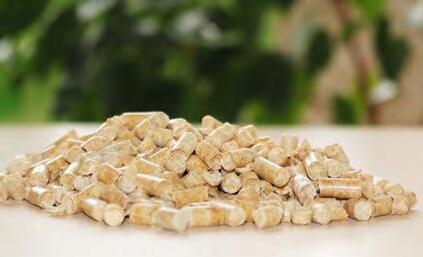
PELLET BOILER RETROFIT GOOD NEWS TRENDS
PRODUCT SHOWCASE IMPROVE P/S PIPING PERFORMANCE
12 COMPARISONS BETWEEN HYDRONIC AND VRF/VRV SYSTEMS
CONTROL LOGIC
HOW TO MATCH GLYCOL LEVELS TO VARIOUS SYSTEMS
DISPELLING RADIANT MYTHS
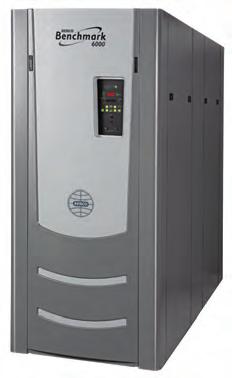
When you need major horsepower in a tight space.
There’s nothing small about its performance...just its dimensions.
AERCO’s Benchmark 6000 boiler packs six million BTU/hr., 94.5% efficiency and unmatched reliability into a compact footprint that’s a third the size of the competition. You can park it anywhere.
Consistently correct
A simple, repeatable approach to retrofitting a pellet boiler.
BY JOHN SIEGENTHALER
MH8 Control logic for fluid temperature control
BY MIKE MILLER
MH14
Removing the mystery
How to match glycol levels to various systems.
BY ROBERT WATERS
MH18
Active floors hit the mark at Winnipeg airport
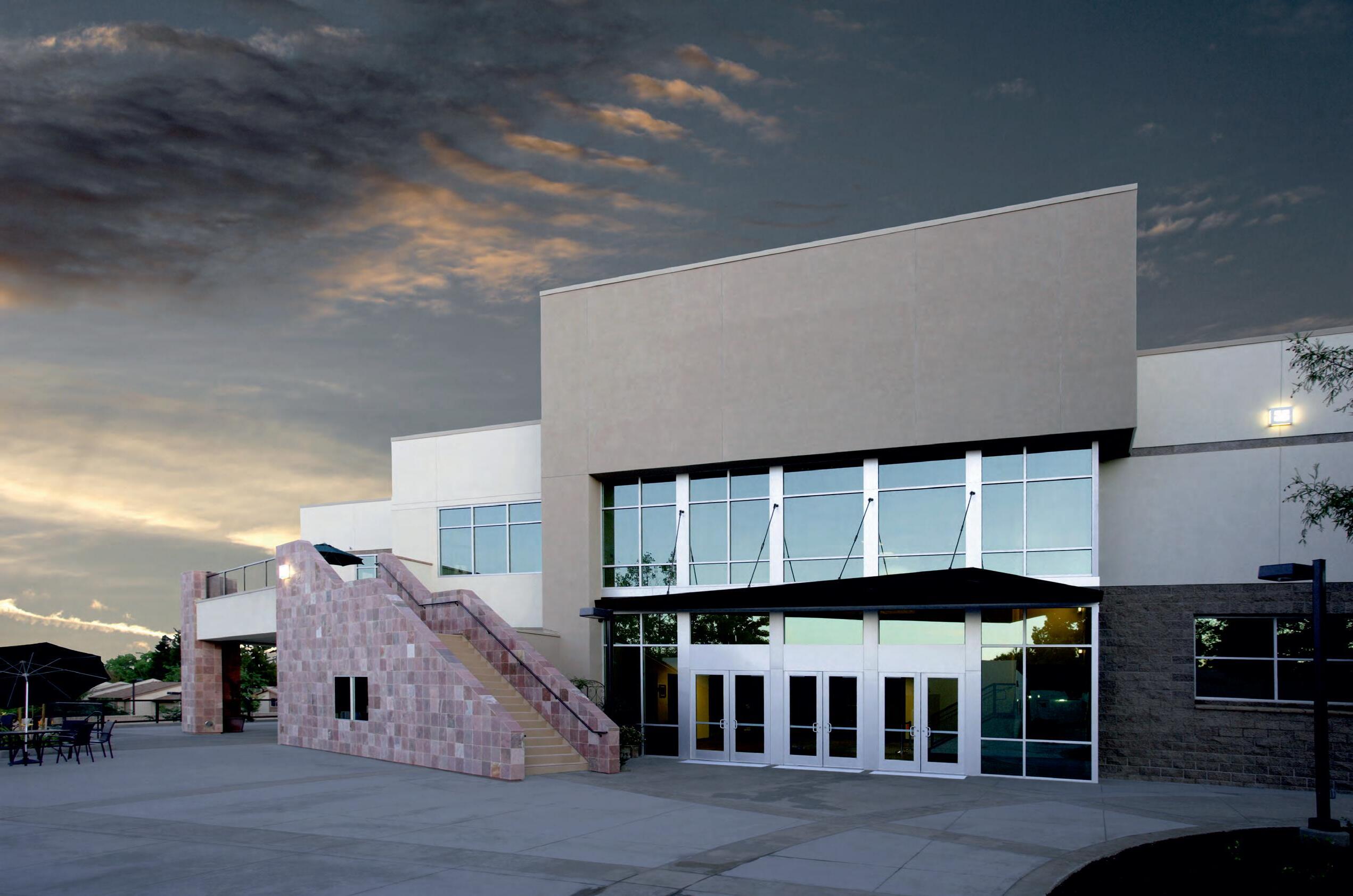
How to heat and cool a very large, nearly all-glass building, while hiding the sources of warmth and cooling.
BY RUSSELL LAVITT
MH22
A look at the big picture
Boiler and system flows may be decoupled, hydraulically speaking, but they should be linked in the mind of designers and installers.
BY ALEXIS CODINA
MH26 Product Showcase
MH34
A look at the bright side
Trends that mean good news for the hydronics industry.
BY STEVE GOLDIE
MH38
The continuum of radiant myths
BY ROBERT BEAN
MH42
Water remains the “Gold Standard”
Twelve comparisons between hydronic and VRF/VRV systems.
BY JOHN SIEGENTHALER
MODERN HYDRONICS
EDITOR ASSISTANT
ASSOCIATE
ACCOUNT
SALES & MARKETING
ART DIRECTOR
ACCOUNT COORDINATOR
CIRCULATION MANAGER PUBLISHER
Kerry Turner (416) 510-5218 KTurner@hpacmag.com
Beth McKay
David Skene (416) 510-6884 DSkene@hpacmag.com
Stephen Kranabetter (416) 510-6791 SKranabetter@hpacmag.com
A simple, repeatable approach to retrofitting a pellet boiler.
BY JOHN SIEGENTHALER
During the last two years I have been reviewing submittals for proposed heating systems using pellet-fired boilers. They come from heating professionals ranging from installers to professional engineers. These submittals are required to participate in a state incentive program that offers significant rebates to encourage growth of the biomass heating market.
My task is to review the proposed systems for technical details, and flag possible issues for clarification or redesign, before thousands of dollars of hardware gets installed incorrectly.
One of the commonalities of these submittals is that many designers view pelletfired boilers as simply a “box” that burns pellets and makes hot water. They want to set that box next to an existing oil-fired or propane-fired boiler, and just cut it into the existing distribution system. They seldom look at that existing distribution system as fertile ground for not only improving the performance of that new pellet-burn-
ing “box,” but also improving the comfort provided by the system.
The following is a discussion about a “make over” of an existing oil-fired hydronic heating system chosen to receive a modern pellet-fired boiler. This makeover shows one way to integrate that new boiler so that its unique operating charac -
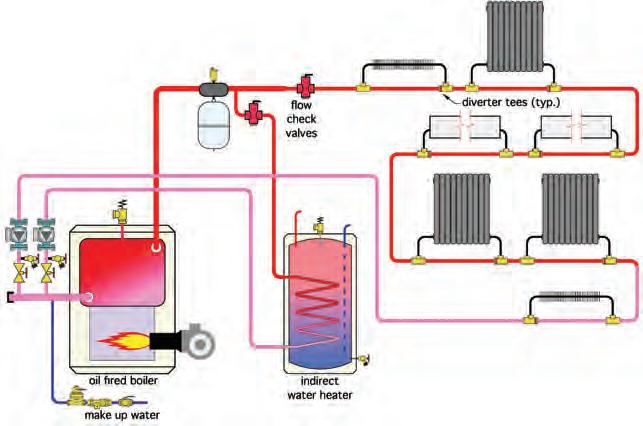
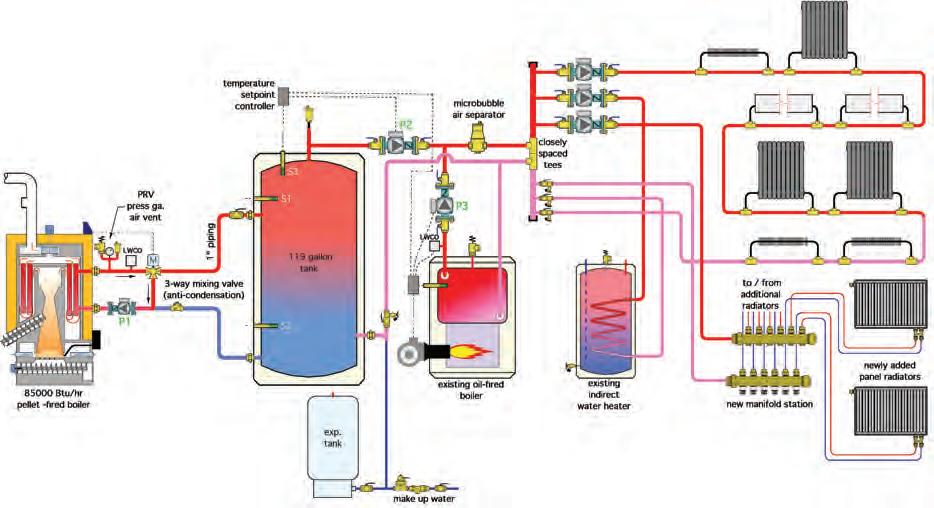
teristics are respected. It also shows how the “comfort challenged” heat delivery system was improved at the same time. This makeover is based on a real installation. It took place in a 1800s vintage farmhouse in a cold upstate New York location. Figure 1 shows a piping schematic of the original system.
Figure 1 Original system
The oil-fired boiler supplies a single distribution circuit that serves a combination of fin-tube baseboard, standing cast-iron radiators, and some cast-iron baseboard. (Yes, someone really put all those different heat emitters together on a single circuit). The heat emitters are connected to the piping circuit using diverter tees.
In an interview prior to the makeover, the homeowner stated that there were several “cold spots” in the house. In some cases cold enough to freeze a glass of water left on the kitchen floor during a cold winter night. Ouch!
GOING UNDER THE KNIFE
The primary goal of the makeover was to reduce heating cost by adding a modern pellet-fired boiler to the system and treating it as the primary heat source. The oil-fired boiler would remain in the system as the “auxiliary” heat source. The intent was to configure the oil-fired boiler to automatically operate if the new pellet-fired boiler was unable to supply the load, or was out of service.
At the time of the makeover, heat supplied from the new pellet-fired boiler would be about half the cost of heat supplied by burning fuel oil. However, those cheaper Btus were not going to allow the marginal hydronic distribution system to improve the home’s comfort. This is where the scope of the makeover changed from simply reducing operating cost to also providing significantly improved comfort.
The rationale behind this makes sense: since the system would be undergoing significant hydronic “surgery” to add the new boiler, why not take opportunity to upgrade the home’s comfort by adding some more heat emitters while the system is on the operating table?
An easy way to do this was to install a manifold station in the basement and use it along with ½" PEX-AL-PEX tubing, to supply panel radiators that would be placed in the areas where comfort was marginal. The panel rads could be different sizes to match the supplemental heating needs and available wall space in the cold areas. The manifold station would include two additional connections, which were to be closed off initially, but easily accessible if the system was ever further expanded.
Beyond improved comfort, the added heat emitters would lower the water temperature at which the distribution system could supply design heating load. A suggested guideline is to add enough heat emitters to reduce the supply water temperature at design load conditions by at least 30F (that is, from 180F on an existing system to 150F on the modified system). This allows the thermal storage tank, which is an integral part of the pellet-fired boiler retrofit, to operate over a wider temperature cycling range. The result is reduced on/off cycling, which yields higher thermal efficiency and lower emissions.
DON’T “SWEAT” EITHER BOILER
Another suggested guideline is to limit the added heat emitters so that the return water temperature to the oil-fired boiler stays above 120F most of the time. This should be sufficient to prevent sustained flue gas condensation within the oil-fired boiler. If the return water temperature was going to be consistently below 120F, as it might be if a large area of radiant panel heating were added to the system, it is prudent to add a thermostatic boiler protection valve as shown in Figure 2. This valve limits flow through the oil-fired boiler, when necessary, to keep it from operating with sustained flue gas condensation. With this valve in place, along with another anti-condensation valve for the pelletfired boiler, the return water temperature from the distribution system can be as low as you want it.
THE MAKEOVER
Figure 3 shows the modified system, which now includes the pellet-fired boiler and thermal storage tank along with some other piping modifications.
This reconfiguration allows either the thermal storage tank, or the existing oil-fired boiler to deliver heated water to the closelyspaced tees that hydraulically separate circulators (P2) and (P3) from the zone circulators. It also allows the oil-fired boiler to be isolated from heated water when it is not being used, which
Figure 2 System with thermostatic boiler protection
LWCO
fired boiler
should be most of the time now that the pellet-fired boiler is installed. This is important because allowing heated water to flow through an unfired boiler just dissipates heat through that boiler’s jacket and up its flue.
The pellet-fired boiler is regulated by its own internal controller, which monitors the temperature of two temperature sensors (S1 and S2) within the thermal storage tank. When the temperature at the upper sensor (S1) drops to some lower setpoint (such as 140F) the pellet boiler fires. It remains in operation until the temperature at the lower sensor (S2) has climbed to some high temperature limit (such as 170F). This stacks the tank full of hot water before the boiler is turned off. The objective is to create long on-cycles followed by long off-cycles, which increases the overall burn cycle efficiency of the boiler and reduces its emissions. The control operation takes place 24/7 whenever the pellet boiler is powered on. It is completely independent of the other system controls.
The controller within the pellet-fired boiler used in this system also operates a motorized three-way mixing valve between the boiler and thermal storage tank. This valve’s purpose is to keep the boiler’s inlet water temperature above the dewpoint of the combustion gases (about 130F) whenever possible, and thus prevent sustained flue gas condensation.
BASIC BRAINS
The control system that manages overall system operation can be simple. Whenever there is a demand for space heating or domestic water heating, power is applied to a temperature setpoint controller, which measures the water temperature in the upper portion of the thermal storage tank at sensor (S3). If that temperature is
at or above some minimum value (such as 140F) circulator (P2) is turned on, and heat is supplied from the tank to the load. If the water temperature in the upper portion of the tank is below this setpoint, circulator (P2) is off and the oil-fired boiler is turned on along with circulator (P3). If the temperature at the top of the thermal storage tank later rises to the minimum setpoint plus a differential of 10F (in this case 140+10=150F), the setpoint controller brings the tank back online as the sole heat source.
The new circulator that supplies the manifold station is wired in parallel with the original zone circulator supplying the space heating distribution system. This ensures adequate flow and head to handle the new panel radiators.
This is a relatively simple makeover scheme that is repeatable on many “typical” existing hydronic heating systems with a convention oil-fired or propane-fired boiler and fin-tube baseboard heat emitters. It allows the pellet-fired boiler to manage itself using its own internal controls, which act independently of the other system controls. It also addresses the need for improved comfort versus just shifting heat production from oil to pellets. The added heat emitters will also put an end to those frozen glasses of water on the kitchen floor.
John Siegenthaler, P.E., is a mechanical engineering graduate of Rensselaer Polytechnic Institute and a licensed professional engineer. He has over 34 years experience in designing modern hydronic heating systems. Siegenthaler’s latest book, Heating with Renewable Energy, was released recently (see www.hydronicpros.com for more information).
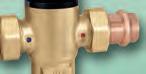
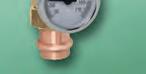
Presscon™ Press Connections
The Presscon™ press connections, with its exclusive LEAK DETECTION feature, will detect leaks during system testing if a press connection is unpressed. Calef was the rst to introduce zone valves with press connections and has expanded press connections to its broad range of hydronic components. Press sizes from ½” to 2” copper are available on several air separators, dirt separators, hydronic separators, magnetic separators, thermostatic mixing valves, balancing valves, press reducing valves and more.
Presscon connections have a temperature range of 0°F - 250°F for up to 50% glycol mixtures and pressure rated to 200 psi. Connections meet low lead law requirements for use in accordance with U.S. and Canadian plumbing and mechanical codes.
Components
Heating & Cooling
CONTROL LOGIC FOR FLUID TEMPERATURE CONTROL
BY MIKE MILLER
We come across so many different types of terminology in our industry that not everyone is fully aware of their meanings. The following is some of the most basic control logic terminology with a short explanation of what each means and how they apply in hydronic system controls.
FLUID TEMPERATURE CONTROL LOGIC
Fluid temperature control is crucial in today’s advanced hydronic heating systems, not only to increase overall system efficiencies, but also to increase the overall comfort level within a system. Fixed water temperature control is still applicable in process applications, however for fluid temperature control provided to a heating terminal unit, it should be a thing of the past.
OUTDOOR RESET
Outdoor reset refers to adjusting the fluid temperature provided to the system based on outdoor temperature change to match the changing building load. In most cases, this is done based on a ratio or heating curve that can be calculated using the design supply water temperature (DST – warmest fluid temperature required at the design day, also known as worst condition), warm weather outdoor temperature (WWODT –or warm weather shut down) and design outdoor temperature (DOT –
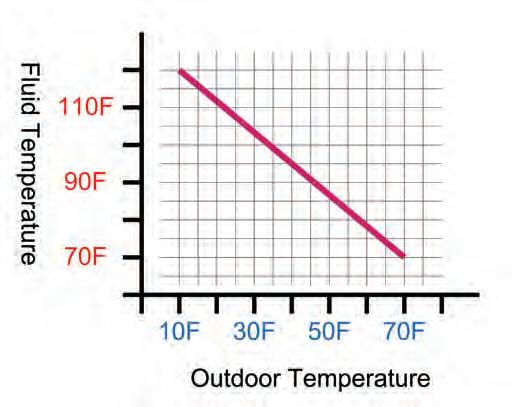
coldest outdoor air temperature). See Figure 1 for an example of a high mass radiant floor heating system. The DST number will vary depending on type of terminal unit chosen to heat the building.
This calculated ratio references the amount of fluid temperature change per 1F outdoor air temperature change.
Using the same example as in Figure 1, should the outdoor air temperature change from DOT to 50F, the desired fluid target temperature would be 86.7F:
((WWODT–Outdoor air temperature) x Reset ratio) + WWODT = target).
On a graphical front, using this same formula, a heating curve can be drawn and this very same example is depicted in Figure 2.
Figure 2 Heating curve for a high mass radiant floor heating system
Figure 1 Calculation for a high mass radiant floor heating system
CONTROLS
OUTDOOR RESET CURVE SHIFT FOR SETBACK AND BOOST
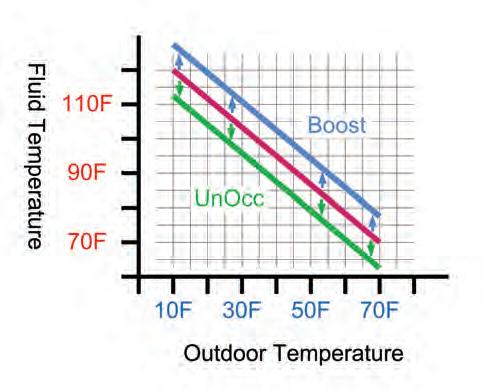
Since outdoor reset is matching the fluid temperature provided to the load of the building based on outdoor air temperature, the same logic can be applied to achieve building temperature setback at night, or other periods where the building is unoccupied, simply by reducing the fluid temperature below what is required during occupancy. Most leading controllers on the market will provide an Unoccupied scheduling feature through integral timers, or the ability to connect external timers. During unoccupied periods, the controllers would parallel shift the heating curve downward thus reducing the supply fluid temperature to the building to achieve building air temperature setback.
Alternatively, this same parallel shift logic is applied when the controller comes out of setback from unoccupied periods to achieve a boost and faster recovery of the building when it resumes normal occupancy conditions by shifting the heating curve above its normal for a period of time that can either be applied through control logic based on outdoor temperature or simply a timed function. See Figure 3 for an example of a parallel shift.
ON/OFF FLUID TEMPERATURE CONTROL WITH FIXED DIFFERENTIAL
With modulating generation equipment (modulating boilers, mixing valves, injection pumps, and so on) On/Off fluid temperature control no longer applies, as shown in the modulating and floating control examples discussed later.
However, on/off generation equipment (on/off boilers, modulating boilers at or below minimum modulation output, heat pumps, on/off injection valves/pumps, and so on) are operated using On/Off control logic to maintain a desired setpoint. In most
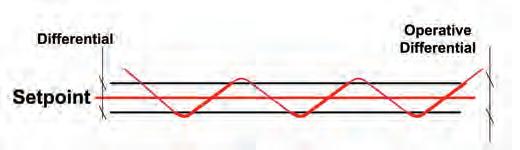
cases, an On/Off Differential is applied that is split half below and half above the target. This differential is in place in order to eliminate short cycling of the equipment. For example, if a setpoint is 120F and the chosen differential is 20F, then the equipment is turned ON at setpoint – ½ diff (10F) and turned OFF at setpoint + ½ diff (10F), effectively cycling the generation equipment between 110F and 130F fluid temperature. See Figure 4 for a graphical example of an on/off differential.
ON/OFF FLUID TEMPERATURE CONTROL WITH AUTOMATICALLY ADJUSTED DIFFERENTIAL
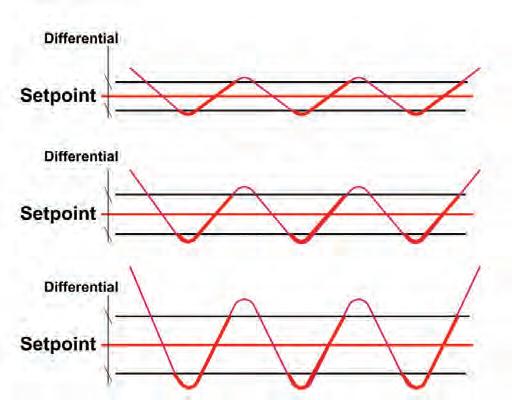
Some of today’s most sophisticated controllers can apply a differential that automatically varies based on the load, using some additional PID logic (further explained below). In order to maximize operating efficiencies, an adequate balance must be maintained between the lowest amount of temperature swings, while minimizing short cycling of the equipment at all times. Typically, when the load is high, a differential can be lower as the generation equipment is more effectively loaded. When the load is low, then the generation equipment has much greater capacity than the building requires and the differential should be larger in order to minimize or eliminate short cycling to extend its life cycle. Common automatically adjustable differentials range between two and 42F. See Figure 5 for graphical auto differential example.
Figure 3 Parallel shift
Figure 5 Auto Differential
Figure 4 On/off differential
CONTROLS
FLOATING ACTION TYPE MIXING OUTPUT
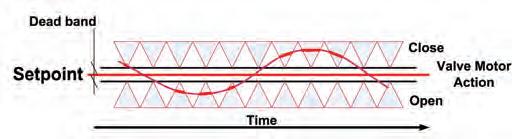
Floating action type mixing refers to a motorized mixing device, often two-, three- or four-way mixing valves where the motor is actuated using most commonly either 24Vac or 120Vac. The voltage is applied for the motor to drive in either the open or the close position. When no voltage is applied to the motor, the valve remains in its current position. Most often, the time component and the dead band, as well as the operating band (not to be confused with On/Off Differential) is calculated using PI logic and the motors actuation speed from fully open to fully closed. Figure 6 shows how the controller pulses the floating action type motor either open or closed depending on where the temperature fluctuates.
When the temperature is within the dead band, the motor remains off, keeping the valve in its current position. If the temperature fluctuates above the setpoint and is within the operating band, then the valve is modulated/pulsed close as shown in this example.
When the temperature fluctuates below the desired setpoint and is within the operating band, then the valve is pulsed open as shown. Should the temperature fluctuate outside of the operating band, the motor will either open or close continuously until the temperature settles again within the band.
Floating action is one of the more cost effective and easier to implement control options available, but it is often also slower responding than a modulating output may be. Most floating action type motors take between 90-120 seconds to go from fully open to fully closed, but in high mass hydronic heating fluid temperature control systems it is sufficient.
MODULATING MIXING OUTPUT
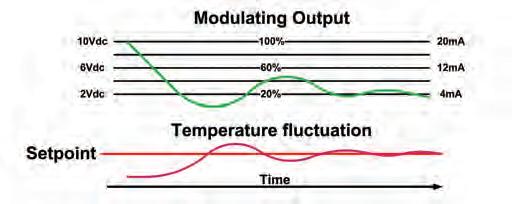
Modulating mixing devices generally have the capability to achieve much more accurate and faster temperature control than that of the floating action type. Modulating is often a requirement for low mass, fast reacting systems or process applications. Modulating devices can also still be two-, three- or four-way mixing valves, or even injection pumps. Modulating devices also include generation equipment, such as modulating boilers. Modulating signals are commonly either a small voltage between 0-10Vdc (2-10Vdc) or small current between 0-20mA (4-20mA) or resistive based between 0-135 Ohm.
Figure 7 shows an example of a modulating output operating on PI logic. When the operating temperature is below setpoint, the modulating output increases. When the operating temperature is above the setpoint, then the modulating output decreases. Modulating type devices require a modulation signal to remain in the desired position. Most often, when no modulation signal is provided to the motor, then the modulating devices output is off.
PID LOGIC
PID is an acronym for proportional, integral and derivative control. In layman’s terms, the proportional stands for an error between actual temperature and desired setpoint. Integral adds the time feedback mechanism of how long the error has been there. The derivative anticipates the error changing over time with compensating action taking place. The control algorithm will process all three (or only PI, depending on control programming) in order to decide whether to increase or decrease the operating outputs in order to eliminate the error.
If you have been working with any kind of microprocessor temperature control system, you have watched and experienced PID logic in action. For modern hydronic heating systems, many controllers in the market operate on PI logic only, because a small degree of error is not crucial to most hydronic heating systems and is much easier to fine tune. PI or PID is applied in any of the above control strategies.
While I have focused on very high level control logic, some additional requirements may be part of your system. These could include minimum and maximum fluid temperature limits to protect system components or pieces of equipment. Any of the strategies mentioned here could be modified to accommodate those cases.
Mike Miller is the director of sales, commercial building services at Taco Canada Limited and past chair and member of the Canadian Hydronics Council. He can be reached at hydronicsmike@ tacocomfort.com.
Figure 6 Floating action type motor
Figure 7 Modulating output operating on PI logic
REMOVING THE MYSTERY
How to match glycol levels to various systems.
BY ROBERT WATERS
Glycol is a mystery fluid to many in the HVAC industry, but it is an essential tool for designing many different types of HVAC systems. In Canada, where glycol is essential to protect HVAC systems from freezing, most contractors have a basic understanding of why glycol is used. However, many may not realize all of the implications and issues that must be considered when the decision is made to use glycol in a system.
Glycol in a hydronic system impacts the way that many circuit components such as pumps, pipes, air eliminators and boilers work. If the wrong choices are made there can be serious consequences to the efficiency, performance and longevity of the system. Glycol must be accounted for early in the system design, as using glycol with its lower heat transfer capability will impact the sizing of many of the system’s components.
Water is a better heat transfer media than glycol–you can see that when you compare the specific heat of the fluids. At 60F/15.5C water has a specific heat of 1.0 Btu/(lb*oF). Compare this to 50 per cent glycol at 0.84 Btu/(lb*oF) and you can see that glycol has 16 per cent less heat carrying capacity. The specific heat also changes with temperature and it only gets worse for glycol at lower temperatures.
Glycol is also thicker and more viscous than water, making it more difficult to push through the pipes. If the system is originally designed for water, and then at the last minute changed over to glycol, you will most likely have problems as the initial sizing of components are no longer sufficient for the glycol system.
Using the correct type and concentra-
tion of glycol is very important, as you only want to use as much as required to do the job. Too much glycol adds expense, impedes heat transfer, and affects pumping capacity. Not enough glycol can lead to damaging and expensive freeze-ups.
The type and concentration of glycol used is dependent on the project location and the type and specific requirements of the system. There are two basic types of glycols used in HVAC systems, propylene glycol and ethylene glycol.
Both of these fluids have similar freeze protection and heat transfer characteristics with the main difference being that propylene glycol has a lower toxicity level. Due to its lower toxicity, propylene glycol is more commonly used in residential and small commercial HVAC systems.
Either type of glycol will always include added corrosion inhibitors to protect pipes and components. There are many different types of inhibitors used that are specific to different applications. Using the correct type of glycol – inhibitor mix is crucial to providing long-term
reliable system operation. Climatic conditions are very different in Toronto and Yellowknife, so the levels of freeze protection required and the resulting concentration of glycol will vary for the same type of system installed in different locations.
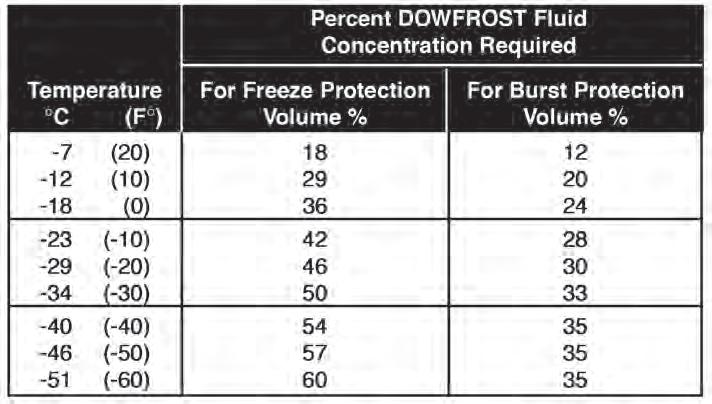
All glycol manufacturers provide charts (see Figure 1), which show the percentage of glycol required to provide a certain level of protection against freezing or burst protection. Typically a 50 per cent concentration of glycol will give you freeze protection down to -30F/-34C. However to provide pipe burst protection to the same temperatures, only 33 per cent glycol is required. Burst protection means that the fluid can no longer be pumped, but it has not expanded to a point where it will burst pipes.
The HVAC applications that most commonly use glycol are snow and ice melting systems, ground source heat pumps, solar water heating systems, chilled water cooling systems, and in the hydronic systems that require pipe burst protection due to their location or activity level. Some
Figure 1
of these applications require high levels of freeze protection, while others only need a lower level of burst protection as a safety measure.
Snowmelt systems by their nature require a high level of freeze protection because all the components are located outside the building envelope and are exposed to the ambient conditions. This means that snowmelt systems require quite high levels of glycol concentration in the range of 50 to 60 per cent.
Solar water heating systems also require a very high level of freeze protection as solar collectors and piping are located outside the building. Typically glycol concentration in the range of 45 to 60 per cent will be required, with most applications in Canada using 50 per cent glycol. Installations in the far north usually need to increase the concentration to account for colder winters.
Solar systems also have the unique characteristic of producing very high fluid temperatures during summer stagnation conditions. This leads to very specialized glycol requirements that use special high temperature corrosion inhibitors to protect the fluid from breaking down rapidly. If the wrong glycol is used in a solar water heating system, the fluid can break down and turn nasty very rapidly. This can result in plugged collectors, blocked pumps, and in extreme situations systems that must be abandoned entirely. There are special glycols made exclusively for solar water heating systems and they are highly recommended for these types of systems.
Ground source heat pumps often use glycol in their earth loops. As these loops are often much deeper in the ground, they are typically not exposed to the same kind of extreme conditions and therefore require a lower concentration of glycol, usually in the range 15 to 25 per cent. Fluid toxicity is certainly an important issue in the ground source industry so therefore propylene glycol is usually essential for these types of applications.
“Too much glycol adds expense, impedes heat transfer, and affects pumping capacity. Not enough glycol can lead to damaging and expensive freeze-ups.”
Many hydronic heating systems, especially those that incorporate radiant floor heating will utilize glycol to provide a level of safety against burst pipes and the resulting damages that can occur to the building and the system. In these applications a lower concentration of glycol in the range of 25 to 30 per cent is usually utilized just to provide peace of mind against bursting pipes during unoccupied periods. Commercial buildings that use radiant floor heating systems and that may be unoccupied for periods of time are certainly candidates for this protection. Pipes that burst in a concrete slab are a serious problem that can result in very expensive and disruptive repairs.
When glycol is used in the system there are certain installation, service and maintenance factors that must be considered to maintain a long reliable lifespan of the fluid and the system components. Here are a few of the things to look out for:
• Boilers that use aluminum heat exchangers have special glycol requirements. Make sure you check with the boiler manufacturer and use the correct fluid for these boilers, or you will be in for big problems down the road.
• Before installation of the glycol into the system, a thorough cleaning of the entire system must be done. If this is not done properly there can be problems with sludge formation or pipe fouling after the glycol is added, leading to a reduced lifespan of the glycol and system. Any residual dirt, debris, flux, or residual pipe oil can interact with the glycol and cause problems. A commercial pipe-cleaning agent should be added to the piping and then thoroughly flushed out with fresh -
water to remove any traces of the cleaning agent. Ideally the system should be blown out with air to remove any residual water prior to adding glycol water mixture.
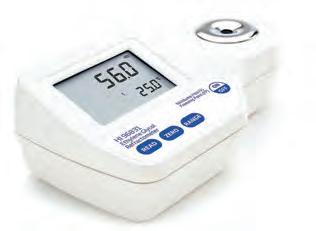
• Many glycol vendors will provide glycol that is already pre-mixed. This is the best way to add glycol as it guarantees the correct glycol concentration, and that the water used in the mixture is free of contaminants. If 100 per cent glycol is purchased then on-site mixing is required, and this can cause issues if not done properly. When mixing glycol on-site with water it is highly recommended that only distilled or deionized water be used. Fresh water directly out of the tap often contains calcium, magnesium, and chlorides and when these come in contact with the glycol inhibitors, they often create problems with sludge and fouling. Finally after mixing, check the concentration with a glycol refractometer to ensure the concentration is correct.
• Once the system is charged with glycol, proper air elimination is critical for glycol systems. Air that becomes trapped in a glycol water mixture is especially hard to separate. Air pockets or frothing can result when the system pump is activated, which often leads to many frustrations during and after the commissioning process. A good quality micro bubble air eliminator is highly recommended for any system containing glycol.
• Different brands or types of glycol should never be mixed, due to the different corrosion inhibitors used by different manufacturers. If topping up an existing system, only use the same
brand that was originally installed.
• When the system is operational, periodic testing of the glycol must be done to ensure that it is still suitable for use and providing the correct level of freeze protection. It is not unusual for something to go wrong in a system such as a
leak or system maintenance, and the system ends up getting topped up with freshwater. This will resulting in a diluted glycol concentration and a lack of freeze protection. Burst pipes or frozen solar collectors can often be the result of this problem. Typically an annual check-up will include verification of the glycol concentration with a refractometer, and a check of the glycol PH level using litmus test strips. Glycol that has gone bad typically will have a low PH level, which if left unchecked, will start to corrode the metal components in the system. Usually when the PH level is too low the glycol must be drained, the system flushed and recharged with new glycol.
• Ultimately glycol must be disposed of when its life in the HVAC system is over. There are chemical supply companies that offer glycol disposal services, and this may be required depending on the type and quantity of glycol being used, and the regulations in your local area. Just pouring it down the drain may not be acceptable, and could land you in hot water with the environmental regulators in your area. Using glycol is an essential part of installing HVAC systems in Canada and if installed and maintained correctly will provide years of trouble free service. Be aware of all the issues and rely upon glycol professionals if you need to learn more about using glycol. Do not let glycol be a mystery fluid in any of your HVAC installations.
Robert Waters is president of Solar Water Services Inc., which provides training, education and support services to the hydronic industry. He is a mechanical engineering technologist graduate of Humber College and has over 30 years experience in the hydronic and solar water heating industry.
Photo: Hanna Instruments
Core of Engineers
More than just a sleek new firetube design.
The innovative design of FlexCore stainless steel, symmetrical firetube boilers is making all others obsolete. Developed exclusively by the experts at RBI, its unique heat exchanger design not only maximizes efficiency but also eliminates the longterm stressors associated with thermal expansion. rbiwaterheaters.com
• 1500 - 6000 MBH
• Stainless Steel Firetube HX
• Patented Turbo Pilot Ignition System
• Variable Volume Flow
• Full Modulation
• HeatNet 3.0 Digital Control Platform
• HeatNet Online Remote Monitoring
• Touchscreen Programming & Diagnostics FLEXCORE
Active floors hit the mark at Winnipeg airport
BY RUSSELL LAVITT
As a significant public building, the Winnipeg James Armstrong Richardson International Airport has large expanses of heated and cooled floors as part of its LEED Silver Certified approach to heating and cooling system efficiency. From the onset of the project, the vision for the terminal building was of a clean, modern architecture incorporating thematic aspects of the Manitoba prairie.
Of importance was a strong directive to minimize–if not make invisible–all of the normally-seen mechanical systems and to keep the building as transparent as possible. Tall spans of exterior curtain wall were designed to merge with the ceiling and disappear into the floor without visual clutter. The challenge placed before the mechanical design team was how to heat and cool a very large, nearly all-glass building, while hiding the sources of warmth and cooling.
An in-floor heating and cooling system became the obvious solution, but presented a significant technical challenge. Of primary importance was a discussion with the architectural designers on the quality of the curtain walls.
Triple pane window units were considered at first, but upon further investigation, it was concluded that comparable thermal performance of the glazing system could be achieved with dual pane units and a higher quality curtain wall system. Once the thermal performance was established, heat loss and gain calculations were performed to establish heating and cooling requirements for the spaces. As expected due to the large expanses of glass, it was verified that the heating requirements would be significant and that a heated floor system would require some substantial output. It was also verified that the summertime solar loads would also be considerable and would push the project towards a large cooling component.
The designers then realized that a large floor surface area with the capability of heating or cooling the areas in question could be a major benefit to the project. Radiant floor systems use relatively low temperature heat sources, typically limited to 140F/60C due to the potential of concrete failure when exposed to higher temperatures on a continual basis. This results in a large area of floor being required to generate sufficient
How to heat and cool a very large, nearly all-glass building, while hiding the sources of warmth and cooling.
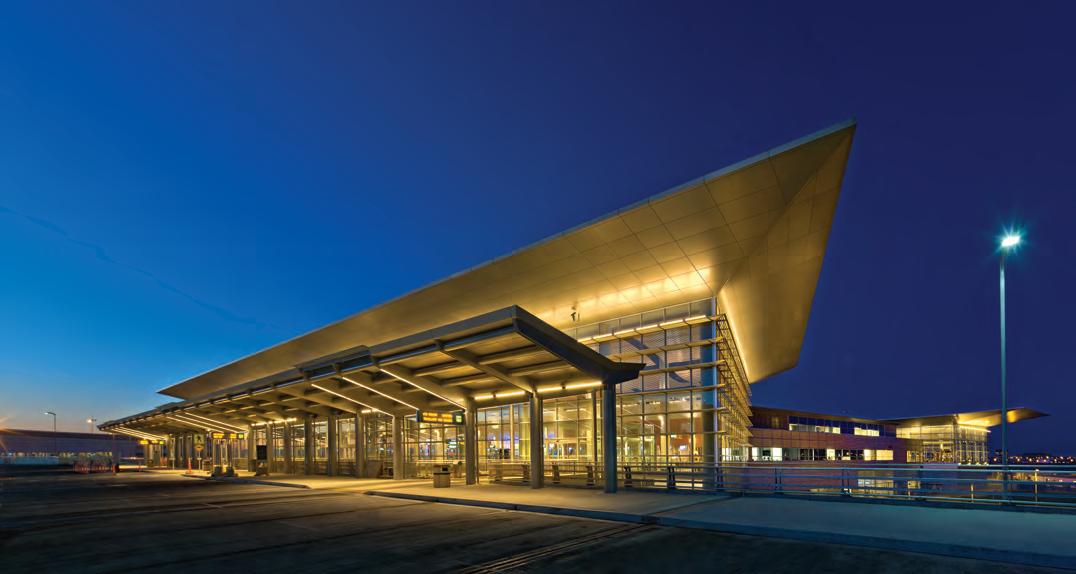
Winnipeg James Armstrong Richardson International Airport is the first terminal in Canada to receive any type of LEED certification and one of a very few (20+) to receive the same worldwide.
heat to effectively temper a space.
In the summer, when the sun’s rays impact the interior of the building, this same large floor area can be used to absorb the solar gain directly by circulating cold water through the same pipe that carried warm water during the winter. The solar gain can be captured directly rather than allowing it to heat the ambient air in the space, where the only effective means of then cooling the air is with cold water coils at the air handlers. The result: smaller heating and cooling air handling equipment as a result of the use of active floors.
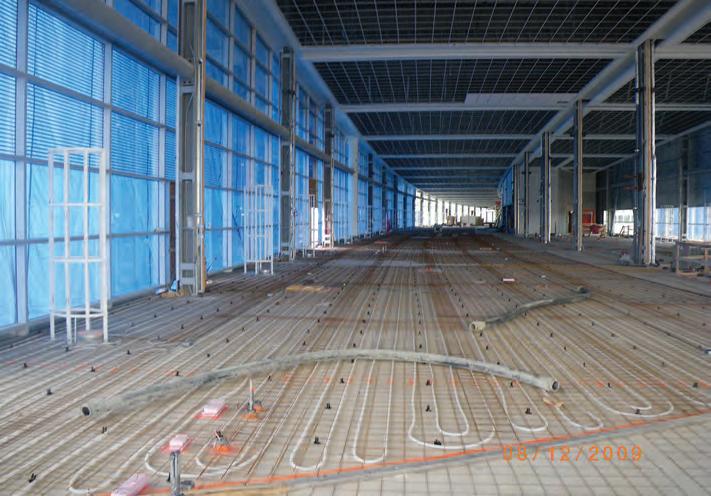
To proceed on the design of the radiant floor systems, the team first determined the optimal placement of the heated floor areas. As infrared radiation from the floor in heating mode needs to “see” an adjacent surface to generate heat, the heated floor area needs to be within a reasonable distance of the curtain wall. For the Winnipeg airport, the optimal heated floor zone placement was within a 25-foot (7.6-metre) deep band
from the foot of the curtain wall. This placement allowed the radiant floor to “see” the entire lower pane of the curtain wall and removed the need for perimeter radiators at the base of the windows.
The designers then analyzed the placement of the floor areas in cooling
mode. To accomplish this, solar angles were reviewed through all 8760 hours of the year to determine where sunlight would fall on the floors. From this exercise, optimal floor zones for solar load capture were determined and then compared with the optimal heating zones. The final active floor zones (combined seasonal heating and cooling) were determined through an optimization exercise where areas and placement were considered to determine the best active zone for both purposes. As the architectural and interior design process continued, it was decided that floor finishes would include tiles and carpeting. Some in-depth research into the thermal properties of the floor finishes was required as any material beyond the base concrete floor introduces an insulating factor to the effective transfer of energy from the floor in heating mode or into the floor for cooling. To overcome this effect, the floors would require more
Heating Winnipeg James Armstrong Richardson International Airport (YWG)
The LEED Silver Winnipeg
James Armstrong Richardson International Airport is heated using high efficiency natural gas-fired hot water boilers. High temperature water (180/82C) is pumped from the Central Utilities Building (CUB) via a 3200-foot (one km) long utility tunnel to the terminal building where it is used in a thermal cascade configuration. The high temperature water feeds high output heating elements such as entry heaters, unit heaters, or baseboards in back-of-house areas. Water typically leaves these elements at 150F (66C)
and is routed next to the air handling unit heating coils. Once used to heat outside air, this water is mixed down to typically 120F (49C) and routed to the active floor system when in heating mode. This water returns to the CUB at 100F (38C) and is used to condense water vapour in the boiler flue gases, increasing overall plant efficiency to 97 per cent The active floors are also coupled to a 90F (32C) heat pump condenser water loop which allows the active floors to operate on heat reclaimed from electrical rooms, tenants, and data centres when conditions warrant.
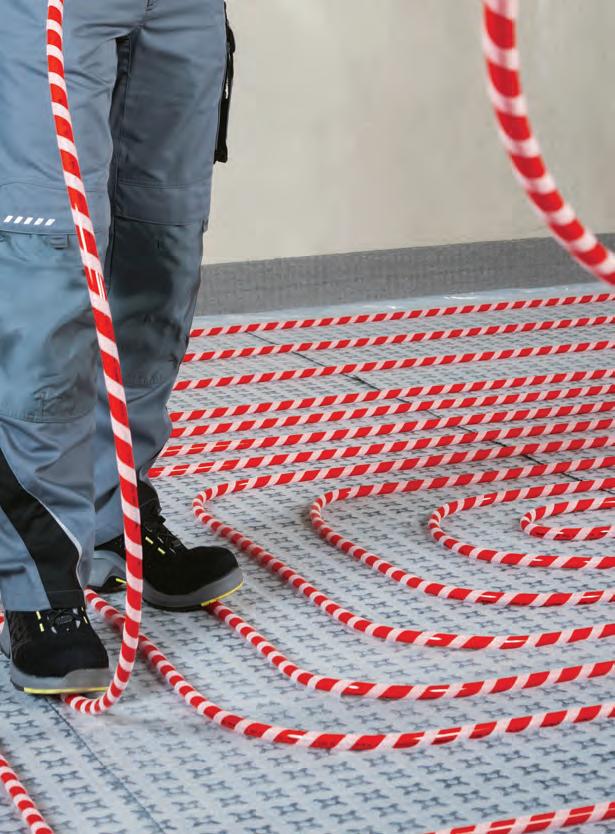
The optimal heated floor zone placement was within a 25-foot deep band from the foot of the curtain wall. During and after construction shown here.
The Winnipeg Richardson International Airport Terminal Building achieved LEED Silver in early 2015. The building was designed as a series of transparent luminous pavilions to take advantage of Manitoba¹s prairie landscape and sky.
power to push or pull energy through the floor covers. Through thermal analysis, it was calculated that on the coldest of days the floors could be operated at 120F (50C) without negatively impacting the occupied spaces. In areas with less insulating flooring material the floors would be operated at 100F (38C). In cooling mode, chilled water as cold as 44F (7C) was available from the central chiller plant and would be adequate for the cooling task. In both cases, sufficient power (through temperature and flow rate optimization) was provided by design to make the active floor systems viable for the project.
Control of the floors is by means of a series of three temperature sensors embedded into the heated floor zone. The quantity of sensors was increased to provide redundancy and sufficient distribution of data gathering to ensure accurate measurement and control of the floor slab temperature. In the cooling mode, a local humidity sensor additionally measures relative humidity in the space containing the floor and the control sequence calculates the dew point. The floor slab is then maintained at a temperature above dewpoint to prevent condensation on the floors, which could cause slip hazards or damage the carpets.
The result of the implementation of active floors at the Winnipeg Airport is an evenly warm and comfortable space in the wintertime. The occupied space is kept at a space temperature slightly lower than typical buildings due to the radiant effect of the floor directly warming occupants, while the ambient air temperature can be lower. In the summertime, the solar
capture effect efficiently stops solar gains wherever the sun strikes the active floor. There is a noticeable absence of ‘sun heat’ in spaces that are brilliantly lit by the sun’s rays.
In operation, the impact of the active floors has been impressive. The active floors were put into full automatic operation a few months after the airport opened for business. During the period where the active floors were not operating, central plant load was near full capacity. As the floors were commissioned and brought into operation, plant load dropped off as the air systems were not being relied upon as the main heating and cooling systems.
Of particular effect was before and after scenarios in the passenger inspection line area (security checkpoint) where hundreds of people wait in a fully glazed area with a low ceiling. Solar gains and people loads rapidly cause the ambient temperature to rise to a point where the air handlers could not keep up. Once the active floor was in full operation, the active floor dropped ventilation cooling loads and the associated high air flows substantially. Overall, the central plant operators have noted that chiller load dropped off 25 per cent once the cooled floors were fully operational.
Russell Lavitt, P.Eng., is with Stantec Consulting Ltd. He was the mechanical engineer-of-record on the Winnipeg James Armstrong Richardson International Airport–Terminal Building project.
BIG PICTURE A LOOK AT THE
Boiler and system flows may be decoupled, hydraulically speaking, but they should be linked in the minds of designers and installers.
BY ALEXIS CODINA
Akey decision to make when designing a hydronic system concerns the piping method to connect the terminals and the heat source. Single-loop piping is often the most economical and simple to implement but primary secondary (P/S) piping offers flexibility in multi-zone and multi-boiler applications.
This article looks at different scenarios that occur during the operation of a P/S system that a hydronic designer should take into account when applying this piping configuration. Ways of improving the performance of P/S piping applications by adjusting the flow balance between both loops, will also be discussed.
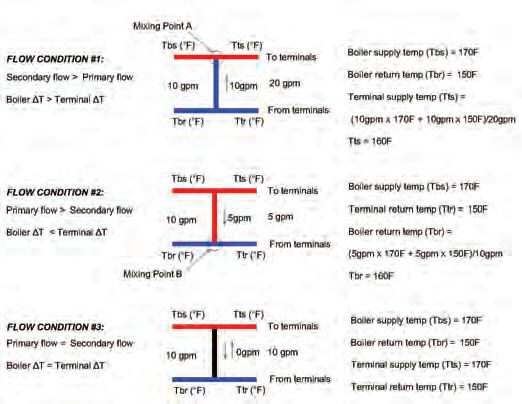
Figure 1 summarizes the three main flow conditions that occur in P/S systems.
The following scenarios show the impact of flow condition #1 and #2 in two real-life boiler retrofit projects.
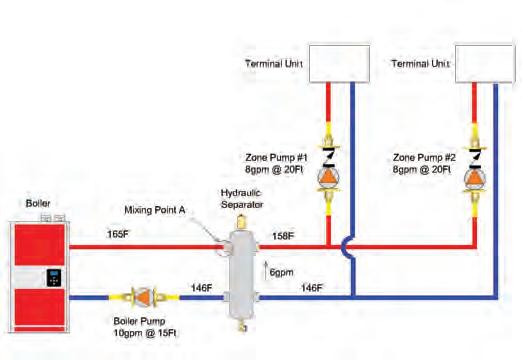
Figure 2 shows a P/S system where a new 100000 Btuh mod-
con boiler was recently installed. Hot water supply temperature with the previous boiler was 163F. The new boiler’s maximum supply hot water temperature is 165F. The new boiler pump was selected for a design water temperature differential of 20F.
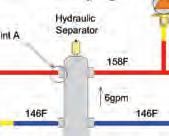
The total secondary flow at peak heating load is 16gpm, or 60 per cent higher than the primary flow. As a result, supply water temperature to the terminals is reduced to 158F ((10 gpm x 165F + 6 gpm x 146F)/16 gpm) downstream of mixing point A.
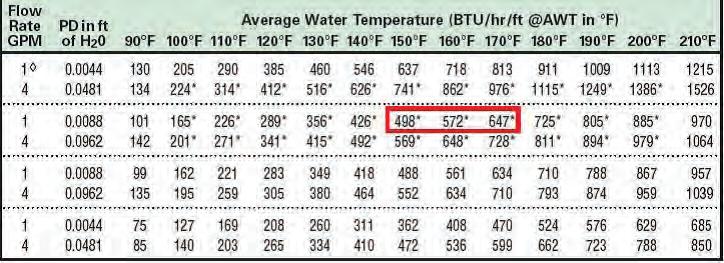
Although it could be argued that the terminals only need 163F degree water during the coldest time of the year, assuming an outdoor reset schedule is followed, the reality is that the new boiler will not meet the building’s peak heating load. By interpolating data from Figure 3, one realizes that heat output drops approximately six per cent when supply water temperature reduces from 163F to 158F. Unless six per cent or higher spare capacity was allowed during the selection of the terminals, this scenario may result in complaints from the client resulting in unplanned and costly system modifications.
In this case, boiler selection did not take into account the characteristics of the existing terminals, or the P/S flow balance at peak load. Note also that the situation could have been worse
Figure 1 Flow conditions in P/S piping
Figure 2 Hydronic system with mod-con boiler with an external boiler pump
Amazing performance in the corners and perfect on the straightaways.
HeatLink PEX-a tubing is engineered to perform. Our PEX-a tubing is manufactured using the one step crosslinking extrusion process, creating a superior and more uniform molecular structure, which means increased strength, flexibility and thermal memory. Amazingly, a section of ½” tubing can be bent into a 3” radius without affecting tubing integrity. So you can count on great performance in the corners.
HeatLink PEX-a is highly crush and abrasion resistant and perfect for projects where it’s buried in earth or covered in concrete. It’s built to take the heat, the cold, and the pressure–above and beyond industry specifications–to last a lifetime. UV stabilized to withstand up to 12 months exposure to sunlight, it’s the reliable tubing choice for your next potable water or radiant heating or cooling project.
HeatLink PEX-a tubing is lightweight, durable and requires fewer fittings–so it’s really quick and easy to install on the straightaways too.
HeatLink PEX-a is certified to meet or exceed industry performance standards and approved for installation across North America. Install our PEX-a tubing with confidence–we cover every inch of it with a worry free 25 year warranty.
We’ve been proudly making HeatLink PEX-a tubing right here in North America since 1998.
if a lower primary flow had been chosen to reduce boiler installation costs by using a smaller pipe size on the primary loop. Boiler flow values for delta T values higher than 20F are common data in European boiler catalogs, which are often misunderstood and misapplied in the North American market.
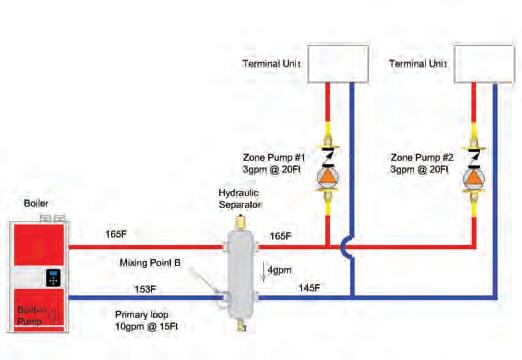
Figure 4 shows a new mod-con boiler, with a built-in circulator, connected to an existing distribution system similar to the one in the previous scenario. This time the exiting terminals need 165F water from the heat source.
Unlike the previous scenario, here, the terminals receive the hottest water available in the system due to a four gpm primary flow excess. However, the primary flow excess is reducing the delta T in the primary loop to 12F, which represents 60 per cent of the secondary loop design delta T of 20F. Note also that boiler delta T would reduce even further to 6F, if only one zone called for heating. As it is known, reduced boiler delta T means less chance of condensing operation and wasted pumping power.
BUILT-IN BOILER CIRCULATORS
With an increasing number of mod-con boiler manufacturers offering built-in circulators, knowing the options available to adjust the boiler flow becomes a valuable tool to fine-tune hydronic systems. Built-in boiler pumps do simplify boiler installations. However, to assume that the manufacturer has already taken
care of boiler flow, and that there is nothing else to adjust on the primary loop, would simply be giving away the opportunity to look at the big picture.
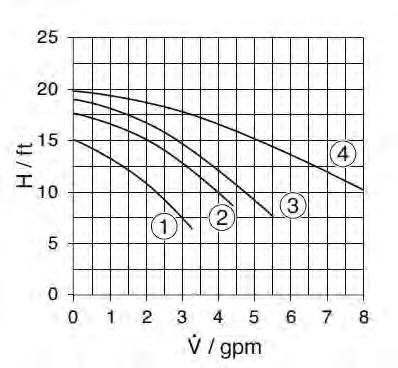
Although not often explored, most mod-com boilers allow adjusting the speed of the built-in boiler pump either manually at the pump, or through programming. The latter allows for infinite speed selection, while the former consists of fixed speed options chosen from a dial or selector at the pump. Figure 5 shows pump curves for a mod-con boiler that provides four manual boiler pump speed settings.
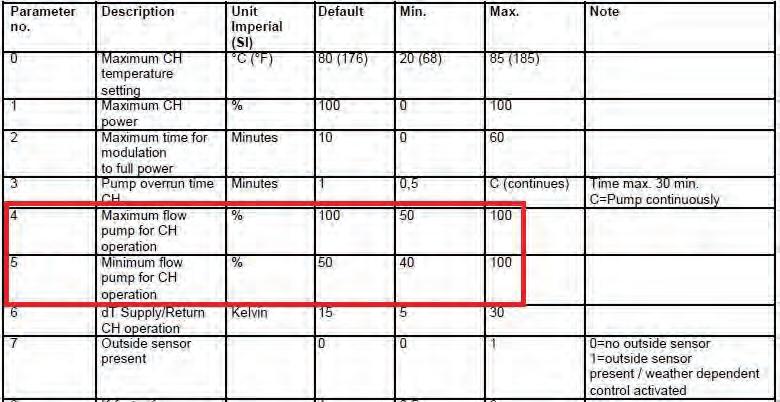
Figure 6 shows the parameter list for a mod-con boiler with configurable maximum and minimum boiler pump speeds. Note that if maximum boiler pump speed is limited to 60 per cent for the system in Figure 4, both boiler and system delta T will be the same at peak load, as depicted in flow condition #3 in Figure 1
Note also, that as the boiler pump is also variable speed, it could ramp down to 40 per cent to maintain a selected delta T
Figure 4 Hydronic system with mod-con boiler with built-in pump
Figure 6 Parameter list for a mod-con boiler with a built-in boiler pump
Figure 3 Terminal capacity table
on the primary side at part load operation under a reset schedule.
This variable boiler pump speed strategy could extend boiler condensing operation at part load conditions. Another added benefit would be additional pump power savings at reduced speed operation.
DO NOT TAKE P/S FLOWS FOR GRANTED
Very often, the components in a hydronic system have, at least on paper, the potential to operate effectively and efficiently when combined, i.e. meeting the heat load while achieving a high system delta T at a relatively low supply temperature. However, very often this potential vanishes right after the water goes through the first T of the P/S set up.
Taking advantage of reduced boiler flows at peak load to save on near-boiler hardware is a popular strategy, but designers should be mindful of the impact of this strategy on the secondary loop, especially the mixed supply water temperature to the terminals.
As rare as it may be, the flow condition #3 in Figure 1 represents the most efficient and effective way of running a P/S sys -
tem as the system delta T is maximized and the pumping power is lowest. Therefore, do not miss the opportunity to adjust the boiler flow within the allowable limits or take advantage of builtin variable boiler flow features to suit your design. Do not consider boiler flow set in stone only because the boiler literature seems to suggest that is the case.
Finally, boiler and system flows may be decoupled, hydraulically speaking, but they should be linked in the minds of designers and installers, to be able to look at the big picture, which is overall hydronic system performance.
Alex Codina, P.Eng. LEED AP, is the heating sales engineer with The Master Group in Ottawa. Codina has 15 years experience in hydronic system design. He can be reached at acgarcia@master.ca.
PRODUCTS
Thermo 2000 offers the Combomax and Buffmax Ultra. The 50 and 70 Combomax Ultra combined electric boiler and instantaneous water heater models offer performance levels from 4.5 kW to 29 kW for both residential construction and condominiums. Buffmax is a three-in-one buffer tank that also serves as a storage tank. Because of its design and configuration. It acts as a hydraulic separator for any hydronic application. It is available in seven sizes from 30 to 200 U.S. gallons. www.thermo2000.com
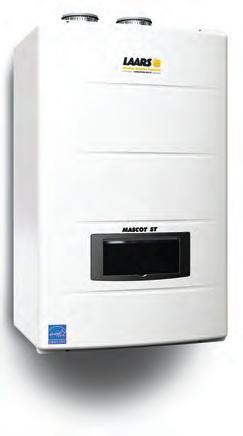
The Mascot ST condensing tankless water heater from Laars Heating Systems Company features a 0.96 Energy Factor (EF) efficient stainless steel heat exchanger, a full 10:1 modulation and is available in a 199 MBH size. It has a self-cleaning design that allows condensate to flow down along the tube walls and out through a condensate collection system. It has an advanced control system, a primeless condensate trap, zero clearance installation and vents up to 100 feet in PVC, CPV and polypropylene. www.laars.com
Models TC600 and TC1450 condensing hot water boilers from Parker Boiler are made of 316 stainless steel. The boilers have a pressure to 80 psi and operating temperatures of up to 210F. The boilers feature a thermal efficiency of 98 per cent, and can use natural or propane gas, biogas and #2 oil. They are available in LOW NOx and combination fuels www.parkerboiler.com
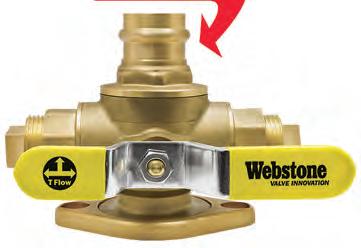
The Isolator with round flange from Webstone Valve features a round shape and bolt pattern designed to accommodate high efficiency variable speed pumps. Three flange designs with FIP, SWT or PRESS connections in sizes 1 ½ and two inches are available. All valves feature uni-body design, which helps to avoid a leak path at the flange. www.webstone.com
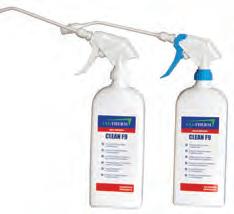
AXI-Therm Clean F9A and F9B boiler combustion side cleaner from Toptherm is designed for use on condensing boilers. The F9A removes combustion residue from the fire side of heat exchangers in stainless steel or aluminum condensing boilers, while the F9B cleaner and passivant is for the fire side of heat aluminum exchangers. Each bottle comes with an extended spray nozzle. www.toptherm.it
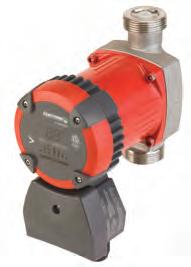
The stainless steel Compass wet rotor circulator from Armstrong Fluid Technology offers a high flow capacity and eight optional control modes. The SSU model features a threaded union connection that can adapt to copper, PEX and CPVC plumbing. www.armstrongfluidtechnology.com
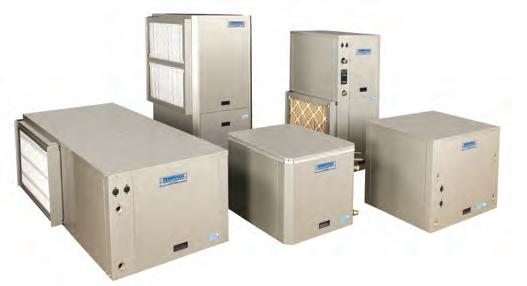
Tempstar has introduced a geothermal product line. The units provide even temperatures and humidity control. Several packages are available including split and water-to-water geothermal models with a variety of options. Capacities range from 1 ½ to six tons. www.tempstar.com
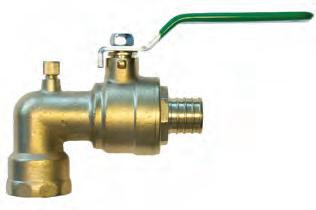
Eastern Foundry and Fittings Inc. has introduced a new line of angled ball valves designed for use with water meters, commercial water heaters and boilers, fan coils and radiant baseboard systems. The valves feature reduced leak points and extra fittings. www.eff-fitting.com
PRODUCTS
The Hydra Industrial hydronic furnace from Dettson is available in three phases. It offers modulation through durability contactors, is lightweight, and is available in 208 V, 240 V, 480 V and 600 V. www.dettson.com
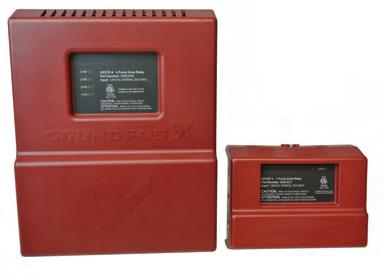
The expandable Grundfos UPZC series of zone controls manage circulator and boiler control in residential hydronic heating systems. The non-networked devices control up to six heating zones and can be coupled together in various configurations. Boiler pumps, domestic hot water pumps, system pumps and pump priority are all controlled from the UPZC control. The zone relay control connects to standard thermostats using either two or three wires. The optional third wire provides 24VAC to thermostats that require external power. The UPZC operates in a cold start configuration with a call-for-heat from a thermostat. www.grundfos.com
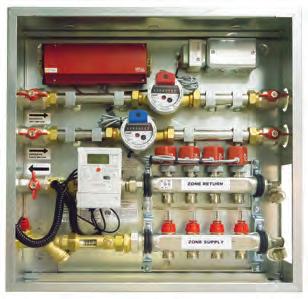
The HeatLink Btu metering panel allows developers to install hot and cold water (DHW and DCW) meters, and thermal meters for each building unit. Each unit can then be charged according to its actual water and energy usage. Each panel includes a recessed housing with coin/ screwdriver locks, stainless steel manifolds in two, three and four loop configurations with a 1.5 U.S. gpm circuit flow rate and flow meters. It also includes a prewired 24Vac transformer and StatLink Base Module. www.heatlink.com
The universal B-Vent cap from Centrotherm Eco Systems allows for multiple flue configurations. It uses existing BVent as a chase, and features quick installation. www.centrotherm.us.com
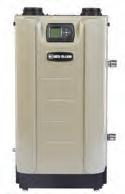
Weil-McLain Canada’s Evergreen high-efficiency boiler, delivers up to 96.5 per cent AFUE and is suited to larger residential and light commercial applications. It is available in 220, 299 and 399 MBH sizes. It is floor or wall mountable and features a stainless steel fire tube heat exchanger. www.weil-mclain.ca
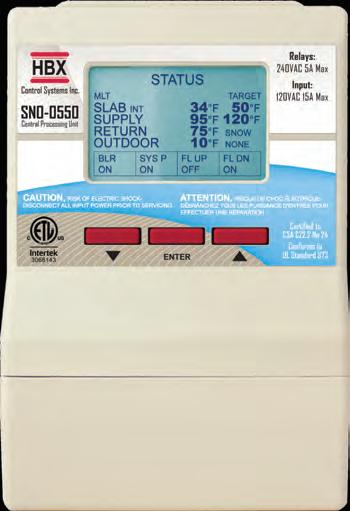
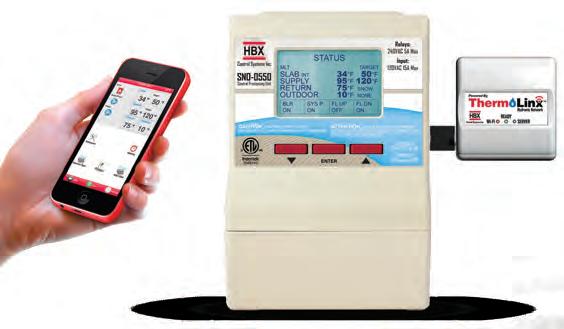
The SNO-0050 snow melting control from HBX Control Systems is the latest product in the ThermoLinx Hydronic Network. By attaching the TMX-0100 (ThermoLink Wi-Fi module) to the SNO-0550 users can control snow melt systems. It features pre-set snow condition settings from very light to heavy. The HBX Zone App is suited to Android and Apple devices and allows users to turn off the snow melt system from any location. www.hbxcontrols.com
NO OTHER CONDENSING BOILER SCORES HIGHER THAN FTXL™ . In the light-commercial class, Lochinvar Fire-Tube and SMART SYSTEM technology make the FTXL boiler your best choice for efficiency, performance, flexibility and ease of installation.
PRODUCTS
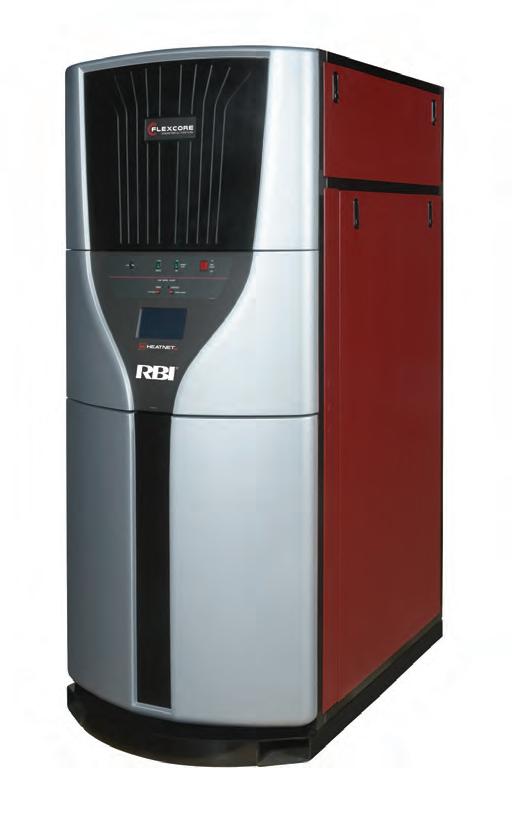
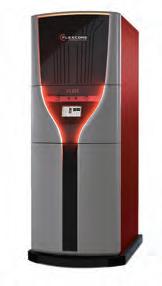
RBI Flexcore symmetrical firetube boilers feature a conical shaped tube sheet coupled with rounded rectangular fire tubes that allow for even heat transfer. The boilers are available in four sizes ranging from 1500 to 6000 MBH, and have a 5:1 combustion turndown.
www.rbiwaterheaters.com
The Runtal Flow Form offers an industrial design in a modern radiator. It is available in numerous finishes in both hydronic and steam heat models. The radiator is suited for use in lofts, studios and galleries. www.runtalnorthamerica.com
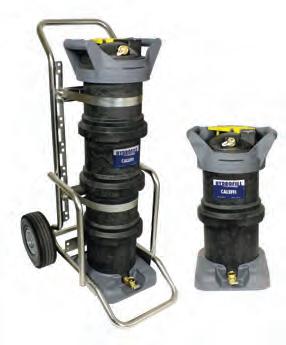
Hydrofill from Caleffi Hydronic
Solutions is a portable water treatment filling unit that produces demineralized water from site sourced water. It is suited for use in closed loop hydronic heating and cooling systems. The removal of salts and other soluble minerals helps to prevent premature equipment malfunction. www.caleffi.com
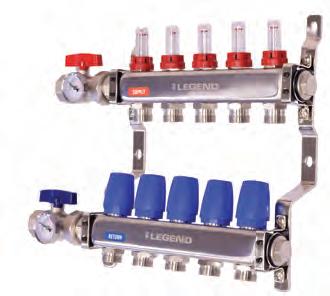
Legend’s M-8330 stainless steel manifold is designed for use in hydronic heating and cooling systems. It features built-in flow meters and the return header has easy to actuate circuit isolation valves. All assembled parts have EPDM O-rings and seals. www.ontor.com
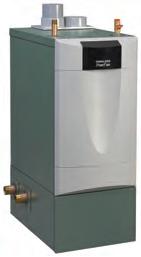
The Peerless PureFire natural or LP gas-fired condensing boiler from PB Heat, is suited to residential and commercial applications and is available for either natural or LP gas. The direct vent, sealed combustion residential models feature efficiencies of up to 95 per cent and are ENERGY STAR approved. www.peerlessboilers.com
Uponor North America has launched the touchscreen radiant thermostat. The Heat-only thermostat with touchscreen is designed for precise temperature control of residential hydronic radiant heating systems. It can operate the system based upon the air sensor measuring operative temperature, a floor sensor (purchased separately), or a combination of both.
www.uponor.ca
Hydronic System Design Expert Instructor: John Siegenthaler • Online: October 3 - December 11, 2016
MASTERING HYDRONIC SYSTEM DESIGN
Learn how to design state-of-the-art systems for residential and light commercial buildings that deliver unsurpassed comfort, efficiency and reliability. During Mastering Hydronic System Design, John Siegenthaler provides a detailed discussion of the design elements underlying modern hydronic heating systems. It presents both design concepts and design tools for optimizing hydronic heating systems in a variety of contemporary applications.
For more information and to register visit www.hpacmag.com/siggy
by
S T RIK ING PERFORMANCE
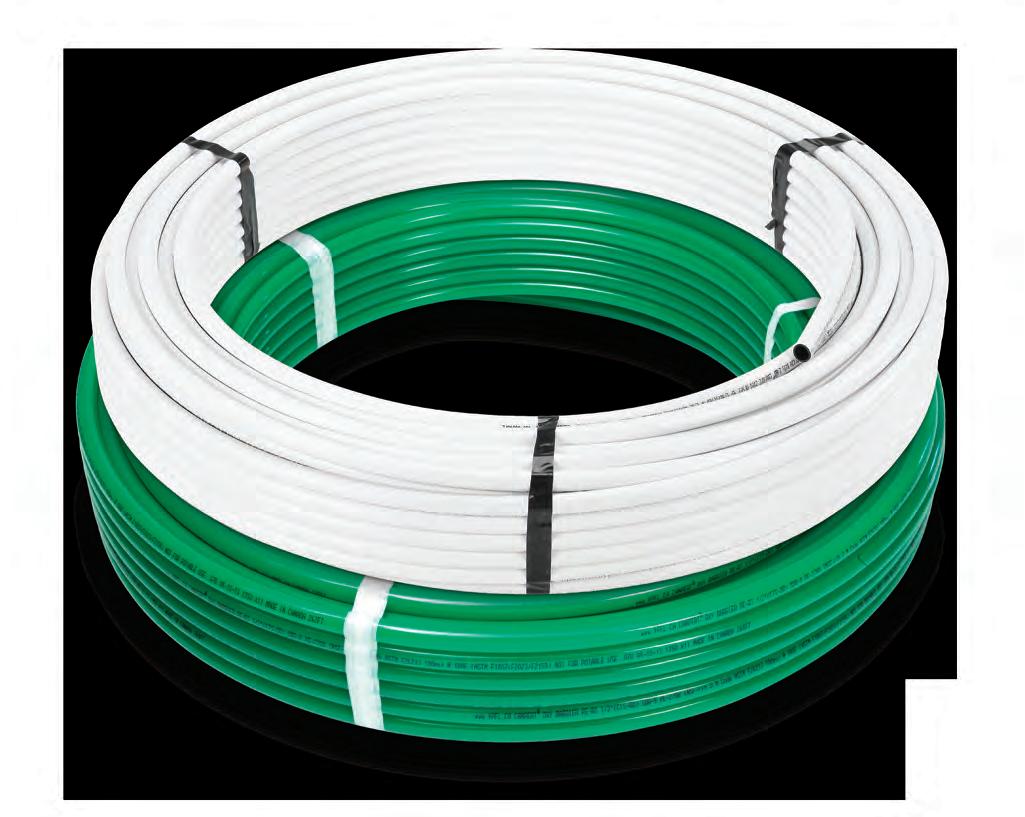
CB Supplies is proud to announce the launch of Vipert Potable & Radiant PERT Tubing, designed to perform as well or better than any other flexible plastic tubing in the market today.
IMPROVED FLEXIBILITY FOR EASIER INSTALLATION
With relaxed memory you’ll experience less spring back than PEX for easier installation
RECYCLABLE
VIPERT is recyclable and requires less energy to be produced than PEX
STRENGTH & DURABILITY
Excellent hydrostatic strength at high temperatures and very high burst pressures
BUILT FOR EXTREME TEMPERATURES
Maintains excellent flexibility in extreme cold and hot environments
25-YEAR WARRANTY
CB Supplies stands behind VIPERT with a 25-year warranty
EASY LINE IDENTIFICATION BY COLOUR
Eliminate hot and cold water cross connections
Potable: Radiant:
Manufactured by:
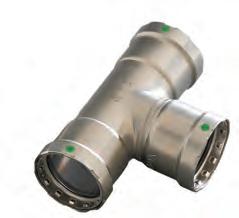
Viega’s eight new reducing tee configurations for the Viega MegaPress and MegaPressG system for joining schedule five to schedule 40 black iron pipe are available in ½ inch to two inch sizes. The products use modern cold press connection pipe installation and are suited to hydronic heat, chilled water, compressed air, fire sprinkler systems, low pressure steam and vacuum lines. www.viega.us
The Versatec Ultra single hydronic heat pump from WaterFurnace International Inc. has an energy efficiency ratio (EER) of 14.0 to 17.5 and a coefficient of performance (COP) of 2.9 to 3.1. It combines scroll compressors, R-410A refrigerant and oversized heat exchangers and is suited to commercial applications. It features a reversible control box, a range of operating temperatures, and is compact in size. The units can be used for heating only, cooling only or both. It has a heavy-gauge steel cabinet finished with a corrosion-resistant, polyester powder coat.
www.waterfurnace.com
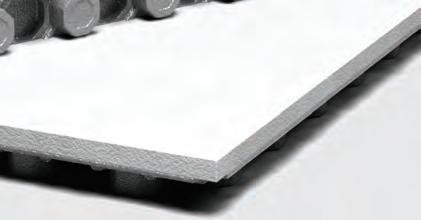
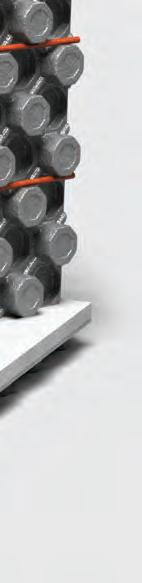
Creatherm radiant floor panels are manufactured out of EPS and BASF Neopor. The panels are interlocking, which allows for precise tube layout. This eliminates the need to tie, clip, staple or screw hydronic tubing to the substrate. Floor panel sizes are two and four inches and feature a staggered snap-tight grid. Panels are available in 1.8, 2.8 and 3.3 inch thicknesses. www.creatherm.com
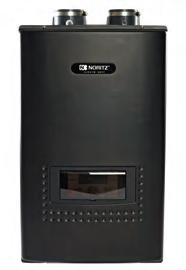
The CB combination boiler from Noritz delivers hot water to both plumbing and hydronic heating applications. Two models are available. The CB180DV model has a maximum Btuh of 180 000 for hot water and 100000 Btuh for space heating. The CB199DV model has a maximum Btuh of 199000 for hot water and 120000 for space heating. www.noritz.com
H2O Demineralizers Engineered Hydronic Fluid
Allows site water to be used for filling any hydronic system while meeting the strict water quality requirements of boiler and glycol manufacturers
WA LOOK AT THE
BRIGHT SIDE
Trends that mean good news for the hydronics industry.
BY STEVE GOLDIE
hen I sat down to write this article, my intention was to take a look at some of the most common issues in residential hydronic installations and ex amine the remedies. In the interest of not being repetitive I did a quick review of my most recent articles and I re alized that I can be pretty negative.
Considering how much of my week gets filled up with trouble shooting, I could easily justify this as being somewhat of an oc cupational hazard. However, rather than pressing on with my “what not to do” crusade, I have chosen to embrace a more pos itive approach, highlighting some of the encouraging and more positive trends in our industry. Call it positive reinforcement or catching more bees with honey, whatever the case it is the new improved “glass half full” Steve Goldie.
The first positive trend is the proliferation of condensing boiler technology. Condensing boilers are by no means new. They first began appearing in the residential market about 15 years ago. In those early days there were few options and there was little un derstanding of how to properly install and apply this new technol ogy. There were plenty of naysayers claiming potential fuel efficiency savings, if any, could never justify the extra costs of the boiler and its more complex installation.
Those days also were marked by far too many poor and improper installations. As with all new technology, there was a learning curve, a rather steep one in this case. Condensing boilers were a tough sell and the durable, tried and true cast iron atmospheric still dominated the market.
Today the landscape is far different; the number of condensing boilers available is staggering. I can offer you a good, better and best condensing option in just about any size range. Would you like floormount or wallmount? No problem we have both. Low mass, medium mass and even high mass designs are all available.
This proliferation of condensing boiler options has occurred for a number of reasons, including regulatory changes that mandate higher efficiency standards. Most of all these boilers exist because they work and the market demands them. Are there still naysayers out there promoting the virtues of old atmospheric technology? Of course there are, I can probably still find you people who believe the world is flat as well and just because they say
would entail removing the old boiler, often a gravity system with no pump and oversized piping, and connecting the new boiler return and supply to the corresponding headers of the old system. There was not a lot of thinking to be done and very few residential systems had any zoning. They were simply one pump systems with a supply and a return. The difference between a good install and a bad install would simply come down to neatness of the piping. I have seen more than a few that were actually piped backwards and they still worked for years.
This is not meant as a criticism, I am plainly stating how things were. Most installers, my early self-included, simply did not have a thorough understanding of good piping practice because we did not need one to get the job done. The old saying, “necessity is the mother of all invention,” surely applies here.
By the late 80s and early 90s the advent of PEX pipe and the growing popularity of in-floor heating created renewed demand for hydronic heating, not simply in retrofits but in new housing. This new demand also created a need for a better trained, more knowledgeable hydronic installer. At times our industry has struggled to meet this need and most of us have more than enough examples of piping nightmare jobs we have encountered, however, I truly believe that there are more and more qual -
From digital controls and condensing efficiencies to unsurpassed durability and application flexibility the KN-Series boiler is at the head of the class. knseries.com
• Cast Iron Condensing Heat Exchanger
• HeatNet Digital Controls w/ Remote Monitoring
• Variable Volume Flow (10:1)
• Full Modulation
• Industrial-Grade Ignition System
WHERE WE ARE AT
ity installers being developed all the time. Training is offered in many different ways by many entities such as wholesalers, manufacturers, trade organizations, community colleges, The Canadian Hydronics Council and so on. I do not want to get into the debate of whether or not hydronics installer should be a recognized trade or not, I will just say that there are many resources available to anyone willing to learn. In my opinion many are indeed learning and the level of competence seems to be on the rise, so glass half full Goldie is feeling encouraged.
The third encouraging trend I will mention is the growing popularity and availability of energy efficient variable speed pumps. Variable frequency drive (VFD) pumps are to pumping what modulating burners are to boilers. Rather than have a fixed speed pump chosen to meet an estimated or theoretical load, VFD pumps have sensors giving actual feedback of either pressure drop or temperature difference in a system. This information allows these smart pumps to calculate the actual load, and ramp up or slow down their speed accordingly to deliver the gallons per minute required, reacting and adjusting accordingly if and when this requirement changes. VFD pumps have been available for quite a few years now, but the past couple have
seen a significant surge in popularity, partly due to lower costs and partly due to a better understanding of the real benefits they offer.
When I started in wholesale many would have said I was crazy if I predicted that one day every boiler we sold would be a modulating condensing model, and yet, that is pretty much the reality. We are not far away from the day when virtually every pump sold by wholesalers will have some form of VFD technology built in. I am confident that more and more of the people installing these technologies will be knowledgeable and competently up to the task. This might all mean that my troubleshooting career will be over but no worries, glass half full Goldie will just look for a job as a positive-thinking motivational speaker.
Goldie photo Steve Goldie learned his trade from his father while working as plumber in the family business. After 21 years in the field, he joined the wholesale side of the business in 2002. He is frequently called on to troubleshoot systems and to share his expertise with contractors. He can be reached at sgoldie@nextsupply.ca.
THE CONTINUUM OF RADIANT MYTHS
BY ROBERT BEAN
Back in 2004 I penned an article called Radiant Mythology: 22
Myths about Radiant Heating. In the years since the first copyright of the article on www.healthyheating.com, that article has brought me the immense pleasure of watching tightlywound individuals implode and explode through their nastygrams which arrive in my inbox. The myths continue and have expanded to well over 40 “myth-understandings” about radiant energy and radiant systems.i Here are a few of my favourites.
1) Radiant floor heating was “invented by the Romans.”
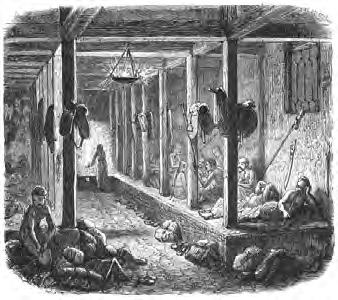
The kang was used predominately in ancient northern China and was a raised heated living and sleeping surface Constructed with a fireplace and, depending on source of fuel, built without chimneys (for charcoal) or with chimneys for wood and other combustibles. Hot gases followed flues formed or constructed into the masonry or earth, through which heat was conducted to the surface (adobe, brick, or stone). Then, this heat radiated to the occupants and room. The by-products of the combustion called “dragon’s breath” were, in some cases, efficiently used for space heating and cooking.
This is not even close to being accurate. The earliest forms of radiant floor heating emerged well before the Romans ever showed up. Present day archeological sites in Asia and North America are uncovering forms of floor heating carbon dated back to 1000 B.C. That is hundreds of years before the Romans embellished the idea. But the application goes back even further with combination cooking and radiant space heating systems found in Korea and China dating back to 3000 to 5000 BC.
It is time the radiant industry embraced its past and correct the sins of those continuing to distort history.ii
2) Radiant floor heating “creates the same feeling as sitting in the sun or in front of a fireplace.”
It is nice to think of floor heating in these terms but in reality if this were true you would bake to death. It is important to understand the sun and radiant floors operate on two completely different elec -
tromagnetic wave lengths.iii The sun or fires operate at high intensity short wave and floor heating operates at low intensity long wave.
Since the human body and floor heating operate in a similar temperature range they coexist within an almost identical long wave range. Translation: radiant heating systems do not heat you up in the sense of the sun or a fire, rather they enable you to retain more of your own heat by reducing the loss of body heat via radiation. Look at it this way–the temperature of your skin fluctuates and varies from your feet at approximately 85F (29C) to approximately 96F (36C) at your head. Remember, hot goes to cold. So what do you think is going to happen with heat transfer when your body is operating warmer than the floor? Feeling the heat of the sun from the floor? Not likely. Feeling the retention of your own heat–absolutely. Call it self-love.
3) Radiant floor heating “saves energy.”
Energy can neither be created nor destroyed, therefore it cannot be saved like
the accumulation of coins in a piggy bank. Energy is always being preserved in its current state or converted with conservation to another state but it is never saved–not even by radiant systems. The concept of saving energy is likely the biggest disservice we have allowed to happen to mankind. It makes people focus on the wrong targets for sustainability.
4) Radiant floor heating “is energy efficient”.
This is going to shake some cages. First let me state unequivocally that radiant heating and cooling systems empower boilers, heat pumps, chillers and solar systems to achieve their maximum rated peak performance. Full stop. No one with a basic understanding of heat exchanger design can debate this principle. But an energy efficient machine does not equal efficient use of energy. For example, consider the combustion temperature of 3200F (1700C) in a 97 per cent boiler for creating 100F (38C) fluid temperatures just to maintain a space temperature of 72F (22C).
When the temperature generated at 97 per cent efficiency is approximately forty seven times hotter than the target temperature your brain should do mental gymnastics.iv Air only folks–do not get self-righteous, this also applies to furnaces. Neither appliance, regardless of its rating should be considered energy efficient if it wastes more than 90 per cent of the work potential.
This is a big broad topic but let me wind this myth up by stating radiant systems are first and foremost enablers. They allow cooling and heating appliances to
transfer heat as intended by the manufacturer’s engineers and support the reduction in system power consumption used in motors.
5) Radiant floor heating “causes hardwood floors to crack.”
This myth still comes up. Consider that 100 per cent of all hardwood flooring complaints in buildings conditioned exclusively with air did not have radiant floor heating to blame. What is up with that? The number one cause of wood deformation is moisture changes not the operating temperature of a well-designed floor. Control the absolute moisture in the wood and space and the differentials between the two and you control the deformation.v There is a caveat: if the floor heating system has to operate at such a high temperature as to be the cause for damage, the very ethos of low temperature floor heating has been completely ignored in the design process. Shame on the designer who ignores this first principle. We will hunt you down and put you in the stockade.
6) Radiant floor cooling “causes condensation.”
Along the same logic as above, 100 per cent of all moisture-related complaints in buildings conditioned exclusively with air did not have radiant floor cooling to blame. Understand all buildings with all types of HVAC systems need to manage moisture for controlling biologicals, dimensional
changes in hygroscopic materials, to mitigate hydrolysis, to preserve artifacts, and for thermal and respiratory comfort. If you
control moisture for these far more important factors, condensation on radiant cooling surfaces becomes a moot point. As with the hardwood floor myth, the problem is moisture not temperature; sweating the details on moisture control means no sweating on any cool surface.vi
7) Radiant floor heating “causes overheating with solar loads in high performance homes.”
Have you ever placed an ordinary thermometer in the sunlight on the floor inside your home on a winter day? What does it read and what does this tell you? In my highly-acclaimed, non-government funded research project at the international headquarters of www.healthyheating. com; using a meat thermometer from the kitchen cupboard–I measured floor temperatures up to 88F (31C) through double
pane, lowE glass on a cool -8F(-22C) February afternoon in Calgary. Eighty-eight Fahrenheit is about 12F (7C) higher than the fluid temperature required in a high performance home heated with radiant. Again, hot goes to cold.
Now put on your thinking caps. If the floor surface temperature heated by the sun is hotter than the fluid in the radiant system, what mode is the floor system in? Heating or cooling? Also, if the floor warmed by the sun is hotter than all the other surfaces what do you think is happening to the radiant space temperature? The room does not feel hot as a result of the embedded tubes, you feel hot because your body cannot shed its heat fast enough since the room’s surfaces are not cool enough to extract sufficient body heat. The problem is not new and neither is the solution. Gain control over solar gains and you gain control over the overheating in all buildings with all types of systems.
You will hear the myths presented above and many more as you go about designing, installing and maintaining hydronic systems. Your clients will be well served if you keep an open mind and have the knowledge to determine fact from fiction.
Robert Bean, who is president of Indoor Climate Consultants Inc., is a Registered Engineering Technologist in building construction through the Association of Science and Engineering Technology Professionals of Alberta and a Professional Licensee in mechanical engineering through the Association of Professional Engineers, Geologists and Geophysicists of Alberta. He has served two terms as an ASHRAE distinguished lecturer, serves on ASHRAE committees TC 6.1 (Hydronics), TC 6.5 (Radiant), TC 7.4 (Exergy) and SSPC 55 (Thermal Comfort) and is a recipient of ASHRAE’s Lou Flagg Award.
References
i http://www.healthyheating.com/Radiant_Mythology/ Radiant_Floor_Heating_Myths_. htm#.V1siVvkrJaQ
ii B ean, R., Olesen, B., Kim, K.W., History of Radiant Heating and Cooling Systems, ASHRAE Journal, Part 1, January, 2010
iii http://physics.info/radiation/
iv B ean, R. 2010. Master Yoda – The E5 Jedi, HPAC January/February
v Wood Handbook, Wood as an engineering material. General Technical Report 113. M adison, WI: U.S. Department of Agriculture, Forest Service, Forest Products Laboratory
vi B ean, R. 2016. The logic of moisture management: Condensation is not the dark side of chilled water and radiant cooling systems. HPAC February
• Primary loop with pump and the choice of 1 to 6 secondary zone pumps all within one wall mounted station
• PSS Circuitry allows each zone to be set, supplying either high or low temperature output from a condensing boiler
• Boiler supply and return is available in either bottom left or bottom right side of the station
• All field settings can be adjusted using jumpers
• Variety of pump options available
I SEE YOU’RE INTO HYDRONICS…
WATER REMAINS THE “GOLD STANDARD”
Twelve comparisons between hydronics and VRF/VRV systems.
BY JOHN SIEGENTHALER
Hydronics technology has long been known for unsurpassed heating comfort.
It has also been used for cooling, primarily through chilled water distribution systems in commercial and institutional buildings. This well-established and highly successful track record is, in part, based on the thermal properties of water. It is also based on the versatility of hydronic systems in adapting to a wide range of applications. No other heat transport material provides the versatility, safety, reliability, energy efficiency, or environmental compatibility of water.
Over the last few years, a new method for moving thermal energy through buildings has appeared on the North American market. This approach uses refrigerant as the transport media throughout a building and is known as either a variable refrigerant flow (VRF/VRV) system, or a variable refrigerant volume (VRV) system.
VRF/VRV systems use multiple interior heating/cooling terminal units that have refrigerant passing through them, as illustrated in Figure 1. The refrigerant flow rate through each terminal unit varies depending upon the heating or cooling load that terminal unit is trying to satisfy.
THINKING IT THROUGH
HVAC system designers, architects, and building owners have many choices when it comes to heating and cooling buildings. The choice of system should consider up front cost, operating cost, long-term serviceability, expandability, reliability, safety, and environmental responsibility. With these criteria in mind, let’s examine the benefits that modern hydronic systems offer relative to VRF/VRV systems.
BENEFIT #1: HYDRONIC SYSTEMS CAN BE USED WITH MANY ENERGY SOURCES.
Hydronic heating and cooling systems are easily adaptable to a wide variety of current and future energy sources. These devices include boilers fueled by natural gas, propane, or fuel oil, geothermal and air-to-water heat pumps, and renewable energy heat sources such as solar thermal collectors and biomass boilers. Other potential heat sources include waste heat recovery, off-peak thermal storage systems and combined heat and power (CHP) systems.
In some cases two or more of these heat sources can be combined in the same system. They can share the load based on the most favorable operating conditions for each source.
Likewise, many options exist as sources of chilled water for hydronic-based cooling systems. They include chillers and heat pumps operating on standard vapour compression refrigeration cycles, as well as gas-fired absorption chillers, and even water drawn from large/deep lakes.
VRF/VRV systems are solely sourced by electricity.
BENEFIT #2: HYDRONIC SYSTEMS ALLOW FOR SIMPLER FUTURE MODIFICATIONS.
When older commercial or institutional buildings are upgraded, their existing hydronic distribution system, or portions of that system, may be reusable in combination with a new central plant for producing heated and chilled water.
When VRF/VRV systems are used, the existing hydronic piping and all hydronic terminal units must either be decommissioned in place or removed from the building. All new copper
Figure 1
piping and refrigerant-based terminal units must then be installed to each conditioned space. This can be highly disruptive to the normal use of the building.
BENEFIT #3: HYDRONIC SYSTEMS REDUCE RISKS ASSOCIATED WITH REFRIGERANT LEAKS.
It is possible for a leak to develop in either a hydronic heating / cooling system, or a VRF/VRV system. A leak in a hydronic system is generally easy to detect and the material leaking is just water or a mixture of water and antifreeze. Well-designed hydronic systems provide numerous isolation valves that allow the portion of the system where the leak is to be isolated from the remaining parts of the system. Hydronic systems that distribute heating or cooling energy produced by a refrigerantbased source can be designed so that the refrigerant-containing devices are confined to a mechanical room, or located outside the building.
A leak in a VRF/VRV system is a serious and potentially dangerous matter. VRF/VRV systems contain much more refrigerant compared to hydronic systems served by a typical heat pump or direct expansion chiller. Under certain conditions, a single leak can be responsible for a complete loss of refrigerant from the system. Large refrigerant leaks can require immediate evacuation of the building and intervention of Hazmat teams.
Refrigerants such as R-410a are heavier than air. If a leak develops in the interior portion of a VRF/VRV system the refrigerant could accumulate in the lower portions of rooms with highest concentrations near the floor. Such accumulation will displace air in the room. In spaces with minimal ventilation it is possible for refrigerant concentrations to reach values that could render occupants unconscious and ultimately lead to suffocation.
ANSI/ASHRAE standards 15 and 34 define specific refrigerant concentration limits based on pounds of refrigerant per thousand cubic feet of interior volume, beyond which acute toxicity is expected. Those designing VRF/VRV systems should verify that the amount of refrigerant that could be lost due a leak, and the smallest space into which this refrigerant could accumulate, are in compliance with this standard.
BENEFIT #4: HYDRONIC SYSTEMS USE LESS DISTRIBUTION ENERGY.
Although proponents of VRF/VRV systems point out that no circulators are needed to move refrigerant throughout a building, electrical energy is still required just to move refrigerant gas and liquid through piping. That energy is supplied as electrical input to the system’s compressor(s). The electrical energy consumption for moving refrigerant through a VRF/VRV system, per unit of heat or
cooling energy delivered, is significantly higher than that required for a well-designed hydronic system, as shown in Figure 2
Power required for distribution system (% of compressor power)
medium pressure VAV low pressure VVT hydronic
Distance from energy source to load (feet)
Piping for hydronic and VRF
Ducting for VAV and VVT
Figure 2 compares the energy required to move the cooling effect through a building. It assumes that the thermal energy is supplied by a vapour/compression source such as used in a VRF/VRV system. The vertical axis represents the percentage of the compressor power required to move (not create) the cooling effect generated by the refrigeration system. The horizontal axis represents the distance from the thermal energy source (e.g., boiler, outdoor unit, etc.) to the load.
The VRF/VRV system uses about six per cent per 100 feet of refrigerant line set, compared to the hydronic system, which uses about 0.3 per cent per 100 feet of distribution distance (e.g., 200 feet total piping circuit length).
BENEFIT #5: HYDRONIC DISTRIBUTION SYSTEMS ARE NOT DEPENDENT ON SPECIFIC REFRIGERANTS.
Hydronic systems are not subject to radical redesign or modification based on future changes in refrigerants.
Over the last two decades, highly successful refrigerants such as R-22 have be phased out of the North American market due to concerns over their global warming potential. Replacement refrigerants have been and continue to be developed. The properties of these replacement refrigerants have mandated changes in components such as refrigerant piping and the oils that are carried throughout the system with the refrigerant.
While it is impossible to know what refrigerants will remain acceptable over the next 10 to 20 years, efforts to determine optimal future refrigerants continue. This could lead to breakthroughs that allow refrigerants such as carbon dioxide or propane to emerge as the new standards. Eventually, legacy chillers, heat pumps, or VRF/VRV systems that rely on present
Figure 2 Energy required to move cooling effect
day refrigerants could be rendered obsolete. The tubing that carries present day refrigerants throughout a building in a VRF/VRV system may not be suitable for future refrigerants or their associated oils. Upgrading a legacy VRF/VRV system could require replacement of piping, terminal units, or other hardware, as well as recycling of refrigerant and oils. Such changes would be very costly.
BENEFIT #6: HYDRONIC SYSTEMS ALLOW EASY INTEGRATION OF THERMAL STORAGE.
Many heating and cooling systems can benefit from thermal storage. The high heat capacity of water makes it an ideal thermal storage material for both heating and cooling systems. The heated or chilled water may be produced by heat pumps or chillers at times when off-peak electric utility rates are in effect, which significantly reduces the cost of delivered thermal energy.
Water-based thermal storage can also be used in systems that have renewable energy heat sources such as solar thermal collectors, air-to-water heat pumps, or biomass-fuel boilers. Combined heat and power (CHP) systems also benefit from water-based thermal storage.
Thermal storage is easy to implement when a hydronic heating source and distribution system are used. In many systems, the water that stores thermal energy in a tank can eventually pass through the distribution system without need of any heat exchangers. This eliminates the cost and complexity of the heat exchanger(s) and the thermal penalty imposed by their use.
The use of thermal storage for space heating and cooling with VRF/VRV systems is not practical. While it is possible to transfer heat from refrigerant to water using heat exchangers, it is not practical to recover that heat back into refrigerant for subsequent delivery to VRF/VRV terminal units.
BENEFIT #7: PIPING OPTIONS
Hydronic systems can use traditional piping materials such as copper tubing or steel piping. Modern hydronic systems can also use polymer-based piping materials such as PEX, PEX-AL-PEX, PERT and polypropylene. These piping products are less expensive and generally easier to install than the all copper piping systems required with VRF/VRV systems.
VRF/VRV systems use copper tubing. Figure 3 shows some of this tubing being installed in the hallway of a commercial building. A multi-storey building with such a system could contain several thousand feet of copper tubing, with hundreds of brazed or mechanical joints. Hydronic systems can use larger piping for mains and thus reduce the linear footage of piping and joints that need to be installed.
BENEFIT #8: HYDRONIC SYSTEMS ALLOW FOR RADIANT HEATING AND COOLING
Hydronic radiant panel heating has long been recognized for providing unsurpassed thermal comfort. Warm water from a variety of heat sources can be supplied to these panels. They create interior surface temperatures and air temperature profiles that are ideal for human comfort. They operate silently, with minimal air movement and deliver heat to spaces using a fraction of the distribution energy required for forced air systems or VRF/VRV systems.
VRF/VRV systems are limited to air as the final means of conveying heat or cooling effect from refrigerant into heated spaces. As such, they are not well suited to interior spaces with tall ceilings, or applications where internally generated dust would quickly clog air filters.
BENEFIT #9: HYDRONIC SYSTEMS PROVIDE LOAD VERSATILITY
In addition to space heating and cooling, hydronic systems can be configured to provide high capacity domestic water heating, snowmelting, and pool heating. These ancillary loads can be prioritized to reduce the total thermal capacity needed.
VRF/VRV systems are not currently used for such ancillary loads.
Figure 3
MAC
95% AFUE, Wall Hung Condensing Hot Water Boiler
(Available in both Combi and Space-Heating Only Models)
AI - Artificial Intelligence Control
...that thinks for itself
Automatic Setup on Initial Startup
Recognizes Natural or LP Gas
Continuously Monitors Combustion
BENEFIT #10: HYDRONIC SYSTEMS PROVIDE LONGER LIFE EXPECTANCY
A well-designed and properly maintained hydronic heating or cooling system is a long term investment. Although the life of the original heat source or chiller is typically 15 to 25 years, the distribution system (the piping, valves, heat emitters and terminal units for cooling) can usually provide many decades of service. Many hydronic systems that were installed over 50 years ago remain in operation today.
The 2015 ASHRAE Applications Handbook lists the medium service life of air-to-air heat pumps and similar refrigeration-based HVAC equipment using fixed-speed compressors and outdoor condenser units at 15 years. There is no listing specifically for VRF/VRV equipment because of its relatively new use in the North American market. Anticipated life expectancies should be similar to air source heat pumps with outdoor condenser units.
BENEFIT 11: HYDRONIC DISTRIBUTION SYSTEM COMPONENTS ARE WIDELY AVAILABLE
The piping, valves, circulators and terminal units required in most hydronic systems can be sourced from many companies with distribution networks across North America. This provides options when the system is initially designed, as well as when maintenance or replacement parts are needed in the future.
Most VRF/VRV systems are manufactured in Asia and many use proprietary components. The availability of these specialized components may be more limited, especially in emergencies where they are needed quickly.
Most manufacturers of VRF/VRV systems require installation and maintenance by factory-trained technicians. These technicians often use specialized
diagnostic equipment for troubleshooting. The rapid evolution of electronic controllers and firmware used in VRF/VRV systems underscores the need for readily available, trained technicians who can keep these systems operating and do so at competitive rates.
BENEFIT #12: HYDRONIC SYSTEMS ALLOW FOR HEAT METERING
In hydronic systems, an accurate measurement of flow rate and temperature drop (from supply to return) allows for a simple calculation of the rate of heat transfer. The total thermal energy that passes a specific point in the system can also be determined by integrating these measurements over time.
Several companies now offer “heat metering” hardware that can be installed easily in a range of hydronic heating and cooling systems. Figure 4 shows two examples of ultrasonic-based heat meters that can be used in applications such as apartments, condominiums and leased commercial space.
Heat metered systems allow owners of multi-tenant buildings to know what each tenant’s thermal energy use was and to invoice them accordingly. Such systems can centralize heat production and
chilled water production, which provides many technical and economic benefits.
THE FINAL ANALYSIS
Water remains the gold standard when it comes to moving thermal energy through buildings. Hydronic systems can provide decades of reliable, safe, and efficient delivery of heating or cooling from a wide variety of sources. They can expand as building configurations change and be retrofitted with different heating and cooling sources as energy markets change, or the original heating/cooling sources reach the end of their service life.
Be sure to consider the points discussed above when evaluating options for heating and cooling systems.
John Siegenthaler, P.E., is a mechanical engineering graduate of Rensselaer Polytechnic Institute and a licensed professional engineer. He has over 34 years experience in designing modern hydronic heating systems. Siegenthaler’s latest book, Heating with Renewable Energy, was released recently (see www.hydronicpros.com for more information).
Figure 4 Ultrasonic-based heat meters
Booth # 618
EXPRESS SETUP
Program your boiler in seconds with an interview style, quick start menu
User-friendly interface for contractor and home owner
COMPLETE REMOTE ACCESS
Built-in internet connectivity
Remote monitoring & diagnostics
EASY USB PROGRAMMABILITY
USB Port for software updates and copying settings to the next boiler
TRUE NATIVE BACnet
Seamlessly integrate IBC BACnet enabled boilers into your current building automation system
MORE FLEXIBILITY
Ability to manage up to 4 different loads and 5 pumps
Automatic altitude adjustment
Intuitive alert system with plain English warnings & error messages
Pre programmed values for all load types
Load Combining to allow 2 loads to operate at the same time
All boilers fully capable of directly connecting to most DDC building automation systems
Building on the success of our industry-leading 5 button boiler control launched in 2003, the new Touch Screen Control makes it even easier to set up and monitor your IBC boiler.
With intuitive features like Express Setup, Easier Diagnostics & Intuitive Alert System, plain English Warnings & Error Messages your VFC or SL Series boiler has never been easier to use.