
• CHILLERS 101 • HYDRONIC COOLING SYSTEMS • RESIDENTIAL CHILLERS



• CHILLERS 101 • HYDRONIC COOLING SYSTEMS • RESIDENTIAL CHILLERS

14
SERVICE VEHICLES
FUEL ECONOMY ON TREND IN 2020
From more diesel options to a mild hybrid and electric alternatives on the horizon, automakers are stepping up efficiency.
By Jil McIntosh
18
COOLING
SMALL-SCALE HYDRONIC COOLING
Using chilled water for residential cooling is becoming much more viable.
By John Siegenthaler
24
HVAC
CHILLERS FOR RESIDENTIAL AND LIGHT COMMERCIAL
Reconsidering the efficiencies of water for heating and cooling in common places.
By Ian McTeer
30
IEQ
COOLING FOR COMFORT
Designing and installing with compliance for ASHRAE Standard 55 in mind.
By Robert Bean
The inside story on chiller operations
By Dave Demma
COVID-19
SHINING LIGHT ON UV
From front line hospitals to residential HVAC, the search for disinfecting solutions is leading some to ultra violet.
By Aaron Engel
48 PLUMBING MAKING CONNECTIONS
Dealing with metal-to-metal and the corrosion that ensues.
By Steve Goldie
SOLAR PHOTOVOLTAIC SYSTEM BASICS
What the mechanical industry needs to know about this growing industry.
By Robert Waters
56 ELECTRICAL GET YOUR MOTOR RUNNIN’
An inside look at what’s driving your pumps and more.
By Curtis Bennett

CURVEBALLS: Speaking with an HVAC contractor about dealing with the new reality.
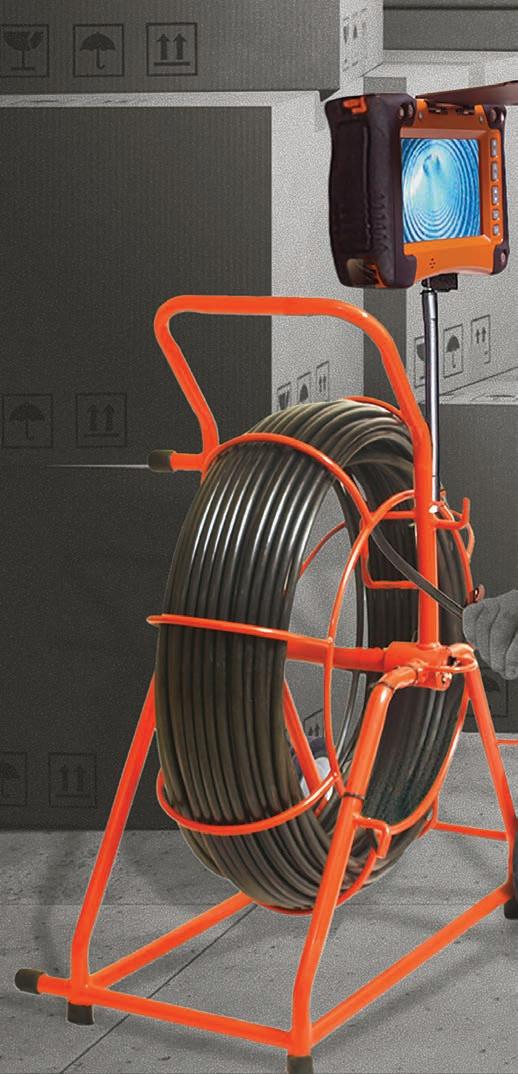
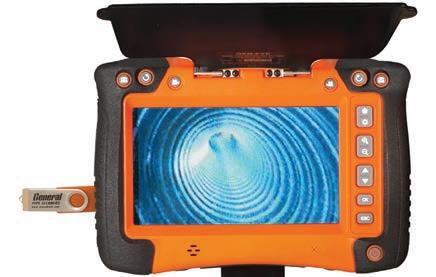


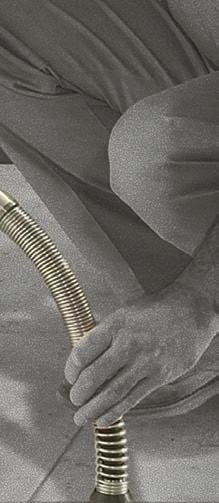

Now you can record your sewer inspection videos and photos instantly onto a ash drive. The powerful Command Module includes a USB port for added recording capability.
It’s packed with features like a big 7" LCD color monitor for crisp, clear pictures, one touch recording, 4X digital zoom, voice-over recording, date and time stamp, ash drive capacity indicator, and more.
Full size X-POD features 200 ft. Gel-Rod® for inspecting 3" to 10" drain lines. Compact Mini-Reel carries 100 ft. or 200 ft. of Gel-Rod for troubleshooting 2" and 3" lines.
Call the Drain Brains ® at 800-245-6200, or visit www.drainbrain.com/geneye
WELL, THIS IS CERTAINLY DIFFERENT. THE WORLDWIDE COVID-19 PANDEMIC has truly been effective at making the world seem a lot smaller, while at the same time drawing a larger focus to the things the matter most to each of us on a local and personal level.
It was no surprise that plumbing and HVAC/R workers were considered essential across the country when the pandemic restrictions were first coming into place. The interpretations in each province may have varied a little, but for the most part the trades were active.
Work on new construction sites did slow down, and homeowners undergoing renovations (or seeking to begin) weren’t calling trades to come into their homes unless there was an emergency. But still, where required, trade services were available.
One common thread I’ve heard from both contractors and equipment distributors over the past two months, is how important it was to make sure their coworkers were kept out of harm’s way. The concern was beyond having the right protocols and protective gear—business owners are questioning the prospect having to expose their employees to multiple people, or households, every day.
In the early days, one contractor was concerned about the “cowboys” out there willing to head out with no protection and continue working, putting themselves and those around them at risk.
As I’m writing this, Canada has recorded some 93,700 coronavirus cases and 7,635 deaths. Yes, that’s only 0.2% of our 37.7 million population having contracted the virus, but you likely don’t have to look too far to know someone who has been affected.
My own 93-year-old next-door neighbour suffered a slip-and-fall accident at home. While at the hospital he contracted the virus and died. It was a terrible blow for our community and devastating for his family.
Over 90% of the deaths in Canada have been people over 60, but that’s no reason to believe it can’t affect any one of us. The scary parts of this virus are the unknowns. There are still a lot of “What ifs?”
The upside for now is that every business person I’ve spoken with has been impressed with how their communities have responded and adjusted.
The national shelter-in-place requirements that started in the cool months of early Spring in Canada made every citizen a little more aware of the air quality in their homes, for better or worse. As I write this, we are slowly beginning the transition to summer and windows are opening up. Before long air conditioning will be kicking in.
Speaking only for myself, working from home since mid-March has made me much more aware and interested in getting my heat pump/furnace system tuned up and ready for the summer heat. It’s not just about making sure the system is operating at peak performance, I want to ensure we have clean air flowing through the house.
I’ve never been more interested in air quality, and I’m sure I’m not alone.
Plumbing and HVAC/R services are essential for the knowledge and comfort they deliver to the people occupying homes and buildings of all sizes. We’re living in a time now where those skills will really begin to shine. <>
– Doug Picklyk, Editor
HPAC MAGAZINE
111 Gordon Baker Road, Suite 400, Toronto, ON M2H 3R1
TEL: 416.442.5600 FAX: 416.510.5140 www.hpacmag.com
EDITOR
ASSOCIATE
PUBLISHER
MEDIA DESIGNER
ACCOUNT COORDINATOR
CIRCULATION MANAGER
PUBLISHER
VICE PRESIDENT
COO
PRESIDENT & CEO
Doug Picklyk (416) 510-5218
DPicklyk@hpacmag.com
David Skene (416) 510-6884
DSkene@hpacmag.com
Emily Sun esun@annexweb.com
Kim Rossiter (416) 510-6794 krossiter@hpacmag.com
Urszula Grzyb (416) 442-5600 ext. 3537
ugrzyb@annexbusinessmedia.com
Peter Leonard (416) 510-6847
PLeonard@hpacmag.com
Tim Dimopoulos (416) 510-5100 tdimopoulos@annexbusinessmedia.com
Scott Jamieson sjamieson@annexbusinessmedia.com
Mike Fredericks
PUBLICATIONS MAIL AGREEMENT NO. 40065710
Heating Plumbing Air Conditioning (established 1925) is published 7 times per year by Annex Publishing & Printing Inc. HPAC Magazine is the leading Canadian business publication for the owner/manager of mechanical contracting businesses and their supply partners.
ISSN: 0017-9418 (Print) ISSN 2371-8536 (Online)
Contents Copyright © 2020 by Annex Publishing & Printing Inc. may not be reprinted without permission.
SUBSCRIBER SERVICES:
To subscribe, renew your subscription or to change your address or information please visit us at www.hpacmag.com
Subscription Price per year: $44.00 (plus tax) CDN; Outside Canada per year: $112.00 US; Elsewhere: 1 year $123.00 (CDN); Single copy Canada: $5.00 CDN. Heating Plumbing Air Conditioning is published 7 times per year except for occasional combined, expanded or premium issues, which count as two subscription issues.
MAIL PREFERENCES: From time to time we make our subscription list available to select companies and organizations whose product or service may interest you. If you do not wish your contact information to be made available, please contact us via one of the following methods: Tel: 416-442-5600 ext. 3552, Fax: 416-510-6875 or 416442-2191; E-mail: blao@annexbusinessmedia.com; or by mail: 111 Gordon Baker Rd., Suite 400, Toronto ON M2H 3R1
Annex Privacy Officer
Privacy@annexbusinessmedia.com
Tel: 800-668-2374
HPAC Magazine receives unsolicited materials (including letters to the editor, press releases, promotional items and images) from time to time. HPAC Magazine, its affiliates and assignees may use, reproduce, publish, re-publish, distribute, store and archive such unsolicited submissions in whole or in part in any form or medium whatsoever, without compensation of any sort.
NOTICE: HPAC Magazine, Annex Publishing & Printing Inc., their staff, officers, directors and shareholders (hence known as the “Publisher”) assume no liability, obligations, or responsibility for claims arising from advertised products. The Publisher also reserves the right to limit liability for editorial errors, omissions and oversights to a printed correction in a subsequent issue. HPAC Magazine’s editorial is written for management level mechanical industry personnel who have documented training in the mechanical fields in which they work. Manufacturers’ printed instructions, datasheets and notices always take precedence to published editorial statements.

Proud member of:



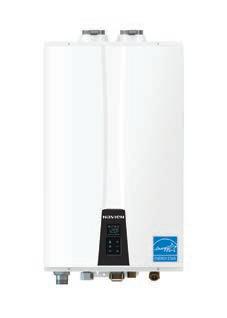
Navien, the leader in condensing tankless water heaters, brings endless hot water comfort to homes and businesses across North America. Keep hand washing and Navien will continue to supply plenty of hot water. Learn more at NavienInc.com.
BY DOUG PICKLYK
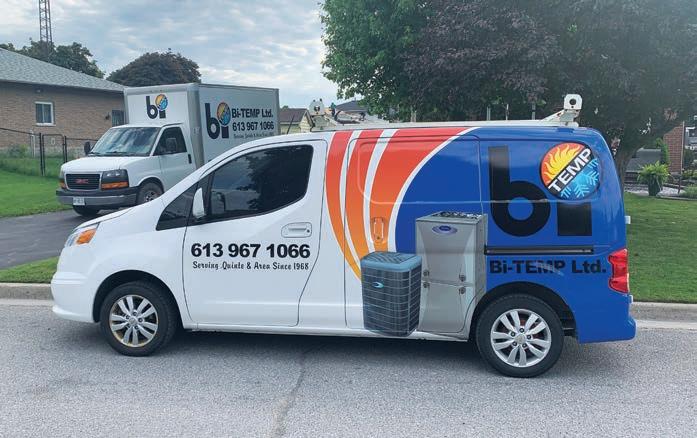
Just into the third week after the government of Ontario declared a provincial emergency, we caught up with Justin Boisvert, owner of Bi-Temp Ltd. in Belleville, Ont., a residential and commercial HVAC contractor, to find out how business had changed since COVID-19 altered everyone’s way of life.
Boisvert (34) acquired Bi-Temp in 2013, a local business that dates back to 1968. Bi-Temp serves an area within an hour radius of Belleville, handling all forms of natural gas, propane and electric heating, air conditioning, hydronics, heat pumps and geothermal, as well as sheet metal, duct designs, refrigeration and more.
As president of the company, Boisvert’s main role is managing the work load and overseeing day-to-day operations. We caught up with him at the end of the work day on Thursday, April 9.
How was business this year prior to mid-March?
Up to mid-March we were running six guys. It wasn't a very cold winter, and there are not a lot of people upgrading their furnaces or switching boilers. So, prior to the COVID slowdown it was a quieter January, February and March.
How many trucks do you usually have on the road?
Normally I would have seven guys on the road, myself in the office and my office manager. And I've got two other helpers on an as-needed basis.
How have things changed since midMarch?
Ever since COVID come into effect we're basically down to emergency service only. Right now, I've got myself and three other guys out in the field.
We've stopped all commercial preventative maintenance, just to limit our ourselves from entering these buildings, and we have a little bit of new construction that we've got to keep rolling with, because those projects haven't been stopping and people have closing dates on homes, and they need a place to live.
When the “essential services” list was announced by the province, was it clear to you where you stood as an HVAC services company? Where have you gone for clarity or information about what you can and can't do?
It's been a lot of conversations with other guys (business owners in the trade), and we’ve been referring to the government sites for the safety protocols and the measures to take as far as trying to do our part to protect ourselves and our customers.
How have you handled safety precautions with your employees?
That's actually been very challenging because we've got a fairly young crew and
two of our guys have pregnant wives right now. For one, his wife is due in a couple of weeks, so he was informed by their doctor that he has to be self-quarantined for 14 days prior to the birth and then for four weeks post birth. So that just eliminated him as of Monday this week.
Another one of our guys is considered a high risk because his wife is a nurse at the Belleville Hospital and is considered high risk. So now he's off for an unknown period of time, unless he wants to move out of his house, away from his wife.
You just have to take it on a day-byday basis, because every day you turn around and there's another curveball coming at you.
Has getting your hands on personal protective equipment (PPE) for your employees been a challenge? The only challenge we had was getting hand sanitizer. The Kinsip Distillery in Prince Edward County is producing some now, and we were able to get our hands on a case.
We ended up having some N95 masks sitting on the shelf, and our suppliers had some heavy-duty black rubber disposable gloves in stock, so we've got cases of those for all the guys to wear.

How about supply chains, are you getting the supplies you need?
That has not been an issue at all. So far, we had a couple snags getting some stuff out of Quebec, but as far as our other equipment goes, I'm finding our suppliers more efficient now than ever with the callin service and either having delivery to the shop or having your order set outside waiting for you ready to pick up.
How are you handling service calls?
We’re only doing emergency calls right now, and every job that we've been going to, we've got our own screening process in place.
As soon as somebody calls the office we do a screening over the phone, asking them all the relevant questions like whether or not they've been traveling, if they've been self-quarantining, whether they're sick, if they're showing any kinds of symptoms.
If they pass that test, then we'll arrive to the site for the service call, and we provide them with a form. Essentially, it’s asking them the exact same questions, and they've got to print their name, sign it and date it. This way we
have a paper trail so that if one of our customers were to show symptoms, I would hope they would reach out to us and vice versa.
“My biggest concern is that we have no idea how long this is going to last.”
Do you think this is going to change the way you do business?
Yes, the big thing I'm looking at right now is the economic impact on everybody. Let's say in a month we're allowed to work safely again. That's fine, but who's going to be putting money into their homes?
The impact on everybody's personal finances is going to be huge. That extra cash that was there is no longer there to upgrade a furnace or add new air conditioning.
I've got a feeling for the next year or two, unless the government comes out with some really good incentives and rebates to get the trades rolling again—
like that home renovation tax credit back in 2008—that it's going to be slow.
As you look forward, even just in the short term, what is your biggest concern?
My biggest concern is that we have no idea how long this is going to last, and then just understanding the risk that's out there.
As of right now, we're still going to be at least three weeks before we can even try to look at resuming somewhat normal operation. Even then, on our residential maintenance side, do I really want to be sending a technician into six different people's homes each day to do an air conditioning maintenance?
Is it worth exposing one of my employees and putting his health and safety at risk just so that somebody can have their AC tuned up? Or do we just stay with emergency service?
It's the uncertainty. It's just so uncomfortable.
Honestly, my stress level has been the highest it's ever been in six years. Because, again, as a business owner, we like to have control of things. And in this world right now, we have absolutely zero control. <>


The ASHRAE Annual Conference originally scheduled to run June 27 to July 1 in Austin, Texas has been restructured into a four-day live virtual event with a significantly reduced registration fee.
The cost to attend the 2020 ASHRAE Virtual Conference is US$99 for ASHRAE members (US$329 for non-members, which includes an annual ASHRAE membership) and includes:
• 12 live technical sessions with live Q&A with presenters
• an on-demand technical program of some 80 sessions
• live video chat sessions with speakers from on-demand sessions
• downloadable copies of all conference papers
• virtual networking happy hours
The technical sessions will be available starting June 22, with conference activities and additional live sessions addressing the latest information relating to the COVID-19 pandemic taking place daily starting June 29 and continuing through July 2.
Technical program tracks include:
• HVAC/R systems and equipment
• Multifamily and residential buildings
• Zero energy buildings
• Resilient buildings and communities
“While we realize that there is no substitute for the special level of interaction that face-to-face conferences provide, we are excited to present this unique format for our members to interact, collaborate and learn,” said ASHRAE president Darryl Boyce, P.Eng. “The unprecedented challenges of this year’s pandemic have afforded us a great opportunity to further our reach and level of engagement in a meaningful way.” www.ashrae.org
We’re in a recession, but according to economist Peter Norman, we’re not headed into a depression. “It’s not a regular recession, as it was caused by a health crisis, and parts of the economy will come back online quickly,” said Norman, vice president and chief economist with Altus Group, who led an hourlong webinar in mid-May hosted jointly by the Canadian Institute of Plumbing and Heating (CIPH) and the Heating, Refrigeration and Air Conditioning Institute of Canada (HRAI).
“By some measures this is among the deepest recessions ever,” said Norman, suggesting the Canadian economy is likely headed for three straight quarters of decline before bouncing back in 2021. He indicated that societal changes happening now could have lingering effects on housing demand and commercial real estate going forward.
For the Canadian economy, Norman sees something of a ‘V-shaped’ recovery, with 2020 ending with 7% drop in GDP and then an upswing beginning in 2021 with an overall growth rate of 5% for next year.
For the housing market, early 2020 saw the number of new starts growing and that momentum provided some insulation from the economic shocks, but a number of factors, including rising unemployment and a drop in immigration could lead to a steep decline in housing demand going forward.
Norman anticipates housing to rebound next year but not to the level anticipated prior to the recession. He suggests renovation spending will also be down this year and will rise next year, but again nowhere near what was anticipated.
In the commercial construction market, where growth has been steady, he notes that a possible outcome from the health crisis is a shift to more remote workers, leading to a decrease in the demand for office space. Some 50 million sq. ft. of office space is in the pipeline, and Norman believes we could see a pause in commercial development intentions over the next two or three years.
The work-from-home trend could also effect housing, as people chose to live outside of city centres if they no longer require a daily commute.
Retail, hospitality and entertainment segments may have to undergo dramatic changes to accommodate for enhanced social distancing for years to come, leading to construction opportunities.
The COVID-19 crisis has exposed vulnerabilities in seniors housing, where changes will need to be addressed through design and possibly policy changes.
On the bright side, there is hope that by next year as a society we can move beyond social distancing and worksites get back to the old normal.
And if and when a second wave of the virus takes hold, communities will be prepared with better infrastructure in place and a familiar grasp of the societal changes that will be required. Norman suggests we’ll be able to respond much more quickly, and subsequent waves may not have as much economic impact. www.hrai.ca www.ciph.com
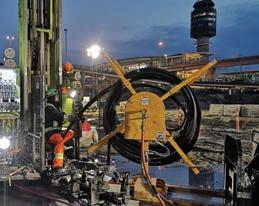
One of the largest geoexchange projects in Canada, part of the 20-year $9.1 billion Vancouver International Airport expansion, has been awarded the Project of Year honour in the building and construction category of the 2020 Plastics Pipe Institute (PPI) Awards.
PPI, the North American trade association representing all segments of the plastic pipe industry, announced the winners of its projects during a virtual annual meeting held on May 5.
The Vancouver Airport project, entered by Versaprofiles of Saint-Lazare-de Bellechasse, Que., was the only Canadian award winner in this year’s program.
The geothermal borefield for the airport’s new Central Utilities Building geoexchange system includes 841 boreholes at 500 ft. each in depth totalling 79.64 miles of drilled borehole and 159.28 miles of 1.25-in. HDPE 4710 piping. The geothermal system is expected to reduce CO2 emissions from heating and cooling demands by 30- to 35%. www.plasticpipe.org
The Canadian Green Building Council (CaGBC) believes the current health crisis has precipitated what could be the tipping point needed to transition Canada toward a sustainable and low-carbon economy.

In early May, CaGBC provided its perspective to key federal ministers in a document entitled, ‘Ready, set, grow: How the green building industry can re-ignite Canada’s economy.’
The CaGBC brief provides guidance on how strategic investment in green building could play a significant role in re-igniting Canada’s economy while also helping the country meet its climate goals.
The recommendations target three areas of investment: workplace training and skills development; removing barriers and creating deep energy retrofit incentives; and shifting the industry to zero carbon building. www.cagbc.org/cagbcdocs/advocacy/CaGBC_Green_ Recovery_Strategy_EN.pdf
In mid-March the organizers CMPX, Canada’s largest trade show for the plumbing and HVAC/R industry, initially postponed the 2020 CMPX event scheduled for March 2527 due to COVID-19, but the biannual trade show has now been rescheduled to 2022. The co-owners of the event, the Canadian Institute of Plumbing and Heating (CIPH) and the Heating, Refrigeration and Air Conditioning Institute of Canada (HRAI), announced that CMPX 2022 will be held March 23-25, 2022 at the Metro Toronto Convention Centre.
In addition, the CIPH announced that the CIPHEX West trade show, scheduled to run Nov. 4-5, 2020 in Vancouver, has been postponed and will now take place November 3-4, 2021 at the Pacific Coliseum at the PNE in Vancouver.
Although the live trade show and conference has been shelved for a year, the show committee is promising to still hold a virtual event this November. The virtual event is expected to include eBooths with company and product information for exhibitors as well as webinars on technical and business topics presented by industry experts.
The rescheduled MEET Show, initally planned for May 6-7, is now set to run November 18-19 at the Moncton Coliseum, in Moncton, NB.
www.cmpxshow.ca www.ciphexwest.ca www.meetshow.ca
The Canadian Apprenticeship Forum, a non-profit organization that connects Canada’s apprenticeship community, is actively seeking more apprentices across the country to participate in the volunary Apprentices in Canada ePanel, a survey group that provides apprentices and early-career journeypersons with opportunities to share their experiences from inside the apprenticeship system.
Currently, to help CAF understand the challenges apprentices are facing as a result of the COVID-19 pandemic, a new survey is being launched to the existing 3,500+ members of the ePanel.
The CAF brings together apprenticeship stakeholders from across trades, across sectors and across Canada to share information, identify challenges and propose joint solutions. As a national voice for the apprenticeship community, CAF influences apprenticeship strategies through research, discussion and collaboration. apprenticesincanada.com
From more diesel options to a mild hybrid and electric options on the horizon, automakers are stepping up the efficiency of service vehicles.
BY JIL MCINTOSH
Just as with their consumer vehicles, automakers are tweaking their trucks and commercial vehicles to help improve their fuel efficiency. This has always been as important a consideration as capability, but now you have even more options for your selections.
In addition to the larger diesels in their heavy-duty trucks, Ford, GM and Ram all offer smaller-displacement diesels in their half-ton trucks. These provide more lower-end power, but with better published fuel figures than comparable gasoline engines.
Depending on the automaker, some gas engines include fuel-saving technologies such as cylinder deactivation, which shuts off some of the cylinders when full power isn’t needed. Some companies are offering smaller-displacement turbocharged engines, for the inherent fuel savings of a small engine but with larger-displacement power as needed (but a little more on that below). And more multi-speed transmissions are available, right up to ten speeds for extra economy.
No one offers a full gas-electric hybrid work vehicle, but Ram has a mild hybrid system available on its half-ton pickup, which primarily improves its fuel economy.
Fully electric vehicles are still in the future, but Ford is promising an electric F-150 pickup, as well as an electric Transit van by 2022. GM is working on an all-electric Chevrolet pickup truck. Mercedes-Benz has electric versions of its Sprinter and Metris in Europe, although they’re not planned for sale in Canada, at least in the foreseeable future.
But even when electric vehicles do arrive, operators are going to have to weigh them carefully, because they pose as
many questions as they answer. You lose your gas or diesel bills, and they require a lot less maintenance, but you have to factor in how long they take to recharge and where you’ll do it. As well, their maximum driving range is usually calculated under mostly-favourable conditions. In addition to batterysapping factors that already apply to consumers who drive electric cars, such as cold temperatures or hilly terrain, electric work vehicles will be further burdened with payload—and you might not know exactly how much that’ll take out of your range until you buy and drive one. There’s going to be a learning curve when these trucks come to market.
Of course, even with conventionally-fuelled vehicles, you have to factor in all the pros and cons when purchasing. Diesel trucks tend to hold their value, but they cost more to purchase and maintain, and are better suited to high-mileage buyers who can amortize those extra costs. And small turbocharged engines are touted by manufacturers for their fuel savings, but they’re most economical when they’re lightly worked. They can get thirsty when you’re towing or hauling, and that can add up significantly over the long run in a hardworking vehicle. You might be better off with a larger, naturally-aspirated engine, and leave the little turbos for those who buy trucks to occasionally haul their stuff to the cottage.
For lighter-duty work, such as service calls, you might also consider downsizing. Automakers now offer a wide variety of compact and midsize vans and trucks. Along with lower costs, these can also access jobs where a full-size doesn’t always fit, such as in underground garages or other tight quarters.
Following is a basic roundup of what’s on offer for 2020. <>



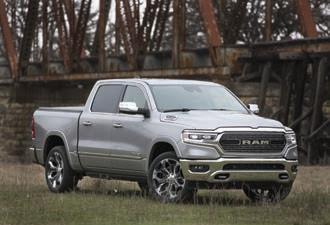
The Ram 1500 uses a mild hybrid system called eTorque, standard on the 3.6-litre V6 and optional on the 5.7-litre V8. It can’t run on electricity alone, but provides electric torque to the gas engine on acceleration for smoother operation and fuel efficiency. It selfcharges, no plug-in. The V8 gets 1.2 L/100 km better fuel economy with it, but it can be a pricey option.
The 1500 also offers a 3.0-litre V6 turbodiesel making 480 lb-ft of torque.
The Ram Heavy-Duty 2500 and 3500 use a 6.4-litre V8 gas engine, or regular or high-output 6.7-litre inline six-cylinder Cummins turbodiesel making up to 1,000 lb-ft of torque.
The F-150 offers six engines, including a 3.0-litre V6 turbodiesel that makes 440 lb-ft of torque and is now offered in the XLT trim level. The Super Duty F-250, F-350 and F-450 come with 6.2-litre or 7.3-litre V8 gasoline engines, along with an available 6.7-litre Power Stroke turbodiesel that makes 1,050 lb-ft of torque.
The midsize Ranger comes in SuperCab or SuperCrew configuration. Both use a 2.3-litre four-cylinder EcoBoost (turbocharged) engine, make 310 lb-ft of torque, and in 4x4 only. With an optional towing package, the Ranger can tow up to 7,500 lbs.
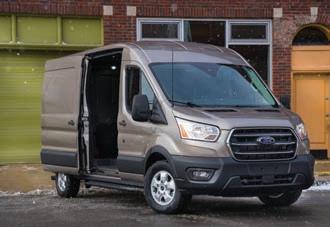
For 2020, the full-size Transit van is available in rear- or all-wheel drive, and an optional power sliding door. It comes in cargo or crew van; with two wheelbases, two roof heights and three lengths; and the choice of a naturally-aspirated or turbo 3.5-litre V6.
The compact Transit Connect comes with a 2.0-litre four-cylinder, but fleets can order a 2.4-litre four-cylinder. Max. payload is 1,550 lbs, and it will tow 2,000 lbs.
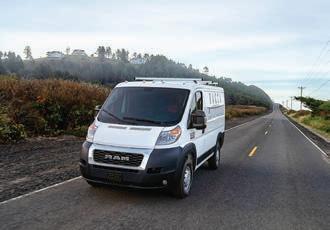
The full-size ProMaster van comes in three wheelbase lengths, regular or extended body, two roof heights, and in 1500, 2500, and 3500 configuration. It can tow a maximum of 6,800 lbs and has a 7,680-lb maximum payload. Unique among full-size vans, it’s frontwheel drive, for a low step-in height.
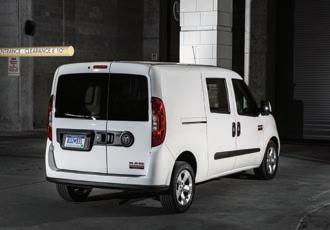
The compact ProMaster City van uses a 2.4-litre four-cylinder, and has a maximum payload of 1,883 lbs and towing capacity of 2,000 lbs.
“Even when electric vehicles do arrive, operators are going to have to weigh them carefully, because they pose as many questions as they answer.”

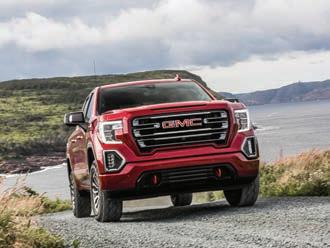
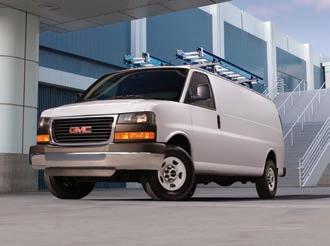
Comparable Chevrolet and GMC trucks and vans have different trim levels and features, but share their drivelines. The Chevy Silverado and GMC Sierra 1500 models come with six engine choices, including a 3.0-litre inline-six diesel that makes 460 lb-ft of torque. Depending on the gasoline engine, ranging from a turbocharged four-cylinder to a 6.2-litre V8, you get either Active Fuel Management, which shuts off specific cylinders, or Dynamic Fuel Management, which uses varying shut-off patterns for even more gas savings.
The Silverado and Sierra heavyduty trucks are all-new for 2020, with 6.6-litre V8 gas engine, or a 6.6-litre Duramax V8 engine making 910 lb-ft of torque. Maximum towing capacity is 35,500 lbs.



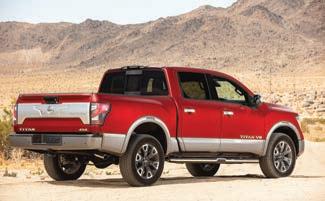
Nissan updates its full-size Titan pickup for 2020, now available only as a Crew Cab 4x4 with 5.6-litre V8 with nine-speed automatic. It’s advertised as 400 horsepower and 413 lb-ft of torque, but that’s on premium fuel. On regular it makes 390 hp and 394 lb-ft.
The larger Titan XD, which Nissan slots between a half-ton and heavy-duty, uses the same 5.6-litre V8, but loses last year’s optional V8 Cummins diesel.
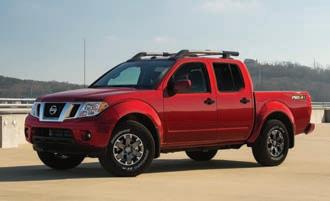
The midsize Frontier pickup is eventually getting a complete makeover, but for now, it looks the same but carries the upcoming new model’s 3.8-litre V6 with nine-speed automatic. That should improve fuel consumption over the previous 4.0-litre V6.

standard- or high-roof configuration, and with 4.0-litre V6 or 5.6-litre V8. Maximum payload is 3,850 lbs and towing is 9,400 lbs. The compact NV200 van uses a 2.0-litre four-cylinder and offers payload up to 1,480 lbs.

Many don’t think of the SUV-based Ridgeline as a “real truck,” but it has numerous features for light-duty service, including a locking in-bed trunk and lots of interior storage. It uses a 3.5-litre V6 with all-wheel drive, and with maximum 5,000-lb towing and 1,570-lb payload capacity.

The full-size Tundra pickup comes in Double Cab or Crew Cab, and all models use a 5.7-litre V8 that makes 401 lb-ft of torque. The Double Cab has a top towing capacity of 10,000 lbs and 1,709 lbs payload, while the Crew Cab can pull up to 9,200 lbs and haul up to 1,567 lbs.


The full-size Sprinter comes in cargo or crew configuration, and in rear- or fourwheel drive. The 1500 comes with a 2.0-litre four-cylinder turbocharged engine, while the 2500, 3500, 3500XD and 4500 use a 3.0-litre V6 diesel making 325 lb-ft of torque.
The Sprinter comes in two wheelbases, with regular or extended body, and standard or high roof. Depending on the model, payload is up to 6,768 lbs.
The Metris is the only midsize van on the market. It uses a 2.0-litre fourcylinder turbocharged engine and comes in two wheelbases, with a maximum payload of 2,491 lbs and 5,000lb towing capacity.
Jil McIntosh is an automotive writer and reviewer with a specialty in trucks and commercial vehicles. McIntosh writes for numerous outlets including the National Post and AutoTrader.ca, and is a member of the Automobile Journalists Association of Canada (AJAC). Her work can be found at WomanOnWheels.ca.
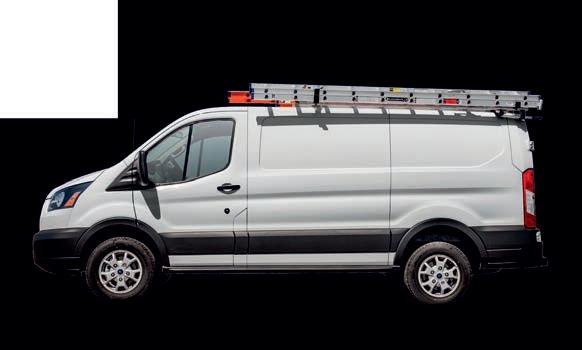

The midsize Tacoma comes in Access or Double Cab, but only in 4x4 configuration. All use a 3.5-litre V6 that makes 265 lb-ft of torque. Maximum towing capacity is 6,504 lbs, and maximum payload is 1,146 lbs.

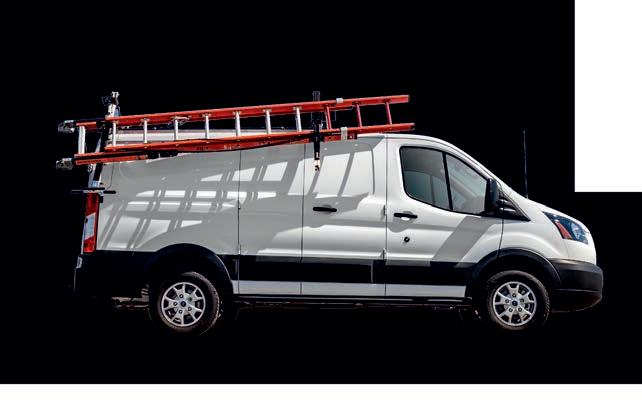
Adrian Steel’s Grip Lock and Drop Down Ladder Racks are designed with ergonomics and user safety in mind. Whether you’re upfitting a single van or an entire fleet, Adrian Steel has just what you need. Increased efficiency starts now.

The use of chilled water for residential cooling is becoming much more viable, but pay attention to the draining of condensate and sealing pipes to avoid unwanted condensation.
BY JOHN SIEGENTHALER
Most of the modern hydronics technology used in North America for residential and light commercial buildings is for heating. Hydronic heat sources ranging from boilers and heat pumps to solar thermal collectors can be combined with many types of distribution system and heat emitters. This allows systems to be configured for very specific comfort needs along with aesthetic preferences, budgets and fuel choices.
For decades, those interested in the versatility and superior comfort of hydronic heating have had to make decisions for cooling. Should it just be omitted? Should I install a separate forced air cooling system? Or, is there a way to provide residential cooling using a hydronic system?
Those who have dealt with the HVAC systems used in larger commercial or industrial buildings know the answer to that last question is yes. Chilled water cooling systems have been used in many larger buildings for decades. They leverage the vastly superior heat transport ability of water versus that of air.
Chilled water can travel long distances through insulated pipes that are very small in cross section compared to ducting of equivalent cooling transport capacity. The chilled water then passes through a coil in an air handler, where it absorbs heat from an air stream.
During the 20th century there wasn’t much interest in using chilled water for cooling smaller buildings. Part of this was due to the lack of devices that could efficiently produce chilled water in the relatively small capacity range needed for smaller building applications.
That situation has changed significantly over the last two decades. Today there are many water-to-water heat pumps and air-to-water heat pumps that can provide both heating and cooling. Most of these units are electricallyoperated using time-tested vapour compression refrigeration systems.
A smaller portion of the available chillers use absorption cycle cooling and are fueled by natural gas or propane. All of these devices can produce chilled water in the 45-50F range typically required for both sensible and latent cooling.
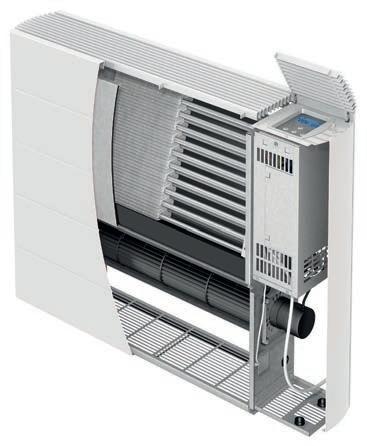
There are also several types of fancoils and small air handlers that can operate with chilled water to produce cooled and dehumidified air. Some are “console” fan-coils, such as the unit shown in figure 1 (next page)
Console fan-coils are mounted low on walls and typically sized on a roomby-room basis. They have a fan that blows air across a coil and can be used for heating when supplied with warm water, and cooling with cool water in the warmer months. As warm humid air passes through the coil it is cooled and dehumidified. The water removed from the incoming air stream condenses on the coil and eventually drips off it.
It is essential that any console fan coil that will be used with chilled water is equipped with a condensate drip pan. Not all console fan-coils are so equipped. The drip pan must be connected to a condensate drain pipe. Codes vary on where the condensate drain pipe can go. Some allow it to be connected to the building’s DVW piping.
Others may specifically prohibit this. I prefer to keep condensate drains separated from other draining systems. Terminating them just above a basement floor drain is one option. Running them outside the building, such as through a soffit is another. Even small console fan coils can produce several gallons of condensate when the system is operating on a muggy day.
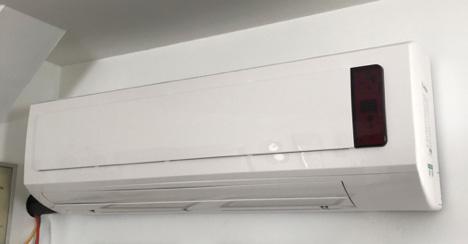
Another type of fan-coil is often called a “high wall cassette.” An example is shown in figure 2 (right)
These units are very similar to the cassettes used in ductless mini-split heat pump systems. Their internal coils are designed for water rather than refrigerant. They are available with total cooling capacity ranging from about 6,000 to 24,000 Btu/hr (0.5 to 2 tons).
Most of these units have variable speed high efficiency fans, oscillating discharge air dampers, and a handheld remote control for setting operating modes. These units can also be used for heating.
The next step up is one or more airhandlers. The idea is the same as with a fan-coil, with the difference being air delivery through ducting versus directly from the unit. Chilled water flows through a coil made of copper tubing and aluminum fins.
Incoming air is pulled across this coil where it is cooled and dehumidified on its way to the inlet of a blower. That blower then drives the conditioned air through a duct system to multiple registers or diffusers.
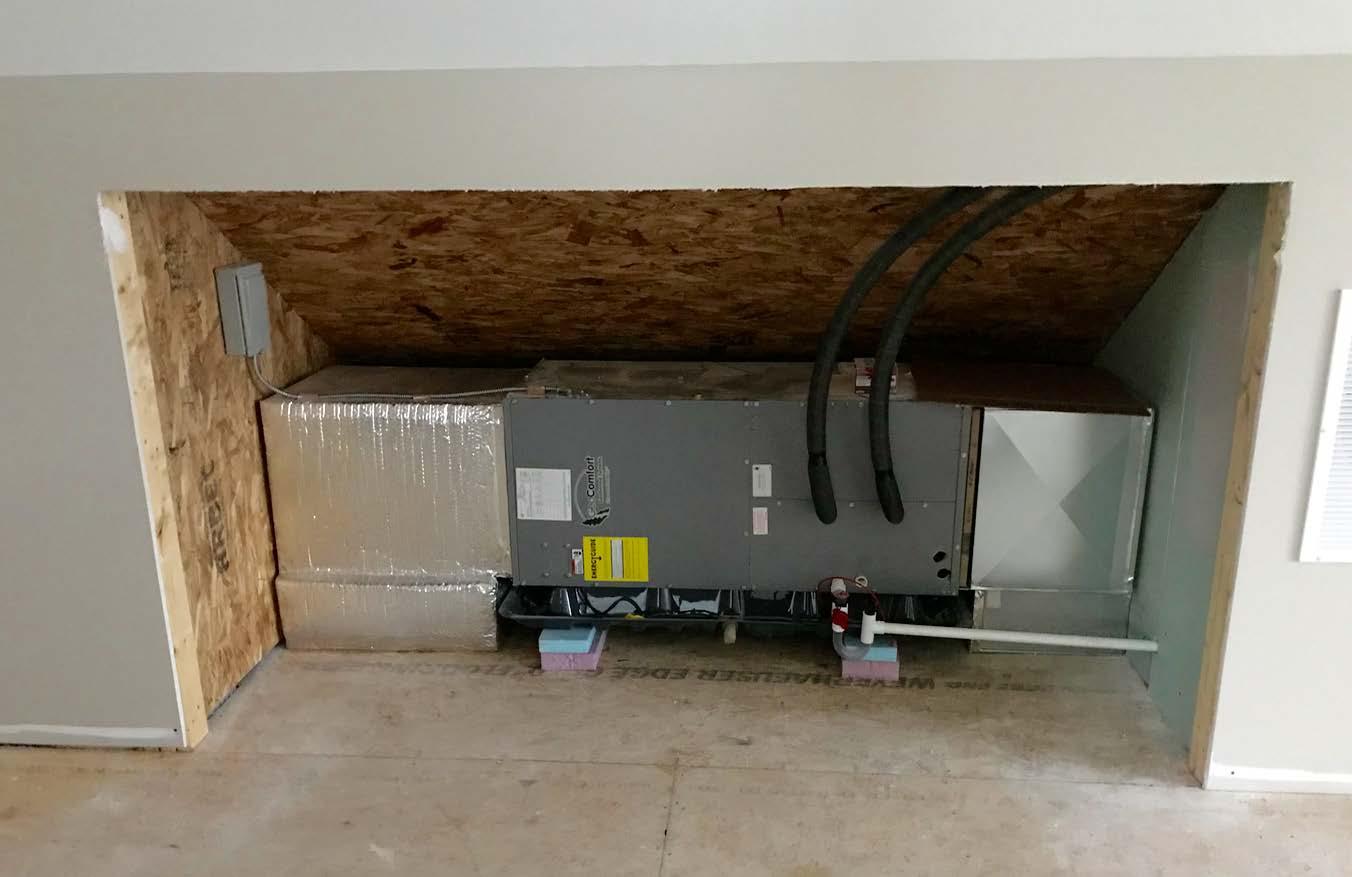
Most air handlers, such as the unit shown in figure 3 (next page), are designed to be installed out of sight. Vertical air handlers can be mounted in basements, closets, under stairs or other accessible spaces.
Horizontal air handlers can be hung from floor framing in a basement, or mounted on platforms in attics or above door height in closets. Many small air handlers can be configured for either vertical or horizontal mounting with minimal field work.
The location of air handlers must provide accessibility for routine maintenance such as filter changes or other service work. It’s good practice to ensure that the entire air handler could, if ever necessary, be removed from its mounting location without sawing walls, framing or having to take the air handler apart.
Whenever an air handler is mounted above finished surfaces, such as drywall, I prefer to set it into a secondary drain pan, such as seen under the air handler in figure 3 (next page). This molded plastic pan would serve as a catch basin for condensate if the pri -
mary condensate drip pan within the air handler ever developed a leak.
The secondary drain pan usually connects to the same condensate drainage pipe as the drain pan in the air handler. In some systems these pans are equipped with a small float switch that can be wired to stop chilled water flow and the blower if it detects a rising water level, which would infer a failure of the primary drip pan.
There are several other details that should be included in small-scale chilled water cooling systems:
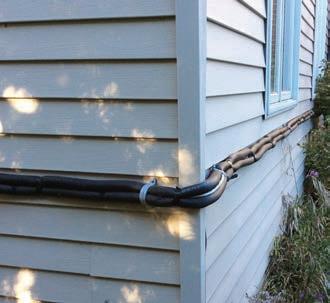
1. Be sure that all piping and piping components carrying chilled water are insulated, and that the insulation is vapour sealed. This is critical in preventing surface condensation on the piping and other components. All seams and joints in the insulation should be glued or otherwise bonded to ensure that moisture-laden air can’t contact the piping. Acceptable insulations are elastomeric foam or fiberglass provided the latter is wrapped with a sealed PVC jacket.
Don’t try to “cheat” on pipe insulation or vapour barriers. It only takes a few hours of operation on a humid day to lay down an ugly and costly water stain on drywall ceilings.
A Single Model Solves Multiple Installation Requirements. Simply configure a selected base model to meet your customer’s needs.
Available in Light, Medium or Heavy Duty from 6 to 119 Gallon Capacity. Perfect for any commercial application big or small.
When your commercial customer needs a water heater, come to the rescue FAST! Answer their call with the ElectriFLEX Series™ Field Convertible Commercial Electric Water Heaters from Bradford White. No need to wait for a special order - you can respond with lightning speed with the right solution, so customer down-time is greatly reduced.
Customize the Right Configuration – FAST! Phase, voltage and wattage are all shop- or field-convertible using a conversion kit.

Bradford White Quality & Performance. Engineered for efficiency, performance and heroic reliability.
To find out how you can be the hero for your commercial customer, visit our website dedicated to the Pro: bradfordwhite.com/electriflex
Continued from p20
“With constantly increasing interest in heat pumps it’s likely that small-scale chilled water cooling will see increasing use.”
Some components such as circulator volutes and valves don’t lend themselves to cylindrical insulation. They still need to be dealt with. A flexible elastomeric self-adhering tape is one possibility. Another is to purchase elastomeric foam in sheets and carefully cut out shapes to fit each component. These custom cuttings can then be joined with insulation adhesive. A high quality electrical tape can also be used to “jacket” pieced insulation assemblies.
2. Don’t oversize the coil in the air handler. Oversized coils will quickly drop the air temperature in a space and satisfy the room temperature setting without allowing sufficient time for adequate moisture removal. The result will be cool but “clammy” air.
3. If you’re planning a zoned cooling system, with multiple fan-coils or air handlers, and supplying them from a fixed speed heat pump, be sure to include a buffer tank. A 2-ton air handler supplied by a 4-ton heat pump without a buffer tank will quickly drop the water temperature to the point where the heat pump turns off on its own internal temperature or pressure limit. This is necessary to prevent the water from freezing inside the chiller and possibly rupturing piping.
4. Make provisions with owners to clean the drip pans in all
fan-coils and air-handlers at the end of the cooling season. There are several biocides on the market formulated to reduce mold growth in drip pans, but they’re not a substitute for a good cleaning with detergent followed by a wipe down.
5. Set up the expansion tank for a slightly lower air pressure so that some water remains in the tank at room temperature. The goal is to prevent the diaphragm from “bottoming-out” against the tank shell when the system is operating with chilled water. This is especially important in systems with buffer tanks. The greater the system volume, the more “shrinkage” as the water cools well below room temperature. If the diaphragm bottoms out against the shell of the expansion tank, the pressure in some parts of the system could drop sub-atmospheric and cause air to be sucked into the system through vents.
With constantly increasing interest in heat pumps it’s likely that small-scale chilled water cooling will see increasing use. A probable scenario is when modern hydronic heating is used in a building and supplied by one or more water-to-water or air-towater heat pumps. In these cases the “chiller” is already in the system. It’s just a matter of equipping the distribution system for cooling. <>

John Siegenthaler, P.E., is a mechanical engineering graduate of Rensselaer Polytechnic Institute and a licensed professional engineer. He has more than 35 years experience in designing modern hydronic heating systems. Siegenthaler’s latest book is Heating with Renewable Energy (see www.hydronicpros.com for more information).
Reconsidering the efficiencies of water for heating and cooling in common places. BY
IAN McTEER
Iwill have to admit that my HVAC proclivities revolve around forced warm air heating systems combined with addon cooling units. It’s the way I was raised in HVAC; in fact, water and its tendency to leak all over the place or to restrict and or to corrode furnace vents have produced no end of headaches for me when troubleshooting nuisance units.
Water can be a truly nasty chemical. Yes, I said it, a chemical. And it’s almost always referred to by its common name, “water”, as opposed to its systematic name, dihydrogen oxide.
But then again, who doesn’t love water for recreation, bathing and simply drinking?
Water is also the universal solvent. Forced together, hydrogen and oxygen atoms share electrons creating a covalent bond. However, the oxygen atom has a greater attraction for electrons that tend to stay closer to the one oxy -
gen atom rather than the two hydrogen atoms. The oxygen atom gains a slight negative charge while the hydrogen atoms are slightly positive. As such, substances such as salt, sugar, alcohol and many other substances easily dissolve into water.
Even the other products of combustion of natural gas combine with water forming weak acids that ruin heat exchangers, vent connectors and chimney liners, aargh!
Having said that, chemistry has also given us strategies to deal with the most annoying properties of water. And, there is one other phenomenal property of water that is foundational to the HVAC industry. Once I started to take hydronic heating seriously, I learned from regular HPAC magazine contributor John Siegenthaler that “water is almost 3,500 times more ‘thermally concentrated’ than air, a hydronic system only has to
move about 1/3,500 of the volume of fluid that a forced air system does to convey the same amount of heat.”
That heat can be used for space heating or process heating and, of course, heat absorbed into water can be effectively removed from any process or building as well.
Chillers have long been used in larger commercial buildings including high rise office towers, institutional buildings and process cooling applications. Sometimes the building requires cooling only, but typically in a cold climate the chiller will be combined with a boiler to provide heating and cooling using common piping sup -
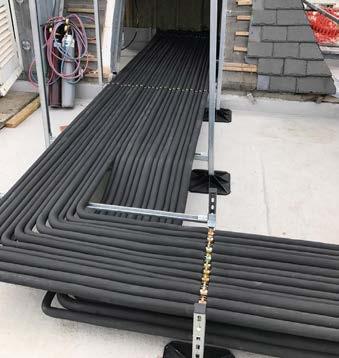
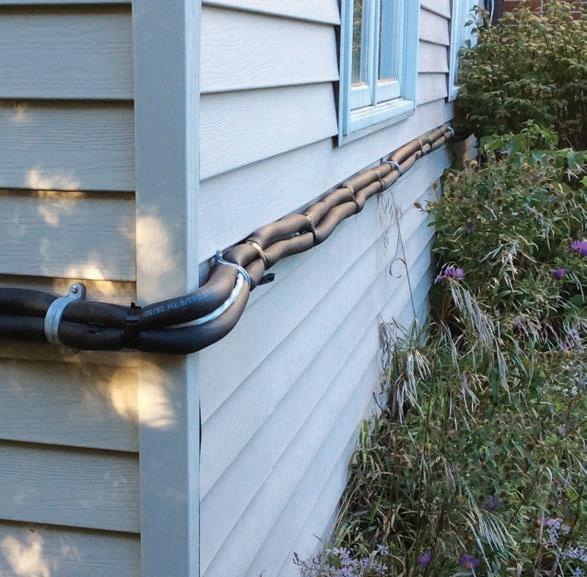
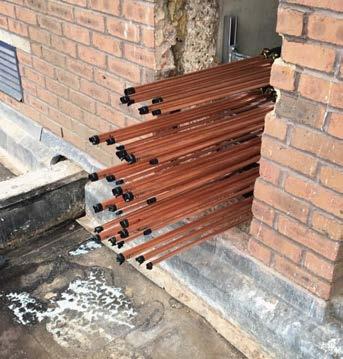
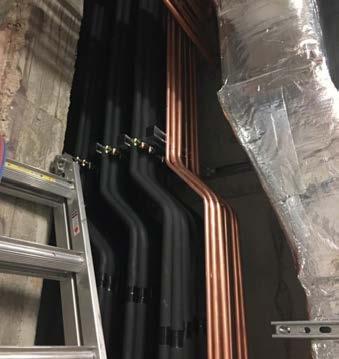
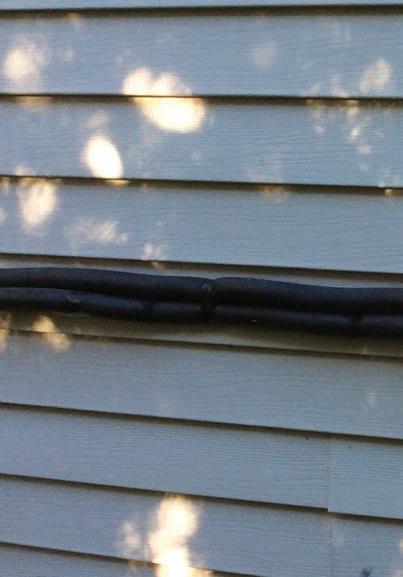
This single VRF line set above doesn’t exceed manufacturer recommendations for run and rise, yet it’s only part of a multiple indoor unit installation in which the total allowable tubing length for all piping is 197 ft. When counted in with the other line sets on this job, the total length of all piping is 212 ft. What sort of trouble might lay ahead for this system?
pling devices such as remote air handlers or terminal units within the space.
Interestingly, some buildings once thought to be perfect for combined chiller/boiler installations, are losing out to variable refrigerant flow (VRF) technology thanks to advancements in capabilities such as simultaneous heating or cooling utilizing variable speed compressors that provide significant energy savings. Regardless, water still moves a lot more btu’s per pound than refrigerant, thus the commercial chiller is likely to be a viable HVAC product for the foreseeable future.
Residentially, chilled water systems have not been forefront in the mind of neither contractors nor consumers. The best known residential chilled water system available today is undoubtedly a ground source heat pump, also known as a geothermal heat pump.
Water-to-air units also provide cooling with matched air handlers connected to a conventional duct system and water-to-water heat pumps are available with hydronic air handlers having optional electric back-up heaters meant for installation into new duct systems.
As far back as 1913, engineers have been concerned about the quantity and type of refrigerants used within confined building spaces. By 1978, ASHRAE and the American National Standards Institute (ANSI) had published a comprehensive document known as Standard 15 that specifies safe design, construction, installation, operation and maintenance of refrigeration systems.
Standard 15 aims to ensure that refrigerants will be kept within the system and, in the event of a leak, mitigation procedures will reduce or eliminate serious impacts on people. Standard 15 limits the quantity of refrigerant in direct systems and requires very large volume systems to be in machinery rooms.
ASHRAE Standard 34 is a companion document to Standard 15 that establishes a system to identify refrigerants by assigning reference numbers, establishing a safety classification and to publish refrigerant concentration limits (RCL).
Concentration means the full vaporization of a refrigerant released into a confined space without ventilation, dissolution or decomposition capabilities. System designers must make sure conditioned spaces do not exceed concentration limits. Refrigerant piping and tubing cannot be installed in prohibited spaces, such as, enclosed public stairways, shafts that have openings to living spaces or any means of building egress.
“Water still moves a lot more btu’s per pound than refrigerant, thus the commercial chiller is likely to be a viable HVAC product for the foreseeable future.”
Recently, VRF systems have become more popular for some commercial applications for several reasons:
• They can provide simultaneous heating and cooling
• VRF’s can be easily zoned
• Since the units are independent of each other, a single unit breakdown won’t paralyze an entire building as in the case of a centralized chiller
• There are a wide range of indoor distribution accessories, such as, terminal units, ceiling cassettes, wall mounted units and fan coils.
• Variable speed compressors are less expensive to operate However, in low ambient applications, VRF heating capabilities may not be adequate requiring supplemental heating equipment and the installation and maintenance costs might not be worthwhile in some applications.
VRF systems also have strict run and rise tubing limitations that must not be ignored. Complex tubing systems must be installed by licensed, experienced installers; nitrogen must be present during the brazing process and the completed tubing must be evacuated and dehydrated in accordance with manufacturers requirements
Granted, a residential or light commercial VRF system will
Continued on p26
never require the amount of tubing as shown in the photos on the previous pages. However, its worth remembering the importance of line set tubing size, length and elevation above the compressor; these three factors, as prescribed by the equipment manufacturer, mean poor performance or, even worse, catastrophic compressor failure will otherwise result from poor piping practice. Such requirements often lead to difficulties with outdoor unit placement not to mention line sets running all over the place outside the building.
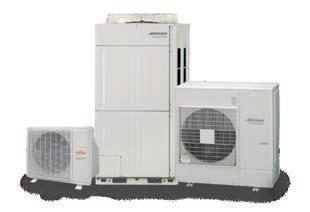
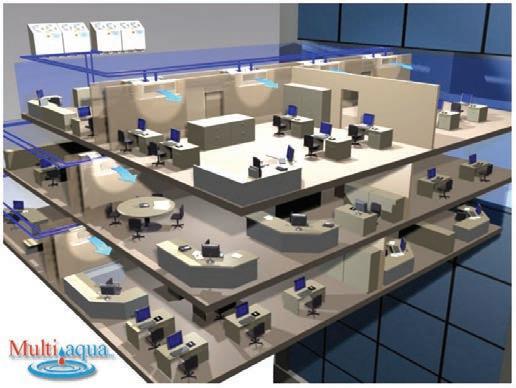
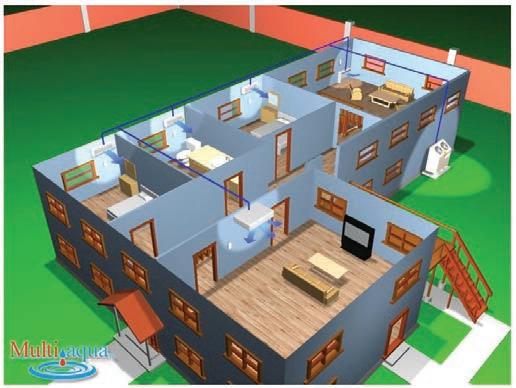
Manufacturers such as Multiaqua, SpacePak (Mestek) and Chiltrix, produce modular air to water outdoor units capable of heating or cooling glycol treated water. Like air source heat pumps, applications utilizing chillers for heating may need to provide supplementary heat in cold climates. There are several important reasons for HVAC contractors to consider specifying modular chillers:
1. Unfortunately, our trade is critically short of licensed technicians and installers, and the situation doesn’t appear to be improving, at least not anytime soon. A modular chiller does not require licensed mechanics to install the water piping systems or the indoor air handlers other than an electrician to provide electrical hook-ups. No refrigerant handling means licensed techs can be utilized elsewhere, such as for commissioning and servicing.
2. No refrigerant inside the building: ASHRAE Standard 15 and 34 do not apply. A modular chiller uses anywhere from 50% to 90% less refrigerant to accomplish the same heating or cooling task.
3. The insulated chilled water piping, typically oxygen free PEX, limits capacity losses allowing nearly unlimited linlengths to indoor hydronic air handlers or terminal units. Booster pumps can be used in exceptional situations.
4. Works with in-floor radiant heating systems but can also
provide “radiant cooling” with the addition of dew point controllers.
5. Hydronic branch distributor units allow for indoor zoning that might include individual high wall, fan coil or terminal units or combinations of each.
In cooling applications, chillers are not rated for seasonal energy efficiency ratio (SEER). Even a properly sized cooling system is oversized 99% of the time thus a chiller’s full speed efficiency is much less important that its average or part load efficiency.
Chillers are AHRI rated for Integrated Part Load Value (IPLV) based on a loop temperature of 44F. Manufacturers also offer a Non-Standard Part Load Value (NPLV) for situations where a 55F loop temperature can meet the requirements of a 44F loop and precautions have been taken to ensure proper dehumidification. A properly specified NPLV loop is dramatically more efficient than an IPLV loop.
A chiller’s IPLV is calculated using the AHRI 550/590 part load standard rather than the full-speed seasonal EER:
IPLV (or NPLV) = 0.01A + 0.42B + 0.45C + 0.12D
Where:
• A = COP or EER @ 100% Load (1% of the time unit requires operation up to 100% capacity)
• B = COP or EER @ 75% Load (42% of the time unit requires operation up to 75% capacity)
• C = COP or EER @ 50% Load (45% of the time unit requires operation up to 50% capacity)
• D = COP or EER @ 25% Load (12% of the time unit requires operation up to 25% capacity)
To roughly estimate the annual energy consumption of a 5-ton chiller (17.6 kW), with an AHRI rated IPLV COP of 4.56, use the following formula:

kWh/year = Chiller rated capacity (kW) x Run Hours ÷ IPLV COP efficiency x Estimated load factor, thus:
Energy = 17.6 kW x 3000 (example run hours) = 52,800 kWh ÷ 4.56 COP x 0.6 (rough average 60% load factor) = 6947 kWh/year. (Based on $0.18/kWh = $1,250 per year to operate)
Compare with a similar 5-ton chiller rated at an ILPV COP of 3.17:
Energy = 17.6 x 3000 ÷ 3.17 x .6 = 9994 kWh/year (Based on $0.18/kWh = $1,799 per year to operate)
No doubt that selecting a modular chiller with the highest AHRI rated IPLV COP is the most efficient choice for any potential customer.
Modular air source chillers are not necessarily meant for residential and light commercial applications. Indeed, larger commercial buildings, even process applications fall within the capa -
bilities of modular chillers.
In residential applications, I have recommended using VRF technology over the practice of installing an evaporator coil onto a new or existing furnace because too many older duct systems cannot efficiently distribute conditioned air, neither in heating but especially not in cooling mode.
To me, it makes no sense installing a 20 SEER inverter drive conventional split system air conditioner into such a system because inadequate air flow means loss of efficiency—that the consumer is paying for!
A modular chiller fitted into a residential application using an insulated loop could easily support a variety of delivery options like a VRF system. Free of refrigerant piping concerns, chilled water can easily be zoned throughout the residence.
Similarly, in a light commercial application such as a strip mall or standalone structure such as a restaurant or gymnasium, I’m thinking a modular chiller would have a crucial installation and operational advantage over a traditional ducted rooftop unit or even a multi-head VRF system.
John Siegenthaler introduced to me the idea of a hydronic system as a “conveyor belt for btu’s.”
I now understand how inherently beneficial my old enemy is at providing not only thermal comfort but exceptional energy savings too.
Water is the way to go! <>

Ian McTeer is an HVAC consultant with 35 years experience. He is a refrigeration mechanic and Class 1 Gas technician.
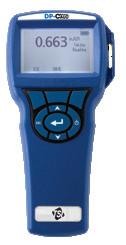
TSI is excited to announce the addition of ISO 17025:2017 accreditation for select TSI and Alnor® branded ventilation test instruments.
ISO 17025 accreditation is a globally-recognized benchmark for precision, accuracy, and reproducibility of analytical results. It is an international standard used as a means of determining the technical competence of laboratories to perform specific types of testing, measurement and calibration.
TSI offers accredited calibration for the following parameters:
+ Velocity
+ Temperature
+ Humidity
+ Differential Pressure







Designing and installing with compliance for ASHRAE Standard 55 in mind. BY ROBERT BEAN
Likely one of the most widespread misconceptions within the HVAC industry is that cooling load calculations are proxies for a comfort calculation, and that A/C design is comfort design. Though both are required for selecting equipment, laying out mechanical room components and for duct routing, none of these tasks identify the discomfort metrics experienced by occupants in buildings.
How can I say that? Because none of these activities are required to ask what people thermally experience based on what they are doing, what they are wearing and where they are positioned relative to the architecture and geometry of the occupied space. For that analysis, the practitioners must look through the lens of ASHRAE Standard 55 Thermal Environmental Conditions for Human Occupancy.
ASHRAE 55 requires the practitioner to evaluate two personal factors, four general factors, and five local factors, as listed in Table 1.
When correctly considered, combined and controlled, these factors result in compliance with Standard 55 based on the work of Dr. P.O. Fanger and two indices; the predicted mean vote and predicted percentage of dissatisfied occupants (Figure 1).
Dr. Fanger developed the Predicted Mean Vote (PMV, x-axis) and Predicted
Category Factor
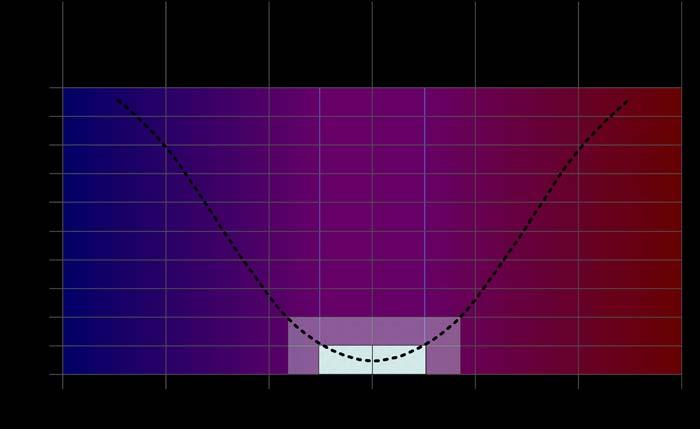
Percentage Dissatisfied (PPD, y-axis) indices to illustrate that when architectural, enclosure, interior and HVAC design can get all the comfort factors from Table 1 right, that most people vote within a 0.0 +/- 0.5 range on a seven-point scale (top of the graph) in comfort assessments. This vote corresponds to a 10% dissatisfaction which is within compliance of ASHRAE Standard 55. Occupant discomfort exceeding 10% corresponds to votes outside the recommended range.
Identifying the source of discomfort and then solving it first with architectural, enclosure and interior solutions are the primary task of every indoor climate consultant.
Personal Metabolic rate (met) and clothing (clo)
General Discomfort Mean radiant temperature (MRT), dry bulb (air) temperature (tdb), humidity (%rh), air speed (fpm)
Local Discomfort Radiant asymmetry (Tasy), floor surface temperature (Tflr), temperature stratification (Tstr), drafts (fpm), ankle drafts
Table 1. Integrated Design Process and Professionals Role in IEQ Elements
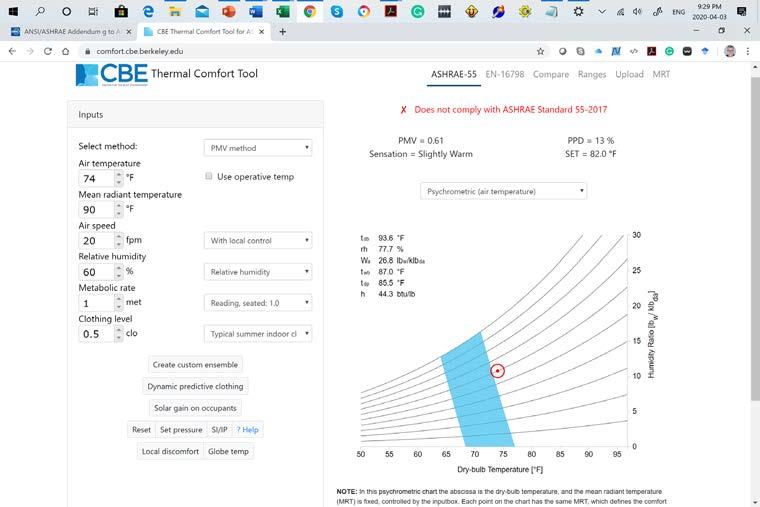
The 11 factors identified in Table 1, when known by calculation and specification, are inserted into the Centre for the Built Environment (CBE) online thermal comfort tool (Figure 2), which advises what a representative occupant might sense and perceive in a space and whether that experience would be in compliance with Standard 55. Equally important is that the assessment identifies sources of potential discomfort and can lead the designer to consider possible solutions.
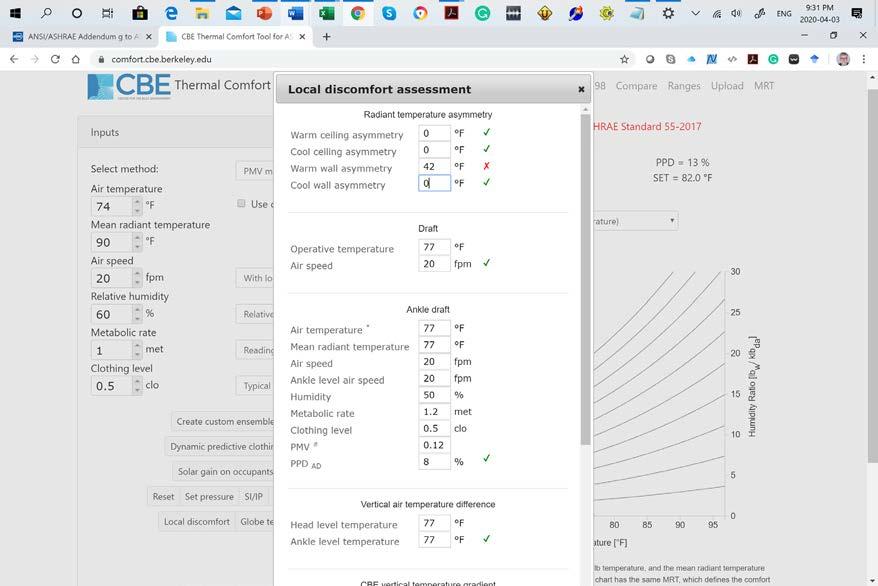
In cooling there are three primary concerns; the first two are illustrated in Figure 2 and Figure 3. These are the mean radiant temperature (MRT) and radiant asymmetry. These values determine the body's ability to discharge heat for cooling via radiation.
What causes the MRT to rise, and what causes radiant asymmetry? In the first case it is overglazed high U-valued flamboyant architecture with poor fenestration and without external shading. In the latter case it will most likely be the occupant with an overheated pane of
glass on one side of them and a cool conditioned space on the other.
The third concern is direct solar radiation absorbed by the occupant. This energy has to be accounted for in the MRT calculation, as shown later in Figures 8, 9, and 10
These three concerns exist because the predominant mechanism for controlling the release or absorption of energy in the form of heat from the body is via radiation followed by respiration and convection.
This shifts over to respiration and evaporation and convection under extremely hot and dry conditions. Under hot and humid environments, the evaporation process becomes muted depending on the vapour pressures on the skin relative to the room.
Under all other conditions, the temperature difference between the mean skin temperature and surrounding mean radiant temperature regulates approximately 60% of the sensible heat transfer from the body to the enclosures.
Overheating occurs when the inside surface temperatures begin to rise, which reduces the body's ability to discharge its excessive heat. It is the retention of heat that causes the perception of feeling hot.
To demonstrate these relationships, note of the following series of cooling challenges and compliances identified within an assessment for thermal comfort according to ASHRAE Standard 55.
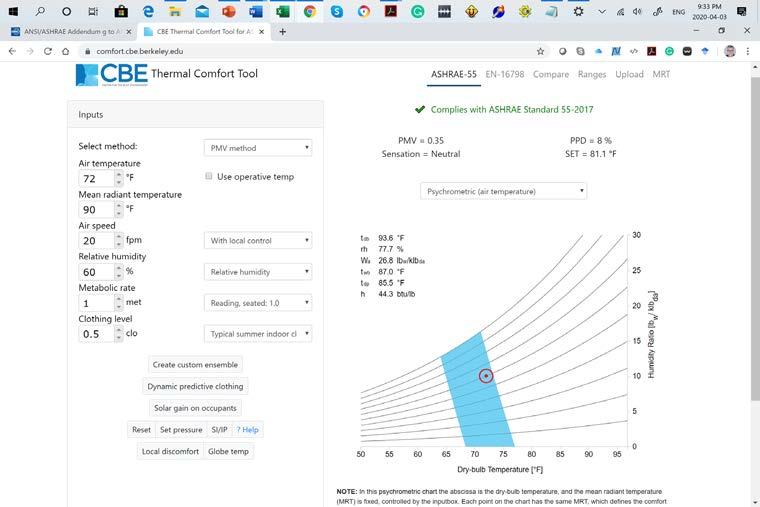
Figure 2 shows inputs for the two personal factors and four general factors. Note the noncompliance PMV > 0.5 with a corresponding predicted percentage dissatisfied, PPD >10%. Note the red dot representing the person is outside the shaded comfort zone. This is due to the higher mean radiant temperature (MRT) and the upper end of the recommended humidity of 60% at a low airspeed, met rate, and clothing. The high MRT is usually due to a large window-to-wall ratio of poor performing fenestration without external
Continued on p32
Continued from p31
shading and no exterior insulation resulting in thermal bridging. The higher humidity under other circumstances would be acceptable, but with the combination of factors shown it is contributing to the discomfort. See in Figure 5 how dehumidification helps in this example for improving satisfaction.
In Figure 3 (previous page) inputs for four of the five local discomfort factors are shown. Note the noncompliant radiant asymmetry of 42F. This would occur when an occupant has a high surface temperature on one side and a cool surface or room on the other—common when large unshaded low performing windows are heated by direct solar radiation, raising the inside glass temperature well above room temperatures.
Figure 4, as per Figure 2 but with a change in air temperature from 74F to 72F. Note the compliance PMV < 0.5
with a corresponding predicted percentage dissatisfied, PPD <10%. This is due to the lower air temperature compensating for the higher MRT. Here dehumidification is not necessary for compliance, but cooling is necessary.
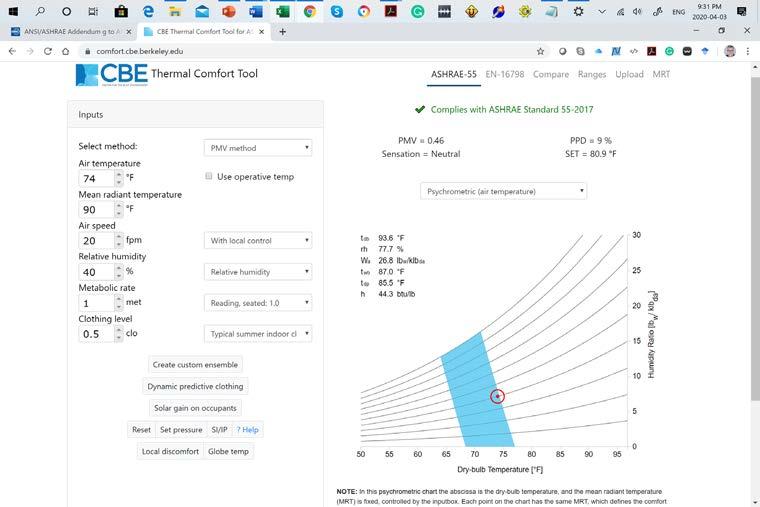
Figure 5, as per Figure 2 but with a change in relative humidity (RH) from 60% to 40%. Note the compliance PMV < 0.5 with a corresponding predicted per-
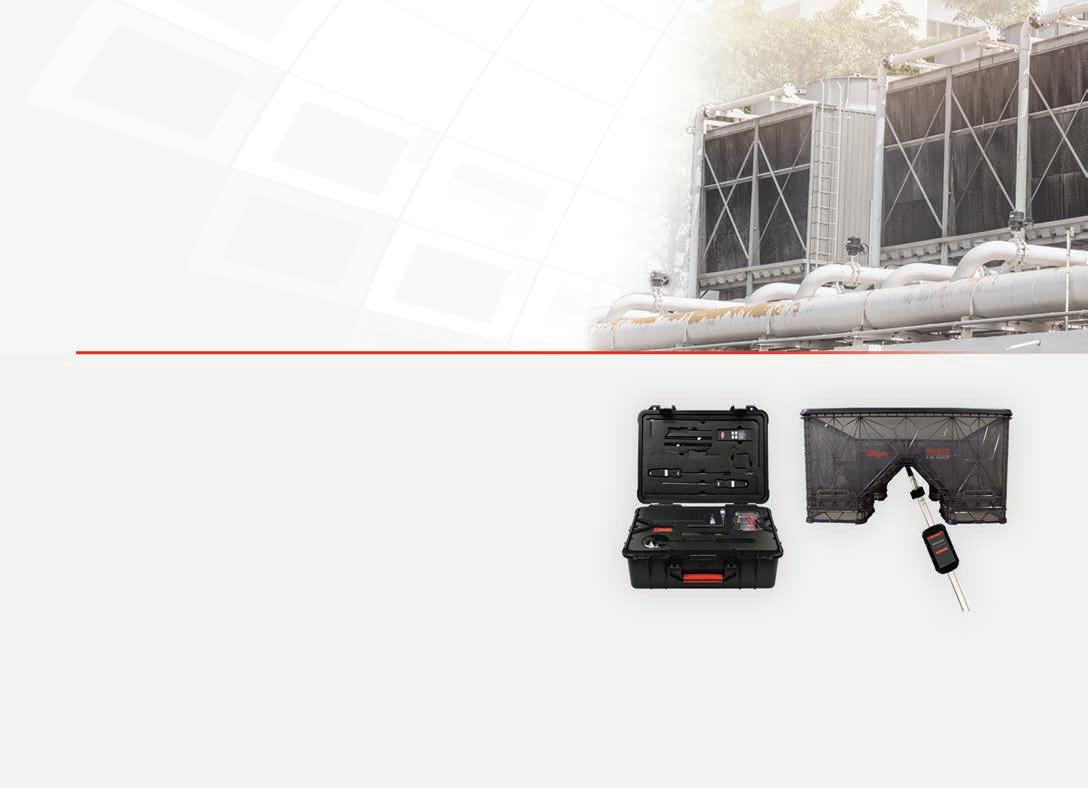
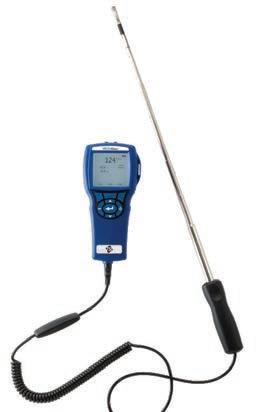
• One stop shop for air, water, temperature, humidity and electrical instruments
• Everything a balancing technician needs in a single case
• Best in class low flow velocity readings
• Durable, repeatable, and reliable in every instrument
• A certificate of NIST calibration is included for each instrument inside the kit
• Save time by sending everything back to us, we can recalibrate all equipment in the kit

centage dissatisfied, PPD <10%. This is due to vapour pressure on the skin exceeding the vapour pressure in the room, enabling latent cooling through room dehumidification. Cooling load calculations and A/C design do not pick these relationships up.
Figure 6: as per Figure 2 but with a change in the MRT from 90F to 85F leading to compliance. This is due to the lower mean surface temperatures, which comes from shading, lower enclosure U values or radiant cooling systems and occupants with low clothing and met rates. If the latter two increase, it is possible to shift into non-compliance. Cooling load calculations and A/C design would not pick up these relationships either, only a comfort assessment can assess these circumstances.
“Cooling load calculations and A/C design are not the same as comfort design.”
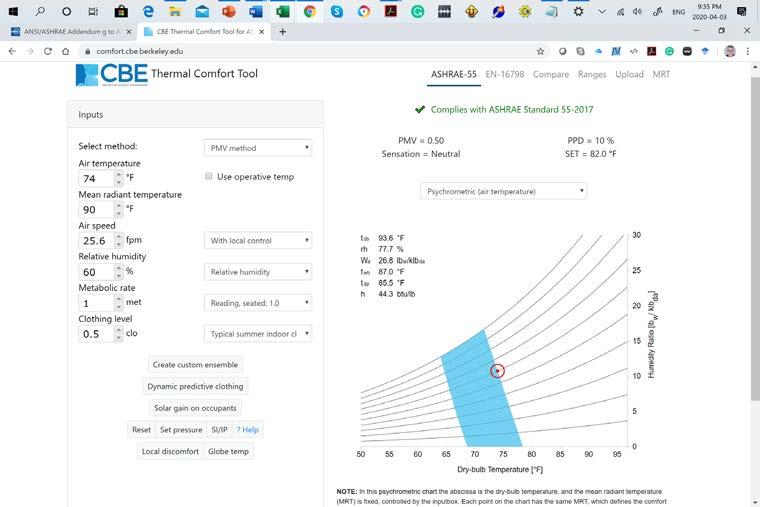
Figure 7: As per Figure 2 but with a change in airspeed from 20 fpm to 25.6 fpm. Note the compliance PMV = 0.5 with a corresponding predicted percentage dissatisfied, PPD = 10%. This is due to the increase in convective flow across the occupant, which is made possible with floor, desk, or ceiling fans. This illustrates that not all overheating challenges need be solved with energy-intensive refrigeration systems. Cooling load calculations and A/C design does not evaluate the use of personal fans but a comfort assessment can and does demonstrate their usefulness.
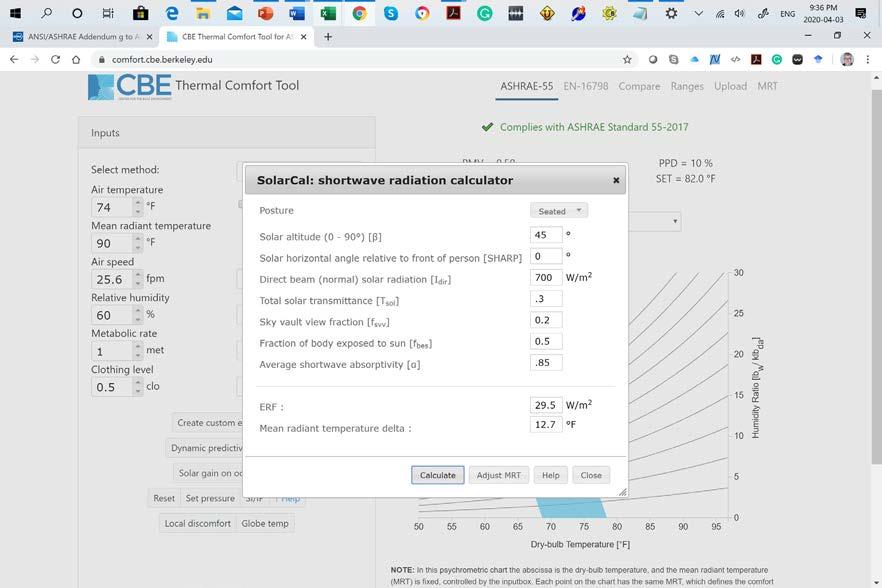
Figure 8: Next to increases in the MRT and radiant asymmetry, the third leading cause of overheating is the absorption of shortwave energy in the form of electromagnetic (radiant) energy transmitted through the glass. To evaluate this effect, the practitioner can use the SolarCal module built into the CBE tool. The results of this assessment adjust Continued on p34
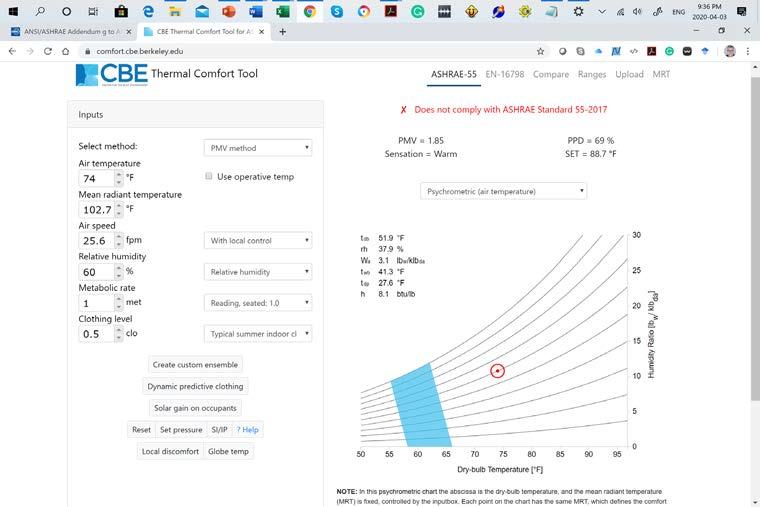
the MRT experienced by the occupant due to direct solar gains. Here, based on the inputs, it results in an increase of 12.7F in the MRT.
Figure 9: as per Figure 7 but with a 12.7F upwards adjustment to the MRT (from 90F to 102.7F) due to the direct solar gain. Note the noncompliance PMV > 0.5 with a corresponding predicted percentage dissatisfied, PPD >10%. This demonstrates to the client and architect the need for external shading. Internal window treatments can convert the shortwave to longwave and reduce some of the effect, but they won’t reduce the cooling load.
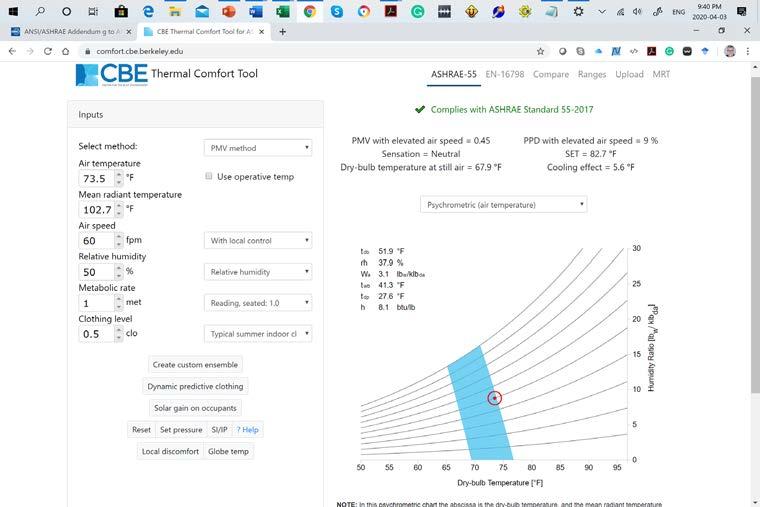
Table 2 Passive/Low Energy Cooling Tactics
Seek lower MRT enclosures and avoid shortwave (solar) radiation by activating external shading, relocate to below grade and northside spaces. Closing internal window treatments will provide some relief though treatments usually become hot and will radiate energy into the space where it will get converted to heat.
Seek/create higher air velocities/drafts by using ceiling, floor, and desk fans; room air purifiers, and cross flow ventilation.
Decrease humidity with cross flow dry ventilation air (if possible) or use dedicated in space dehumidifiers. Use split systems for discharging heat to outdoors.
Decrease met rate through relaxation.
Decrease clothing to reduce insulation and expose more skin surface area to a cooler environment (if possible – see MRT above).
Stay hydrated, reduce blood viscosity for efficient flow to skin for radiant and convective cooling and to prevent dehydration from evaporative cooling (sweating/respiration).
Figure 10 : as per Figure 9 but with an increase in airspeed from 25.6 fpm to 60 fpm made possible with floor, desk or ceiling fans brings the environment into compliance.
As noted in all of these examples, cooling load calculations and A/C design should not be interpreted as being comfort design. Designing for thermal comfort requires the practitioner to focus on the occupant and not the building (see Table 2). This only makes sense since people sense the retention and gain of heat in their bodies ergo the building is not uncomfortable; people are uncomfortable.
For more on this subject, interested practitioners can obtain for no charge a new book on Thermal Comfort Principles and Practical Applications in Residential Buildings. This project was funded in partnership with BC Housing and can be accessed through this link: https://www. linkedin.com/groups/13843486/ <>

Robert Bean is director of www.healthyheating.com, and founder of Indoor Climate Consultants Inc. He is a retired engineering technology professional (ASET and APEGA) who specialized in the design of indoor environments and high performance building systems.
It probably goes without saying that anyone involved in the HVAC/R industry likely knows exactly what a chiller is. But for those outside of our industry, if there was ever a word that was completely inadequate in providing an accurate description of a process, it's chiller.
How do you even define ‘chill’. Perhaps someone has given you a stare that chilled you. Or have you ever been chilled to the bone? Chill doesn’t even come close to accurately describing a temperature range. But perhaps that’s ok, since there is no average range temperature application for a chiller.
OK, let’s chill out over the word thing, and talk about chillers.
So, what is a chiller? To understand chiller operations it all starts with your basic refrigeration cycle, consisting of:
Function: Receive low pressure vapour from the evaporator and convert it to a high pressure vapour. As the compressor also adds heat to the vapour during the compression process, the end result is a superheated high pressure vapour.
Function: Transfer heat from the superheated high pressure vapour. First the vapour is desuperheated. Once the vapour reaches a saturated state, further heat transfer allows it to undergo a change of state into a liquid, and then become a slightly subcooled liquid.
Function: Allow the subcooled high pressure liquid to undergo a pressure drop. The resulting lower pressure will have a corresponding saturation temperature that makes it useful for transferring heat from the refrigerated/ conditioned space (or load).
Function: Transfer heat from the refrigerated/conditioned space (or load) to the low pressure, low temperature saturated liquid refrigerant, flowing through the evaporator.
The load on a typical evaporator in a refrigeration/air conditioning system is the heat content in the air from the refrigerated/conditioned space. The typical evaporator is a finned tube fan coil design. Heat from the air flowing through the finned tube evaporator is transferred to the refrigerant flowing through the evaporator tubes, resulting in a lower air temperature in the refrigerated/conditioned space.
What I've described is a typical single stage of heat transfer: heat from the refrigerated/conditioned space to the primary heat transfer fluid (refrigerant).
A chiller is quite different, in that it involves two stages of heat transfer. The heat load on the chiller’s evaporator is a secondary heat transfer fluid, such as water, or a mixture of water and propylene glycol.
This secondary fluid is brought down to the design temperature for the particular application, and is then pumped to secondary heat exchangers in the refrigerated/conditioned space.
The heat load from the actual refrigeration/conditioned space load is transferred to the pumped secondary heat transfer fluid. This heat is then transferred to the refrigerant flowing through the chiller’s evaporator.
There are two main types of heat exchangers (evaporators) used in chillers:
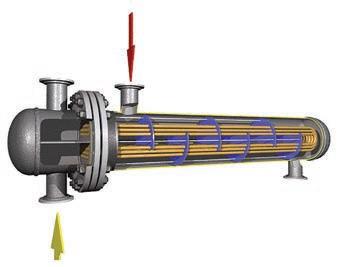
In a shell and tube heat exchanger (Figure 1), the lower temperature saturated liquid refrigerant flows through the inside of the tubes in the barrel, and the secondary fluid is also pumped through the barrel. As the secondary fluid makes contact with the tubes, heat is transferred from it to the refrigerant flowing inside the tubes.
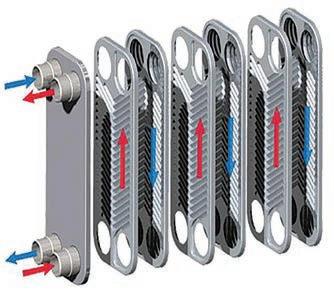
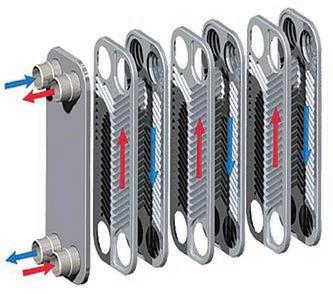
In a brazed plate heat exchanger (Figure 2), a series of corrugated plates are fastened together in a frame. The channel formed by two adjacent plates facilitates the heat exchanger’s high efficiency, as Continued on p36
the secondary fluid and saturated liquid refrigerant is distributed through alternate channels in a counter-flow arrangement. This counter-flow provides for maximum thermal efficiency
The major advantages of this design is that the higher heat transfer efficiency results in a much smaller sized heat exchanger.
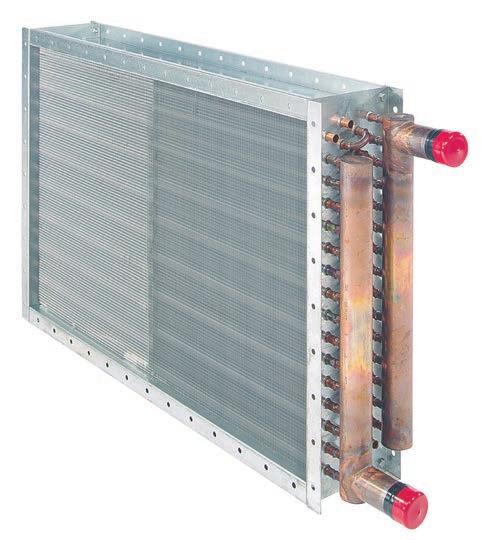
A typical chiller application might be used for comfort cooling in an office building or hotel. Each zone (or hotel room) would have its own hydronic finned tube coil heat exchanger (see Figure 3) as a means to transfer heat from the space to the secondary fluid. The flow of secondary fluid through the heat exchanger is controlled by a solenoid valve, which is energized/de-energized by a thermostat in the space.
only. This reduces the charge from potentially several thousand pounds to perhaps a hundred or so.
ary fluid is very inexpensive compared to refrigerant.
Additionally, while there is a desire to eliminate the potentially environmentally damaging effects of refrigerant leaks, there is relatively little negative effect of a secondary fluid leak on a chiller.
In addition to comfort cooling, there are many commercial and industrial uses for chillers. The list is almost endless: bakeries, beverage bottling, breweries, dairies, food processing, fruit/vegetable washing, wineries, cement mixing, chemical plant processes, dry cleaning facilities, MRI testing, photo processing, plating processes, plastic injection molding, welding machines, and on.
One advantage to this design is the elimination of large refrigerant piping runs to each zone, with the tremendous amount of refrigerant which that would require. Instead, the refrigerant circuit is rather small, being contained within the piping circuit of the chiller
The secondary fluid for a chiller providing comfort cooling doesn’t require any measureable amount of glycol, as the application doesn’t have a significant chance of operating at refrigerant saturation temperatures below 32F. As such, the relative cost for the second -
Now, let me share a specific chiller application that was used to provide a stable environment for the storage of antique books and papers. The requirements were maintaining a temperature between 65F to 68F, and relative hu -
“In addition to comfort cooling, there are many commercial and industrial uses for chillers. The list is almost endless.”
midity (RH) between 40% and 55%.
While this wouldn’t seem to be too difficult, for some reason the onsite chiller was not able to maintain a constant leaving fluid temperature, which made it impossible to maintain a space temperature that was anywhere near what was required. The contractor was at his wit’s end, and he was willing to experiment.
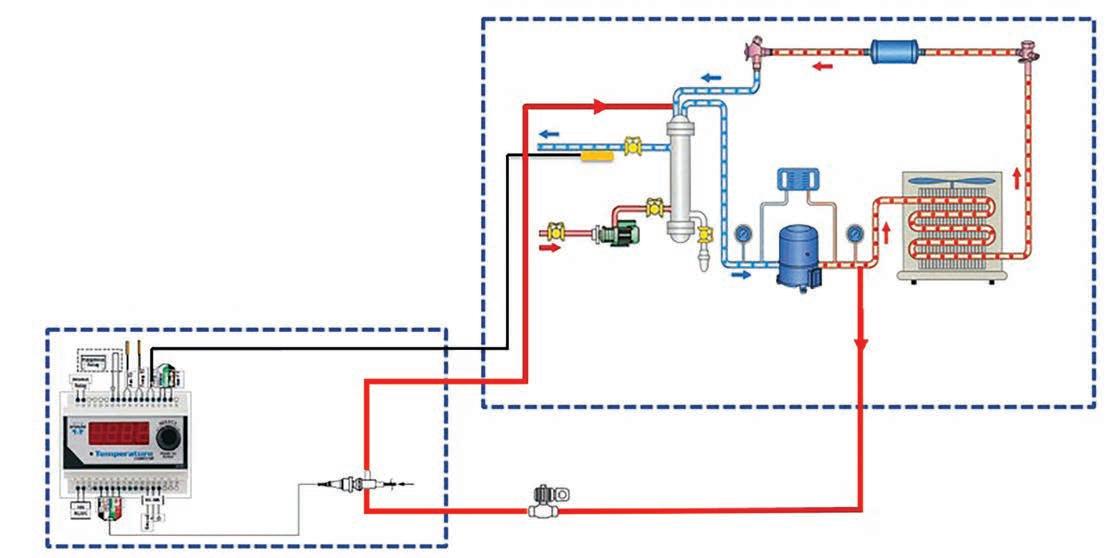
The contractor used a discharge bypass valve to maintain a constant leaving secondary fluid temperature (see Figure 4), but not just any discharge bypass valve. You see, mechanical pressure regulating valves used to maintain precise temperature control are at best challenged.
First of all, you have the shortcomings of a mechanical valve (spring and diaphragm hysteresis) which limits the valve’s ability to control precisely.
Secondly, a system is always at a disadvantage when attempting to control temperature by controlling some other parameter, such as pressure.
In addition to the pressure of the refrigerant in the evaporator, there are other factors that will influence the leaving fluid temperature (or the space temperature), such as load demand and ambient conditions.
Simply relying on a constant evaporator pressure (constant refrigeration saturation temperature in the evaporator) to ensure a constant leaving fluid temperature (or space temperature) will always be less reliable than actually controlling the temperature itself.
So, the decision was made to use an electronically-controlled electrical step -motor discharge bypass valve.
Now, this was a valve which would travel 6,386 steps from fully open to fully closed (at 200 steps per second), which gave it an amazing wide range of resolution. And, the valve was responding to temperature, not pressure. And specifically, the fluid outlet temperature of the heat exchanger.
In addition to the electric discharge bypass valve, a variable frequency drive (VFD) was utilized to vary the secondary fluid flowrate, which facilitated maintaining the space temperature.
This method of control was able to maintain the leaving fluid temperature at 42F, with a differential of +/- 0.75F conditioned space at temperature of 65F, with a differential of +/- 0.5F.
Boom….problem solved…now time
to go get a chilled

Dave Demma holds a degree in refrigeration engineering and worked as a journeyman refrigeration technician before moving into the manufacturing sector where he regularly trains contractor and engineering groups. He can be reached at ddemma@uri.com

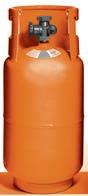
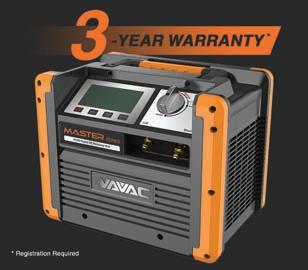
NAVAC now offers a three-year warranty, with product registration, for its next-generation NRDD recovery unit, whose twin-cylinder compressor and oversized condenser with two rows of microchannel coils offer efficient vapour recovery. The standard warranty, without registration, remains two years. The recovery unit features a brushless DC motor that allows it to provide substantial power in a compact size and weight of just 25 pounds. The DC technology also provides better starting performance under low voltage conditions. Its large LCD display is backlit for clear visibility. www.navacglobal.com
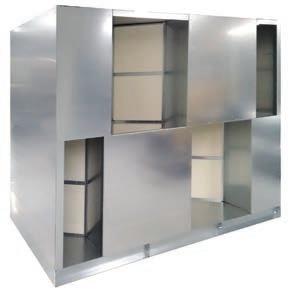
The SA Series from RenewAire is a factory-assembled, turnkey array of stacked static-plate enthalpy cores on a baseplate for energy recovery solutions inside OEM HVAC air handlers in most North American commercial applications. The packaged core with a plenum assembly is an alternative to enthalpy wheels for controlling latent and sensible load transfer in large airflow applications while also providing energy-recovery. The SA Series is available in 20-in. core modular stacks ranging from 3 (w) x 3 (h) (2,250-CFM) to 8 (w) x 8 (h) (70,000CFM). Custom sizes are also available. www.renewaire.com

Johnson Controls LUX KONOse smart thermostat is designed with seniors in mind. The Energy Star certified thermostat, part of the KONO suite of products for commercial facilities, has larger primary and secondary digits and enhanced backlight options. The large icons, like a flame and snowflake, call out heating and cooling functions. Users can rotate the thermostat’s dial to adjust the set temperature or push the dial to change HVAC modes. The thermostat is compatible with the LUX app so users can make temperature and scheduling adjustments from any device. pro.LUXProducts.com/KONOse
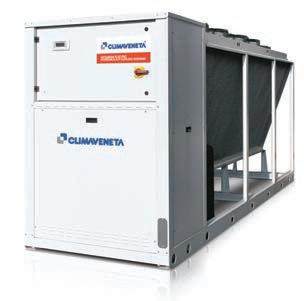
Climaveneta NX-N hydronic heat pump units are available in 14 different sizes from 45-250 kW heating capacity, and are available with optional desuperheater for heat recovery function. A division of Mitsubishi Electric, the Italian-based Climaveneta brand manufactures central climate control systems for comfort and process cooling, and the IT cooling sector. NX-N units can be used in combination with any hydronic equipment and can function as the sole heating and cooling solution. Depending on temperature conditions, they can reduce a buildings annual carbon footprint compared to a traditional chiller and boiler. www.climaveneta.ca.
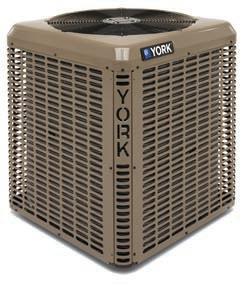
YORK’s single-stage heat pumps, the YEE series, offer 14 SEER cooling and 8.2 HSPF heating efficiency. The systems can provide heat down to an outdoor temperature of 0F and cooling up to 125F. The YEE is optimized to be paired with indoor equipment, such as air handlers and gas furnaces, that use electronically communicated motors. An advanced defrost system provides even temperatures and reduces energy use. The large electrical box cover allows easy access to components and a two-piece extruded louver coil guard is easy to remove and reinstall for annual coil cleaning. YORK.com
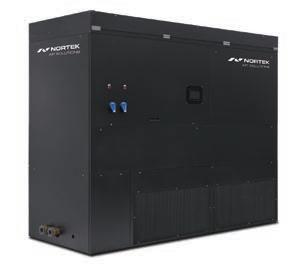
Nortek Air Solutions has added catalog computer room air handlers (CRAH) for data centers requiring cooling units with configurable options. Models from 9,000 to 48,000-CFM or 63 to 430-kW nominal cooling power capacity are available. The units come with a copper tube/aluminum fin A-frame coil; an optional high-capacity coil is available for greater cooling capacity. Two-, three- and four-fan options can be selected. Supply air discharge options include downflow for underfloor applications or front discharge. Each model uses ECM fans in a horizontal configuration positioned below the cooling coil. www.nortekair.com.
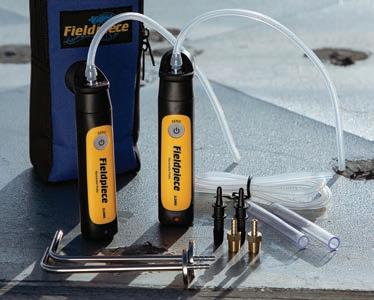
Fieldpiece Instruments’ dual-port wireless manometer works with the company’s Job Link System App for taking pressure measurements. The JL3KM2 dual-port manometer allows HVAC/R professionals to document readings in the app from up to 350 feet away. Technicians can take inlet gas pressure, outlet gas pressure, and total external static pressure of a furnace with multiple probes hooked up and view them all at the same time in the app. Users can view real-time return static, supply static, and total external static pressure all at once with just two probes. www.fieldpiece.com
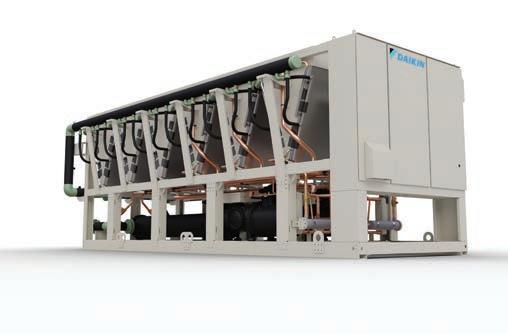
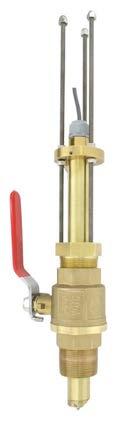
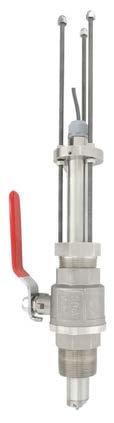
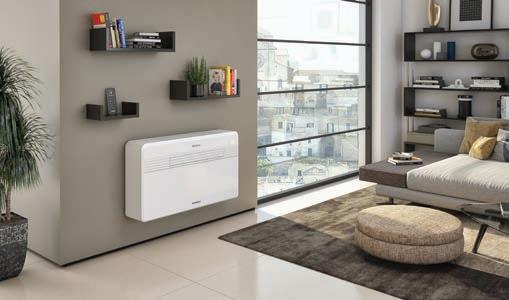
The Maestro Pro heat pump units from Olimpia Splendid feature inverter drive compressors and variable speed fan motors offering quiet operation, down to 32 dBA. The unit provides cooling capacity up to 11,600 btu/h and heating capacity up to 10,200 btu/h. The installation can be low or high wall, with easy installation performed from inside. There is no outdoor unit. It’s economic Italian design also allows for easy upkeep and maintenance. Units come with a seven-year compressor warranty, twoyear parts warranty and limited one-year unit replacement warranty. www.olimpiaslendidusa.com
Daikin has introduced an integrated water-side economizer (WSE) for its Pathfinder air-cooled screw chiller. The WSE uses outdoor air to naturally cool water and other process fluids, reducing compressor work and increasing chiller efficiency. The chiller functions in three different modes—free cooling, mechanical and hybrid—to optimize energy performance and, for data centres, improve power usage effectiveness. At low ambient temperatures, the WSE coils reject the heat, allowing the chiller compressors to shut down. In high ambient temperatures it uses Daikin’s VVR technology and a variable frequency drive to maximize efficiency. www.daikinapplied.com
Dwyer Instruments Series PFT with hot tap insertion paddlewheel flow sensor is suited for monitoring liquid flow rates in pipes from 1-1 2-in. to 40-in. (40-1016mm). Available in brass or a 316 stainless steel body, the unit outputs a frequency proportional pulsed or 4 to 20 mA output. The pulse models are a square wave output signal with frequency proportional to the flow velocity and the 4 to 20 mA models have a linear output of the velocity with 4 mA equal to 0 ft/s and 20 mA equal to 25 ft/s. Applications include cooling systems, pump protection, leak detection, and filtration systems. www.dwyer-inst.com
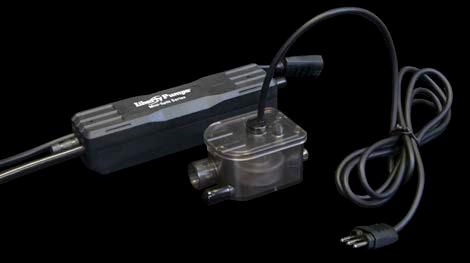
Liberty Pumps’ LCU-MS mini-split condensate pump removes condensate from wall mount, ductless mini-split air conditioners up to 23.5 Btu (7 kW), fan coils, and suspended ceiling air conditioners. The LCU-MS features quiet operation, solid-state switch technology, and a clear reservoir for easy visual inspection. Two models are available, the LCU-MS and the LCU-MS2 which includes a line cover kit. www.libertypumps.com
From front line hospitals to residential HVAC, the search for disinfecting solutions to mitigate risks is leading some to ultra violet systems. BY AARON ENGEL
The Covid-19 pandemic has wreaked havoc on humanity, but it has also illustrated the adage “chaos breeds innovation.” Hospitals in North America, overwhelmed with COVID-19 patients and faced with shortages of personal protective equipment (PPE), have developed their own innovations to disinfect and reuse N95 masks and other medical protection.
Doctors and healthcare managers began ordering UV (ultraviolet) lamp systems to convert hospital refrigerators, cabinets and other containers into make-shift disinfection chambers
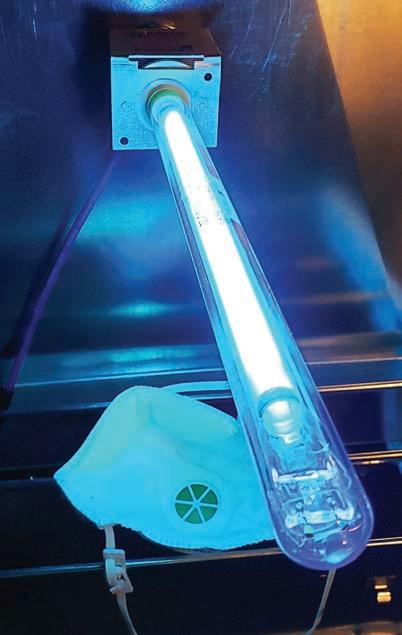
for reusing PPE due to shortages.
Working for a manufacturer of indoor air quality (IAQ) equipment, including UV systems for HVAC units, ductwork and environmental surface disinfection systems (ESDS), our team was able to take dimensions of the various chambers and provide the most effective UV output using modeling software.
Puzzled how doctors were making the connection of UV-C’s virus inactivation capabilities with PPE disinfection, our executives discovered the U.S. Centers for Disease Control and Prevention (CDC) had issued its guideline document “Crisis Standards of Care Decontamination Recommendations” on April 9. One recommended alternative cited a 2018 American Journal of Infection Control article “Ultraviolet Germicidal Irradiation of Influenza-Contaminated N95 Filtering Facepiece Respirators (FFR)” to disinfect PPE for reuse.
The 2018 article’s researchers custom-built a deactivation chamber using Fresh-Aire UV’s high output UV-C lamp system. The conclusion stated that one to five-minute (depending on chamber size) UV-C exposures were effective in disinfecting N95 respirators for reuse during pandemic shortages.
Consequently, UV equipment sales have been strong throughout the pandemic as manufacturers like us, HVAC distributors and contractors battle to keep pace with the increasing demand for institutional, commercial and residential systems.
Besides lamp systems, the most popular requests during the crisis have
“We don’t mention COVID-19, but we do mention studies that have proven UV 99.9% effective against viruses.”
been UV-C surface disinfection for offices, exam spaces and patient rooms; commercial UV systems for disinfecting the airflow and interior surfaces of air handlers and ductwork; and single lamps and combination UV/activated carbon media systems for residential HVAC equipment.
Consequently, many HVAC contractors are on pace to sell and install more residential UV systems. Distributors have also seen an increased interest in UV.
For example, UV sales for Action Furnace in Calgary surged 85% throughout March, April and May, according to Eric Parcels, service manager, who attributed the increase to Alberta’s 6,400 confirmed COVID-19 cases and 120 deaths through midMay, third highest number of cases among Canada’s provinces.
Parcels didn’t anticipate a pandemic, but coincidentally had already been developing an IAQ niche for the 45-year old residential HVAC contractor. For the past year the company has been adding products such as UV lights, based
With locations in Calgary, Edmonton and Red Deer, Action Furnace has placed a focus on residential indoor air quality.
on previous experiences promoting UV disinfection products at Parcels’ former HVAC contractor employers in Ontario and Florida.
The year-long IAQ niche preparation put the company and its two other branches in Edmonton and Red Deer in the right place when COVID-19 news hit Alberta in late February.
Consequently, technicians in the company’s fleet of 25 service and maintenance vehicles were ready to install and promote UV products when consumer interest increased. Crews install two types of UV systems. One is a single low-voltage one-year or two-year UV bulb installed near an air handler’s evaporator coil.
Customers opting for a more comprehensive system get an APCO-X air purifier, manufactured by Fresh-Aire UV. The APCO-X is a combination UV and activated carbon media air treatment system that inactivates biological contaminants and adsorbs gaseous contaminates such as volatile organic compounds (VOCs) from the airstream.
Action Furnace is promoting UV as a disinfectant for viruses, but doesn’t name COVID-19 specifically, because there are no studies yet proving UV’s effectiveness inactivating this novel
version of the coronavirus. However, there are ample studies proving UV’s effectiveness against viruses and similar coronaviruses such as severe acute respiratory syndrome (SARS) and the Middle East respiratory syndrome (MERS). Therefore, the company promotes IAQ in general with 30-second radio spots and mailers to customers.
“We don’t mention COVID-19, but we do mention studies that have proven UV 99.9% effective against viruses,” said Parcels.
Action Furnace has also trained service techs to promote IAQ using a 30-minute air quality monitor collection process executed during routine service calls. A summarizing read out informs customers about the amount of non-biological contaminants found in the air, such as CO2 or VOCs. The air analysis helps customers decide whether an air treatment system would be effective for them. The readouts are later recorded on customer invoices for follow up during the year.
Action Furnace has stocked the monitors on five of its 15 service trucks and hopes to fully roll out the program to the 10 remaining service vehicles along with five maintenance trucks.
As noted, because of its sudden
emergence, there’s no published data of UV-C’s effectiveness or dosage for inactivating COVID-19. However, a 2004 study “Inactivation of the Coronavirus that Induces Severe Acute Respiratory Syndrome, SARS-COV” published by the National Center for Biotechnology Information (NCBI) has proven UV-C’s success with SARS.
Furthermore, our own third-party testing has also included viruses. One study simulated airstream microbe inactivation in an ASTM/AHAM style environmental test chamber simulating a typical building's indoor environment and HVAC air handler arrangement. Performed in an ASHRAE Standard 52.2 test duct system, the test's UV-C light single-pass results demonstrated a 99.03% inactivation of the virus (MS2 coliphage).
The chaos of COVID-19 has led to innovation at hospitals and among manufacturers as well. We are now developing UV-C lamp chambers called Blue-Cube UV to disinfect medical equipment that will help relieve the pressure on N95 mask supply. The company has also introduced a portable UV/HEPA filter combination unit that can be placed in rooms where COVID-19 eradication is critical. <>
Aaron Engel is vice president of business development at Fresh-Aire UV (www.freshaireuv.com). Engel can be reached at aaron@freshaireuv.com or 800-741-1195.
Center for Disease Contro (CDC)l, “Decontamination and Reuse of Filtering Facepiece Respirators” https://www.cdc. gov/coronavirus/2019-ncov/hcp/ppestrategy/decontamination-reuse-respirators.html
American Journal of Infection Control, “Ultraviolet Germicidal Irradiation of Influenza-Contaminated N95 Filtering Facepiece Respirators (FFR)”, https:// www.ajicjournal.org/article/S01966553(18)30140-8/fulltext
National Center for Biotechnology Information, “Inactivation of the Coronavirus that Induces Severe Acute Respiratory Syndrome”; https://www.ncbi. nlm.nih.gov/pubmed/15350737
Napoleon, Canadian manufacturer of heating and cooling equipment as well as fireplaces and grills, came to the aid of a neighbouring company in Barrie, Ont. to keep up with surging demand for medical essentials during the COVID-19 pandemic.
“We wanted to help. However our facilities are not setup for the product required for medical equipment, so we quickly found how we can help by partnering with a local medical equipment producer,” said Stephen Schroeter, co-CEO for Napoleon in a company release.
“We have trained and re-focused Napoleon manufacturing workers to really help medical equipment colleagues deliver on surging demand at a critical time. We are so proud of our team for their willingness to volunteer to help where help is needed and put themselves on the frontline of this crisis.”
Some 50 Napoleon associates were covering four shifts each day including midnights. The team provided support in the areas of material handling, machine operations, assembly, engineering, quality control as well as team leadership and supervisory support.
“I couldn’t be prouder to be a Napoleon team member during this worldwide pandemic. I normally work on building fireplaces and have been employed for 19 years. I have volunteered to work with the medical equipment company and am so grateful for the opportunity to help,” said Napoleon associate, Lindsay R.
The Napoleon team primarily focused on assembling and packaging face shields which provide a wide range of protective coverage for healthcare workers including splash protection which significantly reduces the risk of contamination and protects them against high level diseases, such as COVID-19.
In addition, Napoleon is leveraging its global supply chain partners to expedite the delivery of urgent and essential medical equipment for local hospitals and working to support government agencies to assist further. www.napoleon.com
Imperial Manufacturing Group, a conglomerate of businesses centered around the HVAC and building products industries with its head office located in Richibucto, New Brunswick, has acquired Pointe-Claire/Green Valley Steel Group Inc., a steel service centre offering warehousing, slitting, levelling, and cut-to-length of flat rolled steel products with its corporate head office located in Hamilton, Ont. and facilities located in Pointe-Claire, Que. And Bolton, Ont.
“After working on this agreement for quite some time now, I am proud to say that it has finally come to fruition,” stated Normand Caissie, CEO of Imperial Manufacturing Group, in a company release. “Despite the effects brought on by the recent global COVID-19 pandemic, we still anticipate a good demand for our products in both the residential and commercial markets and Pointe-Claire/Green Valley Steel Group now provides us an ability to improve our supply chain and to better service our customers.”
Pointe-Claire/Green Valley Steel Group, serving its clients for over 50 years, will now operate under the name PointeClaire Steel, a member of Imperial Manufacturing Group. Imperialgroup.ca
Navien, Inc. is laying the groundwork for its first U.S. manufacturing and assembly operation which will be located in James City County, Virginia.
The 300,000 sq. ft. facility will be used as a distribution centre for the first two years and begin the transition for turning it into a manufacturing operation in 2022 with the first stage of manufacturing expected to begin in 2023.
Contingent upon regulatory permits and approvals, Navien’s current plans include beginning to expand the existing facility in 2023, expecting to triple the footprint to nearly 900,000 sq. ft. by 2026.
Distribution of products from the new Virginia facility is slated to begin in April 2020. www.navieninc.com

Wolseley Canada has announced a new partnership with GE Appliances, a Haier company, to bring their exclusively dealer-driven line of Haier ductless and heat pump products to Ontario and Atlantic Canada.
The Haier products are available now at Wolseley in Ontario and Atlantic Canada, with plans to expand to Western Canada in the fall.
By becoming Haier dealers, Wolseley customers will receive preferred dealer pricing, access to seasonal promotions, advertising support, incentives and enhanced technical support.
Shops can learn more and apply to become a dealer at www.Wolseley HaierDealerPortal.ca
Hydron-Aire team, (l-r): Garett Resler (HVAC sales and marketing), Craig Kostelnuk (president) and Darcy Jenkins (office manager).
On May 12 the Danish-based pump manufacturer Grundfos celebrated 75 years in business. The company’s history dates back to the end of the Second World War, when founder and engineer Poul Due Jensen was asked by a local farmer if he could procure a pump. Following the war there was a shortage of almost everything, so Due Jensen had to develop and construct a system from scratch. This led to the foundation of Grundfos.
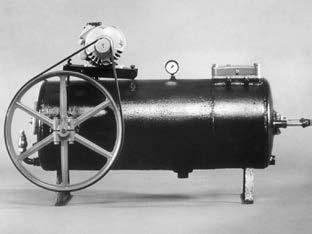
The first Grundfos pump: The Foss 1, nicknamed ‘the pig’ because of its design. It was a shallow groundwater piston pump. A total of 26 were produced and sold.
From the very first pump in 1945 to today’s digital solutions, the 75th anniversary of Grundfos is being dedicated to the shared values of the company’s 19,280 colleagues all over the world.
“We celebrate the pioneering and socially responsible spirit that has driven Grundfos since the beginning and continues to drive us today. We carry that mindset forward with a profound commitment to fight the imminent climate and water challenges affecting all of us,” said Mads Nipper, group president and CEO, Grundfos, in a company statement. grundfos.ca
Daikin Industries has invested $2 million into Silicon Valley-based startup Locix, Inc., a company that uses cloudbased spatial intelligence solutions that use a combination of indoor positioning technology, advanced AI, and Wi-Fi to
The team at Hydron-Aire Ltd., based in Grande Pointe, Manitoba (just outside Winnipeg) has taken on the representation of the Weil-McLain line of products for Manitoba and Thunder Bay areas.
Hydron-Aire takes over the territory from Fernando Carreiro who is retiring after 15 years as the Weil-McLain Canada agent in the area and over 40 years in the hydronics industry in Winnipeg.
The Hydron-Aire team is led by Craig Kostelnuk who brings more than 40 years of experience with an agency that his father started in 1968. The Hydron-Aire team took over the territory for Weil-McLain Canada as of June 1, 2020. www.hydron-aire.com
acquire and analyze locations, as well as spatial and visual data, to enable actionable insights.
The data is used to provide automated decision making for services such as occupancy monitoring for the advancement of smart buildings. Daikin plans to accelerate its air conditioning solutions business and create new customer value by connecting air conditioning devices to networks and analyze big data related to air conditioning.
Daikin aims to reduce labor hours at installation sites by using local positioning technology that will configure and confirm positioning of indoor air conditioning units and automate remote monitoring services that were previously performed manually.
Also, analyzing the presence and movement of people in an office building, Daikin expects to see a solutions business for office spaces emerge. The company has set aside $100 million to invest in global start ups over the next five years. Locix is its first investment in a company outside Japan. daikin.com
Continued on p44
On April 29th employees at Toronto-area wholesaler NEXT Supply packed 500 survival kits for people living on the streets and in encampments in downtown Toronto. This initiative is just one of the ways the company has participated in giving back to its community since the COVID-19 pandemic struck. We spoke with company CEO, Michael Storfer and marketing lead Carolina Lorenz to learn more about how NEXT has been managing through these unusual times.
What’s it been like running a wholesale business during COVID-19?
Michael Storfer: It's a different environment for sure, making sure your people are safe and keeping in constant communication. I think I spend more time on Zoom than anywhere else right now.
I have meetings with every branch manager and sales staff, even if it’s for five minutes, just touching base every day making sure that we're communicating constantly. And I do a weekly meeting with all the staff on Wednesdays to go over what's happening internally and in the marketplace.
Are you communicating with staff more?
Michael Storfer: Oh yes, absolutely. Right now we have to maintain a safe environment for everybody, and we’re trying to focus on what we can do from a community perspective as well. Our core values as a company include being integral to our customers, our co-workers and our community. And I think that's easy to say when there's no pandemic, but when things begin to happen, that's when you realize whether your values are a slogan or you truly believe in your brand.
How did the survival kits for the homeless initiative come about?
Caroline Lorenz: Michael has always felt extremely strong about the company’s philanthropic efforts, so as soon as the pandemic happened a number of our stakeholders and coworkers were asking, “What can we do to help?”
We found the Seeds of Hope Foundation, a grassroots group that deals directly with people in the shelter system and on the streets. They work in transitioning homeless people into homes They are providing the homeless with tents so they can self isolate, but they are in need of food and other necessities. So we collected items and employees made 1,000 sandwiches and a few even made homemade masks.
We set up a socially-distanced assembly line and packaged kits containing a variety of items including water bottles, sandwiches, meal replacement bars and drinks, snacks, a face cloth, socks, toiletries, as well as activity books and
Brad, a manager of NEXT Supply in Markham, in an assembly line helping pack kits for the homeless.

pens. We loaded 500 kits into big totes and shipped them to the foundation.
Are there other community initiatives you’ve become involved in since COVID-19?
Lorenz: We’re also involved with the Friendly Neighbor, a hotline for seniors. A recent start-up, it’s helping vulnerable seniors—a group most at risk—by mobilizing volunteers to deliver groceries and other household essentials to seniors in need. We sent out a link to all staff, and anyone who wishes to volunteer can participate and the company will support them if they need to make a pick-up/delivery during work hours.
What changes have you had to make for your customers?
Lorenz: We’ve implemented a number of safety protocols, including changing shifts so there is less overlap, enforcing social distancing, not taking returns along with enhanced safety and hygiene measures. And while many wholesalers are only allowing phone orders and curbside pick-up, we’re still allowing a limited number of people to enter locations. Some customers have been saying it's hard to find a place to actually wash their hands.
Do you foresee the pandemic having long-term effect on business?
Storfer: I think there's absolutely a realization this is not a one-month change; this is going to be a way of life potentially forever. About 75% of our staff are working remotely, and I can see the nature of sales calls changing. I think we'll find different ways of bringing value. And in some cases, I think that value is going be much higher.
Has anything surprised you during this unusual time?
Storfer: That our staff have remained so calm, and I give credit to our managers. And from a customer perspective, I think that in general our customers have been responsible. They are putting their staff first and not putting them in unsafe environments.
• Inverter compressors for superior performance and exceptional efficiency
• 575V heat pump line offering Priority Cooling Control
• Large-capacity single outdoor units (up to 16 ton). High-capacity units increase layout flexibility, simplify installation, save space, reduce weight and decrease the number of piping and electrical connections
• Exceptional design flexibility and long-term savings on energy and maintenance
• Maintenance-friendly design. All components are accessible from the front for fast, easy, cost-efficient maintenance.
• 10-year warranty on parts and compressors
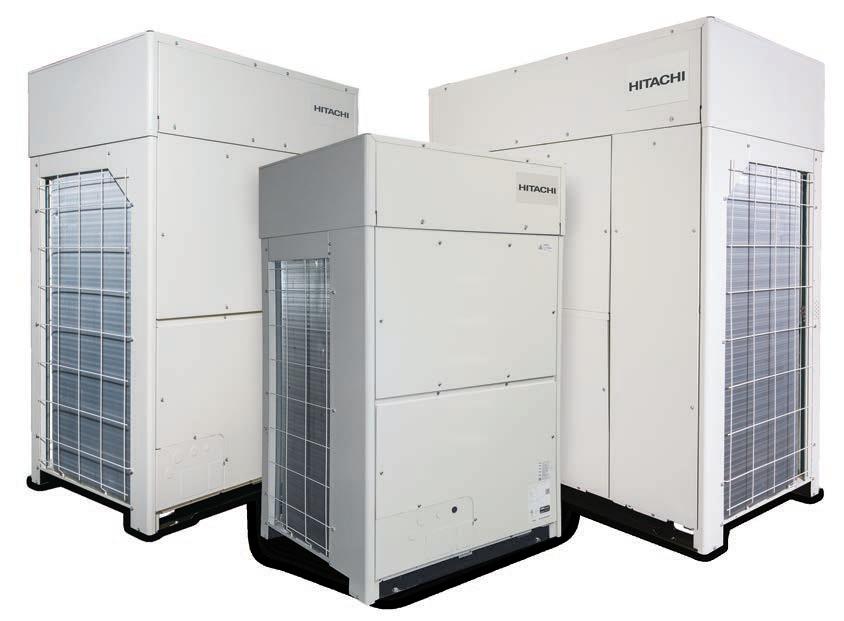
*Available in Ontario, Quebec and Atlantic Provinces only.
CARRIER COMPLETES
SPIN-OFF FROM UTC
Carrier Global Corporation has officially become an independent, publicly traded company after successfully completing its separation from United Technologies. Shares of Carrier began trading on the New York Stock Exchange Friday, April 3 at market open under the symbol “CARR.”
The longstanding manufacturer of HVAC, refrigeration, and fire & security technologies has a global footprint with approximately 53,000 employees operating across 160 countries.
“As a standalone company, we have the ability to leverage our legacy of industry leadership and sustainability to address the challenges of today and tomorrow while executing our vision and growth strategy” said Carrier president/CEO Dave Gitlin. www.Corporate.Carrier.com
MONTREAL-BASED BRAINBOX AI RAISES $12M TO EXPAND ITS REACH
>> Zurn Industries Ltd. has announced the appointment of Snyder Sales Group as its new sales agency representative in Atlantic Canada, taking over from Ancamna Sales. Snyder becomes the representative for all Zurn Canada product lines in Atlantic Canada including: New Brunswick, Prince Edward Island, Nova Scotia and Newfoundland.
Led by Scott Snyder, Snyder Sales Group has a 30-plusyear track record of over 50% market share on lines they represent in the region. www.zurn.ca
>> Duravit USA announced the addition of Sandcliff as its new representative in Eastern Canada. Led by Anthony Greco, Angelo Fortini, and Dave Grey the Sandcliff agency brings a cumulative 25-plus years of experience in the industry.
Duravit USA president Tim Schroeder remarked, “We are thrilled to expand our representation in Eastern Canada. Sandcliff’s proven track record and knowledge of the luxury bath industry will certainly make a great impact across Eastern Canada for our brand.” www.duravit.us
BrainBox AI is using artificial intelligence to reduce energy costs in buildings using HVAC control technology. The Montreal-based company is gaining investment support with a new $12M fundraising round to deploy its technology across North America and abroad.
The solution combines deep learning, cloud-based computing and autonomous decision making to support a 24/7 selfoperating HVAC system.
The oversubscribed round of financing included domestic and international investors, new and existing, including Esplanade Ventures as lead investor and Desjardins Capital.
recycle all elements of the thermostat;
metal, electronics and mercury (which is particularly hazardous). Do your part and join the more than 1,500 contractors already participating in the
“It’s impressive to see a Montreal start-up with an international vision for tackling a global issue like climate change,” said Luc Ménard, chief operating officer of Desjardins Capital in a media release. “The way they’re using AI to efficiently manage energy use in buildings could be a game-changer in a huge market.”
In the 11 months since its launch to market in May 2019, BrainBox AI has installed its self-learning technology in over 15 million sq. ft. of commercial properties, across 15 cities on three continents. www.brainboxai.com

Mits Airconditioning has appointed Peter Kinsey as hydronic product manager and project leader for the hydronic division. Kinsey has a combined 27plus years of experience in the hydronic industry.

Jeff House has re-ignited Jefcom Consultants Inc., a manufacturers rep agency, and has created Boiler House Training to assist wholesalers, contractors, technicians, and manufacturers with hands-on hydronics training. House will offer custom training ranging from two-hour product specific sessions to one-day or three-day hydronic heating and design courses. He also represents Hydronic Systems Canada in SW Ont. from Niagara to Windsor. jefcomsales@live.ca


Mestek’s boiler products group has promoted Ken Eggleston to director of sales – boiler products, overseeing the North American market segments and territories. Eggleston has been with Mestek for over 13 years. Most recently, as the northeast regional sales manager for the boiler divisions.

Ken Barton is now VP of Technical Sales with Arzel Zoning Technology. Barton started my career joined Arzel in 2008 answering calls in the technical support department, eventually moving on to technical services manager. In his new role he will be working directly with technical support, engineering, sales and the marketing departments.


Distech Controls has announced the hiring of Daniel Therrien and the promotion of Sabatino Castaldo to its Canadian sales team. Therrien joins the company as regional sales manager for the Eastern region of Canada. He brings more than 17 years of building automation and HVAC experience to Distech. Castaldo, with the company for 11-years, is now regional technical manager for Canada responsible for supporting sales channels and deploying necessary sales and customer support missions and tasks across Canada.

The Taco Family of Companies announced the promotion of Cheryl Merchant to CEO of the 100year old, third-generation family-owned company. Merchant, who joined Taco in 2019, was previously president of global operations. Prior to joining Taco, she spent the last 19 years as the president/CEO of Hope Global Industries. John Hazen White, Jr., executive chairman and owner of Taco, will remain active in the company, placing his focus on global growth and continuing to strengthen internal and external relationships.


Cleaver-Brooks announces that Johan Tallberg has joined the company as senior vice president of burner systems and exhaust solutions. In this newly created position, Tallberg will be responsible for leading the sales support, product management, sales engineering and product development teams for the burner and exhaust product lines. The company also added Ryan Lepp as the senior vice president of industrial watertube boilers. In this new position, Lepp will leading sales support, product management, sales engineering and product development teams.
DriSteem has added Duncan Curd as global business development leader. In his new role, Curd will focus on international market evaluation, development and implementation of strategic plans. Prior to joining DriSteem, Curd filled a variety of sales, marketing and business development roles with global companies including: Siemens, Carlo Gavazzi, Nortec (Condair) and GRIP Idle Management Systems.
Stelpro has appointed Alexandre Lafrance as national retail sales manager. With more than 20 years' experience in sales and business development in a variety of industries, Lafrance will work with current and future retail partners.


NAVAC has hired Bryan Schwartz for the role of western regional sales manager. In this position, Schwartz will lead sales efforts and play a role in expanding the company’s customer base covering western Canada and the western United States. He brings more than 20 years of sales and service management experience to his new position, most recently he was senior national training manager for LG Electronics.


Saniflo Canada has appointed Jeremy Martin as western regional sales manager and Robert Marchio as central Canada regional sales manager. Martin brings over 18 years of experience in wholesale and retail channels. In his new role he will implement national and regional marketing and sales strategies for western Canada. Marchio has worked in the plumbing and HVAC industry for more than seven years and will now oversee the Ontario, Manitoba and Saskatchewan markets.

Metal to metal and the corrosion that ensues. BY STEVE
GOLDIE
“All will be well and all will be well and every kind of thing shall be well.” –
Julian of Norwich
II freely admit that it may seem odd to lead off a plumbing article by quoting a 14th century mystic, but we are living in strange and uncertain times.
Julian of Norwich spent much of her life living in seclusion; she survived the Black Death, and she managed to write the earliest surviving book written in the English language by a woman. I’ve merely spent a few weeks in semi-seclusion; I’ve managed to survive the Covid 19 pandemic, so far at least; and I’m struggling to write a few simple paragraphs of simple plumbing prose, hopefully they will survive till the next recycling run, so here goes.
Julian of Norwich in her day wrestled with timeless theological issues with eternal implications, and today I want to wrestle with the age old and contentious question of when, if ever, one should use a dielectric union when joining two dissimilar metals.
I will go ahead and state my opinion from the outset: I don’t believe one should ever use these diabolical and deceptive fittings, under any circumstance.
Yes, I am aware that many codes require them, many engineers specify them and many inspectors want to see them. Still, I will stand firm in my assertion that these fittings have no place in any plumbing or heating system.
Now before someone goes and accuses me of being a galvanic corrosion
denier let’s look at what the science has to say. Galvanic corrosion, also know as “dissimilar metal corrosion” refers to corrosion occurring when two dissimilar metals come into contact with one another and simultaneously with a corrosive electrolyte.
In the case of plumbing and heating systems the electrolyte is the water in the system. The contacting metals form a bimetallic couple because of their different affinities (or attraction) for electrons. These different affinities create an electrical potential between the two metals, allowing a slight direct current to flow.
When these bimetallic couples form, one of the metals corrodes faster than it would all by itself, while the other corrodes slower than it would alone, or not at all. The metal that corrodes during galvanic corrosion is known as the anode, and the metal that doesn’t corrode is known as the cathode. Metals that are more cathodic are referred to as more noble metals. (See anodic chart)
This process was discovered in the late part of the eighteenth century by Luigi Galvani in a series of experiments with the exposed muscles and nerves of a frog that contracted when connected to a bimetallic conductor. In the early 1800’s the discovery was put into a practical application by Alessandro Volta who used a series of dissimilar metal disks, separated by cardboard soaked with acid or saltwater solutions to build the world’s first electrical cells, or batteries. This was the basis of all modern wet-cell batteries, and it was
the first method found for the generation of a sustained electrical current.
Our industry has used this process in beneficial ways also, the most obvious example is the use of magnesium, zinc or aluminum in the form of sacrificial anode rods to protect steel hot water tanks from corrosion.
Now that we have (hopefully) a better understanding of the science involved, let’s go back to the argument of whether or not dielectric unions are an effective way to connect dissimilar metals in a plumbing system.
Common examples of connections of dissimilar metals would include copper water lines connecting to old galvanized steel lines, or copper water lines connecting to a steel hot water tank. In these situations we have all three elements required to foster galvanic corrosion, two metals with different corrosion potentials, copper (cathode) versus steel (anode), direct contact between them as they are being connected, and the presence of a corrosive electrolyte being the water.
Preventing galvanic corrosion depends on removing one of these three elements. Dielectric unions have rubber gaskets and plastic sleeves that are intended to act as insulators which separate and break the electrical continuity between the two metals by removing
“Galvanic corrosion, also know as “dissimilar metal corrosion” refers to corrosion occurring when two dissimilar metals come into contact”

the element of direct contact between the two metals.
In theory this should work to prevent the galvanic corrosion, but here is the problem: THEY DON’T WORK!
Not only do they not work, but they actually seem to make the problem worse. I am not alone in my opinion. Do a Google search and you will find countless plumbers with many years of experience posting the same opinion. To quote just a few:
“...I am a licensed plumber for 20-plus years. When I started, it was code to install dielectric unions everywhere in houses where copper connects to steel. Every single union fails miserably by either leaking, clogging up completely, rusting to pieces”
“...My own home has some brass to galvanized steel connections in the basement that I meant to change out years ago, but they are holding fine and give no sign of trouble. The connections are probably 75 years old. I've seen dielectric unions fail within five years.”
“...Dielectric unions suck!”
I know this is all anecdotal evidence, but it is an opinion that is shared by virtually every experienced plumber I’ve spoken to, which adds up to hundreds of years of collective experience. I also read the results of a study in 2013 done by Penn State University, Office of Physical Plant, Energy and Engineering Division, Engineering Services, which observed:
“Whenever a ferrous metal such as black steel is connected to a non-ferrous metal such as copper, a dielectric connection must be installed to prevent galvanic corrosion. The installation of a fitting with inert material between the two metals prevents the flow of electrons between the metals, preventing premature failure of the piping. Traditionally, dielectric unions have been installed to perform this function. However, dielectric unions are proven sources of leaking fittings, and should be avoided.”
In my experience, a 6-inch long brass nipple directly con -
Anodic Chart
50/50 Lead tin solder
Admiralty brass, aluminum brass
Manganese bronze
Silicon Bronze
Stainless steel - grades 410, 416
Nickel silver
90/10 Copper nickel
80/20 Copper nickel
Stainless steel - grade 430
Lead
70/30 copper nickel
Nickel aluminum bronze
Nickel chromium
Nickel 200
Silver
Stainless steel - grades 302,304,321,347
Nickel copper alloys - 400, K500
Stainless steel - grades 316 & 317
Alloy 20 stainless steel
Nickel iron chromium alloy 825
Titanium Gold, Platium Graphite
nected to the hot water tank or brass unions or couplings will yield much better and longer lasting corrosion free results than any dielectric union ever will.
Sometimes you won’t have any choice because a smarterthan-all-of-us engineer or inspector may insist on the diabolical dielectric, but when the choice is yours go with the brass, and in the words of Julian of Norwich, “All will be well, and all will be well and every kind of thing shall be well.” <>

Steve Goldie learned his trade from his father while working as a plumber in the family business. After 21 years in the field, he joined the wholesale side of the business in 2002. His expertise is frequently called on to troubleshoot systems and advise contractors. He can be reached at sgoldie@ nextsupply.ca.
The latest generation of the touch-free WashBar from Bradley features a thin, L-shaped design that gives the feel the fixture is floating above the sink. The WashBar combines touch-free soap, water and dryer. The chrome-plated cast alloy fixture features LED lighting to visually orient the user through the hand washing process with easy-to-identify icons on top of the bar. Water is dispensed at 0.5 GPM although it is also available with an ultra-high efficiency flow rate of 0.35 GPM. www.bradleycorp.com/washbar-next-gen
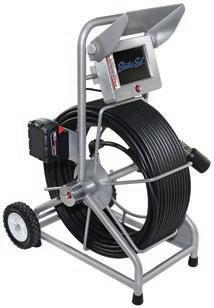
All Electric Eel eCAM pipeline inspection camera systems now come equipped with a built-in battery cradle which accepts a Milwaukee M18 or equivalent battery (battery not included). The new feature adds convenience for operators and allows easy access to power for remote field work or where electricity is not available. Battery life is 6-7 hours. www.electriceel.com
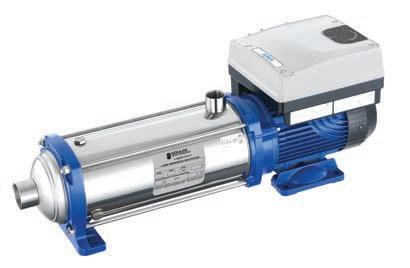
Goulds Water Technology e-HME and e-SVE pumps combine a hydraulic pump with permanent magnet motor technology and a variable speed drive to provide up to 70% energy savings in residential and agricultural applications. The pumps have stainless steel casing and inner components and are certified to the NSF/ANSI 61 drinking water system components standard. The e-HME comes in five models delivering up to 130 GPM and 540 feet TDH. The e-SVE is available in six models delivering up to 85 GPM and 710 feet TDH. Both lines are available in 0.5 – 2 HP. goulds.com
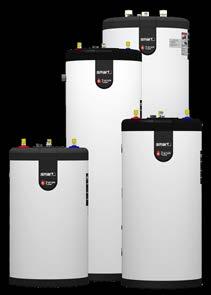
Triangle Tube Smart 316 supersedes the existing line of Smart indirect water heaters and will be available in all current Smart model sizes ranging from 30 to 120 gallons. New enhancements include a 316L inner tank of high-grade stainless steel, acid pickling to promote improved corrosion resistance, a watertight top cover and improved shell to prevents corrosion of the outer tank. The water heater also features an improved dry well quality, as all dry wells are subject to pressure testing prior to installation. www.triangletube.com
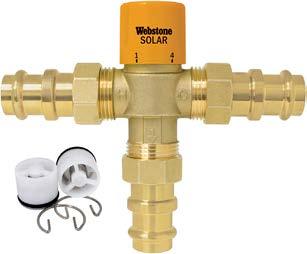
Webstone has announced enhancements to its line of Solar Thermostatic Mixing Valves (TMV). In-line spring check inserts for high temperature solar applications are now included with all Solar TMVs at no additional cost. The products are certified lead-free and available for immediate shipment.
www.webstonevalves.com/TMV
RIDGID has added the K9-306 to its line of FlexShaft drain cleaning machines. Designed to clean 3- to 6-in. diameter drain lines up to 125 ft., the K9-306 clears blockages along with the ability to inspect with a camera simultaneously. The unit features a 1.5 HP internal universal motor, a fully enclosed drum and a retractable handle with multiple wheels and grab points for easy transporting and storage. FlexShaft models use various chain knockers and their fully enclosed nylon-sheathed cable can be easily wiped clean. ridgid.com
















































What the mechanical industry needs to know about this growing industry.
BY ROBERT WATERS
Housing construction in Canada is being pushed greener all the time. In a past HPAC article I discussed some of the green building code trends that are coming, and how they will affect the mechanical industry (Code Green, HPAC Feb 2017). Upcoming changes to federal and provincial building codes are going to continue this evolution to more energy efficient buildings. The ultimate goal of most governments is to have building codes that will require Net Zero Energy Ready homes by approximately 2035, with the BC Energy Step Code being a prime example.
For a home to get to a full Net Zero Energy level, where the annual energy consumption of the building is zero, there are two basic requirements that must be met. First, the building must be constructed to reduce the energy consumption substantially by increasing the insulation levels in exterior walls, ceilings and windows, and making buildings very air tight. These construction enhance-
ments, along with the use of low energy lighting and appliances, will reduce the energy load of a Net Zero Energy Ready home by approximately 70% compared to a home built to today’s 2015 NBC 9.36 building code standard.
The second part of getting to full Net Zero Energy is to install an on-site solar photovoltaic (PV) energy system that will produce enough annual energy to offset the energy that the house consumes. When both of these parameters are in place the house will be truly Net Zero Energy.
Currently most mechanical contractors are not very familiar with solar PV systems, but it is most likely time for that to change.
With Net Zero Energy homes becoming more and more common, and the push towards electrification of home heating and cooling systems, solar PV systems are going to become much more mainstream. These systems have typically fallen into the domain of specialty solar companies, and until recently have been so expensive that only a very small market has developed.
Solar PV prices have dropped dramatically in the last 15 years, to the
point where the cost of generating solar electricity has resulted in grid-connected solar PV systems approaching grid parity throughout Canada. In this article I hope to introduce contractors to the basic construction requirements of installing an on-site PV system, the main components of the PV system, as well as how much energy the PV system will be expected to produce.
The only difference between a Net Zero Energy (NZE) home and a Net Zero Energy Ready (NZEr) home is whether or not the on-site solar PV system has been installed. Most builders who are currently building to this standard are building NZEr homes, and leaving it up to the homeowner to decide if they want to install the solar PV or not.
Regardless, the home can still be built to a standard that easily allows for the solar PV to be integrated at the time of construction, or any time in the future. To ensure that everything is done correctly for the solar installation, Natural Resources Canada (NRCan) has developed a set of “Photovoltaic Ready Guidelines, Ver 2.0” for builders. These guidelines can be downloaded from the NRCan website, and they de -

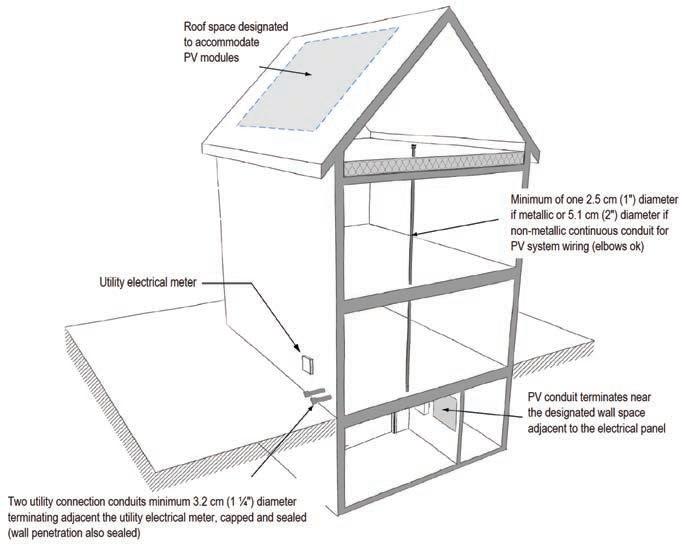
scribe the design considerations and modifications that builders can make to a home’s construction to prepare for the installation of a future solar PV system.
The design considerations and modifications include the following elements: the roof requirements, the PV and utility connection conduit installation and termination, mechanical room wall space, electrical panel rating, and breaker slot and network communications.
Making a home “solar PV ready” is relatively simple and inexpensive to implement when it is done at the time of
construction, and will lead to significant savings in installation costs when the solar PV is installed at a later date.
The first item that Solar PV Ready Guidelines focus on are the roof requirements (see fig 2). The slope and orientation of the roof are site-specific conditions that have a huge influence on the performance of a solar PV system and how much electricity it will generate.
The size of roof space that is available dictates how many PV modules can be installed, and of course any shading on the PV modules must be avoided.
The ideal situation is to have a roof surface that is oriented directly south, with a roof slope of 10o less than the site latitude, and no shading. This ideal situation is not always possible however, and it is OK to deviate a little on the slope and orientation as this will result in only a minor drop-off in system performance. It is best to keep the roof orientation within 45o east or west of direct south, and the roof slope should be between 18o to 56o (corresponds to a pitch of 4/12 to 18/12).
Note that PV panels on low roof slopes can have issues with snow accumulation, so low slopes should be avoided in high snow loads areas. The available roof area being allocated for PV modules must be unobstructed by chimneys, roof vents, skylights, gables, and must be large enough to accommodate the required amount of PV panels.
A PV system sized to provide an energy output sufficient to offset all or most of the annual energy consumption of a NZEr home will require approximately 30 PV modules, requiring an area of approximately 500+ sq. ft.
Builders must also ensure the roof structure not only meets all applicable building code requirements, but will also support the additional dead load and wind and snow loads associated with common photovoltaic energy systems.
The next building consideration is to allow for easy installation of all the necessary PV wiring. There are two paths required, one from the roof location to the electrical panel location, and another from the electrical panel to the outside utility electrical meter location (see fig 3).
For the roof wiring, the builder will need to install a PV conduit constructed of metallic conduit of at least 1-in. nominal diameter, or non-metallic conduit of at least 2-in. nominal diameter. This conduit must be installed entirely inside the building envelope and will extend into an accessible area of the attic close to the PV roof, and down into the electrical panel area. Bends
Continued on p54
are permitted but should be limited where possible to make the future pulling of wires easier.
For the connection of the PV system to the outdoor utility meter, two utility connection conduits of at least 1-1/4-in. nominal diameter rigid PVC conduit should be installed. These two connections allow for the PV system to be connected to the electrical grid for net-metering, and to allow for a PV disconnect switch to be located outside the building.
This PV disconnect switch is required to protect utility workers that may be working in the local area. When the builder is not installing the PV at time of construction all of these conduits must have their ends capped and sealed.
Wall space must be allocated in the electrical room, adjacent to the house’s main electrical panel, for the future installation of a PV system inverter and connection hardware (see fig 4). A recommended space of 36- x 36 inches is suitable, with a minimum clearance 36 inches up from the floor.
Other PV system electrical considerations include ensuring sufficient electrical panel ampere rating (usually 200 A is a good idea) and allowing for network communication wiring for PV inverter communication to the internet. There is great software available that allows for the PV system to be tracked on-line with terrific graphics and live electrical production data displays.
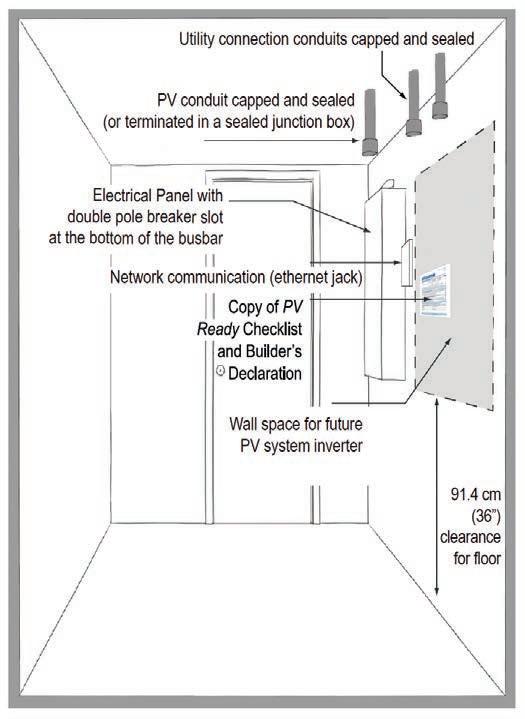
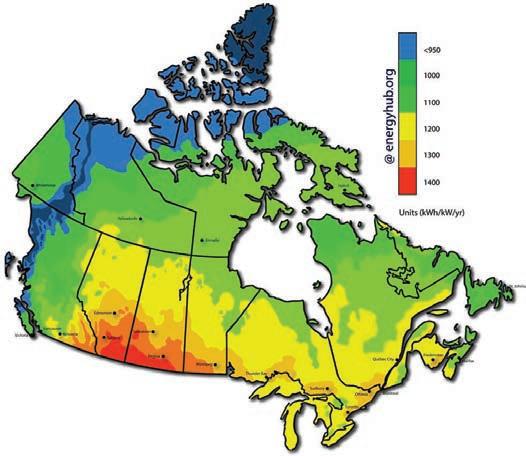
The NRCan PV Ready Guidelines, v. 2.0 go through many more technical details on the roof, conduit and electrical room requirements, so download a copy for more details.
The main components that make up the solar PV system are: the solar PV panels, roof mounting hardware, wiring/cables, the power inverter and the electrical meters. Solar PV panels are typically made of 60 or 70 crystalline silicone cells which are electrical devices that can directly convert solar photon energy into electricity. PV panels generate direct current (DC) output. There are several types of modules available with the most common being either mono-crystalline or multi-crystalline. Most modules are available in either 1 x 1.6 m or 1 x 2 m sizes, incorporate a tempered glass cover sheet and an aluminum frame.
The modules are typically about 1.4-in. thick and weigh roughly 40 lbs. The panels are attached directly to the roof structure using a variety of aluminum frame rack systems, which connect to the roof joists or decking and keep the panels about 2 to 3-in. off the roof surface.
The solar inverter, or PV inverter, is an essential part of any PV system. It receives all of the variable DC output of the solar panels and converts it into an alternating current (AC) that can be utilized on-site by local household loads, or fed into a commercial electrical grid.
There are different types of inverters used depending on whether the system is a grid connected system, a standalone system with batteries, or a hybrid.
As noted, the total cost of installing solar PV has plummeted in the past 15 years as the PV industry has gone through massive worldwide growth. In 2005 installed residential system prices were in the range of $10/W, where now systems are being installed as low as $2.75/W. Large scale commercial systems are being installed in the southern U.S. for less than $0.90/W.
When a residential house has been built to PV Ready Guidelines, the installed cost of the solar PV will be even less due to the reduction in labour and materials.
Storing the PV energy in batteries is an option, but today PV systems are most commonly grid-connected. The energy consumption load of a typical household usually does not match the times when PV panels are generating most of their energy. When the system is grid connected it allows any excess energy to be fed into the electrical grid. Net-metering is a billing mechanism that credits the PV system owner for the electricity they add to the grid. The bi-directional electricity meter will run backwards when PV energy is being exported to the grid. This exported energy provides a credit against the electricity that is consumed at night or on cloudy days when the home's electricity use exceeds the system's output.
If the home is net-metered, customers are only billed for their "net" energy use. There are currently net-metering programs available in most provinces in Canada to encourage the installation of solar PV systems.
The total annual amount of energy produced by a solar PV system is influenced by many factors such as the geographic location, the local site conditions and the size of the solar PV array.
The global solar radiation that any location receives is based on the geographic location of the home. All areas of Canada receive differing amounts of annual radiation with the highest amounts in the southern prairie regions of Saskatchewan and Alberta. There are solar PV radiation
maps available from various sources that show exactly how much PV energy production to expect in your area (see fig 5).
Solar PV systems are rated by kW, with a 1 kW system consisting of about 5 PV panels requiring a roof area of 80-90 sq. ft. Depending where you are in Canada a 1 kW system can produce 1,000 – 1,400 kWh of electricity per year. A home constructed to NZE standards will typically require an 8.4 – 9.6 kW PV system with 30 PV modules to produce 100% of its annual energy.
The push towards Net Zero Homes, and the electrification of space and water heating systems are emerging trends that the mechanical industry is facing. NZEr homes will have dramatically reduced space heating and cooling loads requiring very small-sized heating and cooling equipment.
Climate change initiatives will continue to push for electrification of the heating industry and promote the installation of renewable energy systems. Understanding the role of solar PV systems will be an important part of navigating this emerging green building industry. <>

Robert Waters provides training, education and support services to the hydronic industry. He has over 35-years’ experience in hydronic heating and solar water heating. He can be reached at solwatservices@gmail.com.

You need
You provide answers to customer challenges, and for more than 75 years the Little Giant® brand has provided the dependable, water-guzzling solutions. When you combine our passion with yours, together we help prevent unnecessary damage to their valuables by eliminating unwanted water collection before it starts.
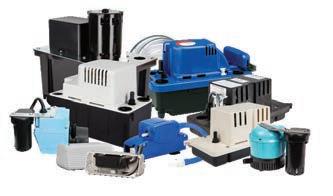
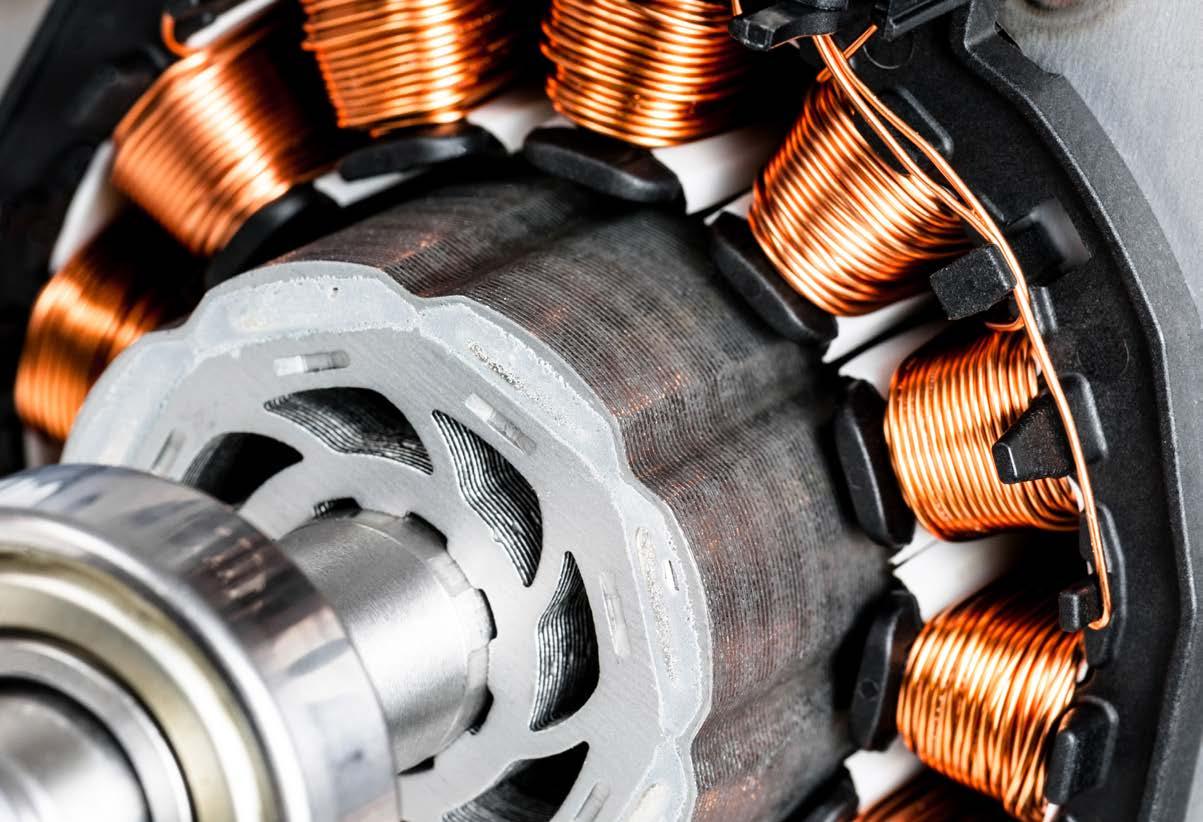
An inside look at what’s driving your pumps and more. BY CURTIS BENNETT
If this article’s headline gets you singing the next line to that song, well then you’re a classic rocker, but we are not here to talk about rock and roll, it’s motors that are on the agenda today.
Pumps are the heart of a hydronic heating system, and at the heart of every pump there is a motor. In our industry the pump is the most widely used example of motors, and pumps have not been immune from the push to become more efficient.
Every watt counts now, where it’s used, how efficient it is, and how efficient the entire system is. I am glad to see more efficient pumps because I have seen more systems with pumps that are too big than pumps that are too small. This leads not only to electrical inefficiency, but system inefficiency. But that’s a topic I will leave for Siggy (regular HPAC contributor and hydron -
ics specialist John Siegenthaler).
My first job out of school was working on automotive repair equipment. Getting a job today is nothing like back then. I remember calling every listing in the yellow pages under “Electronics” until finally someone bit the hook.I was literally thrown to the wolves to start fixing and refurbishing some of this equipment. For example, I was working on a very big wheel balancer for semi-truck tires. Well you guessed it, the motor used to turn the big truck tires was huge. No 120VAC motor in this one. It was 460VAC, and I was a rookie.
If I remember correctly, I was tensioning a spring or prying something inside of the unit, and yes I did not unplug it because I did not think I would get shocked. Well, if you have read any of my other articles, you know what happens next. Wrong, I didn’t get shocked, because I was hanging onto the screw-
driver handle, and plastic makes a very good insulator.
For once lady luck was on my side. I was insulated, but the light show that happened inside was amazing. Sparks flew everywhere. Now don’t get me wrong, I am not making light of my stupidity, but it does make for a good story. The moral of this one, like all the others, is disconnect the power before servicing.
So back to the basics. Since the dawn of time AC motors have been used in mechanical systems, so let’s just dive right in on how the inductive AC motor works.
If you remember my article on transformers you may remember how awesome transformers are because they convert energy without the parts being connected together by wires. Well the inductive motor does the same thing, except it turns a rotor while doing it. It’s actually crazy how electricity works,
and moreover how induction works.
So there are “basically” two parts to an inductive motor. You have the stator, the part that has the electricity attached to it, and you have the rotor, the part that rotates inside the motor. The coolest part about induction is that it works without wires. Have I said that before? Like the transformer, it transfers energy to another part without being connected.
For our example, let’s say the stator is connected to 120VAC single phase (a refresher: as we have talked about before 120VAC is a voltage that swings positive and negative at a rate of 60 times per second or 60Hz). It’s alternating above and below “Zero volts”. This is where the term AC comes from.
So this AC voltage goes into the stator, which is just a bunch of copper windings, yes you guessed it, just like the transformer, where when you put voltage and current into wound up wire you get an awesome thing: an electromagnetic field.
The rotor is usually made up of magnetic parts that are opposite charges, South and North. These magnets run lengthwise in the rotor all the way around. There are a bunch of them, and they alternate North Pole and South Pole. Remember learning about magnets in grade three? A North and North repel each other, and a North and a South attract. So the stator, like the transformer, sends out an electromagnetic field.
The difference between a motor and a transformer, except for the obvious, is that a motor has multiple windings. It could have more than two sets, but for now we will just say two sets. It needs more than one because in the case of a motor the windings are not all working at the same time. Electricity is flowing only to one set at a time and this is how it pushes the rotor around.
We have all used, or at least seen, those little pump checker fobs, the one where the little wheel spins when you hold it on the front of the pump. That is not actually telling you that the rotor is
spinning, that’s only telling you that the stator windings are working properly, producing an electromagnetic field. It’s the electromagnetic field that is turning the little wheel inside the fob. That is exactly how the stator turns the rotor in the motor.
Think of it like this, you have a merrygo-round with two handles on opposite sides for pushing it around. Now you have four people pushing it, they are standing at 12:00, 3:00, 6:00 and 9:00. Remember there are only two handles for pushing, so only two people can be pushing the marry-go-round at a time, either the guys at 12:00 and 6:00 or the guys at 9:00 and 3:00. That is how you get the marry-go-round spinning the fastest, one pair of “pushers” pushes, and then the next pair and so on and so on.
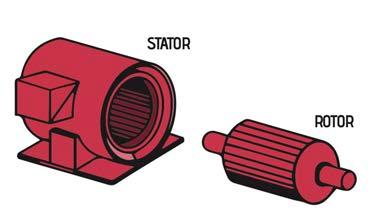
Well, I need to throw a little wrench into this analogy, because we are working with magnetics, the pushers that at not pushing are reaching out their arms as far as they can to pull the handles towards them when they get close. Remember that we are working with magnetism , so some parts repel and some parts attract. I don’t want to complicate it any more so we will just leave it there, with a tiny bit of mystery.
So the pushers are the stator and the merry-go-round is the rotor. In the case of a pump, the rotor is attached to the impeller that pushes the water inside the volute.
I want to touch on another aspect about inductive motors, other than the fact there are lots of them. You have probably looked inside the electrical box on the side of the pump and seen that little cylinder thingy. Well that’s a
capacitor, and it helps to start the motor from a dead stop.
The capacitor is another cool electrical device that someday we may get into but not now. OK, so I embellished a bit indicating that motors have only one stator but, single phase inductive motors can’t start up on their own, they need a little push from inside. This little pusher is a second smaller stator that in conjunction with the capacitor, puts the stator “out of phase” with the rotor to start it up. It’s essentially another “pusher” on the marry-go-round at 1:00 on the outside that once the merry-go-round starts he does not have to work anymore. The other guys do all the pushing.
I’ll go out on a limb and say most pumps in our industry are this type. Not the huge pumps, but up until about ½ HP, above ½ HP they usually go to a 3-phase motor, used in much bigger systems. We are not going to cover 3 phase motors because I wanted to hit on the “circulator” this time.
That should give you a little more insight into how an actual inductive motor works. I hope the oversimplification was not too much, but that it did help you to understand. My intention is always to show, in the simplest way, how something electrical works, and I feel that breaking it down makes it a little more understandable.
Now bring in the smart people that want to change the world. The people who invented the ECM motor—the electrically commutated motor. That explanation will come in the next article. <>

Curtis Bennett C.E.T is product development manager with HBX Control Systems Inc. in Calgary. He formed HBX Control Systems with Tom Hermann in 2002. Its control systems are designed, engineered and manufactured in Canada to accommodate a range of hydronic heating and cooling needs commonly found in residential, commercial and industrial design applications.
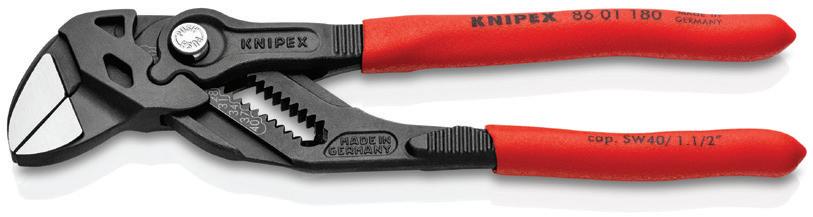
KNIPEX Tools new 7-1/4 in. version of its pliers wrench is about 10% lighter than the previous model and features an increased jaw capacity, from 1-3/8 in. to 1-1/2 in., as well as a narrower jaw profile for accessibility into confined areas. Available in a black atramentized finish or in the original chrome plated finish, other new features include recessed areas for a better grip and laser-etched markings in both metric and imperial. The wrench also features a pinch guard to prevent operators’ fingers being pinched. knipex-tools.com
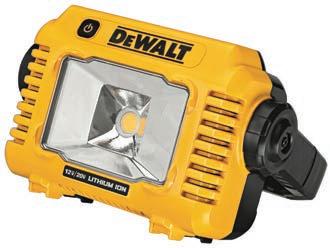
DEWALT’s 12V/20V MAX Compact Task Light is compatible with all DEWALT 12V MAX, 20V MAX, and FLEXVOLT batteries. At only 2.8lbs. (without a battery) the light can be used handheld, self-standing, wire hung, or even mounted on a tripod. The light features a single button that powers on and is used to adjust the brightness settings. With a 20V MAX battery the light offers 2,000 lumens on high, 1,000 lumens on medium, and 500 lumens on low. On the low setting, the light achieves up to 19 hours of runtime. www.dewalt.ca
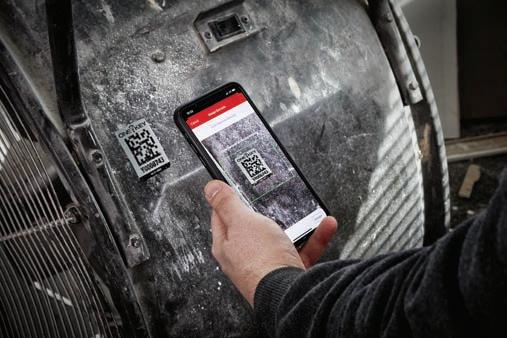
Milwaukee Tool continues has expanded its ONE-KEY asset management platform, tracking and security network with the introduction of Asset ID Tags which allow users to manage their tool and equipment inventories. Scanning the tags with any camera-equipped mobile device automatically records time and location information within the ONE-KEY app, providing instant documentation as assets are transferred between jobsites and users. Available in both small (0.69 x 1-in.) and large (1.5 x 2-in.), the Tags come in sets of up to 200 that are designed to adhere to either plastic or metal surfaces. onekey.milwaukeetool.com
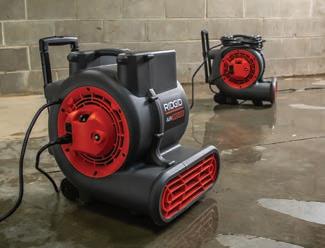
The RIDGID Air Mover, designed for fast cleanup and jobsite convenience, features an integrated 3-speed heavy-duty induction motor providing 1,625 CFM and adjustable angle for efficient drying. The Air Mover weighs 29 lbs. and includes integrated wheels, a collapsible handle and a 25-ft. power cord for extended reach. Dual electrical outlets allow users to connect or ‘daisy chain’ multiple air movers together for additional air circulation or utilize the Air Mover electrical outlets to power additional tools. Two units can also be vertically stacked for convenient transport and storage. ridgid.com
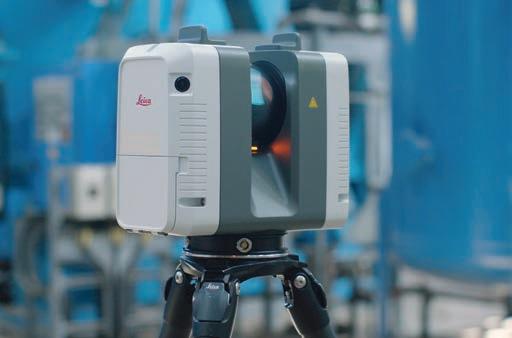
The Leica RTC360 3D laser scanner from Exact Metrology is a portable coordinate measuring machine designed to measure large-scale objects. This laser scanner uses 3D reality capture, a process of scanning and capturing any site in a 3D digital model, combining measurements and imagery. The model can be used for design and comparison purposes in various situations, capturing every detail with to-the-millimeter accuracy. This technology combines one-touch operation with portability and speed to deliver high levels of accuracy, automation and the ability to create 3D environments in a matter of minutes. www.exactmetrology.com

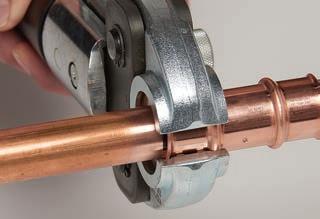
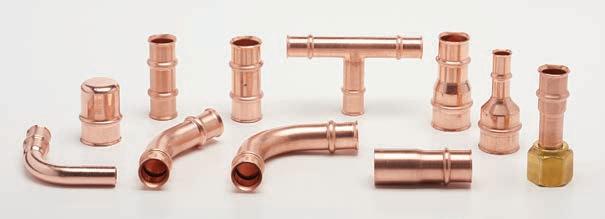
RLS press fittings are the fastest way to make reliable HVAC/R copper tube connections. Our patented double circular crimp gives you a permanent mechanical joint every time, in just 10 seconds. That means you can save time and increase profits on every job, plus have time to get more jobs done.
And because RLS fittings are flame free, they eliminate the additional costs and hazards of brazing – including hot work permits, fire spotters and more. To learn more about saving time and money with RLS fittings, check with your local distributor or visit rapidlockingsystem.com.
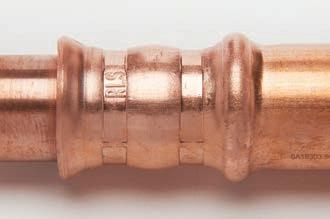
More RLS Advantages:
• 10-second press connections
• UL Listed to 700 psi for HVAC/R
• Huge time and cost savings
• No gas or brazing materials
• No hot work permits or fire watch
• No need to nitrogen purge
• 8 million+ installed since 2015


In these times of social distancing many manufacturers serving the plumbing and HVAC/R industries are reaching out to contractors with new or revised online learning opportunities from webinars to how-to videos:
Viessmann Academy Webinars: Free training webinars on a wide variety of topics. Typically one hour in length, the web-training sessions are intended for contractors, distributors, engineers and sales representatives. Pre-registration is required for webinars. Check out Viessmann’s Twitter (@ViessmannCanada) or Facebook (@ViessmanCA) pages to keep up to date with the latest webinar topics.
Navien Virtual Training: Live and on-demand digital training via webinar, the real time live virtual training sessions are hosted by Navien product trainers. The current webinar list: https://training.navieninc. com/virtual_classes.php
Coffee with Caleffi: A monthly complimentary one-hour training webinar conducted by Caleffi personnel. www.caleffi.com/usa/en-us/ coffee-caleffitm-schedule
Emerson is offering free access to its industry and product learning modules through the end of 2020. Education.emerson.com (choose Emerson 2020 Promotion as the Branch Name during registration)
LochinvarU: A site dedicated to technicians offering video tutorials on Lochinvar products. www.lochinvaru.us/pages/disclaimer.html
Rheem: Offering complimentary training webinars, condensed versions of their Innovation Learning Center classes in one-hour, online sessions. Check out @rheem on Facebook or Twitter to keep up to date, or visit rheemtraining.com to view Rheem’s e-learning calendar and an overview of e-learning courses, a library of resources and install videos.
Taco continues to offer its Taco Tuesday webinar series, free one-hour training sessions on the latest HVAC systems, tools, and technologies. The webinars occur Tuesdays at 12 noon ET and feature a residentially focused or a commercially-focused topic. Sessions are recorded and hosted on the Taco Comfort Solutions website and YouTube channel
Triangle Tube has introduced free Live Video Training sessions, visit Facebook or Twitter @triangletube for times and topics. Triangle Tube also hosts a selection of on-line How To Videos on its website triangletube. com/support/help-videos
Trane offers a variety of online educational resources: www.trane. com/commercial/north-america/us/en/education-training/ educational-resources-by-type.html
Armstrong has a line-up of webinars here: armstrongfluidtechnology. com/en-gb/resources-and-tools/education-and-training/webinarlibrary
Viega is making free online training available to contractors, distributors and others offering classes in such subjects as ProPress, MegaPress and PureFlow PEX, as well as radiant and flushing systems training: www.viega.us/en/service/training.html Viega is also launching TechTalk LIVE!, Zoom webinars discussing topics and answering questions in real time. The webinars will be held every other Wednesday at noon or 6 p.m. CT. The sessions are free, but registration is required. Find out more on LinkedIN, Facebook and Instagram
HBX Controls hosts a video training archive on its site: hbxcontrols. com/archive.php
HeatLink has created a series of Quick Tip videos as guides for the use of their products. www.youtube.com/user/HeatLinkGroup.
HRAI Courses Going Virtual The physical distancing and financial strain imposed by the COVID-19 virus have posed hurdles for effective HVAC/R industry training. In an effort to help overcome these hurdles, the Heating, Refrigeration and Air Conditioning Institute of Canada (HRAI) is offering a growing number of its residential and commercial training courses via virtual classroom along with introductory courses in a self-directed online format. For more information on course descriptions and availability, tel. 800.267.2231 ext. 241, email: training@ hrai.ca, www.hrai.ca/training.
Servicing the greater Calgary area, Ace Plumbing and Heating is lending a hand during the COVID-19 crisis by offering free pick up and delivery of grocery orders for clients as well as offering complimentary replacement furnace filters and water softener salt. We spoke with Jack Devetten (56), owner of Ace Plumbing, in late April to ask about the company’s community outreach initiative and the state of his business during the COVID-19 pandemic.
How did you come up with the grocery delivery, free furnace filter and water softener salt idea? And what do you hope to gain?
We came up with the idea that since we're an essential service and we're driving our vans around while other people are not as fortunate—either self-isolating or in quarantine—we should help out where we can. We’re picking up and delivering prepaid grocery orders, and we're going to schedule pickups at the same time that we're in certain areas.
We have a lot of seniors on our client list and some of them don't have as many people around to help them out. So we feel it’s a good service to do for the community.
As for the furnace filters, we want to make sure that clients have clean air to breathe, especially if they're in quarantine. And a lot of people also need water softeners because of the hard water here in Calgary. So, a furnace filter and a bag of salt really don't cost that much. And since we’re already carrying them in our vans, when somebody phones up for a call, we schedule a time when our van is in the area, and we can come by deliver the items right into their basement.
As for why we’re doing it. Well, first of all, it's a community service. We want to make sure that we're helping out the community. And of course, we also hope that people will remember us when times are good again.
How are you getting the word out?
We're reaching out to our client list, phoning everybody and letting them know that we have this service available. We have a radio campaign and we’re also promoting online through Facebook.
How has COVID-19 affected business?
We've seen about a 40% decrease in work. We’ve found that there are three types of clients now: the ones that are absolutely scared to death of catching COVID-19; the people that are aware of it and understand the social distancing; and then there are other people that are not bothered at all.
We have our COVID-19 protocols. We phone and let people know that we will be social distancing. We'll sanitize the door han-

dles before we go in, sanitize where we work. If we're changing the water heater, for instance, we'll sanitize the old one, pull it out, put the new one in, sanitize it when we're done and all of the piping work. When we bring our tools back into the van, they all get sanitized again. And then the surgical gloves come off and then their hands are sanitized again, and then we proceed with the next call.
What could help your business?
What would help us in the future, and what helped us in Alberta last couple of years, was the energy efficiency rebate programs. I think if they did that again it would help our industry.
Is that your face on the side of every company van?
Yeah, it is. My wife, Margaret, does the marketing. And 15 years ago, I asked her to put something on the van that none of our competitors would do.
She had the van wrapped, and when I went out and had a look at it I said, “Wow, that's a big head.”
She asked, “So what do you think?”
And I said, “Well, I'm beside myself.”
You seem optimistic for the future. Are you always so positive? I think I've always been a positive person. If you're a pessimist and you're running a business, you won't run the business very long because you have to realize that there's a lot of disappointments along the way.
When it's an outside influence that you have no control over, like a pandemic, it's a challenge to keep everything going. I like challenges. This is certainly one I never would have guessed, and certainly one I didn't welcome. But by the time we're through it, in five to 10 years we'll be looking back and talking to our grandchildren about it.
Like it or not, we're living through history right now. <>



From heating controls to mixing valves, Resideo offers a full range of Honeywell Home hydronic product solutions. Find Hydronic Zoning Panels, Pro Press Zone Valves, T6 Pro Hydronic thermostats and more — all in one location.
Our reputation is based on providing you with products to provide homeowners with solutions. Our products have proven to be must-stock standards, engineered for accuracy, safety and reliability — and easy installation.