
QUADRIK COLLECTION
NOW AVAILABLE IN BLACK FINISH




CONIK COLLECTION
NOW AVAILABLE IN BLACK FINISH





Designed for plumbers, loved by designers!



NOW AVAILABLE IN BLACK FINISH
NOW AVAILABLE IN BLACK FINISH
Designed for plumbers, loved by designers!
Setting
12
COVER STORY
HEATING
RESIDENTIAL HVAC WARRANTIES: WHERE IS THE VALUE?
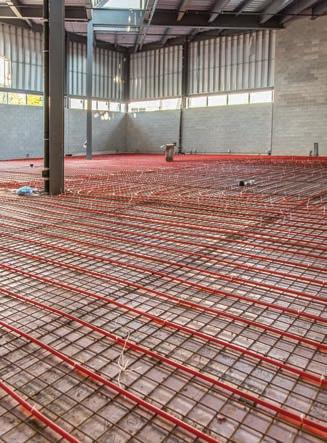
Offering regular maintenance to ensure products perform at peak efficiency and maintain warranty coverage.
By Ian McTeer
18
PLUMBING
HOT TRENDS, COOL FEATURES
Modern commercial washroom designs call for more inclusive spaces with luxurious and sustainable touches.
By Steve Goldie
62
SMART SOLUTION
CALLING IN SERVICE CALLS
Calgary-based startup introduces augmented reality platform that changes the way HVAC technicians deliver service.
By Megan Hoegler
64
PLUMBING
KBIS PRODUCT SHOWCASE
Highlighting award winners at this year’s Kitchen and Bath Industry Show.
By Megan Hoegler
68 TECHNOLOGY WHY FI?
With the proliferation of connected devices in our industry, everyone needs to understand the basics of a Wi-Fi set up and the common challenges involved.
By Curtis Bennett
70 MANAGEMENT UNDERSTANDING ADJUDICATION
What construction stakeholders need to know to navigate Ontario’s new adjudication system
By Catherine DiMarco
72
20TH ANNIVERSARY FOR RMC
The unique industry-run Refrigerant Management Canada program continues to be the only program of its kind in North America.
By Doug Picklyk
74
A SEAT AT THE TABLE
Changing the project design lens to focus on whole life-cycle value.
By Anil Sawhney

With the dependable versatility of Transit and Transit Connect, plus the power and capability of F-150 and Super Duty, Ford’s lineup of commercial vehicles makes achieving your ultimate business goals possible.

• Super Duty has best-in-class*
available payload of 7,850
• F-150 has available features like Pro Trailer Backup Assist^
• Transit has 3 lengths, 3 heights and 58 cargo congurations
• Transit Connect has a compact footprint, and a maximum cargo space of 145.8 cu ft†

SOMETIMES, WHEN WE GET CAUGHT UP IN OUR DAY-TO-DAY WORK WEEKS we can lose sight of what’s going on outside of our small corner of the world. Every day brings new challenges and adventures, but there can also be a repetitive nature to a work week.
I do believe that for people at all stages of their working lives, from newcomers to seasoned veterans, taking the opportunity to attend any industry events—open houses, trade shows, conferences or association gatherings— goes a long way to improving both the person and the business.
Ideally, industry-related events combine educational and social benefits. Some sessions and presentations can get vendor focused, and even in those sessions we’re all looking for that one or two nuggets of information we can glean to make our working lives better.
Walking a trade show floor is one sales pitch after another, but it’s also a true opportunity to see competing products side-by-side and even discover new tools, appliances or services that weren’t on your radar.
It’s also an opportunity to get questions answered. Yes, the Internet has become a fantastic resource for problem solving, but finding experts in person who can solve specific issues is priceless.
Whether you’re the outgoing type or not, it’s hard not to meet new people when you attend any events, and making connections can prove very helpful down the road. Getting involved in industry associations isn’t just an opportunity to network and mingle with a small group, it’s an opportunity to be part of industry change and get a true pulse of the business conditions around you.
I believe the greatest impact industry events have on everyone attending isn’t in the knowledge gained or the relationships formed, it’s more the palpable energy that’s generated by assembling a group of like-minded people together. It’s a reminder that you are part of something larger—that we’re all in this together—and that’s invigorating. It’s hard not to get inspired.
Check the calendar of events in this magazine, or online, and make a point of attending something, somewhere. And then, when walking to the parking lot on your way home, consider what just happened. Did taking a little time away from the day-to-day prove insightful or uplifting? Did you smile at least once?
If you’re attending the CMPX show in Toronto this March, I’ll be there. Stop by, maybe we can share a laugh. <>
– Doug Picklyk, Editor

EDITOR
ASSOCIATE EDITOR
ASSOCIATE PUBLISHER
ACCOUNT MANAGER
MEDIA DESIGNER
ACCOUNT COORDINATOR
CIRCULATION MANAGER
PUBLISHER
VICE PRESIDENT
COO
PRESIDENT & CEO
Doug Picklyk (416) 510-5218 DPicklyk@hpacmag.com
Megan Hoegler (416) 510-5201 MHoegler@hpacmag.com
David Skene (416) 510-6884 DSkene@hpacmag.com
Vince Naccarato (416) 510-5118 VNaccarato@hpacmag.com
Emily Sun esun@annexweb.com
Kim Rossiter (416) 510-6794 krossiter@hpacmag.com
Urszula Grzyb (416) 442-5600 ext. 3537 ugrzyb@annexbusinessmedia.com
Peter Leonard (416) 510-6847 PLeonard@hpacmag.com
Tim Dimopoulos (416) 510-5100 tdimopoulos@annexbusinessmedia.com
Scott Jamieson sjamieson@annexbusinessmedia.com
Mike Fredericks
without permission.
SUBSCRIBER SERVICES: To subscribe, renew your subscription or to change your address or information please visit us at www.hpacmag.com.
Subscription Price per year: $44.00 (plus tax) CDN; Outside Canada per year: $112.00 US; Elsewhere: 1 year $123.00 (CDN); Single copy Canada: $5.00 CDN. Heating Plumbing Air Conditioning is published 7 times per year except for occasional combined, expanded or premium issues, which count as two subscription issues.
MAIL PREFERENCES: From time to time we make our subscription list available to select companies and organizations whose product or service may interest you. If you do not wish your contact information to be made available, please contact us via one of the following methods: Tel: 416-442-5600 ext. 3552, Fax: 416-510-6875 or 416442-2191; E-mail: blao@annexbusinessmedia.com; or by mail: 111 Gordon Baker Rd., Suite 400, Toronto ON M2H 3R1
Annex Privacy Officer Privacy@annexbusinessmedia.com Tel: 800-668-2374
HPAC Magazine receives unsolicited materials (including letters to the editor, press releases, promotional items and images) from time to time. HPAC Magazine, its affiliates and assignees may use, reproduce, publish, re-publish, distribute, store and archive such unsolicited submissions in whole or in part in any form or medium whatsoever, without compensation of any sort.
NOTICE: HPAC Magazine, Annex Publishing & Printing Inc., their staff, officers, directors and shareholders (hence known as the “Publisher”) assume no liability, obligations, or responsibility for claims arising from advertised products. The Publisher also reserves the right to limit liability for editorial errors, omissions and oversights to a printed correction in a subsequent issue. HPAC Magazine’s editorial is written for management level mechanical industry personnel who have documented training in the mechanical fields in which they work. Manufacturers’ printed instructions, datasheets and notices always take precedence to published editorial statements.


Free Services Include:
• • Cost Comparisons
•
• Equipment Detail Packages
• Equipment Detail Packages
Learn More at: www.aipsdesignservices.com
www.aipsdesignservices.com

ASHRAE begins retrofit project at new Atlanta headquarters
The global organization dedicated to advancing the arts and sciences of heating, ventilation, air conditioning and refrigeration, ASHRAE, kicked off the new decade in a big way with a groundbreaking ceremony to celebrate renovations to its new global headquarters.
Top ASHRAE officials, including Canadian Darryl K. Boyce, P.Eng., the 2019-20 president of ASHRAE, gathered at the two-storey, 66,700 sq. ft. facility on Jan. 10, with shovels and hardhats.
Located in a suburb of Atlanta at 180 Technology Parkway in Peachtree Corners, Georgia, the new headquarters

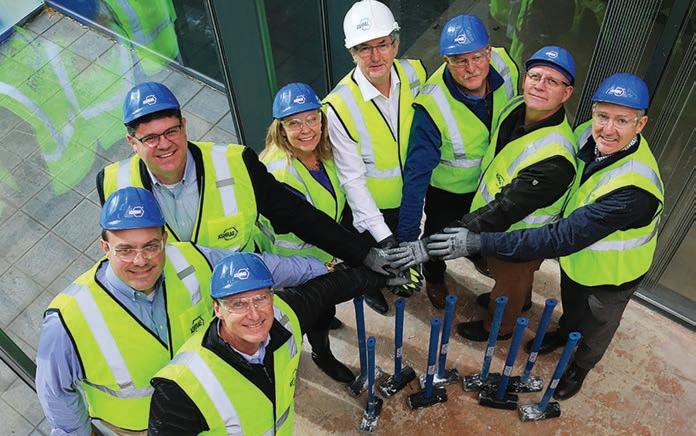
building will feature energy efficient upgrades including: upgraded plumbing; energy-efficient HVAC systems; and new LED lighting systems.
The new site will also have the ability to harness on-site energy production. ASHRAE also has its sights set on ensuring the new facility becomes LEED certified by promising a net-zero-energy ready facility.
“Our new headquarters project will showcase ASHRAE’s best practices and will help us to achieve our vision of a healthy and sustainable environment for all,” said Boyce in a media statement.
In addition to LEED certification, ASHRAE also hopes to achieve Green Globes, Fitwell and/or WELL Building or Living Building Challenge certifications as part of the organization’s goal to be more sustainable and eco-friendly.
At the time of the ground breaking, ASHRAE released a series of defined requirements to help the US$10 million renovation project reach its net-zero-energy goal. Aesthetically speaking, the society has made space utilization and good acoustical qualities a priority, along with a unified interior style and high durability of finishes.
Design criteria for the renovation meet, and in some cases exceed, requirements outlined in ASHRAE’s newly
updated Standards 62 and 90.1.
At the core of the renovation project is the creation of the best possible work environment for employees, focusing on aspects such as general health, fitness and overall well being. These renovations are also following guidelines set forth in the new ASHRAE Advanced Energy Guideline for Office Buildings.
“The plans for this project incorporate some of ASHRAE’s most well-known indoor air quality and energy standards and the end result will be a building that will offer a cutting edge, tangible example of sustainability in action,” said Technical Advisory Subcommittee chair, Tim McGinn, in a company release.
Also present at the groundbreaking were representatives from Houser Walker Architecture and Integral Group, the architectural team working on the project, along with several members of Collins Project Management, the build's acting project management team, Skanska’s construction manager at risk for the project and Epsten Group’s commissioning agent. McLennan Design is also involved but was unable to attend.
The project is expected to reach completion by late summer, with ASHRAE’s approximately 125-person staff scheduled to move into the new headquarters by October 2020. <>


Four cities in the Greater Vancouver Area, Burnaby, Richmond, Surrey and Vancouver, are engaged in a pilot project that tracks and discloses the energy emissions of participating commercial buildings.
Beginning January 21, 2020 participating building owners and managers have begun to disclose energy and emissions data from their properties.
Participants receive detailed energy and carbon performance data for a clear picture of how their building’s performance stacks up on carbon emissions. This information will help them make more informed decisions on capital investments and upgrades.
The Building Benchmark B.C. pilot project is helping all participating parties identify areas and building types that will need extra support from energy efficiency rebates.
“Within the past year we’ve seen unprecedented support for climate action; dozens of cities have declared climate emergencies,” David Ramslie, vice president of sustainability for Concert Properties, one of the project participants, said in a release. “As a result, building owners and managers are paying attention to energy and emissions. The companies that choose to benchmark and disclose their energy and emissions at BuildingBenchmarkBC.ca will not only understand where they rank relative to oth-
Raising awareness of potentially dangerous cross connections in water systems, the Western Canada Section of the American Water Works Association (WCS AWWA) has awarded the winning entries of its 2019 Bad and Ugly Cross Connection Control photo contest.
This is the fifth year the section’s cross connection control committee has held the national contest. The 2019 winners are Brendan Miller, a backflow tester working for SASK Water, and Fred Ramackers, a cross connection control inspector in Regina. Ramackers’ entry included a washdown water closet underneath a prep table at a funeral home, while Miller’s included cross connections at a village water treatment plant.
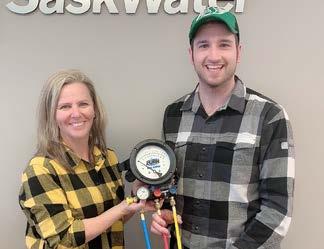
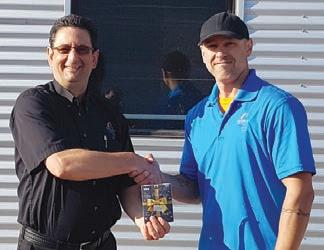
“Our water industry representatives, inspectors, plumbers and testers all share a responsibility to protect our water supplies. Cross connections do exist and are a potential to contaminate or pollute our potable water. Let’s do our best to find and correct these cross connections before the damage is done,” says the committee.
The group is inviting entries for its 2020 contest. www.wcsawwa.net

ers, they’ll be contributing to a community of practice and research that could help to transform the whole building industry.”
The pilot was developed by OPEN Green Building Society, which convened a range of stakeholders to help. The project is funded by Natural Resources Canada and BC Hydro.
www.BuildingBenchmarkBC.ca

The Government of Ontario has launched a marketing campaign to highlight careers in the trades under the slogan ‘Find a Career You Wouldn’t Trade.’
The campaign, which launched January 10, includes video ads that will run digitally in movie theatres and on Tim Hortons TVs across the province.
“We need to do a better job at enticing young people and their parents to the skilled trades,” said Monte McNaughton, the Ontario Minister of Labour, Training and Skills Development, in a release.
The ad campaign features skilled tradespeople in their work environments.
The ads are one part of the government’s strategy to open up the trades for young people and businesses. The province is also investing approximately $75 million in three programs to expose high school students to the trades: $12.7 mil-
lion in the Ontario Youth Apprenticeship Program, $42 million in the Specialist High Skills major program and $20.8 million in a pre-apprenticeship program.
“The reality is that the skilled trades offer exciting and challenging careers that often require solid math and problem solving skills, and expose people to the latest technologies such as 3D printing and robotics,” said McNaughton. “When it comes to opportunity, to earning potential, to having a chance to start your own business, the skilled trades come out on top.”
According to the Province, over the first nine months of 2019 Ontario employers had, on average, 204,000 job openings across all occupations and industries. Of these, 13,000 were in the construction sector. www.ontario.ca/page/skilled-trades
In a New Year’s welcome note to members, Sandy MacLeod, president/ CEO of the Heating, Refrigeration and Air Conditioning Institute of Canada (HRAI), reflected on his first full year in the role, noting, “These are exciting times for the HVACR industry; while the challenges facing our industry continue to grow, the business remains strong.”
Despite challenges, he indicates member satisfaction is up, and by June mebership is expected to have grown by 10 per cent over a two-year period.
Through surveys and continual communication with membership, he shared that government relations and advocacy are top priorities for members, and in response over the past year HRAI has allocated more resources towards
those efforts, investing in new personnel as voices in Ontario, B.C. and Quebec, and is working on arrangements—in partnership with AHRI—on filling a role to satisfy cross-border needs of manufacturer members serving the Canadian market.
In the note, Martin Luymes, vice president, government and stakeholder relations with HRAI, outlined several outreach activities HRAI was involved in over the past year, including: partnering with Natural Resources Canada on the roll-out of the federal-provincial market transformation road map for energyefficient equipment in the building sector and advising Environment and Climate Change Canada in the development and roll-out of its Climate Action Investment Fund (CAIF). www.hrai.ca

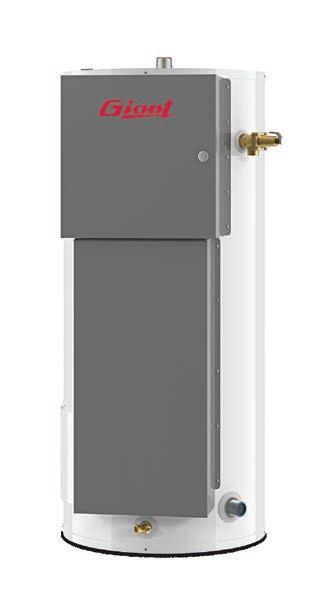
Offered in 41, 61 or 99 imp. gallon capacities (184, 279 or 451 Litres).
Field convertible
Convertible voltage (208 V, 240 V, 480 V and 600 V), phase (3 to 1) and wattage input ranging from 3kw to 54kW on all models and up to 63 kW on 112 models. Allows multiple electric configurations for your hot water needs.
Two (2) high quality magnesium anodes
Oversized on 112 models, they provide excellent protection against the corrosive effects of water and extend the tank life.
Easy service access to components
Designed with a single panel junction box for a fast electrical supply. Equipped with a hinged door and a removable element panel. Allow access to all of the electrical components.
Learn more about our commercial water heaters www.giantinc.com
It’s important to understand manufacturer warranties and be able to identify how you can provide additional value to customers.
BY IAN McTEER
You purchase a pair of pliers from your local HVAC supplier and discover the pliers don’t work for some reason. Regardless of whatever written warranty the tool may carry, the pliers should work as you might expect. Asking for and receiving a replacement tool at no charge is the basis of an implied warranty: the implication is the good should be of merchantable quality, it should function for its designed purpose and it should last for a reasonable time period.
It seems almost counter intuitive that a well-made product would even require a warranty: “buy my machine because it will never let you down,” a manufacturer could claim. Yet, there are so many components in modern HVAC machinery and controls that something could easily go wrong.
The adage commonly known as Murphy’s Law is a form of rubbish confirmation bias but its main tenant, “anything that can go wrong, will go wrong”, is firmly established in the minds of many consumers. Any given manufacturer would likely go out of business without a strong competitive product warranty well known to the marketplace.
Prior to 1975 all product warranties in Canada and the U.S. were very poorly defined leaving consumers in precarious situations far too often. It wasn’t uncommon to find the term “full warranty” in many product advertisements and documents. Consumers quickly found out that sometimes a full warranty might not cover any labour, travelling time,
diagnostics, refrigerant or even shop rags. Shouldn’t a full warranty cover most, if not all, of those things?
Less dependable manufacturers were very aware that advertising a full product warranty might easily allow them a foothold in a very competitive marketplace. Ambiguous warranties created confusion and turmoil even destroying relationships between consumers and contractors.
While there isn’t really a direct upfront cost to offering a warranty, its value is really defined by how manufacturers or their agents act when a product fails. In 1975 the Magnusson-Moss Warranty Act (MMWA) was signed into law in the U.S. This bill created standards for writ-
ten warranties, regardless of the industry, thus protecting consumers from the misleading or otherwise unscrupulous practices plaguing the market. MMWA requires that a “full warranty” means parts, labour, service and transportation of the product must be free of charge provided the consumer has performed any and all related duties within the specified timeframe of the warranty.
Limited Lifetime Warranty means a manufacturer will provide a replacement part(s) that failed due to a defect in manufacturing at no cost for the lifetime of the product. A subsequent purchaser may be entitled to the balance of the same warranty for a shorter time period since purchased by the original owner.






Limited express warranty is a written warranty that defines the length of time specific parts of a product will be covered for defects in material and workmanship under normal use and maintenance.
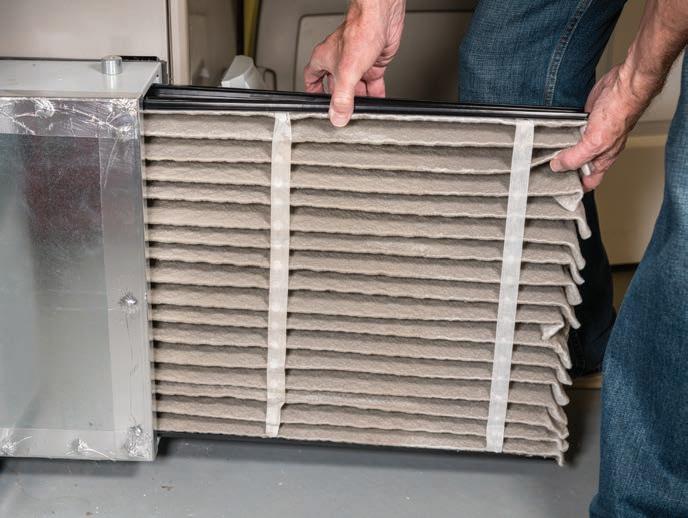
Starting in the late 2000’s some HVAC manufacturers opted for a registered warranty system. Left unregistered, the base limited warranty provides only five years coverage on specific parts (20 years on gas furnace heat exchangers) that fail due to workmanship and manufacturing defects.
A registered limited warranty requires the warranty to be registered with the manufacturer within a set time period after start up (often 60 days) and the base five-year warranty may be doubled: parts go to 10 years, compressors in premium units might get 12 years of coverage, while a gas furnace heat exchanger gets a 20-year warranty once registered. Manufacturers want to collect installation information for not only marketing reasons, but for legal protection in the event of a product recall.
A registered warranty means the manufacturer can communicate directly with the end-user ensuring timely repairs can be made without relying on contractor installation records that may or may not be up to date.
Our Canadian provinces have individually harmonized the requirements of Magnusson-Moss into provincial consumer protection laws. As with the MMWA, provincial legislation does not require a manufacturer to offer a warranty only that any warranty offered must comply with current legislation. However, express (written) warranties are specific legal contracts that identify who is covered and what the company will do in the event of a failure. There are many exclusions, here are just a few:
• Limited warranties do require enduser input, the product must be
maintained and not forced to operate outside its normal function
• Labour is rarely covered unless specifically mentioned in the contract and typically applies to certain parts and repair functions tabulated separately
• Filters, fuses, fluids, corrosion, abrasion and appearance items are often not covered
• Typically, no coverage for parts supplied by others, improperly installed parts, used parts or damaged parts
• Products exposed to flooding, fire, lightning, misapplication or serviced by unqualified personnel
• Transportation of goods, service calls or diagnostic time
• Products re-installed at another site
• Cost of regular maintenance Manufacturers make further disclaimers such as the company will not be liable for any incidental or consequential damage and that the express warranty included with any product exists in lieu of all other warranties expressed or implied. Since the warranty is a contract between the manufacturer and the end-user, no other party can modify or nullify the terms and conditions; for example, a technician cannot void someone’s warranty for any reason. A technician could, for example, refuse to replace a part at no charge on an in-warranty unit citing any of the published exclusions contained in the warranty. The primary takeaway is that HVAC warranties cover defects in material and workmanship, that’s all.
Long limited warranties make consumers feel more comfortable buying a product, but HVAC service contractors would prefer a shorter time frame in order to profit from parts sales. Extending the manufacturer’s registered limited warranty to cover additional labour costs, for up to 12 years in some cases, could prove to be a beneficial sales tool thus providing the contractor with an
additional revenue stream and revenue from part mark-ups that otherwise may not have existed.
However, historically speaking, extended warranties, especially those offered by third parties, have a less than stellar reputation given reports of provider bankruptcies and claim rejections. Indeed, the Consumer Council of Canada released a study last year and executive director, Ken Whitehurst, said, “they [consumers] don’t understand how it’s being sold, they don't understand the complex agreement, they don’t understand how the agreements are financed and secured.”
Whitehurst goes on to say, “that many [warrenties], if not most of them, are of questionable value, but there are some that are of value in some circumstances.”
I’d argue that extended warranties sold through HVAC manufacturers do provide value and necessary consumer protection in these days of $1,000 circuit boards and very expensive inverter drive compressors.
A geothermal system often consists of a warranty package that may include the ground heat exchanger, indoor components and factory-approved accessories. The ground heat exchanger, or loop, must be properly specified and installed by competent drillers or loop installers using materials such as high density polyethene pipe (HDPE), which carries its own 50-year warranty.
I’ve seen quality loop installers offer limited 10-year warranties that cover materials and workmanship related to the installation of the loop including the header and grouting.
But perhaps the greatest expense, namely excavation and site remediation or any other consequential costs not related to parts and material, are not covered. Assuming the loop is pressure tested and flushed correctly, this
potential horror-show should never become an issue.
One Canadian manufacturer of geothermal heat pumps offers this limited warranty on newly-installed equipment:
• Five years on heating and/or heat pump starting on date of installation
• Five years on factory-supplied or approved thermostats, electric heaters and pumping modules
• Ten years on sealed refrigerant circuit components such as the refrigerant to air/water heat exchangers, reversing valve body and metering device and the compressor
• Five years on parts or accessories that are factory-installed
• One year on other accessories purchased separately from the geo unit manufacturer.
• And, according to a schedule published by the manufacturer, some labour will be paid to “authorized personnel” for repairs to specifically listed components for two years from the date of installation
• Sealed refrigeration system components qualify for five years of labour coverage.
• Extended warranty is available.
Regardless of the limited or extended warranty coverage for an HVAC product, contractors can benefit from offering extended warranty coverage along with a maintenance program. Regular maintenance is a must, not only to assure the product performs at peak efficiency, but also to maintain warranty coverage.
A geothermal unit contractor should consider amortizing the longest possible extended warranty into his or her offering. The service plan might include a fee for a yearly tune up or monthly payments that could include a couple of yearly visits. Key plan offerings should include all services that tend to preclude warranty problems, such as:
• Servicing by licensed technicians
• Coil and blower wheel inspection
• Filter maintenance
• Data collection
And may include bonus features like:
• Priority status for emergency service
• No overtime charges
• Discounts on diagnostic fees and repairs not covered by warranties
• Discounts on parts out of warranty
Since I’m not a lawyer, I’d urge contractors to be fully aware of the socalled fine print contained in written warranties and to be sure all custom -
ers are aware of their obligations. Manufacturers make mistakes and things go wrong with processes, but that’s why we do what we do. <>

Ian McTeer is an HVAC consultant with 35 years experience in the industry. He is a refrigeration mechanic and Class 1 Gas technician.



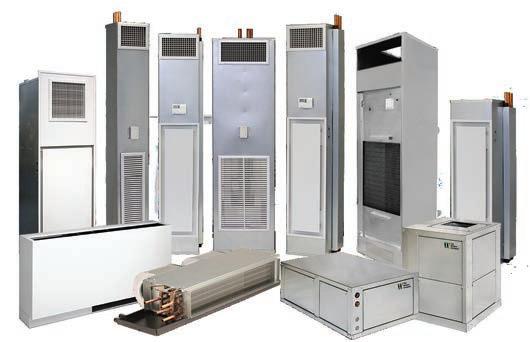



The Whalen Company has always been known for reliability, performance and innovation of fan coils and heat pumps. But we also have a complete line of replacement products, service parts, and the knowledge to support your HVAC system. By offering true replacement parts, refrigeration chassis or complete units, The Whalen Company can save you time and money by supplying exact replacements that don’t require field modifications.
Combine that with a flexible product offering for new construction or renovations and you have an HVAC manufacturer that works with our customers to meet all of their needs. Does your HVAC manufacturer offer this much?
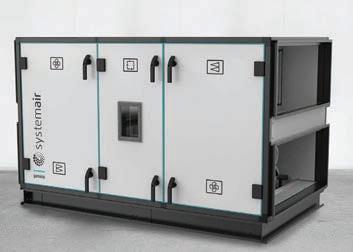
The Geniox air handling units from Systemair for commercial, school, healthcare and industrial applications feature thermally-insulated double wall casings and ABS designed corners to prevent thermal bridging. The 2.4-in. foam injected insulation also reduces sound transmission. The modular units can handle airflows from 2,700 to 16,300 CFM in five casing sizes. www.systemair.net
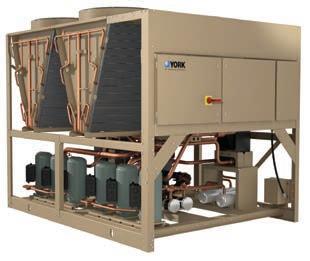
Johnson Controls line of York YLAA air-cooled scroll chillers range from 40 to 230 tons. The scroll chillers are equipped with two independent circuits for partial redundancy. Brazed plate evaporators and microchannel condensers aim to enable more efficient heat transfer. www.york.com/ylaa
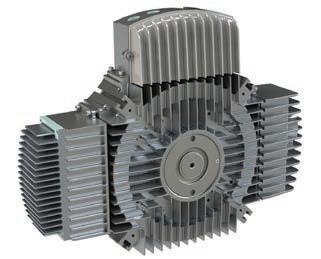
From Regal Beloit Corporation, the UlteMax axial integral horsepower motor can achieve 3to 15-hp. The motor includes an integrated configurable control. It offers speed from 300 to 4200 RPM, and is 4.5 in. thick. www.regalbeloit.com
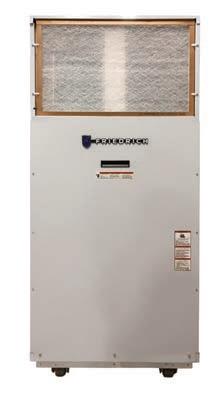
Friedrich Air Conditioning Co. is now offering its VRP (variable refrigerant packaged) heat pump system in a three-ton size. Designed for multi-family and light commercial applications, the system features MERV-8 filtration and onboard sensors that monitor and adjust compressor speeds. www.friedrich.com
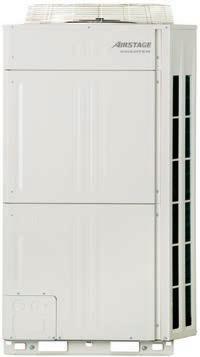
The Smarter Building Controller by Fujitsu General and Ventacity Systems offers a building management system for use with Fujitsu’s Airstage heating, ventilation and cooling systems. The controller offers integration with installed equipment, and control is performed via Internet connection from a connected device. www.fujitsugeneral.com
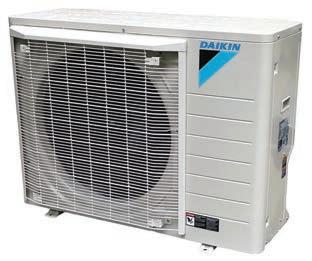
Daikin’s Fit Heat Pump systems are ductless and use inverter compressors and smaller, lighter cabinet designs, for a compact heat pump option. The systems feature a cooling efficiency of up to 18 SEER and a heating efficiency of up to 10 HSPF and require just 4-in. of clearance for installation. www.daikincomfort.com
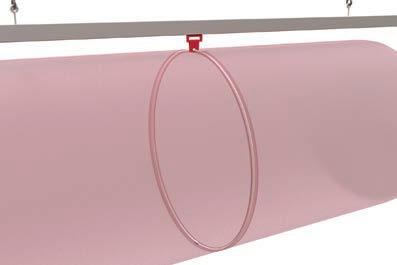
FabricAir has released its Internal 360 Hoops System for shape retention in fabric ducts. Constructed from flexible fibreglass rods, connected by custom-length steel rods, the Hoops system is designed to hold fabric HVAC ducts in a 100 per cent inflated appearance even when air handlers are off or in variable fan speed modes. FabricAir fabrics are UL and CSA-listed and accepted by all building codes in compliance with NFPA 90A-2018. www.fabricair.com




Modern commercial washroom designs call for more inclusive spaces with luxurious and sustainable touches. BY STEVE GOLDIE
Having been a plumber most of his life, my father had lots of plumbing opinions and stories. One of my favourite stories did not come form his years as a plumber but rather from his time in the British army. My dad grew up in Glasgow, Scotland, and back in those days the United Kingdom still had mandatory military service that required healthy young men to serve Queen and Country for 18 months.
James Goldie could best be described as a reluctant recruit who simply ignored his draft notice for almost two years; he could not however successfully ignore the two military policemen who rudely dragged him out of his bed one Saturday morning to escort him to boot camp.
Once he was there he resigned himself to his fate and went about the business of training and peacetime soldiering
along with all the other lucky draftees. Apparently boot camp does not afford an individual any opportunity for free time, free expression or any type of individuality whatsoever. Every minute of every hour of every day was regimented and scheduled, filled with training and drills and such. You woke up when they told you, you ate when they told you and you went to the bathroom, or loo, when they told you.
Life can get pretty harried and busy in this day and age, so much so that at times we feel we barely have a moment to ourselves. Sadly, on days like that the washroom break may be the only quiet alone time one gets. However, in boot camp even this opportunity for a peaceful sit down is removed. The communal army latrine my dad had to use back in the day was a fairly crude set up with a long trough urinal on one wall, and a

long trough drain communal toilet along the other wall.
Yes, you read that correctly, the toilets were basically a long bench seat with about 10 openings with toilet seats, each separated by a divider. Underneath ran a continuous sloped trough drain, with a single flush valve on one end that would clear the entire trough when activated.
Since the day was regimented and scheduled nobody had the luxury of coming and going as they pleased. When a bathroom break was permitted the stalls would be quickly occupied and the line up would form. On one of these occasions my father was lucky enough to be in the drivers’ seat, so to speak, occupying the end stall, the one with the flush valve.
I am not sure what inspired him this particular day, but he decided he would take advantage of his position of power by sending a surprise down the trough.
He rolled up a bunch of newspaper into a soccer ball sized wad, lit it aflame and sent it down the trough. His unsuspecting army mates all had their arses singed as the ball of fire passed by underneath. Whatever repercussions or discipline he faced afterward must have been worth it because he would still get a hearty chuckle out of telling that story even 50 years later.
Thankfully modern bathrooms, as with most things in life, have evolved. They bear no resemblance to the bathrooms of yesteryear, especially those favoured by the British army back in the 1950’s. The name “Water Closet” (or WC) reveals how discreet and utilitarian bathrooms used to be. Through the past several decades that I’ve been working in this industry, bathrooms have steadily become bigger, more luxurious and more comfortable. Residential bathrooms are no longer Continued on p20
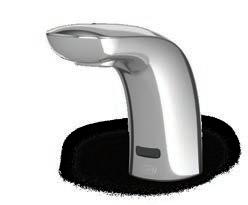

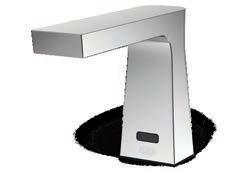
EZ Gear Sensor Faucets deliver reliability, precision, and efficiency to your commercial restroom. Thanks to the dual action of the ceramic disc cartridge and motor gear-driven operation, they outperform and outlast solenoid operated faucets. They intuitively sense the user without delay, too much force, or wasting water. Gear up for the next generation of sensor faucets with EZ Gear Technology.

You can expect up to 20 plus years of trouble-free performance.
tucked away closets, they have become more like home spas where we go to relax, refresh and revive; places we actually want to spend time.
In recent years we have also seen this trend crossing over into the commercial side as well. Clients, customers and employees’ expectations have been substantially raised when it comes to what they expect, and even demand, in public washroom facilities.
The look and feel of a commercial washroom can be a deal breaker for many consumers. No matter how comfortable your guests and customers may feel in your shop, hotel, restaurant or facility, if they don’t feel safe and comfortable in the washroom they may not come back. Successful business and building owners understand the appearance and usability of bathrooms has a significant impact on how patrons perceive them. This is probably most keenly felt in the restaurant industry for obvious reasons. That being said, I could probably fill many pages with restaurant washroom horror stories.
Another trend we see is the move to public or commercial washrooms becoming more universal. Where most buildings would have one washroom designated for men and another for women, we now see this expanding and changing. Many spaces have added family bathrooms, typically larger and including diaper changing stations. More and more we are seeing gender neutral designated washrooms. A growing trend, again with restaurants leading the way, is to provide a number of individual universal bathrooms that resemble a powder room you might find in a high-end custom home.
If meeting these rising expectations and demands is not challenging enough, the modern bathroom designer also has to be mindful of the importance of sustainability. Water-efficient fixtures and carefully chosen materials show the business cares about the environment.

“Touch-free fixtures also cater to the perception of cleanliness.”
Touch-free faucets and flush valves help satisfy this requirement; ensuring valves cannot be left running. Touchfree fixtures also cater to the perception of cleanliness—the less we have to touch in a public bathroom the better.
Sometimes all of these competing requirements can butt heads with each other however. Take the beautiful new and modern washroom facilities in our head office for example. We have touchfree flush valves and faucets installed in all of the washrooms. These valves have small solenoid valves in them that are battery operated, and they also have photovoltaic cells installed on them to ensure the batteries stay charged. Those smarty pants environmentally savvy designers covered all the bases and checked all the right boxes!
Unfortunately sometimes we are too smart for our own good. Those photo voltaic panels on the faucets are not very effective in the dark, and that is exactly where they are more often than not thanks to the motion detector light
switches that ensure the lights stay off when nobody is in the washroom. I guess the designer’s left brain didn’t tell their right brain what they were doing.
When you think about it, designing, building and maintaining commercial washrooms is quite a complex challenge with so many factors to be considered. Not only do they need to look clean and comfortable but they have to be accessible to everyone without offending or excluding anyone. In addition, they have to be durable and vandal resistant; oh and don’t forget to provide facilities to change the baby’s diaper, and if you do retain separate gender designations, the diaper change station better be in all of them.
Well at least nobody has to be afraid of having their morning sit down disturbed by a flaming fireball anymore. RIP Dad, I hope that story can still make you chuckle wherever you are. <>

Steve Goldie learned his trade from his father while working as a plumber in the family business. After 21 years in the field, he joined the wholesale side of the business in 2002. His expertise is frequently called on to troubleshoot systems and advise contractors. He can be reached at sgoldie@nextsupply.ca.
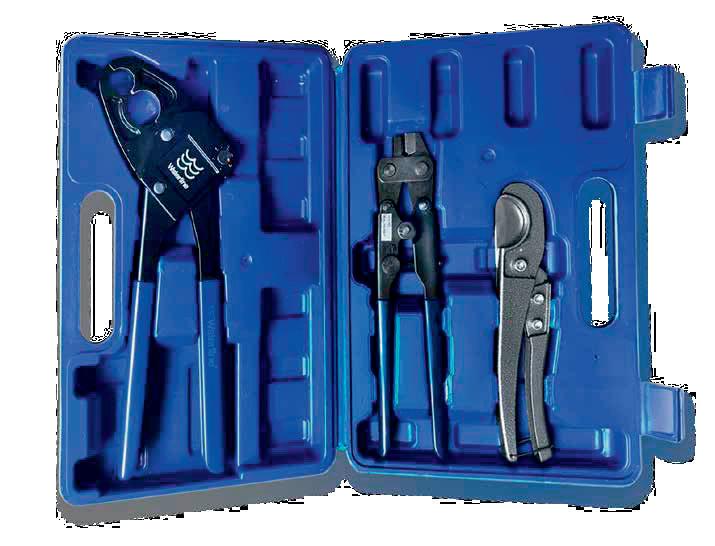


Aquatherm’s updated version of its North American Installer Manual covers safety, best practices and planning for proper installation of Aquatherm systems. The manual is divided into three chapters with new sections on updated product information, references to new resources such as Aquatherm TechTV videos and new technical data. www.aquatherm.com
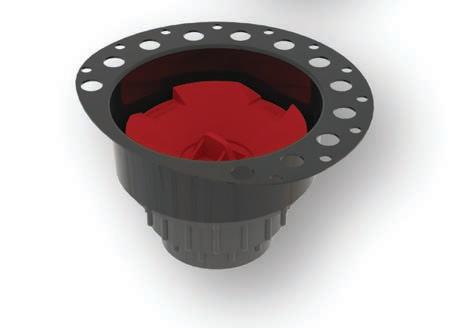
OS&B has introduced FRZERO50, a new offering of non-combustible PVC shower drains, island tub drain and waste & overflows. The products meet flame and smoke requirements of CAN/ULC S102.2-10 for noncombustible buildings and will not support combustion in the presence of an ignition source. www.osb.ca
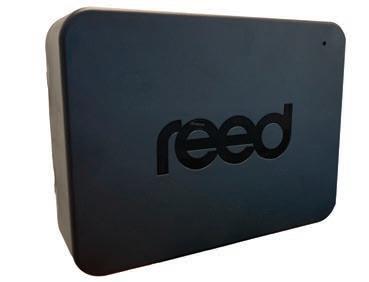
The CloudBox from reed is designed to monitor and control plumbing features. It can be synced to control up to two valves, two meters and two sensors for risk management, water conservation and improved operational efficiency. The set of devices control and monitor domestic plumbing systems while working with many existing plumbing valves, meters, sensors built for use in commercial properties. www.reedwater.io
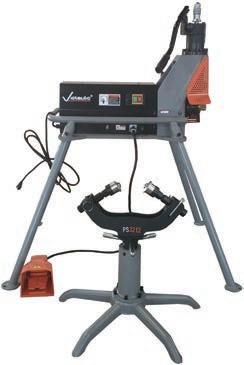
Victaulic’s latest grooving solution tool, the RG3212 roll grooving tool is capable of grooving 2-in. to 12-in. steel piping. Designed to reduce jobsite errors and increase productivity, the RG3212 features an integrated drive motor and discreet design to damper sounds for quiet operation. www.victaulic.com
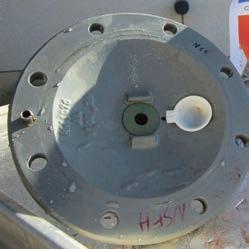
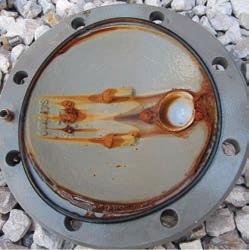
FEBCO’s ArmorTek Advanced Coating System protects its ductile iron backflow preventer valves with three layers of protection to guard against corrosion. FEBCO’s three-pronged coating solution consists of an anticorrosion primer layer, followed by a microbial inhibitor to prevent bacteria growth and a topcoat to bond to the primer and create a high-strength barrier between the iron substrate and water. www.febcoonline.com
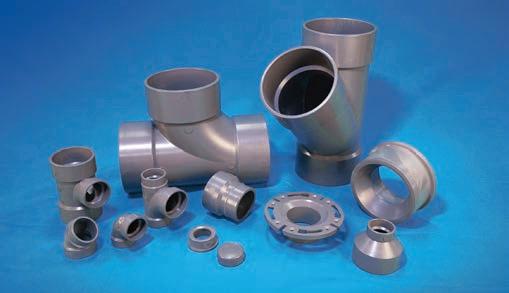
NAPCO Royal Pipe and Fittings has launched NAPSYS-HR PVC DWV, a new system for high rise DWV pipe and fitting applications. The system meets all low smoke and flame requirements of the Canadian Building Code and is available in sizes 1.5-in. to 10-in. in diameter. The low rise system currently in the market will be rebranded under a new name - NAPSYS-LR PVC DWV. www.napcopipe.com


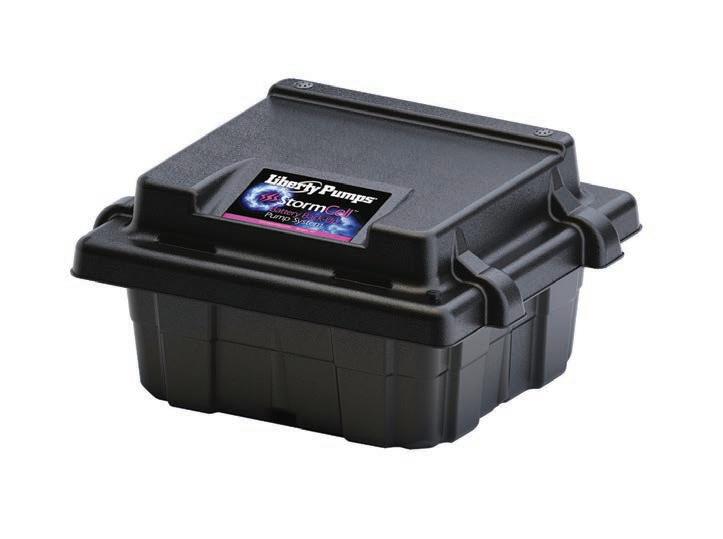

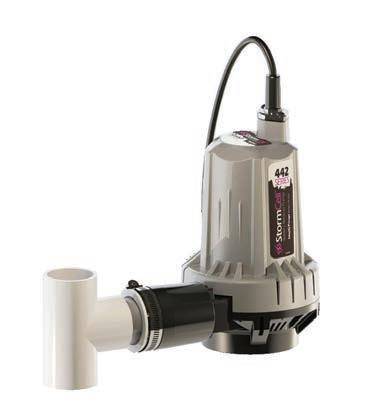
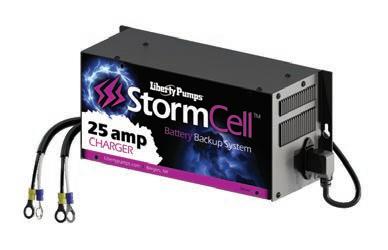
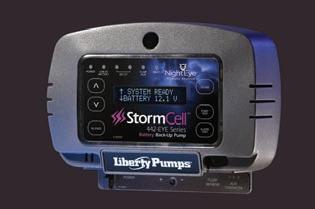
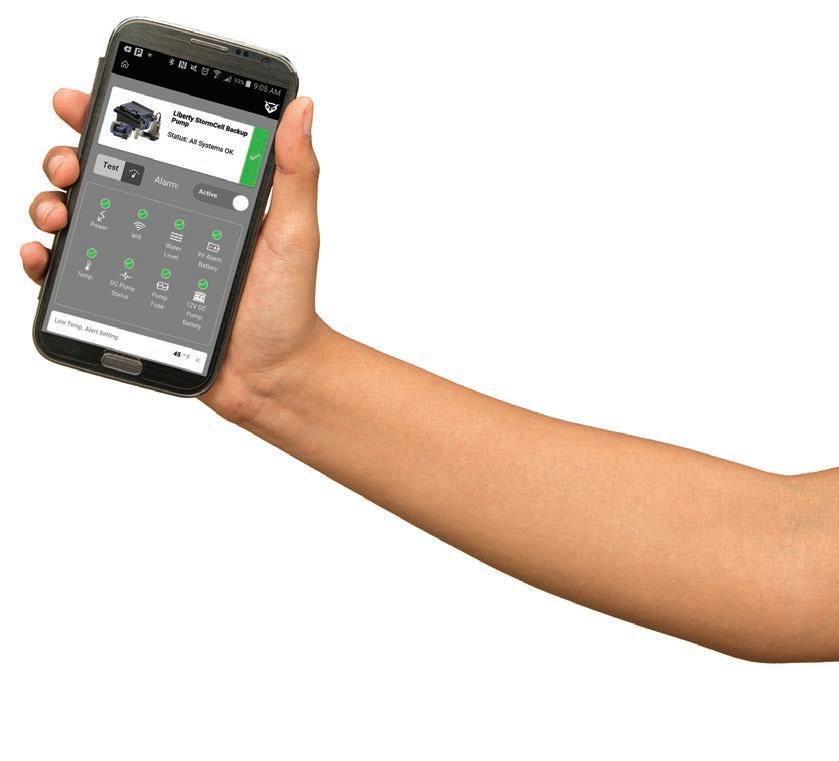
The new StormCell® series of battery backup pumps from Liberty feature advanced professional-grade chargers, energy e icient pumps for longer run times, and optional NightEye® wireless technology for remote monitoring through your smart device.
• Available in both standard and wireless connected models
• Single and dual battery systems
• Energy e icient DC pump (manufactured in the U.S. by Liberty) *



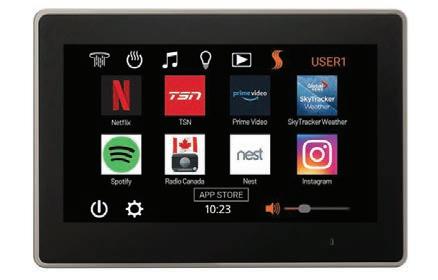
ThermaSol has added three apps to its Smart Shower system; TSN, Radio Canada and Global News Skytracker. The upgrades are part of the Smart Shower System, which features water temperature controls, steam therapy options, sound and lighting as well as TV access to video streaming applications like Netflix and YouTube. The system can be installed up to 30 feet from the actual shower and managed by fully digital touch control. www.thermasol.com
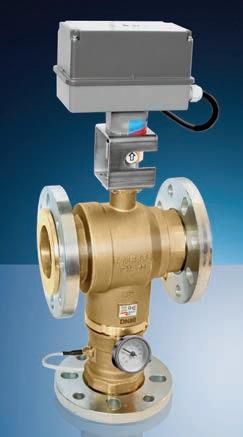
Caleffi’s LEGIOMIX digital mixing valve for commercial domestic hot water (DHW) temperature control is now available with ANSI 150 flanges in sizes 2 ½-in. for 17 to 470 GPM flow rate and 3-in. for 22 to 537 GPM. These new sizes will complement NPT sweat and union connections. The LEGIOMIX also features a “master” electric mixing valve that automatically self-cleans, preventing scale formation. www.caleffi.com
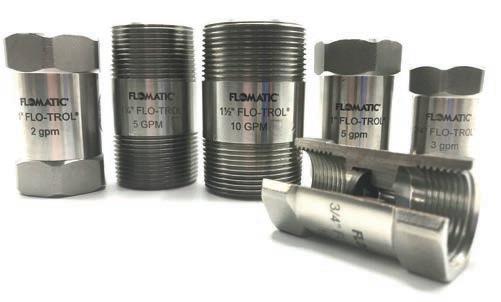
Flomatic has expanded its Flow Control Valves range, The Flo-Trol CD900, to include new sizes and flow ranges. Featuring a stainless steel body, Flo-Trol automatic flow control valves is a self-cleaning and flexible orifice available in a range of sizes (0.25 GPM up to 30 GPM). Flow rates are maintained to within ±15 per cent between 15 and 125 PSI. Each valve is engraved with the flow rate, size and certification and comes sealed and pre-labelled. The Flo-Trol Model CD900 is available in seven different sizes (⅜-in. thru 1 1/2in.) The Flo-Trol CD900 are all NSF/ANSI 61 & 372 certified and covered with a three-year warranty. www.flomatic.com
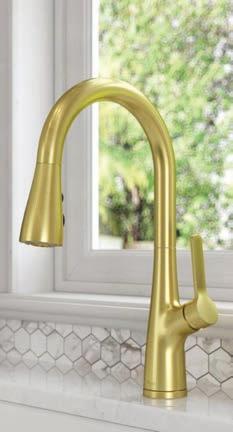
The Neera family of kitchen faucets from Pfister feature the company’s Pforever Seal ceramic disk technology providing a never-leak guarantee. The premium faucet includes an advanced spray head docking to ensure the faucet head fits snug to the spout, the spray head has three settings — spray, stream and pause — and it is made with EZ Clean technology to help resist hard water build up and water spots. The forward-handle design is an ergonomic function. Available finishes include: brushed gold, stainless steel, matte black and polished chrome. www.pfisterfaucets.com
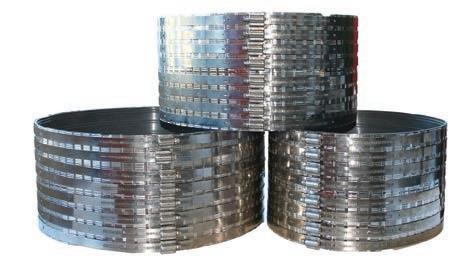
IPEX has extended its line of MJ Grey DWV products to include mechanical couplings in three new sizes; 14-in., 16-in., and 18-in. The new couplings will have the familiar grey rubber lining to indicate their use with IPEX System 15 or System XFR. These couplings are advantageous in cold weather as an option to solvent welding, repairs or tie-ins and for limited joint deflection in difficult installation areas. www.ipexna.com
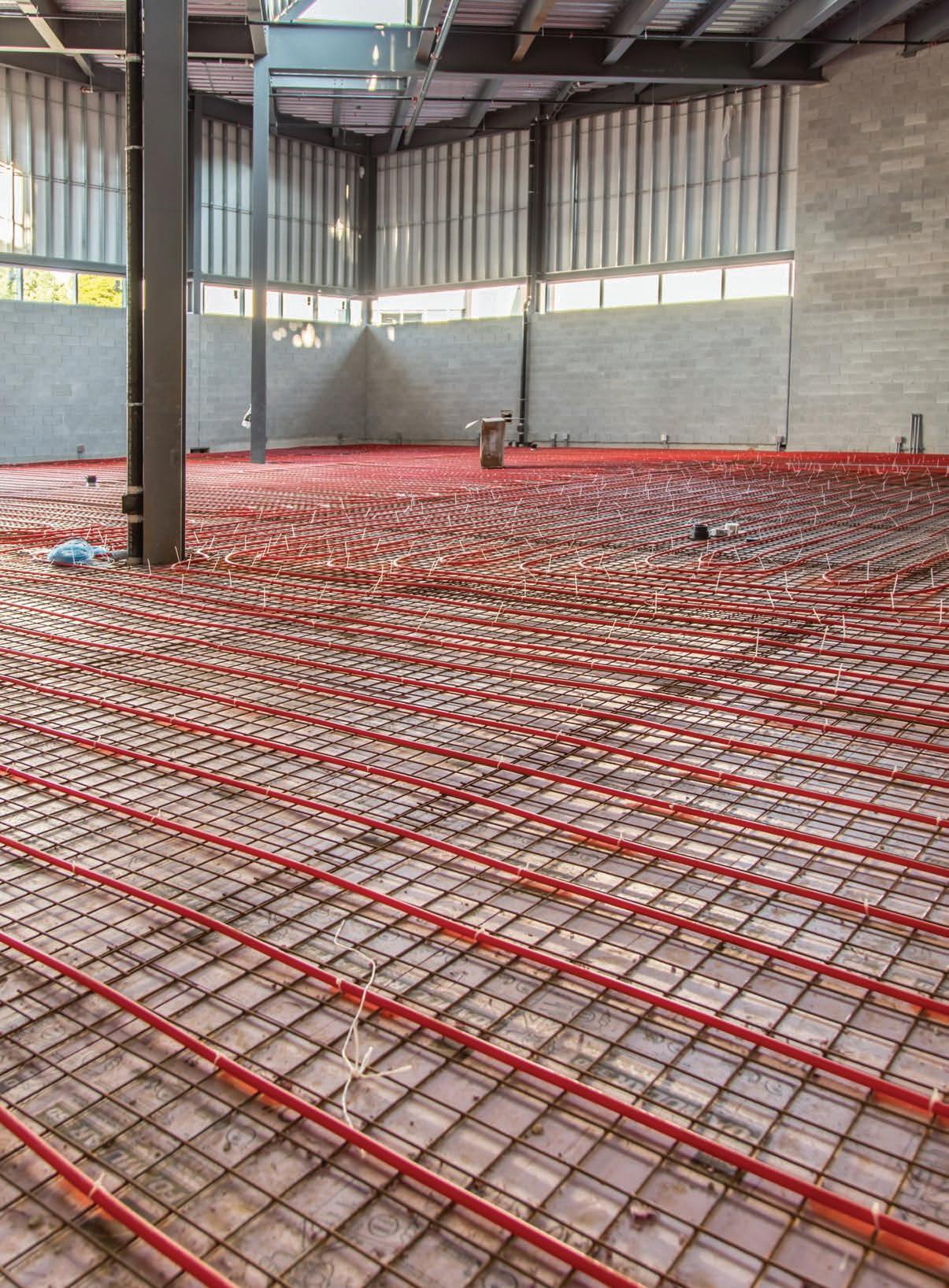
MAKING THE CASE FOR OUTDOOR RESET
RESIDENTIAL AIR TO WATER HEAT PUMP: PART 1
INTEGRATED DESIGN: ACHIEVING IEQ AND EFFICIENCY PRODUCTS THIS MARKET NEEDS
INDUSTRY DEFINITIONS: HEAD VS. DELTA-P





Products we need Suggestions for five technologies/ products that could help move the hydronics industry forward.
BY JOHN SIEGENTHALER
Making the case for installation in every hydronic space heating system.
BY ROBERT WATERS
MH14 NEW TECHNOLOGY
Residential Air to Water Heat Pump Systems
The rise of electrification in residential HVAC will lead to greater adoption of heat pump technologies.
BY MIKE MILLER
EDITOR
ASSOCIATE EDITOR
ASSOCIATE PUBLISHER
ACCOUNT MANAGER
ACCOUNT COORDINATOR
ART DIRECTOR
CIRCULATION MANAGER
PUBLISHER
VICE PRESIDENT
PRESIDENT & CEO
MH16 INTEGRATED DESIGN Achieving IEQ and Efficiency with Human Factor
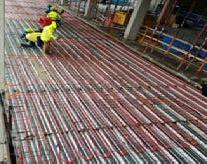
A case study featuring a multi-family project using hybrid HVAC systems using heated and chilled water from the central plants.
BY ROBERT BEAN
MH22 SYSTEM DESIGN Considerations for Operating Hybrid Radiant-DOAS Systems
Three important considerations for designing a sequence of operations that makes the most of this technology.
BY SANJIL KARKI
MH28 TECHNICALLY SPEAKING HEAD VS. ∆P
Important differences between these two commonly used terms.
BY JOHN SIEGENTHALER
Doug Picklyk (416) 510-5218 DPicklyk@hpacmag.com
Megan Hoegler (416) 510-5201 MHoegler@annexbusinessmedia.com
David Skene (416) 510-6884 DSkene@hpacmag.com
Vince Naccarato (416) 510-5118 VNaccarato@hpacmag.com
Kim Rossiter (416) 510-6794 KRossiter@hpacmag.com
Emily Sun
Urszula Grzyb (416) 442-5600, ext. 3537 ugrzyb@annexbizmedia.com
Peter Leonard (416) 510-6847 PLeonard@hpacmag.com
Tim Dimopoulos (416) 510-5100 tdimopoulos@annexbizmedia.com
Mike Fredericks









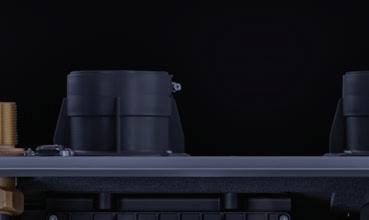
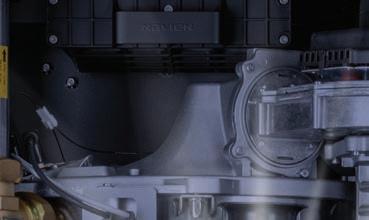



Navien designs and manufactures all the key components and uses advanced robotics to assure manufacturing integrity
Discover the new standard for compact high efficiency commercial boilers by visiting navieninc.com/series/nfb-c.




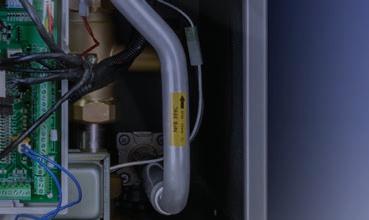




• Advanced stainless steel fire tube heat exchanger
• 7" Touch screen and smart controls
• 97.5% Thermal efficiency
• Common venting and cascading capability
• Top and bottom piping connections




Suggestions for five technologies/products that could help move the hydronics industry forward.
BY JOHN SIEGENTHALER
Product innovation has moved the North American hydronic industry a long way over the last 50 years. In the 1970s, a typical residential hydronic system used a fossil fuel boiler to supply two or three zones of baseboard with scalding hot water. Today, some systems use geothermal or air source heat pumps, possibly supplied by renewably-generated electricity, to supply room-by-room comfort using bathtub temperature water circulating through radiant panels.
Continuous improvement is essential to maintaining a healthy industry, especially if that industry expects to gain market share against competing technologies. To promote future growth, new products and installation methods should (in no particular order):
• make systems easier and faster to install.
• deliver equal or better comfort than their predecessors.
• demonstrate increased efficiency.
• improve system reliability and reduce maintenance.
• correct deficiencies in existing products or installation methods.
With these objectives in mind, the following are my thoughts on five products I think could further enhance North American hydronics technology.
If you’ve used cast-iron circulators in any type of chilled water cooling system,

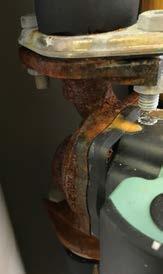
or in earth loops for geothermal heat pumps, you’ve likely seen what happens to the volute, steel flange bolts and even steel handles on isolation flange valves when they rack up a few operating hours well below the dewpoint temperature of the surrounding air. All these components quickly develop surface oxidation. (figure 1 shows an example.)
Over time the orange condensate drips onto anything below it. This “superficial” rust doesn’t compromise the circulators performance, but it does make a mess.
The obvious solution is to add a vapour-tight insulation envelope around all parts of the circulator other than the motor can and wiring compartment.
Some manufactures offer molded foam clam shells that fit specific circulators— usually commercial-sized ECM products. These can limit condensation if they are properly sealed at all locations where air could contact any chilled metal surface.
Wouldn’t it be nice to have an insulation/vapour barrier system that could fit any circulator that may have to operate at sub-dewpoint temperatures?
Perhaps a block of solid insulation
material that could be easily molded, on site, to the shape of the installed circulator, and then attached as two mating parts. Maybe a hollow plastic shell that could be fit around the installed circulator volute and flange joints and then filled with expanding foam.
An elastomeric gasket would be part of either approach to provide the air-tight seal with the circulator’s motor can. The portion of the circulator that contacts the insulation could be sprayed with a “release agent” that prevents strong bonding in case the insulation had to be removed to service or replace the circulator.
Over the last 25+ years I’ve designed many hydronic systems that had one or more circulators with standard PSC motors operated by variable speed controllers. The controllers used a combination of AC wave chopping and frequency control to vary the speed of the circulator.
However, the circulator world is changing. Those familiar wet-rotor circulators with PSC motors are about to go the way of 100 watt incandescent light bulbs. I suspect they will be out of production within the next five years. Circulators with higher efficiency ECM motors are quickly becoming the new normal.
Variable speed controllers using wave chopping and frequency control cannot be used with ECM circulators, so it’s just a matter of time until those controllers follow PSC circulators into the annals of hydronic history.
The good news is that many of the new ECM circulators can be speed-controlled using a 0-10 VDC input signal (not to be confused with the standard

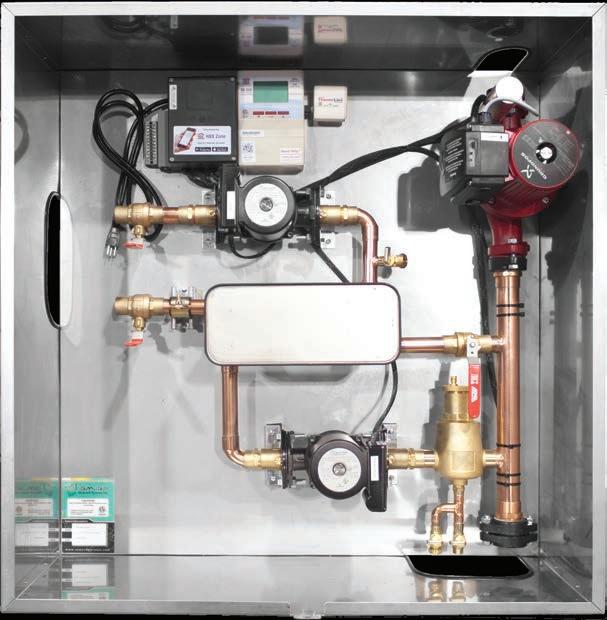

120 VAC electrical power supply). A typical scenario is for the circulator to remain off until the control signal reaches 2 volts. The circulator’s speed increases in direct proportion to the control voltage, reaching full speed at 10 volts.
What’s needed are simple and inexpensive controllers that generate a 0-10 VDC output signal in relationship to some temperature-based condition. The latter could be a user-set “target” temperature, with circulator speed selectable as increasing or decreasing as the temperature measured by the controller varies from the target value. This function allows for supply water temperature control as well as boiler anti-condensation protection.
The controller should also handle differential temperature control, such as used in solar thermal systems or biomass boiler systems. It should also be able to provide variable speed injection mixing based on either a fixed target supply temperature or a target temperature calculated using outdoor reset logic. All these functions are just selectable code within the controller’s firmware. The controller should have connections for up to three temperature sensors, as shown in figure 2
3 A multi-function controller for biomass boiler systems
There are lots of applications for boilers burning wood pellets or chips. These “biomass” boiler systems require several control functions including boiler anti-condensation protection, boiler firing based on two or more temperatures within a thermal storage tank, variable speed injection of heat into a distribution system, differential temperature control to prevent auxiliary heat from entering storage, coordinated operation of an auxiliary boiler and zoning.
All of these functions can currently be provided by combining several independent single-function controllers along with an assortment of relays.
Although these “multi-box” control systems work, their installation and programming can be challenging. I can attest that this has been a significant barrier to successful biomass boiler installations, especially in residential or light commercial applications.
This situation could be greatly improved if the market provided an integrated controller to handle all necessary control functions for these systems. The functionality exists, it’s just a matter of repackaging it in one box.
4
Indirect tanks with larger coil heat exchangers
The future of hydronics is low water temperature. Contemporary heat sources such as geothermal water-to-water heat pumps or air-to-water heat pumps typically max out at water temperatures in the range of 120-130F. That’s hot enough for many types of heat emitters, such as well designed radiant panels or panel radiators. It’s also sufficient to create domestic hot water at perhaps 110 to 115F—if there’s a suitable heat exchanger between the source water from the heat pump and the domestic water.
Most of the currently available indirect water heaters in North America are very limited in such applications. The internal coil heat exchangers in these tanks don’t have sufficient surface area to transfer heat from a much lower temperature heat source to the domestic water at the heat output rate of the source and at a minimum temperature differential of only 5 to 10F. The result will be short-cycling, heat pumps locking out on fault conditions and complaints about inadequate domestic hot water.
Most North American indirect water heaters were developed assuming a boiler would be the heat source, supply-
ing water to the coil heat exchangers at temperatures of 180-200F. Swap in a heat pump and you have a very significant heat transfer “bottleneck.”
One solution is to use an external stainless steel heat exchanger sized for very low approach temperature differences. This works, but it’s arguably more complex than an indirect water heater.
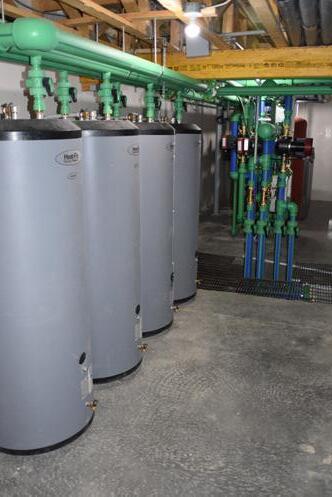
Another solution would be to increase the surface area of the coil heat exchanger inside indirect tanks. Coils with three to five times the surface area of a typical indirect are needed. Such coils would likely span from the bottom to the top of the tank as depicted in figure 3.
The coils could be made of either stainless steel or copper. The water passing through them could be from the heat source, or it could be domestic water. The later “reverse-indirect” concept allows the tank to provide domestic wa -
ter as well as buffering for zoned space heating loads. It also allows the pressure vessel to be made of carbon steel, which is more affordable than stainless.
I would also suggest that such tanks have R-24 F•hr•ft 2/Btu insulation on all surfaces and ample ports for a variety of applications. Think of such tanks as high quality “Thermos bottles,” capable of storing heat for several hours, or perhaps a couple of days with minimal temperature drop.
Peel & stick elastomeric foam pipe insulation that sticks
My last plea is born out of frustration. I’ve had many occasions to see (and fix) peel & stick elastomeric foam pipe insulation with seams that have reopened only a few weeks after installation. I suspect that I’m not the only one who has experienced this problem.

I’ve fixed it using 1.5-in.-wide highquality vinyl electrical tape centered along the slit line. This works, but it shouldn’t be necessary. Perhaps the product branding should change from “peel & stick” to “peel, stick and stay.” Perhaps some of these ideas will come to fruition to advance the North American hydronic market. <>

John Siegenthaler, P.E., is a mechanical engineering graduate of Rensselaer Polytechnic Institute and a licensed professional engineer. He has more than 35 years experience in designing modern hydronic heating systems. Siegenthaler’s latest book is Heating with Renewable Energy (see www.hydronicpros.com for more information).
Representing Lochinvar branded residential and commercial hot water and heating boilers, Aqua-Tech Sales and Marketing Inc. provides top of the line branded solutions and support services to its clients across Canada. Our people bring experience, skills and commitment to supporting our distributors and installers to help them grow their businesses.
From many different product solutions to help you meet your customers’ needs, to technical engineering support, design and bid assistance, extended hours technical support, customer and market insights, well stocked inventory, training, support programs and so much more.
BY ROBERT WATERS
Outdoor reset control technology for hydronic heating systems has been around for decades. I learned about the technology when I started working for CanaPex (predecessor of Uponor) in the late 80’s. I was designing hydronic radiant floor heating systems and was taught to recommend a Tekmar four-way mixing valve with motorized actuator and outdoor reset control for every system.
Later, when I moved to Viessmann in the mid 90’s, I learned about the Trimatik-MC, the Viessmann boiler control system that combines separate outdoor reset controls for both the boiler and the system via motorized mixing valve. Both of these European-based controls were examples of the rapidly growing market for digital outdoor reset control technology.
Outdoor reset control has been mandated for both new and existing boilers in many European countries since the 1990’s. The digital control market certainly has changed and grown significantly since those early days of my
career, but the benefits that outdoor reset technology provides are still very much the same; namely reduced energy use and cost while improving occupant comfort.
You would certainly expect a very mature and established technology like this, with such great benefits, to be widely used for all hydronic heating systems. However, based on my discussions with several industry veterans about the current usage rate of outdoor reset controls, this is not the case.
I was told that outdoor reset controls are still only being used sporadically on residential hot water boiler installations. They are more common in commercial applications where engineers and owners have recognized the significant energy, cost savings and comfort level increases that can be achieved.
This control technology is especially important and timely with new pending NRCan efficiency regulations. As most may already know, NRCan Amendment 15 regulations that just passed into law last year will require all residential boilers <300 MBH to have an annualized fuel utilization efficiency (AFUE) ≥ 90% in 2023 (this means only condensing appliances). This regulation will also require that all residential boilers be equipped with an automatic water temperature adjustment device and must not be able to operate without the device.
Outdoor temperature reset controls, also referred to as weather responsive controls, work for both non-condensing and condensing boilers. They can also be used with heat pumps or biomass hydronic systems by controlling the temperature in the buffer storage tank.
As mentioned, outdoor reset controls provide two great benefits: 1) a dramatic reduction in energy use and cost, and 2) an increase in occupant comfort.
The energy savings result from the fact that the efficiency of any hydronic heat source is always higher when operating at a lower water temperature. This is due to lower stack temperatures, lower standby heat loss, and with condensing boilers, higher amounts of flue gas condensation. Another efficiency factor that also comes into play is that a boiler will be less likely to short cycle on and off in warmer times of the heating season when it is controlled with outdoor reset.
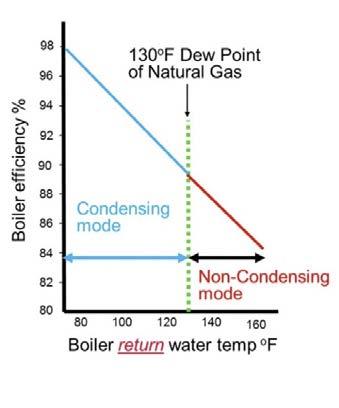
For any gas-fired condensing boiler the operating efficiency will vary in the range of 85% to 98% depending on the water temperature it is operated at (see figure 1).
Many are not aware of this efficiency range because they only look at the AFUE efficiency rating of the boiler. While a condensing boiler may have an AFUE rating of 95%, this rating was established in a test lab with a constant
140F supply temperature. If the boiler is operated in the real world, with a constant high temperature set point of 180F all heating season, it will very rarely condense and likely only have an efficiency in the 85% range.
However, if an outdoor reset control is used the supply water temperature is modulated all winter increasing the efficiency of the appliance in the shoulder seasons providing typical energy savings of 5 to 30%. They are also likely to extend the boiler lifespan by minimizing short cycling.
On the other hand, outdoor reset controls provide great energy savings while at the same time providing a more comfortable living environment for the building occupants. This is primarily achieved by eliminating the dramatic temperature swings that inevitably occur in any home whose heating boiler is operated at the same water temperature all year long. In order to provide consistent and even indoor temperatures, the heat supplied to the building must equal the heat loss from the building. The biggest factor affecting how much heat a building requires is the
outdoor temperature.
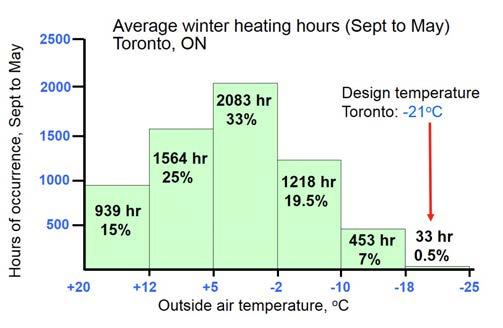
Even in a well-insulated building heat loss increases as the outdoor temperature falls. A hydronic heat source must be set to the highest water temperature setting that will satisfy the coldest day of the winter (design conditions). Design conditions however occur for a very small number of hours per year (less than 5% of the entire heating season: see ASHRAE data, following page), so for the vast majority of the heating season the heat source will be operated at a much higher temperature than is required to meet the load. So what happens when the outdoor temperature is warmer in the fall and spring? At these times the system inevitably overheats the building, creating temperature swings and poor control for the occupants. Overheating will be especially noticeable in high mass hydronic systems such as those with cast-iron radiators and radiant floor systems. In commercial or apartment buildings, where occupants do not directly pay for heating bills, energy use and costs increase even more as occupants open windows to compensate for overheating conditions. By continuously adjusting the system supply water temperature with an outdoor reset control the hydronic system is able to more closely match the exact heating requirements of the building at all times. The results are more consistent, comfortable space temperatures throughout the entire heating season. An added benefit in homes with fin-tube baseboard systems is a minimization of ticking expansion noises in baseboards by preventing large temperature swings.
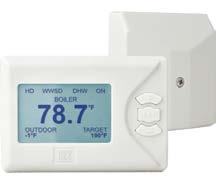
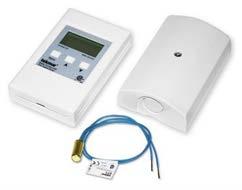
Outdoor reset works by utilizing an outdoor temperature sensor mounted on the building’s exterior, ideally on the north wall and located away from anything that can give it a false reading such as a dryer or ventilation exhaust vent.
This electronic ambient air sensor actively monitors the outdoor tempera -
ture, and based on its reading a microprocessor calculates the heating demand and adjusts the output water temperature of the boiler accordingly. This results in the boiler only running as hot as necessary to achieve the desired indoor temperature.
There are two major categories of outdoor reset control; one being direct boiler reset control and the other being mixing reset control. Some controls will incorporate both boiler reset and mixing reset into one package. A mixing reset control utilizes either a motorized mixing valve or an injection pump to provide a mixed supply water temperature to an individual heating circuit.
Hybrid hydronic systems that have radiant floor heating (RFH) and fan-coil heating are the most common type of system that requires multiple supply water temperatures. For these systems the boiler reset control will provide a higher temperature to the fan coil circuit, and the mixing reset circuit provides a lower temperature to the RFH circuit.
There are many manufacturers today that provide both boiler and system outdoor reset controls. Most controls combine many other features and control capability such as multiple boiler control, wireless outdoor sensors, Wi-Fi connectability, and room temperature feedback. Many condensing boiler manufacturers now integrate the outdoor reset control directly into the boiler so there is no extra added cost.
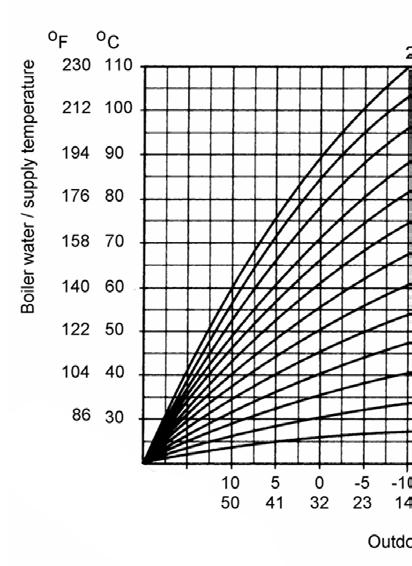
Outdoor reset controls must be set up and calibrated at the time of installation to meet the jobsite specific system requirements. The primary adjustment for any outdoor reset control is the heating curve setting. This setting determines what the maximum supply water temperature will be on the coldest day, and what the lowest supply temperature will be on the warmest day.
Continued on MH12
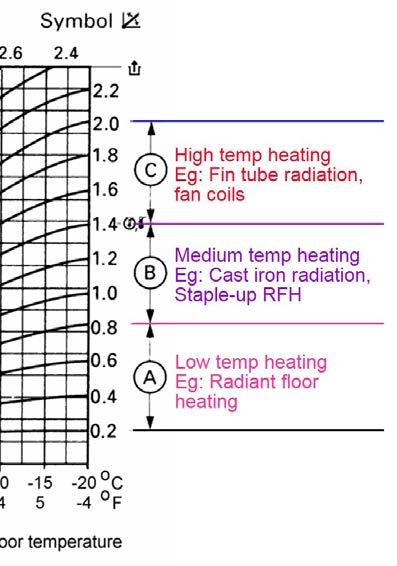
The heating curve is determined primarily by the type of heat emitter used in the system (see figure 2 above).
The control may come with a factory defaulted heating curve, but this will not meet the requirements of all types of systems. Different heat emitters such as high mass radiant floor, cast-iron radiator, and fin-tube will all require unique settings. When using a non-condensing boiler the minimum supply temperature must be set high enough to avoid flue gas condensation in the boiler and chimney (usually a minimum supply temperature of about 140-150F).
Other adjustments such as parallel shift, warm weather shut down (WWSD), and desired indoor temperature may also need to be adjusted. I do not have space in this article to get into the fine details of setting up an outdoor reset control, but there are many sources for those who want more information. Most manufacturers and distributors of hydronic equipment offer training and advice on how to do this properly, so reach out if you need help.
All of these adjustments must be done by the installing contractor at the jobsite, and I believe the lack of understanding of these settings is one of the primary reasons why some shy away from using outdoor reset controls.
In commercial hydronic systems outdoor reset control technology is being used extensively because it makes sense financially. Designers and building owners are seeing that savings can be substantial providing great ROI’s to the owner.
This same acceptance and use level has not spilled over into the residential hydronic market. Many hydronic installers still don’t use outdoor reset controls, even when the control is integrated into the boiler. Many don’t activate the outdoor reset control or bother to install the outdoor temperature sensor and wiring. They prefer to just set the boiler at one temperature and enable and disable it with a room thermostat through the TT connection.
Scott Boutilier, technical advisor/instructor with Viessmann-BC told me, “For many contractors, if they can get away without
using the outdoor reset control they will. Contractors just want to get in and out of jobs quickly, and they don’t want the hassle of running the sensor wire and setting up the control. Even with our boilers that have factory installed outdoor reset controls, many contractors don’t bother to install the outside sensor and just run the boiler at one temperature.”
Like many areas of the HVAC market, margins are always tight and very competitive, and many contractors want to make projects fast and easy. Many don’t want to ever have to return to the job after they are finished the installation. This usually results in a single thermostat, constant temperature boiler, and NO outdoor reset control. For many projects this means that the full potential of a new condensing boiler is not being optimized, and the customer is left with higher fuel bills and sub-optimal comfort levels.
It’s not all doom and gloom though, as everyone I spoke to say the true “wet-heads” are the exception to this trend and have definitely adopted the use of outdoor reset controls. According to Boutilier, “Good hydronic guys have taken the time to learn about outdoor reset technology, understand how it works, and they know how to adjust and fine tune the controls. They know how to make the controls work, can explain the benefits to their customers and they can easily sell the extra cost required to set up and configure the control.”
Unfortunately these hydronic contractors are not the majority. To those who are using them already, keep it up. These simple controls increase appliance efficiency, reduce greenhouse gas emissions, while at the same time make buildings more comfortable. This potent combination seems like a no-brainer to me!
It is time for everyone in the hydronic heating industry to step up and fully utilize this powerful, yet inexpensive, technology. This not only includes hydronic installers, but also regulators who inspect and enforce code and standards. No hydronic space heating system should be installed without one. <>

Robert Waters is president of Solar Water Services Inc. which provides training, education and support services to the hydronic industry. He has over 30 years experience in hydronic and solar water heating. He can be reached at solwatservices@gmail.com. <>

The rise of electrification in residential HVAC will lead to greater adoption of heat pump technologies.
BY MIKE MILLER
As we all said goodbye to last year on December 31, for the HVAC industry this isn’t just the beginning of a new year, a new decade or an opportunity to set new personal and professional resolutions, 2020 and the years to follow will also represent further changes in our marketplace. And although we saw things change in the last decade, the one to come will be even more dramatic — of that I am sure.
The global conversations about a ‘greener’ world—electrification, carbon neutral or net zero buildings—is really starting to resonate across our continent and some geographic regions are already adopting rules and regulations that will prevent or make difficult to use fossil fuel fired equipment moving forward. These changes will, as has already been the
case in Europe, shift the landscape of heat sources away from fossil fuels as the primary energy provider.
Did you know that 2017 was the first time that heat pumps outsold the number of boilers as heat generators in Germany, and this shift continues to move faster and faster over there?
Like many other technologies in this industry, Europe sets the trend and North America typically follows. In the past it would take a number of years for
North America to catch up, but with the world becoming a smaller place, the transition is happening a lot sooner.
Heat pumps will likely lead the way in the immediate future as heat source replacements for fossil fueled radiant systems in the residential market. Geothermal heat pumps are a well tried and tested technology that works extremely well, if installed correctly, but the costs of drilled ground loop wells (depending on geographical location) has kept the adoption of this technology limited to high-end homes.
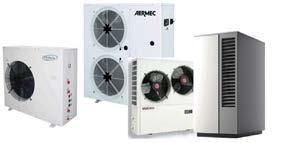
Air to water heat pumps (ATWHP) on the other hand have come a long way in recent years and can offer a much more cost-effective alternative for many structures, big or small, residential or commercial. Heat pumps, unlike boilers, can be reversed to provide cooled fluid for cooling applications in the summer to make this generation of equipment usable all year round. Heat pumps can also provide domestic hot water for a building.
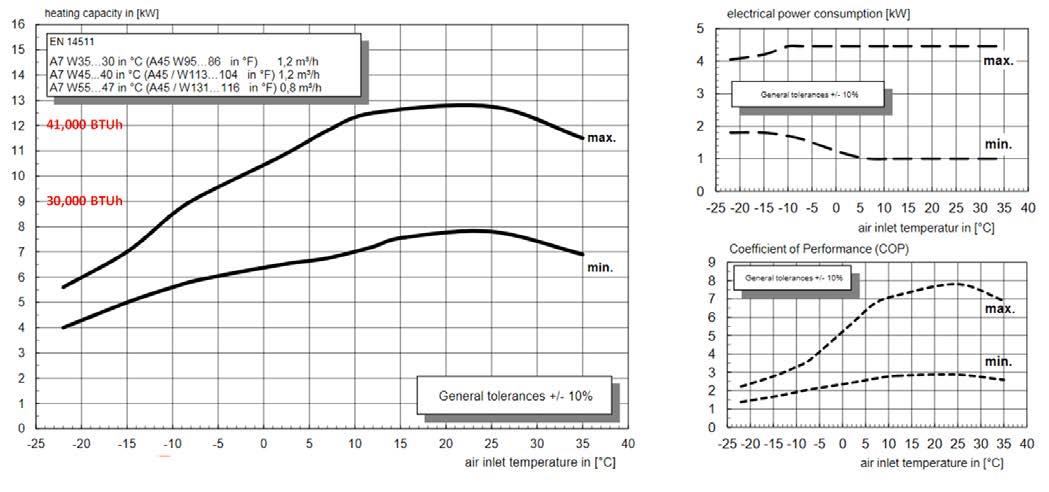
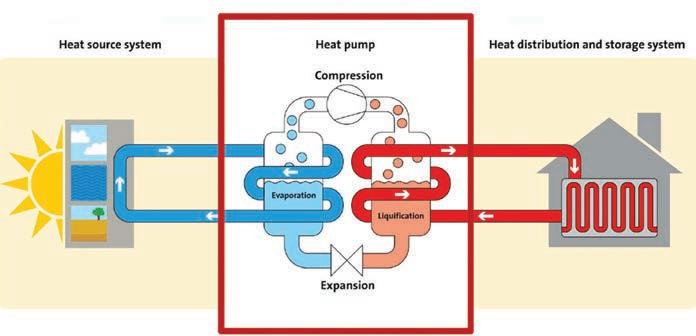
Figure 1 illustrates a very basic heat pump cycle consisting of a source (outdoors), a load (building or fluid storage) and the guts that makes it all happen, including the evaporator, compressor, liquefier and expansion valve.
Refrigerant pressure changes its ability to absorb heat or cool and either put heat into the building in heating mode or pull it from the building and put it outdoors in cooling mode. A reversing valve in the heat pump is used to make the cycle responsive for heating or cooling needs, depending on the requirement.
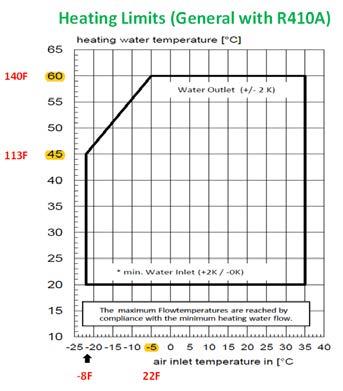
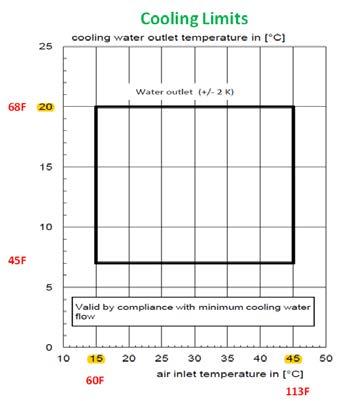
Using outdoor air as a source of energy is limited to ambient conditions. Today many ATWHPs have inverter driven compressors for added efficiency that can modulate to draw energy out of the ambient outdoors as long as it is above -22C (-8F) for heating operation and below 45C (113F) for cooling operation. That’s a pretty wide range, but in many of our regions some additional backup heat generation is required to supplement the ATWHP during extremely harsh conditions outside of that range. ATWHPs also have a limited fluid temperature that it can generate. The refrigerant used in most of these systems, R410A, limits its output capacity as described in figures 2a and 2b.
The maximum fluid temperature a typical ATWHP can provide is 60C (140F) in heating mode, but its output capability is reduced when the ambient outdoors drops below -5C (22F) and is somewhat in a linear relationship from there down to about -22C (-8F) with the fluid temperature of 45C (113F), as is shown in figure 2a
In cooling mode, the output capacity is pretty stable and can be anywhere between 7C and 20C (45F and 68F) for fluid temperature as long as the outdoor temperature is below 45C, as is shown in figure 2b. These limits must be considered when choosing the terminal units for heating and cooling of the building.
Of course, ambient outdoor temperature and fluid temperature provided affect the output capacity and efficiency of the ATWHP. This can vary from manufacturer to manufacturer, and it is important to understand the ranges when considering your design options and requirements. An example of how it may impact a system is shown in figure 3 for heating.
As the outdoor temperature drops the output capacity drops. In this particular example, at -5C outdoor temperature the output capacity is shown at about
9.5 kW or 32,000 BTUh and operating at a COP of 4. At -20C outdoor temperature, the output capacity is shown at about 6 kW or 20,500 BTUh and now operating at a COP of 2.5.
For the cooling operation, as the outdoor temperature rises the output capacity drops. As an example, at 15C (59F) outdoor temperature the output capacity will be about 14 kW or 4 tons of cooling and operating at an energy efficiency ratio (EER) of 5.5. At 45C (113F) outdoor temperature, the output capacity will be about 7 kW or 2 tons of cooling and operating at a EER of 2.
Understanding these limitations is absolutely necessary when designing a system. In the next issue of HPAC (Part 2 of this article) I will go through a very high level system design example using an ATWHP for a 2,000 sq. ft. home in Canada, looking at mechanical system and control logic that could be employed.

Mike Miller is director of sales, commercial building services, Canada with Taco Inc. and a past chair of the Canadian Hydronics Council (CHC). He can be reached at hydronicsmike@tacocomfort.com.
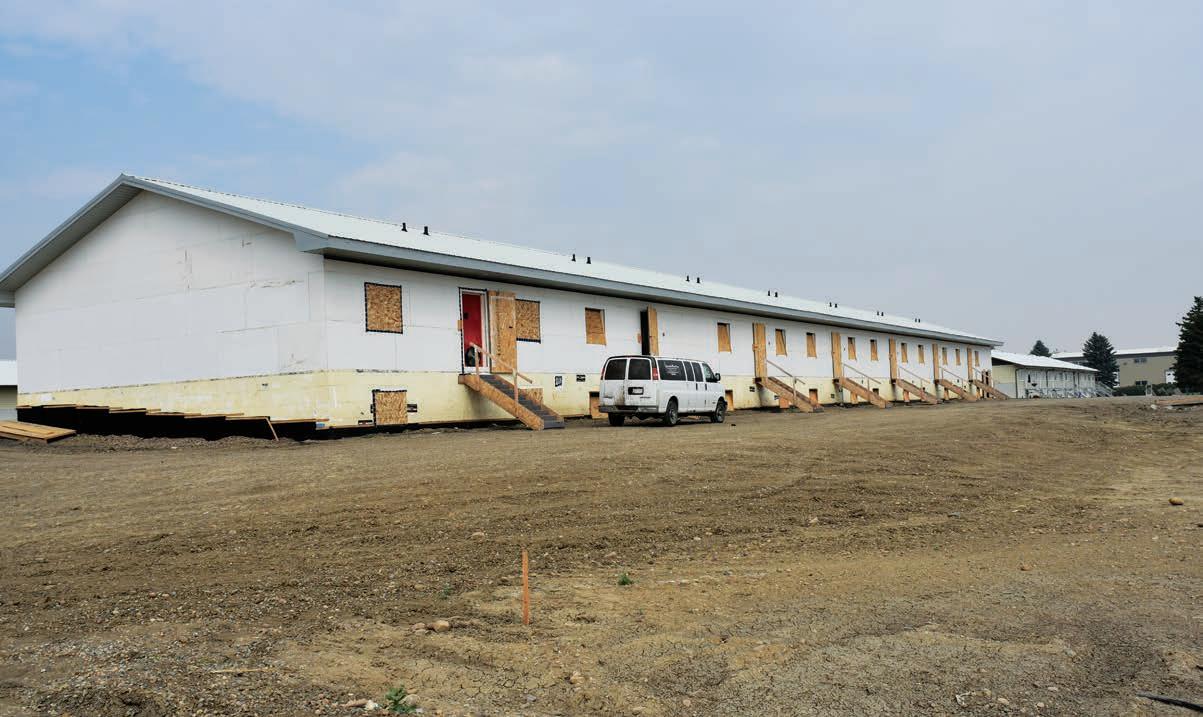
Figure 1: Conservative and practical architecture offers long-term resiliency and simplified control over noise, thermal transfer, air and light. Note the landscaping and foundation drainage plane to mitigate moisture issue and the low window-to-wall ratio to control sound, light, solar gains and radiant asymmetry and drafts.
BY ROBERT BEAN
Iwas recently in Vancouver participating as a guest speaker at an integrated design process (IDP) workshop held at the British Columbia Institute of Technology (BCIT) High Performance Building Lab. The event was a collaboration of BC Housing with BC Hydro, FortisBC and the Province of BC. The day-long function was facilitated by Andy Oding from Building Knowledge Canada and Gary Hamer from BC Hydro. There is no single right or wrong definition of an of an IDP, and for the purposes of the workshop BC Housing’s Wilma Leung identified the group’s objectives as:
1. Describe, test, and refine an IDP that can be used to optimize the design of a home that will serve occupants for 100-200 years;
2. Describe the attributes of a home that is built to serve the needs of the occupants—including comfort, health and safety;
3. Agree upon the essential participants needed for a design charrette (IDP professionals) and the role of the engineer/ architect in leading the builder’s team process to deliver high performance/net zero homes.
I have worked on integrated design teams on many projects and see the process much like a business planning process I have used for years: It begins by identifying the business’s compass (the geography of the playing field and its sense of direction). Then you identify its purpose (why does it exist?), supported by a collections of visions (the pieces of the puzzle that must be achieved in order to fulfill the purpose). Those visions are achieved by a combination of executed strategies (the “what” that needs to happen to make the visions a reality) and tactics (the “work” required to complete the strategy) and goals (the “when” for the time-driven tactics). It is an integrated business planning method that is transparent, easy to
understand and it works; and as I’ve discovered, it applies to the design and construction of buildings.
I have written before about the evils of the traditional design process where the architect/builder/owner segregates the project professionals.1 With the IDP it is all about integrating knowledge through the collaboration of the experts.
The differences are important. In the traditional method the building design is typically based on compliance with the minimum requirements of mandatory codes written for safety and reducing the risk of illness. However, with an IDP (in my experience) it adopts human based indoor environmental quality (IEQ) standards and philosophies around sustainability and earth stewardship. As noted by Pearl (2004), “In professional practice, IDP has a significant impact on the makeup and roleplaying of the initial design team. The client takes a more active role than usual, the architect becomes a team leader rather than the sole form-giver,
and the structural, mechanical and electrical engineers take on active roles at early design stages. The team includes an energy specialist (simulator) and hopefully, a bio-climatic engineer.”2
To prove a classic example of an IDP consider a project we engineered a few years ago. This case study was an 88,000 sq. ft. (8175.47m²) multi-family project comprised of 28 new homes in four buildings (Figure 1). Two identical mechanical rooms were designed, each serving 14 units.
The client is a farming community with a philosophy of building for the long term. They lead a very conservative life with few personal luxuries. The exception is in the design and fabrication of their, “state
of the art” farm buildings, equipment, systems and housing. Here the focus is on resiliency, minimal maintenance, hygiene and indoor environmental quality (IEQ). The architecture is very much antiflamboyant and pro-practical.
Using IEQ for the project ethos drove the compartmentalization of each unit. Each unit is served by independent hybrid HVAC systems using heated and chilled water from the central plants (Figures 3 and 4).
Since the community is sharing resources, including common walls between units, sound privacy is of utmost importance. There can be upwards of seven family members per unit, as such flanking paths needed to be mitigated by non-continuous flooring and wall assemblies.
There can also be outdoor noise issues
Continued on MH18


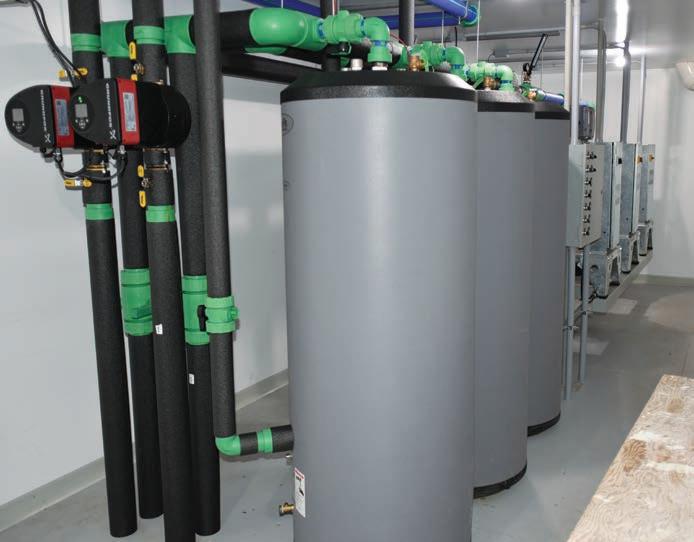
when farm equipment is used near the housing units. Here the enclosure design (conservative window-to-wall ratio, reduced bridging and infiltration) was important to reduce outdoor sound effects. These floor, wall and ceiling details also helped the thermal performance in controlling the mean radiant temperature and thus the operative temperature in compliance with ASHRAE Standard 55 Thermal Environmental Conditions for Human Occupancy.
Lighting quality included window design for achieving acceptable daylight factors which also reduced sound transmission, radiant asymmetry and down drafts; and the design contributed to improved indoor air quality by minimizing the destruction of interior finishes due to exposure to shortwave (solar) radiation. The latter principle is a source control requirement implied in ASHRAE Standard 62.2 Ventilation and Acceptable Indoor Air Quality in Residential Buildings and CSA F326 Residential Mechanical Ventilation Systems.
Air quality strategies also included reducing potential for moisture-related damage (through landscaping, enclosure
designs and ventilation systems) and the use of low VOC finishes, radon mitigation systems and high-quality filtration products.
Odours and vibration are real problems in these types of communities due to agriculture production. Within the homes, internally-generated odours are prevented from migrating to another unit by the compartmentalization details and each unit’s independent exhaust and make up air systems. These details are important since pressure differentials across a common wall created by the operation of exhaust fan(s) could pull odours from one unit into another. However, the most challenging odour issue is related to the hog, poultry and cattle production and outdoor intakes for each home’s ventilation system.
In this dynamic the first source of control is within the production facility itself and then using specialty filtration within each housing unit. Though it’s almost impossible to keep an odour-free environment with natural ventilation, especially during the summer, the community understands some farming odours are part of their culture. Vibration from heavy farm
of 28 mechanical rooms, one in each
machinery can sometimes be a problem mitigated by properly constructed roadways bypassing the housing complex.
Building Systems:
• Below grade enclosure is 11-in. (280mm) ICF basement walls.
• 4-in. (100mm) slab bears on 2-in. (50mm) of rigid XPS insulation on a gravel radon plenum.
• Interior wood frame walls sheathed with OSB and then finished with drywall.
• Above grade walls are 6-in. (150mm) EPS panels with thermally isolated studs.
• Walls are vapour barriered, sealed and finished on the inside with drywall, and outside with weather barrier, strapping and PVC siding.
• The roof is assembled with engineered
with the radiant control closet to the left, air systems at the top and piping vault at the bottom. The central plants (Figures 3 and 4) eliminated 28 gas lines, venting and combustion air set ups; they also eliminated 28 heating and cooling plants and associated expansion tanks and fill assemblies. Continued on MH20
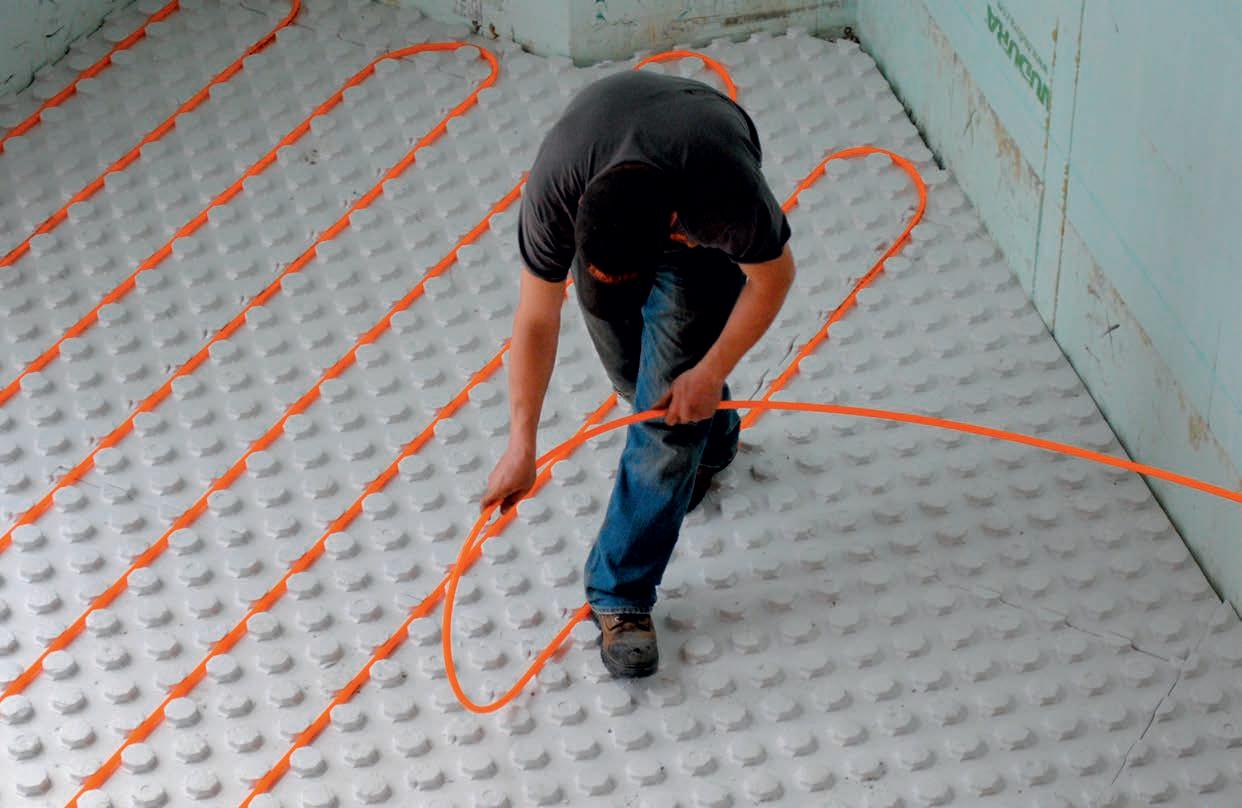
The floor of a building is often the most ignored surface when it comes to insulation. The floor, when insulated with HYDROFOAM®, completes the building envelope and increases comfort and energy efficiency.
HYDROFOAM® maximizes radiant floor heating by ensuring the heat is dispersed evenly throughout the entire floor area, providing building occupants with a comfortable living and working environment.
HYDROFOAM® is the ideal radiant floor insulation product for residential and commercial construction projects. Visit nudura/hydrofoam.com today to start your next project!


Indoor Quality
Metric Architect Enclosure Eng. Mechanical Eng. Electrical Eng. Interior Designer
Sound Reducing transmission of outdoor sounds by minimizing strategically placed openings and designing simplified geometries.
Thermal Reducing transmission of heat and moisture by minimizing openings, reducing solar loads with external shading and designing simplified geometries.
Air
Reducing infiltration by minimizing openings and designing simplified geometries.
Light Reducing excessive natural light using conservative WWR and proper shading.
Odour Reducing infiltration by minimizing openings and designing simplified geometries.
Vibration Reduce or drop complex geometries to simplify vibration control.
Reducing transmission of outdoor sounds through openings and assembly details.
Controlling heat and moisture flows across floor, wall and roof/ceiling assemblies using climate appropriate strategies and tactics including low SHGC.
Reducing transmission of outdoor moisture and particulate through openings and assembly details.
Strategic choices in visible light transmission through windows, doors and skylights.
Reducing transmission of outdoor odours through openings and assemblies.
Reducing transmission of external sources of vibrations through enclosure members.
wood trusses, sheathed and finished with steel roofing. The attic is sealed with a polyethylene membrane, open cell spray foam and filled with cellulose.
• All PVC windows are triple sealed, triple pane and argon filled. Window glass with frame rated at U=0.14 Btu/ft² h F (0.79 W/m²K).
The heating boilers serve the low temperature radiant floor systems and make up air heating coils. Both are designed to operate on reset with maxi -
Reducing sound from motors and fluid flow through pipes, ducts, valves and dampers, registers, relays and contacts in controls.
Regulating heating and cooling operative temperatures and humidity, air velocity etc. to offset internal loads and loads through enclosure.
Conditioning of air for gases, odours and particulate, controlling moisture and air velocity.
Lighting loads that may have a thermal signature contributing to cooling loads.
Transfer of return air flow having odours, strategic choices in filtration.
Mounting of equipment with motors and fluid flow through pipes, ducts, valves and dampers
mum supply of 120F (49C) and a 20F (11C) differential at design conditions of -35F (-37C). Boilers are also domestic water prioritized, staged to switch to 180F (82C) for charging the four 120 gal (454L) storage tanks through a preheat/boost/reheat brazed plate heat exchanger system for an 80F (44C) rise.
The cooling coils were specified by the client for a 45F (7C) entering fluid temperature and a 10F (6C) rise for conditioning the space and make up air. Cooling airflow per unit is 700 cfm (330L/s) at 1 ton/1200 ft2 (3.5 kW/112m2) based on 2200 ft2 (204m2) of cooled space.
Reducing sound through strategic choices in electrical systems (i.e., motors, lights) and attachment of same to structural members.
Strategic choices in lights and appliances with low thermal signatures affecting heating and cooling loads.
Reducing sound through strategic choices in interior acoustic systems, materials of construction and installation methods.
Strategic choices in flooring affecting contact co-efficient affecting thermal comfort to feet.
Power loads for HVAC equipment and systems.
Strategic choices in lighting devices and systems.
Prevention of overloaded circuits or over heated conduit which can emit unique odours.
Minimizing vibration through motors and lighting systems.
Strategic choices in interior systems, materials of construction and installation methods, i.e., low VOC materials.
Strategic choices in general and task lighting.
Strategic choices in interior systems, materials of construction and installation methods.
Strategic attachments of systems and fixtures to structural members.
Ventilation is comprised of a centrallylocated variable speed in-line primary exhaust fan operating at 105 cfm (71 L/s) at 50% of total design exhaust flow. Ceiling located bathroom fans and range hoods provide additional exhaust capacity in conjunction with a unique odour exhaust system connected to each toilet.
The exhaust systems pull makeup air through an outdoor duct connected into the return air plenum. This air flow passes across the heating and cooling coils of the fan/coil unit for distribution through the supply air system when the
fan/coil blower is off. The temperature regulation of the makeup air and air for cooling is done with a unique non-electric auto heat/cool change-over control—the control modulating fluid flow to each of the coils to maintain a clientcontrolled set point.
A room thermostat is used to turn on the blower on call for cooling (or optional stand by heating). Primary heating is radiant floors but in the shoulder seasons can be done with the fan/coil if the occupants wish to use it for the occasional cold spell.
Heated, chilled and domestic water from the central plants to each of the houses is carried through an in-ground PEX distribution network running under the building. Each home is fitted with a piping vault in the basement floor offering access to the pipes and expansion joints (see Figure 2, page MH16)
Every project I have been involved with using an IDP has always resulted in better outcomes. The buildings provide higher indoor environmental quality using less energy, and the energy used is of the highest efficiency possible for the conditions.
The projects usually followed construction schedules and were completed on time. Often the capital cost premium was only slightly higher than normal because the client was willing to trade off expensive “short term” aesthetics for more practical solutions delivering better “lifetime” outcomes.
To help complete the message on how each profession plays a role in IEQ see Table 1. When one sees how integrated the service providers are to an IEQ metric one begins to understand how antiquated traditional segregated processes are and why they deliver such poor out-
comes. Just like in business, everything is related and everything matters. <>
1. Bean, R. (2014) Integrating Elements to Improve Comfort; Design wholeness can be achieved by proficiency in energy, environmental standards and guidelines. HPAC Magazine Canada. Accessed 2020.01.01 https://www.hpacmag.com/features/integrating-elements-to-improve-comfort/
2. Pearl, D. (2004) An Integrated Design Process (IDP) Canadian Architecture. Accessed 2020.01.01 https://www.canadianarchitect. com/an-integrated-design-process-idp/

Robert Bean is director of www.healthyheating.com, and founder of Indoor Climate Consultants Inc. He is a retired engineering technology professional (ASET and APEGA) who specialized in the design of indoor environments and high performance building systems.
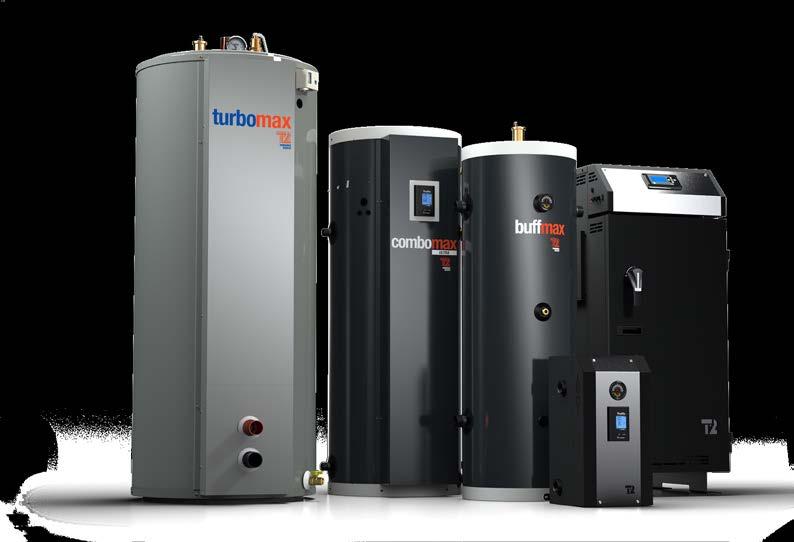
Designing for comfort and efficiency in commercial buildings through optimized controls of a hybrid system.
BY SANJIL KARKI
HVAC system designers do not need to choose between comfort and efficiency in commercial buildings. By integrating a radiant heating/cooling system with a dedicated outdoor air system (DOAS), both of these performance attributes can be optimized. This technology decouples sensible and latent loads, allowing the key variables that optimize comfort and energy efficiency to be independently and precisely controlled.
The potential synergy of hybrid radiant-DOAS systems is underutilized. This article discusses three important considerations for designing a sequence of operations that makes the most of this technology.
A hydronic radiant floor system is controlled by changing either supply water temperature or supply water mass flow rate. Typically, outdoor temperature reset controls are used to modulate the supply water temperature based on outdoor air temperature and control the water flow rate to each room according to setpoint temperature. The average system supply
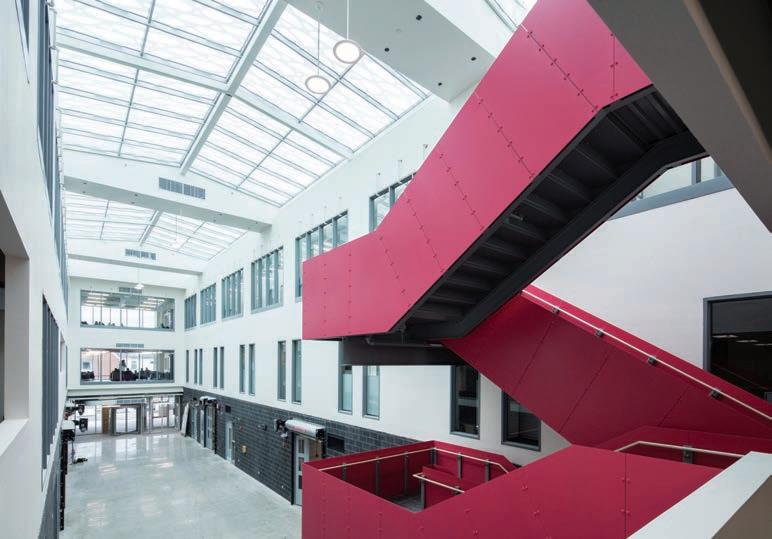
temperature should also be controlled for faster and more consistent operation.
A typical radiant heating system is designed to a handle space load up to 32 Btu/h-ft 2 (100 W/m2) with a maximum allowable slab temperature as per ASHRAE Standard 55 of 85F (29.4C). A radiant cooling system can provide a cooling capacity up to 14 Btu/h-ft 2 (44 W/m2) with latent loads and supplemental cooling typically provided by a DOAS system. In areas with high direct solar loads, the system’s capacity can significantly increase up to 25 Btu/h-ft 2 (79 W/m2), but accounting for this transient capacity is not always advisable from a system sizing standpoint. For comfort,
ASHRAE Standard 55 mandates a minimum radiant cooling slab temperature of 66F (18.9C).
During shoulder seasons, between heating and cooling modes, what is the best way to control the radiant system? Research by the Center for the Built Environment (CBE) at the University of California Berkeley reached the following conclusion: If the building has a lot of exposed thermal mass and a well-designed envelope, there are no times of the year when heating is required in the morning and cooling required in the evening. These types of buildings respond more closely to the 24-hr average of the outside air temperature conditions and
can coast through shoulder season days on thermal mass.
Radiant systems provide sensible cooling/heating and are typically configured as a hybrid with an air system, which is used for ventilation, dehumidification and supplemental cooling/heating, if needed. Typically, radiant does the heavy lifting to maintain the sensible load, by warming or cooling surfaces in the space. DOAS is primarily focused on latent loads, but can assist with sensible loads on summer and winter design days, depending on the project.
In cooling mode, DOAS dehumidifies and delivers the required amount of outdoor air conditioned to handle the latent load of both the outdoor air and the space. This requires a supply air dew-point lower than the room air dew-point, typically 48-50F (8.9-10C).
DOAS handles the entire latent load and radiant is only responsible for sensible cooling. This decoupling of the space sensible load from the latent load affords precise humidity control regardless of space thermal load. Humidity control problems often associated with part-load operating conditions are manageable and designers can easily prevent condensation in the space, even in humid cities such as Windsor, Ont.
The supply air temperature of the DOAS is an important factor in achieving maximum energy savings. To handle the entire latent load, the supply air must be dehumidified to a dew point that is lower than space, which typically means overcooling the outdoor air. Designers must choose between supplying air at “space neutral” or “cold air” condition straight off the cooling coil.
When “space neutral” air is supplied, the dehumidified air must be reheated to introduce fresh air into space without affecting the thermal loads, thus wasting all the sensible cooling done during dehumidification. When “cold air” is supplied, the air coming from the unit does not require reheating. With the outdoor air handling some of the sensible cooling, annual energy consumption of the local HVAC unit is significantly reduced.
One control strategy that can be implemented is resetting the discharge temperature based on outdoor air. When outdoor air conditions are such that overcooling is likely, the supply air is reheated to a neutral temperature. This can be accomplished using a microprocessor controller such as a direct digital control (DDC) for discharge air control; the DDC controller monitors the ambient temperature and resets the discharge temperature of the outdoor air unit accordingly.
A more advanced approach to this strategy is to implement a building management system (BMS) that can monitor multiple spaces and determine the “critical space.” Once the critical space is determined, the BMS can adjust the reheat capacity of the outdoor air unit to prevent the critical space
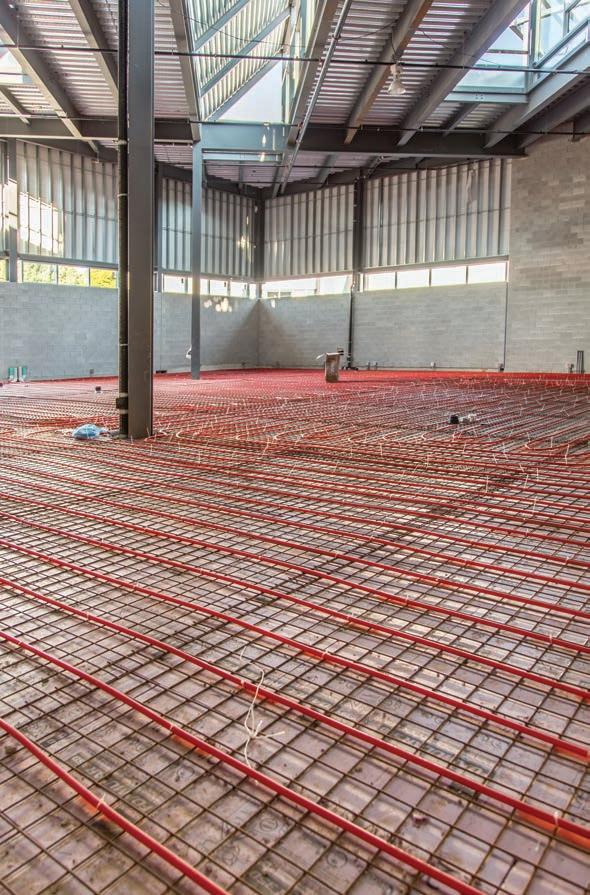
from being overcooled or overheated.
Another controls strategy for saving energy is to utilize humidistats and dehumidification in critical spaces. If the humidity begins trending up, the humidistat sends a signal to the controller that more dehumidification is needed. The controller then lowers the discharge dew point of the outdoor air unit for further dehumidification. Once the room humidity reaches an acceptable level, the dew point is reset back to normal operation.
Beginning with Vancouver, more than a dozen Canadian cities have taken steps toward the ambitious goal of 100% renewable energy. Last year, Berkeley, California became the first American city to ban natural gas infrastructure in new buildings after PG&E, the second-largest U.S. utility and notably, both a gas and electric utility, publicly supported the move. These cities are part of
Continued on MH24
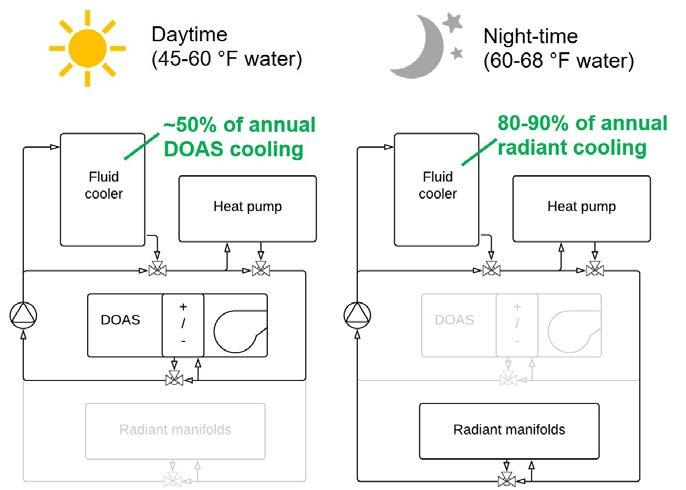
an international trend that will cut natural gas demand through building electrification, swapping out fossil-fuel-powered appliances for electric appliances.
With electrification, engineers are challenged to design HVAC systems that can provide efficient space conditioning without being penalized on utility bills. Heat pumps integrated with hydronic radiant are important components of ZEB design. By extracting heat from a lower temperature source and transferring it to a higher temperature source, modern heat pumps use 66 to 75% less energy than electric resistance heating/cooling appliances.
CBE’s all-electric design concept (figure 1) uses an air-to-water or groundsource heat pump, a DOAS system, a fluid cooler or closed-circuit cooling tower and a radiant system. At night, the heat pump provides warm or cool water to the radiant slab depending on the season. At the end of each day’s occupied period, the system gets feedback from the previous-day slab temperature and the controller gradually changes the slab setpoint during the next 12 hours. In this
way, the controller gradually responds to changes in the zone loads over the course of several days. These designs provide excellent hydronic system energy efficiency while being all-electric.
For example, if the previous day’s outdoor condition is 90F (18.9C), the radiant slab will be in cooling mode. The heat pump will generate 60-68F (15.620C) water that will be circulated through the radiant slab during the night, pre-cooling the slab.
As the occupants arrive in the morning, the slab begins absorbing heat from the space and DOAS begins providing ventilation. If the outdoor air needs to be dehumidified, then the heat pump will provide 45-60F (7.2-15.6C) water to the DOAS system. As the day progresses, the radiant slab slowly absorbs heat from the space. If the radiant system is not able to handle all of the cooling load, the DOAS system could then provide supplemental cooling using the chilled water from the same heat pump.
During milder weather, the closed-circuit cooling tower or fluid cooler is used for water-side economizer operation,
providing an additional 80-90% savings on the radiant cooling system.
Since the same heat pump is providing warm or cool water to radiant during the night and DOAS during the day, the mechanical plant size is significantly reduced. Another key benefit of this design is shifting the heating and cooling loads from peak to off-peak hours when utility rates and demand charges are lowest. Heat pump water temperature and savings will vary depending upon project location.
By addressing shoulder season variations, DOAS supply air temperature and meeting the market trajectory toward electrification, a well-designed hybrid radiant-DOAS system does not need to compromise comfort and controllability to optimize energy efficiency. From sequence of operations to building specification, these factors allow radiant and air-side systems to each do what they do best, even in ZEB designs. <>
Sanjil Karki is an engineering sales specialist for the building solutions division of REHAU, responsible for western United States, Alaska and Hawaii. In this role, he educates engineers and commercial contractors on radiant heating and cooling, snow and ice melting, PEX plumbing and geo-exchange systems. Karki serves on the advisory team of “Optimizing Radiant Systems,” an initiative of the Center for the Built Environment (CBE) at the University of California Berkeley.
Lehrer, D., “CBE Rad Tool Enables Better Design of High-Mass Radiant Systems,” CBE, 16 April 2019, cbe.berkeley.edu/centerline/ cbe-rad-tool-enables-better-design-of-highmass-radiant-systems/.
Bauman, F., Raftery, P., and Karmann, C. “Lessons learned from field monitoring of two radiant slab office buildings in California.” Energy Procedia, 2015. 78, 3031–3036.
Feng, J. (Dove), Chuang, F., Borrelli, F., and Bauman, F. “Model predictive control of radiant slab systems with evaporative cooling sources.” Energy Build, 2015. 87, 199–210. Romaní, J., de Gracia, A., and Cabeza, L.F. “Simulation and control of thermally activated building systems (TABS).” Energy Build, 2016. 127, 22–42.
THE ORIGINAL INNOVATORS DELIVER THE FUTURE IN HIGH-EFFICIENCY BOILERS
An all-stainless steel fire tube heat exchanger available in three Solo sizes - 110, 155, 199, and two Combi sizes - 155 and 199.
LOWER PRICE POINT
BREAKTHROUGH MARKET-LEADING WARRANTY PROGRAM with up to 6-year part, 3- year labor and 10-year heat exchanger warranty
ENHANCED QUALITY CONTROL and built with reliability in mind
Learn more about our Three-Point Warranty Program at our website.
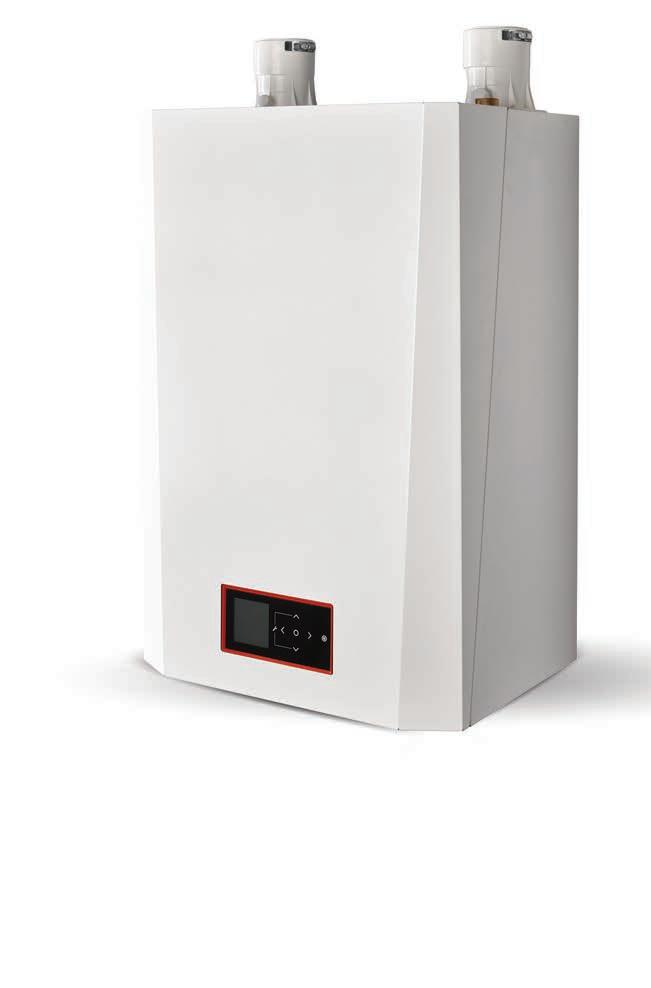
Temkar now offers four new switching relay and zone valve control models to its fleet: 2-zone pumps; 3-zone pumps; 3-zone valves and 5-zone valves. All four models are compatible with low-voltage thermostats and are fitted with RoomResponse, which automatically adjusts boiler temperatures to improve comfort and save energy. Other notable features include unlimited expansion, exercising to prevent pumps from seizing, zone priority and priority override to protect homes from freezing during the winter months. www.tekmarcontrols.com
Spirotherm uses magnet technology to separate ferrous and non-ferrous air debris with its Spirocombi Magnet air eliminator. It can be installed horizontally or vertically on both traditional and wall-mount boiler systems. It is available in ¾-in., 1-in., 1
¼-in., 1 ½-in and 2-in. sizes and comes with threaded, sweat and press fit connection options. www.spirotherm.com
NIBCO has expanded its press valve line to include the Press Slip Ball Valve (PC-FP600A-S-LF). It is easy to install and is designed to adhere to existing copper piping. The PC-FP600A-S-LF is suitable for HVAC and domestic hot and cold water applications. It also has a patented leak detection feature rated to 250 psi Cold Working Pressure. www.nibco.com
Webstone’s Pro Pal Ball Drain is now available in F1960 and F1807 end connections. The full Ball Drain lineup features FIP, SWT, Press, Press x Pex, PP-R, PP-RCT and union connections, in sizes ½ to 2-in. It features lead-free dezincification-resistant brass construction certified to all appropriate codes and standards. www.webstonevalves.com
Milwaukee Tools’ new PEX Clip Jaws system is designed to increase the capability of the M12 and M18 FORCELOGIC press tools for F1807 and F2159 PEX. Engineered with user comfort in mind, the PEX Crimp Jaws are designed to eliminate the repetitive strain required of other handheld tools. www.milwaukeetool.ca
The LAARS OmniTherm series of near condensing boilers and volume water heaters come equipped with electronic airto-fuel ratio control, stainless steel heat exchangers and the Laars Linc icon-driven control system. OmniTherm units can be installed in Category I, II, III or IV vent systems for new or replacement system applications. An intuitive control system features a colour touchscreen. The control system also comes with a quick start option and a USB input for parameter upload. It connects to building automation systems via BACnet. The OmniTherm boiler systems are available in six sizes ranging from 1250 to 3000 MBH. The unit itself offers up to 7:1 turndown and thermal efficiencies up to 87 per cent . It can also be installed in low return water temperature applications. www.laars.com


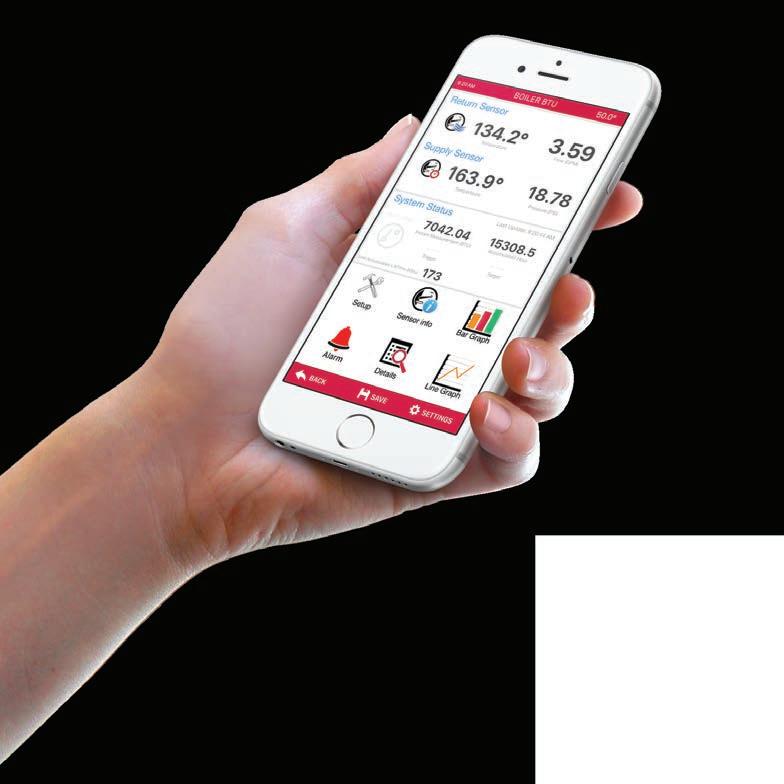


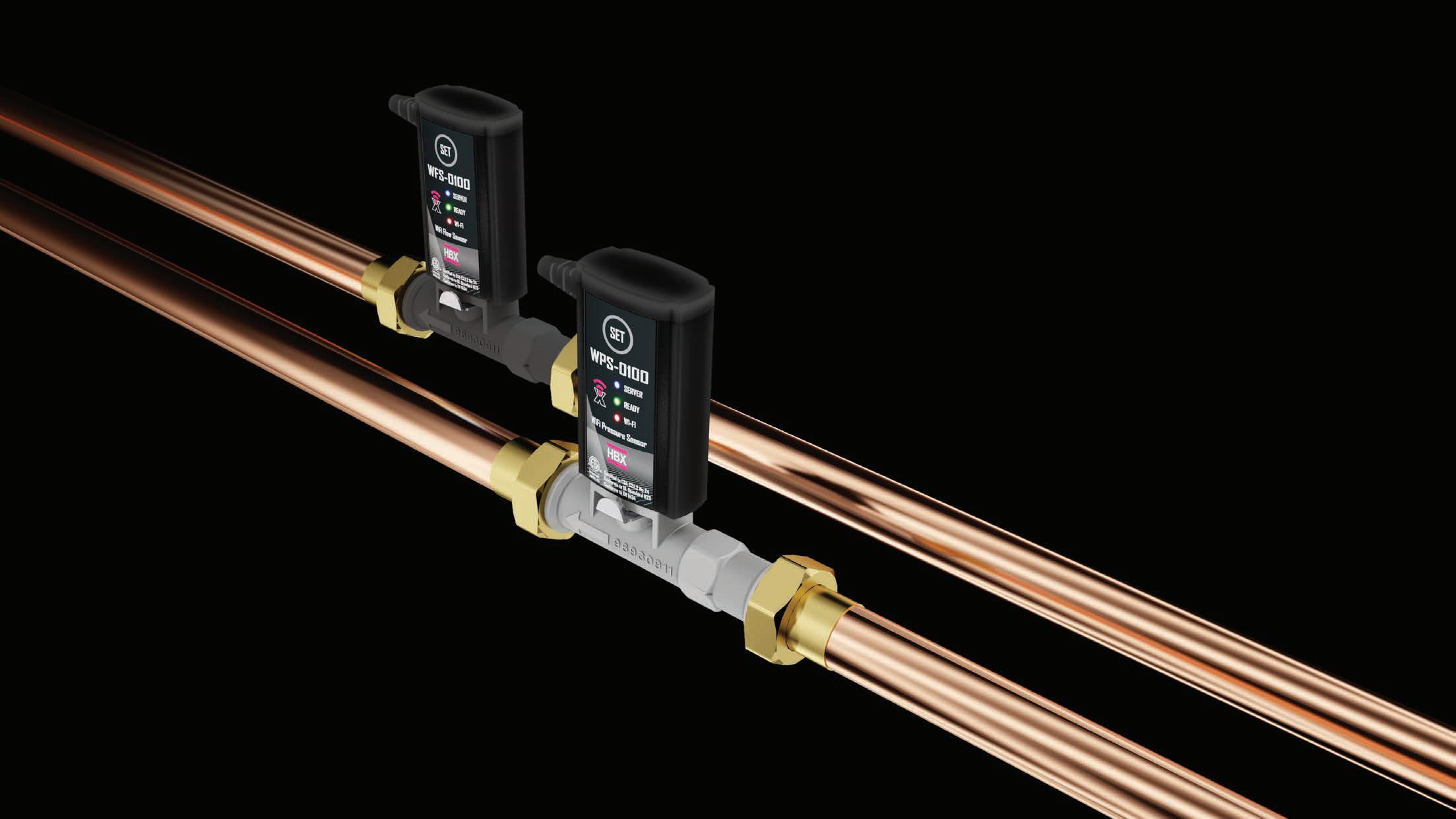
Important differences between two commonly used terms.
BY JOHN SIEGENTHALER
Those who have worked with the technical side of hydronics have likely used terms such as: pressure, differential pressure, head and head loss. These terms all have legitimate and specific meanings. But when some of these words get scrambled into jargon the result can be an undefined or meaningless term. One example of such a scramble is “head pressure.”
To see why the phrase “head pressure” is not a valid technical term it’s important to understand both words.
Let’s start with head. Although I don’t know who coined this word for use in fluid mechanics, I do know where the concept that the word represents came from. It’s attributable to a Swiss mathematician named Daniel Bernoulli. In 1738 he published a book entitled Hydrodynamica which presented a concept that is now embodied in what’s appropriately called Bernoulli’s equation.
Anyone who has studied fluid mechanics has surely come across this equation. It provides the basis for analyzing a wide range of situations: such as a pipeline carrying water from a reservoir to a city, the shape of airplane wings, or—you guessed it—fluid flow in hydronic systems.
Fundamentally, Bernoulli’s equation describes the mechanical energy present in a fluid, and how that energy can be transformed as the fluid changes height, pressure and speed. The “head” of a fluid is simply the total mechanical energy contained in that fluid.
In the case of a closed-loop hydronic system, head energy is added to the fluid
by a circulator. Everything else the fluid flows through (piping, fittings, valves, heat emitters, etc.) removes head energy from the fluid due to the friction present between moving fluid molecules as well as between those molecules and the surfaces they come into contact with.
We can’t “see” energy. We can’t see it with our bare eyes, or under a microscope. Think about it, have you ever seen a Btu, a Kilowatt•hour, or a Joule of energy?
Neither have I.
Although we can’t see it directly, we can still detect when energy is added to, or removed from, a material. For example, consider water flowing into a boiler at 140F and leaving that boiler at 155F. If the piping into and out of the boiler were transparent, the water coming out would look identical to the water going in. Yet we know there’s more thermal en -
ergy in 155F water compared to 140F water. The indicator of that additional thermal energy is a temperature rise. When thermal energy is added to a material (and the material doesn’t change phase between being a solid, liquid or gas) the temperature of that material increases. Conversely, when thermal energy is removed from a material, and the material remains in the same phase, its temperature decreases. Thus, a change in temperature is the “evidence” that thermal energy, which we can’t directly see, has been added to or removed from the material.
When it comes to head energy and pressure there’s an analogy to the relationship between thermal energy and temperature. A decrease in pressure is the “evidence” that head energy has been removed from a liquid. An increase in pressure is the evidence that head energy
The Brute FT® Wall Hung Combination Boiler & Water Heater.
The Brute FT® rises to the challenge with outstanding performance and quick response in a compact design. Its modulating technology automatically adjusts fuel usage to match heat demand – saving up to 20% on heating utility bills compared to standard “on-off” boilers!
To find out more about the Brute FT® and other Bradford White products, visit our exclusive For The Pro® website dedicated to the professional. You’ll get:
• Product Information
• Technical Documentation

• Marketing & Sales tools
• Training Videos and more…
Visit bwforthepro.com now.
has been added to the liquid. We can’t see head energy, but we can detect it being added or removed from a liquid by measuring changes in pressure.
In North America the unit used to express head energy is “feet.” The word “feet” has undoubtedly caused a lot of confusion over the years. I know it confused me for a while. Why would energy be expressed in units that are commonly used for distance? Here again past practices have prevailed.
The unit of feet, abbreviated as ft, comes from a mathematical simplification of the units shown in figure 1.
Figure 1:
This arrangement of units would be properly stated as “foot pounds per pound.”
The unit foot pound, abbreviated as ft•lb, is a valid unit of energy, and as such it can be converted into any other valid unit of energy. For example: 1 ft•lb = 0.0012850675 Btu.
Consider water flowing through an operating circulator. In this situation the arrangement of units in figure 1 can be interpreted as the number of ft•lb of mechanical energy added to each pound of water passing through the circulator. Thus, a circulator that happens to be operating at say 10 feet of head is adding 10 ft•lb of mechanical energy to each pound of water passing through the circulator.
So why don’t we say it that way (e.g., the circulator is adding 10 ft•lb of mechanical energy to each lb of water passing through it)? It’s because mathematically the units of lb in the top of the fraction of figure 1 cancels out with the unit of lb in the bottom of the fraction, and thus the only remaining unit is ft. It’s shorter to just state head in feet rather than ft•lb/lb.
If I had a seat at the table when this simplification became the “standard” in the industry, probably back sometime in the 1800s, my vote would have been to
keep it ft•lb/lb. It’s longer, but it better represents the concept of energy per unit weight of liquid.
So how does one determine the amount of head energy added or removed from a fluid based on observed change in pressure? Answer: Use formula 1.
Formula 1:
Where:
H = head (added or removed) in units of (feet)
∆P = change in pressure in units of (psi)
D = density of the fluid in units of (lb/ft3)
144 = a number needed for the units to work correctly
Formula 1 can be used to calculate the head energy added to the fluid when a pressure increase occurs, such as a pressure increase measured across an operating circulator. The formula can also be used to calculate the head energy removed from the fluid when a pressure decrease occurs, such as across any component or group of components connected together in the circuit.
Water at 60F has a density of about 62.4 lb/ft 3. This makes the fraction of (144/62.4) equal to approximately 2.31.
However, the density of water changes significantly with temperature. The density of other liquids, such as solutions of glycol-based antifreeze, is also different from that of water, and also dependent on fluid temperature.
Thus, stating that the head energy exchanged is 2.31 times the pressure change is only an approximation. It gets you in the ballpark, but the best accuracy is still attained when you use formula 1 along with the density of the fluid.
In a hydronic circuit you can determine the density based on the average temperature of the liquid flowing through that circuit.
So back to the jargon of head pressure. Based on what we just discussed these two words, paired together, are analogous to heat temperature, a term that has no meaning in our industry, or any other industry.
Our industry uses plenty of jargon. For example, we might say that the output of a boiler is 80,000 Btu, when what we mean is 80,000 Btu/hr. We might state that the electrical energy used by a small circulator is 50 watts, when what we really mean is that the power demand of the circulator is 50 watts. We may describe a circulator operating with a head pressure of 10 feet when what we mean is a head of 10 feet.
Jargon is usually acceptable, and perhaps even a bit “admirable” when describing hardware. For example, how many mere mortals know what is meant by a blind flange, street ell or bullhead tee?
However, when learning to manage the physics that determines how the system operates jargon often clouds understanding. That leads to uncertainty, lowered confidence and even finger crossing when making design decisions. We’ve all been there at times, and it makes us (or should make us) uncomfortable.
After reading this some may be thinking that I’m “nitpicking” about words that most of us already sort of understand. Why not be specific and take away the words “sort of” in the previous sentence? It’s precise, professional and ultimately profitable. <>
John Siegenthaler, P.E., is a mechanical engineering graduate of Rensselaer Polytechnic Institute and a licensed professional engineer. He has more than 35 years experience in designing modern hydronic heating systems. Siegenthaler’s latest book is Heating with Renewable Energy (see www.hydronicpros.com for more information).

Fits all of our most popular products
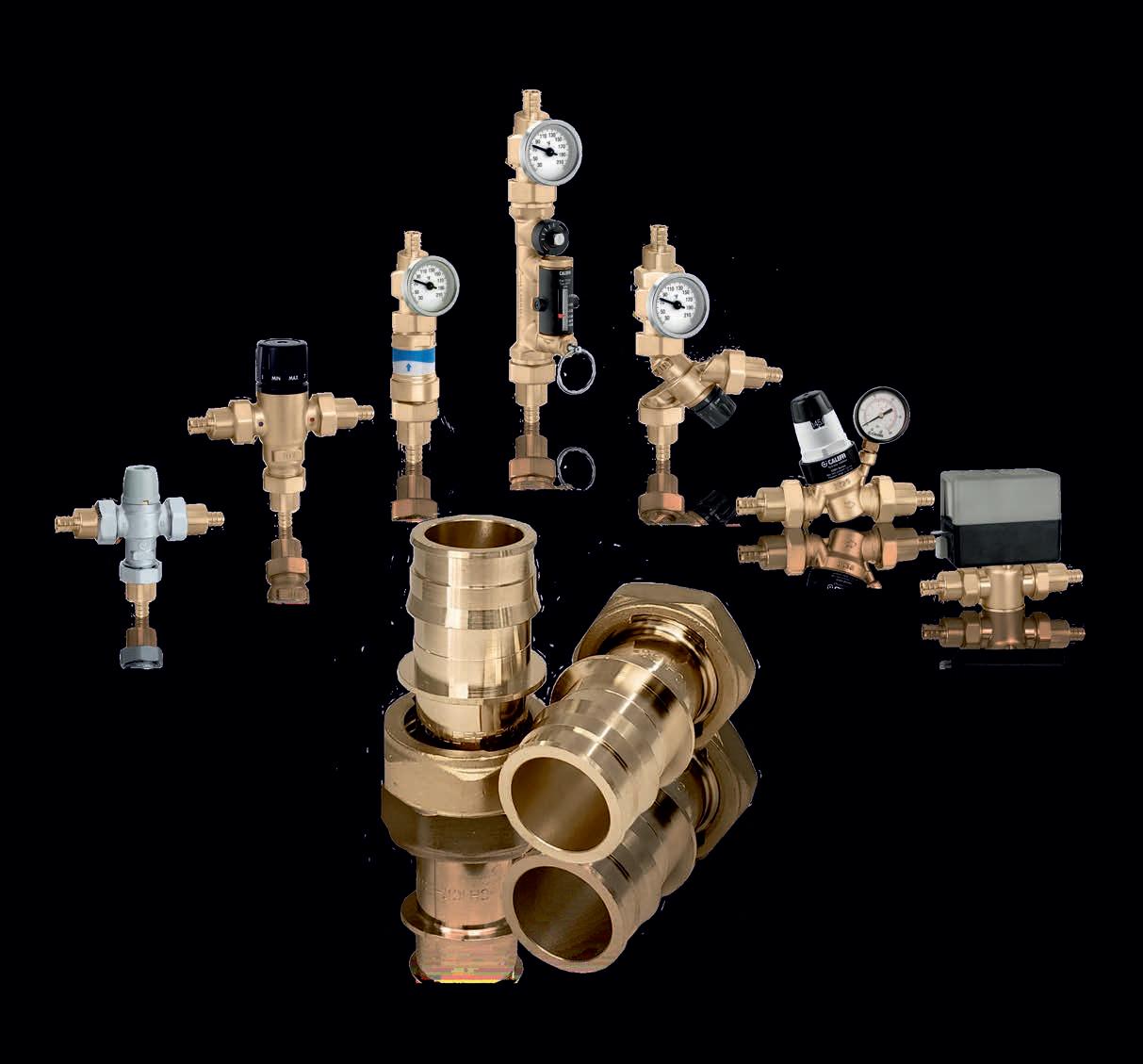
•Low-lead, dezincification resistant brass alloy for durability.
•Union fittings for fast and easy installation and service.
•Meets the requirements of ASTM F1960 for cold expansion fittings.
Components for today's modern hydronic systems

Heating & Cooling


MANUFACTURERS • DISTRIBUTORS • WHOLESALERS

IPEX has opened the doors to a new distribution centre in the central valley region of California.
The new facility, which had its grand opening on Dec. 2, has nearly quadruple the amount of warehouse space. It also features a yard for the storage of pipe, bringing more products closer to more customers and end-users.
“This new facility has allowed us to double our employee base and solidify our commitment to the local community,” said Travis Lutes, president and COO of IPEX. “We listened to our customers and identified an opportunity to grow our presence on the West coast.” www.ipexna.com
NIBCO Inc. has acquired Wisconsin-based Milwaukee Valve Company, a global producer of valves for the commercial, industrial and Navy marine markets including ball, gate, globe, check, butterfly, high performance butterfly, specialty marine and lead-free valves.
“Our interest in Milwaukee Valve was driven by our admiration for its multi-generational family-owned history, strong corporate culture, and long term performance, which are consistent with NIBCO’s core values,” said NIBCO chairman Rex Martin in a company release.
Milwaukee Valve will operate separately as a wholly-owned subsidiary of NIBCO, with no changes to its sales, customer service, administrative, manufacturing or distribution operations. Rick Giannini, CEO of Milwaukee Valve, will continue to lead the business supported by the leadership team at Milwaukee Valve who will remain in place in their current roles. www.nibco.com

Aldes has combined American Aldes and Aldes Canada into one cohesive brand, Aldes North America, which came into effect January 1. The new branding intends to build and expand the brand into both marketplaces through unification.
By rebranding, Aldes North America will combine its U.S. and Canadian resources, increasing operational efficiencies and streamlining customer service. Aldes anticipates that its growth will triple by 2025 through these initiatives.
"The primary reason behind every decision we make is, ultimately, to better our customer experience, and this transformation of the Aldes North America brand is no exception," said John Harrell, president of Aldes North America in a release. "This will allow for a broader selection of ventilation solutions and an even higher quality level of service. We want our partners to know how valued they are and how serious we are about always finding ways to improve their journey with us."
Aldes North America specializes in manufacturing and distributing ventilation systems and components for residential and commercial markets, such as airflow balancing components, residential in-line fans and patented demand control terminal devices for commercial applications. www.aldes.ca
Viega will sponsor Johnathan Cheever, a 2018 Olympian, 14-year member of the U.S. Snowboard Team and plumber, as a snowboard cross racer.

A licensed journeyman plumber, Cheever supports himself in the off-season installing water heaters and plumbing bathrooms in Park City, Utah. He also sometimes returns to his hometown of Saugus, Massachusetts, to work with his father and brother, who own Mark Cheever Plumbing & Heating.
“Jonathan is a natural fit for Viega,” said Molly Morrow, channel marketing manager for Viega, in a company release. “In addition to being a world-class athlete, he understands the challenges and rewards of plumbing.”
This winter Cheever is competing in the FIS Snowboard World Cup, which started in Austria in December and will
conclude in March in the Czech Republic. He is racing for the U.S. as an independent athlete. His uniform, which already features sponsor logos from American Standard and Bradford White, now includes the Viega logo.
“Snowboarding is my passion but, for me, plumbing is more than just a way to make a buck,” Cheever said in the release. “I like the challenge of figuring out the best way to solve a problem and improving people’s lives.” viega.us
Johnson Controls has broken ground on an expansion of its air-handling unit manufacturing facility in Hattiesburg, Mississippi.
Construction on the 22,000 square-foot expansion, manufactures both YORK and Miller-Picking brand systems, began Dec. 18. The plant is expected to create between 40 and 50 new assembly jobs.
“We’re excited to start this project, create attractive employment opportunities for area residents and serve the growing needs of the heating and air conditioning industry,” said Ramiro Rodriguez, plant manager for Johnson Controls.
The expansion will increase the facility’s size to 120,000
square feet. Several sub-assembly cells will be relocated and more manufacturing space will be created in the main plant. Johnson Controls will also install a new crane system for moving products during manufacturing. The project is slated to be completed in May 2020. www.johnsoncontrols.com
Zurn Industries has acquired the assets of Just Manufacturing, an Illinois-based manufacturer of stainless-steel designer and engineered sinks, commercial faucets and accessories.
Just Manufacturing is a third-generation family-owned business with 135 employees and operates out of a 175,000 sq. ft. facility in Franklin, Park, IL.
“Just Manufacturing and the Just Sinks brand have been providing first-class stainless-steel sink solutions to their customers for the past 87 years,” says Craig Wehr, Zurn president, in a company release. “They have a solid position in the commercial building specification market and continuously strengthen the brand with new industrial designs and system solutions. We are excited to add this complementary category to our portfolio and look forward to growing the business.” www.zurn.com

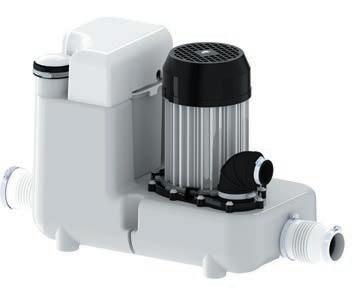

n Heavy-duty drain pump designed to pump up to 25 feet vertically and/or 250 feet across.
n Capable of handling high temperature grey water from multiple fixtures throughout entire building structures.
n 1-HP thermally protected motor discharges gray water from commercial kitchens, dishwashers, washing machines, etc.


On Jan. 27, the Canadian Institute for Plumbing and Heating (CIPH) hosted a panel discussion in Mississauga on the future workforce and the future of work in this industry.
The panel consisted of (pictured above left to right): Gail Kaufman (moderator) Wolseley's vice president of marketing and e-business; Valerie Malone, president and general manager of Lixil Water Technology; Drew Molnar, national sales manager for InSinkErator (Canada); Tom Newell, regional vice president, Ontario for EMCO Corp.; and Kim Rutherford, director of vendor relations, plumbing for EMCO Corp. The four panelists received questions from the moderator as well as audience members regarding everything from how to attract younger generations to the industry to diversity and how to handle cases of discrimination and harassment in the workplace.
According to Malone, attracting fresh, new talent starts with making your industry appealing to the younger generation.
“Plumbing has a certain connotation with the younger generation. We need to think about it differently and start talking to the younger generation about that fact that it’s not plumbing— we're shaping the future of water,” Malone said. “When you phrase it like that, in a way that's inspiring and provoking, it's pretty compelling.”
Many of the questions submitted to the panel centred around what exactly employers can do to attract and maintain talent, especially from the millennial and Gen Z age groups. According to Newell, the very first thing employers should do is to stop using the word ‘millennial’ to describe young workers.
“There's a stigma attached [to that word], the term ‘millennial’ in and of itself is not inclusive,” Newell explained. “There is a stigma attached to the word millennial that causes other generations to judge certain individuals based on their age. Using the term ‘middle aged white men’ to describe the majority of the workforce isn’t inclusive either. We need to start looking at individuals as individuals, regardless of what age group they’re from.”
Just because a workplace does not appear diverse, it does not mean that they do not want to become more diverse. According to Molnar, many employers simply do not know how to go about attracting a more diverse workforce.
“To me inclusion is about making sure you’re giving equal
and fair consideration to all,” Malone said. “It’s less about a checklist and more about asking yourself who can bring the most value to your team. When I'm hiring someone, I don’t want a candidate who thinks exactly like me. That wouldn’t benefit the organization.”
“We need independent thinkers, people who bring something new to the table, something different from the status quo,” Rutherford said.
One of the more difficult questions the panel had to tackle was how management should handle cases of reported discrimination or sexual harassment—particularly from clients while out on a job. “No one deserves to be treated like that,” said Malone. “It's simple. If someone is making you uncomfortable, leave and report the incident to a superior.”
While all panelists acknowledged how far the industry has come in terms of diversity and openness, they all acknowledged that there is still work to be done. From the CEO to the newest apprentice, everyone is capable of promoting diversity in some way. According to Rutherford, a little can go a long way.
“Promoting inclusivity in the workplace can come down to something as simple as word choices. Something like referring to the women in your organization as women and not girls.” We
thermostat; plastic, metal,
(which is
S. A. Armstrong Ltd. has named Todd Rief as its new CEO. Most recently Rief was with Honeywell International serving as Chief Commercial Officer for the homes and buildings technologies division. Rief will report to Charles Armstrong, the executive chairman of the organization.
CIPH has welcomed Therese Kasongo as its new program manager. She will be responsible for overseeing and supporting the activities of CIPH’s Plumbing & Mechanical Advisory Council (PMAC) and the Canadian Hydronics Council (CHC).
Viessmann Manufacturing Co. Inc. has appointed Sandra Folleville as marketing manager for Canada. Folleville will be responsible for implementing marketing strategy and developing communication tools that promote the company's missions, products and services.
Caleffi North America has named Sharon Alexander to the position of brand marketing manager. She will work with sales and media networks and be responsible for advertising, public relations, trade merchandising, trade exhibitions and promotion development.







LIXIL Americas has appointed two new key executives to the Plumbing Manufacturing International (PMI) 2020 Board of Directors and Committee. Sal Gattone, VP of engineering for LIXIL will serve on the Board of Directors while Troy Benavidez, VP of public affairs, will be the co-chair of the advocacy/government affairs committee.

Ouellet Canada has appointed of Mark Kendall as territory manager for the province of Manitoba, Saskatchewan and northwestern Ontario. Kendall has over 20 years of experience in sales and market development. He will have the assistance of Owen Suchar, who has been promoted, to learn the market and products.
David Fink has been named president and executive director of the Plastics Pipe Institute (PPI), An industry veteran, Fink previously served as the chairman of the Board of Directors for PPI from 2017 to 2019. Most recently he was the senior vice president for WL Plastics, a PPI member company.


Emerson has announced two promotions within its professional tools sector: Justin King has been named vice president of engineering; and Rob Trefz vice president of marketing. King will lead the development and evolution of the entire professional tools line of pipe and electrical products, including RIDGID and Greenlee. He joined Greenlee in 2007 and holds a Master’s degree in mechanical engineering from the University of Michigan. Trefz will oversee all product management, product marketing and marketing strategy. He is a licensed professional engineer and has been with the company since 2004, when he joined as a global commodity manager.
Marc Matthews has joined JSA Sales in Coquitlam, B.C. as an outside sales representative and account manager. Matthews brings 17-plus years of sales and support experience and established relationships with the mechanical and plumbing trades.
Reliable Controls has appointed Levi Tully to the position of executive vice president, sales. Tully joined Reliable in 2008 and most recently served as manager of application engineering. In his new role he will inspire sales teams around the world.
Bradley Corp. has appointed Jim Johnston to vice president of manufacturing, responsible for operations of all Bradley manufacturing/plant locations, in Wisconsin, Ohio and Michigan. He will be directing supply chain, quality assurance and lean/continuous improvement.

Viega’s trades education network sales manager, Dan Rademacher, will be travelling to Rwanda to help plumbers in that country after winning the 2020 World Plumbing Council (WPC) Scholarship in late 2019. The WPC Education and Training Scholarship awards $10,000 to a single winner to travel to another country for the purpose of developing and contributing further plumbing industry knowledge.


TO SERVE YOU: - 12 locations from Winnipeg to Nanaimo; - Over 1000 product lines in stock; - 135 dedicated employees to serve you; - State-of-the-art training facility and training events across the network.
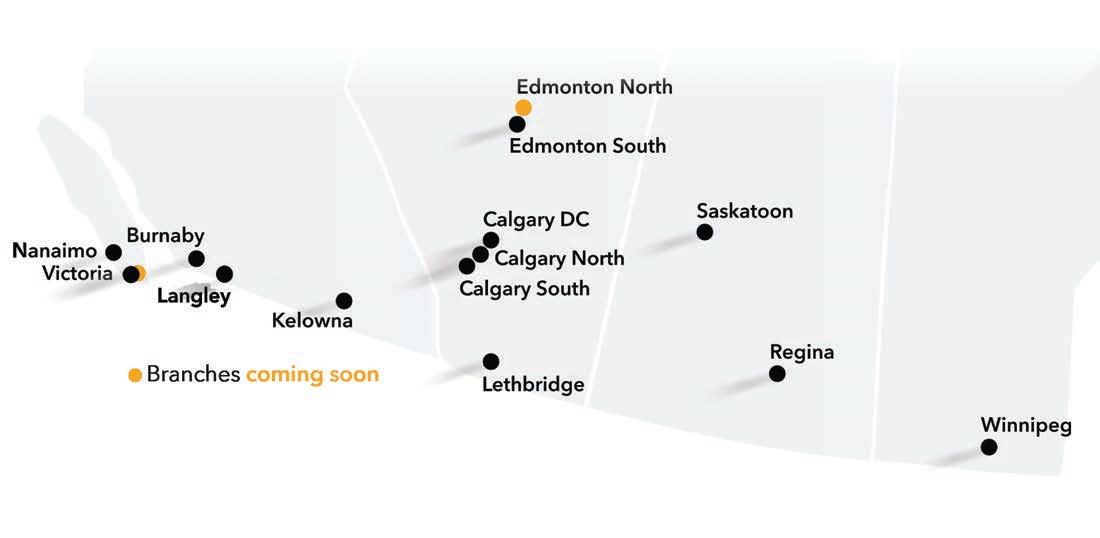
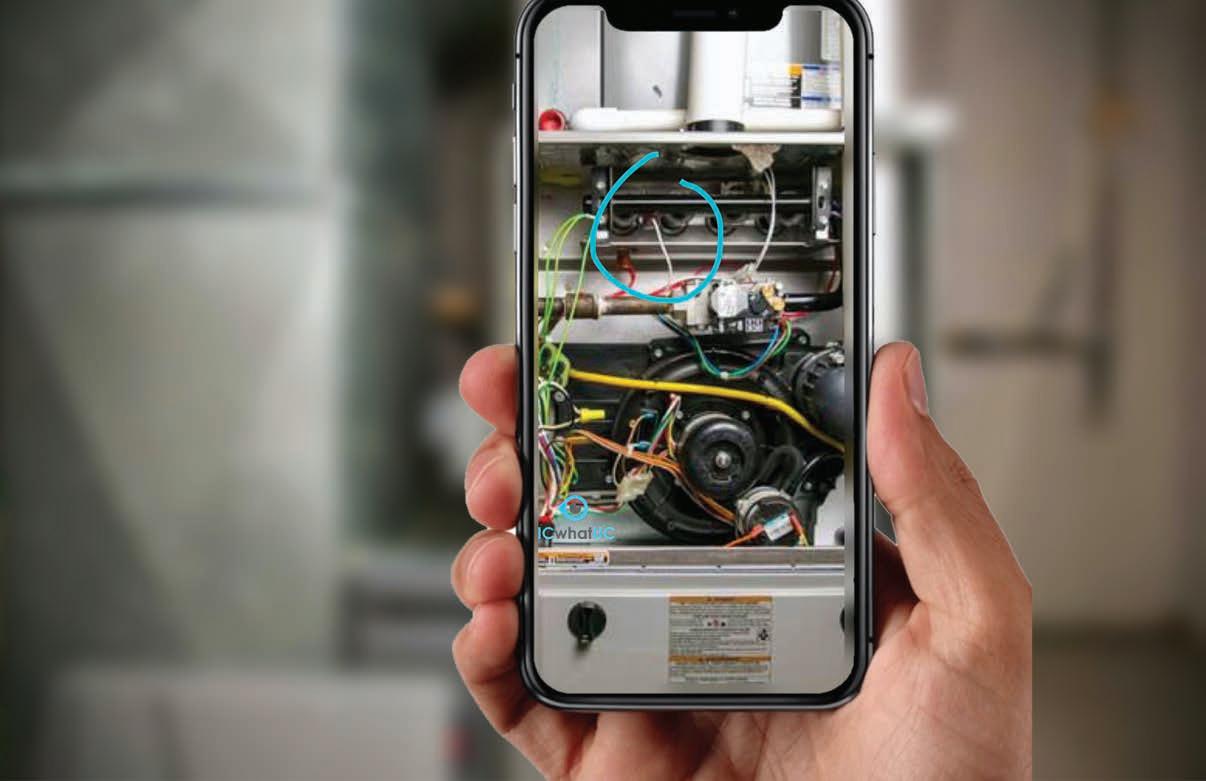
Calgary-based startup introduces augmented reality platform that changes the way HVAC technicians deliver service. BY
MEGAN HOEGLER
When the Edmonton winter rolls in, Phil Wilson is grateful for any opportunity to stay inside and out of any blizzard-like conditions when they arise.
As a distribution operator for ATCO, a utilities service provider based in Alberta, a large part of Wilson’s job involves travelling around the city attending to utility service calls. Especially during the winter months, many of the calls he receives are simple fixes, like a dirty filter that needs to be cleaned.
“Sometimes we get calls for something as simple as dead batteries in a thermostat,” Wilson says.
Factoring in the time it takes him to drive from the ATCO office to a service call, which in some cases can take close to an hour, Wilson has spent many an afternoon fixing a simple problem that could have been solved in minutes.
Until his employer started using ICwhatUC, a customer self-service support system that uses live video chat and augmented reality to assist in solving the simpler HVAC issues, like dirty filters and dead batteries.
Founded by technology entrepreneurial trio Guillermo Salazar,
““We’re not motivated to replace the technician, we’re motivated to replace the way the technician works,.”
Luke Krueger and Danny Way in Calgary after struggling with simple HVAC fixes in their own homes, ICwhatUC aims to simplify the troubleshooting experience for both customers and the technicians through video chat. Think Skype or FaceTime— only the customer does not need to download any new software or add the technician as a forever contact.
The service technician simply sends the customer a weblink via text. After opening the link, the caller then points their phone’s camera at the issue. Both the customer and technician are seeing the same thing, and the technician can then draw lines or circles to direct the caller to the potential problem.
“People can do a lot of these fixes themselves, they just
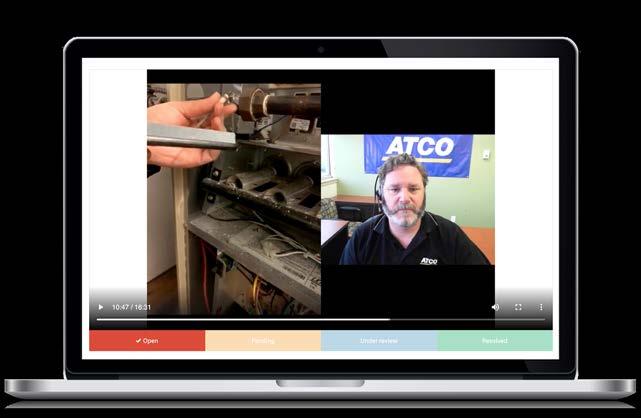
way this service is being delivered. For some HVAC professionals, they see this as a threat,” Salazar says. “At the same time, we’re allowing technicians to earn revenue from wherever they are. They could be out fishing when they accept a call, but then they can service the issue remotely and still bill for that time.”
For Wilson though, answering service calls via video chat isn’t so different from helping friends and family troubleshoot HVAC problems, something he has been doing for years.
“You know how it goes, when you do something like this for a living, all your friends and family start to phone you and ask for free advice,” Wilson laughs. “You do get used to answering questions over the phone.”
While the app is still in its early days, Wilson believes it has a strong future in the HVAC industry. ATCO plans to use ICwhatUC, examine the results and feedback from both customers and technicians, and then decide whether or not to continue using the service.
need expert guidance,” Salazar explains. “We wanted to create a way to deploy that expert guidance. Right now, people are comfortable using apps like FaceTime, but maybe you don’t want to become a contact for that person or maybe you’re on an Android phone system, there were all sorts of barriers to using preexisting video chat apps.”
So the founders decided to create their own augmented reality platform, to fill in the gaps where other video chat platforms fell short.
“It’s user friendly, even your grandmother could use it.”
ATCO has been using the app across Alberta since December. Wilson says he has used it for over 75 calls in the past month alone. The feedback he has received from customers has been overwhelmingly positive.
“I consider this to be the time where we’re really going to see how the program works for us, because this is the time where it’s going to benefit the most number of people,” Wilson says. “If it’s -25C and you might have to wait 12 to 24 hours for a service person, if I can solve your problem for you this way, and it takes an hour, that’s a real benefit. That’s another 12 hours you’re not freezing in your house.”
The app is also minimizing risks for technicians, limiting their travel in blizzard-like conditions to only truly complex troubleshooting cases.
“When a service person is behind the wheel, that’s when the likelihood of an injury or safety incident occurring is the highest,” Wilson says. “Eliminating kilometres travelled has a direct impact on the likelihood of an accident occurring.”
There are a laundry list of benefits to the platform, but Salazar acknowledges that it may be difficult for some technicians and customers to accept. So far, the system has only been used by companies like ATCO, which offer service coverage to customers for a monthly rate and employ salaried technicians.
“It’s a bit controversial. On the one hand, we’re changing the
“It’s still in the early days, but so far the evidence shows we’re solving problems a lot quicker,” says Wilson.
For many technicians, it may be a matter of learning to embrace the technology and how it can benefit their business.
“We’re not motivated to replace the technician, we’re motivated to replace the way the technician works,” Salazar explains. “It’s a new way of working.” <>
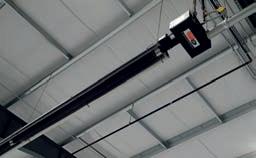

Highlighting award winners at this year’s Kitchen and Bath Industry Show. BY
MEGAN HOEGLER
Kitchen and bath suppliers from across the globe gathered in Las Vegas January 21 through 23 to reveal the latest in bathroom and kitchen products.
Every year, The Kitchen and Bath Industry Show (KBIS) hosts upwards of 30,000 people and hundreds of exhibitors. The event’s annual awards program recognizes the most innovative kitchen, bath and smart home products with its Best in Show awards ceremony. This year, stand out selections from shower floor drains to a hammock-style bathtub were among the list of finalists and winners. Following is a selection of this year’s recognized products.
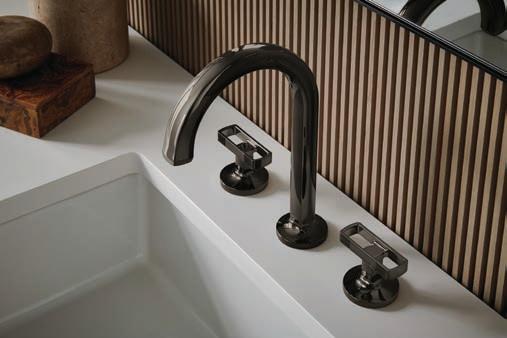
U by Moen’s Smart Faucet won in the SMART HOME TECHNOLOGY section. The voice-activated faucet, also enabled with motion sensor, can be synced with smart home applications on a smartphone. The voice-activated capabilities include dispensing water in fractional metric and non-metric measurements from one tablespoon up to 56 litres, exact and common temperature demands, combined metered and temperature requests along with customizable presets such as ‘dog’s water bowl’ and ‘coffee maker’.
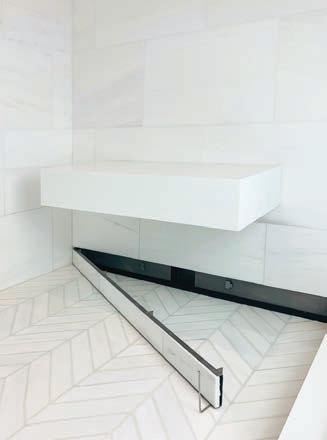
Winning SILVER IN THE BATH CATEGORY was Drains Unlimited’s new WallRecessed Linear Floor Drain featuring a nearly invisible wall-mounted design to siphon moisture away without detracting from the shower design. Available in standard and custom configurations, the wall-recessed linear floor drain models are made from 304 stainless steel, are compatible with liquid and fabric waterproofing membranes and can be applied in any single-pane slope shower installation.
This year’s OVERALL BEST OF SHOW was awarded to the Kintsu Bath Collection by Brizo. The line of luxury bathroom products consists of 10 different pieces. The faucets come in single-handle and widespread models. There are also twohandle floor, deck and a wall mount tub filler, and a multi-function wall-mounted shower head and a dual function raincan showerhead as part of the collection.
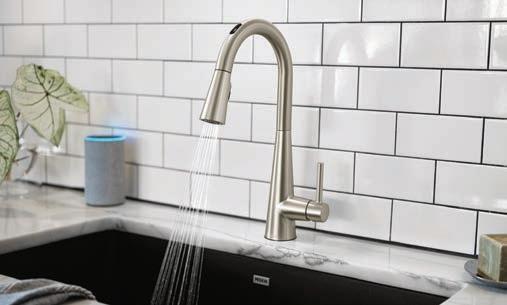


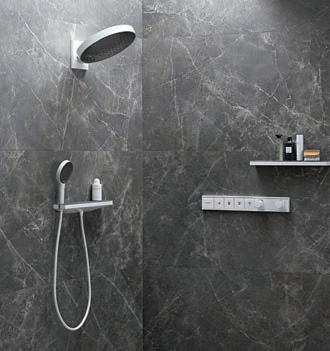
THE IMPACT AWARD went to Hansgrohe’s Rainfinity shower head. The product is engineered for a spa-like shower experience featuring a large overhead, structured spray disc and customizable jet types with varying intensities.
A FINALIST IN THE BATH CATEGORY, the House of Rohl Miscelo collection of Italian faucet components includes handle levers in a three finishes, polished chrome, satin nickel and matte black, and 15 different insert combinations.

A FINALIST IN THE KITCHEN CATEGORY, the Armstong kitchen collection from Perrin & Rowe is a blend of modern luxury and industrial design. The range includes a single-lever faucet and a classic bridge faucet, both available with a pull-down rinse.
Nebia by Moen, a FINALIST IN THE BATH CATEGORY, is a spa shower system that utilizes atomization to break water into smaller molecules, creating the sensation of more water while saving up to 45 per cent water per shower.
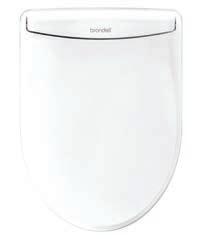
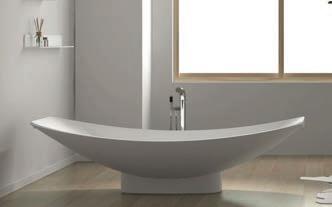
The Hammock Bath Company from Australia was a FINALIST IN THE BATH CATEGORY with their freestanding luxury bathtub design. The deep soaking bath is made from a durable solid surface acrylic material which is soft to the touch and easy to clean.
The Swash Thinline electronic bidet seats from Brondell was a FINALIST IN THE BATH CATEGORY. At just 99 millimeters tall, the seat’s features including fully adjustable washes, warm air dryer, nozzle oscillation and pulsation plus new features like Smart Seat Sensors, auto-leveling adjustment and more.
The KOLO Smart Monitoring System demonstrated by TOTO was a FINALIST IN THE BATH CATEGORY. This internet of things (IoT) solution is a collaboration between TOTO and a division of Georgia-Pacific, that innovates the public restroom. The systems monitors connected restroom fixtures so facility managers/custodial staff can view activity and supply levels in real time.
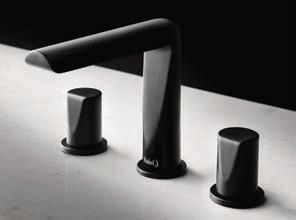
A FINALIST IN THE BATH CATEGORY, the Riobel Parabola collection is available in chrome, polished nickel, brushed gold and black finishes. Drawing inspiration from a parabolic surface, the collection includes faucets, tub fillers, shower trims and compete packages.

The designer Axor Edge collection of faucets and and tub fillers, are a collection of asymetrically assembled cubelike structures. The collection is available in chrome as well as polished black chrome and polished gold.


With the proliferation of connected devices in our industry, everyone needs to understand the basics of a Wi-Fi set up and the common challenges involved. BY
CURTIS BENNETT
It does seem like this topic has been covered, and it does seem like I am beating a dead horse, but this topic is so important that I think it needs to kicked a few more times. Wi-Fi is everywhere now. There are hotspots to connect to free Wi-Fi here, free Wi-Fi there, your house has it, your car might even have it. But how does it fit into HVAC? And what are some of the hiccups that using it can create?
To be fair, I know a lot of people clump “wireless” into Wi-Fi, but they are not the same term. Wi-Fi does use a “wireless” RF signal to move information, but there are many other “wireless” protocols like Bluetooth, ZigBee and LoRa for example. Then we have all these other terms floating around like 3G, 4G, LTE, 5G, 2.4GHz and 5GHz. Yes, I know, start pulling your hair out right now. Is the average Joe supposed to know this stuff? The short answer is no. You don’t have to know them, but you should. If your plan is to continue in this industry, or any industry for that matter, alleviating common confusion is always a good place to start.
So let’s start with terminology before we move on to common problems. I think the biggest issue right now is understanding the different Wi-Fi networks we have now . Currently, 2.4GHz and 5 GHz networks are the norm. These terms describe the frequency of the carrier, or the wireless portion that carries the Wi-Fi protocol. For simplification sake I won’t say protocol anymore, just know that it means the organization of information into something that both ends can understand. The 2.4GHz network has been
around for a long time. Bluetooth and Wi-Fi both started with 2.4GHz, but what has happened is that as more 2.4GHz devices begin communicating the more chances there are for collisions and the information not getting to its intended spot. Too many voices drown out the one you are listening for.
Now let it be known that the devices out there are very good at weeding out what they are listening for, but it is very crowded. In comes 5GHz. Now 5GHz has been around for a long time, just not in our routers and our devices. 5GHz has the advantage to carry more data faster but at a detriment to signal propagation—or how far the signal can travel. Now this is a big mistake among people right now. Mistaking 5GHz network with the new 5G networks for cell phones. THEY ARE NOT THE SAME THING. You will have more hair on your head in the future if you understand that.
Like I said above, 5GHz is the frequency at which the Wi-Fi network runs, but 5G is the term now used for the fifth generation cell phone data technology. I get why the cell industry chose 5G, I just think it would have served the public to call it something else. Even its predecessor 4G networks weren’t called 4G, it got the name LTE for Long Term Evolution very quickly after being created. Anyways I digress, just understand they are not the same thing.
Now there are a lot of devices going into buildings in our industry. Some of them are also coming with Wi-Fi enabled technology. There are boilers, thermostats, sensors, valves and even pumps now. This is just the beginning. The
Internet of Things (IoT) will allow us to look at all sorts of different areas of buildings. This could mean these devices also have technology to connect and interact with other devices in your home, like voice-activated Alexa, Google Home, Apple HomePod or in some cases other home automation systems. It can also mean that it has an App for setup or and app for full use of the product. It can mean so many different things, but before you can even get there you need to get that device onto your network. In some cases this is not too hard, depending on how the company has decided to do this or how the device communicates with the outside world, but sometimes the process is a little more complex
So why doesn’t the device work when you plug it in? Now yes there are devices like Amazon Echo and Apple iPhones that seem easy to hook up to your home network, but the devices that we use in our industry take a little more effort. I do think this is getting better, but here are some things to look out for anyway.
The biggest issue was part of the discussion above. “Most” IoT devices in
our industry are still going to be 2.4GHz. They will NOT run on a 5GHz network. So if an IT guy come in to set up the WiFi net work, they will most likely set up a 5GHz network and disable the 2.4GHz. This will be a pain for you to figure out, as you will think, “well my phone is working on it so it has to be good?”, but your phone can work on both 5GHz and 2.4GHz net works. So watch out for this one!
The second thing to note are the port settings on the router. Oh no, I said “router”. Yes I know the ins and outs of the router can seem daunting, but you may need to dabble a little. Some devices out there need to talk on a specific port. What this means is that devices have a specific pipe that the information can go into or out from through your router. Now most of the time these are open, but there are times where they are shut. This is where the manual comes in handy both for the device and the router. The port settings can also be tied to the security settings of the router. These settings are there to protect your building or house, but sometimes they over protect and won’t let the traffic you
want delivered to get out. So make sure to check these as well.
These settings usually block suspicious behaviour, and you know how suspicious thermostat info can be. The security settings tend to be on integrated router/modems, so just keep that in mind. There is usually a setting that is easy to get to that says: security settings, very high, high, medium and low, or something like that. You may need to set it to medium for some IoT traffic to get through properly. But again, check the manual.
The third most important consideration is the whole adage that since it’s Wi-Fi, there must be an app for that. Well if there is an app, make sure your phone is updated to the latest software. It is becoming increasingly difficult for developers to keep up with backwards compatibility on devices, so they are not going back as far any more. Also, when you install the app make sure you say
OK to ALL the permissions that the app is asking for. Phone developers are tying more security measures into the phones and therefore if the user is not giving permission to use a certain aspect, then the app may not work properly.
I know that’s only a small portion of info, but I hope it helps out one or two of you . Sorry I didn’t include the story about how Wi-Fi almost killed me. Maybe next time. <>

Curtis Bennett C.E.T is product development manager with HBX Control Systems Inc. in Calgary. He formed HBX Control Systems with Tom Hermann in 2002. Its control systems are designed, engineered and manufactured in Canada to accommodate a range of hydronic heating and cooling needs commonly found in residential, commercial and industrial design applications.

Adrian Steel’s Grip Lock and Drop Down Ladder Racks are designed with ergonomics and user safety in mind. Whether you’re upfitting a single van or an entire fleet, Adrian Steel has just what you need. Increased efficiency starts now.


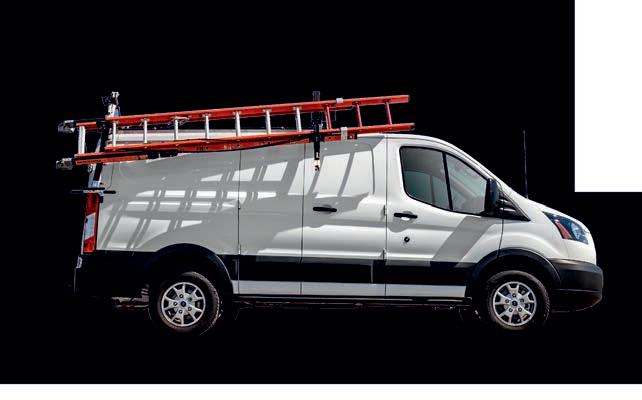

What construction stakeholders need to know to navigate Ontario’s new adjudication system.
BY CATHERINE DiMARCO
The new prompt payment and adjudication provisions under Part I.1 and Part II.1 of Ontario’s Construction Act came into effect on October 1, 2019. The amendments have ushered in a fundamental shift in the way payments flow on a construction site. The prompt payment and adjudication provisions apply to all projects, regardless of size, and to all payers.
Adjudication is intended to be a “swift justice” process for parties to resolve payment disputes, or any other disputes
agreed to by the parties, during the life of the construction project.
On July 18, 2019, the Ontario government announced the appointment of dispute resolution firm ADR Chambers to fill the role of the Authorized Nominating Authority (ANA). The ANA will train and qualify a roster of adjudicators to resolve construction disputes.
Any party to a contract or subcontract may refer a dispute to adjudication by giving a written notice of adjudication. Careful consideration should go into
drafting the notice of adjudication, since an adjudicator’s jurisdiction is limited to the four corners of the notice.
The party referring the matter to adjudication must give an electronic copy of the notice of adjudication to the ANA. The parties may agree on the choice of adjudicator, or they may request that the ANA appoint one. However, if the adjudicator does not consent to adjudicate the matter within four days, it is mandatory for the referring party to request the ANA appoint an adjudicator.
“Once the adjudicator is appointed, the referring party must provide its documents to the adjudicator and the responding party within five days.”
Speed and agility will be important and necessary during this process, as will be keeping the lines of communication open between lawyers and clients, between counsels themselves and between counsels, the proposed adjudicator and the ANA.
Once the adjudicator is appointed, the referring party must provide its documents to the adjudicator and the responding party within five days. The responding party must in turn provide its response and all relevant documents within the timelines prescribed by the arbitrator.
Both parties will need to be both proactive and reactive at the same time,
nimble, thorough and focused on the real issues at hand. Parties must also be prepared to mobilize quickly.
Robust internal systems, strong project management skills, foresight and open lines of communication in your own company will be crucial. The U.K. experience illustrates the risk of early smash-and-grab tactics in an attempt to catch an opposing party unaware. Project staff should be actively encouraged to convey circumstances where there is the potential for a dispute, so that key documents can be gathered and analyzed, and the narrative developed.
Strong analytical and written advocacy
skills will be crucial, since a significant number of adjudications will be decided in writing. In other words, there may be only one opportunity for a party to advance a claim, or respond to a claim. In these instances, the best foot will definitely need to be put forward.
The adjudicator’s decision is binding until the end of the contract. It is not appealable and there are only very limited grounds for judicial review, thus parties must be prepared to live with the outcome of the adjudication, whether good, bad or indifferent, until the contract is finished. <>
Catherine DiMarco is a founding partner of the Toronto-based boutique law firm of Heal & Co. LLP. Catherine is an executive member of the Board of Directors of the Canadian Construction Association, and an executive member of the Ontario Bar Association’s Construction and Infrastructure Law Section.

You need
You provide answers to customer challenges, and for more than 75 years the Little Giant® brand has provided the dependable, water-guzzling solutions. When you combine our passion with yours, together we help prevent unnecessary damage to their valuables by eliminating unwanted water collection before it starts.
The unique industry-run Refrigerant Management Canada program continues to be the only program of its kind in North America.
BY DOUG PICKLYK
In October of last year NASA reported the hole in the ozone layer located near the South Pole was the smallest it has been since first being discovered in the 1980s. There are multiple contributing factors, including mild temperatures in the stratosphere last fall, but scientists agree the global phase out of ozone depleting substances is having a positive effect.
The Canadian HVACR industry can take pride in the role it’s playing in the phase out of these harmful chemicals through the creation of Refrigerant Management Canada (RMC), a self-sustaining program developed by the industry to collect, manage and destroy harmful refrigerants used in the HVACR industry. A not-for-profit corporation run as a subsidiary of the Heating, Refrigeration and Air Conditioning Institute of Canada (HRAI), this year RMC celebrates its 20th anniversary.
“Refrigerant Management Canada has a 20-year history of servicing the HVACR industry in Canada. Its offerings are unique globally and ensure the safe disposal of surplus refrigerants,” says Sandy MacLeod, president/CEO HRAI.
“The model has worked and has benefited the industry and it is a perfect example of industry self-regulation.”
In 2007 the program received a Best of the Best Stratospheric Ozone Protection Award from the U.S. Environmental Protection Agency (EPA).
In 1987 Canada signed the Montreal Protocol on substances that deplete the ozone layer. The international environmental treaty called for phasing out the production and consumption of ozone depleting chemicals common in refrigerants including chlorofluorocarbons (CFCs) and hydrochlorofluorocarbons (HCFCs). To this day the Montreal Protocol is the only UN treaty that has been ratified by all 197 UN member states.
As a signatory to the Protocol, Canada needed to develop a plan to manage substances still in use. In 1998 a federal-provincial working group on ozone depleting substances approached the HRAI for assistance in developing a stewardship program. An HRAI task team of industry representatives, after
“The model has worked and has benefited the industry and it is a perfect example of industry self-regulation.”
A typical portable ISO tank container that will carry around 13,500 kg of collected refrigerant off for incineration.
establishing commitments with key refrigerant suppliers to support the proposed funding approach, ultimately launched Refrigerant Management Canada on January 1, 2000.
The program funding comes from an environmental levy remitted by refrigerant manufacturers, importers and reclaimers of ozone depleting refrigerants sold to the HVACR industry.
Subsequently, the Kigali Amendment to the Montreal Protocol signed in 2016 aims to phase down production and consumption of hydrofluorocarbon (HFC) refrigerants, alternatives to CFCs and HCFCs, which were also determined to have a high global warming potential.
As of February 2017, HFC refrigerants also became part of the environmental levy to support RMC.
“What makes RMC unique is that it brings together industry competitors, colleagues and customers who have a
single purpose to ensure the responsible collection, consolidation and final disposition of end of life refrigerant,” says MacLeod.
Here’s how the RMC process works:
Certified HVACR contractors who decommission (remove refrigerant) from HVAC equipment fill a recovery cylinder with surplus CFC, HCFC and HFC refrigerant and deliver the cylinder to a local participating wholesaler. Today the program has 20 wholesalers taking part, representing 171 branches across the country.
An exception is if a contractor is working with CFC-11 (or R-11) refrigerant, in which case they would have to deal directly with RMC, and a disposal fee would be applied.
Once a wholesaler accumulates a large volume of refrigerant, one of RMC’s two collection service providers (CSPs)— Fielding Environmental in Mississauga, Ont. or Refrigerant Services Inc., in
Dartmouth, Nova Scotia—move into action. The CSPs document, weigh and test each cylinder to analyze the contents.
All cylinders are tracked throughout the system, and a tracking report is provided to RMC monthly, identifying all cylinders and content by refrigerant type.
Once the CSP has collected enough qualifying refrigerant to fill a large portable ISO tank container (around 13,500 kg), they contact RMC to advise on next steps. [RMC leases its ISO tank fleet, which currently consists of 11]
The shipment is then manifested as hazardous waste and shipped to one of two destruction facilities: Swan Hills, Alberta, or Port Arthur, Texas.
For shipments heading south of the border a permit application must be filed through Environment Climate Change Canada and forwarded to the Environmental Protection Agency in the U.S. for approval.
Both of the disposal facilities use incineration via a rotary kiln as the form of destroying the refrigerant. The kilns
reach temperatures of up to 1,200C ensuring complete combustion of all waste materials.
To date the program has prevented 8,756,732 tons CO2 equivalent emissions, equal to some 2,770,824 tons of waste recycled instead of landfilled or the annual emissions of 951,260 homes.
A potential challenge for the recovery program going forward is the introduction of flammable refrigerants into the HVACR market, suggests Nancy Larsen, program coordinator, who has been involved with the program since 2012.
“We are involved with several task forces with industry leaders and AHRI regarding the safe transition to Flammable refrigerants. These include but are not limited to identifying guidelines for safely handling, storing, and transporting, and eventual disposal of flammable refrigerants says Larsen.
While there are traces of flammables found in refrigerant blends today, the concentrations have been very low. However, as the industry moves to phase out HFC products with more low global warming potential refrigerants, the potential of higher concentrations of flammable products getting into the recovery stream is very possible.
“With changes to refrigerant policies worldwide the RMC model will need to adapt,” says MacLeod. “We have recently restructured our internal resources, and I am pleased to announce that Caroline Czajko has taken over leadership responsibility at RMC. One of her early mandates will be working with the RMC Board of Directors to ensure the next decade is as successful as the last two.”
RMC remains the only program of its kind in North America. It’s a leading Canadian example of an industry-managed sustainability program that serves the interest of Canadians, our environment and the global effort to mend the ozone layer and close that hole in the sky forever. <>
Changing the project design lens to focus on whole life-cycle value. BY
ANIL SAWHNEY
The construction market is responding to an increase in demand for more sustainable buildings and infrastructure. Project owners as well, see value in considering life-cycle costs as part of the financial management of building projects. Taking a long view that considers not only the cost to build, but the cost to maintain and eventually demolish an asset, gives leaders a more detailed and prudent perspective.
Life-cycle costs play a vital role in the financial management of construction projects. They allow critical decisions to be made relating to longer-term costs that ultimately affect asset performance, longevity, disaster resilience and sustainability. As design, build and maintain (DBM) contracts become the norm, project owners and other key stakeholders are rewarded for shifting to this whole-life approach.
The current business model is highly transactional, providing little motivation for the hundreds of designers, contractors and suppliers to engage with each other at the early stages of a project. There is even less incentive to stay attached to, and learn from, the asset once it’s in use.
This leads to the repetition of the same mistakes and the failure to adopt best practices. It often also means the delivery of a sub-optimal end-product, low margins and, ultimately, a lack of industry investment.
Such issues become even more significant on megaprojects. Indeed, in infrastructure, the total cost of ownership is critical. Innovation in project delivery, such as Public-Private Partnerships (P3s) help to focus decisions on these broader issues and have a good track record of capital delivery success. Paradoxically, a
“How do we improve design to avoid common pitfalls? It’s done by bringing people, processes and technology together – particularly during the initial phase of a project”
recent study in the U.K. found that “48 per cent of key client programs across the industry do not consistently measure performance. In addition, 61 per cent do not take action to review procurement processes in light of lessons learned from past projects.”
How do we improve design to avoid these common pitfalls? It’s done by bringing people, processes and technology together—particularly during the initial phase of a project when all stakeholders can come together to set expectations and prudently review all alternatives, including the lowest initial cost and best value over the life of the asset.
Everyone benefits when at the outset the stakeholders meet to engage on the key expectations and requirements of a project. For example, assessing wider metrics for business cases across whole life outcomes, design quality, program, capital cost and social value at the briefing will allow clarity for a value-based lens through which to make decisions.
For stakeholders to apply a valuebased lens on a project, we need standards to set benchmarks for comparison, a process to weigh and apply learnings and technology to gather the required data according to the benchmarks (many of the measures already exist).
We also need to share best practices with clients to educate them on the benefits of change, robust professional standards that will support those em -
barking on new ways of determining value and talent equipped to take advantage of this opportunity.
This focus on value would not end at the planning phase or even at the asset’s hand-off. It would lead to procurement decisions for both consultants, contractors and facility managers, to be made through the lens of whole-life value. This change is happening for megaprojects that are publicly owned, with stakeholders looking at the life-cycle cost of the asset to put offset costs into perspective.
The operations phase is the costliest stage of an asset’s life. The higher costs of green measures during construction are low in comparison to the savings they can deliver throughout the lifetime of an asset through energy use reduction, lower maintenance and renewal costs and improved productivity for occupants and users.
The construction sector is engaged in building assets of immense social value, with trillions of dollars being spent each year. In the planning phase, in the building phase and throughout an asset’s life-cycle, listening to and learning from project stakeholders, experienced professionals and the public is an important way to ensure an asset is a positive addition to the built environment. <>
Anil Sawhney is the director of the Infrastructure Sector for the Royal Institution of Chartered Surveyors.
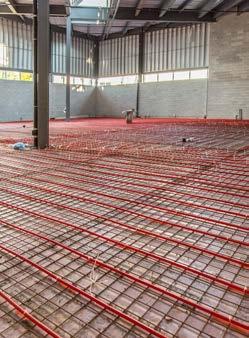

HRAI provides this International Ground Source Heat Pump Association (IGSHPA) training course for HVAC system installers who want to install geothermal heat pump systems in accordance with the requirements of ANSI/CSA C-448-2016 and good industry practice. Upon successful completion of the workshop and passing the IGSHPA installers exam, participants will be issued HRAI and IGSHPA accreditation as an installer of GSHP systems. The course covers design and material options, system layout, pipe joining techniques, trenching/drilling processes, startup, performance checking, troubleshooting and much more. For details contact Angie Mantei at 800.267.2231, ext. 237 or amantei@hrai.ca. www.hrai.ca
The Construction Education Council’s Gold Seal and Blue Seal Accredited Project Management program, offered in partnership with the University of Waterloo, is a 10-day program split into two five-day sessions. The course focused on planning and controlling projects. Topics covered include scheduling, managing individuals, safety, change orders, construction law, dispute avoidance, labour relations and project completion. The course is limited to 24 attendees. For more information on the March 5-9, 2020 course contact Tania Johnston at tania@mcac.ca. www.constructioneducation.ca.
Canada Green Building Council offers a variety of classroom and on-demand online courses along with LEED accreditation programs. Among the on demand courses are: navigating zero carbon building design, designing to net zero with a net zero schedule, LEED V4 for contractors: materials and resources tips, the role of VRF technology in zero carbon buildings and more. For more information on programming visit: www.cagbc.org
The Heating, Refrigeration and Air Conditioning Institute of Canada (HRAI) offers a variety of residential and commercial training courses. The Small Commercial Air System Design course builds on the Small Commercial Heat Gain & Heat Loss Calculations course. This three-day program includes how to design commercial air distribution systems for applications of up to three stories and 600 sq. metres per storey. For more information and scheduling opportunities, tel. 800.267.2231 ext. 241. www.hrai.ca/hrai-training-courses.
The Canadian Hydronics Council (CHC) has partnered with the Northern Alberta Institute of Technology (NAIT) and British Columbia Institute of Technology (BCIT) to provide course blocks toward CHC certification for hydronic system designers and installers. At NAIT students can register for online or paper-based learning and have nine months to complete each block. www.ciph.com/page/chc_certification
TECA’s Quality First training programs are developed by the industry, for the industry, setting minimum standards for the residential and light commercial heating, ventilating and cooling trade in BC. Courses provide contractors with the information they need to install equipment that operates safely and comfortably at rated efficiencies. www.teca.ca
Since 1997, over 30,000 representatives of industrial, commercial and institutional (ICI) organizations have enrolled in the Dollars to $ense energy management workshops. In 2016, the material was completely remodeled and updated; it is now presented in 30 modules, which can be used as building blocks for organizations that have limited resources or that wish to focus on specific topics. www.cietcanada.com
March 25-27
The Canadian Mechanical and Plumbing Exposition will be held at the Metro Toronto Convention Centre www.cmpxshow.com
June 3-5
The annual Canadian Green Building Council (CaGBC) conference offers three days of new ideas, education and networking being held at the Beanfield Centre in Toronto. www.cagbc.org
Conference 2020
April 8-9
The Ontario Geothermal Association Conference will be held at the Hilton Mississauga Meadowvale, this year’s theme: Down to Earth, decarbonizing with geothermal. ontariogeothermal.ca
June 27-July 1
The 2020 ASHRAE Annual Conference will be held in Austin, TX, at the JW Marriott and Austin Convention Center. www.ashrae.org
May 6-7
The 2020 Mechanical Electrical Electronic Technology Show will be held at the Moncton Coliseum, Moncton, NB. www.meetshow.com
June 28-30
The 2020 Canadian Institute of Plumbing and Heating Annual Business Conference will be held in Mont Tremblant, QC. www.ciph.com
HRAI Annual Conference
August 23-25
The Heating, Refrigeration and Air Conditioning Institute will hold its 52nd annual conference in Victoria, BC at the Delta Victoria. www.hrai.ca
The Buildings Show
December 2-4
The multi-discipline construction event is held at the Metro Toronto Convention Centre in downtown Toronto. www.thebuildingsshow.com
Canadian Healthcare Engineering Society Annual Conference
September 20-22
CHES will hold its 40th Annual Conference at the Halifax Convention Centre in Halifax, NS. www.ches.org
CIPHEX West 2020
November 4-5
The Canadian Institute of Plumbing and Heating Exhibition West will take place at the Pacific National Exhibition in Vancouver, BC. www.ciphexwest.ca
January 25-27
The AHR Expo, the annual North American HVACR event, is expected to attract thousands of attendees from across the globe to Chicago. www.ahrexpo.com

MCEE
April 7-8
Industry professionals will gather at the Montreal Convention Centre, QC for the Mécanex/Climatex/Expolectriq/Éclairage (MCEE) 2021 trade show. www.mcee.ca

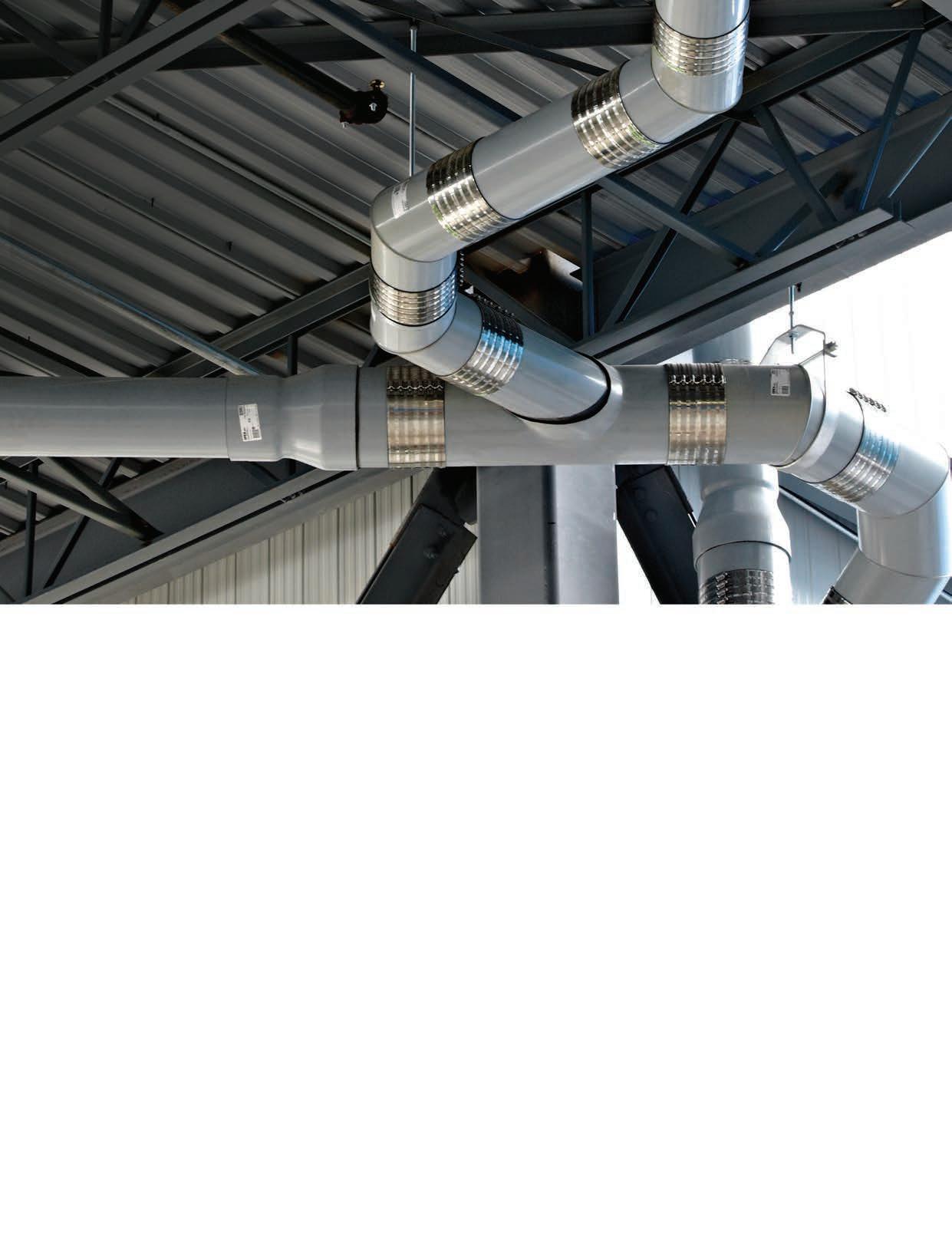
•
•
•
•
•