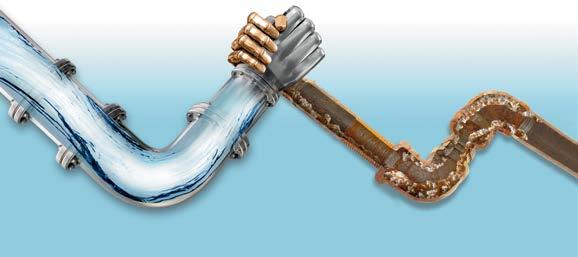
Einstein’s definition of insanity was doing the same thing over and over and expecting different results. If that is true, there are some “insane” hydronic system designers in North America. By John Siegenthaler
MH8 GOOD DESIGN AND INSTALLATION KEY TO GROWTH
Important updates have been made to CSA B214 “Installation Code for Hydronic Heating Systems.”
By Lance MacNevin
MH14 HYDRONIC PRODUCT SHOWCASE
GREEN
New codes, regulations and policies are changing the landscape for the mechanical industry. By Robert Waters 14
16 HOW DO YOU SAY QUALITY IS IN THE AIR?
Contractors and technicians find themselves on the front line trying to help occupants obtain the benefits of cleaner air. By Ian McTeer
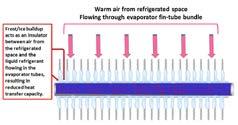
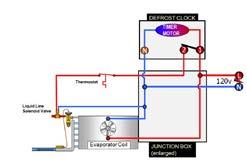
62 INTRODUCTION TO REFRIGERATION DEFROST METHODS–PART I
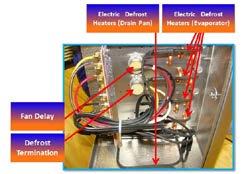
Modifications to basic defrost schemes add yet another layer of complexity for field service personnel. By Bob Schindler and Dave Demma
70 WHAT AM I?
Welcome to HPAC’s What Am I? contest. See the winner of the December challenge and try your luck with the newest mystery product for a chance to win a TLM99s Laser Distance Measurer from Stanley.
MH20 HOW WATER BEHAVES
Basic knowledge can help the designer weigh options and determine appropriate water quality requirements. By Mark Olson
MH26 MORE POINTERS FOR COMMERCIAL PUMPS
Net positive suction head (NPSH) and its role in preventing cavitation. By Mike Miller
IT’S A WHOLE NEW WORLD
Canada, along with its smaller jurisdictions, is moving ahead with a staggering array of codes, standards and regulations that will impact your industry. It is ironic when elsewhere so many rules, accepted practices and norms are being violated in a very public way. However, this new regulatory environment has been a long time in the making on both sides of the border. Unlike our neighbours to the south, there is a political conviction in Canada that more efficient HVAC equipment, improved installation practices and refrigerant phaseouts, as examples, will make a difference.
Manufacturers and wholesalers have felt the impact of changing efficiency requirements, rebate and incentive programs that come and go, and changing fuel preferences for some time, as have contractors. Things have become more complicated with the political situation in the U.S. and the hamstringing of the Environmental Protection Agency (not unlike what NRCan, the National Research Council and CMHC experienced just a few short years ago). Given the investment in R&D manufacturers have already made and the inertia behind “the catch up to Europe” movement, everything will continue to evolve as planned–four or even eight years is a very short period of time in the whole scheme of things.
In this issue several contributors tackle the issue of new standards, codes and regulations, and offer insights into the reasoning behind them and what they will mean to stakeholders, from manufacturers to technicians. As we filter out the noise it is necessary to know the regulatory expectations and plan for them in our businesses. There will most certainly be an impact and it is up to owners and managers to ensure front line workers are informed and trained.
Tim Dimopoulos (416) 510-5100 tdimopoulos@annexbizmedia.com
Ted Markle tmarkle@annexweb.com
Mike Fredericks
PUBLICATIONS MAIL AGREEMENT NO. 40065710
Heating Plumbing Air Conditioning (established 1925) is published 7 times per year by Annex Publishing & Printing Inc. HPAC Magazine is the leading Canadian business publication for the owner/manager of mechanical contracting businesses and their supply partners.
SUBSCRIBER SERVICES: To subscribe, renew your subscription or to change your address or information please visit us at www.hpacmag.com.
Subscription Price per year: $41.95 (plus
$81.95 US; Elsewhere: 1 year $89.95; Single copy
$5.00 CDN. Heating Plumbing Air Conditioning is published 7 times per year except for occasional combined, expanded or premium issues, which count as two subscription issues.
MAIL PREFERENCES: From time to time we make our subscription list available to select companies and organizations whose product or service may interest you. If you do not wish your contact information to be made available, please contact us via one of the following methods: Tel: 800.387.0273, Fax: 416.442.2191; E-mail: vmoore@ annexnewcom.ca; or by mail: Privacy Office, 80 Valleybrook Dr., Toronto, ON M3B 2S9.
HPAC Magazine receives unsolicited materials (including letters to the editor, press releases, promotional items and images) from time to time. HPAC Magazine, its affiliates and assignees may use, reproduce, publish, re-publish, distribute, store and archive such unsolicited submissions in whole or in part in any form or medium whatsoever, without compensation of any sort.
NOTICE: HPAC Magazine, Annex Publishing & Printing Inc., their staff, officers, directors and shareholders (hence known as the “Publisher”) assume no liability, obligations, or responsibility for claims arising from advertised products. The Publisher also reserves the right to limit liability for editorial errors, omissions and oversights to a printed correction in a subsequent issue. HPAC Magazine’s editorial is written for management level mechanical industry personnel who have documented training in the mechanical fields in which they work. Manufacturers’ printed instructions, datasheets and notices always take precedence to published editorial statements.
We acknowledge the financial support of the Government of Canada through the Canada Periodical Fund of the Department of Canadian Heritage.
Proud member of:
INDUSTRY NEWS
ONTARIO’S BILL 70 AMENDS OCOT POWERS
HRAI E-news reports that Bill 70 makes significant changes to the Ontario College of Trades and Apprentice Act, 2009. Though the speedy passage of this bill probably reflected the government’s desire to move on a number of budget and housekeeping matters (it contains many elements), it provided no opportunity for industry to consult or advise.
Amendments to the Act include: a new council called the “Classification Roster” to determine matters relating to the classification or reclassification of trades as voluntary or compulsory; new provisions setting out how trades may be referred to a classification panel; provision for the issuance of notices of contravention requiring a person to pay an administrative penalty; and as of June 6, 2017, College inspectors will have the
BCIT’S HIGH-PERFORMANCE BUILDING LAB OFFERS HANDS-ON OPPORTUNITIES
“Our new High-Performance Building lab is a hub for formal and informal hands-on learning and training for students, industry and others interested in efficient building envelopes,” said Andrea Linsky, program head in the Centre for Energy Systems Applications at British Columbia Institute of Technology’s (BCIT) School of Construction and the Environment (SoCE).
The High-Performance Building Lab (HPBL) also responds to new requirements for energy-efficient housing and recent changes to the design of small building construction and envelopes. Construction technologists, designers and builders will benefit from the training opportunities to become familiar with emerging building envelope technologies. The facility, finished in late summer 2016, was funded in part by BC Housing.
The HPBL adds to BCIT SoCE’s existing role in advancing the sustainability of BC’s built environment. Linsky notes that the HPBL is one of three such training grounds in the world. “The lab offers a rare opportunity to be trained in the construction of energy-efficient new and existing buildings.”
The lab is being used for several educational programs, including the architectural and building technology diploma, the bachelor of architectural science and the Passive House tradesperson training course, and is also open to industry and other stakeholders for rental and custom course development.
Linsky says that the City of Vancouver, for example, has recently provided training for their home inspectors, who will take part in the programs for high-performance building envelopes and associated heating and ventilation systems. Some of the City’s inspectors have already taken part in Passive House training at the HPBL. Linsky also foresees programs dedicated to heat recovery ventilation systems associated
ability to issue Notices of Contravention reflecting administrative monetary penalties, rather than tickets with fines.
Senior OCOT officials are optimistic that these and other changes will help expedite longstanding initiatives promoted by industry, such as the development of an appropriate trade designation for the work of hydronic heating system installers.
HRAI will be consulting with OCOT more intensively over the next few months and will report to members on any significant changes that can be expected to affect the industry going forward.
To see all amendments visit www.ontla.on.ca/bills/billsfiles/41_Parliament/Session2/b070ra.pdf. For more information contact Martin Luymes at 800.267.2231 ext. 235 or e-mail mluymes@hrai.ca.
The HPBL features a stand-alone, airtight testing hut used for blower door tests, the detection and repair of air leaks, the balancing of residential heat recovery ventilation systems, and other teaching applications
with high-performance envelopes, including balancing.
There are also wall practice panels that allow students to practice working with different framing, insulating, taping, and window/door interfaces. In addition, cut-away building envelope models are displayed, and educational signage is present throughout the lab. The lab has integrated presentation and hands-on work space, which helps to facilitate engagement.
Linsky describes the current lab as Phase I of what she sees as an evolving facility in response to building industry needs. “We are happy to talk to anyone interested in high-performance buildings because we want to change future construction to achieve ultra-high energy efficiency.” The lab may also integrate a research component in the future where researchers can explore wall and window assembly solutions for high-performance buildings. http://commons.bcit.ca/energy/research/high-performance-building-lab/
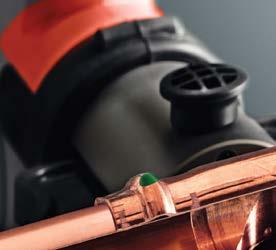
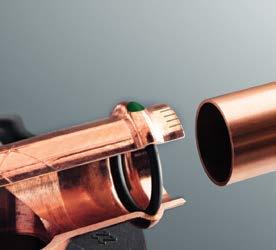
Enjoy the peace of mind that comes with installing Viega ProPress, the original copper press joining solution. With system-matched tools and jaws, no calibration is required and connections are made in seconds. Installations and repairs are fast and easy with Viega ProPress.
• Press connections can be made wet or dry
• Secure press connections made in seconds
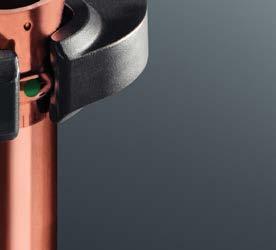
• Equipped with the Smart Connect® feature for easy identi cation of unpressed ttings
• More than 1,000 press tting con gurations available in sizes from ½" to 4"
For more information, call 800-976-9819 or visit www.viega.us
Viega ProPress ®
INDUSTRY NEWS
STATCAN RELEASES NOVEMBER BUILDING PERMIT REPORT, GAINS POSTED IN QUEBEC
Nationally, commercial building permit values was down 6.1 per cent to $1.5 billion in November.
According to the January 10, 2017 issue of The Daily, municipalities issued $7.8 billion worth of building permits in November, down 0.1 per cent from the previous month. The decline was largely the result of lower construction intentions in Alberta, following a spike the previous month due to impending changes to the Alberta Building Code.
In the residential sector, the value of building permits fell 1.6 per cent to $5.1 billion in November, following three consecutive monthly increases. Declines were posted in four provinces, led by Alberta. The largest gains were posted in British Columbia and Quebec.
The value of non-residential building permits rose 3.0 per cent to $2.6 billion in November, the fourth increase in five months. Higher construction intentions were registered in five provinces, led by Quebec and Ontario. The largest decline was reported in Alberta.
In the single-family dwelling component, municipalities issued $2.8 billion worth of permits in November, down 2.0 per cent from October. The decline in Alberta was large enough to offset gains in seven provinces.
The value of permits for multi-family dwellings fell 1.0 per cent to $2.4 billion in November, following four consecutive monthly increases. Declines were reported in six provinces. Lower construction intentions in Alberta and Ontario were mainly responsible for the decrease.
Municipalities approved the construction of 19,498 new dwellings in November, up 0.5 per cent from the previous month. The increase was attributable to multi-family dwellings, which rose 3.3 per cent to 13,035 new units. Conversely, single-family homes fell 4.8 per cent to 6,463 new units.
Construction intentions for institutional buildings were up 25.2 per cent to $686 million in November, following two consecutive monthly declines. The gain was largely the result of higher construction intentions for educational facilities and nursing homes. Increases were reported in four provinces, led by Ontario and Quebec.
The value of industrial permits rose 10.1 per cent to $404 million in November, a second consecutive monthly increase. The advance was mainly attributable to higher construction in-
tentions for primary industry buildings, manufacturing plants and maintenance facilities. Gains were posted in six provinces, most notably Quebec.
The value of commercial building permits was down 6.1 per cent to $1.5 billion in November. Lower construction intentions for hotels, office buildings and retail complexes contributed to the drop. Declines were reported in five provinces, led by Alberta. www.statcan.gc.ca
COHA UNDERGOES SIGNIFICANT REORGANIZATION, RESPONSIBILITIES SHIFT TO PROVINCIAL CHAPTERS
In a letter to members, Dave Brown, board chair of the Canadian Oil Heat Association (COHA) announced that on January 13, 2017, the COHA National Board decided to re-organize COHA along the following lines:
• Provincial chapters will take on primary responsibility for collecting dues, administering and servicing their members, as well as leading initiatives that provide value for membership;
• National COHA members will be approached by provincial chapters for membership as appropriate;
• Provincial chapters will continue to be represented by their representative on the COHA National Board;
• The National Board will administer COHA as an umbrella organization in order to provide leadership and direction on issues of national significance. This will ensure that provincial chapters have a co-ordinated national voice. Issues of a national nature will be elevated by the provincial chapters through their respective COHA National Board representative(s); and
• The administrative cost of maintaining a national office will be greatly reduced. This will reduce the upward pressure on membership dues and give provincial chapters additional resources to pursue local initiatives.
The COHA National Board, working with the provincial chapters, will effect this reorganization over the first quarter of 2017.
He noted that the past several years have brought significant changes to the Canadian oil heat industry. At the same time, experience has shown that COHA members have different needs depending on the region of Canada in which they do business. In order to be more responsive to the needs of members in each province, and therefore add additional value to membership, the COHA National Board of Directors has voted to move operational and administrative responsibilities to the provincial chapters.
Stephen Koch has resigned as president of COHA.
Brown suggested that questions or comments be directed to the appropriate provincial representative on the National Board. www.cleanerheat.ca
ALBERTA BANS DOOR-TODOOR ENERGY SALES
In a move to strengthen consumer protection, selling household energy products unsolicited door-to-door is now prohibited in Alberta. Effective January 1, 2017, the prohibition is for unsolicited sales of household energy products only including furnaces; natural gas and electricity energy contracts; water heaters; windows; air conditioners; and energy audits. According to the Alberta government, energy companies still have multiple ways to sell directly to Albertans, including telephone and online sales, kiosks and advertising. Consumers can still invite salespeople to their homes. www.alberta.ca
FIRST JOINT CANADA-U.S. STANDARD FOR PLUMBING AND HEATING SECTOR
The Standards Council of Canada (SCC) has announced the publication of the first joint Canada-U.S. standard for balloontype ball backwater valves. After several years of collaboration,
ULC Standards, an SCC-accredited Standards Development Organization (SDO) together with Underwriters’ Laboratories Inc., an SDO accredited by both SCC and the American National Standards Institute (ANSI), have developed ANSI/CAN/UL/ULC 1201:2016 Sensor Operated Backwater Prevention Systems. The joint national standard is the first of its kind in the plumbing and heating sector and is expected to provide significant savings in cost and time in both Canadian and U.S. marketplaces. This standard was developed and approved by the joint UL/ ULC Technical Committee on Prevention of Storm and Sanitary Backflow, comprised of Canadian and American stakeholders. A panel, including members of the Canadian Institute of Plumbing and Heating (CIPH), and several U.S. organizations, determined that standards development for sensor-operated backwater prevention systems would benefit the greatest number of stakeholders.
ANSI/CAN/UL/ULC 1201:2016 Sensor Operated Backwater Prevention Systems is available as a “view access” and downloadable PDF for Canadian IP addresses in both official languages at no cost until December 14, 2021. http://canada. ul.com/ulcstandards/aboutus/salesofulcstandardsmaterials/download-ansicanululc-1201/
INDUSTRY NEWS
BECKETT ISSUES PRODUCT ADVISORY
Beckett Corporation has issued a bulletin regarding its Cleancut pump A2EA-6527. Pumps manufactured in March, April and May 2016 might present a tightness issue on Inlet/ Return 1/4-18 NPTF plugs. To identify the pumps check the date stamped on the top of the body. Before starting your burner, confirm the pump is not in the affected date range. If the unit is in the date range, carefully verify the tightness of Inlet/ Return plugs. For any recognized or suspected leak, unscrew plugs and apply pipe sealant, and re-insert them with a fitting torque of 12 to 20 ft.Lbs. www.beckettcorp.com
SCORECARD OFFERS A SNAPSHOT OF HOSPITAL “GREEN” HEALTH
The Green Hospital Scorecard (GHS) provides a snapshot of a hospital’s performance in energy and water conservation, waste management and recycling, corporate commitment, and pollution prevention. In 2013, the GHS was developed and administered by the Ontario Hospital Association through the Green Hospital Champion Fund and supportive funding from the Ministry of Consumer and Government Services.
About half of Ontario’s hospitals have participated every year since the program launch, but the Coalition expects this number to increase as the scorecard’s benefits are more broadly recognized.
Program participants are recognized individually with annual gold, silver, and bronze level achievements and are also eligible for annual Green Health Care awards. A webinar planned for the spring of 2017 will highlight top scorers and provide a forum for exchanging ideas and best practices. http://greenhealthcare.ca/ghs/
The program ended in early 2016, and the Canadian Coalition for Green Health Care, with funding from the Government of Ontario, is now continuing with the delivery of the scorecard through 2017. Participating hospitals report on their environmental initiatives through an online questionnaire. The data is summarized in an easy-to-interpret Green Hospital Scorecard that allows hospitals to benchmark themselves against previous years and to compare their environmental performance with that of other hospitals.
DROP DOWN LADDER RACK
Exclusive twist-to-adjust feature
Easy to operate: Anyone 5’4” or taller can operate
Corrosion resistant design
GRIP LOCK LADDER RACK
Easy reach for anyone 5’7” or taller
Secure clamping mechanism
Corrosion resistant design
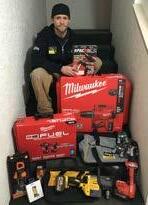
ANDERSON OF LISI MECHANICAL WINS HPAC’S TOOL TAKE AWAY CONTEST
included products from the following manufacturers: UEI; DeWalt; Viega; Uponor; Milwaukee; testo; and FLIR.
Michael Anderson of Lisi Mechanical was the winner of HPAC’s Tool Take Away at CIPHEX West. Anderson’s Take Away
CODE GREEN
New codes, regulations and policies are changing the landscape for the mechanical industry.
BY ROBERT WATERS
The HVAC and plumbing industry in Canada is in for some profound changes with the coming wave of new building codes, policies and regulations. All levels of government–federal, provincial and municipal–are pushing hard to go green and reduce the impact of greenhouse gas emissions and climate change.
Since the federal Liberal government was elected in 2015, there has been newfound attention placed on environmental and climate change issues that was absent during the Harper years. There is also a renewed cooperative spirit between federal and provincial governments. The recent Energy Mines and Ministers’ Conference (EMMC) is an example of this.
Appendix A: Example of a potential energy code roadmap for houses
The EMMC published a federal-provincial framework in August
BUILDING CODE ROADMAP FOR HOUSES
2016 to “Encourage Market Transformation Through Collaboration on Energy Efficiency Standards.” The EMMC vision statement describes a future “where federal, provincial and territorial governments define joint priorities for energy efficiency standards and engage in coordinated activities on standards to drive greater, more cost-effective actions to reduce greenhouse gas emissions and promote energy conservation.”
The impact of new codes and regulations will trickle down to the heating industry. One area that will have a big impact on mechanical systems in the future will be new building code requirements to build more and more energy efficient and air tight buildings. These buildings will have extremely small space heating loads.
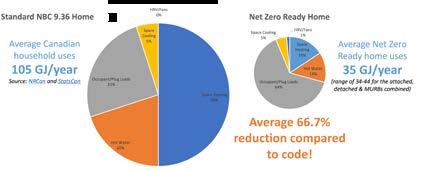
The ultimate target of most governments seems to be to get to a level of Net Zero Energy Ready standard by about 2030. A Net Zero Energy (NZE) home is one that is designed and constructed to produce as much energy as it consumes on an annual basis. A NZE Ready (NZEr) home is a NZE home that has not yet installed the renewables.
All new homes are required by law to comply with the most current Canadian building code. The National Building Code continues to increase the minimum energy performance requirements and is updated approximately every five years. There are currently a number of voluntary low energy building standards in place, such as ENERGY STAR, R-2000, Passive House and NZE.
There has been a large growth in these low-energy homes in Canada and this will certainly continue as builders refine more cost effective techniques to meet these standards. ENERGY STAR homes are 20 per cent more energy efficient than homes built to the current code. R-2000 homes are 50 per cent more energy efficient than homes built to code. NZEr homes are up to 80 per cent more energy efficient than homes built to the current NBC 9.36 with the biggest impact on the space heating load, which drops dramatically. A full NZE home will also include on-site energy generation with re
newables (mostly solar PV panels) and due to the renewable energy production, its energy performance is 100 per cent better than homes built to code.
In September, 2015 the Canadian Home Builders
Association (CHBA) launched a pilot of the NZE labelling program, which will provide the industry with a clearly defined yet rigorous two-tiered (NZE and NZEr) technical standard that will distinguish and recognize builders and renovators and their NZE homes. Version 1 of the program will be launched in early 2017.
While the timing of new building code standards is not fully defined yet, the mechanical industry is starting to see the impact of dramatically smaller heating loads. The traditional home heating system used today consisting of a furnace and tank type water heater, is likely to be quite different in the future. Exactly what shape those changes will take will likely vary by region and new technology development.
Chair of the NZE Housing Council Andrew Oding is a senior building science associate with Building Knowledge Canada and he works intimately with the NZE housing market. Oding sees several trends emerging with mechanical systems in low energy buildings.
“Space heating loads drop dramatically (to the 20 to 30 MBH level) in NZEr homes, while the DHW load stays the same or even increases. This makes it extremely important to have a DHW appliance that is smart, very efficient and can run at variable loads,” said Oding. “Combo systems are gaining in popularity with builders as they provide a good solution for the space heating and DHW demands of a low energy home.”
Another trend that Oding sees emerging is dual fuel systems that combine a small gas furnace with an air source heat pump. “This will allow the homeowner to have the ability to make a choice that could be based on performance, fuel cost, and future carbon taxes,” noted Oding. He sees heat pump technology gaining in popularity due to increases in cold weather performance and the option for builders to have an all-electric solution that eliminates the need for running a gas line into the building.
A closer look at combination systems for space and water heating shows that governments and R&D labs have been looking intently for some time at these systems as a great
way to meet the demands of low energy homes. A recent Canadian Gas Association study done by CanmetENERGY did a comparison test of a high performance combo system and a regular heating system with a high efficiency furnace and storage tank water heater.
The test was done in February and March of 2016 at the Canadian Centre for Housing Technology (CCHT) in Ottawa, which has two identical houses – a reference house and a test house. These houses were built to the R-2000 standard. They
PLUMBING CODES TIGHTEN UP WATER USAGE
The plumbing industry is also experiencing changes as a result of the committed focus on efficiency and conservation. Water-use efficiency is an objective within the 2015 National Plumbing Code. Mandatory water-use requirements are being introduced for plumbing fixtures and fixture fittings that include toilets, urinals, lavatory supply fittings, kitchen supply fittings and showerheads. For toilets the new maximum water usage per flush cycle have been set at between 4.8 and 6.0 Lpf, with urinals limited to 1.9 Lpf.
The water usage will depend on the type of application. Lavatory and kitchen supply fittings will be limited between 1.9 and 8.3 L/min flowrates, while shower heads will be limited to 7.6 L/min. Another method of conserving water is to use a rainwater harvesting system, which are currently being installed and regulated in a number of Canadian jurisdictions. To address this, proposed enabling requirements have been developed for the 2020 edition of the NPC.
In the low-energy buildings of the future, wasting water will be discouraged as much as wasting energy.
Comparison between a code built home and a Net Zero Ready home
feature identical simulated occupancies and are monitored extensively for energy performance and thermal comfort. The reference house mechanical system consisted of a 96.3 per cent AFUE, two-stage, 25 to 40 MBH furnace, and a 40 USgal, 40 MBH, power vented storage tank water heater with a 0.62 EF. The test house used a 15 to150 MBH condensing tankless water heater, with an EF of 0.97 and a 73 MBH air handler.
The month-long test results showed that the combo system outperformed the reference house, using approximately four per cent less energy. This shows a promising result for combo systems, which may increase their use for future lowenergy homes with low heating loads and large DHW loads.
Cold climate air source heat pumps (CCHP) are another technology option that is also being studied by governments and R&D labs. CCHP’s provide an efficient all-electric solution for smaller heating and AC loads, which appeals to many lowenergy builders. Cold outdoor air temperatures in many areas of Canada have typically limited the effectiveness of air source heat pumps and this has hampered their market penetration. That could change with low temperature heat pumps. NRCan CanmetENERGY research experts currently have a Cold Climate Heat Pump (CCHP) five-year strategy, with R&D and field verification programs. The intention is to make CCHP’s more effective at lower temperatures and affordable for Canadians. And because they run on electricity they are being looked at as a way to reduce carbon emissions.
Ventilation is a necessity in a low-energy home due to their air tight construction. HRVs have been used extensively for low-energy homes for many years, but an emerging trend is towards the use of ERVs. Oding stated that as homes get tighter, latent loads often get higher and ERVs do a much better job of handling this. ERVs also work better with summer AC loads, especially in areas with high summer humidity. New developments in ERV core technology has also allowed them to perform much better in colder climates.
So while the type of heating system appears to be in for some change in the future, individual heating appliances themselves are also in for some changes. The days of lower efficiency appliances appear to be numbered due to new NRCan Energy Efficiency regulations. NRCan has four regulatory amendments planned by 2020, which will impact just about every type of energy consuming device.
The mechanical industry will see big changes with updated energy efficiency requirement for water heaters, furnaces, boilers, heat pumps, chillers, air conditioners. Amendment 13 was finalized in December 2016 and comes into effect on June 28, 2017. This will impact central air conditioners and heat pumps, gas and oil-fired storage water heaters and packaged terminal AC and heat pumps.
Amendment 14 and 15 are in the works now and will come in to effect in 2018 and 2019 respectively. These amendments
will affect a wide range of appliances from gas fireplaces, gas and oil boilers, tankless water heaters, gas and oil furnaces, commercial boilers and water heaters, and large air conditioners and heat pumps. So the energy efficiency bar is being raised for all mechanical equipment and there certainly seems to be a big push to get to condensing efficiency’s for most categories. It appears that traditional lower efficiency, non-condensing appliances are being regulated out of existence. Trends seem to indicate that natural gas (NG) use may be in for some challenges in buildings of the future, as in some cases builders will choose not to run a gas line into the building at all, and just go all electric, or some jurisdictions will make it difficult or impossible to use NG. The recent City of Vancouver “Zero Emissions Building Plan” is a good example of what we could be seeing more and more of in the future. Vancouver plans to eliminate all emissions from newly permitted buildings by 2030 and have only renewable energy sources in all buildings by 2050.
Vancouver City officials deny that this is a “ban on Natural Gas” but this is effectively what will happen. Many concerned industries, gas utilities and citizens have objected to Vancouver’s plan due to the potential for supply issues and dramatically higher energy costs.
Not everyone is against Vancouver’s Zero Emissions plan however, as the Pembina Institute recently stated: “We think the city’s Zero Emissions Building Plan will serve as a blueprint for the rest of BC and beyond. In addition to reducing emissions and energy use, the plan will lead to improvements in the quality of homes and buildings. This plan will be an important catalyst in the local, clean, low-carbon economy”.
So far the City of Vancouver has not shown any signs of backing down to those who object to their plan. Only time will tell how this plays out in Vancouver and other jurisdictions.
The low-energy, water-conserving building is here to stay and will only see tighter requirements come into effect as time goes on. The Climate Action Plans of many levels of government are pushing this agenda forward fast. This will lead to many changes, challenges, and new opportunities for the heating and plumbing industries in Canada.
Robert Waters is president of Solar Water Services Inc., which provides training, education and support services to the hydronic industry. He is a mechanical engineering technologist graduate of Humber College and has over 30 years experience in the hydronic and solar water heating. He can be reached at solwatservices@gmail.com.
How do you say QUALITY IS IN THE AIR?
Contractors and technicians find themselves on the front line trying to help occupants obtain the benefits of cleaner air.
BY IAN MCTEER
The American philosopher, naturalist and historian, Henry David Thoreau, best known for his 1854 book, Walden, wrote, “What is the use of a house if you haven’t got a tolerable planet to put it on?” I can understand Thoreau’s despair about the environment. Industrialized cities must have been horrifying places to live by any standard. Outdoor air and no doubt indoor air, was filled with particulates of wood and coal smoke plus the products of combustion coming from oil lamps and gas lamps later on. Lack of sanitation permitted disease and foul odours to plague the health of citizens every day. Dust and dirt whipped up by traffic on unpaved streets settled everywhere, in and out, plaguing rich or poor.
Toronto, in 1850, was no different from other cities of the time. Hogtown, as Toronto came to be known, featured large, odourous meat packing plants as one of its major occupations. They are gone now, but you have to imagine that quality indoor air was just a dream for generations of residents in the slaughterhouse districts of any city. However, in spite of all that, the number one cause, by far, of human morbidity and mortality in 1850s Toronto was Tuberculosis, also known as consumption. So many died from TB that the average life expectancy for males was only 40 years, too young to develop today’s mass killers, heart disease and cancer.
Are things that much better today? If indoor air quality (IAQ) depends upon the outdoor air being as fresh and clean as possible, it would be difficult for me to insist that today’s outdoor air quality is far superior to that of 1850. While particulates, odours and airborne pathogenic disease organisms may be much less prevalent today, it is true that many people in the 21st century suffer from the effects of pollutants unheard of in the 19th century.
Automobile exhaust including diesel smoke and volatile organic compounds such as benzene, acetone and many other pollutants, both man made and naturally occurring, are ev-
eryday concerns. In parts of many Canadian cities these pollutants are found in trace amounts, but for those living near industrial areas, airports, heavy traffic routes and intersections, air pollution is a real concern. Although the average life expectancy for Canadian males has increased to over 70 years, no one can say for sure what constitutes ideal IAQ when the outdoor air is not as fresh as it once was.
WHAT WE DO NOT WANT INDOORS
What we do not want and what we end up with in the indoor air is a complex, often subjective, study. Many people “feel” the air is bad but cannot pinpoint a cause. What conditions or combination of conditions make people ill or uncomfortable? For example, many people suffer from illnesses related to unregulated humidity. Should indoor relative humidity wander too far from its ideal range of 40 per cent RH to 60 per cent RH for too long, then mould, viruses, bacteria and dust mite (dust mites’ feces is the allergen) populations grow with relentless abandon.
Time to start using chimney chases or faux chimneys (perhaps several) to get all vented products up and away from ground level.
We do not want the products of combustion indoors. Carbon monoxide must never be allowed indoors, yet too often it is, resulting in human or animal tragedy. Nitrogen oxide (NOx), nitrous oxide (NO2), volatile organic compounds, particulate matter and sulfur dioxide and excess carbon dioxide should stay outdoors.
Carbon dioxide, one of the main products of combustion, which is typically measured outdoors at 400-500 ppm can often go much higher indoors. Large groups of people in a poorly vented space or perhaps a home gymnasium with several people working out doing aerobic exercise could easily push CO2 into the 2500 ppm range or higher. That is high enough to cause a decrease in mental performance leading to confusion; at a 10 per cent concentration (100K ppm) you are going to blackout.
We do not want tobacco smoke, candle smoke, wood smoke or diesel smoke indoors because these pollutants contain, in part, lung irritants called fine particulate matter. The province of Ontario defines fine particulate matter as, “matter that is 2.5 microns in diameter and less. It is also known as PM2.5 or respirable particles because it penetrates the respiratory system further than larger particles. PM2.5 in Ontario is largely made up of sulphate and nitrate particles, elemental and organic carbon and soil.”
We also do not want chemical vapours, odours associated with biological decay, asbestos, radon gas,
A COUPLE OF TIPS
mercury vapour, formaldehyde, pesticide residue, tree and plant allergens, and excessive noise, and so on.
WHAT THEN IS QUALITY INDOOR AIR?
Air and water: our two most precious live-giving resources. Neither one is naturally pure; water, for example, always has something in it because water is a natural solvent and scours electrons from everything it touches. Air is no different. I already mentioned some of the things we do not want to breathe, but the fact is our air contains some noxious elements in varying degrees all the time. It seems that many people are apparently unaffected by poor air quality, while others suffer a range of symptoms that may be defined as anywhere from mild to life threatening.
HVAC contractors and technicians, often without proper training and test tools, find themselves on the front line trying to help homeowners obtain the benefits of cleaner air every day at home and at work. I am not sure we are getting anywhere in providing consistent IAQ for those who need it the most, the rest of us notwithstanding.
I know many homeowners are very concerned about the quality of the indoor air in their homes. I used to get their calls regularly in my previous position. They would call me about too much humidity, too little humidity and funny odours after a high efficiency furnace was installed, among other things.
TIP: The MSDS sheets for PVC cleaner and adhesive reads: “Prevent inhalation of solvents. Use in a well-ventilated room. Open doors and windows to ensure air flow and air changes.” Some homeowners mistake the solvent odour left over from the vent pipe installation process as a problem created by the new furnace.
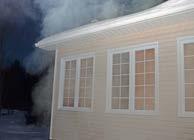
Vent plume from a 200 cfm range hood. How is all this air being made-up? Plume consists of water vapour and cooking fumes that might be recirculated into a furnace combustion air intake or HRV at the chef’s residence or the neighbour’s house.
QUALITY INDOOR AIR STARTS WITH BUILDING MATERIALS
I watched HGTV’s six segment series featuring Mike Holmes and his son, Mike Jr. in which they rebuild what looked like an 80s subdivision bungalow owned by Mike Jr. I was interested to see what HVAC innovations Mike Jr. would want as they added a second floor. Mike Holmes builds a bit over the top, but he is concerned about insulation, high performance windows, tight sealing, vapour barriers, prevention of mould growth and fire protection. Mike Jr’s house is a sterling example of Mike’s philosophy. This time Mike used a new type of drywall manufactured by a Canadian company that captures (within each sheet of drywall) VOCs such as formaldehyde and other aldehydes never to be released into the indoor air again. That is a great start for a newly constructed house as the drywall will capture outgassing from carpets and other construction materials.
Mike Jr’s house has R20 batts in the exterior walls (no spray foam this time) and a further two inches of Styrofoam on the outside minimizing thermal bridges. Tightly sealed, certainly it is on the road to Passive House standard. However, disappointingly, there was no mention of ventilation control or other HVAC.
I noticed large bulkheads in the basement suggesting a conventional furnace
TIP: Never promise a homeowner that the need to dust furnishings will be reduced or eliminated by installing high performance in-line ducted air cleaners. The amount of dust in the air has a lot to do with the veracity of the air handling system. If the heavier dust particles are not moved along with the appropriate velocity, they will usually fall out of the air right on top of the mahogany coffee table. You are selling the best air cleaner to capture the smaller airborne particles (0.3 to 0.1 microns) and you want to keep the HVAC system as clean as possible. Remembering that dust is largely made-up of dead human/pet skin cells, pollen, textile fibres, soil and cosmic dust (yes, perhaps as much as 40K tons of cosmic dust showers our planet every year), there is no end of the need to dust the furniture and vacuum/mop the floors. continued on p18
and ductwork. The kitchen has a chimney style large range hood probably in the 700-900 cfm range but there was no mention of ducting or make-up air. Tightly constructed buildings are energy efficient, but may not be the best places to find quality indoor air unless the idea
of PSIM (properly specified, installed [including commissioning] and maintained) equipment is the primary focus of everyone involved.
WHAT CAN BE DONE?
When talking about existing housing, es-
EXISTING RESIDENTIAL APPLICATIONS
If your customer is adamant about improving his or her IAQ, then you must do some research into determining a starting point; what is bothering this customer? Perform a blower door test to determine the level of “ventilation” that currently exists. Other considerations:
1. Ducts should be thoroughly cleaned.
2. Is asbestos a concern?
3. Has the building ever been tested for radon gas?
4. Survey the building looking for mold, water damage, leaking HVAC drains. Check condensate pumps, drain tubing, refrigeration tubing and furnace venting leaking/dripping water.
5. Do an inventory of air exhausting appliances: perhaps a direct vent gas water heater might work or switch to electric. Be sure a high efficiency gas furnace is taking its combustion air from outside. Suggest the purchase of a ventless clothes dryer. What about flue gas spillage from vertically vented gas or oil fired appliances?
6. Check the kitchen fan for proper installation remembering the high cfm models (above 200 cfm) are likely depressurizing the building or, doing no good at all. Also remember that improperly installed range hoods over gas stoves must be red tagged even if the homeowner is the culprit.
7. Is there an existing HRV and has it ever been balanced or serviced? Are the outdoor vents properly insulated and safely away from outdoor contaminants like idling cars and the neighbors’ kitchen exhaust or BBQ. Has the HRV been unplugged, why?
8. Is the humidity level under control in all seasons? What about an existing humidifier, has it been dumping too much water down the drain while struggling to maintain an appropriate level of moisture in the building?
9. Is the cooling unit appropriately sized for the building and its level of insulation? Does the customer complain about dampness in cooling season?
10. I suggest that any ventilation air brought into a house in an urban area be subject to UV purification with HEPA filtration and VOC remediation.
pecially in Ontario, I have mentioned before that many houses constructed since the late 1960s have very poor air handling systems. Installing a high efficiency in-line cabinet air filter will require serious duct renovations in most cases. It is best to leave that job until
Over the top range hoods for DYI kitchen renovations. One product comment from a purchaser was illuminating: “I basically bought it for lighting and aesthetics, but was told by my installer that it is a very powerful motor, too…it has a 6″ duct that does need to be converted to 4″ for an interior wall.”
Ventless clothes dryer: water removed from clothing can be put down the drain standpipe or collected into this catchment device. The non-potable water can be used in the garden or to mix with grout/cement or put down the drain. Waste heat is returned to the building; helpful with heating but puts a bit of a load on the cooling unit. Perhaps it’s better to use a clothesline for drying clothes on nice summer days.
HRV filters must be cleaned regularly. This manufacturer recommends the heat exchanger core be cleaned at least once per year, maybe more often depending upon its operating conditions. Drain must be trapped, free flowing and leak free. This unit has manometer ports at each duct connection with a manometer set-up diagram and pressure table – easy to check for balanced operation.
I am not happy with this type of HRV damper as it freezesover during extended periods of cold weather. It is time for a furnace-style concentric vent for HRVs with decorative, insulated riser kits to get the terminations as high as possible when chimney chases are not available.
< INDOOR AIR QUALITY
furnace replacement time comes along should the customer balk at the cost.
If your manufacturer offers a larger cabinet size than you need, consider installing it horizontally in the furnace return air drop duct. Check the manufacturer’s specifications beforehand to be sure the oversized unit has the lowest possible pressure drop at your required air flow. These filters, which offer HEPA or better than HEPA performance, will improve IAQ dramatically especially for those suffering from air borne allergies.
ANOTHER STRATEGY: BYPASS AIR PURIFICATION AND FILTRATION
Because in-line high efficiency air filters are too restrictive in second rate duct systems, I contacted Ray Gatt, Ontario and Manitoba regional manager at Sanuvox Technologies, about utilizing a bypass UV filtration system to alleviate excessive pressure drop. Gatt told me his product, “does not have an effect on the static pressure and is fan driven. This unit could be used in a typical residential application…it comes with a UV system.” The unit also contains a HEPA filter and combined with the UVC and UVV wavelengths of the lamp, it is capable of destroying odours too.
Canadian-made Amaircare offers a family of bypass HEPA
filters that offer three-stage filtration and an optional VOC canister. Another Canadian manufacturer, 5 Seasons Electro Air, developed a duct mounted bypass HEPA air cleaner with a UV light and photo catalytic filter capable of “removing biological and chemical contaminants and odours such as toluene, benzene, cooking odours, tobacco smoke, bacteria, viruses, mould and more.” These units are typically available as standalone models for use with hydronic or electric baseboard heating systems.
Generalaire, Honeywell, Field Controls and other UV light manufacturers offer in-duct purification systems without HEPA filtration that typically do not affect airflow significantly.
As a properly trained and committed contractor with the right tools and equipment you can make an important, beneficial improvement to your customer’s IAQ problems. The drive to further tighten-up residential buildings will eventually cause ventilation and IAQ to become your primary concern.
Ian McTeer is an HVAC consultant with 35 years experience in the industry. He was most recently a field rep for Trane Canada DSO. McTeer is a refrigeration mechanic and Class 1 Gas technician.
MODERN HYDRONICS
TIME TO SHUT DOWN
ROGUE PIPING LAYOUTS
TROUBLESHOOTING POINTERS FOR COMMERCIAL PUMPS
HYDRONIC TECHNOLOGY
MH4
Something to avoid…
Rogue piping layout continues to appear despite its poor performance.
BY JOHN SIEGENTHALER
MH8
Good design and installation are key to growth
Important updates have been made to CSA B214 “Installation Code for Hydronic Heating Systems.”
BY LANCE MACNEVIN
MH14 HYDRONIC PRODUCT SHOWCASE
BY MIKE MILLER
BY MARK OLSON
EDITOR
CONTRIBUTING EDITOR
ASSOCIATE PUBLISHER
ACCOUNT MANAGER
SALES & MARKETING COORDINATOR
ART DIRECTOR
ACCOUNT COORDINATOR
CIRCULATION MANAGER
PUBLISHER
VICE PRESIDENT
COO
PRESIDENT & CEO
Kerry Turner (416) 510-5218 KTurner@hpacmag.com
Michael Power mpower@hpacmag.com
David Skene (416) 510-6884 DSkene@hpacmag.com
Stephen Kranabetter (416) 510-6791 SKranabetter@hpacmag.com
Tim Dimopoulos (416) 510-5100 tdimopoulos@annexbizmedia.com
Ted Markle tmarkle@annexweb.com
Mike Fredericks
SOMETHING TO AVOID…
BY JOHN SIEGENTHALER
Einstein’s definition of insanity was doing the same thing over and over and expecting different results. If that is true, there are some “insane” hydronic system designers in North America. They repeatedly cling to certain system piping configurations, even though existing projects using those configurations have produced problems.
One incorrect piping layout that I’ve seen repeated many times could be described as a “morphing” of primary/secondary piping, and a classic header-type multi-zone distribution system. I have seen it as installed hardware, and in neatly prepared CAD drawings created by professional engineers. The latest rendition of this problematic piping layout recently popped up in an e-mail sent to me for review.
The piping error that I am referring to is represented by Figure 1
This piping layout is neither primary/ secondary, nor a “header-type” multizone syste. It is undefined among proven hydronic piping designs.
My guess as to how this rogue piping layout repeatedly manifests itself is that the designer begins thinking about primary/secondary piping, and therefore thinks they needs a primary loop. The heat source(s) will inject heat into this loop, and the load circuits will extract heat from it.
The designer proceeds to sketch out the loop, and puts in a primary loop circulator. Next it is time to add some load circuits. This is where the designer’s memory flashes back to neatly aligned zone circulators all lined up on a wall. With that in mind, the designer connects the supply side of each zone circuit to the upper part of the loop (thinking it is a header), and the return side to the lower portion of the loop
(again viewing it as a header). The fact that the “headers” are connected at their ends doesn’t seem to matter.
WHAT’S WRONG?
One problem with this design can be envisioned if you consider the pressures within the primary loop when only the primary loop circulator is operating. There is a pressure drop between the upper portion of the loop, where the supply side of the load circuits connect, and the lower portion of the loop, where the return side of the load circuits connect. This is illustrated in Figure 2.
If just the primary circulator was running, the pressure differential would be highest between points A and B due to the head loss along the longest loop path. It would decrease to some minimum value between points C and D. However, the pressure differential across any given load circuit at any given time will also be influenced by the on / off status of the load circulators, and thus highly variable. Still, it is possible that the pressure differential between points where a load circuit begins and ends could be several pounds per square inch (psi).
If the pressure at point A is higher than the pressure at point B, the water “wants” to move from A to B. And, if nothing blocks its path, the water will flow from A to B. The result is heat delivery into a circuit in which the zone circulator is off, and there is no need of heat. Call it heat migration, ghost flow, or whatever you want. It is not supposed to occur, and customers have every right to complain when it does.
It is conceivable that all the zone cir-
Figure 1
cuits could have some flow through them when only one zone is actually calling for heat. Flow would occur in any load circuit where the forward opening resistance of any check valve (which is typically 0.3-0.5 psi) is smaller than the developed pressure differential between the supply and return sides of that circuit.
The rate of undesirable heat migra -
tion depends on the pressure differential between the supply and return of each zone circuit, and the amount of recirculation mixing that occurs. The latter depends on the flow rate in the primary loop versus the flow rates in the load circuits. If flow is rocketing through the primary loop - because someone thinks the primary loop flow has to be at least equal to the sum of the load circuit flows
(which is NOT true), then there won’t be recirculation mixing. However, if the flow in the primary loop is less than the sum of the active load circuit flow rates, there is sure to be recirculation somewhere. Think like water. Why should the water travel all the way back to where the boiler(s) are connected to the primary loop if it can just take a shorter detour and end up back at the inlet of a zone circulator?
If you are going to build a true primary/ secondary system, each load circuit and each heat source needs to connect to the primary loop using a pair of closely spaced tees. These tees isolate the pressure dynamics of each circulator from the other circulators in the system. This is called hydraulic separation.
MORE PROBLEMS
The system shown in Figure 1 accurately represents a drawing that I received. Aside from the “morphed” piping layout, there are several other details that should be of concern:
1. There are no check valves in the load circuits to prevent reverse flow when some loads are active while others are not.
2. There are no purging valves in the load circuits.
3. There is a swing check valve mounted in a vertical pipe coming from the boiler. Swing check valves should never be mounted in vertical piping. Under some conditions the flapper within the check valve can “hang” in the open position when flow stops, and slam shut when sufficient reverse flow develops. This can create a strong water hammer effect.
4. The tees connecting the boilers to the “primary loop” should be as close together as possible. The pressure drop between the more widely separated tees connecting the boiler to the “primary loop” in Figure 1 will tend to induce some flow through an inactive
Figure 2
Figure
boiler. This increases heat loss from the boiler jacket and creates convective air currents that such heat up the chimney.
LOSE THE LOOP
Properly designed primary/secondary systems work. Still, in my opinion, there are better options that provide the benefits of primary/secondary piping, but with simpler and less expensive piping configurations (as shown in Figure 3).
This system connects the boilers to a header system that leads to a hydraulic separator. The load circuits connect to short / generously sized headers leaving the right side of the hydraulic separator. High performance air and dirt separation is provided by the coalescing media inside the hydraulic separator. This eliminates the need for air and dirt separators as individual components. By keeping the headers short and
generously sized, the pressure drop along the header is very low. This in combination with the very low pressure drop through the hydraulic separator provides good hydraulic separation of all the circulators in the system.
My suggestion is to size the headers so that the flow velocity within them does not exceed two feet per second when carrying their maximum flow rate.
This piping layout eliminates the “ghost flow” and possible recirculation issues previously described. It also provides equal supply temperatures to each of the load circuits. It does away with the primary loop circulator, and perhaps most importantly, it eliminates the operating cost of a primary loop circulator over the life of the system. The savings associated with the latter could easily add up to more than the cost of the hydraulic separator.
So please, do not repeatedly prove that Einstein was right about insanity. If you are intent on building a primary/secondary system be sure you construct it with closely spaced tees and a properly sized primary circulator. Consider using a hydraulic separator to achieve the benefits of a primary/secondary system with simpler piping and lower life cycle operating cost.
John Siegenthaler, P.E., is a mechanical engineering graduate of Rensselaer Polytechnic Institute and a licensed professional engineer. He has over 34 years experience in designing modern hydronic heating systems. Siegenthaler’s latest book, Heating with Renewable Energy, was released recently (see www.hydronicpros.com for more information).
Hydronic water treatment filling units
Water is the “life-blood” of hydronic systems. Just as we strive to maintain the health of our own circulatory systems, it’s important to maintain the “health” of water and water based solutions that circulate through the hydronic systems we construct and maintain.
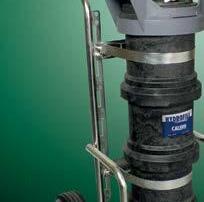
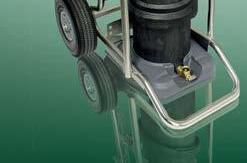
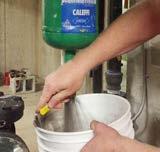
HYDROFILL™ portable water treatment lling units remove scale forming “hard water" minerals, such as calcium and magnesium from job-site water. Salts and other soluble minerals are eliminated to prevent reduced ef ciency and premature equipment failure due to scale build-up or galvanic attack.
HYDROFILL ™ is a convenient tool for installers to use job-site water to produce ideal grade demineralized water at an economical cost per gallon.
Heating & Cooling
Components for today's modern hydronic systems
GOOD DESIGN AND INSTALLATION KEY TO GROWTH
Important updates have been made to CSA B214 “Installation Code for Hydronic Heating Systems.”
BY LANCE MACNEVIN
It is well known in industry circles that when designed and installed correctly, hydronic heating and cooling systems deliver the highest possible efficiency and comfort to building occupants. Likewise, hydronic snow and ice melting systems provide safety, convenience and access in challenging winter environments. But like any system, if not installed correctly, these systems may underperform, malfunction and disappoint owners.
The reality is that I have heard too many stories from homeowners who paid thousands of optimistic dollars for “the best” type of heating, only to get a radiant heating system that was poorly designed and/or installed and not functioning correctly. Do you think these people recommend radiant heating to
their friends and family? Not likely. Professionals know that codes for plumbing and electrical systems are important to ensure that minimum safety and performance requirements are met. A well-written code that is understood by designers and contractors, and consistently enforced, can certainly lead to more satisfied owners and continued growth of the hydronics industry.
Hydronic heating systems in Canada do have a code. First published in 2001, CSA B214 “Installation Code for Hydronic Heating Systems” is that code. In fact, B214 has been referenced in the National Building Code of Canada since 2010, so it is actually the law of the land for jurisdictions that have adopted the 2010 NBC. Not all jurisdictions adopt the NBC on schedule or in its entirety, so always check with the local Authority Having Jurisdiction (AHJ) to determine local requirements.
However, anecdotal stories reveal that B214 is not always understood, or for that matter even known to exist. To help address this matter, for the past three years a dedicated team of hy-
dronic experts known as the B214 Technical Committee (TC) have worked together to make some important improvements to B214. On October 20, 2016 CSA Group announced the publication of the fourth edition of CSA B21416 “Installation Code for Hydronic Heating Systems.” As a member of the 27-person TC, which includes several members of the Plastic Pipe Institute (PPI), I am proud to be associated with this committee and of the result.
REVISION HIGHLIGHTS
The 2016 edition of B214 has been updated for improved clarity, including reorganization of several sections. Several new requirements, written in specific and enforceable language, have been added.
There are dozens of changes, but since I am a radiant and piping guy, here are seven notable revisions*:
1. Addition of PE-RT tubing
2. Inclusion of approved fasteners for heat distribution tubing
3. Revised maximum floor temperatures
• Easily disconnect and replace any portion of a piped system
THE WEBSTONE WAY REPLACES 6 COMPONENTS ELIMINATES 5 LEAK PATHS SAVES 45 MINUTES OF LABOR
• Install anywhere a drain or purge valve is required
THE WEBSTONE WAY REPLACES 2 COMPONENTS ELIMINATES 1 LEAK PATH SAVES 9 MINUTES OF LABOR
CODES AND STANDARDS
4. Clarifications on snow and ice melting systems
5. A new Annex C on radiant cooling systems
6. A new Annex D on minimum flow rates for heat distribution tubing
7. Notes added about potential risks, such as Legionella, in combined potable/hydronic systems
1. Polyethylene of Raised Temperature (PE-RT) tubing was introduced into the US market in 2007 with the publication of ASTM Standard F2623. In 2013, CSA Standard B137.18 was published. PE-RT tubing meeting either of these standards is now included in B214 as an approved piping material.
2. The Technical Committee heard about encounters with inspectors debating about which types of fasteners were approved for radiant or snow melt tubing. New Clause 14.4.4.1–Types of tube fasteners begins with “Unless prohibited by the manufacturer’s instructions, approved tube fasteners shall include the following,” followed by a list of five different types of tubing fasteners that manufacturers agreed should be allowed. This should prevent those type of disputes.
Also, since it is not always clear about the minimum spacing between tubing fasteners, new Clause 14.4.4.2–Spacing of tube fasteners spells this out. (Hint: “in the absence of manufacturer’s specifications” it is 0.75 m).
3. The previous B214 specified maximum floor surface temperatures in a way that was a bit ambiguous. Now, B214-16 Clause 14.2.1 says “Floor surface temperatures shall not exceed 29ºC (84ºF) in occupied areas, with the following exceptions:
a) 31ºC (88ºF) in industrial spaces;
b) 33ºC (91ºF) in bathrooms, indoor swimming pools, and foyers; and c) 35ºC (95ºF) in radiant panel perimeter areas, i.e., up to 0.8 m (2.5 ft) from outside walls.”
Radiant experts will note that the gen-
eral maximum floor surface temperature of “29ºC in occupied areas” is based on requirements published in ASHRAE Standard 55 –Thermal Environmental Conditions for Human Occupancy. Now, B214 is matching this recognized consensus standard. Worth noting is that HPAC contributor Robert Bean was the chair of the Standard 55 User Manual Project Review Committee; lead author for the Standard 55 Short Course and membership Chair for the 55 Standing Standard Project Committee.
“A well-written code... can certainly lead to continued growth of the hydronics industry.”
4. In B214-12, snowmelt systems were included with Auxiliary systems, not entirely appropriate. In B214-16, Chapter 17 is all about Snow and Ice Melt, with some updated requirements. For instance, ½ in. nominal PEX and PE-RT tubing are added to Table 3 “Loop lengths for snow and ice melt systems” since certain low-profile SIM systems need ½ in. tubing. Previously, ½ in. nominal tubing was not even allowed for SIM systems.
Also, Clause 17.5 on insulation for SIM systems no longer requires insulation on all vertical slab edges. If you think about it, vertical edge insulation at the edge of a driveway or ramp would be exposed to the elements and disintegrate, especially when hit with weed trimmers. In many cases, it is beneficial to allow heat to thaw the soil against the slab edge to allow for natural drainage of melted snow - frozen soil could cause an ice dam. So that requirement has been removed.
5. Radiant cooling systems, using chilled water to help cool an occupied
space through a floor, wall or ceiling, are really catching on for commercial and residential applications. Strictly speaking, B214 does not even apply to cooling systems. However, the Technical Committee agreed it was important to share some basic information about radiant cooling systems with B214 users, especially since it is usually the radiant heating system that operates as the cooling system. Therefore, a new “Annex C Radiant Cooling” has been added for informative purposes. Here is an excerpt:
“C.2 Radiant cooling surface temperatures
* For thermal comfort reasons, cooled floor surface average temperatures should not fall below guidelines set in ASHRAE 55 and this Code.
* Cooled floor surface average temperatures should not fall below 19íC (66íF) in occupied areas. Cooled floor, wall, or ceiling surface temperatures should not fall below the anticipated dew point of the space.
* To prevent condensation on any cooled radiant surface, the supply water temperature for a radiant cooling system should be a minimum of 2ºC (3ºF) above the anticipated space dew point, or as per manufacturer╒s system design.”
Annex C also includes information about controls, tube placement and thermally activated building systems.
6. Oversized heat distribution tubing in radiant heating or snow and ice melting systems can result in the flow rate through the tubing being too low. As a result, laminar flow can occur, whereby slow moving fluid clings to the inside of the tubing wall in a so-called boundary layer, effectively insulating the faster fluid in the middle of the tubing and reducing heat transfer through the tubing wall. This situation can reduce the heat output of a hydronic radiant heating or snow and ice melting system. The problem is rare in small diameter tubing, but it can happen.
To ensure good heat transfer through
The loyalty program that’s only for our All-Star professional contractors
The Navien route: loyalty rewards and no detours around contractors
The road to greater profits runs through Navien, the leader in condensing technology for boilers and tankless water heaters. Our new NavienRewards program shows how much we appreciate working only with professional contractors. Unlike other brands, we won’t take shortcuts with alternate distribution channels.
NavienRewards not only gives you the resources that drive more profitable sales, it also provides incentives for you and your team. No other manufacturer can match our contractor support.
Check out all the NavienRewards advantages, including one of eight chances to win a seven day trip for two to South Korea in February, 2018. You’ll enjoy two days at the Winter Olympics, factory tours and sightseeing. To be eligible, sign up today at NavienRewards.com. #NavienAllStars
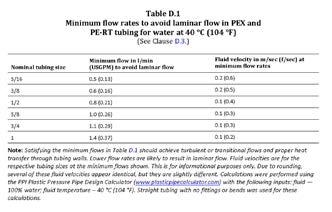
hydronic systems, designers should size heat distribution tubing to result in turbulent or transitional flow and avoid oversizing the tubing, which could result in laminar flow. A new “Annex D Minimum flow rates for heat distribution tubing” provides informative guidance on this topic, with a new Table D.1 Minimum flow rates to avoid laminar flow in PEX and PE-RT tubing for water at 40ºC (104ºF). Oversized tubing wastes money, so this might help someone avoid two problems.
7. HPAC’s Modern Hydronics I (2016) included the article Mixing hydronic heating water with potable water 1 It warned against the potential dangers of combined systems, which could allow Legionella to grow in water in idle heating pipes and then be transferred to the potable water system though connection to a shared heat source. This is a health and safety risk to building occupants, especially young and older people. Therefore, the TC added the following note about potential risks in combined potable/hydronic systems:
“The risk of creating an environment promoting the growth of pathogens such as bacterium Legionella pneumophila (Legionella) within a storagetype dual purpose water heater is reduced when the system is designed
and operated with a minimum tank water temperature of 60ºC (140ºF). In combined space- and water-heating systems, there is still the risk of growth of Legionella within the heating system, resulting in a potential risk to users of the plumbing system. Also, 60ºC (140ºF) water temperature is often too hot for a radiant heating system, and could damage flooring and tubing embedment materials, and overheat floor surfaces. Therefore, appropriate system, control strategy, and/or components should be utilized to reduce the risk. An example is the use of a heat exchanger.”
PPI Recommendation E, published last April, says “it is the recommendation of the PPI that designers and installers not specify or build systems where the mixing of hydronic water with potable water may occur.”2
CREDITS:
WORTHWHILE INVESTMENT
A code is not a design guide and B214 is intended to provide clear and enforceable minimum requirements for the safety and performance of hydronic heating systems. Experienced hydronic installers are likely meeting all these requirements already. Wouldn’t it be great if all installations did too?
We encourage all designers, installers, inspectors and distributors to get their own copy. It is even better if you educate your builders, customers and inspectors about how your systems are complying with B214, since even if B214 is not yet enforced in your region, knowledge of the code can be used as a positive marketing tool.
CSA B214 is not expensive and can be purchased at http://shop.csa.ca.
Lance MacNevin, P. Eng. is director of engineering for the Plastics Pipe Institute’s Building and Construction division and a member of CSA’s B214 Technical Committee. He is a mechanical engineering graduate of the University of New Brunswick. He can be reached at lmacnevin@plasticpipe.org.
Special thanks to CSA B214 program manager Jelena Vulovic for her support of this Technical Committee, and for permission to share these excerpts with readers.
* Use of a portion of CSA B214 “Installation Code for Hydronic Heating Systems” has been authorized by CSA Group. CSA Group is not responsible for the manner in which the data is presented, nor for interpretations. This material is not CSA Group’s complete and official position on the referenced subject, which is represented solely by the standard in its entirety. No further reproduction is permitted.
Table D. 1
HYDRONIC PRODUCTS
The Vitosol 100-FM and Vitosol 200-FM solar thermal flat plate collectors from Viessmann replace a significant amount of the annual energy required for DHW heating, while also providing back-up for the central heating system. The collectors have ThermProtect, a switching absorber layer designed to prevent damage from overheating. It switches from acting as an absorber to acting as an emitter when it reaches 167F (75C). Once the collector temperature is lowered, it switches back to its original state, absorbing and converting over 95 per cent of incoming solar energy into heat. www. viessmann.ca
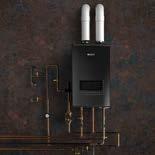
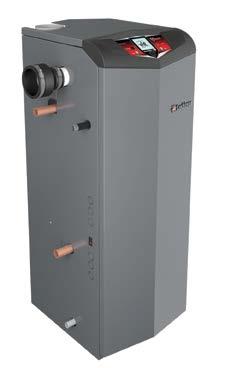
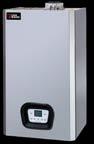
The CB Series of combination (combi) condensing boilers from Noritz perform at a 95 per cent AFUE. Delivering up to 9.2 gallons per minute of domestic hot water, the boilers feature a flow control valve to ensure a consistent temperature for domestic hot water demand, regardless of incoming water temperature. Two models accommodate a host of multiple-room applications including radiators, baseboards, low- and high-mass radiant heating and air handlers. Features include: a compact wall-hung package weighing 90 pounds, an outdoor temperature reset sensor, different temperature settings the domestic hot water heating and space heating applications. www.noritz.com
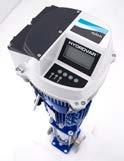
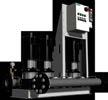
Xylem has released the fifth generation Hydrovar, a pump controller that adapts to system demands, resulting in cost and energy savings while achieving optimum system performance. Capable of running systems with up to eight pumps, the controller has multimaster functionality, enabling each individual pump to take control if one or more units or sensors are not active.
www.Hydrovar.com
Caleffi offers the SEP4 combination separator in sizes two to 14 in. ANSI flanged, with ASME Ustamp. It incorporates air and dirt (magnetic and non-magnetic) removal into the hydraulic separation function, which makes the primary and secondary circuits connected to it hydraulically independent. The SEP4 features an internal coalescing element that continuously and automatically eliminates air micro-bubbles with the simultaneous removal of dirt particles as tiny as five microns. www.caleffi.us
Webstone’s Pro-Connect Press product line now includes three more Pro-Pal items: TDrain, Union Ball Drain and Press x FIP Ball Drain. These items offer single-body brass designs that save space, time, money and leak paths. The product line is compatible with most press tools and is guaranteed for life. www.webstonevalves.com
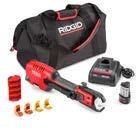
RIDGID’s one-handed, battery operated PEX-One tool weighs five pounds. It is purpose-built to press three sizes and features a compact design. Suited to overhead connections and accessing tight spaces, the tool is designed to provide full power through 150+ presses per charge with a five-second crimp cycle. The tool can press multiple size fittings up to one inch, and has interchangeable dies with a quick change system. It is compatible with ASTM F1807 copper crimp ring fittings. www.ridgid.com/ca/en
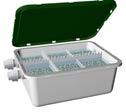
The NT15 from Axiom is designed to neutralize condensate from condensing boilers and furnaces operating on natural gas or propane. The condensate produced by these appliances is acidic and has the potential to harm the environment and the sewer system. The NT15 will neutralize the condensate to a more neutral pH level before it is discharged to drain. Features include 20 Gal/hr (75 l/hr) capacity, two piping configurations for fast and versatile installation, and low profile design for appliances with near floor condensate drain. An integral bypass prevents condensate backflow into the appliance. www.axiomind.com
HYDRONIC PRODUCTS
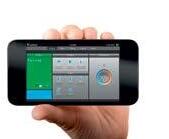
NaviLink is designed to support remote access for all Navien tankless water heaters (NPE series), combi-boilers (NCB-E series) and gas condensing boilers (NHB series) through the new NaviLink Wi-Fi control and mobile App. The Wi-Fi control will be able to report and monitor diagnostic data through the companion App along with error code notification. It reports: DHW and space heating set temperatures, current DHW temperature, DHW flow rates, inlet water temperature, total DHW consumption, average firing rate, cumulative gas consumption, and on demand activation tracking. Existing installations may require the purchase of a new main PCB and front control panel. www.navien.com
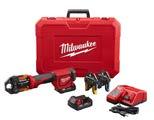
Milwaukee Tool has introduced a press tool for residential installations. The M18 Short Throw Press Tool Kit with Viega PureFlow Jaws delivers force optimized for low force applications. It has the capability to complete 400 one-inch connections on a single charge. Features include: no calibration interval; a prepress battery check prevents user from starting a press the tool cannot complete due to insufficient battery charge; and an auto-cycle ensures full press. A lightweight, in-line design enables the installer to press with one hand. Powered by Milwaukee REDLITHIUM batteries, the tool is fully compatible with the entire M18 line. www.milwaukeetool.com
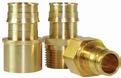
Uponor has introduced brass transition fittings for commercial piping applications. The ProPEX brass transition fittings come in sizes from 1/2” to 2”. The complete offering, which is manufactured from C36000 brass, includes 31 transition fittings that convert ProPEX connections to male thread, female thread, copper tubing sweat, copper fitting sweat and copper fitting press. www.uponor.ca
Asa Contractor you can count on what gives Aqua-Tech its energy. For 35 years Aqua-Tech, established by Founder Bill Palamar, has provided a product portfolio that delivers unmatched quality, performance and application flexibility. Solutions for residential and commercial needs.
Whether you require a gas, integrated domestic hot water system or hydronic boiler solution Aqua-Tech can deliver. From an energy efficient qualifying solution to On-time delivery …each is critically important.
With such solid solutions, who better to beYour Bridge to Success?
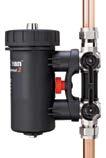
ADEY’s MagnaClean Professional2 features a patented magnetic and nonmagnetic filtration system that captures and removes suspended iron oxide in hydronic heating systems. Designed for 3/4-in. copper and 1-in. NPT iron pipework, the filtration system is suited to residential applications. It is a compact unit that is fitted on the return pipe to the boiler/circulator, via rapid-fit connectors. The unit has a quick-release trigger, low-profile drain valve and built-in air vent. Integral flow-diverters ensure 360-degree distribution for uniform flow around magnets. It also captures non-magnetic debris, such as limescale. www.adeyusa.com
The MAC (Modulating, Artificial-Intelligence, Combi) boiler from Utica Boilers is available in both combi and space heating models. Both versions are rated at 125 mbtu/h for Central Heating Mode. The boiler features the artificially intelligent control, or AI Control Technology. It automatically sets up during initial startup; has the ability to recognize natural or LP gas; and continuously monitors combustion and adjusts gas and air flow to optimize combustion and fuel savings. The control also measures water temperature, flue gas temperature, and pressure that can impact the boiler operation and CO levels. It will shut down operation if any of those values exceed normal operating levels. www.uticaboilers.com
GeoSmart Energy has introduced the NetZero series variable speed hydronic geothermal inverter heat pump system. The product is geared towards the NetZero/PassivHaus residential/commercial market and offers COPs over 5.0. It features Carel communicating controls, Copeland scroll compressor and inverter drive, and built in variable speed circulators. It is available in 3-12KW, 5-22KW, 12-40KW, 15-70KW, and 25100KW capacities. www.geosmartenergy.com
HYDRONIC PRODUCTS
Saniflo has introduced the SaniNuetral neutralizer kit, which incorporates neutralizing granules to increase the pH of acidic condensate water in residential and commercial applications. Condensate from boilers, water heaters, air conditioners and other appliances moves through the unit, which neutralizes it to prevent drain and sewer system corrosion. It can be used with or without a condensate pump. A starter pack of neutralizing granules comes with the unit. www.saniflo.com
The Comfort PM auto from Grundfos is suited to residential applications. The pump features a low noise permanent magnet motor, with energy consumption reduced to as little as 5-8.5 W. Utilizing AUTOADAPT ensures the pump only runs when required. Change pump settings by pushing the arrow button on the face of the pump. Features include a corrosion resistant brass housing and six ft. line cord. http://ca.grundfos.com
Greentherm’s 9800 SE 160/199 and 9800 SEC 199 indoor residential and commercial tankless water heater is suited to retrofit or new construction. It has top water connections, 60’ of two in. venting or 280’ of three in. venting. The water heater is self-adjusting for altitude and gas type. Service valves are already installed on the unit and models are available with recirculation pump. WIFI is available on all models www.boschheatingandcooling.com
Heatlink’s plug ‘n’ play electric boiler panels now have lower pricing on all models, including the six, seven and eight loop 30,000 BTU panels. The self-contained all-inone panels are available with 11Kw or 18Kw boilers, primary pump, and StatLink base module, and can serve up to eight loops to a maximum of 50,000 Btus using the HeatLink TwistSeal manifolds. www.heatlink.com
Viega’s insulated PEX barrier piping system is suited for use in heating, cooling and snow melting applications where underground distribution piping is necessary. The piping is a bonded system utilizing closed cell polyurethane foam insulation with a proprietary membrane to re duce off gassing. It is available with a complete range of piping and fitting offerings. High compressive strength allows for shallower trench depth or surface installations. The polyethylene (LDPE) jacket is UV treated and able to resist any impact or blows incurred during installation or transportation. No special tools are required to assemble fittings. www.viega.com
The THM-0500 is a four-stage full programmable P.I.D thermostat has a large, full graphic display with a low profile. It is designed to be simple to navigate using the touch screen control. When connected to the internet with the Wi-Fi Zoning system, the HBX Zone mobile app allows the thermostat to be controlled remotely. The thermostat allows for humidity and dew point control. It is designed to work with the Wi-Fi zoning system, utilizes only two wires (power and communication) to the ZON-0550 zone control. The thermostat is not a standalone unit. www.hbxcontrols.com/thm-0500.php
Tempstar offers a ductless unit line with efficiencies up to 30.5 SEER and 10.3 HSPF. The SmartComfort Deluxe Series includes both singlezone and multi-zone configurations. The multi-zone configuration can connect up to nine indoor units with a single outdoor compressor. In addition, these new systems feature wireless remote control capability, allowing customers to set the unit to one of five different comfort modes: cool, heat, dry, fan and auto. www.tempstar.com
Consider using Uponor PEX-a for your next Hydronic Piping project.
Sponsored Case Study Profile
Engineers and contractors are recognizing PEX as a technology that retains all the advantages of traditional piping materials, while adding unmatched flexibility and strength.
If you’ve been on a commercial jobsite recently, you may have seen an opaque white pipe being used for the potable-plumbing system. This pipe, called PEX — an acronym for crosslinked polyethylene — is quickly gaining popularity in the engineering and trades sectors due to its flexibility, durability, stable material costs and performance. And now that the commercial plumbing industry has gotten on the PEX bandwagon, hydronic piping professionals are starting to look at it as well.
From an application standpoint using Uponor’s Wirsbo hePEX™ can work with any terminal unit in a hydronic heating system — fan-coil units, baseboards, radiators, chilled beams, VAV (variable air volume) reheat terminal units, radiant manifolds, etc. Also, because of its copper tube size (CTS)-controlled outside diameter, switching to PEX-a piping involves minimal process change. All the hangers, pipe supports, insulation, etc. can be the same, offthe-shelf components used in a copper piping system. Uponor complements the full offering of product with extensive design services to make this switch a reality.
piping applications. The use of Uponor PEX pipe supports permits hanger spacing that is similar to copper pipe, so it reduces the required amount of hangers by half. And since fewer hangers mean lower material and labor costs, Uponor PEX pipe
Bridging the differences between Wirsbo hePEX pipe and copper in most applications is the Uponor PEX pipe support, a galvanized steel channel providing continuous support in suspended
Want to learn more?
support results in a less-expensive installation.
A major criticism of — and misconception regarding — PEX-a in commercial piping applications is its perceived lack of visual appeal. Con-
For more information on using PEX-a piping for your next
or to get a copy of Uponor’s Guide for Hydronic Piping email Jason Smith at jason.smith@uponor.com
tractors and building owners typically expect long, evenly spaced, rigid pipelines running through a building. It’s a look of solidity and durability that many associate with copper and believe PEX-a lacks. Fortunately, Uponor PEX pipe supports reinforce and cover the pipe, negating any aesthetic criticisms. Uponor PEX pipe supports also allow Wirsbo hePEX pipe to be run inside a plenum without spacing limitations between the horizontal runs.
But perhaps the most critical feature of Uponor PEX pipe support is its ability to control the natural expansion and contraction that occurs as the piping heats and cools. Installing anchors and using Uponor PEX pipe supports allow the piping system to function much like a copper system.
This ability to control PEX’s expansion and contraction is critical to allowing for a minimum redesign on a piping system when switching from copper. Thus, Uponor’s PEX pipe supports allow designers to leverage similar design schemes using Uponor PEX as they would for copper.
Engineers can be assured that, although Uponor PEX-a may still be new to them, it has been reviewed and approved as a reliable means of hydronic piping for more than 40 years. With its flexibility, durability and — in conjunction with Uponor PEX pipe supports — its ability to mimic copper’s rigid properties while offering several revolutionary improvements. The common hassles and uncertainties of switching from copper are completely alleviated, allowing the benefits of an improved piping system to stand out.
HOW WATER BEHAVES
BY MARK OLSON
Designers of modern hydronic systems strive for two important objectives: a reliable system and an energy efficient system. Achieving these requires proper equipment selection as well as attention to water quality. Unfortunately the latter is often overlooked, or left to the discretion of the installer, who may or may not appreciate its importance.
The two primary problems that can result from poor water quality are excessive corrosion and lime-scale accumulation. Both shorten equipment life and reduce energy efficiency.
No two systems are alike, which makes hydronic water chemistry an inexact science. Still, a basic understanding of how water behaves in a closed hydronic system can help the designer weigh options and determine appropriate water quality requirements.
In this article, we will discuss corrosion. Lime scale corrosion will be examined in a future article.
PROBLEMS
Corrosion eats away metal, which can cause components to leak or fail. Figure 1 shows a steel hydraulic separator with
a four millimetre diameter pinhole leak caused by corrosion.
As corrosion by-products form, they can flake off and flow through the system. Being denser than water, the debris can settle in areas of low flow velocity. One common location is within a boiler. This causes uneven heat transfer, which leads to thermally induced stresses across the boiler’s heat exchanger. Figure 2 shows the debris that caused failure of a three yearold cast iron boiler. Corrosion debris can also wear rotating equipment. For example Figure 3 shows magnetite, a corrosion byproduct that collected on the permanent magnet rotor of an ECM circulator.
Magnetite is harder than plate glass and because its particles can be as small as 1/100th the diameter of human hair, it is extremely abrasive. Note the scoring on the hardened pump shaft. Similar abrasion can occur on Orings and face seals.
CORROSION REACTIONS
Most corrosion in closed hydronic systems is electro-chemical in nature. An electrical current flows between adjacent metal surfaces and through the water.
To corrode, metal surfaces must be galvanically dissimilar. Copper and steel are examples of dissimilar metals that are
often joined together in a hydronic system. It is also possible for the same base metal to become galvanically dissimilar due to rolling, work hardening or welding.
Corrosion can also result when a given metal experiences different concentrations of dissolved oxygen at different surface locations. This changes the metal’s galvanic properties. It may seem counterintuitive that dissolved oxygen can have different concentrations within the same system, but at the molecular level it does and is the level that corrosion occurs.
Different concentrations of dissolved oxygen create a galvanic cell (A) as shown in Figure 4. The surface at the higher oxygen concentration becomes more noble (cathode) relative to the surface at the lower oxygen concentration (anode). A set of simultaneous chemical reactions occur, which result in depletion of metal at the anodic site and an accumulation of iron oxide at the cathodic site (B). The iron oxide residue begins to impede further corrosion so the formerly anodic site itself becomes both anodic and cathodic and corrodes. This continues until a somewhat uniformly corroded surface takes shape (C). The iron oxide that results is hematite (Fe2O3). It is reddish in colour, loosely adhering, porous, conducts heat
• See the newest, most innovative hydronic products
•
• Network with over 400 industry peers and professionals
•
• WIN great tools!
transfer poorly and can be easily sloughed away to collect somewhere.
If high concentrations of dissolved oxygen remain in the system, destructive pitting can occur. If oxygen levels are eventually depleted, which is desirable, the hematite may convert to magnetite (Fe3O4), which is grey or black. Figure 5 shows a contractor “blowing down” a magnetic dirt separator that has captured a large quantity of magnetite.
As previously mentioned, oxide accumulation can impede further corrosion. If the initial oxygen level within a hydronic system containing iron is low, a relatively thin, protective magnetite layer forms, as shown in Figure 4. Magnetite formed in this manner is ideal. It is dense, tightly adhering, conducts heat well and impedes further corrosion. Similar protective oxide layers form on other metal surfaces such as stainless steel, copper, and aluminum. To provide an added safeguard, some manufacturers oxidize or acid passivate the internal surfaces of products before they leave the factory.
The primary factors that determine the rate of corrosion are dissolved oxygen concentration, the electrical conductivity of the system fluid and the properties of
the metals used in the system.
In general, the corrosion effect of oxygen and the conductivity of the system fluid are interdependent. Water with high oxygen concentration and low electrical conductivity can produce similar corrosion rates to water with lower oxygen and higher electrical conductivity. Minimizing either is effective in minimizing corrosion. Minimizing both is optimal.
Figure 6 shows what happens when common table salt, a molecule of bonded sodium and chloride, is placed in water.
The powerful forces of water’s oxygen and hydrogen atoms dissolve the salt by breaking the sodium chloride bond. This forms charged ions, which give water its electrical conductivity. The higher the ion content the higher the conductivity.
Almost all inorganic solids in the earth’s crust are comprised of minerals, and like salt, they dissolve into water forming ions. The total dissolved solids (TDS) contained in water is determined by measuring its electrical conductivity and is expressed in units of parts per million (PPM).
Some manufacturers specify a maximum TDS level for the water used with their equipment. Others express a maximum electrical conductivity level, typically in units of µS/cm (micro Siemens per cen-
timeter). In either case the intent is to limit corrosion as well as scale formation.
The common positively-charged ions in water are calcium, magnesium, iron, sodium, manganese, and potassium. Common negatively-charged ions are bicarbonates, carbonates, chlorides, sulfate, nitrate and phosphate.
As the temperature of water increases, the ions within the water become more excited. This increases the water’s electrical conductivity. A rule of thumb is that for every 20F rise in temperature, corrosion rates double. This is why chilled water systems are significantly less prone to corrosion compared to heating systems given equal water quality in both systems.
If a designer could only choose one strategy to minimize corrosion, they should ensure that the system stays virtually devoid of dissolved oxygen.
Completely closed hydronic heating systems that have been fully purged of air at start-up will quickly rid themselves of minor amounts of dissolved oxygen. However, systems are never perfectly closed. Oxygen will slowly diffuse into any hydronic system. The rate of oxygen ingress varies depending on the materials used and the quality of workmanship.
Figure 1 Steel hydraulic separator
Figure 4 Corrosion process on a water/iron interface
Figure 3
Figure 2
Figure 2
courtesy of Ken Shockley
I SEE YOU’RE INTO HYDRONICS…
With the increasing popularity of non-barrier polymers the use of a high efficiency air separation device is essential to help maintain low dissolved oxygen levels.
OTHER POTENTIAL FACTORS
One potential factor involves pH – the measure of how acidic the system fluid is. Derived from the French term puissance d’hydrogene (power of the hydrogen), pH quantifies the concentration of hydrogen ions in solution. The potentially destructive nature of hydrogen, and its hydroxide counterpart, relate to its relatively small molecular size (illustrated in Figure 7).
As hydrogen ion concentration increases, acidity increases and pH value falls. Even at extremely low oxygen levels, metals can corrode if pH stays below or above a “happy range” for that metal. Non-alloyed aluminum has a happy range of 6.5 to 8.5 pH. For stainless steel the range is generally higher. One stainless boiler manufacturer specifies an acceptable range of 6.5 to 9.5 pH. The acceptable pH range for iron boilers is even higher. One cast iron boiler manufacturer specifies a 10.5 pH maximum for their boiler.
Fresh water in North America typically has a pH between 6.0 and 8.5. The pH of fresh water in closed hydronic systems exhibits an interesting characteristic: independent of beginning pH, the water in properly designed, pressurized closed heating systems tends to stabilize to about eight pH. This level is ac -
ceptable for all common system metals. The pH in some systems varies significantly from this value due to chemical additives or softening. For example, water softened through the common ion exchange process results in elevated sodium levels. When this water is heated, carbon dioxide is driven out of solution and vented away. Sodium hydroxide can form and pH can drift upward and stabilize above 8.5. Adding a pH inhibitor chemical to softened water is thus important for systems containing aluminum components.
Propylene glycol highlights another pH behaviour. Glycol acts as an oxygen scavenger, which causes the system fluid to become more acidic. Left unchecked, the pH can drop below the acceptable range for metals. Thus propylene glycol producers usually include an inhibitor that protects the system fluid against a rapid decline in pH.
Another potential factor is chemical corrosion. Excessive concentrations of certain chemicals will cause corrosion even in the absence of dissolved oxygen. For example, several stainless steel boiler manufacturers specifically limit chloride or sulfate concentrations. Not only do such chemicals dramatically reduce the effectiveness of chemical inhibitors, in sufficient concentration they can break down protective oxide layers and corrode the stainless steel. Boiler manufacturer specifications for maximum chloride and sulfate concentrations generally range from 25 to 200 PPM, al-
though inhibitor producers prefer the lower value. Most water municipalities are bound by national health standards requiring concentration below these values. However, private ground water sources can be problematic.
EUROPEAN APPROACH
With a hydronic market size many times that of North America’s, it is not surprising that several European countries have water quality standards addressing prevention of corrosion in closed hydronic systems. Germany’s standard is VDI 235. Similar to the others, VDI discourages the use of chemical additives and instead promotes water behaviour understanding, sound system design/operation practice and treatments such as deionization that do not involve additives.
North America does not currently have comparable water quality standards for hydronic systems. However, with more North American companies increasing their efforts to help ensure proper water quality in hydronic systems, we may well be on the way.
Mark Olson, Caleffi North America’s GM and CEO since 2005, holds an MSE degree in applied mechanics from the University of Michigan. His 30 years’ of experience includes engineering, sales and marketing management positions with Whirlpool Corporation, Pentair and Generac Power Systems.
Figure 5
Figure 6
Figure 7
MORE POINTERS FOR COMMERCIAL PUMPS
Net positive suction head (NPSH) and cavitation on centrifugal pumps.
BY MIKE MILLER
In HPAC’s December 2016 issue the article Troubleshooting Pointers for Commercial Pumps (page 52) discussed some of the more common but simple reasons for pump issues that may be resolved without major work. This article serves as a continuation of that discussion with a focus on net positive suction head (NPSH) – a very important detail that must be considered (as several readers pointed out to me after the December article). Reader feedback and opinions are very much valued and appreciated–keep them coming.
As a reminder, this article will not discuss cavitation caused by air entrainment in the fluid or vortexing caused by the piping arrangement as it was discussed in December.
NPSH refers to the minimum suction head required to prevent cavitation in a pump. Look at NPSH as the head corresponding to the difference between the actual pressure at the inlet (suction side) of the pump and the fluid vapour
pressure. An incorrect determination of NPSH can lead to reduced pump capacity and efficiency, severe operating problems and cavitation damage.
NPSH needs to be properly defined as two separate entities: NPSH required (NPSHR) and NPSH available (NPSHA).
NPSH REQUIRED
The required or minimum NPSH is dependent on the design of a particular pump and is determined by the manufacturer’s testing of each pump model. The pump manufacturer can plot this required NPSH for a given pump model on performance curve and this value, expressed as feet of the liquid handled, is the pressure required to force a given flow through the suction piping into the impeller eye of the pump.
Required NPSH can also be defined as the amount of pressure in excess of the vapour pressure required by a particular pump model to prevent the formation of vapour pockets or cavitation. Required NPSH then varies from one
pump manufacturer to the next and from one manufacturer’s model to another. The required NPSH for a particular pump model varies with capacity and rapidly increases in high capacities.
AVAILABLE NPSH
The available NPSH, on the other hand, is dependent on the piping system design as well as the actual location of the pump in that system. The NPSH available, as a function of system piping design and layout, must always be greater than the NPSH required by the pump in that system or noise and cavitation will result. The available NPSH can be altered to satisfy the NPSH required by the pump if changes in the piping fluid supply level, and so on, can be made. Increasing the available NPSH provides a safety margin against the potential for cavitation. The available NPSH is calculated by using the following formula:
NPSHA = ha (+/-) hs - hvpa – hf ha = atmospheric (open loop system)
Table 1 Atmospheric pressure versus altitude
Table 2
‘‘
‘‘ ‘ ‘ My clients trust me. I trust HeatLink.
“ Our decision to choose HeatLink as our preferred PEX provider has been a good one. Vitullo Plumbing has been installing HeatLink PEX products and plumbing systems for years now. We count on HeatLink to deliver innovative products with outstanding performance in the field–all backed by a great warranty. Our clients trust we’ll do the job right–and we trust HeatLink to deliver the products we need to do it right.”
HeatLink potable water, snow melt and radiant hydronic heating/cooling systems are made to perform in the field. All our products are certified to meet or exceed industry performance standards and are approved for use by contractors across North America. Each system has been
– Pat Vitullo, President, Vitullo Plumbing
engineered to set the mark in energy efficiency too. We’ve worked hard for over 20 years to build the products contractors can count on. Plus, our products are backed by HeatLink’s 25 Year Warranty. Give HeatLink systems a try and we hope to earn your trust too.
Vitullo Plumbing installs HeatLink plumbing systems in their residential building projects.
or system (closed loop system) pressure in feet. (Note: atmospheric conditions change with altitude above sea level as shown in the example in Table 1)
hs “+” = head in ft above suction centerline in open loop or positive pressure in a closed loop system in feet gauge
hs “-” = head in ft below suction centerline in open loop or negative pressure in a closed loop system in feet gauge hvpa = vapour pressure of the fluid in feet absolute (changes based on fluid temperature - see example in Table 2) hf = pipe friction in feet between
pump suction and suction reference point. Beware, this must be calculated based on distance and piping material and size, as well as fittings and valves used in the system.
Cavitation can be defined as the formation and subsequent collapse of vapour pockets in a liquid. Cavitation in a centrifugal pump begins to occur when the suction head is insufficient to maintain pressures above the vapour pressure. As the inlet pressure approaches the flash point, vapour pockets form bubbles on the underside of the impeller vane, which collapse as they move into the high-pressure area along the outer edge of the impeller. Severe cavitation can cause pitting of the impeller surface and noise levels audible outside the pump.
A sample pump performance curve (Figure 1) includes a plot of the required NPSH for a pump model. If a pump ca -
Figure 1
pacity of 105 GPM is used as an example capacity requirement, reading vertically from that GPM rate shows a required NPSH of four feet for this particular model. An available system NPSH greater than four feet would therefore be necessary to ensure satisfactory pump performance and operation.
Now let’s look at an open loop system as an example to calculate the NPSHA. Use the formula and tables above to de -
termine that. In our sample system, we are using an open cell cooling tower (fluid at 68F), an end suction pump and a centrifugal chiller at 4,000 ft elevation as shown in Figure 2, with a flow rate of 100 GPM running through 100′ of 3″ Sched 40 pipe.
NPSHA = 29.4 ft (ha) + 5 ft (hs+) –0.78 ft (hvpa) – 2.8 ft estimated using online Friction Loss Tool (hf) = 30.82 ft
When you make a selection for the ap -
propriate pump to be used in this application, simply remember the earlier statement that the NPSHA is greater than the pump’s NPSHR (see pump performance published data).
Like many things in life, the above represents rules of thumb and the most common applications and calculations that will aid in the majority of your troubleshooting needs. However, there are always exceptions to the rule and understanding the makeup of the principles will help you find a solution when you are faced with an exception.
Mike Miller is past chair of the Canadian Hydronics Council (CHC) and director of sales, building services Canada with Taco Inc. He can be reached by e-mail at hydronicsmike@taco-hvac.com.
Figure 2
CONQUEST® GAS WATER HEATERS
100 GALLONS STORAGE
15-YEAR TANK WARRANTY IS STANDARD
CONQUEST® GAS WATER HEATERS
130 GALLONS STORAGE
399,000 to 800,000 Btu
Modulating Burners Available
TANK WARRANTY IS STANDARD
thermal efficiency
POWER VTX® GAS WATER HEATERS
225 GALLONS STORAGE
500,000 to 1,000,000 Btu
Modulating Burners Standard
199,000 to 300,000 Btu 15-YEAR TANK WARRANTY IS STANDARD www.pvi.com
ENGINEERED DUPLEX ALLOY
AquaPLEX is a remarkable new water heater tank material created by alloying 300 and 400 series stainless steels and capturing the benefits of both. Fully pickle-passivated after complete tank fabrication, AquaPLEX is naturally corrosion-proof in potable water regardless of stored water temperature.
• Tank walls are solid AquaPLEX. There is no lining, coating, cladding or plating of any kind. Nothing that can erode, crack, delaminate or wear through over time and expose a steel tank to water
• No anodes of any type are required. AquaPLEX tanks are unaffected by aqueous or galvanic corrosion so an anode rod has nothing to do. And this means tank life cannot be compromised by insufficient anode rod “reach” or condition
• AquaPLEX is immune to chloride-induced stress corrosion cracking; a known failure mode for 304L and 316L stainless steel in hot potable water
• AquaPLEX is as much a process as it is a material. Tanks and welds are designed to eliminate crevices and we employ unique fabrication processes to ensure maximum longevity of the tanks
Better Boilers
RESIDENTIAL CONDENSING BOILERS
SL SERIES
THE MOST ADVANCED STAINLESS STEEL FIRE TUBE BOILER ON THE MARKET
95% AFUE
4 ZONE PUMP CONTROL BUILT-IN
LONGEST VENT LENGTHS - Up to 200 feet in 2” and 480 feet in 3”
MFZ TECHNOLOGY: MOISTURE MANAGEMENT SYSTEM Protects and ensures long life for all components in the boiler
With supply and return connections on both sides of the
go left, go right or use both!
MECHANICAL SUPPLY NEWS
MANUFACTURERS • DISTRIBUTORS • WHOLESALERS
HURST BOILER CELEBRATES 50 YEARS IN MANUFACTURING
Established in 1967, Hurst Boiler & Welding Company is marking 50 years of international industrial boiler and controls manufacturing and solutions success. The company began as a small operation repairing industrial boilers and equipment. Today it has more than 250 employees, and 130 privatelyowned representative organizations worldwide. Hurst’s main manufacturing facility has grown to 300,000 sq. ft., which is housed on an 18-acre campus in Coolidge, GA.
Axiom’s new building includes a lab for continuous testing of
Hurst Boiler has plans for strategic expansion into new markets, as well continued product innovation. Currently the company manufactures, designs, engineers and services gas, oil, coal, solid waste, wood, biomass and hybrid fuel-fired steam and hot water boilers. Also specialized in the manufacturing of modular biomass boiler systems, Hurst’s boiler vessel designs (CRN registered) include firebox, vertical tubeless, hybrid water/ fire-tube, and water-tube. Hurst manufactures seven different types of biomass stoker/gasifiers, which have used more than 2,000 different types of biomass fuels. www.hurstboiler.com
AXIOM MOVES ON UP TO LARGER SITE, ON-SITE RESEARCH LAB
Axiom Industries Ltd. – manufacturer of specialty products for hydronic systems – has moved to a new office and production warehouse located at 3603 Burron Avenue in Saskatoon, SK. The state of the art building includes 21,000 sq. ft. of production and warehouse space plus 6,000 sq. ft. for offices and a new research lab.
“While the new facility enables the company to store and produce all of its products under one roof, it also brings about significant improvements in manufacturing efficiencies. Our new lab enables us to maintain continuous testing of our products under controlled conditions,” said Kirk Nagus, Axiom general manager.
www.axiomind.com
CELEBRATING A HALF CENTURY OF JOINING TECHNOLOGY
TurboTorch, an ESAB brand, is celebrating its 50th anniversary in 2017. TurboTorch was the brand name for the air-fuel products introduced by Wingearsheek, Inc., of Peabody, MA. The products featured a patented air-swirl technology invented by company co-founder Alex Wormser. Burning hotter than other air-fuel torches, TurboTorch’s Extreme line of self-lighting and standard torch tips create a “wrap around” flame effect to heat pipe evenly and quickly. By the early 1970s, air-swirl technology became popular for brazing and soldering.
“TurboTorch Extreme air-acetylene torches set the highest industry standards for performance, reliability, durability and safety,” says Paul Eckhoff, director, product line management, ESAB. “Contractors have trusted TurboTorch to help them to earn their livelihood for 50 years.” www.esab.com
The “wrap around” effect of a TurboTorch Extreme Swirl tip is designed to distribute heat on all sides of a joint.
In addition to a complete line of steam and hot water boilers, Hurst Boiler also manufactures a complete line of boiler parts and boiler room peripherals and provides turnkey after-market products and services.
products.
MESTEK EXPANDS METAL FORMING CAPABILITY
Mestek Machinery is now the exclusive provider of the Harper-type Vanemaker and Railmaker, previously offered by Harper Metal Products. The machines are for roll forming push-type side rails and double wall air turning vanes. With more than 100,000 square feet of manufacturing space at its disposal, the Mestek Machinery family of companies—Engel Industries, Iowa Precision, and Lockformer—is hedquartered in Cedar Rapids, IA. www.mestekmachinery.com
NORTEK GLOBAL HVAC LAUNCHES NEW MICRO-CHANNEL WEBSITE
Nortek Global HVAC has revamped and improved its micro-channel coils website to include more training and technical content. “We want to teach contractors how to successfully work with Micro-Channel coils with this site,” said Carol Baker, vice president of global marketing, Nortek Global HVAC. “There’s a lot of misleading information out there, and we hope to separate fact from fiction.”
SCHNEIDER ELECTRIC AND PANASONIC PARTNER TO SIMPLIFY ENERGY MANAGEMENT
Schneider Electric and Panasonic Corporation recently announced an integrated HVAC equipment and building management solution. Both companies have developed an interface wireless solution, which enables direct serial communication between Schneider Electric’s building management system and room controllers with Panasonic’s variable refrigerant flow (VRF)-based HVAC systems via the ZigBee wireless communication standard.
This integration allows building owners and managers to view all core building systems including HVAC equipment, lighting, security, power and electrical distribution anytime and anywhere via a single interface. According to the companies, it also delivers actionable insights to reduce energy consumption and drive savings.
The joint Schneider Electric/Panasonic solution can be installed wirelessly and plug-and-play technology simplifies system configurations for extensive VRF systems. www.schneider-electric.com www.aircon.panasonic.com
MULTISTACK EXPANDS CLIMATE CONTROL PRODUCT LINE
CHALLENGES AHEAD FOR GLOBALIZATION
Functionally, the revamped site offers performance benefits, charging best practices, history and additional resources for training and education. The company is also running a sweepstakes to encourage training and offer contractors the chance to win one of several prizes. www.microchannelfacts.com.
Multistack, LLC, a privately held Sparta, WI-based manufacturer of chiller systems and heat pumps, has acquired Desert Aire Corp., a Germantown, WI-based manufacturer of commercial and industrial humidity and climate control systems. Multistack will operate Desert Aire as a wholly-owned subsidiary. The two companies will maintain separate Wisconsin headquarters, engineering and manufacturing facilities. According to a media release from Multistack, executive teams of the two companies will remain intact.
Multistack employs over 160 people at its Sparta facility, Desert Aire employs over 80 people at its facility in Germantown. www.multistack.com www.desert-aire.com
Ottawa’s political landscape, the Young Executive Society (YES) and awards honouring member achievements were among highlights of The Canadian Institute of Plumbing & Heating (CIPH) Ontario Region Business Meeting and luncheon, held January 19 at the Mississauga Convention Centre. The event drew 101 attendees.
Guest speaker Paul Wells, The Toronto Star national affairs columnist, said that Prime Minister Justin Trudeau in some ways leads a government in crisis. “How he responds will go a long way in making or breaking his career as prime minister—I’m talking about the crisis of globalization,” Wells said.
Trudeau operates in a world rejecting some of globalization’s assumptions, Wells said. Brexit, Donald Trump’s election and the rise of far-right sentiment in Europe provided examples of this trend. Facing this, Trudeau is seeking infrastructure investment while touting Canada as stable and prosperous to international business.
Another industry challenge–that of
The revamped Nortek site offers performance benefits, charging best practices, history and additional resources for training and education.
Wayne Griffin (centre), estimator, Bardon Supplies, recipient of CIPH Ontario’s 50-Year Service Award with Paul Blaik, Ontario region president and Ralph Suppa, CIPH president and general manager.
Test Quicker Than Ever Before
• Part of the Smart Probes family which now includes the 770-3 Clamp Meter and 552 Micron Gauge
• Measures high-side & low-side refrigerant pressure and temperature simultaneously
• Compact wireless AC/R test kit works with Testo app using your smart device
• Low-loss AC/R system checks No hoses required!
with testo apps
attracting people to careers in plumbing and heating–was addressed at the meeting. YES provides training, networking and other career help, reported Josh Hopkins, CIPH Ontario Region YES Chairman. Those 40 and under and employed by a CIPH member company can participate. The society will host a panel discussion at the Mississauga Convention Centre on March 9.
The next CIPH Ontario Region Business Meeting will be held March 30, 2017. www.ciph.com
FIFTH DESCHÊNES TAKES ON PRESIDENCY OF GDI
François Deschênes, GDI president and chief executive officer
Groupe Deschênes Inc. (GDI) has appointed François Deschênes as president and chief executive officer. He previously held the position of vice president, operations, for GDI’s Quebec Region. Martin Deschênes, outgoing president and CEO of GDI, assumes the position of vice chairman of the board of GDI and will continue to work on special projects. He will become chairman of the board of AD Canada P&H buying group, a position previously held by François Deschênes.
A ceremony that gathered approximately one thousand employees on the factory floor marked the first VRV unit off Daikin’s Texas production line.
FIRST DAIKIN VRV UNIT ASSEMBLED AT DAIKIN TEXAS TECHNOLOGY PARK
Daikin Texas Technology Park, Daikin North America LLC’s new $417 million, four million sq.-ft. campus located outside of Houston, recently welcomed its first VRV unit off the production line during a celebration led by CEO Takeshi Ebisu. Daikin introduced VRV units in 2005 with products imported from Japan and Europe. In February 2014, Daikin was the first HVAC manufacturer to operate assembly lines for VRV outdoor units in North America with limited production in Houston, TX. Now with the opening of Daikin’s new state-ofthe-art campus in Waller, TX, the production of current VRV units, as well as the development of new product designs will “increase productivity drastically by 22 per cent and lead time will decrease substantially in order to respond to customer demand,” said Kou Ishitani, Daikin senior vice president of manufacturing. www.daikinac.com
INNOVATION TOUR OFFERS
CONTINUING EDUCATION, NEW HVAC TECH
Modine Manufacturing Company is set to begin its 2017 Innovation Tour, which will offer new and updated CEU/NATE courses and showcase the latest in HVAC solutions for specifying engineers and contractors at more than 30 loca -
tions, including four in Canada. The tour will be in eastern Canada in May, Calgary in September, and in Edmonton and Vancouver in October.
“Last year was our ‘maiden voyage’ with the innovation tour and we had more than 1,000 attendees and issued more than 2,000 CEUs,” said Kimberly Raduenz, marketing communications manager for Modine.
The 2017 Innovation Tour will feature professional development seminars designed by the Modine HVAC engineering team and the Milwaukee School of Engineering on various HVAC technologies. many more.
The 2017 Innovation Tour kicked off in Las Vegas; the first official stop was held in Pasadena, CA on February 7. www.modineinnovationtour.com
Aalberts Industries N.V. has reached an agreement to acquire 100 per cent of the shares of Shurjoint Piping Products USA, Inc., Haohan Metal Co. Ltd. and Shurjoint Metals Inc. Shurjoint is known for the development, manufacturing, sales and distribution of grooved components for mechanical piping systems. Shurjoint’s engineering, sales and distribution are managed in North America. The company’s portfolio of mechanical piping components includes more than 3,000 items in sizes from 1/2″ to 104″.
Aalberts Industries N.V. acquired Conbraco Industries in 2010. Conbraco manufactures bronze, brass, steel and stainless steel valves and a range of backflow preventers sold mainly in the commercial, industrial and consumer market (retail) under the brand APOLLO Valves. www.aalberts.com www.shurjoint.com
SINCLAIR SUPPLY OWNER AND PRESIDENT RETIRES
Long-time owner and president of Sinclair Supply Ltd. Dan Sorochan retired recently after over 70 years with the company. During that time he grew the company to 17 branches across western Canada, keeping pace with advancements and innovations throughout the industry. Along with a commitment to service and excellence, Sorochan’s leadership style cultivated a family atmosphere at the office. This is clear from the tribute his colleagues circulated to the media. A world traveller and philanthropist, Sorochan was a great advocate and supported of the industry throughout his career.
Sinclair Supply celebrated its 70th anniversary last April. Ownership of Sinclair Supply has not changed, further testament to Dan on his foresight in gathering the right people to carry on his vision.
Dan Sorochan started working at Sinclair Stove & Heating, which was located in a two-car garage in Edmonton, in 1947 as a “general purpose” employee working in the warehouse, doing deliveries and selling, among other tasks.
Paul K. Lachambre is now the president and Milan Tuba remains as the CEO. www.sinclairsupply.ca
Noritz America has promoted company veteran Jay Hassel from his current post as vice president of sales and marketing to president and chief operating officer making him the first American to serve as president for Noritz’s North American subsidiary. He succeeds Hisashi Uryu, who retains the title of chief executive officer while also returning to the parent company in Japan to serve as an officer for Noritz Corporation.
Two other key management promotions followed Hassel’s appointment. Senior marketing and customer care manager Jason Fleming was named vice president of sales and marketing, reporting to Hassel. National account manager Jason Corey was promoted to the new position of national sales manager, reporting to Fleming. Fleming and Corey are also seasoned professionals in the plumbing and hardware fields, each with more than two decades of experience, including a decade or more with Noritz.
Wil VandeWiel has been promoted to chief executive officer of Taco Comfort Solutions. He joined the 96-year-old privately held company in December 2014, in the position of president and chief operating officer. Taco Comfort Solutions’ chairman and owner, John Hazen White, Jr. will focus to an even greater degree on strategic planning and total Taco growth going forward.
Stefan Brosick
Camfil Air Pollution Control (APC) has appointed Graeme Bell to the position of vice president, Camfil APC Americas. Bell will relocate from Europe to Camfil APC corporate headquarters in Jonesboro, AR, where he will hold full responsibility for the manufacturing, technical and training facility there, as well as North and South American sales operations for the company’s dust, mist and fume collection products.
In her new position of Canadian sales manager with Riobel, Renee Demarco is overseeing the Canadian sales team with the exception of Quebec. She is reporting to Luc Lefebvre, North American director of sales. Demarco has been working in the plumbing industry for 15 years and has been with Riobel for seven years.
Weil-McLain has named Stefan Brosick as vice president and general manager, based at the company’s Burr Ridge, IL location. The general manager position is new to Weil-McLain and was created to accelerate integration and execution of the company’s sales, channel management, and product development strategies to fuel future growth. Brosick joins the company with significant leadership experience at companies such as Doosan Infracore and Ingersoll Rand.
WaterFurnace International, Inc. has named John C. Thomas president and chief executive officer. Thomas takes over from Fred Andriano, who served as interim CEO. Andriano will continue his financial roles within NIBE and WaterFurnace. Thomas’ career with WaterFurnace supplier Regal Beloit, as well as General Electric, spans several decades in a succession of progressively responsible roles.
Renee Demarco
Graeme Bell
Dan Sorochan has retired after more than 70 years with Sinclair supply Ltd.
Jay Hassel Jason Corey Jason Fleming Wil VandeWiel
Stefan Brosick
John C. Thomas
today’s cool choice
The ideal replacement for R404A in supermarkets is here — Honeywell Solstice ® N40 (R448A).
There’s no need to wait for a replacement solution. Honeywell has you covered. Solstice N40 is a versatile, blended, ASHRAE A1-rated refrigerant that satisfies all your low- and medium-temperature refrigerant replacement needs. Plus, it’s 5-10% more energy efficient than R404A! Its close match to existing equipment designs and compressors makes for rapid, cost-efficient adoption, and its GWP is 40% lower than R404A, making it a good choice to meet evolving regulatory standards. It’s also a superior replacement for R22 with a good capacity match and no TXV changes.
The compact E3 Compression Latch from Southco, Inc. has a lightweight, shortened housing, which allows it to fit into small, enclosed areas. The latch is tested to EN45545 and meets NEMA 4 and IP65 standards for water and dust protection, making it suitable for various industry applications. The E3 features a variety of grip lengths and comes in several head style options. The compact E3 is available with or without pre-installed cam options. www.southco.com
Munters’ Integrated Customer Air Handler (ICA) is an energy-efficient humidity and temperature control solution available in several configurations. The ICA system includes a dehumidifier and nine desiccant rotor size options, heating and cooling coils, refrigeration package and supply and return HEPA filters. With the option to include RightDry technology, customers can use low temperature reactivation sources for applications needing supply air delivered at 15gr/lb (20F dew point) or above. The ICA with RightDry comes in configurations of up to 100,000 cfm. www.munters.com
The DataSox from DuctSox is a customizable air displacement ventilation ductwork system with onsite directional-adjustability for cooling commercial data centre equipment. The round, overhead and porous fabric HVAC duct system distributes air down into data centre cold aisles with low 400-FPM velocities. It provides directional spot cooling with adjustable nozzles for high wattage servers. The system features a ¼-in. to ½-in. w.g. of static pressure providing cold aisle temperatures. Standard diameters range from 14-in. to 48-in. and custom sizing is available. DataSox is UL-2518 and NFPA-90 compliant for fire and smoke regulations. www.ductsox.com
The SmartSense excess flow valve and thermal shutoff device from Dormont protects against excessive gas flows, gas-related fires and explosions. SmartSense has an internal valve mechanism that reduces gas flow if there is a downstream gas line rupture. Once fixed, SmartSense resets and a normal gas flow is restored. SmartSense includes thermal shutoff capabilities—each valve activates and automatically stops gas flow when exposed to temperatures between 350F and 425F. www.dormont.com
The Napoleon Allure Phantom Series electric fireplace features a mesh front and matte surround, along with high intensity LED lights. The flame colour is adjustable and has the option of orange, blue or mixed flames. The heater can be turned on or off with the included multifunction remote or touch panel controls. The series comes in 42-in., 50-in. and 60-in. sizes and heats rooms up to 400 sq. ft. http://napoleonfireplaces.com/
Fresh-Aire UV introduces the Mini UV CE, an ultraviolet germicidal irradiation (UVGI) light system. The system has an advanced active power supply with a digital filtering process to accommodate every mini-split heat pump brand. Miniaturized components fit all ductless A/C brands and compact mini-split spaces in commercial and residential applications. The Mini UV CE inhibits mould and other biological growth on blower and evaporator coil surfaces. It also sterilizes germs, viruses, allergens and other pathogens. The system includes adhesive clips for mounting the two lamps. www.freshaireuv.com
RAE Coils’ heating coil line offers standard steam, steam distributing and hot water coils to regulate the temperatures of buildings and products. The company can build products with vertical tubes, vertical airflow, condensate connection options and pitched or non-pitched tubes in several configurations. All heating products are leak tested underwater up to 400 PSI where necessary. RAE Coils’ program, Quick Date, lets customers choose the date to receive their products. www.RAECorp.com
The York touchscreen residential thermostat from Johnson Controls offers near field communication, short-range wireless technology and a dedicated distributor app for Android devices. Contractors can preconfigure settings before arriving and control fault features. The thermostat has a quick heat and cool feature and provides ENERGY STAR Most Efficient performance when connected to select York home comfort systems. Contractor contact information can be uploaded. www.york.com/lxseries
Vicenza pellet stoves use smart zone heating technology to distribute heat evenly throughout a house. The Vicenza features automation technology, variable fan motors and quiet operation modes. The stoves have self-cleaning modes, onboard diagnostics and WiFi-capable technical support. They are available in three models—the V3.4, V4.5 and V5.2—with heating capabilities from 34,000 to 52,000 BTUs. www.VicenzaHome.com
Daikin’s Magnitude WME Generation 2 magnetic-bearing chiller features compressor technology with a wider operating envelope for demanding applications. The WME Gen 2 features higher lift capability for harsher climates and two impeller options. The WME 501 and 701 models suit standard lift conditions, while the WME 502 and 702 are optimized for lower load, higher lift conditions. High lift models operate with up to 95F entering condenser water temperature. Where designs require unloading at constant entering condenser water temperature, Magnitude WME Gen 2 provides flexibility to maintain stable chiller operations at low load conditions. WME Gen 2 models can be rated at higher capacities. www.daikinapplied.com
The XEU1series of electric forced-air explosion-proof heaters from Hazloc Heaters suit rugged industrial applications in hazardous locations. They feature a 3kW heater model, LED pilot light and continuous fan option. XEU1 heaters meet CSA and UL Certification Standards to Class I & II, Div. 1 and 2, Groups C, D, F, and G and Class 1, Zones 1 and 2, Groups IIA and IIB. The three cabinet sizes include the ExCaliber air evacuated liquid-to-air heat-exchanger cores available in 35 model choices of voltage and heat output combinations. The heater incorporates an immersion heater, high performance fan and motor assembly, a 14 GA steel cabinet with epoxy/polyester powder-coating, dual safety high limits, a vent relief device, large control enclosure with an extra port and enclosure O-rings. www.HazlocHeaters.com
Tjernlund’s Radon VAC (Variable Aspiration Control) system is designed to reduce radon across several sub-slab soil types. The system consists of a plug-in fan, exterior hood and installer-purchased PVC pipe. It features a sealed, galvanized housing and a PSC permanently lubricated low-watt motor. The system evacuates through the basement sidewall and the corrosionproof hood dilutes radon gas with outdoor air, propelling it away. Airflow velocity is adjustable at the hood. A rubber isolating mounting bracket eliminates vibration transfer and rotates 360 degrees. www.tjernlund.com
Introduction to
REFRIGERATION DEFROST METHODS
part i
Modifications to basic defrost schemes add yet another layer of complexity for field service personnel. BY BOB SCHINDLER AND DAVE DEMMA
It is inevitable that refrigeration systems operating with saturated suction temperatures below freezing will eventually experience an accumulation of frost on the evaporator tubes and fins. The frost serves as an insulator between the heat to be transferred from the space and the refrigerant, resulting in a reduction in evaporator efficiency. Therefore, equipment manufacturers must employ certain techniques to periodically remove this frost from the coil surface. Methods for defrost can include, but are not limited to off cycle, air defrost, electric and gas (which will be addressed in Part II in the March issue). Also, modifications to these basic defrost schemes add yet another layer of complexity for field service personnel. When properly setup, all methods will achieve the same desired result of melting the frost accumulation. If the defrost cycle is not set up correctly, the resulting incomplete defrosts (and reduction in evaporator efficiency) can cause higher than desired temperature in the refrigerated space, refrigerant floodback or oil logging issues.
For example, a typical meat display case maintaining a product temperature of 34F may have discharge air tempera -
tures of approximately 29F and a saturated evaporator temperature of 22F. Even though this is a medium temperature application where the product temperature is above 32F, the evaporator tubes and fins will be at a temperature below 32F, thus creating an accumulation of frost. Off cycle defrost is most common on medium temperature applications, however it is not unusual to see gas defrost or electric defrost in these applications.
Figure 1 Frost buildup
OFF CYCLE DEFROST
An off cycle defrost is just as it sounds; defrosting is accomplished by simply shutting off the refrigeration cycle, preventing refrigerant from entering the evaporator. Even though the evaporator might be operating below 32F, the air temperature in the refrigerated space is above 32F. With the refrigeration cycled off, allowing the air in the refrigerated space to continue to circulate through the evaporator tube/fins will raise the evaporator surface temperature, melting the frost. In addition, the normal air infiltration into the refrigerated space will cause the air temperature to rise, further assisting with the defrost cycle. In applications where the air temperature in the refrigerated space is normally above 32F, off cycle defrost proves to be an effective means for melting the buildup of frost and is the most common method of defrost in medium temperature applications.
When an off cycle defrost is initiated, the refrigerant flow is prevented from entering the evaporator coil using one of the following methods: use a defrost time clock to cycle the compressor off (single compressor unit), or cycle off the system liquid line solenoid valve initiating a pump-down cycle (single compressor unit or multiplex compressor rack), or cycle off the liquid solenoid valve and the suction line regulator in a multiplex rack.
Note that in a single compressor application where the de -
Power is supplied to the LL solenoid valve through 2 switches...
1. Normally closed switch in the defrost time clock
2. Thermostat (open when temperature is at set-point, closed when temperature is above set-point. When either switch opens, it de-energizes the LL solenoid valve, resulting in system pump down.
The defrost cycle will keep the LL solenoid valve de-energized for the duration of the cycle.
frost time clock initiates a pump-down cycle, the liquid line solenoid valve is immediately de-energized. The compressor will continue to operate, pumping refrigerant out of the system low side and into the liquid receiver. The compressor will cycle off when the suction pressure falls to the cut-out set point for the low pressure control.
In a multiplex compressor rack, the time clock will typically cycle off power to the liquid line solenoid valve and the suction regulator. This maintains a volume of refrigerant in the evaporator. As the evaporator temperature increases, the volume of refrigerant in the evaporator also experiences an increase in temperature, acting as a heat sink to assist with raising the surface temperature of the evaporator.
No other source of heat or energy is necessary for an off cycle defrost. The system will return to refrigeration mode only after a time or temperature threshold is reached. That threshold for a medium temperature application will be around 48F or 60 minutes of off time. This process is then repeated up to four times per day depending on the display case (or W/I evaporator) manufacturer’s recommendations.
ELECTRIC DEFROST
Although it is more common on low temperature applications, electric defrost can also be used on medium temperature applications. On low temperature applications, off cycle defrost is not practical given that the air in the refrigerated space is below 32F. Therefore, in addition to shutting off the refrigeration cycle, an external source of heat is required to raise the evaporator temperature. Electric defrost is one method of adding an external source of heat to melt the accumulation of frost.
One or more resistance heating rods are inserted along the length of the evaporator. When the defrost time clock initiates an electric defrost cycle, several things will happen concurrently:
(1) A normally closed switch in the defrost time clock which supplies power to the evaporator fan motors will open. This circuit may either directly power the evaporator fan motors, or the holding coils for the individual evaporator fan motor
Figure 2 Typical defrost/pumpdown wiring diagram
< REFRIGERATION
contactors. This will cycle off the evaporator fan motors, allowing the heat generated from the defrost heaters to be concentrated on the evaporator surface only, rather than being transferred to the air that would be circulated by the fans.
(2) Another normally closed switch in the defrost time clock which supplies power to the liquid line solenoid (and suction line regulator, if one is in use) will open. This will close the liquid line solenoid valve (and suction regulator if used), preventing the flow of refrigerant to the evaporator.
(3) A normally open switch in the defrost time clock will close. This will either directly supply power to the defrost heaters (smaller low amperage defrost heater applications), or supply power to the holding coil of the defrost heater contractor. Some time clocks have built in contactors with higher amperage ratings capable of supplying power directly to the defrost heaters, eliminating the need for a separate defrost heater contactor.
Electric defrost provides a more positive defrost than off cycle, with shorter durations. Once again, the defrost cycle
will terminate on time or temperature. Upon defrost termination there may be a drip down time; a short period of time that will allow the melted frost to drip off the evaporator surface and into the drain pan. In addition, the evaporator fan motors will be delayed from restarting for a short amount of time after the refrigeration cycle commences. This is to ensure that any moisture still present on the evaporator surface will not be blown into the refrigerated space. Instead, it will freeze and remain on the evaporator surface. The fan delay also minimizes the amount of warm air that is circulated into the refrigerated space after defrost terminates. Fan delay can be accomplished by either a temperature control (thermostat or klixon), or a time delay.
Electric defrost is a relatively simple method for defrosting in applications where off cycle is not practical. Electricity is applied, heat is created and the frost melts from the evaporator. However, in comparison to off cycle defrost, electric defrost does have a few negative aspects to it: as a onetime expense, the added initial cost of heater rods, additional contactors, relays and delay switches, along with the extra labour and materials required for field wiring must be considered. Also, the ongoing expense of additional electricity should be mentioned. The requirement of an external energy source to power the defrost heaters results in a net energy penalty when compared to off cycle.
So that is it for off cycle, air defrost and electric defrost methods. In the March issue we will review gas defrost in detail.
Dave Demma holds a degree in refrigeration engineering and worked as a journeyman refrigeration technician before moving into the manufacturing sector where he regularly trains contractor and engineering groups. He can be reached at ddemma@uri.com. Coauthor Bob Schindler is a regional sales manager at KeepRite Refrigeration.
Figure 3 Electric heater, defrost termination and fan delay configuration
April 26 & 27, 2017
Canada’s largest plumbing, HVACR, hydronics, electrical and lighting expo
• Attend free seminars, many of which will o er continuing education credits
• See more than 400 exhibitors and thousands of products
• Visit the New Product Showcase to see innovative energy and water e cient products
In cooperation with :
PLUMBING PRODUCTS
Moen’s Wi-Fi/cloud-based U shower controller finish combines metal and glass and is terra beige. The shapkey shape takes into consideration size and visibility, while the illumination symbols suit low-light environments. The pressure and feel of the switches comes from benchmarking premium automotive electronic controls. www.moen.ca
The Pfister Xtract kitchen faucet delivers quick flowing, filtered water and regular tap water from one faucet. The faucet uses GE’s 2X high flow filtration system, which has a replaceable and recyclable dual filter lasting up to six months. The dual-flow filtration process reduces common water chemicals. Users can toggle between spray and stream mode. The Xtract is installed under the sink. www.pfisterfaucets.com
The Veil Intelligent toilet from Kohler now comes in a wallmounted model. Toilet options include a heated seat with adjustable temperature, stainless-steel cleansing wand, automatic deodorization system, warm water front and rear wash modes, warm air drying system with adjustable settings and an LED nightlight. The toilet has concealed hardware and uses dual-flush technology. It has an integrated selfcleaning function that uses a UV light and electrolyzed water system to sanitize the wand’s surfaces. http://ca.kohler.com
Watts Dead Level trench drains use a frame-anchored design for structural stability and easy installation. Straight, level installation is achieved with self-aligning channels and anchors tying to the structural frame. The flanged channel connections ensure solid joints and proper alignment. The drains come in standard four-ft. sections. One-ft. straight and combination corner/tee sections provide flexibility. They are priced and shipped by the foot with all installation hardware and accessories. www.Watts.com
Reed Manufacturing’s Clean
Ream Plus plastic pipe fitting reamers are designed to reamout Schedule 40 PVC, CPVC and ABS fittings. They are heat-treated and the cutting disc may be sharpened or replaced. The reamers let contractors clean out and reuse plastic pipe fittings. The sizes offered are one ½-in. and two-in. They eliminate the need to replace entire sections of pipe and are guaranteed to ream 250 or more times in three years. Not recommended for pressurized systems. www.reedmfgco.com
Grundfos is extending its SL and SE range of wastewater pumps to include medium, high and super-high hydraulic offerings from 12 HP to 42 HP. The extended range enables free passage of solids up to five inches, while high-efficiency motors allow for low lifecycle cost. The series has IE3 premium efficiency motor components, quick removable pump housing clamps, cartridge seals, quick removable plug-in cord and smooth exterior components. The SL range is suited for submerged use, while the SE range accommodates both submerged and dry installations. http://ca.grundfos.com
PLUMBING PRODUCTS
Geberit’s Sigma70 dual-flush actuators have smooth, seamless surfaces and rimless design in stainless steel and glass finishes. A servo lifter acts like a rocker switch to support the actuator. Pneumatic-assist activation means the dual-flush actuator operates with light pressure. Critical working parts are outside the waterway. www.geberitnorthamerica.com
The Uffizi and Abruzzo collections from Fortis are handcrafted, European-styled luxury faucets. They include several options and can be purchased as a single control trough faucet, a vessel trough, a widespread trough or wall-mounted faucet. The Uffizi features a mix of glass and steel. When turned on, its clear glass chamber bubbles and fills with water, flowing over the spout into the sink. The Abruzzo collection has a tapered front and narrow handle. www.FortisFaucet.com
Powers has unveiled a press connection option for select HydroGuard mixing valves. Valves can be used in new construction and renovation projects as an alternative to a sweat/solder joint for brass and bronze valves. Press connections create a watertight seal while avoiding soldering issues like fire, smoke and the need for fire watches. www.PowersControls.com
Liberty Pumps has introduced NightEye wireless enabled products. The free app and cloudbased system allows Internet connection of a pump via a wireless router. It provides alarm and other performance information via text, e-mail and push notifications to mobile devices and up to four address/phone numbers. NightEye connected products include the ALM-EYE series indoor pump alarm, 442 battery backup pump systems and the SumpJet water powered backup pump. The NightEye app is compatible with Apple iOS and Android devices. There are no subscription or service fees. www.libertypumps.com/nighteye
A flow through expansion tank for potable water from Calefactio helps to avoid water stagnation in the bladder since its design allows continuous flow. The bladder accommodates the water expansion, avoiding a rise in pressure. The design ensures the system water circulates constantly, from the entry to the exit of the tank. www.calefactio.com
The Tesla bath collection is Delta Faucet Company’s first joystick lavatory faucet. It includes optional Touch2O technology, activating water flow with touch or through hands-free proximity sensing. When paired with TempSense technology, an LED light changes from blue to magenta to red, to show water temperature. The full product suite is available in chrome, brilliance stainless and polished nickel. www.deltafaucet.ca
TRAINING
EDUCATIONAL OPPORTUNITIES ACROSS CANADA
Construction Education Council
The Construction Education Council offers a number of management and supervisory courses across Canada through webinars and classroom settings. For more information, e-mail education@mcac.ca. www.constructioneducation.ca
TECA Quality First Training
TECA’s Quality First training programs are developed by the industry, for the industry, setting minimum standards for the residential and light commercial heating, ventilating and cooling trade in British Columbia. Courses provide contractors with the information they need to install equipment that operates safely and comfortably at rated efficiencies. www.teca.ca
LEED Canada
Canada Green Building Council workshops include LEED Green Associate Exam Preparation, Net Positive Energy Buildings, and Introduction to the LEED-v4 Rating System, tel. 866.941.1184. www.cagbc.org
Dollars to $ense Energy Management Workshops
Natural Resource Canada has announced that the Canadian Institute for Energy Training (CIET) is the sole licensee of the Dollars to $ense energy management workshops in Canada, with non-exclusive rights for the commercial exploitation of the workshops in any country around the world. For information on booking a Dollars to $ense energy management workshop contact CIET by phone at 800.461.7618, or e-mail info@ cietcanada.com. http://cietcanada.com
Hydronics Training
The Canadian Hydronics Council (CHC) has partnered with the Northern Alberta Institute of Technology and British Columbia Institute of Technology to provide course blocks toward CHC certification for hydronic system designers and installers. At NAIT students can register for online or paper-based learning and have nine months to complete each block of courses. www.ciph.com
HRAI Training
The Heating, Refrigeration and Air Conditioning Institute of Canada (HRAI) offers a variety of residential and commercial courses. It recently launched Complying with Energy Efficiency Codes in 2017. Throughout the workshop, methods for demonstrating compliance to the building department will be discussed, including the need for additional documentation and product specifications. Copies of SB12 will be provided. The next course date is April 12, 2017 in Mississauga, ON. For more information, e-mail skilltech@hrai.ca. www.hrai.ca
THE SOURCE
ADVERTISERS IN THIS ISSUE
CALENDAR
2017
World Plumbing Day
March 11
World Plumbing Day is an international event initiated by the World Plumbing Council. It is held annually on March 11 to recognize the important role plumbing plays in societal health and amenity. www.worldplumbingday.org
MCEE
April 26-27
Mécanex, Climatex, Expolectriq, Éclairage, a plumbing, HVAC/R, hydronic, electrical and lighting expo, will be held at Place Bonaventure in Montreal, QC. www.mcee.ca
HRAI AGM
August 16-18
The Heating, Refrigeration and Air Conditioning Institute of Canada will hold its 49th annual conference at the Hilton Quebec in Quebec City, QC. www.hrai.ca
CONSTRUCT CANADA
November 29- December 1
ISH
March 14-18
ISH – a trade fair for the bathroom experience, building services, energy, air conditioning technology and renewable energies will be held in Frankfurt, Germany. http://ish.messefrankfurt.com
CCA Conference
March 19-23
The Canadian Construction Association will hold its 99th annual conference in Riviera Maya, Mexico.
www.cca-acc.com/en/annualconference
CaGBC National Conference and Expo
May 30-June 1, 2017
The Canadian Green Building Council (CaGBC) will be holding its annual event in Vancouver, BC. www.cagbc.org
MCA CANADA 76TH NATIONAL CONFERENCE
November 6-9
The Mechanical Contractors Association of Canada heads to Maui, HI for its 2017 conference. www.mcac.ca
The 29th Annual Construct Canada at the Metro Toronto Convention Centre on November 29 to December 1, 2017 will be held concurrently with PM Expo, HomeBuilder & Renovator Expo and World of Concrete Pavilion in the South Building, and IIDEXCanada in the North Building. www.constructcanada.com
2018
CIPHEX West
November 7-8
The tradeshow will feature a full conference program and product showcase. It will be co-located with BUILDEX Calgary. www.ciphexwest.ca
CIPH ABC and AGM
June 25-27
The Canadian Institute of Plumbing’s (CIPH) annual business conference will be held in Ottawa, ON. The annual general meeting will be held on June 27. www.ciph.com
CIPHEX ROADSHOWS
September 21 St. John’s, NL October 17 Edmonton, AB with the Canadian Hydronics Conference October 19 Regina, SK http://ciphexroadshow.ca
2018
CMPX
March 21-23
CMPX will be held at the Toronto Convention Centre, north building, in Toronto, ON. www.cmpxshow.com
DON’T MISS MODERN HYDRONICS-SUMMIT 2017
September 14
Canada’s leading hydronic event will be held at The International Centre in Mississauga, ON. This is your opportunity to see Siegenthaler, Miller, Bean, Goldie and other hydronic experts, in action.
Learn from the best at the Modern Hydronics – Summit 2017!
December What Am I? stumped all but one < WHAT AM I?
The winner of the What Am I? contest is determined based on the accuracy and detail in the response, with bonus points for entrants who shared and interesting or amusing anecdote about the item. Our congratulations to Matthew Reid; a Stanley TLM99 Laser Distance Measurer is on its way to you.
THE WINNING ENTRY
This is a Weil-Mclain Evergreen modulating, condensing boiler. It has a stainless steel fire tube heat exchanger. It is a floor standing boiler shown but a wall mount kit is available. Details: 10:1 turndown, up to 96.5 per cent AFUE, sizes range from 220MBTUH to 399MBTUH. Unit has four pump auxiliary inputs and can be programmed with up to three priorities. – Matthew Reid, President, Reid Design & Consulting Incorporated
EDITOR’S NOTE: interestingly the remaining entries believed the product was a fireplace gas valve. Thanks to everyone who participated. Check out our February edition of What Am I? below.
Welcome to the February edition of
THE SOURCE
Readers are invited to submit photos and descriptions of the items for the What am I? contest. Images must be jpeg or pdf format and a minimum of 300 dpi. If your image is selected you will receive a Stanley 25-ft. FATMAX tape rule.
WHAT AM I?
Items will be featured in whole or in part and may be from any era–they may be appliances, fixtures, tools, pvfs, components, and so on.
To enter, identify the product featured on the right and include what it is, where would you find it, how it works and who made it–bonus points to the entrant who has an interesting anecdote about the item. Send your response to kturner@hpacmag.com for your chance to win a Stanley TLM99 Laser Distance Measurer. The winner will be determined based on the accuracy and detail in the response, remember there are bonus points for entrants who share an interesting/amusing anecdote about the item.
Readers are invited to send photos for possible inclusion in the contest. If your photo is selected you will receive a 25-foot FATMAX tape rule.
SERVER ROOM OVERHEATING?
Protecting important data depends on maintaining a controlled environment. That’s why it is essential to install a commercial-grade server room cooling system that is consistent, efficient and reliable, 24 hours a day, 7 days a week.
With so much on the line, it’s surprising that there are modified residential units claiming to be sufficient for server room applications. Little wonder that these units can’t take the strain placed on them by modern server rooms.
Mitsubishi Electric’s P-Series precision cooling system is different. It’s a commercial grade ductless unit that is designed for commercial applications and is tooled specifically for durability and to maintain consistent, reliable server room temperature.
So whether you’re expanding your server room or designing a new one from the ground up, Mitsubishi Electric P-Series can help keep your critical systems up and running 24/7. Now that’s a cool idea!
BUILT FOR CANADA
As part of our commitment to the Canadian market, Mitsubishi Electric’s Ultra Low Ambient System is designed to withstand extreme weather conditions, whether the outdoor temperature is +46°C or -40°C.
• Access tekmar WiFi thermostats & controls remotely with tekmar Connect mobile app
Automatically adjust the boiler temperature based on feedback from ANY brand of low voltage thermostat to: