
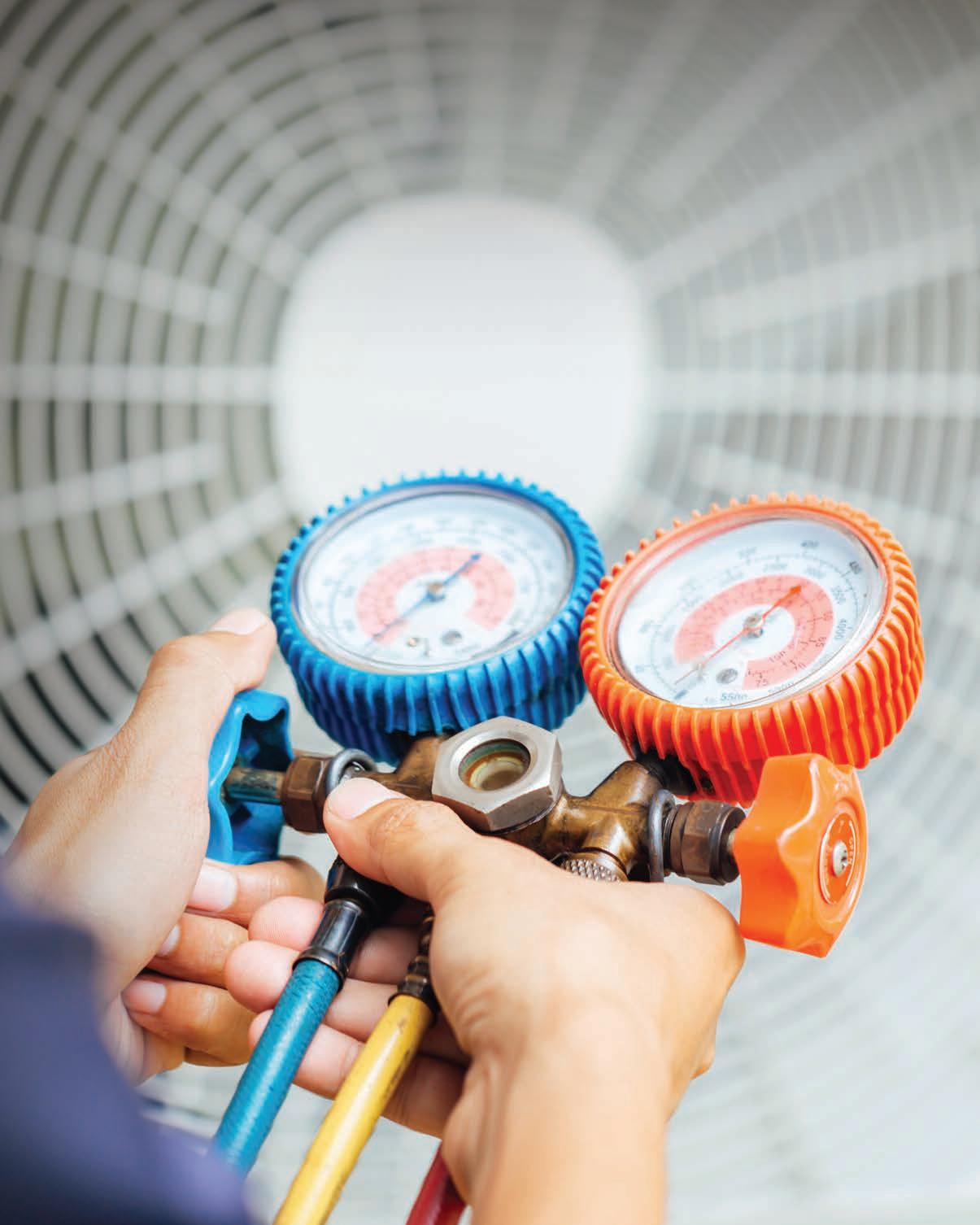
WORKING WITH REFRIGERANTS
CHANGE IS ON THE HORIZON


SUMMIT 2022 IS BACK LIVE!
LEARN FROM OUR TOP-NOTCH HYDRONICS EXPERTS
SPEAKERS




HAVE A CHANCE TO WIN TOOLS AND BLUE JAY TICKETS! (Blue Jays vs NY Yankees)
John Siegenthaler Siggy covers hot button topic Hydronics for Net Zero Homes
Mike Miller Circulators and Valves

Jeff House and Brian Morgan team up to discuss the critical nature of proper boiler chemistry
Tom Gervais
Regulatory Outlook for Boilers and Water Heaters
ENJOY REFRESHMENTS, LUNCH, DINNER & DRINKS
• Do you have new members of your team looking to improve their knowledge of hydronic systems and the components that make them work?
• Perhaps you are primarily an HVAC or plumbing contractor who is considering adding hydronics to your repertoire. Then Hydronics 101 is made for you!
• Industry experts will walk you through the basics of hydronic systems and help you understand why this technology is growing so rapidly.
• Topics include: Boilers | Circulating Pumps | Piping | Controls | Heat Emitters | Boiler Chemistry
• Hydronics 101 sponsored by


Platinum Sponsor Supported by

Sponsors


























































NETZERO
HVAC
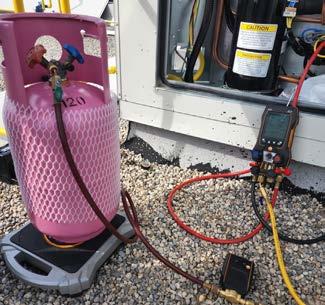
WORKING WITH REFRIGERANTS
A look at where we’ve been and preparing for the introduction of more climate-friendly, mildly-flammable, alternatives.
By Ian McTeer
HVAC
PRODUCT SHOWCASE
A selection of the latest in equipment and supplies for HVAC techs.
52
PLUMBING
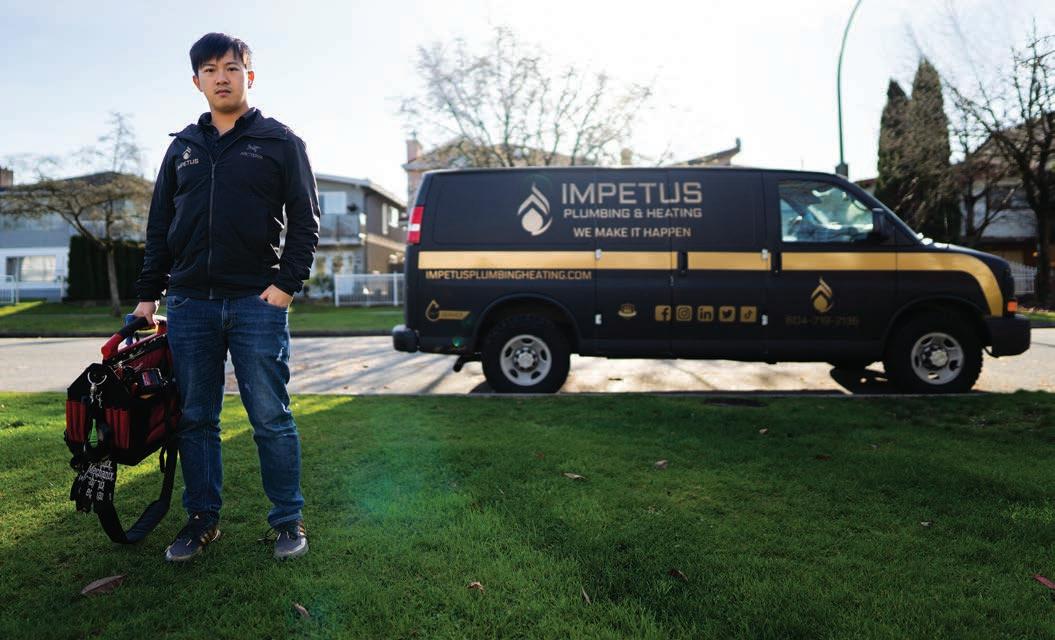
THE “NEW-SCHOOL” PLUMBING BUSINESS
Vancouver’s Impetus Plumbing & Heating is embracing social media and breaking down old-school perceptions.
By Dan Vastyan
REFRIGERATION
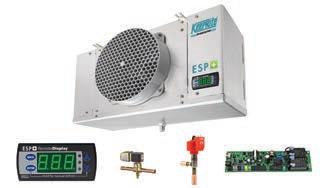
WHAT’S NEW IN REFRIGERATION?
Smart electronic technologies are improving installation and operational efficiencies for large refrigeration projects.
By Dave Demma
Terence Chan, owner of Impetus Plumbing & Heating in Vancouver.
ALSO INSIDE
MODERN HYDRONICS
SYSTEM DESIGN DIFFERING DELTAS
Both temperature control and pressure control of circulators can work when matching flow rate with heating demand, but there are important distinctions.
By John Siegenthaler
MH10 PUMPS
BRIGHT IDEAS – TROUBLESHOOTING 101
From home maintenance to commercial mechanical room operations, problem solving always requires a plan.
By Mike Miller
MH15
SHOW PREVIEW
MODERN HYDRONICS 2022 - THE SUMMIT
The sixth edition of the Summit returns as a one-day in-person event with new twists.
By HPAC Staff
MH20
DISTRICT HEATING HEATING YELLOWKNIFE
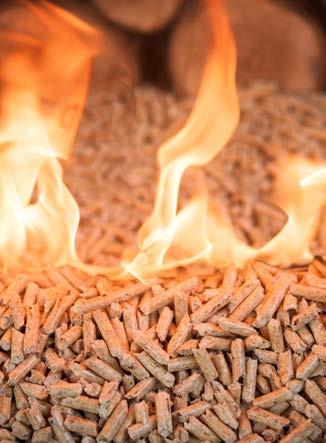
New pellet boiler district energy system helps NWT government reduce its carbon footprint.
By Ellen Cools
MH26
COOLING DEW DROP INN
A quick lesson in condensation prevention when it comes to radiant cooling.
By Curtis Bennett
MH28
HEAT EXCHANGERS OPPOSING CURRENTS
When it comes to designing systems with brazed plate heat exchangers, stick with counterflow piping.
By John Siegenthaler
STRENGTH IN NETWORKS
IN LATE JUNE I HAD THE OPPORTUNITY TO ATTEND THE 89TH EDITION OF THE CANADIAN INSTITUTE OF PLUMBING AND HEATING'S ANNUAL BUSINESS CONFERENCE held this year in picturesque Jasper, Alberta. It was my first live CIPH national conference experience, as it was the first in-person edition held since 2019.
As an association, the CIPH consists of manufacturers, wholesalers, distributors, manufacturer’s agents and others who make and sell products and services for all aspects of the plumbing and heating industry in Canada.
Around since 1933, the group maintains some of the traditional character that would be expected from such a long-standing organization, but the topics of discussion at this year’s conference were very ‘of the moment.’
Supply chain expert Ian Heller from Distribution Strategy Group in the U.S. addressed the current supply problems all industries are experiencing. His message to plumbing and heating distributors is to continue striving to make purchasing convenient and easy for contractors, (while acknowledging you’ll never be as seamless online as Amazon), and remember your greatest value is being able share knowledge and create personal relationships with your customers—connections that can’t be duplicated online.
The CIPH, like most associations, draws its strength from member volunteers, a blend of partners and rivals who together aim to raise the level of the industry they serve. It’s refreshing to see competitors sitting around the same table, sharing ideas, and also enjoying downtime in social settings.
A nice touch at the CIPH event is the recognition of members whose legacy forms the building blocks of the industry in many ways. This year Honourary Life Membership Awards were presented to: Harald Prell, retired president of Viessmann Canada; Bill Palamar, president/CEO Aqua-Tech Sales & Markeing/ Weil-McLain Canada; and Joe Senese, retired from Groupe Deschenes. Both Prell and Palamar were at the event, continuing to share their knowledge and experience with others.
The idea of competitors getting together to elevate an industry is not new— it's the foundation of most any association—but what I've seen lately is a greater effort among a new generation of passionate contractors in the HVAC and plumbing sector who are making efforts to promote and improve the industry. In this issue we have a profile of Terence Chan, founder of Impetus Plumbing & Heating in Vancouver. Chan uses his energy towards creating more exposure and improving the image of the plumbing profession.
He’s not alone. There are many brilliant tradespeople sharing techniques and tips over social media channels and promoting the message that plumbing and HVAC is valuable and cool, all while also trying to raise their game.
We are fortunate to have a number of these social media professionals/influencers joining us the Modern Hydronics Summit on September 15th in Toronto, along with the the regular thoughtful speakers and knowledgeable exhibitors who also form the collective network of industry supporters.
Also, as we were closing this issue I found out CIPH president Ralph Suppa will be retiring at the end of 2023. Ralph is the ultimate supporter of this industry. It's still early, but thank you Ralph for all you do. <>
– Doug Picklyk, Editor
Reader Service
Print and digital subscription inquires or changes, please contact
Angelita Potal, Customer Service Administrator
Tel: (416) 510-5113 Fax: (416) 510-6875
Email: apotal@annexbusinessmedia.com
Mail: 111 Gordon Baker Rd., Suite 400, Toronto, ON M2H 3R1
EDITOR
ASSOCIATE EDITOR
ASSOCIATE PUBLISHER
NATIONAL ACCOUNTS
ACCOUNT COORDINATOR
AUDIENCE DEVELOPMENT MANAGER
MEDIA DESIGNER
PUBLISHER
COO
Doug Picklyk (416) 510-5218 dpicklyk@hpacmag.com
Logan Caswell (416) 728-6209 lcaswell@hpacmag.com
David Skene (416) 510-6884 dskene@hpacmag.com
Kathryn Swan (416) 510-6797 kswan@hpacmag.com
Kim Rossiter (416) 510-6794 krossiter@hpacmag.com
Urszula Grzyb (416) 510-5180 ugrzyb@annexbusinessmedia.com
Emily Sun esun@annexbusinessmedia.com
Peter Leonard (416) 510-6847 pleonard@hpacmag.com
Scott Jamieson sjamieson@annexbusinessmedia.com
PUBLICATIONS MAIL AGREEMENT NO. 40065710
Heating Plumbing Air Conditioning (established 1925) is published 7 times per year by Annex Publishing & Printing Inc. HPAC Magazine is the leading Canadian business publication for the owner/manager of mechanical contracting businesses and their supply partners.
ISSN: 0017-9418 (Print) ISSN 2371-8536 (Online) Contents Copyright © 2022 by Annex Publishing & Printing Inc. may not be reprinted without permission.
SUBSCRIBER SERVICES: To subscribe, renew your subscription or to change your address or information please visit us at www.hpacmag.com
Subscription Price per year: $44.00 (plus tax) CDN; Outside Canada per year: $112.00 US; Elsewhere: 1 year $123.00 (CDN); Single copy Canada: $5.00 CDN. Heating Plumbing Air Conditioning is published 7 times per year except for occasional combined, expanded or premium issues, which count as two subscription issues.
MAIL PREFERENCES: From time to time we make our subscription list available to select companies and organizations whose product or service may interest you. If you do not wish your contact information to be made available, please contact us via one of the following methods: Tel: 416-442-5600 ext. 3552, Fax: 416-510-6875 or 416442-2191; E-mail: blao@annexbusinessmedia.com; or by mail: 111 Gordon Baker Rd., Suite 400, Toronto ON M2H 3R1 Annex Privacy Officer Privacy@annexbusinessmedia.com Tel: 800-668-2374
HPAC Magazine receives unsolicited materials (including letters to the editor, press releases, promotional items and images) from time to time. HPAC Magazine, its affiliates and assignees may use, reproduce, publish, re-publish, distribute, store and archive such unsolicited submissions in whole or in part in any form or medium whatsoever, without compensation of any sort.
NOTICE: HPAC Magazine, Annex Publishing & Printing Inc., their staff, officers, directors and shareholders (hence known as the “Publisher”) assume no liability, obligations, or responsibility for claims arising from advertised products. The Publisher also reserves the right to limit liability for editorial errors, omissions and oversights to a printed correction in a subsequent issue. HPAC Magazine’s editorial is written for management level mechanical industry personnel who have documented training in the mechanical fields in which they work. Manufacturers’ printed instructions, datasheets and notices always take precedence to published editorial statements.

Proud member of:


www.hpacmag.com
IT’S A WIN-WIN.






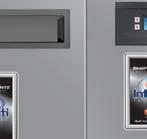


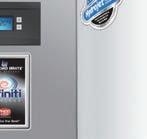
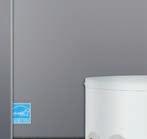

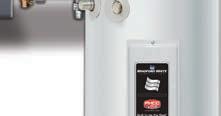
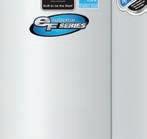

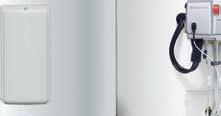







With Bradford White’s residential products, you’ll get the best of both worlds: the performance and features your customers want and For The Pro® engineering for an easy, trouble-free installation.
Infiniti® Series Tankless Water Heaters: Delivers an endless supply of perfectly hot water. Available in both indoor and outdoor models, with or without recirculation pump.
Upright & Utility Electric Water Heaters: Uprights available in gas or electric in a variety of capacities. Utility models for tight spaces, garages, workshops and more.
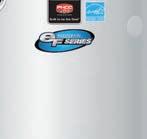
eF Series® Gas Water Heaters: ENERGY STAR® certified for year-round energy savings. Easy to install and service. Available as power vent or power direct vent.
To learn more, visit bradfordwhite.com/canada-contractors
INDUSTRY NEWS
CANADA LAUNCHES GREENER HOMES LOANS UP TO $40K
The Federal Government has launched its interest-free loan program to help homeowners and affordable housing providers complete deep home retrofits.
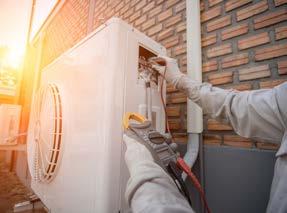
The Canada Greener Homes Loan is designed to help up to 175,000 eligible homeowners undertake deeper, more costly retrofits that will have a significant impact in reducing a home’s environmental footprint, energy bills, and improve home resiliency. Interest-free loans of up to $40,000 will be available per household.
The first phase, which launched on June 17, 2022, is open to eligible homeowners who are applying or have an open application (pre-retrofit stage) to the Canada Greener Homes Grant. The second phase, starting in early September 2022, will expand the eligibility to homeowners who have closed their application (those who have requested their post-retrofit evaluation or grant), but still have remaining eligible retrofits they are interested in pursuing, that have not yet commenced.
The Canada Greener Homes Loan is part of the Canada Greener Homes Initiative. The program builds on the Canada Greener Homes Grant launch on May 27, 2021.
As of early June, the Greener Homes initiative has already issued $38 million in grants to 10,300 homeowners. So far, heat pumps are the top retrofit taken up for the grant. Almost 3,200 Canadian homeowners have received $13.2 million in grants for installing heat pumps.
Since the launch of the program, further air source heat pump and cold climate air source heat pumps installation requirements have been further clarified. Clarifications to the program includes a note stating the air source heat pump or cold climate air source heat pump must be installed by a licensed and trained professional.
The Canada Greener Homes Grant initiative also requires that the heat pump system be capable of distributing heat throughout the entire conditioned space in the house, including the basement (for basements where the distance from the top of the floor slab to the bottom of the ceiling joist is 1.8 m or higher). This applies regardless of whether the heat pump system is a central ducted, mini- or multi-split ducted or ductless system.
The mechanical system contractor is responsible for specifying (including load calculations, sizing and selection) and installing the new heat pump system to meet this requirement.
Additionally, a minimum of one warm air supply outlet or indoor head is required on every floor, including each level of a split-level, mezzanine level, etc., of each dwelling unit in a building. More than one warm air supply outlet and/ or indoor head per floor may be required to ensure heat distribution to the entire building. (A transition period is in place, since this clarification came after the launch of the Canada Greener Homes Grant). nrcan.gc.ca

GRAHAM PROKOPETZ WINS RED SEAL INDUSTRY AWARD
Graham Prokopetz, a Red Seal Plumber and field operations supervisor with Botting and Associates in Calgary, has been awarded the 2022 Darryl Cruickshank Red Seal Industry Award.
Named to honour the life-long impact of the late Darryl Cruickshank, the award recognizes an individual from industry who has made an outstanding contribution to the promotion or development of apprenticeship training in Canada.
Prokopetz was selected for the award based on his extensive work and volunteer history, and his inspirational leadership to the next generation of skilled tradespersons.
With over 45 years in the trades, he has achieved excellence by obtaining his Gold Seal Certification in addition to his Red Seal Endorsement, but most notably through his extensive mentorship to apprentices.
Since 2010, Prokopetz has mentored 13 high school students participating in Alberta’s Registered Apprenticeship Program, one of whom was the first woman to obtain a Journeyperson certification in plumbing. red-seal.ca
ONTARIO COLLEGES PARTNER TO LAUNCH 4-YEAR BUSINESS DEGREE FOR TRADESPEOPLE
Algonquin College, George Brown College and Mohawk College have joined resources to launch a new fouryear honours degree in Business Administration, focusing on people working in skilled trades occupations.
The partner colleges will deliver this
PHOTO: NIKOMSOLFTWAER /ADOBE STOCK
first-of-its-kind degree in September 2022, with all instruction provided remotely and virtually. The program, approved by the Ontario Ministry of Colleges and Universities, is intended for people working in the skilled trades sector who are looking to grow their own businesses, take on greater responsibilities in their current work environments, or pursue management careers in medium-to-large organizations.
The online Bachelor of Business Administration (Trades Management) (Honours) degree will concentrate on business administration, managerial skills, accounting, project management, leadership, marketing, communication and applied research competencies. This theoretical instruction will be combined with 420 hours of structured work experiences (or equivalent), for which students receive credit. tradesmanagementdegree.ca
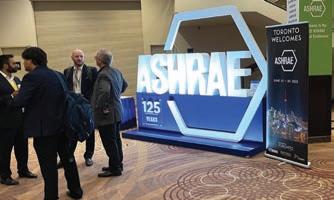
ASHRAE HOSTS ANNUAL CONFERENCE IN TORONTO
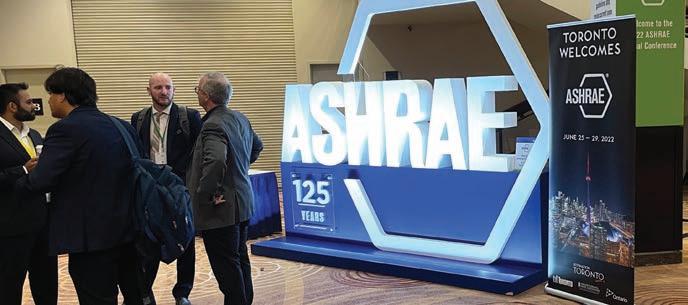
ASHRAE, the global professional engineering society committed to advancing the state of HVAC/R, held its 2022 Annual Conference in Toronto June 25 to 29.
More than 1,800 industry professionals attended the conference in-person and virtually. Topics discussed among the over 80 technical sessions included changes to buildings influenced by the pandemic and the broad topic of decarbonization.
During the conference Farooq Mehboob
What If Water Heaters


of Karachi, Pakistan took on the role of ASHRAE president for 2022-23 and introduced the theme for the year, “Securing our Future.”
“The future does not belong to those who sit and watch,” said Mehboob. “A meaningful and powerful future will not come to us…we must collectively seek it…create it…secure it. And that’s what we’ll do because that’s who we are.” ashrae.org.
FORTISBC INTRODUCES COMMERCIAL REBATE FOR GAS ABSORPTION HEAT PUMPS
FortisBC is introducing a new commercial prescriptive rebate offer for gas absorption heat pumps.
The program is being offered to commercial, multi-unit residential and institutional buildings, including office buildings, hotels, schools, hospitals,
Continued on p10









Toronto welcomed the global ASHRAE conference in June.
recreation centres and care homes. The program is available for retrofit applications, and the building must have a dedicated outdoor space either on the ground level or roof for the gas absorption heat pump units. Commercial customers can receive up to $35,000 in rebates depending on the scope of the project. fortisbc.com
STUDY: GREEN RETROFITS REQUIRE TEAMWORK
The Canada Green Building Council (CaGBC) and the Delphi Group released a new report, Green Retrofit Economy Study that profiles pathways that will equip the green building community with insights into the workforce and supply chain needs across Canada’s retrofit economy.

The study anticipates that Canada will have a shortage of skill workers in the near term. The federal government plans to stimulate economic growth, and over $3.6 billion has been committed to finance energy efficiency upgrades and low-carbon retrofits for large buildings as a way to meet GHG emission reduction targets. To achieve these results the green building workforce will need to triple by 2030 to meet the demand for sustainable building construction and renovation.
The report acknowledges that Canada will need to lean heavily on a skilled, qualified, and growing workforce, as well an accessible and affordable supply chain of low-carbon products, materials, and equipment. Among the key technologies and products identified are heat pumps along with heat and energy recovery systems. cagbc.org

IAPMO UPDATES STANDARD ON PRESS FITTINGS
The International Association of Plumbing and Mechanical Officials (IAPMO) has published IAPMO/ANSI/ CAN Z1117, Press Connections as American National Standards (ANS) and National Standards of Canada (NSC).
The new IAPMO/ANSI/CAN Z1117 supersedes the widely used IAPMO PS 117, which is a standard referenced in the model plumbing codes including the ANSI-accredited Uniform Plumbing Code (UPC). It specifies requirements for materials, physical characteristics, performance testing and markings.
Products covered by this standard include fittings, tube and pipe with press connection ends combined with other types of connections (e.g., threaded, soldered, and push-fit). iapmo.org
ASHRAE TAKES ON BUILDING DECARBONIZATION
ASHRAE has issued a position document on building decarbonization and the group's role on mitigating the negative carbon impact of buildings on the environment.
ASHRAE’s position is that the decarbonization of buildings and its systems must be based on a holistic analysis including healthy, safe & comfortable environments, improved energy efficiency, environmental impacts, sustainability, operational security and economics.
By 2030, ASHRAE hopes all new buildings are net-zero GHG emissions in operation, widespread energy efficiency retrofit of existing assets are well underway and embodied carbon of new construction is reduced by at least 40%. <> ashrae.org/decarb

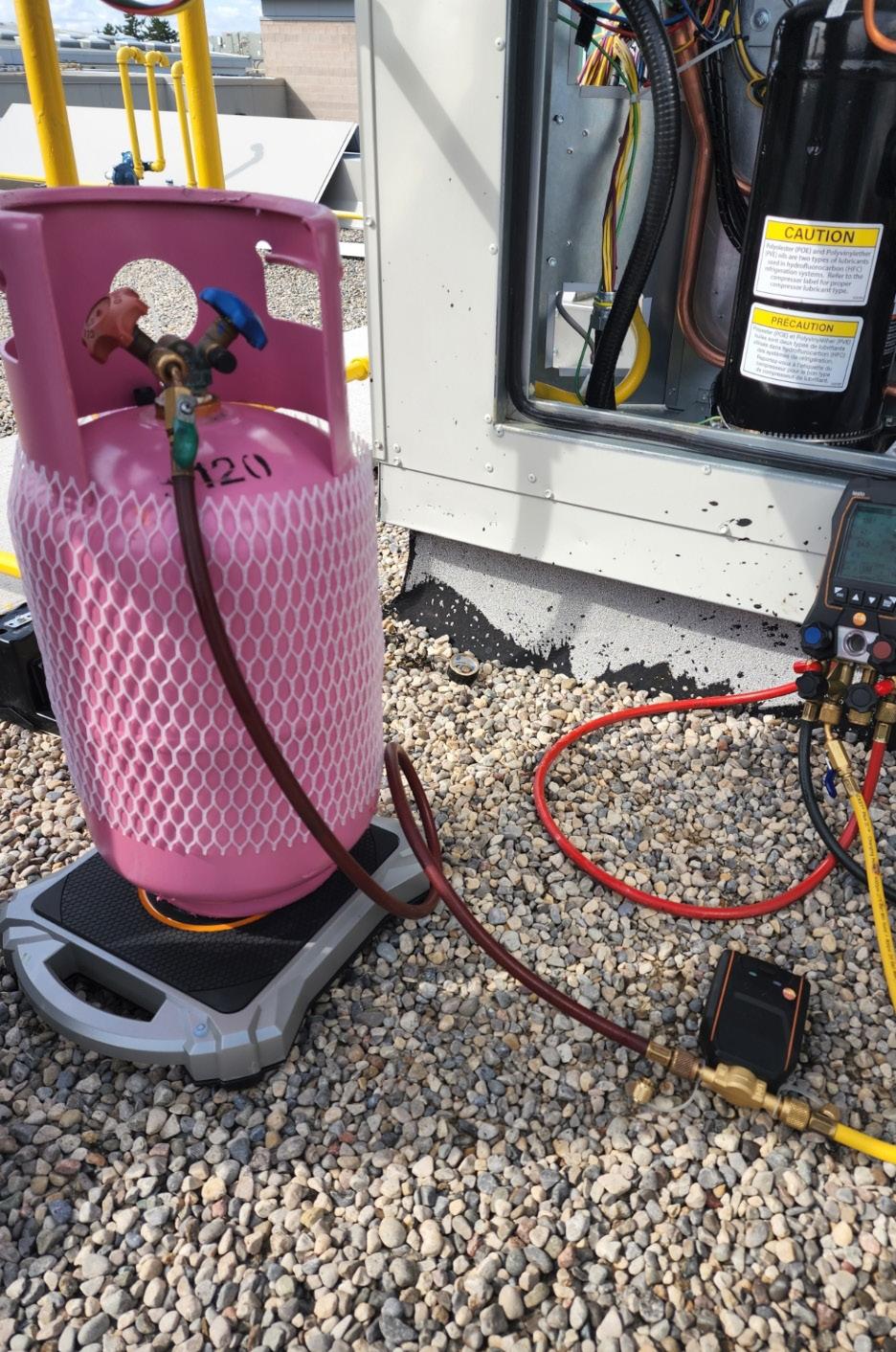
WORKING WITH REFRIGERANTS
Where we’ve been and how we're preparing for more climatefriendly, mildly-flammable, alternatives. BY IAN
McTEER
After Billy Durant purchased the Guardian Refrigerator Company with his own money in 1918, he incorporated the business into General Motors (GM) and renamed it Frigidaire. By 1929, Frigidaire had sold over one million refrigerators, the
only trouble was, the nasty nature of refrigerants like sulfur dioxide, methyl chloride and even ammonia, kept Billy awake at night. Thus, GM created a subsidiary company designed to monitor the exploration of alternative refrigerants. One scientist, Thomas Midgley
fashioned a team of researchers that developed dichlorodifluoromethane, branded Freon 12 (R-12). Midgley, a shameless self-promoter, loved to boast the compound was completely safe. So much so, he demonstrated his claim publicly by inhaling a lung-full of R-12 and then exhaling the chemical onto the flame of an open candle. No fire, no explosion, and Midgley was unharmed. Must be safe, no?
The chemical was deemed safe, but unbeknown to anyone, including Midgely, the Ozone Layer was being attacked.
EARLY DAYS
As residential air conditioning became more popular and affordable in the early 1980’s, some air conditioner manufacturers opted to provide threepiece systems charged with R-22 refrigerant. The evaporator coil contained a vapour holding charge with the bulk of the charge contained in the outdoor unit. Contractors would purchase a pre-charged, pre-insulated copper interconnecting line set of the appropriate length and size for the job. These pre-charged systems were popular since no brazing or system evacuation was necessary.
But pre-charged systems brought frustrating problems:
• Wholesalers often ran out of shorter line sets forcing installers to purchase longer line sets; excess tubing would be coiled up (horizontally!) somewhere in the furnace area.
• Line sets were often work-hardened and difficult to bend due to improper handling and storage.
• Line sets too often were out of round.
• The tubing insulation often proved inadequate allowing condensate to form on the outside.
To avoid some of the problems associated with pre-charged line sets, some contractors (including this one) would purchase a ZERO-kit containing just
the brass connectors and then fabricate a line set to manufacturers’ specifications out of bulk copper and better-quality insulation, even sweating elbows when needed to make a neat and tidy installation.
By connecting the evaporator coil section to the field fabricated tubing, I would pump a deep vacuum into the suction line, liquid line and the evaporator coil. I would then pressurize the evacuated components with vapour to bottle pressure before connecting to the outdoor unit thus releasing the bulk of the charge into the fully open system. Once started, I would charge the capillary tube metering system to superheat.
MEA CULPA
I mention all of this because, from my experience, too many pre-charged systems were overcharged. At start-up, refrigerant regularly needed to be released from the system; in fact, one manufacturer even provided a chart informing the installer how many seconds to leave the suction service valve open to the atmosphere so the charge might be corrected for a specific set of components.
Many service calls to malfunctioning units required vast amounts of R-22 be removed from the unit after a previous servicer loaded the poor machine with enough R-22 for several units. Why? Because the prevailing theory among poorly trained servicers was that to stop the evaporator coil from icing over just add more R-22. “Pump it in until you get 70 on the blue gauge.”
Midgley convinced HVAC/R practitioners (as well as those using chlorinated refrigerants as blowing agents) that atmospheric discharges of his invention were harmless.
Refrigeration textbooks of my era stated, “Saving the refrigerant is not recommended in small systems. The low cost of the refrigerant does not jus -
tify the time it takes to store it. The service technician may exhaust it into the air or into an approved exhaust system…never into a sewage disposal system.” Of course, the technician was warned to use goggles and gloves especially when venting to the atmosphere. Such a waste.
As our industry quickly rushed to sell the benefits of central cooling (and there are many benefits), the complex relationship between a well-designed and properly installed duct system and the refrigeration unit meant to operate in conjunction with it was not fully understood.
Far too often, this one seemingly insignificant shortcoming led to premature system failures often caused by overcharging. Inevitably, quantities of chlorinated refrigerant large and small were regularly “vented to the atmosphere.”
SOME GOOD NEWS
Recent scientific studies show the ozone hole in the Antarctic has closed. Certainly we’re doing the right thing by eliminating chlorine from refrigerants. By recovering refrigerants, even from the smallest systems, the efforts started in 1988 to reduce this type of environmental damage have also been taken seriously.
There’s no going back. Refrigerant
recovery equipment is now an important tool in every technician’s and installer’s kit. Unfortunately, refrigerants continue to escape into the atmosphere, most often through system leaks, physical damage and by fires.
Although the ozone depletion problem has been largely put to bed, scientists worry about refrigerants causing further damage by contributing to global warming.
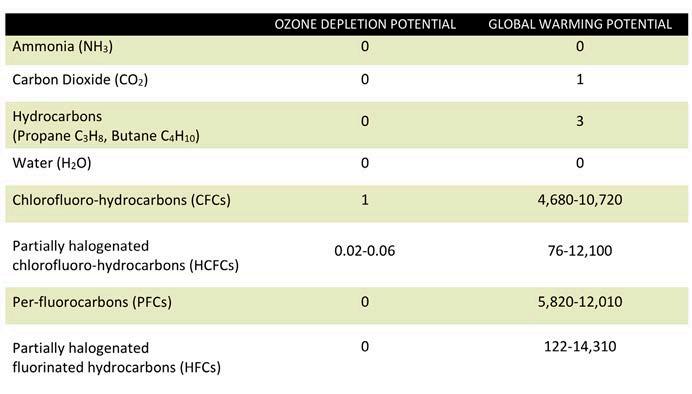
Chlorinated refrigerants such as R-12 were phased out in the 1990’s and hydrochlorofluorocarbons (HCFCs) are either phased out or in the process. The most common replacement refrigerant for HCFC-22 is a hydrofluorocarbon (HFC). Even though its Ozone Depletion Potential (ODP) is zero, R-410a has an uncomfortably high Global Warming Potential (GWP) of 2088. To counter the ODP/GWP conundrum, scientists and engineers are developing better methods of using some of the chemicals Midgley worked so diligently to dismiss as too dangerous for public consumption.
Natural refrigerants such as ammonia and CO2 along with hydrocarbons such as propane (R-290) and isobutane (R-600a) are back in specialized applications that incorporate new safety standards aimed at equipment designers, installers and technicians.
Figure 1. Ozone depletion and global warming comparison.
A2L MILDLY FLAMMABLE REFRIGERANTS
As time goes on, aging units containing HCFC and HFC refrigerants will need to be replaced. I’m thinking our industry will make a concerted effort towards adopting man-made lower GWP products. Hydrocarbon refrigerants are not likely to be used in residential and commercial air conditioning applications, at least in the near term. Why? Standards developed by ASHRAE and ULC specify the amount of system charge that might be released into a given area based on the Lower Flammability Limit (LFL) of the refrigerant.
Too much flammable refrigerant leaking into too small an area could see the LFL reached; in the case of R-290, the LFL is 2.1% in air. Systems requiring large volumes of R-290 or R-600a are simply too dangerous. However, I had no qualms with my recent purchase of a chest freezer con -
taining 1.6 ounces of R-600a. A mere 1.64 ounces leaking into the 8,000 cubic foot area of my house means the LFL will never be reached.
“As time goes on, aging units containing HCFC and HFC refrigerants will need to be replaced.”
SO, WHAT’S THE PROBLEM?
Developing a refrigerant which meets environmental standards, behaves in a traditional manner within most systems, and is relatively safe to use is the proverbial tall order. ASHRAE Standard 34 classifies refrigerant toxicity and flammability classifications:
• Toxicity, or the inherent poisonous characteristic of a substance, is denoted by letter code. The letter “A” denotes lower toxicity while the letter “B” indicates higher toxicity.
• Flammability describes the ability of a substance to burn. The number 1 means a refrigerant will not propagate a flame while those coded with 2, 2L, or 3 will burn or even explode.
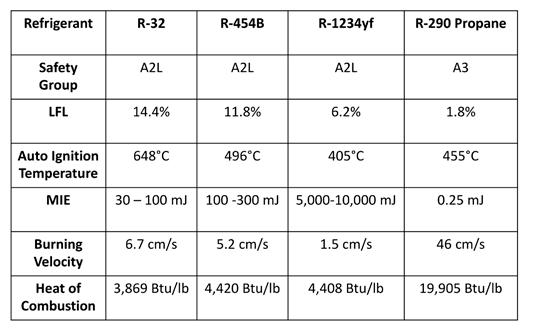
• A2L refrigerants, however, have been formulated to be difficult to ignite. Minimum Ignition Energy (MIE) measures the amount of spark energy needed to ignite a flammable mixture of gas and air. A2Ls typically require 100 times more spark energy than an A3 refrigerant such as R-290, meaning that everyday items like cordless drills or electric heaters will not ignite A2Ls.
• A2Ls require higher concentration levels in air to reach their LFL and
Continued on p14
Reimagine your rough-in
Return Air Frames
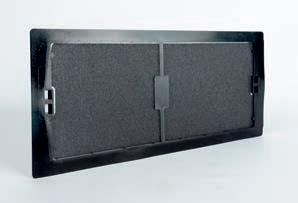
Plastic alternative to traditional return air frames
Filtered and windowed models keep system clean during rough-in
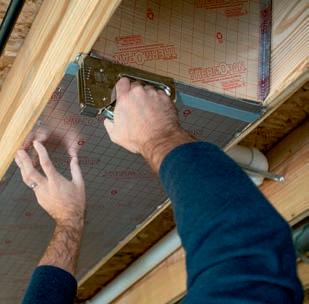
Tested and trusted since 1992
‘Anywhere you can pan a joist space, you can use our Thermopan.’
Our Mechanical Contractor Hub was built for you thermopan.ca
Snap Clamps
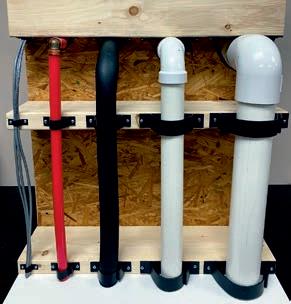
Linesets, PVC, PEX and more
‘So easy, one person can hang a lineset.’

have a much lower heat of combustion meaning a combustion event is less likely to spread.
Handling any refrigerant requires the use of ingrained safety practices. With A2Ls, concern about flammability and toxicity should still be top of mind, consider these points:
• Potential exists for ignition of a refrigerant leak during operation, so find and repair any leaks.
• There is a potential for refrigerant ignition during servicing.
• Structural fires causing catastrophic system destruction will release A2Ls.
• If, for example, R-32 should catch fire from a torch flame during a service procedure, Hydrogen Fluoride is released which is toxic.
• Beware of A2L released into a service vehicle during transit or a large leak into a confined space.
WHAT CHANGES WILL HAPPEN?
The U.S. Environmental Protection Agency is authorized to phase down the production of HFC refrigerants starting this year. Initially, manufacturers of high GWP HFCs like R-134a, R-410a, R-404a among others, were required to phase down
production by 10% on January 1, 2022.
By 2024, a 60% phase down will be enforced and, no doubt, the price of such HFCs will become astronomical. Even the newest refrigerants such as Honeywell’s Solstice and Chemours Opteon XL41 HFO/HFC blend (Hydro FluroOlefin) are still considered to be transitional refrigerants: until the GWP number gets much closer to zero, the scientists will keep on looking.
As of this writing, R-454B and R-32 will most likely be ad -
EVER FEEL LIKE YOU MISSED SOMETHING?

On June 24, 2022, HPAC, along with sister publication Electrical Business, hosted an educational webinar on how to work more effectively in a Virtual Design & Construction (VDC) environment.
A number of very interesting state-ofthe-art applications designed to benefit progressive contractors working in the commercial HVAC and plumbing sectors were discussed
If you missed the webinar or wish to view it again simply click on the QR code.
Learn from Trimble experts about the power of SysQue—a modelling solution for the Revit environment—and Connect2Fab estimating, procurement and fabrication solutions.
Figure 2. Chart showing flammability classes.
and Questions
Comments
Can I reuse existing line sets? Yes – when properly sized and leak free A2Ls are POE compatible however always check with manufacturer for line set compatiblity
Embedded leak sensors? No Yes
Flammable labelling? No Yes
Units likely to have mitigation starategy in case of a leak: start an air dilution fan lock out unit operation, etc.
ISO warning triangle & flame symbol & labels, installer to provide charge info, test pressure & evacuation data
Safely remove refrigerant for repair or replacement? Required Required Use A2L compatible recovery equipment
Purge Circuit with nitrogen? Good Practice Required
Repeat as necessary
Evacuate system Required Required Pump outlet must not be near ignition source
Leak & Pressure Test Required Required No different from what you're doing now
Cylinder Colour Rose Gray/Green/ Red A2L cylinders to have red band around the top
Cylinder Storage Upright, prevent tipping Upright, prevent tipping
A2L cylinders pressure relief can open and reclose to relieve pressure: storage temperature must not exceed 50˚C. No smoking in service vehicles, vehicle flow through ventilation may be required.
Training Required Best Practice Absolutely Required Installation and Service Requirements as noted by equipment manufacturers
opted for use in residential and commercial air conditioning applications. Carrier and Johnson Controls have announced plans to build equipment based on R-454B while Daikin, Lennox and Panasonic prefer R-32.
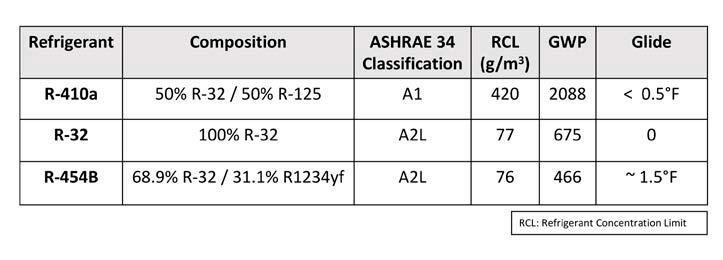
While pure R-32 is an HFC refrigerant, it’s lower GWP (675) makes it suitable for use in residential and commercial applications.
NOTE: A2L refrigerants are NOT dropin replacements. They can only be used with equipment specifically designed for them within designated applications as determined by the equipment manufacturer.
So far, A2L units can do anything R-410a units have been doing. R-410a, classified as an A1 refrigerant, is a blend of R-32 with R-125 added to sup -
press flammability but unfortunately exacerbates the GWP problem (see Figure 3).
TECHNICIANS AND INSTALLERS: WHAT’S NEW AND DIFFERENT
As with anything new, some of your everyday HVAC activities will have to change, but not so much. Installation procedures for A2L equipment are like those of A1 products although everyone must abide by manufacturer's instructions, governmental regulations, and local codes.
Obviously, anyone handling A2Ls must take the appropriate training offered by manufacturers, trade schools, and organizations such as HRAI and ESCO.
• Main differences have to do with pre-
installation safety inspection.
• Maximum charge for A2L equipment will be limited by the cubic feet of available air space.
• Space must be large enough with enough air to keep the percentage of the LFL below that required to support combustion should the entire charge empty.
• ASHRAE Standard 15 and a new standard for residential applications Standard 15.2 are updated or in the works.
• New ULC standards published in 2019 cover design and test standards for HVAC/R equipment.
• Canada’s B52 Standard along with provincial building codes will soon be updated to cover A2Ls.
Many of the tools used by techs and installers currently working with R-410a will be suitable for use with A2Ls including gauge sets, manifolds, and scales. Tools such as leak detectors, recovery machines and vacuum pumps will have to be rated for use with A2Ls.
Digital gauges might require a software update. A2L cylinders will come with a left-hand thread, thus a lefthand thread hose adaptor will be required for connection to the cylinder.
Figure 4 is a chart of some additional A2L requirements and differences. Take note, because these changes are coming so it’s best to be prepared. <>

Ian McTeer is an HVAC consultant with over 35 years of industry experience. He was most recently a field rep for Trane Canada DSO. Ian is a refrigeration mechanic and Class 1 Gas technician. He can be reached at imcteer@ outlook.com.
Additional Product Information and Training Resources:
HRAI: hrai.ca/refrigerant-landscape ESCO: escogroup.org/training/ lowgwprefrigerant.aspx
Figure 3. Comparison of R-410a characteristics with R-32 and R-454B.
Figure 4. Additional A2L requirements and differences.
HVAC PRODUCT SHOWCASE
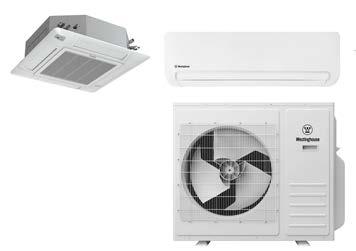
Westinghouse has expanded its mini-split heat pump systems for the North American market. The company offers single-zone outdoor units ranging in capacity from 9,000 to 36,000 Btuh, and multi-zone outdoor units between 18,000 and 42,000 Btuh. Single-zone outdoor units are compatible with the new line of Westinghouse indoor units, which includes ceiling cassettes, horizontal ducted, multi-position air handlers, and wall-mount units of various capacity. Multi-zone outdoor units are also compatible with wall-mount units, ceiling cassettes and horizontal ducted. westinghouseac-usa.com
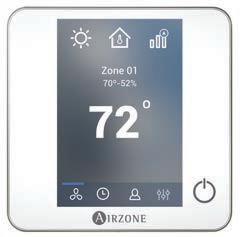
Fujitsu General America has introduced Airzone system, a new communicating zoning system for ducted mini-split and VRF heat hump and heat recovery systems. Available with wireless or wired communication, all Airzone dampers and optional zone modules are connected by a 4-wire cable which provides power and communication. Dampers are positioned to provide optimum airflow into a zone based upon demand monitored through zone controllers. The indoor unit fan is adjusted tomeet the demand of all calling zones. A variety of damper sizes (six to 14 inches) are available. fujitsugeneral.com
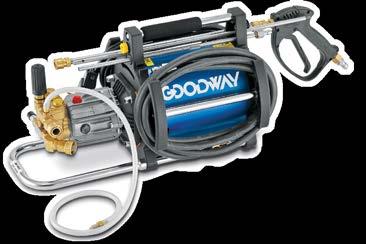
The CoilPro CC-400HF from Goodway for cleaning (air-cooled) condensers, chillers, gas coolers and dry coolers operates on AC power and connects to a ¾-in. water line for continuous operation. It offers siphon technology to draw from CoilShine, Goodway's expanding foam detergent (or other non-acidic cleaners), laying on a thick layer of foam and then using the CC400HF technology to blast dirt, grime, and biological matter from coils. The unit includes a sectional three-piece wand for cleaning behind coils and sprays with a 90-degree nozzle attachment for hard-to-reach areas. goodway.com
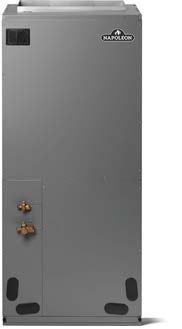
Napoleon has added the NS18 heat pump and air handler. The heat pump features a variable inverter compressor and vapor injection technology to heat a home in temperatures as low as -30C (-22F). The air handler offers a low and quiet with multiple installation options, it blends into the background as it maintains a balanced, comfortable temperature. The NS18 is compatible with any standard heat pump thermostats, smart thermostats or smart home systems working on 24V. napoleon.com
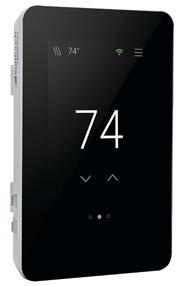
SunTouch has unveiled SunStat ConnectPlus thermostat. The new connected thermostat allows users to remotely access and control their electric floor warming system, using voice control with Alexa and Hey Google. Other features include a new design with glass front and capacitive touch screen, and remote access through the Watts Home mobile app. In addition, features include a voltage level detector and ammeter with diagnostic screen and wireless technology of 915MHz for connecting accessories (SunStat Relay R4 and ConnectPlus Smart Sensor). suntouch.com
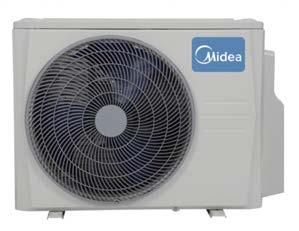
Midea has launched its new EVOX central inverter heat pump system. The side discharge outdoor units support heat pump and dual-fuel heating capabilities, are up to 36% quieter than conventional units, are less prone to natural debris and require less rear clearance (12-in. vs. 24 in. with traditional units). The EVOX AHU includes computational constant airflow (constant CFM Blower) enabling airflow to automatically adapt to the existing ductwork designs and issues caused by blocked coils, dirty filters and improper duct sizing by adjusting output power and fan speeds. midea.com
MODERN HYDRONICS FALL 2022
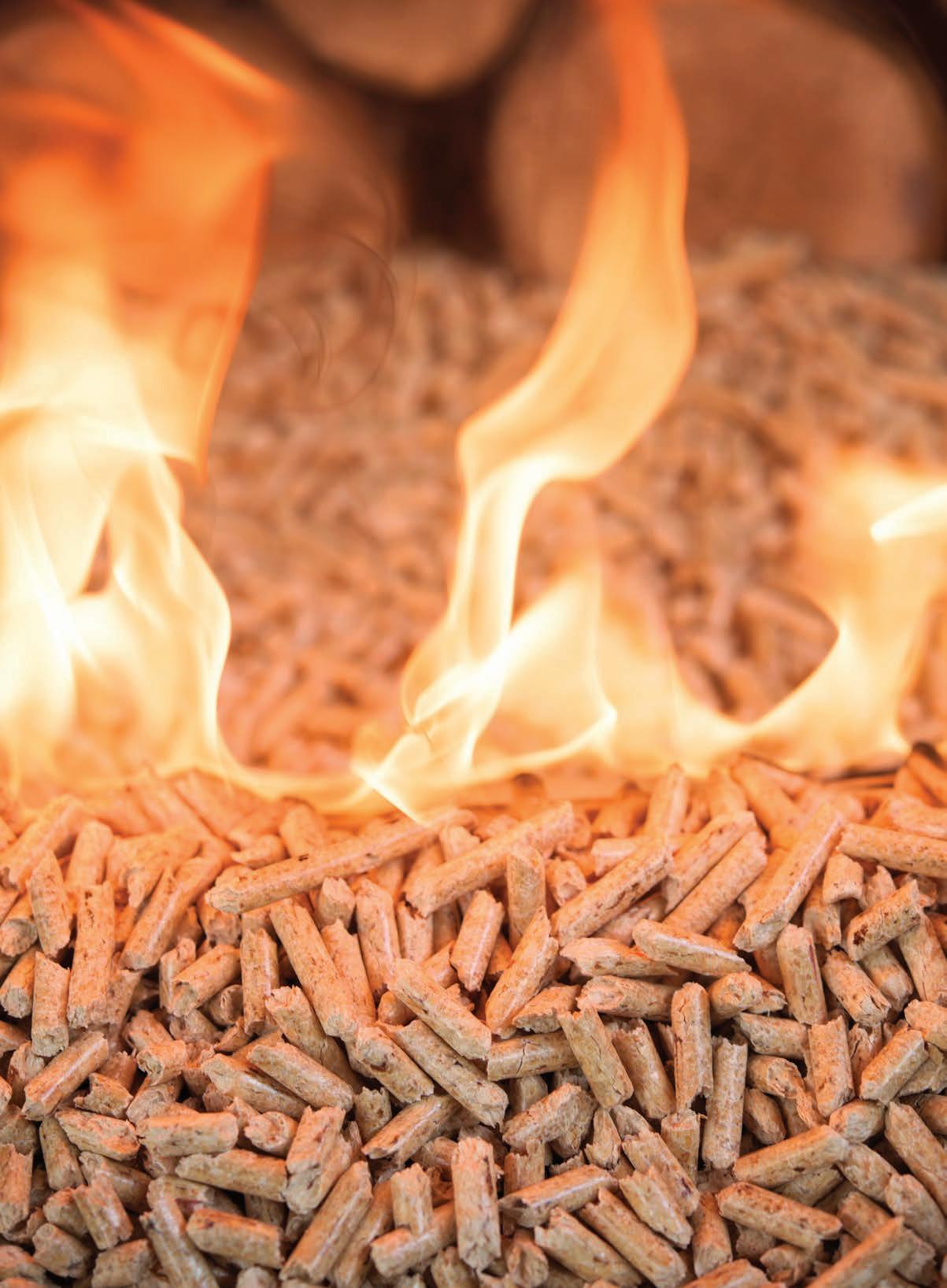
DISTRICT ENERGY IN NWT
Pellet boiler fires up heating system in Yellowknife.
OPTIMIZING BRAZED PLATE HEAT EXCHANGERS
CIRCULATORS: TEMPERATURE OR PRESSURE CONTROL
TROUBLESHOOTING TIPS & LARGE PUMPS



MH6 SYSTEM DESIGN Differing Deltas
Both temperature control and pressure control of circulators can work when matching flow rate with heating demand, but there are important distinctions.
By John Siegenthaler
MH10 PUMPS
Bright Ideas – Troubleshooting 101
From home maintenance to commercial mechanical room operations, problem solving always requires a plan.
By Mike Miller
MH15 SHOW PREVIEW Modern Hydronics 2022 - The Summit
The sixth edition of the Summit returns as a one-day in-person event with new twists.
By HPAC Staff

MH20 DISTRICT HEATING Heating Yellowknife
New pellet boiler district energy system helps NWT government reduce its carbon footprint.
By Ellen Cools

MH26 COOLING Dew Drop Inn
A quick lesson in condensation prevention when considering radiant cooling.
By
Curtis Bennett
MH28 HEAT EXCHANGERS Opposing Currents
When it comes to designing systems with brazed plate heat exchangers, stick with counterflow piping.
By John Siegenthaler
MODERN HYDRONICS
EDITOR
ASSOCIATE EDITOR
ASSOCIATE PUBLISHER
ACCOUNT COORDINATOR
MEDIA DESIGNER
CIRCULATION MANAGER
PUBLISHER
COO
Doug Picklyk (416) 510-5218 DPicklyk@hpacmag.com Logan Caswell (416) 728-6209 LCaswell@hpacmag.com
David Skene (416) 510-6884 DSkene@hpacmag.com
Kim Rossiter (416) 510-6794 KRossiter@hpacmag.com
Emily Sun esun@annexbusinessmedia.com
Urszula Grzyb (416) 442-5600, ext. 3537 ugrzyb@annexbusinessmedia.com
Peter Leonard (416) 510-6847 PLeonard@hpacmag.com
Scott Jamieson


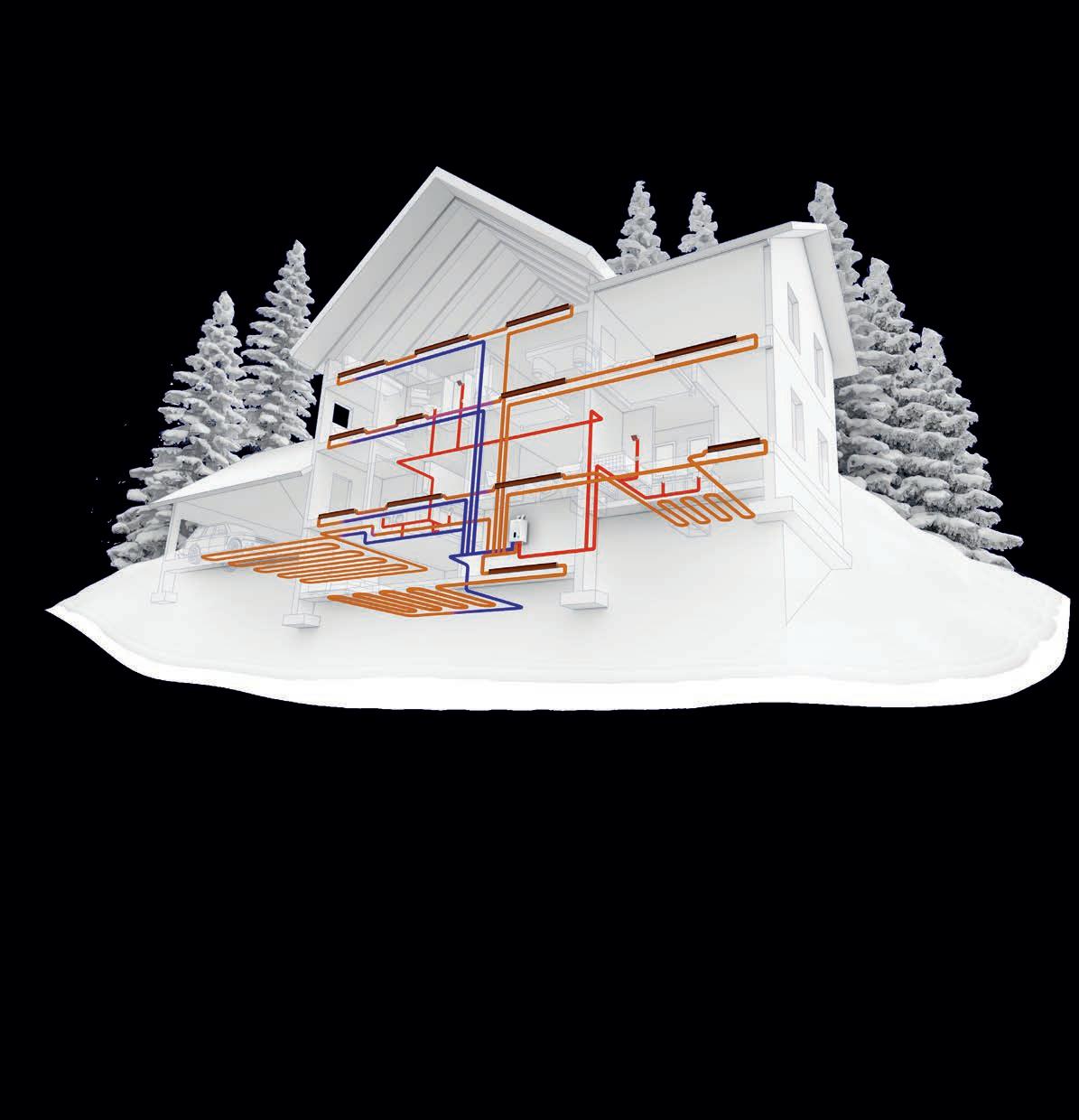
HEATING UP TO 150,000 BTU/h DHW UP TO 210,000 BTU/h
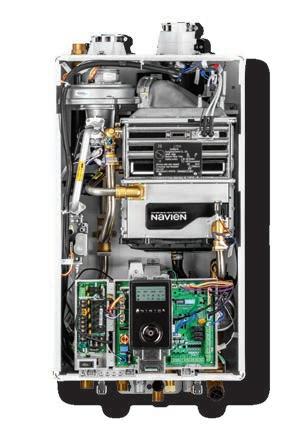
NCB-H
High capacity, High performance combi-boilers
Navien NCB-H high efficiency combis bring the highest level of whole house comfort to any size home...big or small
• Highest DHW maximum BTUs in residential condensing combi-boilers... up to 210,000 per hour
• Highest DHW flow rate @ 70°F rise... up to 5.4 gallons per minute
• Highest number of BTU sizes for the North American residential combi-boilers
• Highest residential combi-boilers domestic hot water turndown ratio...15:1
• Highest residential combi-boilers heating turndown ratio... up to 11:1
• Highest number of built-in zone controls for valves or pumps... up to three
• Highest full lineup 2" venting lengths... up to 65 feet
• Highest number of cascade capable units with up to 15 tankless water heaters
• High altitude certification... up to 10,100 feet (NG or LP)
Aim high with Navien NCB-H combi-boilers... To learn more visit Navieninc.com
The leader in condensing technology...does it again.
DIFFERING DELTAS
Both temperature control and pressure control of circulators can work when matching flow rate with heating demand, but there are important distinctions.
BY JOHN SIEGENTHALER
Over the years I’ve had a lot of questions asking if I prefer to operate zoned hydronic systems based on a set temperature drop between supply and return water temperature (e.g., ∆T control), or a set pressure drop across the distribution system (e.g., ∆P control).
Both methods of speed control attempt to match the flow rate in the system with the current heating requirements of the building. The ultimate goal is to reduce electrical energy use without compromising comfort.
The choice between ∆T and ∆P control of a circulator has, at times, been the subject of rather “heated” debates. It’s almost as if a few Toronto Maple Leaf fans are disputing superior goaltending with some Calgary Flames fans.
There appears to be some strong opinions involved. Maybe it derives from selfjustification that refuses to believe any opposing view. Perhaps there’s a bit of brand loyalty mixed in, or some mathematical manipulation that “proves” what nature will surely do whenever the system being analyzed is put in operation.
Being someone who’s not ready for a fisticuffs defense of how a circulator operates, or interested in faceless banter on the Internet, I tried to look at this subject from a sterile engineering perspective.
I used software that is based on very accurate empirical models of heat emitters such as finned-tube baseboard to
see what happens to the heat output of a hydronic distribution that is forced to operate at an assigned (and fixed) ∆T as the supply water temperature is decreased. I refer to this as “constrained ∆T” operating logic.
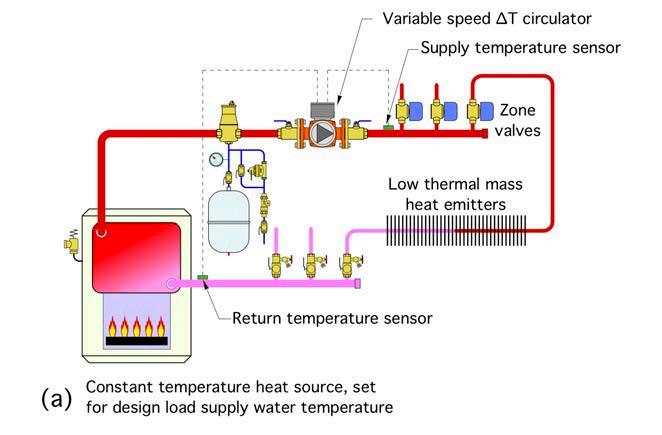
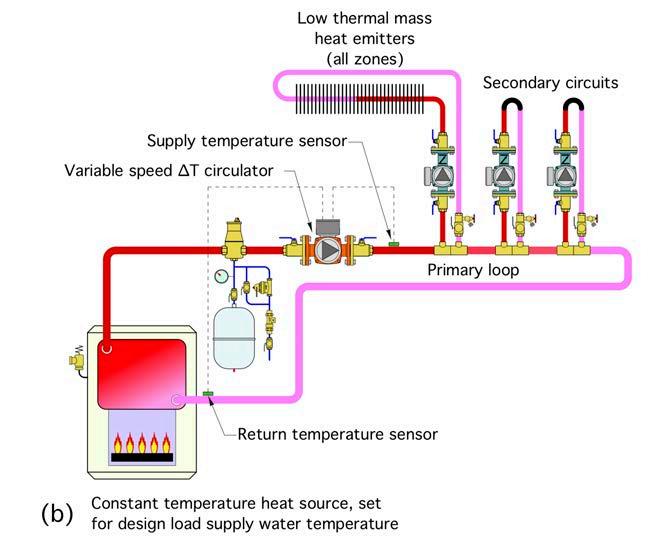
IT WORKS WHEN… What I found is that imposing a fixed ∆T between supply and return can work when the following conditions are all present:
1. Multiple heating zones are controlled
Imposing a fixed delta-T between supply and return requires certain conditions are present in the system. These two examples meet those conditions.
with valves, or multiple secondary circulators supplied from a common primary loop.
2. The system uses low thermal mass heat emitters.
3. The heat source maintains a constant supply water temperature, at the design load value, whenever any zone is calling for heat. Figure 1 shows examples of two systems that meet these criteria.
Consider a low thermal mass hydronic heating system that supplies design load heat output when all zones are active and the supply water temperature remains constant at the design load value. If the heat emitters were not oversized for the design load, all zones would, in theory, remain on until the design load condition subsided (or other factors such as internal gains or intentional thermostat setbacks began influencing the zone loads).
When design load is no longer present in one zone, and the associated thermostat turns off the zone valve or secondary circulator, less heat is being removed from the distribution system. This change reveals itself as an increase in return water temperature (assuming that the supply water temperature remains constant). The temperature difference (e.g., ∆T) between the beginning and end of the distribution system decreases.
A circulator operating based on constrained ∆T logic would sense this decrease and respond by reducing speed so that the design load ∆T was reestablished for the zones that remain active. This process would repeat when another zone turned off. This method of control reduces circulator energy use during partial load conditions.
When a zone turned on, and the supply water temperature remains fixed at the design load value, the return water temperature decreases because more heat is being removed from the distribu -
“∆P control does require the installer to set the circulator for the required ∆P (or in some cases the required head) of the distribution system at design load conditions.”
tion system. A circulator operating based on constrained ∆T logic would sense this increase in ∆T and respond by increasing speed to reestablish the design load ∆T.
MASS MATTERS
The requirement that the distribution system have low thermal mass heat emitters implies that the temperature changes on the return side of the system would appear quickly as zones turn on and off.
A high thermal mass distribution system, such as a heated concrete floor slab, could significantly delay these temperature changes due to heat being absorbed into or released from the thermal mass.
The mounting of the temperature sensors could also affect how quickly the electronics in the circulator respond to the change in temperature.
The constrained ∆T method of control forces the active portion of the system to operate as if it is always at design load conditions. When a zone doesn’t require design load heat input the thermostat for that zone would have to cycle the zone valve or zone circulator on and off to avoid overheating the space.
This, in effect, directs “pulses” of heat into each zone whenever its thermostat calls for heat. The rate of heat delivery during each pulse remains at the design load rate. The duration of each pulse is the time that the zone valve or zone circulator is on.
The design load heat transfer rate multiplied by the “on-time” of the zone determines the total heat added to the space during each pulse.
This method of heat delivery has been
used in millions of North American hydronic systems over many decades. It is generally acceptable if the thermostat differential and boiler high limit differential are reasonable.
It’s important to understand that not all hydronic systems meet the three previously stated constraints.
Many modern systems use outdoor reset control to vary the water temperature supplied to the distribution system based on outdoor temperature. When outdoor reset control is combined with a circulator operating on constrained ∆T logic, the heat output from the distribution system decreases faster than it should based on outdoor reset control theory. This could lead to a reduction in building comfort under partial load conditions.
For this reason, I recommend that circulators using constrained ∆T control only be used in systems that meet all three of the previously stated constraints.
∆P CONTROL
Differential pressure (e.g., ∆P) speed control is intended for use in hydronic systems that use any type of valvebased zoning (e.g., zone valves, thermostatic radiator valves, or manifold valve actuators).
A ∆P circulator operates by continually comparing its pressure differential against some reference condition. The latter could be a fixed value (e.g., constant ∆P control), or a calculated value based on flow rate (e.g., proportional ∆P control).
Constant ∆P is preferred when most of the head loss of the distribution system occurs in the branch (e.g., zone) piping, rather than the “common piping” through
which all system flow passes. This is typical for “homerun” distribution systems.
Proportional ∆P control is preferred when the head loss in the piping mains (rather than the branches) is a large portion of the overall head losses. The latter is typical for “2-pipe” direct-return or reverse-return systems.
A ∆P circulator determines its current ∆P based on the electrical load on the motor, specifically the position of the rotor shaft relative to the magnetic field applied to stator coils.
It uses this information along with a “mapping” of motor operating characteristics to infer both its flow rate and ∆P. It then adjusts motor speed up or down to bring its operating condition as
ducers or variable frequency drives. Response time is short—a few seconds. This is an advantage over ∆T control that depends on the temperature response of two sensors.
∆P control does require the installer to set the circulator for the required ∆P (or in some cases the required head) of the distribution system at design load conditions.
Some installers balk at this requirement, claiming they have no way of determining it.
My response is:
How do you know what size circulator is needed if you haven’t attempted to estimate its operating point when all zones are operating?
IN SUMMARY
Both ∆T and ∆P methods of circulator speed control can work, given the right application and adherence to the constraints mentioned above. Both have been used in the field for several years. Looking ahead, it’s likely that even more refined methods of circulator speed control will be developed, based on multiple sensed inputs, as well as coordination with other hardware in the system, such as boilers or heat pumps. <>

John Siegenthaler, P.E., is a professional engineer with more than 40 years of experience designing hydronic heating systems.

BRIGHT IDEAS –TROUBLESHOOTING 101
From home maintenance to commercial mechanical room operations, problem solving always requires a plan.
BY MIKE MILLER
We have all had opportunities to do troubleshooting.
It seems as though I have been in the troubleshooting business the majority of my professional career. I am often asked, “What is troubleshooting? Where do I start? And what do I do?
In its purist form, troubleshooting is the process we go through to solve a problem. As for where to start? My response is always: start at the beginning.
And when it comes to, “What do I do?”, the answer is, “Develop a plan.”
I’m going to share a simple example of my thought process when it came to solving a small problem at home, and then I will provide you with a real pump troubleshooting situation that I was asked to solve not too long ago.
So, earlier this year I left the office on my way home. The commute is little over an hour. When I first got on the road, I called my wife to give her an estimate as to my arrival time. She informed me that one of the lamps in the living room was no longer working.
She also said that she replaced the light bulb with a new one that she knew was working because she tested it in another lamp. The new bulb did not illuminate. I told her that I had about an hour or so of driving and would think about it on my way home.
Following my own advice, I started at

the beginning and started to list the things that I knew and those that I did not know.
I knew there was electric power available because my wife tested a bulb in another lamp. I also knew there were two lamps in the living room. One lamp was activated by a wall switch and the other lamp was plugged into a live electrical outlet. I know that the lamps are about 26 years old which is the same age as the circuit breaker, the wiring and the receptacle.
What I did not know was which lamp was not working, the wall switched lamp or the live receptacle lamp.
Time to do some interviewing. I called my wife and asked several questions. Her answers revealed the following: the lamp in question is connected to the live receptacle, and that the lamp was working fine the day before.
I could now focus my attention on the lamp connected to the live receptacle which allowed me to develop a plan.
I had about 45 minutes of commuting left, plenty of time to develop a comprehensive plan. I now knew that the problem was either with the house electrical system or the lamp. The house electrical system consisted of the circuit breaker, the house wiring and the receptacle. The lamp consisted of the electrical cord, the lamp switch and perhaps the light bulb.
To eliminate the house electrical system, my plan upon arriving home was to turn off and on the electrical breaker at the electrical panel. The next step was to inspect the lamp switch, the lamp wiring and the receptacle. I have a digital volt/ohm meter, which would make testing the receptacle, the lamp wiring and the lamp switch a breeze.
By this time I was almost home, and I felt confident that I had worked out a comprehensive plan to diagnose and solve the problem.
Upon arrival I asked my wife to put the

Working Smarter Not Harder with Air-to-Water
The latest innovations in air source technology + the clean and efficient characteristics of hydronics = the most capable and highest performing heat pumps available
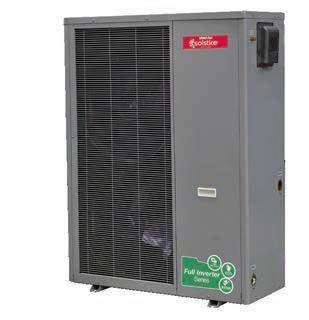
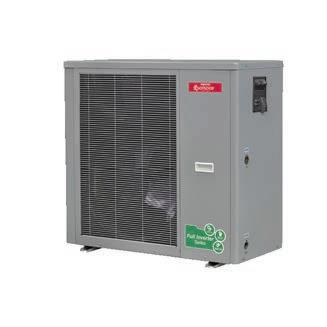
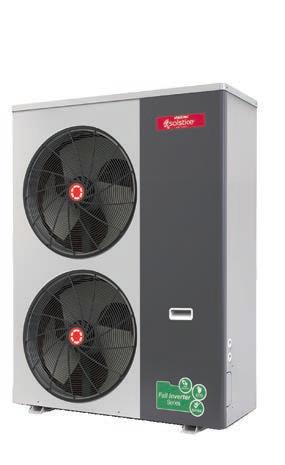
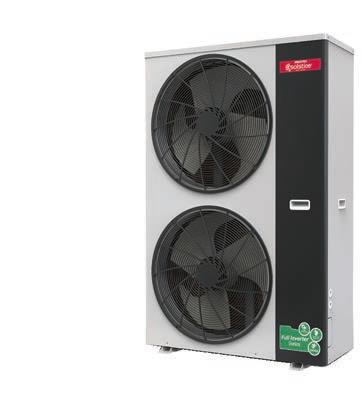
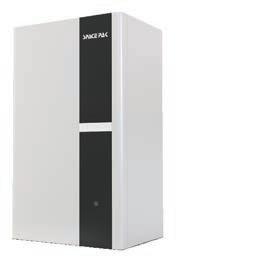
SpacePak’s Inverter Series of Solstice Air-to-Water Heat Pumps
Heating and cooling for your green building goals, fit for even the coldest of climates.
• Industry leaders of air-to-water technology since 2011
• The most complete line-up on the market for residential and light commercial applications
• Industry proven for reliability, performance, & longevity
• Thousands of installations across the US and Canada

• All-in-one solution for year-round whole house heating, cooling, and DHW offset
• All the advantages of a hydronic system without the use of fossil fuels
• High performance heating capabilities down to -20°F
• Perfect match for radiant and solar applications
• Industry leading 10-year compressor warranty and 5-year parts for certified contractors
Solstice Inverter Monobloc SIM
Solstice Inverter Split SIS
Solstice Inverter Extreme ILAHP
wall switched lamp on so that I could check the circuit breaker. I went into the basement, walked over to the electrical panel and identified the breaker for the living room. Fortunately for me the breakers were well labeled, and I immediately found the appropriate switch.
On and off went the breaker, and on and off went the wall switched lamp. The breaker was not the problem.
I grabbed my volt/ohm meter and went upstairs to the living room. Before proceeding any further, I decided to replace the lamp bulb just in case. I removed the illuminated bulb from the wall switched operating lamp and installed it in the offending lamp. Just as my wife indicated earlier, the bulb did not light up.
The next step was to use my volt/ohm meter and test the receptacle that the lamp cord was plugged into. In order to access the receptacle, I had to move the sofa away from the wall because the receptacle was hidden by the sofa. As soon as I moved the sofa to reveal the receptacle, I had my answer.
At this point you might have guessed that the lamp cord was not plugged into the wall. But you would be wrong.
You see, several years earlier, I purchased a digital timer which can be programmed to activate and deactivate a device such as a lamp based on the time of day. The digital timer has an override switch (or on switch) which allows the digital timer’s outlet to be on continuously. I removed the digital timer and plugged the lamp directly into the wall receptacle and the lamp bulb immediately illuminated.
Problem solved. The digital timer failed and no longer provided power to the lamp.
My troubleshooting steps were correct, and I followed my plan. However, I could have determined the problem earlier if I had been more comprehensive during the interview process.
I should have asked my wife to look behind the sofa to see if the lamp was plugged in. That simple request would
have revealed another possible course of action and I would have modified my plan. Lesson learned.
As promised, let me walk you through a real-life pump troubleshooting problem that I was asked to solve.
I received a call from one of our customers regarding what was perceived to be a pump problem. I asked the customer to provide a brief verbal description of the issue. He revealed the following:
1. The pumps were installed about 10 years ago and have been in service since.
2. The customer is concerned that the flow is less than the original design (approximately 850 GPM) and that the flow may have been less than design for the entire 10 years.
3. There are five pumps installed, four operating in parallel one standby.
4. The original design flow was 1,200 GPM and 25 FT for each pump.
5. The pumps serve a condenser water system with an open cell cooling tower.
6. The cooling towers use an indoor sump.
7. The flow was estimated by measuring the pressure drop across the chiller condenser water barrel with one pump running.
8. The pressure differential was measured across the pump at approximately 25 FT.
I asked for some additional information, including:
1. One line diagram of the piping system.
2. Photos of the piping and pumping system.
3. Water level in the sump relative to the centerline of the pump.
4. Photos of the pump and motor name plates.
5. Pump speed in RPM.
6. Water temperature.
7. Suction pressure with the pumps off measured at pump suction flange.
8. Suction pressure with the one pump running at pump suction flange.
9. Discharge pressure with the one pump running at pump discharge flange.
10. Voltage and amperage at the VFD input with motor operating at design load.
After my initial interview on the phone, while waiting for him to send along his information, I collected some documentation including pump data, motor data and drive data.
Now it was time for me to develop a plan.
I decided to create a four-step plan. The first was to review the published data along with the drawings, and the second was to review the information provided by the customer. I needed to evaluate the data before moving on to steps three and four.
The line diagram along with the photographs indicated that the suction header was at the same elevation as the pump suction connection. In other words, the centerline of the suction header was at the same elevation as the centerline of the pump suction.
The photos also revealed that the discharge gage was reading 11 PSIG (approximately 25 FT) and the suction gage was reading 0 PSIG (0 FT) for a differential pressure of 25 FT at 60 Hz.
The elevation of the water level in the sump was 4 FT above the centre line of the pump. At this point I had a hunch that the suction gauge may not be giving us the actual suction pressure. I contacted the customer and asked for a short video of the suction gauge while the pump was running. The video revealed that gauge dial was resting on the gauge pin at 0 PSIG with no movement.
Time to do some calculations.
The suction header was 20 inches in diameter and approximately 30 feet long and was connected directly to the cooling tower indoor sump. Calculations
Continued on MH14


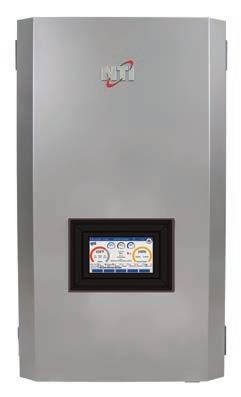
with installers in mind...more powerful and user-friendly interface. • EZ Setup Wizard
• Wi-Fi, remote access to programming, monitoring, diagnostics and troubleshooting (including access to complete error log)
• Easy-to-read, 7'' touch screen with full color graphics
• Three Zones + DHW control. Expand to six zones with optional N-Link Control
backed by NTI’s legendary support, reliability, and technology. Contact your nearest NTI Distributor or visit ntiboilers.com

proved that with one pump operating, the pressure drop was negligible in the suction header. Therefore, the pressure at the pump suction pipe where it connected to the header should be + 4 FT.
Again, back to the drawings and the photos to determine what was between the pipe connection at the header and the pump suction connection. This revealed a butterfly isolation valve and a basket strainer. I now had enough information to complete my plan.
I asked the customer to replace the conventional suction gauge with a compound gauge. A compound gauge can read pressure values both above and below 0 PSIG.
I also asked the customer to take suction pressure readings with the basket strainer screen both in and out.
Here is what he recorded:
• With all the pumps off the suction
pressure at the pump flange read + 4 FT (basket strainer screen in)
• With one pump running at full speed (1760 RPM) the suction pressure at the pump flange read – 25 Inches of Hg (approximately – 12 PSIG with basket strainer screen in).
• With one pump running at full speed (1760 RPM) the suction pressure at the pump flange read + 3.5 FT (basket strainer screen out).
These new readings proved that the actual pump pressure differential was 25 FT – (-12 FT) or 37 FT.
At this pressure differential the pump curve indicated the flow to be approximately 850 GPM. The problem was not the pump but the unanticipated pressure drop of the basket strainer (with screen in).
I recommended that the customer investigate replacing and/or relocating
the basket strainer—problem solved. Admittedly not all troubleshooting problems will be this easy to solve, but the principals are the same.
First, identify the problem. Second, collect data including manufacturers data, drawings, diagrams, field measurements, photos and videos (you can never have too many photos and videos). Third, do some calculations (if appropriate), and finally develop a plan.
Have fun on your next troubleshooting adventure and drop me a line to let me know how you are making out. <>

Mike Miller is vice president of sales, Canada with Taco Comfort Solutions and a past chair of the Canadian Hydronics Council (CHC). He can be reached at hydronicsmike@tacocomfort.com.

MODERN HYDRONICS 2022 - THE SUMMIT
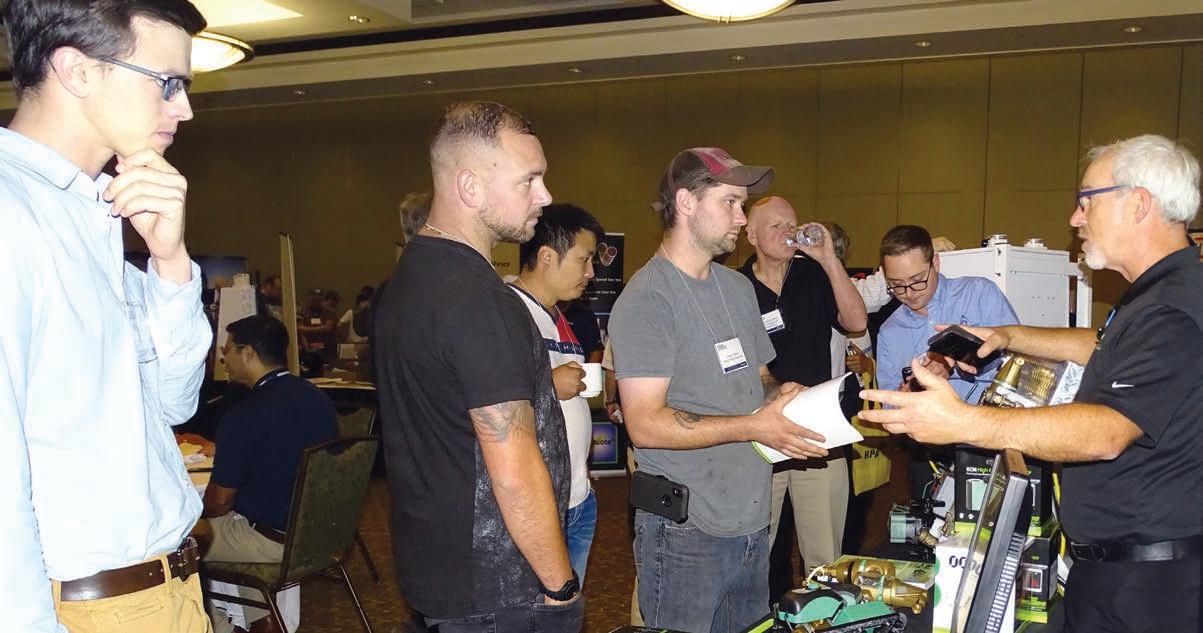
The Sixth edition of the Summit returns as a oneday in-person event.
BY HPAC STAFF
Since 2013 HPAC Magazine has been hosting a one-day Modern Hydronics Summit every two years in the fall, with the event getting bigger and attracting larger crowds every time.
With the pandemic placing all live events on the sidelines in 2021 the HPAC Team made a pivot to hold a virtual two-day Modern Hydronics Summit in March of 2021 attracting viewers from across Canada – drawing the larg-
Continued on MH16
Schedule
The 2022 Modern Hydronics Summit includes five educational sessions delivered by industry experts on topics that will set contractors up for success. Location: Universal EventSpace (6250 Hwy 7, Vaughan, ON)
Thursday, September 15
9:30 am - 10:30 am Registration and Trade Show Floor Open
10:30 am - 11:30 am
11:30 am - 1:00 pm
KEYNOTE Part I: Hydronics for Net Zero Homes (John Siegenthaler)
Lunch & Trade Show
1:00 pm -1:45 pm Zone Circulators or Zone Valves? (Mike Miller, Dave Holdorf)
1:45 pm -2:00 pm Break/Trade Show
2:00 pm 2:45 pm
Critical Nature of Boiler Chemistry (Jeff House, Brian Morgan)
2:45 pm -3:00 pm Break/Trade Show
3:00 pm -3:45 pm
3:45 pm -4:00 pm
4:00 pm -5:00 pm
5:00 pm -5:15 pm
Regulatory Outlook – Boilers & Water Heaters (Tom Gervais)
Break/Trade Show
KEYNOTE Part II: Hydronics for Net Zero Homes (John Siegenthaler)
Sweet Heat Contest Results
5:15 pm -8:00 pm Dinner/Bar
est attendance in the event’s history.
This year, the 2022 Modern Hydronics Summit returns to a traditional one-day in-person format, Thursday, September 17 at the Universal Eventspace located in Vaughan, Ont., just north of Toronto.
THE LIVE EXPERIENCE
While the virtual Modern Hydronics Summit in 2021 provided access to industry professionals from coast to coast, there is no replacing the value of personal interactions at our live hydronics events. Meeting up in person with colleagues who share a passion for this industry, whether it’s sharing a laugh with an old friend or meeting up with new contracting pros, making connections and networking is how this segment of HVAC business continues to grow and prosper.
The trade show portion of the Modern
THANK YOU TO OUR SUMMIT SPONSORS
Platinum sponsor: Resideo.
Keynote sponsor: Caleffi
Hydronics 101 sponsor: NEXT Supply
Tool sponsor: Kane Canada
Event Sponsors: Lochinvar (AquaTech); Roth; Taco; Uponor; Viessmann
And over 60 exhibitors for the trade show featuring all you need for your next hydronics projects.
PLUS: Meet a line-up of HVAC social media influencers as they work on a live pre-fab boiler panel build. In attendance will be: Jess Bannister (@hvacjess); Aaron Bond (@bond_aaron); Terence Chan (@the_impetus); Gary McCreadie (@hvacknowitall1); Tyler Dynes (@dyneshvac); Kiefer Limeback (@toolaholic); Mike Flynn (@flynnstone1); George DeJesus (@Georgetheplumber).
Hydronics Summit will feature over 60 tabletop exhibitors, all specialists in the field featuring technology and services dedicated to this market niche.
And of course the line-up of educational sessions will once again set up attendees for success. Our featured keynote speaker, HPAC writer John
Siegenthaler, will be detailing how hydronic heating and cooling fit into modern Net Zero buildings. He’ll be identifying the advantages of hydronics systems for these applications and how to put the systems together with off-theshelf components to create simple, re -
Continued on MH18
peatable designs. Attendees will also be entered into a draw to win a signed copy of Modern Hydronic Heating for Residential and Light Commercial Buildings (4th edition) which was released this spring.
Other presentations will include: the pros and cons of zone valves and zone circulators; a dive into boiler chemistry; and a look at current and pending regulatory changes and how they will effect new and retrofit hydronic system design.
There will be draws for useful tools after each session, and there will also be Blue Jays tickets up for grabs. Along with a day of education and networking, registration also includes lunch, dinner and a post-event drink.
SOCIAL ENGAGEMENT
Also, live on-site a team of HVAC social media influencers including Gary McCreadie, Aaron Bond, Terence Chan, Jess Bannister, Tyler Dynes, Kiefer Limeback, Michael Flynn and George DeJesus will be working on prefabricating three boiler panels. These HVAC pros will be interacting and live streaming action from the event while also sharing their own tips and tricks using the latest products and tools available.

“There is no replacing the value of personal interactions at our live hydronics events.”
HYDRONICS 101
For the first time this year’s Modern Hydronics Summit is adding a special track for those who are new to the industry or looking to improve their knowledge on hydronic systems and the components that make them work.
This parallel track is being designed for HVAC or plumbing contractors who are considering adding hydronics to their repertoire, or those who want to get their technicians up to speed.
We have dedicated space at the Summit where industry experts will walk attendees through the basics of hydronic systems and help them understand why this technology is growing so rapidly. Each session will be hosted by a product expert and every session will be very interactive and a lively Q&A will be encouraged!
SWEET HEAT
In the Fall of 2020 HPAC magazine launched the first ever Sweet Heat contest, inviting hydronic contractors across Canada to get their cameras out and share their creativity, artistry and resourcefulness in delivering “Sweet Heat” to their customers.
The response was great with over 30 entries last year. For 2022 a generous sponsorship has been attached to the contest, with winners this year (one commercial and one residential project) will each be receiving a $3,000 spending spree courtesy of their local EMCO location.
In addition, the winning entries will be featured in the October 2022 edition of HPAC.
The Sweet Heat prizes will be awarded after the final session at this year’s Modern Hydronics Summit.
REGISTER NOW
The 2022 Modern Hydronics Summit takes place September 15th. Registration is $99 (plus tax & service charge, $119.84 incl.) for the main event, special pricing is available for groups and Hydronics 101. For more information and to register today visit: modernhydronicssummit.com. <>



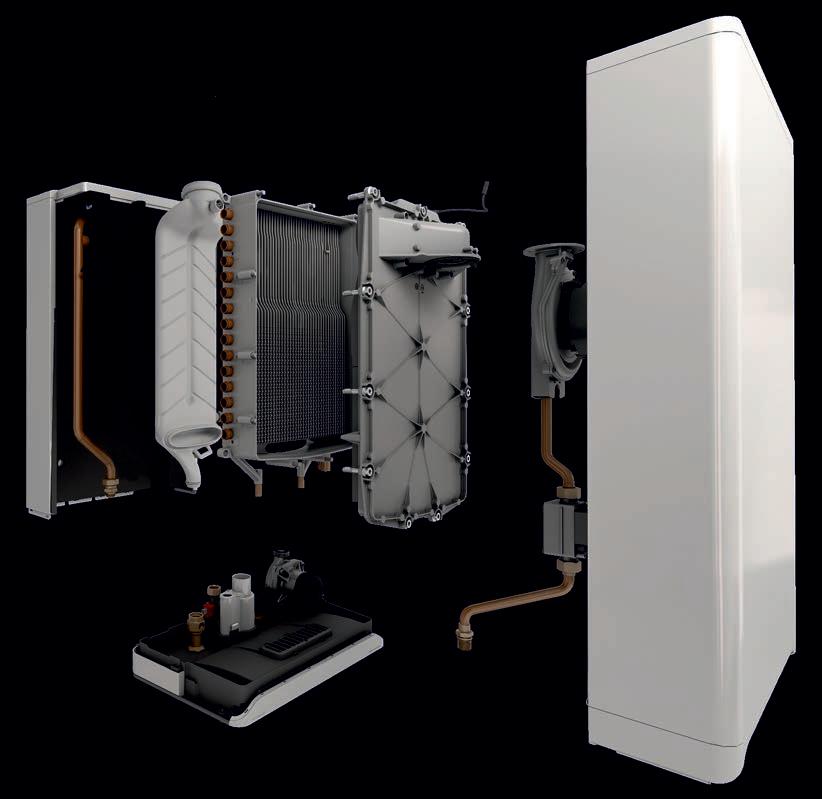


You expect your boiler to provide enough hot water for both your kitchen and bathroom, as well as enough heat to make your home cozy and snug. Combining DHW & space heating in a single compact design featuring two independent copper waterways embedded in a cast aluminium heat exchanger, the SFC Combi is designed to do just that.
The SFC Combi contains cutting-edge, solid-state electronics to control its gas valve, fan and ignition. By doing so, we’ve succeeded in reducing the number of moving parts, made servicing simple, and increased reliability.

www.ibcboiler.com

HEATING YELLOWKNIFE
New pellet boiler district energy system helps NWT government reduce carbon footprint.
BY ELLEN COOLS
As more communities become aware of the benefits of using biomass to heat and power their buildings, more district energy systems are coming online in Canada. Remote northern areas in particular have recognized the opportunity to use bioenergy to reduce their reliance on fossil fuels and lower their greenhouse gas (GHG) emissions.
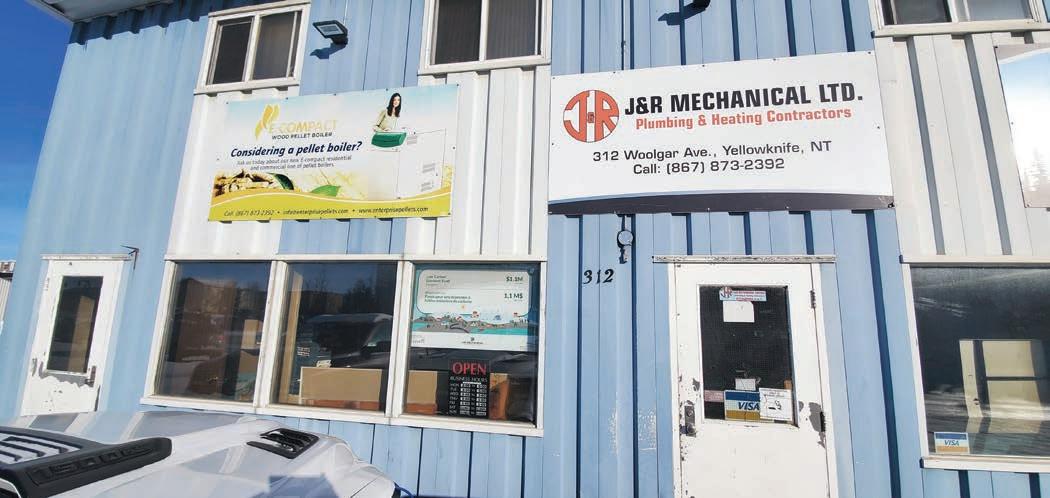
J&R Mechanical, a plumbing and heating contractor in Yellowknife, NWT, is one of the companies leading the charge. Last year the company began operating a new $1.1-million district energy system, called the Woolgar District Heating System, to provide heat to a government of NWT (GNWT) warehouse and three other private businesses, helping to reduce the government’s reliance on fossil fuels.
BRINGING BIOMASS NORTH
This is not the first time that J&R Mechanical has installed a district energy system. According to owner Ken Miller, the company, which was founded in 1977, has been installing biomass boilers for over 12 years. When these types of boilers started becoming popular in the NWT, the territorial government embraced the potential environmental benefits of using wood pellets instead of fossil fuels.
Consequently, “Our government contracts were specifying installations with biomass – in schools predominantly, at first – and that’s how we got involved in biomass,” Miller says. “In the years after
that, when tenders would come out for different systems, we focused on that as part of our regular scope of plumbing and heating. The heating became biomass, and we became a prominent installer of biomass boilers for the government and the private sector.”
Around the same time, J&R Mechanical began installing district heating systems for different government clients. Their first system was for an Indigenous government client in Behchok , NWT, installing a plant that
Continued on MH22
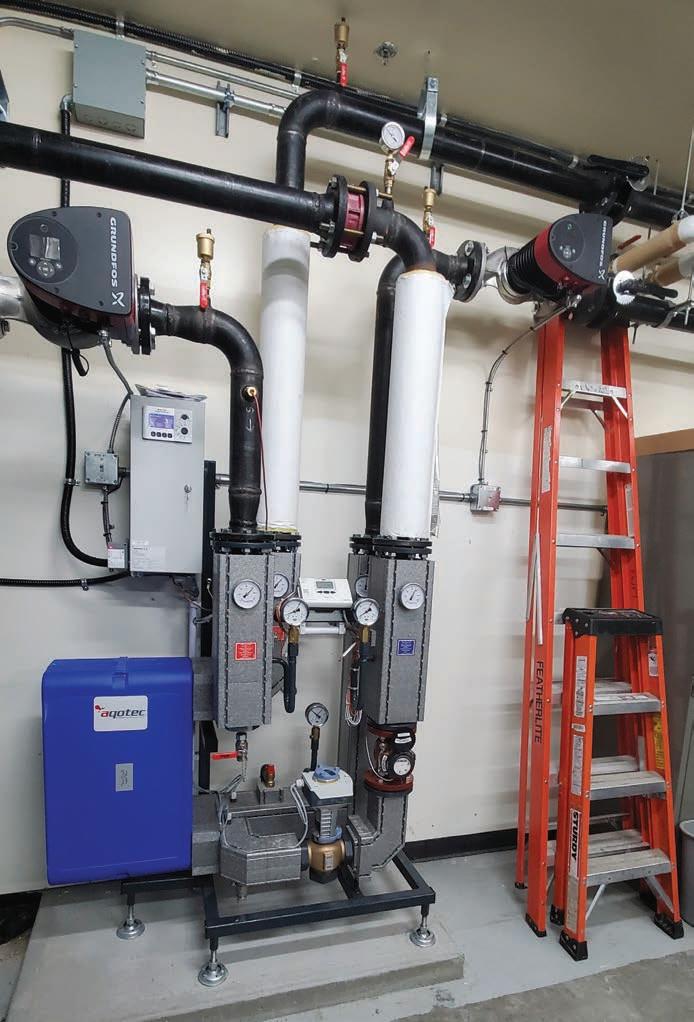
This 200-kW heat transfer station at the GNWT warehouse in Yellowknife allows J&R Mechanical to meter the heat for billing clients. It also provides a hydraulic disconnect between the client building heating system and the district heating system.
assistant

Introducing Viguide



Our new Viguide app connects to any Vitodens smart generation boiler to streamline and simplify each installation.


+ All-in-one app for installation, service, maintenance & monitoring
+ Enhanced customer experience maintenance reminders


with annual automated

+ Faster installation with guided step-by-step start-up and commissioning reporting
+ Simplified maintenance with replacement parts guide

+ Proactive monitoring with remote diagnostics & notifications










DISTRICT HEATING
provides heat to eight buildings from one biomass boiler.
“As we continued to do more and more of those, we had this opportunity to propose a project that was literally right in our backyard – the Woolgar District Heating System – and the main client is the GNWT warehouse,” Milller says. “They have a list of buildings they wanted to switch to biomass, and this one was on their list.”
The territorial government agreed to their proposal to switch the warehouse over to a district heating system. J&R Mechanical also approached other businesses in the area that could benefit from the system, which led to 30% of the block coming on board.
The project took two years from proposing the idea to completion, including the planning and design, permits and installation.
J&R Mechanical ran into a few issues during the construction and installation process, mainly permitting issues, Miller says.
“You can only dig in the summer here, so we started the project too late to get everything – the permits and all of that – on time in the previous summer (2019),” he explains. “Even into the con -
struction season, in the summer of 2020, we were delayed because of permits. We didn’t have everything in place. So, it took us into the winter, which caused some issues for us and left us with some seasonal deficiencies.”
But, the system officially came online in March 2021, and has since been providing heat to the three businesses, the GNWT warehouse and a GNWT data centre that is connected to the warehouse.
FROM WOOD PELLETS TO HEAT
The system itself is fairly simple, with two main components: a shipping container housing a 1330 MBH (390-kW) Viessmann Vitoflex 300-UF boiler and a silo to store the wood pellets.
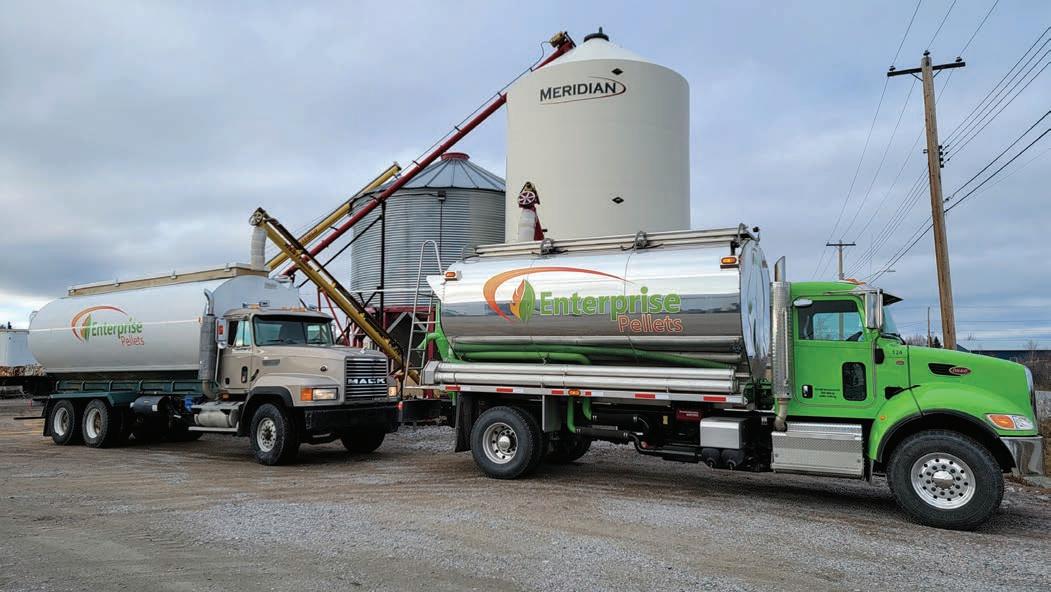
Fink Machine of Enderby, B.C., the supplier, assembled the boiler in the containerized plant, which was then shipped to J&R Mechanical, who installed it and connected it to their own systems. Meanwhile, the wood pellets came from a pellet plant in Alberta.
According to Miller, the system is very similar to any other hydronic heating system: “You heat water and you transfer the heat to buildings through various different types of heat exchangers, whether it be baseboard radiation or
unit heaters, radiant in-floor heaters or radiant panel heating.
“The process of burning wood pellets to create the heat source is the only real difference,” he continues. “We unload and load them, redistribute them to different silos in the community where these pellets are then extracted by augers or different devices to feed the boiler, based on the demand for heat.”
The boiler produces heat, water vapour, carbon dioxide and ash. The heat from the water vapour is transferred to each building’s space heating system through underground pipes, Miller explains.
Yellowknife, of course, is extremely cold in the winter, which means the system has to be able to operate in a harsh climate. So far, there have been no issues with the boiler, Miller says.
“The average design temperature here is to -45C; we’ve seen the boiler operate just perfectly in those tempera -
J&R Mechanical in Yellowknife has been installing biomass boilers for over 12 years.
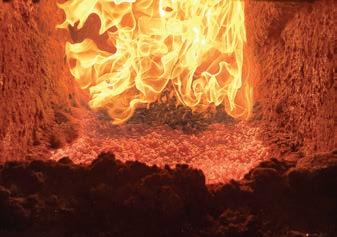
The pellet boiler fired up.
PHOTOS COURTESY
tures,” he says. “It’s operating as it was designed to operate, with low maintenance and fairly high efficiencies. It’s worked out well.”
REDUCING FOSSIL FUEL RELIANCE
The system has also had a big impact on the NWT government’s fossil fuel use, as it has cut oil use for the warehouse by 92% – from 60,000 litres per year to just 4,800 litres. The system has also reduced the warehouse’s GHG emissions by 145 tonnes of carbon equivalent.
The project, which cost $1.1 million, was a big capital investment for J&R Mechanical. The NWT government gave the contracting business a $274,000 grant for the project, but the company footed the rest of the bill. However, Miller says their business plan calls for paying off that investment in four to five years of operations.
So far, the feedback from the community and the territorial government has been very positive, Miller says. He believes there are opportunities for other northern communities to develop simi -
“The average design temperature here is to -45C; we've seen the boiler operate just perfectly in those temperatures.”
lar district energy systems using woodburning boilers to reduce their reliance on fossil fuels.
“I think everyone is looking at them as a better solution – looking at biomass boilers to heat buildings – so I think it has been kind of proven that this is a good way to go,” he says.
Nevertheless, there are a few barriers to overcome when installing a system like this. One such challenge is understanding the potential impact on a community’s infrastructure.
“We bury pipes in the ground, and that can be very disruptive,” Miller explains. “There’s other stuff in the ground that you don’t see – power lines, water and sewer pipes, telephone lines and things like that, depending on where you’re trying to install it. So, engineering
design can be a big challenge.”
However, the benefits far outweigh the costs, and J&R Mechanical is looking at possibly expanding the Woolgar District Heating System.
“If our client base grows – and it potentially will with some new developments next year or the year after – we possibly will have to expand the size of the heating plant to accommodate,” he says.
For now, though, the company is already planning to add one or two more buildings to the system and continue running it as is. <>
This article originally appeared in Canadian Biomass (published by Annex Business Media, owners of HPAC). Ellen Cools served as Editor of Canadian Biomass.
PHOTO COURTESY J&R MECHANICAL
J&R Mechanical established Enterprise Pellets in 2009 to supply, install and maintain biomass boiler systems for residential and commercial heating application in the area. The company distributes pellets to silos in the community.
AutoFill™ is the original, automatic, fast-filling boiler valve, offering precise pressure control in hydronic or cooling systems. Set it and forget it with a simple dial set point adjustment, factory pre-set at 15 psi. The valve combines with optional ASSE 1012 dual check or ASSE 1013 reduced pressure zone backflow preventer to save time and reduce space requirements. An optional pressure gauge offers effortless adjustments as needed—no more guessing. CALEFFI GUARANTEED.


DEW DROP INN
A
quick lesson in condensation prevention when it comes to radiant cooling.
BY CURTIS BENNETT

Ihave one distinct memory about my great grandparent’s homestead. At the entrance, where the two fences met between their land and the neighbour’s, there was a large rock with the words: “Dew Drop Inn”.
I always thought it was a really cool message. I have seen this little saying around in other places since, but I know that rock was there since around 1925, so they might have been the first. At least I like to think so.
Well, that saying leads me to the topic of the day: condensation.
Radiant cooling has been on the verge of being mainstream since I got into the hydronics industry 20 years ago. Working with geothermal heat pumps provides the capability, and we have the piping infrastructure for the heating system, so adding cold water into the mix should just work, shouldn’t it?
Well it’s not that simple.
Radiant cooling runs into a very big
problem, especially in areas with high humidity.
You know when you bring a can of Coke out of the fridge and put it on the counter, and those little beads of condensation form on the outside—it’s like the Coke is telling you that it’s perfect and ready for drinking. Well if that same
“I like radiant cooling, it just needs to be done correctly or you will have a very mad homeowner.”
condensation forms on the pipes running through your walls or on your radiant floors, then we have a big problem.
The condensation that forms is often called dew, or at least that’s what we call it when it forms on the grass and flowers in the yard—when the grass is
cold from the night and the morning sun warms up the atmosphere. The point at which the condensation starts to form is call the “Dew Point”. The dew point of an item is a calculation that involves the relative humidity of the air as well as the temperature of the item.
The calculation is a pretty math heavy, but don’t worry we won’t get into it. Well, ok, just a little bit. Relative humidity is actually a ratio. A ratio of how much humidity the air has in it to how much humidity it could hold at that temperature.
The dew point calculation tells us at what temperature that humidity starts to squeeze out of the air. This is where the problem for radiant cooling comes in.
Don’t get me wrong, I like radiant cooling, it just needs to be done correctly or you will have a very mad homeowner. In many cases it could be the flooring with pipes are running through it that will condense or some sort of radiant cooling panel.
So what do we need to do? We need to control, very precisely, the temperature of the fluid going into these areas.
Having said that how do we make sure?
It starts with the calculations. It is possible to have a different dew point in each room, so the dew point needs to be individually calculated from each room. That will mean each room must have a humidity sensor built into the thermostat.
These calculated values all need to be sent to a “CENTRAL” control. This is the important part. The system needs to communication as a “SYSTEM”, it can’t be individual rooms.
All the rooms have to know the information from the other. This way the system can determine the proper temperature that is required to be entering the system. It has to know dew point values in each room because it needs to go with the high-

est calculated temperature.
If we chose the lowest temperature, or just an average temperature, we could have condensation forming in some rooms but not others. This is bad.
When condensation forms on woods floors, it will eventually wreck them. If condensation forms on cooling panels that have been embedded in the ceiling. Well guess what, bad news as well. I think you see where this is going.
Once the control system has figured out the ideal temperature to be pushed out to the system, we need to get it there, so there will need to be some mixing to properly control the temperature.
Going even a touch colder than the dew point will lead to the formation of condensation, and it does not go away as soon as you push above that temperature. So it’s very important not to go below it in the first place.
Ok, I’ve kept this short and sweet, and hopefully to the point.
In future articles I may have to do a little elaboration and get into more of the math, because radiant cooling is getting bigger every year and it’s critical that we control for that dew point or installations could become homes with dew drops within. <>

Curtis Bennett C.E.T is product development manager with HBX Control Systems Inc. in Calgary. He formed HBX Control Systems with Tom Hermann in 2002. Its control systems are designed, engineered and manufactured in Canada to accommodate a range of hydronic heating and cooling needs commonly found in residential, commercial and industrial design applications.
Partner With Your Industry Experts.
AQUATECH™ offers innovative Lochinvar® commercial and residential building heating and hot water solutions that empower engineers, specifiers, builders and contractors to use solutions that dependably deliver.
A building is about more than just products. It’s about people. Your customers, who live, learn, or work in the facilities must have heating and hot water solutions that perform and give them peace of mind.
Turn to one of your best resources for heating and hot water solutions, value and people support. Grow your business with AQUATECH.

OPPOSING CURRENTS
When it comes to designing systems with heat exchangers, stick with counterflow piping.
BY JOHN SIEGENTHALER
Heat exchangers, in all their varied types and sizes, allow heat to move from one fluid to another without any contact between those fluids. They add considerable versatility to hydronic system design. Common applications include domestic water heating, snow melting and hydronic subsystems for garage floor heating.
Flat plate heat exchangers have captured much of the market. More specifically, “brazed plate” stainless steel flat plate heat exchangers (BPHX) are now available from several suppliers in a wide range of sizes. They are ideally suited for residential and light commercial applications.
This type of heat exchanger is made by assembling a stack of pre-formed stainless steel plates that have copper bonded to them around their perimeter, and at points of contact between adjacent plates. The concept is shown in Figure 1.
The stack is then compressed and heated in an oven to approximately 2,000F to braze the surfaces and perimeters together.
Most manufacturers of brazed plate heat exchangers have standardized plates sizes. Typical plate dimensions are 3 x 8 in., 5 x 12 in., and 10 x 20 in. For a given plate size, heat exchange ratings are increased by adding plates to the “stack” that become the overall heat exchanger. Brazed plate heat exchangers are commonly described by the nominal size of their plates and the number of plates in the stack. For example, a 5 x 12 x 40
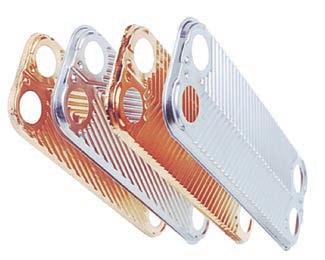
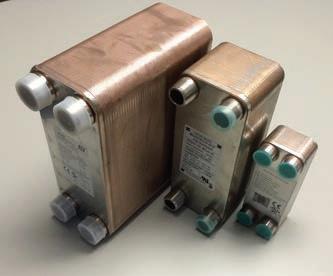
brazed plate heat exchanger has 40 plates, of nominal dimension 5 x 12 in.
One unique plate forms the back of the heat exchanger (e.g, it has no holes through it). Another unique plate forms the front of the heat exchanger, and transitions to the four piping connections. Figure 2 shows examples of brazed plate stainless steel heat exchangers ranging from a 5 x 12 x 100 plate unit, to a relatively small 3 x 8 x 10 plate unit.
FLOW DIRECTION MATTERS
Assuming the channels between the plates were numbered, one fluid passes from one end of the heat exchanger to the other through the odd numbered channels (1,3,5,6, etc.). The other fluid passes from one end of the heat exchanger to the other through the even numbered channels (2,4,6,8, etc.).
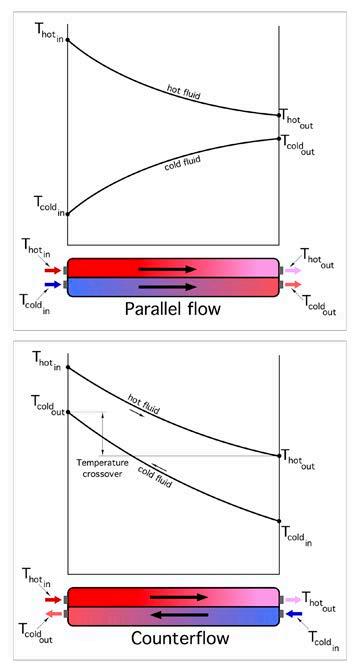
There are two possible ways to pipe up a flat plate heat exchanger. The two entering fluids streams could be moving in the same direction, or in opposite directions. When the two streams flow in the same direction the configuration is called “parallel flow.” When the two streams flow in opposite directions the configuration is called “counterflow.” These two flow configurations, along with representative temperature changes of both fluid streams, are shown in Figure 3.
You can see that the temperature difference between the hot fluid and cool fluid changes considerably depending on where it is measured within the heat exchanger. For the parallel flow heat exchanger the temperature difference at the left side, where both fluids enter, is
Figure 1. Example of typical brazed plate stainless steel flat plate heat exchanger (BPHX) assembly.
Figure 2. Examples of complete brazed plate stainless steel heat exchangers.
Figure 3. There are two ways to pipe up a flat plate heat exchanger: parallel flow or counterflow.
very large. But this difference decreases rapidly as the fluids exchange heat and move toward the outlet ports. There’s also a variation in the temperature difference between the fluids as they move through the counterflow heat exchanger.
The rate of heat transfer depends on how the temperature differences at all locations along the fluid pathways “average out.” Heat transfer theory can be used to prove that this average temperature difference, which is more specifically called the “log mean temperature difference” (abbreviated at LMTD), can be calculated using Formula 1.
Formula 1:
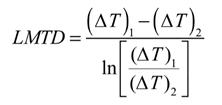
Where:
LMDT = log mean temperature difference (F)
(∆T)1 = temperature difference between the two fluids at one end of the heat exchanger (F)
(∆T)2 = temperature difference between the two fluids at the other end of the heat exchanger (F)
ln [ ] = the natural logarithm of the quantity in the square brackets.
Here’s an example of how to use Formula 1: Calculate the LMTD of the heat exchanger shown in Figure 4 (next page).
Just carefully put the numbers into the formula. Let (∆T)1 be assigned to the top end of the heat exchanger. Thus (∆T)1 = 122-77 = 45F. This means that (∆T)2 is at bottom end of the heat exchanger. Thus (∆T)2 = 104-68 = 36F. Putting these values into Formula 1 yields:
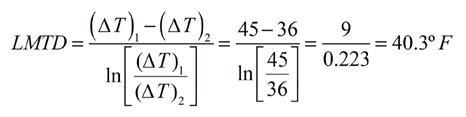
Reversing the ends of the heat exchanger representing (∆T)1 and (∆T)2 would make (∆T)1 = 36F, and (∆T)2 = 45F. Putting these values into formula 1 yields the same result.
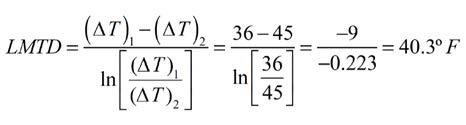




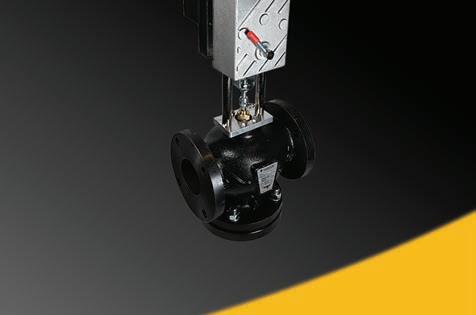

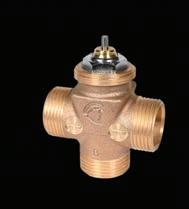



HEAT EXCHANGERS
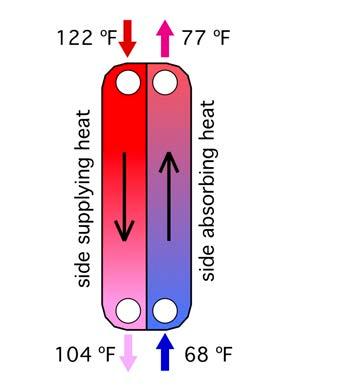
MAXIMIZING LMTD
The higher LMTD at which any heat exchanger operates, the greater the rate of heat transfer, all other conditions being equal.
Heat transfer theory can also be used to prove a very important concept in the application of heat exchangers:
The LMTD of a heat exchanger configured for counterflow will always be higher than that of the same heat exchanger configured for parallel flow, and having the same entering and exiting conditions for both flow streams.
This implies that heat exchangers should always be configured for counterflow when the goal is to maximize the rate of heat transfer.
Figure 5 shows a piping schematic where the heat exchanger is configured for counterflow.
Always check your piping schematics, or schematics that you may be approving for others to use, to be sure that all heat exchangers are piped for counterflow.
Check any installations that you are inspecting, that include heat exchangers, to be sure that they are operating in counterflow.
LET SOFTWARE DO THE HARD WORK
Although it’s possible to manually estimate heat exchanger performance, the calculations are complex and time con -
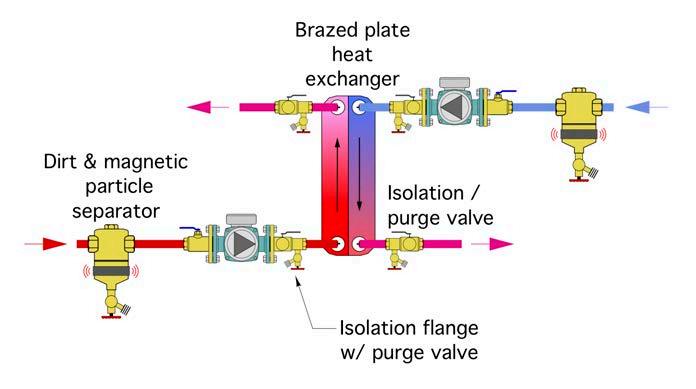
“It's always a good idea to put a high efficiency dirt separator, preferably one with a magnet, up stream of both inlet ports of any heat exchanger.”
suming. Modern practitioners use one of several available heat exchanger software tools available from manufacturers to rapidly evaluate “what if” scenarios, which lead to a final model selection.
In most cases a brazed plate heat exchanger will be sized to pass a given rate of heat transfer when the difference between the entering hot fluid temperature and the leaving cooling fluid temperature is no more than 5F.
Here are a few final application points regarding heat exchangers:
1. “Cleanliness is next to godliness" when it comes to heat exchanger performance. It’s always a good idea to put a high efficiency dirt separator, preferably one with a magnet, up stream of both inlet ports of any heat exchanger. You can see these in Figure 5, along with isolation and purging valves. The latter can be used, if ever necessary, the isolate each side of the heat exchanger and chemically clean scaling from internal surfaces.
2. Always support heat exchangers to reduce stress on the connecting piping.
Several types of brackets are available and they range from a simple steel “shelf” bracket, to brackets that bolt directly to the threaded studs supplied on some heat exchangers.
3. Finally, if the heat exchanger will be operating with chilled fluids, which are lower than the interior dewpoint temperature, be sure it’s fully wrapped with elastomeric foam insulation or other vapour impermeable insulation material.
Stick with counterflow piping and the details mentioned above, and then stand back and be amazed at the incredible performance of modern brazed plate heat exchangers. <>
John Siegenthaler, P.E., is a licensed professional engineer with more than 40 years of experience in designing modern hydronic heating systems. Siegenthaler is the author of the textbooks Modern Hydronic Heating (4th edition available now) and Heating With Renewable Energy (see www.hydronicpros.com).
Figure 4.
Figure 5. Piping schematic configured for counterflow.
LINED-UP FOR DEPENDABILITY
With the latest innovations and long-lasting reliability, it’s the trusted product line.
ALWAYS INNOVATING LASTING RELIABLILITY
• Tank in Tank Technology
• 439 Stainless Steel Fire Tube Heat Exchanger
• Peace of Mind Warranty Program
• No Fault Forward Manufacturing
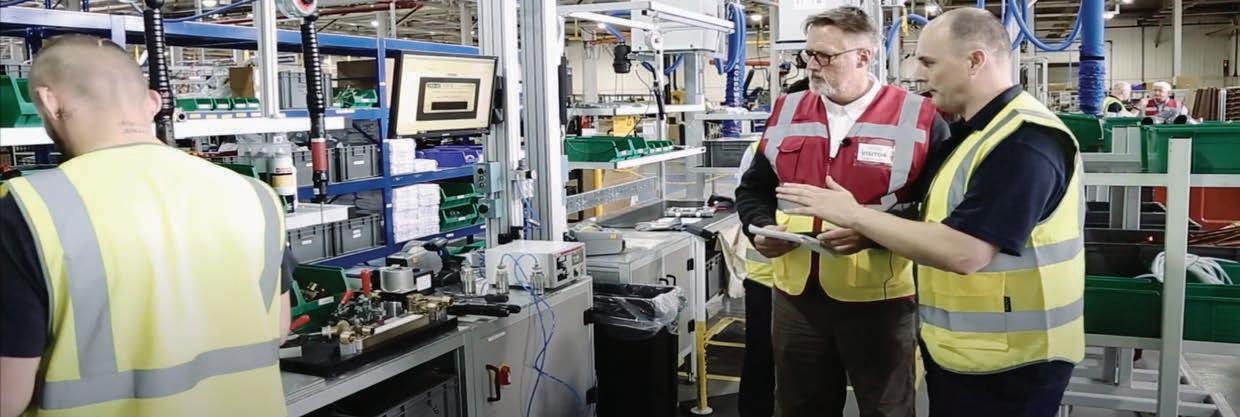
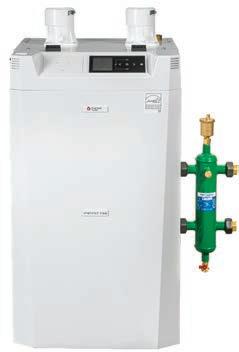
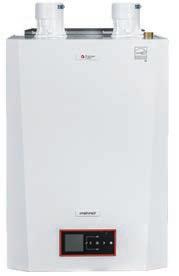
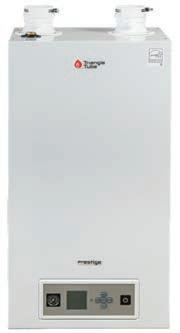
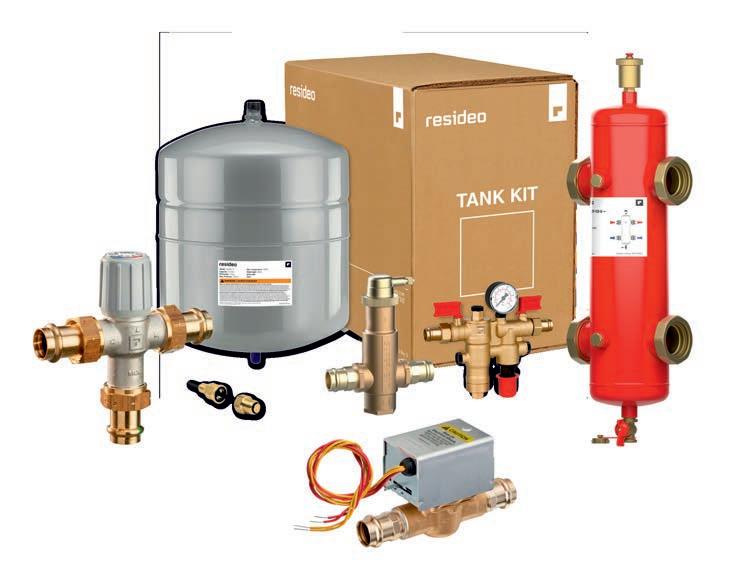
MECHANICAL SUPPLY NEWS
MANUFACTURERS • DISTRIBUTORS • WHOLESALERS
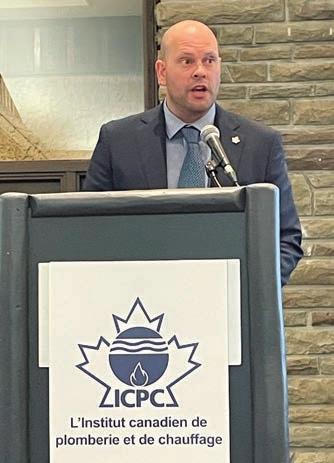
CIPH INTRODUCES NEW CHAIR –MATT ROBINSON
The Canadian Institute of Plumbing and Heating (CIPH) held its annual general meeting (AGM) at the Fairmont Jasper Park Lodge during the group’s Annual Business Conference (ABC) held June 19 to 21, the first in-person CIPH business conference since 2019.
At the AGM the CIPH welcomed Matt Robinson, vice president, Robinson Supply, as its new Chair for 2022-23.
Becoming the 75th Chair of the Institute, Robinson is following in the path of his father, Ross Robinson, who served as CIPH Chair in 2003-04.
Following an introduction by outgoing Chair Bill Hooper (sales manager –Atlantic region, Uponor), Robinson expressed his gratitude to the group and his excitement in traveling the country to visit each CIPH region. While acknowledging the work of those before him, Robinson is looking forward to working on the Institute’s strategic direction in the year ahead.
“One of the important initiatives is building more diversity. In recent years our Board has transformed and committed to building a more diverse group that
ANNIVERSARIES
>> CALEFFI TOASTS TO 20 YEARS IN NORTH
It was 20 years ago that Caleffi opened its North American headquarters in Franklin, Wisconsin. To honour the milestone, the Mayor of Milwaukee proclaimed May 19, 2022 to be Caleffi Day, while the company hosted industry colleagues to celebrate its anniversary and the unveiling of a new Training Center. caleffi.us
AMERICA
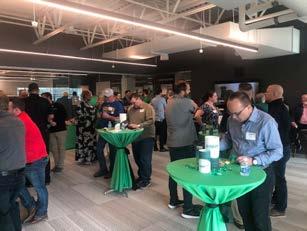
>> MAINLINE BACKFLOW PRODUCTS TURNS 25
Established in 1997, Edmonton-based Mainline Backflow Products works with all levels of governments in Canada and the U.S. to prevent flooding caused by sewer backups. The company’s award-winning product designs including its innovative 'normally open' backwater valve design led to changes to the National Plumbing Code of Canada. backwatervalve.com
>> CHEMFAX CELEBRATES 50
Incorporated on October 1, 1972, Chemfax Products, a manufacturer of specialty chemicals for the plumbing and hydronics industry, has grown from a small facility near downtown Calgary to a company with over 150 products and distribution across Canada and the world. The company celebrated its 50year milestone at its annual Chemfax Stampede BBQ and open house in early July. chemfax.com
brings different perspectives and challenges the status quo … as business leaders we need to push to create more diversity and inclusion in our work environments that are more representative of the communities we live in. Focusing on this will create opportunities and positive impact for all of us,” said Robinson.
The theme for the annual conference was Shift to Celebrate, as the CIPH embraces and adopts to changes in the industry and the association.
Founded in 1933, CIPH will be celebrating its 90th year in 2023, when it will be hosting its annual business conference June 18 – 20 in St. John’s, Newfoundland and Labrador. ciph.com
NAVAC PARTNERS WITH DRM REPAIR CENTRE
Navac has formed a new partnership with DRM Repair Centre in Toronto to provide Canadian customers with outof-warranty repairs for its vacuum pumps, recovery units and other premium HVAC/R tools.
DRM Repair Centre specializes in the service and repair of recovery machines and vacuum pumps for air conditioning and refrigeration. The company also offers emergency services in time sensitive situations. navacglobal.com
Matt Robinson CIPH Chair, 2022-23.
Celebration at Caleffi in Wisconsin.
Chemfax team in Calgary.
BARBARA O’REILLY RECEIVES FIRST CIPH WOMEN OF DISTINCTION AWARD

The inaugural CIPH Women of Distinction Award has been presented to Barbara O’Reilly, vice president/general manager, Rheem Canada. The Canadian Institute of Plumbing and Heating (CIPH) handed out the new award to O’Reilly at the CIPH Annual Business Conference in Jasper. The honour recognizes individuals who have demonstrated a commitment to mentoring, developing and promoting women in the plumbing and heating industry. O’Reilly has been with Rheem Canada for over 27 years and currently sits as a director on the Board of the CIPH. ciph.com
CHC AWARD OF MERIT GOES TO PAUL STEVENSON

The CHC (Canadian Hydronics Council) has bestowed its annual Award of Merit to Paul Stevenson, a hydronics technical services specialist who recently retired from EMCO Corp. in Victoria after serving 45 years with the company.
The CHC Award of Merit is given to an industry volunteer who has contributed to the industry in Canada for at least 10 years, and whose contributions of time, knowledge and expertise have improved the professional profile of the industry through education, training, public relations, technical achievements or the development of codes and standards. ciph.com/hydronics_council
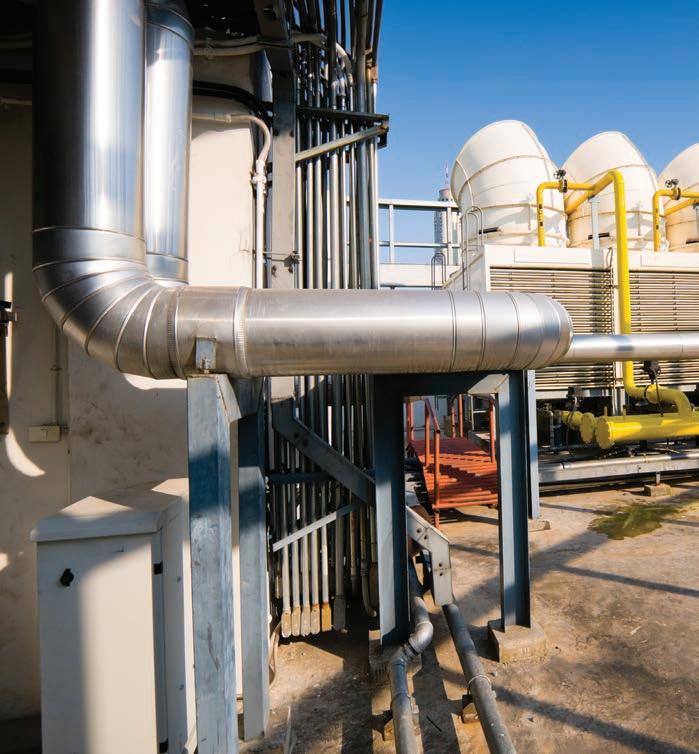
INDUSTRIAL CHIMNEY CO. ACQUIRES CHIMINEE LINING
Industrial Chimney Company (ICC) based in Saint-Jérôme, Québec, has acquired Cheminee Lining, the exhaust solutions division of U.S.-based industrial boiler manufacturer, The Cleaver-Brooks Company. As part of the sale, ICC will continue to lease 56,000 sq. ft. of manufacturing space and 21,000 sq. ft. of office space located in Terrebonne, Quebec, as well as provide employment for more than 44 existing Cheminee Lining employees. icc-rsf.com
JOHNSON CONTROLS ACQUIRES TEMPERED NETWORKS
Johnson Controls has announced the acquisition of Tempered Networks, based in Seattle, Washington.
Tempered Networks has created ‘Airwall’ technology, a new system for buildings that enables secure network access across groups of endpoint devices, edge gateways, cloud platforms and service technicians.
The technology represents a stepchange in operational technology built on secure transmission pipelines to ensure buildings data exchanges and service actions can only take place between people and devices that are continuously authenticated.
johnsoncontrols.com
DAIKIN EXPANDING MANUFACTURING IN MEXICO
Daikin Comfort Technologies North America (Daikin) has announced it will build a 761,000 sq. ft. manufacturing facility in Mexico that will be fully operational in 2024.
The estimated $230 million plant will localize production of Daikin’s mini-split and Daikin FIT residential inverter products that are currently imported from Asia and will serve the company’s growth in response to increasing demand for products in North and Latin America. northamerica-daikin.com
Paul Stevenson
Barbara O’Reilly

Viessmann Canada has promoted Glen Mellis to the role of regional manager – Western Canada. In his new role, Mellis will lead the Langley team, while managing the future growth for the Western Canadian operations. Over the past 11 years, he was the territory manager in the Greater Vancouver Area. Mellis has replaces Randy Stuart, who retired at the end of June.
Mike Tzimas has been promoted to president, Napoleon, succeeding Ron McArthur who previously announced his intention to retire at the end of 2022. Tzimas was most recently the chief financial officer (CFO) with Napoleon. He joined company in January of 2020 as vice president of finance and became CFO in January of 2021.


Master Group has appointed Doug Hines as director of branches. Hines has worked with Master for the past 11 years as a branch manager in various GTA locations. Master also appointed Essam (Sam) El Tawil as branch director – Burlington branch. Chris Bartolotta has been named branch director, based at the Hamilton branch.







LIXIL Canada has promoted Cosimo Coffa to general manager, trade sales and marketing, responsible for American Standard, DXV, and GROHE brands. Previously Coffa led trade/ project sales for Canada since September 2018. He brings more than 27 years of experience in senior sales and marketing roles. LIXIL also promoted Marlon Thompson to vice president (leader), marketing Canada. In his new role, Thompson is responsible for the Canadian integrated marketing team of product, channel, digital and pricing. He joined the organization in 2019.
NAVAC has promoted Luis Ochoa to director of sales for the newly created northern division, leading the company’s sales and marketing efforts for all of Canada as well as the eastern and central markets in the U.S. Previously Ochoa was regional sales manager of the eastern region for NAVAC.

In addition, Master announced the transfer of Denis Cazabon to outside sales representative – refrigeration. Lauren Cassa has been named branch representative/outside sales in Burlington. Cassa spent five years on the tools as a refrigeration apprentice prior to joining the wholesale side of the business.

John Lafontaine has been named branch director for the Markham branch. And Mahadeo Raja Autar is now branch director for Vaughan branch, he has previously worked at the Markham and Cranfield locations.
22_001585_HPAC_AUG_CN Mod: June 17, 2022 4:50 PM Print: 06/30/22 4:11:55 PM page 1 v7

Uponor has appointed Andres Caballero as president of the building solutions – North America division. Caballero succeeds Bill Gray who stepped down in January. Caballero previously spent over a decade in general management roles at Honeywell, leading global businesses in environmental and control solutions as well as building solutions.
Daikin Applied Americas has announced that president/CEO Mike Schwartz will retire at the end of August. Schwartz has held the position since September 2011, and he has increased manufacturing capacity by 75%. Prior to joining Daikin, Schwartz held leadership roles at Lennox International from 1997-2005.

Mellis
Tzimas
Thompson
El Tawil
Cazabon
LaFontaine
Autar
Ochoa
Caballero
Schwartz
Coffa
Hines
Bartalotta
Cassa
THE “NEW-SCHOOL” PLUMBING BUSINESS
Vancouver’s Impetus Plumbing & Heating is embracing social media and breaking down oldschool perceptions.
BY DAN VASTYAN
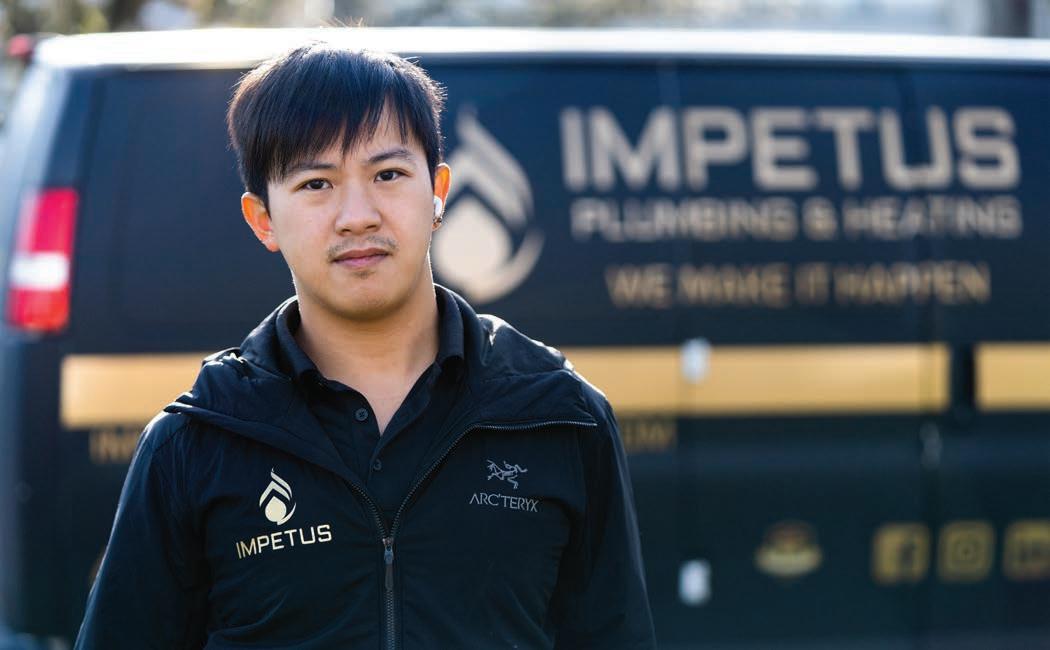
In 1990, Bill Chan emigrated from Hong Kong to Vancouver. When he arrived in Canada, Chan bought a Street Fighter arcade kiosk, the first of many such investments on his way to becoming one of the area’s arcade pioneers. Like many immigrants to North America, Chan’s entrepreneurial spirit and work ethic thrived.
In some ways, Bill’s son, Terence Chan, followed the same entrepreneurial path, although in a more roundabout way in the beginning, and in a completely different market.
“I was a straight-A student in high school and entered the University of British Columbia’s engineering pro -
gram,” says Terence. “That’s where my grades faltered, due almost entirely to my love of video games and the freedom to fail like I’d never experienced. I dropped out and floundered for a few months. My parents suggested a career in the plumbing trade, suspecting that an opportunity to work with my hands would be a good change.”
Chan enrolled in the British Columbia Institute of Technology’s Plumbing Foundation course, at which point he realized that he wanted to give his all to becoming the best plumbing and heating professional he could be.
“The trade bit me,” he explains, as he fell in love with creating things. After
trade school, Chan ultimately took on positions with five different firms. He started working on commercial hi-rise installations; he then went into sales with a distributor, before heading back into the field for service experience.
Later Chan went back to school specifically for hydronic system design. No matter what he was doing, Chan was fully invested.
“When I graduated from trade school in 2011, I set a goal to become the best plumber in the world,” says Chan. “Each job change was a calculated decision to gain the experience I needed to eventually start my own firm. I quite
Continued on p54
Terence Chan, owner of Impetus Plumbing & Heating.
MENTORING FUTURE COMPETITION
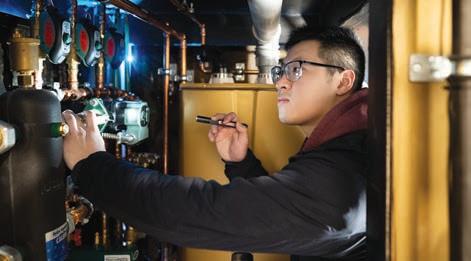
Service technician Calvin Quan works full time for Impetus Plumbing & Heating, but he also owns Ethos Plumbing and Heating—a one-man business he operates on a part-time basis when he’s not working for Impetus.
Quan left high-rise/commercial plumbing in 2019 and transitioned to service plumbing, and Terence Chan of Impetus has been mentoring him with the intention of helping him truly strike out on his own one day. In doing so, some would say Chan is doing himself a disservice, but he claims the opposite.
Chan is mentoring Quan on how to run a business. He seeks out opportunities for Quan to gain more experience, tackle new challenges and run projects on his own. At every step, if there’s an opportunity for improvement, Chan explains how the situation could have been better handled. Chan allows Quan to also see how the company runs, hiding nothing.
“Calvin is a young, ambitious individual,” says Chan. “He came from a few companies, much like myself, and decided he wanted to learn his final lessons at Impetus. When he does step away from Impetus one day, he’ll be ready to show us what he's really learned here.”
Quan doesn’t have concrete plans to leave Impetus yet. He feels there’s much more to learn before he decides to make the move. His current goal is to learn and experience the back-end operations of the business. When he leaves Impetus, his plan is to lend Chan an extra hand from time to time.
“When people learn of this, they ask me why I’d go out of my way to help someone who will become strong competition someday. I don’t see it like that,” explains Chan.
“It’s great to see people grow. It's great to build community. There’s so much work out there, and quite frankly, I trust that Calvin won’t go after my clients. If he did, and if he succeeded in doing so, it just means that a) I never did a good enough job for my customers or b) they were never my customers to begin with!”
“By helping Calvin, I know that when he goes out on his own, there will be jobs that he can’t handle himself, or there will be jobs he's too busy to handle,” continues Chan. “That’s when our relationship will pay dividends. We can always be there to help each other!” — Vastyan
literally took notes on sales, service, design, installation and business management. I recorded what each company did well and what they did poorly.”
Toward the end of his information gathering period, Chan made price lists and paid for his own business licenses. Reviewing his many experiences, Chan had a revelation: changes to company cultures across all sectors of the trade were vital.
“Company culture directly impacts the public perception of the trade and impacts our ability to recruit and retain the right employees and deliver a phenomenal product,” he says. “At the end of the day, company culture dictates profitability.”
LAUNCH OF IMPETUS
Chan founded Impetus Plumbing & Heating in 2015, serving the greater Vancouver area. His motive was to two-fold; to challenge himself and to enhance the perception of the trade.
“The trade has always been perceived as blue collar,” he says. “And how often do you hear someone use the term, plumbing career? At its core, my passion stems from closing the gap between widespread perception of the trade and what a modern, professional plumbing and heating company really does.”
Referrals have steadily multiplied. Impetus hired its first of seven employees in 2017. The company has no niche aside from taking everything they do to the next level – whether involving commercial, residential, service, installation or renovation work.
It is not uncommon for an eyebrow or two to raise after experiencing the company’s quality of work and the employees’ dedication to their craft.
SOCIALLY ACTIVE
According to Chan, the most effective way to change perception of the trade is by providing professional, interesting, informative and entertaining content on social media, and then backing it up with outstanding work.
Chan invests up to an hour a day on social media resulting in Impetus developing a following and being visible on nearly every mainstream platform.
“Social media does a lot more good than bad for a business, at least when used correctly,” says Chan. “We reach customers, potential customers and potential hires. Beyond that, we’re changing the perception of the trade in the minds of countless young people who may not even be in our area.”
Social media has become a critical recruitment tool for Impetus. Chan prefers to hire from social media because his followers are aware of the company’s culture, and they’re largely of the generation that’s in tune with his goals; bringing a professional, young presence to the trade.
“Another benefit of social media is the ability to network
Impetus service technician, Calvin Quan, plans to strike out on his own, with the blessing of Impetus owner Terence Chan.
with manufacturers and other companies that serve the trade,” he explains. “I’ve aligned Impetus with companies that have the same vision I do.”
A number of years ago, Impetus was approached by Jobber, a job tracking and customer management app that Chan now uses to run his business. He has allied himself with a number of other companies in similar fashion.
“The companies I collaborate with on social media are always those whose products I use, and beyond that, they have to be actively trying to improve the trades. Jobber does that,” explains Chan. “I also met Sean Giberson, Canadian sales manager at Taco Comfort Solutions, through Instagram. I learned that Taco is a family-owned company that has built a community of forward-thinking trade professionals through online training and interaction. Their goals align with all of mine perfectly,” he adds.
RESIDENTIAL SHOWCASE
Right as COVID-19 made global headlines and lockdowns began, Chan purchased his first home with a vision to make the residence an Impetus Plumbing & Heating showcase.
“We were so inundated with calls from customers who were uncertain whether or not they could get a service professional to help them that I didn’t even have time to decide between a fixed or variable mortgage,” says Chan.
“The emergence of the pandemic ultimately set back my renovation timeline by a year. Dealing with the other trades, limiting the number of workers in the home, and eventually material shortages really hindered progress.”
Now, in 2022, Chan lives in the home but admits it’s only 85% complete. His plan to completely renovate the 30-yearold, 2,900 sq. ft. home is slowly coming to a close.
“I wanted to incorporate everything
we can do in a residence,” says Chan. “Radiant tubing already existed on all three stories and in the basement, so we had a great baseline. The mechanical room and bathrooms became my key focus.”
The Impetus company colours are on full display inside the home. Each of four bathrooms feature black granite and gold fixtures, made by Riobel. Two of the restrooms feature six-function showers, while another has a large tub filler. The home also has a dog wash.
“Most homes in Vancouver have mechanical systems crammed into the smallest space possible, and my house is no exception. It’s under the stairs,” explains Chan. “I could have moved it to the basement, but I wanted to display our capability within the confines of the average home in our area.”
To meet a big hot water load, Chan paired a condensing Navien NPE-240A
Continued on p56
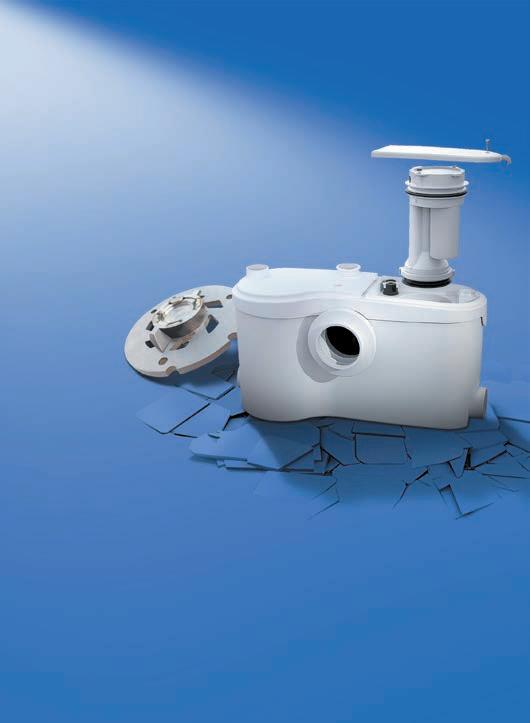
< PLUMBING
Continued from p54
instantaneous water heater with an NFC-200 combi boiler. If needed, the cascading system provides over eight GPM of DHW. Impetus re-plumbed the entire home and installed dedicated DHW return lines.
Currently, the home’s three radiant zones are served by a Taco ECM circulator and Zone Sentry zone valves with press fittings. Both circulators in the system feature isolation flanges. Other Taco components, include boiler feed valves, dual check valves, circuit balancers, the air separator and the magnetic dirt separator and zone control.
Chan ran extra thermostat wires in case he decides to split existing zones in the future. The mechanical room has plenty of flair too, similar to what Impetus provides on all their boiler systems.
A black and metallic gold epoxy pour was applied to the board supporting
the boiler and components. The zone controller, water heater and boiler are all wrapped in matching gold vinyl, and green LED background lighting is powered when the boiler fires.
PRIDE IN WORK
“Seeing to those details exhibits quality and cohesiveness,” says Chan. “I did it in my house, and I do it in customers’ homes, too.
“We’re not ‘butt-crack’ plumbers. We have software and new technology. We assemble controls systems. We have uniforms. We diagnose electrical issues.
“The trade is actively evolving, and I want to help drive that, both locally, through our work, and on a much larger scale via social media.”
Chan has even created a new plumbing group in Vancouver, the BC
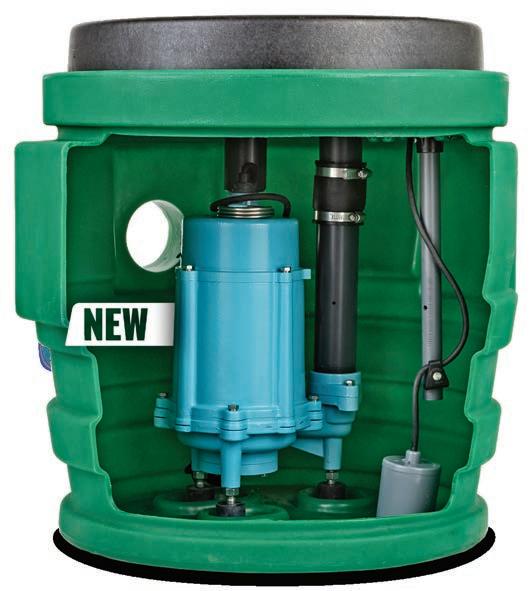
Plumber’s Association. The group is small for now, formed to facilitate business discussions among like-minded professionals who want to see the industry advance.
He believes that too much of the trade is still old-school, and that oldschool mentality is why, according to him, there’s still so much price resistance in the market.
“When people ask us what our hourly rate is, I nicely explain that they have the wrong company,” explains Chan. “That’s not us. We have five stars for a reason. People hear ‘plumbing’ and they think blue collar. That needs to change.” <>
Dan Vastyan is president of Common Ground, specializing in marketing communications serving the construction industry with a focus on plumbing and HVAC markets. danv@seekgc.com.

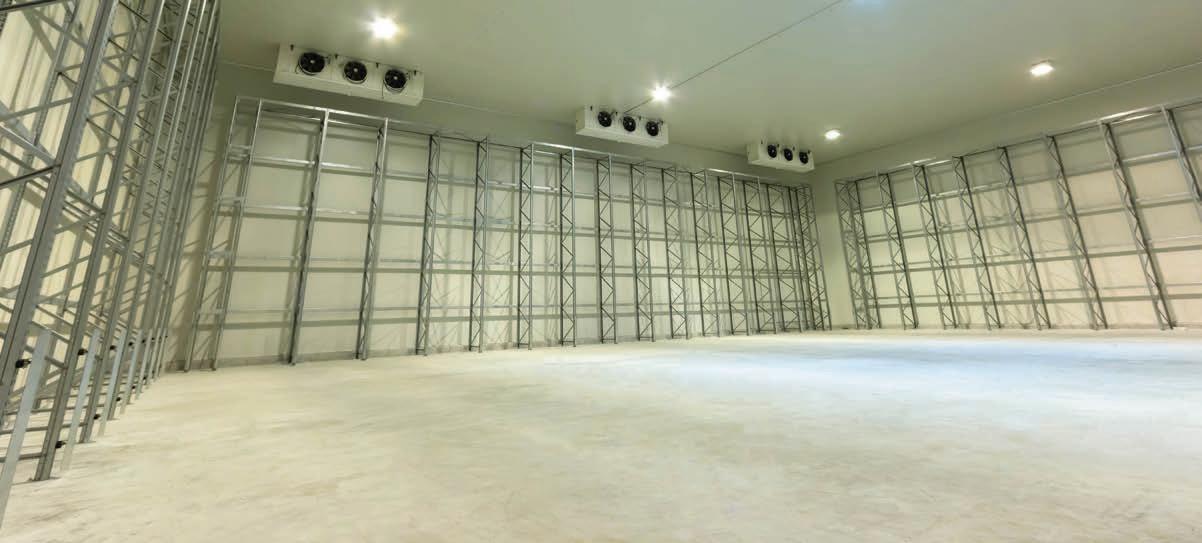
WHAT’S NEW IN REFRIGERATION?
Smart electronic technologies are improving operational efficiencies for refrigeration projects.
BY DAVE DEMMA
Progress in most industries results from new ideas being provided with sufficient capital to undergo the necessary research and development to ultimately become a reality in the marketplace.
Every year, manufacturers present their current offering of the latest and greatest products to the marketplace, and every now and then some technologies knock it out of the park.
In this article I’m going to discuss a couple new solutions that have been game changers in recent years.
First, let’s consider a large refrigeration project. For our example, let’s say you’ve finished the easy part of the equipment installation for a refrigerated beer distribution facility:
• Arranging the crane to set the condensing unit on the roof
• Installing three high profile evaporators in the warehouse
• Installing the pipe hangers, installing/brazing the piping
• Insulating the piping, including the messy gluing portion
• Overseeing the electrician who is running the three-phase power to the condensing unit and evaporators
• Overseeing the control wiring
• Leak testing and evacuating the system
• Putting an initial charge in the system
Now comes the hard part, startup and commissioning:
• Supplying power to the evaporator fan motors
• Supplying power to the compressor
• Fully charging the system
• Calculating and adding the extra charge needed for the condenser flooding valves to maintain the minimum head pressure during the low ambient conditions
• Setting the space temperature
• Setting the cut-in and cut-out on the low pressure control and high pressure control
• Checking compressor oil level, and adding necessary oil to maintain the manufacturer’s recommended oil level
• Checking compressor oil pressure and verifying that the oil safety switch is working correctly
• Checking evaporator fan and compressor motor amperage
• Setting defrost schedule to manufacturer’s specification
• And the fun part, getting up on a scissor lift and setting the thermal expansion valve (TEV) superheat to manufacturer’s specification
Startup and commissioning can be very time consuming, especially with larger more complex systems. But, what if the availability of new technology could shorten the time for startup and commissioning and result in a more efficiently operating system?
Well, of course I wouldn’t be asking the question if an awesome answer couldn’t be provided. Let me cover two smart technology options that are currently available for the refrigeration sector that can help.
LIMITROL+ FLOATING HEAD PRESSURE CONTROL SYSTEM
Condenser capacity is based on several factors: physical size of the condenser fin/tube bundle, fin spacing, air flow provided by the condenser fan motors, and the thermodynamic properties of the refrigerant flowing through the condenser.
While the condenser should be selected for the design condition (aka, the most miserably hot day that the equipment will likely need to operate in), for most of the year when the conditions are milder than the design condition, the condenser will be oversized.
< REFRIGERATION
This is good, but only to a certain point. The lower condensing pressure resulting from milder ambient conditions allows for a more efficient compressor operation. This yields a greater compressor capacity, which can reduce compressor run time, or allow for cycling a compressor off in a multicompressor application.
As with some good things, too much of a good thing becomes a bad thing. The lynch pin with an oversized condenser is how the reduced condensing pressure (which results in a lower liquid pressure) can negatively affect the TEV capacity.
TEV capacity is based on three system parameters: (1) evaporator SST, (2) liquid temp. entering the TEV, and (3) pressure drop across the TEV port.
The lower liquid pressure during low ambient conditions results in a lower pressure drop across the TEV port. If the liquid pressure continues reducing during low ambient conditions, the pressure will eventually drop to a level that results in a TEV capacity that is smaller than the evaporator load. At this point, the TEV becomes undersized. So, some method is required to ensure the liquid pressure never reduces to a level where this can happen. One popular method is to use condenser flooding valves to maintain a minimum condensing pressure (which in turn maintains a minimum liquid pressure).
This is accomplished by allowing liquid refrigerant to back up into the condenser (flooding the condenser), which then reduces the size of the condenser. While the operation of these valves merits a lengthy discussion of its own (which is not the point of this article), suffice it to say that the result of condenser flooding valves is a minimum head pressure which the system will never operate below.
While this method of head pressure control provides very consistent head pressure during low ambient conditions, it requires: (1) determining (and
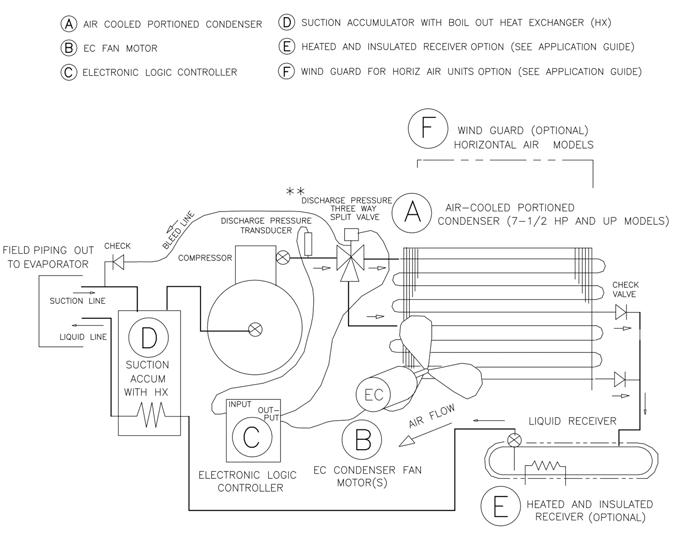
A
piping schematic of LIMITROL+ and components.
adding) the extra refrigerant charge the system needs to properly flood the condenser at the lowest ambient temperature expected, while still maintaining a liquid seal in the receiver, and (2) the obvious extra expense of refrigerant.
In addition, given that every single system will develop a refrigerant leak at some point in its life span, the resulting recharge after the leak repair will be costlier. And then there is the extra refrigerant that will enter the atmosphere and the environmental impact.
The Limitrol+ offers the following features which eliminate the extra refrigerant charge typically associated with maintaining minimum head pressure, and also result in a more efficient system operation:
• An electronic controller, which senses discharge pressure via a pressure transducer. The controller is factory pre-set to maintain a minimum 70F condensing temperature.
• Variable speed EC condenser fan motors respond to DC voltage signal, which allow the motor speed to decrease/increase based on the discharge pressure. During periods of
lower ambient temperatures, the fans may operate at their minimum RPM, yet result in a discharge pressure that is still below the controller’s minimum condenser temp. set-point. When this occurs…
• A condenser split valve is initiated, which will remove a portion of the condenser from operation, and simultaneously, the controller will ramp the EC motor speed to allow a realistic RPM starting point to maintain the minimum head pressure with the reduced condenser surface. The condenser split eliminates the need for flooding valves (down to ambient temperature of -20F), reducing refrigerant charge. The EC motors maintain precise head pressure during conditions below the design condition, and reduce electrical consumption over standard motors.
ESP+ INTUITIVE EVAPORATOR CONTROL TECHNOLOGY
As I have written about previously, the real beauty of electronic control is its ability to provide precise and repeatable results. Nowhere is this more ap -
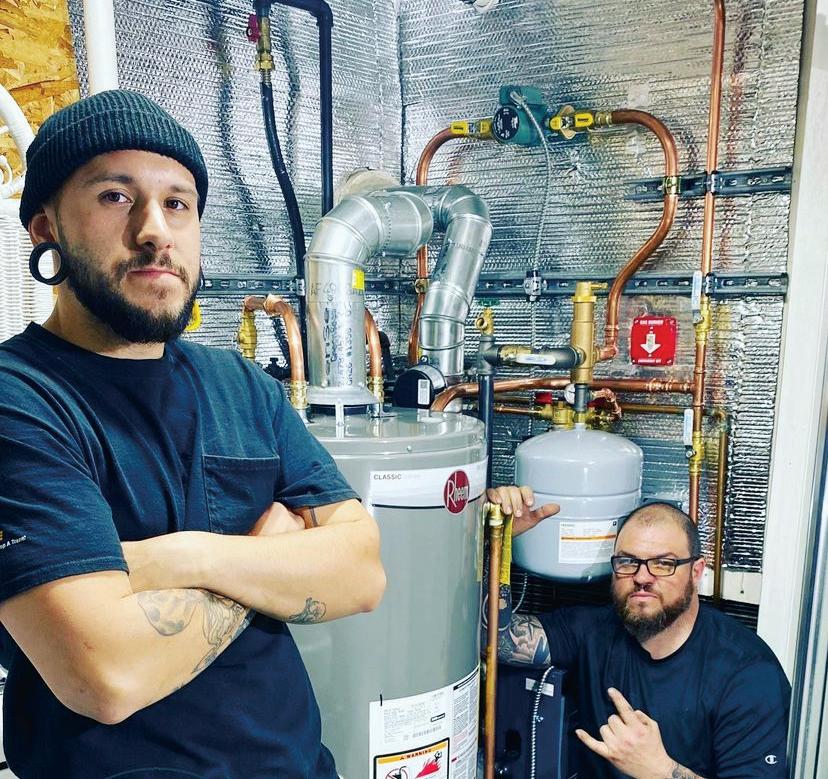
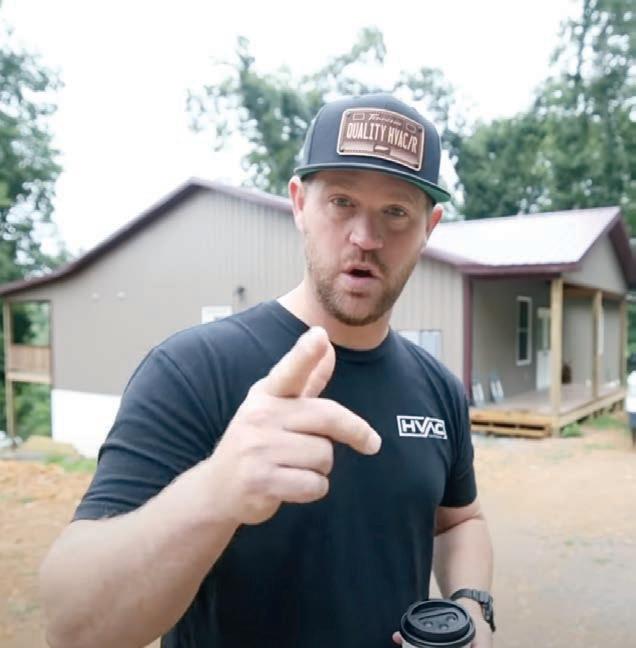

Some of the best and hardest-working HVAC contractors rely on proven RLS press technology to help them get the job done right, and more efficiently.
But don’t take our word for it. Check out the members of our #pressgang on Instagram – those shown here and so many others – to see how RLS press fittings give them valuable benefits like these:
• Connects in 10 seconds
• No flame, no fire hazards
• No hot work permits
• No fire spotters
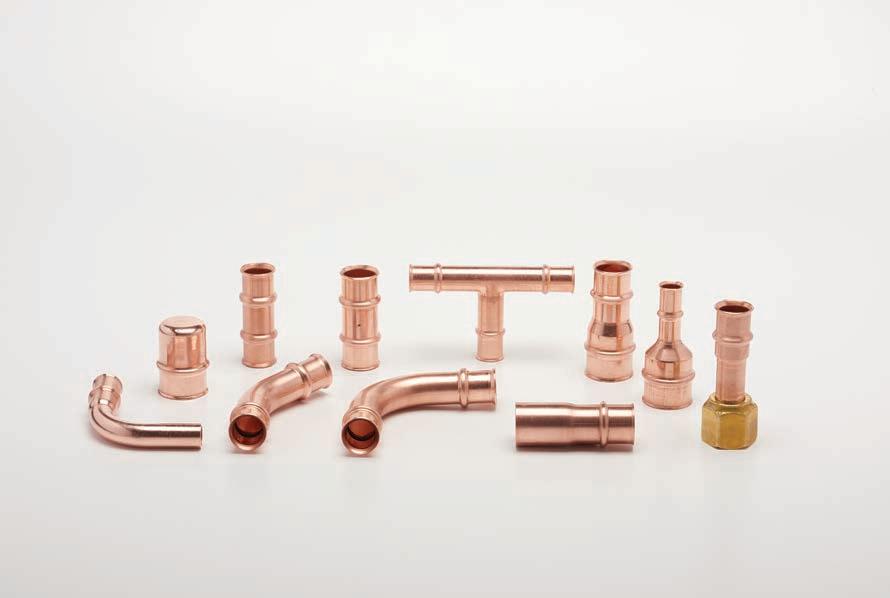
• No nitrogen purging
• UL listed to 700 psi
• 15 million+ fittings installed
• CRN Approved (#0A22551)
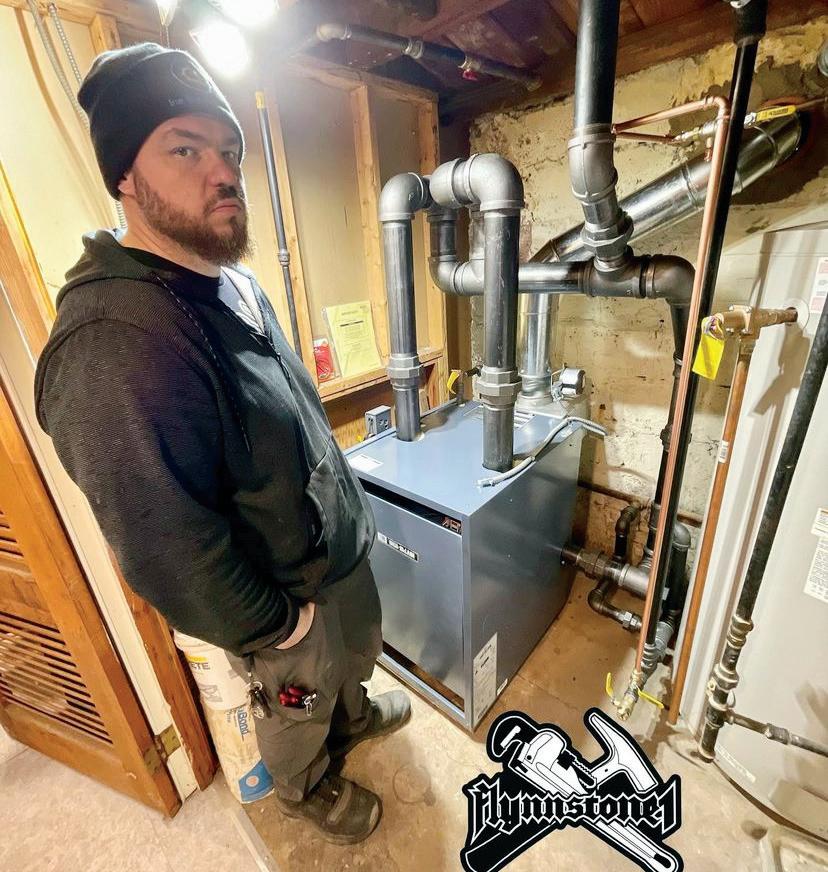



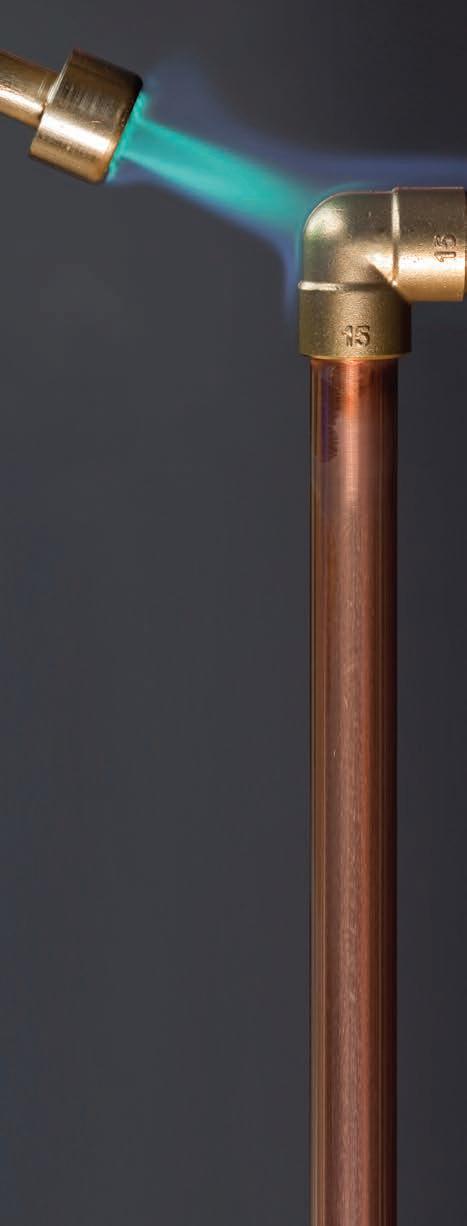
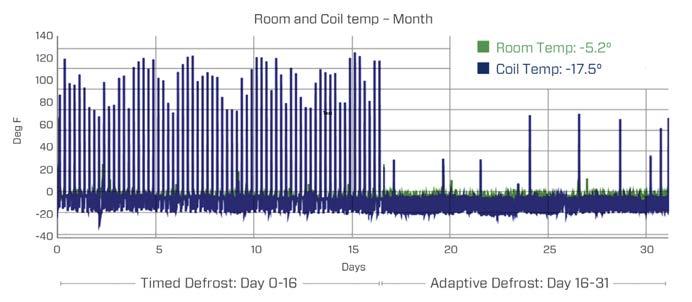
Chart displays benefits of adaptive defrost control including 86% fewer defrost cycles leading to greater energy savings and enhanced system performance including improved integrity of refrigerated/frozen product.
parent than in the ability of an electronically controlled step motor electric expansion valve (EEV) to maintain precise superheat control.
As great as this benefit is, this is only one of many unique features offered with the ESP+ evaporator control technology. The Adaptive Defrost Controller eliminates the need for a mechanical thermostat and defrost time clock, and controls all aspects of the evaporator operation, including the following:
• Monitors the superheat condition at the evaporator outlet via a temperature sensor and pressure transducer. Instead of spending upwards of an hour to properly set a mechanical TEV, the superheat set-point is
THE SOURCE
ADVERTISERS IN THIS ISSUE
entered into the controller, resulting in precise superheat control.
• Maintains precise temperature in the refrigerated space. When temperature set-point is achieved, the controller will de-energize the factory mounted liquid solenoid valve.
• Reduces EC fan motor speed when temperature is satisfied, resulting in further energy savings.
• Initiates and terminates defrost as needed (true demand defrost), offering considerable energy savings over conventional defrost.
• Allows for bonding of up to eight controllers, maintaining the same high efficiency on multiple evaporator applications.
Adrian Steel adriansteel.com p.10
Amvic.........................amvicsystem.com/ampex ....................... MH23
Aqua-Tech aquatech-canada.com MH27
Bradford White bradfordwhite.com/canada-contractors p.7, 63
Caleffi caleffi.com MH25
Chemfax chemfax.com MH2, 3
Eco-King ....................kingheatingproducts.com .........................MH14
Franklin Electric littlegiant.com p.56
Helly Hansen hhworkwear.com p.53
IBC ibcboiler.com MH19
Intellihot intellihot.com p.9
Intertek .....................Intertek.com/HVACR ................................... p.50
IPEX ipexna.com p.64
Mestek spacepak.com MH11
• Capability for remote monitoring, remote set-point changes, and alarm capabilities via text or email.
• With all of the defrost controls at the evaporator, no wiring between condensing unit and evaporator is required. Simplicity is always sought after, but it’s rare that simplicity results in state of the art. Both of these award-winning solutions combine both. The benefit to the refrigeration installer and service technician is a time saving installation, simple setup and adjustment, and troubleshooting aided by remote monitoring and performance history.
The end user will realize greater efficiency, greater stored product integrity from precise temperature control, and the peace of mind knowing that any system malfunction is an email or text message away.
Who can argue that? <>

Dave Demma holds a degree in refrigeration engineering and worked as a journeyman refrigeration technician before moving into the manufacturing sector where he regularly trains contractor and engineering groups. He can be reached at ddemma@uri.com.
Navien Navieninc.com MH5
Next Supply nextsupply.ca MH9 NTI ntiboilers.com MH13
Resideo Resideo.com/Pro/Water MH32
Rhella ........................rhella.com ................................................. MH18
RLS Fittings rapidlockingsystem.com p.59
Saniflo saniflo.ca p.55
Spartan
Peripheral Devices spartan-pd.com MH29
Taco tacocomfortsolutions.com MH7
Thermo Mfg. .............thermopan.ca .............................................. p.13
Triangle Tube triangletube.com MH31
Uline uline.ca p.51
Viessmann viessmann.ca MH21
CALENDAR
2022
2022 Building Performance Analysis Conference
September 14-16
This ASHRAE conference taking place in Chicago will feature three keynotes and more than 90 presentations by leading industry practitioners and academic researchers. ashrae.org
NADCA Technical Conference
September 15 – 17
Hosted at the Hard Rock Hotel & Casino in Atlantic City, New Jersey, this National Air Duct Cleaners Association event is a place where colleagues re-connect, new technicians learn about the industry, and new equipment will be showcased. nadca.com
Canadian Hydronics Conference 2022
September 27-26
This focused two-day conference will bring hydronics industry professionals together in Saskatoon to connect in person and share knowledge and business building ideas. There will be opening and closing keynotes and plenty of educational sessions to choose from. ciph.com/page/hydronics_council
Greenbuild International Conference and Expo
November 1-2
This year marks the 20th anniversary of the Greenbuild International Conference and Expo, the largest annual event for green building professionals worldwide to learn and source cutting-edge solutions. informaconnect.com
IGSHPA Annual Conference
December 6-8
Hosted at the Las Vegas Convention Center, IGSHPA is a non-profit, member-driven organization established in 1987 to advance ground source heat pump (GSHP) technology on local, national and international levels. igshpa.org
2022
Modern Hydronics Summit
September 15
This educational conference and table-top tradeshow focused on the latest in hydronics is being held at the Universal EventSpace in Vaughan, Ontario. Hydronics pros and those new to the trade will all learn at this much anticipated event. modernhydronicssummit.com
ASPE Convention & Expo
September 16-21
The American Society of Plumbing Engineers Convention & Expo is designed to enhance the professional development, technical education, and career growth of plumbing professionals. This year’s event is being held in Indianapolis, Indiana.
expo.aspe.org
MCAC Annual Conference 2022
September 28-October 1
Shifting from hosting virtual events, the Mechanical Contractors Association of Canada (MCAC) will be hosting their conference in person at the Marriott Harbourfront Hotel in Halifax. mcac.ca
HRAI Annual Conference
September 18-20
The Heating, Refrigeration and Air Conditioning Institute of Canada conference in Ottawa will include keynote speakers and topical panel discussions to complement the association’s AGM along with a variety of networking and social events.
hrai.ca
NAFA 2022 Annual Convention
Hosted at The Coeur d’Alene Resort in Idaho, NAFA members include air filter and component manufacturers, sales and service companies, and HVAC and indoor air quality professionals. www.nafahq.org
The Solar Forum 2022
November 14-15
This new event hosted in Phoenix, Arizona is designed for HVAC contractors to educate the community on the value and opportunities available in the rapidly evolving HVAC and solar market. acca.org
2023 AHR Expo 2023
February 6-8
Manufacturers and suppliers from around the world will gather in Atlanta to unveil the latest additions to their product line-ups for the A/C, heating and refrigeration industries. Exhibitors will be demonstrating their technologies and answering contractors’ questions. ahrexpo.com
The
Buildings Show
November 30-December 2
Held at the Metro Toronto Convention Centre, this three-day trade show and conference provides a broad overview of the construction industry with the latest in technologies and educational sessions for contractors of all types. Informaconnect.com/the-buildings-show
to



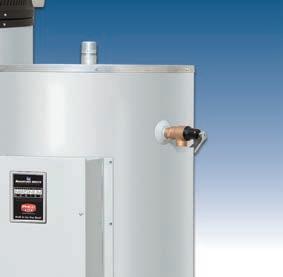





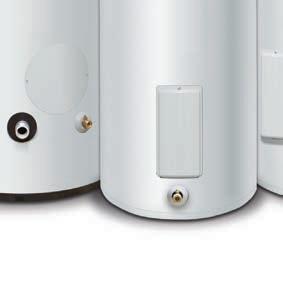

Whether it’s a hotel, restaurant, office building, school or industrial facility, your commercial customers demand more to meet the needs of their businesses. Bradford White has the solutions that deliver:
• MORE EFFICIENCY: eF Series® Ultra High Efficiency Gas Water Heaters offer up to 97% Thermal Efficiency.
• MORE FLEXIBILITY: ElectriFLEX Series™ Electric Water Heaters are field-convertible so a single model solves multiple installation requirements.
• MORE INNOVATION: Commander Series® Ultra Low NOx Gas Water Heaters use advanced technology to deliver outstanding performance with the smallest footprint in its class.
Bradford White’s products are built For The Pro® for easier installation and maintenance to save you time, effort and money.
MOVE OVER METAL
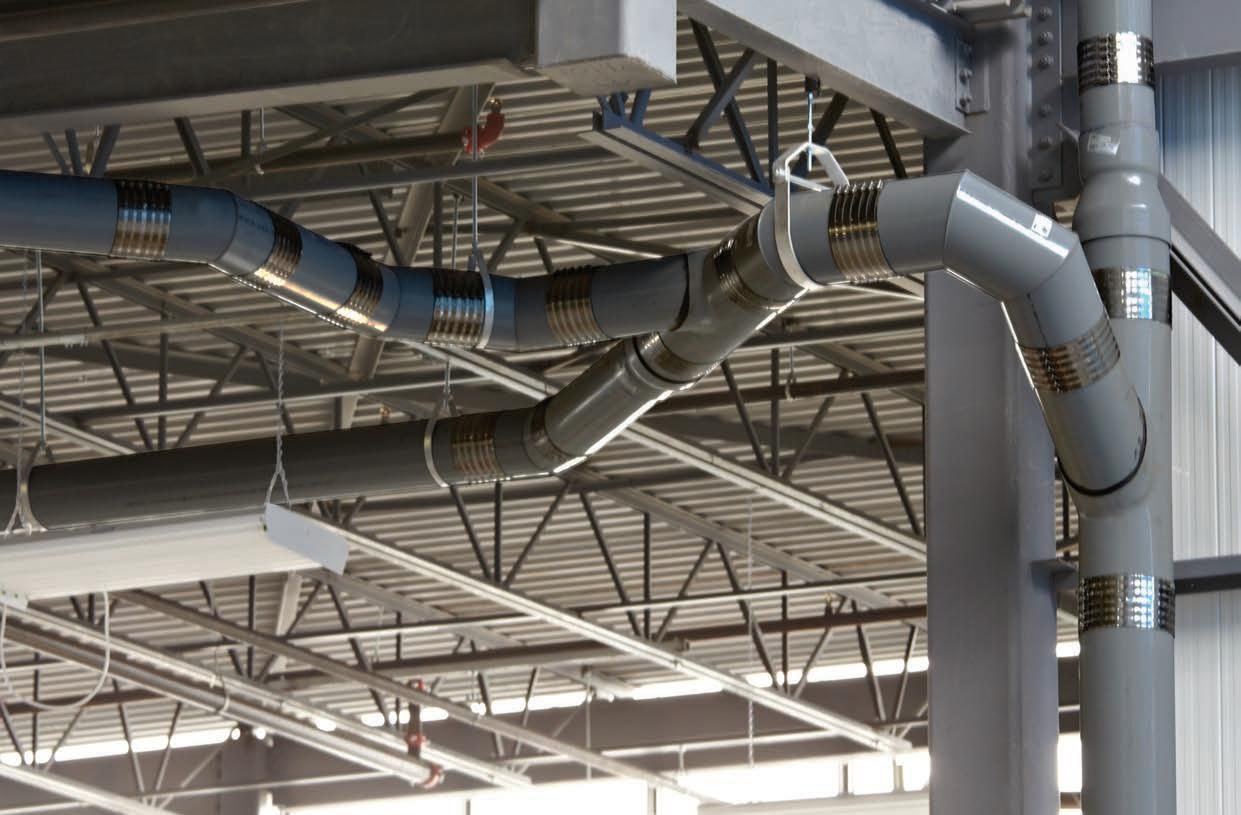
From parking garages to hospitals to high buildings, more and more mechanical contractors and engineers are switching to a long-lasting DWV solution.
As an integrated solution, System 15® and System XFR® meet all code requirements for noncombustible buildings. As a complement to System 15 and System XFR, MJ GreyTM Mechanical Couplings provide an alternative to solvent welding when working in cold weather conditions, from heights in a scissor lift or a bucket.
Drain-GuardTM Double Containment Systems provide safe transport of sanitary or storm drainage in critical areas. Should a leak occur, people, equipment and valuable property will be protected from possible harm.
DWV Systems by IPEX provide the required rugged reliability with all the added benefits:
• Lightweight, Easier to Install
• Corrosion Resistant, Less Maintenance
Contact us to learn more about our complete DWV systems. ipexna.com | 1-866-473-9462
• Overall Project Savings
• Unsurpassed Technical Support