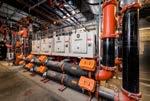
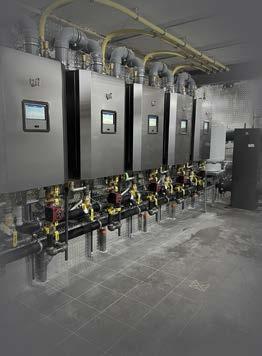
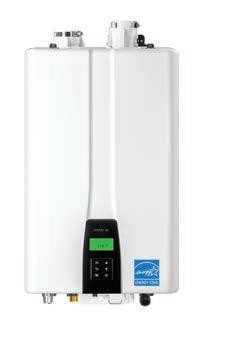
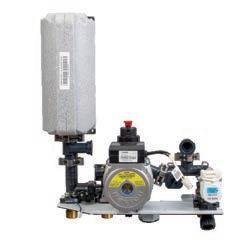
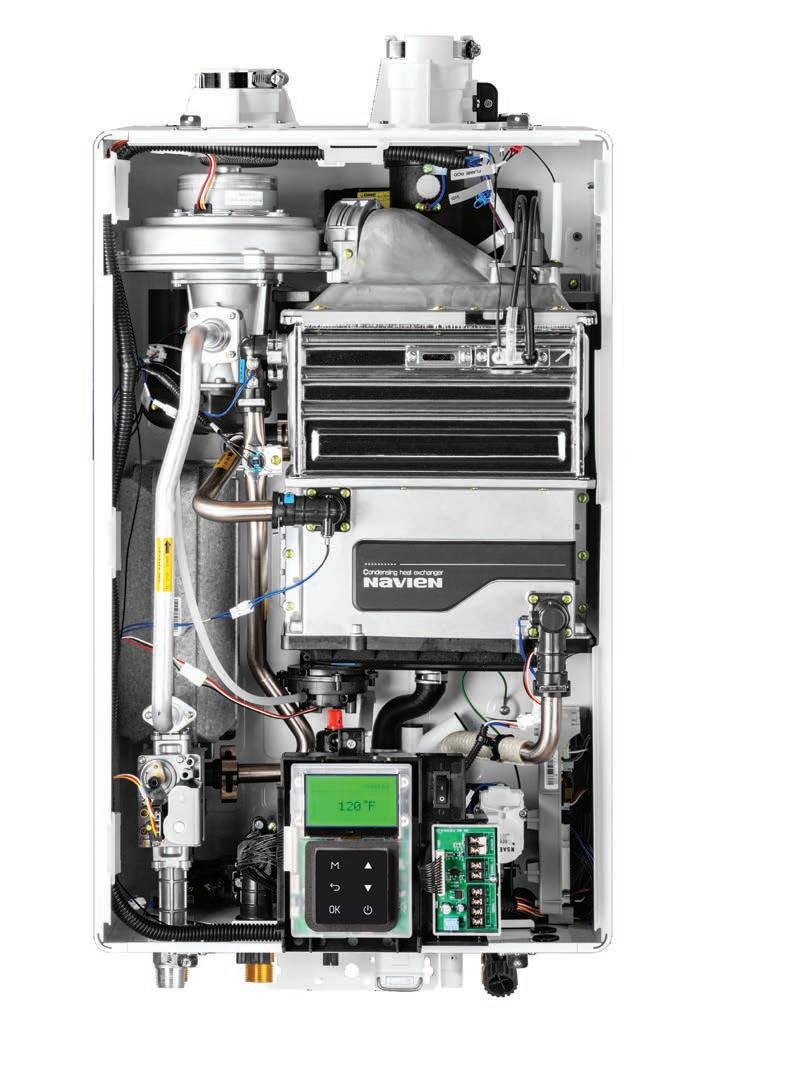
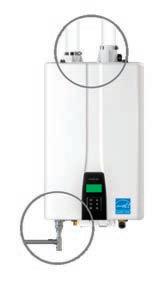
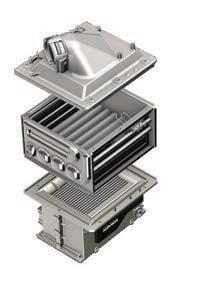
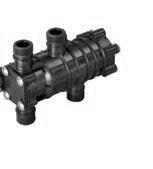
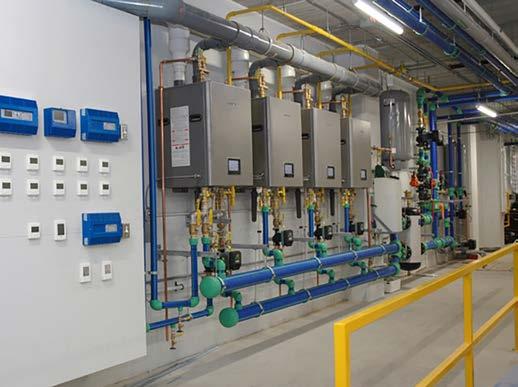
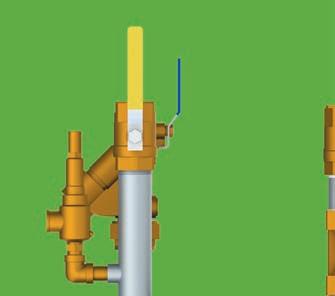
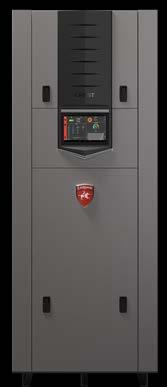
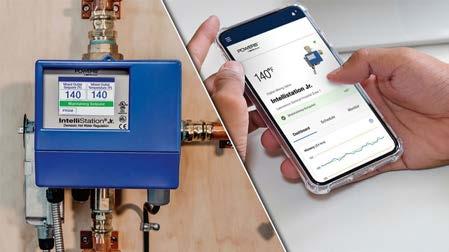
• Fits through a standard doorway (75% less footprint)
• Up to 65% reduction in installation time
• Automates “clipboard” health monitoring
Safe
Sustainably mitigates waterborne pathogens
Smart
Real-time data reporting across devices
Simple
Simplifies design, installation and operation
CON TENTS
FEATURES
10 HVAC
VENTILATION: WHO NEEDS IT?
As new standards lead to tighter building envelopes, homes require mechanical ventilation solutions. By
Ian McTeer
14 HVAC
HRVS AND ERVS
EXPLAINED
This recent HPAC Magazine webinar discusses the role of mechanical ventilation systems in buildings. By Logan Caswell
52 PLUMBING
LOOK FOR THE OPPORTUNITIES
In a year of complications and unforeseen twists, where there’s a will there’s a way.
By Steve Goldie
58 REFRIGERATION
UNDERSTANDING EVAPORATORS
A fundamental element of the refrigeration cycle, we revisit the basic functions of evaporators and how to keep them operating at their peak.
By Dave Demma
MODERN HYDRONICS
This
MH4 AWARDS
SWEET HEAT AWARDS 2021
Celebrating the top entries in the inaugural Sweet Heat competition.
MH10 PIPING
ZONING CONSIDERATIONS
Planning your piping layouts.
MH14 BOILERS
OPTIMIZING BOILER CHEMISTRY
Maintaining clean water is essential.
MH20 DESIGN
WATER WORKS
Net zero carbon TRCA building.
DEPARTMENTS
6 UPFRONT
7 NEWS FEATURE
An interview with Rachel Hesketh: working to raise the profile of women and youth in the trades.
8 INDUSTRY NEWS
49 MECHANICAL SUPPLY NEWS
51 PEOPLE
56 PLUMBING PRODUCTS
61 THE SOURCE
62 CALENDAR
MH22 IN-FLOOR
RELIABLE STORAGE
In-floor solution works for agriculture fertilizer warehouse.
MH24 HEAT PUMPS
CUT OUT THE CUT-OUT QUESTIONS
Path towards a low carbon future will include heat pumps for buildings.
MH26 PRODUCT SHOWCASE
MH28 EMMITERS
ADJUSTING FOR CONDITIONS
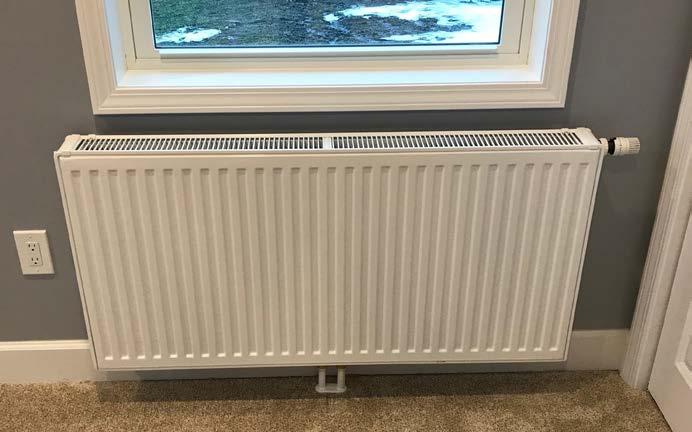
Formulas for sizing panel rads to accommodate low-temp water.
The 2021 Ford F-150
The F-150 that’s tougher, smarter, and more productive than ever before.
Your business is your top priority, so when you’re looking for a truck, you don’t want to settle for second-best. You want a truck that offers bestin-class*,† capability to help you get the job done, plus class-exclusive^ features that make every job easier. You want the Ford F-150, the 2021 North American Truck of the Year.
Re-engineered from the ground up, and redesigned both inside and out, the F-150 delivers toughness and innovative technology to help change the way you work.
BEST-IN-CLASS FOR YOUR BUSINESS
When Ford set out to redesign their best-selling truck, they didn’t cut corners. It’s why the 2021 F-150 offers best-in-class* max. available towing of 14,000 lbs., and best-in-class† max. available payload of 3,325 lbs.
There’s also a new class-exclusive^ 3.5L PowerBoost™ Full Hybrid V6 that offers the most torque ever in an F-150. And delivers maximum available conventional towing of 12,700 lbs.‡
POWER WHERE YOU NEED IT
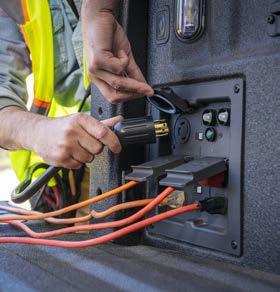
The 2021 F-150 is also available with class-exclusive^ Pro Power Onboard™ which offers exportable power on demand in 2.0 kW/2.4 kW/7.2 kW options. So, when you need to power up your equipment on the worksite, you can plug it directly into your F-150.
YOUR SMART NEW OFFICE
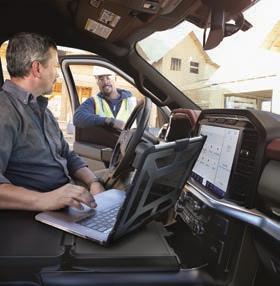
We know that when you use a truck for business, it’s also your mobile office. The all-new interior of the F-150 is designed to help keep you productive, connected, and comfortable, no matter how long your day lasts.
It comes standard with SYNC®4** and has an available 12” Touchscreen giving you complete control of all the innovative tech in the F-150. From enhanced voice recognition, to cloud-based connectivity, your new office
will work harder than ever before.
The 2021 F-150 is also available with a new stowable shifter and centre console that folds down to create an Interior Work Surface for your laptop or even a quick lunch.
BUILT TOUGH FOR YOUR BUSINESS
Tougher and smarter than ever before, the F-150 is designed to work as hard as you do. When you’re looking for the best to help you build your business, you want the truck that’s Built Ford Tough. The 2021 F-150. Part of F-Series, Canada’s best-selling line of pickup trucks for 55 years‡‡
LEGAL
Vehicle may be shown with optional features.
* Maximum towing on 2021 F-150 SuperCab 8’ box and SuperCrew 4x2 with available 3.5L EcoBoost, Max Trailer Tow Package. Class is Full-Size Pickups under 8,500 lbs. GVWR. Max towing varies based on cargo, vehicle configuration, accessories, and number of pessengers. Towing and payload are independent attributes and may not be achieved simultaneously.
† Maximum payloadn on 2021 F-150 Regular Cab 8’ box 4x2 with available 5.0L V8 engine and Max Trailer Tow and Heavy-Duty Payload packages. Class is Full-Size Pickups under 8,500 lbs. GVWR. Max payload varies and is based on accessories and vehicle configuration. See label on door jamb for carrying capacity of a specific vehicle. Towing and payload are independent attributes and may not be achieved simultaneously.
^ Class is Full-Size Pickups under 8,500 lbs. GVWR.
‡ When properly equipped.
** Some mobile phones and some digital media players may not be fully compatible. Don’t drive while distracted. Use voice-operated systems when possible; don’t use handheld devices while driving. Some features may be locked out while the vehicle is in gear.
‡‡ F-Series is the best-selling line of pickup trucks in Canada for 55 years in a row based on Canadian Vehicle Manufacturers’ Association statistical sales report up to year end 2020.
With a full range of Built Ford Tough® Commercial Vehicles, we make it easy to choose the one that’s right for your business. From the endless versatility of Transit and Transit Connect to the legendary power and capabilities of F-Series, you’ll nd a dependable partner that’ll get to work – day in and day out.
KEY FEATURES
Super Duty® has best-in-class max. available payload of 7,850 lbs*
F-150 has class-exclusive^ available Pro Power OnboardTM that offers exportable power on demand
Transit has 3 lengths, 3 heights and multiple cargo congurations
Transit Connect has a compact footprint, and a max. cargo space of 145.8 cu ft†
MOST VALUABLE RESOURCE
THESE DAYS PLUMBING AND HVAC/R CONTRACTING COMPANIES OF ALL SIZES SHARE COMMON CONCERNS about keeping safe during this ongoing pandemic, maintaining a steady flow of business and maybe most importantly ensuring they can not only attract new qualified workers to keep up with the workload, but to retain the existing teams they’ve built over the years.
In speaking with a few business owners recently, they really emphasized the measures they are taking to ensure the work environment they can control meets the needs of their employees, especially the “younger” generation.
One HVAC/R business owner in Ontario talked about actually scheduling a “company day” to break free from the routine and go axe throwing, go-carting or some other group activity.
Another business owner on the west coast talked about the “generational shift” and stressed how important it is to keep the team outfitted with the very latest equipment. It keeps the technicians current and shows you’re keeping the business on the leading edge and relevant.
One article I recently read online about the most profitable businesses in construction emphasized how the best firms are serious about finding, attracting, and retaining the best people. They become a destination employer that attracts highly qualified labour.
The people I’ve spoken with have said you have to remain competitive with respect to compensation, but that’s just a given, you also need a strategy around retention and that includes employee development.
The leading companies look out for ways to include and improve their people through industry training opportunities. In the plumbing and HVAC/R world industry education never stops, that’s why manufacturer and industry association training, along with the helpful assistance that trade journals like HPAC Magazine provide, remain valuable tools to share with tradespeople.
We hope that our efforts to inform through printed pages, online news and articles, and more recently with our 30 Mechanical Minutes videos, we can be an additional resource included in every plumbing and HVAC/R business’s growth and employee retention strategy.
A business is truly only as good as its people, and to be a leader in your field requires making the effort to engage and communicate with your teams to ensure you're providing a work environment they can grow with.
Reader Service
Print and digital subscription inquires or changes, please contact Urszula Grzyb, Audience Development Manager
Tel: (416) 510-5180
Fax: (416) 510-6875
Email: ugrzyb@annexbusinessmedia.com
Mail: 111 Gordon Baker Rd., Suite 400, Toronto, ON M2H 3R1
EDITOR
ASSOCIATE EDITOR
ASSOCIATE PUBLISHER MEDIA DESIGNER
ACCOUNT COORDINATOR
PUBLISHER
COO
Doug Picklyk (416) 510-5218
DPicklyk@hpacmag.com
Logan Caswell (416) 728-6209
LCaswell@hpacmag.com
David Skene (416) 510-6884
DSkene@hpacmag.com
Emily Sun
esun@annexbusinessmedia.com
Kim Rossiter (416) 510-6794 krossiter@hpacmag.com
Peter Leonard (416) 510-6847
PLeonard@hpacmag.com
Scott Jamieson sjamieson@annexbusinessmedia.com
PUBLICATIONS MAIL AGREEMENT NO. 40065710
Heating Plumbing Air Conditioning (established 1925) is published 7 times per year by Annex Publishing & Printing Inc. HPAC Magazine is the leading Canadian business publication for the owner/manager of mechanical contracting businesses and their supply partners.
To subscribe, renew your subscription or to change your address or information please visit us at www.hpacmag.com
Subscription Price per year: $44.00 (plus tax) CDN; Outside Canada per year: $112.00 US; Elsewhere: 1 year $123.00 (CDN); Single copy Canada: $5.00 CDN. Heating Plumbing Air Conditioning is published 7 times per year except for occasional combined, expanded or premium issues, which count as two subscription issues.
MAIL PREFERENCES: From time to time we make our subscription list available to select companies and organizations whose product or service may interest you. If you do not wish your contact information to be made available, please contact us via one of the following methods: Tel: 416-442-5600 ext. 3552, Fax: 416-510-6875 or 416442-2191; E-mail: blao@annexbusinessmedia.com; or by mail: 111 Gordon Baker Rd., Suite 400, Toronto ON M2H 3R1 Annex Privacy Officer Privacy@annexbusinessmedia.com Tel: 800-668-2374
HPAC Magazine receives unsolicited materials (including letters to the editor, press releases, promotional items and images) from time to time. HPAC Magazine, its affiliates and assignees may use, reproduce, publish, re-publish, distribute, store and archive such unsolicited submissions in whole or in part in any form or medium whatsoever, without compensation of any sort.
On that note, I would like to introduce the newest member to our HPAC team: Logan Caswell has joined us an Associate Editor. With a journalism Diploma from Durham College in Oshawa, Ont., Logan comes to us after some field experience in the broadcast media and also marketing and social media sectors. He’s already been reaching out to the HPAC community, and once industry events start rolling again you can expect to see him around in person. If you have any words of wisdom or encouragement to share with someone new to the plumbing and HVAC/R world, please feel free to reach out and welcome this new face to the industry: lcaswell@hpacmag.com. <>
Doug Picklyk, Editor
NOTICE: HPAC Magazine, Annex Publishing & Printing Inc., their staff, officers, directors and shareholders (hence known as the “Publisher”) assume no liability, obligations, or responsibility for claims arising from advertised products. The Publisher also reserves the right to limit liability for editorial errors, omissions and oversights to a printed correction in a subsequent issue. HPAC Magazine’s editorial is written for management level mechanical industry personnel who have documented training in the mechanical fields in which they work. Manufacturers’ printed instructions, datasheets and notices always take precedence to published editorial statements.
Proud member of:
www.hpacmag.com
Logan Caswell
LEADING A YOUTH MOVEMENT
BY LOGAN CASWELL
In May the Canadian Apprenticeship Forum released the Apprentice Demand in Red Seal Trades report which estimates that 163,785 new journeypersons will be required from 2021 to 2025 in order to sustain workforce certification levels across 56 Red Seal trades in Canada. To meet that anticipated demand, the country will need a total of 375,026 apprentices over the next five years.
Filling the gap requires getting more youth interested in the trades and specifically attracting more women. One initiative, being led by CAF, is called Support Women in Trades (SWiT), a national strategy with a goal of increasing the proportion of women across all trades to 15% by 2030, up from a baseline of 4.5% recorded in 2018.
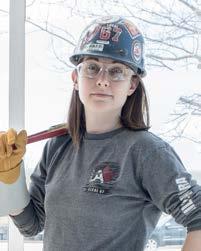
Plumbing and HVAC/R remain typically male-dominated, and while change and support is being encouraged from industry organizations, some individuals are leading from within. Rachel Hesketh, a 29-year-old plumbing journeyperson, recently completed her five-year training program, and now the Hamilton resident is spearheading a youth committee within her union (UA-Local 67) to engage young women to get excited and participate in the skilled trades. We spoke with Hesketh to gain perspective on her journey so far.
What led you to get into this industry? Before this I was on the path of becoming an early childhood educator, so the change in paths happened quite quickly. I came across a preapprenticeship program that aimed to get women into the trades with UA-LOCAL 67. At the end of the program, we had an opportunity for a job placement, and if all went well you received an opportunity to join the union. So it provided me with a lot of drive and motivation to succeed.
What inspired you to make this your career? Through the grind of my pre-apprenticeship program I realized the joy I would get from making this into a real-time career. Seeing progress with yourself was the biggest thing for me. Every day is different, you learn as the days and weeks go on. It’s super encouraging to come onto a job site and instantly know a solution and be able to help others who need your assistance in certain situations.
What led to the launch of the youth committee? It came through my volunteering. I was a part of other committees and saw what was possible. I noticed the interest in getting more women in trades, so I thought it was important to take advantage of it and create the committee called Evolve.
What is Evolve? Evolve is a committee of youth members to encourage people under 35 to participate in helping forward their careers and help young people express their questions about their own union and the benefits involved. It’s not just a local youth committee, it’s a national youth committee. Our goal is to network with members and participate with community outreach—however we can help everybody.
What goals are you trying to achieve as a woman in trades? Being visible and making people know that we’re there. This past week [on a jobsite there were] three women working, and I was shocked in happiness. But three really isn’t enough, and if we can continue to show we’re happy to be there that number should only grow.
What have your experiences been like? I have had some challenges along the way, but I am grateful, and it’s always good having people to support you. Being the only girl on a job site several times; it’s hard to feel like you belong. But as time goes on, we’re seeing more and more women so it makes you feel reassured.
What are the obstacles to getting more women and youth into mechanical contracting? Raising our visibility and overcoming the common stigma of going to university instead of going into trades. You can go to school for years, or you can go work in a trade, do a five-year pre-apprenticeship program and make money along the way.
How do you feel about your career choice today? I love it. You can drive down a road and see a building you worked on and point it out and feel proud about the work you did.
What’s your advice to young people? If you have an opportunity to do a pre-apprenticeship program, do it, because you will have the chance to see if you really like it. There are numerous network opportunities you can take part in and take advantage of union courses. Don’t be afraid of how long apprenticeship programs take because it will be worth it in due time. <>
Rachel Hesketh, working to raise the profile of women and youth in the trades.
INDUSTRY NEWS
FEDS LAUNCH CANADA GREENER HOMES GRANT
The Government of Canada officially launched the new Canada Greener Homes Grant, offering homeowners the ability to receive grants of up to $5,000 to make energy efficient retrofits to their primary residences.
Eligible upgrades include improving heating and cooling systems—such as with heat pumps—replacing windows and doors, adding insulation, sealing air leaks, and purchasing renewable energy systems like solar panels. As part of the program, all mechanical and electrical systems, with the exception of thermostats, must be installed by a licensed and trained professional.
The government program will help up to 700,000 Canadian homeowners and in total includes an investment of $2.6 billion over seven years.
In addition to the $5,000 grant, up to $600 is available for the cost of home energy evaluations.
The grant is retroactive to December 1, 2020, and homeowners go online to register, plan, and document their progress, which includes applying for their pre-retrofit evaluation, choosing from a list of eligible retrofits, scheduling a post-retrofit evaluation, and applying for reimbursement.
Residences include single and semidetached houses, row housing, townhomes, mobile homes on a permanent foundation, permanently moored floating homes, small multi-unit residential buildings (up to three storeys with a footprint of up to 600m2), and mixed-use buildings (residential portion only).
Residents of Quebec and Nova Scotia need to apply directly through their provincial programs to book their EnerGuide evaluation.
Nova Scotia: Home Energy Assessment 1-877-999-6035, info@efficiencyns.ca, www.efficiencyns.ca/residential/
Winning photo in the backflow tester category.
The backflow didn’t pass and already had a note saying it failed two years prior.
2021 BAD AND UGLY CROSS CONNECTION CONTROL CONTEST WINNERS ANNOUNCED
The Cross Connection Control Committee of the Western Canada Section, American Water Works Association (WCS AWWA) announced the winners of its annual “Bad and Ugly” contest: Xavier Lamoureaux of saint-Hubert, Quebec in the backflow tester category; and Robert Glowacki from Winnipeg in the inspector category.
The contest invites testers and inspectors to submit photos of troubled installations with the goal of raising greater awareness of cross connections and to educate other water industry representatives in the field.
“The WCS AWWA CCC committee would like to extend our thanks to all the testers and inspectors who submitted their bad and ugly photos and congratulations to the 2021 winning photos,” notes Danny Wilson, WCS AWWA CCC Education Committee member, who also thanks the backflow manufacturers Conbraco, Watts and Zurn who provide the contest prizes. For 2022 contest entry details visit wcsawwa.net
STUDY HIGHLIGHTS CHALLENGE IN RETAINING APPRENTICES
Statistics Canada released a new study looking at certification rates for apprentices who began their training in 2013 and where they were in 2019. While program durations vary by province and trade, the most common program duration for all trades at the national level is four years. In 2017, four years after registration, approximately one-fifth (20.9%) of the 2013 cohort of apprentices had completed their training and one-third (35.4%) had discontinued. By 2019, just under one-third of
apprentices had certified, while almost half had discontinued (45.4%).
In 2019, six years after registering in their programs, certification rates were highest among Red Seal trades—of note: plumbing (35.1%) and refrigeration & AC mechanic (40.9%).
The study also states apprentices who were undergoing training or close to certifying may have faced obstacles in their training and in the labour market because of the COVID-19 pandemic as many ministries of training and educational institutions closed. The pandemic also had an impact on registrations and certification rates in 2020, adding to the shortage of certified tradespeople in Canada.
statcan.gc.ca
Xavier Lamoureaux, backflow tester with prize.
Inspector category winning photo
CANADIAN PROPANE ASSOCIATION INTRODUCES NEW BRAND IDENTITY
The Canadian Propane Association (CPA) is celebrating its 10th anniversary with a new brand identity that is designed to convey propane as an essential part of Canada’s low carbon economic future.
According to the association, the decision to update the brand was out of the need for visual expression to convey today’s industry — modern, versatile, and reliable.
RMC INCREASES FEE ON CFC-11 REFRIGERANT DISPOSAL
Refrigerant Management Canada (RMC) has announced the fee for accepting CFC11 refrigerant (Trichlorofluoromethane, also called freon-11 or R-11) into the pro gram has changed.
As of July 1, 2021, the new fee be came $20/kg for CFC-11 refrigerant en tering the program for destruction.
RIGHT TIME GROUP EXPANDS REACH TO ALBERTA
Right Time Group of Companies is on a roll. The residential HVAC contractor group owned by San Francisco-based private equity firm Gryphon Investors with regional locations in Ontario, Manitoba and B.C., now has a foothold in Alberta and has strengthened its position in Ontario with the acquisition of two more companies in recent months.
In April Right Time acquired Edmonton-based Romaniuk Heating and Air Conditioning, and the expansion continued in June when Comfort Masters Ltd. in Ontario became Right Time’s seventh acquisition. Comfort Masters provides residential HVAC, air quality and hot water services to the Oshawa, York, Durham and Simcoe regions of the province.
Right Time is focused on developing a national brand through acquisitions or partnerships with existing residential HVAC replacement contractors. right-time.ca
THE ARCTICOM GROUP ENTERS THE CANADIAN MARKET
The Arcticom Group (TAG), a commercial and industrial refrigeration company, has announced its expansion into the Canadian HVAC/R market with three acquisitions: CT Control Temp and its sister company IHM Mechanical, located in Vancouver; and CTR Refrigeration & Food Store Equipment with locations in Calgary and Edmonton.
Based in California, TAG has been expanding over the past three years by acquiring independent HVAC/R companies. thearcticomgroup.com
The change comes after the RMC Board of Directors decided that the cost of collecting and destroying CFC-11 refrigerant can no longer be subsidized by the program, as their costs continue to increase.
RMC recommends that contractors discuss the disposal fee with their customers and remind them that as the equipment and refrigerant owner, they are obliged to comply with the provincial and federal regulations regarding the proper handling, storage and disposal of CFC-11 refrigerant. hrai.ca
TOUGH JOBS CALL FOR TRUSTED PARTNERS.
At Adrian Steel, we do more than just create high-quality products. We look at the big picture, taking into account all of your business needs and the way you work in and out of the van. Then, we provide you with custom solutions that make your job easier and give you the biggest ROI possible.
To learn more and locate your nearest distributor, go to adriansteel.com/distributors
VENTILATION: WHO NEEDS IT?
As new standards lead to tighter building envelopes, homes require mechanical ventilation solutions. BY IAN McTEER
The simple answer to the headline of this article is anyone (human or animal) living and working indoors. The larger question is how we go about providing enough fresh oxygenated air for building inhabitants while maintaining reduced levels of HVAC energy consumption as prescribed by current governmental regulations.
Inspired by the fall-out of an oil embargo in the early 1970s, the U.S. Department of Energy (DOE) embarked on an all-encompassing energy security program that led to North American regulators developing ever-increasing HVAC efficiency standards or Minimum Efficiency Performance Standards (MEPS).
Along with more energy-efficient HVAC appliances another trend has led to sealing houses up as tight as possible with tight-fitting windows, doors, vapour barriers and cans of expanding foam insulation.
In one study of a 90’s era residential renovation, the house in question was depressurized beyond 50 pascals once all the air exhausting appliances were running. That’s 10 times more depressurization than allowed, especially with buoyancy vented fossil fueled appliances inside the structure.
WHAT KIND OF AIR?
With today’s tighter building envelopes we need to consider how to introduce air inside and why. And we might need
several kinds of air. Normally there’s only one type of air, but inside a building we need the air to do different things depending on the indoor activities.
Ventilation air is the most important kind for humans and animals. Humans respire some 30 lbs. of air daily while we spend almost 90% of our lives indoors. At the same time, it is necessary to get rid of excess moisture, odours, carbon dioxide, ozone, particulates and other noxious compounds from our indoor environment. And while opening a window provides needed ventilation air, this unregulated ventilation will cause HVAC systems to consume excessive amounts of energy—energy we’re supposed to be saving.
Make-up air is the air coming in from outside intended to replace that air being exhausted by devices such as range hoods and bathroom fans, central vacuum systems and clothes dryers. Today’s homes that are being built to the latest codes probably do not need make-up air anymore unless oversized range hoods moving large air volumes (more than 200 cfm) are installed by overzealous chefs.
Finally, there is also combustion air, the air meant to be used with fossil fueled appliances such as gas furnaces, water heaters, stoves and wood burning fireplaces. By filling every conceivable air leakage gap in today’s homes, gas appliances must “borrow” ventilation air thus creating a dangerous problem. Appliances unable to vent due to depressurization, or starved for air, could start to burn their own flue products creating deadly carbon monoxide, a tragedy that has ended the lives of too many people over the years.
MECHANICAL VENTILATION
Modern houses and commercial buildings pay much greater attention to air and moisture leaking either into or out of the building, and with standards
such as LEED, Passive House and Net Zero, houses are tight and the building envelope is sealed with an air leakage goal of no more than 1ACH50 (one air change per hour at 50 pascals). I’ve seen one Passive House consultant boast of 0.14ACH50.
And today’s HVAC systems are better designed with gas furnaces and water heaters using outdoor air for combustion, so life is good, no? Maybe not so good, as we are still seeing rules of thumb making the rounds especially in renovation jobs where ventilation systems are often oversized, and powerful range hoods can still suck nearly every
molecule of air out of the house forcing would-be chefs to open a window.
INTRODUCING HRV AND ERV
Older buildings were so leaky that infiltrating air met all the ventilation requirements with ease, but not without penalties. Incoming air needed to be conditioned with heat and maybe humidity incurring extra costs for fuel and maintenance. Houses were drafty, occupants often felt uncomfortable as dry air evaporated excessive amounts of moisture from the skin creating a feeling of being too cold. Static electricity build-up in carpets and furnishing
caused painful shocks when the electrically charged homeowner touched a grounding surface. So, which is better?
A borderline leaky 2,100 sq. ft. threebedroom house rated at 3ACH50 will, according to the ASHRAE 62.1 and 2, require 93 cfm of outdoor air based on the formula:
Quantity of air (Q) = 7.5 cfm/occupant + 3 cfm/100 ft 2 of living area
Thus, Q = 7.5 cfm x 4 occupants + 3 cfm/100 ft 2 = 93 cfm (example calculation by Denis Boyer, M.Eng.)
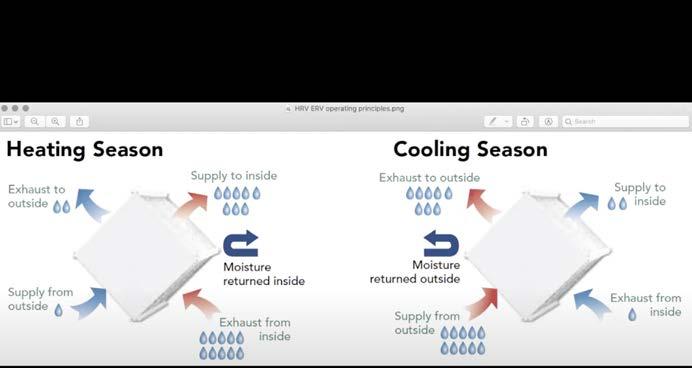
A heat recovery ventilator (HRV) is a mechanical ventilation solution that will use the stale exhaust airstream to preheat the same volume of cold entering outdoor fresh air.
As the airstreams pass each other within the core of the HRV, upwards of 75% or better of the indoor air heat will be transferred to the colder air thus providing needed ventilation while reducing the cost of “making up” the heat required to bring that fresh air up to ambient room temperature.
In humid geographies, in the summer months an HRV will increase the humidity level in the house. With a cooling unit in operation and the windows closed, the house still needs adequate ventilation. A properly sized cooling system designed with the summer latent load in mind should be able to deal with the extra humidity, admittedly, at an extra cost.
An ERV, or energy recovery ventilator, operates in a similar fashion to the HRV, but during the winter some of the humidity in the air is returned to the indoor space. Ideally, in tighter houses, an ERV will help to retain indoor humidity in the 40% range countering the uncomfortable and unhealthful effects of dry wintertime air.
Summer operation has the ERV reject as much as 70% of the incoming humidity sending it back outside before it can load-up the cooling system. An ERV does not act as a dehumidifier.
Continued on p12
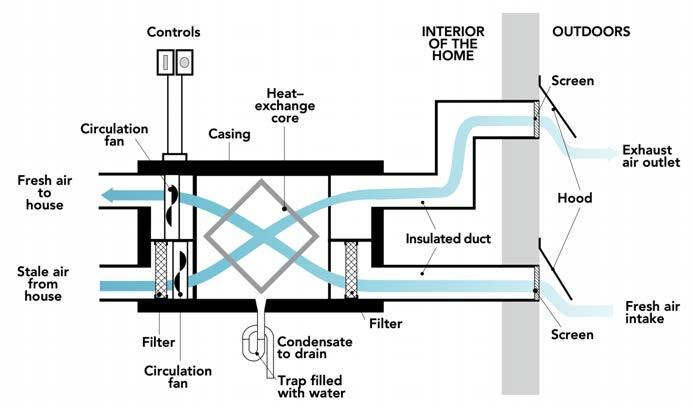
Typical components of an HRV system.
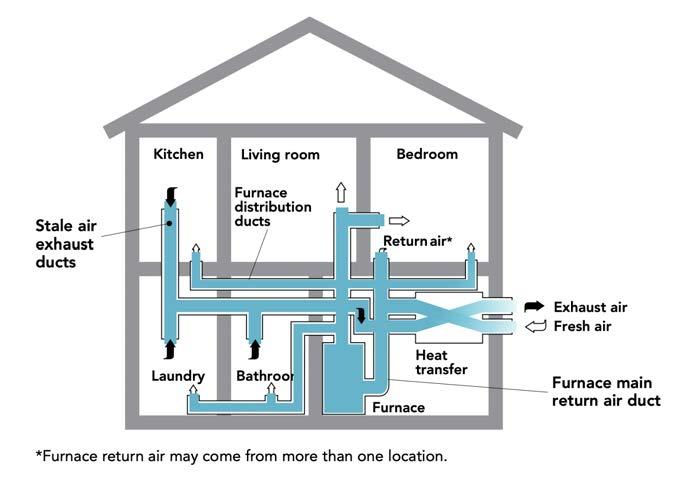
Example diagram of an HRV installed with a forced air furnace system
ERV’S ARE BETTER FOR A HUMID CLIMATE
Ventilation experts will say the ideal mechanical ventilation unit for any home is dependent on the local climate, lifestyle of the occupants and the owner’s specific needs. For example, in houses where the wintertime humidity level tends to rise above 55%, an HRV would do a better job of removing excess humidity.
Experts also agree that newer houses, or those renovated to the latest building code, should have an ERV specified since buildings equipped with triple glazed windows and properly insulated basements can support a higher relative humidity in the winter months: 35% +/- 5% is acceptable.
I was recently listening to a presentation by Gord Cooke of Building Knowledge and he reminded me that modern housing experiences different HVAC loads from yesteryear. Specifically, sensible loads are going down while latent loads are increasing for several reasons, for example:
• Moisture created by occupants and their activities: up to 12 liters per day from a family of four.
• Moisture coming inside due to natural leakage: upwards of 20 liters per day (loose construction 3ACH50) .
• Moisture coming inside via mechanical ventilation: 40 to 50 liters per day at 120 cfm ventilation.
• I’ll add another aspect from my experience—too many people fail to service their HRV’s, many were not installed properly and, all too often, the unit is simply turned-off during the summer. With windows opened for fresh air, the cooling system must work overtime to not only reject uncomfortable sensible heat at bedtime (windows closed) but will decidedly blow the budget on dealing with the latent load that will become the most difficult and time-consuming task of the overburdened cooling system.
If excess ventilation air via oversized equipment or “windows open strategy” occurs, humidity levels will easily exceed 50% in humid climates. As Cooke mentioned in his lecture, when the moisture content of air is measured at 50%RH and the air temperature is 23C, then the dew point temperature will be 12.1C (53.8F). Now the sizing of the air conditioning unit and its latent capacity becomes crucial. An oversized AC unit, or too much air over the evaporator coil, or an improperly specified unit, may put air off the evaporator coil above dew point – in other words, no dehumidification!
INSTALLATION CONSIDERATIONS
While ERV/HRV units designed for residential installation can be installed in a simplified fashion using the existing air handling system to distribute the conditioned air, do not do it that way if possible.
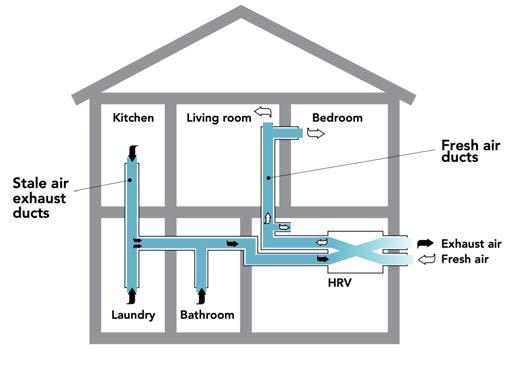
In my opinion, it is best to install a fully dedicated duct system in new construction or complete renovation jobs. The
building will benefit from the best possible conditioned air distribution and the lowest possible operating cost, as the furnace or air handler fan will not be needed.
Some of the best HRV/ERV equipment on the market feature EC motors and control algorithms capable of automatically balancing the systems and adapting to pressure changes. Optional MERV 13 filtration is available and a TURBO mode lasting up to four hours helps to remove odours, and in dedicated situations can help provide needed ventilation for an isolated sick room.
It may take some time to convince all homeowners that mechanical ventilation is truly superior to open windows at any time. Urbanites truly have a vested interest in relying upon professionally installed and well-maintained mechanical ventilation, something, as studies suggest, they have never had before.
Mea Culpa: I live in a rural area, certainly not free of dust and other contaminants from outside, however, on nice lowhumidity days of reasonable temperature we typically open the windows regardless of my HRV and fancy air cleaner.
At night we can hear the Barred Owls hooting, the leaves rustling in the trees and the spring peepers frantically chirping; it is all comforting in a way. And even in winter, my wife of many years insists on keeping a window open, just a crack!
Perhaps there will come a day when windows only open for emergencies, and one’s view of the outdoors will come from giant OLED screens. Whatever the future may hold, improvements to indoor air quality will never come too soon. <>
Ian McTeer is an HVAC consultant with 35 years of experience in the industry. He was most recently a field rep for Trane Canada DSO. McTeer is a refrigeration mechanic and Class 1 Gas technician.
Example diagram of an HRV with direct ductwork
Maestro Wi-Fi App available
HRVS AND ERVS EXPLAINED
A recent HPAC Magazine webinar discusses the role of mechanical ventilation systems in buildings and shares some best practices for contractors. BY LOGAN CASWELL
The latest instalment of HPAC Magazine’s 30 Mechanical Minutes focused on ventilation, with regular HPAC writer Ian McTeer joined by Ryan Carr, Business Development and Technical Lead with Air Solutions. The main topics of discussion centered around heat and energy recovery ventilation systems (HRVs and ERVs). The episode was sponsored by TSI Inc.
HRV, ERV BASICS
Carr explained how modern homes are unlike our grandparent’s drafty houses, and as buildings are no longer constructed to leak heat and moisture they need ventilation of some kind to filter and refresh the stale inside air.
“In our quest for energy efficiency we have tightened up that [building] envelope and we no longer have that natural heat exchange,” said Carr. “So we have to give the house lungs.”
A heat recovery ventilator (HRV) uses the heat in the outgoing stale exhaust air to preheat the incoming air. However, Carr explained that as envelopes have become even tighter, “It’s less about the heat loss/heat gain anymore, and more about the moisture.”
That’s why energy recovery ventilation systems (ERVs) have become more prominent. Not only is the sensible heat addressed, but the system also captures the latent heat (or the moisture) in the air. That means seasonally, in colder climates such as Canada, an ERV transfers the humidity from the air which has
been conditioned indoors to the incoming cold bone-dry air and also keeps it at an ambient temperature. While in humid hot weather months excess humidity is kept outdoors. This creates a better indoor environment and ultimately energy savings for the consumer.
SIZING UNITS
In most new residential installations, a simple bedroom count is generally all that’s needed to calculate what size of HRV or ERV unit should be installed.
“Frankly, we don’t really care about square footage,” said Carr. “Because bedrooms are a good indicator of the number of occupants in the house, as they are the ones needing the fresh air.” Carr went on to say contractors can now right-size equipment with a typical three-bedroom family home only needing a 64 cubic feet/minute (cfm) unit for continuous ventilation.
On the commercial building side, McTeer pointed out how the multitude of applications from swimming pools to restaurants and office spaces to gymnasiums complicated the whole process of ventilating a building. The recent pandemic, which drove workers away from commercial buildings to work from home, has highlighted the need to create a healthier environment the workplace.
“Often you hear the term sick building syndrome,” said McTeer. “A lot of it has to do with the fact commercial buildings are very poorly or sometimes overly ventilated to the point where the relative humidity drops to under 10% in some cases. This causes people a lot of grief.” He referred to a recent article about those working from home because of COVID are delighted because their allergies, stuffy nose and dry skin issues have been reduced and they
Continued on p16
Panelist Ryan Carr explains the principles behind the operations of an ERV core which benefits indoor humidity control in buildings.
With the AirAssure™ Indoor Air Quality Monitor
Amazing things happen when we’re in the same place — and with the new TSI AirAssure™ IAQ Monitor, you don’t have to wonder about your indoor air quality. This economical, user-friendly device measures what you need to know about your indoor environment and places the information at your fingertips in real-time. This data can help you make informed facility decisions and confidently welcome people back indoors.
To learn more, visit tsi.com/AirAssure.
don’t want to go back to the office.
INSTALLATION PRACTICES
Carr outlined three dominant installation methods for HRV/ERV systems:
Simplified – where the unit is hung in the mechanical room and air is inducted in and out of the return air ducts.
Exhaust ducted – the unit is pulling from high moisture areas of concern— laundry room, bathrooms, and kitchens.
Fully ducted – in this installation method dedicated exhaust ports in those areas of high humidity are combined with supply ducts into common areas such as hallways, bedrooms and family rooms. Eventually the air reaches an equilibrium throughout the building.
BEST PRACTICES
It is crucial these systems are balanced when installed: too much supply versus
exhaust could drive moisture into the walls. “As that moisture moves its way into the outside of that wall it’s going to get cooler, and it may condense inside that wall. It can lead to mold, mildew or rot,” said Carr. Conversely, too much negative air pressure will lead to infiltration of unconditioned air which also increases the risks of mold and higher energy costs. There is also a potential of back draft from combustion appliances, chattering dampers and hardto-open doors.
MAINTENANCE REQUIREMENTS
Installing an ERV or HRV is an opportunity for service contractors to add another line to the invoice for annual maintenance. Services include cleaning or replacing prefilters, ensuring the condensate line is clear (HRVs), and checking exterior hoods. <>
Q&A
Questions posed by webinar viewers:
How can one find a proper balance in a drier home in the winter?
McTeer: An ERV is the best choice as it retains a minimal amount of humidity, eliminating the cost of power to run a humidifier.
Are there any emerging technologies on the way?
Carr: New technologies such as zone register terminals installed in highconcern areas of the house such as laundry rooms, bathrooms and kitchens can be turned on with the switch of a button. The switch would-open a dedicated fan for the specific area while shutting the other areas off, enabling a focused suction to that room. Both McTeer and Carr answered additional viewer questions, to see the entire recorded video visit: hpacmag.com/tech-pulse.
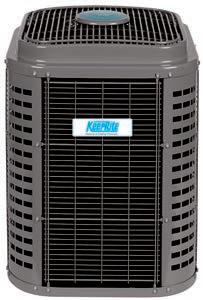
IT’S TIME TO COOL DOWN WITH KEEPRITE
• Up to 19 SEER
• Up to 13 EER
• As low as 56 decibels
• 5-stage operation
• Wi-Fi® enabled remote access
• 10-Year No Hassle Replacement™
MODERN HYDRONICS FALL 2021 SWEET HEAT 2021
WAREHOUSE IN-FLOOR INSTALLATION
SIZING PANEL RADS FOR LOW WATER TEMPS
This year’s contest-winning projects
PLANNING MULTI-ZONE LAYOUTS
BOILER
CHEMISTRY
CONSIDERATIONS
*Navien NPE Series is the best selling condensing tankless water heater according to BRG.
MH4 AWARDS
Sweet Heat Awards 2021
Celebrating the top residential and commercial entries in HPAC Magazine’s first-ever Sweet Heat hydronics installation competition.
By Logan Caswell and Doug Picklyk
MH10 PIPING
Zoning
Considerations
What to think about when planning your system layout.
By John Siegenthaler
MH14 BOILERS Optimizing Boiler Chemistry
In this edition of 30 Mechanical Minutes panelists review why maintaining proper water chemistry is essential with modern boiler systems.
By Logan Caswell
EDITOR
ASSOCIATE EDITOR
ASSOCIATE PUBLISHER
ACCOUNT COORDINATOR
MEDIA DESIGNER
CIRCULATION MANAGER
PUBLISHER
COO
MH20 DESIGN Water Works
The new headquarters for the Toronto and Region Conservation Authority will showcase its mechanical system.
By Doug Picklyk
MH22 IN-FLOOR
In-floor Provides Reliable Storage
Radiant heating used for temperature and condensation control in agricultural fertilizer warehouse.
MH24 HEAT PUMPS Cut it Out with the Cut-Out Questions
Old ways of thinking are not compatible with a low carbon future.
By Chris DesRoches
MH26 PRODUCT SHOWCASE
MH28 EMMITERS
Adjusting for Conditions
How to size panel radiators for low water temperatures. By John Siegenthaler
Celebrating the top residential and commercial entries in the first-ever Sweet Heat hydronics installation competition.
BY LOGAN CASWELL AND DOUG PICKLYK
Launched in late fall 2020, the first ever Canadian Sweet Heat Installation contest called on hydronic contractors from across the country to share photos of recent projects and explain the challenges and creative solutions their teams used to deliver comfort to their clients.
The installations could be in a new-build or a retrofit project, and it needed to be a Canadian contractor and a Canadianbased project. The community answered the call, and the competition received 31 entries from Victoria, B.C. to Bridgewater, Nova Scotia. The entries were divided into two categories (commercial and residential) and the final judging was performed by experts, John Seigenthaler and Robert Bean, who together bring 80 years of industry experience.
The winners and first runners-up in both categories were first revealed during the final session of the 2021 Modern Hydronics Summit, held online on March 30 and 31.
RIVERDALE PLUMBING
First, our congratulations go to Riverdale Plumbing in Toronto for taking first place in the residential category for a modern custom home project located in the prestigious Forrest Hill area of Toronto.
Riverdale is a small family-owned company formed in 1974 and specializes in new build and retrofits, specifically in-floor heat, air handlers, hot water generation and snow melts.
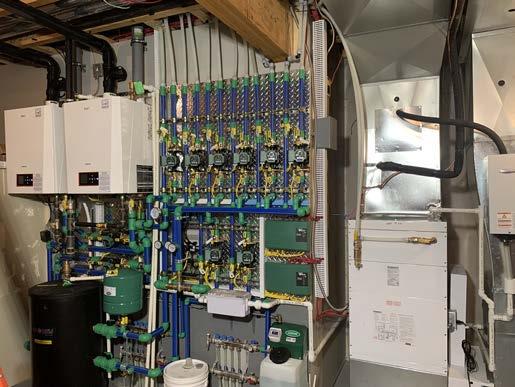
The company's operations manager, Pierce Akins, explained some challenges the company faced with this award-winning project. “We had to redesign the hydronic system so it could physically fit based on the litmited space we were given to build our heating stations throughout the house,” said Akins. “We used modulating pumps instead of fixed-speed pumps to save more energy and save space.”
Akins said he has seen an increased demand for hydronics in his business, especially in the high-end new builds in and around Toronto where the new designs present challenges to heat with traditional equipment.
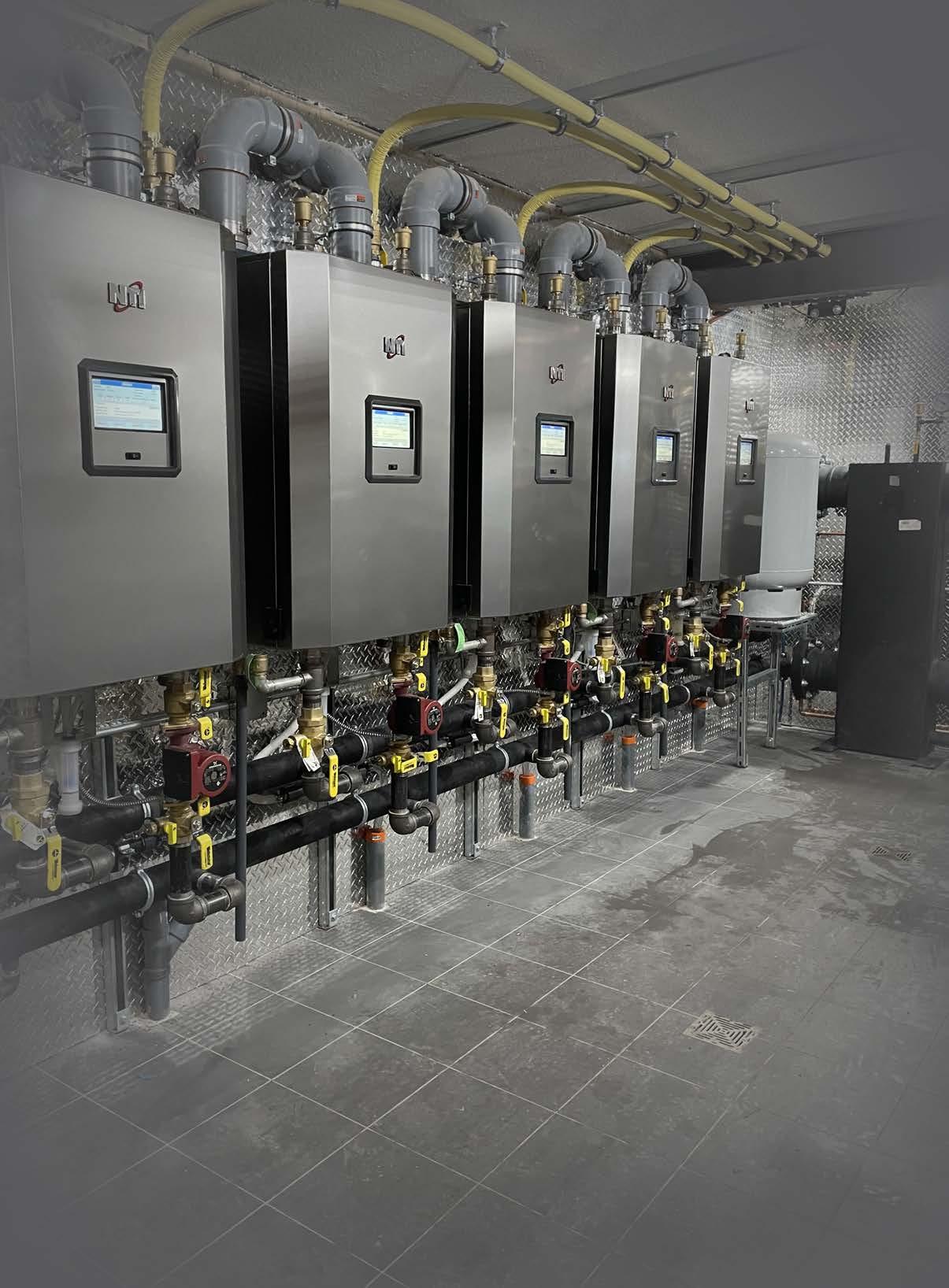
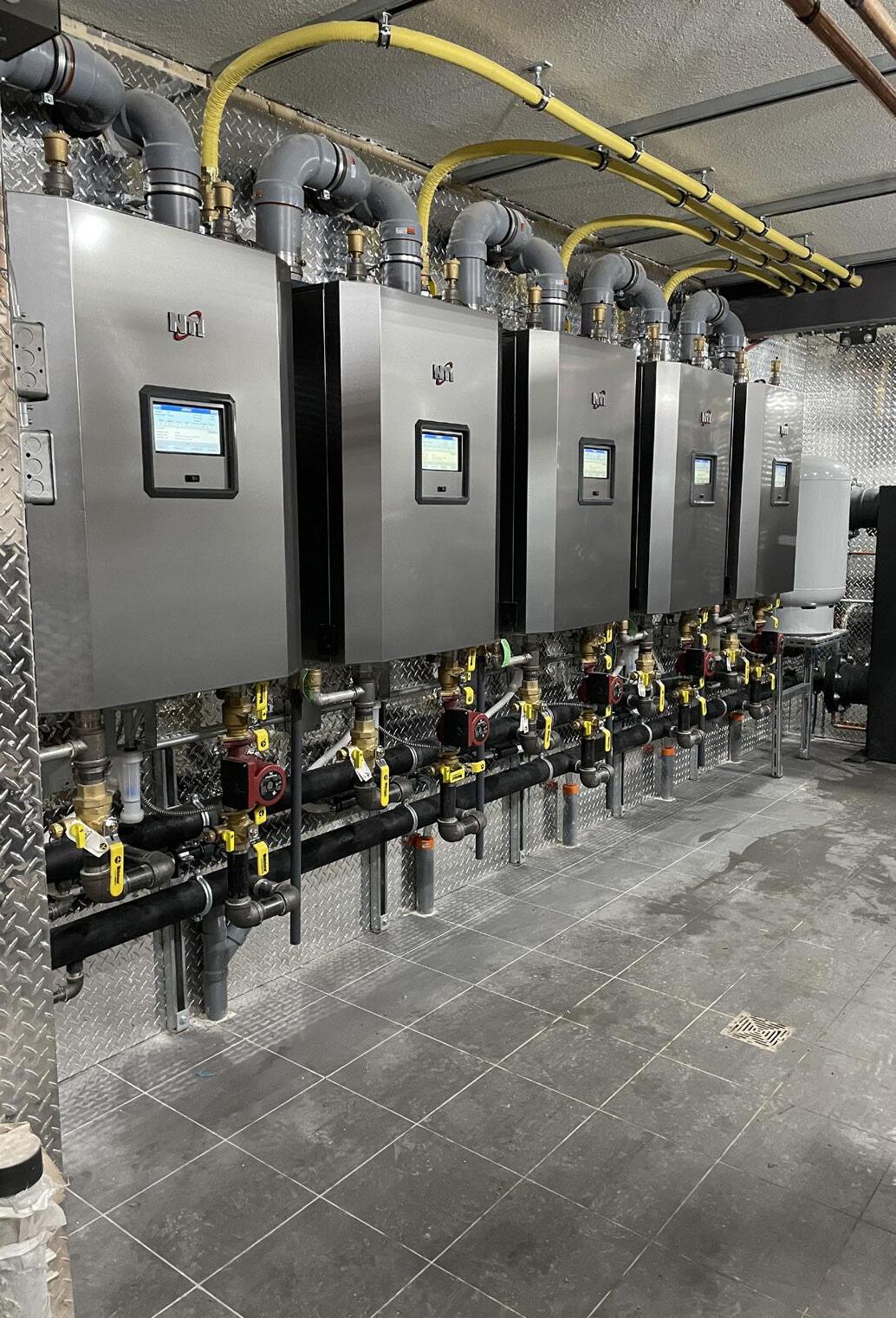
On this project Akins explains how they changed the design from the original drawings of two large boilers to five smaller units. “It gave us the advantage of lower modulations while also meeting the higher loads once they all fire up together.
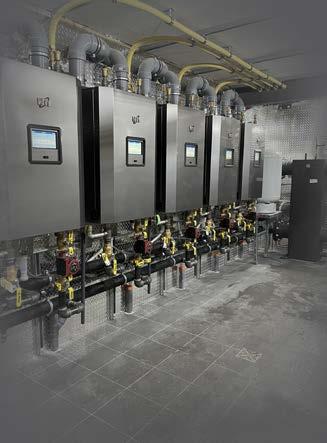
Winner in the residential category, this custom home project was completed by Riverdale Plumbing in Toronto.
The Riverdale Plumbing project used modulating pumps instead of fixed-speed pumps to save energy and space.
Doing this we could get down to 40,000 Btus, which allowed us to save energy and use the boilers as effectively as possible.”
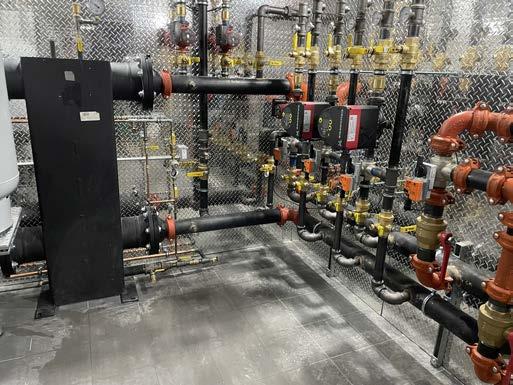
The boilers were installed to provide heat for two indirect hot water tanks, a large snow melt, indoor spa, outdoor spa, outdoor pool and supplementary heat (in-floor heat and heating coils) to the building. The primary heat for the building is provided by heat pumps.
Contest judge, Robert Bean, gave the Riverdale Plumbing project his vote for the top spot because the of its energy-saving efficiencies. “What I liked about this project was given the size of the loads, they used the least amount of electrical power to move the thermal energy through the building.”
Co-judge, John Seigenthaler concurred, adding that the untold story of hydronics is about judging the quality of a system by looking at both the energy consumed to produce the heat and the energy used to move it through the building.
500-seat dining hall, commercial kitchen and amenity spaces on bottom two floors.
Patrick Waunch, president and CEO of Rambow Mechanical, founded the business in 1985 with himself and an apprentice. Today, the firm specializes in industrial and commercial projects filling a niche throughout Western Canada with a regular team of around 45 people. “I enjoy a challenge,” says Waunch, who has over 50 years of experience in the commercial and industrial mechanical sector.
“We had to redesign the hydronic system so it could fit.”
Seigenthaler also admired the used of valves rather than zone circulators which use less electricity as well as the beautiful workmanship, well thought out design, modern technology and well-placed hardware from a servicing standpoint.
“From an energy standpoint, the use of a variable speed pressure-regulated circulator combined with valves is definitely going to use less energy,” said Seigenthaler. “A lot of preplanning went into this relatively small space in a very large home.”
RAMBOW MECHANICAL
The top entry in the commercial category was awarded to Rambow Mechanical of Kelowna, B.C. This new construction project, the Nechako residence, is part of the UBC Okanagan housing commons in Kelowna. The building itself is a 137,000 sq. ft. six-storey residence with some 220 bedrooms and a
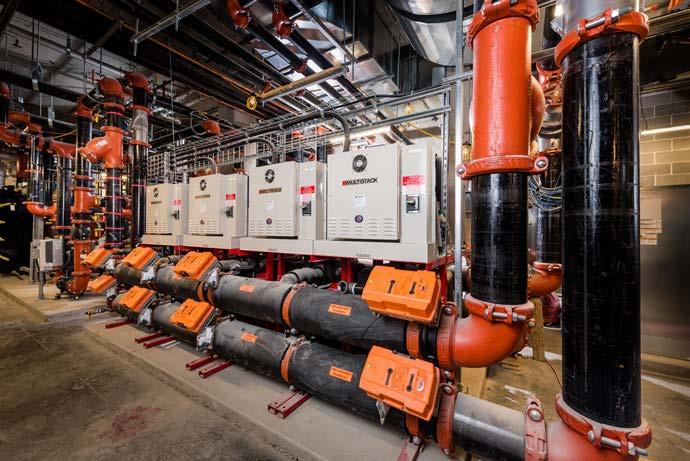
For this project, which lasted about two years, the building is tied into a centralized campus low-temperature district energy system (LDES). Heat pumps located in the Nechako building use water-to-water heat recovery for maximum efficiency when both heating and cooling are required. Two 8-in. stainless steel connections, which connect to two heat exchangers, provide an effective heat surface of 386 sq.m. per heat exchanger. This allows the system to both draw heat or reject heat back into the system.
The heat pumps send either hot or chilled water through a network of 6-way control valves that, in conjunction with a large number of thermostats, allow various fan coils, unit heaters and in-slab heating/cooling. The in-slab heating is located in the common restaurant area and unit heaters are located in main doorways and loading dock areas.
All of the pumps in the system have variable speed drives on them, ramping up and down driven by controls. In addition to the complex heating/cooling system, all the student room windows have a built-in contact sensor, monitored by a direct digital control (DDC) system, so when the window is opened the DDC is programmed to shut down the heating/cooling for energy savings. When the window is closed the DDC reactivates the fan coil in the room to its previous program.
Continued on MH6
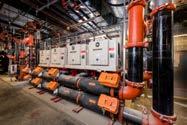
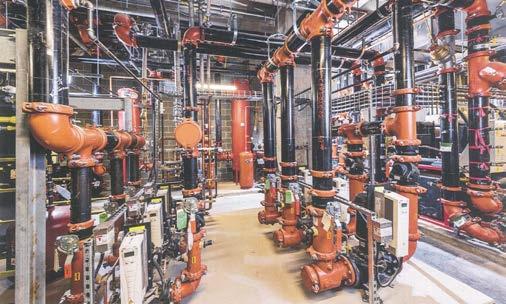
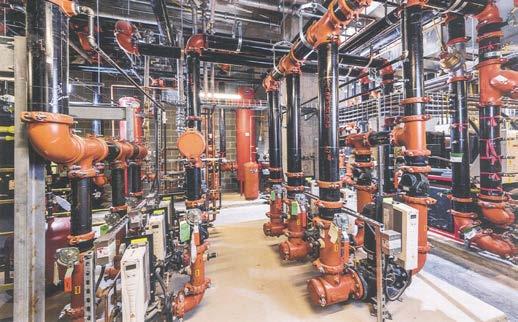
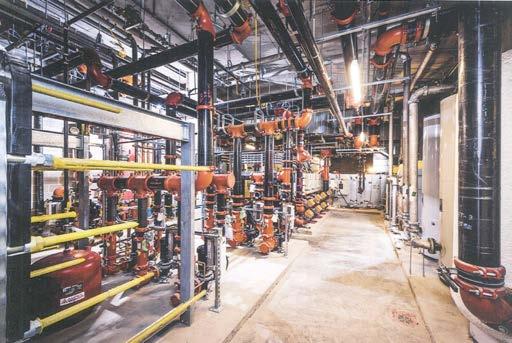
Winner of the commercial category; this is the mechanical room located in the basement of UBCO Nechako residence completed by Rambow Mechanical located in Kelowna, B.C.
The mechanical room is tied into a centralized campus lowtemperature district energy system (LDES).
Another energy-saving element is the heat recovery system that captures heat from exhaust fans and the commercial kitchen range hood using an energy recovery ventilator (ERV) and repurposing that energy back into the HVAC system.
The heating system also aides the domestic hot water. “Once our heating side returns back from the system it runs through a heat exchanger that tempers the incoming domestic cold water, so when you have low loads situations for heating you gain a lot of benefit from this second heat exchanger taking heat out of the heating system,” says Shayne Haller, project manager with Rambow Mechanical.
According to Wauch and Haller, working to the LEED Gold certification requirements on this project meant sourcing local materials that met the low environmental impact specifications (including cements, sealants, etc.). “A lot of paperwork and effort is required to satisfy the LEED certifications,” says Waunch, a process which is becoming a more common practice on all of their projects.
The Sweet Heat contest judges applauded the certification
2021 SWEET HEAT ENTRIES
Thank you to everyone who took the time to enter our first Sweet Heat Contest:
Air Design Services, London, ON AV Mechanical, Caledon, ON Battye Mechanical, Peterborough, ON Boss Plumbing, Saskatoon, SK Canadian In-Floor Radiant Solutions, Burlington, ON Canuck Mechanical, Prince George, BC Deer Bridge Plumbing & Heating, Calgary, AB Denrite Mechanical, Sturgeon County, AB Doyle Plumbing Heating & Cooling, Fraserville, ON Gleeson Plumbing, Moorefield, ON Good Grade Plumbing & Gas, Victoria, BC Grand Mechanical Solutions, Brantford, ON GTAHeat.ca, Vaughan, ON JJM Mechanical Group, Burnaby, BC
John Sadler Plumbing & Heating, Surrey, BC Lloyd HVAC Services, Toronto, ON Mason Place, Keswick, ON MICA Energy Solutions, Oshawa, ON Micon Plumbing, Mississauga, ON Northern Air & Mechanical Systems, Sudbury, ON Parr Mechanical Plumbing & Heating, St. Pauls, ON POC Plumbing & Heating, Oakville, ON Pre-Con Builders, Oakbluff, MB Pro Climate Mechanical, Concord, ON R4 Mechanical Systems, Wetaskiwin, AB Rambow Mechanical, Kelowna, BC RBA Mechanical, Edmonton, AB Rhynos, Bridgewater, NS Riverdale Plumbing, Toronto, ON TJL Mechanical, Fergus, ON TT Plumbing & Heating, King City, ON
requirements of the project. “I really liked the attention to the low temperatures in the heating, and that just makes the systems operate at their peak efficiency,” said Bean.
Siegenthaler added, “It really looked like they were taking advantage of opportunities to minimize energy use and use systems that work with good attention to the exergy concept. As we move towards decarbonization, here’s a hydronic system that does a good job of recognizing that electrical-based systems and low-temperature systems are going to be the new normal in hydronics.”
“When we talk about the challenges we had, we also went through the Covid-19 scenario,” adds Waunch. “We had to maintain manpower, but we were very fortunate to be able to have people come in and out and have not one single case of Covid on-site.”
In all, the residence project lasted about a two-years for Rambow Mechanical, and it’s anticipated that the building will be full of students this fall.
Commercial installation runner-up, Grand Mechanical
Runner-up in the residential category, Denrite Mechanical
DO MORE WITH LESS
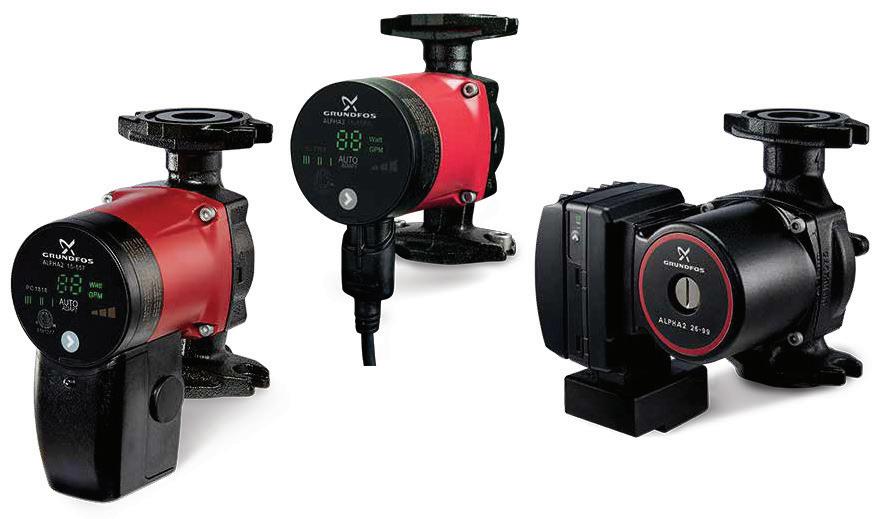
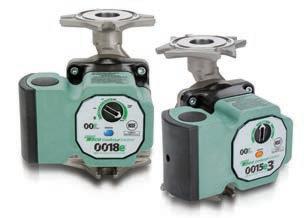
Cover 90% of your residential circulator needs with the ALPHA2 15-55 and ALPHA2 26-99.
ALPHA2 – Delivers comfort and savings to your customers for years to come. Install our most efficient variable speed ECM circulator with patented AutoAdapt function.
CROSS REFERENCE CHART
ALPHA2 15-55
UPS 15-58F/FR
UPS-15-42F/FR
UP15-10F
UP15-42F
005
006
007
008
0010
0015
00R-IFC
00R-MSF1-1FC
007E
0015E
0018E
ALPHA2 26-99 UPS 26-99F 0010 0011
NRF-22
NRF-25
NRF9F/LW
ECOCIRC 19-14
LR-20WR
NRF-36 SP#2
NRF-45 SP#2 SERIES 100 PL-30 PR
NRF-36SP#1
NRF-45SP#1 LR-15BWR
ASTRO 30
ASTRO 50-3
ASTRO 25
ASTRO 30-0
ASTRO 20
ASTRO 230CI-R
E7(B)
ASTRO 50(B) H41
ASTRO30(B)
ASTRO 250CI-R
ALPHA2 15-55 with terminal box
ALPHA2 15-55 with line cord
ALPHA2 26-99 with terminal box
Grundfos
TACO Bell & Gossett
Armstrong Wilo
RUNNERS UP
The runner-up spot in the residential category was awarded to Denrite Mechanical of Sturgeon County, Alberta. This home had a mechanical system which, according to Bean, “needed some therapy.” Bean said he awarded the runner-up prize because of Denrite’s design and installation, particularly their attention to low-temp return temperatures.
“In order to get the maximum amount of work out of a boiler you need to get those temperatures down to 75-80F return water temperature. The only way to do this is to oversize the heat exchangers on the air handlers,” said Bean.
The project was also commended by Seigenthaler for its workmanship and design. “I gave a good rating for their ability to integrate that much hardware into the small space and yet keep accessibility for servicing,” said Seigenthaler.
SWEET HEAT 2022
We are now inviting hydronics professionals across the country to get out your cameras and do it all over again.
Sweet Heat 2022 launches now, so if you take great pride in the work your team is doing and have new installation projects that are worth talking about (either new build or retrofits), it’s time to bring it on!
The entry process is simple, and you’ll find all the entry details at hpacmag.com/sweet-heat-2022 and maybe you’ll be our feature story next year.
Good luck to all.
Grand Mechanical Solutions of Brantford, Ontario was the runner-up in the commercial category. Their project was a new build facility for a landscape equipment supplier. The building included over 30,000 sq.ft. of radiant in-
floor heat and snow melt among the showroom, offices, service shop and underground garage. “I liked the application of multiple boilers staged, instead of putting one large device in,” says Bean. For Siegenthaler: “It was a good use of modern piping materials, and ECM circulators," and he appreciated how the controls were well separated from anywhere water could affect them.
Both judges were impressed with the quality of workmanship in all entries, but are always looking for how contractors use engineering principles which promote energy efficiency and compliance with standards. “When it comes to energy, conserve it first,” says Bean.
Their recommendations to future entrants is to demonstrate how you made your systems efficient, and where possible identify what standards you are meeting to provide comfort to your clients. <>
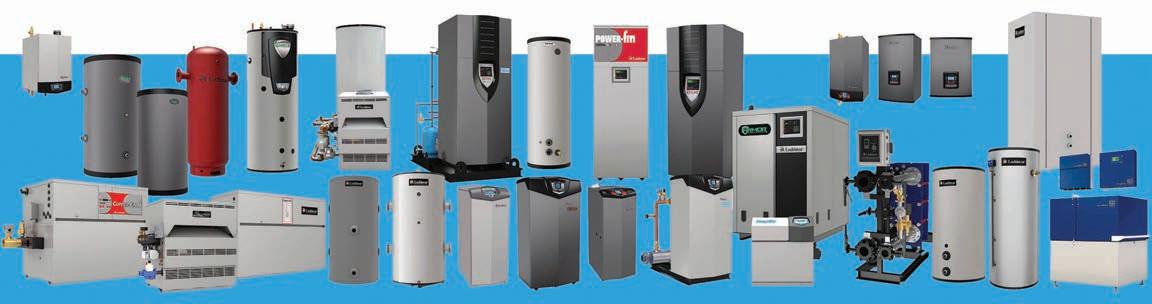
Your business is all about cash flow, project performance and planning, going big too soon, having the best people, innovating and working with partners that really want to help you grow your business.
Your business needs innovative partnerships that incorporate the newest product technologies and digital tools — reliable
brands that make things better. That’s why AQUATECHTM is proud to offer Lochinvar® heating and hot water boiler solutions that perform for you and your customers. Energy efficiency. Quality performance. Broad product selection. And technical support.
Call us today and explore how our over 40 years of experience can support you.
ZONING CONSIDERATIONS
Things to consider when planning your piping layouts.
BY JOHN SIEGENTHALER
Azone is any area of a building for which indoor air temperature is controlled by a single thermostat (or other type of temperature controller). A zone can be as small as a single room, or it may be as large as an entire building.
Multi-zone systems have the potential to provide two important benefits not available in single zone systems, namely:
• The ability to meet individual comfort requirements through independent control of room temperature
• And, the ability to conserve energy by reducing the temperature of unoccupied zones and thus the rate of heat loss from them.
Multi-zone hydronic systems are easy to create, much easier than their forcedair counterparts, and several hardware options exist for implementing zoning in different types of distribution systems.
However, before attempting to layout a zoned distribution system it’s important to evaluate how zoning can best be implemented in the building. The goal is to maximize the benefits of zoning while at the same time keeping the system affordable, energy efficient, reliable and as simple as possible.
AVOID OVERSELLING
In some cases, hydronic zoning has been “oversold.” For example, potential clients, and even some heating professionals, sometimes think that the more zones a system has the better it is designed. This is not true. Just because it is possible to create a separate zone for every room does not mean it is the best choice.
In some cases, the extra piping and control hardware necessary for roomby-room zoning adds complexity and cost without returning tangible benefits. Dividing a system into an excessive number of zones may even create operational problems such as heat source short-cycling. It can also add to system maintenance requirements, again without returning any benefit to the owner.
Here are several factors designers should consider when deciding how to best implement zoning.
THERMAL MASS
Some people assume that zoned systems are somehow able to lower the temperature of a room (or group of rooms) down to some setback temperature as soon as the thermostat is turned down. Likewise, they might assume that any given room will quickly warm back to normal occupied temperatures as soon as the thermostat is turned up.
No occupied space can undergo a drop in temperature of several degrees over one to two minutes simply by stopping heat input. Similarly, no practical heating system can instantly raise the temperature of an occupied space by several degrees. The time required to cool down or warm up a zone is significantly affected by the thermal mass of the heat emitter(s), and the building itself.
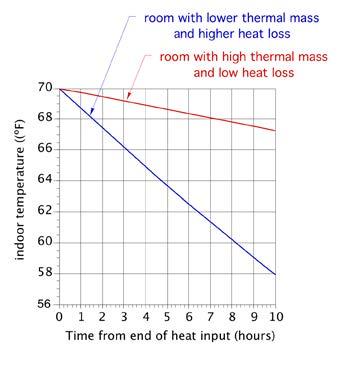
The greater the thermal mass of the heating system and building components, the slower the decrease in indoor temperature when heat input to the zone stops. This is illustrated in Figure 1.
The two curves shown represent combinations of rooms and their associated heat emitter(s) with significantly different thermal masses. The room with low thermal mass could be a typical woodframed residential room with fin-tube
baseboard or perhaps a fan-coil as the heat emitter. The room with high thermal mass could be the same room, but equipped with a 4-in. thick heated floor slab as its heat emitter.
A very well insulated room (or an entire building) with high thermal mass might only experience a temperature drop of 3F to 5F over a cold midwinter nighttime lasting 8 to 10 hours, even with its heating system completely off.
If the occupants reduced the thermostat setting from 70F to 60F at night, the inside air temperature would not decrease to the reduced setpoint before morning. The energy savings potential of such a situation is very limited. If the thermostat were turned down 10F or even 20F, the results would be the same.
The thermal mass of the heat emitter also affects the recovery period when the setback ends. Low thermal mass heat emitters such as finned-tube convectors can usually restore a room that has been set back 10F to normal comfort in perhaps 15 to 30 minutes.
High thermal mass systems such as a heated concrete slab-on-grade floor can take several hours to bring a space back to normal comfort temperature following
Figure 1. Variables effecting heat loss
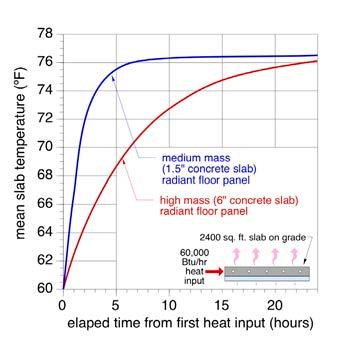
a prolonged setback period. This is illustrated in Figure 2, which shows the simulated heating of both medium-mass and high-mass radiant floor panels, starting at an initial temperature of 60F, and having a sustained heat input rate of 60,000 Btu/h.
It’s important not to use heat emitters having significantly different thermal mass in the same zone when that zone will operate with frequent changes in setpoint temperature. Because their response times during both cool down and warm up are so different, neither type of heat emitter is likely to produce acceptable comfort during the transition periods between stable setpoint temperatures.
It’s also important to realize that the energy conservation potential of a high thermal mass-zoned system is very dependent on the duration of any reduced thermostat setting.
If a zone can be maintained at a reduced temperature for several days, the energy conservation potential can be significant. However, attempting to create significant temperature changes on a daily basis in zones with high thermal mass heat emitters is futile.
The energy savings will be very small and the potential for temperature overshoot and undershoot will be significant. This characteristic should be explained to eventual owners who may not understand how high-mass systems respond to changes in the thermostat settings.
HEAT FLOW TO ADJACENT ROOMS
Another factor affecting zoning performance is inter-zone heat transfer. This refers to heat transfer through interior partitions as the building attempts to equalize temperature differences from one room to another.
If, for example, a particular room is kept at 65F, while an adjacent room is kept at 75F, heat will flow from the warmer to the cooler room through the wall separating them.
This partially defeats attempts to
maintain temperature differences by zoning. The greater the thermal resistance of the exterior envelope of the building, the harder it is to maintain significant temperature differences between rooms separated by uninsulated interior partitions.
OCCUPANT INVOLVEMENT
Another consideration that helps determine the cost effectiveness of zoning is the willingness of the occupants to regulate the system. It might seem obvious that an owner who is willing to pay more for an extensively zoned system would also be willing to regulate it. However, experience has proven that this is not always true, especially when nonprogrammable thermostats are used. Given modern lifestyles people often forget to regulate their heating systems.
Different rooms within a single zone (e.g., controlled by a single thermostat) and supplied with the same water temperature can still be maintained at different temperatures by adjusting the flow rate through individual heat emitters, assuming, that is, that these rooms are not all served by a series piping circuit. Flow balancing is usually adequate when the goal is to maintain several rooms at different (but stable) temperatures.
Room-by-room zoning is justified in situations where several rooms are to
have both different and frequently changing air temperatures. It can also be justified when the added cost of room-by-room zoning is relatively small. A good example of the latter is when panel radiators, each equipped with thermostatic valve actuators, and piped into either a homerun or “1-pipe” distribution system are used as heat emitters. These distinctions should be discussed with eventual owners before committing several hundred dollars for extensive zoning controls that may seldom be used.
INTERNAL HEAT GAINS
Rooms with large south-facing windows may at times be totally heated by solar heat gains. Rooms in the same building that do not receive solar gain may still require heat input. Well-planned zoning separates rooms with likely solar heat gain from those without. It also accommodates the fact that the rooms receiving solar heat gain change over the course of the day as the sun moves.
Rooms that contain heat-producing equipment such as computers, copiers, vending machines, intense lighting or cooking facilities are usually good candidates for separate zoning.
It’s also important to use heat emitters with low thermal mass in areas subject to large and highly variable heat gain from the sun or other internal heat sources. The low-mass heat emitters can quickly start and stop heat input as necessary. This is especially important in modern buildings having very low rates of heat loss.
SLEEPING COMFORT
Many people prefer to sleep in cool bedrooms. Good zoning design allows for this possibility. It’s common to zone a residential system so one or more bedrooms are controlled as a single zone. Another common strategy is to create one zone for the master bedroom, with a separate zone for the master bathroom.
Figure 2. Simulated heating of both medium-mass and high-mass radiant floor panels.
This allows the bathroom to remain comfortable even when the bedroom is cool.
ACTIVITY LEVEL
Exercise rooms are good candidates for separate zoning, while it’s unnecessary to maintain normal human thermal comfort conditions in spaces that are infrequently occupied—examples include basements, garages, guest rooms, and workshops. Garages, if heated, are usually maintained at air temperatures of 45F to perhaps 60F, and again are usually set up as a separate zone. In cold climates the garage zone is usually designed to operate with antifreeze. This allows the garage zone to be completely turned off, if desired, without the risk of freezing.
TRANSITORY AREAS
Entry vestibules with exterior doors and
doors into fully heated space are good candidates for separate zoning.
In some cases, the goal is to maintain the vestibule at higher temperatures to help buffer interior spaces from cold air gusts when the exterior door is opened.
When floor heating is used in such high-traffic areas, the floor surface temperature is often maintained several degrees above that of other interior areas to help buffer the cold and to dry tracked-in moisture.
EXTERIOR EXPOSURE
Rooms with minimal exterior exposure will have small heating loads relative to their floor area.
When such rooms are controlled as separate zones, overheating can be minimized. Rooms that have no surfaces exposed to the outside typically do not need heat emitters.
BLENDED SOLUTIONS
These consideration should all be “weighed” when deciding upon a distribution system strategy. On some projects one or more of these considerations may not be present. On other projects some may be very dominant.
The “beauty” of modern hydronics technology is the ability to meld these considerations together in a way that enhances owner satisfaction while also providing energy efficiency and decades of reliable operation. <>
John Siegenthaler, P.E., is a licensed professional engineer. He has more than 40 years experience in designing modern hydronic heating systems. His latest book is Heating with Renewable Energy (see www.hydronicpros.com for more info).
Hydronic Heat Pump
For Hydronic Designers
This is a must have to utilize the new TECA heatpump drawings and design projects involving air-to-water or water-to-water heat pumps.
For Hydronic Installers
This is great insight into the proper sizing, operation and logic of heat pumps when utilized in a hydronic heating or cooling system
OPTIMIZING BOILER CHEMISTRY
In this edition of 30 Mechanical Minutes panelists review why maintaining proper water chemistry is essential with modern boiler systems.
BY LOGAN CASWELL
In a recent installment of HPAC Magazine’s 30 Mechanical Minutes, the free webinar featuring virtual content for real world professionals, HPAC editor Doug Picklyk sat down with HPAC contributing writer Steve Goldie and Brian Morgan of The Morgan Group to discuss the merits of being proactive in dealing with water chemistry in the design, operation, and maintenance of hydronic systems. Goldie and Morgan shared their knowledge of treatment solutions and what’s important to consider in new and retrofit applications —both residential and commercial.
Although water is the optimal heat transfer medium, optimizing the water chemistry is vital in the new generation of modern boilers. Goldie, a hydronics specialist with Next Supply with more than 40-years-experience in the plumbing industry, recalled the main cause of corrosion and subsequent reduced reliability in old cast-iron boilers was oxidization due to air in the system.
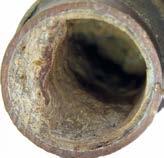
The main culprit today is the quality of the water being pushed through the much narrower passageways. New technologies create hot water very quickly, and there are a lot of opportunities for scale build-up especially around the heat exchangers. This build-up can cause the heat exchanger to overheat
and fail which is a huge contrast to old cast iron systems which could be full of sediment for decades and still be functionally operational.
“Water chemistry is crucial these days,” said Goldie, “In my day, the most important component was the air separator. Now it’s not the case.” He went on to stress the importance of testing the pH of the water—even from the municipal supply—and to install a de-mineralizing cartridge which triggers an alarm to alert the owner when it needs to be replaced.
“Water quality and chemistry is something you can’t ignore anymore,” said Goldie. “It needs to be part of the regular maintenance schedule and routine of your boiler system.”
Boiler manufactures have now identified water chemistry as a catalyst for premature boiler system failures and have even made a point of nullifying their warranty if the boiler’s water supply is not maintained to their specifications.
Morgan illustrated the new best practices and recommendations issued by
manufacturers which included procedures such as:
• Test the water before you fill the system.
• Make sure you have air elimination in the system.
• Treat all boiler feed water as though it is hard water.
• Use chemical inhibitors on every job.
• Flush old and new systems with fresh clean water before commissioning the new boiler.
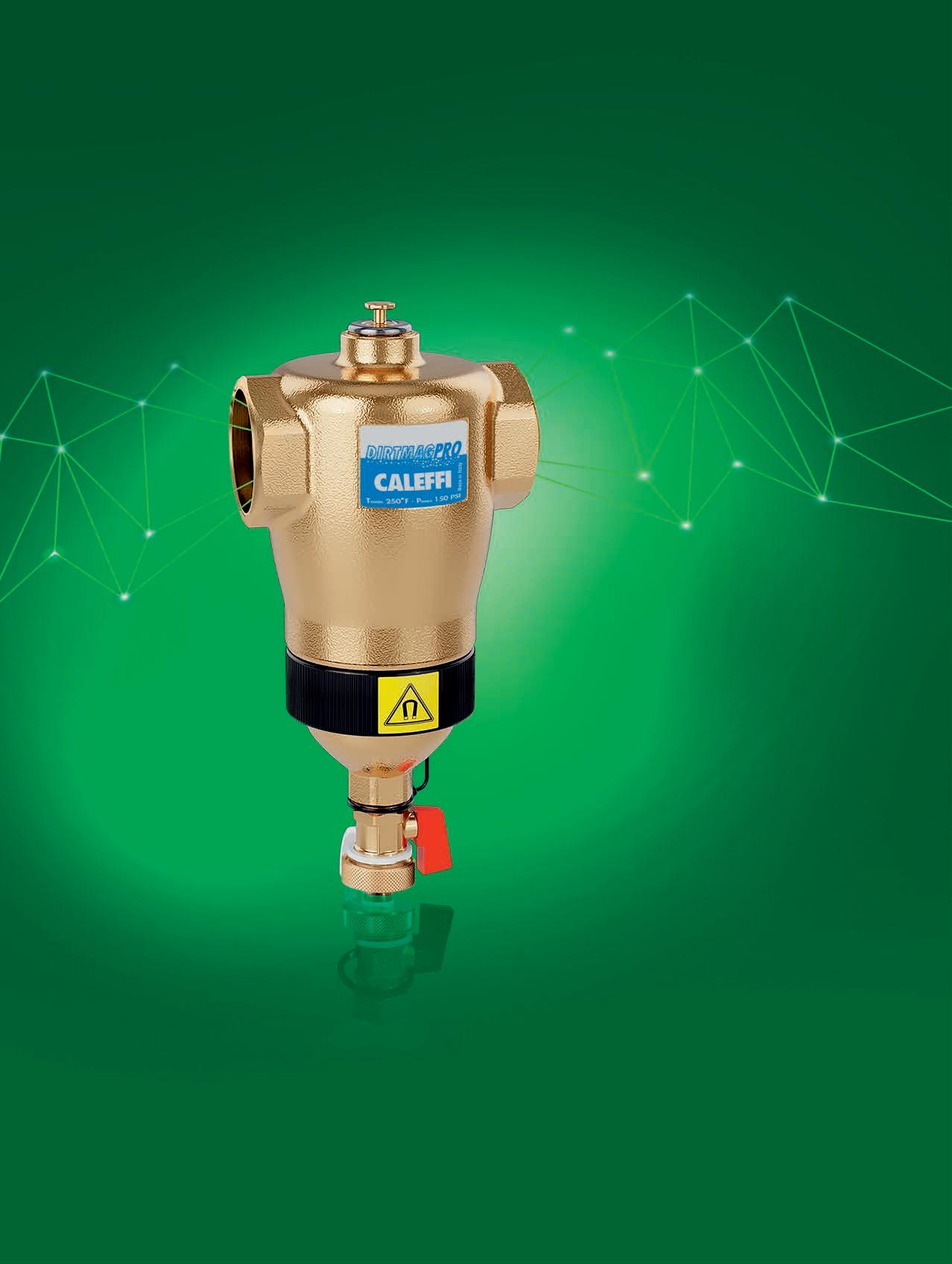
• Use magnetic dirt separators on systems containing large amounts of iron and to remove debris from system water.
• Where possible, treat boiler feed water.
• Repair system leaks immediately to prevent oxygen and untreated water from entering the system.
When installing a new boiler into a large building with existing steel and copper piping, sometimes it’s difficult to flush an entire system, Morgan recommends at the least testing the water and treating the system water before introducing new
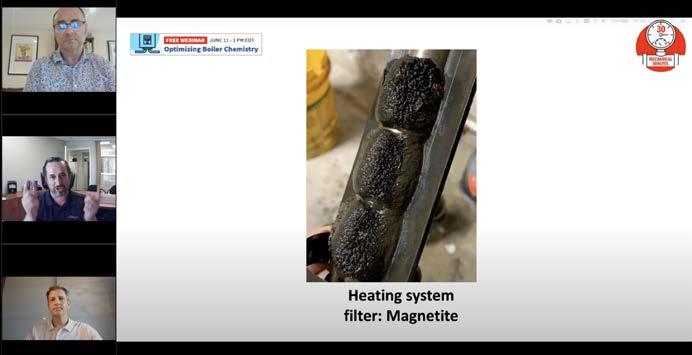
Webinar participants (top to bottom) Steve Goldie, Brian Morgan and Doug Picklyk, here discussing the important role of magnetic separators at keeping hydronic systems clean.
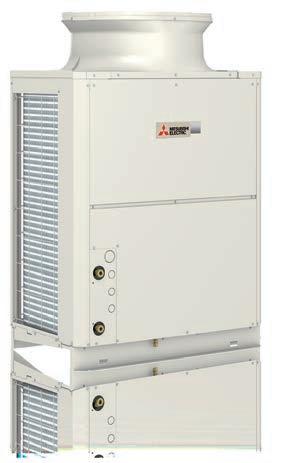
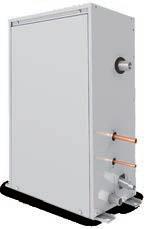
Trust Mitsubishi Electric For Your Net Zero Hydronic Solutions
LOW CARBON HYDRONIC HEATING & COOLING, AND DOMESTIC HOT WATER SYSTEMS
u Natural Gas Alternatives for Electrification
u Trusted Performance, Quality and Reliability
u Reduces Energy Consumption Over Comparable Natural Gas Systems
u Strong Canadian Customer Support Team
VISIT US AT CIPHEX WEST BOOTH 625
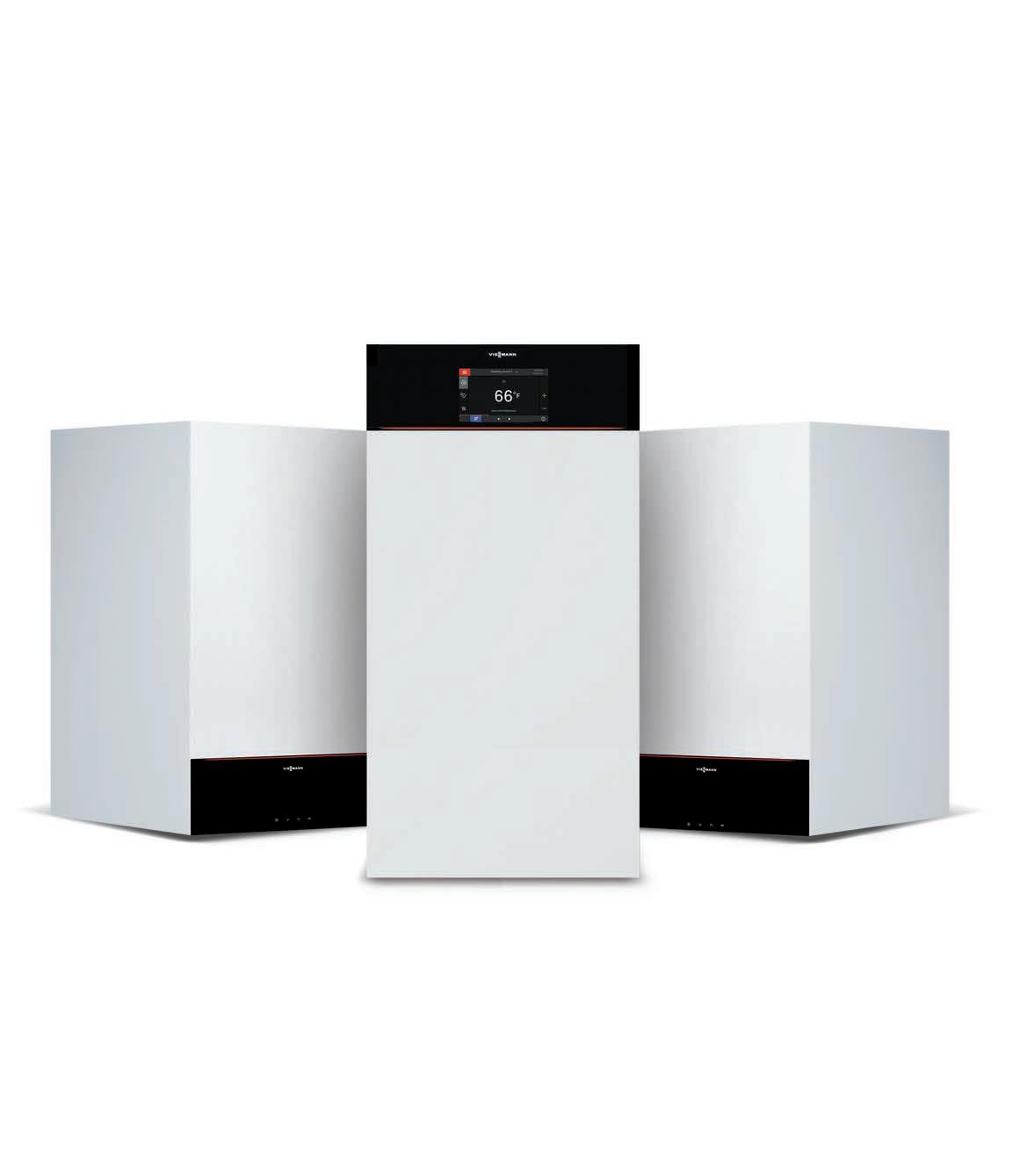
Game changing innovation
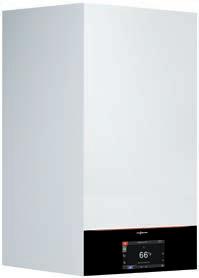
Introducing the smart generation of Vitodens
Grow your business with Viessmann future-proof solutions. Our smart generation of high-efficiency gas condensing boilers and digital applications are designed to work for you, saving you time and energy on and off the job.
+ Flexible installation with dual position display
+ Fast commissioning with preconfigured start-up guide
+ Easy remote monitoring and servicing with Vitoguide
+ Optimize maintenance with interchangeable spare parts and accessories
+ Fits any home with residential boiler sizes from 85 to 199 MBH, all with WiFi inside
Wifi inside
Your all-in-one Digital assistant
Introducing Vitoguide
Our new Vitoguide app connects to any Vitodens smart generation boiler to streamline and simplify each installation.
boilers, or look at de-coupling the new boiler system from the existing system with a heat exchanger, so you can ensure you have great water quality flowing through the boilers.
He’s also seeing installations where the hydronic system is decoupled from the make-up water feed system with a make-up package to easily treat and test the water in the boiler system.
“I’ve seen closed-loop heating boilers installed in buildings where they’ve had leaks and in a very short order of time will fail because of scale build-up on the boiler,” agreed Goldie, who also pointed out the importance of the volume of water in a system even if the municipal water has been tested before entering the system.
“The problem is there might be so much volume in that building that there’s still enough mineral content in that volume of water…even though the water is within the acceptable limits,” said Goldie. “The total volume brings so much calcium into these heat exchangers that you’re still going to have a problem. I’m a big fan of isolating your boiler system from your building, so putting a heat exchanger in between your boiler and your system enables you to have much better control over the boiler water.”
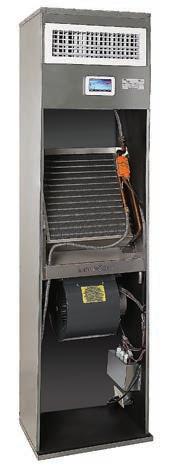
Custom Built Retrofit Fan Coil Systems for Apartments & Condos
Saving you and your customers time and unnecessary cost
Installation of our high quality, custom-sized systems virtually eliminates all drywall, painting and finishing work while delivering, highly efficient, whisper quite comfort!
OUR PRODUCTS ARE:
• Canadian made
• Carry up to 5 year warranties
• Available in both vertical and horizontal configurations
Contact us at 905-766-1513 and visit us online at inner-coolsystems.ca to check out our range of customizable options and our engineering excellence! INNER-COOL SYSTEMS
“Magnetic filtration cannot be ignored anymore.”
This installation method is especially beneficial for instance when a service contractor may need to drain the riser. Without isolation the contractor is most likely to be refilling the system with untreated municipal water.
What about the use of glycol in hydronic systems? Morgan said the use of glycol can be beneficial for both its anti-freeze protection and its inhibitors which help prevent any microfilm build-up or rust in the piping system. The inhibitors also lubricate the seals and pumps which help the hydronics system overall.
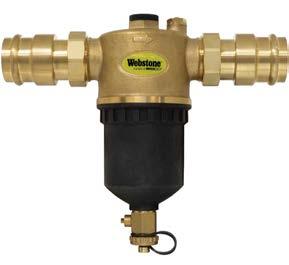
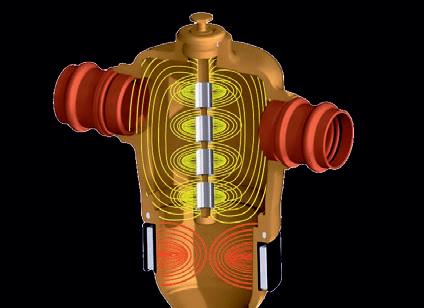
Another crucial piece of equipment, in our experts’ opinions, is a magnetic filtration system. Magnetic filtration systems trap magnetite which is a build-up of metal particulates which attach to components in the heat exchangers and pumps. More and more manufacturers are recommending the installation of magnetic filters on inlets before the water goes into the heat exchanger or pump as a way of treating the magnetite problem.
“Magnetic filtration cannot be ignored anymore,” said Morgan who stressed it must be properly managed by the installer, and building owners need to be educated on the downfalls of noncompliance with the manufacturers’ recommendations.
“When someone spends $150,000 or more on a new commercial boiler system, and after one heating season it’s not covered under warranty and it’s failing … that’s a much bigger issue than what the investment would have been up front,” said Morgan.
The webinar ended after a brief question and answer session with the conclusion that optimizing boiler chemistry is not an option anymore, and it can save a lot of money if you maintain these systems according to the manufacturers’ recommendations no matter where your water comes from.
To view the full webinar visit hpacmag.com/tech-pulse <>
HEAT TRANSFER PLATES
The next edition of 30 Mechanical Minutes will feature hydronics expert John Siegenthaler discussing the effect of heat transfer plates on the performance of “staple up” radiant floor heating systems.
Date: Thursday, September 2nd at 1PM (eastern time). Visit hpacmag.com for registration details.
Sponsored by
INNER-COOL
SmartPlate Has EVolved
Introducing SmartPlate EV. With its ultracompact 24" x 32" footprint, vertical piping connections and capacities up to 4500 MBH and 300 PSIG, the SmartPlate EV indirect water heater gives you greater design fl exibility for standard and highpressure systems. It also easily integrates with AERCO’s Benchmark boilers and smart Edge Controllers for a powerful combination system. Join the EVolution. SmartPlate EV. 24 x 32
WATER WORKS
The design of the new headquarters for the Toronto and Region Conservation Authority will showcase its mechanical systems.
BY DOUG PICKLYK
Managing and protecting natural water systems in and around the city of Toronto is the mandate of the Toronto and Region Conservation Authority (TRCA), so it’s no surprise the design of the organization’s new headquarters incorporates water in many ways including, of course, its mechanical systems.
Being built near the Black Creek ravine in Toronto’s north end, the $65 million project (with support through NRCan’s GCWood Program) broke ground in January of 2020 with occupancy slated for September 2022. The new light-filled open-plan four-storey office building covers some 90,000 sq. ft. (8,100 m2) and will be a unique mass timber structure.
ZAS Architects of Toronto in a joint venture with Irish-based Bucholz McEvoy Architects designed the TRCA headquarters to be one of the most energy efficient mid-rise commercial buildings in North America
“We envisioned TRCA’s new workplace as one that will inspire, motivate and support the culture of its employees, who are champions of the local environment,” says Peter Duckworth Pilkington, principal with ZAS Architects. In addition to the use of wood, other sustainable design features include an energy efficient building envelope, a green roof, rainwater harvesting, low impact landscape development, and solar chimneys which increase efficiency by heating ventilation air. The heating and cooling system is
electric, using geothermal heat pumps along with roof mounted solar panels for thermal assistance. The project is participating in the Canadian Green Building Council’s (CaGBC) Zero Carbon Building Pilot Program, and it’s targeting Net Carbon Zero, LEED Platinum v4, Toronto Green Standard Level 2, and WELL Building Silver certifications.
“Overall, this building is tracking to be among the most energy efficient buildings in the country, somewhere around 54 ekWh/m² [equivalent kilowatt hours per meter-squared],” notes Duckworth Pilkington. When compared to traditional office buildings of this size, carbon emissions along with operating costs are projected to be reduced by up to 50%.
A main feature will be four water walls in the main atrium—each water wall is actually a glass enclosure (like a duct) in which the ventilation air is pulled down from the outdoor intake at the roof level and distributed to energy recovery ventilators (ERVs). Inside each of the glass ducts a chain-link mesh is suspended the full height and water cascades down the four-storeys—providing a visual display and playing a role in pre-heating and humidification of the dedicated outdoor air HVAC system. “Through the water wall feature, we’re making the building’s life support systems that are usually hidden infrastructure visible and tangible,” says Duckworth Pilkington. “Making the invisible visible when it comes to energy use, serves as a very real reminder of the impact our daily lives and decisions have on the planet every day.”
The windows on the southern façade feature operable exterior shading, and a secondary skin in front of the shading allows for pre-heating of the air before entering the building in cooler months.
A lot of the building’s control strategy is designed to optimize passive heating,
cooling and ventilation opportunities. For example, the building management system will alert occupants on their phone via an app to either open or close windows to ensure the building is using energy most efficiently.
The central mechanical room in the basement was originally planned as a closed-loop geothermal system, but after ground water was found on the site a redesign led to an open-loop geothermal solution. So instead of drilling some 44 boreholes, now there will be four boreholes. “The open-loop geothermal is an opportunity the client didn’t want to miss out on, because they are experts in water flow, conservation and protection their staff was able identify an underground bedrock valley in which underground aquifer sits” says Jamie Dabner, principal with Integral Group, the mechanical engineers on the project.
The original plan called for a solar thermal system on the roof as a back-up to the ground source heat pump strategy, but now with the geothermal system being configured with an open loop the geothermal system will connect to the mechanical plant in the basement and the solar thermal array on the roof will boost the efficiency of the system
The new TRCA office is a mass timber building with geothermal heating and cooling and solar thermal panels.
and provide greater heating potential for the building. “We actually have it piped up to be available for free heating, so there are times in the shoulder seasons when we might not want to run the compressors, and we’re just going to
run the building on solar thermal only,” explains Dabner.
Because the preference was to expose the wood on the interior and not hide it with drop ceilings, there is an air distribution plenum system, about 14-in. deep, across the top of each cross laminated timber (CLT) floor slab on every storey with supply air diffusers.
The plenum is used for ventilation only, and separate from that is the fourpipe radiant system with six-way valves feeding water-based ceiling panels used for both heating and cooling.
The piping network runs in the plenum, and the pipes poke down to the modular radiant ceiling panels which are hung on the underside of the CLT flooring.
“It’s quite a special strategy that required coordination with all of the design team,” says Dabner. The energy calculations led to about 40% of radiant
coverage in the interior zones of the building and the remaining 60% around the exterior zones of the building.
To accommodate cooling with the ceiling panels, considering Toronto’s summertime humidity, there will be dew point sensors in the thermostats in each of the zones, and if somebody opens a window raising the humidity indoors, the zone will turn off.
There are also ceiling fans, and according to Dabner the fans can increase the capacity of the radiant panels by up to about 10% in cooling mode.
He points out that a well thought-out four-pipe system is really the future of Net Zero carbon design.
Once completed, the new TRCA headquarters will be used as a learning centre–a living laboratory for developers, researchers and students–to demonstrate zero carbon features. <>
IN-FLOOR PROVIDES RELIABLE STORAGE
Radiant heating used for temperature and condensation control in agricultural fertilizer warehouse.
Belmont Farm Supply, located about 185 km outside of Toronto in Belmont, Ont, provides fertilizer, seed and more to farmers in the southwest region of the province. It has been part of the farming community since the 1940s.
When owner-partners Graham Hutton, Brad Walker and Jeff Aarts decided to build a new fertilizer warehouse, they wanted a state-of-the-art building to maintain the floor at a constant temperature. “We were trying to keep the moisture from forming on the concrete when the humidity rises,” Walker notes.
A floor temperature between 57F and 60F is essential when storing fertilizer. A lower floor temperature that allows outside temperatures to rise above it causes risk of condensation that can turn the fertilizer from a solid to a liquid.
Walker selected St. Marys, Ont.based iFH Design and Installations, headed up by Paul McRoberts, to design and install the radiant floor heating.
McRoberts is a 47-year veteran in hydronic heating; after beginning as an apprentice in 1972, he opened his own business in 1984 and was one of the first contractors in southwest Ontario to specialize in radiant floor heat.
DON’T FORGET THE INSULATION
The ceiling height of the steel-constructed building is more than 36 ft. The
concrete slab is 372 x 96 ft. More than four miles of PEX was installed. The radiant system uses piping in ¾-, 1-, 1-¼-, 1-½- and 2-in. sizes; 1 ¼-in. stainlesssteel manifolds; ¾-in. connectors; and compression-sleeve fittings.
“Instead of doing all the large diameter supply and return piping above, we did it all below ground with 2-in. and 1-½-in. oxygen-barrier piping with the fittings,” McRoberts explains. “Then we insulated all the piping with 1-in. foam insulation made for underground use.”
The next step was the placement of 2-in. expanded polystyrene panels that double as insulation and a piping-installation method. The ¾-in. by 500-ft loops were walked into place on top of the boards at 9-in to 12-in spacing then connected to the manifolds. A 40% glycol solution runs through the PEX network.
From the boiler room, all manifolds were supplied with 1-½-in. oxygen barrier supply lines. The longest supply lines were nearly 300 ft from the heat source.
“In each area of the manifolds, we installed floor sensor wells with PEX piping so we could insert our sensors in
after the concrete was installed,” he says. “Before the concrete pour, the floor piping was pressurized to 100 psi to ensure there were no leaks under the floor, which also included the 1-½-in. and 2-in. in-slab distribution piping.”
In the mechanical room, two boilers are the heat source for the radiant heating system — providing nearly 800,000 Btu/h of energy to maintain the required floor temperature. Low-loss headers and a hydronic dirt separator provide hydraulic separation and protect the components. A high capacity circulator distributes water to the five manifold stations. Isolation flange kits and floor sensing and pump controls round out the equipment.
QUALITY AND RELIABILITY
Opened in April 2019, the owners have been through winter seasons with the warehouse full and have fine-tuned the floor temperatures. “We are extremely happy that we have the heated floor,” Walker says. “It certainly helps maintain the quality of our products.” <>
This article provided courtesy of REHAU.
A 20,000 ft² fertilizer warehouse equipped with radiant floor heating.
Discover fresh ideas, expand your network, and fine-tune your skills at Western Canada’s biggest show for plumbing, hydronics and HVACR.
More than 30,000 sq ft of exhibits
Thousands of products from North America’s top manufacturers
Information packed seminars
Fantastic prizes
Free Parking for attendees
REGISTRATION
OPENING SOON
EXPERIENCE THE FUTURE OF PLUMBING, HYDRONICS AND HVACR IN PERSON AT
CIPHEX WEST 2021
NEW DATE! November 3 & 4, 2021
New products. New ideas. New tools. New tech.
CIPHEX WEST
CUT IT OUT WITH THE CUT-OUT QUESTIONS
Old ways of thinking are not compatible with a low carbon future.
BY CHRIS DESROCHES, P.ENG.
The term “heat pump” has many misnomers and gets thrown around far too loosely these days as HVAC conversations shift towards sustainability, low carbon emissions and building electrification.
A niche subset of heat pumps that are gaining momentum in the Canadian hydronics market are air-to-water heat pumps, which, aside from electric boilers, are an alternative to traditional fossil-fuel based boilers. Heat pumps sound attractive, so when it comes to hydronic systems, why are they still lurking in the shadows?
Air-to-water heat pumps extract heat from the air outside a building, so the machine’s ability to perform efficiently and provide useful heating is greatly influenced by outside air temperature. Any heat pump will have practical limitations due to the refrigerant being used, and it will eventually shut off when it can no longer effectively provide useful heat to the building. This is commonly referred to as the “low ambient cut-out temperature.”
And when it comes to designing with air-to-water heat pumps, the most critical design consideration the Canadian market is fixated on, and the first question to come up in heat pump conversations with a contractor or engineer is: “So… What about the cut-out temperature?”
While there have been great strides in improving heat pump performance and pushing the limits to operate in colder temperatures, usually, the design tem -
perature is below the heat pump cut out. In these cases, an auxiliary heat source will be required when using airto-water heat pumps. However it is important to recognize the frequency of time where it is colder than the cut-out temperature for the majority of Canada’s built environment is relatively few hours, typically a few weeks of the heating season. In favourable climates, such as coastal cities or even Toronto, it can be less than a week of the entire year. When it comes to heat pumps, it’s about using the heat pump when it makes sense to do so.
“The days of seeking one size fits all solutions are finished.”
Gas-fired boilers have been the norm in Canadian hydronic systems for decades due to widely available low-cost natural gas, not to mention they are relatively inexpensive. Boilers do not have the same design challenges nor constraints that air-to-water heat pumps have, so it was easy for an engineer to explain to a client why they wouldn’t entertain an alternative to a boiler. Today, design criteria are undergoing substantial change as the market shifts towards prioritizing energy efficiency and sustainability. Building and Energy Codes, as well as the metrics used to define what constitutes a “cutting-edge” and sustainable design are becoming more stringent. Limits on Energy Use
Intensity (EUI), Thermal Energy Demand Intensity (TEDI), Greenhouse Gas Intensity (GHGI), among other metrics, are being scrutinized, and the bar is consistently being raised. While these metrics may be optional and modest today, they will become prerequisites as time moves forward to achieve net-zero in new buildings by 2030.
The Federal carbon tax will also transform the industry towards electric heating solutions, which brings us back to air-to-water heat pumps. By focussing on improving building designs with both active and passive energy reduction, we can improve our buildings’ carbon footprint, but will that be enough?
Air-to-water heat pumps are one part of a wider solution, and they will become more common on the path to 2030 in hydronic systems.
Do heat pumps have limitations? Yes, but there are workarounds. The days of one size fits all solutions are finished, as it is often not compatible with a low-carbon future. This should be viewed as a benefit by providing buildings with resiliency and redundancy.
It’s not so much a matter of if air-towater heat pumps will become the norm for hydronic systems, but rather when the market will recognize and understand how the technology fits into a low carbon building. So instead of asking “What is the cut-out temperature?” the real question is “What is the best way to make use of the heat pump while it can operate?” <>
By Chris DesRoches, P. Eng., Applied Product Manager, Mitsubishi Electric Sales Canada, Inc.
Jaga Climate Systems has announced its new Dynamic Boost Hybrid (DBH) technology. Suited for use with low-water temperature systems such as heat pumps, solar energy and condensing boilers, the new DBH unit connects to a hydronic fin tube element, forcing convection and increasing the efficiency of the emitter to provide quick heat. The unit gives users more control over individual room temperatures and reduces the need for unnecessary heating and overheating.
jaga-canada.com
Webstone has announced their new Magnetic Boiler Filter (MBF) XL model. MBF XL is designed for larger residential boilers and is commonly installed on the system run. The magnet captures ferrous particles from the system before reaching the boiler, with an integral drain valve and service tool to remove the accumulated debris. The units are available with a choice of Press, FIP, MIP, or SWT union connections to join to system piping. www.webstonevalves.com
Viessmann has added WiFi connectivity to its latest generation of residential Vitodens condensing boilers. The Vitodens 100, available in both combi (B1KE) and heat-only (B1HE) models, and Vitodens 200 (B2HE) include stainless steel heat exchangers, the company’s Lambda Pro Plus clean combustion control, 10:1 turndown ratio, and work with either propane or natural gas. Both are available in a range of sizes and MBH outputs. The new Vitoguide app allows contractors to commission the boilers from a mobile device. viessmann.ca
Tekmar’s BACnet Snow/Ice Sensor Interface 681 measures the presence of snow or ice through sensor technology and interfaces with building automation systems via BACnet MS/TP to automate the start and stop and slab temperature operation of hydronic or electric snow melting equipment. The interface supports Snow/Ice Sensor 090 (automatic start and stop) and Snow Sensor 095. Features include warm weather shut down and cold weather cut off. watts.com
Belimo has introduced its integrated Energy Valve and Thermal Energy Meter that together provide energy measurement and control, Delta T management, and IoT-enabled billing. The solution offers direct integration to building management systems or IoT-based monitoring platforms. The valve and thermal energy meter can be powered using Power over Ethernet (POE) allowing both power and network connectivity. They also connect with the Belimo Assistant apps and web server tool to support the design process, simplify commissioning, and assist with troubleshooting. belimo.com
Lochinvar has announced its new Crest condensing boilers with Hellcat combustion technology for commercial applications. The commercial boilers come in eight models ranging from 1 million to 6 million Btu/h, with up to a 25:1 turndown, a wave fire tube design, and CON-X-US Remote Connect capabilities. The Hellcat technology features an O2 sensor located in the combustion chamber that along with its Smart Touch controls helps adapt and account for seasonal changes, shifts in weather patterns and altitude. lochinvar.com
Navien’s NCB-H condensing combi-boiler series includes five models ranging from 160,000 Btu/h for DHW and 60,000 Btu/h for heating, to 210,000 Btu/h DHW and 150,000 Btu/h heating. The NCB-H uses dual stainless steel heat exchangers for heating and a separate flat plate stainless steel heat exchanger for DHW. Other features include: 15:1 turn down ratio for DHW and up to 11:1 for heating, built-in DHW recirculation controls, 2-in. venting up to 65-ft. and 3-in. venting up to 150-ft. navieninc.com
Bell & Gossett is expanding its CRS CoalescingStyle Air & Sediment Separator product line. The units help break entrained air and suspended solids out of system fluid improving heat transfer and energy efficiency. CRS design helps protect pumps, boilers and other components, improving and prolonging the life of a system. Models are available for air-only, sediment-only, and air/sediment combo separation, and in sizes 2-in. through 36-in. with 2-in. – 4-in. flange or groove end connections. bellgossett.com/sales-service
Taco Comfort Solutions has expanded its offering of stainless steel within its ECM circulator family. 00e Series circulators are built with efficient and quiet EC motors to consume up to 85% less electricity, and also offer automatic unblocking and air-purge mode. Their dual electronic knockouts and six-inch stranded wire leads make for easy wiring. They also include the integral flow check and are doubleinsulated, so no ground wire is required. TacoComfort.com
The Bosch Singular Boiler series includes the 5200 and 4000 combi boiler solutions, offering 5.2 and 4 gallons of hot water per minute respectively. The Singular 5200 offers 140,000 Btu/h for space heating, while the 4000 unit offers 80,000 Btu/h. Featuring a 95% AFUE rating and a turndown ratio of up to 10:1, the units include dual stainless-steel heat exchangers and also feature an internal circulator and the capability for outdoor reset. www.boschheatingandcooling.com
ADJUSTING FOR CONDITIONS
How to size panel radiators for low water temperatures. BY JOHN SIEGENTHALER
Modern panel radiators are one of my favorite heat emitters. They’re easy to install, emit radiant as well as convective heat, and have high quality powder coat finishes. They’re nice in new construction and very well suited to retrofitting.
The panel in Figure 1 is about two feet high and four feet wide. You can see the two ½-in. PEX-AL-PEX tubes that supply it connected at the middle of the base of the radiator. You can also see the nonelectric thermostatic valve that regulates the flow rate and thus the heat output of the panel, making it an independent zone. There’s also a dual ball valve fixture at the base of the radiator that can isolate the panel from the system if ever necessary.
SHOW ME THE NUMBERS
As is the case with many heat emitters in North America, the published data for heat output from panel radiators is based on relatively high water temperatures. The most common being an average water temperature of 180F, and an assumed room air temperature of 68F. This makes the difference between the average water temperature in the radiator and the room air temperature 18068=112F. This temperature difference, or Delta T (∆T), is a reference condition which will eventually be used as part of the derating procedure for operation at lower water temperatures.
In North America it’s common to find heat output rating tables based on this 112F temperature difference. One example is shown in Figure 2 (pg. MH30).
The black numbers in Fig. 2 are heat outputs (in Btu/h) based on the dimensions (height, width, and thickness) of the radiator. The typical “thickness” dimension is based on 1, 2 or 3 water plates within the panel. Note the reference conditions in the upper right.
ADJUSTING DOWNWARD
These rating tables are fine for installation where a conventional boiler operating at relatively high water temperatures serves as the heat source. But what happens when panel radiators are installed in lower water temperature systems supplied by heat pumps or other low temperature heat sources? The short answer is that their heat output decreases. But by how much?
To date, there is no North American
rating standard that’s specific to panel radiators. This is where we turn to a European standard called EN442. It is widely accepted across Europe where tens of millions of panel radiators are used, and it provides the basis for adjusting heat outputs over a wide range of conditions. It also involves several calculations. The first of which is
Where:
Formula 1:
Formula 1:
Formula 1:
Where:
Qe = estimated heat output of the panel radiator (Btu/h)
∆Td = temperature difference determined using either Formula 2 or Formula 3 below (F)
∆Td = effective temperature difference (F)
Tin = inlet water temperature to panel (F)
Tout = outlet water temperature from panel (F)
Formula 1:
Tair = room air temperature (F)
ln = natural logarithm function (use [ln] key on scientific calculator or your smart phone)
Formula 2:
Q112 = the output of the panel radiator when the difference between the average water temperature and room air temperature is 112F (Btu/h)
1.3 = an exponent (not a multiplier) (use [yx] key on scientific calculator or your smart phone)
Formula 2: Formula 3:
Formula 3:
Here’s an example: In Figure 2, a 2-water plate radiator that’s 24 inches high and 48 inches long has a rated heat output (at ∆T= 112 ºF) of 9,500 Btu/h. Estimate its heat output assuming an inlet water temperature of 160F, an outlet water temperature of 140F, and a room air temperature of 65F.
For now we will use Formula 2 to calculate the value of ∆Td:
The value of Qn for Formula 1 is the radiator’s listed heat output at ∆T= 112, which was 9500 Btu/h.
Now just put the numbers into Formula 1 and grab your (scientific) cal -
culator. You can use a scientific calculator to raise a number to the 1.3 power. Don’t have one? Just turn on your iPhone, press the calculator APP, and turn the phone to the “landscape” orientation - instant scientific calculator. Here’s the result.
Td = Tin + Tout 2
Formula 3: Formula 4:
u = Tout Tair () Tin Tair ()
As the entering water temperature drops closer to the room air temperature, or the flow rate through the panel changes the EN442 standard introduces a modified way to calculate the difference between the average water temperature in the panel and the room air temperature (e.g., the value of ∆Td used in Formula 1). This is where Formula 3 comes in.
The decision on using Formula 3 rather than Formula 2 is based on yet another formula (sorry, but it’s necessary). We’ll call it Formula 4.
Formula 4: Formula 4:
Btu hr
Where:
Tout = outlet fluid temperature from panel (F)
Tin = inlet fluid temperature to panel (F)
Tair = room air temperature (F)
This formula looks at how the outlet temperature of the radiator is dropping relative to the inlet temperature. As the flow rate through the panel decreases there would be a wider temperature drop across the panel and thus the value of “u” in Formula 4 will drop.
Here’s the criteria set by the EN442 standard:
If u < 0.7 use Formula 3
If u ≥ 0.7 use Formula 2
Here’s another example. Water enters the panel radiator used in the previous example at 115F, and exits at 92F. The Continued on MH30
Figure 1. Example of a modern panel radiator.
air temperature in the room is 65F. Determine the correct ∆Td to use in Formula 1.
Solution: Start by calculating the value of u:
u = Tout Tair () Tin Tair () = 92 65 () 115 65 () = 0.54
Since 0.54 < 0.7 the EN442 standard prescribes use of Formula 3 to calculate
d:
∆ Td = Tin Tout () ln Tin Tair Tout Tair
u = Tout Tair () Tin Tair () = 92 65 () 115 65 () = 0.54
You’ll again need scientific calculator (or your iPhone turned horizontally) to get the natural logarithm [ln] of 1.85185 in the above calculation. No big deal, just enter 1.85185 on the calculator display and press the [ln x] key.
∆
Qe = Q112
= Tin Tout ()
Now that the appropriate value of ∆Td has been determined, the final step is to plug the numbers into Formula 1:
u = Tout Tair () Tin Tair () = 90 70 () 115 70 () = 0.44
u = Tout Tair () Tin Tair () = 90 70 () 115 70 () = 0.44
∆ Td = 115 90 () ln 115 70 90 70
= 30.83º F
This is roughly about one quarter of the “rated” heat output of the panel. I’ve found 25% to be a good “ballpark” ratio between the published heat output ratings of most panel radiators, based on the ∆Td = 112F rating conditions, and the estimated output when operating the panels in the range of 105-110F average water temperature.
WORKING BACKWARDS
1.3 = 13,374 Btu hr
Now that you know how to reduce the heat output of panel radiators operating at lower water temperatures let’s consider a typical sizing calculation where you need to select a specific panel for a specific design load.
Consider a room with a design load of 2,500 Btu/h. The selected panel radiator will be supplied with water at 115F, and operate with a 25F temperature drop. The room temperature will be 70F. Use the above information to select two
possible radiators from the table in Figure 2.
Solution: Start with Formula 4:
=
u = Tout Tair () Tin Tair () = 90 70 () 115 70 () = 0.44
= Tout Tair ()
Since U < 0.7 use Formula 3 to get
u = Tout Tair () Tin Tair () = 90 70 () 115 70 () = 0.44 u = Tout Tair () Tin Tair ()
Tair () = 90
u = Tout Tair ()
Td =
Next, set up Formula 1 with all the known information, including the required heat output at the lower water temperature (e.g., 2,500 Btu/h):
Now it’s just a matter of looking through the table in Figure 2 to find a radiator with a listed output close to this value. A radiator with three water plates, a height of 24 in., and length of 48 in. has an output of 13,664 Btu/h, which is very close to calculated output at ∆Td=112F.
A radiator with three water plates that’s 20 in. high and 64 in. long has a listed output of 15,829 Btu/h - more than enough.
Thanks for hanging in there through the math. Think of these formulas like your tools. Used properly they get you to the results you need. In this case they give you accurate ways to select panel radiators that are compatible with low temperature hydronic heat sources like geothermal or air-to-water heat pumps. That’s a good skill to have as hydronics technology evolves. <>
Btu hr This can be solved for the necessary
=
John Siegenthaler, P.E., is a licensed professional engineer. His latest book is Heating with Renewable Energy (hydronicpros.com for more information).
Figure 2. Sample heat output rating tables for panel radiator
DIRTMAG® PRO
DIRT SEPARATOR WITH 40% MORE POWER
Caleffi pioneered the magnetic dirt separation market in North America over 10 years ago with DIRTMAG® Now say hello to DIRTMAG® PRO – our latest advancement in ferrous and non-ferrous debris separation. Containing powerful, dual magnetic fields and a redesigned collision mesh, DIRTMAG PRO delivers 40% more power for greater efficiency in dirt removal. The debris blow-down valve makes serviceability simple, keeping your hands clean. CALEFFI GUARANTEED.
ComboMax ULTRA
PEAK-PERFORMANCE HEATING SYSTEMS
An electric boiler and instantaneous water heater: a combination without compromise.
VoltMax
Increased temperature control. Increased power control. The ideal electric boiler for your commercial projects.
BuffMax
Optimize any type of hydronic system with the BuffMax buffer tank.
TurboMax
The instantaneous indirect water heater with unmatched exchange capacity, exceptional hot water quality and a lifespan of more than 30 years.
Bth ULTRA and MINI
The reliable and ef cient electric boiler available in compact sizes for your residential needs.
MECHANICAL SUPPLY NEWS
MANUFACTURERS • DISTRIBUTORS • WHOLESALERS
MARKS SUPPLY ACQUIRED BY MUNCH’S SUPPLY
Munch’s Supply, a U.S.-based HVAC distributor celebrating its 65th year in business, made its first entry into the Canadian market with the acquisition of Marks Supply, an Ontario HVAC distributor with nine branches, three retail plumbing showrooms and two distribution centres.
“We have come a long way since my father started this business in 1962,” said Marks Supply president Robin Todd in a media release, adding, “Curtis Shea will step into the role of president and lead the Canadian operations for the combined company.”
Munch’s Supply is owned by North Carolina-based Ridgemont Equity Partners, a private equity firm. The addition of Marks Supply expands Munch’s geographic footprint to 51 locations serving 16 U.S. states and one Canadian province.
munchsupply.com markssupply.ca
100 YEARS FOR COPELAND
In celebration of the 100th anniversary of the Copeland brand, parent company
Emerson will be marking the milestone all year long. Edmund Copeland founded the company in Detroit in 1921. Emerson acquired Copeland in 1986 and recently completed an expansion of its Ohio engineering facility creating 110,000 sq. ft. of new R&D lab space. emerson.com/Copeland
BECKETT ACQUIRES WESTWOOD
The R.W. Beckett Corp. has acquired the assets of Westwood Products Inc., a supplier of specialty heating products for the oil heat and HVAC industries. beckettcorp.com
IPEX OPENS TWO NEW CANADIAN DISTRIBUTION CENTRES
Bringing more products closer to its customers and end-users, IPEX recently held grand opening ceremonies at two distribution centres (DCs), one in Winnipeg and the other in Dartmouth.
The new DCs are modern, larger buildings, replacing two smaller locations in both regions. The Winnipeg DC is a new build significantly increasing both warehousing and on-site yard space. The Dartmouth DC almost doubled in size and now provides yard space for more storage.
“Expanding our warehousing capabilities is integral to our customerfirst culture,” said Travis Lutes, president/COO, IPEX. ipexna.com
DISTRIBUTION
>> Barclay Sales is now representing NTI Boilers in B.C., Alberta, Saskatchewan and Manitoba. barclaysales.com/
>> Jefcom Consultants Inc. is representing the Roth radiant and plumbing lines in Ontario. Sharp Environmental will continue to represent the Roth DWT in Ontario. jefcom.ca
>> Air Heat Supplies is now a full-service stocking distributor of Baxi Boilers and accessories. The company operates three branches in the GTA (Mississauga, Scarborough and Toronto) and one in Belleville, Ont. airheat.ca
OUELLET GROUP EXPANDS TO U.S./ LATIN AMERICA
Ouellet Group Inc. has acquired Innovair Corp., a supplier of air conditioning and heat pump equipment in Latin America and the U.S.
Ouellet Group also includes: Ouellet Canada in L’Islet; Dettson Industries in Sherbrooke (Que.); Hazloc Heaters in Calgary; Britech in Toronto; and Nanjing Ouellet—manufacturing plant in China. ouellet.com
NAVIEN LAUNCHES CANADIAN FINANCING PROGRAM
The new NaviLend Canada financing program is powered by SNAP Home Finance, and contractors who wish to take advantage of the program must be NavienRewards members and complete training with SNAP. Navien is offering a promotion for NaviLend applications submitted between July 15 to September 30, 2021 and funded by December 31, 2021. snap4home.com/navilend
Continued on p50
PHOTOS
COURTESY
IPEX
Winnipeg Distribution Centre employees: Trevor Kornago, Josh Chinchilla, Brendan Hapin, Hubert Akilimali, James Boisclair, Roger Habimana and Tim Sarchuk
New Dartmouth, Nova Scotia Distribution Centre with employees: Charlene Dort, Peter Lacoste and Bruce Paynter.
CIPH WELCOMES BILL HOOPER AS NEW CHAIR
The Canadian Institute of Plumbing and Heating (CIPH) hosted its annual general meeting online, for the second year, with over 200 member-sites registered to attend. The 89th annual proceedings were led by interim-Chair Andrew Dyck, stepping in for Gail Kaufman who was unable to complete the term.
Meeting highlights included the naming of the 74th Chair, Bill Hooper, regional sales manager, Atlantic Canada, with Uponor. Upon accepting the new role, Hooper encouraged an ongoing culture of active volunteerism. “Let’s agree that there are no small roles in being a steward of the industry, and we can all find ways to lead and contribute.”
Five new members joined the CIPH Board this year including: Rita Woodley (Noble); Christine Joannou (Riobel); Barbara O’Reilly (Rheem Canada); Julie Storey (Boshart Industries); and David Succurro (Reliance Worldwide).
Presentation of the first ever Golden Leaf Award, given to a CIPH member (manufacturer/master distributor) who best supports sales agencies, was awarded to Bradford White Canada.
The Canadian Hydronics Council's Award of Merit went to Wade Peterson, vp sales/marketing with Heatlink Group.
Honorary Life Memberships: Rick Fantham (Emco), Kevin
Fullan (Master Group), John Hammill (Moen), Robert Whitty (Bartle & Gibson), Mike Patterson (Emco) and Paul McDonald (formerly, Bradford White). <>
There’s a reason we’ve been the go-to pump for HVAC, Plumbing, Pool, and Hydroponics professionals for generations: experience. For 80 years, Little Giant® products have stood the test of time, pumping a steady flow of proven reliability in the most demanding applications.
Bill Hooper, CIPH Chair
Wade Peterson P.Eng., CHC Award of Merit recipient
Ralph Suppa, president CIPH (left), presents inaugural Gold Leaf Award to Mark Williamson, director of sales and marketing for Bradford White Canada.
Aqua-Tech Sales and Marketing welcomes Paul McDonald as the national sales manager focusing on wholesale distribution. McDonald brings years of experience from the manufacturing and distribution sides of the business. The company also welcomes Laura Monster and Ryan Theisen to the sales and marketing team. Monster joins the customer service representative (CSR) group and provide support for customers across Canada. Theisen will join the technical support representative (TSR) group with a focus on supporting manufacturers that Aqua-Tech represents..
Harry Kandilas has joined the Zurn Canada team as national sales manager. Kandilas brings over 25 years of industry-related sales and leadership experience, most recently he was general manager of Vinylbilt Windows and Doors.
Weil-McLain Canada has introduced Lorenzo Rigatti as its new territory sales manager for Central Ontario. Rigatti will support hydronics contractors in the GTA and surrounding area with product selection, equipment installation, maintenance and troubleshooting.
Kristy Bell is the new national sales manager (Canada) for OS&B. Bell has over 13 years of experience in the Canadian plumbing and heating industry. In her new role, she will be responsible for all Canadian plumbing wholesale sales of OS&B-branded products.
Ray Newstead has taken on the role of vice president of the Canadian division at ECCO Group Sales and Distribution.
Newstead joins ECCO as a senior executive with several years of building products and HVAC industry experience, most recently as CEO. He will be responsible for the oversight of the company. ECCO Group has promoted Kevin Haine to division vice president of the U.S. division in sales and distribution. Since joining ECCO in 2005 as a territory manager, most recently he was director of manufacturing sales. The company has also promoted Glen Bolger to vice president of operations. Bolger most recently held the position of director of manufacturing operations.
NAVAC announced Luis Ochoa as regional sales manager of the newly created eastern region. Ochoa will manage relationships with NAVAC’s distribution channels and oversee the company’s representative network. The company has also promoted Andrew Greaves to director of education and customer experience, and he will oversee NAVAC’s tools and services education curriculum. He previously served as the company’s northern regional sales manager.
HRAI has hired Chelsea Goberdhan to its government relations team with a focus on the needs of members in Ontario, specifically contractors. Goberdhan has worked as a legislative assistant and most recently as government relations coordinator for the Ontario Mining Association.
Blossom Pangowish has joined the Canadian Institute of Plumbing & Heating (CIPH) as a program manager. She is responsible for overseeing and supporting the activities of CIPH’s Annual Business Conference set for June 19-21, 2022. <>
Kandilas
Rigatti
Bell
Monster Ochoa
Haine McDonald Newstead Theisen Greaves
Goberdhan
Pangowish
Bolger
LOOK FOR THE OPPORTUNITIES
In a year of complications and unforeseen twists, where there’s a will there’s a way. BY
STEVE GOLDIE
Iwas standing outside of my local pizza joint recently, waiting for my order, when I heard a voice call out my name from across the parking lot. I looked around and saw Tom, someone I first met over 40 years ago.
Back then I was not even an apprentice plumber; I was just working with my dad until I figured out what I really wanted to do. Most mornings my father and I would stop at the local plumbing wholesaler where Tom was working the counter; something to do till he went to university and figured out his future.
We were 18 or 19 years old, neither of us envisioned nor planned a career in the plumbing industry, and here we were still going with over 80 years of collective experience—Tom now a senior executive at the same company he started with, and I am just senior.
It was nice to catch up. He is still having fun and his passion and enthusiasm for the business was evident.
One of the things we spoke about was the unprecedented challenges the pandemic has created in our industry— specifically, material shortages and ever-lengthening lead times on virtually everything. We traded examples and remarked how we could never have imagined shortages on such everyday “bread and butter” type items.
I won’t mention specifics, but I am sure most if not all of you readers have experienced this first hand, and not just plumbing; these supply chain issues are creating challenges for pretty much every industry. Items that had lead times of two to four weeks in the past are routinely now eight to 12 weeks away.
Normally I would have been braced for a harsh response when delivering news of lead times this long, now most customers react with a knowing shrug. It’s not that they don’t care, it is simply an indication of how pervasive the problem is and how low expectations have become.
So how did we get here? Can we simply put all of the blame on Covid 19?
The short answer is, there is no short answer. We are all a part of a global economy that is intricately connected, and the supply chain that feeds it needs to operate with a complicated synchronicity.
If you remember back at the beginning of this global pandemic, many businesses were forced to close or slow production. This was the first jolt to hit the global supply chain knocking things out of sync. Granted, this was over a year ago, but the closures and slowdowns stretched to weeks and months with every jolt causing a ripple effect.
To make things worse, manufacturing of goods was not the only thing that was
affected, shipping also saw massive disruptions. When our global economy is in full swing, more than 5,000 ships can be floating on the oceans carrying upwards of 20 million shipping containers, filled with every type of consumer good. The majority of these goods originate in Asia, with China home to seven of the 10 largest container ports worldwide.
The early days of the pandemic saw China virtually shut down for two months. Shutdowns in Europe and North America followed, but demand for household consumer goods actually increased as people were shut up at home. That coupled with a spike in demand for medical supplies that saw a significant surge in shipping once China opened up again. The sudden surge in shipping resulted in backlogs and congestion in the receiving ports in North America. This bottleneck in shipping is still responsible for many delays we are experiencing today, and I have not even mentioned the chaos that resulted
In March a container cargo ship was stuck in Suez Canal, blocking the world’s busiest waterway.
•
Quick Install Coupling
Innovative Design Features
• 1-Bolt Design Saves installation time over conventional Couplings
Integrated Wedge ensures Gasket Compression and prevents pinching
•
Quick Install Gasket
• Pipe Stop: Ensures the Gasket is properly located in the connection, and assists in vertical installations
Gap Seal: The Gasket design is optimized for any sort of installation
Additionally, our Quick Install Gasket design ensures Gasket-to-Pipe contact from the moment you install it
< PLUMBING
Continued from p52
when a massive container ship got stuck in the Suez Canal back in March.
If these Covid-related disruptions are not enough, we also saw a significant weather-related disruption when the freak winter storm hit Texas, a State not prepared for the deep freeze temperatures they were subjected to. Much of the electrical grid went dark, which shut down gas production, which further hampered electrical production since natural gas is the main fuel source for electrical generation in Texas. Talk about ripple effects.
Texas is also home to many of the petro chemical plants responsible for much of the world’s plastic resin production. Theplasticsexchange.com estimated the Texas storm cost the plastics market 5 billion lbs. of resin. I have no idea how much of the total market that represents, but I’m sure if you take away
that much of raw material from any industry you are going to see shortages in finished goods somewhere. And since plastic resin is required to make plastic pipes and fittings it is easy to understand some of the shortages our industry is experiencing today.
So when will we see the end of this?
Well, I wish I could tell you to just be patient for a little while longer however things may get worse before they get better. It appears government stimulus spending, pent up consumer demand and increased vaccination rates are leading to a significant economic recovery.
Business is actually quite busy. Increased demand will place even more strain on an already stressed system. We will continue to see shortages and longer lead times for months, perhaps even longer.
I will conclude with an important thing to keep in mind: with challenges
come opportunities. My friend Tom seemed excited and energized by the challenges, and I agree. How we respond is up to us. Savvy contractors will look for alternative products, methods and suppliers to get things done. Motivated suppliers will look for options as well, and will step into the service void to win new customers.
Now is not the time to be complacent, shrug our shoulders and accept the uphill battle of the “new normal” of long lead times. Now is the time roll up our sleeves, get to work and see what gold lies in them there hills. <>
Steve Goldie spent 21 years in the field and joined the wholesale side of the plumbing business in 2002. He can be reached at sgoldie@nextsupply.ca.
CONDENSATE PUMPS
PVI’s Dynamic Water Heating®
A revolutionary water heating system design and application approach that features greater BTU input for quick reaction, an optimized storage buffer for extra power when needed, the bene t of high water turnover, and exclusive duplex stainless steel AquaPLEX® construction for unmatched performance and longevity. Learn more about PVI’s Dynamic Water Heaters at pvi.com.
OptiSize® will help you select an optimally-sized water heater for your next project
PLUMBING PRODUCTS
The Teledyne Flir MR265 Moisture Meter and Thermal Imager is designed to visually scan large areas to identify and locate moisture issues, air leaks and electrical problems. The dual thermal imager and measurement tool combines a 160 × 120 resolution thermal camera, visual camera, laser pointer, and both pin and pinless moisture detection for fast leak identification and measurement. flir.com
PRIER’s P-6IV irrigation supply valve for areas subject to freezing comes with a built-in elbow that swivels to allow for easy installation. Designed with the contractor in mind, it allows servicing from the exterior of the structure. A ¼-in. NPT port in elbow allows for irrigation system winterization and air blowout. The heavy-pattern cast brass hydrant with a nickel-plated body resists corrosion and offers a triple-seal positive shutoff system. The valve is available in 12 lengths. prier.com
The versatile RIDGID pipe saw is transportable and cuts 1-in. to 12-in. pipe with up to a ½-in. wall thickness. Configured to cut steel and stainless steel, with a switch to an optional blade it can cut plastic and cast steel. The saw secures to the pipe with a three-point roller system that sets up and cuts up to 12-inch pipe. Well-placed handlebars and feed rate speed monitoring with an LED interface enable controlled rotation from an ergonomic position. ridgid.com
Powers, a Watts brand, has added remote connectivity to its IntelliStation Jr. digital mixing valve. Now with WiFi capability, connecting to the Watts OnSite mobile and web app for commercial facilities provides access to mixing valve data for building owners or contractors. BACnet and Modbus were already native to the valves, but now Cloud connectivity provides an additional way to view and adjust mixed outlet temperature. www.watts.com
Webstone has enhanced its E-X-P Complete product line, now offering everything needed for a gas-powered tankless water heater (TWH) installation. The new kits combine E2 series or Ultra-Compact series TWH service valves with Webstone’s forged brass gas sediment trap. Each ¾-in. kit includes two colourcoded service valves, a residential pressure relief valve, the sediment trap kit with an FIP ball valve and a 24-in. gas flex line. Connection options include press, sweat, FIP, push and PEX. webstonevalves.com
The Symmons Rapid Install Bracket is a shower valve mounting bracket made of heat resistant nylon that creates a stable installation, particularly when using non-rigid supply lines, allowing installers to go back and service the valve without fear of damaging the lines. The bracket sets the rough-in depth and features over 1-in. of give for completing installation with the surrounding tile/shower wall. symmons.com
< REFRIGERATION
UNDERSTANDING EVAPORATORS
A fundamental element of the vapour compression cycle in refrigeration, it’s vital to revisit the basic functions of evaporators and how to keep them operating at their peak. BY
DAVE DEMMA
Evaporator [ ih-vap-uh-rey-ter ]
An evaporator is a device in a process used to turn the liquid form of a chemical substance into its gaseous-form/ vapour. The liquid is evaporated, or vaporized, into a gas form of the targeted substance in that process.
The vapour compression cycle is a brilliantly designed machine which, when designed and applied properly, can maintain a designated space at a temperature that is lower than that of the immediate surroundings. It accomplishes this by transferring heat from the space to a heat transfer medium—in the case of the vapour compression cycle, that medium is a refrigerant.
The ultimate goal of the vapour compression cycle is to transform the refrigerant into a saturated fluid at a temperature that is low enough to facilitate the heat transfer necessary to achieve the desired temperature in the space.
There are four required components in the vapour compression cycle, each having its own specific function which contributes to that ultimate goal: Compressor: receives low pressure/ low temperature vapour from the evaporator and transforms it into high pressure vapour. Heat is added to the vapour during the compression process, and it leaves the compressor as a high pressure/high temperature vapour.
Condenser: receives high pressure/ high temperature vapour from the com -
pressor and transfers heat from it. This allows it to change state from a vapour into a liquid. The liquid temperature is lower than the compressor discharge temperature, but still relatively warm.
Expansion Device: receives the high pressure/warm temperature liquid and forces it to undergo a pressure drop. Lowering the pressure allows the refrigerant to assume a new saturation temperature, which corresponds to the new lower pressure.
Evaporator: receives the low pressure/lower temperature saturated liquid from the expansion device, and it flows through the tubing in a finnedtube coil. The relatively warmer air in the space is circulated through the fins, allowing the heat from the air to be
transferred to the saturated refrigerant in the tubing, thus cooling the space.
While each component in the system is of equal importance, the evaporator is where the space temperature reduction takes place, and it is simply the result of heat transfer.
Evaporator capacity is based upon several factors:
• Type of refrigerant
• Refrigerated space temperature
• Design condensing temperature
• Amount of heat to be removed (heat load)
• Humidity requirements for the space
For example, if the design requirement is to keep beverages at 35F in a
Rusted and frozen evaporator coil resulting in compromised performance.
PHOTO: ROBERT REASOR/ADOBE STOCK
When you want a faster, safer alternative to brazing...
Trust the technology that’s been proven more than 10 million times since 2015: RLS press fittings.
While there will always be a need to braze, more and more HVAC/R contractors are also taking advantage of the time and cost savings – and proven reliability – of RLS press fittings. They connect in seconds, without the need for a torch, gas, nitrogen and everything else required for brazing (like hot work permits and fire spotters).
With more than 10 million fittings installed successfully around the world since 2015, RLS technology has been proven beyond any doubt. Designed specifically for high-pressure HVAC/R systems, our patented double circular press results in two 360˚ metal-to-metal connections, creating a permanent mechanical joint every time, with no leak paths. So with RLS, you can connect with confidence!
Learn more at rapidlockingsystem.com and become a certified installer at training.rapidlockingsystem.com.
RLS Advantages:
• Connects in 10 seconds
• UL Listed to 700 psi
• No gas or brazing materials
• No flame, no fire hazards
• No burn permits
• No fire spotters
• No nitrogen purging
• Works in tight spaces
• Millions of fittings installed
< REFRIGERATION
Continued from p58
refrigerated cabinet, then the system should be providing 25F saturated liquid refrigerant to the evaporator inlet. This will allow a 10F TD (temperature difference between air entering the evaporator fin-tube bundle and the saturated refrigerant flowing through the evaporator). This 10F difference allows the heat content in the higher temperature air to be transferred to the lower temperature refrigerant.
The amount of refrigerant necessary (mass flow rate) will depend on the type of refrigerant, the refrigeration load and the ambient condition. Of course, the design load is the maximum amount of heat transfer necessary to keep the product or space at the design temperature on the absolute most miserably hot and humid day in the summer time.
For the remainder of the year the equipment will be oversized. Yet, within a 24-hour period of any given day there will be continuous variations in the load (box doors being opened, product being loaded, changes in ambient temperature, etc.). To compensate for the varying load condition a thermostatic expansion valve (or electric expansion valve) will modulate open/closed regulating refrigerant mass flow in response to the load at any given moment.
Factors that affect evaporator performance can be broken down into two categories, air flow and refrigerant mass flow.
AIR FLOW
Evaporator capacity is, in part, based on the quantity of air flowing through the finned-tube bundle measured in cubic feet per minute (CFM). If any condition exists that would cause a reduction in the CFM, this will result in a reduction in evaporator capacity. For example:
“Factors that affect evaporator performance can be broken down into two categories, air flow and refrigerant mass flow.”
1. Dust and dirt particles floating in the air are circulated through the exterior of the evaporator by the evaporator fans. These particles will accumulate on the evaporator fins and tubes. If evaporators are not cleaned periodically this buildup can seriously impede the air CFM, resulting in a loss of evaporator capacity.
2. Air conditioning systems will employ filters to reduce the amount of dust/dirt that can foul the evaporator surface. Should these filters become restricted with a large buildup this will result in an air CFM reduction.
3. Return air ducting, if undersized, will result in an air CFM reduction.
4. If an evaporator fan has been replaced with a blade of the wrong pitch, this will result in an air CFM reduction.
5. If an evaporator fan motor has been replaced with a motor with a lower RPM than the original motor, or a multispeed motor incorrectly set up to operate at the wrong speed, this will result in an air CFM reduction.
6. Evaporators utilizing belt drive motors are always susceptible to worn/slipping belts, which will result in an air CFM reduction.
7. Evaporators with belt drive motors may utilize adjustable drive pulleys. If the pulleys are not adjusted correctly, this will result in an air CFM reduction.
REFRIGERANT MASS FLOW
Evaporator capacity is also, in part, based on the refrigerant mass flow. At a given refrigerant saturation temperature there is a finite amount of heat that can be transferred to each lb. of refrigerant mass flow. As such, there will always be a specific requirement of refrigerant mass flow to meet the load demand at any given time. If any condition exists that would cause a reduction in the necessary refrigerant mass flow this too will result in a reduction in evaporator capacity.
1. Many reduced refrigerant mass flow issues can be directly traced to an underfeeding thermostatic expansion valve (TXV). This can be the result of an incorrectly sized expansion valve, a faulty valve adjustment, contaminant buildup inside the valve causing a restriction in flow, a defective thermostatic element (which reduces the valve opening force), incorrect thermostatic charge, or in some cases bulb charge migration (where the element head is colder than the element bulb, and the charge migrates to the colder area).
2. There is a certain percentage of liquid refrigerant that flashes into vapour during the expansion process and is
Plugged filters will reduce air flow, which directly effects evaporator performance.
directly proportional to the difference between the entering liquid temperature and the saturation temperature in the evaporator. If abnormally high condensing temperatures occur (resulting from a dirty condenser), this can reduce the liquid refrigerant mass flow entering the evaporator after the expansion process.
3. Expansion valves can only operate at their rated capacity if they are being fed by 100% liquid refrigerant. To achieve this, the liquid entering the expansion valve must be slightly subcooled. Otherwise, the refrigerant will start to change state into a vapour. If there is excessive liquid pressure drop (undersized liquid line, restrictions in the filter-drier, solenoid valve, etc.), the liquid pressure can drop to a point where some portion of the liquid will “flash” into a vapour. This will result in the expansion valve being fed with a mixture of liquid and vapour, reducing the available liquid mass flow entering the evaporator.
4. Electric expansion valves are controlled by some type of electronic controller. There are certain parameters that must be entered for the controller to accurately control the valve. Among these are:
(a) The total number of steps the valve travels from fully closed to fully open. For example, if the valve has a total of 2,500 steps, but the controller is set for 1,250 steps, the valve will never open more than 50% of its available stroke.
(b) Each controller is programmed with several refrigerant options. For example, if the system is using R-404A, but the refrigerant parameter is set for R-22, the valve will not control accurately.
(c) The superheat set-point must be entered for each application. If this is overlooked, or incorrectly set, it could result in the valve constantly underfeeding.
Understanding the function of the evaporator should assist the technician in garnering the maximum performance from it. It should go without saying, in all systems great performance is directly proportional to precise set-up and commissioning. Maintaining that great performance is only possible with regular and thorough maintenance. <>
Dave Demma holds a degree in refrigeration engineering and worked as a journeyman refrigeration technician before moving into the manufacturing sector where he regularly trains contractor and engineering groups. He can be reached at ddemma@uri.com.
Contaminate buildup in a thermostatic expansion valve can restrict refrigerant flow.
CALENDAR
NADCA Fall Technical Conference
September 16-18
The National Air Duct Cleaners Association, an association for HVAC inspection, cleaning and restoration, is hosting its Fall Technical Conference in Charlotte, North Carolina. nadca.com
CIPHEX West
November 3-4
Western Canada’s plumbing, hydronics, heating, ventilation, air conditioning, refrigeration and water treatment show is being held at the Pacific National ExhibitionColiseum in Vancouver. ciphexwest.ca
AHR Expo & ASHRAE Conference
January 31-February 2
The Air Conditioning, Heating, Refrigeration (AHR) Expo returns in 2022 to the Convention Center in Las Vegas. The annual showcase will reveal the future of HVAC/R technology along with plenty of educational and networking opportunities. ahrexpo.com
MEET Show
May 4-5
The second-largest industry event of its type in Canada, and the largest trade event east of Montreal, MEET features some 400 companies in over 100,000+ sq. ft. of exhibit space in the Moncton Coliseum Complex. meetshow.ca
HRAI Annual General Meeting
September 23
The Heating, Refrigeration and Air Conditioning Institute of Canada (HRAI) will be holding its annual general meeting virtually. hrai.ca
BuildEX Vancouver/Alberta
September 27-29
BuildEX Vancouver and Buildex Alberta will host in person micro events in Vancouver, Edmonton and Calgary along with online educational events. BUILDEX Amplified will come together for an in person event in February 2022 in Vancouver.
buildexvancouver.com
Building Performance Analysis Conference (ASHRAE)
November 10-12
The conference will address the practices of energy modeling and building performance simulation using simulation tools, software development, and future research and applications. ashrae.org/conferences
CMPX
March 23-25
Held at the Metro Toronto Convention Centre, CMPX is one of North America’s largest trade shows for the mechanical and plumbing industries attracting some 500 exhibitors representing products, services, innovations and applications for industry professionals. cmpxshow.com
The Buildings Show
December 1-3
This annual show brings together renovators, contractors, designers and property managers to the Metro Toronto Convention Centre for a three-day trade show and conference. thebuildingsshow.com
ASHRAE Annual Conference
June 25-29
The annual conference is being held in Toronto at the Sheraton City Centre. In addition, the 13th International Industrial Ventilation Conference for Contaminant Control is taking place June 22-24 in the same place. ashrae.org/conferences
NCI High Performance HVAC Summit
April 4–7
At the 2022 National Comfort Institute (NCI) Summit in Scottsdale, Arizona attendees can choose breakout sessions to attend based on three different knowledge levels: novice, practitioner, or mastery. gotosummit.com
Canadian Hydronics Conference
September 27-28
The conference will bring hydronics industry professionals together in Saskatoon to connect in person and share knowledge and business building ideas. ciph.com/page/chc2021
• Free app download
• Cloud-based system designed exclusively by Liberty Pumps
• No service or subscription fees
• Works through your home's wireless router
• Connect using simple BlinkUp™ technology - no PC required
• Available on pump alarms and emergency back-up pumps
• Apple® iOS and Android® compatible
• One NightEye® app can support multiple devices/installations (Separate control/alarm unit required for each installation)
• User-defined low basement temperature alert
THE ULTIMATE TANKLESS SOLUTION
• EASY INSTALLATION. Built For The Pro® for easier installation and maintenance. Includes built-in flush valves and bigger, roomier box.
• VENTING FLEXIBILITY. Can vent with 2” or 3” PVC or polypropylene up to a max length of 280ft.
• OUTSTANDING ENERGY EFFICIENCY. The Infiniti® K Series is ENERGY STAR® certified to save your customers money all year long. The Infiniti® K Series delivers exceptional performance and outstanding efficiency for endless hot water delivery. The Infiniti ® K Series features:
• SRT™ SCALE REDUCTION TECHNOLOGY for improved performance, longer life and easier maintenance.
• STEADISET® TECHNOLOGY to keep the water temperature accurate and consistent for an endless supply of perfectly-hot water.