HOW TO RETROFIT A PELLET BOILER


HOW TO RETROFIT A PELLET BOILER
PLUG IN AND USE LESS
energy saving potential in today’s buildings and industrial processes

Canadian infrastructure investments are on the rise, and with ambitious climate and energy targets in place, Danfoss has been helping make Canadian cities more efficient and sustainable for 65 years. Heating and cooling consume as much as 40 percent of a building’s total energy use. Danfoss solutions like AC drives, variable speed compressors and hydronic control valves help cut energy consumption and improve comfort and control. City-wide, Danfoss’ innovative district heating solutions amplify efficiencies — cost-effectively boosting energy productivity, minimizing environmental impacts and helping cities plan for a sustainable future. With Danfoss, our cities can get more out of less without sacrificing performance or reliability.
Discover how we’re Engineering Tomorrow at danfoss.ca
18 HEATING IS ELECTRIC THE ONLY WAY TO GO?
By Ian McTeer

22 COMPRESSORS HOW TO MATCH CAPACITY WITH LOAD
Technologies to modulate system or compressor capacity. By Dave
Demma

76 PLUMBING FLUSHING INACCESSIBILITY
Incorporating universal design. By Beth McKay

MH4 CONSISTENTLY CORRECT
A simple, repeatable approach to retrofitting a pellet boiler. By John Siegenthaler
MH8 CONTROL LOGIC FOR FLUID TEMPERATURE CONTROL
By Mike Miller
MH10 THE CONTINUUM OF RADIANT MYTHS
By Robert Bean
MH14 REMOVING THE MYSTERY
How to match glycol levels to various systems. By Robert Waters
MH18 ACTIVE FLOORS HIT THE MARK AT WINNIPEG AIRPORT
How to heat and cool a very large, nearly all-glass building, while hiding the sources of warmth and cooling. By Russell Lavitt

MH22 A LOOK AT THE BRIGHT SIDE
Trends that mean good news for the hydronics industry. By Steve Goldie
MH26 HYDRONIC PRODUCT SHOWCASE
MH39 A LOOK AT THE BIG PICTURE
Boiler and system flows may be decoupled, hydraulically speaking, but they should be linked in the mind of designers and installers.
By Alexis Codina
MH42 WATER REMAINS THE “GOLD STANDARD”
Twelve comparisons between hydronic and VRF/VRV systems.
By John Siegenthaler
IN THIS ISSUE, IAN MCTEER SINGS THE PRAISES OF ELECTRIC HEAT AND THE products associated with it. He also presents the flipside – the ugly politics of electricity that have driven up costs for the consumer.
Until recently, I largely ignored the details on the hydro bill. I considered the cost to be a necessary evil and avoided the aggravation of figuring out the various charges beyond the kWh base rate.
My attitude has changed somewhat since we started to investigate heating options for a vacation property. When I actually looked at the breakdown of seemingly unregulated, uncontrollable charges, the bill took on gigantic proportions. As an example, a 2015 study by Hydro Quebec shows eight adjustment clauses on a Toronto Hydro bill that may cause fluctuations in the price of electricity. Wouldn’t you love that billing flexibility in your business?
The situation is worse in rural areas, or in the case of non-principal residences. While electric is the most sensible option for us, the delivery charges alone may make us reconsider and spend our winter weekends at home analysing our hydro bill.
Editor
Robert Bean’s article in HPAC May 2016 was doomed as the gremlins were clearly determined to prove that several errors are better than one!
Note that Cooling without compressors in the digital edition (www.hpacmag.com) is correct. Apparently gremlins do not do online.
FORMULA 1 “unmorphed”
Formula 1
Qrad = εσA(∆T4)
Where,
ε = surface emissivity of the roof
A = roof area, m²
σ = the Stefan-Boltzmann constant (5.6704 × 10⁻⁸ W/m²∙K4)
∆T = temperature differential between the sky and roof,
K [Kelvin = (TºC + 273.15)]
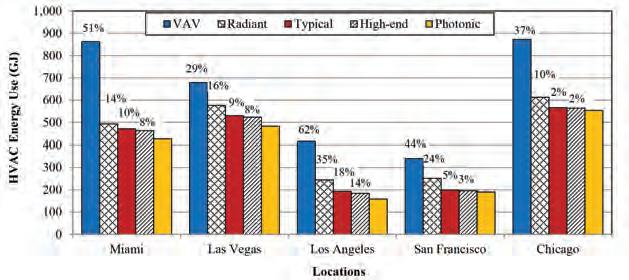
Figure 3 was provided courtesy of Skycool Systems Figure 4 was incorrect. Here is the correct graphic; Figure 4 Energy savings with phototonic radiative cooling
EDITOR
ASSISTANT EDITOR
SALES & MARKETING COORDINATOR
ASSOCIATE PUBLISHER
ACCOUNT MANAGER ART DIRECTOR
ACCOUNT COORDINATOR
CIRCULATION MANAGER
PUBLISHER
Kerry Turner (416) 510-5218 KTurner@hpacmag.com
Beth McKay
Kim Rossiter (416) 510-6794 KRossiter@hpacmag.com
David Skene (416) 510-6884 DSkene@hpacmag.com
Stephen Kranabetter (416) 510-6791 skranabetter@hpacmag.com
Mark Ryan (416) 442-5600, ext. 3541 mryan@annexbizmedia.com
Barb Vowles (416) 510-5103 bvowles@annexbizmedia.com
Urszula Grzyb (416) 442-5600 ext. 3537 ugrzyb@annexbizmedia.com
Peter Leonard (416) 510-6847 PLeonard@hpacmag.com
ANNEX PUBLISHING & PRINTING INC.
VICE PRESIDENT Tim Dimopoulos (416) 510-5100 tdimopoulos@annexbizmedia.com
PRESIDENT & CEO Mike Fredericks mfredericks@annexweb.com
PUBLICATIONS MAIL AGREEMENT NO. 40065710, REGISTRATION NO. 10815
Heating Plumbing Air Conditioning (established 1925) is published 7 times per year by Annex Publishing & Printing Inc. HPAC Magazine is the leading Canadian business publication for the owner/manager of mechanical contracting businesses and their supply partners.
ISSN: 0017-9418
Contents Copyright © 2016 by Annex Publishing & Printing Inc. may not be reprinted without permission.
SUBSCRIBER SERVICES: To subscribe, renew your subscription or to change your address or information please visit us at www.hpacmag.com.
Subscription Price per year: $41.95 (plus tax) CDN; Outside Canada per year: $81.95 US; Elsewhere: 1 year $89.95; Single copy Canada: $5.00 CDN. Heating Plumbing Air Conditioning is published 7 times per year except for occasional combined, expanded or premium issues, which count as two subscription issues.
MAIL PREFERENCES: From time to time we make our subscription list available to select companies and organizations whose product or service may interest you. If you do not wish your contact information to be made available, please contact us via one of the following methods: Tel: 800.387.0273, Fax: 416.442.2191; E-mail: vmoore@ annexnewcom.ca; or by mail: Privacy Office, 80 Valleybrook Dr., Toronto, ON M3B 2S9.
HPAC Magazine receives unsolicited materials (including letters to the editor, press releases, promotional items and images) from time to time. HPAC Magazine, its affiliates and assignees may use, reproduce, publish, re-publish, distribute, store and archive such unsolicited submissions in whole or in part in any form or medium whatsoever, without compensation of any sort.
NOTICE: HPAC Magazine, Annex Publishing & Printing Inc., their staff, officers, directors and shareholders (hence known as the “Publisher”) assume no liability, obligations, or responsibility for claims arising from advertised products. The Publisher also reserves the right to limit liability for editorial errors, omissions and oversights to a printed correction in a subsequent issue. HPAC Magazine’s editorial is written for management level mechanical industry personnel who have documented training in the mechanical fields in which they work. Manufacturers’ printed instructions, datasheets and notices always take precedence to published editorial statements.
We acknowledge the financial support of the Government of Canada through the Canada Periodical Fund of the Department of Canadian Heritage. HPAC MAGAZINE 80 Valleybrook Drive, Toronto, ON M3B 2S9 TEL: 416.442.5600 FAX: 416.510.5140 www.hpacmag.com



Proud member of:







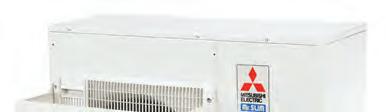
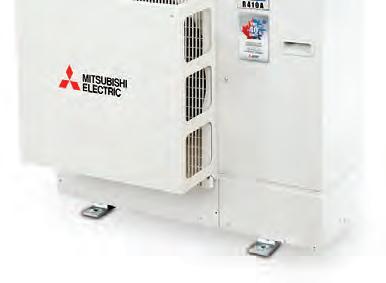





Protecting important data depends on maintaining a controlled environment. That’s why it is essential to install a commercial-grade server room cooling system that is consistent, efficient and reliable, 24 hours a day, 7 days a week.


With so much on the line, it’s surprising that there are modified residential units claiming to be sufficient for server room applications. Little wonder that these units can’t take the strain placed on them by modern server rooms.
Mitsubishi Electric’s P-Series precision cooling system is different. It’s a commercial grade ductless unit that is designed for commercial applications and is tooled specifically for durability and to maintain consistent, reliable server room temperature.

So whether you’re expanding your server room or designing a new one from the ground up, Mitsubishi Electric P-Series can help keep your critical systems up and running 24/7. Now that’s a cool idea!














As part of our commitment to the Canadian market, Mitsubishi Electric’s Ultra Low Ambient System is designed to withstand extreme weather conditions, whether the outdoor temperature is +46°C or -40°C.





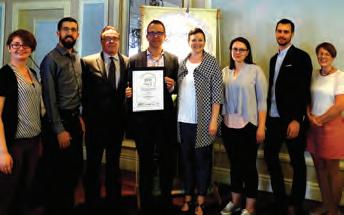
The 2016 Canada Green Building Awards were held at the Fairmont Royal York hotel in Toronto, ON on June 6, and recognized nine buildings from across Canada that demonstrate sustainable design.
The Ontario Regional winner and Technical Award winner was presented to the Bill Fisch Forest Stewardship and Education Centre. The centre is located in WhitchurchStouffville, ON. DIALOG is the mechanical engineer for the structure. The Groupe Dynamite Atrium is the Regional Quebec winner. Located in Montreal, QC, the high volume building encourages the stack effect and natural ventilation, which can be supplemented by mechanical means through two ducts. The mechanical engineer for this project is Aedifica Consultants.
The British Columbia Regional winner is the Fort St. John Passive House
located in Fort St. John, BC. The house has a heat recovery ventilation system, PV panels that generate power to run an air conditioner, and air source heat pumps with backup electric baseboards. The mechanical engineer for the project is Renu Building Science.
The Atlantic Regional award was presented to the Dura House located in Terence Bay, NS. The house features fibreglass frame windows that have been carefully placed and sized for solar heating, natural lighting, as well as ventilation. A heat recovery ventilator operates at 75 per cent efficiency and helps to drive ventilation. The mechanical engineer for the project is Equilibrium Engineering.
The Jasper Place Library, located in Edmonton, AB has achieved LEED Gold certification. Mechanical engineer Williams Engineering Canada
The Canada Green Building Council (CaGBC) and Urban Green Council (the New York chapter of the U.S. Green Building Council) have announced their partnership to bring Green Professional Building Skills Training (GPRO) to professionals across Canada in order to meet the growing demand for skilled workers in the green building field.
GPRO is made up of a series of courses and certificate exams developed by the Urban Green Council that aim to close the gap between conventional and sustainable construction practices. Since the program’s launch in 2011, over 8000 people have received GPRO training across North America.
“It is clear that Canada’s building industry is embracing greener, higher performing buildings as best practice,” said Thomas Mueller, president and CEO of the CaGBC. “We are introducing GPRO to meet the demand for trained construction professionals which are knowledgeable and
Inc. incorporated ways to conserve energy and reduce heating demand. Ventilation air enters the building through a raised floor, and exhaust air travels through return grilles located at ceiling level.
MMM Group is the mechanical engineer for the Budzey Building in Vancouver, BC. “This public sector project is a model for energy-efficient highrise residential design. The 30 per cent window-to-wall ratio, the high performance envelope and heat recovery ventilation in each suite are strategies all private sector developers should try to emulate,” said the jurors.
skilled to deliver top quality buildings in the growing green building industry.”
Currently, builders and operators are already using GPRO certified professionals to bring LEED into their projects in the U.S. and in the Greater Toronto Area (GTA). The Toronto chapter of the CaGBC has been offering GPRO education in the GTA since 2015.
“Urban Green Council is proud to partner with the CaGBC to expand GPRO training, making it truly international. Now GPRO green building training for contractors, trades and building operators will be available coast to coast throughout all of North America,” said Ellen Honigstock, director of education development for the Urban Green Council.
The CaGBC is currently preparing course material and will roll-out the first round of national training in the fall of 2016. Certified training professionals will earn AIA and GBCI credits while completing the training. www.cagbc.org/gpro
The next winner, Our House in Toronto, ON, is a renovation of an 84m2 home. The house features a green roof over the front porch, two air changes per hour at 50 Pa, and a small ERV and boiler for efficiency. SGA Associates is the mechanical engineer.
The Grange Triple Double, also located in Toronto, ON, has been designed for passive cooling and ventilation and features an increased level of insulation at the brick façade.
The high efficiency heating system has a 94 per cent AFUE natural gas forced air furnace coupled with an HRV. The jury called the building a “flexible, multi-unit, multi-generational home.”
The SkyGarden House is a renewal of a century-old single family home in Toronto, ON, which transformed a small home into a three storey, high efficiency house. It features natural ventilation, passive cooling, in-floor radiant heating, high-velocity cooling,
According to the Canada Green Building Council (CaGBC), the second quarter of 2016 has seen steady growth for LEED registered and certified projects with 81 certifications and 106 registrations between April 1 and June 30. Currently, the cumulative total of LEED certified projects across the country sits at 2757.
“LEED certified projects are the industry standard for green building in the commercial and institutional sectors in Canada, and with each passing year that impact widens to other sectors,” said Mark Hutchinson, vice president of the Green Building Program for the CaGBC.
Projects that earned LEED certification during the second quarter include: 66 Slater St. in Ottawa, ON, which earned LEED Gold certification for existing buildings. The
low-flow plumbing fixtures and highefficiency lighting.
The awards ceremony kicked off a two-day Canadian Green Building Council (CaGBC) tradeshow event which attracted 1000 guests, and an opening plenary featuring presentations from Premier Kathleen Wynne, Glen Murray, Ontario environment minister, Terry Homma, director general for public services and procurement Canada, and Vancouver city councillor, Andrea Reimer. www.cagbc.org
22-floor commercial office building was originally constructed in 1969 and was retrofitted with features such as a new reflective roof and building-wide installation of water efficient plumbing fixtures.
The University College of the North in Thompson, MB also earned LEED Gold certification. It achieved this standard through sustainability measures such as passive daylighting strategies and by using materials chosen for local availability and durability.
La Tour Deloitte in Montreal, QC became a certified LEED Platinum building. It features premium air filtration and enhanced climate control.
Additionally the Toronto Dominion Centre (TDC) in Toronto, ON, which is comprised of six LEED Platinum buildings, earned another distinction by becoming WELL v1 Certified in late May. www.cagbc.org www.wellcertified.com
Integrated HVAC Engineering
Expert Instructor: Robert Bean • Online: October 3 - December 11, 2016

Run thermal comfort calculations, submit designs for a radiant-based HVAC system with DOAS, and make recommendations to improve IEQ and energy efficiency through architectural, building, and interior systems. During Integrated HVAC Engineering, you will study the complex interaction of room air temperature, humidity, mean radiant temperature, ventilation rate, lighting, sound, and even odours that determine the true quality of an interior environment. Numerous calculation and modeling exercises will allow you to immediately apply what you’ve learned. The course includes a variety of Excel tools for performing critical calculations, such as: the inside surface temperature of walls, ventilation rates for the current and previous version of ASHRAE Standard 62.2, exergy, and much more.
For more information and to register visit www.hpacmag.com/bean
Powered by

In Alberta, the transition period for voluntary application of the National Energy Code for Buildings (NECB) 2011 ends on November 1, 2016. Additionally, Section 9.36. Alberta Building Code (ABC) 2014 for housing and small buildings, ends on the same date.
A recent STANDATA notice explains that when an application for a building permit is received for a site-constructed building on or after November 1, 2016, the building design must comply with the requirements of the NECB 2011 or Section 9.36. ABC 2014.
For more information, see the STANDATA – Application of Energy Efficiency Requirements and Enforcement Dates. www.municipalaffairs.alberta.ca
Coca-Cola Refreshments Canada and the Canadian labour union Unifor are providing 15 new $2000 scholarships for women enrolled in Sheridan College’s skilled trades programs. The announcement was made recently at Sheridan College’s Centre for Advanced Manufacturing and Design Technologies.
The scholarships will be awarded based on a number of factors, including financial need, and will be open to any woman enrolled in one of Sheridan College’s six trades programs or two post-graduate manufacturing management programs including: electrical engineering technician, electrical techniques, mechanical technician – tool making, mechanical
Skills Ontario has announced that the Ontario Technological Skills Competition (OTSC) will be moving to the Toronto Congress Centre for its 2017 event. The competition has been held at RIM Park in Waterloo, ON since 2002. It has featured 67 contest sites, 44 elementary challenges and workshops, a career exploration showcase, 2200 competitors from across Ontario, and over 20000 spectators.
techniques–plumbing, mechanical techniques–tool and die maker, welding techniques, quality assurance–manufacturing and management and manufacturing management.
The scholarships are available for the 20162017 academic year.

www.sheridancollege.ca www.coca-cola.ca www.unifor.org
The Canadian Apprenticeship Forum (CAF-FCA) recently published a resource that offers strategies for hiring and retaining Aboriginal tradespeople. Hiring and Retaining Aboriginal Apprentices: An Action Plan for Employers draws ideas from skilled trades employers who value the contribution Aboriginal apprentices make to their workforce. The resource also explores the positive results for both the company and the Aboriginal community.
Sarah Watts-Rynard, CAF-FCA’s executive director, explained that, “Across the country, savvy employers are building strategic partnerships and integrating Aboriginal apprentices into their skilled trades workforces. This guide
continued on p10

“We are thrilled to be moving the pride of Ontario to the Toronto Congress Centre, a facility that will help us heighten the awareness of the tremendous career opportunities in skilled trades and technologies to young people from across Ontario,” said Gail Smyth, executive director of Skills Ontario.
The Toronto Congress Centre will provide a space that will allow all contests to be hosted under one roof. Additionally, associated events, such as the OTSC closing ceremony and the Young Women’s Conference, that were previously held offsite, will be held within the Toronto Congress Centre.
The 2017 OTSC will be held May 1 to 3 in Toronto, ON.
This year’s competition in early May featured a new element for competitors. Hy-Mark offered first place winners in the plumbing and sheet metal categories full time positions with the company. On the morning of the competition, Rob Dewer, Hy-mark’s president, informed the heating systems competitors that a job offer would also be made to this industry’s winner too.
The winner for the plumbing category was David Kingsberry from George Brown College. Bailey Bowman of Cambrian College took home the Hy-Mark prize for heating systems, and the winner of the sheet metal category was Owen Fryer from St. Clair College.
Additionally, Magna International extended job offers to medalists in the automation control, industrial mechanic and mechatronics contests.
The 2016 competition attracted 2100 competitors from secondary and post-secondary institutions, who competed in 67 skilled trades categories. www.skillsontario.com

provides insider experiences, tips and strategies for success.”
The best practices portion of the resource addresses cultural and business realities, and highlights communication, education tips, as well as how to develop a local talent pool.
The action plan was developed, in part, with funding assistance from the Government of Canada’s Workplace Opportunities: Removing Barriers to Equity program. The action plan is available for download at www.caf-fca.org.
Babcock Canada, Inc., a subsidiary of Babcock International Group, has announced the inaugural year of the STEM Spotlight Awards in Canada. This initiative honours the ideas of students entering skilled trades professions, and aims to recognize the benefits and career opportunities in science, technology, engineering and math (STEM) related fields.

The competition, which launches in September 2016, consists of five categories for student application and recognition, and is modelled after the United Kingdom’s STEM Awards presented by the Babcock International Group.
The STEM program is only open to BC students for its inaugural year, “However we’re looking to expand nationally in the future,” said Laura Mitchell, account manager at Talk Shop Media Inc., STEM Spotlight Awards.
Industry professionals from each of the technology, environment, marine, mining and energy categories will present a specific complication or obstacle related to their industry. Student participants are invited to create and submit a solution based on a clear set of criteria. A shortlist will be produced of the most impressive entries within each of the five categories. These participants will
The Canadian Apprenticeship Forum held its biennial national conference in Vancouver, BC in early June. The event, entitled Apprenticeship: Hands on the Future, attracted over 500 attendees and featured key note speakers Trevor Wilson, human equity strategist and Robert Watt, president, RJW-Gem Campbell Stonemasons Inc.
The three-day event included a panel discussion on the future of apprenticeship, as well as a session that focussed on electrical industry initiatives for women which was moderated by Carol MacLeod, executive director, National Electrical Trade Council (NETCO).
Raymond Massey, past chair of the Alberta Apprenticeship & Industry Training Board was awarded the
then present their ideas before their category sponsor during the first round, and then present to a panel of three expert independent judges during the second round for a chance to win the overall grand prize.
www.stemspotlightawards.ca
The BC Safety Authority (BCSA) has released its 2015 State of Safety Report. The report is an information analysis, which includes data on installation and operating assessments, incident investigations and research, and enforcement activities. It is also an overview of BCSA’s activities. The report is designed to help people understand technical trends and to use that knowledge to make informed safety decisions.
In addition to summarizing information on installation and operating permits, physical assessments and incident investigations, BCSA’s 2015 State of Safety Report highlights longer-term trends on specific types of incidents such as uncontrolled refrig-
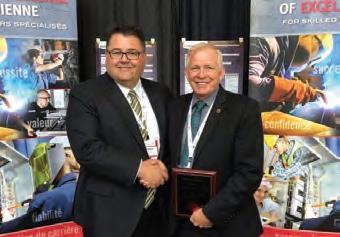
2016 Darryl Cruickshank Memorial Award. This award is given to a nomi nee who has made an outstanding contribution to the development and promotion of apprenticeship training for Red Seal trades in Canada.
The 2018 national conference will be held in Montreal, QC.
erant ammonia releases, carbon mon oxide leaks, elevator levelling and passenger ropeway deropements.
In other BCSA news, it has reminded propane tank owners in BC of their responsibility to obtain an operating permit as required by the Safety Standards Act.
All owners of propane tanks are responsible for providing tank data to the BCSA and to obtain a permit for each tank in operation. The permit requirement is applicable regardless of the type of installation. www.safetyauthority.ca/permitsapprovals/operating-propane
The Ministry of Municipal Affairs and Housing (MMAH), the Office of the Fire Marshal and Emergency Management (OFMEM) and the Ministry of Labour (MOL), have developed a guideline that aims to enhance fire safety within and around mid-rise buildings while they are under construction.
The ments amendments made to the Ontario
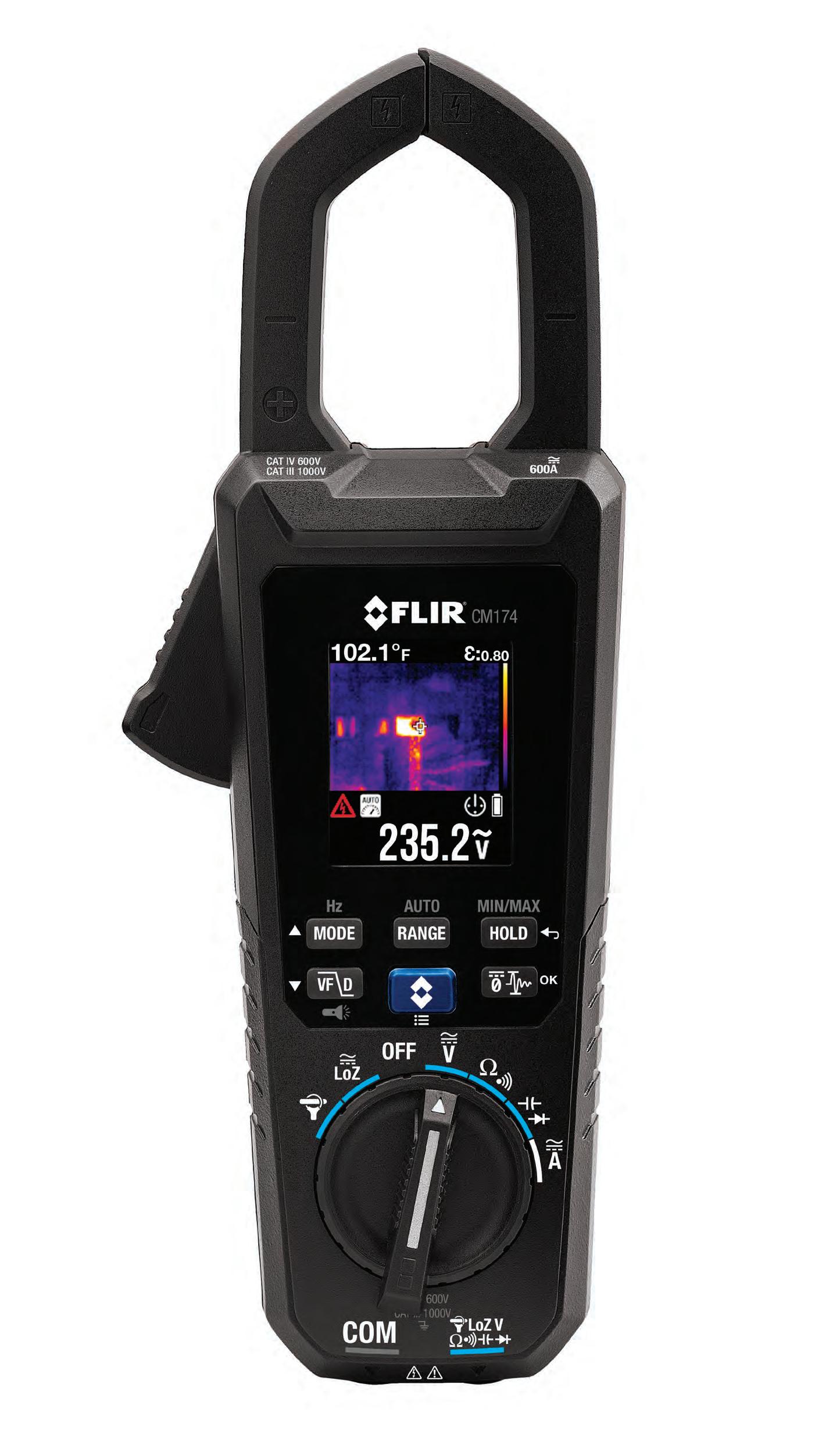

WORK SAFER AND MORE EFFICIENTLY with the new FLIR ® CM174 clamp meter with built-in thermal imaging camera. Featuring Infrared Guided Measurement (IGM) technology, the CM174 visually points you to the precise location of duct leaks, inefficiencies and potential electrical issues. You’ll find problems faster, get more done, and boost your credibility.
To see IGM in action go to www.flir.ca/CM174

Building Code, which permit mid-rise (five and six storey) buildings of wood frame construction. These amendments came into effect in January 2015.
Currently available in English and French on the MMAH, OFMEM and MOL websites, it includes best practices and considerations for builders and others involved in the construction and protection of these buildings, but does not constitute a Regulation.
www.mah.gov.on.ca
www.labour.gov.on.ca
www.mcscs.jus.gov.on.ca/english/ FireMarshal/OFMLanding/OFM_main. html
Manitoba Hydro has launched the Power Smart Solar Energy Program –a program to encourage home and business owners to harness the power of the sun through incentives and financial support. Those who adopt solar power can generate their own electricity and also sell excess energy back to Manitoba.
Manitoba Hydro president and CEO, Kelvin Shepherd said the Solar Energy Program will provide solar PV installations an incentive of one dollar per watt installed, which will cover roughly 25 per cent of the upfront capital cost of a new installation.
The program is planned as a twoyear initiative with an estimated 30 installs in the first year and 65 taking place in the second. He added however, that, “uptake may differ depending upon customer interest.”
www.hydro.mb.ca
SaskPower is offering a commercial refrigeration rebate that can cover up to 50 per cent of the purchase price for products such as: self contained refrigeration units including refrigerators, freezers and display cases; electronically commutated motors; evaporator
fan controllers; anti-sweat heater humidistat controls; night covers; strip curtains and auto door closers for walk-in or reach-in freezers or coolers.
Beginning on June 28, the program was updated and the incentive has been capped at $15,000 per location to a maximum of $50,000 per business, each year.
Additionally, SaskPower released a bulletin in May that made note of some non-compliance issues related to residential HVAC systems that are in need of immediate attention by the industry. The issues include: gas leaks, particularly in new home construction; unvented gas appliances and loose venting systems; and clearance to combustibles, especially for gas ranges and fireplaces. www.saskpower.com
In June, the Ontario government introduced the proposed Burden Reduction Act, 2016. If passed, this bill will amend section 22(1) of the Technical Standards and Safety Act (TSSA), 2000, to specify a 90-day time limit for a person to appeal to a statutory director regarding inspection orders or inspection-related seals or fees.
Originally the Ministry of Government and Consumer Services, in consultation with the TSSA, was considering a 30-day time limit but revised this after industry feedback. www.tssa.org
The Home Inspectors Association has estimated that as few as 10 per cent of homes sold in the Greater Vancouver and the Fraser Valley areas of BC are undergoing an inspection prior to sale.
The Home Inspectors Association (HIA) BC, estimates that nearly 30000 homes were sold in the first five months of 2016 without a professional home inspection. continued on p14

Given the current real estate environment, HIA is recommending the provincial government implement a seven-day “cooling off” period to protect consumers after an offer is accepted on a home, in order to allow buyers to protect themselves by having a professional home inspection completed.
At press time Helene Barton, executive director, HIABC, said that so far, there has been no response from the government regarding the cooling off period. www.hiabc.ca
Ontario has plans to invest up to $900 million over four years from cap and trade program (which came into effect July 1, 2016) proceeds. The money will go to retrofitting social housing apartments, and grants and rebates for residential multi-tenant buildings will be provided.
As part of the recently released
Climate Change Action Plan, the province has plans to invest up to $500 million to retrofit social housing apartments with energy efficient and renewable energy technologies. Indigenous social housing will also be eligible for retrofits.
The province will invest up to $400 million in an incentive program for private residential apartment buildings for the purchase and installation of energy efficient technologies, such as boiler replacements. www.ontario.ca

Owner of Solar Water Services Inc., and HPAC contributor Rob Waters, has joined the Canadian Institute of Plumbing and Heating (CIPH) as a technical consultant for codes and standards. In the position, Waters
will assume an advisory role for staff and members.
He comes to CIPH with over 30 years of experience in the hot water industry and has worked with gas, oil and biomass boiler system controls, and residential and commercial hydronic system design.
“Members through our recent long range planning process told us that we needed to hire a technical consultant to ensure that CIPH’s interests are at the forefront of codes, and regulatory issues. Robert brings us the necessary skills to represent CIPH with key government departments as we deal with uniformity for water and energy efficiency reports,” said Ralph Suppa, CIPH president and general manager. Prior to owning his own business, Waters was with Viessmann Manufacturing Company Inc. for 20 years. www.ciph.com
continued on p16

PHIX® Under Sink Acid Neutralization Cartridge Safe and effective solution for neutralizing acidic wastewater in a compact under-sink design, requiring no special piping.
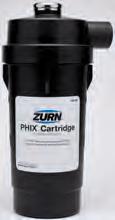
Zurn products offer high quality construction, and reduced building maintenance. Our customized solutions combine superior design with innovative engineered plumbing products unmatched in both new and retrofit applications. Our expertise helps customers meet sanitary sewer regulations while protecting the watershed, public health, and communities.
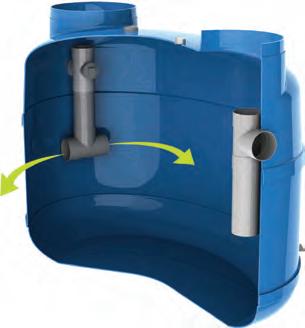
Proceptor ®
Superior gravity fuel, fat, oil, and grease separator designed with corrosion-resistant, reinforced fiberglass for ease of service and lowest cost of ownership.
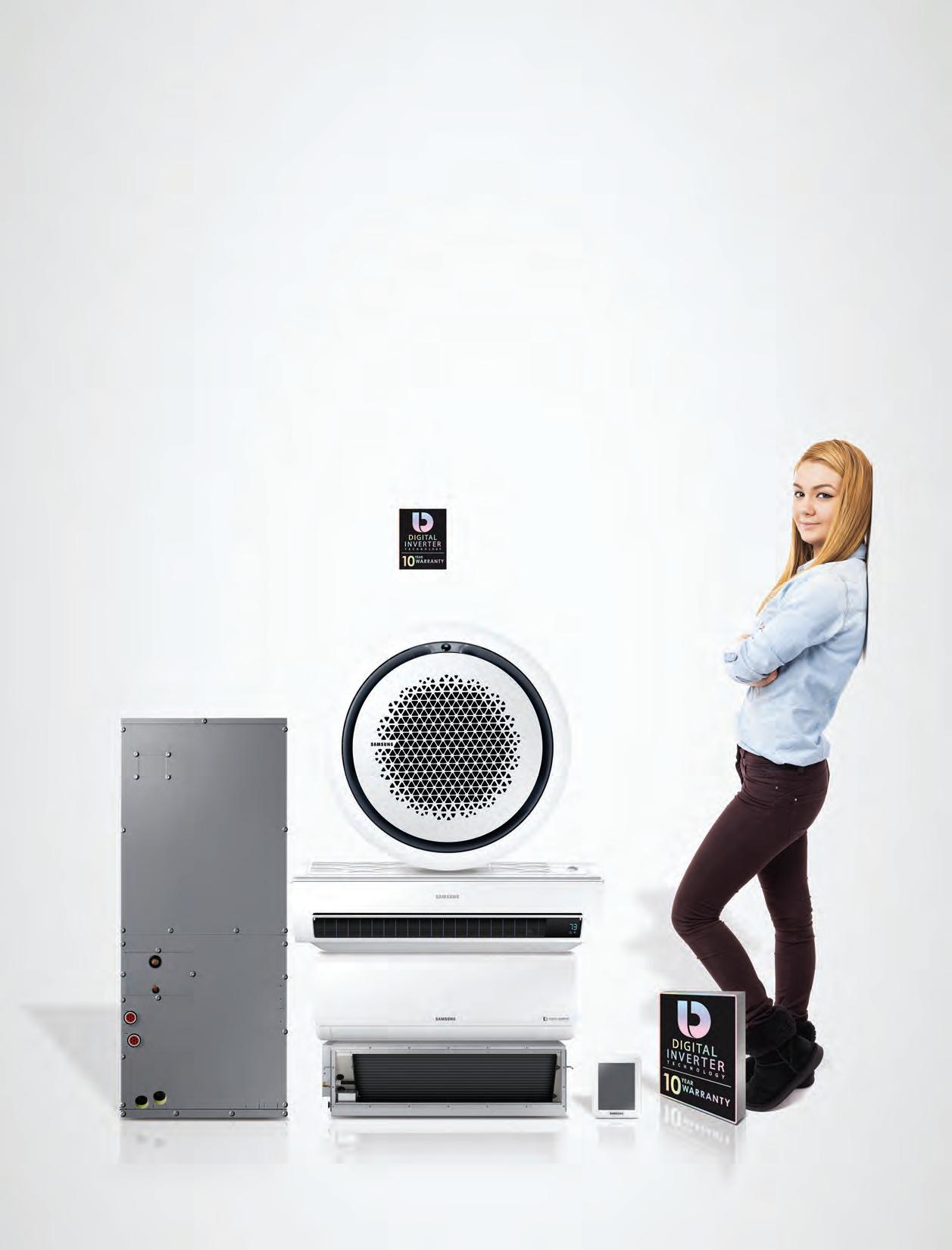
SAMSUNG HVAC CONTINUES ITS PROUD TRADITION OF COMBINING THE BEST TECHNOLOGIES IN THE WORLD WITH TRULY INNOVATIVE IDEAS. AS A RESULT, SEVERAL NEW AIR CONDITIONING SYSTEMS ARE JOINING THE FAMILY.
• THE “FORM FOLLOWS FUNCTION” 360 CASSETTE. THIS ONE-TO-ONE SYSTEM EMBODIES THE REAL MEANING OF FORM FOLLOWING FUNCTION, BUT FOR A VERY PARTICULAR REASON. THE 360° WIND OUTPUT ALLOWS FOR PERFECT AND EFFICIENT WIND DISTRIBUTION, WHICH EQUATES TO ULTIMATE COMFORT, THE CIRCLE IS ALSO THE PERFECT DESIGN SHAPE, SO THE 360 CASSETTE DOES ALL OF THIS IN STYLE.
• THE SMART WHISPER CAN COMMUNICATE WITH THE SAME SAMSUNG SMART HOME APP* THAT YOUR OTHER SAMSUNG APPLIANCES USE. AN ALREADY-RELIABLE PERFORMER JUST GOT BETTER, GIVING THE USER TOTAL CONTROL FROM VIRTUALLY ANYWHERE VIA A SMARTPHONE (A NEW 17 SEER WALL MOUNT UNIT WILL ALSO BE AVAILABLE ).
• THE MULTI-POSITION AIR HANDLING UNIT AND THE NEW DUCT TYPE ALLOWS FOR FLEXIBLE INSTALLATION, GIVING THE CONTRACTOR MORE OPTIONS.

* With the Samsung Smart Home App, you can control your air conditioner via your smart phone or tablet from virtually anywhere!1
For full product features/specs and a detailed look at Samsung HVAC’s robust line up, please visit our new website, www.samsunghvac.com
BUY SAMSUNG WITH CONFIDENCE**
ALL SAMSUNG MINI SPLITS CARRY A 10 YR WARRANTY (ON COMPRESSOR AND PARTS, REGISTRATION REQUIRED)
**Novus warranty is 7 yrs compressor/5 yrs parts. Registration required. Restrictions Apply.
A number of the PEX product standards by the CSA Group have been updated to reference the low-lead requirements in NSF 372 (no more than a weighted average content of 0.25 per cent on wetted surfaces).
Some of the common standards for manufacturers of thermoplastic pressure pipe, associated fittings and applicable compounds, and cements included in the CSA B137-13 Series of Standards are B137.0, B137.5, B137.10, B137.11. Manufacturers had to comply by January 2, 2016 in order to guarantee certification updates, and listings were to be completed by July 1, 2016, according to the CSA Group.
In order for manufacturers to maintain compliance and certifications to NSF 61, there is already a requirement for NSF 372 integrated for potable applications. www.csagroup.com
Ninety-two people were recognized by ASHRAE for their contributions to the Society and the built environment industry at the Society’s Annual Conference held June 25 to 29.
Denis Morris, P.E., fellow ASHRAE, life member from

Laura Wand, vice president, building efficiency global chiller business, Johnson Controls, presenting a $100,000 cheque to ASHRAE Research during the President’s Luncheon at the ASHRAE 2016 Annual Conference in St. Louis.
Halifax, NS and James Scriven, P.E., fellow ASHRAE, life member also from Halifax, NS received the distinguished 50-year member award. The exceptional service award went to Canadian Craig Wray, P. Eng., who is retired from Lawrence Berkeley National Laboratory. Two Canadians received the distinguished service award. John Cowan, P. Eng., life member, is an independent consultant in the arts and sciences and is
involved in the fair reporting of energy savings achieved by energy efficiency projects in Toronto, ON. Alex McGowan, P. Eng., vice president of technical services, WSP Canada Inc. also received this award.
In other ASHRAE news, its 2016 handbook on HVAC systems and equipment features revisions to the majority of its chapters. Updated chapters include chapter 12, district heating and cooling, which has new content from ASHRAE research project RP-1267 (the new District Heating Guide and District Cooling Guide). Chapter 51, thermal storage, has new content on grid reliability, renewable power integration, heat storage, emergency cooling, water treatment and commissioning.
The volume is available in print and in electronic format. To order, tel: 800.527.4723, or visit www.ashrae.org. www.johnsoncontrols.com
We recycle all elements of the thermostat; plastic, metal, electronics and mercury (which is particularly hazardous).
Do your part and join the more than 1,500 contractors already participating in the program.
FOR MORE INFORMATION 1(800) 267-2231, x 224 Email pthompson@hrai.ca
The National Research Council of Canada (NRC) is celebrating its 100th birthday this year. In cel ebration, it is donating the his toric first colour-standardized Canadian national flag to the Canada Science and Technology Museum (CSTM).
Fifty years ago, NRC researchers were tasked with creating a flag that maintains colour consistency throughout wear and tear. NRC selected the iconic red colouring, which became the standard for all Canadian flags.

The historic flag will be exhibited at CSTM when it reopens in the fall of 2017 as Canada celebrates 150 years as a nation. www.nrc-cnrc.gc.ca


BUSINESS ELITE DEALERS OFFER MORE THAN JUST GREAT VEHICLES
Whether it’s 1 vehicle or 100 vehicles, your business deserves big benefits. With Chevrolet and GMC Business Elite Dealers you get:
No two businesses are alike. So that’s why Business Elite Dealer programs are tailor-made for your business. Our account specialists work with you to determine the right vehicles and services that help you get the job done. And when your business needs us, we’re there with priority service and work-ready loaners. Trucks? Cars? Vans? Chevrolet and GMC Business Elite Dealers also provide a wide variety of commercial vehicles to meet your needs. It’s not just good business … it’s your business.
Is the only way to go?
BY IAN MCTEER
Live Better Electrically was a popular theme promoted by electric utilities around North America in the late 1950s and early 1960s. A Gold Medallion Five Star home would have nothing but electric appliances: stove, washer and clothes dryer. To qualify for the lowest cost Five Star electricity rate, a residence would also have electric space heating and water heating. Sometimes an electric furnace or hydronic boiler supplied the space heating requirements; however, electric baseboard units provided most space heating.


Builders loved electric baseboards as they were cheap to install, electricians did all the hookups, and no ugly bulkheads were necessary to hide ductwork. Electric baseboards are still used in new construction today, especially in Quebec where hydro rates are a bit more favourable than other parts of Canada.
In 2016, Canadian homes are filled with electric appliances, many of which were still in the realm of science fiction in the 1950s. However, it is rare to find a straight electric furnace without a secondary source of heat such as a heat pump or
Electric heating is 100 per cent efficient, even an electric baseboard heater is a more efficient space heater than the best gas furnaces on the market. It does not need a chimney or a horizontal vent pipe, ductwork, or a drain. Baseboard heaters have few installation drawbacks, are easily maintained and easily replaced, have no carbon monoxide worries, offer quiet operation and are inexpensive to purchase.
I know why we are not heating with electricity. Electricity is expensive to generate and to distribute to end users.
In the province of Ontario, runaway costs have pushed ratepayers to the limits of affordability and residents of other provinces are struggling too. Ontario spent years and billions of dollars in a headlong quest to satisfy an unsubstantiated notion that electricity production should be expanded indefinitely.
Canadians were eager to embrace the benefits of laboursaving electric appliances, subsequently creating a huge manufacturing industry employing many thousands of workers.
Ontario Hydro started an enormous infrastructure development program in the 1950s, starting with an expansion of the
Niagara Falls facility called Beck II, another huge dam was built as part of the St. Lawrence Seaway project and an all-out expansion of coal generating facilities coupled with requisite transmission lines made Ontario a busy place. Nanticoke, owned by Ontario Hydro, was the largest coal-fired generating station in North America. Commissioned in 1978, it was the last coal-fired station to be decommissioned in Ontario in 2013. Its proclivity for generating air pollution, acid rain, and CO2 pollution won’t be missed.
After World War Two, the leftover echoes of the famed Manhattan Project that brought the Hiroshima and Nagasaki bombs into being, sought a civilian outlet. As a flimsy knowledge of how to go about generating electricity with the atom evolved, North America went on a nuclear generating station construction binge.
In 1954, the U.S. Atomic Energy Commissioner, Levi Strauss, insisted that soon nuclear energy would be “too cheap to meter.” There is nothing cheap about nuclear

even a wood stove in the family room. Electric water heating is typically confined to rural areas off the gas mains.
It is not as if there is no electric heat being used in Canada today. On the contrary, it is a reasonably stable industry with several Canadian manufacturers leading the way with a multitude of products. Thermolec, a Quebec-based company, has a range of commercial duct heaters, plenum heaters, make up air heaters and an electric boiler. Also located in Quebec,

power, as the province of Ontario would soon discover. Pickering A nuclear plant came on-line in 1974, $218 million dollars over budget (in 1974 dollars, I was making around $4.00 an hour then).
Later, the Darlington facility was built at a cost of 14 billion dollars, almost 10 billion over budget. Darlington went on line in 1993 and is now in the process of a multi-billion dollar mid-life renovation. The nuclear generating stations in Ontario, including the plant on Lake Huron, which is leased to British Gas, have been money pits absorbing tax money and user fees with unabated abandon. The requisite and on-going infusions of cash into Ontario Hydro’s chaotic energy policies pushed the heating market into the arms of natural gas suppliers.
Ouellet is manufacturing a wide range of residential electric space heating products ranging from baseboard heaters, kickspace heaters, wall convectors, radiant heaters, electric furnaces, floor insert heaters, floor heating cable mats, and heating cable for snow melting. Dimplex, with an office in Cambridge, ON, has a similar wide range of products including solar hot water and a storage heater that stores heat by warming ceramic bricks with off-peak heat to be used later in the day when prices go higher.
continued on p20
1977, to urge Canadians to adopt a conserver society. The SCC said all new buildings should be more efficient and much better insulated; obviously the SCC was ignored.
“Forget about subsidizing alternative energy and electric cars, spend some of the money on building better buildings.”
The ever-expanding costs related to providing all forms of energy, including electric power (especially from nuclear plants), caused the Science Council of Canada (SCC), in
The first Prime Minister Trudeau brought Amory Lovins, an American physicist and environmental scientist, to Ottawa during that time for consultations on Canada’s energy policy. Lovins believes in developing a “soft energy path” that focuses on energy efficiency and renewable energy sources. Lovins thought heating with electricity was comparable to using a chainsaw to cut butter! While I have great respect for Lovins, I fundamentally disagree with his ideas regarding electric heating. In March 1979, the nuclear reactor housed in Unit 2 of the Three Mile Island facility near Harrisburg, PA suffered a partial meltdown. Even though no one was harmed in the incident nor have any human health consequences been suffered by local inhabitants, the fear of a potential nuclear “China Syndrome” put an end to the construction of any more new nuclear plants in North America.
While I have championed the benefits of using electric heat over fossil fuels, there is no free lunch when it comes to proper specification, proper installation/commissioning, and proper maintenance (PSIM) of electric heating equipment. Electricity is dangerous: electrocution, arc flash, and fire are real dangers waiting for the sleepy/careless tech, installer or other unsuspecting person disrespecting Mother Nature. Installers must follow the installation instructions and the governing electrical codes. Service technicians must always inspect electrical de -
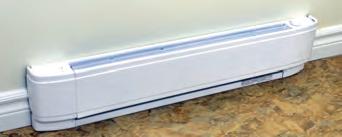
Figure 1 Classic baseboard heater. Baseboards are easily installed, quiet, easily maintained and very inexpensive. There are likely millions of them still in service throughout Canada today.
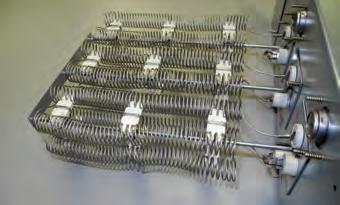
Figure 2 Typical slide-in heater kit to fit a specific manufacturer’s air handler. The open coils are always live, even when not calling for heat as one leg is constantly energized. The two circular discs on either side at the top are thermal limits. Fusible links are connected at the bottom as a failsafe to prevent runaway heater operation.
continued from p19
vices for proper wire sizing, good grounding and loose connections that cause overheating and potential fires. When a conventional heat pump has been specified for a typical duct system in an existing building, be sure the system can handle the required airflow. A three-ton conventional heat pump, for example, may well be AHRI certified to deliver maximum HSPF at 1200 cfm. However, if an electric heater kit has been added to the air handler, more airflow beyond 1200 cfm might be required. Be sure to check your manufacturer’s specifications.
Figure 3 Main electrical disconnect switches. While they are circuit breakers, the main electrical safety circuit must reside in the building electrical distribution panel. Contactors were used in this model to power the other leg of the heater circuit when signaled by the thermostat. The big disadvantage of using contactors (based on homeowner complaints) is the loud “snap” they would make pulling-in, which is especially noisy and irritating at 3 a.m. when all was quiet in the house.
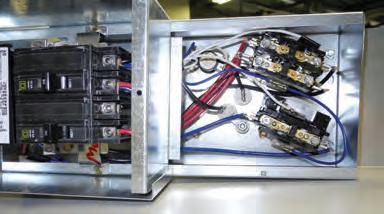
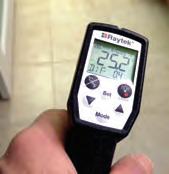
Figure 5 and 6 Installation of a 209 watt floor warming cable in a small basement bathroom. The infrared thermometer shows the formerly frigid basement floor is now a comfortable 25C.
I find it disheartening that governments continue to subsidize alternative methods of generating electricity and electric cars. I agree with the Science Council and other environmentalists who say the best answer is to use less. Forget about subsidizing alternative energy and electric cars, spend some of the money on building better buildings. Subsidize existing homeowners and commercial building owners to cut their heat loss by 50 per cent or more as soon as possible. There are still commercial buildings out there without a stitch of insulation in them. Subsidize new home construction to Passivhaus standards if necessary; get the heating load minimized at the outdoor design temperature.
Our industry will be there with electric heat: small inverter drive heat pumps strategically zoned or small duct
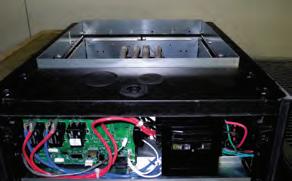
Figure 4 Late model slide-in heater kit using electronically controlled switching relays that are significantly quieter. In the latest designs, the relays remove power from both legs of the heaters when the heating cycle is done.

high velocity systems with inverter heat pumps, and maybe a small amount of backup heat or small electric boilers as part of a zoned hydronic system providing domestic hot water too. There is a lot of work for us all to do to help everyone to use less.

Ian McTeer is an HVAC consultant with 35 years experience in the industry. He was most recently a field rep for Trane Canada DSO. McTeer is a refrigeration mechanic and Class 1 Gas technician.
Author’s note: I suggest reading a book called: Green Illusions, The Dirty Secrets of Clean Energy and the Future of Environmentalism by Ozzie Zehner. The section on solar panels will make you want to scream.


















































































Current technologies are available to modulate system or compressor capacity.
BY DAVE DEMMA
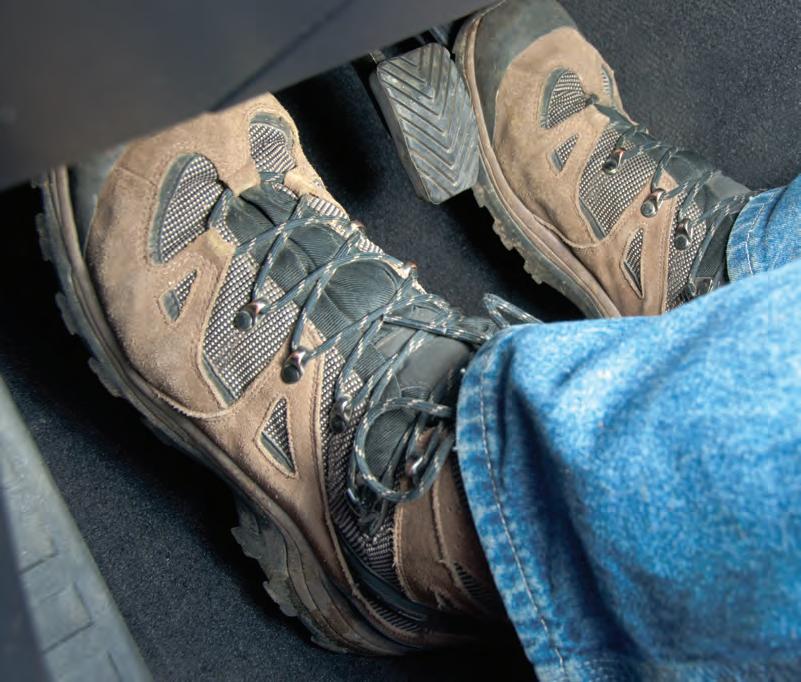
It is morning again. You get ready for the day and make your way out to the garage where your car is waiting for the morning’s commute to work. You start the engine, make sure your radio is tuned to your favorite morning show and proceed to carefully back out of the driveway. Then you put the pedal to the metal and take off at full speed to the first stop sign. At the last moment you slam on the breaks, coming to a screeching halt just before the pedestrian walk. After making sure it is safe to proceed, you take off once again at full speed. While this style of driving might get one to work, it is hardly an efficient way to drive. The accelerator was designed for a specific purpose–to match the engine’s speed with the driving requirements at any given moment. Why has it taken our industry so long to see the logic in this approach?
Compressors are selected for an application’s design condition, typically the worst case scenario in the middle of the summer, thereby ensuring that there is sufficient capacity to provide adequate comfort cooling (or product temperature in refrigeration applications) under all circumstances. One of the factors influencing compressor capacity is the condensing temperature, and this is directly affected by ambient temperature. In fact, as the condensing temperature increases, the compressor capacity decreases. For example, consider a compressor with a capacity of 50500 Btu at a -20F SST and a 105SCT. During the cooler months where the condensing temperature can be maintained at 70F, the
compressor capacity increases to 66500 Btu.
Now think about that for a moment. The system load is typically at its highest during the peak ambient temperatures in the summer. This is the condition at which the equipment is selected to ensure that there is sufficient equipment capacity during the most miserable of conditions. As the load decreases with a drop in ambient temperature, the compressor capacity increases. Going back to the driving analogy, even though the speed limit has decreased to 25 m.p.h, the engine is still operating at full speed. It is time to implement an accelerator to limit compressor capacity.
There have been several methods used in an attempt to match compres -
sor capacity with the actual load at any given point in time. The following is a review of the technologies currently being employed.
Mini-split/multi-split/VRF equipment manufacturers have been providing inverter driven compressors with their equipment for some time now. In simple terms, think of this as a compressor (rotary or scroll) with a built in VFD. So, functionally it is not too much different than a compressor applied with an aftermarket VFD but there is an added benefit. The manufacturer spends the necessary time in its research and development lab to design the inverter components that will vary the frequency to the absolute best specification for optimal performance of its compressor.
Compressor unloading allows one or more cylinders in a compressor to temporarily become inactive for a portion of time to reduce compressor capacity. For example, a four-cylinder compressor could operate as a two- or three-cylinder compressor during times of reduced load. The issue with this technology is that it does not of-
fer the ability to precisely match the compressor capacity with the load. If the actual load on a 10-ton system drops to 6.5 tons, unloading one of the four cylinders results in too much capacity, while unloading two of the cylinders results in too little capacity. To put it more plainly, if the speed limit is reduced to 40 m.p.h., and your car only offers the ability to drive at 33 m.p.h. or 47 m.p.h., how does this really serve your needs?
While discharge bypass is not a compressor technology, it is a means of matching the system capacity with the load demand. A very stable option in maintaining a constant minimum suction pressure (minimum discharge air temperature or chiller fluid temperature) comes from bypassing discharge vapour to the low-pressure side of the system, falsely loading the system. The extra loading on the compressor will raise the evaporator pressure along with the evaporator refrigerant saturation temperature.
When used properly in air-conditioning applications this will prevent the saturation temperature from dropping to the point where frost buildup on the evaporator can occur. It can also be applied to prevent the compressor from operating below its design suction pressure, ensuring a reasonable compression ratio. If the discharge gas is bypassed to the evaporator inlet at the design evaporator temperature, proper refrigerant velocities for good oil return will be maintained as well. Look at this method of matching system capacity with the load condition as you would driving the car with the engine at maximum RPM, while simultaneously applying the brakes to remain within the required speed limit.
So, this method does not offer reduced energy consumption for the lower load periods, but it does very nicely match the system capacity with the actual load. Efficient operation
aside, using an electric step motor discharge bypass valve that responds to discharge air temperature will provide control within +/- ½ degree F.
Although scroll compressors have been in use for some time, it was not until 2000 that digital scroll technology was available for commercial HVAC applications.
The digital scroll differs in design from the standard scroll in that it has the ability to allow the top scroll plate to lift approximately one millimetre from its normal position. This is enough of a distance to completely eliminate the scroll plate’s ability to compress vapour. The result is 100 per cent unloading capability.
This is where the digital aspect comes in. Through the abilities of electronic controllers, the compressor can now operate in segments of cycle time, which is comprised of the sum of loaded state cycle time and unloaded state cycle time. Plainly speaking, the compressor operation can be broken down into cycles of 20 seconds, with some portion of the 20 seconds of operating completely loaded, and some
portion of the 20 seconds operating completely unloaded.
The capacity of the digital scroll can vary between 10 per cent and 100 per cent. The compressor capacity can be calculated from a ratio of percentage of loaded state time to the total cycle time. For example, if the loaded state time were 10 seconds and the total cycle time were 20 seconds, the compressor capacity would be 10/20, or 50 per cent of total capacity.
Given the wide range of capacities the digital discus can operate under, it can offer a very precise solution for matching the compressor capacity with the system load. Not only can design parameters be maintained more closely but there is the added benefit of an opportunity for energy savings.
The same technology that allows a scroll compressor to operate loaded anywhere from two seconds to 20 seconds for each 20-second cycle time has been applied to some discus compressors. The unloading is accomplished by blocking the suction port of
continued on p24
“The manufacturer spends the necessary time in its research and development lab to design the inverter components that will vary the frequency to the absolute best specification for optimal performance of its compressor.”
the given cylinder to be unloaded. This will allow the bank of digitally controlled cylinders to operate anywhere from 10 per cent to 100 per cent capacity. If it is a three-cylinder compressor, the three cylinders will constitute a single bank of cylinders, and will load or unload simultaneously. The four-cylinder and six-cylinder compressors will have one bank of cylinders that remain 100 per cent loaded at all times. As such, the four-cylinder will unload down to 50 per cent and the six-cylinder down to 33 per cent.
Unlike the scroll compressor, which is completely inaccessible in terms of removing/replacing parts, the semi-hermetic compressor heads and valve
plates are removable. With a valve plate/head replacement, the addition of the solenoid coil, discharge temperature sensor and controller, a discus compressor can be converted to a digital discus. If capacity modulation is required, this allows one to upgrade a standard discus compressor to a digital discus compressor easier and less expensively.
Another option for providing compressor capacity modulation is to apply a variable frequency drive (VFD) to a standard compressor. A VFD works by converting the input current to direct current, and, from this, generating a simulated AC signal at varying fre -
quencies. Varying the frequency will vary the motor speed, thus varying the compressor capacity.
While VFDs can provide good compressor capacity modulation, there are several things that must be taken into consideration. Most VFDs are capable of generating frequencies from 2.5 Hz to over 300 Hz. This is well outside the normal range for the typical compressor motor, so the frequency upper/lower limits must be kept within the compressor manufacturer’s recommendations.
In addition, the frequency range, which ultimately determines the motor speed, will be dependent on the compressor’s ability to provide proper lubrication at the reduced speed. Again, the VFD must be setup based on the compressor manufacturer’s specifications.
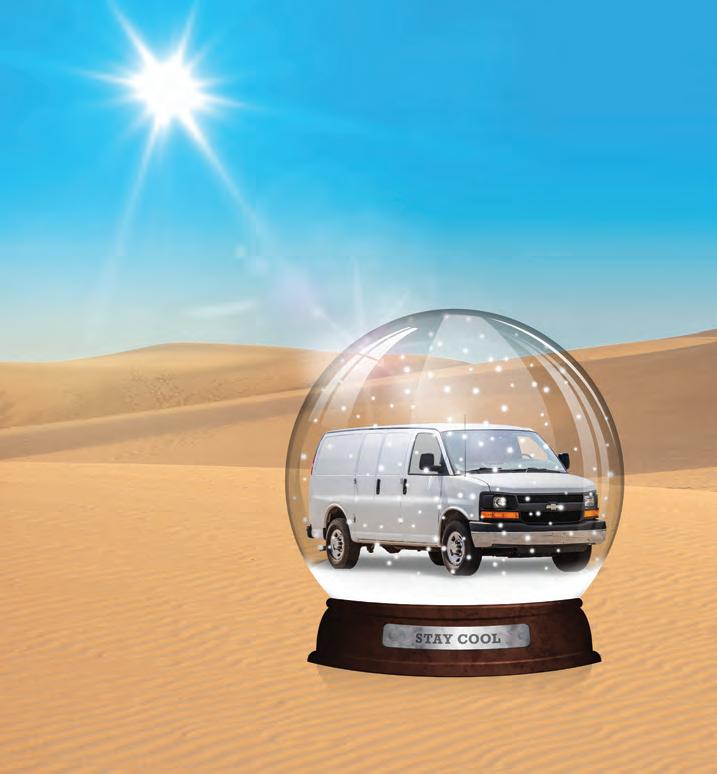
We know the last thing you want to worry about this summer is keeping the cab of your van cool. The new Adrian Steel composite partition provides a tighter seal compared to a traditional steel partition, which means you have better climate control. This saves you time and fuel while ensuring that your cab stays at a comfortable temperature. Learn more at AdrianSteel.com/composite-partition
An additional advantage of a compressor outfitted with a VFD is that the startup frequency results in a low motor speed/torque, which reduces the normal high startup current. Not only does this reduce electrical consumption, the low torque start also relieves stress on the motor/compressor.
The bottom line is there are many options available to better match equipment capacity with load to provide maximum comfort in air conditioning applications or product integrity in refrigeration applications, without having the pedal to the metal whenever the equipment is in operation.

Dave Demma holds a degree in refrigeration engineering and worked as a journeyman refrigeration technician before moving into the manufacturing sector where he regularly trains contractor and engineering groups. He can be reached at ddemma@uri.com.

PELLET BOILER RETROFIT GOOD NEWS TRENDS
PRODUCT SHOWCASE IMPROVE P/S PIPING PERFORMANCE
12 COMPARISONS BETWEEN HYDRONIC AND VRF/VRV SYSTEMS
CONTROL LOGIC
HOW TO MATCH GLYCOL LEVELS TO VARIOUS SYSTEMS
DISPELLING RADIANT MYTHS
When you need major horsepower in a tight space.

There’s nothing small about its performance...just its dimensions.
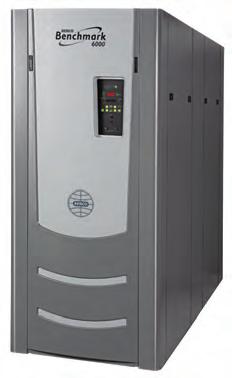
AERCO’s Benchmark 6000 boiler packs six million BTU/hr., 94.5% efficiency and unmatched reliability into a compact footprint that’s a third the size of the competition. You can park it anywhere.


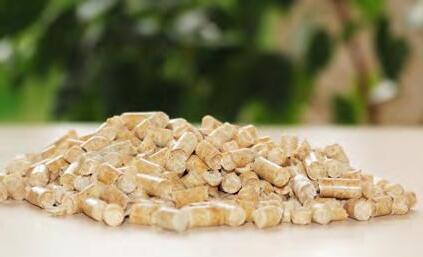
A simple, repeatable approach to retrofitting a pellet boiler.

BY JOHN SIEGENTHALER
BY MIKE MILLER
Removing the mystery
How to match glycol levels to various systems.
BY ROBERT WATERS

How to heat and cool a very large, nearly all-glass building, while hiding the sources of warmth and cooling.
BY RUSSELL LAVITT

MH22
A look at the big picture
Boiler and system flows may be decoupled, hydraulically speaking, but they should be linked in the mind of designers and installers.
BY ALEXIS CODINA
MH34
A look at the bright side
Trends that mean good news for the hydronics industry.
BY STEVE GOLDIE


MH38
The continuum of radiant myths
BY ROBERT BEAN
MH42
Water remains the “Gold Standard”
Twelve comparisons between hydronic and VRF/VRV systems.
BY JOHN SIEGENTHALER
EDITOR ASSISTANT
ASSOCIATE
ACCOUNT
SALES & MARKETING
ART DIRECTOR
ACCOUNT COORDINATOR
CIRCULATION MANAGER PUBLISHER
Kerry Turner (416) 510-5218 KTurner@hpacmag.com
Beth McKay
David Skene (416) 510-6884 DSkene@hpacmag.com
Stephen Kranabetter (416) 510-6791 SKranabetter@hpacmag.com
Kim Rossiter (416) 510-6794 KRossiter@hpacmag.com
Graham Jeffrey
Barb Vowles (416) 510-51037 bvowles@annexbizmedia.com
Urszula Grzyb (416) 442-5600, ext. 3537 ugrzyb@annexbizmedia.com
Peter Leonard (416) 510-6847 PLeonard@hpacmag.com


BY JOHN SIEGENTHALER
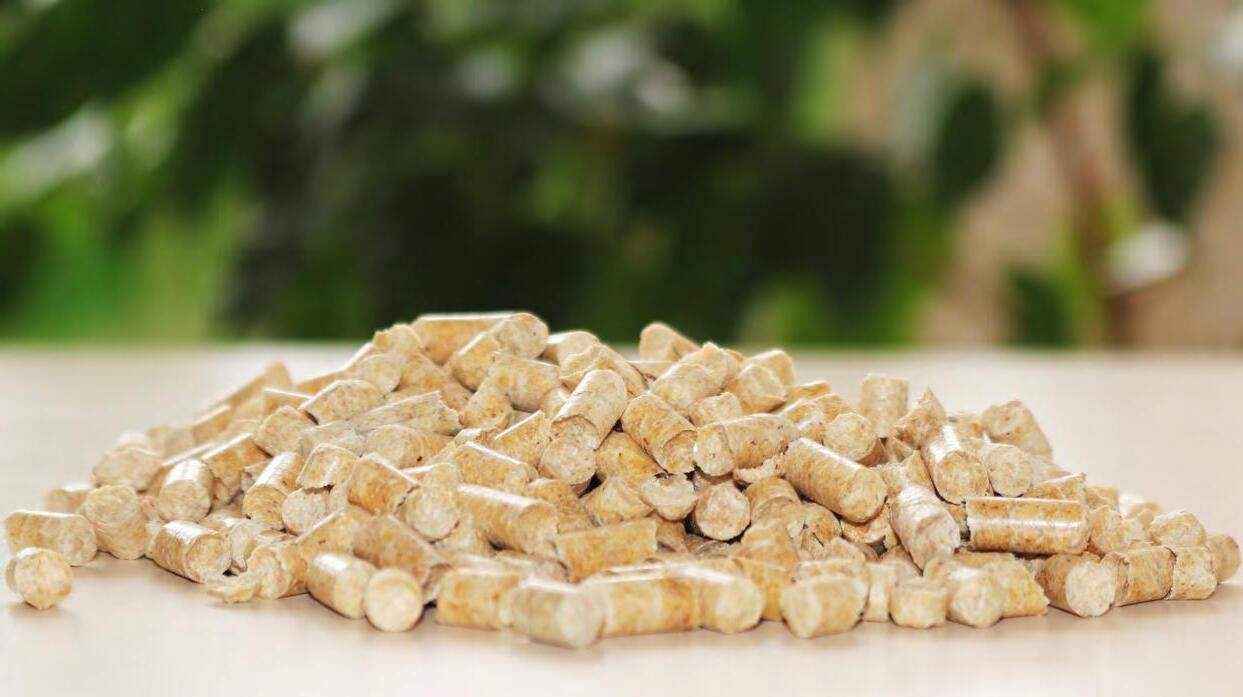
During the last two years I have been reviewing submittals for proposed heating systems using pellet-fired boilers. They come from heating professionals ranging from installers to professional engineers. These submittals are required to participate in a state incentive program that offers significant rebates to encourage growth of the biomass heating market.
My task is to review the proposed systems for technical details, and flag possible issues for clarification or redesign, before thousands of dollars of hardware gets installed incorrectly.
One of the commonalities of these submittals is that many designers view pelletfired boilers as simply a “box” that burns pellets and makes hot water. They want to set that box next to an existing oil-fired or propane-fired boiler, and just cut it into the existing distribution system. They seldom look at that existing distribution system as fertile ground for not only improving the performance of that new pellet-burn-

ing “box,” but also improving the comfort provided by the system.
The following is a discussion about a “make over” of an existing oil-fired hydronic heating system chosen to receive a modern pellet-fired boiler. This makeover shows one way to integrate that new boiler so that its unique operating charac -
teristics are respected. It also shows how the “comfort challenged” heat delivery system was improved at the same time. This makeover is based on a real installation. It took place in a 1800s vintage farmhouse in a cold upstate New York location. Figure 1 shows a piping schematic of the original system.
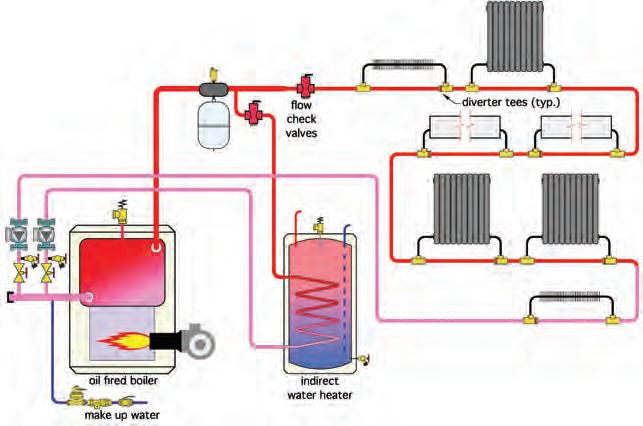

The oil-fired boiler supplies a single distribution circuit that serves a combination of fin-tube baseboard, standing cast-iron radiators, and some cast-iron baseboard. (Yes, someone really put all those different heat emitters together on a single circuit). The heat emitters are connected to the piping circuit using diverter tees.
In an interview prior to the makeover, the homeowner stated that there were several “cold spots” in the house. In some cases cold enough to freeze a glass of water left on the kitchen floor during a cold winter night. Ouch!
The primary goal of the makeover was to reduce heating cost by adding a modern pellet-fired boiler to the system and treating it as the primary heat source. The oil-fired boiler would remain in the system as the “auxiliary” heat source. The intent was to configure the oil-fired boiler to automatically operate if the new pellet-fired boiler was unable to supply the load, or was out of service.
At the time of the makeover, heat supplied from the new pellet-fired boiler would be about half the cost of heat supplied by burning fuel oil. However, those cheaper Btus were not going to allow the marginal hydronic distribution system to improve the home’s comfort. This is where the scope of the makeover changed from simply reducing operating cost to also providing significantly improved comfort.
The rationale behind this makes sense: since the system would be undergoing significant hydronic “surgery” to add the new boiler, why not take opportunity to upgrade the home’s comfort by adding some more heat emitters while the system is on the operating table?
An easy way to do this was to install a manifold station in the basement and use it along with ½" PEX-AL-PEX tubing, to supply panel radiators that would be placed in the areas where comfort was marginal. The panel rads could be different sizes to match the supplemental heating needs and available wall space in the cold areas. The manifold station would include two additional connections, which were to be closed off initially, but easily accessible if the system was ever further expanded.
Beyond improved comfort, the added heat emitters would lower the water temperature at which the distribution system could supply design heating load. A suggested guideline is to add enough heat emitters to reduce the supply water temperature at design load conditions by at least 30F (that is, from 180F on an existing system to 150F on the modified system). This allows the thermal storage tank, which is an integral part of the pellet-fired boiler retrofit, to operate over a wider temperature cycling range. The result is reduced on/off cycling, which yields higher thermal efficiency and lower emissions.
Another suggested guideline is to limit the added heat emitters so that the return water temperature to the oil-fired boiler stays above 120F most of the time. This should be sufficient to prevent sustained flue gas condensation within the oil-fired boiler. If the return water temperature was going to be consistently below 120F, as it might be if a large area of radiant panel heating were added to the system, it is prudent to add a thermostatic boiler protection valve as shown in Figure 2. This valve limits flow through the oil-fired boiler, when necessary, to keep it from operating with sustained flue gas condensation. With this valve in place, along with another anti-condensation valve for the pelletfired boiler, the return water temperature from the distribution system can be as low as you want it.
Figure 3 shows the modified system, which now includes the pellet-fired boiler and thermal storage tank along with some other piping modifications.
This reconfiguration allows either the thermal storage tank, or the existing oil-fired boiler to deliver heated water to the closelyspaced tees that hydraulically separate circulators (P2) and (P3) from the zone circulators. It also allows the oil-fired boiler to be isolated from heated water when it is not being used, which
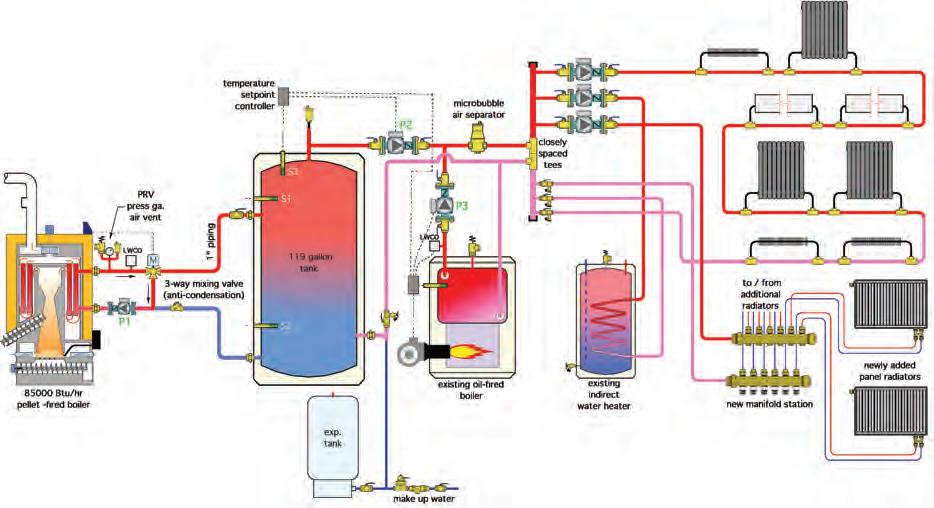
should be most of the time now that the pellet-fired boiler is installed. This is important because allowing heated water to flow through an unfired boiler just dissipates heat through that boiler’s jacket and up its flue.
The pellet-fired boiler is regulated by its own internal controller, which monitors the temperature of two temperature sensors (S1 and S2) within the thermal storage tank. When the temperature at the upper sensor (S1) drops to some lower setpoint (such as 140F) the pellet boiler fires. It remains in operation until the temperature at the lower sensor (S2) has climbed to some high temperature limit (such as 170F). This stacks the tank full of hot water before the boiler is turned off. The objective is to create long on-cycles followed by long off-cycles, which increases the overall burn cycle efficiency of the boiler and reduces its emissions. The control operation takes place 24/7 whenever the pellet boiler is powered on. It is completely independent of the other system controls.
The controller within the pellet-fired boiler used in this system also operates a motorized three-way mixing valve between the boiler and thermal storage tank. This valve’s purpose is to keep the boiler’s inlet water temperature above the dewpoint of the combustion gases (about 130F) whenever possible, and thus prevent sustained flue gas condensation.
The control system that manages overall system operation can be simple. Whenever there is a demand for space heating or domestic water heating, power is applied to a temperature setpoint controller, which measures the water temperature in the upper portion of the thermal storage tank at sensor (S3). If that temperature is
at or above some minimum value (such as 140F) circulator (P2) is turned on, and heat is supplied from the tank to the load. If the water temperature in the upper portion of the tank is below this setpoint, circulator (P2) is off and the oil-fired boiler is turned on along with circulator (P3). If the temperature at the top of the thermal storage tank later rises to the minimum setpoint plus a differential of 10F (in this case 140+10=150F), the setpoint controller brings the tank back online as the sole heat source.
The new circulator that supplies the manifold station is wired in parallel with the original zone circulator supplying the space heating distribution system. This ensures adequate flow and head to handle the new panel radiators.
This is a relatively simple makeover scheme that is repeatable on many “typical” existing hydronic heating systems with a convention oil-fired or propane-fired boiler and fin-tube baseboard heat emitters. It allows the pellet-fired boiler to manage itself using its own internal controls, which act independently of the other system controls. It also addresses the need for improved comfort versus just shifting heat production from oil to pellets. The added heat emitters will also put an end to those frozen glasses of water on the kitchen floor.

John Siegenthaler, P.E., is a mechanical engineering graduate of Rensselaer Polytechnic Institute and a licensed professional engineer. He has over 34 years experience in designing modern hydronic heating systems. Siegenthaler’s latest book, Heating with Renewable Energy, was released recently (see www.hydronicpros.com for more information).





















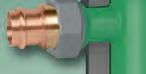




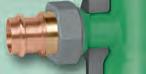




















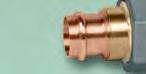
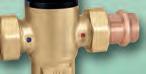

































The Presscon™ press connections, with its exclusive LEAK DETECTION feature, will detect leaks during system testing if a press connection is unpressed. Calef was the rst to introduce zone valves with press connections and has expanded press connections to its broad range of hydronic components. Press sizes from ½” to 2” copper are available on several air separators, dirt separators, hydronic separators, magnetic separators, thermostatic mixing valves, balancing valves, press reducing valves and more.

Presscon connections have a temperature range of 0°F - 250°F for up to 50% glycol mixtures and pressure rated to 200 psi. Connections meet low lead law requirements for use in accordance with U.S. and Canadian plumbing and mechanical codes.
Components
Heating & Cooling


BY MIKE MILLER





We come across so many different types of terminology in our industry that not everyone is fully aware of their meanings. The following is some of the most basic control logic terminology with a short explanation of what each means and how they apply in hydronic system controls.
Fluid temperature control is crucial in today’s advanced hydronic heating systems, not only to increase overall system efficiencies, but also to increase the overall comfort level within a system. Fixed water temperature control is still applicable in process applications, however for fluid temperature control provided to a heating terminal unit, it should be a thing of the past.
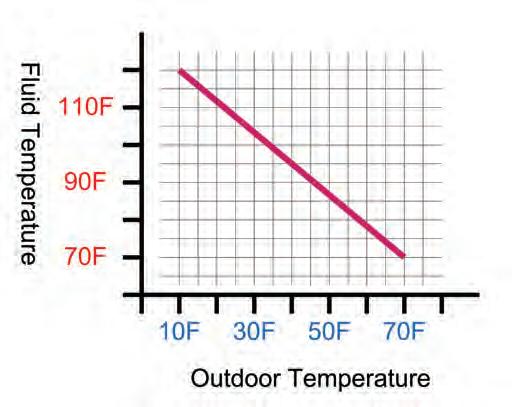
Outdoor reset refers to adjusting the fluid temperature provided to the system based on outdoor temperature change to match the changing building load. In most cases, this is done based on a ratio or heating curve that can be calculated using the design supply water temperature (DST – warmest fluid temperature required at the design day, also known as worst condition), warm weather outdoor temperature (WWODT –or warm weather shut down) and design outdoor temperature (DOT –

coldest outdoor air temperature). See Figure 1 for an example of a high mass radiant floor heating system. The DST number will vary depending on type of terminal unit chosen to heat the building.
This calculated ratio references the amount of fluid temperature change per 1F outdoor air temperature change.
Using the same example as in Figure 1, should the outdoor air temperature change from DOT to 50F, the desired fluid target temperature would be 86.7F:
((WWODT–Outdoor air temperature) x Reset ratio) + WWODT = target).
On a graphical front, using this same formula, a heating curve can be drawn and this very same example is depicted in Figure 2.








































































































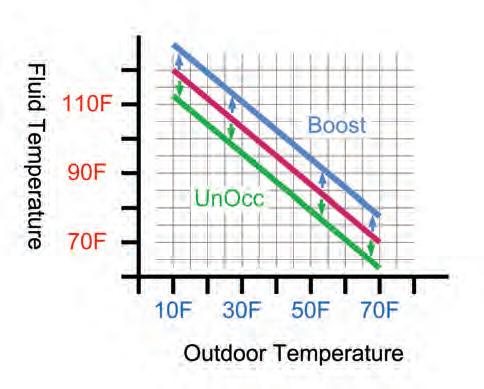
Since outdoor reset is matching the fluid temperature provided to the load of the building based on outdoor air temperature, the same logic can be applied to achieve building temperature setback at night, or other periods where the building is unoccupied, simply by reducing the fluid temperature below what is required during occupancy. Most leading controllers on the market will provide an Unoccupied scheduling feature through integral timers, or the ability to connect external timers. During unoccupied periods, the controllers would parallel shift the heating curve downward thus reducing the supply fluid temperature to the building to achieve building air temperature setback.
Alternatively, this same parallel shift logic is applied when the controller comes out of setback from unoccupied periods to achieve a boost and faster recovery of the building when it resumes normal occupancy conditions by shifting the heating curve above its normal for a period of time that can either be applied through control logic based on outdoor temperature or simply a timed function. See Figure 3 for an example of a parallel shift.
With modulating generation equipment (modulating boilers, mixing valves, injection pumps, and so on) On/Off fluid temperature control no longer applies, as shown in the modulating and floating control examples discussed later.
However, on/off generation equipment (on/off boilers, modulating boilers at or below minimum modulation output, heat pumps, on/off injection valves/pumps, and so on) are operated using On/Off control logic to maintain a desired setpoint. In most
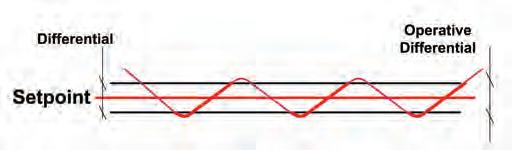
cases, an On/Off Differential is applied that is split half below and half above the target. This differential is in place in order to eliminate short cycling of the equipment. For example, if a setpoint is 120F and the chosen differential is 20F, then the equipment is turned ON at setpoint – ½ diff (10F) and turned OFF at setpoint + ½ diff (10F), effectively cycling the generation equipment between 110F and 130F fluid temperature. See Figure 4 for a graphical example of an on/off differential.
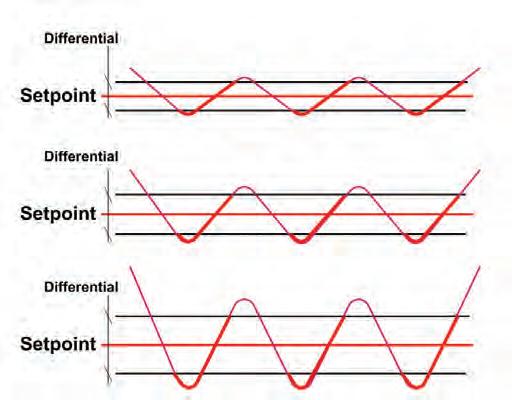
Some of today’s most sophisticated controllers can apply a differential that automatically varies based on the load, using some additional PID logic (further explained below). In order to maximize operating efficiencies, an adequate balance must be maintained between the lowest amount of temperature swings, while minimizing short cycling of the equipment at all times. Typically, when the load is high, a differential can be lower as the generation equipment is more effectively loaded. When the load is low, then the generation equipment has much greater capacity than the building requires and the differential should be larger in order to minimize or eliminate short cycling to extend its life cycle. Common automatically adjustable differentials range between two and 42F. See Figure 5 for graphical auto differential example.







Floating action type mixing refers to a motorized mixing device, often two-, three- or four-way mixing valves where the motor is actuated using most commonly either 24Vac or 120Vac. The voltage is applied for the motor to drive in either the open or the close position. When no voltage is applied to the motor, the valve remains in its current position. Most often, the time component and the dead band, as well as the operating band (not to be confused with On/Off Differential) is calculated using PI logic and the motors actuation speed from fully open to fully closed. Figure 6 shows how the controller pulses the floating action type motor either open or closed depending on where the temperature fluctuates.
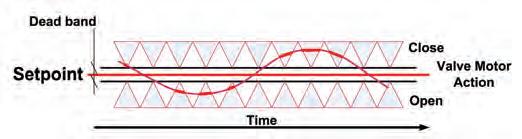
When the temperature is within the dead band, the motor remains off, keeping the valve in its current position. If the temperature fluctuates above the setpoint and is within the operating band, then the valve is modulated/pulsed close as shown in this example.
When the temperature fluctuates below the desired setpoint and is within the operating band, then the valve is pulsed open as shown. Should the temperature fluctuate outside of the operating band, the motor will either open or close continuously until the temperature settles again within the band.
Floating action is one of the more cost effective and easier to implement control options available, but it is often also slower responding than a modulating output may be. Most floating action type motors take between 90-120 seconds to go from fully open to fully closed, but in high mass hydronic heating fluid temperature control systems it is sufficient.
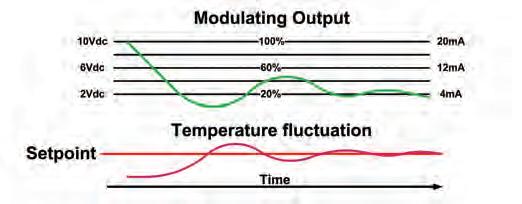
Modulating mixing devices generally have the capability to achieve much more accurate and faster temperature control than that of the floating action type. Modulating is often a requirement for low mass, fast reacting systems or process applications. Modulating devices can also still be two-, three- or four-way mixing valves, or even injection pumps. Modulating devices also include generation equipment, such as modulating boilers. Modulating signals are commonly either a small voltage between 0-10Vdc (2-10Vdc) or small current between 0-20mA (4-20mA) or resistive based between 0-135 Ohm.
Figure 7 shows an example of a modulating output operating on PI logic. When the operating temperature is below setpoint, the modulating output increases. When the operating temperature is above the setpoint, then the modulating output decreases. Modulating type devices require a modulation signal to remain in the desired position. Most often, when no modulation signal is provided to the motor, then the modulating devices output is off.
PID is an acronym for proportional, integral and derivative control. In layman’s terms, the proportional stands for an error between actual temperature and desired setpoint. Integral adds the time feedback mechanism of how long the error has been there. The derivative anticipates the error changing over time with compensating action taking place. The control algorithm will process all three (or only PI, depending on control programming) in order to decide whether to increase or decrease the operating outputs in order to eliminate the error.
If you have been working with any kind of microprocessor temperature control system, you have watched and experienced PID logic in action. For modern hydronic heating systems, many controllers in the market operate on PI logic only, because a small degree of error is not crucial to most hydronic heating systems and is much easier to fine tune. PI or PID is applied in any of the above control strategies.
While I have focused on very high level control logic, some additional requirements may be part of your system. These could include minimum and maximum fluid temperature limits to protect system components or pieces of equipment. Any of the strategies mentioned here could be modified to accommodate those cases.

Mike Miller is the director of sales, commercial building services at Taco Canada Limited and past chair and member of the Canadian Hydronics Council. He can be reached at hydronicsmike@ tacocomfort.com.

BY ROBERT WATERS
Glycol is a mystery fluid to many in the HVAC industry, but it is an essential tool for designing many different types of HVAC systems. In Canada, where glycol is essential to protect HVAC systems from freezing, most contractors have a basic understanding of why glycol is used. However, many may not realize all of the implications and issues that must be considered when the decision is made to use glycol in a system.
Glycol in a hydronic system impacts the way that many circuit components such as pumps, pipes, air eliminators and boilers work. If the wrong choices are made there can be serious consequences to the efficiency, performance and longevity of the system. Glycol must be accounted for early in the system design, as using glycol with its lower heat transfer capability will impact the sizing of many of the system’s components.
Water is a better heat transfer media than glycol–you can see that when you compare the specific heat of the fluids. At 60F/15.5C water has a specific heat of 1.0 Btu/(lb*oF). Compare this to 50 per cent glycol at 0.84 Btu/(lb*oF) and you can see that glycol has 16 per cent less heat carrying capacity. The specific heat also changes with temperature and it only gets worse for glycol at lower temperatures.
Glycol is also thicker and more viscous than water, making it more difficult to push through the pipes. If the system is originally designed for water, and then at the last minute changed over to glycol, you will most likely have problems as the initial sizing of components are no longer sufficient for the glycol system.
Using the correct type and concentra-
tion of glycol is very important, as you only want to use as much as required to do the job. Too much glycol adds expense, impedes heat transfer, and affects pumping capacity. Not enough glycol can lead to damaging and expensive freeze-ups.
The type and concentration of glycol used is dependent on the project location and the type and specific requirements of the system. There are two basic types of glycols used in HVAC systems, propylene glycol and ethylene glycol.
Both of these fluids have similar freeze protection and heat transfer characteristics with the main difference being that propylene glycol has a lower toxicity level. Due to its lower toxicity, propylene glycol is more commonly used in residential and small commercial HVAC systems.
Either type of glycol will always include added corrosion inhibitors to protect pipes and components. There are many different types of inhibitors used that are specific to different applications. Using the correct type of glycol – inhibitor mix is crucial to providing long-term
reliable system operation. Climatic conditions are very different in Toronto and Yellowknife, so the levels of freeze protection required and the resulting concentration of glycol will vary for the same type of system installed in different locations.
All glycol manufacturers provide charts (see Figure 1), which show the percentage of glycol required to provide a certain level of protection against freezing or burst protection. Typically a 50 per cent concentration of glycol will give you freeze protection down to -30F/-34C. However to provide pipe burst protection to the same temperatures, only 33 per cent glycol is required. Burst protection means that the fluid can no longer be pumped, but it has not expanded to a point where it will burst pipes.
The HVAC applications that most commonly use glycol are snow and ice melting systems, ground source heat pumps, solar water heating systems, chilled water cooling systems, and in the hydronic systems that require pipe burst protection due to their location or activity level. Some
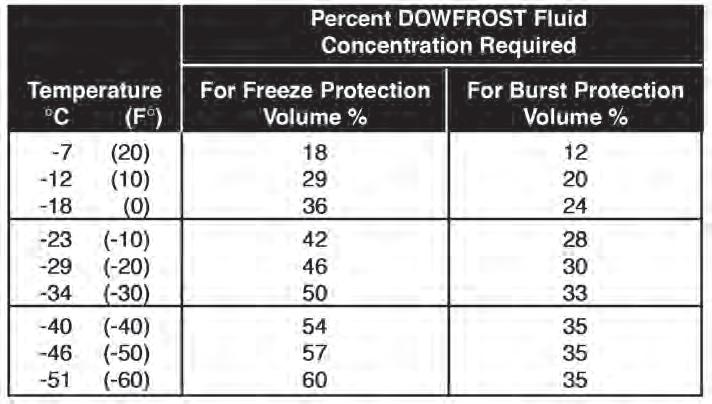
of these applications require high levels of freeze protection, while others only need a lower level of burst protection as a safety measure.
Snowmelt systems by their nature require a high level of freeze protection because all the components are located outside the building envelope and are exposed to the ambient conditions. This means that snowmelt systems require quite high levels of glycol concentration in the range of 50 to 60 per cent.
Solar water heating systems also require a very high level of freeze protection as solar collectors and piping are located outside the building. Typically glycol concentration in the range of 45 to 60 per cent will be required, with most applications in Canada using 50 per cent glycol. Installations in the far north usually need to increase the concentration to account for colder winters.
Solar systems also have the unique characteristic of producing very high fluid temperatures during summer stagnation conditions. This leads to very specialized glycol requirements that use special high temperature corrosion inhibitors to protect the fluid from breaking down rapidly. If the wrong glycol is used in a solar water heating system, the fluid can break down and turn nasty very rapidly. This can result in plugged collectors, blocked pumps, and in extreme situations systems that must be abandoned entirely. There are special glycols made exclusively for solar water heating systems and they are highly recommended for these types of systems.
Ground source heat pumps often use glycol in their earth loops. As these loops are often much deeper in the ground, they are typically not exposed to the same kind of extreme conditions and therefore require a lower concentration of glycol, usually in the range 15 to 25 per cent. Fluid toxicity is certainly an important issue in the ground source industry so therefore propylene glycol is usually essential for these types of applications.
“Too much glycol adds expense, impedes heat transfer, and affects pumping capacity. Not enough glycol can lead to damaging and expensive freeze-ups.”
Many hydronic heating systems, especially those that incorporate radiant floor heating will utilize glycol to provide a level of safety against burst pipes and the resulting damages that can occur to the building and the system. In these applications a lower concentration of glycol in the range of 25 to 30 per cent is usually utilized just to provide peace of mind against bursting pipes during unoccupied periods. Commercial buildings that use radiant floor heating systems and that may be unoccupied for periods of time are certainly candidates for this protection. Pipes that burst in a concrete slab are a serious problem that can result in very expensive and disruptive repairs.
When glycol is used in the system there are certain installation, service and maintenance factors that must be considered to maintain a long reliable lifespan of the fluid and the system components. Here are a few of the things to look out for:
• Boilers that use aluminum heat exchangers have special glycol requirements. Make sure you check with the boiler manufacturer and use the correct fluid for these boilers, or you will be in for big problems down the road.
• Before installation of the glycol into the system, a thorough cleaning of the entire system must be done. If this is not done properly there can be problems with sludge formation or pipe fouling after the glycol is added, leading to a reduced lifespan of the glycol and system. Any residual dirt, debris, flux, or residual pipe oil can interact with the glycol and cause problems. A commercial pipe-cleaning agent should be added to the piping and then thoroughly flushed out with fresh -
water to remove any traces of the cleaning agent. Ideally the system should be blown out with air to remove any residual water prior to adding glycol water mixture.
• Many glycol vendors will provide glycol that is already pre-mixed. This is the best way to add glycol as it guarantees the correct glycol concentration, and that the water used in the mixture is free of contaminants. If 100 per cent glycol is purchased then on-site mixing is required, and this can cause issues if not done properly. When mixing glycol on-site with water it is highly recommended that only distilled or deionized water be used. Fresh water directly out of the tap often contains calcium, magnesium, and chlorides and when these come in contact with the glycol inhibitors, they often create problems with sludge and fouling. Finally after mixing, check the concentration with a glycol refractometer to ensure the concentration is correct.
• Once the system is charged with glycol, proper air elimination is critical for glycol systems. Air that becomes trapped in a glycol water mixture is especially hard to separate. Air pockets or frothing can result when the system pump is activated, which often leads to many frustrations during and after the commissioning process. A good quality micro bubble air eliminator is highly recommended for any system containing glycol.
• Different brands or types of glycol should never be mixed, due to the different corrosion inhibitors used by different manufacturers. If topping up an existing system, only use the same
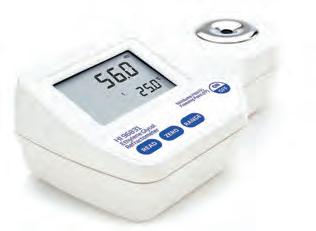
brand that was originally installed.
• When the system is operational, periodic testing of the glycol must be done to ensure that it is still suitable for use and providing the correct level of freeze protection. It is not unusual for something to go wrong in a system such as a
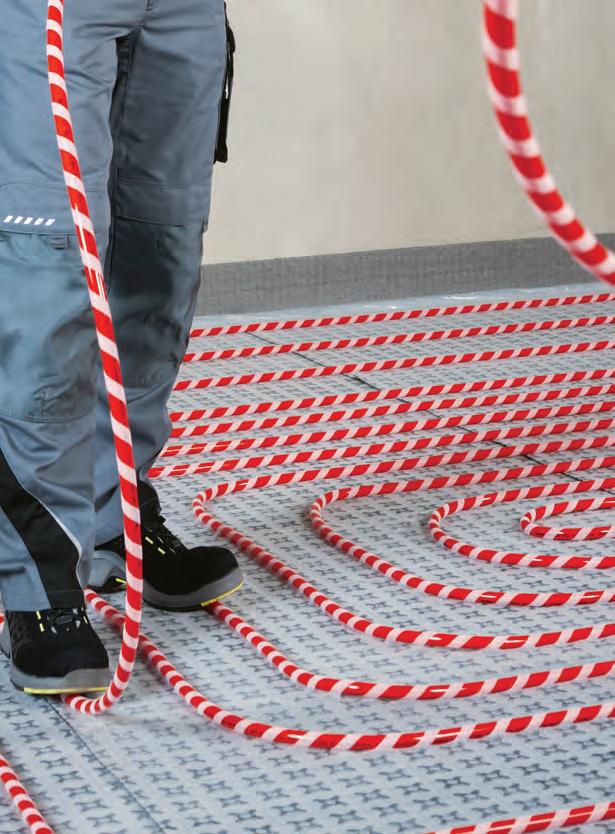
leak or system maintenance, and the system ends up getting topped up with freshwater. This will resulting in a diluted glycol concentration and a lack of freeze protection. Burst pipes or frozen solar collectors can often be the result of this problem. Typically an annual check-up will include verification of the glycol concentration with a refractometer, and a check of the glycol PH level using litmus test strips. Glycol that has gone bad typically will have a low PH level, which if left unchecked, will start to corrode the metal components in the system. Usually when the PH level is too low the glycol must be drained, the system flushed and recharged with new glycol.
• Ultimately glycol must be disposed of when its life in the HVAC system is over. There are chemical supply companies that offer glycol disposal services, and this may be required depending on the type and quantity of glycol being used, and the regulations in your local area. Just pouring it down the drain may not be acceptable, and could land you in hot water with the environmental regulators in your area. Using glycol is an essential part of installing HVAC systems in Canada and if installed and maintained correctly will provide years of trouble free service. Be aware of all the issues and rely upon glycol professionals if you need to learn more about using glycol. Do not let glycol be a mystery fluid in any of your HVAC installations.

Robert Waters is president of Solar Water Services Inc., which provides training, education and support services to the hydronic industry. He is a mechanical engineering technologist graduate of Humber College and has over 30 years experience in the hydronic and solar water heating industry.

More than just a sleek new firetube design.
The innovative design of FlexCore stainless steel, symmetrical firetube boilers is making all others obsolete. Developed exclusively by the experts at RBI, its unique heat exchanger design not only maximizes efficiency but also eliminates the longterm stressors associated with thermal expansion. rbiwaterheaters.com
• 1500 - 6000 MBH
• Stainless Steel Firetube HX
• Patented Turbo Pilot Ignition System
• Variable Volume Flow
• Full Modulation
• HeatNet 3.0 Digital Control Platform
• HeatNet Online Remote Monitoring
• Touchscreen Programming & Diagnostics FLEXCORE
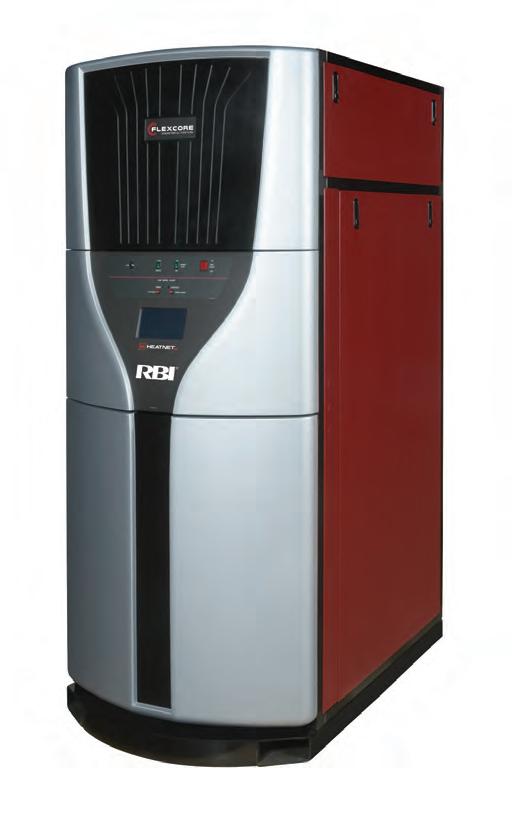
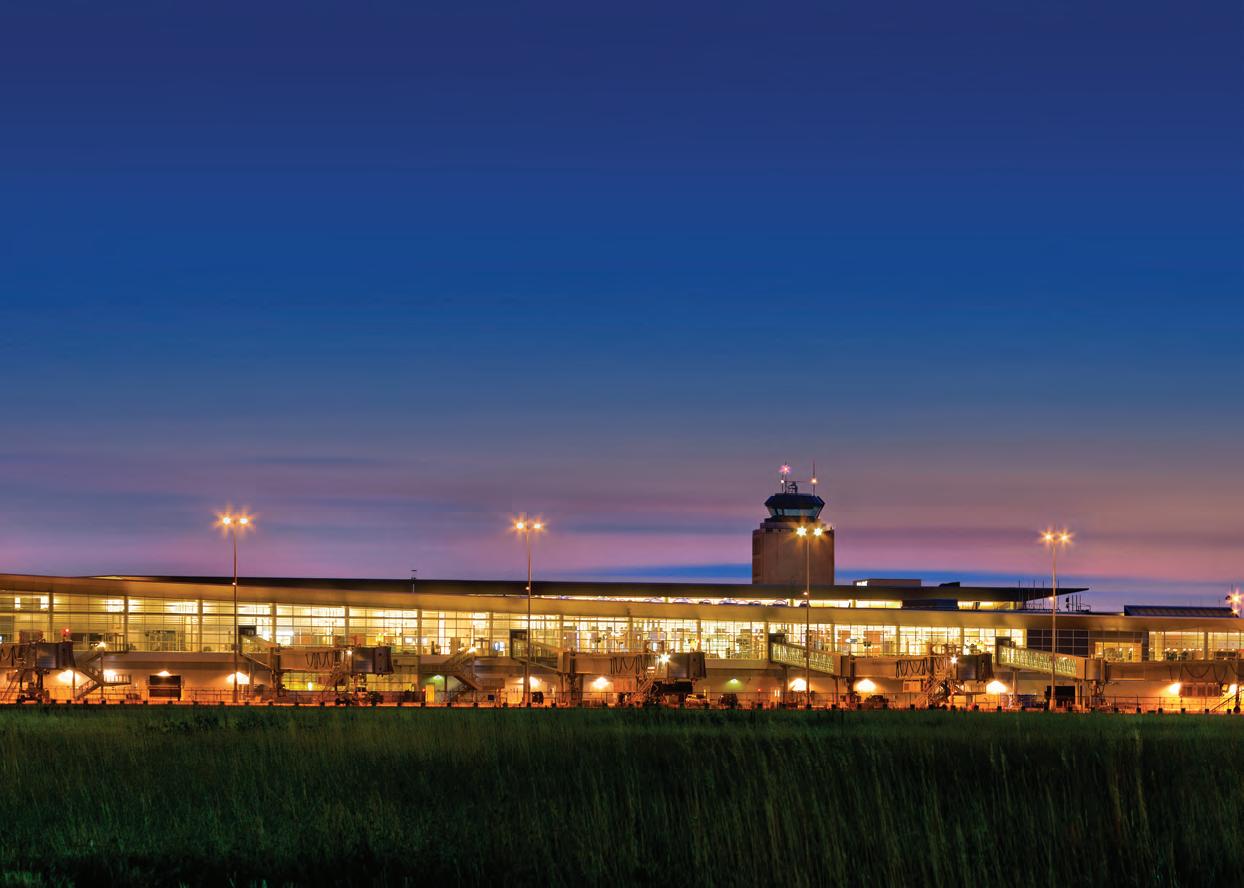
BY RUSSELL LAVITT
As a significant public building, the Winnipeg James Armstrong Richardson International Airport has large expanses of heated and cooled floors as part of its LEED Silver Certified approach to heating and cooling system efficiency. From the onset of the project, the vision for the terminal building was of a clean, modern architecture incorporating thematic aspects of the Manitoba prairie.
Of importance was a strong directive to minimize–if not make invisible–all of the normally-seen mechanical systems and to keep the building as transparent as possible. Tall spans of exterior curtain wall were designed to merge with the ceiling and disappear into the floor without visual clutter. The challenge placed before the mechanical design team was how to heat and cool a very large, nearly all-glass building, while hiding the sources of warmth and cooling.
An in-floor heating and cooling system became the obvious solution, but presented a significant technical challenge. Of primary importance was a discussion with the architectural designers on the quality of the curtain walls.
Triple pane window units were considered at first, but upon further investigation, it was concluded that comparable thermal performance of the glazing system could be achieved with dual pane units and a higher quality curtain wall system. Once the thermal performance was established, heat loss and gain calculations were performed to establish heating and cooling requirements for the spaces. As expected due to the large expanses of glass, it was verified that the heating requirements would be significant and that a heated floor system would require some substantial output. It was also verified that the summertime solar loads would also be considerable and would push the project towards a large cooling component.
The designers then realized that a large floor surface area with the capability of heating or cooling the areas in question could be a major benefit to the project. Radiant floor systems use relatively low temperature heat sources, typically limited to 140F/60C due to the potential of concrete failure when exposed to higher temperatures on a continual basis. This results in a large area of floor being required to generate sufficient
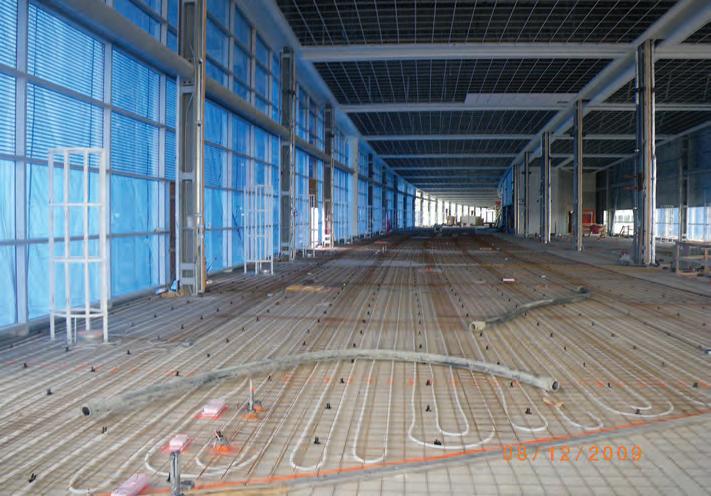
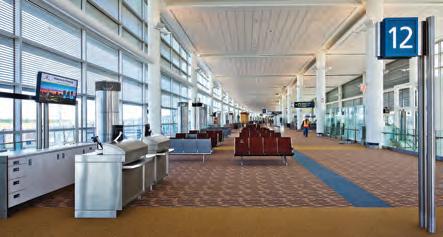
heat to effectively temper a space.
In the summer, when the sun’s rays impact the interior of the building, this same large floor area can be used to absorb the solar gain directly by circulating cold water through the same pipe that carried warm water during the winter. The solar gain can be captured directly rather than allowing it to heat the ambient air in the space, where the only effective means of then cooling the air is with cold water coils at the air handlers. The result: smaller heating and cooling air handling equipment as a result of the use of active floors.
To proceed on the design of the radiant floor systems, the team first determined the optimal placement of the heated floor areas. As infrared radiation from the floor in heating mode needs to “see” an adjacent surface to generate heat, the heated floor area needs to be within a reasonable distance of the curtain wall. For the Winnipeg airport, the optimal heated floor zone placement was within a 25-foot (7.6-metre) deep band
from the foot of the curtain wall. This placement allowed the radiant floor to “see” the entire lower pane of the curtain wall and removed the need for perimeter radiators at the base of the windows.
The designers then analyzed the placement of the floor areas in cooling
mode. To accomplish this, solar angles were reviewed through all 8760 hours of the year to determine where sunlight would fall on the floors. From this exercise, optimal floor zones for solar load capture were determined and then compared with the optimal heating zones. The final active floor zones (combined seasonal heating and cooling) were determined through an optimization exercise where areas and placement were considered to determine the best active zone for both purposes. As the architectural and interior design process continued, it was decided that floor finishes would include tiles and carpeting. Some in-depth research into the thermal properties of the floor finishes was required as any material beyond the base concrete floor introduces an insulating factor to the effective transfer of energy from the floor in heating mode or into the floor for cooling. To overcome this effect, the floors would require more
The LEED Silver Winnipeg
James Armstrong Richardson International Airport is heated using high efficiency natural gas-fired hot water boilers. High temperature water (180/82C) is pumped from the Central Utilities Building (CUB) via a 3200-foot (one km) long utility tunnel to the terminal building where it is used in a thermal cascade configuration. The high temperature water feeds high output heating elements such as entry heaters, unit heaters, or baseboards in back-of-house areas. Water typically leaves these elements at 150F (66C)
and is routed next to the air handling unit heating coils. Once used to heat outside air, this water is mixed down to typically 120F (49C) and routed to the active floor system when in heating mode. This water returns to the CUB at 100F (38C) and is used to condense water vapour in the boiler flue gases, increasing overall plant efficiency to 97 per cent The active floors are also coupled to a 90F (32C) heat pump condenser water loop which allows the active floors to operate on heat reclaimed from electrical rooms, tenants, and data centres when conditions warrant.
The Winnipeg Richardson International Airport Terminal Building achieved LEED Silver in early 2015. The building was designed as a series of transparent luminous pavilions to take advantage of Manitoba¹s prairie landscape and sky.
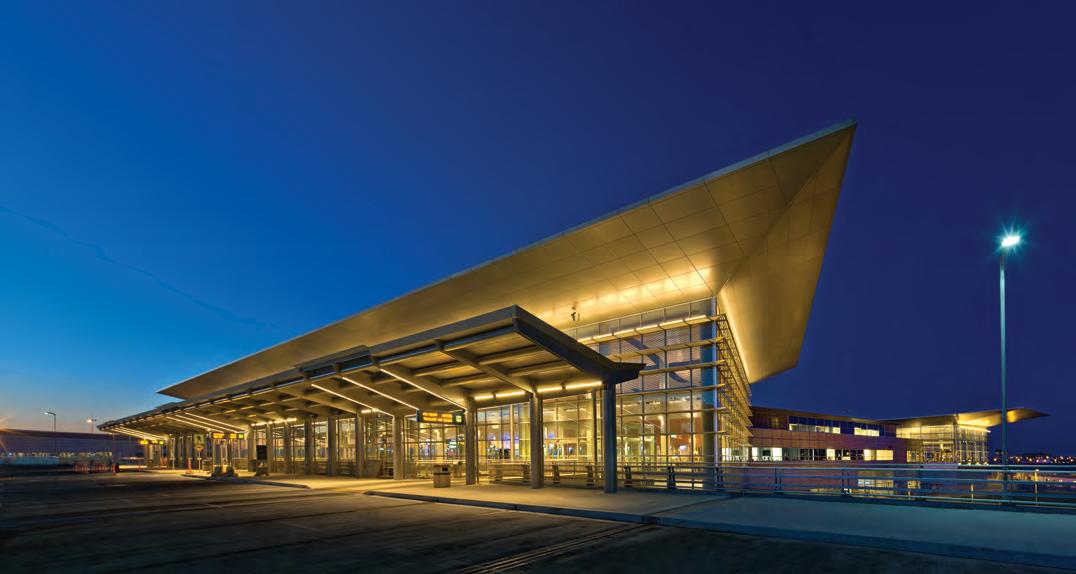
power to push or pull energy through the floor covers. Through thermal analysis, it was calculated that on the coldest of days the floors could be operated at 120F (50C) without negatively impacting the occupied spaces. In areas with less insulating flooring material the floors would be operated at 100F (38C). In cooling mode, chilled water as cold as 44F (7C) was available from the central chiller plant and would be adequate for the cooling task. In both cases, sufficient power (through temperature and flow rate optimization) was provided by design to make the active floor systems viable for the project.
Control of the floors is by means of a series of three temperature sensors embedded into the heated floor zone. The quantity of sensors was increased to provide redundancy and sufficient distribution of data gathering to ensure accurate measurement and control of the floor slab temperature. In the cooling mode, a local humidity sensor additionally measures relative humidity in the space containing the floor and the control sequence calculates the dew point. The floor slab is then maintained at a temperature above dewpoint to prevent condensation on the floors, which could cause slip hazards or damage the carpets.
The result of the implementation of active floors at the Winnipeg Airport is an evenly warm and comfortable space in the wintertime. The occupied space is kept at a space temperature slightly lower than typical buildings due to the radiant effect of the floor directly warming occupants, while the ambient air temperature can be lower. In the summertime, the solar
capture effect efficiently stops solar gains wherever the sun strikes the active floor. There is a noticeable absence of ‘sun heat’ in spaces that are brilliantly lit by the sun’s rays.
In operation, the impact of the active floors has been impressive. The active floors were put into full automatic operation a few months after the airport opened for business. During the period where the active floors were not operating, central plant load was near full capacity. As the floors were commissioned and brought into operation, plant load dropped off as the air systems were not being relied upon as the main heating and cooling systems.
Of particular effect was before and after scenarios in the passenger inspection line area (security checkpoint) where hundreds of people wait in a fully glazed area with a low ceiling. Solar gains and people loads rapidly cause the ambient temperature to rise to a point where the air handlers could not keep up. Once the active floor was in full operation, the active floor dropped ventilation cooling loads and the associated high air flows substantially. Overall, the central plant operators have noted that chiller load dropped off 25 per cent once the cooled floors were fully operational.

Russell Lavitt, P.Eng., is with Stantec Consulting Ltd. He was the mechanical engineer-of-record on the Winnipeg James Armstrong Richardson International Airport–Terminal Building project.
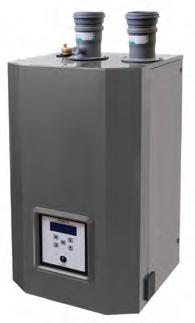
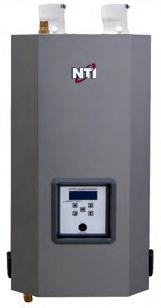
Boiler and system flows may be decoupled, hydraulically speaking, but they should be linked in the minds of designers and installers.
BY ALEXIS CODINA
Akey decision to make when designing a hydronic system concerns the piping method to connect the terminals and the heat source. Single-loop piping is often the most economical and simple to implement but primary secondary (P/S) piping offers flexibility in multi-zone and multi-boiler applications.
This article looks at different scenarios that occur during the operation of a P/S system that a hydronic designer should take into account when applying this piping configuration. Ways of improving the performance of P/S piping applications by adjusting the flow balance between both loops, will also be discussed.
Figure 1 summarizes the three main flow conditions that occur in P/S systems.
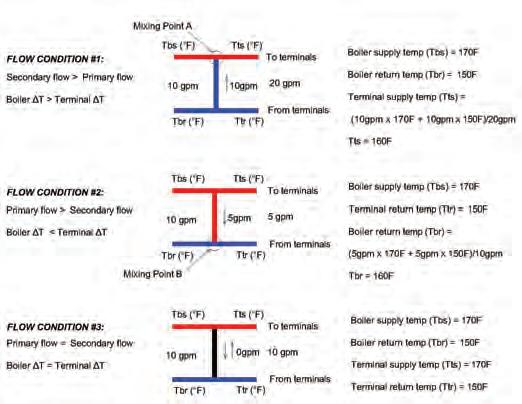
The following scenarios show the impact of flow condition #1 and #2 in two real-life boiler retrofit projects.
SCENARIO A: SECONDARY FLOW > PRIMARY FLOW (FLOW CONDITION #1)
Figure 2 shows a P/S system where a new 100000 Btuh mod-
con boiler was recently installed. Hot water supply temperature with the previous boiler was 163F. The new boiler’s maximum supply hot water temperature is 165F. The new boiler pump was selected for a design water temperature differential of 20F.
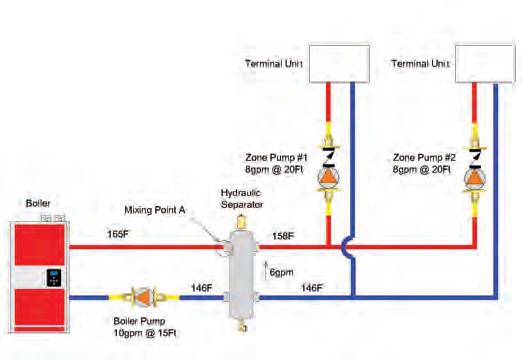
The total secondary flow at peak heating load is 16gpm, or 60 per cent higher than the primary flow. As a result, supply water temperature to the terminals is reduced to 158F ((10 gpm x 165F + 6 gpm x 146F)/16 gpm) downstream of mixing point A.
Although it could be argued that the terminals only need 163F degree water during the coldest time of the year, assuming an outdoor reset schedule is followed, the reality is that the new boiler will not meet the building’s peak heating load. By interpolating data from Figure 3, one realizes that heat output drops approximately six per cent when supply water temperature reduces from 163F to 158F. Unless six per cent or higher spare capacity was allowed during the selection of the terminals, this scenario may result in complaints from the client resulting in unplanned and costly system modifications.
In this case, boiler selection did not take into account the characteristics of the existing terminals, or the P/S flow balance at peak load. Note also that the situation could have been worse
HeatLink PEX-a tubing is engineered to perform. Our PEX-a tubing is manufactured using the one step crosslinking extrusion process, creating a superior and more uniform molecular structure, which means increased strength, flexibility and thermal memory. Amazingly, a section of ½” tubing can be bent into a 3” radius without affecting tubing integrity. So you can count on great performance in the corners.
HeatLink PEX-a is highly crush and abrasion resistant and perfect for projects where it’s buried in earth or covered in concrete. It’s built to take the heat, the cold, and the pressure–above and beyond industry specifications–to last a lifetime. UV stabilized to withstand up to 12 months exposure to sunlight, it’s the reliable tubing choice for your next potable water or radiant heating or cooling project.
HeatLink PEX-a tubing is lightweight, durable and requires fewer fittings–so it’s really quick and easy to install on the straightaways too.
HeatLink PEX-a is certified to meet or exceed industry performance standards and approved for installation across North America. Install our PEX-a tubing with confidence–we cover every inch of it with a worry free 25 year warranty.
We’ve been proudly making HeatLink PEX-a tubing right here in North America since 1998.
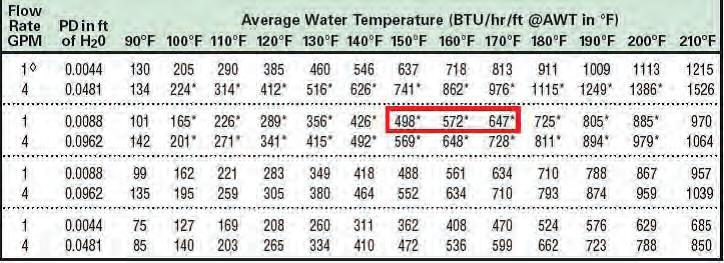
if a lower primary flow had been chosen to reduce boiler installation costs by using a smaller pipe size on the primary loop. Boiler flow values for delta T values higher than 20F are common data in European boiler catalogs, which are often misunderstood and misapplied in the North American market.
Figure 4 shows a new mod-con boiler, with a built-in circulator, connected to an existing distribution system similar to the one in the previous scenario. This time the exiting terminals need 165F water from the heat source.
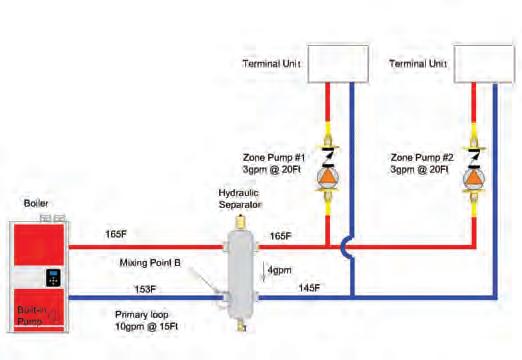
Unlike the previous scenario, here, the terminals receive the hottest water available in the system due to a four gpm primary flow excess. However, the primary flow excess is reducing the delta T in the primary loop to 12F, which represents 60 per cent of the secondary loop design delta T of 20F. Note also that boiler delta T would reduce even further to 6F, if only one zone called for heating. As it is known, reduced boiler delta T means less chance of condensing operation and wasted pumping power.
With an increasing number of mod-con boiler manufacturers offering built-in circulators, knowing the options available to adjust the boiler flow becomes a valuable tool to fine-tune hydronic systems. Built-in boiler pumps do simplify boiler installations. However, to assume that the manufacturer has already taken
care of boiler flow, and that there is nothing else to adjust on the primary loop, would simply be giving away the opportunity to look at the big picture.
Although not often explored, most mod-com boilers allow adjusting the speed of the built-in boiler pump either manually at the pump, or through programming. The latter allows for infinite speed selection, while the former consists of fixed speed options chosen from a dial or selector at the pump. Figure 5 shows pump curves for a mod-con boiler that provides four manual boiler pump speed settings.
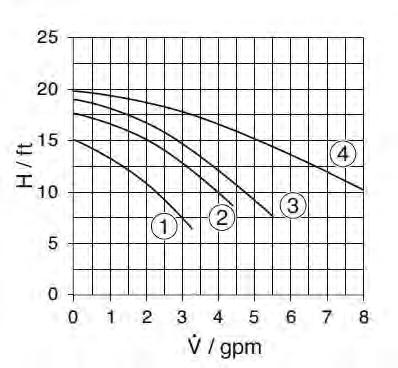
Figure 6 shows the parameter list for a mod-con boiler with configurable maximum and minimum boiler pump speeds. Note that if maximum boiler pump speed is limited to 60 per cent for the system in Figure 4, both boiler and system delta T will be the same at peak load, as depicted in flow condition #3 in Figure 1
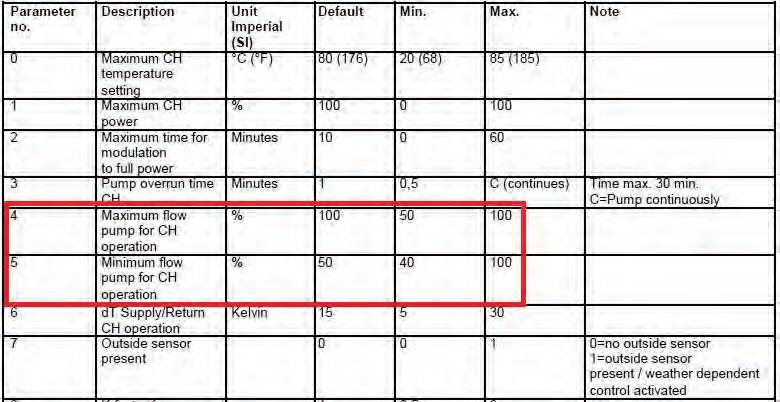
Note also, that as the boiler pump is also variable speed, it could ramp down to 40 per cent to maintain a selected delta T
on the primary side at part load operation under a reset schedule.
This variable boiler pump speed strategy could extend boiler condensing operation at part load conditions. Another added benefit would be additional pump power savings at reduced speed operation.
Very often, the components in a hydronic system have, at least on paper, the potential to operate effectively and efficiently when combined, i.e. meeting the heat load while achieving a high system delta T at a relatively low supply temperature. However, very often this potential vanishes right after the water goes through the first T of the P/S set up.
Taking advantage of reduced boiler flows at peak load to save on near-boiler hardware is a popular strategy, but designers should be mindful of the impact of this strategy on the secondary loop, especially the mixed supply water temperature to the terminals.
As rare as it may be, the flow condition #3 in Figure 1 represents the most efficient and effective way of running a P/S sys -
tem as the system delta T is maximized and the pumping power is lowest. Therefore, do not miss the opportunity to adjust the boiler flow within the allowable limits or take advantage of builtin variable boiler flow features to suit your design. Do not consider boiler flow set in stone only because the boiler literature seems to suggest that is the case.
Finally, boiler and system flows may be decoupled, hydraulically speaking, but they should be linked in the minds of designers and installers, to be able to look at the big picture, which is overall hydronic system performance.

Alex Codina, P.Eng. LEED AP, is the heating sales engineer with The Master Group in Ottawa. Codina has 15 years experience in hydronic system design. He can be reached at acgarcia@master.ca.
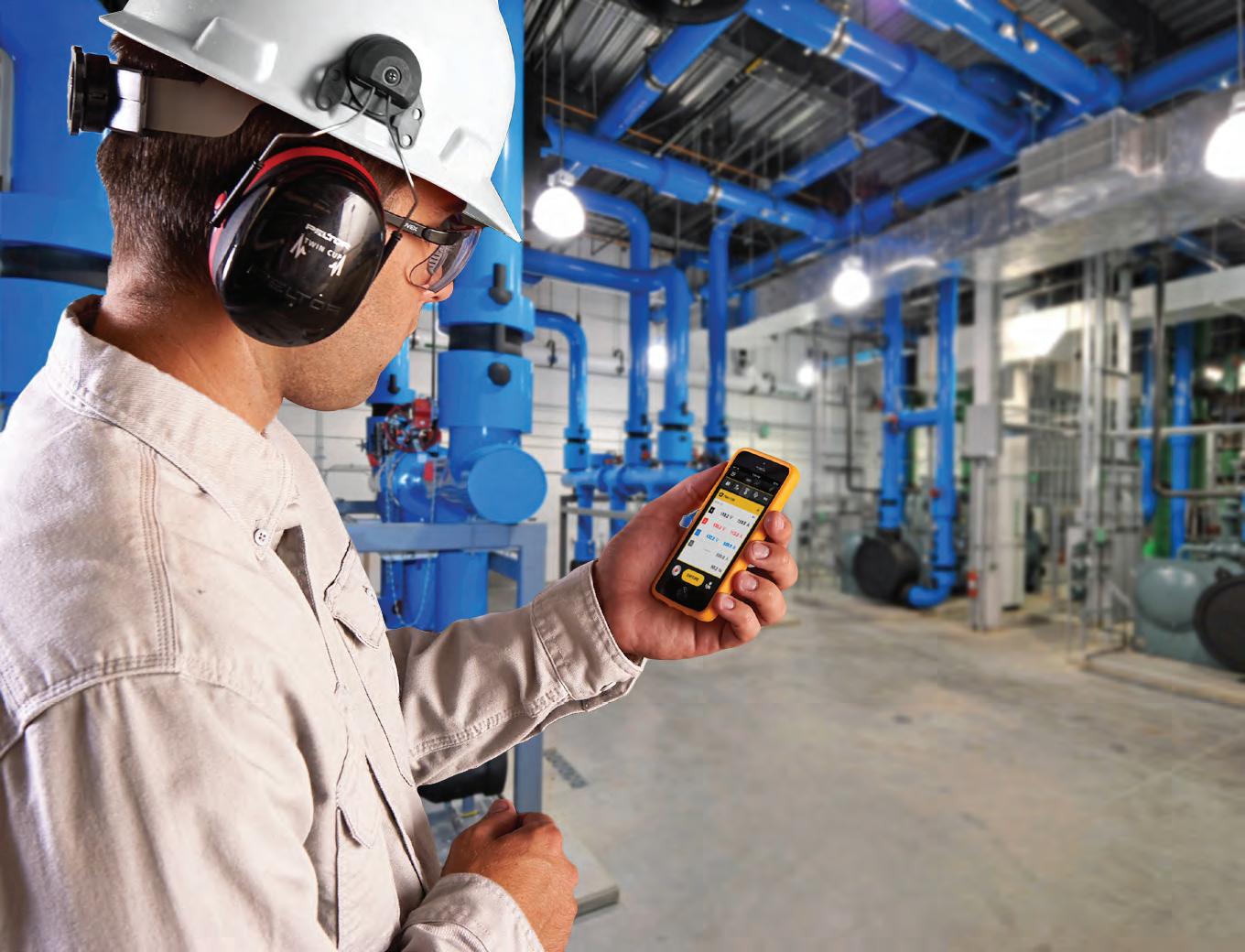
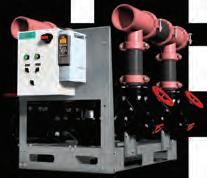
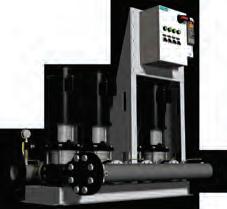

Thermo 2000 offers the Combomax and Buffmax Ultra. The 50 and 70 Combomax Ultra combined electric boiler and instantaneous water heater models offer performance levels from 4.5 kW to 29 kW for both residential construction and condominiums. Buffmax is a three-in-one buffer tank that also serves as a storage tank. Because of its design and configuration. It acts as a hydraulic separator for any hydronic application. It is available in seven sizes from 30 to 200 U.S. gallons. www.thermo2000.com
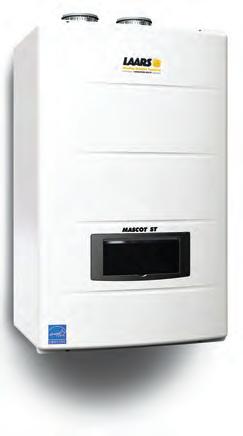
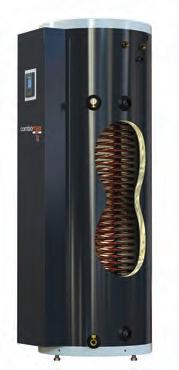
The Mascot ST condensing tankless water heater from Laars Heating Systems Company features a 0.96 Energy Factor (EF) efficient stainless steel heat exchanger, a full 10:1 modulation and is available in a 199 MBH size. It has a self-cleaning design that allows condensate to flow down along the tube walls and out through a condensate collection system. It has an advanced control system, a primeless condensate trap, zero clearance installation and vents up to 100 feet in PVC, CPV and polypropylene. www.laars.com
Models TC600 and TC1450 condensing hot water boilers from Parker Boiler are made of 316 stainless steel. The boilers have a pressure to 80 psi and operating temperatures of up to 210F. The boilers feature a thermal efficiency of 98 per cent, and can use natural or propane gas, biogas and #2 oil. They are available in LOW NOx and combination fuels www.parkerboiler.com
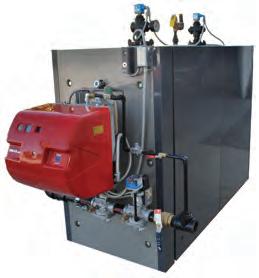
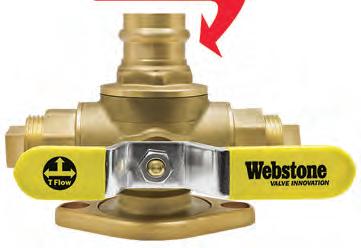
The Isolator with round flange from Webstone Valve features a round shape and bolt pattern designed to accommodate high efficiency variable speed pumps. Three flange designs with FIP, SWT or PRESS connections in sizes 1 ½ and two inches are available. All valves feature uni-body design, which helps to avoid a leak path at the flange. www.webstone.com

AXI-Therm Clean F9A and F9B boiler combustion side cleaner from Toptherm is designed for use on condensing boilers. The F9A removes combustion residue from the fire side of heat exchangers in stainless steel or aluminum condensing boilers, while the F9B cleaner and passivant is for the fire side of heat aluminum exchangers. Each bottle comes with an extended spray nozzle. www.toptherm.it
The stainless steel Compass wet rotor circulator from Armstrong Fluid Technology offers a high flow capacity and eight optional control modes. The SSU model features a threaded union connection that can adapt to copper, PEX and CPVC plumbing. www.armstrongfluidtechnology.com
Tempstar has introduced a geothermal product line. The units provide even temperatures and humidity control. Several packages are available including split and water-to-water geothermal models with a variety of options. Capacities range from 1 ½ to six tons. www.tempstar.com


Eastern Foundry and Fittings Inc. has introduced a new line of angled ball valves designed for use with water meters, commercial water heaters and boilers, fan coils and radiant baseboard systems. The valves feature reduced leak points and extra fittings. www.eff-fitting.com
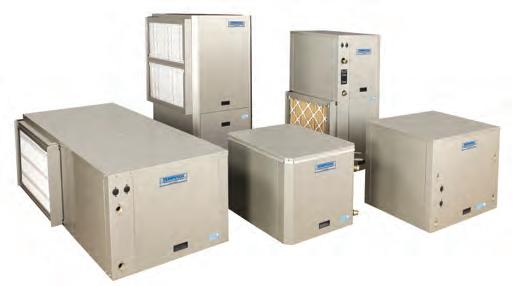


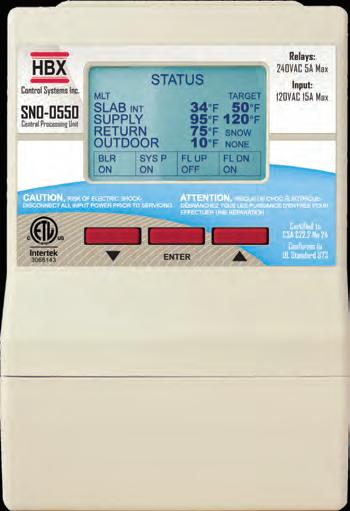






The Hydra Industrial hydronic furnace from Dettson is available in three phases. It offers modulation through durability contactors, is lightweight, and is available in 208 V, 240 V, 480 V and 600 V. www.dettson.com
The expandable Grundfos UPZC series of zone controls manage circulator and boiler control in residential hydronic heating systems. The non-networked devices control up to six heating zones and can be coupled together in various configurations. Boiler pumps, domestic hot water pumps, system pumps and pump priority are all controlled from the UPZC control. The zone relay control connects to standard thermostats using either two or three wires. The optional third wire provides 24VAC to thermostats that require external power. The UPZC operates in a cold start configuration with a call-for-heat from a thermostat. www.grundfos.com

The HeatLink Btu metering panel allows developers to install hot and cold water (DHW and DCW) meters, and thermal meters for each building unit. Each unit can then be charged according to its actual water and energy usage. Each panel includes a recessed housing with coin/ screwdriver locks, stainless steel manifolds in two, three and four loop configurations with a 1.5 U.S. gpm circuit flow rate and flow meters. It also includes a prewired 24Vac transformer and StatLink Base Module. www.heatlink.com
The universal B-Vent cap from Centrotherm Eco Systems allows for multiple flue configurations. It uses existing BVent as a chase, and features quick installation. www.centrotherm.us.com
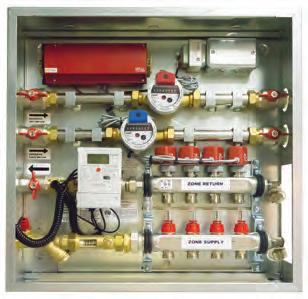


Weil-McLain Canada’s Evergreen high-efficiency boiler, delivers up to 96.5 per cent AFUE and is suited to larger residential and light commercial applications. It is available in 220, 299 and 399 MBH sizes. It is floor or wall mountable and features a stainless steel fire tube heat exchanger. www.weil-mclain.ca
The SNO-0050 snow melting control from HBX Control Systems is the latest product in the ThermoLinx Hydronic Network. By attaching the TMX-0100 (ThermoLink Wi-Fi module) to the SNO-0550 users can control snow melt systems. It features pre-set snow condition settings from very light to heavy. The HBX Zone App is suited to Android and Apple devices and allows users to turn off the snow melt system from any location. www.hbxcontrols.com










NO OTHER CONDENSING BOILER SCORES HIGHER THAN FTXL™ . In the light-commercial class, Lochinvar Fire-Tube and SMART SYSTEM technology make the FTXL boiler your best choice for efficiency, performance, flexibility and ease of installation.
































































































































RBI Flexcore symmetrical firetube boilers feature a conical shaped tube sheet coupled with rounded rectangular fire tubes that allow for even heat transfer. The boilers are available in four sizes ranging from 1500 to 6000 MBH, and have a 5:1 combustion turndown.
www.rbiwaterheaters.com
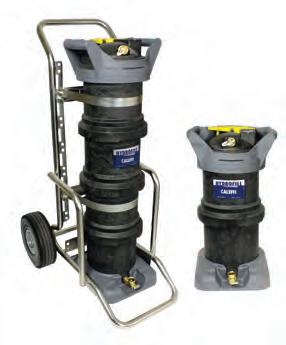
The Runtal Flow Form offers an industrial design in a modern radiator. It is available in numerous finishes in both hydronic and steam heat models. The radiator is suited for use in lofts, studios and galleries. www.runtalnorthamerica.com
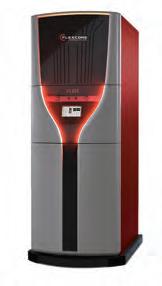
Hydrofill from Caleffi Hydronic
Solutions is a portable water treatment filling unit that produces demineralized water from site sourced water. It is suited for use in closed loop hydronic heating and cooling systems. The removal of salts and other soluble minerals helps to prevent premature equipment malfunction. www.caleffi.com

Legend’s M-8330 stainless steel manifold is designed for use in hydronic heating and cooling systems. It features built-in flow meters and the return header has easy to actuate circuit isolation valves. All assembled parts have EPDM O-rings and seals. www.ontor.com
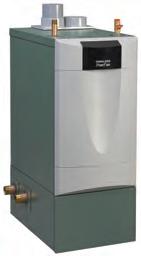
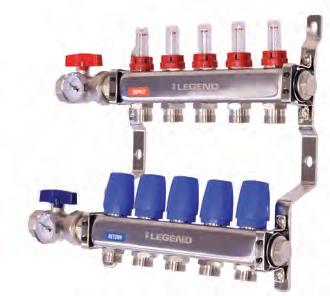
The Peerless PureFire natural or LP gas-fired condensing boiler from PB Heat, is suited to residential and commercial applications and is available for either natural or LP gas. The direct vent, sealed combustion residential models feature efficiencies of up to 95 per cent and are ENERGY STAR approved. www.peerlessboilers.com
Uponor North America has launched the touchscreen radiant thermostat. The Heat-only thermostat with touchscreen is designed for precise temperature control of residential hydronic radiant heating systems. It can operate the system based upon the air sensor measuring operative temperature, a floor sensor (purchased separately), or a combination of both.
www.uponor.ca

Hydronic System Design Expert Instructor: John Siegenthaler • Online: October 3 - December 11, 2016

Learn how to design state-of-the-art systems for residential and light commercial buildings that deliver unsurpassed comfort, efficiency and reliability. During Mastering Hydronic System Design, John Siegenthaler provides a detailed discussion of the design elements underlying modern hydronic heating systems. It presents both design concepts and design tools for optimizing hydronic heating systems in a variety of contemporary applications.
For more information and to register visit www.hpacmag.com/siggy
by

CB Supplies is proud to announce the launch of Vipert Potable & Radiant PERT Tubing, designed to perform as well or better than any other flexible plastic tubing in the market today.
IMPROVED FLEXIBILITY FOR EASIER INSTALLATION
With relaxed memory you’ll experience less spring back than PEX for easier installation
RECYCLABLE
VIPERT is recyclable and requires less energy to be produced than PEX
STRENGTH & DURABILITY
Excellent hydrostatic strength at high temperatures and very high burst pressures
BUILT FOR EXTREME TEMPERATURES
Maintains excellent flexibility in extreme cold and hot environments
25-YEAR WARRANTY
CB Supplies stands behind VIPERT with a 25-year warranty
EASY LINE IDENTIFICATION BY COLOUR
Eliminate hot and cold water cross connections
Potable: Radiant:
Manufactured by:
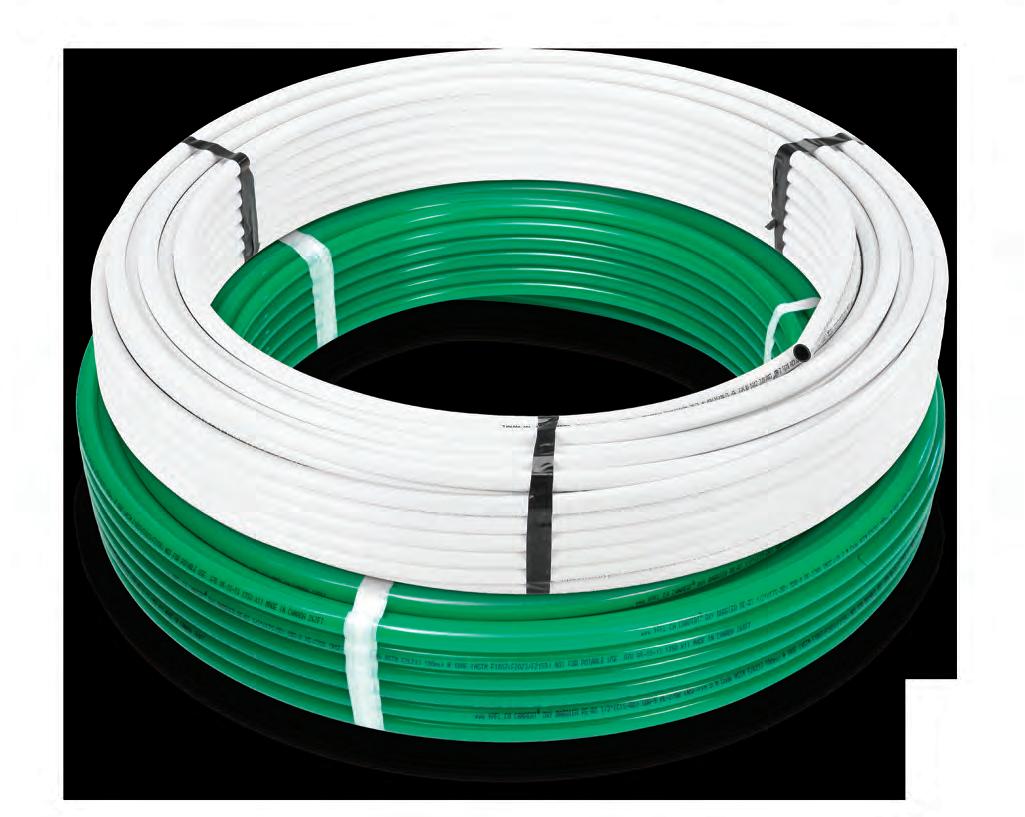
Viega’s eight new reducing tee configurations for the Viega MegaPress and MegaPressG system for joining schedule five to schedule 40 black iron pipe are available in ½ inch to two inch sizes. The products use modern cold press connection pipe installation and are suited to hydronic heat, chilled water, compressed air, fire sprinkler systems, low pressure steam and vacuum lines. www.viega.us
The Versatec Ultra single hydronic heat pump from WaterFurnace International Inc. has an energy efficiency ratio (EER) of 14.0 to 17.5 and a coefficient of performance (COP) of 2.9 to 3.1. It combines scroll compressors, R-410A refrigerant and oversized heat exchangers and is suited to commercial applications. It features a reversible control box, a range of operating temperatures, and is compact in size. The units can be used for heating only, cooling only or both. It has a heavy-gauge steel cabinet finished with a corrosion-resistant, polyester powder coat.
www.waterfurnace.com

Creatherm radiant floor panels are manufactured out of EPS and BASF Neopor. The panels are interlocking, which allows for precise tube layout. This eliminates the need to tie, clip, staple or screw hydronic tubing to the substrate. Floor panel sizes are two and four inches and feature a staggered snap-tight grid. Panels are available in 1.8, 2.8 and 3.3 inch thicknesses. www.creatherm.com
The CB combination boiler from Noritz delivers hot water to both plumbing and hydronic heating applications. Two models are available. The CB180DV model has a maximum Btuh of 180 000 for hot water and 100000 Btuh for space heating. The CB199DV model has a maximum Btuh of 199000 for hot water and 120000 for space heating. www.noritz.com
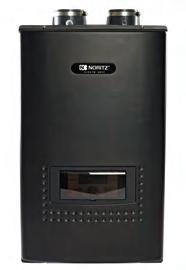

Allows site water to be used for filling any hydronic system while meeting the strict water quality requirements of boiler and glycol manufacturers

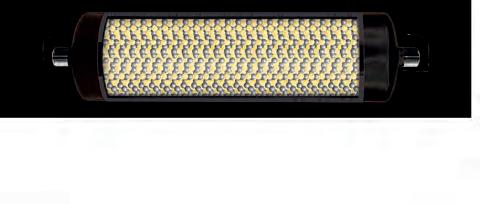

BY STEVE GOLDIE
hen I sat down to write this article, my intention was to take a look at some of the most common issues in residential hydronic installations and ex amine the remedies. In the interest of not being repetitive I did a quick review of my most recent articles and I re alized that I can be pretty negative.
Considering how much of my week gets filled up with trouble shooting, I could easily justify this as being somewhat of an oc cupational hazard. However, rather than pressing on with my “what not to do” crusade, I have chosen to embrace a more pos itive approach, highlighting some of the encouraging and more positive trends in our industry. Call it positive reinforcement or catching more bees with honey, whatever the case it is the new improved “glass half full” Steve Goldie.
The first positive trend is the proliferation of condensing boiler technology. Condensing boilers are by no means new. They first began appearing in the residential market about 15 years ago. In those early days there were few options and there was little un derstanding of how to properly install and apply this new technol ogy. There were plenty of naysayers claiming potential fuel efficiency savings, if any, could never justify the extra costs of the boiler and its more complex installation.
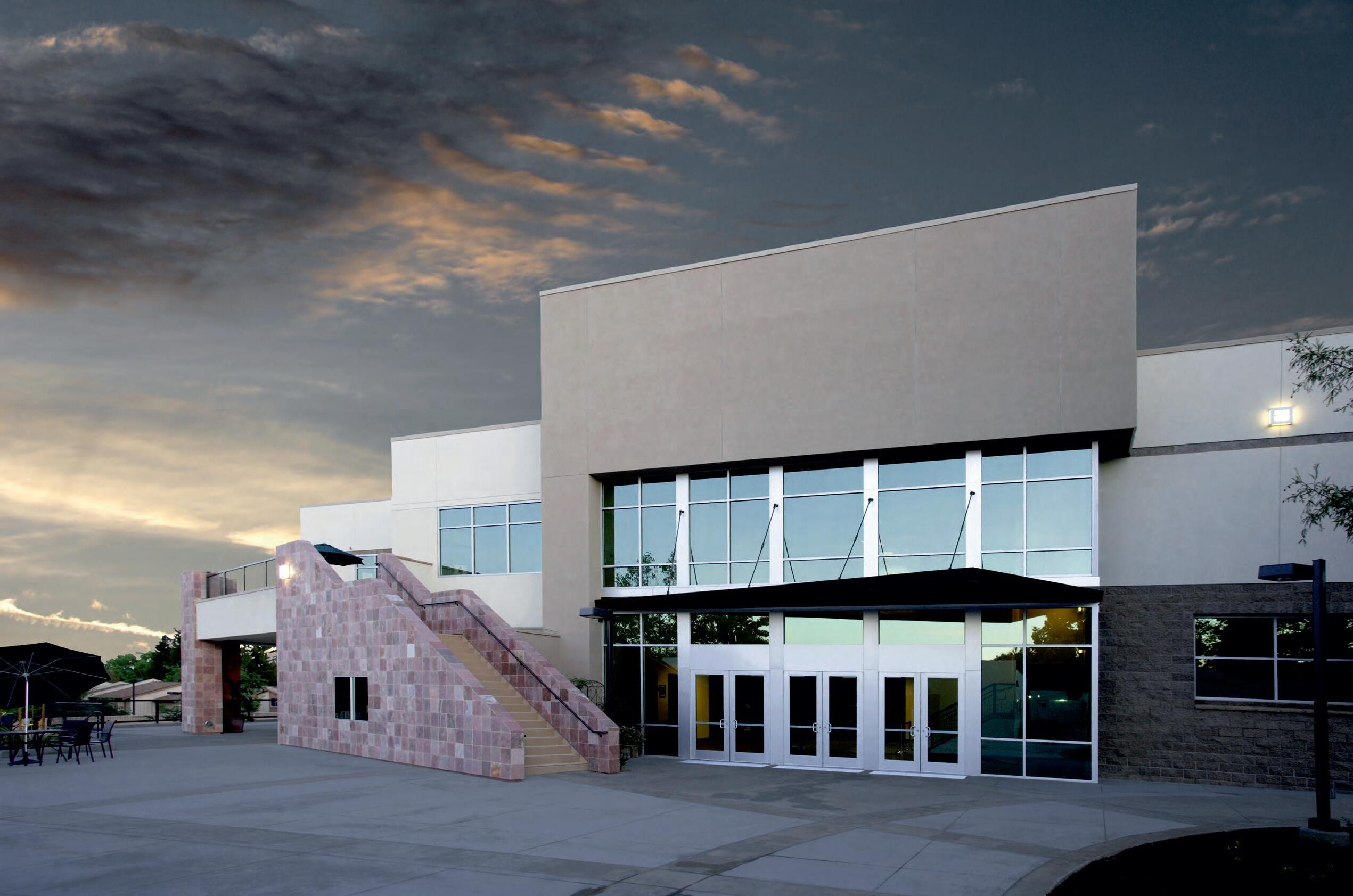
Those days also were marked by far too many poor and improper installations. As with all new technology, there was a learning curve, a rather steep one in this case. Condensing boilers were a tough sell and the durable, tried and true cast iron atmospheric still dominated the market.
Today the landscape is far different; the number of condensing boilers available is staggering. I can offer you a good, better and best condensing option in just about any size range. Would you like floormount or wallmount? No problem we have both. Low mass, medium mass and even high mass designs are all available.
This proliferation of condensing boiler options has occurred for a number of reasons, including regulatory changes that mandate higher efficiency standards. Most of all these boilers exist because they work and the market demands them. Are there still naysayers out there promoting the virtues of old atmospheric technology? Of course there are, I can probably still find you people who believe the world is flat as well and just because they say
would entail removing the old boiler, often a gravity system with no pump and oversized piping, and connecting the new boiler return and supply to the corresponding headers of the old system. There was not a lot of thinking to be done and very few residential systems had any zoning. They were simply one pump systems with a supply and a return. The difference between a good install and a bad install would simply come down to neatness of the piping. I have seen more than a few that were actually piped backwards and they still worked for years.
This is not meant as a criticism, I am plainly stating how things were. Most installers, my early self-included, simply did not have a thorough understanding of good piping practice because we did not need one to get the job done. The old saying, “necessity is the mother of all invention,” surely applies here.
By the late 80s and early 90s the advent of PEX pipe and the growing popularity of in-floor heating created renewed demand for hydronic heating, not simply in retrofits but in new housing. This new demand also created a need for a better trained, more knowledgeable hydronic installer. At times our industry has struggled to meet this need and most of us have more than enough examples of piping nightmare jobs we have encountered, however, I truly believe that there are more and more qual -

From digital controls and condensing efficiencies to unsurpassed durability and application flexibility the KN-Series boiler is at the head of the class. knseries.com
• Cast Iron Condensing Heat Exchanger
• HeatNet Digital Controls w/ Remote Monitoring
• Variable Volume Flow (10:1)
• Full Modulation
• Industrial-Grade Ignition System
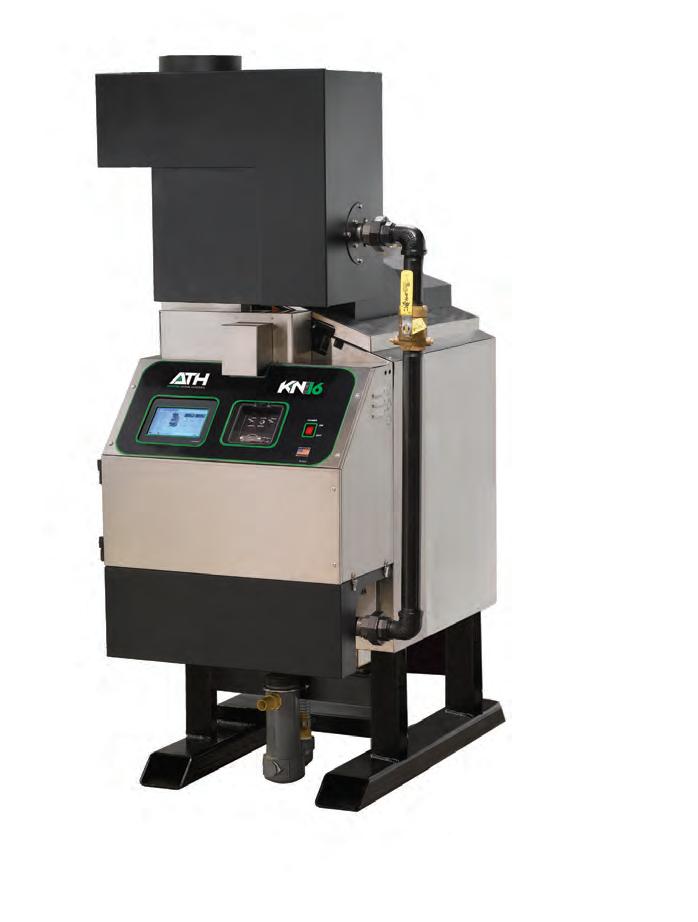
ity installers being developed all the time. Training is offered in many different ways by many entities such as wholesalers, manufacturers, trade organizations, community colleges, The Canadian Hydronics Council and so on. I do not want to get into the debate of whether or not hydronics installer should be a recognized trade or not, I will just say that there are many resources available to anyone willing to learn. In my opinion many are indeed learning and the level of competence seems to be on the rise, so glass half full Goldie is feeling encouraged.
The third encouraging trend I will mention is the growing popularity and availability of energy efficient variable speed pumps. Variable frequency drive (VFD) pumps are to pumping what modulating burners are to boilers. Rather than have a fixed speed pump chosen to meet an estimated or theoretical load, VFD pumps have sensors giving actual feedback of either pressure drop or temperature difference in a system. This information allows these smart pumps to calculate the actual load, and ramp up or slow down their speed accordingly to deliver the gallons per minute required, reacting and adjusting accordingly if and when this requirement changes. VFD pumps have been available for quite a few years now, but the past couple have

seen a significant surge in popularity, partly due to lower costs and partly due to a better understanding of the real benefits they offer.
When I started in wholesale many would have said I was crazy if I predicted that one day every boiler we sold would be a modulating condensing model, and yet, that is pretty much the reality. We are not far away from the day when virtually every pump sold by wholesalers will have some form of VFD technology built in. I am confident that more and more of the people installing these technologies will be knowledgeable and competently up to the task. This might all mean that my troubleshooting career will be over but no worries, glass half full Goldie will just look for a job as a positive-thinking motivational speaker.

Goldie photo Steve Goldie learned his trade from his father while working as plumber in the family business. After 21 years in the field, he joined the wholesale side of the business in 2002. He is frequently called on to troubleshoot systems and to share his expertise with contractors. He can be reached at sgoldie@nextsupply.ca.
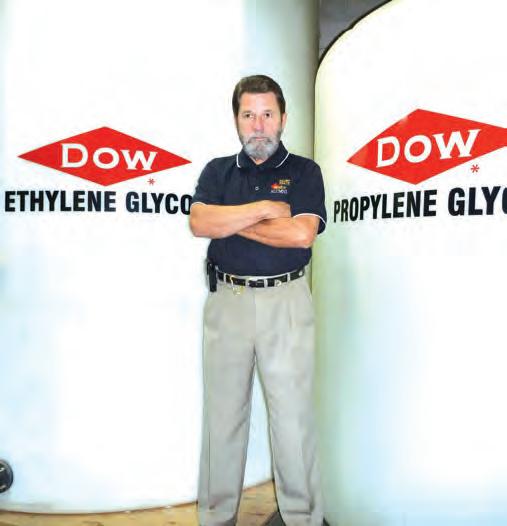













BY ROBERT BEAN
Back in 2004 I penned an article called Radiant Mythology: 22
Myths about Radiant Heating. In the years since the first copyright of the article on www.healthyheating.com, that article has brought me the immense pleasure of watching tightlywound individuals implode and explode through their nastygrams which arrive in my inbox. The myths continue and have expanded to well over 40 “myth-understandings” about radiant energy and radiant systems.i Here are a few of my favourites.
1) Radiant floor heating was “invented by the Romans.”
The kang was used predominately in ancient northern China and was a raised heated living and sleeping surface Constructed with a fireplace and, depending on source of fuel, built without chimneys (for charcoal) or with chimneys for wood and other combustibles. Hot gases followed flues formed or constructed into the masonry or earth, through which heat was conducted to the surface (adobe, brick, or stone). Then, this heat radiated to the occupants and room. The by-products of the combustion called “dragon’s breath” were, in some cases, efficiently used for space heating and cooking.
This is not even close to being accurate. The earliest forms of radiant floor heating emerged well before the Romans ever showed up. Present day archeological sites in Asia and North America are uncovering forms of floor heating carbon dated back to 1000 B.C. That is hundreds of years before the Romans embellished the idea. But the application goes back even further with combination cooking and radiant space heating systems found in Korea and China dating back to 3000 to 5000 BC.
It is time the radiant industry embraced its past and correct the sins of those continuing to distort history.ii
2) Radiant floor heating “creates the same feeling as sitting in the sun or in front of a fireplace.”

It is nice to think of floor heating in these terms but in reality if this were true you would bake to death. It is important to understand the sun and radiant floors operate on two completely different elec -
tromagnetic wave lengths.iii The sun or fires operate at high intensity short wave and floor heating operates at low intensity long wave.
Since the human body and floor heating operate in a similar temperature range they coexist within an almost identical long wave range. Translation: radiant heating systems do not heat you up in the sense of the sun or a fire, rather they enable you to retain more of your own heat by reducing the loss of body heat via radiation. Look at it this way–the temperature of your skin fluctuates and varies from your feet at approximately 85F (29C) to approximately 96F (36C) at your head. Remember, hot goes to cold. So what do you think is going to happen with heat transfer when your body is operating warmer than the floor? Feeling the heat of the sun from the floor? Not likely. Feeling the retention of your own heat–absolutely. Call it self-love.
3) Radiant floor heating “saves energy.”

Energy can neither be created nor destroyed, therefore it cannot be saved like
the accumulation of coins in a piggy bank. Energy is always being preserved in its current state or converted with conservation to another state but it is never saved–not even by radiant systems. The concept of saving energy is likely the biggest disservice we have allowed to happen to mankind. It makes people focus on the wrong targets for sustainability.
4) Radiant floor heating “is energy efficient”.

This is going to shake some cages. First let me state unequivocally that radiant heating and cooling systems empower boilers, heat pumps, chillers and solar systems to achieve their maximum rated peak performance. Full stop. No one with a basic understanding of heat exchanger design can debate this principle. But an energy efficient machine does not equal efficient use of energy. For example, consider the combustion temperature of 3200F (1700C) in a 97 per cent boiler for creating 100F (38C) fluid temperatures just to maintain a space temperature of 72F (22C).
When the temperature generated at 97 per cent efficiency is approximately forty seven times hotter than the target temperature your brain should do mental gymnastics.iv Air only folks–do not get self-righteous, this also applies to furnaces. Neither appliance, regardless of its rating should be considered energy efficient if it wastes more than 90 per cent of the work potential.
This is a big broad topic but let me wind this myth up by stating radiant systems are first and foremost enablers. They allow cooling and heating appliances to
transfer heat as intended by the manufacturer’s engineers and support the reduction in system power consumption used in motors.
5) Radiant floor heating “causes hardwood floors to crack.”

This myth still comes up. Consider that 100 per cent of all hardwood flooring complaints in buildings conditioned exclusively with air did not have radiant floor heating to blame. What is up with that? The number one cause of wood deformation is moisture changes not the operating temperature of a well-designed floor. Control the absolute moisture in the wood and space and the differentials between the two and you control the deformation.v There is a caveat: if the floor heating system has to operate at such a high temperature as to be the cause for damage, the very ethos of low temperature floor heating has been completely ignored in the design process. Shame on the designer who ignores this first principle. We will hunt you down and put you in the stockade.
6) Radiant floor cooling “causes condensation.”
Along the same logic as above, 100 per cent of all moisture-related complaints in buildings conditioned exclusively with air did not have radiant floor cooling to blame. Understand all buildings with all types of HVAC systems need to manage moisture for controlling biologicals, dimensional
changes in hygroscopic materials, to mitigate hydrolysis, to preserve artifacts, and for thermal and respiratory comfort. If you
control moisture for these far more important factors, condensation on radiant cooling surfaces becomes a moot point. As with the hardwood floor myth, the problem is moisture not temperature; sweating the details on moisture control means no sweating on any cool surface.vi
7) Radiant floor heating “causes overheating with solar loads in high performance homes.”

Have you ever placed an ordinary thermometer in the sunlight on the floor inside your home on a winter day? What does it read and what does this tell you? In my highly-acclaimed, non-government funded research project at the international headquarters of www.healthyheating. com; using a meat thermometer from the kitchen cupboard–I measured floor temperatures up to 88F (31C) through double
pane, lowE glass on a cool -8F(-22C) February afternoon in Calgary. Eighty-eight Fahrenheit is about 12F (7C) higher than the fluid temperature required in a high performance home heated with radiant. Again, hot goes to cold.
Now put on your thinking caps. If the floor surface temperature heated by the sun is hotter than the fluid in the radiant system, what mode is the floor system in? Heating or cooling? Also, if the floor warmed by the sun is hotter than all the other surfaces what do you think is happening to the radiant space temperature? The room does not feel hot as a result of the embedded tubes, you feel hot because your body cannot shed its heat fast enough since the room’s surfaces are not cool enough to extract sufficient body heat. The problem is not new and neither is the solution. Gain control over solar gains and you gain control over the overheating in all buildings with all types of systems.
You will hear the myths presented above and many more as you go about designing, installing and maintaining hydronic systems. Your clients will be well served if you keep an open mind and have the knowledge to determine fact from fiction.

Robert Bean, who is president of Indoor Climate Consultants Inc., is a Registered Engineering Technologist in building construction through the Association of Science and Engineering Technology Professionals of Alberta and a Professional Licensee in mechanical engineering through the Association of Professional Engineers, Geologists and Geophysicists of Alberta. He has served two terms as an ASHRAE distinguished lecturer, serves on ASHRAE committees TC 6.1 (Hydronics), TC 6.5 (Radiant), TC 7.4 (Exergy) and SSPC 55 (Thermal Comfort) and is a recipient of ASHRAE’s Lou Flagg Award.
References
i http://www.healthyheating.com/Radiant_Mythology/ Radiant_Floor_Heating_Myths_. htm#.V1siVvkrJaQ
ii B ean, R., Olesen, B., Kim, K.W., History of Radiant Heating and Cooling Systems, ASHRAE Journal, Part 1, January, 2010
iii http://physics.info/radiation/
iv B ean, R. 2010. Master Yoda – The E5 Jedi, HPAC January/February
v Wood Handbook, Wood as an engineering material. General Technical Report 113. M adison, WI: U.S. Department of Agriculture, Forest Service, Forest Products Laboratory
vi B ean, R. 2016. The logic of moisture management: Condensation is not the dark side of chilled water and radiant cooling systems. HPAC February


• Primary loop with pump and the choice of 1 to 6 secondary zone pumps all within one wall mounted station
• PSS Circuitry allows each zone to be set, supplying either high or low temperature output from a condensing boiler
• Boiler supply and return is available in either bottom left or bottom right side of the station
• All field settings can be adjusted using jumpers
• Variety of pump options available



BY JOHN SIEGENTHALER
Hydronics technology has long been known for unsurpassed heating comfort.
It has also been used for cooling, primarily through chilled water distribution systems in commercial and institutional buildings. This well-established and highly successful track record is, in part, based on the thermal properties of water. It is also based on the versatility of hydronic systems in adapting to a wide range of applications. No other heat transport material provides the versatility, safety, reliability, energy efficiency, or environmental compatibility of water.
Over the last few years, a new method for moving thermal energy through buildings has appeared on the North American market. This approach uses refrigerant as the transport media throughout a building and is known as either a variable refrigerant flow (VRF/VRV) system, or a variable refrigerant volume (VRV) system.
VRF/VRV systems use multiple interior heating/cooling terminal units that have refrigerant passing through them, as illustrated in Figure 1. The refrigerant flow rate through each terminal unit varies depending upon the heating or cooling load that terminal unit is trying to satisfy.
HVAC system designers, architects, and building owners have many choices when it comes to heating and cooling buildings. The choice of system should consider up front cost, operating cost, long-term serviceability, expandability, reliability, safety, and environmental responsibility. With these criteria in mind, let’s examine the benefits that modern hydronic systems offer relative to VRF/VRV systems.
BENEFIT #1: HYDRONIC SYSTEMS CAN BE USED WITH MANY ENERGY SOURCES.
Hydronic heating and cooling systems are easily adaptable to a wide variety of current and future energy sources. These devices include boilers fueled by natural gas, propane, or fuel oil, geothermal and air-to-water heat pumps, and renewable energy heat sources such as solar thermal collectors and biomass boilers. Other potential heat sources include waste heat recovery, off-peak thermal storage systems and combined heat and power (CHP) systems.
In some cases two or more of these heat sources can be combined in the same system. They can share the load based on the most favorable operating conditions for each source.
Likewise, many options exist as sources of chilled water for hydronic-based cooling systems. They include chillers and heat pumps operating on standard vapour compression refrigeration cycles, as well as gas-fired absorption chillers, and even water drawn from large/deep lakes.
VRF/VRV systems are solely sourced by electricity.
BENEFIT #2: HYDRONIC SYSTEMS ALLOW FOR SIMPLER FUTURE MODIFICATIONS.
When older commercial or institutional buildings are upgraded, their existing hydronic distribution system, or portions of that system, may be reusable in combination with a new central plant for producing heated and chilled water.
When VRF/VRV systems are used, the existing hydronic piping and all hydronic terminal units must either be decommissioned in place or removed from the building. All new copper
piping and refrigerant-based terminal units must then be installed to each conditioned space. This can be highly disruptive to the normal use of the building.
BENEFIT #3: HYDRONIC SYSTEMS REDUCE RISKS ASSOCIATED WITH REFRIGERANT LEAKS.
It is possible for a leak to develop in either a hydronic heating / cooling system, or a VRF/VRV system. A leak in a hydronic system is generally easy to detect and the material leaking is just water or a mixture of water and antifreeze. Well-designed hydronic systems provide numerous isolation valves that allow the portion of the system where the leak is to be isolated from the remaining parts of the system. Hydronic systems that distribute heating or cooling energy produced by a refrigerantbased source can be designed so that the refrigerant-containing devices are confined to a mechanical room, or located outside the building.
A leak in a VRF/VRV system is a serious and potentially dangerous matter. VRF/VRV systems contain much more refrigerant compared to hydronic systems served by a typical heat pump or direct expansion chiller. Under certain conditions, a single leak can be responsible for a complete loss of refrigerant from the system. Large refrigerant leaks can require immediate evacuation of the building and intervention of Hazmat teams.
Refrigerants such as R-410a are heavier than air. If a leak develops in the interior portion of a VRF/VRV system the refrigerant could accumulate in the lower portions of rooms with highest concentrations near the floor. Such accumulation will displace air in the room. In spaces with minimal ventilation it is possible for refrigerant concentrations to reach values that could render occupants unconscious and ultimately lead to suffocation.
ANSI/ASHRAE standards 15 and 34 define specific refrigerant concentration limits based on pounds of refrigerant per thousand cubic feet of interior volume, beyond which acute toxicity is expected. Those designing VRF/VRV systems should verify that the amount of refrigerant that could be lost due a leak, and the smallest space into which this refrigerant could accumulate, are in compliance with this standard.
BENEFIT #4: HYDRONIC SYSTEMS USE LESS DISTRIBUTION ENERGY.
Although proponents of VRF/VRV systems point out that no circulators are needed to move refrigerant throughout a building, electrical energy is still required just to move refrigerant gas and liquid through piping. That energy is supplied as electrical input to the system’s compressor(s). The electrical energy consumption for moving refrigerant through a VRF/VRV system, per unit of heat or
cooling energy delivered, is significantly higher than that required for a well-designed hydronic system, as shown in Figure 2
Power required for distribution system (% of compressor power)
medium pressure VAV low pressure VVT hydronic
Distance from energy source to load (feet)
Piping for hydronic and VRF
Ducting for VAV and VVT
Figure 2 compares the energy required to move the cooling effect through a building. It assumes that the thermal energy is supplied by a vapour/compression source such as used in a VRF/VRV system. The vertical axis represents the percentage of the compressor power required to move (not create) the cooling effect generated by the refrigeration system. The horizontal axis represents the distance from the thermal energy source (e.g., boiler, outdoor unit, etc.) to the load.
The VRF/VRV system uses about six per cent per 100 feet of refrigerant line set, compared to the hydronic system, which uses about 0.3 per cent per 100 feet of distribution distance (e.g., 200 feet total piping circuit length).
BENEFIT #5: HYDRONIC DISTRIBUTION SYSTEMS ARE NOT DEPENDENT ON SPECIFIC REFRIGERANTS.
Hydronic systems are not subject to radical redesign or modification based on future changes in refrigerants.
Over the last two decades, highly successful refrigerants such as R-22 have be phased out of the North American market due to concerns over their global warming potential. Replacement refrigerants have been and continue to be developed. The properties of these replacement refrigerants have mandated changes in components such as refrigerant piping and the oils that are carried throughout the system with the refrigerant.
While it is impossible to know what refrigerants will remain acceptable over the next 10 to 20 years, efforts to determine optimal future refrigerants continue. This could lead to breakthroughs that allow refrigerants such as carbon dioxide or propane to emerge as the new standards. Eventually, legacy chillers, heat pumps, or VRF/VRV systems that rely on present
day refrigerants could be rendered obsolete. The tubing that carries present day refrigerants throughout a building in a VRF/VRV system may not be suitable for future refrigerants or their associated oils. Upgrading a legacy VRF/VRV system could require replacement of piping, terminal units, or other hardware, as well as recycling of refrigerant and oils. Such changes would be very costly.
Many heating and cooling systems can benefit from thermal storage. The high heat capacity of water makes it an ideal thermal storage material for both heating and cooling systems. The heated or chilled water may be produced by heat pumps or chillers at times when off-peak electric utility rates are in effect, which significantly reduces the cost of delivered thermal energy.
Water-based thermal storage can also be used in systems that have renewable energy heat sources such as solar thermal collectors, air-to-water heat pumps, or biomass-fuel boilers. Combined heat and power (CHP) systems also benefit from water-based thermal storage.
Thermal storage is easy to implement when a hydronic heating source and distribution system are used. In many systems, the water that stores thermal energy in a tank can eventually pass through the distribution system without need of any heat exchangers. This eliminates the cost and complexity of the heat exchanger(s) and the thermal penalty imposed by their use.
The use of thermal storage for space heating and cooling with VRF/VRV systems is not practical. While it is possible to transfer heat from refrigerant to water using heat exchangers, it is not practical to recover that heat back into refrigerant for subsequent delivery to VRF/VRV terminal units.
Hydronic systems can use traditional piping materials such as copper tubing or steel piping. Modern hydronic systems can also use polymer-based piping materials such as PEX, PEX-AL-PEX, PERT and polypropylene. These piping products are less expensive and generally easier to install than the all copper piping systems required with VRF/VRV systems.
VRF/VRV systems use copper tubing. Figure 3 shows some of this tubing being installed in the hallway of a commercial building. A multi-storey building with such a system could contain several thousand feet of copper tubing, with hundreds of brazed or mechanical joints. Hydronic systems can use larger piping for mains and thus reduce the linear footage of piping and joints that need to be installed.
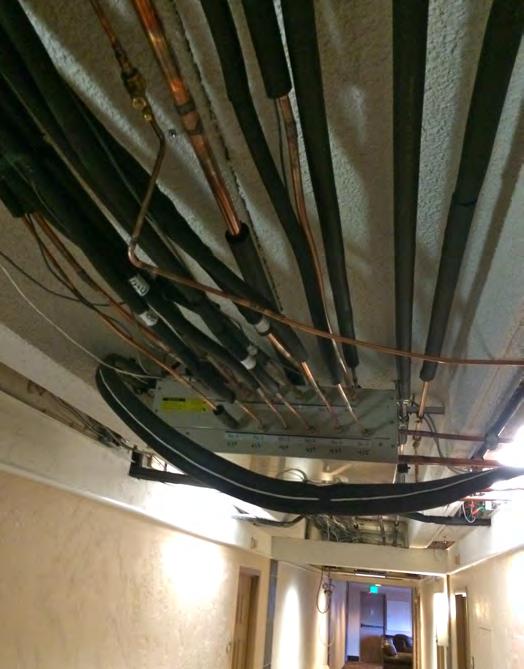
Hydronic radiant panel heating has long been recognized for providing unsurpassed thermal comfort. Warm water from a variety of heat sources can be supplied to these panels. They create interior surface temperatures and air temperature profiles that are ideal for human comfort. They operate silently, with minimal air movement and deliver heat to spaces using a fraction of the distribution energy required for forced air systems or VRF/VRV systems.
VRF/VRV systems are limited to air as the final means of conveying heat or cooling effect from refrigerant into heated spaces. As such, they are not well suited to interior spaces with tall ceilings, or applications where internally generated dust would quickly clog air filters.
In addition to space heating and cooling, hydronic systems can be configured to provide high capacity domestic water heating, snowmelting, and pool heating. These ancillary loads can be prioritized to reduce the total thermal capacity needed.
VRF/VRV systems are not currently used for such ancillary loads.


95% AFUE, Wall Hung Condensing Hot Water Boiler
(Available in both Combi and Space-Heating Only Models)
AI - Artificial Intelligence Control

...that thinks for itself
Automatic Setup on Initial Startup


Recognizes Natural or LP Gas
Continuously Monitors Combustion
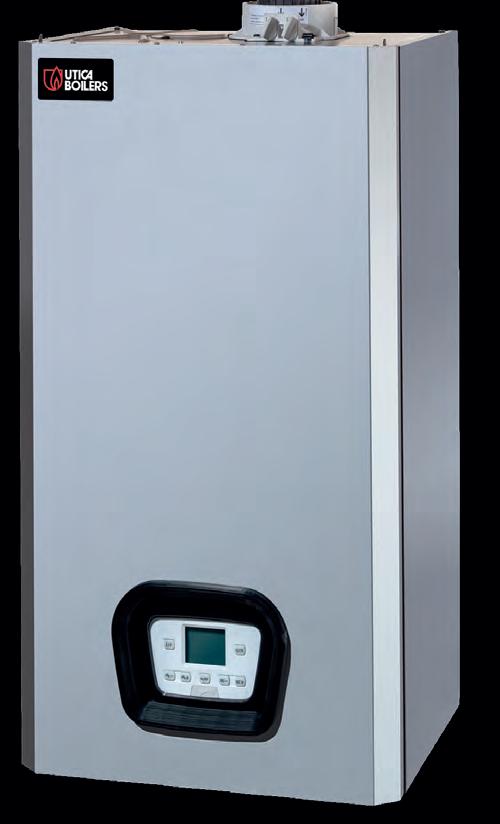
A well-designed and properly maintained hydronic heating or cooling system is a long term investment. Although the life of the original heat source or chiller is typically 15 to 25 years, the distribution system (the piping, valves, heat emitters and terminal units for cooling) can usually provide many decades of service. Many hydronic systems that were installed over 50 years ago remain in operation today.
The 2015 ASHRAE Applications Handbook lists the medium service life of air-to-air heat pumps and similar refrigeration-based HVAC equipment using fixed-speed compressors and outdoor condenser units at 15 years. There is no listing specifically for VRF/VRV equipment because of its relatively new use in the North American market. Anticipated life expectancies should be similar to air source heat pumps with outdoor condenser units.
The piping, valves, circulators and terminal units required in most hydronic systems can be sourced from many companies with distribution networks across North America. This provides options when the system is initially designed, as well as when maintenance or replacement parts are needed in the future.
Most VRF/VRV systems are manufactured in Asia and many use proprietary components. The availability of these specialized components may be more limited, especially in emergencies where they are needed quickly.
Most manufacturers of VRF/VRV systems require installation and maintenance by factory-trained technicians. These technicians often use specialized
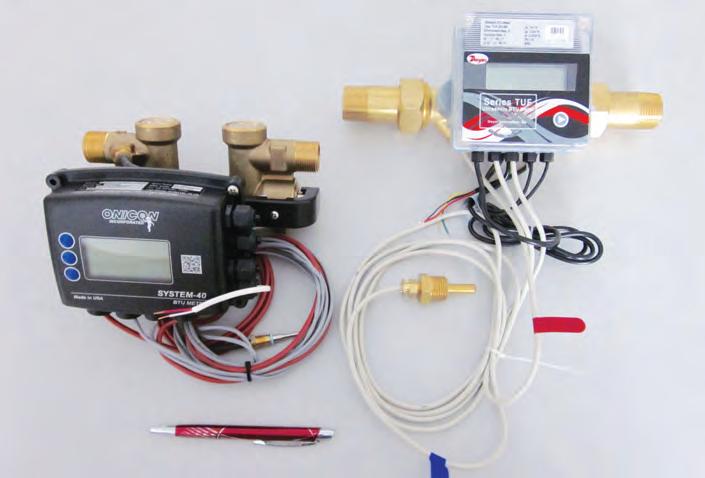
diagnostic equipment for troubleshooting. The rapid evolution of electronic controllers and firmware used in VRF/VRV systems underscores the need for readily available, trained technicians who can keep these systems operating and do so at competitive rates.
In hydronic systems, an accurate measurement of flow rate and temperature drop (from supply to return) allows for a simple calculation of the rate of heat transfer. The total thermal energy that passes a specific point in the system can also be determined by integrating these measurements over time.
Several companies now offer “heat metering” hardware that can be installed easily in a range of hydronic heating and cooling systems. Figure 4 shows two examples of ultrasonic-based heat meters that can be used in applications such as apartments, condominiums and leased commercial space.
Heat metered systems allow owners of multi-tenant buildings to know what each tenant’s thermal energy use was and to invoice them accordingly. Such systems can centralize heat production and
chilled water production, which provides many technical and economic benefits.
Water remains the gold standard when it comes to moving thermal energy through buildings. Hydronic systems can provide decades of reliable, safe, and efficient delivery of heating or cooling from a wide variety of sources. They can expand as building configurations change and be retrofitted with different heating and cooling sources as energy markets change, or the original heating/cooling sources reach the end of their service life.
Be sure to consider the points discussed above when evaluating options for heating and cooling systems.
John Siegenthaler, P.E., is a mechanical engineering graduate of Rensselaer Polytechnic Institute and a licensed professional engineer. He has over 34 years experience in designing modern hydronic heating systems. Siegenthaler’s latest book, Heating with Renewable Energy, was released recently (see www.hydronicpros.com for more information).

Booth # 618
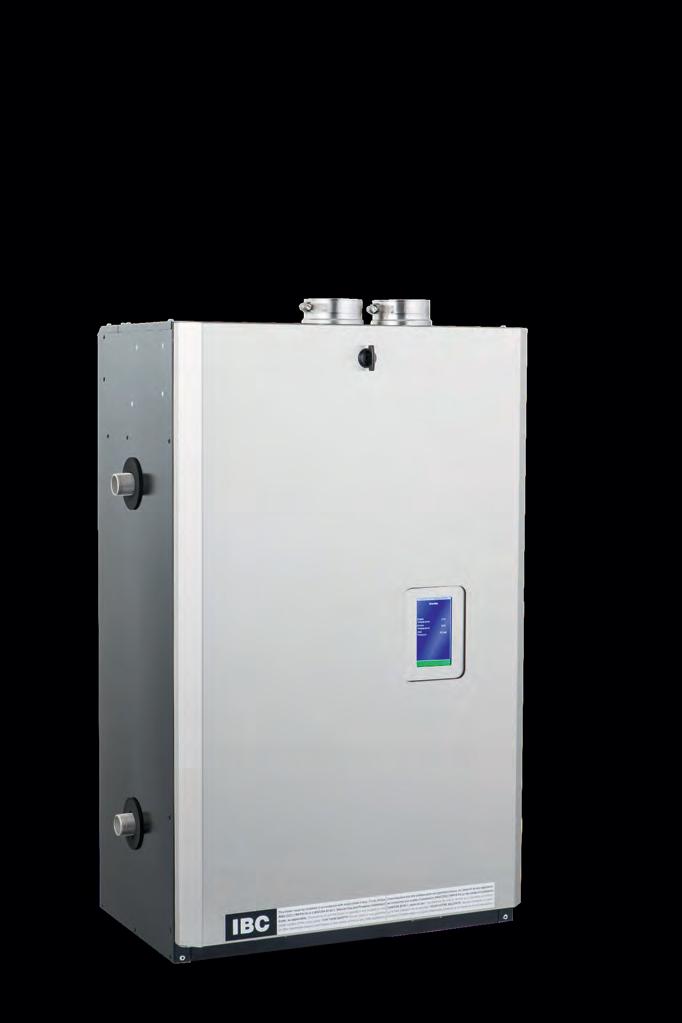

Program your boiler in seconds with an interview style, quick start menu
User-friendly interface for contractor and home owner
Built-in internet connectivity
Remote monitoring & diagnostics
USB Port for software updates and copying settings to the next boiler
Seamlessly integrate IBC BACnet enabled boilers into your current building automation system
Ability to manage up to 4 different loads and 5 pumps
Automatic altitude adjustment
Intuitive alert system with plain English warnings & error messages

Pre programmed values for all load types
Load Combining to allow 2 loads to operate at the same time
All boilers fully capable of directly connecting to most DDC building automation systems


Building on the success of our industry-leading 5 button boiler control launched in 2003, the new Touch Screen Control makes it even easier to set up and monitor your IBC boiler.
With intuitive features like Express Setup, Easier Diagnostics & Intuitive Alert System, plain English Warnings & Error Messages your VFC or SL Series boiler has never been easier to use.

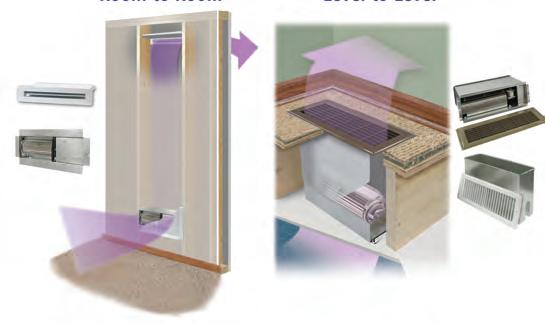
The AireShare is a through wall and through floor/ceiling transfer fan from Tjernlund Products Inc. The fans circulate heated or cooled air from fireplaces, stoves, electric baseboards, split system ductless air conditioning and window air conditioning units to adjacent rooms. AireShare is available for both horizontal air flow and vertical air flow, and features a low profile, quiet intake blower and unobtrusive grilles. www.tjernlund.com
The round access panel from FF Systems is made of an aluminum frame that virtually blends into the wall or ceiling once installed. It is equipped with concealed mechanical touchlatches, and is available with either 1/2 inch or 5/8 inch drywall. The door is fully removable for improved functionality. www.ffsystems.ca
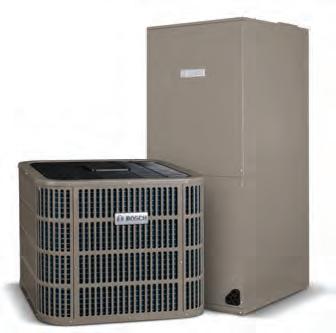
The inverter ducted split system air-to-air heat pump from Bosch has modulating capa bilities that self-adjust to provide users with consistent room temperature. The system features a 9.5 heating seasonal performance factor (HSPF) and has varying operating speeds depending on wheth er it is cooling or heating. Condenser units are available in three to five tons and the air handler unit sizes range from two to five tons. www.boschheatingandcooling.com
SchwankAir has introduced the 1000/1000H series air curtain. It can be mounted above a door and is available in three, four and six foot models. Multiple units can be stacked together for larger door widths. The unit has a high and low air flow setting, and comes with an automatic activation feature, which allows the unit to turn on and off automatically as the door opens and closes. SchwankAir also has a heated air curtain option with its 1000H series. www.schwankair.com
SPX Cooling Technologies Inc. has introduced ClearSky plume abatement technology. It aims to improve cooling tower efficiency and reduce unwanted water vapour plumes when integrated with Marley fielderected counterflow cooling towers. ClearSky is a fully integrated system that uses a series of PVC heat exchanger modules in the tower plenum to condense the moisture in ambient air before it exits the tower. www.spx.com
The Dynamic Air Diffuser (DAD) acts as both a diffuser and ceiling fan. It uses the forced air from the operating HVAC units in the building and requires no electricity. Airflow from the attached ductwork flows through the diffuser’s hub and out the linear slots of the fan blade, which turns the fan. The DAD is available in custom colours and features low noise levels. www.dynamicairdiffuser.com
Pittsburgh Corning offers a self-sealing laminate jacketing product that is formulated for protecting FoamGlas insulation systems in high traffic areas. The Pittwrap B100 aluminum butyl wrap can be sealed using manual pressure, without the use of a torch or heater. Suited to chilled water lines, it creates resistance and protection against punctures and tears due to its high-tack butyl adhesive and three-layer aluminum polyester films. www.industry.foamglas.com
Franklin Electric Co., Inc.’s Little Giant VCC-20-P Series is designed for automatic collection and removal of condensate from air conditioning, refrigeration and dehumidification equipment installed in air handling and plenum applications. It is suited to office buildings, manufacturing facilities, schools, hospitals and commercial limited space installations. It delivers pumping performance of 80 GPH at one foot and 20 feet shut off. www.littlegiant.com
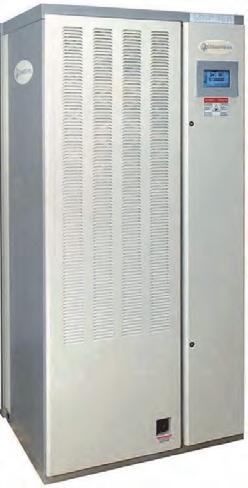
The Series 6 computer room air conditioner (CRAC) unit from ClimateWorx International has a six square foot footprint and is available in up flow, down flow and free blowing configurations. It is suited to telecommunications centres, computer rooms, hi-tech offices and laboratory environments. www.climateworxinternational.com
Greenheck’s line of Vari-Green ener gy control products now includes the Vari-Green Drive (model VGD100), which is a factory-mounted and wired variable speed control for three phase motors of up to 10HP. The pre-programmed drive uses R3 filtering technology to re duce electrical harmonics. www.greenheck.com
Nortek Global HVAC offers a shorter version of the M7RL gas furnace in order to accommodate higher SEER coils. The new model does not include an integrated coil cabinet. A separate coil box can accept evaporator coils of up to 25 inches in height. It has heating capacities of 45, 60 and 72 MBtuh, and is down flow only with a top return.
www.nortek.com
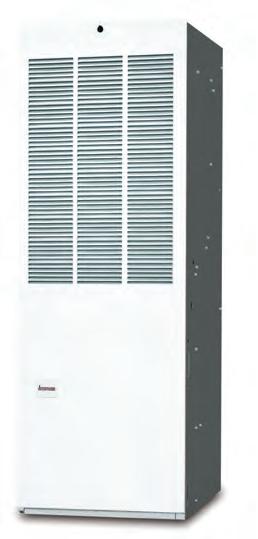
The Trane ProSpace packaged terminal air conditioners (PTAC) are suited for use in the hospitality industry. Features include humidity control for individual air-quality management, wireless thermostat and remote control capabilities. www.tranesupply.com

The Arctic condensing boiler series from Thermal Solutions is available in 1.5, two, 2.5, and three million BTU input ranges. It features a stainless steel design and is suited to commercial condensing space. The Arctic is available in a fully packed or knock-down configuration so it can fit into tight spaces. It can accommodate variable primary and primary secondary piping designs due to minimal waterside pressure drops and low minimum flow. www.thermalsolutions.com
York Linear active chilled beam systems provide cooling, heating and ventilation. The units can be suspended from overhead concrete slabs using threaded rod or hanging wire support systems to match with either metal panel, fibreboard or plaster ceilings. The beams feature no filter fan drain pan or any other moving parts. www.york.com
The Aspen Xtra ductless air conditioner installation accessory product line from RectorSeal Corp. is available in a 39-item contractor kit. It includes necessary connectors, adaptors, brackets and supports and is packaged in a clear-view, re-stockable plastic box designed for service trucks. The product line also offers a variety of zinc-coated, corrosion-resistant hanger/ brackets and clips that fit up to four sets of insulated line set pairs. www.rectorseal.com
7 locations to serve you better
7,600 sq ft with large inventory including all HVAC-R specialties and top brands
Easy access displays
Strategically located north of the QEW between Appleby Line and Burloak Drive
BURLINGTON 5040, Mainway, Unit 8 905 335-4002
EAST YORK 38, Cranfield Rd 416 751-1611
ETOBICOKE 65, Vulcan Street 416 244-5611
HAMILTON 639, Woodward Ave. 905 547-8300
MARKHAM 49, Riviera Drive 905 475-0075
MISSISSAUGA 445, Admiral Blvd, Unit 10 905 670-7521 -NOW MOVED TO A NEW LOCATIONMISSISSAUGA (Hydronics) 6300 Viscount Rd, Unit 1B 416 781-2221
easy & efficient
Incorporating universal design into private and public bathroom spaces
BY BETH MCKAY
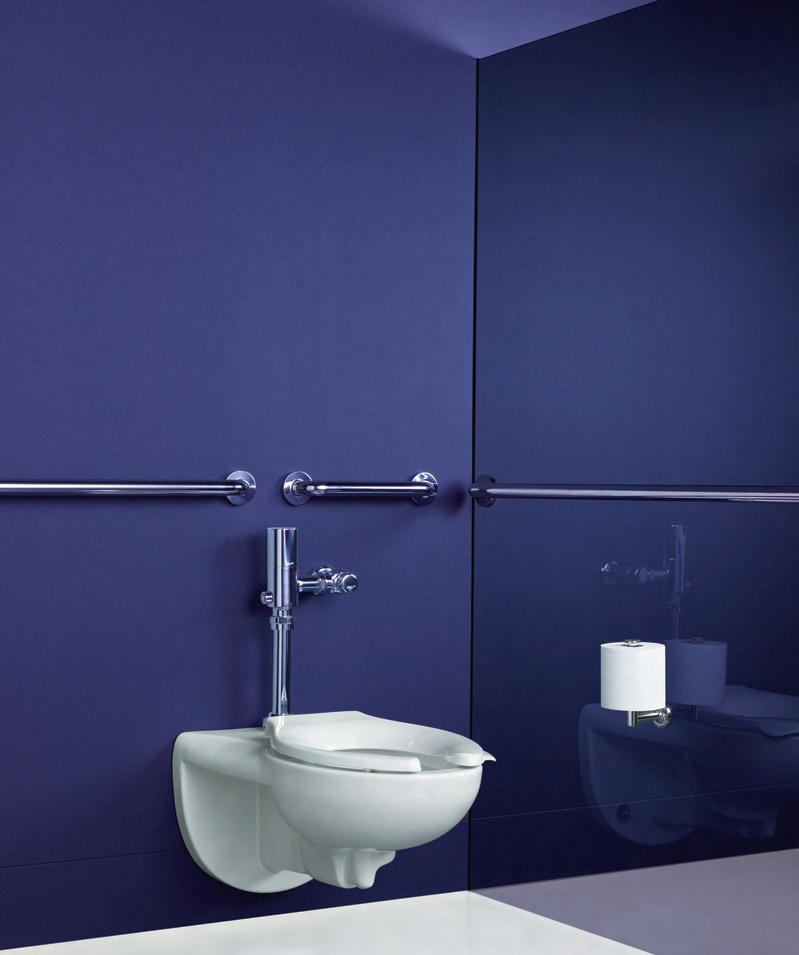
AThe Kingston commercial wall mount toilet bowl from Kohler will perform at either 1.28 gpf or 1.6 gpf, depending on the flushometer. It is ADAcompliant when installed at the required height of 17 inches to 19 inches from the floor to the top of the seat. www.kohler.ca
recent study conducted by three Carleton University graduate students has found that, despite recent updates to the Ontario Building code, accessibility still remains an issue in commercial washroom spaces.
The study was released in April 2016, and addressed the availability, quality and accessibility of municipal public toilets in Ottawa, ON by using a visual assessment tool comprised of 47 indicators. The students sampled 92 public toilets between December 2015 and February 2016, and their results showed that 63 per cent of the toilets that were deemed to be wheelchair accessible, posed a minimum of one barrier to users with mobility challenges.
These results are not unique to Ottawa. Earlier in the year, students from St. Francis Xavier University in Antigonish, NS created the St. FX Washroom Inclusivity Project. The end goal of the program is to create an app with a detailed map that pinpoints and describes every oncampus washroom, since finding a barrier free bathroom can take time and is trial and error. This app will efficiently allow students to locate a washroom to suit their specific accessibility needs.
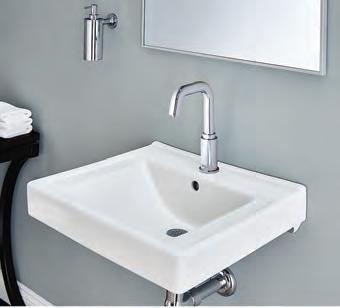
The Decorum vitreous china, wall-hung sink from American Standard is 20 inches by 18 inches. It includes the EverClean surface and is both ADA and TAS compliant. www.americanstandard.ca
The Aqua Zone from Aquabrass is a space-saving shower and bath concept that can be quickly installed in residential settings. It consists of a combined ergonomic bath shape as well as a shower floor creating a contained wetzone with a centre drain. It has a reinforced base, is made of solid Lucite acrylic one-piece construction and features EZ-Glide installation. It requires 60 inches by 60 inches of space.www.aquabrass.com
Based on these examples, it would seem that the provinces are in need of a commercial bathroom accessibility code update. The problem is, some updates have already been made yet these obstacles still persist.
For example, the Accessibility for Ontarians with Disabilities Act (AODA), which was introduced in 2005, has a goal of creating an accessible Ontario by 2025. Even more recently, the Integrated Accessibility Standard Regulation (O. Reg 191/11) offers revised requirements for accessible public spaces.
These requirements came into effect on January 1, 2015, and include: power door operators at the entrance to all barrier-free washrooms; amended mounting height and location requirements for accessories (such as towel dispensers and hand dryers); a new fold-down grab bar design; an L-shaped grab bar removing the option of a diagonal grab bar; and an increased minimum clear floor area in barrierfree washroom stalls.
These updates join the existing standards of the 2012 Building Code, which state that a barrier free washroom must be available in public areas of most buildings, and
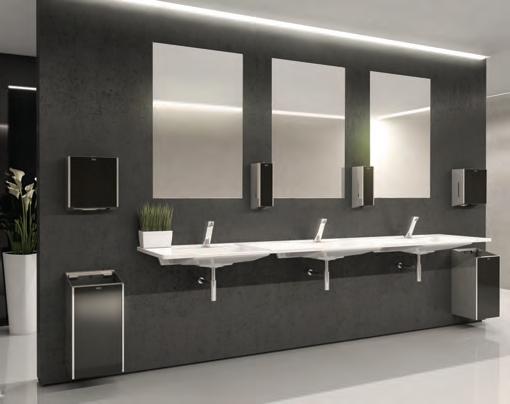
that the bathrooms must be situated on a barrier free path of travel and are subject to a number of alterations to suit all users.
Though this sounds promising, there is a catch. The requirements only apply to new construction and extensive renovations. Therefore, the Carleton study has found that upgrades need to be made to existing washrooms, and programs, such as St. FX’s app, are band-aid solutions until universal bathroom design retrofit requirements become standard practice.
According to the Canada Mortgage and Housing Corporation, eliminating ridges and barriers leading into the bathroom and shower, enlarging doorways and incorporating console vanities are some ways to start moving towards universal design.
Many companies are also designing new and adaptive appliances to suit universal commercial design that meet Canadian (CSA B615) and U.S. (ADA) standards.
At Franke, Cory Macey, senior product development engineer/product manager, commercial, explained that building codes act as a canvas for appliance design. “We don’t just view this challenge [building codes] as a compliance requirement. We feel that code compliance within product design can foster creativity, allowing us to create products in new and innovative ways,” he said.
Charles Scott, product manager for commercial fixtures at Kohler explained that there are many aspects that affect appliance design, “but mobility, such as sitting versus standing, reaching for objects and [the] manipulation of handles or buttons are main considerations when we design accessible washroom products.”
Upon meeting code certifications and improving ease of use, cleanliness is another important attribute for universal bathroom appliances. Scott added that smooth surfaces are easily cleaned, and are therefore incorporated into many commercial and residential fixtures.
Mansfield Plumbing has introduced the Protector No-Overflow toilet. This toilet displaces overflowing water by redirecting it into the concealed secondary drain. The bowl is coated in a PuraClean glaze, which helps to reduce bacteria. It is available as a SmartHeight toilet, and stands 16-½ inches tall. It meets ADA standards and has a three-inch flush valve design. www.mansfieldplumbing.com
The Exos line from Franke offers coordinated washbasins and accessories for public and semi-public areas. The line has clear-cut shapes, single or up to five attached sinks, and is barrier free. www.franke.com
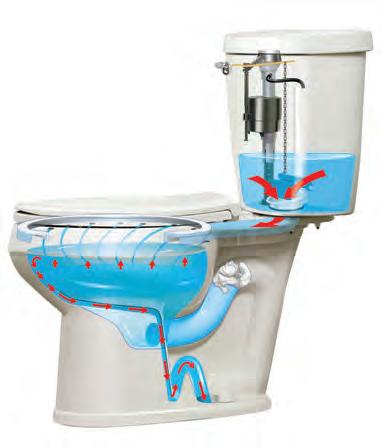
The director of engineering at Masco Canada, Frank Stauder, noted that many faucets offer a 24-hour sanitary rinse cycle to help eliminate standing water, reducing and simplifying the amount of cleaning required of the faucets.
While accessible appliances make their way into the commercial setting, universal design and aging in place renovations are becoming more mainstream in residential settings.
“Accessible bathrooms need not conjure up images of institutional spaces. It is our duty as professional designers to help our clients understand that they can have a luxury, spa-like bathroom that is also safe and accessible,” said interior designer and LEED accredited Sarah Barnard of Sarah Barnard Design. “The most common sentiment expressed by residential clients is that they don’t need to plan an accessible bathroom now. This way of thinking can cause major upset later in life.” She noted that hands-free faucets and grab bars are becoming more attractive and are available in an expanding range of finishes as well.
In residential spaces, even minor relocation of appliances can make a big difference. For example, contractors can offset the tub faucet handle so that it is closer to the user before getting in the tub, reducing the reach needed to turn it on. Barnard added that, “clear space adequate for wheelchair turning radius, ample knee space, toe kick clearance, counter heights appropriate for both standing and seated users, touchless faucets and reinforced grab bars all help ensure high performance and maximum safety.”
A number of contracting companies have even geared their business to suit the aging in place demographic, especially as the baby boomer generation approaches retirement age. In Vancouver, BC, Rahim Lakhani, home accessibility specialist, founded Home2Stay to address this need.
Lakhani’s company consists of a team of five in house
continued on p78
Watermark’s linear drains are suited to open showers built without thresholds. The product allows bath designers to pitch the surface of the shower in one direction rather than four as with centre drains. The drains have no lip which is beneficial for ADA compliant shower design. The drains can be placed at the shower entrance, against the wall or under a bench. www.watermark-designs.com
specialists, each of which have a forte, such as carpentry, finishing, lifts and elevating. He said that the team will bring in an electrician and plumber for their expertise when needed.
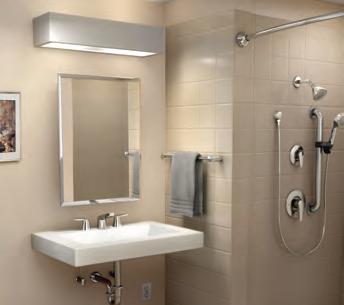
The Modern M-Bition and M-Dura bath suites from Moen offer single and two handle widespread faucets designed to handle hard water and heavy use. Faucet handles allow the user to easily finetune temperature balance. There is an adjustable temperature limit stop. The showerhead options feature the PosiTemp valve to reduce water consumption, and have a discrete transfer and grab bar slide bar available for stability and safety. www.moen.com
“The demand [for this type of work] is growing as the population ages. Aging in place is becoming more common as people are wanting to stay in their homes for the rest of their lives,” Lakhani said.
Working towards universal design does not need to be an all-at-once major renovation in the home. If there is no ur-
The Roosevelt faucet from Newport Brass is available in 27 finishes. It features solid brass construction, ceramic valves that meet WaterSense and CalGreen standards, and has ADA compliant lever handles. www.newportbrass.com
gency, upgrading one appliance at a time will set the bathroom on the right track to attain universal design standards. Many companies are producing universal bathroom products, and through the updates and implementation to provincial standards and codes, these appliances will eventually become commonplace. However, there is a demand to retrofit commercial bathrooms to suit universal design standards in order to create inclusive and safe public washrooms.
Our new 6EC and 10EC Series sump and effluent pumps are built on the shoulders of 75 years of pure grit and determination. These rugged and efficient workhorses feature cast iron covers and bases*, upper and lower ball bearings, and larger intakes to reduce clogs... all while pumping up to 67 gpm.
littlegiant.com






















The new Delta hands-free thermostatic lavatory faucet is the smart choice for applications requiring thermostatic temperature regulation. The mixing valve and solenoid are contained within the body of the faucet and the supply lines are factory-installed, making installation quick and simple. Outlet temperature limits can be set easily from above the deck by the installer and a top mixer allows the user to adjust the water temperature to comfort. Now that’s smart. Backed by an




The Selia kitchen faucet from Pfister uses React touch-free technology. The faucet activates when a hand or object passes within its sensor range, and features a hibernate mode that allows users to turn off the sensor for cleaning. It has a pull down spout with an extra long hose and a one- to four-hole configuration. The water temperature can be set and reset, and can also be controlled by the sink handle. www.pfisterfaucets.com
The Parma Café kitchen faucet from Danze Inc. features solid brass construction and a ceramic disc valve. The faucet operates at 6.62 L of water per minute. It is available in chrome and stainless steel. www.danze.com
Stone Forest now offers the Pink Onyx Wabi Vessel for residential and commercial use. All vessel basins are carved from small onyx boulders. The shape, colour and size will vary as each is unique. www.stoneforest.com
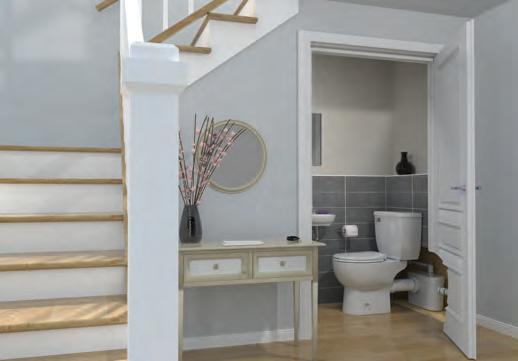
The Saniaccess2 from Saniflo is suited to residential applications, and can be combined with the company’s china toilets. It pumps wastewater up to 15 feet vertically or 150 feet horizontally from the soil stack. Its five connections (water supply, ¾ inch discharge pipe, toilet access, vent and electrical supply) help to reduce installation time. www.saniflo.com
The SANCO CO2 -refrigerant heat pump water heater from Sanden International is suited to residential use. It is a twopiece system that features a low profile design, a choice of two size options (a 43 gallon tank and an 83 gallon tank) and is made from a corrosion-resistant stainless steel.
www.sandenwaterheater.com
The 8E864 series lead-free package from the Bonomi Group is powered by the Valbia VB008 mini quarter-turn direct-mounted electric actuator. It measures 4 ¾ inches long by 2 ¾ inches wide, and has a waterproof IP 65 housing that is constructed of flame-resistant plastic with O-ring seals at critical points. www.bonominorthamerica.com
Universal deck plates from T&S Brass and Bronze Works allow a single-shank product and energysaving sensor faucets to be installed in nearly any sink by covering and sealing unused holes. The plates are available in four inch and eight inch versions and are compatible with the T&S line of vandal-resistant faucet models. www.tsbrass.com
The MicroDerm in-home spa treatment from Mansfield Plumbing is available in 25 models with tub unit sizes ranging from 60-inches by 32-inches, to 72-inches by 42-inches. Rectangular, oval and corner tub designs, and one- or two-person tub sizes are available. The tubs come in seven different colours with various trim finish options. www.mansfieldplumbing.com

The Reducing Coupler from John Guest USA Inc. is available in two sizes for use in the domestic plumbing market. It is manufactured from engineered plastic with an EPDM O-ring, and it satisfies hot and cold water plumbing/remodelling and hydronic heating applications. It can be used with copper, PEX or CPVC pipe. The coupler is both lead and corrosion free. www.johnguest.com
he Mechanical Electrical Electronic Technology (MEET) show drew a crowd of over 6300 industry professionals to Moncton, NB for its biennial trade event in May.
“This was another strong edition for MEET,” said Shawn Murphy, show manager. “Everyone seemed very upbeat; the energy was high and I heard from numerous exhibitors that they had a really good show.”
The show featured the Skills Canada NB Electrical Installations Competition, which showcased the skills of post-secondary construction electrician students. The winner, Joey Bard (Apprenticeship Edmundston region) also took home the first place prize for electrical installations at the Skills Canada National Competition, which also took place in Moncton, NB in early June.
New for 2016, the MEET Show included a pre-registration passport prize program that offered visitors, who pre-registered by a specific deadline, a passport ballot for the chance to win one of two cash prizes courtesy of the program’s sponsors. Gary Arseneault and Nicolas Comtois were the winners and each took home $4000 courtesy of the program sponsors.
The 4th biennial MEET Innovation Awards were presented at the show, and each of the four participating industries gave an award to an exhibiting company in recognition of their innovative products in the industry.
The winners included: Belimo, recipient of the Atlantic Canada Mechanical Exhibitors (ACME) Innovation Award for its Belimo Energy Valve; Delta Faucet Canada, who received the Canadian Institute of Plumbing and Heating (CIPH) Innovation Award for its Electronic Thermostatic
The Canadian Institute of Plumbing & Heating (CIPH), Electro-Federation Canada (EFC), the Illuminating Engineering Society (IES) and ACME-Atlantic Canada Mechanical Contractors are the show sponsors. www.meetshow.ca
MEET exhibitors offered a number of contests and incentives to attendees. The winner of JF Taylor’s Man Cave (shown here) contest was Denis Sears, head of maintenance for Anglophone East, a school district in southeast New Brunswick.
Lav Faucet; Stelpro received the Electro-Federation Canada Innovation Award for the 4000 W KI Thermostat for the Smart Home; and Beghelli Canada Inc., recipient of the IES (Illuminating Engineering Society) Innovation Award for its product Pluraluce.
At the Industry Dinner, Bob Pulsifer was presented with the MEET Show Recognition Award, to commemorate his years of service and efforts in shaping the MEET Show into the event it is today. He was instrumental in building the initial framework for the show.

By Beth McKay
The Canadian Institute of Plumbing and Heating (CIPH) held its 84th annual general meeting (AGM) at the Fairmont Banff Springs Hotel during the association’s annual business conference (ABC) in Banff, AB on June 26 to June 28.
At the meeting, Weil-McLain Canada’s Bill Palamar was named the incoming chairman of CIPH. Palamar began his career in the industry in 1979, and at the age of 23, purchased the assets of Weil McLain where he continues as president and CEO. He has also served as president of CIPH Ontario Region. Palamar thanked the board and committee members for their efforts, as well as his wife and daughter who were in attendance for his first speech as chair.
Palamar takes the place of outgoing chair Siân Smith, who will now serve as CIPH treasurer. “Being your chairman this year has been one of the highlights of my career so far,” Smith said.
The association also recognized Mike Miller, Taco Comfort Solutions and HPAC contributor who received a Young Executive Society (YES) award. Rick Proulx of Reliance Worldwide Canada received a Lifetime Service Award.
(l to r) AIM/R President Stew Chaffee, RichTomkins Co., CIPH 2015-2016 chairman Siân Smith, Noble Corp. and CIPH agents’ council chairman Andrew Dyck from Barclay Sales sign an MOU to establish a framework for communications and cooperation in the plumbing and heating industry.
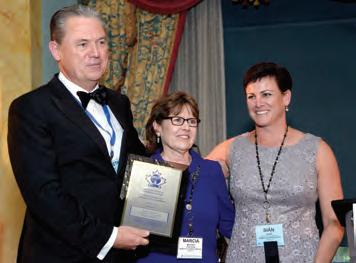
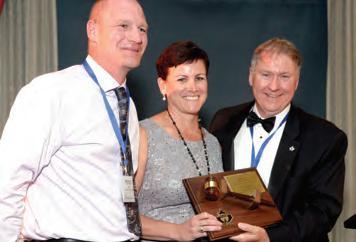
Ken Webster of Viessmann Manufacturing Company Inc. was awarded CIPH’s highest accolade; the Honorary Life Membership award. Recipients of this award must be nearing retirement or be a retired senior executive who has provided outstanding leadership to CIPH, their company and the industry. Webster explained that he has relied on the talented people in this industry. “It’s about discourse and discussion,” said Webster regarding his role with CIPH.
Along the lines of encouraging ongoing discussion, the Association of Independent Manufacturers’ Representatives
(AIM/R) and CIPH signed a Memorandum of Understanding (MOU) to establish a framework for communications and cooperation in the continued development of the plumbing and heating industry in North America. With the signing of the MOU, the associations intend to create an organized and systematic approach for sharing information between the two organizations through the exchange of publications, memorandums and materials.
Stephanie Martin, a building inspector at Alberta Municipal Affairs was the keynote speaker at the CHC luncheon. Martin spoke about some alterations to the safety codes act in Alberta and the application of energy codes. She noted that the National Energy Code of Canada for Buildings, 2011 now has an extended transition end date of November 1, 2016 (originally the transition end date was set for May 1, 2016).
Martin also discussed building and plumbing SCO inspections and said, “the only thing consistent about how hydronic systems are inspected across the province of Alberta is how inconsistent they are.” She said that there are inconsistencies in all areas, including the design information requested for the permit application, what is being reviewed during the inspection and which discipline is completing the inspection.
Following Martin’s presentation, the outgoing CHC chairman, Mike Miller, welcomed the incoming CHC chairman Dave Hughes, associate chair (special projects) for the pipe trades program at the North American Institute of Technology (NAIT).
Additionally the CIPH ABC event featured a presentation on Canadian birds of prey and a country western night. The 2017 CIPH ABC will be held June 25 to 27 in Ottawa, ON. www.ciph.com


Viega LLC has promoted Dale Heath to regional sales manager, Canada. Heath will be responsible for growing, managing and developing sales strategies for all of Canada. He has worked for more than 17 years in the plumbing and heating industry. Prior to this position, he was a district sales manager for Viega’s prairie sales district in Canada.
Following this announcement, Viega promoted HPAC columnist Mark Evans to director of North American sales where he will be responsible for directing strategic planning, brand value extraction and sales development for the field sales team across the United States and Canada. Evans was hired by Viega in 2007 to develop and implement a comprehensive sales and marketing strategy and plan prior to the introduction of Viega products to Canada. Prior to joining Viega, Evans worked in the wholesale, agency and manufacturing sectors for companies including Danfoss and Wilo, where he was a team leader on both a regional and national level.
Danfoss has appointed Santiago Martin as head of Danfoss Drives Americas. In this role Martin will be responsible for leading the company’s business in the U.S., Canada and Latin America. He will also serve as part of the company’s management team in North America.
James Dagley has been appointed president of Aerco International. Dagley joins the company from Johnson Controls where he filled leadership roles of increasing responsibility in the fields of sales, marketing and business development.
Frank Windsor, Rinnai America’s general manager, has been promoted to chief operating officer. Prior to joining Rinnai, Windsor spent 23 years with Kohler.




Mestek Inc. has promoted Kenneth Eggleston to national sales manager for SpacePak. Eggleston has been with SpacePak for five years as project manager. Prior to that, he worked for over four years at the Mestek Research and Development Center. He will handle Canadian and U.S. sales.
Ken Watson has been named marketing and brand manager for Taco Comfort Solutions. He brings over 20 years of advertising and marketing experience to the company, having served in both agency and client-side roles over his career.
Stelpro has appointed Dave Minhas to the position of territory support manager, U.S. Minhas has been with Stelpro for nearly nine years. In his new position he will work under the supervision of Keith Brauss, sales and marketing director, U.S.


The Canadian Institute of Plumbing and Heating has welcomed Lisa Pike as region coordinator for Newfoundland and Labrador. Her responsibilities in this new position will include assisting the region president and board in creating its action program of goals, developing agendas, preparing office and staff budgets and managing region banking.
DeLancey Davis, Franklin Electric’s vice president and president of North America Water Systems, has been appointed to the Hydraulic Institute 2016 to 2019 board of directors.



T&S Brass and Bronze Works has hired Michael Potvin in the role of product compliance engineer. Potvin will be responsible for product compliance efforts with a number of agencies and will also maintain and update the current product certifications and listings. Potvin was most recently the regulatory compliance engineer with Tyco SimplexGrinnell.

Paul Hebert has joined Boshart Industries as the Canadian sales manager. Boshart has also welcomed John Falconer to the team as technical sales engineer. Falconer previously worked at Preferred Pump and Baker Manufacturing.

HeatLink has announced that Howard Huss’s sales management territory has expanded to include eastern Canada. Huss will continue developing the north-east U.S. territory for HeatLink, but will now also oversee Ontario, Quebec and the Atlantic provinces.
Bosch Thermotechnology has appointed its regional president, Vitor Gregorio, to directorat-large on the board of the Air-Conditioning, Heating and Refrigeration Institute (AHRI). Gregorio currently manages sales in the U.S. and Canada, as well as Florida Heat Pump (FHP) manufacturing under a joint venture.



Ouellet Canada Inc. has opened a distribution centre at 270 Avenue Corriveau in Montmagny, QC. The building is 45000 square feet and has been renovated to house the shipping, storage and repackaging activities of Ouellet, Momento and Global Commander brands.
The company invested nearly $3.5 million transforming the old Corriveau factory into a functional distribution centre. Additionally, Ouellet is working on the automation of electric baseboard assembly and the implementation of a new enterprise management computer system (ERP). Both projects are scheduled for completion by early 2017.
Ouellet Canada is part of the Ouellet Canada Group Inc., which also owns Industries Dettson Inc., located in Sherbrooke, QC, Hazloc Heaters in Calgary, AB, and Nanjing Ouellet, a manufacturing plant in China. www.ouellet.com
Conference held in Denver, CO in June. The company accepted the awards for its Thermo King truck and trailer refrigeration units in Europe that use R452A; the Trane Sintesis air-cooled chiller; and the Trane Series E CenTraVac chiller, which are known in the U.S. and Canadian markets as models CVHH/CDHH.
Companies nominate their own products for the Environmental Leader Products and Projects Awards, and a panel of experts in the energy and environmental management fields judge the entries.
In other IR news, the company has made a climate commitment to reduce greenhouse gas emissions from its products and operations by 2030. The company pledges to cut the refrigerant GHG footprint of its products by 50 per cent by 2020 and incorporate lower GWP alternatives across its portfolio by 2030. IR also has plans to invest $500 million in product-related research and development by 2020 to fund the long-term reduction of GHG emissions. www.trane.com www.company.ingersollrand.com
Jess-Don Dunford’s Fluid Forward 2016 one-day conference and tradeshow in Kitchener, ON in June attracted more than 150 attendees. Speakers included Jeff House, sales engineering and training manager at Jess-Don Dunford, Tom Gervais, international sales manager, Laars Heating Systems, Kevin Viera of HBX Controls, Kirk Nagus, general manager at Axiom Industries Ltd. and Taco Canada’s national sales manager, Sean Giberson.
The program also featured an offsite engineer workshop, presented by HPAC columnist Mike Miller, director of commercial sales, Taco Canada. Miller talked to guests about variable speed pumps, VFDs and building automation.

Fluid Forward delegates had the opportunity to interact with industry experts. Tom Gervais (r) of Laars Heating Systems was a speaker at the event.
An evening event with live music offered attendees the chance to connect with others in the industry. www.jessdondunford.ca
Ingersoll Rand (IR) was awarded three Product and Project of the Year awards at the fifth Environmental Leader
Mads Nipper, the CEO of Grundfos was among the speakers at the United Nations (UN) Global Compact Leaders’ summit held in New York City in late June. His speech reminded the approximately 800 attendees that the corporate sector wants political action and will use the UN’s 17 sustainability goals as a lever for development, innovation and business.
“Sustainability and responsibility are not a department of a report. They are the very essence of every company who wants to think ahead and accomplish something greater than just creating short-term profit,” Nipper said.
He stated that more than 663 million people around the world lack access to clean drinking water. In response to this figure, Grundfos has collaborated with NGOs and UN organizations to speed up engagement to help reduce this number. www.grundfos.com

Plumbers Supply’s new showroom at 900 Brock Road in Pickering, ON, features over 3000 square feet of display space. This location is four times larger than the previous facility in Ajax, ON and has a store-like layout.

VANCOUVER CONVENTION CENTRE
REGISTRATION OPENS JUNE 15 at ciphexwest.ca




We’re open late on Wednesday to make it easier to attend after work! Wednesday, November 2 10 am – 8 pm Thursday, November 3 10 am – 4 pm

For information about exhibiting, contact Elizabeth McCullough at e.mccullough@ciph.com or 800-639-2474 CONNECTING WESTERN
• CIPHEX West trade show > CONNECT with 250+ manufacturers and SEE thousands of products
• Canadian Hydronics Conference > INCREASE your hydronics expertise at in-depth workshops and seminars
• Plumbing & HVACR Seminar Program > Get ideas and practical tips to BUILD your business
• HVACR & Plumbing Design Forum > Take advantage of the FLOW of information and ideas with advanced training for heating and plumbing engineers, designers, specifiers and contractors
• CWQA Water Treatment Workshop
• New Product Showcase > SEE the newest products and technologies
• CIPH BC Region Industry Dinner > Tuesday, November 1 with speaker Brian Thwaits, the Brain Trainer
Coinciding with the move, the company is offering more materials for HVAC and air quality technicians, and launching more products online with current vendors in North America and worldwide. www.plumberssupply.ca
Uponor Corporation has announced the formation of Phyn, a new partnership with Belkin International. Phyn will create an intelligent water solution designed to protect family homes and businesses from leak damage and improve water conservation with automated and anticipatory controls.
According to a release issued by Uponor, the technology offered by Phyn will create an intelligent water system expected to benefit builders; insurers; utilities engineers; and plumbing professionals.
Uponor and Belkin have agreed to establish two joint venture companies. The first one will operate in the U.S. with its headquarters in the Los Angeles area, and the second one will be located in Europe. A research and development lab will be located in Seattle. No timetable has been set for the first product launch. www.phyn.com

IPEX recently revealed that it has completed a plant expansion in Edmonton AB. The development represents a $55.4-million investment for the company. The expansion is 17245 square feet in size and will allow IPEX to bring large diameters of polyvinyl chloride (PVC) pressure and sewer piping to the Canadian market. www.ipexna.com
HPG Sales and The Morgan Group are recipients of 2015 Sales Awards from Mestek Inc. HPG Sales, of Toronto, ON, is the recipient of the RBI Water Heaters leading sales award for the Canadian market. Additionally, HPG Sales has been recognized with the Mestek sales award for overall Mestek product sales in North America.
The Morgan Group of Markham, ON received the Advanced Thermal Hydronics leading sales award for the Canadian market. www.mestek.com
The Master Group was among Johnson Controls’ 29 top channel partners who were recently recognized for outstanding achievement during fiscal year 2015. The Best of Brands event was held in Beverly Hills, CA. The Master Group Inc. won the Family of Brands award, which recognizes the Master Group’s roots with the Johnson Controls brands and its ongoing investment in infrastructure, people and inventory to grow its business. The Family of Brands award acknowledges the group’s performance across York, Coleman, Luxaire, Guardian, Source 1, Ruskin and Titus brands.

Wolseley Canada has announced that Darcy Curran, senior vice-president, is leaving the company effective August 19. Simon Oakland, Wolseley’s global head of corporate development, will assume leadership responsibility for Wolseley Canada on an interim basis.
In other Wolseley news, the wholesaler has broken ground on a multi-purpose facility located in Laval, QC. The building will include a plumbing and HVAC/R branch, a Vague & Vogue showroom, a warehousing facility and office spaces.
The facility is located at 4200 Rue Louis B. Mayer and is expected to employ 180 Wolseley staff. Construction is scheduled for completion in November, 2016. www.wolseley.com
CCI Thermal Technologies Inc. has been recognized as one of Canada’s Best Managed Companies for the 11th consecutive year. CCI Thermal Technologies offers seven brands including Cata-Dyne, Ruffneck, Caloritech, Fastrax, 3L Filters, Norseman and DriQuik.www.ccithermal.com
In other Master news, the company has opened a branch in Burlington, ON at 5040 Mainway, Unit 8. This is its seventh location in Southwestern Ontario and 27th in Canada. www.master.ca
Primex Manufacturing Ltd., a producer of plastic HVAC venting solutions for the building envelope and located in Langley, BC, recently announced that Air Force 1 Sales & Marketing Ltd. is representing the company’s HVAC products in the Ontario region. Though the Langley, BC based Primex has customers across Canada and the U.S., Ontario has been identified as a key growth market for the company in 2016 to 2017. www.airforce1.ca www.primexfits.com
Rep-Can, a London, ON based manufacturer representative has added Midea ductless mini-splits, Eubank wall hung AC products, EWC zoning dampers, Air Oasis purifiers and Vapco coil cleaners to its line. Rep-Can service distributors in Ontario, Quebec and the Atlantic provinces can be reached at tel: 519.666.3187. The company’s website – www.rep-can.com – is under development.
IPS Corporation’s plumbing division have formed an exclusive distribution agreement with Green Drain. The waterless trap seals will be integrated into the plumbing division and will be inventoried in IPS’ two U.S. master distribution centres, and also in Canada through GF Thompson, the exclusive Canadian dealer. The product will be available under the IPS ‘one order, one shipment, one invoice’ program. www.ipscorp.com www.liquidbreaker.co/the-green-drain/
Viessmann Manufacturing Company Inc. has announced an agreement with HTS to act as the company’s sales representative in Ontario for its commercial hydronic heating systems. This agreement became effective on July 4, 2016. HTS is headquartered in Toronto, ON and has seven offices with over 350 employees in Ontario, including a team of 50 factorytrained and certified technicians. www.htseng.com

Utica Boilers’ products are now available in Canada through its master distributor Morden National Sales and Marketing Inc. in Wallaceburg, ON. Many of the company’s products are ENERGY STAR rated and qualify for rebate incentives. www.uticaboilers.com

This year marks the 75th anniversary for Little Giant, a Franklin Electric company. The Little Giant Vaporizer Company was founded in Oklahoma City, OK, where 15 employees manufactured submersible vaporizers for evaporative coolers. After World War II, Little Giant purchased an aluminum die-casting machine and started taking on die casting contractor work in the 1940s to further increase sales and personnel expertise. By 1950 the company developed and manufactured an upgraded Little Giant Vaporizer Pump that could be used anywhere water circulation was a problem. Nearly every decade to follow, Little Giant added to its pump offerings and expanded its focus to battery chargers and steam cleaning machines, as well.
Little Giant was purchased by Franklin Electric in 2006. www.littlegiant.com www.franklinwater.com
Bryan Steam LLC is celebrating its 100th year in business. To celebrate 100 years in business, the company is planning an open house in August for its employees, North American representatives, vendors and local and stage dignitaries. The family picnic event will be held at Bryan Steam’s manufacturing facility in Peru, IN and will include food and tours. www.bryanboilers.com
McKeough Supply recently raised over $30,000 in support of Camp Trillium at its 18th annual Bill Porteous Memorial Golf Tournament in Burford, ON. Camp Trillium provides children with cancer and their families with fun and enriching recreational opportunities. Shown here following the cheque presentation are (l-r) Rhonda Craft and Andrew Porteous of McKeough Supply, Rich Rimpson of Rheem Canada Ltd., Carrie Arnold of Camp Trillium, Luke Kilbourne of AMTS, Scott Waters, ICP–Keeprite & Tempstar, John Pallante and Jean-Guy Marchand of Broan Nutone/Venmar Ventilation, Paula Burgin and Roy Levy of Sandpiper Energy Solutions. www.mckeoughsupply.com

Canplas Industries Ltd. turns 50 years old this year. The company will celebrate this milestone in September. Canplas is a manufacturer of thermoplastic products for the plumbing, vacuum and ventilation markets. The company’s head office is located in Barrie, ON, with other locations in Langley, BC and Edmonton, AB. Canplas is a member of the Aliaxis Group of companies, which provides plastic solutions for fluid transport in the field of building materials. www.canplas.com
Bradley Corporation is celebrating its 95th anniversary this year. To commemorate the milestone, the company hosted a learning tour of its manufacturing plant for high school students that are enrolled in the Design Engineering Manufacturing (DEM) Center in Wisconsin. www.bradleycorp.com
Bradley’s machinists demonstrated equipment and operations, and discussed product materials as well as the production process.

NIBE Industrier AB of Sweden (NIBE), the parent company of Fort Wayne-based WaterFurnace International, has announced that it has entered into a stock purchase agreement with LSB Industries, Inc. to acquire 100 per cent of LSB’s Climate Control Group, Inc. (CCG). At press time, the deal was expected to be finalized in August 2016.
CCG is the holding entity for six heating, ventilation and air conditioning (HVAC) companies, including ClimateMaster, International Environmental Corporation, ClimateCraft, ClimaCool Corp., Koax Corp. and ThermaClime Technologies. www.waterfurnace.com
Nibco Inc. has acquired the valve assets of Webstone Company Inc. The transaction between the two companies was finalized on May 23, 2016, and the new business unit is named ‘Webstone, a brand of Nibco.’ www.nibco.com
Distributor RBL A/C Inc. has relocated to 50 EmilienMarcoux, Suite 101 in Blainville, QC. Contact information, including the telephone number (450-420-1444), remain unchanged. www.rblac.com
Viega LLC will be moving its North American headquarters to Broomfield, CO. The company is planning to build a new headquarters and educational training facility in the city. The move is expected to be completed by December 31, 2017. www.viega.com

In response to the wildfires in Fort McMurray, AB in early May, dahl Brothers Canada Ltd. created the dahl Cares program to raise funds for various charities. For one week, 10 cents from each item ordered was
The Construction Education Council offers a number of management and supervisory courses across Canada through webinars and classroom settings. For more information, e-mail education@mcac.ca. www.constructioneducation.ca
TECA’s Quality First training programs are developed by the industry, for the industry, setting minimum standards for the residential and light commercial heating, ventilating and cooling trade in British Columbia. Courses provide contractors with the information they need to install equipment that operates safely and comfortably at rated efficiencies. www.teca.ca
Canada Green Building Council workshops include LEED Green Associate Exam Preparation, Net Positive Energy Buildings, and Introduction to the LEED-v4 Rating System, tel. 866.941.1184. www.cagbc.org
Natural Resource Canada has announced that the Canadian Institute for Energy Training (CIET) is the sole licensee of the Dollars to $ense energy management workshops in Canada, with non-exclusive rights for the commercial exploitation of the workshops in any country around the world. For information on booking a Dollars to $ense energy management workshop contact CIET by phone at 800.461.7618, or e-mail info@cietcanada.com. www.cietcanada.com
donated to the Canadian Red Cross’ Alberta Fires Appeal. In total, the company raised $11,550. www.dahlvalve.com
DuPont and The Dow Chemical Company have announced that stockholders at their respective special meetings held on July 20, have voted to approve all stockholder proposals necessary to complete the merger of equals transaction. According to a release from the companies, this is a key milestone in the process to merge the two companies and subsequently pursue the intended spin offs of three highly-focused, independent companies.
The companies expect the merger transaction to close in the second half of 2016, subject to customary closing conditions, including receipt of regulatory approvals. www.dowdupontunlockingvalue.com
Schneider Electric Canada has received the Technology Company of the Year award at the recent 2016 Victoria Innovation, Advanced Technology and Entrepreneurship Council (VIATEC) Technology Awards show in Victoria, BC. The VIATEC Technology Awards show attracted 802 attendees. Fifty-eight finalists were selected from the 189 nominations, and a total of 15 awards were presented. The company’s Global Power Solutions team is located within its R&D centre for power metering hardware and
The Canadian Hydronics Council (CHC) has partnered with the Northern Alberta Institute of Technology and British Columbia Institute of Technology to provide course blocks toward CHC certification for hydronic system designers and installers. At NAIT students can register for online or paper-based learning and have nine months to complete each block of courses. www.ciph.com
SkillTech Academy, the education division of the Heating, Refrigeration and Air Conditioning Institute of Canada (HRAI) offers a variety of residential and commercial courses for the advancement of its members’ business and technical excellence. For more information, contact Dorothy Allen by e-mail: dallen@hrai.ca. www.hrai.ca/skilltechtraining.html
Eden Energy Equipment is hosting a training opportunity in Guelph, ON on September 13. Presented by John Siegenthaler, topics covered will include hydraulic separation; distribution efficiency and low power pumping; combining hydronics and geothermal heat pumps; thermal storage; low temperature heat emitter applications; and small scale chilled water cooling applications. The fee is $119 and includes all course material, lunch and a completion certificate. For more information, tel. 800.665.3336 ext. 123. www.edenenergy.com/blog/john-siegenthaler-hydronics-training
software in Victoria, BC. The award recognizes the company’s ongoing commitment and hard work in developing innovative power and energy measurement and management solutions. www.schneider-electric.ca
LG Electronics Canada (LG) was awarded the title of manufacturer of the year HVAC at the 2016 ENERGY STAR Canada Awards ceremony held in Winnipeg, MB.
The Honourable Jim Carr, Canada’s minister of natural resources, presented the awards to select companies for their innovations in energy efficiency. These innovations include the incorporation of ENERGY STAR-certified products in major social housing developments, encouraging energy conservation through consumer incentive programs and promotional campaigns, and selling and promoting innovative energy-efficient homes, products and appliances. www.lghvac.com www.energystar.gov
Uponor North America now provides online access to the AquaSAFE Level I training course. The course was previously only available in the classroom at Uponor Academy in Apple Valley, MN.
September 11-13
The course consists of nine videos and takes approximately two hours to complete. After plumbers receive their Level I online training certificate, they are ready for Level II jobsite training, which can be coordinated through an Uponor manufacturer’s representative. www.uponorpro.com/training
September 15-16
The Canadian Healthcare Engineering Society’s annual conference will be held at the Vancouver Convention Centre in Vancouver, BC. It will include presentations on healthcare sustainability: designing for wellness and practical code issues for healthcare facilities. www.ches.org
RSES International Annual Business Meeting
September 28-October 1
The RSES board and RSES auxiliary international annual business meetings will be held in conjunction with the RSES Southwestern regional associations 67th preconference meeting and tradeshow. www.rses.org
American Society of Plumbing Engineers Convention & Expo
October 28-November 2
Watts Water Technologies Company has premiered five videos showcasing the company’s specification drainage products. The videos focus on the Dead Level Trench Drain, Track Lavatory Carriers, Industry Standard Compression Seal Closet Carriers, RD-700 Dual Outlet Roof Drains and the F Series Flanged Roof Drains. www.watts.com/pages/whatsnew/drainage_hero.asp.
Daikin Texas Technology Park in Houston, TX will encompass 4.1 million operational square feet, which is roughly the size of 74 football fields, when it is complete. The company will centralize engineering, logistics, manufacturing, research and development, testing and customer support at the new facility. Distribution and logistics departments have already started the transition from their current offices to the Texas Technology Park offices. www.daikincomfort.com
The World Plumbing Council’s (WPC) conference will open the discussion on the critical role plumbing has in providing a healthy and safe environment. The international exhibition runs concurrently to the conference. It is being held in Cape Town in South Africa. www.wpc2016.co.za
October 11-13
Chillventa is an international exhibition for the refrigeration, AC, ventilation, and heat pump sectors that takes place at the Exhibition Centre in Nuremberg, Germany. www.chillventa.de
CIPHEX West
November 2-3
Sustainable Built Environment
September 19-20
The International Sustainable Built Environment Conference of the Americas offers a seminar program, presentations of regional policy papers, and will feature commercial exhibits. It will be held at the Toronto Marriott Downtown Eaton Centre Hotel in Toronto, ON. www.sbcanada.org
Construction Education Conference
October 19-21
The Construction Education Council (CEC) is holding its Construction Education Conference in Winnipeg, MB at the Fort Garry Hotel. www.constructioneducation.ca
The ASPE convention offers networking opportunities with more than 4000 industry professionals. The ASPE exposition is scheduled from October 31 to November 1. Both events will be held at the Phoenix Convention Centre in Phoenix, AZ. www.aspe.org
The tradeshow will feature a full conference program, including the Canadian Hydronics Conference and a product showcase. It is co-locating with the BUILDEX Express show at the Vancouver Convention Centre in Vancouver, BC. www.ciphexwest.ca
1 The combination sports bottle filler and fountain from Franke features a cabinet finish in brushed stainless steel. The waterways are lead-free in material and construction, and units have a built-in 100 micron strainer that stops particles before they enter the waterway. The unit will comply with wheelchair accessibility when properly installed and features a heavy duty galvanized steel frame. www.franke.com
2 Watts Water Technologies Company’s programmable logic controller (PLC) is for use with its existing line of R48 Series commercial reverse osmosis (RO) systems. It features an embedded Ethernet port, and also has a colour touchscreen for displaying system statuses, operating pressures and feed, and product connectivity. It is compatible with SCADA applications for supporting Modbus over serial applications. www.watts.com
4 The Washbrook and Maybrook urinals with the EverClean surface from American Standard include antimicrobial properties to help inhibit the growth of bacteria. They are both ADA compliant and feature a 3/4-inch inlet spud. www.americanstandard.ca
3 Toto’s chrome EcoPower flush valves generate power each time water spins a small internal turbine when the unit is flushed. Stored in a series of capacitors, the auto-generated electrical energy powers the flush valves’ sensor eye, microprocessor and solenoid. The 1.28 gpf WaterSense labelled commercial toilets work with the flush valve to provide optimal performance. www.totousa.com
5 Delta has introduced the 3000T4 Series, low-profile, wallmount electronic lavatory faucet with H2OPTICS technology. It features a 1.5 gpm spout on a 4 1/2 inch stainless steel wall plate. It allows users to independently mix hot and cold water flow and is available in either a single or double configuration. www.deltafaucet.ca
6 The geometric single-hole touchless hybrid energy cell-powered commercial bathroom sink faucet from Kohler uses Insight infrared technology. It features a water-saving vandal-resistant 0.5 gpm aerator. The Brenham wall-mounted or concealed carrier arm mounted commercial sink and shroud with single faucet hole combines a natural style with durability for commercial spaces. It measures 21 15/16 inches in length by 19 3/4 inches in width, and is ADA and TAS compliant. www.kohler.com
7 RectorSeal Corp. has introduced the SureSeal vent-guard, a plumbing vent stack device designed to eliminate toxic sewer gas, odour egress and migration to nearby rooftop HVAC system outdoor air intakes. The vent-guard is available in three sizes designed to fit two, three and four inch-diameter commercial building plumbing vent stacks and restaurant grease interceptor vents. It is constructed of EPDM rubber and infused with carbon black that is resistant to ultraviolet light. www.rectorseal.com
9 The Artisan Ceramic Collection oval toilets and bidets from Hastings Tile and Bath are available in multiple finishes, and require an in-wall tank system. The toilet measures 12 3/4 inches in height, 15 3/8 inches in width and has a depth of 22 inches. www.hastingstilebath.com
8 Faucets and showerheads within the MDura line from Moen, offer a contemporary style and are suited to high-use environments. All faucets have a vandal-resistant aerator and handles, and are solid brass construction. Tub and shower components have a standard flow rate model of 2.5 gmp or an alternative Eco-Performance model with a flowrate of 1.5 gmp. Showering systems provide the option of wall-mount or handheld showerhead models, or a wall-mount/handheld combination. www.moen.ca
10 The Advocate AV-Series lavatory system from Bradley Corp., is a sink, soap and water-conserving faucet, as well as a dualsided hand dryer. It features a touchless, infrared 0.38 gpm faucet, a top-fill infrared soap dispenser and requires little movement from the user www.bradleycorp.com
Bardon
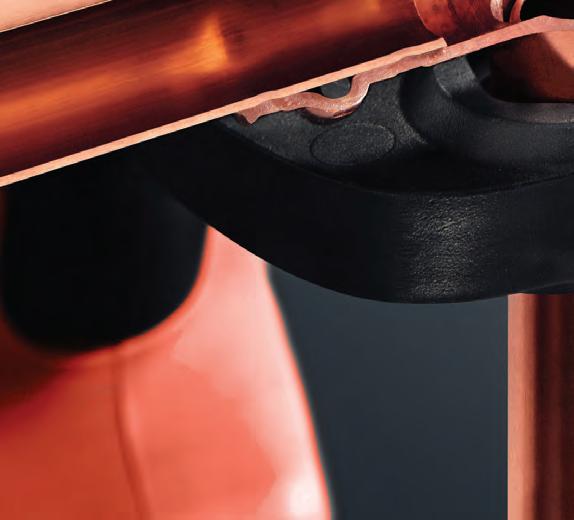
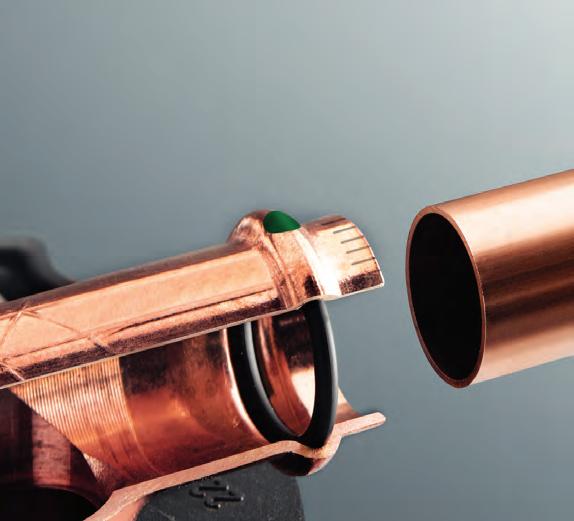
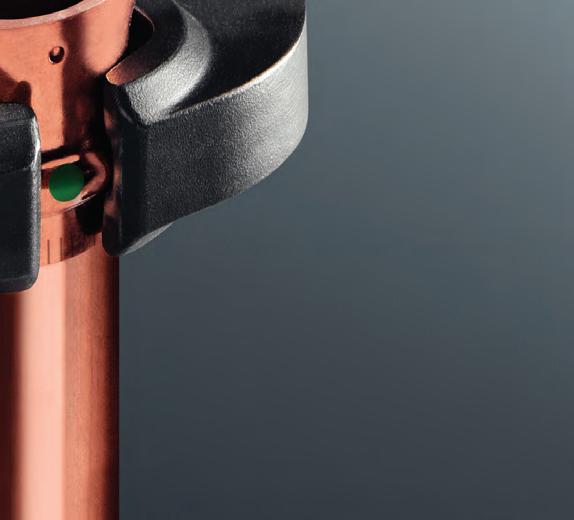

Enjoy the peace of mind that comes with installing Viega ProPress, the original copper press joining solution. With system-matched tools and jaws, no calibration is required and connections are made in seconds. Installations and repairs are fast and easy with Viega ProPress.
• Press connections can be made wet or dry
• Secure press connections made in seconds
• Equipped with the Smart Connect® feature for easy identi cation of unpressed ttings
• More than 1,000 press tting con gurations available in sizes from ½" to 4"