

MATT NICHOLLS is the editor of UAV
MATT NICHOLLS is the editor of UAV
Canada has long been a global leader in the development of new technologies and processes to add value and enhance operations in aviation and aerospace, so it’s certainly not surprising to see organizations from coast-to-coast taking leadership roles in the rapidly developing unmanned space.
In 2017, organizations across a variety of industries took their unmanned pursuits to new levels, introducing systems, applications and technologies that showcase just how impressive UAVs can be, what their capabilities are and what value they can bring to commercial operations.
Take the City of Victoria B.C. Fire Department for example. As Paul Dixon outlines in his piece “In the Line of Fire,” pg. 14, B.C.’s capital city is working in concert with Salt Spring Island, B.C.-based UAV firm, Indro Robotics and Remote Sensing to implement unmanned technology into its operations for a variety of roles including situational firefighting reconnaissance, emergency management, search and rescue (SAR) and more.
The city’s UAV is also being shared by other departments, mainly on the law enforcement side, to be deployed in critical police operations. And while the program is very much in its infancy, the potential for what the modified DJI Matrice 100 is immense – the sky truly is the limit.
A similar situation can be found in Edmonton, where UAVs are being used in aviation-related applications to enhance safety operations. The Edmonton International Airport (EIA) for example, is employing a unique UAV solution by the team from Clear Flight Solutions (CFS) and AERIUM Analytics for wildlife management. The lifelike Robird UAS is helping keep pests at bay,
making EIA the first airport in the world to implement this type of technology. This illustrates how the integration of UAV ingenuity and airport operations can work together to enhance safety.
UAV innovation and development on commercial unmanned applications is being further explored at two prominent Canada UAV research and development sites – the not-forprofit Canadian Centre for Unmanned Vehicle Systems (CCUVS) in Medicine Hat, Alta. and the UAS Centre of Excellence (UAS CE) in Alma, Que. As Joe Atherton explains in “National Buzz: Leading the UAV Curve,” pg. 10, each site is enhancing the development of UAV applications on a variety of levels.
The CCUVS Foremost range was the site of a critical beyond-visual-line-of-site (BVLOS) achievement earlier this year, when Ventus Geospatial used an Aeryon Labs Skyranger UAS and a C-Astral Bramor fixed wing platform to perform BVLOS flights.
Transport Canada (TC) continues to work with members of the Canadian unmanned industry to establish a regulatory environment that will safely support commercial UAS operations and BVLOS activity. Once this framework is established, commercial UAS opportunities will take off. The spinoff effects for the training community and other supporting UAS industries will follow.
UAV market surveys consistently place the future value of the commercial unmanned industry over the next decade in the billions of dollars. It’s highly encouraging that many Canadian firms are positioning themselves to capitalize on this future growth potential. With the proper regulatory framework in place – including acceptable BVLOS regulations – Canada will continue to be one of the global leaders in the developing UAV space.
EDITOR MATT NICHOLLS email: mnicholls@annexweb.com 416-725-5637
MEDIA DESIGNER JAIME RATCLIFFE
CONTRIBUTING WRITERS
RICK ADAMS, JOE ATHERTON, MARK ARUJA, REHANA BEGG, PAUL DIXON
NATIONAL ADVERTISING MANAGER
MENA MIU email: mmiu@annexweb.com 416-510-6749
ACCOUNT MANAGER KORY PEARN email: kpearn@annexweb.com 519-902-8574
ACCOUNT COORDINATOR
BARB VOWLES email: bvowles@annexbizmedia.com 416-510-5103
GROUP PUBLISHER MARTIN MCANULTY email: mmcanulty@annexweb.com
COO TED MARKLE email: tmarkle@annexweb.com
Printed in Canada ISSN 0227-3161
No part of the editorial content of this publication may be reprinted without the publisher’s written permission ©2016 Annex Publishing & Printing Inc. All rights reserved. Opinions expressed in this magazine are not necessarily those of the editor or the publisher. No liability is assumed for errors or omissions. All advertising is subject to the publisher’s approval. Such approval does not imply any endorsement of the products or services advertised. Publisher reserves the right to refuse advertising that does not meet the standards of the publication.
Looking to catch up on the latest news from around aviation and aerospace? Check out Aviation This Week, a live digital version of the top news stories affecting a variety of key markets. It's quick, essential information you need to know!

Airbus has launched a new commercial drone start-up named Airbus Aerial.
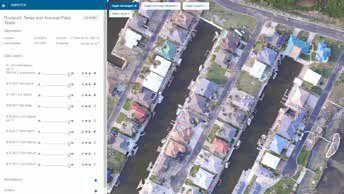
With bases in the U.S. and in Europe, Airbus Aerial’s business focuses on developing new imagery services. These services leverage state-of-the-art software and aerospace technology to offer actionable data and analysis of information provided by drones, satellites, highaltitude aircraft and other sources.
“Through Airbus Aerial, we are positioned and committed to advancing the commercial Unmanned Aerial Systems (UAS) industry. It brings together partners from across the industry – ranging from
vehicle manufacturers, data analytics companies, service providers and others – to enable data-focused services at large scale,” said Dirk Hoke, chief executive officer of Airbus Defence and Space. “Using an integrated combination of assets, from UAS platforms to satellite imagery, Airbus Aerial is rolling out a wide range of new imagery services. In the future, additional pillars of the Airbus Aerial activities will be
in the area of cargo drone services as well as providing connectivity via aerial assets.”
The U.S.-based part of Airbus Aerial is headquartered in Atlanta, Ga., and is led by Jesse Kallman, a UAS industry expert with more than 12 years of experience including research at Georgia Tech, federal policy at the Federal Aviation Administration (FAA), commercial UAS at Airware, and advocacy with groups like
UAV technology is being used by insurance adjusting firm, CRU Catastrophe Response Unit, to test the processes of providing critical information in a post disaster event. The technology was particularly useful in reference to several B.C. wildfires.
Unlike the Fort McMurray fires in Alberta, there was no aerial imagery provided to the public in Williams Lake, B.C. to determine the status of structures in the restricted areas. This compounded worry and concern for many evacuated homeowners, anxious to know if they’ll have an inhabitable home when the fires clear up.
Catastrophe Response Unit (CRU) decided this would be the perfect time to utilize its new drone group and test the
processes of providing critical information in a post-disaster event. Having registered and licenced UAS pilot adjusters in both Canada and the U.S., and the Kespry drone system, CRU worked through the process of requesting SFOCs to obtain Transport Canada (TC) clearance to fly properties in the severely damaged areas of Spokin Lake Road, Horsefly Road and Prichard Road.
After identifying properties that could not be inspected for one of their clients, the first steps were to provide the coordinates to TC to determine if flights could be made in those areas. Normally a process that takes days, with the assistance of Kespry and another CRU industrial partner, clearance to file the flight plans was
received in less than 48 hours.
Next came the mobilization challenges. Jaina Ford, a leading CRU pilot; Glenn Smith, the director of the CRU drone division, and Gary Winston, founder of the CRU group, all travelled to the Williams Lake Operations Center to review plans before starting flyovers. Transporting the drone itself wasn’t easy as the unit is stored in the cargo hold of a plane while the custom batteries had to be securely transported as carry on.
“We took more than 18 months of research and study before we recognized the technical superiority of the Kespry system. During that time, we trained six pilots, who were also adjusters, to qualify for the long list of tests and licenses
AUVSI (Association for Unmanned Vehicle Systems International).
“Drones are only a piece of a much larger picture for us,” said Kallman. “Airbus Aerial brings together a variety of aerospace technologies –including drones and satellites – and combines them in a common software infrastructure, applying industry-specific analytics to deliver tailored solutions to our customers’ biggest challenges.”
Airbus Aerial imagery services target a range of applications for commercial industries, such as insurance, agriculture, oil and gas, and utilities, as well as state and local governments. One of its most recent applications was to provide insurance companies free access to its library of area base maps and data analytics of the areas affected by Hurricanes Irma and Harvey.
required on both sides of the border,” said Smith. “Now, our commercial program has more practical catastrophe experience to guide us with the benefits and use in widespread losses.”
Being able to create and analyze event mapping has always played a key role in systematically responding to catastrophes. Simply creating overlays from hail event to hail event lets companies determine new damage and areas affected in prior years. With earthquakes and large-scale fires, claims are usually worked from the least severe first, then finishing with the most damaged.
CRU sees its drone group as a big assistance in quickly quantifying this damage by neighbourhood or parcel.
Animal management is always a concern at major international airports and Edmonton International has come up with a unique UAV solution for its operations.
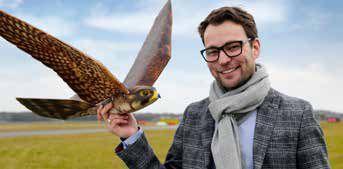
Clear Flight Solutions (CFS) and AERIUM Analytics have integrated unmanned aerial system (UAS) technology at Edmonton International Airport (EIA) for wildlife management, the first ever airport in the world to integrate a full suite of UAS services into their daily operations.
The primary focus is on enhancing EIA’s Wildlife Management Plan while supporting continued growth of the Edmonton Metro Region’s aerotropolis.
The Wildlife Management Plan integrates CFS’s Robird technology to guide birds safely
away from air traffic, while discouraging nesting near airside operations and glide paths. The Robird has been proven around the globe to be an effective, ecologically-friendly method of bird control. The Robird mimics the flight of an actual falcon in realistic fashion, making its flight behaviour so indistinguishable from its natural counterpart that other birds believe that their natural enemy is present in the area.
“We operate our Robirds in a variety of places, but taking the step towards full integration within daily operations at an airport is huge,” Nico Nijenhuis, CEO of Clear Flight Solutions notes. “For years, there has been a lot of interest from airports. To integrate our operations at a major Canadian airport is fantastic.”
As part of the integrated suite of services, CFS AERIUM provides UAS mapping and inspections services to support EIA’s maintenance programs and future economic development efforts. The missions were completed to satisfy safety and hazard identification risk assessments requirements in addition to demonstrating competency
Kongsberg Geospatial, an Ottawa-based developer of real-time, mission critical, geospatial visualization software, and eSmart Systems – a company that develops digital intelligence for the energy industry and smart communities – are integrating the Kongsberg Geospatial IRIS UAS situational awareness system into the eSmart Systems Connected Drone solution for powerline inspection.
eSmart Systems Connected Drone solution collects realtime powerline inspection data for analysis in the eSmart cloud, which provides actionable data that helps utility companies to reduce power failures and operational costs.
Kongsberg Geospatial has been providing technology for military UAV platforms for more than a decade, and is now actively working with industry and regulatory groups in the U.S. and Canada
NEWS views and industry perspectives
UAS missions have been conducted under tight supervision within 400 metres of active runways. EIA is Canada’s fifth-busiest airport by passenger traffic and the largest major Canadian airport by land area. It is a selffunded, not-for-profit corporation whose mandate is to drive economic prosperity for the Edmonton Metro Region.
“EIA is excited to trial this new technology,” Steve Rumley, vice president of infrastructure at EIA, said. “We will ensure that all of the airports regulatory requirements are met as part of our safety management system, including risk assessments etc. to ensure that the testing is completed in a safe manner.”
EIA also houses the Alberta Aerospace and Technology
Center (AATC), which focus on the development and attraction of aerospace and technology companies to Alberta. In 2016, the AATC joined up with AERIUM to focus on the growth and development of UAV technologies in Alberta.
“The partnership between AERIUM Analytics and Clear Flight Solutions is exactly the types of companies and solutions we look to foster under the Alberta Aerospace and Technology Center. We look forward to supporting and promoting this incredible integration of UAS services into airport operations around North America,” said Myron Keehn, vice president of commercial development at EIA.
to develop a simple, portable display for civilian UAV operators that provides them with a unified situational awareness picture combining a wide range of live data feeds into an easy to understand display format.
The IRIS display for eSmart Systems will enable multiple drones to be managed simultaneously by a single operator and provide real-time calculation of communications lineof-sight to enable BVLOS
operations. IRIS will provide the operator with real-time 2D and 3D visualization of airborne track and weather data.
“The expertise and capability of eSmart Systems is exactly the type of enterprise partnership we are looking for to employ our technology,” said Ranald McGillis, president of Kongsberg Geospatial. “We are pleased to join eSmart Systems to help lead the way in the emerging drone aviation market.

MARK ARUJA
It is very likely that 2017 will be remembered as a watershed year for the Canadian UAS industry. Business activity is rising dramatically as both investors and customers are seeing supportable business cases. The regulatory risk is decreasing, new products and services are coming to market, and close to a decade of commercial operating experience is building capacity beyond the pre-revenue stage. As importantly, the conversation is moving to automated vehicles, new communications technologies, data analytics and artificial intelligence.
Unmanned Systems Canada and LOOKNorth undertook an update of the UAS industry in a survey earlier this year. It established that there are now approximately 1,000 companies in the Canadian UAS sector, dominated by companies with less than 10 employees, but also including several large companies (over 100 employees) with UAS operations integral to their businesses
Commercial revenues in 2016 were estimated to be $500 million, with a remarkable 60 per cent revenue growth anticipated in 2017. Anecdotally, these predictions appear to bearing out. Notably, these operations are all undertaken within Visual Line of Sight (VLOS). If Beyond VLOS operations are approved, revenue growth of 100 per cent is expected for 2018.
In addition to capacity growth, the industry is clearly becoming established along ver-
tical segments such as surveying and mapping, precision agriculture, construction, mining and the film industry as major examples. This trend is expected to accelerate with BVLOS operations, as agriculture scales into millions of hectares surveyed, and major infrastructure owners such as the electrical utilities, oil and gas companies and railways start implementing UAS capabilities.
The best practices under which VLOS operations have
of capacity at TC to move forward with Beyond VLOS and larger UAS policy and regulatory issues, including wider concepts such as Unmanned Traffic Management (UTM). Fortunately, the 2017 federal budget allocated new funds to TC to address both UAS and automated vehicles regulatory progress. By the end of this year, TC will have a 30-strong crossdisciplinary UAS Task Force, which will now have the capacity and focus to accelerate the
wishing to do business and invest in Canada.
The upcoming year is expected to see the beginning of a substantive body of knowledge with BVLOS operations, in terms of technologies, business and safety cases. This will enable industry to provide TC with evidence-based proposal for regulations for operations Beyond Visual Line of Sight and in non-segregated airspace.
These are many challenges, which lie ahead to ensure that
“The conversation is moving to automated vehicles, new communications technologies, data analytics and artificial intelligence.”
been undertaken have generated almost 10,000 Special Flight Operations Certificate approvals by Transport Canada (TC). This has also resulted in 2,300 commercial UAS pilots having been trained in Canada in the past 12 months to TC requirements. This year, after 10 years of collaboration by Unmanned Systems Canada (USC) with TC, we reached the milestone event of proposed regulations for Small UAS being published in Canada Gazette One for public comment.
This decade of effort, however has been hampered by a lack
pace of progress.
Fortunately, TC has now approved two UAS test ranges in Foremost, Alta., and Alma, Que. for BVLOS operations. These facilities will not only be critical for a number of Canadian OEMs coming to market in 2017 with BVLOScapable larger UAS, but also for international operators and OEMs who do not have ready access to such airspace. As a result, 2017 has seen an upsurge in export promotion of the Canadian UAS industry, and increasing dialogue internationally with foreign companies
the Canadian UAS industry is able to develop its expertise at a pace that outmarches our global competitors, and allows us to gain a substantive share of an international market that will be valued at $100 billion-plus. Canada’s expansive geography, challenging climates and global depth of expertise in disciplines such as mining, agriculture and surveying, built upon a strong aeronautical history and export focus only point to many successes in the near future.
Mark Aruja is the Chairman of Unmanned Systems Canada.

PAUL DIXON
I’ve seen a number of posts in forums from people intent on getting into the UAV business. All too often, their posts are prefaced with question such as “what’s the best drone to use for (insert job here)” or “how much should I charge?”
But there’s a lot more to hanging out your shingle in the rapidly expanding world of UAVs than giving your business a snappy name and cute logo. And if you’re going to get paid at some point, then you must understand your UAV venture is a business and needs to be treated like one.
If you're serious about this, then there's only one way to do it and that's to get it right from the beginning. To make the most of your business, you need to build a solid foundation before you turn a rotor. Long before you secure your first client, make sure you follow a few key steps. Do you have a solid business plan? You’d better get one, because it’s your road map to the future. Is this going to be an add-on to your existing business or is it a new venture? What are you going to do, who are your customers going to be and how much are you going to charge them? If you have experience in a particular field, then make it work for you. If you’ve got a background in heavy construction or mineral exploration, potential clients are likely going to prefer dealing with
someone who speaks their language.
It’s also important to make a list of the industries or businesses you are familiar with and then take a survey of potential clients in your area. What services would you offer potential clients? Are you simply going to capture data and hand over the raw product – photos, video or any number of data captures – or will you process the data and present your clients with a finished product?
Once you have a business plan together, get to work on all the various licences, permits and other sundry paperwork that goes with any
also need a GST number. If you don’t have one, then get one. In the business world, nothing separates the pretenders from the contenders faster than the lack of a GST number.
Another key step is to understand your insurance requirements, both from the regulatory sense and the broader context. Many thirdparty facilities such as hotels and golf courses that cater to weddings and corporate events stipulate UAV users to provide proof that the UAV pilot as well as the UAV are TC compliant and require proof of insurance.
You must be prepared to
necting with the right person over the phone or by email can be tricky. Join your local chamber of commerce or business organization and take the opportunity to provide demonstrations.
When making presentations, never tell potential clients that you can save them. Instead, focus on how you can help them grow their bottom line through the services you provide. At the same time, don’t forget that you have to keep growing your own business. Your UAV, batteries, cameras, everything are depreciable and subject to wear and tear from day-to-day operations,
“To make the most of your business, you need to build a solid foundation before you turn a rotor.”
business. While it’s important you understand and follow the applicable Transport Canada (TC) regulations regarding UAVs and their operation, it’s just as important from the business side of the equation that you address things that every business has to contend with.
Are you doing business as a limited liability corporation, partnership or sole proprietorship? That’s for you to decide, based on a number of factors. Whatever you choose, you’ll have to register with your province. You will
put a lot of time and energy into establishing your business and growing it. If you’ve figured out what your preferred market areas are and who the potential clients are, then you need to figure out how you’re going to connect your service with the client’s need, especially when they don’t know that you’ve got the solution to a problem they might not even be aware of yet. A solid website is a must. Simple is fine, but it has to be current. Direct marketing to potential clients is always a possibility, but con -
otherwise known as depreciation. You need to account for that in your business plan, just as you need to say abreast of new developments in UAV technology and peripherals. At the end of the day you have to show a profit and that’s not a dirty word. When it comes to running a business, any business, it comes down to one thing. Do it by the numbers and the numbers will work for you.
Paul Dixon is a freelance writer and photojournalist living in Vancouver.

While regulators try to keep up, commercial drones are rapidly evolving from Christmas toys for the bored into serious, sophisticated business tools. Collision avoidance is becoming standard.
German-Canadian-American company Microdrones was the first to receive beyond visual line of sight (BVLOS) approval from Transport Canada (TC) in July, after TC initiated operations at the UAS Centre of Excellence, Alma, Que, which offers the industry a dedicated, restricted airspace for testing.
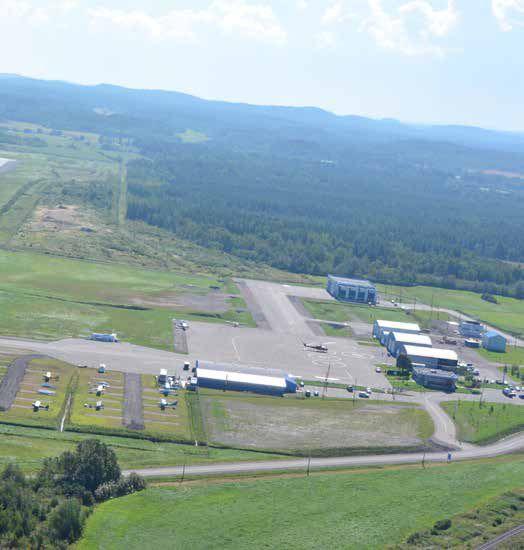
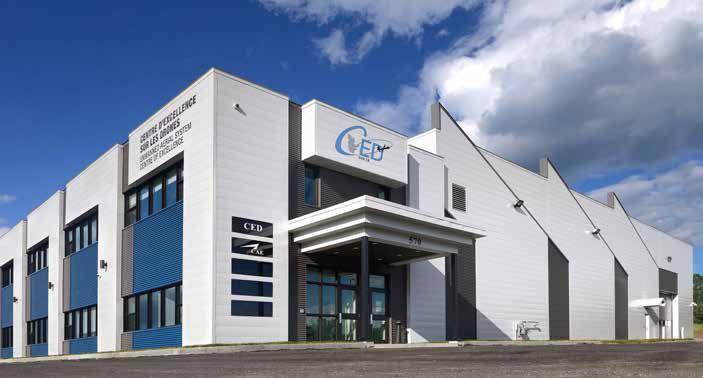
With its, 8,400 ft. sq. hangar and more than 6,000 sq. ft. of office space, the UAS Centre of Excellence is an unmanned gem, and its team is working diligently on a number of Beyond Visual Line of Sight (BVLOS) R&D projects both in Canada and abroad.
The next frontier of UAS innovation will focus on improved cameras and sensor systems, autonomous flight navigation, improved “geofencing” to preclude operations in restricted areas such as around airports and military installations and artificial intelligence.
“There will be more automation – from launching the drone, flying it and capturing the data, to being able to transmit that data and automatically analyze it,” said Anil Nanduri, vice-president in the New Technologies Group and general manager of the UAV segment at computer chipmaker Intel.
Aircraft manufacturer Airbus, for example, is combining the
latest in drones, sensors, and computer analytics to conduct maintenance inspections. As the drone hovers around the aircraft, high-resolution images are scrutinized using machine-learning algorithms to identify any imperfections. The process takes about 10 minutes compared with two hours for two quality inspectors using a cherry picker vehicle.
A category of unmanned aerial vehicles (UAVs), which is coming on strong is multi-rotor drones. These generally offer more manoeuverability simply by changing the relative speed of the rotor and adjusting the
where capability means the Edge can be deployed in hard-to-reach places, including mountain and water locations, and does not require catapults for launch or nets for landing capture. The 130-cm wingspan UAV can be assembled in about a minute with payloads that include a 60-megapixel camera, video, thermal or multispectral imaging. (Clients may also certify their own payloads via FlightWave’s open-source design.) Operators can create automated flight plans or pilot the drone with a joystick. The pre-launch price for The Edge is US$7,500, rising to $10,000.
a helicopter and flies in fixedwing mode for nearly an hour. It is fully autonomous; no piloting skills necessary. It claims “Formula 1” wing technology, “the same batteries that power a Tesla” (presumably smaller), and a LIDAR (Light Detection and Ranging) sensor for landing.
And in yet another celebration of Canada’s 150th year, battery-maker Duracell is going “where no drone has gone before” on an 11,000-km trip that started in Beavercreek, Yukon and concludes in St. John’s, N.L. The Explorer150 program which kicked off in August, is a joint project with
“The process takes about 10 minutes compared with two hours for two quality inspectors using a cherry picker vehicle.”
thrust produced by each.
Applications include aerial photography, agriculture, environmental inspection and coverage of sports events.
A California disrupter, FlightWave Aerospace Systems, will launch a UAV early next year, called the “Edge,” which will take off vertically, then fly as a fixed-wing platform, capable of speeds up to 100 km/hr, with a range of up to 100 km for up to two hours. They’re also working on a solar panel upgrade which will add another 30 minutes’ endurance.
The takeoff and land any-
Enroute to earning his PhD from the Aerospace Design Lab at Stanford University, FlightWave co-founder Trent Lukaczyk did internships at Boeing (on computational materials and mesh tools for composites), Lockheed Martin (simulating aerodynamics), Hillcrest Labs (consumer electronics), and NASA’s Langley Research Center.
The “Wingtra,” which emerged from ETH, the Swiss Federal Institute of Technology in Zurich – sometimes referred to as the “Silicon Valley of drone innovation” – also takes off like
Maclean’s magazine, Duracell, InDro Robotics and (TC). The cross-country journey will provide idyllic video of the countryside that you can view here: http://duracelldrone.macleans. ca/#intro.
This journey accuately showcases the multi-use capabilities of unmmaned aircraft .
Rick Adams is chief perspectives officer of AeroPerspectives, an aviation communications consultancy in the south of France. He is also the editor of ICAO Journal.
The UAS CE sports a building with an 8,400 square-foot hangar and more than 6,000 square feet of office space
By Joe Atherton
Unmanned Aerial Vehicles (UAVs) are a new technology niché which has given us the ability to view things from different angles and heights which even manned aircraft are unable to do.
In particular, an operator can benefit from the instant gratification of being able to fly within minutes of acquisition. This is unheard of in manned aviation, but now, through the use of UAVs we can be “airborne” in minutes.
Each country is responsible for developing and managing its own set of regulations that pertain to the aviation industry whilst agreeing to an international set of general regulations established by the International Civil Aviation Organization (ICAO). UAVs are now becoming a part of these regulations, however the level of enforcement of these regulations varies
from country to country.
Canada is in the process of regulating UAVs as they become more prevalent, particularly in dull, dirty and dangerous tasks. Examples include utility companies who use UAVs to review and assess their infrastructure; farmers using UAVs to manage crop and livestock; realtors who use them to advertise their properties; the film and television industry who capture new views; and law enforcement organizations who use UAVs for search and rescue (SAR) or crime scene reconstruction and more. Needless to say, the uses for UAVs are wide and varied and continue to grow as these platforms become more prevalent. Leading the way in regulating UAVs in Canada is Transport Canada (TC). Under the current TC regulatory scheme, there are two types of pilotless aircraft – those used for recreational purposes, which are
defined as model aircraft, and include traditional modellers as well as those using “drones” or quadcopters for purely recreational reasons, and those using any such aircraft for any purpose other than recreational which are official referred to as unmanned aerial vehicles. It is important to understand which category someone falls into because the rules are different for each category.
For those using model aircraft, no approvals are required. However, they must operate in accordance with the TC Interim Order Regarding the use of Model Aircraft. This Interim Order replaced the original model aircraft provision which was found in Section 602.45 of the Canadian Aviation Regulations (CARs).
The Interim Order provides definitions and describes to whom the Interim Order applies and to whom it does not apply.
Finally, it provides the conditions that must be complied with by those operating model aircraft including situations such as minimum distances from aerodromes, maximum altitudes, areas where flight is prohibited and the need to put the owners contact information on the aircraft.
For those using UAVs, in most cases, an application for a Special Flight Operations Certificate (SFOC) must be submitted by the operator to TC in order to fly. The SFOC application must show how the UAV operator intends to operate and how they will ensure safety is maintained.
In addition to the standard SFOCs, TC is also issuing what are referred to as Compliant Operator SFOCs. These are intended for those professional UAV operators who achieve a higher level of pilot training, operate a UAV that meets a design standard (known as Compliant UAVs), and have put together an organization that complies with certain standards and requirements.
The only exception to the SFOC requirement is to operate under one of two UAV exemptions which provide relief to the SFOC requirement for certain lower-risk operations. These exemptions include numerous safety conditions which must be met in order to operate under the exemption. Details and information on the current regulatory requirements can be found on the TC website. (https://www.tc.gc.ca/eng/civilaviation/opssvs/flying-drone-safely-legally.html)
In terms of the future, on July 15, TC published its proposed new UAV rules in Canada Gazette 1. In response to the Notice of Proposed Amendment, which was issued in summer of 2015, TC has worked on a framework and is now seeking comments before this new version becomes effective on Oct. 13. The proposed rules will no longer differentiate between the uses of the aircraft (recreational or non-recreational) but instead will look at the risks presented by the operation and the aircraft.
With this change, the terms Model Aircraft and UAV will no longer be used and instead the term Unmanned Aircraft System or UAS will be used to identify all pilotless aircraft. These draft rules are meant to capture the biggest sector of the current UAS industry, those operating unmanned aircraft of 25 kgs or less and operated within Visual Line-of-Sight (VLOS).
According to the information in the Canada Gazette, instead of the new UAS regulations being scattered throughout the existing regulations in the CARs, a new Part IX to the CARs will be developed to specifically address UAS. It is anticipated that the most significant changes in the new rules will be for those wanting to fly in complex environments which include in controlled airspace, near airports and within cities or towns.
These UAS users will need to write a knowledge test in order to get a UAS pilot permit, register and mark their UAS, and follow a specific set of rules. By following these new rules, UAS pilots will no longer be required to apply for SFOCs and their business will be able to be conducted in a more predictable way. In keeping with the approach of basing the rules on the risks posed by the intended operation, those that want to operate in lower-risk areas will not have to meet as many rules.
Once finalized these will be some of the first regulations in the world to integrate UAS into the existing airspace structure and not just accommodate them. For those UAS operations that do not fall within the proposed regulatory scheme (for example, UAS more than 25 kgs, beyond visual line-of-sight (BVLOS) flight, etc) a process similar to the current SFOC process will be available to authorize these operations.
Marc Moffatt, director general UAS Centre of Excellence in Alma, Que. shared his perspective on the new regulations with
“It’s obviously good news for the community as it will allow us to develop some training programs and allow operators to comply with these new rules and eventually drop the SFOC process,” Moffatt said. “In other words, if you comply with these rules, you can fly without SFOC and therefore shorten your service delivery cycle.”
Until the new Part IX to CARs is issued, companies and operators will have to continue to request a SFOC through their regional office. In researching this article, it became apparent that difficulties exist across the country as the SFOC process was being applied differently throughout the various TC regions around the country.
As an example, it has been reported that it is extremely difficult to obtain an SFOC in the province of Quebec (or Quebec region) when compared to other provinces. With this said, there has been some successful efforts to level the field as TC has worked with its various regions to standardize the approach.
“The next step will be to define the Beyond Visual Line of Sight regulations. That’s where, in my opinion, where we’ll discover the true benefits of the RPAS and where a site such as the UAS Centre of Excellence can come into play,” Moffatt said. “Since our flight zones have been approved by TC, we’ve more recently managed to get approval to conduct BVLOS operations. This has been quite a development for us and quite an effort.
“We have invested two years to define our Standard Operating Procedures. Not an easy task since we needed to define with the close collaboration of TC and NAV CANADA how we would fly RPAS in BVLOS profile. We are defining the rules and procedures for controls of these systems, and in my humble opinion, we are writing Canadian aviation history.”
At StandardAero, we’re lowering our customers’ DOCs by implementing preventative practices that reduce unscheduled engine removal and emergency maintenance. As an OEM authorized Rolls-Royce AMROC, our comprehensive support programs are designed specifically to increase M250 MTBR, keeping you in the air with worldwide Service Centers and Mobile Service Teams available 24/7.
AOG and need it now? We have an extensive M250 engine accessory and exchange pool, supported by our fresh M250 rental fleet and quick turn-times.
www.standardaero.com/heli +1.204.318.7544

Moffatt was referencing a TC announcement in June, which outlined test trials of UAS technology for surveillance in Northern Canada. The Honourable Marc Garneau, minister of transport, granted the UAS Centre of Excellence approval to begin operations at their test range in Alma, in partnership with the Iqaluit-based company Arctic UAV Inc., and the University of Alaska Fairbanks.
TC will be one of the first to operate at the new test range as the department begins trials with a Sea-Hunter UAV. The trials will provide hands-on experience operating sophisticated UAVs and will help develop procedures, training, and risk assessment tools for surveillance operations in Northern Canada as TC intends to acquire a system that would use UAVs to survey ice and oil spills in the Canadian Arctic.

In anticipation of these activities, the department awarded a contract to Arctic UAV to conduct several research and development flight trials over the next three years.
The UAS CE is also determined to further the development of the centre and establish a pre-qualification and certification site. In the near future, the UAS CE will offer infrastructure and equipment required to prequalify airborne remote sensing systems, a R&D centre to develop sensors and other remote sensing software, and the tools needed to confirm system compliance to the principal standards.
“In conjunction with the prequalification site, we are seeking interested companies to establish a training academy offering training and education programs in the areas of maintenance, manufacturing, image and data analysis, embedded systems as well as pilot training,” Moffatt said. “This site establishment could represent a North America training hub.”
The UAS CE is also being considered as a possible site for TC’s Medium Altitude Long Endurance (MALE) UAS acquisition and testing program, which could eventually see MALE UAS being integrated as part of the National Air Surveillance Program. The UAS CE is now also part of the latest Quebec Aerospace strategy 2016. As such, the Centre has been given the mandate to develop a UAS cluster along with a Strategic & Action Plan.
“We hope to receive final confirmation from the Quebec government that these plans have been accepted by late fall. This should gives us access to some funding to coordinate the Quebec UAS sector,” Moffatt said.
2017-03-02 8:58 AM
In Alberta, the Canadian Centre for Unmanned Vehicle Systems (CCUVS) is a not-for-profit company whose purpose is to facilitate sustained, profitable growth in the Canadian civil and commercial unmanned systems sector. CCUVS makes airspace available for the training and development of the UAS technology sector in both line of sight, and the soon to be developed beyond line of sight operating concepts. CCUVS also assists in the preparation of industry submissions using their knowledge and expertise to make submissions concise and complete – some 85 submissions have been submitted since 2007.
In February, the CCUVS Foremost Range was host to Ventus Geospatial, a Canadian company who used an Aeryon Skyranger small UAS and a C-Astral Bramor fixed wing platform to perform Beyond Visual Line of Sight (BVLOS) flights.
Speaking about the test flights was Stephen Myshak, CEO of Ventus Geospatial, who said this “opens the door for TC to start to get data from the flights and this will lead to regulations so qualified users can start to operate in non
restricted airspace to do pipeline, power line, and large area mapping in Canada.”
UAVs have a wide range of uses and an ever growing demand for operators. Sterling Cripps is a long time operator of UAVs, and is the founder and chief instructor for Canadian Unmanned Inc. (CUI).
Over the past nine years, he has successfully trained more than 2,000 UAV students, representing over 300 businesses in the commercial sector.
He has also worked closely with several police departments and provided initial UAV ground school training for three divisions of the RCMP. This is but one company making an impact in Canada’s growing UAV industry.
On the other side of the equation are companies like Aeryon Labs, headquartered in Waterloo, Ont. Aeryon is a fullservice small unmanned aerial systems (UAS) provider.
In May, Aeryon Labs was part of a team which operated an Aeryon SkyRanger small UAS over Elk City, Okla., which sustained damage from an EF-2 tornado.
The team used the small UAS to collect more than one hour of high-definition video and georeferenced still imagery
over the tornado damage. The real-time video feed was directly provided to Oklahoma’s regional Emergency Operations Centers via AeryonLive video and telemetry solution that streams live video, images and aircraft telemetry from the SkyRanger across a secure bonded cellular network connection.
This is a prime example of Canadian innovation and real-world use of UAVs.
Speaking about the UAV industry in Canada was David Kroetsch, chief technology officer at Aeryon Labs. “We’ve seen the industry go from nothing to embracing remote models which spawned a sort of cottage industry for UAVs,” Kroetsch said. “Since then we’ve seen more of a consolidation as regulations have evolved.
“For an OEM specifically, Canada has been pretty fantastic as we’ve largely been ahead of the curve in operating UAVs, and the export environment has been very positive to grow business internationally.”
With organizations like the UAS Centre for Excellence and CCUVS, and companies like Aeryon Labs, it is apparent that the UAV industry in Canada is strong and developing, and that export potential is growing with it.

By Paul Dixon
UAVs are very appealing to emergency service providers for many reasons, but as the City of Victoria Fire Department has discovered in setting out to establish a UAV program, there’s a lot more going on than initially meets the eye.
As a public agency in B.C., they are obligated to follow the rules, but not simply because they have to. Doing it right
saves time and money and creates a program that has the strength and stability to grow in the future, though it may not look that way as you work your way forward.
The program had its start when fire chief Paul Bruce asked deputy chief Dan Atkinson to look into the potential of UAVs. The first order of business was deciding who within Victoria Fire Rescue
was going to be responsible for operating and deploying the UAV if and when the need arose. Deputy chief Atkinson, master mechanic Cory Meeres along with emergency program coordinator Tanya Patterson and emergency program specialist Jowell Wong took on the responsibility. The next step was selecting a UAV and learning how to operate it, which brought them to Indro Robotics, located on Salt
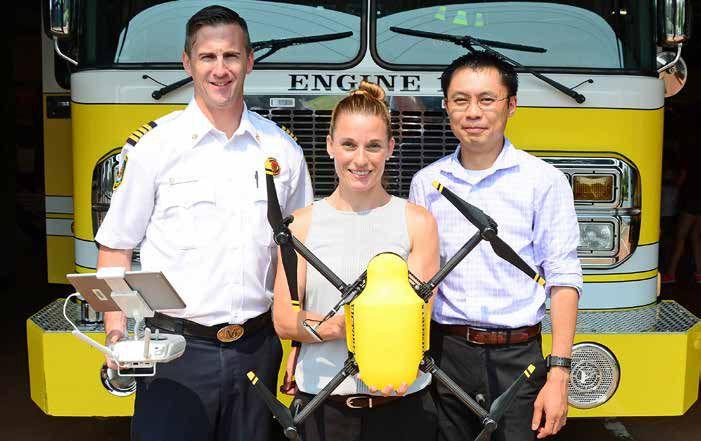
Spring Island. Indro proved to be a good choice, but the team quickly learned there was a lot to learn.
Patterson recalls thinking they would come out of the initial four-day training course ready to put UAVs to work both within the fire department and the emergency program – but that wasn’t the case.
“That was just the basic first level ground school training for pilots,” she notes. “Then we worked with Indro Robotics to get ourselves fully certified (as pilots and observers), which took almost a year. Then there was selecting and purchasing the UAV, which is Transport Canada (TC) compliant. We worked with Indro to get there and to have an SFOC that’s TC compliant as well.”
Philip Reece founded Indro Robotics and Remote Sensing on Salt Spring Island in 2013. With a background in commercial aviation and an entrepreneurial bent, Reece has built a company that promotes and supports UAVs across a wide spectrum of services that ranges from “we fly” to “you fly.”
Depending on the clients’ needs, Indro can do the job with their pilots and UAVs and deliver the finished product to the client in a manner that best suits the need, or as in the case with the City of Victoria Fire Department, train the clients to fly the UAVs, help them choose the most appropriate UAV and continue to support them as required.
“We do a lot of government-related work,” Reece says. “Fire departments, police, paramedics and other emergency services. With these customers, we do a slightly different program (than for a commercial client), because we know that at the end of the day, the goal is to fly beyond visual line-of-sight (BVLOS), especially the search and rescue (SAR) types. We
have our own check pilot in house who can train people on BVLOS and we’ve built up a program that will get them operational right away. Then we continue to build their skills to the point where they could end up flying BVLOS.”
Reece explains that Indro Robotics is an aviation company and not just a UAV company. “I think that’s served us well with TC and the clients we have,” he says. “When you fly in a complex air space like Victoria, you really do have to think of yourself as an aviation company and not just a drone guy.”
Atkinson concurs with Patterson that the first fourday session with Indro was a real eye-opener.
“We came in completely green and by the time the four days were over we realized how green we were,” he said. “We’d gone over with the idea that we’d come back (to work) and be ready to roll. We were introduced to the rules and regulations, the principles of flight, weather – all the basics.”
That was Level 1 and there was still a long way to go. Patterson picks up the story and explains some of the nuances of the program.
“Indro would come over once a week for the next six months and we’d spend half a day doing classroom training and flying in local parks,” she said. “We started on the tiny, little UAVs and progressed up to the ones we have now. The ones we have now are easy to fly because everything is programmed in. The ones we started out with you can’t use an iPad. Everything is stick controlled and it’s really challenging.”
From the first small UAVs, the Victoria team worked up through their training regimen to the UAV they purchased and are currently operating – a DJI Matrice 100 modified to suit the department’s needs. It is also TC compliant. Indro supports a number of leading UAV manufacturers and while
Philip Reece likes to supply clients with one of Indro’s compliant UAVs, he freely admits there are other compliant vehicles in the marketplace.
When asked if flying in public parks attracted much attention, good or bad, Atkinson laughed. “Both,” he says. “When you embark on something like this, one of the primary concerns is how it’s going to be received by the public. Privacy issues, people want to know what kind of information you are gathering and how you treat it. People want to make sure that their privacy rights are protected.”
Staff at city hall addressed privacy issues, through a privacy impact analysis to ensure the program was compliant with city policies. Insurance was another requirement handled by city hall staff. Again, there were a lot of questions to answer, but it’s one more thing done properly at the very beginning.
As the UAV program progressed and training was completed, it generated a lot of attention – internally and externally. Within the City of Victoria, interest came from the police department as well as parks and engineering. For a city the size of Victoria, the UAV represented a shared resource, based on the potential value to the end-users. Once other city departments saw the UAV in operation, they quickly grasped the potential for their needs.
For the police, there was an exercise with the Greater Victoria Emergency Response Team (ERT) where suspects were tracked through a wooded area. The UAV was put up overhead, looking down. Patterson was able to show the incident commander the live feed on the iPad, which was in turn linked to a TV.

“We could see the suspects and then give a description and location to the guys on the ground, which led to their apprehension,” Patterson said. “After that we were able to help with the crime scene reconstruction, taking aerial photos of the scene of a shooting.”
There was also an exercise with the local Urban Search And Rescue (USAR) team where the UAV was used to search a post-earthquake environment for victims. These local exercises caught the attention of the media, which turned it into a national news story.
“We were getting media requests from across the country,” notes Atkinson, as well as calls from fire departments nationwide. “The frustrating thing is,” he notes, “is I was hearing a lot of anecdotal stories about people operating without certification, just doing it under the principle of do it until you’re caught and then beg forgiveness.”
Having reached the stage where they were fully qualified and ready to put the UAV to work, Atkinson and Patterson found themselves facing another puzzle.
“Right now, it’s in-house capacity – the ability to have an operator and visual observer ready to respond to an incident,”
Atkinson said. “We only have the four certified operators in-house. From the time a call is received, from a fire perspective, to the time we would potentially be able to grab the UAV and respond, the vast majority of fire calls we respond to are over. Most are confined to room of origin and they are put out quickly. It’s pretty rare that we’re operationally firefighting and in suppression mode for more than 20-30 minutes. So, in these situations, the fire is under control before we have sufficient resources from the UAV perspective to respond in a timely fashion.”
The opportunity to deploy the UAV on a “real” fire hasn’t happened yet. Another reality check is the realization that the four trained pilot/observers also have full-time positions. Their UAV role is one of those “corner of desk” duties that have become more prevalent in the age of doing more with less. In retrospect, there have been a handful of events where the UAV could have been tested in real-life scenarios, but the operational demands of the situation took precedence.
This past June, a fire on Victoria’s waterfront would have presented a great opportunity to put the UAV to work. Fire broke out on a barge loaded with crushed automobiles and quickly sent a huge
plume of dark smoke up into the sky. Initially, the fire was difficult to approach from land and the images that could have been provided by the UAV would have enabled a quicker size-up of the situation. Atkinson realizes it would have been a golden opportunity, but operational realities take priority.
Waiting for that breakout moment hasn’t stopped them in their tracks, however, as they continue to develop the UAV and work around the municipalities in the Victoria metro area to hopefully widen the base. They are also sharing the message with the community about the UAV and its potential as a community safety and security tool.
“(Working with a UAV) is not as easy as you think it is,” Patterson notes. “You have to make sure you understand all the steps you have to go through. The privacy policy. Operational guidelines . . . how the callout process is going to work. What kind of incidents you deploy it on, who will make the decision for a callout, all the ‘little’ things that you have to plan for and have in place before the actual event.”
Looking ahead, the hope is that the City of Victoria can grow its program into
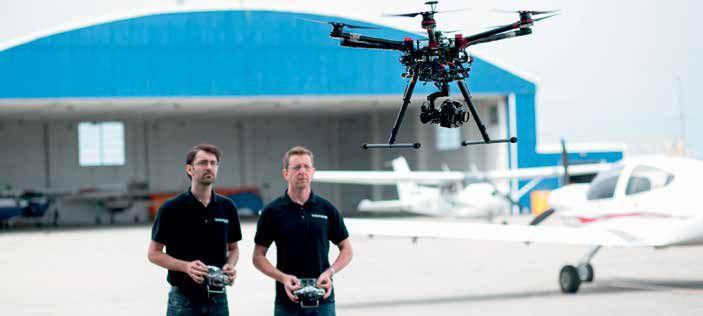
The City of Victoria is seeking to grow its UAV program into a regional resource.
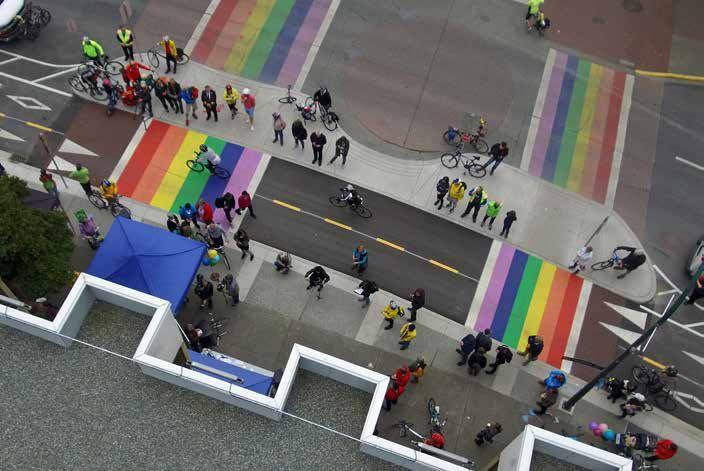
a regional resource, with the message being that there is no need to reinvent the wheel if the resource is already available.
“Take advantage of someone who is already trained and has a program,” notes Patterson in a recent presentation to the Regional Emergency Management Advisory Council. “And call on that resource before trying to start your own program.”
Patterson’s goal for the UAV program is to ensure it an important regional resource. “We’re compliant and we’ve had some high-level discussions to ensure that other agencies know. There are currently mutual-aid agreements in the region anyway and this is something that could be used under those agreements. It’s just a matter of making sure other regional municipalities know the resource is available and could be requested.”
Indro is also working on a new DJI Matrice 200 for the City of Victoria. The new Matrice 200, includes improved weatherproofing or as Reece says, “making it as waterproof as it is possible.” The new UAV will also have dual gimbals for two payloads and a dual batter compartment for longer flight times. The new dual gimbals will allow the team to mount a FLIR camera and regular camera at the same time. The plan is to purchase a FLIR camera for the new Matrice.
Through their contract with Indro Robotics, The City of Victoria has access to a wide range of payload options that are owned by Indro, but could be made available if and when needed, including a variety of cameras and specialized equipment such as radio repeater, sound monitoring, chemical detection and more.
“A lot of people miss the point” about the value of the UAV notes Atkinson. “There are a lot of rules and bureaucracy involved because we have to ensure safety. It’s not a matter of making it difficult, it’s because of all the ‘what if’ scenarios you have to consider.”
The time and effort the City of Victoria Fire Department has put into its UAV program has given them a solid foundation to build the program outward and upward.
By Rehana Begg
The use of drones for industrial inspections, primarily in oil and gas, energy, infrastructure and transportation, is an opportunity that early mover companies like The Sky Guys have seized upon.
“Drones offer incredible opportunity to save time, save money and to remove the human risk from acquiring essential data,” says Adam Sax, president and CEO, The Sky Guys.
With offices in Toronto, Vancouver and Alberta, The Sky Guys is billed as both a professional service and technology company, landing projects in such varied industries as oil and gas, manufacturing, construction and engineering, infrastructure and travel and tourism.
The overall UAV/drone market is expected to reach global market revenue of more than $6 billion in 2017 and grow to more than $11.2 billion by 2020, according to Gartner, Inc. But while the market for commercial drones is much smaller than the demand for personal drones, it has a significantly higher average selling price, higher payload, longer flight times, as well as redundant sensors and flight controllers to make them safer.
Progress monitoring and asset inspections are the primary value from a maintenance and reliability perspective. “The ability to monitor and track equipment in the field in real time or on an ongoing basis, or the ability to do inventory management and volumetrics on any sort of materials is a real value add,” Sax says.
Earlier this year, The Sky Guys started using its drone technology for surveying and inspection services at the General Motors plant in Oshawa, Ont.
The drones are equipped with integrated sensors that map out thermal data for the entire plant and provide critical inspection data at a fraction of the traditional cost and speed, Sax says. While a high-resolution camera takes high-resolution photographs, a thermal camera maps thermal images. The data from both cameras are used to stitch together to create 3D maps.
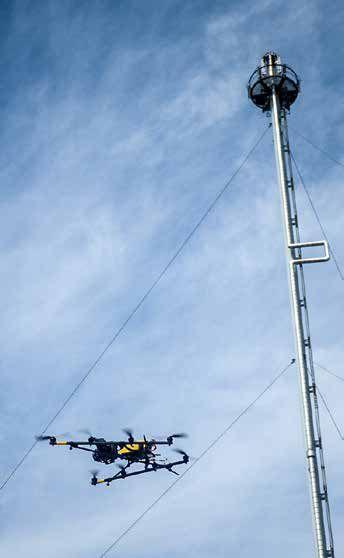
“General Motors can use the thermal maps to inspect entire structures or identify faults or areas that need work, identify heat loss or areas where water pooling will become an issue now or in the future,” Sax says, adding that the drones inspect all critical areas, including flare stacks by ensuring they are tied down and that there is no critical infrastructure damage in need of repair.
To help their clients analyze the data, The Sky Guys has developed a secure cloud network, which allows them to share data and their clients can view it on any device that connects with the Internet – mobile phone, tablet or computer. “The information they see is almost like Google Earth since they can see their asset and click on different layers, such as maps, topography, renderings of structures, and they can zoom in and get up close to the assets.”
In the power and utility sector, where there is a huge need for inspections, drones are becoming a solution, Sax says. Power utilities traditionally use LiDAR (light image detection and radar) for inspecting assets. The Sky Guys took this as an opportunity to develop the first LiDAR drone for the Canadian market and started using it successfully a year-and-a-half ago at EPCOR Utilities, Edmonton’s power and
water utility.
In the mining sector, The Sky Guys have used drone technology primarily for mapping, surveying and topography, for exploratory work in rural areas in northern Canada, as well as in processes, such as water sampling.
Drones are becoming a huge value source and can be highly effective in helping reduce costs by getting critical information to help reduce liability in environmental terms, Sax says. “The ability to map an area in a short period of time at a low cost on an ongoing basis is a huge value. We look at the environmental issues in mining, like tailing ponds.”
According to Gartner research, the inspection segment is expected to dominate with 30 per cent of the commercial drone market through 2020. But while businesses using drone technology in pipeline inspections or power and utility inspections recognize the benefits, there are some hurdles to overcome.
For one, Sax notes, “drones fly at most for 20 minutes and can range in cost from $80,000 to $200,000 each.” Another problem is that drones are susceptible to weather conditions. (“Rain or high winds would create real roadblocks.”)
When Sax started his UAV business in March 2015, he soon learned that “technology wasn’t quite where it needed to be” if his company wanted to provide the best solutions for industries. That is why, in 2016, The Sky Guys scaled up by adding a technology division, Defiant Labs, as a way to develop proprietary commercial drones and develop software with a focus on artificial intelligence
and deeper learning that would allow them to process data and create actionable insights in real time.
Thanks to this research and development arm, The Sky Guys are currently refining their latest offering, the DX-3, which is essentially a fixed-wing, long-range drone with a 12.5-foot wingspan that can assemble and disassemble within five minutes. The drone is designed with proprietary ducted fan technology in the body so that the craft doesn’t require a runway, says Sax. The robust design also allows for 24 hours of flight in all types of weather and can be used for out-ofvisual-line-of-site operations. “We believe this is really a game-changing product that we’re bringing to market in 2018,” he says.
Sax says that his team routinely comes across companies recognizing the value of drone technology and who consider investing in their own equipment. But while The Sky Guys will work with clients to develop in-house talent, companies invariably revert back to subcontracting services from them, he says.
“The primary reasons for that are the continuous investment into the equipment and maintenance of the equipment becomes extremely expensive,” Sax says, noting that The Sky Guys also offers certification for UAV pilots through a ground school certification, as well as in-school training classes for its professional services clients.
“The ongoing training and education, the continuous change of regulations and the combination of all that becomes burdensome for companies,” he notes. “As well, from a liability standpoint, hiring a professional company with a sole focus on data collection using drones removes a lot of the risk and liability than doing things in-house.”
With strong financing and partnerships, the The Sky Guys are en route to becoming a global enterprise. The company is moving into the United States this year and Sax projects the company will provide products, services and software to the global market by 2018.
Sax sees the future of all of the company as being built around the data it collects – as opposed to the drone that’s collecting it – and providing actual insights using artificial intelligence.
“If you know power and utilities and pipelines, the value is in the ability to not only take photos of pipelines but to have the drone learn from the data and perform tasks, such as fault detection and off-gas detection and to report on that in real time,” Sax says. “The ability to have the drone fly autonomously while considering the environmental impact at or close to the pipelines and be able to provide analytics in real time – that’s where we’re headed. And the more AI and machine-learning type technology that we can develop, faster, the more value we will provide for our clients. That’s our long-term strategy. And we’re getting there.”
Rehana Begg is the editor of Machinery and Equipment MRO. Reach her at rbegg@annexweb.com.

















It’s no surprise the H145 is the helicopter of choice for rescue missions. Whether at sea, on a mountain or in a blizzard, it can bring help to where it’s needed. Compact and versatile, it provides outstanding ight performance under the most extreme conditions.


Resilience. We make it y.