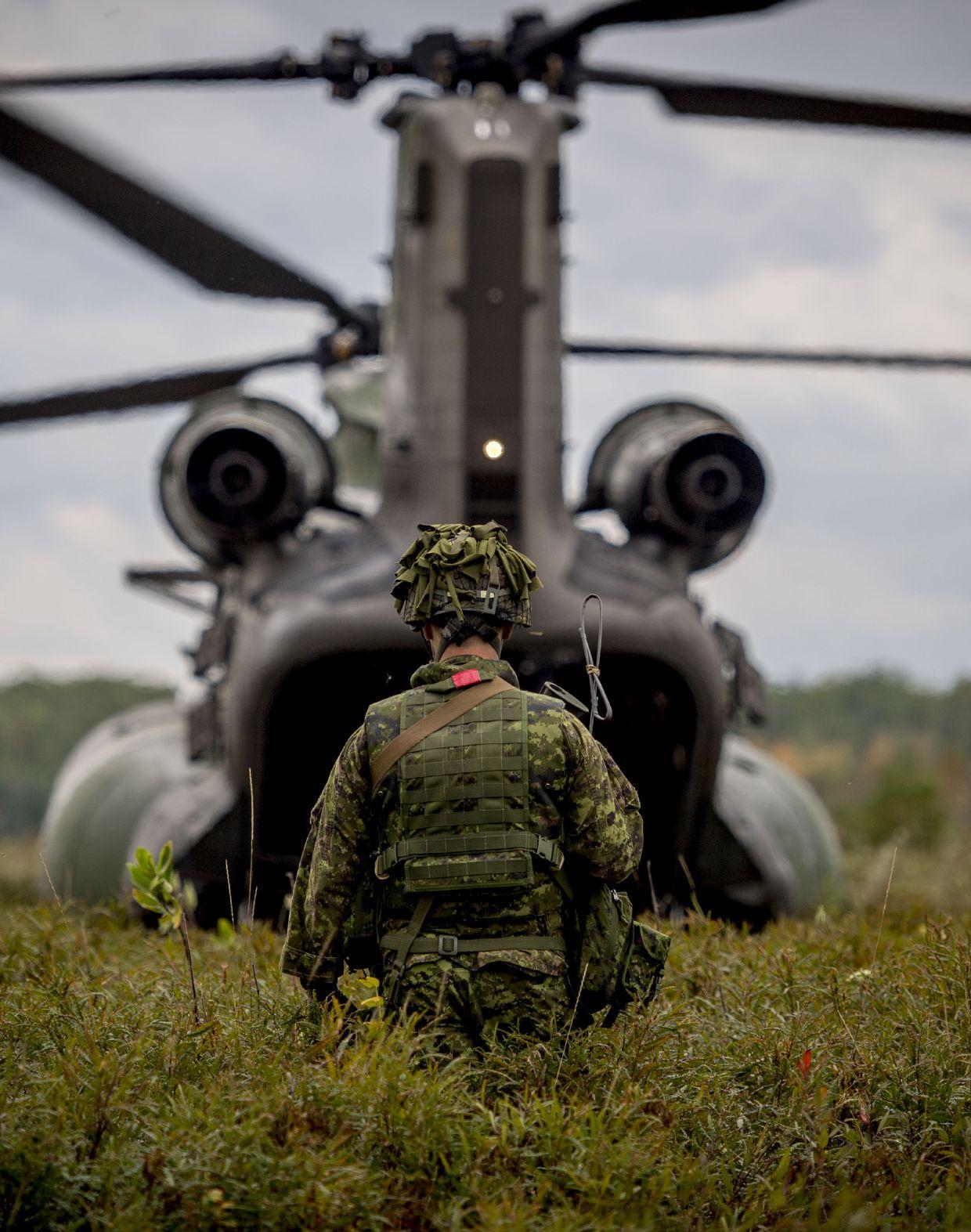
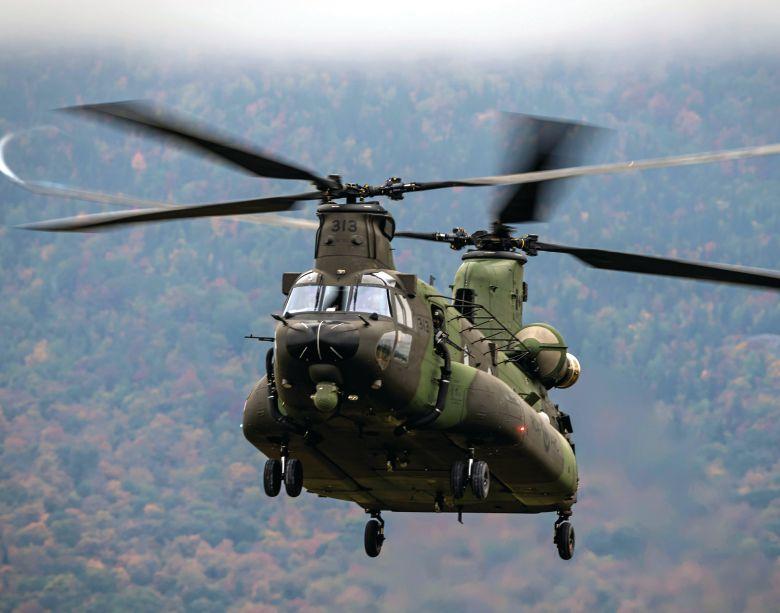
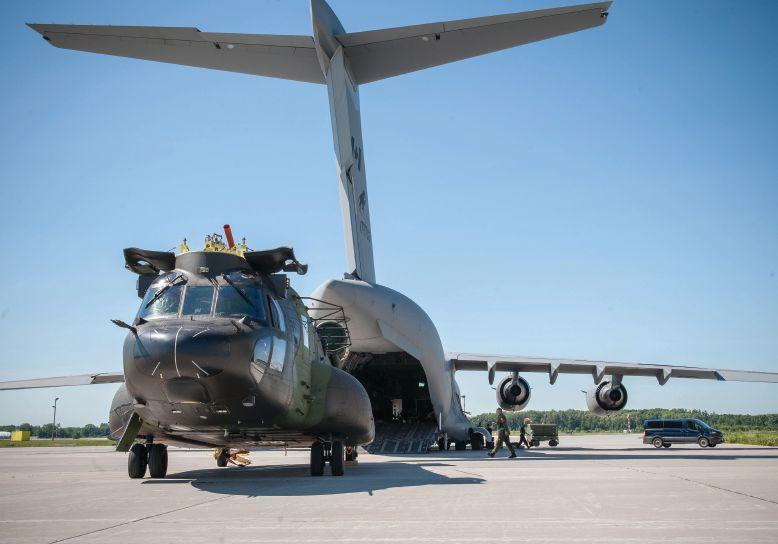
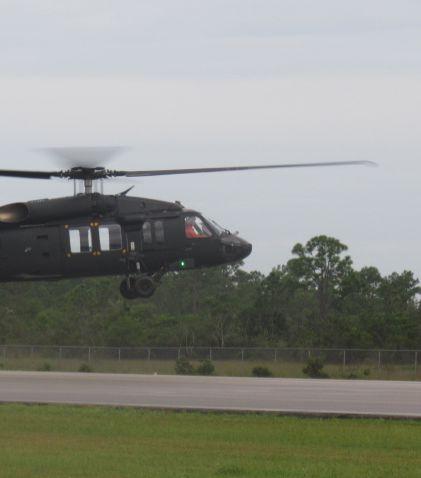
A CH-147F Chinook prepares to land at CFB Valcartier. (Photo: Private Jessica Blackburn)
JON ROBINSON, editor
Bell Textron in July of this year celebrated its 85th year of business, pointing to a range of innovations in flight from building the first aircraft to break the sound barrier – the Bell X-1 flown by Chuck Yeager – to certifying the first commercial helicopter and developing the world’s first tiltrotor, which remains as an awesome sight of engineering. Purchased by Textron in 1960, Bell Aerosystems was instrumental in driving NASA’s first lunar mission by delivering two Lunar Landing Research Vehicles (LLRV) in 1964, well before the space agency had even determined how it would get to and land on the moon. Described by NASA then as the first pure fly-by-wire aircraft to fly in Earth’s atmosphere, the LLRVs would become critical trainers under the new Lunar Orbit Rendezvous concept.
Now, 56 years later, Bell is preparing to certify the 525 Relentless, designed to carry two pilots and up to 16 passengers, as world’s first commercial helicopter with fly-by-wire flight controls. Certification of the 525 has been delayed and is likely to take place in 2021, but this program speaks to Bell’s ongoing commitment to the innovation of flight even through what has been the most-challenging year for the aviation industry. In 2020, Bell reached major milestones and
Eighty-five years of Flight Innovation
demonstration program, designed to assess the safety and utility of unmanned aircraft for commercial use. The first SIO flight of Bell’s Autonomous Pod Transport 70 involved a 10-mile BVLOS circuit using prototype Xwing detect-and-avoid technology in an urban environment.
APT 70’s route along Trinity River in Fort Worth, Texas, included transitioning into and out of controlled Class B airspace, maintaining an altitude of 500 feet. Data collected during the demonstration will be used to support future standards development by the FAA. Through its Nexus program, Bell is also a leading driver of the emerging Urban Air Mobility (UAM) sector. Chalked full of start-ups hoping to revolutionize transportation, established vertical lift companies like Bell will ultimately form the backbone of UAM. In addition to its NASA SIO involvement, the company showed hints of this with the January 2020 introduction of Bell AerOS to track all future aircraft types during passenger flights and logistics operations.
Bell’s team from Mirabel is heavily involved in the parent company’s UAM developments from wind tests performed in Ottawa to vehicle engineering efforts. The Bell facility in Mirabel is approaching a 35-year milestone in 2021 after beginning operations in 1986. Bell sold its first helicopter into Canada in 1963, a Bell 204 aircraft to Skyrotors Ltd. based in Ontario.
Bell Textron Canada is now represented by 1,300 highly skilled employees across the country... To date, the company has built more than 5,200 commercial helicopters.
investments in its V-280 Valor and 360 Invictus future vertical lift programs, including plans to build a corresponding 140,000-squarefoot Manufacturing Technology Center of digital significance.
In early 2020, Bell’s commercial team patented the first ever tail rotor of its kind in the Electrically Distributed Anti-Torque (EDAT) demonstrator, challenging the norms of aircraft noise and electrical distribution. In September 2020, Bell’s innovation of flight was once again on full display with NASA as the lead technology partner in the space agency’s Systems Integration and Operationalization (SIO)
In addition to its key facility in Calgary, Bell Textron Canada is now represented by 1,300 highlyskilled employees across the country. To date, the company has built more than 5,200 commercial helicopters and delivered more than 1,000 aircraft to Canadian customers. These Canadian achievements are celebrated in the 2021 HELICOPTERS wall calendar, through a partnership with the Helicopter Association of Canada, featuring the new 407GXi on the cover.
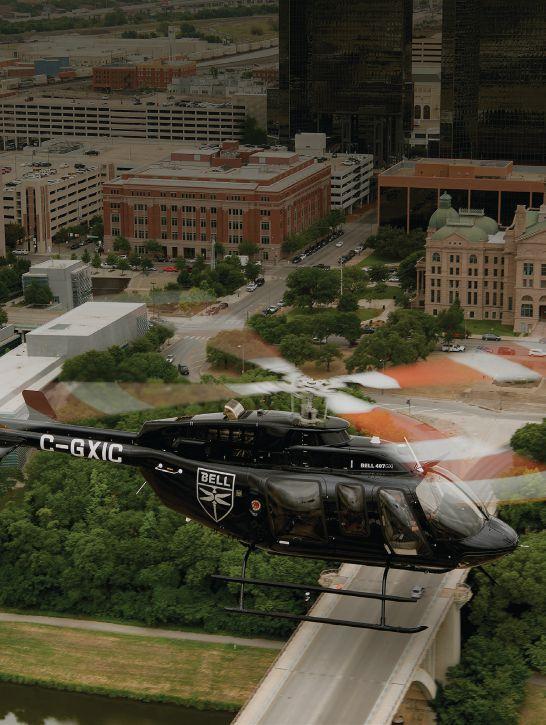
Introduced in 2018, the Bell 407GXi is one of four commercial helicopter types currently being built in Mirabel, along with the 429, 412EPI and 505 Jet Ranger X, the latter of which just surpassed 50,000 flight hours in less than two years. Among the past 85 years of innovation flight, Bell Textron Canada has made an enormous impact on parent company’s all-important commercial segment, which ultimately forms the backbone of the helicopter industry. | H
Kopter upgrades SH09, completes testing in Pozzallo
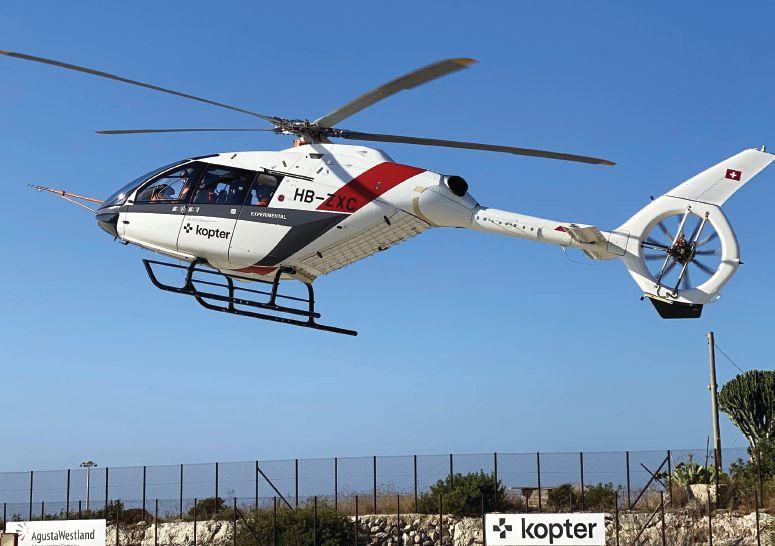
Kopter Group, which was purchased by Leonardo Company in April 2020, completed testing of its third SH09 prototype (P3) in Pozzallo, Italy, returning the helicopter to its main base in Mollis, Switzerland, for more development. Kopter launched its new single-engine SH09 helicopter program in 2017, which achieved first flight on November 22, 2018.
Kopter in June resumed testing activities with SH09-P3 in Pozzallo, in the province of Sicily, completing 40 more flights before returning the aircraft to its Swiss headquarters. Kopter explains the flights allowed it to test multiple aerodynamic modifications and configurations; resulting in what the company calls a significant improvement in smoothness and stability based on P3’s current fitted configuration.
Recent upgrades to P3 include an engine cowling extension for improved aerodynamics, a variable asymmetric tail plane at the best available incidence,
upgrades to the Kopter
the removal of the end plates, and a larger upper vertical fin for improving stability. Moving forward, test priorities are to explore
the capabilities of the new tail rotor and the recent aerodynamic modifications throughout the low-speed envelope. Kopter then
plans to proceed with the upgrade to Garmin avionics and then of the final main rotor head and flight controls.
BELL 505 JET RANGER X REACHES 50,000 FLIGHT HOURS
The Bell 505 Jet Ranger X program has accumulated more than 50,000 global flight hours, with more than 260 505s currently operating across six continents and 55 countries. In August 2019, Bell announced the 505 Jet Ranger X fleet had surpassed 20,000 flight hours.
Bell Textron notes three of its most notable deliveries this year include: Southern Utah University, Centaurium, and Leon County and Alameda County, which received unique publicsafety-configured Bell 505s. The first delivery of the Bell 505 occurred in March 2017 to Pylon Aviation. Powered by a dual channel FADEC Safran Arrius 2R engine, the 505 is a five-seat aircraft rated for a maximum speed of 125 knots (232 km/h) and useful load of 1,500 pounds (680 kg).
Recent
SH09 P3 include an engine cowling extension, variable asymmetric tail plane, removal of the end plates, and a larger upper vertical fin. (Photo: Leonardo)
Southern Utah University’s Bell 505 Jet Ranger X. (Photo: Bell)
Transwest returns to operations with newly equipped Bell 412EP
Transwest Helicopters of Oliver, British Columbia, at the start of September re-entered operations with a Bell 412EP aircraft (C-GTWJ) that has been newly equipped with a range of technologies for utility and firefighting applications. The aircraft underwent a full refurbishment at the Transwest facility and is outfitted with a wire strike kit, the BLR Fast Fin, Strake Kit and BAMBI Max water bucket system, as well as several of Transwestdeveloped supplemental kits. This includes the Co-Pilot Seat Modification Kit and LH Vertical Reference Door STC, which provides added comfort and improved visibility.
including
The company’s 412EP is known as ‘(TW) J for Jeff’ in honour of Jeff Brown, Transwest’s former Chief Pilot for more than 20 years. Tranwest also designed and applied a special memorial aircraft nose decal in honour of Brown. Jason Brown joined the Transwest team in the summer of 2020 as its new Chief Pilot and operations manager. He has more than 13,000 hours of helicopter flight time both domestically and internationally.
Robinson delivers 1,000th R66 Turbine
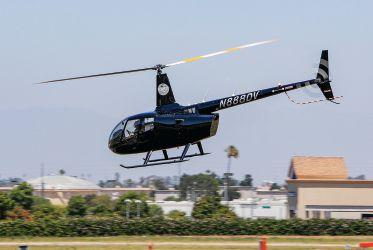
Robinson Helicopter of Torrance, California, delivered the 1,000th R66 Turbine helicopter to one of its dealers, Les Gillespie of Gardner Aviation, based in Peachtree City, Georgia. The new owner of R66 serial number 1000, Donovan Valentine of Monarch Helicopters based in Nashville, Tennessee, previously owned an R44 and, explains Robinson, decided to upgrade to an R66 to better serve his tour company.
The first production R66 was delivered in November 2010, a month after the helicopter received its Type Certificate from the Federal Aviation Administration in the United States. Powered by the Rolls Royce RR300 turbine engine, Robinson states the R66 recently surpassed 1.2 million flight hours without a single reported inflight engine failure.
The R66 is now offered with a range of options, including a cargo hook, lithium-ion battery, fuel
flow system, auxiliary fuel tanks, impact-resistance windshields, state-of-the-art touchscreen avionics, and a SAS/autopilot. The aircraft is also available in police, news and float configurations.
Bell expands service footprint
Bell Textron in September introduced its first ever Authorized Maintenance Center (AMC) in Europe, Aero Club of Poland, which was quickly followed by two more additions in Air Service of Denmark and Intercopter of Germany. Founded in 2001 and then granted maintenance organization Part-145 in 2004, Aero Club is
located near downtown Warsaw and will provide local field maintenance for the Bell 505 and 407. It is owned by JB Investments Sp., a Bell independent representative in Poland since 2007.
Air Service International A/S located in Billund, Denmark, will provide local field maintenance for the Bell 206A/B, 206L and 505. It was established in
in Europe
1979 by Poul Jensen and is now an EASA Part 145 approved centre. Intercopter GmbH, founded in 2003, is located in Taufkirchen near Munich. It will provide service for Bell 206 and Bell 407 series aircraft. Bell now supports customers within a network spanning more than 50 countries in Europe, Russia, the Middle East, and Africa.
HELICOPTERS MAGAZINE
P.O. Box 530
105 Donly Drive South Simcoe ON N3Y 4N5
Tel.: 519-428-3471 Fax: 519-429-3094
Toll Free: 1-888-599-2228
Website: www.helicoptersmagazine.com
EDITOR JON ROBINSON email: jrobinson@annexbusinessmedia.com
MEDIA DESIGNER EMILY SUN
CONTRIBUTING WRITERS
YVAN BLONDIN, REMO GERBER, FRED JONES, KENDRA KINCADE, PHIL LIGHTSTONE, MICHEL MAISONNEUVE, CARROLL MCCORMICK, STEPHEN PYNE, KEVIN TRENBERTH
NATIONAL ADVERTISING MANAGER MENA MIU email: mmiu@annexbusinessmedia.com 416-510-6749
CIRCULATION MANAGER JAY DOSHI email: jdoshi@annexbusinessmedia.com 416-442-5600 ext. 5124
GROUP PUBLISHER, VP SALES MARTIN MCANULTY email: mmcanulty@annexbusinessmedia.com
COO SCOTT JAMIESON email: sjamieson@annexbusinessmedia.com
RETURN UNDELIVERABLE CANADIAN ADDRESSES TO ANNEX PUBLISHING & PRINTING INC., 111 Gordon Baker Rd., Suite 400, Toronto ON M2H 3R1 email: subscribe@helicoptersmagazine.com
Published four times a year by Annex Publishing & Printing Inc.
Mail: c/o Circulation, 111 Gordon Baker Rd., Suite 400, Toronto, ON M2H 3R1
SUBSCRIPTION RATES
Canada - 1 year $31.50
USA- 1 year $74.00 CDN funds
Foreign - 1 year $82.00 CDN funds plus applicable taxes
www.helicoptersmagzine.com/subscribe
Annex Privacy Officer
Privacy@annexbusinessmedia.com
Tel: 800-668-2384
Occasionally, Helicopters magazine will mail information on behalf of industry-related groups whose products and services we believe may be of interest to you. If you prefer not to receive this information, please contact our circulation department in any of the four ways listed above.
LCI, the aviation division of the Libra Group focusing on helicopter and commercial aircraft leasing, and Sumitomo Mitsui Finance and Leasing Company have established a joint venture helicopter leasing business.
The venture has launched an initial acquisition of 19 modern helicopters with a value of US$230 million. Sumitomo Mitsui Finance (SMFL) and LCI are co-investors in the partnership, with LCI also serving as manager. LCI explains the helicopters acquired by the joint venture will be used by operators across the globe in a range of missions, including Emergency Medical Services (EMS), Search and Rescue (SAR), and transportation to offshore wind farms.
Founded in 2004, LCI’s current overall fleet comprises approximately US$1 billion of assets in service, on order and under management, focusing on medium and
Norwegian Air Ambulance receives first ever five-bladed Airbus H145
super medium helicopters manufactured by Leonardo, Airbus and Sikorsky. This fleet is in operation across four continents in multiple sectors, including emergency medical services, offshore wind, search and rescue, maritime pilot transfer and oil-and-gas transportation.
CAMCOPTER measures sulphur emissions in world’s busiest shipping lane
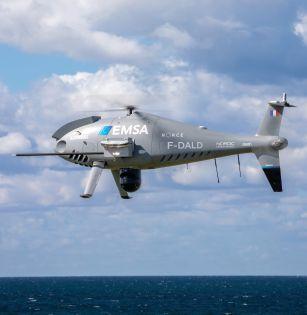
Nordic Unmanned is leveraging its Remotely Pilot Aerial Systems platform to work with the European Maritime Safety Agency for the enforcement of sulphur-emission regulations in the world’s busiest shipping lane, found in the strait of Pas-de-Calais, France, which borders the Strait of Dover.
Nordic Unmanned’s operations with the Schiebel CAMCOPTER S-100 started on September 23 and will continue over a three-month period. The Remotely Piloted Aircraft System (RPAS) service is offered by the European Maritime Safety Agency (EMSA) to French authorities, including the French Maritime Authority for this program.
Nordic Unmanned is leading the program with its partner NORCE Research Institute AS, while leveraging technology and services from Schiebel and Explicit, to ensure that vessels comply with IMO 2020 sulphur regulations. Nordic Unmanned explains should vessels utilize fuel with a sulphur concentration higher than the limitation of 0.1 per cent, they could expect an inspection at the next port of call.
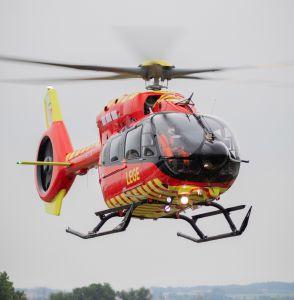
Airbus Helicopters at the end of September delivered the first fivebladed H145 to the Norwegian Air Ambulance Foundation. The new version of Airbus’ H145 light twin was unveiled in March 2019 featuring a 150 kg increase in useful payload and bearingless main-rotor design. The five-bladed H145 was certified by the EASA in June 2020. Airbus notes certification by the FAA is under review and expected soon; and certification of the military version of the five-bladed H145 is expected in 2021.
The Norwegian Air Ambulance Foundation, founded by Norwegian doctor Jens Moe in 1978, is the parent company and owner of Norwegian Air Ambulance (NAA). Airbus explains the organization brought HEMS operations to Norway when it opened its first base near Oslo, using a BO105 helicopter rented from Germany. Today, NAA operates all 13 HEMS bases in Norway and all four bases in Denmark using a fleet of H135s and H145s.
In related news, Germany’s HTMHelicopters reached a deal to purchase two five-bladed H145s, which will make it the first operator to use the helicopter in the offshore wind sector.
Powered by two Safran Arriel 2E engines, the H145 is equipped with FADEC. (Photo: Celian Bauduin)
Rick Hill and Ken Glaze of Heliject stanking on top the North Pole.
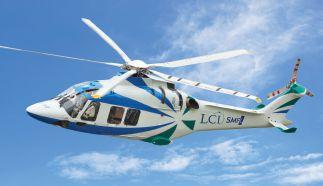
The joint venture between LCI and Sumitomo Mitsui begins with the acquisition of 19 helicopters, including the Leonardo AW169, for a range of missions around the globe. (Photo: LCI)
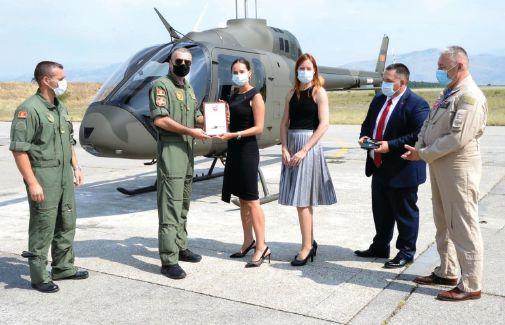
Bell delivers Montenegro Air Force’s first 505
Bell Textron delivered the first of two Bell 505s to the Montenegro Air Force, which will use the helicopters for internal training, while also working with other military pilots in the region. The first aircraft was built in Quebec and accepted by Montenegro Air Force’s Minister of Defence, Predrag Boškovic. The country’s second Bell 505 is expected to be delivered January 2021.
Bell has provided training for three pilots with HeliDeal, a Certified Training Facility for 505 crew located in Southern France.
Manufactured by Bell Textron Canada at its facility in Mirabel, Quebec, the Bell 505 is rated for a top speed of 125 knots (232 km/h) and useful load of 1,500 pounds. This sale was facilitated by the Canadian Commercial Corporation (CCC) through a governmentto-government contract.
Bell explains the 505 includes a high-tech flight deck and adaptable cabin design, Garmin avionics suite, and a FADEC-
controlled engine. The aircraft manufacturer also points to the 505’s high inertia rotor system, enabling students to gain confidence in learning auto rotations.
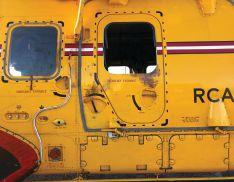
Polar bear damages RCAF Cormorant
Apolar bear on September 16 damaged one of the Royal Canadian Air Force’s CH-149 Cormorant helicopters used for search and rescue operations, as it was parked at the airfield in Saglek, Newfoundland and Labrador. The aircraft is operated by 413 Squadron, based in Greenwood, Nova Scotia.
The helicopter crew had landed at Saglek because poor weather prevented the team from continuing to an automated
NORAD radar station near the remote community as part of a two-week training exercise. Sometime overnight, the bear came by to investigate the helicopter, causing superficial damage as it pushed on a side door, popped out an emergency exit window, and removed a small cover panel on the nose. The RCAF notes the polar bear did not get inside the helicopter and there were no crew members in the vicinity at the time.
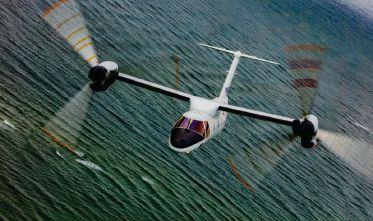
Tokyo evaluating AW609 for Ogasawara Islands transport
The Tokyo Metropolitan Government is evaluating the Leonardo AW609 tiltrotor for future transport to the Ogasawara Islands, which are located in the Pacific Ocean approximately 1,000
kilometres from Tokyo. Also known as the Bonin Islands, this archipelago of more than 30 subtropical and tropical islands became a UNESCO World Heritage Site in 2011. The Ogasawara Islands represent an area covering around 84 square kilometres, holding a population of approximately 5,000. Leonardo explains the AW609 is well suited for Ogasawara Islands transport because it can perform in all weather conditions and with limited infrastructural impact.
The AW609 is rated for a top speed of 275 knots, 25,000-foot altitude and 1,000-nautical-mile (1,852-kilometre) maximum range. The 25,000-footaltitude ceiling allows the AW609 to fly above adverse weather in the comfort of a pressurized cabin. Leonardo has a long-standing presence in Japan with a support and service network for a mixed fleet of 130 helicopters performing a range of civil, public service and military missions.
SkyAlyne expands FAcT team
SkyAlyne Canada LP, a partnership between CAE and KF Aerospace, introduced an expanded team of subcontractors to pursue RCAF’s contract for the Future Aircrew Training (FAcT) program, the military pilot and aircrew training program under Canada’s Strong, Secure Engaged investment plan.
SkyAlyne is one of four qualified suppliers bidding for the FAcT contract, along with Babcock Canada, Leonardo Canada, and Lockheed Martin Canada. The contract award is expected to be announced by the government in 2023.
Canadian-based companies ATCO Frontec, Bluedrop Training and Simulation, Canadian Base Operators, Canadian Helicopters, SERCO Canada and PAL Aerospace are joining SkyAlyne’s FAcT bid team. The newly expanded SkyAlyne team collectively employs more than 14,000 Canadians and operates in every region of the country. | H
Montenegro Air Force’s two Bell 505s will be used to train new military and air force pilots in the region. (Photo: Bell)
The Leonardo AW609 is set to become the world’s first civil certified tiltrotor, with two aircraft currently being assembled in Philadelphia. (Photo: Leonardo)
The RCAF Cormorant crew posted some pictures of the damage caused by the polar bear, as well as some muddy paw prints.
(Photo: RCAF/Twitter)
COLUMN
Welcome to the Pyrocene Age
California wildfires signal the arrival of a planetary fire age
Another autumn, more fires, more refugees and incinerated homes. Free-burning fire is the proximate provocation for the havoc, since its ember storms are engulfing landscapes. But in the hands of humans, combustion is also the deeper cause. Modern societies are burning lithic landscapes, once-living biomass now fossilized into coal, gas and oil, which is aggravating the burning of living landscapes. The influence doesn’t come only through climate change, although that is clearly a factor. The transition to a fossilfuel civilization also affects how people in industrial societies live on the land and what kind of fire practices they adopt. Even without climate change, a serious fire problem would exist... What were lithic landscapes have been exhumed and no longer only underlie living ones. In effect, once released, the lithic overlies the living and the two different kinds of burning interact in ways that sometimes compete and sometimes collude. Like the power lines that have sparked so many wildfires, the two fires are crossing, with lethal consequences.
As a historian of fire, I know that no single factor drives it. Flames synthesize their surroundings. Fire is a driverless car that barrels down the road integrating whatever is around it. Sometimes it confronts a sharp curve called climate change. Sometimes it’s a tricky intersection where townscape and countryside meet. Sometimes it’s road hazards left from past accidents, like logging slash, invasive
that resembles the demographic transition which accompanies industrialization as human populations first expand, then recede. Something similar happens with the population of fires, as new ignition sources and fuels become available while old ones persist.
The transition sparked a wave of monster fires that rode the rails of settlement – fires an order of magnitude larger and more lethal than those of recent decades. Land clearing and logging slash fed serial conflagrations, which blew up in the late-19th and early-20th centuries, the waning decades of the Little Ice Age. It was a period of flame-catalyzed havoc inspiring state-sponsored conservation and a determination to eliminate free-burning flame. Led by foresters, the belief spread that fire on landscapes could be caged, as it was in furnaces and dynamos. Eventually, as technological substitution (think of replacing candles with lightbulbs) and active suppression reduced the presence of open flame, the population of fires fell to the point where fire could no longer do the ecological work required. Society reorganized itself around fossil fuels, adapting to the combustion of lithic landscapes and ignoring the fire latent in living ones.
Fire is a driverless car that barrels down the road integrating whatever is around it.
grasses or postburn environments.
Climate change acts as a performance enhancer and it claims most of the attention because its reach extends beyond flames to oceans, mass extinctions and other knock-on effects. But climate change is not enough by itself to account for the plague of megafires. Climate integrates many factors, and so does fire. Their interplay makes attribution tricky. Instead, consider fire in all its manifestations as the informing narrative. The critical inflection in modern times occurred when humans began to burn fossilized rather than living biomass. That set into motion a “pyric transition”
Now the sources overload the sinks: Too much fossil biomass is burned to be absorbed within ancient ecological bounds. Fuels in the living landscape pile up and rearrange themselves. The climate is unhinged. When flame returns, as it must, it comes as wildfire. Widen the aperture a bit, and we can envision Earth entering a fire age comparable to the ice ages of the Pleistocene, complete with the pyric equivalent of ice sheets, pluvial lakes, periglacial outwash plains, mass extinctions, and sea level changes. It’s an epoch in which fire is both prime mover and principal expression. Even climate history has become a subset of fire history... a particular kind of meddling through our monopoly over fire.
It’s been a stretch to fully include human fire practices within traditional ecology. But industrial fire, unlike landscape fires, is solely a product of human finagling, and so has stood outside the bounds of ecological science. It’s as though the intellectual sink for understanding can no more hold the new realm of burning than nature can its emissions. | H
This article was originally published by The Conversation. Stephen Pyne has written two books about wildfires, called Between Two Fires and Fire. He is Emeritus Professor, School of Life Sciences, at Arizona State University.
STEPHEN PYNE
COLUMN
Superheroes of the Sky
Search-and-rescue exercises with 417 Squadron in Cold Lake
When I think of superheroes, I think of men and women in capes darting across the sky, using their powers for good – dedicated to protecting the public and saving people from impending doom. Replace the capes with uniforms and you can find real-life superheroes flying around Canadian skies, ready at a moment’s notice to come to our rescue.
I recently participated a in training excercise and Change of Command with 417 Combat Support Squadron in 4 Wing Cold Lake in Alberta. Exercises are performed at full speed by this search and rescue squadron, because the team must be ready at a moment’s notice. It can make all of the difference between life and death.
Immediately upon arriving at the Cold Lake hangar, I was whisked away on a quad by Med Tech S1 Andrew Cleveland. Along with two students (future flight engineers, Cpl KC Frigon and Cpl Brandon Barlow), we set up an accident scene as soon as we arrived at ground zero. The scenario involved a quadding accident in which Frigon feigned a broken leg. Then we waited.
It wasn’t long before we heard the sound of rotary blades thumping air in the distance. After a quick lesson on how to set off a flare, I shot one into the sky to signal our whereabouts to CH-146 Griffon. Suddenly over the treetops, the distinct yellow and red helicopter appeared for our rescue. It was easy to imagine how the sight of the Griffon would bring relief to victims at an accident scene.
hover. But I soon took notice of the superheros again and wondered how difficult their mission would be in temperatures well below zero with poor visibility. PO2 Lavoie was being lowered from the helicopter with a stretcher right behind. He quickly assessed the situation to determine who needed medical attention first, swiftly wrapping the wound and moving our patient onto the stretcher.
Once the patient care was complete, the ground portion of the exercise ended and the Med Tech was lifted up to the helicopter. At that point, as a guest patient, I was also secured in a harness, attached to the hoist and swiftly pulled off the ground toward the sky. I looked up at and marveled at the body of the beast hovering right above me... Up, up, up I went. The wind whipping around me, feeling more alive than I have in a long time.
When I reached the helicopter I was happy to see Cpl Devost ready to pull me into safety. This is not the first time I had the privilege to fly with him and it was comforting to see his familiar face... or should I say helmet. The success of this mission depended on the entire team, including the pilots whose flying skills are rivaled by none, the flight engineer serving as mission quarterback, the Med or SAR Techs ready to jump into the most severe conditions, the maintainers who ensure that aircraft is safe for flight, and the logistical and command team who oversee the entire operation.
After a mystical ride over a winding river, with the sun shining down on us and an autumn forest dressed to match our ride, we arrived back at the hangar for the Change of Command presentation.
I looked up and marveled at the body of the beast hovering right above me... Up, up, up I went.
Maj Alexia Hannam and Capt Matt Comeau were, at the controls of the helicopter. Flight engineer Cpl Aaron Devost was at his regular spot, confidently riding in the open side door to guide the helicopter to the scene below for hoisting a Med Tech or any injured people. Med Tech PO2 Dan Lavoie was ready to spring into action, to be hoisted down if necessary, and secure safety of the victims.
As I watched the helicopter moved above us, I admittedly felt a wave of warmth for this mission to be taking place on such a beautiful fall day. It felt as if I was in a magical world with colourful leaves dancing around us and above an amazing machine settling into a
The ceremony was unique because of the pandemic, but it was a special day for outgoing Maj Hannam and incoming Maj Eileen Sudul. Although the official Change of Command occurred in March, the two pilots were finally able to get together with some members of 417 Squadron.
The 417 is a relatively small squadron, but their efforts should not go unnoticed. These skilled military members do not shy away from their duty. They have rescued kayakers and snowmobilers, searched for survivors amid forest fires, among a range of missions that are always risky, in addition to their primary duty to provide rapid SAR response for all military aircraft in Cold Lake. What these people do on an daily basis is remarkable, dangerous and always with the intent to serve others. They truly deserve superhero status. | H
Kendra Kincade is Executive Director of Elevate Aviation.
KENDRA KINCADE
A CH-147F Chinook is prepared for transport to Operation PRESENCEMali onboard a CC-177 Globemaster at 8 Wing Trenton (Photo: Avr. Melissa Gloude, 8 Wing Imaging).
CH-146 Griffons from 430 Squadron take part in parachute training. (Photo: Cpl. Geneviève Beaulieu, Imaging Section, Valcartier)
The Future of Military Installations
Examining CAF priorities and commitments to support base development
BY YVAN BLONDIN AND MICHEL MAISONNEUVE
This article examines some of the factors that will influence the future of military installations in Canada and their impact on the capabilities of the Canadian Armed Forces (CAF). The arrival of a new Chief of the Defence Staff and the pandemic’s budgetary implications, coupled with increasing national security and defence concerns, may only offer the Canadian government difficult choices when dealing with the future need for military installations. This discussion also needs to be viewed in the broader context of the Department of National Defence's (DND) Strong, Secure, Engaged policy priorities and commitments.
THE STRATEGIC OUTLOOK
One of the most critical CAF priorities during the current pandemic will be to protect its members’ health and safety. Due to the pandemic, the pressures and demands on the CAF have been augmented. However, the threat caused by State and Non-State Actors has not diminished. Given the CAF’s primary mandate of defending Canada and protecting Canadians, sight must not be lost on China, Russia, North Korea and Iran’s increasing assertiveness and often aggressive behaviour. Such context is an essential factor when considering the
positioning and basing of CAF elements domestically.
International organizations such as NATO face numerous challenges, including the increasing pressure to reduce their overhead costs from collective funding. Meanwhile, the Trump Administration’s continued pressure on NATO member-states to bring their military spending to two per cent of their respective GDP will remain an indisputable legacy of the current, and to the same degree of previous, U.S. Administrations.
Simultaneously, NATO member-states are finding it hard to agree on values that were initially taken for granted. At the same time, Canada’s relationship with the U.S. is one that fundamentally dictates our approach to defence spending and strategic capability procurements, especially as we continue to collaborate in NORAD and manage our Continental defence priorities. There is greater interest from many actors towards the Arctic, which will force Canada to have an increased presence in this new strategic area.
Internally, factors that influence CAF basing include cyber-threat force protection, energy production, Indigenous Peoples engagement, and natural resource development pressures, including freshwater. The issue of climate change has increasingly captured the attention of Canadians. Climate change will significantly impact the North, includ-
ing rendering the Northwest Passage sailable year-round. Canada has declared this area internal waters, but some nations do not agree, including the U.S., Russia and others. Reduction in the polar ice caps, especially in the Arctic region, will need a more significant Canadian presence and an ability to assert our sovereignty.
THE IMPACT ON CANADIAN MILITARY INSTALLATIONS
While military budgets have grown in the last few years, expenses linked to the pandemic will put tremendous pressure on all federal department budgets. Deficit spending is inevitable in the short-term to stimulate the broader Canadian economy, increasing scrutiny on defence spending. Although increased defence spending is identified in Strong, Secure, Engaged, planned CAF growth is difficult to predict, given the pandemic’s unknown duration. Heightened security concerns, however, should justify protecting the current operation and infrastructure levels.
The effects of climate change on the Arctic confirm the requirement for an increased military presence in the North. Ongoing initiatives in Resolute Bay and Nanisivik will need to grow and be networked to even more locations in the Northwest Territories and Nunavut to support increased activities. The movement North, which started 10 years ago, remains a critical security requirement for Canada and will require investments in telecommunications, Low Earth Orbit satellites and other transportation and logistics capabilities to support and supply Canadian military installations. The federal government needs to mobilize its departments and agencies in a new way to work together, synchronize national policies and priorities, and include industry to address increased activity in the North due to strategic competition over resources and access to new sea shipping routes.
ROYAL CANADIAN NAVY
The transition of the RCN to new fleets supports the dual-basing system in the Pacific and Atlantic regions. The RCN’s challenge will be to meet the increased demand for its services in the North and Arctic regions. The Nanisivik Naval Facility project, for example, first announced in 2007, will provide a docking and refuelling facility for the RCN and the Canadian Coast Guard. The current scope of the project is to support operations during the four-month summer season. With the projected increases in naval activity along the Northwest Passage by Allies and other strategic competitors like Russia and China, Nanisivik will most likely need to meet its original intent: a permanently staffed naval station and home port to a Canadian Arctic fleet.
CANADIAN ARMY
Army bases will remain concentrated to support the four significant formations; the three brigade-groups and Combat Training Centre. Army training areas will need to continue to support large-scale manoeuvres but will also require the ability to train for hybrid conflicts. Greater Arctic basing of Army elements will have to be considered. Force protection of bases and depots will mean more significant resource requirements. As a widely dispersed component within the country, the Primary and Secondary Reserve Forces and the Canadian Rangers can provide presence and quick reaction to local, regional and national emergencies, requiring increased and ongoing resource commitments. There will also be a greater need for federal-provincial cooperation in the context of Continental domestic defence. This may lead to a new agreement between the CAF and Canadian provinces to strengthen or create collaborative protocols, as recently demonstrated by Operation Laser in response to Covid-19. The changing military theatre will shape the Army’s requirements for permanent installations supporting advanced technologies and forward projecting capabilities.
ROYAL CANADIAN AIR FORCE
If the current RCAF operations level is maintained, the requirement for most bases in southern Canada should remain stable. Gander, Comox, Greenwood, Trenton, Moose Jaw, Portage, Cold Lake and Bagotville should not expect any significant change in the next decade. However, the need to continually modernize base infrastructure must be a standing priority for the federal government. The last few decades’ trends to move away from larger cities for noise abatement and better use of ideally located federal land may affect Winnipeg and Shearwater.
Resolute Bay was identified in 2011 by the RCAF as the ideal location to build infrastructure to support increased flying activities in the North. As the Army and RCN increase activities and the requirement grows to support, patrol, rescue and police the Arctic from the air, robust year-round RCAF facilities will be needed in Resolute Bay.
There is no military need or requirement to maintain costly legacy facilities and infrastructure of current RCAF units in Goose Bay or North Bay. Military units in these locations have been kept in place to protect local economies and interests, especially in Goose Bay. The occasional RCAF requirement to use the Goose Bay airfield could easily be met using deployed facilities similar to what currently exists in Nunavut and Iqaluit.
CONCLUSION
The current pandemic has delivered both challenges and opportunities to the CAF. Without a doubt, the pressure on short-term military spending should be the top priority for the new Chief of Defence Staff. The case for continued long-term investment in defence needs to be linked to the federal government’s intent to bolster the Canadian economy. Increasing security concerns generated through geopolitical factors and climate change will require significant defence expenditures on infrastructure and defence capabilities.
Canada needs to be prepared to assert its sovereignty over its Arctic region and the Northwest Passage. Strengthening military installations in the North and Arctic regions needs a whole-of-government approach to leverage infrastructure investments and interdepartmental priorities, plans and budgets. The Department of National Defence’s Strong, Secure, Engaged policy may require enhancements (version 2.0) to reflect evolving threats, innovations in advanced technologies and hybrid military activities of strategic competitors in the North over resources and sea shipping lanes. For these reasons, both DND and CAF need to accelerate their timetable in support of modernizing Canada's military installations. | H
RCAF Lieutenant-General (Ret’d) Yvan Blondin is a Senior Aerospace Associate with Ottawa-based government relations firm, Samuel Associates. He has 35 years of military leadership experience and has accumulated over 3,000 flying hours in various fighter aircraft, including the CF-18 and the T33. Blondin held progressive leadership positions at the Canadian Department of National Defence, NORAD, and served as Director of Staff in NATO ISAF Headquarters in Afghanistan. Blondin was appointed Commander of the Royal Canadian Air Force (RCAF) in 2012, where he served in that position until his retirement in 2015.
Army Lieutenant-General (Ret’d) Michel Maisonneuve is a Senior Defence Associate at Samuel Associates. He retired after completing 35 years of active service in the Canadian Armed Forces. During that period, he served on staff and as an operational commander in missions ranging from humanitarian relief to conflict operations, including Cyprus and the Former Yugoslavia (UN) and Kosovo (OSCE). His senior appointments included Assistant Deputy Chief of the Defence Staff of Canada and Chief of Staff of NATO's Supreme Allied Command Transformation.
Power of Lithium-ion Batteries
How
advances in lithium-ion chemistry from True Blue are providing a new generation of aviation power
BY PHIL LIGHTSTONE
Every aircraft engine start requires a tremendous amount of power to swing the propeller or the turbine fans and power the magnetos/igniters all combining to fire the engine. Once the engine has started, the alternator takes over to produce electricity, powering the panel and charging the ship’s battery. Hot starts on certain engine models can be a problem, quickly zapping the energy stored in the battery. Cold temperatures further robs aircraft batteries of their stored energy.
Battery technology has been changing over the past 20 years. The advent of lithium chemistry has changed both the consumer electronics and aviation industry. From an aviation perspective, NanoPhosphate Lithium-ion and Lithium Iron Phosphate cells offer advantages, without the thermal runway issues plaguing the consumer electronics sector.
Lithium cells have a number of benefits: 70 to 80 per cent lighter than lead-acid and nickel cadmium; 10,000 charge cycle life (versus 350 a lead acid battery); will not corrode or sulfate; cannot freeze or boil; can be mounted in any position, except inverted; very low selfdischarge rate (can hold a charge during the winter months); wider operating temperatures; higher starting voltage while engine is
cranking (faster starts); and discharge voltage is very constant, essentially delivering a steep drop off at total discharge. True Blue Power and EnergyX are two manufacturers that have been leading the charge on this new technology for aviation batteries. EnergyX’s cells are targeted at the uncertified market, with certification underway for Cessna 172s.
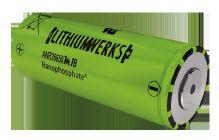
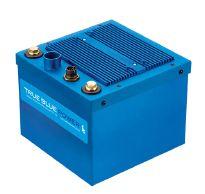
Mid-Continent Instruments and Avionics’ power division, True Blue Power manufacturers a variety of power products, including USB charging ports, chronometer with USB power ports, DC to AC inverters and others. Its NanoPhosphate Lithium-ion battery technology has a stable power chemistry with several million NanoPhosphate cells produced annually. Lithium-ion cells have roughly three times the energy density per kilogram when compared to lead-acid and NiCad alternatives. The result is a battery system that is significantly lighter than traditional batteries, while capable of delivering higher power with noticeably faster engine starts.
IMPACTING CONVENTIONAL BATTERIES
Lithium-ion technology has replaced more than 37 per cent of all conventional battery applications representing a $29.9 billion market and yields a 40 per cent to 75 per cent weight savings. Airframe
True Blue Power lithium-ion batters have earned STC approvals for a range of fixed- and rotary-wing aircraft, including Bell, Robinson, Leonardo and Airbus helicopters. (Photo: Bell Textron)
manufacturers like Airbus, Bell Helicopter, Boeing, Leonardo, Lockheed Martin, Northrop Grumman, Robinson Helicopter Company, Sikorsky and Textron are committed to utilizing this technology.
In 2010, True Blue Power released its TSOd and STCd power solutions for aircraft, including general and business aviation. True Blue Power batteries are STCd for use on the Cessna Caravan, Beechcraft Bonanza, Pilatus PC-12, Robinson R44, and Beechcraft King Air, to name a few.
In January 2020, Airwolf Aerospace selected True Blue Power’s main ship batteries for a series of new lithium-ion battery STC kits on 18 turbine helicopter models, including Bell, Airbus and Leonardo. These kits also include mounting hardware, simple wiring harness and a Magic Button – combing a computer, annunciator and battery warm-up switch – that is exclusive to Airwolf. As Airwolf explains its STC kits essentially offer a plug-and-play, standalone installation, requiring only a one-square-inch hole in the panel for the annunciator.
True Blue Power aircraft batteries are the first lithium-ion main aircraft batteries to receive FAA TSO and EASA European Technical Standard Order (ETSO) certifications, using extremely rigorous Radio Technical Commission for Aeronautics (RTCA) standards for lithium-ion aviation products. Additional testing includes life testing based on accumulating 20,000 simulated flights with no safety or performance issues. The full assessment comprised of 60 batteries undergoing 230 separate qualification tests, including 20 G crash testing, -30° C to 70° C operational temperature, shock and vibration tests. All batteries confirmed the ability to manage over-voltage, over-current, under-voltage and short circuit with no possibility of damage allowed to the aircraft.
A True Blue Power lithium-ion battery will typically last eight years or more. Factors contributing to an early end of life include: high operating temperatures; extreme mission profile; emergency power requirements; and APU start versus main engine start. The True Blue Power TB44 battery has been tested to exceed 11,000 engine start cycles. In most cases, lithium-ion batteries should last three to four times longer than lead-acid batteries.
THERMAL RUNAWAY AND HANDLING
Thermal runaway is a concern with lithiumion batteries. There have been many media stories and YouTube videos showing the catastrophic failure of a consumer-grade lithium-ion battery in a smartphone. The
proprietary NanoPhosphate cell chemistry used by True Blue Power is significantly more stable and less reactive than other chemistries.
In the unlikely event of an internal short circuit to a cell in a True Blue Power battery or thermal runaway, a white, electrolyte vapor is directed outside the aircraft, away from passengers and critical components. Its lithium-ion batteries are tested to withstand a scenario in which all redundant levels of protection are disabled and over-
current/overcharge is applied. The battery is proven to deliver one 100 per cent containment and reach a temperature not to exceed 204°C.
True Blue Power has a number of batteries, of different sizes and amperage hour, focusing on piston, turboprop and jet aircraft. Its technology has evolved over the past 10 years, currently on a 5th generation (Gen5) series, which includes the TB20, TB30 and TB40 main ship batteries. On-board electronics provide proactive
data, alerting and command-control operations of the battery cells.
With USB connectivity, data can be moved off the battery by simply attaching a USB data stick. Some of the benefits of its Gen5 batteries include: Wider operating temperatures (relative to lead acid or nickel cadmium); more power per battery weight; more engine starts per charge; automated built in pre-heaters controlling battery temperature in cold weather operations; data logging; alerting; data integration into glass panels; controllable through a cockpit annunciator panel; on-condition maintenance; and extended life, on average eight years before replacement.
CHARGING AND EMISSIONS
A True Blue Power battery requires about 30 minutes or less for complete recharge when the battery is fully discharged. The battery delivers higher voltages during engine start. This should result in less wear and tear on the airframe power plant and less maintenance. Incorporated in the TB17 battery is a Switch Board, providing the ability to enable and disable charging or discharging depending on the health of the battery and associ-
FEATURE
THE PARAMETERS OF TRUE BLUE POWER LITHIUM-ION BATTERY CELLS:
ated conditions. It also contains a charge limiting function and current monitoring. In addition to the Switch Board is a Control Board, which is the heart of the Battery Management System (BMS).
The discrete logic circuitry monitors the battery functions and protects against such conditions as short circuit, over-temperature, over-discharge and others. The Control Board also generates the battery status signals that are accessed through the 7-pin communication connector for cockpit monitoring and heater control.
True Blue batteries produce no emis-
sions during normal operation. Emissions, vaporized electrolyte, will only be present in the event of a battery failure. However, the battery has a vent to ensure that any gaseous emissions are vented overboard. Be sure to locate the vent where emitted gases would not be directed toward any of the aircraft’s air intake points. That last thing that you want is for the pilot or passengers to be overcome by battery gaseous emissions.
OPERATION AND MAINTENANCE
True Blue Power batteries have the ability to operate at temperatures down to -40°C
(-40°F) thanks to the internal, self-powered heater. They are designed to support an engine start down to approximately -5°C (23°F), depending upon the engine start profile. Below this temperature, the performance of the battery begins to decrease in current and energy delivery as the electrolyte in the cells begins to thicken and the internal impedance increases to retard ion flow. In order to address this, each battery module contains an individual heater which is powered by the cells themselves, even at very low temperatures.
The TB17 and TB44 are able to communicate the battery’s status to the pilot through a panel-mounted display screen (MD41-1817 and MD41-1844). The MD41-1817 is an Annunciation Control Unit (ACU) which is able to support two TB17 batteries. The fully integrated control unit provides annunciation for the TB17/TB44 displaying the following annunciations: temperature, fault, charging and heating. A push button on the ACU turns on the battery’s internal heaters. True Blue Power is developing an annunciator panel for its Gen5 batteries.
True Blue Power’s lithium-ion batteries have demonstrated 20,000-plus engine starts and subsequent charge cycles. The cells themselves are designed for a useful life of up to 10 years. The TB17 and TB44 batteries have a two-year maintenance interval, while the Gen5 batteries have no defined maintenance intervals.
Pricing starts at $9,647, plus options. The True Blue Power batteries deliver sufficient value to air taxi operations and other commercial operators, with flights into airports with little or no maintenance resources. The True Blue Power battery makes a lot sense, versus the total cost of an Aircraft on Ground incident. For revenue generating aircraft, total cost of ownership of battery technology is impacted by costs associated with maintenance at remote airports.
No scheduled maintenance is required for True Blue Power’s Gen5 Advanced Lithium-Ion batteries, once installed. However, the battery must be recharged every six months when it is not in use, following the proper procedures. Optional battery maintenance is included for verification of battery performance only on an as-needed, or on-condition, basis. These include: visual inspection; off aircraft charging; capacity check; re-calibrating the battery’s capacity measurement; and manual capacity check.
If charging is required in between flights, most lead acid chargers are okay to use. However, the lithium batteries cannot be charged using a de-sulphating type lead acid battery charger and a car should not be used to jump start the aircraft. Typical lead acid battery tenders are designed to de-sulfate the cells, which is a problem for lithium cells. There are many battery chargers on the market today which are compatible with lithium batteries (contact True Blue Power for suggestions).
DEALING WITH DANGEROUS GOODS
True Blue Power lithium-ion battery products are classified as Class 9 Dangerous Goods and require special processes for shipping. Customers can contact True Blue Power for complete instructions.
All True Blue Power lithium-ion batteries may ship via ground or vessel at 100 per cent State of Charge, but IATA regulations require the battery to be at 30 per cent state of charge prior to shipping via air and can only be transported via cargo aircraft.
It is important to only discharge to 30 per cent shortly before shipping to avoid a potential over-discharge scenario. Batteries will need to be fully recharged within 30 days to ensure battery health is maintained. If dealing with an AOG situation, the 30 per cent charged battery can be charged using a ship’s power delivered by an APU/GPU.
All lithium-ion batteries are classified by the United States government as non-hazardous waste and are safe for disposal as normal municipal waste. Canada would have similar regulations around their use. However, these batteries do contain recyclable materials and recycling options available in your local area should be considered when disposing of this product. You should dispose the battery in accordance with local, state, provincial and federal laws and regulations. Of course, do not incinerate the battery. You always can go to Call2recycle.org or other online sources for the location of a free drop off recycling centre.
One would expect that over time, with more cells in the field, the cost of research and development, as well as certification, amortized over more batteries, the cost of lithium batteries may become more affordable for the average general aviation pilot/owner. In the consumer market place, lithium-ion cells have all but replaced nickel cadmium cells and rechargeable alkaline cells.
On the horizon for True Blue Power is the all-electric aircraft marketplace. Perhaps we’ll see the smart battery technology become the norm in general aviation and e-planes. Only time will tell. | H
FEATURE
Bringing the S-70M North
Sikorsky outlines the potential for Restricted Category Firehawks to reach Canada
BY JON ROBINSON
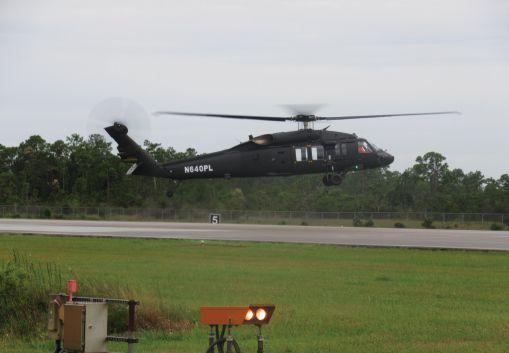
In early 2020, PZL Mielec, a Lockheed Martin company in Poland, manufactured the first S-70M Black Hawk helicopter on the same production line where it has produced the S-70i since 2011 for 17 customers worldwide. The helicopter was then delivered in September to Sikorsky’s flight test facility in West Palm Beach, Florida, for evaluation by the Federal Aviation Administration (FAA).
On October 3, the FAA performed its first of many flights in the S-70M. Sikorsky is working with the FAA to receive Flight Standardization certification for S-70M by the end of this year in accordance with the Type Certificate Data Sheet for Restricted Category clearance. This would allow commercial operators to acquire a new production Black Hawk directly from Sikorsky for the first time in the helicopter’s storied 42-year history.
Based on the third generation UH-60M Black Hawk, which entered service with U.S. Army in 2005 and now has more than 1,300 deliveries, the S-70M was granted Restricted Category certification by the FAA in February 2019. This allowed Sikorsky to request FAA authorization to produce the S-70M for special purpose operations within the civil market, including external cargo, agriculture operations, and forest and wildlife conservation. Within the conservation application, Restricted Category aircraft are able drop water as part of an aerial firefighting operation.
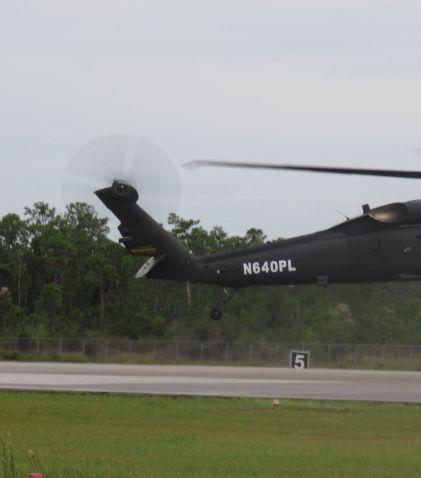
Indeed, the first S-70M – with its initial FAA registry N640PL – that flew on October 3 and is to undergo FAA flight evaluation through November, will be fitted with the
Firehawk aerial firefighting system in 2021 for an undisclosed U.S. customer (Sikorsky expects it will name the first S-70M operator before the end of this year). This Firehawk integration will be performed by United Rotorcraft centring around the distinctive 1,000-gallon Kawak external conformal tank fitted to existing Firehawks, which first entered service 20 years ago with LA Country Fire. This was followed by the new generation S-70i, which entered service earlier this year again with LA County, as well as San Diego Fire and CAL Fire – the latter of which just upped its S-70i order from nine to 12 aircraft.
Sikorsky one year ago had initial discussions with Transport Canada about bringing the S-70M up north under a Restricted Category certification. The Black Hawk has never been operated by the Canadian military, however, making it ineligible for the same Restricted Category clearance as in the U.S. Transport Canada will need to accept the S-70M Firehawk before Canadian commercial operators can buy the sought-after multi-purpose platform.
Don Maguire, Sikorsky regional executive for Canada, notes Sikorsky and the FAA can play an important, collaborative role to assist Transport Canada with the validation process. “By working together, we have the best opportunity to develop a Canadian Restricted Category Firehawk,” he says Experience gained during the past 20 years of operating the S-70 Firehawk in California could greatly benefit Canada, but ultimately the pedigree of the Black Hawk itself should enable certifying agencies around the world to accept the airworthiness of the type design – under a Restricted
FAA evaluation
Category evaluation process. Many government customers around the world are attracted by a third-party airworthiness certification for the Black Hawk. Sikorsky believes there is a need to be fulfilled in the civil arena for a certified utility helicopter, built to a robust military design, to perform demanding missions, such as aerial firefighting and search and rescue.
“The baseline is certified to U.S. MIL standards… whether it be crash or high mass retention, airframe fatigue, rotor system and engine performance, or system redundancy, which are higher than commercial standards, including landing on uneven surfaces,” says Joe Palumbo, international programs director at Sikorsky. He describes growing interest in the S-70M from Greece, Spain, Korea and Australia, countries that similarly depend on the aircraft first earning FAA Restricted Category tickets, followed by national authority approval.
Palumbo notes the Black Hawk’s military baseline also provides a range of maintenance advantages for private companies operating the S-70M, in the field, or simply in terms of ordering spares directly from the OEM, again as authorized by Restricted Category certification. He points to a range of advances in the S-70M’s updated Firehawk configuration relative to previous generations, such as more power, greater maneuverability and lift when fully loaded, enhanced flight safety, new retractable snorkel system (that can fill the tank in 45 sec-
The first
flight of the S-70M Black Hawk, October 3, 2020, at Sikorsky’s West Palm Beach, Florida, facility with its initial registry, N640PL. (Photo: Sikorsky)
onds from a water source only 20 inches deep), four-axis stabilization, wide-chord rotor blades, IVHMS and an NVG integrated digital cockpit.
Both Palumbo and Maguire describe how the Firehawk platform, with its 1,000-gallon actuated belly-mounted tank
and programmable control, has created a new operational paradigm in how wildfires are attacked and fought. In addition to its capability of carrying 12 to 14 firefighters to an uneven surface, the Firehawk can cruise to the fire at about 125 knots with a fully loaded tank (145 knots empty), compared to airspeed limits of around 80 knots for most long-line-equipped mediums in Canada. Many of these older mediums are also relying on analogue avionics.
Maguire describes an image captured of the Firehawk on what he estimates to be a 60-degree bank as it enters the final approach to a drop, which adds G-loading to the water and expels it at close to 90 degrees to the slope. Palumbo then describes the Firehawk’s extensive NVG experience and capability, which is the next evolution for aerial firefighting – not only because of quieter fire conditions associated with nighttime, but also the inherent smokeinduced low-visibility of fighting fires during the daytime.
“There’s clearly a lot of interest in the Firehawk in Canada. If we look at the initial approach from several operators, I would say that we have a potential in Canada for at
least 15 Firehawks over some period of time, of course,” says Maguire. “Provincial forestry services recognize this aircraft is a little more costly to acquire than some of the legacy mediums currently in use. However, the value is there when comparing the intensity and volume of water dropped.”
Maguire explains forestry departments understand the need to provide longer-term contracts to operators rather than annual renewals; and financing organizations would also need to extend beyond typical five-plus-year arrangements to help operators handle costs. “Forestry departments in Canada are intimately aware of the effectivity and the popularity of the Firehawk,” he says, noting one provincial director stated a need for the availability of up to eight Firehawks. “Sikorsky plans to apply for Transport Canada Restricted Category authorization, which would open the door for S-70M Firehawk helicopters in Canada.”
Until such time, Sikorsky and the FAA are pushing ahead to finalize the training curriculum for pilots and maintainers; and working with Flight Safety International to certify an existing S-70 full flight simulator to Level D qualification. | H
NEED FUEL HANDLING EQUIPMENT?
Climate Change and Wildfires
How do we know if there is a link
BY KEVIN TRENBERTH
Once again, the summer and fall of 2020 in the Northern Hemisphere has brought us an epidemic of major wildfires. These burn forests, houses and other structures, displace thousands of people and animals, and cause major disruptions in people’s lives. The huge burden of simply firefighting has become a year-round task costing billions of dollars, let alone the cost of the destruction. The smoke veil can extend hundreds or even thousands of miles, affecting air quality and visibility. To many people, it has become very clear that human-induced climate change plays a major role by greatly increasing the risk of wildfire.
Yet it seems the role of climate change is seldom mentioned in many or even most news stories about the multitude of fires and heat waves. In part this is because the issue of attribution is not usually clear. The argument is that there have always been wildfires, and how can we attribute any particular wildfire to climate change? As a climate scientist, I can say this is the wrong framing of the problem. Global warming does not cause wildfires. The proximate cause is often human carelessness (cigarette butts, camp fires not extinguished properly, etc.), or natural, from “dry lightning” whereby a thunderstorm produces lightning but little rain. Rather, global warming exacerbates the conditions and raises the risk of wildfire.
There is huge complexity and variability from one fire to the next, and attribution can become complex. Instead, the way to think about this is from the standpoint of basic science – in this case, physics. To
understand the interplay between global warming and wildfires, consider what’s happening to our planet. The composition of the atmosphere is changing from human activities: There has been more than a 40 per cent increase in carbon dioxide, mainly from fossil fuel burning, since the 1800s and over half of that increase is since 1985. Other heat-trapping gases (methane, nitrous oxide, etc.) are also increasing in concentration in the atmosphere from human activities. The rates are accelerating, not declining (as hoped for with the Paris Agreement). This leads to an energy imbalance for the planet.
Heat-trapping gases in the atmosphere act as a blanket and inhibit the infrared radiation – that is, heat from the Earth – from escaping back into space to offset the continual radiation coming from the sun. As these gases build up, more of this energy, mostly in the form of heat, remains in our atmosphere. The energy raises the temperature of the land, oceans and atmosphere, melts ice, thaws permafrost and fuels the water cycle through evaporation. Moreover, we can estimate Earth’s energy imbalance quite well: It amounts to about 1 watt per square metre, or about 500 terawatts globally.
While this factor is small compared with the natural flow of energy through the system, which is 240 watts per square metre, it is large compared with all other direct effects of human activities. The extra heat is always the same sign and it is spread across the globe. Accordingly, where this energy accumulates matters. The heat mostly accumulates ultimately in the ocean – over 90 per cent. This added heat means the ocean expands and sea level rises. Heat also accumu-
lates in melting ice, causing melting Arctic sea ice and glacier losses in Greenland and Antarctica. This adds water to the ocean, and so the sea level rises from this as well, rising at a rate of over three milimeters year, or over a foot per century.
On land, the effects of the energy imbalance are complicated by water. If water is present, the heat mainly goes into evaporation and drying, and that feeds moisture into storms, which produce heavier rain. But the effects do not accumulate provided that it rains on and of. However, in a dry spell or drought, the heat accumulates. Firstly, it dries things out, and then secondly it raises temperatures. So water acts as the air conditioner of the planet. In the absence of water, the excess heat effects accumulate on land both by drying everything out and wilting plants, and by raising temperatures. In turn, this leads to heat waves and increased risk of wildfire. Indeed many of the recent wildfires have occurred not only in the Western United States but also in Portugal, Spain, Greece and other parts of the Mediterranean.
Drought conditions, in addition to a lot of dead trees and vegetation, are contributing to another year of severe wildfires. The conditions can also develop in other parts of the world when strong high pressure weather domes (anticyclones) stagnate, as can happen in part by chance, or with increased odds in some weather patterns such as those established by either La Niña or El Niño events (in different places). It is expected that these dry spots move around from year to year, but that their abundance increases over time, as is clearly happening. How big is the energy imbalance effect over land? Well, 1 watt per square metre over a month, if accumulated, is equivalent to 720 watts per square metre over one hour; 720 watts is equivalent to full power in a small microwave oven. One square
metre is about 10 square feet. Hence, after one month, this is equivalent to one microwave oven at full power every square foot for six minutes. No wonder things catch on fire.
Coming back to the original question of wildfires and global warming, this explains the argument: There is extra heat available from climate change, and the above indicates just how large it is. In reality there is moisture in the soil, and plants have root systems that tap soil moisture and delay the effects before they begin to wilt, so that it typically takes over two months for the effects to be large enough to fully set the stage for wildfires. On a day-to-day basis, the effect is small enough to be lost in the normal weather variability. But after a dry spell of over a month, the risk is noticeably higher. And of course the global mean surface temperature is also going up.
As in the wildfires example, there has been a realization that climate scientists may be able to make useful statements by assuming that the weather events themselves are relatively unaffected by climate change. This is a good assumption. Also, climate scientists cannot say that extreme events are due to global warming, because that is a poorly posed question. However, we can say it is highly likely that they would not have had such extreme impacts without global warming. Indeed, all weather events are affected by climate change because the environment in which they occur is warmer and moister than it used to be. By focusing on Earth’s energy imbalance, new research is expected to advance the understanding of what is happening and why, and what it implies for the future. | H
This article was originally published by The Conversation. Kevin Trenberth is a Distinguished Senior Scientist, National Center for Atmospheric Research.
When minutes matter, we’re first to the fight.
High winds, smoke, night skies. We fly where others can’t. Equipped with the most advanced aerial firefighting systems and equipment, FIREHAWK ® is the most capable and effective initial fire attack aircraft on the market. Visit lockheedmartin.com/firehawk
Lockheed Martin. Your Mission is Ours.®
Developing Regional Air Mobility
Why Lilium’s eVTOL network plans look well beyond 20 kiliometres
BY REMO GERBER, COO, LILIUM
The idea of Urban Air Mobility is pretty well ingrained in most people’s minds. It’s futuristic flying cars that hop around a city, perhaps taking off from a garden, before stopping at the local shops and then dropping the kids off at school. Of course, the reality is very different. Taking a short hop from Lower Manhattan to Grand Central Station in New York, or from the English Garden in Munich to the main station, is not only impractical (you’d need hundreds of landing pads in one city) but it won’t actually save you any time as you’ll likely need to travel to and from the vertiport as well as check-in for your journey. Instead, we set out to do something different. Different from what most people expect from electric air mobility and different from the vast majority of our competitors. With a range of up to 300 kilometres (186 miles), we’ll be able to focus on connecting entire regions with high-speed transport, rather than trying to persuade you that we’re quicker than a crosstown journey on an underground train or bike. In fact, contrary to the idea of urban air taxis, we think there will only ever be a handful of routes in our network that are shorter than 20 km (12 miles). That might sound surprising, so I’ve picked two examples – in Switzerland and Southern California – to illustrate how electric VTOL flight might be deployed most effectively.
Switzerland is blessed with excellent transport connections, a punctual train service and many beautiful places to go. And yet, even with world-class infrastructure, it still takes considerably longer than expected to reach these destinations from my home town of Zurich. Traveling with the all-electric Lilium Jet would allow me and others to complete these journeys significantly faster and at a price that would be comparable to a first-
class train ticket at launch, and cheaper after a few years into operation. But the opportunity does not stop there. Because an air mobility service doesn’t require expensive landbased infrastructure like roads or rail connecting each point, we can rapidly create a network with hundreds, if not thousands, of route options, linking up major towns and cities to create significant economic impact, better land use, and increased access to industry, culture and nature.
A system with only 20 landing sites would create around 200 potential routes and 10,000 km of high-speed connectivity (assuming 50 km distance between sites). That’s three times the entire French high-speed TGV rail network for a fraction of the cost. Since we do not have to build tracks, which can easily cost more than $20 million per kilometre, we can connect smaller communities too, adapting the frequency of connection to match the demand. By adapting existing infrastructure
like airports, heliports, or even the roof of a parking garage, there is a genuine opportunity to implement a network that could look like this, in less than five years.
The same argument applies to San Francisco and the Bay Area. Known for its economic activity, matchless creativity and for being surrounded by natural beauty, it is also a large urban area with many centres plagued by heavy traffic and high housing prices. What if we could change that, with high speed, all-electric travel? Today, traveling in and around the Bay Area is a challenge, but a Lilium service has the potential to improve journey times significantly. Assuming you start your journey somewhere around the Embarcadero (the eastern waterfront of San Francisco), travel times to Palo Alto would be around 45 minutes by car, 50 minutes by train, or 10 minutes via a mature Lilium eVTOL service. San Francisco to Santa Cruz would be 75 minutes by car, two hours and
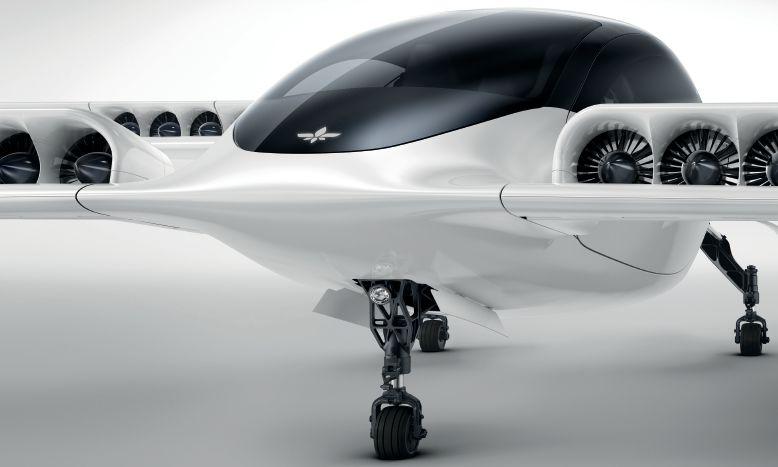
Lilium of Germany is developing a fiveseat VTOL all-electric aircraft with a range of up 300 kilometres, aiming for a market introduction as early as 2025.
(Photo: Lilium)
51 minutes by train, or 20 minutes by Lilium eVTOL. San Francisco to Lake Tahoe would be three hours and 41 minutes by car, eight hours and 49 minutes by train, or 49 minutes by Lilium eVTOL.
If we imagine for a moment that you work in an office in Palo Alto, you could now choose to live in Hayward (five minute flight, $25), downtown San Francisco (10 minute flight, $50), or even San Rafael (15 minute flight, $70). Or maybe you want to escape to Lake Tahoe for a long weekend? That would be less than an hour on a Lilium Jet, at a cost of around $250 at launch and less in the near future. It might not be something you would do every weekend, but saving you three hours each way might well make it worthwhile for an occasional trip.
There are many sites that could host a vertiport in downtown San Francisco, ranging from piers to parking lots and the rooftops of existing transport hubs. And, with a regional approach to travel, we could effectively service the entire downtown area using just one or two pads. In the Valley, we could see vertiports providing high-speed connections to homes and corporate campuses, using shuttles buses, ride-hailing and micromobility for last mile travel. These could be placed alongside highways or next to the Bay, allowing us to minimize any ground impact by routing flights over the water, or above busy traffic arteries.
Our vision is not just about one city though. We want to create a regional network that connects smaller towns and cities and takes the pressure off our highly congested cities, helping to unlock billions of dollars of land value through more distributed growth, in turn improving the way we live.
A recent study showed less than 750 km (466 miles) of high-speed connectivity could generate economic opportunities worth hundreds of billions of dollars. A northern Californian Lilium Jet network, assuming a range of 300 km (186 miles), delivers more than 10 times that amount of connectivity, with throughput for millions of passengers each year, and yet would only cost in the order of $250 to $350 million to construct – a fraction of the tens of billions it typically costs to build a few hundred kilometres of highspeed ground transportation tracks, as we do not need the land and material.
Bringing this vision to life means parking some of the more exotic ideas about what this form of transport might look like and instead focusing on making it affordable, achievable, accessible and acceptable. We have developed a modular and affordable approach to infrastructure that will enable networks to scale
fast. Our detailed costings show that a 5,000-square-metre vertiport (53,000 sqft), with one take-off and landing space and seven parking bays, could be built at ground level for as little as $10 million; and it would be capable of handling one to 1.5 million passengers each year.
In many cases, we could rapidly upgrade the existing infrastructure at smaller, regional airports, creating a connection for even less. And, by ruling out flights under 20 km, we avoid needing to traverse our cities in every
direction, meaning we can deploy the Lilium service in the least intrusive way for communities, choosing our vertiport locations carefully to minimize any impact.
There is still much work to be done to define landing regimes and air traffic management to allow for a higher frequency of flights, but we have developed a detailed approach to infrastructure needs. We’ll also be sharing more information in the coming months about how our unique aircraft concept can deliver a low noise footprint. | H
ADVANCED COMPOSITE STRUCTURES INC.
43 Muir Road
Winnipeg, MB, R2X 2X7
Tel: 204-982-6565
Fax: 204-982-6555
www.acs-composites.com
acs@acs-composites.com
Contacts: James Anning, President; Bruce Anning, VP of Technical Operations; Slobodan Oravec, General Manager
n n For over 30 years Advanced Composite Structures (ACS) has been a world leader in rotor blade and composite structure repairs. ACS’ success is attributed to a comprehensive, ongoing research and development program resulting in new and enhanced repair procedures. ACS strives to provide customers with “Sound-Solid-Solutions” and focuses on fixing problems not symptoms. ACS provides repairs on components like helicopter rotor blades, cowlings, fairings, door and floor panels, radomes, ailerons, elevators, rudders, flaps, flight controls, engine nacelles, landing gear doors and interior panels.
Airwork is an innovative, industry-leading helicopter engineering, sales and leasing company providing in-house expertise, world-class technology and certifications within the global aviation market. Airwork is an approved service centre for Airbus, Honeywell and Breeze Eastern, with workshops for turbine and dynamic component overhaul, repairs and inspections, non-destructive testing, avionics, design and manufacturing, as well as parts supply, sales and leasing. Specific expertise includes: AS350/355 MRO capabilities; Airbus approved dynamic component overhaul, repair and inspection; SD1/SD2 conversion ST; Honeywell service centre for LTS101 engines; and Honeywell-approved LTS101 engine test cell.
n n Founded in 1991, Alpine Aerotech is a repair, maintenance, and overhaul facility for Bell helicopters. Based in the Okanagan, we have an additional hangar in the Lower Mainland. We are committed to providing exceptional customer service, technical expertise, quality of workmanship, and delivering what we promise. We have established a reputation as a high-quality service provider to helicopter operators, achieving a high level of customer loyalty and referrals. We support our employees and believe experience has no substitute.
n ATEQ & Cobra Aviation Inc. is a global manufacturer of measurement testing instruments and adapters. ATEQ has developed a complete range of products with customized hardware and software solutions, adapted to all aviation industry requirements: pneumatic, electric and electronic safety system tests. ATEQ specializes in pitot-static test equipment and accessories, battery testers, loop and bonding resistance testers and industrial leak testers. ATEQ’s competitively priced automated RVSM-compliant air data test set, the ADSE 650 pitot-static tester is completely weatherproof, portable, has built-in pressure and vacuum pumps, programmable leak testing, and uses a remote touchscreen tablet with on-screen help. ATEQ also offers a full range of Cobra Systems aviation accessories, covers and connector kits. Its pitot-static adapters are made in America of high quality 70/75 aircraft-grade aluminum and stainless steel.
CUSTOM HELICOPTERS LTD.
706 South Gate Road
Saint Andrews, MB, R1A 3P8
Tel: 204-338-7953
Fax: 204-663-a5037
Toll Free: 800-782-0780
www.customheli.com
info@customheli.com
Contacts: Jed Hansen; President & CEO; Jude Berard, Director of Maintenance n n n n n
D.W. ELECTROCHEMICALS LTD.
97 Newkirk Road North, Unit 3
Richmond Hill, ON, L4C 3G4
Tel: 905-508-7500
Fax: 905-508-7502
www.stabilant.com
dwel@stabilant.com
Contact: Betty Gordon, Sales Manager n
Custom Helicopters is a top-notch Maintenance, Repair and Overhaul facility located in Winnipeg, Manitoba. Our services include: aircraft modifications and refurbishing; sheet metal work and structural repairs; component overhauls and repairs (transmissions, tail rotor gearboxes, freewheel units, rotor heads).
D.W. Electrochemicals Ltd manufactures Stabilant 22 Electronic Contact Enhancer products. Stabilant 22 is used to ensure the conductivity, reliability and performance of electronic contacts and connectors. Stabilant 22 is an easy to use, cost effective, active resident treatment when assembling or servicing aircraft equipment.
n Eagle is your one stop shop for helicopter maintenance. With many service offerings including, but not limited to, overhauls, new and used part sales, helicopter sales and leasing, and airframe upgrades. Since our beginnings in 1975, Eagle has successfully transitioned from a small, family business to a global team of experts with a network of affiliates in North America, South America and Australia; and with capabilities spanning across multiple OEM platforms.
Erickson is a leading global provider of aviation services specializing in defense and national security, manufacturing, Maintenance Repair and Overhaul (MRO), and civil services. Erickson manufacturing and MRO services include manufacturing the S-64 Air Crane helicopter as the original equipment manufacturer (OEM), as well as manufacturing key aerospace parts for aerospace OEMs. Commercial aerial services include the operation of 20 Erickson owned and operated S-64 Air Crane helicopters to perform firefighting, powerline construction, timber harvesting, HVAC, and specialized heavy-lift for oil and gas. Founded in 1971, Erickson is headquartered in Portland, Oregon, and maintains operations in North America, South America, Europe, the Middle East, Africa, Asia Pacific and Australia.
FLYRITE ACCESORY OVERHAULS LTD.
101, 9615 - 56 Avenue NW Edmonton, AB, T6E 0B2
Tel: 780-439-6020
Fax: 780-439-6106
Toll Free: 888-439-6020
www.flyrite.ca flyrite@incentre.net
Contact: Peter Jenkins
HELIWELDERS CANADA LTD.
Building 47, Unit #1, 21330 56th Avenue, Langley Airport
Contact: Eric Hicks, Executive VP, Sales & Marketing
NAMPA VALLEY HELICOPTERS INC.
1870 West Franklin Rd., Meridian, ID, 83642
Tel: 208-362-0851
Fax: 208-362-9726
www.nvhelicopters.com
eric@nvhelicopters.com
Contacts: Eric Hicks, Executive VP, Sales & Marketing; Chris Rekemeyer, Sales, Marketing, Customer Support
ISERVICE CENTER
6500 Chemin de la Savane
St Hubert, QC, J3Y 8Y9
Tel: 450-550-2024
Fax: 450-468-5497
Toll Free: 877-468-3431
www.iservicecenter.ca
info@iservicecenter.ca
Contact: Jacques Laflamme, iService Center Director
n n n n n n n n n n
Flyrite specializes in starter generator overhauls, repairs and modifications. We work with our customers professionally and personally to help them achieve their goals of reliability and economy. Centrally located in Edmonton, Alberta, since 1997. AMO 90-97.
Heliwelders is a Transport Canada, FAA, and EASA regulatory approved facility. In addition, we are a Fully Authorized Airbus “D Level” maintenance facility. We carry out maintenance, structural repairs, composite repair, avionics, and paint for Airbus, Sikorsky and Bell aircraft. We specialize in major inspections, and structural repairs to Airbus AS350/ H125, AS355, EC130/H130, Bell 205, 206, 212, 412, and 407, and Sikorsky S61 and S92 helicopters. This includes full Interior refurbishments, and in-house paint capabilities. Heliwelders is also an OEM approved Safran Certified Maintenance Center (CMC) for Arriel and Arrius Level 1&2 engine support. Our wholly owned subsidiary, Nampa Valley Helicopters, located in Meridian, Idaho, is a fully authorized Airbus “D Level” Dynamic Components overhaul facility. Nampa carries a large inventory of rental and exchange Airbus Dynamic Components to support the global helicopter markets, including Canada.
n n n n n n Nampa Valley Helicopters Inc. (NVH), is a wholly owned subsidiary of Heliwelders Canada Ltd. NVH is a fully authorized Airbus “D Level” MRO facility, specializing in the Repair & Overhaul of the Airbus AS350/H125, AS355, & EC130/H130 Series Dynamic Components. NVH also carries a large inventory of rental and exchange Components to support our customers. NVH certifications include FAA and EASA regulatory approvals.
n The iService Center is a Robinson and Bell approved maintenance organization that provides maintenance and overhaul solutions to private owners, commercial operators, industry and government. The iService Center has an unparralled experience on Airbus helicopters. Major repairs, 12 year inspections, aircraft painting, composite and hot bonding, canopy repairs, harness replacement and avionics package are an integral part of the iService Center.
SELECT HELICOPTER SERVICES LTD.
105-151 Commercial Drive
Kelowna, BC, V1X 7W2
Tel: 250-765-3317
www.selecthelicopter.com
info@selecthelicopter.com
Contacts: Marty Luksts, General Manager, PRM; Dana Washington, Quality Assurance Manager; Dell Luksts, Production Manager; Jeff Havard, Stores Manager
STANDARDAERO
33 Allen Dyne Road
Winnipeg, MB, R3H 1A1
Tel: 204-318-7544
www.standardaero.com
helicopters@standardaero.com
Contact: Brian Hughes, Vice President of Sales and Marketing
by Onboard Systems, Dart Aerospace, Cargo Aids, and Mechanical Specialties. As a Transport Canada AMO and EASA Part-145 Repair Station, Select provides support to a global customer base, focusing on lasting quality and value.
n StandardAero is one of the world’s largest independent Maintenance, Repair, and Overhaul (MRO) providers with presence in over 85 nations. StandardAero serves a diverse array of customers in business and general aviation, airline, military, helicopter, components and energy markets and holds major OEM licenses for Airbus Helicopters, General Electric, Pratt & Whitney Canada, Rolls-Royce, Safran and Sikorsky. Our capabilities include helicopter engine and airframe maintenance, repair and overhaul, engine component repair, dynamic component repair, engineering services, STC development, interior completions and paint applications.
THE MRO DIRECTORY IS ALSO ONLINE – a searchable resource available on our website year round. wingsmagazine.com/mro-directory • helicoptersmagazine.com/mro
COLUMN
And the Band played On
The growing federal indifference toward dire industry circumstances
The Covid-19 pandemic has had a profound effect on the global economy, but the aviation industry has been one of the sectors to have been most adversely affected.
HAC is concerned that many of our operator-members face extremely difficult circumstances, and are desperately in need of financial assistance in the form of further direct supplements or grants, or in the form of forgivable loans. We have already seen a number of helicopter business failures; and many other operators have suspended their Commercial Air Operator certificates because they cannot afford to carry the required insurance while aircraft sit on the ground. If you take a moment to examine the CTA decisions online, you will see, that since mid-March when the pandemic began, 20 helicopter air operators have surrendered their CTA licenses or had them suspended for a failure to meet the conditions of issuance because they were not able to maintain the required liability insurance, or had their licences cancelled.
Most of our operator-members carry out some essential services in one form or another, such as air ambulance, search and rescue, fire fighting, policing, powerline or pipeline patrol, or hydroelectric work. To make matters worse for air operators, who rely on firefighting during the summer season, wet weather this summer has meant fewer fires to fight – and very little revenue. For Canadians who were not threatened by fires this summer, this is a welcome environment, but in 2019 in Alberta for example, firefighting was
This association is concerned that the combination of a slow summer firefighting season and the effects of Covid-19, which are not yet behind us, will result in more helicopter air operators not being available to carry out our important work. Some of that work includes essential helicopter services required across Canada – and particularly in northern Canada. The financial relief that has been extended to northern air operators is limited to operators with head offices in the north. It excludes operators that may have head offices in the south, or who may only have satellite bases in the north, or who provide service to the north without a northern base.
The effects of Covid-19 will result in more air operators not being available to carry out essential work.
carried out by 71 different helicopter operators from across the country – roughly 90 per cent of those helicopters were on a call-whenneeded basis. Many operators count on casual summer work from firefighting, but they spent the summer sitting nearby a few Canadian hotspots waiting to be hired on-spec. If you consider for a moment the national statistics that are available on the Canadian Interagency Forest Fire Fighting Centre’s (CIFFC) website, you will see that yearover-year statistics between 2019 and 2020 reveal a 90 per cent drop in the National Area Burned statistics. When you consider the national five-year average statistics, 2020 looks even less active.
While HAC applauds Transport Canada for early efforts to mitigate the most pressing effects of the pandemic on the aviation community, there is a growing sense in Tower C that “the worst is over”. Early efforts focused on mitigating the effect of absent inspectors and the effect of limitations placed on gatherings of people, exams, ground schools, flight testing and flight training, etc. – activities that could not be safely carried out with people in close proximity to one another. As Transport Canada Inspectorate staff return to work, there is a growing sense that we are now in the recovery phase, and we can return to business as usual. Nothing could be further from the truth. It will take our industry years to recover from the pandemic. Some operators will simply not survive. Regulatory initiatives are moving forward – even some of the most oppressive and costly ones like the new fatigue management regulations. Airlines are faced with implementing the new rules by December 2020 in the middle of a pandemic with no end in sight. Delaying the implementation of these regulations would not cost the government a penny. With indifference to the pain in the aviation community, however, regulators have instructed operators to implement the regulations as scheduled.
’’
The fact that Transport Canada has indicated that operators should plan on implementing the new regulations is an indication of the growing insensitivity to dire industry circumstances. Other regulatory initiatives like Lightweight Flight Data Recorders march forward as well. Transport Canada needs to consider ways to mitigate the growing financial crisis that is occurring in the commercial aviation community before the fabric of air service across a vast country that depends on it will be significantly and adversely affected. | H Fred Jones is president and CEO of the Helicopter Association of Canada.
FRED JONES
Rugged and Reliable
Leonardo Helicopters are renowned for performance, versatility and safety.
The AW109 Trekker – an evolution of the proven AW109 platform - is the newest light twin, designed for demanding utility and government operations.
Equipped with robust skid landing gear, a latest-generation glass cockpit and advanced avionics, the AW109 Trekker provides the excellent handling qualities, high productivity and operational flexibility you demand.
Inspired by the vision, curiosity and creativity of the great master inventorLeonardo is designing the technology of tomorrow.
FULL SERVICE IN CRITICAL TIMES
Your source for comprehensive, tip-to-tail aftermarket support
WE DELIVER on what you value most. For over a century, the helicopter industry has relied on StandardAero to provide best-in-class rotary wing support with excellent operational efficiency and custom MRO solutions. Through our innovative, safety driven approach, comprehensive helicopter support capabilities and reliable service provided by our expert technicians, it’s no wonder why we are the trusted service partner.
Engines
• GE T700/CT7
• Pratt & Whitney Canada PT6T
• Rolls-Royce M250 and RR300
• Safran Arriel 1 & 2
Airframes
• Airbus H125/AS350, H130/EC130, H135 and H225/AS332
• Bell 204/205, 206, 212/412, 222, 230, 407, 427 and 430