inding reliable, forward-thinking employees and working to create strong, safety conscious corporate cultures where people feel empowered to innovate, contribute and grow is what all companies strive to achieve.
This was one of the salient themes conveyed at the 10th annual CHC Safety & Quality Summit March 31-April 2 at the Westin Bayshore Hotel and Conference Centre in Vancouver, B.C., as some of the aviation industry’s most prominent leaders shared a foundation of safety excellence to the more than 800 delegates from around the globe.
Striving to make safety goals a reality starts with effective leadership at the top, and creating a sound corporate culture also works to keep employees empowered, motivated and primed to succeed. As CHC president and CEO Bill Amelio stressed in his opening remarks on the first day of the conference, without such a framework in place, organizations make themselves highly vulnerable, exposing them to risk and stagnation. (For more on the CHC Safety & Quality conference, see “On the Fly,” pg. 8 and “Practise Does Make Perfect,” pg. 9.)
Creating strong corporate cultures and finding dynamic employees to fuel the technological demands of tomorrow remains one of the greatest challenges facing Canadian aviation and aerospace organizations today. Countless global surveys indicate that a rapidly retiring workforce in North America and abroad coupled with an increased demand for skilled pilots, aircraft maintenance engineers, software engineers and more, has created a looming employment crisis – one that demands the immediate
Cultivating Cultures
Why Engaging Young Minds Drives the Future
initiatives do an excellent job of helping to prepare young aviators for the future demands in rotary- and fixed-wing operations and the Canadian aerospace industry as a whole.
At Wings and Helicopters magazines, we are striving to do our part. Our recent aerospace series in both magazines, for example, highlighted many of these initiatives, and we will continue to feature future collaborative efforts. One such initiative is the establishment of the Consortium for Research and Innovation in Canada (CARIC). A joint initiative of the Aerospace Industries Association of Canada (AIAC) and CRIAQ, CARIC is a national research and technology network that unites stakeholders from industry, universities, colleges and research institutions. The project brings together the best of the entire Canadian industry to identify strategic aerospace technology areas and facilitate collaborative research and development.
When CARIC is up and running, the value of the network’s collaborative research projects could reach more than $20 million per year. Research projects selected will enable the industry to ensure its competitiveness and help overcome “silo” effects, promoting the joint use of research infrastructures, while strengthening research efforts and technological development. Look for much more on this key initiative in future issues of Wings and Helicopters magazines.
The benefits of such cultures also keeps employees empowered, motivated and primed to succeed.
attention from various levels of government, industry and academia.
Marry this with the increased demands for fleet enhancements and expansion in many markets around the globe, and an enhanced commitment for all organizations nationwide to establish a forward thinking, sound corporate structure is paramount. Finding and nurturing Gen Next to fill this impending shortfall is a responsibility shared by all – industry, government and academia.
Fortunately, there are countless examples to illustrate just how industry is working in concert with academia and government to develop and nurture aviation and aerospace students nationwide. These
In helping to unite the industry and do our part to influence change, we have also developed other initiatives to nurture the development of future aviation and aerospace leaders. For example, our Careers in Aviation events this year in Toronto and Calgary did a tremendous job of uniting high school and college students with industry leaders, flight schools, educational institutions and more, to provide students with a better understanding of opportunities available to them. And our Top 10 Under 40 features that will run in both magazines (July/August issue of Wings and July/August/ September issue of Helicopters) will showcase future leaders at work at their organizations right now. All are under the age of 40 and are striving to create safer, stronger corporate cultures throughout the industry.
Amelio’s message at CHC of developing strong corporate cultures to avoid stagnation and risk is an excellent one, and there is plenty of good news on the Gen Next front to illustrate that a new generation of aerospace leaders is poised and waiting to make their mark in shaping the strong corporate cultures of tomorrow. The results can only mean safer, more dynamic Canadian skies.
THANK YOU
WINGS & HELICOPTERS would like to thank our generous sponsors, the panelists, keynote speakers, exhibitors and all the attendees for making our Careers in Aviation Expos in Toronto and Calgary a great success!
NATIONAL SPONSORS
REGIONAL SPONSORS
Market Growth: “Steady As She Goes”
If there’ a single phrase to describe growth prospects in the next few years for the global helicopter industry “steady as she goes” would aptly fit the bill. That’s the forecast Honeywell Aerospace delivered in its 16th annual Turbine-Powered Civil Helicopter Purchase Outlook survey released in February at Heli-Expo 2014 in Anaheim. According to survey forecasts, Honeywell expects some 4,000 to 5,500 civilian-use helicopters will be delivered from 2014 to 2018, while the overall demand will remain similar to the 2013 survey, which also predicted solid growth. Results also note large fleet operator requirements will offset a moderate softening in new helicopter purchase plans.
Latin American will continue to lead all regions in terms of purchase rates, with up to 32 per sent of respondents’ fleets slated for turnover with a new helicopter replacement or addition.
The forecast of civil turbine-powered helicopter purchases has the five-year share of demand from the U.S. and Canada at 26 per cent, which combined with Latin America represents 50 per cent of the total global demand. Europe’s share closely follows with 23 per cent, with the AsiaOceania region accounting for 19 per cent, and Africa and the
Middle East ranking at under 8 per cent.
“Global demand looks steady on the heels of strong 2013 performance,” said Tom Hart, vice president, defence and space sales, Honeywell Aerospace. “Utility helicopter purchase interest is trending upward. Helicopter replacement cycles and increased operating hours in the law enforcement and oil and gas industries has helped sustain demand in those sectors. Several new platforms are scheduled to enter service in the next few years and this is also expected to bolster overall demand.”
Operators who intend to purchase a helicopter within the next five years noted that the age of their current aircraft, contracted replacement cycle and the warranty expiration were key drivers for their decision. For
those surveyed, the make and model choice for their new aircraft is strongly influenced by range, cabin size, reliability and safety, hot/high performance and brand experience.
Survey results also show that Latin America leads the way in terms of fleet replacement and growth expectations, rivaling Europe as the world’s second largest regional market behind North America. Strong results were also recorded in China and Brazil.
In terms of operator preferences by class, light singleengine helicopters continue to be the most popular product class, with the Airbus EC130/ AS350 series, Bell 407 and Robinson R66 the most frequently mentioned models. Intermediate/medium twins are the second most popular, with some 33 per cent of respondents planning to buy a
new model. Most popular models in this class include the AW139, AW169, Bell 412, EC145 and Sikorsky S-76.
Heavy multi-engine machines such as the EC225, Mi-8/17 and S-92, showed a small decline in purchase plans in the 2013 report, but demand for large oil and gas fleet operators not included in the survey continues to support the volume in the heavy class.
The 2014 outlook presents a snapshot of the helicopter business at a point in time and reflects the current business and political environment. This year’s survey queried more than 1,000 chief pilots and flight department managers of companies operating 2,800 turbine and 290 piston helicopters worldwide. The survey excluded large fleet or “mega” operators, which were interviewed separately.
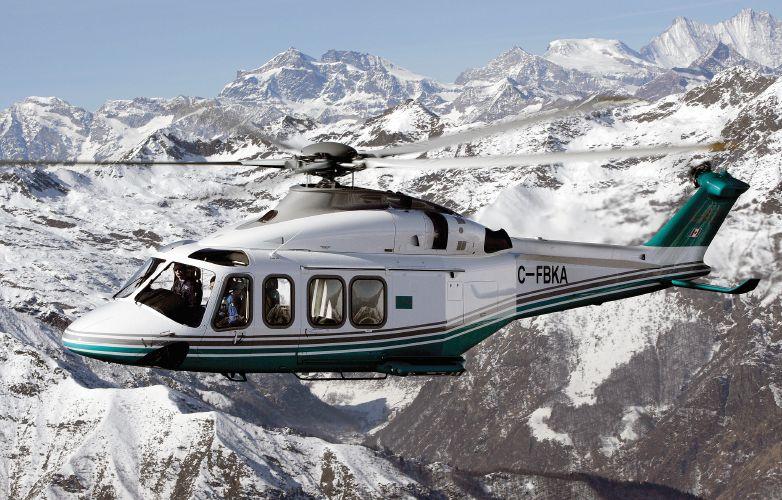
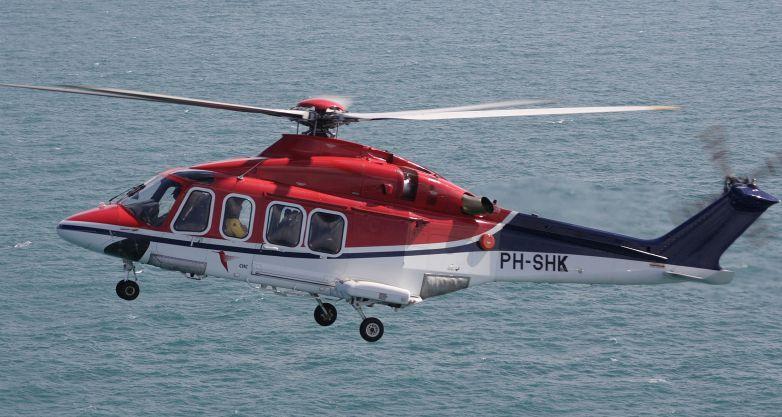
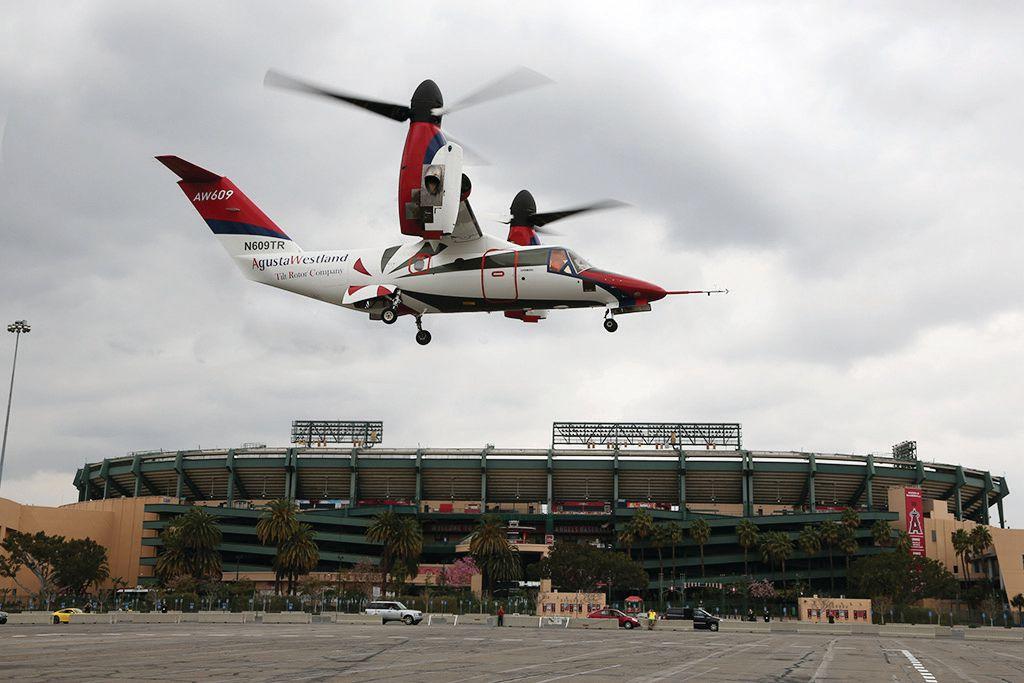
Operators surveyed in the Honeywell Turbine-Powered Civil Helicopter survey are big on the AW139 light twin. (Photo courtesy of AgustaWestland)
Innukoptères Inc.
Adds to its Fleet
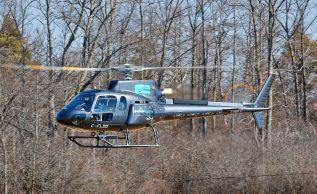
Airbus Helicopters Canada has delivered a new AS350 B3e to Innukoptères Inc. The new aircraft will be used to support a variety of missions in Quebec, including different utilities projects such as the mining industry, tourism and wildlife services.
The new AS350 B3e for Innukoptères Inc. will be used for a number of utility, mining and tourism missions. (Photo courtesy of Airbus Helicopters Canada)
“Selecting the AS350 B3e was an important next step for Innukoptères,” said Paul Desmeules, general manager. “This aircraft will provide accessibility for higher payload and range of our customers, thus expanding our service options.”
Founded in 2010, Innukoptères Inc. was developed in partnership with the native Innu community of Ekuanitshit (Mingan) and Nunavik Rotors (associated with Air Inuit). It is dedicated to helicopter missions within the Duplessis region on Quebec’s North shore.
“Innukoptères’ commitment to Airbus Helicopters Canada and in particular the AS350 B3e is a testament to the reliability of the Ecureuil product line,” said Romain Trapp, president of Airbus Helicopters Canada.
“The AS350 B3e is a powerful workhorse and a natural fit for Innukoptères to enhance its exclusive fleet of Airbus Helicopters aircraft. We are honoured to remain a source of support for Innukoptères’ operations.”
Bell, CCC Sign 412EP Deal
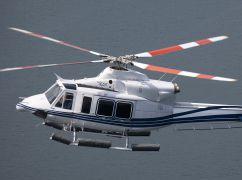
Bell Helicopter has signed a purchase agreement with the Canadian Commercial Corporation (CCC) for eight Bell 412EP helicopters. The aircraft will be delivered to the Philippine Department of National Defense (DND) fully configured and equipped with advanced features to meet the DND’s modernization requirements.
“We are honoured that the Philippine Department of National Defense has selected Bell Helicopter to fulfill their mission requirements,” said C.M. Hwang, managing director, Bell Helicopter’s Asia Pacific region. “We are also grateful for the long-term trust that the Philippine Government and DND have placed in Bell Helicopter to upgrade and improve mission capabilities.”
Five of the Bell 412s will be configured for combat utility operations including relief efforts while the remaining aircraft will be configured for VIP transportation.
“We chose the Bell 412EP because of its versatility and performance in extreme environments,” said Undersecretary Fernando I. Manalo from the Philippine Department of
Bell Helicopter has signed a purchase agreement with the CCC for eight Bell 412EP helicopters. (Photo courtesy of Bell Helicopter)
National Defense. “We are looking forward to the delivery of the first three aircraft in time for the Philippines to host the Asia Pacific Economic Cooperation Summit in 2015.”
The Philippine Air Force has operated derivations of the Bell UH-1H since the late 1960s, and since 1994 when they received their first two Bell 412s.
The contract was negotiated under the umbrella of a Memorandum of Understanding (MOU) between the CCC and the Philippine Department of National Defense for the purchase of defense and military related materials and services.
Prime Minister Stephen Harper announced the MOU in
HELICOPTERS MAGAZINE P.O. Box 530
105 Donly Drive South Simcoe ON N3Y 4N5 Tel.: 519-428-3471 Fax: 519-429-3094
Toll Free: 1-888-599-2228
Website: www.helicoptersmagazine.com
EDITOR MATT NICHOLLS e-mail: mnicholls@annexweb.com 416-725-5637
MEDIA DESIGNER GERRY WIEBE
CONTRIBUTING WRITERS
RICK ADAMS, MICHAEL BELLAMY, DAVID CARR, BRIAN DUNN, PAUL DIXON, WALTER HENEGHAN, FRED JONES, JAMES MARASA, CARROLL MCCORMICK,
ASSOCIATE PUBLISHER WENG NG e-mail: wng@annexweb.com 905-713-4351
GROUP PUBLISHER SCOTT JAMIESON e-mail: sjamieson@annexweb.com
PRESIDENT MIKE FREDERICKS e-mail: mfredericks@annexweb.com
November 2012.
“The CCC is pleased to be once again partnering with Bell Helicopter, a Canadian manufacturer of world-class aircraft and the choice of many nations’ air services the world over,” Marc Whittingham, president and CEO of the CCC said. “This latest contract with the Philippine Government highlights the long history of collaboration between the CCC and Bell Helicopter to provide costeffective government-to-government contracting solutions for highly advanced aerospace products.”
The Bell 412EP is the cornerstone of mission critical helicopter operations throughout the world, able to reliably perform in some of the most extreme climates on the planet. The Bell 412EP offers dual digital automatic flight control system with available IFR option and excellent Category A/JAR OPS 3 capability. With a cruise speed of 140 knots (161 mph), range of 358 nautical miles (412 miles) and an expansive cabin able to comfortably accommodate 14 passengers and one crew member, the Bell 412EP easily fits multiple mission criteria.
RETURN UNDELIVERABLE CANADIAN ADDRESSES TO ANNEX PUBLISHING & PRINTING INC., P.O. BOX 530, SIMCOE, ON N3Y 4N5 CANADA. e-mail: subscribe@helicoptersmagazine.com
Published five times a year by Annex Publishing & Printing Inc. Printed in Canada ISSN 0227-3161
SUBSCRIPTION RATES Canada – 1 Year - $25.00 (all taxes included) USA – 1 Year $35.00 Foreign – 1 Year $45.00
Occasionally, Helicopters magazine will mail information on behalf of industry-related groups whose products and services we believe may be of interest to you. If you prefer not to receive this information, please contact our circulation department in any of the four ways listed above.
Helicopters Magazine is an associate member of the following Canadian aviation associations:
CHC Safety & SummitQuality Impresses
It’s easily one of the most thought-provoking and wellorganized industry events of the calendar year and the 10th annual CHC Safety & Quality Summit once again hit on all cylinders.
The event took place at Vancouver’s Westin Bayshore Hotel from March 31-April 2 with a number of stirring presentations built around the theme of “Safety & Quality in the Real World: Turning Theory Into Practice.” A selection of top-notch speakers and dynamic sessions captivated the more that 800 attendees from around the globe.
the reality” to fixed flawed perceptions and practices to find a sound safety paradigm.
Amelio used the example of the death of famed Formula One race car driver Ayrton Senna in 1994 at the San Marino Grand Prix to illustrate how small incremental changes following a tragic event – both philosophical and from a technology perspective – can lead to industry-wide improvements. Uniting teams to work together through awareness, alliance and action can lead to stronger industry outcomes as a whole. Such practices are currently being followed in the offshore industry to help create the safest working environment possible.
and injured 69 others showed that safety procedures were ignored in a number of instances – from the modifications to reduce drag on the aircraft without factoring in related pilot competencies, to the layout of the course – leading to tragedy. Cutting corners, not properly analyzing incremental changes, and not understanding the end game all led to a major incident and cannot be accepted. The constant application of new standards and competencies is necessary throughout the industry to reduce accidents, focusing on the outcomes and not necessarily the origin of those events.
lost of situational awareness – a state that very often leads to safety lapses and potential accidents.
Once again the conference kicked off with a bang, as CHC president and CEO Bill Amelio dissected three prominent examples where pushing boundaries and trusting established safety practices failed to prevent disaster. In the helicopter services industry where operators are working in some of the most hostile environments possible, pushing the limits and taking risks can lead to serious consequences, Amelio noted.
Operators need to “challenge accepted theories and break down barriers, find the reality of
Amelio used another example, the tragic deaths of 96 people on April 15, 1989 at Hillsborough Stadium in Sheffield, England during a soccer match between Liverpool and Nottingham Forest, to illustrate how poor design and a violation of existing rules can lead to tragedy. Helicopter professional must work diligently to prevent such careless practices in their own operations, he said, and have the fortitude to analyze existing protocols and work to eliminate flawed inefficiencies and potential hazards.
Finally, the tragic crash of a P-51D Mustang at the Reno Air Race on September 16 in Reno, Nevada that killed 10 people
Amelio’s opening remarks were followed by a pair of engaging presentations from Dr. Tony Kern, the founding partner and CEO of Convergent Performance and Dr. Sidney Dekker, Professor, Safety Science Innovation Lab at Griffith University. Kern gave an engaging presentation about the safety lessons that can be learned when analyzing the behaviour of animals in their natural and predatory settings, and reminded the 800 attendees how sensory change, response and adaptation can be potent tools in the safety survival game. Tapping into our various levels of awareness are invaluable in operating and disseminating key information in our daily environments. Losing selfawareness always precedes the
Dekker’s animated presentation offered up a historical analysis of accident evaluation, a breakdown of organization processes and a preconceived set of norms that often are not entirely correct. It was an interesting analysis that signaled to all attendees that this year’s 10th anniversary of this popular event would not disappoint. And following Dekker’s remarks, a spirited debate involving Dekker, Kern and facilitated by Clemson University’s –and CHC Safety & Quality Summit mainstay – Dr. Scott Shappell, certainly reinforced the point.
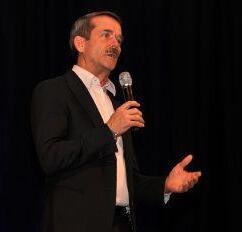
Chris Hadfield, the Summit keynote dinner guest and former commander of the International Space Station, provided another special highlight. Canada’s most prolific astronaut is not only dynamic, knowledgeable and captivating, his ability to share complicated procedures and processes while sharing best practices in a down-to-earth, accessible manner with charm, is just so intrinsically Canadian. (For more on the event, see “Practise Does Make Perfect,” page 8.”
Putting theory into best practice for real world results. It’s a theme that accurately describes the execution of another successful summit.
The 10th annual CHC Safety & Quality Summit once again hit on all cylinders. (Photo courtesy of CHC)
Chris Hadfield impressed during the CHC Safety & Quality dinner keynote. (Photo by Paul Dixon)
COLUMN
Spring is a special time of year in our industry: contracts are being renewed, pilots and AMEs are hired, and training is completed. We are the proverbial bears coming out of hibernation, readying ourselves for a frantic six months of revenue activity to keep our companies alive and prosperous for another year.
It is also marked by what I believe is the premiere industry safety event around – the CHC Safety & Quality Summit. This year marked its 10th iteration and featured such renowned speakers as Tony Kern, Scott Shappell, Sidney Dekker and this year’s keynote dinner guest, Commander Chris Hadfield.
While the theme of this year’s event was, “Safety & Quality in the Real World: Turning Theory Into Practice,” two of the speakers, Dr. Dekker and Commander Hadfield, addressed failure from their unique perspectives. Dr. Dekker has written often on the notion of “drift into failure.” In his technical report entitled, “Why we need new accident models,” Dr. Dekker notes: The greatest residual risk in today’s safe aerospace systems is drift into failure. Drift into failure is a slow, incremental movement of systems operations towards the edge of their safety envelope. Pressures of scarcity and competition that subtly influence the many decisions and trade-offs made daily by operators and management hierarchies drive this movement.
Drift into failure is difficult to recognize because it is about normal people doing normal work in what appear to be normal organi-
Practise Does Make Perfect
Hadfield, Dekker Share Critical Lessons to Adhere To
are both the Challenger and Columbia Space Shuttle disasters and even the Deepwater Horizon blowout in the Gulf of Mexico.
Commander Hadfield, in his captivating recollection of his time in orbit, spoke extensively about preparing for failure by accepting that while plenty of things will go right, it is only by preparing and practising for failure that we will stack the deck in our favour when engaged in complex operations.
We pilots do this every year during recurrent training, but how many of us remain conscious of the need to prepare for failure every day on the job? Our pre-flight inspections help us in this regard, as do the daily inspection of ops gear, belly hooks, long lines, water buckets, etc. But how many of us start the day with an overview of our activities and of all the things that can go wrong that day? Bad weather – do I have my survival gear? Do I have sound flight following? Drill moves – is my gear serviceable? Is the staging area clear of obstacles? Is my fuel Q.A. complete? These types of questions help us prepare for failure and may very well be controls or barriers to protect us from the drift into failure spoken of by Dr. Dekker.
Day after day, we drift from our standards, we accept deviations as norms and we inch closer to failure. ‘‘ ’’
zations. This drift is not obvious nor is its associated breakdowns, failures or errors. Perhaps one of the more well known “drift into failure” accidents involved an Alaska Airlines MD80 crash into the Pacific Ocean in 2000 after a jackscrew failure in its trim system in the tail of the aircraft. In synopsis, the inspection and lubrication cycle on the jackscrew when the aircraft type first entered service was 300 hours; at the time of the accident, it exceeded 2,500 hours. The complete sequence of events is a sobering tale of how normal decisions in the context of other, more complex normal activities, can unwittingly set up a system for failure. Other drift into failure events
Both men are very cognizant of a tendency of successful organizations engaged in complex activities to suffer from the normalization of deviance. This ominous phrase sounds like an academic mumbo-jumbo but let’s consider it for a moment. The normalization of deviance is defined as: “The gradual process through which unacceptable practice or standards become acceptable.” As the deviant behavior is repeated without catastrophic results, it becomes the social norm for the organization. So, in keeping with my spring cleaning analogy – if we didn’t inspect our sling gear yesterday and all was fine, then why bother today? Or perhaps we fly just to minimum fuel limits, just below contract, client or company weather limits, or just close enough to that tree to land closer to the spot for those workers to disembark and go on their way. Day after day, we drift from our standards, we accept deviations as norms and we inch closer to failure.
As pilots, we need to heed the tendencies of complex systems to drift in this manner and incorporate Commander Hadfield’s caution that preparing for failure really is the best defence.
Walter Heneghan is the VP of Safety and Quality at Canadian Helicopters. A passionate advocate for aviation safety and sound risk management, the veteran pilot presents his regular column for Helicopters magazine.
WALTER HENEGHAN
MICHAEL BELLAMY
or those of us who have worked for various helicopter companies and endured the ever-expanding recurrent syllabus of examinations, one of the questions most often posed amongst the crews is, “Who came up with some of these requirements?”
The consensus is usually established that some of them were concocted by a desk jockey whose only reference was an expired copy of the Aircraft Flight Manual and an “Illustrated Parts” guide. Now, introduce the “Transportation of Dangerous Goods” into the conversation and the waitress will soon be arriving asking those at the table to please keep the noise down.
Having an intimate knowledge of the performance capabilities and limitations of each machine and demonstrating competency through an applied regimen of pertinent exams and flight tests is a valid requirement. The annual training objective is to provide assurances to Transport Canada (TC), the company, and clients that the pilot is competent and has the knowledge in place for the position for which he or she was hired. There are strict TC stipulations on requirements, but the syllabus is ultimately left to the charter company to determine and well it should.
The frustration arises when some aviation consultants submit their own unsupported criteria for additional requirements on training and operations. The rationale is that they are responsible for the safety and interests of the end user. I have never held much respect for a directive or a criticism that was preceded by the arbitrary “in
Necessary Elements
What’s Real (And What’s Not) in “Additional” Demands
useless knowledge. An example in rote learning that I can still remember from school days is that the Battle of Hastings which took place in 1066. After many decades, that knowledge, until now, has never found a useful purpose. Such a convoluted search for irrelevant facts and figures may lead the author to believe that he is contributing handsomely to operations when in fact, all it accomplishes is to lead a pilot away from pertinent research onto a frivolous quest.
Consulting companies who provide online instruction on myriad subjects are by far the worse contributors. Many offer generic training and electronically graded questionnaires that are often riddled with errors and re-surface annually with those same mistakes.
Perfunctory survival exams are frequently held to ridicule as they include such observations as, “A quail will fly to water in the morning and from the water at night.” No wait, or is it the other way around? Or how about instruction on how to dig an air tunnel so a campfire can breathe on the tundra in a howling wind? They don’t provide any further discussion as to what you are going to burn on that same windswept tundra or for what purpose – when in all likelihood – you are standing beside a disabled helicopter that will at least offer shelter.
The Transportation of Dangerous Goods Act is an important writ of legislation, but the biennial qualification requirement for helicopter pilots is usually the only time that knowledge is ever called upon.
I commend companies that instruct pilots and engineers on specific dangerous goods which they will likely be asked to transport. Completing an online exam that asks you to search for the correct shipping separation between a package of radioactive isotopes and a refrigerated container of bull semen may, in their opinion, deem you qualified, but is just an absurd waste of time.
’’
Aircraft type and knowledge on a TC approved company operations manual is an absolute necessity.
my opinion.” This inexplicit observation serves more to embellish an invoice than contribute to safer operations especially when the author has little or no flying experience.
Aircraft type and knowledge of a TC approved company operations manual is an absolute necessity and when training lectures are composed by a knowledgeable person this contributes to that end. The company chief pilot usually selects the draft on aircraft type and operations ensuring that questions are applicable.
As recipients, we can easily determine the author’s background as being familiar with charter and field operations or a proponent of
The helicopter industry has become incredibly diverse to where specific training and experience are a necessity and not interchangeable. Some consultants however feel qualified to render judgement and requirements without the inconvenience of having to gain operational knowledge. An independent audit is there to reaffirm that all TC’s standards are in place as well as unique customer requirements. A fastidious transcript of criticisms and petty recommendations only inspires derision and can only be held as contrary to safe and efficient operations.
A native of Spruce Grove, Alta., Michael Bellamy has been flying fixed- and rotary-wing aircraft in a variety of capacities since 1971, and is an accomplished author of several books, including Crosswinds.
MEET OUR COMMUNITY*
are under the age of 44; the average reader/visitor is 50 years old + CONNECTED
of respondents visit the Helicopters website at least once a month
Good, focused magazine that I look forward to receiving –Keep it up! “
“ ” ” I like the direction the magazine is moving in, its openness to change, always improving.
say trade magazine industry e-newsletters and websites are important or very important to staying informed, higher than any other sources other than trade magazines and peer-to-peer communication
WELL READ
67% twothirds onethird
INFLUENTIAL
are owners, partners, managers, or industry professionals; almost half have been in the industry over 20 years
Over twothirds are involved in suggesting or approving purchases Almost one-third are actively involved in purchases above $500,000 in value
OPENMINDED
recall having recommended and/or bought something they saw advertised in Helicopters
say Helicopters is important or very important to keeping up-to-date with their industry
say trade magazines are important or very important in staying informed
have read at least 3 of the last 4 issues they received; 69% have read all four read their issues cover to cover or “most of the articles”
say their issue is read by at least two additional people in their operation; 31% say more than five other people are reading their copy
PAUL DIXON
t was pretty exciting watching Jeff Bezos promoting Amazon’s Prime Air on 60 Minutes before last Christmas. What better place to get a big jolt of free publicity?
Of course, Bezos wasn’t the first to promote the future use of “drones” as speedy delivery systems. He was a full six months behind the folks at Dominos Pizza in the U.K. with their unveiling of the DomiCopter as the next big thing in pizza delivery. My personal favourite is Lakemaid Beer of Wisconsin and the video of their multi-copter delivering a 12-pack to a shack full of parched ice fishing types out on the frozen lake. Was it only my imagination or did those hearty ice fishers bear a striking resemblance to the Swedish bikini beach volleyball team of a bygone era?
The reality check came courtesy of the Federal Aviation Administration (FAA) which quickly airmailed a cease and desist notice to the beerheads, because they actually did fly that little machine over top of a human being within the borders of the U.S. Amazon went to great lengths to make it very clear that their video was made outside the U.S. and that might explain why Dominos would “launch” their program in the U.K. All in good fun, yes, but does it help or hinder the move towards creating realistic regulations governing the operation of unmanned aerial vehicles (UAVs)?
In the U.S., the regulations have been very restrictive – “thou shall not” – while in Canada there has been a more reasoned
Anticipating the UAV World
An Industry Transformation May Indeed Soon Follow
it meets or exceeds the quality of the work done now and does it at a substantial financial saving.
One of the breakout areas has been the adoption of UAVs by Canadian police agencies, principally the RCMP and OPP, for use in rural and remote areas to assist in taking aerial photographs for forensic investigations and highway collision. The ability to put a relatively simple UAV above a scene for a few minutes and capture digital photos and/or video of a scene can be invaluable, especially when compared to the cost of using a helicopter. The news that police in Canada have moved to UAVs as investigative tools produced an outcry in the media from those who somehow see this as a potential invasion of “privacy.” But when it comes to my privacy, I’m much more concerned about the information my cell phone pumps out, not to mention what my credit cards, bank cards, loyalty cards (to name but a few), tell the world about where I go, how I get there and what I spend my money on. If someone wants pictures of me flipping burgers in my backyard, then good luck to them.
If someone wants pictures of me flipping burgers in my backyard, then good luck to them.
’’
approach. There has been plenty of noise south of the border directed at federal legislators to make the FAA hurry up and let UAVs fly, without any apparent public dialogue through the mainstream media as to just what this might mean. Meanwhile, on this side of the border, Transport Canada (TC) and a number of groups representing the UAV/drone community are working collaboratively to develop regulations that will work. The big question is where the commercial breakthrough is going to be. Who is going to come up with an unmanned platform that can replace an existing commercial fixed- or rotary-wing operation in such a way that
It’s not easy to figure out just how firmly the Amazon tongue is stuck into the Amazon cheek. Their Prime Air web page starts with the disclaimer “ putting Prime Air into commercial use will take some number of years as we advance the technology and wait for the necessary FAA rules and regulations .” OK, that sounds vague enough, but read down the page and you soon get to this statement – “ We hope the FAA’s rules will be in place as early as sometime in 2015. We will be ready at that time. ” Are they talking about the same 2015 that I’m looking at, which is a lot closer than some years away? Thankfully, Amazon offers an “unbreakable umbrella” that protects you from rain and “everything else.” Does that everything else include space debris and wayward UAVs? Just asking. Amazon even offers a book –“UAV Pilot – How to Be Ready for the Coming Drone Pilot Job Boom,” based on the premise that “everybody,” from media outlets to public safety agencies to colleges and universities is going to be clamouring for UAVs once the skies are opened up and where are all the pilot/operators going to come from. Buy the book, take the course and reap the benefits of the brave new world. One small irony, however, it’s an e-book. Ah, technology.
Paul Dixon is freelance writer and photojournalist living in Vancouver.
RICK ADAMS
felt my brain screaming for oxygen.” “The pressure of the water caused a stabbing pain in my eyes and ears.” “Your body is a mass of pain and you know you are dying.”
That’s how some near-drowning victims describe the excruciating experience of what is essentially suffocation by submersion in water. Hardly the peaceful “drift into bliss” portrayed in movies such as Titanic
In an offshore helicopter accident, if the crash does not kill you, the sea may finish the job. Drowning is the leading cause of death following a helicopter ditching.
Stig Severinsen, free-diving world champion from Denmark, has held his breath underwater for 22 minutes, but for most of us the typical breath-holding time is perhaps 30 to 45 seconds in warm 25-degree Celsius water. When the water temperature drops below 15 degrees, the average breath-hold time decreases rapidly, and in nearfreezing water can be as little as 5 to 10 seconds. Considering that it takes 30 to 90 seconds just to escape from a helicopter submerged in the brine, the odds of surviving a water impact are slim indeed.
The water temperatures in the North Atlantic, by the way, average 12 to 14 degrees in summer and a bitter 1 to 2 degrees in winter.
Fully five years after 17 people drowned off the Newfoundland coast when Cougar 491 sank in about 150 metres of water, and more than three years after recommendations by the Transportation Safety Board, Transport Canada (TC) has new safety regulations focused on both preventing and surviving water ditchings.
De-Risking Ditch-Drowning
New Standards in Place for Offshore Operations
takes to escape a submerged aircraft and the time your breath-hold gives out. The offshore oil and gas industry in Canada had already made UEBAs mandatory in 2009.
Transport Canada did not go as far as the U.K. Civil Aviation Authority (CAA), which recently issued a “Safety review of offshore public transport helicopter operations in support of the exploitation of oil and gas.” (jointly with the Norwegian CAA). The review came in the wake of five North Sea accidents in four years. The CAA wants each oil worker being transported to and from offshore oil rigs to be seated next to push-out window emergency exits – which means workers must be small enough (in survival suits?) to fit through the opening. This will both reduce the number of passengers in a helicopter and possibly preclude some larger workers from commuting to their jobs.
The U.K., CAA and TC now prohibit flights when weather and water conditions make ditching in water a high-risk option. Environment Canada says the waters off Newfoundland exceed Sea State 4 (considered “moderate” with wave heights up to 2.5 metres on the Douglas Sea Scale) about half the time year-round, but more than 80 per cent of the time in winter. Sea State 6 (“very rough” with waves up to 6 metres) occurs 8.9 per cent of the time between December and January. The highest is SS9 – waves over 14 metres and with the somewhat understated condition of “phenomenal.”
TC, the U.S. Federal Aviation Administration (FAA), and the European Aviation Safety Agency (EASA) now certify Sikorsky’s S-92 aircraft emergency flotation system (EFS) to Sea State 6 conditions. The EFS is intended to keep the helicopter upright until occupants can escape in life rafts.
In an offshore helicopter accident, if the crash does not kill you, the sea may finish the job.
’’
Two of the new measures focus on crew and passenger survivability – requiring each occupant to wear water immersion survival suits and to have emergency breathing equipment.
The fluorescent orange or yellow survival suits are designed to prevent hypothermia from immersion in cold water, and are therefore made of neoprene rubber, usually with built-in boots, built-in gloves or watertight wrist seals, and a hood.
The underwater emergency breathing apparatus – UEBA (rhymes with SCUBA) – is carried on the suit, and provides an additional capacity of breathable air, enough hopefully to fill the gap of time it
Training, of course, can also increase the odds of survival. In addition to UEBAs, Canadian Association of Petroleum Producers require a five-day program designed to help rig workers react effectively to water emergency situations, plus a safety briefing prior to each flight.
Crews also have access to an enhanced Helicopter Underwater Escape Trainer (HUET) to simulate escape techniques from a submerged or partially submerged helicopter.
Rick Adams is Chief Perspectives Officer of AeroPerspectives, an aviation communications consultancy based in the south of France. He has been writing about technology and training for 30 years.
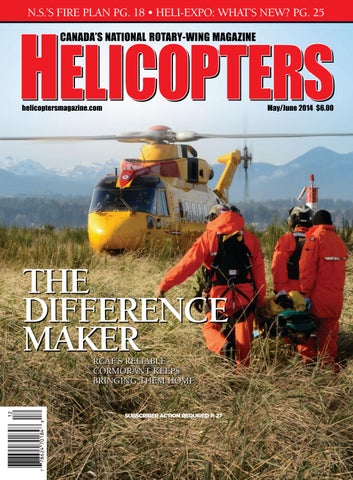
Difference The Maker
RCAF’s Reliable Cormorant Keeps Bringing Them Home
BY PAUL DIXON
Canada is an enormous country and it offers up so many different ways to punish those who tempt fate or run afoul of Mother Nature.
Helicopters have been (and continue to be) a key element of the Royal Canadian Air Force (RCAF) resources, starting with the rugged, twin-rotor H-21 “Flying Banana” – the first dedicated search-and-rescue (SAR) machine which was used from 1954 until it was replaced by the CH-113 Labrador in the early 1960s.
The venerable “Lab” lasted on the job for almost 40 years until the last one was replaced by the Cormorant from 2002 through 2004. The political wrangling of the 1980s and 1990s saw the Lab forced to soldier on, as the original scheme to replace the Sea King and the Labrador with derivatives of the AW101 known as the Petrel and Chimo were shelved. New engines and extensive refits kept the Labs on the job, but by the mid-’90s, even the most parsimonious and partisan federal politicians could see that there was no positive side to keeping the Lab any longer than necessary.
The 101 was reborn as the AgustaWestland 149 Cormorant, with a total of 15 ordered in 1998 with the first aircraft entering service in 2002. Today, the RCAF operates these CH-149 Cormorants from three bases at 443 Squadron in Greenwood in Nova Scotia; 103 Squadron in Gander, Newfoundland; and 442 Squadron in Comox, British Columbia.
The Cormorant was a big change from the Labrador in many ways,
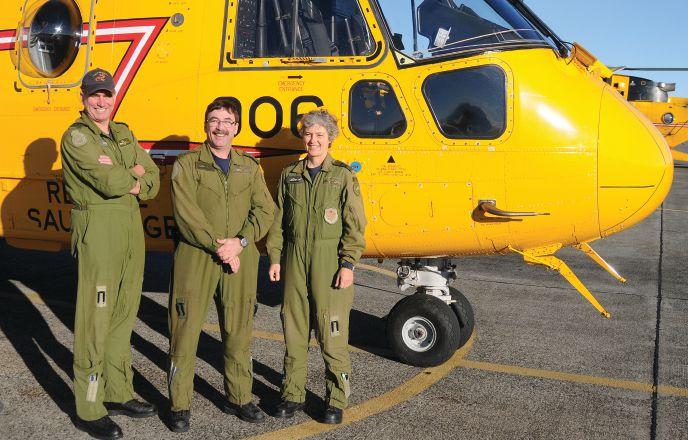
both as an aircraft and as a SAR platform. Major Jenn Weissenburn and Captain Stu Irvine are both experienced SAR pilots based at 442 Squadron in Comox. Weissenburn had almost 3,000 hours on the Labrador, Irvine at just under 2,000 hours and both are approaching 3,000 hours on the Cormorant. In the back of the aircraft, Sergeant Serge Poirier is the team’s Flight Engineer and has 4,500 hours on the Labrador and 1,500 on the Cormorant.
All will attest that the new aircraft was a huge improvement in many ways, but there were also some very profound differences
Difference
between the old and the new. Irvine describes the difference as an analogy, “where the Lab was like your dad’s old pickup truck that didn’t have a heater and you could look down through the floor and see the road go by, but it took you most places. The Cormorant, on the other hand, is more like a modern SUV with all the creature comforts. It will take you to the same places and you’ll be a lot more comfortable getting there, but you’re leery about scratching the paint.”
The Cormorant is a much bigger aircraft, with a full load 10,000 pounds heavier than the Labrador. Three 1,725-horsepower engines give it a top speed of 167 knots and a range of 750 nautical miles while the Lab, with its two 1,800-horsepower engines, had a top speed of 144 knots and a range of 550 nautical miles. The net effect extends the offshore range of the Cormorant to 250 miles over the Lab’s 180, allowing time to get to the scene, take care of business and return to land.
The biggest challenge is the effect that the one large single-rotor of the Cormorant has on everyone involved, the pilots, flight engineers, SAR techs and especially anyone or anything below the aircraft when it comes overhead. Capt. Irvine explains it from the pilots’ perspective. “It’s a single disc and with the special paddles on the ends of the blade it creates its own little hurricane,” he says. “You never know which way things are going to blow. I didn’t understand what the SAR techs were talking about until I saw video of how much the Stokes basket was blowing around. It would be swinging around wildly, 30 feet in any direction and that was just from the rotor wash.”
Sgt. Poirier had his introduction on his first operational mission after his upgrade to the Cormorant. “It was a night mission, on NVGs almost to Prince George, B.C.,” he recalls. “We had to pick up a patient
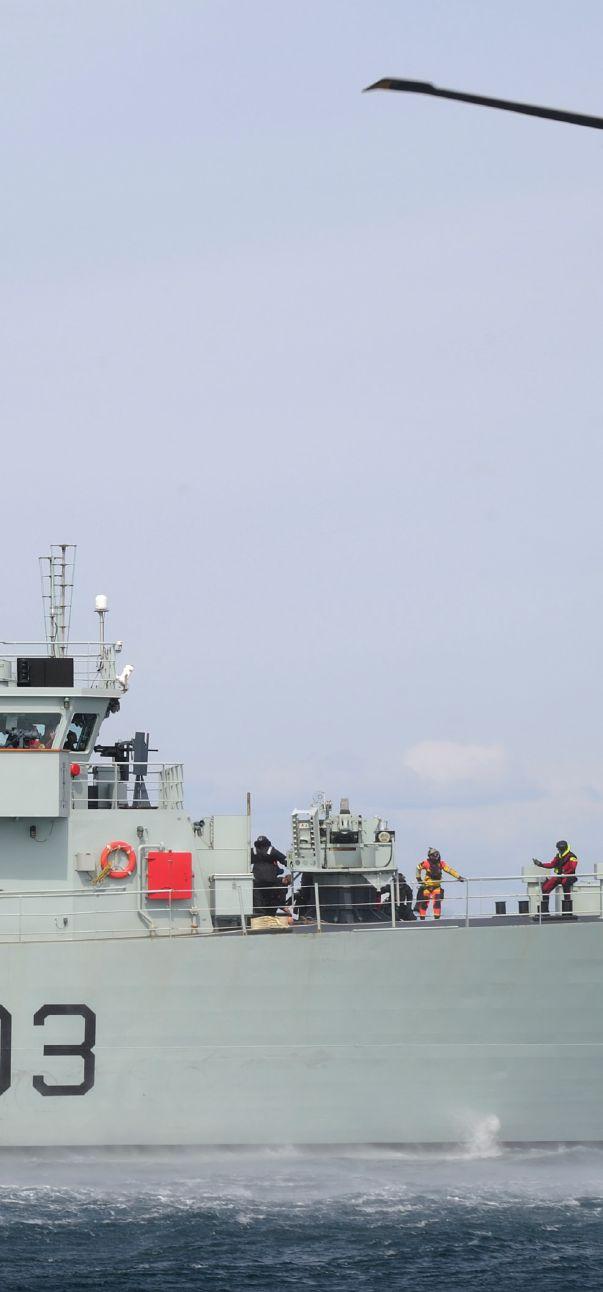
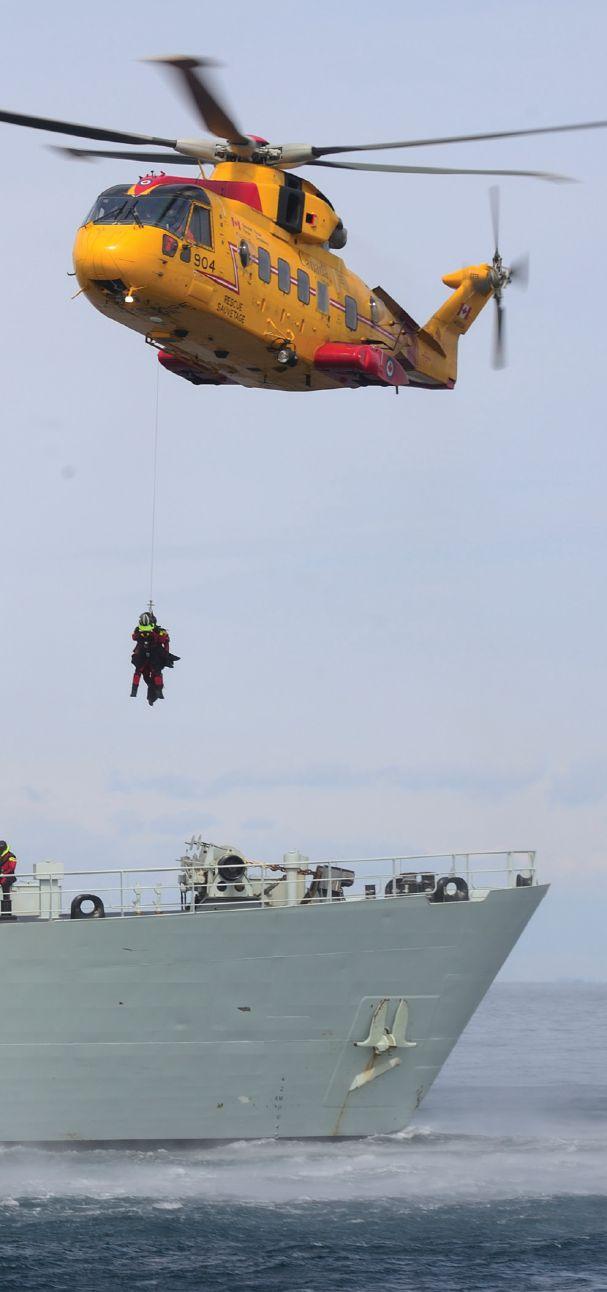
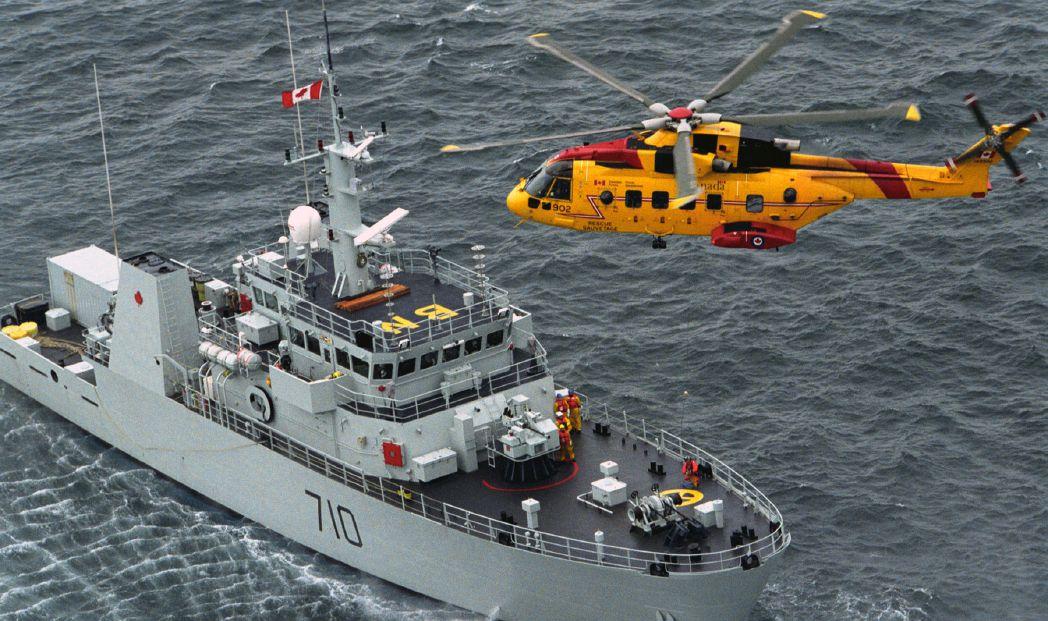
LEFT: A Royal Canadian Air Force CH-149 Cormorant helicopter hovers over the deck of HMCS EDMONTON. (Photo by Private Dan Moore, 19 Wing Comox)
BOTTOM LEFT: A United States Coast Guard H-60 Jayhawk helicopter from Station Sitka, Alaska takes off from Canadian Coast Guard Station Seal Cove, behind a CH-149 Cormorant helicopter on April 30, 2013. (Photo by Captain Trevor Reid, 19 Wing Public Affairs)
BELOW: Capt. Stu Irvine, Sgt. Serge Poirier, and Maj. Jenn Weissenburn in front of Cormorant 906. (Photo by Paul Dixon)
COVER STORY
who had suffered a heart attack near a lake. Not having much experience with the downdraft, I just lowered the SAR tech, but he was caught by the downdraft and it induced a big swing. The swing was so big you could see the SAR tech from the left side of the aircraft, and he was swinging from one side to the other. I was able to get control of him and lower him, but I learned a really good lesson. You hoist in and hoist out at maximum speed.”
MWO Tremblay, as one of the SAR techs, is very cognizant of the downdraft. “The concentration of the rotor wash is straight down and not spread around,” he says. “It’s right where we’re hoisting and it can be really difficult to work. It’s to the point where we always have to be aware of trees around us, because once you are on the ground the rotor wash can knock down smaller trees or even break branches off larger trees.”
Following up on Poirier’s comment about the need to winch as quickly as possible, Tremblay says the winch on the Cormorant is a big improvement over the Labrador, with its 290-foot cable versus its 230foot counterpart. The much higher speed is also a bonus.
When it comes to flying the aircraft – getting to an incident and taking care of business – there are significant differences between then and now. For Irvine, the Cormorant’s performance sets it apart as a top-notch rescue platform. “When you fly in any kind of weather, this machine is absolutely beautiful at getting you there and getting you back again,” he says. “It’s comfortable, it’s got the anti-icing kit, the engine conditioning kit, autopilots and it can get you a lot more places. Now, when you get to those places, I find this aircraft a little more difficult to manipulate, particularly flying in any wind. The Lab didn’t care about the wind, a tandem rotor doesn’t give two hoots about the wind, whereas the Cormorant, if you have a strong wind off the left-hand side, you’re going to know it.”
Weissenburn concurs, adding, “you have to try to fly into the wind a
lot more (with the Cormorant), whereas the Lab didn’t care, you could take the wind from any direction. And that becomes most critical in the mountains because sometimes you don’t have a choice for how you are going to position yourself, with the hoist on the right hand side. With the Lab, the hoist was on the same side, but it didn’t matter because the Lab didn’t care.”
The Cormorant shines as a rescue tool for the RCAF because it can perform very well in a wide range of situations – something it’s older counterpart could not. “Every situation is always different, but now it’s a matter of, ‘how are we going to do this,’ ” notes Weissenburn. “Before there was only one way, but now because of the position of the hoist, the size of the vessel, and the sea state all have to be considered. The Lab didn’t have any kind of altitude hold, so that’s definitely helped us with operations over the water at night. Before, without a hover mode automation or altitude hold, if you weren’t moving forward you didn’t know that you weren’t moving backwards. So, you always had to be creeping forwards to get an airspeed on the Lab, whereas now we can just stop, over water, at night and hover at 100 feet – in complete darkness. That was something we couldn’t do in the Lab. With the Lab we needed a visual reference, whether that was the Buffalo dropping flares or we dropped our own smokes. We needed something, where now we can just sight something on NVG, take a GPS position on that, turn around, come to the wind and come to a hover over the general area.”
Irvine notes that part of the Cormorant’s appeal is the flexibility of having three engines. “With the Lab, if you were coming into a ship, you would insert the SAR tech and then go into a circuit,” says Irving. “If you lost an engine, you would have to leave the SAR tech. With the Cormorant, we come to the back of the boat, insert the SAR techs and stay there now. If we lose an engine, under most circumstances we can hover with two engines, so if we plan it appropriately and lose an engine
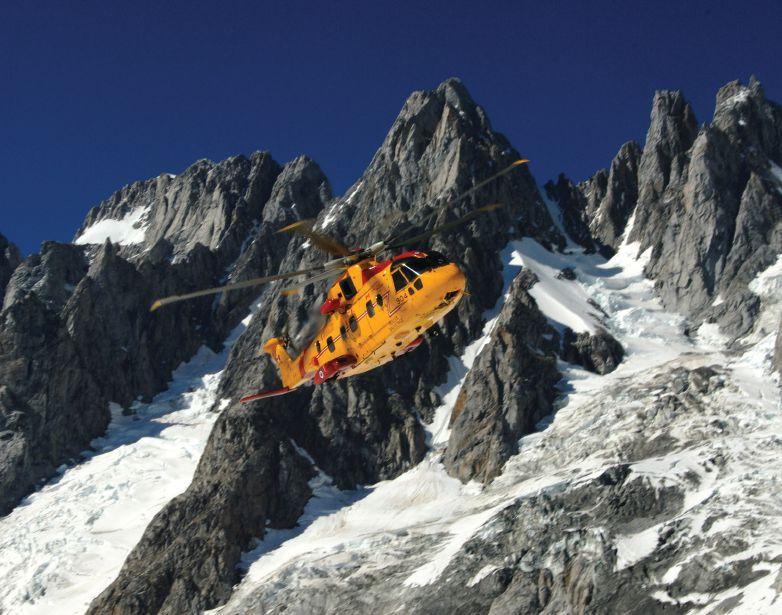
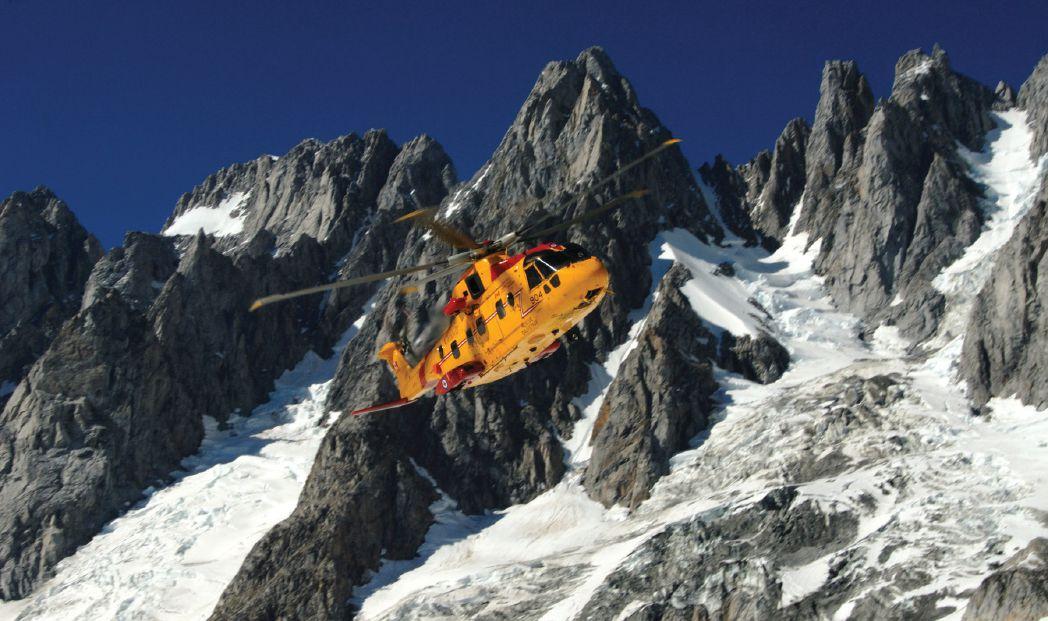
Search and Rescue Techs from 442 Transport and Rescue Squadron based in Comox, B.C., participate in mountain training as part of a joint SAREX. (Photo by Sgt. Blair Mehan)
we have time to think it through. And that’s whether we’re taking the SAR techs back up or dropping everybody off. It doesn’t sound like a big deal, but when it’s the middle of the night out over the ocean and you’ve already had a lot of work to get there, it is a big deal.”
GOING ABOVE AND BEYOND
The Prince Philip Helicopter Rescue Award is presented annually by the Guild of Air Pilots and Air Navigators (GAPAN) headquartered in the United Kingdom, to “an individual member of a helicopter crew, a complete crew or the crews of multiple helicopters, for an act of outstanding courage or devotion to duty in the course of land or sea search and rescue operations.”
In 2007, the crew of rescue 901 from 442 Squadron in Comox made history as the first Canadian winners of the award for a rescue in October 2006. The group captured the honour for conducting a rescue from the side of a cliff in a box canyon with the CH-149 Cormorant. Captain Sean Morris described the experience as “pretty much the worst situation I’ve been in my entire life.”
The 2010 award was presented to the crew of Rescue 902, again from 442 Squadron. In April 2009, they were tasked to rescue a 37-year-old male who had fallen down a crevasse while skiing. The party of three had been on a multi-day excursion, which took them across the Mount Compton Glacier in B.C. and, while on the traverse, one of the party had fallen into a crevasse. Initial reports indicated he may be 30 metres down into the crevasse. The scene was at an altitude of 8,500 feet on a steep, icy slope. Stripped of all non-essential gear, the helicopter was forced to operate at the very limits of its capability. After an intense deliberation it was decided to hoist the two companion skiers into the helicopter and attempt to insert a SAR tech by hoist into the narrow crevasse. The
Cormorant held its position and the SAR tech was lowered down into the glacier and was able extract the fallen skier.
The crew of Rescue 912 of 103 Squadron, Greenwood, were awarded the 2013 Prince Philip Helicopter Rescue Award for a rescue of three hunters from a Newfoundland ice flow in blizzard conditions. “When the rescue was launched, Capt. Noble was faced with flying the Cormorant helicopter through ‘a full-on winter blizzard’ with 40 centimetres of snow accumulating and wind gusts up to 75 kph,” the citation noted. “They immediately hit icing conditions. While flying in extremely low visibility through rugged terrain, navigating many islands and a narrow inlet, the AW101 Cormorant was pounded from the rear by 80 kph winds and severe turbulence off 100-metre hills. Conditions were so severe that Capt. Noble twice considered calling off the rescue.
“With two miles to go to the rescue location, Capt. Noble performed an impromptu ‘out of the box’ manoeuver turning the helicopter 180 degrees and flying backwards to gain stability. The other crew members scrambled to different positions and duties – Capt. Groten on the map, Sgt. Hiscock in the rescue door, MWO Warden in the left spotter window and MCpl. Vokey at the tail – all spotting and guiding Capt. Noble to the hunters’ last known position. Once Warden spotted the hunters’ lights and flares, Vokey was hoisted down to start the rescue, fighting through the storm, fierce rotor wash and static electric shock. The three hunters were hoisted aboard suffering hypothermia and were taken to hospital in Gander for treatment.”
MAKING A DIFFERENCE CLOSER TO HOME
Of course, not all missions attract international attention and sometimes they take place within sight of the bright lights of the big city. In December 2012, a crew from 442 Squadron was involved in a rescue
Continued on page 33
Canada's SAR leaders from Rescue 902, 442 Squadron, are well versed at making rescues at sea. (Photo courtesy of the RCAF)
FEATURE
Rising to the Occasion
Ascent Helicopters Reaches New Heights With Helitank Design
BY PAUL DIXON
Ascent Helicopters is not unlike many other small- to medium-sized helicopter operators in British Columbia.
Located on Vancouver Island with their main office in Parksville and operating out of the nearby Qualicum Beach Airport, Ascent serves clients across a wide variety of industries, including utilities, construction, film and television, fire suppression, heli-skiing, medevac and natural resources.
What sets the organization apart from the competition, however, is its 50001C helitank, developed by Ascent Aerospace for its Bell 212. Ascent president Trent Lemke says, “we decided to get into the helitank business when we discovered that existing helitanks fell short of B.C.’s challenging mission requirements and could not be easily modified.” With 25 years in the business and more than 10,000 hours as a pilot, Lemke jumped at the opportunity presented to him seven years ago.
Ascent was approached by the BC Forest Service (BCFC) and the State of Victoria in Australia as both were looking for improvements in existing tank technology. Lemke says that there are really very few tanks that are specifically designed for firefighting. Most tanks were actually originally designed for aerial spraying and the drop doors were initially designed simply as a means of quickly dropping the chemicals if the aircraft needed to land quickly in an emergency.
BCFS and the Australians had approached the manufacturers of the day, looking for improvements and refinements, but found the manufacturers were reluctant to make any significant changes to their existing products. Lemke speculates that it may have been that these tanks had originally been certified as long as 40 years ago and the manufacturers were not thrilled at the prospect of having to recertify those original designs under current regulations.
As an engineer with Ascent Aerospace, Ryan Yip was involved with building the first tank. At the very beginning, they were surprised to discover how difficult it was to find the specialized materials they had decided to use. A company a few miles down the coast
by the name of Boeing was ramping up development on something called the 787 Dreamliner and was buying up everything on the market. It wasn’t fun then, but Yip laughs now when he says that today you can’t give it away.
Lemke talks about how they took time to make sure they got it right in the development phase. “The tank has been in operation for almost six years on a Bell 212 on a limited SPC,” he says. “We had manufacturing aspects that we wanted to clean up, we wanted to get the tank lighter and there were a few things that we wanted to change out six years, areas we wanted to improve. We actually wanted to go carbon fibre at the very beginning, but it was not the time. We actually got the approval done in Australia. That’s where our carbon fibre was made, so the shell was made in Australia. Then we brought it to Canada and changed some of the systems on it. Then in the process of the carbon fibre we’ve changed our manufac turing process, to make it a lot less labour intensive and hopefully save costs and also save on weight. Our original tank was a combina tion aluminum and fiberglass skeleton, encased with a fiberglass shell. We’ve made quite a few improvements on that whole system.”
Originally the tank was controlled by a printed circuit board, Lemke notes, but the first year was dedicated to ironing out the bugs, including a problem with quality control. There were also contamination issues that needed to be worked out, so the Ascent team replaced them with a programmable logic control. “With the programmable logic control, we can trouble shoot and we can repro gram a lot easier,” Lemke said. “We are also in the process of work ing with SkyTrac out of Kelowna to tie in data tracking and monitor ing, so then we can also monitor the systems via the satellite system. That way, if a pilot is having problems we can troubleshoot the tank. The reality is that apart from the circuit board issues, we’ve had very few problems with the tank.”
Lemke notes that it’s difficult flying on fires without adding more distractions to the pilot’s world. “In B.C., we’ve been blessed for years with a good crop of long-line pilots who can move water
effectively on fires, but a lot of those pilots are getting up there in years,” he says. “We want to take an average ability pilot and be able to train him effectively to deliver water to a fire so they get the most bang for their buck. Our tank system and the control system were designed for that. I can take a pilot that has very little Bell medium experience or no long line experience (or both) and in 15 to 20 minutes, I can have him dropping water on a fire and be effective. It’s really tough to do with other systems.
“Another nice thing about our tanks is that we redesigned the cyclic grip, we took the original Bell cyclic grip and added things on to control the tank, so the whole thing is controlled by the pilot’s thumb. There’s no box here and box here. The cockpit ergonomics of it are such that it is easy to use and it doesn’t take a lot of thought process. Actually, you don’t even notice it when you start working the tank, you can keep your head up and we really wanted to reduce the pilot workload.”
“Gallons-per-hour” was a term used by Dan McIvor to extoll the virtues of the Martin Mars water bombers, the simple idea that more water that was lifted and dropped, the better the outcome would be. Lemke has had positive feedback from the contracting agencies where they have operated their system, that they want as much water as possible out of the lake and on to the fire. With the 50001C helitank, the snorkel retracts after it loads, so you don’t have any restrictions on forward flight, other than the regular flight manual restrictions.
“We are filling so quickly – 14 to 18 seconds is the average time for the tank – so that even in a tight circuit on a fire, we can deliver more water on a fire than a bucket ship with an experienced pilot,” he says. “Now, once you spread out and start flying further distances, we start killing them. The other part of it is, we have vents in the top of the tank so if you over-fill the tank, the water will vent out, but once you’re flying, there’s no water loss out of that tank. The tanks have a big air seal door system. You’re getting 98 per cent of your water on the fire.”
This feature is especially critical in Australia, where, in many locations, they have to truck in water, so they want to get as much as possible. Once the water is on board, it’s quicker getting to the scene of the fire, because of the airspeed restrictions for any type of external load. “With the 50001C, you don’t have that consideration and coming back empty you can move even faster, especially without an empty bucket underneath the helicopter,” Lemke says. “It’s a time and distance formula – your travel time between water source and fire scene is less and you don’t lose any water in transit.”
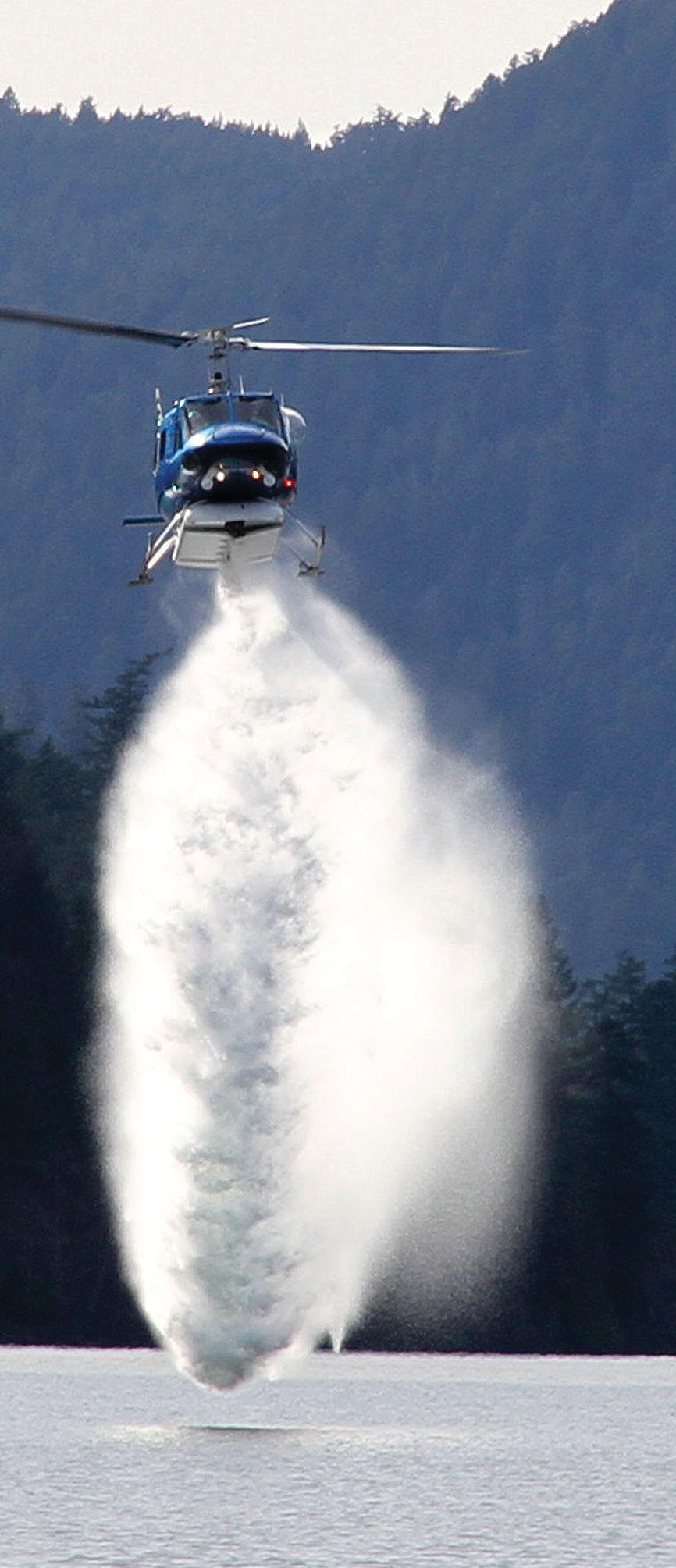
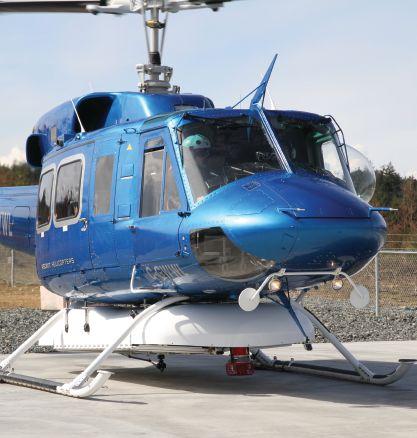
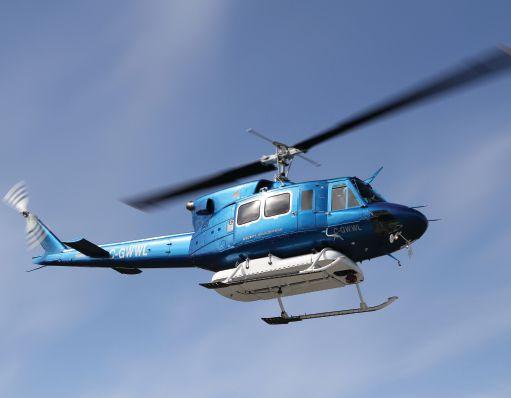
ABOVE: Bombs away. In full release mode, the extra-large doors ensure that all the water comes out with enough force to penetrate dense forest canopies. (Photo courtesy of Ascent Helicopters) INSET: How the tank looks when installed on Ascent’s Bell 212. Note the fully retracted snorkel. (Photo courtesy of Ascent Helicopters)
The new tank gets its baptism under fire when Ascent’s 212 goes into service at the end of April with B.C.’s Rapattack program, based in Salmon Arm. Lemke sees its long-term involvement with that program as a win-win for Ascent and the BC Forest Service. Ascent was able to flight test the original tank for six years in real life situations and the Forest Service watched it happen right before their eyes.
FEATURE
Lemke describes a normal “day at the office” during the fire season at Salmon Arm as a well-coordinated team effort. “For a standard rap attack mission, we take off with a three-person rappel crew and an attack spotter,” he says. “We fly out, figure out where we’re going to put them on the fire, we put them in and then while they’re getting their gear together, we’re actioning the fire. Then when the crew is ready, we offload their gear. With our tank, we have the option of putting half the water on the fire offload the other half to them. It takes some 45 seconds to offload 155 gallons off the hover. We can keep supplying them water on the ground or we can attack the fire directly. If we’re not needed, we can move on to other taskings.”
There’s also a very unique feature to the Ascent tanks and Lemke says it was almost an afterthought. “The doors are really large, so sealing the doors properly was a real focus for us,” Lemke says. “With the way the doors are designed, the water comes out in a big volume – we almost throw it out. We have to drive those doors open, and we don’t want to interrupt the flow of water coming out those doors. So, we have big seals that inflate.
“When the doors close, the gap can be anywhere from a quarterinch to three-quarters of an inch, because there is always a bit of flex. It’s a special rubber that does not retain a memory. You won’t get an imprint in the seal, have it stay that way and have a leak. That in turn allows us to do what we call a ‘restricted drop,’ where we can deflate those seals, which brings out a shower curtain of water, so instead of dropping a big load of water we can drop this shower of water. I think the longest we’ve done is 2,000 feet. We do it quite a bit in the
Up, up and away. The tank sports a clean profile and fully retracted snorkel, nothing to impede flight. (Photo courtesy of Ascent Helicopters)
Kelowna area; it works great on grassfires.”
The 50001C helitank has two large compartments, so pilots can execute a single drop, double drop or a restricted drop. They can also offload water. “So, when we offload water, we can pull to hover and
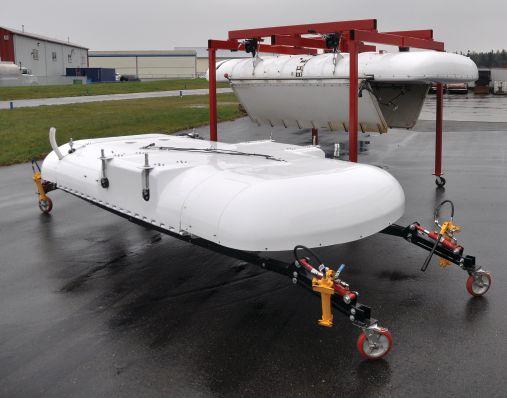
A family portrait. Ascent’s new carbon fibre 50001C helitank (360 U.S. gallons) sits in front, with the old aluminum/fiberglass tank in the rear.
service our rappel crews,” Lemke says. “We drop a fire hose down to them, hook to their portable tank and fill it quickly. That’s the most effective use for them. The key to all these systems is that we don’t have to land and reconfigure, so we can switch into all these different modes without reconfiguring the aircraft or having to land and put a
bucket on or hook the snorkel up or release the snorkel. It’s all done on the fly. It’s also hard to prove because of fire types and mission profiles, but we’re seeing 12 to 14 minutes saving on a fire.”
Ryan Yip watched the 212 in action with the tank on a grassfire outside Kamloops last summer. The fire was stretched out along a rail line, started by sparks from a passing train. Using the restricted drop technique, only two drops were required to control the blaze by showering it along its length. Yip figures it could have taken up to 10 straight dumps to cover the same, which would have taken much longer and wasted a significant amount of water.
The challenges facing fire crews are evolving nationwide with a combination of warmer summers, less precipitation and urban sprawl stretching out further and further in many locales. Lemke is well aware of the new realities in B.C. “I remember the first 18 years of my firefighting, we were fighting fires in the middle of nowhere and now we’re more and more in Kamloops and Kelowna and different areas,” he says. “What we’ve seen a big difference: the interface fire is their focus. So now, in the interior of B.C., for example, now we’re flying in built up areas fighting fires. We’ve been trying to get the Forest Service to bite on NVG. We have our new tank set up so we can ground load. Land and ground load retardant and then with NVG we could work all night in a sustained attack around areas like Kelowna. So, that will be our next focus. We’ll do NVG approval for our 902 next. We’ll see how that goes and look at our 212 for sustained action.”
As the 2014 season is about to unfold, the 360 (U.S.) gallon, carbon fibre 50001C is locked and loaded to take on the world.
Note the large drop doors. (Photo by Paul Dixon)
FEATURE
Minding the Fires
Nova Scotia’s Nimble Helicopter Fleet Continues to Douse the Flames
BY CARROLL MCCORMICK
The pilots have completed their annual ground school and emergency procedures practice. Bucket training has been ongoing since the ice melted off the lakes. The engineers have been poring over the helicopters and the firefighting equipment has been checked and repaired. It is wildfire season again in Nova Scotia.
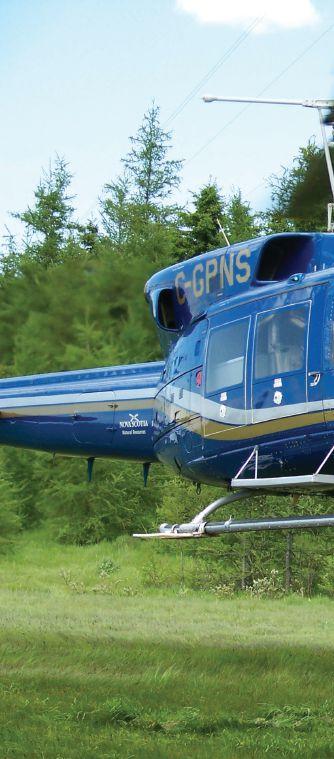
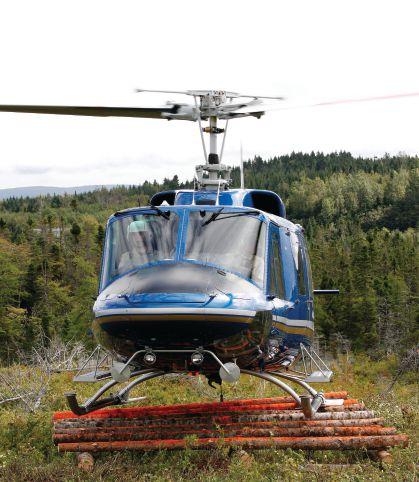
The province bought its first helicopter, a Bell 47, in 1974. Since then it has bought and sold several more machines before settling on its current mix of one Bell 212, manufactured in 1980, three MD 500Es, manufactured in 1989, 1990 and 2002 and one EC120B, vintage 2005.
“From its conception in the mid-1940s, the fleet was fixed wing. From 1974 forward it became a mixed fleet of fixed- and rotary-wing until 2000, when the last fixed wing was removed from the fleet,” explains Ross Wickwire, who oversees the Air Services section of the province’s Department of Natural Resources (DNR). “The high number of small, rocky lakes are not very suitable for float planes and large tankers. The helicopters can pick up water from very small sources of water, providing very short turnaround times from water source to fire.”
Wickwire joined the DNR as a fixed-wing pilot in 1981. In 1984, he completed conversion training to helicopters at Trans Maritime Helicopter in Fredericton, N.B. His long tenure straddles the gradual shift from a fixed-wing to an exclusively rotary-wing firefighting fleet. Data from the government’s Wildfire Management Division has supported the need for five helicopters, a number that the government has maintained for more than 35 years.
Home base for the fleet and seven pilots, including Wickwire, is a 669 square-metre building in Shubenacadie, a few kilometres north of the Halifax International Airport. Four aircraft maintenance engineers working in its 539 square-metre hangar take care of everything except scheduled overhauls, which are outsourced through government tender.
If things get too hot, the Provincial Wildfire Coordination Centre, just next door to the air fleet’s hangar, can request assistance through the Canadian Interagency Forest Fire Centre or the Northeastern Forest
Fire Protection Compact; responding aircraft have flown in from New Brunswick, Quebec, Newfoundland and even Maine.
Mutual aid for the Porter’s Lake fire of 2008, for example, came in from Quebec, New Brunswick and Newfoundland. That fire, near Halifax, burned 1,950 hectares. “We had quite a variety of aircraft on that fire,” Wickwire says.
Nova Scotia has an annual average of 350 fires, burning 800 hectares, but the year-over-year numbers are about as stable as the maritime weather. Last year, for example, there were only 171 fires and 302 hectares burned. The worst scorching in recent memory was the Trafalgar fire of 1976. Located in eastern Nova Scotia, due south of New Glasgow, it cooked 12,950 hectares. One source cites “relentless aerial attack” by William Burtt, flying a Dominion Pegasus Helicopters’ Bell 206 JetRanger out of Cape Breton. “In its time, Trafalgar was huge. We had some huge fires in the 1930s, 1940s and 1950s. Trafalgar really kick-started new initiatives in the department and the purchase of the first medium helicopter, the Bell 212. There’s been nothing as large as Trafalgar since 1976, but there have been serious fires,” says Walter Fanning, director of Forest Protection.
All five helicopters work in fire suppression. “The four light helicopters tend to be dispatched first to the fire scene. The Bell 212 is held back for big fires and high winds. It is used sparingly for other things during times of high hazard. Its primary role during the fire season is firefighting,” Wickwire says.
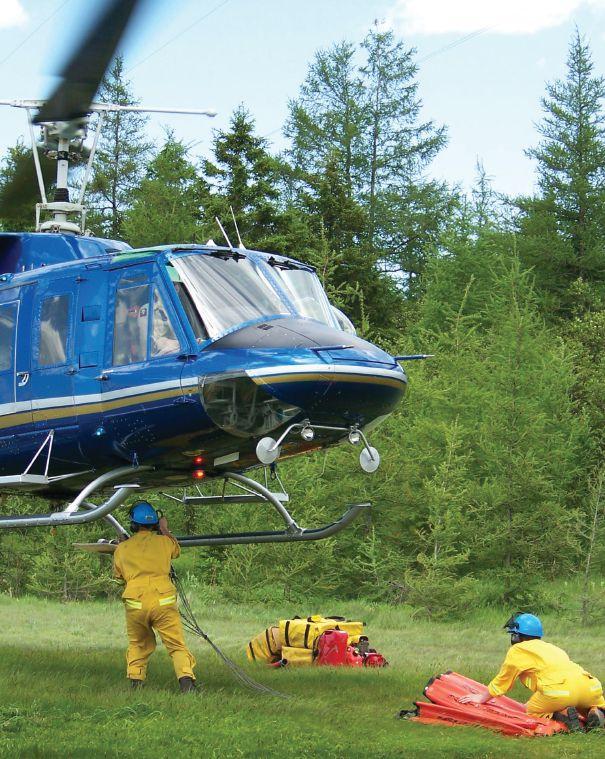
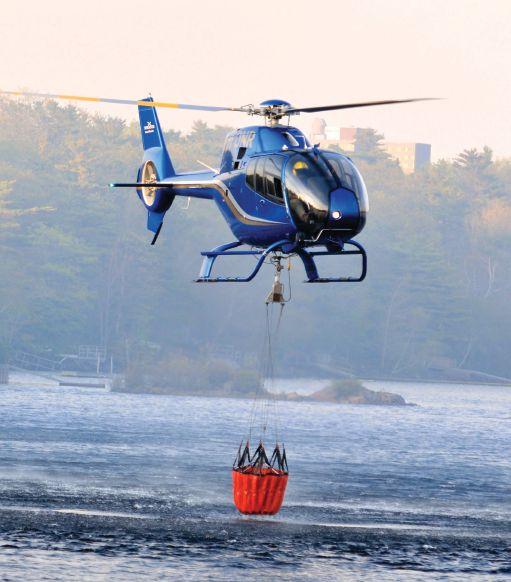
The helicopter pilots battle blazes strictly with Bambi Buckets: a 100-gallon Bucket for the MD 500s and the EC120B and a 250 gallon Bucket for the Bell 212. They carry standard gear such as slings, cargo nets, long lines and survival equipment. The fleet has one cargo pod, for an MD 500. DNR does not rappel fire crews, but pilots will ferry fire crews and their equipment closer to the heat.
DNR requires that candidate pilots have at least 2,500 hours total time, with 1,500 of those in turbine helicopters and a minimum of 2,000 hours as helicopter pilot in command. Candidates should have endorsement for at least two of the fleet types, with current pilot
RIGHT: The helicopter’s versatility makes it the province’s firefighting aircraft of choice.
(Photo courtesy of DNR)
BELOW: The MD 500s and Eurocopter EC120B are the first responders.
proficiency checks. A long list of other requirements make it pretty certain that qualified pilots will be coming from large companies that do a lot of long line and bucket work.
“When we advertise for pilots we get 25 to 30 applicants, of which four or five might be suitable, in our eyes. We spend a lot of time very close to the ground; for example, doing surveys. You get into a fire situation with low visibility and other helicopters and the situation can get interesting,” Wickwire says.
Openings are rare, but there have been some since 2008. “We get a lot of very young pilots wanting to get into the business,” Wickwire says. “We do have a seasonal position for a pilot who is fresh out of flight school within the 150- to 200-hour range, in a co-pilot position in the Bell 212. If the seasonal pilot elects to come back in the second year, they are required to attend the annual training and flight school. Eventually, they will go out into industry for a permanent pilot position. We have pilots on staff who took that route and came back to permanent positions within DNR.”
A school program lets local high school students interested in aircraft maintenance come out to Shubenackadie for one day a week for 10 to 15 weeks. They work with the engineers in order to get a feel for the aircraft maintenance engineer position.
Each of the province’s 18 counties has two DNR district offices, give or take. Most have landing pads and fuel to bring out to fire sites. There are also two forward bases. One is in the west, at McGowan Lake, midway between Annapolis Royal and Liverpool. The eastern base is in Margaree, in Cape Breton. They have bedrooms and kitchen facilities and there is usually a vehicle available.
That DNR can dispatch helicopters around the province ties in closely with several other factors to explain how most fires are put out quickly and, generally, with few hectares burned. The province is not terribly large and it has an extensive network of woods roads. DNR works closely with the province’s 325 volunteer fire departments, which respond extremely rapidly. “We have a long-standing agreement with them. They roll out fast and provide additional resources on our fires. Together, we have a quick response rate, usually less than 20 minutes, to get at the site,” Fanning says.
The province once had 34 fire towers, some of which dated back to the 1940s, but their function is gradually being supplanted by other technologies, Fanning says. “For a long time they were a huge factor in our early detection of fires, but over the years we found that they were no longer the largest reporting group. About 10 years ago they were reporting about 30 per cent of the fires first, while in the last few years they are first to report only 7 to 11 per cent of the fires. Now the public reports the majority of our fires. Our data show that almost all of our fires, about 96 per cent, are started within 1.3 kilometres of houses.”
The advent of 911 and cell phones mean that the people who have fires that get away from them are calling them in. “Unlike the rest of Canada, 99 per cent of our fires are caused by people. If we get a dozen
ABOVE: The Bell 212 is the fleet’s big gun, held back for bigger blazes and high winds. (Photos courtesy of DNR)
FEATURE
lightning fires a year, that’s high,” Fanning notes.
The province has been using fixed-wing aircraft for about 15 years to supplement towers on extreme fire hazard days. In a review and test project three years ago, the department found that using fixedwing aircraft to patrol the province is more cost effective than main-
prescribed routes for the planes to fly. Flights may last from two-anda-half to six hours. Pilots sometimes fly alone, and sometimes with trained spotters, putting along at 2,200 rpm at 1,000 feet above ground level. Depending on the fire threat level, as many as three 172s at a time may be flying patrols anywhere between the extreme west of the province and the Cape Breton Highlands National Park.
You get into a fire situation with
low
visibility and other helicopters and the situation can get interesting.
taining and manning the iconic towers.
The aircraft can fly right over fires, report on the fuel they have to burn and lead ground crews to fires. “I was able to guide a ground crew that couldn’t figure out how to get to the fire on the woods roads,” says Brian Goldie, owner, Centre Valley Aircraft Inc., in Waterville. His company is in the third of a three-year contract with DNR to fly surveillance patrols using Cessna 172s.
Patrols are assigned according to the forest fire weather index and other factors. The Provincial Wildfire Coordination Centre, which monitors the province and allocates resources, has developed coded,
Workshops and symposium
The helicopter fleet averages 1,100 to 1,200 flight hours a year. With a normal to dry fire weather season, the flight hours devoted to the fire side of things might be 30 to 40 per cent of the total hours logged. The frosting on the cake, both for the province and the pilots, is the diversity of assignments the helicopters carry out during the other 60 to 70 per cent of the time.
Wickwire explains: “Air Services provides air support to all Nova Scotia government departments and agencies. Activities include wildfire fighting, fire detecting, provincial emergency situations, biodiversity studies, wildlife surveys, wildlife tracking, Crown land management, inland search and rescue and supporting Nova Scotia’s volunteer search and rescue teams.
“Over the years, we have found helicopters to be very versatile. We are fortunate that we have a lot of varied and interesting jobs that we do.”
Thank you for your confidence over the years Canada. We’re now a Canadian company and want to repay your trust with some very special educational events.
• We have worked with over 100 Canadian aviation enterprises and have held 3 major contracts with Transport Canada.
• No one knows Quality Assurance, SMS or Regulatory Compliance issues like us.
AUGUST 2014 with the latest methods and Regulatory revisions being held in Winnipeg and Calgary this August.
• Workshops in Quality Assurance, Root Cause Analysis and Corrective
• Action Plans and required Basic Auditing Skills
• Special rate for our Canadian friends see our website for details
JANUARY 4-6, 2015 being held once again at the Coronado Springs Resort inside Disney World Florida!
• This years theme “the Future of Regulations in QA & SMS” with our guest speaker, Martin Eley – Director General of Transport Canada
• 2 days of Certificate workshops
• Bring your family and mix business with pleasure
• A great way to meet and greet influential industry colleagues in an intimate atmosphere (less than 100 seats are available for this years event
less than 100 seats are available for this years event!
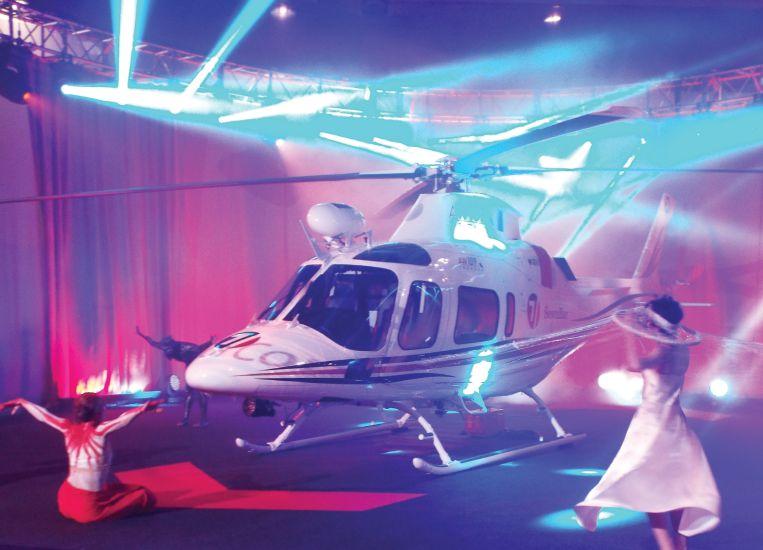
LEFT: In a lavish Cirque du Soleiltype montage, AgustaWestland unveiled its new AW109 Trekker.
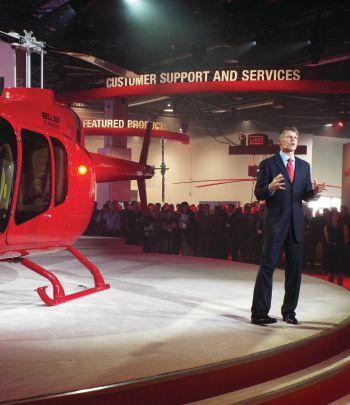
BELOW: Bell Helicopter president and CEO John Garrison introduces Bell’s back to basics 505 Jet Ranger X. (Photos by Matt Nicholls)
Not Just California Dreamin’
Heli-Expo 2014 Wows in Anaheim, Calif.
BY MATT NICHOLLS
In an interview with Helicopters magazine just prior to Heli-Expo 2014 in Anaheim, Calif. Feb. 25-27, Bell Helicopter Canada president Barry Kohler hinted at several new projects his company was engaged in that were sure to pique the interests of operators nationwide and around the world.
“I just can’t tell you yet, Matt,” Barry teased me, “but it will be a game changer.” Well now that the proverbial cat is out of the bag, it certainly looks like Barry’s words will come to fruition.
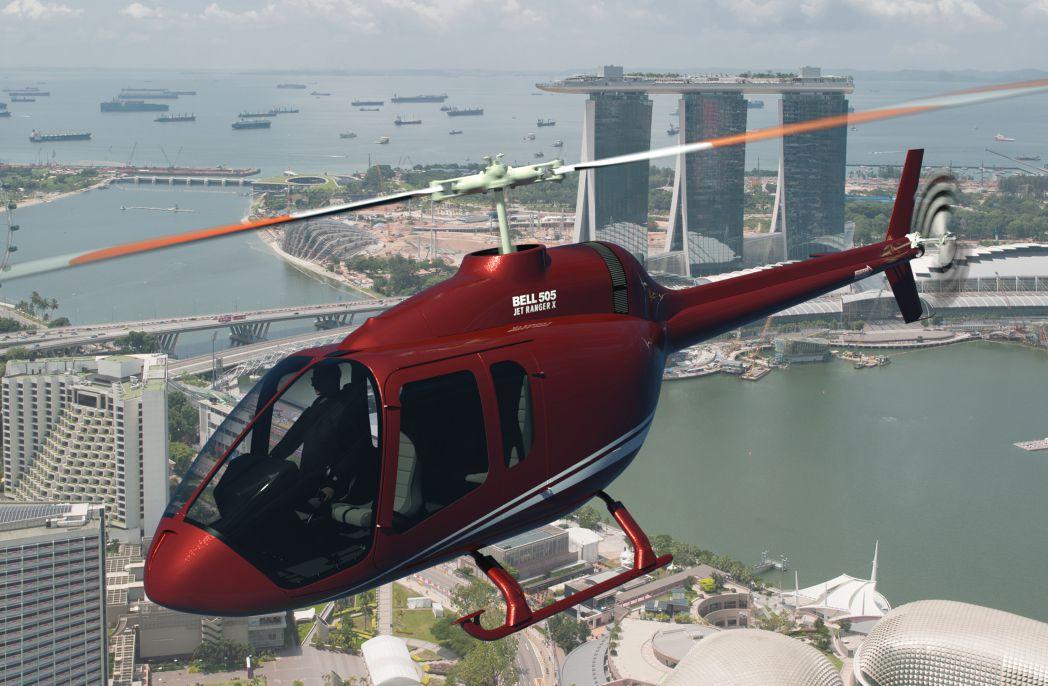
With its ongoing commitment to innovation and a determination to solidify its position as one of the world’s most creative and versatile OEMs, Bell introduced it’s newest model, the 505 Jet Ranger X, on the second day of the show. In typical Bell fashion at the greatest helicopter show on earth, the back-to-basics short light single (SLS) concept was introduced amidst all the light, music and hoopla of a Superbowl half-time show with Bell CEO John Garrison at the mike. Bell just wouldn’t have it any other way.
“Bell Helicopter changed the face of the industry nearly 50 years ago with the introduction of the legendary Jet Ranger,” Garrison told a boisterous crowd of several hundred attendees. “Today we reveal the Bell 505 Jet Ranger X, the high-performance, high-value aircraft
our customers have been asking for in this category. Not only is the Bell 505 competitively priced, it offers a combination of features, capabilities and support customers have come to expect from Bell Helicopter.”
Bell’s new offering – technically first revealed without a name at the 2013 Paris Air Show – should be a strong player in the Canadian market as it will be both affordable and adaptable to many operations particularly utility roles, corporate and training. The five-seat, single-engine, turbine will boast a cruise speed of 125 knots, range of 360 nautical miles and useful load of 1,500 pounds. It will also have a flat floor, increased cabin volume (61-cubic metres) and clam shell doors that will provide customers with configuration flexibility. It also features the Garmin G1000H Integrated Avionics Suite, which gives pilots critical flight information at a glance to maximize situational awareness. Pilot workload is further reduced by the Turbomeca Arrius 2R engine with dual channel Full Authority Digital Engine Control (FADEC).
The 505, like Bell’s 19,300 pound (maximum gross weight) 525 super medium Relentless introduced with similar pomp and circumstance at Heli-Expo in Dallas, Tex. two years ago, was developed in concert with a customer advisory council to ensure all
FEATURE
design elements closely matched operator needs. The Relentless, designed predominantly for the oil and gas market, was also on hand in Anaheim as was the 429 light twin with geared landing gear, providing a perfect display of where Bell is headed in the future. The 407GX was also in tow.
“It’s an exciting time to be at Bell Helicopter, working side-byside with our customers to create the next generation of vertical lift,” Garrison said. “Throughout our entire planning and development process, we are engaging our customers. They are providing us with actionable insights about how we can improve our products and what they will need for their missions in the coming years. This input has been invaluable in ensuring we deliver the products our customers need to be successful.”
No doubt with the new 505, Bell is well on its way to ensuring its continued success and growth in the future. Results from the show certainly reinforced this point – Bell garnered 171 letters of intent from operators for the new 505 Jet Ranger; 10 letters of intent for the 525 Relentless; eight for the 407GX; five for the 412EP; and two for the 429.
TREKKING IT TO SUCCESS
Not to be outdone in the high stakes game of dramatic helicopter introductions and heightening brand awareness, AgustaWestland employed the services of several twirling Cirque du Soleil dancers to showcase its new offering, the AW109 Trekker. The new aircraft is the first light-twin from AgustaWestland to offer skid landing gear.
With a maximum take off weight of 3,175 kilograms (7,000 pounds) and 3,200 kg. (7,055 lb.) with external loads and more than 1,500 kg. (3,306 lb.) of useful load together with a class leading
cruise speed (160 knots/296 km/h), the AW109 Trekker may have the highest productivity in the light-twin turbine helicopter market.
The aircraft can accommodate up to eight passengers including the pilot and can serve a variety of missions including EMS, utility, SAR, law enforcement, and passenger transport. For the emergency medical configuration, the aircraft can accommodate up to six passengers or one stretcher with three/four medical attendants or two stretchers and two medical attendants. The aircraft is powered by a pair of Fadec-equipped Pratt & Whitney Canada PW207C 815-shp engines and has a maximum cruise speed of 154 knots.
The AW109 Trekker also includes the Garmin G1000HTM glass cockpit to enhance situational awareness and safety. The advanced avionics package includes Integrated Helicopter Synthetic Vision Technology (SVT) functionality with the Highway In The Sky (HITS) depiction and the Integrated Helicopter Terrain Avoidance Warning System (HTAWS) with a worldwide terrain and obstacle database. AgustaWestland says it will produce the AW109 Trekker at its plants in Philadelphia and Italy and certification and first delivery of the Trekker is expected next year.
The introduction of the AW109 Trekker is just another positive step for AgustaWestland, which is trying to distance itself from an ugly scandal with the Indian government in 2013 that led to the resignation of several key members of the upper management team. The investigation is ongoing. New CEO Daniele Romiti commented at Heli-Expo that he is very positive about the future of his company,
Bell’s new five-seat 505 Jet Ranger X has real appeal for the Canadian market. (Photo Courtesy of Bell Helicopter)
FEATURE
attractive price for very complex technology,” he said. “I am quite convinced when the tiltrotor gets into the mindset of operators, they will realize how it can meet their future needs.”
though he spent a good part of his time in 2013 protecting the integrity of his firm. Recently, he has been able to focus on the development of key projects, such as the AW119k, the AW169 and perhaps his favourite, the tiltrotor AW609, which made the trek to Anaheim for the show.
“My goals were very different at that time [in March 2013],” he told AIN, the Heli-Expo show daily. “We had to face quite a challenging period with reputation issues, and this resulted in strong activity to reinforce our internal organization to deal with compliances issues. The new and updated procedures have resulted in a better approach.”
Key drivers for the company continue to be the oil and gas sector, EMS and more, and with the EASA certification of the AW189 in February, the AW169 later this year (with projected entry into service in the first quarter of 2015), the future looks bright. With its solid family of offerings, Romiti’s goal of getting the company headed in the right direction seems sound.
“With all of these new platforms you will see how much improved technology we have added especially in the models such as the AW169,” he said. “It has a completely new architecture in terms of dynamic components in the rotors and new touchscreen technologies in the cockpit.”
Romiti is also excited about the AW609’s potential. “There will be a fundamentally new application here because we are targeting a very
SHOOTING FOR BETTER SERVICE
Undergoing a company rebrand is always a complicated undertaking, but it certainly helps when your parent company is one of the strongest players in the aviation community. That’s precisely where Airbus Helicopters sits and with its new name, relatively new president and CEO and new company focus, Airbus is poised for great things in 2014.
Results at Heli-Expo echoed this objective, as 78 bookings underscored the competitiveness of the company’s product line –with acquisitions covering rotorcraft that range from the EC225 and the AS350 B2 and B3e, to the next-generation EC175, along with the new EC145 T2 and the evolved EC225e and AS332 C1e versions.
Guillaume Faury, the aforementioned new head of Airbus Helicopters, explained at the annual HeliExpo press breakfast that Airbus is dedicating more resources this
The AgustaWestland AW609 tiltrotor aircraft wowed the crowds at this years Heli-Expo in Anaheim. (Photo courtesy of AgustaWestland)
year to its customer service initiatives and hopes to enhance its commitment to operators worldwide. It’s a sound strategy and will work to further solidify the firm’s growth in the world market.
“It is time for new priorities,” Faury said. “We simply need to do better.” Along these lines, Airbus is spending several million dollars in 2014 on customer support solutions and has revealed several new broad-based initiatives to solve key problems. Making its web-based customer service portals more effective, doubling investments in IT systems and finding ways to streamline parts distribution are some of the objectives going forward. The company is also launching an online catalogue of helicopter service bulletins and STCs that operators can access worldwide. Driving down maintenance costs on all of its helicopters also remains a priority, Faury said, particularly on the EC175 and EC225, both aimed at the offshore oil and gas markets.
In terms of safety, Airbus plans to install flight data and video recorders in all of its smaller helicopters as standard equipment and install cockpit voice recorders in its medium and heavy helicopters. On the product development side, Faury unveiled plans for two new variants of the EC225e and the AS322C 1e and talked about the company’s plans for its high-speed X4 medium twin. The first flight of the X4 is slated for 2015. In 2013, Airbus posted revenues of $8.33 billion delivering 497 helicopters worldwide, up from 475 in 2012.
DEALING WITH A “MIXED BAG”
One of the most compelling and engaging presentations at Heli-Expo 2014 was Sikorsky’s “Technology Meets Tradition” session on the second day of the show. Sergei Sikorsky, son of company founder Igor Sikorsky, described the company’s past achievements, success
stories and more in a truly compelling presentation. From the early prototype of the VS-300 to the CH-53 to today’s technologically advanced S-76D and the S-97 Raider, it was a truly memorable look at one company’s successful development in aviation.
Earlier in the show at his annual State of Sikorsky press conference, Sikorsky president Mick Maurer discussed a 2013 that he essentially called a “mixed bag.” While the company hit a record backlog of $15 billion, it also recorded an 8 per cent drop in sales, mostly attributable to a drop off in the U.S. government’s order book.
On the commercial side, Sikorsky is currently experiencing growth in several new markets including China, which Maurer notes has taken more than $300 million in orders due to a strong growth in the oil and gas markets. China is also where the frame for the S-76D is being manufactured; the technically advanced aircraft recently made its entry into service.
Touching on the much-maligned CH-148 Cyclone program with the Royal Canadian Air Force, Maurer was adamant that the federal government’s endorsement of the program late in 2013 will spur new life into the project. There were rumblings plans were in the works to rethink the Sea King replacement project and move on from the Cyclone.
Sikorsky is seeing strong growth in the oil and gas market, meaning its S-76D is getting plenty of attention. (Photo courtesy of Sikorsky)
FEATURE
Show Stoppers!
New Products That Stood Out At Heli-Expo 2014
BY MATT NICHOLLS
t’s the industry’s most prominent annual event and this year’s version of Heli-Expo in Anaheim, Calif. certainly didn’t disappoint when it comes to the introduction of new products and services for operators worldwide. Here are some of the new products – and news bits – that caught Helicopters attention at this year’s event:
I• Flight Data Monitoring (FDM) is becoming an essential “must have” safety tool for operators worldwide and B.C.’s Latitude Technologies and Camarillo, Calif.based AKV Inc. are helping to make the process even more efficient. The two companies announced a partnership at the show to share in the development of technical interfaces between AKV’s ETM1000 Exceedance and Trend Monitor and Latitude’s IONode ION100 flight data recorder. The partnership means engine condition data collected by the ETM1000 will be recorded and automatically forwarded by the IONode ION100 to multiple stakeholders of the operators of the aircraft. The enhancements will give operators quicker access to critical engine data, enabling timelier engine trend analysis and maintenance planning. “It’s all about automation and timeliness,” said Latitude president Mark Insley. “Our ability to grab the ETM1000 engine condition data on a continuous basis, monitor the data for inflight events and efficiently deliver the data to the fleet’s maintenance and operations team is what sets our end-to-end FDM system apart.”
• Known for its cutting-edge avionics, Thales didn’t disappoint in California with the introduction of Avionics 2020 for helicopters. Its new avionics package represents a look at the cockpit of the future. Modelled after the principles of its Avionics 2020 for fixed-wing aircraft unveiled last year at the Paris Air Show, the helicopter version sets a new standard for rotary-wing avionics. The new package is aimed at giving pilots the tools to make critical decisions at just the right time easily and efficiently. Also critical to the design to help reduce a pilot’s work-
load. This is done by reducing mouse clicks on screen with gestures similar to those used by smart devices. The system is an “open architecture” one that can be adapted to different platforms. “More and more helicopter manufacturers are putting in place many functionalities that are interfacing with the pilot,” said Thales head of avionics Yves Joannic. “Their workload is increasing, so we need to develop systems that have to decrease that workload.” No aircraft manufacturer has selected the system for its aircraft as of yet, but Thales has signed nondisclosure agreements with several OEMS. The first implementation and entry into service of 2020-powered aircraft will likely come within five years.
• Corporate rebrandings are always intriguing and the new look for Erickson Air-Crane is no different. The global pro-
vider of varied aviation services and operator of the heavy-lift Erickson S-64 Aircrane helicopter has officially changed its identify to “Erickson” to better reflect the company’s aviation presence. In addition to a clean new look and feel, Erickson, will now fly a diverse, global fleet of helicopters and fixedwing aircraft covering heavy-, medium- and light-lift solutions. And after more than 40 years of primarily operating the S-64 Aircrane, Erickson is now targeting a diverse selection of clients across a much broader spectrum. Acquisitions in 2013 included McMinnville, Oregon-based Evergreen Helicopters and Brazilian aviation services company Air Amazonia, a subsidiary of HRT (an independent oil and gas company.) “This was truly a transformative year for our organization,” said Udo Rieder, Erickson CEO. “We now have operate a diversified
“Heli-Expo 2014 in Anaheim, Calif. left most attendees optimistic for the future. (Photo by Matt NIcholls)
fleet and are well positioned to provide a full-spectrum of aerial services in support of our customers’ needs across an even broader number of markets.”
• It appears the sky is the limit for Swissbased OEM Marenco Swisshelicopter. Its new SKYe SH09 made quite the impression at this year’s show, as each time I headed over to the booth there were throngs of people checking out the new machine. Announced in 2011, the clean-sheet singleengine aircraft which seats eight is creating a buzz in a number of markets. Chief
Operating Officer Mathias Senes seemed to be actively engaged with potential custom ers at numerous times during the event. Located in Glarus Nord, Switzerland, Marenco came away from Heli-Expo with 11 additional letters of intent, putting the book order at 59 aircraft to be delivered from 2015 to 2017.
• Enstrom Helicopters has introduced a new player in the helicopter trainer segment with its new TH180. Designed as a training helicopter, the TH180 is based on Enstrom’s reputation for safety and customer support with additional focus on low operating costs and ease of learning. “The TH180 is
designed with the student in mind. Its rugged frame with robust, energy-absorbing landing gear delivers wide margins of safety during the learning process,” said Bill Taylor, director of engineering. “The high inertia main rotor blades and articulated
FX-280 three-seat model. Tracy Biegler, CEO of Enstrom, said during the aircraft’s grand opening that the TH180 should produce operating cost of roughly $175 per hour and an hourly fuel burn of less than 12 gph. The launch price is US$365,000. He
FEATURE
day and at night. SkyVis combines Elbit’s helmet-mounted display (HMD) with commercially certifiable line-out-of-sight and daytime heads-up display capabilities. SkyVis can be used in the day or at night, with or without night-vision goggles (NVGs), in marginal weather or during all phases of flight. Elbit also revealed its Clearvision Heli EVS, a multi-spectral enhanced vision system designed for pilots that provides situational awareness. It builds on Elbit’s fixed-wing product designed for business jets. The system employs fusion algorithms and a range of spectral bands, offers a 35-degree view and is designed to help pilots cope with low-visibility conditions.
• Is it possible to call a helicopter tug sexy? Okay, maybe not. But Tiger Tugs Helicopter Transport’s new Model 12.0 in the tiger striping certainly is eye-catching. The Model 12.0 is a good choice for moving the Bell 212 and 412 safely and easily and its wireless remote system allows an operator to manoeuver a helicopter in tight hangar spaces while controlling the tug from any vantage point. A single operator can move the tug, so no extra help is needed.
• Vector Aerospace Services – North America (HS-NA), a division of Richmond, B.C.-based Vector Aerospace, brought its custom-modified integrated cockpit to HAI. The cockpit features two Sageum 10-inch MFD (EI indication) and two Sageum 10-inch PDF’s for right-or left-hand seat operations. “Certified by Vector Aerospace, the integrated cockpit display reduces pilot workload and provides improved features including maps, weather radar, maintenance page, and warning annunciations,” said Chris
McDowell, vice president of sales and marketing. “The modification is a great example of how Vector continues to generate customized solutions for its customers.” Vector also announced just prior to the show that it has new maintenance agreements with Brazilian MRO provider Helipark to provide repair and overhaul support for the Turbo Arriel 1 and Rolls-Royce M250 engines. Vector plans to open a new 29,000 square foot facility in Jacarei, Brazil this year as part of an initiative to grow its South American customer base.
• Airbus Helicopters is ramping up its efforts to add flight data monitoring (FDM) and cockpit imaging in its helicopters to ramp up its safety efforts, according to new president and CEO Guillaume Faury. All 181 AS350 AStar/Ecureuil light singles delivered last year were equipped with FDM developed by Appareo Systems. Next in line for the devices are the EC130T2 light single and the EC135 light twin. Known as Vision 1000, the device records cockpit sounds and images at a rate of four frames per second as well as roll, yaw and pitch angles. It is attached above and beyond a pilot’s head so the instrument panel, controls and the outside world (through the windshield) are in the camera’s full view. The vision differs from a cockpit voice and flight data recorder (CVFDR) the “black box” which is designed to withstand fires, shock and immersion. A CVFDR is mandatory only for commercial passenger transport in large helicopters. The Vision 1000 can be used as a means of prevention, by monitoring flight data and analyzing the results using a proprietary software program. The concept is to detect pilot deviations from procedures by replaying the flight on the ground.
COVER STORY
Continued from page 17
less than 25 kilometres from the bright lights of downtown Vancouver. The incident was featured in a CBC documentary on SAR that was broadcast in January 2014.
Members of the civilian North Shore Rescue team had spent two days combing the west side of West Vancouver’s Cypress Bowl, the site of the 2010 Olympics snowboarding and freestyle skiing events, for a snowboarder who had gone out of bounds. At the end of the second day, the subject was located at the bottom of a 150metre cliff. As nightfall crept closer, the team realized that it would take all night and all their resources to take him down the almost vertical mountainside, in the face of worsening weather and extreme risk of avalanche. MWO Tremblay and his crew had been alerted shortly after initial contact with the boarder and had been expecting the call and were quickly on their way.
In the CBC documentary, Jeff Yarnold and Mike Danks of North Shore Rescue, laugh when they describe the impression the Cormorant makes as it arrives. Yarnold describes it as “like the starship Enterprise” in the way it lights up the darkness, while Danks adds, “that long before you see the lights of the helicopter you can feel the ground shaking.”
For Tremblay and his SAR tech partner, the challenge was getting to the ground and not knowing if they would be able to get back up. The steep mountainside, tall trees and low ceiling put the helicopter in a situation where the entire 290-feet of the cable was required. Going down was no problem, but when Tremblay
evacuated with the patient in the first hoist out, he very quickly became aware of an unforeseen shortcoming of a 290-ft. hoist. The hoist started smoothly, but as he approached the helicopter, he suddenly began to swing about wildly under the helicopter. While he did get the patient and himself safely on board, there were a few tense moments. The problem was that the guideline which is attached to the cable and allows someone on the ground to maintain tension on the line all the way back to the helicopter, wasn’t as long as the cable and ran out before Tremblay reached the aircraft. That problem was quickly rectified.
Today, Canada’s 15 Cormorants are the highest hour AW101 fleet in the world and Rescue 901 of 442 Squadron is the highest hour AW101 of all. The aircraft have a 98 per cent availability rate and have performed well under the brutal conditions they have been flown in, since AgustaWestland was able to rectify an early problem with rotor hub cracks. Jeremy Tracy, AgustaWestland Head of Region for Canada, told Helicopters his firm continues to work with the Department of National Defence and maintenance contractor IMP Aerostructures, to bring the scheduled maintenance down from the current 300/600-hour cycle to a 600/1,200 hour cycle.
The Cormorant has certainly established itself as robust and reliable workhorse in supporting the men and women of the RCAF SAR Squadrons. The proof can be seen in the hundreds of people who owe their lives and well being to the big yellow helicopter. It might be nice if we had a few more to go around.
•
•
• Complete
Campbell River Base e-mail: info@ebhelicopters.com www.ebhelicopters.com
Gold River Base
Tel: 250-283-7616
Fax: 250-283-7555
Port Alberni Base
Tel: 250-720-8915
Fax: 250-720-3641
•
COMPONENT OVERHAUL SPECIALISTS
markeTplace
Photo by Bill Campbell MAINTENANCE CENTER
COLUMN
The Buck Stops Here!
When Do Pilots Really Get Paid?
few years ago, I was flying on Hudson Bay with a load of biologists conducting a biodiversity survey of the plant life on the coast. On a predetermined series of plots, the biologists catalogued all of the plant life in a 10’x10’ grid. It took about 40 minutes, per grid.
It was a beautiful, hot summer day – CAVOK. It was one of those flying days when you ask yourself, “Do I actually get paid to do this?” Most of the work was five or six miles inland from the coast and we had completed six of the scheduled seven grids. The last one was on the coast – about two miles from a fuel cache, that I had planned to visit while the last grid was being completed. I would then pick up the biologists and head for home. It was a perfectly choreographed end to a perfect flying day.
As I got closer to the coast, our blue skies started to turn grey and I could see that there was a big storm brewing over the Bay. Even though I had flown on the coast before, I can remember experiencing a little disbelief that the weather could be so aggressively pleasant five miles inland and so ominous on the coast. I alerted the biologists that we might have to cut the last grid short if the weather continued to deteriorate. I warned them that if they weren’t prepared for a hasty departure, we could be spending the night in the A-Star Hotel. They agreed to start the grid without delay, while I left for the fuel cache. I needed the fuel to get home in any case, so I dropped them off at the grid and quickly departed.
I had left, ahead of the storm – just five or six miles inland.
As we lifted off, the storm was coming ashore with a vengeance and the winds had increased to about 35 knots. The visibility was also quickly deteriorating in heavy rain and fog. We lifted off uneventfully, but once we were up in the air, I realized that the ceiling was only a couple of hundred feet, and the heavy rains were now interfering with my forward visibility – the water was beading-up on the windscreen of the A-Star.
To make matters worse, when I started to fly inland, I had 35 to 40 knot winds pushing me along under reduced visibility circumstances. While we were above the tree line, I still felt very uncomfortable “overdriving my headlights” so-to-speak. Even if I flew at 50 knots, my groundspeed was nearly 100. I flew a couple of wide 360s on the coast while I considered my options, alternating between 10 and 100 knots over the ground depending on whether I was facing inland or offshore. I could see the ground, but my forward visibility was significantly reduced. It was now painfully clear that I was going to need to land and wait this out.
Fortunately, there were many clear areas to land, and with the use of the storm window, and some limited forward visibility through the rain, I side-slipped my way to a landing on the coast. I tied the machine down in the pouring rain. We retrieved the Sat-Phone to call the base, and the five of us settled in to wait it out. As it turns out, we only waited a couple of hours, but until we were underway again, we were all wondering if there might be a “cozy night” in an A-Star on the coast in our future. As uncomfortable as that would have been, I was convinced that it was still better than what I had just experienced in the air.
If you see a problem brewing, make your views known in no uncertain terms. ‘‘ ’’
When I returned about 30 minutes later, the weather had deteriorated considerably. It was now obvious that the storm was headed our way; we were seeing the leading edge of the storm and it was quickly approaching. I tried to rush the biologists along, but they were reluctant to leave the last grid incomplete and it was clear to me that they didn’t completely appreciate the potential of the storm – and neither did I, as it turns out. When they had completed collecting their gear and loading up the helicopter, the winds off the Bay were still increasing. I must confess that I was focused on returning to the CAVOK conditions that
I learned a few things on that day: If you see a problem brewing, make your views known in no uncertain terms. Sometimes subtlety is lost on a customer that either does not recognize the hazard or has become too focused on completing the job-at-hand. Also, you need to make your decision early, while you have some options – and stand-by it. And finally, as pilots, we really don’t get paid for the hours of flying that we do under ideal circumstances – we really do get paid when we are occasionally called upon to make difficult decisions.
Fred Jones is the president/CEO of the Helicopter Association of Canada and a regular contributor to Helicopters magazine.
Fred Jones
HELIPORT SHOWROOM TRAINING RESTAURANT SHOP
A fascinating experience begins as soon as you enter the first complex ever to be designed as a showcase for the world of the helicopter. Bold architecture, exclusive technical clothing, a showroom, flight simulators, 11 useful helipads, a staff dedicated to impeccable service… Everything is in place to take you to the next level of flight.
THINK SERVICE
Because you need your helicopters to be available around the clock. In addition to the largest product range in the world, we have the largest network of helicopter training, logistics and maintenance centers across the globe.