ou wouldn’t want to be grounded without reliable service nearby ... would you?
Supporting your missions worldwide is what the Bell Helicopter network is all about. With more than 100 independently owned and authorized Customer Service Facilities (CSFs) located in 34 countries, our CSFs provide you with industry-leading support and services when and where you need it, including genuine Bell Helicopter parts, component overhaul, field maintenance and blade and airframe repair.
With
Paul Dixon
Peter Pigott
– Thomas Fuller
WMatt niCHolls editoR
eather lore suggests that the month of march can either “come in like a lion and go out like a lamb” or vice versa – and when you apply this statement to the Canadian aviation industry, you might say an entire pride of lions gave its collective “roar” at the end of march. it’s been a rough ride for the Canadian aviation industry this spring as mismanagement on a number of levels of government – not to mention in some aviation corporations – has dominated headlines from coast to coast.
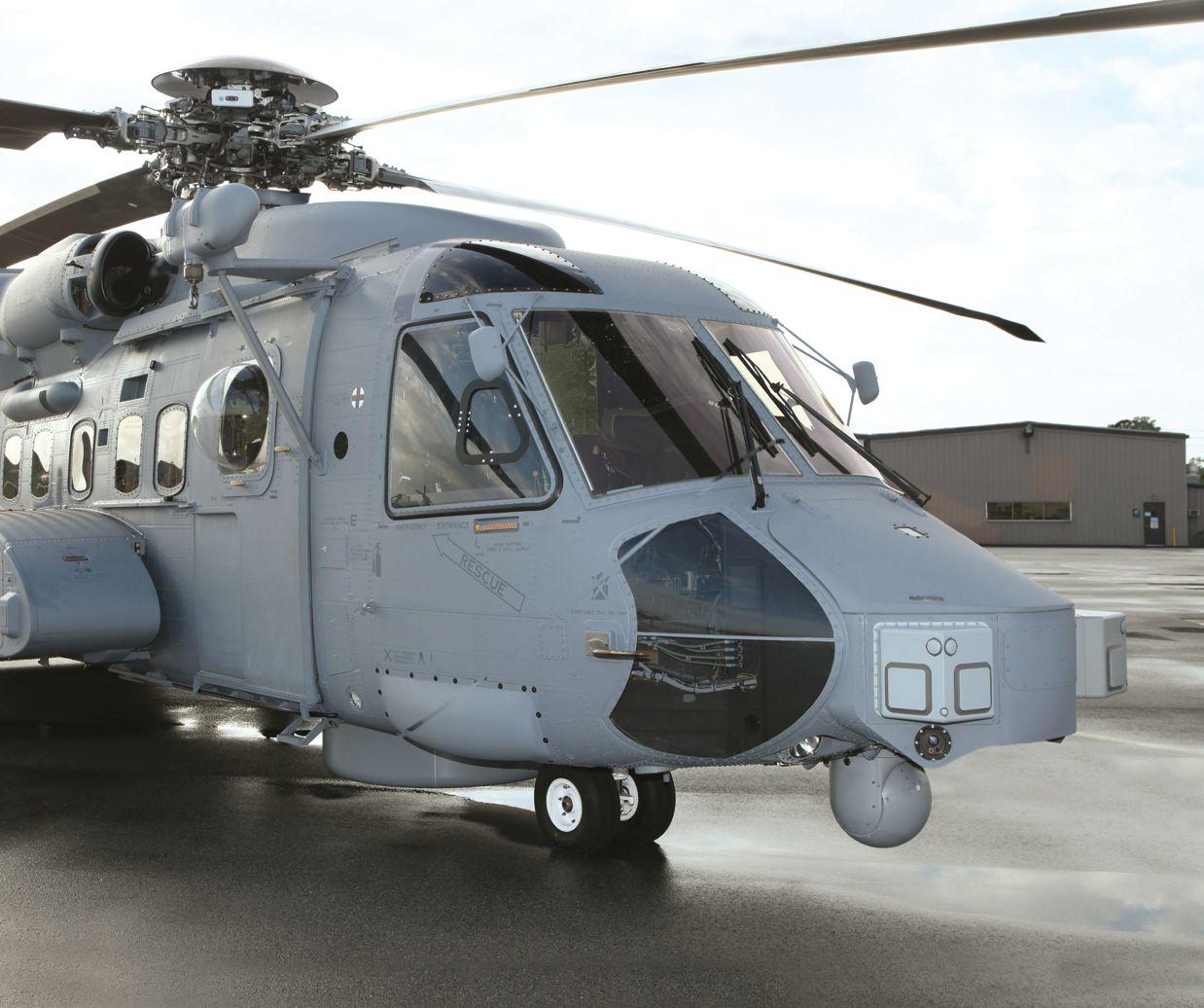
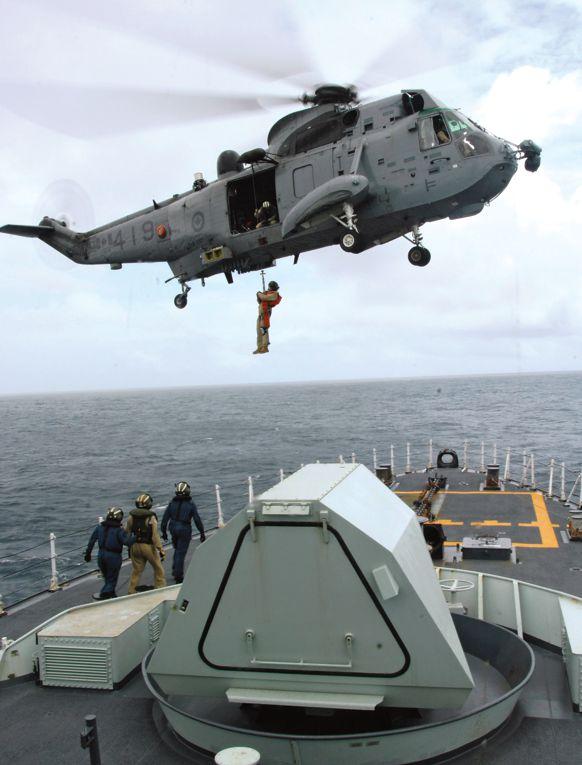
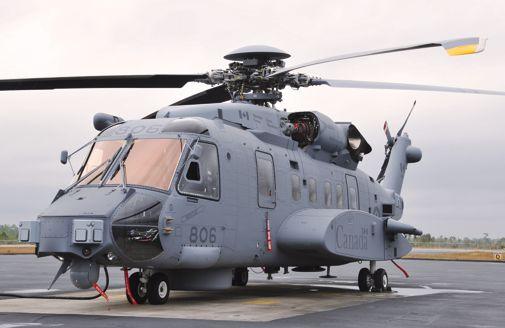
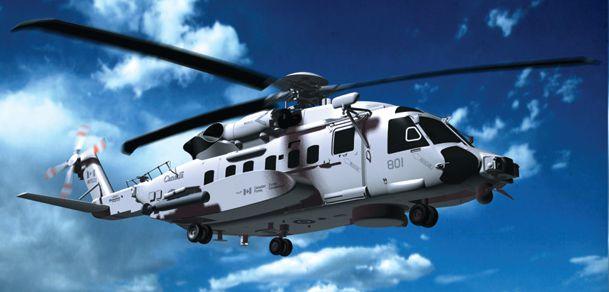
the federal Conservatives’ bungling of the f-35 Joint strike fighter program and its negligence (in revealing) the final costs of the project tops the list. this political football has sparked the collective ire of thousands of Canadians and has grown into the most controversial aviation story since the cancellation of the avro arrow – or, on the rotary side, the bungling of the Ch-148 Cyclone, sikorsky’s replacement for the versatile but aging Ch-124 sea King. (for more on the Cyclone, see “playing the Waiting game, pg. 28)
Canadians have a right to be upset. on march 16, i attended a breakfast in ottawa just before the opening day of the helicopter association of Canada’s annual conference at the Westin ottawa. associate defence minister Julian fantino addressed members of the media and the Canadian association of Defence and security industries (CaDsi) and, for the first time, indicated that the feds were in retreat
Weathering the Storm
Canadian Aviation Seeks Sunnier Times Ahead
of a report from provincial auditor general Jim mcCarter. the troubled ontario-based medical service has been mired in controversy for months, and mcCarter’s report presented a sad commentary on an operation scarred by corporate greed, personal gain and government negligence.
this debacle clearly rests with the irresponsibility of a few now departed members of ornge’s upper management – and it’s unfortunate the hardworking pilots, medevac teams and maintenance crews have been subjected to such negative publicity. having flown with both the fixed- and rotary-wing medical teams, it’s obvious to me these teams have the best interests of ontarians in mind at all times. it’s also not an aviation issue per se, but a commentary on how a government program should not be run.
the month closed with another significant jolt. When finance minister Jim flaherty presented the new federal budget march 29, it wasn’t good news; a 10 per cent reduction in transport Canada (tC) staff was a big blow to an industry already reeling from a lack of resources at tC.
the news was particularly damaging to the helicopter industry. fred Jones, president of the helicopter association of Canada (haC), didn’t mince words. “We already raised concerns about the spare mental (and fiscal) capacity that tC has for the Canadian helicopter industry. the 10 per cent reduction in funding for tC is just going to fuel the fire that tC has no time for industry-driven innovation or efficiency-related changes in Canada.”
this debacle rests with the irresponsibility of a few now departed members of ornge’s upper management. ‘‘
mode over the f-35 project – after months of promises (to the contrary) and grandstanding by defence minster peter macKay.
“all options are on the table,” fantino said, adding that the Conservatives were planning to handle the replacement of the aging f-18s in a responsible manner. interesting – a “responsible” manner? not revealing final costs and lying to Canadians, not to mention waving the red flag years into a project, are deemed responsible?
government mismanagement was also seen at the provincial level in ontario, where the ongoing fiasco over the province’s medical transport provider, ornge, came to a head with the release
several committee members at haC’s annual general meeting had already expressed frustration at tC’s lack of resources to concentrate on issues relating specifically to the rotary-wing industry. further cuts and tC’s inability to concentrate on key issues will make 2012 – and the years ahead – that much more challenging for members of the rotary community.
Budget cuts, government mismanagement, and corporate strife. let’s hope the next few months bring more positive times for Canadian aviation – and that the industry, as a whole, can band together to find solutions and weather the storm of leaner times at tC. if the turmoil in march underscores anything, it’s this: rotary operators, more than ever, need to focus on the things they can control – constantly enhancing their own operations and providing the safest operating environment possible for their clients. and it shouldn’t be a problem: it’s what Canadian rotary operators do best.
PURE LEGEND PURE BREITLING
NAVITIMER
A cult object among pilots and aviation enthusiasts, equipped with Manufacture Breitling Caliber 01, the most reliable and high-performance selfwinding chronograph movement, chronometer-certified by the COSC.
CAD 7,715*
A Commitment to Change
the 16th annual helicopter association of Canada annual Conference & trade Show wrapped up in ottawa march 18 and implementing change in the helicopter safety culture was a predominant theme throughout.
lively committee meetings on the first two days of the event dealt with myriad issues affecting operators including flight and duty times, working more effectively with transport Canada, finding ways to implement cost-effective procedures to enhance safety at operations of all sizes, the inherent value of flight data monitoring, maintenance control issues and more. Committee meetings also touched on broader issues such as determining the overall value of the helicopter industry in Canada and the association’s role as an influencer going forward.
fred Brisbois, sikorsky aircraft’s aviation and product supervisor and a member of sikorsky’s Quality assurance Board gave a thought-provoking and, at times, very entertaining look at the development of safety practices in his saturday keynote, “the Changing safety Culture in our industry over the Years.” Brisbois challenged operators to carefully analyze all aspects of operations to find the most logical places to implement change – and understand it won’t happen instantly.
two influential change makers in the Canadian helicopter industry were also bestowed with special awards.
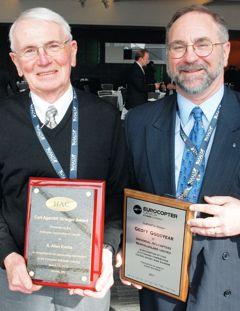
al eustis, who spent an illustrious career as both a fixedwing pilot and a rotary-wing pilot, and was a tremendous advocate for safety in his illustrious career, was named the winner of the 2011 agar Stringer Award.
geoff goodyear, president/ Coo of Universal helicopters, was the first winner of eurocopter Canada’s innovation in safety award. the award is given to a nominee whose business initiatives have demonstrated a great impact on the overall goal of safe flying operations, as recognized by examining skill development, training and any additional resources. the winner was chosen through a committee selection process by a group which included Robert erdos, chief experimental test pilot, national Research Council of Canada; fred Jones, president/ Ceo, helicopter association
of Canada; Matt nicholls, editor, helicopters magazine and Wings magazine; and mike Reyno, co-publisher mhm publishing.
goodyear was also honoured by the haC board of directors for his service on the board as, along with maureen Crockett, manager pacific Region Dulude taylor. in other business, haC added the following to its board of directors for next year: associate member, mathew Christie, alberta sustainable Resource Development (asRD); associ-
ate member, maury Wood, avialta helicopter maintenance; and operator member, Candace moakler, Cougar helicopters. haC president/Ceo fred Jones announced at the end of the event that a second conference will take place later this fall in Calgary. the event will be themed around safety and the oil and gas industries. A permanent move to a fall conference is expected for 2013. for more on the haC Conference see, “Coming out of the fog,” pg. 38.
Agar Stringer award winner Al Eustis (left) and Universal Helicopters president/COO Geoff Goodyear, showcase their hardware. Goodyear was the recipient of Eurocopter Canada’s inaugural “Innovation in Safety” award.
Establishing an effective safety strategy doesn’t happen overnight, says Sikorsky’s Fred Brisbois.
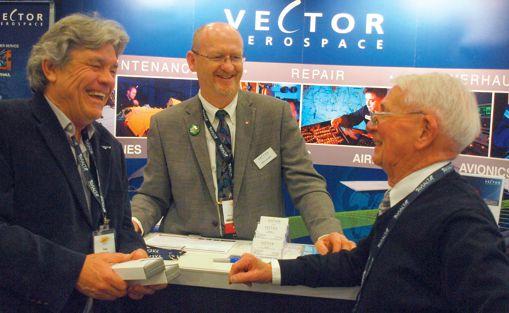
West Coast Helicopters’ Peter Barratt shares a laugh with Vector Aerospace’s Eric Hicks and Agar Stringer award winner Al Eustis.
stoRY and pHotos bY Matt niCHolls
ornge fiasco Hits new Heights
Ontario’s governing Liberals failed to sufficiently monitor the province’s air ambulance service, despite giving Ornge hundreds of millions of dollars that it used to make questionable business deals, said auditor general Jim McCarter, the Canadian Press reports.
McCarter’s long-awaited report shed some light on the troubled agency, which has been mired in controversy over high salaries, questionable business practices and allegations that public dollars may have been used for personal gain. It’s also under a criminal probe for “financial irregularities.”
Ontario’s medical transport provider, Ornge, continues to endure a bevy of attacks over ongoing mismangement.
Government funding to Ornge rose 20 per cent in its first four years of operation, even though the number of patients transported by air fell during that period, the report stated. The health ministry was told in a letter early last year that Ornge planned to create a “complicated network” of for-profit and not-for-profit subsidiaries, McCarter said. But it didn’t look into the arrangements, even though it knew some of the companies would be directly involved in delivering services but would be outside of ministry oversight, the report found.
In 2010, Ornge’s top five senior executives received $2.5 million, which wasn’t disclosed to the public. One board member received more than $200,000, excluding expenses. Some of the money came from the borrowed funds, the report said.
Ornge’s former management and board of directors, who were replaced in January, also refused to provide the agreement relating to a $4.8-million payment that a European company – which sold aircraft to Ornge for $148 million – made to one of the subsidiaries to provide marketing services.
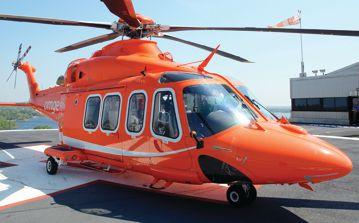
It’s been reported that an Ornge subsidiary controlled by then-chief executive Chris Mazza received $6.7 million from helicopter firm AgustaWestland after Ornge used provincial funds to buy 12 AW139s from the company. Mazza’s replacement, Ron McKerlie, has acknowledged that the marketing work performed by the Ornge subsidiary didn’t reflect the amount of money that was paid.
Canadian Operators Spruce Up Fleets
three more prominent Canadian operators will be sporting new aircraft this season.
héli-Boréal inc. has selected the eurocopter as350 B2 as its eighth eurocopter helicopter. the aircraft was delivered by eurocopter Canada limited (eCl) in mid-march and will be used to expand héli-Boréal’s work in mining exploration, hydro surveying and maintenance missions. “the proven as350 B2 has become renowned for its versatility,” said guy Joannes, president/ Ceo of eCl. “We are especially proud to accompany héliBoréal in its development, and look forward to contributing to the success of its various and complex missions. the as350 B2 is an excellent utility helicopter that is able to carry an external load of more than
one ton (2,200 pounds). thanks to its high useful load, it is well suited for completing mining and utility missions quickly and efficiently.”
added Jean-Yves, vice-president, héli-Boréal inc.: “the as350 B2 will help strengthen our position in the mining industry by providing additional options for our customers. eurocopter aircraft continues to be our first choice in terms of continued reliability, versatility and safety.” héli-Boréal’s current fleet consists of two as350 Bas, three as350 B2s, one as350 B3 and one eC120.
peak aviation in la Baie, Que. is also sprucing up its fleet this year with the addition of a new as350 B3e helicopter. the aircraft will assist with mining and long-lining missions. the sale eCl will mark peak aviation’s fourth eurocopter
HELICOPTERS MAGAZINE
P.O. Box 530
105 Donly Drive South Simcoe ON N3Y 4N5 Tel.: 519-428-3471 Fax: 519-429-3094
Toll Free: 1-888-599-2228
Website: www.helicoptersmagazine.com
EDITOR MATT NICHOLLS e-mail: mnicholls@annexweb.com 416-725-5637
PRODUCTION ARTIST BROOKE SHAW
CONTRIBUTING WRITERS
MICHAEL BELLAMY, DAVID CARR BRIAN DuNN PAuL DIxON, DAN GIBSON WALTER HENEGHAN, FRED JONES, NEIL MACDONALD, JAMES MARASA
ASSOCIATE PUBLISHER ALISON DE GROOT e-mail: adegroot@annexweb.com 519-429-5191 • 1-888-599-2228 ext. 246
ADVERTISING SALES ADAM SZPAKOWSKI e-mail: aszpakowski@annexweb.com 1-888-599-2228 ext. 273
Coast to Coast helicopters has also added a new as350 B3e for the new year. the aircraft will be operated by one of the group’s operators: mustang helicopters. mustang already operates a fleet of 12 as350 B2 helicopters.
“We have always been impressed with the astar family of helicopters,” said frederic allard, president, mustang helicopters. “the single-engine, lightweight as350 B3e will lend additional support to our utility missions thanks to its effective lifting power capacity, endurance and maneuverability.”
Coast to Coast’s fleet is composed of 19 varieties, including medium, intermediate and light lift helicopters and fixed-wing, operating from a global network of bases across Canada.
SUBSCRIPTION RATES Canada – 1 Year - $25.00 (all taxes included) uSA – 1 Year $35.00 Foreign – 1 Year $45.00
Occasionally, Helicopters magazine will mail information on behalf of industry-related groups whose products and services we believe may be of interest to you. If you prefer not to receive this information, please contact our circulation department in any of the four ways listed above.
Helicopters Magazine is an associate member of the following Canadian aviation associations:
(Photo by Matt Nicholls)
Offshore Oil Tragedy Still Not Resolved
the wife of one of the 17 offshore oil industry workers who died three years ago when a Cougar helicopter crashed southeast of newfoundland is renewing calls to improve offshore chopper safety in the province, notes CBC news.
“it makes me angry, and there are times when it makes me really angry,” said lori Chynn, whose husband, John, was aboard the sikorsky model s-92a that lost oil pressure shortly after takeoff and plunged into the ocean mid-
morning on march 12, 2009. since the crash, the federal transportation safety Board has recommended offshore helicopters meet the industry standard of being capable to continue to fly 30 minutes after losing oil pressure. Despite repeated calls for transport Canada (tC) to enforce the regulation, it has yet to happen.
Chynn and the families of others who died in crash want the transportation minister to remove the special exemption that allows the s-92a to skip the 30-minute run dry rule – a
year after the safety board recommended the change.
tC said it is still negotiating with other agencies, such as the U.s federal aviation administration (faa). But the faa has already said it won’t force manufacturers to make helicopters that can run dry for 30 minutes, even though other models do have this feature.
shawn Coyle, a helicopter test pilot and instructor, said
he’s satisfied sikorsky has adequately retrofitted its s-92s to prevent another catastrophic oil loss. “Aviation is full of stories like this. the important thing is that we learn the lessons, and apply the corrective things and move on,” said Coyle. the 2009 crash hasn’t slowed s-92 sales. last month, sikorsky signed its biggest contract for the model – for 16 aircraft at about $15 million each.
suRViVal: HoW to Get a fix
Your aircraft is down, priorities firmly in place with shelter established and multiple rescue signals at the ready, but now you must venture beyond the safety of your camp to find water and food – without a pencil, map or compass. Concerned that you could get lost again? Don’t be. Just do the following: Observe the largest, most visible features of the terrain surrounding your camp, adding what you recall seeing before you went down to form a rudimentary mental map. Next, imagine a place you know well, perhaps where you grew up or the community in which you live or work – for this exercise let’s use the intersection of Yonge and Dundas streets, at the entrance to the Eaton Centre in downtown Toronto. Now picture an aerial view of downtown Toronto’s familiar landmarks, streets and cultural centres and, in your mind, simply superimpose this map over your campsite map and assign your familiar names to your new landscape’s visible features. For example:
• There are many hills to the distant north east (I’ll call that, “The Danforth, beyond the Don Valley Parkway.”
• About five miles north of me a river runs from west to east (I’ll call that the 401).
• There is a dense forest in a valley to the southwest of me (the Toronto Island Airport)
• A bog is about a mile south of me (the Air Canada Centre – beyond is Lake Ontario)
• There is a large berry patch just west of me (the Kensington Market)
• There appeared to be an abandoned mine to the south east of me (the Distillery District)
This “mental mapping” technique will help you continuously landmark yourself and allow you to explore the area around your crash/camp site safely, without getting lost (again). When I teach this method to the budding young pilots at Algonquin College in Ottawa, I frequently use “The College Square Beer Store” as one of the landmark reference points and, for some reason, this is one concept they retain quite well.
Dan Gibson is a consultant with the Helicopter Association of Canada, an award-winning pilot and president of Bear Beaver Aviation Services. He teaches in the Commercial Pilot/Aviation Management Program at the Algonquin School of Advanced Technology in Ottawa.
late spring is here and the majority of you are well into another flying season, possibly with new jobs and clients – that’s the exciting part of spring and summer. however, new clients mean new contracts, and with new contracts comes the possibility of improperly formed, and potentially unenforceable, contracts.
While i have written articles about contracts in the past, it’s always a good idea to review the basics from time to time. at a basic level, a contract is formed when one party makes an offer, and it’s accepted by the other.
We enter into contracts on a daily basis, even though we are not always aware of it. for example, we enter into a contract with a shopkeeper when we buy something from their store. the offer and acceptance rule, however, does not necessarily follow in a way you might expect.
in a store setting, the merchandise is presented as an “invitation to treat.” the buyer walks up to the checkout, with money in hand, and makes the “offer.” the shopkeeper has the option of accepting the offer, completing the contract, or refusing to sell.
it may seem illogical to refuse to sell, but consider a situation where the item has been priced incorrectly – perhaps changed by someone other than the shopkeeper. should the store be bound by that listed price? Believe it or not, if the “offer” was made by the
Contractually Speaking
New Clients Mean New Deals; Here’s a Refresher
offer, and if not followed, will result in a situation where a contract is not formed, even though both parties intended for it to be.
speaking or writing the words, i agree or i accept, is obviously intended to be an acceptance of an offer, but there are also nonverbal, or non-written methods of accepting an offer. for example, a person can accept an offer by performing the task required, as in finding a lost or stolen item.
generally speaking, an offer can be revoked any time up until the point where it has been accepted. this is the case even if the offeror says it will be open until a particular time, and then revokes their offer before that time expires. Unless you have made an option agreement with respect to the initial offer, you are out of luck once you learn the offer has been revoked.
if no time limit has been set in the offer, it can still expire after a “reasonable” period. offers are not open forever, and reasonableness depends on the facts of your particular case – and these offers can have a different meaning to different parties you intended to contract with. it’s always a good idea to insist on a timing “clause” within any offer and acceptance negotiations.
it’s only when things turn ugly that we start to look this closely at contract formation. ‘‘ ’’
shopkeeper, and “acceptance” by the buyer at the cash register, the store would have to be bound by this simple contract!
one of the key factors in the rule regarding a contract is that the acceptance must be communicated to the offeror in order for a contract to form. there are established ways of communicating acceptance, and these are usually predicated on social or business norms. let’s focus on the business side for now.
acceptance must be communicated in a method that makes the most business sense within the context of the negotiations. sometimes, the method of acceptance is set out in the terms of the
Rejecting an offer can take on different forms as well. We all understand someone telling us they do not accept our offer and will reject it, but it’s important to note that a “counter-offer” is often considered a rejection of an offer. it’s a good idea to let the other side know you are exploring different pricing options, and not rejecting the offer outright. once an offer has been rejected, it cannot later be resurrected by that same person without the agreement of the offeror. these are simply the initial rules regarding the formation of contracts, and i hope it helps you focus your intentions in the initial stages of negotiations. most of what i’ve discussed is taken for granted, and, in the normal course of events, everything turns out well. it’s only when things turn ugly that we start to look this closely at contract formation.
Neil J. MacDonald is a lawyer practising in B.C. He holds an ATPL-H, flew as an IFR offshore aircraft commander internationally and on the B.C. Air Ambulance. He has consulted on quality and safety issues in the Middle East. njm@neiljmacdonald.com This is not a legal opinion. Readers should not act on the basis of this article without first consulting a lawyer for analysis and advice on a specific matter.
neil J. MaCdonald
Building on last year’s inaugural success, Securetech 2012 will feature over 55,000 square feet of Canadian and international exhibits showcasing world class technologies and products for the public safety and national security markets.
This is your best opportunity to present your products to a myriad of public and private sector organizations* such as:
• Public Safety Canada
• Canada Border Services Agency
• Transport Canada
• Canadian Coast Guard
• Royal Canadian Mounted Police
• Dept. of National Defense
• City of Ottawa
paul dixon
the 2012 ChC safety & Quality summit set another attendance record this year, drawing delegates from around the world to Vancouver, proving that this event is the real deal and not just the flavour of the month. it was sRo in the Westin Bayshore’s grand Ballroom as ChC’s president/Ceo Bill amelio welcomed more than 800 delegates to the proceedings. With the theme of “improving safety Culture through talent, training and trust” it was a compelling three days.
amelio added a few more t’s to the mix in his address – transformative thinking and technology – saying, “talent and training must be acquired and developed in a manner that instils trust. trust, in turn, enables adoption of the tools, systems and processes our people need to further strengthen our industry and advance safety.” trust is everything; it’s the hinge that holds the door in our worlds and allows it to swing –both ways, open or closed.
there must be trust in everything we do or, conversely, don’t do –everything, every day. We exist between two extremes, a sliding scale with blind trust at one end and complete distrust at the other. We play the trust game every time we step into an elevator, drive to work or simply decide where to go for lunch and what to have. imagine how painful it would be to simply take a walk around the block with a complete lack of trust of anything or anybody.
technology, transformative thinking and trust are the foundation of
ing impression regarding helicopter emergency medical systems (hems) during his presentation “the Road to Just Culture: Case studies in peeling onions.” Judge noted that although the ultimate numerical tally in saving a life is primarily about one person, the patient, it’s actually far greater than that – as many as 100 people in his estimation. that’s the number pulled into the chain of events when something happens and a helicopter sets out. the patient, the pilot, the flight nurse or paramedics, the doctors, nurses and countless staff at the hospital – they’re all involved in the final equation. it also includes first responders in the field, dispatchers, administrators, mechanics and support staff back at the base. every time the phone rings or the bell goes off, there must be trust that everyone is on their game.
Captain Chelsey Burnett “sully” sullenberger iii has spent his life building trust. it can be argued the culmination of his career learning experience came down to a precious few minutes when he successful landed Us airways flight 1549 in the hudson River off manhattan, new York City, on Jan. 15, 2009. in doing so, he saved the lives of 155 passengers and crew.
it’s this kind of professionalism so many aviation professionals practise every day of their lives. ‘‘ ’’
change in our industry. to wit, amelio spoke of ChC’s adoption of the electronic flight Bag, a perfect example of the intersection of the “t” trifecta. this advancement, capturing the attention of many fixed-wing and rotary-wing organizations, takes a significant trust in technology. transformative thinking across generations must also occur before these in the industry accept this technology, adopt it into an organization and grow with it. there were many people with ipads or other tablets at the summit, and, of course, the potential for this new technology is virtually unlimited in business and aviation.
tom Judge of the international helicopter safety team created a last-
and while he gets the accolades for the incident, it wasn’t just him – it was a team effort. “if you do not build a team,” he said during the summit’s gala dinner, “then given enough time, you will fail spectacularly.” teamwork is built on trust. It was trust that enabled Sullenberger and first officer Jeff skiles to work as one on that fateful morning. sullenberger also credits the air traffic controller who, realizing this was a serious situation, simply put out as much information as possible, enabling the pilot to make the best decisions possible. these people didn’t work together every day; they didn’t have weeks to rehearse though in reality, they had been preparing for this moment their entire professional lives. it’s this kind of professionalism so many aviation professionals practise every day of their lives.
a sobering thought was sullenberger’s comment that when interviewed by the ntsB, only 18 passengers acknowledged they had listened to and participated in the pre-flight safety briefing. ask yourself this: when you fly commercially, do you know where the exits are? Do you know how many seat backs there are between you and the exit ahead of you, as well as the exit behind? When you’re in a hotel, do you know where the fire exits are off the floor you’re on?
this is your personal sms. Can you trust yourself on this?
Paul Dixon is freelance writer and photojournalist living in Vancouver.
there is a growing tendency from high-profile customers to stipulate increasing pilot-hour requirements from helicopter charter companies. these rigid requirements are often the result of aviation consultants who are more familiar with fixed-wing operations, and who, by introducing them, are defeating the very foundation with which they are charged – safe and efficient helicopter operations for the client now and in the future. By increasing the experience level for even the most undemanding charter flights, they are rapidly eliminating future resources as more and more senior pilots look to retirement. mandating higher and higher levels of experience satisfies an immediate specious requirement, but also seriously impedes efforts by progressive companies looking ahead to future operations with qualified pilots and engineers. Why would a potential helicopter pilot entertain the thought of investing $60,000 in flight training if they knew that, upon completion, they would be faced with several years of meagre wages and non-flying duties? this is precisely the course we have legislated ourselves into, and if all involved parties cannot reach an accord that satisfies safety concerns and allows younger pilots a chance at a career, then where will future pilots come from?
newly minted helicopter pilots are never allowed to proceed directly to the captain’s seat in a charter operation. first, the company must be assured he/she has the right attitude, work habits and familiarity with helicopter operations even before flying skills are assessed. this doesn’t
The New Frontier
Increased Pilot-Hour Demands Threaten the Future
so, anyway, given the ever-increasing regimen of exams completed, flight training undergone and assessments endured. these newly minted pilots soon become immersed in the company culture and only when this happens, will management be comfortable in assigning to the beginners.
But now, introduce a consultant’s arbitrary requirement that all pilots – regardless of the task – must have attained 1,500 hours of flight experience. this stipulation includes nothing to highlight pertinent experience, the company’s comprehensive training, or its continuous assessment. it’s simply an autocratic stipulation based on specious knowledge and is often contrary to the very passenger’s recommendation that will be riding with that pilot in the first place.
not so many years ago, field operatives representing major companies had a reference book that contained helicopter companies approved by the contracted consultant. this reference manual assured them that all government and company standards were in place for a particular company and patronage was left to the end user based on their past experience and familiarity. When a newer pilot was offered up for a particular task, the representative was consulted and only with the client’s approval was the pilot assigned. the advantages were numerous. for example, the pilot was flying with an experienced helicopter operator able to provide him with pertinent landing site information and so on. With this amenable procedure, a neophyte could safely be kept on track garnering that nowmandated experience.
so, what happened to eliminate a field representative’s authority? Was there a serious safety infraction that mandated a change? how are experience levels to be gained if draconian rules are put in place eliminating the very processes by which companies can hope to meet higher and higher standards?
newly minted pilots are never allowed to proceed directly to the captain’s seat in a charter operation.
happen overnight, and even when the candidate has met with universal approval from all company departments, will the company be confident enough to invest in flight training? i have witnessed a low-time non-flying pilot so versed in a particular client’s operation that he provided recently arrived experienced pilots with a comprehensive briefing necessary to complete the job. But only when this knowledge and commitment to company endeavours is in place will advancement to flight training begin. never is there a more apt pupil than a pilot who has spent the past year or more with the hopes and aspirations of what’s next – he/she never loses sight of the dangling carrot. of course, it would be difficult for them to do
in the past number of years, it appears consultants have evolved into adversarial combatants sanctifying ever-stricter requirements on the premise of safety with no thought as to the eventual consequences. aviation safety consultants, clients and charter companies directly involved in helicopter operations should be seeking an accord to discuss the looming pilot shortage – not making it more difficult for young pilots to get into the profession in the first place. once this attitude shift occurs, then, and only then, will pilot requirements be met and safety standards upheld.
A native of Spruce Grove, Alta., Michael Bellamy has been flying fixed- and rotary-wing aircraft in a variety of capacities since 1971, and is an accomplished author of several books, including Crosswinds.
MiCHael bellaMY
ColuMn
take care of this truck . . . it pays your salary. I saw this sticker on the dash of the fuel bowser at the moosonee airport years ago when i first began flying the s-76 for Canadian helicopters. i always thought it was a clever message: simple but straight to the point. this truck is why you have a job, so treat it with respect, maintain it, and you will continue to have a job. for the ames and pilots involved in daily flight operations, this bumper sticker refers to your aircraft and support equipment.
Do you inspect the external load gear every day? Do you do a solid, thoughtful and deliberate daily inspection every day? are you completing and complying with the various airworthiness directives and bulletins, company maintenance advisories and memos every day? are you completing power checks in accordance with either the oem direction or company guidance? these items may appear to be motherhood, but in the heat of the battle when there is pressure to generate revenue, are you being true to yourselves and doing all of these things? every day?
What about you personally? start with a personal review or inventory. how do you begin your workday? are you taking care of your own personal health? are you paying attention to the cues in your personal life so that you can stay safe? When flying like a madman in the busy days of summer, what are you doing, proactively, to stay healthy? are you drinking enough water, eating properly and getting sufficient rest? are you properly maintaining the “software” in the equation – the pilot? What about your sleeping arrangements? are you waking up rested or still tired from an
Reasons To Care
Safety Means a Personal Reality Check, Too
underlying cause in dozens of recent aircraft accidents.
further to this theme, are you sufficiently attentive to your personal circadian rhythm? sleep debt, fatigue and circadian lows can all combine to create less than ideal conditions in the cockpit. a combination of the circadian low period (for most of us this is mid-afternoon) and fatigue can reduce pilot performance by up to 35 per cent. the first step to managing this is awareness, so have your strategies ready to combat the mid-afternoon low. fatigue is a slow-burning fuse – manage its level and you can address this risk.
fatigue can be exacerbated through dehydration and malnutrition, which are major impediments to top performance as well. planning personal “fuel” stops is just as critical to safe operations as replenishing the Jet B. are you planning for regular breaks?
Dehydration, in the peak of summer, is incredibly insidious. a fully grown adult actively engaged in physical labour may need to intake up to six litres of fluid just to replenish that processed or lost by the body. a failure to “rehydrate” has been shown to negatively impact aerobic work performance, increase cardiovascular strain and reduce productivity. in significantly dehydrated adults (four per cent dehydration by body weight), reaction times in some studies have been observed to be changed by over 20 per cent, according to researcher Bob murray, phD with the gatorade sports science institute. at the end of a long flying day, returning to camp, flying into the setting sun, can you afford to have your reaction time to an emergency condition reduced by 20 per cent?
A tired pilot is more prone to making bad decisions that may lead to catastrophic outcomes. ‘‘ ’’
interrupted sleep cycle?
fatigue is insidious and cumulative, and research completed at the Walter Reed army institute of Research concluded that recovery from a “sleep debt” incurred over seven days did not recover the declines in performance associated with bad sleep patterns after three “recovery” days. in other words, once you get tired and try to catch up on your sleep with extended sleep recovery sessions, you will still suffer impairment in your cognitive abilities. all this is bad news for pilots who need to be sharp and on their game. a tired pilot is more prone to making bad decisions that may lead to catastrophic outcomes and fatigue has been identified as an
Some of these items now must appear to be familiar. Both transport Canada and the federal aviation administration have previously published the i’m safe checklist for aircrew to use as a handy mnemonic prior to flight: for completing a personal inventory of any underlying illnesses, medication use, stressors, alcohol use, fatigue and eating (food and water).
as we ramp up into the busy flying season, take a personal inventory, ensure that the i’m safe checklist is valid, and proactively manage the risks to your flight operations that have everything to do with “you.” let’s rewrite the bumper sticker to read take care of this pilot . . . he supports his family and implement proactive strategies to manage risk and conduct safer operations.
Walter Heneghan is the VP of Safety and Quality at Canadian Helicopters. A passionate advocate for aviation safety and sound risk management, the veteran pilot presents his regular column for Helicopters magazine.
WalteR HeneGHan
CoVeR stoRY
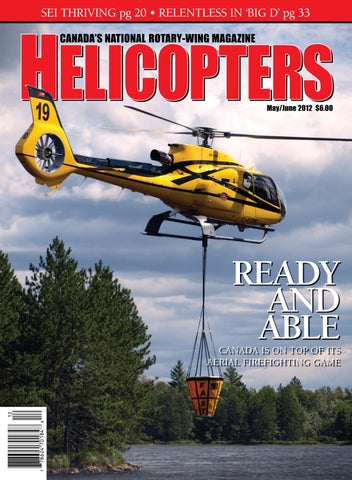
Ready and able
Canada Is on Top of Its Aerial Firefighting Game
bY paul dixon
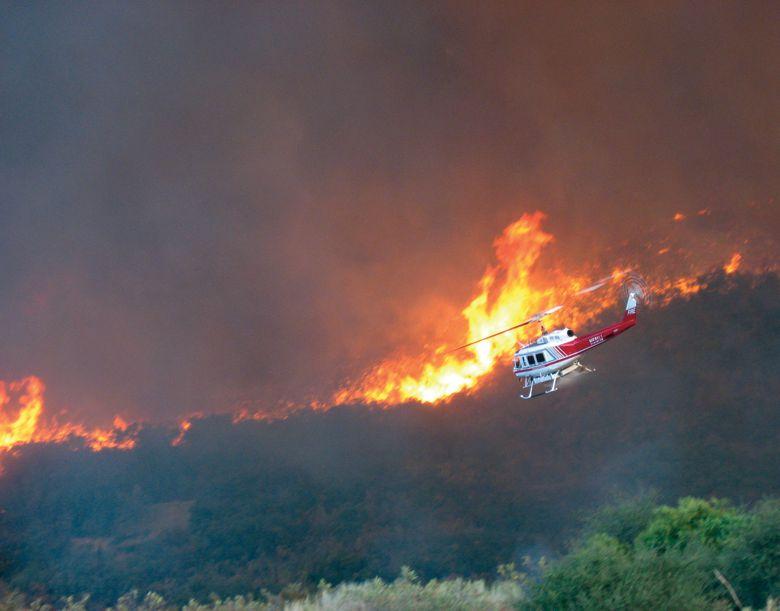
Wildfires, unplanned and unwanted natural or human-caused fires, are a fact of life in Canada.
With more than 400 million hectares, or about 10 per cent of the earth’s forests, Canada averages some 8,600 fires annually and has for the past 40 years. While only three per cent of these fires grow to more than 200 hectares, the fires that do account for 97 per cent of the area burned across the country. While the total area burned varies greatly from one year to the next, the 30-year average is 2.6 million hectares annually, from a low of 0.3 million hectares in 1978 to a high of 7.5 million hectares in 1989.
Directly and indirectly, forestry-related industries employee hundreds of thousands of Canadians and provide tens of billions of dollars to the national economy. once dominated by pulp mills supplying the world’s newspapers and sawmills producing dimension lumber, Canada’s forest industries are reinventing themselves to meet the needs of a changing world economy.
in Canada, responsibility for forest and fire management rests with each of the 13 provinces and territories, while the federal government is responsible for fire management in the national parks. annual fire suppression costs are rising constantly in Canada currently average about $500 million and have risen to more than $1 billion dollars in recent years. British Columbia, alberta, ontario and Quebec generally account for about 80 per cent of total annual expenditures in Canada. Coupled with climate change and the threat of worsening fire seasons is a political and economic climate that places increasing stress on the people and organizations responsible for fire management.
over the past century, Canada has developed some of the most sophisticated forest management and fire management systems in
the world to minimize the occurrence of wildfire and contain it when it does occur. in the early days, the intent of firefighters was to put out all fires as quickly as possible with a philosophy of, “all fire is bad fire.” in the 1970s, a realization developed that fire had an essential role in maintaining a healthy ecosystem, which led to the development of management systems that took a number of factors into consideration for fighting wildfires, including the ecology, the cost of suppression and prioritizing values and risk.
the Canadian model of operations has not been built in isolation from the rest of the world, but rather based on the experience
of others and often in collaboration with agencies in other countries. as we have learned in the past, there are valuable lessons to be learned from what is happening today in other countries, environmentally, economically and politically.
in 2005, the Canadian Council of forest ministers released the Canadian Wildland fire strategy, addressing critical issues identified in the wake of the disastrous 2003 fire season, which saw hundreds of homes destroyed and tens of thousands of people evacuated in Western Canada. in 2010, an update to the original report cited information from fire seasons in every region of the country that had reached epic proportions in the preceding five years. Case in point, in 2006, the four western provinces simultaneously experienced severe fire activity while ontario experienced its longest fire season, the result being a shortage of resources in all regions due to the inability to draw on external forces and equipment.
the Central Westcoast forest society (CWfs) states unequivocally, “Climate change will have significant impacts on Canada’s forests. the Canadian forest service has used general Circulation model projections for the 21st century in its forest fire models to estimate that by 2040, Canada will be experiencing significantly increased fire occurrence and fire spread potential, based on climate change impacts on temperature and precipitation patterns. in 2006, ontario used these estimates within its level of protection analysis system to gauge the impacts of this increased fire activity on ontario’s suppression capabilities and success in containing wildfires. it was predicted that in order for ontario to maintain its
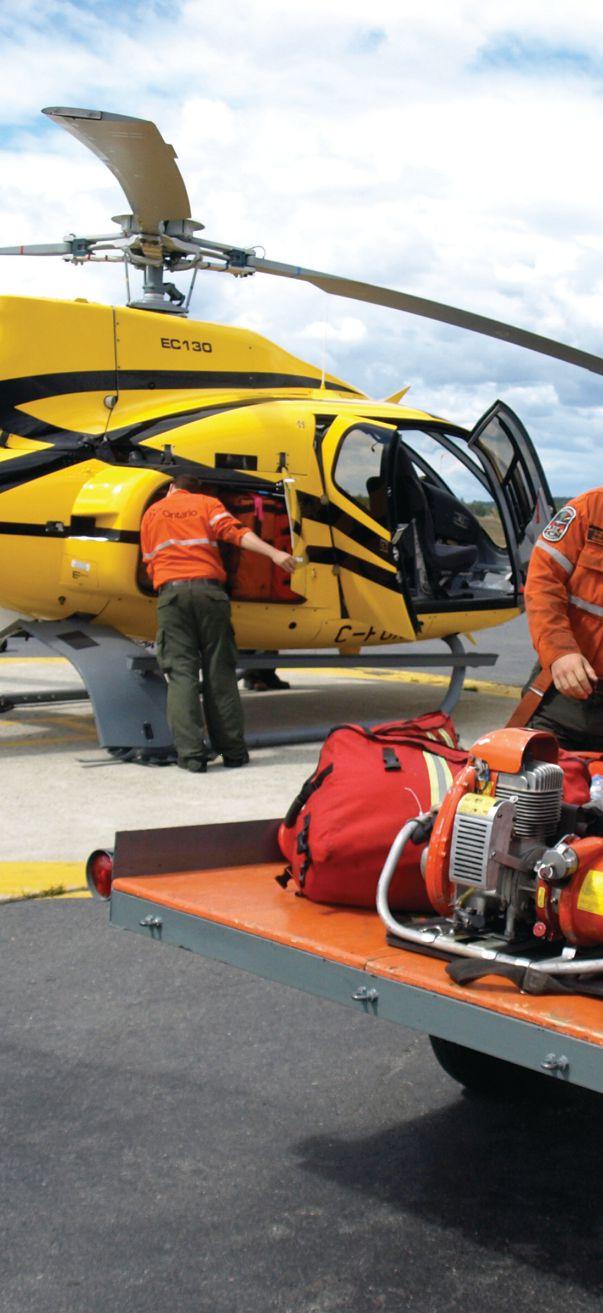
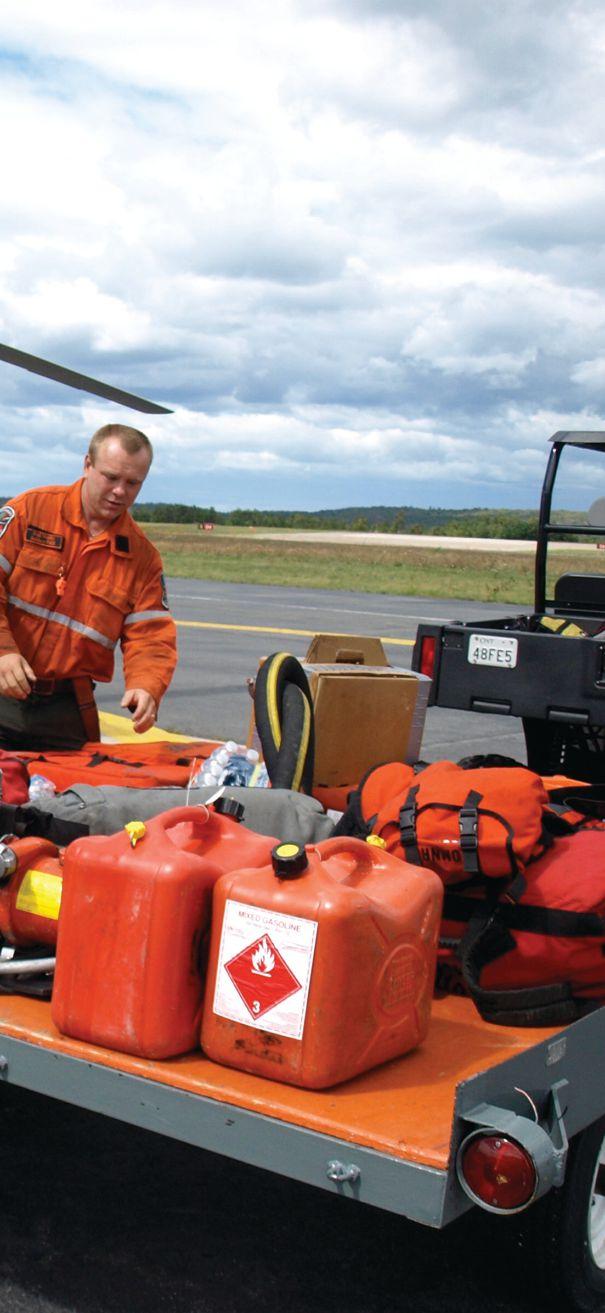
LEFT: The MNR enacts a quick strike approach to forest fire suppression, transporting small crews on site quickly and efficiently. (Photo by Matt Nicholls)
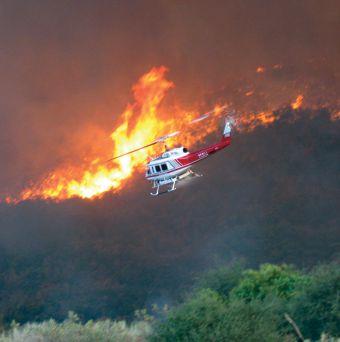
BELOW: Developing healthy and productive forest ecosystems to supply the changing economy is a key strategy going forward.
(Photo courtesy of Ascent Helicopters)
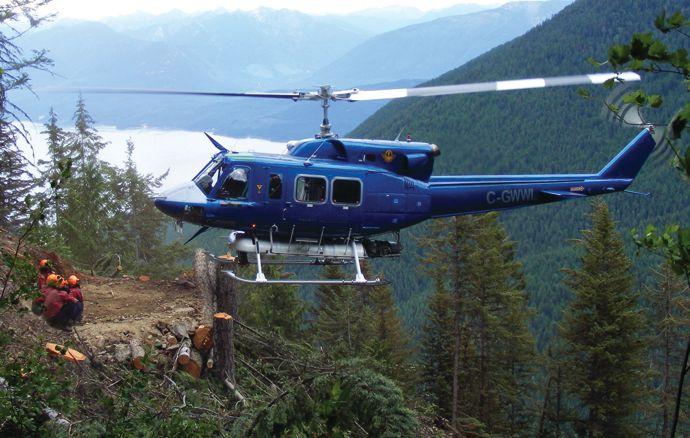
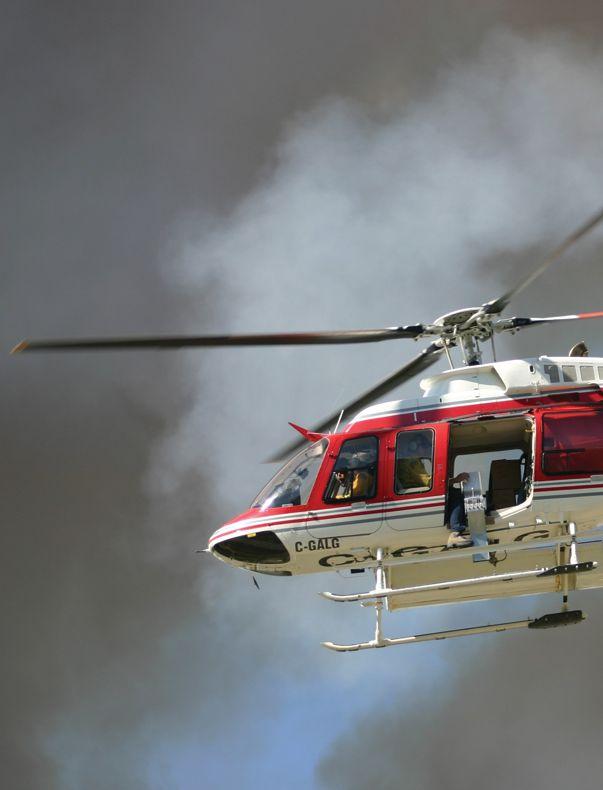
BOTTOM LEFT: The strength of the Canadian wildland firefighting system is the ability to move resources from one part of the country to another in an efficient and controlled manner through one chain of command. (Photo courtesy of Alpine Helicopters)
CoVeR stoRY
current level of fire response success in this projected more severe fire regime, it would need to double its fire suppression resources.”
Dr. John pomeroy, head of the University of saskatchewan’s hydrology department, stated in a recently released report that it will only take a four-degree change in temperature to cause dramatic changes to the snow levels across much of Canada’s prairies and mountains. he is one of a group of Canadian scientists who state bluntly that our winter season has been diminishing steadily over the past several decades as evidenced by the fact that the ice cover on our lakes and rivers has shortened by two weeks over that time. in 2012, the government of alberta declared fire season open a month early on march 1, after a mild, dry winter. grass fires had already burned across large areas of alberta in January and february, driven by winds strong enough to blow transport trucks off highways. seasonal crews were called in early in every province, with training and equipment inspection moved up by a month in some locales.
buRninG ConCeRns
as the model for wildfire management evolved in the 1980s, it followed three main streams:
• Build resilient communities and educate the public;
• Develop healthy and productive forest ecosystems to supply a changing economy;
• adopt modern business practices and emerging technology. as towns and cities expanded, the model morphed into what is known as the Wildland Urban interface (WUi). property owners and local governments prior to the development of this strategy have failed to foresee the dangers of building in interface areas without taking steps to build resilient structures and undertake fuel management programs.
most provinces now have a firesmart program, which seeks to raise the level of awareness of communities and residents, enabling them to raise their level of preparedness and thereby reducing the level of exposure to wildfire. provincial firesmart programs direct communities to take the lead by proactively removing potential fuels such as dry grass, dead leaves and tree needles, brush and small trees from community lands, and educating members of their communities to take the same responsibility for private property. in British Columbia, a number of recommendations made by the filmon Commission of inquiry into the 2003 firestorm were incorporated into the firesmart program, but given the current economic climate, it will take more than 100 years to fully implement the program at the current level of funding.
tHe VieW fRoM tHe soutH
looking south to the United states, we can see where increasingly extreme fire conditions are stretching shrinking budgets. thousands of homes have been lost in interface fires in recent years and scores of people have died. municipalities and state governments are facing critical budget shortfalls, and the money is simply not there to protect areas in need. in 2011, the state of California cut its wildfire protection budget by $34 million. CalfiRe, the state’s Department of forestry and fire protection, operates the world’s largest dedicated fleet of firefighting aircraft: 11 Uh-1h superhuey
helicopters, 23 grumman s-2t tankers and 14 spotter aircraft. the Uh-1h helicopters have been in service with CalfiRe for more than 20 years after being obtained from the U.s air force as surplus. the aircraft have reached the end of their projected service life, but there is no budget for replacements. maintenance hours are increasing and replacement parts must increasingly be fabricated in-house.
CalfiRe is able to call on a limited number of state air national guard Blackhawk helicopters during the fire season. in the U.s., national guard units are under the direction of the state governor’s office, and for 30 years in California, a limited number of national guard helicopters have been integrated into the state firefighting model. after facing extreme criticism from politicians and the public for a perceived failure to utilize U.s navy and U.s marine Corps helicopters during the catastrophic 2009 fire season, these assets have now been integrated into the response model, with Ch-53 and Blackhawk helicopters equipped with Bambi Buckets available on a last-called, first-released basis.
all the military helicopters – national guard, navy and marine Corps – have a limited usefulness as they are limited to bucketing operations. a decision was made years ago, amid concerns about slung loads, to restrict helicopter firefighting operations in urban areas to belly tanks. CalfiRe officials were not aware that navy and marine corps helicopters were equipped with Bambi Buckets and their pilots were trained in their use as standard practice. for
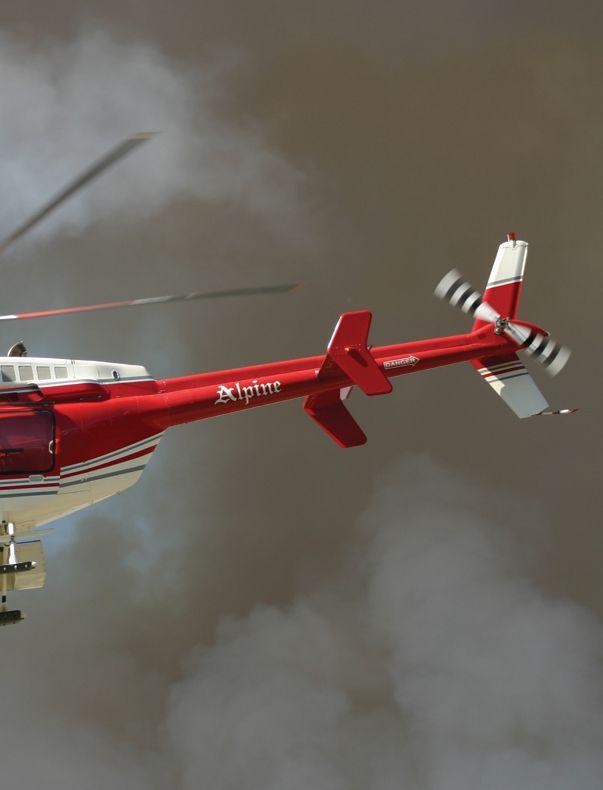
RIGHT: Over the past century, Canada has developed some of the most sophisticated forest management and fire management systems in the world – including rotary assets from operators nationwide. (Photo courtesy of Alpine Helicopters)
the past two years, U.s. military helicopter crews have been attending the CalfiRe spring training camps to familiarize themselves with operational requirements and better integrate themselves. Air Division Battalion Chief Ray Cheney says the focus is on integrated training and the “all hazards” approach to disaster planning and training, not just focusing on firefighting.
While the Canadian military has provided assistance to civilian authorities in a number of major events in recent years such as 2003’s firestorm in B.C. and hurricane Juan in nova scotia, major floods and winter storms, there are no plans to provide helicopters to perform aerial firefighting duties. in response to a direct question for this article, a spokesman for Royal Canadian air force headquarters who asked not to be named, said: “our helicopters are only used in a utility role for firefighting support and not employed in an aerial firefighting capacity. examples are moving personnel and equipment, and searching for possible fire locations. the RCaf has no plans to provide an aerial firefighting capability as it is already provided by the civilian industry. We only provide utility support when a government agency specifically requests aid.”
one of the mandates of the CWfs was that a national wildfire strategy for Canada should be patterned after the model in place for emergency management and disaster response. the creation of the
Canadian interagency forest fire Centre (CiffC) in 1982 was a direct result. the function of CiffC is similar to the role of the federal government in the wake of a major disaster. emergency planning in this country is based on the “all hazards” approach where incidents are gauged as much for their disruptive potential and the need to provide the same basic services to individuals and communities. no matter what the hazard, emergency planners view the event the same way whether it is a wildfire at the height of summer or extreme winter weather. Residents are each initially responsible for themselves and their own immediate families. When they encounter a situation beyond their capabilities, they rely on local, community-based resources. When the situation is beyond the scope of the local authority, they turn either to neighbouring communities under pre-existing mutual-aid agreements or to the province. When the province runs out of resources, they turn to the federal government and in the most extreme situations, it may elevate to an international incident.
the strength of the Canadian wildland firefighting system is its ability to move resources from one part of the country to the other in an efficient and controlled manner through one chain of command, with CiffC as the expediter. most provinces in Canada own a small number of aircraft, relying on commercial operators, some on seasonal contracts and a larger number on a call-when-needed basis. Bob Crowell, operations manager for the ontario ministry of natural Resources air services, reports that they have four helicopters assigned to the fire program from april through to the end of october, primarily in the initial attack role, but also for fire line support and supply, crew training, detection, aerial ignition, infrared scanning, slinging, water bucketing, research and testing. at the peak of the 2011 fire season, ontario had 181 contracted helicopters on fire operations, for a total of almost 4,000 hours flown. historically, fire season has varied across the country, allowing resources to be redeployed from one province or territory to another as needs have arisen. provinces will make resources – firefighting crews, aircraft and other equipment – available to the national pool based on their current and forecast situations. this works well until a situation occurs as in the summer of 2006 when there was a period of extreme fire activity across the four western provinces and ontario at the same time. no jurisdiction was able to release resources and each region found itself confronting serious shortages of personnel and aircraft on a daily basis.
as resources are stretched, technology is playing a larger role across the entire spectrum of wildland firefighting, from prediction, detection to suppression. Crowell, for example, speaks to the mnR’s dependency on new techniques to keep up with rapidly changing environment. “We are always looking at evolving aviation technology especially when it is cost effective and efficient in support of our fire and resource management clients,” he said. “We are using technology such as night vision goggles, evolving aircraft, tracking and satellite communication systems including UaVs. the mnR continues to work with university research projects and the national Research Council on emerging technology.”
as we have seen with slave lake in 2011 and too many other communities in the past decade, the aftermath of wildfires is a disaster by any definition. if Canada continues to see changes in its weather as predicted, warmer, drier and windier conditions nationwide, the scope of the resulting disasters may grow to magnitudes beyond our current comprehension. if, as predicted, the requirements for firefighting response in this country were to double by 2040, would we be able to cope? helicopter operators from coast to coast are ready to meet the challenge.
HaRdlY a dRop in tHe buCket
Vancouver’s SEI Industries Is Putting Out Fires Worldwide
bY paul dixon
sei industries may be famous for creating a product named Bambi, but it is anything but meek and mild on the international firefighting scene.
from an industrial park in suburban Vancouver, B.C., sei industries serves clients in more than 110 countries around the world. sei prides itself on creating innovative product solutions for its customers by fostering a dynamic and flexible culture that allows sei to continually engineer new products. the corporate motto is, “We engineer solutions” and it has succeeded on its promise for three decades.
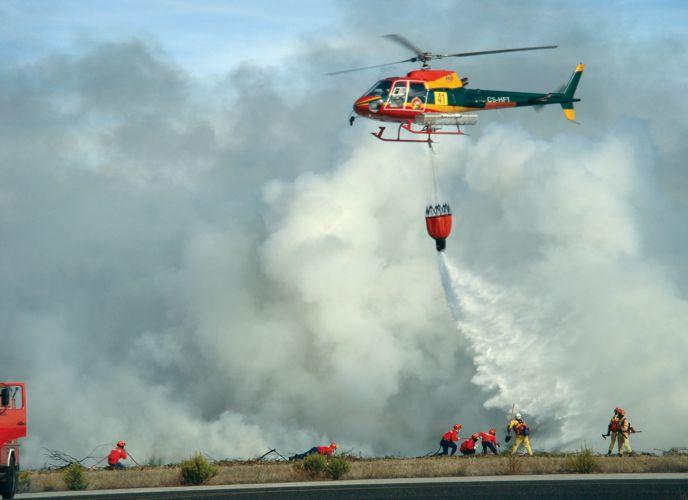
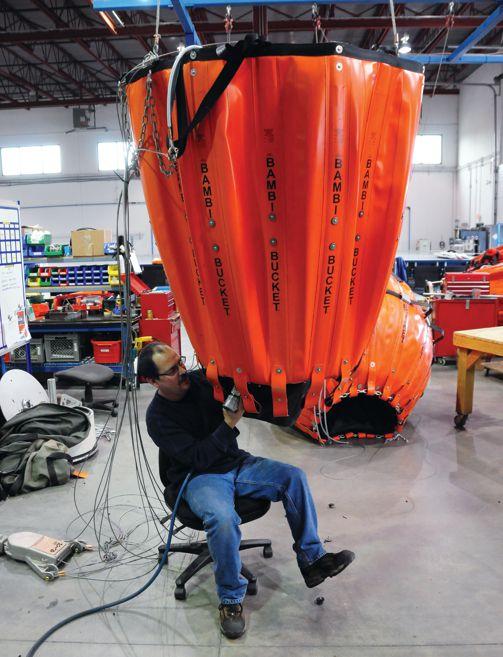
sei’s aerial division was launched in 1982 with the introduction of the original Bambi Bucket. firefighting buckets weren’t new at the time, but sei was the first company with a fully collapsible bucket with a pilot controlled, instant opening valve, which provided an accurate and concentrated flow of water from the bucket to the fire. the valves on existing first-generation buckets were difficult to operate and released the load in a fine spray. through consultation with helicopter operators and government agencies in north america, sei created a collapsible bucket with a simple gravityactuated valve that delivered the desired volume of water onto the target.
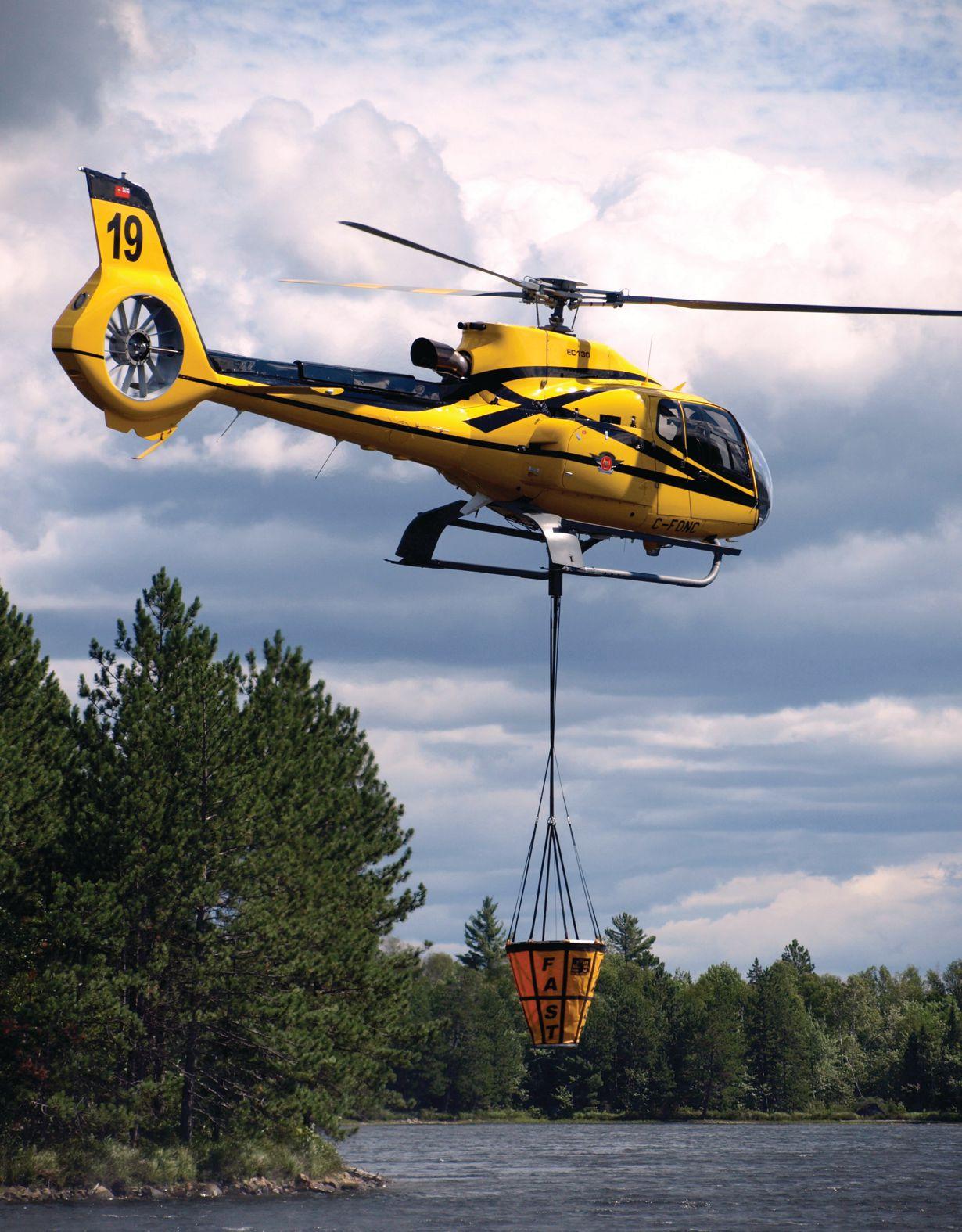
today, sei controls more than 90 per cent of the world market and the familiar orange Bambi has become ubiquitous in the world of aerial firefighting. the product line literally includes the right product for just about every class and model of helicopter, from the 260-litre bucket for the Robinson R-44 to the monster 9,800-litre version for the Ch-47 Chinook. the mi-26 has even been fitted out with twin 7,600-litre buckets mounted in tandem.
shawn Bethel served more than 20 years with the BC forest service before joining sei in 2007 as division manager responsible for aerial firefighting, fire ignition and ground firefighting products. acknowledging Bambi’s 30th birthday, he says, “our messaging is we have new product and are proud of our innovations but we’re not losing sight of the need to improve the old.” over the past 30 years, Bambi has grown in many different direc-
tions to meet different needs in widely diverse markets. the trademarked powerfill system allows pilots to draw from water sources that are too shallow for dipping – as shallow as 18 inches. With a long-line, Bambi powerfill allows pilots to access water sources in areas that would be inaccessible to tanked helicopters with snorkels, such as tree-lined streams and other sources of water with few to no rotor clearance issues.
this year’s new Bambi max features a lightweight, quick operating multiple drop valve wrapped in the standard tough Bambi Bucket shell that increases volume per drop through a fuel cycle. the ability to pre-select loads allows efficiency at both the dip site and over multiple hot spots, which can be targeted by releasing portions of water over each one, is an important feature. the helicopter operator can also choose to unload as many separate drops as required to lift his bucket load out of the dip site, safely to the next target. greater efficiency on each fuel cycle makes this a desirable piece of equipment prompting many firefighting agencies to request operators with these capabilities first and release them last. many firefighting agencies in north america, europe and australia give preference to these bucket performance capabilities in their contracts.
Bethel talks about sei’s level of customer service, and how it fuels their every move. “our customers will continue to see proactive communication from us rather than just waiting for trade
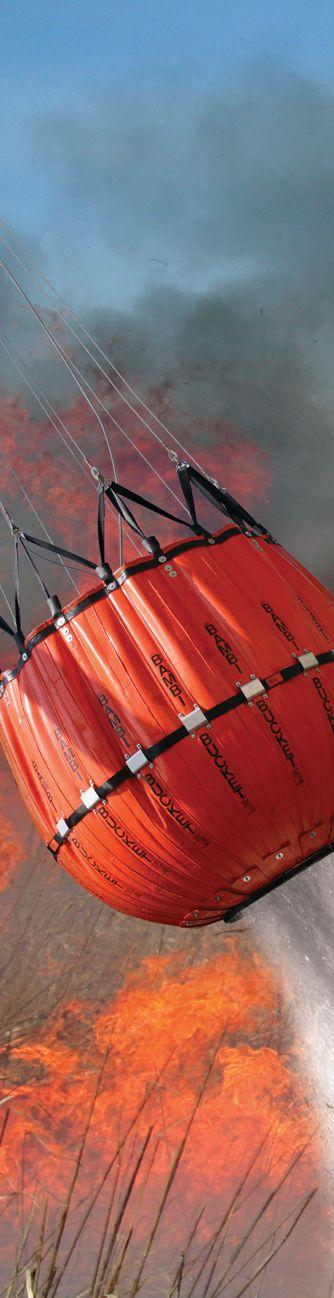
ABOVE: SEI controls more than 90 per cent of the world market in aerial firefighting and the familiar orange Bambi has become ubiquitous in the world of aerial firefighting.
(Photo courtesy of SEI Industries)
shows . . . we like to travel to see our customers, work with them and support their operations from the start of fire season, through to the end. our customers like it when we go to their hangar, pull out their buckets and provide technical input on how to keep them maintained and working the way they are supposed to. helicopter operators have a lot on the ‘line’ (literally) and having a bucket that works every time on a fire is critical to their revenues. We did a survey two years ago and resounding feedback from our customers was, ‘this is what we like about sei – you guys support us all the time and there’s great customer support.’ We will never lose sight of that.”
today, Canada represents only about 10 per cent of the Bambi market, with the U.s. accounting for the lions share at 60 per cent, but emerging markets in Brazil, Russia and especially China will tip the balance in the future. speaking specifically to the emerging Chinese market, Bethel says, “they don’t get a lot of fire, but they are manufacturing a lot of helicopters over there. they’ve gone from a handful of helicopters to fleets everywhere. our agent in China is very close to the two major oems, so the helicopters are coming off the production line with Bambis wired in and delivered to the customer with the Bambi Bucket and systems installed, fire ready.” sei recently purchased the fast Bucket assets and is currently incorporating the new “yellow” bucket within their aerial firefighting manufacturing and sales organization. in 2003, sei developed a new aerial ignition system with the objective of introducing aerial and ground-based ignition dispensers that simplified the task, reduced costs with an improved standard of efficiency and operator safety. the result was Dragon eggs, a delayed chemical ignition device that offered a significant advancement over the outdated plastic spheres of the time by improving reliability and burning dynamics. at the same time, sei also engineered the Red Dragon – aerial plastic sphere dispenser (psD) – and the green Dragon, the first automated ground-based plastic sphere launcher. the teaming of the Red and green Dragon dispensers with Dragon eggs has resulted in the next generation of fire ignition systems that offer more safety features and better operability than any other system available today. in october 2011, sei
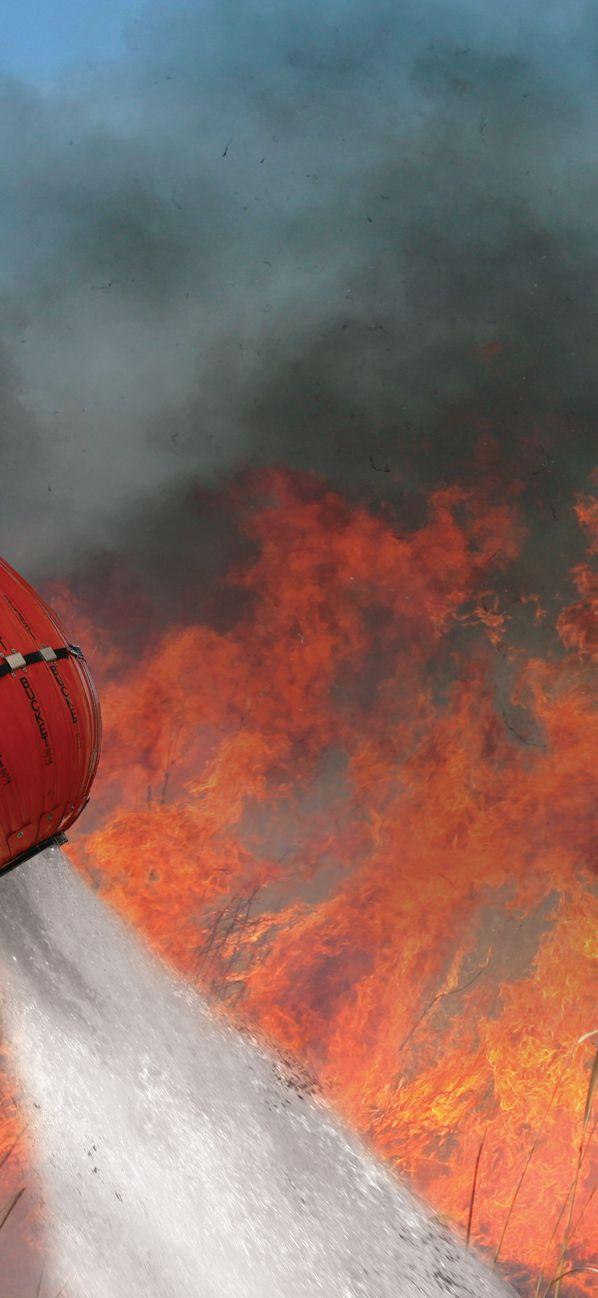
RIGHT: The Bambi Bucket product line literally includes the right product for just about every class and model of helicopter.
(Photo courtesy of SEI Industries)
purchased the premo fire ignition assets and are now able to offer legacy aerial fire ignition psD and the premo fireballs that work with them. the premo psD technology has been around since the early 1970s.
paul Reichard manages the remote site/environment division of sei and tells how the Canadian forces brought a problem to their door that in turn opened up a whole new market for SEI and resulted in the Cf becoming sei’s single largest customer. “the Canadian military came to sei 20 years ago when they ran into a problem with their american supplier of fuel tanks,” Reichard says. “We weren’t making fuel tanks at the time, we were making Bambi Buckets. they said it looked like we had the technology to do what they needed and asked if we could try doing this because they needed a domestic supplier who could support them when they go to war, peacekeeping or have an emergency.”
sei developed the bladder based on the american military specification of the time, but the american standards presented problems for the Canadian military. the americans treated the bladder as a commodity: use it once and dispose of it. the specifications called for a life span of 18 months or three moves. as well, the americans had gone to a single fuel type years before, so the fabric used in their bladders was only good for that type of fuel. as Reichard relates, “the Canadian military didn’t have the money to replace their bladders every 18 months, so they needed a bladder to last five to six years, so we abandoned the U.s. military specifications in 1999 and drafted up our own specifications for the Canadian military.” the bladder sei created far exceeded the previous specification.
the american bladders were built to a 2.5:1 safety factor, but by using computer-controlled 100 per cent Rf welding and engineering a unique cross-seaming procedure, the sei bladder achieved a 5:1 safety factor and a much longer life expectancy. then, came the realization that there were a number of military users around the world facing the same financial constraints as the Canadians.
With a market identified, the King series of bladders was developed. “the Desert King was developed for the egyptians, the arctic King was developed specifically for the Russians and the Canadians and the Jungle King for our south american clients,” Reichard explains. “for the Canadian military, we also went into turnkey systems. they don’t just want a bladder, so what we have is three pieces of kit. We have the warehouse, which is our fsDs – fuel storage Distribution system, a 100,000 U.s. gallon tank farm with filtration in and filtration out, pumping systems in and out, so they can deploy two containers, open it all up and you have all you need to set up your bulk fuel storage solution – that is your warehouse. it has both electric and diesel. first in, green field, the diesel runs, and as soon as they get their generator set, it goes to electric. that led us to develop other kit for them, which is the high pressure Refueling system – it fills up the aircraft or bowsers if it’s on tarmac. the newest part of the kit is the f34Ds, which is our big gas station can. they use it to fill the jeeps and tanks. so, you have a whole turnkey system. We are the sole supplier to the DnD for their fuel needs.”
sei has expanded the concept to create a complete fluid management system – the design, engineering and manufacturing of products that transport, transfer, filter and store fuel, water and sewage,
SEI’s aerial division was launched in 1982 with the introduction of the original Bambi Bucket. (Photo by Paul Dixon)
SEI employs approximately 60 production staff – and their work often consumes them. (Photo by Paul Dixon)
often as a complete turnkey liquid management systems. Wherever the Canadian forces have gone in the past 20 years, sei has enabled them to complete the mission. from the desert heat of afghanistan to CfB alert, the most northerly inhabited spot on the planet and everywhere in between, if the Cf has a need for fuels and fluids, sei has provided the solution. humanitarian missions to haiti, turkey and sri lanka with the Disaster assistance Response team (DaRt), security operations in support of the Vancouver olympics and g8 – sei has been there.
a full CouRt pRess as the only company in the world that engineers, manufactures, installs and provides customer operational support for complete turnkey fuel storage systems designed around collapsible fuel storage tanks, sei finds itself creating solutions for challenges brought by clients. their products have been deployed in operations around the world – for mining companies, oil and gas exploration, remotesite construction projects, helicopter bases and disaster relief operations. to name just a few:
• siberia’s Bema gold. During winter conditions, sei delivered, installed and connected a two million-gallon diesel fuel tank farm for exploration activities in one of the world’s largest gold deposits.
• Yukon’s selwyn Resources. at the top of two raw mountain sites, sei provided a complete turnkey 400,000-litre fuel system that allowed the establishment of two airstrips and base camps for mining exploration.
• oak Ridge national laboratory. sei provided containers for heavy water storage to enable oak Ridge national laboratory to perform nuclear-related maintenance on their equipment. Reichard echoes Bethel when he talks about sei’s clients. “We do a lot of is field support,” he says. “We do a lot of turnkey systems and we send a lot of people into the field to support the product. if you buy a fuel system from us, we won’t just sell it to you, we will engineer it, manufacture it and come up and set it up for you; we’ll teach you how to use it.”
a recent development for sei is the Bulk aviation transport tank (Batt), another example of a client bringing a problem to sei in search of a solution. “it started originally in latin america because we have one specific client, much like our Canadian forces,” Reichard says. “they have a lot of jungle bases with our Jungle King bladders. typically, they were being supplied by truck, but at the height of hostilities, the trucks were being hit. they were losing trucks, losing drivers and losing fuel. they needed a way to get the fuel off the ground and the only way they could do it was to fly it in drums, but they couldn’t get the number of drums into the sites very easily, so they came to us and asked us if we could build a bladder. We originally said no, we weren’t interested, as we had no experience in building transport bladders. But they said, ‘We’re already doing it with your bladders and it’s working very well.’ they had bought a bunch of smaller bladders from us, shoved them in the planes, they weren’t the right shape and they were flying around with them. We just freaked out. it didn’t fit, but it was working. so, we worked with them to develop a specification. they didn’t know what they wanted more than a bladder on a plane.”
in developing the Batt, sei worked with the client and their civil aviation authority and came up with a product that satisfied all the needs. “that was 2009 and it took a few different versions of the tank to get it right, but eventually we came up with three different patented baffle systems, one for big tanks – we call it the “Divide” – the restrictor baffle for smaller tanks. and for rotary
wing, we have an ‘X-baffle,’ to give you the hover load of a helicopter,” Reichard says.
sei patented three baffles and determined they needed to develop a double tank; the inner tank would be strapped down with different types of cargo nets or strapping. But it was moving too much, rubbing and abrading, so they decided to put a tank within a tank – which had never been done before. “We worked with a couple of suppliers to come up with the zipper we needed, something that is fuel-resistant, but very, very easy to work with and strong enough to build a tank out of,” Reichard says. “We worked with a german company that came up with the zipper and we learned how to put a tank inside a tank, so the outer tank is what secures the tank to the aircraft. it takes all the abuse from rolling and abrasion and it’s fuel resistant, but the inner tank is the one that’s baffled, holds the fuel and it works really well.”
the Batt minimizes deadhead flights as the bladder can be easily folded up and stored when not in use. Damage to the aircraft from drums is eliminated and there is no fuel spoilage. the elimination of drums relieves remote site operators of concerns for environmental impacts from spilled fuel or abandoned drums. in the end, it was a win-win-win situation.
With years of international success behind it, sei is certainly not cooling its heels and dousing potential projects. says Bethel: “sei will continue to build its worldwide reputation for excellence by harnessing the strength of its innovative product lines and entrepreneurial corporate spirit to meet the increasingly challenging needs of its existing customers as well as emerging markets.”
AIR FORCE PILOT TRAINING SUPPORT 2012 DEFENCE UPDATE
In2001 Kelowna Flightcraft led a team of top Canadian aerospace companies to create Allied Wings. Established in 2005, we operate Canada Wings Aviation Training Centre at Southport, MB – a turnkey training solution dedicated to ab-initio and advanced fixed and rotary wing Pilot training for Royal Canadian and Allied Air Force Pilots.
Pilot candidates are assessed and trained via a world class learning system, which blends classroom and online learning; desktop trainers, four simulators, and a fleet of 42 aircraft.
Our four fleets of aircraft include the Grob 120A for primary and basic flying training, the King Air C-90B for advanced multi-engine training, the Bell 206 for initial rotary wing training, and the Bell 412 for advanced rotary wing training. They are supported with a Grob, King Air C90B, and two Bell 412 simulators.
Allied Wings provides all ground school and simulator instruction, including formation flying, as well as flight training in the Grob and Bell 206, working with Air Force instructors on the C-90B and the Bell 412. Over 200 pilots are trained and accommodated on site annually at Canada Wings.
The Allied Wings Team, assembled and led by Kelowna Flightcraft, includes industry leaders in integrated flying training solutions and advanced simulation technologies – Canadian Helicopters Ltd., Atlantis Systems Intl., and Canadian Base Operators
Canada Wings employs 180 dedicated staff. In addition to flight training, Canada Wings also operates the entire airfield including air traffic control, navigation services and runway maintenance. On-site support services include housing and meals, classroom space and recreation.
For more information, please visit alliedwings.ca
MILITARY PROGRAMS
n Kelowna Flightcraft has a long and proud tradition of supporting military aviation programs, from heavy mainte-
nance and avionics upgrades for the Canadian Forces fleet of Cosmo CC109 aircraft to heavy maintenance checks and substantial avionics upgrades to the Canadian Forces fleet of T-33 trainers.
Extending this rich tradition, we now provide complete extended life cycle support for the DHC-5 Buffalo and the DHC-6 Twin Otter and their components. Recent modifications include the BALE and TALE avionic upgrades to extend the fleet life cycle. This includes modernization, manufacture, testing, air-worthiness approval, and full logistics support – as we strive to maintain a +70% fleet reliability. These solutions are offered to all operators of these uniquely capable aircraft around the world.
ABOUT KELOWNA FLIGHTCRAFT
n An award winning AMO, Kelowna Flightcraft Ltd. operates two full-service facilities in Kelowna, BC and Hamilton, ON as well as nine satellite bases that stretch across Canada from Vancouver, BC to St. John’s, NF.
Our main bases in Kelowna, BC and Hamilton, ON have 500,000 sq. ft.
of hangar and shop space with the capacity to accommodate aircraft as large as a DC-10-30. We’re an ISO 9001-2008 quality assurance certified company with TC approved AMO 16-82 and EASA Approval 145-7040. Customers from around the world come to Kelowna Flightcraft for quality maintenance and modification work. We pride ourselves on reliable on-time service. We have the experience and the flexibility to meet our customers’ needs, whatever the challenge.
Kelowna Flightcraft Air Charter Ltd. owns and operates over 20 commercial aircraft including B727, CV580, CV5800 and DC-10-30F – and delivers an unparalleled 99% reliability to our primary customers of Purolator Courier and Canada Post. Flightcraft also owns and leases aircraft to operators around the world.
With a total fleet of over 80 aircraft (including Allied Wings), and nearly 1,000 skilled and experienced staff, we are Canada’s largest Air Cargo operator. Privately owned, Kelowna Flightcraft Group of Companies gives you The Power to Fly – whether it’s training, operating or maintaining. See what our quality, service and reliability can do for you.
2012 DEFENCE UPDATE
ROCKWELL COLLINS STEPS UP PRESENCE IN CANAdA
Rockwell
Collins is expanding its presence and commitment to Canadian aerospace and defence through its facilities in Ottawa and Montreal. The newly expanded office space in Ottawa specializes in the design and development of wireless, ad hoc networking technologies, including battlefield modeling and simulation of tactical networks. The SubNet Relay (SNR) technologies developed in Ottawa are used by the Royal Canadian Navy and coalition partners around the world to establish ad hoc, Internet Protocol (IP) networks used for tactical data exchanges, chat, enhanced situational awareness and collaborative planning. The facility also serves to coordinate customer service and repairs for Rockwell Collins products sold to Canadian military customers.
Recently announced program
awards for Rockwell Collins Government Systems in Canada include:
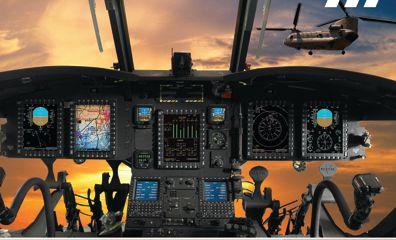
• In 2010, Rockwell Collins was selected to provide its Common Avionics Architecture System cockpit for the Royal Canadian Air Force CH-147 Chinook.
• Recent aircraft acquisitions, including Rockwell Collins avionics products and systems, include the C-130J Super Hercules, the CC-177 Globemaster, and the CH-148 Cyclone Maritime Patrol Helicopter including two full-motion simulators. Rockwell Collins also maintains a substantial presence in Montreal, Quebec, providing system engineering, customer support and sales to Bombardier. The facility plays a central role in maintaining a strong relationship with Bombardier, one of the world’s largest commercial and business aircraft manufacturers.
Visit Rockwell Collins’ exhibit #1103 at CANSEC 2012 to learn how the company’s solutions are being customized and delivered to Canadian customers, including:
• Common Avionics Architecture System (CAAS)
• FireStorm™, a FAC/FOO system
• Link 16, MIDS JTRS, ARC-210
• SubNet Relay HF/VHF/UHF
• TacNet™ tactical radios
• 721S blade radios
• CCT120 portable SATCOM
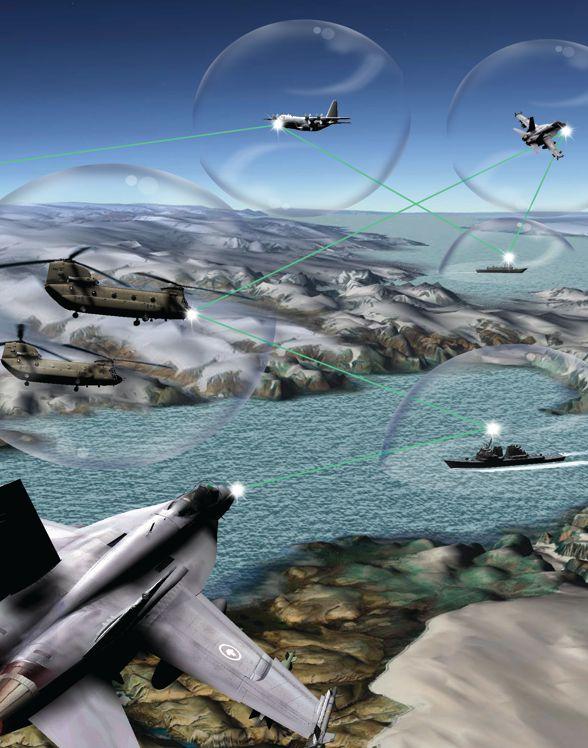
Networked systems making every platform a sensor.
Whether performing Sovereignty patrol, or Search and Rescue missions across the Canadian landscape, or a multinational interdiction campaign, mission success requires an enabled network with a proven ability to connect –anywhere, anytime. Fast. Reliably. Securely.
From threat detection to threat resolution, Rockwell Collins provides our customers with reliable networks designed for interoperability.
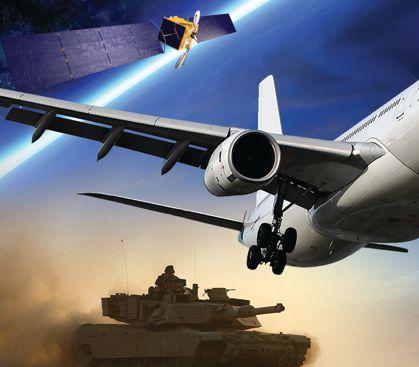
By 2016 , it’s estimated that there will be more mobile devices on the planet than people to use them –10 billion devices for a mere 7.3 billion people. The resulting demand will require high-speed connectivity to cover most, if not all, of the planet. Thanks to an exclusive agreement between Honeywell and Inmarsat, travellers will be able to do everything from real-time social media to video conferencing and multi-media presentation development while in flight virtually anywhere in the world, with an experience similar to being at home or in the office.
The agreement centres around the integration of Honeywell’s onboard hardware with Inmarsat’s new Global XpressTM network. Using Ka-band network technology in the next few years, passengers will experience high speed connection on airline and business avi-
ation flights via smartphones, tablet computers and laptops. Real-time social media, video conferencing and multi-media presentations will be enabled between people in flight with those on the ground. The same connectivity will allow government users to better communicate with ground bases about position and status of manned and unmanned aircraft.
EMS Aviation is now Honeywell.
Driven by a demand for data traffic that is anticipated to grow 50-fold for smartphones, and 62 times today’s rates for tablets, the high-speed access will be made possible by two aviation industry pillars united by a single vision.
2014 will be here before you know it. Will your fleet be ready? Learn more at honeywellaerospace.com.
powerful connection
By welcoming EMS Aviation into the family, Honeywell is poised to offer its business, commercial and government aviation customers unprecedented high-speed connectivity—on the ground, in the air, around the globe.
playing the Waiting Game
The CH-148 a Stark Reminder of the Precarious Nature of Procurement
bY peteR piGott
i’ll take one piece of paper, i’ll take my pen, and i will write zero helicopters,” prime minister Jean Chretien said with conviction. “that will be it, and i will not lose one minute of sleep over it, either.”
this was the response of Canada’s 20th prime minister who, during the 1993 election campaign, turned the purchase of 50 eh101 helicopters into a significant election issue, dooming Kim Campbell’s chances of being elected and serving a full term as the nation’s first female prime minister. except for the avro arrow, and arguably today the f-35 Joint strike fighter, no military aircraft has generated as much public debate as rotary aircraft. so, what is it about the procurement of military helicopters that is so controversial in this country?
it certainly hasn’t always been this way. When the sikorsky sea King entered service in may 1963, Canada was in the midst of the Cold War and the Cuban missile crisis was still fresh in the collective minds of the general public. forty-one sea Kings were purchased without controversy or even national attention. they were designed to be used on aircraft carriers and when those crazy Canucks perfected a process by which they could land on the minuscule deck of a heaving destroyer –even calling the vertical winch the “bear trap” – other navies could only watch in awe.
somalia, the persian gulf, peggy’s Cove, east timor, the manitoba floods, the adriatic, haiti and lately off the libyan coast – through the years the stalwart sea King served like the workhorse it was – and by now it is almost twice the age of the men who flew it.
But unlike diamonds, helicopters don’t last forever, and as early as april 1986, the government issued a solicitation of interest for the new shipborne aircraft (nsa) project – the sea King’s replacement. the three main companies responded: sikorsky with the sh-60 sea hawk, ehi (formed by Westland and agusta) with the eh-101; and aerospatiale’s sa 332f1 super puma. Whoever the winner was, the first sea King replacements were expected to become operational in 1995. then, the new liberal government cancelled the contract, nullifying nine years of work and paying a penalty of $478.3 million to do so.
the subsequent sea King life extension program, which cost taxpayers $71.5 million, allowed the machines to soldier on so that, by 2013, they will mark a milestone of 50 years in service. flameouts,
engine stalls, falling into the ocean or the muskeg, pilots dying in them – by now, everyone has heard the incredible stories of how the remaining 29 “geriatric” sea Kings require 30 hours of maintenance for every hour of flight. or how they are unavailable 40 per cent of the time. or the day that, because the helicopter’s avionics died, the sea King crew had to use a cellphone to get help . . . in December 2002, to expedite the procurement, new liberal Defence minister John mcCallum announced that the replacement would be acquired through a single contract for the airframe and mission systems, comprising the procurement of 28 fully integrated maritime helicopters, a simulation and training suite, integrated logistics support, and a 20-year in-service support contract. With inflation factored in, the project cost was set at $3.1 billion, not including the longterm maintenance contract.
two years later, after “a thorough examination of the submissions,” (although critics claimed that agustaWestland had been frozen out) prime minister paul martin selected the bid by the sikorsky aircraft Corporation for 28 h-92 superhawk helicopters – to be called the Ch-148 Cyclone in Canadian forces service. When asked why the s-92 in its military version was chosen, a DnD spokesperson replied: “the Ch-148 Cyclone is designed such that its role will expand as the capabilities of this aircraft are exercised and fine-tuned. additionally, its easily reconfigurable interior, large rear ramp, and suite of sensors will allow the Cyclone to switch between roles much more quickly, resulting in faster response times and a more effective platform, no matter what the mission.”
to meet the required capabilities specified for the Ch-148 Cyclone, sikorsky incorporated a number of modifications including fly-by-wire flight controls, blade and tail fold system, enhanced engines and drive system, as well as a sophisticated suite of mission sensors to provide a
ABOVE: The interim maritime CH-148 at Shearwater is being used as a ground-based aid as part of the RCAF’s training program. (Photo courtesy of RCAF)
LEFT: A Canadian Forces CH-124 Sea King helicopter lowers personnel to the ship’s deck during a transfer exercise on HMCS Ville de Québec in the Indian Ocean. (Photo courtesy of RCAF)
world-class robust, multi-role helicopter that the government hoped would serve Canada’s defence needs for years to come. in an updated version of the “bear trap,” sikorsky would also provide 12 C-Rast helicopter haul-down systems for halifax class (hfX) ships to accommodate the Cyclones.
the cost for the Ch-148 Cyclones was tabbed at $1.8 billion with a $3.2 billion 20-year servicing agreement and then Defence minister Bill graham touted the deal, saying they were “the right helicopter for the Canadian forces and the right price for Canadians.” sikorsky also pledged to invest $4.5 billion in industrial activity in Canada over the next 20 years and teamed up on the contract with some heavy hitters – general Dynamics Canada of ottawa and l-3 Communications
To meet the required capabilities specified for the CH-148 Cyclone, Sikorsky incorporated a number of modifications including fly-bywire flight controls, blade and tail fold system, enhanced engines and drive system. (Photo courtesy of RCAF)
mas Canada of mirabel, Que. the first Cyclone it promised would be delivered by nov. 30, 2008, with others every 27 months. if that did not occur, the manufacturer would be paying heavy penalty fees. finally, it looked as if this helicopter procurement was going to “fly.”
iMMense Capabilities
the s-92 is an advanced, medium-sized twin engined helicopter developed from the Uh-60 Black hawk that sikorsky has been successfully
building for the U.s. military and many other nations around the world. such was sikorsky’s confidence in the s-92 that it was the company’s bid for the U.s air force’s $10 billion CsaR-X contract since cancelled, but one in which lockheed martin also entered with its Us101 model based on the eh101.
Critics have pointed out that Canada would be the first military customer of the s-92 while the eh101 was already in use by with the British and italian militaries. there were also rumours that the Canadian military preferred the eh101 to the s-92, but the government squashed that with the explanation that the eh101’s drawback was that it was too bulky to land on the Canadian patrol frigates – as the sea King had. and even if it could, a major structural refit to the hangars would be required.
When this journalist asked DnD why had the history of the Cyclone project been so troubled, the answer was: “please refer to sikorsky for more information as sikorsky is responsible for delivering on the terms of the contract delays.” subsequent research showed that it all began to go downhill for sikorsky in 2006, when its workers went on strike at the Connecticut and florida plants, subsequently causing a six-week strike delay in the production of the Cyclone.
not delivering on time meant that the helicopter manufacturer would face anywhere from $36 million to $89 million in penalties and in January 2008 Defence minister peter macKay swore that such fees would “kick in” if this occurred. But by the year’s end, ottawa had toned down its rhetoric and agreed to accept six interim helicopters to be delivered in november 2010.
further complications to the program occurred in march 2009,
Aviation Ground Fueling Technologies
specializes in the design, fabrication and installation of aviation fueling systems throughout Western Canada.
• API 5th Edition Truck Loading & Offloading System
• Large Inventory of Fueling Components Available 24/7
• Certified Aviation Petroleum Technicians Available 24/7
• Custom Fueling Solutions
• Towable Helicopter Fueling Units Availbale for Rent or Purchase
Ltd.
when an s-92 operated by Cougar helicopters went into the ocean while ferrying workers to the offshore oil rigs off newfoundland and only one of the 18 persons onboard survived. the transportation safety Board identified the cause as a broken titanium stud in the s-92’s gearbox oil filter assembly. and although sikorsky announced that it had furnished replacement studs to all s-92, the media was quick to seize on the model’s defects. Could it be trusted in critical combat scenarios?
in august 2009, when the government of Canada announced it would acquire 15 Ch-47f Chinooks to address the Canadian forces medium-to-heavy lift helicopter requirement, critics wondered if this would become another Cyclone mess. auditor general sheila fraser thought so in november 2010, when she slammed the procurement of not only the Cyclones but the 15 Ch-147 Chinooks as well.
fraser noted that the former’s contract award had not been “fair, open and transparent” and that the whole process was an $11-billion dollar mess with national Defence deliberately hiding the real cost. the Cyclones were not the “off-the-shelf” purchases that DnD pretended they were, and fraser told the media that, because the military had asked for so many changes in effect sikorsky had to develop a new state-of-theart helicopter.
To date, Sikorsky has promised that fully compliant helicopters will be delivered this year and all interim-standard helicopters would be retrofitted and delivered to DND/CF by December 2013.
(Photo courtesy of Sikorsky)
“national Defence,” fraser said, “underestimated and understated the complexity and development nature of the helicopters it intended to buy. the substantial modifications to the basic models resulted in significant cost increases and project.”
not tHe onlY ones
if it was any solace, ottawa wasn’t alone in bungling helicopter procurement. the australian government had so mismanaged its contract with Kaman to provide it with seasprite helicopters (also decades late and millions of dollars over budget) that today, the whole experience is taught in australian universities in ethics courses.
By 2010 the Conservative government was desperate enough to waive all penalties and negotiate a new deal that would allow sikorsky to deliver a single “interim” incomplete helicopter for training purposes. sikorsky was unable to do even that and in 2011, the government finally levied an $8-million penalty on it – a fine that remains to be paid. on Jan. 5, 2012, five “training ” Cyclones were promised with a single example delivered to CfB shearwater, n s. When asked about this, the DnD spokesperson, who requested not to be named in this article, responded by email.
“as per the contract, the interim maritime helicopter at shearwater is being used as a ground-based aid as part of the training program,” he said. “this training allows technicians to conduct hands-on practical
Measuring stick
The CH-148 is a military variant of the Sikorsky S-92 helicopter. It features a composite aluminium airframe with lightning-strike and high-intensity radio frequency pulse protection. It incorporates a wider four-bladed articulated composite main rotor blade in comparison with the S-70 Blackhawk. The tapered blade tip is angled downward to cut down on noise and increase lift. The helicopter can operate with modern high-tech naval frigates and is equipped with numerous safety features. Flaw tolerance, bird strike capability and engine burst containment are integrated into the design.
Avionics
The CH-148 is equipped with APS-143B radar, the SAFIRE III EO System, L-3 HELRAS sonar and Lockheed Martin AN/ALQ-210 electronic support measure (ESM) system. Its aircraft management system (CMA-2082MH) is provided by CMC Electronics. General Dynamics Canada was contracted in 2004 to provide the mission systems for the entire fleet of 28 helicopters. These
The CH-148 Cyclone has been called “the right helicopter for the Canadian Forces and at the right price for Canadians.”
(Photo courtesy of Sikorsky)
training for various maintenance tasks, such as troubleshooting, and component removal and installation, as well as post-maintenance functional checks to ensure proper operation of aircraft systems. the aircraft has also been used to conduct maintenance demonstrations, which are a contractual requirement, to validate maintenance procedures and support systems.”
training of the initial cadre of technicians began in february 2011, and initial phases were completed in June 2011. since then, maintenance demonstrations have been conducted using the sikorsky helicopter at shearwater. further technician training and maintenance demonstrations are expected to occur in the next couple of months.”
to date, sikorsky has promised that fully compliant helicopters will be delivered this year and all interim-standard helicopters will be retrofitted and delivered to DnD/Cf by December 2013. sikorsky president Jeff pino reiterated this message at heli expo 2012 in Dallas this past february, confirming that deliveries are on track for later this year. as to the Ch-147fs, production of the fleet is underway at Boeing’s facility at Ridley township, pa. and delivery to the main operating base at petawawa, ont., will begin in 2013.
the fact that the Cyclone has yet to take to the skies it didn’t stop RCaf chief lt.-gen. andre Deschamps from praising the Cyclone when he appeared before the senate’s defence committee in late february 2012. “the Cyclone,” he said, “is a world-leading maritime surveillance and control helicopter. it is probably the most balanced technology platform coming out from maritime helicopter. it’s what Canada needs to operate in the most demanding maritime environment in the world.” the RCaf , he maintains, will have operational capacity by 2014.
after all the twists and turns in the saga, one can only conclude that maybe the Cyclone is the world’s first “stealth” helicopter. it certainly is a golden example to illustrate the precarious nature of military aircraft procurement.
mission systems include radar, ESM, acoustics, self-defence, navigation and communication systems.
Armaments
Armaments include door-arm mounted GP machine guns and two MK 46 torpedoes on BRu-14/A weapon.
Countermeasures
The helicopter is fitted with sensor equipment to search and locate submarines during ASW missions. A modern countermeasures suite is incorporated to defend the helicopter against incoming missiles.
Power Plant
The CH-148 is powered by two GE CT7-8A engines. A new CT7-8A7 engine based on the CT7-8A1 is being developed by General Electric out of their own funds to replace the current, less efficient engine and will be tested and certified by June 2012. The six interim helicopters are to be fitted with CT7-8A1 engines.
bell Relentless in ‘big d’
Textron’s Dallas, Tex.-based Helicopter OEM Makes a Splash
bY Matt niCHolls
they say in the lone star state you better go big or go home. Well, textron’s Bell helicopter certainly didn’t skimp at the biggest helicopter show of the year, heli expo 2012 in Dallas, tex. Big? try huge.
Bell stole the show at this year’s industry mecca in mid-february with an impressive marketing display and stirring introduction of its new 525 Relentless super medium twin helicopter, the largest civil helicopter in the company’s history. Revealed in an impressive lighting and video display with a large contingent of slickly dressed Bell employees on hand, the 525 created a buzz that reverberated throughout the Dallas Convention Center.
“Bell helicopter is on a mission to ensure you are successful in your own specific mission,” Bell president/Ceo John garrison said during the lavish 525 introduction on the show’s second day. “over the past three years, we have been on our own mission to revitalize our commercial business – with a laser focus on ensuring our customers are successful.”
the 525, known as the mysterious “magellan” project for months prior to the launch, is an impressive machine with a wide variety of applications. it weighs in at 18,000 pounds and has a projected range of more than 400 nautical miles, a speed close to 150 knots and a ceiling of 20,000 feet – so it certainly meets the “big” requirement. the
aircraft is powered by two general electric Ct7-2f1 engines, which generate 1,800 horsepower each, and sports many of the technological advancements and bells and whistles you’d expect from a cutting-edge, next-generation machine. some of the highlights:
• a garmin g5000h glass cockpit (a rotary version of the system found in the Cessna Citation X) with quick, intuitive touch controls for better control and training applications;
• enhanced flight control computers from Bae systems;
• Comfortable 20-inch wide passenger seats;
• a five-bladed main rotor for a smooth, comfortable ride;
• Well-designed architecture in the mid-cabin (“cavernous” according to Bell senior vice-president larry Roberts, the most room in the industry in its class);
• a large cargo hold, largest in the industry in its class;
• a lift assist tail boom design for better flight control of the aircraft. With its power, speed, and impressive interior space, the 525 is ideally suited for the oil and gas sector – and it is sure to make a mark here – though company officials are touting it for a variety of applications. the 525 is capable of carrying up to 16 passengers and can be configured for oil and gas, search and rescue (saR), emergency medical transport and Vip/corporate support.
the 525 program is the genesis of years of work following a careful
The flight deck of the Bell 525 Relentless was patterned after the Boeing A380 Dreamliner. (Photo courtesy of Bell Helicopter)
featuRe
criteria outlined by an advisory board of loyal customers, made up of all levels from pilots of operations managers to maintenance managers. members of the advisory team advised Bell to create an aircraft that is affordable, delivers improved range capabilities, has a spacious cabin with more cargo volume and has improved situational awareness.
“We not only listened, we reacted – we developed a new super medium helicopter,” garrison said. added Bell chief engineer David King: “We have essentially built this program around a customer advisory panel that is essentially part of the design team. We also divided our development team into different product teams and they were managed as their own business unit. they were empowered to make the cross-functional decisions necessary. it includes designers and the voice of the customer. they see their fingerprints on the final design.”
Bell’s Roberts pointed out some of the key aspects of the 525 in greater detail. the J-track seats, for example, which are new to the industry, allow very easy access for the crew and pilots into the cockpit. “the cockpit itself is based on awareness reactive control from horizon to horizon,” Roberts added. “so, it’s not just new garmin5000 horizon display, it’s not just the superb fly-by-wire system designed by Bae, it’s not just all the enhanced visibility, it’s not just the cockpit space, it’s all one concept under arc horizon . . . now and going into the future. and i’m sure many of you are little unnerved about seeing five blades on a Bell helicopter. But they are beautifully engineered in a fully articulated main rotor hub.”
the 525’s first flight will likely occur next year or in 2014, said Roberts, with certification in the U.s. to occur in 2014. Certification in Canada and europe will follow. the 525 will be built in texas, the home of the company’s Bell/Boeing V-22 osprey program. Currently, more than 300 employees in mirabel, Que., and Dallas work on the program. estimated costs for the program are $500 million, part of the company’s $1-billion factory, research and inventory investment program Bell announced earlier this year.
phi, a leading offshore oil company operating in the gulf of mexico, was the key launch customer. the company was actively involved in working with the product development advisory board on the 525 project. said phi chairman al gonsoulin at the launch: “they [Bell] are going to do what they say they are going to do, which is what we need in this industry going forward.”
in addition to the 525, garrison touched on another successful product, the Bell 429, during his opening remarks. the reliable, technologically advanced light twin has received transport Canada approval for a 500-pound weight increase to increase the maximum gross weight to 7,500 pounds. the additional gross weight provides greater range and loiter times, and as garrison boasted, “no other product can compare with it in its class.” garrison also made reference to the Bell 407gX and the 407ah, introduced at heli expo in 2011. Both are making a mark around the world.
another one of Bell’s products, the V-22 osprey, is proving to be one of the key revenue generators for the firm. Bell delivered 34 V-22s in 2011 and is scheduled to deliver 115 more through 2014. the company is looking to export the V-22 going forward to keep the production lines moving and Canada is a potential market. the aircraft could be a consideration for the Royal Canadian air force and potentially the open military saR contract.
garrison also maintained that he believes the civil helicopter industry has nowhere to go but up, and programs such as the 525 will
RIGHT: Bell Helicopter president/CEO
ABOVE: The AgustaWestland AW189 helicopter is a top candidate for offshore oil operations. (Photo courtesy of AgustaWestland)
TOP: In 2012, Sikorsky will start delivery on its S-76D aircraft with the first model expected out in July. (Photo courtesy of Sikorsky)
ABOVE
John Garrison explains Bell’s vision for the future. (Photo by Matt Nicholls)
certainly help in this regard. “as you can see, we are relentlessly pursuing the commercial business,” garrison said. “at Bell helicopter we play to win and we define winning as making our customers successful.”
not to be outdone
While Bell helicopter made a big splash with its relentless marketing assault and impressive new aircraft, marignane, france-based oem eurocopter maintained its own significant presence with a product launch commemorating its 20th anniversary – the eC130 t2.
the eC130 t2 is an updated version of the company’s successful eC 130 aircraft, which has become a favourite of operators worldwide. powered by turbomeca’s arriel 2D engine, which provides 10 per cent more average power and less specific fuel consumption than the current powerplant, the eC130 t2 provides tremendous versatility and value for operators.
“innovation is something that is key for us, key for our customers” said eurocopter president/Ceo lutz Bertling after the curtain was
dropped on the new machine, to the delight of hundreds of onlookers. “our understanding of innovation is turning technology into customer value. it’s all about higher, faster, farther. We are listening to our customers, listening to your advice on how to improve our products. this machine boasts more power, a new engine, which means lower costs, lower maintenance, more power and a much smoother ride.”
new and updated features in the eC130 t2 include an anti-vibration control system, improved air ventilation distributing and demisting systems, a redesigned larger cabin and enhanced man-machine cockpit interface. it’s all about maximizing value and providing top safety standards. “the anti-vibration control system is very effective, there’s a new air conditioning system (optional) which provides better conditions inside within flight, new sliding doors (optional), and of course, more safety,” Bertling said.
“safety is, and always will be, our number one priority. and i believe for every active oem in this world, there can be no priority that is higher than safety,” he said. “this is why, for this helicopter, we have not only improved the man/machine interface, we’ve also improved the instrumentation to make it easier to fly for the pilot. We have also installed an energy-efficient fuel system in the helicopter to make it safer for the passengers and the pilots.”
the eC130 t2 has a maximum gross takeoff weight of 2,500 kilograms (kg) for internal loads and 3,050 kg with sling loads – and a speed increase of 10 knots. future developments include a 1,500-kg cargo sling and an ergonomically styled interior. obviously, the aircraft was an instant hit as no fewer than seven launch customers joined Bertling on stage to celebrate its arrival into the market.
“We strongly believe that this aircraft will set the standard for singleengine helicopters for years to come, most likely for this decade,” Bertling said. “this aircraft will dominate the tour market, will find its way into the utility market and, with its large cabin and flat floor, into the ems market. this aircraft will be suitable for all of them.”
prior to the launch, Bertling hosted his annual “state-of-theindustry breakfast” and predicted “slow but steady growth” going forward. and although eurocopter has had some real achievements in its two decades of growth – it maintains 43 per cent share of the worldwide civil/parapublic market, up from 27.7 per cent in 1992, while military share has gone from 8.8 per cent to 21.5 per cent and deliveries have gone from 214 in 1992 to 503 last year – there is still much to be accomplished.
ensuring the entry into service of the eC145 t2 and eC175 aircraft in europe, the U.s. and Canada remains a top goal, as do larger ideas such as exploring emerging opportunities in renewable energy options such as wind farms, vertical lift commuting and renewable resource extraction. “We are certainly not the only ones who are investigating these concepts, so it’s always important to look ahead and to keep innovating,” he said.
in a WoRd – ‘ReallY Good’
You don’t have to introduce a new aircraft in a splashy display of marketing brilliance to make an impact, as the sikorsky aircraft Corp. proved. the stratford, Conn.-based oem produced plenty of panache of its own, including signing a texas-sized contract with the U.K-based Bond aviation group for 16 sikorsky s-92 helicopters.
a favourite aircraft of oil and gas operators worldwide, sikorsky has currently replaced 66 per cent of the gear boxes in the s-92 fleet with new equipment and is also making a strong push in the offshore oil and gas market. how strong? in December of last year alone, sikorsky booked 26 new orders for this versatile aircraft.
“We look at our product line starting with the s-92, it’s getting a
featuRe
great showing everywhere,” said sikorsky president/Ceo Jeff pino in his annual “state-of-sikorsky” address. “We have almost 400,000 flight hours on this fleet, 140 in service, we’ve built more than 180, and they are doing very well in very tough environments. it’s flexible, it’s got all the capability in the world.”
pino said offshore oil and gas markets, particularly in the north sea and China, will continue to drive the large-helicopter market in 2012, and with the average age of the worldwide fleet at approximately 30 years, there is plenty of opportunity out there. “What’s driving the marketplace in 2012 is clearly the nine-passenger plus market – and the age of this nine-plus size fleet,” he said. “and as you know, many of the off-shore oil contracts now require aircraft that are no more than 10 years old. so, this is what’s causing the kind of fervour you see out on the floor. We’re all very optimistic about this sector.”
pino maintains he is also quite pleased with the diversified product base sikorsky has created on both the military and civilian side, and is cautiously optimistic about the future. “We had 7.4 billion in sales last year, and although eurocopter eeked us out in total sales, we have followed a tremendous growth path since 2005. What i really like about
Canadian Connection
There were plenty of Canadian firms making noise at this year’s show. Here’s a rundown of some top newsmakers:
• Canadian Helicopters announced a major rebrand at the annual Eurocopter breakfast and took delivery of a new AS350 B3e AStar sporting the new company colours. Canadian had its strongest year ever in 2011 and looks to expand its international footprint in 2012.
• Alberta’s Eagle Copters announced its Bell 407 HP engine conversion program is proceeding on target and it expects Transport Canada approval next year. Announced in 2010, the 407 HP program allows operators to replace a Bell 407 RollsRoyce 250-C47, 813-shp engine with a Honeywell dual channel FADEC 970-shp HTS900 engine.
• Pratt & Whitney Canada showcased its PT6C-67E and PW210 family of engines that power the Eurocopter EC175 medium twin, and Sikorsky 76D and AgustaWestland AW160 medium twins respectively. The new engines offer top power-toweight ratios and low fuel burn. PC&W also highlighted its customer support programs at the show, introducing an engine exchange program for its PW206B2 model, aimed at operators working in severe environments.
• Sikorsky Aircraft recognized Vancouver-based Heli-Jet International as operator of the world’s highest-time Sikorsky S-76 airframe. The company’s S-76A has logged 37,025 flight hours. It entered service in July 1980 and has carried more than 500,000 passengers.
• Sky Trac Systems and Thales have teamed up to help the Canadian Coast Guard. The pair are helping the Coast Guard’s 22 helicopters and 17 helicopter-capable ships with improved tracking capabilities using the next-generation ISAT-200 Sat Com tracking unit.
• Appareo and CHC are developing an electronic flight bag app for the iPad. The app will help standardize CHC’s flight operations around the world. For more on the electronic flight bag concept, see the July/August/September edition of Helicopters
our company is our tremendous growth mix and our tremendous portfolio of products.”
in 2012, sikorsky will start delivery on its s-76D aircraft with the first model expected out in July. powered by twin pratt & Whitney Canada pW210s engines with dual faDeC controls, the s-76D boasts a state-of-the-art integrated thales cockpit, a maximum gross weight of 11,700 pounds, an ultra quiet cabin, increased range and the ability to launch in known icing conditions.
“i have flown this aircraft personally. it’s a tremendously fast, powerful aircraft and more quiet than i had envisioned,” pino said. “it meets, right now, the proposed iCao standards. it’s got a modern, brand new cockpit modelled on the a380 cockpit, and the new pratt engines provide an enormous capability in virtually any environment. it’s also got active vibration control that we have on the s-92. so, what we’re positioning here, is a capable cost-effective aircraft – that’s the value proposition. it will be very competitive in its class.”
on the military side, sikorsky remains – specifically with its iconic Blackhawk and seahawk programs – solidly connected to the U.s military. it is also forging ahead with its s-97 Raider program, the military variant of its revolutionary X-2 technology. the Raider has a projected top speed of 250 knots and a turning radius 50 per cent tighter than of an apache helicopter. its potential as a groundbreaking military aircraft is unprecedented notes pino.
“our military business drives 70 per cent of our company, and we have had tremendous growth,” he said. “We’ve had 20 per cent annual growth rate over the past five years. it’s the envy of the industry. our programs are extremely solid. and any dips that we see in the U.s military will be offset by inroads with the international military. We’re going after international military hard.”
sikorsky took in more than $1 billion in military contracts in 2011 and expects to see $5 billion more in 2012.
tHe RiGHt Model
agustaWestland also made noise at this year’s heli expo, garnering international orders of close to $400 million right off the bat. a deal with lease Corporation international of Dublin, ireland, on the show’s second day, saw the anglo-italian oem sell a fleet of aW139, the aW169 and aW189 helicopters to the irish helicopter giant. Deliveries are expected next year.
according to agustaWestland Ceo Bruno spagnolini, helicopter demand reminds strong and 2012 should be another solid year. a new growth cycle on the civil side is kicking in and that’s good news for the company’s most popular aircraft – the aW139, the aW169 and the new aW189. With their U.s presence continuing to grow – there have been more than 100 aW139 deliveries from the philadelphia, pa. assembly plant, for example – and the addition of a new facility in arlington, tex., where some 100-plus employees are working on the development and certification activities related to the aW609 tilt-rotor, agustaWestland’s footprint should remain large.
the aW189 made its debut at the show, and judging by the buzz it created in on the floor, its future looks bright. powered by twin general electric Ct7-2e1 engines and equipped with faDeC and built-in particle separators, the 19-passenger aircraft is ideally suited for the growing oil and gas market. major operators that have purchased the aircraft include Bristow helicopters, Bel air and Weststar aviation services. spagnolini said certification of the aircraft is on track for 2013 with deliveries expected to start the next year.
Big news from all the major helicopter manufacturers – what else would you expect from the world’s premier helicopter event deep in the heart of texas?
Campbell River Base e-mail: info@ebhelicopters.com www.ebhelicopters.com
Gold River Base
Tel: 250-283-7616
Fax: 250-283-7555
Port Alberni Base
Tel: 250-720-8915
Fax: 250-720-3641
Commercial Charter Services
• Bell 407, Bell 206 and Bell 206L
• Robinson R22, R44, R66
Approved Robinson Dealer
• New & Used helicopter sales
• Complete overhaul facility R22, R44 and R66
Avionics
• Helicopter and Fixed-wing complete avionic services
Photo by Bill Campbell
ColuMn
if there is “fog of war” then surely there must also be a “fog of the helicopter association of Canada Convention & trade show” and i must confess that it has yet to completely lift. there was a flurry of intense activity running into the event march 16-18 at the Westin ottawa and ottawa Convention Centre followed by three days of frantic execution. afterward, i felt like i was standing at the centre of the third ring where the circus used to be in the end, it was a great success – haC set a record high for an eastern convention with roughly 600 delegates and the largest trade show in its history. i’d like to take a moment to recap the event and its highlights for those of you who couldn’t make it this year, and refresh the memory of those who, like me, are having some difficulty remembering the details.
the flight training committee, and others are struggling with an inconsistent interpretation of “flight time” by transport Canada (tC). this discussion has been complicated by the use of the definition as it applies to a variety of operational areas including flight and duty time limits and the logging of flight time and air time for the purpose of student training records and maintenance.
the ifR committee had a good meeting and discussed the use of nightvision goggles (nVg) and the prospect of developing a committee best practice for ems operations. While the committee acknowledged the time that tC had invested in the nVg issue, they were largely unhappy that tC didn’t have time to devote to projects that advanced industry innovation
Emerging From the Fog
HAC’s Ottawa
Convention a Capital Success
any discussion of providing more responsibility to the helicopter industry. there was discussion of two new haC best practices for oil and gas operations and utility flight operations, which can be found on the haC website (www.h-a-c.ca) under “guidelines and best practices” and amendment no. 1 to the pilot competencies for wildfire operations was discussed in the air taxi committee. the committee is also beavering away at updating the heli-skiing and mountain-flying training guidelines and they have recently submitted a class “D” static fixed long line best practice to the hAC board for review and approval.
in addition to the pilot competencies issues, heli-ski and mountainflying guidelines, and class “D” operations, the air taxi committee also discussed the prospect of a bush helipad construction best practice and resolved a concern with respect to hover emplaning/deplaning in CaR 703/704 operations.
the maintenance and manufacturing committee was well attended and discussed the shortage of ames and the difficultly attracting new people to the industry, as well as problems with the stC approval process.
the airborne law enforcement committee was looking to haC for more support in the form of promoting its efforts to other Canadian law enforcement agencies with a view to revitalizing the committee.
the oil and gas committee also discussed its new best practice and the response of customers thereto, past and future meetings with Canadian association of geophysical Contractors (CagC), and potential new issues.
“ many of the committees lamented the fact that tC has become less engaged with industry. ‘‘ ’’
and safety, in favour of priorities of their own, which were established internally and without industry input.
many of the committees lamented the fact that tC has become less engaged with industry, and some characterized the department as being in “full retreat” from any contact with industry in the wake of tC’s budget cutbacks (all right, i was the one who said it that way, but the sentiment was there across a number of committees). the 10 per cent budget reduction for tC in the latest federal budget won’t mitigate that problem, moving forward. a number of committees have also commented that it struck them as ironic in an “age of sms” that tC would run, not walk, away from
last, and certainly not least, the safety committee held a wellattended meeting which focused on a variety of issues including fDm and flight and duty time limits, the hai accreditation program, fuel quality issues, fDRs, CVRs, and anti-icing, to name only a few.
haC also announced officially that in response to a survey of members conducted last fall, the association would be moving to a fall format convention. as a bridge to a full fall format in Vancouver in early november 2013, the association will be holding a general meeting in Calgary from november 2-6 at the Westin Calgary with a much smaller trade show. this meeting will concentrate on professional development and training with a focus on the oil and gas sector. stand by for more on the course details, and get your cowboy boots out for the party . . . i look forward to seeing you there!
Fred Jones is the president/CEO of the Helicopter Association of Canada and a regular contributor to helicopters magazine.
fRed Jones
iSMS was developed using the leading experts in Safety Management and Operations from Canada, the U.S. and Europe. iSMS is changing the world of safety management systems (SMS). What will iSMS do for your operation?
• Provides fastest path to regulatory compliance
• Handles large number of SMS findings in the most effective way
• Allows SMS managers to see the overall safety situation and undetected trends using analytical tools
• Delivers immediate risk identification, root-cause analysis and unequaled risk assessment that includes financial risk assessment
• Offers continuous monitoring of corrective actions
• Presents company-wide validated and consistent emergency response iSMS provides immediate return on investment (ROI) for SMS managers and SMS training and will improve your overall ROI by reducing material and nancial losses.
( THINK LAW ENFORCEMENT )
Eurocopter equips the best police pilots with an elite range of homeland security helicopters. Serving communities for protection, surveillance and interception duties. Outpacing criminals and patrolling the highways. Issue an EC135.