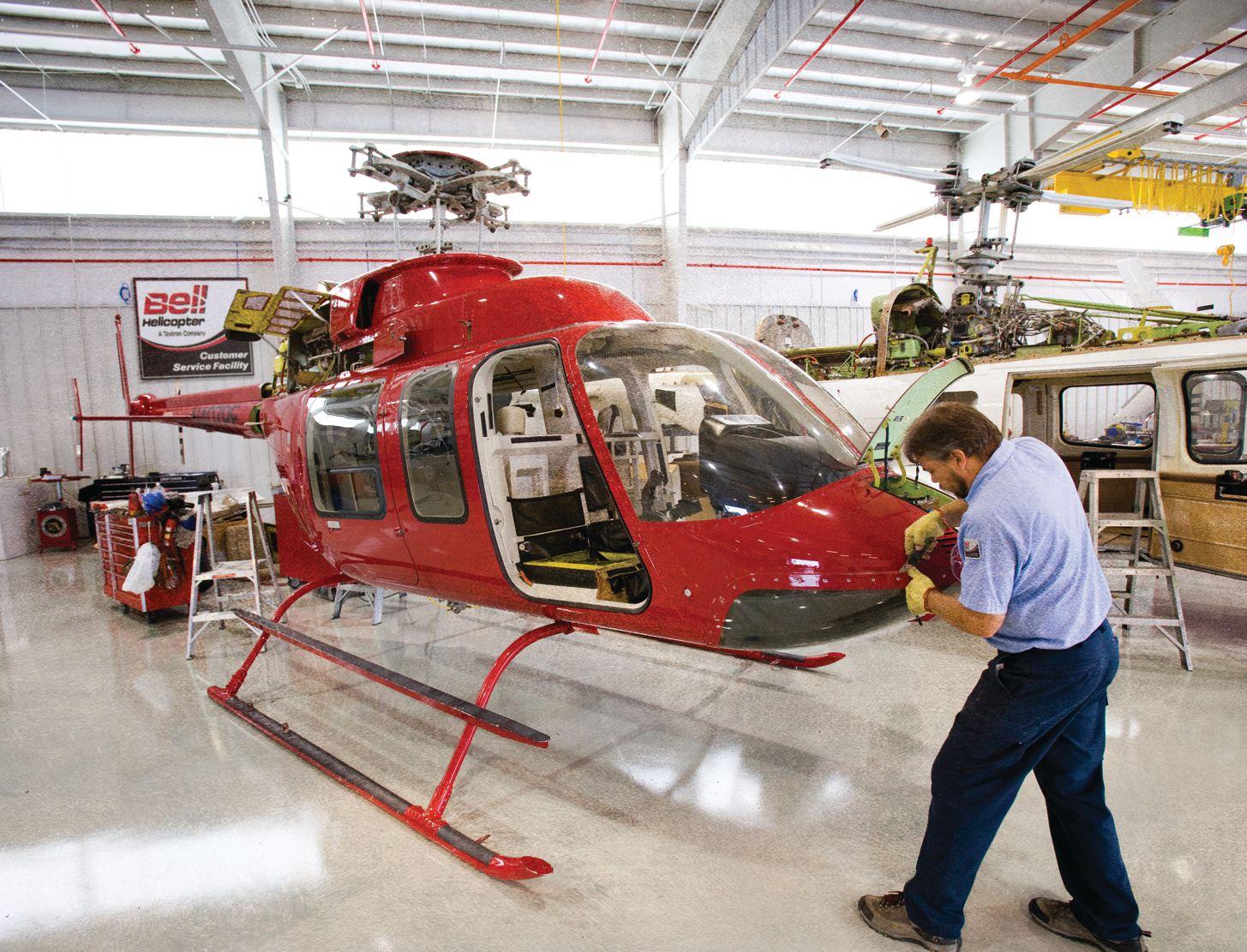
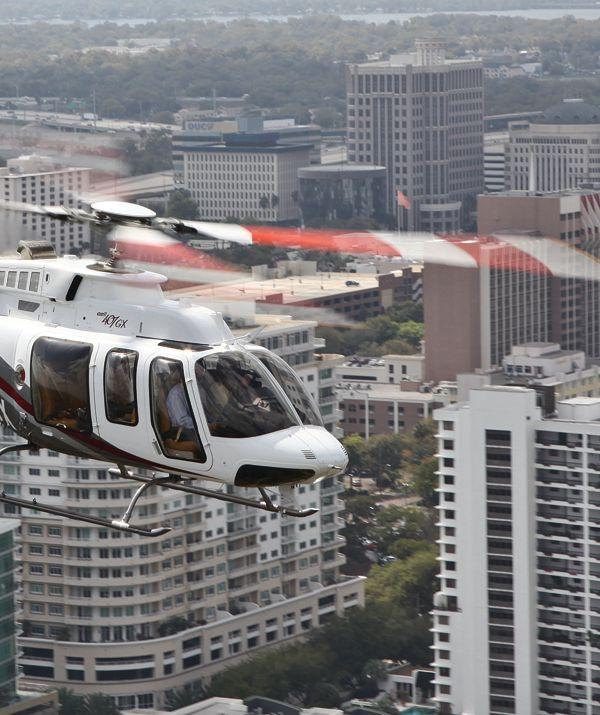
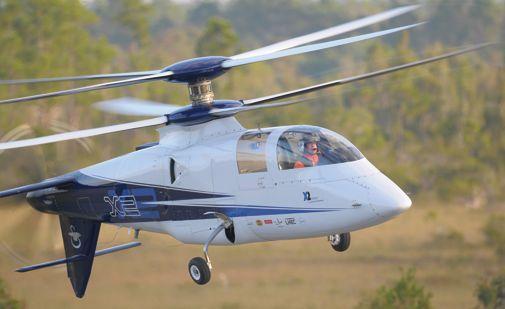
You didn’t get to where you are by compromising. Neither did Bell Helicopter, which is why there are no compromises in a 429. Luxurious, spacious and adaptable, it was designed precisely for your fast-paced, high-stakes world. With impressive range and speed, plus an astonishingly smooth and quiet ride, the 429 gets you where you need to go in comfort and style. On a Mission.
Paul Dixon
Peter Pigott
Matt Nicholls
editoRial
Matt niCHolls editoR
n a time of turbulence and change, it is more true than ever that knowledge is power.” – John F. Kennedy if america’s most iconic president is correct in his assessment that knowledge in times of change is power, then those attending three superb industry shows this spring must be feeling enlightened, empowered and eager to conquer all challenges.
March featured three “must attend” industry events, offering very different perspectives: heli expo March 5-8 in orlando; the helicopter association of Canada’s 15th annual Conference and trade show at Vancouver’s beautiful pan pacific hotel March 25-27; and the rapidly growing ChC safety & Quality summit March 28-30 at the Westin Bayshore.
said one industry colleague who attended all three events: “it’s been a whirlwind . . . it seems like i’ve been living out of a suitcase all month. But what a month.”
What a month indeed. the busy show season kicked off in orlando with arguably the industry’s most important event: the 63rd annual heli expo trade show. Featuring a record 625 exhibitors, more than 20,000 attendees (up from 596 exhibitors and 15,243 attendees a year ago), 65 helicopters on the floor, countless new products, and a variety of top-notch educational opportunities, the show offered attendees an excellent chance to assess the state of the industry and a glimpse into what lies ahead.
The Knowledge Quotient
Spring shows offer chance for enlightenment
two members of its enhanced rotary-wing aircraft lineup. new agreements for 68 bookings came from operators in the united states, Canada, europe and russia. (For more on heli expo see, “good Vibrations,” pg. 28.)
While heli expo 2011 offered plenty of glitz and a glimpse into where the industry is headed, haC’s annual event took a more cerebral approach – an expanded educational program covering important issues that will shape the Canadian industry for years to come. this year’s gathering featured a bevy of new programs for operators including pre- and post- educational opportunities on risk management, a mountain flying ground school, and a flying the wires course. other top educational sessions included an hour with transport Canada director general Martin eley and haC president Fred Jones, and an update from the international helicopter safety team (ihst) on helicopter safety and incident rates from Canadian helicopters’ sylvain seguin.
Helicopters magazine jumped into the fray, hosting its first-ever industry roundtable – an exclusive invite-only town hall meeting featuring haC president Jones and several top Canadian operators. discussion topics included strategies for dealing with tough economic realities; controversies over flight and duty times; the ongoing challenges of working with transport Canada; pilot shortages; worker retention and more. look for our roundtable report in the July/august issue and on the web at www.helicoptersmagazine.com.
attendees i spoke with at this year’s event were pleased with the variety of content offered and re-affirmed the importance of staying abreast of so many critical industry issues.
it’s been a whirlwind . . . it seems like i’ve been living out of a suitcase all month. But what a month.
“it’s been a very positive event; there are real signs we’re headed in the right direction,” said standardaero vice president of helicopter programs tom roche. standardaero used the event to draw attention to its 100th anniversary. “For us, it’s been a great show on many levels.” eurocopter Canada’s laura senecal echoed roche’s sentiments and is optimistic the market is ready for a turnaround. “it was a big week for us, and we’ve got a lot of good things coming up.” a big week for eurocopter indeed. new business concluded during heli expo involved eight of eurocopter’s helicopter types, including the dramatic introduction of the next-generation eC-145 t2, along with
all about Qualit Y
the ChC safety & Quality summit is fast becoming one of the industries “must-attend” events and this year’s version didn’t disappoint. With impressive keynote speakers, arguably the most diverse educational lineup of any industry event and impeccable organization, it more than delivered on its theme: “Corporate responsibility vs. personal accountability: two sides of the same Coin.” it was a fast-paced, well-executed three days of thoughtprovoking analysis, ironing home the incredible commitment to safety that must be made at all levels of an organization (for more on the summit, see “the great debate,” pg 12).
heli expo, haC and the ChC safety & Quality summit – three very different conferences, each offering unique perspectives and value in times of great change. after all, JFk is right: knowledge is power.
Helijet Lifts Off on B.C.’s North Coast
Richmond-based helijet international has opened the doors at its prince rupert base in seal Cove and is now expanding helicopter charter and air ambulance services along British Columbia’s north coast.
overseeing the air medical operations at the base, steve Morrow will work with andrew scott, who will be responsible for developing helijet’s general charter business.
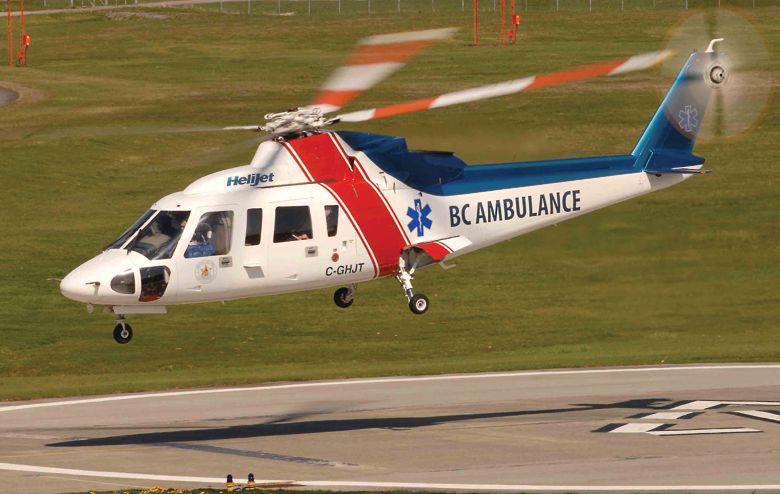
helijet’s air medical service will operate a twin-engine sikorsky s-76 helicopter under an exclusive eight-year contract to the B.C. ambulance service, 24 hours a day, seven days a week. a team of 12 highly-trained flight crew and maintenance engineers will be
expanding
integral in keeping the helicopter mission ready to fly at a moment’s notice.
helijet has been under contract with the B.C. ambulance service, operating two dedicated helicopters based in Vancouver for more than 12
years, and for more than five years has also provided lear-31 fixed-wing jet aircraft.
helijet president and Ceo danny sitnam says the organization is looking forward to becoming an integral part of the city’s business
niGHt fliGHt ConCepts tRaCks noRtH
At the recent Helicopter Association of Canada Annual Convention and Trade Show, Night Flight Concepts (NFC) announced plans to expand operations into Canada, timed with the unveiling of a new strategic partnership with Helicopter Transport Services Canada Inc. (HTSC).
Night Flight Concepts is no stranger to the Canadian market. In recent years, it has helped numerous government and industry organizations across the country plan, implement and maintain night-vision goggle (NVG) capabilities to support night-vision imaging system (NVIS) programs, including the RCMP, York Regional Police, Cougar and Helicopter Transport Services.
The company maintains NVGs are increasingly transforming night operations for the better: operators that have received exemp-
and tourism community. helijet will also offer general charter helicopter air services for the numerous business sectors in the surrounding community, as well as sightseeing tours for the local residents and tourists.
tions to fly with night-vision technology in Canada confirm they are experiencing significant advantages, including higher safety standards, operational benefits and added value to the bottom line.
HTSC president Luc Pilon says: “This is an important time in Canada. The Canadian NVG market is poised for explosive growth. HTSC extends the NFC partner network to help support this growth.”
HTSC and NFC will co-locate in Carp, Ont., at the HTSC corporate headquarters facility in the national capital region, to provide government, industry and the aerospace research communities with NVG solutions. Services will include pilot and instructor NVG training; NVG maintenance training; NVG 180-inspection and repair services; NVG aircraft lighting modification; NVG equipment acquisition solutions; and NVG program management consulting.
Helijet is
its helicopter charter and air ambulance services along B.C.’s north coast. (Photo courtesy of Helijet)
a Hot Win for denendeh
Denendeh Helicopters Ltd. has been awarded a five-year contract to provide firefighting support and suppression services out of Hay River, N.W.T. A majority aboriginal-owned partnership of Great Slave Helicopters, Denendeh Helicopters brings together the investment arms of K’atlodeeche First Nation of the Hay River Reserve, and the Deh Gah Gotie First Nation of Fort Providence.
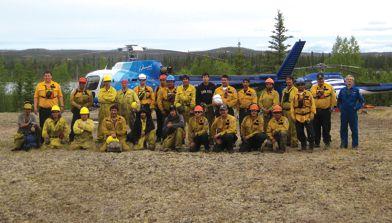
Denendeh Helicopters will provide fire support and suppression services out of Hay River, N.W.T., for the next five years. (Photo courtesy of Denendeh Helicopters)
The five-year deal, valued in excess of $2 million if the expected hours are flown, will see Denendeh Helicopters supply one firefighting purpose-built Astar 350 B2 helicopter and the related flight and maintenance crew to the Northwest Territories Department of Environment and Natural Resources.
In addition to the Northwest Territories, Great Slave Helicopters, its subsidiaries and its aboriginal partners currently service forest fire contracts in Alberta, Manitoba and Ontario, and provide back-up support in B.C. and the Yukon. Denendeh Helicopters also owns two helicopters that are servicing the mineral exploration industry this summer.
Two Visionaries Honoured at HAC
the helicopter association of Canada honoured two distinguished visionaries at its recent annual convention and tradeshow in Vancouver.
Neil J. Armstrong (deceased) was honoured with the Carl agar/alf stringer award for his outstanding contribution to the helicopter industry. the award is named after two trail blazing icons who founded okanagan helicopters.
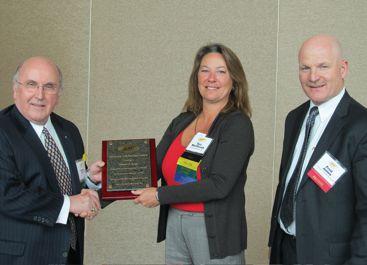
Robert Ough accepts the Honorary Life Member Award from Teri Northcott, HAC chair, and Fred Jones, HAC president and CEO.
Born in alvinston, ont., armstrong joined the air Force when the second World War began and learned to fly in the tiger moth. he became extremely interested in the application of helicopters for geological work while working as a geologist in the early 1950s, and later earned his helicopter licence at spartan air services in ottawa. armstrong worked as a geologist/pilot in many major exploration projects in the north and is generally considered to be Canada’s first helicopter pilot/geologist. throughout his career, he was an avid promoter of helicopter use in the oil and gas industry, geological
exploration and forestry. in particular, he endorsed helicopter use in seismic work and was a pioneer in early magnetometry development. inducted to the Canadian aviation hall of Fame in 1974, armstrong was dedicated to a unified helicopter industry and the promotion of safety. at age 74, armstrong and his son Corky were killed in an unusal twin otter crash on an iceberg in antarctica. his contribution to Canadian aviation, and in particular the helicopter industry, will always be remembered. the haC also bestowed robert A. Ough with an honorary life Member award. the award recognizes ough’s significant contribution to the
HELICOPTERS MAGAZINE P.O. Box 530 105 Donly Drive South Simcoe ON N3Y 4N5 Tel.: 519-428-3471 Fax: 519-429-3094
Toll Free: 1-888-599-2228
Website: www.helicoptersmagazine.com
EDITOR MATT NICHOLLS e-mail: mnicholls@annexweb.com 416-725-5637
ough, who was integral in the formation of the haC, has been an enthusiastic supporter of the industry his entire career. “i highly appreciate the haC award because of the work with Barry hewko during the early stages of haC. thanks to Barry for helping make it happen,” said ough.
ough commenced his flying career in the rCaF in 1958. Flight operations in the helicopter industry began in 1970 and over his career, ough flew with many outfits including skyrotors, great lakes helicopters (instructor), dominion-pegasus/okanagan, and sept-iles helicopter (all part of the ChC group). in 1981, he moved into the marketing side of the business with hughes helicopters/ Mcdonnell douglas helicopters. ough also spent time as general manager of Canadian air-Crane before moving back to a marketing role with eurocopter Canada limited in 1995.
GROUP PUBLISHER/EDITORIAL DIRECTOR SCOTT JAMIESON e-mail: sjamieson@annexweb.com
PRESIDENT MIKE FREDERICKS e-mail: mfredericks@annexweb.com
RETuRN uNDELIVERABLE CANADIAN ADDRESSES TO ANNEx PuBLISHING & PRINTING INC., P.O. BOx 530, SIMCOE, ON N3Y 4N5 CANADA. email: ncuerrier@annexweb.com
Published five times a year by Annex Publishing & Printing Inc. Printed in Canada ISSN 0227-3161
Canada – 1 Year - $25.00 (includes GST - #867172652RT0001) uSA – 1 Year $35.00 Foreign – 1 Year $45.00
Occasionally, Helicopters magazine will mail information on behalf of industry-related groups whose products and services we believe may be of interest to you. If you prefer not to receive this information, please contact our circulation department in any of the four ways listed above.
Helicopters Magazine is an associate member of the following Canadian
LETTER: Failure to Heed the Call
Helicopters received the following letter in response to Paul Dixon’s column, A Shrinking Pool – What Will Come With the Demographic Dips of Tomorrow? in the March/ April 2011 issue.
i was quite sad to read [paul dixon’s] column. i am a former avionics instructor with BCit during the 90’s and up to 2005, i spent a lot of time at meetings
with industry, CaMC, and other aviation organizations. other instructors and i tried constantly to get industry to plan ahead for the baby boomer syndrome and hire our students to fill the future gap. We were confronted with “apprentices are too expensive; we want fully trained people with endorsements and experience,” etc., etc. the sad thing is that here
A Harrowing Rescue
the harrowing rescue of two inuit hunters from the icy waters of Frobisher Bay was cause to celebrate at great slave helicopters and discovery Mining services in mid-March. the pair was polar bear hunting when one of them fell through some soft ice. great slave helicopters had part of its fleet in iqaluit and, after obtaining a release from its customer peregrine diamonds, dispatched a eurocopter astar 350 B2, registration C-gFhn, to locate and rescue the men.
“discovery Mining services logistics manager Jennifer Burry got the call in iqaluit and quickly made all the arrangements to initiate the search-and-rescue mission,” said John Curran, discovery air marketing manager –northern services.
“the hunters were roughly 120 nautical miles from iqaluit nearing the mouth of Frobisher Bay when our flight
MAY
May 17-19
in B.C., there are a number of ex-avionics students who eventually left the aviation industry and are now working for translink and other organizations because of better salaries and conditions and more secure employment – something that the aviation industry could not offer them.
Douglas Grant Retired Avionics Instructor, BCIT
crew spotted them – one of the hunters was floating on his komatik and the other was on the ice.”
pilot James kitchen then manoeuvred the helicopter in close while aMe Will Ward plucked the two men, one-byone, into the warmth and security of the hovering helicopter.
“it was about an hour and
Correction notice
On pages 33 and 34 of the March/April issue of Helicopters, in the article “BCIT Leads the Way,” we erroneously identified a Bell 206 as a Bell 212 in two photo captions. We apologize for the errors, and thank our loyal readers who pointed them out.
25 minute flight to get them back into iqaluit and all the while our assistant operations manager louis trottier was monitoring the helicopter’s progress from Yellowknife using our gps satellite tracking system,” added Curran. “he was able to stay in contact with the search-and-rescue coordinators and provide realtime updates to the emergency medical services staff standing by to meet the helicopter upon its return to iqaluit.”
discovery air’s subsidiaries annually assist in approximately a half-dozen search-and-rescue missions in the north.
eBACe (european Business Aviation Convention & exhibition) geneva, switzerland www.ebace.aero
May 28-29
Wings and Wheels Heritage Festival toronto, ont. www.wingsandwheelsfestival. com
JUNE
June 20-26
49th International Paris Air Show le Bourget, France www.paris-air-show.com
June 24-26
COPA National Fly-In and AGM langely, B.C. copacon2011.ca
June 24-26
The Great Lakes International Air Show st. thomas, ont. www.greatlakesinter nationalairshow.ca
JULY
July 6-7
CBAA Annual Convention and Trade Show Calgary, alta. www.cbaa.ca
OCTOBER
Oct. 2-4
Airport Management Council of Ontario (AMCO) Convention and Trade Show Brantford, ont. www.amco.on.ca
Oct. 5-6
International Winter Operations Conference Montreal, Que. www.winterops.ca
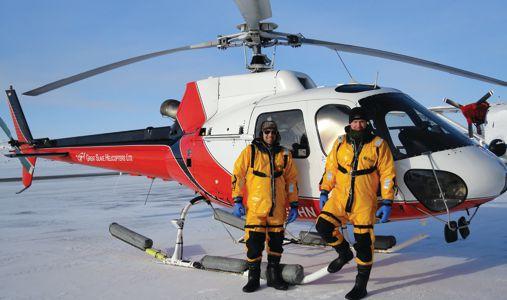
Great Slave Helicopters' pilot James Kitchen and AME Will Ward saved two Iqaluit hunters from the icy waters of Frobisher Bay in mid-March. (Photo courtesy of Great Slave Helicopters)
neil MaCdonald
n January 2010, i wrote about how a Waiver of liability can be an effective method of protecting your company from customers who get injured while engaging in challenging activities. i said that your waiver should include language stating the customer waives his/her right to sue you should things go wrong, and i suggested that if you intend to include negligence, you should clearly state that.
i thought it might be a good idea to look a little more closely at the law of negligence for this column. the “classic” definition of negligence is “the omission to do something which a reasonable man, guided upon those considerations which ordinarily regulate the conduct of human affairs would do,” or “doing something which a prudent and reasonable man would not do.”
We have all seen people do things that do not seem reasonable to us, and most of us with spouses can safely say we have done things that do not seem reasonable to others! the courts came up with their own measure of reasonableness, and created this concept of a “reasonable man.” then, either through political correctness or oxymoronic construction, they changed it to “reasonable person” which now applies to all of us equally.
the reasonable person is of normal intelligence, and without any unusual powers of foresight. the person is not extraordinary, nor unusual, but will act in accordance with generally approved practices.
Clarifying Negligence
Always Consider the End User
foreseeability is the key issue here – was it reasonable that the person harmed should have been in your thoughts prior to the act or omission? the case that started this movement, called Donoghue v. Stevenson, came out of the united kingdom in 1932. it involved a woman who sued a drink manufacturer because she found a decomposed snail in a bottle of ginger beer after she drank from it. she fell ill, and sued for damages. the law at the time was that you could only sue if the parties contracted directly with each other. since the woman did not buy the drink directly from the manufacturer, it was customary that she should not have a case against it. the court found that the manufacturer should have had the end user in mind at the time of bottling; therefore it was reasonably foreseeable that its actions would affect Ms. donoghue. this proposition still stands 80 years later!
if your conduct has been found not to have conformed to that of the reasonable person, then you have breached the duty of care. this is an all-or-nothing proposition. once established, the injured party must prove that he or she has suffered damages, and that those damages were caused by your actions or inactions. this is called causation.
Causation is generally established using the “but for” test. What this means is the damages would not have been sustained “but for” the conduct of the negligent party. that party does not have to be solely responsible for all the damages suffered, but the principle just means that some of the damages would not have occurred but for his/her actions. an injured party also can be found to have contributed to the injuries he suffered. Contributory negligence used to be a complete defence to a negligence charge. today, however, it simply affects the damages awarded. if the injured party is found to be 25 per cent responsible for his/her own injuries, his award would be reduced by that same 25 per cent margin.
We need to be as careful as reasonably possible when conducting our affairs.
and so should we.
in order to have a finding of negligence against us, we must first have or owe a “duty of care” towards someone. We must then breach that duty of care. Finally, there must be some measurable damage flowing from or caused by that breach of the duty.
duty of care is a legal obligation requiring us to take reasonable steps to avoid conduct that entails an unreasonable risk of harm to others. the duty is not something you owe to everyone in the world, but only to those who can be characterized as your “neighbour.” those who are close enough to you to be affected by what you do, or don’t do. reasonable
While this is only a brief look into the law of negligence, it serves as a reminder that we are all in this together, and that our actions and omissions can affect those around us. We need to be as careful as reasonably possible when conducting our affairs – both in our business lives, and our private lives, and always look at the bottom of the bottle!
Neil MacDonald is an aviation lawyer practising in B.C. He has completed an ISO 9001:2008 QMS Lead Auditor course, holds an ATPL-H, and flies as an IFR Off-Shore Captain. neil.j.macdonald@gmail.com This is not a legal opinion. Readers should not act on the basis of this article without first consulting a lawyer for analysis and advice on a specific matter.
Our Mission:
Platinum Award Winners
Air Asia Company Ltd.
Alpine Aerotech Ltd.
Arrow Aviation Co. LLC
Avialta Helicopter Maintenance Ltd.
Eagle Copters Maintenance Ltd.
Fuji Heavy Industries Ltd.
Helipark Taxi Aereo E Manutencao Aeronautica Ltda
Motorflug Baden-Baden GmbH
Northwest Helicopters LLC
Patria Helicopters AB
Rotorcraft Support, Inc.
Sikorsky Aircraft Australia Ltd. DBA Sikorsky Helitech
Servicio Tecnico Aereo De Mexico (STAM)
Uniflight, LLC
Your initial purchase of a Bell Helicopter is just the beginning of our relationship. That’s because your ownership experience is important to us from every angle. With more than 120 customer service facilities across 34 countries, you’ll get the best support in the industry. That includes the Bell genuine parts inventory, Bell trained technicians and the highest service facility quality. In fact, each year, all Bell-approved customer service facilities undergo a comprehensive audit. Please join us in recognizing this year’s select group of 14 service facilities that achieved platinum status for 2011. On a Mission.
ColuMn
paul dixon
t was an important week in Vancouver for members of the helicopter industry to herald the arrival of spring 2011, with the helicopter association of Canada’s annual Convention & trade show March 25-27 followed immediately thereafter by the ChC safety & Quality summit.
Both conferences covered many critical issues and topics, and another common thread connected them: the overall theme of the ChC’s annual gathering, Corporate Responsibility vs. Personal Accountability – Two Sides of the Same Coin. the brainchild of ChC’s vice-president, safety and quality, greg Wyght, this year’s ChC event got off to a rousing start with three heavyweights debating both sides of the issue. tony kern, phd, Ceo of Convergent performance, llC, took the personal side, while John nance, an aviation analyst with John nance productions, rode the corporate pony. With animated scott shappell, phd, co-founder of htaCs inc. as moderator (instigator?) and enigmatic graham Braithwaite, phd, head of the department of air transport at Cranfield university, working both sides of the border, it was like watching the 3-d chess game in the first Star Wars looking back over the past decade, we’ve had far too many examples where corporate responsibility and personal accountability were required. does one have to come before the other and can either exist in the absence of the other? is it the chicken or is it the egg? What was
The Great Debate
Deciphering Both Sides of the Responsibility Issue
warning system, as well as hundreds of tsunami sensors ringing the country. it’s moot at this point to wonder what the death toll might have been if all these steps had not been implemented, but the reality is that the largest earthquake in Japan’s history, followed by a massive tsunami has devastated a large portion of the country, killed tens of thousands and lefts hundreds of thousands homeless.
the triple whammy for Japan is the ongoing Fukushima daiichi nuclear power plant situation. Japan is the personal/corporate accountability/responsibility question at a macro level. at the haC luncheon March 26, veteran eMs pilot and this month’s Helicopters guest columnist, randy Mains (see, “lessons learned,” pg. 38) spoke with great passion about the pressure placed on eMs pilots in a for-profit health care system to fly in sub-marginal conditions and about decisions being made for the wrong reasons. it’s the perfect analysis of responsibility and accountability at the micro level. and it, of course, begs the question: can you make good decisions at the personal level if the corporate model is skewed?
When i interviewed Maj.-gen. Yvan Blondin, Coo of the Canadian air force earlier this year (see, “a Commanding Force,” pg. 24), he spoke about key missions that our military is tasked with by our government and the challenges in fulfilling these missions with personnel and equipment that are stretched micro-thin. these are dangerous missions: search-and-rescue in the high arctic, long-range maritime surveillance patrols, humanitarian flights into rudimentary airfields around the world, anti-piracy missions, and supply and support missions in afghanistan. everything the Canadian Forces does is at the edge of the envelope and often goes beyond, but as the general says, – “if we don’t do these missions, who will?”
Can you make good decisions at the personal level if the corporate model is skewed? ‘‘ ’’
enron – personal or corporate? the crash of the Colgan Q-400 in Buffalo just before last year’s ChC summit – was that personal or corporate?
look at what has happened in Japan, with an earthquake followed by a tsunami, topped with the threat of a nuclear disaster that could make Chernobyl look like a burned out light bulb by comparison. the Japanese live in constant awareness of earthquakes. For the past 50 years, Japan has marked sept. 1st, the anniversary of the 1923 tokyo earthquake that killed more than 100,000, as disaster prevention day. evacuation drills are a staple at schools, businesses and public offices across the country. Japan has the world’s most extensive earthquake
Canadians are in the middle of the federal election campaign as this column goes to press. the electoral process in this country is our personal exercise in accountability – accountability as in, “Count me in.” the voter turnout in the previous federal election was an all time low at 58 per cent. it’s a record i hope we don’t break this time. it’s not a chicken or egg question. if you make a conscious decision not to vote, then you’ve abdicated your personal accountability and there can never be any corporate responsibility.
here’s hoping the corporate entities in the aviation industry continue to analyze and measure both sides of the responsibility coin – and continue to strive for the ultimate standards in safety and customer satisfaction.
Paul Dixon is freelance writer and photojournalist living in Vancouver.
Size Shouldn’t Matter
Light, Maybe, but Heavy on Skill
there is a tendency, among aircrew, to equate helicopter size with pilot competency and experience. the same can be said for customer perception. the assumption goes, the bigger the helicopter, the greater the accumulation of pilot expertise at the controls. and because of this, pilots of heavier machines usually receive a greater amount of respect from other aircrew and customers.
pilot evolution from lights to intermediates, and then on to mediums in a customer-oriented industry is a necessity for a successful charter operation. however, pilots don’t always follow this sequence as quickly as they may like. the unique skills and expertise they gain in light machines is invaluable though, and perhaps it is time to adjust pay scales and attitudes to reflect this.
usually a candidate for medium training will have to accumulate in the neighbourhood of 3,000 incident-free hours and have a solid reputation with the operator’s clientele before being considered for the endorsement. easy to understand, then, why some Jet ranger and astar pilots unfortunately regard their current endeavour as a rite of passage to that coveted seat in a bigger helicopter.
during a recent after-hours “there i was” session, an acquaintance who is an ex-military pilot remarked that he went from 200 hours on a Bell 206 right into a Bell 212. not unusual for a military pilot, as there is nothing in the military roster to fill the gap.
retiring military pilots, leaving civilian pilots who have worked long and hard polishing bush skills and customer relations feeling a bit snubbed. the reality is, you may be flying a light or intermediate, but the skills you’ve developed are of immeasurable value to your customers and your employer.
the charter pilot has to be able to adapt, safely, to tacit pressures without compromising his or her best judgment and expertise at the controls. Customers can be very disparaging if they feel the pilot is deliberating too long when assessing a confined area or even worse, wasting money on a protracted slow approach. Management does not relieve the pilot of responsibility even when the machine is on the ground, expecting decisions that satisfy not only safety but also the bottom line. (For example, overreacting to a malfunction by landing a machine in an inaccessible location, (compounding the return-to-service costs) does not gain you points).
not to be disCounted
the expertise pilots gain in light machines is invaluable . . . perhaps it is time to adjust attitudes.
’’
however, missing from the pilot equation is the invaluable customer liaison experience that charter pilots gain. Civilian operators, understandably, capitalize on the singular experience of these ex-military pilots and slot them into mediums tasked for VFr, or iFr point-topoint passenger flights. i am not insinuating that military pilots are capable of nothing else.
however, their training and experience took them down different avenues, and once in the civilian job market, they are reminded very quickly of their experience levels when looking for a job. Many of the medium seats out there are being grabbed up by
i once witnessed a Jet ranger pilot quietly join a group of relaxing medium drivers at a fire camp. When asked what he was flying, he selfeffacingly nodded towards his Jet ranger. “Just a jet box,” he replied. i was perturbed by his deference. here was a pilot tasked with transporting fire services personnel in and out of unprepared sites to survey new staging areas and pumping sources. What he accomplished day after day at the controls of that 206 needn’t have taken a back seat to any of the medium drivers in the group. Management expected him to fly as many hours as possible, provide the client with safe transportation, and on top of that, keep his machine clean and presentable at all times. Yet, he still felt that he had to apologize for the fact that he was only flying a light. light and intermediate helicopters are the most prevalent charter machines in the country, yet because of the connotation of size, pilots and engineers dismiss them as befitting a pilot with novice skills. in reality, the reverse holds more truth, and in the helicopter world size shouldn’t matter. For that iFr, multi-engine and medium endorsement, there is always a bank card, but those light to intermediate flying skills in a charter operation – priceless!
A native of Spruce Grove, Alta., Michael Bellamy has been flying fixedand rotary-wing aircraft in a variety of capacities since 1971, and is an accomplished author of several books, including Crosswinds
MiCHael bellaMY
in parts 1 and 2 of our “survival” series, we drew up a dire crash scenario, then discussed the psychology of surviving, setting priorities, how to build an emergency shelter and the numerous benefits of fire.
Continuing from where we left off, it is early dawn as you emerge from your make-shift refuge and assess your situation. despite being warm and dry, your crude shelter was hastily constructed and uncomfortable, so sleep did not come easy. Without fire, the darkness made matters worse and every scurry and snap echoed and amplified ominously in your imagination. now, exhausted and wrought with anxiety, you find yourself cold and alone, trying to piece together some mosaic of understanding; you are safe and protected (you made sure of that last night), but you had no fire and that situation must change. You are hungry, but that can wait. You are definitely thirsty and that can’t wait long, but. . . does anyone out there know where the hell you are?
Yesterday’s flights were long, at low altitude, and to several random destinations, so pinpointing your location will be difficult. the narrow
building a signal fire
• In a clearing, lay a framework of alternating dry and green sticks in a large square.
• In the centre, loosely assemble into a mound such combustibles as birch bark strips, dry grasses and pine needles, entwined with narrow, dry kindling.
• Build up your structure into a pyramid shape by alternating your firewood, ensuring plenty of ventilation from below.
• Occasionally crisscross your square with dry sticks, placing plenty of dry grass, birch bark and small dry kindling on the lower tiers.
• From knee to waist level top your tiers with a mix of dry kindling, birch and fresh evergreen boughs, switching solely to fresh evergreen on the upper levels.
• Continue this process until your structure is eye height and the upper two thirds are dominated by fresh evergreen.
• Once lit, a roaring inferno will funnel upwards like a chimney flue, rapidly igniting your “greenery” and resulting in copious amounts of thick yellow/white smoke billowing into the sky.
• Keep an ample source of greenery on hand and ensure your structure is kept dry and ready to ignite on the first attempt upon seeing or hearing SAR.
Facilitating Your rescue
Knowing the Proper Signalling Techniques is Key
gorge where you crashed is surely impeding your elt signal and the last time you looked your cockpit was spewing sparks and smoke –who knows the extent of the damage to your electronics. one thing is for sure – you have to find a way to let somebody know where you are, and that you are alive!
Road to ReCoVeRY
Following an aviation mishap, priorities are never clear or chronological. instead, they overlap and leapfrog each other. in our hypothetical scenario, you are uninjured but night fell quickly, preventing you from establishing anything beyond a rudimentary shelter. Your once clear priorities are now blurred by fatigue and anguish.
to counteract this, congratulate yourself on your monumental feats of surviving the crash and your first night alone. use the daylight and your ability to distinguish your surroundings to buoy your spirits. strengthening your resolve and lowering your expectations protects you from being discouraged, so start by presuming that all is lost and your radio and supplies have been destroyed. the reasoning behind this is if a few things are in working order and some of your survival kit is salvageable, they become windfalls and you feel better, not worse. Most missing hikers are found within three days – aviators much sooner, but don’t “expect” to be rescued. instead, do everything possible to facilitate your own rescue. By placing “yourself” in charge, you will find more creative and unique ways to signal for help.
search-and-rescue (sar) aircraft will be looking for any visible signs of the crash site from the air, such as smoke from a signal fire or any of the international ground signals for help – sos, a large V or X, or a large triangle. use tree bows, peeled logs, sod, stones, branches, bright clothing, flags, parachutes, etc. to create colours that contrast your surroundings, and make your signals as large as possible – ideally 40 feet in length and 10 feet between each letter. You can also signal an aircraft with anything reflective, such as broken glass, metal, mirrors or lenses.
With your outstretched arm in front of you, simply hold your fingers open in the shape of an upwards “V.” position the distant aircraft between your fingers inside the “V” and hold your reflector close to your face to catch the angle of the sun’s reflection so that it centres within the “V.” the intensity of the flickering light will align with the sar aircraft making it easier for you to catch their eye. a signal fire is very effective but use everything at your disposal and several methods simultaneously to increase your chances of being rescued.
Survival and Rescue is Part 3 in a series aimed at providing pilots with critical wilderness survival skills and insight. The next instalment will highlight how to effectively stock a flight survival kit.
every year on average, 8,500 wildfires are reported across Canada, burning an area of 2.5 million hectares. Wildfires destroy property, cause economic hardship and generally disrupt lives. as human habitation creeps further into the wildland interface, the potential for costly and deadly wildfires increases. Millions of hectares of forest ravaged by insects and blight, coupled with extended periods of drought, sets the stage for wildfires of epic proportion.
Canada has a sophisticated management system to manage wildland firefighting response from the smallest isolated communities to international response. at the bottom rung, firefighting response within organized territory is the responsibility of the local authority; towns, cities, regional districts. if the situation is beyond their capabilities and/or resources they may turn to neighbouring communities, by way of mutual-aid agreements, or to their provincial authority. When the province’s resources are overwhelmed, the Canadian interagency Forest Fire Centre (CiFFC) steps into the picture. located in Winnipeg, CiFFC co-ordinates services for all the provinces, territories and federal fire management agencies, and co-ordinates sharing of resources with the united states and other countries.
Funding for CiFFC is a federal-provincial joint venture, with the federal government contributing one-third and the provinces making up the remainder based on their inventory of productive forestland. British Columbia pays 17 per cent of that two-thirds, while prince edward island pays only 0.1 per cent. in B.C., 2003 was a watershed year for wildland firefighting in B.C., one of the most catastrophic in the province’s history. due to an extended drought in the southern half of the province, forest firefighters
faced conditions never seen before in Canada. lightning strikes, human carelessness and arson all contributed to igniting nearly 2,500 fires, ultimately involving more than 10,000 firefighters and support personnel, and burning more than 265,000 hectares. the extreme volatility of the dry forests, compounded by the province’s difficult terrain, created unprecedented fire behaviour and at times made fire suppression almost impossible. More than 300 residences and businesses were destroyed and more than 40,000 people were evacuated from their communities at the peak of the fire season.
in response to widespread public protests about the 2003 firefighting efforts, the B.C. government appointed gary Filmon, former premier of the province of Manitoba, to head a commission of inquiry on
wildland firefighting in the province. the Filmon Commission heard hundreds of submissions and produced a report that identified a number of critical shortcomings, and established future priorities.
Brian simpson, director of B.C.’s Wildfire Management Branch, describes the major shift in firefighting philosophy that came from the Filmon report. “prior to 2005, wildland firefighting in B.C. was simply a response. now, we have shifted our focus from protecting forest values to protecting communities through fuel
management programs and community wildfire plans. Fire management around communities is critical.” the shift from suppression to prevention follows the model adopted by the u s. Forest service. despite the fact that the usFs had reached a 99 per cent initial attack success rate, higher than the 95 per cent target for most Canadian provinces, it had been incurring record-setting costs, losses, and damages in fire areas where severe, catastrophic fire should have been rare. the usFs realized that devastating fires were continuing to occur because the service had been attempting to manage the landscape to protect everything from commercial interests to human settlements, and by doing so had in fact created an environment conducive to superfires.
the province of British Columbia created a fuel mangement program that provides matching funding to communities to reduce fuel build up in interface areas in order to reduce the potential for extreme fires. in april 2011 the B.C. government announced a further $25 million would be committed over the next two years to allow the program to continue.
all about tHe teaM
British Columbia employs 1,100 Class 1 firefighters and 30 initial attack (ia) firefighters operating from 50 bases across the province. three-person ia teams can be deployed by helicopter or vehicle. salmon arm is home to the province’s 36-member rap attack team that rappels from helicopters to access fires in the heavily-treed, steep mountain terrain, while Fort st. John in northern B.C. is home to the north peace smokejumpers, who operate out of fixed-wing aircraft. twenty-person unit crews stationed across the province round out the front-line complement of seasonal firefighters. as circumstances dictate, ia teams can combine to form a unit crew or unit crews can be broken down into smaller teams. Flexibility is the key
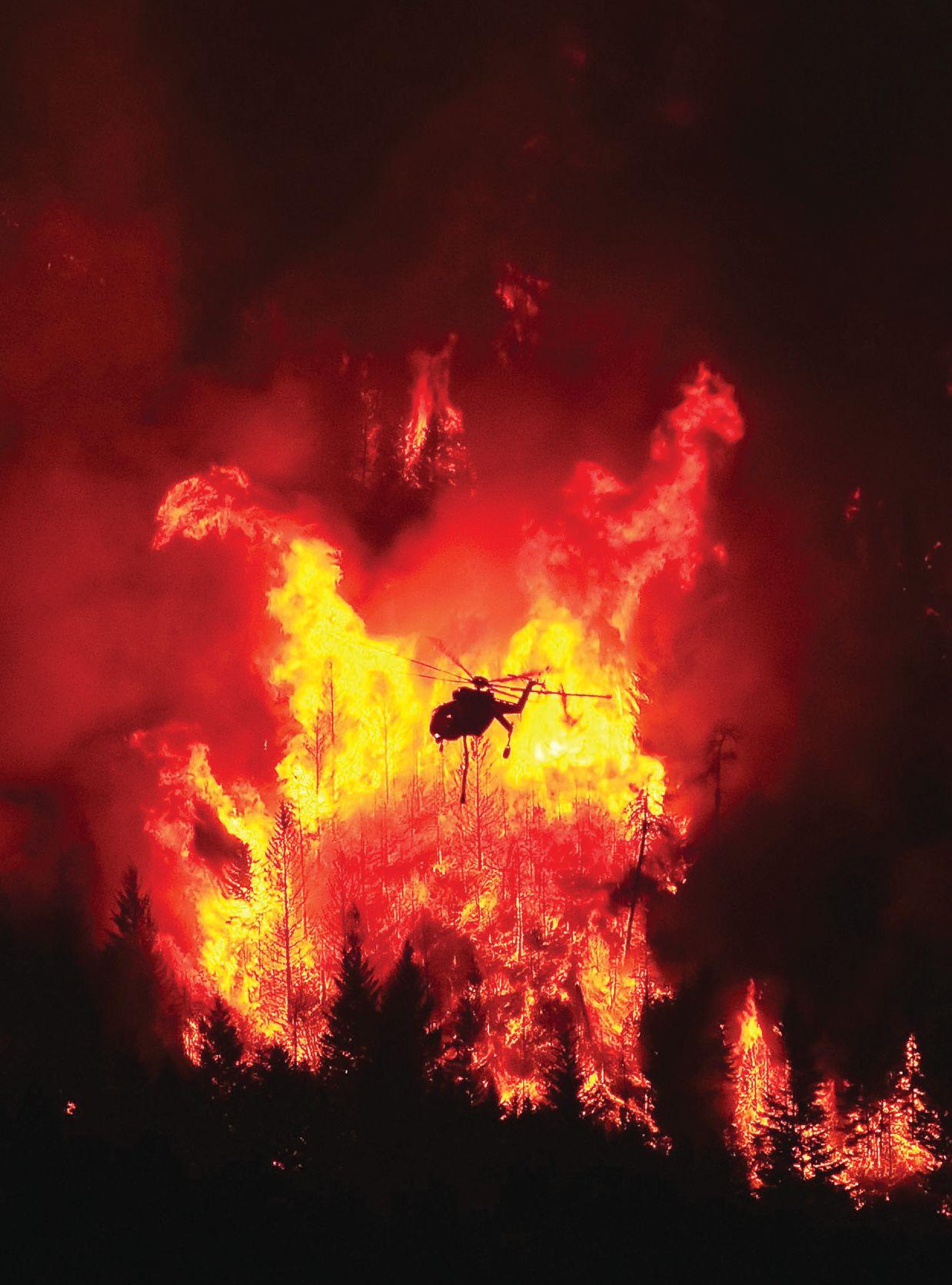
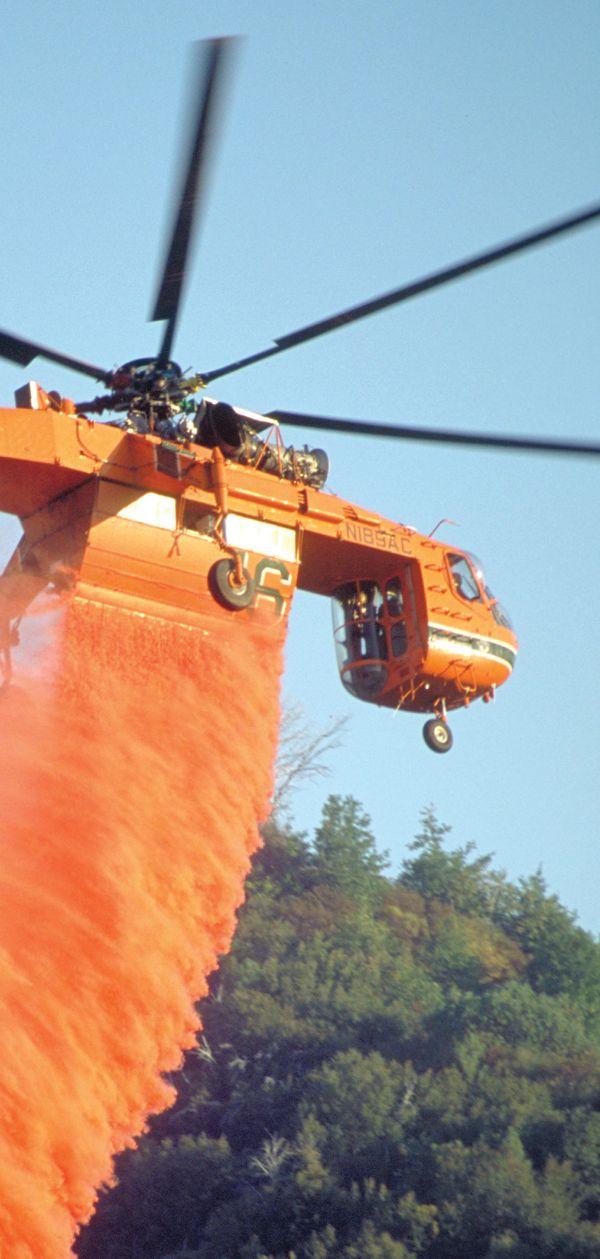
LEFT: Initial attack teams in B.C. are critical for keeping fires at bay. Here, an Erickson Air-Crane drops a retardant on a developing blaze. (Photo courtesy of Erickson Air-Crane)
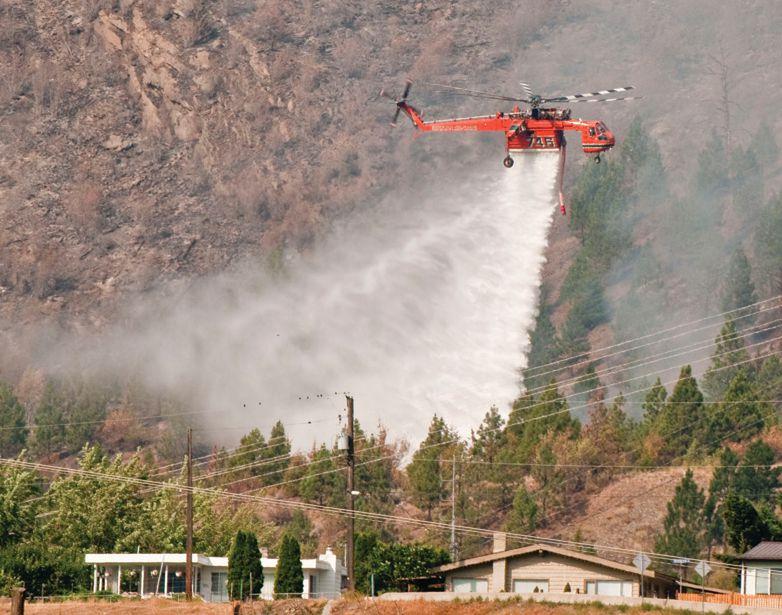
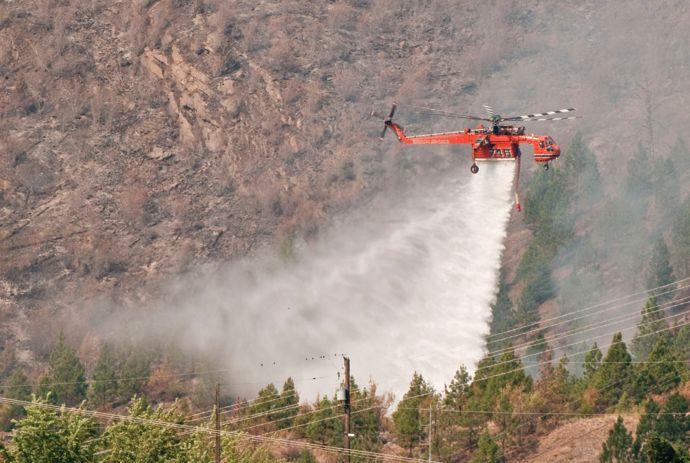
BELOW: Community based firefighting strategies are standard in B.C., with a plethora of rotary- and fixed-wing aircraft employed to battle blazes. Here, an Erickson Air Crane battles a fire in Lillooet. (Photo courtesy of Erickson Air-Crane)
CoVeR stoRY
A strong initial attack strategy utilizing a variety of rotary assets is crucial to B.C.’s firefighting process. (Photo courtesy of SEI Industries)
to effectiveness, says tom reinboldt, supervisor of the smokejumpers. “specialization is for insects – the more flexible you are, the more valuable you are,” he says.
the decision to deploy crews on any fire is made at one of six regional Fire Centres located around the province by the regional Wildfire Control officer using the criteria of closest and/or most effective resource available to respond. Considerations for most effective use of a resource, or combination of resources, required to respond include the size of the fire and burning conditions; any access issues (i.e., can you drive to it or is the fire remote?), dispatch distance; what is threatened (i.e., homes and infrastructure, high-value timber, etc.); and what is the current and predicted fire load within that Fire Centre’s region.
bambi Versus Godzilla
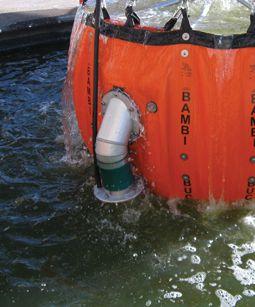
Bambi Buckets appeared in the skies over Japan’s Fukushima nuclear power plant in late March as Japanese military pilots struggled in a desperate attempt to maintain water levels in the damaged reactors at the site, bringing the media to Bambi’s home: SEI Industries of Delta, B.C. Without proper training or equipment, the water being dropped by Japanese military pilots appeared to be ineffective. Global TV, CTV and Discovery Channel gave extensive coverage to the story, with Discovery filming a segment for Daily Planet at Abbotsford Airport with Shawn Bethel, division manager of SEI’s firefighting division and Ralph Wagner of Sequoia Helicopters. Bethel explained that because the untrained pilots used only 25-foot lines, (instead of the more usual 150 to 200-foot
RotaRY suppoRt seRViCes
initial attack teams across the province are delivered by medium helicopters, which utilize hover exit techniques where aircraft are unable to land. Where trees or topography make landing impossible, rap attack crews can rappel down from as high as 80 metres through openings in the tree canopies. depending on the fire, the team may move directly to fight the fire if it is small, or in the case of a larger fire, clear a landing zone to enable other firefighters to be brought in quickly. at the same time, the ia crew is dispatched to the fire, air tankers and/or helicopters may be dispatched, depending on resource availability. ideally, the team will have the support of one or more tankers for retardant drops and helicopters for water drops by bucket or belly tanks. swift response by B.C.’s initial attack crews across the province keeps the province close to its goal of keeping 95 per cent of all wildfires within four hectares.
success in firefighting is based on an integrated approach: firefighters on the ground supported by air tankers and helicopters. it takes integration of all three and each understanding the role of the others to work together as a team. retardant dropped by tankers can establish a perimeter defence, while helicopters fill in the holes in the line and attack hot spots with buckets or belly tanks.
Jeff Berry, B.C.’s manager of aviation services, says the idea is to send out enough resources to knock the fire down without having to reload. if the weather co-operates, the fire can be contained in place or driven against a defensive line where it will burn itself out as the crews on the ground eliminate the last hot spots.
Help WHen it’s needed
unlike other provinces such as alberta and ontario, B.C. owns none of its own aircraft – part of the provincial government’s commitment to private-public partnerships. all aircraft are contracted, with a core group hired on a seasonal basis and others on an as-needed basis. at the peak of the 2009 fire season, there were 251 helicopters actively engaged in firefighting activities (57,000 hours flown), as well as 42 aerial tankers and water bombers. rotary-wing resources are tracked and controlled from dispatch centers in each of the six regional Fire Centers around the province, while fixed-wing air tankers are controlled by the provincial air tanker Center in kamloops. all dispatch centres use modern Cad systems and are cross-linked in real time, allowing real-time sharing of data. in the event that one centre is offline, other centres can takeover operational responsibility.
For large fires, moving fuel and other resources as close to the operations zone as possible maximizes flying time over the fire, by reducing the need to fly to find fuel. steve newton, superintendent of
lines used by trained fire pilots), they flew too fast and released their load from too great a height, the water was no more than a fine mist by the time it reached its target. A demonstration followed with several passes by Sequoia. On the first pass, replicating the Japanese practice of too high and too fast, the water was widely dispersed and barely covered the bottom of a child’s plastic swimming pool that had been set out as a target. On the final pass, flying low and almost stationary at release, the pool was filled to almost overflowing. Bull’s-eye. SEI offered to supply long lines and an experienced trainer to teach the Japanese pilots, but the offer became moot when emergency power to the site was established and the plant emergency pumps came back on line.
aviation management for the B.C. Wildfire Branch, puts it very simply: “the closer you move the fuel to the fire, the more water you’ll get on the fire.”
the concept of Class 1, Class 2 and Class 3 designations for wild land firefighters is a national standard that allows rapid deployment of ground firefighters across the country through the auspices of CiFFC. the day is long gone when volunteers would be taken off the street and thrown into the firestorm. national standards for aircraft and pilots as well, allow for seamless integration of out-of-province resources into critical situations. the work of the helicopter association of Canada’s pilot Qualifications Working group has identified the competencies
Coulson s-76b firewatch
Coulson Air Tankers of Port Alberni, B.C., operates its S-76B as a flying data and communications centre. Equipped with forward-looking infrared (FLIR), an Aerocomputer mapping system, twin Sony highdefinition DVRs and monitors, satellite phones and Internet/e-mail service, it can record and send fire data anywhere in real-time. Firewatch has been used as a birddog in conjunction with Coulson’s Martin Mars water-bomber, and uses its onboard equipment to create a video record of drops and provide a real-time data link to fire bosses on the ground to determine the accuracy of each drop.
In 2010, during the Australian fire season, the Firewatch was employed in Australia to measure the effectiveness of a number of aerial assets, including trials with Tanker 10’s converted DC-10. During the Canadian summer fire season, Firewatch was under contract to the Province of B.C., operating in the interior of the province, and providing real-time information and mapping with its electronics suite.
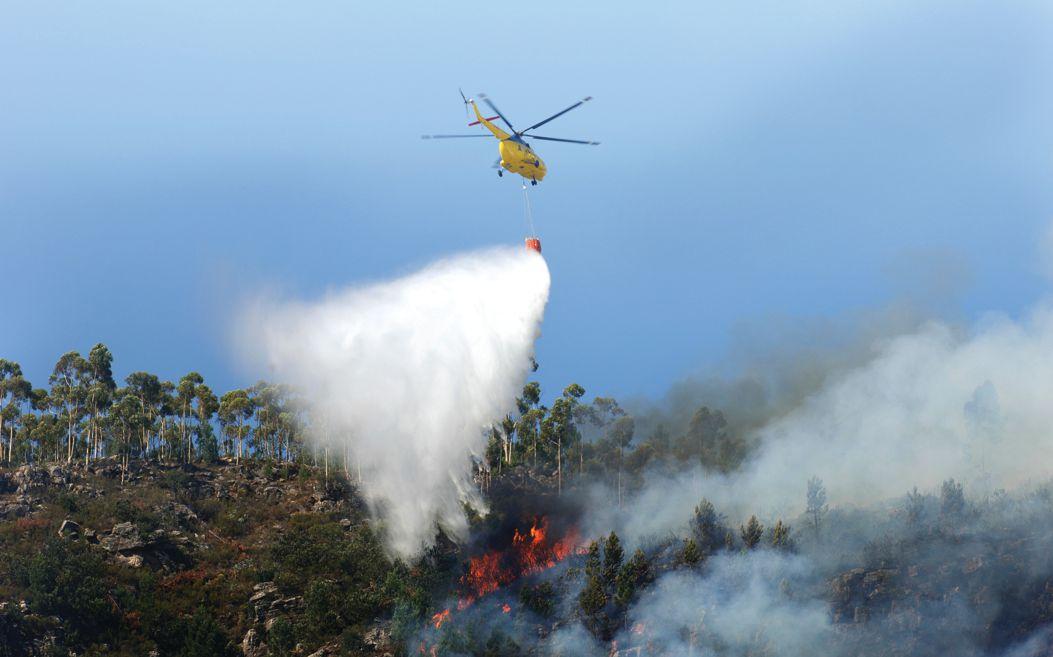
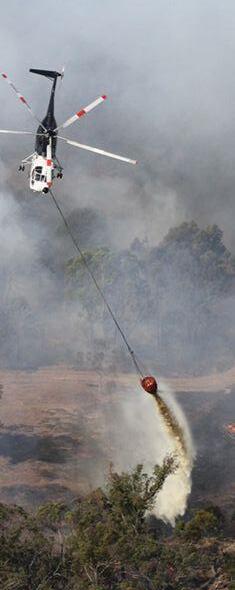
Extensive water bucket drops are critical to the success of B.C.’s firefighting efforts. (Photo courtesy of iStock)
required of pilots engaged in wildfire operations rather than simply relying on an arbitrary number of hours as a measure of a pilot’s capabilities. eight specific areas of expertise were identified, resulting in the creation of the pilot Competencies for helicopter Wildfire operations – Best practices training and evaluation, a joint haC/CiFFC document. For 2011, the forest agencies of B.C., alberta, Yukon, saskatchewan, northwest territories and Manitoba have all confirmed that they will be using these criteria.
buRninG bRiGHt
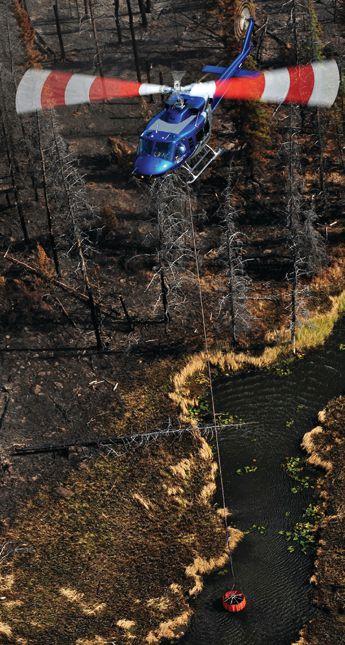
Canadians have always been at the forefront of aerial firefighting. sixty years ago, the first generation of commercial helicopters gave a hint of what would be possible when technology caught up to imagination. as machines grew larger, more powerful and gained reliability, the potential could be realized. techniques and equipment were developed through trial and error. Many credit Jim grady of okanagan helicopters with creating the first helicopter water bucket when he and henry stevenson fitted a trap door to the bottom of a 45-gallon steel drum with a switch that allowed the helicopter pilot to control the “Monsoon Bucket.” Fifty years on, the bucket is ubiquitous in aerial firefighting, with delta, B.C.’s sei industries supplying more than 90 per cent of the world’s market with their giant pumpkin Bambi Buckets. over the past 40 years, aerial firefighting, especially with helicopters, has grown from an ad hoc response to a sophisticated high-value industry in its own right. the ability of helicopters to deliver personnel, equipment and suppresion across wide regions under extreme conditions makes them a cost-effective tool at a time when all eyes are on the bottom line. as climates around the world continue to create conditions that lead to more and bigger fires every year, the role of the helicopter in wildland firefighting will continue to evolve.
farewell to dustballs and Rhino snot
Canadian Forces’ Griffons Prepare to Leave Afghanistan
bY peteR piGott
Helicopters correspondent Peter Pigott recently travelled to Afghanistan and was embedded with the Canadian Forces (CF) in Kandahar. He reports on the critical role of the Griffon helicopter and its CF air and ground crews in Afghan operations as part of the Joint Task Force Afghanistan (JTFA) Air Wing.
With the end of the Canadian Forces combat mission in afghanistan fast approaching, a seamless transition from the kandahar region for the allies remains the ultimate goal.
For the Bell Ch-146 griffon, it marks the end of a mission – one that has seen the tactical utility aircraft do a little bit of everything for the CF, including reducing the risk of exposing personnel to ambushes, land mines and improvised explosive devices, and providing protection to troops on the move.
“We currently have eight Ch-146 griffons in theatre,” said Capt. isabelle Bresse of air Force public affairs, “and the mission closeout activities will be done in such a way so as not to impact the task Force’s ability to conduct ongoing operations as part of isaF, under which Canada will cease combat operations in July 2011.”
Master Cpl. david Williams, who deployed to afghanistan in 2003 as part of operation apollo, is all too familiar with the harsh effects of the afghan environment on aviation operations. “We were a unique entity when we hit the ground in kandahar. Brand new and untested, we were part gunship, part pick-up truck...and we were riding ‘shotgun,’ ” said Williams, who was first deployed to afghanistan with the CC-130 hercules transports. “i had witnessed just how unforgiving and harsh the desert environment can be to aviation assets...even for something as rugged as a herc.” later deployed as a flight engineer with 408 tactical helicopter squadron, Williams must have wondered how the griffon going to cope – he would certainly find out.
a Valued peRfoRMeR
Whether operated by the CF in somalia, haiti or kosovo, helicopters have been used as utility vehicles – for troop transport, medevac and search and rescue. the Bell 412hp, was built in Mirabel, Que. and between 1995 and 1997 the CF received 99 of them. destined to be the “swiss army” knife of the military, the 412 was designated utility tactical transport helicopter (utth) Ch-146, more commonly called the griffon.
the multi-use rotary platform came in two configurations: the utility tactical transport helicopter (utth), and the Combat support squadron (Css) version. originally, neither were deployed to afghanistan, where without its own helicopters, Canada depended on airlift resources from its nato allies. that changed in January 2008, when one of the recommendations of the independent panel on Canada’s Future role in afghanistan, headed by former deputy prime minister and foreign affairs minister John Manley, was “to better ensure the safety and effectiveness of the Canadian contingent,” by immediately securing medium helicopter lift capability. the acquisition of six Chinook helicopters from the u s. army was followed by the announcement, on nov. 26, 2008, that eight Ch-146 griffon helicopters would also be deployed to afghanistan as part of the Joint task Force afghanistan (JtFa) air Wing.
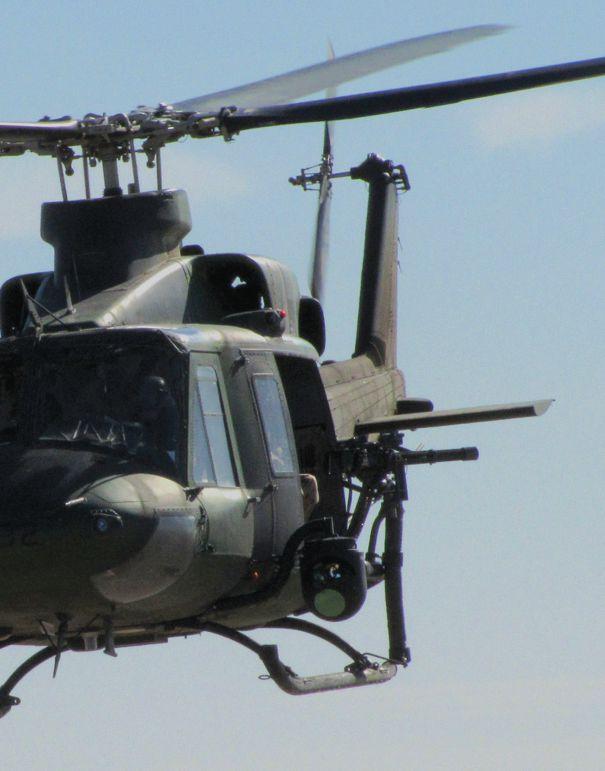
With crews from 408 tactical helicopter squadron based in edmonton, alta., the griffons were to act as escort aircraft for the Chinook transports. it was a significant change in Canadian aviation doctrine but one that dnd had been preparing for. as early as 2007, Close Combat attack (CCa) procedures had been developed by Capt. ryan tyler and Capt. Jean-eude ainsley, project officers at 403 squadron, CFB gagetown. the procedures would allow Ch-146 helicopters to use mounted C6 machine guns to react to fire support requests from forward air controllers (FaCs) in the field.
“having the ability to provide offensive helicopter fire support can give a huge measure of confidence to soldiers on the ground,”
ABOVE: Canadian Forces’ Griffon sets a course to begin Operation MOSHTARAK in Afghanistan. (Photo by Master Cpl. Craig Wiggins, Flight Engineer, JFTK Afghanistan, Roto 8)
said Cpt. tyler. once the CCa procedures were approved, crews began supporting FaC courses and land force exercises in various locations across north america.
it is to the credit of all concerned that on dec. 6, 2008, less than a year after the Manley report, the men and women of the Joint task Force afghanistan air Wing paraded at their base in kandahar. the air Wing included six C h-147d Chinooks, Cu-170 heron unmanned aerial vehicles (uaVs), eight Ch-146 griffons and three CC-130 hercules, already in theatre. Wing commander Col. Christopher Coates could rightly say how proud he was.
“our air and ground crews are experienced, skilled and enthusiastic,” he said. “they have trained hard to deploy here to provide important enhanced support to our fellow Canadians and our afghan and isaF partners on the ground.” But the Canadians knew
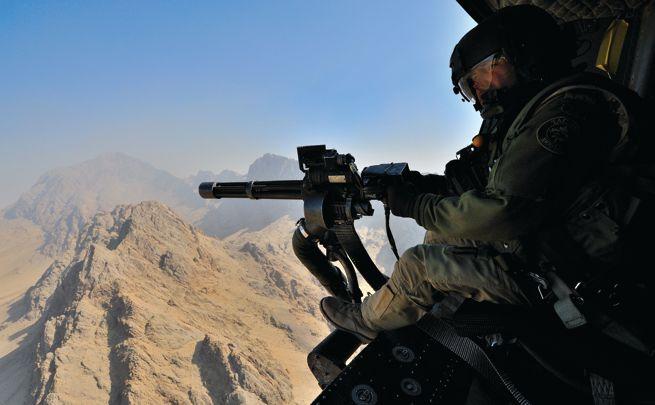
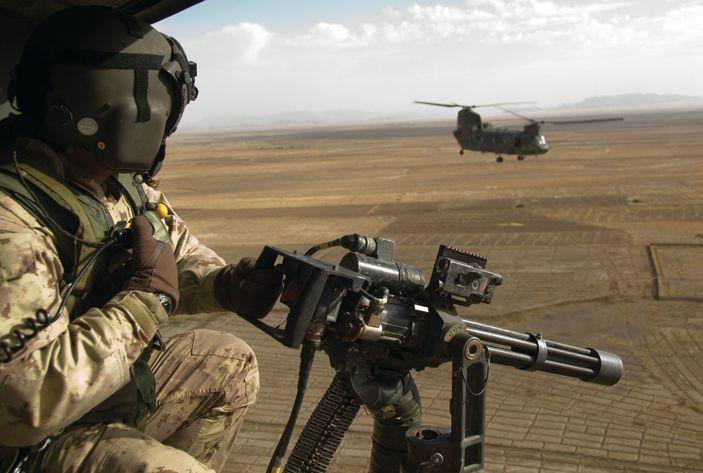
RIGHT: Door gunner, Master Cpl. Craig Wiggins, provides security from a CH-146 Griffon helicopter during an escort mission. (Photo by Master Cpl. Angela Abbey, Canadian Forces Combat Camera)
supporting Role
The CH-146 Griffon fleet will be well taken care of after its deployment to Afghanistan finishes up, thanks to a long-term deal with Bell Helicopter.
The $640-million deal awarded to Bell earlier this year by the federal government is called the “Optimized Weapon System Support” (OWSS) contract. It includes aspects of management services, engineering and technical publications, aircraft maintenance services, and spare and consumable parts.
The OWSS deal combines three existing contracts providing engineering support, repair and overhaul support, and supplies for the Griffon program. The contract will be worth close to $1 billion if the four-year options are picked up. The majority of the work on the Griffons will be done at Bell facilities in Mirabel, Que., and Calgary.
“With this contract, the CH-146 fleet enters a new era of support,” said Barry Kohler, president of Bell Helicopter Canada. “We look forward to working together to make the CH-146 fleet a highly successful one, capable of meeting the most challenging tasks assigned to it in the interest of national security.”
that the severe afghan environment they were to operate in was going to be as much a challenge as the enemy. “sand gets into absolutely everything,” Williams said. “avionics, engines, oil coolers, autopilot and Cdu buttons, seat rails, helmet bags, box lunches, you name it. it mixes in with the slightest of oil leaks to form a paste that if not dealt with in good time, gets baked into a hard crust by the hot sun. this meant that paying special attention to oil coolers was important on a preflight inspection.”
the key to keeping the griffons in the sky was preventive maintenance. at the fuel and re-arm point (Farp), a secure, isolated area on the kandahar base that allowed for the re-arming of helos, hot closed-circuit refueling (hCCr) soon became commonplace. (this is a special procedure that lets the crews refuel without shutting down, allowing for quick turnarounds.) “re-arming and refuelling are both risky, so trained crews were present to carry out these duties, allowing for quick turnarounds minimizing our times away from the Farp,” said Williams. “even something just a simple as keeping a 1.5-inch paintbrush in the map case or a can of compressed air to dust off the buttons and gauges on a preflight or during a flight would stretch out the life of push-button components like autopilot panels. religious cleaning of fine parts on mission kits like claw feet on seats and gun mount swivels reduced our dependency on replacement parts.”
a biRd’s eYe VieW
in William’s’ opinion, the flight engineers and door gunners had the best seats in the house during flight ops with the griffons. “in a day we could fly an escort mission for a Chinook, then refuel, pick up
dependable asset
The CH-146 Griffon has been a mainstay for the Canadian Forces since being introduced in 1995. Here’s a look at the aircraft’s chief roles in the past, a consideration of its uses going forward and a breakdown of its specs.
Primary and Future Uses: SAR (home and abroad) – though there have been questions about the aircraft’s suitability for the rigours of the job – surveillance and reconnaissance; casualty evacuation; counter-drug operations.
Notable Operational Highlights: Manitoba’s Red River flood (operational assistance), 1997; Eastern Canada’s ice storm (Operation Recuperation), 1998; united Nation’s effort to stabilize Haiti (Operation Helo) 2004; Security support for major Canadian events such as the Winter Olympic Games (Operation Podium), G-8 and G-20 Summits (Operation Cadence), 2010; SAR relief of trapped motorists in blizzard conditions on Highway 402 in southern Ontario (Operation Canton), 2010; military utility role, War in Afghanistan (Operation Apollo), 2011.
Aircraft Specifics:
• Length: 17. 1 m
• Rotor span: 14 m
• Height: 4.6 m
• Power plant: Pratt & Whitney PT6T-3D engine
• Maximum speed: 260 km/h
• Range: 656 km
• Crew: two pilots, one flight engineer
• Passengers: 10
some passengers/cargo and fly them to an FoB, refuel again, and then support ground troops and take the fight to the enemy,” he said. “i think our role provided a security and versatility that our ground troops deserved and appreciated. it saved lives, and it was one of the most rewarding experiences of my career.”
and just how did the griffon perform? Williams explained that pilots and maintenance teams learned quickly what the aircraft’s limitations were, and had prepared for that even before deployment. “several systems were removed even before departure from Canada in the name of weight saving,” he said. “however, once we arrived in theatre, we had refined our calculations to ensure we were squeezing every ounce of power we could to get the job done safely and effectively. We had started to appreciate not only our Wat [weight, altitude, temperature] limitations, but our itt [inter turbine temperature] limits as well (which is normally not a factor back here in edmonton...or anywhere in Canada for that matter). We started to utilize our hover ceiling charts more often than just simply referring to the Bell 1-1 Wat chart, giving us a more realistic picture of our performance.”
operationally, much of the flying was down in the weeds, where sand and debris were ever present. though most of the landings were on at least semi prepared surfaces, dust ball landings were still a part of life there. “those landings were perhaps the hardest on the helos,” Williams said. “We normally flew with the cargo doors removed for door gunning (and as a weight-saving measure), so it got dirty quickly. the main rotor blades would require refinishing quite often
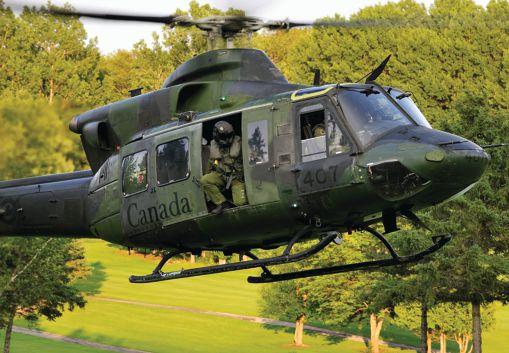
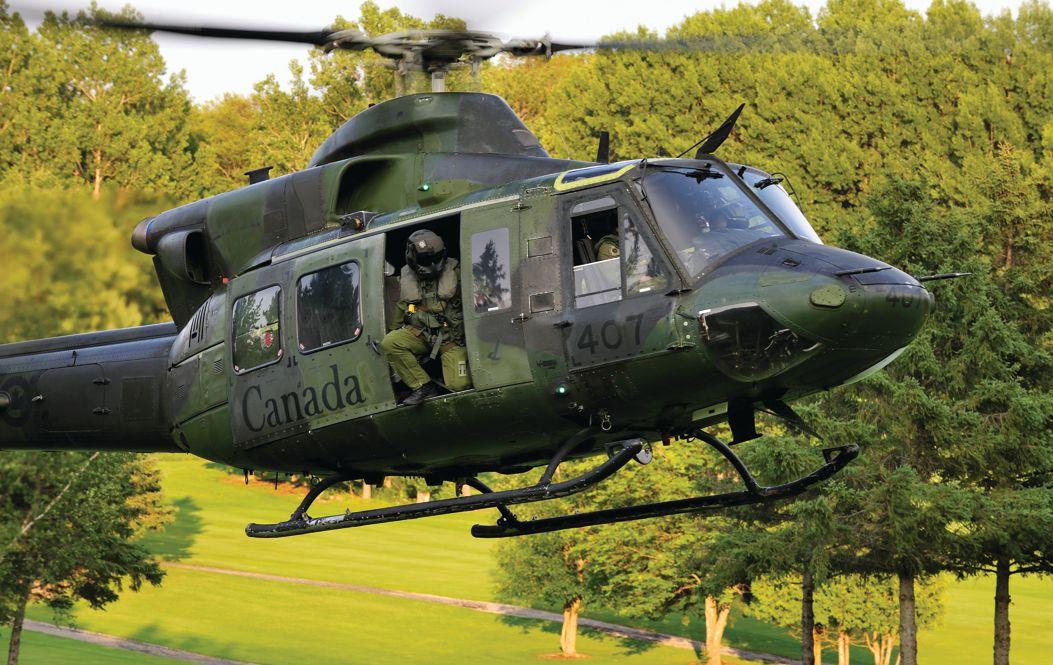
A Canadian Forces (CF) CH-146 Griffon helicopter lands at Deerhurst Resort after providing air mobility support to the 2010 Muskoka G8 Summit. (Photo by Cpl. Pierre Thériault, Canadian Forces Combat Camera)
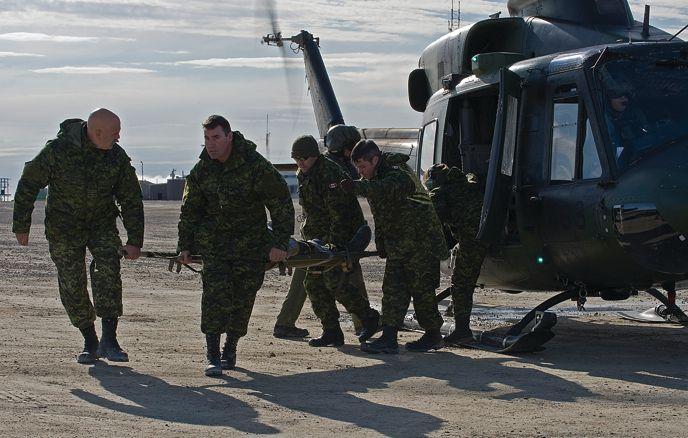
During a simulation exercise, a team carries a stretcher off a CH-146 Griffon helicopter as part of Operation Nanook, one of three major recurring sovereignty operations conducted annually by the Canadian Forces in Canada’s Arctic. (Photo by Cpl. Jax Kennedy, Canadian Forces Combat Camera)
as they were in a perpetual state of being sandblasted.”
some FoBs used “rhino snot,” a thick layer of slime developed by the u s. Marines at Camp rhino to cover the landing zone in order to keep the dust down. (the u s. army first used envirotac, the syrupy “goo” that is mixed with water and applied as a top dressing to harden loose soil at a harrier base in Yuma, ariz., in the late 1990s. in 2002, it was put into use at Camp rhino in afghanistan and the u s. Marines started calling the goo “rhino snot.” the material eventually breaks apart and is environmentally friendly.)
there. the Joint task Force afghanistan air Wing will be supporting mission transition activities throughout the end of the combat mission scheduled for July 31, 2011. rotarywing operations, said Bresse, will cease no later than the end of august, and all CF helicopters will be redeployed to Canada
shortly thereafter. upon return to Canada, they will be sent to Montreal (Bell helicopter) for thorough inspection and refurbishment. according to the air Force public affairs office, no decision has yet been made as to how the helicopters will be reintegrated into the overall inventory.
HoMeWaRd bound
having logged more than 1,000 hours on the griffon with some 250-hour and 37 combat missions flown in theatre, Williams returned home to edmonton. “it was quite unlike any deployment i had experienced,” he concluded. “usually, people aren’t trying to shoot at you and your friends, and vice versa . . . that adds a whole new dimension to the experience. there were ample opportunities where things could go wrong . . . very wrong, but they didn’t, and the rewarding part was that everybody got on that big airplane home. i think that speaks volumes about our aircrews and ground crews, some great hands-and-feet flying, sound tactics, and good training.”
With Canada’s role in afghanistan coming to a close, many changes are in store for both the troops and the helicopters deployed
CRITICAL DECISIONS AT CRITICAL TIMES
Choosing your fire fighting bucket is a critical decision.
As an operator you know that the cost of an AOG to your revenues, to your reputation and to the forest itself cannot be measured.
Bambi has been responding to AOG’s for 29 years in critical timeframes, without fail, without question. It’s not on the spec sheets or in the operating manual but it comes with every
Response time is everything. That is how you are being measured. That is how you are being paid. That is how you choose your next bucket...
Commanding force
Canadian
Forces’ Maj.-Gen. Yvan Blondin is calm, confident and in control
bY paul dixon
if there’s one man in the Canadian Forces who has his finger on the pulse of all rotary- and fixed-wing activity, it has to be Maj.-gen. Yvan Blondin – and he wouldn’t have it any other way.
the Montreal native joined the Canadian Forces in 1980 and has steadily risen in the ranks. a CF-18 pilot with more than 3,000 hours on type, he is today, as the commander of 1 Canadian air division and Canadian norad region, the one person responsible for the people and machines that comprise today’s Canadian air Force. Fit, trim and relaxed, Blondin spoke with Helicopters in his Winnipeg office about his colourful career and the status of some the air force’s most important assets.
Q. How did you come to join the Canadian Forces?
A. i was 21, going to school and needed a job. i answered a classified ad for an insurance salesmen but after the interview, i knew they weren’t going to call me back so i was pretty much out of options. My car just happened to be parked in front of the recruiting centre, so i thought “what the hell, let’s go have a look inside.” i went inside and asked, “do you have any jobs here?” the person behind the counter asked me what i wanted to do. i saw a poster behind his back of a pilot in a dark green flying suit standing by a jet and i thought that looked good. so, that’s how the air force reeled me in. When i went home and told my mother that i had joined the air force and was going to be a pilot she thought i was joking.
i arrived in portage the next summer for flight training and i’d never been in an airplane before. My first flight, in a Muskateer, scared the hell out of me. i couldn’t wait to get back on the ground. You go up and fly again the next day because you’re more scared about what the other guys are going to say about you than what the airplane can do to you.
i was in it all for the adventure, just for five years, and then i was going to get a real job. after five years, i was posted on the CF-18, a brand new airplane. then, at the end of nine years, i thought i would leave because they give you a year’s pay (as a bonus) and i could get a real job. But by then, i was involved with the CF-18, and i was doing something i was happy to do and being paid to do it. here i am 30 years
later, haven’t found a real job yet and just loving it.
Q. Your role has changed significantly over the past 30 years. Can you explain the breadth of your position as Major-General?
A. i’m in charge of all Canadian air force operations. it’s a great honour, the responsibility of being able to lead and make a difference. it’s certainly not a regular office job. the span of operations, afghanistan, air security operations in Canada for CanadaCoM, norad operations, operations for the Canadian north region . . . i’m also responsible for force generation, mission capability, developing pilots and air frames, so we can use them during operations.
it’s true the technology is great, but flexibility is the key to air power and this is where i exercise flexibility, having control of all the levers so that we can deliver the best effect in the end. over the past three years, we’ve had some big challenges, any one of which would be big enough on its own.
Q. What are those challenges and how do you manage human assets, especially given all the operation levels you oversee?
A. the first challenge is the people one. We downsized [in the 1990s] and we didn’t recruit. When you do this, you end up with a lot of young and lots of old, with nobody in between. the experienced folks are really what make it work, but they are the ones retiring. so, i’ve got lots of new folks coming in and we’ve been recruiting, doubling the rate of recruiting the past two or three years. it’s great to see all those new people coming in, but by the time we recruit them, train them and get them experienced, there’s a period of three or four years that they’re not useful to me. they’re actually a drain on assets, because i need to use experienced people to train them to get them up to speed. i’m operating probably with about 80 per cent of effective manning into my units.
this people challenge, when you couple it with the transition from old aircraft to new aircraft, is also a concern. having new aircraft is great.
With seven new fleets in 10 years, we’ve never seen that in the air Force. But when you get a new fleet, there’s a period of learning. there’s a period of not just learning to fly it, but also how to maintain it, to ensure you’re using it effectively. to get the best effect, it takes time. another key challenge is that we are so busy with operations. We took Chinooks that were virtually scrapped in afghanistan, turned them around, qualified on them, started doing operations and we’ve been successful for the past year. We’ve done that in a combat theatre. and if you do this with the C-17, do this with the Cyclone, do this with the Chinook, it takes people away – and it’s people i don’t have here to use the older aircraft. so, to try to go from one to the other has been a challenge.
Q. How has the role of the Canadian Air Force changed over the years, and what is the primary focus now?
A. the pace of operations has been unprecedented in the past 30 years. if you look at the 1940s and ’50s, when we had the second World War and then the korean War, we had operations ongoing with a huge air force and plenty of new people. after that, until the ’90s, it was 40 years of training. We didn’t have operational missions like we do now. For every one person that you deploy, you’ve got another one in training and one just coming back.
in the past year, we knew that supporting afghanistan would be a drain on what we did. We knew with the olympics coming up, we needed to prepare early, train people early, be careful in scheduling, deciding who would be used for what, whether they would be deployed to afghanistan this year or next. We actually told people to take their leave early in the year because we thought it was going to be busy after Christmas for three months. We arranged the training schedule with the different operational training units so we had enough assets to support afghanistan and the olympics.
so, when haiti came up right in the middle of the operations, it wasn’t a question of whether we could do it or not. it was, “ok, we’re going to haiti.” Because i control everything, i could decide to slow down a bit on training for helicopters because i needed a six-pack to go to haiti. it was easily co-ordinated and done. We could use the flexibility we needed, and within 12 hours, we had a plan on how we were going to support haiti – and how we could do other operations because everything was controlled out of here from the CaoC [Combined air operations Centre]. every day for the first two weeks, we were having video-conferences daily with ottawa, Vancouver and everybody involved with the different operations, to see where the stresses were and what we needed to adjust to be able to support.
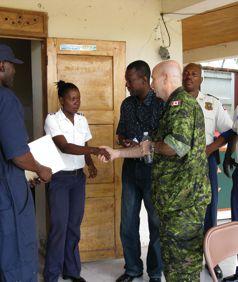
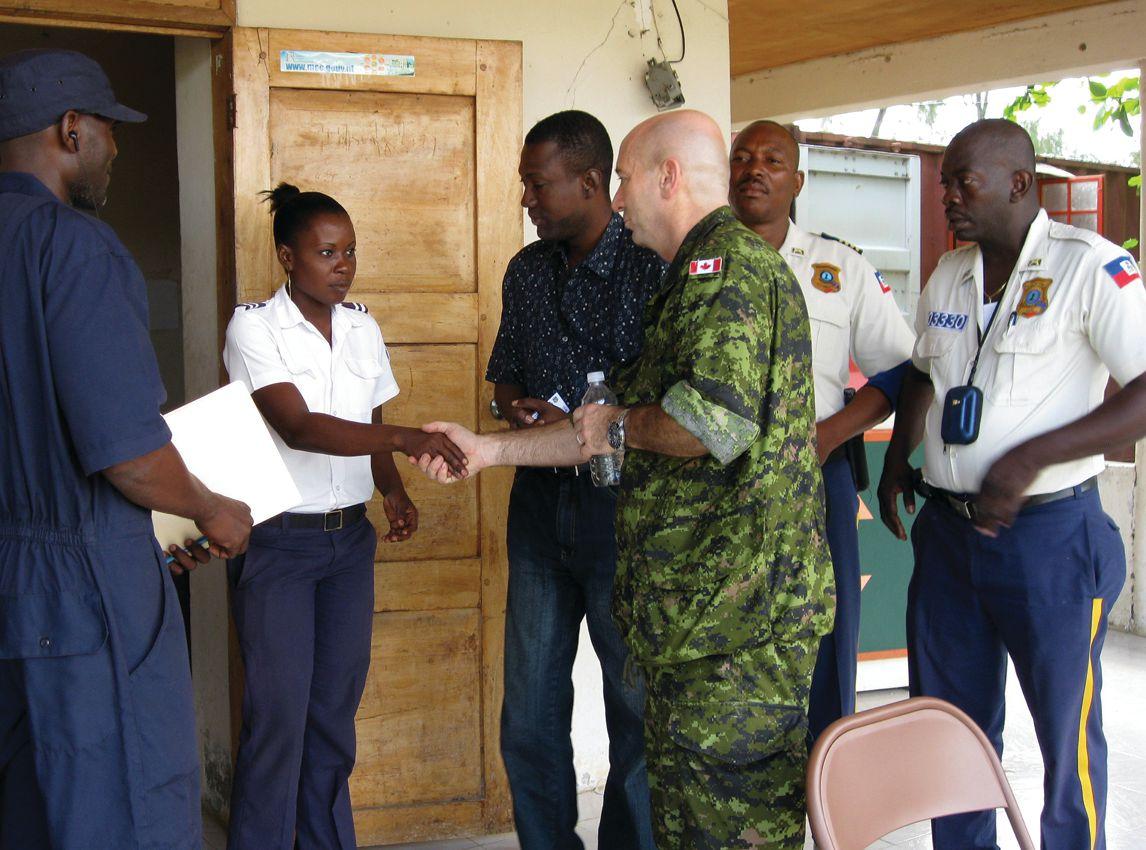
ABOVE: Maj.-Gen. Yvan Blondin greets Haitian officials at the Jacmel airport during Operation Hestia. (Photo courtesy of DND)
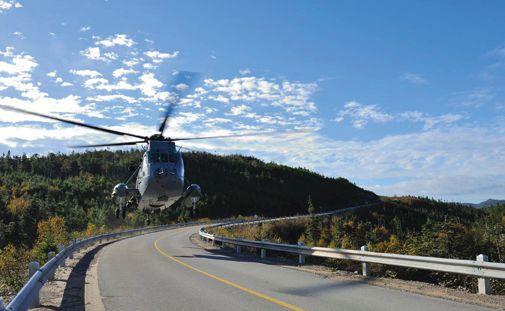
RIGHT: Maj.-Gen. Yvan Blondin monitors the CF fleet, including this Sea King from 423 Squadron in Shearwater taking off from a highway near a bridging site in Petite Forte, Newfoundland. (Photo by Master Cpl. Angela Abbey, Canadian Forces Combat Camera)
Q. So, you’re functioning today at a level that wouldn’t have been possible in that old regime, during the Cold War?
A. during the Cold War, we didn’t have that flexibility. We didn’t have the same operational mindset or the same qualifications. actually, the people principle is probably what makes us successful. the motivation is just unbelievable. if i keep them busy, if they’re doing operations, they just love it. When we do something it’s more than just getting the pay, it’s like you make a difference, like you’re useful, especially doing all this and the tremendous support we’re getting from the population.
Q. You have many people who report to you, but by the same token, you have different people you report to above you, depending on the situation. Do you find that difficult?
if i can retain the good people, and just let them do their job, they will work miracles.
Q. Canada is poised to replace 138 CF-18s with 65 of the hotly debated F-35s. How is this possible?
A. When we bought the F-18 we bought 138, but we had three squadrons of F-18s in germany at that time. We were supporting four operational squadrons in Canada plus an otu, so we were supporting eight squadrons with 138. right now, we are operating with around 78 F-18s, but there’s a huge inventory at the otu, so if you look at my four squadrons, i’m operating with 13 or 14 planes per squadron today. the F-35 is planned to be 12 per squadron with four squadrons, but it is assuming we’re going to have an otu, which would have 15 to 17 airplanes.
A. i provide the air support, so it’s just that different missions have different bosses. i’m really the facilitator, the co-ordinator. i make sure that i advise them the best way possible –and ensure we can still do other missions. it’s all about having one point of co-ordination and offering the best use of resources available, because i can play with everything. i can slow things down, because everything is based on force generation capabilities. it’s all about training. i need hours to train my new pilots, qualify them. that requires a lot of available resources. the more i use for that, the less i have for force employment and operations. When something comes up, i can say, “slow down,” let’s slow down on this and we can catch up later, re-adjust. if there’s a mission out there to be done, we’ll do it. so, i wouldn’t want to separate those hats, they need to be together.
Q. What are your thoughts on the Family Support Initiative and how different is a military career today compared to several decades ago?
A. the more i talk about operations, the more the guys want to do them. But when you deploy people for six months and they come
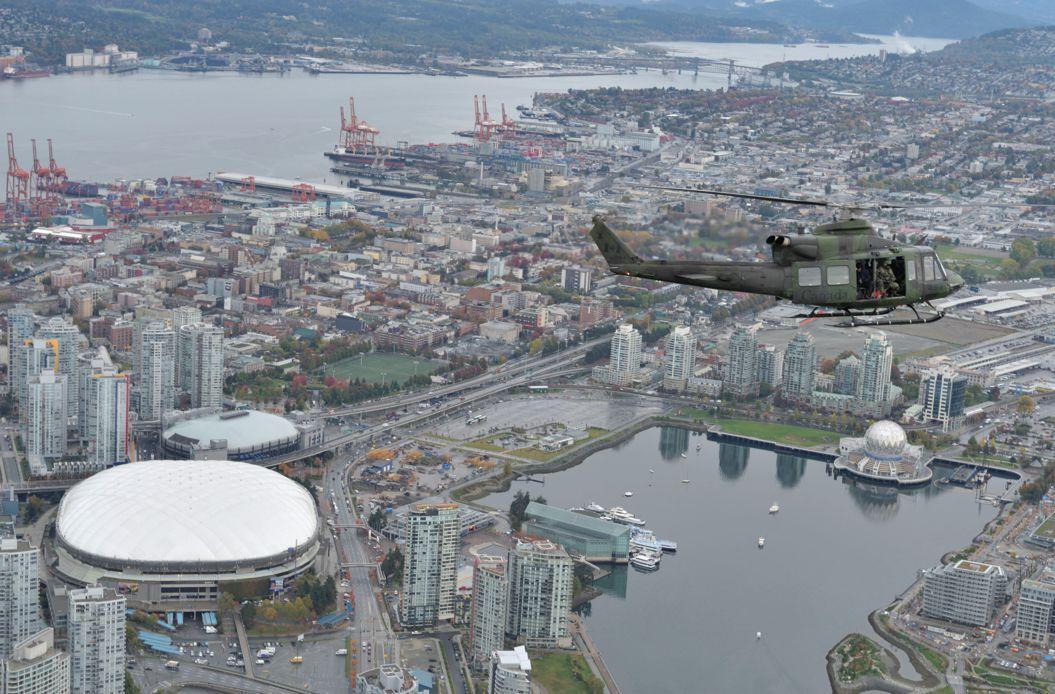
A CH-146 Griffon helicopter flies over Vancouver during a familiarization flight in preparation for Exercises PEGASUS GUARDIAN 3 and SPARTAN RINGS. (Photo by Sgt. Paz Quillé, Canadian Forces Combat Camera)
back, it’s tough on the family. The problem we have with attrition is not necessarily coming from the guys. I can keep them interested, they love what they are doing, but when the spouse says, “I’ve had enough,” I lose a guy. If I don’t take care of the family, I’ve got a problem. So, we’ve put a lot of effort into supporting people. If I’ve got someone coming back with psychological problems from an operation in Afghanistan, it’s not just that person who has the problem; the wife and the kids are having the same problems. Even if there are no psychological problems, repeated operations abroad has an effect on the family.
Q. So, the CF is much more concerned about looking after its human assets today?
A. When I joined 30 years ago, they would ask me which posting interested me, but we knew we were just going to go where we were told. It’s much different today. We consult. We ask people . . . what about moving this year? What about next year? We make long-term plans. We’re much more flexible in our approach, trying to consider family issues, family obligations, location preferences. It’s not because we want to be nice people. It’s what you need to do if you want to retain people.
The truth is, the only reason we are successful in our operations is because of the people who make it work. If I can retain the good people, and just let them do their job, they will work miracles. It’s not the equipment that makes us different from other Air Forces; it’s the people flying it and maintaining it that make the difference. It’s what I see in every-
Two Canadian Griffon helicopters and a Canadian CH-130 Hercules airplane gathered at Jacmel airport in Haiti during Operation Hestia. (Photo by Cpl. Julie Bélisle, DND)
thing we do. It’s a highly professional force; we’re a small, but elite force.
Q. Risk is an important part of any Air Force mission. How do you manage risk –and does it ever worry you?
A. You’re always operating at the edge of your capabilities, having to make the call: do we do it or not? But if we don’t do search and rescue in bad weather, who’s going to do it? It’s always about risk management. How much should we do and how much do we not do? It’s a tough question. If we go to Haiti, how far do we push, where do we stop? Everything is about pushing the limits but keeping it within safety parameters. After all, managing risk is my bread and butter. Every day, there’s another decision, always based on the risk. There’s a lot of stuff being done here – but that’s what makes it enjoyable.
A door gunner provides security from a CH-146 Griffon helicopter in Afghanistan. The Griffon is riding shotgun for a CH-147 Chinook. (Photo by Cpl. Owen Budge, JTFK Image Tech., Afghanistan, Roto 8)
Good Vibrations
Optimism abounds at Heli Expo 2011 in Orlando, Fla.
bY Matt niCHolls
it’s arguably the most dynamic trade show of the season and this year’s version of heli expo, held March 5-9 in orlando, produced its fair share of game-changing news.
From extravagant launches, to new products, to special celebrations – innovation was on display in spades.
Helicopters magazine was there and shares some highlights of this year’s event. and while the industry continues to recover from a stagnant period of growth over the past couple of years, optimism abounds for better times ahead – in Canada and around the globe.
sHinY neW toYs
one of the most exciting aspects of any aviation show is the introduction of new aircraft, and this year’s version didn’t disappoint. new helicopters from two major oeMs – and an upstart swiss engineering firm – made quite a splash right out of the gate.
eurocopter got the party started with its glitzy introduction of the new eC-145 t2 twin-engine helicopter. unveiled in dramatic style at the company’s spacious booth in front of hundreds of attendees, the new aircraft was “piloted” through a dramatic cloud of dry ice by lutz Bertling. Four gorgeous female crew members accompanied eurocopter’s president and Ceo, who stepped out to say a few words.
“as the leading helicopter company in the world, eurocopter has a strong commitment to innovation,” said Bertling proudly. “it’s all about customer value, it’s all about mission capability. our understanding of innovation is to turn technology into higher customer value. this is precisely what we have done with this helicopter. With the 145 family, which started with the Bk-117/eC-145, we have delivered more than 700 helicopters and flown thousands of hours – but this not a reason to stop innovating. [this new machine] will feature more power and versatility than its predecessor and continue to put us in a leadership position in this market.”
the eC-145 t2 medium-light twin is an evolved version of the eC-145, incorporating new features for enhanced performance. it sports the company’s signature Fenestron tail rotor for maximum safety, powerful new arriel 2e engines, upgraded main and tail rotor gear boxes and a new avionics suite.
and while deliveries for the new aircraft are set to begin in 2012, interest at the show was immediate – the aircraft had three u s. operators as its launch customers: Metro aviation, lewis energy group and leading edge. spain’s inaer (10 aircraft in eMs configuration) also jumped on board.
the eC-145 t2 is expected to attract operators worldwide in eMs, sar law enforcement and corporate sectors. oil and gas and off-shore customers will also appreciate its nine-passenger seating capacity. it promises to be a strong addition to an already solid eurocopter family – one, that as Bertling pointed out in his annual state-of-the-organization breakfast, will keep eurocopter heading in the right direction.
the company experienced slow growth in 2010, showing revenues of $6.7 billion verses $6.2 billion in 2009. some 46 per cent of eurocopter’s deliveries went to the military sector, whereas 54 per cent went to the civilian and parapublic sector. the company claims to have a 49 per cent share of the world-wide helicopter market.
foR WHoM tHe bell tolls
With attendees still marvelling at the introduction of the newest member of the eurocopter family, Bell helicopter grabbed attention with its own dramatic unveiling.
Bell launched the 407gX and the 407ah – two versions of its popular 407 single, to much fanfare. the 407gX is an enhanced 407 equipped with an innovative garmin g1000h integrated flight deck. the new glass flight deck provides pilots with critical flight information at a glance for greater situational awareness, improved operational capability and increased safety. the cockpit features, as standard, two 10.4-inch high-resolution lCd displays with an intuitive, easy-to-scan layout and an integrated avionics system that presents flight instrumentation, position, navigation, communication and identification information.
“the Bell 407 was already an industry-leading helicopter offering superior performance, exceptional passenger comfort and enhanced safety characteristics,” said larry roberts, senior vice-president of commercial business for Bell. “the 407gX’s next-generation cockpit combined with the aircraft’s rugged airframe will make it the first choice for
ABOVE: The Bell 407GX offers an excellent blend of safety and performance. (Photo courtesy of Bell Helicopter)
RIGHT: AgustaWestland CEO Giuseppe Orsi called the AW169 a “vision of the future” at this year’s Heli Expo. (Photo courtesy of AgustaWestland)
BELOW: Eurocopter president and CEO Lutz Bertling outlines his company’s economic performance in 2010. (Photo by Matt Nicholls)
those who place their highest value requirements on safety and performance.” the 407gX represents a $125,000 upgrade over the $2.6 million base 407 model.
gary kelly, vice-president of marketing for garmin international who joined roberts on the stage, said the new machine borrows many traits from its fixed wing companions. ”While many of these features can be found on fixed-wing aircraft, the highly-scalable g1000h takes cockpit operations and safety technology to the next level,” he said. one of the most impressive aspects of the 407gX cockpit display is its big screens. these will be extremely attractive to law enforcement operators as they can display functions such as forward-looking infrared (Flir) display and camera images.
Bell also introduced its first armed commercial aircraft, the 407ah it’s the first Bell-qualified armed commercial aircraft across the market and is designed to support a wide range of law enforcement and paramilitary missions worldwide.
the 407ah comes equipped with a baseline law enforcement package that can be customized with multiple weapon configurations. “the 407ah is a high-performance platform with exceptional manoeuverability, speed, payload and range,” said roberts. “it will meet the needs of a variety of parapublic agencies at a cost that is far less than that of a similarly equipped military aircraft – but with increased lethality.”
not to be outdone
Bell and eurocopter weren’t the only major players showcasing shiny new hardward at the show. agustaWestland, a Finmeccanica company, used heli expo as its “full commercial launch” of the aW169, an eightto-10 passenger medium/light twin. the project was first announced at the Farnborough airshow last year.
the multi-purpose twin is a technologically advanced aircraft capable of carrying up to 10 passengers, or being configured for two stretchers in a cabin accessible by sliding doors. it is powered by two Fadec-controlled pratt & Whitney Canada pW210 engines and has countless safety margins with high rotor clearance – making it ideal for a number of uses from eMs to sar. With the first flight set for 2012, it is expected to be in full service by 2014.
agustaWestland also showcased one of its popular aW139s at the event – one of 10 purchased last year by ontario-based eMs ornge. the aW139 is one of the company’s most popular products and continues to lure operators from a variety of disciplines.
in a thought-provoking briefing just prior to the opening of the show, agustaWestland Ceo giuseppe orsi called the aW169 a “vision
of the future.” he noted the first flight is expected in 2012 with service to begin in 2014, though he maintains 2013 is more accurate. orsi was quite positive while highlighting his firm’s fortunes in 2010. the Milan, italy-based company delivered 111 commercial helicopters last year, its market share has grown steadily in the past five years . . . and the future looks bright. “agustaWestland has been growing at more than three times the rate of market growth,” he said, “and we have room to expand.”
proving that one of the keys to effective leadership and innovative thinking is keeping one’s finger on the pulse of future trends, orsi captured attention when discussing the future uses of rotary-winged aircraft. When talking about growing congestion at major airports, for example, he cited vertical flight as a possible solution. City-centre heliports concentrating on vertical transportation with helicopters of 50-passenger capacity could help alleviate congestion.
agustaWestland is assisting in two heliports currently under development in Milan. said orsi of promoting the use of vertical flight in city environments as a transportation option, “it’s something we must do. We need to be more supportive of helicopters [in our cities]. . .we need to be aware that helicopters can be an important part of the transportation infrastructure.”
skY seaRCH
the swiss are famous for hot chocolate and well, cheese. perhaps in the very near future you can add helicopters to that list. a swiss engineering firm, Marenco swisshelicopter, unveiled its first aircraft at the show a carbon-fibre, single-engine aircraft. the 5,200-pound prototype skYe sh09 will fly next year and begin customer deliveries in 2015.
the $2.6-million helicopter is powered by a single Fadec-controlled honeywell hts900 engine and has a quiet five-blade rotor system –which will generate a cruising speed of some 270 km/h and a range of 430 nautical miles. designed for five to eight passengers, the skYe sh09 will be most useful in parapublic, oil and gas, sar operations and air ambulance roles.
northern Reflections
• B.C.’s Alpine Aerotech Ltd., and Alberta’s Avialta Helicopter Maintenance Ltd. and Eagle Copters Maintenance Ltd. were among 14 independently owned maintenance, repair and overhaul service providers to capture Bell Helicopter’s Platinum-level service award.
• V. Kelner Helicopters of Thunder Bay, Ont. announced the purchase of its second AS350 B3 aircraft from Eurocopter Canada.
“The selection of a second AS350 B3 was easy – the aircraft is well-suited for our operations in mineral exploration and our customers have come to count on the performance and lift capability,” said Frank Kelner, CEO. V. Kelner Helicopters was established in 2008 and began its operations with an EC-120B and in 2009 expanded with a new AS350 B3.
• Eurocopter Canada also announced the sale of three AS350 B2s, two EC-130 B4s and one AS350 B3 aircraft to Capitale Hélipro based in Quebec City. It brings the company’s fleet to 11 aircraft: five AS350 B2s, three EC-130 B4s, two AS350 B3s and one EC-120B. Capitale Hélipro’s operational base offers a wide variety of services, including; charter, sales, maintenance and helicopter flight training.
• VIH Aviation Group Ltd. purchased 10 AgustaWestland AW139 helicopters and signed a long-term deal with Pratt & Whitney
Eurocopter president and CEO Lutz Bertling navigates the new Eurocopter EC-145 T2 during its introduction. (Photo by Matt Nicholls)
Marenco is a contract mechanical engineering firm in pfaffikon, switzerland that employs a team of some 30 engineers. its Ceo, Martin stucki, is a veteran helicopter pilot. Commercial director Mathias senes maintains that the aircraft is ideal for mountain rescue ambulances and air ambulances – and is designed for customers who want the cabin space of a twin with the operational capabilities of a single.
tHe need foR speed
the quest for producing the fastest helicopter on the planet was also front and centre at heli expo.
the main contenders in the speed game are sikosky’s supercharged X2, which has reached speeds of 250 knots in flight tests; eurocopter’s X3, which reached 180 knots in flight tests last fall; and the nine-passenger Ba609, a civil tilt-rotor helicopter being developed by Bell and
Canada to service the helicopters’ PT6C-67C engines. “Our fleet of helicopters provides a vital service to oil and gas customers who require highly reliable transportation among their various sites, including their off-shore facilities around the world,” said Ken Norie, president. “Pratt & Whitney Canada engines have been an important part of our fleet for the past 10 years, and we are pleased to see their increased presence in this important parapublic market.”
• StandardAero celebrated its 100th anniversary at this year’s event. Originally founded as Standard Machine Works in Winnipeg in 1911, StandardAero has grown into one of the world’s largest independent repair and overhaul companies supporting the aerospace industry. A multi-faceted product line includes engine maintenance, repair and overhaul of general aviation, air transport, business aviation, military transport and, of course, helicopters. Said vice-president of helicopter programs Tom Roche: “We’re continuing to add some very impressive customers to our growing list of satisfied clients, and our partnership with Rolls-Royce has never been stronger. Our diverse customer base in military, police, EMS, corporate, tourism, oil and gas support, and utility operators has provided us with exceptional strength and resiliency to market shifts.”
agustaWestland.
Bell helicopter president and Ceo John garrison addressed the speed issue in his press conference, revealing that the Ba609 is leading the pack in the speed game. garrison said the nine-passenger aircraft has reached speeds of 270 knots. “the X2 and the X3 just can’t touch it,” said garrison proudly. and how committed is Bell to the project? “our intent is to continue to work on it,” said garrison, adding that he hopes the aircraft will be certified in 2014.
When asked about the X3 in his press briefing, eurocopter’s Bertling was less concerned about the speed race than about delivering optimum value. “it’s not just about the speed, we are not in a race
for speed,” he said. “it’s about providing the right price point for customers.” the X3 has a variety of uses for civil operators, Bertling said, including sar, border patrol and commercial off-shore passenger support. Military applications are also a possibility. the X3 may be in service in six years, Bertling said.
life of tHe paRt Y
prior to attending my first heli expo this year, i was told not to miss the Md helicopters press conference with the dynamic lynn tilton. the advice was warranted as the Md helicopters Ceo gave a detailed overview of her company’s progress in 2010 to a standing room only crowd.
Md delivered 20 helicopters in 2010 and tilton hinted that at number of key contracts are coming to fruition in the near future for the Mesa, ariz.-based firm, including one for 50 to 75 aircraft Md 902 explorer twin helicopters for eMs services across six Middle eastern countries.
another major deal was announced just after the show: a $186 million contract from the u s. army to supply six Md 530 F helicopters for training purposes as part of its rotary Wing primary training aircraft in shindand, afghanistan. as many as 54 aircraft may be delivered over the life of the four-year deal.
tilton spoke passionately about building up the perception of american manufacturing companies in the world market and keeping americans working. said tilton: “We are extremely excited about the future and keep working on our processes so we can get better and better.”
excitement about the future and a focus on improving processes are fitting ways to capture the sentiment of this year’s event – positive vibes about the future.
Sikorsky’s supercharged X2 has reached speeds of 250 knots in flight tests. (Photo courtesy of Sikorsky)
The indispensable reference tool for aviation industry executives from the publishers of
Trans North Helicopters at Whitehorse, Yukon is accepting applications for the following positions:
PILOTS
Minimum 2000 hrs, endorsed on BH06, AS 350 & Hughes 500’s. Must have mountain experience with long line proficiency moving diamond drills or similar operations. Full time and seasonal positions available. Competitive wages and excellent benefit package. Applications by email to Stephen Soubliere, Chief Pilot chiefpilot@tntaheli.com or by fax (867) 668-3420
AME’S
M1 & M2 with experience/endorsements on BH06/L, AS350 and Hughes 500. Full time, permanent, competitive salary and excellent benefit package. Applications by email to Charles Hoeller, Chief Engineer choeller@tntaheli.com or by fax (867) 668-3420
aptain, reach for your hat.” this is a saying, i always tell our pilots to think about when an emergency occurs. i didn’t coin this phrase; my brother-in-law, andy, passed it along to me several years ago while sharing a beer at his home in hythe, england. andy is a simulator instructor and flight examiner in the Boeing 777 and the airbus a320 for air 2000.
Why is this saying so critical? using the analogy of taking the time to reach behind you for your hat in an emergency slows you down to deal with whatever has occurred, without rushing into an action that could possibly make matters worse; an action like switching off the wrong fuel valve on the good engine (something my brother-in-law and i have witnessed in the sim more times than we care to remember).
andy and i often compare notes, as i too, am a sim instructor and flight examiner in the Bell 412 simulator for abu dhabi aviation in dubai. From our joint experiences as sim instructors, we have witnessed more harm done by pilots getting in a rush by any other factor. We also concur there are very few emergencies where you have to do something immediately. Flying a single-engine helicopter when the engine quits is one exception, of course, but in a twin, you only need to “check down collective” a little to ensure you don’t exceed the limitations of the good engine. there are no prizes for how fast you can deal with an emergency, only the booby prize if you get it wrong!
Lessons Learned
Celebrating the Value of the
Simulator
do it! disabling Fred is more of a helicopter pilot’s reaction, i think, than a fixed-wing pilot’s reaction.
there are usually two instances when i see a pilot disengage the autopilot. one: he perceives the autopilot is doing something he isn’t expecting so he disengages it and takes over manually. this is normally because the pilot doesn’t fully understand the autopilot and he’s done something to make it happen. i see it more often after one engine has been shut down.
the second incidence is when there is an emergency. the captain somehow feels “i need to take control.” once he’s done that, the crew has two emergencies on its hands. it’s like having three crewmembers in the cockpit, and just when you need all three, the pilot relieves “Fred” of his command, leaving the remaining crew to fly the helicopter and deal with the emergency. leave Fred alone; let him fly while you and the copilot deal with the emergency.
Robbie pilots, take HeaRt
abu dhabi aviation recently landed a contract that required it to hire 56 new pilots. the pilots were given 10 hours in the sim as copilot, then 10 hours acting as captain. after passing a checkride, they were given a type rating on the Bell 412.
thinking toward the future, my company elected to hire several young, relatively low-time robbie instructors (instructors on robinson 22s and 44s) who had either just recently received their atp or were a year away from attaining one. taking on the Bell 412 was, of course, a huge leap for them as well as a terrific opportunity. i couldn’t help but wonder how they would make the transition. turns out i needn’t have worried – i was very impressed with their performance.
there are very few emergencies where you have to do something immediately. ‘‘
tHe “i’M GoinG to kill MYself” sWitCH
i have seen many instances in the simulator where a pilot gets into trouble by acting hastily. For example, a pilot is flying on instruments in cloud with the autopilot (we call it “Fred”) engaged, doing the flying for him; when given an engine fire scenario, the captain grabs the controls, punches Fred in the nose, knocking him out, just when Fred is needed most. i have seen more pilots get into trouble by disabling the autopilot in iMC conditions than any other non-emergency. don’t
i am pointing this out to “new” pilots out there because in the beginning of our careers, we all have self doubts, wondering whether we will be able to make the leap to a new machine. take heart. When the time comes, you’ll do just fine. that is, if you always remember to reach for your hat – and stay in control.
Randy Mains works for Abu Dhabi Aviation as a type rating instructor and flight examiner in the Bell 212 and Bell 412. He is also a flight simulator instructor and flight examiner in the Bell 412 flight simulator in Dubai training his company’s pilots. When not in Dubai he resides in Victoria on B.C.’s Vancouver Island. He was the keynote speaker at this year’s HAC conference.
JUNE 1 & 2, 2011
Over 8,000 industry suppliers and government customers
Over 400 booths, 128,000 sq ft of exhibition space
of the art defence and security technologies, equipment and services