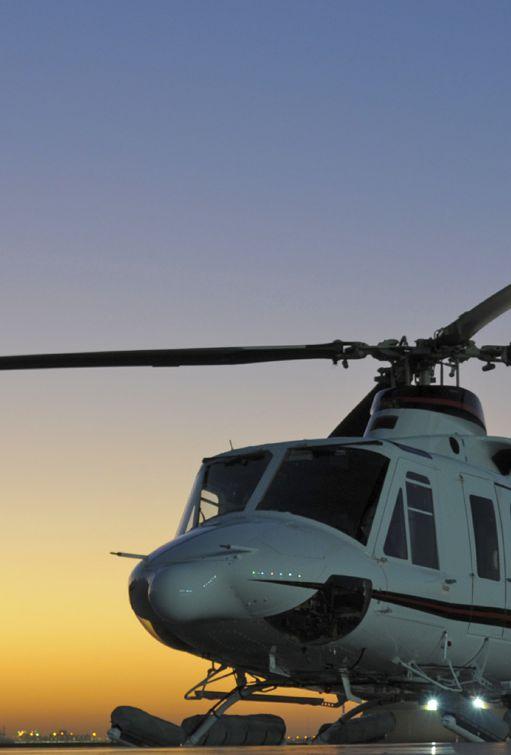
That’s why technicians at our authorized Customer Service Facilities have been trained at Bell Helicopter’s industry-leading training academy. As factory-trained maintenance technicians, they are dedicated to providing you with the highest level of service using Bell Helicopter’s rigorous standards of quality. With more than 100 Customer Service Facilities across 35 countries, you’ll get the best support in the industry.
Bell Helicopter Proudly Recognizes Our 2012 Platinum Customer Service Facilities:
Air Asia Company Ltd.
Alpine Aerotech Ltd.
Avialta Helicopter Maintenance Ltd.
Eagle Copters Maintenance Ltd.
Northwest Helicopters, LLC
Rotorcraft Support, Inc.
Servicio Tecnico Aereo
De Mexico (STAM)
Summit Helicopters, Inc.
Uni ight, LLC
Sikorsky’s
Calgary’s
lMAtt niCHolls editoR
ast spring, Helicopters magazine sat down with influential Canadian operators at its first roundtable in vancouver to discuss key issues affecting the industry. it was, at times, a spirited affair, especially when discussion turned to the ongoing challenges many have with the framework of Canada’s regulatory environment – and, more specifically, in dealing with transport Canada (tC).
regional disparity and the inconsistent interpretation of regulations in various geographical sectors were key issues, while Helicopter association of Canada president fred Jones added that tC’s approach is often confined to the tactical, which is based on department, instead of having a system in place that ensures all regions can interpret information in an identical way.
the group highlighted other issues plaguing the nation’s federal regulator, from inferior service – particularly when it comes to safety and following through on the safety Management system principles that were articulated to the Canadian helicopters industry several years ago. frustration with flight and duty time limitations (see, “the Gorilla in the Hall,” Jan/feb, pg. 38) was another sticking point.
said Jones: “at a time when more and more responsibility is being shifted to industry to manage its own safety and mitigate its own operations, there is a situation where less and less responsibility, or less and less authority, is being given to actually accompany that in a flexible way.”
fortunately, there are good news stories when it comes to interactions
Seeing the Light
NVIS Leadership a Refreshing Change
the collective efforts of all parties have produced a document that is thorough, efficient and clear – a testament to how the process should work. “the HaC group was very dedicated in its objectives,” he said. “it was great because of the interest and professionalism of all HaC participants and several other agencies such as royal Canadian Mounted Police, ontario Provincial Police, ontario Ministry of natural resources, Government of Manitoba air service and the Canadian owners and Pilots association. everyone was very much dedicated to a working model that would ensure safety yet allow industry to capitalize on the technology.”
toews was positive about the group’s accomplishments. “it meets industry’s need for clear guidance from transport Canada for the implementation of nvis and evs in normal operations where an exemption from the Cars is not required (basic operations),” he said. “there may be a few issues that require clarification or further development, but in general the CBaC reflects industry consensus regarding training, qualification and equipment requirements for basic operations.
“the development of the nvis/evs CBaC is a good example of cooperation between the HaC and tC.”
Key recommendations for operators considering getting into night vision, said Demers, is to take it one step at a time, ensure good training and be prepared to follow through with the recurrent training. operators need to see it as a true safety enhancement for night vfr as for next steps, there is a submission of 6 nPa (notice of Proposed amendment) for the Cars (Canadian air regulations), which will be reviewed by CaraC (Canadian aviation regulation advisory Council) this coming fall 2012.
tC’s stephane Demers is proud of the direction that Canada is taking with nvis.
’’
between industry and tC, and the collective work of industry. HaC’s nvis working group is, for the most part, a shining example. the working group, led by stars pilot Bob toews, has joined tC’s stephane Demers and rob freeman in laying the groundwork to develop regulations that will help put Canada in a leadership role when it comes to nvis their collective efforts came to fruition in february with the release of the advisory Circular for night vision (www.tc.gc.ca/eng/civilaviation/opssvs/ managementservices-referencecentre-acs-600-603-001-1467.htm).
Demers told Helicopters he is proud of the direction that Canada is taking with nvis
“i hope that now that the circular is out, we will see more operators look at introducing nvis into their operations and that some of them will possibly see a growth opportunity – such as being able to conduct aerial work at night – and also to see a growth with fixed-wing operators,” Demers said. “as the technology grows in popularity, and hopefully becomes more affordable, i hope to see it become the norm for all commercial operations doing night vfr work. Much like we have seen GPs become the norm, i believe that unaided night vfr will become a thing of the past within five to 10 years.”
let’s hope efficient, well-orchestrated future interactions on key issues like nvis involving tC, operators and key industry associations becomes the norm as well.
Peeling Back ornge
embattled ontario air medical transport firm ornge has been crushed by numerous allegations of improper corporate and professional conduct over the past few months, and now the firm is being investigated by ontario Provincial Police for “financial irregularities.”
the investigation was launched at the request of the Ministry of Health and longterm Care, said oPP spokesperson Cathy Bell. sources said the ministry asked police to look into “financial irregularities” at ornge after receiving advice from forensic auditors who examined its books.
the criminal investigation is the latest blow to ornge, which receives about $150 million a year from the Province to operate a non-profit air medical rescue and transport service. Police, ornge and Health Minister Deb Matthews declined to say what prompted
the investigation, but the minister said she is disappointed that the police had to be called in.
“When i see what appears to be an abuse of taxpayer dollars in a health-care system that is under real pressure, when people in this province aren’t able to get everything they want when it comes to health care, it is a huge
betrayal – a betrayal of trust,” Matthews said.
two main issues prompted the police investigation: the $6.7 million paid by agustaWestland for 12 aW139 helicopters under the watch of ousted ornge founder and former Ceo Chris Mazza to an ornge for-profit subsidiary. agustaWestland made the payments after ornge purchased
the helicopters for $148 million. ron McKerlie, the agency’s interim president and Ceo, recently acknowledged that marketing work performed by the ornge subsidiary did not reflect the amount of money that was paid. another red flag was the $1.2 million in loans ornge reportedly provided to Mazza on top of his salary.
suRViVAl: MAsteRinG MeteoRoloGY MYsteRies
As pilots, meteorology is perhaps the most important safety variable we face when flying. We study it endlessly, checking METARs, TAFs and Wind Charts and spend a great deal of time staring into the sky. Some of us still wet a finger and thrust it skyward.
But are plants and animals able to predict the weather, time and temperature? Many can. Some have built-in systems or react to atmospheric pressure while others take cues from nature. Birds, for example, have an integrated magnetic compass that enables them to navigate thousands of kilometres, even at night. When geese, crows and swallows fly high, it means that fair weather is coming – also true when pine cones, dandelions, milkweed and marigolds open, ants scurry and fishing is relatively poor. When birds fly low, line up on branches and chatter, pine cones, dandelions, marigolds and milkweed pods close, ants follow in a straight line and fish bite – and so do the bugs, so foul weather is coming! When all goes silent however, the bugs stop biting
and every smell is enhanced, take cover; a big storm is about to hit.
Chickory and pickerel weed close at 12 noon and the white water lily closes tight at 4 p.m. every day. Deerflies tend to bug you between 9 and 10 a.m., horseflies at 2 p.m. and mosquitoes appear en mass around 8 p.m. Bees follow a routine as well. One of nature’s strangest displays is that of the common field cricket. Next time you recognize that familiar sound, count the number of chirps you hear in 15 seconds – Let’s say it’s 30. Divide that by two and add six = 21. . .the exact temperature in degrees Celsius. Quite impressive isn’t it? So, feeling a touch humbled? Best go check that darn TAF! It can certainly help you stay aware when stranded in the wild.
Dan Gibson is a consultant with the Helicopter Association of Canada, an award-winning pilot and president of Bear Beaver Aviation Services. He teaches Wilderness Survival Skills in the Aviation Management program at Algonquin College in Ottawa
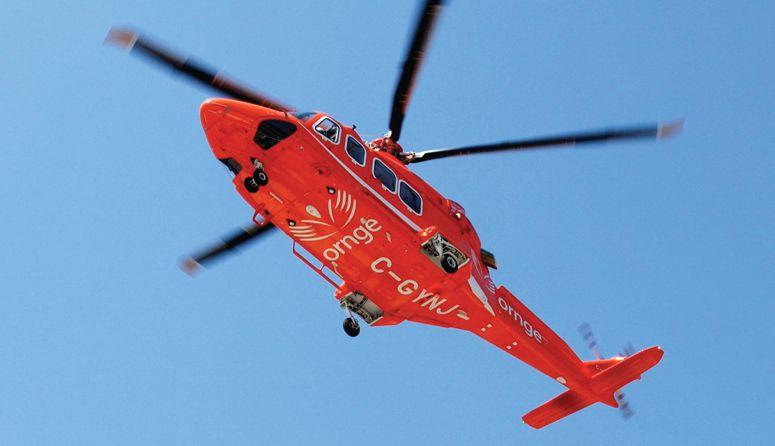
Ontario's medical transport service Ornge is now being investigated by the OPP. (Photo by Matt Nicholls)
Canadian Makes a splash
Spring is the perfect time for a makeover, and what better place to showcase that new look than on the biggest helicopters stage imaginable – HAI’s Heli-Expo in Dallas, Tex.
Canadian Helicopters did just that on the first day of the mid-February event, joining host Eurocopter and a gathering of key journalists at an unveiling of its new corporate look – tastefully adorning a brand new high-performance AS350 B3e helicopter.
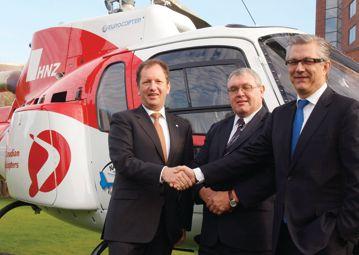
Eurocopter president/CEO Dr. Lutz Bertling (left) joins Guy Joannes, Eurocopter Canada president/CEO (centre), and Don Wall, Canadian Helicopters Limited president/CEO, for the presentation of a new AS350 B3e helicopter during Heli-Expo in Dallas.
It marks the latest purchase of an AS350 B3e aircraft by Canadian Helicopters, and it will be used to assist utility missions. The addition increases the current fleet to 75 Eurocopter aircraft. Don Wall, president and CEO of Canadian Helicopters, was on hand for the presentation, and was quick to point out the importance of the relationship his firm has with Eurocopter. He was also keen to highlight Canadian’s growing international presence, noting the acquisition of Helicopters NZ (HNZ) in July 2011.
“We are pleased to bring aboard a new AS350 B3e with increased capabilities and levels of safety,” said Wall. “The new look is being introduced across our fleet as the first step towards building our new brand, and was chosen to represent our dynamic and growing worldwide helicopter operations.”
Canadian now has 800 employees operating in 49 locations worldwide. It boasts a total of 155 aircraft in the fleet with revenues reaching $240 million in the last 12 months.
custom Helicopters sold to eic
founded in 1977, Custom Helicopters is a privately owned provider of helicopter-based aviation services in Manitoba and nunavut. it boasts a fleet of 24 helicopters providing service from Winnipeg, thompson, Gilliam and Garden Hill, in Manitoba and rankin inlet in nunavut.
Custom Helicopters operates light, intermediate and medium category helicopters on longand short-term contracts to government agencies, utilities, first nations groups, mining companies and other customers.
the acquisition was valued at $29 million, and will be paid through a combination of cash and the issuance of the Corporation’s common shares.
Mike Pyle, president/Ceo of exchange income Corporation, felt the time was right to make a move. “We believe that market conditions are favourable for us to begin to deploy some of the more than $200 million we have available to support our disciplined acquisition strategy,” he said. “Custom Helicopters represents a strategic acquisition as it allows us to
Bambi Celebrates 30 Years
the Bambi Bucket has been a successful part of the Canadian helicopter for a long time – three decades in fact.
the iconic firefighting tool created by Delta, B.C.’s sei industries in 1982 continues to be a fire-fighting standard – and it’s even conquered a key competitor. sei has acquired absolute fire solutions, the
makers of the fast Bucket. Both products will be available under the sei fold. the Bambi Bucket’s lightweight, collapsible design has revolutionized aerial firefighting by improving initial attack response times to wildfires.
“sei is very proud of the Bambi Bucket’s legacy, but we’re also very cognizant that much of our success is a result of the
HELICOPTERS MAGAZINE
P.O. Box 530
105 Donly Drive South Simcoe ON N3Y 4N5 Tel.: 519-428-3471 Fax: 519-429-3094
Toll Free: 1-888-599-2228
Website: www.helicoptersmagazine.com
EDITOR MATT NICHOLLS e-mail: mnicholls@annexweb.com 416-725-5637
PRODUCTION ARTIST GERRY WIEBE
CONTRIBUTING WRITERS
MICHAEL BELLAMY, DAVID CARR, BRIAN DuNN, PAuL DIxON, DAN GIBSON, WALTER HENEGHAN, FRED JONES, NEIL MACDONALD, JAMES MARASA, PETER PIGOTT
ASSOCIATE PUBLISHER ALISON DE GROOT e-mail: adegroot@annexweb.com 519-429-5191 • 1-888-599-2228 ext. 246
ADVERTISING SALES ADAM SZPAKOWSKI e-mail: aszpakowski@annexweb.com 1-888-599-2228 ext. 273
GROUP PUBLISHER/EDITORIAL DIRECTOR SCOTT JAMIESON e-mail: sjamieson@annexweb.com
PRESIDENT MIKE FREDERICKS e-mail: mfredericks@annexweb.com
RETuRN uNDELIVERABLE CANADIAN
ADDRESSES TO ANNEx PuBLISHING & PRINTING INC., P.O. BOx 530, SIMCOE, ON N3Y 4N5 CANADA. email: subscribe@helicoptersmagazine.com
enter a new segment of the aviation market, one with strong and sustainable margins. Consistent with our business model, Custom’s senior management will be retained through long-term service contracts.
said Jim Hawes, founder and president of Custom Helicopters ltd.: “We look forward to enhancing the business opportunities of Custom Helicopters with exchange’s financial resources and through operational synergies with exchange’s other aviation companies.”
Published five times a year by Annex Publishing & Printing Inc.
SUBSCRIPTION RATES Canada – 1 Year - $25.00 (all taxes included) uSA – 1 Year $35.00 Foreign – 1 Year $45.00
Occasionally, Helicopters magazine will mail information on behalf of industry-related groups whose products and services we believe may be of interest to you. If you prefer not to receive this information, please contact our circulation department in any of the four ways listed above.
valuable feedback we’ve received from our customers. it was this feedback that led to product improvements and spurred new innovations,” says shawn Bethel, sei’s firefighting division manager. “over the years, our relationship with the aerial firefighting community has helped us to make a better bucket and, for this, we are truly grateful.”
Helicopters Magazine is an associate member of the following Canadian aviation associations:
According to statistics Canada, the divorce rate in 2008 in this country – the last year statistics were compiled – was hovering around 41 per cent. this means that if the rate remains stable, roughly four out of 10 married couples are expected to divorce before their 50th wedding anniversary. it is closer to 50 per cent in the u s., say experts at the san Diego Divorce Center. they also suggest it is much higher (up to 78 per cent) for some groups, such as celebrities, police officers and aviation professionals.
Many of the questions i get from people in the aviation industry are “family law” related. i wanted to take a few moments to discuss what is happening out on the west coast.
the B.C. government recently tabled legislation that will change the face of divorce in that province, and may well signal a change seen throughout the country over the next few years. British Columbia’s new family law act should become law in the next 12 to 18 months, replacing the current (1979) family relations act.
after months of meetings with a blue-ribbon committee made up of government representatives and some of B.C.’s senior family law lawyers, the recommendations for change were debated and fine-tuned. to the government’s credit, they seem to have listened well.
so what is new? Well, for one, there is new language regarding custody and access for children. the term “parenting time” will replace, and is less threatening than, “access” and better reflects the current situation
Parting of the Ways
B.C.’s New Family Law Act Will Be a Game Changer
one of the bigger changes deals with common-law relationships where, under the current legislation, they are treated differently with respect to the division of assets than married couples are. Married couples, after a period of time, can consider most things they have as “family assets,” as long as it can be shown those assets were used during the marriage. not so for common-law couples, who must fight to get the same rights when dividing household goods, assets or finances.
the old legislative scheme can be viewed – quite simplistically – like this: if you are married, the courts will presume you intended to divide everything you owned after a breakup, and you have to make a claim in court in order to change that presumption. if you are in a common-law relationship, the courts presume you intended to keep what you brought in, and simply divide what you acquired during the relationship, or what grew from the investments over that same time.
under the new law, common-law spouses – those who live in a marriage-like relationship for two years (or less if they have children together), will be treated the same as married couples with respect to the division of family assets. this will apply equally to same-sex couples. B.C. will lead the way as the first province in Canada to grant equal property rights to separating common-law spouses.
our current court-centred, adversarial approach does not work for most Canadians ‘‘ ’’
in many families throughout Canada. Moving away from language suggesting “ownership,” we will see “guardianship” replace “custody.”
Children are no longer the “primary” consideration when families break up – they should now be the “only” consideration. Watch for this area of the legislation to attract litigation. it is difficult at times, to separate what is best for the kids from what is best for the parent who has primary guardianship. Moving away from your ex with your kids is often where this issue first gets tested. you will continue to have rights when it comes to parenting time with your kids if they move, but certain steps may be required of you in order to enforce them.
for the most part, the new law will move the focus from a “courtcentred” approach to more of an “out-of-court,” negotiated approach. Mediation and Collaborative law will continue to be important, and arbitration will be introduced; good news for everyone involved. this legislation is long overdue, yet the success of the new family law act will depend on how quickly lawyers and judges recognize the policy shift that underscores this legislation. our current court-centred, adversarial approach does not work for most Canadians caught in the battlegrounds of divorce – regardless of whether they are celebrities, police officers or simply aviation professionals. – with files from georgialee Lang
Neil J. MacDonald is a lawyer practising in B.C. He holds an ATPL-H and has flown as an Air Ambulance, and IFR Off-Shore Captain. nmacdonald@georgialeelang.com
Georgialee Lang has been a trial and appellate lawyer for 22 years, and has appeared twice as lead counsel before the Supreme Court of Canada. She is a Commercial Arbitrator and a Family Law Mediator. glang@georgialeelang.com
This is not a legal opinion. Readers should not act on the basis of this article without first consulting a lawyer for analysis and advice on a specific matter.
neil J. MACdonAld
pAul dixon
two signs of spring’s approach in vancouver are the cherry blossoms that blanket the city and the CHC safety and Quality summit. the theme of this year’s event is “talent, trust and training,” and three renowned speakers/authors – tom Casey, tony Kern and stephen Covey – will deliver the message. their collective wisdom is pretty much common-sense stuff, but that fact alone highlights the basic human condition – common sense is all too often uncommon.
of all the habits Covey has brought forth for our consideration, i think my favourite has always been “seek to understand before being understood.” in emergency management, a mantra is “you don’t know what you don’t know,” with the second verse often being, “you don’t know what you need to know.” from schoolyard to boardroom and countless venues in between, how often have we heard that all-time classic, “you just don’t understand”? Well, the riff i’ve picked up on in my time covering the helicopter business is along the lines that this business is so very different from other businesses that an outsider couldn’t possibly understand the dynamics.
recently on his blog, Casey wrote about the need to assess the competency of supposed “experts” and the willingness of people who should (and could) know better to buy in on outdated and irrelevant information presented by people who are selling themselves and nothing but. it’s about the “experts” who expound on the conventional wisdom of the day
A Logical Approach
Safety Need Not Be a Complicated Element to Master
World series time, when it takes longer for the “experts” to talk about the game than it does for the players to play the game.
there was a “major Hollywood movie” last year called Moneyball, about Billy Beane, a man who turned the baseball world upside down as general manager of the oakland a’s by flouting conventional wisdom on essential skills and game tactics. the movie was mildly interesting, but the book it was derived from – Moneyball by Michael lewis – is a detailed and systematic dismantling of the conventional wisdom that has fuelled the baseball brain trust for generations. this new wave of thinking was fuelled by Bill James back in the late 1970s. James had a voracious appetite for devouring statistics, extrapolating them in ways never before considered and achieving results very much at odds with the conventional wisdom.
this business is so very different from other businesses that an outsider couldn’t possibly understand ‘‘
and look good doing it.
Kern leads the Global War on error, focusing on human error, avoidable human error, at the source, and invoking the words of Marcus Cicero – “any man can make mistakes, but only an idiot persists in his error” – in the cause. Cicero lived more than 2,000 years ago, yet his words ring as true as ever today.
instead of trying to relate all of this to the mysterious world of helicopters and the people who fly them, let’s go out to the ball game. Peanuts, crackerjacks, root, root, root for the home team. there’s no shortage of expert opinion on any aspect of the game, especially come
in the same vein, lewis has written several books detailing the inner workings of the financial meltdown of recent years. they are fascinating forays into the inner workings of the largest financial institutions in the world, many of which have exploded like supernovas or simply rolled over and sunk without a trace. the then 20-something lewis, a graduate of the london school of economics in the early ’80s, went to work as a bond salesman for salomon Brothers – an environment captured in tom Wolfe’s book, The Bonfire Of The Vanities lewis has recalled his amazement that he, as a neophyte salesman, was being asked by people twice his age, responsible for investment accounts into the billions of dollars, for guidance as to where they should investment their funds. through his series of books, lewis shows the reader where derivatives started, how mortgages were first pooled and resold as securities, and how an entirely new way of thinking evolved that resembled nothing so much as spinning sugar into cotton candy. it was a world, much like professional baseball, where the conventional thinking ruled the day and woe to those who dared ask questions.
Which brings us back to Casey, Kern and Covey who will be offering their insights, with a combined message that might be, “what did you think was going to happen?” the last word is from that renowned 20thcentury philosopher, Charles Dillon stengel, who much like Cicero two millennia before him was purged from his position of exaltation after he was deemed past his prime. unlike Cicero, however, the “old Perfesser” managed to keep his head. Casey stengel hit it out of the park himself with his observation that “most ball games are lost, not won.”
Paul Dixon is freelance writer and photojournalist living in Vancouver.
EMS professionals strive to provide the best care to the patient. AgustaWestland provides unique, integrated and affordable products to the global healthcare delivery system. Together, bringing care to the patient with the best aero-medical solution.
agustawestland.com
Retooling for the Start of a New Season rites of Spring
pring training is upon us once again. for some, it’s a time to dust off skills that have been languishing over the winter; for others, it’s merely an interruption but a necessary sabbatical from revenue flying. it’s also a time to renew friendships and catch up on “there i was” stories as pilots from all theatres of operation gather in one place.
the spring itinerary varies little from company to company. there are written examinations for pilots, covering everything from company policy and aircraft systems to the handling of dangerous goods. there are lectures on all matters of company endeavours, usually culminating with administration people bemoaning a pilot’s ineptitude when it comes to paperwork. then, it’s out to the helicopter and the fun begins.
training pilots are usually pulled from the experienced pilot roster and must demonstrate their desire to train and understand company operations. Company check pilots (aCPs) are authorized by the transport minister to conduct flight checks independent of transport Canada inspectors. Knowledge of Cars, the company operations manual and aircraft specifications are also required. However, the check pilot may not have accumulated flying skills in certain company operations, which is not to say they can’t evaluate, but occasionally, they make judgments based solely on their own experience.
on a check ride, this becomes apparent when the aCP moves from examining on established or published aircraft parameters to evaluating
the pilot as “satisfactory with Briefing.” it’s still a passing grade, but it’s the aCP’s evaluation that will be entered on the pilot’s file not the training pilot’s. so, which one is accurate?
What i’ve found rewarding when i’ve been in the capacity of a training pilot or aCP, is evaluating skills in from pilots who are involved in theatres that i have little recent experience in – i have watched a Jet ranger pilot unerringly judge obstacle clearances within meters after spending a summer moving surveyors, observed a seismic pilot seemingly over-controlling his machine while his load hung motionless in one spot. i rarely judged based on my own comfort level in these situations; i was evaluating the candidates.
safety margins were maintained relative to the skill of the pilot, and most of all, he/she maintained a professional attitude.
With helicopter operations ever expanding into new fields, no one can possibly gain all of the skills necessary to master every facet of operations – so, perhaps rendering judgments should be limited as well. the examining pilot has an invaluable opportunity to learn in these situations also.
Knowledge of the flight characteristics of a particular machine and the mechanics of dealing with unusual situations is paramount and is defined with caveats in the afM (aircraft flight manual). But a pilot dealing repeatedly with moving surveyors will be comfortable with confined area landings, which would send an ifr’s pilot adrenalin into full rich. Pilots all have differing comfort levels.
With operations expanding into new fields, no one can... master all facets of operations.
the candidate’s ability to handle the helicopter in a working environment. long lining, bucket expertise or confined area approaches, for example, may be familiar circumstances to the pilot being judged, but not so to the examiner. Pilots’ comfort levels may differ, and until experience is gained, their first introduction to a difficult procedure will certainly involve a degree of “pucker factor.” When this happens, an aCP’s initial reaction may be to grade the performance as uncomfortable, or below standard. this isn’t necessarily right.
i have witnessed an experienced training pilot’s evaluation of a candidate as “above standard” and immediately afterwards, the aCP graded
so, how can an examining pilot whose skills in a particular segment are rusty – or non-existent – make a determination on a candidate’s performance? it’s a good question. if it goes beyond the normal capability of the machine and compromises safety, then the examining pilot has an obligation to question and realign the candidate’s procedures. But not all approaches into a confined area necessitate protracted deliberation, for example. a pilot used to making such decisions on a continuous basis, would know how to go about the task skilfully and may not appear to the aCP as being too casual.
spring training is a critical time of year, whether you’re a seasoned veteran, aCP or training pilot. it’s a time to refresh old skills, and develop new ones, and keep an open mind in all situational endeavours. it’s all about having another safe season in the air.
A native of Spruce Grove, Alta., Michael Bellamy has been flying fixed- and rotary-wing aircraft in a variety of capacities since 1971, and is an accomplished author of several books, including Crosswinds.
MiCHAel Bell AMY
peteR piGott
so, what’s the best way to come up with a name for a fledgling helicopter company? turn to Hollywood for some creative inspiration, of course! that’s precisely how ottawa’s Questral Helicopters’ striking namesake came into being.
“Kestrel means a bird that can hover in the wind,” says president tosh serafini. “When we were forming the company in 1987, there was a movie my wife was watching and the boat in the movie was named ‘Kestrel.’ so her suggestion was to call the company that – but spell it as ‘Questral.’”
located in the avitat building at the ottawa Macdonald-Cartier international airport, Questral Helicopters boasts a fleet of three eurocopter as350s (with another coming on line in april) and employs nine pilots and six engineers. serafini, who had been flying helicopters for geophysical survey companies since 1979, owns the firm, and he –along with manager troy fisher – was eager to share with Helicopters some insight into operations, the future and what’s in store for 2012. in our survey business, the contracts are all across the country so there’s no need to move the base of operations at all.”
all three helicopters were in the hangar being worked on the day Helicopters dropped by in early January. “When it’s not busy – say between Christmas and new year’s, we bring the machines home, do maintenance on them and then they go out again,” serafini said. “We do our own maintenance, supervised by the company president, who was
Questral Hovering
Ottawa’s Questral Helicopters
Surveying the Future
Helicopters is the only commercial helicopter service in north america that specializes in airborne geophysical surveys. Questral does not interpret the geophysical data collected, instead it leaves that to its clients. says serafini: “We specialize in flying a grid pattern low to the ground for various companies that bring their own sensors.”
Clients include fugro airborne surveys, Mosaic Mapping systems, Geoterrex-Dighem, sanders Geophysics and tHeM Geophysics. “it’s our customers that get the contract,” he continued, “so who we fly for depends on them.
When asked how Questral ships machines to distant locations, serafini said, “if we’re going to Mexico, for example, we fly it down there, but if it’s going overseas we put in a 747. the machine is taken apart – the whole thing fits on one “cookie tray,” (flat metal skid) and is put on the truck to Mirabel airport. We take it as close as we can to the job where it is reassembled.”
When it comes to hiring new staff, serafini notes that he always seeks pilots with a minimum requirement of 1,000 hours, and astar-endorsed applicants are preferred. “We‘re not looking for someone who has 50,000 hours,” serafini said, “but a person who is open minded and has the willingness to learn and adapt into becoming a good survey pilot.”
so, why the preference for the as350? “it’s a performance issue,” fisher said. “and the cabin configuration is wide open so we can load it with all of the customers’ requirements and then have the performance.”
‘‘ ’’
you can’t drop your price and still be sustainable. if you do, you can’t offer safe, reliable service.
also the director of maintenance.”
serafini’s path to Questral is not unlike those of many others who have a passion for aviation. While working as an apprentice electrician in the construction industry, serafini always had ambitions to be a helicopter pilot. He earned his rotary licence at Canadore College in north Bay but after he was unable to find a job flying, he returned to Canadore to secure an aMe (aircraft Maintenance engineer) diploma. in the years that followed, while serafini flew and fixed helicopters, he couldn’t help but notice the need for a helicopter company that concentrated on geophysical surveys. He formed the company in 1987, and now Questral
Heading into the new year, Questral is doing well. “We are holding our own because we offer a really good service, but it’s not all gangbusters and things have not bounced back,” said serafini. “the competition is pretty fierce.” “We’d definitely like to see one or two more machines come on board, and we would remain with as350s.”
so, how do serafini and fisher describe the health of the rotary geophysical survey industry today? any key challenges ahead? serafini’s concern is that companies are undercutting each other to buy work. “if everybody would just keep their rates high, there’s still enough work to go around,” he said. fisher agrees, adding that the problem is especially prevalent in eastern Canada. “some companies are just starting up and they’re going in with a very low rate,” he said. “you can’t drop your price and still be sustainable. if you do, you can’t offer safe, reliable service. unfortunately that’s how accidents happen.”
Peter Pigott is a veteran aviation journalist living in Ottawa.
Active risk Management
Not as Tough a Goal as It Sounds
the phrase “risk management” conjures up thoughts of detailed process, thick manuals, operational directives; in other words, bloat. in aviation, the core of people involved in the movement and maintenance of aircraft are task oriented, operationally focused, “get-’e-done” folks who don’t want bloat; they just want a serviceable aircraft to fly or parts on hand to fix that broken bird.
But “active risk management” is actually, in my view, the cornerstone to safe aviation operation and can be achieved through a very simple process. it just means that we need to pre-identify the hazards facing us on a daily basis, determine how to mitigate the risks associated with those hazards, and stay actively engaged in repeating this process until our flying day is complete.
first of all, consider this scenario. it is a common fact that most people drive from home to work each day using one primary route, (i know that i do). often, we do this without much consciousness. sometimes, (and i know this from personal experience), we may get halfway to work and not even remember much about the first part of our commute. We are so familiar with the routine of driving to work, having been able to complete the task hundreds of times without incident, that we are literally on a type of “subconscious cruise control.” it is not a difficult task, we are experienced drivers, the routing is well known and the tricky spots along the way are very clear in our
‘‘
new information? i change my routing. But my new routing may be unfamiliar to me, forcing me out of my state of unconscious competence into one, temporarily i hope, of conscious incompetence this new state adds risk to my commute and should force me into a higher degree of awareness and prudent decision making. again, faced with a change to my routine, i engage in an active risk evaluation mode and modify my driving accordingly, hopefully arriving safely at work. But if i am jolted into a state of unconscious incompetence, i may not realize that new hazards are presenting themselves or that i am in a state of increased risk. this is the real danger zone. so, what does my commute have to do with aviation safety? Well, while it means that just because i have moved a drill 100 times or flown 500 ifr approaches or completed hundreds of off-site landings to unprepared landing sites, does not mean i am not at risk. and, although the state of unconscious competence is a desirable one, being in a state of conscious unease is a safer one.
so, how do we battle this? simple: acknowledge that your state of unconscious competence needs to be tempered by a state of unease. ask yourself: What are the threats facing you today? What risks do they pose to you and your passengers? What can you do to mitigate these risks so that you all come home at the end of the day?
let me challenge you to begin each day with these questions: Where am i?, What am i doing?, What hazards are in my way today? How am i going to manage the risk associated with these hazards, today? and before every takeoff and landing, repeat the thought: Where are the threats to me right now? How will i manage these threats safely?
your state of unconscious competence needs to be tempered by a state of unease.
minds. We are in a level of unconscious competence and it just happens. But there are still hazards along the way and we are still exposed to risk, even if our level of comfort is high and our degree of conscious awareness is low. i actively manage the risk associated with my commute without really being aware of a risk-management process or structure.
now, change this routine. What if i change my standard drive route after listening to the local radio station’s “drive” program that alerts me to blockages, or in edmonton, for all the detours created by the “other season – road construction.” What is my response to this
We make similar decisions every day we drive to and from work and, when faced with roadblocks, most of us default into a type of risk assessment in order to continue our commute. so, try it next time you are faced with a busy day of moving drills, or flying water survey scientists or bucketing a fire. What are the hazards to me today? How will i manage them?
’’
raise your level of consciousness around your core competencies and you will be engaged in active risk management.
Walter Heneghan is the VP of Safety and Quality at Canadian Helicopters. A passionate advocate for aviation safety and sound risk management, the veteran pilot presents his debut regular column for helicopters magazine.
WAlteR HeneGHAn
CoVeR stoRY
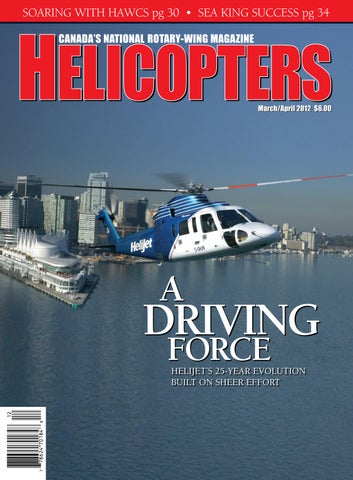
A driving force i
Helijet’s 25-year Evolution Built on Sheer Effort
BY pAul dixon
t started with a single helicopter, a vision and little else beyond sheer determination. twenty-five years on and two million passengers later, that vision of scheduled rotary-wing service between vancouver and victoria, downtown to downtown, is very much a reality. Danny sitnam, Helijet international’s president/Ceo, was a young apprentice machinist when “it” happened – a friend took him for his first ride in a helicopter and his world changed forever.
the ink was still drying on his commercial licence and the 19-yearold sitnam was headed north, ferrying helicopters to the yukon, “cutting his teeth” as he describes it. in the early 1980s, he returned to southwestern British Columbia and started a small helicopter training school with a partner. the school is still in operation, but sitnam felt there were bigger untapped opportunities for helicopter operations in the vancouver area. Brainstorming with a group of friends, he became convinced that there was a market for a scheduled passenger helicopter service between downtown vancouver and the provincial capital, victoria on vancouver island. His vision: a passenger airline utilizing helicopters, not to be confused with a helicopter company that carries passengers.
the original capital of British Columbia was the city of new Westminster, which today is a suburb of vancouver, but when the then-separate colonies of B.C. and vancouver island were amalgamated in 1866, victoria won out as the then-and-now capital. victoria, as a city, thrives on the business of government and while the seat of government and ministry offices are located there, most of the people who come to do business with the government – and for the government – have to cross the salish sea from the mainland. twenty-five years ago, the choices were limited to crossing by car and ferry, a timeconsuming process especially for a day trip, flying into victoria
international (yJJ), followed by a 22-kilometre taxi ride downtown, or utilizing the established floatplane service between vancouver and victoria harbour.
to say that reaction to sitnam’s big idea was mixed would be an understatement. one of the would-be partners suggested it was “the stupidest thing he’d ever heard of” and walked out. But for those who stayed, they still share the same vision. sitnam puts the early days into perspective. “i think it’s a combination, that at the start, we needed people with entrepreneurial skills; it’s pretty gutsy starting up an airline using helicopters. We needed people who could think outside of the
box, but had also gone through their own business experience, of failure, to be able to stare the devils in the face. it certainly helped me when we launched. it isn’t for the weak of heart to go into this type of business. a lot of the senior people with this company have been here for over 20 years.”
HuMBle BeGinninGs
on nov. 26, 1986, Helijet started service with a single Bell 412, offering seven daily flights from vancouver to victoria. sitnam and the Helijet management team were running a scheduled airline business. He recalls it was a long time before he slept through the night. “the business plan as we know it wasn’t a structured thing, it was a few pages. We thought we could move 20,000 passengers at $70-80 and we would only have costs that are half the revenues. that was the business plan. the revenue forecasting wasn’t too bad, but on the expense side, we were so far off the mark, truly off that side of the page without understanding what it costs to deliver that service. it took us a couple of years to really understand it. this business costs a lot. this is reality, these are not one-time charges, they are there all the time.”
it took the team roughly three or four years to rationalize what it would take to make the business work – and there was no faith from the banking community and rightfully so with the red ink that was coming out. “it wasn’t bankable, it was impossible,” he says. “We really funded ourselves instead of aligning with bankers. the major founders became the bank, the shareholders, showing their commitment to the plan. it took us about three-and-a-half to four years before we saw some black ink in the program.”
even as the financial picture improved, uncertainty was a constant companion. rick Hill, vP operations and commercial programs, says making things work in this industry is rife with uncertainty – and
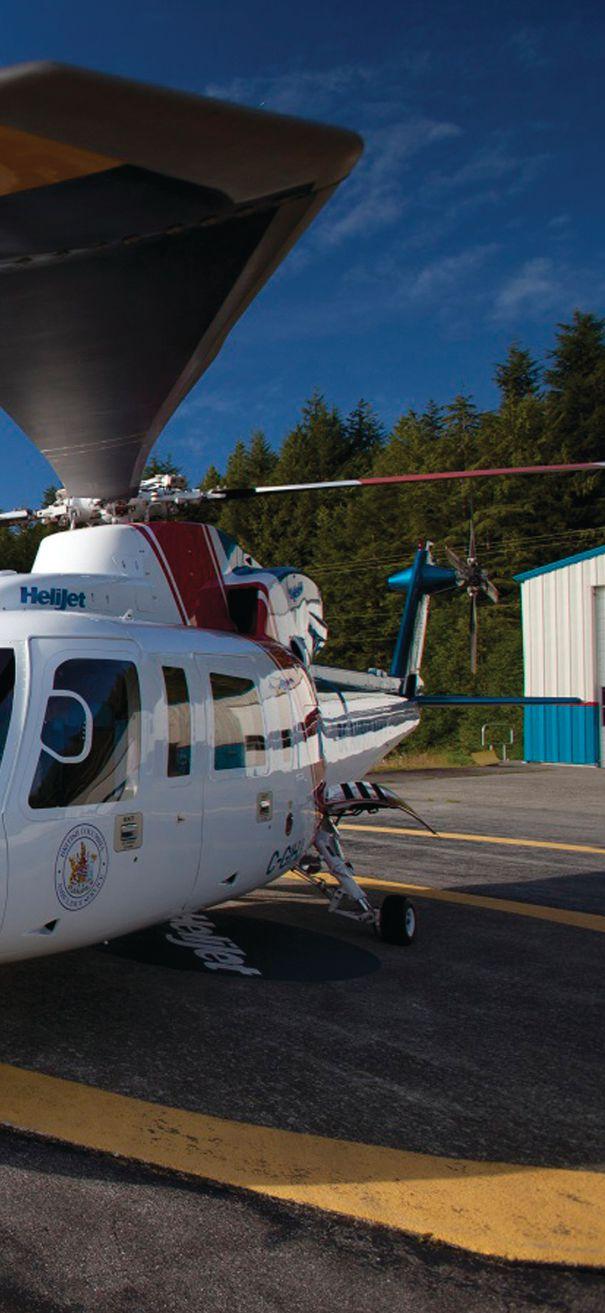
LEFT: It took the team roughly three or four years to rationalize what it would take to make the business work. (Photo courtesy of Helijet)
BELOW: One of the would-be Helijet partners suggested the idea of commuter service was “the stupidest thing he’d ever heard of” and walked out. The majority of staff stayed. (Photo courtesy of Helijet)
BOTTOM LEFT: In the winter, Helijet’s IFR advantage over the floatplane competition is readily apparent with morning departures a full hour before the float operators. (Photo courtesy of Helijet)
CoVeR stoRY
it’s not for the faint of heart. “this is the airline business. the airline portion of our business has always been the most challenging and continues to be the most challenging as far as margins,” Hill says. “it’s got so many different dynamics attached to it so it’s difficult to forecast the market, the consumer and what they’re going to decide tomorrow, next week and next month.”
Hill notes that the bottom line is “time is cost.” and one of the main reasons Helijet came into being was to bring ifr into the victoria-vancouver corridor. “it’s a huge piece of what Helijet does and it’s a key reason why we’ve been successful,” says Hill. “there was a floatplane monopoly before and they can’t do the things we can do. We brought
a whole new dynamic to the business, in the dead of winter.”
in the winter, Helijet’s ifr advantage over the floatplane competition is readily apparent with morning departures a full hour before the float operators and evening departures almost three hours after the last floatplane flight of the day. Coupled with 99.2 per cent of 2011 flights departing per the published schedule, it’s attractive for bureaucrats and those doing business with the government to schedule meetings in either city with a high degree of certainty – an opinion voiced by Glen Miller, who has worked both in government and as a consultant.
“i prefer to use Helijet over fixed-wing operators in particular because they are not as subject to the vagaries of weather,” says Miller. “relying on a fixed-wing operator that may not be able to fly due to fog or other inclement weather may mean missing important business meetings that must then be rescheduled.”
GRoWtH pRospeCts
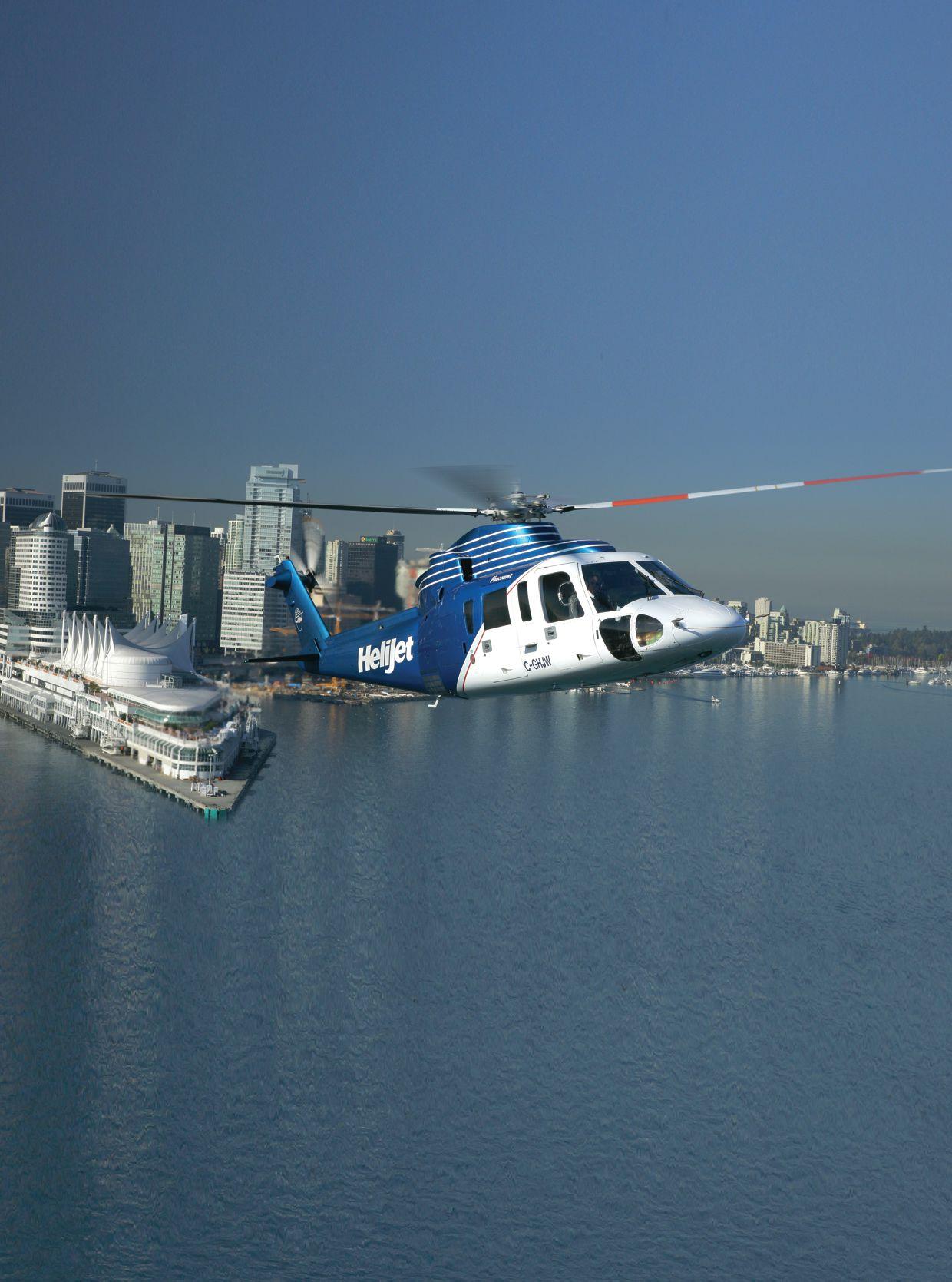
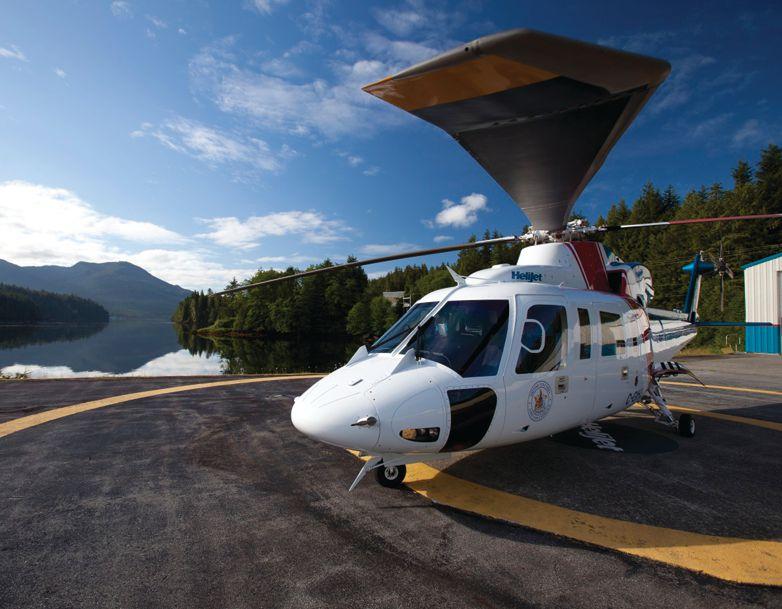
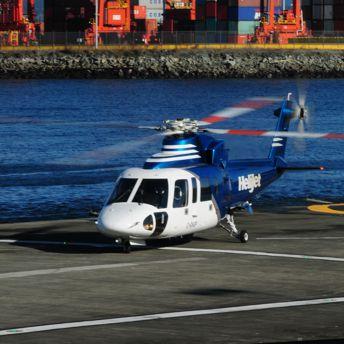
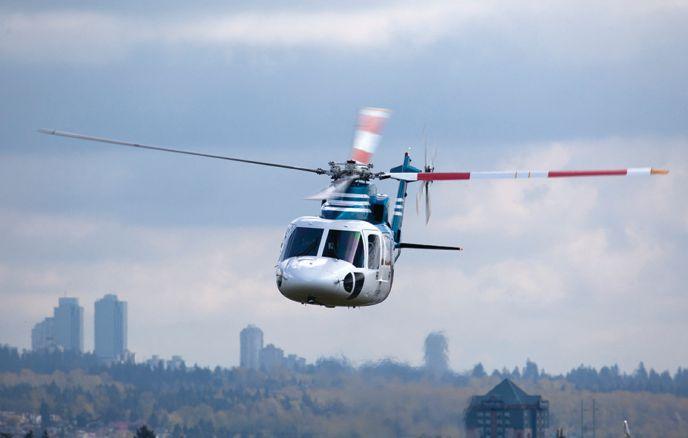
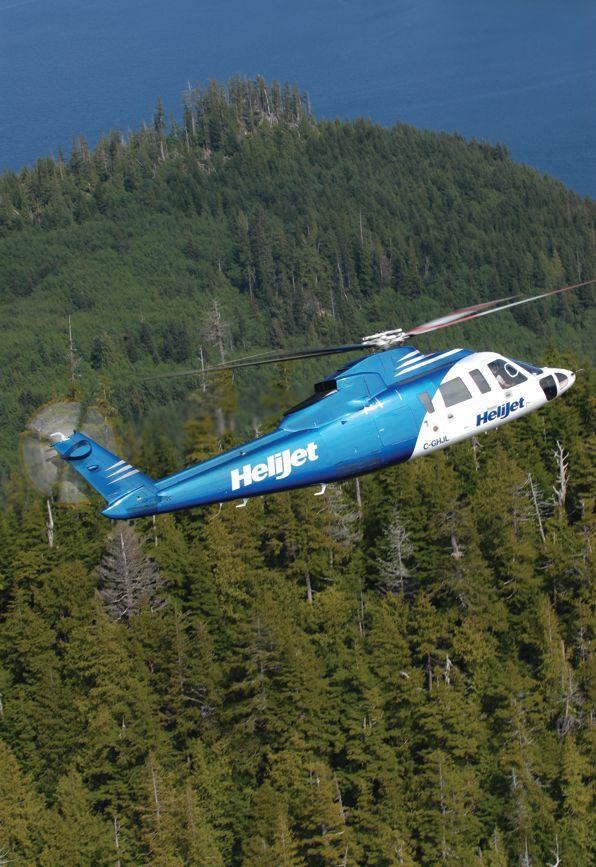
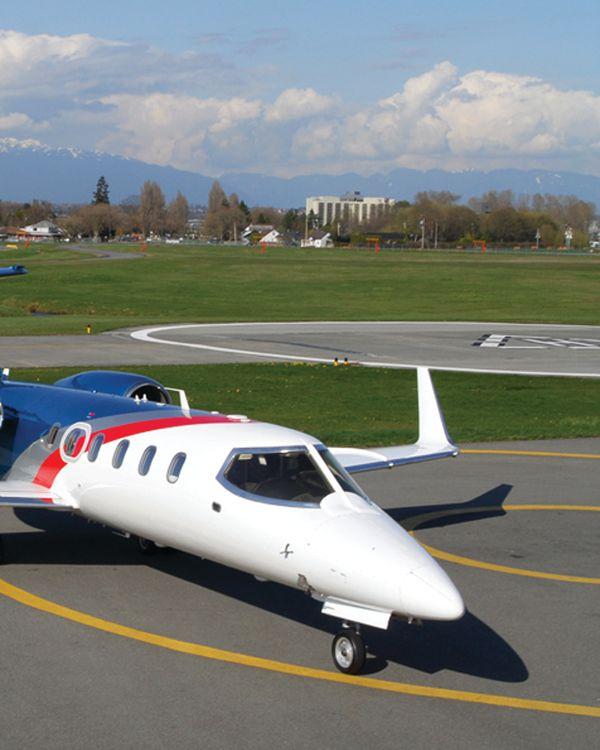
from the single Bell 412, Helijet has grown to a fleet of 10 sikorsky s-76s (a and C++), three Bell 206s and two lear 31as. the fleet expansion was paramount, says sitnam, because while the 412 had its strengths, it wasn’t the right aircraft for this particular demographic. “i have to give sikorsky credit; their good salesmen kept pounding on the door saying, ‘you’re in the wrong aircraft, you should look at ours.’ We started running the numbers, and realized that some of the things we were looking for, like creature comfort and cabin configuration, really were conducive to business travellers.”
“nobody really likes sitting sideways in the 212-412 configuration,” adds sitnam. “the seating wasn’t that great – four people facing
ABOVE: From a single Bell 412, Helijet has grown to a fleet of 10 Sikorsky S-76s (A and C++), three Bell 206s and two Lear 31As. (Photo courtesy of Helijet)
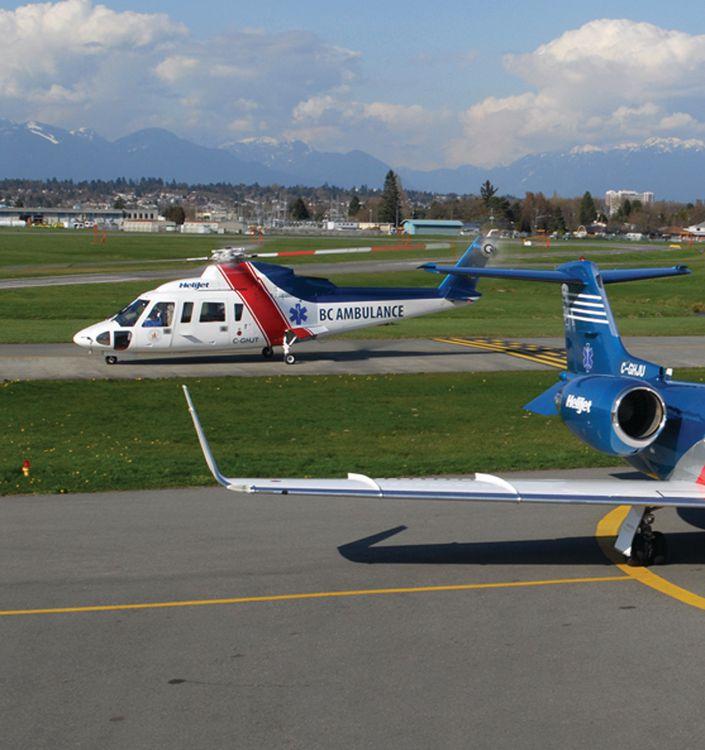
RIGHT: Another market that opened up to Helijet has been operating air ambulances for the BC Ambulance Service. (Photo courtesy of Helijet)
aft, five people facing forwards, and it wasn’t conducive for business travellers. sikorsky said we could get three rows of four all facing forward. speed was also a big factor with the s-76, plus the cost factor it was taking to run a leg. then we also moved into wheels. the s-76s were a much better, airport-friendly aircraft around our fixed-wing brothers.”
as the fleet grew, so did the workforce and today, it numbers some 135, including 40 rotary-wing pilots, 10 lear pilots and 35 aMes. Helicopters’ columnist neil MacDonald spent 17 years with Helijet, working his way up from the ramp to fly scheduled service and air ambulance. “i had the privilege and the pleasure to work for Helijet on and off for more than 17 years, and have nothing but fond memories of the people and organization,” says MacDonald. “the leadership set the perfect tone for a professionally run, top-class airline, with a family atmosphere. i feel very proud to have been a part of that family.”
another cornerstone to the company is operating the heliports in both vancouver and victoria through its subsidiary, vancouver Heliport services. it just made sense, says sitnam, when they were able to take on this responsibility in the mid-’90s, as Helijet was the dominant user of both facilities. even with a recently inked long-term lease with Port Metro vancouver, the threat of development is always there. the vancouver heliport sits on the last piece of undeveloped property on the waterfront, a stone’s throw from Canada Place and the downtown business core. finding a suitable replacement site would be extremely difficult. sitnam is quick to point out that “there isn’t any federal, provincial or municipal support or subsidization of any sort. it’s kind of like asking air Canada or WestJet to take all the costs of yvr.”
A GloBAl Model?
always seeking new opportunities, sitnam and his partners thought hard about applying the Helijet model globally once they’d refined operations in B.C. it didn’t take long, however, for the team to realize that the notion was one without sound traction. “We had a vision that we would grow our scheduled service into a broader area or areas, but as we experienced the business and rationalized it we realized that the growth is going to be very, very limited to anything outside of this geography,” he says. “We thought we could grow the program in the new york area where everybody has tried. We did a lot of work in that area and there were a lot of really smart people that wanted us to set up shop there.”
sitnam notes that even sikorsky, in the earlier days of their relationship, would take them along to other areas where they were trying to sell aircraft, trying to bring a commercial sense of an operator like Helijet to establish something in taipei. “We went to taipei and looked at an opportunity there to establish using the helicopter,” says sitnam. “then we went over to Japan and studied that, osaka, narita. other operators started it. We analyzed it and we were pretty cautious to do it ourselves, and they started and they failed.”
instead of trying to reinvent the wheel, Helijet has stayed close to home, focusing on broadening horizons on a smaller scale. the leisure market is one such area. as Hill notes, the company services a number of exclusive fishing lodges on Haida Gwaii, off the north coast of B.C. “a lot of equipment from here goes to Haida Gwaii; last summer we had four s-76s up there,” he says. “it’s a big operation. it fits very nicely with our scheduled service, because our schedule service tends to go down in the summer. our victoria service is much busier in the winter. it’s nice to be able to move those resources out of here and into something else. that’s been a good thing for us.”
another market that opened up to Helijet has been operating air ambulances for the BC ambulance service. starting in 1998, Helijet provided rotary-wing service from yvr and today operates two s-76C++ and the lear 31a from yvr and a third s-76C++ at Prince rupert. “Before Helijet became involved, it was largely just patient transfer and while that’s still part of it, there’s a lot more firstresponse,” he says. “it’s been great to grow that and change the dynamic and the change in technology we’re putting in these aircraft – for example, the Max-viz were putting in these aircraft to fly at night. We’re constantly upgrading the technology and safety as you need all the tools at your disposal.” in fact, air ambulance service has grown to such an extent, that sitnam expects it will account for as much as 55-60 per cent of 2012 revenue.
An open Mind
Keeping focused on doing what they do best – and ensuring they don’t become complacent – is the most important challenge Helijet faces going forward, says sitnam. it’s a goal that’s not easy to attain. “the biggest challenge for us now, looking at it is being open-minded and trying not to get stuck in our ways,” he says. “We all get older and we need to be open and learn to take criticism.
“fortunately, the quorum has been together for a good time, and it’s allowed the company to move on and diversify, move on to other areas, let go of the weaker links. We’ve had a lot of closures of business opportunities over 25 years, some of them disheartening and disappointing. i think that just makes us stronger. it shows we’re willing to take a chance; you calculate everything out the best you can, give it a go and know when to say ‘enough is enough.’ if you don’t try it, you’re never going to have an opportunity to make it a success.”
When seeing is Believing s
Two Supporters of HFDM Discuss Its Benefits
BY pAul dixon
afety in aviation seems like such a simple concept, yet we are constantly presented with overwhelming evidence to the contrary. Knowing the right thing to do is not enough, nor is the act of passing laws and making rules.
a s parents, there comes a time when we have to trust that our children are ready to take that next big step. Maybe it’s the first time they want to take the car on a f riday night. you paid for driving lessons and they’ve endured the hours of shared wisdom that all parents dispense free of charge. you ask them for a detailed itinerary, passenger manifest and go over “the rules” one last time before they leave, but as much as you try to project a cool and nonchalant image, you can’t help remembering that it wasn’t all that long ago that it was you itching to be unleashed on the family sedan.
n ow imagine you have a position of responsibility in a helicopter company and maybe the feeling among the people flying your aircraft is pretty much the same. What does happen to your helicopter once it disappears over the horizon? e ven if you are the most junior pilot in the organization, do you even wonder about how other pilots treat the aircraft? e specially the one you are scheduled to fly today?
i t’s precisely the premise behind Helicopter f light Data Monitoring (H f DM) – a systematic method of accessing, analyzing and acting upon information obtained from flight data to identify and address operational risks before they lead to incidents and accidents. i nformation gleaned from H f DM systems can be invaluable to operators – not only to reduce operational costs, but also enhance training effectiveness and operational, maintenance and engineering procedures. i nformation from H f DM programs is also unique because it provides objective data that otherwise is not available.
a nd while many operators have implemented H f DM systems into their aircraft – often at the insistence of clients – others have yet to grasp the need. Paul s pring, chief pilot/owner of Phoenix
Heli- f light and Mike Pilgrim, flight data monitoring manager at CHC Helicopter, are both huge proponents of the technology, and have donated significant time to the Global H f DM s teering Group (see “ a bove and Beyond,” next page).
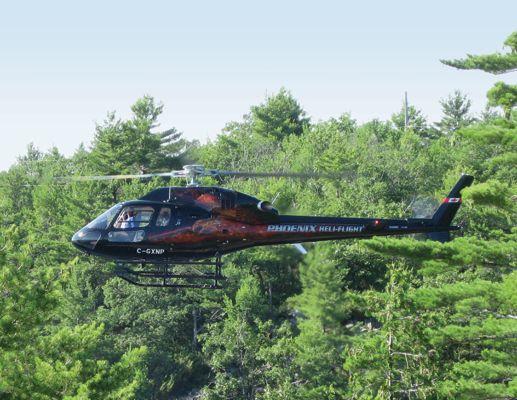
s pring thought he had a good handle on his operation, though he will tell you today that he was wrong; actually, “dead wrong” are his exact words. He started Phoenix Heli- f light out of f ort McMurry, a lta., with one aircraft and today operates five machines. Back in the beginning, as a one-man, one-machine operation, there wasn’t any need for concern about H f DM, or how the aircraft was being operated. But as soon as the second helicopter was added the problems started.
s pring remembers it well. “ i had a pilot working for me that you never knew what was going on with that aircraft – and the way i would find out was through other members of the local aviation community. f ort McMurray is a small town, especially on the aviation side. i was out of town on holidays, and a friend said when i came back, i don’t want to be a rat but while you were gone, your machine was out on the weekends doing auto rotations over and over onto the infield.”
n ot wanting to call out the friend who had witnessed the pilot’s behaviour over the weekend, s pring asked the pilot to explain the number of landing fee charges when there were no corresponding flight tickets. t he pilot’s response was that he had been feeling a little rusty and had taken it upon himself to conduct some self-training. s pring remembers thinking, “We don’t train ourselves, because that’s not training; that’s goofing around – and number two, it’s not authorized.” Phoenix already had a training program in place, with pilots from e urocopter and policies in place supporting the training and use of aircraft.
“ r ight then, i knew i had a problem because i had a lack of oversight, a lack of control unless i was physically there – and no one wants to stay at work every day, every minute,” he says. i n this situation, he put the pilot in question under strict supervision and the pilot resigned shortly thereafter.
ABOVE: Several of CHC’s oil and gas clients are insisting on the inclusion of FDM systems on all aircraft. (Photo courtesy of CHC Helicopter)
RIGHT: Phoenix Heli-Flight owner Paul Spring in a strong proponent of HFDM systems. (Photo courtesy of Phoenix Heli-Flight)
Above and Beyond
i n his distant past, s pring had come from the commercial airline world, where the implementation of flight data management systems was part of standard operating procedure. “ i used to wrench on 737s for an a merican carrier, so i ’m well aware of flight data recorders, cockpit recorders and knew that they didn’t fit in helicopters – too expensive and too big to work.”
Phoenix Heli Flight’s Paul Spring and CHC Helicopter’s Mike Pilgrim are strong advocates for HFDM systems, and each has donated significant time to the Global HFDM Steering Group. Flight data monitoring programs have been in common use by major commercial airlines for more than 30 years and, although in limited use by some helicopter operators for over 10 years, they have only recently become more widely used and available for the whole helicopter community.
HFDM is the systematic, proactive and non-punitive use of flight data from routine operations to improve aviation safety. It enables an operator to compare its standard operating procedures with those actually achieved in everyday flights and, armed with a better knowledge of how their aircraft are being flown, enables them to design more effective training and safety programs for their flight crews.
Global HFDM Steering Group has a number of set goals going forward, including:
• Co-ordinate users’ requirements for HFDM systems and support and advise aircraft and equipment manufacturers in meeting those requirements
• Provide a source of expertise, information and advice for users wishing to adopt HFDM systems
• Development and communication of industry best practice on HFDM matters
His epiphany came in 2007, when he read articles on a ppareo s ystems before he attended that year’s Heli- e xpo. f ounded in 2003, a ppareo s ystems, ll C, is an advanced technology business that designs and manufactures electronic, mechanical and software products for aerospace, defense and transportation applications worldwide. o ne of its specialties is helicopter flight data management systems, giving operators a glimpse into what happens in the cockpit. “ i made a point of going to their booth at the show and was so excited about the oversight that it would give me that i pretty much committed to the equipment right then and there.”
a t that point in 2007, a ppareo was still almost a year away from having the equipment certified. s pring learned as much as he could about the equipment while he was waiting, but then events took a dramatic turn. “Between the time i got interested and talked to them, got prices and got the actual delivery, we had our first crash and it was a fatal. t he investigation was simple because there were five people on board and only one was killed. t he pilot was honest about the accident and exactly what he had done. We knew he had got into servo transparency and we knew why he got into servo transparency. i f you saw the wreck, everybody should have died, but the thing that saved their lives was they landed in muskeg. i f they’d all been killed, what would we have known about the accident other than the location? n othing, because with servo transparency, once the hydraulic system quits functioning it goes away. i t’s one of those things that leaves no telltale indicators for the accident investigators.”
Phoenix installed its first f DM recorder in January, 2008 and s pring realized very quickly that the solution he had been seeking brought with it an even bigger problem. What do you do with the data? “We weren’t ready for that Pandora’s Box of information flooding us,” he recalls, “but at least we knew that we had at the very minimum a crash recorder. s o, one of the checkboxes that i ticked off was that we now had a means of insight if there was another crash.”
feAtuRe
M A kin G n e C ess ARY C HA n G es
t he question of data collection and deciphering its contents confronted Mike Pilgrim several years previously when he was implementing r ichmond, B.C.-based CHC Helicopter’s HD f M program for his group of s uper Pumas serving the offshore oil fields in the s hetlands.
“ o ne of the problems i found in trying to implement the H f DM program at CHC was that i needed certain information from the manufacturers of the aircraft and manufacturers of the equipment – and in order to effectively decode the flight data, you need to have the parametric data to decode from digital into engineering,” says Pilgrim. “ s ome of that information is proprietary and the manufacturers don’t like giving it up to some upstart. s o, we had trouble getting material extracted from various sources. s o, i thought wouldn’t it be a good idea if i got in touch with some of the other H f DM people [at other operators] because H f DM was just starting to take hold. a ctually, it was
becoming contractually required by some of the oil companies we flew for, so i contacted some of the f DM people in other companies and asked if they were having the same problem in getting information out of the manufacturers and yes, they were.
“so, we got our heads around making a combined and joint request to the manufacturers – look, guys, we need this stuff. it wasn’t just specific information we were after; there were all sorts of things that really needed to be co-ordinated. Different aircraft record different parameters and so you can’t have a standard event set in your HfDM unless you have all the parameters to generate the events. and so, we said, wouldn’t it be a good thing if all the manufacturers produced all the same data, and the manufacturers said, that’s not a bad idea – tell us what you need. so, we went away and talked a bit more.”
Jump ahead to the 2008 CHC safety summit. at the previous summits, HfDM had been presented within the workshop presentations, but in 2008, a full day was set aside. Pilgrim recalls, “we wanted to bring the helicopter manufacturers, software vendors and operators together in the same room for a day to talk about HfDM, asking people what it meant to them when they heard the term HfDM, what does it mean to the manufacturers, what does it
ABOVE: Large companies like CHC depend on technologies such as HFDM to find and retain major clients. (Photo courtesy of CHC Helicopter)
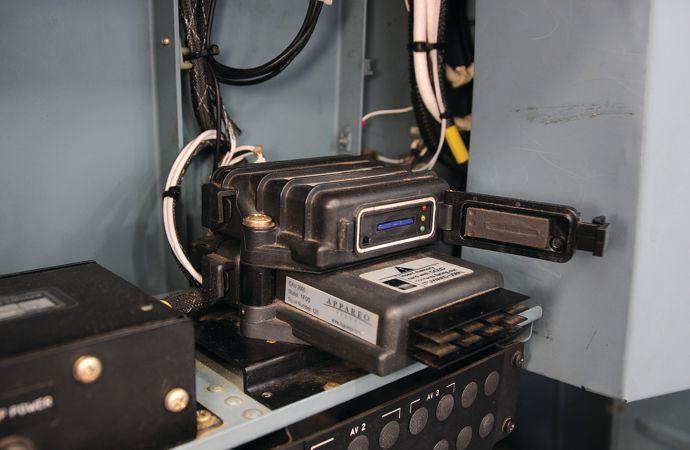
LEFT: Appareo Systems, LLC is an advanced technology business that designs and manufactures electronic, mechanical and software products for aerospace, defense and transportation applications worldwide. (Photo courtesy of Appareo)
mean to the software vendors? We had sikorsky, eurocopter, agustaWestland, aerobytes and we also had Bristow, CHi and CHC and they all did presentations on what they thought HfDM is about. We had an audience of about 70 people and at the end of the day, saw it as our opportunity to lobby the manufacturers together.”
the manufacturers, who had so zealously guarded their proprietary data, realized that there were a lot of people using their aircraft out in the world who really did have a need to know what was going on in the cockpit. as Pilgrim remembers, the manufacturers didn’t quite understand why people wanted the data or what they were going to do with it, but they did realize that they were facing a very dedicated and passionate group representing their biggest customers and something had to be done. the result was the formation of the Global HfDM steering Group.
spring was in the room and found himself frustrated by the direction the group was taking. “the big operators, the heavy iron, were right in there,” he says. “these guys fly offshore, ifr, two pilots, aberdeen to a rig and back again or lagos to a rig and back again. these guys aren’t the [safety] problem; charter operators like me, we’re the problem. We don’t have a standard job, single pilot, vfr.”
the HfDM program that fit the needs of the large operators, capturing data over a period of days, weeks or even months, didn’t meet the needs of an operator such as Phoenix that operates smaller aircraft in an environment that can see pilots and aircraft operating in totally different mis sions on a day-to-day basis, from sar eMs, wildfire suppression, aerial survey and anything else that requires moving
Phoenix Heli-Flight had a serious crash in 2007. Says owner Paul Spring: “If you saw the wreck, everybody should have died, but the thing that saved their lives was they landed in muskeg.” (Photo courtesy of Phoenix Heli-Flight)
people or cargo around northern alberta.
“i understand where the big operators are coming from because their world is that very succinct, controlled world of offshore ifr, it’s all they do,” says spring. “they can get away with trend analysis, they can get away with group memos. But, if i’ve got one rogue pilot, why would i wait until the end of the month and send out a group report showing a trend analysis or bad
Introducing the
pilots even care about that if you’ve only got one guy? you go talk to the one guy, because he’s your problem.”
spring walked away from the 2008 meeting, went back to fort McMurray and kept working his own program at Phoenix. in 2009, he came back to the group at the s afety s ummit, realizing that he either had to get involved with the group for the “little guys” or walk away from it. He
www.robinsonheli.com • 310-539-0508
Global HfDM steering Group, largely because, in his words, “Mike Pilgrim has managed to find people from every segment of the business who have the passion to push this (HfDM) forward.”
Pilgrim’s view of the situation isn’t that far removed from
spring’s given the relative disparity of their operations and environments. “the HfDM program will show you when pre-established thresholds have been exceeded, it will show you the profiles that are being adopted by your pilots in your everyday business. you can see when the aircraft goes over the horizon; if it comes back, you don’t know what’s happened between the time it disappeared and the time it reappeared. But with flight data monitoring, you can see what’s been going on and know now how your crews are flying your aircraft and treating your aircraft.”
so why is HfDM so important? it all comes down to meeting the expectations and requirements of the customer. the larger companies such as CHC and Bristow, have to meet the requirements of the major oil companies on a worldwide basis, or risk losing their livelihood.
for spring at Phoenix Heli-flight, being an early advocate of HfDM is a marketing tool that he can use across the broad customer base he serves. He says being vetted by one of the major oil companies is something he can use to his advantage. “there are companies who are interested but can’t afford to send their own auditors, but they asked and they now know we’re an e sso-vetted supplier,” says s pring. “ t hese companies have to have their own certification to go to work for the oil companies, so they know we’ve done the same process, just an aviation process. But that word hasn’t filtered down to a lot of these smaller companies. “ i f i can’t get the word through to the helicopter companies, i ’ll make them get it because their customers think it’s a good idea.”
LIKE A BANK: WE CAN LOAN YOU MONEY. UNLIKE A BANK: WE CAN LOAN YOU ONE OF OUR AVIATION EXPERTS.
At GE Capital, we’re not just bankers, we’re builders.
So not only can we give you smart financing, we can also bring you expertise from across GE. Stop just banking. And start building.
GECapital.ca GE Capital
Aviation Ground Fueling Technologies Ltd. specializes in the design, fabrication and installation of aviation fueling systems throughout Western Canada.
• API 5th Edition Truck Loading & Offloading System
• Large Inventory of Fueling Components Available 24/7
• Certified Aviation Petroleum Technicians Available 24/7
• Custom Fueling Solutions
• Towable Helicopter Fueling Units Availbale for Rent or Purchase
Phoenix Heli-Flight owner Paul Spring maintains HFDM is a marketing tool that he can use across the broad customer base he serves.
(Photo courtesy of Phoenix Heli-Flight)
pushing the Boundaries
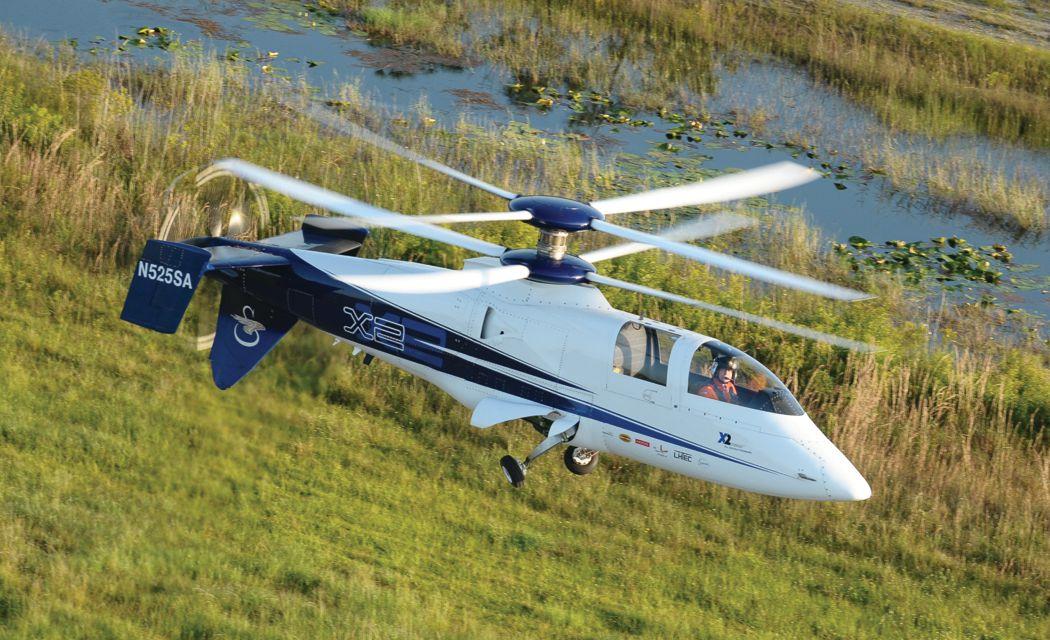
LEFT: On March 15, 2011, the Sikorsky Aircraft Corp. X2 Technology demonstrator team was awarded the 2010 Robert J. Collier Trophy. It won a number of other top awards last year as well. (Photo courtesy of Sikorsky)
BELOW: Sikorsky president/CEO Jeffrey Pino is a strong proponent of developing highspeed, highly agile military aircraft such as the S-97 Raider. (Photo courtesy of Sikorsky)
Sikorsky’s Prototype Aircraft Continue to Make Noise
BY peteR piGott
obert J. Collier was an aviator and sportsman who, in 1910, commissioned a trophy to encourage the american aviation community to strive for excellence in aeronautical development. on March 15, 2011, the sikorsky aircraft Corp. X2 technology demonstrator team was awarded the 2010 robert J. Collier trophy – and the team is poised once again to push the speed boundaries with the soon-to-be-developed s-97 raider.
Rto put the achievement into perspective, it’s a pretty special award indeed – previous winners have included orville Wright and Chuck yeager. “i know our speeds pale in comparison with yeager breaking the sound barrier at 748 mph,” said X2 chief test pilot Kevin l Bredenbeck. “But we did this with a helicopter, and it is nearly double the lift-to-drag ratio of any rotorcraft and double the top speed of most conventional helicopters. and we had power remaining to go faster.”
Bredenbeck flew the X2 technology demonstrator on sept.15, 2010, at a speed of 250 knots in level flight at the sikorsky Development flight Center in West Palm Beach, fla. the demonstrator also reached 260 knots in a very shallow (two to three degrees) dive during the flight. “it didn’t sink in,” he said, “until David Walsh, director of test for the X2 program, said, ‘Come home, we did it.’ ” asked how he felt
at the time, Bredenbeck said, “so surreal. one minute you kiss your wife goodbye and you’re letting the dog out to go outside and then the next, you’re at altitude, setting a record.”
High-speed vertical flight has been attempted before, notably by Canadair in the 1960s and by Bell/agusta with the Ba609. But these firms used “tilt rotors” – complex hybrid aircraft with rotors and not true helicopters. the X2 differs in that it is still a helicopter that can go fast, auto rotate and hover.
according to steve estill, sikorsky’s vice-president for worldwide sales, it can match the speed of Bell/agusta 609 tilt rotor with far less complexity. the X2 demonstrator is powered by a 1,452 shp, faDeCequipped t800 turboshaft engine that was previously installed in one of the sikorsky Comanche helicopter prototypes. it drives both the rotor and the pusher propeller through two gearboxes. this makes X2 technology well suited to missions such as search and rescue, military or flying fast to oil rigs, which would call for development of a light to intermediate X2 twin of the same size as the 12-passenger s-76 or 19-passenger s-92.
in 2005, sikorsky committed resources to the X2 technology program, and the demonstrator first flew on aug. 27, 2008. it immediately caused a sensation, with Time magazine calling it one of the top
50 inventions of 2009. the single-engined fly-by-wire aircraft features coaxial rotors and a pusher propeller that sikorsky believes will revolutionize the helicopter world with its speed.
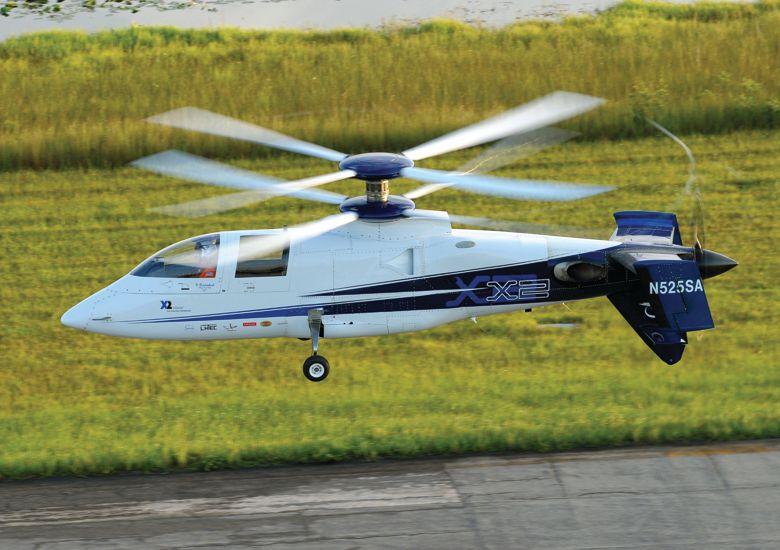
Current helicopter speeds are limited by rotor aerodynamics but, in contrast, the X2’s coaxial rotor system is optimized for all regimes of flight by a fly-by-wire control system that slows the rotors at high forward speeds to prevent their tips going supersonic, while maximizing lift and minimizing drag by adjusting the pitch of the rigid, carbon-fibre blades. the counter-rotating rotors provide equal lift on each side of the
full speed Ahead
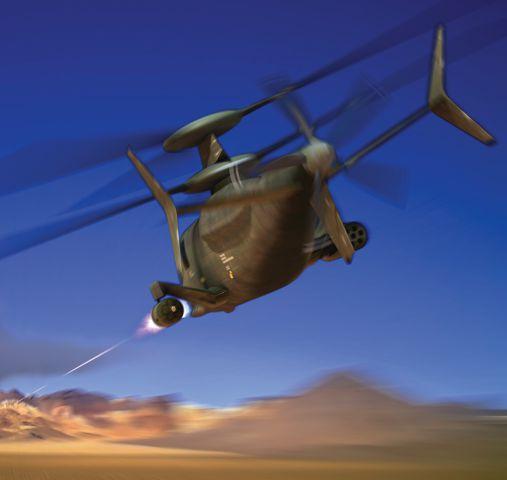
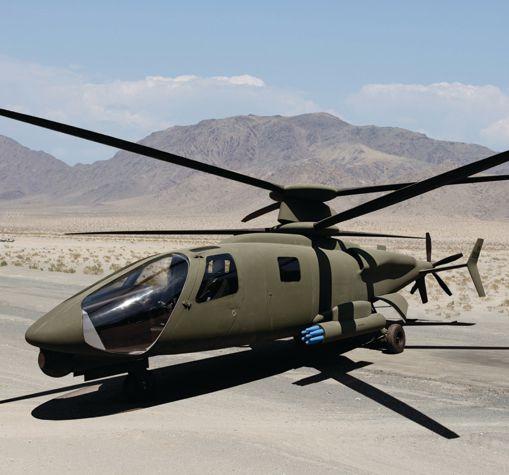
Sikorsky announced in early January, 35 companies will join its team to create two prototype S-97 Raider helicopters for evaluation by the u.S. military. Self-funded by Sikorsky and its team members, the Raider program will demonstrate military applications of Sikorsky’s breakthrough x2 rotorcraft design.
“As designer and integrator of a next-generation light tactical helicopter capable of outperforming conventional helicopters in almost every performance parameter, it was imperative we chose our suppliers for the maturity of their advanced aerospace products and technologies,” said Doug Shidler, Sikorsky’s Raider program manager. “Product maturity will enable Sikorsky to demonstrate the Raider helicopter’s flight and aerodynamic performance in a simulated military environment starting in 2014, and ultimately bring x2-designed helicopters to future customers quickly and at a very affordable price.”
The Sikorsky X2 demonstrator reached a top speed of 260 knots in a very shallow (two-to-three-degree) dive during its record-breaking flight. (Photo courtesy of Sikorsky)
aircraft and, unlike a traditional helicopter, are relieved of having to provide all the forward propulsion by a large pusher propeller at the rear of the fuselage. the rigidity of the blades allows the rotors to be closely spaced at only two feet apart, further reducing drag.
the accolades for both man and machine speak volumes about
the program. in april 2011, Professional Pilot magazine named the X2 demonstrator “innovation of the year.” in recognition of an outstanding improvement in fundamental helicopter technology, the X2 was chosen by the american Helicopter society as the winner of the 2011 Hughes award. Bredenbeck was also honoured when the society of experimental test Pilots recognized his accomplishments with the iven C. Kincheloe award for the year’s outstanding professional accomplishment in flight testing (previous recipients were alan shepard and neil armstrong). at the Dubai air show in november 2011, Flightglobal magazine named Bredenbeck “aviator of the year.”
“the team and i are still in shock from what was accomplished,” said the chief test pilot,” and that we have the potential to continue pushing out faster. so how did it feel? Honoured and privileged to have been on the pointy end of technology and been a part of this team, representing sikorsky aircraft, its heritage and legacy. i may be the one sitting inside that cockpit, the pointed end of technology, but i was never by myself. the entire X2 team was right beside me.”
s-97 RAideR: outpeRfoRMinG tHe ConVentionAl
While the X2 completed its final flight on July 14 last year after accumulating 22 hours over 23 test flights, it’s officially not the end of sikorsky’s foray into high-speed flight. With the end of development, the X2 will be followed by its first application, the s-97 raider high-speed scout and attack helicopter – and the u s army is keenly interested.
the u s army’s competition for the next-generation armed aerial scout (aas) is heating up among all rotary manufacturers. to meet the requirements, Bell Helicopter plans to re-engine a Kiowa with a Honeywell Hts900-2 engine and eaDs north america and lockheed Martin are converting an eC145 single-rotor helicopter into the as645 armed scout. sikorsky has entered an X2 aircraft design called the s-97 raider helicopter to the competition.
“What can the s-97 offer that the others can’t? ” steve engebretson, sikorsky’s aas scout director, was asked. “We have demonstrated a
next-generation rotorcraft,” he replied, “that will outperform conventional helicopters in every aspect: high altitude, hover efficiency, manoeuvrability, and speed, as well as other performance parameters. By building the two raider prototype aircraft, we will provide the u s. government a head start on an affordable platform that can be fielded in time to meet their needs for a new armed reconnaissance aircraft.”
like the X2, the raider prototypes will feature twin coaxial counter-rotating main rotors and a pusher propeller. in addition to flying at nearly twice the speed of a conventional helicopter, the aircraft will incorporate other key performance parameters critical to combat operations – increased manoeuvrability, greater endurance, and the ability to operate at high altitudes. for reconnaissance missions, the X2 raider helicopter will have space aft of the two-pilot cockpit for armament and auxiliary fuel. in an assault configuration, the cabin affords space to accommodate up to six troops.
this is not the company’s first time in such a competition. in feb. 2004, the u s army cancelled the sikorsky/Boeing raH-66 Comanche which was to be the next reconnaissance and attack platform and expanded procurement of its existing aircraft, like the Black Hawk helicopter.
But the military also began a new effort to replace the Kiowa Warrior in the armed reconnaissance mission and cancelling the Comanche program set the stage for the current aas competition. from a technology perspective, sikorsky took advantage of lessons learned on fly-by-wire, composites and rigid rotors that were developed for Comanche.
engebretson was also asked if there had been any representation to the Canadian forces concerning the s-97. and while sikorsky’s focus thus far had been on the u s. military alone, he replied they are anticipating international interest in the near future. With the timeline for production of the raider at “about 10 to 12 years,” according to sikorsky officials, there is hope a Canadian raider could very well be screaming across the skies.
For reconnaissance missions, the X2 Raider helicopter will have space aft of the two-pilot cockpit for armament and auxiliary fuel. In an assault configuration, the cabin affords space to accommodate up to six troops. (Photo courtesy of Sikorsky)
Sikorsky officials put the timeline of the S-97 Raider’s development at 10-12 years. (Photo courtesy of Sikorsky)
soaring with HAWCs
Calgary’s Aerial Police Unit Keeps the Bad Guys at Bay
BY peteR piGott
it wouldn’t be a stretch to label Kevin Brookwell (insp. retd.) a law enforcement visionary.
Brookwell is the manager in charge of strategic communications for the Calgary Police service (CPs) office of the Chief, but in 1992, as a sergeant, Brookwell was researching the use of rotary-winged aircraft to support police operations. at the time, no other police agency in Canada used helicopters to support ground-based patrol units. But today, the Helicopter air Watch for Community safety (HaWCs) is a key part of the policing unit.
so, how did it all begin? “on the evening of oct. 7, 1993,” Brookwell said, “a prolific offender was active in the Calgary area. He was also operating a stolen vehicle and had been involved in a number of pursuits with CPs units before those pursuits were called off for safety reasons. He was picked up again shortly before midnight and police vehicles began closing in on him. the offender made a turn southbound onto Deerfoot trail and accelerated to 160 kilometres per hour. at the same time, Constable rick sonnenberg exited his patrol unit and was in the process of laying a spike belt as the offender approached. as he tried to avoid the spike belt the driver turned toward sonnenberg and struck him at full speed. sonnenberg died instantly.”
later, when Brookwell met rick’s sister lisa stinson, “it was clear she loved her brother very much – and she was very proud of him. But she also wanted answers as to what could be done to prevent this from happening again.” stinson wondered if a helicopter might have prevented her brother’s death. she outlined her plans to establish the Const. rick sonnenberg Memorial society to raise funds to purchase a helicopter for the CPs
“lisa created the acronym HaWCs for ‘Helicopter air Watch for Community safety,’” Brookwell said. the society then reached out to the citizens of Calgary for funding to purchase a CPs helicopter. “there was a tremendous amount of support,” he said. Booths were set up at malls in the Calgary area and sales were brisk for t-shirts, pins and other society paraphernalia. in 1994, the society and HaWCs launched the “sky’s the limit” Home lottery and sales soared. With provincial community investment funding and support from corporate businesses in Calgary and anonymous philanthropists, the $1.5 million goal was reached in november 1994.”
in the months that followed, Brookwell put together the original HaWCs operational team, which was a unit sergeant (himself), a chief pilot, a chief engineer, a line pilot and three CPs officers rotating through the shifts as tactical flight officers. a MD520n helicopter was purchased, retrofitted with police equipment. on June 30, 1995, lisa stinson and the society’s board of directors, presented the keys of “HaWC1” to then chief of police Gerry Borbridge. the helicopter was airborne on its first operational patrol flight on July 18, 1995.
“the 520 served us well for many years,” said Brookwell, “and i have a lot of great memories sitting in the right seat of the old girl. However, we began having a few issues with service and parts availability. at the same time, eurocopter had come out with the eC120 and the enclosed fenestron tail system.”
in 2004, a second Home lottery was hosted, more than $1.8 million dollars was raised and on april 11, 2005, stinson presented the keys to the CPs’s second helicopter, the first of Calgary’s eC120s (HaWC2), to then chief of police Jack Beaton. today, the air services unit has two eC120s, five pilots, two ground crew engineers, three full-time tactical flight officers, and five part-time flight officers who also spend time of the street.
on the HaWCs hangar floor at the Calgary base, Helicopters’ Peter Pigott spoke with chief pilot Cameron Dutnall and tactical flight officer constable James Partridge.
Helicopters: What is the role of HaWCs? i’m guessing that you don’t chase criminals down the street like in the movies?
Dutnall: What it boils down to is officer safety. a number of studies have been done on policing that state that one helicopter is worth approximately 14 police cars just because of its point of view. it is the tactical advantage of being in the air – you see where the police units are and whether or not they are set up properly and you can assist with that. the bad guy might be hiding – you don’t know if he is armed or not but we can scan ahead using our camera – and call, “Hey, watch out there’s a hot spot around the corner.” Most of the time, the bad guys don’t even know we’re there.
Helicopters: are you both pilots as well as police officers?
Dutnall: i am not a police officer and wasn’t trained as one. My background was the military where i flew and instructed on twin Hueys, Griffons and then Cormorants in sar role. i came to HaWCs after that and have been here for just over four years.
Helicopters: is that the usual path? some cities train their police officers to be pilots.
Dutnall: Calgary is different from, for instance, edmonton where we have high-time civilian pilots available. edmonton has several high-time pilots within their police force and has been able to take advantage of that fact.
Helicopters: if he doesn’t fly the helicopter, what does the tactical officer do?
Partridge: the voice of the guys on the ground is the police officer in the aircraft – and the pilots keep us safe up in the air. it’s one guy flying, one guy doing the policing.
Helicopters: Why a helicopter? for a city as spread out as Calgary, why not a spotter plane? it’s cheaper, faster and it would cover more ground.
Dutnall: a helicopter is far more versatile. We can land – not that we have had to land, although there is that possibility – and because of its speed and manoeuvrability, we can stay lower. think of us like a police car in the air. We are tied into the police radio network and dispatched much like a patrol car. air traffic Control gives us clearance to be in a specific area at a certain time. We get our piece of airspace and if we want to go to a different piece we request permission to do so.
ABOVE: On April 11, 2005, Lisa Stinson presented the keys to the CPS’s second helicopter, the first of Calgary’s EC120s (HAWC2). (Photo courtesy of HAWCS)
RIGHT: A number of studies have been done on policing which state that one helicopter is worth approximately 14 police cars. (Photo courtesy of HAWCS)
Helicopters: Given the variety of helicopters available, why the eC120?
Dutnall: Well, it meets our needs very well as far as a patrol aircraft goes and it’s the quietest helicopter on the market. it’s important to maintain a quiet aircraft. We don’t want the citizens of Calgary disturbed at night by flying over them. But it’s also reassuring for the police officers to hear us coming to assist them at a crime scene. and the bad guys to hear us, too. if an officer has pulled someone over at a traffic stop – say he’s a gang member that has some sort of weapon – if he hears a police helicopter up top, maybe he will think twice about doing anything.
Helicopters: What is the greatest misconception that people have about you guys flying around?
Partridge: We essentially provide frontline support, which is surveillance, the tracking of stolen vehicles, finding a guy who has just robbed a bank – using our eyes out the window with binoculars or the thermal imager. But people believe that we land and arrest the bad guys and throw them in the back. We rarely ever land – i’m not getting out and handcuffing anyone and throwing them in back. We direct police officers to the scene. this platform is a patrol machine to support the police operation. We’re not going to be picking up bodies – there’s no physical room in the helicopter anyway, there’s so much kit jammed in.
Helicopters: But there must be noise complaints – especially when you’re out at night?
Dutnall: there were a lot of noise complaints when the unit began in 1995, but they’re almost gone now. i think that now people understand that when we make a noise at 3 a.m – it’s not because we want to wake you up but because someone’s hijacked a car down the road or lit something on fire or broken into a shed.
ABOVE: Calgary’s helicopters are like a police car in the air. They are tied into the police radio network and dispatched much like a patrol car.
(Photo courtesy of HAWCS)
RIGHT: Some citizens do get confused by the traffic helicopters and they assume it’s HAWCS, but R-44s are a lot noisier.
(Photo courtesy of HAWCS)
Helicopters: are you ever confused with the traffic helicopters?
Dutnall: some citizens do get us confused with the traffic helicopters and they assume it’s HaWCs, but their r-44s are a lot noisier than ours. We have agreements with them and with nav Canada about airspace – lets them do their job and us ours.
Helicopters: Do you get called out a lot for search and rescue?
Dutnall: We do some sar, but that is not our focus – not that we don’t assist if we have to. last year, there were some kids floating down the Bow river on rafts – they didn’t show up that night, so it was our night shift that went searching down the river for them. the kids were on shore and had lit a fire. it was HaWCs that found them and directed police units to them. We get requests from the rCMP to assist in outlying communities – or sometimes we get permission from the City of Calgary to follow a bad guy and we will stick with him until we hand over to the rCMP or to its conclusion.
Helicopters: What’s a typical day for HaWCs?
Dutnall: We have a day shift as well as a night shift – about 22-hour coverage of Calgary. there’s an overlap so one helicopter can hand over to the other for the next shift. When one is down for maintenance or inspection, we have the other one so it’s continuous coverage. We typically operate over the city, especially the built-up area at 1,000 feet according to the transport Canada regulations. We can go lower but don’t – with the camera optics that we have we don’t need to. the Calgary Police operations centre is in constant contact with us. the image we see on the camera the operations centre sees as well.
We had a good example last year, when there was a call about a home invasion and the helicopter showed up, observed and recorded the bad guys leaving the home – there were shots fired and the police arrived. those guys were taken into custody because the helicopter was there. that’s the other aspect of police officer safety – the helicopter can get there quicker than a patrol car. We get there in time to see the bad guys and then say to the patrol car on the ground, “your bad guys are over there.”
Helicopters: isn’t this Chinook country with the Bow valley acting as a natural wind tunnel? How does that affect HaWCs?
Dutnall: our speed is subject to the wind but we can usually get up to 300 km/h. this year, we’ve had a hard time with winds. it’s been very windy in Calgary for whatever reason – the winds
that we have had – some were over 30-40 knots, not that the helicopter can’t handle it. But its very difficult to see images on the camera. Plus, it’s uncomfortable for the crew – it gets quite fatiguing. But if a call warrants it we can get airborne and monitor. We do have weather limits as per the Canadian aviation regulations.
Helicopters: Most of the crimes must occur at night – in the dark. What do you do then?
Partridge: of course, at night the eyes don’t see anything, which is why we have the nitesun, which has 30-million-candlewatt power. But 90 per cent of what we do at night is aided by three pieces of kit – two sets of night vision goggles and the turret
which holds a daylight video camera, a thermal imaging camera which is an M12 ts650 and a laser pointer. But the primary asset is thermal imaging. We’ve got an infrared sensor that picks up warm bodies, objects and vehicles, a daylight sensor and a laser illuminator designator. the imagery that is captured on there is instantly on the monitor at operations.
Helicopters: How do you know who the bad guys are?
Partridge: Well, if it’s happening late at night and they’re hiding under a deck – chances are these are the bad guys. once we get an address where a home invasion is taking place, we rotate into the area. the ars (augmented reality system) onboard overlays the street and address information of a map over a real-time video image. so, where ever the camera is pointed, the ars draws the streets and address information over the video.
Helicopters: What is the future for HaWCs? Can the machine be utilized for other operations?
Dutnall: for what we use the eC120, it does a very good job but as to its ability to expand its operational envelope, there’s really nothing left. as to the future for HaWCs – there are no thoughts of expansion right now. until the Calgary police decide they want to have a bigger mission profile, this is what it is going to be.
expansion or not, HaWCs is an extremely effective policing tool, more than exceeding the collective visions of Kevin Brookwell and lisa stinson.
Bradley Potter, Managing Vice President, and John John Wright, Executive Vice President, are pleased to announce that Andrew J. Pell, CAIP, has joined BFL CANADA’s Vancouver office as Vice President Client Executive - Aviation.
Andrew has over 30 years experience with international and national insurance brokers, specializing in Aviation insurance as a client executive and a broker.
He brings expertise in servicing all classes of General Aviation including fixed wing and rotary wing aircraft operators, fixed base operators, and manufacturers.
BFL CANADA has experienced rapid growth throughout Canada by providing a unique entrepreneurial and creative environment for its employees resulting in exemplary service to its clients.
BFL CANADA is the largest employee-owned and operated commercial insurance brokerage and consulting services firm in Canada. BFL CANADA provides a complete range of insurance products, risk management and employee benefits services to all industry sectors across Canada and, through a strategic alliance with the Lockton Companies, LLC, in the U.S., as well as in over 100 countries around the world.
BFL MAKES A DIFFERENCE 200 - 1177 West Hastings Street, Vancouver, BC V6E 2K3
604-669-9600 FAX: 604-683-9316
sea king off libya
Canada’s Venerable Helicopter Shines During Operation Mobile
BY peteR piGott
Canada’s involvement in the libyan conflict last year under operation Mobile is now part of our country’s impressive military history, but the memories are still fresh for several crew members with the CH-124 sea King on the HMCs vancouver. Helicopters magazine caught up with four key Canadian forces’ personnel and asked them to share their thoughts on our essential role in the operation.
MAJ.
don pHillip, HMCs VAnCouVeR’s AiR detACHMent CoMMAndeR
“flying a sea King is an experience in itself,” said Phillip of the iconic rCaf rotary aircraft during the mission. “a traditional ‘stick and rudder’ helicopter, the sea King has no computers assisting the pilots, so we have to land the 19,500-pound helicopter on a moving ship by ourselves, day or night, rain or shine, in any sea state.”
Part of 12 Wing, 443 squadron is equipped with six CH-124 sea
King helicopters. on July 10 last year, one sea King took off from its home base in Patricia Bay, B.C., to join HMCs vancouver on its deployment to the Mediterranean sea for operation Mobile, the Canadian forces’ participation in operation unified Protector, the u nited n ations-authorized, nato-led effort to protect civilians in libya. the mission? to enforce an arms embargo and no-fly zone on the former regime.
under the call sign, trojan, the helo’s primary focus was patrolling the waters off the libyan coast. the air detachment on board consisted of four pilots, two air combat system officers (aCso), two airborne electronic sensor operators (aes op) and 11 technicians. the crew followed the directions from the aCso, flying at various altitudes and areas to cover the assigned patrol box. their job was to provide an extension of HMCs vancouver’s sensors to build the recognized Maritime Picture and conduct Maritime interdiction operations in support of vancouver’s mission to enforce the arms embargo while allowing humanitarian aid to flow into libya.
once on station, the crews flew two sorties daily to search for vessels transiting from the many libyan ports, developing a maritime picture for HMCs vancouver and establishing the pattern of life in the region. after a day of patrolling, the maintenance crew worked to refuel, re-arm and prepare trojan for the next day’s mission. the detachment also held an “alert 30” status at all times to react to any situation that required the aircraft. (this means that from a dead sleep, the technicians and the crew can launch trojan in 30 minutes to perform whatever mission is required.)
operating at low level in a war zone, in what is considered a “high threat environment,” the CH124 assigned to the detachment had been fitted with a trial version of the augmented surface Plot (asP) system. the asP system integrates radar returns, GPs and the automatic information system (ais) Horizon onto one system
One Sea King helicopter took off from its home base in Patricia Bay, B.C., to join HMCS Vancouver on its deployment to the Mediterranean Sea for Operation Mobile.
(Photo courtesy of RCAF)
equipped with a map overlay. from a tactical standpoint, this has proven to be a force multiplier by augmenting the current navigation system. trojan had also been fitted with a full self Defence suite (sDs) suite, providing an additional layer of protection to the crew, making it the most advanced CH-124 ever to deploy with the Canadian forces.
“the sea King is also equipped with crash-resistant fuel cells located in the belly of the aircraft,” Phillip said. “We have two hydraulics systems that work in tandem to fly the bird. the systems are capable of flying on one but we consider it an emergency at that point because if we lose the other, we would no longer be able to control the aircraft.”
When asked what effect the Mediterranean/desert environment had on the sea King’s engines, Phillip said, “the engines were very reliable and capable of producing a lot of power in the hot temperatures there. at the end of each day, the engines were fresh water rinsed to wash off the sand and salt water that was ingested through-
ABOVE: Major Don Phillip said landing a Sea King on the flight deck of HMCS Vancouver always presented a real thrill. (Photo courtesy of RCAF)
LEFT: The ASP system, combined with the new Self Defence Suite, has created the most technologically advanced Canadian Sea King ever to deploy. (Photo courtesy of RCAF)
out the flight.”
Phillips said landing on the flight deck of HMCs vancouver always presented a real thrill. “the flight deck is only as big as eight parking spots and it moves; pitching fore and aft as high as four degrees and can roll up to 20 degrees,” he said. “the pilot focuses on visual cues and receives conning from a landing signal officer to aim for a moving spot that is two feet by two feet.”
pte. JoHn GeRl ACH, JunioR Aes op, HMCs VAnCouVeR
as a new airborne electronic sensor operator (aes op) having just graduated from a CH-124 sea King type course, Gerlach was thrown right into the deep end with operation Mobile. But he considers himself “very lucky” to to have sailed with HMCs vancouver’s Helicopter air detachment.
“everything i experienced was new to me and landing on a ship for the first time was no exception,” he said. “My first experience at sea was the day we flew trojan to HMCs vancouver on July 10. after landing on the ship and having never been at sea, i was feeling a little seasick the following day, so as you can imagine it was a relief to get into the air and have a relatively steady deck. in the days ahead, i got my chance to hone my skills.”
Gerlach said he quickly had to prepare himself and learn the new asP system, which he notes “was a very useful and important tool on the mission.” the system, combined with the new self Defence suite, have created the most technologically advanced Canadian sea King ever to deploy. the asP system combines the legacy radar display
with a full map overlay, increasing the ability to track and classify contacts, particularly small ones.
an aes op’s role in the helo is to operate the radar, sonar and flir, and provide sensor information to the aCso other duties include the maintenance and operation of weapon stores such as the C6 machine gun, sonobuoys, and smoke markers. the aes op also trains in conducting utility operations such as vertical replenishment at sea (vertreP) and hoisting personnel from land, ship or the sea in order to support search-and-rescue operations.
“on our way to libya, i was able to participate in force protection exercises to help prepare us for the road ahead, more specifically using the helicopter to help protect the ship from small fast attack craft,” Gerlach said. “one of the scenarios we practised, was to gain the compliance of an approaching vessel. to do so, we would fly low over the water, i would hold a large stop sign in the cargo door on which i painted “stop” in both english and arabic. if the vessel were to continue, i would be ordered to conduct warning shots with the C6 and then if the vessel still continued to threaten the ship, i could be ordered to engage.”
While the helo patrolled off the coast of libya, Gerlach was able to find several small boats leaving various harbours and to provide the ship with information through the use of sensors, cameras, and gyro stabilized binoculars. “in some cases we even hailed these vessels to gather more information,” he said.
“it was a great feeling to be in the air – a taste of freedom and a break from the ship,” he said. “Combine that with the various tasks and roles required of an aes op – and a great view from the cargo door – and no day was exactly the same. i often thought to myself that i have one of the best jobs in the world.”
MAsteR Cpl. GeoRGe MeeCHAn, teCHniCiAn, HMCs VAnCouVeR
When the navy sends a ship on a long deployment, such as vancouver’s mission on op Mobile, they like to have a helicopter on board. the helicopter can provide the ship’s commanding officer with a much greater war fighting capability and other abilities such as casualty evacuation, (CasevaC), vertreP and passenger transfer.
usually, for a long deployment, the helicopter chosen for the mission is one that has just come out of overhaul. Prior to the deployment, the maintainers will replace all the components that will become time expired, and “this can place a heavy workload on technicians working long hours, putting a lot of stress on families who won’t be seeing their loved ones for the foreseeable future,” Meechan said. “regardless it must be done and we all count on the support of our families.”
When on board a ship, all crew ship’s members are all “sailors first” – which means they are part of the ships’s company and take their turn in the evolutions that keep the ship running, such as cleaning stations and duty watches. Beyond that, all technicians in the air detachment have a minimum of two jobs on board. the first priority begins with work on the helicopter, a secondary duty that can often take up as much time as the primary job. these include aviation life support equipment (alse); supply; Petroleu-oil-lubricants (Pol); non-Destructive testing (nDt); sample of aviation Product (soaPfluids analysis); air Maintenance support equipment (aMse); and tool Control.
“With every deployment there is a learning or relearning curve,” Meechan said. “skills can get rusty when you’ve been ashore for a while so when the helicopter lands on the flight deck for the first time, the pressure to get the job done right becomes all too real.”
Working the deck and hangar is similar to what members of the air force do on land operations: performing cargo hoists, passenger transfers, helicopter-in-flight refuelling (Hifr) and other evolutions. “Much like our land-based counterparts, we often did this in low light or pitch darkness,” said Meechan. “But unlike them, we are faced with carrying out these tasks on something that is akin to working on the back of a mechanical bull on low setting.”
CApt. BiAnCA einsfeld, tRoJAn’s AiR
CoMBAt offiCeR, HMCs VAnCouVeR
einsfeld is an aCso by trade, and known as a tactical coordinator (taCCo) aboard the CH124 sea King helicopter. she is a member of HMCs vancouver’s air detachment and was the operations officer (opso) for this deployment. “as the opso, it was my responsibility to organize the flight program to include both our mission and training requirements all while balancing the rigorous maintenance schedule,” she said. “this was a daunting task and filled up most of my day while on the ship and not in the air flying.”
on board the sea King, as a taCCo, einsfeld directed the crew in order to accomplish whatever mission they were assigned to do. Her primary focus was navigation and tactics. she ensured they maintained stand-off distances when required, provided direction when conducting identification runs on contacts and maintained an overall picture of what surrounded them. she also tracked and classified contacts and ensured the ship was made aware of any suspicious vessels or activities in the area.
“as a junior taCCo, this deployment was an enriching and exciting experience,” she said. “i am very fortunate to have had the opportunity to learn my job during an actual operational deployment. Being air force on a nato deployment in the navy is like travelling to a
foreign country. everyone around you speaks in a different language and uses acronyms that you are not accustomed to. it makes you feel as if you are immersed in a culture far different from your own. this was my first operational deployment, as it was for most of our two sea King crews. it was a steep learning curve, understanding how to operate not only in a multinational task group, but also how to operate within the constraints of the navy.”
the air detachment was tasked with many different types of missions in libya, from personnel transfer and medevacs to contact investigation. their primary focus was to build a recognized maritime picture (rMP) for the ship.
“We extended the ship’s radar and ais horizon and were able to provide information to build up a better picture of what was surrounding us,” said einsfeld. “We aided in gathering information for building patterns of life in the area of operations. Having a chance to work with all this new equipment was also a great transition for what is to come with the future deployment of the CH-148 Cyclone.”
einsfeld said her experience in libya will be hard to forget. “i found that for some, it’s easy to forget why we were out here, sitting off the coast of libya, just miles from shore. since we weren’t on the ground fighting the war, it may have felt like we weren’t accomplishing much. But we were keeping ports open and allowing humanitarian aid to reach those in need – as well as stopping arms from making their way into the hands of the former regime. and, if nothing else, we were showing a presence, which was a great deterrent. sometimes it’s good that nothing seems to be happening – it means we were being effective.”
Peter Pigott would like to thank lieutenant (Navy) Anthony (Tony) Wright, Task Force Vancouver public affairs officer, HMCS Vancouver, for his help in co-ordinating the crew interviews.
Once on station, the crews flew two sorties daily to search for vessels transiting from the many Libyan ports, developing a maritime picture for HMCS Vancouver and establishing the pattern of life in the region. (Photo courtesy of RCAF)
HAC 2012
16th Annual HAC Convention & Trade Show
March 16-18, 2012 W OTTAWA, ONTARIO
Don’t miss Canada’s largest gathering of helicopter operators, manufacturers and industry suppliers March 16-18, 2012 in the nation’s capital city, beautiful Ottawa, Ontario.
HAC is your opportunity to network with the operators of more than 1,500 helicopters, take advantage of special training and education sessions, contribute to the direction of the industry by participating in HAC committee meetings, and much more.
To register as an attendee or book your exhibit space, go to www.h-a-c.ca.
Pre-event Courses, MarCh 14-15, inClude:
• Flying in the Wire & Obstruction Environment
• Helicopter Longline and Cargo Net Maintenance
• Person Responsible for Maintenance Control (PRMC) Workshop
• Managing your Costs and Profitability
We Proudly salute our 2012 CorPorate sPonsors: agustaWestland, aon reed stenhouse, Bell helicopter textron Canada, eurocopter Canada, heli-one, heliCoPters Magazine, honeywell, nav Canada, Pratt & Whitney Canada, rolls-royce, standardaero, safranturbomeca, vector aerospace, Willis Global aviation
info@ebhelicopters.com www.ebhelicopters.com
EXPLORE THE
OPPORTUNITIES
ENGINEERS
• Engineers who have endorsements and a minimum of 1 year experience of the AS 350 Series, Bell 206 and Bell 407
• Medium Engineer with a minimum of 2 years field experience on the Bell 205, Bell 212 and Bell 412
• 206 Fleet Manager with 3 to 5 years experiences
• Engineers eligible for type course after 12 months of service
• $5,000 sign on bonus for all AME positions
BASE AND POOL PILOTS
Consideration will be given to candidates who have over 1500 PIC with long-line proficiency and endorsements on the AS 350, Bell 205, Bell 212 and Bell 407.
International tours are available for AME’S and Pilot’s and fluency in Spanish is an asset.
If you are a team player and can deliver superior customer service that exceeds expectations on the areas of safety and meeting client needs, we want to hear from you.
For immediate consideration on the Engineer and Pilots opportunities e-mail resume and references to jugjit_morecurran@greatslaveheli.com
ColuMn
fRed Jones
his summer, i was reflecting on the importance of “comfort food” in the life of a helicopter pilot. our world is unpredictable enough, so most pilots have learned to cling to those circumstances that they can control or at least find some predictability in. We love the familiarity of routine – it creates the illusion that things will unfold exactly as we plan each day. i have often considered the circumstances that have provided me with some comfort over the years, and i would like to share a few of them with new pilots, and old ones like myself.
That Last Look
Wherever possible, i always insist on being the last person to enter the aircraft, and just prior to getting in, i do a complete walk around the aircraft. i can’t tell you how many times, i have discovered a belt hanging out or a door partially closed or a gas cap or a backpack sitting on the flight-step, even an open cowl or someone’s clipboard on the horizontal stabilizer! i insist that passengers never leave anything sitting on the helicopter, even for a minute.
Get Customers Working for You in my preflight briefing, i always make it a point of reminding my passengers to alert me to anything unusual. “i can’t see everything from the front seat,” i like to tell them. “if you are getting out and see oil on
comfort Food for Pilots
Helicopter Pilots Need Elements of Control
be a “local,” hang-out with one for a while anyway . . . it will invariably pay off.
Familiarity Breeds
Content – Get a Proper Hand-off
tell me, who knows the operator, the customer, the aircraft and the operational environment best? the pilot that you are relieving. i hate it when the pilot that i am relieving is going home on the aircraft that i arrived on . . . new aircraft, new customer, new fuel source and pump, alleged caché locations, new routine. always insist on using all the time available to get a proper hand-off briefing, and make sure your own checklist of items is to be covered. and be sure to return the favour for the pilot arriving to relieve you.
Bring Your Comfort With You
Contract pilots are like gypsies. they move from company to company and they are constantly faced with new aircraft, equipment, customers, geography, local weather and missions. Most contractors that i know, and many full-time pilots, bring their own GPs, maps, tools, computer and basic equipment to ensure that they surround themselves with familiar elements to create a familiar environment.
Finding Comfort When You Return Home
We love the familiarity of routine –it creates the illusion that things will unfold exactly as we plan each day.
the side of the aircraft, or notice a cowl open, or a small tree that appears to be uncomfortably close, calmly walk over and ask for a headset to tell me about it.” it’s just common sense in my mind.
Rely on Local Knowledge
Many of the areas we operate in are without decent forecast weather. frequently, we rely on an area forecast that has questionable reliability. i always try to take some time with someone in the camp who has spent some time there (preferably a number of seasons) and who can give me some insight in to the local weather phenomena. if you can’t
Have you ever noticed that when you return from a tour of flying or business travel that your wife has an expectation that you will take over all the routine jobs that you missed while you were gone (naturally, including theirs and yours)? you should have to drive the kids to all their soccer games, and clean all the bathrooms, and need to do all the laundry, etc. i usually end that conversation by suggesting to my wife that i would be happy to take over all those responsibilities, just as long as we can also catch up on all the sex that she missed while i was gone, too.
’’
it should be said, however, that i am always a little concerned that she is going to tell me that she didn’t miss it . . . it’s a lot like the old rodney Dangerfield joke where he and his wife agreed to quit smoking except after sex. six months later, he hadn’t had a single cigarette, but his wife was up to two-packs-a-day . . . let’s try to perpetuate the illusion that we have some control, over that, anyway.
Fred Jones is the president/CEO of the Helicopter Association of Canada and a regular contributor to Helicopters magazine.
The Bose® A20® Aviation Headset. The best we’ve ever made.
When you fly helicopters, you know being focused is critical. e acclaimed noise reduction, comfortable fit and clear audio of the Bose A20 Aviation Headset helps reduce distractions so you can concentrate on flying. In fact, it’s engineered for the high noise levels that are found in helicopter cockpits. Certified Helicopter Flight Instructor Stephen Boatwright summed it up this way, “…if you want to be able to hear everything, if you don’t want fatigue, if you don’t want to miss those radio calls…then go with the A20.”
In addition, it has an auxiliary audio input, available Bluetooth® communications interface and meets or exceeds all TSO standards. Plus, its optional flexible power circuitry allows for a connection from a 6 pin to U174, letting you take the headset from one helicopter to another. No other headset offers this advanced combination of features and benefits. Prove it to yourself. Try the A20 Aviation Headset for 30 days, satisfaction guaranteed.
Thinking without limits
( THINK SERVICE )
Because you need your helicopters to be available around the clock, we have the largest network of helicopter training, logistics and maintenance centers across the globe. Eurocopter — Ready to serve you 24/7.