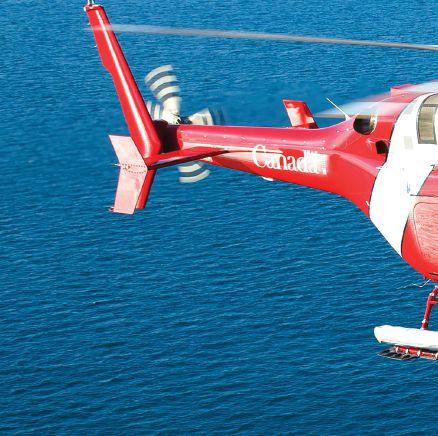
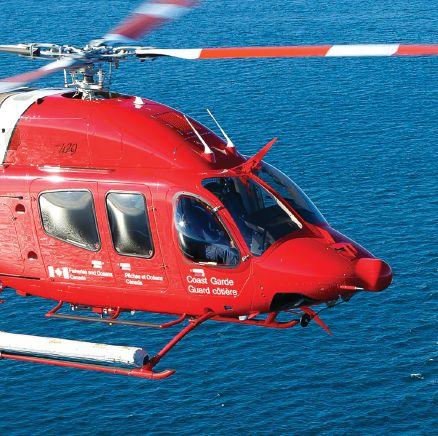
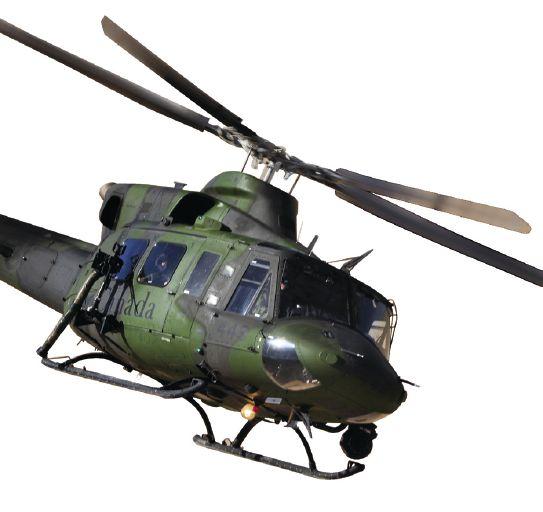
When minutes count, depend on the power and performance of the Bell 429 for your search and rescue mission. The reconfigurable interior seats up to seven passengers plus a pilot, features large sliding doors for quick access, and a 70+ cubic foot baggage compartment. The Bell 429 is ready to serve your operation by delivering 150-knot speed, as well as the safety and superior handling needed in critical situations.
DMATT NICHOLLS is editor of Helicopters
aunting. Dramatic. Disheartening. Welcome to the beginning of the 2016 operating season, where several significant incidents put the Canadian helicopter industry under the microscope – and the picture wasn’t always positive.
The crash of an Airbus Helicopters H225 operated by CHC Helicopters near Tur<accent>øy, Norway that claimed the lives of 11 passengers and two crew on April 29 was daunting indeed. The particulars in the accident are disturbing: the helicopter’s main rotor head detached from the mast of the aircraft in flight and caused the helicopter to plummet into the sea, killing all on board.
The crash came shortly after the conclusion of the CHC Safety & Quality Summit in Vancouver, a popular annual industry event that brings together delegates from around the globe to discuss ways to enhance safety in the oil and gas market. This year’s event was themed around the concept of enhancing safety in times of economic challenges, and the accident was a cruel reminder that no measure of safety is too much, no matter what the economic realities.
In its investigation of the mishap, the Accident Investigation Board of Norway (AIBN) determined the crash to be one of three things: failure of the epicyclic module, a lift-strut attachment or the main gearbox conical housing. In response to the investigation, Airbus Helicopters stepped up efforts to help investigative teams, but
Eye of the Storm
Fort McMurray Fire, High-Profile Accidents, Paint Mixed Safety Image
Through it all, aerial firefighting teams illustrated just how effective and advanced Canadian aerial firefighting is today. At the height of the fire’s rage in mid-May, more than 45 helicopters and 22 air tankers were involved in the operation – an outstanding number to effectively coordinate and track.
The Fort McMurray blaze was 10 times that of the 2011 Slave Lake fire, which destroyed one third of the town of Slave Lake. This blaze caused $750 million dollars in damage, at the time, the most expensive fire damage in Canadian history. It also resulted in an aviation-death: pilot Jean-Luc Duba was killed when his Bell 212 crashed as he was assisting in fire operations.
There were other harrowing stories, some involving helicopter operators. Paul and Andrea Spring for example – who for years have worked to raise safety standards industry-wide and help others in need with Phoenix Heli-Flight’s Medevac operations – lost their home in the blaze. They, like other aviators, soldiered on as they had from Day 1, staying the course to the end. Drama aside, it’s this resiliency that drives the success of the Canadian helicopter industry in times of strife.
The Transportation Board of Canada’s (TSB) report on the May 2013 crash of an ORNGE S-76A helicopter in Moosonee that claimed the lives of two pilots and two paramedics easily fulfilled the disheartening part of the early season news. As Kathy Fox, TSB chair pointed out in the report, there were a number of alarming organizational, regulatory and oversite deficiencies that led to the accident.
The accident was a cruel reminder that no measure of safety is too much at any level.
also to work to support international customers. It was a measured response yes, but one that needs to continue in the future for safe operations of a helicopter platform with a history of gearbox issues and problems.
Early season drama came in the form of the Fort McMurray fire that dominated headlines for two months in May and June. The numbers are staggering: more than 2,500 homes and buildings destroyed; some 1.5 million acres burned; $615 million earmarked to supply firefighting resources/proper evacuation procedures; insurance payouts estimated at roughly $2.6 billion.
Equally disheartening is the fact that ORNGE – and Transport Canada (TC) – didn’t address procedures and organizational deficiencies that may have helped prevent the crash. (For more, see “A Sad Reality,” pg. 8.) In its report, the TSB noted 14 deficiencies in the regulations, flight rules and pilot readiness and aircraft equipment that need to be adhered to in order to prevent like accidents in the future.
And while both TC and ORNGE have taken significant action to make amends, work still needs to be done. Let’s hope both organizations continue to work to ensure the safe transport of patients in need – processes that aren’t disregarded or blatantly ignored.
As each situation illustrates, the storm can subside and be contained, but only with a calculated, collective effort.
Rugged and Reliable
Finmeccanica is now Leonardo - inspired by the vision, curiosity and creativity of the great master inventordesigning the technology of tomorrow.
The AgustaWestland AW109 Trekker is the newest light twin-engine helicopter, equipped with robust skid landing gear; developed to provide the perfect platform for demanding utility and aerial work operations.
High productivity, excellent flying qualities, controllability, manoeuvrability and latest-generation glass cockpit and advanced avionics allows operational flexibility for a variety of roles.
Shared Negligence led to ORNGE crash: TSB
The Transportation Safety Board released its report on the May 2013 crash of an ORNGE Sikorsky S-76A helicopter in mid-June, noting that a number of organizational, regulatory and oversite deficiencies led to the crash.
The accident occurred on the night of May 31, 2013 in Moosonee, Ont. At approximately, 12:11 AM EST, the Sikorsky S-76A departed from the Moosonee Airport destined for Attawapiskat, Ont. As the helicopter climbed through 300 feet into darkness, first officer Jacques Dupuy commenced a left-hand turn and the crew began carrying out post-takeoff checks. During the turn, the aircraft’s angle of bank increased, and an inadvertent descent developed.
Both captain Don Filliter and Dupuy recognized the excessive bank and that the aircraft was descending; however, this occurred too late, and at an altitude from which it was impossible to recover. A total of 23 seconds had elapsed from the start of the turn until impact, approximately one nautical mile from the airport. The aircraft was destroyed by impact forces and the ensuing post-crash fire. All four on board – Filliter, Dupuy and paramedics Dustin Gagenais and Chris Snowball – were killed.
In its report on the crash, TSB investigators were stoic and direct in their assessment of the tragic accident, noting that the system – and organizational inadequacies both at ORNGE and Transport Canada (TC) – let the crew down. It also acknowledging neither Filliter nor Dupuy had the proper training to safely execute the flight that night, and the crew pairing underscored the flaws in place at ORNGE.
“This accident goes beyond the actions of a single flight crew,” said Kathy Fox, TSB chair. “ORNGE did not have sufficient, experienced resources in place to effectively manage safety. Further, TC inspections identified numerous concerns about the operator, but its oversight approach did not bring ORNGE back into compliance in a timely manner. The tragic outcome was that an experienced flight crew was not operationally ready to face the challenging conditions on
the night of the flight.”
The TSB investigation uncovered several issues. The night visual flight rules regulations do not clearly define “visual reference to the surface,” while instrument flight currency requirements do not ensure that pilots can maintain their instrument flying proficiency. At ORNGE, training, standard operating procedures, supervision and staffing in key safety/supervisory positions did not ensure that the crew was ready to conduct the challenging flight into an area of total darkness. The training and guidance provided to TC inspectors led to inconsistent and ineffective surveillance of ORNGE, as inspectors did not have the tools needed to bring a willing but struggling operator back into compliance in a timely manner, allowing unsafe practices to persist.
As a result of risks to the aviation system found during this investigation TSB is issuing
14 recommendations to address deficiencies in the following areas:
• Regulatory oversight
• Flight rules and pilot readiness
• Aircraft equipment
A detailed breakdown of the recommendations can be found here: http://bit.ly/1PtYduH
Fox noted that steps have been taken by both parties to ensure that enhanced safety measures have been put in place to help prevent future accidents. In an interview with the ORNGE corporate team earlier this year, Helicopters discussed the accident and some of the steps the organization has taken to improve operations. Some of those have included the introduction of NVGs for night flying operations, improved communication and safety commitments at various levels, enhanced pilot training, the reassessment of its helicopter fleet and deployment and more. More needs to
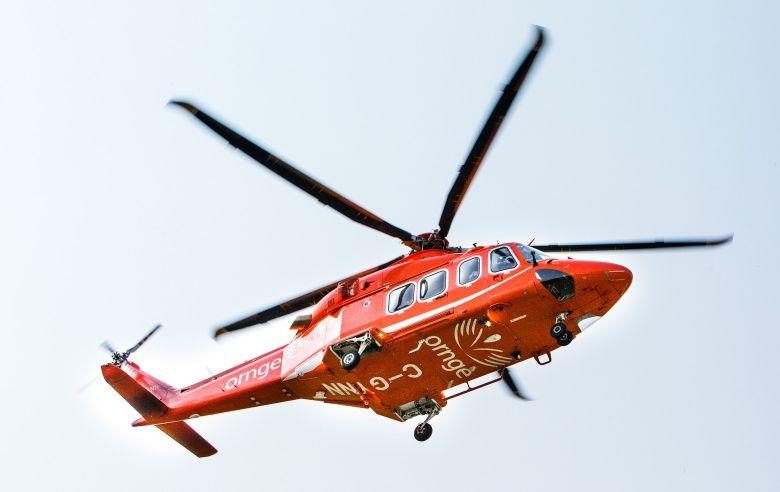
ORNGE is now deploying its AW139 helicopter to the Moosonee base. (Photo courtesy of ORNGE)
be done and accountability is necessary, but steps are being taken. (For more, see “An ORNGE Revival”, http://bit.ly/1V1T7v1)
“Both ORNGE and TC have taken significant action since this accident, but there are still a number of gaps that need to be addressed,” Fox added. “Our recommendations will help ensure that the right equipment is on board, that pilots are suitably prepared, and that operators who cannot effectively manage the
safety of their operations will face not just a warning, but a firm hand from the regulator that knows exactly when enough is enough, and is prepared to take strong and immediate action.”
ORNGE president/CEO Andrew McCallum told Helicopters safety enhancements arae ongoing, including the addition of the AW139 at the Moosonee base, implementation of NVGs and more.
“Obviously this was a tragic
New training system for the Chinook
Bluedrop Performance Learning Inc. has developed a new training device for the CH-47 Chinook helicopter. The 42-foot-long mock-up of the Chinook was manufactured by Bluedrop and installed in its Bluedrop Training and Simulation Centre facility in Halifax. The mock up includes Boeing’s cockpit training simulator system.
The new mock-up represents a 100 per cent untethered, or wireless, virtual reality training experience that is supposed to will maximize the flexibility and safety of the trainer.
event but we have not been complacent and we won’t be in the future,” McCallum said. “We have put a strong aviation team in place and will continue to make refinements and efforts to enhance our safety envelope. I think the fact TSB recognizes we have taken many steps to improve our operation since the accident is significant.”
For more on the ORNGE Moosonee incident see, “A Sad Reality,” page 8.
HELICOPTERS MAGAZINE P.O. Box 530
105 Donly Drive South Simcoe ON N3Y 4N5
Tel.: 519-428-3471 Fax: 519-429-3094
Toll Free: 1-888-599-2228
Website: www.helicoptersmagazine.com
EDITOR MATT NICHOLLS email: mnicholls@annexweb.com 416-725-5637
MEDIA DESIGNER ALISON KEBA
CONTRIBUTING WRITERS
RICK ADAMS, DAVID CARR, BRIAN DUNN, PAUL DIXON, WALTER HENEGHAN, FRED JONES, JAMES MARASA, CARROLL MCCORMICK, COREY TAYLOR
Bluedrop Performance Learning has created a new training device for the CH-147 Chinook.
(Photo courtesy of RCAF)
“Bluedrop has designed an important part of a high-fidelity, immersive training environment that will enhance the effectiveness and safety of service members operating the Chinook,” Roger Schallom, Boeing senior manager of the Americas for International strategic partnerships said. “Together with Boeing’s existing cockpit training device, it allows for fully interactive crew and mission-scenario training, with unparalleled realism for greater effectiveness.”
The initial development phase of the trainer began one year ago following a more than US$2million cash commitment from Boeing as well as, an intellectual property license associated with the specific technical characteristics of the Chinook platform, engineering support from the Boeing training and simulation group during the development phase, and a five-year commitment to support the on-going sales and marketing of the new product within Boeing’s global supply chain.
The integration and testing process will continue throughout the fall, with a full demonstration of the stand-alone trainer ready by year-end. The final delivery of the trainer to Boeing is anticipated in early 2017.
Yellowhead adds to its fleet
Eagle Copters Ltd. delivered two more Eagle 407HPs to Yellowhead Helicopters Ltd. in June, just in time for the 2016 operating year. Yellowhead Helicopters plans to use the machines for missions including cone harvesting, aerial seeding, power and pipeline patrols and fire suppression.
“Yellowhead’s rate of growth in supporting the forestry, mining, petroleum, utility and tourism industries has been achieved by offering its customers performance and value,” Stephane Arsenault, vice-president of sales and marketing at Eagle Copters Ltd. said. “The 407HP reflects our company’s ability to provide innovative solutions across a broad spectrum of industries.”
Yellowhead Helicopters Ltd. is a privately held Canadian company that has been providing commercial helicopter solutions to the public, industry and government since 1975.
GROUP PUBLISHER MARTIN MCANULTY email: mmcanulty@annexweb.com
DIRECTOR OF SOUL/COO SUE FREDERICKS
RETURN UNDELIVERABLE CANADIAN ADDRESSES TO ANNEX PUBLISHING & PRINTING INC., P.O. BOX 530, SIMCOE, ON N3Y 4N5 CANADA. email: subscribe@helicoptersmagazine.com
Published five times a year by Annex Publishing & Printing Inc.
Helicopters Magazine is an associate member of the following Canadian aviation associations:
The Eagle 407HP is a more versatile version of the dependable Bell 407. (Photo courtesy of Eagle Copters Ltd.)
COLUMN
A Sad Reality
Sticking to Sound Safety Management Principles
Dear Transport Canada and ORNGE: “You have been weighed. You have been measured. You have been found wanting.” On June 15, 2016, the Transportation Safety Board of Canada (TSB) finally released its report into the fatal helicopter accident May 31, 2013 involving a Sikorsky S-76A helicopter in Moosonee, Ont. The investigation took more than three years to complete and it paints a damning picture of dysfunction within the organizational structures of the new operator for the province of Ontario, ORNGE and within Transport Canada (TC).
The shocking result of the culmination of these dysfunctions was the death of four men who were just trying to do their jobs. I was involved with the previous operator who provided the service for the people of Ontario with distinction since the inception of the air ambulance program in 1977, flying more than 165,000 hours in a wide variety of operational conditions with only one major accident and no fatalities.
To many of us, the accident at ORNGE was inevitable. The exhaustive exposé reported in the Toronto Star by Kevin Donovan over the past three years laid bare to many of the fault lines implicated in the accident. The dysfunctions were widely known yet, as the report reveals, there was an inadequate response from the regulator. In my view, TC was feckless and bears significant culpability. This view is reflected in the TSB report.
One of the more offending aspects of the accident is that dozens of
good, real, common sense safety strategies, forged through firsthand experience, were discarded. Four men died.
Worse yet, TC Civil Aviation, the agency charged with a fiduciary duty “for advancing the safety of all aspects of civil aviation . . .” through the development and use of “. . . oversight activities, [to] verify [compliance] with the regulatory framework through certifications, assessments, validations, inspections and enforcement. . .” was woefully asleep at the switch.
Repeated evaluations, conversations and consultations regarding how to manage or eliminate the risks that had germinated within the ORNGE operation went nowhere. It is clear that the failure of the operational management structure informs this accident.
TC was armed with a wealth of information about the spectacular management and operational shortcomings of the ORNGE rotary wing operation, and yet was trapped in a stupefying paralysis in the execution of their responsibilities. Four men died
In my view, TC was feckless and bears significant culpability. This view is reflected in the TSB report. ‘‘ ’’
industry experts, insiders and onlookers alike, saw all the signs of dysfunction and disease. Many raised the flag. Some sacrificed careers and their paycheques to cry out. Yet the leadership within the newly formed, arms-length, not-for-profit-yet-ego-driven non-governmental agency stood behind these self-same egos and plowed ahead.
They blamed it on sour grapes. They blamed it on divided loyalties from the staff and managers they inherited. They blamed it on everyone but themselves. The operational structure, bequeathed to them by Canadian Helicopters and battle hardened more than three decades, was cast aside. Controls, mitigation strategies, policies, procedures and
The report goes into some detail about the operational conditions that fateful night in May. I know these conditions. For six years, I flew that very same helicopter more times than I care to remember along the western James Bay coast back and forth and back again to Attawapiskat. Yes, some nights it was dark – my AME used to say that it was “dark, like the inside of a cow . . .” And yet, I was never too concerned because I knew that I had the training and the experience and the safety mitigations (SOPs, crewing policies, etc.) that created sufficient barriers to the risk of flying in the black to protect me. I knew that there was increased risk at 12:30 a.m. on a moonless, overcast night. I knew it was adequately managed. Yet, ORNGE and its managers discarded many of these controls, the Ministry of Health with the Ontario Government and TC couldn’t be bothered to properly oversee the operation. The Captain himself had self-identifed to his managers that he didn’t think the crew pairing was right. He was the last line of defence. He had no support. All the controls had failed. Four men died.
Helicopters safety expert Walter Heneghan was employed by Canadian Helicopters Limited from 2001 until 2014 and worked in a number of positions including a line pilot based in Moosonee, Ont. safety manager for its EMS Division and as vice-president of safety for the company. The opinions expressed in this piece are his alone and are not representative of any company, former or current employer, or this publication.
WALTER HENEGHAN
COLUMN
PAUL DIXON
There is rarely a week goes by that we don’t see something in the mainstream media about drones, drones, drones and just in case you missed it, there’s always another drone somewhere else on the verge of doing something new and exciting.
The fun side is trying to imagine what I could possibly purchase through Amazon that would conceivably require expedited delivery via drone, but that is tempered by the also increasing reports of drones being coming more than a little too close to commercial airliners around airports, or helicopters interfering with wildland firefighting efforts and other acts of human stupidity. What motivates people to do this? The short answer is – I don’t know.
Let’s come back to planet Earth and take a look at something that promises to be here a lot quicker than we might be ready for it – the self-driving car.
While Amazon has scooped the lion’s share of the buzz with its drone program, the self-driving car is gathering momentum at an unprecedented pace, with billions invested in research and development already and it’s only going to get bigger.
There are currently 10 companies testing driverless cars on public roads in California, while closer to home, the Ontario government has passed legislation that will allow the testing of driverless cars on public roads in the province.
In a show-and-tell with federal and provincial politicians, General
Automation for the better?
Eliminating Pilot Expertise and Control Will Spell Trouble
itself in the world of commercial airliners – the human factor.
In California, when a driverless car is taken out in public, it must have a human sitting in the front seat who is fully prepared to take over at any point when the onboard computer finds itself unable to deal with a situation.
Commercial airliners, with their high degree of automation have already approached this threshold. Air France 447 comes to mind, where the human pilots were not able to deal with the consequences when the autopilot and onboard sensors couldn’t agree and handed off to the pilots. This is less of a problem on the helicopter side of the equation, where pilots are more in tune with their machines and flying environments.
On the plus side, we can expect that driverless cars won’t drink and drive, text or put on makeup while zipping down the road. And with a full onboard navigation system and 360 sensor protection, one would think that it’s clear sailing ahead. But it’s not, because there is one great black hole of despair for the auto-auto, the one thing that humans can still process better than any computer. Uncertainty, the moment when the system is presented with a problem, or apparent problem – that is not part of the software.
Ad hoc detours such as road closures around a major fire or street closures for a parade or construction can defeat navigation systems. A dark patch on the road ahead, could be many things. It may be a pavement repair, a sheen of water or is it potentially a deep hole filled with water? Does the car drive around, slow down or stop – especially at highway speeds? A ball bounces out on the street ahead. Is there a child close behind? How does a computer react?
Uncertainty, the moment when the system is presented with a problem, or apparent problem. ‘‘ ’’
Motors Canada announced it would be putting up to a thousand software engineers to work on creating “the company’s software for selfdriving, autonomous connected cars.” The race would seem to be between the old guard auto companies and the upstarts with the incredibly deep pockets such as Google.
The autonomous or self-driving car is an opportunity for those in the aviation community to sit back and watch what happens in the twodimensional world that the automobile lives in and study the implications for those who live in a three-dimensional world. The fly in the ointment for the car developers is a problem that has already manifested
These are the situations where the computer is going to toss the hot potato to the human companion. When the time comes, how do we separate the self-driving cars from the good ’ol you-drive cars? And how does this affect the world of aviation? Don’t think I want to be around to try and sort that one out. If you want to see one huge challenge to the orderly world of the selfdriving car, take a drive from West Vancouver to Whistler and back on a sunny Sunday afternoon and watch the hi-jinks on the highway. If you were wondering about a future world where cars drive in orderly straight lines at one sedate pace, you will soon realize that it won’t be happening any time soon. Not in this corner of the world, at least.
Paul Dixon is a freelance writer and photojournalist living in Vancouver.
COLUMN
COREY TAYLOR
et’s face it. We all love challenges or everyone in this industry would abandon helicopters, just like everyone except the federal government has abandoned fax machines.
That said, challenges are enjoyable but only if you expect a reasonable chance of success – or frustration will set in before long. Like a chubby-thumb-syndrome sufferer typing too fast on an iPhone, when the effort far exceeds the return, you will want to throw up those chubby thumbs and do something else.
I felt this point approaching in the third week of June, but it could have been because I was writing this column on an Air Canada Rouge flight from South America that departed Lima at 2:55 a.m. Surely a descendant of the de Sade family runs scheduling at Air Canada. To add insult to injury, I committed the heinous crime of secreting a bottle of Chilean Pisco in my bag. Since Chile and Peru have used artillery on each other to settle the all-important questions of who invented Pisco and whose is best, I was detained for more than an hour and paid triple the purchase price in order to keep it.
In the all-pervasive shadow of this record-setting downturn, I am dismayed to see more challenges arising, in areas hitherto are somewhat immune. The one we are wrestling with right now we have seen periodically, but it’s becoming more or less de rigueur in other countries. Will it soon dominate Canada? What challenge am I talk-
The Age-Old Question
Will the Age of an Aircraft Really Produce a Safer Operation?
real safety? Do we not change out dynamic components as they come due and periodically refurbish airframes? Some of the shops around the world that specialize in refurbishment can turn out an aircraft looking (and smelling) factory-new at a fraction of the price, without a single compromise on the safety front, from what I see. Personal experience tells me a well-maintained helicopter performs the same irrespective of airframe hours, whether it has 100 or 20,000. Maybe the blades are close to retirement and the hook loads are 10 per cent less than they once were, but soon the helicopter will have new blades installed and watch out!
New wings cost as much or more than a new aircraft when you compare this to a fixed-wing aircraft of similar size. New car smells aside, I have seen growing pains inflicted by zero-time factory aircraft, so age and hours are just metrics, and could be irrelevant to boot, if one only thinks of safety as the desired result.
Where did this demand originate and is there any impact at all on real safety? ‘‘ ’’
ing about? It’s airframe age limits – the bane of the operator and the elixir of the OEM. Where did this idea of a time-life machine originate? I understand this concert with airliners, taking into account their landing and pressurization cycles, but why helicopters? Not that long ago, Canadian operators would win a contract in some foreign land, arrive with a few aged Bell 212s with 20,000-plus hours and do what we do best. But now, that same client, who waxed poetic around the level of service and the skill of the pilots and engineers, is demanding we use aircraft that are under 10 years old. Where did this demand originate and is there any impact at all on
Yesterday I argued with a client (on hour two of my 22-hour preboarding day) about this. I explained how a Bell 212, for instance, was refurbished every 3,000 hours, with the final product (if conducted to a proper standard) possibly exceeding factory-new in finish and quality. They said their advisors tell them every time an aircraft is disassembled, a potential exists that some worker assembled something incorrectly. While this is essentially indisputable, does this somehow preclude errors at the OEM factory? Are new aircraft snag free? I can personally vouch for the negative here, having picked up new aircraft more than once. The human element is the human element, irrespective of whether they are in our hangar or theirs! Are aircraft certified to modern standards safer? I think hypothetically they can be, as they are designed to avoid accidents from system failures and are designed to crash better, but here we run into the elephant in the room, namely the main cause of incidents is still decisions made by the pilot, airframe age be damned. It would be really nice if we could get new aircraft every decade, but in Canada, I think this is far in the future. Perhaps a paradigm shift is in order? Like our pilots, helicopters are safe and age does little to dampen that! Trust me.
Corey Taylor is vice-president of Global Business and Product Development for Great Slave Helicopters. Great Slave is a private company with more than 50 helicopters and that 45 pilots operating both in Canada and international locations around the globe.
RICK ADAMS
hen it is deployed in early 2018 to the Transport Canada training centre in Ottawa, the new flight simulator for the Canadian Coast Guard (CCG) Bell 412 EPI and Bell 429 helicopters may be the most technologically advanced non-military rotary-wing training system in the world.
The Level D training system is in development at CAE’s manufacturing facility in Saint-Laurent, Que., near Montreal’s Trudeau airport, and incorporates the company’s core Series 3000 helicopter simulator technology. There will be separate cockpits for each Bell model, alternately mounted (roll on/roll off) on a common visual system/motion base “docking station.” The cockpit not on station can function as a flight-training device.
What will set the Coast Guard simulator apart are the extended visual system and level of database realism, especially for scenarios in extreme sea states. The 12-foot direct-display dome will provide a 220-degree horizontal by 88-degree vertical field-of-view (FOV), well beyond the more typical 60 degrees of today’s fielded devices. The vertical FOV will be extended below the cockpit doors for slingload operations as much as 120 feet under the aircraft, and chin window mirrors will get their own dedicated 4.1 megapixel visual channels to show the cargo hook and load directly below the simulated aircraft.
The CCG requirements call for allowing the pilot “to see down-
Inside the CCG 412 EPI
CAE’s 429 SIM to be World’s Most Advanced
and security, Mike Greenley, said the visualization of waves and wave-wind interactions, such as whitecaps, wind lines, and spindrift (blowing spray) provide important cues to both pilots and winch operators. “Hovering close to the water, taking visual cues from the water and a ship that’s bobbing while trying to pluck a load from that water, correlated with the physics-based modeling, the fidelity and accuracy will provide a level of realism we haven’t achieved previously,” he said. “It’s pushing us to a new limit in terms of the fidelity of those interactions.”
Database features will include ship models of icebreakers, cargo ships, tankers, tugboats, and commercial fishing vessels with detail such as portholes, antennae, flags, cranes, life boats, navigation lights, and beacons. In land areas, there will be urban towns with buildings, streets, traffic lights, wire hazards, remote fuel caches, helipads, and the Coast Guard’s 16x16-foot wooden landing pads set on uneven and sloped surfaces. Along simulated shorelines, CCG light stations will be modeled with functioning rotating or flashing lights. There will even be iceberg movement and ice-breaking effects. There are also Canadian geese and seagulls (for bird strike training).
What will set the Coast Guard simulator apart are the visual system and database realism. ‘‘ ’’
wards in front of the aircraft while completing the reconnaissance of the area as well as upwards during approach and departure to confined areas.”
During shipboard operations, the Coast Guard wants the “entire range of wind and weather phenomena . . . including high winds, snow, rain, and fog” and for arctic/winter offshore operations snow, blowing snow, and icing conditions. “Ice can form on the helideck and ship structures during conditions of high wind and sea states and it is important to simulate these effects,” the CCG explained.
CAE vice-president and general manager of CAE Canada defence
Canada, of course, has the world’s longest coastline as well as two million lakes and rivers, including the four Great Lakes, and the world’s longest inland waterway, the St. Lawrence. The Canada-wide Common Database (CDB), will be sharable with other Canadian Forces training programs, and will feature most Canadian airports. In addition, the Coast Guard is getting five high-definition, 50x50 km operational training areas (OTAs), each with an airport – coastal, including Bella Bella Campbell Island Airport (CBBC); offshore with St. John’s International Airport (CYYT); mountain, Sandspit Airport (CYZP); onshore, Quebec City, Jean Lesage International Airport (CYQB); and arctic, Resolute Bay Airport (CYUT).
Although the Coast Guard is not part of Canadian defence forces, Greenley said, “The computer-generated forces are more on the military side with complex, multiplayer interactions such as landing on ships and search-and-rescue scenarios.” The simulator will also incorporate night vision goggle training capability
Rick Adams is chief perspectives officer of AeroPerspectives, an aviation communications consultancy in the south of France, and is editor of ICAO Journal.
Above and Beyond
Young Aviation and Aerospace Leaders are Setting New Standards
BY MATT NICHOLLS
In an inspiring address to young aviators and aerospace professionals at Wings and Helicopters Careers in Aviation Expo in Calgary this past May, WestJet Encore president Ferio Pugliese emphasized the importance of developing young leaders in Canadian aviation and aerospace.
Finding and retaining these difference makers, Pugliese noted, continues to be one of the most important tasks corporations face each year. Fortunately, many Canadian aviation and aerospace firms are blessed with employees who are taking the reigns and implementing change for the better: developing new systems, processes and value-added efficiencies to enhance operations.
In our annual Top 20 Under 40 report, we uncover 20 influencers who are working to fill this much-desired leadership gap. Many are not only implementing change, but are extending their leadership abilities by helping with various industry associations and community projects.
The 20 individuals featured here were carefully selected by our editorial team following an online contest that ran earlier this spring. Candidates were nominated by colleagues based on their influence
to drive change, leadership skills and more. In most cases, nominators had several years of experience working with the candidates, observing how they cultivated their skills and grew in their respected spheres.
Featured alphabetically, our Top 20 Under 40 achievers represent the resourcefulness, commitment and dedication organizations are craving in today’s marketplace. We salute the achievements of all who participated.
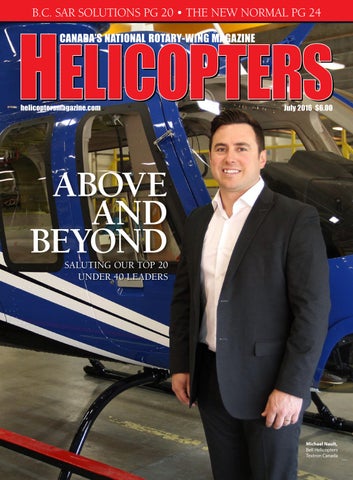
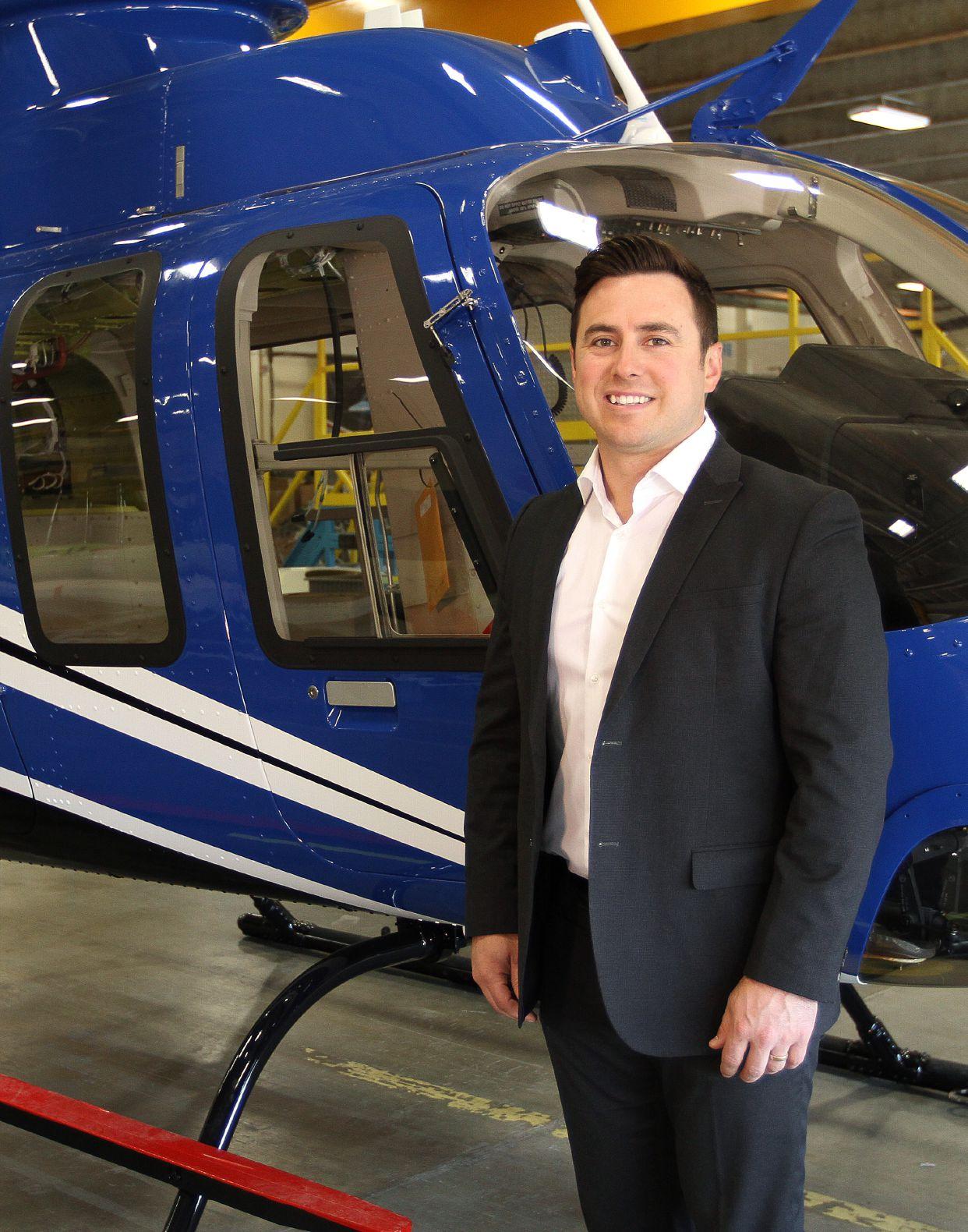
NAME: MICHAEL NAULT
TITLE: PROGRAM DIRECTOR, LIGHT HELICOPTERS, BELL HELICOPTER TEXTRON CANADA
LOCATION: MIRABEL,
QUE.
Helping to influence change at one of Canada’s top aerospace companies is a dream come true for Michael Nault.
For the past 10 years, the 32-year-old program director at Bell Helicopter Textron Canada has played a critical role in helping to drive program development at the Mirabel, Que.-based company. After graduating from école Polytechnique de Montréal with a
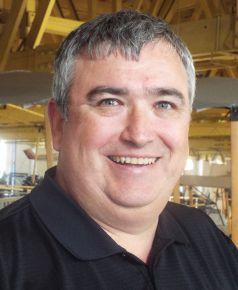
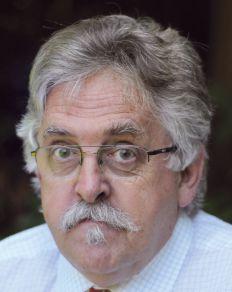
LEFT: Michael Nault, Bell Helicopters Textron Canada BELOW: Denis Bourgouin, Fast Air
bachelor’s degree in mechanical engineering in 2006, Nault began his career as an airframe structures engineer. After only a few years, he was selected by Textron to participate in a leadership program where he moved to the U.S. for three years to work at other Textron business units.
Nault worked at as product engineer at Kautex, an automotive business unit, then went to Bell’s research and development centre to work on flight tests on the BA609 (now AW609) tilt rotor aircraft. He completed the development program at Lycoming engines as a systems engineer before coming back to Mirabel in 2011 to manage the technical team supporting the Bell 206L4 and 407 assembly lines. In 2013, Nault was named chief engineer for the in-production of light single helicopters, becoming technically accountable for the 206L4 and 407.
Over the course of two years, Nault led his team through several safety and performance initiatives leading to the successful launch of the Bell 407GXP at Heli-Expo in 2015. Nault was awarded the Larry D. Bell Pioneer Award and the 2015 Textron Chairman’s Award for Innovation, and was also named program director for Bell Helicopter’s light single aircraft.
An active and passionate member of several industry associations including the board of directors of the Montreal-Ottawa chapter of American Helicopter Society (AHS) International, Nault is one of Canada’s leading ambassadors for the helicopter industry.
NAME: DENIS BOURGOUIN
TITLE: DIRECTOR OF MAINTENANCE, FAST AIR LOCATION: WINNIPEG, MAN.
Doing anything necessary to get the job done as efficiently as possible. It’s the perfect way to describe the work habits of Denis Bourgouin.
The 39-year-old is the director of maintenance for Winnipegbased Fast Air, a role he continues to refine and grow. Bourgouin began his career as a groomer, working his way up through the ranks to the position he holds today. Over the years, he has continued to develop himself, and he now holds several aircraft maintenance endorsements.
During the company’s implementation of the Gulfstream fleet, Bourgouin played a key role in the process, working closely with the Gulfstream team on deliveries. In his current role, he is responsible for most of the financial aspects of the department and AMO staff.
Definitely a “people” person, Bourgouin works closely with all members of the team to ensure personal expectations are met. Through his leadership, the AMO has long-serving team members who are more than happy to come to work. Bourgouin is always looking for ways to improve on the firm’s processes to increase aircraft availability.
A key member of the management team, Bourgouin is also a supporting member of the Central Aircraft Maintenance Engineers Association. His leadership and attentiveness to detail set him apart from the crowd – and make him a definite asset to both Fast Air and Manitoba aerospace.
NAME: SHAWN BRAIDEN
TITLE:
PRM,
AEROFLIGHT INTERNATIONAL SERVICES/HARBOUR AIR GROUP/TANTALUS AIR
LOCATION: RICHMOND, B.C.
Shawn Braiden, 37, was been bitten by the aviation bug long ago.
At the age of 12, he joined the Royal Canadian Air Cadets 676 squadron in Sydney, B.C. In 1997, he received his pilot’s licence, while working as a volunteer at the Victoria Flying Club. Braiden felt
it was essential to attain his AME’s licence because this would give him valuable insight into how his aircraft worked.
He attained his AME “M” licence from BCIT and then accepted a part-time position with Harbour Air as an apprentice/groomer. Four months later, he completed the BCIT program and became a full-time apprentice at Harbour Air. He also worked part-time for Tasman Helicopters.
Braiden’s leadership skills, passion for the industry and commitment to safety was noticed early on at Harbour Air. In 2000, he was appointed crew chief despite only being an apprentice. In 2001, he attained his AME licence and in many ways, his career was set to soar.
In 2005, Braiden was instrumental in creating the Coal Harbour Line Maintenance base and in 2013, he was accepted by Transport Canada as a PRM delegate. He accepted that role at Harbour Air a few months later. As he has progressed with the company, he has focused on improving efficiencies and ensuring the top safety for his crew. He is currently responsible for a fleet of 40 aircraft, in addition to approximately 30 third-party aircraft, as well as the firm’s quality assurance policies.
An active member of the aviation community, Braiden sits on the BCIT Program Advisory Council and is a member of the Vancouver Soaring Association, COPA EAA and the Cessna 195 club. The proud owner of two vintage gliders and his own Cessna 195, to say Braiden has followed his aviation passion would be an understatement.
It wouldn’t be far-fetched to say Sean Davies isn’t just good at one thing – he’s proficient at many.
The 36-year-old is the co-owner/operator of Thunder Bay, Ont.-based operator Maintair Aviation Services – a Shell Aviation dealer and ground handling provider, and president of Deciphr, an aviation leasing and consulting firm. Davies is an aviation veteran of some 18 years with expertise in a number of areas including sales, marketing, flight and ground operations, safety development, scheduling and strategic planning. It’s an impressive background for sure.
A graduate of the Confederation College Aviation program in 2000, he began his career with Slate Falls Airways and then quickly moved to a management position with Wasaya Airways where he was employed for 11 years. An entrepreneur at heart, Davies then took on the role of manager at Maintair with the future intent of becoming a partner in the company. He became co-owner in August 2014.
Today, Davies puts his skills and expertise to work in a number of enterprises and also finds time to support the community he calls home. Whether working with the Thunder Bay Regional Health Sciences Centre raising dollars and awareness for its many services, or sitting on the advisory committees for clubs and associations, Davies always finds time to give back.
Davies is also the recipient of the 2012 Queen Elizabeth II Diamond Jubilee Medal for outstanding and remarkable achievement for the Governor General of Canada, and is a supporter and Advisory Council member of Confederation College. He is recognized throughout his community as a dynamic supporter of both aviation and the city he loves.
COVER STORY
NAME: GARY DEW
TITLE: HARDWARE ENGINEER, AVERSAN INC.
LOCATION: MISSISSAUGA, ONT.
It didn’t taken Gary Dew much time to make a significant impact on the Aversan team – and he hasn’t stopped since.
The 28-year-old hardware designer heads up one of Aversan’s largest projects and his leadership abilities have been apparent since he joined the organization. After just six months, Dew proved himself working on the C919 embedded controller and designed an automated test rack for the program. He has since led the electrical engineering design and development on a number of other projects, including a Thales train simulator. Now working with NG HUMS, Dew is spearheading a team of seven engineers working on system architecture and design.
As well as being a gifted hardware designer, Dew is very proficient at understanding client needs and design schedules. They trust his expertise and he is a great liaison for his colleagues. The group is thrilled to work with such a reliable, open teammate, one that fully understands the challenges they face.
Always maintaining his composure under tight deadlines and pressure, Dew is a valuable asset to not only to Aversan, but the aerospace community as a whole.
NAME: JESSE GORANSON
TITLE:
MANAGER, MARKETING AND STRATEGY, HELI-ONE
LOCATION: VANCOUVER, B.C.
Jesse Goranson, 34, has been with Heli-One for four-and-a-half years, originally starting with the company as an external consultant. After developing a passion for the aviation MRO industry, Goranson took on a permanent role with Heli-One to develop and execute business intelligence initiatives. He then took on a bigger role as the manager of marketing and strategy and works to identify new markets and opportunities to grow Heli-One’s reach and capabilities.
Goranson works with Heli-One’s global facilities, OEMs and industry partners to further develop areas of potential growth and development. He has spearheaded notable achievements that include leading the launch of a new website, increasing the addressable market by 20 per cent through OEM partnerships and has generated an additional 10 per cent in annual sales through the launch of marketing automation and enterprise technologies.
Capable and always displaying a sound work ethic, Goranson is an important asset to the Heli-One operation on a number of levels.
NAME: WARREN GOSSELIN
TITLE: DIRECTOR, TECHNICAL OPERATIONS, REVENUE
LOCATION: OTTAWA
SERVICES NAV
Warren Gosselin is a skilled, hard-working member of the NAV CANADA team.
The 36-year-old is responsible for managing NAV CANADA’s maintenance contract with the Canadian Air Transport Security Authority (CATSA), in which he is embedded as a client executive. Under this contract, NAV CANADA maintains passenger security
equipment at the country’s airports. Gosselin is responsible for overseeing other existing maintenance service contracts and acquiring new ones – a task he has proven to excel at. Before moving to the head office, Gosselin was manager of technical operations for the Winnipeg flight information region, responsible for ANS equipment across much of central Canada and Nunavut.
Gosselin has been a key member of the NAV CANADA team for a decade and has led several highly successful national initiatives that have fostered significant change and improvement within the ANS. He has also won two awards of merit for outstanding service.
Gosselin is dedicated to improving the culture of the organizing through his strong leadership skills and work with colleagues. Within NAV CANADA’s broader company initiatives, he is part of a core team involved in collaborative efforts with industry partners. He continually proves to be one of the most dynamic leaders at NAV CANADA – resourceful, attentive and influential.
Moving a company forward isn’t possible unless you yourself are forward thinking –and Milena Kohanenko fits this description.
Kohanenko, 35, oversees the regulatory compliance of Ledcor’s Aviation division –both fixed and rotary wing – as its aviation compliance manager.
Constantly raising the bar has been a hallmark of Kohanenko’s leadership style and those that have worked with her quickly realize she is a passionate leader who knows the regulatory environment inside and out.
Kohanenko holds a law degree from the Ukraine and is an IRCA certified ISO auditor and COR auditor. Previous to her current role, she was the director of compliance for the Summit Air Group and the compliance manager for Arctic Sunwest Charters reporting to the accountable executive. She designed, implemented and maintained a best in class Quality Assurance Program (QAP) at both companies.
Kohanenko is well-respected by both her peers and colleagues at Ledcor for her unwavering professionalism and commitment to safety in aviation.
NAME: JOCELYN LEBELL
TITLE: DIRECTOR OF CORPORATE SERVICES, HAWKAIR LOCATION: TERRACE, B.C.
From concept to completion, it takes a driving force to get the job done, and for 13 years, Jocelyn Lebell, 34, has quietly helped to build the Hawkair brand.
As a young honours graduate from the BCIT Marketing Management program, Lebell joined the airline industry and has thrived on the complexities and challenges of her various roles.
Upon joining Hawkair, she took on the challenge of revenue management and was instrumental in modernizing the process. She was a key innovator of the Ultra-Econo fare, and in 2014, she entered
WHERE SAFETY WORKS
At Mark’s Commercial, safety is our business. You’ll get the right products sent to the right place at the right time.
We make it easy to outfit your workforce with innovative workwear that maximizes safety and performance. Mark’s Commercial is home to the most advanced and innovative workwear and PPE brands available, suitable for any industry.
Wholesale programs, online ordering, direct delivery and a responsive Client Services Team make Mark’s Commercial the only wholesale workwear supplier you need when safety matters most.
COVER STORY
Hawkair’s Women in Leadership Program as the pioneering woman. She also became director of corporate services, where she translates corporate strategy into business strategy enabling the team to attain personal development goals. Today, she is a senior executive and leads the Corporate Business Services Business Unit.
A passionate speaker and active member of several industry associations including BCAC, NATA and ATAC, Lebell is committed to giving back to her community. She was recently named to the Board of Directors of the Northern Savings Credit Union in Prince Rupert, B.C., providing valuable input into key initiatives as well as acquiring business intelligence to help foster the development of Hawkair.
Confident, attentive and innovative, Lebell is very conscious of her roles and is an active participant in advocating for young women seeking to grow in aviation and aerospace.
NAME: CANDACE MCKIBBON
TITLE: EXECUTIVE DIRECTOR, BC
LOCATION: VANCOUVER, B.C.
AVIATION COUNCIL
Candace McKibbon, 25, has always understood the importance of “doing a little bit extra” no matter what the task. She did so as a student at BCIT and she’s showing the same kind of commitment and initiative in her role as executive director with the BC Aviation Council (BCAC).
McKibbon graduated from the BCIT Airport Operations diploma program in February 2014. As a student, she brought passion, leadership ability and determination to the industry in a number of ways, volunteering for key events such as the CHC Safety & Quality conference and working as a mentor for other students.
In her role as executive director, she works tirelessly to find new ways to connect key players in the B.C. aviation and aerospace community, with a particular emphasis on helping young aviators in career development. An engaged volunteer for a number of organizations, McKibbon still works closely with the Aviation Leadership Foundation and the BCAC, connecting young aviators to established professionals to share experiences.
McKibbon has been honoured with a bevy of important awards for both community and scholastic achievement, and continues to impress both co-workers and other industry leaders with her ongoing commitment to B.C. aerospace.
NAME: DUSTY MILLER
TITLE: WESTWIND CAPTAIN/DEPUTY FLIGHT SAFETY OFFICER, DISCOVERY AIR DEFENCE
LOCATION: VICTORIA, B.C.
Dusty Miller, 38, is not your typical pilot
A day at the office for Miller could mean flying in remote northern geographical locations, ferrying across the Atlantic or towing an aerial target being shot at by the Navy.
Since joining Discovery Air Defence (DA Defence) in 2009, Miller has flown more than 1,100 hours on the Westwind special mission aircraft delivering service under the interim Contracted Airborne Training Services (iCATS) program, and earned his captain qualification in February of 2015.
Miller is involved in flying unique missions involving Electronic
Warfare Training, Aerial Target Towing and real-time quality assurance verifications of Canada’s northern early warning radar system . . . to name just a few. Miller also played a key role in the delivery of the company's A-4N fleet from Mesa, Ariz. to Wittmund, Germany. The ferry involved several winter transits across the North Atlantic including stops in Greenland and Iceland. This was a major achievement for Miller professionally and a milestone for the company, as it prepared the program with the German Armed Forces.
Miller is not just a pilot. When he is not flying, he helps out on engineering tasks as an apprentice aircraft maintenance technician on the Westwind and Alpha jets. It’s a unique skill base that assists him in all flight safety endeavours.
Miller is also the company’s deputy flight safety officer, in charge of developing and maintaining safety standards such as fatigue management, human factors and more. Outgoing and friendly, Miller brings an impressive skill base to his role and is an invaluable part of the team.
NAME: NATALIE PANEK
TITLE: MEMBER OF TECHNICAL STAFF, MDA’S ROBOTICS AND AUTOMATION DIVISION
LOCATION:
BRAMPTON, ONT.
Change agent. Leader. Influencer. Mentor. These are just some of the words that aptly describe 31-year-old Natalie Panek.
Panek is a member of technical staff with MDA’s robotics and automation division in Brampton, Ont. Her accomplishments are visible through her trailblazing work on nontraditional projects, and she has been making her mark on the Canadian aerospace industry ever since she set her sights on a career in space.
Panek graduated with a degree mechanical engineering degree (with distinction) from the University of Calgary in 2007 and participated in the university’s inaugural solar car project. She attained a VFR private pilot’s degree during her undergraduate studies, and went on to complete her master’s of applied science in aerospace engineering from the University of Toronto in 2009, before accepting two back-to-back internship programs at NASA in 2008 and 2009.
Since 2010, Panek has worked at MDA performing robotic analysis for various space programs, and currently is working on MDA’s contract with ESA’s 2018 ExoMars program. Panek is very passionate about sharing her work with the public, particularly the topic of satellite servicing as a means to more sustainable exploration.
Community service and helping mentor young women in career development is something Panek is passionate about, and she is very giving of her time to support a variety of initiatives. She is a mentor for Cybermentor, a University of Calgary program that promotes women in science and engineering, and is also a member of their advisory council. Panek also mentors through the 4-H Canada’s Leadership Excellence Awards of Distinction (L.E.A.D.) program and has worked as a judge and volunteer for important organizations such as the Ninety-Nines and Women of Aviation Worldwide. She is also a passionate speaker and writer for a number of organizations.
Panek possesses a unique combination of skill, dedication and insight, helping Canadian aerospace reach new heights.
For Chrissy Perry, teaching aspiring fighter pilots the nuances of their craft is a rewarding and exciting experience.
Perry, 39, joined KF Aerospace Defence Services in Portage la Prairie, Man. as a class 1 instructor in the fall of 2008. KF Aerospace Defence Services is the primary flying training school for the Royal Canadian Air Force (RCAF). Perry was employed as a line instructor upon joining the operation, but within a few years, she moved to the role of assistant chief flying instructor.
In fall 2010, Perry was promoted to chief flying instructor, and has done an outstanding job guiding the careers of aspiring military pilots. She supervises a staff of 25 instructors, has developed – with Transport Canada – one of four instructor refresher courses in Canada, worked with the DND as a liaison in the policies and procedures of the flying program and so much more.
In addition to providing her students with the skills and knowledge to advance their careers as military pilots, Perry has still found time to carry out a bachelor of arts at the University of Manitoba with a strong base in psychology. Always learning and honing her craft, Perry is a professional, dedicated leader who excels in all aspects of her role.
In many ways, Erik Polzin, is living a life many only dream of.
Polzin, 33, is a commercial pilot and engineer with in the Canadian VFR helicopter industry with an affinity for the Far North –its people, culture and varied flying experiences it provides. He is the founder/CEO of Sitka Aviation, a Sprucedale, Ont.-based firm that caters to a wide range of clients in a variety of disciplines.
Polzin has flying endorsements on several machines and is qualified to work on Bell, Airbus and Robinson helicopters – mastering the ability to offer his customers both flexibility and expertise in a number of realms. His path to success has been gleaned from good old-fashioned hard work, persistence and dedication to his craft.
After attaining his commercial pilot’s licence from E-Z Air Helicopters in 2004, Polzin quickly enhanced his skills with a bachelor’s degree in aircraft maintenance engineering in 2007. He went to work as an apprentice engineer in 2007 with Chilliwack, B.C.-based Western Aerial Applications before catching on as an engineer/pilot at Bi-Air Applications. He moved to a role of seasonal pilot with Glacier Helicopters, before catching on with Trinity Helicopters, which later merged with Summit Helicopters in 2013. Bitten by the love of the Far North and the chance to operate his own business and service his own clients, he created Sitka Aviation in 2013 – and hasn’t looked back.
COVER STORY
Polzin’s entrepreneurial spirit, “can-do” attitude and commitment to the highest standards for his clients have helped make his dream of business ownership a success.
NAME: JEFF ROBERTS
TITLE: AVIONICS/ELECTRICAL SYSTEMS DESIGNER, AME, AVMAX
LOCATION: VANCOUVER, B.C.
Jeff Roberts prides himself on his versatility and ability to handle a variety of jobs in a professional, efficient manner.
The 27-year-old Avionics/Electrical Systems Designer and AME at Avmax in Vancouver has proved to be an invaluable addition to the team when he came on board three years ago.
Roberts graduated from BCIT in 2008 from the Avionics Maintenance Technology program and spent four-and-a-half years at Kelowna Flightcraft (now KF Aerospace), where he gained his AME licence before joining the team at Avmax. He started out in the avionics division before progressing to the engineering division. He has worked at both the Calgary and Vancouver locations, and has travelled all over the world, handling a variety of different tasks. Roberts’ interpersonal skills and strong sense of customer service often stand out, and he is often complimented for his business acumen and overall knowledge base.
Roberts also shows his leadership skills in his community. He is the founder of Family Photos Kelowna, an organization that raises funds for cancer research.
NAME: STEPHANIE ROBINSON
TITLE: B1900D CAPTAIN, AIR GEORGIAN
LOCATION: MISSISSAUGA, ONT.
Stephanie Robinson was trained to be at a pilot at Seneca College in the bachelor of aviation technology program and she continues to share her passion with aspiring aviators learning to soar.
Robinson, 25, is a B1900D captain with Mississauga, Ont.-based Air Georgian and is a spokesperson for the Seneca Career Pathway Partnership. A dedicated member of the aviation community, Robinson has already won several awards for her positive outlook and enthusiasm for her craft, including the Russ Bannock Award and the Lloyd Cripps Memorial Award. She has also participated in numerous career events to promote and educate the next generation of pilots.
One of the main messages Robinson likes to share with aspiring aviators is there are many avenues you can follow to attain your final role as a commercial pilot, just don’t get discouraged if things don’t work the first time. Persistence, commitment, hard work and dedication will eventually pay off. Robinson is living proof of all of these sentiments. She has set a goal of being part of the training department either on the flight line or in the simulator. Igniting the passions of young adults in both high school and public school is one of her goals.
PROFILE
B.C.’s SAR Solution Providers
Small Group of Volunteer Responders Brings Lost Souls Home
BY PAUL DIXON
round Search and Rescue (SAR) in British Columbia is unfortunately a growth industry. Over the past 30 years, through events such as EXPO 86 and the 2010 Winter Olympics, the world was exposed to all that B.C. has to offer across its richly diverse geography. Across the province, in a wide range of activities from extreme backcountry winter sports to enjoying a summer afternoon in an urban park, the number of people meeting with misadventure has been steadily rising.
GIn 1991, the province of B.C. recorded 400 “rescues” for the province. For 2015, that number exceeded 1,500. And as in much of life, the numbers don’t tell the whole story. Ground SAR in B.C. is done solely by volunteers – volunteers who have willingly agreed to place themselves on call 24/7/365, willing to respond as required, which last year accounted for more than 100,000 hours on task. The province estimates this would represent, at a minimum, at least $20 million dollars in direct salary that is their donated time, and another $50 million in capital costs and infrastructure that is raised by the individual teams within their respective communities.
Civilian SAR teams provide the expertise or “subject matter experts” to the lead agencies – which are the police in matters of missing persons or overdue travellers or the ambulance service when dealing with injured persons. As well, teams may be called on to provide assistance to the provincial coroner’s service, military SAR, or Parks Canada.
Teams will specialize in techniques specific to the challenges presented by the geography in their region, which can include rope rescue, swift water rescue, marine rescue, ice rescue, avalanche operations, SAR dogs, mountain rescue and cave rescue to name but a few. Increasingly, the use of helicopters is being integrated into rescue operations and a small number of teams are becoming increasingly proficient in helicopter long-line or HETS operations. As the call volume has grown, the increased use of helicopters has become a force multiplier in increasing the effectiveness of ground
SAR, as well as decreasing the times in extracting injured persons from remote locations and delivering them to medical attention.
THE B.C. SAR HISTORY
While the early use of helicopters in SAR duties was limited to the military, the most likely first use of a helicopter for rescue purposes in B.C. was a civilian operation. As related in the book Helicopters – The British Columbia Story, in October 1947 an employee of the Greater Vancouver Water Board suffered a severe fracture while working in the headwaters of the Capilano River. It took five hours for a doctor to hike into the scene and his assessment of the injuries called for immediate evacuation.
An attempt at landing a Tiger Moth close by failed, as the site was surrounded on three sides by sheer cliffs rising more than 500 metres. Aero Surveys was operating a Bell 47-B3 in the area and arrangements were made to use the helicopter. The trip from the remote site to a hastily improvised landing zone in a park close to the hospital took all of 15 minutes, sparing the injured man hours of agony and further medical complications. It’s a scenario that has become almost commonplace today.
Through the 1950s and 1960s, RCAF helicopters performed inland rescue missions on an ad hoc basis. Civilian SAR was beginning to coalesce and develop as a separate discipline as it evolved out of previously existing civil defence programs. The use of long-line (HETS) techniques was pioneered by Parks Canada back in the 1960s. By the 1990s, the use of HETS was being adopted by a small number of civilian teams in B.C.
George Zilahi, a long-time member of North Shore Rescue and now general manager of Emergco, a leading supplier of HETS equipment, recalls his first exposure to the use of helicopters in ground SAR almost 40 years ago. A ground team from NSR was searching for two young girls missing in the backcountry. A Bell 47 operated by a Vancouver radio station joined the search, located the girls and was able to land and extract them, no worse for wear. The problem was
mission grows exponentially the longer the mission goes on and the cost in human hours alone as it ripples out through the support network is difficult to imagine, let alone calculate.
DEALING WITH LOGISTICAL REALITIES
The mountainous terrain across most of B.C. creates great obstacles and presents additional layers of danger for rescuers. Dense forests, steep slopes and fast-flowing mountain streams make ground evacuation techniques difficult and are as dangerous for the rescuers as they are for their subject. The increased use of helicopters was in response to this. Initially that might have meant transporting team members along with supplies and equipment to landing zones in the search area. That led to pilots using toe-in, one skid or no skid landings in order to drop rescuers in places the helicopter could not land, all extremely dangerous techniques that put everyone’s life in jeopardy.
to find the ground team and notify them that the girls had been located, to spare them having to stay in the backcountry overnight. A phone call was made to a local logging company that made their company helicopter available. The pilot was able to locate the ground searchers, pass word that the search was called off and they were able to get themselves back to the staging area as night was descending.
The idea of saving a night out in the mountains seems simple, but it has a huge multiplying effect. As with a military operation, when a unit is deployed in the field, there is a requirement for support and logistics that often takes a much larger group. When the search team or teams are forced to stay out overnight, then the support group is stood up as well. It’s something that Michael Coyle, search manager with Coquitlam SAR points out that people often don’t consider.
“Teams have to be able to plan for multiple duty cycles,” he says. “It’s one thing to put a team out for the initial 10 to 12 hours, but you have to be able to replace them if needed.” All the SAR members are volunteers and most of them have jobs – firefighters, paramedics, physicians, business owners, and students. Often, they must rely on a personal support network to enable them to respond in the first place – whether it’s co-workers available to cover shifts on short notice, arranging child care needs with spouses, partners or willing neighbours or in the case of the self-employed, the ability to simply lose a day’s work. The number of people involved in a rescue
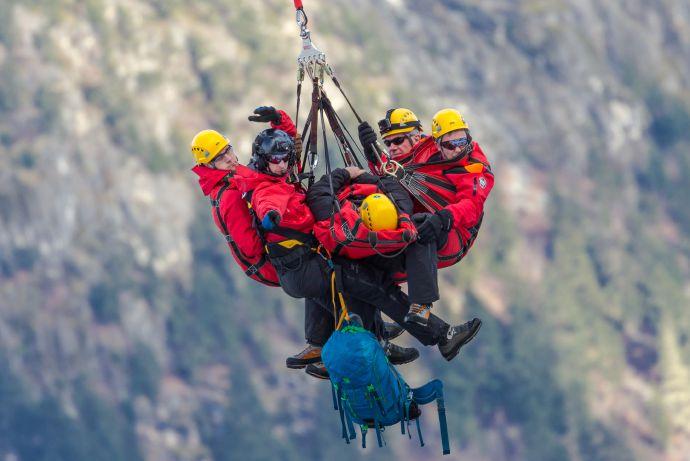
While not without significant dangers of its own, inserting rescuers via HETS allows them to bypass obstacles and danger posed by ground response. The pilot and the helicopter are now separated from terrain by the length of the line, instead of hovering inches from terrain to perform a hover exit. George Zilahi sees it as pure risk management, taking the condition of the patient(s) and the time factor in extracting them to medical attention as well as the challenges presented to rescuers in both reaching and evacuating the injured party.
HETS increases the number of situations in which helicopters can be used. While the concept is simple, it requires a highly-skilled pilot and well-trained rescue personnel. Pilots must be highly skilled in mountain flying and long-line operations, but what’s even more critical is the pilot must be comfortable with the idea that someone will be flying with him at the end of a line.
Brad Fandrich of Valley Helicopters in Hope, B.C., realizes that not every pilot is capable or ready to pull it off. “Not every pilot likes that type of thing,” Fandrich said. “You’re not taking people in to pick flowers. It’s often a dirty, tough job of dealing with other people’s misfortunes. Some pilots just don’t like the idea of having a human extended 200 feet below them.” Valley is one of three companies in southwestern B.C. that provide HETS service to local SAR teams, with Talon in Vancouver and Blackcomb in Whistler being the others. At the other end of the line, while all SAR teams in the region are versed in working with helicopters, only a handful have trained up to perform HETS rescue.
HETS has become a particularly useful tool for North Shore Rescue, which covers West and North Vancouver. Their office, so to speak, is the mountainous backdrop that provides the spectacular setting across the harbour from downtown Vancouver. With three major ski resorts, provincial wilderness parks, regional and municipal parks in this setting, the team is the busiest SAR group in the province by a wide margin. Their 2015 total of 139 was more than 50 per cent ahead of Chilliwack’s 86.
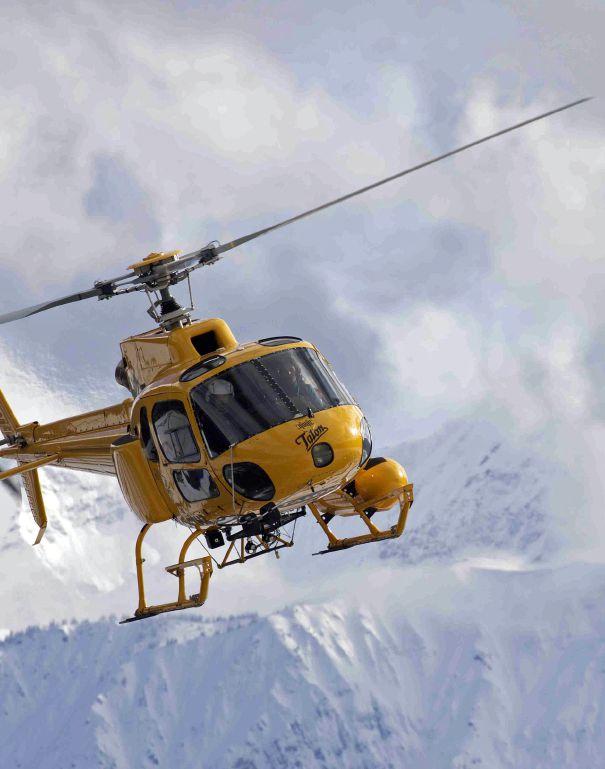
MAIN: Talon Helicopters AStar B2 with Boost system installed. (Photo courtesy of Talon Helicopters)
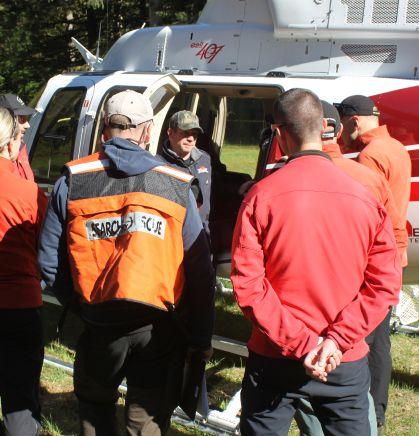
RIGHT: Brad Fandrich of Valley Helicopters, briefing Coquitlam SAR members prior to commencing helicopter training. (Photo courtesy of Coquitlam Search and Rescue)
Unlike many regions in the province, this is the front country as compared to the backcountry. That said, those who venture out of bounds during ski season can quickly find themselves fighting for their lives, as the backside of the mountains are laced with steep gullies and ravines. When the ski hills are bare, hikers are lulled by sunny skies and all too often find themselves facing harsh conditions. Compounding the situation is the lack of cell coverage from the moment you lose sight of the city.
LEADING THE SAR CHARGE
For Mike Danks, team leader at North Shore Rescue, the use of helicopters is almost integrated into their response protocols.
“Anytime during the day if we have good visibility, if it’s remote and there’s a critical injury, we’ll look to use a helicopter,” he says. “It seems like that’s becoming more common place, there’s more extreme sports happening. Mountain bike accidents are getting further and further back in the wilderness, so getting these people out in a time-sensitive manner requires the use of a helicopter.”
Concurrent with the increased workload, North Shore Rescue is now using a new HETS system developed by Boost Systems. The principals behind Boost
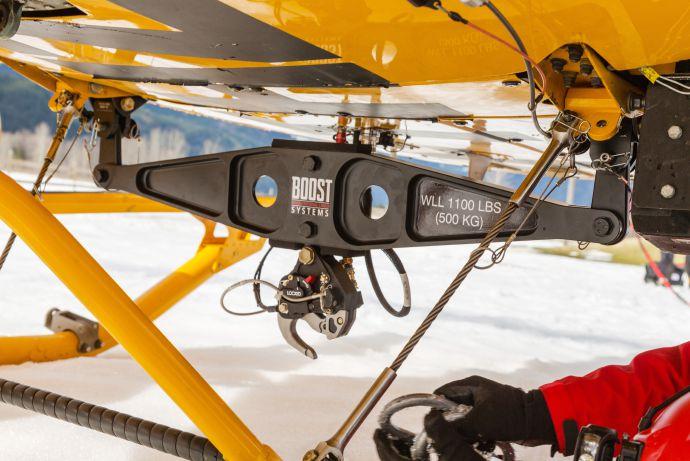
Systems are North Shore Rescue members Jeff Yarnold and Derek Thomas. Their system has a load limit of 1,100-pounds versus 600-pounds for the Emergco harness. Another significant difference is that the Boost system gives the pilot full control over the load. The bellyband system employed by
Emergco depends on a second person to operate the release mechanism in the case of an emergency. As Yarnold explains, “we’ve got the hydraulic release system on the cyclical. It’s a protected release, so the pilot can’t inadvertently release the load. The backup electrical release also requires a distinct movement.” Boost has Transport Canada and FAA certification on its AStar 350/355 models and is currently working towards certification for their Bell 407 model.
Peter Murray at Talon Helicopters was a guinea pig during the development of the Boost system, though he hastens to point out that he is in no way involved with the company. He is so impressed with the system that he has equipped his TwinStar and two AStars in it.
The new system proved its worth very quickly for North Shore Rescue in early May. Holding to the axiom that calls are more likely to come in at the end of the day when light is fading, two separate calls came in moments apart just after 6 p.m. In the first scenario, deep in the mountain valley in the Lynn Headwaters, a hiker had struck his head and fallen unconscious into a fastmoving mountain stream. Two passers-by helped his companion get him out of the water to find he had no apparent pulse. With no cell service, the companion ran seven kilometres until his phone would work while the other two performed CPR.
Working against time, Talon delivered rescue team members including a paramedic and equipment to the scene. Once packaged, the patient and rescuers were extracted, maintaining CPR in flight with an autopulse and oscillator. At the same time, a second Talon helicopter long-lined a second rescue team in to the back side of Crown
With a load limit of 1,100 pounds, the Boost Systems external hook easily handles a party of five and their gear. (Photo courtesy of Boost Systems)
Mountain where two hikers found themselves in deep snow, wearing running shoes, no warm clothing or climbing equipment as darkness was falling around them. The Boost System allowed the helicopter to take the two stranded hikers out in one lift. The young man who fell into the stream did not
survive, but the Boost System allowed North Shore Rescue to deliver the highest possible standard of care to the patient in the field and to then extract all involved in two trips; a third trip would have been required with the previous equipment and darkness would have prevented the flight from being made.
The next day, Coquitlam SAR was requested to assist Maple Ridge SAR with a HETS rescue in Golden Ears Park, again as daylight was fading quickly. A lone female hiker had become disoriented and found herself stranded on a ledge near Evans Peak, unable to move up or down the rock face. Using a Talon helicopter, two Coquitlam SAR members were long-lined to the scene, where the hiker was able to guide them in by using the flashlight feature of her cellphone. The SAR members were transported above her position, rappelled down to her and once they had determined she was OK, she was outfitted in a harness and the three of them were flown out.
Three rescues in two days, all in the front country so easily accessible to an increasing number of all-too-often illequipped and unprepared would-be explorers. While there was a fatality in one response, the use of the helicopter made the very response itself possible. In the other two instances, the subjects were quickly extricated and quickly returned to civilization. In all three situations, the rescue personnel were able to get in quickly and get out just as quickly. The helicopter is a great force multiplier, enabling so much more to be done, but often the key thing is to be able to do less and be just as successful.
The Boost Systems external hook. Manufactured by VIH Aerospace, the part is matched to the specific aircraft. (Photo courtesy of Boost Systems)
Dealing with the New Normal
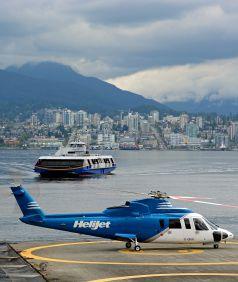
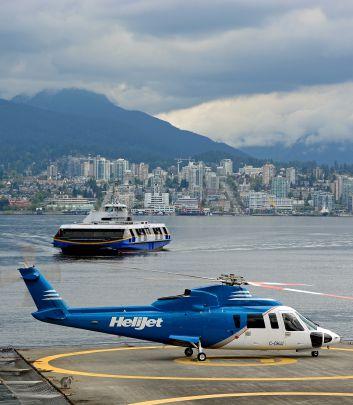
BELOW: A Helijet S-76 about to depart downtown Vancouver. (Photo by Paul Dixon)
Changing Economic Realities Mean New Strategies for Operators, OEMs
BY PAUL DIXON
At the 2016 CHC Safety & Quality Summit in Vancouver, CHC CEO Karl Fessenden spoke to the a myriad issues facing the industry in general and his company in particular, and was very specific when highlighting current economic realities. He addressed his remarks to attendees in the big picture – business operators, suppliers, regulator and other industry partners – stressing that it was more important than ever to conduct “budget exercises,” “capital expenditure reviews,” and “cost benefit analyses” on all levels.
Fessenden spoke of how – only a year before – the world was cringing as oil prices had dropped to $60 a barrel and now, with oil hovering as low as $30, 2015 was already being referred to as the “good old days.” Fessenden added that in tough times, it’s critically important to focus on safety, both in daily operations and in longterm planning. Maintaining a safety focus, he noted, ensures an organization will have the core strength to grow with expanding markets in the future.
Just three weeks after Fessenden spoke in Vancouver, CHC suffered a catastrophic accident, when one of its EC225 Super Pumas (H225s) crashed into the ocean off of Norway, killing both pilots and 11 passengers. Just a week later, CHC announced the company was
seeking Chapter 11 protection under American bankruptcy laws. A statement released by the company, quoted Fessenden noting that the process would give the company “an orderly path to enhance our financial flexibility and establish a competitive capital and operating structure” to grow the business in the long term. CHC’s day-to-day operations will remain as they are for now, but at the same time, the company is seeking to reorganize its fleet in a move that may see it shed two-thirds of the aircraft it currently operates by 2017.
While CHC grew out of Canadian roots and maintains a significant footprint in metro Vancouver with corporate offices in Richmond, B.C., and subsidiary Heli-One in Delta, B.C., there is a question of what impact, if any, the CHC announcement will have on the rotary-wing community in B.C., across Western Canada and the country as a whole. While the economic malaise afflicting Alberta’s oil patch has garnered the lion’s share of attention over the past couple of years, there has been a widespread slowdown through much of the energy and resource-based economy in Western Canada.
In B.C., for example, the provincial government is touting LNG exports to an energy-starved Asian market as the economic driver of the future, but these projects are dependent on the building of processing plants on the coast fed by pipelines from the source in the
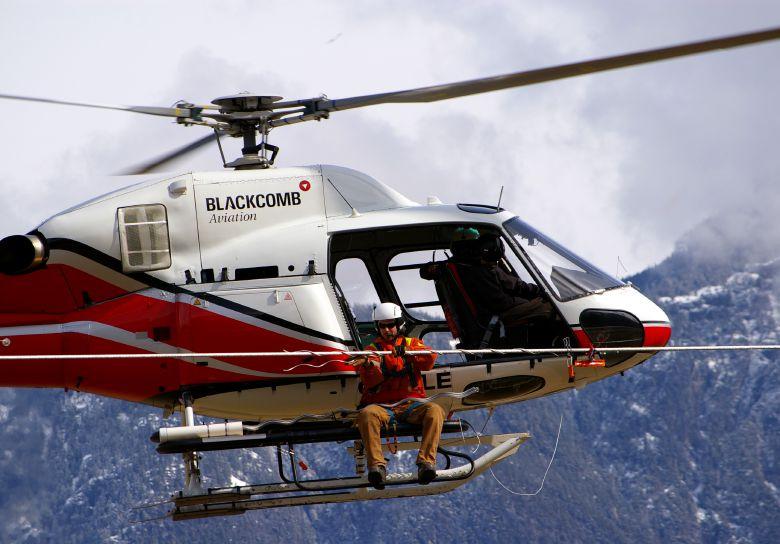
LEFT: Blackcomb Helicopters engaged in hydro line inspection. (Photo by Andrew Bradley, Blackcomb Aviation)
northeastern corner of the province. Pipelines are a contentious issue in B.C., with several projects seeking to build or expand existing pipelines to bring Alberta oil to the coast for shipment to world markets under intense opposition from a wide range of sources. And as projects are either shelved or stalled, critical work for helicopters is on hold right along with it.
Mining, which has been an economic driver in the province for decades, is suffering from a combination of depressed prices on world markets and increased environmental concerns. Coal mining in particular, has suffered as the Asian market for thermal coal has shrunk drastically and may never return. Forestry, the single economic driver in much of B.C. through the 20th century, has faced innumerable challenges from environmentalists, foreign tariffs on exports, falling demand for wood pulp and millions of hectares lost to insects and blight along with the demise of many of the legacy logging companies in recent years.
Logging, mining and mineral exploration and other resource-based industries were well-established long before helicopters were first introduced. Those first helicopters, few in number and limited in performance and capacity, were still able to establish themselves as a force multiplier, enabling both established businesses and new enterprises to do things in a way that wasn’t even imaginable before the helicopter was introduced.
In the late 1940s, it was the foresight and ingenuity of a handful of helicopter pioneers, including Carl Agar, Alf Stringer and Gerry Emerson to name but a few, who first employed their Bell 47s in aerial spraying and topographical survey work, where the helicopter first established itself as an invaluable tool. Helicopters were quickly embraced in a number of roles in southwestern B.C. – and on Vancouver Island –but the breakout performance was the role a handful of Bell 47s had in supporting the construction of the Alcan smelter project at Kitimat and especially in supporting the construction of the powerhouse at Kemano, in wilderness conditions. The use of helicopters was credited with cutting at least a year off the construction schedule.
SURVIVING THE DOWNTURNS
The ingenuity and resilience that was demonstrated by the pioneer helicopter operators has lived on throughout the years, as the industry has found itself riding the rollercoaster through good times and bad. The strength of the industry in the eyes of Fred Jones, president of the Helicopter Association of Canada (HAC), has been its ability to rapidly change in response to the
operating environment. Helicopters spoke to Jones about current economic realities as he was in the midst of a tour of B.C., visiting with association members.
“The industry has always been adaptable if nothing else,” Jones said. “I’ve been pleasantly surprised by what I’ve been hearing from operators this year. The price of lumber or the price of oil and gas are beyond their control. What we are seeing are more and more operators looking for a niche market or speciality that that will allow them to even out the peaks and valleys.” Some of those niche markets include survey work, aerial photography, specialty infrared scanning, and powerline work.
The low Canadian dollar can also have a positive impact on some sectors, for example, the forestry industry. The price of lumber is rising and there is a marked resurgence in heli-logging out west. Another benefit for the low dollar is the rise in American and European tourism, and many operators are reporting stronger interest in heli-tourism.
“Adaptability is what we are about,” Jones said. “Forward-thinking operators are exploring the niches, something that will stabilize them, then the seasonal stuff or price-dependent commodities is a bonus, depending on prices.”
Many operators in the B.C. region have established preferred areas of expertise, enabling them to stay profitable. For example, Brad Fandrich, general manager at Valley Helicopters in Hope B.C, hasn’t been severely affected by the economic slowdown in the VFR charter sector in B.C., mainly
due to his firm’s diverse product offering. Valley offers support to a wide range of industries ranging from logging, mineral exploration and powerline construction to flying provincial avalanche technicians.
One company that has developed a large footprint in a particular niche is Wildcat Helicopters of Kelowna, B.C. Ian Wilson, vice-president of Wildcat Helicopters told Helicopters that many operators have seen economic conditions like these before – it is the nature of the business. He notes that Wildcat is “holding up well,” as its chosen area of operations has focussed on aerial firefighting, both in direct suppression and supporting heli-tack operations. For more than a decade, Wildcat has spent the Canadian winter down under, fighting fires in Australia. Coulson Aircrane, part of the Coulson Group of Companies, has been sending its S-61 machines to Australia for firefighting as well, more recently alongside its C-130 fixed-wing tankers. It’s a business tactic operators nationwide are utilizing.
Helijet of Vancouver has also shown an ability to diversify its product offering to deal with tougher economic realities. The company has built its reputation as the world’s largest rotary-wing scheduled airline, as well as providing air ambulance service to the province of B.C. In addition to its legacy Vancouver-Victoria route, in 2015 Helijet, initiated daily scheduled service between Vancouver and Nanaimo, supporting a growing number of professionals who choose to work in downtown Vancouver while living on Vancouver Island. When passenger loads on the Vancouver Island
Talon Helicopters Twinstar AS355 is actively engaged in filmmaking in downtown Vancouver (Photo courtesy of Talon Helicopters)
commuter routes drop, Helijet picks up the slack by moving aircraft up the coast to provide service to many of the exclusive fishing lodges in Haida Gwaii and on B.C.’s central coast.
Vancouver built a reputation as a mecca for filmmaking many years ago, earning the designation Hollywood North. Talon Helicopters and Blackcomb Aviation have built an impressive list of credits for movies, TV shows and commercial shoots. While not the main part of its business offering, filmmaking is a nice business vertical for the company. Blackcomb offers a wide range of services from power line construction and maintenance to backcountry skiing and scenic tours from its base at Whistler.
SEEING THE FOREST FOR THE TREES
Heli-logging is also making a comeback on Vancouver Island, but there is a different approach from some operators. Since Tim Stinson of Stinson Aerial Services came home to Vancouver Island five years ago, he says there’s been a bit of a shakeout. Five years ago, there was a real mix of aircraft on the jobs: heavy life C-47 Chinooks, S-64, K-MAX, Kamov and the S-61. He’s seen a shift in the size of aircraft.
“Now, you are seeing them moving into the medium and medium-heavy – such as the Kamov, S-61, Vertol,” he said. “The timber profile seems to be more appropriate and the flies are getting a lot longer. Where we used to be 500 metres, now we are talking 1,000 metres plus.” Stinson just finished a project on the north end of Vancouver Island that has great implications for the future.
“We flew a K-MAX and a S-64 together. The 64 led the logging and the K-MAX supported it. My focus with what we do is the falling first. We try and find the most experienced guys in the industry, for example, and we combined two falling groups, which was new to a lot of people. We made sure we used the long ground where we could, we used all the tools we had – jacks. Then, we used calcula-
tors, we developed an app, so we can punch in diameters and calculate the optimal length we can fly and balance that with the value.”
The goal of the project is to identify prime timber at the source and cut it with tender-loving care. “We are already seeing wood with a lack of fracture at the sort,” Stinson said. “We want to be able to track that through the mill and see the uptick in value.”
The old growth timber is becoming increasingly valuable because there is less of it and what remains is becoming increasing isolated, which therefore creates the need for helicopters. The prime timber is only handled three times, a significant reduction over conventional techniques, where every time the wood is handled increases the likelihood of damage and diminished value. The hope is that this technique may see an increase in price by as much as 25 per cent.
Fessenden’s remarks about emphasizing training in times of economic downturn have never been truer for Abbotsford, B.C.’s Chinook Helicopters, Canada’s largest rotary-wing flight school. Clayton Reid of Chinook says the school was busy during the big “crash” of 2008 and its business has been growing steadily over the years.
If there are pilots displaced by the slow-down in the offshore oil and gas business, Clayton doesn’t see too many of them coming home. “They tend to have specific skills and get picked up by other companies in the international market, because Canadian pilots are very sought after in the world market,” Reid said. One trend the team at Chinook has noticed is the number of current helicopter pilots that are starting to retire, whether by aging-out or retiring. It’s a trend that has been noted industry wide and when the market does return, there will be a definite surge for more qualified pilots.
STAYING COMMITTED TO A PLAN
Helicopter operators aren’t the only ones feeling the pinch in a complicated marketplace. Airbus Helicopters Canada communications coordinator Laura Scott says her company remains committed to its main business segments and model. The team realizes the helicopter business is cyclic and they expect a slow and steady recovery through the next five to 10 years as prices for oil and other commodities recover. The future for Airbus Helicopters Canada remains focused on upgrading the Canadian fleet of helicopters, which the management team characterizes as “among the oldest in the world, with a majority of the aircraft over 30 years old.”
It’s much the same story at Bell Helicopters Textron Canada in Mirabel, Que. Currently, there are more than 1,000 Bell aircraft operating in Canada in all regions. The company’s long-term presence in Canada was recently strengthened with the transition of the Bell 505 Jet Ranger X assembly and final delivery to the Mirabel facility. In announcing the Mirabel move, Anthony Moreland, Bell’s vice president of North American sales, noted, “Mirabel will continue to be cornerstone of our global manufacturing, research and development, engineering and certification activities. Our operations in Canada have been, and will continue to be, a vital part of that global growth strategy.”
BONDS THAT WON’T BREAK
The helicopter industry in Canada is not a stack of dominoes or a house of cards. There is an interconnection between most if not all facets of the industry from the smallest operators to the large OEMs, but that connection looks more like a basket weave, where the strength of the whole is not dependent on any one component. Jones was correct in assessing the resilience and forward thinking of Canadian operators. The very nature of the business demands a level of awareness at all times and as Fessenden said, the same skills that enable a business to survive through the bottom of the cycle are the same skills that will enable it to thrive at the top.
CONTINUED FROM PAGE 19
NAME: GRAHAM SNELL
COVER STORY
TITLE: GENERAL MANAGER, SASKATOON/REGINA AEROCENTRES, LANCASTER AVIATION FUELS
LOCATION: SASKATOON, REGINA, SASK.
True leaders find solutions to challenges no matter how great they may seem. Graham Snell can certainly relate.
When the 38-year-old was named general manager of the Saskatoon/Regina Aerocentres and Lancaster Aviation Fuels in the spring of 2013, the business had challenges that had been growing for a number of years. Customer service levels were not up to professional standards, the safety commitment was barely acceptable and staff had little direction.
Graham has worked tirelessly to rebuild the team and instill a “can-do” attitude that has transformed the business and win customers back. Internal processes from IT to human resources are once again in check, and clients are definitely noticing.
Hard work, commitment and sound leadership. Yes, creating a top FBO is a team effort, but Snell has been a driving force in making it all happen at the Saskatoon/Regina Aerocentres and Lancaster Aviation Fuels.
NAME: MARK STEINBECK
TITLE:
PRESIDENT, TRAXXALL TECHNOLOGIES
LOCATION: MONTREAL, QUE.
With more than 14 years of aviation experience in a variety of disciplines, Mark Steinbeck, 33, certainly has the business acumen and vision to take Montreal’s Traxxall Technologies to new heights. But it’s his sound leadership skills and keen understanding of his craft that help set him apart.
Steinbeck has worked his way up in the corporate ranks of three separate aviation companies, enabling him to gain experience in not only aircraft maintenance tracking but sales and marketing, customer service and general management.
He started his career at Avtrak managing the customer service team before being promoted to a sales role, where he consistently exceeded all targets and eventually managed the North American sales team. In his next position at aircraft management firm Mayo Aviation, Steinbeck gained an entirely new perspective: the ability to see the industry from a client’s point of view, understanding challenges aircraft operators have in keeping their fleets in top condition.
Steinbeck was recruited by Traxxall in late 2014 to a company at a crossroads: the founders had a vision to create a “clean sheet” tracking system moving the company from a product development entity to one concentrating on commercialization. Steinbeck became the driver of the brand, helping to transform and lead the company’s sales team and more.
Steinbeck is driven by a competitive spirit, commitment to technological innovation and a passion for service excellence. It’s this rare combination of skills that have helped Steinbeck reach new heights.
NAME: BERT VAN DER STEGE
TITLE: VICE-PRESIDENT, COMMERCIAL, FIRST AIR
LOCATION: KANATA, ONT.
Bert van der Stege is certainly not afraid to shake things up.
The 38-year-old vice-president of Kanata, Ont.-based First Air has played a critical role in the restructuring of the airline since joining the organization in November 2013. First Air is currently in the midst of a threeyear transformation that includes a $110-million investment in modernizing the airline’s fleet including the introduction of new ATR 42-500 aircraft.
Van der Stege has been instrumental in spearheading the introduction of new codeshare partnerships with other northern carriers to allow each partner to benefit from efficiencies and synergies. He also started a strategic alliance with CargoJet and Alaska’s Lynden Air Cargo for a critical heavy-lift Hercules operation.
An active member of the Board of the Northern Air Transport Association (NATA), van der Stege has been very vocal and supportive in highlighting the needs of northern aviation at both the territorial and federal levels. First Air is dedicated to serving the needs of Canada’s northern communities and van der Stege certainly plays a critical role in leading the change and making northern aviation sustainable
NAME: GABRIEL ZELLBECK
TITLE: ASSISTANT CHIEF PILOT, L R HELICOPTERS
LOCATION: CALGARY, ALTA.
Gabriel Zellbeck, 34, isn’t one to back down from a challenge.
Zellbeck got his Canadian CPLH certificate from Helicopters Canada in North Bay, Ont. and got his first break with L R Helicopters in Calgary. He flew as a news pilot on the Robinson R44 and then spent countless hours flying tours and ENG to build time.
When the opportunity to move over to a pilot training role came along, Zellbeck seized it. A passionate and dedicated instructor, he is happy to provide the necessary instruction to his students, but also to share stories and experiences that reflect his unique combination of effort and enthusiasm it takes to achieve every goal.
Zellbeck continues to hone is craft, accumulating some 2,000 hours as a vertical reference and forestry pilot. His ability to plan, organize and execute all roles is an inspiration to both students and staff alike.
WINGS AND HELICOPTERS MAGAZINES
WOULD LIKE TO CONGRATULATE THE WINNERS AND NOMINEES OF THIS YEAR'S TOP 20 UNDER 40 AWARDS PROGRAM. WE WOULD ALSO LIKE TO THANK
Please stay tuned for next year's online nomination process and remember to vote for your firm's top young leaders!
MARKETPLACE
Maintenance for Bell 206, 206L, 205, 212, 412 and Robinson R22 and R44.
The e urocop T er AS350/355 Book
The AStar (or “Squirrel”) light-utility, multi-purpose helicopter has deep work roots in civilian, law enforcement and military operations. Whether you are new to these types of Ecureuil machines or an experienced pilot who has flown them for years, you will appreciate this in-depth look at how they really work. The Eurocopter AS350/355 Book - the essential training aid, reference book and flight-manual companion - gives you that deeper knowledge.
Includes the real-life, hands-on, working knowledge you should know:
• Overview of the AS350, along with model and type variations
• Examination of the inner and interrelated workings of the machine’s airframe, engine, transmission and rotors
• Insight into the AStar’s all-important controls, hydraulic, electrical, fuel, heating and ventilation systems
• Observation of the helicopter’s limitations, performance, weight and balance data and the daily flight checklists
• Advice for handling non-autorotative and autorotative emergencies and other assorted in-flight “situations”
• Operating procedures and operating tips for control effects, power checks, noise abatement
• Question and Answer sections for measuring up your working knowledge of the AS350 and more!
COLUMN
FRED JONES
Recently, Transport Canada (TC) released an update on the Flight Crew Fatigue Management issue. The thrust of the note was to inform the regulated community that TC intends to proceed directly to Canada Gazette I with new draft regulations in the spring of 2017.
Once they have received written comments during the 60-day period following publication, they will take a few months to do a Disposition of Comments, where they will analyze the comments and provide their justification for accepting or rejecting them. Once this is complete, they will publish the regulations in Canada Gazette II, and they will come in to force – but using a phased implementation – starting first with CAR 705 (airlines), which will need to be compliant 12 months after Gazette II publication.
CAR 703 and 704 operators will need to be compliant 48 months after Canada Gazette I publication (CAR 702 air taxi and CAR 604 business aviation have been excluded altogether). This means that the new regulations, if everything goes according to plan, would affect Canadian helicopter operators in 2022 at the earliest.
What the update did not describe is any of the substantive content of the draft regulations that are headed for Canada Gazette I. HAC maintains that the new draft regulations will be the same regulations that were tabled in the form of a Notice of Proposed Amendment (NPA) in September 2014, modified in minor ways, “to reflect the concerns of the commercial aviation community,” articulated for TC
Not Like Wine at All
Bad
News Never Gets Better With Time
very conservative prescriptive regulations. HAC supports the FRMS approach, but once a FRMS has been approved, the operator must be free to implement changes without seeking TC approval. The FRMS must also be “suitable for the size and complexity.”
In the five-year process, running up to TCs recent update, the views of CAR 703 and CAR 704 operators were rejected, in favour of recommendations that were more suited to the airline community. HAC maintains that what you will see in the spring 2017 are regulations “in the name of science” that will not respect the anchor points in the science or accommodate the operational realities of the Air Taxi and Commuter communities.
For example, HAC expects that the new draft regulations will erase the “zeroing” provisions of the current regulations; they will reduce the maximum tour-length to 21 days, including the time that it takes to move crews to and from the job site; and there will still be new cumulative duty time provisions, to name only a few. That is, the ugliest elements of the September 2014 NPA will survive to be published in Canada Gazette I.
It strikes this association as odd, that ICAO, in its Fatigue Management Guide for Airline Operations, at page 6 (a Guide for Helicopter Operations is under development), summarizes the science under four key principles:
• Periods of wake need to be limited. Getting enough sleep (both quantity and quality) on a regular basis is essential for restoring the brain and body.
These systems have the potential to allow for some relief from the prescriptive regulations. ‘‘ ’’
by the national aviation associations and their members in a meeting that took place in January 2015.
We don’t expect to see any significant changes to the content of the September 2014 NPA affecting Canadian helicopter operators. I would be happy to be wrong, but my advice to all segments of the commercial aviation community is, “hope for the best, but prepare for the worst in spring 2017.” We do expect to see provisions that will allow for the establishment of a Fatigue Risk Management System (FRMS), “suitable for the size and complexity of the operation.”
These systems have the potential to allow for some relief from the
• Reducing the amount or the quality of sleep, even for a single night, decreases the ability to function and increases sleepiness the next day.
• The circadian body clock affects the timing and quality of sleep and produces daily highs and lows in performance capacity on various tasks.
• Workload can contribute to crew member fatigue. Low workload may unmask physiological sleepiness while high workload may exceed the capacity of a fatigued individual.
HAC maintains that the Gazette I regulations that TC is planning to publish will stray well beyond these scientific principles and will include many elements that will be devastating to the commercial helicopter community in Canada.
Fred Jones is the president/CEO of the Helicopter Association of Canada and a regular contributor to Helicopters magazine.
Buy one Bose A20 aviation headset and get a SoundLink® Mini II Bluetooth® speaker free.
YOU PROTECT, WE SUPPORT.
With years of experience providing mission ready helicopters to law enforcement agencies, Airbus Helicopters knows the importance of serving communities. With the quietest and safest aircraft and wide range of equipment available across its product range, Airbus Helicopters is taking airborne law enforcement to new heights. Airbus Helicopters is there to support law enforcement with the latest in reliable technology, whenever and wherever duty calls.