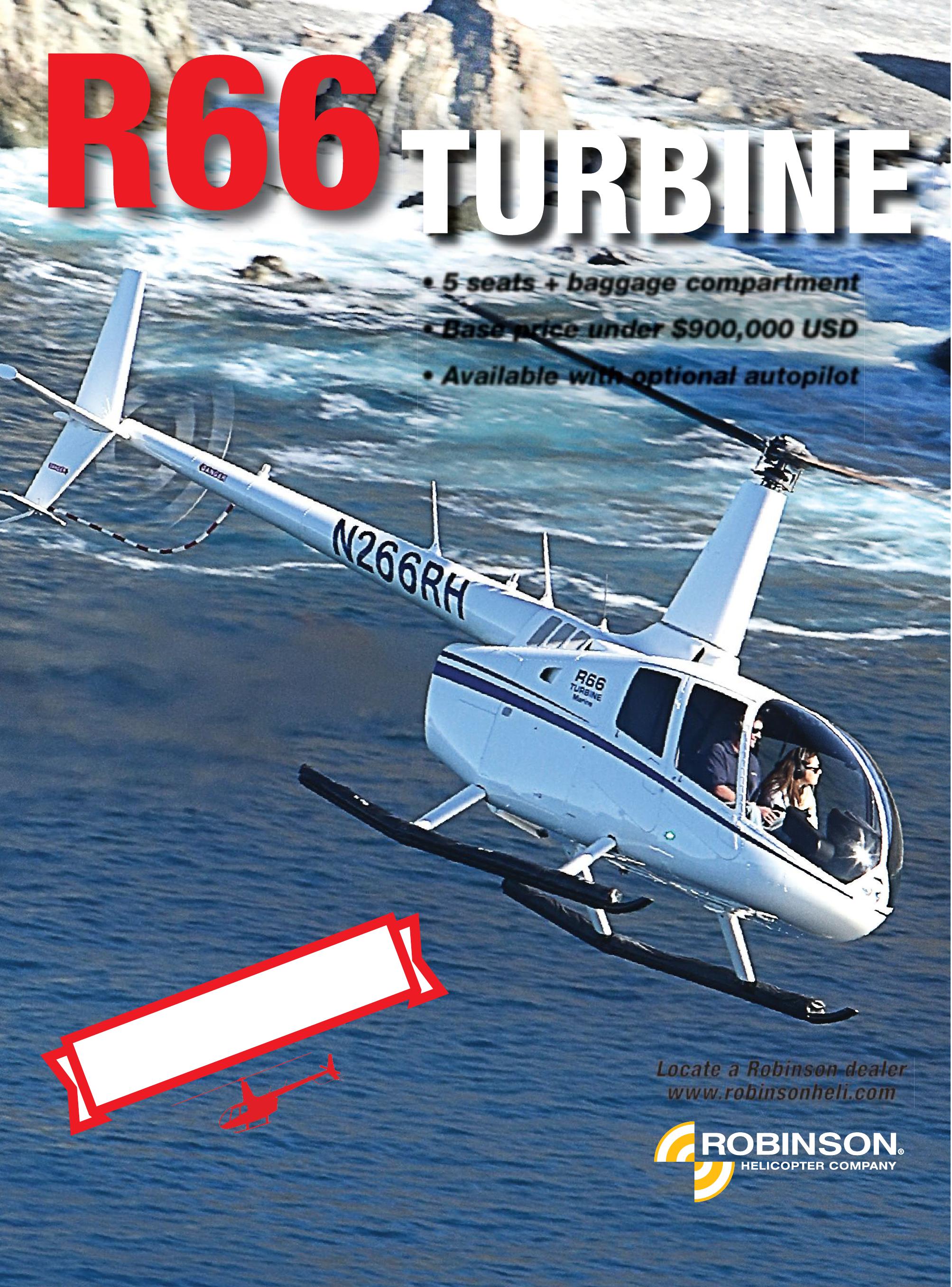
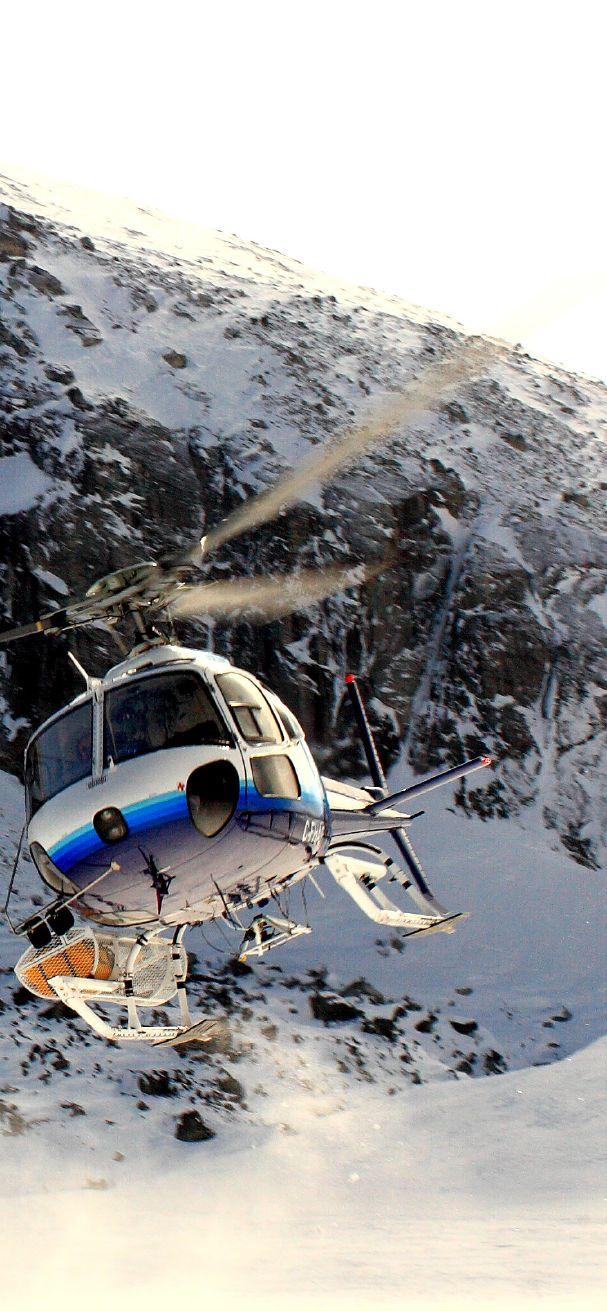
• 5 seats + baggage compartment • Base price under $900,000 USD • Available with optional autopilot
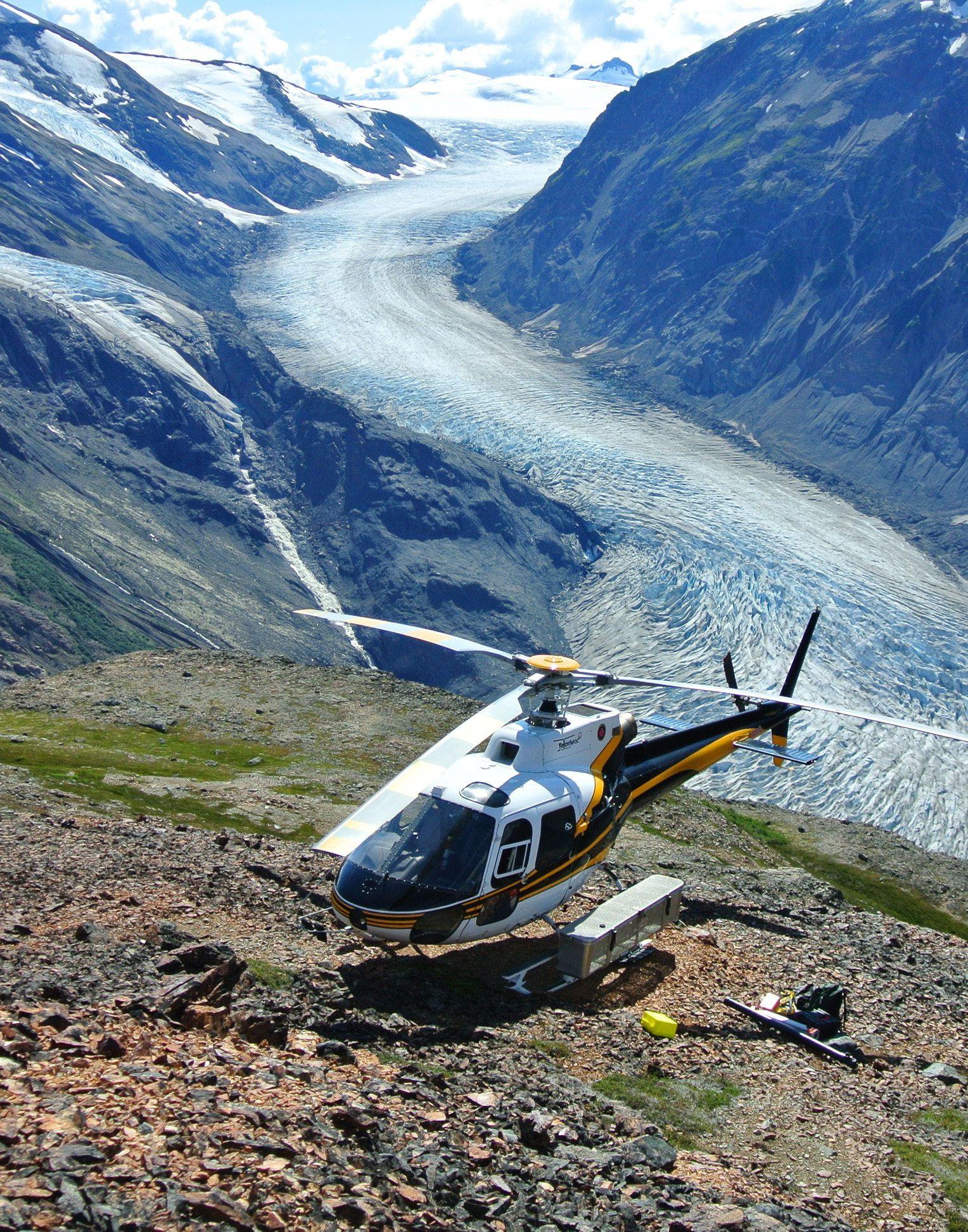
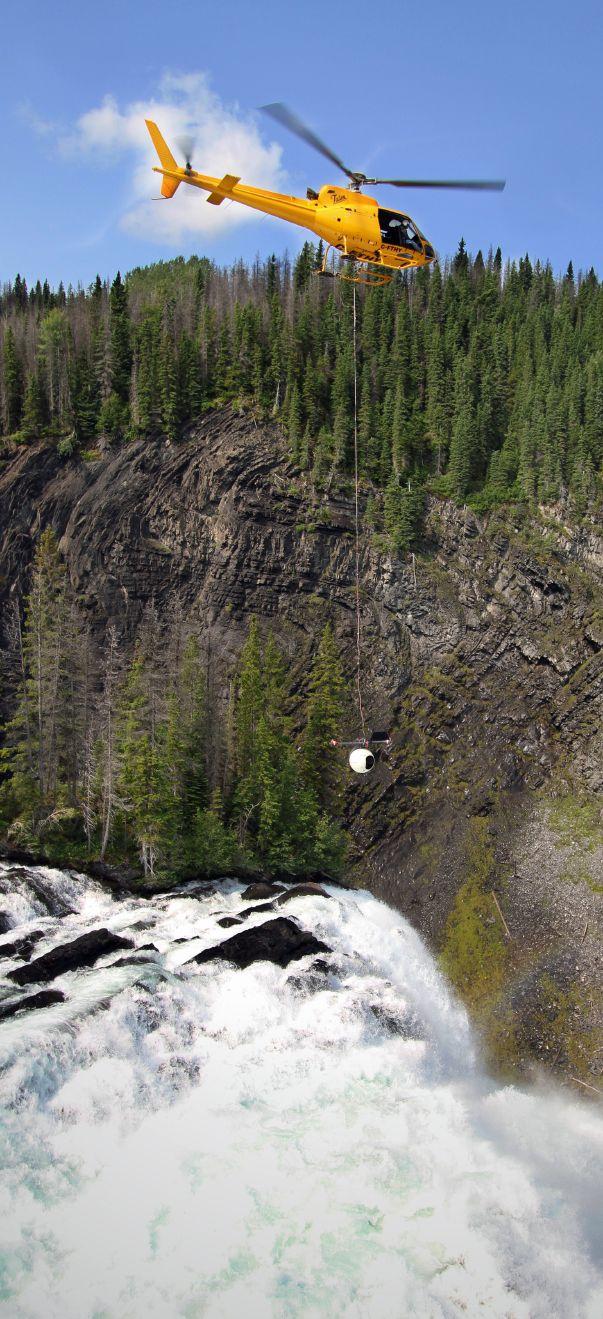
Yellowhead Helicopters is working to refine its safety culture.
MATT NICHOLLS is editor of Helicopters
t never ceases to amaze me how passionate a conversation can get when you manage to corral a group of helicopter professionals in a room for an extended period of time, focusing on one subject. It’s insightful, constructive and downright fun.
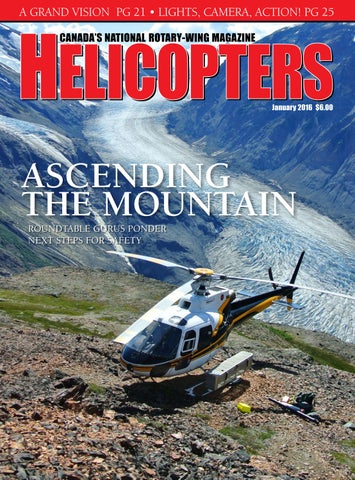
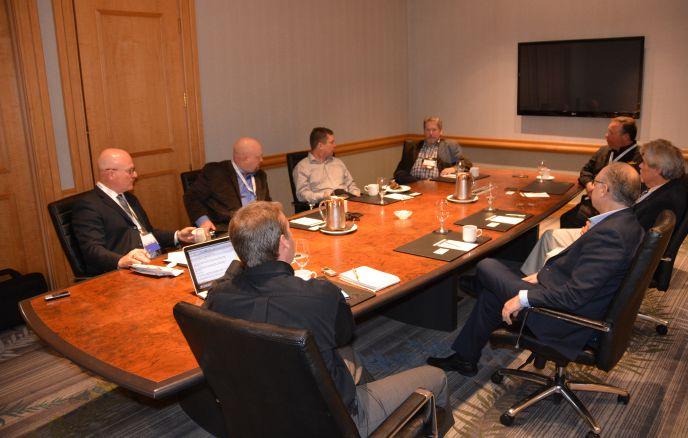
This is precisely what transpired in the early morning hours of Nov. 15 at the Helicopter Association of Canada’s (HAC) annual convention and trade show in Vancouver, when Helicopters conducted a lively industry roundtable with a very worthy group of industry leaders. Seven experts confined to a room for 60 minutes, all tasked with a mission to discuss safety in the Canadian market – how it has transformed, where it is headed and what needs to be done to make operating environments safer and more secure for all. (Please see, “Ascending the Mountain,” pg. 12)
The subject matter is as vast and complex as the operations the professionals in the room are tasked to carry out with their teams and in planning for the roundtable, determining what subjects to discuss was hardly a slam dunk. The ongoing flight and duty time issue, droning on about drones, economic realities, mergers and acquisitions, finding top talent and employee retention – all were worth bantering about and this group was keen to share their views and perspectives.
Yet, safety remains the issue that shapes the way suppliers and operators build and maintain their businesses and it is most defi-
Take a Look Within
Increasing Safety Levels is a
Shared Responsibility
West Coast Helicopters’ Peter Barratt, for example, pointed out that the “do as I say, not as I do” philosophy that existed at one time has been replaced by a much more active commitment from all operational levels. More and more Canadian operations like West Coast, have a comprehensive Safety Management System (SMS) and best practices. Barratt and his team are taking things to a new level by implementing personality analysis and testing for all pilots to see which roles might be suitable and which are not.
Such practices have been under scrutiny following the Germanwings flight 9525 crash in March 2015 – one of aviation’s top stories of the year. There’s no doubt enhanced psychological testing of pilots in both the fixed and rotary world is going to be more prevalent in the months and years ahead.
A better, more comprehensive way to share best practices and other key safety information was also highlighted by several members of the group – an area that is bound to help industry reach new safety goals. As Valley Helicopter’s Brad Fandrich aptly noted, the Canadian industry recently went through a prolonged period without a fatal accident – the longest duration in its history. Overall, accidents continue to diminish, so essentially steps are being made. Yet, fatal accident numbers remain a concern and the reason numbers continue to stay relatively the same are disturbing.
Without a sound commitment to safety as the grounding principle, dealing with other issues would be more complex. ‘‘
nitely connected to all of these aforementioned issues. Without a sound safety commitment as a grounding principle, dealing with other challenges would be even more complex.
While the discussion highlighted the challenges industry is working through – such as the establishment of a stronger working relationship with Transport Canada (TC), educating “non-forwardthinking” clients impervious to the importance of creating a safe working environment, dealing with economic realities and juggling the cost of enhanced safety procedures – there were many positives shared that point to the emergence of a new safety paradigm.
Also disturbing, as Great Slave Helicopter’s Corey Taylor notes, is a mentality among some clients that when push comes to shove, the safety rhetoric projected by upper management is often tossed aside when the time comes to get the job done. In other words, two philosophies exist – the perceived safety projections by corporate and the “get ’er done” reality pilots deal with to make clients happy, even while almost compromising regulations.
The challenge for industry – and it was discussed at length – is to bridge this gap and ascend to new heights of the safety universe. Technology, enhanced communication, shared information, borrowed best practices from other industries, education – it will all help. But the commitment must also come from each individual and organization with a vested interest. This shared commitment will produce the seeds for future growth. May 2016 be your safest, most prosperous year ever.
HAC event an unqualified success
The Helicopter Association of Canada (HAC) celebrated its 20th annual convention and trade show Nov. 13-15 in Vancouver and by all accounts, it was an unqualified success. More than 1,000 delegates and attendees took in the event, which featured a strong educational program and lively committee meetings. The event also featured the association’s first static display, a variety of showcased aircraft on the top of the Vancouver Convention Centre.
“We are very pleased with the way it worked out, a very strong conference,” noted Fred Jones, president and CEO of HAC. “Our committee meetings featured lively discussion, there was good traffic at the trade show and some very strong professional development offerings.”
Attendees at the event were treated to a solid educational program, an area HAC has been working hard to enrich. Sessions were well-attended and offered attendees a variety of educational options including emerging environmental issues, a look at the Canadian accident history analysis, an hour with Transport Canada and an analysis of the economic footprint of the industry by InterVISTAS Consulting.
Several industry leaders
walked away with top honours during the annual awards luncheon on Nov. 14. Rod Wood received HAC’s Honorary Life Member Award for his long-time contributions to the association, while Jim Davies and Terry Jones both received the Agar-Stringer award for their long-standing contributions to the Canadian helicopter industry.
Three other members of the HAC community were named honorary life members: Geoff Goodyear, Charlie Mooney and Barry Hewko.
BC Hydro was also honoured with the Airbus Innovation in Safety Award for its commitment to safe flying
practices, while employing an exceptional or groundbreaking approach.
HAC also officially announced its new Board of Directors at the show. The new board for 2016:
• Brad Fandrich, Valley Helicopters, vice-chair (re-elected) – western operator
• Jen Norie, VIH, corporate secretary (mid-term – not up for election) – western operator
• Jonathan Burke, Blackcomb Aviation, director (newlyelected) – western operator
• Brian Clegg, Skyline Helicopters, director (newly-elected) – western operator
• Shane Cyr, Universal Helicopters Newfoundland, director (newly-elected) –eastern operator
• Jacob Forman, Yellowhead Helicopters, director (midterm) – western operator
• Steven Williams, Emond Harnden LLP, director (re-elected as an associate director by acclamation) –associate
• Maury Wood, Avialta, director (elected as an associate director by acclamation) - associate
HAC’s first-ever static display was small but intriguing. (Photo by Paul Dixon)
Another Cyclone Wind Storm?
The troubled CH-148 Cyclone program could be facing more scrutiny over the next two years unless training and delivery schedules are met, a senior defence official told The Canadian Press. The programs must be carried out to avoid a helicopter shortage that could occur due to the retirement of the five-decade old Sea King fleet.
Concern that the Sea Kings may be phased out faster than the Cyclones have the equipment to be fully capable of replacing them has been around since the former Conservative government announced last June that the old helicopters would be slowly retired by 2018.
The CH-148 program needs a boost if it hopes to meet the RCAF’s future needs. (Photo
RCAF).
The Sea Kings fly off the decks of warships and there is fear that some Canadian naval vessels might have to go to sea without helicopters.
The possibility that the Sea Kings would be pulled out of service faster than they can be replaced is something defence planners are scrambling to mitigate, said the senior official with knowledge of the program.
Robinson introduces a new aircraft
The Robinson Helicopter Company is introducing a new model into its fleet.
The R44 Cadet, a two-place R44, is expected to make its debut in the first quarter of 2016. Capable of a wide variety of utilitarian applications, Robinson developed the Cadet with the training market in mind.
The Cadet has many of the same characteristics as the R44 Raven – including the same basic airframe, rotor system, and Lycoming O-540-F1B5 engine –but the rear seats have been removed and the aft compartment reconfigured for cargo.
The maximum gross weight is 2,200 lbs., which is 200 lbs. less than the Raven I. Engine power is derated to 210 HP takeoff/185 HP continuous (down from 225/205 HP in the Raven I). The lower weight and derated power provide increased performance
Ornge won’t be selling AW139s
Aslowing market and a drop in oil prices has prompted Ontario’s medical transport operator Ornge to hold off selling its fleet of AW139 helicopters according to a Toronto Star report. The helicopters were purchased in 2008 by a previous management team. The new team determined in 2013 that selling the fleet made sense, as the AW139 might not be the right aircraft for the job.
margins at high altitudes, and a newly designed muffler enables the Cadet’s flyover noise signature to be more than three decibels lower than the current R44 Raven I. A variety of optional equipment will be available for the aircraft.
HELICOPTERS MAGAZINE P.O. Box 530 105 Donly Drive South Simcoe ON N3Y 4N5 Tel.: 519-428-3471 Fax: 519-429-3094
Toll Free: 1-888-599-2228
Website: www.helicoptersmagazine.com
EDITOR MATT NICHOLLS email: mnicholls@annexweb.com 416-725-5637
MEDIA DESIGNER GERRY WIEBE
CONTRIBUTING WRITERS
RICK ADAMS, DAVID CARR, BRIAN DUNN, PAUL DIXON, WALTER HENEGHAN, FRED JONES, JAMES MARASA, CARROLL MCCORMICK, COREY TAYLOR
NATIONAL ADVERTISING MANAGER MENA MIU email: mmiu@annexweb.com 905-713-4351
Ornge sold two AW139s in 2013 for U.S. $10 million each, though in today’s market the remainder of the fleet would be worth $6 million each, according to Dr. Andrew McCallum, president and CEO of Ornge. Increasing maintenance and training costs have also contributed to the decision, McCallum noted.
The company has been generally pleased with the performance of the aircraft, McCallum said, due to its lifting capacity and flying characteristics – consistent with feedback from other medical transport companies utilizing them.
Helicopters Magazine is an associate member of the following Canadian aviation associations:
courtesy of
(Photo courtesy of Robinson Helicopter)
Ontario’s medical transport provider Ornge has decided against revamping its fleet. (Photo courtesy of Ornge)
COLUMN
WALTER HENEGHAN
Hamlet’s soliloquy mid-way through Shakespeare’s pivotal work informs my column this issue as I personalize my message to you.
For many years, I have been a troubled sleeper. As far back as my air force days, I was a snorer and over the years have perfected that skill to Olympian levels. I always believed that in spite of this I was getting good sleep; after all I was leading a fairly effective life and managed work and play, I must be OK, right?
My ex always told me that she didn’t mind my snoring; if I was snoring, she knew that I was still alive. (This always oddly comforted me!) But intellectually, I knew that snoring was not a good thing and those odd nights when I awoke gasping for air should have told me that all was not well.
Earlier last year, I spoke to my doctor and was referred to a sleep clinic. It was not, as I had envisioned, an overnight session with EEG and EKG leads attached all-over, in a sleep lab being studied and monitored like a lab rat. Rather, I was assessed by a sleep specialist and then sent home with a device that seemed appropriate to the movie set of “ One Flew Over the Cuckoo’s Nest! ”
The sleep study device was a headband with several lightweight data units designed to measure brain wave activity, movement, heart rate and oxygen saturation. I didn’t have the most restful sleep but carried through ever curious. I had the device for just one night and then returned to the physician. Diagnosis:
When the Night is Right
An Aviator’s Perspective on the Benefits of Sleeping Properly
issued specific guidance to its medical community regarding the certification process for aircrew with sleep apnea although TC has not yet followed suit. Both the NTSB and TSB have issued accident reports that address pilot fatigue as an ongoing risk factor.
Well, regardless of the regulatory processes and the science that drives it, here is my personal experience. After the diagnosis, I was provided (on loan), a device to assist in my breathing whilst asleep. The Continuous Positive Airway Pressure (or CPAP) device provides a small, constant flow of air via tubing and a mask or cannula to ensure the airway remains open while asleep.
It took some time to adjust to the mask etc. but the result was truly stunning. Two nights into using the CPAP, I was waking up truly rested. In fact, for the first two weeks of use, I was awake most days at 04:30! Apparently the quality of my sleep was such that the 6½ hours or so was sufficiently restorative. I have found myself much less tired during the day, more energized at work and “clearer of thought.” I have the energy to read more. I am retaining more. My mental processes are sharper. My outlook on life is brighter. My general fatigue and weariness including all too frequent headaches are gone.
The shift has been extraordinary and immediate. I now have the perspective provided through epistemic privilege about the truly restorative benefits of sleep. The light in my head has gone from a dim 20-watt incandescent bulb to a 200 watt LED – and all from a good night’s sleep . . . amazing!
I now have the perspective provided through epistemic privilege about the truly restorative benefits of sleep. ‘‘ ’’
Obstructive
Sleep Apnea, (OSA). So, now what?
Much has been written over the past few years in aviation circles about sleep disorders; sleep debt and the impact on pilots’ abilities to function at optimum levels. Recent Transport Canada (TC) consultations with industry regarding fatigue management have us much more familiar with circadian effects on pilots, coping strategies and the impact of fatigue on flight safety.
The Colgan Air 3407 accident brought additional scrutiny onto the airline industry especially regarding the fatigue or alertness levels of the pilots. In fact, earlier this year, the FAA
So, here is my message to you: If you are tired in the day, sleep poorly, snore or meet any of the risk factors for sleep apnea, talk to your doctor. Get a sleep study done. If you have any diagnosis of a sleep disorder, manage it.
CPAP devices are not inexpensive – mine cost more than $2,500, but many employee health care plans provide coverage. Just do it. I can say unequivocally if the money had to come from my own pocket it would have been worth every red cent!
“ To sleep, perchance to dream. ” Don’t underestimate the power of a good night’s sleep . . . it can change your life.
Walter Heneghan is the vice-president for Health, Safety and Environmental Protection with the Summit Air Group of Companies, Ledcor Resources and Transportation, based in Edmonton and throughout Western Canada.
PAUL DIXON
s it possible to create a working environment that is completely safe? Can we reduce the chance of errors, oversights, omissions and/or deviation to zero in our various workplaces, and in particular an aviation environment?
I think no. Does that mean we stop trying? Absolutely not! The theme for CHC’s 2016 Safety Summit is “Back to Basics: Prioritizing Safety in a Challenging Environment.” W. Edwards Deming said that focusing on quality would actually drive down costs. It was one of his 14 points of management. We could easily substitute the word “safety” for “quality” and likely have the same effect on the bottom line. You do not save money by “cheaping out” on safety programs. If you think that following safety guidelines is costing you money, have you ever seriously considered what not following those guidelines will cost you? Ask your accountant or insurance agent to enlighten you in this regard.
Safety Management Systems (SMS) and Crew Resource Management (CRM) in aviation came about for compelling reasons and we need to understand these reasons and be capable of applying the philosophy behind these programs to ourselves – and the situations we find ourselves in. Learning to look inward with a critical eye and maintaining equilibrium in environments where decisions have to be made with a high degree of accuracy when information is vague, incomplete or misleading is not easy and it can be extremely stressful at the best of times.
In my previous life, a friend and I read Transportation Safety Board (TSB) and National Transportation Safety Board (NTSB) reports for
It Can Be Done
A Personal Look At the Shared Safety Responsibility
a VIA train in 2013 is a case in point. The bus had just departed a transit station heading downtown and was hit by the train, resulting in the death of the driver and five passengers. How is it possible that a bus operated by a municipal transit service could approach a level crossing when the gates were down, lights flashing, bells ringing and train rapidly approaching and collide with the train?
From the TSB report: “Although the crossing flashing lights, bells and gates had been activated more than 30 seconds earlier, the bells were not audible within the bus, and the driver’s view of the gates and flashing lights was obstructed by trees, shrubs, foliage, Transitway signage and the front corner pillars of the bus.” The TSB report goes on to comment that the driver had driven through this same spot 60 times in the previous 12 months, though from the varying times of his schedule he would have rarely encountered a train at this crossing. “Drivers who are familiar with a crossing and who have a “no trains” expectation tend not to look in either direction while approaching a crossing and are less likely to reduce their approach speed than drivers who are unfamiliar with a crossing.”
As a result, The City of Ottawa has since improved driver sightlines in the vicinity of the Transitway crossing by trimming or removing trees, shrubs and foliage. Signage has also been enhanced – including by the addition of an advance warning sign with a light that continuously flashes – and the posted speed limit in both directions approaching the crossing has been reduced to 50 km/h. There have been a number of lawsuits filed, so I’ll keep my thought to myself for the moment.
Hindsight is 20-20. It becomes painfully obvious that simply removing any one domino from the string will stop the cascade.’’
years, along with line-of-duty death reports for police officers and firefighters killed on the job. What we were looking at were the human factors that were at play in so many of these incidents. Frequently, the outcome of these events rested on a series of seemingly small and individually insignificant events that would have been deemed to be minor. Unfortunately these little things were interconnected and much like dominos falling, once they started tumbling they simply cascaded. Of course, hindsight is 20-20 and it becomes painfully obvious that simply removing any one domino from the string will stop the cascade.
The TSB report on the fatal crash involving an Ottawa transit bus and
Look at this incident and deliberately do not use the word “accident” and compare it to your own situation at any time of your working life. We are the worst to objectively judge ourselves, but it doesn’t mean we shouldn’t try. How often do we walk by something at work that strikes us as being unsafe, but it doesn’t have an immediate impact on us – we just walk on by. How often did we forget to pass on something to the person who relieved us? If we’re already doing a good job on thinking safety, then the only way we will ever get better is by constantly striving to be the best. Think of Tony Kern’s Global War On Error, make it personal and start right now.
Paul Dixon is a freelance writer and photojournalist
COREY
TAYLOR
all me crazy, but it’s almost comforting that the price of copper is near what it was when I graduated from high school. I say comforting for two reasons. One, it makes me think of when I had hair – sort of. Two, it means it can’t possibly go lower, can it?
An analysis of metal and mineral prices vs. helicopter activity over the past three decades shows the two are almost always in lockstep, and since helicopter activity is generated by clients raising or earning money, metals and other commodities going up is good for our industry. Unfortunately, the commodities bubble (or super-cycle depending on who you talk to) of the 2000s has popped and while what comes down usually goes up, when that will happen is the question of the day.
Most commodities were in a depressed state from the early ’80s to around the turn of the millennium, when the effects of China’s growth, the popping of the Internet bubble and the availability of almost free money created such a steep growth curve in prices that it makes the famous global warming “hockey stick” look like a pool cue. During this period of growth the exploration for, and production of, almost everything increased. Many operators reaped the benefit while the Canadian helicopter fleet added dozens and dozens of aircraft. As soon as growth stopped a lot of those financed helicopters started to look like they weren’t such a good idea, but I think Canada has done well to retire a few of the machines built before I was born!
Riding Out the Storm
Unstable Conditions Wreak Havoc With the Industry
nitely be required and I suspect the national fleet will resume growth in the future, but there is more pain to come before that happens.
This past season was another one in which depression morphed to relief when the fire seasons in B.C. and Alberta enabled many operators to resume making mortgage payments and actually look at the points on a wine label instead of just the price on the tag. That’s not something we can count on for 2016, so prudent operators are cutting costs, reducing expansion plans and trimming debt. With no real end in sight to the malaise, the goal is to survive to catch that wave for the next growth cycle.
Helicopters will definitely be required and I suspect the national fleet will resume growth in the future.
Now that the suffering has been going on for about four years (with copper and zinc at six-year lows) are there any signs of hope? I think there are, but it won’t be like the recovery from the Great Recession of just a few years ago. Our industry is fortunate in the sense that supplies of extracted commodities are essentially finite, and new discoveries are getting smaller and less frequent.
Since the easy ones have been found, it’s no secret that new ones are almost always going to be on the frontiers of the planet. And contrary to what many people think in this era of Google and Wikipedia, there is plenty left to discover. Helicopters will defi-
There were odd pockets of what I call “geographic blessings” this past season, namely areas where there was substantial activity requiring helicopter support, but these were rare indeed and should be cherished when discovered. One trend I see continuing is the demand for high-performance singles and twins, which seems a bit counterintuitive when faced with the broad downturn. It seems that the clients who do have money to spend are also demanding levels of capability that wasn’t widely available just a few years ago, so more money is being spent on fewer numbers of aircraft. This move to newer and more powerful aircraft might sound like music to the ears of the OEMs, but I think most operators will continue to upgrade legacy aircraft – and when faced with a choice between the newly STC’d 407HP and a factory-new helicopter the choice will be clear. Without clients insisting on certain airframe age limits or refusing aftermarket upgrades, the Canadian industry has always turned to the best bang for the buck model, and I don’t think anyone can say we haven’t made it work all this time.
’’
2016 will probably be the first time many of us confront the use of drones as direct competition, as if we don’t have enough to fret over with the current state of affairs. I have always said: we can’t create work, we can only win it. I am changing my mind on that. I think we need to find new things to do with helicopters. Perhaps things no one ever thought of. That would be something worthy of this industry of pioneers!
Corey Taylor is vice-president of Global Business and Product Development for Great Slave Helicopters.
RICK ADAMS
Should Canada increase the penalties for the hooligans and sociopaths who aim laser lights at aircraft? Under the Aeronautics Act, those convicted of pointing a laser at an aircraft could face up to $100,000 in fines, five years in prison, or both. By comparison, U.S. federal law allows up to 20 years in prison and a US$250,000 ($333,000) fine.
In theory, under the Criminal Code of Canada, life imprisonment is an option, but no one believes any judge would hand down that severe a punishment unless the laser attack caused an aircraft crash. Indeed, it doesn’t help to have tough-language laws on the books when the judiciary fails to follow through. Earlier this year in the U.S., the notoriously contrarian Ninth Circuit Court of Appeals overturned a 14-year jail sentence of a gang-history criminal on the flimsy premise that he “may not have known” that the bright green light was a danger to the pilot of a Fresno, Calif. police helicopter. Just aiming at an aircraft, the judges concluded, “is not, in and of itself, sufficient to allow a rational factfinder to conclude that [the defendant] acted with a reckless disregard for the safety of human life.”
The arrest and conviction rates – irrespective of generally light punishments – are abysmally low: only about two per cent of reported incidents result in arrest, and fewer than two-thirds of those lead to convictions. Nearly all of the culprits are male (96 per cent), who apparently equate pen-sized pointers with manhood-validating Jedi light sabers.
Blame Einstein
Pilot Vigilance Top Option Against Laser Attacks
TC senior media relations advisor.
Gauthier told us there have been 488 laser-strike incidents in 2015 through October, which would equate to a year-end total of 586, compared with 502 in 2014. That’s about a 67 per cent increase since 2012.
In the U.S., the numbers are even worse. Based on 5,148 “illuminations” through early October, the Federal Aviation Administration (FAA) estimates there will be between 6,600 and 7,100 incidents in 2015 – a 176 per cent increase over 2014’s total of 3,894 incidents.
Most pilots by now know the drill when confronted with a laser attack: Fly the plane first; don’t look directly toward the light; block the light if possible; turn up the cockpit lights; resist the urge to rub your eyes. And many have handy or wear special laserprotective eyewear.
A promising new solution from a Nova Scotia company, Metamaterial Technologies subsidiary Lamda Guard, is a special film coating, 100 times thinner than a human hair, which selectively blocks specific narrow-band light frequencies (such as laser beams and other bright lights) by reflection. Known as metaAir, the aircraft windscreen coating uses an array of “nano-particles.” Lamba Guard is working with Airbus to bring the coating to the aviation market. Metamaterial Technologies is also participating in the Canadian Technology Accelerator in Silicon Valley, which specializes in growing tech start-ups and small-medium enterprises.
I’m sure Einstein would be appalled that his vision has also been turned into an instrument of evil
’’
Transport Canada (TC) is hoping an education campaign, tagged “Not A Bright Idea” will help deter those who are truly unaware of the dangers of shining lasers at low-flying aircraft. “The department takes this issue very seriously, which is why we launched a national safety awareness campaign with our partners, the Vancouver International Airport, the Royal Canadian Mounted Police, and NAV Canada. The aim is to reduce laser strikes by helping Canadians better understand the serious risks and consequences of pointing a laser at an aircraft and to encourage the public and pilots to report laser strikes if they witness or experience them,” said Natasha Gauthier,
So how is aviation’s laser problem Einstein’s fault? Two years after revealing his theory of relativity, in 1917 Professor Albert proposed a process called “stimulated emission” – stimulating electrons to emit light of a particular wavelength. It took four more decades before scientists translated that theory into laser light, which certainly has useful applications in medical devices, military target identification, retail checkout scanners, and tormenting cats. But I’m sure Einstein would be appalled that his vision has also been turned into an instrument of evil by unthinking or malicious malcontents.
Rick Adams is chief perspectives officer of AeroPerspectives, an aviation communications consultancy based in the south of France, and is editor of ICAO Journal. He has been writing about technology and training for 30 years.
Roundtable Gurus Ponder Next Steps for Safety
BY MATT NICHOLLS
afety. It’s the driving force behind every aspect of the helicopter industry, a delicate bond uniting operators, suppliers, clients and end users together on so many critical levels.
The collective efforts of all parties over the past number of years have worked to raise safety standards to new levels, as declining accident and incident numbers from various sources indicate. But how does one take responsibility for their personal safety footprint and apply it to real-world situations – and what about an operation’s role as a whole? What tools are necessary to bring things to a new level?
Complex questions all and these were just some of the topics discussed during a lively roundtable discussion in the early morning hours of Nov. 15 during the Helicopter Association of Canada’s (HAC) annual conference and trade show in Vancouver. The invitation-only event brought together seven industry leaders from a variety of organizational backgrounds for an intriguing hour-long discussion.
And while HAC president Fred Jones did his best to apologize for booking such an undesirable early-morning session – I am certain some members of the group were hurting from the rockin’ party the night before – once the caffeine kicked in and the group dug in, the discussion moved at a frenetic pace (that’s frenetic in the Canadian helicopter sense of the word).
Here’s a synopsis of what the group had to say – and what potential safety solutions and questions remain.
Ascending the Mountain S
Helicopters: What role does safety play at your operation and how does it shape the overall culture?
Fred Jones (FJ): It’s our role to help facilitate the development of safety standards in the industry. We do this through Best Practices, committee deliberations and facilitating those discussions. We also have a presence on the board of the International Helicopter Safety Team (IHST) and promote professional standards inside the Association, professional conduct among operators and promote it in our involvement in the regulatory development process.
Corey Taylor (CT): People speak at safety seminars and admit
Ascending
safety has to start at the top; management has to buy in, your executives have to believe in it. But I don’t think this exists at a lot of companies. In our recurrent training, we go over safety issues all the time, yet it doesn’t seem to get communicated in the field. People will say, when they are being candid, that there are two sets of rules – those that get things done and keep clients happy and those that keep corporate types happy, with all the trappings of safety, structure, Safety Management Systems (SMS) etc. We are working hard to bring this gap together.
Brad Fandrich (BF): We are a smaller operation, so safety with us is achieved in conjunction with our customers. Some are very educated, and have raised the bar and encouraged us as an industry to reduce payloads and implement other steps to reduce pilot workload. This makes a pilot’s job easier, which can improve an operation’s overall safety. The goal is to educate everyone so they are playing on the same field.
Bob Spracklin (BS): I am an odd duck in terms of my aviation career. Half of it has been on the operator side, the other half on the client side. Fire operations in Canada are one of the most complex for helicopters, with hazards we can never eliminate, you can only mitigate. We have the same attitude towards safety as operators have. We need to evolve safety and the best way to do this is to unite clients and operators to get some consistency of operational procedures. The fact HAC promotes and brings people together, it means that the conversation isn’t just a conversation, it’s a practical application.
Jacob Forman (JF): Since I am on the corporate side, I may have some different views of the safety question than other people. As we tell everyone at the company – the safety department, the pilots, the maintenance staff – it is all of our jobs to make safety the No. 1 priority.
Peter Barratt (PB): We started operations just under 25 years ago and safety was not a significant focus. The thought process was “do as I say, not as I do.” When Transport Canada (TC) said, “SMS is coming,” we thought, here is a tool we can use. Doug Strachan, our chief pilot at the time, developed our SMS, and because of that, we started training everyone along this premise. It worked to a certain extent. Then, we
Group dynamics: our roundtable participants engage on matters of safety. (Photo by Paul Dixon)
COVER STORY
developed Best Practices. Now, we are evaluating the role personalities play on safety. We analyze personalities and traits, and have worked this data into our SMS to see what positives each personality type can bring – and also what negatives.
Sylvain Seguin (SS): Safety is a complex issue, but to make it work effectively, you have to simplify it. When you have a number of bases, staff and aircraft, different types of work and missions, it is not easy. We look at lessons
learned and try to come up with processes that work and are effective – and integrate these processes into our training and into the way things are done in the field. Over time, these elements become part of the safety management process. It’s also lessons learned from industry. The more we can share our Best Practices – with HAC, with various committees, with industry – I believe this is where we can get to the next level; a sharing of industry information.
Helicopters: Excellent points. I think part of the problem is – and Corey nailed it – there is often a disconnect at some operations between the corporate safety message and what is actually needed to get the job done. Comments?
CT: This is definitely true. A large part of it is because the clients have the same disconnect. So, when you work with a fire boss, for example, who thinks it is not applicable what it says in their own safety manual, pilots are put under a lot of pressure to do what they need to do. I still fly on occasion and I have been in contact with guys who have no idea what their corporate safety standards are. It is much better than it was say 15 years ago or more, but when you are working with some companies, they have no idea what the requirements are. There are three elements: the corporate perspective from the top, the supervisor on the job and the pilot – and because all levels are disconnected, the pilots are left to try to make it work. When you think about aviation, we push safety all the time, but the clients don’t. If they are paying for that helicopter, and they are paying good money, they want you to work to the level of the regulation. “Never mind Best Practice – go to the limit of the regulation, that’s all we are asking of you.”
Helicopters: That seems like a rather draconian perspective. Is this still something operators deal with in the current operating environment?
BF: It used to be rather “normal” to be pressured to the limits, but customers are getting wiser. They are integrating safety programs into their corporate procedures; some are paying attention and will work with you towards a common safety goal. But there are others that are definitely old school that will do anything to get the job done. I think the aggressiveness is starting to dissipate with some of this behaviour, which is obviously positive for the industry.
Helicopters: So what is driving this change in perspective?
BS: Clients and operators are starting to move in the same direction. You are getting philosophical shifts in perspective at some companies; clients are realizing the importance of having an SMS. Corey mentioned one of the challenges in creating a comprehensive safety culture: you have varying levels of buy in to the process at each operation. Plus, we have the challenges of differing levels of experience – educating at all levels, both with the client and operator. There is also tremendous turnover, so every five years you have to train new people.
FJ: One of the things I see operators struggling with – and it becomes particularly problematic with high turnover – is information management. You are getting voluntary reports, incidents – how do you keep up with the information? And when you are hiring contractors who come to the situation cold and are faced with your specific system – how do you do it? A safety culture is based on an accumulated history of the corporate experience, the front-line experience and more. Digesting all of this information is certainly a challenge.
SS: It’s a great point, which is why we need to find a way to simplify safety information. Operators need to find ways to work effectively with HAC – revisit your Best Practices and revisit your SOPs. If we want to share as an industry, I think the best venue is through these committees. We have evolved with our various committees at HAC and with Best Practices, the next step is with SOPs.
BS: We have to look at safety at our operations and find ways to simplify it yes, but bear in mind, it is anything but simple. It is complicated and very complex. We can’t simplify it as a whole, but we can simplify what we do in bite-sized pieces. And if you have corporate types who think because you implement a few procedures that you’re done. That’s not going to cut it – there will always be more, and this kind of attitude may create a problem. Creating a complex system and breaking it out into bite-sized pieces is the best way to do it. But bear in mind, the whole thing, is very complicated.
Helicopters: What about the role of the regulator? There are concerns with Transport Canada (TC) regarding service levels and a general lack of understanding of the helicopter community. How has this affected the safety environment?
FJ: TC is well intentioned, but sometimes it is misguided, because overall, there is a lack of understanding of our industry. It is a complicated business. There are so many niche markets and niche operations that the regulatory body fails to understand. This, of course, applies to flight and duty times, but it also applies to a number of other areas. TC does not necessarily understand the importance of flexibility in our operational environment, something our operators and pilots understand intuitively. Seasonal operations, long day light hours in the north, the logistics of moving crews around – these are challenges that are completely foreign in an airline environment. There’s also the disconnect that exist because the things that drive the regulations from the government point of view are entire-
ly different than the things that drive changes from the inside of an operation. For example, one accident could cause a huge change in motivation for TC to change part of the regulation simply because of its profile – and we have seen that happen for multiple situations over the years.
Helicopters: How does this disconnect impact safety at your individual operations and on the industry as a whole?
BF: It definitely has an effect on safety. And TC is almost unresponsive on very basic service levels. One colleague said she has had files on her desk for over 12 months. The level of service from TC? There is really nothing there. And it is not the individual inspector’s fault. They are overwhelmed and underfunded, so they are spread so thin that they can’t deal with a lot of things.
PB: It’s bureaucracy as we all know. Some 25 years ago, I remember TC had a mandate
“I get to do what I love to do, every day.”
Chris Horton, Helicopter Pilot // Instructor
COVER STORY
that said, “we are here to help.” Well, now it is simply, “we have no money and we can’t help.” So, it drags on. But that isn’t the worst aspect of it. Try dealing with the security side. It took us a year-and-ahalf on one project just to get a clearance. You get a different person on the phone every second day.
CT: When I started in the industry, I was impressed because TC inspectors always had such a great background. Their experience was impressive – they always knew where I had been, what I had experienced. It still exists to a certain degree today, as there are some that have this background, but others you look at and just shake your head. They have no understanding. They have never done it, they have never been involved in the industry, they have heard about it, but they certainly have strong opinions about it.
JF:To me, it comes down to leadership. As leaders in our companies, it is our responsibility to make sure we put the proper resources in place for tools and training. The government has failed to do this for the past decade or so.
Helicopters: Bob brought up an interesting point about simplification and concentrating on “bite-sized” pieces in developing a stronger safety culture. Any examples?
CT: This really resonated with me, because there are some strategies we are supposed to implement throughout the industry and I have never seen them done successfully. For example, external load tracking equipment. You get an onboard hook that is good for five years or so many hours, but nowhere I have worked – and forgive me if the other operators here are good at tracking this stuff – has this information been tracked well. Usually a client says, “So how many hours have you had on that hook? When is it due for an overhaul?” And we say, “Sorry, what?” And then you find out, you don’t even know where you got this hook and you can’t find any information on it.
One of things that we have done as a company, because we run paperless on the flight ticket side, is we are trying to simplify it and make it easy for the pilots to comply and do what they are supposed to do. This is where technology comes in, because now if you fill out a flight ticket, it is not paper, it’s a tablet and it’s a forced response. Have you been doing an external load? Drop down box, click yes. Were you using a long line? Click yes. Which long line? Drop down box select and you are done. It selects your hook, tracks it all, and if you are using it more than one day, you can just indicate “no changes” and go from there. It tracks all of the data. This kind of information is invaluable and it is not that complicated to implement.
PB: What we have found with SMS, is it led to a whole range of things we weren’t aware of, or we didn’t know we weren’t aware of. And we ended up updating our policy manual, building a Best Practices manual, identifying personality profiling. The fact is, everyone has positives and negatives and not everyone will do what you want them to. Yes, safety is complicated, but you have to find the right tools to keep it going. And we have gone a little bit further with it –such as instituting personnel profiling – and we involve the clients in some of our safety meetings and we compare notes. Any problem can be solved through communication, so we are trying to communicate.
Helicopters: So, are we doing enough individually – and collectively – as an industry to be as safe as we can be?
CT: I don’t think so, but I do think we want to. People are busy. One of the problems we have as an industry is we are in a big downturn. And if you believe that safety has no cost, that is nonsense. Many of the compliance issues when you get into the quality side of
The Players
Fred Jones, president/CEO, Helicopter Association of Canada
In his words: “Safety is critical to every aspect of the Canadian helicopter industry. It’s the bond that unites us on all levels, operators and suppliers.”
Corey Taylor, vice-president of operations, Great Slave Helicopters
In his words: “Most CEOs want their company to be safe, they believe there is a structure and rules employees need to follow, but they are not that engaged.”
Brad Fandrich, general manager, Valley Helicopters
In his words: “In our safety culture, we try to enable and encourage pilots to make sound decisions and use safety processes at the company to educate our customers – and spread that knowledge throughout the industry.”
Bob Spracklin, aviation services co-ordinator, Saskatchewan Wildfire Management Program
In his words: ”Safety is never going to go away. It needs to evolve to a point that it is no longer a safety program per se – it is part of your corporate identity of how you do things.”
Jacob Forman, chief executive operator/accountable executive, Yellowhead Helicopters
In his words: ”Safety is the backbone of what we do, and it has to be the number one priority industry wide.”
Peter Barratt, vice-president operations, West Coast Helicopters
In his words: “It has been a real eye opener to see how all the personalities mesh and affect our safety culture.”
Sylvain Seguin, chief operating officer, Canadian Helicopters
In his words: “As well, as much as you develop processes, you need to augment proper training – this is what helps establish a strong culture.”
things, you just need more people. I think operators really want to find a solution, but often, it isn’t easy. We are making progress, but are we doing enough? No, but you can’t just ramp up and do more immediately. At the safety forum, many operators came up to me that I would have thought were not safety savvy at all – smaller markets, not sophisticated, smaller geographic areas. But I was amazed at how advanced some of them were – especially in attitude.
BF: I agree that the industry is on a steady improvement. How to speed up the progress or fix it per se, I don’t know how to do that, but if you look at where we came from and where we are, there has definitely been progress. We had over a 12-month period with zero fatal accidents – that is unheard of in our history. To me, the industry should give itself a pat on the back. We have never had this in the past, we have hit a remarkable target, but how do we reach a higher level? It’s definitely tough.
Continued on page 29
Filling a Necessary Void
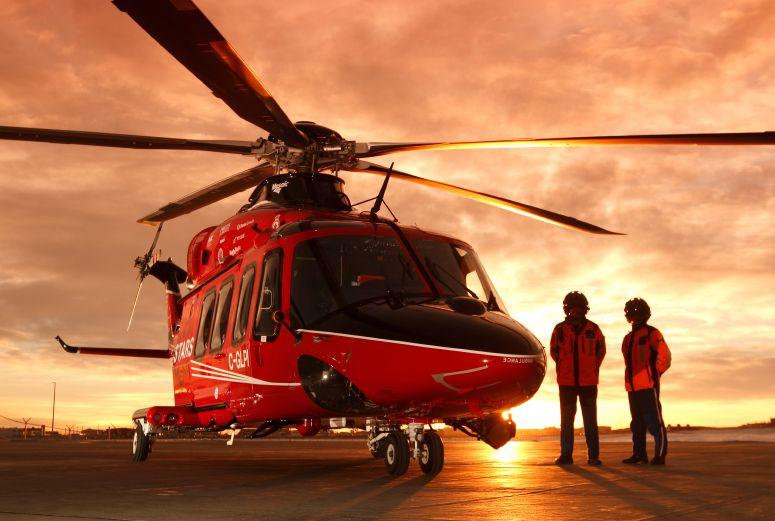
Left: Rotary-wing operators now have a new CRM instructor’s course to utilize. (Photo courtesy of STARS)
Below: Yes, the course is intense, but sustenance is important. (Photo by Kaye Mains)
A CRM Flight Instructor Course for the Rotary Crowd
BY ADAM W. JOHNSON
stablishing the safest operating environment possible is the goal of operators worldwide and creating standards for Crew Resource Management (CRM) is certainly top of mind. Until recently, a CRM instructor’s course built specifically for helicopter pilots pertaining to civil pilots, was nowhere to be found, but that is not case now. Veteran pilot and trainer Randy Mains, in concert with Oregon Aero, has developed such a course and HeliWeb’s Adam W. Johnson recently had the opportunity to check it out. He shared this report with Helicopters
E...Mahatma Gandhi once wrote, “If we could change ourselves, the tendencies in the world would also change. As a man changes his own nature, so does the attitude of the world change towards him… We need not wait to see what others do.”
Many of us strive to live our lives with this sentiment in mind, but few people I’ve met embody them as well as Randy Mains. As a matter of fact, he’s dedicated his life to it – to being the change he wants to see in the world.
If you are not familiar with Mains, allow me to enlighten you. He got his start in the helicopter industry serving in the United States Army as a Huey pilot in Vietnam. He flew more than 1,000 combat hours, during which time he earned the Distinguished Flying Cross,
the Bronze Star, and 27 Air Medals, among other awards. In the 47 years since then, he has herded cattle by helicopter in Australia, flown the jungles of Papua New Guinea, and has flown and instructed in several countries throughout the Middle East. While working as a senior flight instructor for Bell Helicopter International in Iran, the 1979 Islamic Revolution broke out, forcing him to flee on the last charter flight out of the country.
Upon returning to the United States, Mains, and other early pioneers, became a part of a new drive to create life-saving Helicopter Emergency Medical Services (HEMS) programs based on the lessons learned and experience gained in Vietnam. Mains worked tirelessly to prove the concept of “the Golden Hour;” it is well established that trauma patients’ chances of survival are at their highest if they receive care within one hour after their injuries.
In January of 2013, Mains quit his job at Abu Dhabi Aviation to return once again to the States to try and make a difference. Fed up with reading headlines about the continuous loss of life he had observed in his years of HEMS experience, he knew he had to do something. After 47 years, and more than 13,000 flight hours, Mains proclaims, “I’m in the ‘giving back’ phase of my career.” As the author of four books, all of them helicopter related, he is
FEATURE
passionate about sharing his nearly five decades of aviation experience. He is absolutely passionate about safety – almost as passionate as he is about teaching.
At the Air Medical Transport Conference 2012 in Seattle, Wash., Mains crossed paths with Oregon Aero founder and CEO, Mike Dennis. Most pilots are familiar with Oregon Aero for their helmet and headset comfort and safety upgrade products, but they do much more than that. With their products, including crash-resistant seats, in literally hundreds of types of military and civilian aircraft, Oregon Aero seeks to change the status quo by designing products that surpass industry and marketplace expectations.
When Dennis heard about Mains’ idea for a Crew Resource Management Instructors course, and saw firsthand the passion Mains is known for, they immediately set out to form a partnership to spon-
sor the train-the-trainer CRM Instructor course that has been, if you think about it, nearly five decades in the making. This joint pursuit to make the helicopter industry a safer place is a match made in heaven. In the words of Oregon Aero’s chief operations officer Tony Erickson, “If we can prevent people from needing to experience the survivability of our crash resistant seats through the safety and awareness training that good CRM provides, that’s the best case scenario.”
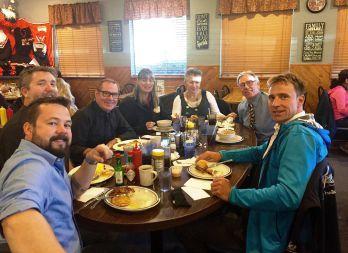
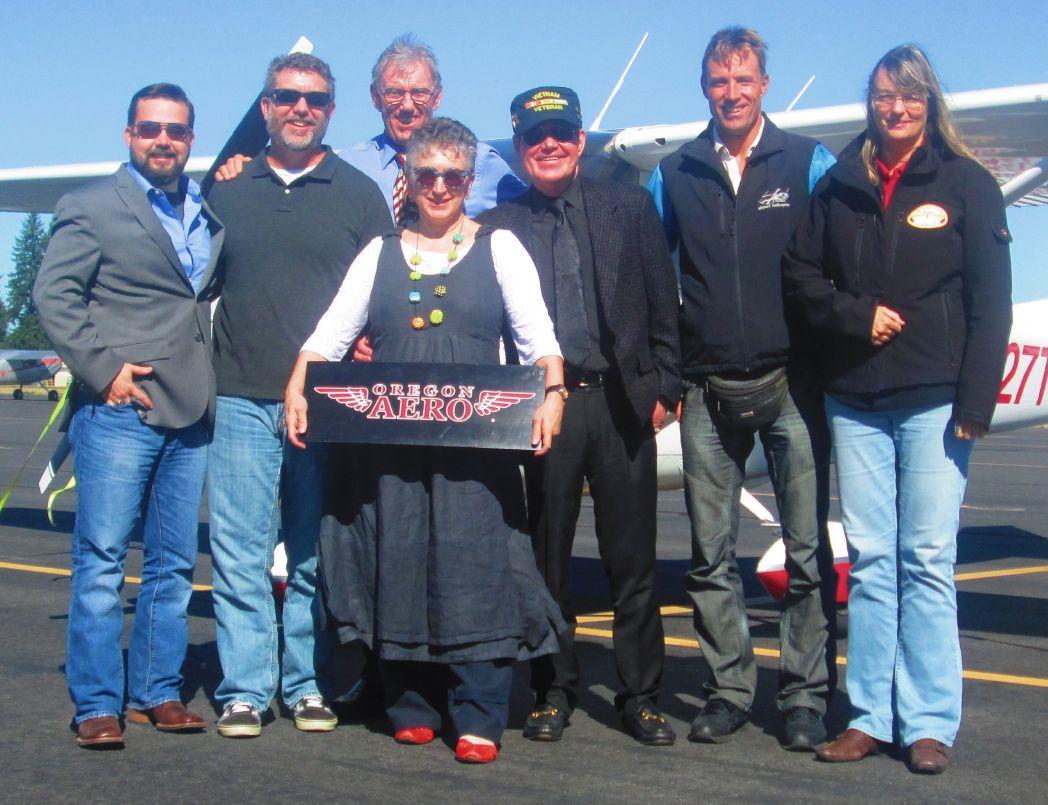
Mains’s fifth CRM Instructor’s course took place in Canada from Jan. 8-12 at the Sidney Pier Hotel and Spa on Vancouver Island. The first-ever Canadian event featured three Canadian chief pilots, one Canadian line pilot and some prominent members from south of the border, including a senior flight nurse from UCLA’s Alert3 flight program and the director of
clinical risk management at Air Methods Corporation, the largest helicopter air medical provider in the U.S.
When I was given the opportunity to attend the CRM Instructor’s course, I jumped at it. I was immediately impressed by Mains’ professionalism and communication. In the weeks leading up to the course, he sent out several emails to the attendees, first and foremost to introduce everyone, and secondly to relay information about accommodations. Mains followed up with everyone individually every step of the way to ensure the travel and check-in process had gone well. This level of attention to detail and follow-through struck me as a rare but welcome trait in this day and age.
When we arrived at Oregon Aero’s headquarters in Scappoose, Oregon, we were given a tour of the facility before
Happy day! Graduation for all of the course participants. (Photo by Gerhard Paasche)
being led to a well-appointed and spacious classroom. Each of us was presented with a 280-page instructor’s manual, along with several other thoughtfully prepared handouts, including a flash drive pre-loaded with over three gigabytes of information. It was a bit overwhelming at first, and it seemed unlikely that we could possibly cover that much material in a five-day, 40-hour course. I was wrong. We covered all of it and more. Oregon Aero’s CRM Instructor course is intensive. Discussions are encouraged, and are often lively.
The instructor’s manual each of us received that we would ultimately use to teach and facilitate our individual CRM course once we returned to our home base was, as Mains put it, a “living document.” As new information is presented in the industry, new views are expressed and new lessons learned, that manual is destined to adapt and grow with us. Sure enough, by the end of the course, Randy’s prophecy had begun to fulfill itself; we were already swapping PowerPoint presentations and other information with one another.
In our class of five students (plus Mains), the combined experience in aviation between us was 44,250 flight hours and a jaw-dropping 368 years. As a relatively lowtime CFI, to say I felt outgunned going in would be an understatement. I soon learned, however, that my fears of inadequacy were misplaced. The group meshed fluidly as the course proceeded. The diversity of experience – both in aviation and in life – continuously brought about unique observations, experiences and viewpoints.
The pilots in my class were: Dr. Bettina Schleidt, professor of industrial psychology and human factors from SRH University in
Heidelberg, Germany; Hannes Ulmer, utility pilot and CFI in Zurich, Switzerland; Roland “Bud” Jarvis, most recently an instructor pilot and examiner with Abu Dhabi Aviation, but began flying helicopters in Vietnam, where he earned the Distinguished Flying Cross; Bill Orvis,
Crew resource management skills are critical in life and death situations. (Photo courtesy of STARS)
assistant chief pilot for Sundance Helicopters in Las Vegas, Nev.; and lastly, myself, a former U.S. Marine Corps chemical biological radiological nuclear defense instructor, and current CFI in Oregon.
During the five-day course, the group continuously developed into a near familylike atmosphere. I attribute this phenomenon largely to Mains’ outstanding ability to facilitate. A good facilitator has the ability to take a step back from the formal role of instructor and instead encourage the development of a “just culture.” Not only did I witness this occurring in our very own group, but facilitation became a focal point in the overall tone of the course. “The way they do it in the airlines,” Mains told us.
Before we left each evening, we were assigned a relevant topic on which to give a presentation the following day. It was fun and interesting every day to watch each of
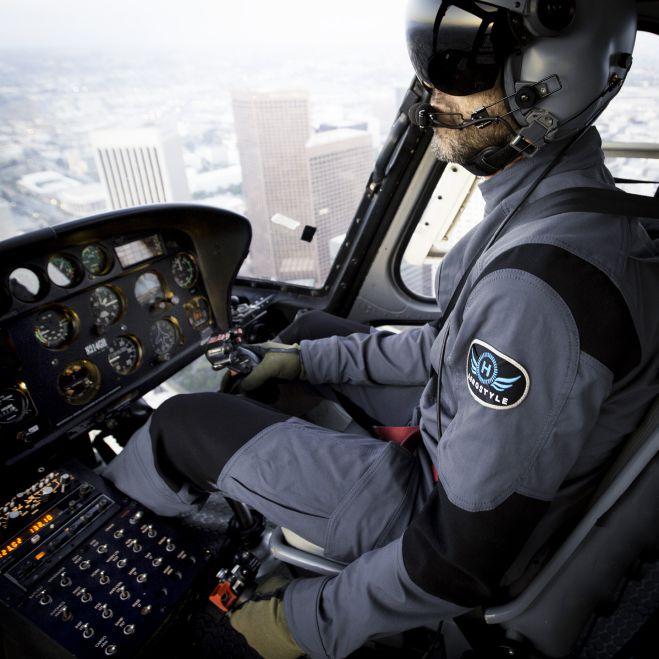
THE NEW GENERATION OF FLIGHTSUITS
- Aaron Fitzgerald Helicopter Pilot, President and CEO, Airborne Images, Inc., Los Angeles, California
FEATURE
us progress toward learning to stop instructing and start facilitating. Early attempts for nearly all of us were well intentioned, but still missed the mark.
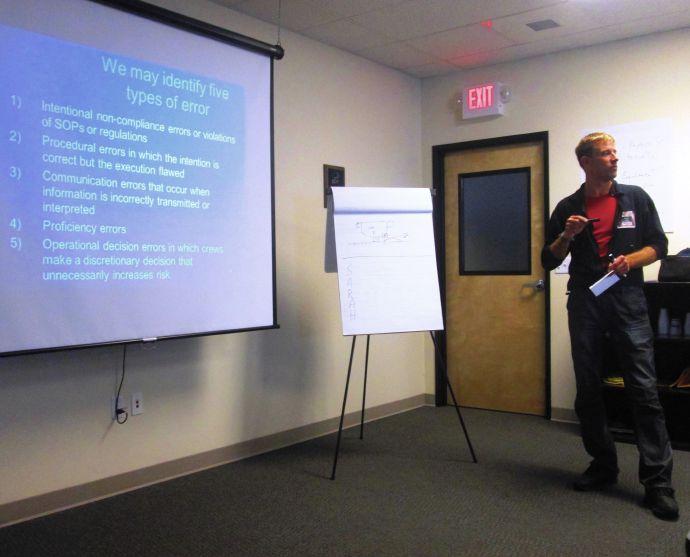
One of the most challenging things to do as an instructor is learning when and how to shut up. With Mains’ leadership, and constructive evaluation and feedback from peers, we began to improve. Presentations improved. Our role as facilitators improved. On the first day, the tendency was for the student-instructor to dominate the allotted time period. By the time of our final presentations, we were getting the hang of it. We, as instructors, had learned to act more as shepherds of conversation – presenting the information as tools, and then stepping more into the role of facilitator by encouraging discussion.
The transformation was truly incredible, as it took the common – dare I say, even boring – safety lecture and turned it into a lively discussion by enthusiastic participants. Indeed, by the final presentations, the facilitated conversations were so interesting and so animated that I think we were all genuinely a little disappointed when the allotted time for each presentation had run out.
The objective of facilitated CRM training is to create a “just culture”– a culture in which people have no fear of retribution for having an open dialogue. The reason this role as a facilitator is so vitally important to CRM training is that it encourages attendees to invest themselves in the topic and take ownership of the material. Only when a person feels that he or she has a stake in something can it bring about a change in behaviour. That is, in short, precisely what CRM is – what Mains calls the CRM mantra: “A crewmember’s awareness of how his or her actions or inactions will affect the safe outcome of a flight.”
Facilitated CRM training has been proven more effective to change adult behaviour than any other method by the airlines and military aviation, preferable to electronic CRM training, which does nothing to change behaviour. The U.K.’s Civil Aviation Authority (CAA) issued a statement in 2003 that “Most experts and practitioners are in agreement that the variability in the effectiveness of CRM training is largely linked to the quality of the delivery and not the content, and that training with a high degree of facilitation has been more successful.”
When the United States Coast Guard
implemented facilitated CRM training, it reduced its accident rate by a staggering 70 per cent. Other branches of the U.S. armed forces have implemented similar programs with similarly impressive results. Consider that CRM training is essentially nothing more than raised awareness of contributing factors leading to human error. In a NASA taskforce in 1980 to try to determine why so many airliners were crashing, they discovered that human error was a contributing cause in 80 per cent of all accidents reviewing records going back to 1940.
In Helicopter Air Ambulance (HAA), that number increases to an unfathomable 94 per cent. The CRM Instructor Course seeks to teach instructors how to empower individual team members with the tools necessary to make the safest decision possible under a given set of circumstances –how to see and predict the “links” of an error chain forming and, more importantly, how to break that chain before it becomes an accident, and thus a statistic. I can think of few things that can yield more cost-effective or more immediate results to the safety culture of an organization than having an effective, facilitated CRM program in place. Oregon Aero’s and Randy Mains’s collaborative CRM Instructor course enables operators, more than ever before, to have exactly that.
Bill Orvis, asst. chief pilot for Sundance Helicopters, related his thoughts about his company’s outlook on CRM and safety training. “What we want is compliance,” he said. “Trying to get pilots to comply with what the company is asking for in its safety program requires a change in behaviour. In order to enact this change, crewmembers must be aware of what’s at stake. The key to gaining this understanding and communication is training. Facilitated CRM training is what will do it.”
When I asked Mains what prompted him to want to quit his well-paying job and create this course, he recounted the old proverb, “Give a man a fish and you feed him for a day; teach a man to fish and you feed him for a lifetime.” Just as he has been a determined advocate in the push for the installation of autopilots in HEMS aircraft, he is equally adamant that facilitated CRM training has the power to save lives. Saving lives was a resounding theme throughout the course, albeit in a selfless, unassuming way, as the aim of CRM facilitation is to provide people with the tools to save themselves. Now, having personally experienced Mains’ passion for CRM and safety, I must confide that I agree. As Bud Jarvis succinctly put it, “The value of this training is that it will keep people alive!”
A variety of observations, experiences and viewpoints were shared throughout the duration of the course. (Photo by Kaye Mains)
A Grand Vision
Langley Regional Airport is a Growing Hub of Helicopter Activity
BY PAUL DIXON
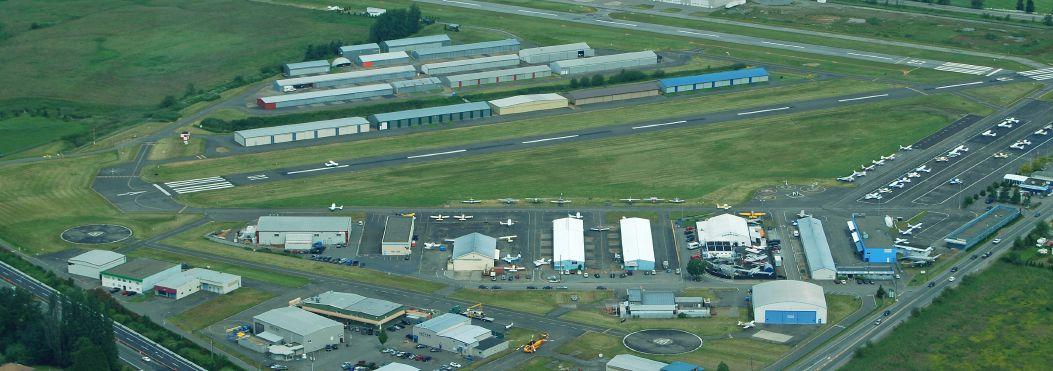
Think globally and act locally would describe many businesses today, but you wouldn’t necessarily include a small regional airport on the outskirts of Vancouver on that list. Langley Regional Airport (CYNJ) is not as small as it might first appear and packs an economic punch far above its weight class.
Originally built in 1938 by the federal Department of Transport, the airport (or more accurately, airfield) had been planned as part of the Trans Canada Airway, a string of airfields from the prairies to the West Coast. The field served as a relief field for the larger Commonwealth training programs at Boundary Bay and Abbotsford. After the war, the Department of Transport continued to operate the airport before it was sold to the Township of Langley for $24,300 in 1967.
The airport was built on 120 acres, with the original 2,100 ft. north-south paved runway and a recently added 2,700 ft. east-west runway. When the airport was completed in 1938, the area was known as Langley Prairie, a rural farming community with a population that may have numbered in the hundreds. Today, Langley Prairie is just a geographical reference and the combined population of the City of Langley and Township of Langley is more than 140,000 and growing rapidly. The airport sits on its original site, but now multi-lane arterial roads border three sides, with a river running on the fourth. With no chance of growing horizontally, CYNJ is taking the vertical path by focusing on the rotary-wing market.
THE HELICOPTER PHILOSOPHY
The decision to “go rotary” came in the early 1990s, when George Miller took over management of the airport after 35 years in the Royal Canadian Air Force (RCAF). Miller describes the circumstances that brought him to Langley as being “just by luck.” He learned of the job completion through a friend and came on board in 1991. The municipality wanted to hear how Miller would propose to build up the airport or turn it around, as there had been discussions about developing the site for other purposes. A plebiscite had been held in the City and Township and residents voted overwhelmingly to keep the airport, but with the stipulation that it needed to stay within that 120-acre footprint.
“My first job,” as he recalls, “was to take a look at the airport, get a feel and write a master plan for rebuilding the airport. My whole emphasis was on rotary-wing and general aviation, along with complementary commercial activity. There wasn’t any room to expand the runways, so we needed to build up our marketing plan for rotarywing, because we only had a couple of companies at the time.”
So, in Miller’s words, he “got to it.” Tirelessly promoting the airport was job one, within the local community and across the broader aviation community. Part of that was becoming an active member of the BC Aviation Council (BCAC), where he served as president for five years. During his tenure with BCAC, he worked on creating a network-friendly environment.
“We got away from head tables and long tables and got into round tables of eight so people could have actual conversations and
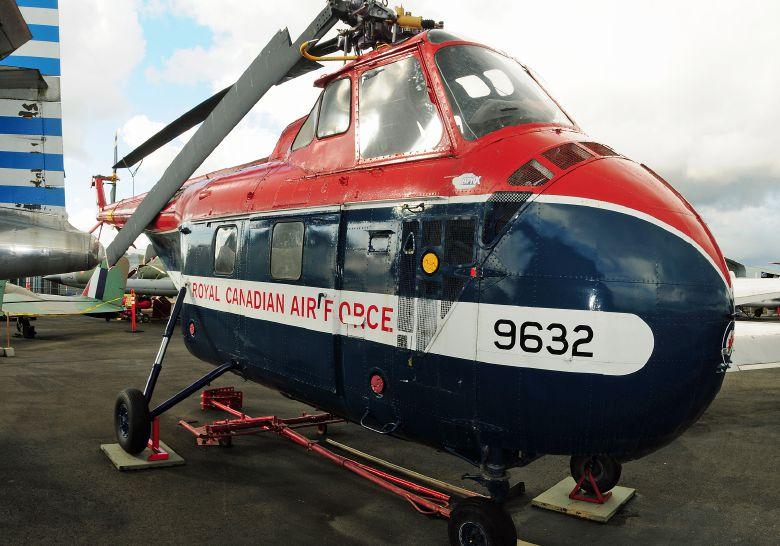
Left: A Sikorsky S-55 (UH-19) at the Canadian Museum of Flight at Langley Regional Airport.
(Photo by Paul Dixon)
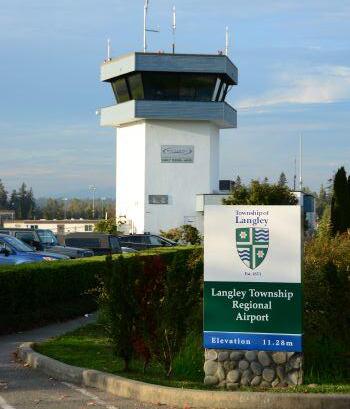
Below: The Tower at CYNJ – a new airport emerges.
(Photo by Paul Dixon)
that became a really good way to introduce one’s self to helicopter people,” he says. Miller then started to build up a nucleus of companies by making the airport attractive to businesses. “I think we had the best lease prices in the Fraser Valley and the best fuel prices,” he says. “We got away from branded fuel and looked after it ourselves. [We implemented] long leases that allowed someone to build a business. Eventually, it started to fall into place.”
TAKING THE REIGNS
The current airport manager, George’s son, Guy Miller, describes that attitude as a remarkable incentive. The airport has grown steadily over the years and is now a serious contributor to the local economy. The numbers from the economic development department at the Township of Langley show the airport generating $30 million in salaries, with a total output of goods and services of $158 million.
When Guy took over the airport operation, it was done through his own company, Avcon Consulting. In his words, Guy Miller joined the RCAF right out of university, flew the F-18 Hornet for seven or eight years, and then went off to fly the B747 for Cathay Pacific. “Once I’d been in Hong Kong for a decade or so, George gave me a call and asked me if I wanted to come back and help him at Langley,” Guy said. That was 10 years ago. He worked for Avcon for seven years and then three years ago, the Township of Langley took over operation of the airport. Today, Guy Miller is a municipal employee as the airport manager, reporting directly to the township CAO.
“It’s been beneficial,” Guy says. “While there were benefits as a contractor, we get a tremendous amount of support from the township with the engineering department, accounting, payroll, finance – before that was all contracted out. If we need a snowplow, we pick up the phone and call engineering. That’s a lot different than it used to be.”
VECTOR’S NEW HOME
Guy Miller has continued what George started. Ten years ago, the north side of the airport was simply an open field. In the spirit of community involvement, the airport would host Canada Day celebrations that would draw huge crowds of up to 60,000 over a weekend. Today, the fields are disappearing under a wave of new construction that will see more than 200,000 square feet of buildings erected.
Vector Aerospace is constructing an 88,000 square foot new facility on the north side, which will incorporate new avionics and structures shops, with 65,000 square feet of hangar space under one roof. The new building is designed to bring the current Langley workforce,
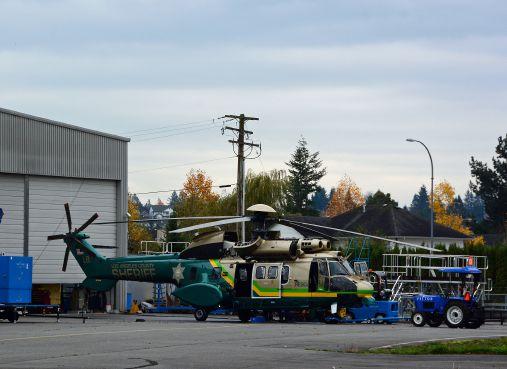
The team at Vector Aerospace works on an AS322 from the Los Angeles County Sheriff Department (Photo by Paul Dixon)
currently working in a number of different buildings, under one roof. When the facility is up and running, it is expected to add a further 180 jobs and, in turn, attract major investments and nearly double the technical activity and production of the airport.
As Vector moves over from its current facilities, other businesses are lining up to move in. CanWest Aerospace is located next door to Vector’s current location on the south side and is planning to add 10,000 square feet to its current building. What drives companies in this region isn’t the local or regional helicopter business as much as the global market.
CanWest’s Tom Roberson says 90 per cent of his company’s
business is from outside Canada. “What has made us successful is diversifying into the overseas markets. We haven’t been seeing the slowdown in our business that others have seen from the downturn in oil and gas. We were just awarded a $35 million contract by the Egyptian government. We will maintain, support and upgrade their Sea King and S-61s for the next five years. The U.S. State Department is one of our biggest customers as well. They still fly plenty of S-61s. That’s our focus and we’re trying to expand more on the corporate side, interiors and paint. People will come halfway around the world to get it done here because it gets done right.”
The south of Langley Regional Airport looking north (circa 2010). Construction currently underway or planned for the north side of the airport (at top of photo) will add 200,000 square feet of commercial space. (Photo courtesy of Langley Regional Airport)
JUST THE RIGHT SPOT
Down the road from CanWest, TRK Helicopters is now located in its new 6,000 square foot hangar and office complex, having moved over from a smaller building. TFK does the bulk of its flying in northern B.C. and the Yukon, so why does owner Randy Marks choose to have his offices and maintenance facility in Langley? It’s quite simple: he doesn’t want to live anywhere else and it’s still more efficient for TRK to do its maintenance work here. It offers ease of access and relatively affordable (by Vancouver standards) real estate in the local communities that make Langley airport an attractive sell for companies looking to recruit personnel. It’s far enough out of the big city to be affordable, but close enough to take advantage of what the city has to offer.
Lyle Watts has operated Heli College Canada Training for 22 years. For him, Langley is an ideal location for a training school, offering a great diversity of landscape in every direction. “It’s close to Abbotsford for IFR, it’s close to the mountains, Pitt Lake and Mud Bay,” he says. As surprising as it is to realize how much business local companies do outside Canada, it is equally surprising to realize how many students come to Heli College from around the world. And there’s a good reason: the high level of expertise offered by the school.
“People like Geoff Stevens, who is the highest time Robinson pilot in the world, with more 19,000 hours,” Watts explains. “I’ve got 42 years in the business, I’m an instrument and VFR examiner. It seems strange to some that you will find these qualifications in a small place like Langley.” Of course, word of mouth also plays a role. If one student from Europe phones friends back home, they came over. The halls of Heli College’s office are lined with hundreds of Polaroids of graduates, including more than a hundred CHC pilots who trained here over the years.
MORE MOVEMENT
RCMP Air Services moved its helicopters from YVR to Langley in July 2013. Langley is located almost at the geographical area that Air 1 and Air 2 are responsible for. The move ensures more timely responses to many areas of metro Vancouver and removes the potential of conflict between commercial airliners and police helicopters at a major airport. There is also a significant saving realized as the shorter response distances mean less fuel burn, coupled with lower hangar rental.
The Canadian Museum of Flight has outgrown its facilities on the south side of the airport and is awaiting final rezoning approval to move to a new site on the southwest corner of the airport. When the museum moves to its new building, the airport is already planning for upgrades to the area being vacated. Carol Madill, airport operations assistant, sees it as a chance to upgrade, put services underground and get things modernized. “It’s snowballed like crazy and now it’s starting to fill in and we’re constantly having people here finding other places to move to – and now we will have more movement with the (old) Vector space opening up. People want to be here because we’ve got the big hitters here.”
THE JOURNEY AHEAD
Yes, the seeds that were planted by George Miller are certainly germinating, as the airport continues to thrive. From just a handful of businesses 25 years ago, there are now 55 on the airport grounds, with most of them connected to the rotary-wing world. There continues to be strong support for the airport from the community. With the penchant for further growth and global opportunity, Langley Regional Airport is poised to have a very strong and bright future.
Laying the Foundation
On his 80th birthday, George Miller did what he’s been doing most of his life – he went flying. Miller spent the afternoon leading the Fraser Blues, the display team he founded in 2001, through its paces in the skies over Langley, B.C. and the Fraser Valley.
It’s a long way in time and distance from that day in 1953 when the recent high school grad walked into the RCAF recruiting office in Ottawa, but most 18-year-olds today would be hard-pressed to keep up with him.
Accepted by the RCAF, he soon found himself in an airplane for the first time in his life. He was learning to fly the Harvard Mk 1, not the friendliest of machines for a novice. At the age of 19, he was flying Sabres in Europe.
By 1962, he had discovered an aptitude for aerobatic flying and was chosen as the lead soloist for the Golden Hawks, performing at 70 air shows across North America that year, before returning to Europe and transitioning to the F104 Starfighter.
In 1972, Major Miller was chosen as the second team leader of the RCAF’s Snowbirds. Under his leadership, the team became the nine-aircraft demonstration team, still unique in the world of aerobatic flying.
He introduced new uniforms for team members and ground crew and was also responsible for the team adopting CFB Comox as their pre-season training home, a tradition that endures to this day.
Miller served 35 years in the RCAF and after a short tour in the commercial aerospace market and private business, he signed on with CYNJ, where he stayed until January 2015.
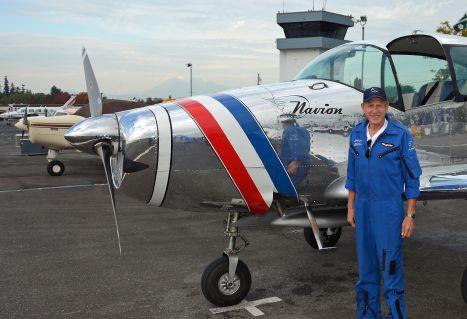
In 2001, Miller formed the Fraser Blues formation display team. Headquartered at Langley Regional Airport, the team flies North American Navion aircraft. Over the past 15 years, the team has appeared at scores of air shows and community events across Western Canada and neighbouring states.
During his career, Miller has received numerous awards and citations. In June 2007, the BC Aviation Council presented him with its Lifetime Achievement Award. In June 2015, he was inducted into the Canadian Aviation Hall of Fame, but the biggest reward of all just might be that after 61 years he’s still doing what he loves.
GEORGE MILLER’S VISION PAVED THE PATH FOR SUCCESS
Happy Birthday. George Miller with his prized Navion on his 80th birthday. (Photo by Paul Dixon)
Lights, Camera, Action!
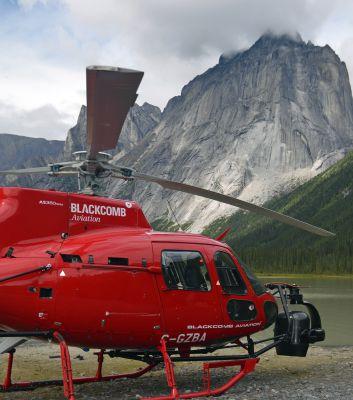
Below: Blackcomb Aviation’s AS350 B3 with a Shotover camera on location for Star Trek at Cirque of the Unclimbables. (Photo courtesy of Blackcomb Aviation)
Helicopters Continue to Transform the Movie Business
BY PAUL DIXON
viation, photography and movies – it’s a creative bond that goes back to the very inception of flight. Wilbur Wright, for example, is credited with the first use of a movie camera from an aircraft in April 1909. Not long after, the First World War saw the wide acceptance of aerial photography and the post-war years saw a surplus of aircraft and trained pilots, a combination that was a boon to the nascent motion picture industry.
ACecil B. DeMille, an established filmmaker when America entered the war, trained as a pilot and volunteered for overseas service just as the war ended. With aviation in his blood, he bought up surplus aircraft and established his own flying service in suburban Los Angeles (Charlie Chaplin ran a competing air service from a neighbouring airfield) at the same time he was introducing the concept of the movie blockbuster and establishing Hollywood as the film capital of the world.
The epic movie Wings, which won the first Academy Award for best picture in 1929, contained some of the most spectacular aerial footage, even when measured by today’s standards. Aerial cinematographers in the early days of Hollywood were usually a stunt man or pilot. The work was limited to movies that featured aerial dogfights or stunt sequences shot with hand-held and hand-cranked
cameras. Through the 1920s and ’30s, there was little advancement made in aerial photography, even though there were a number of major aviation films made during the era. It took the introduction of the helicopter to fully integrate aviation and filmmaking.
Prior to the introduction of the helicopter as a camera platform, aerial shots were limited in style and technique. There are several movies from the late 1940s listed as the first use of a helicopter on a commercial film shoot, but it was the 1955 TV series Highway Patrol with its fly-over title sequence and frequent use of a Bell H-47 in scenes, that put the helicopter squarely in the public eye. Desilu’s 1957 series Whirlybird, took the H-47 and made it a star. Directors and cameramen were brought on to design shots on a much larger scale, using the helicopter as they would employ a crane shot for a ground camera, coupled with improved cameras, exploring new possibilities.
A defining moment was the closing sequence of the 1968 Barbra Streisand movie Funny Girl, where Streisand is seen standing on the bridge of a tugboat as it sails past the Statue of Liberty. A helicopter approaches from the port side of the tug and crosses over the bow as the camera zooms in on Streisand as she sings. The camera then zooms out as the helicopters flies up and away, steady as a rock.
Left: Talon Helicopters’ chief pilot Kelsey Wheeler follows the action in Alberta for Fly Over Canada. (Photo courtesy of Talon Helicopters)
FEATURE
Camera operator Nelson Tyler, who incidentally did not appear in the movie credits, achieved the shot by creating his own vibrationdampening camera mounting system. A new standard for aerial cinematography was born and the next decade saw a steadily increasing use of sophisticated aerial shots as techniques, cameras and hardware improved.
THE VANCOUVER CONNECTION
From a truly Canadian perspective, as long as Hollywood has existed there has been a connection with Vancouver. While there was a miniboom in movie production during the 1930s, the real move to Hollywood North didn’t begin until the 1980s. By 1999, film and TV production passed the billion-dollar mark and for 2015, Creative BC (formerly the B.C. Film Commission) predicts that film and TV production will contribute in excess of $2 billion, while commercials and corporate productions will account for another $200 million.
Vancouver has been attractive to American and international productions for a number of reasons. It’s in the same time zone as Los Angeles, the climate is mild and there is a great diversity of geography in southwestern B.C. that can mimic more exotic locations around the world. Local governments have provided incentives to film companies and there is a large pool of skilled film tradespeople available. Creative BC says that 97 per cent of the workforce in film and TV production is drawn from locals.
Helicopters play a critical part of all stages of film making in B.C., including location scouting, crew and equipment logistics, stunt work and cinematography. Recently, Helicopters talked with two locals with decades of experience using helicopters in aerial film-
making – Peter Murray of Talon Helicopters and Steve Gray of Blackcomb Aviation – about their experiences flying for many of the feature movies, TV shows and commercials that have been filmed in Vancouver and southwestern B.C. in recent years. There is a remarkable similarity to how they approach aerial filmmaking, right down to the helicopters they fly on the job: the AStar 350 B2 for Talon and the AStar 350 B3 for Blackcomb. Both opt to use the AStar 355 Twinstar for situations requiring a twin-engine aircraft.
Vancouver has been attractive to American and international productions for a number of reasons.
Helicopters: How did you get started in the business?
PM: I was exposed to the film business more than 25 years ago. My brother was working in film and has his own Vancouver-based production business today and my sister was working in the business as well. I started flying on long-gone TV shows and the like.
Western Canada’s only dedicated news helicopter, a Bell 206 L4 operated by Talon Helicopters, flying over Vancouver’s West End.
(Photo courtesy of Talon Helicopters)
SG: I started gradually, because I spent years flying cameras filming sailing regattas in the Caribbean where I was living at the time. We would be filming sailboats sailing at sea, racing, etc. so, I had years of that experience before working on an actual feature film. I had a pretty good idea artistically and visually of what they are looking for, but working on features. The new thing for me was dealing with production, stunt coordinators, directors, producers, who are all looking for something different.
Helicopters: How do you work with so many different productions?
PM: Flying a helicopter with a camera is just another way of using the helicopter and people who do it all the time. They usually tend to get better at it, because they are more familiar with the procedures and what the production is looking for. It helps to have a good eye; if you happen to be a good natural photographer and understand light and composition. During actual filming, there’s the flow. A lot of times you’re following something, you’ve got to turn right, or left or climb or descend, change your flight path before anyone says it, because by the time they say it, it will be too late. The more you do it, the better you get. You learn that camera operators are all a little bit different, just like pilots are. The more you work together the better the shots come out, because you are able to anticipate each other’s requirements. The operators tend to fly with pilots they know. It’s not a place for new pilots, not because they are unsafe, but because they don’t know what to do.
SG: They won’t just hire anyone. They want people they have had prior positive experience with, pilots that do exactly what they say they are going to do and do it safely. There are only a handful of
pilots in Canada that do film on a regular basis. The relationship between the pilot and the camera operator is critical. We both have to understand what the shot is, that it’s a team effort. You have to get good at listening to directors on the set, because you may only get one chance to do what they want you to do.
Last summer, we did a movie called “Monster Trucks” which included a scene with explosions and a truck rollover. We only had one shot at it, so we had to be in the right place at the right time. You usually only get one or two rehearsals and sometimes you get no rehearsals at all. That’s why it is so important for the camera operator and the pilot to be comfortable with each other, understand how we each work and to trust that each of us is going to do what we said we would do and do the job correctly.
We’re the same as everyone else on the set. When you go on the set you have gaffers, second unit directors, camera people, camera assistants, makeup artists and when you go on these feature films you get to know these people quite well. It’s always the same people and the reason it’s the same people is the same reason they hire an experienced camera pilot. It’s because they’ve used them before, they’re comfortable with them, they do what they say they are going to do and they can trust what they are going to do.
Helicopters: So, can you name some of your favourite projects?
PM: The opening video for the 2010 Olympics was very memorable, but I’m not sure if it was because I had to get up early so many times or not. It was all shot in morning light or evening light, so you’re not out there all day. We were up at 4 a.m. to do that kayaker shot, the one where we’re going towards the city, over Spanish Banks.
Talon Helicopters’ chief pilot Kelsey Wheeler (right) “acting like a helicopter pilot” during shooting of a TV pilot. (Photo courtesy of Talon Helicopters)
FEATURE
It turned out beautifully because we had the right light and the right people in the kayaks. As far as flight time, that was probably less than an hour. I’d estimate we flew for 20 hours over six months, 20 to 25 hours of different segments at different times –and there were many more segments that didn’t get put in the video. You spend three hours prepping and 45 minutes flying. That was one I definitely enjoyed and I enjoyed the results, because it went on for so many months and took so much planning to get what we wanted.
SG: We just did the new Star Trek feature film this summer. We shot at the Cirque of the Unclimbables in Nahanni National Park in the Northwest Territories. It was exceptional, an area you never get to fly to otherwise. We had to get permission from Parks Canada, but it was incredible. I’ve also been involved in several big features that involved both stunt and feature flying. Stunt flying can mean a number of different things. You might just fly past the camera, land and have actors get out, or we might just do something with the helicopter on the ground, not running, for dialogue inside the helicopter – and I might have to “act” like a helicopter pilot. Then there’s what most people would consider stunt flying, such as the A Team movie, where I was flying a gunship and chasing a Bell 205 through a low river valley in a desert area near Cache Creek. Stunt flying can include approaching a camera in a certain way. A lot of it can evolve at the moment depending on what the director wants to do and the pilot being able to take that direction and turning it into something that looks dramatic, but at the same time is safe.
Helicopters: What are the safety considerations when you are working on a show or movie?
PM: Sometimes companies want Hollywood movie pilots to come up and fly our aircraft. Other companies might still do it, but we don’t. If I’m flying technical crew to a location, I don’t fly four feet off the water at 80 knots, because that’s not what we are doing. If we are filming, I am quite comfortable down at four feet in the right conditions, off the water at 80 knots, because we are filming. I don’t push the envelope and I’m not stressing the aircraft beyond its limitations. In film, people like to talk themselves up and people like to talk up pilots. I keep hearing about what certain pilots have done, but it’s not legal or it’s beyond the helicopter’s capabilities. With certain types of work there is more ego, and with film there is definitely ego.
SG: Safety has never been an issue for me on the West Coast, but I know there were issues years ago. There were very public accidents involving well-known celebrities and that’s really changed the industry. Most producers and directors admittedly know very little about the performance capabilities of any given helicopter. They trust us to give them that information. Another important point is that, at this time, film production companies are very safety conscious. They will listen to the pilot and accept our suggestions as opposed to finding another pilot as they may have done years ago. Now, they will listen to your comments and they are as interested as we are in a safe alternative.
Helicopters: Are UAVs and GoPro cameras going to replace helicopters?
Murray jokes that Talon is a “drone-free” zone, but the short answer from both is “no’. UAVs and small, inexpensive cameras are being used to some extent in aerial filming and have a legitimate, but limited role at this time. With a helicopter, the director and camera are right there with the pilot. Until someone comes up with a better way, helicopters are in the movie business to stay.
Talon Helicopters filming the waterfall sequence for Sherlock Holmes: A Game of Shadows. (Photo courtesy of Talon Helicopters)
COVER STORY
Continued from page 16
JF: We have come a long way as an industry, even in the last five years. It will simply require more commitment, more work. We have to keep our heads down and keep at it – piece by piece.
SS: If you look at the last five or 10 years, there has been a complete change in the standards and expectations of clients in various industries and this is progressing all the time. There also has been a distinct safety movement within various organizations. Safety does have a cost – and when you have customers that ask for a 15 to 20 per cent reduction in pricing, it’s harder to make massive investments in safety infrastructure. We have to be creative, we have to find ways to share information, create Best Practices and come up with the same result but for less. It is also about sharing of information, because some of the issues that we all have, whether it is Yellowhead or Great Slave, or Valley, they are very similar issues. We need to create data gathering processes that can be shared with industry – that could be the next phase in our safety development.
Helicopters: Fred, on the 20th Anniversary of HAC, and through your commitment to the industry, you have earned the last word.
FJ: The challenge from the Association’s point of view is to try to bring some structure that can be shared. How do we take a system that represents the Best Practice and export it to all of the operators, small ones, large ones – but how do you do that? Best Practices are a good start but we are struggling at the Association to determine what is the next step. We need to find a way to operationalize the systems, the changes, the policies, the SMS, the Best Practices, and export it in a form that is digestible and can be used by individual operators. The Association has got to evolve as well. Technology will be part of the answer, but it is also, for the Association, identifying systems that will be most useful industry wide.
Helicopters: Technology is key to achieving a higher safety culture, but how many of the transformative ideas come from other industries?
FJ: I think this is definitely part of the answer – looking to other industries for tools, ideas, mechanisms and technology to push the information out. It can only work to enhance and develop a brand new level of safety across the industry.
Campbell River Base e-mail: info@ebhelicopters.com www.ebhelicopters.com
Gold River Base
Tel: 250-283-7616
Fax: 250-283-7555
Port Alberni Base Tel: 250-720-8915
Fax: 250-720-3641
BASIC HELICOPTER AERODYNAMICS
T hird Edition
Basic Helicopter Aerodynamics is widely appreciated as an easily accessible, rounded introduction to the first principles of the aerodynamics of helicopter flight. Simon Newman has brought this third edition completely up to date with a full new set of illustrations and imagery.
Simon Newman addresses the unique considerations applicable to rotor UAVs and MAVs, and coverage of blade dynamics is expanded to include both flapping, lagging and ground resonance. New material is included on blade tip design, flow characteristics surrounding the rotor in forward flight, tail rotors, brown-out, blade sailing and shipborne operations.
Concentrating on the well-known Sikorsky configuration of single main rotor with tail rotor, early chapters deal with the aerodynamics of the rotor in hover, vertical flight, forward flight and climb. Analysis of these motions is developed to the stage of obtaining the principal results for thrust, power and associated quantities. Later chapters turn to the characteristics of the overall helicopter, its performance, stability and control, and the important field of aerodynamic research is discussed, with some reference also to aerodynamic design practice.
Heli book ad jan 2016.indd 1
FRED JONES
Andy Rooney of 60 Minutes fame once wrote, “ . . . airplane pilots are open, clear-eyed, buoyant extroverts, and helicopter pilots are brooders, introspective anticipators of trouble. They know if something bad has not happened, it is about to.”
I don’t think that Mr. Rooney’s assessment is completely accurate, but there are a few traits that I have noticed over the years – some we need to embrace, and others we need to resist.
Helicopter pilots and operators like to plan ahead, but the world we live in conspires against advanced planning. I can’t tell you how many times I thought I was going on one job, and it was cancelled, or I was redirected to another job – sometimes en route. The work makes us adaptable to changing circumstances beyond our control, but I would argue that our ability to adapt has driven many of us to seek out tactical life scenarios. It is one thing to work well under the pressure of changing circumstances but entirely another to seek them out. Working well under pressure doesn’t necessarily mean that you should go looking for pressure. I tell my wife that I “work best under pressure.” She reminds me that I only work under pressure.
Because we expect things to change constantly, when we actually find ourselves able to relax, we tend to leave behind our inhibitions and behave in a way that is free from social limitations or any code of conduct particularly in the company of others in the industry. We work hard and we play hard.
A Pilot’s Nature
Understanding Your Personal EDA and How to Get There
or be sensitive to an unusual vibration in the tail rotor. Having said that, I am not sure that makes us “introspective anticipators of trouble.” In fact, I would argue that it makes us particularly happy when we don’t detect any problems.
But I would argue most vigorously with Mr. Rooney over his statement that, “They know if something bad has not happened, it is about to.” I would suggest that nothing could be further from the truth. Helicopter pilots are a hopelessly optimistic lot. Like Carl Spackler in Caddyshack, “I don’t think the heavy stuff is gonna come down for quite a while.” We can sit in the eye of a hurricane and convince ourselves that it is starting to clear. Indeed, we are right up there with golfers for our optimism.
In fact, I believe that where we fall down as a group is in our ability to think strategically. We are so focused on thinking tactically, we sometimes miss the big picture.
Admittedly, we need to cope with our immediate circumstances, but we also need to make the time to contemplate where we want to be two years, 10 years, and 20 years from now. That means taking some time to think about our long-term priorities.
That is, how to position yourself or your business for the next phase of your life. The first step is to take the time to determine what it is you want to do. That means different things to different people, but for all of us it means making the time to determine the “destination.” I’ve never had much luck in aviation – or life – when I have an “EDA” or Estimated Destination of Arrival.
Helicopter pilots and operators like to plan ahead, but the world we live in conspires against advance planning.
’’
We love the comfort of predictability when we can find it in the little things we do. My daughter caught me going through a checklist in the car recently, and she has noticed I do a walk around before departing. I had to explain to her the importance of knowing where the vehicle “AOM” was located, and how to look up the meaning of each annunciator light. I hang my keys up in the same location every day when I come home. Doesn’t everyone?
Helicopter pilots are wired to detect circumstances outside the norm. We are tuned to recognize a bearing that is worn beyond limits
Prioritize and invest your energy in high-leverage projects. Allowing yourself to be distracted leaves you vulnerable to chasing shiny objects that pull you away from the core objective, trying to do too many things at once or equating “being busy,” with being successful. We are all pulled in a million different directions: we need to recognize those opportunities that move us closer to our strategic goals.
Finally, Mark Zuckerberg said it best: “The biggest risk is not taking any risk . . . In a world that is changing really quickly, the only strategy that is guaranteed to fail is not taking risks.”
Fred Jones is the president/CEO of the Helicopter Association of Canada and a regular contributor to Helicopters magazine.
THINK LAW ENFORCEMENT
Airbus Helicopters is Canada’s preferred supplier for law enforcement aircraft. Law Enforcement agencies around the world count on the reliability, performance and efficiency of Airbus Helicopters rotorcraft for their critical missions every day. The H145 is always “ready for duty,” capable of being equipped with a modern mission management system for a variety of police operations. It offers unmatched versatility and flexibility for enhancing public safety. Issue an H145.