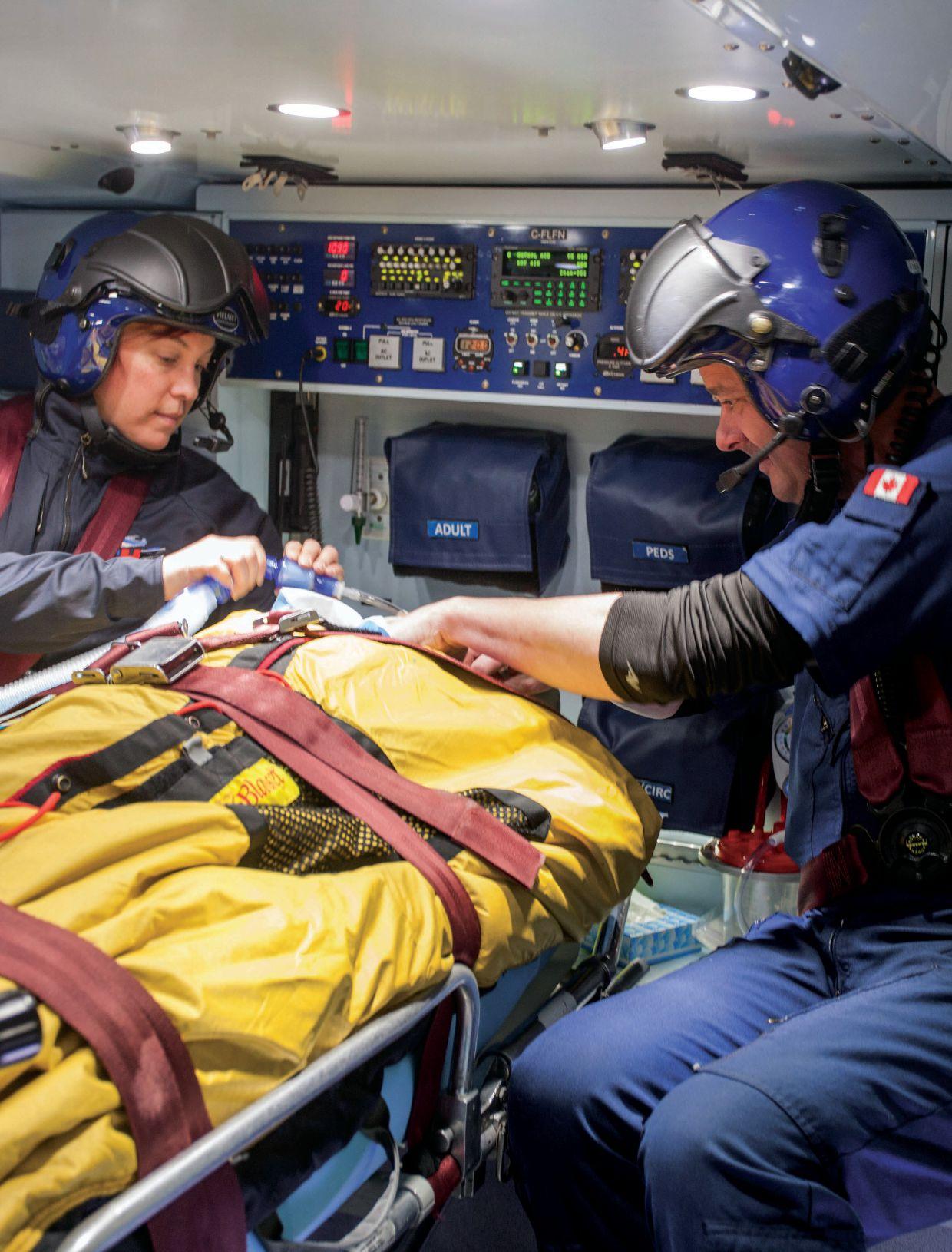
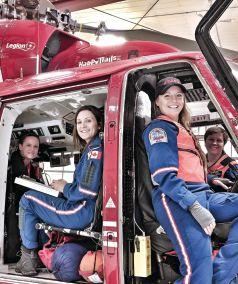
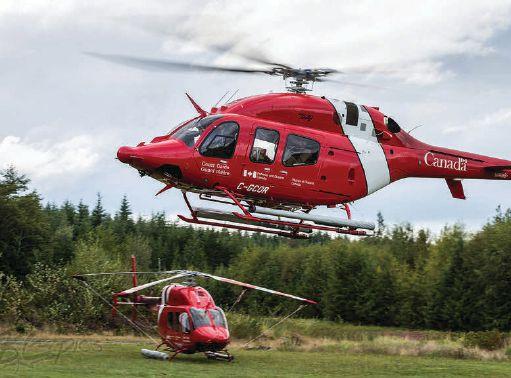
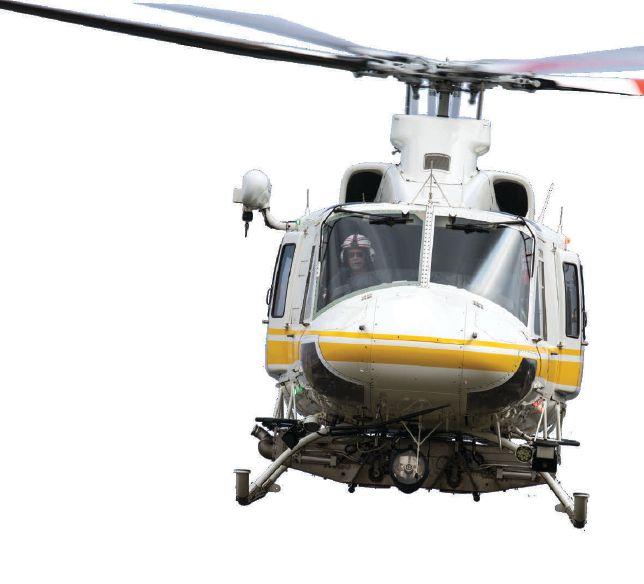
LifeFlight Tango and November are operated by CHL for EHS LifeFlight, controlled by Emergency Medical Care Inc. to provide life-saving services. (Photo: EHS LifeFlight)
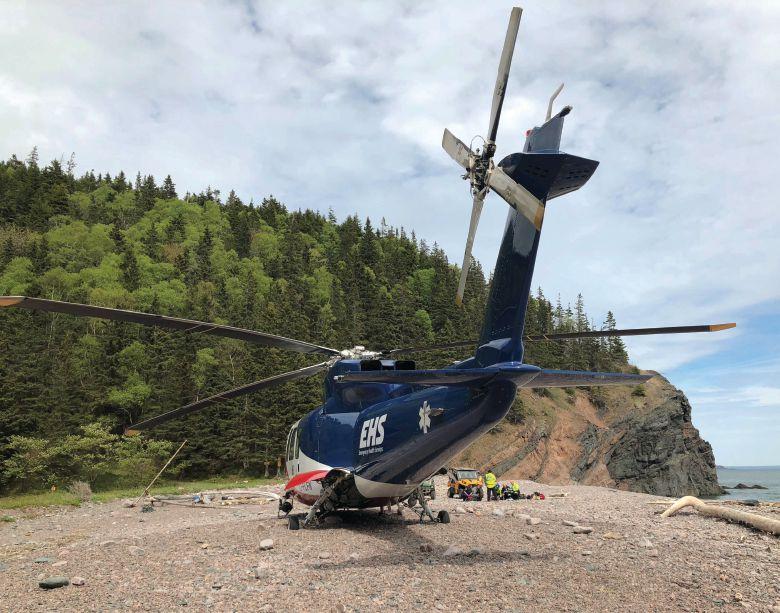
An EHS LifeFlight Sikorsky on a Nova Scotia beach. (Photo: EHS LifeFlight)
JON ROBINSON,
editor
Honeywell's 21st annual Turbine-Powered Civil Helicopter Purchase Outlook, released on March 4, projects 4,000 new civilian-use helicopters will be delivered from 2019 to 2023, a dip from the 4,200 helicopters cited last year. Despite a slightly lower outlook compared to the 4,200 deliveries cited in last year’s forecast, Honeywell explains new helicopter platforms will support an expected three to four per cent annual growth rate in overall deliveries – describing this environment as a largely healthy helicopter market poised for moderate growth.
This year’s outlook results comes from a survey of more than 1,000 chief pilots and flight department managers of companies operating 3,334-turbine and 321-piston helicopters worldwide. Respondents had a slightly less positive view of the global economic outlook in this year’s survey compared with 2018.
North America is expected to lead much of the growth globally, with light single-engine models as the most-desired product class, according to Honeywell, driven by demand in law enforcement. Purchase plans are stronger from law enforcement and oiland-gas operators in this year’s Honeywell survey, but significantly lower from corporate operators. About 20 per cent of survey respondents in North America said their helicopter fleet utilization is expected to increase over the next 12 months, which is higher than the global rate of 14 per cent. Honeywell explains a
Five-year Civil Helicopter Forecast
of planned North American purchases were identified as light single-engine models, while roughly 22 per cent were for intermediate and medium-twins.
Compared with 2018 results, purchase plans in Europe were lower in this year’s survey. Here, Honeywell explains nearly 15 per cent of respondents said they would either replace or expand their fleet over the next five years. The figure was 22 per cent a year ago. Intermediate and medium twin-engine classes captured roughly 30 per cent of total mentions for new helicopters; and 25 per cent of respondents indicated plans to purchase light single-engine helicopters, down 12 percentage points from last year. The sample of Russian operators responding in the 2019 survey remains small, explains Honeywell, which continues to add some uncertainty to the overall European results.
In Latin America, Honeywell explains results for 2019 show significantly lower fleet replacement and growth expectations compared with 2018. Purchase plans are well below the global average of 15 per cent, and the region’s purchase plans decreased by 26 percentage points from last year.
Latin America had the lowest rate of new aircraft purchase plans globally, with only nine per cent saying they would either replace or expand their fleet over the next five years.
Purchase plans in Brazil decreased to only five per cent, according to Honeywell, reflecting higher political tensions and lower expectations for longterm economic growth. Latin American respondents favoured light single-engine models, which represent about 70 per cent of planned purchases, an increase of 20 percentage points when compared with 2018.
’’
18% of respondents in North America plan to replace or expand their fleet in the next five years.
greater proportion of planned new helicopter purchases are for intermediate/medium twin-engine models in this year’s survey when compared with 2018. The proportion is lower for light twin-engine. The proportion of light single-engine and heavy twin-engine planned purchases are about the same as last year.
In North America, Honeywell’s report found purchase plans have risen by five percentage points from a year ago, with 18 per cent of saying they would either replace or expand their fleet with a new helicopter over the next five years. North America is home to more than 40 per cent of the world’s helicopter fleet. Close to 65 per cent
In Asia Pacific, overall buying plans were down five percentage points compared with 2018, according to the Honeywell report. Close to 13 per cent of said they would either replace or expand their fleet with a new helicopter over the next five years. Light single-engine and medium twin-engine helicopters were the most popular classes, both capturing near 30 per cent of mentions for new helicopters. Despite limited inputs, new helicopter purchase plans were stable in China, showing that about 21 per cent of the fleet would be replaced or expanded by a new helicopter over the next five years. Plans were up by about 10 percentage points in India. | H
AW109 Trekker gets FAA certification
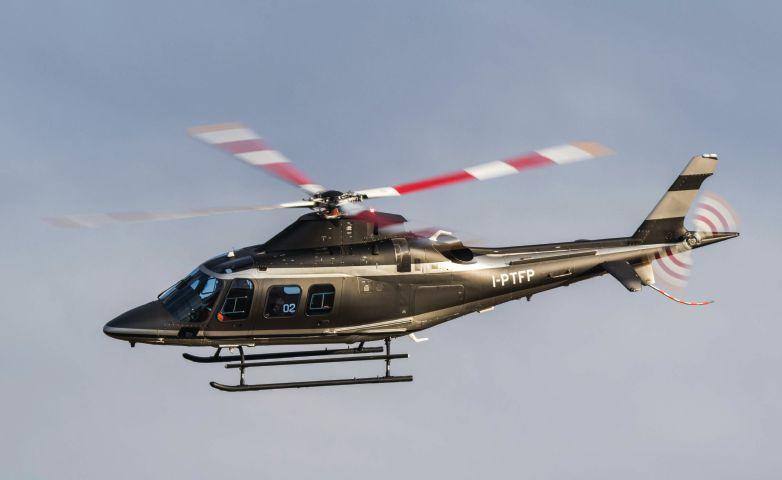
Leonardo’s AW109 Trekker light twin engine helicopter has been issued with type certification by FAA, allowing the light twin helicopter to enter the U.S. market. The company describes the AW109 Trekker as the fastest light twin for quick law enforcement and rescue intervention, as well as the only helicopter in its class to feature a cabin allowing full patient body accessibility for EMS missions.
Leonardo maintains that North America holds the largest potential EMS market for light twins based on the num -
ber of in-service fleets that need replacement. Previous variants of the AW109s have a strong position in North America for VIP, Emergency Medical Service, utility and
homeland security roles. The AW109 Trekker maintains the AW109 Grand airframe (large cabin) with a greater payload. It is the company’s first light twin to offer skid landing gear and it leverages a Genesys Aerosystems glass cockpit. Power is provided by two FADEC equipped Pratt & Whitney Canada PW207C turbine engines.
CITYAIRBUS TO BE TESTED BY AIRBUS IN GERMANY
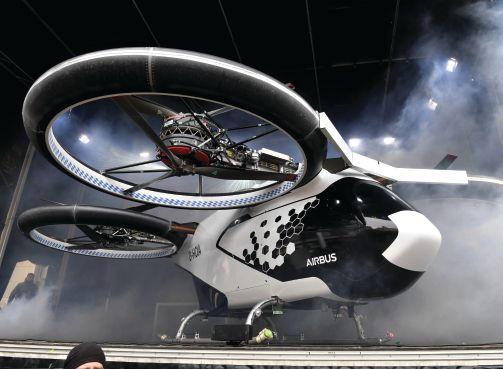
Airbus in mid-March for the first time unveiled a demonstration model of its CityAirbus aircraft, targeting the Urban Air Mobility sector. The French company ultimately expects the electric Vertical Takeoff and Landing (eVTOL) vehicle to be fully autonomous. CityAirbus, which is to be initially equipped with four 140 kW batteries (each generating 110 kWh of energy), eight rotors and seating for four, is scheduled to begin testing this summer in Germany at Manching airfield near Ingolstadt. CityAirbus was developed at Airbus’ factory also nearby in Donauwoerth, Germany. The company is initially targeting a cruise speed of up to 120 km/h and a 50 km range. It is to hold eight fixed-pitch propellers, powered by Siemens direct-drive engines that rely on an equal number of 100 kW electric motors. The fixed-pitch propellers of the CityAirbus present a different concept than Bell’s recently introduced (January 2019, full-scale design) Nexus VTOL, which features six tilting ducted fans – described as Bell’s powered lift concept. The Nexus is to be powered by a hybrid-electric propulsion system being developed by Safran.
CityAirbus is to hold fixed-pitch propellers, powered by Siemens direct-drive engines. (Photo: Airbus/Twitter)
More than 60 AW109 Trekkers have been ordered worldwide. (Photo: Leonardo)
First Canadian order of Airbus H160
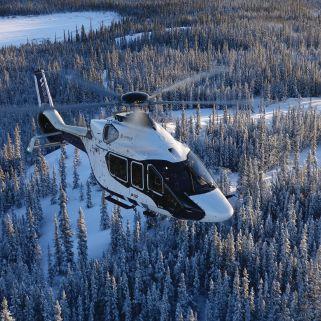
Airbus signed an order for an ACH160 with an undisclosed Canadian customer, who is described as having vast experience in corporate aviation. The aircraft is to be delivered with a custom-made interior. Romain Trapp, president of Airbus Helicopters Canada, explains the H160’s breakthrough design, low sound levels, smooth flight at high speeds and the product maturity at entry into service, are well suited for operators in high-demand markets. The selection of the H160 by the customer followed a flight demonstration during the H160’s 2018 North American tour.
The medium twin-engine H160 is the first member of Airbus' H generation.
The medium twin-engine H160 is the first member of the H generation. From its inception, Airbus also points to the H160’s increased external visibility for pilots through an enlarged windshield, lateral and floor level, combined with the aircraft’s cameras, which show one of four multi-functional displays in the cockpit. The H160 also features Airbus’ digital avionics suite, Helionix, as well as the 4-axis autopilot. The aircraft has been designed to facilitate ease of maintenance, which, according to Airbus, allows it to reach levels similar to that of a light-twin helicopter.
Macquarie buys Waypoint portfolio
Macquarie Group, through its Macquarie Rotorcraft Leasing operation, completed the acquisition of a helicopter portfolio from Waypoint Leasing Holdings Ltd. and its subsidiaries. The move will also see Waypoint staff join the new owners. The portfolio acquired includes 120 medi-
um and heavy helicopters leased to approximately 30 operators, in addition to a what Macquarie describes as a number of firm and option order positions with Airbus Helicopters.
The company explains the acquisition was funded from existing internal Macquarie
DART bought by First Aviation, Greenbriar
Group funding sources. Founded in 1969, Macquarie Group operates in more than 70 office locations in 27 countries. It employs approximately 15,110 people and has assets under management of more than A$532.1 billion (as of December 31, 2018).
Greenbriar Equity and First Aviation Services in March acquired DART Aerospace. Greenbriar is a private equity firm with more than $3.5 billion of committed capital. First Aviation, headquartered in Connecticut, is a provider of repair and overhaul, rotables management and engineering services. Its principal operating subsidiaries include Aerospace Turbine Rotables, Evolution Aerospace, and Piedmont Propulsion Systems.
DART has operated as a subsidiary of Eagle Copters and Era Group for more than 10 years. The company holds a portfolio of more than 900 STCs and 4,500 products, such as flotation systems, landing gears, cargo expansion, cable cutters and filters.
HELICOPTERS MAGAZINE P.O. Box 530
105 Donly Drive South Simcoe ON N3Y 4N5 Tel.: 519-428-3471 Fax: 519-429-3094
EDITOR JON ROBINSON jrobinson@annexbusinessmedia.com
MEDIA DESIGNER CURTIS MARTIN CONTRIBUTING WRITERS RICK ADAMS, DAVID CARR, BRIAN DUNN, PAUL DIXON, WALTER HENEGHAN, FRED JONES, JAMES MARASA, CARROLL MCCORMICK, COREY TAYLOR NATIONAL ADVERTISING MANAGER MENA MIU mmiu@annexbusinessmedia.com 416-510-6749
CIRCULATION MANAGER JAY DOSHI jdoshi@annexbusinessmedia.com 416-442-5600 ext. 5124
GROUP PUBLISHER MARTIN MCANULTY mmcanulty@annexbusinessmedia.com
PRESIDENT & CEO MIKE FREDERICKS
RETURN UNDELIVERABLE CANADIAN ADDRESSES TO ANNEX PUBLISHING & PRINTING INC., 111 Gordon Baker Rd., Suite 400, Toronto ON M2H 3R1
subscribe@helicoptersmagazine.com
Published four times a year by Annex Publishing & Printing Inc. Printed in Canada ISSN 0227-3161
CIRCULATION
apotal@annexbusinessmedia.com
Tel: 416-510-5113
Fax: 416-510-6875 (main) 416-442-2191
Mail: c/o Circulation, 111 Gordon Baker Rd., Suite 400, Toronto, ON M2H 3R1
SUBSCRIPTION RATES
Canada - 1 year $31.50
USA- 1 year $57.00
Foreign - 1 year 63.00 plus applicable taxes www.helicoptersmagzine.com/subscribe
Annex Privacy Officer
Privacy@annexbusinessmedia.com
Tel: 800-668-2384
Occasionally, Helicopters magazine will mail information on behalf of industry-related groups whose products and services we believe may be of interest to you. If you prefer not to receive this information, please contact our circulation department in any of the four ways listed above.
Helicopters Magazine is an associate member of the following Canadian aviation associations:
(Photo: Airbus/Thierry Rostang)
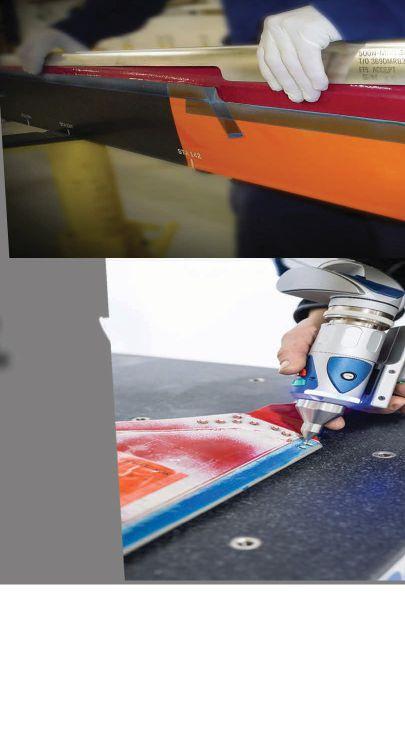
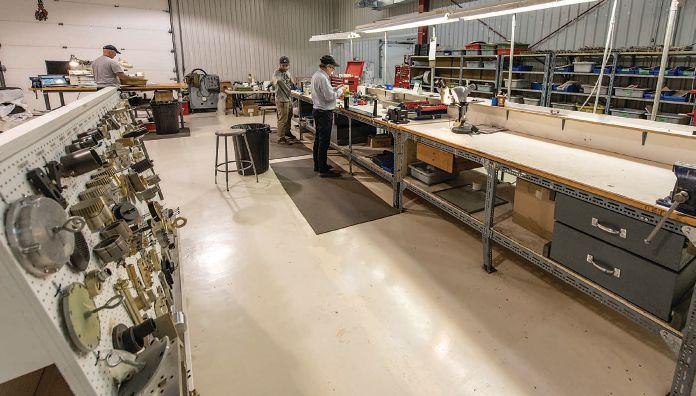
DART Aerospace’s wearplates protect the landing gear on the Canadian Coast Guard’s Bell 429 fleet. (Photo: DART, CCG)
Kopter takes over Lafayette facility
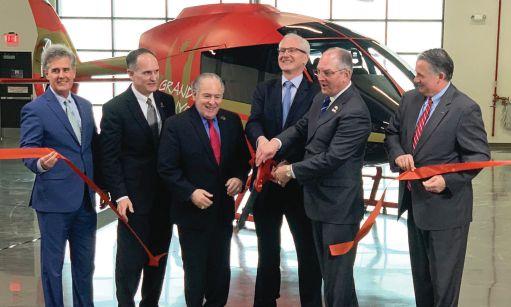
Kopter Group AG on March 9 marked its fullscale entry into North America with a ribbon-cutting ceremony around its takeover of an 84,700-square-foot facility located at Lafayette Airport in Louisiana. In July 2018, the Swiss company formed a U.S. subsidiary, Kopter North America LLC, to be led by Christian Gras – in addition to his responsibilities as executive VP for Kopter Group. Kopter expects the Lafayette facility to create 120 jobs by 2025 for the annual production of around 100 aircraft, targeting assembly of its SH09 helicopters.
The company is leasing the
facility from Lafayette Airport Commission. The State of Louisiana initially funded construction of the US$25.3 million
INSPECTION • REPAIR • OVERHAUL
Lafayette facility on a 14.7-acre airport site. Kopter states it will make additional capital investments in new equipment and
building extensions. Kopter points out additional jobs will be generated in the region with plans to ultimately source U.S. supplier parts representing more than 50 per cent of the SH09 value. Current suppliers include Honeywell (turboshaft engine), Garmin (avionics), Kaman (composite parts), among others. The company plans to begin hiring personnel for the facility later this year. It expects to begin operations by mid-2020 with deliveries of locally assembled helicopters to start in 2021. The company’s investment in Lafayette follows recent news of expansions planned for Kopter sites in Switzerland.
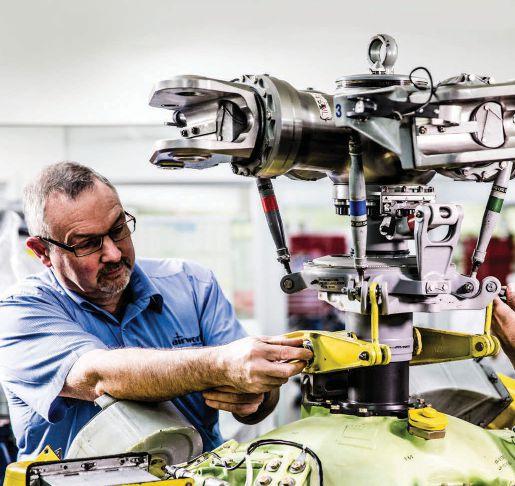
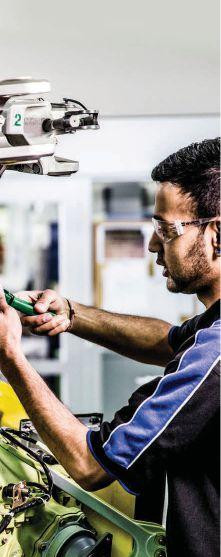
Airwork NZ capabilities also include
Airwork
Aircraft sales and leasing MODs and STCs
Parts and component sales
Kopter plans to begin operations in Lafayette by mid-2020 with deliveries of locally assembled helicopters starting in 2021.
(Photo: Kopter Group)
LEONARDO NEW ORDERS
SURGE
WITH NH90
Leonardo released its 2018 financial statements (ended 31 December, 2018), reporting new order intake at EUR 15.3 billion ($23.1 billion) up 32 per cent at constant currency when compared to 2017. The company holds what it describes as a record backlog at EUR 36.1 billion ($54.4 billion), which amounts to approximately three years in terms of equivalent production. New orders in the fourth quarter of 2018 alone amounted to EUR 5.7 billion ($8.6 billion), an increase of 7.1 per cent compared to the corresponding quarter of 2017. The EUR 15.1 billion generated by new orders in 2018 – relative to EUR 11.595 million in 2017 – is largely the result of Qatar’s acquisition of NH90 military helicopters, which Leonardo pegs at EUR 3 billion ($4.5 billion).
Qatar’s order for 28 NH90 aircraft, with Leonardo serving as primary contractor, was announced in March, 2018. Delivery of the helicopters are scheduled to take place from 2022 to 2025. They are to be powered by Safran RTM322 engines, which are used in approximately 80 per cent of the worldwide NH90 fleet (March 2018). Revenues in the fourth quarter of 2018 amounted to EUR 4.0 billion ($6.0 billion), an increase of 8.5 per cent compared to the corresponding quarter of 2017. For all of 2018, revenues amounted to EUR 12.2 billion ($18.4 billion, an increase of 4.3 per cent compared to 2017 at EUR 11.7 billion ($17.6 billion).
DDC 400-lb Condor
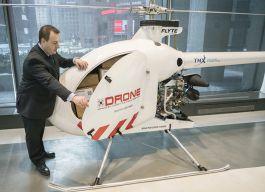
Drone Delivery Canada unveiled its new Condor drone, which has been in development for the past year to serve as a delivery cargo aircraft. The Condor is expected to have a payload capacity of 180 kilograms (400 pounds) and a potential travel distance of up to 200 kilometres. The company explains it will work with Transport Canada to secure necessary approvals to begin flight testing the Condor by the third quarter of 2019. Throughout 2018, Drone Delivery Canada (DDC) worked closely with Transport Canada on a Beyond Visual Line-of-Sight (BVLOS) pilot project to operate its Sparrow drone.
The Sparrow is powered by an electric propulsion system and can hold a 5-kg payload to transport goods like general parcels and medical supplies. The pilot project tested the Sparrow’s capabilities between the communities of Moosonee and Moose Factory – two northern Ontario towns located approximately 19 kilometres south of James Bay. The Condor, however, presents a potentially significant jump in payload capabilities. Powered by a gas propulsion engine, it measures 22-feet long, 5-feet wide and 7-feet tall. It has a wing span of approximately 20 feet and is capable of vertical take-off and landing. It is equipped with DDC’s proprietary FLYTE management system, which is the same platform used by all of its cargo delivery drones. In January 2019, DDC began testing its Falcon cargo delivery drone with a payload capability of 50 pounds and a travel range of 60 km. | H
Pavilion M&A Services...
Tony Di Benedetto with the Condor. (Photo: DDC/Newswire)
COLUMN
Barcoding with aviation management software offers considerable advantages for more efficient processes, better decision-making and precise parts traceability. Whether you’re an operator, a heliop or an MRO, barcoding offers aviation operations the ability to quickly access – in a one-step process – the who, what and where information relative to a particular part. It also improves accuracy in terms of job costing and work estimation. Ultimately, the benefits of barcoding in aviation management software all boil down to ease of communication, complete item traceability, and the precise transfer of information void of any human error. Here are the Top Six benefits of barcoding in aviation management software:
1. LESS HUMAN ERRORS
Barcoding helps to relieve businesses from the burdens of human error by emphasizing machine control over the transmission of information. So when a maintenance technician on the hangar floor requires a new part, your stores clerk simply scans the barcode for that part, scans your technician’s work task card, and then hands the part over to the technician to complete the transaction. There is no need to manually enter part numbers or employee work task card information, as this data is automatically entered into the system with the easy action of scanning the barcode.
The Benefits of Barcoding
Leveraging aviation software for storeroom and business efficiency
3. EXACT EMPLOYEE TIME TRACKING
Barcoding offers aviation organizations the ability to accurately track employee time and labour hours, providing full operational transparency in terms of the time it takes to complete tasks and process information. Business owners know time is money. Barcoding is, in and of itself, a time-saving process, with huge potential to save organizational capital and increase revenue.
4. MAINTAIN PROPER INVENTORY CONTROL
In order to ensure that your business is running smoothly and without unnecessary stoppages due to a dearth of required parts, it is imperative that you maintain and oversee stock control. Barcoding helps to dispel this fear of losing control of your inventory, as each barcode generated is a unique identifier for a specific part. This means that you can quickly identify a part when issuing parts to a task during the preparation of sales packing slips, vendor returns, warranty returns, core return packing slips, as well as during base-to-base transfers.
5. MAKE INFORMED BUSINESS DECISIONS
The director of maintenance might inform you that you should be charging more for a particular service, based on the time measured on employee work order task cards. This time worked per each task is tracked simply with the swipe of a barcode scanner at the beginning and end of the task. As a result, senior management can be proactive in terms of their responsibilities and can make more informed business decisions.
Barcoding dispels a fear of losing inventory control, as each barcode is a unique identifier for a part.
2. ACCURATELY EXPEDITED PROCESSES
Barcoding offers organizations peace of mind knowing that information is always correct and readily available. So when your technician picks up a part and wants to determine its airworthiness, all that is required is a scan of a barcode to quickly identify parts and load their history. This means that you don’t have to keep all your paperwork with your parts (a potentially nightmare). Instead, you can store this material in a management system and retrieve it almost instantaneously with a barcode reader.
6. PARTS TRACEABILITY
The most significant benefit to barcoding is instant access to the history of any part, component, consumable item, or collection of items with a barcode reader. This simplifies the processes of issuing and receiving parts. Data displayed from a barcode scan may include a part description, a part number “received as,” a part number “controlled as,” a traceability batch number, purchasing history, inventory location, expiry date, batch quantity, serial number (rotable), condition (rotable) and much more. | H
Christopher Lawn is the marketing specialist at WinAir, an industry-leading aviation management software provider. info@winair.ca
CHRISTOPHER LAWN
Nexus leverages Bell's years of tiltrotor expertise and its engineer plans to build a comfortable ride for the initial customer base.
(Images: Bell Flight)
Aggressive Urban Air Approach
Some of the world’s largest helicopter manufacturers continue to push toward a New Era of transportation
BY JON ROBINSON
Attendees hustling across the spread-out HAI Heli-Expo show floor in Atlanta stop in their tracks when the Bell Nexus on display – with musical accompaniment and a lightshow – begins tilting its six ducted rotor fans toward 90 degrees for what would be a premium forward-flight position. This is the second showing of Bell Flight’s full-scale Urban Air Mobility (UAM) aircraft design, after the Nexus was unveiled in early January 2019 at CES in Las Vegas.
Discussions at Bell about developing an aircraft for UAM began in earnest more than three years ago based on its FCX-001 concept helicopter, described by the company as a future technology and leveraged as a roadmap. The Nexus illustrates how the company is also leveraging its experience in developing tiltrotor aircraft – like the V-22, V-247 and V-280 – for the benefits of flying in both airplane and VTOL mode. “We know a lot about why that is a good platform. They are very agile and very efficient [in terms of] speed and range,” says Levi Bilbrey, manager, creative services, Bell Flight, who is part of the team presenting the Nexus at Heli-Expo, and earlier at CES.
Bell tested its tilting ducts at full-scale power in an Ottawa, Ont., wind tunnel through a partnership with the Canadian government. Not
strictly designed for thrust, the noticeably thick and deep ducts also provide ample lifting surface as airfoils surrounding a central wing. The ducts could also potentially provide ample sound suppression.
“Nexus is really just one of the configurations we have been exploring,” explains Bilbrey. “There are lots of different technologies we are looking at and obviously the partners we are bringing into the conversation have a lot to do with that.”
Nexus is to be powered by a hybrid-electric propulsion system being developed by Safran. The program’s other current development partners include EPS (batteries), Thales (flight control hardware and software), Moog (flight control actuation) and Garmin (avionics). This cooperation is a prime example of today’s UAM environment in which partnership agreements form far upstream, even relative to traditional rotorcraft developments. The millions – potentially billions – of R&D dollars being invested by these aerospace giants signal UAM technology is moving at a pace that might be expected, given the potential to sell thousands of these new-class aircraft for metropolitan areas becoming more congested by the day.
The UAM market is also drawing the attention of systems start-ups and a range of intriguing external-aviation players from automobile
makers to elevator builders, citing Otis’ March 2019 agreement with Sikorsky and The Spaceship Company (Virgin Galactic’s spacecraft builder) – and, of course, Uber. “This is near future. We are thinking five to 10 years at the most. We are looking at potential flight tests in the next few years and service by the mid-2020s. We want to lean in, lead it, but we want to make sure it is done right, make sure it is safe and make sure it is reliable,” says Bilbrey. “Bell knows how to make things well. We have been doing that for over 80 years. We want to make sure the experience is what it is supposed to be.”
Most major rotorcraft manufacturers, and their key suppliers in areas from engines and structures to avionics and interiors, are in an enviable position to contribute UAM systems under a favourable R&D environment. “When you have market desires and technologies that can merge, the speed at which these things come out historically is pretty impressive,” says Scott Drennan, VP of innovation at Bell Flight, during an eVTOL panel discussion at Heli-Expo.
Drennan describes what has become a classic illustration of transportation progress captured on Fifth Avenue, New York: A picture taken on Easter morning in the year 1900 showing a single car among dozens of horse-and-buggy rigs, placed next to a second picture taken from the same spot on Easter morning 1913 showing a single horse-and-buggy among dozens of cars. “It is the same phenomenon… market demand and technology coming together at the same time.”
Zach Lovering, VP of UAM systems at Airbus, speaking on the same panel, relates UAM market desire to the same city. “There are roughly 1 1/2 million people living in Manhattan, but there are three million people who work there; and that is enabled by the fact that they have Skyscrapers,” he says. “The real question is what systems can be put in place today to take a two-hour commute that you might have and change it to 10 minutes.”
Airbus operates a scheduled helicopter service called Voom in São Paulo, Brazil, which provides the company with valuable data points for its UAM programs. “The time it takes to drive from the airport to downtown São Paulo is about two hours. You can get in one of our helicopters today, through an app, say where you are, where you are going, and you’ll be at your destination in 10 minutes,” explains Lovering. “But even with a solution available based on helicopters, it is still out of reach for a lot of people.”
During Robinson Helicopter’s press conference at Heli-Expo, company president Kurt Robinson addresses a question about his attendance at Uber’s Elevate conference, which first brought the potential of flying taxis to life in 2017: “We have had some conversations with them. What is interesting to me, and everybody here who owns a helicopter, is that we are actually already there today. A helicopter can land anywhere.”
He points to the efficient design of the R44 and R66. Along these lines, Robinson describes how a California company recently installed an electric-propulsion engine on an R44, flying it for approximately 20 minutes and reaching a speed of around 80 knots. Robinson does note the clear positive externality of UAM-tech growth in terms of the potential development of more heliports, or vertiports in UAM parlance – one of the many infrastructure hurdles for UAM adoption.
Lovering points to advances in digital design manufacturing that can allow for more automated production and, therefore, significantly lower the unit cost of UAM aircraft, which can also drive efficiency through AI advances like autonomous operation. Airbus on March 11, 2019, for the first time unveiled a demonstration model of its CityAirbus aircraft, which it projects to be fully autonomous. The project started about three years ago and the Airbus UAM team, now up to approximately 40 people, plans to begin CityAirbus test flights sometime this summer near Ingolstadt, Germany.
CityAirbus in its current configuration features fixed-pitch propellers, presenting less mechanical complexity relative to Bell’s tilting-duct design. With its wings expected to open up to approximately 30 degrees above flat in forward flight, CityAirbus is to be powered by electric (eVTOL) propulsion via 140 kW Siemens direct-drive engines. Current
electric-propulsion systems, of course, provide little range and speed with less than favourable weight per kW output. Battery breakthroughs by Tesla, however, show the potential of pure electric transportation. Perhaps more interestingly, the acceleration of Tesla’s cars hints at the significant potential advantages electric propulsion can provide to the rotor world in terms of immediate torque. It is a big reason why most aircraft manufacturers are investigating ways to integrate electric power systems, even if not initially serving as a powerplant. There will also be many hurdles in certifying battery-powered VTOL vehicles carrying human cargo, but this is an issue dwarfed by a mountain of regulations needed for UAM safety and airspace usage.
“Our initial vehicle will be completely autonomous, but certification-wise and customer-acceptance-wise, as well as entering into the market [via certification], we do believe that we will need a piloted version, so that those initial flights can help the new customer base feel a lot more comfortable,” says Drennan. “[Team Nexus] is founded in people who know what aviation is, know how to certify vehicles, and know how to produce those vehicles or components in great numbers – with the qualities that mean you get what you designed on the backend of the factory line. If you integrate those [principles] together, you get a safe, high-volume vehicle.”
Drennan continues to explain the challenge of UAM customer acceptance presents a range of hurdles for the Nexus team. “We are challenging our engineers to make a comfortable and familiar interior despite maybe what some would say is a short ride in Urban Air Mobility,” he says. As a hybrid-electric vehicle, Nexus is targeting a range of 150 miles with a cruise speed of 150 miles per hour. “We would like to be prepared for having people experience comfort as if they were in their automobile or perhaps in a higher-end airline-ticket scenario. That is a challenge. It is called weight. It is called drag. But there are indications that your customer’s desire to feel comfortable is more important.” | H
REGIONAL ACCOUNT MANAGER
based role now available
Airwork is a gl g obally recognised Helicopter engineeringng, sales and leasing company locate t d a at Arddmore Airporort in n Auckland New Zealand d
• B • e part of a Glo Gl bal al Sa S les Team
• C Creaate t a positive Customeer Experie r nce
•E
• • Enhahance nc Heelic li opter and MR M O sales in C n anada a
• D • eveelop lo meananingf n ful ul and a loong-term cust s omer relatiionships
• Brinng y g ou our stronroong g u u d nderst d anding g of thhe Hel e ico c pte p r i indu nd stry
• B • Be e proaroactcti c ve and a or o ganise seed t tom o meet sa s les tar t ta ge gets
For r moore inform or a attiion on and ap a plicattioion de dettails ls pl ple please s vis v it i www w .ai i .aairwo r r rk rkggrou ou roupcp.com o
Anywhere we are Needed
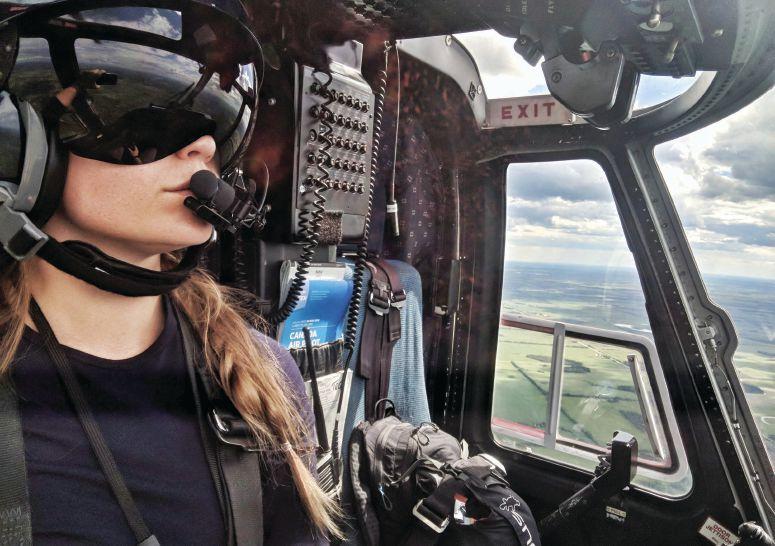
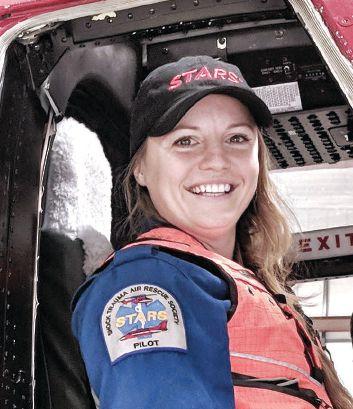
Left: Adele Dobler joined STARS in February 2017, becoming lead schedule service pilot, based in Grand Prairie, Alberta, helping to form one of Canada's highest response rotorcraft teams.
Below: After two years with STARS, Dobler accepted a position to fly for an air ambulance operation in Kenya.
Adele Dobler describes life as a STARS Air Ambulance captain
BY KENDRA KINCADE
The world of aviation is full of inspiring people like Adele Dobler, helicopter pilot and a captain with STARS Air Ambulance out in Grand Prairie, Alberta. Less than half of the population in Western Canada lives in urban centres with access to critical care. For the other half of the province, access might be measured in hours, which can be the difference between life and death; full recovery or permanent damage. With STARS, people living in rural communities, working in remote areas, travelling on highways or needing transportation major medical centres, can receive the very best in critical care via helicopters staffed and outfitted as mobile ICUs. I don’t know if it’s just me, but learning about careers that take you outside of the 9-to-5 grind is exciting.
Dobler became a pilot because she loves everything about aviation, weather patterns, navigation, air law, aircraft systems and, of course, seeing beautiful places from the air. She will soon embark on a new life journey to fly a BK 117 for an air ambulance operation in Kenya. One thing Dobler truly loves about being a helicopter pilot is that you are never done learning. There is always another course, certification, endorsement or utility to learn in her job. It is a career that requires you to think outside of the box and problem solve on a daily basis, and it also brings you to some of the most beautiful places in the world.
What does a day in your life at work look like?
Dobler: A day in the life of a STARS pilot can be hard to predict. Generally, we start off by checking in and getting a brief from the previous crew about the aircraft or any missions they had the night before. We will then do some checks and a daily inspection to make sure the helicopter is ready to go for the day. Then we are on standby until a tone comes in and we slide down the metaphorical firefighter pole to push the helicopter out of the hangar and be on our way in under 10 minutes.
Our destination is anywhere we are needed, whether that is a rural hospital to pick up someone who needs immediate surgery or a highway to pick up someone who has been in a horrific car accident. The Air Medical Crew then does the hard work of stabilizing the patient, so that it will be safe to transport them in the helicopter. We fly them either to the hospital in Grande Prairie or all the way to a facility in Edmonton.
What is the best part of your job?
My favorite thing about my job is being able to see places in the world that no one else ever gets to. I have had the privilege of flying in some amazingly remote and incredibly beautiful areas including Haida Gwaii, Prince Rupert, Willmore Wilderness Area, Jasper National Park, Monkman Provincial Park and others.
What is the hardest part of your job?
One of the hardest things about my job is staying impartial to the patient. Sometimes, we get a call and the weather is unflyable... but we are responsible to make the safe decision that won't put our crew in danger in order to save the patient. It can be very difficult to make the call not to dispatch when you know there is someone in need.
What stands from your time at STARS?
One thing I will never forget and also makes me proud to live in Canada is a flight I took at night in the middle of winter. For flights at night, we use night-vision goggles to enhance the safety and visibility when we are out flying in places with no light. I looked out as we were leaving the city and the Northern Lights burst across the horizon and brilliantly started dancing in the distance. Goosebumps covered my skin and I had to focus on my job, because I couldn't stop looking at them! The goggles pick up each photon of light, so they just filled the entire sky. It was absolutely beautiful.
Is this your dream job?
Working for STARS had been a goal of mine for many years since I grew up in Alberta. They are a great company that does an amazing job serving the people of remote and rural towns in this province. It is interesting how dreams change once you attain them, however, and I will be moving on to another role flying the BK 117 in Kenya for an air ambulance company there. I have always wanted to fly internationally, and I will have the opportunity to see some more incredible places in the near future!
What pilot advice would you share?
Breathe – It sounds silly, but there will be times that you feel overworked, overtired, task-saturated and behind the aircraft. Just take one second and remind yourself to breathe, slow down, prioritize and complete one thing at a time. On my approach checks, I secretly add this to my checklist before I land each time.
Why would you encourage others to become a helicopter pilot?
I would encourage anyone to become a helicopter pilot if you truly believe that it is your passion. It is a challenging, rewarding and beautiful career, but there are sacrifices you need to make to achieve your flying goals. There might be times you need to mop the hangar floor at a job in the middle of nowhere. Then you might have to fly in the bush for a few years to gain experience. Then ignore everyone who tells you that girls can’t lift fuel drums... Hopefully, those times will teach you to persist, because you cannot picture yourself doing anything other than flying over beautiful places that no one else will ever see. | H
LET US BE YOUR SMS MANAGER!
Annex 19 SMS, Regulatory SMS, Customer Based SMS
Concierge SMS:
• Monitors all Safety Reports
• Facilitates all Risk Assessments
• Facilitates all Root cause Analysis
• Monitors all Corrective Actions
• Much more
Let us tell you how?
Get all that was promised from your SMS at 50% or less than it is costing you now!
DTI has been developing and working with governments and private enterprises for years and has found a way to eliminate all the obstacles!
Some questions we have been asked!
Q: Do I need to buy expensive software or anything else?
A: No, we work using your existing system.
Q: Who will talk to our regulator when they have questions?
A: We will. Think of us as your SMS manager!
We know what it takes!
SMS, when deployed and worked properly is the golden ticket to achieving the safest, most predictable service or product you can. Unfortunately, many enterprises cannot find the “expertise” needed to accomplish this. Contact us and we’ll explain it all to you!
“After years of working with hundreds of enterprises we have come to realize that the constant meeting and endless paperwork often associated with SMS have caused it to lose its effectiveness. We’ve figured a way to get great results, cut the work load of the enterprise and saved a ton of money…”
-Dennis Taboada, CEO
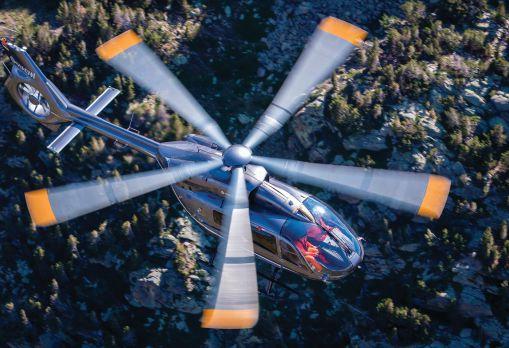
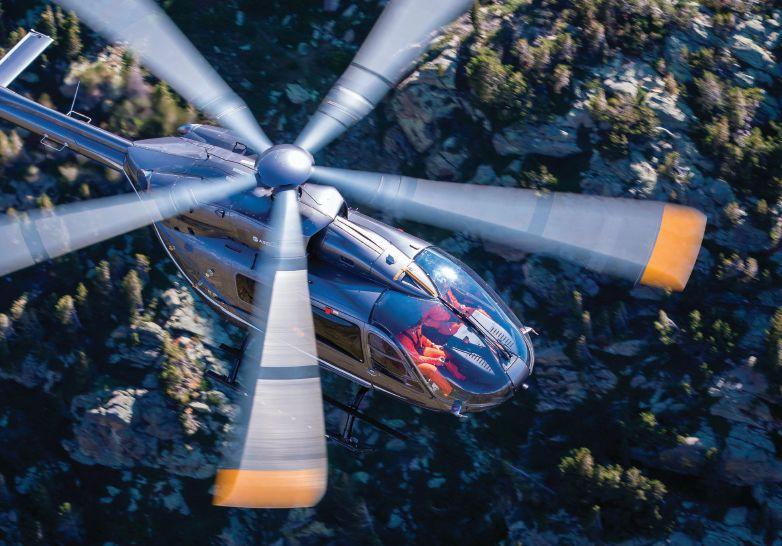
The five-bladed rotor of the new H145, increasing its MTOW to 3,800 kg.
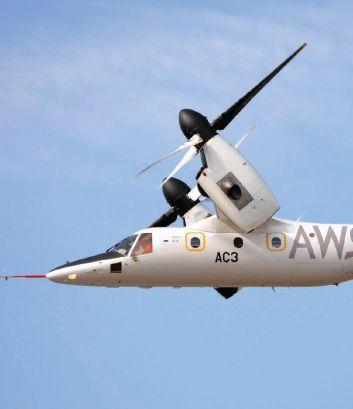
Below: Leonardo has begun assembly of its AW609 tiltrotor. (Photo: Leonardo)
Rotorcraft Progress at Heli-Expo
Helicopter manufacturers illustrate moderate but continuing growth in new orders, deliveries and product innovation
BY JON ROBINSON
Airbus Helicopters at Heli-Expo 2019 unveiled a new version of its H145 light twin-engine helicopter. This upgrade brings a five-bladed rotor to the multi-mission H145, increasing the useful load of the aircraft by 150 kg, with a new maximum takeoff weight of 3,800 kg.
EASA certification of the new H145 is planned for early 2020, with first deliveries to follow later that year. This upgrade will also be offered to current H145 customers as a retrofit option.
Three operators were initially named as early adopters of the 5-bladed H145, including: Swiss Air-Rescue Rega (first worldwide retrofit, to be applied on seven aircraft); Dare County MedFlight (first North American retrofit); and Norwegian Air Ambulance (first EMS client, to be applied in R&D missions). Airbus states the design simplicity of the H145’s new bearingless main rotor will ease maintenance, increase reliability and improve ride comfort. The reduced rotor diameter of the H145 will allow it to operate in more confined areas.
During Heli-Expo, Chris Emerson, president of Airbus Helicopters and head of Airbus Helicopters North American, explains the company in 2018 had close to 800 operators in North America, amounting to just under 3,000 aircraft. “What was interesting last year is that we
had over 100,000 shipments with partners,” he explains. Last year in North America, Airbus also had 75 gross orders, representing a 72 per cent market share in the region, and 40 per cent new customers.
“We are over 90 per cent of the market share in law enforcement for this last couple of years,” says Emerson, noting the H125’s capability to provide power for potentially critical missions. He explains Airbus continues to work closely with EMS providers (particularly in the U.S. with its new insurance reimbursement structure) and the company sees operators in the utility/oil-and-gas sector diversifying into new contract areas given the slow rebound of energy industries.
“The most-dynamic market segment for us in the region… and I know Europe would say the same thing, is private and business aviation.”
On day two of Heli-Expo, Kurt Robinson, president of Robinson Helicopter, explains the company had another solid year of deliveries in 2018, with an increase to 316 helicopters from 305 in 2017 and from 234 helicopters in 2016. The 2018 deliveries included 33 R22s, 74 R66s, and a total of 209 R44s, breaking down into 128 Raven II, 63 Raven I, and 18 Cadet aircraft. Outside of the U.S., which saw 87 total deliveries, Australia was Robinson’s largest export market in 2018, followed by China, Canada and the UK.
Left:
(Photo: Airbus)
“We have delivered over 900 R66s today,” says Robinson, also noting the current production levels of R22s at more than 4,800 aircraft and R44s at more than 6,900. Last year alone, the R66 flew approximately 250,000 flight hours based on Rolls Royce utilization rates. “Over half of the [R66s] being ordered now include the Aux tank, which has an additional two-hour range, [giving] you five hours of total endurance in the helicopter.” The company is currently producing two R66s per week, in addition to four R44s and one R22.
Robinson continues to explain the company plans to add ADS-B out to all aircraft produced in 2019 and it expects to complete the development of a cockpit video recorder this summer. He also highlights a new centreconsole integration with the Avidyne IFD 400 series. Robinson explains the company continues its investigation into running diesel fuel on the R44. “There are issues regarding heat, regarding vibration, but there are obviously a lot of good benefits,” he says. “It would allow a couple thousand feet of altitude performance [and] from what we see right now in a Raven II you are burning about 16 gallons an hour of fuel. [With] diesel, you are talking about 12 gallons an hour.”
Leonardo, at HAI Heli-Expo show in Atlanta, announced the start of production on the world’s first AW609 tiltrotor Level D Full Flight Simulator (FFS), as well as its intention to introduce the first U.S.-based AW169 Level D FFS. Expected to enter service in 2020, both simulators will be installed into the new training academy being developed at the company’s facility in Philadelphia.
Leonardo describes the introduction of these two simulators in the U.S. as a major milestone for the delivery of training services, particularly as the assembly stage of producing the AW609 was set to begin, also in Philadelphia. The AW609 simulator is developed in collaboration with CAE and based on the CAE 3000 Series FFS featuring a roll-on/ roll-off cockpit design. This enables cockpits representing various Leonardo helicopter types to be used in the full-motion base simulator. Both simulators will be operated by Rotorsim, a joint venture of CAE and Leonardo. The Italian company also emphasized the pending FAA Type Certification of the AW109 Trekker light, twin helicopter, which it received three weeks after Heli-Expo.
Sikorsky announced plans for its S-92 helicopter line, featuring MATRIX computing, which would re-designate fielded helicopters as the S-92A+ after modification, and newly produced aircraft as the S-92B. The two variants will share a nearly identical configuration, explains Sikorsky, with S-92B helicopters also featuring enlarged cabin windows and plans for a common cabin door suitable for offshore and SAR configurations. | H
WE DELIVER
on what you value the most. For over a century, customers have relied on StandardAero to provide best-in-class rotary wing support with excellent operational efficiency and innovative custom MRO solutions. We’ve significantly expanded our industry-leading helicopter support capabilities to include new turboshaft engines and new airframes on civil & military rotary wing aircraft – capabilities that are backed by certified technicians and experienced aerospace professionals who have a passion for delivering awardwinning customer service. Contact us today to learn how we can support you!
Engines
• GE T700/CT7
• Pratt & Whitney Canada PT6T
• Rolls-Royce M250 and RR300
• Safran Arriel 1 & 2
Airframes
• Airbus AS350/EC130 series & AS332/H225 Super Puma
Two Sikorsky S-76C+ helicopters and a Super King Air provide air ambulance services in Atlantic Canada
BY CARROLL MCCORMICK
clattering in the sky materializes into a blue, white and red helicopter, which settles down in the middle of the highway and shuts down its engines. A stretcher is rolled away from it, then rolled back a few minutes later and disappears inside. The pilot spools up the turbines, takes the helicopter up a few feet, slowly rotates it 180 degrees and flies away.
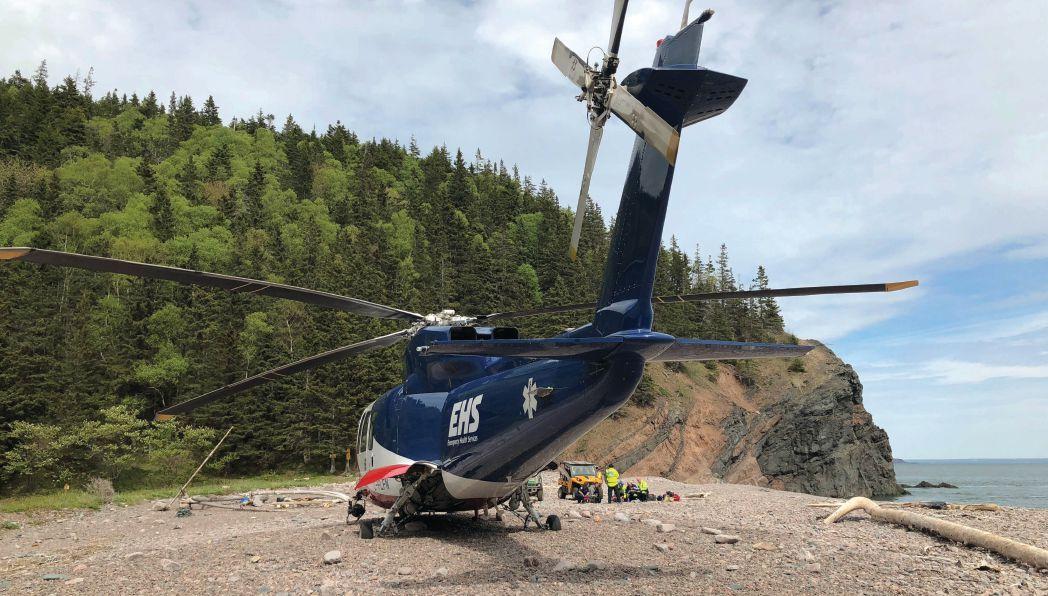
AThis is the scene on many highways in Nova Scotia at motor vehicle collisions. Fire trucks, ambulances and police cars will block off a healthy chunk of road to create a landing zone for the helicopter, a Sikorsky S-76C+, to transport surviving passengers to Halifax hospitals.
This helicopter and its mate, called LifeFlight Tango and LifeFlight November, are owned and operated by Canadian
Helicopters Limited (CHL) for EHS LifeFlight, which operates under the management of Emergency Medical Care Inc. (EMC). A private company, EMC since 1998 operates under contract to the Nova Scotia government’s Department of Health and Wellness, Emergency Health Service division.
Tango and November began service on December 15, 2017, replacing a single Sikorsky A model that operated in the province from 1996 to 2017. Colin Flynn, program manager, EHS LifeFlight, says, “[The 76C+] is quite roomy and specifically designed to accommodate stretchers. We can put two Ferno stretchers in it.”
Built in 2005, the 76C+ has twin Saffron Arriel 2S1 engines, capable of a take-off power of 856 shaft horsepower. Its speed, range and IFR capability are desirable for EHS LifeFlight missions. Critically ill
patients must be moved quickly and with EHS LifeFlight serving Nova Scotia, Prince Edward Island and New Brunswick, and being on the East Coast, the pilots – on 24/7 alert – had best assume that they will encounter instrument meteorological conditions.
The power and flyaway capability the engines provide allowed EHS LifeFlight to resume helipad landings after Transport Canada forbid them for the A model in 2016 – a drag on a service mandated to move critically ill patients to specialized care facilities as rapidly as possible.
“The A model was capable of doing the maneuvers, but it wasn’t written in the manual. In 2016, we were informed by Transport Canada that the A model would no longer be allowed to do these maneuvers,” Flynn says.
CHL began modifications on the 76C+ machines in 2016, Flynn explains. “A team
An EHS LifeFlight Sikorsky 76C+ on a Nova Scotia beach. (Photo: EHS LifeFlight)
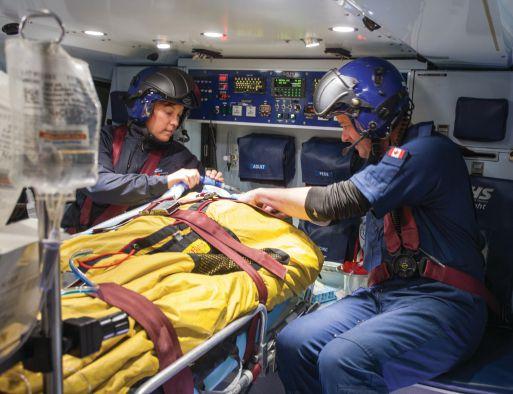
of LifeFlight crew and CHL engineers set out to redesign the aircraft cabin to better suit our changing environment. Improvements to the lighting, access to oxygen, suction and medical air were completed, as well as a redesign of medical supply storage. Electronic systems were also all updated to the latest technology.”
Tango and November are two of the most modern S-76C+ aircraft in operation, according to EHS LifeFlight. Flynn refers to the “great patient care compartment,” “radio and communications systems in the back for the medical staff to talk to their people,” and “a lot of cockpit upgrades,” in the 76C+, including night vision goggle-compatibility and real-time weather feed from NAV Canada, dual Garmin 750s, bluetooth interface, and XM satellite.
The EHS LifeFlight hangar is located at the Halifax Stanfield International Airport. It houses the two helicopters, the Super King Air and a freightliner ground unit, as well as adult clinical teams and program administration. Engineering support is also handled at the hangar by dedicated engineers for each company. PAL Airlines operates the Super King Air and PAL employees are dedicated to the EHS LifeFlight program under contract.
Two pilots and two medical specialists are on each shift. Everyone and everything is kept in a in a state of readiness that allows wheels up in as little as 10 minutes.
“One aircraft is always mission ready, while the other undergoes routine maintenance. The expectation is 10 minutes wheels up during visual flight rules conditions and 20 minutes wheels up during IFR conditions. Once we get a request for a transport, the pilots will check the weather right away. If it is suitable for helicopter flight, they will pull the helicopter out of the hangar and get it ready. Once the mission is launched, they have 10 minutes to wheels up,” Flynn explains.
The basic pilot qualifications include solid instrument flight rules experience and previous medivac and maritime flying experience. They are also trained to assist with triage in the case of mass casualty incident situations.
The medical teams, the composition of which changes according to the mission, are made up of critical care paramedics, critical care nurses and registered respiratory therapists, depending on the patient being moved.
“We have adult, pediatric/neonatal and obstetrics team configurations. If the patient is over 16, we send the adult team. Less than 16, we send the pediatric team. Less than 28 days old [is] neonatal, which would require incubator transport. We get 150 to 200 calls a year for neonatal services,” Flynn explains. “All of the outlying hospitals fly premature babies to the IWK Health Centre in Halifax. The Children’s services team is based at the IWK and consists of nine critical care
nurses, nine registered respiratory therapists and eight obstetrical specialty nurses.”
While most NS hospitals have helipads, there are just two at hospitals in PEI and one in NB. There are ground-based helipads on hospital property or community-sponsored helipads. “We have quite a network of community helipads around the province. Most are looked after by community organizations. We send our pilots out on an annual basis to inspect them. There are portable lights to put down around the landing zone and local fire departments go out to inspect the ground for foreign object debris and to set up the lights,” Flynn says.
For missions to locations away from the luxury of landing pads, EHS LifeFlight has a network of more than 10,000 Landing Zone Officers it has trained, mostly volunteer firefighters. “They look for level ground free of obstructions. They control the area until the helicopter lands, and the engines shut down, and they monitor the takeoff too,” Flynn says.
Between the two Sikorskys and a Super King Air 200, EHS LifeFlight completes more than 900 missions per year, and the number is rising. “We’ve set a record every one of the past five years,” Flynn says.
The Sikorskys – think first responder – go where the King Air cannot. The King Air is more of an interfacility transporter. “Interfacility transports are the hospital-to-hospital transfers for escalation in care,” Flynn says. “Once a patient gets too sick or requires a specialty service, we step in for the care and transport.
“Our program is dispatched out of the provincial medical communications centre located in Dartmouth. The centre handles all requests for ground [there are 165 transport capable vehicles in NS] and air ambulance transport through calls from individuals or transfer requests from hospitals, through the provincial 911 system,” Flynn explains. “Normally, a ground ambulance will arrive on-scene first and determine if the patient requires critical care transport, but there are times when EHS LifeFlight will arrive first in cases of remote scenes.” | H
On the fly, an EHS LifeFlight medical team attends to a patient. (Photo: EHS LifeFlight)
Tackling Air Taxi Safety
The Transportation Safety Board of Canada spent four years working on an air-taxi Safety Issues Investigation to address persistent issues
BY JON ROBINSON
he Transportation Safety Board of Canada in 2015 launched a Safety Issues Investigation into the risks – and underlying safety issues – of domestic airtaxi operations. The research is based on 15 years of data from a range of sources not exclusive to TSB’s own investigations and the Civil Aviation Daily Occurrence Report System (CADORS) overseen by Transport Canada, as well as 17 previously existing studies produced by various agencies dating back to 1990.
TAir-taxi operators, as defined by Canadian Aviation Regulations (CARs) Part 703, hold no more than single- and multiengine aircraft (other than turbojet) with a maximum certificated take-off weight of 19,000 pounds, or less, and a seating configuration of nine, or less – excluding pilot
seats. As a key segment of Part 703, helicopter operator statistics, as well as accident types and themes, were broken out in the Safety Issues Investigation (SII), but ultimately presented as part of the entire airtaxi sector.
In launching the SII program, the Transportation Safety Board (TSB) announced Part 703 deaths represented 62 per cent of all commercial aviation fatalities over the 15 years measured (2000 to 2014). The SII, according TSB, aims to address Part 703 issues that have not been sufficiently mitigated with the ultimate goal of taking action to reduce what Canada’s transportation watchdog describes as persisting risks.
Based on its earlier investigations into Part 703, TSB notes there are multiple recurring issues to address, including areas like pilot experience and training; ineffec-
tive pilot decision making (PDM)/crew resource management (CRM); crew adaptations from standard operating procedures (SOPs); inadequate risk analysis of operations; operational control; organizational factors; and Transport Canada oversight.
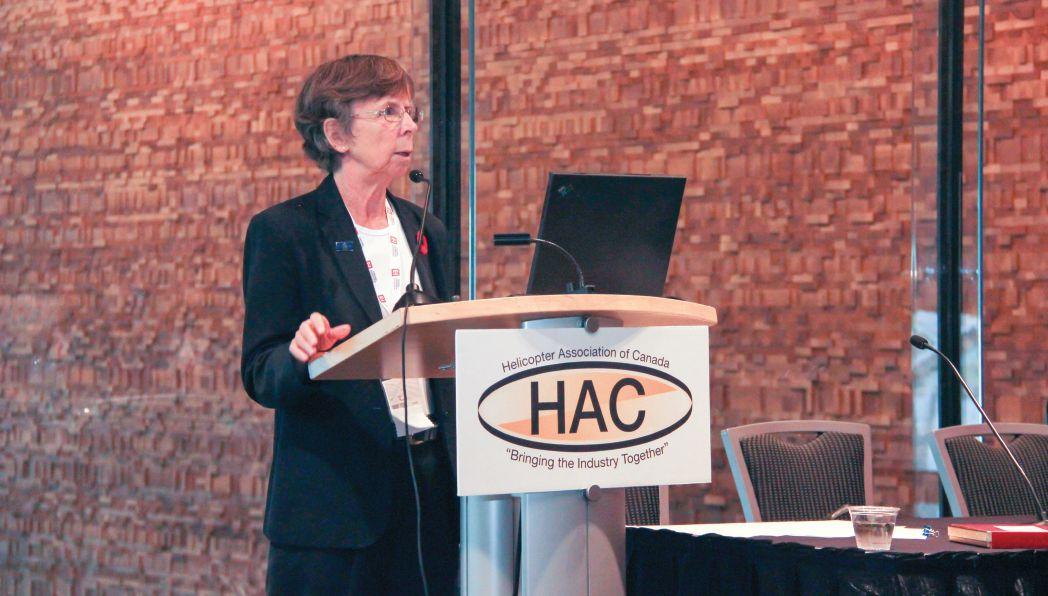
TSB chair Kathy Fox at the Helicopter Association of Canada conference in midNovember 2018 presented preliminary findings of the air-taxi SII, which included 11 common factors of all Part 703 accidents. She began her presentation showing bar graphs of accidents and fatalities from 2000 to 2017 involving Canadian registered aircraft by operator type, including CARs Parts 702 up to Part 705 used to define the airline segment. “Air taxi sticks out like a literal soar-thumb in terms of the total number of accidents, and also the total number of fatalities,” Fox says.
Kathy Fox, chair of the Transportation Safety Board, shares safety insights at the Helicopter Association of Canada conference held mid-November in Vancouver, BC. (Photo: Jon Robinson)
She is quick to point out how TSB does not have the underlying activity rates of Part 703 operators, meaning the research team did not have specific takeoff and landing totals, or number of hours flown. Fox also explains some operators have multiple certificates allowing them to report against the highest type they hold. As a result, TSB cannot determine the air-taxi sector accident rate, which has gone down in total numbers. Fox also notes a decrease in the total number of Part 703 operators.
“If we look at these numbers in a different way, so which sector has the most accidents, again from January 2000 to December 2017,
[air taxi is at] 189 and that is 55 percent of all commercial aviation accidents, 62 per cent of the fatalities,” Fox says. Looking at the same statistical categories and timeframe for airlines, there were 15 fatalities, including 12 deaths in the 2011 First Air Flight 6560 accident. “705 has a very good safety performance if you measure in terms of accidents and fatalities.”
Fox reiterates the air-taxi SII is based on a data samples from 2000 to 2014, because the research team decided to focus on closed investigations. Fox presented the additional three years – 2015 to 2017 – to illustrate how air-taxi accidents and fatalities are still sticking out
from other sectors. During the industry consultation phase of the SII, TSB also produced more than 300 hours of testimony, based on approximately 125 interviews from 32 operators and Transport Canada inspectors. This included a range of single-pilot and multi-crew operations, involving seaplanes, helicopters, VFR, IFR, medivacs, and more. This resulted in the SII focusing on 19 accident themes, which TSB differentiates from accident types.
TSB worked from approximately 166 of its own investigations – including 109 involving airplanes and 57 involving helicopters. TSB identified 14 reoccurring airplane-related accident types and nine helicopter accident types. “For helicopters, it is primarily loss of visual reference in either controlled flight into terrain, or loss of control, or aerodynamic effects that resulted in a loss of control, [as well as] some other accident types, but the vast majority are in those first three categories.”
Fox explains these air-taxi SII results were mapped into a theoretical model called Rasmussen’s Safe Operating Envelope to determine how operators can better manage competing pressures – financial sustainability – and a safety state. “I prefer to talk about risk, rather than safety,” says Fox, describing operational triggers like pilot experience, aircraft availability and weather – “operational context matters.”
She also acknowledges air-taxi operators must accept the limitations presented by critical aviation services like air traffic control and airport authorities, regulations and, of course, individual employees. “The most frustrating and disappointing thing is that we see the same accidents over and over again,” says Fox, “So what do we need to do to raise the bar in this segment of the industry when there is no single issue that is the problem.”
Fox explains TSB is planning to convene aviation stakeholders – operators and authorities – in fall 2019, which also happens to be the mid-way point of its biannual Watchlist, with the fifth edition being released in late-October 2018. Among seven key safety issues identified on the 2018 Watchlist, three multimodal issues affect aviation, including safety management and oversight, slow progress addressing TSB recommendations, and fatigue management. The risk of collisions from runway incursions and runway overruns were the two key Watchlist issues specific to aviation.
“We are not just going to wait for people to take action. We are going to go out and talk to operators and airport authorities in this country,” Fox says, continuing to explain the consultative approach will also address a common criticism heard by the organization, that the Watchlist is driven too heavily by the TSB. “We would like to hear from industry… to identify what progress has been made on the issues that we have identified in 2018; and what are the key issues you think the board should consider in 2020.” | H
There aren’t many of us still in the system who sat around the table in the CARAC process when the phrase Safety Management Systems (SMS) was first uttered. At the time, it was sold to industry on the basis that it could provide relief from some of the most-problematic elements of the Canadian Aviation Regulations (CARs) – if the operator could build a safety case to show their practices were at least as safe as the applicable prescriptive rule(s). Transport Canada has made it difficult for operators to build their safety cases and its own inspectors simply do not have time for an in-depth examination. What’s more, for many inspectors, any exception to the prescriptive rules simply represents exposure for them and the department.
All of the operators and associations around the table at the time appreciated the safety-enhancing potential of SMS – the idea that if we could identify the small problems, in advance of an accident or incident, we could prevent the accident or incident. For operators who have an SMS – and who reacted using their SMS to respond to a regulatory violation and confessed their sin to Transport Canada – they were not supposed to be proceeded against by enforcement. Problem is, it often doesn’t happen, even where operators have voluntarily implemented SMS.
At a time when Transport Canada’s budgets were being reduced, SMS offered a mechanism for the department to eliminate
702, 703, 704, 705). Today, after more than 13 years, it is only a regulatory requirement for an ANS service provider; in CAR 705 (Airline) operations, for Part III (Airports), CAR 604 (Business Aviation) – and I have some serious doubts whether it will ever become a regulatory requirement in any other Sub-Part of CARs. Call me crazy. Meanwhile, everyone believes they know what an SMS is. Transport Canada inspectors prod operators to implement it; customers impose SMS on operators via contracts; third-party auditors insist upon a functioning SMS; and even the TSB comments negatively when a 703 operator has an accident without a fully functioning SMS in place – whatever that, is.
Operators are implementing SMS in the absence of any regulatory guidance, sometimes at considerable expense. ‘‘ ’’
costs, because much of the responsibility for identifying safety risks (costs of oversight) were downloaded to individual operators. Inspectors would audit the system rather than the minutia of an operation (Aircraft Inspection Check Lists, for example). What’s more, Transport Canada would not need to hire as many inspectors with operational or technical experience, in favour of inspectors who were able to determine if an SMS was functional –System Auditors. It was Transport Canada’s intention to apply SMS to all certificate holders – Air Navigation Services Providers, airports, and all levels of the commercial aviation community (CAR
To make matters worse (or better), operators are implementing SMS in the absence of any regulatory guidance – sometimes at considerable expense. Some of these systems are more complicated than what Transport Canada mandates through regulation. It is naïve to believe that what operators are actually implementing in response to pressure will actually fit the SMS regulatory requirements, if regulations are ever published. This will mean that their systems will need to be re-written, at considerably more expense. In the absence of any SMS regulatory requirement, Transport Canada has also included an optional requirement for Fatigue Risk Management Systems (FRMS), intended to provide the same opportunity for relief from new prescriptive Flight & Duty Time (F&DT) limits, which SMS was supposed to provide from CARs. We have no reason to believe that it will be any more successful, particularly since an FRMS is just an SMS applied to fatigue-related risks. Sadly, access to an FRMS, will not be an option for helicopter operators, since the new F&DT regulations represent a radical and oppressive departure from the current regulations. FRMS, for us, will be essential and costly, since there are a variety of major elements of the new regulations that require separate FRMS applications. FRMS was never intended to be a mechanism to re-write regulations, only to tweak them.
The solution, you ask? Transport Canada should either move forward with an SMS regulatory requirement and an FRMS for small operators that really are “scalable for the size the complexity of a small operator”, or stop pushing operators to implement an SMS, and change the Flight & Duty Time regulations to better accommodate the reality of helicopter operations. | H
FRED JONES
YOU.
Continuous customer feedback means we’re able to constantly re-engineer and improve our service. It’s just one of the reasons we’re the helicopter industry’s biggest service network, providing 24/7 assistance to 150 countries around the world.