Occasionally, Ground Water Canada will mail information on behalf of industry-related groups whose products and services we believe may be of interest to you. If you prefer not to receive this information, please contact our circulation department in any of the four ways listed above.
Serving the Canadian ground water industry for 38 years.
www.groundwatercanada.com
4 EDITORIAL: SUSTAINING OUR SOURCE
A resource in transition.
By Laura Aiken
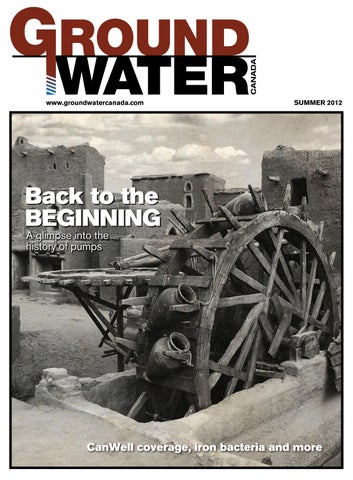
8 BACK TO THE BEGINNING
Take a trip back to the birth of pumps.
12 VIEW FROM THE WEST
Meet the Slade family.
14 CONSIDERING CISTERNS
There’s a new CSA standard for cisterns.
16 REVAMPING SYSTEM DESIGN
Newer, more efficient pumps require a longer loop system.
18 FIGHT YOUR FUEL COSTS
Money saving ideas and technology to come.
20 RED SCOURGE
New treatments for iron bacteria.
ON THE WEB:
Researchers demonstrate cleaning technology
Dr. Denis O’Carroll from the University of Western Ontario visited the University of New South Wales Water Research Lab to demonstrate how iron nanoparticles coated with a rust-preventing polymer show promise in cleaning up toxic chemicals from ground water.
Study finds rural ground water vulnerable
A new ground water study shows a huge section of rural New Brunswick is vulnerable to contamination, reported the CBC.
Sustaining our source
Globally, ground water is set to take centre stage as the United Nations names it a resource in transition.
by Laura Aiken
Figuring out how to be greener with our water is a hot topic these days. Cisterns and other water recycling efforts are being explored. Governments identify fresh water sustainability as an important issue. However, what flows beneath our feet is out of sight, leaving ground water somewhat out of mind and poorly understood by the public. This must change.
Ground water is a critical global resource, indeed the largest volume of unfrozen fresh water on earth. Ground water supplies almost half the drinking water in the world and 43 per cent of irrigation globally, with India, China and the U.S. being its largest abstractors, reports the United Nations.
The UN published Groundwater and Global Change: Trends, Opportunities and Challenges by Jac van der Gun as part of its United Nations World Water Assessment Programme this spring. The study is a mix of startling facts, sadness, hope and ultimately innovation, with all fingers pointing towards ground water as a “resource in transition.”
The UN estimates that over 80 per cent of waste water worldwide is not collected or treated.
There are a few key reasons ground water is receiving more attention these days, van der Gun outlines. Ground water is more resilient to the effects of climate change than surface water (though saline intrusion of coastal aquifers due to rising sea levels is an ongoing concern).
Ground water is a key emergency resource, as shown in the 1995 Hanshin-Awaji earthquake with a magnitude of 7.3 that killed 6,400 people and left more than one million households without water. Municipal water was down for months, but it was possible to pump water from many wells right after the quake. Some prominent aquifers in drier regions are showing long-term decline, with Yemen the most frightening among countries in water crisis. Here, aquifers are drying up so fast the capital city is facing running out of water in a decade.
Globally, the demand for food is expected
to increase by 70 per cent by 2050 and energy consumption is estimated to increase by about 50 per cent between now and 2035. The global ground water abstraction rate has at least tripled in the last 50 years, says the UN.
The above facts are more than enough reason for the world to start watching its water use. While Canada, enviable land of plenty, is certainly a far cry from Yemen, it is still a country that needs to show strong leadership. This is sometimes difficult because ground water management is a local affair but it’s important to remember that increasing ground water awareness is a national issue.
We will see more water recycling and reclamation technologies in Canada in the years to come. The Netherlands is well practised in an interesting water recycling method. Managed Aquifer Recharge (MAR), or intentionally storing water in aquifers for later use or environmental benefit, is widely practised in the Netherlands. MAR is being used more and more to help recycle water by harvesting urban storm water and waste water, then, usually, pretreating the water that’s injected into the aquifers. This is a potentially useful tool, the UN identified in its report, although not without its eco-risks.
The UN estimates that over 80 per cent of waste water worldwide is not collected or treated. As members of the ground water industry, you’re on the front lines of public discourse. You are leaders at the grass roots of water protection. What can you do in your community to help people better understand how precious a resource ground water is? There is no country that can afford to take water for granted.
NEXT ISSUE: The next issue of Ground Water Canada will focus on the geothermal industry and much more. Look for it this fall!
INDUSTRY NEWS
KEMIRA ESTABLISHES R&D IN ALBERTA
Kemira opened a research and development projects laboratory in Alberta on May 1. The laboratory, located on the campus of the University of Alberta, will be an extension of Kemira’s North American R&D, headquartered in Atlanta.
The new laboratory also provides a technology stage to showcase and demonstrate Kemira’s solutions to targeted audiences such as the various oil sands producers. In addition, the new site supports Kemira’s regional growth in the conventional oil and gas marketplace in the areas of stimulation, drilling and cementing.
For more information, visit www.kemira.com.
GRUNDFOS CANADA CELEBRATES 20 YEARS
Grundfos Canada celebrated its 20th year in business on May 1.
To commemorate this milestone, customers, partners, and industry leaders gathered together with employees on March 27. Dinner and speeches were held at the St. Volodymyr Cultural Centre in Oakville, which was hosted and emceed by Lee Smart of Second City Comedy troupe. Guests were also treated to the musical entertainment of Danny Marks Blues Trio and Alter Ego.
Reflection, exploration and celebration was the theme of the evening, with several presentations by Grundfos officials and political leaders focusing on the subject. The roots of Grundfos Canada were examined and the history of the company and its partnerships with both local entities and global counterparts were explored. Future development, partnership growth and contributions to a more sustainable way of conducting business were also highlighted.
“With roots in Denmark, Grundfos continues to show itself as a wellestablished Canadian company that has shown great success in applying its energysaving products to the advantage of society, the environment and the bottom line,” said Erik Vilstrup Lorenzen, the Danish Ambassador to Canada.
Simon Feddema, Grundfos Canada president, reflected on the roots of the company and spoke of the accomplishments and trials that Grundfos Canada has experienced over the past two decades. He also thanked Grundfos partners and employees and invited them to focus on carrying out the Grundfos values in all aspects of their lives. Guests were also addressed by Rob Burton, the mayor of Oakville, and Søren Ø. Sørensen, executive group vice-president. Both congratulated Grundfos on its success over the past 20 years and expressed their expectations of a prosperous future for the company.
PRO GOLFER TO DELIVER KEYNOTE SPEECH AT NGWA EXPO
Tommy “Two Gloves” Gainey has been slated to deliver the keynote address at the 2012 NGWA Groundwater Expo and Annual Meeting, which takes place from Dec. 4 to 7 in Las Vegas.
Gainey, a former A.O. Smith Corp. employee, will recount his story of making his dream come true. He will share his journey from small town beginnings in Bishopville, S.C., to making it to the PGA Tour, and reflect on the importance of staying true to your form.
While it’s said one needs talent and luck to become a professional golfer, when it came to making his dream a reality, Gainey preferred the tried and true motto that “anything in life worth having is worth working for.” He left his job wrapping insulation around hot water heater tanks at A.O. Smith to pursue his boyhood dream of becoming a professional golfer. After years of chasing his goal on the Nationwide Tour, Gainey finally earned his PGA Tour card in December 2008, with A.O. Smith electing to sponsor him in 2009.
In spite of his successes – on and off the links – Gainey’s work ethic, commitment to family and desire to give back to fans is both honest and refreshing. It’s something not typically seen in today’s ego-driven, look-at-me sports world. Of course, his grip and unorthodox swing do set him apart on the tour. The twogloved grip, which gave rise to his nickname, came from how his father played golf, while his swing comes from his days as a promising high school baseball player.
For more about the 2012 NGWA Groundwater Expo, visit the events/ education section of the NGWA website or call 1-800-551-7379.
ARBITER RULES IN FAVOUR OF CGC
The Canadian GeoExchange Coalition (CGC) was awarded $267, 061.77 in damages on March 29 after a Montreal tribunal ruled in its favour following a three-year dispute with the Canadian Ground Water Association (CGWA).
At the heart of the claim filed by the CGC in 2009 lies a matter of material. The CGC contracted the CGWA to develop a national training course for the geothermal industry. What was delivered was 95 per cent cut and paste version of an existing course created for Ontario well drillers pertaining specifically to Ministry of the Environment (MOE) regulation 903, says Denis Tanguay, executive director of the CGC. Two technical schools were listed in the dispute as subcontractors of the CGWA.
“I certainly felt a relief because I knew this was a just cause,” says Tanguay.
The CGWA is moving forward with appealing the decision. A two-man committee consisting of association president Jim Friesen of Manitoba and board director Simon Massé of Quebec, has been appointed to work with the lawyers involved, says Wayne MacRae, executive director of the CGWA.
“We were certainly disappointed with the arbiter’s decision but it’s not a done deal,” says MacRae.
“It’s a sad day for the water well and the geo industry – to have two national associations fight, and the college as well,” says Tanguay. “Everyone’s reputation has been tarnished.”
ALL’S WELL AT CANWELL
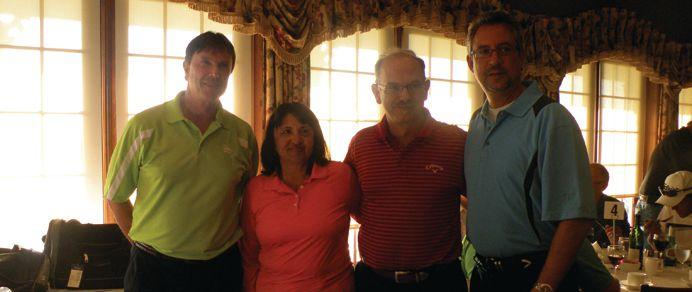
CanWell 2012 kicked off on May 23 with a great day of golf at Copetown Woods Golf Club in Copetown, Ont., for the Lifewater Canada charity tournament. Ground Water Canada’s own Ed Cosman hit the links with Jamie Bruce and Harry and John Oussoren. While their score didn’t top the prize table, Pina Allard, Remi Allard, Thom Hanna and Jim Vallerie did submit the winning score for the day with a 15 under. Most Honest award went to the Bullocks: Greg, Murray, Curtis and Reg.
Pina Allard earned the ladies’ longest drive while Jeff Bazinet took the men’s. Rita Sabourin took the ladies’ closest to the pin and Neil O’Doherty took the men’s. Golfers had the opportunity to win a 2012 Buick Verano if they made a hole in one on a designated hole. There was a hole in one for the day sunk by The0 Gerritts, but unfortunately for Gerritts, it wasn’t on the hole with the car on it.
All players had the opportunity to hear from Lifewater Canada president Jim Gehrels after the game. Gehrels, a geoscientist who was left legally blind by a progressive disease, nonetheless drills well across the world for the charity he founded with Glenn Stronks in 1995. He has helped install 600 wells in Haiti and Africa alone. Gehrels was presented with a cheque for $5,000 on behalf of CanWell.
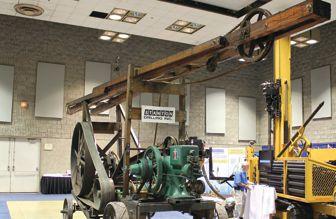
The trade show officially opened at 1:30 p.m. on May 24. Attendees got to see an old rig from the 1900s on the floor courtesy of Stanton Drilling Inc. Seventy-eight exhibitors showcased their wares on the floor until the show wrapped up at 1 p.m. on May 25. Technical sessions and division meetings were held that afternoon, followed by a five-course culinary adventure at the Canadian Warplane Heritage Museum. Diners feasted in a hangar amongst fighter jets – truly a unique experience.
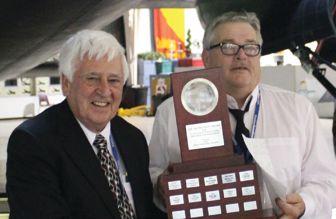
Bill Morrison of Morrison Environmental was honoured with the Archie Watt award, a deeply touching moment for Morrison who was mentored by Watt. Watt passed away in 2010. He would have been 100 this year.
The Earth, Wind and Fire award went to Kim Yee of the OME.
The convention wrapped up on May 26 with OGWA and CGWA annual general meetings, an afternoon demo and evening dinners. The ground water industry can look forward to 2014 when CanWell pops up in beautiful Kelowna, B.C.
Stanton Drilling’s old rig from the 1900s on the show floor.
Bill Morrison receiving the Archie Watt award.
The winning team at Copetown Woods.
BACK TO THE BEGINNING
A glimpse into the history of pumps.
Pumps are essential to your business, but do you know where they come from? Ground Water Canada did some digging to bring you a brief history of some of the most popular pumps.
by STEFANIE WALLACE
ANCIENT WATER PUMPS
Shaduf – The first water pump dates back to between 3000 and 2000 BC, originating in the Mesopotamia area of southwestern Asia in present-day Iraq, northeastern Syria, southeastern Turkey and southwestern Iran (the name Mesopotamia means “land between rivers”). Called the shaduf, or shadoof, the pump consisted of a wooden lever beside the riverbank, pivoted on two vertical posts. A pole was attached to a bucket and suspended from one of the levers, with a counterweight fixed to the other end. The user of the pump pushed the pole down, filling the bucket with water, and the weight raised the bucket. The system
is used to move water from one body of water to another. The shaduf was popular throughout the Middle East, and has been said to be the only form of water pump used in the region for the next 2,000 years. The shaduf is still used in India and Egypt to irrigate land.
Noria – Dating back to 700-600 BC, the noria, or the Egyptian water wheel, consisted of buckets or clay pots along the circumference of a wheel that was powered by the water current. As the buckets were immersed and filled with water, gravity forced the buckets at the top of the wheel to empty into a trough, and the wheel continued in a circular motion. According to the Irrigation Museum, the noria
RIGHT: A shaduf, the first water pump dating back to between 3000 and 2000 BC.
was the first non-human-operated lifting device.
Sakia – Also called the Persian water wheel, or the tympanum, the sakia is similar to the noria, except an external force powered the wheel, rather than the river current. A sakia consists of buckets attached to an upright wheel. Traditionally, animals such as horses or oxen powered sakias. Sakias are still used in Egypt and are now made from galvanized sheet steel, although they are now powered mechanically.
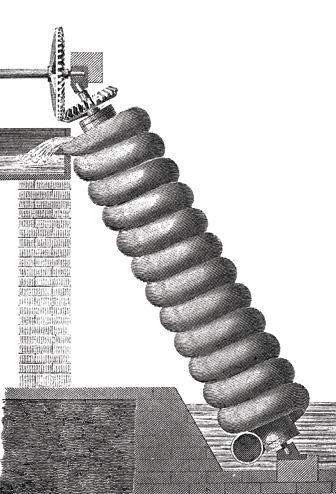
Archimedes’ screw – In about 250 BC, Archimedes, a Greek mathematician and inventor, devised a pump made of a metal pipe in a corkscrew that revolved, drawing water up the tube until it eventually poured out the top. The screw was usually turned by hand or by a windmill. The Archimedes’ screw was typically used for draining water from mines or areas of shallow water. Although the screw pump is credited to Archimedes, historians believe he merely popularized a device he saw while visiting Egypt. British engineer John Burland used an Archimedes’ screw in 2001 to stabilize the Leaning Tower of Pisa. Archimedes’ screws are also used in sewage treatment plants. Snowblowers and grain elevators are equipped with augers, which are essentially the same as Archimedes’ screws. The Archimedes’ screw will rotate when water is poured on top of it, allowing the rotating screw to be used to drive an electric generator.
In 1830, Revillion invented the modern screw pump, which consisted of a right- and a left-handed screw meshing together, being driven in opposite directions.
Water organ – The water organ is the predecessor of the modern force pump.
Designed by Ctesibus of Alexandria, Egypt, around 200 BC, the water organ is an air pump with valves on the bottom, and a cylinder with a plunger at the top, which creates a vacuum, drawing water upward through the valves. This pump was usually made of
The Noria, an Egyptian water wheel dating back to 700 to 600 BC.
The Archimedes’ screw.
bronze and valves and plungers were also incorporated into other kinds of machinery, such as military equipment.
POSITIVE DISPLACEMENT PUMP
Around 1650, Otto von Guericke, a German scientist, invented the piston
vacuum pump, using leather washers to prevent leaks between the cylinder and the piston.
Aldrich Pump Company began manufacturing the world’s first line of reciprocating positive displacement pumps for steel mills and mine
dewatering in 1902.
Sir Samuel Morland, an English academic, invented the plunger pump in 1675 in an attempt to improve the water supply to Windsor Castle.
Charles C. Barnes of Sackville, N.B., patented the rotary vane pump on June 16, 1874.
CENTRIFUGAL PUMP
Reti, a Brazilian soldier and historian of science, claims the centrifugal pump was a mud-lifting machine developed by Francesco di Giorgio Martini, an Italian Renaissance engineer. In 1687 French inventor Denis Papin developed the first true centrifugal pump with straight vanes, which was used in local drainage work. John Appold, a British inventor, introduced the curved vane in 1851.
John Gwynne filed for his first centrifugal pump patent in 1851. His early pumps were used primarily for land drainage, and many can still be seen today in pump house museums. Gwynne’s steam engines usually powered the pumps. When John died
The SpeedStar 30K, mounted on a 6 x 4 truck, is perfect for shallow municipal or deep residential water wells. 25,000-lb. singleline winch combined with the hydraulic rod spinner makes tool handling fast and easy. This is the flagship of the GEFCO water well line, and has been for decades.
n Hoisting capacity (hook load) — 30,000 lbs. with tophead travel of 29 ft.
n Field-proven PTO power design reduces maintenance costs and noise
n Hydraulic rod spinner
n Carousel options available
A hydraulic ram at the Center for Alternative Technology.
in 1855, James Gwynne took over the company, and other family members formed a rival company. The two firms reunited in 1903 as Gwynnes Ltd. By the end of the 19th century, Gwynnes was producing pumps of all sizes to cover all industrial applications, from small electric pumps to those rated at 1,000 tons per minute.
The multistage centrifugal pump was developed in 1905, but Ground Water Canada was unable to locate information about its developer.
HYDRAULIC RAM PUMPS
John Whitehurst, from the United Kingdom, invented the precursor to the hydraulic ram pump in 1772. The manually controlled device raised water to a height of 4.9 metres (16 feet). Joseph Michel Montgolfier (the French co-inventor of the hot air balloon) invented the first automatic ram pump in 1796. Montgolfier’s sons obtained an Engliish patent for an improved version of the pump in 1816. Josiah Easton, an English engineer, acquired Whitehurst’s
design and the Montgolfier patent in 1820.
The first American patent was issued to J. Cerneau and S.S. Hallet in 1809, sparking more interest in hydraulic rams in the United States.
SUBMERSIBLE PUMPS
Armais Sergeevich Arutunoff invented submersible pumps in Russia in 1916, but they were not used in the United States until the 1950s. His pump was originally designed for use in ships, water wells and mines, but he later altered the design to be used in oil wells. Further refinements to Arutunoff’s original design allowed for other applications, such as pumping drinking water and wastewater, and creating fountains.
VARIABLE SPEED/ CONSTANT PRESSURE PUMPS
Variable speed pumps, used to make a constant pressure system, initially came from the European market. Larger applications have been applying variable
frequency drives for as long as drive technology has been in place, according to Eric Hansen, product engineer at Flint and Walling. Hansen guesses variable speed pumps have been around since the late 1980s, but notes the last 10 to 15 years have seen the prices of drive technology drop, making the systems more economical and marketable for residential systems. FE Petro introduced a patented variable speed, variable length fuel pumping system in 1996.
LOOKING AHEAD
Pump technology has made great strides over the years, and Hansen suspects that as drive technology becomes more cost effective, the future of pumps lies in the variable speed market. He foresees the popularity of a variable speed system increasing because of its efficiencies and cost advantages. However, with constantly changing technology and continuing education, there’s no doubt pumps will continue to evolve in the coming years as they have in the past.
by STEFANIE WALLACE
VIEW FROM THE WEST
Drilling on Vancouver Island.
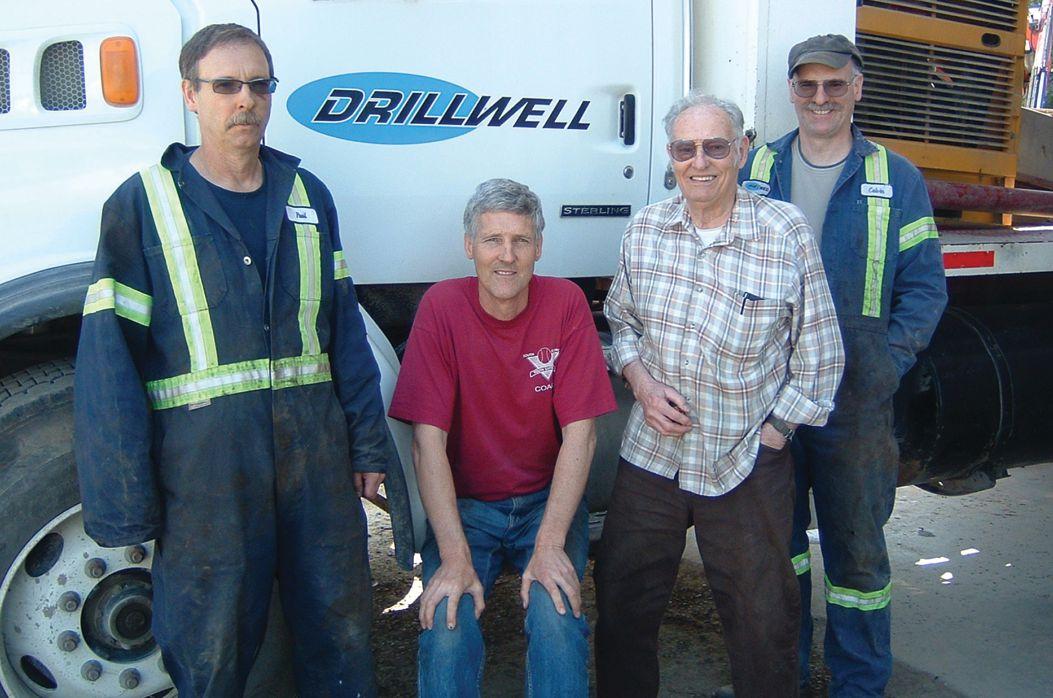
Chances are, if you live in the Cowichan Valley area of Vancouver Island, you’ve heard of the Slade family. Their family business, Drillwell, started in Cowichan Bay in 1965 on the property of Ken Slade (the patriarch of the business and family).
In 1994, the business moved to a 3.5-acre property in an industrial area just outside of downtown Duncan. Now in its 47th year of business, Drillwell is run by the second generation of Slades, brothers Paul, David and Calvin, who became partners in 1982.
Although Drillwell installs geothermal systems, conducts hydro-flushing of wells and drills for mining and exploration, water wells have been the main focus of the business since the beginning, when the majority of drilling was done with cable tools. Paul has seen the progression of industry machinery, and guesses Drillwell purchased one of the first air rotary casing hammer machines in British Columbia, back in 1972. “A casing hammer machine replaced a lot of the cable tool drilling, and now we are replacing the casing hammer machines with dual rotary machines,” Paul says. The company’s fleet currently includes five dual rotary machines, one conventional machine, two auger machines, four cable tool machines, a large pump machine and several crane trucks.
Starting a business isn’t cheap, especially with the hefty price tag attached to all of the necessary equipment. “I think anyone who is involved in [the drilling industry] knows it’s a crazy overhead, so it’s pretty tough to get going,” Paul says. “You can spend a million dollars pretty quick before you can earn a single buck, so having family in the startup is pretty beneficial.” And a core group of employees is essential. Drillwell has anywhere from 20 to 30 employees, depending on how busy they are. Paul notes that maintaining
family business principles has contributed to Drillwell’s low turnover rate. “We expect a lot from our guys; they’re, of course, our greatest resource, and so we’re very flexible,” he says.
But even with a great team, the best equipment and years of experience, challenges appear, and the Slades have been busy adapting. “The drilling conditions out here are pretty challenging, in that in a five-kilometre radius we have granite bedrock exposed, we have 300 feet of overburden, and we have shale bedrock exposed,” Paul says. The cost of geothermal installations on the Island is considerably higher than in other parts of Canada, such as the Prairies, where ground conditions are more predictable, he adds. “In a five-kilometre radius, you can have extreme conditions that can double your costs of drilling in no time.”
Drillwell has adapted to geological obstacles by using existing equipment, purchasing smaller tools of the trade and investing in proper training. But unpredictable conditions combined with Vancouver Island’s mild climate make geothermal a tough sell. Paul says larger facilities or buildings requiring more heat and air conditioning are more open to installing a geothermal system, but the technology is not as popular in residential projects as it has been in other parts of Canada.
“The climate is so friendly and mild, and the need for heating and cooling are small and short lived,” says David, who is currently building a house equipped with ground source geothermal and other eco-friendly options. “It’s probably my grandchildren or great-grandchildren that
will see the benefit of it,” he says. “I’m lucky that I can afford to do this, but I’m investing in the technologies even though I’m not likely to see an actual financial payback.” David notes that British Columbia’s cheap electricity is another blessing and curse. “It’s great for us and British Columbia, but it’s another challenge behind [geothermal], which is a very sustainable way of heating and cooling,” he says.
While Drillwell as a company has come across challenges, the brothers say that British Columbia’s water well drilling industry is facing a few challenges of its own. Lack of regulation, protection and awareness are three issues very dear to the heart of the company. “Ground water is our most valuable natural resource . . . because of that it should be protected and regulated,” Paul says. “If you’re cutting corners when you’re doing your work, you’re cutting some of the protection.”
Public education about ground water has made headlines lately, thanks to the work of the Cowichan Watershed Board (David serves as a member). A recent survey conducted by the board concluded
that 72 per cent of residents in North Cowichan and Duncan didn’t know the source of their water, and fewer knew how much money they spend on water per year. “Something this important is so taken for granted; the only time you worry about it is when it’s short,” Paul says. Drillwell is working to bring more light to this issue, to help sustain the future of ground water. “For many years, the drillers have been the unlegislated keepers of probably the most valuable resource in the ground,” Paul says. David is a member of the Water Act Modernization committee, which is working to modernize the 100-year-old Ground Water Act in British Columbia. “We’re trying to introduce the water sustainability act, which is going to incorporate a whole bunch of different aspects of ground water and surface water, hopefully with an emphasis on the environment and on resource protection,” he says, adding that the hope is to have the act in place by spring 2013. “[The committee] is doing it with a great deal of public input and consultation, so hopefully it’s something that won’t have to be looked at for another 100 years.”
The board isn’t the only group that’s busy planning for the future. Paul insists that he and his brothers certainly don’t feel – “or act!” – their age, but they are beginning to discuss their succession plan. “We’ve got a couple of good years left in us yet!” he says. With some of the third-generation Slades working at the business from time to time, the brothers are hopeful the family business will continue as such. “It’s been wonderful being able to be involved with our parents and keep them in the circle you couldn’t offer someone a better retirement,” he says of his father Ken and mother Patricia, who still visit the shop every day. Ken is still president of the company, and the three brothers are directors. “We’re all equal partners and slowly buying out mom and dad’s shares as the company can afford it,” Paul says.
Meantime, the Slade family will continue to progress as they have been, rallying for change and trying to stay one step ahead of the game. “We’ve seen things, and we’re trying to keep up,” Paul says. “We’re not trying to be cutting edge, but we like to consider ourselves one of the leaders.”
From left to right, Paul, David, Ken and Calvin Slade are the four driving forces behind Drillwell.
CONSIDERING CISTERNS
There’s a new CSA standard for cisterns.
Acistern is a large vessel that is used to hold a reserve of water. Cisterns can be located above or below ground, and come in a range of sizes and shapes with varying features.
by KEVIN WONG
Many people in dry or rural areas have cisterns to back up their regular water supply. In some parts of Canada, a cistern is used as the primary source of water for a household. Several companies sell ready-made cisterns for people who want to install them and others will custom build a cistern to exact specifications. CSA recently released the CSA B126 Standard – Water Cisterns for public review. This document offers these companies a clear standard on how to build and install water cisterns.
People have been storing water in cisterns for thousands of years and some still do, like many on the coastal islands of British Columbia.
Many early cultures realized the value of saving rainwater, rather than allowing it to run off. They built large jars and later big containers for the purpose of storing rainwater. Some cisterns could also be filled from springs or pumped from a well or rivers. The cistern could be used to supplement water supplies during the dry seasons, or for non-potable applications like watering gardens or flushing toilets. In many regions of the world, you will still see gravity-fed cisterns. These cisterns collect rainwater with open tops or gutter systems. They are mounted on platforms or towers that elevate them above a home or garden. The pull of gravity sucks water into irrigation or home
RIGHT: Many early cultures realized the value of saving rainwater, and we still do.
plumbing, allowing the cistern to supply water without using power. A gravity-fed cistern’s rate flow can be controlled with valves, or increased with the assistance of a pump.
When a cistern is used to store water for household use, it may have filters installed to clean the water before it reaches the home. Otherwise, people may need to boil the water or use water treatment chemicals to make it drinkable. When used for irrigation, filters are not typically included, since plants are not as vulnerable to algae and other water contaminants.
A belowground cistern can be quite large, and tends to be more efficient than an aboveground cistern, because it is insulated by the earth, does not lose water through evaporation. However, setting up a gravity feed system for a belowground cistern is rather challenging. Many people must install pumps to get water out of a belowground cistern. In regions without electricity, people may use buckets to haul water up from the cistern. In both cases, the classic shape for a cistern is round or rectangular, although other shapes may be made to conform to unusual spaces. The cistern typically has a cap or cover to keep animals, plants and insects away from the water.
Applications for cisterns are multiple in the water world. In areas where the
climate is dry or where water is very deep in the ground, a cistern may be the only way to get water to the house; it must be trucked in from a municipal source, collected as rainwater or drawn from the well. Another situation when it may be handy to consider a cistern is when you are dealing with a low yielding well and you already know that there is no chance of getting more yield fast. Most would say drill deeper but, as we all know, the deeper you go, the greater the potential for the need for water treatment requirements. Sometimes the yield chemistry is just so problematic to treat that going the way of a cistern is the only choice versus spending thousands in complex treatment systems. Economics matter today and the cistern is just another option that we should be aware of.
There is yet another more controversial application for cisterns in cities, which is storm water management. Instead of having all the storm water rapidly run off down the drains, utilize some of the hard surfaces to catch the water, and slowly release it to the system via a permeable surface or catchment systems to utilize this water for irrigation.
Slowing down runoff can be done with catchment systems, which hold the water for other uses, such as watering gardens. Rain gardens, trenches filled with rocks and gravel, and permeable paving all allow water to soak into the ground. Anything you put on your land –fertilizers, animal feces, salt, fuels, heavy metals – ends up in storm water runoff.
Commercially, large underground cisterns below large commercial properties would make this economically feasible. Residentially, a rain barrel would apply here.
Today we have a new CSA standard; tomorrow it may end up in the national plumbing code as an option to support water conservation, grey water reclamation and reuse, rainwater catchment applications, storm water management, water treatment and water conservation objectives or segments. Consider cisterns as a viable option today.
Kevin Wong is the executive director of the Canadian Water Quality Association and the manager of the Canadian Association of Pump Manufacturers.
An old blue cistern collecting water for a homeowner.
Revamping system design
New, more efficient heat pumps require longer loop systems.
by Stan Marco
Over the past few years, thousands of geothermal heat pump systems have been installed across Canada in response to the demand for more cost-effective, energy-efficient and renewable heating and cooling solutions for home and business. Along the way, the industry has learned how important it is to select the right-sized equipment and loop systems to maximize heating and cooling efficiency. Designing the right system from the outset will ensure that home and business owners reap the benefits of their geothermal system for years to come.
Never will system design be more important than in the coming year. A number of geothermal manufacturers and distributors, including my own company, are on the verge of introducing new heat pump equipment that is expected to raise the bar on energy efficiency. Some companies are boasting that their new equipment will increase today’s energy efficiency by as much as 30 per cent.
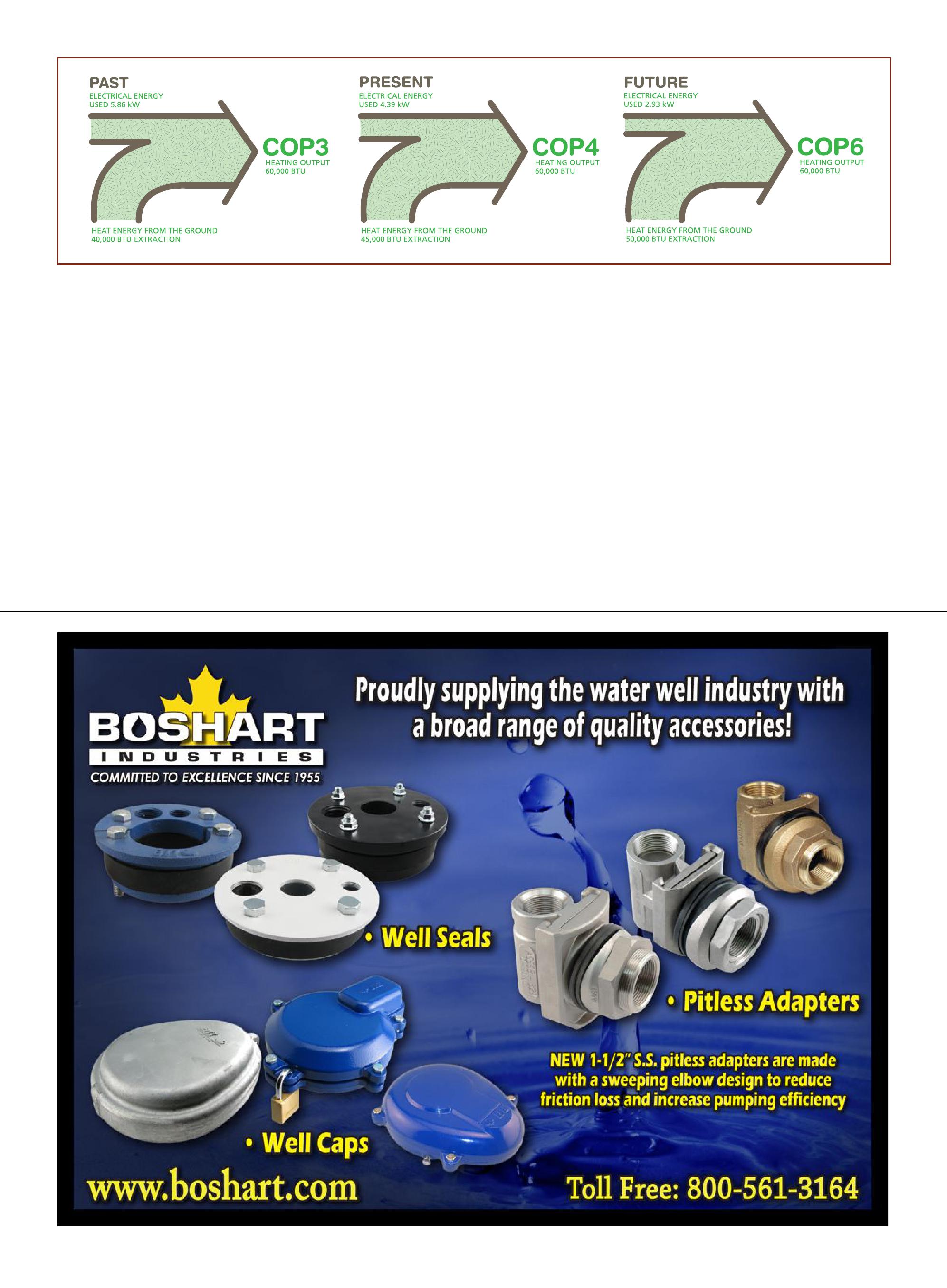
with advances in geothermal technology, more energy-efficient equipment was introduced, and we began to rely less on the electricity component and more on the energy extracted from the ground to achieve our goals. For example, 10 years ago, it took 20,000 British thermal units (5.86 kilowatts) of electricity and 40,000 BTUs of energy from the ground to heat a home requiring a heating output of 60,000 BTUs, resulting in a COP of three. Today, with more efficient equipment design, that same house has a COP of four, using 15,000 BTUs (4.39 kW) of electricity and 45,000 BTUs of energy from the ground.
Some companies are boasting that their new equipment will increase today’s energy efficiency by as much as 30 per cent.
Supporting this new level of efficiency means the design of loop systems will need to be re-evaluated. When used for heating, geothermal heat pumps are rated by their COP (coefficient of performance). The COP measures the combination of the mechanical energy from the electricity needed to run the machine and the heat energy extracted from the ground. When heat pumps are sized properly, the combination of the two sources totals the energy necessary to heat a home or building.
Proportionately, we used a lot more electricity and less extracted energy from the ground in the past than we do today. Over the years,
In the coming year, we will see the introduction of geothermal equipment that pushes the envelope on energy efficiency, moving us towards a COP of six. For the first time ever, we will see a reduction in our reliance on electricity to as little as 10,000 BTUs (2.93 kW), while the energy being absorbed from the ground reaches 50,000 BTUs.
It’s great news that we’re becoming savvier when it comes to harnessing energy from the ground to heat and cool our buildings. But as this new, more efficient equipment hits the market, our increasing reliance on the earth’s energy means we need to pay even closer attention to the loop designs that will best support these new systems.
As the amount of electricity used to run the heat pump is decreased and the earth’s energy is more heavily relied on, longer or larger loop systems will be required to reduce undue stress on the ground. In the future, different loop configurations and enhanced grouting practices
will emerge to support these more efficient systems.
The industry has seen several new and rehashed older helical vertical loop ideas in the past year as well as new lake loop and horizontal boring technology. Unfortunately most vertical ideas are unsuccessfully attempting to provide equal or better performance in smaller ground spaces. Shallow loops are dramatically affected the fluctuating annual moisture level found in unconsolidated formations and by the regional outdoor ambient temperature limiting reliable performance. Long term high performance is best served by
deeper more the thermally stable rock formations below.
This is great news for the drilling industry as the more efficient geothermal equipment and redesigned loop systems should lead to the need for more drilling than ever before.
When this new equipment hits the market later this year, the geothermal industry will need to work hard to ensure that contractors, drillers and installers are aware of the importance of loop design in supporting these new systems.
The importance of selecting the rightsized equipment and loop systems to maximize heating and cooling efficiency
hasn’t changed. What has changed is that, with equipment becoming more efficient, there’s an even greater focus now on designing the right loop systems to ensure maximum performance from these new systems and minimal stress to the ground.
Stan Marco is a well-respected and highly sought after geothermal knowledge expert and educator. He is an active member within the ground water community, a board member with the Canadian GeoExchange Coalition and co-founder and CEO of GeoSmart Energy & GeoSmart Drilling Services.
FIGHT YOUR FUEL COSTS
Innovative ideas designed to save your gas dollars.
Big rig operators have taken a huge hit in recent years thanks to dramatic increases in diesel and gasoline prices: a hit that can drain revenue almost as quickly as it comes in.
by JULIE FITZ-GERALD
Fuel efficiency has become paramount for drillers who want to maintain a profitable business. This hot topic is spurring suppliers in the industry to provide solutions, resulting in the emergence of innovative technologies and programs to help rig operators reclaim lost income.
One program generating buzz within the industry is the first-of-its-kind Carbon Offset Aggregation Cooperative (COAC) in British Columbia. Launched in January 2011, COAC helps its members reduce the amount of fossil fuel used in their fleets by adding technology, modifying equipment and increasing awareness of rig operators, leading to reduced fuel consumption. Through fuel reduction, members earn carbon offsets, which the COAC aggregates and then sells, transfers or trades, with the proceeds being returned to the member as a dividend.
for non-hydraulic rigs and approximately 10 hours for hydraulic rigs and can be scheduled between shifts or during regular downtime to minimize impact on daily operations. Once installed, COAC will train the owner and any additional staff in the operations. The cost for COAC equipment varies depending on the rig and financing is available if needed. With the opportunity to reduce fuel costs and carbon emissions, COAC members can bring about positive change in their businesses while also improving their bottom line.
The cost for COAC equipment varies depending on the rig and financing is available if needed.
There is a $100 fee per company to become a member of the COAC. The cooperative also retains a percentage of a member’s carbon offset sales for administration purposes, and charges a service fee on members’ fuel savings. In return, COAC provides manufacture-trained installers who ensure all equipment meets or exceeds industry standards. An install of COAC equipment takes approximately five hours
On the technology side, Schramm, a century-old manufacturer and global supplier to the hydraulic drill industry, focuses on developing groundbreaking products that provide greater efficiency. The West Chester, Pa.-based company launched its innovative air-Control System for new and used Schramm rigs two years ago, providing operators with fuel savings of more than 10 per cent.
Gregory Hillier, product manager at Schramm, explains that traditional air compressors typically produce a greater volume of air than is required down the hole, leaving the balance of air to be vented into the atmosphere. This air loss is a prime culprit of inefficiency on the rig. Continued
RED SCOURGE
New treatments for iron bacteria.
by TREENA HEIN
“
Iron bacteria and iron oxides have always been an issue and reoccurring problem for acreage well owners in the southern part of the province,” says Billy Baker, owner-operator of Baker Water Systems in Priddis, Alta.
“Whether we are servicing equipment or replacing submersible pumps, almost all the wells we encounter have some variety of iron bacteria or related deposits. And in most cases, well owners are unaware of the bacteria unless obvious problems arise.”
Baker refers to iron bacteria as “nuisance bacteria” due to the slime problems associated with their presence in wells, cribbed wells and cisterns. “Odour and discoloration of the water are usually the first things customers notice, but it can become a more extensive problem,” he says. “You see well yield reductions and fouling and plugging of water treatment systems (inline sediment filters, reverse osmosis units, and media-based filters) with slime, as well as water lines and even submersible pump screens.” Baker asserts that if things have got to that point, maintenance is no longer an option and full remediation of the well and the filtration system is needed – which is both costly and time-consuming.
The traditional treatment practice, Baker explains, involves pouring household bleach or varying concentrations of 12 to 60 per cent chlorine in granular or liquid form directly into the top of the well. “Circulation or flooding the well with water was considered an important part of the procedure, but it wasn’t always done due to limited access to well or inability to haul larger volumes of water,” Baker notes. This procedure of overwhelming the iron oxide bacteria with high doses of chlorine came to be known as “shocking” the well, and it became the industry standard for removing iron bacteria.
“Although it gave the owner peace of mind, later studies showed that it wasn’t an effective solution at all,” Baker notes. “The corrosive nature of the chlorine was considered an
accepted risk and the iron bacteria were controlled temporarily, but would always return – sometimes worse than before.”
Baker Water Systems adopted a treatment that involves adding five gallons of 12 per cent acetic acid to the well (lowering the pH of the water makes chlorine less corrosive) followed by circulation to dilute and disperse the acid. Secondly, a five-gallon dose of 12 per cent chlorine is added, followed by continuous circulation. The well is then flushed with fresh water to force the chlorine into the aquifer around the well bore. “All this is completed from the top of the well casing, and the chemical mixture varies depending on the depth and the severity of the iron bacteria,” says Baker. “But this practice has its limitations and risks. Mixing the acid with chlorine produces dangerous gases and, although it appears that the treatment has done a good job, it doesn’t eliminate the iron bacteria completely. Regrowth is to be expected and regular maintenance will always be necessary.”
NEWER TREATMENTS: PROS AND CONS
Baker says there are many products available to treat iron bacteria issues. They involve chemical and mechanical rehabilitation processes that usually boast amazing results, but, he says, the costs of the chemicals are astronomical and the processes are very labourintensive. “Trying to convince customers to spend thousands of dollars to treat a well when they are accustomed to spending only a few hundred for ‘shocking’ is difficult, to say the least,” he notes. “You also have to manage expectations, because the customers who do choose a more expensive treatment go into it expecting some kind of guarantee, which isn’t possible.” Baker adds, “I’ve seen a few of
these treatments and the results are typically good, but the expense and the fact that in some cases, the treatment lasts no longer than a basic ‘shocking’ treatment makes them of questionable use. Customers have been very vocal with their disappointment.”
About six months ago, Baker was introduced to Boresaver Ultra C by his business supplier (and the Canadian distributor of the product), Brian Reierson of Ability Pump & Equipment in Calgary, and decided to give it a try. It’s a proprietary blend of monohydrates and organic acids created in Australia and brought to North America by Laval Underground Surveys of Fresno, Calif. “It’s been shown to be 10 times more effective than other products at removing iron oxide and iron bacteria,” says Laval global product manager Steve Strong. Boresaver Ultra C is certified by NSF International (an independent, nonprofit organization that provides standards development, product certification, auditing, education and more) for use in potable water supplies.
handle. I poured it into the top of the wells, left it to circulate for a period of time and then flooded with fresh water.” In both cases, the results were very good. “In the first well, Boresaver Ultra C increased well yield by 1 igpm,” says Baker. “With the second well, in the past it has needed scheduled iron issue maintenance every six to eight months, but it’s been five months since treatment with Boresaver Ultra C and thus far there are no indications that would suggest the return of the iron bacteria.”
“Keeping equipment intended for wells away from bacterial sources is what we as professionals should be doing.”
Although you can use the product in this way, Strong says, “We recommend using a purpose-built cable tool rig and an inspection camera to record pretreatment and post-treatment results, and to be able to gauge the correct amount to use to achieve maximum results,” says Strong. “You can use it by doing a water sample test or visual inspection, but it’s much more effective to verify the severity of the issue by using a camera.” Strong did a presentation on Boresaver Ultra C at the CanWell conference in Hamilton on May 24, and Laval Underground Surveys also had a booth there.
“I had two wells in particular that were having reoccurring iron bacteria problems, even with scheduled treatments,” Baker notes. “The process is simple and the product safe to
Baker thinks the cost of Boresaver Ultra C treatment is very reasonable. “It’s about $1,000, which is about double the cost of ‘shocking’ – which I don’t do anymore – depending on a few
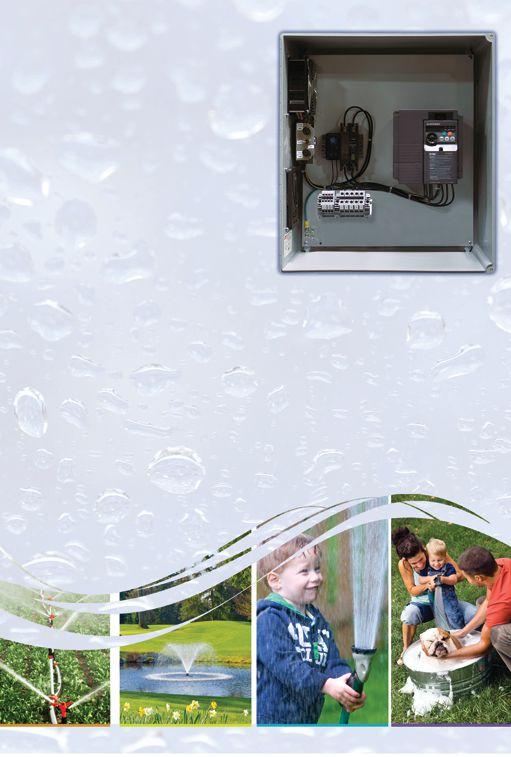
Constant Pressure Control Panels
The CPN1 Indoor VFD Panel and CP3R Outdoor VFD panel are economical, pre-engineered options for constant pressure applications to 5 HP, including:
n Pressure Booster Pumps
n Deep Well Submersible Pumps n Irrigation Pumps
Each panel features a single factory-programmed variable frequency drive for quick and easy installation and set up.
OptionalCPN1DuplexController available to alternate lead control of twoCPN1ortwoCP3Rpanels.
factors, and it’s certainly more affordable than other labour-intensive treatments, which range from $2,000 to $4,000,” he observes. “But you also have to look at the long term. If a customer is paying for iron bacteria treatments twice a year for a few hundred dollars each time and this treatment is more expensive but you don’t have to do it nearly as often, the benefits become clearer.”
Baker adds: “Iron issues will always be there, and this product has the potential to be a cost-effective and long-term maintenance solution for the customer. Further field testing on the many different consistencies of iron bacteria and iron oxides along with service technician and customer feedback is the first step.”
Brett Smith at All’s Well Filtration & Pumping Solutions in High River, Alta., has also given Boresaver Ultra C a try. “Although I don’t have long-term results
to discuss, the outcomes seem to be good,” he says. Smith applied it to two neighbouring wells about two months ago and another well in late April (two weeks before this interview). Each time, he applied the product, circulated for 45 minutes, let the treatment sit for about 20 minutes and then circulated again for another 20 to 30 minutes.
He then introduced 150 to 200 gallons of fresh water to back-flush to push the treatment into the aquifer, letting the treatment sit for a minimum of 12 hours before pumping off. (Like Baker, Smith has used acetic acid and chlorine for iron bacteria issues in the past.)
“With the wells two months ago, they did ultraviolet violet measurements afterwards, and that showed good results,” Smith reports. “I see Boresaver as a specific treatment, a tool that’s nice to have in situations where iron bacteria are an issue. The other big
attraction with this product is that it’s biodegradable. You can tell customers that and they really appreciate it. After treatment, the water can be pumped onto a lawn or field with no worries.”
David Hanson of Design Water Technologies (a Minnesota-based consulting firm) developed a dual product line to treat iron bacteria in wells, pipelines, heat exchange units, and plumbing/piping called Unicid. It was developed over two decades ago and has been used in over 29,400 wells over the last 21 years worldwide. Hansen says it provides virtually zero return of bacterial problems. He has seen only 15 wells had a recurrence, which was due to physical factors in the well (such as corrosion in the well casing or failed/ no grout) that allowed a recurrence of the organisms. He says their lab can predetermine if this problem exists and will warranty chemistry, if done. The products are shipped as non-corrosive, non-hazardous substance. Canadian distribution began last year.
“Unicid Catalyst penetrates and breaks up iron bacteria sludge and Unicid Granular fully dissolves it,” explains Hansen. “Because the buildup of live and decayed bacteria is completely removed from the borehole, there are no remaining nutrients for iron bacteria in the water to attach to and feed on.” The products are applied together into a well, followed by a development and monitoring procedure to determine when the well is clean, followed by flushing. Low pH (below 4.5) may kill grass, and a neutralizing agent can be added before flushing. The entire process of cleaning a domestic well can take from about four hours to a day and a half. Total cost of the treatment is $2,500-$3,000.
Hanson adds that because iron bacteria, coliform, and E. coli are found in the top two inches of soil, he believes it’s important to avoid things like laying pumps on the ground when servicing or installing them. “Keeping equipment intended for wells away from bacterial sources is what we as professionals should be doing.”
Treena Hein is a science writer based in Ontario and a regular contributor to Ground Water Canada.
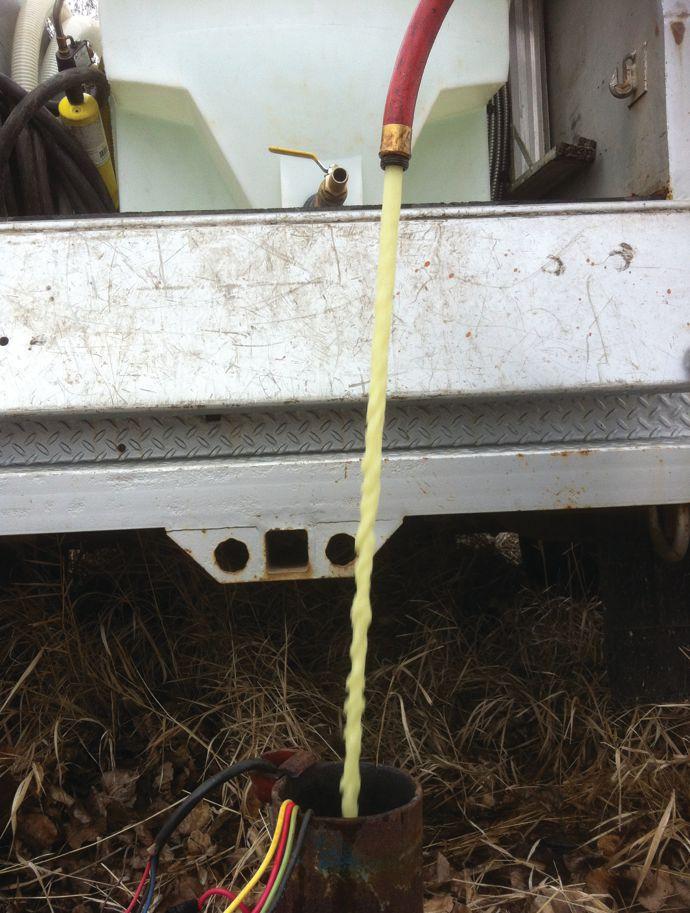
Brett Smith, owner of All’s Well in High River, Alta., circulating Boresaver Ultra C to treat a well with iron bacteria issues. The product turns a greenish colour when active.
EXPAND YOUR EDUCATION
A new course on geothermal installation.
Starting this fall, the Canadian GeoExchange Coalition (CGC) will offer a new course in geothermal loop installation. This threeday comprehensive workshop is designed for all contractors involved in the outdoor component of geothermal loop installations.
by BENJAMIN HÉNAULT
This training is part of an ongoing market transformation initiative started by the CGC in 2001, and aimed at creating a unified and strong Canadian geoexchange industry. It is an integral part of the CGC’s Global Quality GeoExchange Program.
Starting in spring 2013, all drilling companies will be required to have accredited geothermal loop installers on staff in order to renew their company qualification. Thus, this course becomes a new requirement for CGC system certification and applies to both residential and commercial installations.
The new geothermal loop installation course differs from the installer course, which covers building systems and basic technical aspects of geothermal installations (heat pumps, circulation pumps, building site evaluations, distribution systems, system commissioning, etc.). Even though the installer course touches on basic installation principles, certain important notions are not covered in great detail.
The geothermal loop installation course covers important concepts, such as:
• loop insertion into the borehole
• placement of horizontal loops, open loop systems and lake loops
• manufacturing of secondary headers
• mixing and injection of geothermal grout
• thermal fusion of HDPE joints
• purging of exterior networks
• hydrostatic pressure tests
• hydrodynamic pressure tests
• connecting of the pipes into the building
• pros and cons of geothermal vaults
• trenching and excavation (for vertical and horizontal loops)
• underground insulation and markers
• preparation and injection of heat transfer fluids
• submerged loop preparation and installation
• installation of transition HDPE to inside piping
• final site report
Course participants must successfully pass an examination in order to receive a CGC training certificate. This certificate is the prerequisite to apply for CGC’s geothermal loop installer accreditation.
Accreditation will help you open new markets and offer your customers an increased level of confidence, knowing their system was installed by a qualified installer according to Canadian standards, regulations and geology. Visit www.geo-exchange.ca for more information.
Benjamin Hénault is a professional engineer and a graduate of École de technologie supérieure. He is the technical advisor at the Canadian GeoExchange Coalition and is studying in geothermal research for his masters degree at École Polytechnique de Montéal.
Laser Marked Water Level Meter
The 101 P7 Water Level Meter uses Solinst laser marked flat tape, which is accurately marked each mm or every 1/100 ft and Certified Traceable to National Standards. New submersible P7 Probe ideal for total well depth measurements to 300 m (1000 ft).
Standard Model 101 P2 Water Level Meter with heat embossed markings still available.
Own the Best Geothermal and Water Well Grouting Equipment Available Anywhere!
Fill, mix, pump a batch of grout in just 90 seconds with the Geo-Loop 50-500. Call the experts for your grouting needs.
Ultimate Grouter Model 50-500
• 0-35 GPM at pressures up to 500 PSI
• 5x8 piston pump with chrome liners
• 80 gallon SS taper cone bottom mixing tank
• 24 HP Honda
• Powder coat paint
Grout Hose Reels
• Spool capacities range 200’-1,000’ grout line
• Hydraulically-driven forward and reverse
• Smooth 360 degree swivel base
• Powder coat paint
• 5 reel models
Check out our full line of grout pumps and accessories at: www.geo-loop.com jeff@geo-loop.com or 1-712-434-2125
NEW PRODUCTS
SANECOTEC’S HUWA-SAN PEROXIDE TECHNOLOGY
Jim Shubat, president of SanEcoTec, was on hand at CanWell 2012 to present what his company hails as the new generation of hydrogen peroxide for water treatment and disinfection. The product is designed to be powerful, residual and sustainable. SanEcoTec is a company dedicated to environmental responsibility and good stewardship, values that are at the core of its technology. www.sanecotec.com
NEW DTH HAMMER FROM ROCKMORE
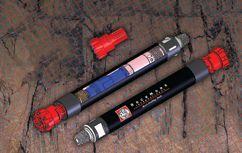
Rockmore International has released the first DTH hammer in its emerging Deep Hole series, the ROK 500DH. As a five-inch-class hammer, the 500DH is targeted to drill 140to 152-millimetre (5.5- to sixinch) diameter holes. Designed to increase drilling effectiveness and efficiency in deep hole applications, the ROK 500DH incorporates engineering advancements for drilling in DTH applications such as geothermal, exploration, waterwell, and in other mining and construction sectors. The hammer is rated for use with large compressors: 24.1 Bar (350 PSI) at 25.2 m3/min (890 SCFM), but can accept greater air volumes and pressures from larger air compressor packages. The upper and lower hammer air chambers of the 500DH have been modified accordingly in order to achieve optimum drilling efficiency. www.rockmore-intl.com
GEOSMART’S NEW PUSH’N PULL
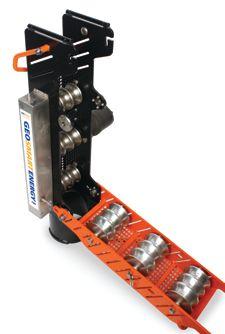
GeoSmart introduced a compact multi loop feeder and pump puller to North American drilling industry at the CanWell conference in Hamilton, Ont., in late May. GeoSmart Energy has recently acquired a new time-saving multi loop and pump handler designed specifically for geothermal drilling applications, but with additional applications for the water-well industry as well. Compact and powerful, the GeoSmart Push’N Pull simplifies the installation of geothermal pipes in vertical drill applications, saving time, money and manual labour. www.geosmartenergy.com
SCHLUMBERGER WATER SERVICES LAUNCHES VMOD FLEX
Schlumberger Water Services (SWS) released of Visual MODFLOW Flex (VMOD Flex), the next generation of ground water flow, heat and contaminant transport modelling software for ground water professionals. Visual MODFLOW Flex improves modelling efficiency by integrating 3-D hydrogeologic conceptual modelling and industry standard numeric engines in a single, easy-touse software environment. www.swstechnology.com
SOLINST’S NEW FIELD SAMPLING PUMP
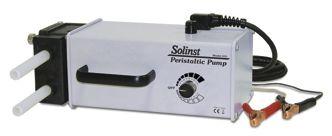
Designed for rugged field use, the reversible flow Solinst Model 410 peristaltic pump is ideal for water or vapour sampling from shallow wells and surface water.
The metal case is robust, compact and lightweight. It has no vents, grates or openings, making it water resistant, easy to use in the field, and easy to maintain and repair. The pump connects to a 12-volt power source to operate. One easyaccess control allows high or low-flow sampling. The pump can be fitted with two sizes of silicone tubing, and is effective to depths up to the suction lift limit, as much as 33 feet below sea level. www.solinst.com
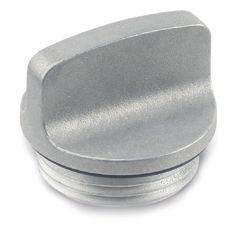
THREADED PLUGS PROVIDE RELIABLE SEAL
J.W. Winco, Inc. now offers series GN 441 and GN 442 threaded plugs with finger grip. These RoHS-compliant plugs are available with NBR seal (GN 441) or VITON seal (GN 442). The threaded plugs have an external diameter matching the screwin holes for DIN 3852 pipe bolt connections. Plug bodies are made of aluminum, with either a tumbled matte finish or black plastic coated finish, and are available with or without vent hole. A range of sizes is offered with metric
BSPP parallel threads. Threaded plugs with dipstick are available upon request. www.jwwinco.com
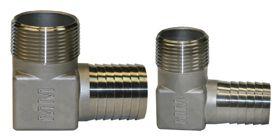
STAINLESS STEEL HYDRANT ELBOWS FROM MERRILL
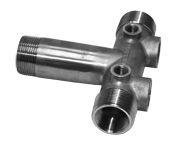
Merrill Manufacturing has introduced two new stainless steel hydrant elbows: the SSHE125 is 1-1/4" Insert x 1-1/4" MIP and the SSHE1000 is 1" Insert x 1" MIP. Each hydrant elbow connects plastic pipe to male iron pipe and is made of investment cast 304 stainless steel for strength and economy. www.merrillmfg.com
WELL PUMP’S NEXT-GEN 3" PUMPS
Well Pump showcased the 3" WPS-CP at this year’s CanWell as part of its next generation of pumps. The stainless steel pumps are designed to provide high resistance to wear and run at a top speed of 8.200 RPM with a 140 Hz motor. These single phase pumps offer protection against dry running and over or under voltage. The new 3" submersible pumps also offer constant pressure due to variable speed with two pressure settings available. www.wellpumps.be
INDUSTRY NEWS
SONIC DRILLING BUZZES THROUGH BURIED RAILWAY TRACK
By Nancy Argyle
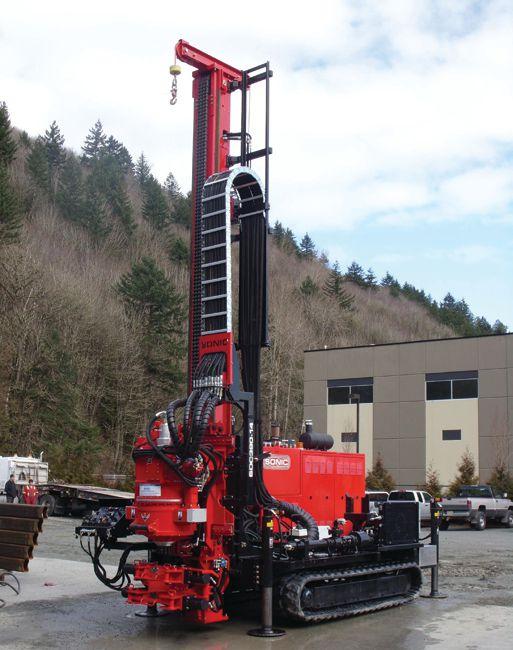
Recently, Sonic Drilling Ltd. took on the special challenge of drilling inside a heritage building that was originally constructed sometime during the 1890s. Using an SDC-450 rig, mounted on tracks, the project required numerous special preparations in advance of actually drilling indoors.
Originally, the building had been a coal-fired generating station although its last tenant was actually a steel mill and, since then, the building had been vacant for the past 20 years. Because there were no environmental regulations back at the beginning of the 20th century, the new owner now wanted to find out what was under the building’s four-foot-thick concrete floors.
Although the project only required two holes to be drilled to a depth of 30 feet, the safety efforts were immense to ensure that there was adequate venting of exhaust, enough light to see properly and enough space in which to operate. Unfortunately, the weather caused some delays as it began to snow heavily once the crew was ready.
On the positive side, the building offered a large hangarlike door so that the drill rig could be moved easily inside, despite the cramped quarters once it was in there.
Once the drilling commenced, all seemed to be going smoothly until the rig suddenly took a lengthy 10 minutes to drill only six inches. Unbelievably, the sonic drill had hit a buried railway track! After slowing down considerably, it buzzed through the thick regular gauge steel and kept right on going.
In the end, thanks to extensive planning, the project was completed without incident. For the crew, though, finding a buried railway track made it an especially memorable one. However, this project still had one more surprise in store!
During drilling, a once-in-a-lifetime photo was captured of
the drill pipe glowing red, due to a rare and specific frequency of vibration. Ray Roussy, patent holder and developer of modern day sonic drilling technology, always thought that, under just the right conditions, it might be possible for the drill pipe to glow. Still, it took 30 years and a particular set of conditions for his theory to be realized.
Roussy is president of the contracting company, Sonic Drilling Ltd., and the U.S.-based Sonic Drill Corporation. He is also co-owner of the manufacturing company, Sonic Drill Systems, which produces the now-famous Sonic Drill Corporation (SDC) model of sonic drill rigs.
Continued from page 18
“Basically our system monitors the compressor demand by the tools that are down the hole and it matches the compressor output to the required consumption, while also matching the cooling fan speed to the demand of the compressor. That’s really where the fuel savings come in,” Hillier says.
Schramm’s electronic air-Control System can be included as part of a package when purchasing a new Schramm rig or it can be purchased as a retrofit for the company’s older model rigs.
“To gain the full benefit of the features of the system, you need to have a machine that has an electronically controlled engine, which has been common on rigs in the last eight to 10 years,” Hillier explains.
While there are many variables that can impact the overall cost for a retrofit kit,
to separate trucks and equipment. Please contact for full details and pricing.
Hillier notes that operators can expect to recover the total cost in as little as one year.
In its spring 2012 newsletter, Schramm announced that it is in the midst of developing another exciting innovation centred on fuel efficiency: dual fuel systems. Currently, the technology is being developed for the oil and gas industry, where rigs run around the clock and natural gas is more accessible. Hillier says that until the transmission and portability of natural gas is further developed, it will be difficult to expand the technology into the water well drilling industry; however, it remains a very
real possibility for the future.
“Certainly the concept is good. When that technology is available, to have ample supplies of compressed natural gas available, then it is really an efficient system and there are some potentially incredible savings.”
While fuel prices will continue to pack a punch, big rig operators can take a collective sigh of relief knowing that new innovations and programs are emerging every day to help lower fuel consumption and increase fuel efficiency. It is a winning combination that puts greater control back into the hands of Canada’s drillers.
SHARE YOUR THOUGHTS!
If you’re a driller and you’ve found a way to save fuel costs, or know of a company that employs innovative fuel-saving technology, e-mail Ground Water Canada at laiken@annexweb.com or tweet @GroundWaterMag. We’d love to hear what you’re doing and share it with our readers!
The Magic Number
Do you have enough money to retire?
by Sloan Levett
How much money do you need to retire?
We all think about retirement, usually more often as we get older. Maybe we have it backwards. We should start thinking about retirement earlier and, equally important, create a financial strategy to get us there. There are some very alarming statistics about people saving for retirement. According to a study published in the U.S. by Forrester Research, 40 per cent of baby boomers between the ages of 41 and 50 have not initiated any financial planning for retirement. In Canada, about a third of adults have said they haven’t saved anything for retirement, while three quarters of Canadians view their CPP payments as their primary or secondary source of retirement income. Interestingly enough, according to Decima Research, more than one in five Canadians is expecting an inheritance to help improve their retirement savings.
Ten per cent of retirees return to work because of their financial situation and roughly 20 per cent have postponed their retirement because they feel they don’t have enough retirement savings. Most people in their mid 20s to mid 30s would rather spend their money now and worry about saving for retirement later. During this period, you are likely to deal with immediate financial concerns like buying a house, starting a family and establishing your career. From your mid 30s to late 40s your career is generally more established and you are more likely to be financially secure with the ability to start to accumulate savings. If you wait until your 50s to start saving for retirement, it may be too late.
As you plan for retirement, look at your overall financial picture. This includes paying off debt, setting up and contributing to RESPs for your children’s education and taking care of aging parents.People’s biggest concern is figuring out just how much capital will be needed. If your preretirement income was $70,000 annually, some experts suggest you will be able to maintain your lifestyle during retirement on about 70 per cent
of that or $49,000. You first need to look at your sources of retirement income. Government benefits (CPP and OAS) will make up a third of that total with the remaining two thirds coming from you. Others suggest you can get by with 50 per cent pre-retirement income. But in this case, you must be debt free and not have expensive hobbies. Remember, there’s no magic number for retirement savings. Sherry Cooper, chief economist at BMO Nesbitt Burns, offered this method a few years ago to determine how much capital you need to retire. First, decide on your annual retirement income amount. Deduct from that the amount you will receive from government and corporate (if applicable) pension plans. That will leave you with a savings shortfall. If your goal is to be penniless at age 90, Cooper suggests you will need 15 times the shortfall as a capital base at retirement. Cooper’s rule of thumb is based on a few assumptions: you retire at age 65, live to age 90, earn an average of eight per cent on your investments before inflation (which in the current low rate economic environment is likely very difficult to achieve) and that inflation will be three per cent a year during your retirement.
If the answer to how much capital you need to retire were an easy one, there wouldn’t be an abundance of literature and retirement calculators offering advice and analysis. The answer will depend on the lifestyle you want to enjoy in retirement, your family situation, the amount of money you want to leave for your estate and other considerations. One thing is for sure, the earlier in life you start saving, and the more often you save, the faster your nest egg will grow and the greater your chances of meeting your retirement goals will be.
Sloan Levett is the president of Fuller Landau Family Office Services Inc. To contact Sloan directly, please call 416-645-6581 or e-mail slevett@fullerlandau.com.