Occasionally, Ground Water Canada will mail information on behalf of industry-related groups whose products and services we believe may be of interest to you. If you prefer not to receive this information, please contact our circulation department in any of the four ways listed above.
Serving the Canadian Ground Water industry for 44 years.
Settle in and celebrate the next wave of the ground water industry
www.groundwatercanada.com
Plus why you should consider adopting a health and safety management system
We look back on the contributions of Lewis Hopper, driller and government
ON THE WEB:
NDP pushes for free well water testing in N.S. Nova Scotia’s New Democratic Party has introduced a bill to offer free annual testing for coliform bacteria, the most common contaminant of well water in the province. The Halifax ChronicleHerald reports.
Researchers aim to pull specific toxins from water
Scientists from Rice University in Texas are developing technology they can fine-tune to remove specific contaminants from water. Technologynetworks.com reports.
Past and future
by Colleen Cross
This column is both hard and easy to write. Hard because I’m looking back on one of the greats of Canadian water well drilling who is no longer with us. Easy because I’m looking forward to a new generation of the industry – and they are an inspiring bunch.
First, Lewis Hopper. This spring Jeff Dickson of M&M Drilling Rivers in Manitoba let me know that Lewis, a longtime well driller and government liaison to other drillers, had been diagnosed with terminal cancer.
Jeff suggested I give Lewis – still “sharp as a tack” – a call to learn a bit about Canada’s water well drilling past.
Three lines in Jeff’s email stuck with me: “He has drilled a well in every province in Canada. . . . He was our government babysitter for years in the field here. . . . He has forgotten more about wells than I will ever know.”
I called Lewis and he sent me a copy of his memoirs to read with a promise to talk the next week. Now, that’s some homework I could get into! I learned so much about the industry in those 40 lively, down-to-earth, heartfelt pages.
I talked to Lewis again the next week, and found him very sharp indeed. He was also kind and funny, which was slightly unexpected given his reputation for being, at times, and by his own description, difficult to deal with – and by that I mean principled and uncompromising in those principles. This was a reputation he seemed to wear as a badge of honour.
You’ll find details of that conversation and more on Lewis’ legacy on page 20.
Sadly Lewis passed away a week after we spoke leaving a gaping hole in the Manitoba industry. I feel fortunate to have got a taste of his no-nonsense style, read some of his thoughts on the industry and told him they were invaluable to me in understanding this industry’s place in
the big picture.
This do-it-the-right-way-or-don’t-do-it-at-all driller truly championed well drillers and I like these words of wisdom he had for them (with all due respect to the engineers!): “Don’t ever think you are below anyone; engineers got their education studying what the working class learned and gave away. Someone was then smart enough to get it down on paper so it could be studied to become an engineer!”
And now, the Top 10 Under 40. In January, Ground Water Canada put out a call to readers to tell us about young drillers, service people and scientists who exhibit outstanding leadership, skill and dedication to the industry.
I suspect you’ll see something of yourselves in the 10 young professionals you’ll read about in this issue. Maybe you started out in the industry for some of the same reasons: to help out in and carry on the family business, to work outside every day, to solve problems, and to expect the unexpected every day.
Parker Drury, a young well driller from Barrie, Ont., summed up the work very well: “Be prepared to work hard, put in long hours and do heavy lifting, he says.
“But you’ll find it fulfilling. I do.”
I learned many things from these young people, but mostly I learned this: don’t try to interview drillers in July, busiest of months!
No doubt this is an older industry, but these young people are evidence the next generation is smart, family oriented, hardworking, and tuned in to the big environmental picture.
We hope you enjoy reading these stories of the past and future, and we hope they inspire you to let us know about other stories that need telling.
CELEBRATE TOGETHER
1 YEAR ANNIVERSARY OF THE CANPIPE SUB-FACTORY
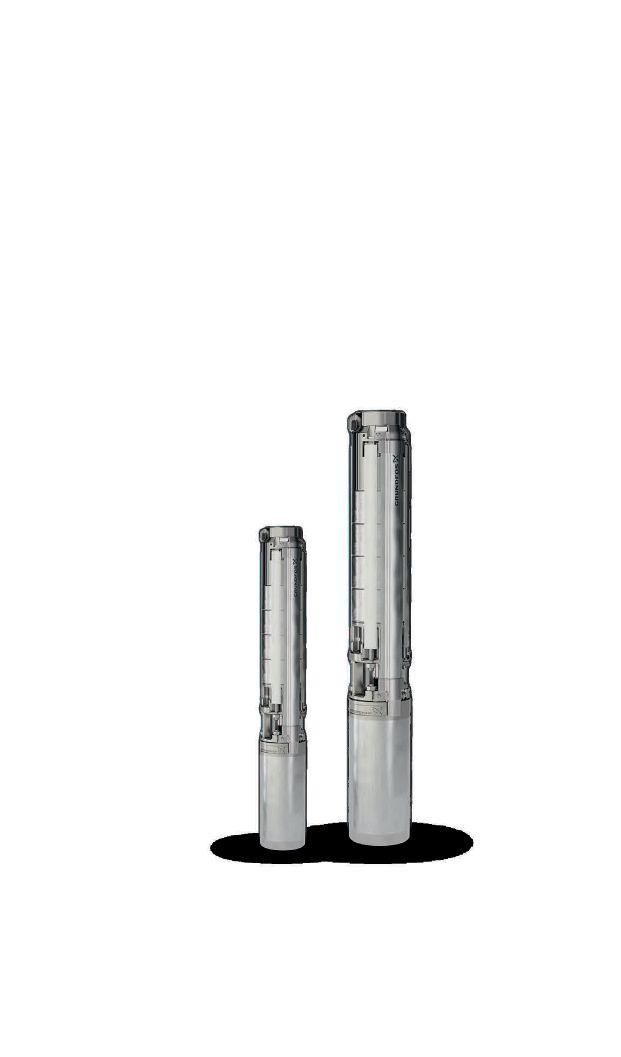
One year ago, Canpipe was selected as a Grundfos sub-factory for the assembly of 6” submersible pumps.
There was a joint recognition that the market needed to be serviced faster to get large volume wells back producing water. Our partnership delivered.
YOUR PARTNER FOR SUBMERSIBLE PUMPS AND BEYOND
- Submersible range: 85 to 300 GPM with 1-1/2 to 75 HP
- All sub-factory pumps receive the same warranty
- Delivery in as little as 4 hours (conditions apply) www.grundfos.ca
INDUSTRY NEWS
AI TECH COULD HELP PROTECT WATER SUPPLIES, STUDY SAYS
Progress on new artificial intelligence technology could make monitoring at water treatment plants cheaper and easier and help safeguard public health, suggest researchers at the University of Waterloo. Researchers have developed AI software capable of identifying and quantifying different kinds of cyanobacteria, or blue-green algae, which could potentially shut down water systems when it suddenly proliferates.
“We need to protect our water supplies,” said Monica Emelko, a professor of civil and environmental engineering and member of the Water Institute at Waterloo, in a news release. “This tool will arm us with a sentinel system, a more rapid indication when they are threatened.”
The research indicates testing using AI can be done quickly and well, Emelko said. The team is working through all possible scenarios to take advantage of the technology.
The operational AI system uses software in combination with a microscope to inexpensively and automatically analyze water samples for algae cells in about one to two hours, including confirmation of results by a human analyst.
Current testing methods, which typically involve sending samples to labs for manual analysis by technicians, take one to two days. Some automated systems already exist as well, but they require extremely expensive equipment and supplies.
According to Emelko and collaborator Alexander Wong, a systems design engineering professor at Waterloo, the AI system would provide an early warning of problems since testing could be done much more quickly and frequently.
The goal is an AI system to continuously monitor water flowing through a microscope for a wide range of contaminants and micro-organisms.
The researchers estimate it may take two to three years to refine a fully commercial sample testing system for use in labs or in-house at treatment plants. The technology to provide continuous monitoring could be three to four years away.
A study on the research, “Quantification of cyanobacterial cells using a novel imaging-driven technique with an integrated fluorescence signature,” was recently published in the journal Scientific Reports.
CANADA, N.B. TO HELP FUND ENERGYEFFICIENT UPGRADES
The federal government will invest almost $51 million to help New Brunswick residents make energy-efficient upgrades to their homes, businesses and industrial operations, Environment and Climate Change Canada said in a news release.
The government will invest a total of $234 million in New Brunswick.
Canada’s Low Carbon Economy Leadership Fund will support New Brunswick Power’s Total Home Energy Savings Program as well as programs for commercial and industrial energy efficiency. These programs help cover the cost of home-, commercial-, and industrial-efficiency retrofits in the province.
The Total Home Energy Savings Program will assist homeowners with energy-efficiency changes such as better insulation, home heating systems, heat-recovery ventilators, windows, doors, water heaters, drainwater heat recovery, and renewable-energy systems. With government support, New Brunswick Power will expand programming to homeowners who heat their homes with oil.
The program for commercial buildings is designed to help business owners save energy, save money, and make energy-efficient retrofits in commercial buildings.
The New Brunswick Power Energy Smart Industrial Program is designed to provide financial incentives to industries to improve energy efficiency in their operations to reduce energy consumption, provide environmental benefits and save on costs.
New Brunswick Power is investing up to $82 million, over the coming five years, in programs for homeowners, businesses, and industries, to support rebates and other programs. New Brunswick will put $101 million toward retrofitting government buildings.
HYDROGEOLOGIST GRAY GIVEN APGO AWARD OF MERIT
Hydrogeologist Peter Gray has been given the award of merit from the Association of Professional Geoscientists of Ontario for his “significant contributions to the geoscience profession.”
Peter Gray
Gray, a vice-president and senior hydrogeologist for MTE Consultants Inc., in Kitchener, Ont., has many years of experience on various types of projects ranging from international to domestic assignments, including ground water, surface water, soil and contaminant investigations, the APGO said in a news release. He also has been involved in the exploration, development and protection of municipal ground water and surface water supplies related to municipal supply and aggregate resources.
Gray has been responsible for the design, construction, supervision and testing of municipal wells and assessing the impacts of contaminants on ground water and surface water. He received the award at the APGO’s AGM in June.
Hydrogeologist
INDUSTRY NEWS
RETIREES DRIVE RECREATIONAL PROPERTY PRICES, SAYS REAL ESTATE REPORT
Canada’s increasingly aging population has retirees driving and inflating the recreational market in popular leisure locations.
A recent survey of RE/MAX brokers and agents found that recreational properties are experiencing a surge in pricing, with 78 per cent of regions surveyed showing a higher median price in 2018 compared to 2017. The survey, conducted in the spring, showed that retirees are driving 91 per cent of popular Canadian recreational markets driving up prices in those markets.
Brokers foresee current trends continuing into 2019. In the next two to five years, brokers in British Columbia speculate the market will see a shift from retirees to younger buyers driving demand for recreational properties, as younger buyers accumulate more purchasing power. However, in the Prairies, the tighter mortgage qualifications and overall economic performance will make it more difficult for younger buyers to enter the market. In Ontario, brokers see both retirees and younger buyers driving demand in the next few years. Atlantic Canadian brokers are closely aligned with those in the Prairies who see retirees continuing to drive the market.
In the report, Canadians identify the features important to them in a recreational property. The top five were affordable purchase price, waterfront access, reasonable maintenance costs, nearness to town and reasonable distance from primary residence.
According to a recent report from Canada Mortgage and Housing Corporation, urban and rural housing starts are trending up from a year ago. The trend in housing starts was 216,362 units in May 2018, compared to 225,481 units in April 2018. Rural starts were estimated at a rate of 17,412 units, up from 16,145 in May 2017.
CLIMATE AND GROUND WATER DICTATE SHAPES OF RIVER BASINS, STUDY FINDS
Researchers at the Massachusetts Institute of Technology have found that small water basins formed in humid climates are heavily shaped by the local ground water, which carves out shorter, wider basins.
River basins also vary in shape, which, as MIT scientists report, is heavily influenced by the climate in which they form. The team found that in dry regions of the country, river basins take on a long and thin contour, regardless of their size. In more humid environments, river basins vary: Larger basins, on the scale of hundreds of kilometres, are long and thin, while smaller basins, spanning a few kilometres, are noticeably short and squat.
The results, published in the Proceedings of the Royal Society A, may help researchers identify ancient climates in which basins originally formed on Earth and on other planets, MIT said.
PPI FORMS GEOTHERMAL AND POLYPROPYLENE PIPE COMMITTEES
The Plastics Pipe Institute Inc. has created two groups as part of its Building and Construction Division: the Polypropylene Pressure Pipe Steering Committee and the Geothermal Steering Committee.
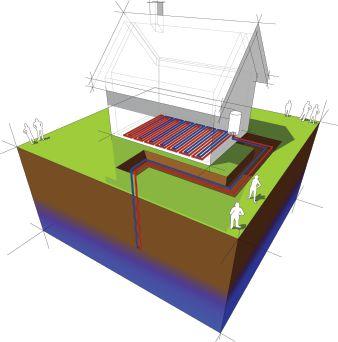
The Geothermal Steering Committee focuses on two types of polypropylene pressure pipes: PP-R, polypropylene random copolymer, and PP-RCT, polypropylene random copolymer with modified crystallinity and temperature resistance, said PPI, a North American trade association representing all segments of the plastic pipe industry, in a news release. Both types of pipes are approved for potable hot and cold-water plumbing systems, hydronic heating and cooling systems, as well as other applications.
The Polypropylene Pressure Pipe Steering Committee (P4 SC), which will focus entirely on polypropylene pressure pipe, reflects the rapid growth and continuing acceptance of polypropylene pressure pipe in the North American market, the company said.
PPI technical staff co-ordinate industry research programs, develop technical publications, create educational information about these systems, and participate in standards development organizations, code bodies and other organizations.
It recently published its first publication related to polypropylene (PP-R) pressure pipe, PPI TN-57 Proper Integration of Copper Tubing and Components with PP-R Piping Materials for Plumbing Applications.
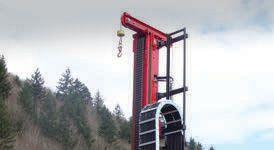
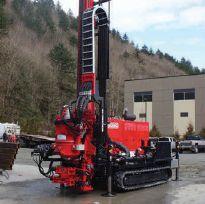
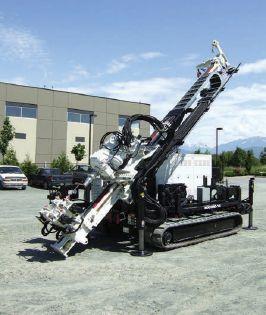
Rubber-Tired, Tried and True
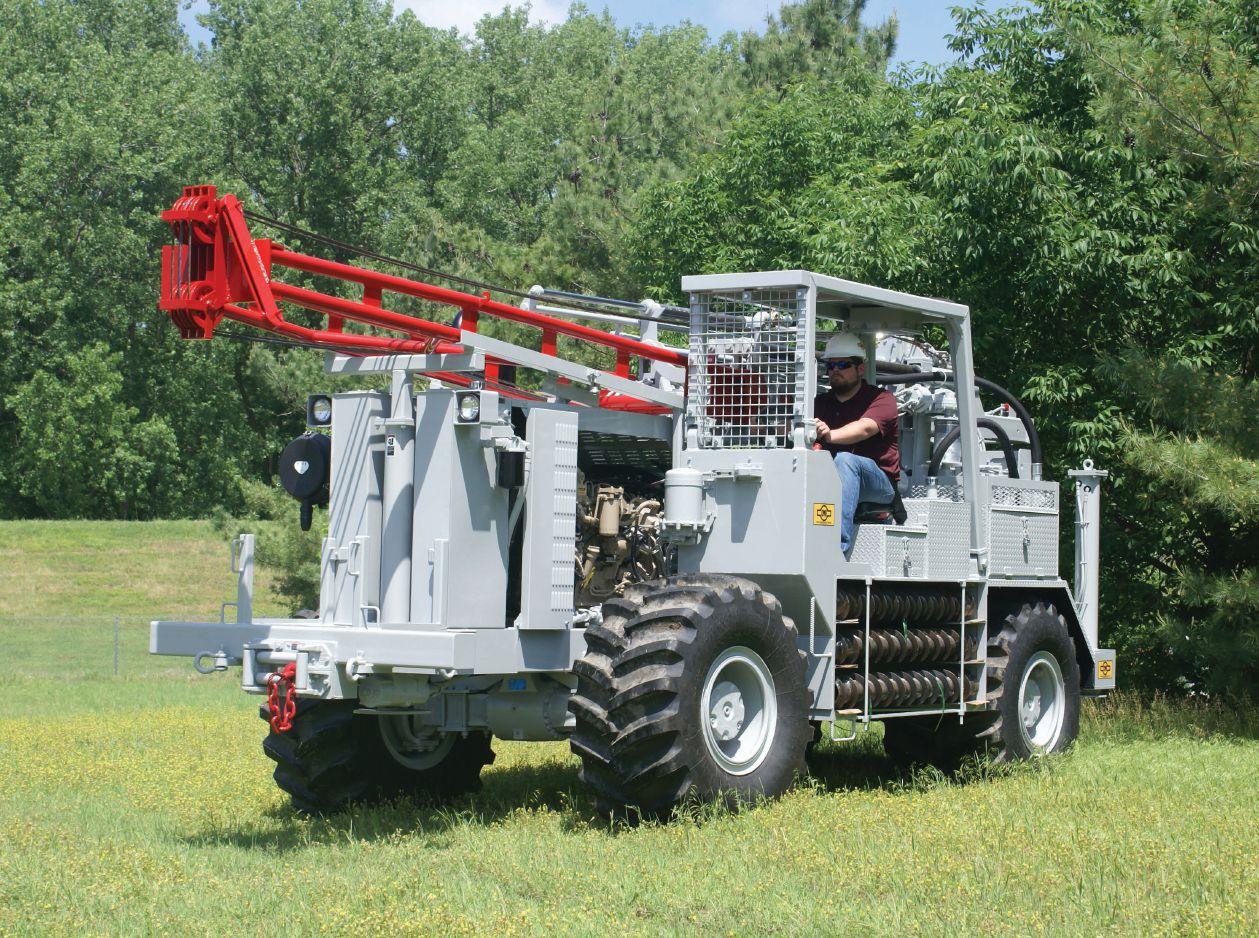
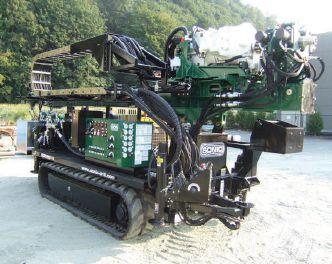
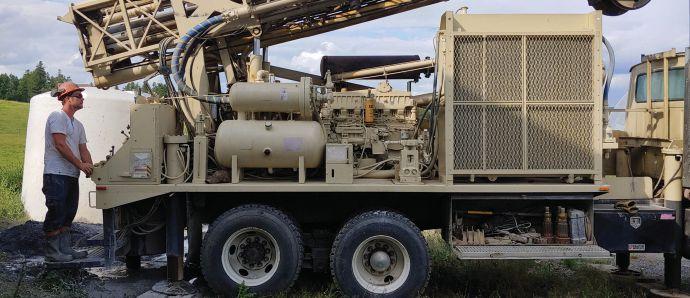
The CME-750X is the culmination of over 30 years of experience in ATV drill technology. It’s been designed and refined from the ground up to provide the best combination of mobility and drilling performance you can get with a rubber-tired all-terrain drill rig. There are no compromises.
All-terrain means you can get to jobs inaccessible to truck mounted rigs without building costly access roads. And with its built-in auger racks, tool boxes and water tanks, the CME-750X carries everything you need to get the job done when you get there. Of course the rubber tires won’t damage most pavement so you can use this rig on city streets as well.
The dependable mechanical rotary drive is available in standard, high torque or high speed models. The high torque version provides up to 12,950 foot pounds of torque while the high speed model gives you spindle speeds up to 930 rpm. And 30,000 pounds of retract force let’s you take on those big drilling jobs.
The CME-750X is available with the same options as our truck-mounted drills, like automatic SPT hammer, hydraulic rod holder and breakout wrench, quick mast disconnect, various hydraulic hoists and many more.
If your jobs call for a rig that can get through mud, snow, sand and rough terrain, check out the CME-750X. It’ll get you there and then, it’ll get the job done.
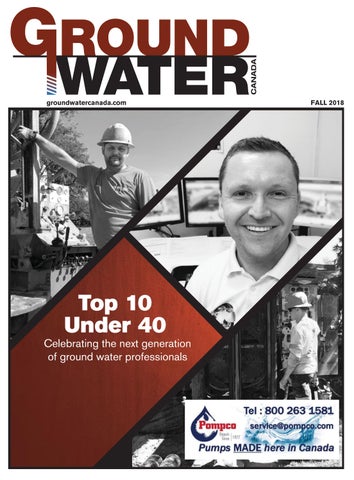
TOP 10 UNDER 40
Celebrating the next wave of the ground water industry
It’s hard not to feel good about the future of the ground water industry after talking with 10 young people who work hard and love what they do.
by COLLEEN CROSS
In January, Ground Water Canada put out a call to readers to tell us about outstanding young professionals who exhibit outstanding leadership, skill and dedication to the industry.
Readers came through with an impressive sampling of the industry’s best. All of the drillers, service people and scientists you will read about are called upon to expect the unexpected, think on their feet and come up with creative solutions. It’s made me appreciate just how important problem solving is in all facets of this industry.
Enjoy reading about these young folks – and maybe see a little of yourself in them!
THE EDUCATOR
Parker Drury, Drury Well Drilling, Barrie, Ont.
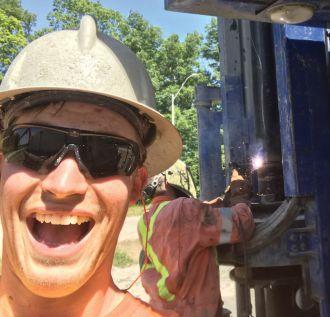
At 27, Parker Drury, has been a driller and installer with his family’s business, Drury Well Drilling in Barrie, Ont., for five years.
Father Bob Drury runs the business, which has been incorporated since 1988, making this their 30th year in business. The younger Drury is starting the process of taking over the business and the plan is for him to assume ownership in five or six years.
Drury, who worked a lot of summers during his high school years, studied business administration at Georgian College. After deciding office work was not for him, he worked in the automotive industry for five years, then decided to get into well drilling full time. He first focused on servicing and now drills as well.
Drury Well Drilling, whose territory covers the Barrie area and stops just north of Orillia,
does pretty well all residential work, including lots of infrastructure work, rehabilitation and instalment of replacement casing, Drury says.
“I get a lot of satisfaction out of helping people get good, clean water,” he says, “and I learn a lot about other trades.”
His most memorable moments are those “firsts” – first service call, first day drilling. “The big learning curve days,” he calls them, noting that given the amount of time, materials and money at stake, it’s important to learn from any mistakes made.
“Parker is a great example of doing things properly and educating his customers and the public,” said Craig Morgan, Rideau Pipe, who nominated the young driller.
When I ask him about customers, this unearths some passionate ideas. “A lot of people don’t really understand where water
RIGHT: Parker Drury
comes from or why they have wells or treatment equipment and systems,” he says. “I love to educate people about pressure systems and how to maintain equipment. It helps them in the long term, even though it cuts somewhat into our stream of income.”
They like to use the best equipment. A lot of equipment now has 10-year life; his has a 15- to 20-year life. “A lot of people have trouble cutting that cheque.” But if you amortize the cost over years, it probably works out cheaper. Education helps them understand it’s a good investment. It’s the heart of the home.”
Drury has some advice for those looking to get into well drilling. “It’s good to keep an open mind to learning things,” he says. “Be prepared to work hard, put in long hours and do heavy lifting, he says. But you’ll find it fulfilling. I do.”
Work hard, but work smart, safely, and sustainably – both personally and environmentally,” he says. “Critical thinking is an absolute necessity for this industry whether it’s in pumps and pressure system installation or service or on the drilling side of things.”
If there’s a challenge, it’s in separating work and home life and getting a worklife balance, Drury says. “We do a lot of jobs and I work a lot of late nights,” he says. “Sometimes just stepping away from the work for a bit is a challenge.”
In his spare time Drury tries to get in some woodworking, read, listen to music, and visit friends in the city or at nearby cottages.
But it’s clear he loves the work itself. “Once you’re enjoying what you’re doing, it’s not work anymore.”
BORN TO DRILL
Jordan Lepper, Lakeland Drilling Ltd., St. Paul, Alta.
At 26, and eight years in, water well driller Jordan Lepper feels good about his choice of career. That has a lot to do with family.
Lepper works for Lakeland Drilling in St. Paul, Alta., two hours northeast of Edmonton. Established in 1967, it was purchased by his father, Darell, in 1997. Brother Justin, 29, works in the business as a driller as well.
He remembers thinking at age six
being keen to drive drill rigs – not tractors, like other kids he knew. At 16, he was sure drilling was for him. That’s about when he started to help his father by sweeping out the shop and helping on the rigs.
Lepper always liked school – and was not short on “book smarts,” having received a Top Apprentice Award from the Alberta Apprenticeship and Industry Training Board in 2014 and the Maurice Lewis Award for top marks at Red Deer College during his second year. But he never seriously considered a career outside of drilling: something drew him toward the industry.
As a driller now, he likes the physical labour of the job, the time spent outdoors and, not to be overlooked, the money. “This industry has allowed us to make a good, honest living,” he says. He also likes the idea of being his own boss one day.
The company’s services include drilling, servicing, repair, and rehabilitation of domestic water wells, as well as agricultural and industrial source wells, geophysical logging, coring and observation wells, and pump work.
But Lakeland’s bread and butter is environmental drilling, Lepper says. Most of their work is in Cold Lake and Conklin, but they also have taken on jobs in Calgary and Drayton Valley. “We go where the work is,” he says.
He remembers helping on a job for Canadian Natural Resources Limited Horizon in Fort MacMurray when he was just 18. “I got to drill a well at the bottom of a mine.”
“I know it sounds cliché, but I take in something new every day,” Lepper says. “I take as much info from everyone as I can. I listen to everyone.”
Working in the family business has brought the family a lot closer together, he reflects. “I didn’t see a lot of my dad as a child,” he says. “If you look at it in that way, you stay positive, even on a bad day.”
Lepper and his wife, Kennedy, have a three-year-old daughter, Arie, and another child due in the fall. He enjoys spending time with them and says Arie is “into everything.” He says with a laugh, “She’s payback for how I was with my mum.” He also likes to play hockey and hang out with friends.
“It’s been a winding road of learning,” he says. Thinking back on his early days as a driller, he recalls being led astray by “thinking I knew something I didn’t.”
“Know what you don’t know,” he says.
SEEING A JOB THROUGH
Fraser Cummings, hydrogeologist, MTE Consultants Inc., Kitchener, Ont. Fraser Cummings, 28, has been a hydrogeologist with MTE Consultants Inc. in Kitchener, Ont., for four years.
“I always liked nature and being outdoors,” Cummings says. “I remember in high school thinking I wanted to do something related to the environment and that’s how I got into earth science.”
He earned his undergraduate degree in earth science and a master’s in hydrogeology from the University of Waterloo.
The young environmental scientist divides his time between field and office. In the field, he often focuses on pits and quarries, taking water levels from monitoring wells, performing hydraulic conductivity testing and taking samples from those wells. Some days he is on site to supervising drilling of those wells.
Back in the office, he completes hydrogeological assessments, writes reports from data gathered in the field or submits applications for permits to take water for clients.
Jordan Lepper
COVER STORY
“I like the mix,” he says. “It’s satisfying to go from collecting the raw data to assembling it in a report to coming out with a final product that I was involved in from the beginning to the end.”
From day to day Cummings is motivated to excel by the professional geoscientist designation (P.Geo) he earned a year ago, because it reminds him of what his work means. He also feels motivated by the people he works with. “I want to make sure I’m doing the best I can so that if someone else looks at it that they’re seeing good results,” he says.
Working with drillers, he has learned to pay attention and to ask lots of questions. “They know if the rig is drilling and smoothly and if it’s drilling in hard bedrock or cobbles. I try and make sure I’m paying attention and ask them ‘What kind of soil are we in now?’ ‘What does it feel like?’ ‘Can you feel when the soil changes?’ ” Cummings says.
“Fraser interacts regularly with rural private well owners on projects we work on related to gravel pit and quarry development and monitoring. His quiet but confident approach puts the well owners at ease when meeting with them to discuss their well specifics and the benefits of allowing him to inspect their well and assess it for potential longterm monitoring. Fraser’s knowledge of hydrogeology, combined with the time he spends with rural well owners, has also equipped him to effectively interact with the general public at potentially stressful public open houses or town hall meetings,” says supervisor and mentor Peter Gray, who nominated him.
Cummings says he learned a lot from Gray. “One thing I’ve learned from Pete is that there is a difference between being a boss and being a leader,” he says. “Pete’s very much a leader. It’s about working as a team: as a team we can accomplish a lot more than one person
trying to do one thing at a time. If there are complications, it’s our job is to solve those problems and come to a solution without dwelling on the past.”
One thing he likes about his job is that, from his first day, he felt his opinion was valued even though he didn’t have the experience other team members had. “I’ve always felt free to speak up if I had an idea or needed a question answered. My opinion has always been heard.”
When he’s not on the drilling site or crunching numbers, Cummings likes to spend time with wife Arissa and daughter Hailey, who will turn two in October. He also plays baseball and ultimate frisbee.
Young people thinking of entering the industry should enjoy working outside and be able to “go with the flow” and solve problems when things don’t go as planned, he says. “Problems are going to come up and you just have to remain calm and solve them as you go.”
Justin Clarke has been around the ground water industry all of his life. Now 36, the sales manager at Maxim Environmental & Safety Inc., in Mississauga, Ont., cut his teeth doing field work and gaining hands-on experience that would serve him well in helping customers through challenging
situations.
Clarke started at the age of 10 working as a field assistant on weekends and professional development days for his father, hydrogeologist Bill Clarke, at Waterloo Geoscience Consultants Ltd., a consulting firm. He was hired full time with in 2004 and remained in the consulting business until 2012.
Following his field work, he joined Heron Instruments’ team for one year before going to work at Maxim, a company that sells, rents and services environmental monitoring and sampling equipment.
These days, Clarke may be found not in the field but in a bustling office, headset donned, handling orders in the early morning, followed by a steady stream of calls and emails from consulting firms and small businesses in the field. He works with a team of about 10 staff solving equipment and situation problems. “All troubleshooting is done over the phone, and that’s good because clients can send us a photo,” he says. “So I have a visual of what’s going on but I also have all service manuals and all online tools at my disposal to solve the problem.”
He remembers vividly one noon hour he was asked by a client in Thunder Bay – a 14-hour drive away – to deliver equipment the same day. With the
Fraser Cummings
Justin Clarke
situation urgent due to a spill that threatened the environment, the team put the equipment on the next flight from nearby Pearson airport and had the equipment in Thunder Bay around suppertime. “Situations like that are the best way to develop trust with clients. You realize you can do anything!”
Clarke likes the close-knit nature of the industry. He recently served as a representative of suppliers for the Ontario Ground Water Association and encouraged his company to join as a member for networking opportunities and to help build awareness of the organization.
“The OGWA has the best intentions for the industry,” he says.
Clarke can’t say enough about this industry as a career path. “There aren’t a lot of careers with the pay and the benefits that let you be outdoors and benefit from being outside and experiencing your town or city or province,” he says. “So much of the industry is driven by cleaning up the province because real estate values really drive the economy. You’re turning land that was originally an industrial property into land that is safe and usable again. Knowing that I’m assisting the environmental effort is a really big deal for me. There’s that larger picture to it – it’s not just a paycheque, it’s not just my career.”
“As a result of his extensive field experience, Justin takes particular satisfaction from troubleshooting with young field technicians who work for one of several consulting firms who represent Maxim’s growing clientele. Justin’s technical knowledge is broad and varied, as he attends technical manufacturers’ workshops so that he can be adept with the newest environmental monitoring equipment,” said father Bill Clarke, who nominated him.
When home in Smithville, Ont., in the Niagara region, Clarke savours time with wife Tracy and daughters Emmalynn, 4, and Aubrey, 1.
“Right now I am just embracing being a dad,” he says. “I’m doing something I’m really proud of and I get to come home happy every day.”
Ashley Friesen, 23, was on a job in Swan River, Man., about two hours south of
The Pas, when I caught up with her during a 24-hour pump test.
Friesen, a well technician for her family’s company, services wells. “There is no typical day because on any given day you could end up doing any task.” In addition to pump testing, she carries out well rehabilitation, well abandonment, pump installation, water sampling, grout work and myriad tasks relating to keeping wells healthy. “There’s a lot of on-call work in this job,” she says. “It’s definitely interesting.”
When Friesen started in an entry-level job as a driller’s helper six years ago, she did not see herself continuing in the industry. “I didn’t plan to stay in it,” she says.
She tried her hand at service work, and since 2015 she’s focused on her work as a well technician, assisting several drilling crews.
One perk of her job is getting a chance to see some of the country. “I like the
INSURANCE PROGRAM
PROUDLY SERVING THE GROUNDWATER INDUSTRY SINCE 1992: Lackner McLennan Insurance has made it their business to protect other businesses, and their specialty program for the groundwater industry has been making waves.
A liability program designed to provide you with defense costs arising from an employee dispute or issue with one of the Ministries. (Labour, Environment, Revenue)
travelling I get to do,” she says. “I’ve been to Ontario, Saskatchewan and Alberta.”
She also enjoys learning about what other tradespeople do and picking up new skills.
For example, she now has experience using a cable tool and a down-thehole camera. The camera is housed in a former ambulance custom fitted to protect the delicate, expensive equipment, she explains enthusiastically. “The vehicle is wired up and a person can sit in the back and control the camera.”
The camera is beneficial to clients to see if screens are plugged or fractures are open enough or whether they need rehabilitation using a cable tool, she says. “It helps you see if there’s any point in fixing the well.”
She says the worst days are when she is in the shop all day, doing jobs that need doing such as stocking the truck or doing oil changes. “Those days can drag.”
As a woman, Friesen comes up against a couple of challenges. Although treated equally by all staff, she occasionally has to convince a skeptical customer she can do the job, she says. Also, the physical nature of the work can be difficult. “I sometimes struggle with lifting heavy things,” she says. “It’s definitely challenging.”
She tries her best to help create awareness of the industry by talking with well owners and educating the general public. “People don’t know anything about water wells,” she says. “They don’t understand where their water comes from. There needs to be a Hollywood movie about water well drilling.”
She recounts pulling out 200 feet of pipe from a well, to the surprise of the well owner, who had no idea how deep a well could go. “When people see drillers at work, they sometimes ask if they’ve struck oil. Sometimes I’m not sure if they’re serious or not,” she says.
When not troubleshooting wells, Friesen loves to get out and hike. Manitoba’s Hunt Lake is a favourite spot. She recently camped in Ontario and loved it: “What’s not to love? It’s lakes, and trees, and rocks.”
Near the end of our chat, Friesen
reflects that a water well is like a car. “You wouldn’t buy a car, then not take care of it,” she says. “You have to give it a little TLC.”
‘ALWAYS A THRILL’ TO HIT WATER
Jason McLeod, McLeod Water Wells Ltd., Strathroy, Ont.
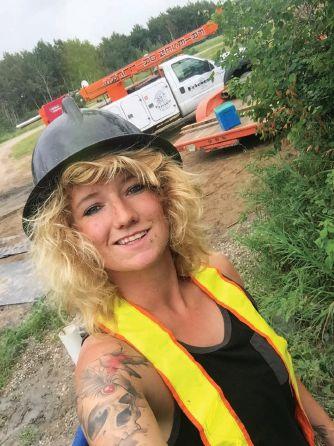
It’s great to see a successful family business operated with pride. I knew that was the case when I read Lisa McLeod’s nomination of her husband, Jason.
“He has worked hard to build an excellent reputation for himself as “an honest, fair and a very skilled driller,” writes his business partner and office administrator.
McLeod, 39, has been president of McLeod Water Wells based in Strathroy, Ont., for 12 years.
With Lisa, he operates the water well drilling business, which drills and services wells in southwestern Ontario.
“Customers and associates call him “The Well King” because of his success in finding water in some areas where it’s tough to find, she adds.
McLeod Water Wells has developed into a fleet of three drill rigs, two support trucks, pump service vehicles, mini-excavator and a team of 10 employees.
“He has built a successful company from the ground up and continues to
McLeod
grow with the industry, implementing new technology and drilling practices. He is liked and respected by both his employees and fellow contractors,” Lisa writes.
McLeod graduated from the Drilling and Blasting program at Fleming College in 1998. With encouragement from family and friends, she says, he “took the leap of faith” in August 2006 and purchased a 1978 TH55 Ingersoll Rand drill rig and support truck from his uncle, Ralph McLeod, who drilled in nearby Ingersoll until retiring a few years ago and still lends his support to the business.
McLeod remembers his first exposure to water well drilling as a young teenager, watching his uncle drill a well.
“I like working with my hands, I like working outdoors. What I like about this job is that you never know what to expect.”
They do a variety of jobs, including lots of irrigation wells, he says.
McLeod, who has been an active member of his association for 11 years, appreciates the opportunity to learn every day. “I try to learn something from everyone I meet. Everyone has
Continued on page 24
Jason
That's
Fiable. lrreprochable. Durable.™
PITFALLS AND BEST PRACTICES
Prevention and health and safety management
The weather — that favourite Canadian conversation topic — is more than idle chatter when you work outside 12 months of the year. Whether it’s January’s arctic chill or July’s scorching heat, blizzard conditions or torrential downpours, weather-related hazards are common issues.
by CAROLYN CAMILLERI
RIGHT: “You have to have a health and safety program that reflects the type of work you do,” says Paul Casey, vice-president of programs and strategic development for Ontario’s Infrastructure Health and Safety Association (IHSA).
“In the winter time, there is the potential for more physical hazards to occur, like slips and falls,” says Ellaline Davies, president of Safety Works Consulting, which provides customized safety training for companies and often works directly with the Ontario Ground Water Association. “In the summer time, heat stress is a big one — not heat stroke but heat stress — so making sure people are hydrated appropriately is important.”
While ensuring workers are adequately dressed to prevent frostbite is critical in the winter, Davies says, on hot summer days, it’s more about ensuring workers stay dressed. Dispensing with layers of clothing and personal protection equipment can be very tempting as temperatures rise.
Other nature-related safety issues arise when accessing drilling sites and dealing with varying terrain, especially during rig setup. Moreover, well workers often work alone in remote, rugged areas.
“If you are going into a remote area, do make sure either the homeowner is there or, if it is a project for a consultant, they have someone there,” Davies says, emphasizing that the worker or property owner must also have some reliable method of communicating with the outside world in case of an emergency.
With respect to rig equipment, preventive maintenance is key to avoiding problems.
“Don’t wait for something to go wrong on the rig before you do something about it,” Davies says. “And don’t ignore things like fluid drips or
SAFETY
COR certification provides companies with a process for evaluation.
“Evaluation means you review to see if it’s being implemented correctly, and you make sure that it does get the desired outcome, meaning the hazard has been controlled,” Casey says.
When something doesn’t work as it should or leads to an issue, COR-certified companies follow an assessment process, which leads to corrective action and creates the opportunity for improvement in the future.
“If nothing else, the company has the confidence their program is being applied regularly, because they evaluate themselves,” Casey says. “Without that, a lot of organizations, a lot of people, have the assumption things are safe, because events aren’t happening. People aren’t getting injured. Equipment’s not being damaged. But you really don’t know until you evaluate and assess. Is it being applied? Is it appropriate to start with? Is it making a difference? And how do we improve upon it?”
“COR confirms the system is aligned to the work
In winter, there is the potential for more physical hazards to occur, says Ellaline Davies, president of Safety Works Consulting.
Award-Winning Awawarard rd rd-d-WiWininninnni n nin in ing ng
d T h l
Pa Patateteenntentteed Teechecchnchhno no nololologloogy gy
hazards and controls necessary for the type of work you’re doing,” Casey says. “The majority of it is knowledge that your controls are sufficient to support the work you’re doing and allow your people to be safe in their daily activities — and that’s the bottom line. Continuous evaluation and continuous improvement allows you to be confident that you’re meeting any new challenges that come up.”
While COR is national, it is administered provincially — and is relatively new in Ontario and eastern provinces.
“The majority of participants today are in the construction field, but we do have a large number of electrical utilities involved, and we do have a large number of transportation companies participating,” Casey says, adding that some very large construction projects have started requiring larger subcontractors to be COR-certified on a threshold basis.
In Alberta, COR is not a requirement but there are incentives and rebates offered through WCB. A key incentive is being able to work with some of the larger companies.
“COR has been around since the early ’90s in Alberta, and what has happened is that a number of larger companies are involved in COR, and, for them, when they are hiring other companies, they look for companies that have COR,” says Tammy Hawkins, chief operations officer for the Alberta Construction Safety Association (CSA).
Hawkins estimates that 10 per cent of companies in Alberta
are COR-certified, but in construction specifically, that represents about 55 per cent of construction payrolls.
“There are 13 different [COR] certifying partners in Alberta, and we certify half of the CORs in the province,” Hawkins says.
Which certifying partner you want depends your WCB industry code. Well drillers may be included with oil and gas well drillers under Energy Safety Canada — also known as Enform. At Enform, COR is organized by company size, with COR for companies with 20-plus employees, MECOR for companies with 10 to 19 employees, and SECOR for companies with fewer than 11 employees.
“Most companies manage their financial assets. They manage their cash flows. They manage all of those things and, for some reason, safety becomes a compliance focus,” Casey says, adding that the IHSA itself is COR-certified, a process that involved redesigning its own program and re-educating its staff.
“In a health and safety management system, you can’t just focus on, ‘What do I have to do to be legally compliant?’ In a system, you have to say, ‘What do I have to do to be confident my employees are doing the work appropriately and will be able to go home safely at the end of the day?’ ”
Carolyn Camilleri is a Toronto-based writer, editor, and content strategist. She has been writing for consumer and trade magazines, as well as businesses and organizations, for more than 15 years.
CHAMPION OF THE DRILLERS
Lewis Hopper advocated for aquifers and drillers
Not many people can say they have drilled in every province in Canada over more than 70 years, yet that was the case with Lewis Hopper.
by COLLEEN CROSS
government
The longtime well driller and government liaison to the drilling community died in Brandon, Man., on July 4 at the age of 89 after a courageous battle with cancer and a remarkable life and career.
Hopper began his water well drilling career in the 1945 in New Brunswick, and worked in Nova Scotia, Prince Edward Island and Quebec, before joining International Water Supply in Saskatoon from 1959 to 1975.
He worked for the Manitoba government for 23 years – first for the Manitoba Ground Water Section out of Winnipeg from 1975 to 1989, then in the provincial lab in 1989, and finally for the Manitoba Water Services Board in Brandon.
From 1998 to 2017 he consulted independently as Hopper’s Well Service Ltd.
That is an outline of his career, but there is a richer story to tell. Lewis Hopper did a lot for Manitoba, said friend and associate Ryan Rempel, formerly of Friesen Drillers Ltd., who worked with him for some 35 years beginning in the 1970s. “In its infancy the MWRB was a busy and energetic place and Lewis was a big part of it,” wrote Rempel in an email.
“He was hired in part to be a liaison between the department and the drillers. Well, he was that and much more. He was a mentor to many of the drillers, a troubleshooter (and a troublemaker at times to some), a driller, a pump installer. You name it, Lewis did it all.”
In his memorial tribute, his friend Les Connor, former owner of Paddock Drilling in Brandon, Man., described some of Hopper’s
most significant contributions to the industry. “One of the common problems at the time, was that because of the limitations of older well drilling methods – there were many wells that were producing sand with the water. . . . . Along with Lewis’ colleague at Water Resources, Arne Pedersen, a standardized method of well construction was developed to drill sand-free wells. It was Lewis’ challenge to convince the well drillers that this new method worked, show them how it worked, and that they could make money with it. It was a success, and over a few years most of the sand-producing wells were repaired or replaced. The technique became standard practice, and is still standard practice, for well construction today. Tens of thousands of Manitoba residents that rely on wells for their
RIGHT: Longtime well driller and
liaison to the drilling community Lewis Hopper had a remarkable life and career.
PROFILE
water supply continue to benefit from this work to this day.”
Hopper was an innovator who was instrumental in solving many well drilling and maintenance problems, Connor said in his tribute. “He made up a variety of tools and equipment such as fishing tools for retrieving items dropped down or stuck in wells, frostfree packers, flow through packers, sand feeders, jetting tools, frost-free hydrants, cutters and scrapers for cleaning wells, and tested many of the recommended well cleaning chemicals that were available at the time. Many of these inventions, tools, and techniques have become standard operating procedure and are in use today by well drillers in this province and beyond.”
Kim Poppel worked with Hopper in later years. Poppel closed wells for Manitoba’s water authority, sealed abandoned wells and cleaned reservoirs.
“I told Lewis, ‘You’re full of stories. Write this stuff down.’ ” Together they did just that, exchanging pages and getting down details of his life, career highlights and opinions informed by years in the field. Les Connor and Ryan Rempel reviewed the memoirs.
“Initially, there was a lot more steam,” Poppel said with a laugh. “But we left in just enough crotchety.”
Hopper was pleased to have finished the writing project. “Kim encouraged me to put something down on paper,” Hopper said in an interview with Ground Water Canada in June. “She did a great job getting it down.”
Although Hopper first harboured doubts about working for the government through the Manitoba Water Services Board, it was a career move that brought him a lot of satisfaction.
“I was not impressed with going with the government back in 1975, but I promised my brother on his deathbed that I would apply for it and I got the job,” he said during our interview. “But, you know, it was one of the best things that ever could have happened. These Manitoba well drillers were just the greatest guys to work with you could get.”
He was not shy to question government authorities on matters of drilling and water quality, and encouraged other drillers to do the same.
“Don’t ever think you are below anyone; engineers got their education studying what the working class learned and gave away. Someone was then smart enough to get it down on paper so it could be studied to become an engineer!”
Despite his awareness of two camps, Hopper said he learned a lot from engineers.
“We have some good engineers. They had to be good to put up with me,” he said with a laugh. “If I didn’t like something I said so. I didn’t back up when I thought I should go ahead.”
One engineer Hopper admired for his humility was Arnold Pederson. “Arnold was down as low as anyone could go to work with drillers,” he said.
His rapport with drillers sometimes gave the board cause for concern. “I had one of my bosses tell me I couldn’t be doing a very good job because the drillers thought I was OK. I said, ‘If you can’t work with them and have them on your side, you can’t do a proper job.’ ”
Hopper clearly had drillers – and everyone – on his side, and the evidence came in the form of a restored 1942 Studebaker pickup a group of his government colleagues, well drillers and suppliers presented him at his retirement picnic.
“Needless to say, both my wife, Joyce, and I were in shock and disbelief,” the newly retired driller wrote in his memoirs, “and as some of the drillers said, ‘Hopper was speechless.’ ”
The Hoppers, who have four children – Rick, Bernard, Scott and Maureen – since the mid-1990s, have made their home in a small community in a glacial moraine, at the base of a hollow overlooking Manitoba’s Lake Clementi.
These words from Ryan Rempel seem to sum up the feelings of Hopper’s friends and colleagues: “The preservation of the aquifers and ground water and the preservation of the drilling trade and its drillers were two of his passions. He did a lot for both. There is a big hole in the ground water industry. RIP, Lewis.”
For more on Lewis Hopper, and a link to his memoirs, visit groundwatercanada.com > Drilling
COVER STORY
Continued from page 14
something to offer,” he says. “So if I do a task or technique, it’s not just me doing it but me fitting what I’ve learned from others into what I do. It really is.”
When not working he enjoys moose hunting near Thunder Bay and, closer to home, fishing. In fact, short on free time, he built and stocked a pond in the backyard to enjoy the hobby.
LEADERS
The couple have three children: Tyler, 10, Adam, 9, and Chelsey, 5. The older boys have shown interest in the family business: Adam helps around the shop, and Tyler for his 10th birthday asked to go drilling with his dad. “We brought him in just before we expected to hit water,” McLeod says.
“I’m always excited when we hit water,” he says. “I could do this 100 times and it’s still always a thrill.”
• Accuracy in overburden
• Better performance in tough overburden conditions
• Allows better sampling
• Allows screen installations
• Facilitates the extraction of the casing
• Easy operation
• Allows cleanliness on sites
FOURTH-GENERATION DRILLER
Patrick Simonson, JH Simonson
Well Drilling Ltd., Centreville, N.B.
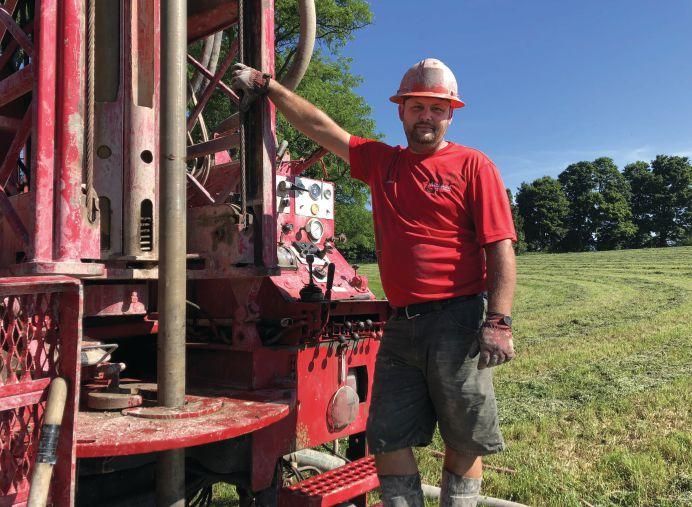
At 38, Patrick Simonson is a fourthgeneration water well driller for JH Simonson Well Drilling in Centreville, N.B., near the border with Maine.
The business was started in 1921 by his great-grandfather, Harry, and grandfather, Jack, and incorporated by his father, Jim, in 1983.
The youngest Simonson started helping out around age 12 or 13, but started working in the family’s business in earnest in his early twenties, when his father, looking to retire, needed a hand. Jim retired in 2003, and though he still occasionally pops by to observe local jobs, he is enjoying more leisurely pursuits of hunting and fishing.
He never worked with his grandfather, Jack, who was getting out of the business as the youngest Simonson was becoming interested in drilling.
It’s a small business, with just Simonson and one employee on staff. They serve customers from Grand Falls to Nackawic, drilling wells, selling pumps and offering UV light treatment. “We do everything,” he says, adding that about half the business is selling pumps.
“I like that the work is different every day: some days you drill half the day, then run the roads delivering pumps.”
Canada being the big country it is, Simonson has found the notion of offsite learning helpful. Years ago, after challenging the licensing exam and missing it by a question or two, he took the one- to two-year course remotely through Red Deer College in Alberta and passed. He found it a helpful experience, although “there was lots of stuff on the test that we don’t typically use like cable tools, mud rotary.” Because the ground in his region is bedrock, the company uses a IngersollRand T3W down-the-hole hammer.
If there’s aspect of the job that can be a challenge, it’s the sheer complexity of government regulations, he says.
“You know what you’re doing, and it’s sometimes hard having government standing over your shoulder.”
He and his wife Brandie have two young boys, Jack, 7, and Emmett,
3. When he’s not watching Jack play baseball, Simonson enjoys snowmobiling, four-wheeling and fishing out of the river that runs along the back of their property, a tributary to the St. John River.
The Simonsons believe it’s important to do their part for the industry. Jim was president of the Atlantic Water Well Association for several years, and Patrick is looking forward to the convention in Truro in September. He finds the meetings and shared information very helpful. “We’re remote. They give us prices, tell us about new plumbing codes coming in. They keep us well up to date.”
All in all he likes the work. “You have to work hard, try to keep everyone happy, because bad news travels fast,” he says. But it’s satisfying when he can help out a customer. “Some people are very grateful and will like you for the rest of your life for giving them water.”
READY FOR ANYTHING
Patrick Houle, Houle Well Drilling, Noelville, Ont.
Pat Houle, 27, has been a driller and installer with the family business, Houle Well Drilling in Noelville, Ont., for seven years.
Started by Houle’s grandfather, Omer Houle, in 1961, the business has served the French River, Parry Sound, Sudbury, North Bay and surrounding area for more than 50 years.
Pat Houle worked summers as a teenager for his dad and grandpa,
beginning with handing them tools. I didn’t set out to be in well drilling, but it just grew on me.”
His first idea was to be an engineer, but after two years of university and the realization his chosen field might not allow him to work outdoors as much as he’d like, he told his dad he’d like to join the family business.
He began by learning on the job by trial and error, then took the two-week course through Fleming College to on the road to becoming licensed.
He’s never looked back. They do
1
2
3
Patrick Simonson
COVER STORY
a little of everything – drilling new wells, servicing existing wells, pump sales – mostly on the residential side, he says.
Houle says he likes how happy customers are when they learn they have good water. “People take it for granted,” he says. “I would say at least 50 per cent of my job involves
educating the public.”
On one of his more memorable jobs, he recalls telling a well owner their well was good and they’d no longer have to bring in pails of water from a relative down the road. “That felt good,” he says.
“Pat is a great example of caring for the industry and customer,” said Craig Morgan, Rideau Pipe, who nominated him.
What Houle finds challenging about the job is also what he likes best about it. “It’s a double-edged sword. You have to be ready for anything. You could drill 100 wells and they won’t be the same. So much has to do with how the formations change.”
If you don’t like solving problems, it’s not a great choice of career, he says. “It’s hard work, with long hours, but it’s worthwhile.”
Houle is in the process of taking over the business from his father, Richard, who is still in on hand in the field to offer advice. “He has all but retired. He’d like to be fully retired,” his son says with a chuckle. His mother, JoAnne, works in the office. It’s a small business – four employees in all.
When not working, he enjoys outdoors pursuits including hunting, fishing and, during the long winters in northern Ontario, snowmobiling and ice fishing.
REMOTE CHALLENGES
Thomas Williams, Red Williams Drilling Ltd., Parksville, B.C. Thomas Williams, 34, is operations manager for Red Williams Drilling, the namesake company owned by his father. Officially, Williams started drilling in 2003; unofficially, he’s been in the business most of his life.
Williams the younger didn’t always want to be a driller. He had studied at Malaspina University-College to be an auto mechanic when he decided to shift gears and join the family business. He likes the work, he says, adding that there is enough mechanical and maintenance work attached to water well drilling to satisfy his interest in all things mechanical.
Most of the company’s jobs fall within 300 kilometres of the shop in Parksville, including Qualicum Beach. They do work related to fish farms, commercial and residential irrigation, water treatment, fusion HDPE, water delivery and pump service and repair. About 20 staff carry them through their busy season, including two pump crews, two drill crews.
Williams works in the oil patch during the winter and he enjoys the change of scenery. He recently spent four months in Norman Wells, N.W.T., working for ConocoPhillips. Among other things, he took samples and checked that fracking wasn’t affecting
Patrick Houle
the ground water.
He also enjoys the chance to meet drillers from across the country, noting he recently got to know some drillers from Newfoundland.
Working along the southwest coast of British Columbia in itself provides a lot of diverse working conditions. “It’s something different every day,” he says.
He recalls an interesting job he worked on recently drilling geothermal wells – one 600 feet, another 400 feet – into a mine shaft for Vancouver International College. They used a 150-horsepower pump, and he was looking forward to being on hand for the firing up at the end of August. “It’s a unique project,” says Williams, who had done roughly one dozen geothermal jobs before tackling this one.
Drilling is a demanding job with long hours and seasonal work, says the young driller, whose favourite aspect of the job is working in challenging conditions in locations that are hard to get to. For that purpose, they have a smaller, limitedaccess rig that drills about five feet at a time as opposed to the 20 feet a larger rig would typically drill.
He is going to Nimmo Bay this fall to complete one such job. The resort on Mount Waddington will be changing its water source from surface water to ground water, a process he expects to take about a week. He flew up earlier this summer – and back again the
same day – to size up the location and requirements.
Well owners have been generally slow to register their water wells, as required by the relatively new ground water regulation. Although as a driller he is not involved in the licensing process, he is on the ground educating people on well registration requirements and often helps walk well owners through the process. Registration is “not the most straightforward,” he says.
THE PROBLEM SOLVER
Kamal Singh, NCS Fluid Handling Systems, Surrey, B.C.
Kamal Singh has worked for 25 years on commercial and industrial projects involving specialty water and fluid pumping – all of them related to ground water. This is an amazing fact in light of his age.
Singh has been vice-president of design and engineering at NCS Fluid Handling Systems for nearly three years. He has expertise in system rentals, sales and service of industrial pumps, hydraulic calculation, system design, risk mitigation, environmental disaster response, and mechanical troubleshooting, writes NCS president and CEO Owen Gilbert, who nominated Singh for the Top 10, adding that he’s worked in the oil sands in northern Canada, the construction market on the Pacific coastline and the northwestern U.S., and the mining industry in central Canada.
“Kamal has proven to be a resourceful, strategic and confident leader with strong planning and organizational skills,” Gilbert writes. “Years of operational knowledge have contributed to a well-developed problem-solving skillset that incorporates an engineered approach in combination with a people-oriented management style.”
Singh has a bachelor’s degree in
Thomas Williams
COVER STORY
mechanical engineering, a master’s of business administration, his Association of Engineers and Geoscientists of British Columbia designation, and his Green Belt Certification in the Six Sigma program at the University of Michigan. But it’s his practical experience and analytical approach to real-world situations that distinguishes him.
Singh, who was born in Delhi, India, but moved as a child moved with his family to British Columbia, learned about pumps from his father, who manufactured positive displacement pumps and filters for companies that produce edible oils.
Engineering degree in hand, he went to England to work for ITT Corporation on retrofit ballast pumps in First and Second World War ships. Singh was sent into the ballast – “the dungeon” – with measurements and drawings to try to retrofit the pump to the original specifications.
His career was off to a flying, or floating, start. From there he took a position in Winnipeg. “I started off in ITT’s ground water division in Winnipeg, which was basically ground water control and sewer bypasses.” He grew the division, in a region that stretched from Thunder Bay, Ont., to Saskatchewan.
On first venturing into sales, he
wasn’t sure it was for him, but it’s worked out well as he is called in on more complicated jobs where an engineered solution was required. He enjoys coming up with customized solutions to solve clients’ problems.
“To get into this industry, just answer your phone. Somebody has a problem –and if you can put your head into it and find a solution, you are it,” he says.
As for memorable days on the job, Singh has a doozy. In 2009, he and the NCS team were asked by Hollywood moviemakers to stage a scene in the movie Marmaduke in which Los Angeles is flooded and the Great Dane is involved in a rescue. Filmmakers wanted to shoot realistic special effects, so Singh and his team created an artificial pool using 1100-horsepower pumps.
The next day he was called back to help solve a problem: they needed the water warmed to the temperature of 15 degrees required by the insurance company for the dogs’ health. They brought in a heater, emptied the pool, heated the water, and refilled the pool. They were then asked to create turbulence. Stability balls at his gym provided the inspiration for Singh’s
solution of securing these balls to the bottom of the pool using a net.
When his mind is not on pumps, Singh enjoys skiing and collecting vintage cars like the 1965 AMC Cobra. He and wife Jasmit, who met at the University of British Columbia, have a young son.
He likes the feeling when you sort out a problem. “It feels amazing when you’ve sorted out something for a client that no one else wanted to touch. We try to test the limits of engineering. People think they have the solution, but we take the butterflies out of the stomach. That’s our job.”
Kamal Singh
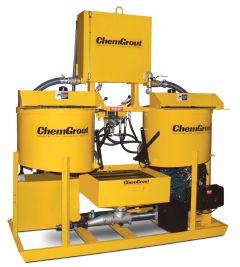
GROUT PUMPS HANDLE VARIETY OF MATERIALS
ChemGrout’s Geotech Series grout pumps handle a wide variety of materials, including neat cement, high ratio sand/ cement, bentonites and nonshrink grout.
Models include the CG-500/031/DH/GT diesel/hydraulic powered, the CG-550/031/GH/GT gas/ hydraulic powered, and the CG-555/031/GH/GT gas/ hydraulic powered.
The pumps’ large-capacity mix tanks and holding hopper provide continuous pumping, increasing productivity and reducing line blockage, ChemGrout said in a press release.
The series features the company’s three-inch piston pump
designed for fast, trouble-free operation.
Conveniently located variable speed controls allow a single operator to quickly mix and pump batches.
Users can match grout plant to job size with their choice of single or double 70-gallon mix tanks.
The company’s Geotech series features specially designed blades and baffles that develop a high shearing action, to provide rapid and thorough mixing.
There is an optional trailer package available for single mix tank design.
Applications include soil and rock grouting, void filling, soil anchors, contact grouting, rock bolts, self-levelling, slab undersealing, well casings, encasements, post tensioning, abandoned shafts and geothermal. chemgrout.com
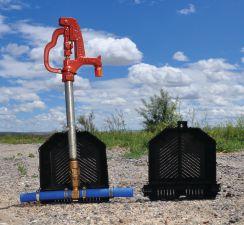
DAVIS UHB’S LIGHTWEIGHT UNIVERSAL HYDRANT BOOT PUTS SAFETY FIRST
Ability Pump & Equipment of Calgary is the first Canadian
NEW PRODUCTS
supplier of the Universal Hydrant Boot, manufactured by Davis UHB. The Boot is designed to be installed on the bottom of a yard hydrant, eliminating the need to use gravel to install a yard hydrant.
“This is very handy, as with it, you can basically not install a yard hydrant wrong,” said Brian Reierson of Ability Pump in an email. “Also, the big safety feature of it is that you can do everything above ground. There is no longer a need to get down in the 10-foot deep trench to install the hydrant and risk a collapse.”
The Universal Hydrant Boot (UHB) allows free drainage without contamination. It will allow the water to drain away from the pipe and leach naturally, thus preventing premature and costly replacement. The leaching ability is equivalent to approximately 9 sq. ft. of washed gravel that is 6” deep. The UHB is made for many different soil types and various conditions, said a press release.
New installation no longer requires a person to be in the
trench preventing and eliminating the risk of injury or death, should the trench walls fail. The installation is no longer time consuming or labour intensive and, most importantly, no longer a safety hazard.
The UHB will fit all standard size hydrants. It is attached to the hydrant bottom to protect the valve from all sediment and allow the hydrant to drain quickly and efficiently. This simple and patented two-piece device can be installed after the waterline is secured to the fitting.
The operation – quick and safe assembly above ground, followed by lowering into the trench and backfilling without gravel – drastically reduces the time in the trench when replacing old hydrants. abilitypump.com
AD INDEX
Handling customer information
Compliance, transparency and communication are ke y
by Marc Gordon
Do you collect information from your customers? Are you concerned about how to handle that data?
A 2018 study by the Canadian Marketing Association found that 40 per cent of Canadians are willing to share their personal data in exchange for benefits such as free products, improved service and tailored offers.
However, 77 per cent of Canadians have some concern about their online privacy, specifically the sharing of personal data.
This could be interpreted to mean that if you can make people confident in how you collect and manage their personal data, they will be more likely to want to share it.
Here are five ways to collect and manage your customers’ information responsibly.
BE COMPLIANT
Beyond local and federal laws, many industries have their own codes of conduct regarding customer data. These can cover everything from how data is collected to what incentives can be offered in return for sharing such data. This should be your starting point when creating a data collection program. [Editor’s note: For information on Canada’s anti-spam legislation, visit the Government of Canada website, Fightspam.gc.ca.]
GATHER ONLY WHAT YOU NEED
The more information you ask from customers, the less likely they are to give it to you. Also, more information means more resources needed to manage it. So focus on exactly what data you need, why you need it, and how it will be used.
STORE THE INFORMATION SECURELY
While it can be argued that no data is truly safe, you can still reduce the chances of it being hacked. Start with an established, offsite data management company. Not only will it be automatically backed up and physically safe from theft, but many security features come standard.
According to the Canadian Marketing Association, 77 per cent of Canadians have some concern about their online privacy, specifically the sharing of personal data.
It will also reduce your liability should things get compromised.
HAVE INTERNAL POLICIES AND GUIDELINES
The weakest link in any security system is the human one. Beyond making sure you control who has access to the data, it is also important to establish clear policies and guidelines. This will ensure the data is used in accordance with local laws while encompassing corporate and social responsibility. Sharing these policies with the public is an important part of building trust.
BE TRANSPARENT
People don’t mind sharing personal data if they feel doing so will benefit them. So let them know what the deal is. What will it be used for? Will it be shared? What will the customer get out of it? Can they have the data removed if they wish? These are all questions whose answers should be honest and accessible.
Marc Gordon is a recognized marketing expert, speaker and strategist. His articles appear in over 200 publications worldwide. Visit marcgordon.ca for more business tips.
In 1937, Berkeley® pumps were first used to irrigate the fertile fields of the San Joaquin Valley of Central California. Today, Berkeley continues its tradition of uncompromised quality and proven reliability, addressing the most challenging water transfer and residential water needs with the most comprehensive product lines available.