Now there’s a permanent name for portable power: Doosan. Formerly a division of Ingersoll Rand, we’re the product that construction and mining companies worldwide have relied upon for 140 years. Known for innovative solutions and extraordinary service, we’re the same superior product as always. The only change is the name.
Annex Publishing & Printing Inc. P.O. Box 530, Simcoe, Ontario N3Y 4N5 (800) 265-2827 or (519) 429-3966 Fax: (519) 429-3094
Editor | Laura Aiken laiken@annexweb.com (416) 522-1595
Occasionally, Ground Water Canada will mail information on behalf of industry-related groups whose products and services we believe may be of interest to you. If you prefer not to receive this information, please contact our circulation department in any of the four ways listed above.
Serving the Canadian ground water industry for 38 years.
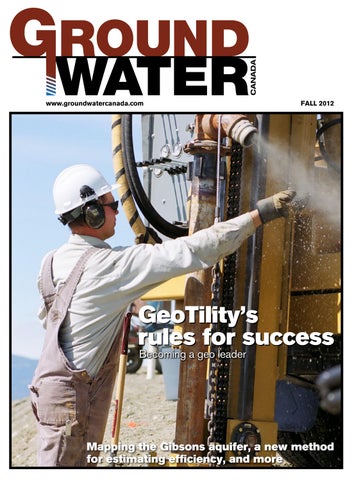
8 gEotility’s rulE s for succE ss
How one geothermal company is finding success in the West.
14 a proactivE protEction plan
Mapping the future of water for Gibsons, B.C.
16 sElEcting your suppliEs
Handy tips for choosing the right grout for your next geothermal job.
18 tiME-saving tEchniquEs Putting a database to work for you.
20 Moor E wE ll drilling: 67 yEars young
A trip through nearly seven decades of drilling on the East Coast.
ON THE WEB:
Beverage companies investing millions to conserve ground water
The Dr Pepper Snapple Group and other major players in the beverage business are investing millions of dollars to protect their number one ingredient.
www.groundwatercanada.com
Are volcanoes a new source of geothermal energy? Scientists are testing the idea of pumping water into the sides of a dormant volcano in Oregon at pressures great enough to evoke small earthquakes because there is great potential for geothermal energy, according to energydigital.com.
Rules and regs
New geothermal rules for Ontario put the spotlight on changes to come
by Laura Aiken
april 20 will go down in history as the day that changed the geothermal industry in Ontario forever. It took only one contractor in Oakville, who struck a boatload of pressurized natural gas while drilling a borehole for a vertical geothermal heating system, to usher in that change. Thankfully, no one was hurt, but the potential for stratospheric danger was there. Rob Burton, Oakville’s mayor, called for an immediate moratorium on geothermal drilling in the province until the rules were rewritten to better protect public safety. He pretty much got his wish with a government reaction so kneejerked the MOE may have kicked itself in the head. It swiftly slapped a new regulation in place that, basically, called for a bunch more consultation and prior planning before a geothermal drilling project could get underway. Nothing lights a fire under the Canadian government like the thought of blood on its hands, and rightfully so.
Nothing lights a fire under the Canadian government like the thought of blood on its hands, and rightfully so.
It’s too bad for the geothermal industry that the hastily implemented Regulation O.98/12 happened as opposed to a more thoughtfully drawn up amendment to Regulation 903. The Canadian GeoExchange Coalition (CGC) outlined in a press release the many layoffs that have happened as a result. The industry was ground to a halt by the need for a 45-day minimum posting for environmental compliance approval. The CGC proposed that drillers be able to continue with the well-established safety guidelines they have until a new regulation can be hammered out fairly and with more public consultation but the wish wasn’t granted. If balls had rolled more quickly on amending Reg 903 in the first place, as the ground water industry has long been calling for, the geo industry would have had more time to transition smoothly into new requirements. This situation hasn’t hurt the geo folks alone,
for people can be one and the same. It hurts water well drillers who are earning money and keeping their staff busy with geothermal installations too.
The issue of licensing is still the nut of what the ground water industry has been calling for. There is a notion of fairness in requiring licences for all those who drill into the ground that will be difficult to dispel or, conversely, meet, as there is another view that a licence is an onerous burden when the holes being drilled aren’t for the purposes of a product that leads directly back to the human mouth.
The regulation the government put forward is too cumbersome in places, too onerous, and places too much burden on the geothermal industry by requiring expensive consultations on already pricey projects for home owners. But it is a step towards what the water well industry is seeking and it’s important that these industries, different but similar, reach common goals and mutual understanding. That being said, the geo industry has paid a very high price with Reg O.98/12. I’d like to see them happy with a regulation that they are comfortable with. The MOE has promised to consult with industry stakeholders. It will be interesting to see what becomes of it all.
Change is the simultaneous birth and death of the way something is done. When it’s been slapped down in a political fever, chances are always high that it will cause a furor. In the end, strengthening regulation for the geothermal industry will help put more safeguards against dangerous accidents in place, and keep the public’s faith and goodwill high.
NEXT ISSUE: Hunker down in the cold weather with our upcoming winter edition. We’ll be focusing on drill rigs. Don’t miss it!
Case Study – Alaska Research Project
Grundfos Submersible Aids in Subglacial Hydrological and Glacier Outburst Flood Research
Glacier outbursts are expected to increase, possibly flooding communities living below, as glacier melt and thinning continues to increase during the summer melt season. Even though it is fairly understood how these outbursts occur and there have been model simulations developed to route the flood waters beneath the glacier ice, the models lack field observations from a drainage system standpoint.
Lemon Creek Glacier (LCG) located near Juneau, Alaska was selected by the University of Alberta to undergo field observations investigating the link between the development of the subglacial drainage system and the drainage of a lake at the glaciers surface (supraglacial). Ultimately the study will be the first to measure subglacial hydrological conditions at locations along the glacier length before, during and after a lake drainage event. The data collected will also be used to test and modify model simulations.
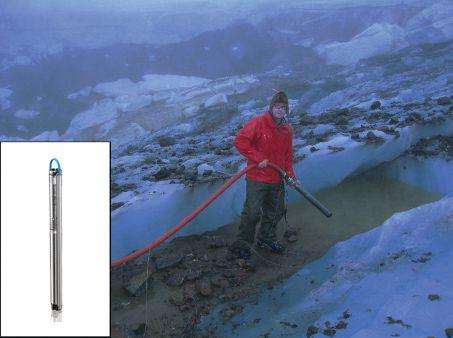
Field observations included drilling to LCG ice-bed using a hot-water drill and creating boreholes to perform pumping tests. In order to accomplish this a pump was required that was small enough in diameter to fit down a four inch hole, powerful enough to pump water from depths of 50 to 60 meters and light enough to install, uninstall and move. It also needed to run off a small gasoline generator, have variable pumping rate that could be controlled, all while meeting a small budget.
Arndt Motor and Pump recommended and supplied a Grundfos submersible pump 10SQE05-160 115V, with an integrated variable frequency drive (VFD) motor for nominal flow of 10 gpm and a CU 300 controller.
The SQE pump and CU 300 package was chosen for the following reasons:
• The SQE has a compact 3-inch design and is equipped with a Grundfos “smart motor” allowing electronic communication with the CU 300 and user. The motor and CU 300 enables variable speed control with the pumps performance being able to adapt to any specific requirement.
• The hydraulic pump design and permanent magnet rotor provides high efficiency resulting in low energy consumption and low energy cost
• The CU 300 communicates with the SQE by power line communication, meaning there are no extra cables required between the controller and the pump.
The only water source left after complete lake drainage.
• The SQE has overvoltage and undervoltage protection preventing damage to the motor if the voltage provided by an unstable voltage supply such as a generator happens to move outside the permissible voltage range.
• The SQE is protected against dry running, ensuring cutout of the pump in case of lack of water in the borehole, which will prevent the pump and motor from damage.
The University of Alberta was pleased to find out that the SQE pumping system was able to fulfill all of the requirements on their small budget. In June and July 2011 the University used the SQE to supply water from a nearby stream and lake to the hot-water drill. The SQE was temporarily installed, up to three or four days at a time, where three to six hour pumping tests were performed before the SQE was moved to other boreholes on LCG.
The field study was funded by National Geographic Society/ Waitt Institute, Canadian Circumpolar Institute, Geological Society of America, The Explorers Club, Arctic Institute of North America, American Alpine Club and Natural Science and Engineering Research Council of Canada. Results from the field study will allow for modifications to model simulations and further analysis.
Grundfos is the world’s largest manufacturer of pumps and pumping systems. Grundfos’ Canadian headquarters is located in Oakville, Ont. 1-800-644-9599, www.grundfos.ca
INDUSTRY NEWS
AroUND Th E wor LD
Here’s a look at what’s happening with ground water worldwide.
new York granted $11 million to protect ground water
New York governor Andrew Cuomo allowed $10.6 million in grants to help 159 farms in 27 counties protect New York’s lakes, streams and rivers from agricultural runoff. The funds were granted, after a competitive process, to county soil and water conservation districts to help preserve water quality in major watersheds throughout New York state.
students design ground water purifier
A group of college students in India have developed an affordable method of purifying ground water. The four students, in their final year of environmental engineering at Vidyavardhaka College of Engineering, have developed a technology to purify the ground water using polystyrene beads, aiming to reduce the high concentration of inorganic substances. The students noticed that this practice works with wastewater, and decided to give ground water a shot. Their efforts were recently recognized with Mahindra Reva Greenest Project Award.
scientists urge sustainable development of newfound aquifer
A vast aquifer recently found 300 metres beneath northern Namibia could contain enough drinking water to supply central-north Namibia for up to 400 years. Scientists are currently mapping the aquifer, estimating it covers 15,000 square kilometres. Christoph Lohe, a German hydrogeologist working on the project, says sustainable development is necessary. “The aquifer is fed from mountains in southern Angola. The system is thousands of years old. To keep it sustainable, we need to extract only as much water as is being recharged,” he told The Guardian Careless drilling could threaten the supply, which, he says, is a very rare discovery.
Great prospects for geothermal development in south America
Although South America contributes some of the lowest emissions in the world, many of its countries are global-warming targets, reports Power Engineering The continent’s population is expected to rise 72 per cent by 2035, and governments are reacting with developments in renewable energy. A report released by the Energy Sector Management Assistance Programme (ESMAP) states the range of geothermal capacity is broad, but exploratory drilling has been limited.
“Extrapolating from the experience in the U.S., where there has been a large amount of exploratory drilling, the potential of conventional geothermal resources in Latin America might be as much as 300 TWh per year,” it says. It notes that key spots are located along the Pacific Rim, which ranges from Mexico to Chile, and the Caribbean islands also have potential.
maryland ground water dated to two million years old
Recently published research gives evidence ofshows glaciers that melted more than two million years ago and deposited layers of sediment around what is now the Chesapeake Bay. In between those layers run underground rivers, with water flowing in that is tens of thousands to two million years old.
Heron Instruments moves sHop
Heron Instruments has moved into a new, larger premises in Dundas, Ont. The new location opened July 10. All e-mail addresses and Heron’s toll-free telephone number remain the same. The Depew, N.Y., location will remain the same. Heron’s new address is: Heron Instruments Inc. 447 Moxley Rd. S., RR 2 Dundas, ON L9H 5E2 • Phone: 905-628-4999
The Saskatchewan Watershed Authority’s 25-year water security plan aims to ensure sustainable water supply in the province.
Photo credit: Saskatchewan Watershed Authority
The Saskatchewan Watershed Authority has developed a new 25 Year Saskatchewan Water Security Plan, which will provide the direction and long-term perspective to guide water management while addressing challenges created by the growing province. The plan will increase Saskatchewan’s ability to protect water quality, maintain aquatic habitats and ensure sustainable water supplies to support growth.
In 2011, the government held a first round of consultations on a water strategy for the province. A total of 174 individuals, representing 92 organizations, participated in consultation sessions. Collectively, they indicated strong support for the development of a new plan. The consultation document is based on what was heard during those consultations.
The plan will take a long-term perspective and incorporate the ability to adapt and respond to change. The plan provides specific actions that are targeted for implementation within the next few years.
Assessment and reporting on progress will be undertaken annually, and new actions identified to ensure the water vision is achieved.
The document can be found online at www.swa.ca/25yearplan. Comments on the proposed vision can be submitted to the Saskatchewan Watershed Authority by e-mail: 25yearplan@swa.ca.
Ground WAter monItorInG beGIns At neW Wells
Kawartha Conservation in Ontario completed the installation of two ground water monitoring wells in Galway-Cavendish & Harvey in June, as part of the Provincial Groundwater Monitoring Network (PGMN), which includes more than 480 wells across southern Ontario.
One well is located in the headwaters of Nogies Creek, just north of Crystal Lake, and the other near the municipal administrative office. They were installed at these locations to provide information on the Precambrian and limestone bedrock aquifers in the area,
including their current state, and to help identify emerging water level and quality trends.
The information gathered will support municipal planning, water resource management, water taking decisions, drought assessment, and response in the event of a drought.
oNTAr I o g E oTh E rmAL r E g ULATI oN r E cEIvIN g m IXED r EvIEwS
A new Ontario regulation for geothermal drilling is aiming to provide more industry guidelines, but it has been met with mixed feelings from associations.
On April 20, a driller in Oakville, Ont., encountered natural gas while drilling a geothermal borehole, which resulted in the evacuation of at least one house. This incident triggered an outcry, with concerns expressed by many, including Oakville mayor Rob Burton.
As a result of the incident, the Ontario Ground Water Association (OGWA) in May asked the provincial government to modify the Ontario Water Resources Act, Regulation 903, to encompass the drilling of geothermal boreholes. Regulation 903 currently requires insurance coverage and ongoing technical training for licensing of water well drilling. There is no mandatory requirement in Ontario for a geothermal driller to have a well contractor or well technician licence.
“Unregulated geothermal drilling by untrained, and sometimes unlicensed and uninsured drillers has led to a number of serious problems, including flowing wells causing millions of dollars in damage, interference with neighbouring wells causing loss of potable water, and now this potentially explosive situation,” the OGWA said in a press release in May.
Instead, Ontario Regulation O.98/12 was adopted. The regulation requires drilling companies to apply for an environmental compliance approval (ECA) per the Environmental Protection Act. For the purpose of the Environmental Bill of Rights (EBR), ECAs are classified as Class II instruments and are subject to a minimum of 45 days posting on the Environmental Registry. As a result, as of June 19, there was to be no drilling for geothermal purposes in Ontario until at least the end of August.
The Canadian GeoExchange Coalition (CGC) was unhappy with the adoption of Regulation O.98/12 and in June wrote to Premier Dalton McGuinty asking for its immediate suspension. The CGC says the regulation is ill-conceived, hastily written, and hurts Ontario’s green energy industry and Ontario’s small business while unfairly targeting geothermal drilling. In a June press release, the
CGC said it had learned of more than 30 recent layoffs at drilling companies and is expecting additional layoffs for system designers and installers, as well as product manufacturers and distributors across the province. It has recommended that companies involved in geothermal drilling more systematically follow long-established safety guidelines used for comparable drilling activities within Ontario while more thorough and fair regulation is drafted and publicly consulted.
“The Ontario geothermal heat pump industry deserves a regulatory framework that is developed through proper consultation. The current improvised regulation is equivalent to a province-wide stop-work order for all geothermal drilling for an extended and unknown period of time for no valid technical, scientific reason,” said Denis Tanguay, president and CEO of the CGC in a press release.
The CGC is also highly concerned that in an already tight and difficult market, the regulation can create market imbalances among drilling companies where the strongest companies eliminate their competitors.
Craig Stainton, executive director of the OGWA, said while the association feels the process of immediately shutting down the geothermal industry may have been a knee-jerk reaction, there was danger involved. Stainton said the Ministry of the Environment has advised the association that there would be changes coming to Regulation O.98/12 and stakeholders will be involved in creating those changes.
“In certain areas we don’t feel O.98/12 goes quite far enough, in other areas we feel it’s a bit heavy handed. We find, to a certain extent, the 45-day posting on the [ECA] somewhat onerous,” Stainton said. However, Stainton said the government must be commended for the support provided to companies in complying with the new regulation. “The involved ministries were most co-operative and provided extremely well-rounded help to the individuals applying [for an ECA]. Everyone was given the opportunity for a dry run through of what was to be required and meetings were held to give people instructions on how to apply.”
Stainton said the OGWA looks forward to the further amending of Regulation O.98/12.
R ules fo R success
Being an early bird helped geotility earn its wings
Jim Leask got his start in heating and cooling in the early 1990s before turning his focus solely to geothermal in 1997. He was early in the game as far as strategic development of the industry goes in Canada. Natural Resources Canada commissioned Ground Source Heat Pump Market Development Strategy – Final Report by Marbek Resource Consultants in 1999.
by LAu RA Aike N
This report laid the groundwork for industry growth in Canada and paved the way for The Canadian GeoExchange Coalition’s formation in 2003. But information had been growing and been gathered for some time. For example, a research program assessing geothermal opportunities and resources in Canada ran from 1976 to 1986, reports the Centre for Energy.
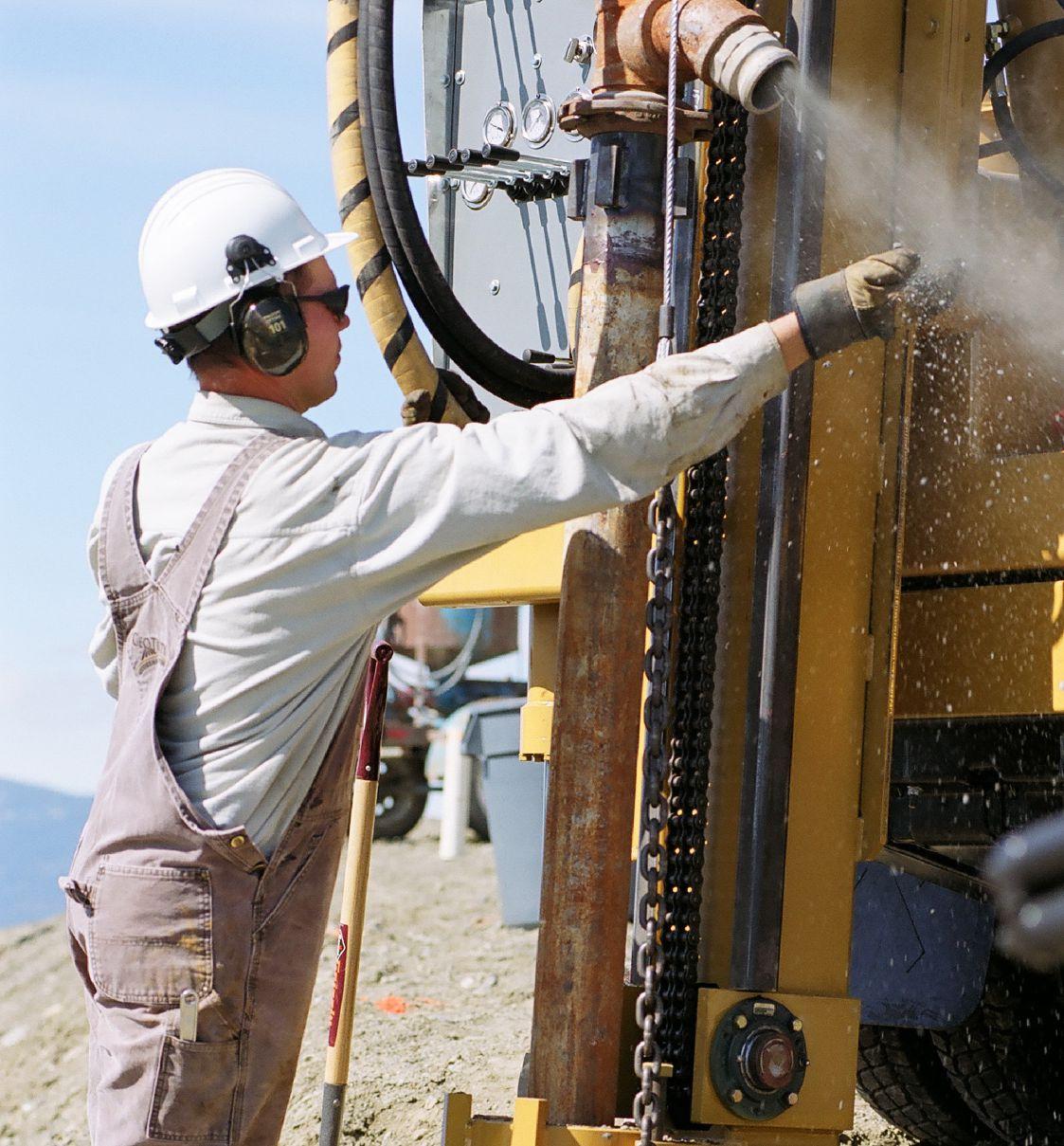
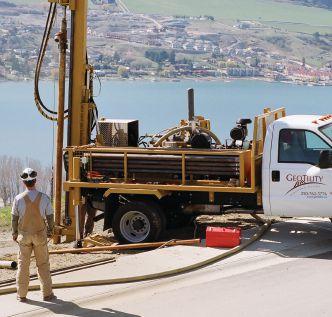
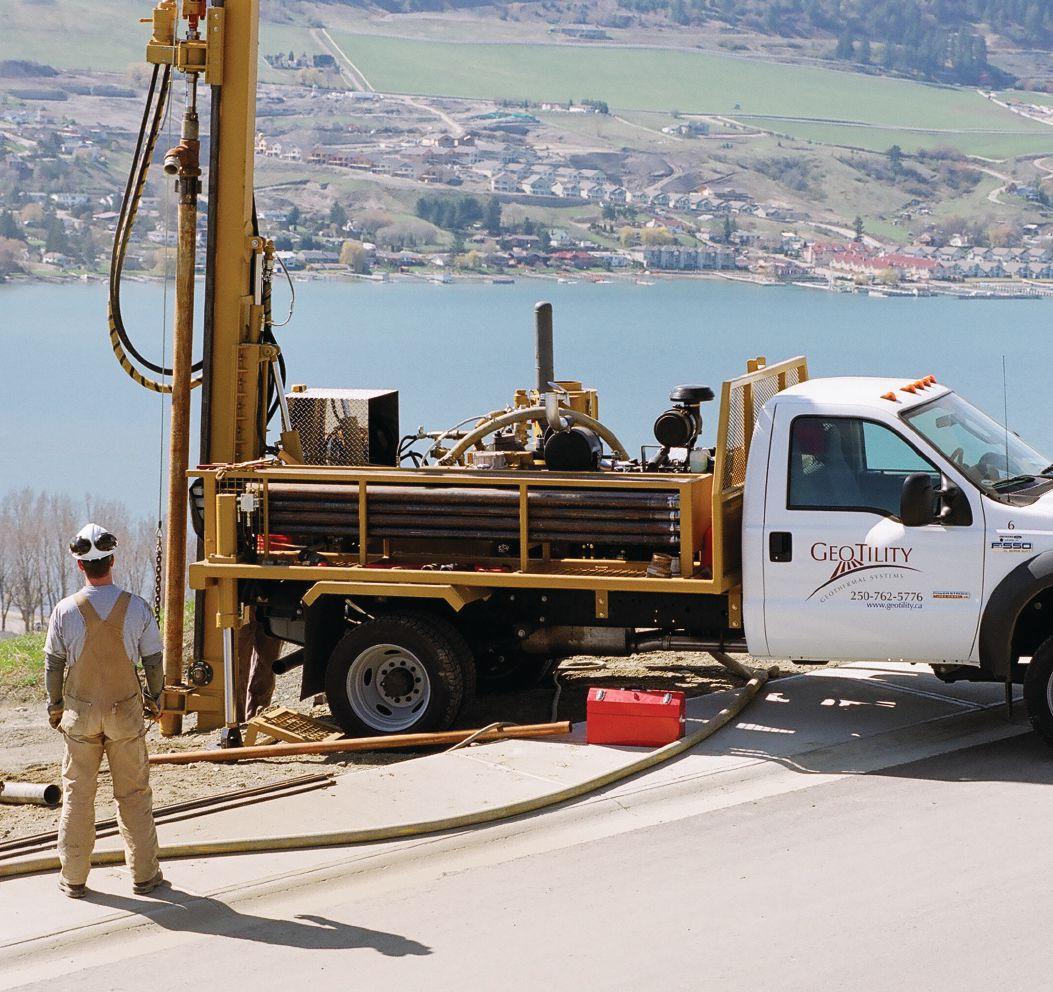
Today, his company, GeoTility Geothermal Installations, has eight rigs, about 60 people on staff, two Canadian offices and one in Washington state. Jobs have their staff roaming across Western Canada and the American Pacific Northwest. Though there are other shareholders now, Leask is still the president. GeoTility has dedicated itself to a leadership role in geothermal, serving on several boards and memberships: he is a past board member of the Earth Energy Society of Canada and Okanangan Chapter, B.C. Sustainable Energy Association; a board member of GeoExchangeBC, Okanagan Environmental Industry Alliance, Thompson Okanagan Branch – Cascadia Chapter of the Canada Green Building Council; and a member of the International Ground Source Heat Pump Association, Canadian GeoExchange Coalition and B.C. Ground Water Association.
Stuart Yanow, P. Eng., LEED, CGD, is vice-president of this geothermal company, which has done a great job at figuring
out how to make money and grow doing geothermal installations. Yanow worked in mechanical consulting and design, spending several years learning the geothermal industry and technology before joining GeoTility six and a half years ago.
Excluding the United States, Yanow says Geotility installs systems in about 25 to 50 homes per year and works on about 25 commercial projects, while noting that is a low estimate. Residential contracts make up about 25 per cent of its projects, says Yanow, who is seeing more and more utility companies going into the energy market and energy services departments pushing contracts to sell geothermal to school boards.
The Osoyoos Indian Band project is a particularly intriguing job. It’s the first geothermal district energy system to date for interior British Columbia. A district energy system centralizes heating or cooling for a community or commercial development. This system is being designed for the Senkulman Business Park, and will also service a new corrections facility being built. In all likelihood, the Vincor winery adjacent to this property will also hook up to the system, which will improve the efficiency, says Yanow.
“Vincor, a large industrial tenant, are going to connect their wastewater, opportunity to reclaim heat from the wastewater.”
Does Yanow see wastewater reclamation much in the geothermal industry?
“I don’t think there is much going on between two industries. There have been some projects though. I think it will be more common [in the future]. Everyone’s looking for places to reduce their carbon footprint so we’re going to see more wastewater treatment uses.”
The Osoyoos Indian Band project is a close-loop system featuring oneinch-diameter HDPE boreholes drilled about 145 feet deep.
“The band looked at open-loop system but they are new going into
the utility business. There is more potential for contamination or risk with an open-loop system, no maintenance with closed-loop.”
The design is meant to allow for growth as the development builds outward. GeoTility used a pair of supply and return HDPE piping, while each building will have its own connection to the district piping system and heat exchanger. Ten-inch HDPE mains will deliver the 20 per cent propylene glycol solution to each building.
The central pumping system uses top-of-the-line variable speed drives and a direct digital control (DDC)
system that allows for round-theclock monitoring of the system and a detailed analysis of energy performance. GeoTility is acting engineer of record, prime contractor and geothermal contractor on this project.
“What GeoTility offered was detailed financial modelling and rates of return. We were really an advisor on the financial side. We did the whole design and offered a turnkey project.”
Its ability to help the finances makes sense for a client is crucial in landing jobs for GeoTility. The geothermal market is extremely competitive these days, says Yanow. The economy is
GeoTility focuses on turnkey solutions for small and big jobs alike.
All photos courtesy of GeoTility
GeoTility has four divisions: engineering, drilling, heat pumps and service/maintenance.
chugging along but it’s not great and contractors aren’t making a ton of money. However, there’s more to making the sale than making the numbers add up.
“Drilling is an expensive hobby. You need to make money at it and it’s a tough market. We try to work with clients who value our expertise, pushing more towards negotiated work rather than projects coming out of a tender. The First Nations, they came to them directly, and then we were working with the client to provide the best value.”
Yanow says business savvy and experience is essential when it comes to drilling, especially on those multi-million dollar jobs. For the company to be sustainable, you’ve got to make money at it and be prepared for fixing or replacing your equipment. He also attributes Geotility’s success to its ability to weather the storms and ride out the slow times.
Since the Canadian federal government rebate for retrofitting homes with greener systems ended about six months ago, there has been little left in the way of rebates for customers hoping to install a geothermal system. The U.S. has many more incentives for commercial and residential developments to go the way of geothermal, mostly in the form of federal tax credits, says Yanow.
it’s the first geothermal district energy system to date for interior British Columbia.
While working with commerical and residential clients is different, Yanow says initial cost is still generally the first barrier. Over the years, he’s learned that clients have a different way of looking at the economics of the system. For example, a strip mall customer is looking at what it does for the value of the lease and what it will make the building worth, but not everyone will be looking at those factors.
It’s important to keep learning. Yanow says he’s still learning stuff every day.
“If you just start with one contract, do your first hone, then a second, some light residential and surround yourself with good people…Jim has always been really good at instilling integrity, determination and the highest standard, taking the high road, keeping our word.”
For Yanow, what keeps him excited about the geothermal industry is a mix of care for the environment and a renewable energy he can get behind pragmatically.
“I think for me it’s the only renewable source of energyefficient technology that’s out there that makes sense having, that’s a doable one with a palatable cost that makes financial sense in a relatively short term, probably the most practical.”
NEW P RODU cTS
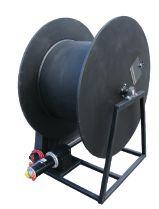
about 350 pounds, depending on size and additional options. The reel’s drum and chain guard are constructed of a special polyethylene that is fused together. The drum is mounted on a tubular steel frame. 1-800-263-5353
Reeling it in
The poly pipe reeler from Ability Pump & Equipment is a quick and sanitary way to pull a pump. By storing the pipe as it pulls it, it eliminates the need to lay the pipe on the ground. The reeler comes in two standard sizes, a 16-inchwide drum and a 24-inch-wide drum. It has the ability to pull 1,200 pounds at a speed of 40 to 45 feet per minute. The poly pipe reel weighs
i deal fo R salt studies
The TLC Meter provides accurate, stable conductivity and corresponding temperature measurements displayed on
a convenient rotating LCD display for easy viewing. The 19-millimetre diameter probe measures conductivity that has been standardized to 25 C. Conductivity measurements are read from 0-80,000 µS/ cm with readings giving accuracy of five per cent of reading or 100 µS (whichever is greater).
The TLC meter is ideal for saltwater intrusion investigations, tracer tests, road salt studies, and a general indication of contamination levels, which can provide early warnings of changes in water quality. www.solinst.com
Ze R o-lead b R ass tank tees
Merrill Manufacturing introduced an extended line of nolead brass tank tees, including one-inch and 1.25-inch
Tested Toughness.
tank connections, one-inch and three-quarter-inch lateral with male and/or female connections, half-inch and threequarter-inch drain holes, and one or two drain holes. www. merrillmfg.com
totally conve Rted
Aalborg‘s new TIO Totalizer converts analog mass flow meters and controllers into precision digital units. The TIO‘s compact size is designed for wall, panel, field, or unit mount applications. Aalborg
NEW P RODU cTS
configures the TIO input and output signals to your specific application. Changes can be easily made via a userfriendly menu. All process configuration parameters’ settings are password protected to prevent accidental or unauthorized changes. This model is equipped with two programmable optically isolated digital outputs and a user-programmable optically isolated pulse output with preset active low time interval. www.aalborg.com
new dRill bit design
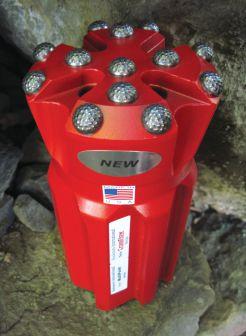
Rockmore International has a new drill bit design especially suited for hard rock quarry drilling.
The CrossFlow design is intended to provide more efficient rock cutting flushing in order to improve penetration rates and extend bit life. The flush holes are located within
newly designed flushing grooves that promote maximum flow of rock cuttings away from the bit face. These V-shaped flush grooves are much wider at the bit edge than conventional designs and greatly enhance the ability of the flushing medium to carry the larger rock chips away from the bit face and up towards the hole annulus. In addition, the rock chip velocity is reduced at the wider section of the flush groove at the bit edge, leading to a reduction of steel erosion on the body of the bit.
e xpanded line
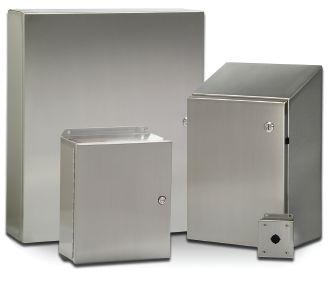
Hammond Manufacturing’s line of 316 stainless steel enclosures is expanding with a line of junction boxes, push -
button boxes, wallmount, floormount and freestanding enclosures. Compared to the more traditional 304 stainless steel, 316 stainless steel contains higher levels of chromium and the additional element molybdenum which make it the premium material for metal enclosure construction.
For more information, visit www.hammondmfg.com.
p R oactive p R otection
taking active steps to sustain a pristine aquifer
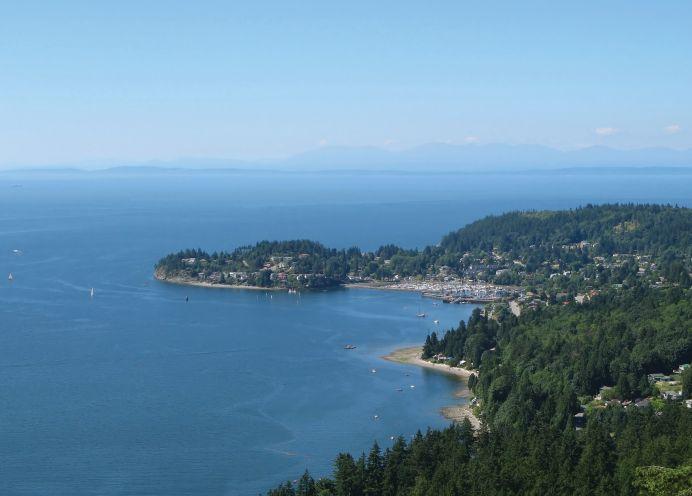
despite its small area and wee population of 4,400, the community of gibsons, B.c., has several claims to fame. located on the coast of British columbia’s mainland along the strait of georgia, the town is inaccessible by road from the rest of the lower Mainland.
by STefAN ie WALLAC e
Gibsons has been the setting of various movies, perhaps most notably the CBC television series The Beachcombers. In 2009, the town was declared the Most Liveable Community in the World at the international LivCom awards. But a major source of pride for the town is the confined aquifer that lies under it and its oh-so-pure water that’s not chemically treated.
The aquifer provides two-thirds of the Town of Gibsons’ water supply. In 2005, the town earned the title of best drinking water in the world at the Berkeley Spring International Water Tasting Contest, beating out more than 60 municipal entries from around the world. This raised awareness of the importance of the aquifer within the community.
“It’s a pristine aquifer source,” says Darren David, principal hydrogeologist at Waterline Resources. “I think the town is very proud of it.”
David is part of a team that’s undertaken an aquifer-mapping program project as part of the Town of Gibsons’ greater long-term initiative to protect its point of pride. The town’s proactive approach makes it unique. Usually projects like this aren’t undertaken until something catastrophic happens. David serves as Waterline’s project director, joining Sue Gordon, principal at Gordon Groundwater Consultancy, who was a project co-ordinator during Phase 1 and has taken the lead on the outreach component in Phase 2 (currently being completed). Dave Newman, the town representative and director of engineering at the Town of Gibsons, Shelley Bayne, senior hydrogeologist at Waterline Resources, and Jessica Doyle, masters of science student at the University
of British Columbia, also work with the team.
“Ultimately we’re looking to understand the sustainability of the supply for [what they call] the Gibson aquifer and essentially complete a water budget to assess the present and future demand and stress on the aquifer,” David says. “One of the key questions that we’re trying to answer for the town is if there’s sufficient water to supply the existing population.”
The community’s population is anticipated to eventually reach 10,000, so the team is also looking at whether or not there would be enough water to meet the demand of its future residents.
Planning for the program was a lengthy process. The first grant application took place in 2007, says Newman. In 2009, the town received a $400,000 provincial “Towns for Tomorrow” grant. The municipality then committed $100,000 and the project began that year.
Newman and Gordon consulted over proposals from 11 companies interested in the project with published criteria on which to base their recommendation to Gibsons’ council. Based on the recommendation from Newman and Gordon, Waterline Resources was selected by town council to develop the approach to map the aquifer in an area covering approximately five square kilometres. The study area extends from the Gibsons’ waterfront, north to the top of Mount Elphinstone, east to Gibson Creek and west to Chaster Creek, covering the entire Town of Gibsons and beyond town boundaries within the Sunshine Coast district. Existing geology and hydrogeology data, including surficial and bedrock geology maps, more than
100 water well logs from the provincial Ministry of Environment database, climate reports, and groundwater and surface water monitoring data, was entered into Waterline’s groundwater geodatabase and compiled into ArcGIS (geographic information system) format for presentation. That data was supplemented with a field portion, including surficial and bedrock geology mapping, creek surveys, hydraulic testing of wells, installation of data loggers, water quality sampling and ongoing long-term monitoring.
“Our role was to develop a conceptual model of the hydrogeology and to be able to understand the relationship between the aquifers and the creeks, as well as how the groundwater is being used.”
Phase 1 wrapped up in the summer of 2010 and the conceptual hydrogeological model was constructed.
“We now have much of the data in an electronic form, in various databases, which is being integrated on a GIS platform,” David says. Eventually, the town will be presented with ArcGIS files that can be incorporated into the town’s own database system. David says preliminary analyses led him to believe there is sufficient water for a larger community, but Phase 1 presented several data gaps with the conceptual model, which were addressed in Phase 2.
“The data related to the conceptual model is now being used to construct a numerical [computer] model to complete predictive estimates or simulations of aquifer performance under various future scenarios,” David explains. Simulations being investigated include effects from climate change with corresponding sea-level rise, and increased future groundwater extraction to meet the water supply demand of the town.
In 2011, Jessica Doyle began a master’s degree in hydrogeology at the University of British Columbia and was granted a $30,000 scholarship from the Natural Sciences and Engineering Research Council, plus a $12,000 contribution from Waterline as an industry sponsor for her degree. As part of her thesis, Doyle is examining recharge characteristics of the aquifer.
Phase 2 has an estimated completion deadline of March 2013. “The conceptual model will be presented along with numerical modelling simulation results and predictive estimates of potential
The Gibsons mapping project shed light on how the aquifer responded to tidal fluctuations.
effects on the aquifer,” David says. “The final deliverables will be provided in a report and presentation to the town.”
Another major component of Phase 2 of the project is a community outreach
effort. The town found that an ample supply of high-quality groundwater does not necessarily foster concern from the
selecting your supplies
Use the right grout on your next geothermal project
by Stan Marco
Adhering to environmentally friendly and following sustainable practices are two important factors to keep in mind when installing geothermal systems. Our industry’s reputation relies on system designers, contractors, drillers and installers maintaining the highest of standards in all aspects of the installation. This includes selecting the right grout for the job.
Using a one-size-fits-all solution when it comes to geothermal grouting will provide disappointing results. While grouting may have historically been seen as a means for maintaining low costs, it’s something that should never be sacrificed in a bid to be competitive.
In an earlier column, I talked about the importance of grouting vertically or horizontally bored geothermal loops as soon as the pipes are inserted into the holes. Proper grouting at the right time and with the right material provides an all-important environmental surface barrier and thermal connection between the pipes and the ground surrounding it, while also protecting the quality of the groundwater. Grouting techniques within the geothermal industry need to be of the highest calibre. This starts with effective planning at the design stage. There are a few things to keep in mind when determining which grouting material will be most effective in an installation:
2. Where are existing wells on adjacent properties in relation to where you will be drilling?
3. Are there flowing conditions or naturally occurring gas in the area where you will be drilling?
g eology
Bedrock is porous and can act like a sieve, so it’s vital to select a grout mixture that will prevent the grout from running off the bedrock.
When it comes to determining which grout material will be most effective in terms of thermal conductivity and longterm sustainability of the loop system, the geology of the landmass you are drilling is very important. Bedrock is porous and can act like a sieve, so it’s vital to select a grout mixture that will prevent the grout from running off the bedrock. This is particularly true when drilling in areas like the Niagara Escarpment in Ontario, where the geology is largely limestone and porous rock. This usually calls for a thicker grout in zones that are highly fractured.
A standard mix grout eventually disappears into the bedrock, leading to less thermal conductivity in the loop and possible holes in the ground where the grout has given way. One of the options when grouting in porous rock conditions is to use granular bentonite. It will do a good job of filling the hole and won’t drain away.
We recently completed a geothermal installation where the middle of the drilled
1. What is the anticipated geology of the land on which you will be drilling?
Continued on page 27
time-saving techniques
Maximize your office time with a database
do you ever feel as though your office work is never done and you’re always behind? typing the same information over and over can be frustrating and can feel like a lot of wasted time with little headway.
by Ri C k O B e RLe
Most ground water companies use a computer these days but they are merely tickling the computer’s capability. Simply Accounting and QuickBooks are standard fare anymore to keep up the books, but what about the rest of the business? How do you manage work orders or equipment? Are you on top of all the return phone calls and getting those routine service calls lined up? How many thousands of pounds of paper are sitting in your file cabinets? And speaking of file cabinets, wouldn’t you like to open up your office space and use
fewer of them? Let’s not even get into those government compliance reports! How does anybody find anything?
Beauregard_7x3.25 3/21/06 7:45 AM Page 1
A database is essential for streamlining the flow of any business. In a database environment, any piece of information is entered once and one time only. That same information is then used over and over in different processes. For example, a customer’s name, address and general information are entered first to identify a well’s owner. This same information is used for estimates, work orders invoicing and finally, the government-required reports.
Using this information repeatedly saves hundreds of keystrokes on a single customer. Imagine how much time you could save when dealing with hundreds of customers in a given year. Moreover, if there is a mistake, it is fixed in one place and the correction flows to every other function.
The beauty of a database is that this information is available and usable in the future – all without re-entering any information. Revisiting a site for service call 10 years later is no problem. Just do another work order for the same site and
you are on your way. You know exactly what pump was installed, its serial number and the wiring. This saves you time by taking the right parts to the job the first and only time.
Time is money. Efficiency directly affects your bottom line. Databases are readily searchable in any number of ways. Wells are notorious for changing owners, as people sell their homes. But you can easily search a database by the address. As the property owner changes, you can track the ownership of the well over time if you choose. Searching for wells drilled in a given area is no problem either. Simply search for a road name, county, section, or range of GPS co-ordinates.
Brad Meyers of Aaron Drilling in Calgary was an early adopter of databases. He recently sold his company and says that the most valuable asset was the database of thousands of wells drilled and pumps installed and their service histories.
This underscores the value and importance of a good system. They are
handy and efficient to use in the first place, but their true worth presents itself over time when the company is sold. Without good electronic records, a company’s value is merely the value of its tangible assets and perhaps some goodwill.
Personal computers were in their infancy in the 1980s. Meyers knew there had to be a better way than writing each provincial well report by hand. A programmer was hired to build a system not only to record the required information and print the reports, but also to use that same information for estimating, work orders and other company-needed functions.
“Our database allowed us to be much more efficient in serving our customers and completing our work. Every time we went to a job, we knew exactly what to expect and had the parts on board to make the repairs,” Meyers said. “Filing the well logs was a snap and we were committed to extending the use of that data to our daily operations. It has benefited us tremendously over the years. Our customers appreciate the fact that we care
enough to track everything on their well.” Modern times call for modern solutions to age-old tasks and problems. Paper-based record keeping is going the way of the rotary-dialed phone. Doing business today requires a new approach and new tools in your office. While a computer and a basic accounting program beat a pen and paper, it still doesn’t approach the efficiency and costsaving benefits of a database system. Just as most companies have replaced old cable tool rigs with the latest equipment, it is time to adopt new tools in the office that go beyond computerized accounting, spreadsheets and word processing.
Make this the year that you start a “one-and-done” plan for your company. Use your time savings for your family, your hobbies, or just doing more work.
Rick has been consulting with drilling and ground water companies since 2001. His specialty is building systems to automate workflows. He can be reached at 517-487-2677 or roberle@ geoinsights.biz.
m oo R e Well D R illing
celebrating nearly seven decades of drilling in
aby STefAN ie WALLAC e
early 1980s.
p.E.i.
family owned business that has operated for 67 years has to be doing something right. Ground Water Canada spoke with John Moore, the third generation in the business, about drilling on the i sland and his motto of treating people fairly.
w hat have you obse R ved in you R many yea R s in the well d R illing industRy?
I think for the most part, well drillers aren’t good businesspeople. A lot of the work we do is done for a fraction of what we should be getting. But if you want a chance to get the job, that’s what you’ve got to do. It’s like well drillers are afraid to make money. There’s no regulation – it doesn’t matter what kind of equipment or experience you have; you can do the best job and be the best driller in the country, and whoever is five cents cheaper gets the job. Over the last five years, I’ve lost probably four big jobs by less than $100 – not as much with the house wells, but more the bigger projects. And we don’t go off Island, and [drillers from] New Brunswick and Nova Scotia don’t come here. There are some
companies that go back and forth, but there’s barely enough work for everybody to make a living staying where you are.
w hat challenges must d R ille R s face when d R illing on the e ast c oast?
On P.E.I., the drilling is pretty good. In New Brunswick and Nova Scotia you get into granite and boulders. We’ll have some places here where you might get into 50 or 60 feet of mud and rocks, but it’s generally pretty simple drilling, just claystone and sandstone – we don’t have granite. But sometimes [drillers] can drill that easier than they can drill our stuff. They can run a hammer, but we can’t hammer through mud. Although, I wouldn’t want to have to go to some of these other places and drill. You would learn with experience
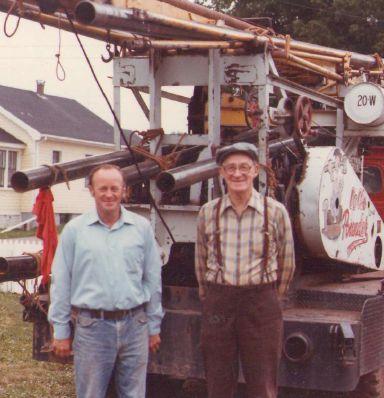
lE ft: Harold Moore (left) and John “Hap” Moore sometime in the late 1970s to
right: Grandpa John “Hap” Moore in the early 1950s.
Photo by Moore Well Drilling
Laser Marked Water Level Meter
The 101 P7 Water Level Meter uses Solinst laser marked flat tape, which is accurately marked each mm or every 1/100 ft and Certified Traceable to National Standards. New submersible P7 Probe ideal for total well depth measurements to 300 m (1000 ft). Standard Model 101 P2 Water Level Meter with heat embossed markings still available.
Drill faster, cheaper, smarter with Sonic Drill Corporation’s award-winning, patented drilling technology. Put it to work on your next project to heat up profits and cool down costs. It’s the perfect choice for geothermal installations, environmental investigations and mineral explorations.
• Drill 3-5X faster (depending on conditions).
• Drill, case, loop and grout in one step for geothermal projects.
• Collect continuous, undisturbed core samples to 300 ft.
• Drill using water or air (depending on conditions).
• Produce up to 70% less mess, lower your site clean-up costs.
• Various rig sizes (some fit in a 20’ shipping container to drastically reduce shipping costs).
of course, but you would hit stuff you would never experience here, and never will.
h as the geothe R mal industRy been g R owing on p.e.i.?
The more systems are being installed by professionals, the more people are gaining confidence [in geothermal]. It will get busier and busier the more that happens. I think around here too, plumbers at first were a bit scared of it. They didn’t know a lot about it. I know some plumbers who put them in because the customer wanted it, but they still don’t really like them. People are just more traditional. P.E.I. is a place where things don’t change too quickly. It’s been done this way for a lot of years and it does the job, so they keep doing it that way.
It used to be, 10 years ago, you had a couple hot weeks in the summer and that was it. It’s getting hotter here, this summer has been really dry and hot, and it’s nice having air conditioning in the
house and people just never thought of it before. Those things are available now and can be done at a reasonable cost. But the big thing is to have it done right.
b eing in business fo R 67 yea R s is quite an accomplishment. w hat’s you R sec R et to success?
You’ve always got to treat people fair. We’ve been in business for 67 years and you could ruin your reputation in a couple of jobs. If I price a job, I price it at what I think it’s going to be, not what I think the customer wants to hear. And I’ve lost wells before because I’ve priced something at 200 feet where someone else prices it at 80 feet. The other person got the job and he was back three times to drill deeper. By the time he was done he was at 220 feet. Being up front with the customers is best. You try to be right on, but I always tell people, “I’ll tell you exactly how deep your well is when we’re done.” I did two geothermal wells last week and we priced them at 130 feet each and they came back at 90 feet each. I’d rather do it that way.
h ave the R e been many changes to the way you do business ove R the yea R s?
We’ve always been a company that tries to evolve. I don’t like change for the sake of changing, but I like change if there’s a better way to do something; if there’s an easier way to drill a well and still come out with the same quality. That’s why I like going to conventions and trade shows because I find you learn things from talking to other drillers. Most times I can go to [a trade show] and pick up one or two things that we can put into our practice, so it’s worth it. And even though we’ve been around so long, there’s always someone who doesn’t know us. We do a lot of advertising in curling and hockey rinks; we do radio and television commercials. And we have a website – people look things up on the Internet, so you have to be there. You never want to just assume that they will call and know who you are.
c ustome R se Rvice is obviously ve Ry impo Rtant to you. h ow do you build a R elationship with you R custome R s?
I always encourage the customer to be there when we’re drilling if they can. I’ve had customers tell me that the drillers told them to stay away when they’re drilling. That would set off some warning signals for me. It’s interesting to watch and you don’t have to be a well driller to know when we have water and there’s a good flow there, especially for the wells we know are going to be deeper. I like to show people we’re 150 feet deep, the machine’s going and there’s nothing but air out of the hole. Its just nice if they can see it and they’re comfortable, they just get the feeling you’re not trying to pull something on them. To me your name is worth more than trying to steal a few extra dollars from somebody.
The bottom line is, no matter who does the job, I still want the customer to get the best possible result. You’re dealing with water; something that sustains life. I don’t get upset if I don’t get a job I’ve priced, I still want that person to have the job done right. You just try to be up front and treat people fair; do a good job for a fair price and most people are happy.
Constant Pressure Control Panels
The CPN1 Indoor VFD Panel and CP3R Outdoor VFD panel are economical, pre-engineered options for constant pressure applications to 5 HP, including:
n Pressure Booster Pumps n Deep Well Submersible Pumps n Irrigation Pumps
Each panel features a single factory-programmed variable frequency drive for quick and easy installation and set up.
OptionalCPN1DuplexController available to alternate lead control of twoCPN1ortwoCP3Rpanels.
D ata at you R finge Rtips
how the sowc is revolutionizing the world of water
the due diligence and red tape involved in drilling new wells can be a time-consuming and sometimes frustrating process. i magine if that process was reduced to a few clicks of a button.
Environmental assessments, viability studies and ecotoxicological reports could literally be at your fingertips within the foreseeable future thanks to the Southwestern Ontario Water Consortium (SOWC). The SOWC is a partnership made up of eight universities and more than 80 industry partners, including public- and private-sector groups, which is working to revolutionize the way waterrelated data is shared.
IBM Canada has contributed $20 million to the project, providing hardware and software for the cutting-edge platform, which will facilitate research and technology development, testing, and demonstration in water. It’s a daunting task, and one that has never been attempted before in Canada, notes Geoff Riggs, business development executive of Smarter Cities and Water Initiatives for IBM Canada.
IBM has been involved with two similar projects – a marine application in Galway Bay, Ireland, and instrumenting sensors on the Hudson River in New York – but the SOWC is unique because of the sheer amount of information that must be integrated and the number of partners involved. “We’re talking about over 300 kilometres of watershed, which makes it much larger in physical scale [than Galway Bay], probably comparable to the Hudson River application, but with the number of partners involved here we’re talking about
a lot more data. With eight universities and 80-plus industry partners, many of which are generating their own data, I believe this project is more complex than either of the previous ones mentioned,” explains Riggs.
Since the project was announced last August, SOWC partners have been busy analyzing their own individual data systems in an effort to aid in the integration. This has paved the way for the architecture and design of the new platform that will see the merger of dozens of varying data systems. “The analysis, the design and the requirementsgathering are really the core elements or milestones of the past 12 months and those are generally when there’s the most risk in a project, which is why so much time is allocated to it.”
The goal is to have the new streamlined platform up and running in the first quarter of 2013, which leaves only six months for the system to be installed. Riggs explains that the platform will likely be broken into nodes, allowing some nodes to come online before others. “Once the various nodes are plugged in, you’ll have miniature ‘centres of excellence,’ if you will, around the different focus areas, such as watersheds, waste water, ecotoxicology, drinking water, analytics and sensors. People will be able to go in and analyze the watershed from a different set of dimensions along those areas of focus and
by Ju Lie f iTz-Ge RALd
that in itself is a quantum leap in terms of the information that was previously available.”
Pooling such a vast array of data from numerous partners and universities onto one platform is expected to raise the level of efficiency for all water-related jobs. Researchers and scientists will no longer waste time grappling with incompatible systems of information and can therefore focus on their research. Municipalities will be able to better monitor water and waste systems, preventing occurrences of toxic sewage overflow and burst water mains.
Well drillers can also expect to benefit from SOWC’s platform in due course, when information about potential drilling sites, such as viability, possible environmental sensitivities or ecotoxicological issues, are made available. “As the number of possible well sites shrinks, I can imagine that [drillers] need to be more efficient in their process of sourcing and executing drilling and this is exactly the kind of thing that IBM excels at: efficiency. Efficiency of dissemination of information, collection of that information and turning it into formats available for a wide variety of people to use, including drillers.”
The SOWC will likely follow the trend of moving data and applications to the cloud, allowing users with Internet connectivity to access the information from a smartphone, tablet or laptop.
“These kinds of business models will probably involve paying for some kind of subscription service, so that with your ID you can log in to various applications, or data stores as we call them, and then that data store might allow you to select different data sets so that you can do your own analytics or modelling of that data.”
By the end of this year, IBM Canada and the SOWC hope to have the systems integration platform completed, allowing partners in the consortium to plug into each other. The next step will be running a pilot project to prove the platform can pull in data from the institutions and universities involved. The results of the pilot project will then determine the next steps of integration.
The SOWC is an ambitious project, with the sheer enormity of it spawning global interest. Water industry players around the world are watching intently to see if the project’s lofty goals can be accomplished.
“There’s no doubt that this is a daunting task, but I think it’s something that as a society we have to do. As a species, we’ve never shied away from these kinds of challenges. We are compelled to find new
The Southwestern Ontario Water Consortium wants to put more information at the tip of your digital fingers.
and innovative solutions through this new currency we’ve created, namely data. We’ll definitely innovate and produce something that hasn’t been done before. It may not serve all people perfectly, in
fact I’m sure it won’t, but it will be a bold, new and useful tool.”
Julie fitz-Gerald is a freelance writer based in uxbridge, Ont.
Own the Best Geothermal and Water Well Grouting Equipment Available Anywhere!
Fill, mix, pump a batch of grout in just 90 seconds with the Geo-Loop 50-500. Call the experts for your grouting needs.
Ultimate Grouter Model 50-500
Grout Hose Reels
Check
• 0-35 GPM at pressures up to 500 PSI
• 5x8 piston pump with chrome liners
• 80 gallon SS taper cone bottom mixing tank
• 24 HP Honda
• Powder coat paint
• Spool capacities range 200’-1,000’ grout line
• Hydraulically-driven forward and reverse
• Smooth 360 degree swivel base
• Powder coat paint
• 5 reel models
Continued from page 15
community, resulting in a lack of engagement in the town’s efforts to sustain and protect the supply.
“Finding the most effective communication and engagement approaches so the community grasps the importance of what we’re doing is a bit of a challenge,” says Newman. The town held an open house during Phase 1 that was poorly attended, “despite the fact that the community identifies with and values the water. But to actually get them to come out and learn more about it was a struggle.”
Recognizing the importance of community involvement, Sue Gordon of Gordon Groundwater Consultancy took the lead of the outreach component in Phase 2.
“One of the important issues is that even with the hydrogeological study and master’s thesis providing all this great data, ultimately it’s really the community values and behaviours that can have the most direct effect on sustainable groundwater management efforts,” Gordon says.
The social marketing strategies started with a community survey to determine residents’ background knowledge of groundwater and the Town’s relevant initiatives, and its knowledge of preferred methods of community engagement. The project benefits from the assistance of students from British Columbia Institute of Technology Sustainable Business Program. Next steps are to develop a blog/website linked with a smartphone app to promote awareness of the Town’s initiatives and the role the community has in sustaining and protecting their groundwater supply.
Thanks to the outreach component and Gordon’s involvement, the town was selected as one of the Canadian Council of the Ministers Environment (CCME) Groundwater Sustainability pilots. These CCME pilots are part of a national and provincial initiative to develop a universal approach to evaluate and communicate about the sustainability of groundwater resources across Canada. Several areas across Canada were also chosen as pilots, but the Town of Gibsons’ proactive approach set the community apart from the rest.
“Based on the data collected by Waterline and Gordon Groundwater, groundwater sustainability indicators are to be developed that will be comparable across these pilots,” Gordon says. “The town will have these indicators to show the community, politicians, businesses and visitors, how well they’re doing, and to impress upon them the importance of continued efforts to sustain and protect their great groundwater supply.”
Engaging the community is one of the most important parts of the project, and David hopes this proactive approach will spark similar projects in neighbouring communities before it’s too late.
“We want to be able to monitor groundwater extraction in conjunction with water levels and quality in order to confirm sustainable and responsible groundwater use. It is important that we can respond to any changes in the aquifer long before it becomes an issue,” Newman says.
And of course, not taking their most precious natural resource for granted is key.
“We also have a strong desire to maintain our unchlorinated water supply. Being responsible with continued monitoring and community engagement is certainly going to go a long way to ensure we can retain that privilege.”
Continued from page 16
hole was porous, but the geology above and below that point was denser. In this instance, we elected to grout the bottom of the hole, add coarse bentonite in the porous zone, and then regrout from that point to the surface. While the material costs were higher, we recognized that the geothermal loop would function at its optimum level because we used the grouting solution most effective for this particular installation.
In areas like Toronto, on the other hand, where the geology is primarily shale, more compact and less porous, the type of grout used doesn’t raise the same challenges you face with bedrock.
w ate R wells
It is wise to review existing well records to see where neighbouring property wells are located. If the ground in the area you are drilling is fractured and porous, the grout you are using could potentially leak into an adjacent well. Knowing where these wells are in advance, as well as the geology of the landmass in the area, may help determine the depth of the holes and the type of grout material.
n atu R ally occu RR ing gas pockets flowing conditions
If you are drilling in an area prone to, for example, natural gas pockets, you should be using neat cement with bentonite to grout the holes around your loop. Neat cement grout cures to a hard, chalky consistency and is ideal for preventing erosion due to groundwater seepage and for preventing natural gas from percolating out of the ground. Neat cement has a slightly higher conductivity than 20 per cent solid bentonite grout, and can be thermally enhanced by adding sand much the same.
Over the years, the geothermal industry has introduced grouts with higher conductivity that enable them to transfer more heat than the standard 20 per cent solid grout largely used by the water well industry. Geothermal grouts tend to be a blend of bentonite and sand or bentonite and graphite. The goal of these grouts is to generate higher conductivity and protect the quality of the surrounding groundwater.
Regardless of which grout you use, the material you select should be based on the geology of the land, the presence of adjacent water wells, the presence of natural gas or oil, and its ability to protect the quality of the groundwater and generate efficient heat transfer in the loop system.
Stan Marco is a well-respected and highly sought after geothermal knowledge expert and educator. He is an active member within the ground water community, a board member with the Canadian Geoexchange Coalition and cofounder and C e O of GeoSmart energy & GeoSmart drilling Services.
e stimating efficiency
a new method to determine the efficiency of a gshp system
asystem for finding the total length of a ground source heat exchanger is too simple to evaluate the global efficiency of the future system. the 70/90 per cent guideline is stated in csa c 448.2-02 c lause 10.3.1.
The following text, which is a part of one of our articles (co-written by Denis Tanguay) may provide better comprehension of this clause.
Design and installation of residential GSHP systems in Canada are governed by CAN/CSA C448.2-02 – Design and Installation of Earth Energy Systems for Residential and Other Small Buildings (hereafter C448). Article 10.3.1 of this standard specifies that:
The heat pump(s) shall be sized in such a way that their rated heating capacity, at the minimum entering liquid temperature (0 C or 32 F for closed-loop systems and
10 C or 50 F for open systems), is not less than 70 per cent of the building’s design heat load. The combined output of the heat pump and any supplementary heat shall be equal to or greater than 100 per cent design, but the heat pump shall not exceed 105 per cent of the design heat loss.
Note: The intent of this clause is to ensure that the heat pump supplies more than 90 per cent of the building’s annual space heating energy load.
The standard requires a minimum heating capacity for the heat pump relative to a building’s need. However, there is
by Be NJAM i N HÉNAu LT
nothing to guarantee that the unit will be able to provide it because the system is not referred to as a whole: standard C448 is silent about the minimum entering water (EWT) temperature of the loop in heating mode. According to C13256, the ground source heat pump (GSHP) unit EWT for a closed loop is 0 C and 10 C for an open loop. But there is no way to guarantee this temperature. Standard C448 does not require any minimal water temperature for system design, and rightly so (no minimum EWT can be required since EWT is actually dictated by a variety of factors, including
financial parameters). The minimum heat pump capacity of 70 per cent in standard C448 aims at ensuring that the unit will provide 90 per cent of the building’s annual space heating energy load. Note that this 70 per cent rule overestimates the minimum capacity required to provide the 90 per cent.
Standard C448 does refer to standard C13256, which mandates a specific minimum co-efficient of performance (COP) for the unit, according to the type of GSHP system installed. C13256 says:
Here again, there is nothing to guarantee that the unit will not have a lower field performance since the EWT can be below those established in C13256.
In reality, as many as 75 per cent of GSHP systems in Canada will function with EWT below 0 C in intense cold. The heat pump unit ratings are not representative of the conditions in
Canada. Industry discussion suggests current heat pump ratings are based on theoretical EWT in an average climate. Ground temperatures are higher than in Canada. Adjustment based on ISO 13256, C13256 was never appropriately adapted for Canada. Most residential design software on the market is not able to address minimum requirements set in standard C448. In the Canadian Geoexchange Coalition (CGC)’s staff and member-reported experience, current design tools are often too simplistic, not all user friendly, and most do not consider important design parameters, such as grout properties, borehole diameters or thermal interference between boreholes. In addition, the choice of regions is limited.
To address these weaknesses, CGC staff developed an innovative and more advanced computer assisted design and analysis tool (GeoAnalyser). For closed vertical GSHP systems, this tool uses the commercial system design method proposed by Kavanaugh and Rafferty (1997). The software produces an estimated Seasonal Coefficient Of
Performance SCOP based on the bin method, and the BIN calculation is based on the SCOP estimation method presented in by the American Society of Heating, Refrigerating and Air-Conditioning Engineers in 2005.
To the best of the CGC’s knowledge, this is the only design tool available in Canada that produces a BIN table based on accurate municipal meteorological data as well as other design parameters not considered by other software. This tool is more accurate for residential as it considers the overall performance based on all components, not only the rated performance of a heat pump unit. When used in conjunction with C448 requirements, the GeoAnalyser provides a much better estimation of the 70 per cent / 90 per cent design requirement and also produces a more credible SCOP.
Benjamin Hénault is a professional engineer and a graduate of École de technologie suprieure. He is the technical advisor at the Canadian Geoexchange Coalition and is studying in geothermal research for his masters degree at École Polytechnique de Montreal.
maximizing cash flow
by David Filice
When times are tough, cash matters more than earnings
The Canadian economy has been uncertain for more than a year now, due to the European and American debt crises continuing to have negative effects in Canada
In a recent survey, Harris-Decima randomly sampled 1,000 Canadians via telephone. When asked about rising interest rates, 48 per cent of the respondents said a significant interest rate hike would pose a challenge to them in keeping up with mortgage or debt payments. They will rise eventually and pressure on consumers means pressure on businesses. Cash is the lifeblood of any business and matters more than earnings in a tough economy. Here are some important steps to take to maximize your cash flow. When you first start a business, cash is usually scarce and most people are forced to either live within their means or fail. Being in survival mode can be helpful if you maintain the same mentality as your business profits grow. You need to know where you are financially and have a plan for covering your obligations. Your business will have fixed expenses that have to be covered regularly, such as payroll and rent. In addition, you likely have variable expenses that rise and fall with your sales. Create a monthly cash flow budget and monitor it weekly. If your sales are falling short of your predictions, cut back on your expenses.
Continue to slash costs where possible.
Tough economic conditions with falling sales volumes require cost-cutting measures wherever possible. When sales volumes are expected to decline, costs need to be closely monitored. Reduce spending on items that can easily be cut without affecting the sales levels of the company. Make tough decisions about payroll costs and don’t look back.
1. Bargain for credit terms with suppliers
By evaluating your supplier base, you may decide to consolidate your suppliers and be in a position to purchase more from one or two
suppliers. This will allow you to obtain more favourable credit terms for the increased volume you will be providing to the remaining suppliers. Furthermore, as many suppliers will be hungry for cash in tough economic conditions, you may be able to obtain early payment discounts.
2. Track inventory and supplies
Consider carrying less inventory than normal during tough times. Customers may be willing to wait a bit longer for orders if your suppliers can provide you with inventory on a just-intime system. Try to identify waste in supply purchases.
3. Get smarter on tax
Don’t make tax payments any earlier than you need to. Many businesses remit taxes monthly when they may qualify to be quarterly or even yearly instalment filers.
4. Have a back-up plan
Always include a cash reserve as part of your cash management plan. Plans can sometimes take a negative path, and if a strategy is not in place for such emergencies, the business will be put under significant stress. Consider keeping some low-interest-rate credit cards with zero balances. However, be sure to keep the balance zero in non-emergencies.
If you are concerned about the viability of your business, remember that without sufficient cash flow, even a needed financial restructuring cannot be implemented. Many businesses end up closing down or filing for bankruptcy as they did not have the cash flow resources to go through a restructuring process that takes time while the business continues to operate.
david filice is a senior vice-president and partner in the restructuring and insolvency practice of fuller Landau LLP, Chartered Accountants and Business Advisors. Contact him by calling 416-645-6506 or e-mailing dfilice@fullerlandau.com