Glass Connections Ottawa served up tips on how things are changing and how to meet those challenges. 22 A great view
The IGMA Summer Conference in beautiful Banff gave great views of the mountains and the glass technology landscape.
Vegas in the fall
GlassBuild 2016 heads to the desert a month later than usual. Organizers say it will be worth the wait.
Here are top suppliers you can work with to achieve incredible feats of glass architecture.
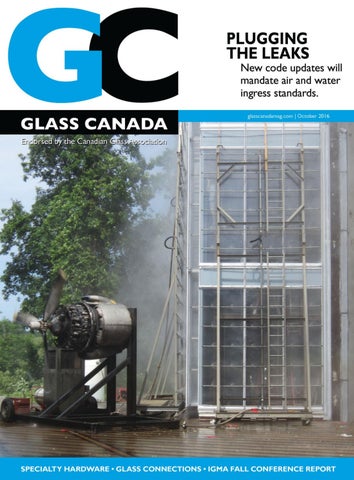
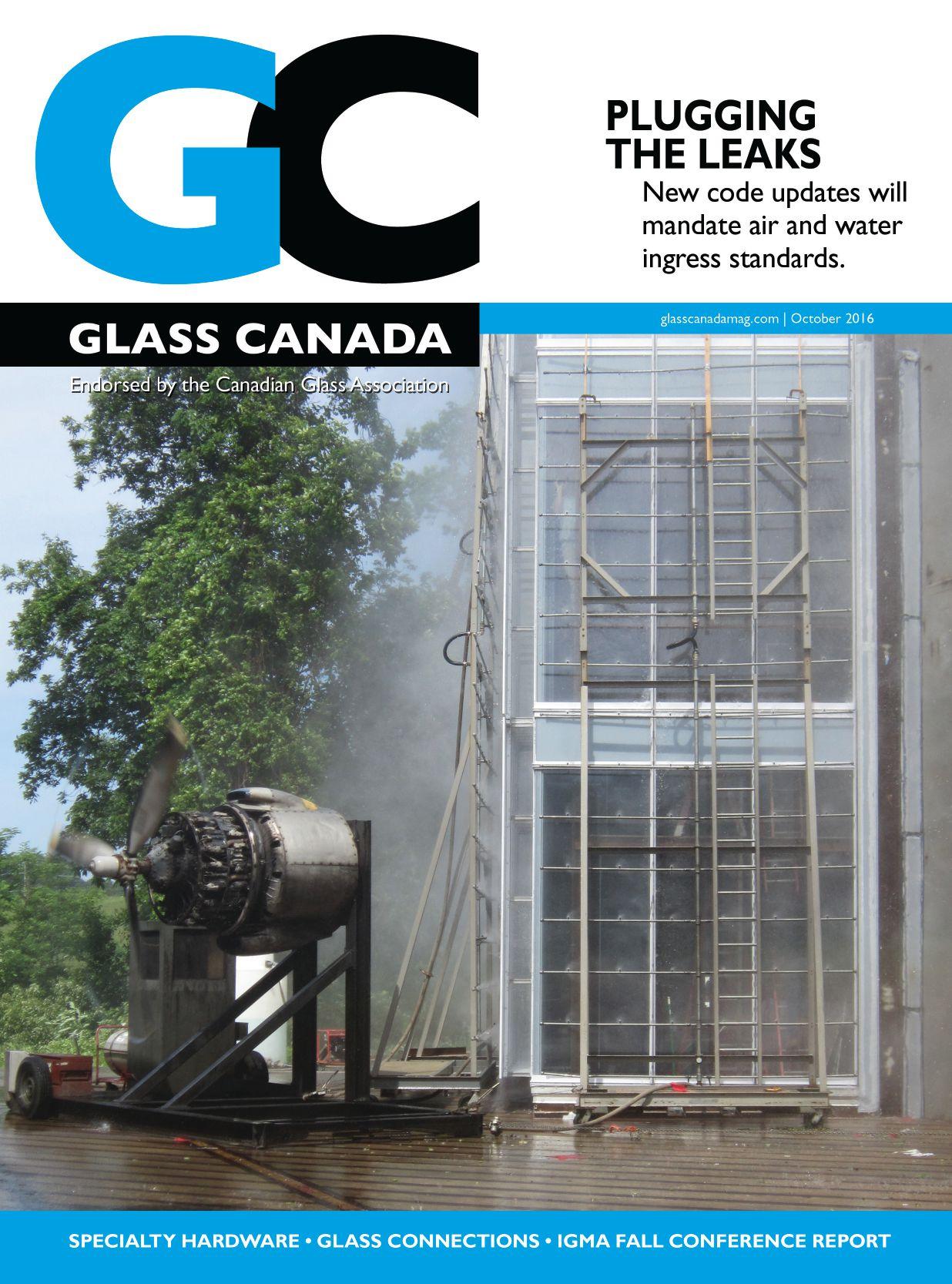
The National Building Code will soon require fenestration components of building facades to resist air and water ingress. Here’s what it will say and why you shouldn’t worry about it. Cover photo courtesy of Intertek.
Puncturing price panic
Government intervention on housing prices probably won’t help.
EDITORIAL
It is hard to know what to think about housing prices. On one hand, high prices are obviously good for our industry. As long as condos in Toronto and Vancouver are commanding a million dollars each, developers will be eager to keep building. But the question on everyone’s mind is, what happens when the country runs out of people willing to spend that kind of money on a cramped one-bedroom? It isn’t hard to envision a future of half-full towers and plummeting property values bankrupting developers and casting our big urban markets into a long-term chill.
GLASS CANADA
October 2016
Volume 28 • Number 5
Annex Business Media P.O. Box 530, Simcoe, Ontario N3Y 4N5
EDITOR | Patrick FLANNERY pflannery@annexweb.com 226.931.0545
But everyone has been staring that spectre in the face for at least 10 years now. It’s been amusing to watch the Chief Economists go through the stages of grief as they came to grips with the futility of their trade. First came denial that prices were a problem – the New Economy of permanently low interest rates meant everyone could afford everything no matter what it cost. Then came the sly attempts to bargain their way to accurate predictions – the bubble would burst, but probably not until some unspecified time in the future. Next the angry demands that we stock up on canned foods ahead of the imminent housing crash apocalypse. Then a sad depression as they started to admit in front of rooms full of people that they had no idea what was going on. The last Chief Economist I heard seemed to have finally accepted that property values in Toronto made no sense to anyone, so he shrugged and boldly predicted a severe correction soon, all the while acknowledging that he was probably wrong.
The federal government has apparently decided it is time to Do Something. There was a story in the Globe and Mail this morning about some minister who is in charge of this stuff saying that he and other cabinet ministers are having a lot of frowny discussions about it. Ire seems to have focused around the perceived impact of foreigners buying properties as investments rather than places to live. Vancouver’s city council got worked up enough about this to apply a special transfer tax to properties owned by foreigners. Governments wanting to Do Something scare me.
Here’s a thought I find interesting: there are a billion people in China. That means there must be tens of millions of millionaires with the wherewithal to pick up a condo in Canada just for the fun of it. I asked earlier what happens when we run out of people who want to pay these prices. Maybe the reason these prices are defying regular economic logic is because the pool of people willing to pay is several orders of magnitude higher than it ever has been in this country’s history. Maybe it’s connected to the stubbornly low rate of inflation that bedevils central bankers the world over – apparently no rate of interest is low enough to stimulate prices in an economy that gets stuff made in China.
I’m probably wrong, but no wronger than a Chief Economist, which isn’t too bad for someone who gets paid what I do. I say bring on the wealthy condo owners, the more the merrier, and let the market forces sort ‘em out. •
Canada - 1 Year $36.75 (includes GST) ($39.55 includes HST/QST)
U.S.A. - 1 Year $50.00 (in US dollars)
Occasionally, Glass Canada will mail informationon behalf of industry-related groups whose products and services we believe may be of interest to you. If you prefer not to receive this information, please contact our circulation department in any of the four ways listed above.
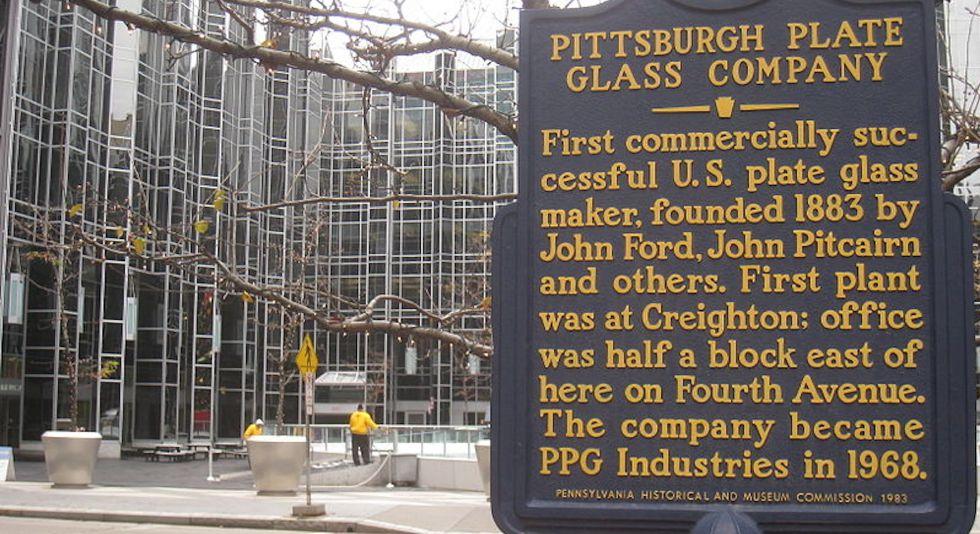
PPGannounced it reached a definitive agreement to sell the assets of its flat glass manufacturing and glass coatings operations to Vitro, a Mexico-based producer of flat glass and specialty products. The transaction is expected to close by the end of 2016, subject to customary closing conditions.
According to Frank Caporiccio, PPG’s Canadian regional sales manager, customers will not experience any change from this transition. “Vitro has bought it all, and all the employees are going with it,” he said. “I am still reporting to the same person in Pittsburgh.The only change will be the logo on the business cards.”
In an interview with Glass Canada, Dick Beuke, PPG’s vicepresident of flat glass for North America, said the decision to sell was part of PPG’s strategy to maximize shareholder value by focusing the company on the area where it has its greatest revenues and global market presence: the coatings and paint sector. That division had come to dominate PPG’s portfolio over the past 20 years to the point where architectural glass accounted for only about three per cent of the corporation’s business. “It’s like anything, you either have to be big or you have to be out,” Beuke explained. “We are the number one coatings company in the world and in glass, we aren’t even global.”
According to Beuke, there was an opportunistic element to the timing of the move, as well. Glass sales are just starting to recover from the 2008 recession and the flat glass division shows potential for growth for the first time in 10 years.The deal makes sense for both sides because Vitro lacks market presence in the U.S. and Canada and PPG had little penetration into Mexico.
Access to PPG’s R&D facilities was also a key for Vitro as more low-E and insulating glass is specified in Mexico. “A lot of the places in Mexico, the specification is monolithic,” Beuke says. “Just a piece of quarter-inch glass. But all the new
buildings have insulating glass units.” Beuke reports that Vitro executives were very excited to see the work going on in PPG’s Pittsburgh labs.
Beuke says Vitro will take steps to ensure timely glass supply. “They are putting in a new float plant in Monterrey so they will have two float plants there,” Beuke says. “Their Mexical operation goes down for a rebuild some time around now and they will expand their capacity there as part of the rebuild.”
Under the terms of the agreement, PPG will divest its entire flat glass manufacturing and glass coatings operations, including production sites located in Fresno, Calif., Salem, Ore., Carlisle, Penn., Wichita Falls, Texas, four distribution/fabrication facilities located across Canada and a research and development center located in Harmar, Penn., near Pittsburgh. PPG’s flat glass business includes approximately 1,200 employees.
“This transaction represents the end of an historic era for PPG as a manufacturer of flat glass, and it is another major step in our portfolio transformation to focus on paints, coatings and specialty materials,” said Michael H. McGarry, PPG president and CEO. “Upon completion of this transaction, the flat glass operations will become part of a company that is focused on growing its core glass business.”
Adrián Sada Cueva, CEO of Vitro, said, “This investment will strengthen our construction glass business, as it will allow us to participate in the U.S. and Canadian markets and in the segment of high performance glass coatings in which we have no significant presence. The combination of the talented teams from both companies is expected to result in a business with greater growth potential.”
PPG will receive approximately $750 million in gross cash proceeds.
CGA Newsletter
CANADIAN GLASS ASSOCIATION
Inour fast-paced, technology driven business world, being able to manage change is a key differentiator. Industry professionals with a proven record of embracing change perform better. Earlier this month, more than 75 industry professionals gathered in Ottawa at the CGA’s Glass Connections conference where the topic of change became a common thread throughout the event. From international code updates to fire-rated glazing updates, participants got up to speed on emerging compliance topics and new products. Thanks to presentations from Stanley Yee of Dow Corning, Tim Nass of Safti First, Bruce Milley of Guardian Glass, George Torok of Morrison Hershfield and Mark Silverberg of Technoform North America, participants left with a better understanding of changes coming to the trade in Canada and how they will drive future trends in products and business practices. [See Glass Canada’s expanded coverage of Glass Connections on page 24.]
The theme of change was also a factor in Canadian Glass Association’s Annual Meeting where it was announced that Susan Mahoney will serve as the new executive director of the CGA. Mahoney replaces Bill Yanek, who served as CGA executive director of the past year. Yanek has left to pursue new opportunities as the CEO of the Professional Retail Store Maintenance Association.
The CGA is pleased to welcome Susan. Mahoney has served as a staff member
of Centric Management and Consulting, the association management company that manages CGA, for the past two years. She specializes in event planning, board management and has a background in government and non-profit management.
The 2016 Glass Connections conference was a tremendous success and CGA would like to thank all the participants, exhibitors, sponsors, presenters and planning committee members who made it a great experience for all who attended.
Check out pictures from the event on our Facebook page: facebook.com/CanadianGlassAssociation.
ONTARIO GLASS AND METAL ASSOCIATION
Please
see Frank Fulton’s
“You Bet Your Glass” column on page 30 for a full update on the prompt payment process. The Construction Lien Act review report is due to be released at the end of September. The OGMA will be meeting with Prompt Payment Ontario within days of the release of the report to determine next actions depending on its content. Details will be distributed to the industry as soon as they are available.
We are still planning our Fall Seminar. Details will be sent to members when available.
Companies have until the end of the year to put accessibility policies and procedures in place and to prepare to communicate your information and employment practices for compliance with the Accessibility for Ontarians with Disabilities Act
(AODA). To find out your legal obligations, go to ontario.ca/ page/accessibility-laws, then contact Workplace Safety and Prevention Services to help you put it in place.
If you are conducting business in the glass industry in Ontario, the OGMA is the voice that represents your interests at the provincial and federal level. Protect your business and support our fight for prompt payment legislation by becoming a member or as an associate member if you are a consultant to the industry. Please visit the OGMA website for more information.
After a year of preparation, the OGMA/WSPS safety manual is now ready for use by the metal and glass industry. The manual was created by qualified health and safety professionals and is a timesaving tool enabling glass shops to establish their own company program. Not only will this support a company’s efforts to eliminate workplace injuries and illnesses, it will also lower costs and time related to Workplace Safety and Insurance Board (WSIB) claims. Additionally, WSPS and the health and safety manual will get your company compliant with the new OHSA Regulation 297/13 as well as AODA requirements.
AGMCA
Dennis
Haatvedt has announced he will step down as president of the AGMCA at the end of this year. A search for his replacement has been initiated. Haatvedt has held the position since April 2015. He has been in the glazing industry for 40 years, most recently with AGC Flat Glass North America.
Dennis Haatvedt
PROVINCIAL GLAZIERS ASSOCIATION OF ALBERTA
ThePGAA held a board meeting July 20. Since then the association has launched a new website and are currently working on a refined, searchable database. The new website features a cleaner layout with some upgraded graphics and big, obvious links to important areas like the Master Glazier Program and our events calendar.
We held our annual golf tournament August 18, and had a good turnout, slightly down from past years. Business continues quite strong in the province, despite the oil industries continuing woes, with Edmonton particularly strong and Calgary and rural markets a bit softer.
Our next board meeting is September 21.
Guardian Venezuela seized
Venezuelan troops seized Guardian’s float glass plant in Monagas, Venezuela, this summer and have since nationalized it, claiming the plant as property of the Venezuelan government. Guardian’s statement follows:
“On Aug 1, Guardian Industries announced that the Venezuelan government had seized control of Guardian de Venezuela SRL. On August 19, the Venezuelan government published a resolution granting a government-sponsored Special Administrative Board full authority to control and operate Guardian Venezuela, thereby reaffirming the government’s expropriation of Guardian Venezuela and its assets. These actions by the Venezuelan government have been taken without the consent or involvement of Guardian or any of its affiliates and in violation of applicable investment treaties. The Venezuelan government seized control of Guardian Venezuela when the company attempted to implement an orderly and safe cool-down of its glass melting furnace to protect the safety of its employees and the community in general, while otherwise continuing commercial operations. Float glass plants operate at extremely high temperatures, continuously, 24 hours a day, 365 days a year, throughout their operational life. All float glass plants must be temporarily shut down at the end of their operational life in order to undergo major repairs requiring specialized and technical expertise. Contrary to what has been asserted by the Venezuelan government, Guardian Venezuela never abandoned or closed its operations. Guardian has warned the Venezuelan government of the grave safety risks to plant employees and the community in general should it continue to operate the plant without completing major
repairs. Guardian and its affiliates cannot be responsible for the safety of employees or any liability or damages resulting from the government’s continued operation of the plant. Should the Venezuelan government produce and sell glass from the plant, Guardian cannot be held responsible for product quality and will consider any use of Guardian’s name, Guardian product names, or Guardian trademarks to be unauthorized and a misappropriation. Throughout this process, Guardian and Guardian Venezuela have acted to protect the safety and best interests of plant employees and the community.
Guardian Industries Corp., Guardian Industries Navarra SL, Guardian de Venezuela SRL and their affiliates continue to reserve their rights under all applicable laws and treaties. “
Processed glass PCR published
The Glass Association of North America and the Insulating Glass Manufacturers Alliance have announced the approval and release of the Product Category Rule (PCR) for processed glass. The PCR is based on revisions made to the Institute of Construction and Environment (IBU) standard “Part B PCR structure for Glass Wall and Ceiling Coverings, 2014.” The focus of revisions to the document was to include references applicable to the North American market and to make it consistent with the GANA PCR for Flat Glass, UN CPC 3711, and the Cradle to Gate Window Product Category Rule. The joint GANA-IGMA task group led by Helen Sanders of SageGlass worked diligently with UL to create this PCR for the industry. “The completion of the processed glass PCR is an important accomplishment for the glass industry,” said Sanders. She recently briefed IGMA members about the process and status of the PCR at the IGMA Summer Conference in Banff. “With its completion, we now have rules established for doing life cycle assessments for the whole value chain: flat glass, processed glass and windows. This means that we will be able provide environmental product declarations (EPDs) for processed glass to our architectural customers to meet the increasing requirement to use products from manufacturers who have provided full material transparency documentation.
With LEEDv4 coming into full effect October 2016, the requests from architects designing to this standard to provide EPDs for products will continue to increase. Now we have the baseline rules in place by which we can do lifecycle assessments of our manufacturing process to provide these EPDs.”
“The completion of the PCR for processed glass is the successful culmination of a combined industry effort spanning many years that started with the flat glass PCR, and then the window PCR,” explained IGMA executive director, Margaret Webb, who put great effort into the project. “This PCR was developed as a core product with processes for coated, laminated, heat-treated, decorative and insulating glass. The industry can now provide credible EPDs for their customers. The joint IGMA-GANA task group will now consider whether to continue and develop a generic EPD for the industry.”
The PCR is available for download on the Underwriter’s Laboratory (UL) website. Updates on the industry-wide generic environmental product declaration may begin this fall and will be discussed at the IGMA Winter Conference, announced last week, scheduled Jan. 23 to 27 at the Sheraton Sand Key Resort in Clearwater Beach, Fla., and during the GANA Annual Conference at the Hilton Head Marriott Resort and Spa, March 14 to 17.
Update to AW windows and doors testing COMING EVENTS
The American Architectural Manufacturers Association (AAMA) has released an updated document describing the test procedures and specifications for Architectural Class windows and doors (AW). AAMA 910-16, “Voluntary ‘Life Cycle’ Specifications and Test Methods for AW Class Architectural Windows and Doors,” was last updated in 2010. “AW windows and doors, covered in AAMA/WDMA/ CSA 101/I.S.2/A440 (NAFS), are the only fenestration product types that go through accelerated life cycle testing including operating and thermal cycles followed by structural, air and water tests,” says Greg McKenna of Kawneer, chair of the AAMA 910 Lifecycle Testing Review Task Group.
“AAMA 910 is an important document as it is referenced in the North American Fenestration Standard and lists the sequence of tests to be conducted on these highperforming products.”
Since its introduction more than 20 years ago, the AAMA 910 life cycle testing specification for AW products has been widely accepted by industry consultants and the specifying community. With the advance of technology, along with two decades of experience and test data from a variety
of materials, this specification and test method has now been updated to reflect the changing needs of the marketplace, such as longer warranty periods, sustainable design, more durable finishes and increasingly more stringent code requirements. Enhancement of performance requirements, to include thermal cycling and increase the number of operating cycles, as well as increased misuse loads, helps to more clearly differentiate AW products from other performance classes. In addition, descriptive language has been clarified for ease of use. This specification and test method is intended to model, through accelerated testing, the normal wear that can be expected during the life of a typical AW product.
“Reference standards were updated to their most current edition and other relevant test specifications were listed,” said Doug Holmberg of Wausau Window and Wall Systems, vice-chair of the task group. “This specification and test method is intended to model, through accelerated testing, the life of a typical Architectural Class window or door with operating and locking hardware opening/ closing cycles to simulate actual use, along with thermal cycling which is also an important durability attribute.”
Accessibility standards harmonized
CSAGroup has announced that its key accessibility standard has been referenced in the Canadian National Building Code (NBC), an important step toward the harmonization of accessible design requirements. CSA B651-12 “Accessible Design for the Built Environment” was first published in 1990 and is now in its fourth edition. The standard contains requirements for making buildings and other facilities accessible to persons with a range of physical, sensory, or cognitive disabilities. It was developed to fulfill an expressed need for a national technical standard that covers many different types of buildings and public spaces.
“The Technical Committee on Accessible Design has worked for many years to make this harmonization possible. Accessible design opens doors for people of all abilities and is an essential part of our built environment,” said Magali Depras, president of standards for CSA Group. “By giving designers clear and consistent
requirements and expectations across the country, the work of creating accessible spaces is made easier.”
The accessible design provisions in the CSA Group standard were comparable to those in the NBC and it was clear that creating a single source document would help simplify the design process. Over the past three years the technical committee has worked with its counterpart committee at the National Research Council, the developer of the NBC, to align and update the design requirements in both documents. Once that was complete, B651 could be directly referenced in the NBC.
Users of the recently published 2015 edition of the National Building Code now have the option to use either the design requirements in the NBC or those in B651. The CSA and NBC technical committees are continuing to work towards referencing CSA B651 as the sole source for accessibility design requirements in the 2020 NBC.
Oct 19 - 21
GlassBuild Las Vegas, Nev. glassbuildamerica.com
Nov. 1 - 3
IG Fabricators Workshop St. Paul, Minn. igmaonline.org
Fenestration West Surrey, B.C. fenestrationwest.ca
March 1
CSC No Frills Tradeshow Toronto, Ont. toronto.csc-dcc.ca
April 20
Top Glass Mississauga, Ont. topglasscanada.com
April 27 - 29
AIA Convention Orlando, Fla. aia.org
by BRIAN BURTON
Brian is a construction writer from Ottawa Ontario who served on the CSA’s Fenestration Installation Technician Certification Program Personnel Committee. You can contact Brian at Blueblade49@gmail.com or learn more by visiting Burton’s-Pen.com
Canadian quality should sell overseas
Canada’s fenestration industry is remarkably well placed to take advantage of emerging global market trends in the foreseeable future. Here at home, the continuing domestic slowdown in new construction and the increasing cost of new home construction and renovation is depressing the market. On the other hand, global market demand for window and door products is expected to continue a modest upward trend. Global market projections by application are very close to equally split between residential and commercial applications.
Our economy is actually in much better shape than it was a decade ago and improving employment prospects and increasing income levels give ample reason for optimism. However, most of the significant long-term market growth will likely occur outside our borders, where market conditions should favour Canadian fenestration product manufacturers. The global market for fenestration products is currently estimated at over $138 billion per year. In recent years, millions of residents in developing nations have begun to urbanize. The new middle classes and business owners in these newly industrialized countries (NICs) now expect more from their built environment and from fenestration components in particular.
There are distinguishing features of NICs that warrant consideration. Often, the transitional economies in these countries are in the process of moving from a closed economy to a more open fiscal environment. The population is usually young, growing and actively seeking to improve their quality of life. By definition, NICs are building their infrastructures, which translates into higher costs for manufacturing and distribution.
Canada’s most tangible strengths are in manufacturing, production and distribution.
FENESTRATION
Buildings in India, Brazil and China, three examples of growing NICs, have typically incorporated relatively small windows, partly to compensate for a lack of mechanical ventilation and to avoid excessive glare. Today, new technologies are encouraging an increased use of larger windows in greater numbers. House sizes in most NICs are also growing in tandem with household income levels, thereby creating additional demand. With the exception of warm climate countries, where thermally efficient windows are relatively expensive, demand is also close to equal with regard to windows versus doors.
There is a similar equality with regard to new construction and renewal, a trend which is expected to continue as many newly industrialized nations replace older buildings and homes.
India is second only to China with regard to demand for both replacement and new construction fenestration components. Rapid industrialization and urbanization are stimulating demand for doors and windows, regardless of the material used. The Indian architectural market is particularly sophisticated and there is an increasing use of high quality fenestration components for retail and commercial applications as well as office buildings and other commercial structures.
While fenestration products have typically been viewed as difficult and expensive to package and transport, it’s becoming increasingly apparent that Canada’s most tangible and valuable strengths are in manufacturing, production and distribution. Supply of manufacturing equipment is another desperate need in the NICs. Over the years we also have accumulated significant experience with regard to installation, on-site testing and quality control in general. Our knowledge of environmental separation from our experience building for severe climate conditions is a significant asset. We also have developed considerable strategic marketing expertise – all of which can be successfully exported if we adopt a suitable approach and create the right partnerships.
Global markets for fenestration products are not brand sensitive, likely because the period of time between purchases can be as much as 10 years. This fact, combined with the fragmented nature of the industry, means smaller players face less resistance when entering international markets and are often able to find a niche if they concentrate. •
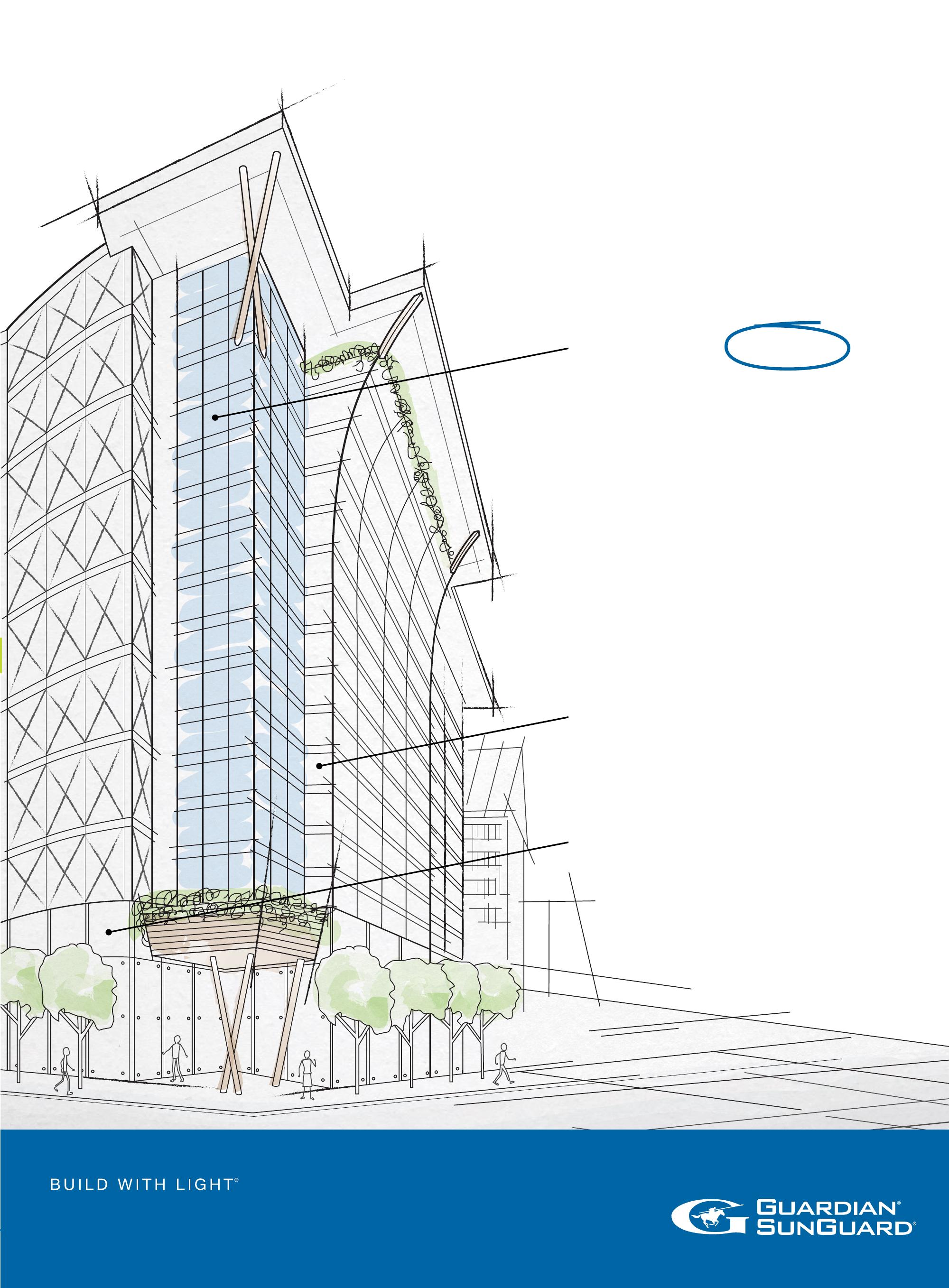
NEW BLUE.
is perfect for contemporary structures that are big on light, smart on energy. Our clients prefer its light blue color, and CrystalBlue pairs perfectly with the SunGuard® coatings we specify.”
Paulo Perkins, GraceHebert Architects New Guardian CrystalBlue™
Spandrel
Plugging the
the leaks
Air and water ingress requirements are on the way.
by PATRICK FLANNERY
The five-year update cycle has come around again for the National Building Code, and one big change commercial glazing fabricators will see is the inclusion of specific minimum requirements for air/water ingress for all fenestration components of Part 5 buildings. The new sections 593.4 and 593.5 of Part 5 will cover air and water ingress, respectively. The requirements are not anticipated to be hard for most fabricators to meet and are designed more as a starting point to establish a common, minimum benchmark so specifiers, contractors and fabricators can all have a common understanding of what the current applicable standards are. This has been done, according to Robert Jutras of CLEB Building Science, who sits on the Part 5 committee, to address a common complaint that different bid requests on the same project, or bid requests on projects that are very similar and geographically close, often have wildly varying specifications, or reference standards and test methods that are years out of date.
The air performance requirements are drawn from the North American Fenestration Standard (NAFS), and the water ingress performance requirements come from the Canadian Supplement to that document. NAFS is already familiar to most architects and fabricators as pre-fabricated windows have had to conform to the standard since the NBC 2010 was adopted. The rationale for applying that standard to the rest of the fenestration components was pretty simple: “If a punched window on floor 20 of a precast wall needs to meet NAFS – and it already does under NBC 2010 –then why would the curtainwall that is 10 feet beside it have to meet something else?” asks Jutras. See the chart opposite for details of the new requirements.
The components that will now have to meet NAFS are referred to in the NBC as “Other fenestration assemblies.” These will include curtainwall, spandrel, window walls, storefront, skylights and point-supported assemblies. Descriptions of these components will appear in the appendix to the section, as the process for including official definitions in the code is fairly torturous, according to Jutras. Previously, air/water performance for these kinds of fenestration on Part 5 buildings was left entirely to the discretion of the designer and specifier.
Exclusions to the new section include storm doors and windows and store entrance systems, such as revolving doors, which are frequently site-built and not designed to be air- and watertight anyway. Smoke and relief vents are also excluded. Site-built doors and commercial steel doors are covered in other parts of the code and are therefore not addressed in the new sections either.
Ironically, that has usually led to fabricators having to meet a tougher standard than the NBC will set. “It doesn’t matter what they put there because for curtainwall every consultant wants you to meet the highest standards of AAMA [American Architectural Manufacturer’s Association] 501,” reports Jim Brady, general manager of Desa Glass. “They can put in the minimum codes, but I have to meet the maximum standards. I’m building for the100th storey of a building in Miami with hurricane-force winds.”
Window wall is one area where Brady can see a benefit to having established air/water requirements. While curtainwall design is fairly standardized, architects are experimenting more and more with “inside-out” concepts that involve large, unbroken, operable barriers between interior rooms and outside space. “Window wall is interior glazed with snap-in stops and roll-in rubbers,” Brady explains. “You don’t get the compression you see with a pressure plate and a quarter-20 screw. Drainage and pressure equalization is very tough to control on a window wall.” Perhaps demanding that window wall meets the same air/water standards as other types of fenestration will drive a move toward higher quality and innovation in those products.
Jutras explains that the Part 5 committee hopes that including air/water performance in the code requirements, even as low minimums, will help prevent overspecification as well as under-specification. The existing AAMA test standards that have been used for years were drafted to address worst-case scenarios without regard for specific environmental and geographical conditions. Frequently, they call for higher levels of resistance to water ingress than a building will encounter. On the other hand, NAFS, and especially the Canadian supplement, has been drafted with specific reference to local climates and weather conditions. There are maps and tables outlining requirements for facades based on where they are in Canada, their orientation and the surrounding terrain. As these requirements become understood in the architectural community, it is possible that they will actually open up some design flexibility as fabricators and contractors are not required to over build.
Meeting the tough AAMA 501 standards has some drawbacks for fabricators. The cost of the tests are significant, at around $60,000. Desa has found alternative tests that meet the same performance
CHAPTER AND VERSE
5.9.3.4 Air leakage
2) Except as provided in Sentence (3), other fenestration assemblies and their components shall have an air leakage characteristic, measured at an air pressure difference of 75 Pa, when tested in accordance with ASTM E 283, “Determining Rate of Air Leakage Through Exterior Windows, Curtain Walls, and Doors Under Specified Pressure Differences Across the Specimen,” that is not greater than a) 0.2 L/(s.m2) for fixed portions, including any opaque portions, and b) 1.5 L/(s.m2) for operable portions.
5.9.3.5
Water penetration
2) Except as provided in Sentence (4), other fenestration assemblies and their components not covered in Article 5.9.2.2. shall resist water penetration when tested in accordance with a) ASTM E 331, “Water Penetration of Exterior Windows, Skylights, Doors, and Curtain Walls by Uniform Static Air Pressure Difference,” or b) ASTM E 547. “Water Penetration of Exterior Windows, Skylights, Doors, and Curtain Walls by Cyclic Static Air Pressure Difference.”
3) Tests referred to in Sentence (2) shall be carried out at the driving rain wind pressure as calculated in accordance with CSA A440S1, “Canadian Supplement to AAMA/WDMA/CSA 101/I.S.2/A440, NAFS – North American Fenestration Standard/Specification for Windows, Doors, and Skylights.”
standards, but has to convince customers that they are just as reliable. “It can be hard with some guys who are set in their ways and only have two big suppliers in mind,” Brady says. “When you are a mediumsized guy without AAMA 501 they don’t
zo n S a ves E n er g y
Daylighting systems produced with Azon structural thermal barrier technologies—the MLP™ or Dual Cavity—for aluminum windows and curtain wall, along with high performance glazing components for insulating glass, will yield a fenestration system capable of upholding the highest efficiency and sustainability standards
want to hear from you even though the test standard is the same. Some will take that work and say ‘OK, go ahead,’ others will say, ‘No, you have to meet AAMA.’”
The NAFS and Canadian supplement performance numbers are included right in the requirements of the NBC 2015 code. AAMA test methods are referenced, but only in the appendix as guidance to an effective test that will proof compliance with the NAFS performance requirements. The reason for this is because AAMA is not a consensus standard, subject to public review. Only consensus standards are allowed to be part of code requirements, Jutras explains.
Staying up-to-date on codes and standards is a daunting task for everyone. Spelling out a common, minimum requirement will help smooth out the bidding and testing process, Jutras hopes. Today, “if you get specifications from 10 different architects on the same project, you will have five different requirements,” Jutras says. Putting the air/water requirements right in the code gives fabricators and test labs the ability to go back to the specifier and point out where they have used inapplicable or out-of-date standards. In an environment without published requirements, specifiers can suspect fabricators of cherry-picking standards to suit their products. Now, “it gives the fabricator the chance to say ‘I’m not saying it, the code is saying it,’” Jutras explains.
The NBC 2015 has been published and is now awaiting adoption by the various provincial jurisdictions that reference it. •
Rome wasn’t built in a day.
And neither were the leaders that built it.
Great leaders not only have brilliant strategic direction, but also the strength of character and the sensitivity to help others become leaders as well.
This is what distinguishes a good company from a great company.
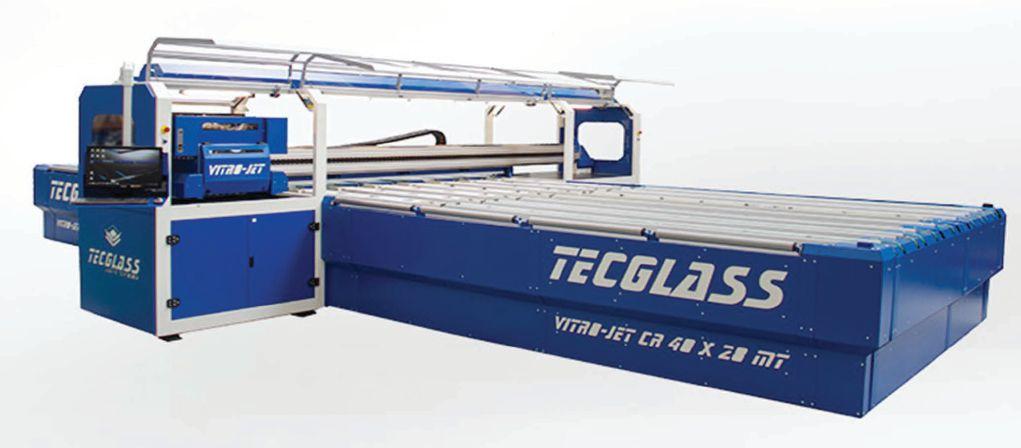
ProTemp provides “Unparalleled Freedom” for Architects & Designers
Sizes up to 98” x 176”
• Large format printing
• Special Climate Controlled, Dust-Free Room
• Digital Precision and Colour Quality
Endless Creative Possibilities!
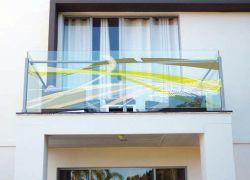
No matter what your creative project, ProTemp can make it a reality in glass.
Our new ceramic printer can print from 360 dpi from a .jpg or Photoshop® file up to 1080 dpi from an .ai or .eps file, ensuring the highest definition possible in glass printing. Once printed, the glass must be heat treated to “fire-in” the image. The image then becomes permanently fused within the glass. See how it work on YouTube. https://youtu.be/BqtdKmYyvsU
Send Ivan a vector file of your design for a FREE 12”x12” sample today! Then show your clients the creative possibilities available with this new technology.
SERIES 1781
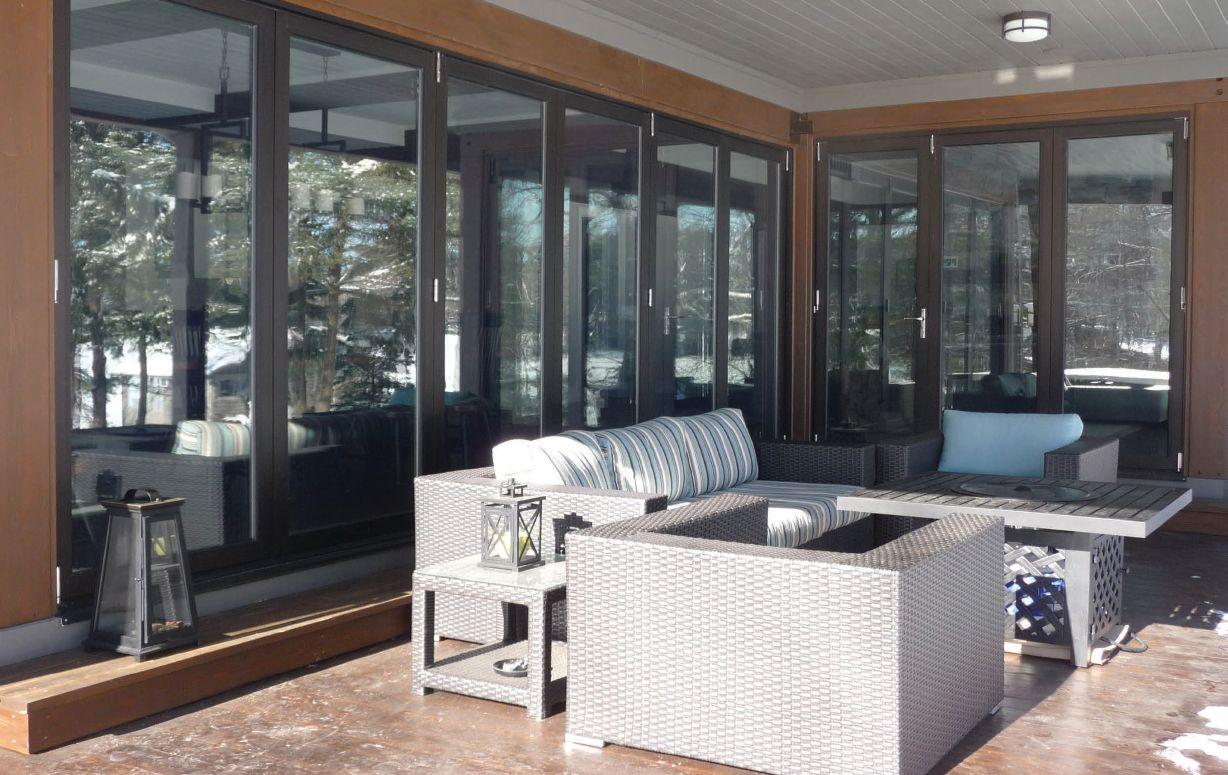
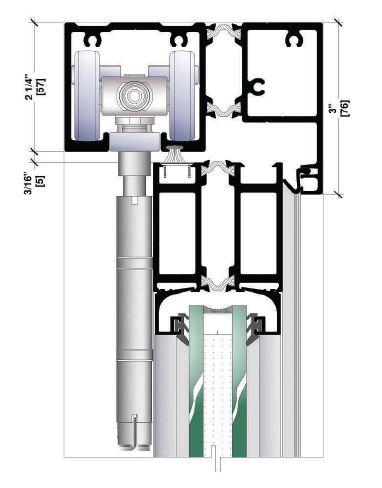
Commdoor Series 1781 is a premier folding door system for larger applications. It has been designed for strength and is generously proportioned to meet the requirements of specifiers looking for folding solutions in medium to large residential and commercial applications.
Stainless steel bearings in the pivots and carriers allow even the largest doors to be moved quietly and with fingertip ease between the open and closed positions.
In A Single Direction For Exterior Folding Doors
• maximum panel weight: 220 lbs (100 kg) each panel
• maximum panel width: 39” (990mm)
• maximum panel height: 118” (2997mm)
• maximum number of panels: 8 each way
NAVIGATING CHANGE INDUSTRYEVENT
by PATRICK FLANNERY
The Canadian Glass Association hosted Glass Connections, its full-day educational conference, Sept. 13 and 14 at the Westin hotel in downtown Ottawa. The Annual Meeting of the CGA took place on the afternoon of the 13th, after which delegates were welcomed by a reception featuring some very tasty ribs, chicken, sliders and that perennial Ottawa favourite, beaver tails. Everyone had a chance to lift a beverage with contractors, fabricators and suppliers from across the
Glass Connections helps the industry deal with a shifting environment.
country that they don’t get to see very often. Word went through the room that Chris Johnson of Lenmak had stepped down as president of the CGA and Jim Brady of Desa Glass has put his hand up once again to take the reins. Brady has promised an aggressive campaign to drive membership and board participation, and has initiatives in mind that he hopes will bring more resources to the association.
The event was ably coordinated by Bill Yanek, the out-going executive director. Yanek will be leaving his position at Centric Management for other opportunities, and administration of the CGA will be turned over to Sandy Mahoney. Yanek was thanked for his efforts and professionalism.
Codes and standards update
The education sessions kicked off on the 14th with a look at Canadian energy standards by Stanley Yee of Dow Corning, who is also president of the Glass Association of North America. Yee outlined
the three approaches code authorities have taken for code compliance: prescriptive, trade-offs and performance. Prescriptive paths require contractors to provide facade and fenestration systems designed a particular way, using a particular set of components, in order to comply. The trade-off path lists energy performance requirements for various components of the building, then allows architects to specify lower-performing elements in certain areas as long as some other element offsets the penalty with higher performance. Whole-building performance paths place few or no requirements on how the building is constructed, as long as the whole building meets certain numbers for energy efficiency. These paths leave the most room for design flexibility and probably make the most sense from the perspective of actually reducing the amount of energy used. Yee predicts performance path compliance will continue to gain popularity and soon become the most common way energy standards are enforced in Canada. Jim Brady commented that new buildings in Calgary
ABOVE: Everyone agreed Glass Connections was a great way to get together with some people you don’t see all the time. Here, Sergei Mihhailenko of Glazing Engineering hangs out with Jim Brady of Desa Glass and Angelo Cairo of Stouffville Glass.
already have to have performance-path modeling done both at the bid stage and again before the building is released for occupancy.
Yee showed a chart mapping the stringency trend for ASHRAE since its inception in 1975 – buildings are now allowed to use half the energy under ASHRAE that they were allowed to use back then. Still, it appears that the industry has not had significant trouble meeting these challenges with technology. A U.S. Department of Energy study found almost 100 per cent compliance with energy code requirements in residential windows across six states. A study of commercial buildings by the same agency is planned.
Yee discussed the activities of the Glazing Industry Code Committee in influencing the decisions of the IECC at its recent update meetings. The GICC submitted successful proposals to increase allowable commercial skylight area, increase compliance flexibility, remove barriers to window replacement and tighten residential U-factor requirements. The GICC also successfully resisted a proposal that would have prevented highly glazed commercial buildings from complying
In an industry where one small mistake or equipment malfunction can result in serious injuries, it’s so important to know that your equipment won’t let you down. Regardless of the size of the job, I have trusted Wood’s Powr-Grip’s suction cups for my company and my employees.
Dustin
with IECC energy requirements even if they showed compliant energy efficiency levels. Whole-building air-leakage test standards were approved. The GICC also influenced the IECC to reject proposals to require commercial buildings under two stories to meet residential U-factor requirements, to remove commercial shading credits and to eliminate credits for onsite renewable energy. In short, the GICC, which now includes members of the CGA thanks to its alliance with GANA, has helped to prevent numerous changes that would have negatively impacted the ability of architects to specify glass facades under IECC standards. As an international model code, the IECC influences building codes all over the world.
ASHRAE 90.1 update meetings are ongoing and Yee says the discussions have become much more inclusive of the glass industry viewpoint since North American associations rose up two years ago to resist proposals to further reduce window/ wall ratios. U-factors and solar heat gain will likely be added to the requirements for fenestration components in the next round of changes.
Thoughts on sustainability
Mark Silverberg of Technoform delivered a thoughtful talk on sustainable building, giving some perspective on why the concept is important for the industry. One of the surprising points to come out of his talk was the revelation that, when the concept of “sustainability” was invented in the ‘80s, the need for economic profits was fully recognized as part of the philosophy. Silverberg showed how the original idea of sustainability was as a three-legged platform incorporating the environment, social considerations and economics. Turns out a sustainable proposal that eliminates or overly restricts the possibility of making money is not, in fact, sustainable.
Silverberg also presented data showing the importance of building envelope construction to the worldwide environmental movement. Several international studies have found that energy use in buildings is the most important contributor to climate change and depletion of natural resources worldwide, and that building envelope design and refurbishment represents the number one opportunity for sustainable development ahead of any other sector. To illustrate the point, he mentioned environmental targets in New York City that would require the refurbishment of more than a million buildings over the next 20 years. He urged delegates to look on sustainable building practices not as a threat to their way of doing things but as an immense opportunity.
Too much to cover here
helping
Space prohibits going into similar detail about the rest of the talks – you really had to be there. Bruce Milley of Guardian discussed the evolution of flat glass production, giving delegates an inside look at the processes that produce the glass they use every day and the amazing technology that is used to coat it. Tim Nass of SaftiFirst informed delegates about the difference between fire resistant, fire protective and safety glass and how those three categories are treated in the codes. George Torok of Morrisson Hershfield discussed window wall and the common design and installation pitfalls that cause it to leak, along with recommendations for how to fix them. Larry Carbary of Dow Corning told delegates how his lab used finite element analysis to discover a better way of applying silicone in high wind-load applications. It has something to do with hyperelasticity. About 75 delegates attended the event. The next Glass Connections is tentatively slated for Vancouver. • Wood’s Powr-Grip introduces Intelli-GripTM Technology the smart solution to glass handling. For more information visit WPG.com or call 800.548.7341.
Anderson President, Anderson Glass, LLC Waco, Texas
A GREAT VIEW
by PATRICK FLANNERY
Delegates at the Insulating Glass Manufacturers Alliance 2016 Summer Conference sometimes had to tear themselves away from the breathtaking views and visits by the local wildlife long enough to concentrate on the excellent technical progam Aug. 8 to 10 at the Banff Centre for Creativity and the Arts in Banff, Alta. About 75 IG fabricators and their suppliers gathered to join discussions on cutting-edge technical innovations and changes to standards interspersed with lots of networking and a fun night at a mountain lodge.
The theme for the Tuesdaynight networking dinner was “Are you a lumberjack?” and most of the IGMA delegates proved that clear mountain
Beautiful Banff was the setting for advanced technical discussion.
spring water does indeed flow in their veins with an impressive display of flannel, work boots, toy axes, hats with ear flaps, false beards and even a Mountie uniform. Prizes were handed out for best mens’ and ladies’ costumes, best lack of a costume, longest sustained effort in support of the industry and most “bear-like” in promoting the industry.
In the conference room, delegates heard from the Certification, Emerging Technology and Innovation, Technical Services and Education committees. The content was, as always, fascinating, acting as an overview of the outstanding issues in IG fabrication best-practices and a look ahead to what the industry will be doing in the future to continue to improve and stay competitive. For instance, delegates heard presentations on an update to an ISO-style quality program specifically for the glass industry, new ways to do the butterfly test for sealant adhesion, a creative solution to turning monolithic windows into triple IG without ripping them out and an update on environmental declarations
for glazing products which will soon be mandatory for LEED projects under Version 4, which comes into effect in October.
Jeff Haberer of Trulite chairs the Technical Service Committee. Tracy Rogers of Quanex reported on the activities of the Glazing Guidelines and Visual Quality subcommittees. Rogers reported that Glazing Guidelines is working on a draft guideline for IG units with unsupported edge conditions, for instance, two-sided butt glazed units. He noted that the IGMA does not support doing this, but since it is happening anyway the subcommittee has decided to address it.
The Visual Quality subcommittee is working on a consumer education web page that will outline acceptable visible flaws in IGUs. The hope is that this will mitigate problems with consumers rejecting whole units on the basis of very tiny imperfections. The page is to include introductory information with baseline knowledge about IGUs, an introduction to the applicable industry standards, a FAQ section and guidelines for inspecting IGUs.
ABOVE: Bill Lingnell of IGMA and Urmilla Sowell of GANA try to assess whether this visitor will agree to chair a subcommittee.
Some felt a similar document for commercial clients would be useful, too. The page is being produced in partnership with the American Architectural Manufacturers Association and is going through their balloting process before returning to IGMA for approval. When it is ready, it will appear at glassdocs.com, a huge information portal run by the Glass Association of North America, the National Glass Association, AAMA and IGMA.
Rogers also reported on the Vinyl Siding Distortion subcommittee that is also preparing an educational web page addressing the concern that low-E glass can reflect solar energy causing damage to nearby vinyl siding. The subcommittee is drawing information from a variety of sources to refute this myth, which gained some traction in the U.S. after a vinyl siding association produced a YouTube video.
Haberer reported that the IG Cavity Width subcommittee had some delays in getting its draft document ready because of discussions over how to treat the question of the effect on U-factors of IG cavity width. Some feel it is too simplistic to draw a straight line between cavity width and U-factor, while others feel it can’t be denied that a smaller cavity will lead to increased U-factor unless other steps are taken. The U-factor material may end up in an appendix or taken out entirely.
David Cooper of Guardian discussed the work of the PIB Migration subcommittee. The joint subcommittee with the Glass Association of North America is working to define the problem of PIB migration out of IG seals. At this time it looks like the scope of the group will be limited to finding a testing protocol, and the likely candidate is one from the Rosenheim Institute in Germany. The focus now is on finding out if any other chemicals or components interact with PIB to make it more likely to flow after installation.
Cooper also reported on efforts to update, archive or discard hundreds of old technical documents. He said the IGMA’s glazing guidelines should soon be available in French.
Jeff Baker of WestLab reported to the committee on Energy Star. The Canadian Office of Energy Efficiency administers Energy Star and has been funded through 2021, so the program is not going anywhere. The overhaul of Energy Star’s digital properties continues, with changes to the web addresses coming as well as Facebook and Twitter accounts. The big recent
change has been to require all Energy Star product data to be submitted through recognized certification organizations only, instead of direct from the manufacturer. Energy Star officials are looking at certifying storm windows and possibly including solar heat gain data in their assessments. Also, the program recognizes that steps are needed to tighten enforcement of the use of the label and prevent substandard products from being sold under the name. Mystery shoppers may be used to purchase products and have them tested.
Helen Sanders of Sage Electrochomic chairs the Emerging Technologies Committee. She gave a presentation educating delegates about the new rules that will be coming in with LEED v4 in October that will require manufacturers to have official Life Cycle Assessments and Environmental Product Declarations prepared for their products in order to qualify for sustainability points. The IGMA along with other glass building organizations has helped this process by putting Product Category Rules in place for flat glass, processed glass and windows. The association is now working with the Glass Association of North America to see if it can produce a generic, industry-wide EPD for processed glass products.
Sanders introduced Tracy Rogers, who gave the committee a presentation on an innovative system from Quanex that can be retrofit to old windows, essentially upgrading monolithic single glazing to double-glazed, or upgrading double-glazed to triple, without removing the old fenestration. Rogers described how the system was tested on a building constructed in 1971 in Philadelphia. The heart of the system is a slide at the bottom of the frame that allows the interior lites to be attached without distorting the existing spacers. In the case study he presented, two pairs of sideby-side rooms with different orientations on the building were compared for a year with and without the system. Heating cost reductions of 40 to 60 percent and cooling cost reductions of around 35 per cent were measured in the retrofit rooms. The systems can be installed at night without evacuating the floor and without any exterior work. Quanex estimated the cost of ripping out and replacing the old windows would have been around $1.8 million, while retrofitting the whole building with this system cost $800,000.
David Cooper updated the committee
on the white paper on vacuum insulating glass recently published by the VIG subcommittee. The subcommittee is now looking at developing a test standard. An ISO durability and dimensional tolerance test looks right now like it will fit the bill. It does not appear that temperature and humidity affect the performance of VIG units. Ultraviolet radiation can negatively affect some of the chemicals used in VIG, so work has begun on developing a UV resistance test. Mechanical load testing is also in development.
Tracy Rogers reported from the Advanced Fenestration Testing subcommittee on efforts to find a screening test that would reveal the need for full ASTM E2190 and E2188 durability testing, thus reducing the need for time-consuming and expensive destructive testing. The subcommittee is looking at test from five different labs with such colourful names as Big Hammer and Thumper. Many of the tests seem to deliver results that successfully predict the results of the full tests. Now the subcommittee will expand the test criteria and try to address different standards. John Kent of the Insulating Glass Certification Council reported that using interim data predicted the results of the ASTM test 85 per cent of the time, leading to speculation that this may open the door for some kind of provisional certification allowing manufacturers to go ahead with products pending future completion of the full test.
Randi Ernst of FDR Design talked about gas measurement validation. Efforts to develop a test standard are slowed by the difficulty of controlling the many variables involved. Some stakeholders want the ability to appeal tests. The subcommittee is looking at adding chromatography to ASTM 2169, or possibly developing a new ASTM standard for dessicant testing. The subcommittee has been unable to find data comparing argon to krypton fill to see if there is any difference for testing purposes.
The event was led by IGMA president Mark Hutchinson of Intigral and organized by IGMA executive director Margaret Webb and administrative and certification coordinator, Kate Webb. Major sponsors included Cardinal, Dow Corning, Guardian, H.B. Fuller, Intigral, PPG Canada, Quanex, Royal Adhesives/Kommerling and Tremco.
The next IGMA conference will take place Jan. 23 to 26 in Clearwater, Fla •
BY ALLAN DOYLE
Allan Doyle is general manager and partner of Global Windows and Doors in Richibucto, N.B., and president of Fenestration Canada. He has over 30 years’ experience in the fenestration industry.
A new WinDoor
The current year has been a very busy and productive year at Fenestration Canada. The spring meetings at the Fairmont in Mont-Tremblant, Que., were an excellent networking and education event and an introduction to our new association management team at Zzeem. The prospects for membership growth and development have never been better or more clearly focused with Zzeem at the controls.
Now that the fall season is here, the Fenestration Canada team is fully engaged with hosting WinDoor North America, the annual trade show of the window and door industry in Canada.
WinDoor 2016 is heading to a new venue in Old Montreal: the Palais des Congres de Montreal. This is a “new” event with a new layout, an ambitious and revitalized education program and new networking and social events. Fenestration Canada is proud and enthusiastic to welcome the collaboration and support of the AVFQ – Quebec’s provincial fenestration association – as a partner in the promotion and content development of the show. With the support of the AVFQ we are expecting tremendous support from the fenestration industry in Quebec. Special thanks to Gilbert Lemay, AVFQ executive director, and his team for their support in this new and exciting venture. This is a unique collaboration for our two groups.
Stéphane Labelle of Groupe Eugenie and chair of the WinDoor committee has worked hard to create a new show, with a new image and layout in the heart of Old Montreal. Follow his WinDoor blog at windoorshow.ca. The WinDoor show committee is looking forward to hosting members of the fenestration industry across Canada at this new location on Nov. 15-17. If you have never been to Montreal this is a tremendous opportunity to experience one of the great cit-
If you are looking for information, we will have an expert on hand.
FENESTRATION CANADA
ies of the world and discover new opportunities to learn and grow your business.
Your show committee has promised two great events that will provide many opportunities to network. After a day of committee meetings we open the show with a cocktail reception and head out to Old Montreal for “Doors Open Montreal,” a downtown dining tour. After a jampacked schedule on Wednesday, the show committee will be hosting the “After Hours” show floor party. Both events are new to the WinDoor schedule and the show committee anticipates great participation from both attendees and suppliers.
If that wasn’t enough, Steve Alward of Atlantic Windows and the Education Committee supported by Jeff Baker of Westlab and J.F. Kogovsek of Maxam Marketing, have lined up an impressive, technically focused education program. Nine education sessions are planned with some presentations in either English or French and some offered in both French and English. Also back by popular demand is the Q&A panel discussion with the test labs. If you are looking for information on triple glazing, net zero homes, changes to the installation standard, codes and standards updates, social media, mulling guidelines and other technical matters, we will have an expert on hand to get you informed. You also do not want to miss Stephane Labelle, your show committee chair, and Laura Weil of Euro Vinyl Windows and Doors as they give you the rundown on the power and potential of social media in their talk titled “Be in the Know.”
Steve and J.F. will also be introducing “Train the Trainer.” Fenestration Canada will be producing a series of presentations designed to show our members how to make presentations in a professional manner with content that is created and approved by Fenestration Canada’s technical experts. The first presentation on the North American Fenestration Standard (NAFS) and the Canadian supplement was presented to a group of building inspectors in New Brunswick. Don’t miss Steve and J.F. at WinDoor.
The Show Committee has listened to the concerns of past attendees and has revamped the show. All we need now is your presence. Register online today. See you in Montreal. •
FALL IN VEGAS GLASSBUILD2016
by GLASSBUILD
Now in its 14th year, GlassBuild America: The Glass, Window and Door Expo is the gathering place for the North American glass, window and door industries. Presented by the National Glass Association and the Window and Door Dealers Alliance along with show co-sponsors, the American Architectural Manufacturers Association, the Glass Association of North America and the Insulating Glass Manufacturers Alliance, GlassBuild America is a comprehensive and united event.
In 2016, GlassBuild America is being held in October because of a date change by its marketing partner show, Glasstec in Dusseldorf, Germany. Glasstec,
GlassBuild goes a little later in 2016 with a great educational lineup.
the largest glass industry trade fair in the world, was bumped out of its usual October timeframe into the September timeframe by an even larger plastics industry trade fair. This meant GlassBuild America had no choice but to shift to October for the 2016 event.
All Express Learning events take place on the tradeshow floor in the Express Learning Theatre, booth 314.
WEDNESDAY, OCTOBER 19
11:00 am | Get Your Products Market Ready Presented by Intertek
Product testing and certification are inherently tied to the building commissioning process. Learn the ins and outs of the testing and certification process to get your products to market, and ultimately, into buildings.
Audience: window and door fabricators
11:30 am | Expand Your Color Palette with New Vinyl Window Options Presented by Veka
New vinyl colour options are changing today’s home and building exteriors. Learn about the latest colour technologies, custom-colour and colour-matching possibilities, as well as the feasibility of darker colours in regards to energy transfer in residential and commercial vinyl windows.
Audience: window and door fabricators and dealers
1:30 pm | Five Simple Steps to Identifying a Quality IG Presented by GED
Learn to spot the key characteristics of a high quality IG unit, in a way that everybody in your facility can understand.
Audience: architectural glass and window fabricators
ABOVE: It’s the biggest fenestration event in North America. GlassBuild happens in October this year, but organizers promise it will be worth the wait.
2:00 pm | Window Safety is Everyone’s Responsibility
Presented by the American Architectural Manufacturers Association
Falls from a window can result in serious injury or death, especially for children. Learn what you can do as a manufacturer or dealer to spread awareness about this important safety issue.
Audience: window fabricators
2:30 pm | Bird-Friendly Glass and Your Bottom Line
Presented by Arnold Glas and Ornilux
The market for bird-friendly glass has reached a tipping point here in the U.S., with LEED and other regulatory bodies advocating its use. Learn how and where the market is growing, and why incorporating this glass in your product line can differentiate your company as an innovator and solutions provider.
Audience: architectural glass and window fabricators
3:00 pm | Cybersecurity on the Manufacturing Floor
Presented by The Rovisys Co., sponsored by Glass Magazine
If you are like most manufacturers, you are probably grappling with an increasing growth of smart devices on your manufacturing floor. This emerging connectivity comes with unseen danger: the threat of cyber-attack to extort money, steal customer information, or disrupt production. This session focuses on helping you understand the cyber vulnerability that is associated with your dynamic manufacturing IT environment and discusses what you can do to mitigate the risks.
Audience: fabricators
3:30 pm | The Internet (Glazing) of Things
Presented by the Glass Association of North America
Audience: glazing contractors
THURSDAY, OCTOBER 20
10:30 am | IG Fabrication for the Next Generation
Presented by the Insulating Glass Manufacturers Alliance
As experienced plant personnel reach retirement age, they take with them a wealth of industry knowledge. This IGMA-sponsored session relies on adult
education principles developed for Gen X, Gen Y and Millennials to ensure that this expertise gets passed onto the next generation of IG fabrication personnel.
Audience: fabricators
11:00 am | Warranties as Contracts Presented by The Gary Law Group, sponsored by Glass Magazine Warranties are more than marketing tools, they are legal contracts that tie companies to their products or work into the future. In this session, learn about the long-term legal obligations of product and project warranties and how they affect everyone from contract glaziers to fabricators to product manufacturers.
Audience: contract glaziers, window and door fabricators and dealers
11:30 am | Window Walls vs. Unitized Curtain Walls: An Evolution Presented by Kawneer
Since 2000, window wall applications have gained momentum in the mid-rise multifamily and commercial markets. Learn about distinct market opportunities on the horizon for window walls and unitized curtain walls as urban and nearurban cityscapes continue to command modern architectural trends.
Presented by Mr. Shower Door, sponsored by the NGA
Rapid-fire tips and techniques for solving shower enclosure issues, from working with new builders to speeding up installation times to reducing reorders. Hear from Mr. Shower Door’s Tom Whitaker how to get the job done better, faster and safer.
Audience: full-service glass companies
1:45 pm | HGTV and Me
Presented by Anderson Glass, sponsored by the NGA
A regular on the HGTV show “Fixer Upper,” learn from Dustin Anderson about his television experience, how it fits into his overall marketing plan, and what other marketing strategies he has found to be successful.
Audience: full service glass companies, window and door dealers
2:15 pm | To Employ or Contract?
Presented by WindowJim, Sponsored by WDDA
The construction industry as a whole largely subcontracts installers, especially on projects requiring several trades. But what about window and door dealers: Is it best to contract or employ installers?
Audience: window and door dealers
2:45 pm | Three Keys to Increase Lead Conversion...Tenfold!
Presented by MarketSharp
Ok, you’ve generated some leads, but you still have to convert that “spark of interest” to a “raging fire of desire” to proceed to the next step in your sales process. Often, this requires processes and skills that many companies overlook. In this session, discover some staggering statistics and how-to strategies to maximize your lead conversions and increase sales.
Audience: window and door dealers
Wait, there’s more
In addition to Express Learning, GlassBuild America also features the 11th annual Glazing Executives Forum, the second annual Window and Door Dealer Days and The Dream Showroom. More than 400 exhibiting companies are expected to showcase their most innovative glass and fenestration products and services.
Advance registration rates are in effect until September 30, with NGA and WDDA members receiving special member rates. Rates increase on October 1.
Who
puts this thing on?
Founded in 1948, the NGA is a trade association serving the architectural glass and metals industry and represents the interests of glazing contractors, glass fabricators and architects. Its sister organization, the Window and Door Dealers Alliance (WDDA) represents the interests of retail, wholesale and installing dealers of new and replacement windows, doors, skylights and related building products. The NGA\WDDA provides education and training programs and services for its member companies. The NGA\WDDA also produces the industry’s largest annual trade show in the Americas, GlassBuild America, and hosts the Glazing Executives Forum and Window and Door Dealer Days, bringing together thousands of industry professionals to help them build more profitable businesses. •
SPECIALTYHARDWARE
Absorption of loads
pilkington.com
The fittings in the Pilkington Planar system offer the ideal balance between durability and appearance. All are manufactured from 316 grade stainless steel and some of the most durable engineering plastics currently available. Highly engineered and tested components allow Pilkington Architectural to offer the smallest, most aesthetically pleasing fittings available without compromising performance.
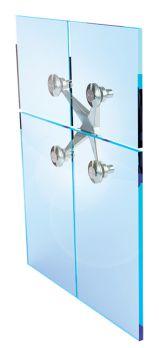
Specially customised fittings are available subject to design assessment and approval. The 902 fitting connects indirectly to the secondary structure by means of Pilkington Planar spring plate brackets or castings. The 902 can accommodate any angle of slope, making it ideal for roofs and canopies. The 905J fitting is the most popular Pilkington Planar fitting. It eliminates the need for spring plates and allows absorption of live loads and thermal expansion by rotation around a stainless steel rod connected to the back up structure. The Planar cast springplate provides the opportunity to customise and innovate. Pilkington Architectural engineers are able to develop new stainless steel connectors by use of 3D CAD and finite element models. Designs can accommodate large lateral movements and high loads from the glass panels. These connectors allow the designer to tailor the aesthetic of the façade to their individual requirement, whether that be a subtle detail or a bold
design statement. Four and two point castings (e.g. Nexus) are some of the many types of stainless steel connectors designed to connect the glass fitting to the back-up structure whether structural steel or glass mullion.
Three-sided standoff
stellaglasshardware.com
Stella believes that projects shouldn’t be changed to work with the limitations of the parts. Hardware should always evolve to meet the project’s needs.
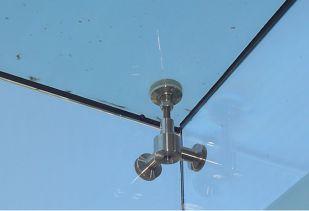
Working with designers and creating new parts from scratch inspires the work Stella does. A bold and visionary architectural design requires components that allow it to function and look exactly as it was imagined. Stella’s custom approach is reserved for those projects that are setting new precedents, and that simply can’t be specified from a catalogue. For example, the Stella corner standoff is a needed element on many glass boxes. It functions to connect glass at three planes and is an alternative to a heavy-looking bar support. This custom standoff provides structural rigidity in glass corner situations where needed and maximizes transparency. These are always bespoke parts created to the exact dimension of the project’s corner.
Stainless steel
jeberkowiz.com
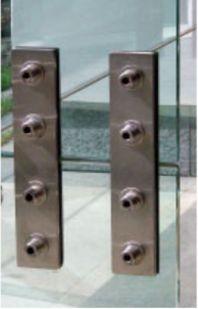
JEB Invisiwall point-supported hardware is suitable for vertical walls and canopies. To ensure quality, all point-supported system hardware is fabricated from 316-alloy stainless steel and is available in satin and polished finishes. Rotule fittings can be fixed or articulated, reducing stress at holes to minimize the possibility of breakage. Rotule heads can either be countersunk or have a surface disk.
Maximum transparency
nupress.com
As a next-generation designer and manufacturer of structural glass facade systems, Nupress is committed to the continuous upgrade and technological advancement of its company and people. Nupress employs the latest design, engineering and manufacturing technologies to produce state of the art, custom manufactured hardware to meet the most demanding facade design requirements. Forward-thinking design professionals are given the freedom to design tomorrow’s structural glass walls. Design and development of products is focused on delivering satisfaction and engineered solutions that enable as well as compliment the architectural intent. Nupress’ unique position as not just the designer but the actual manufacturer of our products sets it apart from competitors and allows architects unprecedented design freedom. Pictured is the Bay Adelaide East project in Toronto.
Designed by KPMB Architects, Bay Adelaide East comprises a 44-storey office tower with a six-storey podium that connects to an existing building at 132 Yonge Street. The Bay Adelaide East Tower lobby is designed with 30-foot ceilings and low-
iron structural glazing. The sophisticated and contemporary ground floor lobby is vibrant and spacious, with an abundance of natural light. During design meetings the architectural team expressed a desire to have a very transparent wall with no holes in the glass. To meet the architect’s design intent Nupress designed and manufactured the Nu Ledge Stacked Structural Glazing system using an integral shelf system to support face lights. The system requires all fins to be fully tempered and multi–ply laminated. Laminated fins are supported via top and bottom wind load shoes/anchors. The 12-mm face glass is supported via dead load blocking at the sill and two intermediate shelves, in addition to being continuously structurally siliconed back to the laminated fins.
Multitude of options
flynncompanies.com
Structural Glass Wall Systems gives Flynn clients a multitude of design and performance options. Walls can be heavy tempered singleglazed; double- or even tripleglazed insulated glass; top-hung with vertical glass fins; vertical and horizontal metal truces; posttensioned cable supported; or a combination of various other custom applications. In all cases the final result is wonderfully large expanses of total vision glazing. The lack of bulky metal support systems help create beautiful lines of sight to both the inside and outside of the building.
Complete engineering package
obe.com
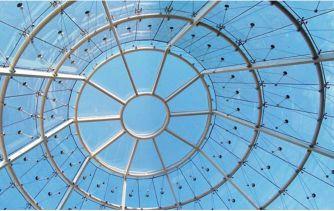
Point-supported canopies and facades are comprised of stainless steel spider fittings and tempered glass to resist wind load and snow load requirements. Glass attachment fittings are designed to flex when the glass is under loading to reduce stresses in the glass at the fitting connection’s. Spider fittings are typically bolted to a steel back-up structure. Oldcastle BuildingEnvelope has extensive experience in the design of structural glass systems. It offers custom-design and engineering capabilities for all structural glass applications for any design development needs. Oldcastle BuildingEnvelope provides complete engineering and shop drawings for structural glass systems as a complete package to customers. All engineers are licensed in their jurisdiction with extensive knowledge of glass structures. Oldcastle BuildingEnvelope can review steel requirements on a project-by-project basis to determine feasibility. Oldcastle BuildingEnvelope point-supported systems can incorporate insulating glass with or without low-E, laminated glass or monolithic tempered glass.
by FRANK FULTON
Frank Fulton is president of Fultech Fenestration Consulting. He has been in the industry for 30 years and can be reached via email at fultech.fc@ gmail.com
Low priorities
Way back in February, 2015, the Ontario government issued a press release stating “Ontario is launching an expert review of the Construction Lien Act that will include the examination of payment issues within the construction sector.” It went on to say that “strengthening Ontario’s construction sector is part of the government’s economic plan for Ontario.” It was stated on many occasions thereafter that the process would be fully transparent.
A year has now passed since I outlined the proceedings of the Ontario Construction Lien Act review. The OGMA and AGMCA joined Prompt Payment Ontario (PPO) to ensure the views of the glass and metal industry were heard at the table. Extensive surveys were conducted by PPO to compile data to prove just how poorly subcontractors are treated when it comes to getting paid by contractors, developers, and municipalities. The legal group completed its’ extensive review of the act and submitted its recommendations to the provincial government at the beginning of May, 2016. And there it sits. Although this matter is largely a regional issue at this time, you can be sure it will influence future laws across the country. Those of you who aren’t blessed with the strong and responsible Liberal leadership we enjoy in Ontario may wonder why they haven’t released the report yet. To be fair, they’ve been extremely busy diligently managing our economy with an unprecedented level of fiscal responsibility.
One example of this is the gas plant scandal where, in order to win seats in an election, the Ontario Liberals gave in to “NIMBYism” in Oakville and Mississauga and halted the construction of two gas-fired hydro plants that were already under construction. The tab to the taxpayers was
The Ontario government has been extremely busy diligently managing our economy.
YOU BET YOUR GLASS
reported to be as high as $1.1 billion. It wasn’t all bad news though. The Liberals won those seats in the communities where the gas plants were scrapped.
During the past year our illustrious leader, Kathleen Wynne, was very busy establishing a new Ontario Retirement Pension Plan (ORPP) to supplement the CPP while at the same time rolling out carbon emission cap-and-trade regulations, more accurately referred to as a carbon tax. The plan was rolled out at the beginning of the year but some behind-closed-door talks with the prime minister’s office led to its cancellation in June. In that short time, $8 million was spent marketing a program that never actually existed.
The government has been “investing” in many other areas as well, ringing up a debt of $308 billion. This makes Ontario the most leveraged jurisdiction in North America with twice the debt of California and half the population.
Possibly more lucrative will be the carbon tax, a way to extract money from working stiffs by adding a penalty fee to the fuel they use to heat their houses and the gasoline they use to drive their cars to work. The cap-and-trade regulation took effect on July 1 and was expected to increase the price of gasoline by 4.3 cents per litre and add $5 to a household’s monthly natural gas bill. Cumulatively, it is expected to raise $1.9 billion in the first year, or according to O’Leary, “the largest hedge fund in Ontario history.” Although this money is earmarked to fund green projects, there’s not a person in the province who believes that’s where the money will be going within a few years.
So, what’s all this got to do with the CLA review and the release of the report? When pushed by PPO, the message from David Phillips, chief of staff to the Attorney General, Yasir Naqvi, was that the CLA review report “was important to Minister Naqvi, but there are a number of legislative issues that are of a greater priority.” There exists the concern that the delay was to allow politically connected influences a chance to massage the final report in their favour prior to its release.
Well, as it happens, just as I finished writing this mini-rant, the Attorney General’s office issued a letter stating the review will be made public at the end of September. We’ll hope for the best but must be ready for the worst. Stay tuned. •
The CRL-U.S. Aluminum Monterey Bi-Folding Door and Wall System™ is an award-winning innovative solution that creates uninterrupted transformative living spaces by providing striking hybrid environments with spectacular views. Suitablefor both residential and commercial applications, our system features clean, modern aesthetics with precision-engineered components that allow window, wall, and door panels to slide smoothly with minimal effort. The Monterey allows you to bring the outdoors in while providing resistance to undesirable weather conditions, and provide security with standard two point interior lever latches, and available three point keyed locks on select Monterey configurations.
The Monterey comes in several different configurations, in powder coated and anodized finishes, with a thermally broken option for improved energy efficiency.
• Top Hung Panels Glide Smoothly and Easily With Minimal Effort
• Versatile Pivoting Panel Option
• Weather Resistant, Designed for Interior and Exterior Use
• Inward or Outward Stacking Positions Available
• Certain Models Available With 3-Point Keyed Locking System
• Thermally Broken, Constructed for Extreme Weather Conditions
• Flush Mount or Raised Sill Options
The NEW CRL Baywood™ Horizontal Retractable Screen System is now available for use with all CRL Monterey Bi-Folding Doors. Baywood Screens easily mount to the inside jamb of the opening, or if tight on space, a face mount frame is also available. The matching finish bottom guide adheres to most floors, including rough tile and hardwood. The pleated screen is durable, yet sheer enough to allow excellent visibility.