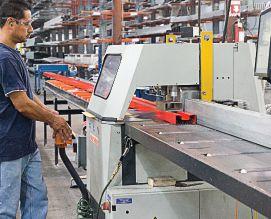
Open up and let the profits in with these innovative new solutions for entrances.
U.S. military researchers are experimenting with sintered materials that are as hard as aluminum but with great optical quality.
Additive manufacturing is getting a lot of press. But where is it in terms of real application?
Where accredit lies
Accreditation is a good idea that has been hard to implement.
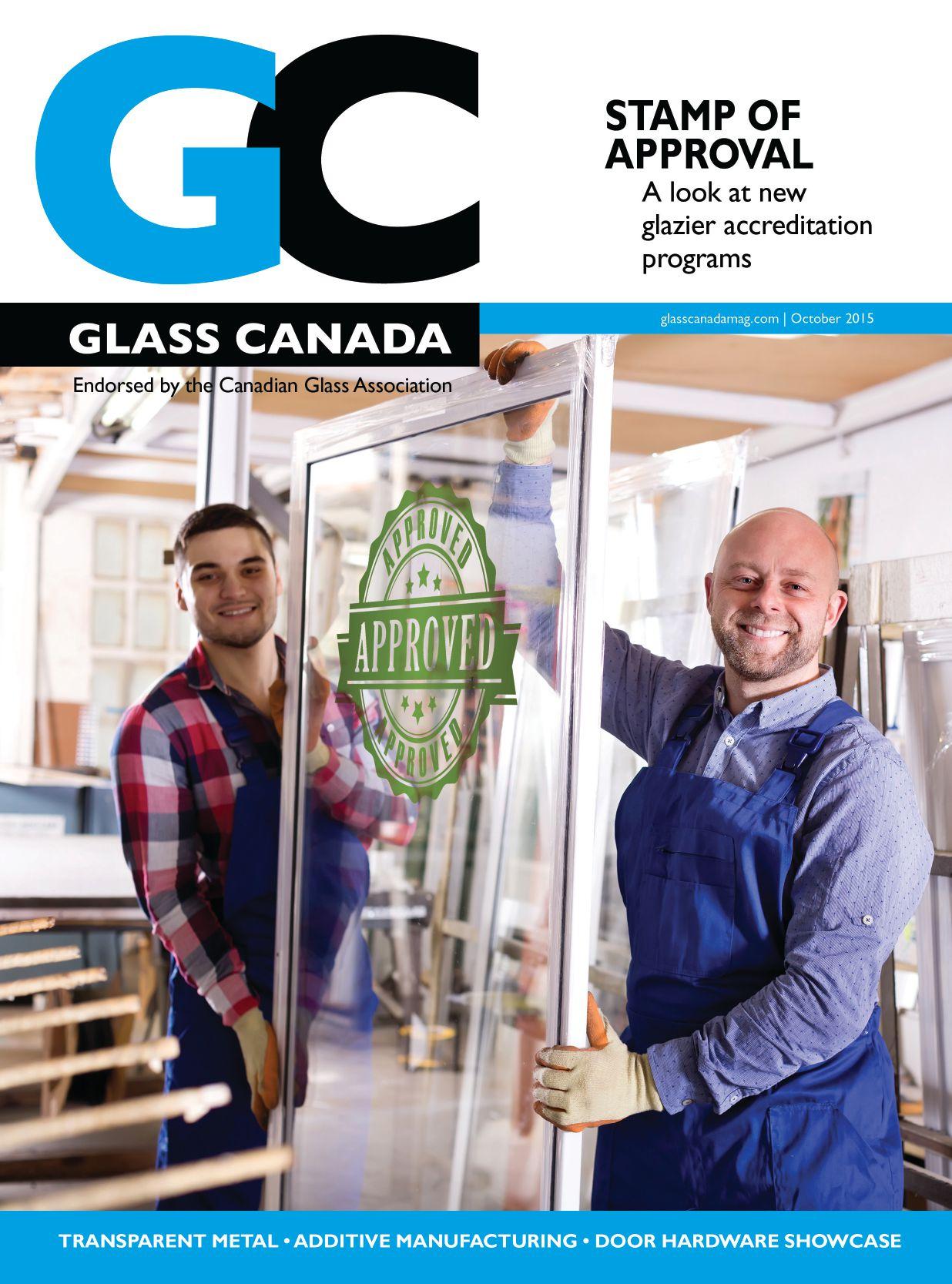
Our cover story this week is about accreditation of glazing companies, a topic I imagine will get very different reactions depending on the reader. It’s a new thing for the Canadian glass industry, but certainly not a new idea in business. How people react to the idea of accreditation says a lot to me about where they are as a business and how they approach the market.
As a basic concept, it is hard to argue with accreditation. Objective, knowledgeable certification of a company allows customers to shop with less risk, contractors to advertise their bona fides and the industry to defend margins for quality.
As in all things, the devil is in the details and accreditation is so beset with devilish details that effective, popular programs are pretty rare. The main pitfall lies in the basic conflict between the accrediting company’s duty to honestly and objectively evaluate its subjects and its duty to serve its paying customers – they are the same people! If the customer is always right, and the customer says his company complies with the standard, well, where do you go from there? Accrediting organizations are always under pressure to leave loopholes in either the standard, the auditing process or their documentation to suit the preferences of their customers.
NEXT ISSUE
• Double skin facades
• Annual Buyers Guide
Solutions to this problem exist, but many introduce new problems of their own. Removing the agency relationship between the accrediting company and its subjects is one fix. For instance, if the certifier is a taxpayerfunded government agency, the company to be certified has no pull as a paying customer. Or if the organization is funded by a group farther up the market vertical – the accredited company’s prospective customers – the pressure to cheat on behalf of the subjects is obviously removed. The problem in both these cases is when industries are regulated by outside entities, the rules tend to quickly become unfair and render the industry unprofitable. Companies will simply opt out of such a regime if allowed to do so. If forced to comply, a recessionary business-stifling effect occurs.
The other big problem that can sink voluntary accreditation programs is a perceived lack of value in the program. Accreditation is only ever as good as the respect it commands in the target market. A lack of awareness of the program among the accredited company’s customers is quickly fatal. Also fatal is a proliferation of accrediting agencies, creating an alphabet soup of logos and standards that customers despair of deciphering and soon ignore. Any accreditation agency that wants to last better pony up a substantial marketing budget that creates the impression that companies bearing its seal of approval, and only those companies, are the very best in the business.
Opposing all these factors is the common lament that our industry has become commoditized and something must be done to arrest the race to the bottom on price and quality. It’s a complaint heard, perhaps not coincidentally, most often from the larger and better-established companies in the sector. Accreditation programs involve a difficult balancing act between competing market forces. It remains to be seen whether anyone can stay on the wire in the Canadian glass industry. •
GROUP PUBLISHER | Martin MCANULTY mmcanulty@annexweb.com
Publication Mail Agreement #40065710. RETURN UNDELIVERABLE CANADIAN ADDRESS TO CIRCULATION DEPARTMENT, P.O. BOX 530, SIMCOE, ON N3Y 4N5 e-mail: subscribe@glasscanadamag.com
Printed in Canada, All rights reserved. Editorial material is copyrighted. Permission to reprint may be granted on request. ISSN 0843-7041
Canada - 1 Year $36.75 (includes GST) ($39.55 includes HST/QST)
U.S.A. - 1 Year $50.00 (in US dollars)
Occasionally, Glass Canada will mail information on behalf of industry-related groups whose products and services we believe may be of interest to you. If you prefer not to receive this information, please contact our circulation department in any of the four ways listed above.
www.glasscanadamag.com
INDUSTRY NEWS
Oldcastle acquires C.R. Laurence
Oldcastle
BuildingEnvelope, a CRH Group company, has executed a binding agreement, subject to regulatory approval, to acquire C.R. Laurence, North America’s largest manufacturer and distributor of custom hardware and glazing products to the glass and glazing industry. Headquartered in Los Angeles, CRL will continue to be independently managed and operated as a subsidiary of OBE and will retain all existing management structures and personnel. The company has eight manufacturing/engineering centers and 28 service centers across the U.S. and Canada, and an additional six operations in the United Kingdom, Denmark, Germany, and Australia. CRL designs and manufactures a wide range of engineered hardware products required by professional glaziers and glass shops to complete the installation of architectural glass in both commercial and residential markets. For the past two years, the Los Angeles Business Journal has recognized CRL as one of the top 100 Fastest Growing Private Companies.
Commenting on the acquisition, Ted Hathaway, CEO of Oldcastle BuildingEnvelope, said, “CRL is a true American success story. CEO Don Friese has built an extraordinary organization that has enjoyed exceptional growth. I have been impressed with CRL’s
leadership and unwavering commitment to the customer. We extend a warm welcome to their talented employees and management team and look forward to capturing unique and compelling synergies together.”
Friese, who will continue to lead CRL after the acquisition, said, “CRL is proud to be acquired by Oldcastle BuildingEnvelope, who we have admired for many years. As a leader in the glazing industry, it is an honour to be part of this world-class company. We look forward to the opportunity to build upon our strengths and talents to better serve our customers.”
Lloyd Talbot, president of CRL, said, “C.R. Laurence is a true American success story. Most of you who have known us and done business with us over the years know the names ‘CRL’ and ‘Don Friese’ are synonymous. Don will be 75 in October and has built a tremendous business over a legendary career spanning 55 years and counting. We have been working on a plan for several years by which CRL would remain an independent company for many years to come. By now you may have read or heard of the acquisition of CRL by Oldcastle BuildingEnvelope. Significantly, Don will remain CEO of CRL and CRL will be independently managed and operated as a subsidiary of OBE.”
Oct. 13
GANA Fall Conference San Antonio, Texas glasswebsite.com
Oct. 18 AAMA National Fall Conference Cambridge, Md. aamanet.org
Nov. 3 Windoor Toronto, Ont. windoorshow.com
2016
Feb. 21 - 23
GANA BEC Conference
Las Vegas, Nev. glasswebsite.com
Feb. 29
IGMA Winter Conference Indian Wells, Calif. igmaonline.org
April 20
Top Glass Mississauga, Ont. topglasscanada.com
May 19 - 21 AIA Convention Philadelphia, Pa. aia.org
Sept. 16 - 18
GlassBuild Atlanta, Ga. glassbuildamerica.com
Sept. 20 - 23
Glasstec Dusseldorf, Germany glasstec-online.com
The Ontario Glass and Metal Association presented Kate Turoczi of Southlake Regional Health Foundation with a $2,000 donation toward beds for cancer patients. Handling the very big cheque are Angelo Cairo of Stouffville Glass, OGMA president, and Doug Morris, OGMA director.
CGA Newsletter
Canadian Glass Association
The CGA has partnered with the Glass Association of North America to offer several manuals. During the last CGA board of directors meeting, it was confirmed that the association would work in partnership with GANA to sell GANA Manuals to CGA members at a reduced rate, and in Canadian funds. The manuals that will be offered are:
• Glazing Manual
• Engineering Standards Manual
• Fully Tempered Heavy Glass Door and Entrance Systems Design Guide
• Laminated Glazing Reference Manual
• Protective Glazing Manual
• Project Managers Reference Manual
• Fabrication, Erection and Glazing Hours Manual
• Guide to Architectural Glass
• Sealant Manual
The CGA website is undergoing an overhaul in the next few months to be able to accommodate immediate online sales and downloads. Stay tuned for more details in the coming months.
The CGA Technical Committee is hosting a call for volunteers to serve on the group. We hope you will consider sending one of your technical staff to serve on the Technical Committee and help to bring your expertise to both the regulatory bodies governing codes and to the members of the CGA. If this is something that you would be willing to do for your industry, please contact us at info@canadianglassassociation.com. The first meeting has not yet been scheduled, but will be held via conference call.
The chair of the CGA Technical Committee is Brent Harder, Ferguson Corporation.
Provincial Glaziers Association of Alberta
This bit of news will touch on the PGAA’s progress with the Master Glazier program. The first of nine courses in the MGP is complete and we expect to have the Division Eight, Blue Print Reading course ready for enrollment the last half of October. There are a few more details to be ironed out but our educational provider, the Southern Alberta Institute of Technology, is confident we will be able to take applications for this course this October. The PGAA will provide complete course details to our members and other interested parties soon. While the courses being developed for this program are aimed at journeyman glaziers wishing to upgrade their skills with a view to obtaining master glazier status, the courses are open to anyone wishing to upgrade their skills. This latter group could include estimators, spec writers, suppliers and anyone requiring AIA learning credits to maintain their educational certification. SAIT and the PGAA are starting development mid October of course number two, Doors and Related Hardware. The PGAA is supplying three subject matter experts to develop this course. Tom Woodman and Lynn Allan from Capilano Glass in Edmonton and Jim Brady from Desa Glass in Calgary will provide the industry expertise to develop this course. These PGAA volunteers will spend about two to three hours every
two weeks for about three months with a targeted course completion date of January, 2016. We expect the development of course number three to follow shortly after.
The PGAA board thanks our educational partner SAIT and the PGAA volunteers who are making this extraordinary initiative a reality.
Ontario Glass and Metal Association
Thelegal review of the Construction Lien Act is now well underway and an information package has been completed by the legal review group for distribution.The outcome of this review could be the most important piece of legislation in decades and could make a huge difference in your ability to be paid for work. We’ll only get one shot at this and your input could make the difference.The OGMA has joined Prompt Payment Ontario, a lobby group formed to make sure opinions from the Ontario construction industry are heard in this process. As an OGMA member, you are invited to respond to PPO’s online survey to make sure the glazing industry’s voice is included.We strongly urge you to visit ipsosresearch.com/contractorpaymentsurvey and take 20 minutes to answer the questions.
The OGMA Fall Seminar Will take place on Oct. 29 at 11:30 at the Richmond Hill Golf Club. Our sponsor and presenter will be ICD who will be educating attendees on the use, benefits, and limitations of opaci-coat spandrel coatings.
If you are conducting business in the glass industry in Ontario, the OGMA is the voice that represents your interests at the provincial and federal level. Protect your business interests by becoming a member or as an associate member if you are a consultant to the industry. Please visit ogma.ca for more information.
OGMA fall golf was held Sept. 17 at the New Course at Hidden Lake Golf Club, one of the latest additions to the ClubLink stable of courses. About 100 members and guests had an outstanding day of golf followed by an outstanding dinner. We proudly made a donation of $2,000 to the Southlake Regional Health Centre for the purpose of purchasing equipment for cancer patients.
After a year of preparation, the OGMA/WSPS safety manual is now ready for use by the metal and glass industry. The manual was created by qualified health and safety professionals and is a timesaving tool enabling glass shops to establish their own company program. Not only will this support a company’s efforts to eliminate workplace injuries and illnesses, it will also lower costs and time related to WSIB claims. Additionally, the health and safety manual provides proof of compliance with the new OHSA Regulation 297/13.
If you are conducting business in the glass industry in Ontario, the OGMA is the voice that represents your interests at the provincial and federal level. Protect your business interests by becoming a member or as an associate member if you are a consultant to the industry. Please visit the OGMA website for more information.
A new Star in HHH’s sky
Glass
fabrication tools and equipment are now available through HHH Tempering Resources’ official partnership with K-Star Diamond Company, a glazier’s equipment manufacturer. The signed contract launches a value-added HHH product line expansion for North American glass fabricators. Key tools now offered by HHH include: hand-held precision glass cutters, shape cutting tools and vacuum glass lifters. “The addition of select K-Star products means increasingly comprehensive fabricator choices with HHH,” said HHH Tempering Resources president, Mike Synon. “As we keep an eye on the future and endeavor to be the industry’s leading North American resource, we seek to meet fabricator demand for increases access to quality tools through strong partnerships with trusted brands,” In addition to the handheld cutting tools and glass lifters, HHH also features an exclusive and specially designed K-Star dual-belt seamer.
Company Presidents Mike Willard (Salem Glass) and Mike Synon (HHH Tempering) have announced their respective companies are partnering to offer comprehensive glass services—independent of their unique brands—through the joint venture Glass Tempering Resources. This entity will serve the glass industry with new and refurbished tempering lines and other refurbished equipment. Additionally, Glass
Strong support for Top Glass
Top Glass Conference and Exhibits, returning April 20, 2016, to the International Centre in Mississauga, Ont., continues to experience strong growth with the help of top industry suppliers. Gold sponsor Tremco has been joined by Commdoor Aluminum and RPM Rollformed Metal Products as Silver sponsors.
Tremco has been a driving force behind Top Glass from the beginning. One of North America’s foremost suppliers of sealants, weatherproofing and passive fire control solutions for commercial and residential construction and industrial applications, Tremco continues its great tradition of support for industry education and growth.
Commdoor also has a long history of steady support for sector groups, including the Ontario Glass and Metal Association. Part of the Toro Group, Commdoor Aluminum produces entrance framing, swing doors, curtain wall, sliding
Howard has PVB
Everlam, a new company producing polyvinyl butyral interlayers for laminated safety glass, has announced the appointment of Jim Howard as vice-president of sales for North America. The company, established in Europe in 2015, is making a decisive move towards development of its business worldwide. Howard brings to Everlam extensive executive level experience in the PVB business and other chemical industries in North America. His mission is to position Everlam PVB interlayer for growth in laminated safety glass with existing and potential customers in the architectural market.
CEO Luc De Temmerman commented, “As the trend towards
Tempering Resources will offer Master Service Agreements for all tempering brands. “Currently, there are no firms in the glass machinery arena that have a broad sales team covering both the United States (U.S.) and Canada, and the technical expertise to service any tempering brand. The formation of Glass Tempering Resources fulfills that void,” Mike Willard explains.
Mike Synon adds, “This venture truly provides much needed service as some of our industries best maintenance personnel retire and companies reduce the size of their current maintenance staff. Glass Tempering Resources is a costeffective solution to keep their equipment running in top condition.”
Glass Tempering Resources features the world’s most popular tempering line from North Glass Tempering. North Glass has sold the highest number of tempering systems in the global market. Salem will offer complete sales support, while HHH will provide U.S.-based services including installation, postsales technical support, parts inventory and 24-hour service agreements. “Our customers no longer have to wait for overseas service. Instead, our technical staff is available 24/7 to get our customers up and running as quickly as possible. Our industry is focused on machine uptime and we are driven to achieve that goal for our customers.”
and bi-fold doors, windows and other products for the glass construction market. In business since 1989, the fabricator stocks a huge inventory in its Toronto-area warehouse and manufactures new products using advanced CNC machinery.
RPM is another first-time sponsor of Top Glass. A metal fabricator in Concord, Ont., RPM produces a huge array of rollformed products for the glass fabrication industry, including reinforcements, spacer, grill bar and door hardware. You can read more about RPM Rollformed Metal Products in Glass Canada’s August 2013 profile “Rockin’ rollforming,” available online at glasscanadamag.com.
“We are so grateful to our sponsors and encourage everyone to thank them at the show,” said Danielle Labrie, Top Glass show manager. “Interest in our 2016 edition has certainly been strong following our great session last spring.”
greater use of laminated glass in architecture continues to open new opportunities and increases demand for high-quality products, Everlam’s goal is to become a brand of excellence in PVB interlayers for architectural laminated safety glass. We have the right products, a team of experts in place and the flexibility to provide excellent customer service.”
Howard says, “Everlam is a new name for a new company that has produced excellent quality products used extensively in many applications for years. With the agility of a streamlined organization, our focus is to grow the business in North America as quickly as possible.”
Update to wall leakage standard
The American Architectural Manufacturers Association has updated and released a document specifying test methods, specifications, and field checks used to evaluate the structural adequacy of wall systems and their ability to resist water penetration and air leakage. Other optional tests also are included. AAMA 501-15 is intended to be referenced in current laboratory and field testing methods for exterior wall systems comprised of curtain walls, storefronts and sloped glazing. It was previously updated in 2005. According to José Colon of Architectural Testing, chair of the AAMA 501 Update Task Group, the standard recently was updated to make sure all labs and product manufacturers are on the same page as far as procedures and pass/fail criteria for certain parts of the standard. These document updates also take into consideration the new technologies for equipment being used for testing.
“Historically, AAMA 501 has been the base standard for project specific test requirements,” says Colon. “More and more specifications are being written that are actually even longer than what is called out in AAMA 501.” This is especially the case in places with more detailed codes, like Miami-Dade or the state of Florida in general, said Colon.“A specific product or system company will ask us to test per AAMA 501 just to get their system testing so they can get certification from Miami-Dade or Florida,” he says. “The building code requires AAMA 501 on curtain wall and store front systems. Plus, we have other manufacturers or glazing contractors that will need similar testing per AAMA 501, or greater, for a specific project.”
AAMA 501-15, as well as other AAMA documents, may be purchased from AAMA’s Publication Store.
Brosmer elevates at Kawneer
Kawneer has named Colin Brosmer vice-president of sales, marketing and product development. In this role, Brosmer will join Alcoa’s Building and Construction Systems lead team and will be responsible for sales, marketing, architectural promotions, product development and front end functions for North America. Brosmer joined Alcoa in 2001 as a welding engineer for Alcoa Automotive and was named manufacturing project manager for Kawneer in 2006. He later held positions as Kawneer regional sales manager for central
Canada and commercial business manager for curtain wall and director of front-end services. Most recently, Brosmer served as director of sales for Kawneer. He will continue to be based out of Kawneer’s Norcross, Ga., headquarters. Brosmer holds a Bachelor of Science in welding engineering from Ohio State University.
“During his tenure, Colin has demonstrated drive, leadership and a deep commitment to Alcoa’s Kawneer brand, which is well known for its world class product suite providing innovative, cutting edge solutions to the architectural and construction industry,” said Diana Perreiah, president of Alcoa Building and Construction Systems.
Agnora installs huge ceramic ink printer
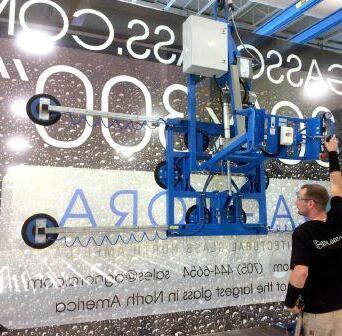
Agnora of Collingwood, Ont., has installed the largest ceramic ink digital glass printer in North and South America. The DipTech AR8000W prints ceramic ink directly on the surface of glass up to 130 by 300 inches. In the tempering oven the printed image is then fused permanently to the glass. Printed glass can also be laminated and insulated, providing architects with a wide range of creative and structural design options. Printed glass can save energy, diminish glare and solar heat gain to increase occupant comfort, reduce bird
collisions and provide enhanced traction slip resistance. Applications include building entrance canopies, balustrades, stairs and walkways, skylights and building facades. Agnora extensively researched decorative glass options before deciding on the industry’s popular Dip-Tech glass printing technology.
Owner Richard Wilson is excited about the new printer’s reception. “Customers have been quick to engage oversize glass printing,” he says. “They are marrying the printer’s wide range of colours, accuracy and repeatability with the design freedom and ‘wow-factor’ of building with big glass.”
Digitally printing ceramic ink in-glass can convey photorealistic designs, provide privacy and opacity control, produce ‘double sided’ images and imitate the look of overall or pattern acid-etched glass for oversized interior and exterior applications.
“Our team is very proud of our new Dip-Tech jumbo printer,” Wilson continued. “This addition to our toolbox enhances Agnora’s abilities to custom-fabricate the largest glass in North America and to continue providing industryleading customer service.”
Agnora’s new printer can print surfaces up to 130 by 300 inches and can produce high-definition, photo-quality images.
Colin Brosmer
by MARGARET WEBB
Margaret Webb is the executive director of the Insulating Glass Manufacturers Association.
Helping you get ISO
IG Certification Programs are now recognized and required by fenestration certification and rating programs such as Energy Star, the American Architectural Manufacturers Association, the Window and Door Manufacturers Association and the National Fenestration Rating Council, recognizing the critical importance of the IG unit on the overall durability and performance of fenestration systems.
Three years ago, IGMA began the process of updating the TM-4000-02(07) Insulating Glass Quality Manufacturing Procedures manual. The current quality manual provides the basis of the quality control system for the IGCC-IGMA and IGMAC certification programs. The original program contained the majority of the elements required for ISO certification but did not address the foundation of the ISO process for continual improvement: corrective and preventive actions and more specifics for design and development. The primary contact person at each IGMA member company in good standing will receive a complimentary copy of the significantly revised manual, which will be identified as TM-4010 IG Manufacturing Quality Procedures.
Many of IGMA’s certified manufacturers are already seeking accreditation to the ISO standard and the goal of the new document is to provide a framework for an insulating glass manufacturer to use as the basis for a specific program geared to the unique requirements of each facility. This new document provides a unique tool for fabricators to become ISO 9001:2008 compliant or to proceed for full certification to the ISO standard.
The goal of the new document is to provide a framework for an insulating glass manufacturer to use as the basis for a specific program.
Any quality management system consists of documentation tiers. Tier I is the quality procedures manual, which has been under development under the IGMA Certification and Education Committee. The new manual is close to completion as this writing, having just completed the second committee ballot. Tier II are the procedures, Tier III, the work instructions, and Tier IV are the forms to prove compliance.
The text provided, though somewhat specific to IG production, is generic in nature and must be tailored to support a specific company’s structure, procedures and operations. The text is provided in different colours to visually provide instructions to the manufacturer. Text in red must be edited by the company with specific information regarding their organization. The comments in blue are for clarification purposes so that the user of the manual will understand the purpose of each section and how to complete it.
To further assist manufacturers to move to this level of quality, IGMA has contracted with an ISO consultant company, RPM Consulting. Ron Michalzuk has experience with the IG industry and will be a valuable resource, providing the expertise and support to implement a full quality program for the fabrication of insulating glass units. A link with contact information will be provided on the IGMA website.
IGMA has already developed much of the additional information required for the Tier II, III and IV documents however it will take time to compile it into one document and determine where there are gaps. To address the time factor of internal development, IGMA is considering contracting directly with RPM to complete the remainder of the required documentation so that the entire management system is ready to go by the end of 2015. The IGMA Board of Directors will discuss the merits of this proposal at their next meeting. •
IGMA
Seal of approval
approval
Organizations are offering new ways to certify your competence.
by TREENA HEIN
If you haven’t already heard about accreditation programs in the glass industry, it’s clear you’re going to be hearing a lot more soon.
One is the North American Contractor Certification (NACC) program, announced by the Architectural Glass Institute (AGI) in January 2015. In July, the names of the first NACC-certified companies were released – three U.S. firms, as well as Ferguson Neudorf Glass of Beamsville, Ont. Twelve more architectural glass & metal contractors are currently going through the certification process.
The NACC program was created to provide baseline recognition for competency, business practices, and adherence to industry-accepted guidelines. The program “provides confidence to building owners as well as the design and construction community with defined processes, controls and procedures to help drive a higher-quality end product.” The NACC Board of Directors includes contractors, consultants, construction specialists and manufacturers.
Administrative Management Systems (AMS) is the third-party certifier that administers the program. It has been doing this sort of work since 1997, for U.S. national associations such as the Safety Glazing Certification Council, Insulating Glass Manufacturer’s Alliance and the National Fenestration Rating Council. AMS President John Kent says NACC provides a differentiation that helps contractors, building owners, architects and the specification community to select competent companies and increase the likelihood of a successful project with lower re-work.
Kent describes industry awareness of NACC in the U.S. and Canada as “likely minimal at present,” but points out that “the program is still very new. Eighteen months ago, it was just a concept.” Outreach to architects, builders and the specification community is underway through things like mailings and presentations, and an ongoing promotional plan was developed at the first NACC annual meeting in mid-September (in Atlanta, piggy-backed with GlassBuild). Additionally, as of August, Kent notes, “We were thrilled that through some really hard work by many people, the NACC program is now under ISO/IEC 17065 Accreditation by the American National Standards Institute (which has an agreement with the Safety Council of Canada).”
Alberta glazing contractor Jim Brady shares his personal views on the program. “While I think that the idea has merit, it also has some underlying issues,” he says. “In Canada, construction processes are very regionalized...as a result, the architects and consultants for projects may or may not be onboard with NACC.” He adds that while he’s “all for” programs that recognize industry leaders, he fears that a program such as NACC might be a detriment to fair competition. “Just because one company doesn’t have NACC Accreditation doesn’t mean that they can’t give a good quality installation, and if not having that accreditation disqualifies them from quoting on the project, then it limits competition,” Brady observes, “thereby increasing prices to the end user (building owner). My guess is, most companies in Alberta would likely not participate in this program and they would
LEFT: Telling customers you offer high quality and great workmanship is easy to do, but hard to prove. Programs like the new North American Contractor Certification say they can help.
only do so when backed into a corner.”
Brady also wonders if the NACC board members include representation from smaller more regionalized companies. We asked AMS, and found out that of the five glazing contractors on the ten-person NACC accreditation board (the others being enduser companies such as building contractors), two companies are larger and three are smaller, with a good diversity of size always the aim.
Other accreditation programs
Brady notes that in Alberta, the Alberta Apprenticeship and Industry Training is used to educate tradespeople, but that the glazier trade in that province is not compulsory certified and apprenticeship is not mandatory. “Personally, I think this is wrong,” he says. “It is mandatory for someone to get training on hairdressing, but not for someone to change a sealed unit into a foursided structural silicone curtainwall ten storeys off the ground.”
Currently in Canada, Brady notes, the provinces of B.C., Alberta and Ontario have glazier apprenticeship training with in class instruction. “I am unsure about Quebec,” he says. “The Maritimes, Saskatchewan, Manitoba and the Territories do not. Some companies in Saskatchewan and Manitoba use the Alberta program. Nationally, the Red Seal program is in place, but… an individual merely has to prove they have a certain amount of hours in the trade, write an exam, and if they pass, they are recognized as a Red Seal Journeyman.”
Glazier has been a Red Seal trade since 1986, and the related standards and exams have been updated several times. Julia Sullivan at the Red Seal Secretariat says “Earning a Red Seal endorsement provides good job prospects and allows individuals to work anywhere in Canada. Completing an apprenticeship in a Red Seal trade also gives access to many of the benefits available from the government.”
Brady would be strongly in favour of getting curriculum delivered to tradespeople in jurisdictions where there is no program, and processes to measure skills with both written and practical exams. “In my years as a champion for education, I have heard many people say ‘I can’t afford to send my people to school, we’re too busy, others may steal them away from me, etc.’ and my only response to them is ‘You can’t afford to not educate your people.’ ”
Although he had not heard of NACC, Brady did point out Green Advantage (GA), an organization based in Maryland that’s now working to launch a ‘Curtainwall Installer Certification’ (GACIC) program. It will include written as well as performance exams with standards created by the International Glazier Certification Board, a broad array of industry experts from the U.S. and Canada.
Tough standards?
As Brady has noted, accreditation carries concerns. It can be a controversial issue because large companies can afford to put their people on the boards of the associated groups and certification bodies, thereby driving tougher and tougher accreditation standards, which may squeeze out competition from smaller companies.
On the other hand, good accreditation programs can help buyers avoid fly-by-nighters without having to embark on timeconsuming due-diligence searches. In addition, these programs can help prevent governments from having to step in to protect the public from shoddy workmanship. In one firm’s view, ac-
creditation also helps companies take their reputation to the next level. “Raising the bar and being an industry leader is something that Ferguson Neudorf strives for every day, so [going for NACC accreditation] was natural for us,” says Peter Neudorf Junior, director of field operations at Ferguson Neudorf Glass (FNG) in Beamsville, Ontario. “We want to be above the norm.”
FNG (founded in 1986, and now one of Canada’s largest curtainwall contractors) became NACC accredited in July. Neudorf says he and other leaders at the firm started talking about third-party accreditation a couple of years ago. “I sit on the Ontario and American Boards of the Architectural Glass and Metal Contractors Association and there have been many discussions about a certification specific to our trade,” he explains. “There are certainly issues with quality and standards within our industry and not all companies are committed to improving these standards. The general thought was that it’s time for some kind of accreditation and it’s time for architects and consultants to put their support behind this concept. My brothers and I decided to look into it, and I joined the advisory committee that got the necessary information to AMS to develop the NACC.”
When asked about the most onerous or challenging of the NACC criteria, Neudorf says it was improving overall production flow and communication between departments. “We needed improvement in how sales, purchasing, engineering, fabrication and installation connected with one another,” he notes. “It was a challenge to make changes. Some of our people were resistant to change and didn’t recognize the benefits of adding the extra
paperwork required to be a little more organized. Our team just kept pushing to have the necessary changes made to our standard procedures and added some new ones, making sure our management team were committed to getting things done in the way that best suited each department. It’s about more accountability, in the end.”
Those at Ferguson Neudorf consider the NACC cost to be very fair. Neudorf says they’ve paid at least the same amount for other third party services in the past, “and this time it really helped us streamline our business.”
Kent says the total NACC cost is currently a little under $4,000 per year, but notes that there will likely also be internal costs for a firm to change things so that they comply with program requirements. “We feel these costs are a fraction of the savings available from increased efficiency, greater recognition and lower rework,” he says. “In fact, the number one comment we have received from companies undergoing the process is that ‘this NACC process will make us a better company.’ ”
In terms of industry acceptance, Kent believes that while recognition of certification is never an overnight event, the value always becomes recognized by the user community. “Each of the [other programs we administer] has enjoyed steady increased recognition for over 30 years. We fully believe the NACC program will be a significant force both in the U.S. and Canada in the coming months and years.”
Neudorf agrees that awareness and industry acceptance is going to take time. “I’d say maybe half of our industry in Canada are moving towards certification at this point,” he says. “The other half either don’t see the value or think it’s not for them. But companies who are interested in being accountable will want this.” He adds, “We’ve found that it’s been very positive, an eye-opener and a learning opportunity. It’s not something to be afraid of – it is not an audit but rather an evaluation. You should welcome it if you want to become a better company.”
North American certification programs
Here are just some of the agencies offering to certify your company, your work or your people.
CSA Fenestration Installation Technician
csa.ca
The certification addresses the need to ensure the knowledge, skills and abilities of individuals who install factory assembled windows, exterior doors and unit skylights in residential buildings three stories or less. To become certified, individuals will have demonstrated proficiency in understanding and applying manufacturer installation instructions, general building principles, the CSA A440.4 window installation standard and other industry standards and/or best practices.
Green Advantage greenadvantage.org
Green Advantage offers the longest standing green building certification targeted specifically to construction field personnel across trades.
North American Contractor Certification theagi.org
The NACC Program was created to provide certification recognition as a means of creating a baseline for competency, business practices, and adherence to industry-accepted guidelines. The program provides confidence to building owners as well as the design and construction community with defined processes, controls and procedures to help drive a higher quality end product.
Red Seal
red-seal.ca
The Red Seal Program is the Canadian standard of excellence for skilled trades. Formally known as the Interprovincial Standards Red Seal Program, it sets common standards to assess the skills of tradespersons across Canada. Tradespersons who meet the Red Seal standards receive a Red Seal endorsement on their provincial/territorial trade certificates.
Window Wise windowwise.ca
Window Wise is a replacement window quality assurance program designed to give homeowners peace of mind that investing in window replacement will be a lasting one. We approve window replacement manufacturers and certify window installation contractors.
Energy Star
nrcan.gc.ca
The Energy Star Initiative is a voluntary partnership between the government of Canada and industry to make high efficiency products readily available and visible to Canadians. NRCan formally enrolls manufacturers, retailers and other organizations as participants in the Energy Star Initiative. Participants help promote Energy Star and ensure Energy Star-certified products are prominent and readily available in the marketplace and to Canadian consumers.
by SKIP MACLEAN
Skip Maclean is president of Fenestration Canada. He is business development manager for Tru-Tech Doors and has over 40 years’ experience in the window and door industry.
Windoor equals opportunity
When I think back on past Windoor shows, I can always think of at least one reason why participation paid off. As each November approaches I anticipate the hum of the show floor as attendees enter the exhibit hall to search out and validate required products and services. There was always something good to take from every show. Whether it was the renewal of old acquaintances, the instant feedback and gratification of new product launches, establishing new contacts, discussing current developments and challenges or simply celebrating another successful year with customers and suppliers, some key to success has always emerged.
Ideas and information are what Windoor is truly about. The exchange of ideas between fenestration professionals cannot be downplayed or dismissed. Many long-standing relationships have developed at the show and still exist today. Vendors, customers, owners, tradesman and other stakeholders gather to learn, teach and participate in matters that impact our industry.
New products! What exhibit would be complete without new products? This year’s show will have an expanded Innovation Station, located central to the exhibit booths and adjacent to both the Fenestration Canada and educational areas. Exhibitors will have an additional opportunity to promote their new product or service through short product demos in the education theater as well as placing product samples or literature in the continuously displayed Innovation Station. Discussing solutions for improving window and door processing, disseminating technical information and helping understand codes and standards are another key area of Windoor activity. The educational center will again be a hub of significant activity as many fenestration professionals
Committees are driven by the hard work of a few dedicated and passionate volunteers.
gather to hear presentations on subjects and matters that affect our businesses and industry.
Organizations like Fenestration Canada are only as strong as their members. Several committees are driven by the hard work of a few dedicated and passionate volunteers. Members from the Windoor, Marketing, Membership, Education and Technical committees have contributed their time and efforts to ensure the best Windoor experience possible. There are several changes to this year’s show and the format is designed to improve value. These changes are a direct result of surveys conducted immediately after last year’s show.
Opportunity is what Windoor brings. The opportunity to celebrate as an industry. The opportunity to discover what new products and technologies are available. Windoor brings window and door fabricators together through the Fabricator Council and other interactive and information sessions. Thursday morning’s breakfast session will provide key economic information from Scotiabank.
Recognizing that our marketplace is changing, the Windoor, Education and Technical committees have prepared information-packed seminars designed around needs particular to the fenestration industry.
Windoor will kick off this year with a special presentation from Argo great Michael “Pinball” Clemons. Don’t miss this high-energy presentation at 4 p.m. on Tuesday, Nov. 3.
For more information visit fenestrationcanada.ca or windoorshow.com.
If you are not a member, contact us and let us show you the value of membership. Networking, technical resources, education, government relations, Windoor North America – together we can accomplish so much. •
Transparent metal
New processes may lead to metal windows.
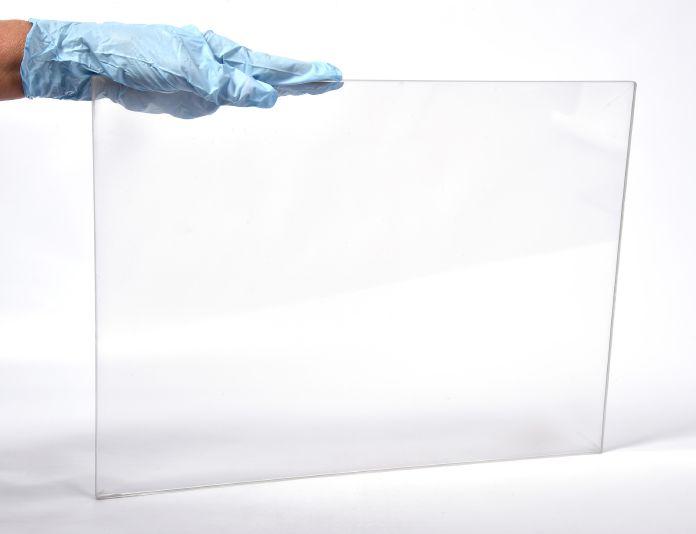
The U.S. Naval Research Laboratory uses a hot press to make spinel into conformable optics, like this flat sheet. “Ultimately, we’re going to hand it over to industry,” says Jas Sanghera, who leads the research, “so it has to be a scalable process.” In the lab, they made pieces eight inches in diameter. “Then we licensed the technology to a company who was able then to scale that up to much larger plates, about 30-inches wide.”
Imagine a glass window that’s tough like armor, a camera lens that doesn’t get scratched in a sand storm or a smart phone that doesn’t break when dropped. Except it’s not glass, it’s a special ceramic called spinel that the U.S. Naval Research Laboratory (NRL) has been researching over the last 10 years.
“Spinel is actually a mineral, it’s magnesium aluminate,” says Jas Sanghera, who leads the research. “The advantage is it’s so much tougher, stronger, harder than glass. It provides better protection in more hostile environments so it can withstand sand and rain erosion.” As a more durable material, a thinner layer of spinel can give better performance than glass. “For weight-sensitive platforms – unmanned autonomous vehicles, head-mounted face shields – it’s a game-changing technology,” he says.
NRL invented a new way of making transparent spinel using a hot press, called sintering. It’s a low-temperature process, and the size of the pieces is limited only by the size of the press. “Ultimately, we’re going to hand it over to industry,” Sanghera says, “so it has to be a scalable process.” In the lab, they made pieces eight inches in
diameter. “Then we licensed the technology to a company who was able then to scale that up to much larger plates, about 30-inches wide.”
The sintering method also allows NRL to make optics in a number of shapes, “conformal with the surface of an airplane or UAV wing,” depending on the shape of the press.
In addition to being tougher, stronger and harder, Sanghera says spinel has “unique optical properties. Not only can you see through it, but it allows infrared light to go through it.” That means the military, for imaging systems, “can use spinel as the window because it allows the infrared light to come through.”
NRL is also looking at spinel for the windows on lasers operating in maritime and other hostile environments. “I’ve got to worry about wave slap and saltwater and things like that, and gun blasts going off. It’s got to be resistant to all that. And so that’s where spinel comes into its own,” Sanghera says.
Says Sanghera, “Everything we do, we’re trying to push the mission. It’s designed to either enable a new application, a
new capability, or enhance an existing one.”
Spinel can be mined as a gemstone. A famous example is the Black Prince’s Ruby, which is actually spinel with a colour dopant. NRL chemists have also synthesized their own ultra-high purity spinel powder, and other synthetic versions are commercially available. “The precursors are all earth-abundant, so it’s available for reasonably low cost,” Sanghera says. The spinel NRL makes is a polycrystalline material, which means it is made of a lot of crystal particles all pressed together. With glass, “a crack that forms on the surface will go all the way through,” Sanghera explains. Spinel might chip but it won’t crack. “It’s like navigating through the asteroid belt, you create a tortuous path. If I have all these crystals packed together, the crack gets deflected at the hard crystals and you dissipate the crack energy.
When scientists first started trying to make glass-like spinel, they were using a crucible instead of a press. “A big problem with growing crystals is that you have to melt the starting powder at very high temperatures: over 2,000 C,” Sanghera says. It’s expensive to heat a material that high, and “the molten material reacts with the crucible, so if you’re trying to make very high-quality crystals, you end up with a huge amount of defects.” That’s why Sanghera and his colleagues turned to sintering. “You put the powder in a hot press then you press it under vacuum to squash the powder together. If you can do that right, then you can get rid of all the entrapped air and all of a sudden it comes out of there clear-looking.”
If the press has flat plates, the spinel will come out flat. “But if I have a ball and socket joint and put the powder in there, I end up with a dome shape,” Sanghera says. “So we can make near-net-shape product that way.”
NRL was not the first to try sintering. But previous attempts had yielded “a window where most of it would look cloudy and there would be an odd region here and there – about an inch or so – that was clear, and that would be coredrilled out.”
So NRL deconstructed the science. They started with purer chemicals. “Lousy chemicals in, lousy material out,” Sanghera says.
Then they discovered a second problem, this time with the sintering aid they were adding to the spinel powder. “It’s about one per cent of a different powder, in this case lithium fluoride,” Sanghera says. This “pixie dust” is meant to melt and “lubricate the powder particles, so there’s less friction, so they can all move together during sintering.” They were putting the powders together in shakers overnight, but “the thing is, on a scale of the powder, it’s never mixed uniformly.”
Understanding the problem led to a unique solution for enabling uniform mixing. Now, “there’s only one pathway for densification,” and the spinel will come out clear across the press.
To further increase the quality of the optic, “you can grind and polish this just like you would do gems,” Sanghera says. This is the most costly part of the process. “One of the things we’re looking at is, how do we reduce the finishing cost?” The surface of the press is imprinted onto the glass. “If we can improve upon that,” he says, “make that mirror finish, then –and so that’s where we get into a little bit of intellectual property – what’s the best way to do that?”
For both the Department of Defense and private industry, “cost is a big driver, and so it’s important for us to make products? that can be affordable.”
Unique applications for military and commercial use
“There are a lot of applications,” Sanghera says. He mentions watches and consumer electronics, like the smart phone, as examples. The military in particular may want to use spinel as transparent armour for vehicles and face shields.
Reducing costs
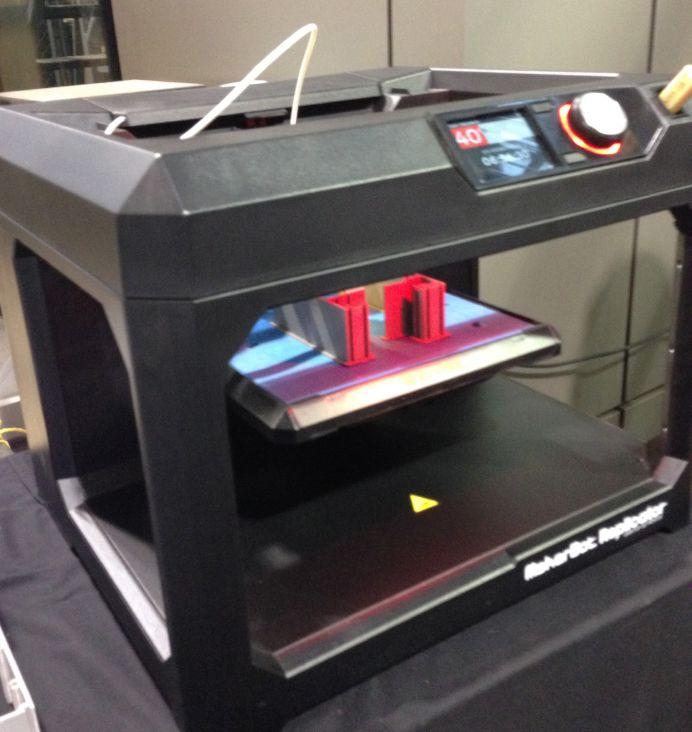
The U.S. Naval Research Laboratory uses a hot press to make spinel, a process called sintering. It’s much less expensive than melting, and the size of the pieces is limited only by the size of the press. Lead researcher Jas Sanghera says, “You put the powder in a hot press then you press it under vacuum to squash the powder together. If you can do that right, then you can get rid of all the entrapped air and all of a sudden it comes out of there clear-looking.”
To further increase the quality of the optic, “You can grind and polish this just like you would do gems.”
Photo courtesy of U.S. Naval Research Laboratory/Jamie Hartman
A “bullet-proof” window today, for example, has layers of plastic and glass perhaps five inches thick. “If you replaced that with spinel, you’d reduce the weight by a factor of two or more,” Sanghera says.
The military’s also interested in using spinel to better protect visible and infrared cameras on planes and other platforms. Glass doesn’t transmit infrared, so today’s optics are made of “exotic materials that are very soft and fragile,” and have multiple layers to compensate for colour distortions. “So that’s what we’ve been doing now, developing new optical materials,” Sanghera says. Spinel windows could also protect sensors on space satellites, an area Sanghera’s interested in testing. “You could leave these out there for longer periods of time, go into environments that are harsher than what they’re encountering now, and enable more capabilities,” he says.
NRL is also looking at spinel (and other materials) for next-generation lasers. “Lasers can be thought of as a box comprised of optics,” he says. “There’s passive and there’s active components. Passive is just a protective window, active is where we change the colour of light coming out the other end.” For passive laser applications, like exit apertures (windows), the key is high quality. “That window, if it’s got any impurities or junk, it can absorb that laser light,” Sanghera says. “When it absorbs, things heat up,” which can cause the window to break. Sanghera and his colleagues have demonstrated, working with “ultra high purity” spinel powder they’ve synthesized in NRL clean rooms, spinel’s incredible potential. For active laser applications, they’ve demonstrated how sintering can be used with materials other than spinel to make a laser that’s “excellent optical quality.” Instead of spinel, they use, “things like yttria or lutecia and dope them with rare earth ions.” NRL has transitioned both types of laser materials and applications to industry.
Editor’s comment
Alternative transparent materials in appliactions that require high impact resistance would be a welcome innovation in architectural glazing. Many designers have been looking for solutions to problems with traditional safety glass products. One example that springs to mind is balcony glass. There have been several instances in big Canadian cities of tempered balustrades in high-rise condominiums shattering and showering tempered glass “pebbles” into the street below, much to the concern of passers by and unit owners. The breakages were blamed on the expansion and contraction of nickel sulphide inclusions in the glass which are introduced as a normal byproduct of the primary float glass process. Heat soaking can ensure a lower percentage of inclusions in the glass that survives the process, but adds waste and cost without completely eliminating the problem. New standards for balcony guard construction and the use of
laminated glass will probably ameliorate the issue going forward, but at the cost of some design restrictions. Sintered spinel panels would presumably be much stronger, offering increased protection to residents and pedestrians.
Another area where safety glass has become not-so-safe is wired glass. Primarily used for fire resistance, wired glass has come under scrutiny lately following instances of people impacting the windows and cutting themselves on the metal wire interlayer. If spinel can take the heat of a laser without shattering, a regular fire should cause no problem.
Of course, the cost of producing architectural-size sintered spinel panels is prohibitive right now. Perhaps some form of additive manufacturing process would offer a solution, as some kinds of 3D printers operate in a manner very similar to sintering. Again, technology that is some years off. So were smartphones in 1995. Sometimes it pays to keep an eye on what is coming next. •
by BRIAN BURTON
Brian is involved with an innovative multidisciplinary firm that specializes in technical business writing: Award Bid Management Services (award-bidmanagement-services. com). The firm assists companies interested in selling goods and services to governments and institutions. He can be reached at brianburton1995@ gmail.com.
A Canadian opportunity
Along with two other interested parties I recently completed a literature survey and report on the potential impact of climate change on Canadian buildings and infrastructure. The report was more like speculation than hard-core research because we didn’t test any of our conclusions or suggestions.
After we submitted the preliminary report I received several responses from members of the association that sponsored the survey. In particular one design professional disputed the fact that climate change was occurring at all – in any form – and in Canada in particular. Whether any climate change is occurring is not really the main issue since the subject remains a concern for the construction, insurance and financial sectors. I personally sustain an interest in Canadian environmental conditions, not because our climate might be changing but because Canada is a global leader in the research and implementation of severe weather construction and construction technology. specifically with regard to fenestration components as well as the building envelope. I highlight this leadership role because it is been suggested on occasion that Canadians are modest to a fault. I’ve heard this comment on numerous occasions and it appears to be built into our national character.
I would stress two points about our leadership role. The first of being that construction is Canada’s largest industry and our nation’s largest employer. Second, that as a nation we spend more on construction than virtually any country on the planet with the exception perhaps of Norway and Iceland. Both these facts are worth considering. In my experience the value of our built assets is rarely discussed in real terms but I can assure you that the amount we have invested over the last
When it comes to severe climate conditions Canadians have seen it all.
50 years is significant, to say the least.
FENESTRATION FORUM
I would point out that severe climate is a term that describes extreme cold, heat and humidity. In addition we could probably add strong winds, rapid alterations in the conditions of our rivers and lakes and other weather effects too numerous to mention. When it comes to severe climate conditions Canadians have seen it all and continue to do so.
This brings to mind a personal recollection that I heard from a former president of Fenestration Canada. He told me he had traveled the world extensively in his role as president and virtually everywhere he went people took the time to tell him that Canada made the best windows in the world.
It’s also worth noting that the construction industry is not the only sector with a vested interest. The government, insurance and financial sectors also have a stake in how we respond. There are also more than buildings involved in that our infrastructure should also be included in the list of our capital assets.
So instead of debating the technical issues relating to climate change allow me to suggest that preparing for severe weather is well worth the effort and investment.
The validity of any suggestion that our climate may be changing, the cause of any possible changes or whether we can have any effect on what may be occurring is not the main issue. What’s really important is Canada’s economic well-being. Construction is our largest employer. Any growth creates new jobs and makes existing ones more secure.
My contention is that we should be exporting and capitalizing on our leadership in the field. Our built environment has always been constructed with severe weather conditions in mind. If the conditions change, who better than Canadians to lead the way? If climate conditions are not changing, we still benefit because our investment in buildings is very large and that is not about to change.
What should we do in light of these facts? Promote our expertise, market our capabilities and develop and exploit our technology as well as our knowledge.
In effect we have a considerable investment in the research and formal testing of construction technology. It is good business practice to at least seek a return on the long-term investments we have made. •
Adding productivity
A look at the promise and challenges in additive manufacturing.
By building up layers of material, 3D printers can create complex shapes with multiple materials and even moving parts in one step. The process has come a long way, but is still too slow for most production applications. Still, many glass fabricators have invested in the technology for prototyping and tooling uses.
It’s an evolution, not a revolution.”
That’s how James Janeteas, president of 3D printer provider Cimetrix Solutions, described additive manufacturing — or 3D printing as it is often called — at an event in Toronto late last year.
There is a lot of hype surrounding the technology, but Janeteas cautioned manufacturers not to fall into the “pit of disillusionment” when it comes to what 3D printing technology can do. Because of speed, cost and resolution factors, the technology just doesn’t make sense for some applications.
“As much as the industry is hyping it up, it’s important to understand that some of the expectations that you may hear about our technology being able to
perform may not be met,” he said. “It’s important not to get discouraged.”
Instead, he urged companies to continue looking for opportunities to leverage the technology. Because there are opportunities.
Application options
Additive manufacturing has been wellembraced as a technology that can provide fast prototyping or produce a small quantity of parts for testing.
“It’s predominantly a fast route to commercialization,” says Nigel Southway, secretary and past chair of the SME’s Toronto Chapter. “So you can take your design and make one part or two for testing of the final product. And then when you’ve got the final product done, then you change
technologies and make the plastic parts in volume out of a mould tool using injection moulding or some other form of plastic application,” he explains. “You can generate a sample that’s an equivalent enough part to the final moulded part to be able to pass all the tests and get a jump on your product introduction.”
Although the technology will continue to evolve and improve, Southway says “the current additive manufacturing technology speed is too slow to, for example, make bottle tops or even computers, quite frankly. Any high-volume product cost requirements would not be satisfied with the cost curve in additive technology…It’s mainly for people that want to do rapid proto-parts or can afford the premium to make low-volume samples.”
Additive manufacturing for metal parts has similar high-volume prohibitive cost curve issues as plastic parts, but allows much more complex shapes to be produced with less machining operations and less machining skills required.
There are many present uses for a 3D printer in the glass industry, including much quicker production of tooling compared to traditional methods, says John O’Hara, sales manager at Chicago-based 3D printer maker Sciaky. “These tools can be used,” he says, “to form vinyl, aluminum and stainless steels into parts of windows or doors.” Reuben Menezes, a 3D printing solution specialist at Proto3000, lists other industry applications to include design testing, marketing of new concepts, production of jigs and fixtures for inspection or assembly, and extrusion test moulding. Multi-material printing, he adds, can allow for testing of seals without a two-step process.
But Southway explains that “the unit part cost may still be higher than conventional methods, the throughput may also be slower, and the additive manufacturing process may still require some secondary machining operations to meet finish and tolerances.”
He maintains that this is not a cost-effective solution for a part you can make easily in other technologies. However, one area where this technology offers a great opportunity with significant leverage, says Southway, is in toolmaking.
“It will add a real advantage to toolmakers and part designers who have to solve tooling constraints and wish to use exotic metal materials.”
Tooling time
A challenge when it comes to producing tooling for plastic moulding is getting coolant through to the point where the heat is generated. According
to Southway, additive manufacturing offers far more options to solve that problem because it allows tool designers to more cost effectively build complicated waterways or thermal management ports into the structure for the cooling process that will also improve the moulding performance.
“In some cases — and provided the toolmakers embrace this technology correctly — some difficult problems can be solved, such as improved internal cooling chambers for the mould-making process and difficult profiles produced for press and form tooling. This could translate into improved final tool part throughput and performance, and also improved quality and repeatability,” Southway says.
One-step prototyping
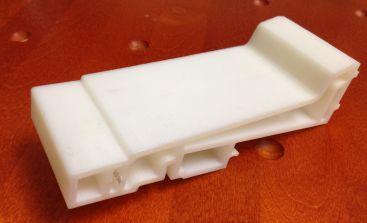
This small section of vinyl window profile was fabricated on a 3D printer. Plastics are the most common material used in additive manufacturing, but metal parts can be made as well.
He predicts that additive manufacturing will change the way we do tooling and make companies that leverage the technology more competitive. “That always drives manufacturing. Better tools are always the differentiator,” he says. “The toolmaker and the prototyping engineers will want and need [additive manufacturing] to compete.”
Extruding is certainly faster for mass production of lineal, but a 3D printer can change the part it is making as fast as selecting a different file in the computer, with no tooling changeover.
All Weather Windows of Edmonton uses 3D printers to create machining jigs and router templates which are often used for low-volume production on the floor. “For low-volume small plastic parts, it can actually make sense to 3D print the parts themselves instead of paying for an injection mould,” says Jesse Tufts, product development engineer. “Small caps, plugs and clips can function just fine as 3D printed parts and can usually be printed reasonably quickly and economically.”
Challenges that remain
Gary Cluthe, CEO at Duron Plastics in Kitchener, Ont., bought an EOSINT M270 system about five years ago. His company specializes in custom injection moulding and mould making. He thought the technology would be ideal for mould making.
At this point, however, their EOS machine is not being used for this purpose. Instead, aerospace and military contractors have been using it for their needs. And now there are inquiries almost
INNOVATIONS |
BY Maria Del Ciancio and Rob Colman
every day about having parts produced on the machine.
“For us, the costs don’t warrant making tooling yet,” Cluthe says. “And it hasn’t worked out well for cavity core work. It has been too difficult to polish out deep ribs in the moulds we do.”
That is not an uncommon issue. It is widely accepted that the current additive technology will need to be integrated with existing metal-removing machining technologies to support a final finished part.
To achieve the benefits of additive manufacturing, Southway explains the technology must be integrated with existing metalremoving machining technologies such as surface texture and finish, and tolerance limits may need metal-removing processes as secondary finishing operations.
But advancements are happening, says Vesna Cota, additive manufacturing design and development specialist for Tyco Electronics Canada, a TE Connectivity company based in Markham, Ont. The company, which designs and manufactures connectivity products and solutions for a variety of industries, mainly uses additive manufacturing for prototypes, trims and fixtures — to compress response and development time, and to maximize the performance of their products. But they also use the technology for fully functional prototypes in production material using rapid tooling.
“Additive manufacturing technologies are very well suited for tool repair and conformal cooling, with many successful implementations so far, yet the build times and/or surface finishes have been a deterrent,” Cota says. “Advancements in those areas, along with new materials and the forthcoming hybrid additive manufacturing
systems, should prompt reconsideration. Even those who took a look at it just two or three years ago may find themselves surprised by the advancements since.”
The advancements, she says, include “continuous incremental but significant improvement of processes, build speeds and build sizes. There is still a great need for better defined process controls. The proprietary materials and need for characterization drive high material costs, but at the same time, many new materials are being developed and released, exhibiting superior performance to any existing ones.”
But to really leverage the technology, Southway says that additive metal technology will require a strong engineering application consulting capability to support the development of new design approaches, as well as a clear knowledge of the different design rules and part planning activities.
“Contrary to the public’s belief, the metal additive process is not a push-button technology. There’s a lot of design rules, there’s a lot of planning that needs to go into making a part and making a machine produce it. To do it well, you also need the designer to understand the constraints as well as the significant opportunities if they harness the technology correctly,” says Southway. “You can’t just take your existing drawings to this machine and make them. You’ve got to redesign your part or your tooling around the technology and the mission of your final product for maximum benefit.”
“Additive manufacturing is a completely new way of thinking, designing and manufacturing of a product. To reap true benefits, the additive manufacturing implementation has to span the whole process
— from concept to final part, including 3D modelling,” says Cota. “Skill sets are being developed on the job and there is a lack of proper information and guidance. Difficult funding procedures and lack of understanding on the side of the financial institutions are all impediments to wider spread additive manufacturing implementation.”
Moving forward
It’s not just the high-tech aerospace and automotive industries that should be leveraging the technology. There are opportunities for “traditional industries,” too, Southway says.
For example, oil and gas industry equipment providers have many parts such as couplings and joints and valves that could benefit from the technology; furniture and durable goods manufactures will benefit from integrating this technology into the toolmaking environment where more rapid tooling will provide a competitive advantage; and food processing and pharmaceutical equipment manufacturers would benefit from sensitive and complex metering devices being produced with this technology.
“Everybody thinks that this technology is only destined for hightech products and high-tech industries. It’s certainly not. It’s also destined to support traditional industries that need to go more hightech with the processes and the methodologies they use, and the toolings they apply to their traditional products. And so what we need to do is make sure that the traditional industries embrace this technology, probably in their tooling arena or even in the product itself, to turn it from being a non-competitive traditional industry into a highly competitive traditional industry. And this technology,
coupled with a spirit of innovation and the art of continuous improvement, is the gateway for it.”
In terms of the future, Tufts says, All Weather Windows turns to materials, noting that some new Stratasys printers can print in nylon, and therefore provide increased possibilities for doing small production runs of custom parts. “We have a lot of aluminum extrusion profiles as well as PVC extrusions,” he adds, “and a 3D metal printer could speed up the prototyping process for these designs. As this technology develops, I can see 3D metal printing becoming a lot more common and preferable in some ways to CNC machining or wire EDM due to the material efficiency.” He points to multi-material 3D printing as another area of advancement. “We can’t do it here but we often send out weatherstrip designs to be 3D printed in rubber-like materials before getting dies cut,” Tufts explains. “They can print combinations of flexible and rigid materials on the same piece, for example a weatherstrip with a stiff base and a more flexible top, or a prototype of a rigid plastic extrusion with a co-extruded gasket.
And while there are new opportunities for the application of this technology that will continue to emerge and evolve, it is not meant to replace your current processes, but rather to complement them.
Says Southway, “When you add it to the suite of processes and tools that the manufacturing engineer has, that’s when it becomes powerful.” •
This article originally appeared in the May 2014 issue of Manufacturing Automation.
Intertek announces first laboratory in Canada accredited by SGCC
Intertek’s Montreal (Lachine) laboratory is the first testing laboratory in Canada approved by the Safety Glazing Certification Council (SGCC) for testing in the ANSI, CPSC and CAN/CGSB Certification programs
DOOR SYSTEM & HARDWARE PRODUCTSHOWCASE
Hidden and protected
capitolindustriesinc.com
Capitol Industries’ new Magnetic M-1000 and M-7000 hide and protect lock cylinders and latches behind a corrosion-resistant sliding plate made of anodized aluminum. The cylinder shield protects the lock against vandalism, bumping, picking, drilling, contamination, unauthorized key use, as well as extreme weather. The products can be keyed alike or differently with over 10,000 combinations and the possibility of on-site key duplication, with proper tools and a key code. Regular magnets will not open the device. The M-Series products use rare earth magnets with a lifetime of over 80 years. Equipped with a patented, fully mechanical system, there is no need for wiring or batteries. To hide and protect
the cylinder, simply slide the outer plate up. To unlock and reveal the cylinder, place the magnetic key in the key slot and slide the cover down. The devices may also lock in the open position and require the magnetic key to close. Ideal applications include storefronts, remote facilities, after-hours lockout, basic access control, maintenance rooms, construction sites and harsh environments.
Style and security
maglocks.com
The Rite Touch RT1050D offers sophisticated styling, convenience, flexible access control, safety and security for single or double glass doors. Suitable for indoor applications with no modification necessary to the glass, the easy-to-install, surface-mounted Rite Touch combines elegant aesthetics
with the latest touchscreen technology. Contractors can distinguish an opening by harmonizing style and security with the Rite Touch.
Matches
any interior
dorma.com
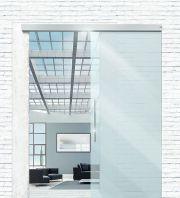
Dorma Americas has introduced its innovative new MUTO manual sliding door system. MUTO makes installation hassle-free with its compact, modular profile and easy integration of complementary functional elements. It offers a variety of features to provide convenience in everyday use. With aluminum finishes including clear anodized, similar to satin stainless steel anodized, and powder coat options, MUTO can be matched to virtually any architectural interior. The MUTO line includes the MUTO Basic and MUTO Comfort systems. Both offer technical features and aesthetic qualities that make them suitable for a wide variety of applications. System features include a self-closing door with no need for a power supply; a Dormotion damping device to decelerate door panels as they approach the open or closed positions, taking them to a gentle stop; the option of integrating a status indicator to enable monitoring of the door from anywhere within the building; a standard wall and ceiling mounting and installation in suspended ceilings; an elegant body with sharp edges and a small recess for the logo clip. The MUTO system accommodates variable weight tolerances and movement patterns ranging from small single panels of 110 pounds or biparting panels up to 330 lbs per panel (or as high as 440 lb in MUTO Basic) while being capable of synchronized movement. Tempered laminated safety glass is used with availability of special interlayers for advanced function and customized glass design. MUTO uses a simple, two-step door panel height adjustment. MUTO Comfort comes standard with roller carriers for glass and, with the appropriate adapters, can also carry wood door panels. In the MUTO Basic system, the roller carriers directly attach to wood door panels, while adapters allow the use of glass panels.
TALK GROWTH
by RICH PORAYKO
Business consultant Mike Tyson once said “Everyone has a plan until they get punched in the face.” So what do you do when you get punched in the face? You shake it off and come up with a new plan. Welcome to 2015 GlassBuild America held Sept. 16 to 18 in Atlanta which was full of more than 7,600 attendees and 420 exhibitors fine-tuning new plans.
Even with the world economy struggling, consensus by some of the industry’s top leaders was that the fundamentals are in place and the U.S. economy is expected to grow non-linearly through 2018, barring a geopolitical crisis. There is pressure along the entire supply chain from float companies to freight, fabricators and glazing contractors, however glass supply is expected to be remain available. Competition is fierce. Reports indicate that fabricators across the U.S. are busy with long lead times and quality issues, however machinery and equipment sales were higher than ever even though cash flow is in short supply with
Communication and growth the main themes.
the industry ramping up capacity to create better margins and competitive advantages.
Communication was the reoccurring theme and the message to attendees was to set clear expectations and then communicate them early and often. Experts are calling it the Amazon Effect and it means communication is more important than ever, especially if for any reason what we promise is not accurate. According to Glazing Executives Forum speaker Jeff Dietrich, a senior
analyst from ITR Economics, it’s not about next-day delivery, “it’s about next day delivery at 11:00. It is about communicating with people if for any reason what you promised is not accurate. It is critically important in the mindset of your clients and customers that what you promise, you deliver on time.”
At the Managing Lead Times in a Busy Market panel discussion, industry experts agreed that while construction is improving, the U.S. still hasn’t caught up to 2007. “We are getting busy
Attendees at GlassBuild’s packed education sessions heard that U.S. fundamentals are strong, and that glass supplies are ramping up in a sustainable manner. Weakness in overseas markets may make the U.S. the focus of industry growth for years to come.
again,” said Chris Cotton, general manager of Dlubak Specialty Glass. “It isn’t at the levels prior to the recession but our industry is busy. That’s a good thing. There is plenty of glass out there. The fabricators and whole supply line are gearing back up to those levels.”
“Things are much better but we’re still not where things were before the financial collapse,” shared John McGill, general manager of YKK AP America. “We’re a little skeptical that there isn’t quite that amount of growth but we are seeing some growth over the next few years. Everyone in this room went through the crisis and we all came out much smarter and stronger. It’s very important that we don’t forget those lessons. We are all more cautious and deliberate.”
“There is a lot of capacity and a lot of glass,” said Garret Henson, vice-president of sales and marketing for Viracon. “Are we going to run into a glass shortage? I don’t think so. Could we reach a ceiling? Sure, we could but I wouldn’t allow it to create any extra stress or anxiety for your supply chain capability. That being said, there are certain things that have changed. There has been 25-to-30-per cent reduc-
GLAZIERS
tion in float capacity in North America. It takes a long time for a float company to build a plant and, quite frankly, they aren’t sure that they should do that. There also has been a fairly heavy reduction in contract glaziers that look at certain types of jobs. There were 11 glazing contractors that left the market in 2012 and 2013 that were doing big buildings who aren’t doing them today. There is stress along the entire chain but there is still material out there.”
“There is plenty of standard clear glass available,” agreed Cotton. “Getting it to your factory in a day like you used to be able to do is not the same. It typically takes three of four days to get it to your plant, which is a completely different issue. Specialty products like textured, low iron and tinted glass that are run like clockwork every four or five months can create the illusion of a shortage.”
“Communicate early, communicate often” said Henson. “As you think through this process, you have to talk to your suppliers about your expectations that you have for your needs. If you can bring them in during your bid process, then your chances of success are much higher. If you go to your partner early enough and you
help them understand what success looks like to you, then there is no reason why they can’t help you all the way through that chain.”
Henson emphasized to set clear expectations and reserve capacity. “Most of the suppliers in today’s environment are understanding of this demand and are willing to set aside capacity for you or participate in some level of commitment of a period of time. However once you do that, you have to communicate. To me, a good supplier is an asset. After your employees, they may be the most valuable people on your team at that point. If you have done your diligence and you have purchased reliability and found the right team to partner with, they should be able to take you through successfully.”
“Project managers are so important in today’s environment,” continued Henson. “We have a saying at Viracon: ‘Those that manage jobs really well are great customers to work with. Those that let the projects manage them, become very, very difficult to help.’”
According to Dietrich’s Prosperity in an Age of Decline presentation, the U.S. economy will grow through 2018. “This economy for you looks pretty good. Into the second quarter of next year, there is no indication of a recession short of an explosion that goes off somewhere around the world or a black swan crisis that no one knows about.”
“China, Japan, the European Union, Brazil, and South East Asia are going through either recession or slower growth. The U.S. is the only economy in the world that has been growing for the last four-and-a-half years. You can count China in there however their growth is slowing. They are declining faster than they have in the last 16 years. Which is significant but we don’t know how significant. China is an unknown to all of us even the experts.”
“For those of you in non-residential construction, you ought to know that you have a minimum of 12 months of advance warning to adjust. You are the only ones in the economy that gets that advance warning. And for some of your projects, it’s over 14 to 16 months that you ought to know what’s coming. Our next recession in our forecasting cycle is 2019. Which means for some of you, it’s 2020. That doesn’t mean linear forecast growth. It just means we are not going to go negative in this economy and we don’t see construction going negative.”
FOR SALE
For Sale: profitable glass tempering factory fabrication and installation company for sale. All state of the art computerized equipment; CNC cutting, CNC mill & drill, state of the art furnace, new Bottero, new HO Forvet, Besanna drill, Besana washer, 3 new sedimentors and 24 professionally trained staff. Over 20 years of tax returns to prove worth. Call Shawn 705-791-1622 or visit us at www.accurateglassbarrie.com
EMPLOYMENT OPPORTUNITY
Join the iGe team – area SaleS repreSentative
RESOURCEDIRECTORY
IGE Glass Technologies, Inc keeps growing and growing and now we are searching for the right people to join our fast paced equipment and supplies outside sales team that includes Manny Borda and Michael Spellman.
Do you know us? Do you think you can fit in? Do you think you can work as hard as we do? Do you know the industry? Do you have any references from our loyal customers? Are you happy travelling extensively? if you answer yes to “all” these questions, please contact our Gm mr. Jeff Spicer at 800-919-7181 to set up a confidential meeting.
by FRANK FULTON
Frank Fulton is president of Fultech Fenestration Consulting. He has been in the industry for 30 years and can be reached via email at fultech.fc@gmail.com
A chance for change
You may recall that in the June, 2015 issue we discussed the press release from the Ontario Ministry of the Attorney General where the law firm of Borden Ladner Gervais LLP had been appointed to conduct an expert review of the Construction Lien Act. Their review had been scheduled to be completed by the end of 2015 but that is now looking unlikely.
Reviewers are looking at changing the amount of holdback from the current 10 per cent. They will consider increasing the number of dates for the release or early release of holdback such as on phased projects. Release of holdback may be made mandatory or automatic after expiration of lien rights, unless there has been early release of holdback. There’s a possibility of eliminating holdback for finishing work and the introduction of mandatory holdback trust accounts or a mandatory project bank accounts. The review will try to align the time limitations in the act with payment time periods in the Ontario construction industry, considering the causes of payment delays and how they can be addressed in the act or other legislation. Reviewers will consider the potential effect of prompt payment provisions on the principle of freedom of contract and on industry lenders and sureties. All this must be considered across the wide range of possible contract types.
Recommending an alternative dispute resolution mechanism is a possible outcome, pending consideration of the effectiveness of available procedures and remedies. This could include introducing an adjudication mechanism for construction disputes, mandatory mediation of lien actions, and/or an arbitration mechanism for construction disputes. Dispute review boards could be recommended for certain types of projects.
Our goal is to persuade the Ontario government that legislation is needed to ensure that money flows as it is intended.
YOU BET YOUR GLASS
The review will consider whether “pay-when-paid” and/or “paid-if-paid” clauses should be made unenforceable. Owners, contractors and subcontractors could be given rights to access proof of financing as a result of this review. The review could recommend labour and material payment bond sureties to promptly pay undisputed amounts. It could recommend labour and material payment bond payees to complete their subcontracts if that’s in the best interests of the project. Mandatory labour and material payment bonding of all public projects and the electronic delivery of surety bonds will be looked at. And it will discuss whether changes to the third-party beneficiary rule are appropriate in order to enable payment by owners directly to subcontractors and suppliers.
Other issues include the Canada Revenue Agency’s super priority, the regulating of bidder exclusion provisions, lien rights related to delays, the potential for abuse of lien rights, mandatory certification of subcontract completion and the effectiveness of existing trust provisions.
The Ontario Glass and Metal Association determined the best way for our industry to be heard was to partner with other trades and interested parties to give us a much louder collective voice. We did this by joining Prompt Payment Ontario (PPO), a sole-purpose alliance of 42 contractor associations, unions, suppliers, general contractors and pension trust funds who have an interest in seeing prompt payment legislation enacted in Ontario. Our goal is to persuade the Ontario government that legislation is needed to ensure that money flows as it is intended down through the contractor supply chain.
PPO is one of the stakeholder groups that will make a submission of arguments to the CLA review team. In order to present meaningful. statistically viable data in their submission, PPO has issued a survey to collect the opinions of companies across the province. To have your say in changing the laws that affect your business, I urge you to go to PPO’s website at ontariopromptpayment.com and complete the survey. I also encourage you to join the OGMA who represents and presents your interests to PPO keeps you updated on the issues. •
Your vision is unique and complex. It pushes boundaries. It takes design to a new level. It personifies aspirational performance and expansive aesthetics. It demands respect and inspires awe. Your vision doesn’t come in a box.
Introducing Kawneer’s 2500 UT Unitwall™ System. Delivering ultra-thermal performance in a unitized curtain wall system.
MoVe on to tHe neXt ProjeCt faSter tHan eVer
n e e D D o o r S n oW ?
We have the most popular aluminum-framed doors in stock and ready for immediate pickup. What’s best, our stock doors come equipped with CRL’s patented CORNER-LOC® System– the strongest door cor ner assembly available
Let uS faBriCate for You
Take the guesswork out of quoting your fabrication labor, reduce costly fabrication errors, and, most importantly, save time Our KD Storefront Fabrication service provides installation-ready
combination of quality, inventory, expertise, and tur nkey services gives you maximum flexibility and profitability.