
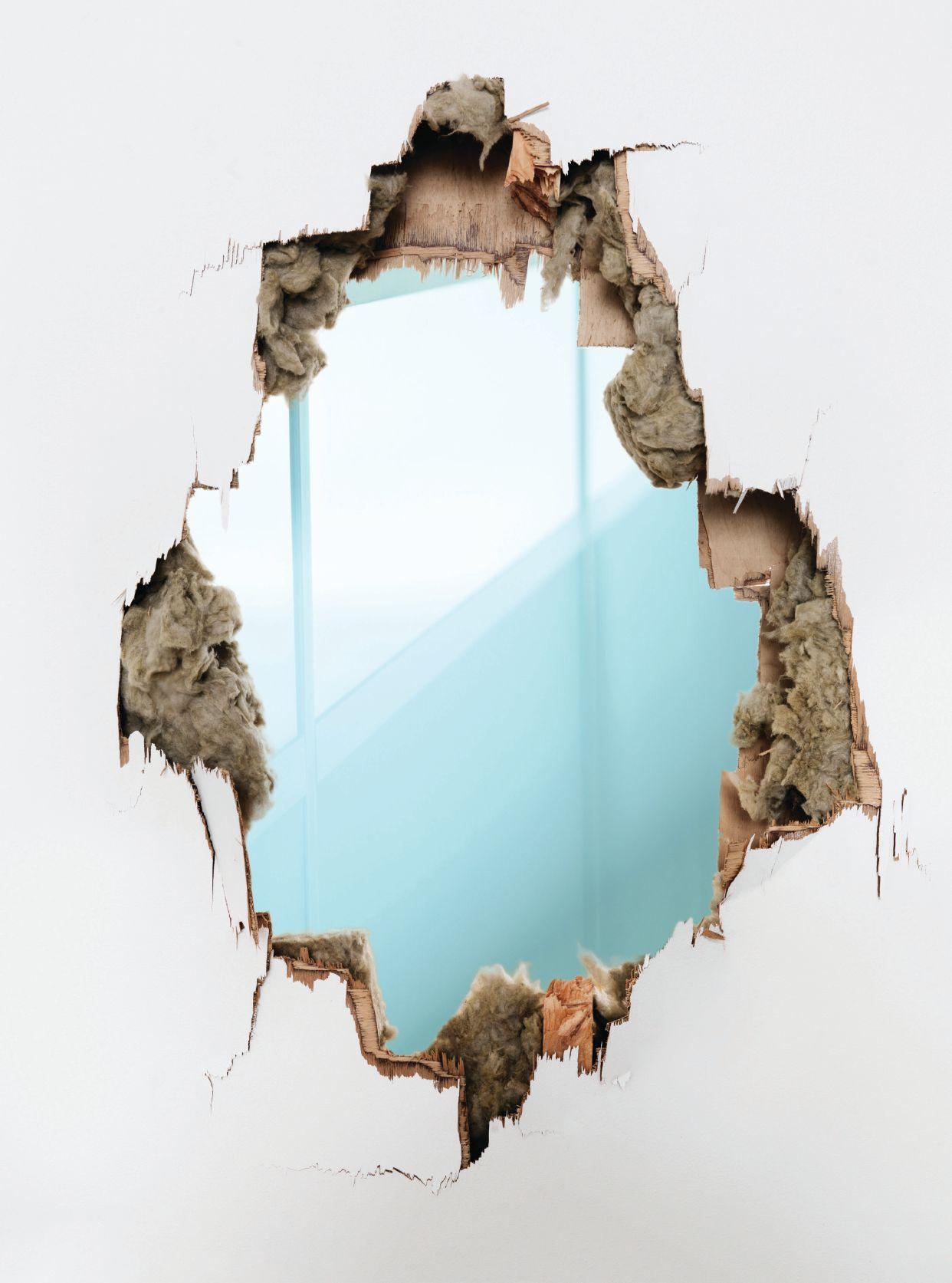
Don’t let a wall stand in your way.
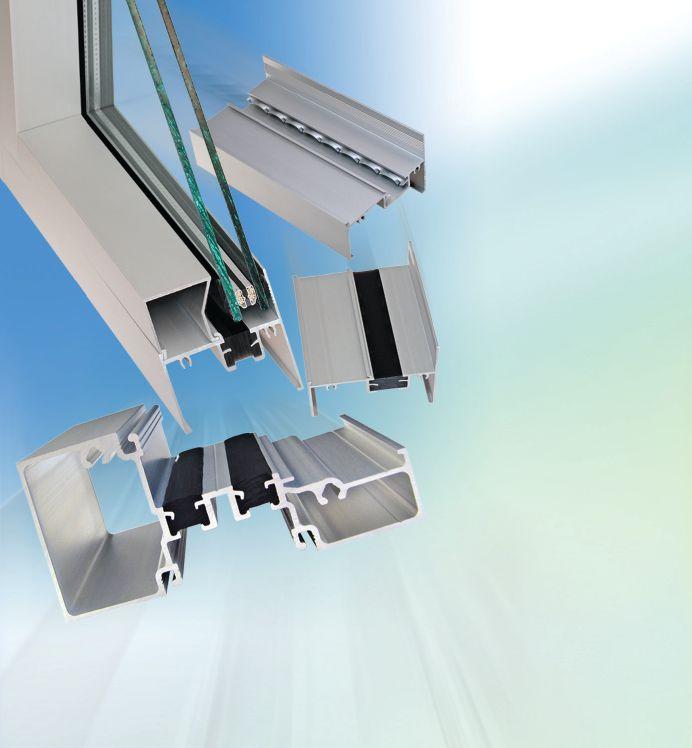
INTRODUCING INFRAME™ INTERIOR FRAMING FROM KAWNEER
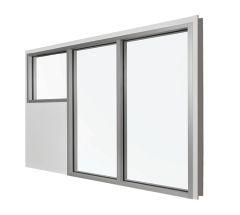
Break through. Break in. Kawneer is bringing its expertise inside with the new InFrame™ Interior Framing, which allows more light to fill the interior of a space. With Kawneer as a single source for both exterior and interior framing, walls are no longer barriers but a break through in design, performance and beauty.
It’ll change the way you look at walls.
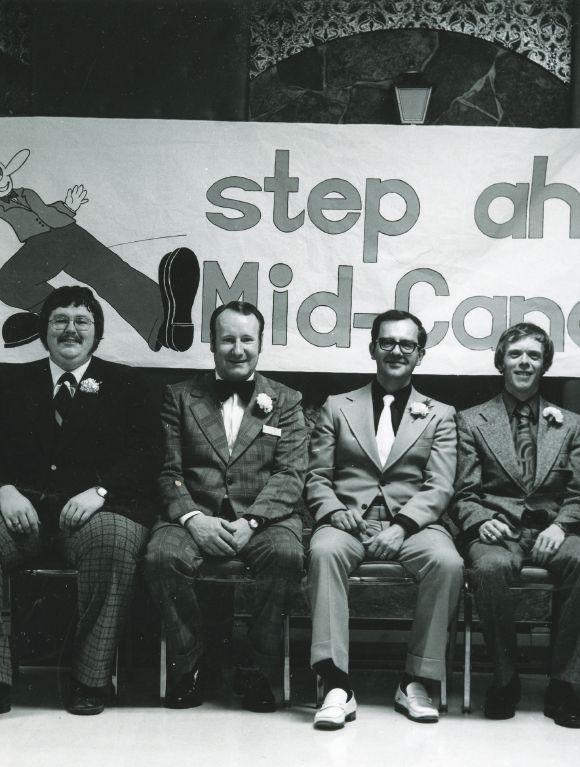
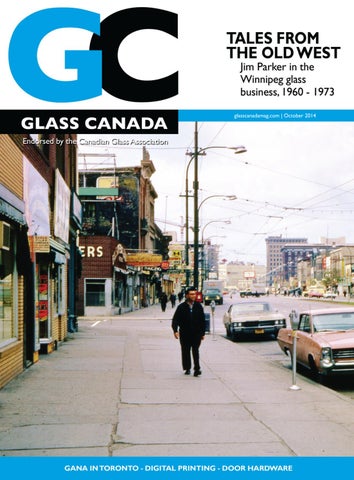
The West really was wild 40 years ago, at least in the glass business. Jim Parker got into his share of shootouts - these are his stories. Cover photo by Chris Morgan.
The Canadian Glass Association has new Twitter handle and Facebook page. Now you can get instant updates from Canada’s glass construction organization, and join the online conversation with glaziers across the country. Follow @CanadianGlass on Twitter and Like Facebook.com/CanadianGlassAssociation.
18 GANA comes to Canada
It only took 20 years, but North America’s glazing association made it to Toronto for its fall conference.
22 Business happening
GlassBuild records its best results in years. Rich Porayko has a report from the floor.
27 Door hardware showcase
Your clients get more demanding every year with door designs that push the envelope of the possible. Here is the gear that will help you meet their visions.
14 Innovations
Digital printing with ceramic opens up a whole new realm of esthetic and functional options. It can even help you meet certain regulations.
COLUMNISTS
20 Fenestration Forum by Brian Burton
30 You Bet Your Glass by Frank Fulton

Pride and purpose
The OGMA’s support for Canadian veterans strikes a nerve.
The OGMA collected $5,500 for Wounded Warriors of Canada at its fall golf tournament. TAGG Industries, Valley Metal Finishing, the Toro group and Security Mirror all matched the OGMA’s $1,000 donation, with Quiktemp/Ultimate Creative Designs kicking in another $500. I’m highlighting this in my editorial because I’m proud to be working in an industry that will step up in this fashion to support those who have made such incredible sacrifices for this country. I hope the OGMA’s success with this fundraiser encourages them to repeat it, and inspires other organizations to do the same.
GLASS CANADA
October 2014 Volume 26 • Number 5
Annex Publishing & Printing Inc. P.O. Box 530, Simcoe, Ontario N3Y 4N5
EDITOR | Patrick FLANNERY pflannery@annexweb.com 226.931.0545
SALES MANAGER | Danielle LABRIE dlabrie@annexweb.com 519.429.5187
NEXT ISSUE
• Commercial building code update
That Canadian veterans need help is beyond question. Canada’s Veteran Ombudsman, Guy Parent, pointed to numerous severe shortcomings in our postservice support for severely disabled veterans in a 2013 report. Many disabled veterans can’t work, yet are denied impairment benefits. Compensation beyond basic medical care is feeble, and support for transitioning from the military to a civilian career is inadequate. Pension benefits fall short of 70 per cent of prerelease salary, which is what most Canadians with pensions can expect. As far as I’m concerned, if you go to fight for this country and get permanently disabled doing it, you should get a free ride for the rest of your life – I am willing to pay for that. And if you serve in the military in any capacity, you certainly deserve at least the retirement benefits that some quaking scribbler like me can expect.
• Monomer coatings
I know some military people. My great-grandfather and great-grandmother met overseas in World War I and I’ve read their letters. My grandfather was killed in World War II when my father was an infant. Many of my cousins are in the Forces and one has returned from Afghanistan with post-traumatic stress disorder. My father-in-law spent 30 years in the military, and my wife grew up on bases across the country. I can report from direct experience that these are not people prone to asking for coddling or handouts. Unfortunately, these are exactly the kind of people who can get ignored while other, shall we say, “whinier” groups are handed blank cheques.
So, good on the OGMA and all the members who supported this cause. Initiatives like this highlight other ways in which associations are important to an industry. Without the OGMA, how would the various companies involved have gotten organized to make this group effort to raise money? It is doubtful whether it would have happened at all. And now that it has, everyone involved can feel proud. Is there some value in feeling proud of your profession and your trade? I’m always reading that millennials entering the workforce want to feel their job has some meaning or significance beyond just the paycheque. And I’m reading (and hearing) at least as often about the difficulties we have attracting new talent to the trade. Maybe the OGMA is on to a way to broaden the appeal and visibility of the glass construction industry. •


ACCOUNT COORDINATOR | Stephanie DeFIELDS sdefields@annexweb.com 519.429.5196 | 888.599.2228 ext. 257
MEDIA DESIGNER | Brooke SHAW
GROUP PUBLISHER | Martin MCANULTY mmcanulty@annexweb.com
Publication Mail Agreement #40065710. RETURN UNDELIVERABLE CANADIAN ADDRESS TO CIRCULATION DEPARTMENT, P.O. BOX 530, SIMCOE, ON N3Y 4N5 email: subscribe@glasscanadamag.com
Printed in Canada, All rights reserved. Editorial material is copyrighted. Permission to reprint may be granted on request. ISSN 0843-7041
CIRCULATION
email: subscribe@glasscanadamag.com Tel: 866.790.6070 ext. 208 Fax: 877.624.1940
Mail: P.O. Box 530, Simcoe, ON N3Y 4N5
SUBSCRIPTION RATES
Canada - 1 Year $36.75 (includes GST)
($39.55 includes HST/QST) U.S.A. - 1 Year $50.00 (in US dollars)
Occasionally, Glass Canada will mail information on behalf of industry-related groups whose products and services we believe may be of interest to you. If you prefer not to receive this information, please contact our circulation department in any of the four ways listed above.
www.glasscanadamag.com

Opening Night Tribute FEATURING The
v Registration Includes FREE Daily Seminars
v Learn The New Codes and New Standards
v Discover The Latest Technologies
v Annual Economic Forecast
v See All The New Products
v FREE MTCC Parking
v FREE Lunch On The Show Floor

INDUSTRY NEWS

Save the date for 2015 Top Glass show
Glass Canada magazine has announced Top Glass, Canada’s event for the ICI glazing trade, will return to Mississauga, Ont., April 15, 2015. The one-day conference and supplier expo will once again take place at the International Centre. “The great response to our inaugural event in May has convinced us that this is something that needs to take place every year,” said Danielle Labrie, Top Glass show manager. “This event is about more than just new technology, it is also about education and coming together as an industry.” Top Glass 2014 exceeded expectations with over 450 registrations, and attracted immediate support from its top
sponsors, with Tremco returning as a Gold Sponsor and Alumicor upping its support from Silver to Gold status. Top Glass 2015 is expected to feature exhibits from more than 30 top suppliers to the commercial and high-rise glass construction sector. Organizers are committed to presenting a great educational program at Top Glass 2015. To that end, Top Glass has issued a formal call for papers, inviting industry experts to submit their proposals for a one-hour technical seminar on some topic of interest to glass construction professionals. Watch topglasscanada.com for more announcements as plans for Top Glass 2015 evolve.
Course to explain WHMIS changes
The Workplace Hazardous Materials Information System (WHMIS) is changing as Canadians prepare to align with the Globally Harmonized System of Classification and Labelling of Chemicals (GHS). To help educate workers about the upcoming changes, the Canadian Centre for Occupational Health and Safety (CCOHS) has released a new e-course, in partnership with the Workplace Hazardous Materials Bureau of Health Canada (formerly the National Office of WHMIS) and funded by Health Canada. It is offered free of charge to the first 100,000 participants, for
up to one year, and is available in English and French. The goal of GHS is to have a common set of rules for classifying hazardous products, common rules for labels, and a standard format for safety data sheets (SDSs). The e-course, WHMIS (After GHS) for Workers, will help workers in Canada understand how to communicate hazard information through labels and safety data sheets under the new GHS requirements. This course is recommended for workers in organizations where chemical products are used.

Brummet to represent Vitrum
Vitrum Glass Group has announced a new team member, Tara Brummet, in the role of sales representative. She will be working from the Langley, B.C., head office and will be responsible for key accounts throughout the Western United States. Brummet brings with her over 15 years experience in the glass industry, is currently a Fen-BC board member and involved with GANA at the committee level.
“Tara is relationship oriented and has created great connections in the glazing industry,” says Bruce Robinson, Vitrum sales manager. “Her great attitude, technical knowledge and background in glass make her a great resource to our customers.”
Brummet will also be representing Vitrum’s sister company, Apex Aluminum Extrusions, by providing support on strategic sales to glazing customers throughout the Western United States.

CGA Newsletter
CANADIAN GLASS ASSOCIATION
Justin time for Halloween, the Canadian Glass Association has some changes brewing that we are excited to share. In previous years, the only way to become a CGA member was to also belong to your local provincial association. While that option still remains, it is now not the only way you can gain membership in the association. Effective immediately, CGA membership is now open to all industry representatives for a flat fee. The dues for non-provincial association members are $500 per year. A sampling of current membership benefits are:
• Discount on event registrations
• Support for the Glass Connections conference
• Working relationships with provincial associations
• Exposure in Glass Canada magazine Benefits that the CGA are currently working on include:
• Working relationships with like-minded industry associations
• Educational webinars
• Social media (Facebook and Twitter) interaction and updates
• LinkedIn group discussions If your company is interested in learning more about membership in the CGA, contact the association at info@canadianglassassociation. com or via phone at (785) 271-0208. We look forward to speaking with you on how your company will benefit from CGA membership immediately.
Canadian Glass Association 3195 - 9th St. S.E. Calgary, Alta. T2G 3C1 (785) 271-0208 ext. 310 www.canadianglassassociation.com
ONTARIO GLASS AND METAL ASSOCIATION
Earlyclouds gave way to a beautiful day for golf at the Ontario Glass and Metal Association’s fall golf tournament Sept. 18, but the big story was a huge outpouring of support for Wounded Warriors, a charity dedicated to helping Canadian Forces veterans. The OGMA collected $5,500 that will go toward helping veterans with post-traumatic stress disorder and those who have had other difficulties reintegrating into society after leaving service. The tournament took place at Richmond Hill Golf Club in Richmond Hill, Ont. Richard Martin, a board director for Wounded Warriors, accepted the big cheque from Doug Morris of Morris Glass and Windows. Golfers were challenged to show up wearing camouflage clothing, spurring a donation by the OGMA which was matched by donations from several sponsor companies. Matching the OGMA’s $1,000 donation were: Valley Metals, Tagg Industries, Security Mirror and Toro Group/Commdor Aluminum/ProTemp Glass. Quiktemp/Ultimate Creative Designs also chipped in $500. Ron Knox of Security Mirror made his donation in dramatic fashion, joining the sponsors at the front of the room following Martin’s moving description of the program at the post-golf dinner.
Also announced at the dinner was the recipient of the OGMA’s $500 education bursary, Shawn Perry. Perry was selected by the staff of the Ontario Industrial and Finishing Skills Centre to receive the
OGMA’s fourth bursary recognizing an outstanding glazing apprentice. Perry works for Erie Glass in Chatham, Ont. OIFSC instructor Steve Laird noted Perry is extremely knowledgeable in the trade, getting top grades and showing great willingness to help other students.
There was some golfing, too. Low score on the day went to the team of Ron Knox and George Hunak (Security Mirror), Brian Hall (Brichem Sales) and Pastor Jim Nolson of the Campus Church. Most honest golfers were Jen Harnest (Prelco/PGP), Doug Lilja (Ferguson-Neudorf) and Al Perrault. Numerous other prizes were handed out for closest to the pin, long drive and other games.
The Ontario Ministry of Labour announced in November, 2013, that all workplaces governed by the Occupational Health and Safety Act had to provide training for supervisors and workers by July 1, 2014, and that the training had to meet the specific requirements set out in the regulation. It is imperative that your company satisfies these requirements as penalties will be imposed on those that have not complied.
In January, 2014, the OGMA reached agreement with the Workplace Safety and Prevention Services (WSPS), formerly the IAPA, to proceed on the creation of a manual geared specifically for small and mid-sized glazing contractors and glass shops. A draft prototype of the new “OGMA/ WSPS Glazing Contractor Health and Safety Manual” was displayed for the first time at las spring’s Top Glass Conference and Exhibits Show.
The WSPS will work with your company to implement

the safety program, will keep you updated on all changes to laws that you must be in compliance with, put you in a strong position to withstand a Workwell audit, and help you to defend yourself with the Ministry of Labour in the event of a workplace accident. Your participation in this program is an absolute must for many obvious reasons. Contact an OGMA director for more information.
This committee held its last meeting in May on the topic of Contractor Safety. These meetings are of great value and benefit to glazing contractors and glass shops and cover many topics that have a significant impact on your business. If you are interested in attending a future meeting or joining the group contact Steve Ringler at steve.ogm@bellnet.ca
Our inaugural fishing derby was held on August 6 with a fabulous turn out and a great day of fun, fish, and camaraderie. If you missed this year, give it a shot next time. You won’t be disappointed.
Ennio Rea of Trulite crushes one at Richmond Hill Golf Club. It was a beautiful day for golf with over 100 OGMA members in attendance.
Zoulek to cover North and South America


The American Architectural Manufacturers Association has announced new staff appointments, which include Jason Seals as certification manager and Rich Rinka as technical/ industry affairs manager. Seals comes to AAMA with over 15 years of experience in the fenestration industry. As AAMA’s certification manager, he will direct all certification-related activities of the association with direct management responsibilities for the AAMA air, water and structural Gold Label Certification Program, as well as the AAMA Thermal Certification Program (silver label). Also, Seals will manage all aspects of the ANSI accreditation requirements in addition to certification-related audits and act as advisory staff liaison to assigned member groups within the association.
“We are very fortunate to have Jason join AAMA in the role of certification manager,” says AAMA’s president and CEO, Rich Walker. “He will be a valuable asset to the association and our members since he brings with him more than 15 years of testing and member company knowledge and experience.”
In his most recent position with a window and door manufacturer, Seals managed certifications and approvals from various independent inspection agencies and code organizations, including AAMA. As AAMA’s technical/industry affairs manager, Rinka will serve as a technical spokesperson and liaison representing AAMA at the meetings of key affiliated industry organizations to identify any areas of interest or impact to AAMA members. He also will conduct critical reviews of the association’s technical documents to ensure consistency, stringency and accuracy, as well as co-ordinate the use and acceptance of AAMA standards by other consensus bodies. As staff liaison for assigned committees and task groups, Rinka will provide technical expertise and direction for members.
“In a relatively short period of time as the previous certification manager at AAMA, Rich grasped all the challenging nuances of the certification program. We have no doubt he will excel as technical/industry affairs manager,” says Walker. “Rich’s impressive technical credentials and troubleshooting experience in the field underlie his versatility, and we look forward to him solidifying AAMA’s relationships and collaboration with our key industry partners.”
Prior to joining AAMA in 2012, Rinka worked in the industry as a field technical engineer for a component supplier and also served as chair of the AAMA 800 Maintenance Committee. During his time in product development for the automotive industry, he developed and still holds four patents related to sealants.
Dorma appoints new president
Dorma Americas has named Reed Buettner area president. Buettner was most recently president of Dorma U.S.A. He brings to the executive role deep expertise in the design and development of access solutions, as well as a long history of successfully pursuing new business and growing the market share of established building systems brands. Before joining Dorma, Buettner served as CEO of Door Controls Inc., which was acquired by Dorma in July 2013. Earlier in his career, he served as a general manager for automatic entrance manufacturer, Besam, a subsidiary of Assa Abloy. Prior to that, he served as a designer for ThyssenKrupp Elevator. Buettner’s extensive background and understanding of the building systems industry is ideally suited to Dorma’s plan for robust, organic growth and unprecedented product development in 2014 and 2015. Ronald DeThomas, CFO for Dorma
Correction
In our April 2013 issue, Glass Canada stated that Pilkington had dropped its Spacia line of vacuum insulating glass in North America. Neil McSporran, manager of business development for architectural and technical services for Pilkington North America, replied, “In fact we have never dropped Pilkington Spacia as an offering in North America and the product is available globally.
Americas, said the selection of Buettner is representative of the company’s ambitious plan to accelerate strong revenue growth and invest in new product development. “DORMA’s technological leadership, combined with our strategic acquisitions of niche market leaders, positions our company to take a commanding lead in American markets,” said DeThomas. “Reed’s success as CEO of Door Controls Inc. demonstrates that he is an experienced and dynamic executive who understands how to maximize these advantages.”
“I am very pleased to join Dorma Americas at this exciting time in the company’s history,” said Buettner. “Our people, our expanding product portfolio, and our commitment to serving our customers are second to none. I have every confidence we will exceed our 2014/2015 objectives, and accelerate our progress toward the Dorma 2020 vision.”
Over the last year or so we have supplied more projects than ever before in the U.S.A. and interest seems to be growing and we have now introduced Pilkington Spacia 21 to our product mix. This is a hybrid VIG and offers U-factor of 0.12 Btu/h ft2 F and SHGC of 0.34 U-factor and can be manufactured with tempered glass as its outer pane.” Glass Canada regrets the error.
Jason Seals
Rick Rinka
Glaston acquires rights to Glassrobots
Glaston has acquired the industrial property rights to all Glassrobots products. The acquisition strengthens Glaston’s position in glass processing machines and as a provider of extensive lifecycle services. As a result of the deal, concluded on Aug. 8, the industrial property rights and related documentation of Finnish glass processing machine manufacturer Glassrobots Oy’s flat tempering and bending machines and also of its automotive products and other equipment will transfer to Glaston. The deal is conditional on the approval of the Glassrobots Oy bankruptcy estate creditors’ meeting.
“The acquisition will significantly strengthen our position in the heat treatment machine segment, where we are already very strong,” says Glaston Corporation’s president and CEO, Arto Metsänen. “The deal will support our technological competitive advantage, in addition to which it will strengthen our service business, because through our extensive
geographical network we will be able to supply Glassrobots’ customers with significantly more comprehensive maintenance services.”
The industrial property rights include, among other things, three major patents which Glaston can use in its own product development. Through the acquisition, the company can also continue its active defence of its intellectual property rights in the market. In addition, the industrial property rights, documentation and supplier network will give Glaston the exclusive right to supply Glassrobots’ customers with original spare parts and technical support. Glaston will establish a separate Glassrobots service team. Materials management and logistics will be combined at Glaston’s distribution centre in Tampere. This will ensure for existing Glassrobots customers continuity of aftermarket business and, in the future, more comprehensive lifecycle services for spare parts, maintenance work and modernization.
Amesbury Truth launches combined brand
Amesbury
Truth, a division of Tyman PLC, has unveiled a new brand identity and tag line unifying the former Amesbury and Truth Hardware brands. This is a significant step in the integration of the two businesses which came together in 2013. Commenting on the significance of the new brand, Jeff Graby, president and CEO, said, “Amesbury Truth offers best-in-class engineering resources with the broadest portfolio of innovative solutions that drive our customers’ success. We are proud to share our new brand with the fenestration community. This new brand honors our rich history of innovation, trusted results and engineering excellence we bring to our customers.” Commenting on the integration of the two brands, Michael McCann, senior vice-president of sales and marketing, said, “The logo we developed represents the unification of two industry leaders.
Wiebe joins C.R. Laurence

C.R.
Laurence’s U.S. Aluminum Division has announced the addition of Greg Wiebe to the company’s Canada operations as outside sales representative based out of Winnipeg. Wiebe comes to C.R. Laurence while the company’s continued North American CRL-U.S. Aluminum expansion and growth plans are in full effect. Bringing more than 23 years of experience in the door and hardware industry, Wiebe has a strong command of access control systems, aluminum storefronts, entrance systems, and architectural hardware. In his career he has also garnered specification writing, estimating, project management, and installation support skills.

We’ve incorporated various elements of the original brand marks, marrying colours and fonts to represent the coming together of two well-respected organizations. We listened to our customers and heard loud and clear that both of these historic brands were important to them. Our tag line, ‘Engineered Solutions. Trusted Results.’ articulates the value we bring to our customers and our commitment to excellence.”
“Greg’s solid understanding of the Canadian door and hardware market makes him a natural fit for our ongoing initiatives to expand the U.S. Aluminum brand,” says Gavin Brin, president of C.R. Laurence of Canada. “His thorough knowledge of the industry, door and hardware product lines, AHC credentials, and invaluable experience will prove to be an asset to the company and our customers.”
As outside sales representative, Greg will provide regional customers with specialized product and project support.
C.R. Laurence has five locations across Canada and U.S. Aluminum locations in Toronto and Langley, B.C. CRL acquired U.S. Aluminum in 2011 following the curtain wall and storefront manufacturer’s Chapter 11 bankruptcy. C.R. Laurence is an ISO9001:2008 certified manufacturer and supplier to the glazing, architectural, railing, construction, industrial, and automotive industries, with service centers around the world.
Greg Wiebe

Winnipeg
tales
My story in the flat glass industry –1960 to 1973
by JIM PARKER
It was spring, 1960, in the city of the Golden Boy, the longitudinal centre of North America. I was hired by Pilkington Glass on Market Avenue as draftsman at $200 a month – a liveable salary for the days when I was still living at home, a coffee cost $0.25, a gallon of gas was $0.35 and I was driving a ‘54 Chevy that I had bought for $600 with $30 monthly payments. After one year they offered a $15 a month raise, which I questioned because I was now doing drafting and estimating, but manager Jacques Bernard insisted that was all he could offer. Yes, sure, right.
I quickly looked for another job and was offered an interesting one at Eaton as a draftsman. I resigned at Pilkington. Jacques was somehow able to find the money and increased the raise to $75 per month. As it was interesting work, and I liked the people, I stayed on.
There was no coffee in the offices in those days, so we went across the street to the Cosy Corner restaurant for morning and afternoon breaks. The coffee was good but the girls who worked in the neighbourhood were better. In particular there were several young ladies working next door at Stanley Brock, including Helen Sitarz.
Things were going well at work but I was no longer a draftsman. I was designated to do inventory and parts ordering in the aluminum and automatic door departments. It seemed no one else wanted the job and I was the junior guy. I learned on the job, as there was zero training, from the great employees working in those areas.
In 1962, the top folks at Pilkington Brothers in England made a tour of Canada to meet customers and promote their new float glass system that was taking off in world markets. I had a chance to meet one of the brothers as well as key customers like Cornie Loewen. In December they gave every employee a bonus of three per cent of their annual wage as a reward for the float glass success. I quickly cashed the cheque and went to Peoples Credit jewelers and put a down payment on an engagement ring. I then drove out to Pine Ridge and got permission from Nellie Sitarz to marry her daughter, Helen. She was shocked and impressed that I would ask her. After receiving permission, I proposed to Helen and thankfully she accepted. We were engaged on Dec. 7. Love that float glass!
The bronze doors at the Manitoba legislature were so heavy that Parker and Border Glass got the job installing one of the first automatic entry systems in the province. One hitch: the Manitoba winters were too cold for the system.
I worked my way up to estimator and contract salesman. Part of my job was calling on architects and promoting Kawneer aluminum systems and Stanley automatic doors. Both companies had training courses available, but there was no budget to send me as the courses were in Michigan and New England. In 1967, Helen and I drove east with our Esso credit card and some cash (no Visa in those days) and we saw Expo ‘67 in Montreal and toured the float plant in Toronto. That was my Pilkington training.
Successful strategies for getting contracts in those days combined creativity and street sense:
• Combine bids from different sections. For grocery stores such as Safeway, we would put in a lower price, adding the storefront to the cost of the automatic door equipment.
• Offer bids on alternate products. For the Manitoba Institute of Technology there were two sections: aluminum windows in the classroom buildings and heavy oak wood windows in the office tower. Thinking the wood windows would be over budget, we offered an alternate to substitute the tower with aluminum and put in a combined bid that won us the contract. That worked out extra well as there was a fire in the

classrooms that melted all the windows and we got the replacement business.
• Know who your friends are. Some contractors were close to our competitors. We would quote them a higher price a few hours before bid closing knowing that those high numbers would be fed back to our competitor.
• Get architects to request our products exclusively. Hard work sometimes paid off as architects would specify our products and only accept others as alternates. Local manufacturer Dominion Bronze did a superb job of getting its products specified exclusively. We worked hard to get alternate products in to compete. For instance, for the YWCA building we used our thermal-broken aluminum frame and had Storm-Tite install its tracks and sash on the slider windows. Needless to say, the Dominion Bronze folks were not impressed. Price fixing in the commercial glass industry was a reality.
I was not involved, but it seemed to be common knowledge that flat glass prices and commercial bids were sometimes rigged. Some of the stories I heard were about the Winnipeg city hall and Winnipeg airport where managers got together and decided who would get the jobs. Incredibly, at times one supplier would sell product to the competitor, allowing both to be involved on the job. I was directly involved on one project for the Atomic Energy building in Pinawa, Man. I was able to get a “tight spec” on a window that combined aluminum over a wood thermal break. My boss met with others in the trade and decided to let Westmacott Glass get the job. Pilkington would sell the windows to Westmacott and the other companies would back off. I first found out about the deal when I received a call from the specification writer at the architect, Moody Moore. He was really upset wondering how Westmacott was able to bid with our product. I checked with my boss and he told me, “Not to worry, you will still be getting credit for the sale.” I decided that I did not want to continue working in that environment, so I told the specification writer and the general contractor the truth. I thought there would be lots of repercussions but nothing happened that I know of. I decided to look for other work and turned in my resignation. I received a call from the vice-president in Toronto who offered me a chance to move there. I asked him if it was any different there and he said no. That ended my 10-year career with Pilkington Glass.
Where do we go from here? There is a young family to look after. I talked with several people in the industry, including people I had met at the house-builders meetings and window companies. I also met with the owner of Border Glass. We were in agreement about fighting the big competitors. I met his people and was impressed with their knowledge and enthusiasm. I joined his company and got right back to work.
I was able to bring the Stanley automatic door business over to Border from Pilkington. We bought their inventory, hired Gerry the service man and got right to work. With this team, we were able to get the glass- and door-maintenance business from the airport, Safeway, Loblaws and Westfair Foods. Having this storefront work allowed us to get a dealership with Kawneer, which opened even more prospects for us. We also saw the opportunity to compete on window projects, bringing in proven products from Zedler in Edmonton and Sentenal in Toronto. We were able to do many projects in Manitoba, including hospitals in Flin Flon and The Pas, apartments in Fort Garry and Thompson, and office buildings. We also started assembling sliding windows from Zimcor to do residential apartments.
Fighting the big guys sure is motivating
We took great pleasure in fighting the big companies’ price games. Because we had access to competing aluminum products, they never knew when we would bid against them. We didn’t get many of the bid projects but we saved money for the building owners.
At the Winnipeg art gallery, the bids were closing at the bid depository at noon and I was there to do a take-off and drop in our bid. A Pilkington salesman came in and started talking to me. I told him I was just doing a take-off. About

Jim Parker circa 1969. Parker went on to become a founder of the Windoor trade show and recognized as a Pioneer by Fenestration Canada.
Printing possibilities
Digital printing technology opens new vistas for designers and glass fabricators.
When reconstructing this cathedral in New Zealand, architects were able to replicate the original stained glass at a fraction of the cost with digital printing.

Emerging less than two decades ago, digital ceramic printing on glass is a relatively new technology that uses ceramic inks to apply imagery, a pattern or text to the surface of flat glass. Initially, the technology only printed with black ceramic ink and was mainly used in the transportation industry. Over time, a wider range of ceramic ink colours was developed and the printing technology became more advanced, enabling the digital mixing of these colourful inks. These advances paved the way for the first application of digital ceramic in-glass printing in architecture, and, in 2007, the glass designer Bernd “Bernie” Hoffman collaborated with the glass processor Interpane Sicherheitsglas to print a satellite image of the town of Eiserfeld on the Eiserfeld Municipal Bank glass façade. Today, digital ceramic printing is used to print any design on glass, and is ideal for both transportation and architectural glass applications.
Opening new opportunities for the glass industry
By combining the versatility and highquality of digital printing with the
durability of ceramic inks, digital ceramic printing technology has created new opportunities for glass fabricators to offer glass printing services that were previously out of reach either because of the limitations of earlier technology or due to prohibitive costs of production. This technology enables a high degree of customization, is suitable for long and short runs, and creates printed glass designs that are extremely durable and resistant to internal and external conditions. With digital ceramic printing on glass, glass fabricators can print any design their architect and interior designer clients might imagine, on panels of almost any size with complete predictability, repeatability, and accurate colour matching.
Digital ceramic printing on glass also supports a wide range of functional requirements, meeting the needs of architects and interior designers to integrate functional performance into the glass elements of their designs. With ceramic inks, numerous performance factors can be achieved and controlled, including light diffusion, light transmission, energy efficiency, shading control, slip-resistance and privacy levels. In addition, digitally
Photo by Bridgit Anderson
printed glass is a recyclable and non-toxic material when using inks that are free of toxic heavy metals, thus offering a sustainability advantage that is an increasingly important consideration in many architectural projects.
Digital ceramic printing on glass also eliminates the typical constraints of traditional screen printing and UV digital printing. The process does not require screens, and the files are stored digitally. Therefore, there are no setup, storage, or maintenance costs. And, compared to UV digital printing, digital ceramic printing offers longer durability, enabling more exterior applications.
Applications for digital ceramic printing on glass
Digital ceramic printing can be used for virtually any application on interior or exterior architectural or transportation glass, including curtain walls, facades, windows, balustrades and balconies, signage, shower doors, dividers, wall cladding, doors and tables, backsplashes, flooring, canopies, roofing, public art in public spaces, and transportation glass for air and sea craft and land vehicles.
The following examples demonstrate the unlimited possibilities of digital ceramic printed glass in architecture applications.
Columbia College Chicago, Chicago, Ill.
The façade of 600 S. Michigan Avenue underwent significant urban renewal and restoration in the past century. In 2010, the college needed to redo the exterior façade namely for safety reasons. After exploring several replacement options, including replicating the original terra cotta (rejected due to cost), it was decided that digital glass printing would be used in the restoration. The ceramic frit, covering almost 46 per cent of the glazed area, significantly reduces the solar heat gain as well as bird collision risk, which is consistent with the owners’ commitment to environmental sustainability. Furthermore, they used ghost-like images of the building’s original façade, giving a nod to its extensive history.
Cardboard Cathedral, Christchurch, New Zealand
Christchurch’s original cathedral and its stained-glass rose window were destroyed in a series of earthquakes. The Transitional Cathedral, designed by Shigeru Ban Architects, was built nearby in 2013. It is nicknamed the “Cardboard Cathedral” due to its extensive use of cardboard tubes in its construction. Metro Performance Glass was approached to process
the 12-metre-high glass facade. The original design called for coloured triangles, until Metro Performance Glass showed they could do so much more with digital printing on glass. Using photographs of the original rose window, the images were lifted and printed directly onto the glass, and the ability to easily adjust the transparency levels gives the glass a stained glass appearance. The new window pays homage to the past through the use of modern glass printing technology.
The Wire, Omaha, Neb.
The Wire is the first architectural project in the world to include glass windows digitally printed with Dip-Tech Extra Durable S1 Inks. The architects sought a solution to replace the existing insulated metal panels with glass that would increase the flow of natural light without compromising the look of the original facade of the historic building. To simulate the no-gloss finish of the metal panels, printing the custom dot pattern using a mixture of the black and white Dip-Tech Extra Durable S1 inks directly onto the external side of the glass was the only solution.

Does ceramic frit weaken glass?
Matt Tangeman of Custom Glass Equipment says: “My personal hypothesis is that digitally applied frits impact glass strength less than ones applied via other methods. Why? Compare the large ice cubes in your cocktail to one that has crushed ice in it. The crushed ice has more surface area, and hence melts faster. The large, harder-than-liquid cubes still are present after the same amount of time and temperature, just like frit experiences in a tempering cycle. When large particles that are as hard or harder than the glass are impacted they become a concentrated stress point that initiates fracture. Has this been proven out quantitatively? No. Should it be? Let the industry decide, and maybe some fabricator would be willing to do just such a test for the good of the industry. If so, I’d be happy to collaborate, plan and interpret those results. My second hypothesis is that digitally applied frit exhibits thin film behavior while roll, screen, and spray applied frit mostly (there are some exceptions) exhibits thick film behavior. Again, the limited time-temperature exposure bodes well for digitally applied frit glossing out and fully melting into a thin coloured glass film. In my eight years of representing Dip-Tech technology, strength and breakage issues have never been an issue in a project. Also, frit adds colour which causes glass to absorb much more heat compared to clear and low-e glasses that transmit or reflect it. This causes differential thermal stresses that are accounted for when the glasses are heat strengthened or tempered.”
Digital ceramic printing components and points of consideration The foundation of digital ceramic printing on glass is digital glass printers, digital ceramic inks, and image processing software. We recommend that glass fabricators look for a single comprehensive solution where all three elements are fully integrated and have been proven to work together seamlessly for multiple glass printing applications.

A glass printer is a flatbed digital printer that jets ceramic inks directly onto glass panes. There is a range of digital ceramic glass printers on the market that offer varied functionality and support various pane sizes. Currently, the largest printable panel size is 3.3 by 18 metres, and panes as small as 10 by 10 centimetres can be printed on the same printer. Some key features to look for when purchasing a digital glass ceramic printer are a smooth colour-switching system, which enables machine operators to easily shift between print jobs and increase throughput; an inline dryer, which enables real-time drying, thus saving time and costs; and drop fixation, where ink droplets are dried immediately to enable a single pass of the print carriage even when printing multi-layer and multi-colour files. The drop fixation also makes inline double vision printing possible, which occurs when different graphics are printed one on top of the other so that the resulting image looks different from opposite sides of the glass.
Digital ceramic inks contain inorganic pigments and nano-particles of glass frit which encase the pigments and are fused into the glass during the tempering or annealing process. This results in glass that can be laminated, bent, doubleglazed, or coated. It is important that the inks be manufactured in a highly controlled production process to remove any variability in the final product. This will ensure consistency in replication of the colour palette of ink, so panels may be replaced when necessary, eliminating the risk of colour variations. It is also important to understand what inks in the portfolio may be digitally mixed so that architects and designers will know the precise outcome of colour every time.
The image processing software bridges the glass printer and the inks and is the design tool for turning standard graphic files into ready-to-print images that are tuned for optimum results on glass. It ensures repeatable and consistent results across multiple users and sites. Colour matching capabilities, pattern generators, and automatic tile numbering are some of the key features that should be included in the software.
In addition to the features of the individual components, glass fabricators should also consider factors such as the reliability and consistency of the technology, and how well-proven it is in the market, looking at the number, range,
complexity, and durability of projects already implemented with the technology. Also, when investing in large capital equipment, you are forging a long-term relationship, so additional factors to consider are the number of years the supplier has operated in the market and who are the customers in the company’s portfolio. Make sure the supplier is trustworthy, with a proven track record, and has a healthy forecast for future growth. Lastly, it is also advisable to seek out a supplier who will offer 24/7 technical service support, graphic support to achieve optimal printed results for projects, and marketing support to gain the tools to effectively promote printed glass to architects and designers.
The future of digital ceramic printing on glass
The digital ceramic glass printing field is one of the most exciting and fastdeveloping fields in the glass industry. Architects require a solution that delivers on both aesthetic and functional requirements, and glass fabricators need a solution that delivers accurate glass printing for a wide range of applications in order to maximize their business potential. With this in mind, glass printing technology companies are dedicating significant resources to developing specialized inks that offer additional functionality. For example, as part of its ongoing drive to expand its range of ceramic inks, DipTech recently developed and introduced extra-durable inks for printing on the external side of glass and a slip-resistance ink that creates anti-slip surfaces for exterior or interior flooring applications. Dip-Tech CEO, Yariv Matzliah, says “Amidst the exciting developments of today, it is anticipated that glass will become a primary building material used to create everything from building façades and office furniture to interior structural and aesthetic décor, with improved sustainability and advanced results not achievable with many of the materials commonly used today. Digital architectural glass allows architects and designers to create high-end elegance on a tight budget by matching the look of textiles, wood grains, natural stone and so much more. We are moving into a digital age, and glass processors and architects alike must think about the future.” As time goes on, it is likely that more specialized inks will be developed, opening up new applications that today are only a dream. •
Solutions to make your business less fragile



INDUSTRYEVENT
GANA COMES TO CANADA
by PATRICK FLANNERY
It had a certain synergy to it. After 20 years, the Glass Association of North America finally held a conference in Canada, specifically at the DoubleTree by Hilton Downtown in Toronto starting Sept. 23. And at that conference GANA announced its management company, Centric, has also been hired to manage the Canadian Glass Association. GANA and the CGA will now share an executive director and the resources of a national association management firm.
Over 50 member companies sent about 100 delegates to participate in technical discussions and network with colleagues and suppliers. Delegates attended technical meetings over three days interspersed with informative lunch-hour presentations.
The Technical Committee of the Building Envelope Con-
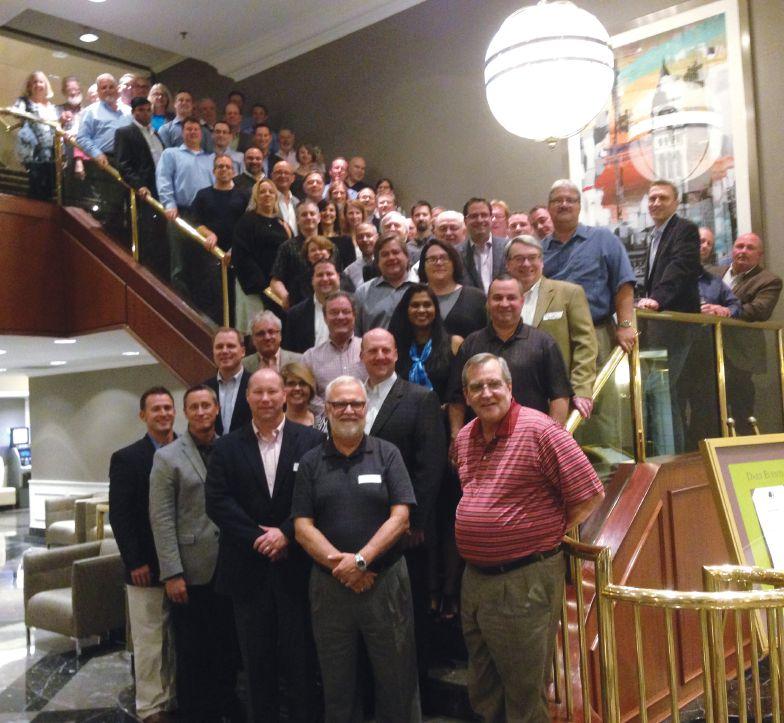
GANA’s Fall Conference delivers substance in Toronto.
tractors Division, chaired by Chuck Knickerbocker of Technical Glass Products, heard a presentation on reflected glare and solar heat from Vincente Montes of Curtainwall Design Consultants. Then the committee got updates on the progress of several technical publications from the various authoring subcommittees.
Bill Yanek of Centric Management told the lunch crowd about its association management provider and described Centric’s activities across the continent with various other associations. Ashley Charest, GANA and Canadian Glass Association executive director, introduced the CGA as Centric’s newest cli-
ent and announced it would now be accepting memberships from individual companies in the Canadian glass industry regardless of whether they were members of their provincial association. She also introduced the CGA’s new social media channels: @CanadianGlass on Twitter and on Facebook under CanadianGlassAssociation.
The Energy Division convened after lunch with Tom Culp of Birch Point Consulting giving members an update on energy codes and standards. He said 2015 promises to be a big year with a number of major updates to such standards as LEED, the Inter-
ABOVE: After 20 years in operation, GANA chose to celebrate with its first-ever full conference in Canada.
national Green Construction Code and the International Energy Conservation Code due to be released. There do not appear to be many major challenges for the glass industry in the proposed updates now that GANA and IGMA have seen off the attempts to lower window-to-wall ratios in ASHRAE 189.1.
Energy Division chair Helen Sanders of Sage Electrochromics updated members on the progress of the Life-Cycle Assessment Task Group which is close to completing its work to develop Product Category Rules for Environmental Product Declarations for windows and commercial glazing products. She warned members to get familiar with EPDs as they may soon become mandatory for green building projects. A lab was selected to develop the final framework of the GANA-approved PCR.
A subcommittee was formed to build a library of research on the effects of daylighting on occupant health and productivity.
The Decorative Division chaired by Marc Deschamps of Walker Glass convened on Sept. 24. Delegates discussed the potential for weakening of glass when ceramic frit is applied and how to quantify this and communicate it to the industry. A task group was formed to generate a Glazing Information Bulletin on cleaning acid-etched glass, which is something professional glass cleaners have been asking about. The NeoCon committee reported strong growth in interest in glass at the Chicago interior design show and recommended GANA’s continued involvement. Committee chair Mandy Marxen of Gardner Glass Products said fabricators should consider exhibiting at the show and bring their most creative designs.
Michael Mesure of FLAP Canada raised awareness of the importance of bird-friendly facades over lunch. Preventing bird collisions with glass is not as straightforward as it seems and many common ploys do not work. Plastic owls are useless, Mesure reported, as are hawkshadow decals. Angling glass and planting trees very close is also ineffective. Bird-friendly glass products on the market are still of limited effectiveness because designers have not yet discovered the correct frequency of ultraviolet light that is most visible to birds. Mesure said marking the glass is still the only proven solution, and markings need to be spaced no more than two inches apart horizontally and four inches apart vertically. The markings also need to be put on surface one of multi-lite units or else the window will still reflect enough to attract birds. Mesure pointed out that protecting birds is now a matter of law in Canada, where building owners can be held criminally responsible if their buildings cause the deaths of endangered species. The good news is properly marked windows will reduce bird strikes by 70 per cent or more, and buildings so marked will not attract prosecution for the owners when birds do hit them.
and that heat-strengthened, tempered, laminate edges can’t be polished the way architects often want. A task group was formed to look at developing guidelines for this process.
On Sept. 25, the insulating division met chaired by Nathalie Thibault of Prelco. Members took a look at the draft GIB for insulating glass performance with a new table listing different types of IG and their relative performance characteristics. It was decided that this document was ready to go to ballot. A presentation on multiple cavity units is being developed to help address confusion among architects about when and how to apply multicavity options. A bent-glass GIB is also in development and there was some discussion of whether to include cold-bent. The task group working on a PIB migration GIB attracted a great deal of discussion even though no members of the group were present. The problem is very complex and it was difficult for members to even agree on a scope for the GIB. Tracy Rogers of Quanex opened a discussion of focused solar reflectivity and suggested GANA form a strategy to counter claims by the U.S. Vinyl Siding Institute that low-E coated windows can cause damage by reflecting solar heat onto nearby buildings. The division voted in favour of producing a document to educate the public on the root causes of focused reflected sunlight and to make recommendations to help homebuilders avoid the problem.
At lunch, Dwayne Torrey of the Canadian Standards Association introduced members to the CSA and discussed progress on
Markings on glass are still the only proven solution to prevent bird strikes.
its A500 standard for “building guards” - railings, balconies, balustrades etc. The standard will be broad-ranging, covering more than just glass railings. Quite a bit of detail will be included on railing systems with diagrams of approved designs. It is not anticipated that the standard will mandate laminated glass. Wind load requirements will not be included in the initial version of the standard, but may be in future amendments. Torrey estimated A500 will be ready for publication in the spring of 2015.
Valerie Block of Kuraray chaired the laminating division meeting and reported on progress in developing a deflection table for laminated glass. The decision was taken to only consider PVB interlayer for the compression guidelines since it is the most common. The team developing guidelines for heavy door installations is seeking a hardware supplier that can help them mount doors and do compression testing so laminated glass can be included in the heavy door guide. The topic of edge treatments of laminated railings was raised, with members pointing out that wet-glazed balconies might have issues with exposed interlayer
Veteran glass consultant, Bob Maltby, regaled the tempering division with tales of flat glass experimentation. Maltby has written a book titled Bob Maltby’s Glass Book and was signing copies at the conference. The book is a huge compendium of Maltby’s knowledge gained over 54 years in the industry. The tempering division heard that iridescence is a hot topic and should be addressed. The heat soaking GIB will probably be restrained to a descriptive document introducing the process to architects. Chuck Wenci of Viracon gave a spirited presentation on the topic of optical distortion in glass, urging members to reject the word “distortion” in favour of simply pointing out that all glass has varying optical qualities.
After each division meeting, GANA executive director Ashley Charest reminded members that nominations are open for the Division Member Of The Year awards. Many divisions also have chairpersons who will reach the end of their terms at the GANA Annual Conference in Las Vegas in March and will need nominations for new candidates. •

by BRIAN BURTON
Brian is now involved with an innovative multidisciplinary firm that specializes in technical business writing: Award Bid Management Services http://award-bid-management-services.com/. The firm assists companies interested in selling goods and services to governments and institutions. He can be reached at Burton@award-bidmanagement.com
Climbing the urban Everest
Iadopted the term “Urban Everest” after reading about the distinct trend in some very large cities around the globe, including some in Canada, to build tall – very tall. Some enterprising developers are building residential high-rise towers that are over 80 storeys high. We see it in Toronto, but this vertical living trend is also becoming more and more common in cities like Hong Kong, Mexico City, and many major U.S. cities.
Normally, buildings of this height are towering symbols of corporate presence. Elaborate and grand edifices like the Empire State Building, for example, rising over 100 storeys above New York’s street level. To build residences on this scale represents a very different view of architecture and civic planning, and possibly even society. At street level, large cities tend to be crowded and noisy with air quality that leaves something to be desired. However, if you can afford it, you can reside 50 storeys above street level where it is a totally different environment. In other words, you can get out of the city without actually leaving it. As you move up, developers add one or two percent to the asking price for each floor you increase up in height. For example, a penthouse condominium in a new 84-storey tower being constructed in New York commands a price of $95 million, with a monthly charge for common element maintenance of $17,805. That’s $8,255 per square foot. Of course, that also buys you six bedrooms and eight bathrooms. Even a tiny, 351-square-foot studio unit comes in at $1.5 million in that building. Penthouse purchasers are offered private wine cellars on lower floors for a mere $400,000 and separate condominiums for maids and servants on the 28th and 29th floor ranging in price from $1.5 million to $4 million.
If you can afford it, you can reside 50 stories above street level where it is a totally different environment.
FENESTRATION FORUM
Some buildings also offer residents in indoor/outdoor event space for over 300 guests. Luxury amenities in the sky – for the right price. Is it worth it? When you get up to this height, it is amazingly quiet and the views can be breathtaking. On some days you are above the clouds and helicopters fly by below you.
Another distinct trend I have noticed in some recent buildings and designs is adding commercial space near ground level. Several years ago I noticed condominium construction in Toronto that included three floors of commercial occupancy at street-level. Now I’m seeing designs, or renderings at least, for buildings that boast six to eight storeys of commercial occupancy. This includes three levels of retail space above the lobby as well as four to six additional storeys of office space. This adds to the total height of the building, along with two or three exclusive penthouse floors at the top. Some buildings also require four floors to house the mechanical equipment used for heating, ventilation and air-conditioning, again adding to the overall building height.
The windows in these buildings are huge, and in fact it is the glass that makes these buildings truly special. The developers appear to take the benefits of glass entirely for granted. Without the glass there’s no view and, in most cases, that’s what their customers are paying a premium for. Even the silence has been built into the performance of the sealed glass units.
Another motivation to build tall is the scarcity of urban land readily available for development. Real estate experts tell me it is becoming increasingly harder to find and takes longer to develop. When it is available, it can be expensive. Obtaining building permits and dealing with the required municipal approvals can also add to overall construction costs, especially in major metropolises. This has generally encouraged developers to focus their efforts and concentrate their attention on buildings with a special appeal – namely, those that can offer outstanding and unobstructed views – all of which contributes to the ongoing growth of the urban Everest. •



INDUSTRYEVENT
BUSINESS HAPPENING
by RICH PORAYKO
Well attended. Fun. Educational.
GlassBuild America 2014, held Sept. 15 in Las Vegas, was everything you look for in a trade event.
Over and above the refreshingly positive atmosphere, this year’s show featured two significant differences over previous years. Most notably, the excellent 20-minute Express Learning sessions held right on the show floor that were free and open to everyone. And then there was the outstanding smartphone app which helped attendees navigate the show and maximize time for the frequent seminars and demonstrations that took place for all three days.
Tipping the scales as the
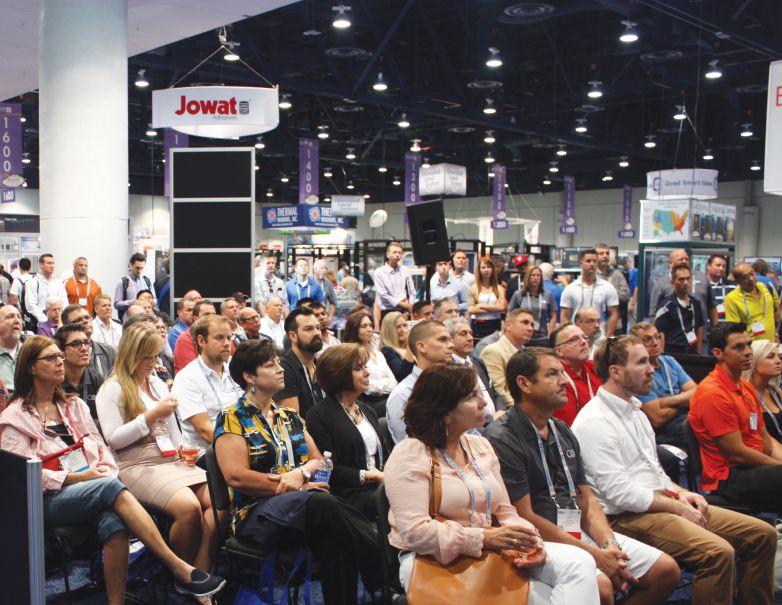
Reports of U.S. economic revival swirl around GlassBuild.
largest glass, window and door show in North America according to its organizer, the National Glass Association, this year’s GlassBuild welcomed 7,200 glass professionals and 375 exhibitors.
Always a highlight of GlassBuild is the Glazing Executives Forum (GEF). This year’s opening panel discussion, moderated by Rick Hamlin of Cupples, did not disappoint.
“Are far as the market is concerned, wow, what a difference the last 12 or 18 months has been,” said Oliver Stepe, senior vice-president of YKK AP America. “It’s been quite a transformation. The level of this market is still far below where we came from at its recent peak in 2007. We should be happy but it’s not time to break out the champagne. There is a lot of growth to catch up on.”
Fellow panelist Mic Patterson, vice-president of strategic development for Enclos concurred, “I think cautious optimism is appropriate but a lot of the market fundamentals are not as robust as much as a lot of people think they are. Recovery has been spotty in
a lot of areas.”
“The market has started to heat up,” said Jay Philips, Americas commercial segment director for Guardian. “It has gotten more consistent in more areas however there has been a hesitance for major investment. Overall industry capacity hasn’t expanded significantly. You are seeing it out there with long lead times becoming worse over the last three or four months. With the volume of projects that are coming out now and moving forward into the construction phases, looking at the overall supply picture, I don’t see those lead times improving considerably. For a company to be successful, they need to have a better handle on their supply chain than anyone else. He who has the best supply chain will win.”
Steppe agrees, “There is not an appetite from major investors for North America. They’re focused on emerging markets in India, China in South East Asia. We’re talking countries with populations of almost two billion people each. The long term opportunities for
ABOVE: Modelled after TED Talks, the free Express Learning seminars were well attended.


THE ORIGINAL & TRUSTED NAME IN GLASS HANDLING EQUIPMENT
those investors are not necessarily in North
According to Philips, the trend that Guardian Industries is seeing most is “Bigger, bigger, bigger. As big as you can make an opening. We’re seeing a lot of glass come in from Europe because of the size requirements. Guardian sold three projects in Washington D.C. where the openings were 10 feet by 14 feet.”
“The dominant trend that I see driving change is an increase in geometric complexity,” said curtainwall innovator Patterson. “Ten years ago everything was flat with right angles. Now, everything is curved and we spend a lot of time on geometrical optimization.”
Patterson adds “Performance standards are being increasingly dictated through legislation. It’s a good and necessary thing. It’s a pain but it’s forcing some real change. Architects and industry are trying to figure out how to meet these new U-Factors. This is just the beginning. It is going to get bigger. And legislation will be the dominant directive.”
According to Philips, retention is one of Guardian’s top priorities, “The market is improving. Companies are hiring. In the past, we might have talked about recruitment, now we have to focus on retaining the people that are most critical to the success of our organization. At Guardian, the number one issue we are looking at is retention of employees. People’s phones are ringing with opportunities.”
Jeff Dietrich of ITR Economic presented his much-anticipated and usually accurate predictions for the economy and construction marketing in “Ahead of the Curve –2015 and Beyond.”
“How do you know that this economy is stable?” asked Dietrich. “You look at all the leading indicators that we look at and what you see is an economy that is relatively strong and self-sufficient. What’s amazing about the economy and growth that we’re seeing is that we are doing this at time when China is sluggish, Europe is coming out of its second recession in four years and Japan is in recession.”
“One of the ways to take advantage of growth is to stop doing things you shouldn’t be doing. Access capacity. Not only from you but from your suppliers and make sure that when that order comes, that you have the workers, cash, line of credit if you need it, and everything you need for increasing activity because that’s what we see coming.”
Good information indeed. •
11:50, I finished my take-off and went and dropped in our bid on the gallery. The Pilkington guy phoned his boss, who was waiting in contractor V.K. Mason’s office close by, and told him we were bidding the job. Just before noon, a car drove up to the front door, slammed on the brakes and rushed in to drop off a bid. Pilkington got the order, but left a lot of money on the table. We were the second-lowest bid.
An opportunity came up at the University of Manitoba student union building. The project was specified Kawneer. We decided to bid and asked Kawneer for a price. They said that we would have to send them the architectural plans in order for them to give us a quote. They were caught in the middle between their Canada-wide customer, Pilkington, and us small guys. I went ahead and did our own estimate on the project and prepared our quote. The bids closed at noon in the student union executive offices. When we got there to deliver our bids, there was a Pilkington person at each entranceway. When they saw us we knew that we wouldn’t get the job. The Pilkington manager was waiting outside the offices with what we assumed were two bids: one if we showed up, and a higher one if we didn’t. When the bids were opened the Pilkington bid was about 10 per cent lower than ours with the other companies considerably higher. We went for lunch and laughed at how mad the Pilkington guy was. I heard later that the he phoned his Toronto boss and told him that their bid just beat ours by only a little bit.
Automatic entry doors! In the early ‘60s there were very few automated entry doors. Safeway had some Kawneer electric operators mounted in the transoms and Loblaws had Stanley pneumatic floor operators. During my time in the industry we were the leaders in a fascinating and quickly growing industry. We did some great projects. The Winnipeg post office’s air-conditioned computer room was a room with a huge computer that needed to be kept cool. The Winnipeg airport had 48 swing doors, originally tempered glass that we changed to
aluminum as people kept breaking the glass with luggage trolleys. The doors were later changed to sliding automatic doors. At the Manitoba legislature building, the front entry doors made of bronze were so heavy people had trouble opening them. They wanted to keep the original appearance so we proposed installing operators in the floor. It was a big job as we had to cut into the thick concrete. The operators were set to open slowly because of the heavy weight of the doors.
Today, after a slow beginning, automatic sliding doors are located everywhere. Western Canada’s first sliding doors were installed in the Tom Boy store in Neepawa, Man. They didn’t have room for conventional swing doors in the small building, so the biparting sliding doors did the job. The front entry to the MTS building near Polo Park had to handle large numbers of employees coming and going and regular doors couldn’t handle the traffic. They also had a limited area to work with, so sliding doors were the right answer. I remember when the pneumatic operators froze up. I called the Stanley engineer in New England and when he heard it was -40 F, he told me the operators were not designed for that temperature and that we were on our own to solve the problem. Working with the MTS building staff, we came up with electric heating strips installed along the air lines and that solved the problem. You’ve got to work with the cards you are dealt!
After 13 years in the glass business it was time to move on. After three years, I was out the door at Border Glass. But life goes on and opportunity knocked. I met with my insurance agent about a career in life insurance, Willmar Windows about opening up a storefront business and Hunt/Pella about the window business. I chose Hunt as it was in an industry that gave me a fresh cast of characters, new hope and, ultimately, a change of scenery when I was transferred to Calgary. I enjoyed my years in the Winnipeg glass industry and learned a lot. The best part? The good people that I met worked with and taught me to use creativity and street sense. •


by SKIP MACLEAN
Skip Maclean is president of Fenestration Canada. He is business development manager for Tru-Tech Doors and has over 40 years’ experience in the window and door industry.
No longer a teenager
In 2014, Windoor is celebrating its 20th anniversary. So much has changed over these years. With that, new suppliers, product evolutions and industry challenges have developed. As with most 20th anniversaries, there have been many great times celebrated during peak years as well as many trying times where the industry has pulled together to promote a community of best practices. From the show’s humble beginnings as a casual conversation over a few cocktails, Windoor has established itself as the premier window and door show in Canada. This year we will be recognizing the founders of the show, as well as the five exhibitors who have been with the show every year since the beginning. To celebrate, we have added live entertainment featuring the Blus Brothers during the opening cocktail reception Tuesday evening.
Sponsored by Fenestration Canada, Windoor ties industry leaders together with an estimated 150 exhibitors, and 3,000 attendees for a show which not only provides great networking opportunities, but also offers necessary seminars to keep everyone on top of the latest industry standards and codes. Be sure to participate as the industry experiences a monumental shift in traditional fabrication and product applications. Windoor is the most convenient way to stay informed while enjoying a great trade show and even free lunch and parking!
Scheduled for Nov. 18 to 20 in Toronto, a wide variety of exhibitors will be showcasing all aspects of the window and door industry, for instance:
• Insulating glass equipment and components
• Window and door systems in a variety of materials and finishes
Windoor is the most convenient way to stay informed.
• Operating hardware
• Fabrication equipment
• Services, such as software and testing
• Fenestration-related associations and trade magazines
FENESTRATION CANADA
The Windoor 2015 educational program promises to be very worthwhile. Fenestration Canada technical director Jeff Baker and J.F. Kogovsek of Maxam Marketing will discuss strategies for NAFS compliance and Baker will update attendees on changes to building codes across the country. These critical presentations are always packed, so arrive early! Andrew Peel of Peel Passive House Consulting will reveal his groundbreaking Passive House standard for green construction. David Mitten of the Siding and Window Dealers Association of Canada will deliver and update on the popular Sill to Sash program and Steve Hopwood from the National Research Council will discuss the latest developments in Energy Star.
On behalf of Fenestration Canada, we encourage you to attend Windoor 2014. For more information about exhibiting or attending Win-Door 2014, please visit windoorshow.com or call 1-800-2820003 to see how you can participate in Canada’s premier fenestration event.
Even with Windoor on the way, Fenestration Canada has found time for some other events. We hosted a series of webinars designed to update companies and stakeholders dealing with the compliance of fenestration products to provincial building codes referencing the North American Fenestration Standard (NAFS-08). A total of 477 individuals registered for the English versions and another 136 registered for the French series of the webinars which were presented over a period of three consecutive days from September 15 to 17. Participants from all across Canada included a wide cross-section of the industry including fabricators, builders, specifiers, architects and code officials. Fenestration Canada members can now access the recorded webinars and download the presentation slides from the association’s website in the Member Resource Centre using their login information.•
DOOR HARDWARE
Electric door strike camdencontrols.com
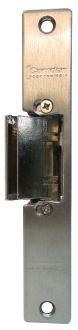
Camden Door Controls has released a new line of economical and rugged electric door strikes specifically designed for glass doors. 09 Series glass door strikes are compatible for use on singleswing glass doors 11.2 mm thick. There are 12 VDC, 24 VDC, failsafe, and fail-secure models. All glass door strikes are reversible for left- and right-handed doors and can be installed at the top or side of the door. 09 Series glass door strikes feature continuous-duty operation, 254-kg static strength, a 200,000-cycle life expectancy, a -15 to 40 C temperature rating and are backed by a three-year warranty. The strikes are part of an extensive line of market-leading electric strikes offered by Camden Door Controls, one of Canada’s leading independent manufacturers of door activation and
locking products. Available through more than 300 stocking distributor locations across North America, Camden strike models include BHMA grade 1, 2 and 3 ANSI strikes, EZ Fit “no cut” strikes, preload strikes and rim exit strikes.
Attractive ladder pull dorma.com
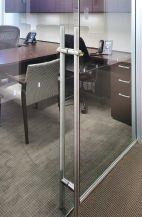
For elegant and secure glass entrances, Dorma offers Locking Ladder Pulls, a pair of tubular lockable pull handles with thumb turns made from the highest quality 316L-grade stainless steel - perfect for the toughest interior or exterior environments. Four lengths are available: 49, 60, 72, and 84 inches. They feature patented anti-break-in technology and steel dead-bolt locking on the reverse side of the key insertion. The anti-break-in technology conceals cylinder-fixing screws for additional security. Designed for rim
and IC rim cylinders, Dorma Locking Ladder Pulls use seven-pin, large-format interchangeable cores for easy re-keying of handles. A floor socket is included. In addition to glass doors, fittings are available for aluminum, wood, PVC and mixed-material doors from 10 to 22 mm thick. Fittings for thicker doors are available on request.
Spread-spectrum fob camdencontrols.com

Camden Door Controls has just released a new line of Lazerpoint RF 915-megahertz spread-spectrum fobs. The compact and attractive one-, two- and four-button key fobs are the first in the market to be developed specifically for people with disabilities (ADA-compliant) and feature large, raised buttons that can be operated with a closed fist. An LED confirms button activation, as well as provides a low-battery alarm and

DOOR HARDWARE
an exclusive battery-test gauge. These fobs also offer incredibly long battery life, with over 115,000 activations using standard button-style lithium batteries. The remarkable CM-TXLFB base turns a key fob into a remote activation button that can be handheld; mounted to a wall or under a desk using screws; clipped to a visor or belt with the metal clip supplied; or strapped to a wheelchair with the Velco strip supplied. CM-TXLF key fobs snap in to the base, without the need for tools.
Suitable for radiation environments
dorma.com
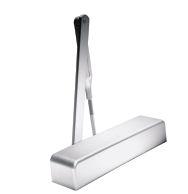
Dorma introduces its new, lead-lined, fullmetal cover for use with the Dorma 8900 and 8600 Series closers. Lead-lined covers are used in applications in radiology areas in hospitals, clinics, and dental facilities. The lead-lined cover can be painted or plated the same as a regular full-metal cover. Please allow an additional five-day lead time when ordering. The 8600 door-closer series is a non-handed surface-applied door closer with adjustable spring power and a backcheck positioning adjustment. It provides the flexibility needed to meet the many demands of commercial and institutional applications, including ADA barrier-free accessibility requirements. The modern, slim cover, flat form arm and architectural finishes provide the aesthetic qualities required of architectural grade closers. The 8600 Series is designed to

provide a highly flexible door control system suitable for use on all hollow metal, aluminum and wood doors typically used in commercial construction. The 8600 Series door closer features a backcheck positioning adjustment for parallel arm applications to maintain an ANSI backcheck range similar to regular and top jamb applications. This door closer series, with it’s adjustable spring size 1-6, also meets barrier-free accessibility requirements.
ADA-compliant pulls crlaurence.com
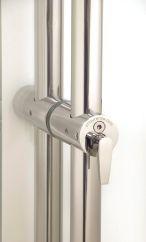
C.R. Laurence prides itself on engineering quality architectural solutions that aid architects, contractors, and installers create buildings that combine aesthetics with real world functionality. CRL understands the importance of effective operation for the end user, including individuals protected under the Americans with Disabilities Act (ADA). C.R. Laurence’s new line of Locking Ladder Pulls for all-glass entrances takes the company’s trusted design and adds additional features that align with the A.D.A.’s requirements for more specialized and inclusive openings. The alloy 316 stainless steel Locking Ladder Pull product line features a smaller-diameter housing that gives it a contemporary minimalist aesthetic while providing enhanced, specially designed ADA-compliant thumb-turn mechanisms. The new designs feature fully concealed deadbolts complete with six- or seven-pin rim-type cylinders that are designed for easy re-keying or maintenance when necessary. The Locking Ladder Pulls are also designed to eliminate any bending or kneeling down to lock or unlock doors. They are readily available for immediate shipment in 48-, 60-, 72-, and 84-inch sizes to meet strict architectural project deadlines. Custom sizes up to 120 inches and/or fully compliant configurations are also available for special order. Staying with CRL’s commitment to maintaining the industry’s highest standards, the new line of Locking Ladder Pulls are thoroughly tested in the company’s ISO 9001:2008 certified facilities to 100,000 cycles to ensure long-term durability and operation.
Secure and flexible
richelieu.com
E-primo electronic lock cylinders from Richelieu offer security and flexibility in one package. Designed to be easy to use, with no PC, software or wiring required, the E-primo cylinder works with user keys (such as media cards) that can be programmed directly on the E-primo cylinder. No wiring is required for installation. E-primo fits into the cylinder cutout where a conventional lock cylinder would be installed. The system enables flexible authorization assignment with user-key programming directly on the E-primo cylinder. It operates intuitively due to the central position of the reader unit. The rotary thumb turn on the outside is engaged by using authorized identification media, thus enabling the lock to be locked or released. The thumb turn’s ergonomic design is suitable for use on metal frame doors. Acoustic and visual feedback signals provide easy guidance for users.
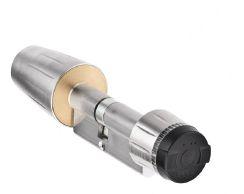




Click on our website to view company – www.accurateglassbarrie.com or call Shawn 705-791-1622


by FRANK FULTON
Frank Fulton is president of Fultech Fenestration Consulting. He has been in the industry for 30 years and can be reached via email at fultech.fc@gmail.com
Applewood Glass
It’s no small feat managing a manufacturing and glazing contracting business in today’s construction market. It’s a tough business with no shortage of landmines, challenges and highs and lows, but Tony Menecola, president of Applewood Glass and Mirror Inc., has been winning the battles for 35 years now and has no intention of pulling back. Recounts Menecola, “When my dad, Lorenzo and I started Applewood Glass in 1979, I used to fabricate and install windows and entrances by day and look after the books and try to drum up business by night.”
To celebrate the company’s 35th birthday, Tony and his family threw a very classy evening party in July at their 40,000-square-foot facility in Mississauga, Ont. Daughter Jennifer and Tony’s lovely wife, Eva, transformed a big section of the shop into a lavish banquet hall setting complete with catered hot hors d’ouvres, live music, mood lighting, and a fully stocked bar. Son Anthony schmoozed and helped keep things running smoothly. The Menecola’s entertained about 200 guests that evening and the family was very gratified that so many customers, suppliers, employees, family, and friends came to join in on the celebration. Ennio Rea, the OGMA’s designated spokesman at large, entertained the gathering with some appropriately selected humour and filled the role of master of ceremonies, introducing some local political dignitaries.
The speakers included Steve Mahoney, former councilor, MPP, MP, and one of the frontrunners for the position of mayor of Mississauga in the upcoming election, and George Carlson who represents Ward 11 on the Regional Municipality of Peel Council. Applewood was also presented with a plaque from current Mississauga mayor, Hazel McCallion, to commemorate its
“... a somewhat conservative but cautiously optimistic and innovative manner.”
achievement and contributions to the community.
Tony feels his approach to business has had a lot to do with Applewood’s success and longevity. He manages the business in what he calls a “somewhat conservative yet cautiously optimistic and innovative manner.” Controlled steady growth continues to be the plan going forward. Applewood is coming off the best year in its history in 2013 and will exceed its high water mark in 2015. The company currently supports 50 employees and that number is likely to grow with the business. States Menecola, “This year we are focusing our efforts on investing in new equipment for the shop. We have purchased a double-head mitre saw, three new jib cranes, three new conveyor lines for our unitized curtainwall production, a state-of-the-art computerized silicone pump and are anxiously awaiting delivery of a new CNC profile machine.”
In addition to running Applewood Glass, Tony has been deeply involved with the Architectural Glass and Metal Contractors Association (AGMCA) for the past twenty years, having served as president for two terms and currently filling the V.P. position. He is on the OGATC committee that oversees the training of Glass and Metal Technician apprentices at the OIFSC school, and on the Local Apprentice Committee which monitors the apprentices and ensures they complete their training. He is also on the negotiating committee representing unionized glazing contractor employers.
Looking back over the past 35 years, many projects come to mind but Menecola is most proud of the curtainwall they did for BMW’s flagship showroom in Toronto, a magnificent façade viewed by thousands of people daily. He also takes great pride in the production facility he purchased in Mississauga five years ago and of all the renovations he took on to turn the place into an attractive and finely tuned, efficient operation.
Tony continues to love the business and looks forward to facing the new challenges that arise every day. Thanks to his conservative and detailed approach and relentless work ethic, the future is looking bright for Applewood Glass and Mirror.•

DoorS IN Stock
• Narrow Stile Aluminum Doors for Exterior and Interior Applications
• .Prepped for Offset Pivots or Butt Hinge (Included)
• Glass Stops for 1" (25 mm) Glazing (Glass Not Included)
• Available in Clear and Bronze Anodized Finishes
• Other Finishes are Available on Special Order
• In Stock - Ready to Ship or Pick Up at All CRL- U S Aluminum Service Centers