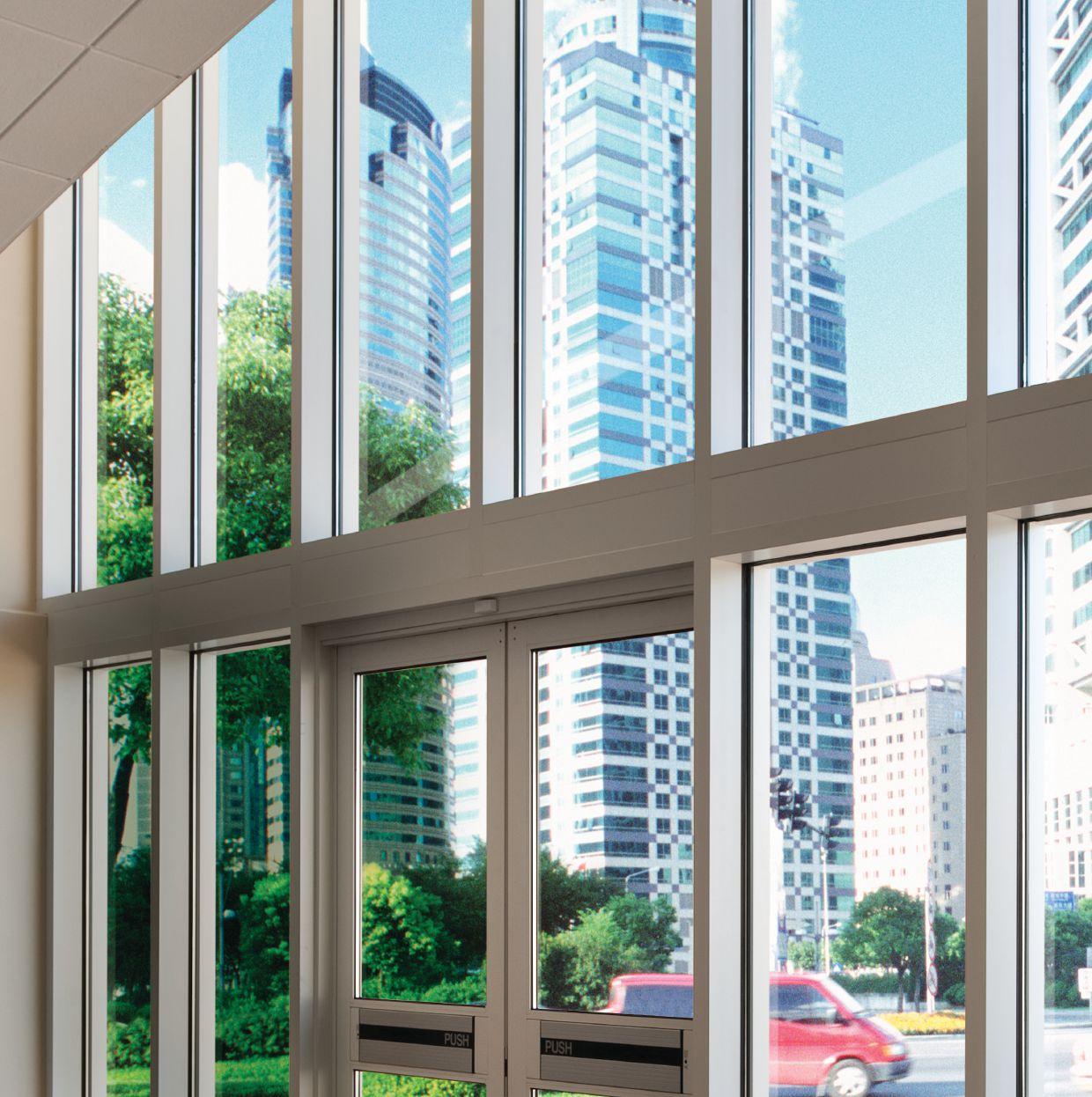
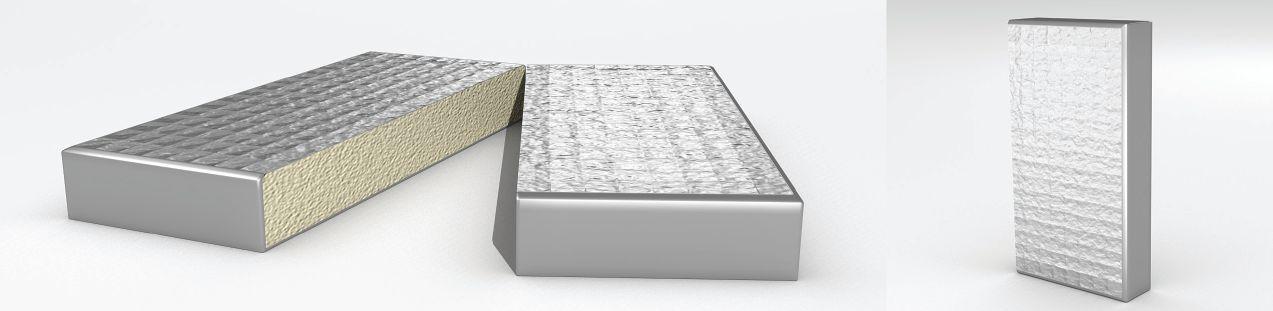
One of the only products on the market to combine superior thermal performance with a larger, more versatile span, Kawneer’s newest Trifab® 601 Series Framing System is built with a 6" frame – that’s an inch and a half more than a traditional storefront. Available in standard, thermally broken and ultra thermally broken, the new Trifab® 3-in-1 platform offers more flexibility, more drama, more options for you to design bigger, better buildings. An extra inch and a half makes a world of difference.
GLASS CANADA
24 GlassBuild report
Glass Canada roving reporter Rich Porayko says GlassBuild Las Vegas was better than it has been in years. Find out why.
28 Win-Door preview
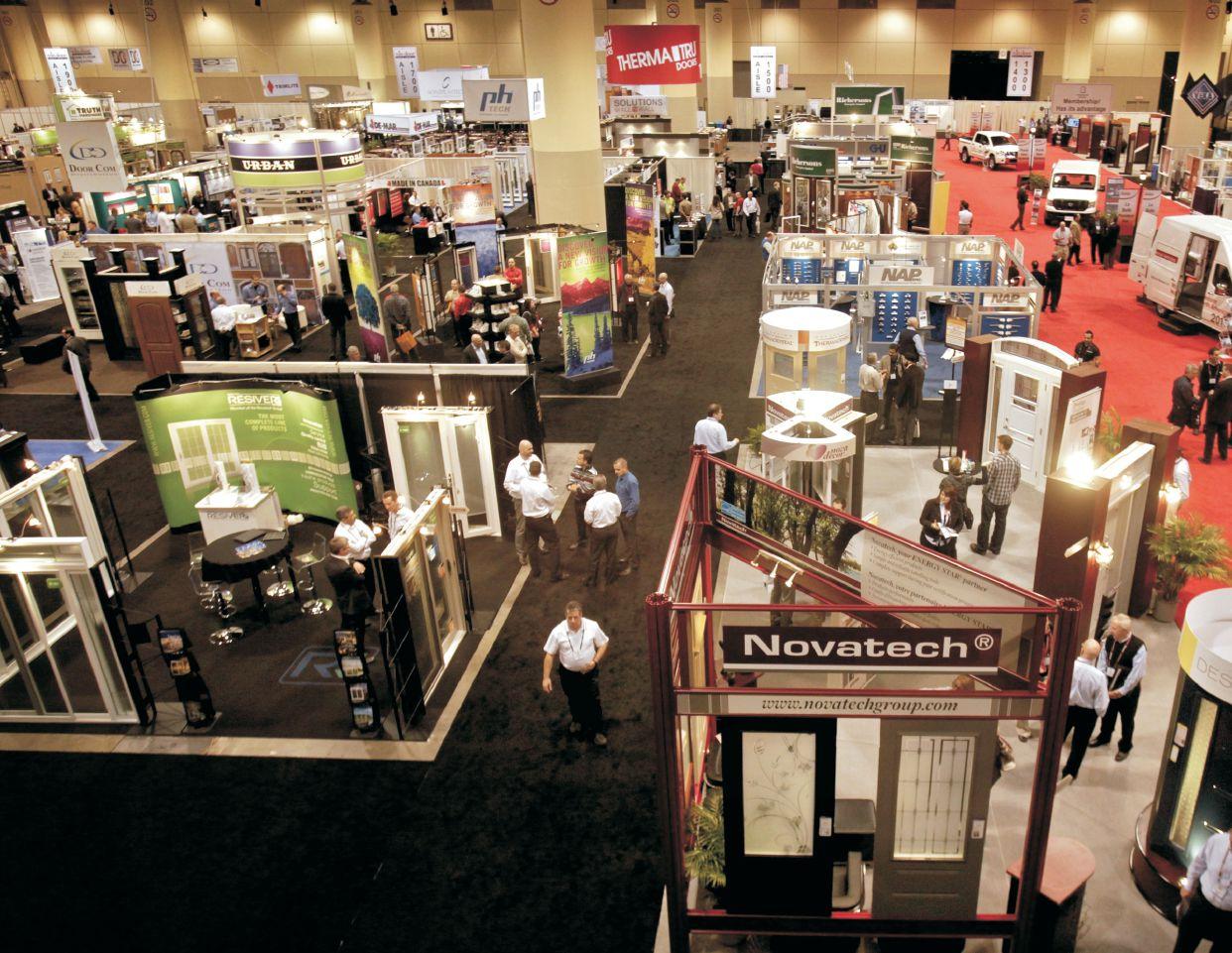
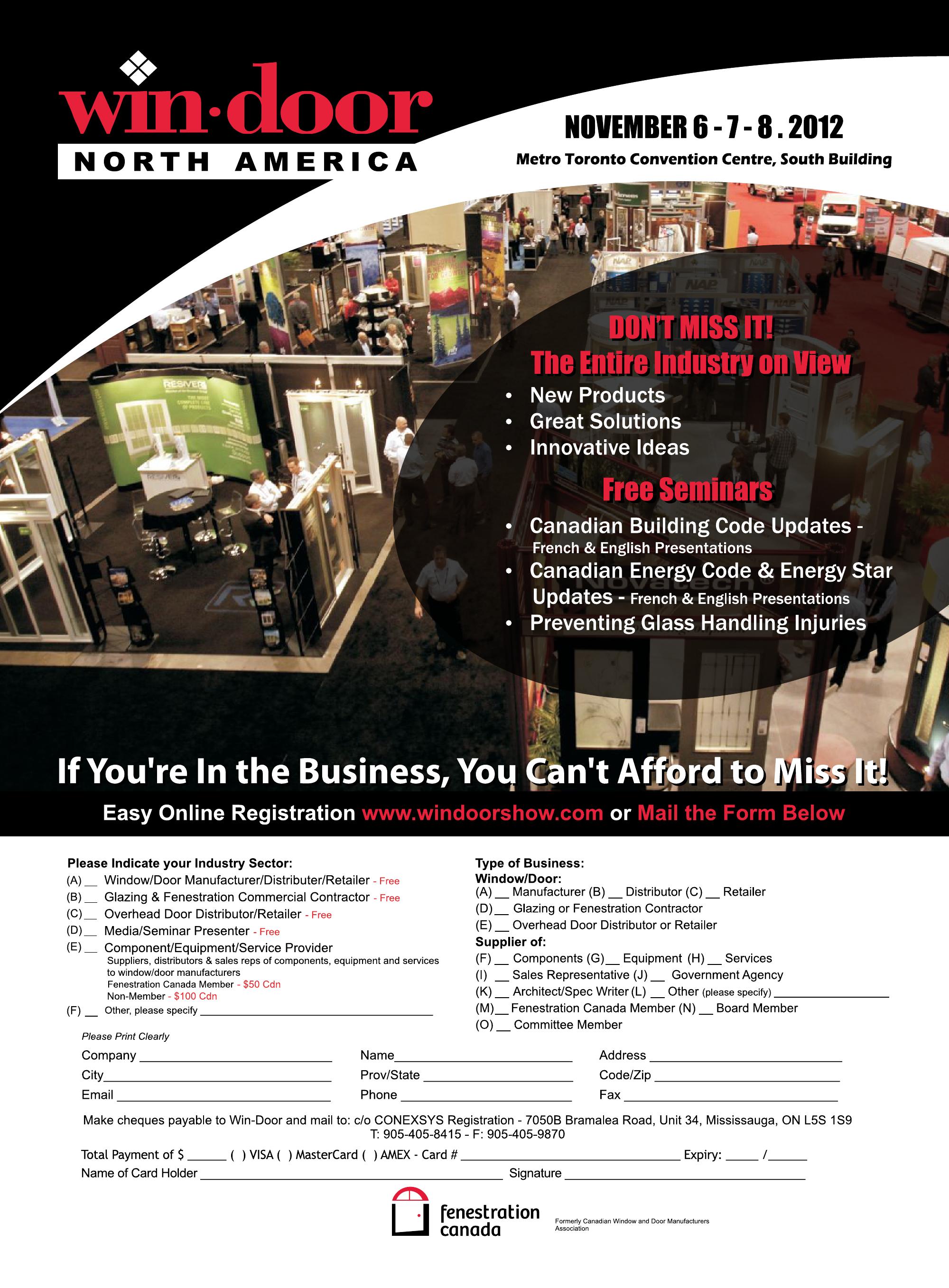
Fenestration Canada celebrates 45 years of service at Win-Door 2012.
DEPARTMENTS
9 Fenestration Canada
Your association can put the wind in your sails.
14 Innovations
PPG has some strong opinions on coil steel coating.
18 Under the Glass
Tiltco stays ahead of the market to win.
26 IGMA
Technical Committee chair Helen Sanders talks dynamic glazing.
COLUMNISTS
Brian Burton
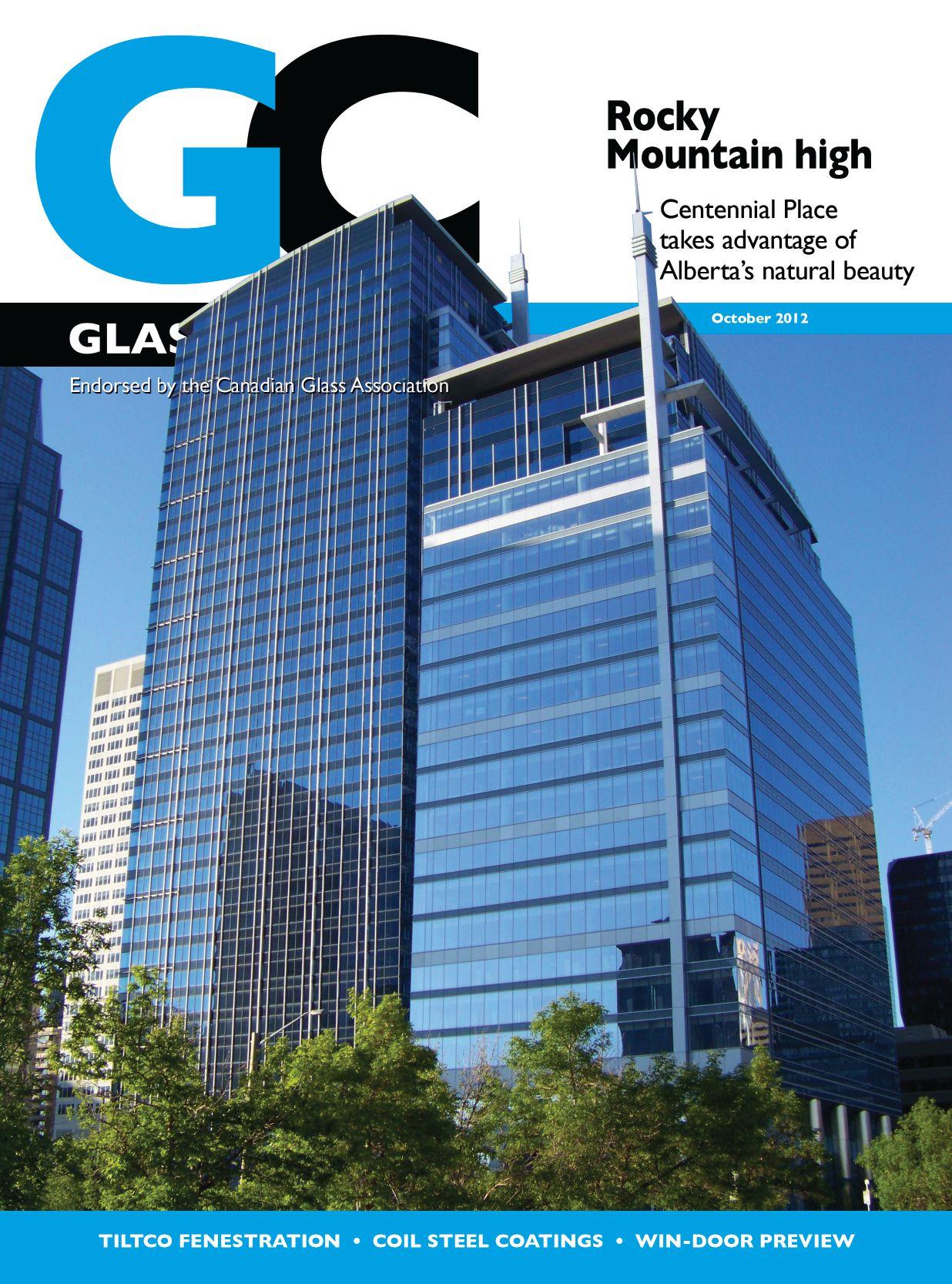
Calgary’s Centennial Place development gets its finishing touches with two new towers. Architects WZMH talk about the challenges and triumphs.
Finding the sweet spot
There seems to be a lot of soul searching going on in the glass industry these days, at least among the people who are interested in serving the overall market.
The Window and Door Manufacturers Association of B.C. has merged with the Glazing Contractors Association of B.C., creating a new association called Fenestration B.C. that will serve both residential and commercial sides of the industry. Here at Glass Canada, we are launching a new supplement called Fenestration Review that focuses on the residential market. Fenestration Canada for some time has been looking for ways to get commercial glaziers more involved in the association and Win-Door. Everyone seems to be jockeying around, trying to get their service mix and industry approach just right.
NEXt IssUE
• buyers Guide
• Effective bid proposals
Some of this is a natural reaction to the ongoing turmoil in the market. The Great Recession to the south has sucked billions of dollars out of the economy and claimed many once-reliable glass construction companies as victims. Most of the major supporters of associations and magazines in Canada are also exposed to the American market – indeed, many of them do the bulk of their business there. While Canada has bumped along without much impact from our relatively short recession, the U.S. situation has been grim and has not fully recovered yet. Budgets are squeezed, and trade show booths, magazine ads and donations to associations are often among the first things on the chopping block. Marketing 101 says you are supposed to ramp up your advertising and promotions at the bottom of the business cycle, but it is remarkable how few marketers seem to have taken that course. In the shadow of these circumstances, associations and magazines have to find ways to cut costs, bring in new revenues and better serve their clients.
Some of the changes are being driven by changes in the industry itself, as is entirely appropriate. Some of the old distinctions between the commercial and residential sides of the industry are weakening. Vinyl is now considered a potential material for use on commercial applications. Modern computer and manufacturing technology makes it possible for residential fabricators to customize their products to an extent formerly seen only on the commercial side. When the GCABC and WDMA-BC got together to talk about merging, they quickly found their memberships had more in common than they did differences. And whenever I speak to my readers about the commercial/residential mix in Glass Canada, I get the same response: you want a magazine that addresses both sides of the industry.
Glass Canada will continue to speak to both sides of the industry. In this issue, you will find a technical article on steel coil coatings next to a profile on a tilt-turn residential window fabricator. You will find our cover story on a Calgary skyscraper build next to a preview of Win-Door. Let us know if we have the right mix. •
GROUP PUBLISHER | Martin MCANULTY mmcanulty@annexweb.com
Publication Mail Agreement #40065710. RETURN UNDELIVERABLE CANADIAN ADDRESS TO CIRCULATION DEPARTMENT, P.O. BOX 530, SIMCOE, ON N3Y 4N5 e-mail: subscribe@glasscanada.com
Printed in Canada, All rights reserved. Editorial material is copyrighted. Permission to reprint may be granted on request. ISSN 0843-7041
CIRCULATION
e-mail: subscribe@glasscanada.com
Tel: 866.790.6070 ext. 208 Fax: 877.624.1940
Mail: P.O. Box 530, Simcoe, ON N3Y 4N5
SUBSCRIPTION RATES
Canada - 1 Year $36.75 (includes GST)
($39.55 includes HST/QST)
U.S.A. - 1 Year $50.00 (in US dollars)
Occasionally, Glass Canada will mail information on behalf of industry-related groups whose products and services we believe may be of interest to you. If you prefer not to receive this information, please contact our circulation department in any of the four ways listed above.
www.glasscanadamag.com
INdUstry NEWS
AWW builds windows for Habitat
More than 50 employees of All Weather Windows’ Mississauga fabrication plant volunteered their time on saturday, sept. 22, to build windows for 11 habitat for humanity homes in southern Ontario. the employees built insulating glass units and vinyl sills then glazed in windows in the morning between 9 and 11 a.m., generating 95 windows and 18 doors for the build.
the mood was upbeat as the event started with a pancake breakfast prepared by habitat for humanity volunteers. All Weather Windows founder and executive vice-president henry banman was on hand to welcome the workers and thank them for their participation. A family who lives in a habitat-built home, the Piccios, were also on
site to thank the workers and describe the effect habitat’s assistance has had on their lives. Jose Piccio said he would never have been able to raise the down payment for a home on his own.
Material for the build was donated by AGC, Westek building Products and Masonite. Fenestration Canada vice-president skip MacLean announced a drive by the association to raise over $100,000 for habitat for humanity with events like AWW’s across the country. “What we are hoping for is to get 100 members and have them raise $1,000 each and have that matched by the member companies,” MacLean explained. “so we are asking for everyone to get involved for such a great charity and a wonderful event.”
Daniels director of sales for IMT
The Iowa Mold tooling Company has announced that don daniels has joined IMt as the company’s director of sales. daniels brings more than 30 years of experience in sales management and competitive sales strategy implementation to IMt.
“We are incredibly excited to welcome don to our IMt team,” said Jim hasty, vice-president and general manager of IMt. “don’s depth of knowledge and experience in the materialhandling sector will continue to strengthen
IMt’s commitment to our markets. don will bring a genuine dedication to our commitment to distributors and customers.”
daniels will be responsible for leading the IMt sales team and helping direct business strategy for the company’s line of materialhandling equipment and commercial vehicles. In addition to driving new sales initiatives, he will work to strengthen the IMt distributor network, customer service and after-market support efforts.
iverson joins Vitrum
British Columbia based glass company Vitrum has announced the addition of brad Iverson to their sales team. Iverson will focus on expanding Vitrum’s sales efforts in the Alberta and saskatchewan markets, providing full-service glass fabrication and case distribution. Iverson brings 11 years of experience in the glass industry, including five years in automotive glass and six years in glass distribution. brad was born and raised in Calgary, Alta., and continues to live there with his wife and family.
thomas Martini, president of Vitrum Industries, states, “We are very excited to welcome brad to our team at Vitrum. the expansion of our sales and distribution team further strengthens our ability to meet the needs of our customers. I believe brad’s experience in glass distribution and his credibility throughout the Alberta and saskatchewan market will be an asset to both Vitrum Industries and our customers.”
CGA Newsletter
Canadian Glass association
Moredetails are now available about our spring conference and Glass Connections expo. It will be a full day session at the delta Montreal, taking place thursday, May 29 from 8 a.m. to 4 p.m. the delta is located at 475 President Kennedy Avenue in Montreal.
A buffet breakfast and lunch will be served.
there will be five speakers: “First Canadian Place tower recladding Project – redefining an Icon” by hamid Vossoughi and Vladmir Maleev of halsall Associates; “building Envelope Commissioning as Part of the design and Construction Process” by Mario Goncalves of Patenaude-trempe; “dynamic Photochromatic” by John Carpenter, president of Clearstream International Products representing schott Okalux Architectural Glass; “Looking beyond today’s Glass systems: New and Innovative Products and system designs for the building Envelope” by Mike harpell of read Jones Christoffersen; and an architect to be named later.
thanks to our conference chairperson, steve Gusterson, and our technical committee of Leonard Pianalto, Gusterson, brent harder and shawn Wessel for putting this together.
Conference sponsors will be on hand with tabletop displays showcasing their products. Please give them your support. the CGA board of directors will have our spring meeting the day before the expo and seminars.
Online registration for this event will be available soon on the association website.
Ontario Glass and Metal Association
Abeautiful course, a cloudless s eptember day and a delicious buffet were all on offer at the Ontario Glass and Metal Association’s fall golf tournament in Kettleby, Ont., in s ept. 13. t he event attracted 92 golfers even though many regulars were away at Glass b uild.
t he highlight of the evening was Ennio r ea’s heartfelt presentation awarding d ieter r ingler of Oakville Glass and Mirror the OGMA Lifetime Achievement Award. d ieter, his wife Ingrid and son s teve were on hand for this well-deserved honour.
t he Carrying Place Country Club was in great condition for the best-ball scramble. h ole
sponsors were Clearstream Architectural Products, tremco, Jamac s ales, Prelco, Krisro Metal Industries, triple s eal, Construction d istribution s upply, Protemp Glass, s ika Canada and Alumicor. s ome very nice
prizes were handed out at the dinner, including toronto Argos tickets, a cappuccino maker and a 42-inch t V.
More photos from the tournament can be seen on the Glass Canada Facebook page.
Glazing Contractors Association of B.C.
The votes have been cast and the results are in. WdMAbC and GCAbC have now merged into one new association: the Fenestration Association of b.C. (FenbC). Our meeting was well attended by members from both associations. the vote was unanimous on both sides. Congratulations to everyone for completing this task. the boards of both associations would like to thank the Merger Committee for its hard work and due diligence to ensure the interest and concerns of both memberships were considered. the members of the committee were, for the GCAbC, debra dotschkat of GC Glass Canada, david Langton of Competition Glass and Leonard Pianalto of read Jones Christoffersen. For the
WdMA-bC, terry Adamson of Westeck Windows, Gary brown of sGb services, Al Jaugelis of Innotech Windows and doors and robert steeves of Gienow Windows and doors participated.
the new association’s new location is 101–20351 duncan Way, Langley, b.C. this is also currently the site of the glazier apprentice training facility.
Our new membership categories will be very simple. regular members include contractors, window and door manufacturers, pre-hangers and installers. supplier members include companies that supply materials to the fenestration industry. Associate members include consultants, engineers and architects.
there are several key
next steps for FenbC. Our first Annual General Meeting will take place on October 22. We will elect our new board of directors at this meeting. Please take a few minutes and consider participating on the board. Almost all of our meetings will be virtual, using GotoMeeting, so you need not be concerned about time spent traveling. this has worked successfully for both associations during the past year, and has made it possible for individuals situated outside the Lower Mainland to participate fully in board discussions.
Next week you will receive a letter from the new association asking for some information about your company in preparation for the membership renewals drive.
Golfers enjoyed a delicious buffet dinner after a day of top-notch golf conditions.
Ringler honoured
dieter
ringler of Oakville Glass and Mirror was honoured at the Ontario Glass and Metal Association’s fall golf tournament with the Lifetime Achievement Award for 45 years of business in the Ontario glass industry. ringler’s wife, Ingrid, and son, steven, were on hand for the presentation.
Former recipient Ennio rea of triple seal presented the award. he told the 92 members in attendance that ringler left Germany on sept. 26, 1965, and arrived in Montreal. Walter Peterson of repla Windows sponsored dieter for his first year in the country. there he began his career in the glass and metal industry. ringler founded Furi Aluminium with his friend and partner Frank Furtner.
In November, 1967, ringler bought Oakville Glass and Mirror and expanded the business from a basic glass shop providing mirrors, storm doors, windows and repairs. With the encouragement of bernie Leaman, ringler launched Oakville Glass into the aluminium business.
In 1981, Oakville Glass moved to its
current location at 550 bronte road. the company currently employs more than 20 employees as well as subcontractors.
rea said ringler has enthusiastically participated in the OGMA “by attending the dinners only.” According to ringler, “golf was for playing after you were 50.”
ringler later became a director and then the president of the OGMA. he became president of the Canadian Glass and Metal Association in 2007.
rea concluded saying ringler’s son steven works along side of him as CEO, which leaves dieter plenty of time to pursue his favourite hobby: travelling the world.
ringler thanked the OGMA board and the members said the award was a very great honour.
McClatchey hands off to McClatchey
The board of directors of sAF has announced that John McClatchey has retired from the position of president, effective september 1. McClatchey has held the job since 1988. he will continue to serve on the board of directors. McClatchey plans to work as CFO of sAF for at least another two years.
James and Penn McClatchey will share the CEO job, assuming the titles co-CEO. James will take responsibility for sales, It and finance. Penn will take responsibility for operations, engineering and marketing. James joined sAF in 1973, and Penn joined sAF in 1986. both men have deep experience in all areas of the company’s business.
Under John McClatchey’s leadership, sAF began manufacturing wall panel systems, column covers, perimeter systems roofingedge trims, and coil anodizing. sAF opened a 100,000 square-foot fabrication and fluorocarbon coating facility in Villa rica, Ga., in 2003, and a 70,000 square-foot operation in redding, Calif., in 2006.
John McClatchey stated, “this is an ideal time for a CEO transition. the company is in very good shape strategically and financially. the management team at sAF is second to none and ready to capitalize on
the many opportunities ahead. I have great confidence in Penn and James and their ability to lead sAF to the next level of success. they are surrounded by a very strong group of talented people at all levels of the organization.”
Penn McClatchey commented, “I look forward to working closely with James to finish out 2012 in strong fashion, and I’m excited about leading sAF in 2013 and into the future.”
James McClatchey said, “sAF has thrived despite a harsh building products market during the last four years. Our success has always been based on a model of shared decision making. I look forward to working with our management team to open our new anodizing line in redding later this year.”
based in Atlanta, Ga., sAF is a nation-wide aluminum extrusions and sheet distributor, aluminum fabricator, and aluminum finisher specializing in Kynar painting and architectural anodizing. sAF also distributes column covers, architectural panels, and commercial roofing trim to architectural specifiers, glazing contractors, and other industries. Customers can order batch aluminum anodizing, painting, coil anodizing, powder coating and custom fabricating.
McLenaghan joins sage
sage, a leading manufacturer of electronically tintable dynamic glass, announced that Alan McLenaghan has joined the company as its vice-president of operations. McLenaghan will bring his extensive experience in glass manufacturing to sage’s new 320,000-square-foot, highvolume manufacturing facility in Faribault, Minn. he will support the organization in the completion of the facility and be responsible for safety, supply chain, MIs, and manufacturing operations at what will be one of the the world’s largest and most advanced electrochromic glass manufacturing facilities when it begins commercial production in early 2013. McLenaghan comes to sage from Verallia North America, a saintGobain group company headquartered in Muncie, Ind. McLenaghan began his 15-year career with saintGobain in 1998 when he led construction of the company’s award-winning float glass manufacturing plant in Eggborough, North yorkshire, England. that facility won the prestigious U.K. best Factory award from the Cranfield school of Management in 2005 while McLenaghan served as site director. Prior to saint-Gobain, he spent three years with duPont and seven with ICI in both the U.K. and U.s
by PIErrE PErrEAULt
Pierre Perreault is a sales executive for Servitek Fenestration and chairs Fenestration Canada’s Editorial Committee.
Set your sails for change
As I travel to meet with customers and suppliers, I often get the question: why should I become a member of a trade association, be it national or regional? What’s in it for me?
It’s all a matter of influencing your destination, as a business. I once worked with a business leader that was an avid sailor. He often compared business to sailing, which at first may seem odd, but I think it applies very well to our industry. When sailing, you rarely travel in a straight line from point A to point B. You know where you leave from, and you know what your objective, or destination, is. You cannot change the direction of the wind, but if you pull on the right ropes, tighten one sail, loosen up another, you will be able to sail your ship to point B, even if the wind is blowing in another direction. In other words, there are things you cannot change (the wind), but your knowledge, experience and ability to adapt will allow you to make the right decisions to attain your objectives.
Being active in the industry helps broaden your knowledge, gain from experiences shared from other members and and be better equipped to adapt your business to a perpetually changing environment. And somehow, it also affects how the wind will blow in the industry.
You may read trade publications like this one, or attend trade shows to see what others are doing and what different suppliers have to offer, but these are typically unidirectional activities. Information gets to you, and you do with it whatever you see fit. Involvement in an association is a two-way street. Members voice their concerns, share their perception of how issues affect them and how they should be tackled and, if they so wish, actually take part in the teams or committees, addressing them.
You cannot change the direction of the wind, but if you pull on the right ropes, you will be able to sail your ship.
A good example of this is the ever-increasing energy efficiency requirements we face. Fenestration Canada and other regional associations have been hard at work for the last few years, meeting and discussing with regulators, drafting technical documents, assessing how proposed regulations will affect you and proposing different options, striving to shape the way the wind blows, and providing you with tools and expertise to harness that wind. Energy efficiency is probably one of the challenges we face that has garnered the most exposure, and it is not going away anytime soon. But what about other concerns you confront every day that affect the direction of your business?
Are human resources an issue, attracting, training and retaining talent? What about marketing? Procurement? Logistics? What affects you most likely affects other fabricators or distributors around the country. Get involved in your association, let other members know the way the wind is blowing for you, and what you think the industry should do about it.
Like the old saying goes: the only thing permanent is change. The industry will change, your local business environment will change, your customers will change, your suppliers will change and the regulatory requirements will change. Your business will change. Nothing ever remains static, like it or not. You can choose to absorb these changes as best you can and hope for the best, and this may be a very worthwhile strategy. On the other hand, getting involved and helping shape the way the wind blows will influence the destination of your ship.
A good chance to embark with your association is coming up next month. Win-Door North America is Fenestration Canada’s flagship event for the industry, taking place Nov. 6 to 8 at the Metro Toronto Convention Centre. We will be holding our general meeting at 9 a.m. on Thursday, Nov. 9, in the presentation theatre right on the show floor. This is an excellent opportunity to find out just who is involved in the association and what we have been up to over the past year. Fenestration Canada will man a booth on the show floor where you can stop in any time for a private conversation with our executives. And you can see our technical team of Jeff Baker and J.F. Kogovsek show off their knowledge in 11 a.m. seminars on the 7th and 8th. If you have ever wondered just where your association can take you, Win-Door is the place to find out.•
Rocky Mountain
Mountain high
Calgary’s Centennial Place is built with the environment in mind.
by Rich Porayko
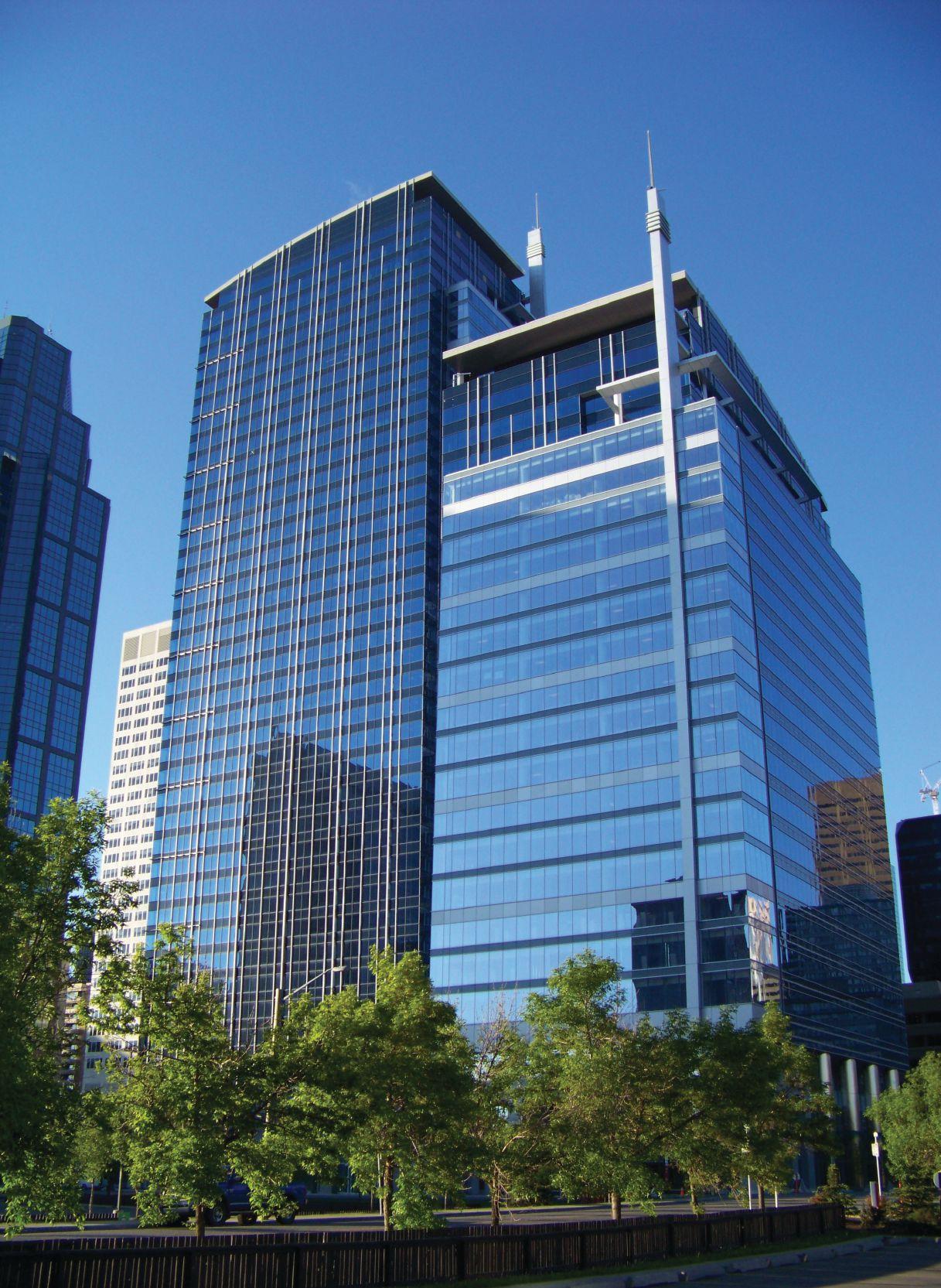
Named in honour of the Wild Rose Country’s Centennial year, Centennial Place is a set of two LEED Gold certified towers with a linked podium occupying a full city block in the Eau Claire region of Calgary. A typical floor features six corner offices and with minimal structural intrusion for greater layout flexibility and access to breathtaking views of the Rocky Mountains. The buildings represent a completion of a campus of offices that Oxford Properties has built in the Calgary area over the last 30 or 40 years, many of which were designed by WZMH and various generations of the firm. The project is almost like an addition to the family.
Tom Schloessin, project architect of Centennial Place for WZMH, recalls how the Oxford family of buildings progressed as technology and best practices improved. “Over time the styles of the buildings have changed,” says Schloessin, “so it is interesting to see how the buildings have evolved. We were quite proud to achieve LEED Gold for Centennial Place. We were told that at the time it was the largest single LEED Gold project in Canada.”
Creative freedom
“Effectively, we filled a city block with this development,” says Schloessin. “When you are creating a two-tower project, you want to situate the buildings relative to one another so they perform well and optimize things like daylighting. In that aspect, Centennial Place was very successful in that the buildings don’t shadow each other. The other feature that is exploited by the orientation of the towers is the view of the Rocky Mountains to the west, which we wanted to optimize with a lot of vision glazing. We wanted as much sense of natural light as possible. It wasn’t low iron glass, however; it was as clear as we could get it within our budget.”
Keeping with the ongoing trend for these types of projects, the glazing contract was split between the tower, which was completed by Antamex International (now known as Oldcastle BuildingEnvelope) from Delta, B.C., and the podium, which was supplied and installed by Global Architectural Metals from Welland, Ont. “This happens frequently with these types of buildings,” explains Schloessin. “The tower was completed by a company in the curtain wall trade and the perimeter podium glazing is completed by someone with a structural glass system or a basic curtain wall system. For the tower, we were working with Antamex just as they were opening their manufacturing facility in Delta, so they had a tremendous incentive on that project. It worked out very well.”
“With a building like Centennial, we were dealing with a standard unitized curtain wall system which is designed to be modular, however, we wanted to introduce new features,” says Schloessin. The solution was to incorporate a patterning effect in terms of protrusions in the mullions and cap treatments. “That’s how we achieved the play in the facade and Antamex was very good at achieving that effect.”
Schloessin continues, “On each tower, one wall is sloped so we had an inclined plane and were putting the unitized glazing system on a slight angle, which was interesting and achieved by
LEFT: The spires on both buildings include lighting features that were built at Antamex’s Delta factory and shipped to the site to be hung in place. “We designed and fabricated the spires near the end of the job with very little detail, which was fairly challenging,” says project manager Otto Ward.
Antamex without issue. They were well versed in the technology of curtain wall and very knowledgeable in terms of sequence of production and fabrication. We had the benefit of some very experienced people. The end result was quite successful.”
“It was a very interesting job for us,” says Herb Resar, vice-president of western operations for Oldcastle BuildingEnvelope, the company responsible for design, engineering and overall operations for Centennial Place. “We had one of the best construction managers in the country in PCL and it was a privilege to work with them on this project. Antamex/Oldcastle BuildingEnvelope was part of the design–assist for this project, which went very well with the co-operation of WZMH as there was the need for interaction and communication in the design development. Pressure equalized, unitized, rainscreen curtain wall designs have existed for a number of years; however, the extrusions for this job were all custom manufactured and adapted to the architect’s requirements for the esthetics, while we concentrated our efforts on function and durability of the system.”
“The main parts of the towers were relatively straightforward and went smoothly because there was a lot of repetition, even though WZMH added character to the facade by using different glass types and alternating details in different areas,” explains Otto Ward, Antamex project manager for Centennial Place, now business development leader for Garibaldi Glass. Ward continues, “But when you get to the top, there are recesses and cantilevered beams, decks louvres and other architectural features with steel that penetrated the system, requiring complex framing configurations to maintain air and vapour
seals throughout.”
“There was a point where both buildings were being built at the same time so it was a challenge in keeping enough supply for both towers, in particular with the tops as there was a delay in the steel work,” says Ward. “So near the end of the project we were asked to speed up the job, which made it difficult to find space at the top of the building for the frames while the steel work was still going on. Even though both buildings look similar except for the heights, the steel work at the top of each building was actually designed very differently, so our connections had to be different for each tower. Even though it all looks the same, it is not.”
“It worked out extremely well and was a good job for everybody,” says Resar. “It was the type and size of project that we do well. It had the repetition that we are looking for from a manufacturing point of view and the complexity to really put your head into the design and engineering, especially at the tops of the buildings and the spires.”
Connected inside and out
“Another feature of the glazing design that we really like about Centennial Place is that even though it is a full city block, the building is really light in terms of how it comes to ground,” explains Schloessin. “There is a lot of openness. You have the effect that you can look through the entrance lobbies and see the tower elevator cores and the main interior concourse. When you are dealing with a full-block development like Centennial, there is a risk of losing clarity in design and having
Continued on page 17
PVDF versus sMP
A look at performance in UV-durable coil coatings.
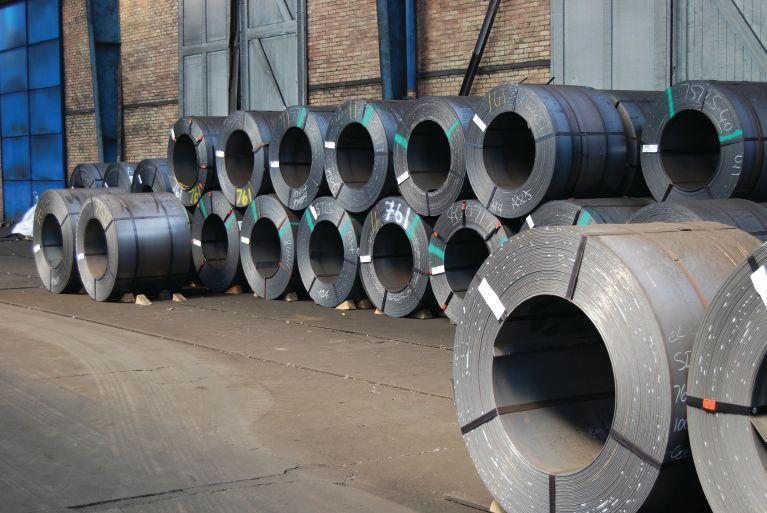
All steel-coating technologies are not created equal. When it comes to resisting chalk and fade over time, nothing beats 70 per cent PVDF.
Although silicone-modified polyester (SMP) and super-polyester coatings are well suited for specific applications, they cannot provide the same proven long-term performance as 70 per cent polyvinylidene fluoride (PVDF) coatings, due to the latter’s superior chemistry.
In today’s competitive environment, many companies make claims that SMP and super-polyester coatings equal or exceed the performance capabilities of 70 per cent PVDF coatings. This article examines the differences between 70 per cent PVDF coatings, SMP and superpolyester coatings, and evaluates the true long-term per- formance of each coating technology.
First, the basics. Coil coatings are made from three basic ingredients: resins, pigments and solvents.
Resins
Resins give coil coatings basic performance characteristics such as resistance to abrasion, scratching, moisture and ultraviolet light, as well as mechanical char-
acteristics such as adhesion, hardness and flexibility during fabrication.
Coil coatings are formulated with several resin types, including acrylic, epoxy, polyester and PVDF polymers. For applications that demand a highly durable coating surface, such as metal roofing, composite panels, building panels and curtainwalls, 70 per cent PVDF coatings are regarded as superior due to their strong UV resistance. Because of their lower cost and harder finishes, SMP and super-polyester coatings are traditionally favoured for applications such as warehouses, industrial, storage and agricultural structures and other non-monumental commercial buildings.
In recent years, some manufacturers have sought to position SMP and superpolyester coatings as viable, low-cost alternatives to 70 per cent PVDF coatings. While it is true that polyester coatings are more resistant to UV damage than early generation coatings, they do not offer the same weatherability, colour retention and gloss retention as 70 per cent PVDF coatings.
To understand why, it helps to know the chemical structure of various resins. PVDF resin molecules are composed of alternating carbon-fluorine and carbon-hydrogen bonds. Carbon-fluorine bonds are among the strongest in the chemical world. Consequently, they render PVDF resins chemically and photochemically inert, and, therefore, virtually immune to degradation from sunlight, moisture, acids, pollutants and chemicals. That is the reason for their superior durability.
By contrast, molecules in SMP and superpolyester resins are based on carbon-hydrogen, carbon-oxygen and carbon-silicone bonds. Because their molecular bonds are weaker, long-term exposure to ultraviolet light and environmental hazards eventually defeats the structural chemical integrity of the polyester coating, causing it to chalk or fade.
Pigments
Pigments are colourants made from fine powders. There are three types of pigments – organic, inorganic and ceramic – and their chemical structure determines their stability (ability to resist fading). Because ceramic pigments are made from metal oxides fused under high temperatures, they are the most chemically stable and fade-resistant. Consequently, they are the default choice for coatings systems warranted to satisfy the most demanding performance expectations, such as high-end architectural applications.
Solvents
Solvents are carriers that make coatings easy to apply. They do so by solvating resin to a desired consistency and dispersing pigments evenly throughout the coating. Solvents have no effect on coating performance.
Ultimately, a coating is only as good as the sum of its parts. If a coating is formulated from strong, durable resins but weak pigments, it has the potential to chalk or fade prematurely. Conversely, durable resins combined with strong pigment systems will deliver long-lasting performance. In short, a coatings formulation cannot be strong if any of its individual components are weak. High-quality raw materials are essential to the long-term durability and performance of any coating.
Be wary of performance claims
In recent years, some manufacturers have sought to imply that SMP and super-polyester coatings can offer the same long-term performance benefits as 70 per cent PVDF coatings. This practice is misleading for two reasons.
First, as demonstrated in the previous section, SMP and super-polyester coatings do not have the chemical structure needed to sustain the long-term performance of 70 per cent PVDF coatings.
Second, and perhaps even more critical, SMP and super-polyester coatings do not have longterm weather exposure data equal to 70 per cent PVDF coatings, which have a 45year history of proven durability on buildings throughout the world. Since 70 per cent PVDF coil coatings debuted in the 1960s, they have been continuously subject to South Florida exposure testing. In this testing, coatings are applied to metal panels and exposed at a 45 degree angle to South Florida’s notoriously harsh humidity and UV light, then measured at five-year intervals for chalk, fade and other signs of environmental degradation. New SMP and super-polyester coatings are introduced every four to five years. As a result, these products have no more than 10 to 15 years of performance data in South Florida exposure testing or actual building performance. Despite the lack of requisite testing, many of these coatings are warranteed at terms comparable to 70 per cent PVDF coatings.
Chalk Ratings
chalk rating: 1
Chalk rating: 5
Some coatings manufacturers seek to dismiss this concern by insisting that performance data for new SMP and super-polyester coatings supersedes that of older products. New polyester technologies may, in fact, be superior to the earlier polyester formulations, but they cannot achieve the long-term performance of 70 per cent PVDF coatings because, ultimately, the molecular structure of the base polyester resins will cause them to fail.
Best chalk rating: 10
Coatings specifiers also should examine if and how their warranty distinguishes between
Poorest
vertical and non-vertical surfaces. Many warranties cover vertical and non-vertical surfaces differently because non-vertical surfaces such as roofing are much more susceptible to failure than vertical exposures. Seventy-per cent PVDF coatings purchased from proven, reputable coil coatings manufacturers will provide equal chalk and fade coverage for vertical and non-vertical surfaces.
Chalk and fade
As explained earlier, chalk and fade result directly from the chemical breakdown of a coating’s base resins and pigments, which ultimately appear as a visible loss of colour and/or gloss.
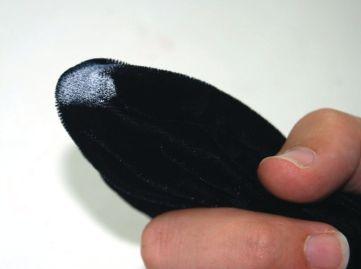
Chalk is the appearance of a powdery substance on the surface of a coating. In accordance with ASTM D4214-98 test procedures, it is measured by rubbing the coated surface with a soft fabric and calculating the amount of powder that is
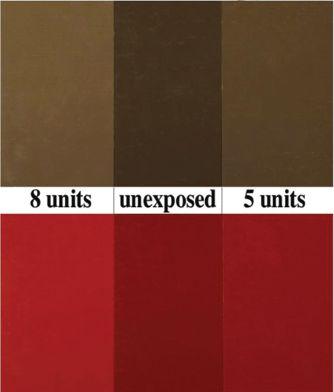
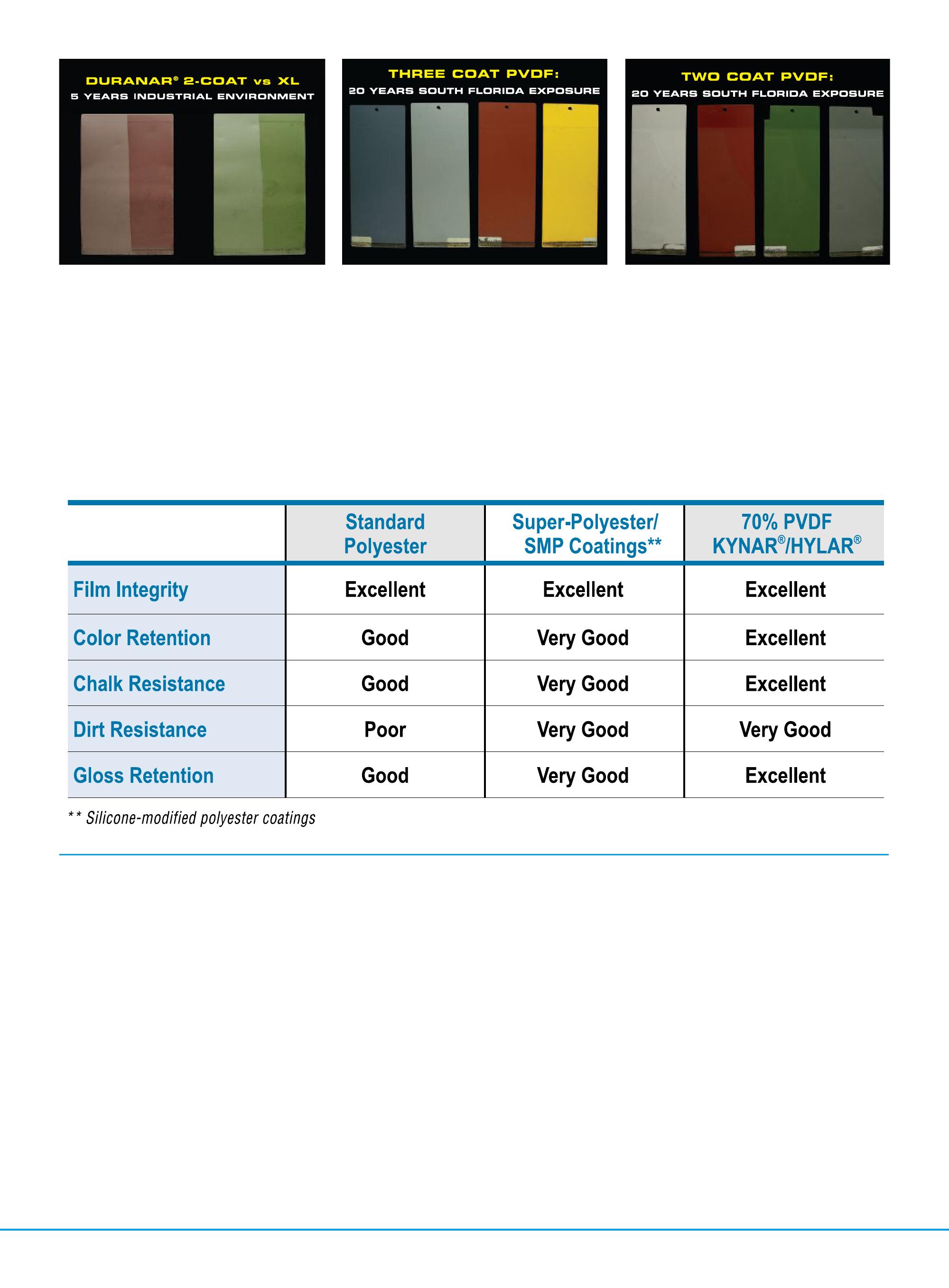
Two rows of coloured, coated metal panels depict colour changes (fade) of eight E Hunter Units and five E Hunter Units. One E Hunter unit denotes the smallest degree of colour change visible to the naked eye.
a difference of one or two points in a chalk rating, or of more than five E Hunter units in a fade measurement, can mean the difference between a coating that maintains its original appearance for 30, 40 or 50 years and one that looks old much sooner.
PVDF versus polyester
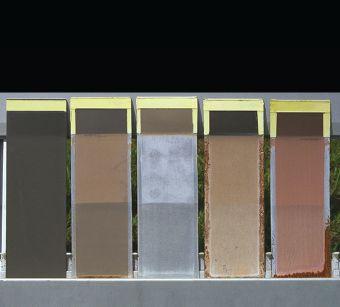
After 40 years of UV exposure, PVDF coatings and polyester coatings will react differently in exterior environments. As
Comparing the performance of a PVDF-coated metal panel (left) and four metal panels with different polyester coatings after 20 years of South Florida exposure.
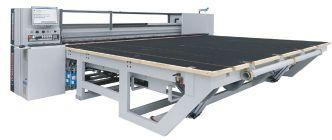
MAKING GLASS EASY
Master 33/43
Durable CNC Workhorse Cuts and Shapes with 3/4/5-Axes Precision State of the art technology delivers very high finish quality. Thousands of satisfied customers.
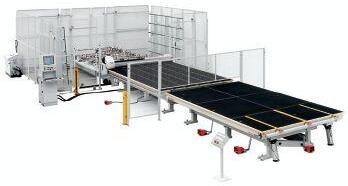
Genius Series
CNC cutting tables for straight and shaped flat glass Versatile, modular, and configurable for any size shop, from individual craftsmen to large manufacturing operations.
Genius 37CT for Float Glass
Genius LM for Laminated Glass Fastest cutting cycle of all laminated glass cutting tables, features unique design for greater throughput.
the pictures below indicate, in the initial five years of exposure, both types of coatings will have a slight shift in colour fade and chalk values, yet, over time, the differences in their composition will become clearer.
Although PVDF-quality coatings will have a very gradual decline in colour fade and chalk over a 40-year period, polyester coatings will match PVDF coatings for a time then abruptly lose performance. On average, durable polyesters may have half the life expectancy of PVDF coatings, which severely limits their long-term performance.
The benefits of adding a clear coat
PVDF coatings are available as two- or three-coat systems, with the third coat representing the application of a clear topcoat. In most circumstances, the clear coat is applied to protect the metallic flake from tarnishing and changing colour during UV exposure.
Another benefit of clear coats that is often overlooked is that they minimize accumulation of dirt and make metal building surfaces easier to clean. This is critical in severe industrial environments
Panel photo courtesy of Arkema Corp.
or coastal areas where buildings can be exposed to chemical fallout or salt spray.
Resistance to UV exposure also is enhanced with a clear coat, as demonstrated by the two photos below, allowing manufacturers to provide improved warranties for chalk and fade.
Comparing coatings
FAR LEFT: The differences in fade after five years. The left side of each panel has been treated with a clear topcoat as part of a three-coat system, while the right side of each panel has been left unprotected with a conventional two-coat system and no clear coat.
Demonstrating the long-term performance of PVDF coatings treated with a three-coat system with a clear coat after 20 years of South Florida exposure testing.
The chart below illustrates the relative strengths of four commonly specified types of architectural coatings.
Rocky Mountain high
Continued from page 12
large stretches of wall that don’t really tell you anything. We were trying to eliminate the idea that there is a clearly perceived front or back door to the development. We don’t really have that. The logic of the buildings is very apparent from the street and it was very important to us when we designed the building and we were able to achieve it in the final product.”
“We couldn’t really afford to use a heavy duty structural system,” recalls Schloessin. “It just wasn’t in the cards; however, we were able to achieve huge transparency and a lot of interconnection between inside and outside space simply by using high span curtain wall. We were able to use fairly conventional, accessible technology and maximize the limits of the glass sizes available. Because Global Architectural Metals was able to engineer the overall wall area using curtain wall, backup support
and sag rods to cover off deflection, we were able to get a very light looking wall.”
“The front entrance was another collaborative effort where we drew something that was technically impossible and Global was able to find a way to make it happen,” says Schloessin. The challenge was that when you put a canopy over a front door into a tower you have to break down the scale. However, you don’t want to shrink it down to the size of the person. “The concept was to float an all-glass canopy in a space where your main structural supports are nine metres apart. Global was able to run a steel V-profile between the major support points and install the entire remaining canopy with an all-glass gable construction. Very nice work.”
“The project turned out very well, considering the context in which we were working and how busy Calgary was at the time,” says Schloessin. “There were lots of pressures and I think we weathered the storm.” •
UNDERtheGLASS | by PAtrICK
Ahead of the wave
tiltco makes a habit of leading the market.
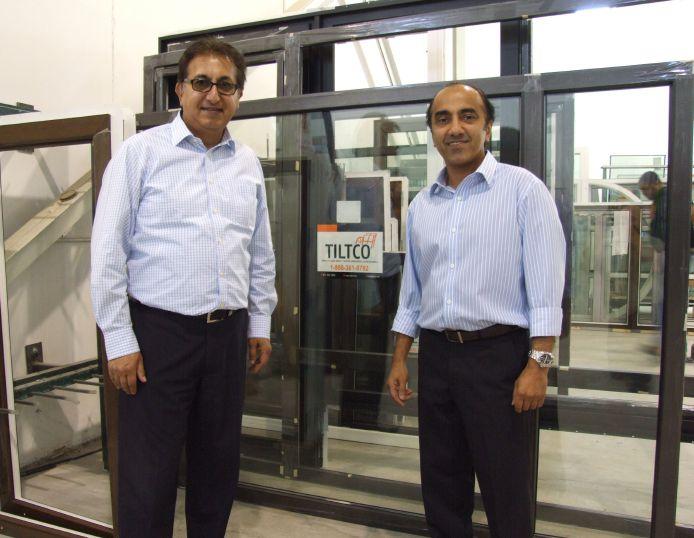
Jay and Jiten Madha have been fabricating, installing and exporting window and door systems for their entire lives, the last 30 of those as owners of their own company. The brothers say their considerable experience is one of the keys to Tiltco’s ongoing success. Go to www.glasscanadamag.com for a video plant tour of Tiltco Fenestration.
At A GLANCE | tiltco Fenestration
Established: 1988
Staying ahead of a market is a bit like surfing. All the mass and power is behind you, rushing forward, and your success depends on your ability to find just the right position. Jay and Jiten Madha seem relaxed and in control as they steer their board, known as Tiltco Fenestration, just ahead of the crest of change in the industry. The amazing thing is, they have been staying out ahead in this manner for more than 30 years now.
The Madhas grew up in the industry. Their father had a window fabrication business in the U.K., and Jay and Jiten went into business for themselves in the 1970s on the aluminum (uPVC) side. In the mid-’80s, they attended an Interbuild show in Canada as part of a British trade delegation and saw that PVC window technology was in a very primitive state in this market compared to what was going on in Europe. “It was interesting because when we came to the show, we met a guy from Quebec,” Jay remembers. “He was actually gluing vinyl. And I said, ‘What are you using for reinforcement?’ Wood. And
they were sliding windows and they were selling like hot cakes. I think they called them Pearson Windows.” The Madhas encountered a lot of naysayers when they floated the idea of bringing European vinyl technology to the Canadian fenestration market. Extruded vinyl windows would be too expensive for this market, they were told, because people do not stay in their houses as long as they do in the U.K. “Plastic was a brat,” Jay remembers. The Madhas’ response was to focus on higher end housing that usually is the homeowner’s last home. In any event, the dire predictions of PVC’s failure in Canada turned out to be about as wrong as wrong can be.
Having jumped ahead by bringing customizable PVC windows to the Canadian market, Tiltco differentiated itself again by offering European tilt-turn technology before anyone else on the continent. “Tilt and turn was still a bit different and it was a European design, so we wanted to bring that to the market,” Jiten remembers. “We were looking at the other window systems that were out there and
Products: Custom fenestration of all kinds focusing on high-end vinyl tilt-turn windows.
Website: www.tiltco.net
tiltco is one of the oldest suppliers of European-style tilt-turn windows in North America. Owned by brothers Jay and Jiten Mahdra, the company ships everywhere in Canada, the U.s. and the Caribbean. tiltco concentrated on luxury, high-end solutions, sourcing specialized parts and materials globally.
we thought we need to bring something different and make a change in some way. We thought there had to be a market for this so we threw it out there and people liked the difference.”
Structural integrity was one of the big questions about PVC in the beginning, so Tiltco had all their products tested to the strictest standards they could find, a practice the company maintains today.
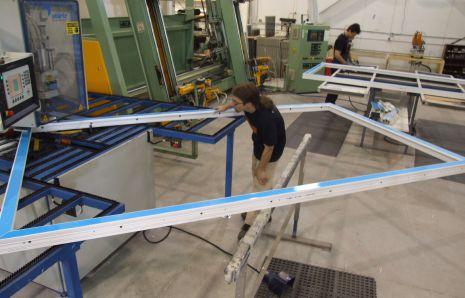
Automated welding and corner cleaning keep Tiltco’s quality consistent. With a little ingenuity, workers can use the machinery to process even outsized jobs like these.
Derek Lukala, Senior Technical Sales, says Tiltco’s understanding of codes and standards has helped drive sales. “You have certain companies out there that are good at certain products, like a company that just does sliding doors and they specialize at that specific system. We provide a single source for all fenestration needs and we can integrate all those systems together so we can provide a complete, cohesive package for the whole project. I think that is what makes us successful: the engineering, testing and product development that is behind the scenes.”
Tiltco started in Canada in 1988 in a 10,000-square-foot shop in Uxbridge, Ont. Initially, most of its business was done across the border in the U.S., taking advantage of the favourable exchange rates to make money at competitive product prices. When Uxbridge declined the Madhas’ application to expand (the building would have threatened fish habitat in a nearby stream), they moved to a 15,000-squarefoot facility in Newmarket. Tiltco outgrew that, then another plant around the corner and by 2007 was ready for a much larger, purpose-built home. Tiltco now resides in a 35,000-square-foot plant with a showroom and office space on the second floor. The styling is quite modern and European, reflecting their products’ aesthetics.
Tiltco manufactures custom fenestration elements of all kinds, but its meat and potatoes is tiltturn vinyl windows. Employing about 30 people, the company ships its products all over North America. Production takes place in Tiltco’s 35,000-squarefoot plant in Newmarket, Ont. Tiltco has sales offices in Florida, Texas, Seattle and the Caribbean. Sales are typically direct to the architect or contractor, with the property owner often involved.
The company’s focus is high-end products for luxury residential applications. Eschewing mass-produced, cookiecutter designs, Jay and Jiten leverage their years of experience in the industry into a willingness to take on any challenge. Designing new sash and spacer systems from scratch to fit a particular application is not a problem. Massive curved glass walls for an architect’s posh residence in Florida is not a problem. Derek Lukala, Tiltco’s senior technical sales representative, gives some examples: “Sliding doors that are 20 feet wide and 10 feet high with two panels. Bi-folding door systems that are above 10 feet tall and do not require mid-rails. A curved wall you can put in your home and have a huge expanse of
glass. Windows in a showroom on King East in Toronto that are 26 feet wide – a single frame window. We do these kinds of things because we have the ability to tweak a product and manufacture it in such a way that we have the confidence to put it in and know it is going to last.” Tiltco will use whatever material is specified for the job, including PVC, steel, wood and aluminumclad wood.
Lukala says the company needs a direct approach because of the specialized nature of the products and the custom service he offers. “It is really difficult to offer this kind of product to a distribution network because of the amount of education needed,” he says. “And there is the whole process of going from design to manufacturing, so it just works a lot more quickly and efficiently when customers work with us directly.”
Part of growing Tiltco’s business involves leveraging its innovative designs into new areas. Lukala has seen a good reaction on the west coast and in the American northwest to its multiple sliding door system – perfect for pretty views over the Pacific. “Washington and Oregon states have pretty stringent energy codes and we offer a product that will meet those energy codes right off the bat. We have the testing completed already. So we were able to find great success in those areas because we have a very efficient production line that is small. We do not need 100 people to run it, but we are still able to turn out large numbers of units. We can keep up with demand whether it be on a house scale or a 20-storey building scale.” Tiltco has done the testing and certification on its products for just about every part of North America, from Alaska to the Caribbean, including impact testing for hurricane-prone areas.
Tiltco has invested in some modern
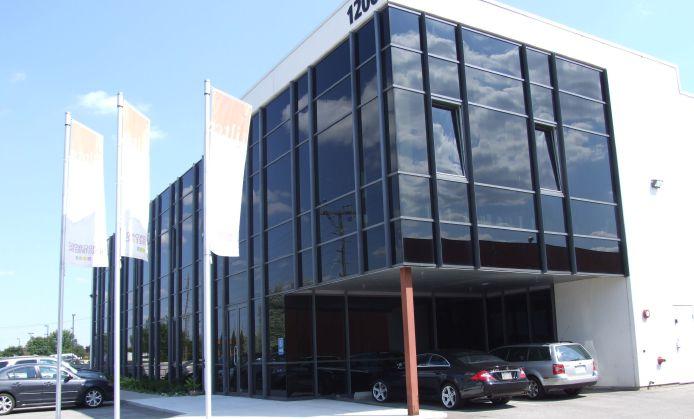
Tiltco’s 35,000-square-foot plant features some very sleek architectural glazing with operable boardroom and showroom windows. It was custom built in 2007 for the manufacturer.
NEW PREMIUM N-SERIES VACUUM CUP features a new, low-marking pad, durable one-piece cast handle, long-lasting powder coat finish plus all the advantages of our original metal hand cups
NEW EAZI LIFTER WINDOW CRANE makes light work of challenging window installations NEW VACUUM PAD FOR COATED SURFACES designed to handle Low-E glass directly on the coated side without leaving permanent marks
Request your new product brochure today. Visit www.powrgrip.com or call 800.548.7341
technology for its production processes, including a purpose-built CNC drilling and cutting machine and large, automatic four-point welders. Automation may seem out of place in a custom shop where a flexible process is more important than speed, but Tiltco uses the machinery to achieve higher-quality parts and more accurate fits. Then, for larger jobs, it can use the repeatability of the machinery to generate multiple identical versions.
Applying automation to custom window and door fabrication, introducing PVC and tilt-turn technology, wowing the design industry with new concepts –Tiltco’s success has been built on a foundation of ongoing innovation. “We are constantly looking at ways to better ourselves, to offer better service to our clients,” Jay says. “For instance, right now, with our new systems, we realize that energy factors are getting better and better, so we are trying to jump the one or two steps that everyone else is doing and jump six steps ahead. So while everybody else is catching up for the next four or five years, we are ahead of them.”
“It is sort of a German mentality,” he goes on, “and I won’t say European because to me it is more of a German mentality. It is to innovate and innovate and sometimes you can overdo it. In North America we certainly do not overdo it, but they can. For us it is about constantly innovating through our design and through technology.”
The next innovation for Tiltco is a new type of PVC profile that is tested to American Architectural Manufacturers Association standards to have the same structural strength as galvanized steel. The extrusions come from Europe (Jay will not say where). Because of its strength, Tiltco can eliminate steel reinforcements from its larger profiles, improving their weight and thermal performance. The extrusions retain the same welding and machining characteristics as regular PVC, and come with full multi-cavity thermal breaks. If the testing turns out as expected, Jay thinks he will be able to use the same extrusion spec in any installation from the Arctic to the tropics because the thermal performance is so good.
Time will tell if Tiltco’s new product initiative turns out the way the Madhas hope. But if past performance predicts future performance, it seems a safe bet that
by brIAN bUrtON
Brian Burton is the author of Building Science Forum and is serving on CSA’s Fenestration Installation Technician Certification Committee. Brian is a research and development specialist for Exp (The new identity of Trow Associates). He can be contacted at brian.burton@exp.com or through www.exp.com.
Daylighting dimensions
Our last column outlined some of the complexities involved in capturing natural light to illuminate buildings. We also learned that when buildings are properly illuminated using natural light operating costs may be reduced in some cases.
In the past, illumination engineers were often restrained from using natural daylighting primarily because of the perception that operating costs associated with additional heating and cooling loads might increase. However, the relatively recent innovations in high-performance windows and glazing have resulted in improved energy performance. When combined with advancements in daylighting controls, engineers can now take a more practical approach to harnessing natural illumination. The net result has been a reduction in our dependency on electrically powered lighting.
Effective daylighting requires a systematic approach. No single design approach can be applied to all buildings. Retrofitting daylight strategies for existing buildings does present a challenge primarily because it is not possible to change the building’s orientation. However, a careful study of the building’s fenestration components may still present attractive retrofit solutions. Illumination engineers now use computer programs extensively to effectively model and simulate daylighting systems prior to construction or modification.
Although not every element contained in the following list is considered absolutely essential, the systems that engineers now develop for new buildings typically have one or more of the following features:
Engineers can now take a more practical approach to harnessing natural illumination.
• a building orientation that takes advantage of the potential for natural illumination
• a window-to-wall ratio appropriate for the climate
• high-performance glazing
• passive or active skylights
• tubular daylighting devices
• solar shading components
• responsive electric lighting controls
In most cases, daylighting systems will function more effectively if daylighting components are equipped with redirection devices. Natural illumination can also be enhanced by proper choice of interior design features and surface finishes. In addition to properly placed windows and skylights, light tubes and light shelves can also be effective in maximizing the amount of daylighting that can penetrate deeper into the building. Not only is the available natural light subject to a fair amount of variability, but the occupants’ need for light, whether natural or artificial, also changes depending on their activities inside.
Designers, engineers and building owners are continuing to demonstrate interest in the potential benefits of daylighting on an international scale. To integrate daylighting strategies properly, all the stakeholders including the building owner, architect, lighting designer, HVAC engineer, interior designer and operational staff should be involved. In commercial buildings, the work environment needs to be assessed on a room-by-room basis under ideal circumstances to ensure adequate illumination for the tasks that will be undertaken. There also needs to be a degree of control over the system by occupants because experience has shown that workers will insist upon it.
Illumination engineers have learned from experience that daylighting strategies that are properly designed and installed to ensure even lighting distribution, have controls to limit glare and/or heat gain without creating visual distractions can generally have positive effects on building occupants and building operation.
They have also discovered that if these rules of thumb are not considered, daylighting has the potential to create negative effects. Proper commissioning of the systems and regular maintenance are important considerations. •
Peace Of Mind...
SafeGard™ Window Opening Control Device (WOCD)
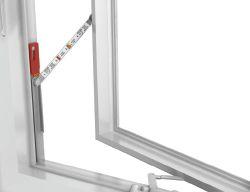
Safety and security are of utmost importance for homeowners, especially those with small children. Truth Hardware has developed an engineered solution which meets ASTM F2090-10, the new industry guideline enacted to address the issues of accidental falls and egress opening.
SafeGard™ meets the following ASTM F2090-10 guidelines:
• Window Opening Control Device limits casement sash opening to 4" or less
• Easy two-step operation to release Window Opening Control Device
• Window Opening Control Device automatically reattaches itself when the window is closed
GlassBuild America 2012
GLASSBUILD BOUNCES BACk
by RICh PORAYkO
It’s official. The results are in and the industry chatter agrees: GlassBuild America 2012 has easily been the best glass show with the strongest numbers in North America in years. It wasn’t 2006, however, and it may never be 2006 again. At least, not for a very long time.
The mood of the show was noticeably upbeat. Even if it was the Vegas distraction, it sure was a more positive atmosphere and attendance than in 2010, the last time GlassBuild America was held in Sin City. Depending on whom you talk to, there are mixed reviews about the state of the industry. More than a few companies claim to actually be growing and increasing sales, contradicting the financial indexes, bankruptcies and M&A trends.
Real innovation
“There is a great enthusiasm on the floor and the attendees are experiencing real innovation, which will only help them improve their business and improve the industry,” said Max Perilstein, promo-
tions consultant to the National Glass Association. “The innovation here is like none other. I am completely blown away by some of the products that have been developed over the last year. Companies are actually innovating. This industry is really moving forward.”
“Our Canadian exhibitors are some of the leaders of innovation,” Perilstein went on. “There is Walker Textures of Montreal, who continue to bring exciting new products to each and every show.
Glassopolis excels in hard-to-find and specialty glass products, and its booth is always packed. There is also a brand new company from Toronto called Ecobox Green Glass Systems, who are bringing brand new recyclable packaging to the glass and glazing industry so companies don’t have to use wood anymore – they can use something that is better for the environment.”
Perilstein continued, “We are particularly excited for the continued growth of
“the innovation here is like none other.” – Max Perilstein, NGA
our Innovative Products Program area focused on the most cutting-edge products available on the market. It started a few years ago as an idea to focus on new products and it was a handful of booths. Now it has grown substantially and exhibitors want to be part of it. It has really taken off and become very popular. Other new items are the M3 Glass Technologies Networking Booth, which is located on the show floor so that attendees can grab a seat and conduct business in a comfortable environment without leaving the show. Our education sessions continue to be refreshed each and every year with the subjects that concern
the industry and this allows our attendees to learn and share new ideas.”
Sharing best practices
“This is a great opportunity for Fenestration Canada to show off its educational resources, meet with current members, recruit new members and represent the Canadian market,” said Patrick Shield of Win-Door North America, official tradeshow of Fenestration Canada (formally the Canadian Window and Door Manufacturers of Canada).
“Exhibiting at GlassBuild is a perfect opportunity to educate the
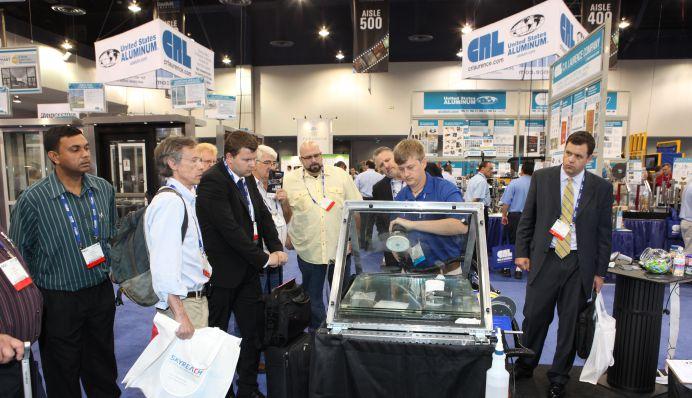
ABOVE: Traffic and energy on the floor at GlassBuild were higher than they have been for some time.
industry about the association, Canada’s harmonized building codes and about doing business in Canada in general. It also introduces the U.S. glazing market to the Win-Door show.”
“Fenestration Canada has been coming to GBA for seven or eight years and has been a big supporter of the show,” Shield added. “We are in harmony with the NGA, the Glass Association of North America, the Insulating Glass Manufacturers Alliance and other partners and have a lot of crossover members. We need to continue working closer together and share best practices such as the Window and Balcony Safety Program that Fenestration Canada developed with the Emergency Services Chiefs of Canada.” Partners Promoting Windows and Balcony Safety is an awareness program that identifies risks and offers fall-prevention strategies aspiring to eliminate injuries and deaths associated with falls from a window, balcony or deck.
Glazing Executive Forum economic forecast
Jeff Dietrich, senior analyst for the Institute for Trend Research, was the keynote speaker for the NGA Glazing Executive Forum. Dietrich has been such a popular presenter that he has spoken at this event every year since its inception. The 2012 forum drew a record crowd of more than 200 glazing industry leaders from across North America.
Dietrich provided an overview of the housing and construction markets, which are key to the glazing industry. “Construction trends are alive. Housing starts are up over 21.4 per cent from one year ago. Housing affordability is at an all-time low. Equally good news is that home prices have hit bottom and are heading higher. Non-residential construction is 14 per cent above one year ago and showing surprising strength. Although the gains are well below the historic peaks of 2008, the recovery touches a broad swath from commercial to health care, manufacturing to malls, sports arenas to education institutions.”
“We’re not doing the job of training the next generation of workers. You should probably be hiring because your window is probably two and a half to three years before you will be paying them what you were paying them three or four years ago, so hire and train them now. Take advantage of the young, the intelligent, the very
bright, and spend the time and money to train them.”
“Manufacturing is never going to come back fully. So here’s the good news. If your cash flow or balance sheets aren’t healthy right now, you have about two and a half years to get them healthy and borrow money before inflation pushes interest rates up. And we would encourage you to borrow money now while interest rates are historically low, if you haven’t already, or borrow again. It’s not to buy a
yacht or an airplane. We did that in 2005 and 2006. It is to create wealth, acquire assets, expand your business, introduce a new product or hire someone. It is to do so something for the long term that will set you up for the future.”
Rich Porayko is a professional writer and founding partner of Construction Creative, a marketing and communications company located in Metro Vancouver, B.C. richp@constructioncreative.com
by helen sanders
Helen Sanders is the vice-president of technical business development for Sage Electrochromics and an IGMA board member. She chairs the IGMA’s Emerging Technology and Innovation Technical Committee.
Advances in dynamic glazing
Dynamic glazing is one of the more exciting innovations occurring in the glass industry today. The technology is evolving quickly, and promises to deliver significant benefits to the energy efficiency, cost and interior environment of buildings where it is used. I had a chance to address an industry group on this topic at the IGMA Performance and Innovation in Insulating Glass Educational Seminar in Las Vegas that took place right before GlassBuild.
Dynamic glazing refers to glazing elements that change their transmission properties in response to such external stimuli as heat, sunlight, gas or electricity. Respectively, these four types are referred to as thermochromic, photochromic, gasochromic and electrochromic.
Thermochromic laminated glass incorporates a PVB interlayer with a low-E coating on the third surface. It darkens as it heats up. Thermochromic insulating glass sandwiches the PVB between two panes on the exterior side of the unit and puts the low-E coating on the inside pane, the fifth surface. It can achieve a VLT range from 50 to 10 per cent and an SHGC range from 0.32 at 25 C to .2 at 65 C.
Electrochromic glazings come in four subtypes: polymer-based, monolithic ceramic, suspended particle devices and liquid crystal devices.
LCD glazing is used for privacy applications as it becomes completely opaque when activated rather than simply reducing transmissions. The LCD interlayer consists of a layer of electrolytes sandwiched between two conducting layers. When high-voltage AC current is applied, the electrolyte crystals line up, allowing light to transmit. When the current is off, the crystals float
Dynamic glazing promises to open up architectural options.
randomly and completely diffuse light.
SPD dynamic glazing is mechanically similar to LCD designs, except reactive particles are suspended between conductors instead of electrolytes. In its off state, the unit is tinted. As higher levels of AC voltage are applied, the unit achieves different tint conditions until, at the highest level, it is apparently clear. SPD modulates visible light with only a small effect on SHGC. Its big advantage is the speed with which it can switch transmission characteristics. VLT can range from 50 to 0.7 per cent, and SHGC can range from 0.61 to 0.37.
Polymer-based electrochromics are presently only made in Europe. The system consists of a laminate of two glass plys each containing a transparent conducting oxide and electrochromic electrode or counter electrode respectively, with a special polymer in the middle that is both conductive and acts as an adhesive laminate. When DC current is passed through the conductors, electrons pass through the polymer, causing a polarity shift that darkens the unit. When used in an IGU, VLT ranges from 50 to 15 per cent and SHGC ranges from 0.38 to 0.12. These designs require an edge seal on the laminate portion.
Monolithic ceramic electrochromic designs allow the active dynamic layers to be deposited on the back of a single sheet of glass rather than sandwiched as a laminate interlayer between two sheets. As in polymer-based designs, an ion-transmitting middle layer separates two electrodes and two conductors. In this case, however, the middle layer is a ceramic rather than a polymer. Framed into an IG unit, monolithic ceramic glazing can be combined with argon gas fills as required to achieve VLT ranges from 62 to two per cent and SHGC ranges from 0.47 to 0.09. Dynamic glazing promises to open up architectural options by eliminating the need for increased HVAC, sunshades, low-E IGUs and automated blinds. Architects will have a chance to meet energy efficiency requirements at affordable cost while delivering improved views and more comfortable living and working environments. •
IGMA
INDUSTRY EVENT
Win-Door the place to meet and learn
Window and door fabricators gather Nov. 6 to 8 in toronto.
Fenestration Canada will induct new members into its elite Pioneers hall of fame at Win-Door. The ceremony will be followed by a dinner.
Win-Door returns Nov. 6 to 8 to the Metro Toronto Convention Centre with a full slate of 110 exhibitors and an educational program that seems to get stronger every year. The 2012 edition is going to be louder than ever with Air-Ins demonstrating its air infiltration tests using a Pratt and Whitney DC-6 aircraft engine.
Tuesday, Nov. 6
7 a.m. - 2 p.m. Fenestration Canada Board Meeting
8 a.m. - noon “Going Global Export” by the Wood Manufacturing Council
2 - 3 p.m.
2:45 - 4:45 p.m.
Partners Promoting Window and Balcony Safety Meeting
“The SAWDAC Fenestration Installation Technician Program” - an update on the new installation training program by the Siding And Window Dealers Association of Canada
“How to Grow Your Business in the New World of Social Media” by Scott Wilson, president of RankHigher.ca
10 a.m. - 5 p.m. Show floor opens
11 a.m. - noon
11:45 a.m.1:30 p.m.
“Update on Building Codes” by Jeff Baker, J.F. Kogovsek and a code official (bilingual presentation)
Lunch in the meeting centre
Noon Jim Parker Booth Award
2:30 - 3:45 p.m.
3 - 4 p.m.
5 - 6 p.m.
“Preventing Glass Handling Injuries” by Mike Burk of Quanex
Win-Door Show Committee Meeting
“Pioneers of the Industry” presentation
6 - 8 p.m. Pioneers reception and dinner
Thursday, Nov. 8
11 a.m. & 2 p.m. Air-Ins testing demonstrations
9 - 9:30 a.m. Fenestration Canada Fall Meeting
9:30 - 10:30 a.m. “The Power Hour” - Economic forecast by Peter Norman Altus Group
10 a.m. - 3 p.m. Show floor opens
11 - 12 a.m. “Update on Energy Codes and Energy Star” by Jeff Baker, J.F. Kogovsek and Steve Hopwood of Natural Resources Canada
1 - 5 p.m. Energy Efficiency Fenestration Steering CommitteeSteve Hopwood and Jeff Baker
1:30 - 2:15 p.m. “Access to Public Financing” by Joe Edl, president of TS
This edition of Win-Door coincides with Fenestration Canada’s 45th birthday, and the association will be marking the occasion with some special presentations. The induction of new Pioneers will be a highlight as industry leaders familiar to everyone will be recognized for their years of good work. Also, Fenestration Canada will join Toronto Emergency Medical Services to present a $5,000 cheque to the Wellness Centre for Spinal Cord Recovery. The money will help fund the addition of an electrical stimulation machine to the Centre, which will be useful in treating victims of falls from windows and balconies.
Blocks of rooms with special rates are available at the Win-Door partner hotels: InterContinental Toronto Centre, Fairmont Royal York and Renaissance Toronto Downtown. Attendees are encouraged to book by contacting the hotel of their choice.
Full coverage of Win-Door 2012 with floor plans, exhibitor listings and exhibitor product previews will appear in Fenestration Review, Canada’s annual magazine for the residential window and door industry, mailing to Glass Canada readers in mid-October. •
by FrANK FULtON
Frank Fulton is president of Fultech Fenestration Consulting. He has been in the industry for 30 years and can be reached via e-mail at fultech.fc@gmail.com.
Code toughens up balcony glass
In the June issue of Glass Canada, You Bet Your Glass discussed the matter of spontaneous breakage and falling glass from balconies in highrise apartment buildings. The primary culprit for the failures was determined to be nickel sulphide inclusions or impurities in the tempered glass lites, which shrink during the tempering process and expand over time, resulting in exploding glass in some cases. Although there are known to have been at least 30 incidents of shattered balcony glass falling from buildings in Toronto alone during the past year, fortunately there have been no significant injuries to pedestrians.
In response to requests from the City of Toronto and the Residential Construction Council of Ontario to amend the Ontario building code to address the falling balcony glass panel problem, the Ontario Ministry of Municipal Affairs and Housing established the Expert Advisory Panel on Glass Panels in Balcony Guards. The panel was composed of 25 members, including engineering consultants, building code consultants, developers, contractors, professional designers, municipal building inspectors, insurance providers, and members of codes and standards writing bodies.
Based on the panel’s recommendations, the ministry issued Supplementary Standard SB-13 to amend the Ontario building code, setting higher standards for design as well as the types of glass to be used in balconies for all highrise developments approved after July 1, 2012.
In addition to prescriptive requirements to ensure that glass does not come into contact with the metal railing members, and clarification of live and guard load structural calculation procedures, the
The question now is how these code changes will impact the use of glass balconies in the future.
yOU bEt yOUr GLAss
significant changes focus on the type of glass that can be used on balconies in the future.
Balcony glazing located beyond the edge of a floor, or within 50 mm of the edge of a floor, shall be heat-strengthened laminated glass. Glazing located from 50 to 150 mm inward from the edge of a floor shall be fully heat-soaked tempered glass or heat-strengthened laminated glass. Glazing located more than 150 mm inward from the edge of a floor shall be heat-strengthened laminated glass, heat-soaked tempered glass, or standard tempered glass (not heat-soaked) as long as it does not exceed six millimeters in thickness. (The probability of having nickel sulphide inclusions is higher in heavier glass.)
These regulations are now the toughest in Canada, though they are not retroactive and do not apply to existing buildings. However, the measures made to Ontario’s building code are only temporary. The province has asked the Canadian Standards Association to develop national guidelines that could then be adopted under Ontario’s code. The standard-writing process is underway and is expected to be completed within the next few years. At that time, it is reasonable to assume that the standard will be referenced in the National Building Code of Canada, and that these more stringent glazing directives will be applied nationwide.
From the glass industry perspective, the question now is how these code changes will impact the use of glass in balconies in the future. In addition to most of the glazing now having to be heatstrengthened and laminated, the railings, posts and anchorage must also be made stronger and heavier to withstand increased structural loads. The increase in cost to developers for the “improved” glazed balcony systems could bring the overall cost to more than $10 per square foot.
According to Mark Brook of BVDA Facade Engineering (who is one of the members of the Expert Advisory Panel and involved as a consulting engineer on numerous highrise buildings), the changes to the building code have not had much impact on the demand for glazed balconies thus far. “Many developers had started using laminated balcony glass as a safety measure prior to the code changes.” •