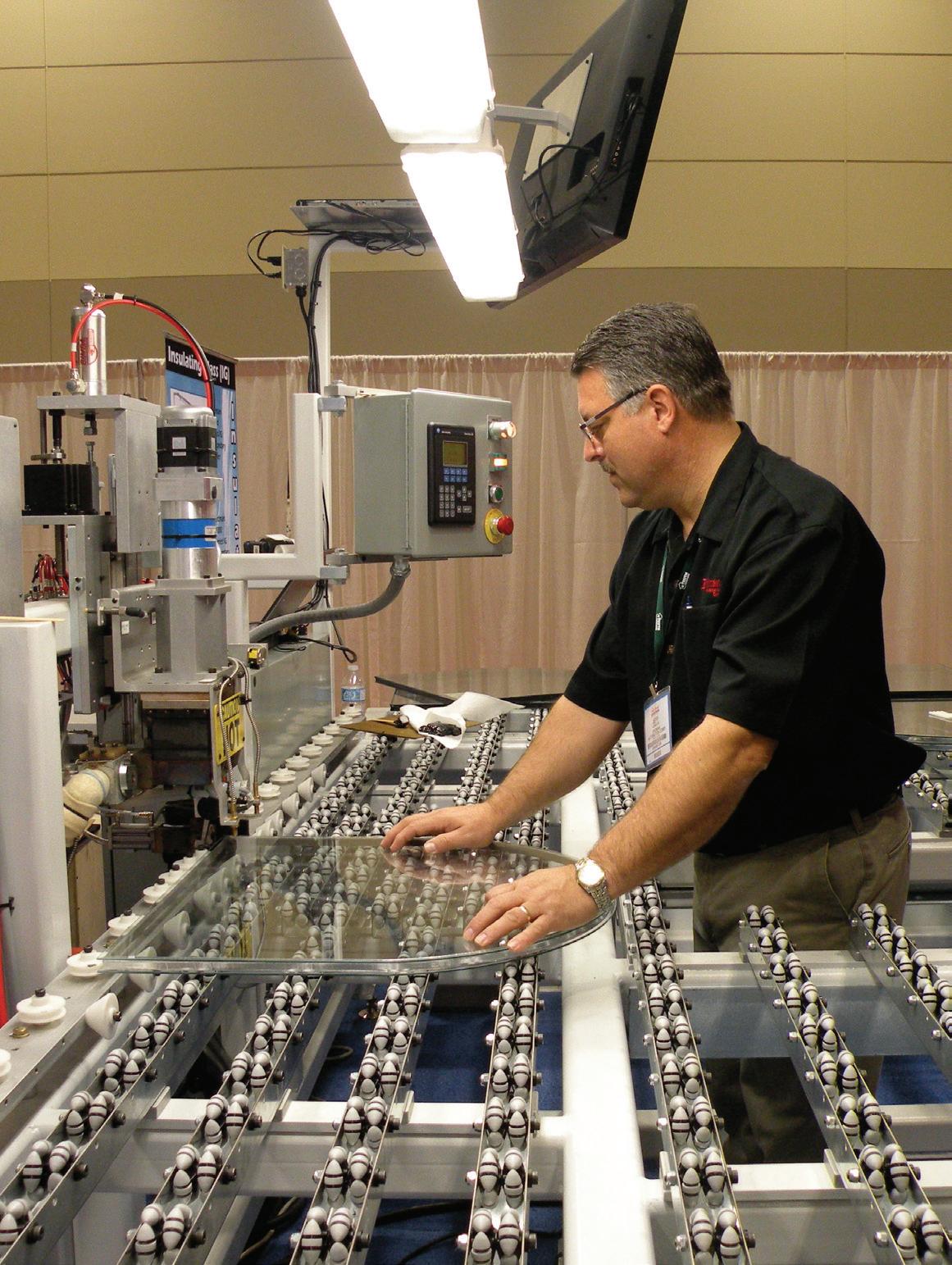
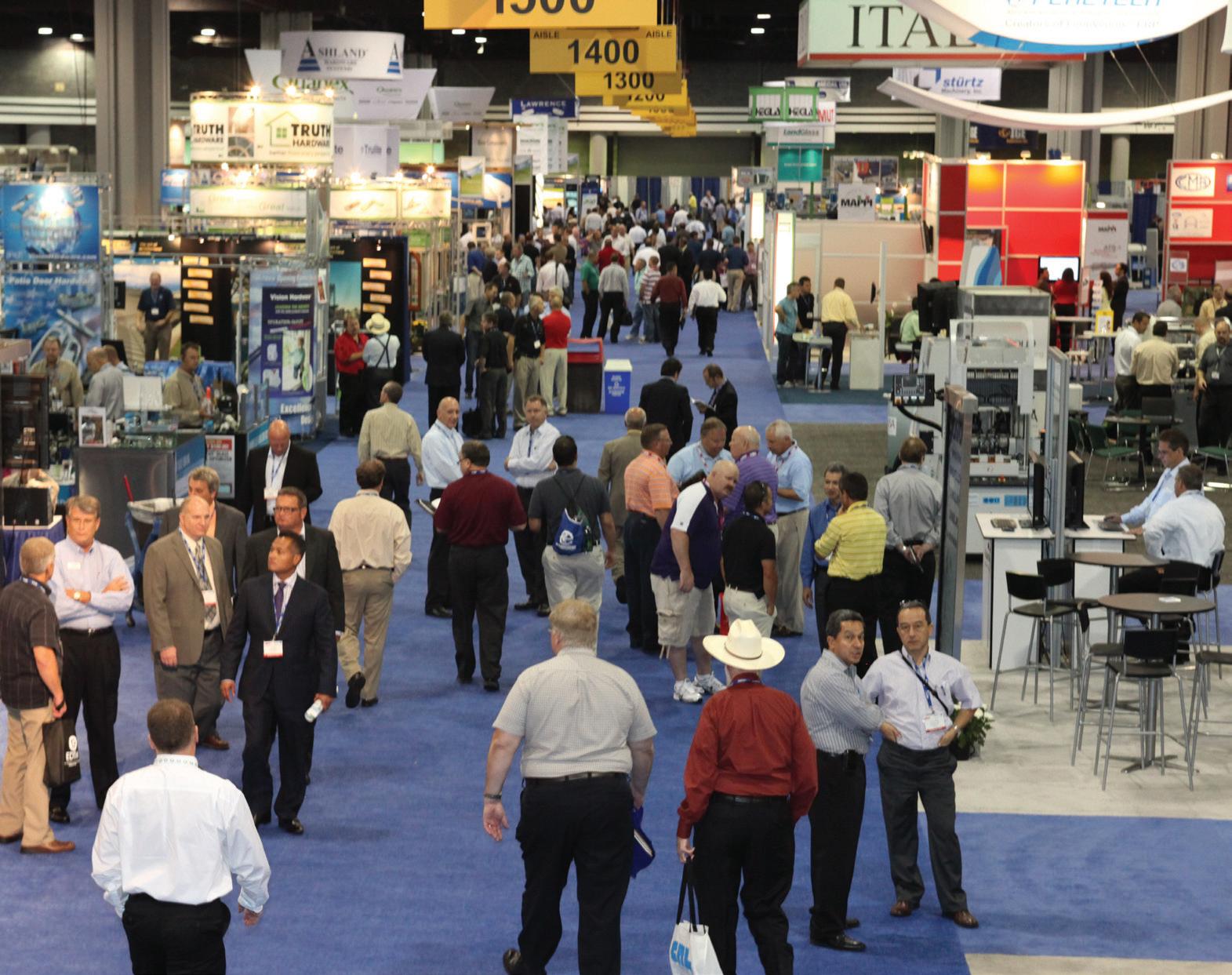
Numbers were down slightly, but foreign participation is up as offshore companies rush in to pick up the slack in the North American economy.
30 The history of ASTM E 1300 IGMA technical consultant Bill Lingnell takes you through the development of one of the most important standards in the architectural glass industry.
DEPARTMENTS
Under the Glass Spandreltech is driven to be the best in the Canadian curtain wall market.
Innovations
New channel glass products let glaziers use light as a design tool. 36 Fenestration Canada update Win-door offers exclusive educational opportunities.
COLUMNISTS
The window and door industry gathers in Toronto this November. Glass Canada has your floor plan, exhibitor list and a sneak peek at the products on display.
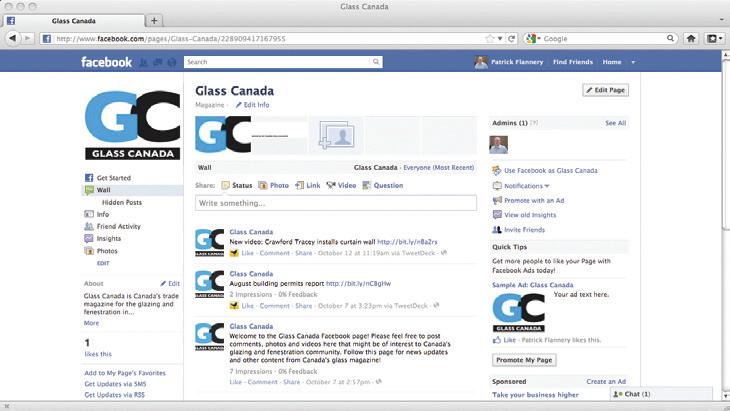
Now you can get instant updates on Canada’s glass industry by following @GlassCanadaMag on Twitter. Or, visit the Glass Canada page on Facebook to post your comments and links.
Stay informed to survive
EDITORIAL
Changes to laws and building codes are only a threat to your business if you are unprepared for them. In this time of rapid change, take every opportunity to get inside information.
It is official: you are no longer allowed to be anything other than green. That’s green as in environmentally friendly, not green as in Kermit the Frog. B.C.’s Energy Efficiency Act has made it law that windows and doors installed in that province must meet certain U-value standards, and other jurisdictions across the country seem ready to follow suit through laws of their own or changes to building codes. The option of building a cheap, leaky house and cranking up the heat to compensate is no longer an option, at least so far as the doors and windows are concerned. Being green is no longer a matter of choice or marketing strategy (think Energy Star) but rather a matter of lawful compliance.
NEXT iSSUE
• Curtain wall focus
• Overseas
recruiting
These kinds of increases in regulation make business owners uneasy, and with good reason. Perhaps your business plan was predicated on being able to offer low-cost, less green solutions to some segment of the market. At a stroke of a pen, government regulators have rendered large portions of your inventory worthless. There is usually a phasein period during which your inventory can be sold off and upgraded, but what about your market position? If you have made your bread and butter being a low-cost, high-volume supplier (no shame in that, by the way) it is not easy to suddenly morph your company and sales staff into a low-volume, high value-added supplier. For one thing, that section of your market is probably already occupied by someone else. You are suddenly forced to try to carve out a niche against an established competitor. It is like starting up all over again, minus the energy and lack of overhead of your youth.
Even if your products already meet the standards set out in the regulations, new regulations almost always mean new requirements for demonstrating that you are compliant with those regulations. In the case of B.C.’s law, each and every fenestration product will be required to bear a label showing it has been tested and found compliant. It is not clear at this time whether every individual window or door will need to be tested before it can bear the label, or whether the government will allow testing of only a representative sample of a product line. Going from zero requirement for testing and labelling to lab-testing 100 per cent of your product is obviously incredibly costly and disruptive to your process. Companies can – and do – go out of business under less pressure.
Most fenestration products sold in Canada do meet or exceed the new regulations, and it seems unlikely that even bright green B.C. will insist manufacturers test every single unit. But it is certain that manufacturers who do not stay abreast of these changes will face a costly scramble to keep up. Information and education are your best weapons.
To get educated about the coming changes, consider attending Jeff Baker’s Ask the Inspectors seminar at Win-door on Nov. 16. I can’t think of a better way for you to get out in front of the coming changes and build a strategy to deal with them. •
GLASS CANADA
October 2011 Volume 23 • Number 5
Annex Business Media P.O. Box 530, Simcoe, Ontario N3Y 4N5
EDITOR | Patrick FLANNERY pflannery@annexweb.com 226.931.0545
GROUP PUBLISHER | Martin MCANULTY mmcanulty@annexweb.com
Publication Mail Agreement #40065710. RETURN UNDELIVERABLE CANADIAN ADDRESS TO CIRCULATION DEPARTMENT, P.O. BOX 530, SIMCOE, ON N3Y 4N5 e-mail: jmatheusik@annexweb.com
Printed in Canada, All rights reserved. Editorial material is copyrighted. Permission to reprint may be granted on request. ISSN 0843-7041
Canada - 1 Year $36.75 (includes GST) $39.55 includes HST/QST
U.S.A. - 1 Year $50.00 (in US dollars)
Occasionally, Glass Canada will mail information on behalf of industry-related groups whose products and services we believe may be of interest to you. If you prefer not to receive this information, please contact our circulation department in any of the four ways listed above.
www.glasscanadamag.com
SUSTAINABLE BUILDINGS ARE GREATER THAN THE SUM OF THEIR PARTS. When it comes to sustainable design and construction, product decisions must work together to contribute to the end result. With evolving requirements and code changes, navigating this complexity can be challenging. Our expertise in thermal systems and sun control can help you create a solution that delivers lower U-values, controls heat gain and leverages light to reduce energy demand. Kawneer and Traco understand how to realize the big picture…one piece at a time.
Every day you make a choice. Make a choice that counts.
Architectural Aluminum Systems
Steel + Stainless Steel Systems
Entrances + Framing Curtain Walls Windows kawneer.com traco.com kawneergreen.com
iNdUSTRY NEWS
PPG activates solar power testing array
PPG Industries has activated a new 4,800watt solar system at the PPG Glass Business and Discovery Center in Harmar, Pa., about 15 miles from the company’s headquarters in Pittsburgh. The system enables PPG to demonstrate for customers the value of its prototype and existing solar glass products, such as the Solarphire glass product line, and to help researchers and product developers gather real-world data on the performance of these products.
It is currently equipped with two,
SAF adds capacity
Southern Aluminum Finishing recently announced that Huber Street Properties, a closely related entity to SAF, has purchased the Redding, Calif., facility in which SAF-West currently operates. SAF-West serves the western U.S., Canada, and Pacific Rim markets with architectural aluminum distribution, fabrication and finishing services.
The 13-acre property includes approximately 230,000 square feet of manufacturing and office space. The purchase helps cement SAF plans for expanded capabilities and services, including a new anodizing facility scheduled for next year.
“We are excited to grow SAF facilities in California.We are here to stay in Redding, Calif., our base for growing our markets for architectural aluminum in western U.S. and Asia,” said James McClatchey, vice-president of SAF.
10-module arrays, one using Solarphire PV photovoltaic glass, and one using Solarphire AR anti-reflective glass. Online monitoring software measures the real-time power output of each array, and solar power generated by the system is tied back into building operations.
The site is available for use by PPG customers to test and demonstrate their products at one-month intervals. Customers with products installed on the array can access performance data via e-mail or the Internet.
IGMA adds Innovation Committee
The insulating glass industry has seen many new technologies enter the market to address the energy efficiency, daylighting and esthetic needs of the commercial and residential fenestration markets. The Insulating Glass Manufacturers Association expects this trend to expand and continue to grow. Therefore, the board of directors has approved the creation of the Emerging Technology and Innovation Committee to develop guidelines, specifications and testing standards for the future technologies of the insulating glass industry.
Newly formed task groups will partner with key government organizations and industry to advance the understanding, guidelines, testing, certification and proper use of innovative insulating glass technology.
HSP is also developing plans to upgrade the building to attract new tenants for the facilities not operated by SAF. “The building offers an opportunity for a true mixed-use facility, including manufacturing as well as offices. We see lots of possibilities,” said McClatchey
Based in Atlanta, Ga., SAF is a U.S. aluminum extrusions and sheet distributor, aluminum fabricator and aluminum finisher specializing in Kynar painting and architectural anodizing. SAF distributes, fabricates, anodizes and paints aluminum sheet, extrusion, column covers, architectural panels and commercial roofing trim. SAF offers products and services to architectural specifiers, glazing contractors and other industries. Services include aluminum batch anodizing, painting, coil anodizing, powder coating and architectural fabrication.
The ETI Committee was established at the August 2011 IGMA technical meetings held in Victoria, B.C. It will be chaired by Helen Sanders from Sage Electrochromics, and co-chaired by Guardian’s Dave Cooper, president of IGMA. Several of IGMA’s research task groups will fall under the steering direction of this committee.
IGMA is currently soliciting suggestions for additional task groups and membership in this exciting new committee. Interested parties should contact the association or visit the website at www. igmaonline.org.
CGA Newsletter
Canadian Glass Association
Building on the success of our last two conferences in Vancouver and Toronto it looks as if Glass Connections Edmonton 2011 was a great success. The conference was held on Oct. 27 at the Delta Edmonton South Hotel and Conference Centre. The CGA Technical Committee worked hard to provide a program of topics and speakers to interest everyone in the glass industry.
Topics and speakers included: Considerations for the Condensation Resistance of Fenestration Assemblies (Joe Erb, commercial market manager for Edgetech IG), Eliminating the Potential for Air and Moisture Infiltration at the WindowWall Interface (Peter Poirier, Tremco), Structural Glass: Design Philosophy and Practical Applications (Simon Brown and John Kooymans, Read Jones Christoffersen), Architectural Glass: Let’s Talk About the Near Term and What’s on the Horizon for Cold Climate Glazing (Bill Coady, Guardian), and Sustainable Buildings and the role of Glass (Matt Grace, western Canada division head for Enermodal Engineering). For more information on this conference please refer to the website at www.canadianglassassociation.com
The CGA held its annual general meeting on Oct. 26 to elect a new board of directors. For the past two years, the CGA has been led by its president, Richard Verdon, of RSVP Agency. During Richard’s tenure, the CGA has created two new
Canadian Glass Association P.O. Box 595, Abbotsford, B.C. V2T 6Z8 Tel.: 604.855.0245 • Fax: 866.253.9979 www.canadianglassassociation.com
provincial associations – one in Manitoba and one to represent the Atlantic provinces – entered into an agreement with the Glazing Contractors Association of British Columbia (GCABC) to be the owner and distributor of the Glazing Systems Specifications Manual (National Version) and held two very successful conferences. The members of CGA and the board would like to thank Richard for his direction and hard work. Well done!
Ontario Glass and Metal Association
The OGMA held its fall golf tournament on Thursday, Sept. 22, at the fabulous Carrying Place Golf Club near Aurora, Ont. All those who participated enjoyed a great day of golf, a very good dinner, and a lot of camaraderie and catching up with industry colleagues. If you missed it this year, don’t miss the next one.
Ennio Rea is the proud recipient of the OGMA Lifetime Achievement Award for 2011, presented by president Frank Fulton at the dinner following the fall golf tournament. Ennio has been involved in the glass and metal industry for the better part of 35 years and has served as president twice during that time. He has been a major contributor and tireless worker for the association and a front-and-centre character in the industry. Ennio continues to contribute to the OGMA as past president on the current board of directors.
The OGMA will team up with Construction Specifica-
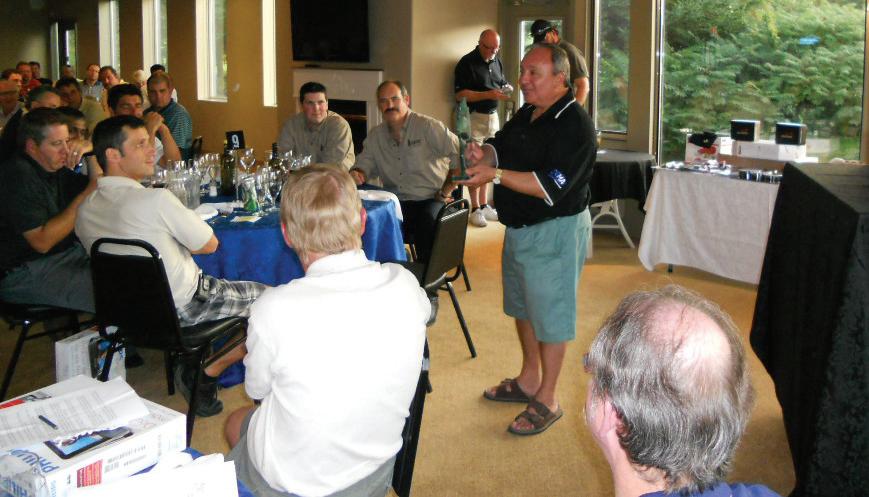
Ennio Rea accepts his Lifetime Achievement Award at the OGMA’s fall golf tournament in Aurora, Ont.
tion Canada (CSC) for a dinner seminar on Tuesday, Dec. 6. Details will be forwarded to members as the date approaches.
The OGMA NHL road trip is going forward. Mark Saturday, Jan. 14, 2012, on your calendar and plan to go on a road trip to Detroit for an afternoon tilt between the Detroit Red Wings and the Chicago Blackhawks.This is sure to be a blast and will be limited to 30 participants. Keep your eyes open for the flyer and get your booking in early.
Glazing Contractors Association
GCABC is pleased to report it is almost finished with the glazing apprentice curriculum. I would like to take this space to thank the subject matter experts for all their help.
The GCABC has been working closely with the B.C. Ministry of Energy with regards to the new B.C. Energy Efficiency Act and how it affects the commercial glazier. We are working closely with the Association of Professional Engineers and
Geoscientists of B.C., the Architectural Institute of B.C. and the Ministry of Energy to find ways to alleviate any confusion in interpreting the regulations. It is that time of year again when we are asking our members for their submissions to the GCABC Industry Awards. Categories are: Member of the Year, Project Excellence, Outstanding Individual, Community Contribution and Volunteer of the Year.
This year’s 20th Anniversary Annual Golf Tournament was a great event. We had 184 golfers. The GCABC/WDMA golf committee consists of Seth Maretz (co-chair), National Glass; Devin Pickles (co-chair), Starline Windows; Rich Porayko, Construction Creative; and Ivo Tanner, Quality Auditing Institute.
Our sponsors this year were Cardinal IG, CP Distributors, Vitrum Industries, PFG Glass, Quanex Building Products, Starline Windows, Flynn Canada, Gienow Window and Doors, Guardian, Oasis Windows, and Tremco Canada.
We are currently working on our schedule for speakers and topics for the coming season starting in September 2011.
Schuller named Viracon president
Viracon has announced its new president is Kelly Schuller, who had been senior vice-president of sales and marketing since 2010. Schuller reports to Joseph Puishys, CEO of Apogee Enterprises, parent company of Viracon.
“Since joining Viracon last year, Kelly has led development of its strategic plan, which focuses on the values that have historically made Viracon a great choice for architecturally significant commercial buildings, including industry-leading quality, new product development, architectural design assistance and complete and on-time delivery,” said Puishys. “At the same time, he has spearheaded Viracon’s efforts to expand
its international presence, and has successfully managed operations of its recently acquired Brazilian subsidiary. With Kelly as Viracon president, we have a leader who will both strengthen Viracon’s traditional sources of value to its customers, while leading the company strategically into new areas of growth.”
“I am excited and honoured by the opportunity to lead Viracon,” said Schuller. I look forward to working with the company’s strong management team, our dedicated employees and our great customers in this role as we push for ever higher levels of quality, service and innovation.”
Schuller has a master’s degree in business administration from Harvard University and a bachelor’s degree in business administration from the University of Wisconsin, Eau Claire. He and his family reside in Inver Grove Heights, Minn.
GBO faces cash crunch
Canadian Press has reported Bonneville doors and windows manufacturer GBO has temporarily shut down its operations. A cash crunch is preventing the Quebec-based company from purchasing the new raw materials needed to meet its orders.
GBO manufactures wooden windows, doors and accessories sold under the Bonneville and Polar brands, serving construction and home improvement markets mainly in Quebec, Ontario, the Maritimes and the eastern and southeastern United States. Founded in 1946, GBO had 250 employees at the end of 2010.
All of GBO’s directors, except chairman and CEO Christopher Wood, have resigned from the board of directors.
Last month, GBO reported it doubled its net loss in the latest quarter on sharply low-
er sales. The company lost $1.8 million 10 cents a share for the three months ending May 31, compared with $770,000 two cents a year ago. It posted sales of $3.1 million, down from $4.6 million. Canadian sales fell by more than half to $1.2 million from $2.7 million, while U.S. sales dropped by just over six per cent to $1.8 million.
GBO said poor weather affected the company’s profitability in the first quarter of fiscal 2012, affecting construction markets and its own factory output. Its manufacturing plant south of Quebec City was flooded during the quarter.
Last spring, GBO had announced that its Bonneville windows and doors division was awarded a US$1 million contract to restore the windows in a multi-storey building in Brooklyn.
Brent Newblom joins Dymax
dymax Corporation has announced the appointment of Brent Newblom as a territory sales manager in the field sales department. In his new position, Brent will report to Ed Wienckowski, regional sales manager, and will provide a key service in helping manufacturers in
Ohio, Indiana, Michigan and Canada solve their most complex application problems and reduce manufacturing costs.
Brent comes to Dymax after 21 years at Applied Industrial Technologies, headquartered in Cleveland, Ohio, including six years as a strategic account manager. He was most recently the vice-president of sales and marketing at Kenakore Solutions in Perrysburg, Ohio.
Mammen new NGA chair
The National Glass Association is pleased to announce the election of Chris Mammen to the office of chairman of the board. Mammen, president of M3 Glass Technologies of Irving, Texas, has served on the board since 2006. Mammen took the office of chairman on Sept. 14 at GlassBuild America in Atlanta, Ga. He will serve a one-year term. Other new executive officers introduced at GlassBuild are chairman-elect Bill Evans of Evans Glass Company in Nashville, Tenn., and treasurer Robert Brown of Brown’s Glass in York, Pa. Steve Burnett of Walters and Wolf Curtain Wall will serve as immediate past chairman. Board members returning for the 2010-2011 term are: Michael Albert of S Albert Glass Company in Beltsville, Md., Bryan Bush of City Glass Company in Omaha, Neb., Mark Dawson of Glass Doctor in Waco, Texas, Newton Little of ACE Glass Company in Little Rock, Ark., David Steele of The Window Gallery in Augusta, Ga., and Tom Trainor of Trainor Glass Company in Alsip, Ill.
UNDERtheGLASS |
Cool confidence
Spandreltech owners Wes and Irene Sanders expect to be the best.
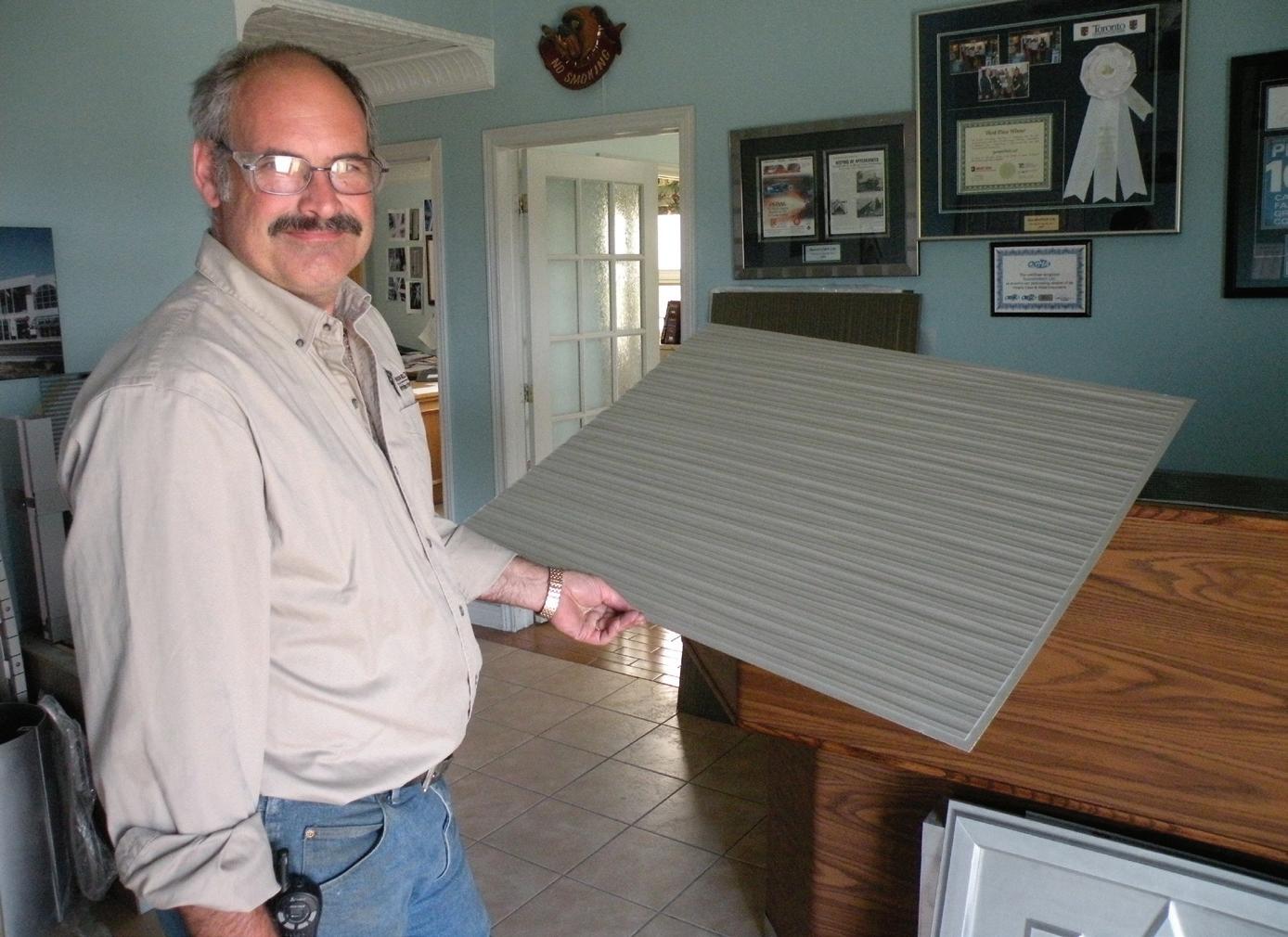
Wes Sanders shows off one of his custom aluminum panels with a wavy decorative design. CAD design software and CNC fabricating equipment allows Spandreltech to create just about anything that architects can imagine.
AT A GLANCE | Spandreltech Ltd.
Location: Erin, Ont.
You remember the cool kid in school, the one who always won at sports, had the best dates, got invited to all the best parties, had all the best clothes and made it all look easy. If you were not that person, you wanted to be, and wondered what made him or her so different. What you realized, probably years later, was that most of it came down to confidence. The cool kids expect success, so they find success. That is the kind of confidence the owners of Spandreltech, Wes and Irene Sanders, exude when they talk about their business, now celebrating 20 years of custom curtain wall component fabrication.
Spandreltech makes backpans, panels, column covers and other custom architectural components out of aluminum, galvanized steel and fibreglass. Everything it builds is custom fitted to a specific project, but the company has recently launched several of its most common designs under such brand names as Alumaspan, Galvaspan and Formaspan. Wes runs the production shop and handles the technical design
side of the business, while Irene takes care of most of the estimating, accounting and marketing. All three of their children have worked in the business, but Corey, 20, has the most interest and seems set to take over someday. He has a degree in architectural technology and already takes care of most of the computers and machinery on site.
Located in the small community of Erin, Ont., about an hour’s drive from Toronto, Spandreltech operates out of a 14,000-square-foot manufacturing facility with 25 employees. The Sanderses have invested heavily in automation; the factory floor sports several CNC brakes, presses, punches and cutters. New designs are laid out using three-dimensional CAD models prior to manufacturing. Wes has seen great benefits from automation. “I invested in a CNC brake press in the mid-’80s,” he remembers. “I used to have six guys working a second shift and reduced it to two guys working one shift.” Wes is enthusiastic about the quality he gets from the CNCs, and likes being able to troubleshoot architects’ designs with a computer model before
Employees: 25
Established: 1991
Manufacturing floor: 14,000 square feet
Owners: Wes and Irene Sanders Website: www.spandreltech.com
Celebrating 20 years in business this year, Spandreltech provides on-site window installations, and panel design and manufacturing. Complex and unique engineering challenges, and complete interior and exterior panelling solutions are its specialty. Branded products include Alumaspan preformed aluminum wall panels, Formaspan metal column covers, Galvaspan galvanized steel curtain wall back pans and Thermaspan custom laminated insulated wall panels.
wasting time and materials on an actual assembly. He has also used computer modelling to his advantage in the bidding process, showing prospects attractive renderings of his proposals to give a clearer picture of his design.
Small beginnings
The Sanderses started Spandreltech with three employees, two pieces of equipment and 4,000 square feet in the old tannery in nearby Acton, Ont. They had just one contract. Even after moving to a 6,000-square-foot location in Georgetown, Ont., in the late ’90s, the company’s growth soon outpaced the available space. “We were packed floor to ceiling. Everything had to come in one door and right back out the other,” Wes remembers.
It was in these early stages that Wes’ unusual determination and confidence paid off. He remembers having to challenge an architect on a Bellville work site at the tender age of 18 with only two years’ experience in the field under his belt. He had been sent to the job site by his employer to show a mockup of an architect’s design. When he saw the mockup, he could see it would move once it was installed, and made some changes. Then he walked into the meeting with the architect who had created the original design. “So we were sitting there and the guy says, ‘I don’t want to discredit you, but you are awfully young,’” Wes remembers. ‘I don’t know if you really understand what you are doing.’ I said, ‘I’m willing to bet my year’s salary against yours that what I am about to put on your building is going to work and you
can take that backhoe sitting outside and spin the tires up against it and it will not collapse.’ He said, ‘Let’s make it a gentlemen’s wager.’ I won the wager.”
That kind of take-all-comers moxie has characterized Spandreltech’s approach to business ever since. “Wes is a technical guru. The thing he hates most to hear is, it can’t be done,” Irene says. “Well, you know what? It can be done, and if it is made out of metal, we can make it.”
Building a high profile
From these gritty beginnings, Spandreltech has risen to participate in some of the highest-profile projects in Canadian architecture. It supplied aggregate panels, diagonal panels and other exterior cosmetic work for the new Bow Centre in Calgary, the tallest skyscraper outside Toronto. “We did a lunch-andlearn with the architects on the Bow in Toronto,” Wes says. “We did a 45-minute presentation and we ended up being there for four and a half hours. They took us through and showed us every step of how the Bow was going to be done.” Wes showed the Bow architects at that meeting that Spandreltech could understand their design challenges and find solutions. They started out with a contract to machine the panels, and ended up being asked to do the full assemblies.
Spandreltech’s list of other projects is impressive, including the Perimeter Institute in Waterloo, Ont., the Lincoln Centre in New York, and the Windsor and Detroit casinos. One in particular, the Galveston Aquarium in Galveston, Texas, challenged Wes’ creativity. Being in a hot climate, the building needed to be constructed to keep cold air in rather than out, which meant the insulating layer needed to be on the inside rather than the outside of the building. Plus the interior wall needed to be as dark as possible to provide contrast with the illuminated tanks. Wes developed perforated black panels combined with a dark-coloured insulation that gave the aquarium the dark look it needed along with the insulation.
Checking all boxes
If there is one secret to Spandreltech’s success, it is in Wes and Irene’s determination to be the best in each and every area of the business. “I’m a very competitive person,” Irene says. “In the last 10 years we have become…no, I have become very aggressive in selling our product and getting it out there and making people understand our attention to quality.” Spandreltech attracts quality workers and retains them by paying similar wages to what they would get in the city even though they are in a lowcost, rural location. They post photos of their projects around the work areas to keep employees interested and engaged in the products they are building. Irene has poured effort and resources into the branding of Spandreltech, developing catchy product names and developing a slick website that tracks high on Google search results. They stay engaged with associations and trade shows, and provide educational opportunities that sometimes turn into prime networking opportunities. Not content to make do with standard technology, Wes has driven investment and learning in automation and computer design.
There are no plans to turn Spandreltech into Spandreltech International anytime soon. That is something Wes and Irene are going to leave to Corey, if he chooses to do so. For now, the Sanderses are enjoying some extra vacation time after a life of working non-stop to get the company to where it is today. Looks like the cool kids are going to have their success and enjoy it, too. •
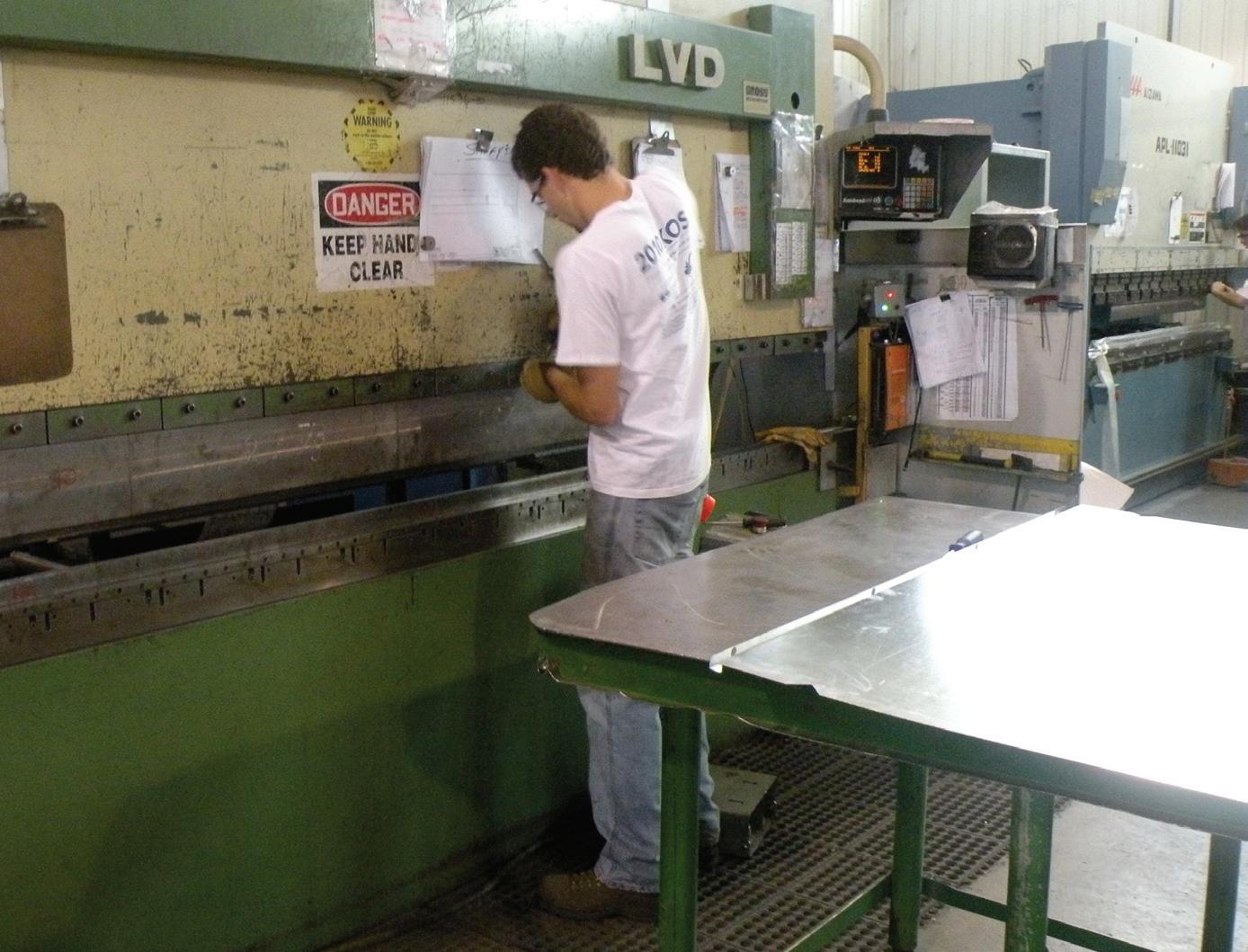
Wes Sanders saw a tremendous jump in productivity when he transitioned to CNC brakes and presses.
by FRANK FULTON
Frank Fulton is president of Fultech Fenestration Consulting. He has been in the industry for 30 years and can be reached via e-mail at fultech.fc@gmail.com.
The amazing career of Bernie Leaman
In my previous column we looked at Bernie Leaman’s start in the glass and metal industry up to the point where Ian Moore announced his promotion to president of Commercial Aluminum at the end of 1976.
Bernie found himself in the right place at the right time when the greatest construction boom we’ve ever experienced started in the early 1980s and Commercial Aluminum rode the wave to a period of amazing growth and profitability. When Bernie took the helm in 1977 Commercial had 25 people on staff. Ten years later that number had grown to 110 people. Commercial took advantage of the boom by adding new products, growing its customer base and expanding into new markets.
Bernie has always had a strong belief in people, their desire to succeed, and a willingness to give them a break. He gave many glaziers their start in business by extending them credit, while making it clear that his trust was not to be taken lightly.
When a fledgling glazier went to meet Bernie to set up an account for the first time, he would show his new prospective customer a stack of cheques that had been bounced on him over the years, and he made it very clear that he had collected and made good on each and every one of them. If you were thinking about scamming Commercial, you had better think twice, or you’d have Leaman on you like a pit bull on a pork chop. “You can’t be in business and stay in business if you are a dishonest person,” Bernie would say.
In addition to growing the number of customers, Bernie grew the product line to include sliding mall doors, curtainwall profiles and vents, in addition to the entrance door and framing
If you were thinking about scamming Commercial, you had better think twice, or you’d have Leaman on you like a pit bull on a pork chop.
systems. Seeing the potential for market expansion during the boom, Bernie opened a branch of Commercial in Calgary, manufacturing the same product line that had been developed in Toronto. Herb Hetzner was dispatched from Toronto to head up the Calgary operation, which grew to a staff of 20 in a few years.
Throughout his time in business, Bernie was a strong supporter of the Metro Toronto Glass Association, the predecessor to the OGMA, and served on its board for eight years as secretary, treasurer and eventually, president. To this day, he has a plaque hanging in his home office dated June 22, 1977, honouring him as Man of the Hour. It hangs right beside the inaugural Lifetime Achievement Award bestowed upon him in 1998 by OGMA.
Bernie participated in the association because he loved being around people in the industry. “For people in the glass and metal business, you had to be involved in the MTGA or you were just an outsider looking in,” he said. “It was a great place to be, a fun place to be, and it was where you had to be to know what was going on in the industry.”
When asked about the highlights of his career, Bernie cites all the marvellous relationships and friendships he cultivated with customers and suppliers during his career. “I have no negative memories whatsoever about my time in business. I loved every minute of it.”
While sitting at his desk in his office following lunch one afternoon in 1986, Bernie felt a throbbing pain in his left arm and pressure in his chest. He was suffering a heart attack. Instead of calling an ambulance, he opted to have one of his salesmen, Richard Moulaisson, drive him to York Finch Hospital where he was admitted and coaxed back to health.
Bernie returned to work within a few months but a second heart attack in 1989 knocked him out of the box for good. Doctors told him the stress of work, should he choose to return, would inevitably kill him. Bernie made the wise choice and opted for retirement.
Today, Bernie continues to enjoy life with his wife Mary in Woodbridge, Ontario, puts up with the occasional medical malady, and still sees a lot of his cronies from business. “Everything I am today I owe to what I learned during my years spent at Commercial Aluminum,” he says. •
High-Performance
Unprecedented
Personalized
Award-Winning
by BRiaN BURTON
Brian Burton is the author of Building Science Forum and is serving on CSA’s Fenestration Installation Technician Certification Committee. Brian is a research and development specialist for Exp (The new identity of Trow Associates). He can be reached at brian.burton@exp. com or through www. exp.com.
Strategic marketing techniques for the fenestration industry
In my last column I discussed some of the basics regarding strategic marketing techniques.
Part 2 outlines some of the steps that can help you enhance your position in the market and maximize the return on your sales efforts.
In many cases, the quickest method to identify and rectify marketing function deficiencies is to conduct a marketing audit. Historically, marketing audits were most often undertaken by companies that had reached a desperate position because of deteriorating markets or ineffectual policies. But marketing audits should be conducted on a regular basis.
The first step in a marketing audit is to determine if a company’s marketing objectives have been clearly identified and communicated to principals, associates and staff. Many firms have never bothered to make objectives more specific than to achieve a high sales volume or to make a high profit on sales.
Different executives may also hold different views of the company’s marketing objectives. One of the main benefits of the audit is exposing such situations and clearing the confusion out of the operating policy.
Typically, an audit asks several questions. It looks for a strategic marketing plan that is evaluated on an ongoing basis. It checks for the ability to gather market intelligence about competitors. The capacity to develop new ideas for products and services is evaluated. The company should have a system that ensures proposals and client inquiries are handled expeditiously. Most auditors want to see a centralized marketing resource under one authority. Managers should
In a market segment that has low profitability, intense competition and minimal growth potential, a firm may decide to withdraw from the market.
have the authority to implement change in delivery procedures. A marketing audit will ask if the marketing department is of sufficient size and experience in relation to the company. Is there adequate interaction between marketing and other divisions or branch offices? Companies need an appropriate mix of marketing vehicles, such as advertising, networking and trade shows. Finally, a marketing audit will evaluate the company’s ability to obtain feedback from clients.
If your firm does not have a strategic marketing plan, or needs to revamp its image, policies or market focus, there are a number of steps you can take. Have a brainstorming session focused entirely on strategic marketing. The session should focus on four distinct topics using four separate worksheets. First, divide your client base into market segments by types of projects and clients, services provided and geographic location. Next, analyze each segment for volume, growth potential and profitability, and rate your firm’s technical competence in that area. Then undertake strategic planning, deciding what management action is required and developing marketing strategy and tactics. Finally, conduct a market analysis that includes your market position and the strength of your competition. Establish a priority rating for each segment. Once you have rated your priorities and set your goals to ensure the plan has direction and specific objectives in the various market sectors for the next three years, the plan should position you to take advantage of your strengths and correct or compensate for any perceived or actual weaknesses.
In some cases, for exampleAs an example, in a market segment that has low profitability, intense competition and minimal growth potential, a firm may decide to withdraw from the market. In other instances, a market segment with high profitability and growth potential, and no competition, may become a top priority.
The success of strategic marketing plans for fenestration-related industries is highly dependent on accurate assessment of internal corporate resources in combination with evaluation and measurement of market segments and expectations. My experience has clearly demonstrated that the most important factors affecting the eventual success of strategic marketing programs are sincere commitment on the part of senior staff, setting clear, reachable targets and ensuring that the firm’s resources match its sales and marketing goals. •
Knock Knock.
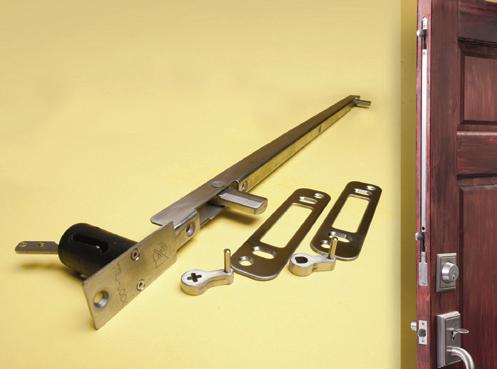
You need the finest hardware to complete your door offering. Something customizable but simple. Strong but stylish. And above all, it needs to be designed for the North American market. Introducing, Truth’s new Sentry™ Multi-Point Hinged Patio Door System: an innovative solution packed with features that exceeds your expectations – and those of your customer.
Innovative And Secure Multi-Point Locking System
Completely modular for custom design, this 300 series SST multi-point locking system easily fits in standard eurogrooves and offers superior strength and security with full 1" throw of dead bolts and shoot bolts.
Robust And Reliable Adjustable Hinges
The Sentry™ adjustable hinge exceeds ANSI grade 3 requirement by achieving 350,000 cycles on panels weighing up to 220 lbs and ANSI grade 1 impact specifications. Intuitive indicators allow for accurate vertical and horizontal adjustment.
Eye-catching Handle Designs
Distinctive styling meets intuitive function. Truth offers multiple handle designs from traditional to contemporary, each with a North American designed 90 degree thumbturn located above the handle. The Sentry™ Multi-Point Hinged Patio Door System – yet another engineered solution from the company you can trust – Truth Hardware.
Matt Kottke
Matt Kottke is marketing support manager for Truth Hardware and chairman of Fenestration Canada’s show committee.
Message from the show chairman
There are exciting times on the horizon for the window and door markets and the Win-door North American trade show is once again the place that will help you position your business to take advantage of those opportunities. For well over fifteen years, the Win-door national trade show has been bringing our industries, top companies and decision-makers together in a venue that offers something for everyone. This year’s show promises to continue that strong tradition with a wonderful line-up of exhibitors and educational forums created to help strengthen our industry and, most importantly, your business.
This year’s show will feature all the latest in machinery, sealants, testing services, hardware, and advancements in technology, all of which is geared to help your business position itself for the 2012 building season. And why is this important? Because this is your trade show. Sponsored since the beginning by the Canadian Window and Door Manufacturers Association (CWDMA), now called Fenestration Canada, Win-door has always had the well-being of the Canadian window and door industry first and foremost in its plans. Win-door continues to be focused on creating a strong trade show which brings everyone together to share ideas, discuss issues and network face to face with our peers. So much has changed over the years – particularly with the advancements in technology and social networking. However, the one thing that cannot be taken lightly is the importance and power that comes from meeting people and seeing products and services in person. The power of this asset cannot be overlooked and Win-door is your show because it provides you with that opportunity.
Located in downtown Toronto, Nov. 15 to 17 the Win-door show has found that right balance between informational content and social opportunities to draw a quality audience year in and year out. The show opens on Tuesday evening with show hours beginning at 5:00 p.m. allowing attendees an ample amount of time to travel to this destination and then unwind with their peers during the evening social hosted by Fenestration Canada. Wednesday’s show hours are from 10:00 a.m. to 5:00 p.m. and Thursday’s are from 10:00 a.m. to 3:00 p.m., providing visitors time to see the exhibits, attend the educational sessions, and each day enjoy a free luncheon held right on the show floor. The evenings are your own and the downtown Toronto area has proven to be a great location to entertain customers or simply enjoy an evening out to relax. Located in the heart of Toronto’s restaurant, entertainment and theatre districts, the home of Win-door, the Metro Toronto Convention Centre, offers a vast array of choices for business and pleasure.
If you haven’t made plans yet to attend this event, we strongly encourage you to do so soon. Reservations and registrations are now open – don’t wait too late. For more information check out the Win-door website at www.windoorshow.com. Remember, this is your show – don’t miss it. Here’s hoping we will see you in Toronto.
Map and Booth Information
360 Innovations 1907
ACME Window Hardware 1812/1814
Adfast 1213
AIR-INS Inc. 1944
Alexandria Moulding 2022
Ameri-Can Machinery 2023
American Renolit 1708
Amesbury 1717
Apricot Coating Systems Inc. 1941
Aquasurtech OEM 1937/1939
Aribell Products 1523/1525
Atwood Sales Inc. 1246
Barberan 1708
Beijing Great Wall - Peony
Mould Manufacture Co., Ltd. 1233
Bostik Canada Ltd. 1826
Caldwell Mfg. Co. NA, LLC 1223
CAN-BEST Testing Lab. 1924
Construction News and Report
Group/CNRGP 1627
Custom Surface Solution Inc. 1828
De-Mar Window Hardware Inc. 1623/1625
Door & Window Manufacturer Magazine 1216/1218
Door Com Distribution 1613
Door Components Canada 1943
Door Han North America 1949
Draft Seal Ltd. 1603/1605
Durotech International, Inc. 1901/2000
Dusco Doors Ltd. 1803/1805
Eclipse Arthitectural 1603/1605
EDTM, Inc. 1912
Erdman Automation Corp. 2025
Everlast Aluminum Ltd. 1806/1808
Evotech Industrial Coatings 1417
Fenestration Canada - formerly CWDMACanadian Window and Door Manufacturers Association
1208/1210/1214
FeneTech, Inc. 1609
Fenewood Ltd. 1527
Fenzi North America 2018
FERCO Arch. Hardware 1429
FiberLink Inc. 1727
Forimpex Inc. 1626
Formex Building Products Inc. 1217
Full House Company 1729
Fusion Glass Works 1917/1919
Glass Canada Magazine 1236/1238
GM Wood Products 1328
Grafco International 1326
Groupe Promax Inc. 1702/1704
H. Paulin & Company Ltd. 1719
Habitat For Humanity Canada 1902/1904
HB Fuller 1607
Hedson Technologies 2036
Hygrade Metal 1516/1518
IGMA - Insulating Glass
Manufacturers Alliance 1938/1940
Indutec 1703/1705
Interlock USA, Inc. 2031
John Evans’ Sons, Inc. 1622/1624
Joseph Machine Co. 1843
JRC Machinery Inc. 1552
JSA Machinerie 1823/1825
Kalcor Coatings Company 1709
Kear Fabrication Inc. 1845
Kleiberit Adhesives Canada Inc. 1708
Kristrack 1603/1605
Maver Glass Machinery 1246
MCT Hardware Glass Ltd. 1807
Mennie
Win-door preview
JRC Machinery
www.jrcmachinery.com
Booth 1552
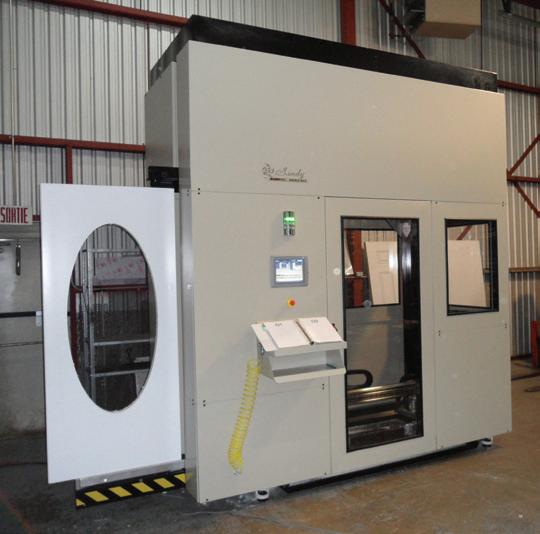
Terrebonne, Que.-based JRC Machinery will be showing its exclusive line of Canadian-built vertical CNC door machining centres from EuGenie, the Sandy series. Sandy machining centres process the doors in the vertical position for a smaller footprint and better swarf removal. These three-axis machines can machine lites, grooves for multi-point locks, hinge holes, screw locations for panic bars and grooves for PVC coverings. The Sandy can automatically probe for door width, thickness and deflection, then update cutting parameters for each piece, including adjustments for door height from 24 to 96 inches. The vertical clamping system does not contact the front and back surfaces of the door, allowing for machining of pre-painted doors. The work area is enclosed for improved dust control and the entire machine footprint is 4 1/2 by 12 feet.
Fenewood
Booth 1527 www.fenewood.com
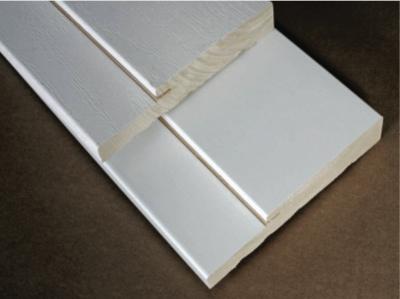
Fenewood vinyl-wrapped wood products are available with Smooth White or Stainable Woodgrain finishes. Designed to be maintenancefree and guaranteed against delamination, Fenewood wrapped wood is suitable for door jambs, brickmould and other applications. The Smooth White finish is pre-finished and UV-stabilized with no need to ever paint. The colour matches steel Polytex pre-finished white doors. The Stainable Woodgrain finish can be stained to match fibreglass doors. Able to withstand extreme temperature changes from -30 to 100 C, the vinyl on Fenewood-wrapped wood is permanently fused to the substrate to keep the wood dry and prevent wicking and rotting. Vinyl will not wave like cladding can when it is exposed to temperature changes, and installers can reduce labour time by cutting and assembling only one product instead of wood plus cladding. Custom colours are available by special order (minimum order quantities apply).
Aribell
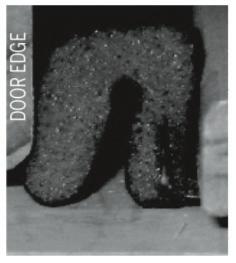
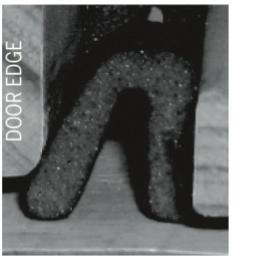
New PE-650 (left) versus traditional weatherstripping.
Booth 1523
Aribell, together with Endura Products, will introduce new door weather stripping with two major improvements: proud edge design and a low-wick foam formulation. The new PE-650 proud edge design increases contact with the door panel face, reducing air and water infiltration when subjected to high air pressure. The patented low-wick foam formulation uses a combination of closed-cell and open-cell structure to absorb 50 per cent less water with 60 per cent higher stiffness. As moisture wicks into the foam, its travel and subsequent volume is limited once it contacts the closed cells. This is especially important in cold Canadian climates where the weather stripping can freeze when saturated.
Renolit
Booth 1708
Renolit has expanded its Exofol IN interior film range with a new addition that brings added depth to the already popular program. For almost 30 years, Renolit has offered strong options for PVC window-frame enhancements with high-performance decorative films. Exofol IN now adds Winchester PD to its stock range of interior designs. Winchester PD is a medium dark oak with a
beautiful, realistic design. It will complement the lighter, natural oak Winchester PA already popular in the series.
Exofol IN offers several other woodgrain design laminate films to enhance the look of the interior of window frames. It is suitable for substrates of PVC, fibreglass, aluminum composite and more. Along with the two oaks the Exofol IN range also includes Amati PD, a soft medium walnut; Calvados C, a beautiful natural cherry; Calvados K, a medium maple; and Ontario PM, a blonde hard rock maple. The full range of Exofol IN includes our exclusive scratch-resistant coating: a special UV-cured lacquer on the surface that protects the film through its life. This protects the surface not only during manufacture, transport and installation, but also through the life of the product for the end user.
Other advantages of the full series include multi-step print designs for an extremely realistic look, and a pearl finish that is far less glossy and offers a much softer appearance, shadowing nicely on the profile detail. Exofol IN boasts a very long shelf life. Available from stock in our U.S. warehouse, with low minimums, this film series is a way for window manufacturers to set themselves apart in the market with new, modern design options.
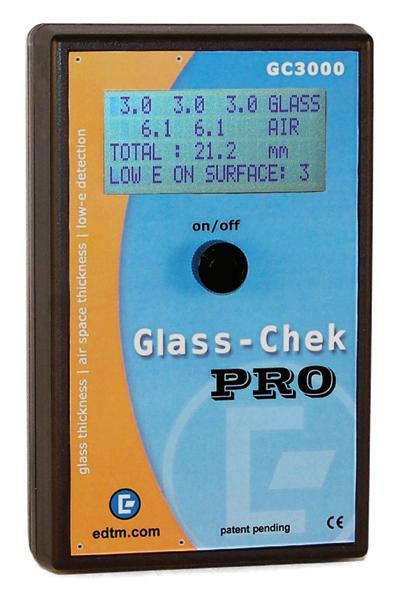
EDTM will be displaying its evergrowing line of instruments and sales kits to the glass and window industry. The Win-door show provides a great opportunity for attendees to evaluate its products hands-on, with live demonstrations being conducted continuously throughout the show.
The GC3000 Glass-Chek Pro allows users to identify types of low-e coatings in a window as well as thicknesses. EDTM will be highlighting its latest improvements to this instrument. The ability to measure window thickness and the presence of low-e has proven to be an attractive feature in the market. The GC3000 is also effective for testing the thickness of triple pane windows. However, one of the biggest selling points has turned out to be the ability of the meter to identify different types of low-e coatings. The Glass-Chek Pro will indicate if the low-e coating is a hard coat (pyrolytic) or soft coat (sputtered) product. If it is a soft coat lowe, the meter will also tell you the number of silver layers used to make it, allowing you to estimate the type of coating being used. This is beneficial for glass companies that use multiple types of low-e coatings for their windows, and sometimes mix up the glass or cannot identify the window out in the field. For window replacement companies, this feature helps them select the proper low-e to use in the replacement window, guaranteeing to their customer that the replacement window will offer similar energy benefits to the one being replaced.
EDTM will offer discounts on orders placed at the show. EDTM is proud to be the only North American company that designs and manufactures portable test equipment for the window industry, here in America. EDTM will be demonstrating all of our existing products at the show, as well.
WTS Paradigm Booth 1312 www.wtsparadigm.com
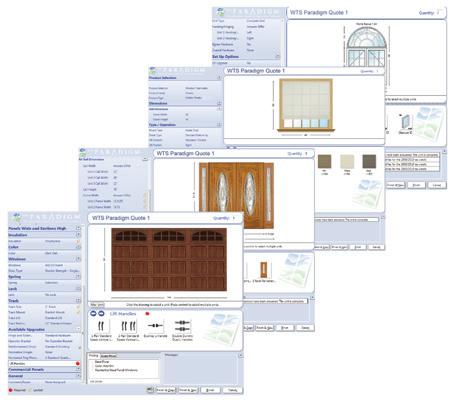
The UX Configurator from WTS Paradigm is the same powerful configurator the industry has come to know, with a new bold look and feel. The user interface resulted from thousands of hours of end-user research and development. WTS Paradigm interviewed hundreds of customers and end users to gather feedback, and used new technologies to elevate the Configurator to higher levels of user acceptance. Our easy-to-use interface lets users spend less time creating a quote and more time selling.
The Configurator provides an intuitive and visually appealing interface, giving you a more enjoyable experience when configuring. This new interface brings customer confidence to the selling process by showing a more realistic representation of the project. Users navigate seamlessly through products and options, and can see detailed information on products. Realtime pricing updates and an accurate engineering drawing of the project makes users and customers more comfortable with the quoting experience.
Novatech
Booth 1402
Always passionate about design, Novatech will launch its new 2012 doors and door products at the coming Win-door North America show. In the upcoming year, Novatech will be introducing seven new, exclusive and elegant decorative designs to catch your attention. It will also be introducing a new steel door collection to meet the new trends. Visit Novatech at booth 1402 to learn more about these new products and others.
Eclipse
Booth 1603
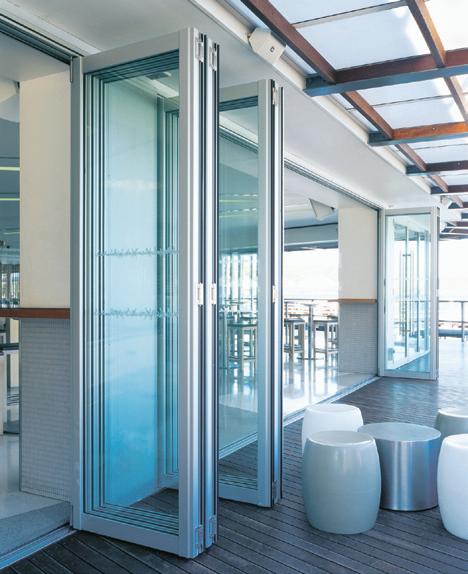
Imagine an opening in your wall without sliding doors. Your inside becomes the outside in one continuous space. You can entertain without interruption and your views become vistas. No fixed-glass panels and no mullions or posts, just wideopen space.
The C3 Exterior Aluminum Folding Door System from Eclipse Architectural combines contemporary design with sleek lines for enhanced esthetic appeal. Designed for structural performance, versatility and value,
Win-door preview
the system features two quarter-inch thick panels and three-inchwide stiles and rails for more glass and light. Concealed Multipoint locks are used on the active door and our new Multi-point locking system is used to lock down each pair of doors. A system can accommodate up to eight doors in each direction for a total of 16 panels measuring 52 feet wide and 10 feet high. The panels can accommodate any glass spec and the colour options include clear, bronze and black anodized finishes and dozens of powder coat finishes. The C3 System with its self-draining sill has been tested and meets AAMA performance standards. The C3 was also tested with hurricane glass for impact and wind load and met those performance standards.
Booth 2037
Rehau
www.na.rehau.com
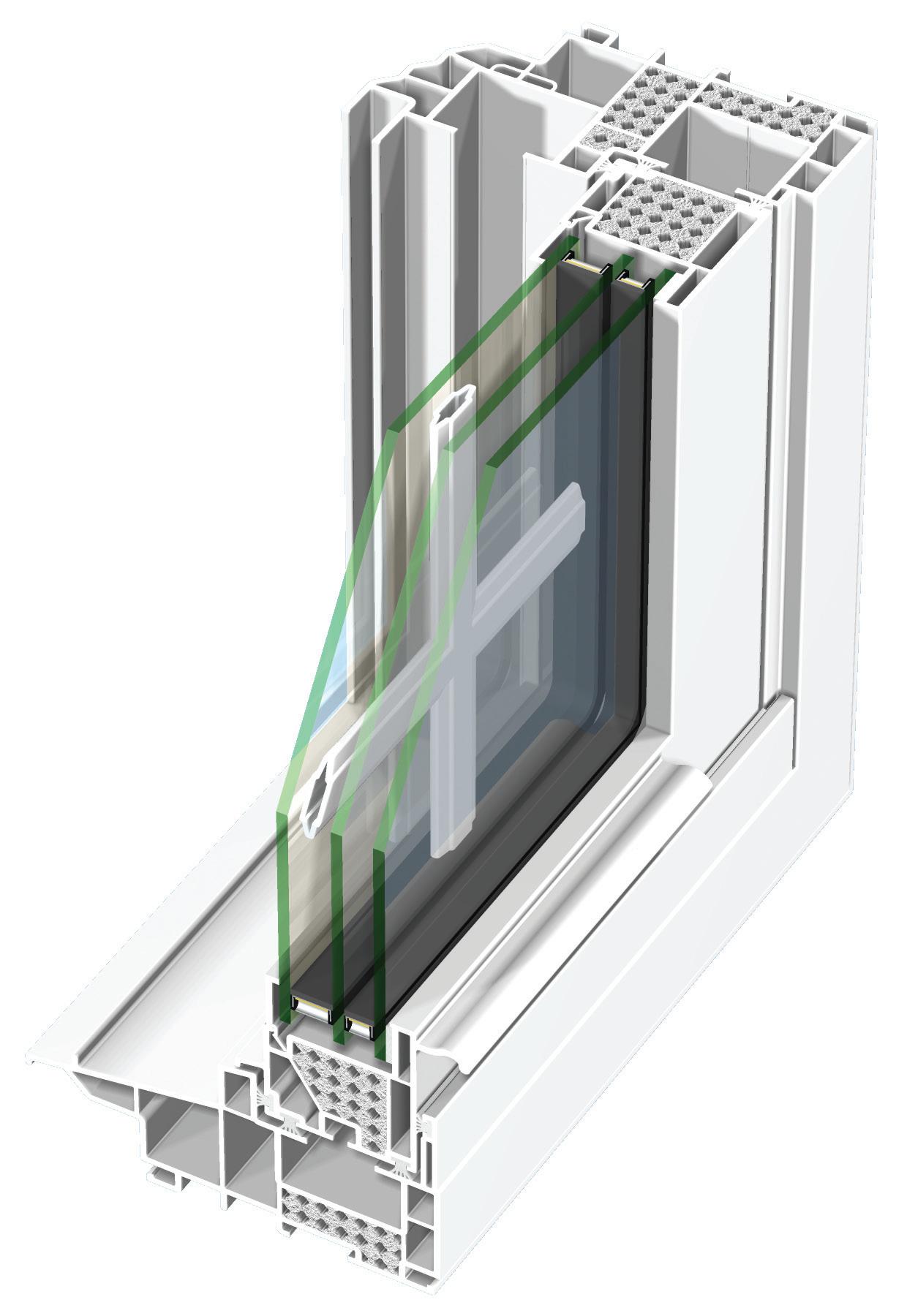
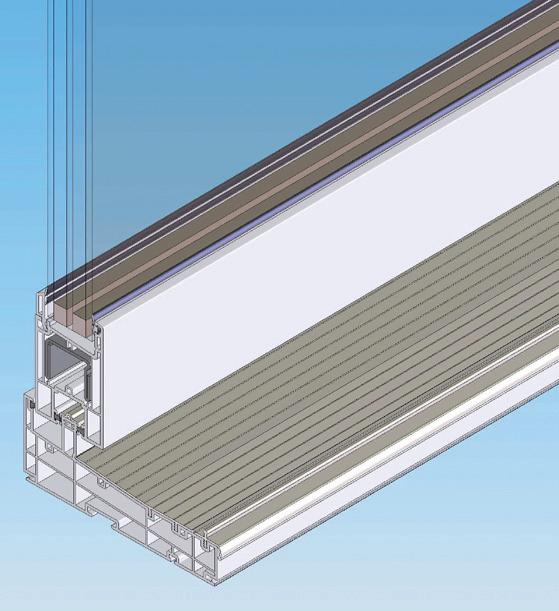
Rehau will exhibit its new System 2200 Patio Door at Win-door. This new sliding patio door design features a wide saddle rail sash for smooth operation and enhanced integrity, giving strong structural performance. The design creates a high-end look, while interlocking sashes allow for outstanding resistance to air infiltration. The multi-chambered sash profiles with robust reinforcement provide strength, security and maximum thermal performance (U-factors as low as 0.17). The sash accepts glazing up to 1 3/8 inches and the sloped sill features an anodized aluminum finish and unobstructed entry. This high-performance system is suitable for residential remodelling and commercial applications. The system is available in a kit with everything needed to be built onsite. Lineals can be ordered for custom sizes. The System 2200 is available in white and beige UPVC or solid and woodgrain foil laminates.
1809
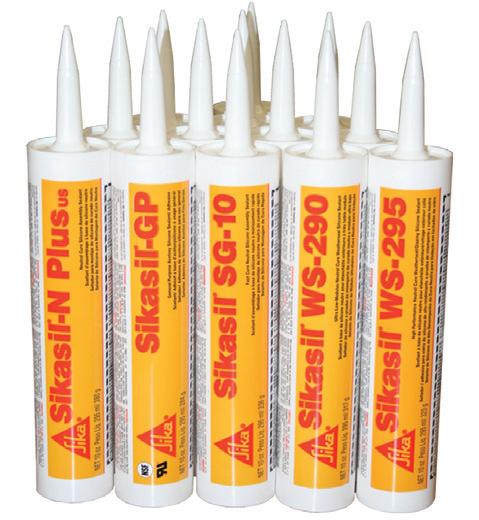
PlusUS, a professional-grade, neutral-cure, construction sealant. Structural glaziers can use Sikasil SG-10, a fast-curing, non-sag, medium-modulus, elastomeric, neutral-cure sealant. For weather sealing, Sikasil WS 290 and Sikasil WS-290 FPS are pre-tinted or site-tintable, ultra-low modulus, neutral-cure and no-bleed. Sikasil WS-295 and Sikasil WS-295 FPS are pre-tinted or sitetintable structural glazing and weather-seal grade, neutral-cure, no-bleed sealants. Sikaglaze IG-4429 HM, Heat-Mirror Insulating Glass sealant and Sikasil IG-25 HM, high-modulus sealant for airand gas-filled insulating glass take care of the IG market.
SBMS
Booth 1722
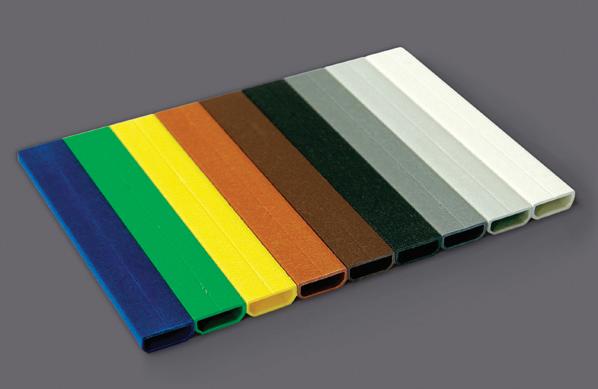
Steve Brown Machinery Solutions has been named Swisspacer distributor for Eastern Canada and northeastern U.S. states, and will be exhibiting Swisspacer spacer bars at Win-door 2011. Swisspacer is a thermally optimized spacer bar made from a highly insulating composite material. Extremely thin metal membranes guarantee air and gas tightness as well as excellent adhesion for all insulating glass sealing compounds. Swisspacer’s thermal performance makes it suitable for increasing the energy efficiency of windows.
Swisspacer exactly matches the shape and dimensions of aluminium spacers. Being rigid and self-supporting, it handles in a similar way to aluminum. Because of its structural superiority, Swisspacer can be used in all types of insulated glazing units. It is also suitable for use in roof glazing or curtain wall facades where it is exposed to high thermal and mechanical loads.
Esthetics is becoming more important, so Swisspacer’s range of 17 colours is a major benefit.
can.sika.com
Sika Canada will exhibit the latest addition to its sealing and bonding line for the fenestration industry, the Sikasil line of specialty silicones. Designed specifically as high-performance sealants and adhesives for structural glazing, weather and joint sealing, insulating glass and a variety of other specialty applications, Sikasil silicones are designed to be used on a host of manufacturing materials. Manufactured to exacting standards, these silicones are notable for their fast-curing properties, the strong bonds they create and their permanent elasticity.
For general use, there is Sikasil-GP, a general-purpose acetoxy-cure, anti-microbial sealant adhesive, and Sikasil-N
Swisspacer is available in Eastern Canada (Ontario, Quebec, New Brunswick and Nova Scotia) from Steve Brown Machinery Solutions, who will also serve the northeastern U.S., including New Jersey, New York, Pennsylvania, Maine, Connecticut, Massachusetts, Vermont, New Hampshire and Ohio.
EDTM Booth 1912 www.edtm.com
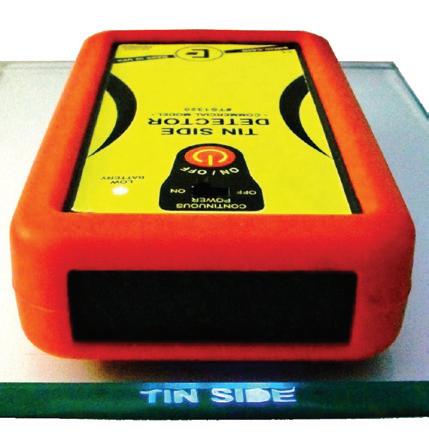
EDTM will be introducing two new styles of tin side detectors to the glass industry. The more capable version will be our TS1320 Commercial Tin Side Detector. The design has been commercialized to stand up to the wear and tear of everyday factory use. A protective rubber boot is included around the product and the instrument has been drop-tested to confirm its rugged design. A momentary power switch allows the user to pulse the glow, making it much easier to identify the tin side. Powered by fewer batteries than competing products, the design still operates longer than
Sika Booth
previous offerings. The most impressive feature may turn out to be a specialized insert that allows the detector to be used in brighter room-light conditions.
EDTM will offer discounts on orders placed at the show. EDTM is proud to be the only North American company that designs and manufactures portable test equipment for the window industry, here in America. EDTM will be demonstrating all of our existing products at the show as well.
Patio door hardware
Booth 1829 www.truth.com
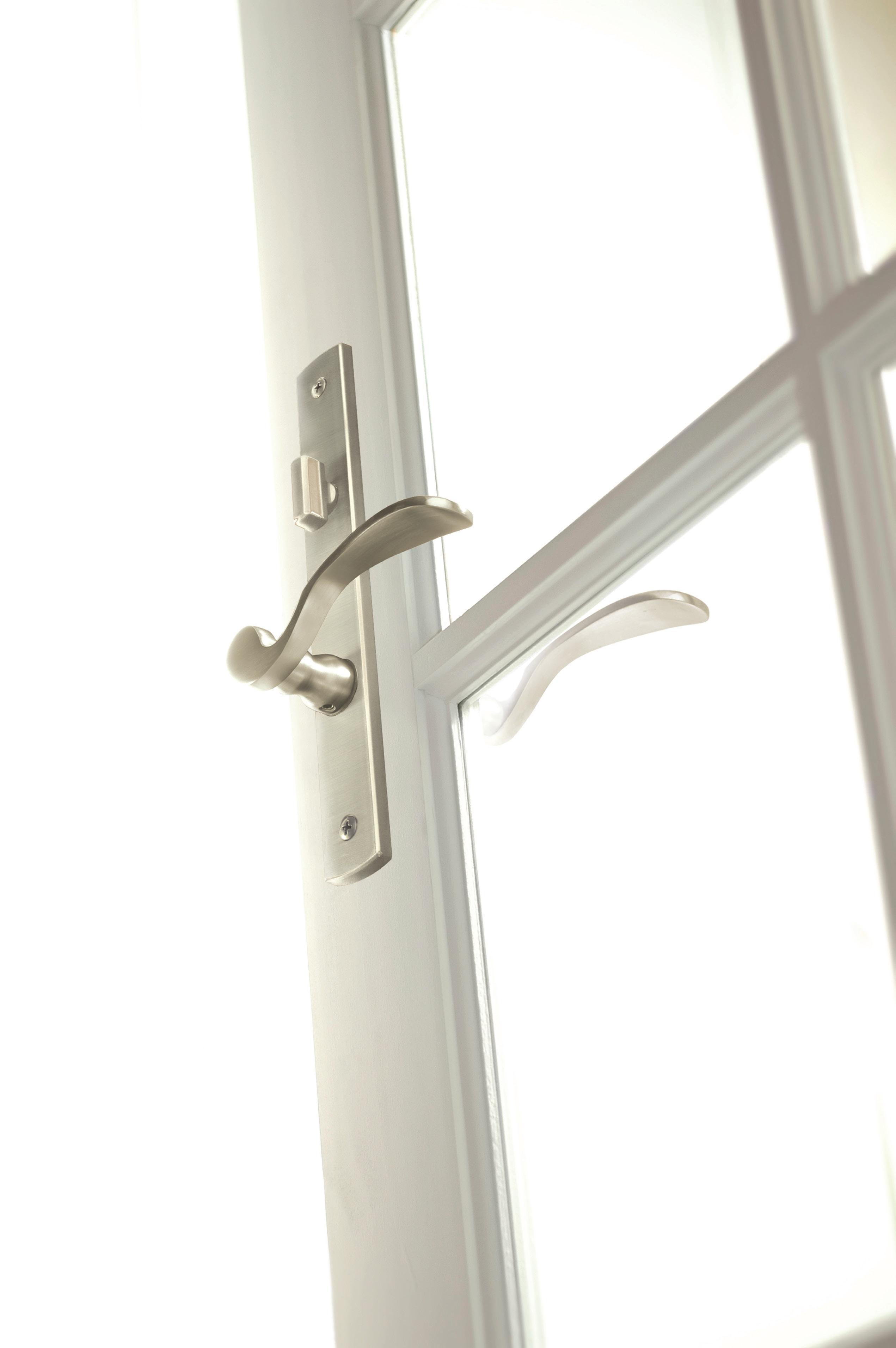
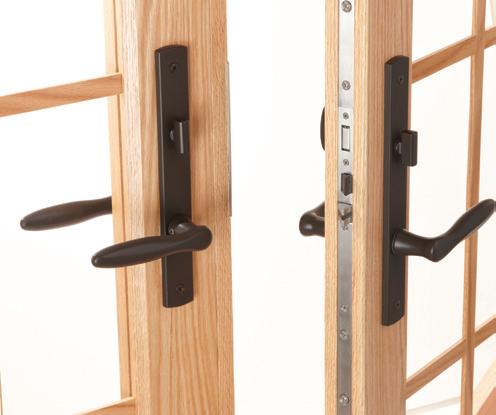
Designed specifically for the North American market, Truth Hardware’s new Sentry multi-point hinged patio door hardware system combines flexibility with optimal security. From intuitive functionality, like the 90-degree thumb turn located above the handle, to high-performance adjustable hinges and multiple handle designs – all of which easily adapt to your current door system – the sentry multi-point system produces the superior quality and performance you expect from Truth Hardware.
Window and door manufacturing suite www.360-innovations.com
Booth 1907
This specialized window and door software package combines 360 Innovations’ reseller solution CustomBuilt360 with its modular ERP software BusinessCore360, channeling all the possibilities of the technology platform. It offers manufacturers the power to bring together all business partners and tune them onto their channel. 360 Innovations delivers access to a new distribution pipeline with a consistent sales, quoting and after-sales platform to all CustomBuilt360 point of purchase users, from the big hardware wholesale stores, value added suppliers and specialized W+D retailers. With the Window+Door Suite360, manufacturers can improve the entire selling and marketing cycle from attracting customers to their products, to guiding them to the right products and services, to successfully converting them into loyal buyers while improving production management and delivery scheduling all on one platform. The CustomBuilt360 module includes and easy-to-use and user-proof interface and guided selling process. It supports multiple products on the same interface and integrates the intelligent Product360 catalogue. CustomBuilit360 includes powerful administration tools and options to enhance your website.
Azon Saves Energy
NEW total design system:
MLP™ (mechanical lock profile) for commercial window, door, storefront and curtain wall applications offers the best balance of energy efficiency and high strength for aluminum fenestration products used in the most demanding climates and conditions.
Modern daylighting systems produced with both Azon structural thermal barrier technologies—the MLP™ thermal barrier method for aluminum windows and Warm-Light® warm-edge spacer for insulating glass, will yield a fenestration system capable of upholding the highest efficiency and sustainability standards
technologies—
“Our main purpose is to provide high-performance fenestration components that meet our customers’ sustainability goals and expectations.”
Contact us to learn about the role of Azon thermal barriers in energy conservation.
Win-door preview
PVC mouldings and trim Booth 1824
www.vi-lux.com
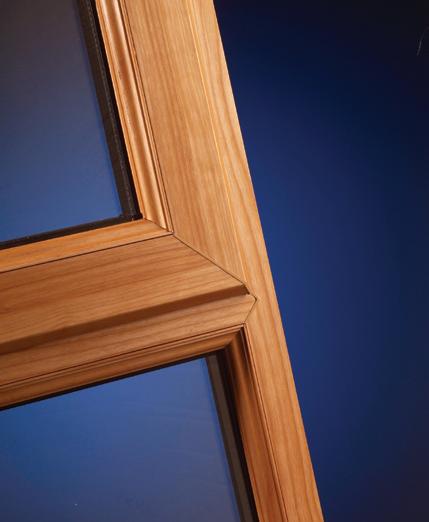
Vi-Lux offers a product line designed to simplify life for builders and their customers. All Vi-Lux products are made with virgin materials and its methods of product distribution and customer service are designed to exceed accepted industry standards. Vi-Lux Mouldings is a manufacturer of cellular PVC products located in Napanee, Ont. For more than 20 years, Vi-Lux Mouldings has continued to focus on products for the building materials industry, as well as manufacturing components and custom profiles for the window and door industry. Cellular PVC millwork continues to grow as the preferred alternative to wood in many building applications because of its ability to resist the elements and its cost effectiveness. Vi-Lux is dedicated to delivering the best product and customer service at great prices. Vi-Lux Mouldings can deliver consistent high- quality, a broad product variety and, working together with its customers, just-in-time delivery. Customers count on its continuous product and process development to produce products consistent with ever-evolving consumer demands.
New lock system Booth 1717
www.amesbury.com
Amesbury Hardware Products will display its new patentpending Tru-Lock, a multi-point lock system for entry doors. This innovative product is designed to provide increased security while allowing the homeowner flexibility in trim set hardware. The system easily incorporates into standard double bore panel systems of all types and is adaptable to work with most handle brands in the market today. Besides providing point of purchase selection of handle hardware, the system also enables the homeowner to change the trim-set in the future if their decorative tastes change. Once installed, the system functions the same as a standard latch and deadbolt, eliminating the operational confusion experienced with current euro-groove style systems.
New window line
Booth 1927 www.quanex.com
Quanex Building Products has introduced new additions to its award-winning EnergyCore line of fusion-insulated window products. The new options include horizontal slider, tilt singlehung, side-load single-hung and corresponding profile picture window designs. The new windows are available in a variety of frame options, such as block frames for replacement projects, flush-fin for stucco substrates and a wide range of nail-fin options for remodel projects, tear-outs and new construction applications.
The new window system offerings are designed to complete the EnergyCore line and deliver value-leading energy savings. Quanex says energy-efficient performance continues to be the most important purchase motivation for homeowners. For any residential architectural style needing a retrofit or remodel, there is now an EnergyCore product for that application.
Quanex tries to offer window manufacturers designs tailored to their individual regional markets. For example, the flush-fin frame options are required for stucco home applications, and thoughtful engineering also delivers products with one-inch and 1 3/8-inch nail-fin set-backs for markets where homes have bevelled siding.
The expanded EnergyCore line features profile designs that isolate the AirCell insulation for sash weeping and includes a new fixed-interlock with triple weather-stripping contact points. The latest additions to the line accept 3/4-inch dual-pane IGs up to 1 1/8-inch triple-pane IGs.
EnergyCore single-hung designs are compatible with common side-load balance hardware, feature a dual-sash seal and offer multiple chambers of AirCell for superior thermal performance throughout the frame. The EnergyCore picture window design maintains a consistent appearance with the horizontal slider and single-hung products for a clean architectural look.
AIR-INS INC.
1320 Boul. Lionel-Boulet, Varennes, QC J3X 1P7
Tel: 450-652-0838
Fax: 450-652-7588
e-mail: info@air-ins.com or r.jutras@air-ins.com www.air-ins.com
ALUMICOR LTD
290 Humberline Dr., Toronto, ON M9W 5S2
Tel: 416-745-4222
Fax: 416-745-7759
Toll Free: 1-877-258-6426
e-mail: info@alumicor www.alumicor.com
Alumicor champions LEED
CAN-BEST
38 Regan Rd., Unit 4, Brampton, ON L7A 1C6
Tel: 905-840-2014
Fax: 905-840-2847
www.can-best.com
FENZI NORTH AMERICA
11 Dansk Crt., Toronto, ON M9W 5N6
1-416-674-3831
Fax: 416-674-9323
e-mail: info@fenzi-na.com www.fenzi-na.com
Fenzi North America has added to its product line, with the
introduction of Fenzi HOTVER Hot Melt Butyl. Continuing to listen to our customers’ needs, we are now also offering our Fenzi Butylver PIB in the color of grey , to go along with the traditional black. Combined with our other IG components (Polysulphide, Desiccant, Aluminum and Steel spacers) Fenzi North America continues to be a complete supplier for our customers IG needs. Fenzi Polysulphide is manufactured here in North America to meet your delivery requirements in a timely manner.
Serving the window and door industry with high performance products, unprecedented industry knowledge, personalized technical support and award winning marketing support. Quanex
Building Products continues to outperform the markets by fostering close ties with its customers.
Resiver Patio Doors has been delivering nothing but quality products and peace of mind to their customers since 1993. As an exclusive partner of window and door manufacturers, they built their reputation around carefully designed PVC and aluminum patio doors that are both functional and appealing to the eye. With unmatched quality control Resiver accepts nothing but the best products coming out of the production line. They strive to create an ongoing positive experience for their customers with a dedicated work force including a progressive R&D team and a supportive sales and marketing staff. Resiver is part of The Novatech Group since 2010.
SIKA CANADA INC.
601 Delmar Ave., Pointe-Claire, QC H9R 4A9
Tel: 514-697-2610
Fax: 514-697-3910
Toll Free: 800-689-7452
e-mail: marketing.industry@ ca.sika.com OR wesselink. kryston@ca.sika.com www.sika.ca
Innovative products: SelfAdhered Flashing Membranes; Polyurethane, Silicone and Hybrid Sealants & Adhesives for FFI; Auto-Glass Adhesives; General Purpose Adhesives, Sealants and Tapes; and Windshield Repair Products. Sika, The Bonding Expert!
Supplier’s of new and remanufactured Sunroof, T-top and roof panel replacement glass, supported by highly trained CSR’s to quickly answer pricing, service and installation questions. With Sunroof Express, service is easy.
TRUTH HARDWARE
700 W. Bridge St., Owatonna, MN 55060
Tel: 507-451-5620
Fax: 507-451-5655
Toll Free: 1-800-866-7884
e-mail: truthsal@truth.com www.truth.com
Designer & manufacturer of quality operating hardware for the window and door industry. Truth Hardware provides engineered solutions for hinger, operators, sash locks, rollers, multi-point locking systems.
FINDING ANSwERS GLASSBUILD 2011
by RICh PORAykO
Fantastic educational seminars, well-attended networking events and innovative products made for a successful show. It sure isn’t 2006, but recovery is on its way.
GlassBuild America returned to Atlanta, Ga., this year to a sold-out trade show floor packed with optimistic exhibitors and a vast smorgasbord of professional development and networking opportunities. The mood was generally positive; however, the overall attendance was slightly lower than in previous years, with 6,295 participants in 2011 compared to just over 7,000 in GBA Las Vegas 2010 and almost 7,000 in GBA Atlanta 2009.
GlassBuild offers constructive solutions and innovative opportunities as participants struggle in a sluggish economy.
Innovation was on display as companies from all over the world showcased some of the most innovative and exciting products available on the market today. While many old-school glass companies are often either too busy or too slow to attend trade shows and conferences, 393 dynamic suppliers looking to drum up business and gain market share exhibited at GlassBuild this year, up from 388 in 2010. This year’s event also included 73 first-time exhibitors, many of them from overseas who are looking to break into the competitive North American market. Even with fewer attendees, it is these forward-minded glass, window and door leaders that are demonstrating the industry’s resilience during challenging economic times.
“We had so much enthusiasm leading up to the show and it carried throughout the week. The exhibitor’s booths were quality displays that attracted many participants,” says Denise Sheehan, vice-president of industry events for the National Glass Association.
Held Sept. 12 to 14, GlassBuild America is sponsored by the NGA, the American Architectural Manufacturers Association, the Glass Association of North America, the Insulating Glass Manufacturers Alliance and the Bath Enclosure Manufacturers Association.
“We have been exhibiting at GlassBuild for a long time. The show has been good for us,” says Marc Deschamps, business development manager for Montreal-based acid etch glass and mirror manufacturer, Walker Glass. “We released our new anti-slip acid etched glass called Traction, which has had a very positive reception. It is part of our all-glass process, which only involves polishing the surface as opposed to applying a coating.
“We have met some great new companies, including fabricators, contract glaziers and architects; however, we don’t base everything just on new leads. That can be deceptive. We have a lot of customers come by to see us so the networking and
ABOVE: Numbers were down again at GlassBuild in Atlanta, but those who came discovered groundbreaking technology and many chances to learn and network. Increased foreign participation opened doors for many new exhibitors. (Photo by Rob D. Cohen Photography)
IN ATLANTA
relationship management is huge. It allows you to show new products and hand out samples and brochures. Yesterday we spent a fair amount of time with a group of architectural students who we see as the next generation of architects and can appreciate that they are taking the time to learn about glass.”
Shaun Blott, national sales manager for Decon, a representative for Jordahl concrete anchoring technology systems, has already booked for GBA 2012. “We made some good quality contacts with actual projects, including ones from South America, which is an area we’d like to open up,” says Blott.
Decon’s quick-connecting, adjustable anchor channels, Tbolts and accessories are hot rolled in Germany and fabricated in Decon Continental’s Brampton, Ont., plant. “The show has had some great opportunities and we met some big players that we had never met before,” says Blott. “On the last day I was standing in front of our booth looking for people I knew and I met up with the vice-president of engineering for one of the largest glazing contractors in the country. That was a great connection.”
“We work pretty hard in the booth to make sure we are visible,” Blott explains. “We have samples and literature up front so that we are really working the show floor and we’re not sitting back on a chair, waiting for people to walk in. I think Vegas with
its entertainment will draw a few more attendees. You still hear comments about ‘this economy’ and people are in that mindset. It is still tough out there. The economy is still an issue.”
Education and networking
In addition to amazing displays and innovative products, GlassBuild America 2011 will also be remembered for the outstanding educational opportunities and professional forums that took place. The Glazing Executives Forum kicked off the week with a powerful keynote speech by Serious Energy CEO Kevin Surace that had attendees talking long after the event was complete. With the Glazing Executives Forum in its sixth year, the Window and Door Dealers Forum in its second year, the debut of the Architects Forum and the three highly attended Building-Integrated Photovoltaic, Decorative and Door and Window Specification seminars, GlassBuild America offered an extensive variety of educational opportunities for all segments of the industry.
The second annual Window and Door Dealers Forum brought together many of those who are working hard to make a difference in the industry. The First Annual NGA Architects Forum offered an eclectic group of speakers and highly rated education. This new program is geared to attract architects to
the event, as it is a great opportunity to earn education credits in the area of architectural glass.
On the final day of GlassBuild, three seminars took place, beginning with a standing-room-only BIPV event, followed by updates on Window and Door Performance Standards and Decorative Glass. Greg Saroka of Calgary’s Goldray Industries, which manufactures over 15,000 different glass products, was a panel member for the Decorative seminar and hammered home the commitment required to be in the specialty glass business.
The annual GlassBuild America Welcome Reception, cosponsored by Quanex Building Products and the NGA, was a big success, with nearly 900 people packing the ballroom. This event is one of the best networking opportunities around.
GlassBuild America 2012 will be held September 12 to 14 in Las Vegas at the Las Vegas Convention Center.
‘Embrace uncertainty’
Will the economy ever return to normal or has it already?
Speaking to the highly attended Fifth Annual Glazing Executives Forum, Jeff Dietrich’s highly anticipated economic forecast set the tone for the panel discussions among nearly 150 of North America’s leading glazers. Dietrich is a senior analyst for the Institute for Trend Research, an economic forecasting consultancy.
Other lessons learned include advice on how to excel at core competencies, how to borrow money to increase efficiencies and gain market share, and how to prepare for inflationary pressures, because higher prices are here and not going down any time soon.
“The general mood among consumers and business leaders continues to be one of confusion, uncertainty and caution,”
Dietrich began. “The economic news seems depressing: stagnant high unemployment, limited credit, diminished wealth, a soft construction market with high vacancy rates and too much inventory, consumer debt, rising national debts and deficits raising the spectre of higher taxes, and a national leadership that appears to be short on options for what to do next.”
“If you are waiting for certainty, you are going to be way
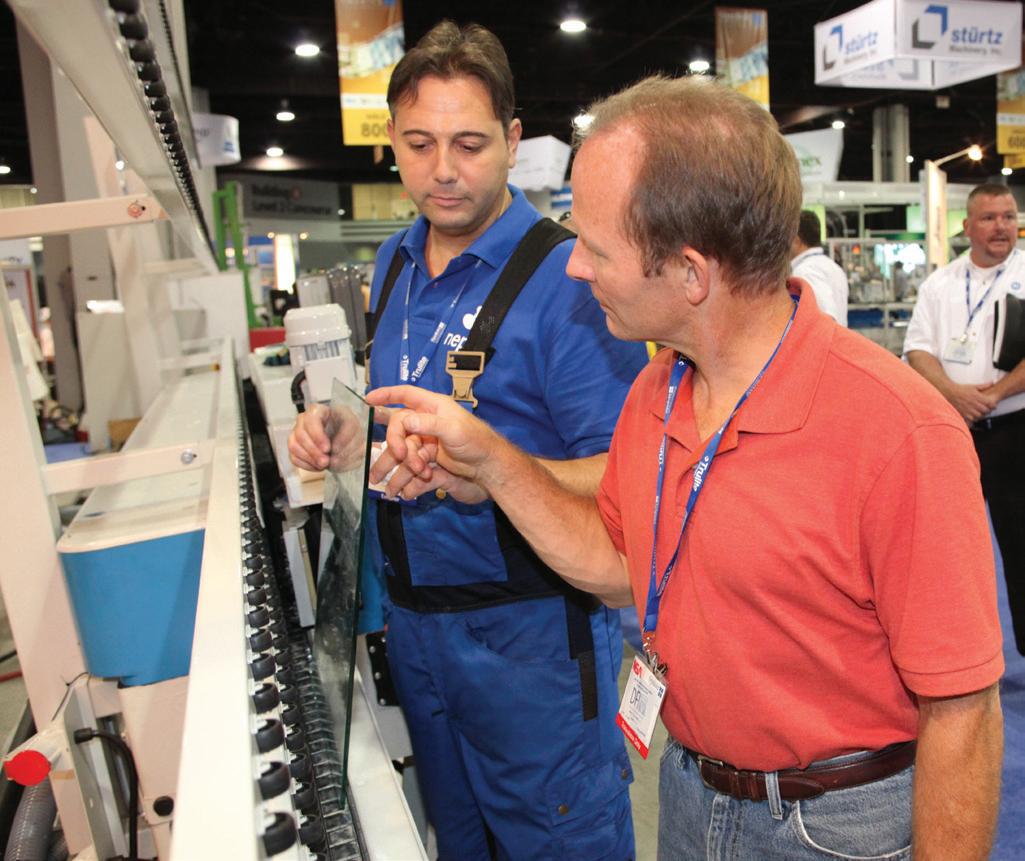
Using labour-reducing technology is one way to stay afloat in difficult times. (Photo by Rob D. Cohen Photography)
behind and lose the game,” says Dietrich. “You are going to have to learn to embrace uncertainty. You are going to have to take risks that are very real. Not like the 2006 risks, where you had plenty coming in. Embrace uncertainty because our problems are not going to be solved in the next three years.”
“Hire. If you hire a college student today, it will be three years before you have to pay them what they are worth. Because you can hire talent with high potential, take the time to train them.”
Dietrich, one of the most popular speakers at previous NGA events, delivered his most up-to-date economic forecast for the nation. “The question that continues to rattle around is “Will this recovery last?” The short answer is “Yes.”
He emphasized that glaziers in the U.S. have a ways to go. But light is at the end of the tunnel. “The commercial construction market is the caboose of this economic recovery. Apart from those with government contracts, the recovery in commercial real estate is not expected to see much relief or growth until 2012.” Sectors in the U.S. with the fastest recovery at present include health care, education, military, government and power.
“Yes, there are real challenges that threaten to undermine consumer spending and business growth,” Dietrich admits. “But at this time, the leading indicators for economic activity, consumer trends and cuts in spending, as well as ITR’s cyclical theories, offer a view consistent with a mild recovery in North America.”
“The shift is being made from taxing the wealthy to taxing wealth. It will impact us all. Find a good financial planner and put some money in the Cayman Islands.” The message was intended for the mostly American audience; however, it seems like great advice, no matter where you live.
Dietrich concluded with some optimism. “This recovery will have many bumps and some bruises along the way. Be proactive anyway. There are excellent opportunities to gain market share at this
Rich Porayko is a professional writer and founding partner of Construction Creative, a marketing and communications company located in Metro Vancouver, B.C. richp@ constructioncreative.com
THE EVOLUTION OF TEChNICAL feature
by BIll lInGnell
In the early part of 2011 during an ASTM task group meeting, the chairman of the Glass Strength Committee asked that a small contingent put together background and history along with information on the use of the ASTM E 1300 Standard Practice for Determining Load Resistance of Glass in Buildings. Jeff Haberer of Cardinal IG and I offered to pursue the task. The following information in this article is part of the effort that was put into the writing of a paper used to explain the request. It is hoped the explanation relating to the background and evolution of this standard will give the reader insight into how the group has promulgated a standard that has been in place now well over 22 years. The standard continues to be updated and added to in an effort to assist the glass industry, architects, engineers, contractors, designers, consultants, researchers and others interested in glass use for buildings.
Currently this standard is
Changes to standards follow advances.
used throughout the United States and parts of Canada for determining uniform lateral load resistance (i.e., snow and wind load) of glass used in buildings. It is referenced by the model building codes in the U.S., Canada and other countries. Origins of the standard will be discussed along with historical and recent updates. The standard offers a practical approach to lateral loading that addresses many, if not most, of the glazing types offered today, including, monolithic, annealed, fully tempered
(toughened), heat-strengthened, laminated (with shear modulus equal to or greater than PVB), insulating glass (double and triple glazed), asymmetric glass constructions, various support conditions (one-, two-, and three-side support), and combinations of the above.
We will be discussing the progress made in the standard in providing the user with advancements in load resistance of glass based on the development of additional charts for non-
ABOVE: Standards for lateral load give guidance to architects and structural engineers as they try to do new things with glass. As technology makes new designs possible, standards must keep up in order to ensure the new technologies are used safely. Above, the Sony Centre in Berlin, Germany.
OF ASTM E 1300
factored loads, glass thicknesses, glass type factors, load sharing and increased load magnitudes that have been important to meet glass industry needs.
Architects, engineers, glass fabricators, glazing contractors and others have obvious needs to know and understand the strength of glass. Wind load, snow load and self weight are the primary concerns when it comes to glass for use in buildings. In these times of ever-expanding designs, there is also a need to evaluate such special applications as point loads, line loads, partial loading, impact loading and other designs beyond the typical vertical window or sloped glazing with four-side structural support to the glass. Throughout the long history of using glass in buildings, users have increased the thickness of the glass in order to meet the resistance of lateral forces that would tend to break it. The need has always been for a practical and convenient way to evaluate just when to increase the thickness for added strength to meet design load requirements.
ASTM E 1300 is a practice that lays out a methodology for evaluating glass load resistance and allows the user to determine if a glass type and construction has adequate strength to be in compliance with the architectural design requirements or achieves code compliance.
Glass strength evaluation prior to ASTM E 1300
Prior to the introduction of the ASTM E 1300 standard there were other methods used in the United States to evaluate glass strength for buildings. In the 1960s and into the 1980s most architects and engineers used one simple chart that described the assumed strength of each glass thickness. These charts expressed maximum load capability versus glass area with a line for each thickness of glass based on a probability of breakage of eight lites per 1,000 for annealed glass. As new types of glass saw increased use, adjustment factors were established to address the strength for heat-strengthened, fully tempered, laminated, insulating, and certain pattern glasses. The straight-line chart (see Figure 1) was adopted by many building code agencies for evaluation of glass strength for glass used in buildings.
These charts were based on empirical results from testing to failure of thousands of various-sized plates of annealed glass for each thickness. There were at least 25 lites tested to destruction using aspect ratios of 1:1 to 1:5 for all the glass thicknesses tested. Testing of over 3,000 lites of monolithic factory-fresh glass helped to develop these initial glass strength values at LOF Research Facility in Ohio. The information was commonly used
plate geometry and not just total plate area (PPG 1979).
From this work, a series of glass thickness charts were created. These were likely an improvement over the earlier straight-line charts, but they did yield somewhat different results. Because of this, the charts were deemed controversial and did not attain uniform acceptance by code bodies and practising architects/ engineers.
Around the same time, W. Lynn Beason produced a study introducing a glass failure prediction model. This became the basis for initial discussions within ASTM on glass strength for buildings. This work is well documented elsewhere (“A Failure Prediction Model For Glass,” 1980; “Basis for ASTM E 1300 Annealed Glass Thickness Selection Charts,” 1998). A brief account is presented here. The theory addresses reasoning for the high coefficient of variation in glass strength. This variation is the result of the orientation and density of surface flaws in the glass.
The theory employs the work of Weibul (1939) who offered a statistical failure analysis for predicting the strength of brittle materials. Using this analysis, the glass failure prediction model uses two parameters called “m” and “k,” which relate to the surface flaw conditions. These two parameters are used in a risk function equation employing plate dimensions, elasticity of the glass, load duration, distribution of stress in the plate, and magnitude of applied load. This very complicated function was then synthesized into a series of charts for each glass thickness. The charts have plate width and height on separate axes.
in the world. Membership is initiated by the participants’ own requests, not by appointment or invitation. Committees are balanced, so no more than 50 per cent of the participants are producers. The remainder must be consumers or general interest. The latter includes consultants, architects and academics.
With this organizational structure, the task was set to come to a consensus agreement on what to use for glass strength. Initial work took nearly 10 years of exhausting debate and discussion until a final draft document was produced. The previously noted glass failure prediction model was agreed to be the basis for the new standard. Compromises were made on the values for the surface flaw parameters m and k. These were chosen to accurately reflect the strength of weathered glass removed from buildings and resolve the controversy in the industry. Values for the parameters are given in the standard. The committee felt the use of weathered glass represented a more practical effort to describe the basis for the evaluation of load resistance for glass used in buildings.
Early revisions and updates
for selecting glass subjected to uniform load conditions for 60-second durations with a design factor of 2.5 and firm four-edge support, and was eventually incorporated into many model building codes.
In the 1970s, efforts were made by glass manufacturers to improve their understanding of glass strength and better predict the statistical nature of glass. Most notable among these was work by PPG Industries. This work employed a maximum stress approach coupled with finite element analysis that considered
Moving the glass strength controversy to ASTM
As we have discussed, ASTM E 1300 was born out of controversy in the industry when new approaches to glass strength yielded different results from the conventional straight-line charts of the 1960s and 1970s. Being a consensus organization, ASTM (now ASTM International) was perhaps uniquely suited to address the controversy. Unlike other standards organizations, ASTM is a not a national standards body. Membership and participation is open to anyone anywhere
The first version of the standard, ASTM E 1300-89, was released in 1989. This version only covered annealed monolithic glass of rectangular shape with support on all four edges and with a lateral load duration of 60 seconds. Twelve U.S. glass thickness designations were covered from 2.5-millimetre to 22-millimetre. A chart for each thickness was provided. Optional procedures for centre deflection and estimating probability of failure were included in an appendix. An example of the non-factored load chart for six-millimetre glass is shown in Figure 3. This is similar to what was presented in the original 1989 ASTM E 1300 standard. It was clear that more than monolithic annealed glass was used by the industry. After a period of general acceptance to the approach within the E 1300 document, strategies for handling different glass types were addressed. In 1994, a second version was issued that offered type factors for annealed, heat-strengthened, fully tempered, laminated, and two-pane insulating glass containing lites of the same type. In addition to factors for the glass types with 60-second load duration, the revision also included type factors with 30-day load duration. This was for evaluation of a typical snow load.
Early versions of ASTM E 1300 never envisioned this level of complexity in window design. (Photo courtesy of Traco)
For the 1997 version of the standard, the ASTM task group began to address other needs. These included evaluation of insulating glass units that are asymmetric. This refers to having mixed glass types and thicknesses on each lite of glass in the insulating glass unit. An example would be an exterior sixmillimetre tempered lite, with a roomside lite of 13-millimetre, annealed, laminated glass. This type of construction is especially common in sloped glazing, but there had never been any standardized way of evaluating its strength.
This asymmetric analysis entails far more complexity than the symmetric case. Hence, a major restructuring of the strength adjustment factors had to be executed. In the asymmetric IG example cited above, the thicker lite will take more of the load than the thinner lite. An approach to determining each lite’s share of the load was needed. Additionally, the differences in glass type (fully tempered versus annealed laminated) requires examination of each lite individually according to its type and to the determined share of the applied load.
To accomplish all this, an assumption was first made that load sharing is proportional to the stiffness of the lites. This is estimated by taking the ratio of the cube of the thicknesses. A table of load share factors was created that laid out all possible combinations of glass thicknesses for short-term (60-second) loads. A second table of load share factors was created for IG constructions with laminated glass under long-term loading (30 days). Since laminated glass has a different stiffness behaviour under long-term loading, this second table assigned load share
for each individual glass ply in the laminated layup.
The addition of the asymmetric IG analysis was a major step forward. While based on assumptions that were not perfect, results were judged to still be conservative within the realm of the stated breakage potential of less than eight in 1,000. The advantage was that more common IG constructions could be evaluated using a standardized consensus practice.
As far as standards and testing have come over the last decades, there are still many potential improvements under discussion. Watch these pages in the coming months for more updates from the ASTM task group. •
Bill Lingnell has over 46 years of experience in the technical field of glass and architectural products. He has held such senior management level positions as vice-president of engineering and technical services at a wall systems company, corporate vice-president of a building envelope contractor, and director of new products and technical services for a major glass manufacturer. He holds three master of science degrees in engineering (civil, mechanical and engineering science) from the University of Toledo and a bachelor of science in civil engineering from Ohio University. Lingnell is a registered professional engineer in five states. As a member of various professional groups, code bodies, trade organizations and industry associations, he has contributed to the writing of standards and guidelines for test procedures pertaining to the use and testing of glass, wall systems, sealants and wall components through ASTM committees E-6, F-12 and C-24.
Daylight and design Light becomes a design tool with channel glass technologies.
Large, glazed spans of channel glass add drama to a library. New channel glass products can span up to seven metres, making them ideal for exterior applications.
(Photo courtesy of TGP)
Channel glass first made headlines for its ability to diffuse large amounts of daylight deep into interior spaces without glare or excessive shadows, while reducing heat transfer. Today, although channel glass remains an effective daylighting material, many building professionals recognize that its unique depth, profile and light-transmitting qualities can also contribute to the art of building design. Whether by shape, texture or colour, it can make modern glazed applications worth looking at, not just through.
Design basics
Channel glass systems consist of Ushaped, translucent cast-glass channels mounted in an aluminum perimeter frame. While these linear glazed segments can capture and transfer large amounts of daylight, they can also form an esthetic not possible with conventional windows or glass block. For instance, cast-glass channels in vertical and horizontal installations can span up to seven meters without interruption. They can also form curved or serpentine configurations.
The channels are dual-glazed for exterior applications and can be single- or dual-glazed for interiors. Due to their ability to capture natural light, common exterior applications include storefronts and
facades, wall systems, windows and strip lighting. As discussed in the following sections, varying channel glass colour, texture and orientation allows such systems to contribute to building envelope performance without detracting from contemporary design. Common interior applications include partition walls (as the channels help maintain privacy while still admitting light), as well as object architecture.
Channel glass is available in a variety of colours and textures with varying translucency, allowing for the transfer of diffuse light in a sophisticated manner.
Designing by shape
One popular trend is to install long, linear sequences of channel glass. Because interim framing is not required in vertical applications and the systems can be stacked over floor slabs to achieve greater heights, designers can use channel glass systems for large, dramatic glazed areas. When installed vertically, these glazed expanses can create the sleek, understated esthetic desirable in many contemporary buildings. Horizontal applications often appear more geometrical in form.
Another option is to intermix or vary channel glass orientation and length, adding dimension and depth to building designs. For instance, arranging the linear
glass strips in a vertical pattern separated by windows or framing units is a simple yet efficient way to create eye-catching facades. Conversely, when a subtler look is desired, architects can place vertical castglass panels with openings between them (as they do not require intermediate mullions). This can bring an ethereal element to buildings and, on a practical level, allow for air ventilation if protection from the outside elements is not required.
A growing design trend is to install curved or serpentine configurations. The slender frames and narrow glazed segments in channel glass systems allow for tighter radii than conventional glass: as low as 1.9 metres. Such compact arcs can ebb and flow like water, encircle stairwells or represent landscapes and emotive themes, accentuating sophisticated designs.
Thanks to manufacturing advancements, design professionals can use the sleek shape of channel glass to their advantage, regardless of building location (see sidebar).
Designing by texture
Varying the texture of glass influences two key design elements: interior lighting and movement. For instance, channel glass with no surface patterning is monolithic in appearance and provides only a moderate level of translucency. By comparison, channel glass with a thin, net-like texture disperses softer light for greater privacy.
Channel glass textures range from no surface patterning to wave-like textures that create dramatic optical variations by prismatically bending light and varying its distribution. Incorporating channels with larger wave-like texture patterns typically results in more sophisticated light play, whereas keeping the same texturing throughout creates a more homogeneous look.
Designing by colour
Design professionals can use channel glass to make artistic statements with surface colour. The standard translucent channel glass hue is a light seafoam green. Additional translucent colours include amethyst, bronze and clear. Providing only a hint of surface colour, these channels allow for strong passage of natural light while subtly complementing a building’s colour scheme.
For object architecture or catchy storefronts, architects can select from a range of standard polycarbonate laminate options and over 1,500-tempered ceramic frit colours within the RAL design system. With the colour melded to the interior surface of the glazing during manufacturing, coloured ceramic frits are opaque and can create bold accents. Two other design-savvy options are to include colourcoating metallics and to apply lettering or other shapes with decals or custom painting.
Where a more light-obscuring appearance is desirable, design professionals may wish to consider sandblasted channels. Such treatment achieves greater opacity and is ideal for spaces like offices, entryways and lounges that require both light and privacy.
Regardless of the colour chosen for the channel glass system, lights can be set between it and a wall to create backlit screens that display one or more colours. In many instances, interior applications such as partitions and focal points are lit by day and night. Exterior applications, on the other hand, are often backlit only at night. This allows them to take full advantage of the sun’s natural light by day, yet function as a visual landmark for customers by night.
PUTTING ChANNEL GLASS TO ThE TEST
Strong storm cycles and hurricanes have led to an increased emphasis on protecting the building envelope. Evidence of this is seen in today’s stringent building codes. While such codes are beneficial when a storm strikes, they can severely limit building professionals’ ability to meet other important design goals, particularly when it comes to glazing. For instance, many hurricane-approved glazing systems have protective films, which can block out daylight. Or, they require supplemental protective devices, such as shutters, that can hinder sleek visual lines.
In recent years, a hurricane-approved channel glass system has entered the market, providing design professionals with a new alternative. The enhanced system builds upon traditional channel glass assemblies, featuring dual-glazed, vertically oriented, cast-glass channels with a polycarbonate laminate and thermally broken frame. The channels can extend up to 10 feet high and are approved for 60 PSF design loads.
Rated to Miami-Dade County and state of Florida requirements – some of the most stringent codes in North America for protecting buildings against high-wind and wind-driven projectile damage – the system allows for the esthetic transfer of natural light while helping protect buildings and occupants against severe storms.
Channel glass design will continue to evolve, bringing with it new shapes, textures and colours. As these new features enter the market, contact a channel glass supplier for more information on the resources and design support they provide. •
Serpentine channel glass can visually link a retail store with its surrounding landscape.
(Photo courtesy of TGP)
by YVES HOULE
Yves Houle is president of Fenestration Canada. Fenestration Canada’s mission is to represent and support all aspects of the window and door manufacturing industry.
Education adds value to Win-door
We are very excited that the key decision makers from across Canada are coming soon to Toronto to see the new products and services being showcased at Win-door 2011. Win-door has become the industry’s most important event, and the reason for that is simple: it is our show. It is focused on bringing our industry’s top companies and our industry’s key players together in a venue that offers something for everyone.
This year’s event will showcase over 150 exhibitors, and features the machinery, hardware, systems, sealants, testing and technology that will drive the market in the months ahead. It is a great place to talk face to face with suppliers, see the latest products and connect with the entire Canadian window and door industry. It is your true one-stop-shopping opportunity of the year. By choosing to attend Windoor you are taking the steps to help strengthen your business and our industry as a whole.
A most comprehensive lineup of educational seminars is being offered this year. The Economic Power Hour, is an economic forecast from the Altus Group. Ask The Inspectors: Forum on Code Changes is another valuable seminar on offer. As new building codes roll out across the country, window, door and skylight manufacturers need to know how changes will affect their businesses. Codes are like a licence to do business, and without proper testing and labelling, products will be rejected by building inspectors. Join Jeff Baker, technical consultant for Fenestration Canada, as he leads a presentation and discussion with a panel of building inspectors in this all-important industry update. You will have the chance to learn what the new codes represent for your business, what will be required for testing and labelling, and how building inspectors will handle inspection and enforcement.
Win-door has become the industry’s most important event, and the reason for that is simple: it is our show.
Also on the schedule is Glass Performance and Energy Efficiency: The Straight Talk. Get answers to the questions we all ask about IG units direct from the professionals. Bill Lingnell, technical consultant to IGMA and one of the world’s foremost experts on glass and architectural products, joins IGMA’s executive director, Margaret Webb, for an hour of candid, straight talk about insulating glass. You will learn which are the best spacer bars, and what is the most effective cavity width. You will also learn about such topics as fade resistance, coatings, gas fill options and the best ways to prevent gas loss. The program will touch on sound reduction and life expectancy of IG and how to extend its life. There will be an Ask The Expert question-and-answer session, so this will be an hour you won’t want to miss.
On Thursday afternoon there is a seminar called New Code Changes: A Focus on Exterior Doors. Door codes have been an integral part of the national building code for decades, but new codes signal a renewed scrutiny. Product will now be subject to a range of requirements, including temporary and permanent labels. As well, they will be tested for size, positive/negative design pressure (DP), air infiltration and exfiltration, plus much, much more. Take time to attend this important seminar and get an up-close and detailed look at the new codes and how they can affect your business. Learn the new requirements for testing, labelling and grading; the energy standards and safety features doors must meet; how and when each province will implement the codes; how rules in Canada differ from U.S. requirements; how building inspectors are renewing their interest in doors; and how to get the right information for your area of the country.
As you can see, there are plenty of features, seminars, events and live demonstrations that come free with your badge. We think they raise the bar for what Win-door has to offer, along with the products and services of our suppliers.
Win-door is located in the heart of Toronto’s restaurant, entertainment, sports, and theatre district. It is an attractive destination point that sets the stage for hospitality activities with clients. When you are not on the show floor, or in one of our fact-filled seminars, we encourage you to take advantage of all this area has to offer.
Our thanks to the Win-door Show Committee, who provide us all with a great show each year. •
by JOHN ROPER
John Roper is the editor for The Installer, The Fabricator, The Conservatory Installer and Glass Works magazine published in the U.K.
Doom, gloom and self-inflicted crisis
Never mind Greece, never mind Spain or Italy, or, for that matter, the U.S.A. – which is big enough to take care of itself – the U.K. is going to hell in a handcart. Ask anyone: the economists, the politicians. (Well, some of them. Half say they are rescuing us; the rest say the other half are making everything worse.) Ask the renta-gobs we hear on the BBC. Economically, we are doomed.
That is the opinion we hear from all of the commentators, including not a few journalists. Facts, real facts, are hard to come by, and if they are positive, not generally reported. Anecdotally, companies in the window and glass business that I talk with seem to be doing not badly. According to the Confederation of British Industry’s August Industrial Trends survey, manufacturers are enjoying healthy order books and improving expectations for the future. I have not heard that reported anywhere. Was I just not listening or was it drowned out by the doom-mongers?
Furthermore, Glenigan, which monitors and reports trends and activity in U.K. construction, says in a current report it has recorded a 15 per cent increase in the underlying value of planning approvals over the six months to July 2011. Alongside this, the Office for National Statistics has reported an increase in investment by private manufacturing firms in new building work. This has resulted in a 36 per cent increase in project starts over the three months to August compared to a year ago. While admitting that the increase is from a low base, the Glenigan report boils all of this down to an overall six per cent year-on-year increase in the value of construction starts.
There is a will to push us into a recession, to damp down confidence. Perhaps it is not so puzzling, because it is very political.
So why are we not hearing about this? Why is only the negative reported?
I end up with the impression that there is a will to push us into a recession, to damp down confidence. Perhaps it is not so puzzling, because it is very political. Some of the politicial commentators want to damage the government. The renta-gobs and economists get paid for interviews and, for the media, good news just does not cut it. Most of the commentators do not have a clue about the real economy and how things work. For years we have been asked to accept that trading bits of paper was a valuable thing to do, that we could have a sound economy based around service and financial trading. The problem with that is that you cannot. A sound economy has to be based on stuff. A former chancellor of the exchequer (our version of a finance minister) sold all of the U.K.’s gold, and a subsequent prime minister closed down our coal mining industry, and generally wrecked manufacturing, so that our money became based on nothing but bits of paper. When, 10 years ago, we got a socialist government that was pretending not to be socialist, the paper traders must have thought it was happy holidays. Couple that with the Labour party’s tendency to create loads of non-productive and expensive public-sector jobs and the economy faced a 10-year downhill race.
At present the public sector is being cut back viciously. Note that everything mentioned by Glenigan, the CBI and ONS relates to private-sector work, so, while it may be small in real terms, it has some solid worth. And it will include a lot of glass, hardware and windows. Good news for the industry.
What we now need urgently in the U.K. is a massive house-building program to get first-time buyers on the property ladder. This would have the effect of unlocking savings and getting consumer spending started again. Once that happens it should be good news all the way. •
EUROPEaN SCENE
CRL WedGe-LoCk™ 'aLL-GLaSS' dooR RaiLS
• adjustable door alignment System allows Jamb Line adjustment Without Removing door
• Solid aluminum Rail, Rigid Single Component housing Will not Shift and Fall out of alignment over Time Because the housing is not Made of Two halves
• door Rails Come Completely Fabricated So door assembly Can Be Ready for installation in Less Than 10 Minutes
• dry Glazing allows easy Field Glass Replacement
• Glass Securing Pads designed for Longevity in extreme environments
• available With or Without a Lock
• Six Popular Stock Finishes
crl glass entrance door rail system
CRL's patented Dry Glaze Wedge-Lock™ Glass Securing System is a totally original concept for securing the glass in a door rail No more fumbling with multiple pieces, trying to align them properly. No more time wasted waiting for cement to dry, or i
CRL SideLiTe RaiLS WiTh ToP Load RoLL-in GaSkeT
• Sidelite Rails Match door Rails for even Sightline