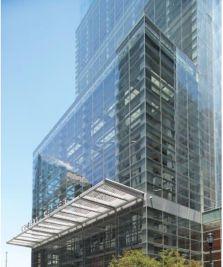
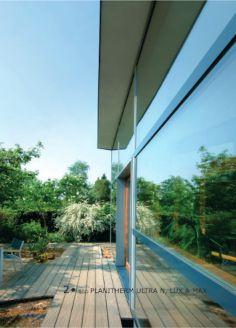
Coast to coast, Canadian glaziers and glass fabricators continue to revolutionize the urban environment with incredible achievements in architecture. Here are six projects that caught our eye.
Recordings of Glass Canada’s popular Winter Webinar series are available online at glasscanadamag.com > webinars. Earn your learning credits sitting right at your desk!
glasscanadamag.com
Glass gets raves
Canada’s commercial glazing event bursts at the seams with interested attendees.
Under the Glass
National Contract Glaziers has worked hard to create a culture focused on people.
Flat glass showcase
Look here for the clear, the colour-neutral and the energy efficient products that will make your facades shine.
Education intangibles
Canadian manufacturers retain one significant advantage over our competition.
A big difference between the U.S. and Canada becomes evident when you stop for fast food on the way to Florida. Along I-75 you sure meet a lot of counter staff who make you wonder how they managed to navigate the streets to work that day. My wife asked one server if the chicken strips were breaded. You would have thought she’d asked her to calculate the mass of Jupiter. It took three of them working together with management to even understand the question. Communication is largely through monosyllabic grunts. Lord help you if you don’t cite the combo number in your order – simply asking for what you want may not match up with the colour-coded buttons on the till. I haven’t conducted a scientific survey here, but I don’t think I need to. The average fast food employee in Canada is much smarter, much better spoken and a much better worker than their counterpart in the U.S. I can’t help but think it has something to do with our public education system, which I have heard is better than most U.S. systems on most measures.
NEXT ISSUE
• Operating offshore
• Fabrication machinery
(Obviously, I’m generalizing. If your son or daughter works at an American fast food chain, I’m definitely not talking about them.) Loss of Canadian manufacturing to the U.S., Mexico and China is an oft-cited problem. It is depressing to those of us who think there is a value in keeping manufacturing jobs here when we contemplate the incentives companies have to move their plants elsewhere. Many jurisdictions are essentially giving free, serviced land to manufacturers and waiving property taxes. Unions frequently have no ability to enforce a contract, allowing employers to set wages on a worker-by-worker basis. Corporate taxes are often higher in the U.S., but personal income tax is much lower. Productivity numbers in Canada continue to lag the U.S. by a wide margin. The real question is, why does anyone manufacture anything here at all?
Years ago I heard an analyst talk about these problems to a Society of Manufacturing Engineers group and he mentioned one of the things Ontario had going for it was an educated workforce. At the time, it seemed to me to be a weak point. In the case of unskilled labour, particularly, it would seem to make little difference whether the workers are educated or not. I think my limitation at the time was that I had not done a lot of travelling to other parts of the world and seen what a lack of education really looks like. Without a decent basic education, people can’t even follow orders effectively. They certainly can’t be trusted to correctly interpret anything written. They can be trained to do a task, but the minute something unexpected comes up, they are lost. Somehow, learning basic skills and being challenged to complete a program of education equips people with the tools to learn and reason better, even in areas where they have not been directly trained. It really doesn’t matter how simple the task is in your business, you need employees that can at least process information well enough to function without constant supervision. That’s one thing Canada still has going for it: an “unskilled” workforce that is, by international standards, actually quite skilled. •
June 2016
Volume 28 • Number 3
Annex Business Media
P.O. Box 530, Simcoe, Ontario N3Y 4N5
EDITOR | Patrick FLANNERY pflannery@annexweb.com 226.931.0545
Canada - 1 Year $36.75 (includes GST) ($39.55 includes HST/QST)
U.S.A. - 1 Year $50.00 (in US dollars)
Occasionally, Glass Canada will mail informationon behalf of industry-related groups whose products and services we believe may be of interest to you. If you prefer not to receive this information, please contact our circulation department in any of the four ways listed above.
Prompt Payment Ontario, a construction industry group dedicated to reforming Ontario’s system for paying contractors, met with legislators in Queen’s Park all day May 11 to push for the quick release of the Reynolds Report, which contains the findings of the Construction Lien Act review and was submitted to the Ontario government in late April. The group hopes the swift release of the report will get prompt payment reforms onto the Ontario government’s agenda before provincial Parliament breaks for the summer. The Ontario Glass and Metal Association is a member of Prompt Payment Ontario. Prompt Payment met with Members of Provincial Parliament from all three parties, including Speaker of the Legislative Assembly of Ontario, Dave Levac. The OGMA was represented at the meetings by Angelo Cairo of Stouffville Glass, association president. Monte McNaughton (PC, Lampton-KentMiddlesex) has been spearheading the introduction of the reforms to the Legislature and plans to create a blue ribbon panel to tour the province and collect information with a view to driving legislation. Steven Del Duca, the Minister of Transportation and one of the founders of the original Bill 69 was also involved. There are 107 seats in the provin-
cial legislature of which Prompt Payment was able to schedule and meet with 46 MPP’s. Del Duca joined Opposition Leader Patrick Brown, and NDP MPP for Algoma-Manitoulin Michael Mantha who expressed their support with new legislation.
“It was a great day with lots of positive feedback,” Cairo reports. “It was amazing to see the reaction on the MPPs’ faces when you tell them you may not get paid for work you have done. Some were quite upset and commented it was just wrong that we need a law in order to get paid.” Cairo pointed out to the legislators that Prompt Payment reforms would protect everyone down the food chain in construction contracting, from general contractors and subcontractors right down to workers and suppliers. He also highlighted the excessive lost time and money that delayed payments cause, including losses of tax dollars for publicly funded projects.
“Some MPPs were led to believe that the reason why people weren’t paid is poor performance,” Cairo said. “They weren’t understanding that contractors use late payment as a leveraging tool to complete projects and fund other projects using their subcontractors’ money.”
The Canadian Glass Association has prepared a lineup of expert presenters for the 2016 Glass Connections conference. This annual event will be held in Ontario at the Westin Ottawa Hotel on Sept. 13 to 14. The event will open with an evening welcome reception followed by a full day of industry programming.
The CGA is pleased to announce Safti First as the exclusive Platinum Sponsor for this year’s conference and Dow Corning as the Gold sponsor. Safti First has over 35 years’ experience in testing, innovating and providing technologically advanced fire-rated glass and framing systems. Dow Corning is a global leader in silicone-based technology and innovation.
“For two consecutive years now, Safti First has served as the Platinum Sponsor of Glass Connections,” shares Bill Yanek, CGA executive director. “Their commitment and support is invaluable and helps us provide the best content possible for attendees.
“Dow Corning is an industry leader and we’re pleased to have their support as a sponsor of Glass Connections,” Yanek adds. “Their expertise is key to providing attendees with timely and relevant industry updates.”
In addition to providing sponsorship support, Safti First will also provide attendees with valuable updates and insights during the presentation “Code Considerations in Fire-Rated Glazing” presented by Tim Nass, vice-president of national sales, for Safti First. This presentation
has been approved for one learning unit by the American Institute of Architects and will discuss fire-rated glazing products that are new to the market and provide clarity on which products are appropriate for certain applications based on current code requirements.
Dow Corning will also provide attendees with valuable updates on international code activity. The presentation, “What’s Happening in the International Code Arena?” will be provided by Stanley Yee, LEED-accredited professional and façade design and construction specialist for Dow Corning High Performance Building Solutions.
The Safti First and Dow presentations are two of many sessions addressing critical updates in code requirements and business operations. The 2016 Glass Connections conference will also feature a presentation on international codes and a keynote presentation on prompt payment and the proposed changes to the Construction Lien Act in Ontario.
PROVINCIAL GLAZIERS ASSOCIATION OF ALBERTA
Gary
Porter of Alberta Glass has been elected president of the PGAA. He is a management professional with over 40 years experience in the glazing industry. With many years spent in residential, light commercial and commercial markets, Porter has seen the industry develop and professionalize over the course of his career. He has always participated in industry associations, saying it is this collaboration and sharing of
ideas and beliefs that propels the industry forward. Porter is part of the leadership team at Alberta Glass Company and carries responsibility for estimating and branch operations.
“Over my tenure at the head of the PGAA I hope to continue and enhance the stated purposes of the association,” Porter says, noting this includes speaking for the glazing and auto glass industries in Alberta on matters of provincial concern and interest; promoting the pursuit of excellence within the industry; achieving and maintaining compulsory certification through continuous apprenticeship training; promoting safety and environmental responsibility for the public and the glass worker; promoting harmonious working relationships among members for the benefit of the industry as a whole; providing opportunities for the exchange of opinion and coordination of efforts among members; encouraging ethical conduct in all matters by members and growing involvement with all municipal and provincial government bodies to both better ensure industry standards are improved upon and maintained and to have a voice in future legislation that might affect the industry.
ONTARIO GLASS AND METAL ASSOCIATION
The legal review of the Construction Lien Act has been ongoing but the review group requested another extension to the end of April, 2016. Prompt Payment Ontario has begun the lobby effort by
mailing letters to all MPP’s requesting their release of the report to PPO and to a timely vote in provincial parliament. A lobby day at Queens Park was also held. [See the full report on page 6.] To review up-to-date information on issues, surveys, and submissions, go to constructionlienactreview.com > documents.
In August, get ready for an evening of exciting thoroughbred racing, outstanding food, and great camaraderie in the decadent Woodbine Club dining room at the Woodbine Racetrack. It’s the perfect venue for getting to meet and have a drink with industry colleagues. Keep your eye open for your flyer or look on the OGMA website to register.
If you like getting up early and welcoming the sunrise with a beer, the OGMA Fishing Derby is for you! Details shall be forthcoming.
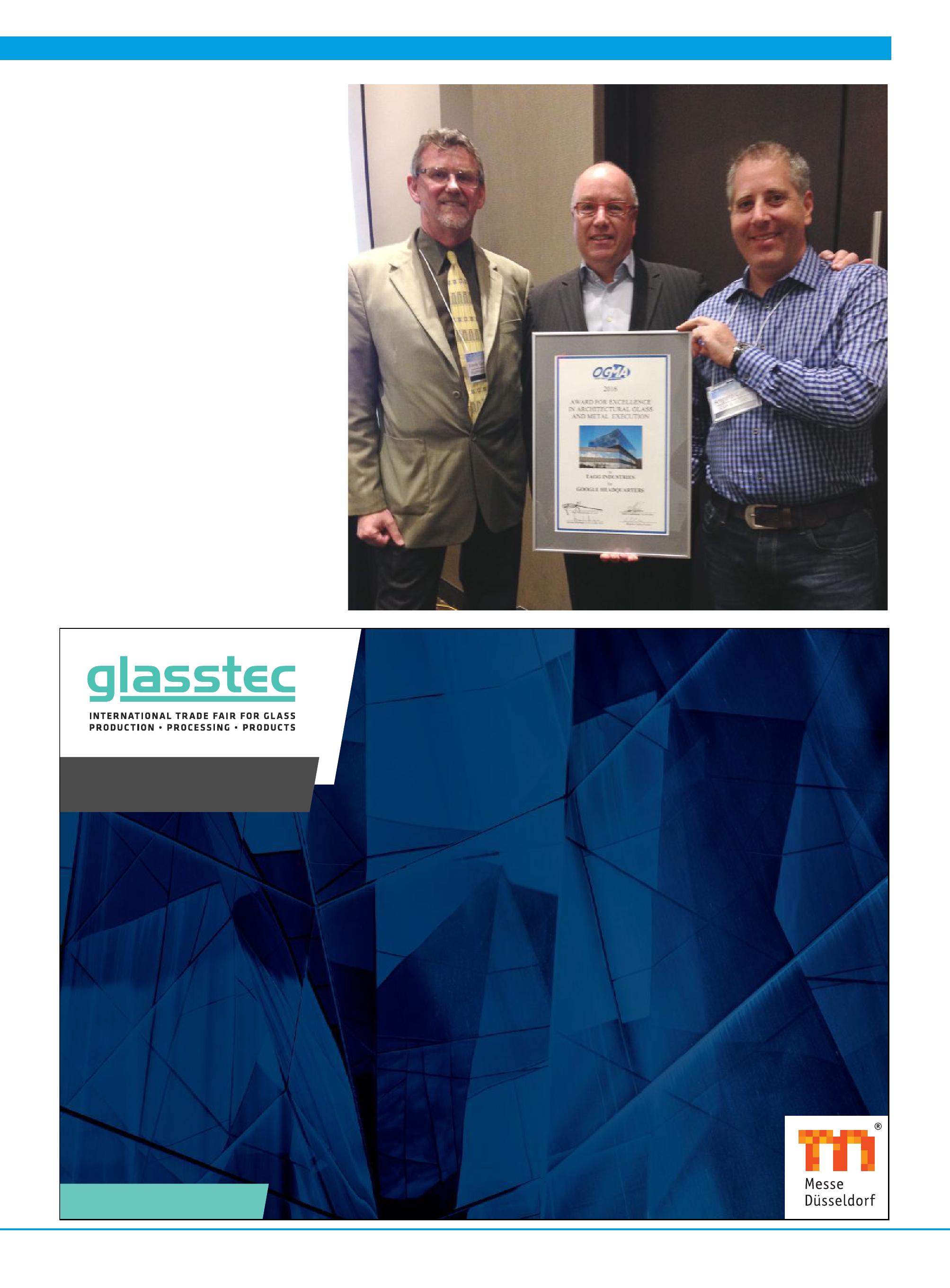
The Ontario Glass and Metal Association presented its Awards of Excellence to two Ontario companies at the Top Glass trade conference on April 20. TAGG Industries won the award for Excellence in Architectural Glass Execution, and Perkins Plus Will won Excellence in Architectural Glass Design. TAGG won for its work on Google’s Canadian headquarters in Kitchener, Ont., and Perry Plus Will won for Mohawk College’s David Braley Athletic and Recreation Centre. The award was judged by Adrian Phillips and Paul Marcoccia of CS&P Architects. Only OGMA members could nominate winners, but any Ontario architectural glass provider was eligible to win the awards. The OGMA is accepting nominations for its 2017 Awards of Excellence, which will be presented at Top Glass on April 19, 2017.
Amesbury Truth absorbs Giesse
Tyman
PLC has entered into an agreement to acquire the Giesse Group, which is composed of GSG International and Giesse North American (GSNA). GSNA, a leading supplier of hardware systems for the aluminum Euro Groove window market, will be unified with AmesburyTruth. The acquisition enables AmesburyTruth, a premier manufacturer of window and door components for residential and commercial applications, to broaden its commercial product portfolio and further penetrate the commercial market segment. GSNA includes a distribution and technical support center in Blountville, Tenn., where products are shipped daily to commercial window and door manufacturers across the U.S. and Canada. GSNA sources its products from GSG International, which will be united with Schlegel, a subsidiary of Tyman. The acquisition will allow for a seamless transition enabling the manufacturing and distribution
TheNational Glass Association (NGA) has announced it has joined the Glazing Industry Code Committee (GICC). Founded in 1983, the GICC was formed to interact with the model building code organizations upon behalf of the nation’s glass and glazing industry. Beginning in 2010, the GICC became a part of the Glass Association of North America as a standalone, semi-autonomous “committee,” open to all qualified companies and other trade associations serving the glass, glazing and fenestration industries. The current membership of GICC is a diverse group of companies and trade organizations involved in manufacturing, fabrication, distribution, or installation of curtain walls, windows, doors, and sunrooms and the glazing systems for those architectural products. This diversity enables GICC to analyze and pursue code actions on a wide range of glass and glazing issues.
“We recognize the important mission of the GICC to develop a greater awareness of architectural glass, glazing materials, and glazing systems as safe and economical products among code officials, government agencies and the general public,” said Nicole Harris, NGA president and CEO. “By joining the GICC, we are able to take a more actionable role to support and promote their important efforts.”
relationship to continue between GSNA and GSG international.
“We look forward to the opportunity to expand our commercial presence in North America,” said AmesburyTruth president, Jeff Graby. “Giesse is a good fit for our business as their objectives align well with the AmesburyTruth mission. Innovation is at the heart of what we do.”
The AmesburyTruth sales team will contact customers to ensure their needs are being met, but also to introduce them to a broad product portfolio inclusive of more hardware, weather-strip, and extruded solutions. “The team is eager to broaden our product portfolio by offering Euro Groove hardware to existing commercial customers,” said Mike McCann, senior vice-president of sales and marketing for AmesburyTruth. “This is also a great opportunity to provide new solutions for former Giesse customers.”
GANA executive vice-president, Bill Yanek, noted, “Code advocacy continues to impact the glass and glazing industry in a significant way. The stronger GICC’s voice in code forums becomes, the better our industry will fare. NGA’s membership is a welcome addition to GICC that will strengthen our glass and glazing industry advocacy efforts.”
In other NGA news, the association has published a newly revised Guide to the Glass and Glazing Requirements of the Model Building Codes – 5th Edition, a valuable reference to U.S. federal glazing laws, local U.S. glazing regulations and how they are related to American model building codes. “NGA’s mission is to educate and inform architectural glazing contractors, glass installers, architects, plan reviewers, building inspectors and specification writers,” stated Harris. “The updated guide will serve as a valuable tool to assist glaziers and glass installers in complying with all appropriate glazing requirements.”
The guide includes chapters on building codes, safety glazing, fire-rated glazing, structural requirements, energy conservation codes, green construction, accessibility, repair and alteration work, and compliance and responsibility. It is available to NGA members and its state chapters at the discounted price of US$69.95 and to non-members for US$104.85.
GlassCon Global schedule released
GlassCon Global, taking place July 6 - 9 in Boston, Mass., will include over 20 hours of robust programming designed to provide a variety of usable content relevant to all facets of the design and construction industry. Some of the key insights attendees will gain from the conference include:
• High-performance use of glass – Learn about the durability of glass including fire testing, noise absorption/sound scattering, laminated glass fin walls and acoustic interlayers
• Scientific research – Learn from the top scientific minds from around the world with presentations from our scientific committee
• Net zero, energy and sustainability – Understand energy code implications, thermal performance and production simulation, as well as benefits of insulating glass for commercial applications
• Security, fire-rated and laminated glazing – Learn about sealants, testing, safety requirements, design and dynamic structure of laminated glass
• Case studies – Hear from top minds about the latest developments, products and processes in the field
Attendees can expect thought-provoking discussion among global leaders and educational tracks geared specifically to address issues affecting all members of a project team.
waiting for pay
Average collection period (days) for receivables: Construction industry compared to all non-financial businesses 2000 - 2012
Average collection period (days)
IN ONTARIO...
almost one contractor in every five (18.7%) is carrying current receivables which have an average age of 90 days or more.
almost one invoice in every 5 (19.5%) that was outstanding for more than 30 days (excluding holdback monies) took 90 days or more to settle.
setting aside holdback monies, on average over the past three years, two-thirds (67.6%) of trade contractors’ invoices that were outstanding for more than 30 days, were overdue for more than 45 days.
almost a quarter of trade contractors (24.7%) reported that late payments had caused their company to face a threat of insolvency.
by MARGARET WEBB
Keeping trade knowledge alive
The IGMA’s first IG Fabricator Workshop was held May 3 through 5 at the Intertek testing facilities in Plano, Texas. IGMA plans to offer this workshop multiple times each year and at various locations throughout Canada and the U.S. Oak Moser of Oak Hill Consulting is professionally moderating the workshop. Oak, formerly a plant manager at a major fabrication facility, brings his years of experience to this new role.
The object for the workshop is to transfer knowledge and skills to the next generation. Many of the baby boomer experts will be retiring in the next five years and we want to make sure that most of that capital knowledge stays in the industry and doesn’t retire at the same time. Students gain valuable insight into the IG production process and forge networking connections that will last their career and are transferable both within their own facilities but also beyond. Have a problem? One of our subject matter experts or a fellow student will most likely have the answer or be able to provide guidance on where to find a solution.
So what made this training session different? This was predominantly a hands-on training event. Students rotate through various work stations to learn and practice many of the activities that are part of a regular IG production line.
The opening session on Day One started with an orientation on safety and basic information that the students needed to know for each work station. As safety in handling glass and other materials is paramount in the workshop, IGMA provided all students with personal protection equipment including full arm sleeves, safety glasses and cut-proof gloves. Mike Burk, chair of the IGMA Glass Safety Awareness Council and a trained adult education specialist, was on hand to ensure safety protocols were strictly adhered to.
Day Two is where the students put theory to practice. There were six work stations, each with its own expert moderator or instructor. Each hands-on session was approximately 30 minutes each so that each student had the opportunity to practice the specific task associated with the work station. Registration was limited to a maximum of 30 students to ensure that each one gets the individualized attention required to master a technique.
At the frost point station, Bill Lingnell, IGMA Technical Consultant, showed students how to set up the frost point device including how to properly use dry ice, place the unit on the measuring sensor, take a measurement and learn how to determine a pass from a failed unit. The volatile fog station with Jeff Haberer of Trulite Glass and Aluminum Solutions gave students the opportunity to view units both passed and failed per the ASTM E2189 procedure. The gas fill and measurement station with Randi Ernst of FDR Design let students gas fill their own IG units and showed them how to properly measure the gas content with the Sparklike GasGlass device.
David Cooper of Guardian Industries manned the sealant adhesion butterfly test and sealant mix test workstation teaching two activities: correctly scoring glass and following the procedure to determine primary sealant adhesion to glass, and also mixing a two-part sealant properly and determining that the mixture has been done correctly. Desiccant testing with Shulin Cui of SilicaStar showed two procedures for measuring desiccant capacity. The first used a pre-packaged desiccant kit commonly provided by suppliers and the second uses a microwave. Finally, glass cutting with Bill Briese of GED Integrated Solutions taught the importance of using cutting oil when cutting glass and showed students the results of a good cut versus a poor one. Students were also be able to see the effect on sealant adhesion when glass is improperly cleaned.
Day Two concluded with a networking reception where students had the chance to ask the subject matter experts questions on the day’s activities and consult with them about specifics in their own operations. Rounding out the workshop, Day Three focused on IG design, certification and testing, component compatibility and a facility tour to witness impact testing, full wall testing and hurricane testing.
Visit the IGMA website (igmaonline.org) for dates and locations for future IG Fabricator Workshops. •
IGMA
Margaret Webb is the executive director of the Insulating Glass Manufacturers Association.
When Service Counts
Features
SERIES 4000
Thermal Doors
• Designed for thermal efficiency in commercial applications.
• Series 4200 narrow stile has 2” (50.8) vertical stiles, 2-3/4” (69.9) top rail, and 3-7/8” (98.4) bottom rail
• Series 4300 medium stile has 3-1/2” (88.9) vertical stiles, 3-7/8” (98.4) top rail, and 5” (127.0) bottom rail
• Series 4400 wide stile has 5” (127.0) vertical stiles, 5” (127.0) top rail, and 6” (152.4) bottom rail
• Door is 2-1/4” (57.2) thick
• Dual welded corner construction
• Polyamide thermal break
• 1” (25.4) insulated glass infill
• Accommodate most HW in the market
• Standard push/pulls
• Polymeric bulb weather stripping and pile weathering in door frame
• Standard anodized finishes
• Painted finishes in standard and custom choices
• Tested to AAMA and CSA requirements
Optional Features
• Several sizes of top, bottom and mid rails
• Endless choices for different finishes interior and exterior
by SKIP MACLEAN
Skip Maclean is president of Fenestration Canada. He is business development manager for Tru-Tech Doors and has over 40 years’ experience in the window and door industry.
Change following change
“
Change is the law of life. And those who look only to the past or present are certain to miss the future.”
I recently read this on a colleagues post on Linkedin and thought how appropriate for this quote to reappear in my life. The quote from John F. Kennedy is more relevant to me now than at any time in my past.
Fenestration Canada has begun another phase in its journey to become the leading resource in all Canadian fenestration matters. Fully emerged into the second quarter of 2016, there is a general flurry of activity at both the association and membership level. The board of the association recognized that change was necessary to not only remain relevant but to also increase our effectiveness and influence on issues and opportunities that affect our members, our economy and our industry. After engaging a professional management company to help steer its activities, define its priorities, initiatives and policies, the association is fully poised to provide its membership with a competent and supportive voice in fenestration matters.
Now more than any time in the past, there is significant interest from young fenestration professionals to become involved and help define the direction our industry will take in the years to come. Fenestration products often take a backseat to other major building products such as kitchen and bath, flooring, lumber or roofing products, but are no less important and a major factor when energy efficiency and quality of living space are considered. Our industry will play a major role in shaping the way living and work spaces will look and act in the future.
Exciting new programs and features are being put in action.
FENESTRATION
The association has been asked to participate in determining future building codes, product specification guidelines, standards for sizing and placing of fenestration products for fire rated applications and many other fenestration- and building-related issues. By getting involved in these efforts, we deliver a benefit to fenestration professionals across Canada that cannot come from any other source. Governments and standards-developers can only act when the industry speaks with a unified voice that does not reflect the particular interests of any one company or region. We have recognized our power as a national association to act on behalf of the whole window and door sector, and are expanding our efforts to use that influence to help everyone. If you want to make sure your company’s interests are reflected in Fenestration Canada’s positions, I encourage you to get involved! Let’s make no mistake, Fenestration Canada is, in essence, its members, member companies and individuals who take the time to voice their opinions, listen to and understand those of their peers, apply their expertise and experience and learn from other fenestration professionals.
In the theme and spirit of change, exciting new programs and features are being put in action for both the upcoming Annual General Meeting in Mont Tremblant, Que., and the WinDoor show in Montreal. 2016 will mark the first year in its 21-year history that WinDoor will be located outside of Ontario. The decision to move the show to Montreal was not made lightly. Survey results from both exhibitors and attendees indicated that this move would not only cure the perception of “sameness” but would re-energize the event and promote the Canadian national perspective of our industry. Already the vibe surrounding the move is increasing in volume and several new features have been added. A new show committee, an experienced and engaged show management team and a unified commitment to change has never been more prevalent. Please commit to joining us for both these events. It is through the concerted effort, participation and involvement of Canadian window and door fabricators, suppliers and service providers that we can protect and promote our industry. •
TOPGLASSREPORT
TOP GLASS GETS RAVES
by PATRICK FLANNERY
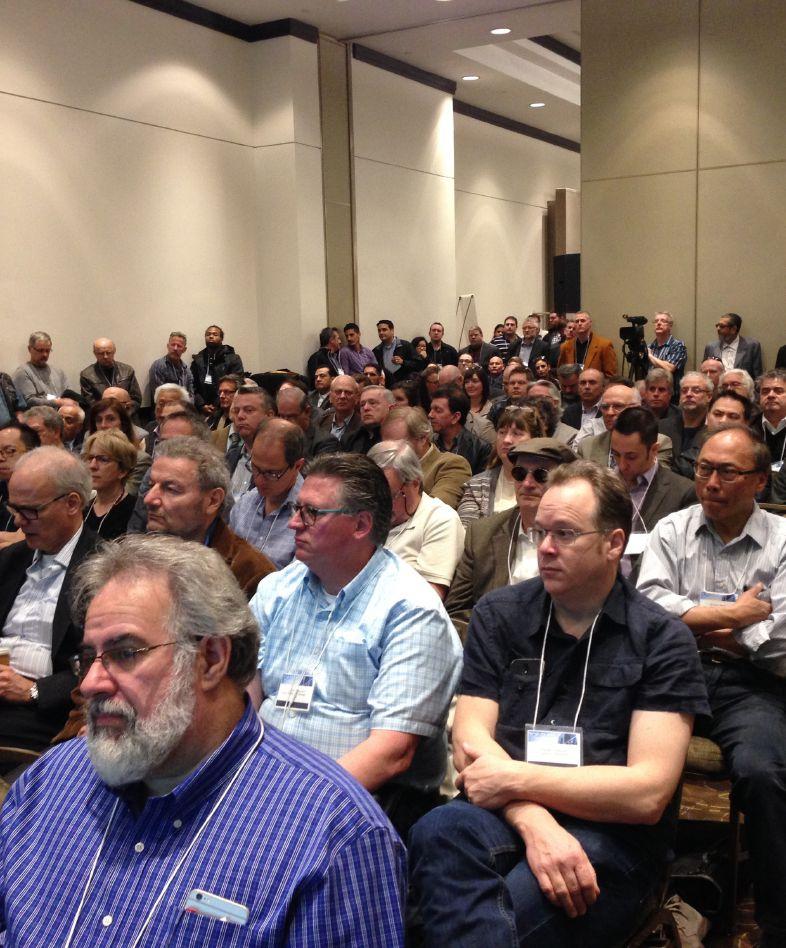
Top Glass broke records on April 20 with 383 attendees, including a strong turnout of 150 architects, specifiers and building engineers. The four one-hour education sessions were standing-room only as attendees flooded in to appreciate the presentations, which were eligible for continuing education credits. Top Glass was supported by generous sponsorships from Gold Sponsors Alumicor and Tremco; Silver Sponsors Commdoor Aluminum and RPM Rollformed Metal Products; and livestream sponsor Sika Canada.
The huge increase in attendance created some challenges for show organizers. Plans are in place to significantly increase the size of the lecture hall for 2017 and to streamline the process for collecting information for issuing attendance certificates.
Many attendees approached show organizers to express their appreciation for the event. They pointed to the high quality of the educational content, the convenient, one-
Appetite for education attracted big crowds.
day format and the chance to speak to so many professionals from the glass industry in one place as major benefits. “Thank you for hosting this day,” said Magid Youssef of 4 Architecture. “The topics were really interesting and well presented. I wish there were more events like this.”
For the first time, Top Glass education seminars were livestreamed to an online audience across the country. Excerpts from the livestream broadcast will be made available to attend-
ees in the coming weeks.
Exhibitors were delighted with the turnout and the quality of the attendees. “Excellent show, very well promoted and organized and the attendance speaks for itself,” said Yousif Abachi, vice-president of operations for RPM Rollformed Metal Products. “We are very confident that we will see results and orders.”
The education sessions included seminars on vacuum in-
ABOVE: Top Glass attendees overflowed the lecture hall to hear presentations on vacuum insulating glass, insulating glass failures, window wall challenges and laminar bonding technology. Organizers have promised a larger venue for next time.
RAVES
Steve Dulong, CEO of Tagg Industries (centre), accepts his award from Steve Gusterson and Angelo Cairo.
sulating glass, IG unit failures, window wall challenges and laminar bonding of large format glass panels. Attendees also took in the Ontario Glass and Metal Association’s presentation of Awards of Excellence to TAGG Industries and Perkins and Will for outstanding projects they completed in 2015.
Top Glass 2017 will take place April 20, 2017, at the International Centre. Organizers are accepting booth reservations (contact Danielle Labrie at dlabrie@ annexweb.com) and proposals for education sessions (contact Patrick Flannery at pflannery@annexweb.com). Online attendee registration is already open. •
20–23 September 2016
Düsseldorf, Germany
The
by BRIAN BURTON
Brian is now involved with an innovative multidisciplinary firm that specializes in technical business writing: Award Bid Management Services http://award-bidmanagement-services. com/. The firm assists companies interested in selling goods and services to governments and institutions. He can be reached at Burton@ award-bid-management.com
Winning the tender
The procurement policies of government agencies and publicly owned corporations require them to take reasonable steps to obtain the best value for their money and as a result most of them use variations of what is commonly known as competitive open procurement or open tendering.
It’s a very large market for fenestration products, however successfully capturing work of this nature can require considerable concentration of resources and is usually time-sensitive. It’s advisable to maintain an up-to-date proposal library that describes corporate personnel, past experience and other routine details to save time.
If you’re new to the practice visit; buyandsell.gc.ca > procurement-data > tenders > get-started.
Submitted tenders that meet the mandatory requirements are typically evaluated and rated on the basis of what is known as technical merit. The procurement team typically follows three basic principles to establish merit. It selects the best bid that meets all their requirements with a demonstrated track record for delivering on time and on budget. Next, it selects a supplier with a valid procurement business number that meets all the technical requirements such as insurance, security clearance and also meets applicable employment standards. Price is not always the most important factor when awarding bids. While pricing is important it so is the bidder’s reputation and perceived ability to deliver on time.
You can often improve your win rate by addressing three main criteria: basic appearance, supporting materials and by clearly demonstrating that you understand the vendor’s objectives.
The buyer or purchaser wants to know that you clearly understand the desired outcome.
FENESTRATION FORUM
Of course, you also have to clearly distinguish yourself from your competitors.
“Basic appearance” asks if the proposal contents follow the instructions of the request for proposal with regard to contents and formatting. Your approach, strategy and message must be clear and concise. You should select opportunities carefully, structure your proposal to match the RFP itself and include an executive summary. Be precise and avoid overuse of buzzwords and acronyms. Explain the benefits of using your services. Ensure formatting is consistent throughout the document. The desired outcome of the purchaser is not always entirely evident and it’s important to undertake a careful analysis of the tender if you want to improve your chances of success.
There are a few common omissions. Inadequate understanding of the buyer’s needs is one. The buyer or purchaser wants to know that you clearly understand what they often call the desired outcome. Failure to address all mandatory RFP requirements in the same order as they appear in the tender document is another common mistake. This is a very important point as in many cases the purchasing teams will review multiple submissions and yours will stand out if it is clear and properly ordered. Underestimating the time and effort required to write a winning bid proposal can lead to missed deadlines. Submitting unnecessarily long or complicated proposals can also be fatal. Avoid the overuse of jargon and acronyms. Make sure the vocabulary is understandable to the widest possible audience. Minimize the word count and keep in mind the reviewer’s will likely read multiple submissions. Avoid run-on sentences and long meandering phrases when one or two words will suffice. Avoid merely listing features and make a point to explain the benefits the client will experience by using your products or services. Make sure your content is consistent and has been double-checked.
If necessary, ask the buyer pertinent questions to determine their true buying motives and desired outcomes. A common mistake is to promote services whether or not they meet the buyer’s needs or produce the desired outcome. You must meet all mandatory requirements or risk having your bid disqualified. If you cannot meet all of the mandatory requirements find a partner that can. And lastly it’s considered good business practice to undertake a debriefing on each submitted proposal, win or lose. •
SEPTEMBER 13-14, 2016 OTTAWA, ONTARIO
COVERSTORY
GREAT GLAZING
Performance art
by Treena Hein
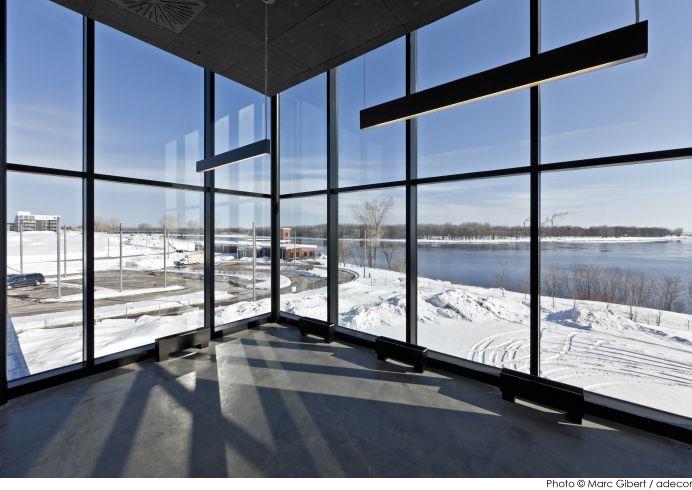
A breath-taking view of the Saint-Lawrence and Saint-Maurice rivers is central to the design of the new cultural performance venue in Trois-Rivieres, Que. Glass is also used extensively in the facades of the building in order to bring in as much light as possible to the foyer, ticket booth, administration offices, dressing rooms and storage rooms of the magnificent new $45-million-dollar amphitheatre.
The main auditorium is a completely outdoor space which holds 9,000 (3,500 seats). The venue is the starring feature of Trois-Rivieres’ new urban development area and is expected to become the new landmark for the city.
The northwest facade of the stage/ foyer tower building is glazed from top to bottom to maximize the view of the public plaza where people arrive, welcoming them into its spacious and light-filled interior. “In order to have a sleek, uninterrupted glass surface at the most prominent corner where the main entrance and foyer are located, we used a Kawneer Clearwall four-sided silicone system,” explains co-architect, Paul Laurendeau. “For the other openings, the Kawneer 1600 Wall System was used to save costs. For horizontal intermediate mullions, we used a structural silicone glazing option.” Clear glass with low-E coating was specified for all exterior glazing.
At the glazier, Vitrerie Laberge, project manager Michel Gagne says installation of the Kawneer Clearwall system (and all other glass features) went according to standard practices, “other than having been performed mostly in winter, rather than in the summer, as planned.” Both clear glass (Thermos 2-by-6 mm clear with low-E 366 and black R-Max spacers with argon) and opaque glass (Thermos 1-by-6 mm Supergray soaked with Cerafrit with black R-Max spacers and argon/6 mm clear tempered)
Amphitheatre Trois Rivieres embraces the rivers.
from Prelco were used.
Glass is also used in interior spaces to allow corridors and secondary rooms to have both natural light and indirect views to the outside, with the backstage corridor on the second floor offering an uninterrupted view across the whole building through successive glass partitions. Glass partitions also separate each office on the second floor acoustically while still allowing people to see each other, and all offices overlook the foyer. The glass partitions are full-height 16-mm tempered glass, notes Gagné, with Duranar black aluminum mouldings.
Various other types of glass were used in other interior spaces. “Mirropane glass (6 mm tempered laminated with PVB 060) was used around the manager’s office next to the ticket booth, for example, because of security required in money-handling activities,” says Laurendeau. “Another example is a small section of black spandrel glass along the bottom part of the ticket booth, which hides employee desks from outside views.”
Designed as a new landmark for the city, the Trois Rivieres Amphitheatre is filled with light and views of two of the town’s namesake rivers. Glass is used for security and privacy in the interior, as well.
Architects: Paul Laurendeau, François Beauchesne (joint-venture)
Glazing contractor: Vitrerie Laberge
Curtain wall/hardware supplier: Kawneer and Dorma
Fabricated glass supplier: Prelco
Vision glass: Type V-1, V-2 and V-3: 25 mm thermal unit composed of 6 mm clear tempered glass with Prelco low-E 366 coating on Face 2, 13 mm cavity with argon gas, R-Max black spacer bar, 6 mm clear tempered or clear heat-strengthened glass.
Spandrel glass : Type V-4: 25 mm thermal unit composed of 6 mm
Prelco SuperGrey tempered glass with black Prel-Coat Std #PC-9907 on Face 2, 13 mm cavity with argon gas, R-Max black spacer bar, 6 mm clear tempered glass.
Photo by Marc Gibert
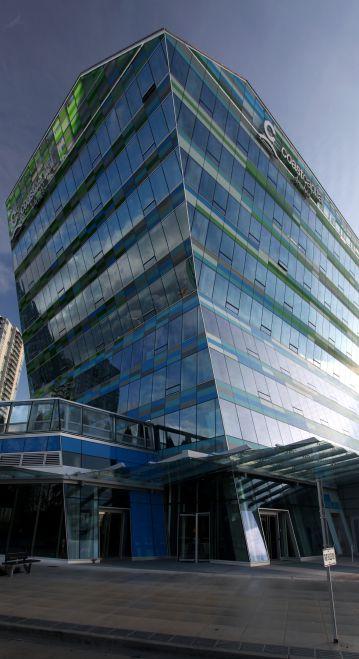
Youth and transparency are the catchwords in the design of Help Headquarters – Coast Capital’s new building in Surrey, B.C.
Reflecting change
by Rich Porayko
After over five years of planning and development, Coast Capital Savings, Canada’s largest credit union by membership, has moved into its innovative new headquarters in Surrey’s city centre. Dubbed “Help Headquarters,” the new building is the deliberate antithesis of a traditional corporate head office, with Coast’s brand, values and culture woven into every aspect, inside and out.
Designed to appeal to the changing needs of today’s workers, in particular those of Coast Capital’s own employees and its growing percentage of younger workers, the new office space reflects their values of transparency and community, and fosters an environment of collaboration.
The first of a larger four-phase project known as The Hub at King George Station, the Hub will provide over 760,000 square feet of LEED Gold, transit-oriented office and retail space in multiple phases, as well as approximately 1.2 million square feet of residential space in later phases to the heart of Surrey – B.C’s fastest growing city.
PCI Developments Corporation constructed the 185,000-square-foot Coast facility and Musson Cattell Mackey Partnership Architects (MCM), the firm behind the eye-catching Vancouver Convention Centre West, designed the building.
“Coast Capital Savings’ new Help Headquarters is a significant project for us and one we are pleased to have collaboratively designed and built with the Coast Capital team,” says Andrew Grant, president of PCI Developments.
“The overall design of this building incorporated a series of alternating slopes, both positive and negative along all four elevations resulting in constant change in glazing make-up, glass capturing methodology and the challenges of designing a unitized system able to handle the intricacies of compound transitions at
the future.
all outside corners,” says Russ Jackson, business development manager for Flynn Canada. “The make-up of inboard and outboard lites changes from heat strengthened to heat strengthened laminated depending on the orientation of the various sloped walls.”
“These issues were compounded by a tight schedule and small construction footprint. The building’s north elevation
Glazing contractor: Flynn Canada Ltd.
General contractor: PCI Developments Corp.
Curtainwall: Custom application FlynnWall four-sided SSG, unitized, pre-glazed curtain wall with 5250 Series OptiVu vents.
Glazing system: Structurallyglazed canopies with inverted spider fittings; structurally glazed seamless balustrades; interior glazing including structural glass staircases and miscellaneous glass.
Vision glass: 6 mm clear outboard lite with low-E on surface 2/ 13 mm airspace with argon gas and thermally broken spacer bar/6 mm clear inboard lite.
Spandrel glass: 6 mm clear tempered with custom, multi-coloured frit.
ran parallel to an active Skytrain line, and the west elevation along one of Surrey’s busiest roads. As a result, Flynn’s forces not only had to work diligently but also creatively in order to perform their work in a safe and timely manner. Truly, Flynn’s glazing foreman, Jeff Anderson, was not far off the mark when he commented, ‘On Coast Capital, we never saw the same condition twice.’”
An aluminum veil breaks up glare and diffuses light through the upper storeys of this Toronto residence. Creative use of off-the-shelf windows generates a unique living space.
Behind the Veil
by Jack Kohane
A “house-for-all-seasons” is an apt description of Toronto architect Paul Raff’s most innovative handiwork: Counterpoint House. “The design objective was to create a practical and functional family home, which nurtures a healthy family dynamic,” he says. “Glazing was a huge part of achieving this goal. I believe there is not much in the world of architecture that’s more important than natural light and view that can be enjoyed year round.”
Selected by Azure Magazine as among the world’s top 10 residential projects, Counterpoint House offers airy and modern interpretations on such mundane elements as windows, roofs and porches, to bolster an open concept interior with a strong sense of connection to the outer garden, trees, and sky. Located in the upscale North Toronto community, its 2,500 square feet of living space is sited on a compact 25-foot-wide footprint.
The homeowners moved to Canada after years of living overseas. After a lengthy search to find one house in this sprawling city that they wanted to live in, they finally viewed this lot, which afforded great potential. “So they sought me and my team out to design a ground-up new home for them,” says Raff.
Natural light is one of the main drivers of the design. Expanses of glass and carefully placed windows to frame the views help provide a comfortable, uplifting environment in various times of day and in various seasons. The upper levels of the house are set back from the street face of the building allowing a large south-facing clerestory window to flood the middle of the house with sunlight. Its function and flow facilitate the many family-oriented endeavours the clients sought. Additionally, the unusual split level stepping of its upper floors and bold window openings create a feeling of airy spaciousness. On the ground floor, a floor-to-ceiling picture window offers a view straight through the first floor to the back garden.
With south-facing basement windows, the lower level offers a light-filled comfortable get-away for the many family members who often visit from abroad.
But the home’s keynote feature is the refractive aluminum veil on the front façade’s upper levels. The design is based on the concept of a light shelf (in this case, 220 of them) where, particularly in the midday hours of winter, excessive glare is diffused by bouncing light deep into the space of the building. “Their highly polished top surfaces bounce sunlight deep into the space,” explains Raff. “It imbues the interior with a glow and a dynamic pattern of shadows and reflections that shift across the space over the course of the day.”
Three different glaziers were involved in this project. At Counterpoint House (a term that denotes the various living spaces here that are spatially both
Architects: Paul Raff Studio.
Glazing contractor: None.
Windows: Bauhaus Windows and Doors, Slung Suspended Systems Corp (triple track sliding glass door) and Tiltco Windows and Doors.
independent and interdependent), the glazing process and installation basically worked within the normal conventions of the construction industry.
“Most importantly, the glaziers helped create the light and shadow effects at Counterpoint House that are absolutely entrancing,” gushes Raff.
Counterpoint House uses an innovative screen system.
Photo by Ben Rahn/A-Frame
Digital display turned “off”
Digital display turned “on”
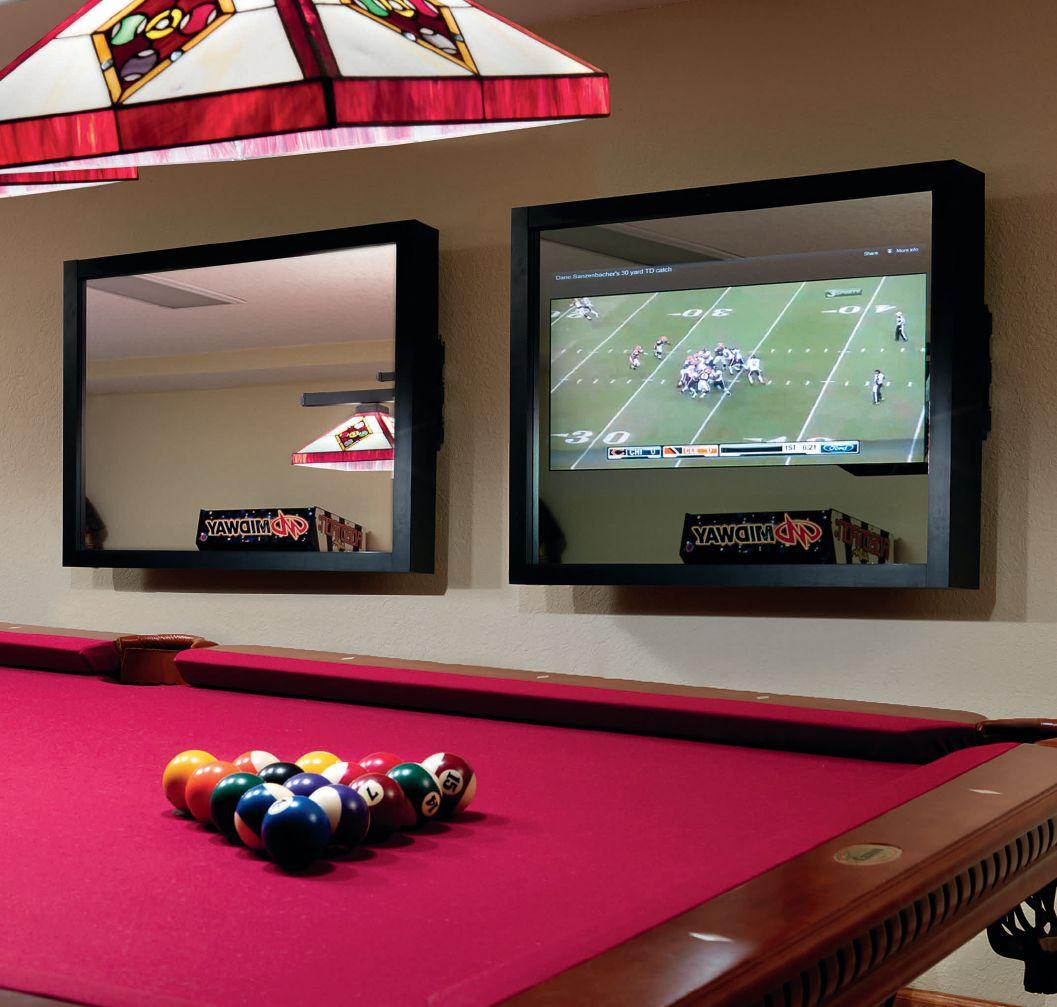
Pilkington MirroView™ 50/50 and Pilkington MirroView™
Pilkington MirroView™ 50/50 and Pilkington MirroView™ are ideal for concealing digital displays and video screens for commercial and residential applications.
The glass appears to look like a normal mirror when the display is ‘off’, but when the display is ‘on’, the image shows through the mirror for an unobstructed view of the television display beneath. This modern and transitional glass is very durable and can easily be handled, transported and processed. Pilkington MirroView™ 50/50 is designed for use in applications with high ambient light, whereas Pilkington MirroView™ is designed for low ambient light applications.
COVERSTORY
Both the dramatic, S-shaped bay window and innovative, 90-degree silicone-mitred window are visible here.The glazier says the mitred window is not hard to do for an experienced installer, but is still uncommon in residential builds.
Harmonious Living
by Treena Hein
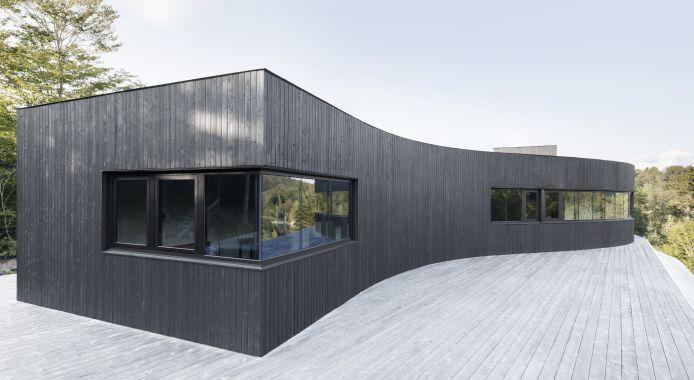
The stunning “La Heronniere” home in Wentworth, Que., was designed to be functional and environmentally-friendly, but also starkly beautiful, with striking glass features that complement the building’s natural surroundings. “A young couple with two children wanted to build a house representing their values, their desire to occupy a natural setting harmoniously,” explains the architect, Alain Carle.
The house is energy self-sufficient (using wood for heating and solar panels for electricity generation), and the site design incorporates things like recovered aggregate residues from the foundation excavation. The use of glass helps with energy efficiency, enables the family to grow some of its own food and also allows family members to feel connected to the outdoors. “The glazing, while contributing to technical passive energy objectives,” explains Carle, “also acts as a frame on the landscape.”
This unique home is situated on a steep slope, with an upper sleeping area and a lower living space that’s joined to the outdoor living space through a small greenhouse, placed in continuity with the big bay window on the southwest side. The bay window features clear lowE (Te67 on Face 2) plus argon glass with vertical silicone joints, segmented to create an S-shaped bay of glass.
Another S-shape is found in the most
stunning glass feature of the house, a long curved window on the second floor, creating a ribbon of window with what Carle describes as “complex geometry.” Gaetano Asaro Jr. of Alumilex (the glazier and fabricator) says the continuous window features pieces of glass (Te67 with argon, as above) jointed with silicon with mullions at several openings. “It was quite an easy task to achieve,” he notes. “We had custom-measured everything and then custom-made the window wall, but when the installation was first occurring, it became clear that the opening wasn’t to the right measurements. So the framing of the opening had to be re-done.”
Another striking glass feature of the house is windows with 90-degree angles and silicon-mitred corners. “We do a lot of those. We’ve been doing them for 20 years and they are not complicated, but they are new to the public in residential applications,” says Asaro. “The average customer in an average store won’t easily find people able to do these or even consider them as an option because they are not common in houses. They’re used in commercial applications and high-rises,
How did we choose?
As you look at our feature on Canada’s outstanding architectural glazing projects, you are probably thinking of a project or two that you feel is more innovative, more esthetic, better executed or otherwise more deserving of notice. And that’s OK. This review is meant to show examples of great Canadian glazing, not to act as an exhaustive list or to rank these projects as
the “best.” The goal is to give you a look at what our industry is achieving across the country, and maybe to spark an idea that will help you in your business.
To find these projects, Glass Canada editor Patrick Flannery spent time searching on the internet, asking industry veterans and looking back through files and notices for projects that have
Architects: Alain Carle Architecte
Glazing contractor: Alumilex
Fabricated glass supplier: Alumilex
Vision glass: 6 mm clear, low-E (Te67 on Face 2 ) x 6 mm clear. Tempered when required by code.
but not in houses very much so far.”
There are also very large glass doors on the lower level, which Asaro explains are opened with a massive ALX120 lift-andslide mechanism. There are mechanical arms attached to the opener hardware at the top of the doors, allowing the occupants to open small venting ALX2060 windows without having to use a ladder or chair.
Asaro says most of the windows face southwest, capturing lots of sun and warmth. “This building has better energy performance than the average building,” he notes, “not only because the windows and other components are top-end but because the orientation of the building on the site was well thought-out.”
attracted the attention and admiration of people in the architectural glass community. Many of these projects have won awards for architectural design. If you feel there is an important project that we have overlooked, do drop Glass Canada an email at pflannery@annexweb. com to let us know about it. Maybe we will include it next time.
La Héronnière’ blends function and innovation.
Photo by Alain Carle
The renovated Kitchener Public Library has achieved LEED Gold certification with triple glazing and specially fabricated large format low-E glass. The award-winning design combines new materials with a classic building without clashing.
Wrapped in glass
by Jack Kohane
Like a good book, the freshly renovated and expanded Kitchener Public Library manifests the best of its architectural past while embracing the marvels of the present. Opened in May 2014, the new building designed by Toronto-based Levitt Goodman Architects Partners (LGA) in joint venture with Phillip H. Carter Architect, culminated a four-year, phased construction process during which the library remained operational.
Priced at almost $50 million, the project (now certified LEED Gold) encompasses 82,000 square feet of renovation and an addition of 30,000 square feet, transforming a historic 1960s Modernist building into a gleaming repository enveloped by a new wall of high-performance glass. “To us, the project was like putting a ship in a bottle,” says LGA’s José Castel-Branco, contract administrator of the project. “It became a study, architecturally, in incorporating new elements into a wrapper of the original.” On the street side, the architects added a new layer of glass that turns the existing heritage façade – of sculpted, curving concrete and fieldstone – into something akin to an old tome on display.
“The building’s state-of-the glazingart exterior interlaces a black granite base with a continuous volume of highperformance curtainwall,” notes CastelBranco. The curtain wall, fitted with fritted and spandrel panels, sits proud of the base and is a clear span from floor to parapet at approximately eight meters tall without internal reinforcing. The frames were fabricated in modules and shipped to site for quick installation and glazing. The curtainwall encircles the building, allowing access and revealing portions of the original library exterior.
“We work on projects that are far from standard – and this was one of them,” says Angelo Cairo, president of Stouffville Glass, the glazing contactor. He explains
by
that anti-reflective thermo units at the west elevation used 12-mm laminated glass giving a reflection value of only three per cent. All canopy and interior glass used tempered laminated glass with frit coatings for balustrades and 12-mm clear tempered glass for office partitions.
Cairo points out that the interior of the project posed hefty technical difficulties. “Very wide oversized glass doors (CRL was the hardware supplier), and the standoff fittings all needed to be drilled and tapped into the face of steel for the feature stairs. Making sure every single hole lined up and was in the right spot was top priority to ensure when the glass was installed it was going to be installed properly the first time.”
A stunningly elegant community interactive hub for the city of Kitchener, located one hour west of Toronto, the library houses hundreds of thousands of books, along with plenty of comfortable seating and lounge areas, a refurbished 200seat theatre and a children’s library featuring heated floors and kid-friendly furniture.
“Some forward thinking was required for the building’s design,” notes CastelBranco. “That is, to create the kind of spaces needed for public activities, quiet spaces and busy social spaces – just how a modern library works.”
In May 2015, LGA captured the OLA (Ontario Library Association) Award for Library Architectural and Design Transformation.
Architects: LGA Architectural Partners
Glazing contractor: Stouffville Glass
Curtainwall: Oldcastle BE (formerly Fulton Windows), anti reflective OptiView thermo unit from Pilkington Glass with special coating on Surface 1,4,5 and 8 to achieve a reflective value of less than two per cent.
Curtainwall glass fabricator: Agnora
Vision glass: Triple glazed low-E on Surface 2, argon gas and frit on Surface 3.
Exterior glass: Fabricated and supplied by J.E. Berkowitz L.P.
Interior glass: Fabricated and supplied by Prelco.
Interior glass balustrade hardware: C.R. Laurence
Glass specification: Pilkington Eclipse Advantage low-E coating units: triple glazed R5. Solera R9 double-glazed diffusing glass for the translucent panels. Stouffville Glass spandrels: acid etched, back-painted, 12.9-M, low-iron tempered backpainted double glazed and Prelco back-painting of the sealed unit IGU shadow boxes.
The Kitchener Public Library preserves the old with the new.
Photo
Ben Rahn/A-Frame
COVERSTORY
Water informed the design of Telus Garden, both outside and in.The building is designed for beautiful views of Vancouver Harbour, and to incorporate hydronic heating and cooling that circulates water through the building.
Glass meets nature
by Rich Porayko
Telus Garden is a one-million-squarefoot development in downtown Vancouver that encompasses a whole city block. It consists of three separate buildings: a new 22-storey office tower on Georgia Street, a new 53-storey residential tower on Robson Street and a upgrade to the existing Telus telecommunications building on Seymour Street. With a total of 91 LEED credits achieved, TELUS Garden is the highest scoring LEED Platinum-certified office building in Canada.
“At the heart of the sustainability strategy is the central plant which connects all three buildings together,” says Peter Wood, director of architecture for Henriquez Partners Architects.
“The existing Telus building is full of telecommunications equipment which produces a significant amount of heat. In order to cool this equipment, energy is discharged into the atmosphere. The new development captures this excess energy and shares it between buildings on the block, including being connected to the downtown district energy system.”
According to Wood, unlike conventional buildings that use air to heat and cool, Telus Garden uses water, which is a far more effective medium to transfer energy. It also takes up less space, allowing for a lower floor-to-floor and ultimately more floors. Heating and cooling is delivered to the space by perimeter fan coils and in-slab radiant pipes.
In addition to advanced mechanical systems, the buildings also utilizes high performance envelope and various passive solar strategies. In fact each facade of the office building is responsive to its particular environmental aspect. The east and west facades have 600-millimeter-deep vertical glass fins, including horizontal frit at the head of each window to reduce solar gain and glare. The south facade has 1500-millimeter-deep
Telus Garden is not your standard reflective box.
horizontal sun shades and the north is floor to floor glass to capture views of the spectacular Vancouver Harbour.
Other sustainability strategies that the office building uses are stormwater retention, water conservation and collection, vegetated green roofs, photovoltaic arrays and a integrated building control system.
“From the start we did not want the office tower to look like your typical tinted or reflective glass box,” says Wood. “We did not want to disconnect the occupants from the outside world: the views, the weather and the time of day. All these things contribute to a more healthy and productive workplace. To correct this we looked for a triple-glazed low-E glass with highest visible light transmission we could find. This allowed considerable amount more daylight to flood in, which in turn reduced the need for artificial lighting. Reduced floor plate depth and the deletion of the traditional dropped ceilings also allowed for daylight to penetrate deep into the space. For some of the more public spaces like the lobby or the Sky Gardens we switched to a structural glass system and low-iron glass to better blur the distinction between inside and outside.”
“We were considering dynamic glass at one point, including incorporating LED into the curtainwall as a media facade, but we saw much more potential for architectural expression and energy savings by exploring simple low-tech passive shading elements. Just as we didn’t want to create yet another corporate glass box, we wanted the building to be seen clearly as Telus’ commitment
Architects: Henriquez Partners Architects
Glazing contractor: Central Glass (Iljin), Korea
Glass supplier: Shanghai Pilkington
Pavilion roof curved glass: Echo Glass
to a more sustainable world and a better workplace. This idea culminates best at the top of the building with a floating array of photovoltaics – a halo of sorts.”
The future is also friendly for birds at Telus Garden. Passive solar shading devices help with bird mortality by avoiding glass strikes. The development of every horizontal roof service into an extensive or intensive green roof also created ecosystem for birds and bees in this very urban location.
“Besides the horizontal and graduated frit at the head of the curtain wall windows, the glass, steel and glulam pavilion along Georgia Street has a decorative frit. This pavilion spans an entire city block, providing weather protection over the plaza at one end, while transforming into the roof of the lobby at the other end. The glass has an abstracted branch and leave pattern fritted into each curved piece, creating the effect of being under a forest canopy.”
The extensive use of fritted glass soffits contributes to a dematerialization of the building by providing a reflective surface by day, while at night a canvas of architectural lighting effects at a civic scale. •
BRING YOUR VISION.
“Our choice in glass opens up a historical structure to highlight its character, while creating a bright, comfortable, modern workplace.
SNX 51/23 delivers exceptional clarity and energy performance, without unwanted tint or reflections.” JOSH
Doing it with culture A focus on
people drives National Contract Glazing.
National Contract Glazing has landed major projects all over the Ottawa. Retaining key employees has enabled it to take advantage of a steady stream of work on ICI projects. Expertise on the job site leads to success and fast completion.
When National Contract Glazing’s John Bastedo is asked what’s unique about the company, he doesn’t hesitate. “It’s the people,” the vice-president states firmly. “We have a process to put a job through, with many people involved. Each job is passed on, and this keeps us on top of jobs and also shows contractors we are on top of things, which builds our credibility. We are proud of our excellent track record of project completions ranging from less complex store-fronts and entranceways, to multi-story, multi-phase contracts in both the private and public sector.”
National Contract Glazing was formed in 2000 by Bastedo and president Jean-Guy Tremblay at a point when both men had already been in the industry for twenty years, Jean-Guy as a site supervisor and Bastedo as a manager at various companies. At that time, they were working together again after also having worked together at another company in the past, and they found it was a combination of factors made the option of doing their own thing very attractive. “The company I was managing
AT A GLANCE | National Contract Glazing Limited
was amalgamating all its branches to be under one roof in Montreal, and that left both Jean-Guy and I as their only employees outside Montreal,” John remembers. “We both stayed on, and I did several years of travelling across Canada and into the U.S., but then they wanted me to move to Montreal and I didn’t want to do that. I went with another company but I didn’t see a future there, and Jean-Guy had started a business, so we took the plunge and formed a partnership. We didn’t draw a salary at first, we kept working for our employers at the same time. We both had many contacts with general contractors, architects, estimators and so on, and Jean-Guy knew the site and shop personnel. We started with small jobs, with people who knew us throwing us some bones, and away we went.”
Bastedo says they’ve always had a really good partnership, with a clear dividing line of responsibilities along with great communication. “I have to know what’s going on onsite and figure out estimates but I’ve never worked on site and neither of us tells the other what to do,”
Company incorporated: May 2000
Number of employees: 50
Plant square footage: 8,000
Owners: Jean-Guy Tremblay (president) and John Bastedo (vice-president)
Main focus: Design, fabrication and installation of aluminum curtain wall, storefronts, windows, skylights and glazing. Recent projects include Carleton University MacOdrum Library (high-performance structurallyglazed curtainwall, windows, doors, all-glass doors, skylights); St. Francis Xavier High School (curtainwall, skylights, windows, and doors); Genivar Building (segmented curtainwall, windows, doors, all-glass doors); Irving Greenberg Cancer Center (high-performance triple-glazed curtainwall, doors, all-glass doors and screens).
Website: www.nationalcontractglazing.com
he explains. “I get the business, Jean-Guy gets it done.”
Soon after deciding to start their own firm, they found Kathy Knox, who continues to serve the company today as office manager and book-keeper, and added more employees as time went on. “At first, our work space was so small, we couldn’t even turn around an aluminum extrusion 24 feet long,” John recalls. “We could do small jobs but it really limited us. So then we got an industrial space and have been there ever since. We try to run a lean ship with basic equipment, but at the same time, we have everything needed to work efficiently. We’ve partnered with a company that does only fabrication that increases our capacity enormously without having to renovate or expand.”
Bastedo says they don’t do a lot of advertising as the work comes to them. “We’ve grown to a comfortable level that our overhead will handle,” he says. “Sometimes it’s a struggle to get enough work but we’re equipped to do the work with the people we have. The whole business is based on our people and our capabilities and we really value them. And if we let them go, we’ll never get them back.” John really wanted others in the company to have the opportunity to include their voices in this story, which says a lot about the company atmosphere, and here are the responses from some of them.
NCG has come a long way since its first location, where they couldn’t turn around a 24-foot piece of aluminum. Now the company operates out of an 8,000-square-foot shop. A zo n S a ves
Staff reflections
Office manager Knox recalls that at the start, “We were renting a very small space, so small that Jean-Guy, John and I shared two desks. We’ve gone from 15 employees in total to, at one time, 81. All our projects have numbers and one thing that sticks out in memory is our first job over one million dollars was number 100. Very appropriate I think.”
Chief estimator Michel St. Denis first met Jean-Guy and John 20 years ago when he was a draftsman fresh out of college. Later, when NCG had formed, Michel was asked by John over breakfast one day if he would like to join the team. “This summer will mark 11 years from my hiring,” he notes. “I primarily work daily with John, and the combination of our many years working together is a
strong reason for the success of NCG. Together, John and Jean-Guy have created a company that has a friendly, comfortable and respectable work environment.”
Bastedo calls Keith Cowan the company’s “catch-all” guy, who is responsible for health and safety, IT, invoicing, cost monitoring and also filling in for John when he’s away. Cowan was initially brought into NCG as a project coordinator, but says he was also explicitly challenged from the start to take his business management experience and look at all aspects of the company’s operations with an eye to improving efficiencies. “The aspect of working at NCG that I value the most is the feeling that we’re all willing to be actively involved as members of the team,” Keith says. “This starts with Jean-Guy and John and their eagerness to truly empower all of us to be effective. Being a mid-sized company, there is no “corporate” feeling, and therefore dayto-day issues are dealt with promptly,
Daylighting systems produced with Azon structural thermal barrier technologies—the MLP™ or Dual Cavity—for aluminum windows and curtain wall, along with high performance glazing components for insulating glass, will yield a fenestration system capable of upholding the highest efficiency and sustainability standards
efficiently and with the direction and help of the owners as required. It may sound like a cliché, but I truly do believe that NCG’s greatest strength is the incredibly strong team dynamic that Jean-Guy and John have fostered. I believe that it is this dynamic that has enabled NCG to mature as a glazing contractor that excels at completing highly complex projects.”
NCG has one senior project manager, Ron Coppens, and two others, Jason Georganas and Alex Wertwyn. Georganas says “The reason I chose NCG was because of the personnel and reputation they have. What I found unique is that they do not have a turnover of personnel. In the nature of this business, this is irregular to be able to maintain the same team for such a long time.” Not long ago, Wertwyn was offered a project manager position after working for NCG for some time before that and being encouraged by John and Jean-Guy to take formal project management training. “Knowing the amount of effort I had put in to my work while continuing my education and then, in time, being offered this position,” Alex notes, “has given me the sense that a bright future here is both possible and likely if you’re willing to work at it. The perseverance, patience and collective knowledge of those who run the show around here have helped me to succeed in my current position. We have a strong team with good values.”
You must be doing something right when top building engineers select you to build their headquarters. NCG provided the segmented curtainwall for the Genivar building (now WSP Global).
Evolving industry
Over the years, Bastedo says a major change they’ve dealt with is the evolution of curtainwalls. “We’ve had to keep up with the new products and change how we are doing things,” he explains. “It’s not that we are designing but we have to understand what the designers are trying to achieve and we have to keep up. It’s all about performance, low-E coatings, different types of glass and aluminum doors. The array of products is always developing and it’s almost endless. The building code is becoming more stringent too, and you also can’t use things that were used in the past.”
He notes that being in Ottawa has been positive in that it’s always busy. “If it’s not government building work, there is infrastructure, institutional or commercial. You don’t get the severe downturns you might see in other markets.” At the same time, Bastedo is clear that some years have been just break-even. “It’s challenging mentally, and you wonder why you are working hard but you need to maintain your team,” he says. “Collecting money can also be interesting. You’ve got to know who you’re working for. And early on, we found it
a bit difficult to expand, as the banks wouldn’t lend us money, just a line of credit.” About 18 months ago, John and Jean-Guy decided to hire another estimator, and it’s been a very good move. John says with two estimators, they are twice as likely to get projects and their volume of work has gone up.
Employment on-site is one of the biggest ongoing challenges. John says all NCG site workers are unionized, and Jean-Guy’s long experience onsite and with the union has provided him with solid knowledge of what individuals are capable of and who works well with whom. Another long-term employee, senior site superintendent Ross Tobin, assists Jean-Guy in ensuring the sites are running smoothly. Tobin worked with both Jean-Guy and John in the past and brings invaluable experience to the table. “We have built a solid core of site supervisors over the years,” he says, “along with a strong team of site workers that enables us to handle jobs of any size and complexity.”
John, Jean-Guy and the rest of the NCG team are looking forward to 2016 as another opportunity to build on their reputation. •
S U M M E R C O N F E R E N C E
A U G U S T 8 – 11, 2 016
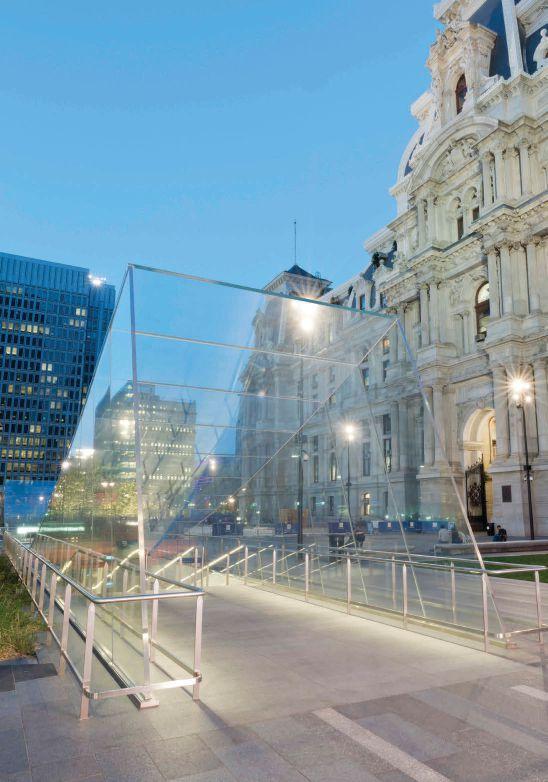
Architect: KieranTimberlake
Installed by APG International
Dilworth Park
92 lites of 5-ply and 7-ply laminated, oversized, structural glass that protects access to public transit without any metal structure supporting the roof.
FLATGLASSSHOWCASE
Exceeds today’s requirements
us.agc.com
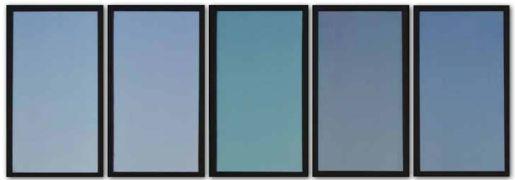
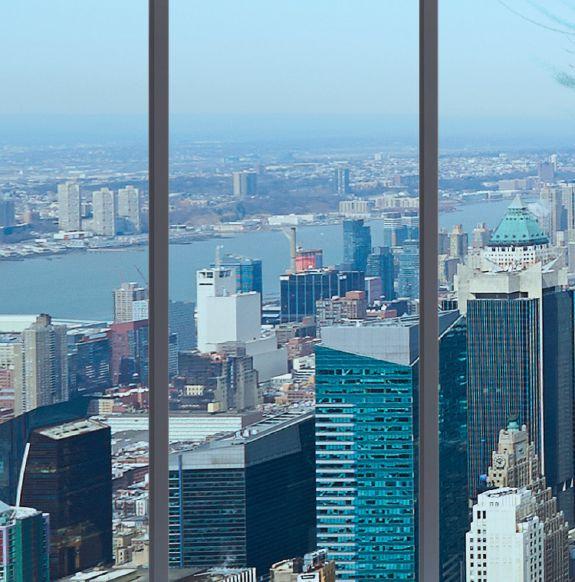
AGC Glass Company’s new Energy Select 23 is a high performing triple-silver coating on a clear substrate that delivers a neutral blue aesthetic with the combined performance of a 0.23 solar heat gain coefficient and 50 per cent visible light transmittance. It is ideal for meeting the most challenging energy code requirements. This is the latest step in the development of AGC’s range of advanced coating technology. Available in annealed and post-temperable, Energy Select 23 is designed to achieve the highest level of solar control performance possible using a clear substrate without compromising the neutral colour desired by architects. It is designed to keep more heat out and let natural light in to achieve greater indoor comfort and energy savings for the hotter climate regions. Energy Select 23 is part of the family of low-emissivity coated glass products that offers high-performance glass solutions that go beyond what is required today, positioning architects to meet the challenges of designing for the future.
Perfect for showers
guardian.com
Guardian Glass North America introduces Guardian UltraClear glass, a low-iron product that delivers maximum clarity and colour neutrality without the green tint of standard glass. Elevating light transmission and presenting views that are near trueto-life, UltraClear glass is a featured product from Guardian InGlassT, a complete offering of interior glass solutions.
It takes more than the latest equipment to turn a sheet of glass into a work of architectural art. At GGI, we enjoy pushing the capabilities of our machines, we love taking on unique projects, and we are proud to work with architects and designers who are dedicated, as we are, to enhancing the built environment.
“Architects and designers choose UltraClear glass to bring natural light deep into interiors,” explains Sarah Wansack, interiors segment product manager for Guardian Glass North America. “The versatility of UltraClear glass means the product can be used with many low-E SunGuard coatings to combine vivid clarity with the high performance SunGuard coatings bring.”
Interior applications include frameless enclosures, walls, partitions, entranceways, display cases, tables, railings and more – all bringing pure, bright and boundless clarity.
“Guardian UltraClear glass allows natural light to pass through with remarkable clarity and brilliance that is perfect for shower applications,” says Jared Ross, president of Cardinal Shower Enclosures. “Frameless shower enclosures are in high demand, and customers want the true colour transmission without the green tint from standard glass. Guardian UltraClear glass offers colour neutrality all the way through to the edge.”
Fabricated, laminated and heat-treated like standard float glass, UltraClear glass elevates the performance and aesthetics of
a wide range of glass products, whether it’s laminated glass layers without the distortion, back-painted or spandrel glass that achieves a true colour match, or simply stunning clear views. Manufactured in Corsicana, Texas, UltraClear glass is available in thicknesses from two to 12 millimeters and sizes up to 130 by 204 inches.
Possibilities for historical restoration
pilkington.com
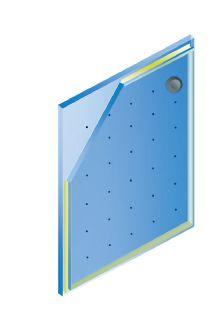
Pilkington Spacia is the world’s first commercially available vacuum glazing. It offers the thermal performance of conventional double glazing in the same thickness as traditional, monolithic glass (single piece of six millimeters). Spacia provides a real solution to the problems of balancing historical preservation with modern comfort and environmental requirements. This product offers a costeffective method of improving the energy efficiency of older homes where glazing dimensions are physically limited or where maintaining the original frames is desired. Spacia vacuum glazing consists of an outer pane of low-emissivity glass and an inner pane of clear float glass, separated by a micro-spacer grid of tiny pillars, each measuring 0.5 millimeters in diameter. The grid ensures that the panes are kept a fixed distance apart. The edges are welded to achieve a hermetic seal. Air is extracted to create a vacuum via the extraction point, rather than being filled with air or gas. Because there are no gases in the space for convection or conduction, the thickness between the two pieces of glass can be extremely thin (0.2 millimeters) while still achieving the desired energy improvement. The result is excellent thermal performance
Low-e glass
Pilkington Spacia™
FLATGLASSSHOWCASE
from a unit that is only slightly thicker than single glass. With a narrow overall thickness and good acoustic performance, Spacia is ideal for use in variety of building types. Various types of Spacia are available for a multitude of glazing solutions. Spacia offers historic buildings the ability to maintain their original design, while improving glazing performance. It may even allow the use of the original frames if these are in a reasonable or repairable condition or if replica sashes are feasible. Until now, the only choices were to sacrifice thermal performance and comfort, or to compromise the appearance of the building by using bulkier modern frames.
From skylight to spandrel
ppg.com
Starphire Ultra-Clear Glass by PPG provides a superior option for curtainwall glass applications, offering brilliant clarity and true-to-life views of the outdoors. When the design calls for maximized transmission of natural light, Starphire glass is as its strongest. Offering maximized transparency with seven per cent higher visible light transmittance than other clear glass in a typical skylight or spiderwall, Starphire glass provides sparkling clarity and undistorted transmission of colour. From art galleries to convention centers, corporate office buildings to shopping malls, Starphire allows designers to bring the beauty and brightness of the outdoors into the interior. For vision glazings in which enhanced energy performance is required,
Starphire glass can be combined with other glass coatings to satisfy energy requirements while maintaining its unique ultra-clear visual character, free of the green cast inherent in ordinary clear float glass. To boost VLT, combine Starphire with solar control low-E coatings, such as Solarban 70XL, Solarban 60 or Solarban 67 glasses. To increase the solar heat gain coefficient, combine Starphire with passive solar coatings, such as Solarban R100 or Solarban z75/z50 glasses. Starphire maintains its remarkable clarity in thickness from 2.5 to 19 millimeters and is stocked regionally to ensure consistent supply reliability.
Architects have a beautiful way to conceal the electrical and mechanical areas between floors with Starphire. Its brilliant clarity and absence of greening combine to offer spectacular views and true colours, enabling whites, reds and yellows to be seen with remarkable fidelity. PPG Architectural Glass is a marketing alliance partner with ICD High Performance Coatings, an industry leader in spandrel glass coatings and manufacturer of Opaci-Coat-300, a line of high-performance spandrel glass coatings in a range of colours and metallic finishes. When these water-based coatings are combined with Starphire glass in a spandrel glass unit, they offer a vivid palette of spandrel glass solutions with unparalleled brightness and colour fidelity.
Designed for triple glazing
saint-gobain-northamerica.com
Nowadays, rising energy prices and climate change are driving the performance of buildings to a new level in terms of energy savings and CO2 reduction. In this context, improving the thermal efficiency of homes is a particular target. New generation windows are becoming one of the most efficient components in new houses, thanks to excellent thermal insulation when triple glazed now combined to high passive solar gains. Saint-Gobain Glass has developed very new low-E coated glasses especially dedicated to triple-glazed units for a better living. Designers can enlarge windows for a maximum of daylighting, comfort and energy savings, bringing more space inside. SGG Planitherm Lux is a new generation of low-E coatings dedicated to triple glazed units with the highest energy balance ever reached. Occupants will enjoy the best thermal insulation (0.7 U-value in a triple-glazed unit with two cavities of 14 millimeter argon-filled) and maximize passive solar gains (62 per cent, combining Planitherm Lux with clear float glass Planilux). Planitherm Lux is manufactured on Saint-Gobain’s magnetron coaters. A unique combination of multiple layers is applied to high quality clear float glass or SGG Diamant extraclear float glass using a magnetically enhanced cathodic sputtering process under vacuum conditions. The resultant thin and extremely transparent coating reflects long-wave heat radiation back into the room, while maximizing transmittance of natural light and shortwave solar radiation. With a light transmission of 73 per cent, a triple-glazed unit using Planitherm Lux and clear float glass ensures a high level of daylighting. This coating is particularly suitable for passive-houses and low energy-houses, including residential windows, patio doors and French doors, along with commercial structural glazing, curtainwall and façades and windows.
For the birds
walkerglass.com
Walker Glass has created AviProtek, an advanced architectural glass that unites bird-friendly, acidetched patterns by Walker Textures glass with highperformance solar control, low-E coatings by PPG to meet emerging demand for an attractive bird-safe glass that is energy-efficient and transmits high levels of daylight. Walker Glass with AviProtek patterns can be manufactured with Solarban 60 or Solarban 70XL glass on the second surface of an insulating glass unit. AviProtek patterns on the first surface of windows and architectural glass are proven to reduce bird injury and mortality by providing contrasting patterns that birds can see while in flight. AviProtek patterns developed by Walker Glass are based on research conducted by the American Bird Conservancy. Studies show that birds collide with glass because its transparency, reflectivity or darkness can create the illusion of safe passage or access to water, plants or perching locations. Walker’s bird-safe glass helps eliminate such illusions by creating detectible visual patterns, developed by birdsafety researchers, which signal a barrier is present. AviProtek glass gives architects, designers, specifiers and building owners the ability to comply with bird-safe building codes and to earn LEED certification credits for both bird-friendly building design and environmental performance. Available on clear and ultra-clear Starphire glass substrates, AviProtek comes in five standard birdfriendly patterns.
Meets three criteria
viracon.com
With the need to balance aesthetics, natural light and solar heat gain, designers are increasingly challenged to find coatings to meet all three criteria. Viracon now offers an additional solution in its lineup of high-performance coatings, introducing Viracon VRE-65, its newest high-performance coated glass. Viracon VRE-65 provides form and function with solar performance similar to Viracon VE2M along with the crisp, neutral appearance of Viracon’s other VRE coatings. Its high light transmission (59 per cent) also allows twoway vision under varying light conditions and aids in controlling glare while providing aesthetic appeal. With light-to-solar-gain ratios from 1.25 to 1.80, Viracon VRE-65 balances natural daylight with energy performance. VRE-65 joins VRE-38, VRE-46, VRE-54 and VRE-59 to further extend the wide range of insulating glass options offered by Viracon.
by FRANK FULTON
Frank Fulton is president of Fultech Fenestration Consulting. He has been in the industry for 30 years and can be reached via email at fultech.fc@gmail.com
Accommodating disability
Not long ago I attended the Top Glass Conference and Exhibits show in Mississauga, Ont., put on by Glass Canada and spent the day between manning the OGMA booth and schmoozing with visitors, exhibitors, old and new customers and former employees. This year’s event was particularly busy with a big showing of architects who came to get Ontario Association of Architects learning credits for attending some of the seminars put on. It seems that’s what it takes to get architects to attend glass-industry related conferences. At any rate, the organizers and exhibitors were thrilled with the turnout and I would strongly recommend manufacturers and suppliers to the commercial glass trade to sign on for the next Top Glass event.
I love events like this: one day only with quick to put-up and take-down displays. They’re a great opportunity to catch up with people you haven’t seen in a while, do what you can to avoid the ones you don’t want to catch up with, and to get up to speed on everything that matters with the who’s who in the business. A lot of visitors to the OGMA booth showed considerable interest in our OGMA/WSPS Health and Safety Policy Manual. A common concern voiced by many was that they never hear anything about the myriad of changes and updates to the government regulations they’re supposed to be in compliance with. Quite frankly, there’s no way anybody can be up to speed on this stuff, let alone deal with it all, and still find time to manage their business.
Take the Accessibility for Ontarians with Disabilities Act (AODA) legislation for example. Every person who is found guilty of an offence under this Act is liable to conviction and a fine of up to $50,000 for each day or part of a day on which the offence occurs or continues to occur. If
Claiming ignorance of the law won’t get you off the hook when you’re caught not complying.
YOU BET YOUR GLASS
a corporation is found guilty, the fine can be up to $100,000 per day and every director or officer who is found guilty of not carrying out their duties pertaining to the Act are subject to fines of up to $50,000 per day. Claiming ignorance of the law won’t get you off the hook when you’re caught not complying.
As of today, Ontario companies with less than 20 employees are already legally required to be able to provide accessible customer service, have documented employee training in serving customers of all abilities, have a written accessibility policy in place available to all employees and customers, be able to provide publicly available emergency information and receive feedback from people with disabilities.
By the end of 2016, a small business is required to make their public information accessible when asked in a timely manner. This applies to both written and other forms of communication pertaining to emergency and public safety information, feedback processes for employees and the public, employee information and other public information such as price lists and product and project specifications. There are a number of formats that can be used to comply to depending on the specific disability being addressed and they don’t necessarily have to be expensive, but they do have to be in place.
Also, by the end of this year, all companies must make their employment practices accessible to meet the needs of employees and job applicants with disabilities. What this entails is notifying your employees and the public that you will accommodate the needs of people with disabilities in your hiring process and will make adjustments to support them. You are required to provide workplace information that is in an accessible format if an employee asks for it such as job descriptions, manuals, forms, policies, and health and safety information. All non-disabled employees must be trained in how to assist any disabled co-workers, customers, or visitors in the event of an emergency and be provided with documented information about your companies policies to support people with disabilities.
The requirement for companies with 20 or more employees becomes more onerous and even more so for companies with numbers greater than 50. So do yourself a favour and get the WSPS people on board to help you put what you need in place to avoid the fallout and expense of noncompliance. •
More Light. Less Heat. Stunning Visual.
Introducing NEW Energy Select 23. Featuring a neutral blue reflected color, 50% visible light transmittance and 0.23 solar heat gain coefficient, this high performing low-e glass lets natural light in, while keeping more heat out— for maximum energy savings and indoor comfort. AGC provides just the right solutions. For Every Code. For Every Region.
Visit us.agc.com to learn more, or email us at info@us.agc.com to request a sample.
If you’re planning a premium exterior retail space, ENTICE® is the only solution that delivers the aesthetically pleasing qualities of a monolithic frameless glass entrance, plus satisfies new energy code requirements and ASHRAE 90.1 air infiltration criteria.
ENTICE® retains the elegant appearance of heavy glass storefronts with ultra narrow vertical lines, and features the unique ability to support door handle hardware on 1" insulating glass panels that accommodate all high solar and thermal efficient glass options, including low-e coatings and tints. crl-arch.com/ENTICE Introducing the Award-Winning EnticeEntrance System from CRL-U.S. Aluminum