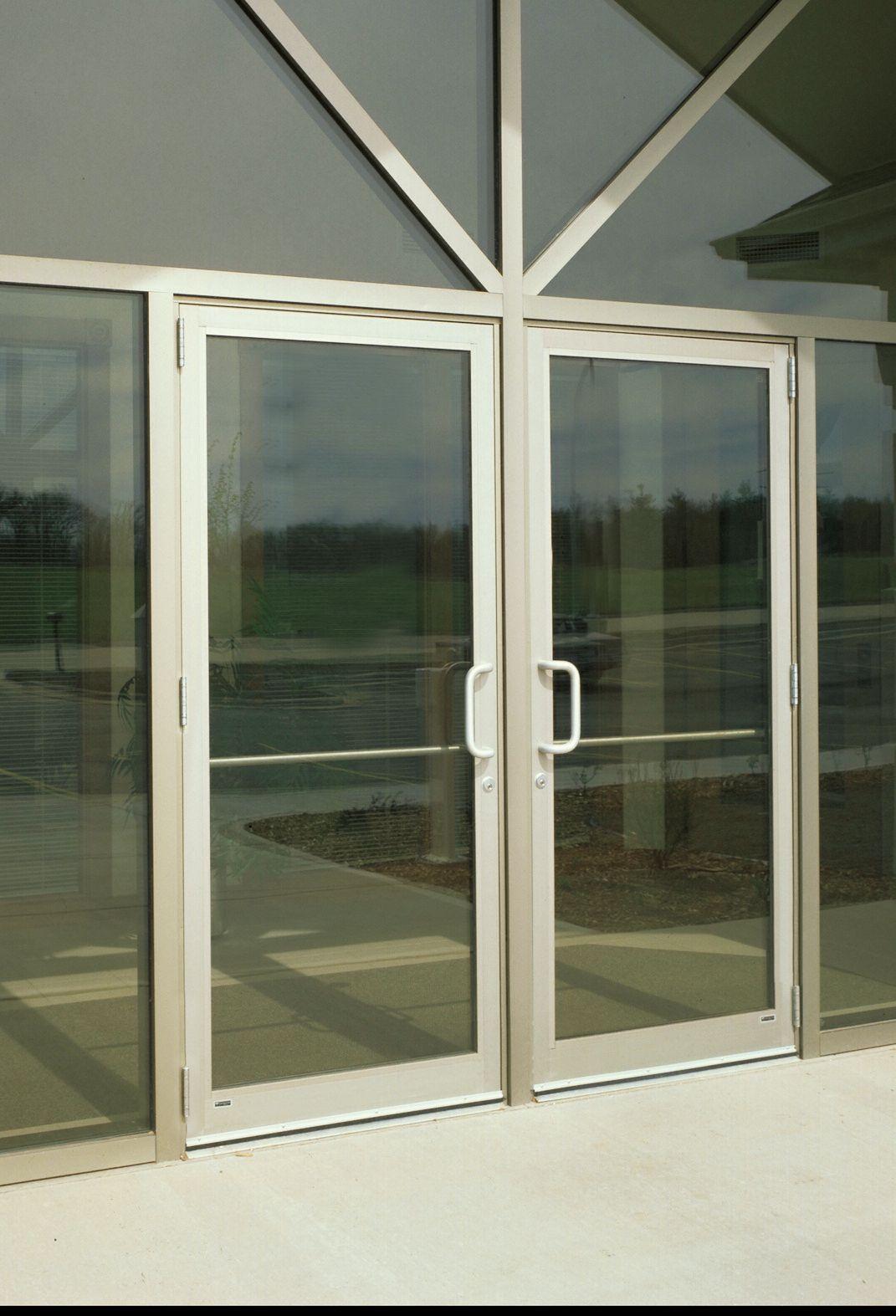
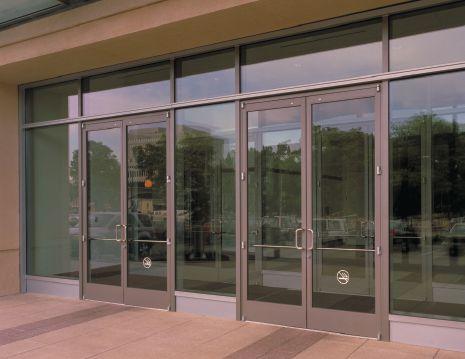
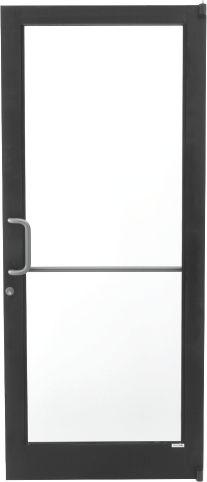
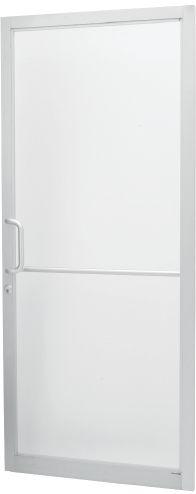
You challenged us to create a window that would keep what’s on the outside out, while maintaining occupant comfort on the inside. We answered. The new AA™6400/6500 Thermal Window delivers superior thermal and water performance and excellent condensation resistance. A fusion of beauty, strength and functionality, the AA™6400/6500 Thermal Window enhances any application – new and retrofit construction – while delivering architectural aesthetic appeal and ease of installation. See where design and functionality combine to keep what’s on the outside out.
The glass industry has won a recent battle to reduce window-to-wall ratios in an influential green building standard. Here’s how.
Your guide to the people and companies that point the way to better business.
Key takeaways from the BEC
GANA’s conference teaches glass pros how to deal with uncertain conditions.
Garibaldi Glass Days
The Mobius brothers open their state-ofthe-art facility to B.C.’s glass builders.
Apex Aluminum sets new standards for automation and volume.
You have been heard
Your responses to our reader survey raises great points.
We recently sent a reader survey around to everyone on our email list. The primary function of the survey was to make sure we have your company information and industry sector correct so we have an accurate picture of who is reading the magazine. However, there was a section where respondents could type in their comments, and many of you took advantage of that opportunity. Lest you think your responses were consigned to a folder and forever doomed to gather digital dust, I thought I would address some of the points and issues raised.
The first thing to note is the overwhelmingly positive nature of the comments. Many of you simply said you enjoy Glass Canada and find it informative and worthwhile. We honestly didn’t get one response telling us we suck. That certainly doesn’t mean there aren’t any readers who think we do, but I’m reasonably confident that they must be in the minority. It is gratifying to see that our commitment to providing the glass industry with an effective and engaging business information channel is appreciated. Thanks to all those who took the time to tell us you like our publication.
NEXT ISSUE
• Great glazing projects
• Wire glass hazards
There were some comments on our regional balance. Some readers felt the magazine content is too focused on Ontario. Others felt there was too much focus on western Canada. Since the complaints from one part of the country roughly balanced out the complaints from the other part of the country, I’m tempted to think I must be getting it about right for a national publication. Inevitably, there will be periods where we hear less from a certain region and more from others. Then, over time, the trend will reverse. Since I am always trying to cover issues that are of interest to any glazier in the country, I don’t think it matters that much where the information originates. Even stories on strictly provincial matters, such as building codes, can be read in other provinces to inform the local readers’ views of their own situation. The whole purpose of a national magazine is to communicate across the geographical barriers that separate us, so it is not only inevitable but desirable that you end up reading about what is happening elsewhere. That said, I make no claim to be perfect in covering everything of interest that happens across this vast nation. I would encourage anyone disappointed with Glass Canada’s coverage of their glazing community to simply drop me an email at pflannery@annexweb.com whenever they feel something noteworthy is at hand.
Some readers in Quebec mentioned they wish there was a French edition of the magazine. So do I. I realize that with solely an English publication we are not serving the massive Quebec glass industry as well as we could be. But the simple fact is that translating an issue of our magazine into French would cost about as much as producing the entire issue in the first place.
Some readers asked for more articles on decorative glass. I agree it is probably time we return to this important topic, and plans are in the works. Another comment said we should have had boxes for apprentice/journeyperson status in our “highest level of education achieved” question. I couldn’t agree more, and that will be fixed in future surveys.
GROUP PUBLISHER | Martin MCANULTY mmcanulty@annexweb.com
Publication Mail Agreement #40065710. RETURN UNDELIVERABLE CANADIAN ADDRESS TO CIRCULATION DEPARTMENT, P.O. BOX 530, SIMCOE, ON N3Y 4N5 email: subscribe@glasscanadamag.com
Printed in Canada, All rights reserved. Editorial material is copyrighted. Permission to reprint may be granted on request. ISSN 0843-7041
($39.55 includes HST/QST) U.S.A. - 1 Year $50.00 (in US dollars)
Occasionally, Glass Canada will mail information on behalf of industry-related groups whose products and services we believe may be of interest to you. If you prefer not to receive this information, please contact our circulation department in any of the four ways listed above.
www.glasscanadamag.com
INDUSTRY NEWS
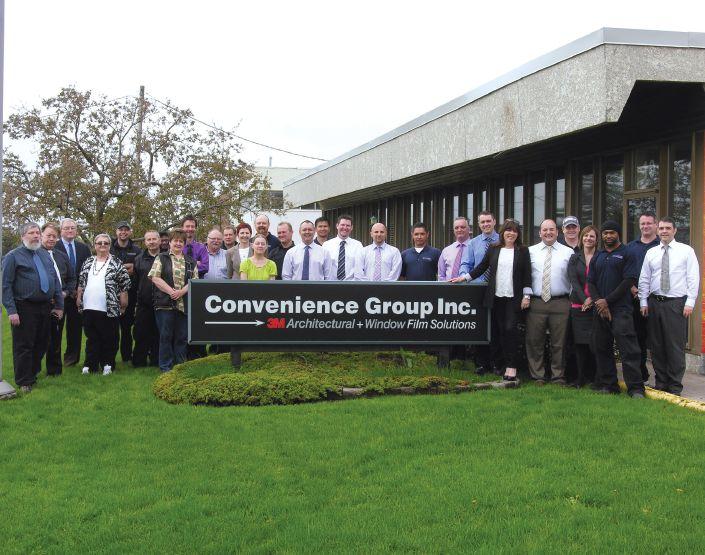
Convenience Group turns 40
Convenience Group began in president George Turjanica’s south Etobicoke basement in 1974, when an innovative company named 3M selected his company as a dealer for their window film products. In the beginning, Convenience Group focused on introducing solar films to commercial office buildings in Toronto. Solar films remain popular as a way of not only addressing solar glare but moderating building temperatures. The rise of the Leadership in Energy and Environmental Design (LEED) rating system and the rebates available through the Ontario Power Authority’s saveONenergy program have helped continue the demand for the company’s products. In 1991, Convenience Group was made the Canadian distributor of 3M products, adding to the scope of its business the supply and support of a network of dealers across the country. Convenience Group now oversees a network of around 30 dealers across Canada, with locations in all major centres. In recent years, Convenience Group became more aware of how buildings impacted the migratory bird population.
They consulted with the advocacy group FLAP (Fatal Light Awareness Program) to develop a responsive product to address the increasing problem of bird fatalities. In essence, the product developed is a window film featuring a specially sized and spaced grid of dots or lines. When applied to the first four floors of a building (the problem zone), it enables birds to detect the glass and effectively prevent bird collisions. After 40 years of remarkable growth, Convenience Group includes the TD Centre, as well as many buildings up and down University Avenue in Toronto, in its project portfolio. The impressive client list not only includes commercial office buildings, but hospitals, universities and prominent area residences. George Turjanica marked the occasion by offering his gratitude, “We extend our sincere thanks to our dedicated team, our supplier partner 3M, and our customers for making these 40 years successful. With the addition of new and innovative products and services, we look forward to the opportunity for continued success.”
Gusterson becomes vicepresident of sales
Alumicor has announced the appointment of Steve Gusterson to the role of vice-president of sales for Ontario. Gusterson has worked in various roles at Alumicor, most recently as the senior manager of pre-construction design. Gusterson is past chair of the Toronto Chapter of Construction Specifications Canada and is currently an instructor of its Technical Representative course. He also remains an active member of the Ontario Glass and Metal Association. Gusterson is passionate about the role of associations within the building envelope industry. He brings 25 years of experience and technical expertise to his new position and will continue to report to Lyndon Regular, national vice-president of sales and marketing.
CGA Newsletter
CANADIAN GLASS ASSOCIATION
The 2014 Glass Connections Conference and Trade Show hit Halifax June 4 and 5. Thank you so much to all of the volunteers who worked tirelessly to put together an event that benefits the entire industry nationwide, in particular Jim Brady, Richard Verdon, Mike Higgins and Tony Spurrell. Glass Connections Conference & Trade Show is a highly focused educational and networking event for glaziers, architects, engineers, designers, spec writers, commercial construction contractors and building owners. In addition to a full day of peer reviewed seminars with three Continuing Education credits available, the conference hosted a Nova Scotia style Kitchen Party meet and greet on the June 4 opening night, complete with a table top trade show on both days to give manufacturers and suppliers the opportunity to showcase their products, services and upcoming technologies. Thank you very much to our members, volunteers and sponsors including Dow Corning, Tremco, Alumicor, Safti First and Boon Edam. It was great to see everyone there.
PROVINCIAL GLAZIERS ASSOCIATION OF ALBERTA
It has been pretty quiet on the PGAA front lately. Ross Wady of All Glass Parts in Edmonton is the new president of the PGAA. The PGAA had its AGM on March 12 in Red Deer, Alta.
Elections were held and Wady was elected president. Jim Brady will stay on as past president for two years.
Canadian Glass Association 3195 - 9th St. S.E. Calgary, Alta. T2G 3C1 www.canadianglassassociation.com
The PGAA took part in the Provincial Skills Competition in Edmonton on May 14 and 15 as a “Try-A-Trade” exhibitor. This event is always very successful with over 600 students passing through our booth and learning about the glazing trade.
The PGAA’s annual golf tournament will be held at Riverbend Golf Course in Red Deer on August 14. We have made a change in venue where we will have an air-conditioned meeting room after the tournament. This golf course also offers the use of fairwayroaming carts.
ONTARIO GLASS AND METAL ASSOCIATION
The
Workplace Safety and Accident Prevention group held a meeting at Tremco in January on the topic of violence and harassment policies and management’s obligations.
The next meeting will be on contractor safety. Please check the OGMA website for updates. These meetings are of great value and benefit to glazing contractors and glass shops and cover many topics that have a significant impact on your business. If you are interested in attending a future meeting or joining the group contact Steve Ringler at steve.ogm@ bellnet.ca.
The Ontario Ministry of Labour announced in November, 2013, that all workplaces governed by the Occupational Health and Safety Act must provide training for supervisors and workers by July
1, and that the training must meet the specific requirements set out in the regulation. The training must include instruction in seven key areas for workers and six key areas for supervisors. It is imperative that your company satisfies these requirements as penalties will be imposed on those that have not complied.
In the last issue of Glass Canada, we announced that in January, 2014, the OGMA reached agreement with Workplace Safety and Prevention Services (formerly the IAPA) to proceed on the creation of a manual geared specifically for small and midsized glazing contractors and glass shops. A draft prototype of the new OGMA/WSPS Glazing Contractor Health and Safety Manual was available for all participants to review at the Top Glass Conference and Exhibits event. This allencompassing document will be of particular importance to companies who do not have a formal safety policy in place and who do not have the time or resources to create a program on their own. The WSPS will work with your company to implement the safety program, will keep you updated on all changes to laws that you must be in compliance with, put you in a strong position to withstand a Workwell audit, and help you to defend yourself with the Ministry of Labour in the event of a workplace accident. Your participation in this program is an absolute must for many obvious reasons. Contact an OGMA director for more information.
We’re putting together a new event for this summer. Picture yourself pulling out of Port Credit harbour on a 40foot fishing boat on August 6, chasing down an award winning
salmon with your OGMA friends. The day will include lunch, prizes, and camaraderie. Make sure to come out and test your angling skills. Great time guaranteed.
We’re all set for Sept. 18 at a new OGMA golf venue, the Richmond Hill Golf Club. Mark your calendar now. Details will follow as the date approaches.
If you are conducting business in the glass industry in Ontario, the OGMA is the voice that represents your interests at the provincial and federal level. Protect your business interests by becoming a member or as an associate member if you are a consultant to the industry. Doug Morris is heading up membership for our association, so please contact him today at douglasmorris@ rogers.com or visit the OGMA website.
To order the Ontario version of the Glazing Specifications Manual of Standards and Practices, visit www.ogma.ca.
ATLANTIC PROVINCIAL GLAZING ASSOCIATION
TheAPGA is proud to introduce its new board of directors for 2014: Mike Higgins of City Thermo Pane, president; Mario Arseneau of Royal Door, vice-president; Russell Lutes of Prelco Industries, treasurer; Dan Everson of Economy Glass, technical director; Shawn Wessel of RSVP Agencies, technical director; Tony Spurrell of Tremco (retired), membership director; David Boudreau of Alumicor, secretary; and David Squires of Old Castle BE, membership director.
CCOHS offers online tool
The Canadian Centre for Occupational Health and Safety (CCOHS) has developed a new online occupational health and safety management service, OSH Wise, designed to help organizations establish, maintain and improve their
health and safety programs while meeting their legislative responsibilities. The OSH Wise management service can help small to medium-sized organizations establish a health and safety program, as well as to adopt a continual improvement process to meet their health and safety responsibilities and regulatory requirements. The tool can also assist organizations in employee engagement, staying compliant, managing incident reporting and helping to eliminate or reduce health and safety risks. “The best way for an organization to keep its employees safe at work is to have a well-developed health and safety program, and ensure that program is properly communicated, implemented and improved on an ongoing basis. That’s where OSH Wise can help,” says Chris Moore, manager of training and education at CCOHS. “We wanted to encourage organizations to think broadly about health and safety, and make it an integrated part of the overall management of the organization.” OSH Wise provides a web-based framework that promotes a systematic approach to integrating the health and safety of workers into the everyday management of the business. Included in the webbased management service are single seats for six e-courses titled Developing an Occupational Health and Safety Program; Hazard Identification, Assessment and Control; Accident Investigation; Workplace Inspections; Health and Safety Committees; and Due Diligence in Occupational Health and Safety. OSH Wise also includes CCOHS publications Implementing an Occupational Health and Safety Program and Job Safety Analysis Made Simple in PDF versions, with five hours of technical support. The program will provide users with guidance and information and is enriched with audits, tools, checklists, training and expertise from the comprehensive CCOHS knowledge base.
AAMA creates sustainability committee
The American Architectural Manufacturers Association (AAMA) board of directors voted unanimously to establish a sustainability steering committee. It will oversee the various AAMA committees and task groups involved in establishing standard practices that lead to product sustainability -- from component development to structural integrity. “This decision reflects the vital strategic importance that AAMA believes sustainability-related issues have to the fenestration and glazing industry, and to AAMA members’ businesses,” says AAMA’s sustainability steering committee co-chair, Mark Silverberg, president for Technoform North America. The other co-chair for the AAMA Sustainability Steering Committee is Kevin Gaul, director of legislative and regulatory affairs for Pella Corporation. In addition to leading the committee, both Silverberg and Gaul are members of AAMA’s board of directors and participate in several other AAMA committees and task groups including the Architectural Products Group and the Residential Products Group. Gaul adds, “Windows, doors and skylights have historically been designed and manufactured to meet and
exceed sustainability and energy-efficiency requirements. We want commercial and residential builders, specifiers, architects, incentive program providers and homeowners to be fully informed of the many benefits of incorporating the technologically advanced fenestration products available today into sustainable buildings’ designs.”
The formation of this new committee builds on AAMA’s substantial past work and educational efforts, which address product-related sustainability and transparency-related issues. The pending release of the joint industry document for fenestration Product Category Rules (PCRs) will provide manufacturers with the tools needed to develop life cycle analyses on their product lines. The Environmental Product Declarations (EPDs) that follow will offer individual manufacturers an opportunity to showcase their processes and commitment to sustainability. The committee will begin its work immediately via monthly conference calls and will report its progress to AAMA’s membership beginning with the AAMA National Summer Conference, June 1-4 at the Hyatt Regency in Indianapolis.
Quebec leaves the national association
The AVFQ, Quebec’s association for the glazing and fenestration industries, has withdrawn from the Canadian Glass Association in a letter sent to the CGA board in March.The letter cites the need for the AVFQ to focus its budget on its own membership programs, and states, “We already have our own committees, training group, events and partnerships with different players in the window and door industry across North America.” The letter is signed by Gilbert Lemay, AVFQ director general, and
Dorma
acquires RFID maker
Dorma
Americas has added a critical new element in its developing U.S. presence by acquiring Farpointe Data of Sunnyvale, Calif., one of the nation’s premier innovators in radio frequency identification (RFID) for access control. Acquired April 1, Farpointe Data enables Dorma to provide its customers with superior, integrated designs and enhanced performance from access readers, cards and tags.The acquisition is intended to reinforce Dorma’s reputation as a technological trendsetter in access design, technology and manufacturing. Advanced RFID technology is a Farpointe hallmark. From the company’s lowpower technologies to its innovative approach to reader and credential security, Farpointe’s history is marked by aggressive investment and successful development.The company’s products, designed for quick and easy installation, have demonstrated years of reliable, trouble-free service.These products meet or exceed the requirements of a broad range of applications, including physical and logical access, secure identity and vehicle
Ratios in effect
copied to Marc Bilodeau, AVFQ president, and Alain Langis.
“The board of directors of the CGA thanks AVFQ for their support of our national association and wishes them well in their future endeavors,” said Rich Poryako, CGA interim executive director.The AFVQ did not respond to a request for comment.
CGA membership dues are $25 per member. Fenestration B.C. also resigned its membership in the CGA in January.
identification. Among many categories of end users are airports, hospitals, universities, tech installations and government facilities. Farpointe’s products are widely available from an actively growing global network of OEM system manufacturers and international distributors. “It would be hard to imagine a better-realized combination than Dorma and Farpointe Data,” commented Dorma president,Wil VandeWiel. “The corporate cultures are a good fit. Customer and channel synergies were apparent from the start. It’s clear that the expanded product portfolio that Farpointe brings will be an immense competitive asset for Dorma.”
“The team at Dorma clearly demonstrates the ability to couple growth with careful attention to market channels, all the while adding value to their customers,” adds Scott Lindley, president of Farpointe Data. “We are very excited to be partnered with Dorma, and are confident they are the right company to support Farpointe’s next level of growth.”
for Ontario glazing trade
The Ontario College of Trades has announced new trade ratios are now in effect. The ratio for the Architectural Glass and Metal Technician trade remained unchanged at one journeyperson per apprentice for the first journeyperson hired and two journeypersons per apprentice for all additional staff. “For the first time in Ontario there is an open and transparent process in place to review all trades subject to ratios,” said registrar and CEO David Tsubouchi. “Never before has a comprehensive review of all 33 ratios been done in the province.” Of the 156 trades in Ontario, 33 are subject to journeyperson-to-apprentice ratios. The new regulation (O.Reg.104/14) posted brings all ratios under one regulation, standardizes the way ratios are expressed, and implements the remaining 2013 Ratio Review Panel decisions to change ratios. In 2012, the College initiated an independent, criteria-based, open and transparent process to review all ratios that gave skilled trades professionals and the public the opportunity to participate in the decision-making. The ratio reviews were conducted by independent Review Panels — chaired by vice chairs from the Ontario Labour Relations Board. The Review Panels review all written and oral submissions against set criteria (for instance, economic impact of the ratio and the health and safety of the apprentice) in order to decide the appropriate journeyperson to apprentice ratio for the trade. In 2013, the Review Panels completed their review of all 33 trades subject to ratios. As a result, 15 of the 33 changed. Of the 15 trades with ratio changes, 14 trades’ ratios were decreased (fewer journeypersons required per apprentice) and one trade’s ratio was increased (more journeypersons required per apprentice). Journeyperson-to-apprentice ratios exist in certain trades to ensure the safety and quality of on-the-job training of apprentices, while providing for the future skilled labour needs of industry. Ratios determine the number of apprentices who may be sponsored or employed in relation to the number of journeypersons employed in particular trades. Ratios vary by trade as each trade and sector has particular needs and characteristics.
GOING MEDIEVAL
The window-to-wall ratio debates pits energy efficiency But glass construction experts say
by IRWIN RAPOPORT
Twe can have both.
he window/wall ratio (WWR) controversy in the ICI building community is an ongoing one and a proposal to reduce the percentage was defeated last January. The current ratio is a 40 per cent WWR limit on the prescriptive path in ASHRAE 90.1 and the International Energy Conservation Code. It is only for the prescriptive path, and any amount of glazing can be used in the performance path where one uses energy modeling to show that your proposed building has the same or better energy performance as a reference building that meets the prescriptive path.
Thus, architects and designers can use any amount of glazing, but the comparison is made to a 40 per cent WWR building, which forces engineers to use other features such as high efficiency HVAC equipment and daylighting to meet the target.
The proposal for a new standard, 189.1, had it passed, would have dropped the prescriptive limit from 40 to 30 per cent WWR (a 25 per cent reduction). Again, any amount of glazing would have been allowed in the performance path, but the WWR reduction was fought by many who considered it to be a bad precedent for glass industry and counter to high-performance design. The revision would have cost glass suppliers and contractors a lot of business, but the industry got together and successfully lobbied the committee to have it removed. That battle was won, but glaziers can only hope it’s the end of the war.
Making buildings more energy efficient with a smaller environmental footprint has been a hot topic for some time, and many green building advocates have been upset with glass curtain wall building envelopes. They share a basic understanding that a glass barrier between the outdoors and indoors can never be as insulating as a brick or stone wall. This has resulted in a push by some green building advocates to require buildings to have smaller windows in relation to the wall space in order to qualify for certain green certifications, like LEED. Curtain wall manufacturers, architects and designers have pushed back, pointing out that a healthy balance can be achieved and that the energy inefficiency of glass construction has been frequently overstated.
LEED doesn’t have to mean less glass. The Mona Campbell Building at Dalhousie University is certified LEED Gold with a generous, wrap-around glass facade. Designers achieved the designation with a garden roof, high-tech interior air quality sensors, pre-heated ventilation air and a water loop heat pump system.
efficiency against esthetics and functionality.
ASHRAE is one key organization that sets standards for energy efficiency of commercial buildings (not just HVAC standards). ASHRAE 90.1 is its main energy standard, while ASHRAE 189.1 is a green standard meant to include both energy efficiency and other green attributes (for instance, land use, material use and indoor environmental quality) similar in concept to LEED or GreenGlobes, but written as a standard or code format instead of a point system.
While USGBC supports ASHRAE 189.1, it is not required to be used in LEED buildings. They are still two separate programs. LEED is still the main system, and it uses ASHRAE 90.1 as the basis for energy efficiency (but awards more points for higher levels of performance). However, 189.1 has gained some acceptance and use with military and publicly funded buildings.
Thomas Culp is the president of Birch Point Consulting and an energy code consultant for the Glass Association of North America and the Aluminum Extruders Council. He presented his clients’ case against the proposal at last January’s 189.1 committee hearings. “The original proposal came out of an analysis for ASHRAE 90.1-2010 comparing the energy use of a medium office building with different window-to-wall ratio,” says Culp. “That study showed energy use could be decreased a few per cent if the prescriptive limit was reduced from 40 to 30 per cent WWR.” Culp argued the analysis they used was not applicable. “It was only for the 2010 version of ASHRAE 90.1, and did not include the higher performance windows and daylighting required by ASHRAE 189.1. The requirements would not even comply with
ASHRAE 90.1-2013; it was only for one building type (medium office), it only looked at site energy and it did not consider impacts on indoor environmental quality and occupant well-being.”
Regarding the last point, Culp stresses that “as part of the debate (which lasted from last June through this January), we presented dozens of studies that demonstrated all the positive impacts that windows have on high performance buildings. For spaces with access to high quality daylighting and/or views, there are studies that show increased real estate value, higher rental rates, a 20 per cent increase in office worker cognitive test rates, 39 additional work-hours per year in office worker productivity, nine to 16 per cent improved performance on visual memory tests (but glare decreased it by 17 per cent), and 15 per cent decreased absenteeism in office workers.”
Studies also found decreased office worker turnover and a 21 per cent increase in student test scores, a six per cent increase in retail sales and, for hospital and health care facilities, a 22 per cent reduced development of surgical post-op delirium, a reduced length of hospital stay by 2.6 days, 22 per cent less pain medication prescribed to post-spinal surgery patients, reduced depression and improved sleep.
Culp points out that “overall, productivity-related costs of a building’s use are over 100 times greater than the energy-related costs. So even if there is a small energy savings from a proposed change, if it adversely harms the indoor environment, productivity, and use of a space, the negative impact and increased costs of
the full use of the building will dwarf any potential energy savings. Energy and health should not be a trade-off.
“Plus,” he adds, “you really don’t have to choose one or the other. With recent advances, including high-performance framing, new and multiple low-e coatings, dynamic glazing, improved daylighting and shading designs, both high energy performance and high quality spaces can be achieved.”
Interventions by Culp and others succeeded as the ASHRAE 189.1 committee, at its January meeting in New York City, voted 26-4 (with three abstentions) to discontinue the proposal.
Steve Kemp, manager of buildings sustainability for the MMM Group, says there is a “wealth of evidence” by ASHRAE and others that modest glass ratios are best for building energy performance, and high glass ratios don’t necessarily result in good daylighting. “The sweet spot tends to be in the 30 to 40 per cent range,” Kemp says, “so I am bit surprised by the 30 per cent number.
“Right now,” he adds, “the best performing windows (tripleglazed) are at best 10 per cent of the market. Most windows are double-glazed, low-e Argon and whether in an aluminum or fiberglass window frame, you are talking R3 to R4 as the insulating value, where even a modest wall is R15 to R20. A lot of glass sometimes ends up in window wall and curtain wall, and the opaque sections are at best R4 to R6. In a curtain wall, you can put more glass in because it doesn’t matter from a heating perspective because the glass has similar performance to the opaque wall it is replacing; however, doing so will increase summer cooling loads.”
Kemp adds that buildings with punched-wall windows are “almost always a worse performer than the wall they replace,” and that “mountains” of research have demonstrated that, with well-insulated walls, 30 to 40 per cent glass ratios is the optimum WWR, balancing daylighting, passive solar gains and building heat loss. “You get the gains,” says Kemp, “but you need the insulation in the walls to keep them in the building to get the benefit.”
Kemp suggests that ASHRAE 189.1 is an aspirational standard that is typically not enforced in any jurisdiction. “ASHRAE 90.1 is designed to be a minimal code,” he says, noting that people appreciate daylight. “Even at 25 per cent, if a building is well designed, there is a lot of daylight. Providing daylight is not about the amount of glass, but about the floorplate design and how far you are from the windows.” Kemp, an engineer, has been in the energy efficiency field for 20 years and has witnessed the trend for more glass, pointing out that it is an aesthetic choice “and, for better or worse, window wall and curtain wall condos are the trend. The architects and engineers that design buildings know that it is harder to air condition and that you have to upgrade the HVAC systems to comply with building energy codes to meet the market demand for the glass aesthetic.” All-glass buildings and those with large percentages of window wall are best suited for warmer climate areas. “But the flip side is they require a lot of air-conditioning,” says Kemp. “You could do a tint, but the market likes clear glass.”
Energy efficiency and having reduced energy bills is a concern for building owners and that impacts the final design. Kemp says that an alternative path that is “slowly” being implemented is what New York City has done and what Toronto is considering: the requirement for all buildings to publish their energy bills. “Not many do,” he says, “but we have a database of about 80 buildings and the trend is clear: energy bills go down with more modest glass ratios. We’ve been involved with LEED Platinum buildings with lots of glass. The corollary is that they have exceptional mechanical systems to make up for the envelope. There are lots of places in buildings to improve energy efficiency, but the hope and goal of
Another example of a building achieving high sustainability standards with no shortage of glass.This is Manitoba Hydro Place, the first office tower in Canada to achieve LEED Platinum.
the industry in 20 to 30 years is almost zero energy use, in which case it becomes more difficult to rely only on one technology. We have to rely on all the bits and pieces of the building.”
Kemp says that the 1989 version of ASHAE 90.1 was the first that he applied and has influenced his work ever since. “Glass technology has improved,” he says, “but not as dramatically as some people believe.” To demonstrate this point, Kemp refers to a recent study from British Columbia that examined the energy efficiency of condos in the lower mainland – those built in the 1970s and those in early 2000s. “They tend to heat the central corridor with natural gas, pumping air to pressurize it so you can’t smell what your neighbour is cooking,” he says, “but the heat loss for the perimeter is terrible – and all the buildings in this study had electric baseboards. The trend in the 1970s was single-paned glass and the new ones were double-glazed low-E argon and the perimeter energy use didn’t move over that 30-year period. The better-performing glass was immediately offset by adding more glass, so nothing changed.”
If the WWR ratio was reduced to 30 per cent maximum, Kemp suggests that the glass industry would be pressured to develop more cost-effective solutions for triple-glazed windows. “They are significantly more expensive than the standard product,” he says, “but you can get the equivalent performance at higher windowto-wall ratios. It would be interesting to make the default that you could sell a triple-glazed window.”
On this point, Culp notes, “Obviously reducing the window area limit, even if in just the prescriptive path of one standard, would have been bad for business. But more to the point, it would have delivered the wrong message to designers about the proper role of glazing in high performance buildings.”
Having more energy-efficient buildings has multiple benefits and for Kemp, dealing with the impact of climate change
Continued on page 21
At the Apex
A look at one of Canada’s pre-eminent aluminum extruders
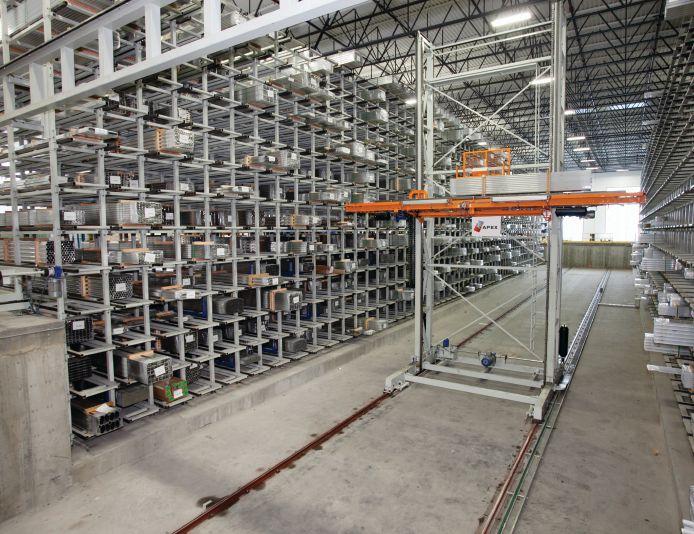
The heart of Apex’s operation is a fully automated warehousing system that is unlike anything else in Canada. It enables Apex to offer its customers unparalleled flexibility in when they place and take delivery on orders.
In 2009, Thomas Martini, president of western Canada-based glass fabricator Vitrum Glass Group, realized the potential for aluminum extruded products in the Pacific Northwest and founded Apex Aluminum Extrusions. Martini built a brand new facility adjacent to the Vitrum headquarters in Langley, B.C., and purchased the most state-of-the-art extrusion line available. The company extruded their first billet in 2011 when other companies were running for cover.
“It’s difficult to understand the scope and magnitude of what Apex is all about without seeing it for yourself,” says Ron Rehwald, senior account executive for Apex. “The level of automation is second to none. We’re making some great inroads into multiple industries including glazing, window, door and aluminum railings. The growth in the last four years has been astronomical.”
If you have never been to an aluminum extrusion plant, think of a giant children’s playdough press that forces out long strands of material through a plastic die in different shapes and patterns. The basic concept is the same but it’s not that simple. Instead of playdough, the press is fed by raw aluminum
bars, known as logs, that are 24 feet long and eight inches in diameter. Eighty-five percent of the logs are from Alcoa in the U.S., with the remainder sourced internationally from Australia and elsewhere. Apex uses three different alloys for their raw materials: 6061, 6063 and 6005A.
The logs are heated to 500 degrees with an energy-efficient, gas-fired furnace. The logs are then sheared to the exact required length with a fixed knife blade for a clean, flat surface. Apex operates on a full recovery system and asserts no loss of scrap raw material, meaning a cutoff from a previous log can be butted up to another log in order to eliminate any waste.
“The sheared log is the exact size that we want to extrude 300 feet of material,” says Martini. “So whether you have one hole in the die or twelve, the computer system is optimizing the exact length to the millimeter. The system has continuous feedback and automatically adjusts on the fly. If extra material is extruded, the system will log it and the next billet will be deducted by that amount.
The Apex press has huge hydraulics, weighs approximately 600,000 pounds, and has 15,000 litres of hydraulic oil for the five-
foot hydraulic cylinder. At the die face at the front, there is 110,000 PSI of pressure being driven by a 1000-horsepower, servo-controlled pump. The control board for the press, which looks like a NASA control station, allows the operator to monitor the oven, the press, camera system, run-out system and production system.
“The operator doesn’t control the speed anymore. The speed is actually controlled by a thermal imaging camera system,” says Martini. “The material exits the press at around 1,100 F so the faster you go, the more friction you create, which means you have to slow down a little bit.”
“The press is constantly adjusting itself to the maximum speed set in the recipe and is trying to achieve that all the time. The temperature and speed are very critical. To meet certain specific mechanical properties, we have to break that threshold to over 1,100 degrees.”
“Fifty percent of the force/pressure is lost to friction and the other 50 per cent is what’s advancing forward into the billet. If the first half of the billet comes out at 420 C, as the press drives forward, with the friction it has created, the back of the billet might be 500 C. The system automatically accounts for this and will go very fast for the first half of the billet and slow down at the end.”
“We gain 20 per cent efficiency on our dies in running this new technology,” says Martini. “The software will allow you to go back through and review every foot of extruded material over the last 24 hours so we can monitor and control our quality every step of the way.”
Apex pre-heats the dies before they are put in the press to prevent them from acting as a heat sink. “Everything has to be the same temperature. Billet, die, holes. We’re extruding large volumes of aluminum on a 20-hour cycle. Which translates to 20-30 die changes in a day. We polish and correct the dies on a regular basis. We have approximately 1,400 active tools and copies of each one. If a customer wanted to run 20,000 kg in a run, the tool is swapped out for its spare during the run and is inspected and polished. We have our own die correction and metallurgical system for surface hardening the dies.”
“Year one we installed the extrusion line. Year two, I had this dream of anodizing and I knew we needed an automated warehouse to do it. So we added automation in year two including three automatic cranes. This crane feeds seven workstations including stacking and retrieving empty baskets, loading and unloading the oven and bringing material to the packaging department. It is running its own algorithms. No one is controlling it.
“We stack the material in the baskets automatically in sequence with a robot stacker. The material is still very malleable and you don’t want to deform
it after stretching as it will remain that shape after aging. In addition it’s a waste of labour to have people stacking.”
“We cut to length, stack it in the basket, age it in the oven for 6 to 8 hours to put mechanical strength and properties back into the metal and then send to packaging. The whole process takes two days. One day for extruding and one day packaging. It’s a very quick turnaround. Our lead time is two weeks but we are filling a backlog of 500,000 kg. We monitor that daily and can make adjustments for customers that run out of material and help them out.”
“The warehouse really solves a lot of that issue,” says Martini. “We maintain a min/ max inventory for customers. We can ship within 24 hours from our automatic warehouse.”
Before heading to the automated warehouse, orders are automatically bundled at the packing station. Apex receives orders from its customers which include a drawing of the exact dimensions on how the order should be packaged. “Our business is selling bundles. Five hundred kg minimums. We don’t sell stick at a time, however we sell to large distributors that do. We have probably 50 different ways that customers want their orders to be packaged.” Orders are stacked in the order specified and the station weighs the bundle and creates a barcoded packing ticket before sending the bundle to the Honeycomb.
The anodizing advantage
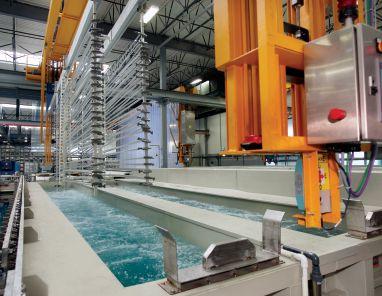
Anodizing is an electrochemical process that converts the metal surface into a decorative, durable, corrosion-resistant, anodic oxide finish. Aluminum is ideally suited to anodizing, although other nonferrous metals, such as magnesium and titanium, also can be anodized. The anodic oxide structure originates from the aluminum substrate and is composed entirely of aluminum oxide. This aluminum oxide is not applied to the surface like paint or plating, but is fully integrated with the underlying aluminum substrate, so it cannot chip or peel. It has a highly ordered, porous structure that allows for secondary processes such as coloring and sealing. Anodizing is accomplished by immersing the aluminum into an acid electrolyte bath and passing an electric current through the medium. A cathode is mounted to the inside of the anodizing tank; the aluminum acts as an anode, so that oxygen ions are released from the electrolyte to combine with the aluminum atoms at the surface of the part being anodized. Anodizing is, therefore, a matter of highly controlled oxidation—the enhancement of a naturally occurring phenomenon. - Courtesy of the Aluminum Anodizers Council, anodizing.org
The Honeycomb is an appropriately named, mindblowing, fully automated inventory management system. It keeps track of inventory levels and the location of the bundles. “The warehouse is the heart of our business. We changed the paradigm of extrusion because we allow customers to keep their inventory here for two to three months. They can draw from it and pull from whatever order they want to take. Loading a truck is very simple. The system scans the barcode, automatically exports those bundles
Apex’s high volumes demand the capability to quickly and accurately re-tool for different job lots. The company makes 20 to 30 die changes per day, using 1,400 different tools.
and we’re done. We could never inventory 2,000 bundles like this without an automatic system because we would need a huge building and a bunch of workers on forklifts damaging and losing the material. That just doesn’t happen here. We don’t charge for this service. When we go to extrude, we don’t extrude the 500 kg minimum, we’re extruding probably 2,000 kg, so the fewer die changes saves us tremendous money and provides efficiency in downtime, lead time, scrap and other advantages.”
backs. We’ve tried to engineer out the limitations that you traditionally have with anodizing through the addition of automation. If we run a bar today, tomorrow, next week or a year from now, we’re going to reach the same target with little to no variation. It gives us a much better chance of repeatability than you would normally have with a traditional anodizing line.”
“All of the product being anodized has an RFID tag on it so we have visualization in the control room and we can see where every bar is in the system at all times. We are getting real-time readings on our tank temperatures, PH levels, and wastewater information. Other plants are limited to manual and periodic sampling. Apex uses acid etch as opposed to caustic etch, providing a better gloss,” says Darby. “With a caustic etch, you are looking at a gloss variation from six to 15. It is the same colour but the gloss makes it appear to be a different colour. With acid etch, we’re able to hold between a six and nine with only a threepoint variation. That provides a much better colour consistency.”
COMING EVENTS
June 24 - 25
Profiles Philadelphia, Pa. amiplastics-na.com
July 7 - 10
GlassCon Global Philadelphia, Pa. glassconglobal.com
August 5 - 8
IGMA Summer Conference
Quebec City, Que. igmaonline.org
Sept. 9 - 11
GlassBuild Las Vegas, Nev. glassbuildamerica.com
Nov. 18 - 20
Win- Door Toronto, Ont. windoorshow.com
Sept. 18
“With anodizing, we’re seeing that shift again,” says Rehwald. “We can anodize 30-foot lengths and we’re seeing more glazing-type customers come on board now that we began to run the largest anodizing tanks west of Toronto over the last four or five months.”
“Anodizing has been part of this industry for many years,” says Brandon Darby, plant manager for Apex Aluminum. “It’s a durable, nice finish which gives lots of versatility; however, like any finish, it does have its draw-
“Another advantage of acid etch over traditional caustic etch is waste of aluminum. Normally, you would etch for 13 to 14 minutes in a caustic etch. We are in the acid etch bath for 30 seconds for clear and one minute for colour. So the amount of aluminum that you are removing is far less which means the aluminum hydrate waste and waste water system is reduced dramatically. It also means the amount of aluminum that is removed to process the material is lower. From an environmental standard, these are all nice to have. These advantages allows us to sell a world-class anodizing finish to the market. We’ve really been able to minimize the traditional flaws of the anodizing process through the engineering and design of our line. It’s made a big difference.” •
OGMA Fall Golf Toronto, Ont. ogma.ca
Sept. 14 - 17
AAMA National Fall Conference Westminster, Colo. aamanet.org
AAMA Annual Conference Fort Lauderdale, Fla. aamanet.org
KEY TAKEAWAYS FROM BEC
by RICH PORAYKO
Attending the BEC Conference makes you a smarter person and a stronger professional. You meet with the most important players in the industry. Sometimes it’s only for a passing moment or even a nod from across the room. Other people you get to see on multiple occasions and have some real time to catch up and share news. Or, you might establish a new contact by sitting next to someone you have never met before for a meal.
Networking aside, they say if you walk away from a conference or seminar with five or six takeaways, consider the event a success. At BEC, which returned back to the great Planet Hollywood this year, you are bombarded with information, often from the moment you ar-
Lots to think about following GANA’s Building Envelope Conference
rive in Vegas. It’s not uncommon to be on the same flight as other BEC attendees and share transportation to and from the host hotel – the perfect time to hear expectations on the way to the event and candid reviews on the way back to McCarran. Even during the recession, BEC was a strong event; however, with commercial construction now picking up, you can bet that the event is going to continue to grow like crazy.
Organized by the Glass Association of North America (GANA) and moderated by industry blogger and marketing guru Max Perilstein, the seminars varied from technical to motivational with a talk on innovative change by keynote speaker, former NFL quarterback Ron ‘Jaws’ Jaworski. Jaworski is currently an ESPN NFL analyst who owns several businesses, including golf courses and restaurants, and
co-owns the Philadelphia Soul arena football team with Philly-native Jon Bon-Jovi. In other words, Jaws is a very successful person.
Jaworski says he learned a lunch-bucket mentality while growing up in a steel town. “My parents taught me that this is a great country. You are going to be afforded great opportunity. It’s up to you to take advantage of those opportunities. They taught me the dignity of work. If you work hard, good things will happen. When you surround yourself with people that you trust, you give yourself the best chance for success.”
Even if you don’t follow American football, Jaworski’s leadership and guiding principles were inspirational and struck a chord with the audience, “Define, delegate and lead. Empower people. Build and foster relationships. Be sincere. Be honest. If you don’t have in-
ABOVE: PPG’s Richard Beuke suggested attendees focus on the hardest thing to manage in business: that which is beyond your control. Contingency planning against the unexpected is the key to success in the present construction environment, he said.
tegrity, nothing else matters,” said Jaworski.
The event kicked off with a presentation by Richard Beuke, vice-president of flat glass for PPG Industries, entitled Anticipating and Managing Change in the Glass Industry. “VUCA is an acronym used to describe or reflect on Volatility, Uncertainty, Complexity and Ambiguity,” Beuke told his audience. “It is a word I first heard about six months ago. VUCA is a word you’re going to hear a lot more in the future. Three years ago it was Six Sigma then Lean, now it will be VUCA.”
“VUCA is an acronym first used by military leaders in Afghanistan and Iraq as they were preparing the plan for a non-traditional and seemingly unpredictable enemy invasions. Business leaders adopted the same terminology and use it as a planning tool for non-traditional economic business shifts that call for a different strategic approach. Think of VUCA as a way of predicting potential elements of change. It’s a means of anticipating change in your business and your everyday life.”
“The commercial construction market itself is a poster child of volatility. We’ve all lived this over of the last five years. There have been extreme shifts in commercial construction demand over the past 30 years. The peak to valley is $170 billion.”
“External events such as the savings and loan crisis in the nineties and the 2009 financial meltdown have all triggered such great collapses in the cycle. And even overbuilding can cause these types of fluctuations and volatility. The one constant in life is the business of change,” said Beuke.
GANA’s energy consultant, Dr. Thomas Culp of Birch Point Consulting, gave another informative presentation on overall trends including increased energy codes, code adoption and enforcement. “Even if you are in a state where the energy codes are not being adopted, you are still seeing it in the specs,” said Culp. “We’ve seen an expansion of the green codes. We all know that LEED is still the leader, but there has been demand out there for new green codes. They cover the same concepts as LEED, material selection, energy efficiency, indoor air quality, but it’s written in a code format to make it a little more useful to city planners.”
“We made some good gains in daylighting. We’re seeing a lot more top-lighting,” said Culp. “The use of skylights as daylighting will be required in more spaces. They are already starting in warehouses and grocery stores. You will notice a lot of
skylights in the newer Walmarts. They do it because they find it is very cost effective. They can save a lot of money, it increases sales and it happens to be good for the environment. Daylight zones are being required to be identified when floor plans are submitted to code officials. The purpose is to force the architect to think of the layout of the glazing, maximize daylighting, and work with the daylight designer earlier in the design process.”
“Over the last year, there has been an attack on the glazing area where ASHRAE 189.1 was proposing to reduce the window to wall ratio from 40 per cent to 30 per cent which was a 25 per cent reduction. We didn’t want to set a precedent so this was a big deal. It would have affected schools, hospitals and offices. The industry rallied and submitted 72 negative comments all asking for the proposal to be withdrawn. That got some attention but they initially didn’t back off. However, after learning more about all the studies showing the strong positive impacts of windows, daylight, and views on indoor environmental quality, health, and occupant well-being, they did vote to discontinue the proposal.” Culp, GANA and other concerned organizations fought back again and won another battle, however the war against the window-to-wall ratio wages on.
Courtney Little, president and general counsel of ACE Glass, has a unique combination of construction and legal experience and always presents a great summary of legal issues affecting the U.S. and Canadian glass industries. Little asked the audience if anyone had heard of the Silica Rule. Not many had, but according to Little, the Occupational Safety and Health Administration is developing a rule to limit exposure to respirable crystalline silica and prevent American workers from developing silicosis. Sounds like a good idea; however, according to Little, the parameters are unrealistic. Little said that his sources noted that a spoonful of silica dust spread over the area of a football field is enough to be considered hazardous. Several Canadian provinces are in the process of amending their own regulations and policies. Legislation or not, you need to be aware of silicosis and the Silica Rule.
Have integrity. Get to know and use VUCA. Prepare for stricter codes. Celebrate increased daylighting. The battle for the wall is not over. Everyone is concerned about industrial disease. There are six decent takeaways right there. •
What is VUCA?
VUCA is an acronym used to describe or reflect on the volatility, uncertainty, complexity and ambiguity of general conditions and situations. The common usage of the term VUCA began in the 1990s, derives from military vocabulary and has been subsequently used in emerging ideas in strategic leadership that apply in a wide range of organizations, including everything from for-profit corporations to education. The deeper meaning of each element of VUCA serves to enhance the strategic significance of VUCA foresight and insight as well as the behavior of groups and individuals in organizations.
Volatility. The nature and dynamics of change, and the nature and speed of change forces and change catalysts.
Uncertainty. The lack of predictability, the prospects for surprise, and the sense of awareness and understanding of issues and events.
Complexity. The multiplex of forces, the confounding of issues and the chaos and confusion that surround an organization.
Ambiguity. The haziness of reality, the potential for misreads, and the mixed meanings of conditions; cause-and-effect confusion.
These elements present the context in which organizations view their current and future state. They present boundaries for planning and policy management. They come together in ways that either confound decisions or sharpen the capacity to look ahead, plan ahead and move ahead. VUCA sets the stage for managing and leading.
- Wikipedia
by SKIP MACLEAN
Skip Maclean is president of Fenestration Canada. He is business development manager for Tru-Tech Doors and has over 40 years’ experience in the window and door industry.
Committee delivers benefits
As we slowly emerge from what has been a very trying winter, Canada’s window and door industry looks optimistically on the upcoming spring and summer seasons. The new year has brought many challenges for manufacturers and suppliers alike. Companies are preparing to meet these challenges in a variety of ways. It is remarkable to see the amount of creativity produced when we are faced with adversity and opportunity.
The creation of our Fabricators Council has provided a platform to voice the concerns of Canada’s window and door fabricators and to allow for a healthy and productive course of interaction. By collaborating on many of the issues currently facing the manufacturing of fenestration products, we can reach sustainable results earlier, lower our individual costs and influence procedure and regulation. A perfect example of this collaboration is the Performance Grade Calculator. This four-step calculator quickly indicates the performance grade required for your customer’s window and door project. If you haven’t seen it yet, check it out on our website at fenestrationcanada.ca.
Current projects soon to be completed include NAFS Phase 2 labeling guidelines for mulled products. The Phase 1 document was completed and posted on the public portal of the association’s website and describes the best practices for NAFS-08 labeling of fenestration products in Canada. An additional objective is to clarify minimum compliance requirements, and we will soon add a FAQ posting on the website to deal with commonly asked questions.
Our membership and marketing committee has been tasked with updating and revitalizing both our printed promotional material and our website to better address the needs of our members and
By collaborating on many of the issues currently facing the manufacturing of fenestration products, we can reach sustainable results earlier.
FENESTRATION CANADA
stakeholders in the industry. New banners promoting the main benefits of association membership were introduced at the Windoor 2013 show.
We have an exciting program lined up for delegates coming to our annual conference in Winnipeg, June 12 to 14, at the historic Fort Garry Hotel. We have group outings, a full slate of technical presentations to update participants on code and standard compliance challenges, and keynote speakers on timely topics. Registration details and program information are all available on the association’s website.
2014 marks the 20th anniversary of Windoor, Canada’s premier show for the fenestration industry. Windoor is truly a remarkable achievement and a testament to the hard work of our organizing committee and volunteers that put so much effort into this event. Windoor provides an opportunity to: showcase our industry, for suppliers and service providers to network with their customers, and display new and emerging products and technologies which are second to none. The presentation of timely, informative and topical education seminars reinforces our commitment to fenestration. No other event offers free parking, free booth handling and storage, free booth cleaning, and free educational sessions. Come and help us celebrate our 20th. Mark your calendar for November 18 to 20 in Toronto.
Finally, I would invite all stakeholders in the fenestration industry to seek out Fenestration Canada members and ask them what benefits they get from association membership. Companies and individuals who get involved in the association and our industry realize positive results that go far beyond the very reasonable cost of membership. The decision to join Fenestration Canada or any association should be based on a genuine interest to promote and support the industry we work in and to ensure our contribution to the Canadian economy. Personal and company benefits are limitless and are directly related to the amount of involvement. Join Fenestration Canada and help influence where our industry is headed. Information on membership benefits and the fee structure is available for downloading from the association’s website. Prepare your business to take advantage of the wealth of information, networking potential and opportunities that could ensure your company not only survives but prospers in today’s marketplace. •
Continued from page 12
is important as well as reducing energy costs and securing LEED points. Renovating all-glass buildings such as Montreal’s Westmount Square complex with tripleglazed windows can be done, but it only makes financial sense when they need to be replaced.
“At the current costs of energy, especially now with the extra low costs of natural gas,” says Kemp, “it almost never makes to replace windows. You replace windows when they’re leaking or have failed in another way. It can cost about $1,000 a window just to take them out. Until the glass is replaced, you should install more energy-efficient systems in the buildings in terms of control systems, lights and boilers.”
Culp agrees that addressing existing buildings is a challenge, but adds “in addition to replacement options, there are also new systems to add low-e glazing units or panels to existing windows to upgrade the envelope performance at a fraction of the cost of full rip-out and replacement.”
Kemp says that curtain wall panels (opaque-spandrel) also need to be efficient. “It’s got so much thermal bridging that the best performance out there is an effective R5 and R6 and most of it is R4,” he says. “You can put in R20 and R30, but they can’t get the performance out of it because it has so much aluminum or steel thermal bridging around it.” However, Kemp is impressed by the possibilities of vacuum insulated glazing, in which the pane of glass allows for R12 and even R20 efficiencies. “But you still have to stick the glass in a real window frame and heat always goes along the path of least resistance,” he says. “We have to figure out how to improve the frames because right now you can install this R20 glass and all of a sudden, you get R11.”
Concerning advances in glass technologies, Culp says “the industry has developed new high performance framing (double thermal breaks, wider thermal breaks), as well as vacuum insulation spandrel panels for very high energy efficiency. Additionally, use of multiple low-e coatings (either two low-e coatings in triple glazing, or two lowe coatings in double glazing with a durable fourth surface coating), dynamic glazing, and integrated design (combining high performance products with daylighting, shading, glare control and ventilation) offer significant positive impacts.” •
Daylighting systems produced with Azon structural thermal barrier technologies—the MLP™ or Dual Cavity—for aluminum windows along with high performance glazing components for insulating glass,
fenestration system capable of upholding the highest efficiency and sustainability standards
GARIBALDI OPENS ITS DOORS INDUSTRYEVENT
by PAUL DIXON
On a sunny April 25, Garibaldi
Glass hosted the fourth annual Glass Day at its stateof-the-art fabrication plant in Burnaby, B.C. Glass Canada spoke with the three Mobius brothers, Carey, Chris and Craig, during Glass Day, as hundreds of professionals from all facets of the building and design world took advantage of the seminars and table top trade show, or just networked with industry insiders in a relaxed and informal setting. With the opportunity to show off their shop to clients, suppliers and competitors, we asked the Mobius brothers how the business has changed in the three short years since they moved in. Carey, as CEO, says “It’s the design of glass and the complexity of the equipment required. Chris is heavily involved in engineering new processes.
Visitors to Glass Day discover what makes Garibaldi special.
We’re having to make custom equipment. The requirements for performance to meet codes now is such that two years ago we never heard of putting double low-E on a unit and now it’s common. We’re seeing more triple glazing in office towers. Triple glazing with a frit and low-E coating into the frit surface within that sealed unit, so the amount of layers or processes involved in some cases has easily doubled. The
amount of choices in high performance glass that’s available now is getting crazy.” Chris Mobius concurs, “Now, you’ve got vacuum insulated panels inserted into insulated units just to get the insulated value up, so that you can put more glass into a building. The codes are getting tighter, so the specifications are getting much more stringent to meet those codes.”
Garibaldi has built its reputation on delivering custom so -
ABOVE: More than just an open house, Garibaldi hosts a tabletop show and educational seminars at its annual Glass Day. The event has become a critical networking opportunity for the B.C. commercial glazing industry.
lutions in this increasingly complex environment. As Craig explains, “A lot of our customers come to us for specialty glazing. We’re not primarily a commodity shop, though commodity glass is a good filler. When we do large jobs, they are generally the complex, inside and outside jobs. We’re known for being very innovative, so often people will come to us with an idea that’s never been brought to life before and we take it on. We’ll build our own equipment to do it, if it doesn’t already exist in the marketplace, just to get the work done.” Garibaldi works closely with everyone involved in pre-production and pre-installation to ensure they can deliver the required product on schedule and avoid having a backlog of inventory in their warehouse – or worse, not being able to deliver the product on time.
The culture of innovation and inclusiveness runs right through the company, a point all three brothers attest to. “Everybody contributes to the innovations”, says Carey Mobius. “It’s not just one or two people, it’s company-wide. A lot of times guys come to us with ideas on how to do something and we’re lucky to have that openness of communication.” Chris talks to the value of open communication. “We work hard to maintain a culture where everybody can eat lunch together in one room. Some of the best ideas come from talking over lunch, it can be as simple as sales staff talking to production.” As Chris and Craig expand on the “really tight” communications system that encompasses the
entire operation, it’s not just communicating on an informal basis. Chris says, “Over a 24-hour period we probably average six leadership huddles at every level of the company. We sequence them in order of how the information comes and then gets distributed out.” Craig adds, “at every shift change we have huddles on the floor with half an hour overlap between [them], so everyone is on the same page. They can communicate properly and hand over completely. We go through all our different metrics. Safety, manufacturing, on-time delivery, defects, absolutely everything so that everyone involved knows that if they made a defect or they made a defect the day before we dig into how did it happen and how do we make sure it doesn’t happen again.” From Chris, the one thing that dominates day-to-day operations, whether front office or in the plant, is focus on the customer, “in the office we focus on the work flow and making sure it’s balanced, while the shop floor might worry more about what kinds of defects they need to extinguish and who’s crosstrained in what area so they can handle the workload for the day.”
Garibaldi Glass began almost 50 years ago as a small, family-run business serving a local market. Today the Garibaldi family of employees has grown to number over 150, bringing innovative technology and production techniques to a market that now stretches across North America and is reaching out to Europe and Asia. •
Photo of: THE COOPER UNION, NYC
by BRIAN BURTON
Brian Burton is involved with an innovative, multidisciplinary firm that specializes in technical business writing, Award Bid Management Services (award-bid-management-services.com). The firm assists companies interested in selling goods and services to governments and institutions. He can be reached at burton@award-bidmanagement.com.
Dry eyes
Anew North-American trade association was formed early this year, and it immediately attracted my attention because of its focus on controlling the impact of moisture on buildings. The Building Envelope Moisture Management Institute (bemmi.org), with offices in Winnipeg and Washington D.C., was organized by a group of charter members to promote rainscreen products and to share knowledge about moisture management for buildings in general. Engineered rainscreen materials are designed to manage water within wall systems and help minimize or prevent the potential damage it may cause.
Controlling moisture, whether in the form of vapour or liquid, is vital to mitigating the risk of premature wall system failure and avoiding any moisture-based threat to occupants. In practice, because many wall cladding systems and the fenestration components within them may not always be entirely watertight under all conditions, managing moisture is important to optimizing performance and ensuring durability. Given that there are a number of forces which drive moisture into wall systems, it is not surprising that water often manages to find a way to penetrate wall assemblies. These forces include kinetic energy, gravity, capillary action, surface tension and wind pressure. Over 50 per cent of reported construction deficiencies involve moisture penetration or retention.
The concept behind rainscreening focuses on designing walls to prevent wind-driven water penetration – the concept is by no means new. In fact, Scandinavian nations employed rainscreen concepts quite successfully when they pioneered ventilated cladding on some of their timber
In our severe climate, almost all the components of a building envelope are expanding or contracting.
FENESTRATION FORUM
buildings. They were the first to begin formal research on the topic. In the 1960s, Canadian building scientists at the National Research Council began researching rainscreen wall systems and recognized that this design approach substantially reduce the risk of uncontrolled rain penetration. We have been studying the topic for over 50 years and know from experience that so-called “face sealed” wall systems don’t perform very well in Canada’s four climate zones.
In our severe climate, almost all of the components in the building envelope are expanding and/or contracting in response to temperature extremes, solar radiation and a number of other factors. As a result, reliance on sealants to prevent moisture penetration can be problematic. Temperature gradients promote both heat and moisture flow through the building envelope in the direction of decreasing temperature and create differential contraction which can result in distortion and increased loading on building components. Building scientists recognize that if moisture is trapped, either as a liquid or as a vapor, it is very likely to cause performance or environmental problems. The goal is to minimize the amount of moisture penetrating into the wall system, providing a means of free drainage and making provisions for ventilation so that any moisture that is present can flow out or evaporate. This ventilation is important because it provides natural air conditioning and prevents heat build-up. It also protects the thermal insulation and vents any penetrating humidity in colder climates.
To effectively drain water, there needs to be a capillary break. Two layers of building paper do not always provide a sufficient capillary break that will perform adequately under all conditions. Used behind wood, fibre cement and other claddings, rainscreen drainage mats can reduce the risk of mold and structural decay. There have been numerous advancements in the development of drainage and ventilation mats over the last decade. Some drainage mats come in the form of an entangled matrix with or without a bonded filter fabric. Others are designed to offer dual ventilation and drainage. All of these are high-quality products. However, when an assembly varies from the conventional rainscreen, assess the situation carefully to make sure the drainage mat will provide the performance needed for the conditions to which it will be exposed.•
by MARGARET WEBB
Margaret Webb is the executive director of the Insulating Glass Manufacturers Association.
San Francisco treat
The Insulating Glass Manufacturers Alliance’s 2014 Winter Conference was held the first week of March in San Francisco. In addition to the technical meetings, highlights included the opening night at Alcatraz and a one-day meeting and tour at Lawrence Berkley National Laboratories in Berkeley, Calif.
Since the last meeting, IGMA has announced the publication of two new technical manuals: TM-1300-13 Design Considerations for Multiple Cavity Insulating Glass Units, and TM-1500-14 Guidelines to Reduce the Instances of Thermal Stress. Both of these documents are available for purchase through the new IGMA online store. IGMA is going virtual for publication orders and will only be providing electronic copies. In addition to the IGMA Online Publication Store, we launched an industry calendar that lists many of the events, meetings and trade shows the industry is interested in. If you have a public event you would like to have included in the calendar, please send the information to IGMA.
The Emerging Technology and Innovation Committee met at the Berkeley laboratories and, in addition to the committee discussions, the group had the opportunity to tour some of the facilities dedicated to the fenestration industry including the new FlexLab facilities.The Gas Permeability task group has decided to follow the EN 1279 procedure for gas retention with a modification to this procedure to subject units to simulated field conditions. The task group is developing those parameters and will be modifying the RFP to include them. The Advanced Testing Fenestration task group is working closely with the National Renewable Energy Laboratory to develop a “big hammer” test,
We launched an industry calendar that lists many of the events, meetings and trade shows the industry is interested in.
which would result in faster test times. The group is also working on two other test methods, which would also result in shorter testing times by increasing the stringency of the test protocol. Currently this group is working on how to correlate the NREL thermal chamber and the two other test methods with the ASTM E 2190 standard to ensure that the new test procedures will meet or exceed the objectives in the existing standard. The Vacuum Insulating Glazing Task Group has completed the first draft of the technical bulleting, TB-2600 Vacuum Insulating Glazing. A few minor edits are still required to the 20 page technical bulletin but it is anticipated that the document may be ready for ballot by the Summer Conference. In addition to working on the Product Category Rule for fenestration products, the Life Cycle Assessment task group will be developing two new PCRs for glass. The first PCR will be for coated glass, possibly including heat-strengthened glass, and the second will be for processed glass including laminated and insulating glass.The Gas Content Field Correlation Study task group met for the first time in San Francisco, Calif. These meetings will be member-only sessions due to the sensitivity of the subject. The task group is developing the parameters to commence a study of these units.
The Technical Services Committee met the second day with reports on task groups, codes and standards development in Canada and the U.S. and reports from our affiliated organizations. The task group that developed the technical manual on multiple cavity insulating glass units has now reconvened and will be undertaking a major revision of TR-1200 Dimensional Tolerances that will include multiple cavity IGU’s but will primarily tighten up the tolerances included in the current document. This technical report has been withdrawn from circulation until it has been revised. Design Considerations for use of Capillary Tubes has been balloted to the board of directors of both IGMA and the Glas Association of North America. The comments are being compiled and, once reviewed and resolved, it will be published as a joint publication.
The IGMA 2014 Summer Conference will be held August 5 to 8 at the Hilton Quebec hotel in Quebec City, Que. The 2015 Winter Conference will be held in Fort Lauderdale, Fla., and once again will be meeting in conjunction with the Insulating Glass Certification Council. The exact dates will be published once they become available. •
IGMA
CONSULTANTSDIRECTORY
AIRINS
1320, boul. Lionel Boulet, Varennes, QC, J3X 1P7
Contact: Robert Jutras, President
Phone: 450-652-0838
Website: air-ins.com
ALUCON ENGINEERING
Roxboro, QC, H8Y 1N8
Website: aluconengineering.com
AMG ATLAS MERIDIAN GLASSWORKS
2151305 Welch St., North Vancouver, BC, V7P 1B3
Phone: 604-984-6639
Website: atlasmeridian.com
APPROVED DRAFTING AND DESIGN
12430 Colemore St., Maple Ridge, BC, V2X 5Z5
Contact: Steven Basso
Phone: 604-466-2015
Fax: 604-467-2015
Website: approveddrafting.com
ARCHITECTURAL TESTING INSTITUTE
356 Saulteaux Cres., Winnipeg, MB, R3J 3T2
Contact: Bryan Boyle
Phone: 204-885-9300
Website: architecturaltesting.com
AWARD BID MANAGEMENT SERVICES
Mississauga, ON
Contact: Brian Burton, Consultant/Owner
Phone: 647-447-9012 (cell)
Website: award-bid-management-services.com
Email: Burton@Award-Bid-Management.com
BERKELEY VADOCZ ENGINEERING
20702 40 Ave., Langley, BC, V3A 2X7
Contact: Gary Berkeley/ David Vadocz
Phone: 604-533-7382
Fax: 604-533-7301
Website: bvengineering.ca
BKL CONSULTANTS
Suite 308, 1200 Lynn Valley Rd., North Vancouver, BC, V7J 2A2
Phone: 604-988-2508
Fax: 904-988-7457
Website: bkl.ca
BODYCOTE
9 Shirley Ave., Kitchener, ON, N2B 2E6
Phone: 519-744-6301
Fax: 519-744-6347
Website: bodycote.com
Email: garyprattis@bodycote.com
BROOK VAN DALEN
1073 Greenbank Rd., Nepean, ON, K2J 4H8
Contact: Mark Brook/Mark Van Dalen
Phone: 613-825-7749
Fax: 613-825-0580
BUILDING ENVELOPE ENGINEERING
1218 Agram Dr., Oakville, ON, L6H 7N9
Contact: Les Szczepanski
Phone: 905-257-3974
Website: beesds.com
CANBEST
38 Regan Rd., Unit 4, Brampton, ON, L7A 1C6
Phone: 905-840-2014
Fax: 905-840-2847
Website: can-best.com
CSA BUILDING SCIENCES
Suite 1262, Fawcett Rd., Coquitlam, BC, V3K 6V5
Phone: 604-523-1303
Fax: 604-523-1303
Website: csawest.com
CSA INTERNATIONAL
178 Rexdale Boul., Toronto, ON, M9W 1R3
Contact: Mohamadou Lamine Diallo
Phone: 416-747-4391
Fax: 416-747-4149
Website: csagroup.org
DAN DARCY AND ASSOCIATES
46 Diana Grace Ave., Dartmouth, NS, B2W 6A2
Phone: 902-462-6118
Fax: 902-462-6118
David Bruce
Phone: 604-946-4048
Email: davidbruce@dccnet.com
DIMENSION CANADA NETWORKS
1413356A Ave., Surrey, BC, V3X 2W7
Phone: 604-671-6916, 604-599-6912
Fax: 604-608-4776, 604-591-6914
Website: dimensioncanada.ca
ENERMODAL ENGINEERING
582 Lancaster St. W., Kitchener, ON, N2K 1M3
Phone: 519-743-8777
Website: enermodal.com
EXOVA
2395 Speakman Dr., Mississauga, ON, L5K 1B3
Phone: 866-263-9268
Website: exova.com
EXP SERVICES
56 Queen St. E., Suite 301, Brampton, ON, L6T 4V1
Contact: Greg Hildebrand
Phone: 855-225-5397
Fax: 905-793-0641
Website: exp.com
F1 GLAZING SOLUTIONS INC.
Contact: Fred D. Fulton
Phone: 416-768-6873
Fax: 888-389-3605
Website: freddfulton.com
Email: Aluflam.Fulton@gmail.com
FENESTRA PURCHASING COOPERATIVE
208140 Fullarton St., London, ON, N6A 5P2
Contact: Brian Hermison
Phone: 888-713-6282
Fax: 519-518-3077
Website: fenestra.coop
FENESTRATION COMPONENTS INTERNATIONAL INC.
202 Sheep River Lane, Okotoks, AB, T1S 1N8
Contact: Ted Paetkau, President Phone: 403-938-1064
Fax: 403-938-1082
Website: fci-inc.ca
FENESTRATION DESIGN SUPPORT
Winnipeg, MB
Contact: Brian Warkentin
Phone: 204-224-9257, 204-250-4166
Email: fds@mts.net
GESTION PIF
2829 Rue Antibes, Mascouche, QC, J7K 3P9
Contact: Pierre Forget
Phone: 514-235-8704
Fax: 450-417-0861
Website: gestionpif.com
GIG FASSADEN, AUSTRIA
Industriestraße 30, 4800 AttnangPuchheim, Austria
Phone: +43 (0) 76 74 / 6 020
Website: gig.at
INTERTEK
1829 32nd Ave., Lachine, QC, H8T 3J1
Contact: Intertek Technical Inspections / Systems Certification
Phone: 514-631-3100
Fax: 514-631-1133
Website: intertek.com
JIM PARKER (WINDOOR PRO CONSULTANTS)
Calgary, AB
Phone: 403-680-8864
Fax: 403-254-2373
Email: windoorpro@hotmail.com
KTS CONSULTING AND PROJECT MANAGEMENT LTD.
90 Park Lawn Rd., Suite 2311, Etobicoke, ON, M8Y 0B6
Contact: Paul McCarty
Phone: 905-921-2808
Fax: 905-643-3669
Website: ktsconsulting.org
LAYTON CONSULTING
301 19978 72nd Ave., Langley, BC, V2Y 1R7
Phone: 604-530-6611
Website: laytonconsulting.com
LEVELTON
15012791 Clarke Pl., Richmond, BC, V6V 2H9
Phone: 604-278-1411
Fax: 604-278-1042
Website: levelton.com
MAXAM MARKETING
1551 D'lberville,
St. Bruno, QC, J3V 4L8
Contact: JF Kogovsek, Ghisiaine Mayer
Phone: 450-723-1257
Fax: 450-723-1258
Website: maxammarketing.com
MICHAEL HOCKHAM
Phone: 780-239-5767
Website: michaelhockham.com
MORRISON HERSCHFIELD LTD.
Suite 600, 235 Yorkland Blvd., Toronto, ON, M2J 1T1
Phone: 416-499-3110, 888-649-4730
Fax: 416-499-9658
Website: morrisonhershfield.com
NSERC SMART NETZERO ENERGY BUILDINGS STRATEGIC RESEARCH NETWORK
Concordia University, 1515 Saint Catherine St. W., Rooms EV 15401 & EV 15104, Montréal, QC, H3G 2W1
Contact: Dr. Andreas K Athienitis, Scientific
Director
Phone: 514-848-2424 ext. 8791
Fax: 514-848-2424 ext. 8791
Website: solarbuildings.ca
ORTECH CONSULTANTS
804 Southdown Rd., Mississauga, ON, L5J 2Y4
Contact: Michael Tingle, Director, Corporate Business Development
Phone: 877-774-6560 ext. 680
Fax: 905-855-0406
Website: ortechconsulting.com
PAULINE RICHARDS
562 Fallingbrook Dr., Waterloo, ON, N2L 4N4
Contact: Pauline Richards Phone: 519-570-6917
Email: prichards.ap@gmail.com
PDG CONSEIL
Sainte Croix, QC
Contact: Luc Tessier Phone: 418-926-2730
Fax: 418-926-2732
Website: pdgconseil.com
Email: ltessier@pdgconseil.com
PROACTIVE FENESTRATION SOLUTIONS
35B 10520 Yonge St., Suite 285, Richmond Hill, ON, L4C 3C7
Contact: Kira Kuperman
Phone: 416-804-1985
Fax: 416-628-4155
Website: proactivefenestration.com
CONSULTANTSDIRECTORY
PROHASKA ENGINEERING
15 Floresville Crt., Richmond Hill, ON, L4C 0S5
Contact: Dave Prohaska
Phone: 905-770-1122 Fax: 905-770-8637
QCA BUILDING ENVELOPE LTD.
Phone: 204-371-0996
Website: buildingenvelope.biz
Email: buildingenvelope@mts.net
QUALITY AUDITING INSTITUTE LABORATORIES
211 Schoolhouse St., Unit 16, Coquitlam, BC, V3K 4X9
Contact: Ivo Tanner
Phone: 604-527-8378 Fax: 604-527-8368
Website: qai.org
RDH BUILDING ENGINEERING
224 West 8th Ave., Vancouver, BC, V5Y 1N5
Contact: Al Jaugelis
Phone: 604-873-1181 Fax: 604-873-0933
Website: rdhbe.com
RUSSELL RICHMAN CONSULTING
c/o Ryerson University, 350 Victoria St., Toronto, ON, M5B 2K3
Contact: Russell Richman
Phone: 416-567-8604
Website: rrcl.ca
SMITH CARTER
1600 Buffalo Place, Winnipeg, MB, R3T 6B8
Phone: 204-477-1260
Website: smithcarter.com
SPRATT EMANUEL ENGINEERING LTD.
2348 Yukon St., Vancouver, BC, V5Y 3T6
Phone: 604-872-121 Fax: 604-872-1274
Website: sprattemanuel.com
THORN SERVICES
35 Shangarry Dr., Scarborough, ON, M1R 1A5
Phone: 416-752-4799 Fax: 416-752-4799
Website: thorn-services.ca
TRUE NORTH DESIGN GROUP
708 – 2071 Kingsway Ave., Port Coquitlam, BC, V3C 6N2
Phone: 604-634-0912 Fax: 877-725-1679
Website: truenorthdesigngroup.ca
TSN COMPANY
2020 45 St. NW, Edmonton, AB, T6L 2V1
Contact: Sonny Nguyen
UL
7 Underwriters Rd., Toronto, ON, M1R 3A9
Phone: 416-757-3611 Fax: 416-757-8727
Website: ul.com
VERIDIS SOLUTIONS INC.
Complexe Jules Dallaire Tour Norton Rose, 2828 boul. Laurier, 7e étage, Québec, QC, G1V 0B9
Phone: 418-263-4777 Fax: 418-263-4701
Website: veridissolutions.com
VISION ENGINEERING AND DESIGN
14891011 Upper Middle Rd. E, Oakville, ON, L6H 5Z9
Phone: 905-847-6470 Fax: 905-338-8523
WESTLAB
c/o Jeff Baker, 4 Beck Blvd., Penetang, ON, L9M 2H3
Contact: Jeff Baker
Phone: 705-812-0710 Fax: 519-488-1060
Website: westlab.net
Glass Canada is a leading source of information for the commercial glazing, residential window and door, and architectural curtain wall industries. Our editorial content focuses on leading edge technology, in-depth profiles and news from around the industry.
by FRANK FULTON
Frank Fulton is president of Fultech Fenestration Consulting. He has been in the industry for 30 years and can be reached via email at fultech.fc@gmail.com
A faint hope for fairness
I’m really getting tired of paying bills and seriously considering just not paying them any more. I’m sick of paying income taxes and making HST remittances too. The only problem is that if I stop making these annoying payments, I can expect my gas and electricity to be shut off, leaving me in cold darkness, and I have every expectation that our government will charge me substantial interest before they garnish what they claim I owe them directly from my bank account. These remedies are available to my creditors without having to incur the expense of taking me to court. If they don’t get paid, they cut off my services or simply take the money from me. If, on the other hand, I am a glazing contractor who has supplied materials and manpower to a general contractor or building owner who chooses not to pay me, I have no such options. My only viable recourse is to take that party to court where the likelihood of me collecting more money than the cost of the legal proceedings is slim to none. Of course, I could put a construction lien on the building, but that option is so pathetic it seldom, if ever, gets me paid.
The current laws in Ontario’s Construction Lien Act do next to nothing to protect the glass and metal industry and we are forced to take on projects at significant financial risk. If I have a contract that stretches over a year and am not being paid my monthly draws, I am obliged to continue work and pay for materials and labour from my own pocket. If I stop work on the project, I will be found in breach of my contract by our courts and therefore become liable for the expense of delaying the project. According to Angelo Cairo, president of Stouffville Glass, “Lien rights are of absolutely no benefit to the glazing contractor. If you aren’t being paid, your
Hopefully, we will see meaningful prompt payment clauses added to the Act.
YOU BET YOUR GLASS
best course of action is to complete the job and sue for payment in court.”
Tony Menecola, president of Applewood Glass and Mirror, states “The lien process is totally useless. I’ve placed three or four liens over the past 35 years and received money from one of them after a long wait. The only ones who benefit from registering a lien are the lawyers.”
There may be some relief and viable remedies to get paid on their way in the form of changes to the current legislation. The Ministry of the Attorney General of Ontario stated in a recent news release that his ministry is reviewing the Construction Lien Act. Bill 69 is a private members bill presented by Steven Del Duca, MPP for Vaughan, and is named the Prompt Payment Act. If the main provisions in the bill eventually make their way into law, financial risk on construction projects will be more equitably shared and the glazing contractor will finally have some recourse to collect money that is due to him or her.
The primary benefit to a sub-contractor would be the right to suspend work or terminate a contract. If a progress invoice is issued, the glazing contractor would be entitled to payment by the latter “10 days after the day a certificate is issued by a payment certifier in respect to the payment, if applicable, or 30 days after the day the payee submits the progress payment application.” The bill goes on to state that “A payee may suspend work or terminate a contract or subcontract if the payee is not paid a progress payment that the payee is entitled to under this Act,” subject to complying with a requirement for the submission of written notices. In addition to this major safeguard for glazing contractors, there are also improvements in the payment terms of holdbacks and the up-front disclosure of financial information by owners and contractors.
There has been huge kickback against this legislation from large contractors, developers, and municipalities. Unfortunately, they have been successful in derailing the bill as the Standing Committee on Regulations and Private Bills of the Ontario Legislative Assembly passed a vote to set aside Bill 69. However, arguments in favour of the proposed changes contained in the bill from many voices in the construction industry were so strong that the Ontario government has begun the process to make changes to the Construction Lien Act. Hopefully we will see meaningful prompt payment clauses added to the Act.•
•Very Popular Narrow Stile Aluminum Doors for Exterior and Interior Applications
• Prepped for Offset Pivots or Butt Hinge (Included)
•Glass Stops for 1" (25 mm) Glazing (Glass Not Included)
•Available in Clear and Bronze Anodized Finishes
•Other Finishes are Available on Special Order
• In Stock - Ready to Ship or Pick-Up at All CRL-U.S. Aluminum Service Centers