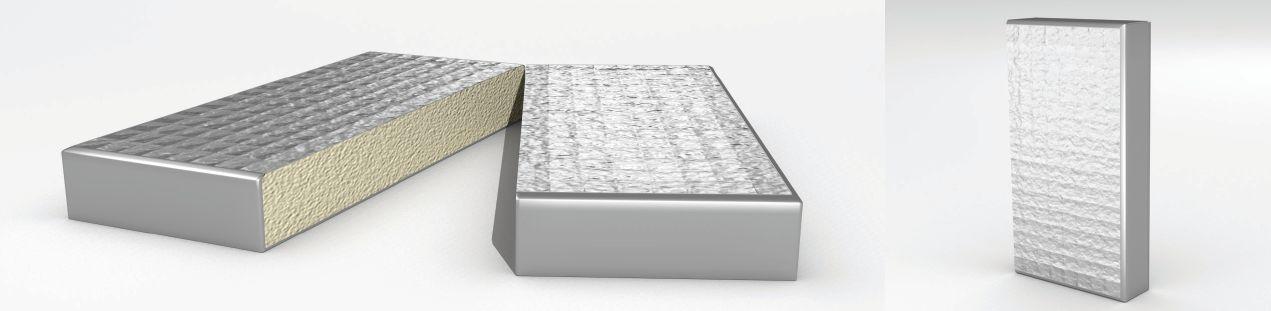
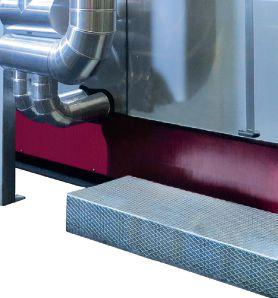
Automated efficiency takes insulated metal back pans and curtain-wall engineering to a new level. Refinements to traditional building envelope technology have put Lenmak Exterior Innovations’ EnvaTherm® back pans ahead of the competition.
Innovation in foam delivery technology yields soft, even, self-sealing insulation that provides a competitive R-value for consistent, reliable performance. The breathable foil backing maximizes thermal performance and protects against fire and UV damage.
EnvaTherm® insulated back pans have many clear advantages:
• Meets Canadian National Building Code requirements for use as a component of a non-combustible assembly (NBC 2010 3.1.5.5.; CAN/ULC-S134 Fire Test of Exterior Wall Assemblies)
• Automated production and lean manufacturing mean competitive lead times
• There is no loss of thermal performance due to air movement through panels
• Minimize the entry of drafts, humidity and allergens; does not support growth of mold
• The use of stick-pins is not required
• 80% lighter than panels that use traditional curtain-wall technology
• Each panel is totally self-contained for easy installation, handling and shipping
• Oversized panels maintain complete seal when properly installed
• Prevent noise transfer
EnvaTherm® insulated back pans are designed for use in curtain-wall systems in conjunction with a variety of architectural finishes, including opaque glass panels featuring UV-resistant finishes or metal panels for areas that do not require glass. Innovation in insulation technology ensures efficiency of production and proven real-world performance.
Flawless from Fabrication to Finish
At the BEC, Scott Thomsen, president of Guardian’s flat glass division, calls for the glass industry to stand up and fight attempts to lower window-to-wall ratios.
Automate your businesses brainpower with these intelligent manufacturing and enterprise solutions.
Specifying high-performance glass
The
A collective yawn
Ontario glass construction industry couldn’t rouse itself to respond to the Ontario College of Trades’ ratio review process for its Architectural Glass and Metal Technician category.
This was the process where the College gave industry a chance to have input on the ratios which will govern apprenticeships for the next four years. The Ontario ratio was left unchanged at one apprentice allowed for the first journeyperson employed, and one additional apprentice for every two journeypeople employed after that. Only Quebec has a higher journeyperson-to-apprentice ratio, yet only the Ontario Glaziers Apprenticeship and Training Committee (a part of the International Union of Painters and Allied Trades) and the Ontario Homebuilders’ Association bothered to make submissions for the review hearing.
NEXt IssUE
• Glassbuild preview
• Anti-spam legislation
According to the OGATC, which controls the apprenticeship program today on behalf of the Ontario Ministry of Colleges and Universities, everything is hunky-dory. The trade is growing along with the boom in glass construction and young people are lining up to fill the available apprenticeship positions. Oh, they could do a little better at getting apprentices to actually finish their apprenticeships and write their Certificates of Qualification, but that doesn’t really matter as experienced apprentices make 95 per cent of what a journeyperson makes anyway. I know that many in Ontario’s glass construction trade do not share the OGATC’s halcyon view of the state of availability of skilled trades, but you would never know it based on the evidence presented to the College.
The OHB called for a straight 1:1 ratio across the board, but ended up admitting in the review hearings that it was really only addressing the low-rise residential side of the business and that its submission had little bearing on the commercial and high-rise sides of the trade. Interestingly, the College and the OHB agreed that the present regulatory framework, which lumps low-rise residential workers in with high-rise and commercial glaziers, is probably flawed. The OHB and the College also agreed that the entire process was nearly irrelevant to the low-rise industry, as journeypersons and apprentices are almost non-existent in that sector any more. Considering the lack of interest in this process from the commercial glazing sector, one wonders if a similar situation might soon persist there, too.
The OCT has clearly failed, so far, to attract the interest and buy-in of the people and companies its clients will depend upon for jobs. This seems a shame, as the OCT offers the Ontario industry a chance to take control of its own labour force and increase the level of training and expertise across the board, on its own terms. Absent that buy-in, OCT bureaucrats will be faced with two choices: look for another job, or begin to whisper in the ears of their politician masters about the need for legislative change to make glazing trades compulsory. •
GROUP PUBLISHER | Martin MCANULTY mmcanulty@annexweb.com
Publication Mail Agreement #40065710. RETURN UNDELIVERABLE CANADIAN ADDRESS TO CIRCULATION DEPARTMENT, P.O. BOX 530, SIMCOE, ON N3Y 4N5 e-mail: subscribe@glasscanadamag.com
Printed in Canada, All rights reserved. Editorial material is copyrighted. Permission to reprint may be granted on request. ISSN 0843-7041
Occasionally, Glass Canada will mail information on behalf of industry-related groups whose products and services we believe may be of interest to you. If you prefer not to receive this information, please contact our circulation department in any of the four ways listed above.
www.glasscanadamag.com
NEWS
Glazing trade in the spotlight
the
21st Annual Provincial skills Canada Competition was held from May 15 to 16 at the Edmonton Expo Centre and more than 6,000 students toured the event while more than 660 secondary and post-secondary participated in 44 events, competing for a place on team Canada to represent their nation at the upcoming Worldskills 2013 competition in Leipzig, Germany. the PGAA presented the glazing trade to students by holding a try-A-trade demonstration for the first time this year. Neil Currie from All Glass Parts said, “It’s a lot more successful than last year because we didn’t have the try-A-trade last year.” the glaziers were not in the skills competition this year, but showcased the duties and roles of glaziers by staging demonstrations in glass cutting, installing glass into curtain wall and fastening pressure plates, and installing glass into an engineered balustrade shoe. once students completed all three demonstrations, they had the opportunity to enter their names into a draw for a 42-inch flat screen tV, while other students walked away with t-shirts. there was a line-up of at least 20 students at all times to participate in this educational exposure activity, proving that a hands on introduction to glazing is better than brochures and banners. steve Foster, a red seal journeyman from desa Glass, was partici-
pating for the first time and was impressed how many young students were out getting their hands on glass, as he remembers that trades were never mentioned while he was going to school. he said, “I think considering how much construction happens in Alberta, it’s great to see everyone in here.” Nathan Wady, a journeyman from All Glass Parts, has participated for the past three years and noted that this year was busier than any other year he’s seen. Apprentices Chris Friesen of Contract Glass Edmonton and Graham tailleur of desa were helping with the demos and on hand to tell students what the process is like from working in the field to becoming an apprentice. Women are considered to be an untapped market in the labour shortage that is quickly approaching. Melanie Milne volunteered her time from desa to show other woman that being a glazier is a career that more young women should consider. she was able to tell young women participating in the skills GEtt (Girls Exploring trades and technology) program that she fabricates and installs just like the guys do, and they could too if they want to. It was an absolute success thanks to the volunteers from the following companies: desa, Alberta Glass, CanAm Glass, Flynn, obE, Ferguson Glass, GtA, Alumatec, Cascade, All Glass Parts, Contract Glass, supertint, and hilti.
Attack on windows
Proposed changes to AshrAE 189.1 standard for the design of high Performance Green buildings are calling for a reduction in the allowable windowto-wall ratio from 40 to 30 per cent in buildings under 25,000 square feet. the proposals have touched off a firestorm in the architectural glass community, with experts estimating these standards could reduce the amount of glass shipped in North America by 25 per cent if widely adopted. scott thomsen, president of Guardian’s global flat glass group, delivered a spirited speech at the Glass Association of North America’s building Envelope Conference calling the fight against these proposals “the battle for the wall.” [see page 20] readers wishing to comment on the proposed changes can do so at www. ashrae.org/standards-research--technology/publicreview-drafts.
Insulating Glass Manufacturers Alliance executive director Margaret Webb said the association would fight these proposed changes as it had fought the previous attempt to reduce ratios in AshrAE 90.1.
CGA Newsletter
QUEBEC GLAzING AND FENESTRATION ASSOCIATION
one hundred and fortyfour golfers enjoyed a great day with perfect, sunny weather at the Club de Golf de drummondville on May 17. best foursome went to the team from Les Portes et Fenêtres AdG of terrebonne, Que. Each won a voucher worth $50 at the sAQ (société des Alcools du Québec).
August 23 will be the association golf tournament for residential and commercial sector companies. the club golf selected is Manoir richelieu in Charlevoix.
After the golf, Marc bilodeau presented his review of the last past year for the commercial sector. he also announced
a new gala that will be held during the annual congress in February 2014. the objective of this gala is to recognize some achievements in our industry from the both sectors, residential and commercial.
Golfers won some great prizes on the day. danny tremblay of Epsylom took home a samsung smart tV.
ONTARIO GLASS AND MetAl ASSOCIATION
back by popular demand, the oGMA will be pleased to put on an exciting and fun night of thoroughbred horse racing again this spring. Come out and join us for a great dinner, camaraderie, and spend some time at the slots. race Nite
takes off at Woodbine racetrack’s Post Parade restaurant on Wednesday, June 19 at 6:30 p.m.
Mark thursday, september 19 on your calendar and plan to attend the renowned oGMA Fall Golf tournament once again being held at the Carrying Place Golf Club.
the oGMA will host an educational spring seminar again this year, details to be determined. Watch www.ogma. ca for updates.
If you are conducting business in the glass industry in ontario, the oGMA is the voice that represents your interests at the provincial and federal level. Protect your business interests by becoming a member or as an associate member if you are a consultant to the industry. doug Morris is heading up membership for our association, so please contact him today at douglasmorris@ rogers.com, or visit the oGMA website.
the oGMA wants to notify all glass and glazing companies in the province that the ontario version of the Glazing systems specifications Manual of standards and Practices is now available for purchase. this all-encompassing document is a “must have” reference tool for all companies in the industry. For more information and to order yours, visit our website at www.ogma.ca.
PROFESSIONAL
GlAzIers ASSOCIATION OF ALBERTA
the PGAA will be having our annual golf tournament on Friday, August 16 at
Alberta s prings Golf r esort in r ed d eer Alberta. We have 144 golfers registered and paid for. It is the most participation at a golf tournament for the glazing industry in Alberta’s history. t his is our third annual golf tournament. o ver those three years, we have raised in excess of $93,000. t he funds raised this year will go towards the creation of the PGAA’s Master Glazier program. t he Master Glazier program is a continuing education program for certified journeyman glaziers. t he nine courses will be offered through the s outhern Alberta Institute of technology. t he accreditation of the Master Glazier program will be by the PGAA.
t he PGAA recently entered the Provincial s kills Competition as a “ try-A- trade.” At this venue, approximately 4,000 junior high and high school students attended this event. t he PGAA then had approximately 700 of those students go through our booth and tried their hand at cutting three-mm glass, installing 12mm balustrade glass and finally fastening pressure plates onto curtainwall. After completing the three tasks, the students were then put into a draw for a new 42-inch flat screen t V.
t he PGAA thanks Lynn Allan, PGAA education director, and r ick Makepeace, PGAA north director, and all of their volunteers for making this a huge success.
t he PGAA along with GAMA will be hosting the next Glass Connections show for the Canadian Glass Association. t his event will be held on t hursday, o ct. 10 at the Acclaim h otel near the airport in Calgary. More details will follow from the CGA.
Meilleur quatuor. From left to right, Jacques Barrette of Les Portes et Fenêtres ADG, Christian Proulx of Les Portes et Fenêtres ADG, Marc Bilodeau of Vitreco (and also vice-president of AIPVFQ), Vincent Collette of Les Portes et Fenêtres ADG and Éric Gravel of Lepage Milwork – Alphonse Lepage.
Full-time job
robert rivard has been named the full-time executive director of Fenestration Canada following a three-month search. this marks the first time Fenestration Canada has had its own executive director. the Executive search Committee has worked very diligently, examining various options, including a complete structural reorganization. the objective was to seek the services of a quality individual that would be completely dedicated to a cost-effective management approach
PPG aims to educate
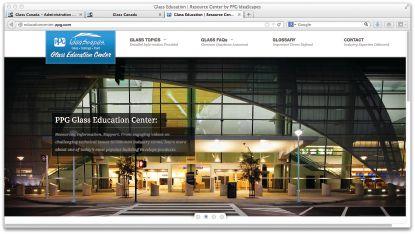
PPG Industries has launched the PPG Glass Education Center, a comprehensive website to help architects, specifiers, students and construction industry professionals learn more about designing, specifying and building with glass. divided into three sections – glass topics, glass FAQs (frequently asked questions) and glossary – the PPG Glass Education Center features a compelling mix of videos, colourful illustrations and educational features that address issues such as preventing thermal glass breakage, specifying large insulating glass units, how low-emissivity glass
solution and lead the association to fully realize its potential as the only national trade association for the fenestration industry in Canada. rivard is a fluently bilingual professional with 20-plus years’ experience managing national trade associations and more than seven years’ project management experience with the sector council program funded by human resources and skills development Canada. he comes to the association with demonstrated ability to lead and manage organizations through appropriate governance models and operational policies. rivard is also an astute financial manager overseeing budgets and deployment of funds with
fiscal discipline. he was most recently involved as the manager of association services on a part-time basis under the previous management firm. having him focus his entire attention to the requirements in administrative issues, marketing of the association, membership promotion and retention services, government relations and the Win-door trade show on a full-time basis will be of tremendous benefit to members who will now have a “go-to” person for all of their needs, Fenestration Canada said. rivard says he is looking forward to meeting everyone at the upcoming annual meeting in st. John’s this spring.
works, how heat-treated glass differs from heat-strengthened glass, and why it all matters for commercial building projects. Glenn t. Miner, PPG director of construction, flat glass, said the PPG Glass Education Center was created to address a growing demand, especially among young architects and students, for more accessible, interactive and engaging technical information about designing and building with glass. “As a building material, glass is more popular than ever, not just because it looks good but because it can help buildings operate more efficiently and make people feel better about their living and work environments,” Miner explained.
“As commercial glass products become more sophisticated, glass manufacturers have an obligation to deliver technical information to architects and other building professionals in a way that helps them meet the increasingly difficult demands made of them.” the PPG Glass Education Center is not designed as a promotional or marketing tool. “When
Trade tribunal re-opens inquiry
the Canadian International trade tribunal has reversed its decision made last o ctober that there was insufficient evidence of injury to investigate the alleged dumping of unitized curtain wall modules by
Chinese manufacturers into the Canadian market. In a May 3 decision, the tribunal announced it has seen reasonable evidence that such dumping may cause injury and that it will launch an investigation into the
visitors log onto the PPG Glass Education Center, they will find very little to no information about our products specifically,” Miner added. “our primary goal is to offer an objective, user-focused resource that enhances the safety, attractiveness and energy-efficiency of buildings constructed with glass, whether they are skyscrapers erected with monumental curtain walls or small elementary schools with simple windows that open and close.” the site’s existing content is based on the most frequently asked questions PPG fields on its website, during sales calls and through its call center, and new educational material will be added continually. In addition to hosting five short videos (three to six minutes each), the PPG Glass Education Center contains an extensive glossary of industry terms and nearly two dozen frequently asked questions covering low-e glass, glass safety issues and more. six more videos will be added to the site before July, along with content driven by architects’ questions and input.
Chinese fabricators’ trade practices. If the tribunal finds that the Chinese companies have engaged in unfair trade practices, tariffs may be applied against Chinese curtain wall modules entering Canada.
Duxton opens new showroom to community
duxton’s open house events took place at 45 h iggins in Winnipeg on April 10 and April 18 to celebrate its new 20,000-square-foot manufacturing plant and the completion of its showroom. o ver 100 industry professionals attended, including architects, engineers, builders, and contractors. t he showroom boasts a unique fiberglass pultrusion display, 3 d wall sections, the new FiberWall door system, and industryleading quint pane r -20 (C o G) glass. o n the plant tour, visitors were able to see new equipment including a pop-up saw, and new product developments such as seamless glazing, designed to mimic curtain wall systems but with a warmer frame. Glass expert tom Clark from Cardinal Glass made presentations throughout the day on their extensive product array, including their new room-side Low-E
coating and their new warm edge spacer with improved strength and thermal performance.
“ t he number of glazing options was impressive,” says Chris r ichter, project manager from Crosier Kilgour. “ t he information will certainly help me and my design team with the decision making process.”
In the factory, d uxton displayed architect-driven designs that made full use of its new FiberWall system: an eight-foot tall prairie-style fiberglass wood entry door, and an expansive window configuration for a custom Edmonton home, measuring over 15 feet wide.
“People don’t understand how much custom work they do,” says Myron Pasaluko from s tantec. “ t he huge frames and custom fiberglass door panel were very impressive. It’s been wonderful to see the company’s growth and development over the last 12 years.”
locked down
the American Architectural Manufacturers Association recently published its first North America standard for multipoint locking hardware for side-hinged door systems. AAMA 909-13, Voluntary specification for Cycle Performance and testing of sidehinged Exterior door Multipoint Locking hardware, establishes a minimum performance requirement and test procedure to evaluate the durability of multipoint locking door hardware. “As the use of multipoint locking hardware increases, products tested to AAMA 909 will help manufacturers confidently incorporate compliant locks into their door systems,” said Mark Fortun (Endura Products), a member of AAMA’s door hardware task Group. Prior to the
Hufcor to bring Monarch south
publication of AAMA 909, the only existing North American standards that were considered to be applicable dealt with single point locking hardware, such as a typical latch and dead bolt.
“there was never a standardized set of basic product requirements unique to multipoint locking hardware despite their use for several years,” said Matt taylor (hoppe North America), member of AAMA’s door hardware task Group. the reliable functionality of multipoint locking hardware is an essential factor for long-term performance of side-hinged door systems.
“the test methods and evaluation criteria in AAMA 909 ensure a rigorous representation of real-world lock use,” said Fortun.
hufcor has announced it has teamed with Monarch Glass Wall systems, a leading Canadian source of all-purpose, custom-built bi-folding glass walls.the partnership introduces Monarch by hufcor, a luxurious line of movable exterior glass wall systems and sliding doors now available for the first time to the mainstream home building industry in the United states. “this new partnership between hufcor and Monarch builds on each company’s strengths,” said hufcor’s Mark blanchard, vice-president, sales and marketing. “hufcor’s network of installing and servicing dealers now has a high-quality exterior movable glass wall system to round out the complete interior glass wall line. Monarch’s introduction in the United states means the products are fully supported by a local service team to ensure architects, builders and homeowners are completely satisfied.” hufcor, founded in 1901, sets the standard in flexible space solutions from 13 different global manufacturing facilities.
“hufcor is the market leader in movable walls,” said George Mei, president of Monarch. “offering our movable Glasswall systems combines our two brands’ strengths in the U.s. – product excellence and commercial market expertise.We’re excited to be partnered with hufcor.” Monarch thermally insulated folding glass walls and lift and side doors are specifically designed for variable climate conditions throughout North America.
INNOVATIVE PeoPle, INNOVATIVE COMPANIES
NsErC might have the right formula for glass industry
by PaTrick Flannery
We all have heard for a long time that we are drawers of water and hewers of wood with little ability to add value to the resources we extract from our rich landscape. Such organizations as Export Development Corporation’s Corporate Research Department have linked this failure to a lack of investment in R&D. “R&D has become a key element in the development and support of companies’ global supply chains,” EDC CRD director Todd Evans wrote in a 2009 working paper. “However, Canada has fallen behind its G7 and Organization for Economic Co-operation and Development competitors when it comes to investment in R&D. Spending on R&D in Canada is equivalent to 1.8 per cent of GDP, versus 2.3 per cent for the OECD on average, and this divergence in R&D intensity has worsened in the pas few years. Countries such as Sweden, Finland, Japan and Korea have R&D intensity rates in excess of three per cent.”
The Institute for Competitiveness and Prosperity, an Ontario think-tank, points to the dire consequences of our incuriosity in a working paper called Small Business, Entrepreneurship and Innovation. “We are less productive than other developed countries like the United States, France and Germany,” Roger Martin, dean of the Rotman School of Management at the University of Toronto, writes. “That is to say, we are less successful in creating value from our human, physical and natural resources than other countries. Lower productivity is synonymous with lower innovation, since product and process improvements result in more value being created with the same resources. The economic progress we have enjoyed is the result of more people working and working more hours in Ontario and Canada than in many other peer jurisdictions. We work more, but not smarter.” Chilling words, to be sure. But are they true in our industry?
Statistical data on R&D spending in the Canadian glass construction industry is hard to come by. But everywhere you look, companies seem to be coming up with new products, new ways to apply old products and new processing methods. One example is All Weather Windows in Edmonton, Alta., which made significant investments in
industry r&d.
four-point welding technology and a number of process innovations to produce its V-weld window design. The V-weld system does away with mechanical mullions, gaskets and sealants to produce a one-piece, welded frame, even for combination windows. Then there is Garibaldi Glass in Burnaby, B.C., which actually built its own ceramic frit screening machine to expand its capabilities in the architectural glass market and meet the requirements of the marine glass work it was contracted for. Vaughan, Ont.-based Tiltco’s owners travel the world looking for new technology to bring home, and found an extruder capable of producing PVC profiles strong enough to not need steel reinforcing even in very large applications. Drier Wall Works in Caledon, Ont., has come up with a window wall system that performs comparably to an insulating glass unit without using sealed units that depend on exterior seals. Agnora, a Collingwood, Ont., glass fabricator, has built a dedicated R&D lab to explore ways of building ever-larger laminated glass fabrications. Another Vaughan fabricator, Euro Vinyl, just launched a pinless screen product. It seems like you can’t swing a cat in the Canadian glass construction industry without hitting someone who is trying something new. Why are we bucking the trend?
It may be because fenestration manufacturers do not always do R&D the way governments and statisticians expect them to. Derek Lukala, technical sales manager at Tiltco, explains his company’s process: “We see what needs to be developed and where our products need to be advanced, whether it needs to be esthetics or performance or different applications for architecture,
Research and development in the Canadian glass industry is rarely a matter of bubbling beakers and white lab coats. Innovation is something that happens every day as part of normal operations, and not a dedicated initiative. NSERC appears to understand this.
then from there we all kind of brainstorm. From that process we get into design on our end, then we see if it can be manufactured and then you have a new product. Before we release it to the marketplace, we’ll go through testing for structural, air, water and thermal. We tend not to try to start anything from scratch - it is usually a refinement of our existing products.” So Tiltco uses a collaborative, problem-solving approach combined, as mentioned above, with discoveries the owners make as they travel around the world. Not exactly a laboratory environment with bubbling beakers and researchers in white coats. And the process is incremental and evolutionary - at what point does a change to a product become “innovation?” Each tiny tweak to one of Tiltco’s profiles probably does not count as such, but over time those tweaks add up to very different, proprietary designs. Tiltco’s process is also hard to gauge with traditional measures because there is no dedicated budget for R&D. “There is a certain amount we know we will have to spend to certify something,” Lukala explains, “so we take that into account always.” This is probably how product development happens most frequently in small and medium-sized companies in our industry: a problemsolving approach that is part of the everyday culture of the organization, rather than something that anyone does as a task. “We don’t have a research and development department or program,” Lukala says. “We just set aside some time in our weekly meeting to talk about different products. We just kind of bounce ideas off each other.”
Lukala says existing government assistance schemes for R&D
do not work well for Tiltco. “We are not a big company and we do not have an accountant to take a week to go through all the paperwork,” he says. “We have done it a couple times but nothing ever comes to fruition even though we are pretty technologically advanced in our field. We just don’t have a big accounting department where we can say ‘For the next week, all you are doing is filling out paperwork.’”
R&D is often the pet project of a senior person in the company who has a flair for that kind of thing. At Garibaldi Glass, one of the three brothers who own the company, Chris Mobius, has the title vice-president of operations and spends most of his time concentrating on the equipment and processes of this architectural glass fabrication plant. When the company began to work in marine glass, it needed to develop its abilities to apply ceramic frit to meet the tough vibrationresistance and water-ingress requirements for boat windows. Chris, with the help of knowledgeable employees, actually built Garibaldi’s first frit application machine using the design of a silk-screening table. The expertise developed in that project has enabled Garibaldi to grab high-profile architectural projects all over the world. Again, not something that appeared in any budget, nor even a project for which any person was specifically tasked. It was just something Garibaldi did, because it needed to be done.
or nothing in the way of real innovation activity in most of the companies that claim them.
One initiative, however, looks like it might work better for the way the average glass fabricator develops new products. We have seen that innovation in the glass industry is not about projects or departments or budgets, but about people. Innovative people lead to innovative companies. The National Sciences and Research Engineering Council of Canada (NSERC) offers programs through its three-year-old Strategy for Partnerships and Innovation that help companies work with universities and colleges to conduct research and to hire graduate and undergraduate students. There are a few different ways the assistance can work, but generally companies can either partner with a university or college department to collaborate on some research (this generally takes the form of the company funding research by a professor or doctoral student, then having intellectual property rights on anything discovered) or by having undergraduate students in a relevant discipline join the company to work on a specific problem or challenge. All Weather Windows has done this, and Banman is a proponent of the strategy. “I think it is important to fund the students so they can learn and so they can apply theoretical knowledge on an actual job,” he says. “It makes total sense to me because when some of them come and
Innovation in the glass industry is not about departments or budgets, but about people.
Governments at all levels say they want to assist Canadian SMEs to innovate, but Tiltco’s experience is all too typical. Assistance seems attracted to easily measured, clearly defined R&D departments with ongoing budgets and dedicated personnel. Absent these characteristics, a mountain of paperwork awaits leading to an interminable waiting period with no attractive chance of success on the other side. Tax credits have long been a favourite way for governments to encourage R&D, but applying for them can be so arcane that companies sometimes have to hire consultants to do it. Plus, the studies show that tax credits are producing little
become regular employees, the already know the work. I don’t really know the most efficient way of applying government money, but this one certainly seems focused and gets people into the industry and gets them jobs. If they do the work well enough, they can almost automatically work themselves into a job.”
An example of how NSERC would work would be a company approaching the program with an idea to work with an academic research team at a university to try to develop an idea for a new kind of thermal break in a PVC profile. “We require them to describe the problem and hoiw they are going to be working
with this team,” Barbara Muir of NSERC explains. “We get the response to them fairly quickly - we try to do it in four to six weeks. In order to lower the risk for the company, we pay for the entire thing: $25,000 for six months and that goes to the university or college. It is about solving the company’s problem.” Opportunities exist for further funding and collaboration if the initial effort is successful. Or, companies can go through NSERC to get assistance with the cost of hiring students. “We will actually pay for the joint salary of an undergraduate to spend four months in the company as an employee to work on a particular R&D project,” Muir says. “It can’t be regular testing for compliance purposes or testing of a product; there has to be an element of the unknown, it has to be a research project. We will pay for $4,500 and the company must pay at least $1,250 of the student’s salary for four months. We are trying to get undergraduates that experience in a company setting with an R&D project.”
One thing that might recommend NSERC to glass industry companies is its apparent culture of customer service. It has regional offices in each region of the country and promises swift answers to project proposals - usually within a month. Muir says advisors at the regional offices will answer questions from company owners about the program and provide ongoing assistance with planning and applying for the aid. The development of the program followed extensive consultations with manufacturers across the country, and NSERC seems eager to avoid the pitfalls of delay, rejection, confusion and extensive paperwork that have plagued R&D assistance programs in the past. Money spent on NSERC partnership projects is usually eligible for Scientific Research and Experimental Development (SRED) tax credits.
Our industry enjoys a strong culture of innovation already, but not one that lends itself easily to the various government attempts at assistance. Maybe NSERC can succeed in sparking even more research and development in the Canadian glass construction sector. •
by sKIP MACLEAN
Skip Maclean is president of Fenestration Canada. He is business development manager for TruTech Doors and has over 40 years’ experience in the window and door industry.
Yes, bye!
Fenestration Canada’s Annual Meeting Program was held at the Hotel Sheraton Newfoundland from May 30 to June 1. A record number of 187 delegates and other participants were registered for the event. Delegates were treated to a sample of what Newfoundland has to offer in terms of lifestyle, scenery and entertainment, as well as timely updates on technical issues, trends and topical subjects. The array of presentations on the program schedule included a code panel discussion for a cross-Canada update on codes and standards related to the fenestration sector moderated by Jeff Baker, FC’s technical consultant. Panel members included Al Jaugelis for B.C., Jean-François Kogovsek for Quebec, Jeff Baker covering Ontario and Atlantic Canada and Steve Hopwood addressing the Energy Star Program. The panel addressed the latest issues involving building and energy codes and standards. The presentation helped de-mystify the sometimes complicated technical language that accompanies published reference material.
J.F. Kogovsek of Maxam Marketing gave the code conversation a marketing twist with “How to get your entrance door NAFS-08 compliant – without going out of business!” Margaret Webb, executive director of the Insulating Glass Manufacturing Alliance, gave an overview of new technical and guideline documents being published by that association. Al Jaugelis of RDH Building Engineering reviewed the key results of its research project dealing with the validity of the Energy Rating system for windows. Steve Hopwood of Natural Resources Canada highlighted the main developments with the Energy Star program. Don Mills of Corporate Research Associates gave a thought-provoking presentation called
A record 187 delegates registered for the Fenestration Canada Annual General Meeting.
“Managing in a Chaotic Market Economy.” Neil Hardy and Joanne Slaney of the Altus Group presented “An Economic and Housing Forecast: Armageddon or plain sailing?”
The Annual Meeting Program provided ample opportunity for attendees to network with industry peers. Everyone enjoyed the good food and drink as well as the entertainment.
I was elected the new president of Fenestration Canada, replacing Yvan Houle of Portes et Fenetres President who becomes the immediate past president. Allan Doyle of Global Windows was elected as second vice-president, with Al Dueck of Duxton Windows moving up to first vice-president. Kevin Pelley of Kohltech International became treasurer.
Also elected as new board members were Jennifer Small of Screenco, Mike Bruno of Alumitex Windows and Doors and Mark Straub of Roto Fasco Canada.
Affiliate Association representatives on the board also include Terry Adamson from the Fenestration Association of B.C., Jim Krahn from IGMA, Ryan Dudeck from Fenestration Manitoba, Gilbert Lemay from the Quebec glass association and David Mitten from the Siding and Window Dealers Association of Canada. Jeff Baker of WestLab serves as technical consultant and Robert H. Rivard is executive director.
Fenestration Canada committees continue to do a significant amount of work on behalf of the association and the industry at large. All committee structures have been re-validated and new candidates recruited for participation. Representative members of affiliated associations were also invited to participate and contribute to the meeting deliberations, thus ensuring both a national and regional/provincial input to the discussion.
Win-Door 2013 will be held at the Metro Toronto Convention Centre Nov. 12 to 14. The education and show committees are hard at work putting together an impressive educational seminar lineup that will address current and upcoming issues of relevance to the fenestration sector.
The 2014 AGM will be held in Winnipeg at the Hotel Fort Garry, June 11 to 14, 2014.
As always, we invite members and potential members alike to visit our website regularly at www. fenestrationcanada.ca for important updates on activities as well as information and resource materials. •
Specifying the right high-performance glass
recent developments in glass technology deliver energy efficiency, daylighting and visual appeal.
AT RIGHT: The triple silver low-E coating on the Ritz-Carlton Toronto achieves one of the lowest ratios of solar gain to light transmittance possible today. New coating technologies make it possible for glaziers to selectively tailor the light spectra that enter the building.
Architects and glass professionals have long understood the benefits of incorporating highperformance glass into building design to maximize daylight, comfort, energy efficiency and esthetics. With the right glass design and glass fabricator, these building advantages can be achieved.
High-performance glass includes heatabsorbing, reflecting and spectrally selective properties, which can contribute to significant energy savings if the glass is selected carefully and in accordance with a whole building design concept. Glass elements should be selected based on many factors, including the building’s climate zone, usage and orientation. If optimized based on these features, the glass selection will result in a remarkable difference in the performance and effectiveness of the completed building – a result of quality assurance and effective integration of materials.
Glass substrates
There are many more glass colours than just clear glass available on the market today, with the most popular being shades of green, grey and blue. Tinted glass substrates are used to lower the SHGC of a glass product – effectively reducing the amount of solar heat entering the building.
Low-iron glass is another popular glass substrate due to its clearer, less green appearance than traditional clear glass. When opting for low-iron glass, it is important to note that low-iron glass is not a performance-improving product, but rather can provide an appearance enhancement where reducing a green hue is desired. Low-iron glass was used to provide the architect’s desired appearance for Telus Tower at 25 York St. in Toronto.
Low-E coatings
Coatings are thin layers of metal applied to glass to improve solar performance. The first architectural glass coatings were reflective coatings with a mirror-like appearance that reduced solar heat gain by reflecting the sun’s energy away from the building.
Due to changing esthetic trends along with building codes requiring high-performance glazing to meet more strict energy requirements, the most popular coatings applied to glass have become low-E, or low-emissivity coatings. Coatings with low-emissivity properties are spectrally selective, have low heat-transfer properties and offer higher light transmission than traditional reflective coatings.
With the profusion of low-E coating options available, selecting a specific coating may seem overwhelming. It will help to understand that each coating has unique appearance and performance characteristics. When selecting glass it is best to start by with a general understanding of the project requirements, either appearance or performance, or both. This will quickly narrow the low-E coating options to a more manageable number.
Telus Tower, referenced earlier, used a radiant low-E coating on low-iron glass. The appearance of this coating and substrate combination is silver – blue with dynamic reflectivity. This reflectivity, combined with higher light transmittance than older generations of coatings, allows the building to look different as weather and lighting conditions change from day to day even though the glass isn’t changing. The 38 per cent VLT and 0.24 SHGC of this glass provides an excellent balance between heat and light.
Ritz-Carlton Toronto used glass with a triple silver low-E coating. As the name implies, this coating has three layers of
silver, which provides an LSG of 2.14, one of the highest achievable with glass products available today. Triple silver low-E coatings have a slight green hue combined with high light transmittance and low reflectivity.
Silk-screened glass
The process of silk-screen printing on architectural glass has been around for more than two decades, and is implemented for two primary reasons: to increase the solar performance and to create the specific visual effect desired by an architect. The paint used is ceramic-based and must be fired to the glass. The glass is then run through a heat-treating furnace and the paint, also known as ceramic frit, essentially becomes part of the glass. Silk-screened glass fabricators typically offer standard line, dot or hole patterns, in a variety of standard colours including white, black, and multiple shades of grey. Most also have the capabilities to accept custom patterns and develop custom colours.
Adding silk-screen patterns improves solar performance, again leading to a potential savings in energy costs compared to a similar glass type without a silk-screen. For example, a one-inch insulating glass unit with two plies of clear glass has an SHGC of 0.70. Adding a 40 per cent-coverage white silk-screen pattern drops the SHGC to 0.54.
Combining silk-screen patterns with low-E coatings allows a designer to tailor the performance and appearance to the specific needs of their project. Silk-screen patterns are applied to the glass first and then the low-E coating is applied. This combination allows both the silk-screen pattern and low-E coating to aid in blocking heat from entering the building.
Silk-screened glass is also a potential solution to reduce bird collisions with glass. While ongoing testing is necessary to understand the effect of various glass products, including specific silk-screen patterns and coatings – such as those with low, medium and high levels of reflectivity – it is evident based on the testing done thus far that silk-screen patterns can be an effective way to reduce bird collisions with glass in building design.
Laminated glass
Laminated glass features an interlayer bonded between two or more glass plies using heat and pressure. It is typically used in overhead glazing and areas where codes dictate safety glazing. Laminated glass also provides a durable,
high-performance glazing product, designed to provide protection against threats such as hurricanes, bomb blasts or forcible entry.
Laminated glass improves specific performance characteristics. Ultraviolet light is the portion of the spectrum that causes interior damage such as fading fabric and deteriorating plastic. The interlayers customarily used in laminated glass will help reduce the amount of UV light allowed to pass through the glass to less than one per cent. While one per cent can still cause some damage, it is important to understand that even the highest-performing insulating low-E coated glass products have five to 10 per cent UV transmission.
Another performance characteristic improved by laminated glass is acoustics. A good way to improve acoustic performance is by selecting an insulating laminated make-up. A standard one-inch insulating unit with two plies of quarter-inch monolithic glass has a sound transmission class rating of 35. If an insulating laminated unit is created by substituting the interior quarter-inch monolithic ply with quarter-inch laminated glass, the STC increases to 39. Increasing the thickness of the laminate will further improve the STC rating.
The future
Glass manufacturers and fabricators are continually evolving to further advance glass and glazing technologies. New products and techniques will continue to bring new alternatives to market that will meet an extensive variety of performance standards, further solidifying the importance of glass in highperforming, functional and visually appealing buildings.•
Photo
by MArGArEt WEbb
Margaret Webb is the executive director of the Insulating Glass Manufacturer’s Alliance.
Understanding thermal stress
The U.S. Department of Energy is looking to develop a rating program for such fenestration product attachments as awnings. It is extremely likely that both the U.S. and Canadian Energy Star programs will adopt these ratings once completed. One of the potential challenges for the fenestration industry will be to manufacture windows that can withstand temperature differentials across the insulating glass unit, which can lead to an increase in thermal stress breakages. The majority of thermal stress breaks occur in winter when the exterior versus interior temperature differentials are the greatest.
One of the common factors that can lead to breakage of annealed glass used in insulating glass units is thermal stress. Breakage due to thermal stress involves the occurrence of a thermal gradient induced by uneven heating of glass by either solar irradiance or other heat sources. When sunlight impinges on a glass plate, some energy is reflected from the surface of the glass, the glass absorbs some energy, and some energy is transmitted through the glass. Energy absorbed by the glass increases the temperature of the glass above the previously existing equilibrium condition. When glass is uniformly heated and if the support system can accommodate the thermally induced expansion of glass, no major stresses will be induced by the uniform temperature increase. However, the part of the glass surface that is shielded from direct sunlight by the edge supporting system or by shadow conditions will be heated unevenly. The uneven heating of glass will give rise to thermally induced in-plane tensile and compressive stresses. When the thermally induced
The uneven heating of glass will give rise to thermally induced in-plane tensile and compressive stresses.
tensile stresses become high enough and interact with certain edge conditions, a thermal breakage can result.
The IGMA Technical Services Committee has developed a bulletin, TB-1300-13, Guidelines to Reduce Instances of Thermal Stress. This Technical Bulletin provides guidelines relating to thermal stress considerations for window glass products used in residential and commercial building envelope projects. Its purpose is to give the user specific guidelines and design assistance toward avoiding glass problems that arise from breakage caused by thermal stress conditions. The Technical Bulletin is intended to consider, but not be limited to, conditions known to be important to thermal stress in glass. It also includes a knowledge base of reference materials, available industry information, do’s and don’ts guidelines for thermal stress, and practical design considerations for the review and analysis of thermal stress.
This bulletin addresses the following conditions as a single design element. Users of the document must be aware that it is rare that only one of these conditions exists as a single item: altitude, building design, design winter conditions, elevation (orientation), glass edge conditions, post installation films, risk conditions associated with framing considerations, glass kind and type, heat traps (indoor conditions), number of glazing lites, solar radiation, spandrel and on-site storage conditions.
Once you starting combining conditions, the potential can increase exponentially. IGMA recommends that each manufacturer work diligently with their glass supplier. Most glass suppliers provide a software tool to calculate thermal stress and when to fabricate with heat-strengthened, fully tempered or even laminated glass to reduce possible consequences of broken glass.
ASTM 2431-12, Standard Practice for Determining the Resistance of Single Glazed Annealed Architectural Flat Glass to Thermal Loadings is available for the industry however it only addresses monolithic glass. IGMA is providing the majority of funding for the development of standard to determine thermal stress for insulating glass units. •
IGMA
West Coast cool
Creativity and youth abound at optimum Glass studios.
Optimum’s designs stress a minimalist, clean concept that stays right out of the way of the architecture and the view. Wilson and company bring a strong esthetic sense to the job, coming as its people do from an art glass background.
Idon’t even know what a regular glass shop looks like,” admits Scotty Cooke. Cooke has some important role at Optimum Glass Studios, but it is hard to tell what it is because no one at Optimum has familiar titles. Curtis Cleveland is “lead strategist.” Cooke calls himself “executive decision-maker.” The only thing for sure is that Kevin Wilson owns the business and that it seems to be doing just fine without a traditional hierarchical apparatus or rigidly defined job roles. Perhaps this is not surprising at a former art-glass company in Vancouver where everyone except the owner is under 30. What may be more surprising is the success Optimum has found in the highend residential architectural glass business, even with its laid-back approach.
Laid back should not be read, however, as sloppy. “We are very meticulous,” Cooke explains. “We will never leave a job halfassed. If it is not good enough for ourselves – and we consider our standards to be pretty high – then we are not satisfied. We try to approach every job with a level of excellence that has to be consistent.”
Wilson started Optimum in 1996 at the age of 21. His first line of work was glass trophies and other art glass pieces. As he became known for his expertise
At A GLANCE | optimum Glass studios
with glass, opportunities arose to supply glass shower enclosures. As their popularity rose, Wilson focused more and more on architectural glass, adding railings and guardrails to his repertoire. In the early days, Wilson worked often with Greg Carter, but when Carter left to work as a designer at Ethan Allen, Wilson found more opportunity on the architectural side.
As Optimum moved into architectural glass, trends were once again on its side. Architects and builders of high-end residences were becoming more and more interested in a style of clean, minimalist use of glass that Cooke identifies as a West Coast style. Frameless glass panels with unobtrusive stainless steel hardware to give interior spaces an open feel and exterior spaces an unobstructed view of the glorious Vancouver landscape – it was a design concept Optimum was only too willing to embrace. “There are not too many places in the world with the views that we have of the ocean, the mountains and the cityscape,” Cooke explains. “Land prices are really high, but people pay for views. The number one thing is, they do not want to lose their view when they build their houses. So that is where glass fits in perfectly.” To meet this require-
Location: Vancouver, b.C.
Founded: 1996
Employees: 14
Shop: 3,000 square feet
Owner: Kevin Wilson
optimum Glass studios provides custom architectural glass designs for luxury residential housing in the Vancouver area. Interior and exterior balustrades, staircases and showers are its specialty, along with specialty glazing.
ment, Optimum keeps its panels as large as possible and the hardware and structural work to a minimum. Wilson’s team strives for a symmetrical look that follows the lines of the building without adding elements. Cooke landed in Vancouver five years ago with a checkerboard background of business school, training as a plumber and experience working in and managing a railing fabricator. He met Wilson when he got a job plumbing his bathroom. Wilson must have seen something in Cooke that set him apart from the average plumber, because it was not long after that when he hired him to manage Optimum’s four employees. The move was apparently a good one, because the company has grown since then to 14
employees and four times the business it was doing when Cooke took over. Cooke says the creativity he gets to use at Optimum is a major reason why he stayed. “I actually went into business for commerce and I took two years and then I was bored,” he says. “I said, ‘Man, I don’t know if I want to be in a bank.’”
Keeping a loose, creative feel is an intentional approach at Optimum. “We work really hard at not being cookiecutter,” Cooke says. He wants each employee to bring his strengths and unique perspectives to the table without boundaries or rigid rules getting in the way. “We do have this youthfulness and one of the things I value about the company is that we have a personality,” he adds. “People enjoy working with the team here and at the end of the day you have to do something that sets you apart. We do not use glass that is different from what any other company would use and our hardware is the same aside from the occasional custom piece. It is a lot the personality that they guys bring that has added an edge to our success.” Cooke readily admits that Optimum is relatively new to the architectural glass business, but says it has not held it back so far. “We don’t have anyone on the staff that has 35 years of glazing experience,” he says, “but that has not really been a limit to what we are able to do.”
Perhaps unsurprisingly for a company where all the employees are under 30, computers are popular to assist with design. Cooke says he quickly tired of the standard practice of measuring up spaces and building templates when he got into the industry and found instead he could do the work just as well with careful measurement and math, assisted by CAD software.
Future directions for Optimum will include expanding its capabilities to be able to produce more and more of the hardware, spandrels and frames for its projects. The company has hired a full-time welder, Wade Halbert, who Cooke says is a master at figuring out creative solutions to difficult glass-holding problems.
With its slick website, youthful staff and loose, creative approach, Optimum is sure to be a favourite of the wealthy and trendy in Vancouver for years to come. •
read more industry profiles online at www.glasscanadamag.com > Past Issues
ABOVE: Scotty Cooke bounced around in a few different trades before finding his stride in glazing. He has helped Wilson grow the company from four to 14 employees.
BELOW: Optimum gets most of its work in Vancouver’s red-hot luxury home market. Their well-to-do clients have spent big money for great views and do not want anything getting in the way.
INDUSTRYeVenT
BATTLE CRY
by rich POraykO
The presentation everyone was fired up to see at the Glass Association of North America’s Building Envelope Conference, was the keynote, “The Battle for the Wall” by Scott Thomsen, president of the Global Flat Glass Group for Guardian Industries.
Thomsen is trying to rally the troops before it truly is too late. In May, the American Society of Heating, Refrigerating and Air-Conditioning Engineers (ASHRAE) filed a proposed change to Addendum “am” to ASHRAE 189.1, “Standard for the Design of HighPerformance Green Buildings Except Low-Rise Residential Buildings” that would limit the window-to-wall ratio to 30 per cent in small and mediumsized buildings “for the purpose of reducing energy use.”
So what happens to the
Guardian’s scott thomsen calls for action.
industry if this goes through and there is a reduced WWR? According to Thomsen, moving from 40 to 30 per cent WWR means 25 per cent less glass. “There will be less glass per facade,” said Thomsen. “There is about five million tons of glass that is sold each year in North America. The commercial market makes up 17 to 20 per cent or about a million tons of all of the glass consumed. If we lose 25 per cent of the commercial market, that is 250,000 metric tons of glass. That is massive change in the amount of glass in the facade.”
Everyone is well aware of the building recession in the United States and Canada. Thomsen told the captivated audience that commercial building floor space installed in the U.S. dropped from 1.6 billion to 650 million square feet since 2008. “The more stark number is the average construction dollar value of a commercial space has plummeted from $600 million to $230 million over five years,” said Thomsen. “So we are all playing in
a smaller marketplace with less opportunity to grow your businesses. If anything, companies are scratching and clawing to find the bare minimum to keep their businesses going forward.”
“The ASHRAE Building Code is pushing very hard right now for a WWR of 30 per cent. ASRAE, the HVAC community and the alternative facade materials are saying to the government that less glass is better. This leaves out a lot of the other factors. Daylighting, work environment, human comfort, performance. Who wants to work in brick box? Not many people.”
“There are going to be fewer windows,” warned Thomsen. “There are going to be smaller windows. Curtainwall becomes strip windows and strip windows become punched openings. This is a supply chain shift. Curtain wall suppliers start battling against commercial window companies with shop-glazed units. The competitive space is getting bigger and there are more players in the channel. In Europe, Latin America and Asia Pacific, we are seeing
ABOVE: Thomsen pointed out that proposed changes to ASHRAE’s green building standards would lead to a 25 per cent reduction in the amount of glass used. If these standards were to be widely adopted, it would spell disaster for many glass construction companies and their suppliers.
Photo credit: r ich Porayko
traditional curtainwall being reduced. So 40 per cent to 30 per cent means 25 per cent less glass. Last time I checked, most of the people in this room get paid by the surface area of the building. What does this mean to your business? Less profit per building.”
Thomsen says the glass industry needs to understand our competition. “To me, the true competitors are solid surface wall materials. They are the other building materials that vie for that square meter of facade. Cement manufacturers want to sell more cement.”
The big question for our industry is how do we keep the WWR at 40 per cent. According to Thomsen, depending on what part of the world you travel to, you will see both increasing and decreasing window-to-wall ratio. “The challenge is to get prepared for the future. In Europe, the glaziers that didn’t prepare 10 years ago are either not around or they are half the companies they used to be.”
“We have to serve two masters,” said Thomsen. “Energy code legislation and architect vision and creativity. The bottom line is that we need to improve the energy efficiency of the glazing and create value at each step of the channel. If a glass company does a lot of R&D to develop an electrochromic glass and the fabricator doesn’t have the capability to handle the electrical wiring or the glazier doesn’t have the skills to install it into a facade because of the complexity of electrical current, the whole channel breaks down. We need to improve the way we pull innovation on energy efficiency through the channel and minimize the adoption chain risk.”
Thomsen says the best way to compete with solid walls is to improve energy efficiency including full migration to high performance coatings. “When you look at the U.S., commercial facades are about 65 per cent and residential is north of 95 per cent,” he said. “The first step is for everyone to encourage energy-efficient coatings to increase the value of the facade. Argon gas filling is an easy way to improve the energy efficiency of an insulating glass unit. Warm edge spacers are improving. Surface four coatings are becoming available. Silkscreen patterns to reduce the solar heat gain. Triple-glazed IG units. The more value, the more money you can put into your pocket.”
“Larger glass sizes are becoming more popular and you have to be able to handle this. In Europe, they have been very suc-
cessful in migrating to triple-glazed and double-skin facades.”
Thomsen urged the attendees to get engaged in the industry. “GANA is not a four letter word. We need more people to be active voices and participate. This might take years. You need to get educated. And don’t wait for everyone else to do it first. We need some early adopters.”
“Embrace the more stringent codes. Partner with suppliers throughout the channel that are working on zero energy buildings. Improve energy efficiency or lose surface area.”
ment is importing products that were made in China but declaring them as made in Vietnam to avoid tariffs. Mislabeling means declaring the contents are doors as opposed to curtainwall. Undervaluing could be claiming that the units inside the container are worth less than they actually are or undervaluing the aluminum within the curtain walls. And we work with Customs to identify those issues.
“I feel like everyone should know this because I have had clients that have got into a heap of trouble because if someone
“We have to serve two masters: energy code legislation and architect vision and creativity.”
The other presentation that created a lot of buzz was an informative update entitled New Tariffs on Chinese Curtain Wall by David M. Spooner of Squire Sanders, who represents American curtain wall manufacturers AGA, Bagatelos and W&W. According to Spooner, on November 30, 2012, the Department of Commerce ruled in favor that “curtain wall units and other parts of curtain wall systems are within the scope of the antidumping and countervailing duty orders on aluminum extrusions from China.”
“In late December 2012, the Department of Commerce sent instructions to customs, requiring all ports to collect anti-dumping and countervailing duty tariffs in the form of cash deposits on all Chinese imports of curtainwall units and parts,” said Spooner. He told the audience that at the time of BEC, ports were collecting tariffs of 171 per cent on imports of curtainwall units from China.
“My colleagues and I as well as the many companies we have worked with are working very actively with the ports to make sure that inspectors understand and are enforcing Commerce’s order. Port inspectors find the order confusing and they don’t understand the curtain wall industry so they eat up the presentation.
“It’s also very important to be careful about transshipment, mislabeling and undervaluation. An example of transship-
gets caught, it’s up to five years in jail and hundreds of thousands of dollars in fines.”
According to Spooner, it is also important to note that tariffs can change yearly and usually do. “We don’t know when the Department of Commerce will likely recalculate the tariff or whether or not it will be 400 per cent or 50 per cent but it will almost certainly change.”
Yuanda, the world’s biggest curtainwall company and Jangho have challenged the Department of Commerce’s ruling. According to Spooner, they have filed a complaint with the Court of International Trade in January 2013. “Customs still continues to collect tariffs even during the course of litigation,” says Spooner. “The case will not move quickly and it’s unlikely to result in a full reversal of the tariffs.”
The presentation definitely struck a chord. One of the comments online after the BEC event stated “As an American that is gainfully employed by a Chinese curtainwall contractor, I found this presentation offensive to myself, my company, and other attendees that are employed by the Chinese.” It’s not worth attending if someone isn’t getting offended. •
Rich Porayko is a professional writer and founding partner of Construction Creative, a marketing and communications company located in Metro Vancouver, BC. richp@ constructioncreative.com.
Glass enterprise solution
www.mainstreetcomp.com
Mainstreet Computers, a business management software and web services provider, has announced the release of its newest version of Glas-Avenue. GlasAvenue 9.0 is packed with all-new features specifically designed to boost profits and add efficiencies. the time Clock Module verifies employees daily time in and out. the Commission system rewards employee’s productivity through incentives. sales tax by Locality takes the guesswork out of charging the appropriate sales tax(es). Pos Invoice Attachment adds photos and documents relative to each invoice. Insurance Job Invoice Customization handles up-selling and insurance billing all on the same invoice. Multiple Vendor Inquiry checks best price and parts availability from multiple vendors simultane-
ously. Coming soon, the Mobile (Android) App will streamline workflow between the office and field technicians. “We’re thrilled to offer new features in 9.0 that will make it easier to run a profitable glass shop,” said david Carnahan, Mainstreet’s president and founder. “I’m especially excited about the Commission system that enables owners to offer incentive-based pay that would be almost impossible to track manually. If you want to increase employee productivity, reward it. our new Commission system makes it simple.” Mainstreet is a leading independent software provider to the auto and flat glass industry. It also provides web services including website design, hosting, brand establishment, logo design and development and especially search engine optimization.
Advanced metal cutting
www.hyperthermcam.com
hypertherm, a U.s. based manufacturer of advanced cutting systems, has announced a number of feature enhancements to its
Azon Saves Energy
turboNest and NestMaster CAd/CAM nesting software. the updates announced today will make it easier for companies that fabricate or cut metal to increase the cut quality, productivity, and profitability of their operations. the added features and enhancements include support for CAd fonts. turboNest now supports native AutoCAd fonts (shX) and Windows system fonts (truetype, opentype, Postscript) for CAd drawings that contain text. the enhanced 2d CAd program in turboNest can make quick changes to any CAd drawing before it is added to the part list. NestMaster now supports Unicode fonts for CAd drawings that contain text. Multiple drawings can be open simultaneously in 2d CAd in NestMaster. the version 10.1 update is available at no charge to anyone with an active turboNest or NestMaster software subscription. Customers simply need to visit the online Knowledge base at www. hyperthermcam.com. ProNest, NestMaster, and turboNest have been leading nesting software packages for two decades, offering high performance and reliability with a straightforward, easy-to-use design. ProNest is also a component of hypertherm’s Integrated Cutting solutions, providing support for true hole and rapid Part technologies.
simple and accurate
www.wtsparadigm.com
Winflexum Gold Fenestration software is designed to be not only simple but also accurate. sometimes swiftness may be at the expense of quality, but not in case of Winflexum configurator. both in quotation and design, using Winflexum Gold results in exact and accurate data. Winflexum Window Quoting software fits to the special needs clients. Fenestration drafts are available in inches, always keeping the right proportion in cases of standard doors and windows. the precise window CAd drawings and 3d visualization ensures clients they will get exactly the door and window products they want. Clients always want to see the most realistic view of the final
product they order, immediately. that is why Winflexum produces a well-designed 3d image and the precise window CAd drawing. Professional Winflexum window quoting software is as fast as the Winflexum window design software. It helps to provide a precise quotation within minutes. the advantage of Winflexum is not only the high standard of the client service, but also its labour-saving features. Winflexum can remove the need for a graphic designer and CAd drawer. Winflexum is suitable for all different technologies, whether the raw material is wood, plastic or aluminum. you can’t find any profile system in the world that Winflexum Fenestration software would not be able to handle. It is compatible with all accessories that may occur in connection with fenestration design and production such as shoulders, shutters, screens, ventilation and venetian blinds. With Winflexum window and door quoting software as well as Winflexum window and door manufacturing software all these extra requests can be integrated into the design procedure and into the quotation process.
Work Anywhere
www.autocad360.com
Autodesk, a leader in cloud-based design and engineering software, is expanding AutoCAd 360 (formerly AutoCAd Ws), its line of easy-to-use web and mobile drafting and documentation applications that let users view, create, edit and share drawing any time and anywhere. the success of AutoCAd Ws to date with more than 12 million downloads worldwide and over two million monthly active users revealed the pervasive market demand
for sophisticated mobile design capabilities. the expansion of the AutoCAd 360 product line improves collaboration and delivers new and simplified ways to work with CAd on mobile devices and web browsers. In addition to uploading existing drawings, users can now start new projects from scratch within AutoCAd 360 mobile. the ability to work with increased file sizes allows users to open and work with more complex drawings and designs. Users can connect AutoCAd 360 directly to popular third-party storage options such as dropbox and box. the block Palette function allows users to easily drag and place blocks into drawings from the drawing’s block collection. Users can take advantage of advanced layer management, properties and attributes, drawing coordinates and additional storage space. top priority support is available for purchase to get faster responses to questions. the new AutoCAd 360 web app beta will deliver
the power professionals need to access drawings from any computer to view, edit, and share with others, while also benefiting CAd novices involved in projects. A simplified user interface improves sharing and collaboration ensuring that critical data can be accessed by anyone involved in a project regardless of expertise with design tools. AutoCAd 360 mobile is available in English, Chinese, French, German, Italian, Japanese, Korean, Portuguese and spanish. AutoCAd 360 and AutoCAd 360 Pro mobile app plans are available at the itunes App store or Android markets, including Google Play. “What used to take us days of communication back and forth and lag time is now taking us hours and minutes with being able to instantly and in real-time update drawings,” said Jim LaPier, designer and It manager for Chesapeake design Group. “With AutoCAd 360, we are able to accomplish what a larger firm would do, but with a much smaller workforce.” •
by brIAN bUrtoN
Brian Burton is a business development consultant and is serving on the Personnel Committee for the CSA’s Certification Program for Fenestration Installation Technicians. His current interests include adaptive reuse of buildings, overcladding technologies, maintenance of the building envelope and the rapidly growing use of computers in construction. You can contact him at brianburton@ live.ca or visit his new website at http://burtons-pen.com
Test the installation
Ihave learned from firsthand experience that in situ testing of building enclosure systems often presents a number of technical and logistical challenges. I was initially exposed to on-site testing while inspecting fenestration installations for high-rise, non-profit buildings. There are cases when this testing may be problematic because of the wide range of environmental conditions that may exist on site, or from the less-than-ideal location of the area(s) selected for testing. Essentially, you are attempting to simulate a severe weather event, which can be difficult even in a controlled laboratory setting. Despite this, I feel in situ testing is a critical tool for quality control that should be deployed far more often than it is.
Manufacturers typically invest considerable resources in laboratory tests, but these test the products, not the installation. Wall systems have evolved over time and become more complex. In my view, they now require more attention to detail to install correctly and without defects. That being said, certain general installation principles will improve the chances of providing effective environmental control within acceptable limits. Contractors who follow these principles have little to fear from on-site testing of their work.
One principle involves paying close attention to the interconnection details between the fenestration product(s) and the water-resistant barrier in the wall system. These barriers need to be properly lapped if they are to perform as intended and failure to ensure continuity where these components interconnect can be a potential source of air or water leakage during the building’s service life.
Laboratory tests test the products, not the installation.
Another installation principle (that applies mostly to designers) involves operating on the assumption that wall systems may experience water penetration at some point and ensuring there is a drainage path for moisture to escape. This drainage path may also serve to provide ventilation, which can allow the system to dry.
For installers, good building practice involves making sure that on-site conditions are suitable when using sealants and weatherstripping. This includes ensuring that surfaces are dry, clean and free from contaminants such as dust or construction debris. This can be difficult on construction sites. Temperature may also be a factor in proper sealant application and contractors must pay attention to the manufacturer’s instructions.
It is also important that these sealants (or self-adhering flashings) are durable enough to withstand exposure to Canadian temperature extremes and UV radiation. In our climate, the temperature extremes result in almost continuous expansion and contraction. It falls to the designer and specification writer to select products that can handle this kind of stress.
The cost of the building envelope in relation to the cost of the entire structure has gradually increased. This is due in part because of the complexity as well as the number of components and contractors involved. In fact, the cost of the enclosure system for newly constructed buildings can equal the cost of all the other building elements. As a result, effective quality control and testing cannot be overlooked or deferred. It is estimated that defects that may lead to moisture penetration or accumulation within the wall systems comprise a significant percentage of reported deficiencies. In my opinion, testing for these defects often does not receive adequate attention, in spite of the fact that we know how to apply quality control expertise to prevent them.
Developers, agencies, architects and other professionals involved with the construction sector all have a vested interest in ensuring adequate quality is achieved, and in keeping water on the outside. •
by FrANK FULtoN
Frank Fulton is president of Fultech Fenestration Consulting. He has been in the industry for 30 years and can be reached via e-mail at fultech.fc@gmail.com.
A standard too far
When NAFS is more widely specified, many manufacturers will be finding out that the new standard is so very different from the A440 that they will have to re-test their entire product offering to comply. I anticipate that a lot of manufacturers may be irate at what will soon be coming their way.
The new NAFS looks an awful lot like the AAMA standards of the past. Having done a lot of window business south of the border in my former role at Fulton Windows, I became very familiar with the AAMA standard and developed a big dislike for it. I found that the rules and procedures and the way users applied the standard to their project specifications made it necessary to greatly overdesign products to comply, in particular the structural requirements.
Instead of having one test size per product to comply as we did with the A440, NAFS has four categories or “performance classes”: Residential (R), Light Commercial (LC), Commercial (CW), and Architectural (AW). In each category, the criteria are more stringent, but the major difference is that the test size of the window or door gets significantly larger. The test sizes under the A440 were reasonable and reflective of what could be expected in the marketplace. The test sizes for the CW rating are way overboard and for the AW rating are outrageous, in my opinion. In order to have a product rated to one of the performance classes, it must pass testing at a prescribed “gateway” size. Downscaling to achieve a performance class rating is not permitted.
Under A440, windows and doors in a ten storey building located in all major centres from British Columbia to Quebec would require a structural rating of C3, meaning that a window
could not blow out or fail to operate at a force of 3,000 pascals, equivalent to a wind speed of 245 kilometers per hour, or deflect more than L/125 at a force of 1,200 pa. For a one-metrehigh sliding window, the maximum the meeting rails were permitted to bend was eight millimeters. For a sliding door the blow-out limits were 2,500 pa and the deflection limits were L/175 at a force of 1,000 pa with an allowable bending limit of the meeting rails at 11.7 mm.
Under NAFS, the structural load test for windows in a 10 storey building in major centres is different from city to city. The blow-out pressures are in a range between a low of 1.56 kPa for Montreal to a high of 2.15 kPa for Quebec City. The testing for resistance to blow-out is less stringent under the new NAFS standard.
The problem for manufacturers will be to meet the new deflection limitations imposed by NAFS due to the considerably larger test sizes and heights in particular but also because of higher imposed loads and more stringent limitations in the case of windows. As an example, for windows and doors installed in a ten storey building in either Toronto or Quebec City, the test for deflection would be conducted at 1,430 pa with limits of L/175. Factoring the size, load, and deflections limitation differences on the meeting rails, the test on a sliding window under NAFS-CW is 328 per cent more stringent and for a sliding door 79 per cent more stringent than under A440 and CGSB 82.1-M89.
To meet the new CW rating, all existing sliding window and door meeting rails must be re-designed and reinforced significantly. The absurd thing in all of this is that a slider has to be designed strong enough to pass a test at a height of 1,500 mm, but in reality most sliding windows provided to mid-rise buildings are only about 500 mm high. In other words, the new standard will be responsible for over-engineered products and greater building costs. •
Stop Worrying About Quality!
The LiSEC HWM horizontal washing machine is perfect for applications where washing quality is crucial. Designed especially for float glass with all types of sensitive coatings as well as laminated and tempered glass, the LiSEC HWM is the perfect fit for your most sensitive washing needs.
n Residue-free cleaning and fast drying of glass sheets
n Ideal for washing glass sheets with highly sensitive coatings
n Ideal for glass sheets which will be coated after the washing process
n Intelligent design for easy maintenance, noise reduction and energy savings Please