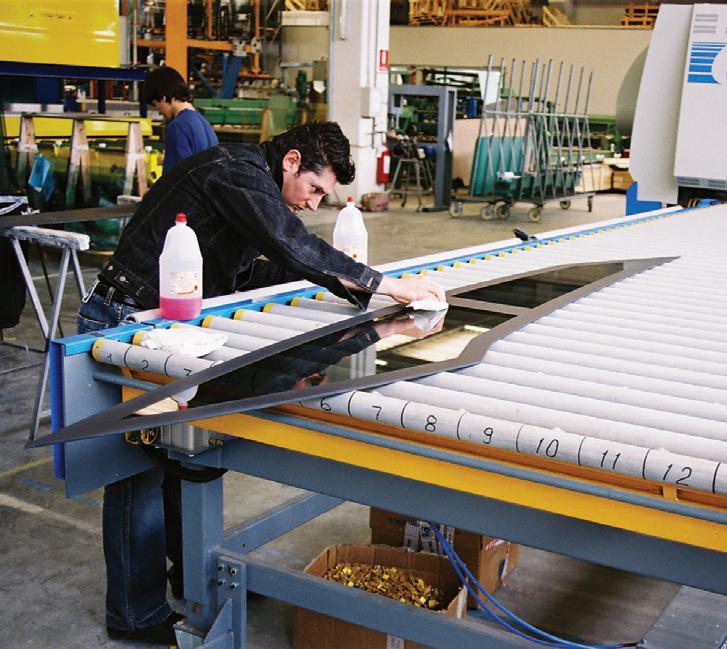
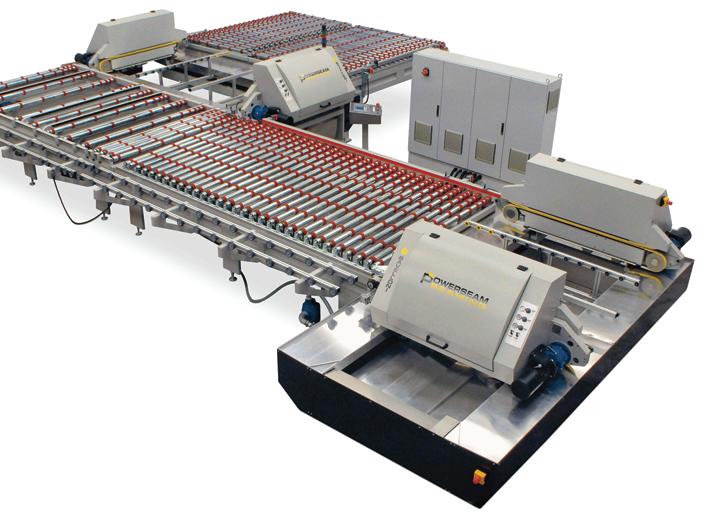
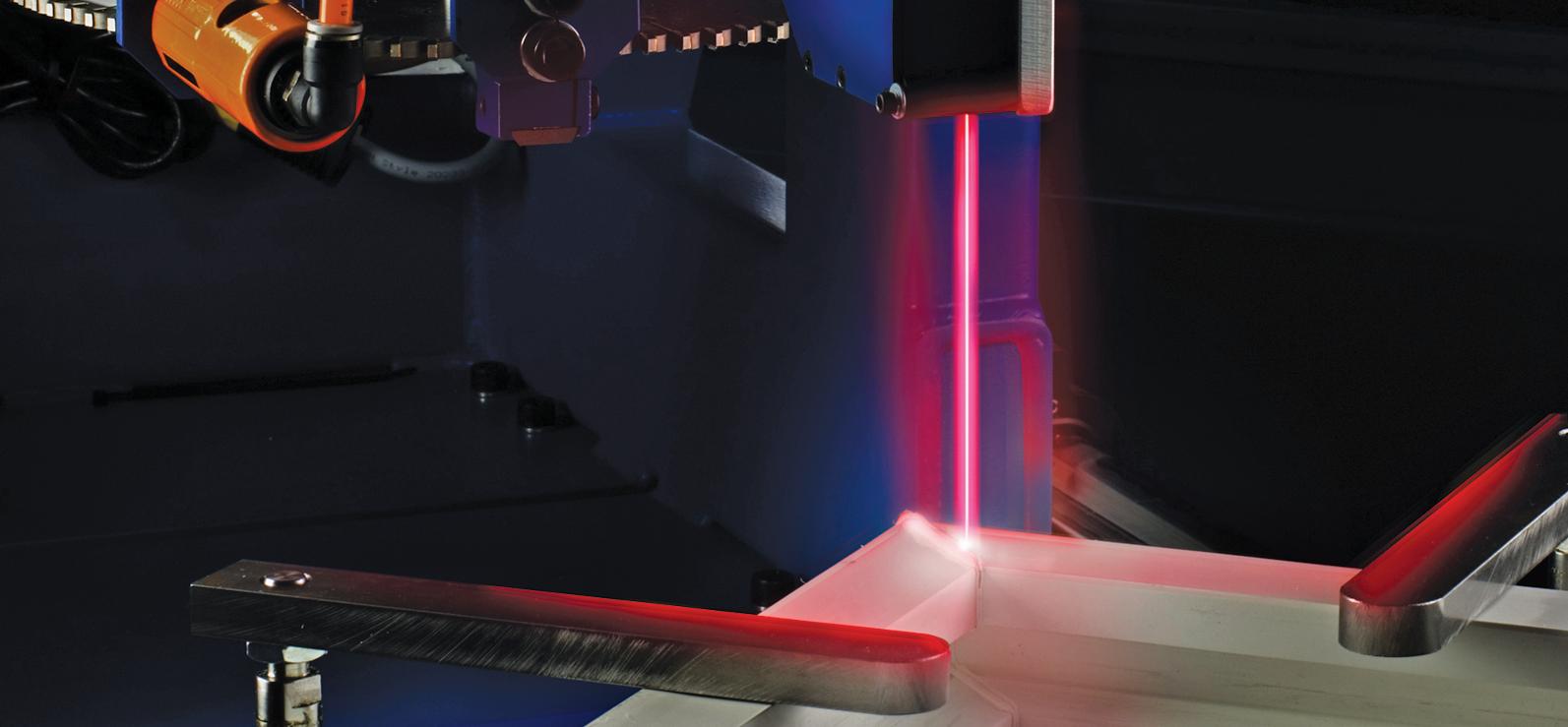
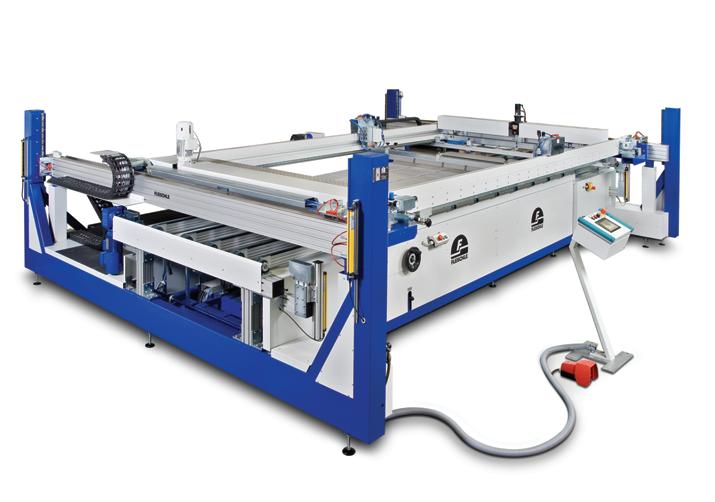
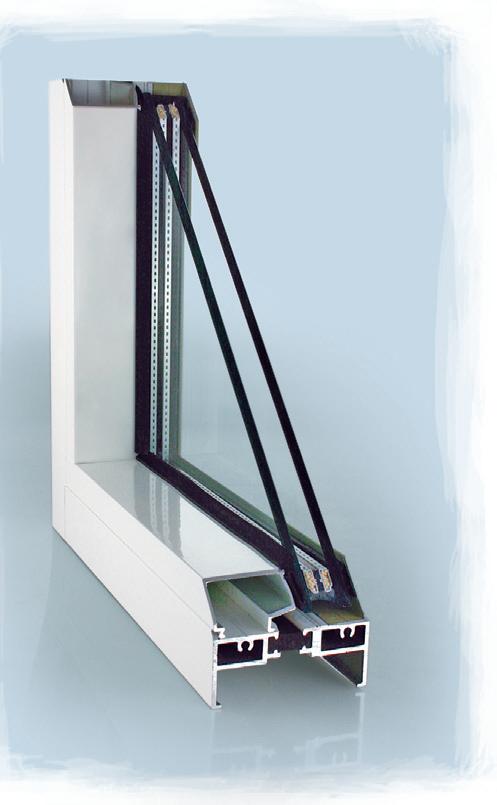
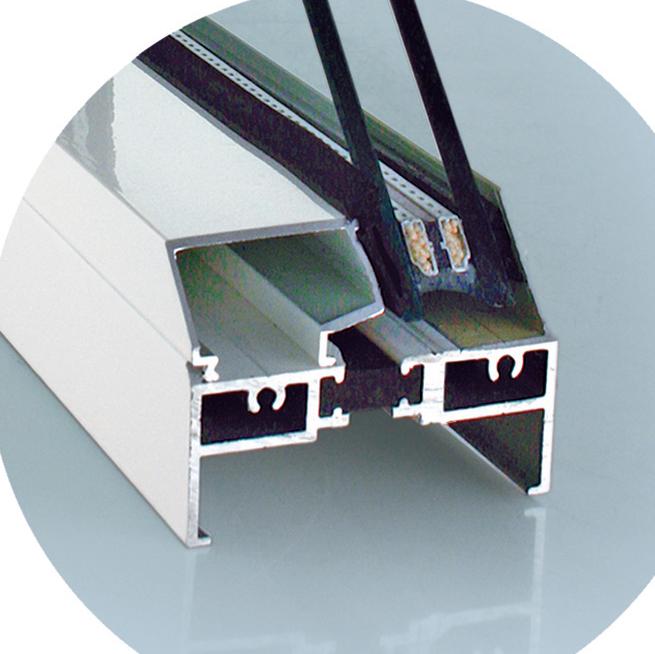
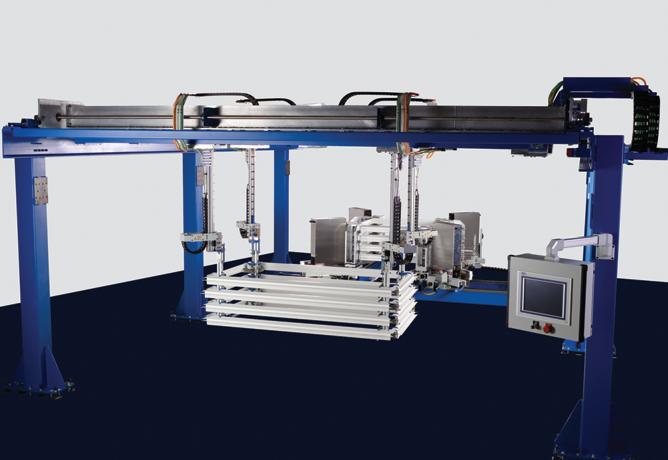
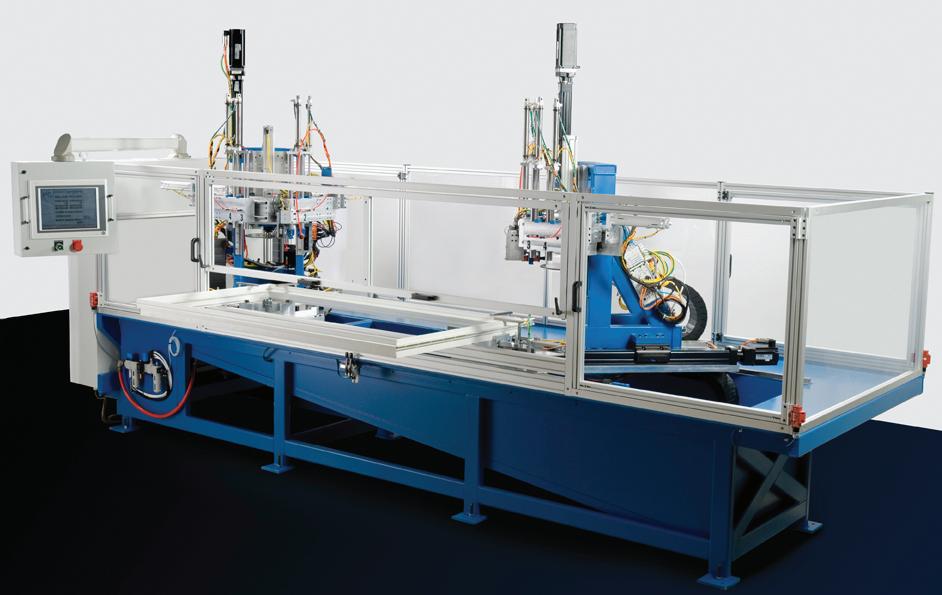
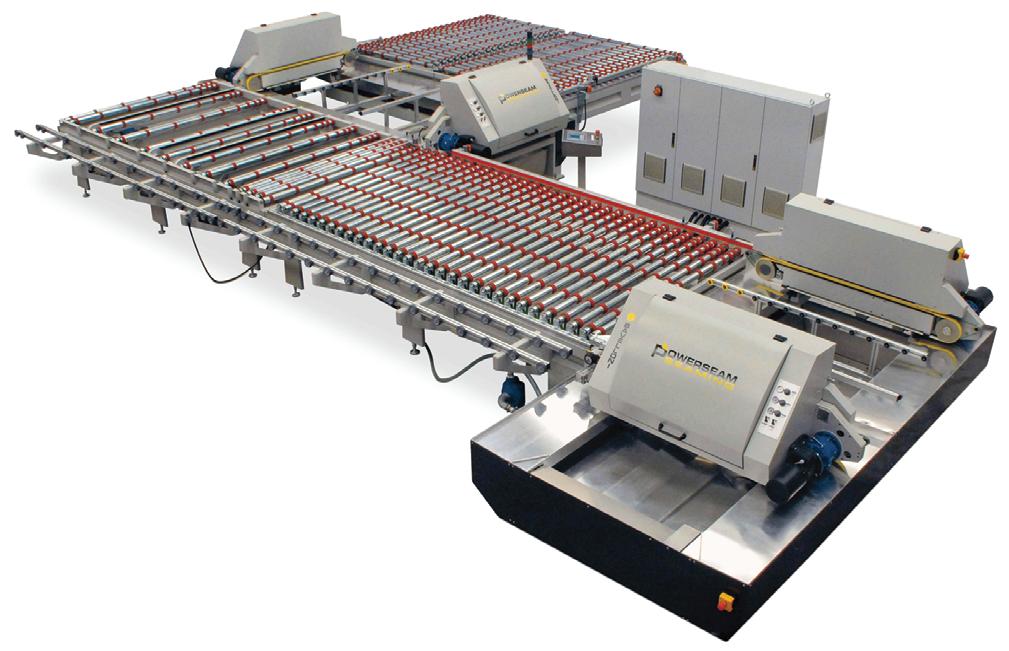
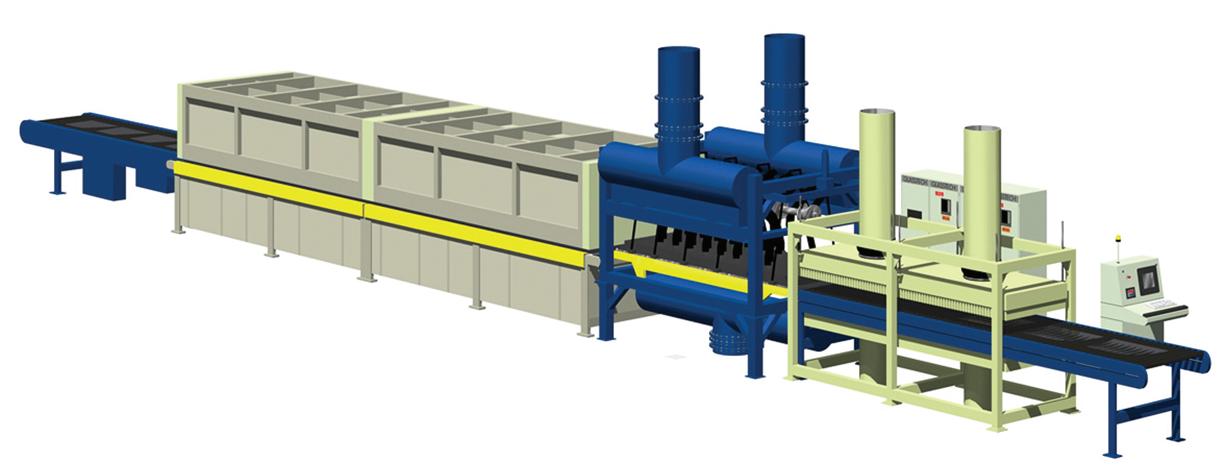
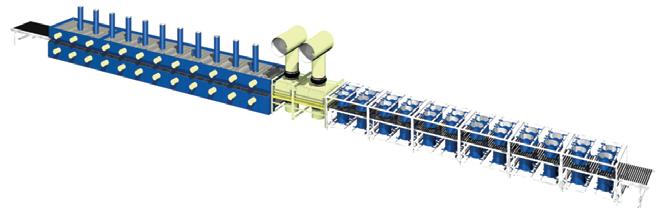
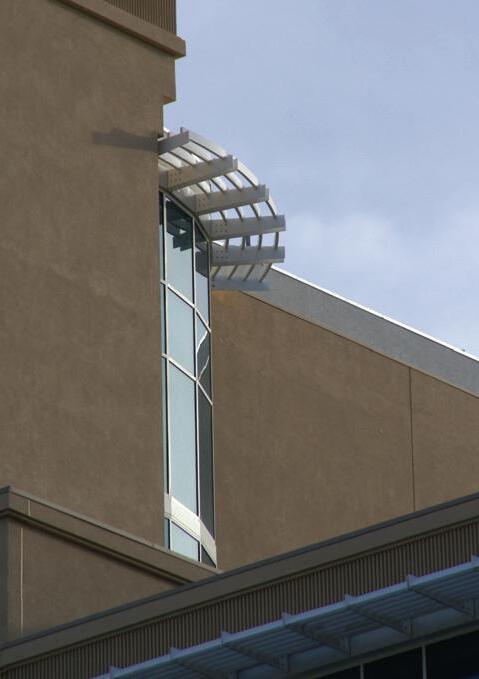
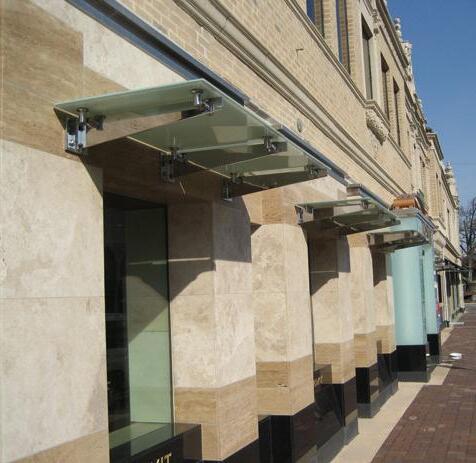
Cover: Photos Courtesy of GED Integrated Solutions, Glassrobots Oy, Fleischle, Glaston Italy Spa.
Printed in Canada. All rights reserved. Editorial material is copyrighted. Permission to reprint may be granted on request.
Member of:
Published six times a year, February, April, June, August, October, December (Buyers’ Guide).
CLAIMS: for missing issues must be made in writing within three months of publication and will be subject to the availability of back issues.
Publications Mail Agreement #40065710
Return undeliverable Canadian addresses to Annex Publishing & Printing Inc., P.O. Box 530, SImcoe, ON N3Y 4N5
June 2008, Vol. 20. No. 3 ISSN 0843-7041
INNOVATION Going up!
Viewport design dares CN Tower elevator riders not to look down.
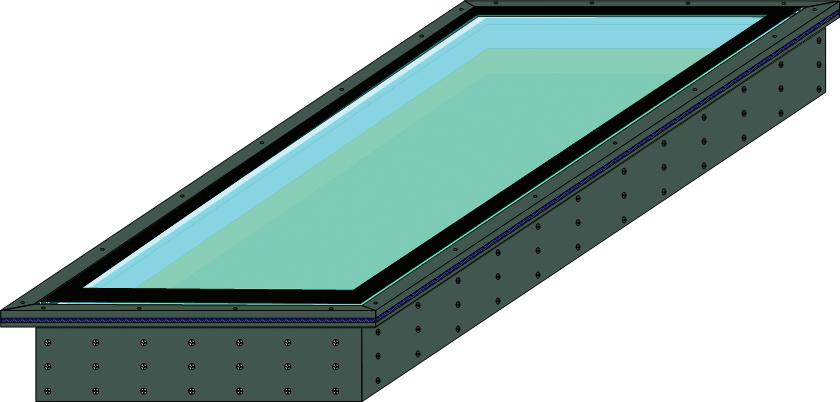
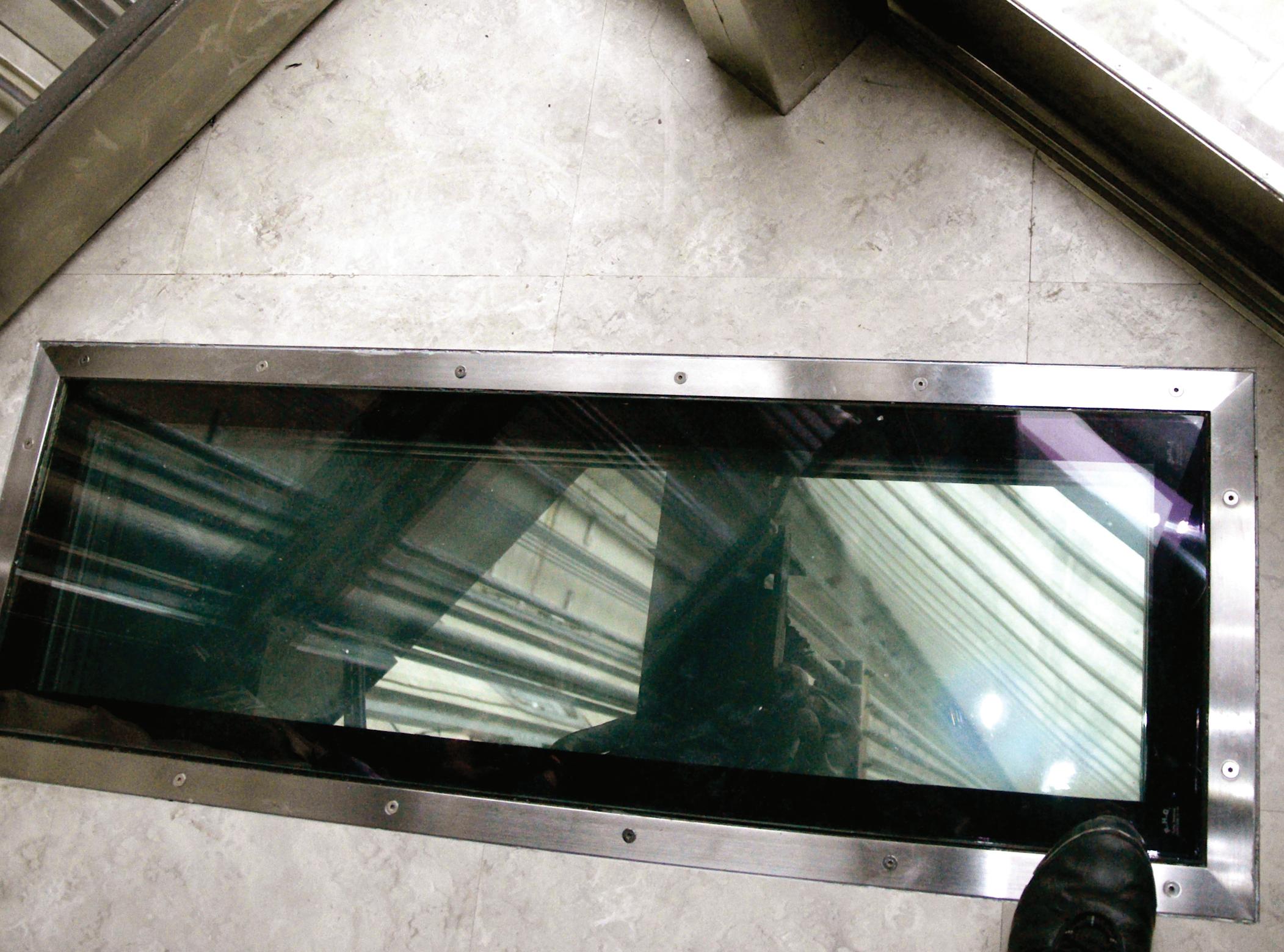
Stadia Industries’ recent design for a load bearing viewport has been integrated into the floor of one of the redesigned elevators at Toronto’s CN Tower. The viewport, which was fabricated and installed by Mainline Industries Corporation in Mississauga, allows elevator passengers to look straight down as the elevator zooms skyward. It is the latest attraction at the CN Tower and builds on the success of the glass floor installed on the observation deck by Stadia Industries in 1994.
Tim Byrne, president of Stadia Industries, says the new viewport gives elevator passengers a clear view 346 metres (1136 feet) straight down as the elevator travels at a speed
Glass Floor which has been walked on and experienced by millions of people since it was first installed in 1994,” he adds.
Stadia Industries supplied and installed the original glass floor on the observation deck. The work Stadia performed became an integral part of an incredibly successful attraction providing visitors with a chance to test their mettle by walking the glass to get a 342 metre (1122 foot) view straight down.
Stadia Industries’ experience with the first glass floor gave the company the confidence it needed to design the new high-tech load bearing viewport for the elevator. The principle design was done by Michael Byrne of Stadia and the engineering was also done by Stadia. “What really made this project
of 22 kilometres per hour (15 miles per hour) to the top of its glass-fronted elevator shaft – 346 metres (1136 feet) in 58 seconds. “Aportion of the elevator floor now features two glass panels which when combined represent almost 0.6 square metres (six square feet) of floor space,” says Tim. He explains that the elevator car replacement was completed to include two glass floor panels in the viewport consisting of three layers of heat strengthened laminated glass plus a layer of blast resistant film, each almost 21⁄2 inches thick (25⁄16 inches/5.08 centimetres) which when combined total almost 0.6 square metres (six square feet) of the total 3.64 square metre (39.25 square foot) elevator floor space.
“The glass panels in the enhanced elevator were designed using the same technology, strength and durability standards of the CN Tower’s famous
The viewport consists of three layers of heat strengthened laminated glass plus a layer of blast resistant film, each almost 2 1/2 inches thick (2 5/16 inch/5.08 cm).
unique was that when we first approached it, we looked back at what our experience with the glass floor taught us and we knew it had to be maintenance friendly,” says Michael, adding that it needed to be designed in such a way that maintenance would not require the elevator to be closed for long periods of time. “We started to think along the lines of a NASCAR pit stop. Only a unitized design would allow us to replace a viewport in a couple of hours instead of days or weeks. That is when we started to think about a product rather than a structure or assembly.”
As a service company, both Michael and Tim Byrne of Stadia have been heavily involved in pre-glazed/unitized curtainwalls, so they naturally drew on their experience to come up with a modular product that could be rapidly exchanged for a new viewport with minimum downtime. “As a
INNOVATION
‘product’, a complete extra set of viewports could be constructed and stored on site in case a unit suffered a failure of the switch-able glass layer or the scuff plates needed replacement to improve the view,” says Michael.
“This added an element of certainty to the whole maintenance process and ensured long-term viability of the attraction,” Michael says. “It is a niche market but I’m glad we captured it. The market may be small but we enjoy the work because it gives us a unique opportunity to innovate and problem solve... and it allows us to showcase our talents as a company,” adds Tim.
Stadia’s experience with the original glass floor and almost 20 years servicing some of the highest windows to the best views in Toronto gave it the experience and insight to complete the unique and challenging design in less than two weeks. “With three layers of heat strengthened laminated
glass plus a layer of blast resistant film, the viewport provides structural security,” says Tim.
Not forgetting that segment of the tourist market that may feel some trepidation or anxious about the trip to the top, the viewport design also includes an innovative fourth electrified glass layer that when triggered becomes instantaneously opaque. Tim explains this feature allows the tour guide escorting the passengers the option to toggle the view on or off as the elevator zooms skyward. ■
R Konstantina B. Skalkos sits on the glass floor that was installed by Stadia Industries in 1994 while visiting the observation deck at the CN Tower in Toronto, Ontario. Stadia’s experience with the floor helped the company design an elevator viewport for the CN Tower, the most recent attraction to this popular landmark.
GLASS CANADA - JUNE
Looking down through the new glass floor in one of the CN Tower's six glass-fronted elevators presents a thrilling new perspective on the view, 346m (1136 feet) straight down. The viewport was designed by Stadia Industries in Concord, Ontario.
PHOTO BY ROGER CULLMAN
PHOTO BY CHRIS SKALKOS
Asahi closes plants to restructure North American operations
Flat glass plant in St. Augustine, Quebec, shuts down.
Asahi Glass Company is halting operations on three of its float glass production lines and two of its architectural coating lines while the company sells its glass fabrication business.
AGC Flat Glass North America (AFNA), formerly AFG Industries, a subsidiary of Asahi Glass has shut down its flat glass production facilities in St. Augustine, Quebec; Victorville, California; and Greenland, Tennessee. There are approximately 240 people employed at its plant in Quebec.
Apress release issued by its president and COO, Kazuhiko Ishimura, from its head office in Tokyo, Japan, in April states that the company is responding to the rapid changes in the business environment and it will restructure to concentrate its management resources on glass for solar cells, as well as raw glass for automotive use and value-added building products.
In the flat glass business in North America, Asahi Glass has been working on improving its profitability since 2006 by overhauling management and shutting down its Cinnaminson plant in New Jersey. However, the continued decline in the US housing market, where residential glass occupies a greater share, has created a serious oversupply situation. “The earnings structure of AGC excessively depends on clear float glass/general purpose glass that is difficult to differentiate from products of competitors. This, combined with higher costs driven by a price surge in raw materials, has been squeezing Asahi Glass’ profitability in the region,” the press release states.
“All furnaces have been shut down,” says Chris Correnti, vice-president and general counsel for AGC, during a telephone interview with Glass Canada magazine in April. “The decision to
close the facilities depended on the particular market they were located in. We just couldn’t keep the plants open... the demand is low, the capacity is high and it was getting worse,” he says, pointing to the market in the west.
“On the east coast it was a similar situation. Producers needed to take action to increase capacity utilization. Canada is now seeing the same thing. The demand is not as bad, but it’s not good. There is a lot of glass coming into
capacity increase,” he says, adding that the housing slump in the US accelerated the problem. “It made a bad situation worse. We were seeing a lot of price squeezing even though the demand was going up, but the capacity was going up even more,” says Correnti. “At some point, something has to give.”
Meanwhile, with growing concern about the global environment and energy issues, the solar cell market is projected to rapidly grow by 40 percent annually on a global basis. In North America, demand for solar cell glass is expected to expand, while demand for raw glass for automotive use and value-added building products is projected to remain stable.
Under these circumstances, Asahi Glass has decided to restructure the flat glass business in North America to focus on three categories: glass for solar cells, raw glass for automotive use and value-added building products. It has also decided to stop its float glass operations, hoping to improve the supply-and demand balance of glass and raise the utilization rate of other production facilities. With these measures, Asahi Glass will decrease its glass production capacity in North America by about 40 percent.
Canada from the US because of the favourable exchange rate and we have been seeing more competition in Canada than ever,” he says, adding that about 15 percent of the company’s total sales are in the Canadian market.
“The plant in Quebec produced clear flat glass which has been hit hard by commodity pricing like it has in the US. The imports coming into the Canadian market with these companies competing against each other has been driving prices down. Alot of companies were increasing the size of their float tanks, creating a situation of having too many plants open and overproducing, and the market just couldn’t keep up to the
As for architectural sputter coating lines, which have an excessive output capacity compared with the size of the market, Asahi Glass has decided to stop operations at the Victorville plant in California and at the Hampton plant in Iowa to concentrate production of its full commercial and residential product range at the Abingdon, Virginia, plant.
It has decided to sell the glass fabrication business to focus on core glass production and coating technologies. With this new structure, the company says it will be better able to focus resources and management attention to driving product innovation and improving cost and quality. Asahi Glass will continue to leverage its group resources and production technologies to introduce leading edge high performance products into the North American flat glass market. ■
Victorville, CA Greenland, TN
St. Augustine, QC
CANADIAN GLASS ASSOCIATION
#23 21848 50TH AVENUE • LANGLEY, BRITISH COLUMBIA • V3A 8A9
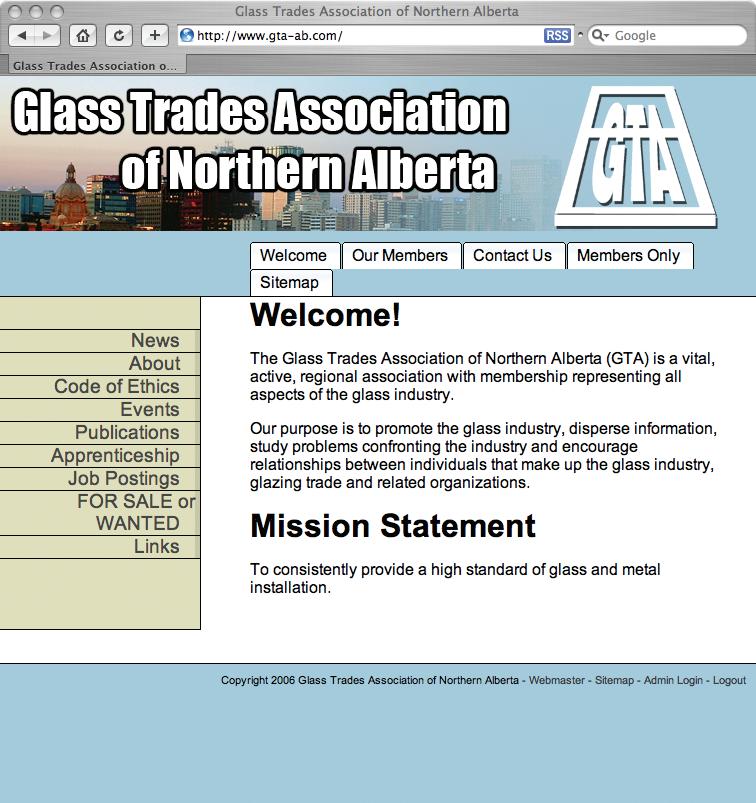
Ross Wady, president for the Glass Trades Association (GTA) of Northern Alberta in Edmonton, submits this report: “Business is good here in Alberta. Nevertheless, our buoyant economy produces some challenges and the GTA is addressing a number of these. One challenge is a chronic shortage of skilled trades people.
“Our apprenticeship training is at the Southern Alberta Institute of Technology (SAIT) in Calgary. In order to attract more people to our trade, SAIT is expanding their excellent program to Edmonton. The expansion of our provincial glazing program to Edmonton has come about as the result of some hard work by our GTA committee chair, Lynn Allan from Beacon Glass in Edmonton and Dave Edwards and Ed Dalzell, both from SAIT in Calgary. A number of other GTA members, along with the Alberta Apprenticeship, are also providing us with direction.
“Our first class was scheduled for May 12, 2008 at the SAIT satellite campus in Edmonton. We have received excellent industry support in the form of donations of cash and materials. Kawneer Canada is supplying metal, Tremco Sealants is supplying sealants and glazing tape, and PCL Construction is supplying cutting tables, to mention only a few contributors. Our long-term objective is to establish a permanent school in Edmonton for northern Alberta glazing apprentices.
“Our current membership of 33 companies now has a new web site – www.gta-ab.com – to support our programs and
disseminate information. Tammy Lanovaz from Supertint is guiding our web site development.
“Our safety committee, James Drewe from Hayward Glass and Sonny Nguyen from TSN, has sent a questionnaire to all members requesting feedback on their safety programs. Safety in the work place is a core concern of our association members.
“Dan Murphy, the autoglass committee chair, will be working with our Calgary sister association on issues relating to autoglass replacement.
“Our social committee chair, Ryan Ardiel from Tremco Sealants, is working on two association golf tournaments. Our GTA tournament on June 7, 2008, is expecting to host the Annual Canadian Glass Association Meeting. The second tournament is our annual North/South Challenge. This friendly competition between Edmonton GTA members and Calgary Glass and Architectural Metals Association (GAMA) members will be held this August, somewhere between our two cities.
“Lastly, I would like to thank the GTA executive for their tireless support. They are: Joe Millard from Bahry’s Glass, treasurer; Wayne Brandt from Kawneer Canada, secretary; Rick Zuchetto from US Aluminum, past president; and our hard working committee chairs. I would also like to thank our sister organization in Calgary, GAMA, for their sage advice whenever we seek their counsel.” ■
PGAA
Tom Woodman, president for the Provincial Glaziers Association of Alberta (PGAA), submits this report: “We had one Annual General Meeting and two executive meetings during the course of 2007. Scheduling meetings with everyone’s busy schedules coming into play has proven to be difficult. This past year, we have focussed on our financial reporting methods and the structure of the original bylaws, as we have the previous year.
“The PGAA’s web site has seen some changes made to facilitate the enrollment of new members and more. Steve Petersen has done an awesome job with the web site and the fax out which was sent in December.
“Following the Glass Trades Association’s (GTA) hard work, a new first year ‘glaziers’ class has been put on by the Southern Alberta Institute of Technology (SAIT) in Edmonton this past May 2008. Ross Wady and Lynn Allan and other members of the GTA were instrumental in getting this class. A lot of work went into getting the class set up for the new students and the GTA membership rose to meet the occasion.
“It has been an honour to serve as the president of the PGAA for the past two years. I regret that I have not been able to accomplish more in my term, but I am confident that the base of the PGAA is strong. With the help of the Glass and Architectural Metals Association (GAMA) and the GTA,
CANADIAN GLASS ASSOCIATION
the PGAA will continue to serve the provincial interests of the glazing industry. I would like to congratulate Steve Petersen on the start of his term as president and wish him every success.” ■
GDAS
Ken Kassian, president of the Glass Dealers Association of Saskatchewan (GDAS), submits this report: “By the time this issue of Glass Canada magazine is published, our association will have completed the Annual General Meeting, Banquet and the second Auto Glass Technician Competition (AGTC) in Saskatoon, held on May 3, 2008.
“The Auto Glass Technician Competition saw seven technicians from across the province compete for the bragging rights as to being the best in the province, and the winner is being sent to the Auto Glass Technician Olympics in the US to represent the GDAS. This competition is being held in November at NACE (International Autobody Congress and Exposition) in Las Vegas.
“For those not involved in auto glass, there will be seminars on such topics as apprenticeship training, architectural glass trends and curtainwall innovations, as well as touching on the Glazing Systems Specifications Manual which the GDAS has accepted, once it is approved by the Canadian Glass Association (CGA).
“The Annual General Meeting held elections for three director positions, along with committee reports and more. At the AGM banquet, we presented Lloyd Glass Apprenticeship Bursaries to two recipients: Clinton McCulloch, who is a second year apprentice employed with Glacier Glass Service in Regina; and Devin O’Dell, who also is a second year apprentice employed with Dynamic Glass & Door in Saskatoon. Although we allow for the presentation of two bursaries a year, this is the first time we have been able to
do so. At the present time, there are 14 apprentices enrolled in the apprenticeship program, and this is up considerably from other years.
“The association will continue to focus on promoting the Glassworker Apprenticeship program and hopefully we will see the current numbers double. With the Glassworker Trade program being offered at both the Southern Alberta Institute of Technology (SAIT) in Calgary, and Northern Alberta Institute of Technology (NAIT) in Edmonton, this will make it easier for apprentices to attend classes.
“The banquet was held at the Travelodge Hotel with entertainment by Karen Grainger featuring her ‘All in One Show’.
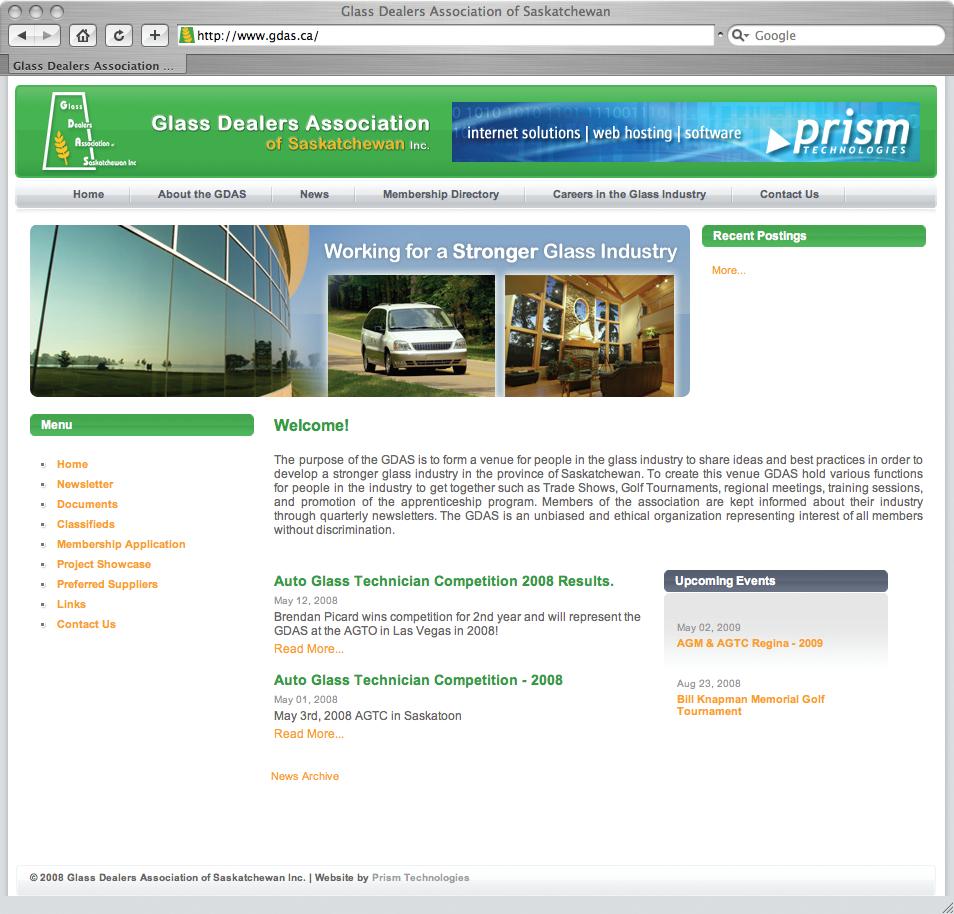
“In April, the GDAS launched its new web site. The site offers opportunities for members for classified advertising, banner advertising and to showcase projects they have completed. For our associate members, suppliers to the glass industry, there is an area called ‘Preferred suppliers’. Here, preferred suppliers are able to create a link to their site. Please visit www.gdas.ca
“We have seen a strong commitment from those involved in the glass industry in Saskatchewan to take a membership in the GDAS, at the present time, our membership is up from last year.” ■
FOR THE CONTRACTOR
Accurate results
Drilling in glass and tile requires exacting precision to prevent cracking and shattering. Bosch Power Tools and Accessories has engineered its new Glass and Tile Bits with a unique geometry to drill faster and last longer. Starting at 1⁄8 inch up to one inch in diameter, the industry’s largest bit size, they are equipped with a three-flat shank to reduce slippage that leads to more accurate cutting.
These tungsten carbide bits are diamond ground to a precision point that eliminates walking and its reinforced head prevents the carbide from cracking. The new Glass and Tile Bits are best suited for working with glass, ceramic walls and ceramic floors, making it the best solution for cutting glass, bathroom installations, drilling and fastening mirrors, or even setting screws in glass furniture.
Bosch says the bits are a perfect solution for professional glaziers who need to drill into multiple materials and that the bits deliver a great balance between cost and performance by cutting faster and lasting longer than other carbide bits.
For more information contact Bosch Power Tools and Accessories at: (877) 267-2499, or visit www.boschtools.com ■
Cuts in all directions
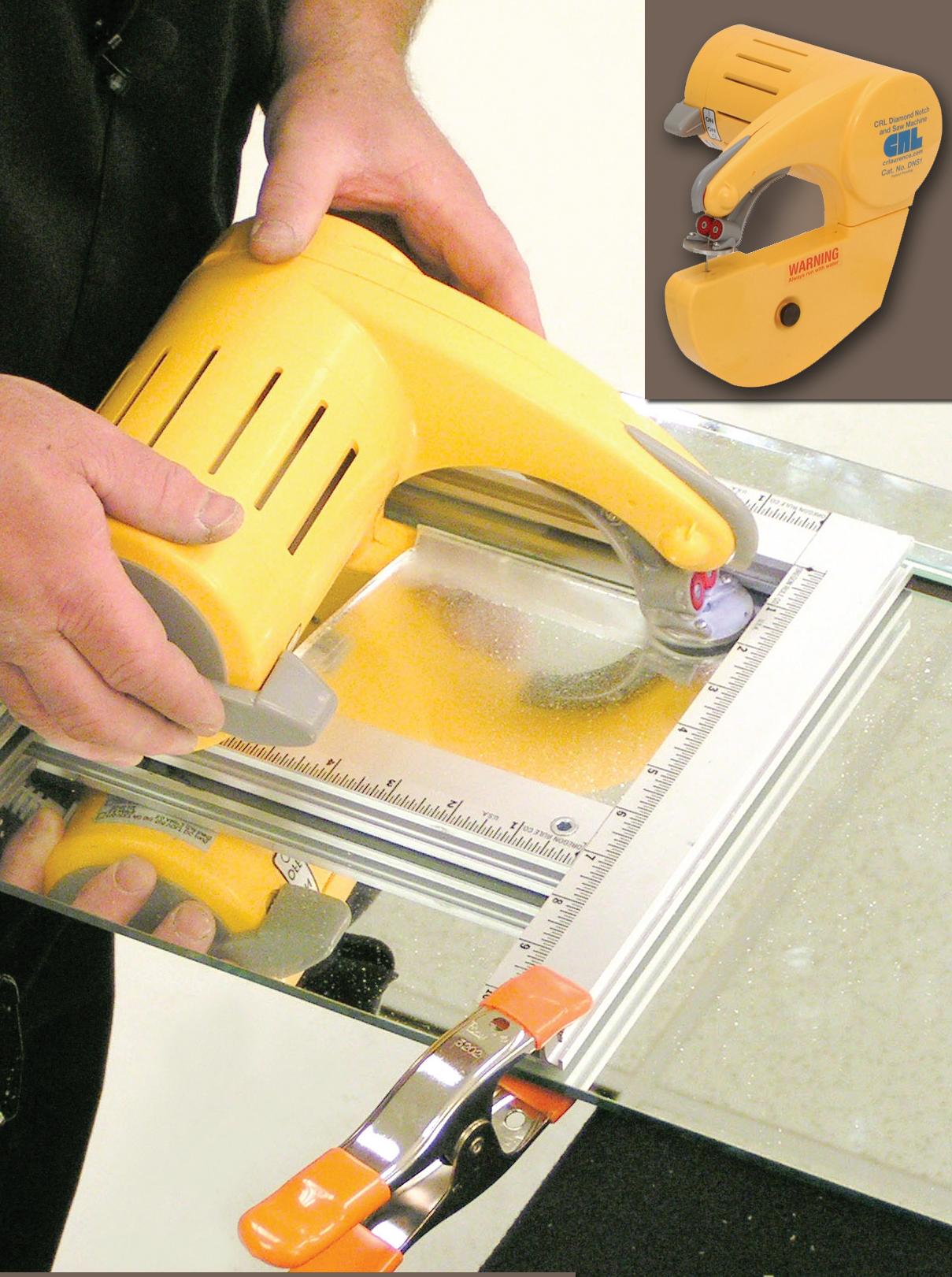
The Diamond Notch and Saw Machine, introduced by CR Laurence (CRL), is for creating notches and free-style pattern edge cuts. The company says this is one of the most amazing tools it has ever introduced to the glass fabrication industry.
It utilizes a fast cutting ring blade with specially coated diamonds that cuts in all directions. It can be used free hand and reduces labour time by 75 percent on patterns
such as crown molding with smooth, chip-free results. The adjustable jig tool can also be used to eliminate drilling, cutting labour time by more than 50 percent. No more double layouts are necessary and little or no sanding is required. This is also the only saw capable of producing strong, square corners.
The CRLDiamond Notch and Saw Machine utilizes a high quality 53⁄4 inch (146mm) steel ring blade, and cuts in all directions on glass up to 1⁄2 inch (12mm) thick. An internal sponge cover provides coolant so a separate coolant pump is not required. Optional radius templates create a wide variety of ‘U’ shape cut-outs. Specialty glass clamp and ‘mouse ear’ templates for CRLshower hinges eliminate the need for hole drilling, break-outs and costly CNC machine set up.
The kit includes the Diamond Notch and Saw Machine, standard ring blade, blade stabilizer with template disc, adjustable jig tool with 1⁄4 inch (6.3mm) radius templates, and a set of six replacement grommets.
The company says the CRLDiamond Notch and Saw Machine is one of the new CRLBrand power tools it has designed for the glass industry. The line includes cordless diamond saw kits, impact driver/drill kits, screwdriver kits and variable speed caulking kits, as well as a variety of belt sanders, a rotary tool kit and hot air gun kit. Designed exclusively for the glass industry, these tools represent CRL’s continuing effort to help glass professionals improve productivity and profitability.
For more information contact CR Laurence at: (877) 421-6144 , or visit www.crlaurence.com ■
EUROPEAN SCENE
To hell in a hand-cart
WHEEEEEEEEE... there they go!
That is the UK window industry, off to hell in a hand-cart. At least you would think so listening to some people. Currently we have a few problems. Fuel prices through the roof, rising food prices and the banks refusing to lend money to anyone (more about them later).
Our own industry gurus, like Robert Palmer from Palmer Market Research, are predicting a general decline in the window market until 2012. Different reasons for different sectors, but that’s the picture. The rent-a-gobs that populate the news programmes on BBC Radio Four at times like these have the whole UK economy in terminal slide. Amonth or so back, they had the planet on the brink of imminent destruction, now it’s the UK. I am not sure if it is quite the same people, but they sure sound the same.
The industry situation is more complicated. First of all it is segmented. The guys making aluminum windows tend, in the main, to service the construction sector – curtainwall, that kind of thing. The vinyl guys generally make windows for housing.
The problem here is that the sector arose from the need to replace all of those rotten wooden windows so beloved of generations of UK house builders. Well, they did it. Well done guys! So now their problem is what to do next?
House builders have switched on to vinyl these days but don’t build enough. They don’t have the land and often cannot get planning permission. It is
by John Roper*
all very political. This is a crowded, overpopulated island is the received wisdom. When did you last look out of your window as your airplane crossed our west coast? The entire UK population lives on about 10 percent of the landmass. Preserving the ‘green belt’ is seen as a good thing even by people who never leave town. Meanwhile, apartment blocks are going up in the middle of towns on closed down gas stations and pub car parks.
Then we have the problems being caused by the banks. Having gone about borrowing money from each other like a student with his first credit card, they lent the money to other people, some of them having no more prospect of paying it back than, apparently, the banks did themselves. Then they panicked and started to demand their money back from each other. Suddenly, surprise, surprise, we are all picking up the bill. The government is now using our taxes to bail out the banks by making huge amounts of money available for them to borrow. Abit like the ads you see on TV offering to round-up all of your debts into one big ‘affordable’ loan.
According to the rent-a-gobs, houses will be repossessed willy-nilly, we will never see cheap loans again and the banks’ tougher criteria will severely restrict the ability of all but the most blue-chip customers to borrow anything at all. This seems to suppose bankers are capable of learning something.
First of all, according to industry sources, repossessions are not rising. With high employment, most borrowers are servicing their loans, if in some cases
with difficulty. Secondly, we’ve been here before. Okay, fuel prices and food prices are rising too but we have been there before as well. Soon the banks will have refilled their coffers and secured their million pound bonuses. The gold cards will, once again, fall through our letter boxes like confetti. That 100 percent, low fixed rate, umpteen times income mortgage will again be thrust upon willing customers.
Meanwhile, people still need windows. Some need conservatories and doors. Some will even have cash. The serious window makers I talk to are busy, but all agree, you have to look for opportunities. There is a problem of oversupply and to survive, companies will have to look at their business models. Conservatories, which are basically a load of windows under a roof, and doors are both strong markets. Overall the prediction, even in this challenged market, is for a not inconsiderable nine million vinyl windows to be manufactured this year. ■
*John Roper is editor for the Installer, The Fabricator, The Conservatory Installer and Glass Works magazines published in the UK. His comments reflect opinions from the UK and may not be applicable in Canada.
Including inclusions GLASS SCIENCE
Glass breaks for a reason.
Spontaneous glass breakage is a term used when glass breaks for no apparent cause. The most common causes are attributed to minor damage during installation such as chipped or nicked edges which later develop into larger breaks, movement in the building or framing system, thermal stresses in the glass or its inability to resist wind load.
Nickel sulphide stones exists in a number of forms such as Ni3S2, Ni7S6, Ni9S8 which are typically not a problem, but one – Ni1-xS – can be a problem because it is not stable.
However, Michael Bitterice, the senior engineer of technical services for PPG Performance Glazings, says that inclusions in the float glass during the manufacturing process can also be the culprit. He says there are as many as 50 possible inclusion types in float glass. They include, among others: zirconia, alumina, silica and nickel sulphide. While there are a variety of inclusion types, the most widely discussed is nickel sulphide (NiS), a type of stone or crystalline blemish. Nickel sulphide stone exists in a number of forms such as Ni3S2, Ni7S6, Ni9S8 which are typically not a problem, but one – Ni1-xS – can be a problem because it is not stable.
Spontaneous breakage
“This occurs in float glass when ‘tramp’ nickel rich particles, such as stainless
steel, combine with sulphur in the melting process. It’s relatively rare, practically invisible, and not practical to detect in a production environment,” Bitterice says, because they are one-tenth of a millimetre – A 0.1mm/~0.004 inch – in diameter. The frequency is random within the float ribbon so the frequency and location of individual inclusions is practically impossible to quantify or predict in individual glass lites.
NiS stones undergo a phase change in crystalline structure that results in an increase in volume when cooled slowly from about 750 degrees F down to room temperature. In standard float glass, this expansion takes place while the glass is at annealing temperatures, so stress relaxation eliminates the tensile stress caused by the phase change.
NiS inclusions may undergo a phase transformation causing them to shrink due to the reheat/quench operations required to fabricate tempered glass. The rapid quench traps the inclusion in its small phase, but over a period of time, these inclusions may revert back or expand to their original state. When the inclusion is located in the centre tension area of the glass, the increase in volume may cause a localized stress increase sufficient to break it several years after the glass has been fabricated, even
All inclusion breaks will have ‘cateyes’, but not all breaks with ‘cat-eyes’ are caused by inclusions.
Inclusions in the float glass are relatively rare, practically invisible, and not practical to detect in a production environment.
though the glass is not under load. Such inclusions can cause spontaneous breakage in tempered glass, without any load being applied, at any time, even five or 10 years after the tempered glass has been fabricated.
“NiS undergoes a phase change, from the alpha-phase at higher temperature to the beta-phase at lower temperature, with a volume increase of approximately four percent. If the stone is in the tension zone of tempered glass and undergoes the phase change, the stress caused by the increased volume may lead to breakage,” Bitterice explains. “It doesn’t take much to get a four percent increase in the size of the growth of the stone.”
When are they a problem?
“In annealed glass, never, because any stones undergo the phase change and become stable during the slow re-annealing of the glass in the float glass manufacturing process. In heat strengthened glass it is not a problem when done properly, because the slower cooling allows any stones to undergo the phase change and become stable. But it can occur in tempered glass, even though it’s rare, because the relatively rapid cooling may arrest the phase change of any stones,
GLASS SCIENCE
leading to possible continuation in the field much later after the glass has been installed that results in glass breakage.”
He says the problem exists in tempered glass because in the tempering process, the more rapid cool down arrests the transition from alpha (smaller) to beta (larger) which locks the stone in. “The ‘alpha to beta’ phase change may continue with an accompanying volume growth of approximately four percent. The phase change is time/temperature dependent and this volume growth, if it occurs in the tension zone, can create a stress of 500,000psi causing breakage.
Since inspection is not practical, glass manufacturers have implemented programs of batch quality control, along with the elimination of any nickel containing materials from their raw material and glass handling systems. Automatic inspection of 100 percent of the float ribbon can also contribute to the reduction in the number of inclusions of all types present in float glass.
No guarantees
“Keep in mind that nickel sulphide inclusions in float glass are rare. No batch compositions produced in North America intentionally includes nickel and there are procedures in place to constantly monitor raw materials. For example, nickel plates, rods and bearings have been eliminated from processing equipment, but this still can’t guarantee 100 percent elimination of NiS inclusions,” says Bitterice.
Another method used to detect this before it leaves the factory is ‘heat soaking’, a process that can uncover some NiS inclusions present in an individual lite of glass; however, this is not 100 percent effective.
“This is an attempt to initiate or accelerate the phase change in the plant that typically exposes glass to temperatures between 280 and 300 degrees C for two to four hours. The objective is to achieve a ‘break now, not later’ result, based on the assumption that any lites with inclusions will break in the process,” he says, adding that this can be conducted on a statistical sampling basis or on entire lots.
Another solution is to specify heat strengthened, rather than tempered, when possible. “Heat strengthened glass is adequate to meet virtually all thermal and wind/snow load requirements and it is 100 percent effective when done properly,” he says, adding that it is made on the same equipment as tempered. “But remember, it is not a safety glazing material.”
After more than 15 years, Bitterice says experts in float glass production are still debating the cause and remedy to this problem. “There is general agreement on most of the science behind this, but not the conclusions,” he says, pointing out that advocates of heat soaking are not absolute in their support of how the process is represented. “You may see ‘avoids’ or ‘reduces’ or ‘minimizes’ breakage, but you won’t see ‘eliminates’ or ‘prevents’ or ‘guarantees’ against breakage. Heat soaking can eliminate, by destruction, some of the nickel sulphide inclusions, but it’s not a guarantee for eliminating all inclusions.”
Although it is easy to blame inclusions for spontaneous glass breakage for glass that has already been installed on site, Bitterice says the infamous ‘cat-eyes’ or ‘butterfly’ break pattern that is characteristic of these type of breaks are not
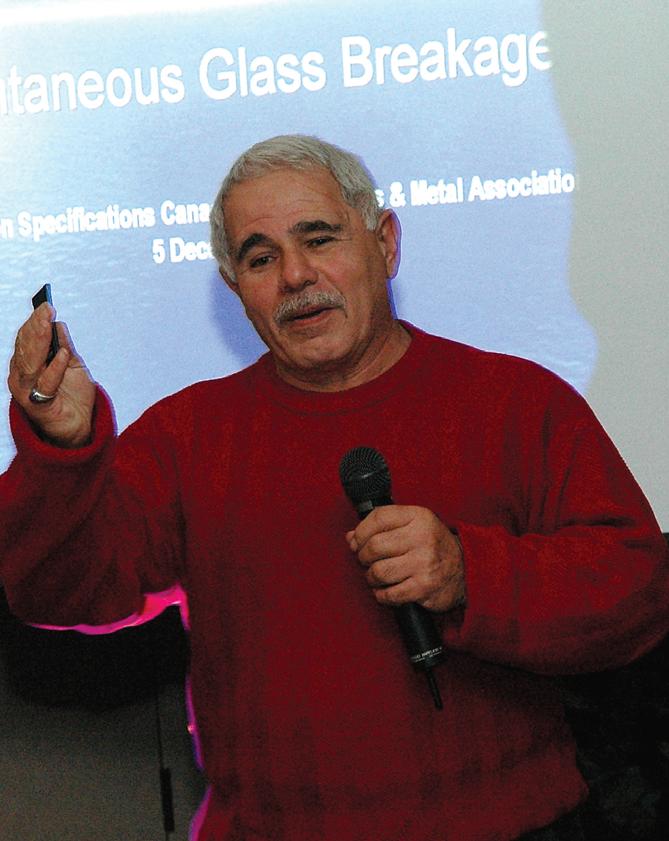
Michael Bitterice, the senior engineer technical services for PPG Performance Glazings, presents a seminar on spontaneous glass breakage. He has announced his retirement from the glass industry this summer.
always caused by them. “This is extremely rare. Out of 10,000 square feet of six millimetre glass, two pieces out of the 10,000 might be affected,” he says.
“All inclusion breaks will have ‘cat-eyes’, but not all breaks with ‘cat-eyes’ are caused by inclusions. It doesn’t prove that the break was caused by an inclusion. Glass breaks for a reason and more than likely, it broke for other reasons.” ■
INDUSTRY NEWS
Expanding for oversized glass fabrication
Barber Glass Industries in Guelph, Ontario, will soon offer 130 by 240 inch oversized glass fabrication when it opens its newest facility in Collingwood, Ontario.
As part of its most recent plans for expansion, the company has secured approximately 170,000 square feet of industrial space located approximately 90 minutes north of Toronto, which is expected to be fully operational by January 1, 2009. This facility will focus on the addition of oversize capabilities in cutting, laminating, tempering and insulating. When up and running, the company will be capable of producing a
CNC fabricated, tempered and laminated insulated glass unit with dimensions up to 130 inches high by 240 inches wide. In addition, the company will add increased back painting, silk screening and waterjet cutting capabilities and products.
Established in 1883, 2008 marks Barber Glass Industries’ 125th year in the glass industry. Company representative, Michael Wellman says much of the company’s success and continued growth over its long history is attributed to its continued commitment to capital investment in line with becoming a truly world class glass fabrication facility.
“Combined with our capability to provide increased levels of service, the upcoming additions to our product
CR Laurence acquires Sommer & Maca Industries
Anew chapter in CRLhistory.
CR Laurence (CRL) has acquired Sommer & Maca Industries (Somaca). Donald E. Friese, CRL’s chairman and CEO, made the announcement in March 2008, stating that the purchase will bring together the products and services of both organizations to enhance the company’s product lines with larger inventories that will be available from all its North American locations, including its four Canadian branches.
“It is with great pleasure that we can now call Sommer & Maca a member of the CRLfamily of companies. Somaca has been a pioneer and leader in the glazing industry for more than 85 years, supplying tools, hardware and supplies. This is a new chapter in the history of both CRL and the glazing industry, and we look forward to continuing to serve the needs of all of our customers.”
Somaca is well known as a glass machinery manufacturer and will continue to maintain the Somaca name within CRL’s new glass machinery division. The former president of Somaca, Dick Carroll, will stay on as president and is looking forward to building the business group for CRL and the industry.
“We plan to produce even more high quality machinery in Cicero, Illinois, and we will be expanding the facility to add additional state-ofthe-art machinery and engineering expertise,” says Friese. Somaca also supplied the stone industry, and CRL will continue to carry the products for the stone and granite industries.
Friese adds, “This is an opportunity for us to learn about Somaca’s business and bring it into ours. We are a strong team and we will work well together. The best part of any acquisition is the opportunity to bring more talented people into our operations to help us grow our business and better serve our customers.”
CRLhas more than 40,000 products and the expanded product lines this acquisition brings will give glass industry professionals more flexibility to source products for the glass and stone industries.
In an effort to make the transition as smooth as possible for Somaca customers, CRLhas added the company’s stock numbers into CRL systems, including the CRL Online Catalog at crlaurence.com. Customers in Canada can easily check stock and place orders online for these products. ■
offering will provide our customer base with an excellent glass supply resource,” says Wellman, adding that some limited production may be available as early as September, depending on the progress of the expansion.
***
Leading edge topics presented at technical meeting
The Insulating Glass Manufacturers Alliance (IGMA) says that Michael Collins, managing partner and co-founder of BIM World, will be making a presentation on the BIM World software products during the IGMASummer Technical Meetings scheduled for the week of June 16, 2008 in Whistler, British Columbia.
“There has been a lot of industry buzz on this new project software which provides integrated technology and service solutions for project management. We are pleased to be able to offer this presentation to our members,” says Margaret Webb, IGMA executive director.
In addition to the presentation on BIM World, members will be provided with updates to both the US and Canadian ENERGY STAR programs. Brian Hubbs, from RDH Building Engineering, will present a seminar on ‘Marketplace Trends & Challenges for Glass Products’; and Chris Barry, Pilkington NA, will be presenting ‘Innovative Applications for High Transmission Glass’.
Complete meeting information is available from the IGMAweb site at: www.igmaonline.org
***
Specialty glass company celebrates 80 years
S.A. Bendheim Company has passed its 80 year milestone in the specialty glass industry.
What began as a husband and wife team in the wholesale stained glass business in Greenwich Village, New York City, has grown into a company with five divisions, a New York City showroom, glass processing and distribution facilities and 100 employees.
Today, S.A. Bendheim is a national importer, fabricator and distributor of more than 2000 types of specialty glass.
Re-positioning glass shops in the market
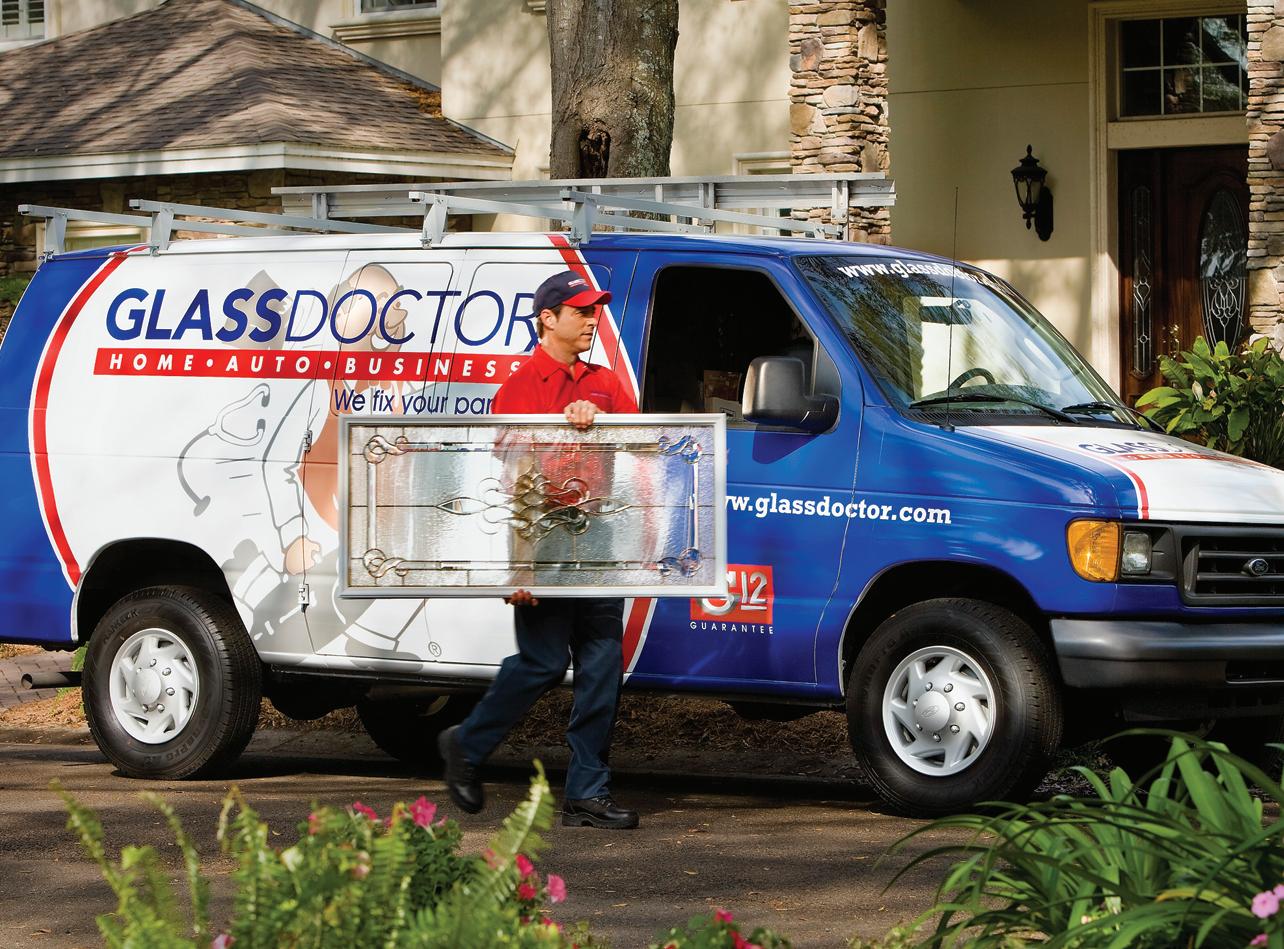
Glass Doctor is seeking Canadian glaziers and entrepreneurs with the pioneer spirit vital to duplicating the success of the largest network of independently owned and operated full service glass shops in the US.
“We’re offering Canadian glass service professionals the opportunity to take their businesses to the next level,” says Mark Dawson, president of Glass Doctor. “We believe there is a place in the Canadian glass services marketplace for full service, mobile glass shops that offer high quality products and fast service.”
More than 160 Glass Doctor franchisees across the US offer complete glass repair, replacement and related services to the residential, automotive and commercial markets at more than 360 locations. Service technicians install and service a variety of glass products, including low-E windows, insulating glass units, tub and shower enclosures, entry door panes, windshields, storefronts, furniture and mirrors.
“What most glass shops fail to realize is that this is a service industry first and we just happen to work with glass,” Dawson says. “Whether the shop focuses on autoglass or residential glass, the customers are the same. Autoglass shops typically shy away from the residential business and vice versa. With our technical training, we can help a glass shop add a whole business segment with a ready-made customer base,” he says.
“In looking at the Canadian glass market, we believe there are a number of shops that may have reached the owner’s potential, but not the potential for the shop in that market. The systems in most glass shops, whether designed consciously or unconsciously, are perfectly designed to get the results that business is producing. If a glass shop owner wants to get a different result, then the owner needs to change the business systems. Glass Doctor offers business systems, service systems and marketing systems that produce results by re-positioning the glass shop in the market.”
Glass Doctor is part of The Dwyer Group, an international franchisor of service industry companies based in Waco, Texas.
October 21–25,2008
Over 1,300 companies, associations and research institutes from more than 46 countries make this exclusive trade show the most important innovation platform for planners and decision-makers worldwide.
The targeted ancillary program with symposiums and the specialty show “glass technology live 2008” presents the future of solar power, photovoltaic, process technologies and applications.
Make sure you visit tomorrow’s world of glass – at the most important platform for the industry in the world today.
INDUSTRY NEWS
Industry appointments
Glasslam N.G.I. has appointed Ted Paetkau of Fenestration Components International as its sales representative in western Canada and Brian Hall of MEH Sales/Brichem as its sales representative in eastern Canada for the company’s Air-Tight Spacer products as well as all of Glasslam’s laminated and decorative glass products.
Air-Tight, Generic, is a flexible EPDM spacer offering tremendous warm edge performance, and Air-Tight Smart Edge, the One Step Product, is an EPDM spacer with a preapplied secondary seal.
Kevin Sullivan , senior vice-president, chemicals, for PPG Industries announced that he will retire in July. Sullivan joined PPG’s fiberglass business in 1973 as a management trainee.
PPG Industries has also appointed Douglas S. Pegg to the position of vice-president, packaging coatings, based at PPG’s global headquarters in Pittsburgh, Ohio. Pegg joined PPG in 1985 as an engineer at the company’s Clarkson, Ontario, coatings facility.
Re-Lowe-cating
Frank Lowe Rubber and Gasket Company is relocating to a brand new 60,000 square foot facility. The new location offers the company room to expand its operations, increase efficiencies and further enhance its commitment to its customers.
The new address is: 44 Ramsey Road, Shirley, New York, 11967. The telephone and fax numbers remain the same: (800) 777-0202, (631) 777-2707, fax (631) 777-2560. Web site: www.franklowe.com ■
Using technology to meet the challenge
by Jim Daniels*
The
10 keys
to job management success.
Overseas competition, rising fuel costs, and a multitude of governmental and contractual requirements are just a few of the significant burdens that glass businesses must face. However, a new class of technology products may be the solution glass shops are looking for to manage the complexities of their businesses effectively.
Job management can be one of the most challenging business processes that the commercial glazing industry manages. Commonly, glaziers ask ”How can I gain visibility into my business to know exactly what is going on at any given point in time?” At the core of this question is the glazier’s ability to effectively manage jobs consistently in their businesses.
There are 10 areas defined as critical elements for better business and job management.
Organization
Manage and monitor all job-related data in one system to improve internal efficiency and client service. Many firms will start out by using Microsoft Word, Excel and a small business accounting package to manage their projects. Eventually, their organization grows and project files are scattered across the organization, leading to a process that is inefficient and lacks co-ordination. That is where the new breed of computer software can help.
Consistency
When you have news of concern to the glass industry, please send it to:
Chris Skalkos
Glass Canada P.O. Box 530 Simcoe, Ontario N3Y 4N5
cskalkos@annexweb.com
Create and maintain a set of procedures and guidelines that are easy to consistently follow. Establishing a process that maintains information to reduce the likelihood of human error and improving the integrity of the data related to each job. This also effectively streamlines job completion and organizational efficiency. It is also essential to train new employees quickly and efficiently. With the proper software tools, managers can cross-train employees as well as themselves.
Accountability and security
2 3
Clearly defined systematic controls on job information access ensures security and accountability across the organization. Not all information should be seen by all employees. Clearly outlining who should have a particular security access effectively keeps personnel focussed on the relevant job information they need while simultaneously protecting customers and the business.
Communication
Communication between all parties involved in a job and access to all pertinent information is crucial. Keeping
SOFTWARE
everyone on a project working together in a harmonious fashion, without delaying or damaging others, is a highly complex task requiring the utmost co-ordination, cooperation, communication and sometimes, compromise. As difficult as it may be, this is what makes a project profitable.
Mobility
Keep on top of jobs remotely. Access to critical information while on the job site or away from the office is key. Using a mobile device that allows access to job information remotely streamlines communication, job accuracy and completion. Having wireless access gives decision makers key job information on a timely basis as well as keeping them current on sudden changes and daily business activities.
Relationship
Maintain good relationships with general contractors. The basic disciplines of ‘on time, on budget and good quality work’ may not be enough to sustain the relationship. Most general contractors demand fast and accurate information, quick summaries of the job’s progress and project auditing results.
Compliance
Documented compliance protects the company and its customers. It is critical to each job that all compliance standards are not only met, but well documented. Without this documentation a glazier is open to potential risks and liability that could be disastrous to the health of the business.
Agility
The ability to react to job changes with quickness and agility is vital. One of the most important steps in job management is planning. Plans change and the ability to react quickly and efficiently is critical to keeping a job on track and all the moving parts moving in the right directions. Having a system in place to effectively communicate changes throughout the organization keeps job quality, morale and customer satisfaction high.
Analysis
4 5 6 7 8 9
Learn from the past to predict the future. Using relevant reporting and analysis tools allow managers to make better decisions based on job and business history. Reporting tools that track and create unique, customized reports allow access to information essential to making the right decisions for the future. Integration to other analysis tools allows managers to further customize and analyze reports to get the precise trending information needed.
Flexibility
Choose job management tools that integrate well with other systems. No one runs a business using a single software system. Make sure when selecting a business management system that it can share data easily with other systems the
company is using today or will be using in the future. Choosing software that make it easy to export data needed in other systems, like accounting systems or analysis tools, saves time and improves efficiencies.
Awell run business will have business management tools in place to organize, control and manage the day-to-day processes that bring profitability. In order to stay competitive, glass shops and contract glaziers have a variety of business management software products to choose from that can help guide them through the complexities of their business requirements so they can continue to grow.
These software products must provide simple, effective tools that will help drive the 10 keys to job management success that are essential for a business to evolve as the industry evolves. Without the proper tools, a business is at risk. Without well defined processes and the discipline to use them, monitor and analyze them, a business cannot compete in the long-run. ■
*Article courtesy of Jim Daniels, director of sales and marketing for GTS Services, a wholly owned subsidiary of PPG Industries. The article is based on a white paper titled 10 Keys to Job Management Success that is available for download at www.gtsservices.com/jm 10
We require a purchaser with in-depth glass, aluminum and hardware knowledge. The successful candidate will possess good general computer skills, the ability to turn hand sketches into 2D cad, be well organized and have a working knowledge of inventory systems. Fabrication and installation experience would be an asset. A driver and administrative assistant report to this position.
We require an estimator for new construction, retrofit and service work with a comprehensive knowledge of the glass and aluminum industry. The environment is fast paced and the work is varied. The successful candidate will possess good general computer skills and be well organized. An ability to read and create AutoCad drawing and perform take-offs with Planswift or similar electronic document software tools is an asset.
We have ongoing openings for career oriented glaziers and door technicians. We engage in new construction, retrofit and service work with curtain wall,
Our work is the steady (year round), our rates are competitive plus we have performance incentives and an automatic quarterly rate increase program which means never having to ask for a raise.
All positions at Stadia require a commitment to customer service, a good attitude plus a desire for personal improvement and professional development. www.stadia.ca
Please e-mail your
to hr@stadia.ca or fax
Stadia Industries Ltd. is a growing glass and aluminum service company in Concord, Ontario. We have immediate openings for the following positions:
Maintains repeatable accuracy
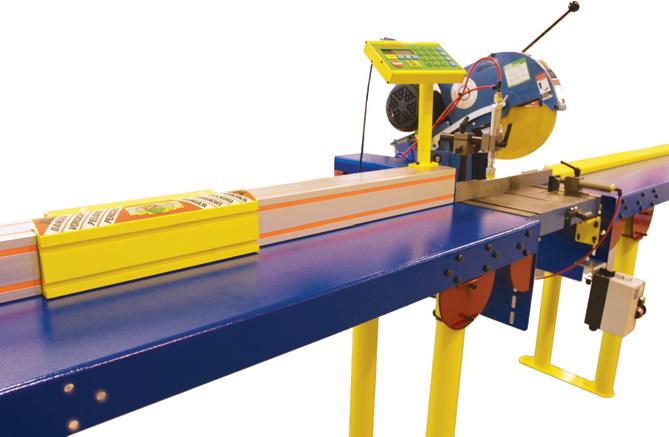
Add TigerStop, the automated stop/gauge and pusher system, to new or existing equipment to simplify processes and minimize wasted time and materials. With TigerStop, operators can push material automatically or use it in place of a manual stop. Material is positioned and ready to cut at the touch of a button.
An operator enters a desired dimension and the TigerStop moves to that position. The operator can confidently make the cut without measuring again and again or setting and re-setting a manual stop. This reduces operator error that results in wasted material and rework. TigerStop maintains repeatable accuracy of +⁄–0.004in to ensure parts are accurate the first time through.
Jobs are also completed in less time with greater accuracy. Operators cut more parts in a shorter period of time because they do not have to manually measure or set stops before cutting each part, allowing them to focus on getting the job done. It is easy-to-use so that any employee can produce precise parts. Stop or push material with TigerStop accuracy while reducing waste. TigerStop is a low cost addition with a great return on investment. ■ TigerStop LLC: (360) 254-0661, www.tigerstop.com
Faster heating rate
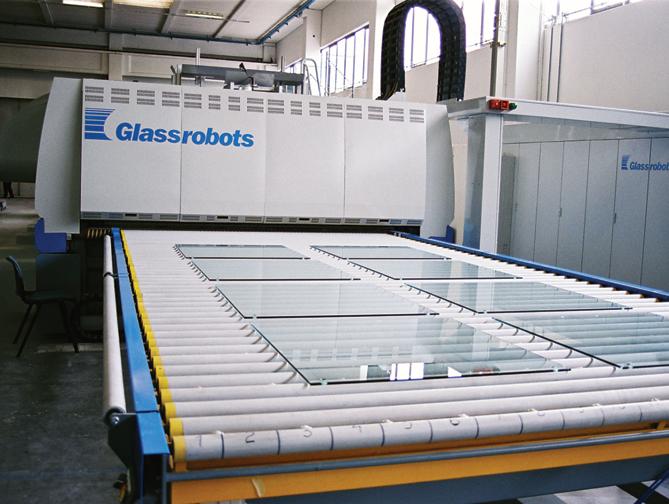
Glassrobots Oy has launched RoboTemp, a new flat tempering product family based on more than 25 years of manufacturing experience. The company says the new types of glass and coatings being introduced to the market and the continuing efforts of glass processors to achieve higher quality and greater productivity, coupled with extremely low energy consumption, are all opening the way for the modern convection technology. Thermal or infrared radiation (IR) is becoming an outdated method for
heating glass because various coatings, especially the low-emissivity (low-E) glass, exclude the possibility of using tempering furnaces that utilize IR. As the coating on the glass heats up, it reflects the IR. Consequently, heating takes considerably longer; so capacity falls and optical quality suffers. With the convection heating system, the glass is only heated with a stream of hot air without direct radiation, so it does not matter what coating is on the glass.
In this new convection system, the airflow has a large volume and low speed and is inverter controlled. The airflow is uniform over the surface of the glass and the temperature can be profiled precisely according to the type of glass and its size.
The glass has to be kept flat from the moment it arrives in the furnace. If the glass is deformed from the heat conducted by the rollers as the glass starts to heat up in the furnace, straightening it during the final heating could be difficult or even impossible. The end result, in addition to other quality defects, is a loss of optical quality. The controls have to react extremely quickly and precisely. This is made possible by Glassrobots’ FuzzyTemp control system. As its name implies, the system applies fuzzy logic, or a different, faster and more accurate way of calculating and processing signals compared to conventional control systems. This results in flexibility and allows mixed production.
Another factor that has an impact on process efficiency and on the quality of the end product is quenching, which also has to be carried out while controlling different parameters precisely and continuously. Quenching has to be uniform and yet rapid.
Aheating time of 33 seconds per millimetre of glass thickness has been recorded as the world record for low-E glass (emissivity or = 0.02 to 0.04). However, Glassrobots’ RoboTemp has achieved heating rates of less than 30 seconds per millimetre. With clear, uncoated glass it has achieved a heating rate of 25 seconds per millimetre.
The extra capacity from the faster heating rate is not the only significant factor from the practical viewpoint. Extremely high optical quality and consistency in the end product give the glass processor a major competitive edge. For example, 4.0mm or 5⁄32in glass that has been tempered with the latest technology can be laminated: two lites
of 4.0mm + 4.00mm with a thin 0.38mm or 0.015in PVB film. Until now, a 0.76mm or 0.030in film was necessary. This has a big impact on the costs of the end product. The structure of the furnace and the way it has been built, linked with effective recycling of the air within the furnace, enable the lowest level of energy consumption. The overall temperature of the furnace is kept low, about 680 degrees C or 1256 degrees F, and does not need to be adjusted for different types of glass.
Glassrobots Oy says it delivered the largest full convection flat tempering furnace in the world at the end of 2006 to a medium sized, family owned company in Germany for the manufacture of façade glass. The furnace can handle a maximum glass size of 3.2m by 8.0m. Glassrobots has also sold the RoboTemp flat tempering lines to Oldcastle Glass and Guardian Industries in the US. ■ Glassrobots Oy: 358-3-3132-3314, www.glassrobots.fi
High speed curing for glass printing
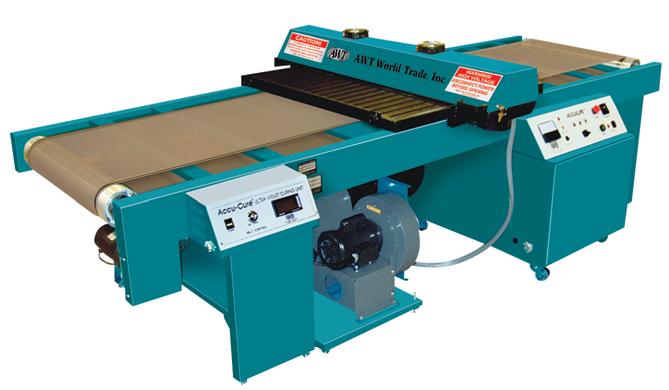
A.W.T. World Trade’s broad range of Accu-Cure ultraviolet curing units provide the ideal solution for curing decorated or imprinted flat glass of all sizes. Standard Accu-Cure units can accommodate glass panels of varied thicknesses and up to 102in (259cm) wide, with larger capacities available through custom orders.
Accu-Cure’s computer designed cooling system safely cures all types of UV inks and coatings while minimizing the heat transmitted to the substrate.
PRODUCT NEWS
The company says the Accu-Cure line is another highly advanced component in its complete modular system for glass makers creating decorative or other printed glass products. For example, by adding an Accu-Print High-Tech V line of screen printers, cooling units and additional conveyor modules, glass producers can easily configure a complete large format glass decorating operation. The company says it can custom design any of the modules to meet a user’s specialized needs.
Drawing on more than 30 years of experience in UV curing technology, A.W.T. combines performance with safety in the Accu-Cure UV curing unit. An operator can adjust gate height on the curing head module to accommodate varied stock thicknesses and to eliminate light leakage. The operator also may adjust the UV lamp output from 100W to 300W or 400W, depending on the Accu-Cure model, to meet production requirements, conserve energy and prolong lamp life. In addition, the Accu-Cure ultraviolet curing unit has an ozone removal system to safely vent ozone and hot air out of the working area.
In addition to the complete conveyorized UV curing system with exhaust, the Accu-Cure is also available as a retrofit package consisting of a curing head and light guard assembly. Also available are additional conveyor sections, sold in 1.0ft (30cm) increments, as well as stand-alone conveyor units. Accu-Cure models include the standard configuration, the Accu-Cure Compact UV and the Accu-Cure 3-D. The Accu-Cure is available in configurations of one or more lamps. ■
A.W.T. World Trade: (773) 777-7100, www.awt-gpi.com
Batch laminating in-house
The Glass Machinery Group of Casso-Solar in Pomona, New York, has introduced a glass laminating kiln for batch operations to serve the expanding markets of companies desiring to bring low production laminating in-house at a economically viable level.
The batch laminating kiln operates by the vacuum process, which is suitable for most types of products including tempered and bent glasses with PVB, EVAor other interlayer films. Produced in standard widths of 72in, 84in and 96in and three lengths of 72in, 144in and
216in with single or double units to provide up to two independent chambers with two bed loads in each.
The system comes complete with caster and lay-up tables, film cutter (EVAor PVB films), scissorlift, part carriers with silicone blankets, transfer deck, laminating kiln, vacuum pumps, PLC controls with touch panel and NEMA12 control enclosure built to comply with all North American codes.
Typical process time for 3.0mm glass with 0.030in PVB and 3.0mm glass is
three to three and a half hours per load. Other advantages the Casso-Solar batch laminating system offers are minimum floor space, lowest power and highest yield, comprehensive training and minimal maintenance. Additionally, Casso-Solar provides complete systems and processing responsibility, including technical sales, training, consulting, service, spare parts and engineering support. The company utilizes nearly five decades of experience in total process support for continuous productivity. ■
Casso-Solar: (845) 354-2500, www.cassosolar.com
Inert atmosphere oven
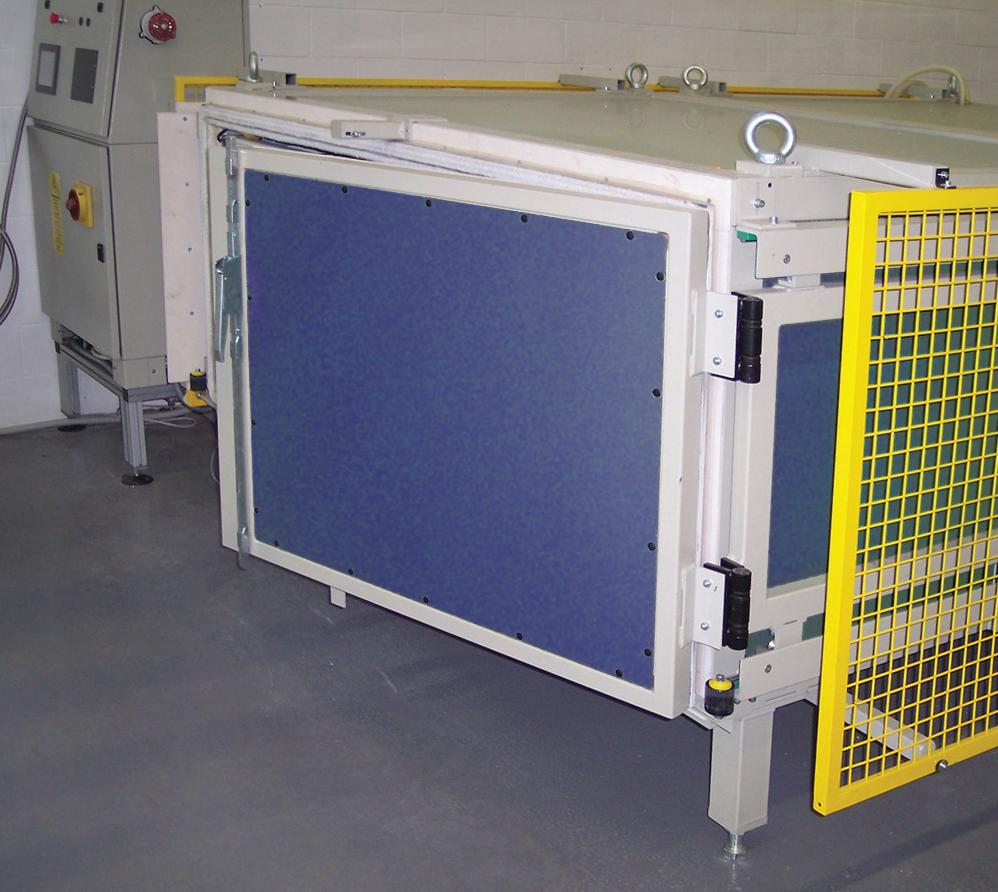
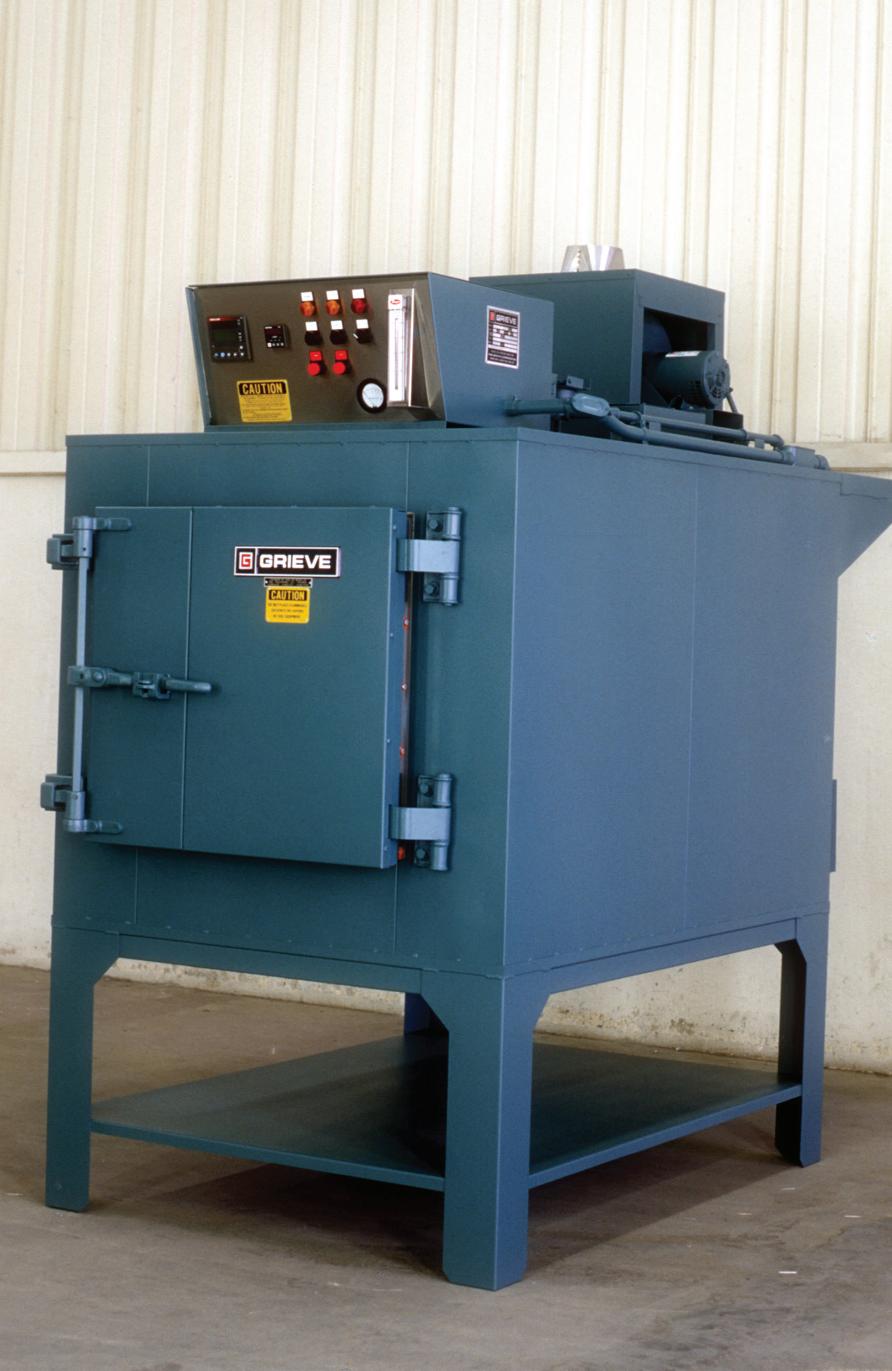
No. 968 is an electrically heated, 750 degrees F inert atmosphere oven from Grieve, currently used for processing glass and stainless steel components for laboratory and production use at a customer’s facility. Workspace dimensions of this oven measure 24in wide by 36in deep and 24in high.
The 12kW installed in Incoloy sheathed tubular heating elements power the unit, while a 400CFM, 1⁄3hp recirculating blower provides horizontal front-to-rear airflow to the workload.
This Grieve oven features 6.0in thick insulated walls, an aluminized steel exterior, Type 304, 2B finish stainless steel interior, a door equipped with adjustable positive latching door hardware and adjustable offset hinges, plus an integral leg stand.
Inert atmosphere construction on No. 968 also includes a pressure regulator,
flow meter, pressure gauge, inner oven walls sealing directly against a 1⁄2in thick silicone rubber door seal, air jacket on the inner oven for cooling, blower shaft seal, outlet with pressure relief, interior seams welded gas-tight and all wall penetrations equipped with compression fittings.
A325CFM blower is on-board to pull air through the air jacket on the inner oven for cooling. Controls on this inert atmosphere oven include a solenoid to open an outlet for automatic purge, digital programming temperature controller, manual reset excess temperature controller with separate contactors and recirculating blower airflow safety switch. ■
The Grieve Corporation: (847) 546-8225, www.grievecorp.com
Fast notch cutting
Glassline Corporation has introduced a new combination Waterjet/Drill technology specifically designed to meet the needs of shower door fabricators. By combining waterjet technology and drilling into one CNC system, production efficiency is greatly improved.
Waterjet technology is utilized for fast notch cutting, and eliminating the dependence on diamond tooling quality and the issues resulting from tool wear. This system provides the flexibility to cut notches at different feed rates, at desired edge quality. An optional grinding spindle can be fitted to the machine, if required, to meet any special finished notch edge requirements.
This new system from Glassline has the ability to drill as many holes as desired, anywhere around the perimeter of the part without additional setups, eliminating the need to move parts between machinery. The drilling system has top and bottom spindles to ensure the highest quality hole production. Up to two different diameter holes can be drilled within one part.
The waterjet system includes a special catch tube that eliminates the maintenance of a large tank. Precision CNC components ensure tight tolerances and repeatability. The system is managed through Windows XPCNC system and Touchscreen interface technology. The system is network ready and contains file storage set up to hold pre-programmed notch patterns.
ACNC Waterjet/Drill System can be custom designed and built to meet customer specific requirements.
Standard specifications provide for processing glass sizes from 610mm x 1220mm to 915mm x 1830mm (24in x 48in to 36in x 72in) – 2130mm diagonal (84in). ■
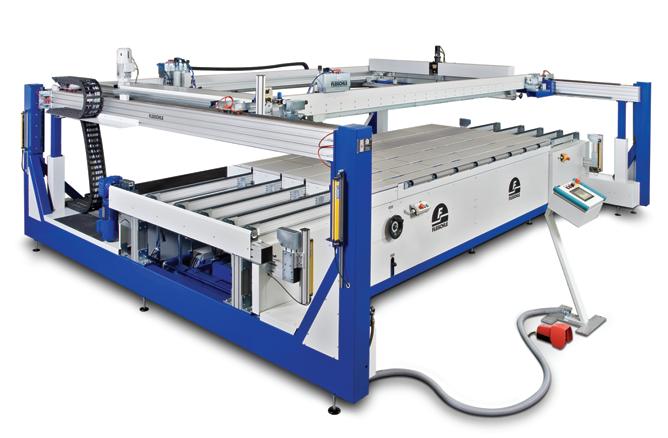
Fleischle, a machine manufacturer based in Germany, explains the evolution of its new machine type called LS.
Refined flat glass is used worldwide by architects and designers as a high quality building material with many configuration possibilities. One of the processes used to apply one or multicoloured decorations to the glass is screen printing which creates an optical refinement that cannot be achieved by other processes and materials.
The demand for colour-coated safety glass for aesthetics as well as for light transmittance and solar control is also important.
Worldwide, companies in the glass processing field have observed this trend, prompting new innovations from the manufacturer of screen printing machines.
The desire for quick changeover of the machine due to often changing production orders with differential portions, from single pieces up to series production, was the criterion which led to the new machine type by Fleischle called LS. Through a modular concept, this machine is available for delivery as semi-automatic, three-fourth automatic or a fully-automatic type. For single
PRODUCT NEWS
pieces the fully-automatic as well as the three-fourth automatic versions can be used in semi-automatic functions.
Asubstantial advantage of this machine type is its high flexibility. For instance, the print unit can be lifted vertically up to 500mm and moved horizontally backwards up to 1000mm via motor. For this reason, the print table and the print stencil are easily available for the machine operator. Both proceeding paths are independently regulated from each other and can be individually adjusted to the corresponding printing format.
For an optimum quality of the print image, the stable print table guarantees an evenly levelled printing plate. Through the help of blowing air, the glass pane gets positioned manually or automatically, depending on the version of the machine, to the rigid masks. The blowing air prevents scratching of the glass pane.
The standard machine is equipped with a motorized screen-lift, programmable in height independently to the squeegee path. The squeegee unit is fitted with an anti-drip system. Optimal safety is guaranteed by personal light barriers sitting at the dangerous zones.
The essential point of the new construction is based on optimal flow of material, productivity, safety and easy operation. Depending on the demand, the LS type is available as a single
COMING EVENTS
machine or for integration in a complete print line with transfer conveyors and a continuous dryer.
As an option for further short-cut of the changeover time, a new developed Fleischle camera system can be used in this machine type as well as on other Fleischle machines. The exact aligning of the printing stencil towards the glass is done via two cameras within a short period of time. On the monitor, the exact alignment gets controlled optically. As a reference point, parts of the print image or the edges of the glass pane are used which will be set-up according to the print stencil. This process enables the set-up of large formats which is fast and precise to achieve an exact print for reproduction. The company has 30 years of experience in the development and construction of machines. The company sells through Casso-Solar Corporation in Pomona, New York. ■
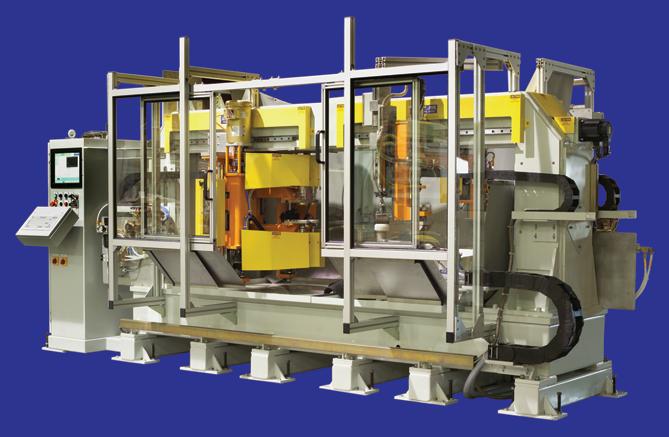
GED Integrated Solutions has introduced SmartWeld i-3, a new automated vinyl welder that delivers increased flexibility, speed and accuracy. Results include less labour and higher throughput, with decreased lead times.
The advanced automation of the SmartWeld i-3 allows one operator to do the work of two. Using the SmartLoad i-3 module, the operator simply uploads the schedule and pre-loads vinyl profiles. The profiles then run through the SmartWeld i-3 continuously. This non-stop operation and quick changeover boost throughput by up to 70 percent.
SmartWeld i-3 is part of GED’s SmartPlant vision that integrates glass and vinyl production with LeanNET software solutions to help manufacturers gain control and eliminate confusion on the production floor. The modular availability of each i-3 vinyl and glass product allows manufacturers to gain major productivity benefits now while creating the ideal plant one system at a time.
As a part of GED’s complete line of glass and window fabrication equipment and software, the SmartWeld i-3 is backed by the company’s training and support services. It follows the
Jun 7GTAGolf TournamentSandpiper Golf Coursewww.gta-ab.com St, Albert, AB
Jun 13GAMAGolf TournamentChestermere, ABwww.gamaweb.org
Jun 17IGMASummer MeetingWhistler, BC(613) 233-1510, www.igmaonline.org
Aug 23GDAS Bill Knapman MemorialElbow, SK(306) 477-4327 Golf Tournament
Sep 18OGMAFall Golf TournamentCarrying Place Golf &(416) 360-8367 Country Club, ON
Oct 6-8GlassBuild AmericaLas Vegas, NVwww.glassbuildamerica.com
Oct 21-25Glasstec 2008Düsseldorf, Germany(312) 781-5180, www.glasstec.de
Nov 11-13Win-door 2008Toronto, ON(800) 282-0003, www.windoorshow.com
For a listing in the Glass Canada Coming Events Calendar, send details to Chris Skalkos at: cskalkos@annexweb.com
PRODUCT NEWS
company’s release of its new SmartClean i-3 vinyl corner cleaner introduced last year.
The SmartClean i-3 corner cleaner is an integral part of the company’s new generation of SmartVinyl i-3 equipment and software specifically designed to save labour and manage materials to improve cost efficiencies in window and door manufacturing. The new twoheaded corner cleaner features an advanced, easy-to-use SmartLaser profile recognition system. The laser measures and automatically adjusts tool paths for high quality corner cleaning. The SmartLaser, along with advanced electronics and a highly developed drive system, combine to improve cycle times by 33 percent, resulting in higher throughput and virtually no remakes.
SOFTWARE
Controlling costs
GED’s new i-Sight software simplifies cost tracking with real-time reports and e-mail alerts direct from machinery. New i-Sight software from GED Integrated Solutions allows operations personnel to more accurately track and control manufacturing costs thanks to the industry’s first real-time reporting link with production machinery.
i-Sight, another LeanNET software innovation, enables machinery to instantly report actual material usage, cycle times and throughput in realtime. This virtual view of the production floor makes it easy for financial and upper management personnel to analyze detailed, to-the-minute production costs including unplanned manufacturing due to remakes, material problems, quality issues or process mistakes.
By measuring the profile dimensions as they are loaded into the corner cleaner, the tool path is automatically adjusted to handle vinyl’s unique variations with pinpoint precision. This eliminates the manual system tweaks required every day with current corner cleaners due to variations in the profiles or the welding process.
System features include an on-screen touch interface for real-time data and monitoring, as well as remote programming and CAD profile importation that saves time, labour and eliminates confusion. Anew high efficiency clean out system collects vinyl dust. If desired, the dust can be removed with a filter vacuum connected to the vacuum port. ■
To keep pace with steadily rising demand for architectural and insulating glass, Bavelloni pre-processing
technology has created PowerSeam, a product that is completely flexible in handling different glass thickness and sizes.
Available as a stand-alone machine or integrated into any production line, Bavelloni PowerSeam operates with one fixed and one moveable bridge, giving it the flexibility to work with different sized glass at random. The operator or the automatic loading system, in fact, only has to supply the glass; then PowerSeam will automatically set up, measuring the sheet dimensions and adapting to its thickness. This reduces the need for glass handling while supporting advantageous horizontal flow throughout the manufacturing process.
Based on the concept of a double edger, PowerSeam offers extraordinary levels of productivity to take full advantage of the new generation of continuous or oscillating Tamglass tempering furnaces. PowerSeam has been designed for integration with conveyors, washing machines and other equipment as well to work
i-Sight also enables window machinery to e-mail key personnel when emergency, preventive or predictive maintenance is needed so problems can be avoided before additional cost is incurred. By automating the reporting process, all of i-Sight’s features result in faster, more accurate control of manufacturing costs. GED provides complete installation, training and customization of i-Sight software. ■ Contact: GED Integrated Solutions: (330) 487-5095, www.gedusa.com
PRODUCT NEWS MARKETPLACE
independently or side-by-side with other continuous flow and/or batch production systems.
PowerSeam’s completely open electronic architecture allows its straightforward integration into customers’ existing lines and software environments. It is ideal for the production of: insulating glass and structural glazing, solar panels, shelves, doors and interior design items to be inserted into profiles. Thanks to its reliability and sturdiness, PowerSeam can withstand highly intensive use, allowing it to operate 24 hours a day, seven days a week as modern production processes normally require.
The technical solutions chosen enable it to achieve cycle times between four and a half and eight seconds, depending on the size and sequence of the glass sheets and the number of pieces of the same dimensions. The low-E capability is available as an option. The new Bavelloni PowerSeam also offers a broad range of optional features, including a table for reading glass dimensions at the entry side. ■
Glaston Italy Spa: www.glaston.net
Flat and bent substrates
Glasstech featured an array of its most innovative and advanced glass processing systems during China Glass 2008, an international glass exhibition held on April 10 to 13, at the China International Exhibition Center, Beijing.
Visitors to the 19th edition of China Glass had the opportunity to see the company’s glass processing systems that produce complex automotive glass, low-E glass and machines for the emerging solar glass market in flat and bent substrates.
Architectural systems
For glass processors involved in the architectural glass market, Glasstech manufactures systems for the efficient tempering of low-E glass, such as the architectural FCH2 Forced Convection Heater flat glass tempering system and the architectural ERH2 Electrical Radiant Heater flat glass tempering systems.
PROFESSIONAL SERVICES
BUSINESS OPPORTUNITY
SALES AGENT required for Glass & Mirror Fabricating and Distributing Company.
If you are already representing a company that would complement the Glass & Mirror Industry,and are looking to expand to include another line,we are looking for you. Ideal Glass requires motivated Sales Reps for Western Canada & Ontario who can attract new customers to expand our existing customer base. Please fax resume to 705-432-3333 or via e-mail to jduggan@ideal-glass.com
PRODUCT NEWS
To temper glass with high efficiency coatings, Glasstech has developed convection heating concepts using either natural gas or electric heating. Its FCH2 forced convection system, fired by natural gas, is ideal for the efficient tempering of energy-saving low-E flat glass. The FCH2 can heat clear glass at a typical rate of 30 seconds per millimetre of thickness, and high performance soft-coat low-E glass at a typical rate of 33 seconds per millimetre. This reduced heating time for low-E glass provides for higher quality with less distortion and dramatically improves productivity and reduces processing cost.
The nozzles on its electric radiant heater system, the ERH2, are located above the glass line and deliver heat to the top coated surface of the glass, improving heating time for low-E coated glass to 40 to 50 seconds per millimetre of thickness, compared to a standard radiant heating system’s 70 seconds per millimetre.
Solar systems
To meet the solar energy industry’s burgeoning demand for flat and bent glass substrates, Glasstech relies on its experience in the automotive industry to develop highly specialized systems for the solar industry, which require repeatability, tight specifications, innovation and cost effectiveness.
The company’s Cylindrical Radius Bender-Solar (CRB-S) parabolic shapes is an efficient and precise system used in the processing of parabolic shapes for Concentrated Solar Power (CSP).
For the photovoltaic (PV) market, the Electric Radiant Heater-Solar (ERH-S) features and the Forced Convection Heater-Solar features (FCH-S) offer high productivity flat glass systems to meet the very precise flatness specifications required for active plate and cover plate processing.
The CRB-S features a forming bed that is 1700mm x 2000mm and processes glass of varying thicknesses, depending on the surface strengthening treatment required. The system will form glass from 1.6mm up to 5.0mm for the specifications and tolerances
NEXT ISSUE:
needed for solar parabolic trough reflector glass parts.
CRB-S systems maintain characteristics similar to other systems in the CRB family and are able to form constant radius shapes, J-bends and the shapes needed to comply with parabolic trough specifications. The CRB-S meets the needs of the concentrated solar power industry by delivering the tolerances and repeatability required to produce the large volume of glass parts the CSP industry will use. ■
Glasstech: (419) 661-9500, www.glasstech.com
While Glass Canada editors make every effort to be objective when reporting on new products, they cannot be held responsible for claims made by companies. Readers are encouraged to contact the companies for more details.
The next issue of Glass Canada will focus on curtainwall and sloped glazing systems. Watch for it in August!
Quality Service Integrity
Since 1975
Insulated Glass Units
Tru-Span Spandrel Glass
Tru-Temp Tempered Glass
Eckelt Structural Glass Walls
PPG Certified Fabricator
Guardian Sun-Guard Authorized Fabricator
Opaci-Coat 300 Authorized Fabricator
Featuring High Quality Products from: • PPG • Guardian • Pilkington • Visteon • St. Gobain • AFG
All Products Available in Stock Cases,Single Sheets,or Cut To Size Walk in Pick Up Service (if required)
Clear & Tinted Float Mirror
Low E Tempered Door Lites
LaminatedHeavy Glass
Polished WireStarphire
Cast WirePinhead
Glue ChipAcid Etched
Thin Ribbed Niagara
1820 Courtney Park Drive • Mississauga, Ontario • L5T 1W1
Commercial: Tel: 905-670-7040 • Fax: 905-670-7041
Wholesale: Tel: 905-453-7111 • Fax: 905-453-7116
E-mail: sales@trulite.com • www.trulite.com
and Standoff
The entire selection is shown in numerous images of completed installations, and the catalog contains a wealth of technical and specification data to assist you in choosing just the right architectural system to meet your customer's needs. It can be viewed or downloaded online at