
Shim It Once and Done. SAVE
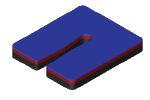
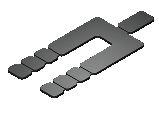
Grove Shims™ has the perfect shim for every job every time. Our 3”x 4” Horseshoe Shims are available in 9 thicknesses.

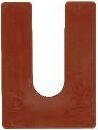
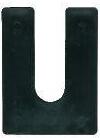





Grove Shims™ has the perfect shim for all your shimming needs.
With color-coded shims and solid thicknesses, the right shim can be easily applied for perfect alignment. No guesswork or realigning. Our shims save you time and money. Need help? Just ask! We’re here to help. 978-534-5188
Visit us online to see all of our available solid 3x4 Shims. www.groveshims.com Free Samples are Available Upon Request.
Grove Shims™ is the leading producer of plastic structural shims. We have been in business since 1962, making shims since 1975, our family-owned business provides prompt, personalized attention to each order. In addition to our large line of in-stock shims, we will custom fabricate parts to meet your unique requirements. Unlike many competitors, our shims are solid and do not have hollow voids, so you can depend on them in crucial, load-bearing conditions.





Enough whining about finding good people. Here are five strategies from top experts for how to attract and retain the workers you need, even from the picky Millennial generation.
You can hear great conversations with experts and important people in the Canadian architectural glass industry on our new podcast. It’s available in the podcasts section at glasscanadamag.com, or through top podcasting services like iTunes, SoundCloud and Spotify.
18 Inside and out
Lawrence Glass and Mirror manages relationships carefully, both inside and outside the business.
22 A quiet conversation
Glass can create the quiet office environments workers crave.
25 100 years of hardhats
A look back at the iconic look of construction.
Frank Fulton

We’re excited to launch GlassTalk, our new podcast.
Keep your eye out for a lot more podcasts coming from Glass Canada this year. I have to say I just love the format. For those of you who haven’t sampled this wonder of online communication, here’s a quick overview.
A podcast is really just a recorded conversation on a topic. It’s essentially a long interview with an expert or other noteworthy person, similar to what CBC radio does on shows like As It Happens or Steve Paiken does on The Agenda. Podcasts, though, can be even longer – some of them go two or even three hours. I won’t be going that long, but it isn’t hard to fill an hour with a guest that has good things to say.
The long-format conversation has a lot of advantages over a TV or radio interview. There’s a chance to really go back and forth and examine an issue. No one is getting cut off or having to condense their thinking into sound bites. You can go over as much terrain as the guest can cover and do so as thoroughly as the topic demands. When it comes to taking a deep dive into some area of interest, podcasts exceed even the ability of a print article to deliver lots of interesting points.
• Top Glass
• Sessions
• Product preview
The other great thing about podcasts is the delivery model. You get podcasts by subscribing to them, usually for free, on a podcasting app. Apple and Android phones include one on the device and the big online services include SoundCloud, Spotify and Audible. Podcasts can also be played off any internet browser – ours will be posted online at glasscanadamag.com. To find the podcast you want, you simply open the app and search for the name. Once you’ve subscribed, each episode of the podcast gets downloaded to your device, where you can listen to it at your leisure. On a plane or in a car with no WiFi? No problem. Unlike live broadcasts, you can stop the recording any time you want and start it again later. Since it’s voice-only, the demand on your attention is less than video. Podcasts are perfect when you’re doing something else, like cutting the lawn, driving or working in your garage. I like to shut off the sound on a video game and listen to a podcast while I play.
Our podcast is going to be called GlassTalk and I’m going to use it to bring voices from the industry to you with information to help your business. One thing we will do is bring on the Glass Canada columnists you read each issue to discuss their last column and expand and enhance their expert advice. We’re planning discussions about codes and standards, imported curtainwall, the new Fenestration and Glazing Industry Alliance association and more. And we’ll be bringing prominent glass people on board to talk about their experiences and stories in the industry, and their opinions of the issues of the day. We’ll release a new GlassTalk every three weeks or so.
If you are like me, you’ve viewed a lot of the social media out there these days with some skepticism. There’s a lot of talking going on and not much being said. I can promise GlassTalk won’t just be part of the general noise you’d like to tune out. Whether you’re an experienced podcast listener or someone who only uses a phone to make phone calls, I hope you’ll give GlassTalk a try. •
@GlassCanadaMag
February 2020
Volume 32 • Number 1
Annex Business Media
P.O. Box 530, Simcoe, Ontario N3Y 4N5
EDITOR | Patrick FLANNERY pflannery@annexbusinessmedia.com 226.931.0545
ASSOCIATE PUBLISHER
| Danielle LABRIE dlabrie@annexbusinessmedia.com 519.429.5187
ACCOUNT COORDINATOR
| Stephanie DeFIELDS sdefields@annexbusinessmedia.com 519.429.5196 | 888.599.2228 ext. 257
MEDIA DESIGNER | Curtis MARTIN
VP SALES/GROUP PUBLISHER
| Martin McANULTY mmcanulty@annexbusinessmedia.com
COO | Scott JAMIESON
AUDIENCE DEVELOPMENT MANAGER Urszula Grzyb ugrzyb@annexbusinessmedia.com 416-510-5180
CIRCULATION
Tel: 416-510-5180
Fax: 416-510-6875 or 416-510-5180
Mail: 111 Gordon Baker Rd., Suite 400, Toronto, ON M2H 3R1
SUBSCRIPTION RATES
Canada - 1 Year $37.00 (plus tax)
U.S.A. - 1 Year $85.00 (in CDN dollars)
Publication Mail Agreement #40065710
Printed in Canada ISSN 0843-7041
Occasionally, Glass Canada will mail informationon behalf of industry-related groups whose products and services we believe may be of interest to you. If you prefer not to receive this information, please contact our circulation department in any of the four ways listed above.
Annex Privacy Officer privacy@annexbusinessmedia.com Tel: 800-668-2374
No part of the editorial content of this publication may be reprinted without the publisher’s written permission. ©2020 Annex Publishing & Printing Inc. All rights reserved. Opinions expressed in this magazine are not necessarily those of the editor or the publisher. No liability is assumed for errors or omissions. All advertising is subject to the publisher’s approval. Such approval does not imply any endorsement of the products or services advertised. Publisher reserves the right to refuse advertising that does not meet the standards of the publication.
www.glasscanadamag.com


The Ontario Glass and Metal Association and Construction Specification Canada’s Toronto chapter held their inaugural joint Share the Vision seminar Nov. 14 at the Richmond Hill Country Club in Richmond Hill, Ont. About 50 people attended. Steve Gusterson, president of CSC Toronto, and Frank Fulton, OGMA board member, welcomed attendees and introduced the speakers.
Ron Hull of Kuraray educated the group about sound reduction in glazing, noting there has been a surge in interest in this parameter in the last few years. Hull showed how acoustic performance is tested and noted there are differences between ASTM and ISO tests and that different labs can give different results.
Glen Ackerley, a lawyer with WeirFoulds, updated attendees on the new Ontario Construction Act which came into effect Oct. 1. He went over the big changes: prompt payment requirements, the new dispute adjudication system and the modernization of the construction lien rules.
Lisa Green of Guardian gave attendees an overview of several emerging technologies in glass, including surface #4 low-E, bird-friendly glass, photovoltaics, dynamic glass, anti-reflective treatments, electrostatic shades, embed-
ded LED, smart mirrors and sensors.
Last, Ted Kesik, a building science professor from the University of Toronto, told attendees how to avoid building envelope failures. It’s a big topic but Kesik’s personality is easily big enough for the task. He boiled failures down to five main sources: bad design, bad operations maintenance, wrong purpose, bad construction and substandard materials. He referred to research that revealed three common ways these sources manifest themselves. The first is failure by contractors and installers to read specifications and system instructions. The second is transition between subtrades – failures happen in the spaces where trades overlap and coordination and communication are needed to get different building systems to work together. Finally, attempts to correct for mistakes and poor design after systems are installed is another major source of failures. Kesik also expressed his dislike of the term “value engineering,” saying “Value engineering does not add value and does not involve engineering.” He lamented the many examples of owners putting their projects at risk of failure by demanding cost-cutting changes to specifications after they are already written.
Feb. 10
FGIA Annual Conference Fort Lauderdale, Fla. fgiaonline.org
Feb. 26
CSC Building Expo Toronto cscbuildingexpo.com
Feb. 27
FenBC Suppliers Meeting Surrey, B.C. fen-bc.org
April 16
FenBC Manufacturers Meeting Surrey, B.C. fen-bc.org
April 22
Top Glass Mississauga, Ont. topglasscanada.com
May 14
FenBC Golf Surrey, B.C. fen-bc.org
May 28
OGMA Spring Golf Milton, Ont. ogma.ca
June 16
FenBC Associations Meeting Surrey, B.C. fen-bc.org
June 17
AGMCA Glazing Contractor Appreciation Day Toronto agmca.ca
June 22
FGIA Summer Conference Chicago, Ill. fgiaonline.org

The Canadian Glass Association is Canada’s only national organization dedicated to the interests of Canadian architectural glass contractors. We are presently investigating ways to restructure to serve our membership better and to identify initiatives appropriate for a cross-country organization to pursue. Suggestions and feedback are welcome – please contact CGA president David Langton at dlangton@compglass.com to have your say.
FenBC is getting ready for 2020. Our FenBC Technical Conference is Feb. 27 at the beautiful Northview Golf Course in Surrey. The agenda will include our popular keynote breakfast, “The Code Talkers.” We will have two streams of information sessions: one stream for the commercial sector and one for the residential sector. Our keynote lunch speaker is Margaret Webb from the newly formed Fenestration and Glazing Industry Alliance. The agenda will also include discussions on acoustics, field testing, air leakage, high performance coatings and much more.
May 14 will be the annual FenBC Golf Tournament, also held at Northview Golf Course. And save the date for the FenBC Industry Conference on Oct. 29, again at Northview Golf Course. Yes, we really like it at Northview Golf Course.
We are working with Mor-
rison Hershfield to revise the Glazing Systems Specifications Manual. The expectation is to have it completed by the middle of 2020.
FenBC is looking for supporters to re-establish the Canadian Glass Association as the national entity representing the commercial glazing contractors industry in Canada. If you are interested in participating, please call Zana Gordon at 778-571-0245 for more information. Thank you to David Langton (Competition Glass and FenBC chair), David Vadocz (RDH Building Science and FenBC Technical Committee chair), Brett Patrick (Morrison Hershfield) and Brent Harder (Ferguson Glass) for their support in keeping CGA active. FenBC will be working to re-develop the CGA with a new set of bylaws regarding membership and a new mission statement. Also, a big thank you to Glass Canada magazine for its continued support of the CGA as we evolve.
January’s PGAA directors meeting was held on Jan. 15. A few ideas were brought to the table regarding what PGAA is going to adopt as its objective(s) for the new year. The first idea was the thought of constructing an Alberta glass convention which would be held in Red Deer (sponsored by the PGAA) with a theme centered around the state of the glazing industry. The intention would be to bring industry experts, suppliers, contractors, installers
Canadian Glass Association PO Box 36117, Surrey, BC V3S 7Y5
Tel: 778.571.0245
fen-bc.org > Canadian Glass Association
and others together to discuss current issues, solutions, ideas and trends in the industry. The initial thought was to combine this event with the association’s annual golf tournament in August. This may not come to fruition this year due to the timeline, but a committee will be formulated for the development of the occasion and details will be provided in the near future.
The second idea was to develop a Project of Merit award for Alberta glazing contractors. Draft templates and overview documents were displayed at the directors meeting last week. The objective of this award would be to recognize projects that our association members have completed; projects that reflect the effort in design, workmanship and performance of deserving glazing contractors and their partners and suppliers. Applications would be received by the PGAA board and each submittal would be judged by a third-party panel. This award is currently still in the design stage and further details will be provided as the award is advanced.
Now that the Northern Alberta Institute of Technology is up and running with the glazier program in Edmonton, the Glazing Trades Association (Edmonton’s local association) will be sending out a letter to more than 250 glass shops located north of Red Deer and in northeastern B.C. and Saskatchewan with the intention of promoting the school program. This letter will provide clarity on the transition from the Southern Alberta Institute of Technology to NAIT in Edmonton. Alberta’s apprenticeship programs are still running strong.
The next PGAA meeting will be the annual general meeting which will be held on March 18. The annual golf tournament will be held in August of 2020 (date and location still to be determined). The PGAA has developed a mission statement. It is: Mantra: educate, collaborate and advocate. PGAA: education, liaison between the GTA and GAMA, and advocacy of contractors to the province.
TheAGMCA is pleased to announce our upcoming Glazing Contractor Appreciation Days, to be held at the Glazier Training Centres in Toronto on May 6, and in Ottawa on June 17. We invite all of our member glazing contractors to come out and see what we are teaching the glaziers of tomorrow. We will have a gourmet BBQ food truck on hand for a complimentary lunch. We expect a great turnout of all of our glazing contractors, owners, managers and staff members. Please plan on attending to meet and greet some of your friends and enemies in the glass business and to say hello to our volunteer directors. Drop by any time between 11 a.m. and 2 p.m. at the Toronto Training Centre (May 6, 130 Toro Rd.) or the Ottawa Training Centre (June 17, 199 Colonnade Rd. S.) To register to attend, get further information or to see how your company could possibly participate in these events, please send us an email at info@agmca.ca.
CTheNational Glass Association (NGA) has announced the publication of its newly updated Heavy Glass Door Design Guide. The guide replaces the previous 1999 edition. The Heavy Glass Door Design Guide is a resource for architects, fabricators and contractors who require technical information and application suggestions for fully tempered and tempered laminated, heavy glass storefront and entrance system design.
“Since its original publication in 1999, the Heavy Glass Door Design Guide has served as an invaluable resource for those who utilize these products in their projects,” says Ron Biberdorf of Trulite Glass and Aluminum Solutions.
“Frameless structural glass systems can
enhance the efficiency of sustainable projects as well as create dramatic esthetics, and this new edition reflects design trends and materials that will help ensure the continued growth and desirability of this industry segment.”
Structural guidance is provided on types of glass doors; hardware and entrance components; swinging, sliding door systems; top and floor-mounted systems; and application recommendations for fully tempered and tempered laminated glass entrance systems.
NGA’s advocacy and technical director, Urmilla Sowell, adds, “The inclusion of tempered laminated glass enhances the usefulness of the guide to reflect current industry trends and

The American Architectural Manufacturers Association (AAMA) and the Insulating Glass Manufacturers Alliance (IGMA) have officially combined into one organization with the new name, Fenestration and Glazing Industry Alliance (FGIA). After a July 2019 vote by both bodies to unify, the two organizations have come together as of Jan. 1, 2020. The AAMA and IGMA boards of directors met in early December to finalize the vision and mission of the unified organization. The vision focuses on improving home and building performance through better glass, window, door and skylight technologies and standards. The FGIA strives to be a welcoming community, leading the glass, glazing and fenestration industry through research, consensusbased standards, product certification, advocacy, and education and professional development. New social media platforms have been established for the new organization, including the following:
Twitter: @FGIAonline
Instagram: @FGIA_online
LinkedIn: @FGIAonline
Facebook: @FGIAonline
Industry professionals are invited to like, connect and follow these accounts to stay up to date on the latest information from FGIA. The new logo and branding will be revealed at the inaugural FGIA Annual Conference, to be held Feb. 10 to 13, along with a new promotional video. Those attending the opening general session will be among the first to see the new FGIA logo and will learn the story behind it. Registration for the conference is open now. Additional upcoming events include the southeast region Winter Meeting (Feb. 13 to 14, Fort Lauderdale, Fla.), the FGIA Summer Conference (June 22 to 25, Chicago), the FGIA Fall Conference (Oct. 5 to 8, Montreal) and the FGIA IG Fabricator Workshop (Nov. 10 to 12, Plano, Texas).

capabilities for heavy glass doors.”
The Heavy Glass Door Design Guide is available for purchase in NGA’s store at glass.org. Discounted rates apply for NGA member companies.
Chad Hoffman has been promoted to the role of president of Wausau Window and Wall Systems. He also will have responsibility for Toronto-based Sotawall Limited. Both companies are a part of Apogee Enterprises. Wausau is a leading designer and manufacturer of energyefficient, custom aluminum window and curtainwall systems. Sotawall is a full-service designer, manufacturer and installer of proprietary, high-performance, unitized curtainwall systems.

Hoffmann draws from 23 years of industry expertise and a breadth of experience in leadership roles including operations, sales, engineering and project management, as well as strong ties within the glazing industry. Prior to his promotion to president of Wausau, Hoffmann served as Apogee’s vice-president of operations and supply chain management. In this role, he led companywide Lean, procurement and shared-services initiatives across Apogee’s multiple business units. Before joining Apogee’s corporate team, Hoffmann worked for 18 years with another of its business units, Harmon, one of the largest U.S. full-service building glass and curtainwall installation companies. During his time with the company, he held many roles including serving as vice-president of engineering and manufacturing. Hoffmann earned a bachelor of science in civil engineering from Michigan Technological University, as well as completing the Minnesota Management Institute Program at the University of Minnesota, Carlson School of Business.
Glaston has announced several corporate moves in the past few months. Appointments have been made to the executive management group, which as of Jan. 1 constitutes of Arto Metsanen, president and CEO; Sasu Koivumaki, COO; Paivi Lindqvist, CFO; Juha Liettya, senior vice-president of Glaston heat treatment technologies; Dietmar Walz, senior vice-president of Glaston insulating glass technologies; Robert Prange, senior vice-president of Glaston automotive and emerging technologies; Artturi Maki, senior vice-president of services; and Taina Tirkkonen, general counsel and senior
Consolidated Glass Holdings has announced Robert T. Cummings the company’s new president and CEO, succeeding Bill Varner, who is retiring. Cummings has served as vice-president of sales and marketing at CGH since June 2019.
“Bob brings extensive experience and is well known in the industry for being a driven, passionate leader,” said Varner, who advised the CGH board of his intent to retire several months ago. “We are thrilled to have someone of Bob’s caliber step in to run the company.”
In his new role, Cummings will be responsible for leading CGH’s architectural division – including J.E. Berkowitz, Solar Seal and Columbia Commercial Buildings Products – as well as its security division including Dlubak Specialty Glass and Global Security Glazing. A 30-year glass industry veteran, Cummings also has held executive level positions at Hartung Glass Industries, Guardian Industries, Trulite Glass and Aluminum Solutions, United Glass Corporation and Standard Bent Glass Corporation. Cummings earned his MBA from Waynesburg College and graduated from Westminster College with a Bachelor of Science.
CGH has also announced that Chris Randisi has been promoted to vicepresident of architectural sales. In his new position, Randisi will lead the sales teams for the CGH architectural glass division.
“Chris has been playing an integral role in growing CGH’s architectural glass segment,” said Cummings. “His nine years of direct experience in the glass industry and 19 total years in the building products sector have provided him with a wealth of knowledge that’s
vice-president of Human Resources.
Glaston has announced it wil be rebranding Bystronic, terminating the use of the name by the end of 2020. The brand will be merged into the Glaston company brand. Glaston acquired Bystronic in 2019.
Bavelloni finalized the acquisition of all shares of Glaston Mexico in October. Glaston Mexico, whose company name will become Bavelloni Mexico, is a business based in Guadalajara specializing in the sales and service of Bavelloni products and in the sales of Glaston heat treatment machines.
been an invaluable asset to CGH. We look forward to leveraging his skills in an expanded role and ultimately providing better service to our customers.”
Most recently, Randisi was director of national accounts and architectural specifications for CGH. He previously served as mid-Atlantic regional sales manager for J.E. Berkowitz and held architectural sales roles with Guardian Industries, Shildan Group and Armstrong World Industries.
CGH) also appointed Jim Smith director of its Invisiwall engineered glass systems. In his new role, Smith will be responsible for expanding the market for Invisiwall and working with the CGH architectural division. Invisiwall engineered glass systems are custom engineered for a variety of applications, ranging from point-supported glass walls, glass canopies, handrail systems, and allglass doors and entrances to commercial shower enclosures and specialty applications.
“Jim brings nearly 40 years of engineering, project management, estimating, and sales experience in the construction industry to the CGH team,” said Cummings. “His expertise in mechanical engineering and construction management will greatly benefit the Invisiwall team.”
Previously, Smith held positions at Armor Masonry, Eureka Metal and Glass, Pioneer Contracting, ASK Plastics and C&M Builders. CGH operates facilities with more than 850,000 square feett of aggregate space and over 700 employees in the security and architectural market segments. The company is based in Pedricktown, N.J.


Robert Cummings (top) is the new CEO of Consolidated Glass Holdings. Chris Randisi has been named vice-president of architectural sales.

by RICH PORAYKO
It could be argued that part of the ongoing labour crisis is a generational issue. Family businesses are not finding successors because their kids are going off to other areas. Julia Schimmelpenningh of Eastman Chemical didn’t hold back in her 2017 State of the Industry address to Building Enevelope Conference attendees. “There is a well-known saying that once you’re in the glass industry for five years, you are in it for life. Well, guess what? The new workforce does not subscribe to that. They essentially say, ‘Uh-huh, I’ll be out of here in three years.’” Combine this with the failure of educational institutions to turn out skilled workers and you have the recipe for a crisis in labour supply that is already choking growth in this industry across Canada.
Instead of whining, let’s look at some ideas for what to do.
1. Concentrate on culture
According to Tom Jackson of Seattle-based SteelEncounters, 95 per cent of job candidates believe culture is more important than compensation. In order to connect with Millennials, he turned to his smart phone. SteelEncounters launched a cutting-edge employee app with everything a worker might want to know, including jobsite locations, an employee directory, company news, HR benefits, payroll information, health and wellness data and even their company store for apparel and swag. Did this alone cause even one employee to stay who otherwise would have left? Impossible to say. But the cumulative effect of efforts like this in your business communicates to younger workers that they are valued and that you are operating on their level. It’s about trust.
2. Look outside the box
Matt Day, president of Glaziers on Demand, a U.S. subcontracting service, heard the call for skilled labour and answered. Day took a different approach to locating workers, which has enabled him to give young adults a new opportunity, provide desperately needed skilled labour to sub-contractors and pursue his faith with integrity.
“Randy Clem is one of the most dependable, hardworking, family men we have,”

explains Day. According to Day, Clem got into trouble with the law at a young age and had severe legal consequences. “He has a heart of gold and has done everything someone can possibly do to get his life back on track.”
As a faith-based company, one of the goals of Glaziers on Demand is to help homeless veterans, convicted felons and people struggling with addictions. At one of its early job fairs, Clem stood out. His past criminal history made it tough for him to get a decent job so he could provide for his family. Clem saw this as an opportunity and simply outworked the other recruits. “He outscored them on their tests but never once left them hanging. His leadership capabilities are off the charts,” says Day. Dignity and self-esteem can be powerful motivators and Day has found a way to connect the dots. “Randy wants his life to mean something. He wants it to have value. With glazing, he has a respectable career that is cool in his friends’ eyes. Smashing car windows was Clem’s past, however installing glass is his future. This man works for a living.”
Outside the box can also mean outside the borders. In 2020, Canada is expecting to welcome over 341,000 immigrants into the country. Fifty-seven per cent of those immigrants will arrive as skilled workers. “A lot of them are working age and have building envelope knowledge, which is important for glazing,” says Kael Campbell, president of Red Seal Recruiting Solutions. “We feature new Canadians in our marketing and social media and do our best to be where they will see us. It helps with recruiting if people know there may be others like them and understand where they come from. It really attracts
It’s time to stop complaining about the difficulty of finding new workers and to actually do something about it. Failure is not an option –the future of our businesses depends on it.
them. It takes a community to attract a community.”
3. Explain the trade
Day remembers when Glaziers on Demand was having a devastating time attracting a younger workforce. “We tried Department of Labor Offices, high schools and job fairs,” he says. “You name it, we tried it. Then one day we asked ourselves, ‘What would attract young adults in the 18 to 24 year-old range to Glaziers on Demand?’ And the answer was simple: market our trade accurately.”
In the spring of 2018, Day decided to go bold. “We placed a ton of Facebook and Craigslist ads and used deliberate language to attract the correct people: get paid while being trained, no student loans, respect from peers, travel while earning a per diem and take home as much as an accountant or nurse to save for a house down-payment.”
It worked. Clem and eight other young men signed up and assembled for the Glazier on Demand Boot Camp. Held at a former Georgian plantation, the first Glazier Academy took place in May, 2018. “My first thought was, ‘What have we gotten ourselves into,’” says Day. It cost Day $20,000 to produce. Only four men graduated from it. Of those four graduates, only one made it more than a month in the field (Clem).
With such a low success rate, Glazier Academy nearly ended before it got a chance to take off. But because one man perservered, Day was able to make back the $20,000 investment and clear another $15,000 his first year. “Today, because of Mr. Clem we have enrolled over 250 in Glazier Academy

Company culture is frequently cited by younger workers as a main factor in deciding where to work and stay. Embracing modern technology often sends them the right message.

alone. That’s a lot of families that have been changed. That’s a lot of young adults that have been inspired.”
“We need to explain to young people what a glazier is,” says Day. “The industry needs to share the stories about the Randy Clems of our world. Glazing is the trade of titans. Everyone admires our work but still thinks a glazier makes doughnuts. Glaziers are the artisans of artisans, who belong to an ancient trade that changes the way people see the world. We are the builders of modern day pyramids.”
“One important step in attracting prospective candidates to the field is for the industry to recognize the glazier trade as a professional skill,” says Jeff Dalaba, program manager for the Architectural Glass and Metal Certification Council. “Many other construction trades have adopted certification or licensing as a means of recognizing the knowledge skills and abilities required to safely and effectively perform,” says Dalaba. The glazing industry has been slow to adopt a universal standard for the glazier body of knowledge and recognition of glaziers that meet acceptable standards.
“The Architectural Glass and Metal Technician Certification for North America (AGMT) is the first to up the game for glaziers by providing glazier certification,” says Dalaba. AGMT is a personnel certification program that features an independent third-party assessment. The program earned ANSI accreditation in March 2019 and recognized its first certified glaziers in July 2019.
To gain certification glaziers must demonstrate a prerequisite 7,500 hours of glazing experience within five years. The intensive certification then tests their ability to perform fundamental glazing procedures and to be proficient in all areas of glazing such as storefront, curtain wall, safety, sealing and more. The testing is both hands-on and written and covers the glazier’s abilities in seven key categories. “The program yields benefits not only to the glaziers becoming certified but also to the entire construction process,” says Dalaba.
While still in its first year of operation, AMGT has already certified 259 glaziers. Administrative Management Systems (AMS, Inc.) conducts the
RIGHT: Do these guys look like they enjoy their jobs? What a lot of young people don’t understand is how fun, fulfilling and lucrative a career in glazing can be. We need to explain the trade better, and to get education institutions on board.

independent testing and is a leader in the glass and fenestration industry for program certification and product compliance testing. The AGMT program has already gained industry acceptance and is referenced in MasterSpec’s updated Division 8 specifications. MasterSpec, an architectural specification system, includes AGMT certification as a requirement for “installer qualifications” within the subsection titled “Quality Assurance.”
Pride shines from the faces of glaziers receiving their AGMT certification. Young people are much more interested in a trade when they know it comes with a recognized industry certification they can show to their peers and any prospective employer.
5. Find friends of friends
“Based on our experience and backed by scientific studies, the top method for attracting new glaziers has always been the employee referral program,” Campbell reports. “There is a study out of the University of Toronto that measured approximately 100,000 hires and found that you get better, safer and more profitable hires if you are using employee referrals.” The study, “The value of hiring through employee referrals in developed countries,” by Mitchell Hoffman at the University of Toronto Rotman School of Management, found that although it is possible for referral programs to be a disadvantage to women and minorities as well as to increase costs to firms through higher wages, also found that employees that are hired via referrals have lower turnover relative to non-referred employees. The study also claims that referred employees are more productive and incur lower recruiting costs than non-referred employees. The research found that when firms hire referred employees, their
workforce becomes more likeminded. Hoffman states that this can be a positive if workers share values or characteristics that are desirable, however it can also be a drawback as it promotes less diverse opinions and ideas.
“We ask our glaziers and apprentices who would be a good fit for the job,” says Campbell. “The incentive could be a bonus to your current employee. Or it just could be recognition. Some people really need the cash bonus but for others,
credit card travel points for a weekend away as reward for referring someone great can work just as well. You don’t have to spend a lot of money.”
With unemployment historically low and young people more picky than ever about their careers, it’s time for our industry to look at new approaches to attracting and retaining labour. The good news is the glazing trade has an incredible amount to offer anyone with the right set of talents and inclinations.•








Inc . 10000 NE 7th Ave Ste 330-A, Vancouver, WA 98685. Phone: (360) 768-5104 - Fax: (360) 326-7228 Email: info@microcranes.com - Web: www.smartrigcranes.com


by MARGARET WEBB
As of Jan. 1, the Insulating Glass Manufacturers Alliance and the American Architectural Manufacturers Association have combined to evolve into the Fenestration and Glazing Industry Alliance. This follows two years of widely publicized discussion, intense dialogue, shirt sleeves rolled up and member presentations.
The face of the industry has changed over the past 20 years. There are a lot more product offerings not only in traditional double-glazed insulating glass units but also dynamic glazing, increased stringency in building and energy codes, material sustainability and more.
I started with the Insulating Glass Manufacturers Asoociation of Canada prior to its merger with the Sealed Insulating Glass Manufacturers Association. It was a time of great change for the Canadian and U.S. members of both associations. It was a successful transition combining not only the two organizations but the cultures as well. That transition, merging the two cultures, took about 18 months. In spite of some of the member concerns about what the new organization would look and feel like, IGMA was a very successful undertaking.
It was a very different time in 2000 compared to today. Every aspect of FGIA was discussed and planned down to the smallest detail prior to balloting the two memberships. (In the case of the IGMAC-SIGMA merger, nothing was heavily planned in advance.) The 18 months following
the successful vote was dedicated to establishing the new management, the new structure and determining staff positions. In establishing FGIA, we are well ahead of the game.
While FGIA is the name of the new organization, the IGMA, IGMAC and AAMA brands are continuing indefinitely and will serve as the lead brands for publications and product certification. We may have a new name but, in reality, all programs and services including task groups will continue the same as they have. The IGMAC certification program also continues as it always did – task groups are continuing to meet and work on their documents and the IG Fabricator Workshop is scheduled for Nov. 10-12. I believe there will be more things familiar than different.
So, as my position as IGMA executive director winds down and my role as the FGIA glass products and Canadian industry affairs director gears up, I find myself reflecting on the past 20 years. IGMA started with two committees and a handful of task groups. Since 2001, we have increased our scope of activity to include codes and standards in Canada and the U.S. as well as participation in the ISO standards development world. We are engaged in research and development funded by the membership and have embraced new training methods while keeping some of the past. While we increased our scope dramatically, the size of the staff did not increase. A number of activities by necessity had to go on the back burner. Two staff can only handle so much. Now, with the resources of FGIA, the vision of what IGMA could have been will be realized.
The next year will bring changes but not as many as some may fear. Much has been retained: the research projects, certification programs, services, workshops and of course the staff. We’re located at the same offices and have the same phone numbers. Emails will change but the old ones will still work. If you have a question, give me a call – we’re here for you.
Change is inevitable. However, change managed properly, opens new avenues and opportunities for growth. IGMA and AAMA will be stronger together and provide a powerful voice for the fenestration industry on both sides of the border.
Come join us. Be the voice of change and have a voice in the future. •

by DAVID HESKA
Happy new year! I hope that each of our Glass Canada readers had a safe and enjoyable holiday season. Over my Christmas break I was able to celebrate with family, unplug and read a couple of books that had been sitting on my bookshelf. One of the books I read was titled “12 ways your phone is changing you.” The topic peaked my interest and was a great follow-up to a contest we had in our office at the end of last year. A colleague decided to create a non-mandatory challenge titled “No phone November.” Thirty people decided to sign up and compete with one another (and, more importantly, themselves) to see how we could change our habits throughout the month. With the average smartphone user spending over three hours on their phone each day I wanted to learn more about my phone usage, so I joined in.
Before I dive into this topic any further let me ask the question many of you are probably thinking: what does our smartphone usage have to do with the glass industry here in Canada? The answer is, a lot. How productive are the staff in your organization? How distracted are they by the technology in their lives? In the next 20 years, how will technology change the way we manufacture glass? Will our smartphones and laptops be connected to our glazing components so that they can automatically be adjusted depending on weather conditions or manually changed based on user preference? I share these thoughts because we are all living in a technological age in which we are more “connected” to those around us, and yet the statistics show we are more lonely today than in the past.
Our employees spent cumulatively 70 hours less on their phones in the last week of November.
Phones have become such a critical part of how we do business that it is now difficult to remember how we ever coped in the past without them. But the sword has two edges – we are more productive at work but possibly less engaged and relaxed at home, or even in work settings outside the office where we used to be able to give our full attention to a meeting or a client. Being always on and always available has its price.
As a result of our office “No phone November” challenge I was able to reduce my smartphone usage to an average of two hours per day. The cumulative result was that our employees spent 70 hours less on their phones in the last week of November compared with the first week. So what did we all do with the extra time in our days? I’m not sure, that wasn’t part of our contest. But I’d bet that whatever we did, it was probably more productive and more satisfying than browsing Twitter or Instagram.
So I’ll repeat a question the author asked in the book I read over the holidays: “The essential question we must constantly ask ourselves in the quickly evolving age of digital technology is not what can I do with my phone, but what should I do with it?” There are numerous ways my life is better today because I have an iPhone in my pocket. But let’s not forget that there are large, publicly traded companies on the stock exchange who’s entire business strategy is to get you and I to spend more time on our devices. Their strategies do not involve having us live more productive lives at work or more fulfilling lives at home with our families.
As we head into 2020 one of the new habits I’m trying to implement is using my phone less between 5 p.m. and 8 p.m. each night and to turn it off completely for one day on the weekend. I don’t know what it might look like for you, but let’s raise a glass to the year ahead in which we unplug our phones more in order to better enjoy time with our friends, coworkers and family. •
Mealey has noted that contractors in his Collingwood, Ont., market are taking on every larger and more complex glazing projects. He’s seeking the profitability sweet spot by moving Lawrence out of residential windows to focus on railings, shower glass and commercial storefront.

For John Mealey, success is very much about good client relationships. With these solid bonds in place, he seeks to create a workplace atmosphere where everyone feels valued. Excellent client relationships, he has learned over his career, are a huge factor in profitability. They are also, in his view, a huge factor in staff morale and retention.
Mealey is the new owner of Lawrence Glass and Mirror in Collingwood Ont., which was started by Gary and Margaret Lawrence in 1988. In planning to sell their business over the winter of 2018/2019 however, the Lawrence’s weren’t just looking for just anyone to take over. “They were friends of the former owner of The Flooring Place, which I had bought in mid-2017, and they asked him how it went,” Mealey explains. “They decided that I would be a good person to carry on what they had built.” Mealey’s wife Suzy, who works part-time at the business as a coordinator in addition to running her own firm, is very also well-known and well-liked in the community, and this continues to
be an important factor in the success of Lawrence Glass.
Buying the business was a good fit for Mealey because he had previously owned a window and door supply firm. In addition, he’d built strong local ties through The Flooring Place, and having that business and a glass business under the same ownership would enable Mealey to sell the same contractors and designers shower glass, glass railings, specialty glazing and other glass and mirror products in addition to luxury flooring and tile. Mealey was also keen to buy the business as it already had an excellent reputation for quality work and attention to detail, with the Lawrences having created a lot of goodwill among contractors in the area.
For the existing staff, the ownership transition was also positive, in that some were perhaps worried that the business might have closed or that whoever took over would be inexperienced. With Mealey at the helm, a man who had accomplished things like growing The Flooring Place 150 per cent since acquisition in June 2017, they could
Location: Collingwood, Ont. No. of Staff: 12
Plant: 4,500 sq feet
Area served: North-central Ontario
Products/services: Flat glass for railings, shower glass and commercial storefronts (90 per cent); IG replacement and mirrors (10 per cent)
relax. He certainly had business smarts, but it was Mealey’s experience with taking over other businesses that has had an impact on Lawrence Glass employees far greater than they likely would have imagined.
Upon taking ownership, Mealey immediately began identifying the top 50 accounts and analyzing not just their profitability, but how they fit with his new Lawrence Glass team. “The driving force behind this analysis is based on the lack of capacity in the market and the desire to fill our available capacity with high-value customers that lead to
higher profitability,” he explains. “In the past in my other businesses, I had noticed that a lot of profit can be lost due to customers not being ready to receive deliveries, not being organized in other ways, not paying in a timely fashion, and so on.”
Mealey began the process by talking to staff and listening to feedback from customers. This led to holding ‘partnership meetings’ with customers and suppliers as well. It’s an approach that Mealey first used with clients at The Flooring Place in 2017 and 2018. During those interviews, he informed customers of the changes he was making at his new business to make it more efficient but he also discussed his expectations. In the Lawrence Glass partnership meetings, because it was already lean and efficient, he was mostly communicating his plans and expectations. Over about 50 interviews since last April, Mealey has asked customers to be ready for his team, to have the site prepared for delivery and to have any building code or engineering information or questions ready. “Timing is critical with glass, and it’s the last thing to go in before occupancy,” he says. “We don’t want to be pinpointed wrongfully as the business that has delayed occupancy.”
Mealey also interviews potential customers to ensure there is an alignment of values and that he and they have the capacity to meet each others’ expectations. He believes it’s equally important that suppliers have the same experience and he works to continually improve communications with them, holding the goal of becoming each suppliers’ best customer.
But Mealey had another reason to do all this, which was just as important: to increase staff morale. “It has a negative effect on any staff when they have to deal with troublesome customers,” he observes. “In my businesses, I want to create an environment where that’s not a factor for my employees. I want them to be respected and happy. I want them to know I have their backs.” When asked what his staff said when he explained what he was doing, Mealey says they were surprised – and excited about the future.
As for the response of interviewed customers, well, some of them had to be fired, but the vast majority of the





entire supply chain were keen to jump on board. “We all have mutually-similar goals – we all want to be profitable, deal with good people and do a good job,” Mealey says. “The process of getting there is the challenge, but clearly identifying the responsibilities in each part of the process is a critical first step. Building is complicated and the homeowner is more involved and armed with more information than even before. I think the choice is simple – keep up or get out.”
As a result of his analysis, Mealey also decided to narrow his products and services to some extent. He believes it’s hard to gain a competitive edge when you’re not focused on what you do best. For example, he’s taken Lawrence Glass out of doing residential windows, for now anyway, as it wasn’t an area of expertise and was only about ten percent of business. Now, about 90 per cent of sales are flat glass for railings, shower glass and commercial storefronts. The other ten is IG replacement and mirrors. This has all been positive, but the most rewarding experience Mealey has had so far at Lawrence Glass and Mirror was with a new client – sort of. “We had had a builder leave The Flooring Place in the fall of 2018,” he explains. “At that point, it was still in transition and neither of us had put our best foot forward. So, he went looking for other suppliers and I had felt badly about it. Recently this builder came back to us after having a very bad experience with competitors in both flooring and glass. He wanted to get back on track with us and start over. We recently completed our first job where both The Flooring Place and Lawrence Glass supplied and installed his order, and everyone was happy. It’s been one of my highlights since taking over.”
Mealey believes small businesses are being challenged to continually increase efficiencies like never before. That’s why since he took over, he’s put Lawrence Glass through a “digital transformation,” with workstations and tablets now running glass-specific software (SmartBuilder). He notes that while it’s always challenging to learn new systems, using the software has enabled the team to go from generating three or four quotes per day to about 20. “At the same time,” he adds, “customers demand a personal
approach. Every customer wants to feel like they matter the most, and we strive to show that.”
It was also a bit challenging for some employees to answer a lot of his questions about what could be improved and why, putting them a bit on the spot in terms of their accountability. Mealey says however that this challenge has “turned out to be a great process to really understand the business and how to set individual goals. Everyone has responded well. After acquiring multiple companies over the years, I try not to make the same mistakes twice and think this acquisition was the smoothest so far.”
Mealey has also introduced a company-matched RRSP program for his employees, as well as an individualized goal-orientated bonus program. These, along with his positive attitude, have made a big difference in helping attract and retain good staff, he says. He believes the existing staff were ready for change and have welcomed the way he is uncompromising with expectations. All these changes since April have al -
ready resulted in a healthy 25 per cent bump in business over the same time last year.
But of course, Mealey is looking ahead. “Our contractors seem to be taking on larger projects that are becoming more complex,” he says. “Stairs with detailed custom railings are becoming a focal point in people’s homes, and custom showers are getting more complex and trendy. Many builders are seeking
timeline.” To boost sales further, Mealey has introduced “a really fun product” in partnership with Imagic Glass that enables personal image application.
It’s clear that what makes Mealey most excited is creating a rewarding atmosphere for the people he works with, and it’s not something he will ever give up on. “My background is highly varied, with homebuilding experience, to World Cup-level alpine ski racing, to
supply partners that can fulfill on a larger scale, which is where we fit in. Builders also want to deal with fewer suppliers, and if you can supply more of the project and get it done faster, that’s better for everyone. Our tile installers, for example, are being trained to measure for glass, which saves a lot on the
two decades in commercial finance,” he says. “For the last five years of my commercial finance career, I felt like a number and I never want to feel like that again, and I don’t want anyone else to feel like that either. This makes me excited and wanting to come to work every day.” •

Powr-Grip products provide a smart and efficient way to lift and move all sizes of glass. As always, glazier safety is our top priority.

Open concept offices seemed like a great idea at the time – until productivity started to slip thanks to noise and distraction. Glass interiors can retain the feeling of connectivity while drastically cutting down the chatter.
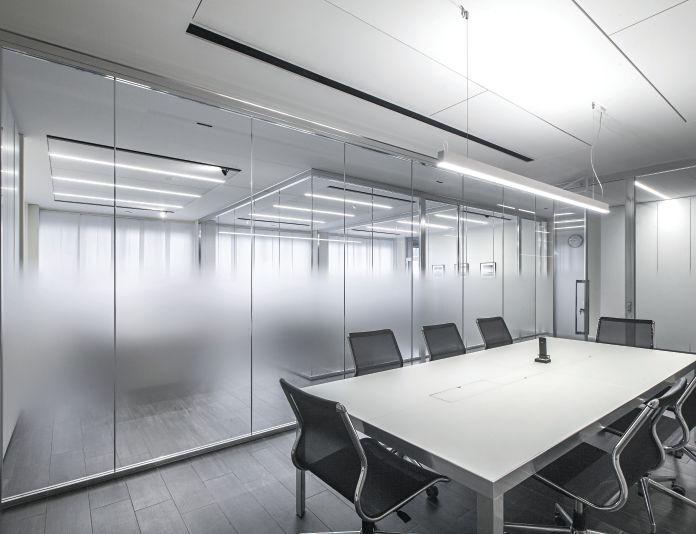
Fully integrated open office plans seemed like the perfect answer to claustrophobic cubicles — until they weren’t. Despite grouping employees at communal desks and tearing down private office walls, Harvard Business School researchers found that the move to open up workspaces has negatively impacted collaboration, triggering a withdrawal response among workers. The 2018 study discovered that open office concepts reduced face-to-face interactions by 70 per cent, while employees increased their email use by 50 per cent. Other studies showed wall-free offices had a negative effect on attention spans, creativity, motivation, and morale. While open office concepts let in lots of natural light (good), they also promote noise distractions (not good). In fact, a University of Sydney study found that “noise pollution” is the top beef of employees working in exposed offices, resulting in lower productivity and more sick days. Since about 70 per cent of all offices have switched to open
floor plans, the design trend isn’t going anywhere. Instead, designers are starting to tweak and optimize workspace to strike just the right balance between individual privacy and collaborative areas.
While “noise distractions” still might sound like a trite complaint, the Information Overload Research Group estimates that “digital distraction” costs U.S. companies nearly $1 trillion annually. By drastically reducing face-to-face interactions and driving up employee email use (and therefore screen time) by 50 per cent, open office environments are also increasing exposure to digital distraction. If a company makes the decision to invest more in a workspace that takes these factors into account, it’s actually a smart financial move.
In initial meetings, designers and architects can make the case for strategic acoustic design by prompting clients to review how floor plans affect recruit-
ing, retention, and absenteeism. For example, if a human resources department surveyed current employees, how would satisfaction with the building environment and the company rank as a whole? A strong case can be made for investment in research-based interior design that reduces noise, visual, and other distractions, since it helps minimize employee turnover and absenteeism.
More than anything else, employees value workspaces that balance team building and collaboration with individual focus and creativity, according to Gensler Research Institute’s 2019 U.S. Workplace Survey. The takeaway? Designers and Csuite execs should move away from the open versus closed office debate and focus on creating a flexible office. Flexibility can be easily supported by offering ondemand open and private work areas to employees, as well as common spaces, to help boost morale and productivity.
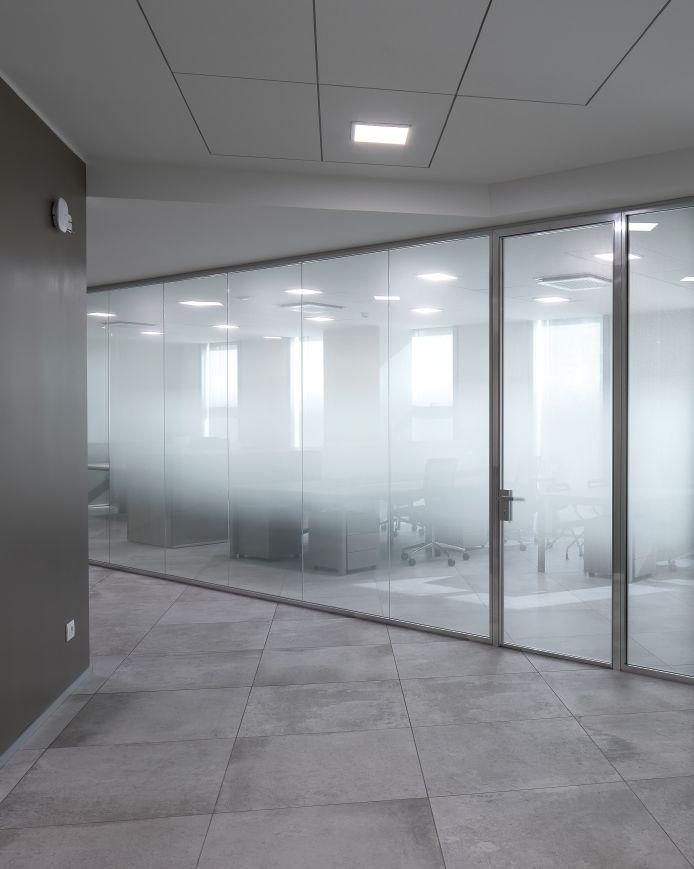
Glass is an excellent choice to set aside quiet, private workspaces that still maintain open sight lines, while also facilitating natural light-filled, collaborative common areas. In addition, glass offers designers and building owners lots of flexibility in choosing just the right look, opacity, colors, textures, patterns, or branded imagery. That way, panels, partitions, walls, and doors integrate seamlessly into the overall interior design.
When building out the ideal flexible work environment, an understanding of Sound Transmission Class (STC) ratings is key. These ratings cover a wide range that can allow for both high-energy brainstorming areas and ultra-quiet hideaways. STC ratings show how well a construction element like a glass partition blocks sound and reduces noise. These ratings are determined by playing a tone near the partition and then measuring the decibel value on the other side. The higher the STC value, the more the partition blocks out noise. These rankings get calculated by a logarithmic formula and can’t be batched. That means two 0.5-inch pieces of glass next to each other wouldn’t equal the STC rating of a single one-inch panel.
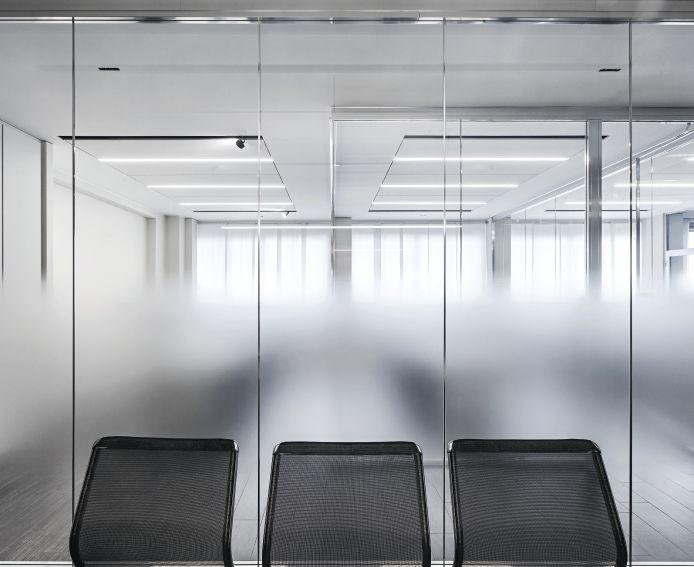

“Laminating and double-glazing glass can improve STC ratings,” says Ron Gerhardt, head of McGrory’s doors and entrances division and director of engineered products. “Sound absorption and diffusion are a growing priority in office and healthcare facility design, where productivity and privacy are important. Unlike other materials, glass can have a sound dampening effect while still allowing light to penetrate, contributing to the overall well-being of employees and patients.”
When you’re considering what STC glass rating to use, it really depends on the effect you want to create. The design team needs to work with suppliers to select the right glass type for each application. They’ll also help you avoid pitfalls, such as gaps that allow sound to leak through door installations and office fronts. We all know how small gaps in glazing and facades can allow a disproportionate amount of heat loss through air leakage. It turns out sound is no different.
“Lamination can drastically increase glass’ sound-dampening qualities,” notes
Dan Laporte, McGrory’s director of laminating sciences. “But the real beauty of what we’re doing is that adding lamination allows you to have a myriad of design capabilities, while still taking into account your acoustic needs. It also allows you to incorporate visual privacy and branding into your design.”
Options available on the market include materials like switchable privacy glass that goes from total transparency to complete opacity at the flip of a switch, and integral blind units.
Suppliers with an in-house print division can also create custom, colourmatched films in metallics, chromes and pearlescents, as well as standard white fades and full-flood translucency customized to your preferred level in different areas of a space.
Metal frames and other hardware used to install glass walls and partitions are key to preserving an architect or designer’s desired acoustic levels. Work closely with your supplier to make sure these details meet your specifications.
“A common misconception is that the various wall systems require glass
from that specific wall system manufacturer,” says McGrory regional architectural sales consultant John Clark. “With the right expertise and manufacturing capabilities, you can make architect/ designer-specified glass that works with almost any existing system, demountable or otherwise, and achieves the desired acoustical qualities. That’s one of the advantages of working with an all-inclusive glass manufacturer.”
Ultimately, offices of the future are focused on accommodating people’s varying needs for collaboration and privacy. A flexible space can be achieved with glass, which offers the best of many worlds: limitless design options, privacy at will, natural light penetration and options that can meet multiple STC ratings. •
Founded in 1984 by John and Mary McGrory, McGrory Glass is still family owned and operated. With three facilities spanning +150,000 square feet, it is committed to the environment and sustainability. McGrory Glass is headquartered in Paulsboro, N.J.
by BULLARD
Women got the vote. Prohibition began. The National Football League was founded. And, the construction industry was forever changed by the invention of an often-overlooked but significant worker safety advancement: the hard hat. And, while perhaps not considered a great technological invention now, at the time the invention of the hard hat revolutionized and galvanized the businesses and the people behind American industrial boom.
The hard hat comes from a Kentucky-based, familyowned company called Bullard, which was founded in 1898 in San Francisco by Edward Dickinson Bullard. The company originally supplied carbide lamps and other mining equipment to gold and copper miners in California, Nevada and Arizona. When Edward Dickinson Bullard’s

son, E.W. Bullard returned from World War I, he combined his understanding of customer needs and his experience with his doughboy army helmet to design a protective headgear for miners.
Today, the hard hat is the most recognizable safety product worn by workers on industrial job sites around the world. “We are so proud to help workers go home safely at the end of the day, and we celebrate a century of manufacturing innovation in
the industrial health and safety and emergency responder markets,” CEO Wells Bullard, says.
“We can all be proud of the role Bullard has played in revolutionizing the safety industry. We are poised to lead our safety markets with even greater advances as we continuously strive to solve the tough problems workers face,” she continues. “As we embark on a year-long celebration highlighting our innovations that have improved the quality of life for workers around the world, I want
ABOVE: There’s been more technological change in hard hats over the years than you might think. The first ones were made out of boiled canvass.

to say thank you for helping make Bullard an awesome company.”
The “Hard Boiled” hat was introduced in 1919 and represented the first of many innovative designs over the past century that has led Bullard to its prominent position in head protection for industrial and emergency response applications.
“The original ‘Hard Boiled’ hat was manufactured out of steamed canvas, glue, a leather brim and black paint. My great-grandfather built a suspension device into what became the worlds’ first commercially available, industrial head-protection device,” Bullard explains. “We may take it for granted today, but we are proud to be celebrating 100 years of an innovation that truly helped our country grow and keep the hard-working women and men who built it safer.”
During the 1930s, while the Golden Gate Bridge was being constructed in San Francisco, bridge engineer Joseph B. Strauss contacted Bullard to request that the company adapt its hats to protect bridge workers. It was the first area ever designated as a “hard hat area.” Bullard not only supplied hard hats for this famous project, but its engineers also designed an original suppliedair respirator for workers responsible for blasting the steelwork prior to the application of the bridge’s International Orange paint. Bullard went on to design innovative supplied-air respiratory protection solutions for such key industries as pharmaceutical manufacturing and automotive refinishing.
The company continued to innovate the hard hat through the decades. In 1938, Bullard designed and manufactured the
first aluminum hard hat, which was considered very durable and reasonably lightweight for the time. “Even today, a few clients still have their 25-year-old aluminum hard hat,” Bullard smiles. “These hats have one serious drawback: aluminum is a great conductor of electricity.”
Bullard’s distinctive three-ribbed, heat-resistant fiberglass hard hat was developed in the 1940s. In the 1950s and 1960s, thermoplastics replaced fiberglass. In 1982, the standard hard hat changed again with the incorporation of a non-slip ratchet suspension with a knob in the back for simple sizing.
The hard hat today is known in the industry as the “Classic” or “Standard” and is produced from polyethylene plastic, making it lightweight, durable, easy-to-mould and non-conductive to electricity. Enhanced with an upgraded suspension system, the Classic incorporates easy-lock snaps for simple installation, easy height adjustment, an enhanced brow pad and is available in cap or full-brim styles. The Vented model fosters more airflow inside the hard hat, keeping the user cool and comfortable while providing quality protection.
One happy customer has been using the Bullard brand for half of the existence of the hard hat. Hawaiian Dredging Construction Company and its 1,000 employees have been in business for 117 years and have built many of the landmark projects in Hawaii. They are Hawaii’s largest general contractor.
According to its health, safety and environmental director, Joaquin Diaz, the long-lasting relationship with Bullard is due to his company’s commitment to providing quality safety products that protect employees. “Daily, head injuries are prevented through our 100 per cent hard hat policy,” Diaz explains. “Relationships don’t last long if trust isn’t part of it. We trust Bullard to produce equipment designed to best protect our employees. In 50 years, there is no doubt about the products and the people presenting these products to us.
“Bullard has a long history in the business. The Bullard people make the company and our interactions with them positive,” Diaz added. “We enjoy the product. The three ribs hard hat design is a fixture and is recognized by many in our industry.”
As Wells Bullard leads her fifth-generation business into the future, she says she understands how rare it is to have a business achieve that type of longevity. “I would say it’s because my family has had a really deep commitment for remaining independent. We believe that’s what’s best for our employees, customers, channel partners and suppliers because it allows us to have a really long-

term focus. In the safety industry, thinking about the long-term effects of our products on the workers we are protecting is very valuable. We are constantly evolving. We became an international company in the mid-‘90s. We continue to expand our international presence today and are really focused on innovation and technology and integrating technology into our products. It’s a different company at every generation, I would say.”
Bullard is also a leading manufacturer of other personal protective equipment and systems that are marketed worldwide, including thermal imagers, firefighter and rescue helmets, supplied air respirators, powered air-purifying respirators, and air quality equipment.
“We’ve been very successful for more than 121 years by really watching, carefully observing and then closely listening to our customers and learning what needs they have. Very often, it’s unspoken needs. Customers tell you things they need and sometimes it’s what they don’t specifically ask for that they really need,” Bullard shares. “Our engineers and staff can think about that and leverage that into a better solution. We’re going to continue to listen to our customers and watch them work so we can learn. The Bullard I see in the future is one that builds on our strong brand, legacy, safety and our close relationship with our endusers. If we stay focused on what’s important to us, we’ll be positioned to deliver technology in ways that will truly better solve our customers’ problems.”
The company even has its own fan club. The Turtle Club honours men and women who escaped injury because they were wearing hard hats at the time of industrial accidents. It is a participatory program for workers that has proven to be a valuable adjunct to traditional industry head-protection safety efforts.
The Turtle Club was founded to help increase safety on industrial job sites by encouraging the use of hard hats and was founded in 1946 by C. R. “Rusty” Rustemeyer, safety director at Canadian Forest Products. In 1950, Edward W. Bullard, Sr. was appointed the Turtle Club sponsor. This appointment was particularly appropriate since, in 1919, it was this same man who invented the hard hat. Today, the club’s international sponsor is E. D. “Jed” Bullard, grandson of E. W. Bullard. Because of Jed Bullard’s commitment and efforts, interest in the club remains active and membership continues to grow.
“We’re a company that’s very much focused on safety and we’re thinking about safety for the very long term. We like to think we are delivering peace of mind and that people trust us and trust our equipment in some of the most hazardous environments. And so it’s really important that people understand that we’re doing this for the right reasons,” Bullard says. “We’re dedicated to advancing human safety to enable long, healthy, and productive lives, through innovative solutions. It’s amazing to think it all started with a hard hat. Our line of safety products today includes so much more. We have respiratory protection for pharmaceutical manufacturing and abrasive blasting for metal preparation. We have fire helmets and thermal imaging cameras to protect emergency responders. We like to think that ours is a very noble calling. We get to protect the brave customers: the firefighters who are running into a burning building when everyone else is running out; the people who are researching and making the drugs that will heal those that are sick; the line workers who are restoring power after a
storm. We’re really proud of the people we protect, and we look forward to providing future generations with our safety products.”
The company is growing and recently added the Bullard Center in Lexington, Kty., where research and development, new product development, marketing and global shared resources collaborate to develop the next generation of Bullard products and services. Bullard is headquartered in Cynthiana, Kty., where the company’s products are manufacturered, and has offices in Singapore and Germany as well to service customers around the world.
“We have accomplished a lot together and have saved the lives of many during Bullard’s 121 years,” Bullard continues. “Take a look at our rich heritage chronicled on our Century of Innovation website at bullard.com/celebrate. Our Hard Boiled Hat revolutionized safety. Our great tradition of protecting lives through innovative solutions fuels our commitment to Bullard’s future success. This is a great time to be a member of the Bullard family.” •












wpg.com

P1 vacuum lifters are the most popular lifters from Wood’s Powr-Grip and they just got better. Now all dual-vacuum models are equipped with WPG’s Intelli-Grip technology. This computer-operated system makes vacuum lifters significantly safer, more intuitive and easier to maintain. Intelli-Grip efficiently manages the internal functions of the lifter and provides information to operators in real time via a colour LCD display. The system minimizes the risk of human error by continuously monitoring the lifter’s vacuum and power systems, self-testing before every lift, and immediately alerting operators of problems before they become dangerous. The P1 Series still features the abilities that made it a glass-industry standard, such as lifting flat or curved glass and providing full rotation and tilt capability.
smartrigcranes.com

Microcranes now offers a wireless remotecontrol solution option for the 2,000-pound rated, 21-foot hook height M1 Global Model pick and carry crane used indoors, outdoors and on rooftops. Operators using wireless remote control can achieve greater visibility and accuracy so they can complete more lifts in less time while reducing operational costs and promoting more efficient use of manpower. The Rigmaster wireless controller from Winches Inc. will control the Microcrane M1 Model from more than 50 feet away, utilizing a superior FM-based signal at 915 megahertz. The rugged and durable design of the wireless control will float in water and the transmitter and receiver meet IP67 for weather protection. Its operation temperature range is -20 C to +50 C. When compact, the M1 Model hydraulic portable hoist fits through doorways and inside elevators for easy transport. The glass lifting equipment is used in installing, repairing and maintaining glass panels and windows. Products are ISO certified. Made in the USA. CE Certified. OSHA, ASME, PALD, ANZI and CSA compliant. No operator license is required under OSHA’s small crane compliance (rated 2,000 pounds or less.)
quattrolifts.com

The Quattrolifts Vector 880, Vector 880 Off Road and Vector 1800 Off Road glazing robots can lift up to 880 or 1,800 pounds of glass. Now with the addition of a variable hydraulic speed dial to all models, Quattrolifts has solved two big concerns that glaziers face when operating large glass lifting machinery. Glaziers are often concerned that glazing robots are too jerky when micro-movement is required during the final installation. All Quattrolifts Vectors are hydraulic machines (instead of electric actuators) which are essential for smooth lifting. For the machine operator, the variable hydraulic speed dial simply adjusts the sensitivity of the existing controls, which in most cases will solve a huge headache with tight installations where precision is crucial. This will prove to be a real bonus when glazing into top and side pocket channels as well as with reverse glazing. The variable hydraulic speed dial allows installers to work with greater confidence, safety and higher efficiency. Quattrolifts also now provides the option of covered trailers for the full Vector range. The dual-axle trailers come with a springloaded fold-down ramp and a side entrance door allowing for tools to be securely stored. This new covered trailer will allow installers to hook up the trailer with their Vector glazing robot, drive to site and simply drive the Vector away once the glass installation is complete.
ergorobotic.com

The Thom 2200 and 4000 are fork-attached adapters that turn any telescopic handler into a remote-controlled multi-axis glass manipulator.The Thom 2200 has a 2,200-pound attachment capacity; the Thom 4000, 4,000 pounds. Users can position the boom up to 90 degrees up and 45 degrees down, in or out. The load can be tilted up or down, swiveled left and right, shifted side to side or rotated. Ergo’s EZ Pick technology and double redundant vacuum system makes loading the Thom easy and safe. Especially useful for the rough terrain of job sites, the Thom is limited only by the height and capacity of the attached handler. It grips any smooth material and operates independently of the handler by remote control.
glgcan.com
The GlassLift 500/1100 is an intelligent remote-controlled robotic multi-lifter with three-dimensional manipulation, sen -

sor surveillance and remote repair diagnostics. It is a battery electric-drive model with 1,100 pounds of pick and carry capacity. It uses a radio remote control with variable speed selection and precision controls to millimeter accuracy, ideal for all types of glass and fire door installation. Contractors can reduce labour and avoid injuries, increasing jobsite productivity and fatigue. The GlassLift 500/1100 is easily transportable and fits into elevators.
quattrolifts.com
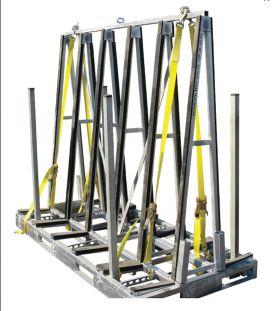
Groves’ heavy-duty transport racks include four hold-down ratchet straps to secure the load. The four adjustable safety posts provide for safe removal of unstrapped loads that may shift unexpectedly. The safety posts are stored at the end of the A-frame during transport. They have a 10,000-pound capacity and can handle glass loads up to 96 inches long by 48 inches wide by 88 inches high.
quattrolifts.com

As a complete system with a smooth and precise rigid guidance or integrated in an existing crane system, the Easy-Lift from Bystronic is very customizable. As a big advantage, the insulating glass unit can always be suctioned in a way that its lower edge is completely horizontal when hoisted up, without manual intervention by the operator. The self-holding system of each pad is equipped with powerful Venturi nozzles which are responsible for the vacuum creation. Easy-Lift saves the operator time while adjusting the glass units. This makes the system work ergonomically and economically at the same time. Special use cases like feeding and removing glass units for IG sealing, tempering furnaces, pane turning, or screen printing are accomplished with highest flexibility for the operator. With Easy-Lift it is possible to have a quick and safe transportation of glass and other units with superior comfort.













by FRANK FULTON
Irealize that accounting practices and pension management are not the spellbinding, edge-ofyour-seat topics you’re accustomed to reading in You Bet Your Glass, but there is a big unsettling bubble that has been building for years. It is now on the verge of bursting and nobody seems to be paying any attention. Well over a million union employees and retirees are about to lose their pensions. Their safety net is on the verge of insolvency.
There are 1,400 multi-employer union pension plans operating in the United States representing 10.6 million workers and retirees. A number of these pension plans are due to run out of money in the next two years and it is forecast that 125 plans covering 1.4 million people are expected to run out of money over the next 20 years. The safeguard backstop that has been in place since 1974 to insure pension benefits is the Pension Benefit Guaranty Corporation (PBGC), a U.S. government agency that is not funded by taxpayer dollars. It is already on the hook for paying out the benefits to about 1.5 million people from previously failed pension plans it had insured, and this agency’s multi-employer program is on the path of running out of money into insolvency itself by the end of 2025. According to the American Academy of Actuaries, more than 10 per cent of the current employees and retirees in these union pension plans will not be receiving their full benefits.
The unions running the “defined benefits” pension plans had to see this coming. The automotive sector in the U.S. faced industry-wide collapse not that many years ago in large part as a result of unsustainable pension liabilities coupled with a decrease in demand for their products that lead to a huge shrinking of the workforce that makes contributions to the plan. General Motors had
This is turning into a political football... leaving the retirees dangling.
reached the point where they had 2.5 retirees to support for each active worker.
Last July, the U.S. House passed legislation that would bail out multi-employer pension plans managed by collective bargaining agreements by giving 30-year loans to insolvent plans so they can continue to distribute promised retirement benefits. Of course, as with all things in America, this is turning into a political football and the Republican-lead Senate has yet to sign off on the funding deal, leaving the retirees dangling. About 99 per cent of the taxpayers who are going to be asked to contribute something through the government’s general revenues are not in these affected plans. The taxpayer should not be on the hook for the sins of the previous administration’s political deals and union-friendly mismanagement.
On the home front in Canada, the Auditor General recently “convinced” the Ministry of Finance to make a change in the way it reports the liability of future pension payments to federal employees. At a glance, this is pretty boring stuff and the feds released this “nothing but an accounting change” between Christmas and the New Year hoping nobody would notice. In the past, when presenting the budget and the upcoming year’s defecit number, the return on the investment in bonds and securities that generate the funds to pay out the federal pension benefits was based on 20-years’ past averages, years with considerably higher rates of return than are achievable today. Finance was forced to change their predicted returns based on future bond yield curves, which are today considerably lower than past performance. As a result, the federal deficit has been very understated for many years, not honestly telling the taxpayer how much more was being spent over what was being taken in, and it turns out that this “accounting change” means that we as a country (and by that I mean you and me) will actually be going into debt to the tune of $28 billion more over the next five years than was previously being admitted to by our government .
In the U.S. there will be fighting and the gnashing of teeth over spending taxpayer money on a bailout and I have every expectation that, in the end, the pensioners will get screwed. There will be no such soul-searching in Canada. The federal employees will receive every dime and we taxpayers will pick up the tab. •