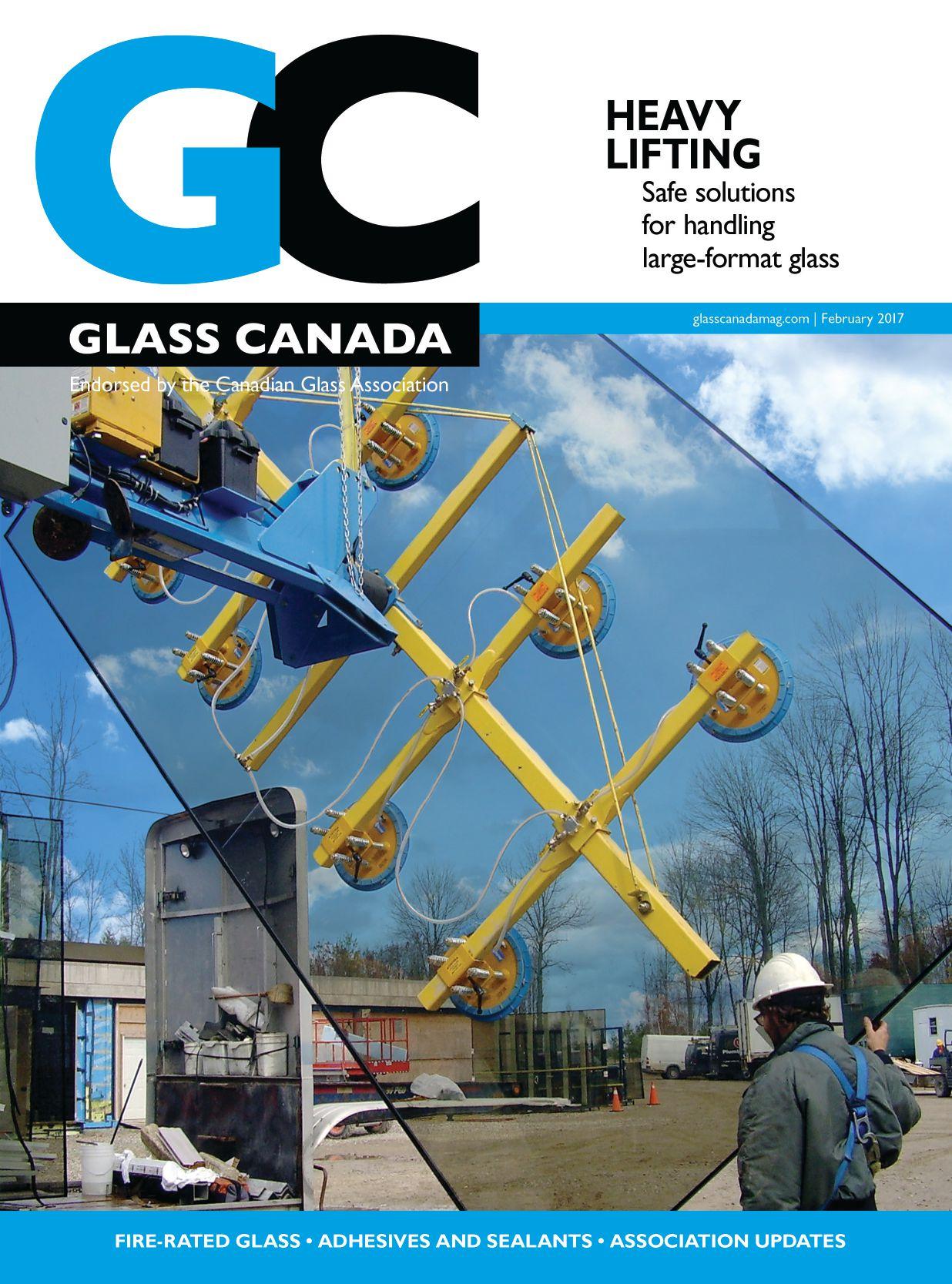
Large format glass is fun for architects, but poses some unique challenges for installers. Lifting these heavy, awkward panels into place can be a safety hazard as well as a logistical nightmare. Here’s how some contractors are clearing the hurdles.
Tune in to Top Glass
Canada’s commercial glazing conference returns April 20 to the International Centre in Mississauga, Ont. You can check out the speaker lineup, register and review the sponsors and exhibitors online at topglasscanada.com.
24 Adhesives and sealants showcase
We’re stuck on these great solutions.
22 Schools with a view
Advances in fire-rated glass are transforming what is possible in institutional architecture.
Canadian Glass Association
I’m
Less is more
bucking the advice of the social media gurus.
I imagine there are a number of reasons why use of social media has been lower in this industry than in some others. (I am omitting our architect audience in these comments – the design community has always been on the bleeding edge when it comes to digital everything.) As a media channel aimed mostly at company owners, we tend to be speaking to an older demographic. Two things are changing there. The first is that the glass industry is slowly getting younger as baby boomers start to retire or step back from day-to-day operations. The second is that social media use – especially Facebook – is seeing a sharp increase among the 60ish set. Come to think of it, those things are probably connected. Young or old, the fact is this industry is almost entirely comprised of small, family-owned businesses with fewer than 50 employees. No one has people sitting around with little to do except watch a Twitter feed. And the nature of the business means there’s little sitting, period. Therein lies another reason why participation is increasing. Following social media used to be a matter of sitting in front of a desktop computer. The rise of mobile devices means social feeds can be watched and updated on the fly, on the road and at the job site.
I think there’s great potential for social media as a way for people in this industry to communicate informally and I recently ran across a great example of that in a Facebook group called Canada’s Glazing Community. A Calgary glazier named Corey Bollivar has created an excellent forum where glass contractors and installers from all over the country are posting notes and photos of their work, often with a lot of great humour thrown in. It is a private group, so you’ll have to message Corey to look in, but since you are in the glazing industry, he’ll likely approve you.
The new power of social media was on obvious display in 2016. Donald Trump was able to shock the world and win the election in part because he was able to put unfiltered messages (very, very unfiltered messages) out in public and essentially force the mainstream media to follow his lead rather than act as a gatekeeper. By doing this, he was able to get a lot of free publicity and also to reach a lot of people who probably never pick up a newspaper. What’s the lesson for us? By using social media you can achieve frequent, unfiltered communication with your target market, delivering a wide variety of messages designed to provoke the reaction you want.
My use of the Glass Canada social channels is a bit different than the social media marketing gurus recommend. I think the strength of social media is the ability to filter what you want to see and cut through the torrent of messages that people put out online. But even a carefully tended social media feed can quickly become overwhelmed with posts. So I use @GlassCanadaMag and our Facebook page to only post content of interest to this market, curated by me. My hope is that by posting less rather than more, you’ll be able to check in on Glass Canada when it is convenient and see the important information in the industry without having to wade through 1,000 posts on multiple feeds every day. All part of the service here at your trade magazine. •
EDITOR | Patrick FLANNERY pflannery@annexweb.com 226.931.0545
DIRECTOR OF SALES/GROUP PUBLISHER | Martin McANULTY mmcanulty@annexweb.com
COO | Ted MARKLE tmarkle@annexweb.com
PRESIDENT & CEO | Mike FREDERICKS
Publication Mail Agreement #40065710
Printed in Canada ISSN 0843-7041
CIRCULATION
email: asingh@annexbizmedia.com Tel: 416-510-5189
Fax: 416-510-5170
Mail: 80 Valleybrook Drive, Toronto, ON M3B 2S9
SUBSCRIPTION RATES
Canada - 1 Year $36.75 (includes GST) ($39.55 includes HST/QST)
U.S.A. - 1 Year $50.00 (in US dollars)
Occasionally, Glass Canada will mail informationon behalf of industry-related groups whose products and services we believe may be of interest to you. If you prefer not to receive this information, please contact our circulation department in any of the four ways listed above.
Large protests took place at Queen’s Park in Toronto on Nov. 30 over proposed amendments to Bill 70 that would allow individuals issued a Notice of Contravention by the Ontario College of Trades to appeal that notice to the Ontario Labour Relations Board. In theory, the OLRB could overrule the Notice and allow non-certified tradespeople to perform tasks set aside for licensed trades. The OCT oversees certification of skilled trades in Ontario and the OLRB is part of the Ministry of Labour tasked with adjudicating legal labour disputes. Architectural Glass and Metal Technician is a designated non-compulsory trade under the OCT.
In response to the protests, the Ontario Coalition of Non-Compulsory Trades issued the following statement:
“Yesterday’s protest against changes in rules governing skilled trades workers does not have the support of a significant number of unions in Ontario’s construction trades, according to the Coalition of Non-Compulsory Construction Trades of Ontario. The Coalition represents seven major construction unions whose members were affected by a freeze on certifications several years ago. Schedule 17 of Bill 70, the law at the centre of yesterday’s protest, opens the certification process again to these trades.
“’The reason certain trades oppose Bill
70 is that they will no longer be able to use the Ontario College of Trades as a vehicle to displace workers who belong to the non-compulsory trades,’ said Joseph Maloney, international vice-president for Canada of the Boilermakers union.
“The trades represented in the coalition are the Boilermakers, Bricklayers and Allied Crafts, Carpenters, Heat and Frost Insulators, Ironworkers, Millwrights and Painters and Allied Trades [IUPAT is the union representing glaziers in Ontario].
“’Every trade trains its members to the highest standards. They are all skilled workers, for whom safety is paramount,’ said Maloney.
‘For the certified trades to say the other trades are unsafe is not only untrue, but is fear mongering at its finest. The amendments put forward by the government will rectify years of discrimination against these trades. All we are asking is that our members, who are every bit as skilled as the certified trades, have the same chance to work as everyone else.’
The changes have been discussed through two years of consultation. There have been two reports on the matter, one by Tony Dean in 2015 and a review of the Dean Report by former MPP Chris Bentley earlier this year.
“’There have been two years of delays in implementing these changes,’ Maloney said. ‘It’s time to move forward.’”
BEELER IN AT AMS
AMS has announced that Ben Beeler has joined the organization to further expand the growing certification management team. Beeler comes with a wealth of experience within the glass industry, having spent the last 32 years in management at Virginia Glass Products Corp., a tempered glass manufacturer in Virginia. Beeler has also been very active in industry initiatives including serving on the executive board of GANA.
Commenting on his new role with AMS Beeler said, “Having been on the glass fabrication side of the industry for over 30 years, I have been directly involved with AMS through both SGCC and IGCC and I have always believed in the necessity of the programs they provide and remain impressed by the highly professional manner in which they do so. I now have the pleasure and honour of being a part AMS and assisting with groundbreaking initiatives that will change the way architectural glass and metal contractors will be evaluated and selected in the market.”
John Kent, president of AMS, shared, “Ben’s years of experience, specific knowledge of our current certification activity, and his outstanding reputation in the glazing industry will be very beneficial to our initiatives.”
CGA Newsletter
CANADIAN GLASS ASSOCIATION
TheCGA’s Glass Connections event is booked. Be sure to join us June 7 to 8 at the Delta Hotels Burnaby Conference Center in Vancouver, B.C. The program is nearly complete; registration and sponsorship opportunities will be available in February. Stay tuned and visit CGA’s website for updates (canadianglassassociation.com). Did you know CGA is a member of the Glazing Industry Code Committee (GICC)? This organization is a Committee within partner organization, the Glass Association of North America (GANA). GICC advocates on behalf of its member organizations, including CGA, at North American code hearings such as the International Building Code (IBC), International Fire Code (IRC) and energy code bodies such as ASHRAE and the International Green Construction Code (IgCC). You can count on CGA to keep you informed of updates and changes that may affect your building practices.
ONTARIO GLASS AND METAL ASSOCIATION
In addition to continuing to champion the interests of our industry in pursuit of Prompt Payment legislation and changes to the Ontario Construction Lien Act, the OGMA has a lot to offer its members coming up in 2017. Please mark the following event dates in your calendar and plan to attend. In case you missed it, compa-
nies had until the end of 2016 to put accessibility policies and procedures in place for the communication of all of your information and your employment practices. To find out your legal obligations, go to ontario.ca/page/accessibilitylaws, then contact WSPS to help you put it in place.
On Thursday, January 19, 2017 at the Richmond Hill GC, Geza Banfai, a member of the advisory group to the Ontario CLA review team, presented a captivating discussion on the changes being proposed to the Construction Lien Act, the benefits of the changes to our industry, and how this new law will affect our businesses in the future once the legislation has been enacted.
At our Spring Seminar, Sergei Mihhailenko, P.Eng and Les Szcepanski, P.Eng. will be presenting an informative talk on the application of the new CSA A500-16 Building Guards standard that will soon be adopted into building codes across Canada governing the use of glass in railings and balustrades. The lunch-and-learn will take place on Wednesday, April 12 at the Richmond Hill Golf Club. The OGMA extends its appreciation to our cosponsors for this event: Trulite Glass and Aluminum Solutions
and Kuraray America. Please see Frank Fulton’s You Bet Your Glass column in this issue of Glass Canada for information about the new standard.
Come and visit us at the Top Glass show on Thursday, April 20.
OGMA members have had nothing but rave reviews for the Pipers Heath Golf Club so we’re going to be holding our spring golf tournament there again on Thursday, May 25. Watch out for the flyer and make sure to book early. It’s always a sell out.
Back by popular demand, plan on attending our annual fishing derby in August. Watch your mail for details.
The OGMA will once again hold our fall golf tournament at the prestigious Country Club in Woodbridge on Thursday, September 21. Mark your calendar now. Details will follow as the date approaches. Protect your business and support our fight for prompt payment legislation by becoming a member or as an associate member if you are a consultant to the industry. Please visit the OGMA website for more information.
After a year of preparation, the safety manual is now ready for use by the metal and glass industry. The manual was
created by qualified health and safety professionals and is a timesaving tool enabling glass shops to establish their own company program. Not only will this support a company’s efforts to eliminate workplace injuries and illnesses, it will also lower costs and time related to WSIB claims. Additionally, WSPS and the health and safety manual will get your company compliant with the new OHSA Regulation 297/13 as well as AODA requirements.
PROVINCIAL GLAZIERS ASSOCIATION OF ALBERTA T
he PGAA board met last on January 11. We are in great shape for 2017. At the meeting we discussed our Master Glazier Program, where our second course Doors and Related Hardware is finished and should be offered by the end of Q1. Two more courses will be developed in 2017, which will leave us with five more to do in 2018 and beyond. Our war chest is strong, but we will still need you to have strong golf tournaments in 2017 and 2018 to meet our commitments with the Southern Alberta Institute of Technology. As we have historically been a non-political association, we have ratified a motion to join the Alberta Construction Association as an associate member, joining a myriad of industry associations, representing construction. This will extend the PGAA voice in issues such as the Worker’s Compensation Board, Occupational Health and Safety, prompt payment legislation, other legislation and other issues affecting our industry.
Geza Banfai of McMillan law firm (right) told the OGMA’s Prompt Payment information session that efforts are underway to draft legislation governing construction payment terms in Ontario. He was rewarded by OGMA director Frank Fulton with fabulous prizes
Vancouver hot, Alberta not
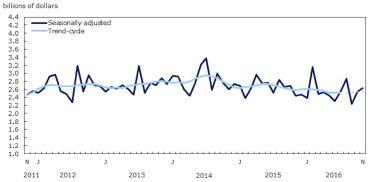
Municipalities issued $7.8 billion worth of building permits in November, down 0.1 per cent from the previous month. The decline was largely the result of lower construction intentions in Alberta, following a spike the previous month due to impending changes to the Alberta Building Code. The value of non-residential building permits rose three per cent to $2.6 billion in November, the fourth increase in five months. Higher construction intentions were registered in five provinces, led by Quebec and Ontario. The largest decline was reported in Alberta. Construction intentions for institutional buildings were up 25.2 per cent to $686 million in November, following two consecutive monthly declines. The gain was largely the result of higher construction intentions for educational facilities and nursing homes. Increases were reported in four provinces, led by Ontario and Quebec. The value of industrial permits rose 10.1 per cent to $404 million in November, a second consecutive monthly increase. The advance was mainly attributable to higher construction intentions for primary
industry buildings, manufacturing plants and maintenance facilities. Gains were posted in six provinces, most notably Quebec. In the commercial component, the value of building permits was down 6.1 per cent to $1.5 billion in November. Lower construction intentions for hotels, office buildings and retail complexes contributed to the drop. Declines were reported in five provinces, led by Alberta. The total value of building permits was down in four provinces in November, with Alberta posting the largest decrease. Significant advances in Quebec, Ontario and British Columbia were not enough to offset the decrease in Alberta. Following a notable gain in October — largely the result of an impending change in the provincial building code — the value of permits in Alberta dropped 36.9 per cent to $1.1 billion. Residential dwellings, down 36.2 per cent from the previous month, accounted for over half of the provincial decrease. Every building permit component declined, led by commercial buildings, specifically retail complexes and hotels. Conversely, Quebec, Ontario and British Columbia recorded the largest gains in November. In Quebec, higher construction intentions were posted for every component, led by multi-family dwellings. The advance in Ontario was mainly attributable to higher construction intentions for institutional and commercial buildings, while in British Columbia the increase was led by multi-family dwellings.
Fletcher leaves GANA
TheGlass Association of North America has announced that Erin Fletcher, director of marketing, will leave the organization to pursue a new opportunity as an account director for EAG Advertising and Marketing. Fletcher has served as director of marketing for GANA for the last three years.
• Custom Laminated up to 86 x 144
• Bent Tempered Laminated to 66 x 96
“Working for GANA has been a true privilege and an invaluable experience. I’ve been inspired both by the ambition and talent of my co-workers as well as that of our dedicated members,” shares Fletcher. “Working for GANA has given me the chance to hone my skills as a marketing professional. This new position is a wonderful opportunity to advance my career goals.”
Since 2013, Fletcher has provided marketing strategy, graphic design, news updates and website development services to GANA. She has authored numerous GANA Perspective columns in USGlass Magazine, driven membership recruitment efforts and ensured GANA events receive ample exposure.
“Erin has been a tremendous asset to the GANA team. Her marketing expertise has helped us maintain a strong brand across a multitude of audiences. With her help we have successfully launched a new website and made multiple enhancements to annual GANA events,” shares Stanley Yee, GANA president. “She will be missed and we wish her the best in her future endeavors.”
As GANA seeks to name a full-time replacement for the director of marketing position, an outsourced marketing solution has been secured.
Total value of non-residential building permits. (Statistics Canada)
Composite thermal barrier standard updated
The American Architectural Manufacturers Association (AAMA) recently released an updated technical information report addressing the most commonly used composite thermal barrier systems. The 72-page AAMA TIR-A8-16, “Structural Performance of Composite Thermal Barrier Framing Systems,” was last updated in 2008 and now includes several new figures and instructions specific to testing dual cavities. Updated software and a user guides are forthcoming to aid users in understanding information contained in this report.
“As codes mandate increasing energy performance requirements, thermal barrier designs are ever evolving,” says Patrick Muessig of Azon, chair of the Thermal Barrier Task Group. “Keeping a complete set of updated thermal barrier performance documents is critical to the commercial fenestration market. AAMA and its members have worked hard to make sure this happens and as a result, the AAMA TIR A8 update has been completed.”
Updated software to accommodate the use of this report, as well as a software user guide, are forthcoming in 2017. In the meantime, AAMA TIR-A8-16, as well as other AAMA documents, may be purchased from AAMA’s online store.
BEC keynotes announced
The Four Commitments of a Winning Team - Mark
Eaton, former NBA player with the Utah Jazz
Eaton is a team building expert who shares with organizations and audiences nationwide how he went from a seven-foot-four, twenty-one-year-old mechanic who couldn’t play basketball to a 12-year career as an NBA All Star with the Utah Jazz. He reveals the secrets that skyrocketed him to fame as the two-time Defensive Player of the Year, enabled him to break the NBA record for the most blocked shots in a single season and be selected to play in the 1989 All-Star Game. Today, Eaton travels the country employing principles and coaching techniques from his 12 years playing professional basketball to teach industry leaders, teams and individuals how to outsmart, outlast and outperform their competition and achieve record breaking success.
Featured speaker: The Intersection of Architecture, Art, Design and Engineering - James Carpenter of
New building
James Carpenter Design Associates
James Carpenter has worked at the intersection of art, architecture and engineering for nearly 50 years, advancing a distinctive vision based on the use of natural light and glass as the foundational elements of the built environment. Carpenter founded the cross-disciplinary design firm James Carpenter Design Associates in 1979 to support the application of these aesthetic principles to largescale architectural projects. In 2012, Carpenter and Reid Freeman of the American Institute of Architects, established Architecture Operations D.P.C. in order to provide clients with a comprehensive architectural service portfolio. Carpenter has been recognized with numerous national and international awards, including an Academy Award in Architecture from the American Academy of Arts and Letters and a MacArthur Foundation Fellowship.
guards standard published
The Canadian Standards Association (CSA) has published A500-16 Building Guards, a new standard governing materials, hardware and installation of balcony guards, including glass balcony balustrades. The standard is expected to be referenced in future national and provincial building codes to prevent well-publicized issues of falling balcony glass.
From the CSA website: “In recent years, there have been a growing number of building guard failures in Canada, some involving a number of prominent buildings in major cities. While many of these incidents are the result of material failures, some are related to the building guards’ overall system design and performance characteristics. The growing risk associated with these failures coupled with the potential catastrophic outcomes has led to an increased need for a standardized approach to building guard design. Up to this point, there has not been a reference standard, clear design requirements, or a consistent set of test protocols for building guards, which has led to lack of clarity for designers and reduced public safety. CSA A500 - Building Guards is a new standard that specifies requirements for materials, design, construction, testing, and performance of permanent guards in and about buildings.
The standard
• Aims to help reduce the risk of building guard failure for improved public safety
• Reduces uncertainty and improves clarity for designers
• Helps make building guard design more consistent and reliable
• Can be referenced in building code regulations
CSA A500 covers:
• General requirements, including methods of analysis and design, new methods for guard height determination, climbability
• Loads, load effects and load combinations, including wind load determination, infill design
• Deflection limits and openings (posts, rails, pickets)
• Anchorage
• Construction to improve safety, security and durability
• Testing of load-resistance (service and ultimate), impact and post-breakage retention of infills, main connections, and anchors/fasteners
• Materials used for building guard assemblies (concrete, masonry, glass, aluminum, steel, wood
by MARGARET WEBB
Margaret Webb is the executive director of the Insulating Glass Manufacturers Association.
Fabricator workshop coming to Canada
Last year, the IGMA held two fabricator workshops in Texas and Minnesota, where more than 80 practitioners from the IG industry were led through the most important aspects of fabricating and testing IG units by the experts of our industry. The workshop features a balanced mix of classroom education along with hands-on demonstrations to discover best practices for cleaning, cutting and handling glass, desiccants, sealants, gas fill, frost point and much more. The reviews of the workshops were incredibly positive.
We are excited to announce we will be bringing the workshop to Canada Feb. 28 through March 2 at the Exova Test Facility in Mississauga, Ont. You are encouraged to register now before the class fills up. Modules include:
• Glass Cutting and Washing (Bill Briese, Bill Lingnell)
• Spacer and IG Fabrication (Richard Warren)
• Sealants/Hot Melt Sealant (Mike Speicher, John Moroney)
• Sealant Adhesion and Butterfly Test (Steve Altum, David Cooper)
• Volatile Fog (Jeff Haberer)
• Gas Filling and Measurement (Randi Ernst)
• Desiccants and Desiccant Matrix (Shulin Chu, Brian White)
• Forensic Investigation of IGU Failures (Bill Lingnell)
IGMA members will receive a discount on attendance. Act now to reserve your spot! Fees for IGMA members are US $890 for the first attendee and US $805 for each additional attendee. Non-members pay US $990 for each attendee, but a registering non-
Reviews of the workshops have been incredibly positive.
IGMA
member company will receive a 25 per cent refund on all workshop fees if they join IGMA.
One of the unique aspects of this program is the opportunity to get hands-on training from the experts. Attendees have been very enthusiastic about this because it connects the information to what they do everyday. Another common reaction has been great interest in the testing facilities where we hold the workshops. Many attendees appreciate the chance to see the equipment and learn about the science of testing and evaluating insulating glass. For many, it has been their first look inside one of these facilities.
Each workshop has been expanded and that is no different for this latest one. Spacer and IG fabrication have been added to this workshop plus the forensic investigation where participants will have the opportunity to work on real case studies.
During the Exova workshop, our subject matter experts will be piloting actual IG fabrication from component to gas filling to determine the best way to add this to future programs.
Enrollment is limited so that every participant has the “hands-on” experience plus oneon-one access to the subject matter experts. This workshop sells out quickly. This is the best training the industry has to offer so register now to secure your place.
Here are some of the comments from past attendees:
“The group of experts you had were awesome. They were very attentive, welcoming and helpful.”
“The hands-on portion was great. Being able to take what was learned in a presentation and then apply it to real life was really effective.”
“Hosting the event at a testing facility is excellent. While participants may see the IGU processes discussed at each of the stations every day, they don’t always get to see the testing methods and apparatus conducted from a third party.” •
HANDLING THE BIG GLASS
The challenges of manoeuvering large-format glazing
by TREENA HEIN
Stunning unbroken views of vistas or store interiors – that’s the demand driving the production, shipment and installation of large panes of glass today – panes as much as 20 feet across and thousands of pounds. Agnora, the largest-capacity glass fabricator in North America, has seen a tenfold increase in the demand for big glass over the last five years. Vice-president of operations Jeff Wilkins says this includes both storefront and residential markets right across continent. Agnora is able to temper, machine, laminate and insulate various thickness of glass up to a maximum size of 130 by 300 inches. The company’s two main challenges of with glass (float glass availability and shipping) have been handled, says Wilkins, through creating strong partnerships with suppliers and by working collaboratively with shipping partners. “Big glass is heavy and dangerous therefore we are very serious about our maintenance and upkeep of our lifting equipment and designing our work flow to minimize the amount of manual lifting,” he explains.
Michael Byrne, president of Explore1 in Concord, Ont., notes that there have been large pieces of glass used in buildings since the 1970’s, but agrees that new markets are now picking up. “Big glass is now showing up in people’s homes because they are wealthy enough to afford it,” he notes. “There’s also a lot more use of big pieces in high-end retail. You didn’t see that ten years ago.” He notes that while large pieces might be only a tiny percentage of the total glass in a large building, they’re popular because they provide such huge architectural impact. “These pieces can cost upwards of $20,000 and have to be perfect through the install,” he says.
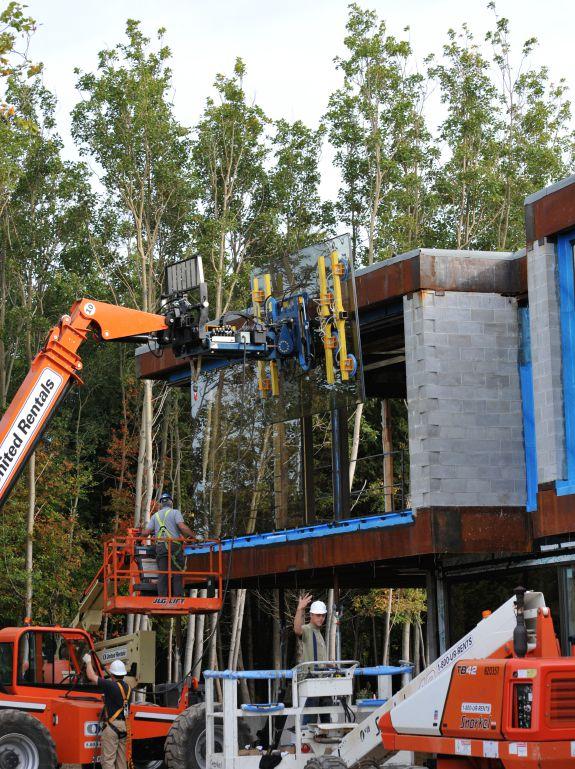
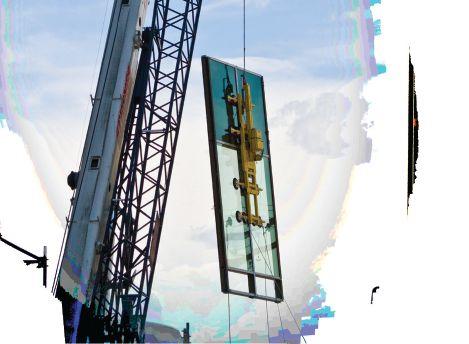
Steve Laird, a safety instructor at the Ontario Industrial and Finishing Skills Centre (OIFSC) in Toronto, notes that if the large pane is to be installed on the outside of the building, cranes are most often used with all personnel using the
glazing components safely.
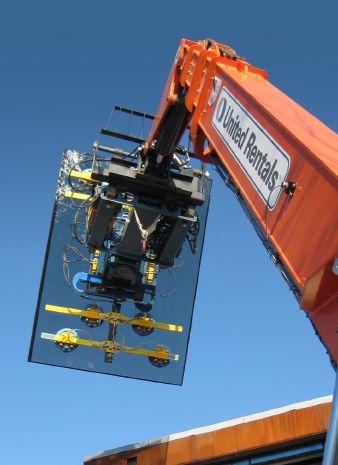
equipment involved certified in all procedures. “Large suction cups of varying configurations and capacities are used successfully for most of these installations,” he observes. “If the glass has to be brought into a building, say for an atrium, you’re looking at different kinds of equipment. Capacity is an issue as anything over eight tons has to be operated by hoisting engineers. With less than eight tons, glaziers who have been trained and certified as zero-to-eight-ton operators can do the job.”
OIFSC has provided training for zero-to-eight-ton operators for about six years, with the course consisting of five days of theory as per the Ministry of Training, Colleges and Universities guidelines, plus hands-on time. The centre has a Spydercrane with a capacity of 6,400 pounds with a glass manipulator that can either be mounted directly to the boom or attached with the hook. “There are several other places to get the training,” Laird explains, but stresses that “it should be done by someone who is certified.”
For his part, Byrne notes that if you search the internet to see how very large pieces of glass are installed, you’ll find many different “very interesting” approaches, but he believes most of them have one thing in common: they put workers and the glass at risk. “You don’t want a situation where installers are exerting a lot of effort because it can lead to error due to exhaustion,” he explains. “Some companies use below-the-hook lifting devices, but Explore1 takes a different
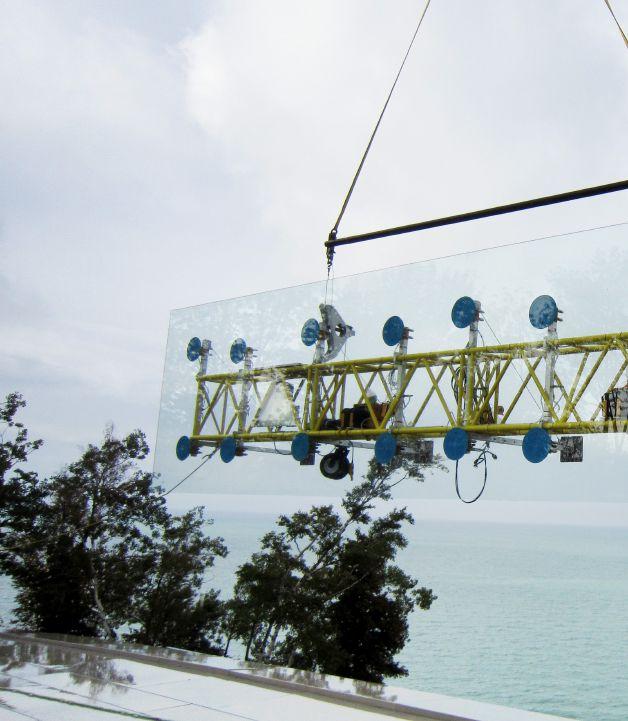
Big, unbroken vistas are great architecturally, but it’s gotten to the point where contractors are having to build their own custom machinery to install them. Here, Explore1 designed a counterbalanced dual-vacuum lifting system to install a 45-by-10-foot panel weighing 5,600 pounds.
approach.”
Back 20 years ago, they used modified robotic lifting technology (designed for curtain wall panels about 10 by 30 feet) for big glass jobs, but about seven years later, in 2003, they took the bull by the horns and developed their own technology – the world’s first counterbalance suction cup lifter. “We had no choice but to take on the challenge of designing our own lifter because there was nothing available that could lift glass in excess of 2,800 pounds,” says Byrne. “There was also nothing that would allow the easy manipulation of glass or curtain wall panels when a crane can’t be used due to an overhead obstruction.”
The Explore1 counterbalanced lifter features an eight-cup vacuum array and hydraulic rotator that can handle loads up to 4,800 pounds up to 60 feet in the air, allowing the installer to safely and efficiently bring the load into the same plane as the frame. The lifter has been used to install over 200 insulated glass units weighing 2,500 pounds or more, in every imaginable situation.
“The lifter does have a learning curve and doesn’t function like a normal lifter,” Byrne explains. “You have to be careful when first lifting the glass. Teamwork is the biggest thing. It’s critical to have a calm and competent and confident group where everyone knows what their jobs are and only does their jobs with no rushing things.” He believes the fact they can do these big install jobs so easily and efficiently now is a
VIBRANT, FULL-COLOUR PRINTING ON GLASS
Whatever stunning decorative artwork your design team creates, we can print it on architectural glass, utilizing the Vitro-Jet F Type printer. This state-of-the-art, cutting-edge digital printing technology offers 1440 dpi for super-sharp resolution. With a prismatic array of industry-accepted colour formulations including RAL, Pantone, NCS, and Color-Book, the design possibilities are infinite.
THE HIGH-PERFORMANCE SERIES
4000 THERMAL DOOR
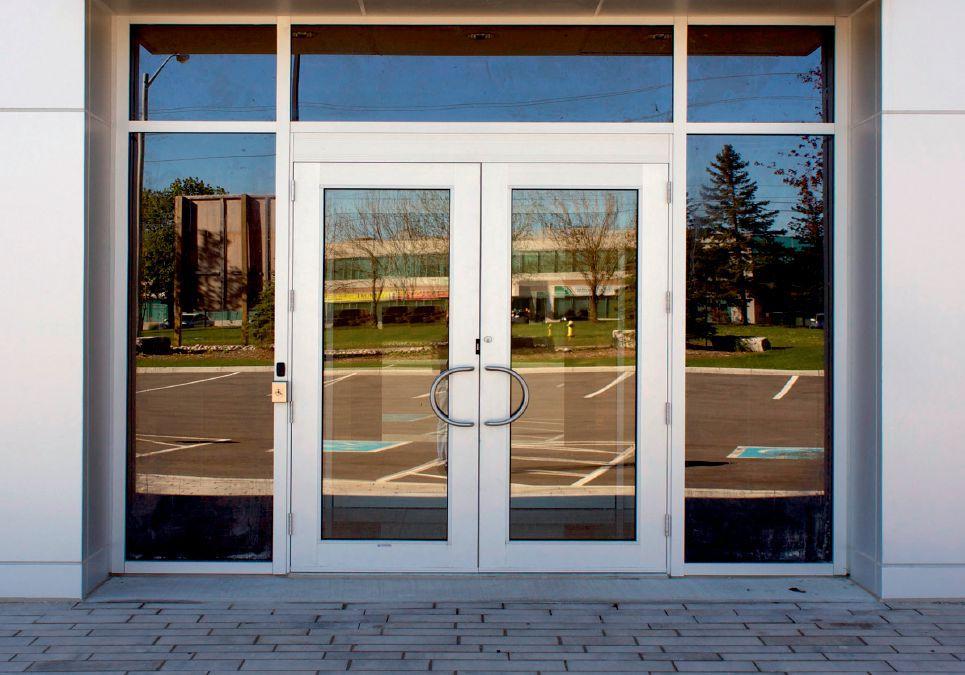
Designed for thermal efficiency in commercial applications, the series 4000 Thermal Door offers high performance with a 2 ¼" overall thickness. Available in a range of sizes, swings, single or pairs. Available in both anodized or painted finishes which allows for separate interior and exterior colours. Features include a 1"insulated glass infill, dual polyamide thermal breaks, polymeric weather-stripping and pile weathering in the door frame. Doors are assembled using dual welded corner construction. Series 4000 thermal doors are made tough for all weather, and tested to AAMA and CSA requirements.
FEATURES
Series 4200 narrow stile has 2" (50.8) vertical stiles, 2 ¾" (69.9) top rail, and 3 7/8” (98.4) bottom rail.
Series 4300 medium stile has 3 ½" (88.9) vertical stiles, 3 7/8" (98.4) top rail and 5" (127) bottom rail.
Series 4400 wide stile has 5" (127) vertical stiles, 5" (127) top rail, and 6" (152.4) bottom rail.
Architectural Aluminum Products
big cultural industry shift. “Yes, there is lots of planning, and we don’t sleep the night before we install a big piece and everyone is excited,” he says, “but it’s a huge feeling of satisfaction.”
An example of one of these big jobs was a massive, 20-by-nine-foot, six inches IG piece to be installed at a luxury home north of Toronto. It replaced a pane installed by another company which had developed an interior shatter due to a rare nickel sulphide inclusion. “For this job, we were able to pick up and float the damaged unit right out of the frame,” Byrne says, “placing it next to the disposal point to help prevent more traffic around the property. We then picked up and gently placed the new IG unit in without issue.”
Another job involving a pane 46 by 10 feet and over 5,600 pounds required the development of a whole new lifting system and process. “It was a confined interior space with low head room and limited floor capacity and we had to develop a system to move the lifter easily from exterior to interior,” Byrne says.
Getting the glass to the right height is one thing – safely orienting and placing it is another. End effectors can allow installers to position the glass, but must be carefully designed to take the weight of large panels.
In an industry where one small mistake or equipment malfunction can result in serious injuries, it’s so important to know that your equipment won’t let you down. Regardless of the size of the job, I have trusted Wood’s Powr-Grip’s suction cups for my company and my employees.
Dustin Anderson President, Anderson Glass, LLC Waco, Texas
helping bring you home safe
“We ended up creating a lightweight, modular, self-hoisting lifter with counter-balancing capability. It’s over 40 feet long and rolled on balloon wheels through the opening and we simplified it with two inboard 5,000-pound hoists. We also designed a two-axis sliding rail mounted to the ceiling, which allowed the installer of other glass units to flush glaze the monster pieces at the opposite ends of the room.”
In addition, for situations when it’s not possible to use a crane, Explore1 created an “end effector.” It’s mounted on a forklift and features a five-axis hydraulic manipulator to control loads as heavy as 2,700 pounds. “You can do complex manipulations like flush glazing into a pocket at the jamb, head or sill,” says Byrne. “The end effector can also be used to move glass through doors, holding the load parallel to the ground and then swinging it up into position once the window opening has been reached.”
The size of Explore1 crews on big glass installations ranges from six to 10 people depending on traffic control and whether workers are needed above or just below. Byrne says everyone makes sure to have a route of escape and stays out of the danger zone and that platforms have to account for this necessity. “There’s always a chance of massive mechanical failure,” he notes. “We harp relentlessly on how to be safe with vacuum lifters and do lots of maintenance. We’ve never had an accident with one.”
Byrne believes that as long as the economy can support it, the trend of big glass will continue, with cost lowering and the comfort of professionals increasing over time. Wilkins agrees. “Engineers and architects are continuing to design big glass into residential, commercial and institutional projects,” he says. “North American glass float plants are recognizing this demand and are starting to increase their size capabilities. Europe has always been ahead of North America in the use of large glass. Today, the standard size float glass in Europe is six meters and trending bigger, and I think we are starting to see the same trend in North America, moving from four to five meters to over six metres.” •
by ALLAN DOYLE
Allan Doyle is general manager and partner of Global Windows and Doors in Richibucto, N.B., and president of Fenestration Canada. He has over 30 years’ experience in the fenestration industry.
A transition year
It really is a new Fenestration Canada. Last year was a transition year that started with the hiring of a new association management team in Zzeem. The Zzeem team have been on a steep learning curve since they started in March of 2016, but by all accounts have managed to bring our association through a very vital period. Our new executive director, Cindy Gareau, has been a fireball from day 1 and has become an important cog in the operation of Fenestration Canada and all the committees that endeavour to bring effective programs to our membership.
At our AGM in Mont Tremblant, Que., we elected a new board with a new slate of committee chairs. There was a new energy at Tremblant that comes from new ideas, new perspectives and a transitioned sense of purpose.
Lisa Bergeron of Jeld-Wen our first vice-president and chair of the Fabricator Council, and Jennifer Small of Screenco, our second vice-president and chair of the AGM committee, have broken down the doors of the old boys club and given Fenestration Canada a new dynamic. These progressive, talented women are the today’s leaders and will be instrumental in guiding us to a new position of relevancy in our industry.
Although Mont Tremblant was a successful AGM by all accounts, members did express a desire that future AGM meetings be hosted closer to major centres with more options for activities outside the official agenda. Fenestration Canada’s next annual general meeting will be hosted in downtown Halifax at The Westin Nova Scotian from May 31 to June 3.
Jennifer Small and her committee have put forth an excellent agenda packed with interest-
The most significant event for Fenestration Canada in 2016 was the rebirth of WinDoor.
FENESTRATION CANADA
ing and fun activities. We kick off our visit to Halifax with a harbour cruise and then we dine on lobster. Another highlight will be our visit to Pier 21 on the Halifax waterfront. The President’s Awards Dinner will be held at the Canadian Museum of Immigration at Pier 21.
The most significant event for Fenestration Canada in 2016 was the rebirth of WinDoor, as our industry embraced Old Montreal with a gusto not seen at a WinDoor event for many years. Attendance was robust and kept exhibitors hopping on both days. The fenestration industry in Quebec came out in force. This was in large part to Fenestration Canada’s partnership with AVFQ to promote and market WinDoor’s first show outside of Toronto. The show committee chair, Stephane Labelle, and co-chair, Laura Weil of Euro Vinyl Windows and Doors, promised a new WinDoor. They delivered an extraordinary event that showed a lot of imagination and courage.
Some first-time exhibitors described how their emerging businesses were able to showcase their products to the ideal clientele, and in turn, secure business for 2017 and beyond. This testimonial was repeated by many. Those exhibitors that attended but chose to take a pass on WinDoor 2016 could see the transformation that has occurred to our show. Many have already reserved booth space for Toronto in 2017. Yes, WinDoor is moving back to the International Centre in Mississauga, Ont., on Nov. 28 to 30, 2017. The show committee is again guaranteeing a “new show” for Toronto. The committee is again working to create a memorable event to strengthen and build upon the success we achieved in Montreal.
The year 2017 will be about educating and empowering our membership. The education committee under the direction of Steve Alward of Atlantic Windows, plans to host several webinars during 2017. There are also plans to provide education seminars across the country like the Western Technical Sessions held in Langley B.C. in October 2016.
I want to thank all the volunteers who put their time and energy into making our events successful. These volunteers are the future leaders of our association, and together with our industry veterans, will shape Fenestration Canada in 2017 and beyond as the leading resource in our industry. •
by BRIAN BURTON
Brian is a construction writer from Ottawa Ontario who served on the CSA’s Fenestration Installation Technician Certification Program Personnel Committee. You can contact Brian at Blueblade49@gmail.com or learn more by visiting burton’s-pen.com
Get to work on site
Websites have been around for about 20 years now, but judging from what I see online a lot of us have never gotten any farther than putting up a very basic page.
This is unfortunate, as your website can be a great tool for attracting business.
To be effective, your site should be properly formatted with relevant content and remain up-to-date. One persistent limitation appears to be the tendency to launch the website, be thankful that it’s finally done and then forget about it. That’s against the unpublished rules of search engine optimization (SEO), which you have to follow if you want people to find you on Google. If you put your website up and forget about it, your ranking will slowly drop because your site is not changing. When your ranking drops, you appear farther and farther down the list of search results, eventually falling off the front page and effectively becoming invisible. Almost no one reads past the first page of search engine results, even if they don’t see what they are looking for there.
The answer is quite simple. You must keep working at it. Ideally, your site should remain a work in progress with an honest and straightforward approach. That means keeping your clients – or potential clients – up-to-date about you and the marketplace. The best sites manage to share with visitors information they don’t already know. Your website should not focus entirely on you and your company but also share information about what you and your staff know and have learned over the years about the architectural glass business. Explaining how properly installed fenestration components add value to residential and commercial properties, looking at what’s new in the marketplace and discussing the latest fenestration issues re-
The best websites manage to share with visitors information they don’t already know.
FENESTRATION
wards the visitor’s attention and is usually appreciated. It’s not sales-oriented marketing as we would usually think of it that makes a website successful but providing unbiased, legitimate information that helps clients determine what is the best value for their money. Once you’ve gained the visitors trust and attention, it becomes easier to encourage potential clients to act by calling you or coming back to your site later.
The guidelines for website content suggest that honesty is the best policy. You should not make unsubstantiated claims or suggest you’re the best in the business unless you can prove it. Purchasing agents tell me that comments like “Our service and quality are unmatched,” need to be substantiated if they are expected to make an impact. Today’s buyers want information, not sales pitches or advertorials.
Your content should give your visitors what they need to know, not just what you want to tell them. Ever see one of those car commercials where people are breaking down the dealership door because they are so excited about the sale inside? In advertising, they call that an example of the writers talking to themselves. The message reflects what the advertiser hopes to achieve, not what the customer hopes to get. Your website should talk to the customer. A good rule of thumb is to ask yourself whether the content helps your users to solve problems or answer common questions.
It can be difficult to assess your own website and its impact objectively. Let a third party rate your site. And get your whole in-house team involved with contributing to the site and evaluating it. What can we do better? Is there something we’re missing? Inquiring as to how clients heard about you, where they heard about you and what made them act to contact you will also help. •
Schools with a view
Modern fire-rated glazing makes the grade in schools.
Creating bright indoor spaces like this in institutional buildings would not be possible without recent advances in fire resistive and fire protective glass products.
If you walk through the recently opened Brooklin high school in Whitby, Ont., one of the first things you may notice is its open and light-filled interior. The 173,200-square foot facility includes extensive glazing throughout to provide natural light and visibility for students and staff. What you may not realize is that a significant portion of the glass used to illuminate the school also provides protection against the spread of flames and smoke. In fact, its clear form is hardly distinguishable from its nonfire-rated glass counterparts. This is a credit to recent manufacturing advances.
Over the last decades, manufacturers have developed clear, sleek and highperforming fire-rated glazing products that resemble ordinary window glass. They can meet the dual goals of code-required life safety in schools and beautiful esthetics, eliminating a common point of frustration for architects: compromising their design vision for the sake of safety.
A new way with fire-rated glazing For years, traditional, polished, wired fire-rated glass was the most commonly
specified fire-rated glass product in schools. Although it had a proven fire safety track record, its industrial appearance and size restrictions prevented design professionals from creating open, light-filled spaces conducive to student learning. It also presented challenges in areas with fire- and impact-safety requirements.
Wired glass is only capable of resisting 100 foot-pounds of impact, which is equivalent to a five-year-old running into the glass. However, because it was the only glazing material at the time that could protect against the spread of flames and smoke for a reasonable length of time (termed “fire protective”), the Canadian General Standards Board (CGSB) granted a code exemption and deemed it suitable for use in areas requiring fire- and impact-safety protection. This exemption left the door open to student injuries from glass breakage. The frequent movement of students throughout the day means that impact safety must be a high priority, even in areas with fire safety criteria. Design professionals did not have access to a glass
product that could satisfy both requirements.
To combat problems with fire-protectiverated glass’ appearance and impact-safety restrictions, manufacturers set out to improve the optical quality and performance of firerated glazing. By the late 20th century, they were producing wireless fire-protective glass with high levels of impact safety. Products are now available that can resist approximately 400 foot-pounds of impact, which is similar to withstanding the impact of a full-grown adult. Such glass can meet CPSC 16 CFR 1201 (Category II), which is a classification similar to CAN/CGSB 12.1 (Category II).
With clear, multitasking fire-protectiverated glass products at their disposal, design professionals no longer have to trade fire protection for impact safety or appearance in educational facilities. This is evidenced in Brooklin High School. To match the esthetic of non-rated glass systems and promote daylight transfer, Aerloc Industries of Dundas, Ont., installed 3,500 square feet of highperformance fire-rated glass ceramic in doors, sidelites, transoms and interior windows. This included installations in highly visible areas, such as the school’s second-floor loft overlooking a common area. The tough, yet transparent form of the fire-rated glass ceramic provides essential life safety while resembling the look of ordinary window glass. It is also impact safety-rated to help prevent injuries from glass breakage if students run into it.
Greater design flexibility
While transparent fire-protective ceramic glazing products proved a significant improvement over their wired predecessors, the development of wireless fire-rated glass with heat-blocking capabilities (“fire resistance”) took design flexibility a step further in areas with stringent fire and life safety requirements. These products provide nearly the same level of clarity as ordinary float glass, carry fire ratings up to 120 minutes, pass the fire and hose stream tests and offer up to Category II impact safety ratings. Most notably, they pass the test standards for solid walls (CAN/ULC S101), allowing design professionals to create fire-rated glass assemblies that exceed 25 per cent of the total wall area. When paired with fire-resistive frames, buildings teams can use fire-resistive glass to create large expanses of see-through walls in areas that would otherwise require concrete, gypsum or other opaque fire-rated materials to meet codes. This is a key design benefit
for schools, as project teams can incorporate fire-rated glass wall panels throughout school corridors, where illumination and views to the outside can improve the learning environment for students. Project teams can also use fire-rated glass curtain walls to maximize daylight penetration and maintain visibility through interior spaces.
For schools with strict design and performance criteria, a new set of fire-rated glazing systems are emerging that allow design professionals to make the most of learning environments while still providing protection from the threat of fire. Among the options are fire-rated glass floor systems. These assemblies can facilitate views and allow daylight to penetrate deep into buildings, provide a durable walking surface, and block flames, smoke and heat.
Design professionals can also select from two of the newest fire-resistive-rated glazing options on the market: siliconeglazed (SG) fire-rated curtain walls and buttglazed, fire-rated framing systems. SG fire-rated curtain walls provide a smooth, frame-free exterior surface. They are ideal for inner city schools with lot line protection requirements in highly visible areas. Butt glazed, fire-rated systems are another design-forward option. They enable extensive fire-rated glazed walls with virtually uninterrupted views and can enhance light transmission in corridors. •
About the author
FIRE RESISTIVE VS. FIRE PROTECTIVE
When reading specifications for fire-rated glass, it is important to know the terms “fire resistive” and “fire protective” and what they mean. They are referring to two quite different standards of glazing.
Fire protective
Fire protective glass prevents the spread of flames and smoke for some period of time, typically anywhere from 20 to 180 minutes. These are the applications where wired glass was widely used in the past, though glass ceramics and specially tempered glass can also have this rating.
Fire resistive
Fire resistive is a higher rating of fire protection because it not only stops the spread of flames and smoke as fire protective glass does, but also blocks the transfer of radiant and conductive heat through the glass. Fire resistive glass products are usually multi-laminates incorporating several layers of glass with fire-resistive interlayers. Codes call for fire-resistive ratings when glass is performing the function of a wall, especially an interior wall for an access zone such as a stairwell or corridor. Fire protective glass must limit temperature rise on the “cold” side of the glass and also be able to withstand a hose stream test after heating.
Jeff Razwick is the president of Technical Glass Products (TGP) and is a past chair of the Glass Association of North America’s (GANA) FireRated Glazing Council (FRGC).
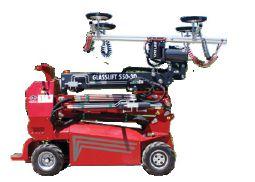
GL G Mobile Glass Handlers
ADHESIVESSEALANTS
Improve productivity
Dow Corning 121 structural glazing sealant answers the challenges facade contractors and manufacturers face with the slow cure of one-part sealants, mixing of multipart sealants and limited movement capability of tapes. Dow Corning 121 is ideal for assembly, installation or repair of structurally glazed glass and other substrates. Featuring easy-to-use dispensing, 121 offers a unique 1-to-1 (“121”) mix ratio and is supplied in a two-part cartridge, complete with a static mixer. Suitable for either on-site or in-shop structural glazing, the sealant offers superior silicone performance that outperforms organic weatherseals and structural tapes. The sealant’s fast, 24-hour cure rate enhances productivity compared with the 14 to 21 days required for single-part sealants, and its 1:1 mix ratio eliminates the need for specialized pumps and mixing equipment. And, Dow Corning 121 structural glazing sealant is backed with an available 20-year structural adhesion limited warranty.
Multiple options
weiss-usa.com
Weiss Chemie Plus Technik has introduced its new Big Six for sealing and assembly adhesives. This new MS-polymer product series consists of sealing and assembly adhesives that cover a wide range of applications. Designed to providing perfect adhesion to a variety of materials where reliable product performance is required, Big Six is suitable for highperformance needs. Products include multi-purpose; flexible and water resistant; slow curing (30 minutes); powerful and high tack; fast curing (five minutes) and transparent, multi-purpose options.
Full range
quanex.com
Quanex’s line of Q-Glaze sealants are high-performance sealants that protect the building envelope from water intrusion and moisture damage, to increase comfort, durability and longevity of the structure, matching any building professional’s needs. It features Q-Glaze Siliconized Acrylic Latex, a premium grade multipurpose siliconized acrylic latex sealant engineered to provide excellent adhesion to vinyl, aluminum, wood, sheet metal and most common building materials without the need of a primer. Also, Q-Glaze RTV Silicone, a onecomponent, permanently flexible, room temperature vulcanizing, mildew-resistant silicone sealant, providing excellent adhesion to cultured marble, tile, glass, vinyl, aluminum and sheet metal without the need for a primer. Next is Q-Glaze Neutral Cure Silicone, a one-component, non-sag, permanently flexible neutral cure silicone sealant, delivering excellent adhesion to vinyl, glass, aluminum, wood, sheet metal and most common building materials without the need of a primer. Q-Glaze Advanced Polymer is a multipurpose, one-component advanced polymer sealant, engineered to deliver aggressive adhesion with the most common construction substrates, while ensuring complete compatibility. Q-Glaze Advanced Polymer Plus is a high-performance, permanently flexible, easy-to-use
advanced polymer sealant that allows for about 50 per cent joint movement and provides aggressive adhesion to common building substrates. Q-Glaze Advanced Polymer New Construction is a multipurpose, one-component advanced polymer sealant, engineered to deliver aggressive adhesion with the most common construction substrates, while ensuring complete compatibility. Finally, Q-Glaze Advanced Polymer Textured is a textured, high-performance, one-component, permanently flexible advanced polymer sealant that’s easy to install and ideal for a wide range of construction and industrial applications.
Safe for indoor use
tremcosealants.com
Spectrem 3 is a single-component, neutral-cure, low-modulus, construction grade silicone sealant that is non-staining and has low polar attraction to dirt. Spectrem 3 has a patented chemistry that has been specifically formulated to seal porous stone, EIFS, metal panels, masonry and pre-cast concrete joints. It includes a 20-year non-stain warranty when pre-approved and tested by Tremco in accordance with ASTM C1248. Spectrem’s low polar attraction to dirt makes buildings easier to clean and maintain. The low-modulus and low Shore A hardness reduce the chances of EIFS substrate failures when compared to applications with medium-modulus sealants. The sealeant features primerless adhesion to most porous substrates with extended tooling time and workability in high temperatures. Spectrem 3’s ease of use reduces the risk of application failure. The matte finish affords an aesthetically pleasing appearance with EIFS and stone substrates. There is no cure inhibition with Spectrem 1, Spectrem 2, or Dymonic FC when applied “wet-to-wet,” minimizing the chance of leakage when sealants abut at glazing and other façade intersects. The low-VOC and zero-solvent content satisfies LEED Indoor Environmental criteria. Greenguard Gold certification ensures safety for use in the most sensitive indoor environments including hospitals and schools.
Apply below freezing
sika.com
Sikasil WS-295 FPS is a neutral-cure, no-bleed, field-pigmentable silicone sealant for use in conventional glazing; perimeter sealing of windows, doors and skylights; unitized curtain wall assembly and field installation; precast expansion joints; and weather sealing of joints in most common building materials. It is a one-part sealant with a site-added colour pack. It may be applied in below-zero freezing temperatures if substrates are completely dry, frost-free and clean. WS-295 features excellent gunability in all temperatures and adhesion to porous and non-porous materials, including glass, aluminum, metal, tile, fibreglass, plastic, ceramic, masonry, concrete, brick, powder coated aluminum, fluoropolymer painted surfaces, vinyl, PVC, granite, limestone, marble and wood. It is capable of accommodating plus or minus 50 per cent joint movement. The product is non-staining, maintaining the appearance of architectural substrates and unaffected by most atmospheric conditions. It meets industry specifications ASTM C920 Type S, Grade NS, Class 50/50, NT, M, G, O; TT-S00230C, Type II, Class A; CAN/CGSB 19.13-M87; AAMA 802.3 and California Air Resources Board 2003 requirements for VOC content. Available colours are Aluminium, White, White Colonial, Bronze, Bronze Medium, Limestone and Black.
by FRANK FULTON
Frank Fulton is president of Fultech Fenestration Consulting. He has been in the industry for 30 years and can be reached via email at fultech.fc@ gmail.com
Requirement and reaction
You probably remember all the kerfuffle brought on by mainstream media a few years ago over the epidemic of shattered glass falling from high rise buildings onto the heads of unsuspecting pedestrians. People were afraid to walk outside, Toronto politicians panicked and an emergency panel was assembled to find ways to combat this terrifying phenomenon. The panel determined without a doubt that the culprits responsible for the spontaneous breakage were nickel sulphide (NiS) inclusions, microscopic impurities found in glass comprised of nickel and sulphur that shrink when glass is being tempered then expand unexpectedly in random situations later on causing the tempered lite to shatter. The panel made their recommendations and based on those the Ontario government issued a hasty edit to SB-13 that went into effect on July 1, 2012. At about the same time the Canadian Standards Association (CSA) was tasked with developing a national standard to be incorporated into the National Building Code of Canada (NBCC) and provincial codes.
The CSA just released the “A500-16 Building Guards” standard and compliance will soon be mandatory. This standard specifies requirements for the materials, design, construction, testing and performance of building guards that act as protective barriers to prevent accidental falls from one level to another, and includes walls that serve this purpose. Considering the public safety aspect of guards, it’s amazing that there hasn’t been a national code to govern them until now.
Similar to windows and curtainwall, guards must now be designed and tested to withstand the wind loads they will be subjected to, as well as strength, anchorage and fasteners, component
Considering the public safety aspect of guards, it’s amazing there hasn’t been a national code to govern them until now.
spacing and deflection and impact. The type of glass that can be used as a guard infill is determined by the proximity of the plane of glass to the floor edge. Laminated glass can be used in all conditions. Heat soaked tempered glass can only be used when the glass is 50 millimeters or more inboard of the floor edge and monolithic tempered glass can only be used when the glass is 150 mm or more inboard of the floor edge. That may sound simple enough but when combined with the new impact-testing criteria that requires the glass to remain in place after being hit with a 100-pound bag of lead shot, laminated glass with a flexible interlayer may not pass muster in certain conditions or systems. Determining the right infill product for the job will be a much tougher prospect requiring pre-project engineering and a lot of up-front due diligence by all parties to a contract.
As head of the Façade Engineering Group of Exp Services and a member of the A500 standard technical committee, Greg Hildebrand has seen his share of issues with glass in guards and railings. He notes “the problem isn’t limited to spontaneous glass breakage but with the railing systems themselves,” hence the need for a standard that takes the entire system into account. “Glass is ‘walking’ out of glazing channels, die-cast shoes holding the posts are breaking and intact lites of glass have fallen out of railings to the ground after being subjected to the dynamic forces of the wind.”
Sergei Mihhailenko, president of Mihko Engineering, is not particularly happy with the new standard, arguing that many facets of the standard are already addressed in current building codes. He also considers that our engineering community is more that qualified to assess the strength of the materials that combine to make up a guard and that all of the testing specified in the new standard is unnecessary. Hildebrand counters that “Yes, it’s true that engineers can assess the strength of all of the materials. However, the guard assemblies can be quite complex and it is practically impossible for an engineer to assess how all of the components will work together when impacted.” Both engineers are in agreement that every guard installed should have a set of engineer reviewed and stamped shop drawings and that site inspections should be made mandatory across the country. •
re·li·a·ble
adjective
1. consistently good in quality or performance; able to be trusted.
Reliable: When it comes to glass fabrication, the de nition of reliability is best illustrated by the combination of Vitro Architectural Glass (formerly PPG glass) technology and its Vitro Certi ed TM members. Getting the very best high performance glass you need, when you need it, within your budget is what
you should expect. But, what you get, in addition, is a partner who doesn’t compromise your schedule or your project’s timeline. A partner that stands with you—always—no matter the size of the job; no matter the timeline.
Discover reliability and the other qualities that de ne Vitro Certi edTM members at vitroglazings.com/de ne.
THE ENVELOPE THAT PUSHES BACK
KEEP EXTERIOR TEMPERATURES WHERE THEY BELONG
INTRODUCING ARCTICFRONT™ SERIES 45X
HIGH PERFORMANCE DUAL THERMAL STOREFRONT SYSTEM
When it comes to meeting energy codes for thermal performance, opposites do not attract Keep the cold air out and the warm air in with the new ArcticFront™ Series 45X High Performance Storefront System from CRL-U.S. Aluminum. By incorporating dual polyurethane thermal break points that act as a superior thermal barrier, it can produce U-factors as low as 0 19 The system excels at maintaining desired internal temperatures and condensation resistance In addition, the NFRC Rated ArcticFront™ Series 45X comes in the familiar design and installer-friendly features of a traditional storefront.
– 2" x 4-1/2" Overall System Dimensions
– Dual Polyurethane Thermal Breaks
– U-Factors as Low as 0 19 Using Low-e 1" Insulating Glass