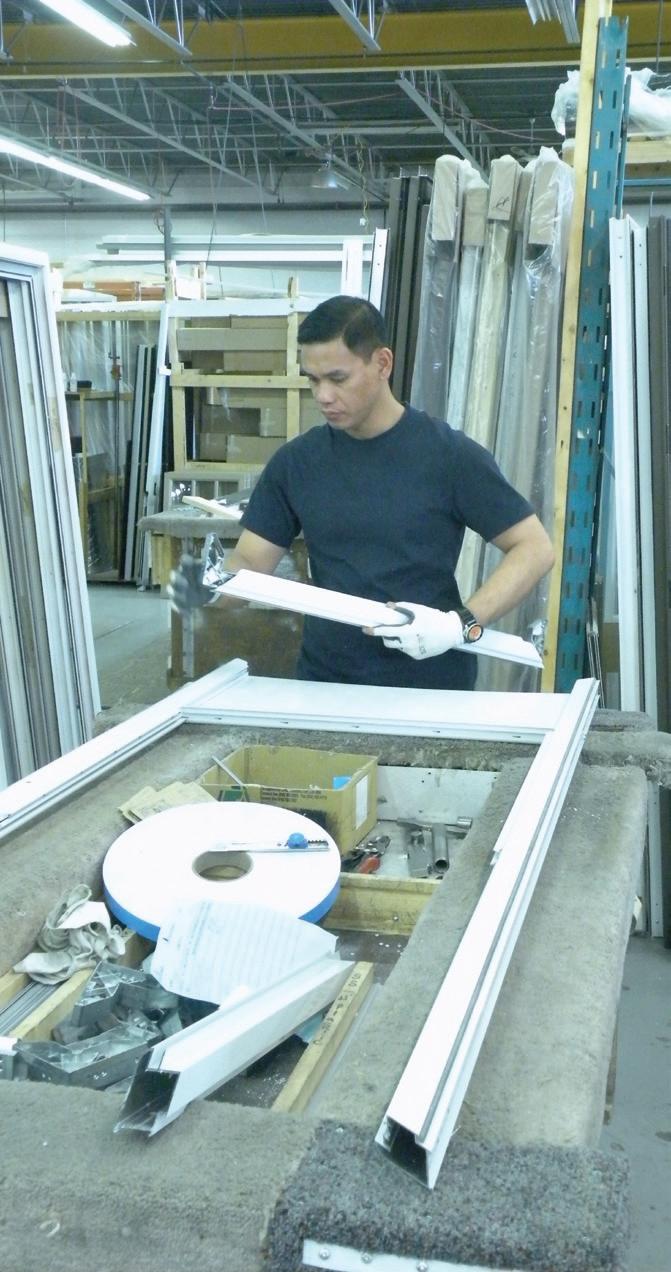
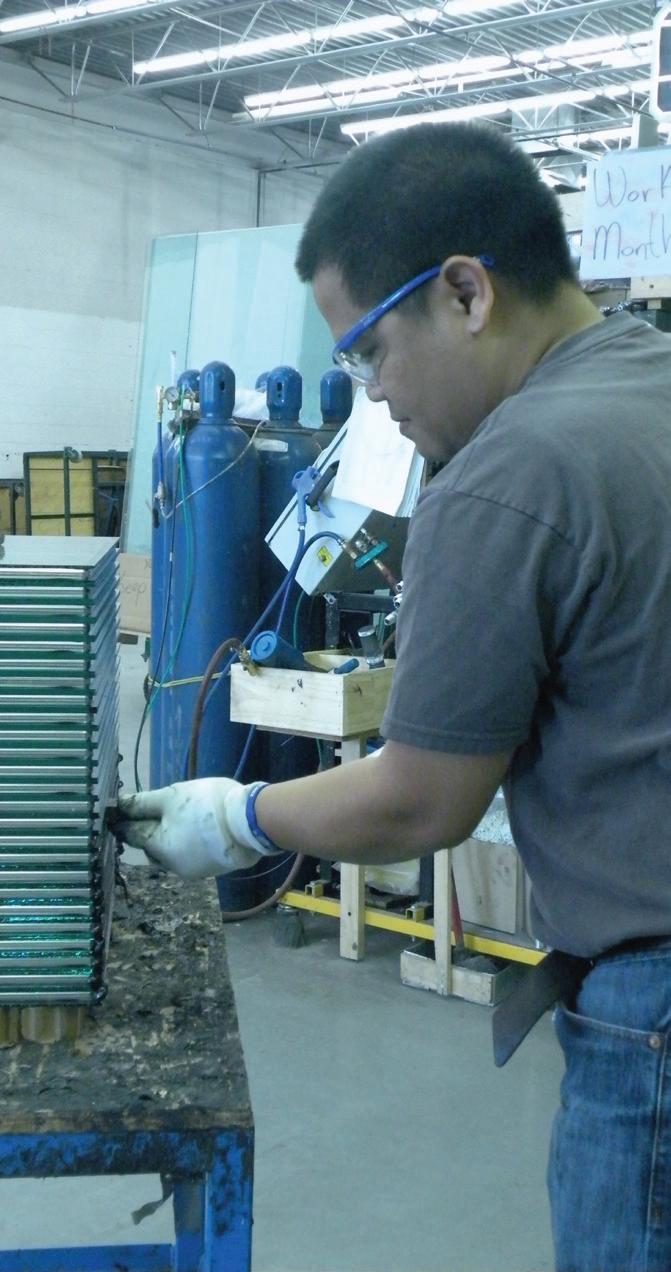
Mike and John Bruno are launching Everlast, Alumitex and Air-Tite to new heights from the platform their father built in west Toronto.
20 Industry events
Want to promote the products you distribute? Why not hold your own trade show? That is just what the Courage brothers do twice a year.
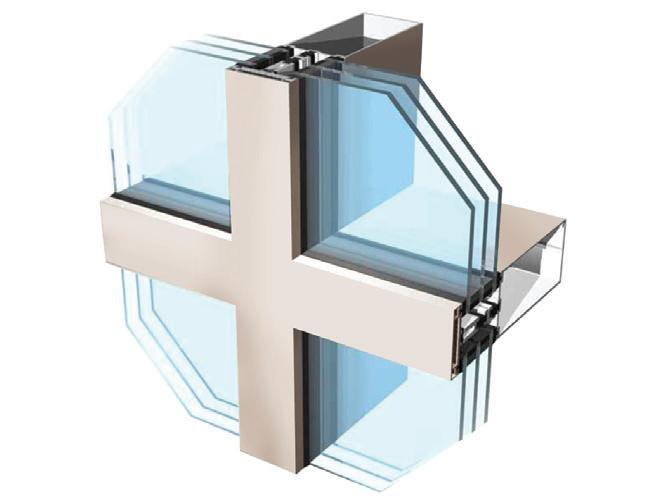
22 Curtain wall product showcase
Truck bodies, silicone, tool tethers, BIM models, sun shades, laser cutters and more.
An
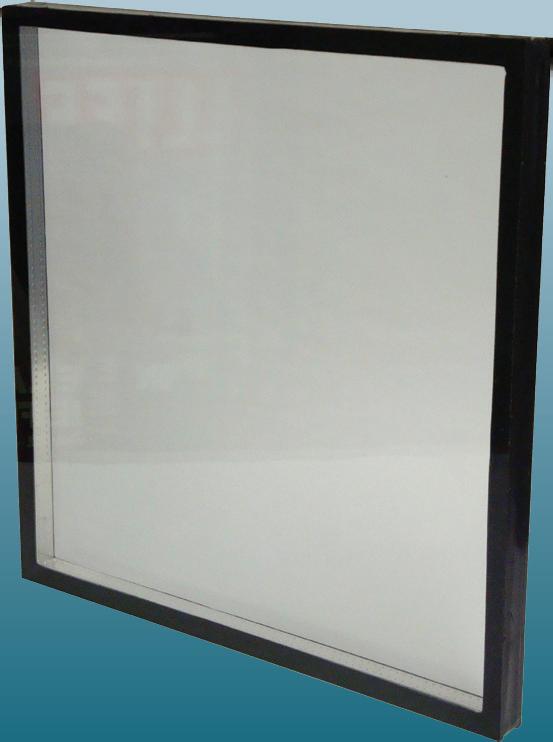
Long-term testing shows certified IG units hold up longer.
COLUMNISTS
Looking for answers
EDITORIAL
In a complex world, disagreements are inevitable. We should be OK with that as long as we realize everyone is searching for answers together.
Are there no right or wrong answers, only different interpretations of the flood of information to which we are all exposed? I don’t like that idea, even as I have to admit the possibility it is true. However, even if that is the way the universe works, I think we need to behave as if it were not true. If we are free to interpret reality any way we want, I think we need to make as our first conclusion the principle that there is truth and that there are correct and incorrect conclusions. I think we need to take this position for two reasons.
NEXT ISSUE
• CGA members
As people who work with their hands, tradespeople find the idea that all things are relative and open to interpretation to be intellectually jarring. A window will accept no argument when it will not fit into an opening. It is either the right size or it is not, and no amount of debate will change this fact. This seems to suggest something fundamental about the universe: that perhaps people who do not do physical work cannot appreciate: we must adjust what we believe to fit the world, not the other way around.
directory
• Glazier training
Secondly, in the absence of an agreed standard of truth, all opinion becomes political. If any position, any conclusion, is admissible, then which conclusions we adopt becomes a matter of personal choice and preference. Then, when people disagree, it gets personal. Instead of a shared journey to find the truth, an argument becomes a test of loyalty and affinity. If you disagree with me, it must be because you don’t like me or are somehow working against me and opposing me for some unknown reason of your own. You must be allied with another worldview that does not admit mine. You don’t just disagree – you are the Enemy.
People with shared goals and objectives shouldn’t be enemies. Our conversations within communities, within families and within industries are conversations between people who rely on each other for their mutual welfare. As a matter of practical necessity, we need to embrace the idea that there is a single right answer, a single best way to proceed, and to acknowledge that we all are engaged in a quest to find that answer together.
Because this industry needs correct answers, and because those answers are out there, this magazine will always publish the honest views of those who are looking for them, whether we agree or disagree with them. Our mission is to act as a conduit through which this industry can have a discussion, not to take sides or to promote one arbitrary view above another. Neither is it our place to judge who is right and who is wrong. When everyone talks, and no one gets personal, the truth will out. •
GROUP PUBLISHER | Martin MCANULTY mmcanulty@annexweb.com
Publication Mail Agreement #40065710. RETURN UNDELIVERABLE CANADIAN ADDRESS TO CIRCULATION DEPARTMENT, P.O. BOX 530, SIMCOE, ON N3Y 4N5 e-mail: jmatheusik@annexweb.com
Printed in Canada, All rights reserved. Editorial material is copyrighted. Permission to reprint may be granted on request. ISSN 0843-7041
Occasionally, Glass Canada will mail information on behalf of industry-related groups whose products and services we believe may be of interest to you. If you prefer not to receive this information, please contact our circulation department in any of the four ways listed above.
www.glasscanadamag.com
INDUSTRY
NEWS
Teaming up to talk safety
The Ontario Glass and Metal Association and Construction Specifications Canada discussed the hot topic of safety glass at their biannual joint meeting Dec. 6 at the Toronto Skating, Curling and Cricket Club. The record crowd of over 100 listened to a presentation by David Thompson and David Wittenberg of Halcrow Yolles before participating in a lively discussion of safety glass characteristics, building codes and engineering standards. Alumicor’s Steve Gusterson, chair of the CSC Toronto Chapter and director-at-large for OGMA, hosted the evening.
Wittenberg started the educational component of the evening with a review of the various kinds of safety glass and their characteristics. He is a structural designer who works in the Structural Glass and New Facade department of Halcrow Yolles.Wittenberg pointed to three common causes of failure in safety glass: improper support, poor interlayer materials and nickel-sulphide inclusions. He made the important point that correct compression of glass is critical to its strength, and discussed the various factors engineers should take into account when designing overhead structures, balustrades and entrances from glass.
Next, Thompson discussed mitigating risk in glass construction. Thompson is a 34-year veteran of the construction industry starting in architectural design and moving to building envelope engineering. He feels the greatest mistake building engineers make is to fail to consider the post-breakage performance of their glass structures. He questioned whether single-pane tempered glass could even be
properly called safety glass, saying he always used laminated and heat-soaked products when his projects called for tempered glass. Thompson quashed the rumour that cheap Chinese glass with nickel-sulphide inclusions was responsible for the bad press glass construction has been getting in Toronto lately. He said he had seen “no evidence” that Chinese glass was involved in these problems, and noted that nickel sulphide is a rare problem, but one that can pop up anywhere, in any glass product of any price. He said that while heat soaking provides an extra degree of confidence, there is debate as to how effective it really is.
Finally, Thompson called for the glass and construction industries to become educated about glass and glass construction and to adopt higher design standards to avoid becoming regulated by codes. “I’m concerned when I hear there are emergency standards meetings in Toronto,” he said. “If we don’t take the initiative as designers we will be left with glass in steel frames. Glass is a great building material and one we are only scratching the surface in developing.”
In the subsequent discussion period the point was made that Canadian standards have lagged American standards significantly because Canadian standard-making is funded by taxpayers while American ASTM standards are developed by volunteers. The lower cost of U.S. standard development allows for more frequent updates. The ASTM standard was last updated in 2009, while the CSA standard was last updated in 1989.
NAFS updated
The 2011 edition of AAMA/WDMA/CSA 101/I.S.2/A440, NAFS “North American Fenestration Standard/Specification for windows, doors, and skylights” (NAFS-11) has received final approval and is now available. This standard is the result of a multi-year effort by the American Architectural Manufacturers Association, the Canadian Standards Association and Fenestration Canada. The updated 2011 standard replaces the 2008 edition of the joint standard.
The 2011 NAFS standard is already referenced in the 2012 editions of the International Building Code and International Residential Code, and the new standard is being proposed to replace the 2008 edition in the National Building Code of Canada when it is updated.
The standard underwent a thorough restructuring, with separate sections for products, materials and components, as well as new product criteria sections for parallel opening windows and secondary storm products. The standard also expands the mullion and tubular daylighting device sections and adds lead content requirements for hardware.
Copies of AAMA/ WDMA/CSA 101/I.S.2/ A440-11 are available for online purchasing on the AAMA, Fenestration Canada or CSA websites.
CGA Newsletter
Glazing Contractors Association of British Columbia
In the past few issues of Glass Canada magazine there have been articles or commentaries describing the value of the newly proposed Fenestration Installation Technician program from the Canadian Standards Association.
I think we can all agree there has been a need for some time to find a mechanism to ensure a higher standard is applied to the installation of residential window systems. What we should not agree to is spending time and money reinventing the wheel. There is a tried and tested program already in place: interprovincial Red Seal glazier apprentice training. Currently, there are training facilities in B.C., Alberta and Ontario. The Canadian Glass Association is working on developing apprentice training programs to service Manitoba, Saskatchewan and the Atlantic provinces.
The glazier apprentice program has been in place for over 35 years. The training standards and curriculum encompass a wide range of skill sets used in the residential, industrial, commercial and institutional building and construction sectors, and these standards are reviewed and updated on a regular basis.
To quote directly from the National Occupational Analysis of 2009:
“There is an increase in the amount of fabrication that is done in a controlled shop environment, leading to faster instal-
lation times of unitized panels. This leads to a corresponding rise in the use of hoisting and rigging equipment, both in the shop and on-site.
“Due to the improvements in the thermal capacity of modern glass, as well as greater client demand for windows that admit more natural light and permit better outside views, the industry has seen an increase in the use of larger, heavier modules. This results in glaziers having to increase their knowledge of and their ability to use hoisting and rigging equipment.
“With more complex building shapes, aerial work platforms, such as specialized swing stages, are used more often. As such, glaziers need a better understanding of their operation, and must comply with certification requirements to use this equipment.
“Older buildings often have outdated materials that no longer comply with established industry standards. During renovations, replacing old windows, doors and specialized glass products requires glaziers to adapt modern glazing methods to suit existing structures and maintain the integrity of the building.
“Due to environmental concerns, there is greater demand for Leadership in Energy and Environmental Design (LEED) building structures, increasing the insulation value of the building. As a result, high-performance glazing products, such as low-E glass, argon gas-filled sealed units and upgrades in thermally-broken extrusions, are used more often. There is greater emphasis on proper membrane installation to improve the integrity of the overall building envelope.
“In the residential sector, consumers are now using approved Energy Star windows to save on energy.”
I am sure you will agree that this work requires a level of training and understanding that cannot be achieved in a short program, or in a mere test. The glazier apprentice program is a four-year program with three levels of training over six weeks and a total of 6,400 hours in the field. Once glaziers have completed the hours and the training they can write the interprovincial Red Seal exam. Red Seal-certified tradespeople are taught the skills needed to install all forms of glazing, including residential windows. As a Red Seal glazier journeyperson, a glazier can travel anywhere in Canada and the credentials will be recognized. Creating another level of certification can only increase confusion among homeowners and general contractors, and could possibly lead to underqualified workers attempting complex commercial work.
The lines between commercial and residential construction are becoming more and more blurred as increased performance metrics are being imposed on all forms of construction. As methods of construction become more demanding, so too does the training requirement for the tradespeople who are involved in the work. Creating a quasi-parallel program for residential installers, as the FIT program does, actually reduces the level of expertise a window installer must demonstrate at a time when the industry is evolving toward everhigher installation standards. In
B.C. the new Energy Act requirements for a commercial and a residential application cannot be achieved if you do not consider how glass is installed. Only a Red Seal journeyperson is qualified to meet the requirements required by the new regulations.This can be achieved by ensuring that a journeyperson is involved with or oversees the installation process.
In closing, I would like to suggest that the CSA and the stakeholders involved take a closer look at what is required to be a glazier journeyperson. Examine what the in-class and the practical job-site training provides. These apprentices and subsequent Red Seal journeypersons are fully qualified to ensure the installation of all glass products meets the required specifications from both the design and regulatory authorities. We would also like the FIT steering committee to consider that during tough economic times many developers will be looking for ways to cut costs. If sub-trades are allowed to use less trained or unqualified labour to install glass products, builders will get what they pay for. In the wake of all the “leaky condo” legal issues I am not sure why anyone would want to go down this road or take the risk. Does it not seem easier and less complicated to simply state that all glass product installations must be performed or overseen by a Red Seal glazier journeyperson? It seems to us that the Red Seal glazier apprenticeship program is a better fit for the commercial and residential construction community than FIT.
– Zana Gordon, CGA executive director
Busytronic
Bystronic has announced new distributor representation in Western Canada with the addition of the well-established Akhurst Machinery Company. Established in 1938, Akhurst Machinery has grown to become one of the largest independent equipment distributors in Canada with a strong commitment to providing quality products and superior service.
With offices strategically located in Western Canada, Akhurst provides local sales and technical support for its growing customer base. Bystronic, a Swiss company, is a leading manufacturer of press brakes, precision lasers, waterjet machinery and automation and material handling systems worldwide with its North American sales and service subsidiaries located in Toronto and Elgin, Ill.
In other Bystronic news, the company announced a sweeping restructuring of its European manufacturing operations. Saying it aims to “bundle” its forces and expertise in order to ensure long-term competitiveness, the company plans to merge production of machines for the specialist field of architectural glass at the Neuhausen-Hamberg location. It will cease manufacturing machinery for architectural glass cutting at its Butzberg, Switzerland, location, and will move its headquarters to its German location.
Bystronic glass and the German glass machine manufacturer Hegla intend to establish a partnership to continue to offer Bystronic customers a full range of glass processing machinery. The aim of this partnership is to work together on the product and market side. Both parties intend to treat the other party as a preferred partner and to join forces when dealing with customers who commission large-scale projects.
All Bystronic Armatec activities will be relocated from Gunzenhausen, Germany, to Neuhausen-Hamberg to become part of Bystronic Lenhardt starting in mid-2012. It is expected that up to 60 positions will be cut at Bystronic Maschinen in Butzberg and
up to 60 positions at Bystronic Armatec are to be relocated from Gunzenhausen to Neuhausen-Hamberg.
Bystronic glass group global sales and service will remain unaltered, as will Bystronic Laser.
Andre Brutsch, CEO of Bystronic glass, said, “The insecure economic prospects have diminished the willingness of many customers to invest or replace. This has had a very negative impact on our incoming orders for an extended period of time.”
Brutsch also pointed to global overcapacities in the laminated glass business section and falling glass prices leading to simultaneous high pressure on costs and a drop in margins throughout the entire sector. Brutsch said, “The competition for each order is extremely high and the margins are correspondingly unsatisfactory. In order to remain competitive, we must reduce our prices at the expense of our yield.”
The strong Swiss Franc has also lead to competitive disadvantages, especially for Bystronic Maschinen in Bützberg. Over the course of the last 18 months, the prices of the export products have risen by approximately 15 per cent solely as a result of exchange rate development.
The operational headquarters of the Bystronic glass group will be relocated to Germany.
Andre Brutsch was named the new head of the Bystronic glass group at the start of 2012, succeeding Richard Jakob as CEO. He is a Swiss Graduate engineer. Most recently, Brutsch was the operative manager of Bystronic Laser in Niederönz, Switzerland, a post he held since 2008.
Jakob, who managed the Bystronic glass group business since the beginning of 2007, has retired from the CEO position. He will, however, remain within the Bystronic glass group management. In future, he will concentrate on special projects and the management of the global sales and service subsidiaries.
Frank Scholz will be assumed responsibility at the start of the year for the newly created position of chief marketing officer. In this capacity he will also become a member of the Bystronic glass group management.
Scholz is a graduate computer scientist and doctor of engineering in mechanical engineering/production. He brings diverse managerial skills in corporate groups to the position along with previous years experience in owner-managed, medium-sized companies. His most recent position was that of managing director at a consulting company in Shanghai.
Schmidt to work with architects
Viracon has announced Alissa Schmidt will be its new Architectural Design Department manager. Schmidt was officially promoted on Dec. 12. Since 2005, Schmidt has worked at Viracon, most recently as an architectural design associate, providing technical, specification and design assistance to the architectural community. She has developed national and international relationships with major architects and consultants in the industry.
In her new role, Schmidt will be responsible for leading the Architectural Design Department’s focus on providing consultative design assistance to architects as they select and specify the glass products to be utilized on their projects.
Schmidt is a graduate of Minnesota State University, Mankato, with a bachelor of science degree in interior design. She is a member of the U.S. Green Building Council and the Construction Specifications Institute.
Andre Brutsch Frank Scholz
by YVAN HOULE
Yvan Houle is president of Fenestration Canada. Fenestration Canada’s mission is to represent and support all aspects of the window and door manufacturing industry.
Action on codes and standards
Codes, regulations and standards are part of everyday life for stakeholders involved in the production, sale and distribution of fenestration products. There is a tremendous amount of activity on codes and standards right now and the challenge is to keep up with what is going on in a number of jurisdictions on top of what is happening at the national level. You can find additional information and details about several of these activities on Fenestration Canada’s website, www.fenestrationcanada.ca.
Here’s a snapshot of some of the more important developments …
The Ontario Ministry of Municipal Affairs and Housing has announced that implementation of the North American Fenestration Standard (NAFS- 08) elements of the National Building Code 2010 into the Ontario Building Code has been delayed and will not come into force until July 1, 2013, for any products.
Fenestration Canada’s technical consultant, Jeff Baker, reports that FC received a favourable response to its request for inclusion of the National Fenestration Rating Council standard as a means of proving compliance with Ontario’s Supplementary Standard SB-12 governing energy efficiency. FC had also requested that the outdated reference to operable and fixed Energy Rating number be removed and replaced by the operable values only. Both requests were approved and included in the amendment to SB-12 prior to Jan. 1.
The Canadian Standards Association is looking for subject matter experts to volunteer for a standard-setting focus group for its new Fenestration Installation Technician certification. This
Implementation of NAFS-08 into the Ontario Building Code has been delayed and will not come into force until July 1, 2013.
FENESTRATION
will be a one-day meeting which will allow the CSA to finalize the exam and launch the program. Interested candidates should contact Kelly Adamovich, at 1-877-235-9791 ext. 88012. The CSA would like to schedule the meeting in mid-February or early March of this year.
The Canadian Commission on Building and Fire Codes has invited Fenestration Canada and its members to take part in the winter 2012 public review of proposed changes to incorporate energy efficiency for housing and small buildings into Part 9 of the NBC 2010. Details on how to participate in the review process are available on the FC website.
The National Energy Code for Houses and Small Buildings is now available for public review. Baker has reviewed the complete set of changes related to fenestration modifications. Stakeholders in the sector are being asked to review the code changes and provide any comments to the Code Centre by using a web link available on Fenestration Canada’s website that provides instructions and forms for submitting comments. Comments must be submitted by 4 p.m. Eastern Standard Time, March 2, 2012.
The Canadian General Standards Board undertook a review last March of the CGSB Standards for Glass and Related Products by means of stakeholder surveys. Findings indicate that there is some support for a technical review of the standards. The CGSB will need funding support to administer the standards development process for new editions and / or re-affirm the existing standards. Further information is available on the Fenestration Canada website.
All stakeholders in the sector are reminded to mark their calendars now for Fenestration Canada’s Annual Meeting being held at the Fairmont Chateau Montebello, June 7 to 9 in Montebello, Que. FC staff have toured the site and feel the Fairmont Chateau Montebello will be the perfect location for the 2012 program. A combination of a most beautiful natural setting in the woods along the Ottawa River, a great schedule of social events and a strong business and educational program will provide significant value and networking opportunities for delegates. Montebello is one of eastern Canada’s leading destinations. It is an exceptional Quebec resort with year-round activities and a new spa. It is one impressive “red cedar log cabin.” •
No compromise
compromise
Peter Faber installs a cutting-edge upgrade on Toronto’s waterfront.
BY PATRICK FLANNERY
Most cities love their waterfront. Vancouver sits like a jewel on the beach between the mountains and the Pacific, placidly looking out over the ocean from a thousand windows. The Thames flows like an artery connecting London, England, to 2,000 years of storied history. New Yorkers bustle back and forth over their rivers, each one delineating a small culture of its own, and have turned their harbour into an international landmark featuring the most famous statue in the world.
On the other hand, Toronto has always had an uneasy relationship with Lake Ontario. While the lake is the only reason the city is there in the first place, this fact only serves to draw Torontonians’ attention to the city’s old, derisive moniker of Hogtown, affixed when Toronto’s defining characteristic was the crowded livestock pens of Queen’s Quay and St. Lawrence Market. This stands uncomfortably at odds with the city’s preferred image today of a cosmopolitan centre of finance and culture. It probably wasn’t a conscious rejection of the lake that caused successive generations of Torontonians to allow the land by the waterfront to become dominated by rail yards and warehouses that ultimately became derelict, nor was it a dislike of a view that caused them to allow the construction of an elevated highway and multiple tall buildings that effectively block the entire lake from the sight of anyone at low elevation anywhere in the city. Why these things did happen is complicated, but suffice it to say there are a number of people in Toronto now who wish to reverse these trends. One such group is the Harbourfront Centre, a not-forprofit former Crown corporation that operates a 10-acre cultural and recreational complex on the site of a former dockside storage facility.
Harbourfront Centre’s mission is to present top-flight arts and entertainment, especially by Canadian artists, to make Toronto’s waterfront a cultural destination. Its performance venue is the Enwave Theatre, an icehouse built in 1926 that has been renovated and repurposed down through the years into its present incarnation as a 422-seat, state-of-the-art theatre with three balcony levels and three lobbies. In 1991, the theatre was renovated to add a three-storey glass envelope that surrounds the entire north, west and east sides of the building to provide acoustic insulation, additional lobby space and an esthetic external finish.
The improvement to acoustics, space and esthetics came at the cost of comfort. The glazing and construction chosen allowed for a high level of heat transfer between the interior and exterior and included no sun filters. Even with heavy use of air conditioning, the lobby was uncomfortable most of the time because the outside temperature was inconsistent. The glazing on the sloped section of the envelope was tinted and eliminated some visible light, but was found to do little to mitigate heat radiation.
This was the situation Peter Faber of Brampton, Ont.-based Faber Solariums walked into when he was hired to replace the insulating glass units in the facade. “I was here in the summertime and we were walking through with the air conditioning pumping out,” he remembers. “I said, ‘You are not getting any cold air out of these ducts, these ducts are actually warming up in the heat of the sun.’ We measured. At its worst, with the air conditioning at full blast, it was 42 degrees up there last summer.” The ducts in question were large, exposed steel ducts positioned in the full, unfiltered rays coming through the west side of the glass enclosure.
Having identified that the existing glass envelope was going to need modification, Harbourfront Centre decided to embark on a much more ambitious program than simply updating the insulating glass units. Like many high-minded organizations, it had made a commitment back in
2007 to become a green organization and to reduce its environmental footprint. But when it began to investigate how it could best do that, it made an awkward discovery: by far the greatest impact to the environment Harbourfront Centre makes is through the carbon emissions from people travelling to visit it. The Centre’s technical study found that travel to and from the site accounted for 95 per cent of the emissions that could be associated with it. Any improvements to the operational efficiency of the building would pale to insignificance next to the impact of the Centre successfully fulfilling its mission of drawing more people to Toronto’s waterfront.
With this in mind, the Harbourfront Centre leadership decided that, in addition to improving energy efficiency and sustainability, the renovations would have to carry a powerful environmental message of their own to hopefully encourage visitors to embrace more sustainable habits and thereby mitigate the damage their travel had done. This was not going to be easy.
About the search for options, Randy Sa’d, Harbourfront Centre’s director of strategic development, says, “Having explored the potential for engaging the public, the overwhelming evidence we found suggested the constant fingerpointing and barrage of guilt-evoking pleas that seems to constantly surround us have stalled the environmental movement. In response, Harbourfront Centre has conceived an innovative solution that is not designed to engage the environmentally conscious, but rather seeks to entice those alienated by the endless line of boring facts and unscrupulous greenwashers dominating the conversation.… We are committed to invigorating this conversation with a sense of fun and inspiration that seems to have disappeared. People who rediscover their personal relationship to our environment naturally create a new context through which to consider their response to its needs.”
Harbourfront decided that the best way to communicate the environmental message it wanted was to connect people to Lake Ontario – the lake they live
next to and are often barely aware of –through art. The Centre engaged Sarah Hall, an internationally recognized glass artist, to create a striking art glass feature, and Internat Energy Solutions Canada to tackle the technical hurdles.
Hall has won awards from the American Institute of Architects and the Ontario Association of Architects for her large-scale art glass installations, mostly at churches around the world. Hall calls her Enwave Theatre work Waterglass. “The Waterglass project uses glass art and renewable energy to tell a story about creativity and the natural environment throughout the entire building facade,” Hall explains in a Centre press release.
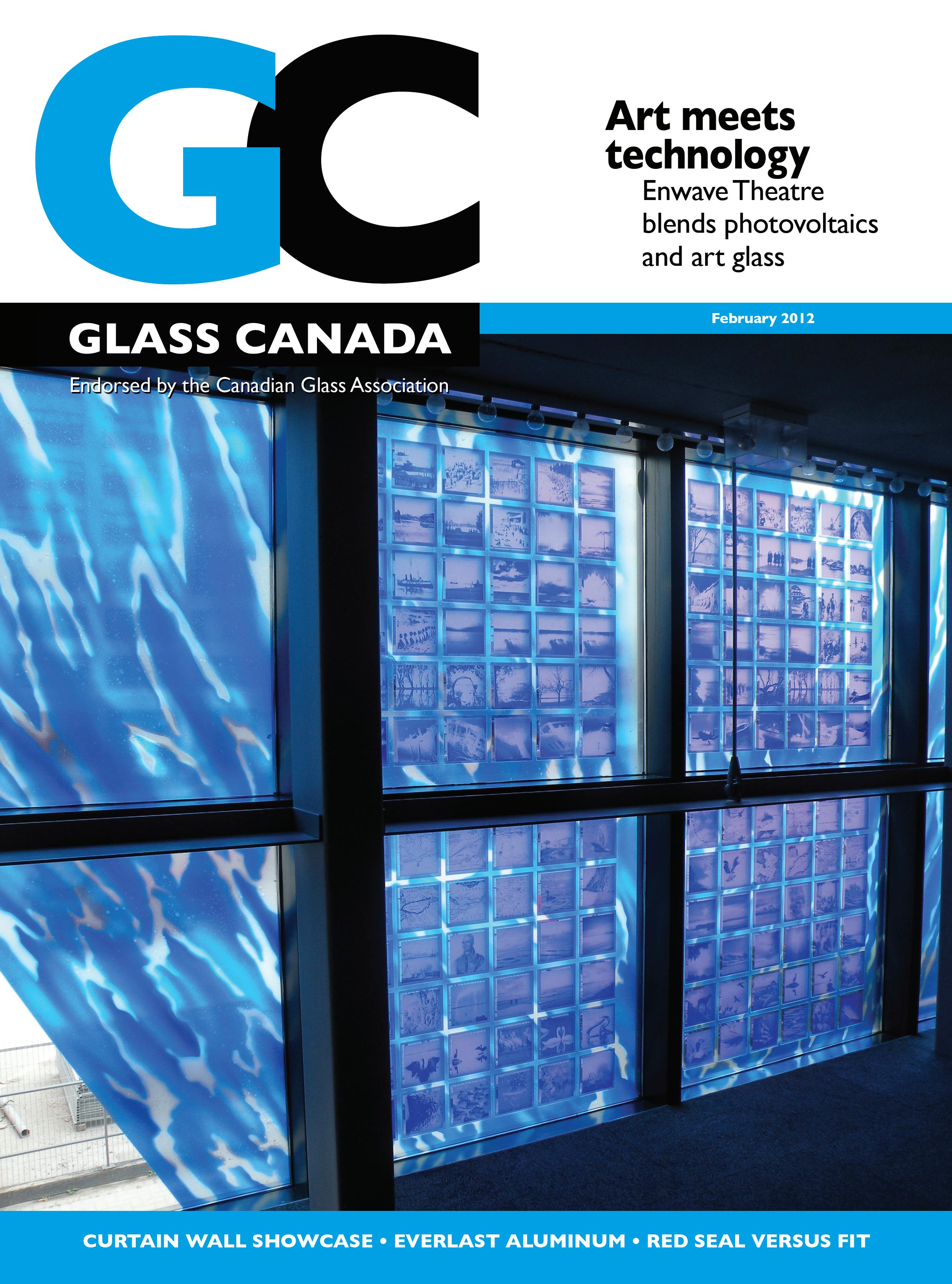
These elements were created with airbrushed, fired enamels on architectural glass then sandblasted. The photographic image gallery on the cover uses screenprinted photographs (Hall went through over 4,000 old photos in the Toronto city archives) and dichroic glass. The result is a sharp, clean image on a background that changes colour depending on the angle of the sun.
Groundbreaking photovoltaics
The sloped western side of the façade holds the 10 photovoltaic panels. They were created as triple-glazed insulating glass units with embedded solar cells. There are 54 standard blue cells per panel, each five inches square and mounted into the existing frames with conduit wiring.
According to Livio Nichilo, CEO and engineering manager of Internat, Enwave Theatre marks the first use anywhere in the world of photovoltaics, art glass and heat mirror coatings combined in one insulating glass unit.
“The biggest challenge in manufacturing these glass units was integrating the heat mirror with the photovoltaics,” Nichilo says. “That has never been done before. With photovoltaic you have to have laminate insulating the solar cells and the connections to the wiring have to be very clean and moisture-free. The way the heat mirror works it has to go through its own heating process to be straightened out so you do not see any ripples or anything. The biggest challenge of the project was making sure the process for the heat mirrors didn’t interfere with the process needed for the photo cells. In that case we had to work
with the manufacturers.” Nichilo won’t say just how the manufacturer solved this problem, but says anyone who knows about these things will probably be able to guess how with a little thought.
The artistic colouring on the photovoltaic units does not go over the solar panels, so there is no interference with the panels’ ability to gather sunlight. Some engineers would chafe at the demand to integrate art with a functional part of the building, but Nichilo understood it to be a critical aspect of Harbourfront’s vision for the project. “What we decided to do was to put the photovoltaics only where it made sense,” he says. “When we say where does it make sense we mean where does the building get enough sun exposure so that those panels will be producing at a high efficiency. The west wall where it is sloped was the only part of the building, because of its orientation and what is around it, where it made sense for us to do that.
“The artwork was actually the last part of the puzzle. It came in after we had already decided on the design and decided on the location of the photovoltaic. The artwork was really inspired by that work and by who Harbourfront Centre is. I saw the artwork as a necessary part. While the technical aspects of this might be interesting to you and me, the reality is for 80 per cent of the population it is not. So our goal is to have those technical pieces, have them there, but tell the story and allow Harbourfront Centre to be who they are.
“Each art piece was done separately. The key part was the German partner we used, Glasmalerei Peters Studios, was able to have the artwork once it was created actually melted into the glass. That is not like paint on a glass, it is actually part of the glass. Once that sheet was made, the whole process was the same as any other assembly.”
Faber says the installation was not particularly difficult aside from the increased weight of the fancy IG units. The original facade had been installed using some rather strange, C-shaped exposed fasteners that Faber had never seen before. The sections were held in place with tech screws, which made them quite easy to remove compared to more recent curtain wall systems with cover caps and pressure plates.
Faber says projects like these show the potential for improvement to the in-
terior living environment that is possible through glazing improvements. He says many building owners simply replace old glass with whatever they had before, whereas with an investment in superior insulating products, they can make their property much more valuable. “For me, there is no difference in cost installing an R-2 unit versus an R-10,” Faber says. “This building had a 35 per cent seal failure. It looked nasty. There are other places with the same problem. With a little bit of an upgrade they could end up with something like this that looks kind of cool, actually.”
The new glazing is undergoing testing to find out just how energy efficient it is. Nichilo says their analysis predicts 0.14 to 0.49 solar heat gain coefficient, a 7.14 R-value and 76-watts-per-square-metre electricity production under idea sun conditions.
“For the heat mirror we did a lot of simulations for energy use using Energy Plus,” Nichilo says. “What it allowed us to do was model the building during wintertime and summertime and actu-
ally track the sun and make sure we were always getting advantages from the heat mirror and the photovoltaic. One of the things that came out of the analysis was the heat mirror had two advantages. One was that it reduced the heat gains, but two was that it had significant advantages as far as the insulation of the building to keep the heat in during the winter. What we were able to find with the analysis was even though the solar gains were reduced because of the heat mirror in the wintertime, the heat that was being kept in through the insulation outnumbered that. So in the winter there was an overall heat benefit and conditioning benefit from the heat glass. Even though the summertime was the reason for bringing that in, we were able to see that in the winter it produced that advantage for us.”
The Harbourfront Centre’s refusal to compromise esthetics, sustainability or performance in its Enwave Theatre renovation has resulted in a groundbreaking design. Perhaps this will be the shot in the arm Toronto’s waterfront district needs. •
Updating an institution
The next generation of Brunos are taking Everlast in new directions.
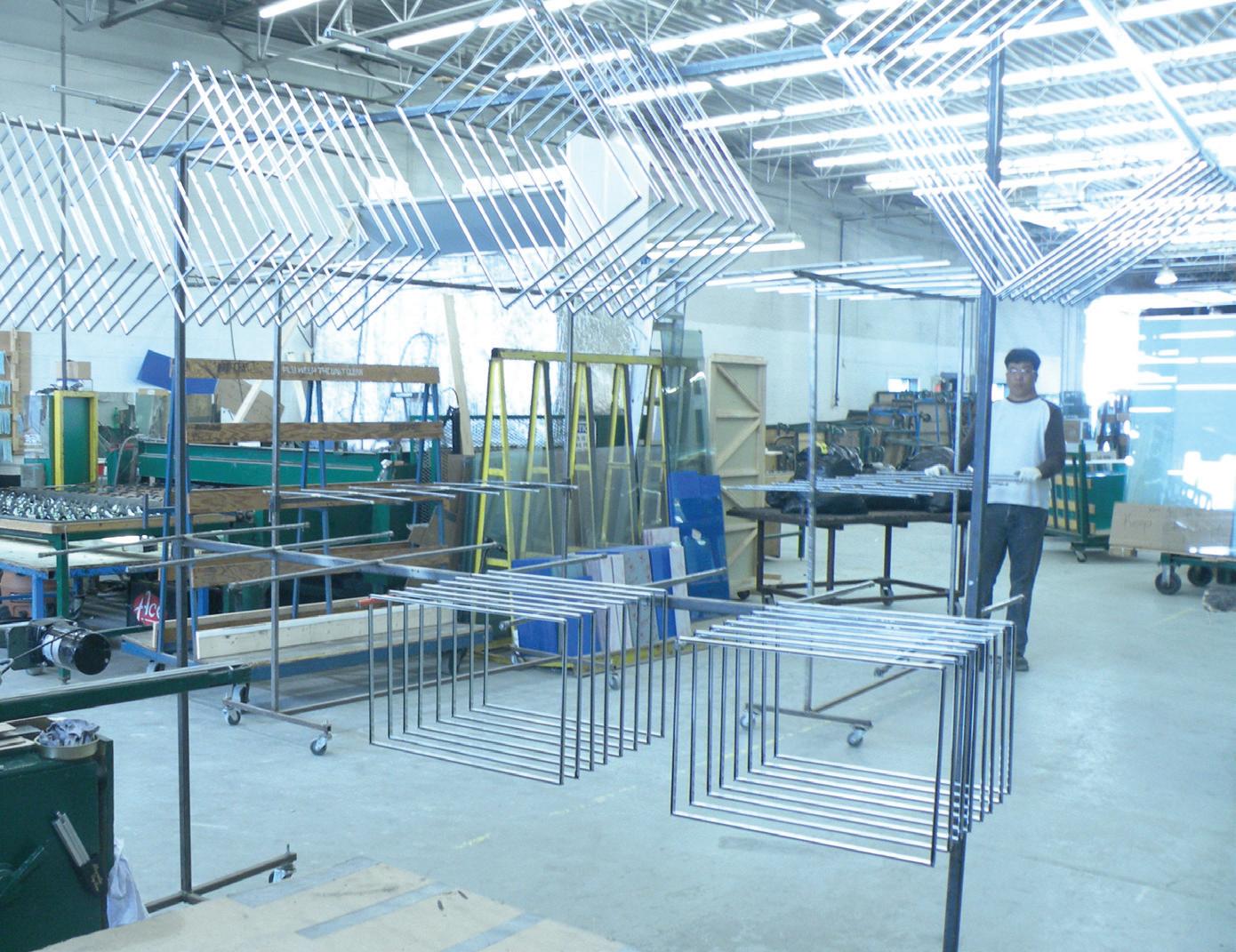
Between Alumitex, Everlast and Air-Tite, there are competencies for just about every kind of fenestration fabrication imaginable on the Brunos’ shop floor.
AT A GLANCE | Everlast, Alumitex and Air-Tite
Managers who grew up in the business have a knack for making the office seem like home. In the case of Mike and John Bruno, president and plant manager of the venerable Everlast Aluminum, Alumitex Windows and Doors and Air-Tite Insulating Glass, the effect is doubly pronounced as both brothers grew up in and around the company’s original Etobicoke location on Kelfield Street. Even after two location moves and the addition of partner Nick Belpulsi and the Air-Tite division, Mike seems completely at home in his hockey-jersey-draped office, and out on the shop floor where some of the workers have been with the company as long as he can remember.
One company, three names Frank Bruno, Mike and John’s father, started his career in fenestration at the tender age of 15 at the original Everlast plant in 1961. He bought into the company in 1976, and later picked up Alumitex, a vinyl window manufacturer in the Weston and Wilson area. Mike and John started lending a hand around
the place when they were 10, cleaning weather stripping, making hinges and other simple jobs. Mike credits the work ethic instilled by his father in those early years for his later success.
Mike Bruno is now the president of the three-headed company: Alumitex, which manufactures vinyl windows and distributes Royal patio doors and TruTech entrance doors; Everlast, which manufactures aluminum window and storm windows, storm doors, porch enclosures and has recently started manufacturing a line of PVC storm doors; and Air-Tite, which manufactures insulating glass units. The company operates out of a 40,000-square-foot facility it moved into in 2008, but had to add another 2,000 square feet last year plus some shipping containers for storage.
Mike oversees the whole operation and spends most of his time on highlevel product development and market planning. John runs Everlast and oversees inside sales and communications. Belpulsi, a 36-year veteran of the glass industry, runs Air-Tite more or less as an independent business. Fab Colletta is
Location: Toronto, Ont. No. of Staff: 85
Established: 1950
Manufacturing floor: 40,000 square feet
Website: www.alumitex.biz
Part of a group of companies that includes Alumitex Windows and Doors and Air-Tite Insulating Glass, Everlast is owned by Frank Bruno and run by his sons, Mike and John. The group produces aluminum storm doors, windows, porch enclosures and sunrooms as well as vinyl windows and vinyl storm doors. Alumitex distributes Royal patio doors and TruTech entrance doors, as well.
a key person for Alumitex. He is a PVC manufacturing specialist and takes care of the vinyl window production. Gord Volker is the operations manager who supports everything the other managers do, including due diligence, process documentation, product certification, process testing, equipment maintenance and everything in between. And Frank
Fabricating aluminum storm doors has been Everlast’s bread and butter for over 50 years. Recently, the company has introduced a new twist with a PVC storm door unlike anything else on the market. Everlast is taking the new doors to market under its own name, and also private labelling the design.
Bruno, 66, still owns the company and comes in for about five hours per day and acts as a sounding board for Mike. He has been in the window and door industry for 50 years now.
Mike is justifiably proud of the strides the company has taken on his watch.
“Six years ago, when I took over, we were about 25 employees,” he remembers.
“We are up to 85 now. When I came into the company I was 20 years old and we were doing about $2.1 million. When I took over full time six years ago we were around $3.1 million. Last year [2010] we finished off at $12.5 million.” Bruno estimates production at around 250,000 IG units per year plus nearly 120,000 other aluminum and PVC products.
Building through innovation
Having grown sales of the company’s established products, Mike has moved into innovative product development, actually coming up with something he says no one has done before. “Two and a half years ago we sat down and said we needed to find something to give us a little more presence in the market,” he remembers. “We’d been doing an aluminum storm door I’ll say for 50 years because that is how long my dad has been in business. It hasn’t changed, hasn’t evolved other than going from a mill finish in gold and white to now browns, some beige and sandalwood. So we sat down and we said ‘OK, how are we going to help this storm door evolve and become more acceptable to today’s consumer. So we looked at the steel door business, which, you know, 20 years ago was your basic white with a white crowning and all of a sudden it has evolved into colours, various colours. On the aluminum side, to do that is just too costly. There is a minimum charge on the paint because it is outsourced. It is harder to paint than steel or PVC; the prep time on it is a lot higher. A steel door is very simple because it is just one surface, whereas on the aluminum doors you have channels that are about half an inch thick. There are just very tight areas that you cannot get into. If you
painted over it, it would just flake off. So we looked and we decided we wanted to introduce a new door that was cutting edge and would complement the steel door line. We wanted to put a retractable screen in it so we came up with this concept and worked with Royal Plastic to develop a PVC storm door. It is actually welded and mechanically fastened at the same time. We won’t say how that happens, but we have both systems.”
Mike showed off the new vinyl doors at Win-door in November 2011. They can be delivered in custom colours with pre-hung aluminum frames for easy installation. They have been tested to the highest standards for energy efficiency and resisting moisture ingress and passed with flying colours. Mike thinks they will
be just the ticket for door installers looking to meet the new energy efficiency standards that are set to become part of building codes across the country.
Vertical integration
The Brunos like to stay in control of their process and input costs throughout the production cycle. “The way we are set up, we are pretty much independent of any other source,” Mike explains. “Anything we need in the manufacturing process, we do in house, other than extrusion. That would include our paint line, our glass line, our architectural bending, that is all done in-house. We have a facility that is very, very unique. You will have vinyl window companies, you will have aluminum window companies that do various products (not the complete line we make) then you will have your standard IG companies. ”
Another process innovation is not just making managers accountable for product shipments, but actually involving them in the process. “Our foremen and our production managers are our
service department,” Mike says. “It is very unusual, but our final product is put on the truck by our management team. Whenever a product is being shipped out of here, it is the management team that is shipping out the product. The reason why is, if there is an issue, the truck loading will be stopped and the problem will be fixed because, at the end of the day, they are the ones responsible.”
This method takes away the tension between service and production by centralizing the whole responsibility in one area. A shipper might overlook a mistake in the product order in his rush to get the truck away in time, and a quality controller might delay a shipment because getting it right is more important to him than getting it out the door. By making one person responsible for both areas, Mike feels he gets an optimized solution to most problems. “A production manager will think, ‘I want to get it done quick, but I need to make sure there is not a bump because I do not want to be going to Montreal or Ottawa or Edmonton or Thunder Bay for a service call,’” Mike says.
New ways to market
The three companies’ products go to market through a network of dealers in southern Ontario, including window and door retailers and “truck-and-ladder guys.” Since he took over in 2005, Mike has diversified that into some low-rise and mid-rise developers and is setting up some vinyl manufacturers to private label the Everlast vinyl storm doors. He has made some deals with national distributors, as well. These moves have taken the company to Thunder Bay, Ont., North Bay, Ont., Ottawa and Montreal.
Mike is staying away from the big box stores because he feels there are too many competitors trying to get that business.
Mike’s strategy is to be a one-stop shop for all fenestration products. He feels this is a strong position because, with the high costs of gas and labour in his local market, retailers and installers cannot afford to go from place to place shopping for all the components they need. By focusing on offering the best service to the client base he has, and continuously coming up with new products for them to buy, he can grow his business in the medium term without having to market himself farther afield. “We really have not increased our customer base,” he explains. “Our customer base has increased the amount they purchase from us, so our customer that used to just buy an aluminum storm door will now buy an aluminum storm door, a vinyl window, a patio door, an IG unit and an architectural shaped window because it is one place to order from, one place to pick up from and one place to make payables to. We have helped them reduce the cost of their operations.” He says he has made his fourfold increase in sales without putting a single salesperson on the road.
The experience and dedication of Mike’s staff allows him to stay back from production and think about larger moves for the company with the help of his father. It is an enviable position for the head of a medium-sized fabricator, where the daily emergencies can quickly overwhelm if you do not have competent people on the floor. It looks as though Everlast’s solid foundation has given Mike, John and the rest of the team a chance to do great things in the future. •
by FRANK FULTON
Frank Fulton is president of Fultech Fenestration Consulting. He has been in the industry for 30 years and can be reached via e-mail at fultech.fc@gmail.com.
Alberta’s industry hero
In my last column, I told you about my trip to Edmonton to attend the Canadian Glass Association’s Glass Connections conference. While I was there I got asking around about some of the noteworthy players in the glass and glazing business in western Canada and was told that if there was any one guy worth telling everyone about, that guy would be Don Ward. I caught up with Don in Palm Springs, Calif., where he works at retirement during the winter months.
If there were a Nobel Prize for contributions to the glass and glazing industry, Don Ward would have to be the heavily favoured candidate to receive it.
Don Ward was born in Swift Current, Sask., and moved to Calgary while still in grade school. He spent a few years serving as a radio operator with the Royal Canadian Navy in the early 1960s, and upon his return to Calgary in 1965 got his foot in the door of the glass industry with a warehouse job at Canadian Pittsburgh Industries (CPI).
Don started at the bottom and through hard work, dedication and an unwavering drive to learn, came up through the ranks. He attended the very first glassworkers apprenticeship training program at the Southern Alberta Institute of Technology and was in its inaugural graduating class in 1969, receiving his Certified Journeyman Glassworker certificate. Ward says, “I was one of the pioneer apprentices enrolled in that initial class. That four-year course was far different than the current sophisticated program. The students were teaching the instructor and developing the curriculum as we were being instructed ourselves.”
While working on the tools for CPI on a number of large projects during the boom years of
Don Ward was promoted to field superintendent overseeing 100 tradesmen . . . eventually becoming the contract sales manager for PPG.
the 1970s he was promoted to field superintendent overseeing 100 tradesmen before moving a few years later into the office as an estimator and eventually becoming the contract sales manager for the newly renamed PPG.
It was during this time that Don began his remarkable contributions to volunteer work for the betterment of the glass and construction industries when he got involved in the fledgling Glass and Architectural Metals Association of Calgary. He eventually became president of that association of local glazing contractors for the first time in 1980. He would serve as president twice more in 1981 and 1984.
In 1981, after more than 16 years with PPG, Ward joined Griffin Glass Industries, a company with a proven track record since 1960, as a vice-president, and changed the company name to Griffin Glass (1981) Ltd. The majority partner, Ken Kennedy, retired in 1985 and Don took over as president of the company.
Even though Don had long ago completed his SAIT apprenticeship training, he continued his involvement with that group as a member on the local and provincial apprenticeship committees for some 18 years, helping with curriculum changes, drafting the Red Seal Interprovincial Examination, marking the practical examination projects and keeping up with regular committee work. Government staff had chaired the apprenticeship committee meetings until industry took over the chairman position. At that transitional time, Don accepted the role of presiding officer of the provincial and local apprenticeship committees and held those positions for more than 10 years.
GAMA nominated Don as their representative on the board of the Calgary Construction Association in 1989 where he remained a director for 17 years. At the time, that was the longest continuous active term of any director. He served three years on the executive committee of the CCA board including a term as president in 1992.
In the next issue we’ll take a look at Don Ward’s involvement and leadership on a remarkable number of initiatives that benefited the industry. •
by MARGARET WEBB
Margaret
Webb is the executive director of the Insulating Glass Manufacturer’s Alliance.
25 years of proof
Finally, the validation is here. It was a long process, but rewarding. Now we have the documentation that proves that higher levels of testing and certification in fact result in better performing insulating glass units when tested and certified. The IGMA 25-Year Field Correlation Study brings real-world performance and results to further establish a case for quality, tested and certified insulating glass units.
The purpose of the project was to determine the correlation of actual, in-service, IG unit failures to the ASTM E 773 Test Method and the E 774 Specification for Classes C, CB, and CBA.
IG units are unique in the realm of manufactured products and the IGMA 25-Year Field Correlation Study established baseline and ongoing quantitative statistics on long-term performance. IG units are a large product with a hermetic seal and are installed in harsh environments subject to ultraviolet rays, water, extreme temperature changes and even oscillating loads. IG units can also be exposed to organic adhesive materials and are often fixed in place by an unknown framing material. Comparisons can be difficult as these units are commonly installed in different environments and under numerous other conditions (frames, locations and facing different directions).
IGMA, which was the Sealed Insulating Glass Manufacturers Association (SIGMA) when the study was first initiated, now has the quantitative results that prove sealed IG units tested and certified to the most stringent industry standards carry better in-the-field performance than those that are not. The study was an ambitious project that examined in-service insulating glass units in specific residential and commercial buildings in various locations across the United States. It
Actual performance varied little from hot to cold or wet to dry climates, or from sea level to mountain exposures.
IGMA
was begun in 1980 with reports issued at the 10, 15 and finally, 25-year marks. The study was based on long-term analysis of in-the-field building performance and examined in-service insulating glass units in specific residential and commercial buildings located in all regions of the U.S. Almost all the units studied faced south or southwest. Visual inspections were completed eight times during the first 10 years and again at the 15- and 25-year points.
Although applications were wide-ranging, actual performance varied little from hot to cold or wet to dry climates, or from sea level to mountain exposures. Eighty per cent of the buildings had no insulating glass failures after 25 years. Glazing systems that held water at or near the edge sealant had accelerated 60 per cent of the failures that did occur in the remaining buildings. The importance of managing water in the glazing cavity is a critical factor in the performance and longevity of certified insulating glass units. Water held at or near the edge seal of an insulating glass unit will result in premature failure, cause structural damage to the glazing system and may result in the formation of mold. The formation of mold and its effect on the occupants of a structure continues to be a prime health and safety concern for architects when designing buildings.
Based on the information obtained from the 25-year data, it is estimated that the failure rate of C and CB units is in excess of 20 per cent, due to the number of buildings re-glazed and known systems that were not properly performing to keep water away from the insulating glass edge. In addition, the number of C and CB units demonstrating failure in the 25-year study (14 per cent) had approximately three to four times the number of failures of the CBA units (3.6 per cent). This clearly demonstrates that those units that achieved the CBA or the highest level of certification outperformed the units that had only achieved the C or CB level of certification.
IGMA’s recommendation: IG units should be certified to the ASTM E 2190 Standard (replacing the ASTM E 774 and CGSB 12.8 Standards) for improved long-term durability against failure and including glazing of units in accordance with IGMA standards. Look for the visible “seal of approval”: a marking on the window spacer between the glass or etched directly on the glass identifying the manufacturer, plant location, certification program and date of manufacture. •
by BRIAN BURTON
The impact of climate change on fenestration
SBrian Burton is the author of Building Science Forum and is serving on CSA’s Fenestration Installation Technician Certification Committee. Brian is a research and development specialist for Exp (The new identity of Trow Associates). He can be reached at brian.burton@exp. com or through www. exp.com. FENESTRATION
cientists agree the earth’s climate is getting warmer. Engineers Canada believes we are seeing the early signs of climate change on new and existing buildings.
Premature deterioration because of the stress caused by changes in the weather pattern is a serious concern and is quickly becoming the focus of a great deal of attention in many regions of Canada because any significant change in weather patterns will require modifications to the manner in which we design and construct buildings.
To meet the challenge Engineers Canada has established a Vulnerability Committee to examine the impact on our buildings and infrastructure. You can see their reports and other information online at www.pievc.ca.
The committee defines climate change as being any systematic change in climate elements sustained over several decades. The building envelope serves an important function as an environmental separator and is particularly vulnerable to even minor changes in climactic conditions because these systems have become thinner and lighter as construction technology has evolved. Fenestration components are also in direct contact with the elements.
In existing buildings, the age of the structure, materials used in its construction and the type of building envelope system can influence its ability to resist climate change. For example a 50-yearold masonry building constructed using a face-sealed cladding system has very little capacity to resist the impact because the shell of the building is directly exposed to the ever-changing exterior environmental conditions. In buildings that incorporate pressure-equalized rainscreen walls the
It is a relatively straightforward building science exercise to simulate at least some of the impacts of various climate change scenarios.
environmental separation is concealed and is not generally exposed to the elements.
Several environmental factors can impact fenestration components. Shifts in the form, pattern, and intensity of precipitation, including the frequency of instances of freeze/thaw cycling, melting permafrost, freezing rain and rain on snow can alter the expected lifespan of fenestration, or affect its performance during that span. Shifts in the frequency of high humidity levels, changes in seasonal temperature ranges and longevity of heat waves or cold snaps, and increased intensity of wind and flooding events can also play an important role. These changes acting on an enclosure system can lead to dimensional changes in the materials which can lead to cracking and fissuring in polymer-based materials such as window frames, sealants and gaskets.
Any increase in dust, particulate matter, smoke and acid rain can also have significant implications for fenestration components. In addition, UV radiation, wind-driven dust and rain contribute to accelerated deterioration
These sources of degradation can lead to the following impacts on building performance and longevity: increased health and safety risks for occupants, overall premature or accelerated deterioration, reduced service life and functionality of components, increased risk of catastrophic failure, increased repair, maintenance and energy costs, increases in service disruptions and increased liability.
It is a relatively straightforward building science exercise to simulate at least some of the impacts of various climate change scenarios on full-scale mock-up building envelope assemblies in laboratory settings. Computer simulations might also prove useful. These strategies might assist in to determining what changes in design and building codes could mitigate the impact for new and existing buildings.
Given the size and importance of our building stock it is important we continue to monitor the issue and it is apparent we also need to substantially increase the general attention given to the topic. Climate change will present a challenge for the people who deal with these components of modern buildings: architects, engineers, building scientists and manufacturers.•
Courage Film Fest 2012
A chance to come see some stuff you can’t see.
Courage Distributing is a Canadian-owned and -operated company that has been distributing window films and related accessories across the country since 1992.
It is time again for the only show of its kind in Canada, the Courage Film Fest seminars. These events have become an annual tradition for many as a way to prepare for the upcoming year with new products and show specials. Starting in 1994 with a modest crowd of window film installers, Todd and Trent Courage have watched their Film Fest grow into the largest window film and paint protection film expo in the country.
In February and March of 2011 the Vancouver and Toronto shows welcomed a record number of companies as over 400 attendees spent an informative Sunday with the Courage staff and manufacturer reps from Sun-Gard Window Films, 3M, Venture Tape Paint Protection, Wrap Films, Remlor Decorative Films and Roland Canada.
This year all eyes are sure to be on the automotive installation demo station as installers take their turn heat shrinking the new Black Pearl automotive tint from Sun-Gard. Feedback from the SEMA show in Las Vegas in November was very positive. With a great colour, lifetime warranty and incredible heat shrink ability, this film is impressive. Other automotive films from Sun-Gard include the
AT A GLANCE | Canada’s Glass Film Expo
classic metal/dyed hybrid PerformX Slate as well as the always popular fully dyed and lifetime warranted Shadow film.
Don’t forget to check out the extensive line-up of commercial and residential window films available from SunGard. The Century series is made with sputtered metals for improved colour and performance and the Decorator series offers great heat resistance and durability. The Solar Silver series continues to be a go-to film for commercial applications where heat and light reduction is key while the dual reflective films take it to the next level by reducing interior nighttime reflection.
Glass-Gard safety and security films are designed to be virtually invisible and will help hold glass together in the case of accidental or intentional breakage. The safety lineup includes clear and tinted films from 2 to 7 thousandths and the security films are available in clear and tinted varieties from 8 to 14 thousandths. Courage also offers a UL rated 14-thousandths film in the RemVu series.
There will be a lot of buzz around the 3M booth as attendees try out the increasingly popular Scotchprint 1080 series Body Wrap Film. Similar to the
Courage Film Fest West
• 8:30. to 3 p.m., Sunday, Feb. 19
• Executive Airport Plaza Hotel, Richmond, B.C.
A casual meet and greet for attendees, staff and suppliers will be held at Carvers Steakhouse and Lounge at the hotel on Feb. 18 from 7 to 9 p.m.
Courage Film Fest East
• 8:30 to 3 p.m., Sunday, March 4
• Oakville Conference Centre, Oakville, Ont.
The meet and greet will be held next door at the Priority Club Lounge inside the Holiday Inn on March 3 from 7 to 9 p.m.
Registration for the Courage Film Fest is completely free and can be completed online at www.courage.ca.
popular architectural DiNoc film, this product is made thinner for the automotive wrap market and is available in cutting-edge designs including carbon fibre, matte black and brushed silver to name a few. A newly released series of
Courage Film Fest has many of the features of a trade show, including education sessions, automotive and flat glass tinting competitions, show specials, prizes and giveaways. Visit www.courage.ca.
glossy colours will also be on hand to make their Film Fest debut.
The paint protection film area has grown considerably over the years and continues to be one of the most popular stations at the Courage Film Fest. Here you will see 3M showcasing its Clear Coat and Top Coat products as well as the Venture Ultra and Standard films. Also available is the Digital Designs software by 3M which features an extensive catalogue of vehicle patterns. These products are suitable for any auto tint business.
Roland Canada will showcase its GX400 cutter paired with the Film and Vinyl Designs software for cutting window tint and paint protection patterns. With this combination installers can maximize their film usage and avoid cutting on cars altogether. Roland cutters also work very well alongside the Remlor Decorative Window Film lineup. These glass enhancement and privacy films come in a variety of patterns and shades allowing any piece of flat glass to be turned into a work of art. From classic frost matte to unique cut glass to the ever-popular dusted crystal, Remlor has the decorative film for most applications. Users can take glass design ideas further by cutting shapes and patterns into these films with a Roland cutter.
Those just getting started in the industry will have access to everything they need to take their business to the next level. With installation 101 demos in each area, attendees will have a chance to learn some of the basics of auto tint, flat glass window film, paint protection film and carbon wrap installations. This will give a taste of what can be learned through the monthly Courage Installation Training courses available at the Richmond, B.C., and Oakville, Ont., locations.
For some attendees, it is all about showing off their talent and taking home a trophy from the Automotive Tint-Off and Flat Glass Film competitions. In Vancouver last year, the first place trophies went to Nixon Hipolito from Street Legal for the Auto Tint-Off and Chris Rennison from Titan Window Films for Flat Glass,
while in Toronto Pablo Gonzalez from PG Professional Tint took the Tint-Off and John DeJong of Georgian Glass Coatings
won the Flat Glass Skills for the second year in a row. The automotive Speed Demon winners were Rene Hipolito from Street Legal in the west and Milan Michale from Image 1 in the east.
The laid-back educational atmosphere combined with show specials, new products, dealer networking, prize giveaways and a complimentary lunch make for a perfect start to the season. Courage is proud to be celebrating 20 years in the window film industry this year. •
PRODUCTSHOWCASE
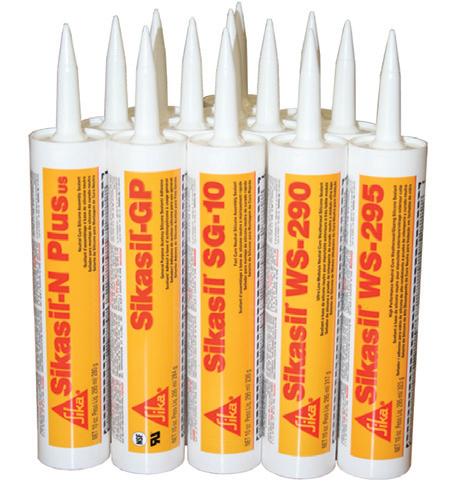
Specialty silicone
www.sika.com
Sika Canada has introduced new additions to its sealing and bonding line for the fenestration industry, the Sikasil line of specialty silicones. Designed specifically as highperformance sealants and adhesives for structural glazing, weather- and joint-sealing, insulating glass and a variety of other specialty applications, Sikasil silicones are designed to be used on a host of manufacturing materials. These silicones, manufactured to exacting standards, are gaining wide acceptance for their ease of use, their fast-curing properties, the strong bonds they create and their permanent elasticity.
The professional-grade products in the line include:
• SG-10, a fast-curing, non-sag, medium-modulus, elastomeric, neutral-cure sealant
• WS 290 and WS-290 FPS, pre-tinted or site-tintable, ultra-low modulus, neutral-cure and no-bleed sealant for weather sealing
• WS-295 and WS-295 FPS, pre-tinted or site-tintable structural glazing-/weather seal-grade, neutral-cure, no bleed sealants
• IG-25 HM, high-modulus sealant for air- and gas-filled insulating glass.
Enclosed glass truck body
www.myglasstruck.com
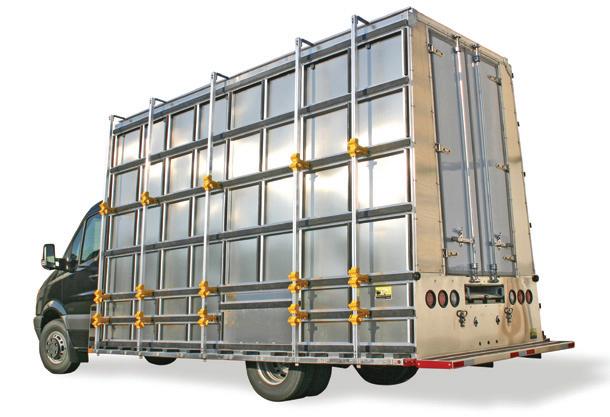
MyGlassTruck.com has announced the release of its new Hero, a distinctive, enclosed, glass carrier truck body that is available in 12-, 14- and 16foot lengths. Engineered for maximum strength and minimal weight, Hero offers superior fuel economy and more payload capacity than bodies constructed of heavier materials riding on the same chassis. Hero’s efficient design uses strong, T6 aluminum, glass racks as part of a robust frame that supports the body’s .060 aluminum wall panels. A welcome alternative to cramped interiors, Hero has more work and cargo space than commercial vans. And, unlike open truck bodies, the Hero’s spacious interior provides protection from the elements and lockable security.
Standard equipment on each side of the Hero body includes full glass rack coverage, and floor-to-ceiling racks can be installed into both sides of the interior. The racks are fabricated from strong, 1/8-inch thick, 6061 T6 aluminum posts and slats joined together with aircraft-grade Huck fasteners that will not crack like welds on aluminum or loosen from vibration like screws or bolts. MyGlassTruck.com racks provide excellent glass protection with rubber padding integrated along the full length of all posts and slats. The glass support ledge at the bottom of the rack is a fully usable five inches deep to accommodate thicker payloads and padded with thick rubber blocks.
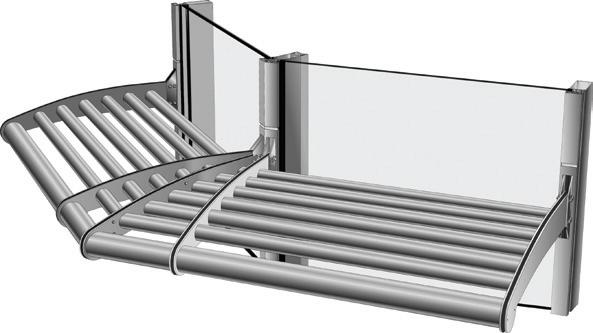
A translucent roof lets the light in for visibility during loading and the floor has a non-slip surface for traction. The body uses a full LED lighting system with sealed wire harnesses and reflective tape at strategic locations around the bottom ledge. Easily removable skirts provide access to the rear wheels for simplified tire changes and maintenance. Lockable, double rear doors with anti-rack hardware offer a wide opening for loading and the cargo bay may be accessed via a rear step-bumper and two stainless steel fold-down steps and/or an optional roll-out walk ramp that selfstores beneath the floor. Other “off-the-shelf” options include sign panels with graphics as well as storage and toolboxes.
For securing glass to the racks, Hero comes with extra-tall, T6 Adjust-A-Poles featuring rubber triangle cleats that can be adjusted forward, backward, and to any position along the shaft. Options include the premium, T6 Super-Pole with the precision adjustability and tension control of scissor-style cleats, and the E-track cargo control system.
All MyGlassTruck.com bodies are designed using an in-house, 3D, AutoCAD system and custom modifications are available. MGT works with all major truck dealers and leasing companies in the United States and Canada and is a member of the National Glass Association and the National Truck Equipment Association.
Easily attached tool tethers
www.gearkeeper.com
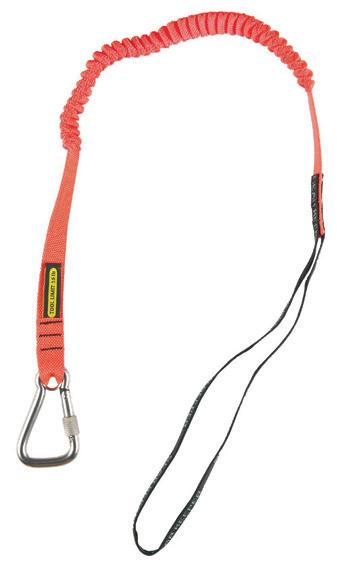
Hammerhead Industries, manufacturers of Gear Keeper industrial tool tethering systems, has announced a pair of new tool tethers for heavy tools and instruments. Both new anchored tethers are designed for attachment to a fixed structure rather than to a person.
The TL1-3025 Fixed Loop Tether and TL1-4025 Fixed Loop Tether are rated at 15 and 25 pounds respectively to keep drills, power drivers, electronic meters and other heavy tools and instruments safely tethered to avoid injury to the worker or the work site.
The fixed loop attachment feature of these new models also permits tethering of tools that have no other attachment point. For example, when a larger loop is required to go around a large handle (for instance, on a chain saw), the worker would just slipknot the fixed loop over the handle.
Easily attached to a fixed object such as a high-rise bucket or scaffolding, the anchored tether transfers the shock load produced by a dropped tool from the worker to the structure. Tethering heavy tools over 10 pounds is a significant safety concern. If dropped, a 10-pound tool can have a shock load that exceeds 200 pounds.
The Gear Keeper model TL1-3025 Fixed Loop Tether has a short retracted length of only 32 inches to avoid entanglement coupled with a low-force extension to 45 inches that minimizes fatigue during use. The coil is covered with high-strength nylon webbing that can withstand tough working conditions.
The model TL1-4025 is a flexible, low profile coil system that provides a 10-foot working radius for tools like power drills, nail guns, power drivers and other heavier weight tools. The coil system is fully enclosed in rugged nylon orange webbing that increases the tether’s overall strength and durability under tough on-the-job conditions for tools up to 25 pounds.
The new Gear Keeper models are also a high-visibility orange in colour and feature a tag that shows the weight of the tool appropriate for the tether as well as such traceability info rmation as date of manufacture,
“This safety tag is a new feature that will help safety engineers make sure that each tool has the proper tether for the job,” said John Salentine, vice-president of Hammerhead Industries. “Safety starts first with the proper mating of both the tool and the tether to ensure productivity and safety in the work environment.”
Engineered back pans
www.spandreltech.com
Galvaspan galvanized steel back pans are installed on the interior face of curtain wall systems in spandrel areas and are secured to the wall framing using appropriate fasteners. The cavity of the back pan is filled with mineral wool or fiberglass that is pin welded to the steel pan.
Galvaspan galvanized steel back pans are available in 20- or 22-gauge galvanized steel, and four profiles to suit a variety of conditions. All brake-formed, back-pan corner joints and seams are spot welded, then sealed using a butyl rubber component sealing compound. The interior side of the pans may be painted as an option when the back pans are visible from the building interior.
In curtain wall construction the control of heat flow is generally achieved through the use of insulation. Although it is not apparent from the exterior, the curtain wall system uses considerable insulation usually behind spandrel glass or any opaque panels. Because of the materials used in the structure (glass and metal) which are highly conductive, the system must also contend with potential condensation on the interior surfaces. To curtail this effect, most Spandreltech curtain wall systems incorporate three distinct features: a sealed, double-glazed window or an insulated metal pan, a thermally broken mullion, and a rainscreen design.
Versoleil expansion
www.kawneer.com
Kawneer Company has expanded its Versoleil SunShade platform. First introduced in a single blade system for curtain wall, Versoleil is now more versatile with the addition of three new sunshade systems: Outrigger for curtain wall and storefront as well as Single Blade for storefront. Pre-engineered for multiple curtain wall and storefront systems, these flexible sunshades offer increased aesthetic choices and more solutions for maximizing shading and energy saving potential. Versoleil SunShades’ Outrigger and Single Blade systems for curtain wall and storefront applications incorporate easily into any building envelope, setting the industry standard for form and function.
Outrigger and Single Blade systems deliver the unmatched breadth and depth of application that Versoleil SunShades are known for. Engineering of common parts and pieces allows for easy fabrication and installation while a uniform attachment approach allows customers to quickly gain familiarity with installation practices regardless of system. To ensure performance criteria were being met, all systems were subjected to a rigorous testing regimen. The end results are durable, pre-engineered solutions that allow for efficient integration of Versoleil SunShades into the building envelope design and can withstand wind, snow and dead loads.
The new Versoleil Outrigger system for curtain wall is a standardized design compatible with 1600 Wall System1, 1600UT System1, 1600 Wall System5, and 1600 SS curtain wall systems. Designed with pre-engineered 90-degree and 135-degree inside and outside corner options, Outrigger is available in 30-inch and 36inch outrigger depths. The revised mounting bracket design allows for shallow, one-inch-deep, curtain wall cover as standard. Optional deep cover also available. There are 44 different outrigger and blade combinations available with sleek blade designs including circular, airfoil, arch, planar, flare, wave, infinity, diamond and square.
Versoleil SunShades can accommodate a full range of colour options. Architectural Class I anodized aluminum finishes are available in clear and Permanodic colour choices. Painted finishes, including fluoropolymer, that meet the American Architectural Manufacturers Association 2605 standards and solvent-free powder coatings, that meet AAMA 2604 standards, are available in a variety of colour choices.
PRODUCTSHOWCASE
Powerful cutting lasers
Hypertherm has introduced two new HyIntensity fiber laser systems: the two-kilowatt HFL020 and the one-kilowatt HFL010. These two new systems join a 1.5-kilowatt system unveiled in 2010 as the first fully-integrated fiber laser systems designed specifically for cutting applications, including marking and fine-feature cutting.
The powerful systems deliver a number of advantages to owners. The deliver high performance on a wide range of applications and consistent cut quality across a number of material types, including brass and copper, and thicknesses up to 16 millimetres on mild steel. They operate at higher cut speeds with lower operating costs and higher productivity than CO2 lasers or plasma cutters on material thicknesses below six millimetres.
HyIntensity lasers can achieve superior cut quality and tolerances for fine-feature cutting on materials from gauge to plate. They feature easy integration and installation onto existing cutting tables, even tables that already have a plasma torch.
All of the HyIntensity systems were developed and manufactured by Hypertherm in the United States, making Hypertherm the only company to offer both laser and plasma cutting expertise. Hypertherm designs and manufactures advanced cutting systems for use in a variety of industries such as shipbuilding, manufacturing, and automotive repair. Its product line includes handheld and mechanized plasma and laser systems, consumables, CNC motion and height controls and CAM cutting software.
The New Hampshire-based company’s reputation for metal cutting innovation dates back more than 40 years, to 1968, with Hypertherm’s invention of water injection plasma cutting. The company, consistently named one of the best places to work in America, has more than 1,000 associates along with operations and partner representation worldwide.
Our product offering is expanding…
You already know us for our high performance polyurethanes. Now discover Sikasil®, our new range of silicone adhesives and sealants –specifically designed to meet the needs of the Façade, Fenestration and Insulating Glass Industries.
For more information about the Sikasil® product range, contact your local Sika representative or Ian Collins at: collins.ian@ca.sika.com or 1-800-688-SIKA.
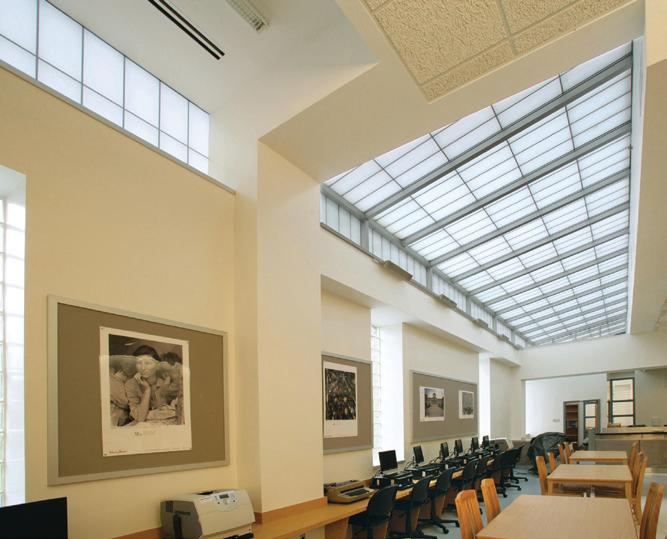
Major Industries, manufacturer of energysaving skylights and translucent curtain wall, is pleased to announce the release of BIM product models for our Guardian 275 line of translucent panel skylights and wall systems.
Major’s product models were created with the architect in mind, and offer small file sizes and emphasize ease of use. BIM content is available for all of Major’s most common skylight configurations as well as both window and curtainwall options to accommodate a wider range of users.
Guardian 275 BIM product models are currently available for download from the BIM page on Major Industries’ website. Energy-efficient curtain
wall
www.crlaurence.ca
The U.S. Aluminum Series HP3253 high-performance curtain wall system for two-inch efficient triple-glazed infills features Dual Thermal Break technology using the Poly-Aluminizer thermal break. Thermally isolated by a continuous thermal spacer it has been especially engineered to satisfy the need for energy conservation. Two-tone colors can be achieved by using different finishes for the exterior face members and the interior mullions. The HP3253 curtain wall features stick erection with no exposed joint fasteners.
RESOURCEDIRECTORY
by JOHN ROPER
John Roper is the editor for The Installer, The Fabricator, The Conservatory Installer and Glass Works magazine published in the U.K.
Small business baffles politicians
Last year was one hell of a year. The global banking cock-up seems, over here, to have turned into a government cock-up. Euro-wide nobody seems to be able to get a grip on things, and in the U.K. the public sector unions have been running rings around the government as they fight tooth and nail to keep their members featherbedded. Notably, none of the perpetrators has ever had a real job or worked in the real economy. The result is the world economies are now being run by a bunch of yahoo casino operators colloquially known as The Markets.
As our whole economy seems to pivot on buying and selling bits of paper, those of us who actually make stuff are broadly ignored. The U.K. government does have a scheme in place – the Enterprise Finance Guarantee – which is supposed to help small and medium-sized enterprises. Under it, the government acts as guarantor on bank loans between 1,000 and 1 million pounds.
There seems to be a bit of confusion going on, according to the chief spokesman of our Federation for Small Business. He cites companies going into banks and not getting a conclusive response to questions about the EFG. In a report in the Daily Telegraph he cites one company that was told the EFG is no longer available. The managing director of that company said, “At a local level, most of the banks actively dissuade you from trying to use it. They see it as a 25 per cent exposure to risk.”
When I started my own business back in the ’80s there was a small business loan guarantee scheme in place. It seemed like a good idea. But the paperwork was horrendous and, it turned out, the bank still wanted my house as a guarantee for the bit the government wouldn’t cover.
One day someone will realize that the only way to actually make money is to make stuff.
In the end it didn’t seem worth the effort so I signed up the house for the lot and spent the next decade working for the bank.
(In case you are interested, I still have the house, I am still in business and I don’t owe the bank a penny.)
The problem is that, over here, the government cannot make its mind up what a small business is. The current EFG is available to firms with a turnover of up to 55 million pounds. In the past, other governments have announced measures to help small business and the only people who could benefit were self-employed, one-man bands. It comes down to what sounds good on the day – usually budget day.
As good as it is to bash the bankers – and they are an arrogant lot – the real root of the banking crisis worldwide was inept government. Back in the ’80s our government (under the almost legendary Margaret Thatcher) closed down our coal industry and then set about destroying our manufacturing sector in the idiotic hope that we could survive as a service nation. Things got worse with the last labour government’s drooling obsession with wealth and its obsequious relationship with the finance industry. Between them the politicians really cocked it up.
These days we do not see people who run businesses going into politics. In the main they are professionals who left university with an ambition to be politicians. Politics is just another industry that has grown up out of nowhere, like security, and health and safety. And, like security, and health and safety, it is parasitic on the people it is supposed to be serving.
The fact is recessions come and go. I can remember at least three and I was running my own business through two of them. The scars you pick up on the way are just part of the learning curve. This one seems a bit different right now but then they all have their character. Eventually there will be another distraction, and the banks will realize that they make their money by lending to, and supporting, the likes of us, not just gambling with bits of paper.
And one day someone will realize that the only way to actually make money is to make stuff. •