Canada- 1 Year $39.00 (with HST/QST $42.12) U.S.A. - 1 Year $54.00 (in US dollars)
From time to time, we at Glass Canada make our subscription list available to reputable companies and organizations whose products and services we believe may be of interest to you. If you do not want your name to be made available, contact our circulation department in any of the four ways listed above.
www.glasscanadamag.com
EDITORIAL
Bringing you more
Glass companies are trying to keep up to a rapidly changing industry in a rapidly changing world.
There are several issues facing the glass industry and Glass Canada is the only Canadian trade magazine dedicated to addressing the factors that impact glaziers, suppliers and manufacturers in this industry.
For 20 years the magazine has been covering the glass, metal, fenestration and auto glass industries with each issue presenting practical information that is integral to the glass professionals in this business.
Technological advancements in glass and glazing products, modernized business practices, the evolution of e-commerce and the Internet, consolidation shifting the balance of competition and new safety initiatives all directly affect the way glaziers do business today, and how it will be done tomorrow.
Successful glass companies need to keep up-to-date on the variables that may impact their business and Glass Canada is the key to keeping them informed.
Published by Canadians for Canadians, each issue contains information that is integral to the industry. Articles cover the tool, equipment, machinery and installation techniques that are essential components to glass professionals while industry news releases report on new trends entering the market.
For more than two decades this exclusive publication has put the spotlight on the glass industry six times a year, but now Glass Canada will be shining the spotlight on the glass industry every day. Launched in 2008, www.glasscanadamag.com is a website dedicated to the Canadian glass industry, very much like the magazine.
You can find news articles and in depth stories about new and unique
NEXT ISSUE:
glazing projects across the country or access archived articles of previously published stories in the magazine. Missed an issue? No problem, get online and view a digital version of the magazine. Trying to contact an advertiser about an ad you saw? Just click the link and go directly the advertiser’s website. Got something on your mind? Write a blog or read somebody else’s blog to see what others are saying. Take part in the glass industry web poll or check out the polling results. Wondering about upcoming glass shows? Well, you can check that out too. Have an idea for a story, click the editor’s link and send me a note.
Like the tools on a glazier’s tool belt, the website is a valuable extension of what we do. A tool that allows us to reach more of our readers, with more glass industry content, more often. In essence, the website brings you more of what the magazine has to offer in a medium that provides a forum for glass professionals and their suppliers to learn and share industry developments.
Glass Canada is dedicated to covering the glass industry…in print or online. Editor, Chris Skalkos
The next issue of Glass Canada will look at interior glass systems and glass coating technology. Watch for it in April!
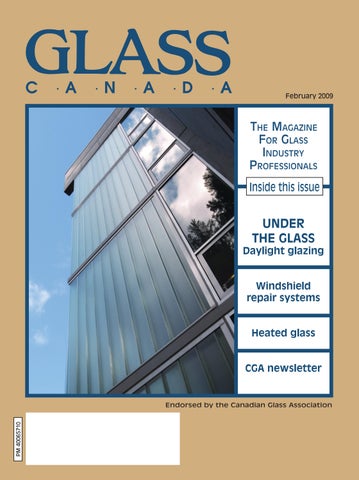
Cover: Photo courtesy of Technical Glass Products (TGP).
DAYLIGHT GLAZING MATERIALS Northern Lights
By Jeff Razwick*
Daylighting options expand with channel glass.
With a cool climate and most of its land closer to the North Pole than the equator, many may overlook the strong opportunities for using daylighting designs in Canada’s buildings. However, architects, glaziers and other building professionals can take advantage of daylighting benefits that are commonly realized in more southern locations.
Daylighting is a deliberate and integrated design strategy that uses sunlight to illuminate interior spaces. The goal is to reduce energy use and improve the productivity of people inside the building, as well as their wellbeing. Building owners and employers, in turn, receive substantial monetary benefits.
According to the Daylighting Guide for Canadian Commercial Buildings published by Public Works and Government Services Canada, there are several factors that make Canadian buildings well-suited for daylighting. First, Canadians spend much of their time indoors during the winter. Second, daylighting works best with diffused, rather than direct, sunlight because this helps overcome challenges with heat gain/loss and glare.
Illumination from the sun is sufficient for daylighting in all but extreme northern areas of the country where short days prevail for extended periods. At 46 degrees north latitude, where most people live, average solar lighting under overcast skies is about 15 times greater than required for typical indoor tasks.
The keys to effective daylighting are to capture sufficient natural light, while avoiding the problems of too much light. While daylighting design guides frequently discuss the use of various classes of window glazing, alternative glazing materials now available in North America are expanding the options.
Notable among these is channel glass. Its unique properties provide a clear way to overcome the challenges of daylighting in cold climates.
The framing system and narrow glass channels allow formation of straight walls, or curved and serpentine walls.
Responding to daylight
A range of studies detail the benefits to building users and owners from daylighting. The Daylighting Guide for Canadian Commercial Buildings summarizes the advantages as: improved lighting quality, better occupant comfort and health, increased productivity and retail sales, reduced auxiliary lighting load, reduced cooling load and reduced peak electricity demand.
People also respond better to fullspectrum natural light than the artificial light created by incandescent or fluorescent lights.
In addition to the benefits for building occupants, daylighting provides energy savings which is helpful to both the environment and for reducing building operating costs.
Studies suggest that daylighting can reduce total energy costs for commercial buildings by up to one third. Savings come from reduced reliance on electric lights, less need for heating on colder days, and diminished cooling system requirements to offset waste heat from artificial lights.
Effective daylighting requires more than adding windows. It is a careful
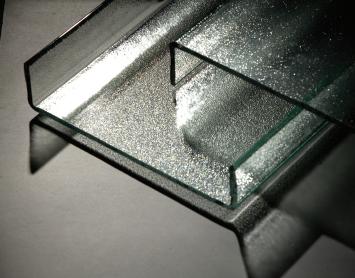
Channel glass systems, such as Pilkington Profilit, consist of self-supporting “U”-shaped cast-glass channels mounted in an extruded metal perimeter frame.
DAYLIGHT GLAZING MATERIALS
balance between capturing light, managing glare, and supplementing illumination with controlled artificial lighting. For buildings in colder climates, addressing heat loss through the glazed area is crucial.
Direct sunlight can distract building users and offset the benefits of receiving natural light. Glares on windows and computer screens are particularly annoying. Likewise, direct sunlight can raise interior temperatures uncomfortably or require additional costs for cooling. Designers can overcome these problems with building design and placement, automated systems, and selection of construction materials.
In addition, achieving the energy savings from reduced lighting requires co-ordination between glazing design and lighting control systems. If a
The channels come in lengths up to seven metres and can be installed vertically or horizontally. In vertical installations, channel glass typically does not require intermediate mullions.
For example, channel glass is increasingly being used given its unique abilities to fulfill daylighting needs.
Channel glass systems, such as Pilkington Profilit, consist of self-supporting “U”shaped cast-glass channels mounted in an extruded metal perimeter frame. The channels come in lengths up to seven metres and can be installed vertically or horizontally. In vertical installations, channel glass typically does not require intermediate mullions.
building captures natural light but doesn’t have automated systems to reduce artificial lighting, the result can be a net increase in costs due to higher cooling demands.
For winter months, in particular, the glazing must also be designed to reduce heat loss since glass tends to transfer heat at a higher rate than other building materials such as wood and concrete.
Channel glass
Many design professionals are accustomed to using specialty glazing for daylighting applications. Highperformance, energy-efficient windows help lower heat gain/loss. Coatings, films and tints can diffuse light and reduce glare. At the same time, more daylighting designs rely on alternatives to traditional window glass.
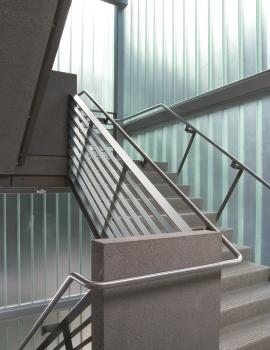
The framing system and narrow glass channels allow formation of straight walls, or curved and serpentine walls with tight radii (as low as two metres). These various properties enable designers to create large, uninterrupted areas of glazing for interiors or exteriors, which works especially well for capturing daylight.
In addition, channel glass performs very well on one of the specific window placement recommendations identified in the Daylighting Guide for Canadian Commercial Buildings : using strip windows for uniform office lighting. An uninterrupted span of glazing provides sufficient lighting to a room without contrasting shadows as is typical with individual window openings.
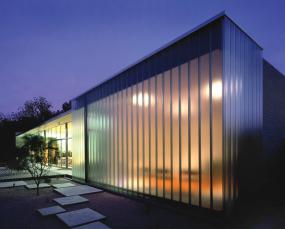
Channel glass is also available in a variety of colours and textures with varying translucency, allowing for the passage of natural light without the loss of privacy. It provides warm, diffused light for interior spaces without glare.
Energy efficiency
The configuration of channel glass systems helps them reduce heat gain/loss.
DAYLIGHT GLAZING MATERIALS
The individual glass channels are mounted in an overlapping fashion, creating an insulating air-filled space. Thermally broken frames are also available to reduce heat bridging. The U-value of the glazing and framing system is 0.53. The glass is also available in a Low-E variety with a system U value of 0.42.
To further enhance energy performance, insulating aerogel can be placed in the enclosed space between the channels
Installing Channel Glass
While not difficult or complex for a professional glazier to install, channel glass requires specific procedures for proper installation. In some cases, these differ from steps used with window glass. Here are some general installation tips for a typical, exterior, vertical application. Be sure to consult the supplier’s documentation for specific methods and requirements.
Measuring frames
First, prepare the structural opening by checking to ensure the supporting structure is square, plumb and in plane. Measure the opening sizes and cut the head, sill and jamb sections taking into account caulking bead clearance requirements and frame expansion. Miter or cope and butt the joints at the head. Cope and butt joints at the sill.
Attaching frames
Place all fasteners approximately 30 to 45 centimetres apart, or as recommended by the engineer of record (specific fastener type depends on the supporting structure). Couple frame members exceeding seven metres in length with an expansion joint material as supplied by the manufacturer. Internally seal the corners and joints.
Cutting channel glass
Tempered glass and annealed glass can be provided cut to length, but for glass cut on site, use the following procedures: Place the glass channel on a flat surface, preferably cushioned with felt or other suitable materials. With the flanges pointed upward, cut the glass channels by hand or with a special saw. To cut by hand, use a cutting
template or straight edge to ensure a straight cut. Begin by scoring the flange farthest away, starting at the corner and working upwards; return back to the corner of origin and start the cut across the face of the glass and continue up the flange closest to the cutter in one continuous motion. Make a light glancing blow to the top edge of the flange opposite the cut on each side of the glass channel. Place the glass-cutting tool under the glass channel and apply light pressure to the flanges of the glass to snap it cleanly across the cut line. Seam the ends of the glass with a disc or belt sander specifically designed for glass edging, taking special care to smooth any irregularities caused by cutting.
Installing glass
Clean all internal surfaces of the glass with an alcohol-based glass cleaner and apply flange gaskets on each flange of every channel. Installation of the glass channels can begin at either the centre point of the opening or at either end. Consult the manufacturer for the size of joint between the channels. Pocket glaze the channels by inserting into the plastic liners located in the head and then lowering the glass down onto the corresponding plastic insert located in the sill.
Sealing the system
Prior to the application of any sealant, check glass joints for consistency and plumb. Install special channel glass shims across internal and external joints and seal all glass-to-glass and glass-to-aluminum joints with approved silicone sealant.
Coloured and textured channel glass, with varying translucency, lets in natural light without the loss of privacy.
to reduce the system U-value to 0.32. Products such as Nanogel aerogel are translucent and helps promote soft, even light dispersion, while reducing condensation and unwanted noise. This advanced material is sometimes called “frozen smoke” since it is one of the world’s lightest solids.
Designers are able to create large, uninterrupted areas of glazing for interiors or exteriors, which works especially well for capturing daylight.
Channel glass systems have been used in Europe for more than 30 years, where they have performed very well in cold, northern climates.
For architects, designers and glaziers, realizing the benefits of daylighting does not need to be difficult, but does require careful planning. Numerous design guides are available in print and online, and professional courses are available to learn the nuances. When incorporating daylighting design concepts, remember that alternative glazing systems may be especially suited for the specific design challenges. ■
*Jeff Razwick is the vice-president of business development for Technical Glass Products (TGP), a supplier of firerated glass and framing systems, along with specialty architectural glazing products. He writes frequently about the design and specification of glazing systems for commercial buildings. He can be reached at: jeffr@fireglass.com.
AUTO GLASS NEWS
PROSTARS alliance launches program for auto glass shops in Canada
PROSTARS, an alliance of independent glass shop retailers in the U.S., has expanded to Canada with Pittsburgh Glass Works (PGW) in New York, conducting the recruitment for the program.
“We’re taking the skills and dedication of the independent glass shop community combined with the efficiencies of electronic connectivity to create an industry leading network,” says Bruce Christie, director of branch sales and operations for PGW Canada. “Because we electronically integrate coverage verification, dispatching, appointment scheduling and part ordering; policyholders and insurance companies benefit from a consistent, accurate process that meets the needs of each party,” he says. “With the METRYX Industry Services Registry that we’ve just launched, we enable our participating glass shop retailers to effectively and efficiently self-manage their service area, capabilities and marketplace offerings. ”
In addition to electronic integration and connectivity, PROSTARS participant glass shop retailers in Canada will have a variety of business growth, operations/training and marketing tools available to them. Further, retailers will be certified through I-CAR and will offer a warranty that will be honoured by all PROSTARS participant locations throughout North America.
“We know that independent glass shop owners deliver exceptional customer service and technical competency,” adds Christie, “but in today’s networked, single-point-of-contact marketplace, it has been difficult for them to win access to large insurance and fleet contracts. PROSTARS participant glass retailers and LYNX Services provide an alternative solution for Canada’s insurers and fleet managers.”
LYNX Services is a leading third-party administrator for auto glass insurance claims in the U.S., and offers an array of processes that deliver efficiencies and exceptional services for the insurance industry and their policyholders. With three call centres, LYNX Services currently manages more than three million claims per year in the U.S. The third call centre for managing Canadian claims opened in Winnipeg, Man., in the
third quarter of 2008.
Fahmy Mechael, vice-president of business development for LYNX Services, says insurance and fleet management executives want a process that enables policyholders to deal with their insurance claims in a single phone call. “The electronic connectivity between our call centres and the independent glass shop owners offer the solution. Our clients in the U.S., know the value of having access to a connected marketplace versus the limitations of being restricted to the service from a single company,” he says.
Introduced in 1999, PROSTARS was developed to enhance the marketing, customer service and quality performance of independent glass shop retailers. It is a nationwide, independent alliance of auto glass professionals who back their work with a national warranty. Participants have access to sales, marketing and business development tools built for the auto glass industry.
www.ppgprostars.com ■
Courage Film Fest tints-off in 2009
With more than 400 attendees expected, multiple product demonstrations taking place, manufacturer representatives present and the always popular TintOff competition, the Courage Film Fests will continue their tradition of attracting industry specialists in 2009.
Courage Distributing holds Canada’s largest event for glass tint professionals, with Film Fest taking place this year on February 21-22, in Vancouver, B.C., and on March 7-8, in Toronto, ON., About 30 tint professionals participate in the Tint-Off competition which has become a popular highlight for the event.
“The competition gets fierce but there are also a lot of laughs and everyone has fun,” says organizer, Todd Courage. “Last year, for the first time in the history of the competition, we had one tinter win at both locations and become Canada’s Best Window Film Installer. We also welcomed more attendees than ever before. We had a lot of support from all of the dealers who came out to the seminars and made them a huge success!”
The Courage Film Fest is supported by many representatives from leading manufacturers such as 3M, VentureShield, Hanita Tek, and Remlor. Each manufacturer holds educational seminars, provides hands
on demonstrations and takes the time to answer questions.
Established in 1992 by brothers, Todd and Trent Courage, Courage Distributing is a Canadian distributor and manufacturer of window films and automotive aftermarket products. The brothers are also the founders of the Polar Bear Dip for World Vision, which takes place every New Year’s Day in Oakville, Ont., which has so far raised $320,000 for the charity.
www.courage.ca ■
A second bronze needed for auto glass competition
From left: Gergely Igazvolgyi, Jeff Olive, Toshiyuki Isohata and Daniel Andersen, share the winner’s podium at the International Master Fitter Competition.
The final outcome of The International Master Fitter Competition 2008 held during Glasstec came to a surprising end with organizers searching for an extra medal.
Both Japan and Denmark finished third with auto glass replacement technicians Daniel Andersen from Denmark and Toshiyuki Isohata from Japan, sharing a bronze medal. The gold medal and the title of International Master Fitter 2008, went to Jeff Olive from the U.S., who also won The National Glass Association’s (NGA’s) American Master Fitter Installer Championship. The silver medal went to Gergely Igazvolgyi from Hungary. Other countries taking part in the competition included Germany, France, Italy, The Netherlands, Norway, Romania and Sweden. The participants of the competition took part in a performance evaluated contest of replacing a side window, replacing a back window, repairing a windshield and replacing a windshield. Each of them had a new Mercedes Benz C-class vehicle to work with.
AUTO GLASS NEWS
The competitors of the International Master Fitter Competition held during Glasstec are judged based on a set of criteria evaluating the quality and safety of their work.
The rules of the competition were based on criteria for quality and health and safety only. It is judged by 12 people.
InterAutoGlass’ managing director Pim de Ridder says all of the competitors exhibited a high degree of technical skill with a focus on quality which is what this event is trying to promote.
The International Automotive Glass Federation was formed in 2007. Its mandate is to support technical standards and codes, training programs and health and safety issues for auto glass technicians or fitters.
www.interautoglass.org ■
Sika’s next generation surface preparation
Sika has introduced its newest generation in auto glass surface preparation with two products. Sika cleaner S is an organic solvent-based cleaning agent for heavily soiled surfaces that cannot be sufficiently cleaned with standard cleaners.
Sika Aktivator PRO is a unique pretreatment system that has been especially designed to provide adhesion on AGR substrates. It has a wide temperature range and short flash-off time for a single wipe-on process in all seasons without special requirements for winter conditions.
The company says that it is working to support its customers in the auto glass adhesive replacement industry with low cost installation systems and by providing technical field service.
www.sika.ca ■
Silicone gel allows re-use of light sensors
Gold Glass Group’s (GGG) newly developed two component silicone gel allows most round type rain and light sensors to be re-used avoiding expensive replacement costs. These include the DW01659 as well as many other current models. Applied easily and quickly through a special mixing syringe, the old sensor can be reattached to the windshield using GGG’s SensorTack refill gel after only a few minutes.
The company says it has developed a system that is inexpensive and easy to use. GGG’s SensorTack refill gel has a short curing time so it can be used in auto glass shops or for mobile applications. A heater box is available to reduce curing times for applications in colder temperatures. The heating box also has a built-in level indicator and fully adjustable feet.
Gold Glass Group is a supplier to the automotive glass market specializing in brand part specific moldings or universal moldings for the ARG market as well as a full range of products supplied to windshield manufacturers. GGG also supplies tapes, foam cores butyl, rain/light sensors, clips, and tools for auto glass professionals.
www.gggcorp.com ■
Windshield repair resin unaffected by moisture
Crackmaster Distributors has introduced a new waterproof windshield repair resin from Ultra Bond. Auto glass shops will never get rained out of doing windshield repairs again with the new Rain Resin. This new chemical formulation is not contaminated by water or moisture and it will not lose clarity or adhesion when there is water or moisture in the stone-break.
This new windshield repair resin for stone-breaks retains its bond as water and moisture are displaced with a windshield repair tool. The water is displaced the same way air is displaced, by vacuum and pressure, however, unlike present windshield repair resins it is not contaminated by water and the refractive index remains the same.
As the water passes through the resin it has no affect on the resins bond or refractive index. Even if the windshield repair tool has little to no vacuum and leaves water in the break
it will not affect the bond or refractive index. Exposure tests both visually and structurally were unaffected with a mixture of water and resin.
www.crackmasterscanada.com ■
Apple Auto Glass rewards customers
The Apple Auto Glass 2008 Fix It N’ Win 25th Anniversary Sweepstakes came to a conclusion on Dec. 17 with 125 Apple Auto Stores participating across Canada.
The annual contest is designed to reward the company’s customers. From September to November, customers received scratch and win cards with a chance to win instant in-store prizes consisting of gas cards from $5 to $50. In addition, customers were eligible to enter the grand prize draws.
Since Apple Auto Glass is celebrating its 25th anniversary, the total number of grand prizes was increased to nine nationally. Each region had three grand prizes: a trip for two to the Mayan Riviera, Mexico, a home theatre system consisting of a 52-inch Samsung FlatPanel LCD HDTV with a Blu–ray disc player and $2,500 in gas money.
The company received more than 11,500 entries over an eight week period and the winners were notified just prior to Christmas.
Trip for two Mayan Riviera, Mexico, winners:
Tina Fuller, Coldbrook, N.S. Jacques Lamoureux, Chelmsford Ont. Sherry Kidd, Surrey, B.C. $2,500 Petro Canada Gas Card winners: Claude Anctil, Moncton, N.B. Robert Saunders, Sudbury, Ont. Chris Penner, Langley, B.C. Home theatre system winners: Agnes Pastuck, Sydney, N.S.
Randy Rowcliffe, Simcoe, Ont. Carla Lagore, Langley, B.C. ■
EUROPEAN SCENE
An umbrella for the sunshine
By John Roper*
I see business getting on with the business of doing business.
How is it for you? A few months ago I wrote in this column that the U.K., window industry was going to hell in a handcart, well now it seems we are all following it at a rate of knots. It seems to me though that we in the U.K., are given a somewhat warped view of the situation. The government is spinning doom-and-gloom at every turn – businesses closing, especially in retail, unemployment spiralling out of control, house prices crashing, nobody able to get credit because the banks won’t lend back to us the billions of tax money they have been given by the government to do just that.
I say this is government spin because, while no one can deny the banks have been in huge difficulty and that is showering down on the rest of us to some degree, our prime minister has
discovered that the worse things seem, the higher his personal ratings in the polls. Why this should be is beyond me, given that he exacerbated the problem when he was Chancellor of the Exchequer (finance minister) by funding a boom based on cheap credit, easily available, supported by an overpriced house market and his solution to the problem is borrow more and spend-spend-spend.
But, in the real world it is hard to work out what is going on. Admittedly, people are losing their jobs but before the ‘recession’ was announced we kept hearing about how many job vacancies there were. The majority of businesses that I talk to seem to be doing okay, at least the well managed ones and as for the retail sector, admittedly there are a lot of low prices out there right now, but the shops are crowded. My favourite measure, there are five restaurants within walking distance of where I live and most nights of the week you will not get a table without booking in advance.
So whilst we are being bombarded
with news stories about redundancies and business failures – most of which problems pre-date the recession – and in particular about lack of credit, I see business getting on with the business of doing business. And on a personal note, far from finding credit hard, in the week after the Christmas holidays I was offered a pre-approved credit card, had a bank on the phone wanting to quote me for taking over my mortgage and my wife’s business bankers tried to persuade her that her business needed an overdraft despite the fact that the account has run with a cash surplus for 12 years. Perhaps the reality is that banks are getting back to normal, they will lend you an umbrella when the sun shines and take it back again when it rains. ■
* John Roper is the editor for The Installer, The Fabricator, The Conservatory Installer and Glass Works magazine published in the U.K. His comments reflect his opinions from the U.K. and may not be applicable in Canada.
AUTO GLASS Making windshield repair work
If you operate an auto glass shop, there is a pretty good chance you have various tools and equipment to make your job quicker and easier. You probably also have an extensive inventory of windshields, or at least have quick access to whatever windshields you may need. In addition to windshields, you may also offer aftermarket services like running boards, window tinting and wood dash trim kits. The purpose of having all these products, along with the right tools, is to be able to effectively service your customers and give your business the competitive edge.
However, there is one vital piece of equipment that may be missing from your shop and the shops of many of your competitors. This equipment has the ability to bring in new business and create a major source of income. What is it? A windshield repair system.
Over the last few years, windshield repair has come into a field of its own. No longer is it the ”snake oil” of the glass industry. Today’s systems have the ability to produce repairs that meet or surpass the expectations of both retail and wholesale customers.
But if windshield repair is so profitable and easy, then why are there so few auto glass shops offering it? Some will tell you windshield repair takes away from replacement business. Others will tell you that windshield repair equipment is unreliable and does not make acceptable repairs. Those are both valid concerns, but are based on a lack of marketing skill and product knowledge.
Increase new customers
With regards to windshield repair taking away from replacement business, there will always be damaged windshields that cannot be repaired. But there are a lot of repairable windshields that may never see the inside of your shop. Why? Because the owners of these vehicles don’t know that their windshields can be repaired, usually with their insurance companies paying 100 per cent of the cost. By offering windshield repair, you can reach all these potential customers and by bringing in new customers, can also increase your replacement business.
As for finding the right windshield
Today’s windshield repair systems have the ability to produce repairs that meet or surpass the expectations of both retail and wholesale customers.
repair system for your shop, there are a lot of choices. Like any other piece of equipment, you have to find one that meets your needs. From a practical point, you will want to make sure the system uses components that last. Avoid systems that use a lot of plastic parts and make sure the system is easy to use.
A system that is difficult to operate can lead to costly mistakes. One of the most important points to look at when deciding on a repair system is what process the system uses to make repairs. Many low priced systems use a screw pressure process. While this may be quick, the repairs tend to be poor. Most times they can still be seen as air tends to get trapped inside the break. This air looks black when viewed from an angle and over time can expand with heat and cause the break to spread.
Some manufacturers have introduced a newer process that involves a pump, manual or electric, that removes the
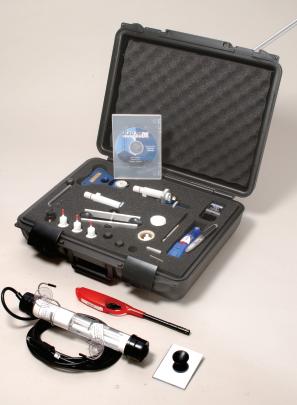
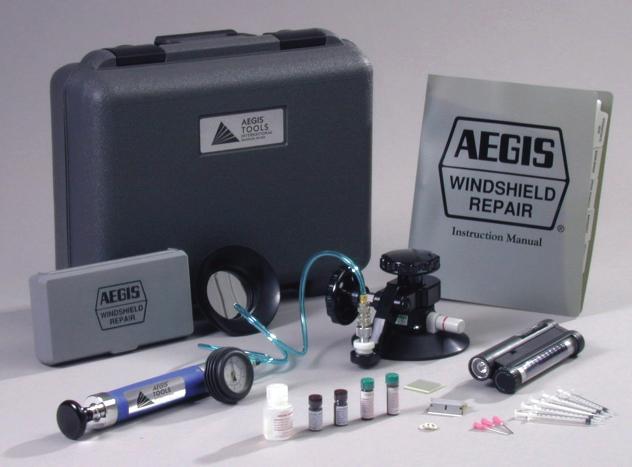
When comparing windshield repair systems consider what materials the components are made from and what accessories are included in the kit.
Photo courtesy of CR Laurence.
Photo courtesy of CR Laurence.
AUTO GLASS
air in the break prior to injecting the resin. This process is catching on, as the repair quality is visually superior to the screw pressure process. However, keep in mind that some hand operated pump systems cannot produce enough vacuum to remove the trapped air.
When shopping for a windshield repair system, it’s easy to become confused. It seems every manufacturer claims its system to be the best while showing how everyone else’s is junk. This is a purchase not to be taken lightly. Your business depends on being able to provide the highest level of service. Every tool and part you use must perform exactly the way it’s supposed to.
Look for manufacturer support So how do you know what system is right for you? The best way to get product information is by calling the manufacturers. Most of them have videos and catalogues that will show you how their systems work. You can also get a lot of information from their websites. Here are some key points to think about when comparing systems:
What materials are the components made from? Metal is best: plastic components tend to wear out from
regular use. What accessories are included with the system? Check to see if a drill and UV light is included. See
Windshield repair systems can generate extra income from repair service work by bringing in new business.
Photo courtesy of CR Laurence.
AUTO GLASS
how much resin is included. Will you have to purchase additional components or upgrade to better accessories?
What repair process does the repair system work on? Screw pressure is based on old technology and tends to produce repairs that are not visually clear. Look for systems that are based on a vacuum/pressure process.
Retains the vacuum
Is there a pump? Is it manual or electric? Although manual pumps are less expensive, electric pumps provide
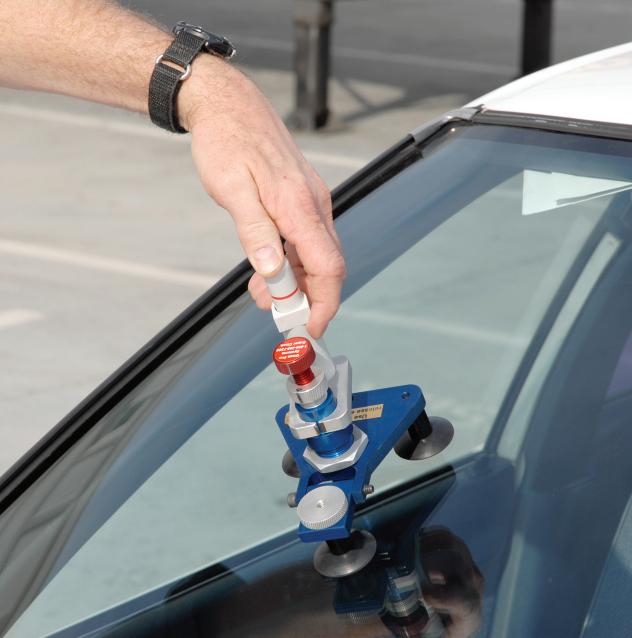
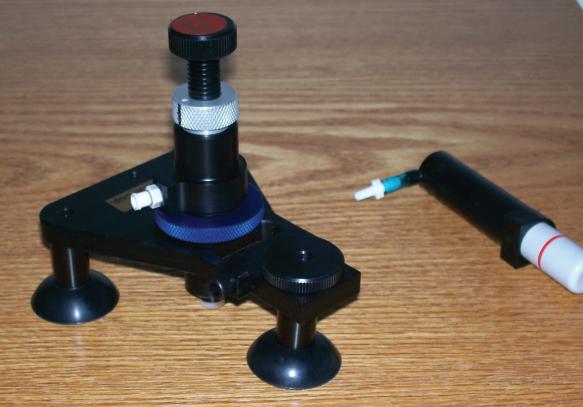
Glass Pro Systems has announced its latest addition to its arsenal for windshield repair: the Annihilator! Made mostly of Delrin, which is very strong, lightweight, and is totally impervious to chemicals, this new tool is designed for vertical repairs to windshields as well as any repairable damage to the glass on a windshield.
The Annihilator has a vacuum pump system using a modified Wood’s pump and is quickly attached and removed from the vacuum chamber with a slip luer. It has been designed this way to eliminate any possibility of fouling out the pump. The slip luer is a friction fit that enables a positive vacuum with a quick connect and a quick disconnect feature. Once a vacuum is in place the pump can be swivelled as needed and still retain the vacuum. Once the injector is lowered to the glass the Wood’s pump can be quickly disconnected. The tool is extremely fast and completes very high quality repairs with minimal training. The total weight is 9.3 ounces without the pump and 10.3 ounces with the pump attached.
Michael Curl, president of Glass Pro Systems, says what makes this tool unique is the secondary vacuum, which is actually creating a strong suction right in the resin pool. He says this is much more effective compared to techniques that use a vacuum zone over the resin because the surface tension in the resin has a fluid connection and draws a motion in the resin to extract any remaining air from the break. This allows for much better repairs and higher quality on a consistent basis.
Parts include:
Vacuum chamber with female slip luer
Injector and piston (Injector anodized aluminum)
Hold down nut (Aluminum)
Adjustable bridge with allen screw to pivot end.
Standoff legs (aluminum) and suction cups
Rear adjuster screw
Modified Wood’s Pump with male slip luer
O-rings and insert seal (seal to glass and vacuum chamber)
the best control and generally make the best repairs. What kinds of repairs do you want to make? Some systems may only be able to repair certain types of stone chips.
Others may only be able to make repairs on specific areas of the windshield. This could hinder your ability to effectively make windshield repair work for you. Check to see the limitations of each system.
What kind of aftermarket support does the company offer? Is personnel training available? How about technical support? Make sure there is a good warranty on your system.
Where is the manufacturer based? Try to look for companies that are located relatively close. Having to deal with currency exchange and customs can lead to big headaches when you are waiting for a new part.
Adding to your service
Even after you have found a system you like, the issue of cost can play a big part in deciding whether to get it or not. But don’t let it be your number one concern. Keep in mind that your markup for each repair is many times higher than that of windshield replacement. Many small to medium sized glass shops can generate additional revenue by offering windshield repair. Also, keep in mind that powered systems tend to be more efficient and quicker than manual systems. This can further help to reduce your cost per repair.
Once you have your windshield repair system, you need to let the world know that you can do the best repairs! To do this you need to do some marketing. That doesn’t mean you need to spend money though. First check out some used car dealers. Then hook up with some fleets like cab companies, couriers and car rental places. If you are already doing work for them, adding windshield repair to your list of services is easy. Remember that by offering ways for your customers to save money, you will in turn make more money.
One thing worth noting, windshield repair, like all your other services, is just one part of your business. It is all the products and services added together, backed by great customer service, that will ultimately decide how successful your auto glass business is. Remember that you are not in business to replace or repair windshields, tint windows, or sell accessories. You are in business to turn a profit. ■
GLASSBUILD SHOW REVIEW
Cautiously optimistic
By Rich Porayko*
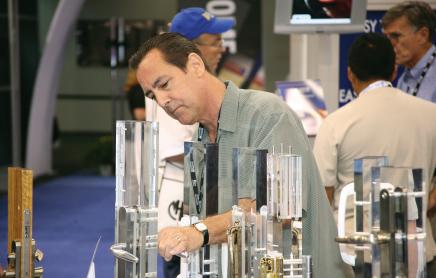
The mood at the GlassBuild America show held this year in Las Vegas, Nev., from Oct. 6-8 could be summed up in two words; cautiously optimistic. Yes, attendance was down and the show had fewer exhibitors than previous years, but as with all things in life and business, the event is about quality not quantity. The show is widely recognized as one of the best marketing venues for the glass industry in North America. It is literally a showcase of who’s who in the industry.
Of course the hot topic at the show was the economy, however, most exhibitors and attendees shared a united confidence that although there would be significant changes yet to come, companies that have the ability to adapt to the new conditions would persevere. They recognize that there are problems out there, but they see it as a correction.
Just weeks before the show, Calgary, Alta., based decorative glass fabricator Goldray Industries Ltd. announced that they had recently purchased 50 per cent of Brooklyn, New York based Colonial Glass. “New York is a really huge market for us; they just love decorative glass.” says Cathie Saroka, marketing director. Goldray, who was exhibiting at the show, has been selling decorative glass products such as
backpainted wall cladding for lobbies and elevator interiors as well as silkscreened product for partitions, bridges and glass floors to the market in New York for about 20 years.
“Sales are still increasing. We know that there are some serious issues in the U.S., and we’ve been seeing many residential companies losing 30-60 per cent of their business, however, commercial has still been good for us. Some of the projects that we have been working on have been cancelled, but there is still so much work out there that we’re not seeing any real business lost yet. There are definitely problems in the construction market and we’re not naive enough to believe that it won’t affect us, but so far we’ve been lucky,” says Saroka.
The new glass economy hasn’t been without its challenges,
Photo courtesy of the National Glass Association (NGA).
GLASSBUILD SHOW REVIEW
however, as Saroka explains, “AGC closing their plants has had a really big impact on us, mostly because of their textured glass which now has a very limited availability. Now we’re scrambling to find alternates because we have jobs that we bid one and two years out that are using AGC glass and we’re having trouble sourcing it so we’re trying to find a substitute. We get the rest of our domestic supply from PPG.”
With glass shortages comes price increases, “We’ve had about a 25 per cent increase on our glass in the last couple of months so we had no choice but to raise our price for glass only,” says Saroka, however “we haven’t added anything to the decorative or value added services. Our raw materials are going up and we have to pass those increases on to the customer which are all-inclusive prices as we don’t have an energy surcharge on top. We feel it doesn’t fluctuate enough to change prices and we absorb as much as we can.”
Saroka says she was happy with the 2008 show, “Attendance is down but the quality of people has been outstanding. I heard that there are 140 exhibitors less than there were in the show last year. But for the people that are exhibiting, really that just means that there’s more time to spend with people that are coming through.”
Marc Deschamps, Business Development Manager for Montreal based Walker Glass, is equally positive, “The show has been outstanding for the first two days; the traffic has been awesome. We’ve had existing customers passing through our booth but we’ve also had quite a few new people stop by that didn’t know about our Textures products so it is a good time to educate them about what we do and talk about new products.”
Deschamps continues, “Day three was quiet for a number
GlassBuild America 2008
October 6-8, 2008, Las Vegas, Nev.
• •
•
•
•
• •
Final Stats Registrants: 8,019 verified; 9,292
registered
Visitors’ places of origin: 64 countries represented
International registrants: 1,615
Annual sales volume of attendees’ companies:
51% - Under $5 million
34% - $5.1 million - $50 million
15% - Over $50 million
Senior managers: 45% of attendees have title of owner, president or vice-president
Exhibiting Companies: 485
International Exhibiting Companies: 122 companies from 12 countries
Floor space: GlassBuild America exhibitors occupied 161,100 net square feet
Attendee Profile:
Glass Retailer/Dealer – 14%
Glass Distributor – 14%
Contract Glazing Co. – 20%
Glass Fabricator – 27%
Residential Window & Door Dealers & Distributors – 19%
Residential Window & Door Manufacturers – 24%
Architects/Specifiers/Builders – 6%
Total equals more than 100% due to the ability to select more than one category.
of different reasons, as it usually is, there was a religious holiday and since it’s Vegas a lot of people were pretty tired from staying up late. But it has been a great show for us; great exposure, we’re happy.”
“Our experience with GlassBuild has always been very positive. We believe as much in push marketing as we believe in pull marketing, so when we get glaziers in the booth we’re happy because we get to educate them. Even though we aren’t going to sell to them direct, we know they will be buying from our customers. This is what is known as pull marketing. We also actively promote to architects and designers so in turn we also get some traffic from these people. Obviously we get a lot of traffic from fabricators as well. At every show we get to know a new temperer or a new laminator which are our two niche markets. It’s great to get a mix of everybody. Our existing customers always come and visit us to chit-chat and we had all our reps around the last two days, so obviously we’ve had a lot of people in the booth which creates a big buzz. There has been quantity, but I would say it has been mainly mostly quality.”
Deschamps acknowledges the challenges of the current business climate, “There are certainly a lot of signals pointing in the direction that the slowdown will continue. People see that the residential market is down and in certain areas of the United States the commercial market is going down as well. I think we’ll see some markets soften up but I don’t think it will be as bad as the media is letting on.
“AGC’s closing of four float tanks has certainly made everyone’s life more of a challenge from a glass purchasing point of view. It is certainly not as easy to get glass but we get the glass we need to service our customers properly. It does make our life a little more complicated but we always keep our buying strategies up to date. It’s always changing. The glass market is not a static market. It changes all the time. It’s constantly evolving.”
Deschamps sums up what seems to be the recurring sentiments of forward minded companies preparing to weather the storm. “If we keep investing in research and development and keep coming up with new products and developing new opportunities, then the outlook is always going to be positive. We need to stay close to market trends and it is that way that we will survive a market that is very challenging.”
The next GlassBuild America show will take place from Sept. 30 to Oct. 2, 2009, at the Georgia World Congress Center in Atlanta, GA. ■
Rich Porayko is a professional writer based out of Coquitlam, BC.
Photo courtesy of the National Glass Association (NGA).
GLASS 2.0 Glaziers on YouTube
By Pat Bolen*
Ithink everybody likes to be recognized for their work,” says Michael Byrne of Stadia Industries in Concord, Ont., which has found a way to use YouTube to show the skill, teamwork and professionalism of its crew and company by posting videos of two of its glass installations on the popular website.
Despite their visibility to the public, the complexity and skill required for large glass installation jobs is unknown to much of the public. As Byrne says, “YouTube is a really simple medium to distribute this type of media. It made the videos instantly accessible to the family and friends of the guys. Many glaziers have a really hard time explaining what they do for a living. (One time a person making small talk at a party asked me what I did for a living and I said, ”I’m a glazier.” To which they responded, ”Oh what donut shop do you work at?”)
The company has two videos on the website which includes ‘Big Glass Install’ and ‘Mighty Glass Install’ with the former shot at the Toronto-Dominion Centre in downtown Toronto and the latter shot at 111 St. Clair Ave. W. in midtown Toronto.
The confidence of both crew and company is evident throughout the videos as the team of eight men plus a crane operator use a vacuum lifter and a 15 ton crane to move the almost 900 pound sheet of glass to its intended location while avoiding power lines, trees and other obstacles. As Byrne says, “it does take some courage to release even these simple little movies to the web. You open yourself and the company up to potential scrutiny.”
“We have replaced a number of lites at the Toronto-Dominion Centre. They are 15 millimetres, 144 x 214 inches and the two glass lites at 111 St. Clair Ave. W. were 12 millimetres, 115 x 161 inches.
Byrne says the first shoot came about primarily for fun and was done with the cameras normally onsite with the crew. “It was edited on Windows Movie Maker and took about eight hours to put together and was kind of a novelty. The scenes came together pretty well to make a nice little story.”
“On the second movie I had a lot more video to sort through and it was much more work. It took about 40 hours to edit,” explains Byrne. “You get so absorbed during the actual install because it is really
intense and you forget to pull out your camera when you have a chance. A lot of the most interesting stuff gets missed,” he says.
“I think the guys really like it…we have a great crew and I honestly feel privileged to work with them on jobs like this. We know we have a good group of guys which the movie seems to capture quite well,” he says adding nothing was orchestrated during any part of the install to facilitate the movie. “This is just what we do.”
While the company has no definite plans for any more videos, Byrne says “if the opportunity arises and we have a spare moment to stop and film I’m sure we will. The guys really like them and the customers seem to as well and it is bringing more attention to our website which is good.”
Visit: www.youtube.com/watch?v=mCS4I8 AWnBA and www.youtube.com/watch?v= 8q0cJiV1wDI as well as www.stadia.ca. ■
* Pat Bolen is a professional freelance writer based in Ontario.
Screen shots of a YouTube video depicting glaziers from Stadia Industries installing large glass lites.
WIN-DOOR NORTH AMERICA
A bright spot in the fenestration industry
By Chris Skalkos
Operating under the cloud of a looming economic recession
Win-door North America showed that there is a bright spot in the fenestration and door industry. Although slightly down in overall attendance exhibitor support was strong, with 145 exhibiting companies occupying 120,000 square feet, taking a proactive lead in keeping themselves at the forefront of the industry.
“Win-door proves to be strong even in very challenging worldwide economic times,” says CWDMA President Eva Ryterband, president for the Canadian Window and Door Manufacturers Association (CWDMA). “Trade participation was over 2600, down from the previous year, obviously due to the economic climate the entire industry is faced with,” she says.
Held in Toronto, Ont., every November, Win-door is a highly focused manufacturers show featuring the latest computer hardware, software, doors, doorlites, hardware, machinery, sealants, weatherseals, testing services, wood products and systems for the fenestration and door industries.
It is the only such show in Canada and it has been operating for more than 10 years. Jacques Oullette, from Bronco Industries in Delta, B.C., has been there for all of them. “I have been coming here since the show’s inception and every time I come I learn something new. There is an opportunity around every corner,” he says, adding that glass companies are still busy in B.C.
Traffic seemed busy during the first day but dropped off noticeably on the second day. “I don’t see a lot of U.S., visitors. I think this show is attracting people who didn’t go to the GlassBuild show,” says David Devenish from Fenzi North America. “We had a few visitors ask about getting into IG fabrication so we have to be here because customers expect to see you.”
Christopher Cooper from Joseph Machinery Company says the Canadian market was fairing much better than the U.S., pointing out some of the more buoyant regions. “I see smaller companies that are very busy…it doesn’t
feel like Canada is in a recession.”
Michael Durham from Sika Canada noted that this particular show is not about the numbers. “It’s definitely slower this year but I have always maintained that it’s not about the volume of people but the quality and I think it’s still there,” he says. “The key for exhibitors is not to come to this show with the same things every year,” he adds, pointing out his company’s new SikaGlaze GS-9179, a hot applied ductile backbedding glazing compound that was attracting attention. “Bring in something different every year and let customers know about it so it’s worth their time to come and see you.”
First time exhibitor, John Tasaro from North American Glass Equipment, says Win-door is a good venue for new companies like his to make their debut. “We have only been in the market for two years so the only way to go is up. I don’t need to see 1000 people. We only need one customer to buy and I see a lot of decision makers here.”
Matt Kottke, Win-door chairperson for 2009, from Truth Hardware says it was encouraging to see that the Canadian window and door market has been able to sustain itself adding that next year’s show is well positioned to surpass the worst of whatever is yet to come. “As we prepare for 2009 I am encouraged by the timing of this show in relation to the economy,” he says. “By this time next year we will be able to see the light.”
Win-door North America 2009 will take place in Toronto, Ont., November 10 - 12.
Safety program expands nationally Children continue to benefit from the partnership that has been formed between the Canadian Window and Door Manufacturers Association and EMS Chiefs of Canada to promote window and balcony safety for children across Canada. In a collaborative effort to prevent further tragedies, 14 cities across Canada are developing and promoting educational injury prevention campaigns aimed specifically at preventing window and balcony falls.
The ‘Partners Promoting Window and Door Safety’ booth at the show was staffed by Paramedics from Toronto
Taking a proactive lead in keeping themselves at the forefront of the industry, 145 exhibiting companies occupied 120,000 square feet, during Win-door North America 2008 in Toronto, Ont.
Opening Ceremonies for Win-door North America 2008, from Left, Bruce Farr, Chief of Toronto EMS and president of the EMS Chiefs of Canada; Michel Flageole (Resiver), Master of Ceremonies; Eva Ryterband, CWDMA president and Richard Lipman, executive director, CWDMA.
EMS. The famous “putting challenge” was prominent feature at the booth, with proceeds going toward the Window and Balcony Safety Program. The prizes were donated by Truth Hardware, Sika Canada, and Veka, featuring Taylormade golf clubs and putters.
The proceeds of the putting challenge donations combined with a generous contribution from the Win-door North America 2008 show committee raised $3,500 dollars for this injury prevention campaign. “The challenge to the CWDMA membership is to be able to increase awareness, participation and support of this very important safety program in future,” says Matt Kottke. “As chair of the show committee, we will continue our efforts to strengthen involvement in this important public awareness program across Canada.” ■
Heated glass
Thermique has introduced museum facilities to a new heated glass technology that eliminates condensation on windows and skylights.
Museums must maintain a high-humidity indoor environment for the protection of priceless art, historical artifacts, and other exhibit pieces. Unfortunately, this humidity will condense on cold glass in the form of fog or frost unless the museum takes specific steps to prevent the problem.
Heated glass technology provides museums with the ability to control the temperature of glass in windows and skylights. If the glass temperature is warmer than air temperature, humidity will remain in the air and not on the glass. Condensation problems will disappear. There is no fog and frost to block the view or the light.
The technology is invisible and silent, both critically important for museums. Installing windows with Thermique heated glass will not change the appearance of the window or building. In fact, heated windows are indistinguishable from ordinary windows, except for the lack of condensation and a gentle warmth that can be felt when standing close to the glass.
Heated glass technology transforms ordinary glass into an extraordinary heating device.
In addition to simply blocking the view, condensation on windows can contribute to problems with mould and bacteria. Plus, moisture on the glass can lead to warping or rot around the window frame. Heated glass eliminates condensation to prevent each of these problems.
“With electrically heated glass, museums have a simple, cost-effective solution to a wide variety of condensation problems,” says George Usinowicz, architectural representative for Thermique. “The glass itself is internally heated without any visible wiring or electrical components. There are no fans, ducts, or bulky equipment to worry about. This technology is completely non-intrusive, and remarkably energy efficient as well.”
Heated glass was first invented more than 60 years ago to keep condensation off the windshield of aircraft. Only recently has a more advanced technology been developed to incorporate heated glass into double-lite, Low-E sealed window units. These windows double as transparent radiators, in residential or commercial buildings. All electrical heating elements can be concealed within the window frame so the technology is virtually invisible.
Thermique is the only company with UL Approval to provide heated glass technology for architectural window units. To produce Thermique heated glass, a transparent metal oxide coating is bonded to ordinary float glass during the manufacturing process. An electrical current is supplied by two buss bars located on opposite sides of the glass. As the current travels across the coating, electrical resistance generates heat evenly across the entire glass surface. Standard electrical wiring connects the buss
bars to a patented Thermique controller.
The controller is typically mounted on a wall like a light switch. Glass temperature is easily adjusted by increasing or decreasing the controller’s power setting which allows building owners and managers to adjust the power level to the glass at the turn of a knob. All wiring and electrical components are hidden within the wall and window frame. Depending on the power setting, the temperature of Thermique heated glass can reach a maximum of 105º F (40.6º C).
A window with heated glass radiates warmth and comfort into a room. The glass surface is uniformly heated with precise control in order to ensure an ideal indoor environment, no matter what the temperature is outside.
This technology transforms an ordinary lite of glass into an extraordinary heating device. The glass itself radiates heat uniformly and with precise control, yet, the glass remains perfectly transparent, without any distortion or discolouration.
By eliminating cold glass from their designs, architects never have to worry about the chills or drafts associated with ordinary windows. Plus, heated windows are able to prevent any condensation from forming on the glass, even in high humidity environments such as bathrooms, saunas, and museums. ■ www.thermiquetechnologies.com.
#23 21848 50TH AVENUE • LANGLEY, BRITISH COLUMBIA • V3A 8A9
TELEPHONE: (604) 880-6757 • FAX: (604) 608-4950
CGA newsletter
President’s report
By David Husson, CGA president
As I begin this report, I am surprised that my first year as president has been completed.
This year we have made some critical decisions to move our association forward. We really have to develop a method to raise revenue to help our association grow. This is our number one priority.
I am also sad to say we are losing two important directors this year in Dennis Haatvedt and Ken Kassian. Both gentlemen have been involved since the beginning of the CGA and will be sorely missed. I have appreciated all the help and commitment that both these gentlemen have made to the CGA and I wish them both all the success in the future.
Richard Verdon, from Ontario, has been appointed to CGA first vicepresident.
I thank Steve Petersen, from Alberta, who stepped forward to volunteer for the second vice-president position and Richard Verdon, from Ontario, who stepped forward to volunteer for the first vice-president position. These two individuals have been active with their provincial associations for several years and will bring a tremendous amount of expertise to the board.
At this time our industry is facing an uncertain future. It is in difficult times that our industry develops a leaner approach and systems to make our industry more competitive so that projects can move forward.
With the automotive industry in North America suffering and all the doom and gloom, remember this:
In the early 1990s how many people owned a laptop computer? How many people had heard of a BlackBerry?
Think of all the spin-off industries these two innovations have created. We live in really exciting times. Sure we face stiff competition from offshore companies, but instead of ignoring it why not embrace it and use it to the best of our abilities? Use your time to do what we do best and that is to develop new products or systems to make our industry better.
We have proven our abilities in the construction industry in North America. The standards developed by the Insulating Glass Manufacturers Alliance (IGMA) today were principally developed by the Insulating Glass Manufacturers Association of Canada (IGMAC). The American Architectural Manufacturers Association (AAMA) and our A440 Standards are now accepted for North America.
I am quite certain that the people of our industry will continue to make the innovations necessary to help our industry grow. ■
AGMCA
By Dennis Haatvedt
The association has had a relatively busy and successful year, however, there was great amount of uncertainty given these
difficult economic times with a number of major building projects taken off line. The AGMCA has served an important role with its Labour Relations mandate. The association represents contractors in Ontario who are signatory to the International Union of Painters and Allied Trades. AGMCA has a long-standing interest in trades training. The association was the main catalyst of Ontario’s Glazing & Metal Mechanic Apprenticeship program, which began in the early 1970s. Currently, Trade Apprenticeship and Training is offered at the association’s state of the art Ontario Industrial and Finishing Skills Centre in Toronto, with satellite Training Centres in Ottawa and Ancaster, Ontario.
Other highlights include: important initiatives put forward by the Ontario Government, namely the “Armstrong Task Force” to qualify the possible expansion of compulsory trades, AGMCA, supported by the Ontario Glass Association had put forward a major brief to the government to support compulsory certification for the glazing trade in the industrial, commercial, institutional and hi-rise building sectors.
As a member of COCA (Council of Ontario Construction Associations) the AGMCA participates in numerous forums and representations to the Ontario government on a myriad of topics and issues, including occupational health and safety, apprenticeship training, the underground economy, workers compensation, taxation, construction lien legislation, as well as others. Currently of great concern to association members are amendments to the Workplace Insurance and Safety Act which will expand premium coverage to include all company officers and specifically, excluding the renovation/housing contractor. This amendment is also being driven by Ontario Building Trades Unions. Also on the burner of discussion by Ontario contractors are changes to Ontario’s Construction Lien Act. For the most part provincial governments do not seem to want to take up this discussion. Changes are needed to help sub-contractors get their money quicker, and with less bureaucracy in the system, a system that should ensure contractors get paid.
The AGMCA, with the Ontario Glass & Metal Association, has participated in the Ontario Glazing Systems Specification Manual project. Committee members: Steve Gusterson, Dieter Ringler, Barrie Eon, John Mastrofini and Zana Gordon were instrumental in this accomplishment. ■
OGMA
By Ennio Rea
The association is doing well and membership remains stable. It held two successful golf tournaments in 2008 with the OGMA Fall Golf Tournament held at Carrying Place Golf and Country Club generating $5,000 in donations for the Children’s Wish Foundation. Cathy Greg of The Children’s Wish Foundation, Brian Wiles, treasurer of the OGMA and Ennio Rea, president of the OGMA gathered for a cheque presentation. The OGMA contributed to the committee putting together the Glazing Systems Specifications Manual for Ontario and the association is now looking at methods to distribute it to members. The OGMA has organized a joint meeting with the CSC and the association is looking at other educational programs to offer to
Dave Husson
its members. The Glazing Systems Specifications Manual will help be a vehicle for that. The association hopes to launch it in the spring in conjunction with an educational seminar. ■
PGAA/GTA
By Steve Petersen
The economy in Alberta is starting to show signs of slowing down but glass companies are still busy. The GTA has undertaken an extensive project to reach out to glass companies in more remote areas in northern Alberta and is considering offering them associate membership. The SAIT apprenticeship glazing program in Edmonton has been very successful. Sales of the Glazing Systems Specifications Manual in Alberta have slowed considerably and the association is working on amendments to it with the Glazing Contractors Association in B.C., which holds the patent on this publication. ■
GAMA
By Margaret Townsend
GAMA held a meeting in September featuring guest speaker Dave Edwards from the Southern Alberta Institute of Technology (SAIT) who gave members an update on what’s going on with the SAIT program.
SAIT has a lot of things going in the glazing trade. In Calgary, there is a class of second year apprentices, with another second year class and a third year class started in the end of October. SAIT’s satellite facility in Edmonton has started its second class of first year apprentices with plans to run a second year class in May 2009.
Ed Dalzell, an instructor with the program reports that the new Edmonton satellite facility is going very well. He acknowledged the support of the GTA and GAMA for all of the support received. Dalzell also commented that having the second venue brings more people into the glass industry, secures the entire program and strengthens the industry overall.
The GAMA golf tournament in June 2008 was a success. The rain was kind enough to hold off until all golfers were off
the course. This year’s tournament will be at the same venue and is tentatively scheduled for June 12, 2009.
The annual North/South challenge was held on Aug. 22, 2008. There were 48 golfers, and Calgary took the win by a close margin of 40 strokes overall.
The GAMA Annual General Meeting took place in November 2008. At this event, the association recognized the members who have shown leadership and commitment to the industry and the association. The top apprentices are also honoured at this event. The association awards one apprentice from each year with a gift certificate for tool supplies from GAMA and Calgary Fasteners.
The Annual General Meeting is when the association elects its new executives and it is actively looking for members to help. ■
GCA of B.C.
By Zana Gordon
The Glazing Contractors Association of B.C., (GCABC) begins the New Year by staying in line with its new strategic plan. It has started 2009 by creating three chapters. There will be one chapter in the Lower Mainland, one on Vancouver Island and one in the Interior. The Lower Mainland chapter will replace the usual general meetings of the association. The objective of having chapters in the outlining areas is to provide opportunities for members outside of the lower mainland to participate in and have the same advantages as those members based in the Greater Vancouver area and Fraser Valley.
Members should mark their calendars for the GCABC/ WDMA-BC 18th Annual Golf Tournament on May 28, 2009. We will be holding the tournament at the same location – Hazelmere Golf and Country Club.
GCABC is finalizing the revisions of the Ontario version of the Glazing Systems Specifications Manual. If this stays on track the manual should be delivered by February.
The GCABC Technical Committee is working on revising the glazing specifications manual to reflect the national building code standards and specifications. Once the newly revised version is completed it will be distributed as a national standard. This will allow each of the provincial associations to add appendices to the manual that will reflect the provincial regulations. The timeline for completion of this revision is early 2010.■
Steve Petersen from Alberta has been appointed to CGA second vice-president.
GLASSTEC REVIEW
Glass and energy on display
Solar technologies top subjects at global trade fair.
Glass and Energy was a theme high on the agenda at the 20th Glasstec show in Düsseldorf in October 2008. More than 1,300 exhibitors from throughout the world presented their innovations in the fields of glass industry, glass machinery and equipment construction as well as the glazier trade. For the first time Glasstec occupied in excess of 73,000 square metres of net exhibition space.
About 55000 visitors, a slight increase in comparison to the previous event, attended the trade fair for the glass sector.
The proportion of international visitors was at roughly 58 per cent. Apart from solar technologies top subjects covered by this year’s Glasstec included the latest finishing and treatment technologies, innovations for technical glass as well as energy-efficient glass products and applications. Many solutions were launched and presented to the public for the first time at Glasstec 2008: such as a novel anti-microbial glass that kills up to 99.9 per cent of all bacteria therefore making it ideal for use in hospitals or nursing homes. For architects these new types of functional glass mean more scope for creativity. Exhibits presented included glass that can be switched from transparent to frosted, at the touch of a button.
In the solar sector interesting innovations such as novel thin-film modules were on display offering a promising alternative to conventional silicon-based solar cells with their films
COMING EVENTS
Feb. 12-17, 2009
GANA - Glass Week
Las Vegas, Nev. www.glasswebsite.com
Feb. 18-20, 2009
National Auto Glass Conference Orlando, Fla. www.glass.org
Feb. 21-22, 2009
Courage Film Fest Vancouver, B.C. www.courage.ca
measuring as little as few thousandths of a millimeter.
Glass is playing an ever increasing role in the generation of heat and electricity through sunlight, which means an increasingly lucrative market is now opening up for the glass industry and especially for machinery manufacturers. Thin film technology is particularly suited for integration into buildings which makes it possible to constantly exploit energy even without the presence of direct sunlight. The ready-made modules deployed can also be used as design elements for sun and heat insulation, light direction, shading or noise control. Possibilities also in terms of shapes and colours are almost unlimited. Thin film technology is particularly interesting for glass machinery manufacturers as well as for their customers, because glass is used as the base material and to cover the solar cells and the production methods are very similar to those used when producing quite normal sheets of insulation glass. It is precisely this similarity that glass machinery manufacturers used to their advantage when modifying their techniques to manufacture thin layer solar modules.
Glass manufacturers like AGC, SaintGobain and Scheuten also presented new glass developments tailored to the needs of the solar industry such as lowiron, textured or specially coated glass.
This year the Special Show “Glass Technology Live” proved to be the major attraction for visitors. The exhibition with accompanying symposium provided interesting insights into the
More than 1,300 exhibitors took up 73,000 square metres of exhibition space at Glasstec. The event attracted about 55,000 visitors, a slight increase from the previous fair.
future of glass technology. Its organizer, professor Stephan Behling, senior partner at Foster and Partners, and his team from the Institute for Building Construction at the Stuttgart University compiled a spectacular array of current product developments, architectural projects and tomorrow’s technologies. The absolute eye-catcher of the Special Show was a bent bridge of coldformed glass with a thickness of just 3.7 centimetres that had a carrying capacity of seven tons.
The next Glasstec will be held in Düsseldorf from Sept. 28 to Oct. 2, 2010. ■
March 2, 2009
Construction Specifications Canada
No Frills Trade Show Toronto, Ont.
www.constructioncanada.net
March 7-8, 2009
Courage Film Fest Toronto, Ont. www.courage.ca
April 6-8, 2009
GANA Glass Fabrication & Glazing Educational Conference
Cincinnati, Ohio www.glasswebsite.com
June 11-12, 2009
Glass Performance Days workshop Tampere, Finland www.gpd.fi
June 12-15, 2009
Glass Performance Days - conference & glass expo Tampere, Finland www.gpd.fi
Photo by Renee Tillmann.
ADVERTISERS INDEX
TEMPERED COMMENTS
What are you contributing?
By Frank J. Fulton*
So, there you are reading this issue of Glass Canada and you see this new column and say to yourself, “hey, I know this guy”, or “who is this guy, I’ve never heard of him….what’s he doing writing a regular column in Glass Canada magazine about the glass industry in Canada?”
Actually, I am as surprised as you are to be writing this column. A lot of the writing I had to do over my 28 years at Fulton Windows wasn’t always all that much fun, particularly the legalistic project background histories, sequence of events, and disputes about scope type letters. I did enjoy writing promotional letters about the technical advantages of some of our products, process improvements, promotional brochures, and positive things like that. So, how did my musings come to be in print today?
Besides almost being a lifer at Fulton, I have also been a longtime member and past president of the Metro Toronto Glass Association (MTGA) that morphed into the Ontario Glass and Metal Association (OGMA) where I once again find myself as a director. For the past number of years we have been recognizing people within our industry and particularly from within our association by presenting them with the OGMA Lifetime Achievement Award at our annual spring golf tournament. The recipients are chosen for being leaders and contributors in our industry, long service and involvement in our association, or in some cases they just lived so long we felt we had to include them.
The recipient of the award this past year was my longtime friend and golfing buddy Bill Parkin from Burlington Glass. Bill and I met when I first got involved in the association in 1982 or so, and when we decided at a directors meeting last winter that Bill would get the award I volunteered to make the presentation.
The editor of Glass Canada, Chris Skalkos was at the event, took some very bad photos of Parkin and me that made him look very old, and asked me for a copy of the speech I had made for Bill so he could include it in a future issue of the magazine. You can take a look at it in the August, 2008 issue. Chris blamed the quality of the photos on the flash. I blamed it on Bill. As it happens, so impressed was Chris by my writing
savvy and proper use of those tricky words such as there, their, and they’re and where, were, we’re, and wear, that he asked if I would consider writing a regular column in the magazine.
After telling me why he thought I might be “okay” at it due to my long history in the business and how I appear to know a bit about a few things and seem to know some people, I felt kind of flattered but much older than I considered myself to be. Even though I look like I’m 70-something, I feel in my own mind that I’m only 20-something, when in fact I guess I really am 50-something. I’m sure a lot of you know how that feels these days, and if you don’t yet, you will. Then, when he shamelessly started throwing money at me, I just couldn’t say no. Unfortunately, it was at that point that I found out Chris throws nickels around like man-hole covers.
I was told that I can write about whatever I feel like that I think may be of interest to people in our industry in Canada. It may be about history, about people past or present, about innovation, about legal or safety issues, state of the industry, about anything or, like Seinfeld, about nothing. Now that I’ve sort of introduced myself it won’t be about me _ well, not all the time anyway.
I’m expecting to have some fun with this column. I envision the column will be about you and for you and I would certainly like to hear from you about issues or people of interest you think the rest of the industry would like to hear about. E-mail me.
So, to close with something I found interesting, in October I attended my son Michael’s graduation ceremony at the University of Western Ontario. Mr. John Thompson was installed as the new chancellor of the school at the event and was also the keynote speaker. He also happens to be the chairman of the Toronto Dominion Bank and the Thompson Reuters communications empire as well as a number of other organizations. He’d have to be considered amongst the most successful and influential business people in Canadian history.
Mr. Thompson had a few interesting pieces of advice for the graduates that would do us all well to consider.
At his first job as a systems engineer
at IBM after graduating from Western with a degree in Engineering Science, he reflected on how he had done at the end of his first year, thought he had done okay, but then thought that he hadn’t really contributed anything that would make a significant difference to the company. He decided then that he would dedicate a few hours each week to reflecting on what he was doing and to coming up with new ideas or directions he thought could make an improvement. He scheduled this time and stuck to it. He said he didn’t have great ideas every week, but considered that if you come up with something worthwhile, if only twice a year, you can start to have an impact. He eventually became president and CEO of IBM.
He also stated that he considered one of the main reasons for his success was the time he spends face to face with people in business and within his organizations. Bringing forward the ideas he generated during his weekly sessions to superiors at IBM got him recognition and showed everybody he wasn’t satisfied just showing up to do a job. No matter what business you are in, leaving your computer and your e-mail behind and seeing people face to face will go a long way to improving yourself and your chances of being successful. ■
*Frank Fulton is president of Fultech Fenestration Consulting, offering technical and improvement project assistance to the glass and metal industry. This is his first column in Glass Canada magazine. You can reach him at fultech.fc@gmail.com.
Frank Fulton
DESIGNED, ENGINEERED AND MANUFACTURED BY C.R. LAURENCE CO.
Entrance Systems 'All-Glass' Entrance Systems
DOOR AND SIDELITE RAILS
PATCH HARDWARE
COMMERCIAL DOOR PULLS
HEADERS AND CHANNELS
STACKING PARTITION SYSTEMS
SLIDING GLASS DOORS
DOOR CLOSERS
SEE IT ALL IN OUR ARCHITECTURAL HARDWARE
SEE IT ALL IN OUR ARCHITECTURAL HARDWARE
SPECIALITY CATALOGS:
SPECIALITY CATALOGS:
AH10 'All Glass' Entrances AND LP10 Commercial Door Pulls
Over 250 color pages showing products for the construction of beautiful 'all-glass' storefronts and entrances. See many beautiful installations showing the products in use to help give you ideas and make the right selection for your next job. All CRLcatalogs can be viewed online at crlaurence.com