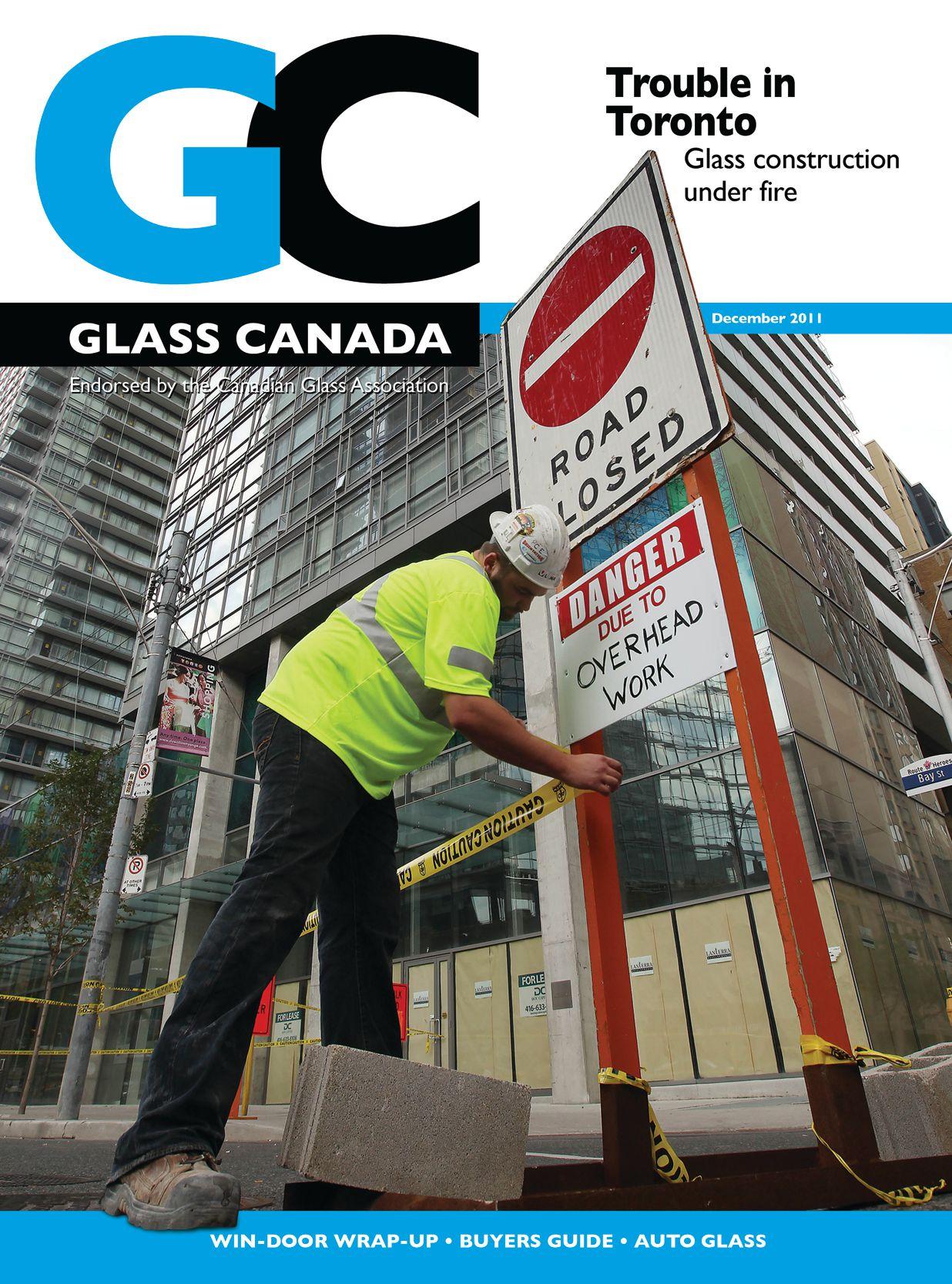
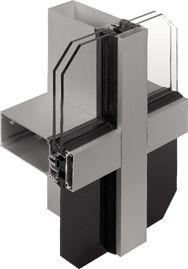
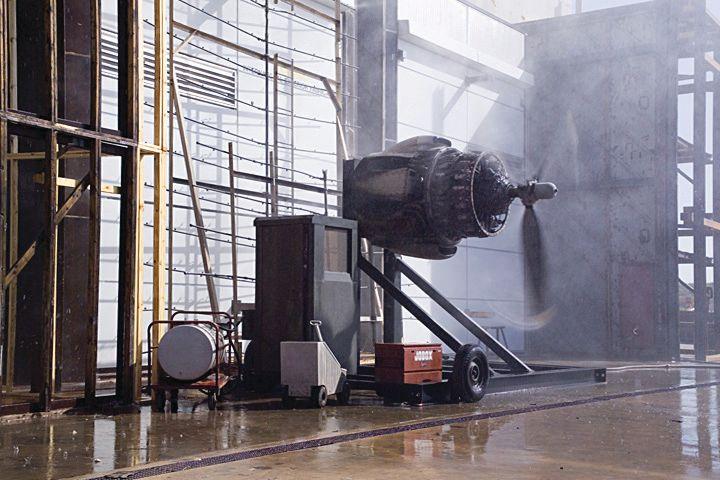
Glass condo construction has come under attack. James Lischkoff and Brian Burton of Exp respond.
14 Win-door report
A thirst for knowledge was apparent among attendees at Canada’s fenestration show.
26 Buyers Guide
Find the equipment and supplies you need to make your business boom.
37 Auto Glass 2012
Our annual look at the world of automotive glass.
Here’s one idea that must not take on a life of its own.
16 Fenestration Canada
The FIT program kicks off at Win-door.
17 IGMA
The first of our regular columns from IGMA’s technical consultant, Bill Lingnell.
COLUMNISTS
20 You Bet Your Glass by Frank Fulton
Browse dozens of images from Win-door on the Glass Canada Facebook page and leave your comments. Win-door organizers estimate over 1,000 attendees and 150 exhibitors were at this year’s edition. Stay tuned to our website for exclusive video from the show!
Any idea is a good idea
Knowing you are right is only half the battle. in business, an idea is only as good as the number of people who agree with it.
Ever hear of a meme? It is an idea that gets spread around and persists over time just because something about it makes it likely to be spread and to persist. Maybe the idea is useful and persists because people who grasp it gain some benefit from it, like the idea that the pointy part of the fork goes into the food first. Maybe the idea is somehow entertaining in its own right, like the “Where’s the beef?” catchphrase in that old Wendy’s commercial. Or maybe the idea, even if it is a bad one, simply holds some weird fascination for people that causes them to focus on it and spread it to others even if the consequences are very undesirable. The music of Celine Dion springs to mind.
The glass industry, specifically the architectural glass industry, is at this moment under threat from a meme. That meme is the idea that glass construction is inferior construction. Disseminators of this meme say that walls with windows and walls made of glass are less energy efficient and less durable than other kinds of walls.
NEXt IssUE
• Curtain wall showcase
• Everlast Aluminum
The rightness or wrongness of this idea is almost beside the point. James Lischkoff and Brian Burton show rather conclusively in our cover story that the idea is wrong, but most people who buy condos will never read that article. Instead, they will become infected by the meme, which is being spread by no less virulent a carrier than the CBC, and begin to suffer the symptom, which is unwarranted nervousness about glass construction. Cultured in the rich agar of green hysteria, it is always possible that the meme will procreate out of control and overwhelm the intellectual body of Canadian condominium buyers, killing the market for curtain wall construction and consigning its predators, the readers of this magazine, to oblivion.
To stop the spread of disease, you need a vaccine, which is really just the disease itself in another, less dangerous form. Memes are no different. To stop their spread you need another meme, another idea, that is equally persistent and acts somehow to neutralize the effect of the first meme. Specifically, we must inject the idea that glass construction is good, energy efficient and durable into the hearts and minds of people in this country.
This will sound like an arcane task to people who make their living building things with their hands. However, there are companies that provide just this kind of medicine. They are called public relations agencies. As in any industry, there are good ones and bad ones and you tend to get what you pay for. I think it would be a good idea for leaders in the glass industry to pool their resources and pay for one of the good agencies to administer a little antibiotic in the areas hardest hit by this meme. •
GROUP PUBLISHER | Martin MCANULTY mmcanulty@annexweb.com
Publication Mail Agreement #40065710. RETURN UNDELIVERABLE CANADIAN ADDRESS TO CIRCULATION DEPARTMENT, P.O. BOX 530, SIMCOE, ON N3Y 4N5 e-mail: jmatheusik@annexweb.com
Printed in Canada, All rights reserved. Editorial material is copyrighted. Permission to reprint may be granted on request. ISSN 0843-7041
Occasionally, Glass Canada will mail information on behalf of industry-related groups whose products and services we believe may be of interest to you. If you prefer not to receive this information, please contact our circulation department in any of the four ways listed above.
www.glasscanadamag.com
INDUstry NEWS
Architectural Testing buys HTL
Architectural testing and hurricane test Laboratory have joined forces under the Architectural testing name to offer innovation and expertise in global fenestration and building product testing, as well as building science and certification services. With the acquisition, Architectural testing now comprises a base of approximately 300 professionals and more than 20 state-ofthe-art testing facilities and regional offices.
Vinu Abraham has joined the Architectural testing team as vice-president of the southeast region, bringing over 20 years of global expertise and technical knowledge in a wide range of product disciplines and performance testing services such as airwater-structural, blast and thermal.
“We’re absolutely dedicated to providing customers with the world-class service they expect and deserve,” says Abraham. “Architectural testing purchased htL to combine complementary testing portfolios well suited to compete in today’s growing building products testing market. the combined company offers a broader range of services and expertise, providing customers with everything they need. We are excited
about bringing Architectural testing and htL together.”
h enry taylor, president of Architectural testing, said, “We are proud to bring these independent testing firms together under the Architectural testing brand in a complementary fashion to better serve the global market. t his reflects the strategy of both companies, which is to provide customers with high-quality, innovative and cost-effective testing services with unsurpassed customer service. As the industry leader, we promise to continue to deliver superior testing, engineering, building science and certification services with excellent value.”
“Architectural testing and htL have worked together on many occasions and feel this will be a seamless integration where all involved will work together to meet client needs to the fullest potential,” said richard biscoe, vice-president and CFo. “both companies have solid reputations when it comes to their testing and engineering capabilities. As one company, existing and future clients will greatly benefit from the increased opportunities.”
IGMA endorses Glass Canada
Glass Canada has obtained the official endorsement of the Insulating Glass Manufacturers Alliance. the endorsement means IGMA recognizes Glass Canada as its media partner in Canada, and an authoritative voice for the Canadian insulating glass industry.
“IGMA is truly a leading North American association within the fenestration industry, and takes its Canadian membership seriously both with technical work and the highly regarded IGMAC IG certification program,” Dave Cooper of Guardian, IGMA president, said. “As such, IGMA supports Glass Canada magazine as a conduit to our membership to the north. In fact, I recently chose Glass Canada as the vehicle for broadcasting our technical body of work by bill Lingnell, IGMA’s technical lead. bill will be providing a technical column to Glass Canada on a regular basis. IGMA is embarking on a new course with the recent creation of the Emerging Development and Innovation Committee chaired by helen sanders of sage Electrochromics. the future aspects and embodiments of IG will be the scope of the new committee, and as such, IGMA will count on Glass Canada to report on its important work.”
I n “the history of AstM E 1300,” Glass Canada, september, several figure callouts were left in the text for diagrams that were not included in the article.We regret the error.
CGA Newsletter
Canadian Glass Association
Abigthanks goes out to all the Glass Connections Edmonton sponsors. our Gold sponsors were Alumicor and Desa Glass. Kawneer was a silver sponsor. All Glass Parts, Ferguson Glass, Grant Metal Products, Lenmak Exterior Innovations, and oldCastle building Envelope were all bronze level sponsors.
our new president was elected at the Annual General Meeting on october 26. David Langton of Competition Glass in Kelowna, b.C., now takes the helm of the CGA. Langton is also the president of the GCAbC. this year, the CGA will be tackling a new set of bylaws.With the creation of the new Notfor-Profit Act in place, the CGA will have to make a few changes to the current bylaws. More to follow on that topic soon.
Work continues on forming our two new provincial/regional associations, the Glazing Contractors Association of Manitoba and the Glazing Contractors Association of the Atlantic Provinces. bylaws and letters of patent have been filed for both associations. For now, the board members for each association are David Langton, richard Verdon and Zana Gordon.this will change once the associations have members and then vote in their new boards.
thank you to all of the volunteers from the board level to the technical committee, to those who just want to help. you are all terrific, we could not do this without you.
We have tentative plans to hold the Glass Connections in Montreal in May 2013. hope to see you all there.
Ontario Glass and Metal Association
theoGMA had plans to team up with Construction specification Canada for a dinner seminar on tuesday, Dec. 6, at the toronto Cricket Club as Glass Canada went to press. With the recent media frenzy surrounding falling glass from toronto condo balconies, the topic of safety glass was expected to lead to some lively discussion. David thompson, manager of building envelope services, and David Wittenberg, structural designer of halcrow yolles were the featured speakers. Watch this space for an update on this event in future issues.
Make sure to join us on saturday, Jan. 14, for a road trip to Detroit for an afternoon tilt between the Detroit red Wings and the Chicago black hawks. this is sure to be a blast and is limited to 30 participants. Contact steve ringler to book your spot at steve.ogm@bellnet.ca or go to the oGMA website.
It is a ways off, but mark May 31 on your calendar and plan to attend the renowned oGMA spring Golf tournament once again being held at the Glen Eagle Golf Club in bolton, ont.
If you are conducting business in the glass industry in ontario, the oGMA is the voice that represents your interests at the provincial and federal level. Protect your business interests
by becoming a member or as an associate member if you are a consultant to the industry. Doug Morris is heading up membership for our association, so please contact him today at douglasmorris@rogers.com, or visit the oGMA website. the oGMA wants to notify all glass and glazing companies in the province that the ontario version of the Glazing systems specifications Manual of standards and Practices is now available for purchase. this all-encompassing document is a must-have reference tool for all companies in the industry. For more information and to order yours, visit our website at www. ogma.ca.
Glazing Contractors Association of British
Columbia
GCAbCis pleased to report we have completed writing the glazing apprentice curriculum. We have hired an instructor and will hold our first Level I training on Jan. 30.
GCAbC has been working closely with the Ministry of Energy with regards to the new b.C. Energy Efficiency Act and how it affects the commercial glazier. this is an ongoing relationship involving many consultations and meetings. We are working closely with APEG, AIbC, and the Ministry of Energy to find ways to alleviate any confusion in interpreting the regulations. the goal of this task group is to bridge the gap between the specifier and the glazing contractor and to develop a consistent methodol-
ogy to ensure compliance with the Energy Efficiency Act. the GCAbC is pleased to announce the winners of its 2011 Industry Awards.the winners were honoured at the association’s Dec. 6 Annual General Meeting.
Project Excellence Award
• Jack bell Expansion at VGh Project
• Concept Aluminum Products Glazing Contractor
• Vitrum Industries and Kawneer North America Material Supplier
• Layton Consulting Engineer
Volunteer of the Year Award
Given to the subject matter experts group for the glazing curriculum:
• Phil Chilibeck, All West Glass
• steve butler, Competition Glass Company
• Debra Dotschkat, GC Glass Canada
• tom Fee, Semiamhoo Glass
• blair Melvin, Vision West Aluminum Products
• thor reid, Flynn Canada
• Phil Parker, Read Jones Christoffersen
• Mike harpell, Read Jones Christoffersen
• Eric skytte, Layton Consulting
• harold Louwerse, Morrison Hershfield
• Chris Lambert, Kawneer North America
• randy smith, Alumicor
• stephen thornton, Spectrum Skyworks our schedule for meetings and topics is available on our website at www.gca-bc.org.
Glass construction questioned
the CbC created a firestorm in the industry with a series of features calling toronto’s glass condominium towers “throw-away buildings” and quoting experts claiming the buildings will “fail” and need extensive repairs in 15 to 25 years.the story also claims curtain walls are not as energy efficient as other types of construction, even saying they are less efficient than 40- and 50-year-old stone and concrete buildings.the article claims insulating glass units in curtain wall modules will lose their seals through thermal expansion and contraction, causing loss of gas, degradation of insulating factor and moisture ingress. some of the experts quoted include John straube, a building science consultant and professor in the Department of Civil Engineering and school of Architecture at the University of Waterloo,ted Kesik from the John h. Daniels Faculty of Architecture at the University of toronto and David house of Earth Development, a property developer.
the story follows a rash of highly publicized incidents of glass falling from high-rise towers in different locations around the city. on Nov. 8,toronto’s Planning and Growth Management Committee made the following recommendations to toronto City Council regarding glasspaneled balconies:
“1. Advise the Canadian Commission on building and Fire Codes and the Ministry of Municipal Affairs and housing of the results of the City’s review of the use of glass panels in balcony guards and request that they consider an emergency amendment to the ontario building Code to better address concerns for public safety when glass paneled balconies may break.
“2. Advise the toronto building and Land Development Association (bILD),tArIoN, and the ontario Association of Architects and Professional Engineers ontario of the results of the City’s analysis of glass panel safety in balcony guards and encourage these organizations to update their practices and professional training regarding the use of glass panels in
Changes at Haeco
J ames siderits has joined haeco, a supplier of automatic glazing, glass setting and handling solutions, to lead sales and marketing for the Famatec ergonomic manipulator product line. siderits has more than 10 years’ experience in the machine tool industry as a manager of marketing communications,
balcony guards.
“3. Advise Industry Canada, the Canadian Glass Association, the safety Glazing Certification Council and the Glass Association of North America of the results of the City’s analysis of glass panel safety in balcony guards and encourage these organizations to communicate and coordinate a comprehensive review of compliance safety standards for the manufacturing of non-metallic product used to produce architectural glazing materials.
“4. re-evaluate wind tunnel standards and criteria and report to the Planning and Growth Management Committee on changes to improve modeling and application standards.”
In the summary to the report, the Planning and Growth Management Committee said, “the report identifies that a response to the issue [of breaking balcony glass] is necessary on several fronts.toronto building is implementing changes to its review of permits where glass panels may be used and is recommending sharing the city’s analysis with stakeholders and regulatory authorities and encouraging them to recognize potential issues with the use of glass panels in an urban setting such as toronto. the chief building official is also recommending that the city request emergency amendments to both the model national and ontario building codes so that the minimum standards of construction, enforced by the city, minimize the potential for future glass balcony failures.”
the review to which the recommendations refer points to three perceived problems with current glass balcony panel designs. recent balcony designs are longer, requiring heavier glass slabs, but often include less framing to hold the glass in place. Nickel sulfide inclusions in tempered glass can expand and contract with temperature changes causing the panel to fail. And panels are often not heat-soaked due to cost.the review says loopholes exist in the present codes which allow builders to pass inspection with these design flaws.
MEMC sells Ontariomade solar panels to Northland
Northland Power has announced it has signed a master module supply agreement with MEMC singapore, an affiliate of MEMC Electronic Materials, to purchase solar PV modules that will be manufactured in Newmarket, ont., for its 130-megawatt ontario solar portfolio.the modules will be used as part of an approximately $600 million investment by Northland to build ground-mounted solar projects in ontario, representing one of the largest investments in ontario’s solar energy sector.
In addition to the 400 workers currently employed at the site, which produces MEMC solar PV modules, Northland’s investment is expected to create another 700 new engineering and construction jobs through the build-out of the projects.
emerging business development and strategic business initiatives for global manufacturers.
“James’ professional background and personal experience growing up in a familyowned job-shop make him an ideal match for relating to our customer base, as we strive to increase penetration of our current markets and expand into related industries,” said Jerry henline, president of haeco.
siderits is a graduate of the University of Cincinnati’s bFA and MbA programs.
“Northland’s significant investment in ground-mounted solar builds on our 25-year history of being an innovative and entrepreneurial energy generator in ontario,” said John brace, president and CEo of Northland Power. “We are pleased to be partnering with MEMC because of their commitment to high quality standards and their demonstrated willingness to invest in ontario for the long-term.”
Northland operates more than 1,000 megawatts of diversified generation, and is actively developing renewable and thermal projects in ontario, including wind, run-of-river, cogeneration, as well as a 400-megawatt pumped storage facility east of Peterborough, ont.
Built to last
last
Glass towers are an excellent long-term investment.
by James LischkoFF and Brian BurTOn
The fenestration industry has been hearing a lot recently about durability and energy performance focused on new condominium construction in downtown Toronto. Some industry insiders quoted in a recent CBC feature [“Throw-away buildings: Toronto’s glass condos,” CBC News, Nov. 14] suggested that these glass condominium towers are “throw-away buildings.”
These views typify the one-dimensional view of some engineers: if something cannot be easily measured and analyzed in mathematical terms then it is of no benefit to society.
It is surprising to read in this story that “building scientists have known for a long time that glass wall structures are less energy efficient than the stone and concrete buildings that were put up 40 or 50 years ago.” In fact, stone and concrete buildings from that era use far more energy per square metre than any other form of housing. Because they were constructed without insulation, using single-glazed aluminum windows, the suggestion that their energy performance is superior to glass towers cannot be supported.
Energy efficiency
If energy efficiency were the only concern, we would not be building high-rise towers with glass. We would be living in caves. Caves are the most energy-efficient structures ever used by mankind. It is our good fortune indeed that engineers do not rule the world.
What we do know for certain is that natural light is one of the most fundamental, positive, lifeenhancing aspects of our environment. It is critical to all human endeavors and vital to our health. Despite the decades of research on the subject, we are often unaware that poorly designed interior environments may cause anxiety, stress, visual disorders and a host of other problems. The nurturing aspects of natural light are receiving more and more attention and it is well known that this attention to natural daylighting is front-and-centre in the design of health-care facilities. In these buildings the designers are clearly focused on the efficient use of glass and fenestration components. If glass and natural light are beneficial to humans in wellness and health centres, surely the occupants of office and residential buildings would also benefit from glass and natural light. A discussion of building envelope design cannot be based solely on energy efficiency without considering the positive attributes of the design itself. Society would be better served if the discussion focused on how we can make better use of glass.
So what about glass itself? As a building material, glass is just as durable as any other common building material. Some of the oldest, 30-year-old, glass high-rise towers are being re-clad for a host of reasons other than energy efficiency. However, it is worth noting that they are not being re-clad because the glass has deteriorated. Glass, unlike some building materials, does not rot, corrode, suffer from the effects of moisture or deteriorate due to natural causes including exposure to the external environment. Considering the main ingredients in glass, glass should rank quite favourably as a sustainable building product. Unlike other traditional building components, such as masonry, glass is currently receiving a great deal of research and development attention that has resulted in dramatic improvements in energy efficiency without destroying its ability to effectively transmit natural light.
Paying attention to history
Decade-old published data on premature failures of building envelopes can give us some perspective that news reports lack. Keep in mind these reports came out long before the present increase in glass construction. In a report published by the Canadian Mortgage and Housing Corporation entitled
2001 Building Failures Study: CMHC
Technical Series 01-140, prepared by R.J. Burnside and Associates, Robert Marshall reported: “In Canada, rehabilitation for roofing and wall system repairs costs an estimated $7.5 billion annually. An estimate of the premature failure rate is three to five per cent, or $225 to $375 million per year. Exposure to costly failures is significant for building owners, home warranty programs, insurance companies and builders. For example, high-rise condominium claims were estimated to be about $20 million in 1990 for Ontario. A 2000 report for the GTA found that claims are common in the first few years of a building’s life, with the majority occurring in the first five years.” The plain fact evident here is that issues relating
to quality control and costs of future repairs are by no means limited to glass towers. What we do know for certain is that over the past 20 years, a period during which window wall construction was relatively rare, we have seen the percentage of claims for operational deficiencies of the building envelope increase dramatically. At the present time these deficiencies now comprise approximately 70 per cent of all identified defects and the expenditures required for remediation and repairs are astronomical.
Durability and quality in perspective
Remarkably, Canada has had a national model building code since 1941. For the
England’s Crystal Palace stood from 1851 to 1936 before being destroyed by fire. Clearly, glass buildings can last. But inadequate design, poor contract language, faulty materials and workmanship, compressed construction schedules, and lack of quality control, can contribute to an early decline.
most part, the tremendous benefits of the code are taken for granted by the general public. Our model building code approach has been supported by the International Residential Code, the Canadian Construction Materials Commission and the CMHC. Canada is internationally recognized as a leader in cold-weather building science. We also invest more money per capita in buildings than most industrialized countries. As a result, our building stock is second to none, with a total value of over $5 trillion.
In addition to climate challenges, over time buildings have become more and more complex while our expectations of the indoor environment are extremely high and continue to rise. This is to be expected in a country where the citizens are 80 per cent urbanized and spend over 90 per cent of their time indoors. Even a relatively small building can contain more components than a jet aircraft and most buildings are essentially one-off prototypes. Buildings are not manufactured on assembly lines and as a result the industry has suffered from what marketing people call “immobility” in the finished product. The industry is highly resistant to innovation and relative to its size we invest a negligible amount on R&D (less than 0.1 per cent of revenues). We have also been extremely slow in incorporating computer technologies. So while it is generally accepted that, although we possess the expertise in building science to improve quality and building performance, we typically fail to systematically apply the knowledge.
Most buildings are not properly commissioned to verify and document that they meet acceptable performance standards prior to occupancy. Most designs for new buildings are not clear enough in detailing the manner in which materials and systems interface with one another and how they should be assembled on
site. On-site quality control measures and quality management in most aspects of the industry are inadequate. This is particularly true of on-site inspections and proper mock-up testing. “Face-seal” construction technology (generally recognized by building scientists as outdated) is still used on most buildings in spite of the fact that it is virtually impossible to effectively seal all building joints. In addition, the various components of the building envelope have different levels of durability, which means they wear out at different rates.
We continue to construct buildings without the input of building scientists who assess building systems to ensure maximum compatibility between subsystems and review component interface detailing to achieve viable long-term performance. So while we can build quality glass buildings that meet all reasonable expectations for longevity and energy efficiency, we often simply fail to do so.
The high cost of repairs
The insurance industry in Australia, a country with a building stock very simi-
lar to Canada, commissioned a formal study that found the cost of repairing damage to structures is actually greater than the five per cent estimate of the annual investment cost of new construction put forward in the Canadian study in 2001. The Australia report suggests that indirect costs add an additional five per cent, bringing the total closer to 10 per cent. Here in Canada we invest approximately $307 billion in construction every year, or approximately $8,000 for each citizen. Applying the 10 per cent formula across the board to include all aspects of construction activity, we would be looking at somewhere in the vicinity of $20 billion annually to repair the damage caused by defects, or approximately $1,600 a year for every Canadian. The report highlighted the fact that a very large percentage of defects are either unnoticed or overlooked, or repairs are deferred. It is not hard to see how the high cost of repairs contributes to lax maintenance, which can result in the kind of catastrophic failures that have made the news lately.
Why is good QC a challenge?
When it comes to addressing quality issues, several reports have identified the primary reasons the industry has struggled for decades. Lack of expertise and resources to improve quality tops the list. A rigid attitude in executive management, or lack of top-management, and employee commitment to quality can contribute. Poor education and a lack of training make it hard for companies to implement improvements. The ever-increasing compression of construction schedules coupled with an emphasis on short-term objectives can be corrosive to good quality. More generally, a tendency to cure symptoms rather than determine causes afflicts some projects. And most business owners agree that too many documents are required for building projects, or at least that they lack the ability to easily meet their documentation responsibilities. Finally, the current,
continued on page 23
THE LITTLE BIG SHO INDUSTRY
by PaTrick FLannery
Win-door is not the biggest show we go to, but it is really important for us,” says Kari Tamminga, a marketing specialist with WTS Paradigm. “It is kind of the little big show.”
That seems like a fair way to characterize the 2011 edition of Win-door that took place Nov. 15 through 17 at the Toronto Convention Centre. While the crowds were not huge, there were enough people to generate some bustle. The feeling of connections being made and deals going down was in the air. Many exhibitors reported they had a great show, and the usual grumbles about traffic did not rise above the level of background noise. Overall, there was a sense of important things going on and suppliers working hard to put their best feet forward. Those who were not there missed out.
Show management estimated a 20 per cent increase in attendance over 2010,
Win-door punches above its weight.
with exhibitor numbers staying steady. “Any time a trade show keeps its numbers steady in this environment, it is a win,” show chairman Matt Kottke remarked.
Education seminars packed
The talk of the show was the incredible popularity of the various seminars put on by experts from Fenestration Canada, the Insulating Glass Manufacturers Alliance, Altus Group
and others. Fenestration Canada technical consultant Jeff Baker’s discussion of upcoming building code changes went beyond standing room only to the point where people were crowded outside the lecture theatre and craning their necks to see in. Efforts were made to expand the theatre seating to accommodate more attendees, but to no avail, as the Thursday version of the talk also overflowed into the show aisles. An aggravating outcome for those who came too late to get a
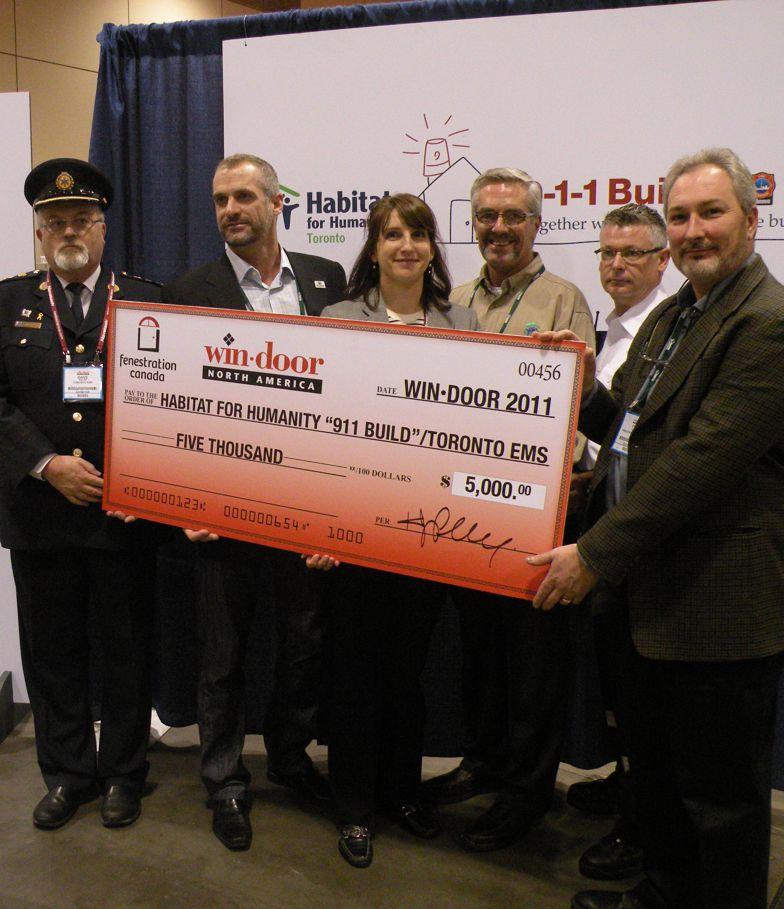
ABOVE: Good luck getting this cheque into the ATM. Members of Habitat for Humanity, Toronto Police, Toronto Fire and Toronto Emergency Medical Services gratefully accepted a $5,000 donation from Fenestration Canada president Yvan Houle.
SHOw
seat, no doubt, but a refreshing change from the half-empty seminars that are all too common at trade shows these days. Don’t look now, but relevant technical information from top industry experts still has the power to draw a crowd, even in the Internet Age.
A new look
The Canadian Window and Door Manufacturers Association (CWDMA) formally unveiled its new name and logo as part of the opening ceremonies for Win-door. The association will now be known as Fenestration Canada.
The name change was announced at the CWDMA’s conference in Banff, Alta., in May, but the new name was phased in over the summer and fall. The Win-door ribbon-cutting marked the formal adoption of the new name, and the end of the old identity. Fenestration Canada past president Kevin Pelley and president Yvan Houle shared the ribbon-cutting duties. Houle explained that the old acronym, CWDMA, had always been awkward to pronounce and remember and had not enjoyed wide recognition in the fenestration industry. The name Fenestration Canada was chosen for its simplicity, its accurate description of the association’s sector and the
Knock Knock.
Design
fact that it is the same in French as in English. Houle said the new name marks a new determination by the association to represent window and door manufacturers in every part of the country, providing a single, national voice even while working closely with regional groups.
Pelley toasted the new name and kicked off the show with his trademark cry of “Sociable!” Given Win-door’s excellent tradition of serving drinks to attendees on the first evening of the show, everyone was quite ready to join in.
Sociable responsibility
Fenestration Canada has chosen Habitat for Humanity Canada as one of its preferred charities. 2011 marks the first year of partnership between Habitat and the association. The aim was to align the association with a charity that would tie in with its philosophy of building, renovating and providing hope by giving back to communities across Canada where members live and work. Habitat’s philosophy of providing families in need with a hand up, not a hand-out, resonated with Fenestration Canada members and was one of the key
Continued on page 25
You need the finest hardware to complete your door offering. Something customizable but simple. Strong but stylish. And above all, it needs to be designed for the North American market. Introducing, Truth’s new Sentry™ Multi-Point Hinged Patio Door System: an innovative solution packed with features that exceeds your expectations – and those of your customer.
Innovative And Secure Multi-Point Locking System
Completely modular for custom design, this 300 series SST multi-point locking system easily fits in standard eurogrooves and offers superior strength and security with full 1" throw of dead bolts and shoot bolts.
Robust And Reliable Adjustable Hinges
The Sentry™ adjustable hinge exceeds ANSI grade 3 requirement by achieving 350,000 cycles on panels weighing up to 220 lbs and ANSI grade 1 impact specifications. Intuitive indicators allow for accurate vertical and horizontal adjustment.
Eye-catching Handle Designs
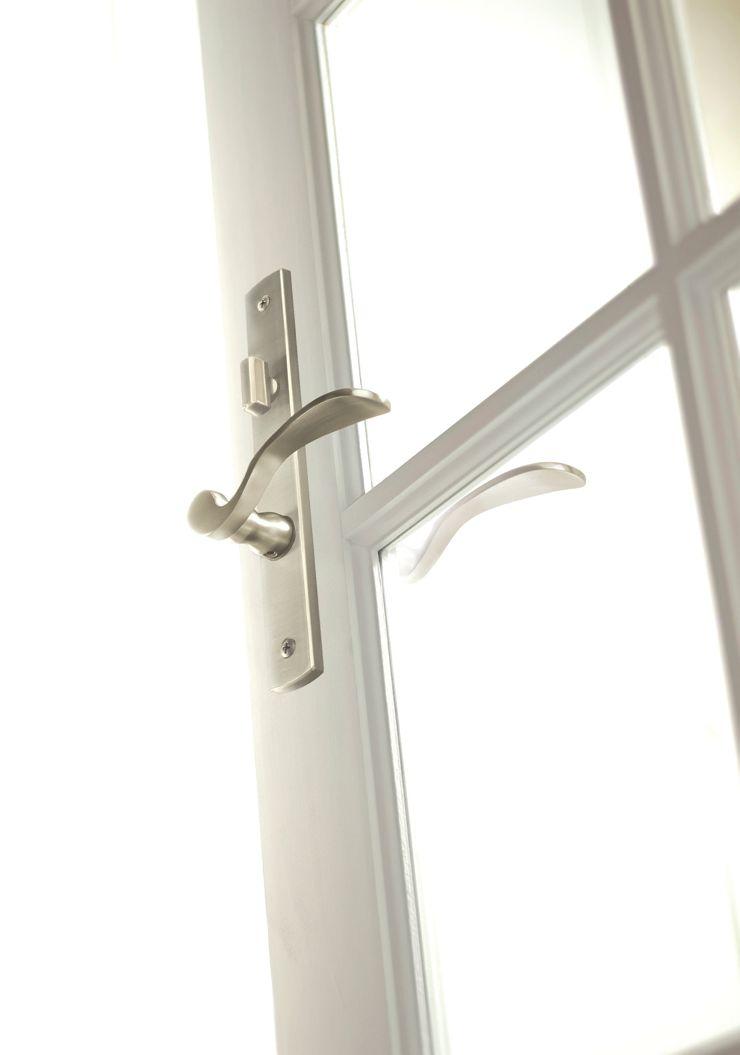
Distinctive styling meets intuitive function. Truth offers multiple handle designs from traditional to contemporary, each with a North American designed 90 degree thumbturn located above the handle.
The Sentry™ Multi-Point Hinged Patio Door System – yet another engineered solution from the company you can trust – Truth Hardware.
more information contact your Truth Representative or visit www.truth.com
by yVEs hoULE
Yves Houle is president of Fenestration Canada. Fenestration Canada’s mission is to represent and support all aspects of the window and door manufacturing industry.
A new name and a fresh start
The Canadian Window and Door Manufacturers Association (CWDMA) has now officially become Fenestration Canada and there was no better place to launch the name and unveil a new logo than at its flagship event, Win-door 2011. The show is the ideal location and focal point where all things related to fenestration come together. We are extremely grateful to our dedicated show committee led by Matt Kottke of Truth Hardware and to all of the company sponsors who help make this show the success that it is.
The quest for information and updates on current issues and challenges facing the industry was very telling as evidenced by the overflowing crowd and even by the quality educational and technical seminars offered during the show. FC’s technical advisor, Jeff Baker was the featured speaker in most of the seminars, and as an engineer and renowned expert in fenestration rating he provided those in attendance with a timely overview and highlights of the new code changes, including factual information on code compliance with implications that could dramatically affect your business.
The Canadian Standards Association closed out the seminar series by bringing attendees up to date on the Fenestration Installation Technician personnel certification program. The proposed standard is currently in draft form and both Fenestration Canada and the Siding and Window Dealers Association of Canada are involved in determining the market need for a training program to prepare persons who will be required to obtain Fenestration Installation Technician (FIT) certification. Those in the industry know that fenestration products can be designed and built to meet the highest standards for quality, integrity and energy efficiency, but if they are not properly installed
Fenestration products can be designed and built to meet the highest standards, but if they are not properly installed the purpose is defeated.
the purpose is defeated. Improper window installation challenges the integrity of the building envelope, resulting in unwanted air or water leakage, significant energy waste and sound pollution. This can then lead to a lack of consumer confidence in our products.
A FIT Scheme Committee has been struck and its members represent a broad base of interests. They have now defined the requirements for and the scope of the certification program. It is designed to be used by individuals installing factory-assembled windows, exterior doors and unit skylights in residential buildings of three stories or less. It outlines the necessary knowledge, skills and abilities to accurately and competently perform the tasks required for this work.
The FIT program will dentify those installers who have demonstrated proficiency in understanding and applying manufacturer installation instructions and general building principles, including their knowledge of the CSA A440.4 window installation standard as well as other industry standards and best practices.
Initially, it was determined that FIT level one, would only be used to cover installers in residential structures up to three stories. The scheme committee has now identified other possible areas for future program consideration, including a FIT level two for residential structures above three stories and a FIT level three for commercial and institutional applications.
Before the certification exam can be offered, it must be beta-tested to provide valuable feedback to assist in establishing the final exam questions and the pass/fail score for certification. The beta testing phase has begun, and the CSA is still actively seeking candidates to get involved. They require an additional 30 completed beta exams in order to finalize the test. The test items have also been translated into French and Fenestration Canada is currently involved in the process of coordinating an exam session for the French beta test. For those interested, more details are available on the Fenestration Canada website.
Finally, we wish to advise readers that the next annual meeting of the association will be held at the Fairmont Le Château Montebello on June 7-9, 2012. We look forward to a large turnout. •
FENEstrAtIoN
by bILL LINGNELL
Bill Lingnell has over 46 years of experience in the technical field of glass and architectural products. He holds three Masters of Science degrees in engineering: civil, mechanical and engineering science. Lingnell is the technical consultant for the Insulating Glass Manufacturers Alliance.
ASTM E 1300 in the 21st century
In my last article, “The Evolution of ASTM E 1300 for Glass Analysis” [December 2011 Glass Canada]I mentioned that a continuation of the history of the ASTM E 1300 standard would venture into the changes and updated editions of the standard that have occurred in the new millennium since year 2000. This article will delve into the work that has occurred since 2000.
In 2000, charts were made bigger, and more legible, allowing easier interpolation between load lines. Conversion factors were added for load durations other than 60 seconds and 30 days. Related to this was the addition of how to combine loads of different durations. One of the most important additions to the 2000 revision was an effort assist evaluation of even more complex designs not covered in the standard. Examples of this are point-supported glass, non-rectangular shapes, and edge supported conditions other than four-edge. It was recognized that engineers and designers were analyzing these types of designs, but with no consensus set of maximum values for edge stress and surface stress. The addition of tables addressing these values in the appendix of E 1300 was a major contribution for standardization.
Several major changes occurred in the 2002 version of the standard. For one, in that same year the industry began changing how wind speed and pressure (windload) were addressed in the U.S. Previously, windload was averaged over 60 second duration. In 2002, the American Society of Civil Engineers agreed to change its standard on determining design loads (ASCE 7) from 60 seconds to a three-second gust. After much debate and discussion about this topic within the ASTM task group, it was decided to rework all 12 of the existing load charts, making adjustments for three-second load duration.
In addition, there had been extensive work by DuPont showing that the factors for laminated glass
There was much concern about complexity and the need for a computer program to keep track of the logistics required to obtain a result.
currently used in E 1300 were too conservative. This work resulted in establishment of separate load charts for laminated glass.
Previously, the document assumed that glass was always supported on four sides. In the 2002 revision, charts were added to address design loads in one-, two-, and three-side support conditions. With this revision the document expanded to 59 pages. There were 42 load charts, five tables of factors, and 13 procedures covering various glass constructions. There was much concern about complexity and the need for a computer program to keep track of the logistics required to obtain a result. Unfortunately, ASTM as an organization does not promote the writing of sanctioned computer software, although others were free to do so.
Editorial changes and revised glass type factors were made in the 2003 version of the standard. Prior to 2004, only polyvinyl butyral (PVB) interlayers for laminated glass were recognized. In order to accommodate other interlayer materials, the 2004 revision included a procedure for establishing equivalency to PVB. The basis for equivalency was to provide evidence through a standardized test (ASTM D 4065), that the non-PVB interlayer had an equal or greater lower bound Young’s Modulus of 1.5 megapascals, and a shear modulus of 0.4 megapascals.
In 2007, definitions for the designation of laminated glass were revised. There are many layup combinations of laminated glass with varying glass ply thickness and interlayer thickness, and a designated laminated glass thickness was necessary for determining which load chart is appropriate. In this update the load charts were adjusted once again this time to accommodate larger glass plates in thicker glasses. Sizes as large as 120 by 250 inches and larger could now be evaluated.
The most recent version of the standard at this writing is the 2009 edition. This revision added a procedure for analyzing triple glazing. This procedure again assumed load share is proportional to stiffness of the plate and determined load share factors based on the cube of the thickness. Also added was a procedure for determining the effective thickness of laminated glass. This procedure is provided for use in independent stress analysis for design situations not covered in the main document of E 1300. There is committee work going on at present to add to and improve the standard further. Stay tuned for the next version that is expected to release in 2012. •
IGMA
Reference Case: InKan Ltd
InKan Ltd of Canada replaces furnace with Glaston RC200™
Why would we go anywhere else?
After running an early generation Tamglass furnace with good glass quality for the past 29 years, InKan Ltd of Canada did not really feel there was any reason to change to any other supplier. The decision to purchase the new Glaston RC200™ was made as part of the company’s plan for expansion into a second building. The new furnace will give them greater size capacity to serve customers better in their unique market niche of customized architectural glass that combines InKan’s know-how in glass and metal.
Metal product manufacturer
InKan Ltd was established in 1976 in Mississauga, Ontario, in the Greater Toronto Area in Canada. By 1982, the company had grown and opened a glass factory in Brampton, also a suburb of Toronto. The company’s first flat glass tempering furnace was a Tamglass. During the following years, the company became known for its unique structural walls and balustrades that are made by ingeniously combining glass with metal. A second, smaller Tamglass furnace was purchased only three years ago to
help respond to increasing business needs, and the company also has edging machinery from Glaston Bavelloni.
According to Tom Duke, Operations Manager, InKan placed the order with Glaston for the new RC200™ in October 2010, and the furnace was delivered in June 2011 with commissioning a few months later in August. “After running good glass with the early generation Tamglass furnace for 29 years, why would we go anywhere else?” Tom asks.
“After running good glass with the early generation Tamglass furnace for 29 years, why would we go anywhere else?”
“VortexPlus™ does what it’s supposed to do, allowing us to focus the convection accurately where it is needed. The temperatures are cooler since the heating can be accurately targeted – which is exactly what leads to the better quality glass.”
RC200™ gives needed size capacity
RC200™ was chosen to give InKan the size capacity of 96”x190” (2400 mm x 4800 mm) needed to better serve the market. “We can now temper, laminate and heat soak everything,” Tom says. “It helps round out everything else we have in our production.”
Today, all is running just fine. Tom says: “The RC200™ is a very sophisticated piece of equipment, and the local Glaston service team has done their part very well. There were only a few small problems when starting up the machine. And by the third load, the furnace was running good glass.” The RC200™ furnace was selected because it helps address production challenges and bottlenecks for companies seeking to expand business with top quality tempering.
Next-generation automation system easy to use
The furnace also features the brand-new iControL™, Glaston’s newest and advanced control system. “The people here are quite happy with iControL™ – it makes it easy to produce very good glass,” Tom states. “It was easy to train our team to use this new system. Even now, we’re still always learning new things with the control system – it’s an ongoing process.”
Better glass quality with Vortex Plus™
Glaston RC200™ also comes with the Vortex Plus™ advanced convection control system, which was designed to significantly increase the control of air placement on the glass surface and to allow operators to precisely control the thermal profiles. “It does what it’s supposed to do, allowing us to focus the convection accurately where it is needed. The temperatures are cooler since the heating can be accurately targeted – which is exactly what leads to the better quality glass,” Tom explains.
One-stop shop for metal and glass
InKan supplies customers in Eastern Canada and the US, as far as Florida and the Caribbean. Even some glass products are shipped to the western parts of Canada and the US, but the majority of the market is on the East Coast of North America. “Our customers come to us for quality and knowledge. They know they can rely on us for complicated jobs. When it comes to metal and glass, we’re a one-stop shop. We do all our own engineering in-house for structural walls and canopies,” Tom says. InKan also has its own contractors in the Greater Toronto Area. ■
“The people here are quite happy with iControL™– it makes it easy to produce very good glass.”
by FrANK FULtoN
Frank Fulton is president of Fultech Fenestration Consulting. He has been in the industry for 30 years and can be reached via e-mail at fultech.fc@gmail.com.
CGA conference a huge hit
At the end of October, I had the pleasure of travelling to western Canada, Edmonton to be precise, for the first time in many years. The purpose of this venture was to attend the Canadian Glass Association’s Glass Connections conference and to man a table-top exhibit for one of my clients, Sunview Patio Doors, where they were introducing a thermal performance aluminum door design for the high-rise residential construction market.
This trip to Edmonton was top drawer compared to my first encounter out there many years ago. While a university student, I headed west to find a summer job with a few friends and spent four months working as a carnie for a small midway show out of Edmonton that travelled throughout northern Alberta and Saskatchewan. We set up and ran rides as well as all the usual carnival games of chance to take money from unsuspecting pockets at local fairs and rodeos in such burgs as Edson, Hinton, Lac la Biche, Fort McMurray and Meadow Lake, to name a few. Needless to say, carnies don’t enjoy the luxurious confines of a Delta hotel at the end of their workday, as did the attendees at the CGA conference. But I digress…
The CGA once again did a great job of putting together a very entertaining and enlightening event and the hundred or so who attended came away with something new worth knowing. Five excellent speakers discussed a variety of topics pertinent to our industry ranging from products to reduce condensation, curtain wall interface construction methods, structural glass applications and glazing in green buildings. Between presentations, delegates spent time learning about products available to them through one-on-one discussions at the table-top displays surrounding the seating area.
The CGA welcomes the Glazing Contractors Association of Manitoba and the Glazing Contractors Association of the Atlantic provinces.
Besides the presentations, changes to the CGA executive and some major additions to the association were announced.
Richard Verdon stepped down as CGA president at the end of his two-year term. During his brief time as leader, Richard did a great job of turning the CGA into a coast-to-coast organization. He recruited the AIPVFQ (Association des industries de produits de vitrerie et de fenestration du Québec) to come under the CGA umbrella. Richard also was instrumental in helping glazing contractors in Manitoba and the Atlantic provinces get their new associations off the ground, and as a result, the CGA was thrilled to welcome the Glazing Contractors Association of Manitoba and the Glazing Contractors Association of the Atlantic provinces into the fold.
Richard will serve as past president for the next few years and will continue to assist the new groups in finding their way. There will be a lot of work to do by all involved.
David Husson whose term as past president concluded, was honoured for his involvement, hard work, and contributions to the CGA. Retired from the daily grind now, David was instrumental in the founding the association in 2002 and served as president in 2008 and 2009.
David Langton, with Competition Glass in Kelowna, B.C., will take the reins as president of the CGA for the next few years. David also serves as the president of the Glazing Contractors Association of B.C.
What really struck me during my few days in western Canada was the level of interest and desire to be involved shown by the people I met in all matters relating to the glass and glazing industry. There’s a real spirit of commitment out there and a strong desire to contribute and make a difference. It was refreshing to see and I hope the new associations get similar involvement and enthusiasm from their local glazing contractors.
The next Glass Connections conference is planned for the spring of 2013 in Montreal, and based on my experiences at the past two events, I would strongly recommend that you attend, bring some of your employees or set up a table-top display. It will be time and money well spent. •
COMING EVENTS
2012
January 31 - February 4
IGMA Annual General Meeting tempe, Ariz. www.igmaonline.org
February 20 - 24
GANA Annual Conference sarasota, Fla. www.glasswebsite.com
Greenbuild san Francisco, Calif. www.greenbuildexpo.org
by brIAN bUrtoN
Brian Burton is the author of Building Science Forum and is serving on CSA’s Fenestration Installation Technician Certification Committee. Brian is a research and development specialist for Exp (The new identity of Trow Associates). He can be reached at brian.burton@exp. com or through www. exp.com.
Let’s counter bad press with better quality
Iread with great interest the comments by readers on the CBC website regarding what industry insiders called the “slow-motion failure” of Toronto’s glass condos where several of the experts interviewed referred to glass condo towers as “throw-away buildings.” [“Throw-away buildings: Toronto’s glass condos,” CBC News, Nov. 14]
Even casual readers of the article complained in writing about the news item’s inaccuracies and chastised the CBC itself for failing to do its homework prior to publishing material about the issues involved. One reader pointed out that the editorial failed to mention the role of the condominium’s board of directors and property management firms in controlling costs and avoiding deficiencies that can lead to premature failure. The reader warned that owners of condominium units could quite easily wind up “living in a ghetto” in short order if either of these stakeholders failed to pay attention to ongoing maintenance. Another reader who took the time to respond to the CBC pointed out that if each person or family who lived in the downtown condo owned a house in the suburbs instead, the increase in energy and financial costs would be astronomical.
Although I do not intend to add to the controversy I would like our readers to consider a few simple facts. These buildings were designed by licensed architects and engineers who were most likely also responsible for on-site quality control. I assume the building designs and plans were reviewed by the building departments of the municipalities having authority and were granted a building permit prior to construction.
The sources quoted in the news feature often seemed to be engaging in speculation without
The CBC must think the average man or woman on the street is asleep at the wheel when it suggests 50-year-old buildings are more energy efficient.
producing any actual performance data – a practice that does not qualify as what we would normally consider building science. Nor does the article mention any of the ongoing efforts by the industry to improve quality, durability, energy efficiency and/or sustainability. The suggestion that the glass structures will require major maintenance much earlier in their life cycle than traditional structures made of pre-cast or brick was not supported by any scientific data nor were any comparisons offered regarding the performance characteristics of any alternative materials. The CBC must think the average man or woman on the street is asleep at the wheel when it suggests that stone and concrete buildings that were constructed 40 or 50 years ago are more energy efficient than the glass towers we are constructing today. I’m also interested in what they term “slow-motion failure.” A building system is either performing in accordance with expectations or it is failing to perform as intended. One or the other!
To return for moment to what is actually occurring in this instance the reader should consider some of the scientific research that has been completed in the construction sector with regard to long-term durability and sustainability. We know quite well why the construction industry does not really compare favourably with other industries when it comes to quality control or encouraging innovation. For example, it’s been proven that most improvements and innovations are incremental and most come directly from product and material manufacturers.
There are actually five main reasons why the construction sector has had a hard time keeping pace with other industries, First, most buildings are one-of-a-kind prototypes and even though many have experimented with assembly-line construction, no one has succeeded as of yet. Constructing buildings is much more complicated and complex than building cars, appliances or even aircraft. We have attempted to change our approach to construction, but because of the complexity and number of players involved, the cost has proved to be prohibitive. Change is difficult in this industry because there are so many health, safety and building code issues involved. And lastly, the industry is highly regulated. In spite of these challenges it is still within the realm of possibility to improve performance in the industry. We would have to spend a great deal more on research and development and take a much more co-ordinated approach. •
continued from page 13
high-pressure tendering and bidding climate is often cited as a reason for degraded quality.
Moving forward
Canada should substantially increase its investment in R&D focused on construction and quality issues in the sector. There should be a radical improvement in our approach to education, training, apprenticeship and certification of construction professionals. National and provincial building codes should be modified to ensure that design reviews by building scientists are mandatory.
The industry requires some form of incentive to encourage high-performing design and construction and to replace the current system where the lowest bid gets the work.
The current levels for on-site testing, inspection and mock-up testing should be increased by a substantial
degree. A requirement for mandatory building commissioning should be included in the local and provincial codes and standards. Local building departments should be more vigilant in determining that structures meet minimum code requirements, including those for durability.
Given the size and importance of the industry the federal government should take the necessary steps to appoint a Minister of Construction and Housing, as is the case in many other nations.
Setting the record straight
If the general public comprehended the extent of the revenue and resources consumed by buildings and realized the cost and consequences of defective construction, current practices would not be tolerated. If we treated the construction sector in a similar fashion to the automobile industry, we would be forced to recall most of the buildings.
Considering that the construction
sector is the nation’s largest industry and largest employer it almost certainly makes more economic and cultural sense to facilitate positive improvements rather than complain about the diminishing quality of our new construction starts after the fact. Everyone in this industry knows there is nothing fundamentally wrong with glass building designs. But without a renewed emphasis on quality, we run the risk that the general public will lose sight of this fact. •
James Lischkoff, P.Eng., is senior vicepresident of building science for Exp (the new identity of Trow Associates) He can be reached at james.lischkoff@exp.com.
Brian Burton is serving on CSA’s Fenestration Installation Technician Certification Committee. Brian is a research and development specialist for Exp and a regular columnist for Glass Canada magazine. He can be reached at brian.burton@exp.com or by visiting www.exp.com.
CROwDS AT CONSTRUCT
Construct Canada offers opportunities to glass industry professionals both as attendees and exhibitors. If you walk the floor, you have a chance to meet dozens of potential suppliers and to visit numerous potential clients. If you exhibit, you get a chance to talk directly to the people who can specify your product in new construction.
A chance to broaden your horizons.
by PaTrick FLannery
Boasting 23,000 visitors, 1,050 exhibitors and 450 speakers, Construct Canada remains Canada’s largest show for the construction industry. Official attendance figures for the 2011 version, held Nov. 30 to Dec. 2 at the Metro Toronto Convention Centre, were not in at press time, but judging from the crowds in the aisles they were better than last year. The attitude among exhibitors was upbeat; the inevitable grumblers were muted and reduced to complaining about the numbers of students, while most were pleased and some downright ecstatic. “This has been a great show for us,” Ron Goldenberg of NuView Windows gushed. “We have seen so many important people here. I just know we will pick up a ton of business.”
With such a diverse spread of exhibitors on the floor – everything from property management firms to concrete suppliers to building security providers to power tool distributors – it is possible to wonder if a glazing or fenestration company is going to benefit from the crowds of attendees walking by the booth. It is the old debate of quality versus quantity. Certainly numerous architects, contractors, property managers and building specifiers will see your booth, but how many of them are shopping for your product? They could just as easily be there only to look at building man-
agement software. Construct has done a fair job of trying to lump exhibitors from similar sub-sectors together in the same areas, but this risks attracting the complaint from exhibitors that they are too close to their competitors. One pities the poor trade show organizer in these demanding times. Such concerns aside, many people in the construction industry obviously find an opportunity to browse a wide variety of products and services attractive. Perhaps Construct Canada is a show for fenestration and glass companies seeking to raise their profiles and broaden their reaches into new markets, while Win-door remains the destination for reinforcing existing relationships and closing deals.
This year’s Construct Canada saw an explosion of solar power exhibitors, with at least a dozen evident to a casual count. Anyone with the capability to provide glass for solar panels would be able to make some important connections. A conversation at the Gemco booth revealed just how important the glass is in a solar panel. Apparently, if even a small corner of the glazing changes in any characteristic, the whole panel must be recertified before it can be used. It seems doubtful that solar panel builders would be able to find glass providers capable of these levels of quality and repeatability just anywhere.•
Continued from page 15
criteria for choosing it as a partner. To kick off the partnership, a $5,000 donation was made to Habitat for Humanity Toronto and the 911 Build, tying nicely into Fenestration Canada’s long-standing support of the Emergency Medical Services Chiefs of Canada’s Window and Balcony Safety Awareness Program.
The Toronto Habitat 911 Build is a joint effort by Habitat for Humanity Toronto and Toronto police, fire and EMS services. This collaborative effort has seen two homes built for two families that require wheelchair access. Both homes are in the finishing stages with the families slated to move in in the next month, allowing them to be home for the holidays.
“We are very excited that Fenestration Canada has chosen Habitat for Humanity Canada as one of its preferred charities,” said Stewart Hardacre, president and CEO of Habitat for Humanity Canada. “Through its first generous donation of $5,000, Fenestration Canada is demonstrating they are committed to helping Habitat build stronger, safer and more sustainable communities across the country. We are looking forward to working together to build out this great partnership and, ultimately, helping to build and sell affordable housing to families in need.”
The Habitat for Humanity booth at the show got attendees into the swing of things by hosting a rousing hammering contest. Contestants tested their mettle against the clock, with the person hammering the most nails into a beam in 20 seconds won a hammer and the second won a screwdriver set. The very talented Simon Grenier and Vito Alpa won easily. For the less handy, a draw was held for a set of Calloway Diablo golf clubs generously donated by Truth Hardware.
All must have prizes
Giveaways and awards were popular at Win-door this year, starting with the draw for three Kobo e-Readers. The lucky prize-winning attendees were Tom Cheney of Cheney Window and Door in Oakville, Ont., Lindsay McGhie of Centennial Windows and Doors in London, Ont., and Clarence Kent of Kento Windows and Doors in Conception Bay South, N.L.
Truth Hardware and North American Logistics sponsored a draw for a set of Callaway Diablo golf clubs that went to Santosh Nair of Durabuilt Windows in Edmonton, Alta.
Mike Bruno of Everlast Aluminum raised $1,200 for Habitat for Humanity by raffling off a $1,000 Air Canada travel voucher.
The Jim Parker booth awards were handed out by industry veteran Jim Parker himself. The award for large booth went to Acrylon Plastics, with
second place going to Royal Group and honourable mention to 360 Innovations and Tru Tech Doors. The small booth award went to JSA Machinerie, with honourable mention to Groupe Promax, Aribell and Eclipse Architectural.
Plans are already being laid for the next edition of Win-door. It will be held Nov. 6 to 8, 2012, at the Metro Toronto Convention Centre, South Building. Glass Canada will continue its comprehensive coverage of this important show with news and updates throughout the year. •
Caldwell Manufacturing has been recognized as the premier supplier of wndow counter balances more than 120 years. Our product lines consist of: Spiral, Block and Tackle, Constant force and Hybrid balances as well as high performance casement window hardware.
Dlubak Corporation has a full line of ballistic and detention products. Flat and curved glass products in insulating, laminated, high performance and fire rated. We also do aluminum extrusion bending.
DOR-LITE MANUFACTURING LTD.
1121 Ominica St. E.
Moose Jaw, SK S6H 7W6
Tel: 306-694-4033 Fax: 306-694-1044
e-mail: twalz@durlite.com www.dorlite.com
DYNAMIC GLASS & DOOR LTD.
#2 - 3003 Millar Ave.
Saskatoon, SK S7K 6G5
Tel: 306-651-1553 Fax: 306-651-1557
EEDTM, INC.
745 Capital Commons Dr. Toledo, OH 43615
Tel: 419-861-1030 Fax: 419-861-1031
e-mail: sales@edtm.com www.edtm.com
ENIXUS TRADE LTD.
34 Dunkirk Rd.
St. Catharines, ON L2R 1A1 Tel: 905-682-3086 Fax: 877-745-2715
World leader in the manufacture of Fenzi Thiover Brand IG polysuphide and Fenzi PIB for insulated glass. Combined with Fenzi Molver Desiccant, AluPro and Roll Tech space profiles, Fenzi North America is a complete supplier for your IG component needs. Fenzi North America has added to its product line, with the introduction of Fenzi HOTVER Hot Melt Butyl. Continuing to listen to our customers’ needs, we are now also offering our Fenzi Butylver PIB in the color of grey , to go along with the traditional black. Combined with our other IG components (Polysulphide, Desiccant, Aluminum and Steel spacers) Fenzi North America continues to be a complete supplier for our customers IG needs. Fenzi Polysulphide is manufactured here in North America to meet your delivery requirements in a timely manner.
INDUSTRYSUPPLIERS
FLOW INTERNATIONAL CORP.
2370 Cawthra Rd.
Mississauga, ON L5A 2X1
Tel: 416-550-3569 Fax: 800-506-7502
www.flowcorp.com
Main Products/Services: Manufacturer of Waterjet cutting machines.
6000 Commerce Pkwy., Ste. D Mount Laurel, NJ 08054
Tel: 856-780-3001 Fax: 336-299-8388
e-mail: usa@glaston.net www.glaston.net
Glaston is an international glass technology company and a pioneer of glass processing technology and services. Glaston’s well-known brands are Bavelloni, Tamglass, Uniglass and Albat + Wirsam.
Quanex Building Products is a global supplier of IG spacer systems, extrusions and window and door components, offering an array of high-performance products, creative marketing support and technical service.
What we do for you: Custom shapes, spacers (climatech warm edge, aluminum doorlite, stainless), muntin bars, screen bars, reinforcements (patio door/sash), Brass/Zinc camen, punching/notching, connectors, desiccant... Over 20 years.
SSAWTRAX MFG. CO. INC.
3694 Kennesaw S. Industrial Dr., Ste. A Kennesaw, GA 30144
Tel: 770-974-0021 Fax: 770-975-1618
Toll Free: 1-888-SAWTRAX
e-mail: info@sawtrax.com www.sawtrax.com
SCREENS - R- US
1275 Eglinton Ave. E., Unit 48 Mississauga, ON L4W 2Z2
e-mail: marketing.industry@ca.sika.com OR wesselink.kryston@ca.sika.com www.sika.ca
Innovative products: Self-Adhered Flashing Membranes; Polyurethane, Silicone and Hybrid Sealants & Adhesives for FFI; Auto-Glass Adhesives; General Purpose Adhesives, Sealants and Tapes; and Windshield Repair Products.Sika, The Bonding Expert!
SPS GLASS & METALS, DIV. 1628611 ONTARIO LTD.
861 Finch Ave.
Pickering, ON L1V 1J4
Tel: 905-831-6624 Fax: 905-831-6625
e-mail: info@spsglass.ca www.spsglass.ca
STARLITE INDUSTRIES INC. 1111 Lancaster Ave., PO Box 990 Rosemont, PA 19010
Manufacturers of architechural dedcorative glass, custom bent glass, kiln cast textures, backpainted galss, excellent selection of imported patterns.
URBAN WINDOWS & DOORS
1955 LaSalle Blvd
Sudbury, ON P3A 2A3
Tel: 705-673-5285 Fax: 705-673-5286
Toll Free: 1-855-673-5285
e-mail: info@urbanwindows.ca www.urbanwindows.ca
VVISION 2000 PLUS WINDOW MFG.
18 Front St.
Sturgeon Falls, ON P2B 3L4
TRUTH HARDWARE
700 W. Bridge St.
Owatonna, MN 55060
Tel: 507-451-5620 Fax: 507-451-5655
Toll Free: 1-800-866-7884
e-mail: truthsal@truth.com www.truth.com
Designer & manufactureer of quality operating hardware for the window and door industry. Truth Hardware provides engineered solutions for hinger, operators, sash locks, rollers, multi-point locking systems.
TURTOOLS COMPANY
861 Old Lillooet Rd., North Vancouver, BC www.turtools.com
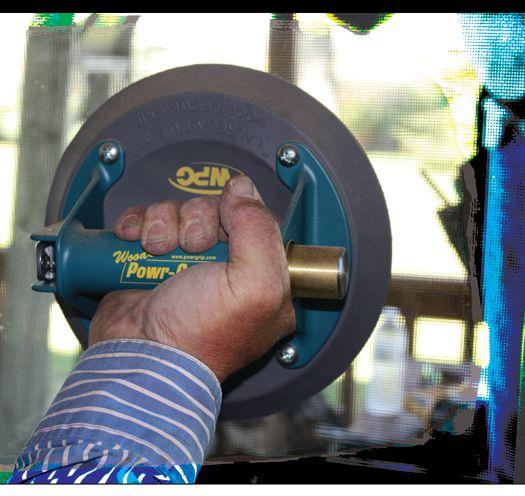
One of the frequent questions we get here at Wood’s Powr-Grip is, “Can I lift curved glass with any of your products?” You may be surprised to learn the answer is, “Yes.” Vacuum lifters can be specifically designed with a wide range of vacuum cups and lifters that can attach to curved or bent surfaces.
Lifting curved or bent materials presents unique challenges. Most standard vacuum pads are nearly flat and designed to attach quickly and easily on flat surfaces. In contrast, vacuum pads designed for curved surfaces have unique characteristics that make them suitable for attaching to such surfaces. These vacuum pads have a concave shape and a thinner edge profile, to facilitate contact with a curved surface. Also, concave vacuum pads are usually manufactured with a lower durometer rubber that enables the pad to conform to the curved surface, requiring less
Vacuum lifters can handle the curves.
pressure against the surface to establish an unbroken seal. A third feature, employed on our newest vacuum pads for curved materials, is a rounded sealing edge. Since the shape of some load surfaces can change during a lift, this design allows the sealing edge to roll and shift, in order to maintain the seal as the load flexes. Special vacuum pads make lifting curved materials possible
The degree of curvature (or arc) to which a particular vacuum pad can attach is reflected in its Minimal Material
Curvature Radius (MMCR). The MMCR of the concave pad, multiplied by two, reflects the smallest diameter of a sphere to which the pad would readily attach. Since the edges are flexible, the vacuum pad can also attach to cylinders or other curved shapes. For example, if you need to lift a tube with a diameter of 24 inches and weighing 80 pounds, a vacuum pad with an MMCR of 12 inches or less would be required. When it comes to lifting large, curved materials, such as windows, building facades, auto body parts, curved stone or
ABOVE: Custom pads enable vacuum lifters to handle just about any size and shape. Vaccum lifters enable glass handling with less physical wear and tear and less chance of dropping expensive product.
nonporous columns weighing hundreds of pounds, it is time to bring in the big guns.
Swap pads to repurpose
Standard vacuum lifters are often used to manipulate materials with curved surfaces. Standard vacuum pads can be replaced with concave pads designed for curved surfaces and used on these multipurpose lifters. For vacuum lifters that feature multiple frame configurations, a linear configuration often is most suitable for attaching to curved materials.
While simply adding concave vacuum pads on a standard vacuum lifter may work in many circumstances, some applications may require special options. Pad mounting options such as spring-shaft pad mounts and rotating pad mounts can be incorporated, along with concave vacuum pads, for less radical situations. However, for materials with a large arc, a custom lifter may be necessary.
Custom vacuum lifters with specially shaped pad frames can be designed for nearly any concave or convex curve. The designs range from simple to complex and are available with manual or powered load movements. Some designs incorporate adjustable frame curvature to accommodate a variety of material radiuses, and most are available with either AC or DC power systems.
Get some good advice
Since load capacities may be affected by alterations to your existing vacuum lifter, and the shape of the load, we strongly suggest that you first discuss your requirements with a knowledgeable technical sales representative. They will assist you in obtaining the proper vacuum lifter for your specific curved materials handling needs. •
Joe Landsverk is the marketing director of Wood’s Powr-Grip.With more than 20 years service, he oversees and co-ordinates the company’s day-to-day marketing and advertising activities.
AUto GLAss NEWS
Auto Glass week review
Auto Glass Week was held s ept. 15-17, in Memphis, tenn. It drew more than 1,000 attendees for three days of education, networking and a look at the industry’s newest tools and services.
t he event was held at the Memphis Cook Convention Center and Memphis Marriott Downtown and brought together all of the industry’s major auto glass groups, including AG rr Magazine, the Auto Glass r eplacement s afety s tandards Council, the Independent Glass Association, the National Glass Association, and the National Windshield r epair Association. AG rr Magazine’s Pilkington Clear Advantage Auto Glass technician o lympics and the Walt Gorman Memorial Windshield r epair o lympics were held on-site as well.
t he event included both a number of informative educational sessions, including
a keynote speech by hockey legend Mike Eruzione, along with an exhibition that gave all of the event’s sponsors and exhibitors a chance to meet with attendees and share their latest offerings.
t he International Window Film t int- o ff and Conference was held concurrently, giving both industries the change to mingle and learn about new products and services available.
“It was rejuvenating to see so many auto glass industry representatives together in one place, hopeful and optimistic about the future,” said AG rr Magazine publisher Debra Levy. “ o ne look at Auto Glass Week showed that reports of the death of the auto glass industry have themselves been dead wrong. We sre excited about next year, and look forward to sharing details on it soon.”
Apple promotion supports Legion
F or the Prince Edward Island Command of the royal Canadian Legion, the Apple Auto Glass Cash your Chips in Event was more than a marketing success. It was a gift that comes as a much-needed surprise. the winner of the national, communityfocused, Apple Auto Glass promotion was bill Power: a proud resident of Montague, P.E.I., and winner of the $10,000 grand prize. the unique nature of this promotion
was that the winnings would be split between the winner and his charity of choice. In bill Power’s case, this was the royal Canadian Legion.
“It is a great opportunity to pay tribute to a friend of mine who passed on, George Mill, a member of the Legion and my old horseshoe partner,” said Power. “he was always involved helping to raise money with the poppy campaigns, so it was nice to be able to do this.”
NwRA cautions consumers
the
National Windshield repair Association has issued an advisory to consumers concerning the quality of windshield repairs, also known as rock chip repairs.
the NWrA advises consumers to make sure their breaks have been repaired in accordance with the ANsI/ NWrA repair of Laminated Auto Glass standard (roLAGs) and to make sure the following has occurred with any break:
• that the break has been filled completely with a high quality resin.
• that the resin is cured and safe driving vision has been restored.
• that the impact point has been made flush with the windshield and will not interfere with proper windshield wiper function.
• that the repair technician has inspected the finished repair, from the driver’s point of view to ensure clarity without distraction.
Consumers are well advised to look for NWrAcertified technicians to complete the repairs as those technicians that are certified by the association as understanding and following the roLAGs standards.
“there are a fair amount of poor repairs being done out there by incorrectly or poorly trained technicians, from companies large and small,” added Wanstrath. “An educated consumer can assure that his or her repair is being done correctly by following the simple checklist above.”
PHOTO BY Penn
Q&A: NGA certification sale to AGRSS
Q | I am an NGA-certified technician. Will I still be certified?
A | yes. All NGA-certified technicians will remain certified. on Jan. 1, 2012, the name of that certification program will change and after that time you will be considered an AGrsscertified technician, although AGrss hasn’t yet finalized the exact name of the program.
Q | Can I still be certified through NGA?
A | No. NGA will be using the AGrss technician certification program as its official certification program.
Q | I have already paid my certification fee to NGA, will there be addition fees from AGrss?
A | No. AGrss will honour the certifications of all those technicians who are certified until their certification would have expired under NGA. those technicians will now get renewal notices from AGrss.
Q | Can I still use my NGA patches and other items?
A | yes. those items will gradually be phased out and replaced by new ones from AGrss, but they can still be used until such time as we provide new ones. NGA members who desire will receive new stickers that note the AGrss Certification is also the official certification program of the National Glass Association.
Q | All our techs are certified but we are not part of the AGrss registered Company program. Do we have to be an AGrss registered Company to have our techs certified?
A | No. AGrss will be offering technician certification to technicians working for all auto glass companies, whether an AGrss registered Company or not.
Q | our company is an NGA-certified company. Do we have to be an AGrss registered Company to have company-wide certification?
A | this is an area in which we do anticipate change. AGrss does not anticipate keeping a certified company program that does not include being an AGrss registered Company. our board is in the process of working out the details now. It is our hope that every NGA-certified company that is not already AGrss registered will become so.
Q | our company is an AGrss registered Company and we have NGA-certified techs. how will this affect us?
A | you are going to get the best of both worlds. though not finalized, our board is working on a mechanism that will allow all techs that work for AGrss registered Companies to be certified easily and at little or no cost. Watch for more information.
Q | If I have questions, who do I contact?
A | Mary hawkins at the AGrss headquarters, 1-630-9426597.
Q | Who is leading this change-over effort?
A | In addition to the AG rss board and staff, the co-chairs of the AG rss Education Committee and their committee members are working on this transition. t he AG rss Education Committee is co-chaired by Dale Malcolm of Dow and Jeff o live of Glasspro. t hese men have long histories with both organizations and have been integral part of both the NGA certification program and the AG rss ’ educational efforts.
– Courtesy of AGRSS
AGRSS to become the Auto Glass Safety Council
the Auto Glass replacement safety standards Council announced recently that the group will undergo a name change. Effective Jan. 1, 2012, the not-for-profit group will be known as the Auto Glass safety Council.
“We’re really excited about the name change,” said AGrss Council president Debra Levy. “We believe it more accurately reflects our true mission: auto glass safety in every respect.”
“setting standards is one aspect of the organization,” said Levy, “but it is so much more, including an auditing and validating organization, along with an auto glass certification and educational organization.”
Levy said the AGrss board of directors conducted a number of consumer and insurance focus groups before voting to change its name and “the change to the Auto Glass safety Council name was clearly the right choice.”
A joint task group composed of marketing committee members and members of the board of directors are hard at work on a new logo and an orderly roll-out of the new name.
“It is exciting,” said Levy, “and it is the next logical step in the advancement of safe auto glass practices.”
the name change was announced in september at Auto Glass Week in Memphis, tenn.
In other AGrss news, the National Glass Association has announced it has sold its auto glass technician certification pro-
grams to the AGrss. NGA certification has been an important standard for auto glass technicians for more than 20 years.
the transfer to AGrss has been in discussions for months, as the two organizations considered various options for improving their respective service to the North American auto glass industry.
“our acquisition of this program is a reflection of the important role certification plays in ensuring the quality, professionalism and safety of auto glass technicians across the country,” said Debra Levy, president of the AGrss Council. “It complements the services that AGrss provides and expands our offerings to this market, and we intend to invest substantially in the program’s value and expansion over the coming years.”
the sale was executed on Aug. 30.
“this transaction is all about providing the best service possible to the auto glass market,” said Phil James, president of the NGA. “We believe that focusing our resources and attention on our world-class auto glass training programs is better for our members in the long run, and it enables the NGA and AGrss to do what each organization does best.”
the NGA will continue to promote the importance of AGrss technician Certification and the AGrss registered Company Certification to the industry, while investing in an expansion of its auto glass replacement and repair training modules offered through myglassclass.com and its other training vehicles.
4401 Page Ave., PO Box 457 Michigan Center, MI 49254
Tel: 517-764-0334 Fax: 517-764-6697
Toll Free: 800-248-4010
e-mail: info@adcocorp.com www.adcocorp.com
Contact: Connie Kearns
ADCO Products, Inc. combines experience, vision and technologies for the growing need of high-performance adhesives, sealants and tapes. ADCO provides value added solutions to a variety of markets including transportation markets of Trailor, Bus, Truck, Rail, RV and Automotive Aftermarket and many more.
AEGIS TOOLS INTERNATIONAL®, INC.
PO Box 259688
Madison, WI 53725
Tel: 608-274-9254 Fax: 608-274-9395
Toll Free: 888-247-6000 - US & CANADA
e-mail: info@aegistools.com www.aegistools.com
For over 25 years, AEGIS® Tools International has proven to be the international industry leader in windshield repair equipment and windshield installation tools.
AEGIS® manufactures and/or distributes windshield repair kits, resins and accessories and a full line of windshield installation and removal tools in over fifty countries. AEGIS® provides excellent service and customer support. Think of AEGIS® for all your auto glass tool needs.
ALL GLASS PARTS INC.
18139 107 Ave
Edmonton, AB T5S 1K4
Tel: 780-487-4895 Fax: 780-484-1209
Toll Free: 800-661-9951
www.allglassparts.com
Contact: Dave Thorton
AMERI-CAN MACHINERY LTD.
2650 Meadowvale Blvd., Unit 5 Mississauga, ON L5N 6M5
Creative Extruded Products, an OEM molding manufacturer since 1979, produces the finest molding systems available to the glass technician; FlexiTrim™ universal moldings, RightTrim™ vehicle specific moldings, and GRIPflex™ on glass moldings.
DE GORTER, INC.
5623 Cannon Dr. Monroe, NC 28110
Tel: 704-282-2055 Fax: 704-225-8290
Toll Free: 800-334-9399
DYMAX CORPORATION
318 Industrial Lane
Torrington, CT 06790
Tel: 860-482-1010 Fax: 860-496-0608
e-mail: info@dymax.com www.dymax.com
Premier windshield crack repair products from DYMAX help prevent costly windshield replacement. Used for years to attach window brackets and rearview mirrors, DYMAX resins are now being incorporated into more window and mirror applications than ever before. Resilient resins also coat glass and prevent shattering.
We ensure that our clients maintain an edge over their competition and we strive to expand their volume, increase their profit and enhance their productivity by providing an unequalled level of speed, efficiency and convenience.
FEIN CANADIAN POwER TOOL COMPANY
323 Traders Blvd. E.
Mississauga, ON L4Z 2E5
Tel: 905-890-1390 Fax: 905-890-1866
Toll Free: 800-265-2581
e-mail: fein@fein.ca www.fein.com
Contact: Karen Bovey
FENZI NORTH AMERICA
11 Dansk Crt.
Toronto, ON M9W 5N6
1-416-674-3831 Fax: 416-674-9323
e-mail: info@fenzi-na.com www.fenzi-na.com
Fenzi North America has added to its product line, with the introduction of Fenzi HOTVER Hot Melt Butyl. Continuing to listen to our customers’ needs, we are now also offering our Fenzi Butylver PIB in the colour of grey, to go along with the traditional black. Combined with our other IG components (Polysulphide, Desiccant, Aluminum and Steel spacers) Fenzi North America continues to be a complete supplier for our customers’ IG needs. Fenzi Polysulphide is manufactured here in North America to meet your delivery requirements in a timely manner.
FNA EqUIPMENT SERVICES
11 Dansk Crt.
Toronto, ON M9W 5N6
1-416-213-1362 Fax: 416-674-9323
e-mail: owen@fnaeq.com www.fenzi-na.com
FNA Equipment services is an authorized Graco Distributor, offering equipment sales and services for all one and two-part dispensing equipment. Stocking a large selection of equipment parts & rebuild kits, FNA can service your equipment needs in a timely fashion. For tehcnical assistance, please call Owen Allen.
GOLD GLASS GROUP CORP.
545-4 Johnson Ave.
Bohemia, NY 11716
Tel: 631-981-4277 Fax: 631-981-4299
Toll Free: 800-448-5188
e-mail: jgold@gggcorp.com
www.gggcorp.com
Contact: Joseph Gold
GROVE PRODUCTS INC.
17 Marguerite Ave.
Leominster, MA 01453
Tel: 978-534-5188 Fax: 978-840-4130
e-mail: sales@groveproducts.com
www.groveproductsinc.com
Prime manufacturer of rugged, inexpensive, convenient, leveling and alignment aids for the glass and construction industry. Grove structural shims makes stack, horseshoe, wedge and flatshims for conventional and firerated applications.
Monument Tools inc was launched to provide a unique set of tools that have applicability to a range of industries but provide specific versatility for the collision and glass industries.
NATIONAL GLASS ASSOCIATION (NGA)
1945 Old Gallows Road, Suite 750 Vienna, VA 22182
Tel: 703-442-4890 Fax: 703-442-0630
Toll Free: 866-342-5642
e-mail: membership@glass.org www.glass.org
Contact: Alyssa Kirkman
The Association serving the architectural glass, automotive glass, an dwindow and door industries.
Roper is the editor for The Installer, The Fabricator, The Conservatory Installer and Glass Works magazine published in the U.K.
Where little recessions come from
I’d like to write about something else, I really would. I know I have covered the topic before, I know we are all really bored with it but I can’t avoid it. It is an obsession, it keeps banging in my ears like an irritating tune. I can’t get away from it, every time I turn on the radio someone is going on about the bloody recession!
OK, so who’s recession is it anyway? Well, I reckon that it is the government’s recession. Though I suppose in a democracy that has to make it the people’s recession. At a recent press-fest held by Roto Frank in Prague (they do this every year, 2010 Barcelona, 2011 Prague) the CEO, Dr. Eckhard Keill, spoke at length about the world economic situation and he pulled no punches blaming governments worldwide for causing the problems (or failing to stop them). “Now,” he said, “the people have to suffer to put things right.”
On the other hand, Roto is predicting its own continued growth Europe-wide. Poland is even exporting windows to Germany. There is an old English saying about taking coal to Newcastle; it amounts to much the same thing. So while everyone else is suffering, or so we hear, Roto is shipping hardware and looking to ship more in 2012.
And that hardware is going into windows and doors. I spent a couple of days recently visiting a few window manufacturers, albeit large operations. They were all very busy, so you have to ask, “Where are all these windows going?” Someone is buying them. And there are some pretty fancy products being made as well: folding-sliding doors are a hot ticket item right now. They are very good doors too to go between your house and the conservatory.
We know there is a recession going on, but when I look at our own industry I can’t help thinking it must be going on somewhere else.
And there’s another thing. Conservatories – people are still buying them, mostly at over 10,000 pounds a go as they are also buying lots of high-spec entry doors.
We all believe the gospel, we know there is a recession going on, the government and the BBC say so, so it must be true. But when I look at our own industry I can’t help thinking it must be going on somewhere else. As I said earlier, someone, somewhere in this bleak, overspent, recession-ridden land has the money to buy the products. Lots of the products.
In the U.K. we do have two problems: parasitic industries and an over-blown public sector. We just got over 13 years with a socialist government which, as they will, expanded the public sector, apparently thinking they were creating real jobs. On top of that we have burgeoning security and health-and-safety industries, neither of which do anything to create wealth. Indeed, all three simply leech on the productive, manufacturing industries and, sometimes, make it difficult for them to do their jobs.
To its credit, the present coalition government has been doing its best to reduce the public sector. Not easy when we, the public, have been fooled into thinking that all of the new agencies were important. They have unravelled some of the ridiculous health and safety regulations, as well – not enough but it has made a start.
(This is how ridiculous it gets: I read recently about an inquest on a woman who had fallen down a flooded mineshaft. The emergency services determined that it would breach health and safety rules to winch her out, so she drowned. The fire chief in charge determined that the operation was a “success” because none of his own crew had been injured.)
And I haven’t even started on the regulatory bodies. These organisations, private businesses all, have been set up to make sure that manufacturers adhere to standards and regulations and charge them for the privilege of being registered. I can think of six which regulate the window industry and glass trades. And they even have their own regulatory body: the United Kingdom Accreditation Service (UKAS).
If anything is likely to send the U.K. window industry into recession it will be paying for that lot. •