GL - August 2023

Page 1


Salem stands out in our methods of selecting, inspecting, testing and developing only the best products.

Our line of Window Glass Products include cutting fluids approved by both Guardian and Vitro for use on all of their Low-E coatings. Ask about our dual-belt glass seamers, material handling equipment and more.

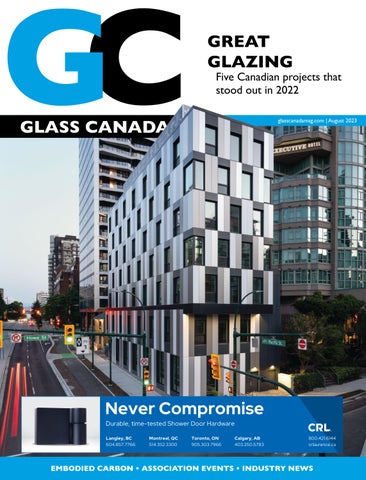
We’ve collected mind-blowing examples of beautiful glazing projects completed across Canada last year. Read on for inspiration and pride in our industry.

Sudbury, Ont.

Pacific Artist Hub, Vancouver, B.C.

Kelly Doron of Half Research Studio gives us a great insight into what the architecture and environmental community are thinking about how building design will evolve in the coming world of embodied carbon standards…critical

Your products are the Devil

EDITORIAL

In the coming world of embodied carbon, the commerical glass industry will face some stiff challenges.

The Architect’s Newspaper was kind enough to invite me and our brand manager, Leslie Osborne, to their recent Facades Plus conference in Toronto. Their CEO, Diana Darling, was a gracious host and the event was well-run and full of excellent people, exhibitors and information. I highly recommend it and nothing below should be interpreted as a criticism.

The education program was ably hosted by Anthony Fieldman of Dialog. The topics included facade construction and delivery, thermal breaking, retrofit concepts and advances in architectural materials. But really there was only one topic: the devastation to the planet caused by human carbon dioxide emissions and the urgent, nay, desperate need to immediately eliminate this scourge.

NEXT ISSUE

• GlassBuild

I bring you this warning from my time in a room with some high-profile architects and building engineers: glass and aluminum construction is now considered by top designers to be a terrible, almost immoral, crime against the environment. To the extent they have influence with government officials (a lot, I suspect), they will guide our future incentive structures toward minimizing if not eliminating the use of these fundamental building materials.

• Sustainable glazing

Yes, we’ve heard it all before. I’m just reporting what I heard in the room from guest after guest in session after session. Sustainable building was not just a concern or a priority to the speakers on stage, it was something more akin to a religion. Embodied carbon is the factor that makes glass and metal the new Satan of this religion. Architects remain concerned about the poor insulating properties of these materials that lead to buildings using more energy. They still bemoan our obsession with “glass boxes” and call for lower window-to-wall ratios. Our industry has had some success fending off these attacks with higher-performing products and pointing out that, in areas with non-emitting energy sources (hydroelectric, nuclear, wind, solar), buildings with electrical heating don’t contribute much to carbon dioxide emissions. But now the carbon dioxide emitted in the manufacture, shipping, installation, maintenance and disposal of building products has entered the collective consciousness. Pound-for-pound, glass, steel and aluminum have the highest embodied carbon among common building materials, exceeding even concrete. Facades Plus speakers showed slides of the kinds of buildings you will see in our Great Glazing pages as regrettable examples of the ongoing mistakes our construction industry is making.

Policy-makers are listening. Natural Resources Canada has expressed its goal to restrict the embodied carbon content of buildings by 2030 and to mandate zero-carbon buildings (operational and embodied) by 2050. Hard to see where we fit in to that plan.

Throughout the conference I had to resist the urge to stand up and say “Isn’t it you guys who are specifying these designs?” How much of this expressed rhetoric will actually be translated into reality is open to question, given the huge advantages of aluminum in terms of weight, cost and ease of fabrication, and the absolute necessity of glass for views and daylighting. •

GLASS CANADA

August 2023

Volume 35 • Number 3

Annex Business Media P.O. Box 530, Simcoe, Ontario N3Y 4N5

READER SERVICE

Print and digital subscription inquiries or changes, please contact Angelita Potal, Customer Service Rep. Tel: 416.510.5113 Fax: 416.510.6875

Email: apotal@annexbusinessmedia.com

Mail: 111 Gordon Baker Rd., Suite 400, Toronto, ON M2H 3R1

EDITOR | Patrick FLANNERY pflannery@annexbusinessmedia.com 226.931.0545

PUBLISHER | Danielle LABRIE dlabrie@annexbusinessmedia.com 519.429.5187

BRAND SALES MANAGER | Leslie OSBORNE losborne@annexbusinessmedia.com 647.280.5885

ACCOUNT COORDINATOR | Barb COMER bcomer@annexbusinessmedia.com 519.429.5171

AUDIENCE DEVELOPMENT MANAGER | Shawn ARUL sarul@annexbusinessmedia.com 416.510.5181

MEDIA DESIGNER | Curtis MARTIN

PRESIDENT/COO | Scott JAMIESON sjamieson@annexbusinessmedia.com

SUBSCRIPTION RATES

Canada - 1 Year $37.00 (plus tax) U.S.A. - 1 Year $85.00 (in CDN dollars)

Publication Mail Agreement #40065710 Printed in Canada ISSN 0843-7041

Occasionally, Glass Canada will mail information on behalf of industry-related groups whose products and services we believe may be of interest to you. If you prefer not to receive this information, please contact our circulation department in any of the four ways listed above.

Annex Privacy Officer privacy@annexbusinessmedia.com Tel: 800-668-2374

No part of the editorial content of this publication may be reprinted without the publisher’s written permission. ©2022 Annex Business Media. All rights reserved. Opinions expressed in this magazine are not necessarily those of the editor or the publisher. No liability is assumed for errors or omissions. All advertising is subject to the publisher’s approval. Such approval does not imply any endorsement of the products or services advertised. Publisher reserves the right to refuse advertising that does not meet the standards of the publication.

www.glasscanadamag.com

Durable and reliable material handling solutions play an important role in glass fabrication efficiency. Groves products are engineered to address every aspect of the fabrication process. So, whether you need to fabricate, move, store or transport glass, Groves offers rugged, high quality, dependable solutions to get the job done. Make the move to Groves — the titans of glass handling.

NEWS

FGIA gets back to basics in Vancouver

Several participants at the Fenestration and Glazing Industry Alliance Summer Conference had the unique opportunity to learn proper techniques for both cutting and washing glass in a hands-on workshop in Vancouver, B.C. Presenters Meghan Chamberlin (Lippert), Adina Dobre (Intigral) and Jeff Haberer (Trulite Glass and Aluminum Solutions) led nearly 30 participants in two different sections of this condensed version of the popular FGIA Insulating Glass (IG) Fabricators Workshop. Supplies, including glass, were donated by Vitrum Glass Group. Before any demonstrations took place at the workshop, all participants put on personal protective equipment, including properly rated gloves, arm sleeves and eye protection. Chamberlin began the presentation by covering the process of washing and cutting glass, noting that adhesion is an important part of a successful IG unit.

“Why is clean glass so important?” Chamberlin asked rhetorically. “Adhesion! If things aren’t sticking together, your IG unit will fail.” She also noted that the water used must not only be clean, but rid of total dissolved solvents. Haberer and Dobre went on to explain how to test TDS levels, demonstrating how

adding things like sugar or salt can change the TDS reading.

Other advice Chamberlin gave was to not use recycled water to clean glass and to never stop glass in a washer while the brush is still spinning. “The brushes can cause low-E burn, and your customer will not be happy,” said Chamberlin. “Also, make sure gloves don’t leave any residue.”

The presenters demonstrated an adhesion test, which showed that distilled water creates better adhesion while common glass cleaner creates the worst. “Most household cleaners leave a shiny finish but that’s a disaster for adhesion in IGUs,” said Chamberlin.

When it comes to cutting, Chamberlin said, there are four components: angle, speed, diameter and force. Participants practiced cutting glass by scoring and then carefully breaking the glass. They first tried this process without cutting fluid and then with – noting it is considerably easier to do with fluid than without. “Remember, the thicker the glass, the lower the cutting angle,” said Chamberlin. More photos from the activity are available at Glass Canada’s Instagram account, glasscanadamag.

Boland steps in as CEO at Agnora

Corey Boland joined oversized and premium quality glass fabricator, Agnora, as CEO on May 23. Agnora is located in Collingwood, Ont. Boland comes to Agnora with over 25 years of experience successfully scaling manufacturing businesses across North America and into global markets.

“I am excited to join the team at Agnora and settle into my new role continuing on delivering exceptional glass products with a best-inclass customer experience,” says Boland.

Although founder Richard Wilson is stepping back from his role as CEO, he will continue to be actively working with the board of directors.

“I have seen Agnora grow immensely over its 12 years of business, and I couldn’t be prouder of the people, products, projects, and achievements we have all made together. We are delighted to gain Corey’s immense experience, enthusiasm, and commitment to our success,” said Wilson.

CANADA’S GLASS ASSOCIATIONS

AVFQ

Once again this year, the Omnium AVFQ golf tournament was a great success. Taking place in the very beautiful region of Mont-Tremblant, the 288 golfers and nearly 400 guests for the evening had a memorable day. Places in the tournament sold out in 48 hrs! AVFQ members will be present at the GlassBuild America 2023 exhibition, which is being held at the end of October in Atlanta, thanks to a trade mission organized by our association.

Provincial Glaziers Association of Alberta

ThePGAA entered a Try-aTrade booth at the provincial Skills Canada competition held in Edmonton on May 3 and 4. Volunteers from the industry manned the booth and showed hundreds of junior and senior high school students how to do various tasks within the glazing industry. Students that tried the various aspects of the Try-a-Trade were entered into a raffle to win a new television, which was donated by the PGAA. The individual that won told our volunteers that their family is not wealthy and that their television had just quit working that morning! It was meant to be. Gary Porter has been carrying the torch for the PGAA for some time and has been actively involved in various industry endeavors such as liaising with the Alberta Trade Contractors Council on prompt payment and providing input on the Alberta government’s new Skilled Trades and Apprentice-

ship Education Act (STAE) and Designated Trades Restricted Activities (DTRA) regulation. He called for an annual general meeting of the PGAA on June 16 and through a lot of personal invitations we had 27 member companies in attendance, which was great to see. At the meeting, Jim Brady (against his previous vows not to) volunteered to be president. We also had five new members volunteer to sit on the executive. We have started a committee to work with our education providers to review and update their content. At a meeting yesterday, we discussed revitalizing our member database to communicate effectively; reviving our Certificate of Leadership program; creating a committee to deal with STAE/ DTRA; and creating a committee to create a best practices guide with the hopes of creating a PGAA warranty (similar to the Alberta Roofing Contractors Association) in the future. We would then go to specifications writers and ask them to put the warranty requirements into their specs. This would be a long way off, but every journey starts with the first step. Updates to follow.

Architectural Glass and Metal Contractors Association

Our association has a longstanding interest in trade training and skills development and, to that end, we helped establish the Architectural Glass and Metal Technician training program over 40 years ago, with the assistance of the Ontario government and the IUPAT union. Our member contractors believe that apprenticeship

training as well as journeyperson skills upgrades are key to maintaining a healthy industry. We have played a major role and continue to participate and oversee the provincial training program administered at the Finishing Trades Institute on Toro Road in Toronto, with a second location on Collonade Road in Ottawa. FTI is the only Ministry of Labour, Training and Skills Development-authorized training delivery agent for the in-school portion of the apprenticeship program known as 424A, Architectural Glass and Metal Technician, a recognized Red Seal trade. Please note the following upcoming scheduled apprenticeship classes:

TORONTO

Level 1 and 2 , August 28

Level 2 and 3 , Oct. 23

Level 1 and 3 , Jan. 2, 2024

Level 1 and 2, March 4, 2024

OTTAWA

Level 1 Aug. 28

Level 1 Oct. 23

Level 3 Jan. 8, 2024

Level 2 March 18, 2024

Fenestration Manitoba

OnJune 1, Fenestration

Manitoba launched a tour of the Building Efficiency Technology Access Centre located in the Carsi building at Red River College Polytechnic in Winnipeg. The BETAC research facility offers building envelope research programs for engineering technologists and engineering students to test systems that lead to making buildings more efficient . Many programs centre on fenestration products and installations. Manitoba has severe climate conditions with temperatures ranging from minus 40 to plus 40

C. The equipment that is needed to test to those temperatures is located in BETAC. Also included are test facilities for water and wind load. Programs are supervised by highly qualified engineers that have spent decades involved in window and door projects in residential and commercial conditions. Funding for the research and development for fenestration products is also available. Many in attendance were able to get a good knowledge of the detail that the centre offers.

Ontario Glass and Metal Association

TheOGMA spring golf tournament was held on June 14 at the Glen Eagle Golf Club in Bolton, Ont. We had an excellent turnout for the tournament and the weather cooperated for the most part. The fall golf tournament will be held on Sept. 14 at Woodington Lake Golf Club in Tottenham, Ont. The OGMA Lifetime Achievement Award was presented to Brian Wiles at the spring golf tournament. Brian has been in the glass industry for more than 45 years, working for Indal Products, Armourguard, Richmond Hill Glass, Protemp, Walker Glass, and BVGlazing. Brian has been an active member of the OGMA and its predecessor, the Metro Toronto Glass Association, since 1990, serving as director for more than 30 years and acting as treasurer for many of those years. Steve Ringler, president of the OGMA, and Noel Marsella, president of the AGMCA, presented the joint $1,000 spring bursary award to Luke Parkin at the spring golf tournament. Congratulations, Luke, on being selected by your instructors.

Fenestration Canada talks architectural glazing

Fenestration

Canada debuted its new commercial division with a panel discussion titled Commercial Pain Points at its Spring Conference in Kelowna, B.C., on May 24. The discussion focused on several topics of particular interest to architectural glazing contractors and glass fabricators and represented a departure from FenCan’s usual fare aimed at residential window and door manufacturers. Many interesting points and insights were raised and one left with the impression the conversation could have gone on for much longer...as no doubt it will at future events. On stage were Jonathan Adams, COO and partner at Layton Consulting in Surrey, B.C.; Brent Friesen, president of Baywest Glazing in Langley, B.C., and chair of FenCan Commercial; Jeff Makimoto, FenCan’s commercial technical director; and Rich Porayko, commercial business development director for the association. Adams set the table with a presentation explaining structural glass standards covering balustrades, building guards and safety glass and pointing to several misconceptions and misuses of them. The standards under discussion were CAN CGSP 12.1; CAN CGSP 12.20 M89, ASTM E1300 and CSA A500.

Adams’ big point was that there’s a lot more to safety glazing than is covered in the standards.

“The safety glazing standard is focused on one key part of safety and one part only,” he explained. “That is reducing the likelihood of injury to a person when when they’re interacting with glass. The standard also does not address strength or durability or fire-rated things.”

Another part of Adams’ presentation that was of particular interest to glazing contractors was his discussion of the roles of the Registered Professional of Record and Supporting Registered Professional on a project. Briefly, the RPR is the architect or lead engineer with final responsibility for certifying construction as complete and to plan, and SRPs are one or more professionals to whom the RPR might delegate authority for checking aspects of the project and

reporting on their readiness. It’s a fairly simple system in concept, but Adams addressed the many issues that arise in practice.

“Some of the things that we often come across are the subcontractor maybe doesn’t know who the RPR is,” Adams said. “The RPR doesn’t know who the SRP is or the subcontractor. This is what we commonly see, this is just the way it has been in many cases. The subcontractor doesn’t notify the SRP of the installation progress until the installation becomes complete. And then the RPR asks for the documents. Well, a field review has to be done. And if we can’t go on site to see things like fasteners because they’ll cover it up with with trim and things like that, then how can we provide these documents? So it’s really in the glaziers best interest to, early on, make sure that you know if an SRP is required, who the RPR is, and to make sure that that the SRP is getting on site to review your proof for your project so that you don’t have to start tearing stuff out after the fact. I think my advice would be just press whoever is hiring you to figure out who those individuals are so that we can at least ensure that somebody is taking responsibility, right? The architect may say, ‘I don’t need supporting professionals,’ but it’s up to him to make that call, not the contractor.”

Lamoureux heading Montreal’s CSC chapter

Alumicor architectural representative, Jennie Lamoureux, has been elected to serve as director of Construction Specifications Canada’s Montreal chapter. She is the first woman to hold this chapter’s highest office. She most recently served as chair of CSC Montreal. In 2020, her dedication and contributions to CSC were recognized with a 2020 Chapter Award of Merit. At the 2023 CSC Awards Luncheon, held May 28 in Calgary, Alta., Lamoureux also was honoured with a Program Director’s Award for Communications. The award recognized her exceptional work

in creating the Chairs Committee and communications tool to connect CSC leaders and collaborate across Canada.

“I feel lucky to have the support and confidence of Alumicor, but also of the members of CSC in this adventure,” said Lamoureux. “Getting involved in associations such as CSC are opportunities to learn about our industry and make us better people in many ways.”

In addition to her volunteer roles with CSC, Lamoureux is an active member of the AVFQ, Quebec’s glazing and fenestration association, and co-chairs the Com-

mercial Technical Committee – Commercial Sector. As a member of the Fenestration Glazing and Industry Alliance, she also represents Alumicor, Tubelite and Apogee Enterprises, and contributes to the Architectural Products Council’s Methods of Test Committee. Working closely with Canadian architectural design professionals, Lamoureux assists with evaluation, selection and specification of aluminum-framed fenestration systems for commercial building envelopes. Drawing from her industry experience and Alumicor’s expertise, she helps support project goals for performance, appearance, sustainability, on-time scheduling and long-term value.

The new FenCan commercial team assembled on stage in Kelowna. From left are Jeff Makimoto, Brent Friesen, Rich Porayko and Jonathan Adams.

Starlight adds thermal break specialist

Starlight Sales Corporation has welcomed Bart Hensley in his new role as technician and thermal break specialist serving North America. In his new role, he will lead the effort to repair thermal break insertion machines of all brands, conduct preventive maintenance and implement improvements to enhance their performance. With an impressive 18 years’ experience as a thermal break polyamide supplier, Hensley brings a tremendous amount of knowledge and expertise to his new role. His extensive background in the fenestration industry, specializing in designing and assisting customers with aluminum assembly challenges, solidifies Starlight’s commitment to delivering exceptional customer support and performance. Raised in the small town of Gate City in southwest Virginia, Hensley embodies the values of compassion, dedication, and a commitment to helping others. From an early age, he was taught the importance

of going above and beyond, no matter what tasks he takes on. Hensley takes immense pride in delivering exceptional results and finds true satisfaction in seeing a customer’s smile when their equipment is fixed and back in action. After completing his college education, Hensley embarked on a journey with a curtainwall and skylight company for the commercial industry. Over time, his expertise broadened to focus on thermal break solutions, and for the past 18 years he has been an influential figure in the fenestration industry, providing design guidance and assisting customers with aluminum assembly issues. Joining Starlight is an exciting opportunity for Hensley to extend his expertise and support to customers across North America. His extended knowledge and dedication will allow Starlight to provide extraordinary service to customers, ensuring that their operations continue to run smoothly.

Joint NGA, FGIA document answers PIB questions

The

National Glass Association and the Fenestration and Glazing Industry Alliance have announced joint publication of a new technical resource, Compatibility Testing of Insulating Glass PIB Primary Sealant with Respect to Glazing Materials. The four-page document discusses methods of compatibility testing of glazing components with respect to polyisobutylene primary sealant in an insulating glass unit. It recommends the use of the Ift Rosenheim test method, outlines the effects of incompatible glazing materials and addresses other factors that may affect compatibility.

“It is easy for people to assume that, because a process is considered industry standard, that a standard actually exists for testing a product, but that isn’t always the case,” explains Robert Carlson (Tristar Glass Products), NGA’s task group co-chair. “The research and collaboration behind this technical resource has been ongoing over the past eight years. We’re excited to be publishing a document long-needed within the industry to formalize our approach to compatibility testing.”

The resource further expands on the validation of Ift Rosenheim and provides additional guidelines addressing test methods for direct and indirect material contact, as well as the effects of migrating components.

“It has long been a question of where to get unbiased test results when certain incompatibility conditions occur with insulating glass primary sealant and surrounding glazing components,” said David Cooper (Fenestration Consultant), FGIA’s task group co-chair. “This new guideline provides information that offers a testing solution using an independent lab to provide results on glazing material compatibility. Member sealant manufacturers contributed time and testing resources in order to validate the chosen test method for compatibility of IG primary sealant with adjacent glazing materials.”

FGIA updates impact and opaque glass documents

The Fenestration and Glazing Industry Alliance has updated a specification providing a standard laboratory procedure for evaluation of simulated human impacts on window systems intended for installation in behavioral care hospitals and facilities. This evaluation procedure also applies to occupancies with similar concerns, excluding other hazardous locations as defined in the International Building Code and International Residential Code. AAMA 501.8-23 Standard Test Method for Determination of Resistance to Human Impact of Window Systems Intended for Use in Behavioral Care Applications, an FGIA document, is now available for purchase in the FGIA online store. This document was last updated in 2014. Guidance is given for the specifier of windows mounted at higher-than-usual window locations as well as a clarification to post-impact evaluation without changing the pass/fail criteria.

FGIA has also released a new technical information report documenting best practices for system design of spandrel areas, including the use of conventional spandrel glass as well as vision glass in conjunction with shadow box panels. Recommendations are made where appropriate, for testing and/or analysis criteria considering esthetics, serviceability and performance. AAMA TIR-A20-23, Glazed Spandrel and Shadow Box Design Considerations, an FGIA document, is now available for purchase in the FGIA online store. TIR-A20 offers a technical review of key issues, including but not limited to, heat buildup, load sharing, esthetics and cavity venting strategies. TIR-A20 also provides a baseline for ongoing development of test methods to verify spandrel performance. This document provides a high-level overview of design considerations for glazed spandrel infills.

First steps taken

The Canadian Board for Harmonized Construction Codes recently concluded a set of public consultations on policy recommendations about including provisions for greenhouse gas emissions in the national model codes. While the 2020 National Energy Code of Canada for Buildings and National Building Code of Canada have energy-efficiency tiers (measures that progressively increase energy efficiency and reduce the amount of energy needed to operate a building), they do not address the type or quality of energy source used by buildings and houses (operational emissions) or embodied carbon, which are “emissions associated with materials and construction processes throughout a building’s life cycle,” as defined by the Canada Green Building Council.

In November 2022, CBHCC decided, in accordance with the direction set by the Canadian Commission on Building and Fire Codes, to draft measures related to operational GHG emissions for inclusion in the 2025 national model codes and embodied GHG emissions for the 2030 edition. Embodied carbon-related provisions have been deferred to 2030. One of the reasons is that there is still work to be done in that area, such as advancing low-embodied materials, before technical solutions can be proposed. It is well known that it is challenging to source low-embodied-carbon materials in northern and remote areas. We need more data and environmental product declarations for embodied carbon. A standard method of analysis for embodied carbon must also be determined. There are many policies focusing on emissions mitigation across various jurisdictions in Canada, but very little regulations on embodied emissions.

There is still work to be done, such as advancing low-embodied materials, before technical solutions can be proposed.

CBHCC is also recommending including a tiered framework that progresses toward the ultimate goal of net zero emissions buildings or houses in the NBC. A net zero emissions building or house has minimal operational and embodied GHG emissions, with remaining emissions offset through various mechanisms. This framework will provide provinces and territories with some flexibility to address different energy source issues.

British Columbia recently added new energy-efficiency regulations to the B.C. Building Code. The government hopes these steps will ensure cleaner, more efficient buildings are constructed in line with its commitment to zero-carbon new construction by 2030. BCBC now requires 20 percent better energy efficiency for most new buildings throughout the province. The Zero Carbon Step Code provides tools for local governments to encourage or require lower emissions in new buildings. The new regulations meet the province’s commitments to gradually lower emissions from buildings until all new construction is zero carbon by 2030 and net-zero-energy-ready by 2032, per the CleanBC Roadmap. Zero carbon refers to carbon dioxide emissions, while a net-zero-energyready building is using 80 percent less energy than typical new construction.

The higher energy-efficiency requirements are a progression of the B.C. Energy Step Code, which was introduced in 2017. Local governments can use the B.C. Energy Step Code to encourage or require energy efficiency that goes beyond BCBC requirements. It is important to note the B.C. Energy Step Code enhances energy efficiency in new construction, while the Zero Carbon Step Code focuses on emissions reductions from new construction.

The reasons for including GHG-related provisions in the NBC are compelling. Approximately 27 per cent of Canada’s GHG emissions are due to buildings. According to the Canada Green Buildings Strategy by Natural Resources Canada, 18 of the 27 percent is operational GHG emissions including electricity-related emissions. Approximately nine per cent relates to embodied GHG emissions according to a global estimate per the 2022 Global Status Report for Buildings and Construction: Towards a Zero-emission, Efficient and Resilient Buildings and Construction Sector report by the United Nations Environment Program. Addressing these types of emissions in the NBC is an

important step toward mitigating global warming and supporting Canada’s climate goals. Canada has committed to reducing total GHG emissions to 40 to 45 percent below 2005 levels by 2030 and reaching net zero by 2050. Additionally, the

2025/2030 NBC will be an appropriate tool to use for reducing operational and embodied GHG emissions of buildings and houses, as it creates a minimum standard and plays a foundational role in building design and construction across

LEFT: FGIA Summer Conference attendees heard the results of a member survey on sustainable construction issues.

the country.

NRC believes the implementation of new GHG emissions objectives and requirements will result in increased commercial activity in the construction sector, supporting a low-carbon economy while helping to achieve our GHG emissions reductions goals.

The FGIA plans to take an active role in all CBHCC and NRC industry consultations about these issues going forward. To better understand the needs of our industry, a survey was sent to FGIA members to ask how the association could best help with their sustainability needs and the results were presented at our recent Summer Conference in Vancouver. Among members’ top priorities were guidance on how to obtain and prepare Product Category Rules and Life Cycle Analysis documents. Understanding the impact of glass and glazing systems on overall

Carbon tension

In my last article, I discussed that the impending climate emergency is precipitating a revolution in the building industry and that our society needs to be more carbon-efficient. Our building industry needs to rely less on fossil fuels, and we have been doing this with smart design and using efficient insulation materials. The approach to net-zero design will enable buildings to sustain themselves as our society tries to minimize operational carbon. But to be truly carbon-efficient, we also need to consider the carbon footprint of the materials and methods we use in the construction of the building. What’s needed is an objective analysis of the overall process. Some of us refer to this as cradle-to-grave assessment.

I used to blatantly ignore environmental detractors who have used distorted arguments to make their point. They’d question whether the environmental impact of erecting a wind turbine outweighs the free energy it gets from the wind. Or if the carbon footprint of constructing a hydroelectric dam (earthworks, deforestation, concrete, etc.) outweighs the benefit of providing green electricity. Does an electric vehicle use more embodied carbon in its aluminum body than the operational carbon that it claims to save? The internet has lots of answers, but I needed to figure it out myself and remember to stay objective.

And our industry is not immune to these arguments. The one hotly debated issue I’ve been hearing about lately is the carbon effect of adding a third pane of glass to an IGU (hence making it a triple pane IGU) instead of using the default standard dual pane. Is triple glass the answer to carbon-efficient glass insulation? I’ve run the calculations many times and researched other

How much energy efficiency matters depends on where you are.

computations. And my final answer is…it depends.

THE ENGINEER

The answer is not obvious and it may surprise you. To calculate this properly, a life cycle analysis needs to be conducted to evaluate the carbon cost of the third pane of glass and compare that to the operational efficiency gains. How much insulation improvement is it contributing? It becomes a more difficult calculation when you consider other factors, such the effect on solar heat gain that is impeded with that third pane. Perhaps there will be improvements to air conditioning efficiencies but worsen the passive heating potential of the building. Will a third pane darken the interior necessitating more lighting?

The fenestration industry has always maintained that opting for tri-pane glass windows instead of dual pane glass sounds like a sensible choice to reduce your operational carbon footprint. However, how much this matters depends on where you are located. In an electrically heated home in Quebec (where the electrical grid is predominantly green hydropower), the embodied carbon of that extra third pane will overwhelm the operational carbon savings. A predominantly green heating grid is not emitting a significant amount of carbon dioxide, therefore the carbon payback (embodied carbon footprint with respect to operational carbon savings) may not make sense. I am, of course, purposely ignoring other important aspects that tri-pane glass windows bring, such as improved thermal comfort and improved noise reduction.

Install those same windows in Alberta or Nova Scotia where heating energy is predominantly fossil fuel-based and that third pane is now paying for itself quickly, from a carbon perspective.

The embodied carbon of glass is consistent with most manufacturers worldwide and has not varied much over the years. Despite operational improvements, float glass manufacturing uses fossil fuels as it’s the only viable method to melt the raw material in furnaces that can reach as high as 3,000 F. The life cycle assessment of glass may yield a high carbon footprint, but there are not many other suitable alternatives to glass. Human well-being relies on regular exposure to light and dark each day. We need a view of the outdoors from our environmentally separated spaces. Essentially, we cannot live without windows and windows are made from glass. •

Claudio
Patio Doors in Woodbridge, Ont.

Finding answers to new challenges

Anew report has revealed that the rise in remote work could potentially lead to a staggering $800 billion loss in the value of office buildings in major cities across the globe by 2030. This post-pandemic trend is expected to cause a significant increase in office vacancy rates and a decrease in rental prices.

According to a McKinsey Global Institute report, office attendance has settled at a consistent 30 percent decline from pre-COVID levels. Additionally, it reveals that only 37 percent of workers are physically present in the office on a daily basis. The pandemic-induced shift in working habits is adversely affecting the value of commercial real estate. This adds to the challenges faced by the market, which is already impacted by rising interest rates.

McKinsey analyzed nine “superstar” cities that have a significant share of global urban gross domestic product. These cities include Beijing, Houston, London, New York, Paris, Munich, San Francisco, Shanghai and Tokyo. Those cities could experience a staggering $800 billion USD (over $1 trillion CAD) in valuation losses, marking a significant 26 percent decline from 2019. According to McKinsey, there is a possibility of office space value plummeting by an alarming 42 percent in a worst-case scenario.

Cellphone data indicates a significant decrease in population within Canadian cities during the workday, with current numbers reaching only half of pre-pandemic levels. According to a recent report by CBRE, Canada’s national office vacancy rate reached its highest point since 1994 in the second quarter. The downtown office vacancy rate in most major centers, excluding Calgary and

There has been growing interest from commercial members to both attend, exhibit and sponsor at WinDoor this November.

Waterloo, has increased to 18.1 percent. Calgary and Halifax were the sole markets to experience a decrease in vacancy rates during the quarter, amidst rising interest rates, challenges in the technology industry and the looming risk of recession impacting office markets.

According to Avison Young, a leading commercial real estate firm, the vacancy rate in downtown Vancouver has increased to 12.3 percent in the second quarter of 2023. This reflects a rise from 11.1 percent in the previous quarter and 9.6 percent at the end of 2022.

Canada is on the brink of transformation. On one hand, we have a housing crisis. On the other hand, office towers are underutilized. With talks of Canada’s population reaching 100 million by 2100, our leaders are realizing the need for significant changes. One promising avenue is the conversion of commercial buildings into high density housing. Not only does repurposing commercial buildings present opportunities for increased housing options, but it also opens doors for updating the facades of the existing structures to meet energy codes.

The possibility for employers to implement return-to-work mandates exists. With ongoing uncertainty, the megatrends point to densification. There is no better time to understand what is happening in the multifamily residential sector. WinDoor North America is Canada’s premier window and door industry event. WinDoor showcases the best of the industry, attracting manufacturers, retailers, suppliers, and other industry professionals from all over the world. The event offers an unparalleled educational experience, allowing attendees to build valuable relationships, access cutting-edge technology, and stay informed on industry trends. While WinDoor attracts both veteran and new fenestration participants, it has historically been a residential event focusing on the latest innovations in windows and door technologies, design trends, installation strategies, and energy efficiency codes. WinDoor 2023 will still largely be a residential event, however as FenCan’s Commercial Chapter continues to grow and gather momentum, there has been growing interest from commercial members to both attend, exhibit and sponsor at WinDoor this November 15 and 16 in Toronto.

Attendees have the opportunity to learn from industry experts and top speakers. From workshops to informative seminars, WinDoor provides educational opportunities covering topics like energy efficiency, material selection, installation techniques and more. WinDoor 2023 will certainly include content of this kind of interest to the commercial architectural glazing sector. WinDoor also includes some great special events such as product launches and Hall of Fame celebrations. But special mention goes to the Main Event gala dinner promoted with great enthusiasm by Mike Bruno, Fenestration Canada past president and president of Everlast. The concept is simple: industry suppliers buy tables at the gala and invite their clients to attend a night of great food, beverages and entertainment after the show. The result is a terrific night of fun and relationship-building with show attendees and exhibitors hanging out together rather than scattering to the four corners of the city for dinner. Whether you are a glazing contractor, glass fabricator or other commercial glass supplier looking to stay up-to-date on trends in the window and door market, WinDoor is a mustattend event.

Don’t miss your chance to join the thousands of glass professionals who will be attending WinDoor 2023 at the Toronto Congress Centre. For more information, visit fenestrationcanada. ca/windoor or email our operations manager, Laine Atkins, at laine@fenestrationcanada.ca. If you are interested in presenting on a commercial glazing topic, please contact our technical director, Terry Adamson, at terry@fenestrationcanada.ca. We look forward to seeing you there! •

Tri-Temp Glass has manufactured tempered glass for showers, railings, entrance systems, interior partitions and architectural glass applications since 2007.

• Tempered up to 96 x 144

• Custom Laminated up to 86 x 144

• Bent Tempered Laminated to 66 x 96

• Back Painted Glass

• SentryGlas Lamination

• Opaci-Coat-300 Spandrel

ELEGANT SECURITY GREATGLAZING

The new Toronto courthouse for the Ontario Court of Justice could not be closer to the heart of the city, just a few steps from Nathan Phillips Square and Toronto City Hall. It consolidates and replaces six other court facilities across Toronto, streamlining the administration of justice and also adding elegance to the downtown. The Italy-based architectural firm, Renzo Piano Building Workshop, describes the goal of the project at an urban level as creating “coherence and connection to the cultural heritage and natural features of the city.”

This 17-storey building offers the use of 73 hearing rooms, which include standard courtrooms but also specialized courts where mental health, drug treatment and other specific situations can be more appropriately addressed.

From the outside at street level, a glazed podium entrance area is presented, with the rest of the building elevated on columns to expose the tall glazed walls of the 20-metre-high atrium. Internal walls wrapping the atrium are also glazed to allow plenty of natural light.

The entire facade encompasses approximately 117,000 square feet, most of it part of the unitized curtainwall from levels five to 17. The main structure glass makeup is a double-glazed 8 mm/8 mm laminated outboard with 8 mm/8 mm laminated inboard and 100 percent annealed substrates.

ABOVE: Embossed metal back pans damp down the transparency and reflectivity of the curtainwall, lending a calm and dignified look to the facade.

AT A GLANCE –Ontario Court of Justice

Location: 10 Armoury St., Toronto

Completion: December 2022

Architects: Renzo Piano Building Workshop in partnership with NORR Architects

Glazing Contractor: Antamex

Glass fabricator: Antamex

Glass: Saint Gobain coated with Diamant ultra-lowiron double-glazed 8 mm/8 mm laminated outboard with 8mm/8mm laminated inboard, 100 percent annealed substrates

The facade and curtainwall design features layers of glass with embossed metallic back pans to ensure the building exudes appropriate calm and dignity. Ryan Spurgeon, president at glazing contractor Antamex, explains that hydroformed metal-painted shadowbox panels create a corrugated horizontal element that changes with shadows and the angle of the sun.

However, hidden from view are types of glass and other features that provide the very high level of security required in a courthouse, for both those that administer justice and those that seek it. That is, within the tower’s unitized curtainwall system, Antamex integrated multiple elements to achieve resistance to blasts, riots and, in some areas, bullets as well. The atrium walls, for example, have multistorey structural blast-resistant cable and structural glass. Consultation for blast resistance was provided by Thornton Thomasetti, a global consulting firm that has been involved with the construction of over 100 embassy buildings around the world as well as six of the world’s 15 tallest buildings.

The facade and curtainwall system also features fly-by corner frames and

LEFT: The podium gives a view from the street of the 20-meter-high atrium inviting everyone into the public space.

peel-away framing interrupting the facade to add depth. There are punched windows in precast, skylights, custom oversized security doors, and a T-shape stick curtainwall on the lower podium floors. “Projecting metal panel canopies on the bottom five floors integrate large C-channels, roofing, water drainage, lighting, drywall and stucco finish undersides, coppings, soffits and more,” stated Spurgeon.

He noted that one of the main exterior features not integrated into the scope supply fell to Antamex installation services to coordinate and ultimately install: the near 60-tonne metal mast/spire. It forms the focal point of the south facade to the Toronto City Hall courtyard and is a critical design signature of the architects. This project won Antamex the 2023 Ontario Glass and Metal Association Award for Execution. •

GREATGLAZING

A LOT OF GEOMETRY

Amuch-needed addition to the heart of Sudbury in northern Ontario, Place des Arts (now called Arts Square) has hosted over 125 shows and events attended by over 10,000 people since it opened in spring 2022. This centre of artistic and cultural excellence has garnered several awards, including one of the Rethinking the Future’s 2022 Architecture Construction and Design Awards. In addition to event spaces, the building also houses headquarters for seven organizations in alignment with the Greater Sudbury Downtown Revitalization Masterplan.

To achieve an artistic flair, the three-storey, 3,716-meter-square building features a mix of heights, angular projections and terraces. The ground floor includes a bistro, bar, cafe, gallery, gift shop and public meeting rooms. Performing arts areas include a 300-seat theatre, a 120-seat multipurpose black box theatre, rehearsal spaces, green room, costume and dressing rooms and equipment and control rooms. The second level houses a designated youth studio, areas for children’s programs and a daycare with an outdoor terrace.

AT A GLANCE – Arts Square

Location: Sudbury, Ontario

Date completed: April 29, 2022

Architects: Moriyama & Teshima Architects and Belanger Salach Architecture

Glazing contractor: Barrie Metro Glass

Glass fabricator: Viracon

Alumicor provided the building enclosure’s custom, aluminum-framed, high-performance glazing systems, with its ThermaWall 2600 curtainwall and FlushGlaze BF 3400 storefront along with windows positioned to optimize daylighting, views and thermal performance. A boom crane was used to lift and install the largest units on the building’s west elevation. Crane trucks were used for the glazing process of all the glass on the third floor and telescopic booms were used on the rest of the building.

Among the installation challenges, explains Barrie Metro Glass’ project manager, estimator and designer, Nelson Vanegas, was the allocation of the frames on the facade. He adds that “this is the first time, due to the integration of the north entrance with the soffit and the access doors being moved to the back, that we had to use a corner mullion (as proposed by the designers) in a horizontal application.” The corner horizontal mullion also had to integrate with other vertical corner mullions. Vanegas notes that there was “a lot of geometry at this location.”

The entire northwest corner was also one of the main challenges for BMG in terms of achieving the continuity of the building design through integrating three different levels and three different curtain walls. Vanegas says engineering the loads and movements of the curtain walls involved additional mullions,

Glass specs: low-E VNE-163 high-performance glass

DGL-1: One-inch overall thickness; outer lite 6 mm clear tempered with low-E on #2; 12.7 mm air space with stainless steel black spacer and argos gas fill; 6 mm inner lite clear tempered

DGL-3: 17.5 mm overall thickness laminated; outer lite 8 mm clear tempered with low-E on #2; 1.5 mm clear PBV RA71 interlayer on inner; 10 mm clear tempered inner

steel reinforcement, design and allocation of the steel anchors.

Among the other challenges, soundproofing one room meant that a commercial grade window frame facing west and another window facing north had to receive an additional layer of glass installed at the back of the frames.

Lastly, the west facade presented the need for lots of geometric problem solving. BMG utilized its 3D scanning system for all the site measuring process, having the frame and the glass in two different planes (diagonal shape and moving backward to the inside of the building from the south to the north). Vanegas adds that the second-floor frame is recessed at only one portion of the building and changes the plane in direction, which created yet another geometric challenge. •

CREATIVITY MEETS COMMON SENSE

25 Pacific Artist Hub is an innovative arts incubator located in the heart of Vancouver. Since its opening in 2021, 825 Pacific has become a hub for creativity and collaboration, encouraging emerging artists to build their own communities and share their work with the world.

825 Pacific is a seven-story concrete multipurpose arts and culture hub designed and certified to the Passive House Standard. The building is 100-percent electric powered with near-zero greenhouse gas emissions. 825 Pacific is currently the tallest certified Passive House building in B.C. and the first certified Passive House multipurpose arts and cultural building in the country.

As the architect of record, IBI Group worked with Passive House consultant, Morrison Hershfield, and design architect, ACDF Architecture, to deliver the tallest Passive House building in Vancouver for Grosvenor Americas.

The space offers artists access to affordable studios, public performances and workshops from top industry professionals. It is also home to a variety of events, including art exhibitions, screenings, lectures and workshops. From gallery openings to live music shows, 825 Pacific Artist Hub provides unique opportunities for people to explore diverse creative expression in an inspiring atmosphere.

Cascadia Windows was recognized with

AT A GLANCE –825 Pacific Artist Hub

Architect: IBI Group

Developer: Grosvenor Americas

Window Manufacturer: Cascadia Windows

Glass Fabricator: PFG Glass Industries

Glazier: VIP Window Installations

a 2022 Vancouver Regional Construction Association Silver Award for their Cascadia Universal Series fibreglass-framed windows installed at 825 Pacific. With an overall effective U-value of 0.80, the Passive House Institute-certified windows feature Cardinal 366 and Cardinal 180 triple-glazed insulating

ABOVE: The combination of panels and windows created challenges for sizing and spacing that the glazing contractor had to overcome to achieve the highest sustainability standards.

glass units fabricated by Langley, B.C.,-based PFG Glass Industries.

According to Mike Battistel, president of Cascadia Windows and Doors, not only did Cascadia’s high performance fiberglass Universal series window enable the project to achieve Passive House certification, the project stakeholders gave the advantage to fiberglass because of it’s durability and long-term performance.

“Fiberglass has a very low coefficient of thermal expansion and contraction,” explained Battistel. “Fiberglass and glass have almost the same coefficient of thermal expansion contraction. There’s almost no stress on the seals and gasket during the lifespan of the window. The tightness levels and the water penetration resistance lasts much longer than window systems that have materials with differential movement.”

Battistel shared that Cascadia’s products are often used in the far north. “We do a lot of hospitals and schools and community centres in Alaska, the Yukon, and Nunavut, including Baffin Regional Hospital Iqaluit and Iqaluit Community Center. They wouldn’t think of using anything but triple units with fiberglass frames. It’s so expensive to build that they need windows that can last 50 years or more. That means the materials need a low thermal expansion coefficient so to prevent expansion and contraction with the big temperature swings.”

All of Cascadia’s windows on 825 Pacific are rated for 730 pascals water penetration resistance, the highest in North America. “We have our own testing facility in-house and we test about five percent of our products as they come off the line,” said Battistel. “We test everything at 730 pascals, and we have had a 100 percent success rate so far in 2023.”

In Vancouver, a lot of people still remember the leaky condo crisis back in the in the early 2000s. “The building envelope consultants and architects on projects like 825 Pacific prefer having our windows because they have more assurance that the windows are going to perform from a water penetration resistance perspective.”

In Passive House construction, there’s much more stringent air tightness testing. “Cascadia’s windows also meet an extremely high air tightness rating so when they completed the whole building air tightness testing, our windows were never an issue.”

“The design of this building is a combination of the windows and panels,” explained Zahra Mosharzadeh, a certified Passive

House designer and project manager for Cascadia. “The alignment between these materials is what dictated the size of the windows. It was complicated to figure out the exact spacing between these panels and align with the size and configuration of our windows.”

“A basic rule of Passive House is to have more windows on the south side and fewer windows on the north side,” said Mosharzadeh. “There is also a specific ratio of operable, in-swing windows to fixed windows for fresh air circulation. With an inward swing casement window, if the sill is below 42 inches, it can create a fall hazard. We had a lot of conversations and meetings around this condition.”

The solution was a small, operable hopper window on the bottom that only opens four inches maximum. Fresh air with no fall hazard.

According to Mosharzadeh, normally in a Passive House project aluminum window frames would need to be further recessed to achieve a better thermal performance. However, fibreglass enabled the performance requirements without having to be extensively recessed.

“Our involvement in the 825 Pacific Passive House project has provided us with an opportunity to leverage our expertise in insulating glass design and manufacturing techniques, as well as contribute ideas on how we can improve efficiencies,” said Steve Nielsen, president of PFG Glass Industries. “With every new project, we strive to push the boundaries of energy saving building materials and make positive contributions to the environment. We look forward to continuing our work on important Passive House projects.” •

GREAT

BEATING THE ODDS

The British Columbia Institute of Technology Health Sciences Centre provides an innovative learning environment for students looking to pursue a career in health sciences. Located in Burnaby, B.C., the centre offers both full-time and part-time programs ranging from health care assistant and medical office administration to diagnostic medical sonography and nursing. Encased in Guardian SunGuard SNR 43 and SunGuard SN 68 on clear glass, the HSC is an energy-efficient and lowcarbon-emission building that prioritizes student wellness, creating an engaging and sustainable environment.

Alan Milner, project manager for Garibaldi Glass, explains that the project had been awarded to a glazing contractor that closed shop as the work got started, which is where Dekor Glass picked it up. “We did everything with Dekor and it worked out great. They took it over from another company and it still went smoothly. They were able to pick up the slack and still finish on time.”

“It was a little bit of a messy beginning,” says Dan Jenn, chief estimator and partner at Dekor Glass. “The previous glazing contractor had just started putting frames in and ordered a little bit of glass and then they went bankrupt.”

The project was already a month behind when it was put back out for tender. “We won the bid and started out four months behind the schedule,” recalls Jenn. “Not a great start. We had to produce our own shop drawings. We had to produce everything, which obviously takes time.” Normally a project of this scope would

ABOVE: Dekor got into the project late but executed an award-winning architectural achievement.

have a year or two to plan.

“We worked with Bird Construction and pretty much designed all of the details as we progressed through the project,” Jenn says. “There were some very complicated details that would be quite tricky to achieve at a normal construction schedule, however we just didn’t have the benefit of time. It was pretty amazing to be able to see it completed.”

“Garibaldi was really good,” says Jenn. “Before the legal process had been settled, it was very complicated. The previous glazier hadn’t officially informed any suppliers, so it was still their project. We had to deal with all that in the beginning.”

“Once it went, we were ordering glass like crazy,” shares Jenn. “We ordered around $1,000,000 worth of metal and glass and as soon as we received it, we had to hit the ground running. We actually finished the project on time somehow. It was pretty wild for us. We’re a pretty young company. My partners and I purchased this company six

AT A GLANCE –BCIT Health Sciences Centre

Location: Burnaby, B.C.

Architect: Stantec

Glazier: Dekor Glass Ltd.

Fabricator: Garibaldi Glass

Glass: Guardian SunGuard SNR 43 and SN 68 on clear

years ago from when we were all 25 years old. We’re just in our early thirties now. We’ve learned a few things as we’ve gone. That was the biggest project we’ve ever done by far and it went really well, too. We already had a great relationship with Garibaldi, which got even better but we also created a really good relationship with Bird Construction as well.”

Jenn and his partners are high school friends who have owned together at Dekor since in 2018. “We’re up and coming and taking on larger projects,” says Jenn. “BCIT is one of our proudest moments. Guardian Glass presented Dekor with a 2023 Commercial Project Award for HSC as a top project for all of Canada. It is pretty next level, because we were all so stressed out. To see some recognition after is cool.” •

GRABBING ATTENTION

The Well commercial tower office building (Building G) is one of seven buildings that make up The Well, an unprecedented multi-use complex in downtown Toronto. The entire development, heated and cooled using water from Lake Ontario, was constructed to achieve LEED Platinum certification.

The lobby of the 39-storey office tower is 25 feet high, with the curtainwall ascending 547 feet above and providing astounding natural light to those arriving and exiting. Each floor features 11-foot floor-to-ceiling glass, with walk-out gardens on floors three to five, 19 and 28. From the restaurant on floor 28, diners enjoy a nearly 360-degree view of the city.

This building and the other six mixeduse buildings of the Well are connected by a sheltered area of 35,000 square feet covered by a German-built outdoor glass

ABOVE: The Well’s facade includes a variant of a Europeanstyle double-skin system.

AT A GLANCE –The Well

Location: 410 Front St West, Toronto

Date completed: December 2022

Architects: Harari Pontarini Architects and Adamson

Associates

Glazing contractor: Antamex

Glass fabricator: BV Glazing Systems

Glass specs: 8 mm Viracon clear low-E #2, 14 mm argon fill, 10 mm clear

Many different glazing systems and custom solutions were required to address all the areas of the building.

canopy with almost 2,000 panes.

Coatings on the panes provide cooling shade to the protected area in the summer and heat retainment during the colder months, with the area designed to be two degrees warmer during the winter than the unprotected city outside. The canopy’s edge gaps keep the area naturally ventilated.

Largely concrete, the Well office tower is clad in a variety of different glazing systems. Most of it is clad in a custom unitized curtainwall of over 400,000 square feet in which glazing contractor Antamex integrated multiple bespoke elements.

Antamex president, Ryan Spurgeon, explains that the curtainwall scope includes high-span floor-to-floor glass with “kissing mullion” shadowboxes, fly-by corner frames with extended metal panels, integrated exo-skeletal aluminum cross bracing, mechanical louvre systems, bump out framing and bent glass and radius aluminum metal panels.

He stated that four unique elements created immense execution and design complexities for the unitized facade, one being that the north side houses all of the mechanical, elevator, bathroom and communal space. This allows for an open concept floor slab from the north side of the building to access the views to the south overlooking Lake Ontario, but “this meant that most, if not all of the north elevation is sheerwall, which required custom staging solutions to climb and install the building from the exterior versus traditional interior unitized (off slab) curtainwall installation.”

Also, a three-tier massing created multiple complex transition details and an immense amount of corner frames to accommodate. Further, stated Spurgeon, each of these tiers provides an open space roof terrace that integrates fly-by slab upstands of curtainwall without bracing to create a seamless railing/terrace windscreen, entrances, railings and more.

On the north and south sides of the building, a non-structural cross bracing is integrated into the unitized curtainwall facade with high precision at centre nodes across multiple floors. These cross braces include pre-wired heat trace cables and wall thicknesses in some instances up to 3/4-inch-thick aluminum.

Spurgeon also explains that a projected staircase on the north side of the facade is clad in unitized curtainwall made from bent glass and radius-formed metal panels on rolled aluminum extrusions. “This unique element creates an appealing and extremely complex finished product which catches passersby’s attention.”

RESOURCEDIRECTORY

RESOURCEDIRECTORY

Porayko is

Embrace your momentum

Travel is just one of those things that I still get a thrill from. Well, either it’s excitement or OCD, but for one reason or another, leading up the time before I head out of town, I am the most efficient and effective person in the room. Granted, it’s a small room but my point is if I am going away for a few days I crank it out and wipe the slate clean before I head anywhere. Fabricators often perform their best when they are busy and I’m the same. If they slow down a little or speed up too fast, defects happen. There is that sweet spot where they are firing on all cylinders. It doesn’t matter if it’s a business or pleasure trip. It doesn’t even need to be a long trip or include a flight. I’d argue that preparing for travel puts me in that sweet spot and not only improves my efficiency but also improves my creativity.

This past June my family and I finally got to make Costa Rica happen after a COVID cancellation. Everything went off without a hitch and I absolutely recommend visiting. However, counting down to departure, like the good old days, I got wired for sound and my superpowers really honed in. I had happy memories of handwritten notes when I was a greenhorn rookie getting ready to go backpack Southeast Asia. The countdown of tasks that need to be done before I can stop working and leave town with a clear conscience. It’s how to do a month’s worth of work in two weeks. It’s about being productive. It’s about momentum.

Momentum affects all aspects of life including work, school, relationships, home, parenting and spirit. Darren Hardy writes about momentum in his book The Compound Effect. He calls it Big Mo. It’s momentum that accelerates success. Momentum comes from making small, incremental, smart

Travel puts me in that sweet spot and not only improves my efficiency but also improves my creativity.

THAT’S RICH

decisions over time that compound into a tremendous force driving one towards the desired outcome. Momentum is about staying consistent with your goals and not becoming overwhelmed or discouraged by setbacks. Setbacks are an opportunity to learn and adjust, leading to more successful outcomes in the future. When we take action every day towards our goal, even if it’s just a small step forward, the compounding effect of those actions can create a powerful force helping to propel us towards our intended destination. Hardy compares it to the momentum of a locomotive train. It’s slow to get started but once it gets going, there’s almost nothing that can stop it, if you keep adding fuel to the furnace. Which is why I fidget and can’t sleep on the plane. I’m coming down from hustling a million miles an hour leading up to the flight. My locomotive is still full of steam.

Costa Rica is beyond beautiful, and the Ticos are some of the friendliest people anywhere. After a few days of decompressing, like most holidays, I started to slow down. I started to chill. My body clock adjusted, and I was able to sleep in. Tranquility manifested and my blood pressure normalized. Life began. Momentum stopped.

And then the opposite happens. Back to reality. Time to re-start that locomotive up from a nearly dead stop. Honestly, I felt like I had an anchor tied to my ass for two full days. I love my work, however coming back from a trip can be tough and it’s 100 percent momentum. I stopped stoking the fire and let the momentum stall. It takes time to decompress. It also takes time and energy to build up enough steam to start driving the locomotive back down the track again. A week later, I’ve caught up, am back in the rhythm and am pounding it out again. Momentum is building.

It was worth it. You only live once and time off is critical. If I won the lottery, I seriously don’t think I’d retire but perhaps search out the perfect work/life balance. After my dad and dog passed last year combined with two and a half years of lockdowns my wife and I are consciously re-embracing our love for travel, and we’re dragging the boy with us. It rejuvenates the soul. Momentum creates an insatiable appetite for details and the ability to stay focused on goals, making the impossible possible. •

Give your building a performance and aesthetic advantage. The Solarban® family of solar control, low-e coatings delivers myriad choices for solar control and aesthetics. There’s a Solarban® glass for every project. Learn more at vitroglazings.com/solarban

Turn static files into dynamic content formats.

Create a flipbook
Issuu converts static files into: digital portfolios, online yearbooks, online catalogs, digital photo albums and more. Sign up and create your flipbook.