Attracting the next generation of glass professionals is top of the agenda at this September’s GlassBuild in Atlanta. 24 Innovation dreams
At Design and Integration, Felix Gutnik has found ways to overcome every manner of engineering challenge. The results may change the way we fabricate glass.
Jobsite product showcase
Get it done on site with these innovative tools for glazing and building envelope construction.
Glass specification is a matter of balancing competing priorities. Our expert takes a look at some of the factors that can drive your project up or down the value chain.
Fed up with Canadians
SomesaytheU.S.isnowabetterplacetodo business.
If discussions over beers at industry gatherings are any indication, there are some who are on the brink of abandoning Canada as a market. The complaints are familiar, but exacerbated at the moment because of the surge in demand in the recovered U.S. construction industry compared to the relative stagnation here.
Most complaints come down to a steadfast refusal on the part of Canadian general contractors, developers and property owners to recognize or pay for value. Large, well-established contractors and fabricators who have spent years and invested millions building reputations as providers of innovative and high-quality building envelopes feel they are being put in the mix with unproven bottom-line artists on projects that could and should benefit from their expertise.
NEXT ISSUE
Sellers get mad when buyers won’t buy their stuff – what else is new? Adding to the frustration now, though, is a perception that not only are the big buyers unwilling to purchase the more expensive glazing options, but that they are unable to realize why they should consider doing so, or why one glass company might be able to charge more for its services than another. The attitude of the Canadian construction buyers seems to be one of disdain for the bidders, with a focus only on extracting as much square footage as possible for as little money as possible with no view to future relationships or the ultimate fate of the project.
• Certification and accreditation
• Door hardware showcase
The buyers’ view is, according to one representative of a large fabricator, “if one of us goes down, three more will spring up to take his place.” In the U.S., it is said to be easier to find fair bidding processes and buyers that will take a look at the whole package and possibly award bids accordingly.
These observations are general and exceptions will abound. But what reaction, if any, should our industry take to such a situation if it exists?
The first idea, to stop bidding on Canadian projects, seems obvious, but is probably only available to companies of a certain size. Bidding on U.S. projects means going up against some of the world’s largest building envelope providers, and it takes deep resources (or significant risk) to be able to compete. That said, many smaller Canadian glaziers could probably do more to reach out across the border. As our report on the recent Building Envelope Conference pointed out in June Glass Canada, there is a huge well of pent-up demand to the south that is just waiting for us to tap into.
But glass construction will continue in Canada and the question becomes on whose terms it will be carried out. Glass is the number-one most popular construction material in the world. Yet, when they enter the glass industry, people like Viracon’s Joe Puishys are horrified at the thin margins glass companies command. Our products and services are frequently treated like interchangeable commodities. A representative of a major glass supplier put it perhaps more bluntly than I would have: “This industry is dumb.”
Perhaps a greater sense of our own value is what is needed. Or perhaps measures such as Prompt Payment legislation and compulsory trade certification will put some leverage back in the hands of responsible contractors. •
GROUP PUBLISHER | Martin MCANULTY mmcanulty@annexweb.com
Publication Mail Agreement #40065710. RETURN UNDELIVERABLE CANADIAN ADDRESS TO CIRCULATION DEPARTMENT, P.O. BOX 530, SIMCOE, ON N3Y 4N5 e-mail: subscribe@glasscanadamag.com
Printed in Canada, All rights reserved. Editorial material is copyrighted. Permission to reprint may be granted on request. ISSN 0843-7041
($39.55 includes HST/QST) U.S.A. - 1 Year $50.00 (in US dollars)
Occasionally, Glass Canada will mail information on behalf of industry-related groups whose products and services we believe may be of interest to you. If you prefer not to receive this information, please contact our circulation department in any of the four ways listed above.
www.glasscanadamag.com
NEWS COMING EVENTS
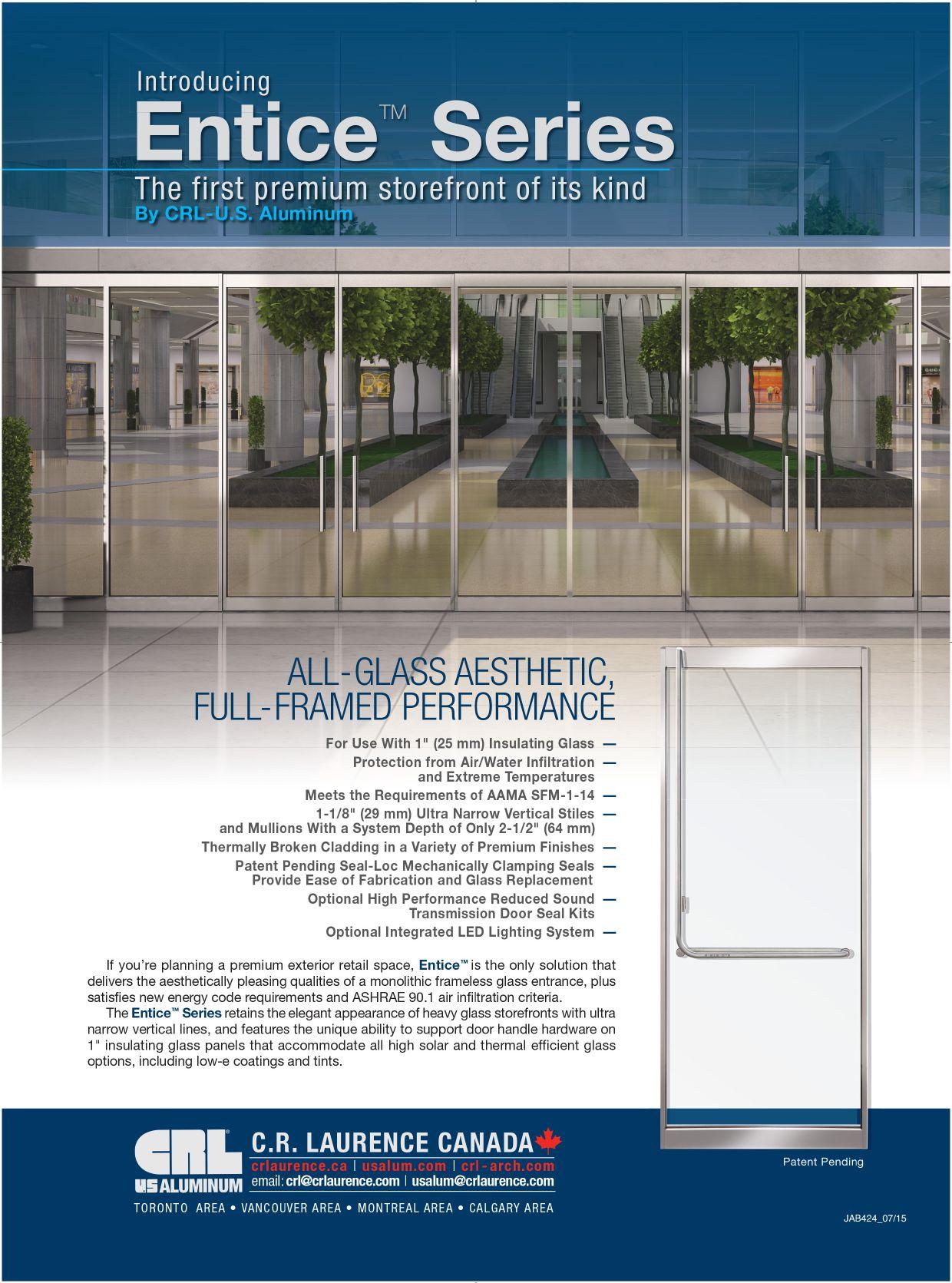
C.R. Laurence doubles Texas warehouse
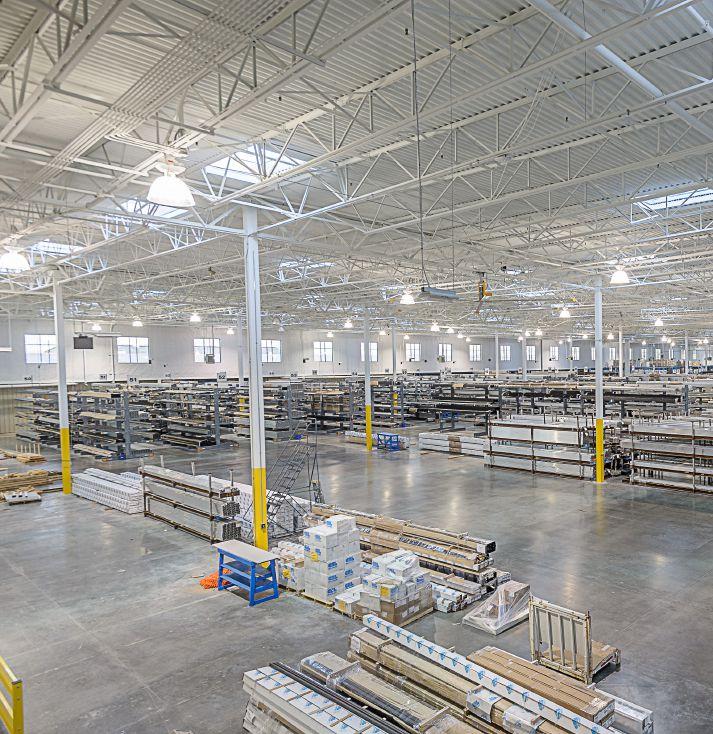
C.R. Laurence has announced the completed expansion of its U.S. Aluminum Division headquarters in Waxahachie, Texas. The renovated facility will enhance production and distribution processes resulting in greater stock inventories, reduced lead times, and improved customer support. At 350,000 square feet, the large-scale expansion doubled the size of the previous building.The result is a new, state-of-the-art facility that serves as the principal North American hub for U.S. Aluminum product manufacturing, fabrication, and distribution. Most importantly, the facility significantly increases inventory space to provide shorter lead times to project stakeholders.
“Expanding the U.S. Aluminum footprint in Waxahachie aligns with our long-term growth strategy, and will have an immediate positive impact on production and customer service,” said Lloyd Talbert, president of C.R. Laurence. “This significant overhaul speaks to
our confidence in, and success of, the U.S. Aluminum brand.”
U.S. Aluminum president, Gerald Hendrick, and vice-president of operations, Patrick Lowrey, will oversee the day-to-day management of the revamped facility.
With service centers in key global markets, C.R. Laurence’s centralized distribution network provides customers worldwide with architectural hardware, including commercial and residential architectural railings, hardware for “all-glass” commercial entrances, transaction hardware and frameless shower door hardware. Over the past few decades, CRL has grown from a single Los Angeles location to include 43 service centers in the United States Canada, Australia, the United Kingdom, Germany, and Denmark.
C.R. Laurence was founded in 1961 and now boasts over 1,700 employees worldwide.
GANA Fall Conference San Antonio, Texas glasswebsite.com
Oct. 18 - 21
AAMA National Fall Conference Cambridge, Md. aamanet.org
Oct. 21 - 24
Glasstec Dusseldorf, Germany glasstec-online.com
Nov. 3 - 5
Windoor Toronto, Ont. windoorshow.com
2016
Feb. 29 - March 3
IGMA Winter Conference Indian Wells, Calif. igmaonline.org
April 20
Top Glass Mississauga, Ont. topglasscanada.com
CGA Newsletter
Canadian Glass Association
The Canadian Glass Association hosted its Annual General Meeting on June 3 at the CGA Glass Connections conference in Saskatoon, Sask. Filled to maximum capacity, it was the largest AGM the association has held to date. In keeping with the recordbreaking theme, the association also almost doubled the size of its board of directors, increasing from six to 10 members. The increase was due solely to interested participants who want to continue the growth and direction of the association, and each will serve a two-year term. The new board also elected its officers for the next two years: Chris Johnson, president; Richard Verdon, vicepresident; Dennis Haatvedt, treasurer; and Brent Wihlidal, secretary.
Due both to the active participation of association members, and the new individuals who are interested in growing the glass and glazing industry in Canada, the CGA has a host of notable achievements that it shared with the membership. The association has joined the GANA Glazing Industry Code Committee, which will provide CGA a voice and vote on code issues relating to the industry. It has re-established the CGA Technical Committee. The Committee will work on code positions within GICC, along with working on other technical issues as they arise in the association. We are also collaborating with GANA to provide CGA members the ability to attend GANA events at a
reduced rate. The CGA has committed to working with the provincial associations to connect each other and the work that they do to serve all of Canada. CGA members will have access to GANA manuals at a reduced rate, providing a CGA member rate and a nonmember rate.
Ontario Glass and Metal Association
The Ontario Attorney General has commissioned a review of the Construction Lien Act. The OGMA has approached the commission to present the concerns of our industry to the review panel. In addition, we have invested $10,000 with an organization of construction trade associations called Prompt Payment Ontario, which was formed for the sole purpose of ensuring the interests of our industry and other trades are heard throughout the review process. The outcome of this review could be the most important piece of legislation in decades and could make a huge difference in your ability to be paid for work. For more information, please read Frank Fulton’s column in the June issue of Glass Canada and get involved. We’ll only get one shot at this and your input could make the difference.
We’d like to extend a warm welcome to members who have recently joined the OGMA: Abaco Glass, Gridline Design Drafting, Panda Windows and Doors/Façade Plus and Samuel Specialty Metals Ontario. Please extend them a
greeting at an upcoming event. Race Nite took place on June 24 and was a resounding success. Everybody had an outstanding time in the posh surroundings of the Munning Room at the Woodbine Racetrack. Some even made enough money to take a day off.
OGMA Fall Golf is just around the corner on Thursday, Sept. 17. For the first time, we’re going to be playing the New Course at the Hidden Lake Golf Club; one of the latest additions to the ClubLink stable of courses. Our Spring Golf event was sold out and we were forced to turn people away so make sure to book early when you get the flyer.
Provincial Glazing Association of
Alberta
One of the initiatives of the PGAA is our participation in the Skills Canada competition. The annual province-wide event draws 10,000-plus high school students from all over Alberta. Its purpose is to introduce young people to the 80 trades that make up the event. While our glazing trade does not participate in the competition side of the event, we are able to introduce potential glaziers to the trade with our “Try-ATrade” booths. The volunteerintensive event was a huge success thanks to the 40-plus volunteers who assisted at our booths. Our glazier TryA-Trade booths were among the busiest at Skills. Over 60 students attended the booths – an increase of 20 per cent
over last year. These potential glaziers got a taste of the glazing trade with hands-on experience at three different stations. Station One was glass cutting, the second was curtain wall cap application and the third was base shoe glazing. These three stations kept our volunteers busy from opening to closing on both days and often there was a line-up to participate. For most of the students, this was their first exposure to the glazing industry. Every student who successfully completed the three stations received a t-shirt. The PGAA also added a women-only interactive booth that was new to this years’ event. The booth was separate from our main booth and required a duplicate set of displays for the ladies. Demonstrations were handled very competently by a group of female glaziers from PGAA member companies. Your association has put a lot of time and energy into this event. We need more trades people and Skills Canada provides an excellent opportunity to showcase our trade. Your support enabled us to attract these future glaziers. An event of this magnitude does not happen without the support of many dedicated people. Thanks to Lynn Allan, our PGAA director of education, Rick Makepeace, our Glass Trades Association of Northern Alberta president and Clint McCulloch, our Edmonton SAIT campus glazing instructor. To our participating PGAA members, thank you for allowing your staff to support the event. They were enthusiastic and represented the trade and your company well. We look forward to working with you at next year’s Skills.
Trulite golf draws smiles
Ennio Rea, Andrew Dolphin and Gwen Hutchins-Porter enjoyed the opportunity to raise a glass with customers and colleagues.
The day was perfect and the good spirits flowing at Trulite’s Customer Appreciation Golf Classic, June 25 at Granite Ridge Golf Club in Milton, Ont. Over 100 golfers took part enjoying 18 holes of golf, a delicious dinner and a chance to putt for cash with half the proceeds going to Sick Kids Hospital. Doug Randall, sales manager, acted as host for the event with a little help on the mic from Ennio Rea.
Atkinson elevated to COO at Stuart Olson
Stuart Olson Inc. has announced changes to its senior management team, including the promotion of two individuals from within the company. Arthur Atkinson has been appointed chief operating officer of the Buildings Group, with overall responsibility for leadership of the group. Atkinson, who has worked at Stuart Olson for over 10 years, was most recently executive vice-president of the buildings group and prior to that served as vicepresident of southern Alberta.
“Arthur Atkinson is exceptionally qualified to lead the buildings group and achieve its strategic and operational goals,” said David LeMay, Stuart Olson’s president and CEO. “He has been instrumental in helping the group build a strong and secure backlog, while steadily improving operational performance.”
Atkinson takes over from David LeMay, who has led the group on an interim basis for the past 18 months. LeMay will now assume the additional responsibility of leading the industrial group on an interim basis, replacing group president, Allan Tarasuk, who is leaving the company.
Stuart Olson also today announced the promotion of Joette Decore to executive vice-president of corporate strategy and
development. Decore has held various executive positions at Stuart Olson, including vice-president of human resources, vice-president of corporate development and most recently, vice-president of strategy and development.
“With executive responsibility for human resources, corporate communications, strategy and corporate development, Joette Decore plays a major role on our senior executive team and has been instrumental in guiding the strategy of the overall organization. This promotion recognizes the significant contribution she is making to the company,” said LeMay.
The changes announced, including the reorganization of the buildings group and industrial group under chief operating officers rather than presidents, are consistent with Stuart Olson’s strategy of operating as an integrated full-service construction company.
“We are creating a leaner, more efficient corporate structure that accelerates decision making, enables all parts of the organization to work together more closely and cooperatively, and reflects the responsibility of the Stuart Olson president for delivering operational performance” said LeMay. “The promotions announced today also reflect our strong focus on internal succession planning. We are committed to developing and growing our people from within our organization.”
NFRC promises more for commercial fenestration
The National Fenestration Rating Council (NFRC) says it is renewing its commitment to providing the commercial fenestration industry with an energy performance certified rating program. In the short-term, the organization is refining its existing Component Modeling Approach (CMA) program to provide users with a more efficient experience, allowing them to calculate fenestration energy performance ratings faster. NFRC’s long-term commitment, however, involves more than just improving its current tools.
“We’re dedicated to building a first-class program for the commercial sector,” said Deb Callahan, NFRC’s interim CEO. “We’ve started interacting more directly with industry professionals to better understand their challenges and guide our decisions toward creating the best solution.”
NFRC will be reaching out to collaborate with partners that include the American Architectural Manufacturers Association (AAMA), the Insulating Glass Manufacturers Alliance (IGMA),
and the Glass Association of North America (GANA). NFRC anticipates its commercial certified product rating program will gain traction as whole-building commissioning grows. It sees this shift creating the need for the organization to provide rating information that enables more precise whole-building calculations.
“This is where the industry is headed, and NFRC is going to be there,” Callahan said.
NFRC’s board chair, Jeff Baker, agrees. He sees the organization more carefully considering its contribution to green building and sustainability as it develops its commercial program. This is another area it plans to cultivate in alignment with insight it gains directly from the industry.
“Our industry is evolving, and we see many exciting opportunities for NFRC to figure more prominently in making the nation’s buildings more energy efficient,” Baker said. “We’re keeping pace with what’s happening, and creating a scalable program.”
Arthur Atkinson
Feds announce new money for southern Ontario businesses
FedDev Ontario Minister, Gary Goodyear, has announced a contribution of $3,227,750 to the Western Ontario Community Futures Development Corporation Association (WOCDFCA) to support the growth of small- and medium-sized enterprises in southwestern Ontario.With this investment, the WOCFDCA is establishing a $6.2-million investment fund to strengthen regional diversification efforts across southwestern Ontario.The federal contribution is leveraging $3,227,750 in matching funding from the network of southwestern Ontario Community Futures Development Corporations (CFDCs).The project will provide a critical source of capital to support the transfer of businesses to a
new generation of entrepreneurs, as well as serve other regional diversification needs in rural southwestern Ontario.Through this fund, the association expects to support 37 small-and mediumsized enterprises by providing access to capital for business development, transfers and other business retention and expansion activities.The federal contribution, through the Investing in Regional Diversification (IRD) initiative, is aimed at supporting the long-term development of stronger, more diverse economies in southern Ontario communities. IRD leverages unique regional assets and local expertise to attract new investment and opportunities for economic growth and development.
Acker to run sales for
DMike Acker
ymax has announced the appointment of Mike Acker as Americas sales manager. In his new position, Acker will report to Stephen LaCroce, global director of technology, and will be responsible for achieving the Americas annual revenue targets in adhesives and equipment while continually enhancing the commercial effectiveness of the Americas sales
Dymax
organization. Acker joined Dymax in 2009 as a territory sales manager and advanced to a regional sales manager position in 2014. He came to Dymax with a breadth of experience across multiple adhesive chemistries and an extensive industrial sales background including several years as an engineering sales representative with Ellsworth Adhesive Systems, a strong Dymax channel partner. Acker received his Bachelors of Business Administration degree from the University of Wisconsin-Whitewater with a major in marketing.
New web ordering system from Pilkington
Pilkington Architectural Glass North America has launched My Pilkington, an innovative online order entry, inventory review and tracking system for its customers. Pilkington is streamlining the glass ordering process with a new user-friendly system, making it faster and easier.The new system offers customers valuable information, available anytime and anywhere. My Pilkington enables customers to review and increase glass orders to fulfill any requirements on truckload quantities; quickly view, print, and download invoices and order confirmations; look up product information and performance data; order samples and literature with a few steps; and customize their profile page by updating profiles, shipping details and managing account access. Customer service representatives are still available to ensure satisfaction with every order.
Restructured DFI emerges
DFI, a coatings supplier, has announced its restructured organization. The main shift creates dedicated teams for both account management and business development allowing a more strategic focus on the specific needs of each. Backed by the marketing and operations groups, DFI hopes this new organization will leverage the company’s 85 years of combined experience in marketing low-maintenance coatings to help DFI customers drive sales and also drive sales to those customers. This restructured DFI will continue to be led by Adam Zax as
CEO. Russ Slaybaugh has been elevated to COO and will have day-to-day responsibility for executing this customer-focused strategy throughout the organization. Guillermo Seta, as senior vice-president of Global Business Development, will focus his talents on further showcasing DFI’s industrial flexibility. As vice-president of Global Operations and customer satisfaction, Todd Gentry’s operations role will expand to all DFI operations worldwide and he will play a key role in ensuring DFI delivers support to the company’s existing customers.
by BILL LINGNELL
Bill Lingnell has over 46 years of experience in the technical field of glass and architectural products. He holds three Masters of Science degrees in engineering: civil, mechanical and engineering science. Lingnell is the technical consultant for the Insulating Glass Manufacturers Alliance.
Filling the information vacuum
The Insulating Glass Manufacturers Alliance has recently released its technical bulletin TB-2600-15 Vacuum Insulating Glass which is an informational document giving an extensive overview on the subject of vacuum insulating glass (VIG). This is one of the documents that the IGMA Emerging Technologies and Innovations Committee worked on for over a year, in which we believe readers will find an compilation of some very interesting and educational information along with data relative to VIG.
There were many contributors and experts within the IGMA membership working on this effort. The finished product has technical information that will assist those in the glass industry, as well as designers, architects, specifiers, engineers and end users of VIG, to understand the product along with the technology and science that goes into this type of insulating glass unit.
Earlier this year, a brief introduction was presented to give an outline of a few topics that will be covered as VIG becomes a viable use of glass and glazing to our industry while we continue to provide energy efficient products, and advance the use of glass. We will go over a few of the basics regarding the VIG concept first and then explain some, but not all, of the topics in the technical bulletin.
The technical bulletin begins with a brief history of the concept. A patent was issued for VIG as early as 1913 with today’s versions similar to the original concept. The VIG unit normally consists of two pieces of glass with an evacuated space between each layer, which is then sealed to keep the vacuum in the space. This principle is to virtually eliminate conductive and
VIG appears to have the potential to assist the glass and glazing industry toward more energy-efficient windows.
convective heat transmission through the cavity.
The general goal of VIG is similar to that of the conventional insulating glass units we are familiar with in that it will improve the overall insulating properties between the exterior and interior environments, lowering the U-factor of the product. The benefits of VIG are that it significantly reduces the convection and conduction within the space between the glass lites due to the vacuum in the gas space, Also, VIG units may be very thin as compared to conventional IGU’s that have a much greater space between the lites. While standard IGU depends on the increased density and inert chemical composition of the gas fill to reduce heat transmission, VIG takes exactly the opposite approach by instead leaving very few gas molecules present which dramatically reduces energy transfer between the lites.
The bulletin goes on to explain some of the differences in the VIG when compared to the typical IGU. For example the space between the two lites of glass in a VIG is typically less than one millimeter, while in a typical IGU the separation is commonly six to 13 mm. The VIG will also have an array of pillars, spacers or stanchions that maintain the void between the lites so they cannot touch under the under the vacuum that is applied in the space between the lites. These spacers are carefully engineered and placed so that the glass stresses are managed properly due to the loading from the atmospheric pressure and vacuum in the space.
There are some interesting design concepts that also allow the coupling of VIG to conventional IGU to enhance the energy efficiency of the glazing system. These “hybrid VIGs” may require special framing and supporting systems, however, it is evident that the overall results will be significant to the end user in reducing energy use and being able to take advantage of daylighting and the use of windows.
At this time VIG appears to have the potential to assist the glass and glazing industry toward more energy-efficient windows. Readers of this article are encouraged to obtain the full publication from IGMA and explore the additional information presented in the document. •
n ’ t m i s s i t
Including a site visit to NREL
�e Brown Palace Hotel & Spa
Octob er ––,
R e g i s t e r n o w
Three ways
ways to glaze
Choosing architectural glass is about balancing options.
by JOHN SHAW
Specifying glass using good, better or best options is a basic concept that can be instrumental in the selection and design process. Various considerations for your glass selections will include safety, energy, loads, and security for a basic system, and can be improved with specialty high performance products to address sound, glare, aesthetics, and performance concerns. These value-added products will differentiate your project to exceed common expectations and would be better/best options.
At a minimum, your glass options must meet minimal energy standards set by the local codes. This baseline standard would be considered a good system. Regardless of the options, the building energy codes drive us to use a prescriptive or component approach to determine what type of glass and quantity should used as defined by the specific application and location. Glass is not a onesize-fits all proposition, and there is no magic checklist, so it is up to the designer to dial in on the project needs and to choose the right glass to specify so there is no room for selection and fabrication errors. According to Bill Cody, architectural design manager for Guardian Glass, some important considerations include the design concept and performance considerations.
Better and best options incorporate various components that enhance the building. There are many considerations, including daylighting, facade design, view and occupancy comfort. All of these factors can play a major role to influence or guide your glass specifications. Better and best options are driven by the architect, glazier, contractor and other decision makers that support the clients’ decisions. Other considerations for selecting the right glass include:
• Sound- Does the glass need to provide specific sound attenuation performance?
• Glare- Will any or all the glazing contribute to excess glare or the need to control interior glare?
• Esthetics- What is the desired reflected colour? How much exterior reflectance is desired?
What about interior reflectance? Is complimentary or contrasting spandrel glass needed?
When specifying glass you will want to ask about the availability of the product and the lead time. It is often preferable to choose glass where more than one manufacturer makes similar products, so your contractors can find the best deal in cases where sub-contractors source glass from more than one fabricator.
Another factor entering into your good/better/best calculation will be the maintenance, cleaning, and repair/replacement costs of the product you specify. You need to know how fast you can get replacement glass during construction and post commissioning. Can the glass be cleaned easily? Coatings can add a number of desirable performance features, but coated glass may require special handling or cleaning practices.
Are the sizes and configurations of glazing being drawn actually constructible or practical? Too
LEFT: There’s nothing worse than a blank piece of paper. When designing a building envelope, architects and engineers are confronted with a nearly endless array of options for glass and glazing materials. Our expert recommends looking at each project as an exercise in good/better/best optimization.
Meeting codes or the least money is only one approach to building design. Good glass specification has to take dozens of factors into account, including possible long-term savings with better framing systems, higher performance glass and more careful application of available products.
often, a designers imagination outstrips the actual state of present technology, especially when budgets are involved. The fenestration framing system selected must be able to accept the glass unit configuration. Warranties are important as well and need to fit the project requirements.
Better and best options create the ability to extend past the common use of the minimum standard glass and allows alternative systems to be used in the specifications, as well as enhanced designs and attachment systems. Attachment systems may dictate or influence the appropriate glass selection and minimum standard for glass specification. The design and overall look of the building is determined by the design/architecture. The proper selection of materials and specification will ensure that vision is brought to life. Unfortunately the specifications are only as good as the execution, and follow-up may require verification throughout the design, manufacturing, fabrication and installation process.
The selection of best glass – for instance, specialty enhanced architectural glass – will allow some give-and-take to what type of system can be used and may allow the designer to use more glass on the project. “All architects want all glass but our energy codes don’t allow it,” says Marc Chavez, associate partner at ZGF. “I would like a cost effective vacuum insulated glass that is 1/4 as thick as a standard triple pane system: an enhanced system that would not limit our glass usage because of U-value. Having said that we do need to manage the heat gain.”
Specialty products can help manage solar heat gain. For example, Raven Windows offers a thermochromic smart window filter that will auto-tint as the building heats with no control systems and or no human interaction. As the building cools it will transition to its clear state. This advanced technology includes a solar-activated filter that is laminated to the #2 glass surface. When paired with double silver low-E the SHGC can reach a impressive 0.104.
The axis of quality
Another great example is Retro Solar. This product is designed to maximize daylighting, while managing solar heat gain and glare, as well as direct light streaming into the building. This advanced technology uses stationary louvers encased within the glass IG unit to reduce solar heat gain while providing an esthically pleasing, clean design with easy maintenance while eliminating the need for cumbersome and unsightly shades or blinds. It is designed to redirect the overheating sun back into the sky and reflects glare-free illumination in the depth of the room with no control systems or electricity.
Your glass selections can be tailored to fit your integrated design objective and outcome. Integrated design allows all the
LIFE SAFETY
Is safety glazing, blast-resistant or fire-rated glazing needed?
ENERGY
Do you have heat gain or heat loss challenges? Do different elevations have different energy needs? What are the code-driven requirements?
aspects of the building to be considered. Various sides of the building will use various specifications. North- and east-facing sides will vary drastically and may use good or better glass, while south- and west-facing sides of the building may use better or best glass. Balance the matrix of design concerns such as architectural design, interior design, heating, ventilation and HVAC systems as well as cost effectiveness and occupant comfort. As the energy and performance expectation grow, the selection options in terms of glass choices and systems decreases. While the advancement of the systems and glass specifications are mainly driven from our minimal energy standards, “the design side is having to learn the engineering of the system used because it is a
constraint on the design, while the systems used are becoming an engineered commodity,” Chavez says.
Balancing short and long term costs will help guide your selections. As part of this process it can be helpful to quantify the requirements such as U-factor, SHGC, visual light transmittance, sound transmission, reflectance, and relative heat gain. To accurately determine short- and long-term costs you will need to involve the glass manufacturer, glass fabricator, window manufacturer and glazing sub-contractor. Balancing the short- and long-term costs will invariably result in a small window of options. Cost may seem to be an overwhelming consideration, but when balanced against long-term costs they are not so prohibitive.
Whether you’re specifying good, better or best, you can avoid some challenging pitfalls by providing clear and detailed specifications. For example, quality pitfalls can be minimized by specification. A recent example includes the Seattle Stadium Place. This project exemplifies the style of Seattle with an amazing design and incredible look, but the ripple effect reflected on the glass distracts from the overall design concept. This is the result of the use of less expensive, imported low iron glass (that very well may have fit the spec) but failed to achieve the overall intent for the look of the project. A more detailed specification such as requiring a tighter roll wave, bow, and warp specification could have reduced the opportunity for distortion or substitution.
When specifying glass it is important to consider application, performance, appearance, costs and design concept. Specifying glass using good, better or best options can be instrumental in the selection and design process. The availability and use of new and exciting products like architecturally driven high performance glass are value added products that will differentiate your project to exceed common expectations. •
John Shaw, principal of Shaw Designer Resources (SDR), has been working with the architectural and design community for over eight years, specializing in the Pacific Northwest. SDR brings marketing expertise with a focus to educate while creating interests and specifications by building relationships for partners. Feel free to contact SDR directly at John@ShawDesignerResouces.com or visit the website at shawdesignerresources.com.
SECURITY
What security issues do you face?
Do you have vandalism, burglary or ballistic security concerns?
LOADS
What are the load conditions affecting the glazing?
Concerns may include: wind, thermal, impact, seismic, snow or structural to name a few.
by SKIP MACLEAN
Skip Maclean is president of Fenestration Canada. He is business development manager for Tru-Tech Doors and has over 40 years’ experience in the window and door industry.
Active and energetic
After completing a successful Annual General Meeting in Vancouver – one of Canada’s most breathtaking locations – it is easy to feel enthusiastic about the future of our industry. Mother Nature was kind, the sun bright and by all accounts attendees were well-served for the time and expense in attending. Delegates were treated to thought-provoking discussion regarding all matters that concern our future and current businesses. Al Jaugelis of RDH presented a session on “NAFS and the Custom Home”; Murray Frank of Constructive Home Solutions presented “Window and Door Installation Challenges”; and Herman Koolman, the Building Officials Association of BC education coordinator, presented a code officials perspective on “Enforcement and Compliance Issues Regarding NAFS.” Installation discussions seemed to dominate the thoughts of many attendees who were invited to provide their perspective during a roundhouse session led by J.F. Kogovsek of Maxam Marketing, who also gave a thought-provoking presentation on “The Benefits of Having Proper Installation Procedures.” Randy Hnatko of Trainwest Management and Consulting delivered the keynote presentations on “10 Barriers to Your Success” at the Friday luncheon and “Eight Insights that will Change the Way you Think and Sell” at the Saturday morning session. The insights provided were both timely and thoughtprovoking.
Once again the Fabricators Council, led by Lisa Bergeron of Jeld-Wen and Greg Dickie of Atlantic Windows met to discuss issues facing fabricators and formulate a strategy moving forward. Over 30 fabricator companies were in attendance at the meetings and many participated in the council meeting. In a later session, technical expert Jeff Baker of WestLab informed attendees of
AGM delegates were treated to thoughtprovoking discussion regarding all matters that concern our future and current businesses.
upcoming changes to codes, Energy Star and other technical initiatives. The technical committee led by Jean Marois of Royal Building Products and Robert Jutras of Air-Ins was in session with many non-committee attendees taking part as observers.
One of the most intriguing discussions around the conference centered on the request by the National Research Council to modernize the code requirements for combustible windows in noncombustible (Part 3) buildings. This request was brought to our attention at Windoor 2014 and a task force was set up to prepare initial steps. There are two specific aims of the project: to assist participating manufacturers expand the use of pre-tested combustible window frames under the current code guidelines and to acquire specific data needed for an industry group to pursue changes in the code requirements that currently restrict the use of combustible windows in Part 3 buildings. Attendees were invited to participate in a webinar on June 23 to establish a framework for industry. NRC is proposing to design a research program that would provide industry participants useful and valuable data independent of any future code changes.
Our new website was unveiled at the AGM to rave reviews and will soon become the backbone of our marketing, information and education initiatives. Hats off to Laura Weil of Euro Vinyl Windows and her Membership and Marketing team for their efforts in developing an exciting, new and fresh-looking website.
A lot of work lies ahead for our re-energized committees. Volunteers are always welcomed to participate and contribute to discussions. Most meetings are held via conference call using GoToMeeting software and we try and schedule face-to-face meetings of committees during our annual conference and the Windoor Show.
Next year, our AGM will be held at the Fairmont Mont Tremblant resort from June 8 to 11, 2016. We encourage everyone to save the dates on their calendars now. We will be working collaboratively with the AVFQ to ensure another successful event. •
Raise your glass to superior quality.
Glaston – Everything it takes to make great glass
MACHINES
Industry-leading machines and technologies for the heat treatment of glass.
SERVICES
High-quality services from maintenance, spares and tools to comprehensive software and machine upgrades.
We deliver machines and services that enable the production of the best heat-treated glass products in the world. Our innovative and extensive portfolio of industry-leading machines and lifecycle services are designed to let you shine in your business.
When we make a promise of glass processing excellence, we see it through.
Glaston provides the most comprehensive range of high-quality glass processing technology and services. www.glaston.net
by BRIAN BURTON
Brian is involved with an innovative multidisciplinary firm that specializes in technical business writing: Award Bid Management Services (award-bidmanagement-services. com). The firm assists companies interested in selling goods and services to governments and institutions. He can be reached at brianburton1995@ gmail.com.
Behind the windows
The National Film Board of Canada recently won an International Emmy Award for its innovative documentary titled Highrise/Out My Window. The compelling web documentary allows viewers the opportunity to take a glimpse “through the windows” at the lives of 14 different high rise residents. The video can be found at outmywindow.nfb.ca.
It’s an appropriate topic to explore because of the increasing number of residential high-rises in Canadian urban centers and around the globe. The subject is also relevant because if you were somehow able to strip away the balconies and railings you could clearly see the tremendous number of windows and sliding doors that a typical 20-story high-rise tower contains. If architecture is supposed to reflect how a building’s occupants live in the space, and if we are involved in building architecture, then this film can tell us something about how we should design our projects.
High-rise residents share a common environment in “vertical cities.”
The video includes comprehensive interviews with high-rise residents that explore their lifestyles and relationships in what amounts to a form of communal living within these highdensity communities. Many are over 20 stories in height and contain more than 200 separate rental units. The director and producer discovered that many close relationships developed with residents who share similar interests. The in-depth interviews from many cities around the globe also demonstrated how closely knit some of these communities can become. In many ways they reflect the cultural diversity of the countries where they are located. Particularly interesting were the interviews with residents living in Havana, Cuba, where music, art and social activities link many of the residents together. They share a common environment in what the director refers to as “vertical cities.” A similar sense of community was quite apparent in the interviews that were conducted in Toronto. In addition to the regular residential units, some buildings have over 5,000 square meters of communal spaces including courtyards, roof terraces and communal dining areas where tenants can gather and socialize with their neighbours.
In a recent interview the director, Katerina Cizek, specifically mentions being influenced by Toronto’s well-known Tower Renewal Project, an on-going initiative that was originally started by former Toronto mayor, David Miller. With almost 2,000 high-rise residential towers, most of which are at least 20 stories in height, it’s well-known that Toronto has the highest density of these high-rise residential buildings in North America with the exception of New York City. The reasons we’ve built so many actually involves a combination of changing construction technology and Toronto’s complex urban demographics. Most of these structures were built almost 50 years ago and most of the discussion lately has focused on how to refurbish these structures economically.
The documentary also points out that for the first time in history, more people live in cities and that most urban growth is taking place on the perimeter of cities where many high-rise towers are constructed.
The documentary explains the reasons for the construction of numerous clusters of high-rise residential buildings in Toronto. These clusters are like a record of urban trends and surges in population growth as Canadians moved into the city at an explosive rate in the ‘50s and ‘60s. Toronto was ready, willing and able in those days when it came to building high-rises and had all the necessary prerequisites which included the motivation, population and skilled work force to effectively accomplish the task. The city itself and the suburbs also had the beginnings of a mass transit system and the financial capital available with many individuals willing to invest and financial institutions willing to extend credit. Another factor that is often overlooked is that Toronto, as an urban center, had plenty of room to grow.
All these factors contributed to the rapid growth in high-rise construction right up to the ‘70s. Toronto saw a tremendous apartment boom. In fact during the ‘60s nearly half the city’s housing stock and 77 per cent of all housing starts were apartments of this type. It seems even then, Toronto was at the forefront of the vertical cities concept. •
A New Look for Triple-Silver Performance
Energy Select™ 28 features an exclusive triple-silver coating that produces a more neutral, bluer appearance to the building envelope while also delivering maximum energy efficiency and comfort. Its 0.28 SHGC combined with a 62% visible light transmission and light-to-solar-gain of 2.21 provides impressive solar control to meet even the most stringent energy code requirements in North America.
AGC takes this new triple-silver coating to an even higher level of performance and visual appeal when added to an array of tinted substrates. Visit us.agc.com or contact us at info@us.agc.com.
INDUSTRYEVENT
GLASSBUILD TO HIT
by NATIONAL GLASS ASSOCIATION
GlassBuild America returns to the Georgia World Congress Center in Atlanta, Ga., on Sept. 16 through 18, with a focus on profit-generating resources and expanded opportunities for the window and door industry through the Dealer Days section of the show. GlassBuild is organized by the National Glass Association and the Window and Door Dealers Alliance.
With more than 325 companies expected to exhibit in Atlanta, GlassBuild will offer attendees the chance to see, touch and discuss new product lines with a variety of architectural glass and metal, and residential window and door suppliers. If your company is looking to invest in new machinery to keep up with increased demand, GlassBuild is a good place to shop with more than 60,000 square feet of the show floor dedicated to equipment for glass and metal fabricators and window and door manufacturers.
Learning at the speed of business.
Supply chain management is a hot topic in the glass industry today in the wake of primary glass shortages that have affected everyone’s businesses. Building strong relationships with suppliers and ensuring access to the products you need is more critical now than ever. What better place to start than face-to-face with your suppliers at GlassBuild?
Labour shortages continue to plague us, so employee retention is increasingly important to the success of any company. GlassBuild offers a chance to show employees you’re invested in their professional growth by providing them the opportunity to attend GlassBuild America’s extensive education program. In addition, tips and tricks for attracting the next generation of glass professionals is a major theme in the Glazing Executives Forum, and the
NGA/WDDA Keynote Breakfast.
Glazing Executives Forum
This event for glass and glazing industry owner and managers will celebrate its 10th anniversary this fall, when executives from around the country gather on Sept. 16.
8:30 - 9 am Continental breakfast
9:00 - 10:00 am Keynote: Building a Stronger Bench
How to empower and incentivize employees to take your business to the next level. During this one-hour presentation, gain insight into how to establish a strategic succession plan, move senior
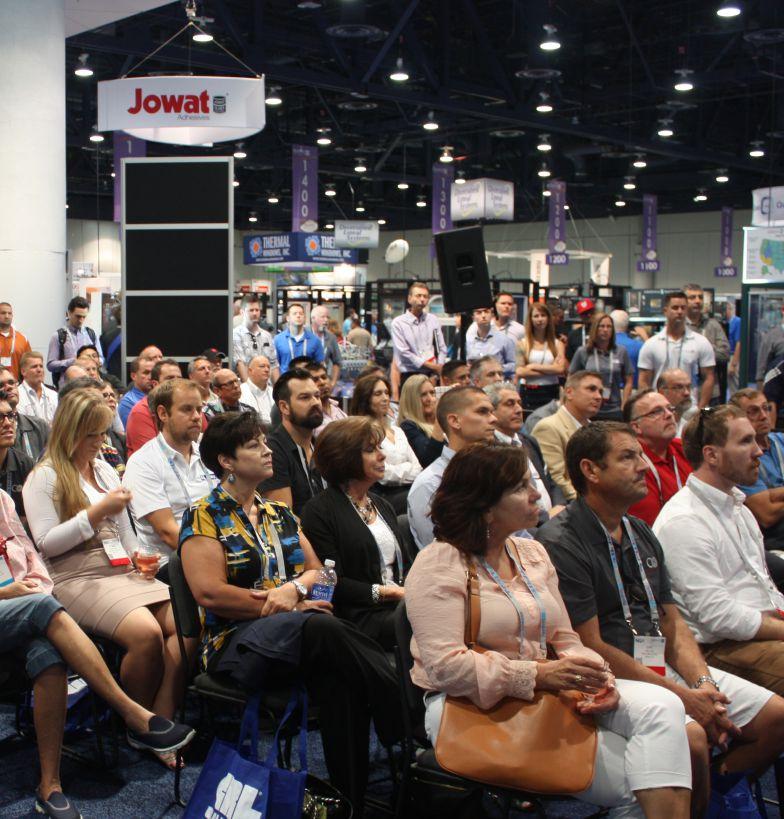
Modeled after TedTalks, GlassBuild’s Express Learning seminars were a big hit last year. The show has brought the 20-minute seminar format back with an expanded lineup for 2015.
photo credit: Rich Porayko
HIT HOT ISSUES
management into leadership roles, and incentivize employees to increase company loyalty.
10:15 - 11 am Breakout Sessions (choose one)
• Strategies for attracting new workers to the glass and glazing industry
• Smart estimating
• Field installation issues
• Architect interaction: Creating a win/win relationship
11:00 - Noon Breakout Sessions (choose one)
• Strategies for attracting new workers to the glass and glazing industry
• Smart estimating
• Field installation issues
• Architect interaction: Creating a win/win relationship
12:15 - 1 pm Lunch
1:00 - 1:45 pm Keynote Panel: Managing Lead Times in a Busy Market
The rebounding construction market has put strains on material supply, creating potential difficulties getting certain products and, in particular, longer lead times. In this panel discussion, project managers from leading glass and metal fabricators share strategies to ease pressures.
2:00 - 2:45 Breakout Sessions (choose one)
• Strategies for attracting new workers to the glass and glazing industry
• Smart estimating
• Field installation issues
• Architect interaction: Creating a win/win relationship
3:00 - 4 pm Economic Forecast with Jeff Dietrich Jeff Dietrich, senior analyst for the Institute for Trend Research, will return to the Glazing Executives Forum with his much-anticipated economic forecast, offering attendees insight into current and future economic trends and their effects on the glass and metals industry.
4:00 - 5 pm Networking Reception
NGA/WDDA Keynote
New for 2015, registered attendees to the Glazing Executives Forum will also gain access to the NGA/WDDA Keynote Breakfast on Thursday, Sept. 17. Speaker, author and generational expert Cam Marston will address how today’s most successful companies are competing for, winning, and retaining their top people. His presentation will break down the motivations of each of the generations of employees and illustrate how companies “in the know” are using those motivations to better attract and retain talent.
GLASSBUILD NEED-TO-KNOW
WHEN: Sept. 16 to 18, 2015
WHERE: Georgia World Congress Center, Atlanta, Ga.
WHAT: Education seminars, keynote speeches, networking, 60,000-square-foot trade show floor
WHO: Commercial and residential fabricators, contractors and dealers.
WHY: GlassBuild is the largest glazing show in North America, welcoming thousands of the industry’s top suppliers and experts. The 2015 edition will include a focus on employee retention and an expanded program for window and door dealers.
Express Learning
Building on the success of its inaugural year, Express Learning returns to the GlassBuild America trade show floor in 2015. Last year, the “TED Talk”-inspired, 20-minute educational sessions drew standing-room-only crowds. This year, the content experts at the National Glass Association and Window and Door Dealers Alliance are producing a new series of free Express Learning sessions, aimed at providing attendees with specific product- and business-related information they can use to build more profitable companies.
Smart PR: Getting your Company in the Trade Media presented by GlassMagazine
Being featured in trade magazines and on their websites is not only exciting, it’s also smart business. Learn how to get your company in front of readers.
On the Cutting Edge: Best Practices for Glass Fabrication presented by Ashley Price and Steve Brown, Salem Flat Glass and Mirror
Learn how to ensure the best glass edge quality through the use of diamond tools, cerium impregnated wheels, cerium, felt wheels, and other glass fabrication technology.
Entering the Commercial Window Market as a Residential Fabricator presented by Matthew Matlak, Veka
Learn a methodology to determine if you, the residential window fabricator, are positioned to enter the commercial market segment. This session will include discussions about market opportunity; how to talk to architects, contractors and owners; margin analysis, marketing; and much more.
Changing the Global Glass Market – From Production to Product presented by Birgit Horn, Glasstec
An examination of the changing global supply chain, supplier challenges, new product development on a global scale and branding glass.
Selling Across the Generations presented by speaker, author and generational expert Cam Marston and sponsored by NGA\WDDA
Learn the different ways to sell to each of the four generations who are making buying decisions in the marketplace today: the Matures, Baby Boomers, Generation X and Millennials.
How to Use Design-Assist to Help Grow Your Business presented by YKK AP America
Learn how to leverage your architectural aluminum system supplier’s resources to make your company indispensable to the architect and general contractor. Examples illustrated by case histories. Find and apply existing, non-standard solutions. Be the first to understand complex code changes. Use application engineering support to the fullest. Work as a team to take time and cost out of the schedule.
The Evolving Shower Enclosure Market presented by Tom Whitaker, Mr. ShowerDoor
Learn about new trends, product options and more.
A Guide to “Pane” Free Installation of Dynamic Glass presented by Lou Podbelski and Helen Sanders, Sage Electrochromic
Learn how easy it is to install dynamic glass into your new construction projects as well as retrofits. This presentation will provide an overview of how to install dynamic glass and examine new technological advances for dynamic glass installation.
Fire-rated Glass and Sustainability presented by Vetrotech Saint-Gobain
Understand the sustainability aspects of fire-rated glass and how it can help achieve LEED v4 credit points.
Field Testing and Forensic Evaluation: A FenestrationMasters Course presented by the American Architectural Manufacturers Association
Codes and standards help to lay the foundation for field testing, but there are common trouble spots that test engineers will encounter during their testing. As detailed in FenestrationMasters curriculum, AAMA water and air field testing documents outline the common problems typically encountered, and address appropriate procedures for forensic testing.
Problem Solving to Boost Your Bottom Line presented by Carl Tompkins, Sika Corp.
This presentation will identify the root causes of problems that occur in all departments, within all positions, within all glass
companies. Sika’s Carl Tompkins will address how much common problems cost companies, remedies for those problems, and how solving them can boost your bottom line.
The Increased Popularity of Unitized Curtain Wall Systems presented by Kawneer
Explore the evolution from stick curtainwall systems to unitized curtain-wall systems; the technology, equipment and mind-set required for the glazing subcontractor to move from stick field erected to unitized solutions; and thoughts on the benefits to the glazing contractor, building owner/developer and design team.
Focus on window and door dealers
The Window andDoor Dealers Alliance will launch Window and Door Dealer Days at GlassBuild America this September, providing a unique venue for dealers to see, touch and talk about new product lines, while gaining valuable information on current market conditions and best business practices. The three-day event will feature:
The Dream Showroom
Sept. 16-17 10 am to 6 pm Sept 18 10 am to 3 pm
The Dream Showroom is the focal point of Window and Door Dealer Days. The 4,400-square-foot pavilion on the tradeshow floor will feature residential windows, entry doors, patio doors, multipanel door systems and hardware display ideas that dealers can incorporate into their own showrooms. The Dream Showroom will provide a unique venue for window and door dealers to see the latest technologies and new product lines, share best practices, get updates on market trends and—most of all—be inspired. Displaying in the Dream Showroom are: DAC Products, EDTM, Renoworks Software, AmesburyTruth, B.F. Rich Windows and Doors, Interlock USA, LaCantina Doors, MI Windows and Doors, Paradigm Window Solutions, Pleotint, ProVia, Seaway Manufacturing Corp., Slide Clear, Soft-Lite, Vinylmax Windows, and Sunrise Windows.
The Remodeling Forecast
Sept 17 1 pm to 2 pm
Presented at The Dream Showroom
During a special one-hour presentation, Window and Door Dealer Days attendees
will gain insight into remodeling market conditions that directly affect their businesses. Presented by Paul Emrath, vicepresident for Survey and Housing Policy Research at the National Association of Home Builders (NAHB), this session will reveal the latest trends shaping the remodeling industry and most importantly, your business! Emrath has over 20 years of statistical and economic research experience at NAHB and has published more than
150 articles on a wide variety of housing related topics. His Remodeling Activity Forecast will focus on:
• Drivers of remodeling activity
• 2015 remodeling forecasts by state and top-performing zip codes
• National 2016 remodeling forecast information
• What home-buyers want in a contractor, how they find them and reasons for choosing them. •
Technology dreams
Imagination and experience can’t beat the bureaucracy.
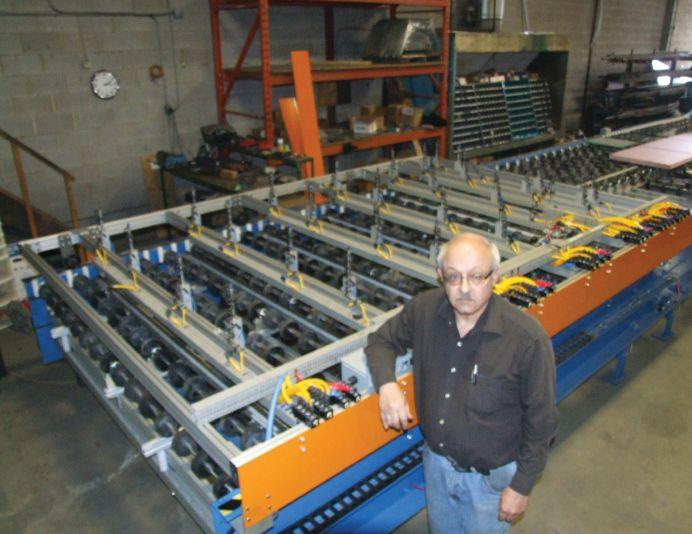
Felix Gutnik is the brains of Design and Integration, where he leverages over 25 years of machine-building experience into beautiful designs like this largeformat pick-and-place laminating system. Now, he’s looking for the opportunity to do more.
Design and Integration is what you might call a pure engineering company. Located in a nondescript industrial unit in Concord, Ont., Felix Gutnik and his team are quietly coming up with elegant solutions to common problems in glass processing automation without multimillion-dollar R&D budgets or any government support. All they really have is Gutnik’s lifelong passion for building and fixing mechanical things, and experience in the glass industry that now stretches back three decades.
Design and Integration will probably build anything anyone asks them to, but their specialty is glass processing automation, including lamination lines, insulating glass assembly lines and material handling automation and equipment. They have provided a liquid lamination line with specialized tables for taping, tilting for assembly, filling and curing laminated glass units. That one was done in partnership with Uvekol.
Film lamination was Felix’s introduction to the glass business through work he did with Kodak at a prior company. Over the year’s he’s come up with some nifty
tricks for solving the notoriously tricky problems of automating film lamination. For instance, one design uses a two-level approach to achieve high-speed lamination even of irregular shapes. The line has two feeder conveyors, one over the other. One sheet is brought in and loaded into the top conveyor. The second is brought in and a worker places and trims the interlayer film. Then the bottom piece, with the interlayer on it, feeds through. As it emerges, the top sheet is precisely fed forward so that it droops down and its edge matches up with the edge of the bottom sheet. As the two pieces feed forward, the top sheet is gently laid onto the interlayer, with its weight forcing out any air between the layers. The system works just as well with round or odd-shaped glass as it does with rectangles.
Design and Integration has also made a very cool cross-cut machine for quickly automating trimming on high-speed, mass production laminating operations. A panel of glass is fed under the film roller, which dispenses the film onto the surface. When its leading edge emerges on the other side, it hits a stop. A sensor
stop drops down on the infeed side as the next sheet of glass comes along. When the second sheet hits the sensor, it pushes it forward until it hits the first panel. The sensor registers distance between the two stops, then retracts out of the way, leaving the two panels a very precise distance apart on the conveyor. The panels roll forward. As the back edge of the first panel emerges, a knife cuts off the film with almost no waste. At the same time, the second panel’s interlayer is placed. As long as each piece is long enough to reach past the film roller, panels of different lengths can have interlayer applied and cut without making any adjustments.
Gutnik has also come up with a novel solution to curing PVB laminate without using an autoclave. The glass panels are put in vacuum bags and stacked on a large, portable rack that can hold dozens of sheets. The entire rack is then put into a lamination oven that goes through the necessary heating and cooling cycles to cure the interlayer. It takes about three hours to cure one batch. Meanwhile, a worker can be loading another rack with freshly assembled units ready for curing. The finished ones come out, the new ones go in and the baking can start again quickly. Gutnik likes this solution because it eliminates autoclaves and can make multiple large panels quickly. The slots on the rack he designed are 10 feet wide by 20 feet deep, and there are eight of them. The system has also been applied to a heat soaking application.
So coming up with innovative solutions has never been a problem for Design and Integration. Gutnik credits his company’s size and the fact that the buck stops with him when it comes to engineering design. “Major companies have mechanical engineers, electric engineers, programmers, concept engineers, all this,” he explains. “The problem is, when a group of people try to develop a horse, sometimes it becomes a camel. Because I work in programming and electrical and mechanical and hydraulics, I design from one source. That’s why I have less screw-ups. But after 22 years in business, last year I made a major screw-up.”
The screw-up Gutnik refers to is his attempt to develop a new kind of horizontal laminator for PVB, EVA and Sentry glass. The concept was to make a two-level system that would pass units through a compact furnace then automatically drop them with a scissor lift to a second level, right underneath, where they would be compressed in a press and heated again to achieve final bonding without an autoclave. The system could be designed with yet another conveyor level underneath the first two levels to let new
units pass from the washer to a second inline laminator, effectively doubling the capacity of the line and taking all the product that a standard washer can put through. Michael Byrne of Explore One is familiar with Gutnik’s prototype. “The goal was to build a machine that was about 1/10th the cost of traditional laminating systems that would require no vacuum bags and be installed with a footprint of as little as 1,200 square feet,” he explains. “The system would give smaller shops the capability to produce laminated glass in a very cost-effective manner. It would also allow for an unprecedented level of flexibility from a pure laminated glass production perspective.”
Into every development process, some rain must fall. Gutnik’s bad weather began with an order of hydraulic relief valves. In the system, hot and cold fluid runs through a large platoon which heats and cools the glass in turn. Both the relief valves and the backup relief valves proved to be faulty and caused an overload in the system, causing 400-degree oil to explode out, destroying a significant portion of his prototype. The wrecked hulk of the first prototype now sits in his back lot, covered in a tarp.
Concept to reality: the LamiExpress
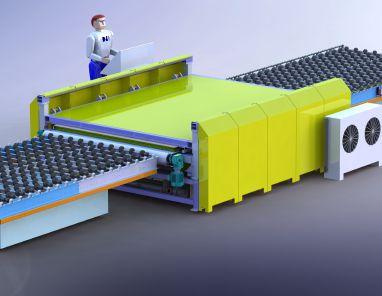
Design and Integration’s LamiExpress will debut at GlassBuild America in September. It has the potential to save fabricators considerable time and floor space, and to make in-house lamination affordable for smaller shops. It is also optimized for integration into larger production lines.
• Laminates PVB, EVA or Sentry glass
• Multiple thicknesses and sizes can be laminated in one batch
• No vacuum bags, autoclaves or tac ovens
• Multiple layers can be applied next to single-layer glass
• Seven-by-10-foot total batch area
• Total footprint: 36 by 10 feet
Gutnik had invested about $400,000 of his own money in the prototype. With the destruction of his parts, it became a significant challenge to continue development. One option he explored was assistance from one of the government programs that are supposedly eager to lavish money on innovative small businesses. What Gutnik and his team have found is that these programs are in fact set up to reward large, existing R&D departments with dedicated staff and budgets and labs with people in white coats. The paperwork requirements alone are impossible for a small
Design and Integration’s machines are built at the company’s facility in Concorde, Ont. Approximate delivery lead time is four months.
Continued on page 28
JOBSITEPRODUCTSHOWCASE
Eliminat e pour strips
halfenusa.com
Halfen USA aims to eliminate pour strips from post tensioned concrete construction with HSD-LD Lockable Dowels and new HSD-LD calculation software. With over 80 years of innovative experience, Halfen introduces the HSD-LD Lockable Dowel system which offers a new approach to designing and realizing post tensioning construction without the need for pour strips and complicated formworks. Together with the new HSD-LD calculation software, the HSD-LD system offers the complete package: from designing and calculating the tension joints in the concrete slabs to eliminating the need for pour strips altogether. Knowing the advantages of post tension construction, but also the difficulties that come with this construction method, Halfen has engineered the HSD-LD Lockable Dowels system to help designers, engineers, and contractors work closer together on their projects while eliminating the time management issues that arise from having to deal with pour strips on site. Halfen HSD-LD Lockable Dowels are designed to be used at temporary movement joints that are most commonly found in post-tensioned concrete frames. HSD-LD Lockable Dowels allow initial shrinkage of the concrete to take place, and are then locked in position with a mechanical plate and a controlled amount of epoxy resin. The locked dowels continue to transfer shear, but prevent further movement from taking place. The result: Halfen HSDLD’s accelerate the rate of construction, improve site access, and minimize formwork requirements. The HSD-LD Lockable Dowels calculation software is intuitive to use and offers straightforward ways to dimension joints using HSD-LD Lockable Dowels. The software allows calculations of slab-to-slab (HSD-LD), as well as slab-to-wall (HSD-LD-W) connections. The program is designed to offer quality printouts of the calculations
and an easy-to-follow, detailed parts list of the required HSD-LD system. In addition, the software enables the designer to combine multiple conditions in one file, and offers 2D and 3D illustrations of the calculated situations.
Eye on the work
brinno.com
The BCC 100 Construction Camera by Brinno can show daily progress on any construction project. The Brinno Time Lapse Video Construction Camera is an easy way to record any projects with a time-lapse video recorded at any rate you want, and played back at any rate you want when the project is done. The BCC 100 is worker-friendly and can be set up anywhere to capture video at a 140-degree angle. It is completely dust-proof and includes a water-resistant housing so it can easily be mounted anywhere outdoors. The BCC 100 will turn eight hours of time-lapsed pictures into an eight minute video easily. And the battery can last for up to 2 1/2 months while taking photos at 30-minute intervals. The Brinno Construction camera delivers Brinno proprietary “instant video,” which means you can play the time lapse video on the spot once filming is completed. No big files are needed to transfer and no video editing or even post-processing are needed. Brinno is one of the world leaders in image-processing and powersaving technology, specializing in producing long-lasting battery-powered autonomous photography appliances.
Defense against a fall
bluewater-mfg.com
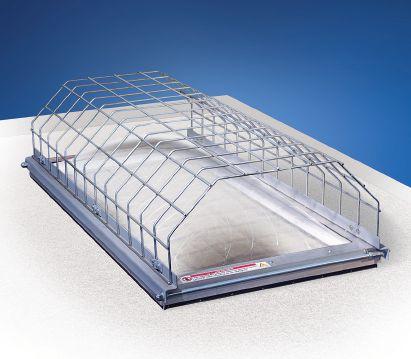
BlueWater Manufacturing has introduced its Skylight Defender. Engineered to prevent employee injuries and deaths from falls through skylights, this non-penetrating fall-protection solution meets and exceeds the 200-pound U.S. OSHA regulation as well as the California OSHA mandates by withstanding and supporting at least 400 pounds. To eliminate any damage to the skylight or roofing membrane, the Skylight Defender requires no drilling. Using basic tools, the Skylight Defender simply fastens onto the skylight frame using a unique compression system in about 30 minutes. Depending on the application, larger skylights may require some drilling. For increased endurance, the Skylight Defender features a wire screen thickness of 1/4 inch. Constructed of welded galvanized mesh, the Skylight Defender screen ensures complete skylight protection.
A pocket for your phone milwaukeetool.com
Milwaukee Tool continues to expand its storage solutions within the hand tool category with the introduction of a new line of work gear that delivers enhanced durability for the end user. Featuring 1680D ballistic nylon construction and double-stitched riveted seams for superior wear protection, the new work gear line will include a contractor belt with a suspension rig.
“As we spent time on the jobsite investigating this category, it was clear that users were frustrated with the premature wear and tear they were seeing in their existing work gear products,” says Bobby Shaw, director of marketing for Milwaukee Tool. “The new line of work gear delivers unmatched durability, comfort and organization for the professional tradesmen, with features that keep their everyday needs in mind and make them more productive in their jobs.”
The contractor belt includes a padded four-point harness that distributes weight evenly for all-day comfort. In addition to such features as all-metal hardware, integrated handles and a padded breathable belt, this model also includes a dedicated smart phone pocket that is large enough for all modern smart phones.
Take it closer to the edge
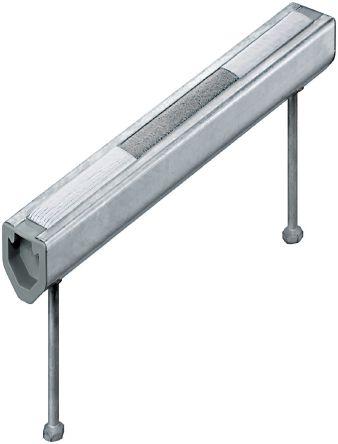
Hilti has introduced a new generation of innovative, high-performance cast-in anchor channels for reliable load transfer to building structures. The innovative
V-form shape of the HAC channels allows for high loads to be taken closer to edge zones. The Hilti anchor channel can be a simple and reliable solution for fastening applications such as curtain wall brackets, guide rails for elevators, sliding door mechanisms for elevators, securing machines to floors or walls and grids for ceilings in showrooms. With a protective LDPE foam insert and end-caps, the channel is sealed effectively, helping to prevent concrete slurry from entering. The foam insert features a tear-out strip for trouble-free removal, which avoids damage to the channel through use of drill bits, hammers or gas torches. Available in seven different standard profiles and various lengths between one and 7 ½ feet, this new generation of cast-in anchor channels has a special uniform inner profile that allows the use of a single T-bolt type for all channels sizes, saving time during installation.
Activated two ways capitalsafety.com
Capital Safety has introduced the LadSaf X2 detachable cable sleeve, a nextgeneration cable sleeve designed to be used as part of the complete Lad-Saf flexible cable ladder safety system. The Lad-Saf X2 cable sleeve offers hands-free climbing, automatically following the user during ascent or descent, and one-handed cable attachment or detachment for fast, easy and safe connections. Its lightweight stainless steel construction offers added durability and longevity to the sleeve. The compact and more ergonomically refined Lad-Saf X2 sleeve has two independent means to activate its fall arrest function: a mechanical system that locks onto the cable almost immediately in the event of a fall; and a supplementary inertia system that activates locking independent of the mechanical system,
providing a redundant safety system for added protection. In addition, the inertia system prevents unintentional upsidedown installation. The Lad-Saf X2 sleeve also features an in-line shock absorber to reduce the forces a worker’s body will experience in a fall arrest event.
Insulate difficult spaces
dowcorning.com
JOBSITEPRODUCTSHOWCASE
Building designers and architects no longer have to make trade-offs in design to meet energy performance codes and regulations and reduce thermal bridging, thanks to a thin-profile, flexible insulation solution from Dow Corning. The HPI1000 building insulation blanket offers significantly improved thermal resistance as compared to conventional insulation products, providing a high insulating value of R 9.8 per inch. Its thin profile, superb flexibility and compression resistance allow for thermal protection in hardto-insulate spaces while eliminating the need for bulky or messy insulation in tight areas of a building’s design. The grey-coloured insulation blanket can be easily cut and conformed to complex shapes and tight curvatures and adhered to building products without difficulty, either in a shop or on site. In addition, the 10-millimeter-thick blanket is fireresistant, hydrophobic and does not settle over time. HPI-1000 blanket can be used at service temperatures up to 200 C. It carries a Class A fire rating per ASTM
E84, with a flame spread index of 5 and a smoke developed index of 10.
All-terrain glass lifting
glgcan.com
The latest addition to GLG’s glass handler line represents the next generation of multilifters and glass handlers; the GlasLift 400/880 not only looks tough, it is tough. The front twin-wheel design, coupled with a reliable hydrostatic drive, make it both manoeuverable and capable of operating in all kinds of different terrains and environments.The GlasLift 400/880 can lift 880 pounds up to 157 inches with precision, as the upper arm moves in an upright position, parallel with the facade. A sledge makes it possible for the arm to move parallel to both sides, one millmetre at a time. It offers 17 inches of boom extension. It can also pick objects off the floor with ease.On top of being tough, the GlasLift 400/880 is compact and uniquely adaptable. It can pass through door openings and hallways as narrow as 29.5 inches, as the outside wheels can be removed easily and in just three to five minutes. It can be carried from site to site in a small trailer, and it can pick up virtually every known building material.
TECHNOLOGY DREAMS
Continued from page 25
operator to meet. According to Andrei Lagounov, one of Gutnik’s sales people, one government R&D program required paperwork justifying the expense of almost every single part they bought to build a prototype. When he saw similar paperwork from a large engine manufacturer, he saw that it was allowed to justify whole large assemblies in one document because the parts involved were already in its existing R&D inventory. “How is a small company supposed to do that?” Lagounov asks. “We buy the parts as we need them, and we rarely know ahead of time what we are going to need.”
Design and Integration has weathered the storm and come out dry and smiling. At September’s GlassBuild, it will unveil the fully functioning Lami ExPress, a glass laminating system that eliminates the need for vacuum bagging or an autoclave. The system can process units of varying thicknesses and sizes with a batch area of seven by 10 feet. Design and Integration is quoting an energy cost per load of $2 and a cycle time of about 1:15, depending on the PVB used. The unit comes with touch screen controls and a Samsung tablet for mobile control. The total space required is 36 by 10 feet.
So it’s one hard-won victory for Design and Integration. One hopes there are more on the way and that, some day, the agencies charged with encouraging companies like this will find some way to actually do their jobs. •
by FRANK FULTON
Frank Fulton is president of Fultech Fenestration Consulting. He has been in the industry for 30 years and can be reached via email at fultech.fc@gmail.com
In the stretch run
It was a way back in February 2010 when I penned that hard-hitting journalistic gem about our cronies’ expedition to Las Vegas to commemorate the 60th birthday of good, old Brian Wiles. You may recall the good-natured banter about Brian and our trip that concluded with, “Next time you see him, you may want to ask if that’s ‘Old Man Smell’ cologne he’s wearing.”
Well, if you can believe it, Brian took exception to that cologne line and wasn’t all that happy having to put up with the zingers shot his way at practically every office he walked in to for the next month. So, to be fair, and to make things right after all this time, it’s my turn to spritz with the noxious eau de toilette. August, 2015, marks 60 years in this world for yours truly.
Turning 60 is one of those good news, bad news situations. You may not have all the tools you used to have, but working with what you’ve got still beats the alternative. Maybe you haven’t reached the end of the road but you can see it from here. One good thing, however, is that in a hostage situation you are likely to be released first. So, does becoming 60 really mean you are old? Apparently the United Nations uses the age of 60 as its cutoff for referring to an “older” population. The World Health Organization, kindly, sets no numerical critera.
Morrison, at the age of 87, wrote about the heroism required to live through the disintegration of one’s own body, concluding that “old age is not for the fainthearted.” Lillian Rubin, active in her 80s as an author, sociologist, and psychotherapist, opens her book 60 on Up: The Truth about Aging in America with, “Getting old sucks. It always has, it always will.” Bernard Baruch, a
Turning 60 is one of those good news, bad news situations.
former American presidential advisor noted, “To me, old age is always 10 years older than I am.” I’m going with that one.
Seriously, though, there are a number of good and bad things to consider regarding aging.
On the bad side, everything hurts and what doesn’t hurt doesn’t work. You know all the answers, but nobody asks you the questions. You wonder how you could be over the hill when you don’t even remember being on top of it. You can’t stand people who are intolerant.
On the positive side, the clothes you’ve put away until they come back in style come back in style. You have more patience; but actually, it’s just that you don’t care any more. There’s nothing left to learn the hard way. You don’t care where your wife goes, just so long as you don’t have to go along. Getting lucky means you find your car in the parking lot. Your secrets are safe with your friends because they can’t remember them either.
I’ve now run out of time to become a pro golfer, concert pianist, billionaire or genius and have decided that in my golden years I am going to focus my efforts on becoming a curmudgeon. I always admired Andy Rooney from 60 Minutes and actually expected to see his picture in the dictionary when I looked up the word. A curmudgeon is described as “a person, especially an old man, who is easily annoyed or angered and who often complains. An ill-tempered person full of resentment and stubborn notions.”
Another take on curmudgeons is that they are falsely believed to be grumpy old men and the truth is that they are supremely independent thinkers, very wise, and have excellent senses of humour. They tell the truth, let people know what they’re thinking without being mean about it, but don’t try to make everything sound pretty. They don’t yell at people or say things to upset them. They suffer fools in silence knowing full well that stupidity has its own rewards. They let them believe as they choose and simply walk away. Hold your tongue and you won’t be the stupid one. Lastly, curmudgeons dress for comfort, not for fashion, wear suspenders instead of belts, and don’t go to fitness centres. They’ve got no use for metrosexuals. You know, I think I’ve been a curmudgeon for years already but just didn’t have the years to support the age criteria. •