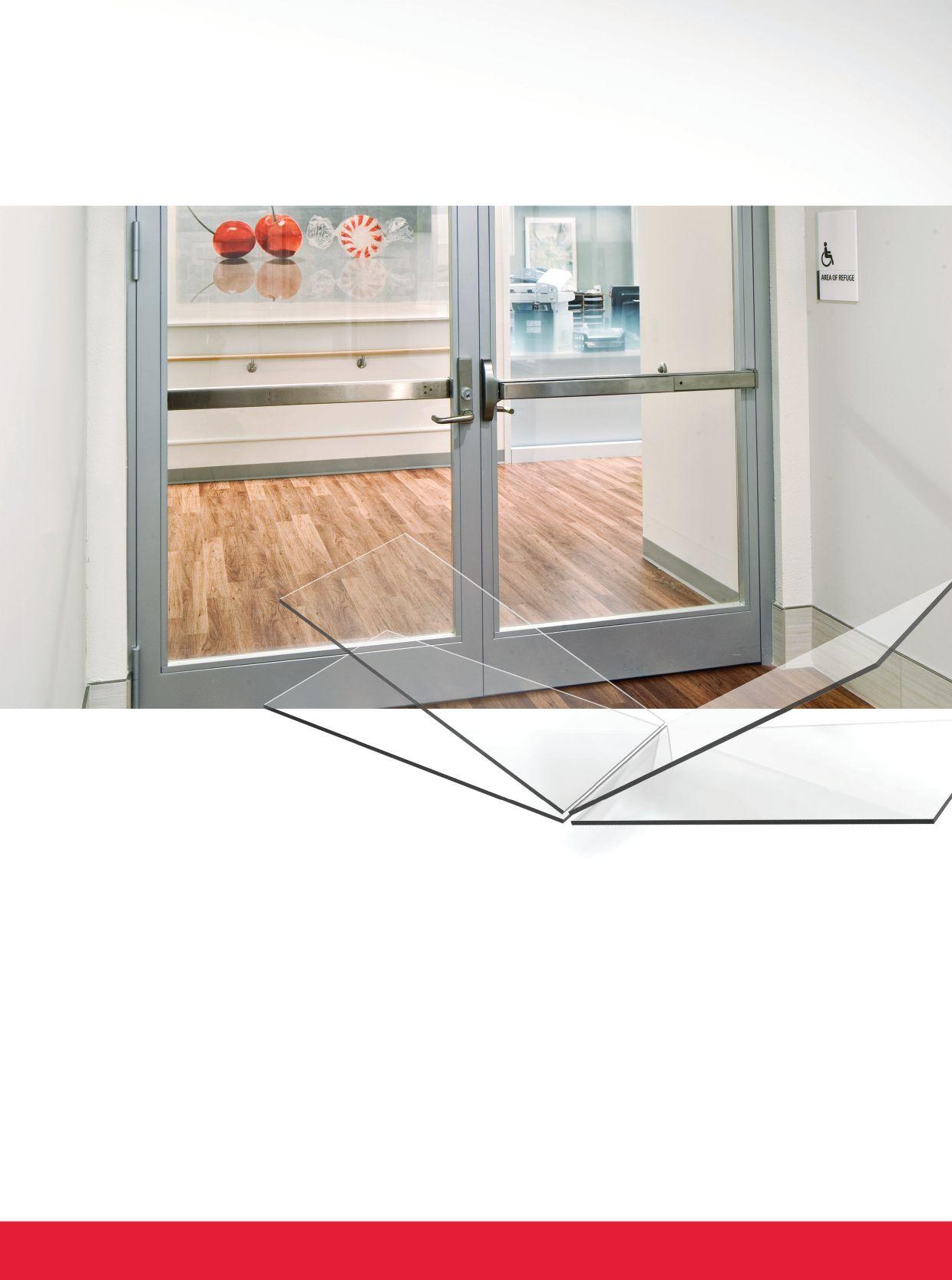
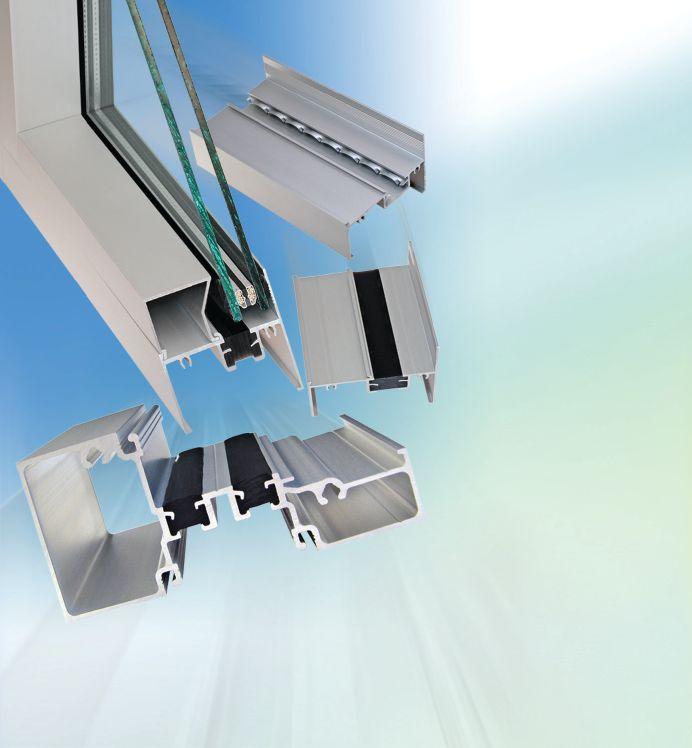
FireLite® from Technical Glass Products delivers the complete package without all the wires. This fire-rated glass ceramic’s clear, wireless aesthetic changed how we look at design. Our trusted products set the standard.
· Groundbreaking ultraHD® Technology
· ULC classified & labeled
· Fire-ratings up to 3 hours
· High impact-safety ratings
Technical Glass Products complements our proven products with a full-time sales team and extensive distribution network in Canada and the U.S. to support your projects. Our in-house experts know our products inside-out, making your life easier and worry-free.
The architectural glazing community enjoyed a day of education and networking at Glass Canada’s inaugural conference event.
strikes in the Atlantic Glass Connections Halifax showed there’s passion for the trade on the east coast.
It’s holding your projects together - better be up to speed on the latest technology.
glass handling leaves the shop floor.
Anti-spam overkill
The federal CASL laws go too far.
Water is wet, the sky is blue and email spam is annoying. Some things you can just assume. I suppose I should be thanking the folks in Ottawa for trying to save me from the annoyance of spam through the Canada Anti-Spam Legislation (CASL). It could be a hopeful sign. Maybe they will begin to tackle other annoyances, such as sunburn, dead phone batteries and foaming beers. And hey, what about taxes? Taxes are annoying. Maybe the feds will do something about them?
Maybe not.
In its no-doubt well-intentioned bid to save us from annoying spam, the federal government has overreached rather badly, in my view. Companies are now forbidden to send any kind of electronic communication to anyone (for commercial purposes) who has not actively opted in to receive communication from that company. The penalties are insane – up to $10 million. I should tell my wife that annoying me now costs $10 million – maybe that will cut down on requests to take out the garbage when the Blue Jays are on.
Maybe not.
NEXT ISSUE
• Economy Glass
• B2B marketing
• Digital printing
It seems to me the problem with spam was never that a company was trying to communicate with you. The problem is with people pretending to be companies trying to communicate with you. Real companies, with a real need to avoid annoying their potential customers, have long ago cut back their communications to those few times when they actually have something new to say, or implemented opt-in/opt-out regimes of their own. The crap filling up your inbox with bogus offers for everything from Aleve to Zoloft is almost always from some obviously quasi-legal, usually foreign, source. And these are precisely the players who will remain completely untouched by this law. Law-abiding companies have frantically jumped through hoops (as we have here at Glass Canada) implementing opt-in programs and losing half their email contacts because at least that proportion of people will not even bother to open the opt-in email. The scammer spammers don’t even have to miss one automated press of the Send button, and people’s inboxes remain just as full of the stuff they don’t want and empty of the stuff they might want.
And, while I appreciate the government’s zeal in rescuing me from annoyance, I have to wonder where they were for the last 20 years. Like most people, I have already taken steps to reduce my spam annoyance to manageable levels. It’s called a spam filter, and I’m pretty sure most email hosts come equipped with them these days. What is the sudden urgency to protect us from law-abiding Canadian companies?
Here’s hoping your relief at finding less spam in your inbox equals or exceeds your annoyance in bringing your company’s policies into compliance. Oh, and please opt in to receive your Glass Canada e-newsletter if you have not already. If you have noticed you are not receiving your e-news (and don’t consider it annoying spam) you may have been opted out by mistake. Please drop me a line and we’ll get you back on the list. •
MEDIA DESIGNER | Brooke SHAW GROUP PUBLISHER | Martin MCANULTY mmcanulty@annexweb.com
Publication Mail Agreement #40065710. RETURN UNDELIVERABLE CANADIAN ADDRESS TO CIRCULATION DEPARTMENT, P.O. BOX 530, SIMCOE, ON N3Y 4N5 email: subscribe@glasscanadamag.com
Printed in Canada, All rights reserved. Editorial material is copyrighted. Permission to reprint may be granted on request. ISSN 0843-7041
($39.55 includes HST/QST) U.S.A. - 1 Year $50.00 (in US dollars)
Occasionally, Glass Canada will mail information on behalf of industry-related groups whose products and services we believe may be of interest to you. If you prefer not to receive this information, please contact our circulation department in any of the four ways listed above.
www.glasscanadamag.com
INDUSTRY NEWS
BY
Applewood celebrates 35 years
in style
Applewood Glass and Mirror of Mississauga, Ont., hosted a classy event to celebrate its 35th year in business on July 17. About 200 guests representing a who’s who of the local glazing trade mingled in the sparkling clean and spacious left side of Applewood’s 42,000-squarefoot plant, taking in an eye-catching violinist on a lift platform, a similarly elevated DJ and slideshows of Applewood’s many outstanding projects. Food and drink flowed freely, served by caterers organized by Jennifer Menecola, daughter of company president, Tony Menecola. The event was a family affair, with Tony, his wife Eva, Jennifer and son Anthony in attendance. Company founder and Tony’s father, Lorenzo Menecola was also on hand with his wife, Filomena. Many of the guests had long association with Applewood, and were happy with the chance to greet and congratulate Lorenzo on the success of the company he started in 1971. George Carlson, a Mississauga city councillor, and Steve Mahoney, a candidate for mayor of
Mississauga, were on hand to congratulate Applewood and present the Menecolas with certificates. Both noted the importance of companies like Applewood to the region’s success. Tony thanked the crowd in an emotional address. “Time flies when you are having fun,” Tony commented. “A lot of the credit goes to our employees. We have employees that have been with us 20-plus years and without them none of this would be possible.” Tony says he is more surprised by what has stayed the same than by what has changed since he joined the company at the age of 20, and credits Applewood’s ongoing success to a culture of innovation and early adoption of techniques such as pre-glazing to streamline processes and improve quality. Tony says careful and measured expansion lies ahead for Applewood. “I’ve had opportunities to grow big and grow fast but that is never a good idea,” he explains. “It is always controlled expansion for me.” All the photos from the event can be seen on Facebook at facebook.com/GlassCanada.
GlassBuild reporting strong sales
Organizers are reporting that booth sales for GlassBuild America 2014, happening Sept. 9 to 11 at the Las Vegas Convention Center, are trending ahead of 2012 and 2013 in both total net square feet occupied and number of exhibiting companies. Over 65 per cent of the exhibit floor is sold out as well as 65 per cent of the Innovative Product Pavilion, which features both first-time exhibitors and companies launching new products to the glass or window-and-door industries. GlassBuild says this trend indicates confidence among decisionmakers and growth in the industry. “Sales are steady and we are thrilled with the progress thus far,” says Denise Sheehan, vice-president of industry events for the National Glass Association. “First quarter signs are pointing to a busy and productive show in September. New trends and new show floor attractions bring a new excitement.” GlassBuild will feature an Express Learning program where guests can attend educational sessions right on the floor of the show at the presenting company’s booth.There are currently 10 such sessions scheduled. GlassBuild has also published a special Architect’s Guide that lists exhibits and education sessions of special interest to architects.
PHOTO
NICK KACHIBAIA
CGA Newsletter
CANADIAN GLASS ASSOCIATION
The Canadian Glass Association has recently selected Centric Management and Consulting to serve as our new association management company. We are excited to work with Centric, as they also currently manage the Glass Association of North America. This creates the opportunity for synergy within the glazing industry, giving added value for membership. This partnership will closely align the two associations, which should negate the possibility of duplication of efforts while giving the glazing industry, as a whole, a stronger voice. It is our belief that this is an extremely positive partnership.
The CGA would like to thank interim executive director, Rich Porayko, for all of his efforts in guiding CGA, overseeing its recent national conference, and for introducing Centric to CGA.
Centric Management and Consulting is an accredited Association Centric Management and Consulting is an accredited Association Management Company. Administered by AMC Institute, AMC Institute Accreditation is recognized and supported by the American Society of Account Executives & The Center for Association Leadership. Accreditation is based on the ANSI Standard of Good Practices for the AMC Industry and demonstrates the commitment and the ability to deliver the highest level of professional management services to association and not-for-profit clients.
Canadian Glass Association 3195 - 9th St. S.E. Calgary, Alta. T2G 3C1 www.canadianglassassociation.com
ATLANTIC PROVINCIAL GLAZIERS
ASSOCIATION
The Atlantic association has just come through our first Glass Connections trade show and conference and it was a huge success! The APGA was honoured to be able to host and be a part of this great event. With the sponsor spots and attendance sold out, the event was a hit from the Kitchen Party with great east coast music to the presenters who provided a great insight into different aspects of our industry. I would like to thank the CGA for allowing us to participate, and for having faith in the APGA directors to pull this thing off. I would like to particularly thank Tony Spurrell for his dedication and commitment in putting this together - we couldn’t have done it without you Tony, thanks.
We are also hopeful that the talks concerning apprenticeship have planted a seed in Atlantic Canada, and the vision the APGA has for making glazing an apprenticeship trade in our region can now take root and progress. That is now our mandate.
PROVINCIAL GLAZIERS ASSOCIATION OF ALBERTA
The
PGAA elected a number of new faces to our executive and director positions at our March 12 annual general meeting. A complete list of these hard-working volunteers
can be found on our website at pgaa.ca. The PGAA would like to thank our past president, Jim Brady from Desa Glass, for his vision and countless volunteer hours that has kept our association relevant to our members. One person alone cannot keep the wheels on the wagon and Jim has managed during his tenure to attract and retain many selfless volunteers. This will make the job of incoming president, Ross Wady of All Glass Parts, a whole lot easier. We wish Jim much success in his new position as president of the Canadian Glass Association.
Each year, the PGAA participates in an annual event to educate high school and post secondary students about the wide variety of trades available to them. This event is the annual Provincial Skills Canada competition held in Edmonton this past May 14 and 15. The PGAA Try-A-Trade booth attracted over 450 students. The three stations we set up provided hands on experience under the supervision of a qualified tradesperson. These stations were glass cutting, curtain wall pressure-plate installation and hand rail pocket and cap installation.
ONTARIO GLASS AND METAL ASSOCIATION
InJanuary, the OGMA reached agreement with Workplace Safety and Prevention Services (WSPS) to proceed on the creation of a manual geared specifically for small and midsized glazing contractors and glass shops. A draft prototype of the new OGMA/WSPS
Glazing Contractor Health and Safety Manual was displayed for the first time at the recent Top Glass Conference and Exhibits Show. This all encompassing document will be of particular importance to companies who do not have a formal safety policy in place and who do not have the time or resources to create a program on their own. The WSPS will work with your company to implement the safety program, will keep you updated on all changes to laws with which you must comply, will put you in a strong position to withstand a Workwell audit, and will help you to defend yourself with the Ministry of Labour in the event of a workplace accident. Contact an OGMA director for more information.
The Workplace Safety and Prevention Committee held its last meeting in May on the topic of Contractor Safety. These meetings are of great value and benefit to glazing contractors and glass shops and cover many topics that have a significant impact on your business. If you are interested in attending a future meeting or joining the group contact Steve Ringler. steve.ogma@bellnet.ca.
The OGMA held its annual spring golf tournament at Pipers Heath GC on May 29, 2014. The event was a complete sell out with 144 golfers and over 150 for an outstanding steak dinner. At the event, the OGMA honoured Doug Hotham by presenting him with its Lifetime Achievement Award. A bursary was also presented to Yaser Ahmad who was at the top of his class in the apprenticeship training program.
We’re all set for Thursday, Sept. 18, at a new OGMA venue, the Richmond Hill Golf Club. Mark your calendar now.
Zoulek to cover North and South America
Guardian Industries has named Rick Zoulek vice-president of flat glass for the Americas. Zoulek will oversee all aspects of Guardian’s North and South American flat glass business and position the company for continued long-term profitable growth. Zoulek was most recently vice-president of flat glass for North America.
“Rick’s commercial expertise and strong leadership will provide our North America and South America businesses with broader capabilities that will support our operational and commercial needs throughout the entire region,” said Kevin Baird, president of Guardian Flat Glass. In addition to Guardian’s seven U.S. float glass plants
and fabrication operations in the United States and Canada, Zoulek’s expanded territory includes float glass plants in Brazil (two), Mexico and Venezuela. Guardian also has distribution centers in Argentina, Brazil, Colombia, Costa Rica and Peru. Zoulek joined Guardian in August 2013 as vicepresident of flat glass for North America. Since then, he and his team have made significant operational and commercial improvements across North America. Before joining Guardian, Zoulek was a corporate officer and vice-president of industrial coatings for PPG Industries, where he spent 24 years in various roles of increasing responsibility. “My focus will be to improve the value we create for our customers, strengthen our portfolio of innovative products and services in the region and achieve operational excellence in both North and South America, all with the goal of attaining longterm growth for the company,” said Zoulek.
Strong start for GlassCon Global
Organizers of GlassCon Global are reporting 324 architects, manufacturers, suppliers, engineers, specifiers, owners and contractors came to Philadelphia for the inaugural GlassCon Global conference on July 7. “We are very excited about the turnout,” said Anthony Darkangelo, executive director of GlassCon Global and CEO of FCA International. “More than 300 leaders in our industry understand the value of coming together to share information and collaborate on the future. That paints a good picture for our industry moving forward.” The conference featured more than 90 presentations delivered by top experts. American Institute of Architecture members attending earned up to 15 continuing education credits through the week. In addition to presentations, GlassCon hosted a variety of panels with recognized industry leaders. One of these, the Transatlantic Debate was moderated
by Nick Beaumont, editor of Intelligent Glass Solutions and featured five top architects. Panelists provided quick overviews of their many innovative projects. Keith Boswell of SOM Architects discussed looking into the glass industry’s future and stressed the importance of designing with the climate in mind. Graham Dodd of Arup talked about the challenges in getting glass its fair share of the wall. He spoke about some innovative approaches including re-working old glass. Warner Jager of Ai3 talked about the importance of and challenges with standards and regulations before taking a reflective glance at the future of windows. James O’Callaghan of Eckersley O’Callaghan discussed glass as a structural element and Charles Blomberg of Rafael Vinoly Architects talked about innovations around the world. The next GlassCon Global is planned for 2016.
Nicole Harris new CEO of NGA and WDDA
National Glass Association senior executive Nicole Harris has succeeded Philip James as president and CEO of the organizations, assuming control over all daily operations on June 20. As president and CEO emeritus, James will serve as consultant and counsel to Harris and the NGA board of directors until his official retirement, August 1, 2015. An industry veteran, James joined the National Glass Association in August 1982. Under his leadership, the NGAsponsored GlassBuild America grew to become one of the largest trade shows in North America serving the glass, window and door industries. In 2009, James also oversaw the launch of NGA’s sister organization, the Window and Door Dealers Alliance, a group dedicated to advancing the interests of independent window and door
dealers. Harris, who most recently served as vice-president of publications for NGA, began her career at the association in 1990 as editor in chief in the publications department. In 1992, she was promoted to publisher of Glass Magazine and AutoGlass, before initiating the purchase of Window & Door magazine, in 1995. As vice-president of publications, Harris established all three magazines as leaders in editorial excellence and advertising market share in their respective markets. Under her guidance, Glass Magazine and Window & Door have established themselves as the market leaders in content for and about the industries served by NGA and WDDA. “On behalf of the board of directors, I want to thank Phil James for his many years at the helm of our organization,” says Robert Brown, NGA chairman and owner of Brown’s Glass, York, Pa. “We are pleased with the smooth transition and are confident that Nicole’s industry knowledge and trade association experience will serve us well taking NGA and WDDA to the next level.”
Borys to lead AWW commercial team
All Weather Windows has announced that Dean Borys has recently accepted the role of director of its Commercial Division. In this role, Borys will have oversight responsibility for all Commercial Branches, located currently in Edmonton, Calgary and Winnipeg. Dean joined Allan’s Glass and Aluminum Products in 2001 and has held several progressive roles including operations manager and general manager since the acquisition of Allan’s Glass by AWW in 2011. Bringing a wealth of industry experience and technical knowledge to this position, Borys
will assist the All Weather Windows executive team in developing strategies to strengthen the division’s position in commercial markets as well as expanding into new ones. While Borys is currently working from the Winnipeg commercial office, he will be relocating to the Edmonton area later this summer and will routinely be traveling to each commercial branch in support of the established branch management teams. In addition to Dean’s appointment, there have been a number of structural changes to the All Weather Windows commercial division teams over the past number of months. It is the division’s collective goal to provide customers with complete glazing solutions – including design and budget assistance, superior project management and industry leading after sales service.
Garibaldi appoints new sales manager
Garibaldi Glass Industries has announced the appointment of Duane Rose to the role of sales manager. Rose has over 20 years’ experience as a sales and marketing professional in various constructionrelated industries. He has held many positions in private manufacturers, distributors, and in the non-profit public sector. Rose brings hands-on experience in account and sales management, having marketed products in Canada, the
United States and overseas. Rose joined Garibaldi Glass in 2010 in an outside sales role supporting independent glass businesses, large multi-national customers, and commercial glaziers. “We are proud and excited to be promoting Duane to the position sales manager. He will play an integral part in helping to develop the sales team and the markets we serve” said Carey Mobius, president and CEO of Garibaldi Glass.
Lalonde to cover Quebec and eastern Canada
Fenzi
North America has announced the addition of key sales and technical support for its growing insulated glass components business in Canada, the United States and Latin America. Bob Lalonde, based in Montreal, has been appointed regional sales manager for Quebec and Eastern Canada, while Joe Ruggiero, based in Philadelphia, has been appointed to technical sales and service. Fenzi, based in Italy, provides chemicals for the glass processing industry with the Toronto facility focusing on the IG components side of the business. Fenzi North America manufactures polysulfide at its Toronto facility while distributing a complete line of other sealants and components used for day to day IG production. Fenzi GM David Devenish adds, “With Bob’s extensive background in IG sealants, his knowledge and support to all his customers will prove invaluable as we move forward with our expansion plans. The recent opening of our new warehouse in LaSalle, Que., is the first step under Bob’s direction. Bob’s experience in the sealant industry and his dedication to servicing his customers’ sealant needs, is exactly the philosophy that we want to bring to all our customers.” Lalonde was most recently with Bostik Canada for over 20 years, covering the
Canadian market with mainly polyurethane and hot melt sealants. Lalonde adds, “I really enjoy being part of the Fenzi team and am thrilled to be working with such a customeroriented company. I’m thrilled to be bringing the ‘Fenzi way’ to my customers and friends throughout the industry.”
Devenish goes on “Adding a respected and proven winner like Bob solidifies our position in Canada as a leading supplier to the insulated glass business as we continue to service our existing customers and grow our core business products. The opportunity to bring Joe to our team for additional support in the U.S. was something all on our management team agreed upon immediately. Joe’s extensive knowledge on two-component pumping equipment and the solid customer base he grew as a Bostik technician over 30 years fills a void in Fenzi’s northeast market. Since joining Fenzi, we have seen the loyalty that his customers show towards him as Joe is working with all to provide sealant solutions thru this transition period in market. In my opinion, adding Joe to our sales and technical service team makes Fenzi a leading provider of sealant solutions.”
Ruggerio adds, ”The timing was right for me to join a progressive company like Fenzi and be able to continue my business relationship with my current customer base. The additional components and products that Fenzi offers for IG fabricators certainly makes it challenging and interesting.”
Bob Lalonde
Breaks on
on impact
Wire glass should not be considered safety glass.
by ROB BOTMAN
It was May 9, 2013, and Sean Lloyd was about to have a very bad day. It was the day he was going to learn a lot more than he ever wanted to about wired glass.
Sean Lloyd was a grade 12 student at Assumption Catholic Secondary School in Burlington, Ont. He was late for class and was rushing up the stairs when he tried to open the fire doors in the stairwell by pushing on the wired glass lite instead of the door’s push bar. Unfortunately for him, he put his arm right through the glass.
When wired glass breaks, the wires actually hold the shards of glass together. This is its main feature, after all. In fires, this serves to retard the spread of smoke and flame through the building. This is why it was installed in the first place. But it is not what you want when you penetrate the glass with your arm.
The wires and broken glass snared Lloyd’s arm, lacerating it. He carved out a chunk of his forearm, severing arteries and tendons. He lost two pints of blood and needed 48 stitches to sew a flap of his arm back on. He suffered a permanent loss of sensation in the arm. And he was lucky. There have been hundreds of similar accidents in North America over the years. Many other people have suffered far worse injuries than Lloyd.
The Ontario School Board Insurance Exchange (OSBIE) is a branch of the provincial government that tracks various risks in our public schools and publishes its findings to help school boards prioritize ways to increase school safety. Back in 2000, they published a Risk Management Advisory on the dangers of wired glass. In their report they tracked over 107 glass injury claims against school boards over a 13-year period. The advisory says that “wired glass can cause horrible injuries” and is “extremely hazardous in impact situations.”
Paul Chowhan, manager of the Risk Management Strategies division of Health Canada says, “Every year, Canadians are injured as a result of impacts and falls into unsafe architectural glass.”
“It is scandalous,” says Jordan Richards, president of Glassopolis in Toronto. Glassopolis and its predecessor, TecniGlas, introduced the first fire-rated glass ceramics to Canada 20 years ago. “The industry has known that wired glass is not a safety glass for years. I’m glad the tide finally is turning against this dangerous glass,” he says.
What is wired glass?
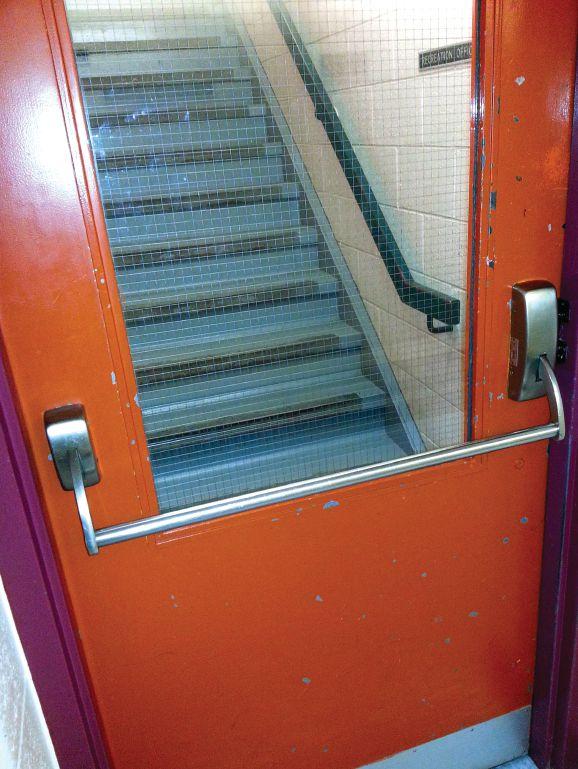
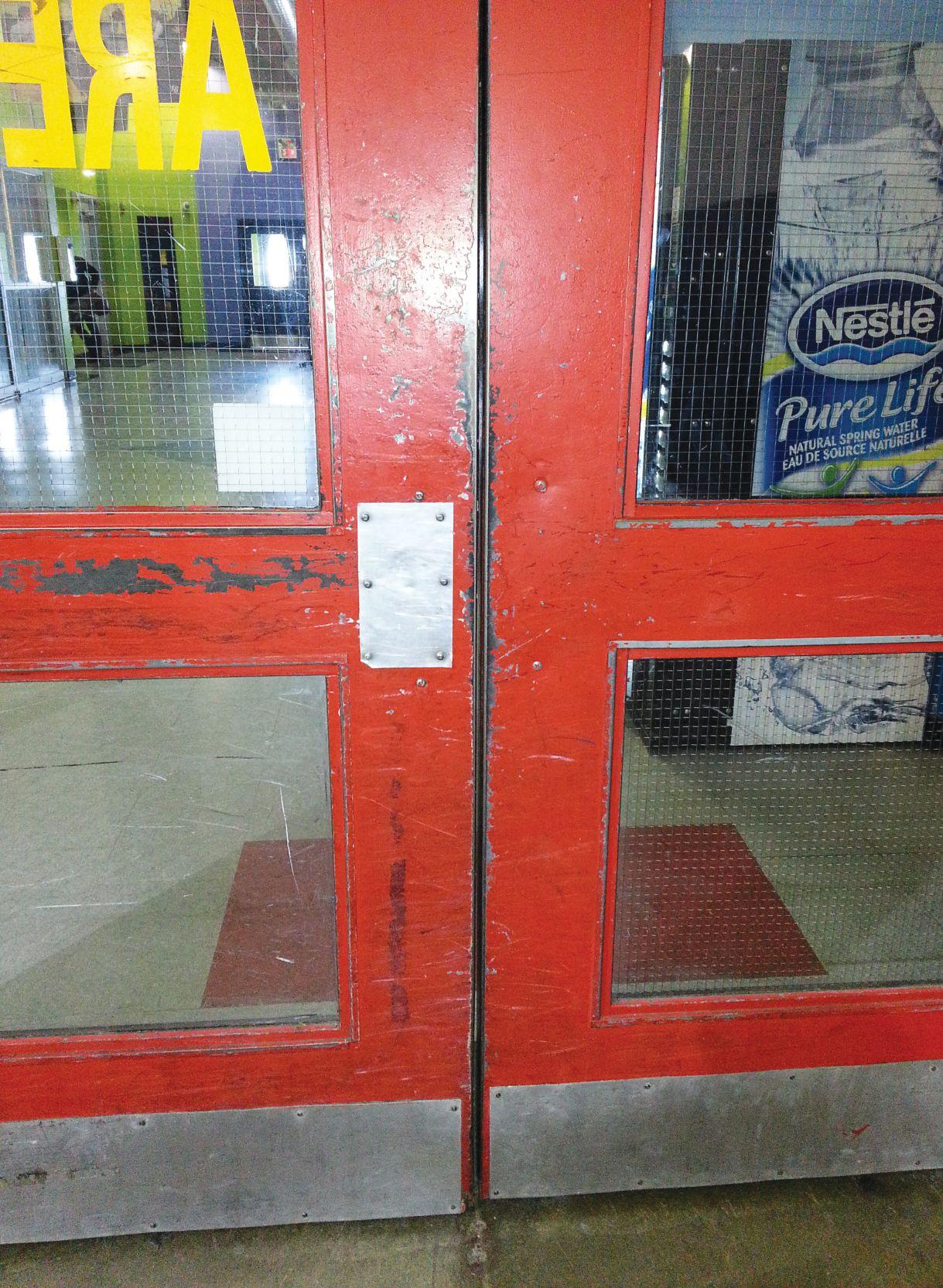
Is this the best we can do? The missing paint from these doors reveals how people smash them open with their hockey bags. Note that the bottom left lite has already been broken and replaced by scratched-up plastic.
Wired glass is the original fire-rated glass. It has been around for decades and has undoubtedly helped save people and buildings from fires. It was originally introduced because annealed glass cannot be used as a fire-rated glass. It breaks in a fire. Wired glass holds the glass together in a fire with a mesh of ductile metal wires. When wired glass is heated, the glass cracks as expected, but the wires hold the shards together which slows the spread of smoke and fire. However, wired glass was never intended to be impact-safe glass. It does not pass modern impact test standards. If you run into wired glass with enough force, you will regret it. So wire is for fire, not safety.
Injuries and lawsuits
The OSBIE Risk Management Advisory on unsafe glass in Ontario schools looked at glass related injuries from 1987-2000. During that time the total injury claims against the schools totaled nearly $3.2 million.
There are several lawsuits currently underway over wired glass. Sean Lloyd filed a $5-million lawsuit on April 29, 2014, against Halton Catholic School Board. The lawsuit alleges the school board was negligent in failing to replace wired glass with safer materials, despite knowing that wired glass was unsafe.
A similar lawsuit was filed against the Toronto District School Board in July 2010 by a student, Ravelle Sidial, after he went through a wired glass door in his school and suffered severed tendons in his right hand and severed an artery. He sued the school and school board for negligence.
In 2009, Devon King pushed his arm through a wired glass door at the Days Inn hotel in Kingston and suffered permanent and serious injury to his shoulder and arm. He sued the hotel for negligence.
A retired Ontario high school principal told Glass Canada, “I’ve seen it with my own eyes. A student was late for class. He broke through the wired glass door and completely severed his finger. I had to pick the finger up off the floor and give it to the paramedics.”
From the hundreds of injuries due to wired glass that have been documented it is clear that wired glass is not an impactsafe glass. The manufacturers of wired glass acknowledge that it is not a safety glass and label each case with warnings that it should not be used in locations where safety glass is required. Despite this, wired glass continues to be used. But be warned: building owners, glazing contractors and distributors should all be on notice that wired glass should not be used in safety locations, or they may face a lawsuit themselves. Some school boards have been told by their insurance companies that they must start replacing wired glass immediately with safer options. In Canada, the risk of liability is driving the glass industry to stop using wired glass immediately even as we wait for the Canadian glass standards and building codes to catch up.
U.S. reduces use of wired glass
In the United States, Americans too have had a rash of wired glass injuries over the years. But they did something about it. Wired glass was permitted in the U.S. building code when it was the only fire-rated glass available. But in the last two decades, new fire-rated glazing materials have been brought to market. These materials are wireless and perform better under fire tests and impact-safety tests. As the Americans increased their requirements for higher levels of impact-safety, particularly in doors and high traffic areas, traditional wired glass became increasingly obsolete. Wired glass use was restricted in the 2003 U.S. International Building Code and essentially excluded from human traffic locations in the 2006 edition.
This process of banning wired glass in the US was a success in part due to the detailed glass injury statistics of Ontario school children kept by OSBIE. There is some irony that the injuries sustained by Canadian kids convinced the U.S. to ban wired glass, yet Canada still allows the material.
The Canadian General Standards Board (CGSB) last revised its standard for wired glass CAN/CGSB 12.11-M90 in 1990. That edition calls the glass “Wired Safety Glass.” A review of the CGSB is now underway with a full updating of its glass standards including CAN/CGSB 12.1 Tempered and Laminated glass. It is expected that these standards and building codes will be updated and largely harmonized with those in the U.S.A., requiring that all glass in human traffic locations be impact-safe and all fire-rated applications must be certified and labeled. Health Canada’s Paul Chowhan adds, “Using impact-safe glass
in all locations where there is a risk of impact from human traffic is a positive step.”
Alternatives to wired glass
For non-fire rated applications, impact safe tempered and laminated glass can be used. For fire-rated applications such as the stairwell door commonly found in schools across Canada, there are many alternatives to wired glass that are both fire-rated and safe on impact. They include:
• Glass ceramics. These materials emerged as the leading fire-rated glass options about 15 years ago. They pass both fire tests and human impact tests. They are transparent, do not contain any wires and are thin, like regular glass (5 - 8 mm). Brand names include Schott Pyran Platinum and NEG Firelite.
• Intumescent glass. This is a new class of glazing that is both fire- and impact-safe. The glass is a thicker multi-laminate (eg. 23 mm for a 60-minute fire rating). Brand names include Fireswiss by Glas Trosch, Pryostop by Pilkington and Pryobel by Glaverbel.
• Organic-coated wired glass. This is a UL-certified product that combines certified wired glass with a specially certified surface-laminated film. Since most films are highly flammable, building inspectors will only approve coated (filmed) glass that is UL-certified and labeled. Examples named include Protect3 Safety Glass by Glassopolis and UL Filmed WG from Central Glass.
“Wired glass was never able to provide impact protection for building occupants” says Dan Poling, fire-rated product manager for Schott USA. “Wired glass became obsolete when modern glass ceramics like Pyran Platinum became available, which are able to provide impact resistance and fire protection without any wires, so they are both safer and better looking.”
Labelling
In the U.S., the rules are clear. Fire-rated locations such as fire doors in school stairwells must have fire-rated, certified and labelled glass. In addition, all locations subject to human impact must be impact-safe. When these two conditions apply, the glass used must be fire-rated, certified, labelled and be impact-safe. Historically, wired glass was exempt from labeling requirements because the building inspector could easily identify what it was. Now that there are many different fire-rated options, all fire-rated glass must be individually labelled. “When fire-rated wired glass was banned in the U.S., everyone had to get used to the idea that each piece of replacement glass had to be certified and labelled” says Poling. “But labeling helps the building inspector confirm that the right glass is being used so it’s the right way to go”.
The Canadian Standards and building codes are changing, finally, and are expected to largely model what has been done in the U.S. This means that fire-rated locations that previously permitted wired glass will no longer be able to use wired glass. Instead, modern fire-rated glazing that meets both fire- and impact-safety must be used. This glass must be individually labelled and certified by the manufacturer, meaning that glaziers will no longer be allowed to cut and install un-labelled glass.
If you want to learn more about the alternatives to wired glass or how to get certified to process them, ask your Canadian suppliers. •
Rob Botman is general manager of Glassopolis, a Toronto-based distributor of fire-rated and specialty glass. Glassopolis.com
TOP GLASS TRIUMPHS
by PATRICK FLANNERY
As a start, it was excellent. Glass Canada magazine together with its association partners and sponsors entertained 150 glazing contractors, glass fabricators and architects on May 28 at the International Centre in Mississauga, Ont. Attendees took in four very informative speakers and browsed the latest glass technology at 30 supplier booths. Feedback on the show was very positive, leaving many attendees and exhibitors wanting more. In 2015, Glass Canada and friends will comply - Top Glass returns to the International Centre on April 15.
Top Glass was made possible by generous support from some of the industry’s highestprofile companies. Tremco led the way as Gold Sponsor, with Alumicor and Dow Corning joining in as Silver Sponsors. Canada’s glass associations joined the party, with the Ca-
Commercial glaziers gather in Toronto for education and networking.
nadian Glass Association, the Ontario Glass and Metal Association and the Insulating Glass Manufacturers Alliance lending their authority as association partners.
Critical information
The show opened with a comprehensive analysis of construction and development trends across Canada by Katherine Jacobs, direc-
tor of research and operations for the Ontario Construction Secretariat. Jacobs told attendees that the country is entering a phase of stronger growth in Industrial, Commercial and Institutional (ICI) construction markets, continuing a slow recovery from the 2008 recession. Her outlook for the remainder of 2014 called for continued growth in commercial building, with industrial remaining flat and government-funded institutional building declin-
ABOVE: It has been a long time since Canada had a national show for the commercial glazing trade. Glazing contractors, fabricators and architects seemed to appreciate the chance to come together.
ing. Multi-unit, residential building is now tied for single-family homebuilding across the country in terms of investment dollars. Jacobs also presented the results of an OCS study on contractor intentions in Ontario, reporting that 40 per cent of contractors in the Greater Toronto Area expected more opportunities, 69 per cent predicted good economic conditions (up eight per cent from last year) and one in three expected to increase their workforce. All this led to an overall “barometer” score that showed a sharp rising trend since 2012 - critical information for anyone counting on GTA developers for business. She also looked at some concerning labour market trends showing a gap of 37,600 workers between what Ontario’s apprenticeship programs are predicted to produce and what will be needed by 2023. “The keynote speaker was really interesting talking about the problems with finding apprentices,” commented Steve Ringler of Oakville Glass and Mirror. “It was eye-opening to hear that the problems we see here with finding new workers are occurring right across the country.”
About poly
Next up, Paul Chackery of Fenzi North America brought his audience up to speed on the chemical and performance differences between polysulfides, polyurethane, silicone and hot melt butyl. He started with a description of how sealant works to hold the gas into and IG unit and hold the lites together, then moved on to a detailed analysis of how each different type of sealant achieves the desired aim. He looked at differences in UV resistance, modulus, chemical fog resistance, overall durability, ease of processing and thermal performance between the various sealants. Chackery noted how differences in how North Americans and Europeans test fenestration have led to differences in preference for sealants; more than half of North American projects use silicone, while over three-quarters of European projects use polysulfide.
Seeing the light
John Carpenter of Clearstream Architectural Products gave attendees a great overview of architectural trends in glass construction, showing how the latest products can achieve amazing results in buildings. Daylighting is a major concern for energy-efficient builders, and Carpenter displayed several dramatic photos showing how windows with modern glass treatments can diffuse light through the interior space, eliminating harsh shadows and making everything appear softly lit. He illustrated how similar technology can spread solar heat through the room, eliminating hot spots and easing the burden on heating and cooling systems. The real wow factor, though, came from Carpenter’s photos and discussion of the latest dynamic glazing technology which has the ability to change the optical and reflective qualities of the glass according to environmental conditions and user demand. His presentation inspired everyone with its depictions of lit-up glass showing videos and light-sensitive smart glass adjusting to the amount of sun hitting it.
Getting the point
Roy Lamont and Richard Brightling of Stella Architectural Hardware closed out the technical program with an overview of pointsupported architectural glazing hardware and the striking designs possible with it. Stella has worked on some incredible projects, and Lamont and Brightling had many photos of creative balus-
trades and staircases as well as massive hanging walls suspended on wires. Brightling tied in a strong business message, discussing his ROAD concept - Return On Architecture and Design - that invites specifiers to consider the long-term financial benefits of putting more architectural “punch” into their projects. Investing in design can increase rents and property values, Brightling said, and stretch the longevity of a building as a desirable space.
Innovation on display
The suppliers exhibiting at Top Glass put their best feet forward with some groundbreaking technology. Tremco has put a great deal of thought into window-to-wall transitions, creating the socalled T3 System to provide contractors with everything they need to integrate fenestration in different sizes and materials into the building envelope. Alumicor was on hand with its TerraPorte Accessable outswing doors that can meet all the latest environmental and air/water ingress standards in a low-profile door suitable for the disabled and elderly. Dow Corning was emphasizing speed and ease of use with its 121 structural sealant. “For a first annual, the traffic has been great,” commented Scott Waechter of Dow Corning. “A rousing success.”
It is an excellent little niche market we have,” said Lee Baker of Tremco. “The guys who are here are really the leaders in the industry. We accomplished everything we wanted to in the first half of the day.”
Top Glass was able to attract some new faces that were not as familiar to the glass construction crowd. A.E. Sales was on the floor with its Winlet glass-handling machine, a new product in Canada that the company has just started importing. The Winlet is small, maneuverable and equipped with powerful suction holders that are perfect for manipulating glass sheets. Also, equipmentrental giant Strongco was on hand showing off its Jekko minicrane, a compact lifter perfect for sitting on the floor of a high-rise and hauling curtain wall modules up to the floor below.
Feedback from attendees was overwhelmingly positive, with many commenting that an event like this for the sector has been long overdue. There was discussion around whether the event should take place every year or every other year, with participants coming down on both sides of the question. “There is obviously a huge amount of interest in this event, as evidenced by the large number of pre-registrations we received,” explains Danielle Labrie, show manager. “We want to keep up the awareness and momentum we have built and bring the conference back every year as long as interest is this strong. We think the sector and our exhibitors need this opportunity.”
Call for papers
Plans are underway for the 2015 edition of Top Glass, slated for April 15. Industry technical experts are invited to submit their proposals for technical presentations to Glass Canada editor, Patrick Flannery, at pflannery@annexweb.com. There will be three, one-hour time slots for technical presentations. Cutoff for submissions is Dec. 15. Speakers will be selected after the cutoff based on:
• Exclusivity and technical strength of content
• Status of the presenter as an industry expert
• Generic and non-promotional nature of material
• Relevance of content to the Canadian commercial glass construction industry.•
by BILL LINGNELL
Bill Lingnell has over 46 years of experience in the technical field of glass and architectural products. He holds three Masters of Science degrees in engineering. Lingnell is the technical consultant for the Insulating Glass Manufacturers Alliance.
Living on the edge
Architects and designers are requesting more and more the use of insulating glass units to have unsupported edges. This occurs in designs that demand more unobstructed views for vision and light transmission and give a smooth appearance using glass. It is typical to see this concept used in butt joint units and point-supported installations where both systems use spans of insulating glass with the edges unsupported.
How much deflection can the spacer and sealant be subject to without causing premature failure? The deflection of the spacer and sealant will be dependent on the type of edge seal technology that is being used. As one would expect there will be certain spacers and sealants that offer different responses. The question actually cannot be answered in a manner that will cover all conditions. For example there will be differences in metal spacers with regard to the profile, thickness of the profile, width and height, mechanical properties and unit size to name a few factors. A steel spacer has different mechanical properties than an aluminum spacer with regard to allowable stresses and modulus of elasticity. Thus one spacer cannot be compared to another on a direct one-to-one basis with regard to deflection. Sealants also respond relative to their capability to resist transverse shear stresses when the edge seal deflects. Silicones have different properties than polysulfide, polyurethane and butyl. The amount of sealant will also have a direct bearing on the resistance to the shear and tension stresses in the sealant (both adhesion and cohesion) that occur when glass deflects. As you would imagine, flexible spacer systems will also challenge the fabricator to limit or minimize edge deflection on insulating glass units.
To date there have not been any reported failures when the L/175 or ¾-inch edge deflection limits are used.
Is the L/175 a good rule of thumb? Is ¾ inch a limit that should be taken into consideration as far as deflection of the spacer and sealant? The L/175 edge deflection limit is a reasonable method to be employed to limit the edge stress on glass and give the designer of the framing system proper guidance so that the glass is properly supported in an effort to use the appropriate glass load resistance based on testing and analytical methods for determining stresses and deflections of glass. The limit assures that there is edge support around the perimeter of the supported edges of glass. The edge deflection should not be confused with the center-of-glass deflection. The center-of-glass deflection will be analyzed based on aesthetic conditions, edge pull-out characteristics, effect on gaskets and sealants, and possible contact with other building materials, to name a few factors that may cause the designer to limit center deflection. Glass strength and resistance to breakage is the primary issue with center deflection. It is a factor that should be thoroughly reviewed and, if need be, limited by the designer. The ¾-inch limit, like the L/175 limit, is a maximum limit that could be considered for deflection of the edge of the insulating glass. It has been used by the glass and glazing industry for many years and has proven to be a safe limit when selecting insulating glass deflection limits as well as general edge-of-glass limits for most window designs that are subjected to wind and snow loads. To date there have not been any reported failures when the L/175 or ¾-inch (whichever is less) edge deflection limits are used for the spacer/sealant designs when using insulating glass.
The present ASTM E 1300 and CAN/CGSB 12.20-M89, Structural Design of Glass for Buildings standards do not address unsupported edges in insulating glass units and, due to the vast amount of variables that exist in the fabrication of insulating glass, there is not a common method that will address all cases. I would suggest that for the current standards updates commentary be made that would give guidance to users of the standard with reference to the deflection limits and working with the manufacturers on the concerns of the edge seal used and its ability to be used in this method both structurally and environmentally. •
IGMA
Reliable Solutions
Others sell washing machines, we develop intelligent solutions for clean glass sheets
It‘s not a rumor any more! LiSEC, the technology leader in the flat glass industry, has extended the product range with new horizontal washing machines. If you are considering investing or replacing existing washers, LiSEC can provide the right solution. The product range covers basic washing machines all the way up to high end contactless cleaning solutions.
www.lisec.com
Get a grip
Automated glass handling is evolving.
As architects specify everlarger glass panels, workers incur risk during installation. Robotic glass handling equipment is getting more versatile and reliable, enabling you to meet the challenges your customers pose without endangering your people.
If you can handily flick a button or twirl a toggle with ease, then the future of glass handling technology is within your grasp. Automated and robotic material handlers are becoming de rigueur in today’s workplace. “Lifting heavy panes of glass can be done with no effort on the part of the operator,” says Will Stayer, president of A.E. Sales, headquartered in Red Deer, Alta. “It’s all about not breaking your back - or the glass.”
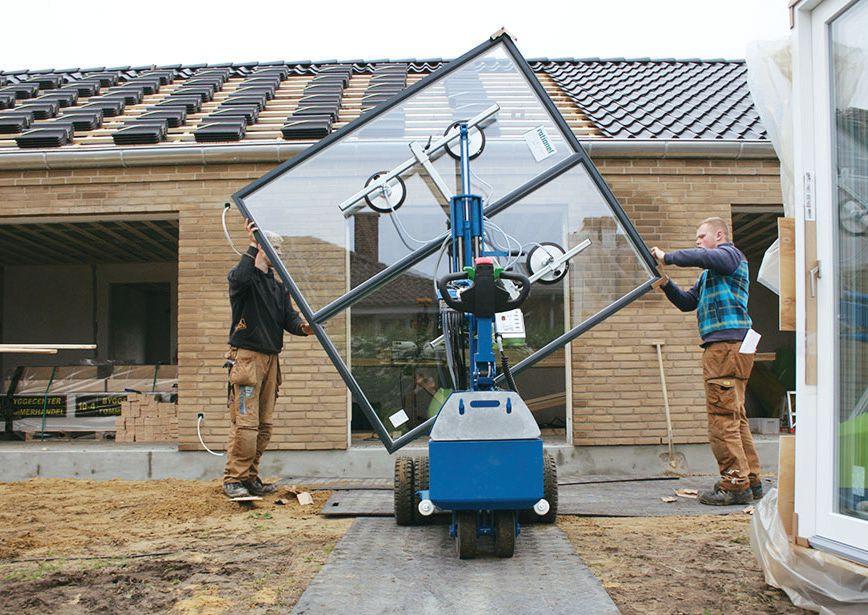
Stayer’s company brings Reachmaster’s innovative Winlet 1265 robotic glass lifter into Canada. Reachmaster is a leading global supplier of compact aerial equipment. “By using Winlet products you reduce, stress and strain on the installers, reduce the incidence of claims for bodily injury and experience less breakage and loss of product,” lauds Stayer. “Traditionally, most glass panels and doors are lifted and positioned manually. The largest are now often placed using crane or other machine-mounted handlers. Winlet handlers allows a glass installer to avoid the need for expensive cranes in many situations, while affording safe handling of larger panes from ground or fork level without the need for manual handling of larger panes.”
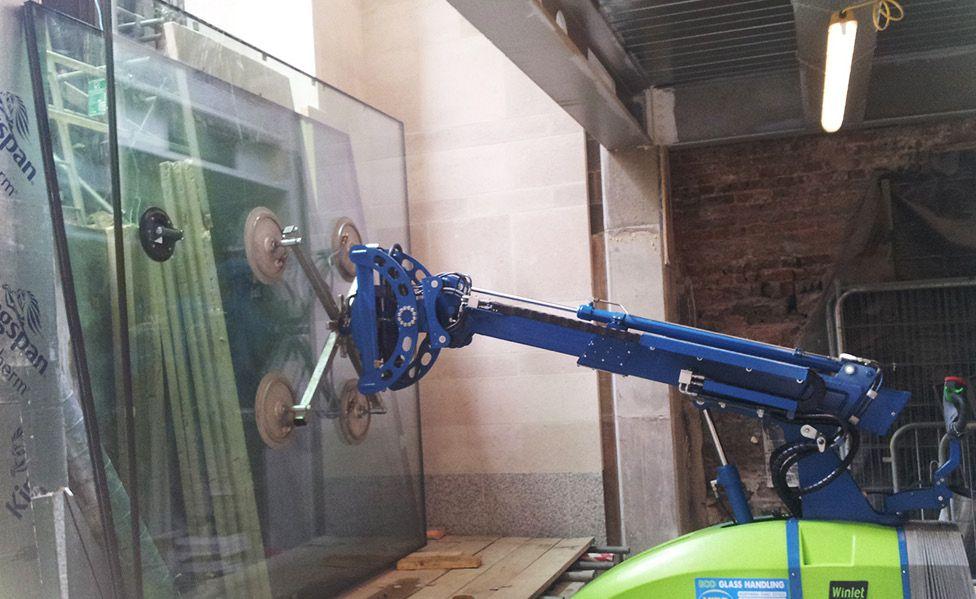
The cutting-edge lifter’s suction cups work by creating a vacuum seal on the glass
using dual vacuum systems, dual vacuum pumps and four vacuum cups, and any one of the four vacuum cups can retain the weight of the lifted item on its own. The front wheel trans-axle drive unit keeps weight on the front drive wheels and can incorporate a single wheel on each side or twin wheels on each side to provide enhanced traction, balance and flotation on rough, uneven or soft terrain. “We also feature wheeled outrigger arms for the stability of heavy and wide loads,” Stayer states, adding that track mounted and fork mounted options that allow mounting on telehandlers are also offered.
Using the Winlet 1265, window elements of up to 1,265 pounds can be lifted, transported and installed. With the ability to place the glass more precisely and more efficiently, faster installations can be done and minimizing chances of damaging the glass.
The battery-powered robotic unit weighs 2,850 pounds, is about six feet, two inches in length and a space-hugging 35-inches wide. Its compact design can handle heavy elements through narrow doorways down to 36 inches wide (the Winlet 770 model can pass through a 30-inch doorway while carrying a glass panel). The Winlet can also grip tightly onto large smooth surfaced object.
The vacuum system allows Winlet’s machines to handle glass panels for most applications,while additional vacuum cup selections enable handling of more porous surfaces such as concrete slabs.
An intuitive visual approach on the remote control panel allows the operator to be up close to the workstation for easier installation without manually handling the glass. The operator selects the function needed on a diagram of the machine itself and then actuates the proportional control to manipulate that function. The vacuum is measured with gauges on the machine that indicate the vacuum status in bar and PSI. Two indicator lights on the control panel indicate the achievement of the vacuum in the two separate vacuum zones.
Hydraulic proportional controls allow the operator to more precisely control each movement of the glass in various directions by making the movement proportional to the movement of his own hand on the controls. Notes Stayer, “If a vacuum seal can be created on the surface in question and the weight is within machine operating range, then it can be handled.”
Outriggers are a safety feature of the 1265. These fold-out arms are sited near the base of the machine and equipped with solid wheels for additional safety when moving large, heavy panels over a surface. “They can prevent a sudden movement to either side if the machine rolls over an object or a hole in the surface being traversed,” Stayer points out.
Winlet’s five-model robotic lifters range in price from $35,000 to $85,000 depending on the model, lifting capability, drive/mount mechanism and the degree of automation.
As for maintenance, Stayer insists very little is required for Winlet lifters. “Because they run on batteries, you need to make sure the machine is plugged into 110-volt electrical outlet at the end of every shift,” he says. Replacement of batteries varies depending on usage hours. “The unit’s flexibility, reduction in operator fatigue and simple operation, will help increase the speed and efficiency of panel placement as well as avoiding unsafe situations, are all features of these Winlet material handlers,” he concludes.
Increasingly deployed across most industries, heavy-duty material handling employing robots and other sophisticated technologies are, despite substantial capital investment costs, are racking up positive results through throughput improvements and boosts in flexibility and consistency while decreasing hazards for workers and the need for additional conveyance systems in manufacturing and warehouse distribution centers.
New ways of designing architectural facades where higher, bigger and self-supporting glass are the order of the day create tough challenges for glass producers’ in-house production, handling
and transportation operations.
Laying it (gently) on the line are the computerdriven intelligent stackers made by German-based Grenzebach Maschinenbau, a major supplier of glass products.
“During handling, it is essential that the (glass) sheets be stacked without scratches onto special racks,” says Franz Krommer, the company’s glass product manager. “With our new stacker generation, results include significantly higher cycle times, higher plate weights and safe handling of plates with a length of up to 16 meters.” These robotic systems are capable of taking off glass plates directly from the moving transport conveyor, correcting their alignment and creating precise glass stacks.
Grenzebach’s vacuumpowered stackers, which can handle plate weights up to 2,400 kilograms at a maximum three cycles per minute, provide glass producers and handlers flexibility, speedier work pace, enhanced peak load and plate size performance.
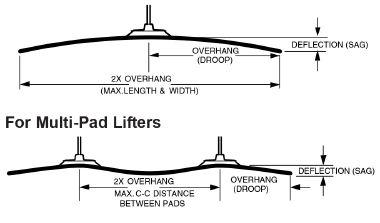
Calculating glass panel overhang
Here’s a simple table showing the allowable overhang past the edge of a vacuum lifter cup for a given thickness of glass sheet.
According to Krommer, his intelligent stackers, driven by servomotors with planetary gear trains, are now deployed and integrated into the company’s glass transit flow across the factory floor. “They can combine several functions in one machine,” he says. “Without additional mechanical components, these new stackers can be operated in various loading and unloading modes. The machine is entirely software controlled. Enabling the loading mode, for one, just needs a mouse click. The performance is adapted to the weight to be stacked. This means that the stacker is only operated at a speed which is actually required at that moment.”
And at this moment, Cynergy Ergonomics is stirring up a buzz with its product 15000 series of vacuum lifters. A cooler door manipulator, the 15000 is a range of vacuum lifters. Model 150 for example, which utilizes pneumatically powered
vacuum cups, can hoist and rotate glass cooler doors through a wide array of motions. “Our lifters can lift, pitch, roll, rotate and transport various components,” says Mike Shannahan, owner of Cynergy Ergonomics, which also manufactures articulating arm manipulators, as well as sheet, panel and roll lifters at its St. Louis, Mo., facility. “For example, we will pick up a glass sheet from the vertical orientation, rotate it 90 degrees, and pitch it forward 15 degrees for insertion into a frame.”
FAÇADES FENESTRATION & INSULATING GLASS (FFI)
Shannahan, who started his career designing military aircraft, did the engineering and design work for the 15000s. Price tagged from $25,000 to $35,000 (depending on the number of motions and/or articulations required), the unit is built for the long haul. “We recommend daily, monthly and annual maintenance inspections to keep it humming,” advises Shannahan. Cynergy vacuum lifters can lift and handle work pieces weighing over 5,000 pounds. “Loads which, in the past, had to be moved by several persons can
The new robotic glass handling machines are built with a compact footprint and powerplants that emit few or no noxious gases - perfect for working in confined indoor spaces.
now be handled easily and safely by a single person for a significant cost savings in labour and time,” he emphasizes.
Another recent introduction to the Canadian glass market, Jekko’s MPK20 is a solid tire, self-propelled pick-and-carry electric crane designed for lifting and transporting cargo raised on the boom. Commended as compact and flexible, it has a single running gear (at a top speed of 2.2 miles per hour, there’s no need for multiple gears) that uses run-on electric batteries. “It is also popular with the glazing industry for placing prefabricated curtain wall panels, building materials, panels, beams and industrial maintenance in general,” says Kris Berry, inside sales coordinator for Strongco in Burlington, Ont., the Canadian distributor of the MPK20 built in Italy by Ormet.
The MPK20 can be equipped with a walk-behind, hydraulic manipulator for glass and panels fully integrated with the functions and safety of the basic machine. Standard features on the unit include a wall charger, working lights, non-marking wheels, quick coupler and wireless remote control. It offers a two-ton maximum capacity, and is powered by a 24-volt DC battery. This 37-inch-wide machine with a maximum load capacity of 4,400 pounds, is electric over hydraulic with a telescopic 12-foot boom that’s moved by steering the machine itself. The MPK20’s boom cannot swivel or turn and therefore does not need outriggers in order to stabilize it from different angles.
A low-maintenance machine that comes with grease fittings for easier lubrication, Berry claims that the MPK20 is one of the safest lifters around. “The wireless radio remote control allows the operator to keep a safe distance from the load while maintaining functionality and accuracy,” he remarks. Working lights (green, amber, red) on the machine also give an indication of the allowable and over load capacity rating. “This mini-crane has applications well tailored to glass-handling,” he says.
Material handling is a bright spot in the use of robotics. And Stayer sees faster growth ahead for the technology. “Material handling robotics have improved rapidly and will continue to do so over the coming years,” he predicts. That’s great news for the glass industry. •
by BRIAN BURTON
Brian Burton is involved with an innovative, multidisciplinary firm that specializes in technical business writing, Award Bid Management Services (award-bid-management-services.com). The firm assists companies interested in selling goods and services to governments and institutions. He can be reached at burton@award-bidmanagement.com.
Change driving change
Isuspect that by the time you read this you will have seen a number of headlines about climate change and, more specifically, the new carbon emission tax recently introduced in the U.S. From what I understand, this new levy on carbon pollution is focused primarily on inefficient, American coal-burning electricity plants. Coal burning plants produce 40 per cent of U.S. power while natural gas supplies about 30 per cent. There are close to 600 of these coal burning plants spread across the U.S., and, taken together, they produce close to 30 per cent of the carbon pollution in that nation. For example, Kentucky has 56 coal-fired electrical generating plants, which account for over 90 per cent of that states electricity. Ontario, by contrast, has a total of five. Almost immediately after the announcement, a spirited debate began about what the potential negative impact this tax could have on electricity prices, jobs and manufacturing industries. Conversely, some argue the move will stimulate “clean energy” innovations. The glass industry stands to both be hit by the negatives and benefit from the positives, if we can react to offer more energy-efficient products.
Here in Canada, politicians have long argued that introducing any measures to reduce carbon emissions would be dwarfed by U.S. emissions, and therefore would be ineffective and expensive for Canada. Regardless, Québec, B.C. and Alberta do, in fact, have some form of taxation on carbon pollution. Although there has been quite a bit of press coverage regarding the impact of the American carbon tax on the North American economy, we should note that some economists have calculated that the impact of carbon pollution on the economy is something like $30 or
There were an additional16 days, or close to 400 hours, where the building envelope and related components were exposed to more moisture.
FENESTRATION FORUM
$40 per ton in industrialized nations. This number might not grab your immediate attention, but consider for a moment that we manage to emit several billion tons of carbon pollution every year. If these calculations are even close to being correct, we are certainly dealing with a very large amount of money. The U.S. government is insisting that if coal-burning plants are emitting excessive carbon and it’s costing the economy, the government is economically and politically justified, so to speak, to recover the losses. Canada will likely follow suit. We should prepare, as a sector, for an environment where people and companies are charged by the government for their carbon emissions.
Obviously, buildings and construction are very large consumers of energy resources, and energy efficiency is going to remain a very important issue over the long term. I personally don’t believe consumer demand will be changed or affected by higher-priced, energy-efficient glazing offerings because the market’s performance expectations are likely to remain very high.
Aside from cost, the design and specifications for building envelopes will be affected by climate change as well. For example, consider some specific climate data that was recorded over several decades at Pearson International Airport in Toronto. This climate data is site-specific and could not be applied across the country, but it does provide some information about what appears to be a gradual warming for this particular location. At this specific location, the average 30-year average annual temperature for 1961 to 1991 was recorded to be 7.3 degrees Celsius. Meanwhile, the average 30-year annual temperature between the years 1980 to 2010 rose by 1.5 to 8.8 C. This gradual warming resulted in an increase in the average number of days with a mean temperature above freezing. Specifically, this meant there were an additional16 days, or close to 400 hours, where the building envelope and related components were exposed to more moisture. This may not sound like a lot but over the lifecycle of the building it could have a significant impact. Several experts I have spoken to predicted changes in climate patterns such as this may require at least some adjustments in the building code. •
ADHESIVES AND SEALANTS
Two-part solution
fenzi-na.com
Fenzi North America has added Fenzi Poliver Polyurethane to its list of IG sealants. Fenzi Poliver is a two-part polyurethane especially formulated for sealing insulated glass and for use in commercial and residential window application. Available in 55-US gallon drum and pail kits, Poliver is for manual and robotic line sealing in traditional polyurethane viscosities and varying curing times to meet customers’ needs.
Blast,
impact and hurricane resistance tremcosealants.com
Developed specifically for in-plant two- and foursided structural glazing and
curtain wall applications, Proglaze II Structural Silicone Sealant, from Tremco Commercial Sealants and Waterproofing, is a two-part, high-performance, highmodulus sealant that cures to a tough flexible rubber when mixed through a pump. Proglaze II provides the superior quality and performance needed to meet hurricane, impact and blast resistance requirements. A shortened cure time also reduces glazing/sealing production time, and snap time is as low as 30-60 minutes.
Bendable warmedge
fenzi-na.com
Fenzi North America has added to its product base with the addition of the Chromatech and Chromatech Ultra Stainless Steel warmedge spacers. Manufactured by Roll Tech, a Fenzi-owned company, these spacers are available with corner keys and
Daylighting systems produced with Azon structural thermal barrier technologies—the MLP™ or Dual Cavity—for aluminum windows along with high performance glazing components for insulating glass, will yield a fenestration system capable of upholding the highest efficiency and sustainability standards
connectors for those wishing to bend on bending equipment. With the everchanging need to meet more stringent energy codes, the Chromatech line of stainless spacers meets the need for better sightline temperatures - both in excess of 17 per cent when compared to traditional aluminum. Both Chromatech and Chromatech Ultra spacers are available in a wide range of air space widths. The Chromatech Ultra has a polycarbonate bridge across the top, available in traditional white, grey and black colours.
Air and water barrier
dowcorning.com/construction
Dow Corning Corporation has introduced an air and water barrier system. Evaluated by the Air Barrier Association of America (ABAA), the Dow Corning Silicone Air Barrier System is a suite of compatible high-performance silicone technologies designed to work
together to better protect the entire building envelope and to improve the energy efficiency of buildings. The system has passed NFPA 285 and is NFPA Class A/UBC Class 1 per ASTM E84. It can be used on both new construction and building renovation projects, and its low-VOC formulation makes it ideal for green construction. The Dow Corning Silicone Air Barrier System includes Dow Corning DefendAir 200 – a water-based, 100 per cent silicone, liquid-applied, air and water barrier. Dow Corning Silicone Transition System features 100 per cent silicone rubber strips and corners that are easy to install with silicone sealants (not mechanical fasteners), this system forms a continuous airtight transition at interfaces, including those that will experience large amounts of building movement.
Supplied by Quanex
quanex.com
Quanex Building Products is now Bostik’s exclusive sales force for its insulating glass sealants in North
America. Quanex will carry Bostik sealants under the Edgetherm brand name, including Edgetherm 3500 single-part butyl rubber-based sealant, Edgetherm 3400 hot-applied desiccant matrix, Edgetherm 3100 and 3000 onecomponent hot-melt butyl sealants. Edgetherm 3500 is a single-part butylbased sealant that sets quickly from its molten state, allowing units to be moved from their assembly locations between two and five minutes after application and glazed the same day. Edgetherm 3400 is a hot-applied desiccant matrix for sealing the airspace of an insulating glass unit, offering optimal absorption for both existing and invasive moisture.
Secures the window-towall connection
www.tremcosealants.com
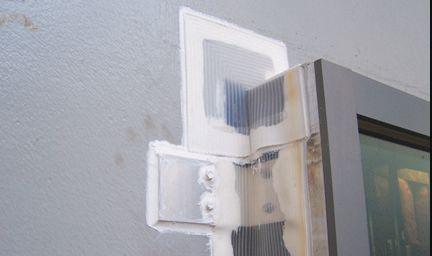
Proglaze ETA, manufactured by Tremco Commercial Sealants and
Waterproofing, is a patented transition assembly composed of pre-engineered, finished aluminum and silicone materials that are mechanically attached to the window and/or wall’s structural framing to ensure a durable connection and seal. The system’s design absorbs wind-loading stresses and movement caused by thermal expansion and contraction, vertical displacement, lateral shear and seismic conditions. The translucent silicone material allows the installer and/or inspector to see through the gasket to verify the recommended amount of sealant is properly applied to ensure an effective seal is achieved, while the ribs of the gasket’s design ensures a minimum sealant thickness.
by SKIP MACLEAN
Skip Maclean is president of Fenestration Canada. He is business development manager for Tru-Tech Doors and has over 40 years’ experience in the window and door industry.
Winnipeg dazzles
The Fenestration Canada Annual Meeting and Conference held in June at the Fort Garry Hotel in Winnipeg saw just under 200 participants register for meetings, social activities and various program events. It was one of the most successful offerings ever. The association acknowledges the tremendous support received from sponsors and Fenestration Manitoba for helping make this event what it was. We wish to particularly underscore the tireless contribution of Al Dueck (Duxton Windows), who persevered in promoting the conference and effectively dispelling any misperceptions anyone had about Winnipeg as a site for the conference.
The annual conference program delivered an extensive package of programming and activities that easily met expectations by all who attended, and delegates were greeted with the patented Friendly Manitoba welcome. It was very significant that something in excess of 30 fabricators were registered – and that included 11 from Manitoba. This was an important milestone in developing greater involvement and, specifically, in the objective of achieving greater engagement by affiliate associations.
One of the key elements of the conference program was the introduction of a fabricators’ round table discussion during lunch. J.F. Kogovsek chaired a lively discussion that was intended to draw out the issues important to the fabricators. It was a genuine opportunity for fabricators to bring their concerns and main issues to an open forum for discussion by peers from across the country. Items generated from the session will be used to help build a NAFS Frequently Asked Questions section on the association’s website to provide further guidance to members.
Key technical presentations and discussions on Friday covered various topics, including: “Windows,
It was very significant that something in excess of 30 fabricators were registered.
FENESTRATION CANADA
Doors & Skylights: A New Standard” by Murray Frank of Constructive Home Solutions; “Phase 2 NAFS Mullion Labeling Guidelines” by Al Jaugelis of RDH Building Engineering; “Building Code Update and Case Studies” by Jeff Baker, Fenestration Canada’s technical consultant; the Energy Star program update by Steve Hopwood of Natural Resources Canada; “Energy Efficient Glazing in Cold Climates” by Tome Akerstream of Manitoba Hydro; and additional presentations by Murray Frank, such as “Embracing the Evolution of Codes,” “Windows: Energy In and Energy Out,” and “Putting Windows in Their Place.”
The Saturday morning program featured several interesting presentations, including Rod Smith, director of operations excellence for the DUHA group who presented their highly beneficial implementation of a continuous improvement program under the title “A Lean Manufacturing Journey.” This was followed by Wade Miller, president and CEO of the Winnipeg Blue Bombers, discussing change management and leadership amidst the dramatic, ongoing changes with the storied football club. It was very clear that the smaller Saturday crowd was quite impressed by the additional professional learning opportunity.
Friday night featured the formal President’s Dinner complete with attendance by the Lieutenant Governor of Manitoba, Philip Lee, and highlighted by the C.P. Loewen award presentation to a local entrepreneur, Bill Fast. Bill and his family were specifically recognized for their innovative leadership of Willmar Windows, resulting in the creation of Canada’s largest window manufacturing operation in the mid-90s. Bill also demonstrated an exceptional commitment to the world around him through his senior involvement in IDE, among other philanthropy commitments, resulting in huge improvements in the lives of the poorest in the world. A very energetic Ukrainian dance, performance by Troyanda, featured the dramatic Hopak in a concluding dance.
We truly appreciate the tremendous response for the numerous delegates who attended and benefitted from great program content and networking opportunities that were offered. Plans are already underway for next year’s conference in Vancouver B.C. •
SIGNS OF LIFE INDUSTRYEVENT
by PATRICK FLANNERY
The Canadian Glass Association needed this. Following a terrible start to 2014 that saw the departure of member associations Fenestration B.C. and Quebec’s AVFQ - as well as long-time executive director, Zana Gordon - Canada’s national glass association was left with many questions about its relevance and future direction. Those questions were largely answered with a very strong Glass Connections event in Halifax, hosted by the new Atlantic Provincial Glazing Association.
Glass Connections Halifax actually started the night before the conference itself with a lively Kitchen Party featuring a local band, Caber Feidh. The music was excellent, ample libations were served and a good time was had by all.
The June 4 conference was attended by 110 glazing contractors and fabricators from points all over Atlantic Canada. The spacious Holiday Inn Har-
Glass Connections Halifax shows energy and enthusiasm in the CGA.
bourview Dartmouth was the setting. Dow Corning stepped up as Platinum Sponsor, and Tremco and Alumicor supported the event as Gold Sponsors. They were joined by 12 Bronze Sponsors. The event took the familiar form of other Glass Connections events with seminars taking place in a large ballroom with the sponsoring suppliers exhibiting at tabletops around the outside of the room.
The education program began with Bruce Miley, architectural design manager for Guardian, providing an overview of the state of flat glass technology today and the trends in its use as an architectural material. Miley asked for a show of hands indicating how many attendees had ever toured a float glass plant, and only
about a quarter of the room had. Guardian, he said, operates 28 glass mines around the world, with proximity to natural gas supplies being a key factor in determining where float glass plants are located. A single float glass plant ships 700 to 900 truckloads per month.
David Kayell of Morrison Hershfield covered developments in codes and standards, telling attendees that Nova Scotia was going to adopt the National Energy Building Code provisions for energy efficiency and apply them to residential projects by the end of the year. He talked about the compliance paths in the NEBC, explaining that the standard uses ASHRAE climate zones and only allows
ABOVE: A well-attended and well-run Glass Connections event was a breath of fresh air in a region that had not had a commercial glazing event in a long time. Halifax turned out strongly and feedback was positive all around.
architects to use the prescriptive compliance path if the project meets window-to-wall ratio requirements. Because of this, curtain wall manufacturers will probably have to rely on the performance compliance path, which allows the project to be certified based on computer modeling of the entire wall’s insulating value. This will still be a challenge, Kayell said, as the standard calls for R23 opaque walls with R2.6 fenestration, while typical curtain wall is only R3. He said the solution will be thermally broken cantilevered balconies, more thermal breaks in the wall design, triple IGUs, vacuum-insulated panels, shading and smart glass.
Scott Waechter of Dow Corning discussed urethanes versus silicone in adhesives and sealants technology, telling attendees how to tell the difference between the two in an existing installation, and the pros and cons of each formulation. He talked about the importance of choosing the right adhesive for an application and properly preparing the installation site. “The best sealant in the world will fail if applied improperly,” Waechter warned.
George Torok, a project manager at Morrison Hershfield gave an information- and example-packed talk about common sources of failure in curtain wall, spandrel and glazing connections. Torok is often called out to consult on disputes over envelope failures, so he has seen it all. Water ingress was a major theme, with Torok pointing out a number of installation errors that lead to leaks. He also talked about the need to allow for movement at joints and transitions to prevent seal failures.
Alfonso Lopez of Senetech gave his audience a whirlwind tour of some trendy glass architecture in projects around the U.S. and Canada. Large format panels were prominent, with companies like Agnora capable of producing sheets up to 35 feet long. Double-skin facades are gaining popularity for appearance and thermal efficiency, though they can be very complex, needing point-supporting hardware, spider fittings and often bonded and embedded fittings for more transparency. Luxury home builders are now designing ahead of codes, and as an example Lopez showed a home in Lake Tahoe with a 1,400-pound, triple-laminated door made of a single panel.
Bill Yanek, executive vice president of the Glass Association of North America, addressed the group, bringing them up to speed on the mission of North America’s largest glass association. He pointed to several trends that will affect glaziers in the coming years, including glass failures and energy-efficient building, and encouraged attendees to join GANA in leading the discussion on these issues. “You can’t show up when a code is about to be enacted,” Yanek warned. “You have to be there in meetings from the beginning if you want to affect the process.” Yanek announced that GANA will be holding its fall conference in Toronto, Sept. 23 to 26.
Jim Brady, CGA president, updated the conference on efforts to instigate an apprenticeship program in Atlantic Canada. Government officials are ready to move forward, he said, but there needs to be an educational program in place. Brady says the Southern Alberta Institute of Technology has come up with a four-year course to train journeypeople in Alberta and is ready and willing to bring the course to Atlantic Canada if the local industry can generate the volunteer hours to adapt the course.
Mike Higgins of Economy Glass, president of the APGA, was instrumental in organizing the event and recognized Tony Spurrell for his tireless efforts to make it a reality. The next Glass Connections is tentatively planned to
place
by FRANK FULTON
Frank Fulton is president of Fultech Fenestration Consulting. He has been in the industry for 30 years and can be reached via email at fultech.fc@gmail.com
Help with health and safety
Glazing contractors in Ontario beware, and be proactive. On July 1, 2014, Ontario Regulation 297/13 took effect as part of the Occupational Health and Safety Act (OHSA) under the heading “Occupational Health and Safety Awareness and Training.” This law requires that all workers and supervisors in the province receive health and safety awareness training. Supervisors, in addition to basic training, must also be trained in how to recognize, assess, and control workplace hazards and evaluate those controls. They must also be familiarized with sources for additional information on occupational health and safety.
The definition of a supervisor under OHSA is important to note. A supervisor is defined as anyone with “control of the workplace or authority over another worker,” regardless of title. Most lead hands, team leaders, managers, directors, etc. are considered supervisors under OHSA and will need to be trained as above.
If a company has already trained its workers and supervisors and feels that their training meets the OHSA requirements, there is no need to retrain as long as they have proof of training. For small and mid-sized glass shops, this is where most fall flat on their faces. They’re good at taking care of business and getting a contract done. They suck when it comes to maintaining documentation. If you encounter the unfortunate occurrence of a workplace accident with one of your employees and end up facing a Workwell audit, your only proof of training and company safety procedures will be in the form of your records and documentation. Without this in place, the penalties could be devastating to you and your business.
Your only proof of training and company safety will be in the form of your records.
To address this province wide industry need, the Ontario Glass and Metal Association has been working with the WSPS to create a health and safety policy manual specifically tailored to the needs of glass and metal shops. It provides the glass shop with a comprehensive workplace specific program including such features as:
• Worksite-specific roles and responsibilities, policies and procedures.
• Safe operating procedures for key work processes and equipment, specifically tailored to include the actual equipment used in each shop or at each jobsite.
• Legal requirements for preventing workplace violence and harassment
• Easy-to-use tools and forms
• Complete documented records for proof of training and due diligence.
The OGMA/WSPS Health and Safety Policy Manual was created by qualified health and safety professionals and is a timesaving tool enabling glass shops to establish their own company program. Not only will this support a company’s effort to eliminate workplace injuries and illnesses, it will also lower costs and time related to WSIB claims. It also provides proof of compliance with the new OHSA Regulation 297/13.
According to Angelo Cairo, president of Stouffville Glass, “We know how important it is to have a safety policy in place and that we need to have records to prove we have done the necessary training. I had thought that we were up to date with our training and safety documentation, however after previewing the OGMA/WSPS manual it is clear that my company and probably the industry as a whole needs some help getting their policies and procedures up to speed. The problem is that we are all so busy just keeping up with our projects that nobody has the time to create and manage a good company safety manual. Regardless of the policies we have created to date, we will be investing into this program. I think it’s just what the industry needs.”
Steve Ringler, president of Oakville Glass and Mirror, states: “The OGMA / WSPS manual was an eye-opener to find out what we needed to do to pass a Workwell audit.”
For additional information on how you can put this program to use in your company, contact the OGMA or myself. •
Grove Products, Inc. has the perfect shim for every job every time.
Looking for the right shim?
Grove Products, Inc. has the perfect shim for all your shimming needs. With color-coded shims and solid thicknesses, the right shim can be easily applied for perfect allignment. No guesswork or realigning. Our shims save you time and money.
Need help? Just ask! We’re here to help.
Visit us online to see all of our available solid 3x4 Shims. www.groveproductsinc.com Free Samples are Available Upon Request.
Grove Products, Inc. is the leading producer of plastic structural shims. We have been in business since 1962, making shims since 1975, our family-owned business provides prompt, personalized attention to each order. In addition to our large line of in-stock shims, we will custom fabricate parts to meet your unique requirements. Unlike many competitors, our shims are solid and do not have hollow voids, so you can depend on them in crucial, load-bearing conditions.
CRL-U.S. ALUMINUM THE NEW STANDARD IN COMMERCIAL ENTRANCES
MANUFACTURED BY CR L- U.S. ALUMINUM
ENTRANCES, FRAMES, STOREFRONTS, AND CURTAIN WALL SYSTEMS
Designed to appeal and engineered to perform, CRL-U.S. Aluminum Entrance Doors set the standard for commercial entrances. Our systems are consistently built to the highest industry standards, ensuring years of reliable service.
WHAT YOU CAN EXPECT IN EVERY U.S. ALUMINUM DOOR:
BETTER PERFORMANCE
• Corner-Loc™: Patent pending corner construction technology features precision alignment tabs, a robust mechanical fastening system, and roboticallyapplied welds; yielding the most durable door assembly on the market.
• Lifetime warranty on corner construction.
FASTER DELIVERY
• Others claim shorter lead times, we opted to remove them altogether.
• Doors and Frames are in stock, ready to buy or ship.
EASIER INSTALLATION
• Adjustable Leveling Screw: Top rail of every door has an adjustable leveling screw to compensate for minor variances in door openings after installation.
• Preset Glass Setting Blocks: Eliminates any confusion regarding proper placement of setting blocks.
COMPLETE PROJECT SOLUTIONS
• Complete your opening with stock inventories of matching Frames, Storefronts, Curtain Walls, and thermally broken options, creating cohesive, performance-driven building fronts.
For over five decades, CRL-U.S. Aluminum has developed a reputation for innovative products, unparalleled service, and complete project support worldwide. That wealth of experience, coupled with the largest selection of architectural systems, enables you to design, create, and build with complete confidence.