Energy efficiency is becoming the law across Canada as provinces update their building codes or even pass new laws. Fenestration Canada’s technical consultant, Jeff Baker, gives us the lowdown on where the changes are and what inspectors are looking for.
20 IGMA Technical Conference review
The Insulating Glass Manufacturer’s Alliance met in Ottawa this past June to discuss the science and art of making insulating glass units. They also managed to have some fun.
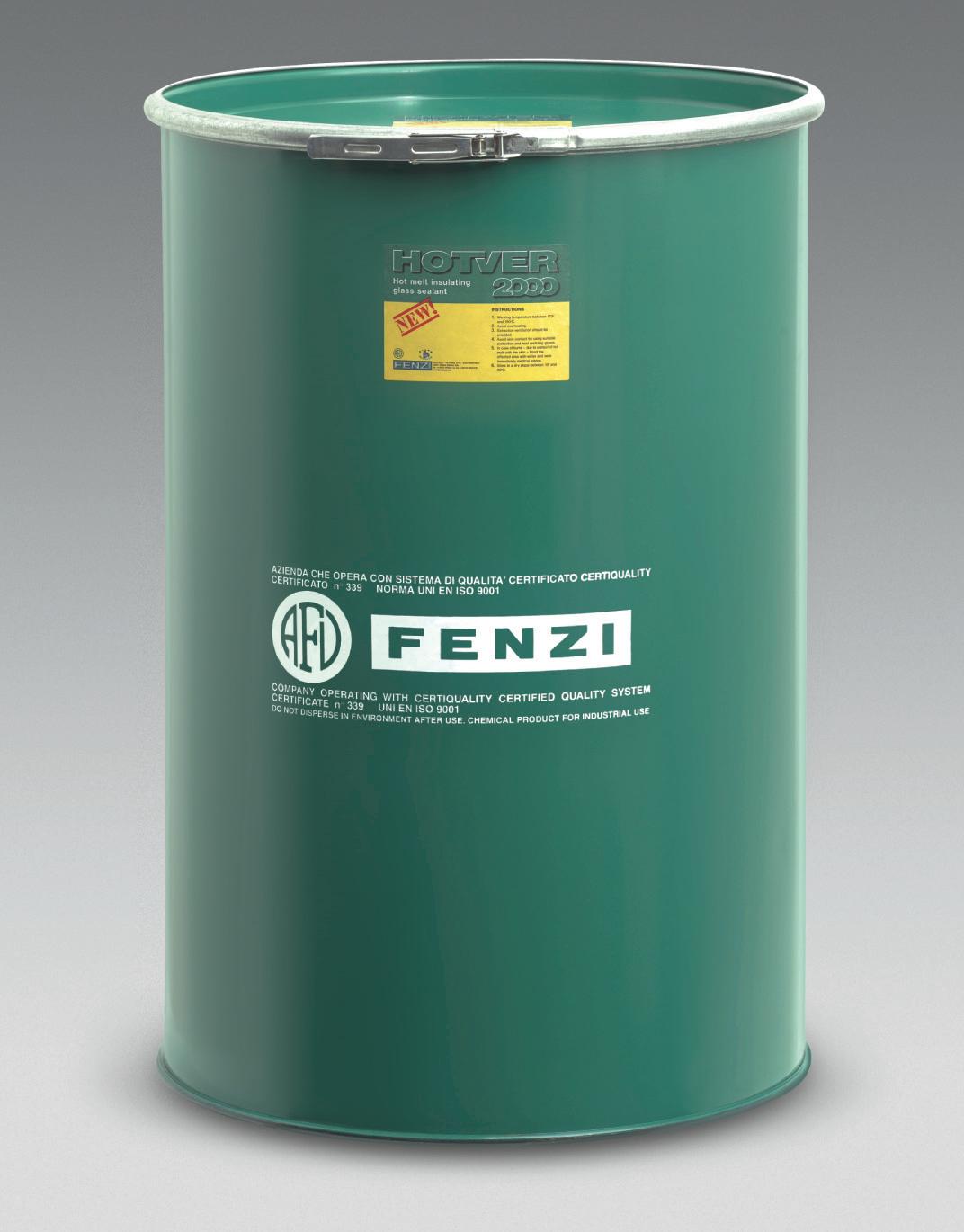
28 Sealants and adhesives showcase
Looking for goo? Top industry suppliers show off the latest and greatest in stuff that comes from a tube or on a roll.
DEPARTMENTS
16 Innovations
Fibre-optics may revolutionize the way we collect information about buildings.
18 Fenestration Canada
Win-Door has something for everyone.
22 Under the Glass
Aylmer Glass and Mirror is the go-to shop in this small town.
COLUMNISTS
19 Fenestration Forum by Brian Burton
30 You Bet Your Glass by Frank Fulton
Jeld-Wen put its community spirit on display in the north Winnipeg suburb of Riverbend in July, helping with a Habitat for Humanity Blitz Build of four sideby-side housing units, eight homes in all.
Efficiency by fiat
EDITORIAL
Energy Star was a really good idea. Before the program, consumers had no way to evaluate the energy efficiency of a particular window system aside from the salesperson’s promises.
By having the energy rating of windows certified by a government agency (Natural Resources Canada), consumers were empowered to choose the level of energy efficiency they wanted relative to the price they were prepared to pay. On the fabrication and retail side, Energy Star provided a great chance to upsell and slowed the race to the bottom on prices. Fabricators could design good, better and best options to satisfy every kind of buyer, and the extra quality they put into the high-end systems could be convincingly demonstrated just by pointing at the label. Those concerned about the environmental consequences of energy generation saw Canadian houses become much more energy efficient. It was voluntary, and truly a win-win-win.
NEXt IssUE
• Win-door preview
• spacers and thermal breaks
Now, energy ratings are passing into law across the country in the form of building code amendments. Consumers will presumably benefit from more energy efficiency in newly built houses. However, the price will reflect the upgrade, and consumers will not be able to choose a cheaper alternative. The situation facing fabricators and installers is much worse. The testing and labelling requirements under the new building codes are onerous. A mistake on a label could result in your windows being pulled out of buildings. Lawsuits are sure to fly as building inspectors who have never had to consider energy efficiency before adjust to the new regimes.
Fenestration Canada, and especially its technical consultant, Jeff Baker, is doing yeoman’s work in staying ahead of the changes and trying to proactively head off negative repercussions for fabricators. Baker and other members of the Technical Committee have been criss-crossing the country alerting provincial authorities when some aspect of their proposed code does not make sense or will present an impossible challenge for fabricators. They are embarking on a training program to teach building inspectors about the new labels and code provisions. Crucially, they are helping to guide building inspectors in interpreting the codes where there is room for multiple approaches. Anyone in the fabrication business wondering whether to bother to support the association should take note.
There is certainly an argument that says preventing the environmental damage done by energy generation can no longer be left to individual choice, though I do not think that position is as controversial as it should be. I question whether the benefit to global atmospheric carbon dioxide levels will justify the expense and impact to market and consumer freedom such laws incur, especially given that a great deal of our energy comes from non-emitting nuclear or hydroelectric sources.
Such arguments are darts against the horde. I’ll sit back down now and confine myself to applauding Fenestration Canada for its efforts in helping window fabricators to avoid the worst consequences of the new code regimes. •
GROUP PUBLISHER | Martin MCANULTY mmcanulty@annexweb.com
Publication Mail Agreement #40065710. RETURN UNDELIVERABLE CANADIAN ADDRESS TO CIRCULATION DEPARTMENT, P.O. BOX 530, SIMCOE, ON N3Y 4N5 e-mail: subscribe@glasscanada.com
Printed in Canada, All rights reserved. Editorial material is copyrighted. Permission to reprint may be granted on request. ISSN 0843-7041
CIRCULATION
e-mail: subscribe@glasscanada.com
Tel: 866.790.6070 ext. 208 Fax: 877.624.1940
Mail: P.O. Box 530, Simcoe, ON N3Y 4N5
SUBSCRIPTION RATES
Canada - 1 Year $36.75 (includes GST)
($39.55 includes HST/QST)
U.S.A. - 1 Year $50.00 (in US dollars)
Occasionally, Glass Canada will mail information on behalf of industry-related groups whose products and services we believe may be of interest to you. If you prefer not to receive this information, please contact our circulation department in any of the four ways listed above.
www.glasscanadamag.com
INdUstry NEWS
Fenestration Manitoba formed
Ayear-long effort to form a fenestration organization came to fruition in the spring of 2012.the new organization, which has been incorporated as Fenestration Manitoba, has roots that reach back a number of years. A core group including brian Epp of PPG, Aurel robin of dominion Windows, rob Johnstone of Accurate dorwin and brian Korchinski of Acrylon had been organizing an annual golf day and mini supplier showcase for quite a number of years. this annual effort achieved a level of interaction and communication within the industry that had not previously existed. however, those individuals reached a point where they decided not to continue as a group. It had become apparent that there was a need for more communication and stronger training efforts on an ongoing basis. Finally, it was also clear that some Canadian regional groups, such as those in Quebec and b.C., were having a favourable impact on their fenestration industries.
As a result, a representative mix of largely Manitoban window and door fabricators and some suppliers met in late April. this meeting was designed to achieve consensus that such an organization was needed and should be formed. In addition, the initial basics of subcommittees and an executive team were formed. subsequently, the legal incorporation and supporting organization have also been completed with the support of ryan dudek, secretary/treasurer. A membership fee structure has been established and the core members have paid their
fees. Notably, the prior annual event committee also provided a substantial donation from 2011.
A number of initiatives have already been launched by members of this group. the installation group has met to formulate some initial plans on how to systematically strengthen the industry standards on this topic. dave Mackay has held a number of discussions with Energy Manitoba and provincial officials. this has resulted in some very important conclusions that the fenestration industry is not being sufficiently credited for the high-performance products that are available to Manitobans. ongoing meetings have opened new channels of communication whereby Fenestration Canada is being given an opportunity to increase the visibility and recognition of high-performance window and glazing options.
the new organization chose the name Fenestration Manitoba to mirror the newly branded Fenestration Canada (formerly the Canadian Window and door Manufacturers Association). It is believed that a win-win can be achieved by channelling information to the benefit of the Manitoba industry as well as by increasing the involvement of the Manitoba members with the national organization. A specific vehicle for this will be the hosting of Fenestration Canada’s annual general meeting in Winnipeg in 2014. the executive of Fenestration Manitoba absolutely believes that this new organization can make a very positive impact on the Manitoba fenestration industry.
From left to right: Al Dueck of Duxton Windows and Doors, Ryan Dudeck of Paramount Windows and Doors, Dave MacKay of Polar Windows, Aurele Robin of Dominion Windows and Doors, Dan Friesen of Epic Windows and Doors, and Brian Warkentin of Fenestration Consulting.
Code changed to prevent falling glass
ontario has strengthened its building code to help prevent balcony glass of newly constructed buildings from breaking. Construction companies will now be required to use heat-strengthened laminated glass when glass is close to the edge of a balcony and to use heat-strengthened laminated glass or heat-soaked tempered glass where glass balcony guards are inset from the edge of the balcony. these requirements are based on the Expert Advisory Panel on Glass Panels in balcony Guards’ recommendations and take effect July 1, 2012.they are intended as an interim solution to ensure public safety while the Canadian standards Association develops a national technical standard for glass panels in balcony guards. the amendment requires compliance on a go-forward basis and does not require existing buildings to retrofit to the new requirement. however, under the building Code Act, 1992, municipalities have the ability to address unsafe conditions in existing buildings.this includes requiring inspections and issuing work orders to remedy unsafe conditions.
CGA Newsletter
Ontario Glass and Metal Association
our fall golf tournament is scheduled for thursday, sept. 13 at the Carrying Place Golf and Country Club. Make sure to join us for this fine day on a top-quality course. Flyers for the event will be sent to our members shortly.
If you are conducting business in the glass industry in ontario, the oGMA is the voice that represents your interests at the provincial and federal level. Protect your business interests by becoming a member or as an associate member if you are a consultant to the industry. doug Morris is heading up membership for our association, so please contact him today at douglasmorris@rogers.com, or visit the oGMA website.
the oGMA wants to notify all glass and glazing companies in the province that the ontario version of the Glazing systems specifications Manual of standards and Practices is now available for purchase. this allencompassing document is a must-have reference tool for all companies in the industry. For more information and to order yours, visit our website at www.ogma.ca.
Canadian Glass Association P.O. Box 595 Abbotsford, B.C., V2T 6Z8 Tel: 604.855.0245 • Fax: 866.253.9979 www.canadianglassassociation.com
Atlantic Provinces Glazing Association
It is coming together here in Atlantic Canada. We have completed our second director’s meeting and have scheduled a third for the near future. Cheques are hitting the bank account and budgets are coming together as we look forward to our first member’s meeting event.
the APGA is looking to secure at least 30 full-time members in this initial year and
Canadian Glass Association
What a busy summer this has been for the CGA. Working on our new set of bylaws to meet the new Not For Profit Act has been a bit of a challenge, but we did it. Cur-
rently we are in the middle of planning our next Glass Connections conference. Glass Connections Montreal 2013 will be at the delta in Montreal on May 29-30, 2013. the tech-
have identified the development of a five-year agenda and the design of a website as initiatives for 2012. We have secured www.apga.ca for our website.
We continue to work on participation, gathering ideas and points of interest from potential members. As with other locations across this country, training and recruiting productive, experienced staff continually comes up for discussion.
though we are still trying to find our way through the possibilities and realities of this newly formed association, enthusiasm and excitement are high within the confirmed membership and the board of directors.
scheduling a social event with the confirmed membership as well as the remaining potential members will be high on our short-term agenda.
nical Committee is working hard at finalizing our program. We should have more to come on this very soon.
We will be holding our first Annual General Meeting on
May 29, 2013 under the new set of bylaws. this will be a very interesting time for us as it will be the first time we will have an elected board of directors.
the first edition of the AIPVFQ golf tournament was sold out with 148 golfers. From left to right, Andre touchette, president of the AIPVFQ, Gilbert Lemay, CEo of the AIPVFQ and richard Verdon, past president of the CGA and tournament organizer. the event was held at Club de golf La Madeleine in Monteregie on May 18.
Anti-dumping complaint launched
The Canada border services Agency announced July 17 that it is initiating investigations into the alleged injurious dumping and subsidizing of certain unitized wall modules originating in or exported from China. the investigations follow a complaint filed by Allan Window technologies of Concord, ont., Ferguson Neudorf Glass of beamsville, ont., Flynn Canada of Mississauga, ont., Inland Glass & Aluminum of Kamloops, b.C., oldcastle building Envelope of Concord, ont., sota Glazing of brampton, ont., starline Architectural Windows of Langley, b.C., and toro Aluminum of Concord, ont. the complainants allege that the dumping and subsidizing of these goods are harming Canadian production by causing the following: lost sales, price erosion, price suppression, reduced profitability, loss of market share, reduced employment and underutilization of capacity.
dumping occurs when goods are sold to importers in Canada at prices that are less than their selling prices in the exporter’s domestic market or at unprofitable prices. subsidizing occurs when goods imported into Canada benefit from foreign government financial assistance. the special Import Measures Act protects Canadian producers from the damaging effects of such unfair trade.
the Canadian International trade tribunal
skip’s ahead
A.b. (skip) MacLean has joined tru tech doors as director of business development, bringing with him over 40 years in the fenestration industry where he has built knowledge and experience in sales, product design, planning and developing organizational strategies. MacLean entered the fenestration industry right out of high school and spent the first 18 years of his career developing his knowledge and skills with Fasco Products, a division of Indal. through his time with Fasco Products, he successfully progressed through the organization
will now begin a preliminary inquiry to determine whether the imports are harming Canadian producers and will issue a decision by sept. 14, 2012. While the tribunal is examining the question of injury, the CbsA will investigate whether the imports are being dumped and/or subsidized, and will make a preliminary decision by oct. 15, 2012. should the CbsA make a preliminary determination of dumping and/or subsidizing, the investigations will be continued for the purpose of making a final decision within 90 days after the date of the preliminary determination. If the CbsA’s investigations reveal that imports of the subject goods have not been dumped or subsidized, that the margin of dumping or amount of subsidy is insignificant or that the actual and potential volume of dumped or subsidized goods is negligible, the investigations will instead be terminated.
duties to counteract dumping and subsidizing are normally only applied to goods released on or after the date of the CbsA’s preliminary determination(s). however, if the tribunal determines that an unusually large increase in harmful imports has occurred prior to the CbsA’s decision and that the retroactive application of anti-dumping or countervailing duty is therefore justified, duty could be levied on the goods brought into Canada as of July 17.
energy stars
The federal Ministry of Natural resources has announced the winners of the 2012 Energy star Market transformation Awards.these awards recognize leadership in promoting energy efficiency in Canada and are presented to utility providers, manufacturers, retailers, advocates and home builders who have shown leadership and commitment in manufacturing, marketing and promoting energy-efficient products.this year, 12 organizations in 13 categories were recognized for their excellence in advancing the Energy star brand in Canada.
to where he earned the position of vicepresident. Following his tenure with Fasco Products, MacLean became sales manager for bL Aluminum, a manufacturer of high-end aluminum windows and doors. With the knowledge and experience that he acquired over the 23 years of his career, he started his own sales agency, AbM sales. MacLean would represent oEM manufacturers of related products to the door and window manufacturing industry on a national level. he would go on to become the vice-president of sales at screenco Manufacturing, a position he held from 2003 until 2012.
MacLean has worked with Fenestration Canada (formerly CWdMA) for over 10 years and says it is his honour to be the current vice-president. he says he intends to take an active role towards ensuring that tru tech doors becomes the market’s first choice in entry door products.
“since its introduction, industry and government have worked together to promote the benefits of the Energy star initiative to Canadians,” said david Anderson, parliamentary secretary to Joe oliver, Minister of Natural resources. the Energy star label encourages Canadian consumers to purchase the most energyefficient products, technologies and services on the market. this label is displayed on 60 product types, including home electronics, major appliances, lighting, windows and doors, office equipment, commercial equipment, and heating, ventilating and air conditioning equipment. Currently, more than 1,100 organizations and 800 home builders participate in the Energy star initiative. In the fenestration sector, three companies took home awards.Winnipeg’s Jeld-Wen won Manufacturer of the year for fenestration products. Edmonton-based All Weather Windows won Participant of the year and Vinyl Window designs of Woodbridge, ont., won Advocate of the year –specific Product.
Hunter named architectural manager
Alcoa building and Construction systems has announced that donnie hunter has been named architectural manager for North America. In his new position, hunter will lead a team responsible for the promotion of the Kawneer, traco and reynobond brands to the architectural community with the goal of driving specification, new product adoption and overall demand for the Alcoa bCs North America product range.
“donnie’s tenure at Kawneer combined with his extensive industry experience and product knowledge is a tremendous asset to our architectural services capability and enables us to provide greater support to architects while also driving growth through specification,” said Kimberly Ferro, vicepresident of marketing and product development for Kawneer North America. “We are excited to have donnie lead this team and look forward to reaching the architectural community in new and different ways.”
hunter’s career with Alcoa began in 1983 as a sales trainee for Kawneer for the southern region working in the Jonesboro, Ga.,
Tourikian honoured
F
enestration Canada honoured Jean-Louis
tourikian of tourig Consultants with the C.P. Loewen award at its annual general meeting in Montebello, Que., on June 7.the C.P. Loewen award recognizes the career of an individual who has demonstrated outstanding dedication, commitment and accomplishment in the Canadian window and door industry.
tourikian immigrated to st. Louis, Miss., from France in 1955. he obtained a bachelor of science degree in political science from the University of Missouri at Columbia, and a master’s degree in management and industrial relations from Webster University. he was commissioned an ensign in the U.s. navy in 1964 and served in Vietnam from 1964 to 1966, being promoted to lieutenant junior grade in 1966. he was also transferred to sicily, Italy, in 1966, where he served as a public affairs officer until 1968. In 1968,tourikian was promoted to senior lieutenant.
tourikian married his wife, rita, in 1967. they have two children, Eric and Valerie. A third, stephanie, died in a traffic accident in 1994.
manufacturing facility. From 1984 through 2001, he held various sales positions and was responsible for architectural promotion and customer sales in the southern region.
In 2001, hunter joined Kawneer’s inaugural architectural services team where he was responsible for providing architects with product application and technical assistance. he made the leap into product management in 2003 where he first worked as the product team leader for hurricane-resistant products, later shifting to product manager for protective glazing products, and most recently, product manager for storefronts, entrances and framing. during his tenure in this role, hunter successfully launched seven new products and released major enhancements for four product lines. hunter is active in two major industry organizations: the American Architectural Manufacturers Association and the American standard for testing of Materials. he currently serves as co-chair of the AAMA’s storefront manual task group and the bIM task group. hunter holds a bachelor’s degree in architectural engineering from southern Polytechnic state Institute and will receive his Mb A from the University of Georgia’s terry College of business in August.
Kitty gets out rehau’s
CEo of North American operations, Kathleen “Kitty” saylor, stepped down from her position on July 1 after an 18-year career with the company. saylor, who has served as rehau North American CEo since 2006, and was the company’s vice-president of human resources from 2001 to 2006, has accepted a position in bozeman, Mont., as the chief executive in residence of the Montana state University Alumni Foundation. rehau North America’s former vice-president of marketing and sales, Christian Fabian, has been appointed to the position of CEo
From 1968 to 1974,tourikian was a supervisor at Western Electric. he then spent five years in sales at Inmont specialty Chemicals. he worked from 1979 to 1993 as the national sales manager for PrC Chemicals, then from 1993 to 2008 as a business manager at Cardinal Glass. tourikian still works in the industry under his own company name,tourig Consultants.
tourikian’s association involvement has been outstanding. he served as a director of the Canadian Window and door Manufacturer’s Association (now Fenestration Canada) for 15 years, including a term as president in 2005 and 2006.tourikian was deeply involved in bringing the CWdMA under the management of the Wood Manufacturing Council, and initiated most of the committee structure that persists to the present day.
Fenestration Canada president yvan houle gave the award to tourikian in a bilingual presentation at the President’s dinner on the first night of the AGM. “Jean-Louis is professional, loyal, sincere and a good friend to have,” houle said.
“Kitty’s stewardship over the past six years has created a solid foundation on which to build, particularly as we now focus toward innovative ways of selling across our business divisions,” said Fabian. “Understanding how market demands can be met from among numerous product lines – whether it be with edgebanding, gaskets and windows, or radiant heating and cooling and geothermal – we will be positioning rehau as a comprehensive solutions provider to the industry and construction markets in North America, Mexico and Central America.”
According to Fabian, in addition to honing a crossselling business strategy, his initial focus as CEo will be to shepherd planned investment by rehau North America in both its construction and industry business divisions.
LOOkING AT ENERGY Codes
Know how to show your products’ compliance with
by TrEEnA HEin
For the first time in history, national and provincial building codes are going to include energy efficiency requirements for windows and doors. Updates to the National Building Code are due to come into effect at the end of this year that will require fenestration components to achieve certain U-values for energy efficient performance in order to be approved as part of a newly built dwelling. In provinces that adopt the NBC, these changes will immediately become part of the building code. But most provinces that make their own building codes are also moving to include energy efficiency standards. Sometimes these are similar to what the NBC will require, but often there are differences.
To get the latest updates on what’s happening in various jurisdictions across the country, we talked to Jeff Baker, Fenestration Canada’s technical consultant. Baker explained that, in addition to North American Fenestration Standard labelling for air/water ingress, window and door fabricators will soon have to prove compliance with an energy efficiency standard in many jurisdictions across the country. “NAFS (North American Fenestration Standard/Specification) requirements will roll out across the country within the next 18 to 24 months,” he notes. “Two years ago, most of the provinces adopted the 2010 code that includes NAFS requirements, but when the national energy code comes into play, new energy ‘proof of requirements’ will also have to be met.”
Some of the NAFS requirements for entry doors have been delayed in Ontario and Nova Scotia, but Baker says they will come on line around the start of 2013. “Right now, inspectors are looking for A440 2000 test reports on entry doors, and if they dig a little deeper, they could be looking for a Canadian General Standards Board test report,”
Interesting times are ahead as provinces creep closer to making energy efficiency standards the law for windows and doors. Enforcement is bound to be spotty as building inspectors learn the new codes and settle on common interpretations.
with the new energy efficiency codes
he explains. “It’s been in the code for 20 years, and usually not enforced at all, but they are starting to look at it in Ontario.”
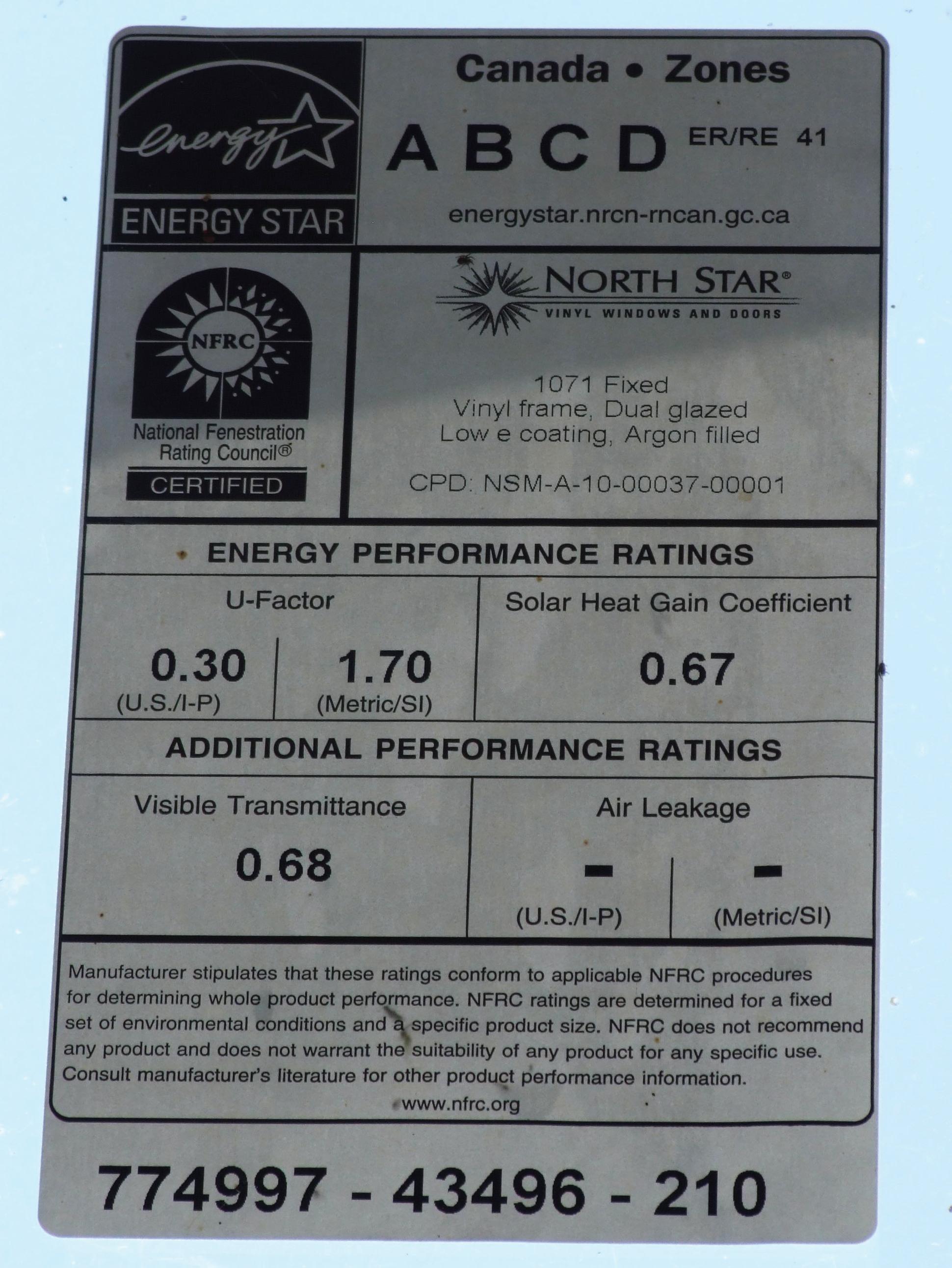
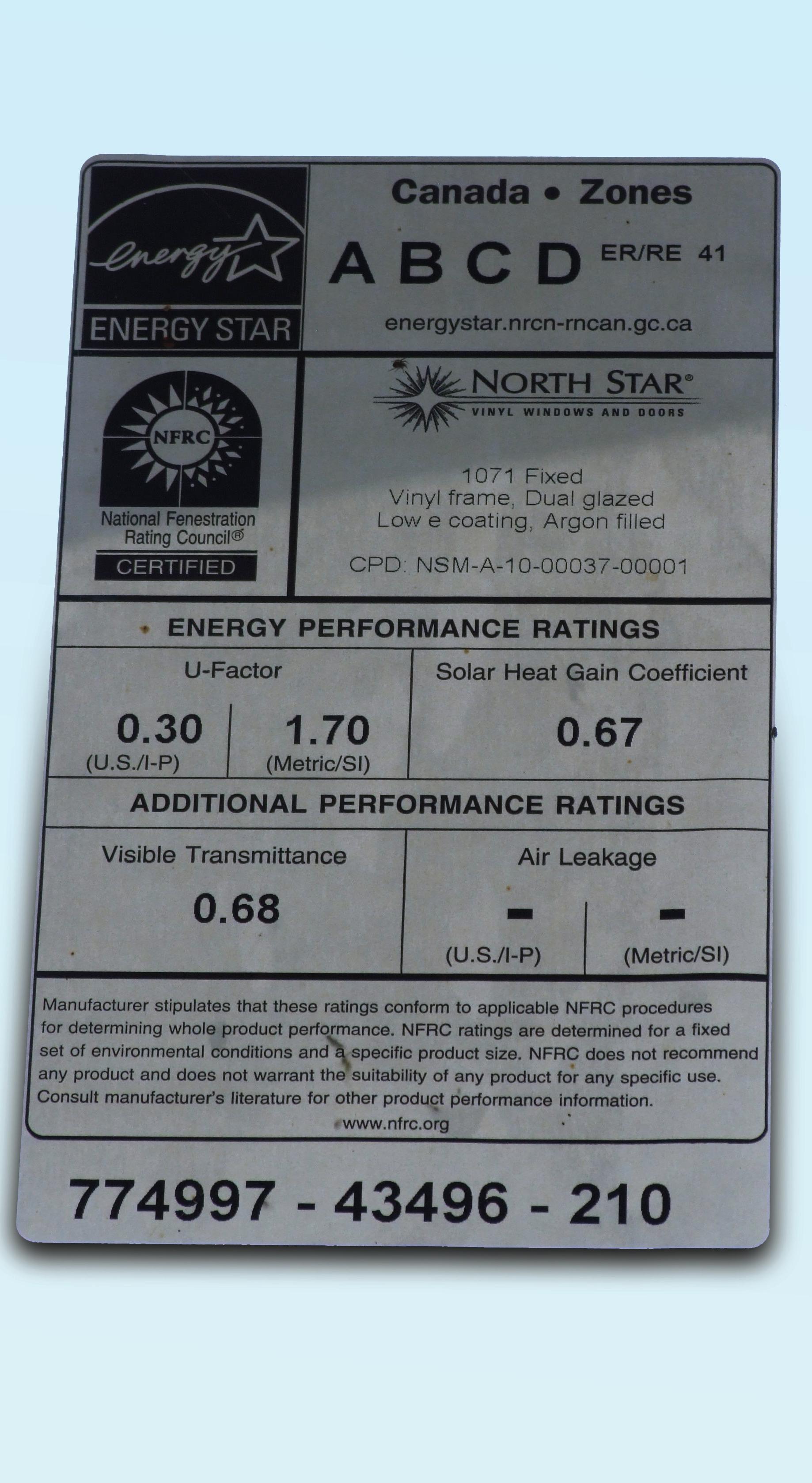
Where National Building Code energy performance specifications take effect, all fenestration products will need a temporary label spelling out the energy performance numbers to either CSA A440.2 or National Fenestration Rating Council standards. “If you’re using NFRC, the best way of proving compliance for the energy rating is to be involved in the Energy Star program, which requires that the energy rating be calculated and labelled,” says Baker. “It’s also very important to have the metric number to prove compliance.”
All proof of requirements to meet code will have to be permanently marked on all products so that it is visible after installation. “That’s been in place in the A440 regulations for over 20 years,” says Baker. “However, all manufacturers are still not complying with that, mainly because it has not been well enforced anywhere in the country except parts of B.C. That needs to change.”
British Columbia
In this province, windows must comply with A440-00 under the building code. “However, the enforcement on the A440
standard is weak – some jurisdictions look it up, some don’t,” says Baker. “It’s just CGSB 82.5 and 82.1 for entry doors and sliding glass patio doors and these should be labelled.”
With regard to energy, B.C. is unique among Canadian jurisdictions in that any product sold in the province has to meet requirements under the Energy Efficiency Act. “So, it’s not actually a matter of satisfying a building inspector, it’s a matter of satisfying a Ministry of Energy official,” notes Baker. “However, they don’t have their own inspection regime, and instead of trying to enforce, they’ve hired a consultant to go out and talk to manufacturers and educate them on compliance.” Baker says the “safe” approach for manufacturers is to invite a Ministry consultant in to go over things and get recommendations, if they haven’t already been visited.
Alberta
Alberta still references the A440 in its code. Baker says although enforcement is rather lax with regard to labels to identify air, water, structural, screen and forced entry requirements, he recommends ensuring products are labelled. Alberta Ministry of Municipal Affairs officials confirm that the province has draft energy efficiency standards out for
consultation now, with possible adoption by the end of 2012.
Saskatchewan
Saskatchewan follows the NBC “pretty much right out of the box,” according to Dan Knutson, president of the Saskatchewan Building Officials Association. Since the 2010 energy efficiency updates to the NBC have not been enacted yet, Saskatchewan building officials are not presently looking for any proof of energy efficiency in windows and doors.
Manitoba
This province has adopted the 2010 NBC and NAFS with some minor modifications. Baker says as long as the window is double-glazed with a low-E coating, a warm-edge spacer of some kind and an air gap greater than 10 millimetres, you’re in compliance right now. “They have introduced an energy code, but it is purely a visual inspection prescriptive requirement,” he explains. “No extra labelling is required.”
Ontario
When a builder submits plans to get a permit, there are energy requirements in Ontario that have to be submitted. However, it’s complicated to prove compliance because they allow trade-offs. “Window manufacturers are responsible to verify the performance level their products will meet,” says Baker. “Installers are responsible for choosing products that meet code.”
Inspectors may require an A440.2 simulation report or NFRC accredited reports that use NFRC data to have energy rating calculations done. ”You could also get a quasi-approval through reports completed by someone approved to do work at a SCC accredited simulation lab that does CSA, QAI or ITS simulations,” Baker notes. “Also, it is acceptable to prove compliance by submitting your energy rating NFRC and/or Energy Star data to Natural Resources Canada. The program will do the energy rating calculation for you based on the CSA data and they accept that as a means of proving compliance.” Baker adds, “We’re trying to get building officials to understand that this is occurring. This is a big deal, because there are a lot of manufacturers out there doing this, and if it is not understood this is a method of compliance, you run into trouble.” This label will get you by in most jurisdictions. Energy Star ratings for your climate zone usually meet or exceed the building code requirements. Only one problem: Energy Star is poised to drastically tighten its qualification requirements.
Richard Stromberg of the Ontario Ministry of Municipal Affairs and Housing confirms that while labels are not absolutely required in Ontario, they will save contractors and fabricators a lot of headaches. “Manufacturers routinely supply labels on windows and sliding glass doors regarding product ratings and the standard they were tested to,” he wrote in an e-mail. “In the absence of labels, municipal enforcement officials may request appropriate documentation
Don’t just survive.
to confirm compliance. The Standards Council of Canada is Canada’s national accreditation body and accredits testing agencies; the province does not provide this authorization. The reports of these accredited testing agencies are generally recognized and accepted by municipalities.”
Quebec
This province’s building code is based on the 2005 national one, which
Go global and thrive!
Going Global workshops can help!
In cooperation with Fenestration Canada , the Wood Manufacturing Council presents Going Global. Be prepared to take advantage of the growing international market for Canadian products. Presented by a seasoned trade expert, this Going Global workshop is designed speci cally for professionals like you. To reserve your seat, send an email to the WMC at the address below.
stephen@wmc-cfb.ca
Going Global:
Supply Chain Management and Importing
It’s FREE and just before the Win-Door Show...
Tuesday, November 6, 2012 - 9 am till noon Metro Toronto Convention Centre
Pre-registered participants may attend a free networking breakfast at 8 am and lunch at noon.
These customized Going Global workshops are organized by the Wood Manufacturing Council, funded by Canada’s Sector Council Program and based on content developed by FITT.
includes A440 2000. “In practice, you should have Energy Star ABC ratings on windows,” Baker notes. “They are working on an energy code right now that is very close to completion and it will be similar to what Ontario has done in terms of the performance levels.”
Maritimes
Newfoundland does not have a provincial building code. New Brunswick uses NAFS for air/water ingress and will follow the NBC for energy ratings. Nova Scotia is still reviewing NAFS. “They granted an 18-month extension on the labeling requirements that will expire around the first of 2013,” says Baker. “An energy labelling requirement is required right now in Nova Scotia.” P.E.I. automatically follows the NBC.
Territories
Baker says one of the territories follows the national codes. “Ironically, because of the extreme weather up north, you would think energy requirements would be found in one or more of the territory codes, but there is nothing,” notes Baker. “However, if it’s government-built housing, they built to specifications beyond code.”
Manufacturers take note
Overall, there is no single set of things that any window and door manufacturer can do that will ensure energy product compliance in all Canadian jurisdictions. “Of course, if you meet all requirements for an Energy Star rating in the far North, that would do it,” Baker says, “but these are not needed in southern Ontario in a high-density subdivision. Regional differences will remain.”
Window manufacturing is done regionally for this reason, but Baker says some large manufacturers produce very high-end windows for the entire North America market with different levels of performance. “It would be smart for a manufacturer to go through the Energy Star map and find out the highest water and wind load requirements would be in the entire region you want to sell into,” he says.
Baker’s new technical bulletin on energy requirements is now on the Fenestration Canada website. He may be doing a presentation at the Ontario Building Officials Association meeting in September. •
shining a light on structure
optical measurement technology promises a new era of structural analysis.
Founded in 2001, Groupe OSMOS is a world leader in fibre-optic technology solutions for the monitoring of structural integrity. OSMOS holds over 50 international patents, counts more than 1,000 successfully completed projects and continues to be active in all areas of structural engineering. OSMOS has been represented in Canada since 2005.
Due to a lack of suitable process technology, insufficient consideration has been paid to the time factor in structural monitoring. Such time cycles as seasons, weekdays and weekends, day and night, high and low tides, drive-shaft rotation and natural oscillations leave their marks on a structure. These cycles can range in duration from a few fractions of a second to several years, and usually overlap.
Optical measuring systems, such as those developed by OSMOS Canada, permit complete and continuous structural diagnostics. They register the entire history of a structure to allow comprehensive analyses. This is achieved through continuous recordings of such static and dynamic stress cycles as tensions, deformations and displacements. Even in the event of a power failure, the integrated reference variable prevents a loss of orientation, thus permitting a correct resumption of recording of measured data following a restoration of power.
OSMOS Canada has harnessed optical-waveguide technology to allow measurements of structural changes. The OSMOS Canada measuring system is based on the principle of intensity modulation
with analog attenuation measurement, which was selected following an examination of all fibre-optic techniques of detecting changes in shape and position. This technique provides extremely stable and reliable solutions with an optimized cost/performance ratio and minimized requirements for electronic and mechanical components. Connecting the sensors via standard optical cables permits measurement signals to be transmitted over long distances without the need for conversion or intermediate amplification.
OSMOS developed the monitoring station for precise registration of the signals supplied by the fibre-optic sensors. This station consists of a master unit, which performs all the necessary network functions, and a slave unit, which performs data measurement. The measured data are fetched and managed by the master unit. The connection between the master and slave is established via a bus (RS 485).
The entire system can be configured online with a web server, or offline using an editor. A database server establishes a modem connection with all configured measurement points and archives all raw data and configuration data accumulated since the previous connection. With the
help of the configuration data, all raw data on the database server are converted into measurement data and visualized. Access is controlled by means of a password.
Measured values can be displayed on XY graphs or as dashboards (threshold values with alarm levels). Maximum and minimum values for each day and for the current measurement period are displayed. The measured data can also be exported for further processing (jpeg, bmp, ASCII table).
Individual measurement values are scanned at a rate of 100 Hertz. An average value – the raw measurement value – is formed from these individual values over a configured measurement interval of 10 to 1,000 milliseconds and saved in a memory with a depth of 300 locations. The raw measurement data form the basis for calculating measurement values.
The memory contains raw measurement data (attenuation and temperature) as well as measurement values (expansion and displacement). These values are used to continuously form the static average value. The static interval can range from 100 seconds to one day. Daily static average values are then saved in a file.
Dynamic data on structural changes in monitored buildings are registered continuously by the OSMOS system and saved for evaluation on reaching specified threshold values. Static data are averaged on the basis of these dynamic data and saved. Static behaviour is therefore the integral function of dynamic behaviour. This permits a formulation of multi-functional statements concerning the objects to be monitored.
Optical measuring systems can provide:
• Ongoing risk surveillance to ensure safety of building structures
• Optimized investment and reduced maintenance costs
• Early detection of defects
• Quality assurance during construction work
• Precise information for developing clear action plans
• Necessary data to define and lay down preventive measures
• Detection of latent defects
Sporadic measurements on structures provide data at apparently important points in time. These random data acquisitions are used as a basis for drawing conclusions that can be highly erroneous. Consequently, this type of data acquisition is not suitable for reliable forecasts concerning structural behaviour. Knowledge of the entire history of a structure makes it possible to identify and analyze periodic events. This permits a better evaluation of the acquired data. As the period of observation lengthens,
an increasing amount of knowledge becomes available to the user, thus resulting in a continuous learning curve. This allows qualified forecasts of future structural behaviour as well as precise risk estimates. Structures can be observed objectively. Only a continuous monitoring of structural loads and stress cycles reflects actual structural characteristics.
Engineering, preventive management and infrastructures monitoring are the wave of the future. Optical measurement technology makes it possible to carry out a snapshot of ongoing works in order to determine a structure’s state, integrity and external influences. It then becomes possible to predict appropriate action to be taken at the right time and the right cost, while ensuring the safety of users and making possible the prolonged useful life of the structure.
OSMOS’s optical technology is the only option for measuring the static and dynamic effects of any type of structure with the same equipment. One can foresee the controlled structural integrity. Unlike theoretical models, optical monitoring makes it possible to determine how structures really do evolve rather than how they should evolve. This allows for proper risk management decision making before major catastrophic consequences occur.
HOW DOES OPTICAL MEASUREMENT WORK?
Fibre-optic cable transmits light by bouncing light rays off the walls of its highly reflective interior. When the cable is straight, the light rays hit the internal walls of the cable at a low angle, allowing the light to quickly get from one end to the other. When the cable is bent, the rays hit the reflective walls at a higher angle and therefore have to travel farther to get through the same length of cable. by measuring the time it takes for light to get from one end to the other, a computer can calculate the amount of deflection the cable is experiencing.
strain on a structure can be measured in terms of the amount of deflection the structure experiences away from its normal position. depending how the cables and sensors are mounted, they can detect bending, twisting, bulging, shrinking or growth. by measuring how the structure’s deflection changes over time, optical measuring devices can measure vibration.
Over the years, OSMOS Group has applied optical monitoring technology in a number of fields, including roads, bridges, railways, industrial structures, historic buildings, hydraulic engineering projects, towers, wind turbines, geotechnical structures, underground infrastructures and large commercial and residential buildings. OSMOS Canada is presently looking for partners to test this technology in a curtain wall application. •
by MAtt KottKE
Matt Kottke is the marketing support manager for Truth Hardware and chairs Fenestration Canada’s show committee.
Something for everyone
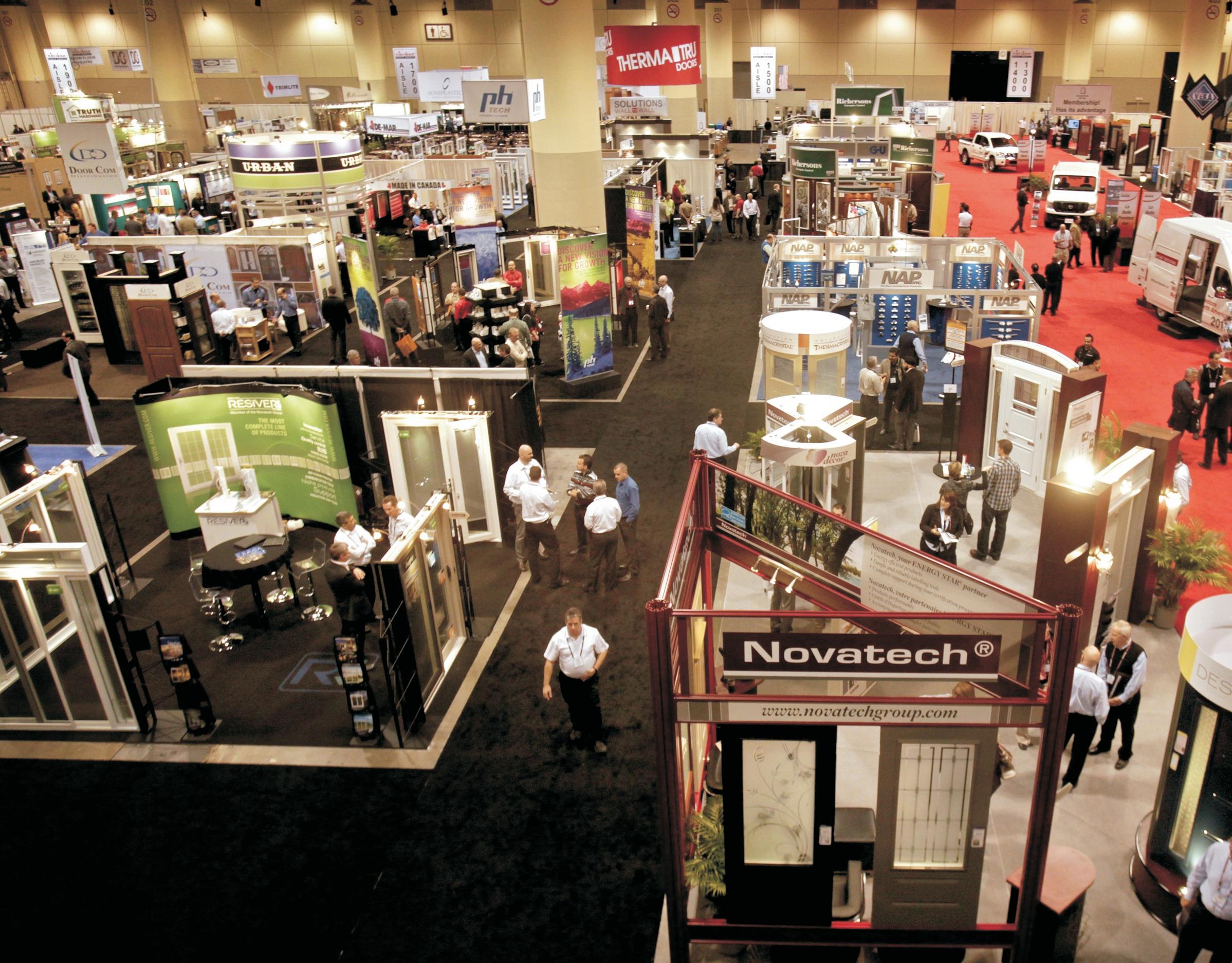
Win-Door North America has become an event that people across Canada cannot wait to come to. Scheduled for Nov. 6-8 at the Metro Toronto Convention Centre, this national show has proven to be exactly what the fenestration industry is looking for. With new products and services being displayed, coupled with engaging and topical educational seminars, WinDoor has built a solid reputation for delivering a quality show year-in and year-out.
Held in the fall of the year, Win-Door is appropriately positioned to allow exhibitors and attendees alike to display new products and gather timely information so they can begin the upcoming construction season off and running. Attendees are treated to an outstanding line-up of quality exhibitors whose range of products includes extrusions, fibreglass pultrusions, hardware, machinery, computer software, weather-stripping and sealants.
And when it comes to the audience’s thirst for knowledge, Win-Door delivers again. Win-Door, which is sponsored by Fenestration Canada, the national association of the Canadian window and door industry, continually reaches out to the market to learn what key subjects the attendees want to hear more about. This year the spotlight will be on new and changing codes and standards as well as Energy Star requirements. From manufacturers to retailers, to contractors and on down the line to the building inspectors themselves, the information they will gather at Win-Door relative to the impact of new codes and labelling requirements will be critical to their success in the coming year.
An example of Win-Door’s willingness to provide the types of educational messages that their attendees desire can also be seen in the delivery of this information. For the first time, Win-Door will be
When it comes to the audience’s thirst for knowledge, Win-Door delivers.
offering a number of their seminars in both English and French to help avoid any translation issues and accommodate the diverse audience this show attracts.
“There is no show quite like Win-Door,” commented Jim Parker, Win-Door consultant. While the attendees like coming, and the exhibitors enjoy the audiences that Win-Door draws, an added perk is all the additional benefits exhibitors receive, such as free material handling and drayage, free on-site crate storage, daily booth cleaning and much more. “Combine this with the free hospitality reception on the opening night, free lunches daily right on the show floor and free parking for exhibitors and attendees, it is hard to find any trade show that does more for its industry,” Parker concluded.
An example of just how popular this year’s show promises to be can be seen in the pre-show sales activity. “Exhibitors have been securing booth locations at a pace much stronger than in past years,” remarked Patrick Shield of Shield Associates, the show management team for Win-Door. “The phones started ringing early this spring as the details of this show started to take shape. Exhibitors don’t want to miss the opportunity to be on the show floor when the doors open, and are taking steps to increase their presence at the 2012 show.”
Yes, Win-Door is certainly a special event and one that continues to deliver even when the show closes. Held in the heart of Toronto’s restaurant, entertainment and theatre district, the Metro Toronto Convention Centre offers exhibitors and attendees a venue that provides unequalled opportunities to spend quality time with customers and prospects. Blocks of hotel rooms close to the convention centre have been set aside with special rates for Win-Door attendees. Contact the Fairmont Royal York or the Renaissance Toronto Hotel before Oct. 11 to get the Win-Door rate. Attendees are advised to deal directly with the hotel of their choice – Win-Door has not authorized any third-party agencies to book rooms on its behalf.
For more information about exhibiting or attending Win-Door, please visit www.windoorshow.com or call 1-800-282-0003 to see how you can participate in Canada’s premier fenestration event. •
by brIAN bUrtoN
Brian Burton is the author of Building Science Forum and is serving on CSA’s Fenestration Installation Technician Certification Committee. Brian is a research and development specialist for Exp (The new identity of Trow Associates). He can be contacted at brian.burton@exp.com or through www.exp.com.
Daylighting dimensions, part 1
Most readers will already know that designing and installing effective daylighting systems for buildings is not only an art but a very complex science as well. Natural illumination practices are changing the fenestration industry at a very rapid pace and will likely continue to do so for the foreseeable future. The evolution in the way we make provision for lighting in buildings has not entirely kept pace with the changes in our workplace and home environments, so we are now playing catch-up. We have fallen behind to a certain degree because most lighting designs for buildings in the past were tailored to enable traditional tasks to be completed on a desk – horizontal viewing. Today, most tasks in the workplace are completed using computers – vertical viewing.
Daylighting is defined as controlled admission and interplay of direct sunlight and/or diffused skylighting within buildings to assist in creating a productive, healthy and visually stimulating indoor environment in an economically beneficial manner. Fenestration apertures such as windows, skylights and solar tubes allow natural light to penetrate deeper into the interior of buildings. When combined with responsive or automated lighting control systems, they can also significantly reduce the demand for electrical power for heating, cooling and artificial illumination.
Natural illumination practices are changing the fenestration industry at a very rapid pace.
The impact of fenestration components and the natural illumination they can provide on occupant productivity and psychology is much greater than the average citizen realizes. We often take for granted the benefits of natural illumination in buildings and the components that provide building occupants a view of the exterior. According to Boris Lamontagne, a researcher at the National Research Council of Canada and an adjunct professor at Carleton University, who is currently developing a novel type of switchable glass, “We expect to be able to see the outdoors when we are in a building and if occupants are denied a view of the exterior for an extended period, the negative impact on their sense of well-being can affect the occupant’s concentration skills, reaction times and efficiency.”We are obviously unable to function effectively without light because we are dependent on adequate illumination for our perception and motor skills. But it is also not surprising that lighting plays a large part in our psychology, health and overall productivity. Whether it be outside or inside, we have always placed a tremendous value on natural light because it provides us with a sense of time and a vital connection that is needed by our internal biological clock. Most of us spend over 90 per cent our time indoors. It is no wonder that illumination, whether it be natural or artificial, is a valuable commodity.
From a historical perspective, the topic was not studied scientifically until the late 19th century; however, over the last 20 years scientists and illumination engineers have learned a great deal about the topic and there is no doubt that it is very complex. Formal studies in the field of photobiology, conducted in schools, universities, hospitals and office environments, have proven without a doubt that natural daylighting in buildings produces significant benefits. Designers also discovered that daylighting requires careful balancing of a number of factors and special considerations. For example, in modern offices where workers are now often viewing computer screens, it has become apparent that the issue of avoiding glare and other visual discomforts has to be taken into consideration. Designers have also recognized certain limitations that include variations in available light due to the time of day, weather conditions, seasonal variations and a number of other factors. Because each building is unique, no single illumination design approach will suit every structure.
When buildings are properly designed, daylighting not only provides psychological benefits and productivity improvements, it also saves energy. Electric lighting accounts for between 35 and 50 per cent of the total electrical consumption in commercial buildings. Electric lighting also increases the loads on mechanical cooling equipment, adding additional costs.
Although daylighting is not intrinsically superior to artificial light, when accomplished with appropriate controls, it is generally considered superior to artificial illumination, less expensive and as having less of an impact on the environment. •
TECHNICALLY SPEAkING
by PaTrick Flannery
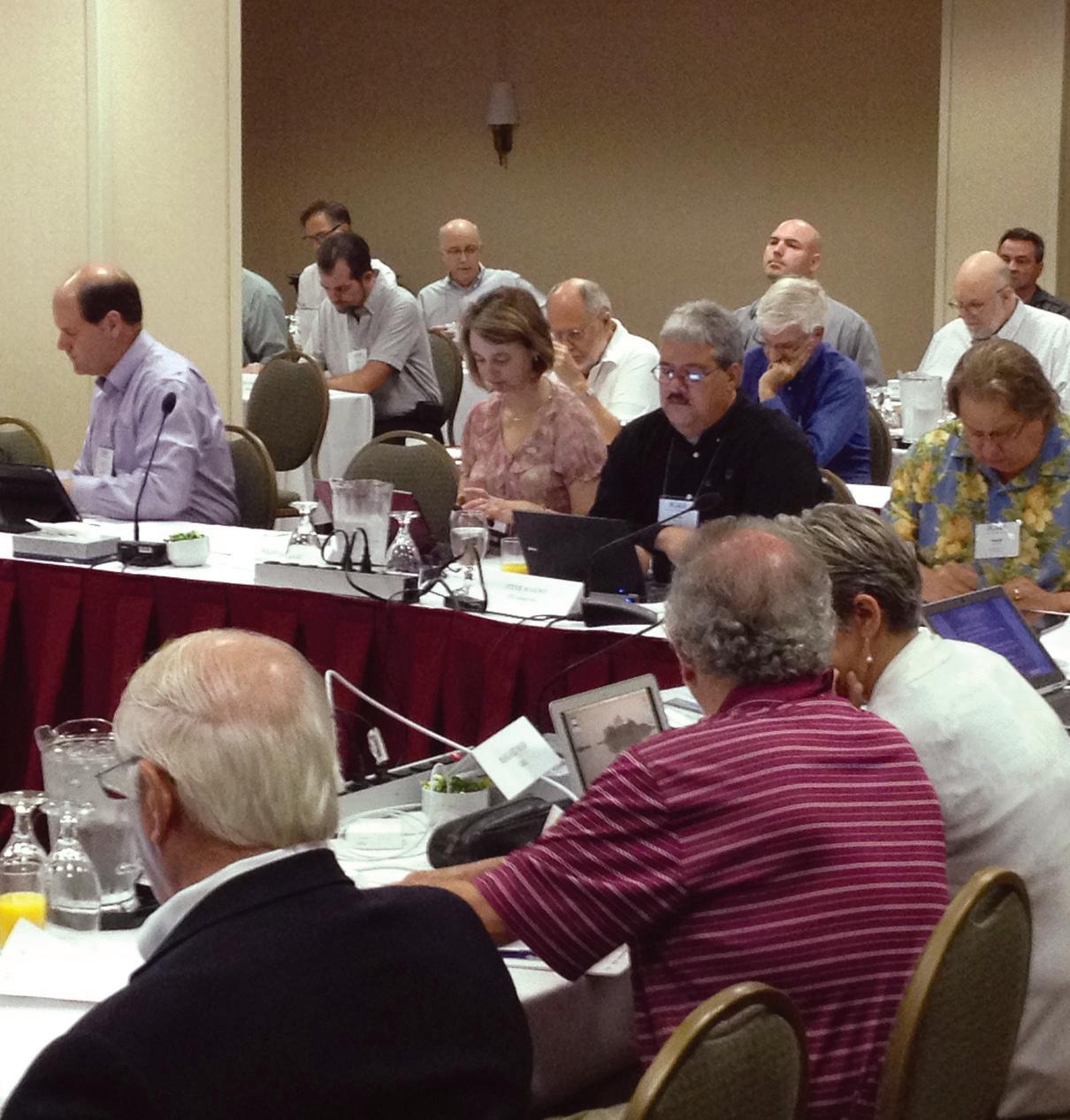
It was standing room only in our nation’s capital as the Insulating Glass Manufacturer’s Alliance kicked off its Summer Technical Conference at the Ottawa Marriott on June 6. IGMA board members, members of the Technical Services Committee and observers met to hear updates on the work of various standards committees, a keynote speech from one of Canada’s first female fighter pilots, Deanna Brasseur, and to plot the course of the association going forward.
The association heard from the task group working on ASTM E 2431 that a methodology has been developed to test IG units for thermal stress failures, but the funding was not available to do the necessary laboratory testing to bring the technical bulletin fully into the ASTM standard. IGMA executive director Margaret Webb reported that the research and development fund needed $63,000 more to
the big minds in the North American
glass industry came together
complete the project, and proposed a mandatory assessment to members of $200 each to help cover the costs. The vote was thrown open to all members in the room and passed with very few objections. The committee has recommended to the board that annual IGMA dues now include a $200 assessment for the
in ottawa.
research and development fund. The committee then passed another resolution asking the board to immediately fund the thermal stress standard development using contributions from other organizations or whatever other funds were available.
In the keynote speech, pilot Deanna Brasseur presented a
ABOVE: The IGMA Technical Conference is not your standard meet-and-greet opportunity. A great deal of serious work gets done. Even industry veteran learn a lot when this room gets talking.
motivating talk detailing her rise within the Canadian military to become one of the first female fighter pilots in the world. She passed along what she has learned about how a can-do attitude can unlock personal potential to overcome any obstacle. Brasseur also shared some hair-raising stories from her years in the cockpit.
The Technical Services Group discussed comments received on drafts of guidelines for general glazing and multiple-cavity IGUs. IGMA technical consultant Bill Lingnell reported progress from the ISO Standards Insulating Glass Working Group and several ASTM committees looking at issues as diverse as standards for spandrels, IG applications in very hot climates, determining argon gas concentrations, and destructive and non-destructive testing of etched glass and glass in air traffic control towers. Lignell said he remains hopeful that Canadian authorities will agree to reference ASTM E 1300 load standards in upcoming revisions of the National Building Code.
Evolving Energy Star
The committee heard from other North American glazing organizations, including the Glazing Association of North America, Energy Star, the American Architectural Manufacturers Association, Fenestration Canada and the National Fenestration Rating Council. Jim Krahn of Marvin Windows and Doors reported that American Energy Star authorities feel too many products on the market today meet Energy Star requirements and are considering tightening regulations to the point where as few as 15 to 20 per cent of fenestration products might qualify. Steve Hopwood of National Resources Canada concurred, saying tighter standards are in the offing in Canada, too. “Energy Star is perhaps the only program that is always trying to put itself out of business,” he said.
Hopwood also reported his office is working closely with Fenestration Canada and other organizations to create a unified Canadian standard for energy efficiency in fenestration. He said the current patchwork of provincial, federal and municipal standards are creating problems for manufacturers. NRCan will conduct a market survey next year
Continued on page 26
Small town, big capabilities
When you are the only glazing contractor in town, you can’t say “no.”
Deb and Tony Holcombe are working more hours now than they did on the farm, but at least it is easier on the knees. They have turned Aylmer Glass and Mirror into a onestop shop for all the glass needs in this small, southwestern Ontario town.
At A GLANCE | Aylmer Glass and Mirror
Aylmer Glass and Mirror was supposed to be a retirement project. After dairy farming for decades, Tony Holcombe was having issues with his knees and looking for something more relaxed that he and his wife, Deborah, could do for a living. When an opportunity came along in 2003 to buy Aylmer Glass – a small, three-man glazing contractor in the tiny town of Aylmer, Ont. (population 7,000) – it looked like just the thing. But a funny thing happened on his way to the quiet life. Holcombe found that it was not in his nature to sit back and let the company drift. And people kept bringing him different things to do that challenged his workers’ ingenuity. As word got around about the Holcombe’s friendly service and can-do attitude, Holcombe found his business growing. Nine years later, Aylmer Glass does three times the business it was doing when Holcombe bought it and has a number of high-profile, innovative local projects under its belt.
Aylmer Glass occupies a 5,000-square-foot building Holcombe built himself six years ago. There are
four full-time employees, plus Tony and Deb. Two workers do nothing but installations, and the senior employee, Henry Geisbrecht, mainly stays in the shop doing repairs and auto glass work. The fourth employee is Holcombe’s son, Matthew, who does whatever is needed and constitutes the company’s IT department. Aylmer Glass does mostly residential window and door replacement, but no category of work is turned away if Holcombe feels he can handle it.
In addition to doing commercial storefronts, glass enclosures for public buildings and display cases for the local police college, Aylmer Glass keeps up a steady stream of automotive windshield replacements. Holcombe estimates residential work is 60 per cent of his business, automotive 30 per cent and commercial coming in around 10 per cent. On the division of labour between himself and Deb, Holcombe has a simple explanation: “She does 90 per cent of the work,” he laughs. “If she takes a day off, Matthew and I are running around here like chickens
Location: Aylmer, ont.
Sq. Footage: 5,000
Employees: 4
Owners: tony and deb holcombe Puppies: 1(Loki)
Aylmer Glass and Mirror is a Northstar dealer, providing residential vinyl window sales and installation for new builds and renovations. but its list of projects goes much farther, including windows, doors, decking, railings, shower enclosures, closet organization, auto glass, glass tabletops, window film and repairs. the company has been in existence since 1969 and under present ownership since 2003.
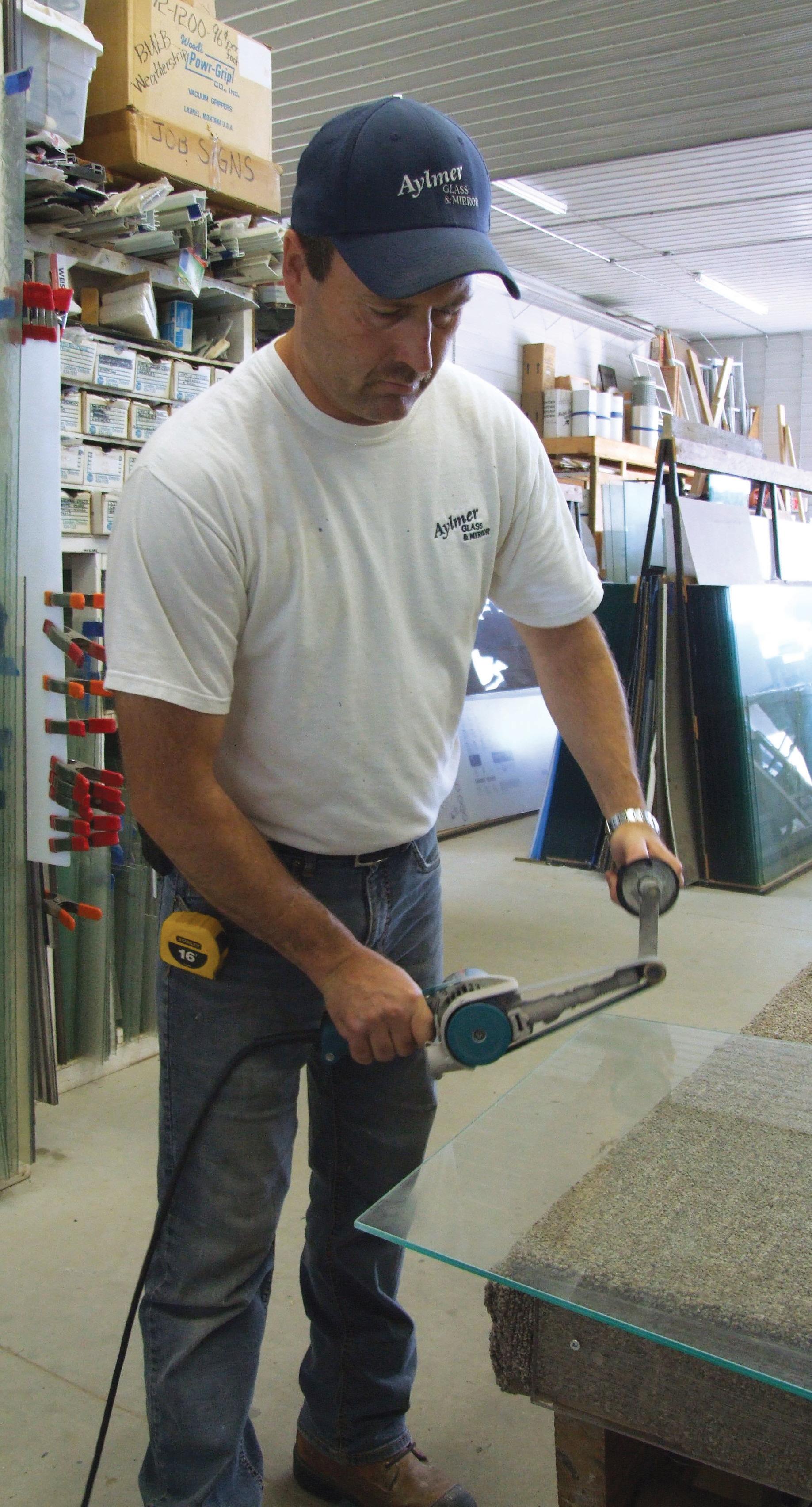
with our heads cut off.” The company is a Northstar dealer and primarily a contractor and service provider rather than a manufacturer. “Our equipment is basically what you would find in any working shop,” Holcombe explains. There is very little in the way of specialized glazing equipment; he has a saw for vinyl and one for aluminum rail and a wet belt grinder. He sends all his bevelling work out to London
Henry Geisbrecht “came with the company,” Holcombe jokes. Geisbrecht handles most of the in-shop work while the rest of the team does installations. Holcombe says increasing Aylmer Glass’s workforce has enabled him to grow the business significantly.
Glass. The company has a pick-up truck and a 14-foot, tandem-axel trailer for deliveries.
Aylmer Glass and Mirror has been in Aylmer since 1969, changing owners and locations many times. Holcombe knew the last owner, Doug Newell, from his high school days in Tillsonburg, Ont., and the two had served on the Brownsville volunteer fire department together. Newell’s father-in-law also farmed in the area and knew Deb’s father well. “After I sold all my cattle, he came to the farm one day and said, ‘What are you going to do with yourself?’” Holcombe remembers. “And I said ‘I don’t know, I just want something I can sink my teeth into.’ And he said ‘My son-in-law is thinking about selling his business.’” Holcombe shadowed Newell for two weeks, accompanying him to installs and meeting his distributors. Afterwards, he and Deb looked over the company’s books and decided to take the leap.
Holcombe estimates Aylmer Glass serves the area in about a 60-mile radius around the shop, going as far away as Guelph and Dutton on occasion. The area is rural, with a few small towns and some light manufacturing. In such a market, Holcombe has found that specializing is not an option. He does get regular sales from two local builders. One is entirely residential, but the other does almost anything from commercial to renovations to custom home building, and Aylmer Glass has to be able to meet his needs. “It has morphed into a lot of different things,” Holcombe says. “Not only do I supply him with his windows and doors, but if he has a commercial job where he needs an aluminum door, I do that for him. In the past I have supplied him with decking material. It has morphed. You develop relationships and they tend to expand
out for you and it grows your business if you are willing to take on things and do different, varied things. It is all a learning process for us, too. Every time you try something new you learn from it. You don’t always make money, but at least they know you can do it.”
Holcombe doesn’t worry about applesto-apples competition in the area. There is more than enough work in the market for everyone, but “fly-by-nighters” are a problem. “They have a break in the back of a truck and now they are window installers,” Holcombe says. “Weekend warriors – there are a lot of them around here.” Holcombe feels that fabricators have a role to play in protecting legitimate fenestration contractors who service what they sell. “Northstar is
“Every time you try something new you learn from it.”
getting better. That was one of my main complaints when I bought the business. They didn’t care who they sold to. If you pulled up in a pickup truck with a credit card in your hand, you were served. But they have really narrowed it down now so that you have to be an authorized dealer to buy off them.”
By far his biggest driver of business is word-of-mouth and referrals, but he advertises in local papers and on the Tillsonburg radio station to make sure Aylmer Glass’s profile stays high. He usually waits for specials before running the radio ads, which works out to three or four runs per year. Northstar has been good about providing marketing material for the print ads.
Another thing Holcombe loves about Northstar is its willingness to work with him on unique projects. As an example,
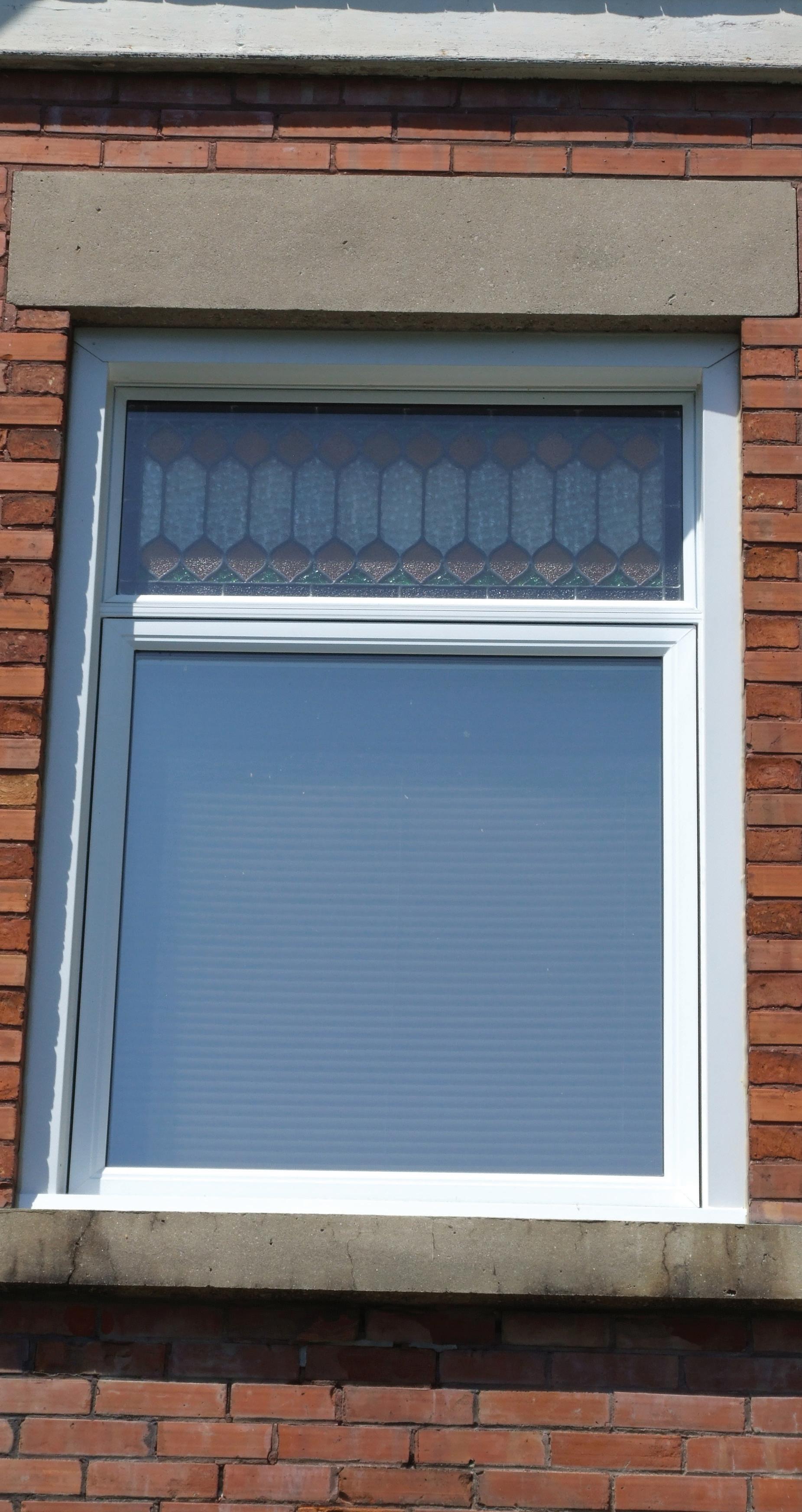
Holcombe is determined to help his customers even when others say it can’t be done. With the help of his suppliers, he was able to preserve this 100-year-old stained glass window and put it into an insulating unit.
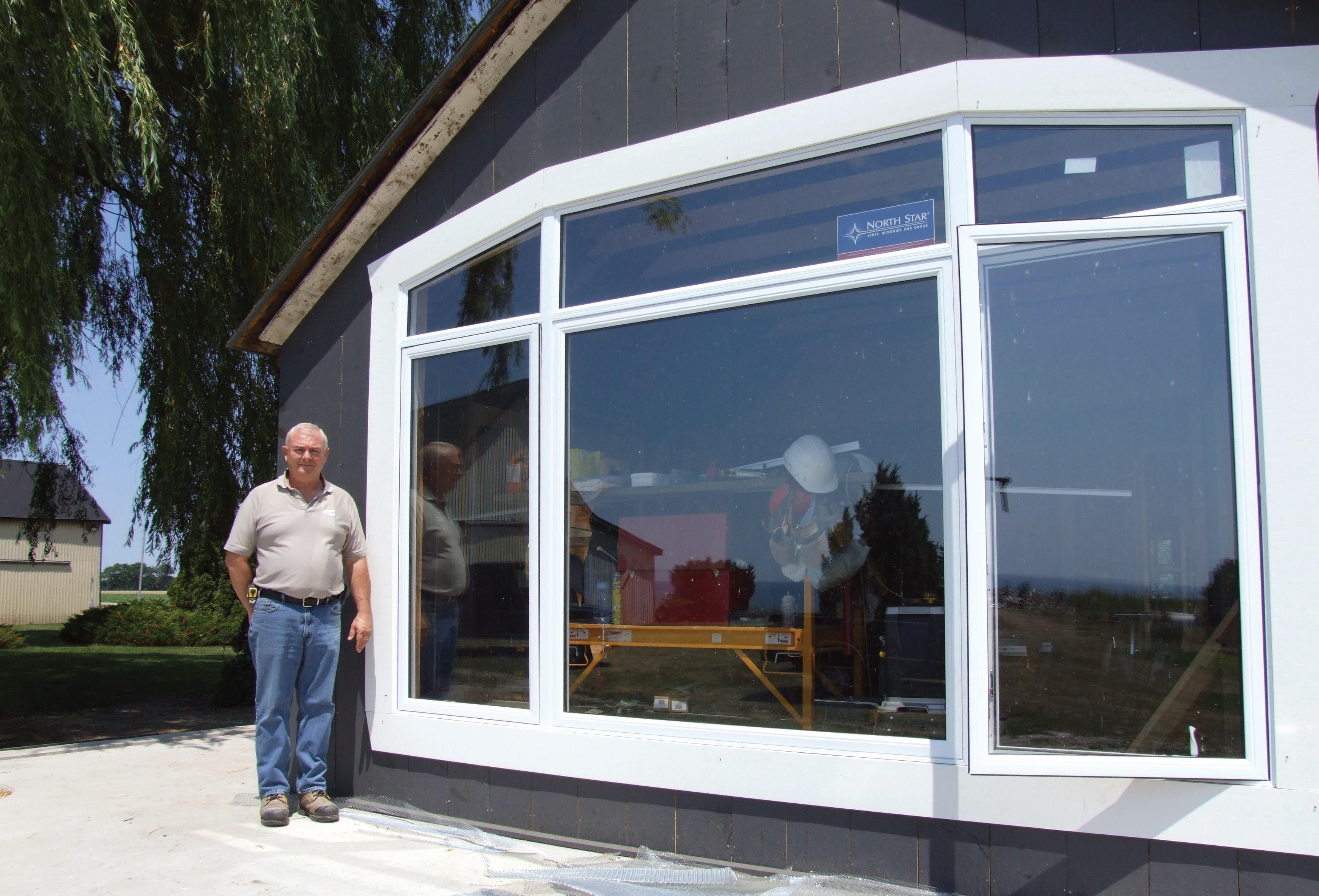
he points to a recent installation of a picture window in a house in Port Bruce overlooking Lake Erie. “We needed it designed,” he explains. “We had a rough idea of how we wanted to do it, so we called them up and told them what we were looking for with the dimensions. They sent us back the plan for it, said ‘Here you go, here’s the CAD drawing of it.’” The window is 12 feet by 90 inches, vinyl with low-E thermal glass and an argon fill. The mullions had to be specially
Northstar helped Holcombe out with a custom design for this oversized bay window. When it is finished, the room is going to have a stunning view of Lake Erie.
designed with metal reinforcements because the size of the window exceeded the extruder’s specifications.
Taking on unusual projects gives Holcombe’s day some zip. About two years ago, he was approached by a local homeowner who had been turned away by a number of larger glazing contractors in the region. The owner had just purchased a 100-year-old Victorian home in Aylmer that had the original stained glass in one of the upstairs windows. Needless to say, the old frame was anything but weather-tight and the homeowner’s upstairs hall was freezing. He was looking for a solution that would preserve the beautiful, hand-made stained glass while providing some insulation. Holcombe jumped on the problem. “It came down to the fact other people had told him it can’t be done,” Holcombe explains. “When you look at it, you think there has to be a way. So I made a few phone calls and my wife made a few phone calls and, sure enough, there are companies out there.”
Holcombe rounded up help from Sunrise Stained Glass and Southwest Glass in London, Ont.
First, Holcombe’s installers gingerly removed the old ¼-inch pane, supporting it across its entire surface and carefully laying it flat. It turned out that the old piece was actually bowed, so Sunrise had to flatten it out. Then Sunrise re-leaded the outside edge and attached a guard that would fit into Southwest’s IG assembly. Southwest fitted the stained sheet into a custom ¾-inch spacer and built the rest of the IG unit around it, creating a gas-filled, triple-paned IG unit with the stained glass fully visible in the centre.
Occasionally, Aylmer Glass is called on for something larger and more commercial than a small-town glazier would normally tackle. One such project was at Bobier Villa, a retirement home run by Elgin county. The walkway where the nurses entered the building for work was icing up in the winter faster than staff could clear it, so the county commissioned a glass-and-aluminum enclosure to protect it from the elements. The enclosure needed to be two storeys high to cover the staircases and slope-glazed to let water and snow run off. Holcombe contracted Cambridge Architectural to build the frames and Southwest to make the insulating units. Another time, Holcombe took on building a handicapped entrance for the Elgin County building. “That was a real challenge,” Holcombe remembers. “It had to be just exact. We had to make a template for Southwest to get the thermals made and we had to make a template for Cambridge Architectural to get this roll so that the aluminum would roll just right.” The county had insisted on a fancy arch at the top of the enclosure that drove up the complexity significantly. The project also included three round hopper windows that needed custom frames.
Aylmer Glass’s eclectic mix of service even extends to auto glass. The previous owner had stopped doing auto glass because “he was tired of dealing with the insurance companies,” Holcombe explains. “The insurance companies have gone central. It is called Belron. Let’s say you have an Aviva claim and you want a new windshield on your car. Well, I don’t call Aviva, I call Belron. The claim goes through Belron and this is where some guys find it a little difficult to deal with.”
Holcombe says Belron follows a very structured approach when processing claims. If the service provider is missing the smallest amount of information about the claim or the customer, Belron will not process the claim or even proceed to collect the rest of the information until it is given. This requires the service provider to be organized in its information collecting process, and Belron works well when it is; however, Holcombe says, many small shops find the rigid process too frustrating to deal with. By organizing his process, Holcombe has been able to bring the auto glass business back to Aylmer Glass and realize some significant additional revenue.
Holcombe attributes Aylmer Glass’s success since he and Deb took over to this willingness to go out of their comfort zone and say “yes” to whatever comes in the door. “We just tackle more things,” Holcombe says. “[The previous owner] did not tend to keep as many employees around. The most he had was two; we have four.” Holcombe finds that keeping on a dedicated installation team in addition to his shop workers helps service and also gives him an incentive to aggressively pursue business. He avoids laying workers off as much as possible, and is keenly aware of the need to keep the company growing in order to support his staff. “We were just going to come in and if
people came in and wanted a mirror cut, yeah, OK, we will do it,” Holcombe says. “But you can’t. You can’t when, all of a sudden, it is not just you and your wife and your family but now you have Henry’s family to feed and another employee’s family to feed. It is a natural progression and growth is always there if you are willing to look and work for it.”
Holcombe’s workers do not have glazing certifications, having been trained entirely on the job, as he was. “I think if you went to probably 90 per cent of small shops, you would not find too many guys that are [certified],” he says. The issue of worker certification does not come up for him, even when bidding on government contracts at the Ontario Provincial Police college nearby. “I’ve been working there for years and the only thing they require is police background checks,” he says.
Holcombe has found a supplier he loves in Northstar, and says once he has a working relationship, he is loyal to a fault. “Northstar is a phenomenal company to deal with,” he says. “Their service department – not that we use it much – but any time we do use it, they are top notch. If you have an issue or a question, they are right there for us.” This approach mirrors Holcombe’s own, which understands that in a small town there are no secrets. “Word gets out. You have to be service oriented,” Holcombe says. “You have to be willing to work with people and, to be honest with you, I think that is what draws people here. We are willing to stand with them and work side by side with them when they are trying to do a project of any kind in their homes. We help them pick the doors, we help them pick the design of the window. That is the key. It is customer service and customer relations. That has really helped our growth.” •
Continued from page 21
to determine what needs a unified standard would have to fulfill.
Hopwood also pointed to condensation control as another area of interest for NRCan research. Problems related to fourth-surface low-e designs bear further investigation, he said.
Jeff Baker of Fenestration Canada reported that the Fenestration Installation Technician certification program is close to completion and that the Siding and Window Dealers Association has already begun using the standard in its training programs.
Tracey Rogers of Quanex proposed IGMA create a consumer-level document on glass visual quality describing acceptable industry standards for inclusions and clarity in terms that homeowners would understand. He said it would help contractors to explain the product to customers complaining about very small flaws in glass lites. The committee voted to have Rogers’ Visual Quality Task Group draft such a document.
Day Two
The second day of the Insulating Glass Manufacturers Alliance Summer Technical Conference featured a meeting of the new Emerging Technology and Innovation Technical Committee. Executive director Margaret Webb started the day with an overview of the committee’s scope and guidelines. Helen Sanders of Sage Electrochromics chaired.
John Greenzweig of H.B. Fuller chaired the Gas Permeability Task Group. This keenly watched group is looking for correlations between the ASTM E 2190 IG performance standard and loss of gas. Greenzweig discussed the road map the task group had created to guide its efforts and the need to issue requests-forproposals to labs to find one able to do the work.
Randi Ernst of FDR Design then chaired the task group on validation of the Mocon OpTech technology for analyzing gas concentrations in IG units. In a very technical presentation, Ernst updated the group on his experiments aimed at showing this technology could generate accurate gas concentration readings even at lower concentrations and through coated glass.
David Cooper of Guardian chaired the task group for Vacuum Insulating
Glass next. He went over the group’s search through the available literature on the technology and said the group’s goal was to create a generic white paper that would introduce the technology to a wider glazing audience. Many technical hurdles still exist to fulfilling the full potential of this technology, but Cooper noted that a few VIG units are now on sale in the international market.
The Advanced Fenestration Testing Task Group, chaired by Tim Snow of the National Renewable Energy Laboratory, is looking for less expensive and easier ways to test IG units, especially edge spacers. It is looking at various apparatuses to assess their feasibility.
Sanders then chaired the Life Cycle Assessment task group. This group is working on protocols for detailing the cradle-to-grave history of products so that buyers can more easily assess their environmental impact. The goal is to develop a labeling system that would work something like food labels, except listing environmental impacts and life cycle history instead of ingredients. Saunders noted there has been significant debate around some of the points about the environmental impact of various product inputs.
After lunch, Sanders was presented with a birthday cake and a round of
Happy Birthday from the delegates. Delegates were also treated to some very entertaining video from the the Fall Technical Committee Meeting in Tempe, Ariz., where Sanders showed off her belly dancing skills.
Once the laughter had died down, it was on to Ken Rubis of Dow Corning and his fascinating presentation on cold bending IG units. Rubis shared the results of studies done by a consortium of several organizations to investigate how cold bending affects the seal quality of IG units. Rubis’ group prepared full finite element analysis models of IG units then certified the models with real-world tests at ATI test labs. Large curtain wall panels were bent, in some cases up to 15 inches, then hit with 100 psi wind loads. Delegates were surprised by how well seals and the glass held up under even these extreme conditions.
The IGMA then moved on to the afternoon’s fun activity, an urban scavenger hunt organized by Urban Quest. Delegates squared off into teams of four and competed to see who could solve puzzles and find various locations around downtown Ottawa the fastest. The incredibly energetic Crystal Archibald of Kohltech led her team of Bill Briese (GED Integrated Solutions) and Aaron Ryan (Pella) to victory. The fourth member of
To the victors go the spoils. The winning scavenger hunt team of (clockwise from right) Crystal Archibald (Kohltech), Bill Briese (GED Integrated Solutions) and Aaron Ryan (Pella) celebrate at a Market pub.
Archibald’s team, your humble editor, soon found the pace too far in excess of his normal activity of sitting at a desk and retired to the relative comfort of a nearby pub patio.
Day Three
The last day of the IGMA Summer Technical Conference kicked off with a meeting of the Glass Safety Awareness Council. The chair, Mike Burke of Quanex, was not able to attend so Insulating Glass Manufacturers Alliance executive director Margaret Webb chaired the meeting. There was a discussion of safety issues in the glass industry as well as possible approaches for raising awareness. There was some discussion of putting a section on safety into the quality manual, however many delegates were concerned about the possible legal implications involved in producing safety guidelines.
Randi Ernst of FDR Design summed it up: “All the equipment manufacturers provide lots of safety information, but no one reads it and when someone gets hurt, the manufacturer gets taken to court anyway.” Webb said she felt the IGMA needs to find some way to provide more safety information to its members.
Crystal Archibald of Kohltech chaired the Education and Certification Committee meeting. Everyone agreed that the education seminars held in Vancouver last December were hugely successful and produced some lively interactions. The committee is working on deciding whether to hold similar seminars at GlassBuild in Las Vegas this September. Webb commented that it is difficult to know in advance how a seminar program will be received. While Vancouver was a great success, Toronto, she said, is often a “dud.”
Coming events
Sept. 12 - 14
Glassbuild Las Vegas, Nev. www.glassbuildamerica.com
Sept. 13 - 14
Crane and rigging Conference Edmonton, Alta. www.craneandriggingconference.com
Next, Ernst chaired the TM-4000 task group, also dubbed the Death by PowerPoint Committee. The group is attempting to develop educational materials to inform the industry about the TM-4000 Insulating Glass Quality Procedures, but most of the discussion at the meeting was about proposed guidelines for creating more effective presentations. Some discussion ensued as to whether their work would be better turned over to the Marketing Committee.
The component task groups delivered an overview of the AGMA/IGMA validation process for insulating glass components and discussed their various certification activities. Some areas where suppliers were asking for change were discussed, such as humidity standards for dessicants and product categories for hot melt. A lively debate broke out over whether the ASTM E 2190 accelerated aging test addresses sealant adhesion, with one group saying it is impossible for an IG unit to pass the test without the sealant maintaining sufficient adhesion, and Tracy Rogers of Quanex pointing out that this does not constitute an actual test of the sealant’s adhesive properties. Everyone enjoyed the discussion so much that it seems sure to come up again at future meetings.
Tim Snow and David Goldwasser of the U.S. National Renewable Energy Laboratory closed the conference with an in-depth presentation on the thermal modeling capabilities of the Open Studio plugin for Google Sketchup. These free online products have extensive tools for three-dimensional modeling and building design, and can create detailed reports on the thermal characteristics of the building design. •
Nov. 6 - 8
Win-door toronto, ont. www.windoorshow.com
Nov. 14 - 16
Greenbuild san Francisco, Calif. www.greenbuildexpo.org
sikasil represents a proven line of highperformance silicone sealants and adhesives for structural glazing, weather and joint sealing, insulated glass and a variety of specialty applications. the sikasil range, combined with sikaflex and sikabond polyurethane technologies, is engineered to provide a wide cross-section of properties, allowing specifiers, manufacturers and applicators to select the best product for their needs. silicones are easy to apply even at sub-zero temperatures, offer superior adhesion to glass and non-porous substrates, excellent movement capabilities, greater service temperature ranges, prolonged durability and long-lasting weathering resistance. sikasil expands upon sika Canada’s comprehensive portfolio of sealants and adhesives. these products are well established and extensively employed in construction and industry, worldwide.
sikasil sealants provide durable protection to moving joints on parking decks, bridges, airport runways and other horizontal applications. sikasil silicones afford the opportunity to install weather seals year round and provide long-term protection to building envelopes in all seasons. sikasil insulated glass sealants and adhesives offer improved adhesion values, fast-curing capabilities and longterm sealing of glazing units in manufacturing.
Fast flowing hot melt
www.fenzi-na.com
Fenzi North America has expanded its product line with the introduction of Fenzi hotver 2000 hot Melt butyl. Formulated to give your IGUs the best mechanical properties and proven through EN1279 and AstM 2190 testing, Fenzi’s hot melt butyl will provide faster flow rates and reduced application temperatures compared to other hot melt materials.
MAKING GLASS EASY
Master 33/43
Durable CNC Workhorse Cuts and Shapes with 3/4/5-Axes Precision State of the art technology delivers very high finish quality. Thousands of satisfied customers.
Genius Series
CNC cutting tables for straight and shaped flat glass Versatile, modular, and configurable for any size shop, from individual craftsmen to large manufacturing operations.
Genius 37CT for Float Glass
Genius LM for Laminated Glass
Continuing to listen to our customers’ needs, we are now also offering our Fenzi butylver PIb in a grey colour to go along with the traditional black. Combined with our other IG components (polysulphide, desiccant, aluminum and Warmedge steel spacers) Fenzi North America continues to be a complete supplier for all your IG component needs.
Cellular glazing tape
www.venturetape.com
Venture tape, a 3M company, has introduced a new generation of products in its glazing product line for window and door applications in residential, industrial and light commercial buildings. Venture tape VG700 series and VG1200 series glazing tapes are closed cell polyolefin foam tapes that provide high performance, better adhesion, weather resistance and durability. both products feature a reformulated adhesive system and a new and improved liner. they also have low VoCs, making them environmentally friendly and contributing toward LEEd compliance credits. Venture tape has also announced that these products will now be available on a national basis through Industrial sales Corp., a leading sales and distribution company of products for the fenestration market. Venture tape VG700 series glazing tapes are coated on both sides and feature a highperforming adhesive system. the exposed side adhesive is a rubber-based adhesive specifically designed for adhesion to PVC and other low-surface-energy sash and frame materials. the liner-side solvent-based acrylic adhesive is specifically designed for adhesion to glass.
Venture tape VG 1200 series glazing tapes are coated on both sides with a solvent-based acrylic adhesive system. the exposed side adhesive system is designed for adhesion to PVC and other low-surface-energy sash and frame materials. the liner-side adhesive has excellent adhesion to glass. the solvent-based acrylic is UV resistant and has greater adhesion properties in colder temperatures. both tapes exceed AAMA specification 810.1, type 1 performance requirements for cellular glazing tapes. both products are available in black, grey or white foam and come in a variety of foam thicknesses.
“We are pleased to be part of this new national partnership with Venture tape,” says Jim hornung, president of IsC. “the new relationship will benefit customers by streamlining sales and service of products for the window and door market.”
by FrANK FULtoN
Frank Fulton is president of Fultech Fenestration Consulting. He has been in the industry for 30 years and can be reached via e-mail at fultech.fc@gmail.com.
The Big Apple building tour
During my almost three decades of tenure at Fulton Windows, business took me to New York City on at least a dozen occasions. With the exception of getting to watch my beloved Toronto Maple Leafs play the New York Rangers at Madison Square Garden (a game the Leafs lost, of course), I’ve got to admit that I hated almost every minute I had to spend there.
Fulton supplied windows to about 30 buildings in the city over the years, with a number of them exceeding 40 storeys, so our projects there represented a pretty big chunk of our business. A lot of time was spent in meetings with developers, architects, and consultants, and on job sites with general contractors, window contractors, and their installation sub-contractors.
Doing business in New York is not for the faint of heart. When they speak of swimming with the sharks, they are referring to people in the construction field in New York, and they lick their chops when little Canadian minnows jump into their water. They have actually perfected the techniques of screwing people over into an art form. My experiences there created a dislike for New York City and everyone in it.
Considering my sentiments for the place, I actually surprised myself when I accepted an invitation from Barry Zigelstein of Crowntech Glass and Aluminum and Noel Marsella of Royaltech Glazing to go on a summer extended weekend excursion to New York with the significant others. I suppose that time actually does heal all wounds. Although I’d been there a number of times, I never once did any touristy stuff. They convinced me that it would be fun and that we could get cheap flights. (For future reference, don’t let cheap flights fool you. You need bags full of money to last in NYC.) Tony Menecola of Applewood Glass was a last-minute addition to our entourage so off we went as a group of eight.
You can’t help but be blown away by this imposing historical marvel and the amazing feat of building it.
We stayed at the Bowery Hotel and at first all I could think of was about running into street gangs with characters like “Slip” Mahoney and “Sach” Jones. Times have changed over the years and so have districts, and the Bowery is now a trendy upscale address. It felt very safe. Maybe the 34,000 uniformed police officers in New York City have something to do with that sense of safety.
Besides doing a lot of eating and walking around in sweltering heat, taking a water taxi ride around Manhattan and the Statue of Liberty, and watching the Toronto Blue Jays implode at Yankee Stadium, a highlight of my NYC tour was a visit to the Empire State Building. If you’ve spent the better part of your life around construction, you can’t help but be blown away by this imposing historical marvel and the amazing feat of building it.
The ESB was the tallest building in the world from 1931 to 1970, when its 1,250 feet and 103 floors were surpassed by construction of the World Trade Centre.
Construction of the ESB started on March 17, 1930, not long after the stock market crash of Oct. 29, 1929, referred to as Black Tuesday, the precursor to the Great Depression. Work was hard to find. The initial budget for construction of the building was $43 million but due to the tough times, the project came in at $25,679,772.
During peak times, there were as many as 3,500 workers on site at a time making about $15 per day. They were happy and fortunate to have a job and the construction went on seven days a week. The construction was actually finished well ahead of schedule in one year and 45 days, with framework going up at a pace of about five floors per week. Seven million man-hours went into the building.
The 6,514 steel windows used in the project were supplied by the Hartwell Metal Window Corporation for a total price of $263,324. The glazing of the windows was done by Contractors Glass Company with a crew of eleven glaziers and a foreman at a cost of $98,838. The window caulking cost $44,812. That works out to about $62.50 per window, or $2.50 per square foot.
If you get the opportunity, I would recommend a visit to this historic site. My feelings for New York City have also softened significantly as a result of this recent visit. •
EnvaTherm™ Insulated Back Pans
By bringing automation efficiencies to the development of insulated metal back pans, Lenmak Exterior Innovations is taking curtain wall engineering to a whole new level.
Our back pans are filled with a light density formulation, which offers insulative properties, and prevents condensation on interior surfaces. When compared to traditional fiberglass or mineral wool filled pans, EnvaTherm™ insulated back pans have a number of clear advantages:
• Complete pans are produced in approximately one minute due to automation efficiencies
• There is no loss of thermal performance due to air movement
• Minimize the penetration of drafts, pressure, humidity and allergens
• The use of stick pins is not required
• 80% lighter than traditional insulated back pans
• No seal issues with oversized pans when properly installed
• Noise transfer prevention – no whistling or drumming
EnvaTherm™ insulated back pans can be used in curtain wall systems in conjunction with opaque glass panels featuring UV-resistant finishes or architectural metal panels for areas that do not require glass.
ARCHITECTURAL
HARDWARE
N T R A N C E S YS T E M S
CRL14D ARCHITECTURAL DOOR AND ENTRANCE SYSTEMS CATALOG
Sho wcasing the largest selection of door systems in one ca talog!