

The future of the Alberta glazing industry emerges from SAIT’s new
program.
Get the job done easier with these time- and money-saving products from top suppliers.

The future of the Alberta glazing industry emerges from SAIT’s new
program.
Get the job done easier with these time- and money-saving products from top suppliers.
Green building is easily the top architectural trend today. Some green building experts are saying glass construction cannot be green construction. Our industry should give them a strong response.
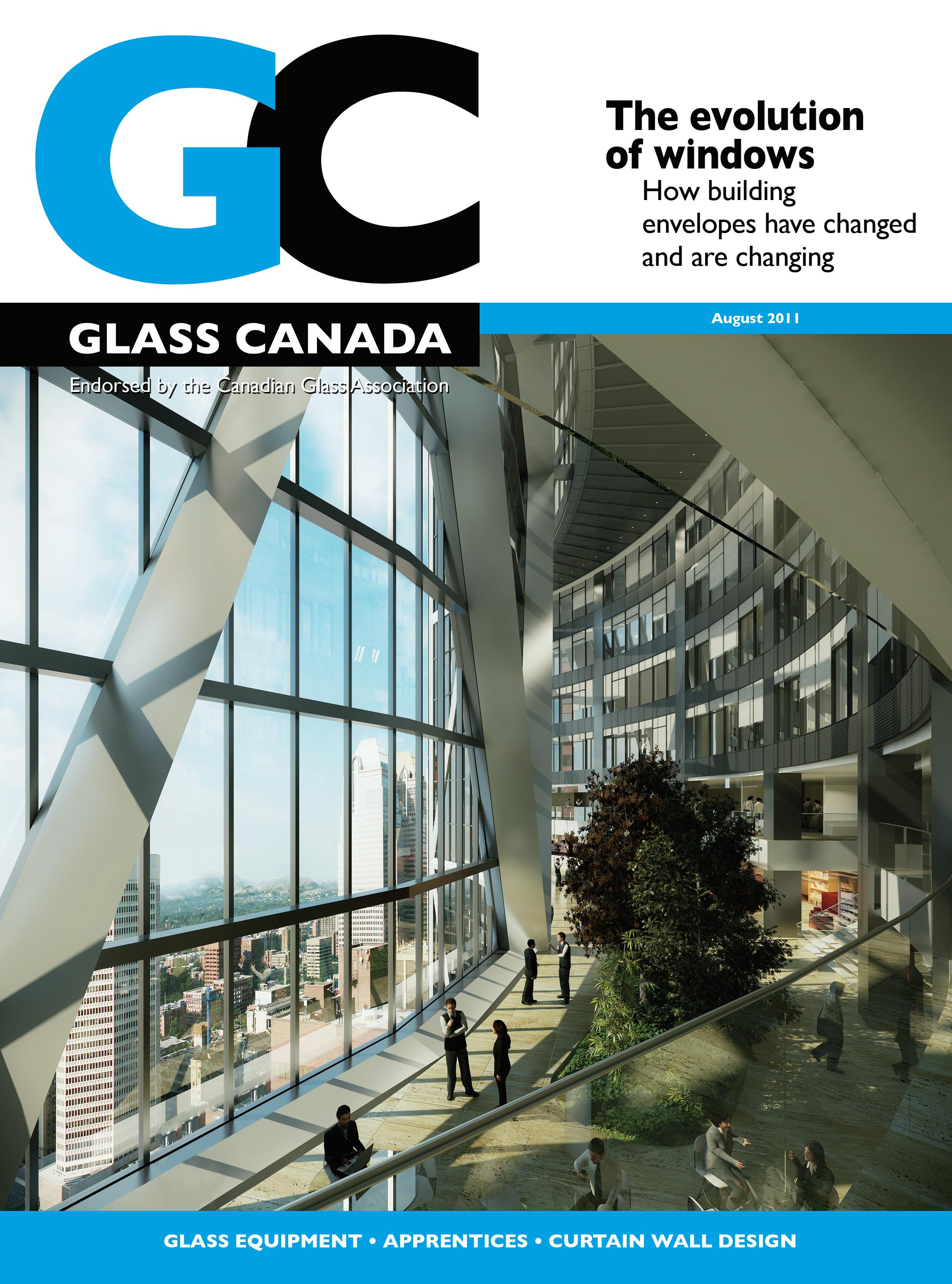
August 2011 Volume 23 • Number 4
Annex Publishing & Printing Inc. P.O. Box 530, Simcoe, Ontario N3Y 4N5
EDITOR | Patrick FLANNERY pflannery@annexweb.com 226.931.0545
• Win-door show preview
• Glassbuild report
Architecture is a lot like art in that it is subject to sweeping changes in styles and design ideas that take on something of a life of their own. S ometimes these are fads that quickly pass and are almost as quickly renovated out of existence. Other times they are pervasive expressions of the spirit of a particular moment in time. Very rarely, they are true innovations that become part of architectural practice for all time. The long-term fates of all businesses in the construction industry come down to a series of bets on the nature of architectural trends as they emerge. Is it a fad that can safely be ignored? Is it an important trend that might require the development of new products and services? Or is it a revolutionary change demanding the complete overhaul of your business plan? Right now, the trend toward green building seems to be wavering somewhere between an important, mediumduration trend and a permanent revolution. That is why it is alarming to me when I hear, as I have, fenestration itself attacked as an enemy of green building principles. Looked at from the simplest possible perspective, a wall will always have a higher R-value than a window. Therefore, it should always be preferable to include fewer windows and doors in your design, if green construction is the primary concern. Using this reasoning, curtain wall construction becomes the Great Satan of the green building movement. If this movement is more than just a trend and actually some kind of revolution, glazing contractors have a big, long-term problem. Luckily, it would appear that the glass industry has truth on its side. Triple-glazing, low-e glass, gas-filled insulating glass, reflective glass, sun shades and solar panels are just some of the ways glass construction projects can be made energy-competitive. Is this kind of construction as cost-effective as simply building with fewer windows and doors? Probably not. But those who are prepared to pay for the look they want need not get the message that they are inevitably being less green by specifying generous amounts of fenestration. It is revealing that many of the top examples of green building projects feature huge, beautiful windows and skylights to let in as much daylight as possible and reduce dependency on artificial lighting.
Let’s not let the idea that glass construction is “less green” take on a life of its own and define the trend for future generations. I’d love to hear your examples of how glass and fenestration was used to make a particular project more energy efficient and less damaging to the environment. I bet your customers would, too. •
SALES MANAGER | Kory PEARN kpearn@annexweb.com 519.902.8574
SALES DIRECTOR | Martin MCANULTY mmcanulty@annexweb.com 519.429.5178
SALES ASSISTANT | Pauline O’NEILL poneill@annexweb.com 519.429.5183 | 888.599.2228 ext. 219
PRODUCTION ARTIST | Gerry WIEBE
GROUP PUBLISHER | Martin MCANULTY mmcanulty@annexweb.com
Publication Mail Agreement #40065710. RETURN UNDELIVERABLE CANADIAN ADDRESS TO CIRCULATION DEPARTMENT, P.O. BOX 530, SIMCOE, ON N3Y 4N5 e-mail: jmatheusik@annexweb.com
Printed in Canada, All rights reserved. Editorial material is copyrighted. Permission to reprint may be granted on request. ISSN 0843-7041
CIRCULATION
e-mail: jmatheusik@annexweb.com Tel: 866.790.6070 ext. 201 Fax: 877.624.1940
Mail: P.O. Box 530, Simcoe, ON N3Y 4N5
SUBSCRIPTION RATES
Canada - 1 Year $36.75 (includes GST) $39.55 includes HST/QST
U.S.A. - 1 Year $50.00 (in US dollars)
Occasionally, Glass Canada will mail information on behalf of industry-related groups whose products and services we believe may be of interest to you. If you prefer not to receive this information, please contact our circulation department in any of the four ways listed above.
www.glasscanadamag.com

Kawneer’s innovative AA®250 and AA®425 Thermal Entrance Doors are a new line of defense against today’s challenging thermal requirements. In conjunction with Kawneer’s high performing frame, the doors are able to deliver improved thermal efficiency compared to a standard door. And, with our proven performance and welded corner construction, the AA®250 and AA®425 Thermal Entrance Doors are the ideal solution for any commercial or institutional application where strength and performance are required.
Setting the standard in thermal innovation.



J . Rich Alexander, PPG executive vice-president, has been appointed to lead all of PPG’s architectural coatings businesses. In this role, Alexander will direct the integration of PPG’s current architectural coatings – EMEA (Europe, Middle East and Africa) and architectural coatings – Americas and Asia/Pacific businesses – to fully leverage strategic and operational synergies for these businesses. In addition, Alexander will assume executive leadership responsibility for the Asia/Pacific region and will retain responsibility for PPG’s fibreglass and flat glass businesses, as well as the purchasing and distribution, and corporate marketing functions. Alexander, based in Pittsburgh, Pa., will continue to be a member of PPG’s executive and operating committees and will continue to report to chairman and CEO Charles E. Bunch.
Pierre-Marie De Leener, PPG executive vice-president, has been appointed to lead PPG’s global automotive refinish, protective and marine coatings, and aerospace businesses. De Leener also will assume executive leadership responsibility for the Latin America region. He will retain responsibility for PPG’s global information technology function. De Leener will relocate to Pittsburgh from PPG’s EMEA headquarters in Rolle, Switzerland. De Leener will continue to be a member of PPG’s executive and operating committees and will continue to report to Chairman and CEO Charles E. Bunch.
Viktoras R. Sekmakas, PPG senior vicepresident, industrial coatings, and president, PPG Asia/Pacific, will be named senior vice-president, industrial coatings, and president, PPG Europe. Sekmakas will assume leadership responsibility for the EMEA region in addition to leading the global industrial coatings and packaging coatings businesses. Sekmakas will relocate from PPG’s

Asia/Pacific headquarters in Hong Kong to Rolle, Switzerland. Sekmakas will continue to be a member of PPG’s operating committee and will continue to report to Chairman and CEO Charles E. Bunch.
Michael Horton, vice-president, Asia/Pacific coatings, and general manager, automotive refinish and architectural coatings, Asia/Pacific, will be named president, PPG Asia/Pacific, and vicepresident, automotive refinish and architectural coatings, Asia/Pacific. Horton will remain based in Shanghai and will report to J. Rich Alexander, executive vice-president, for his Asia/Pacific regional and architectural coatings responsibilities.
In other PPG news, the company reported sales for the second quarter 2011 of $4 billion, an increase of 15 per cent versus the prior year’s second quarter. Each major region and reporting segment achieved volume and price gains. Net income for the quarter increased to $340 million, or $2.12 per diluted share. Second quarter 2010 sales were $3.5 billion, and net income was $272 million, or $1.63 per diluted share.
“Our strong execution during the quarter enabled us to deliver excellent financial performance, including record earnings for any quarter,” said Charles E. Bunch, PPG chairman and CEO. “We implemented further pricing initiatives and managed our businesses aggressively to overcome continued input cost inflation, a global economy that has only partially recovered and several transitory impacts to some businesses’ volumes early in the quarter. Our strong performance underscores the benefits of our broad end-use market reach and the global business portfolio we have built,” Bunch said.
The federal government has announced the revival of the EcoEnergy Retrofit –Homes program until March 31, 2012.There are new requirements for applicants, and purchases made between April 1, 2011, and June 6, 2011, are not eligible.
The government has budgeted $400 million for the program.When the budget ceiling of $400 million in approved applications is reached, the program may be terminated “without notice,” according to the Natural Resources Canada website.
All homeowner applicants for EcoEnergy grants must now register directly with Natural Resources Canada by submitting an online form or calling 1-877-953-5454. Homeowners who have already had an energy audit done on their homes register as past participants; those who have not register as new participants.
Homeowners must now provide receipts to their energy advisors proving the materials and services they claim under the program were purchased after June 6 and before March 31, 2012.
The grant limit per household is $5,000. Homeowners who participated in the program before, but spent less than the full $5,000, can now use the remainder under the limit.
Homeowners can find energy advisors to audit their homes and sign off on their grant applications through a postal code search on the Natural Resources Canada website.

Canadian Glass Association P.O. Box 595, Abbotsford, B.C. V2T 6Z8 Tel.: 778.837.2913 • Fax: 866.253.9979 www.canadianglassassociation.com

Frank Fulton presents a donation for $2,500 to Leslie Johnson of the Canadian Diabetes Foundation. Looking on are OGMA vice-president Steve Ringler from Oakville Glass and Mirror (left), and OGMA director Lee Baker from Tremco.
Whata huge success the Glass Connections Toronto 2011 was.
The Canadian Glass Association would like to thank the following people: CGA board members Jim Brady, Frank Fulton, Fred Fulton, Dennis Haatvedt, Stephen Hargrove, David Husson, David Langton, Rick Makepeace, Richard Neal, Barry Steiner and Richard Verdon. Thanks also go to the CGA Technical Committee: Steve Gusterson, Brent Harder, Daniel Morin, Leonard Pianalto and local volunteers, Barrie Eon of AGMCA.
The Canadian Glass Association is also proud to announce it has entered into an agreement with the Glazing Contractors Association of B.C. for ownership and distribution of the Glazing Systems Specifications Manual. GCABC undertook the revision of the manual to reflect the National Building Code in 2009/2010. The manual is now
completed and the Canadian Glass Association is researching ways to raise funds to translate the manual so it can be available in both English and French.
We are currently working on the Glass Connections Edmonton 2011 program. The CGA Technical Committee has received quite a few proposals for topics and will be finalizing the program soon. The date for this conference is Oct. 27 and the location is the Delta Hotel Edmonton South. Please continue to check our website for an updated program at www. canadianglassassociation.com/ conference.shtml
Our AGM will be held on Oct. 26, the day before the conference. More information will be available very soon.
The OGMA held its Spring Golf Tournament on Thursday, May 26, at the Glen Eagle
Golf Club near Bolton.Well over 100 people attended and enjoyed a great day of golf, a very good dinner, and a lot of camaraderie and catching up with industry colleagues.We donated the proceeds of $2,500 from the event to the Canadian Diabetes Association in support of its children’s summer camp program.The camps are put on to train youngsters in dealing with and managing their disease. The OGMA takes great pride in being able to support children’s charities.
If you are conducting business in the glass industry in Ontario, the OGMA is the voice that represents your interests at the provincial and federal level. Protect your business interests by becoming a member, or an associate member if you are a consultant to the industry. Doug Morris is heading up OGMA membership, so please contact him today at douglasmorris@rogers.com, or visit the OGMA website.
Our Fall Golf Tournament is set for Sept. 22 at the Carrying Place Golf Club. Details will be forthcoming as the date approaches, but why not mark your calendar today.
The GCABC is pleased to report that we have entered in a contract with a technical writing firm to write the glazing apprentice curriculum. Prior to this there was no written
curriculum available for use in the training facilities here in B.C. The GCABC has undertaken this involvement to ensure accuracy in the program, and by virtue of ownership we can review and revise the training as dictated by changes in the glazing industry.
The GCABC has been working closely with the Ministry of Energy with regards to the introduction of the new B.C. Energy Efficiency Act and how it affects the commercial glazier.This is an ongoing relationship involving many consultations and meetings.
This year’s 20th Anniversary Annual Golf Tournament was a great event. We had 184 golfers. The GCABC/WDMA golf committee consists of Seth Maretz (co-chair), National Glass; Devin Pickles (co-chair), Starline Windows; Rich Porayko, Construction Creative; and Ivo Tanner, Quality Auditing Institute. In honour of our 20th anniversary, we changed the prize structure this year, offering more opportunities for sponsors to choose the prizes they would like to give. We presented two large-screen TVs, two IPad 2s, two PS3s, two Xboxes, and two Wiis. Our 50/50 pot this year was again over $1,000. It was a fabulous, sunny day (one of very few this year in B.C.) and the food was great, as was the company. Our sponsors this year were Cardinal IG, CP Distributors,Vitrum Industries, PFG Glass, Quanex Building Products, Starline Windows, Flynn Canada, Gienow Window and Doors, Guardian, Oasis Windows, and Tremco Canada.
We are currently working on our schedule for speakers and topics for the coming season starting in September 2011.
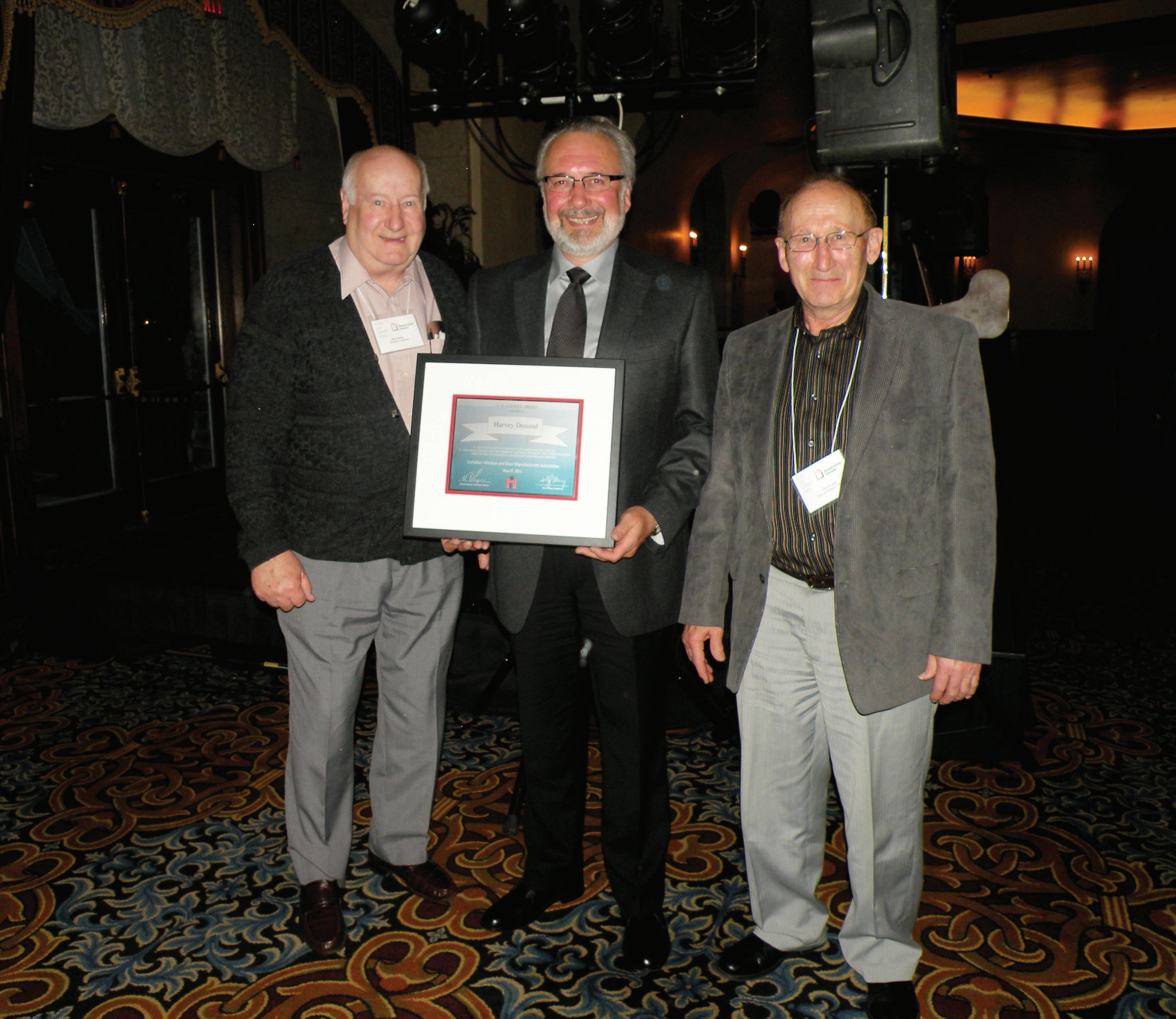
At its May 26 conference in Banff, Alta., Fenestration Canada presented the prestigious CP Loewen Award for 2011, recognizing over 30 years of outstanding dedication, com-
mitment and accomplishment in the window and door industry to Harvey Dunand of Gienow Windows and Doors.The award was presented by FenCan board member Michael Andrade, also of Gienow.
From working the fields of the home building industry, Harvey joined Gienow in 1974, as a lead hand in the mobile home bay and bow window department. Over the next few years his experience and hard work led him to become the foreman for Gienow’s moulding department and residential window assembly. By 1989 Harvey was appointed vice-president of manufacturing and in 1990 become an ownership partner of Gienow. An extremely hard worker, Harvey is dedicated to his passion and his staff. He was an active participant in the CWDMA, serving on both the Marketing and Education committees for three years. He is also a strong supporter of the association’s involvement in our industry.

Viracon, a single-source architectural glass fabricator, has promoted Don McCann to the position of director, international sales. In his new role, McCann will immediately assume responsibility for international sales representatives and territories outside North and South America.
“We are very pleased to announce Don as the new director of international sales,” says Kelly Schuller, senior vice-president, sales and marketing. “His architectural and glazing industry experience, combined with his extensive product knowledge, make him a tremendous asset not just to Viracon, but also to our customers around the world. He has significant international experience, and I am confident architects and customers working on projects outside the Americas will find Don to be a valuable partner
and complement to our existing company representatives.”
McCann brings a wealth of experience to his new position. In his nearly 25 years at Viracon, he has worked closely with architects around the world on a wide variety of architectural glazing projects. Most recently, he served as the manager of the architectural design team at Viracon, working with architects to offer specification and design assistance as well as providing practical glass solutions that meet project-specific performance and esthetic needs.
McCann is also active in the architectural glazing industry. He frequently presents American Institute of Architects (AIA) registered seminars and has spoken both in the U.S. and around the world on a variety of architectural glass topics. He recently presented at the Building Envelope Contractors (BEC) Conference in Las Vegas, and in October he will be presenting at the Council on Tall Buildings and Urban Habitat (CTBUH) World Conference in Seoul, Korea. He is a LEED Green Associate and has written articles for numerous industry publications, including Construction Specifier, Glass Magazine and USGlass. McCann holds a master’s degree in business administration and a bachelor’s degree in finance and accounting.
September 12 - 14
GlassBuild America Atlanta, Ga.
October 10 - 11
RCI Building Envelope Technology Symposium Charlotte, N.C.
October 27
Glass Connections Edmonton Edmonton, Alta.
November 15 - 17 Win-door Toronto, Ont.
November 23 - 25 Glasstec Asia Jakarta, Indonesia
November 24 - 25
AIPVFQ Annual Meeting Quebec City, Que.
November 20 -
December 2
Construct Canada Toronto, Ont.
2012
March 18 - 20
BEC Conference Las Vegas, Nev.
March 21 - 24
Fensterbau Frontale Nuremberg, Germany
May 17 - 19
AIA National Convention Washington, D.C.
June 7 - 9
Fenestration Canada Annual Meeting Montebello, Que.

The NSG Group announces the appointment of Clemens Miller to the post of president of building products worldwide. In this role, he will have full responsibility for all matters relating to the operation and performance of the NSG Group’s global building products business. He succeeds Mark Lyons, who has been appointed CFO of the NSG Group.
A German citizen, Miller will be based in Germany. He joined Pilkington in 1992 from the steel industry. He has managed the group’s fire protection and solar energy busi-
nesses and was appointed managing director, building products, Europe, in 2007. Since April 2010, he has been vice-president of commercial and solar energy products. Miller, who has a doctorate in mechanical engineering from the University of Aachen, Germany, is married, with four children.
The NSG Group’s building products business supplies glass for architectural and technical applications, as well as for the growing solar energy sector. It accounted for approximately 42 per cent of group sales in the financial year ending March 31, 2010, and employs about 11,000 people in 21 countries worldwide.
American Glass Enterprises, an affiliate of Florida-based private equity firm Sun Capital Partners, has completed the acquisition of the assets of Vitro America via a 363 bankruptcy sale.Vitro America serves construction and auto replacement markets with architectural glass and aluminum products, and is based in Memphis, Tenn.
Vitro America, through its three business units – Vitro America Architectural Products, Binswager Glass, and Super Sky Products –serves more than 4,000 customers in the construction and automotive replacement markets from approximately 100 locations throughout the United States. The company had generated consistent revenue and profit in the 2000s, but due to an unprecedented downturn in new residential and commercial construction following 2008, as well as the dislocation in the credit markets that led to elimination of attractive financing for construction projects, the business contracted precipitously.
Sun Capital Partners is a private investment firm focused on leveraged buyouts, equity, debt and other investments in companies that can benefit from its in-house operating professionals and experience. Sun Capital affiliates have invested in more than 265 companies worldwide with combined sales in excess of $40 billion since Sun Capital’s inception in 1995. Sun Capital has offices in Boca Raton, Los Angeles, and New York, as well as affiliates with offices in London, Paris, Frankfurt, Luxembourg, Shanghai and Shenzhen.
Sun Capital subsequently announced that Arch Aluminum and Glass, ACI Glass Products (formerly Vitro Architectural Products) and United Glass will combine and re-emerge as Trulite Glass and Aluminum Solutions, according to a July 21 release. The new company, formed through Sun Capital’s acquisitions, will continue to service the commercial glazing market through its various fabrication facilities. Currently, it has 26 locations throughout the U.S. and Canada.
Quanex Building Products, a global supplier of insulating glass components, extrusions and fenestration products, recently announced that John Ryba has joined the company as senior technical services representative for the Quanex Engineered Products’ technical services group.
“John has more than 20 years of experience in vinyl window manufacturing,” said Miles Sagen, technical service manager, vinyl fabrication. “We are extremely pleased that he has joined our team. His experience and expertise will immediately be an asset to our company and our customers.”
Ryba spent 20 years in various roles in vinyl window manufacturing, including production, operations and plant management. Most recently, Ryba was plant manager for Glass and Mirror Craft of Wixom, Mich., gaining considerable experience in the fabrication of insulating glass with Super Spacer from Quanex’s Edgetech division.
Ryba officially joined the company in May and he is based out of Truseal in Solon, Ohio.
As senior technical services representative, he will focus on supporting Quanex’s customers in the vinyl fabrication market.

tan Dudeck, president and founder of Winnipeg-based Paramount Windows and Doors, passed away on July 9 at the age of 84. Dudeck was an influential leader in the North American glass industry and a technological innovator who greatly influenced the development and acceptance of insulating glass products.
Dudeck started his working career as a teacher in Morris, Man.; however, his true passion was for carpentry. He began building homes in the 1940s and soon after opened Paramount Windows, a 2,400-square-foot facility in the St. Boniface area of Winnipeg. As a testament to Stan’s vision and leadership, the original building stands to this day as the cornerstone of a 100,000-square-foot manufacturing operation.
For more than 60 years, Dudeck prided himself on the quality products and services that Paramount provided. He was the originator of tripleglazed insulating glass units and received multiple awards for his dedication to the industry and the community. Dudeck will be remembered as an honest businessman, an innovator and leader within the glass industry, and a devoted husband, father, brother, uncle, grandfather and great-grandfather. He will be deeply missed by the employees at Paramount and the many friends and associates he made in the business community.
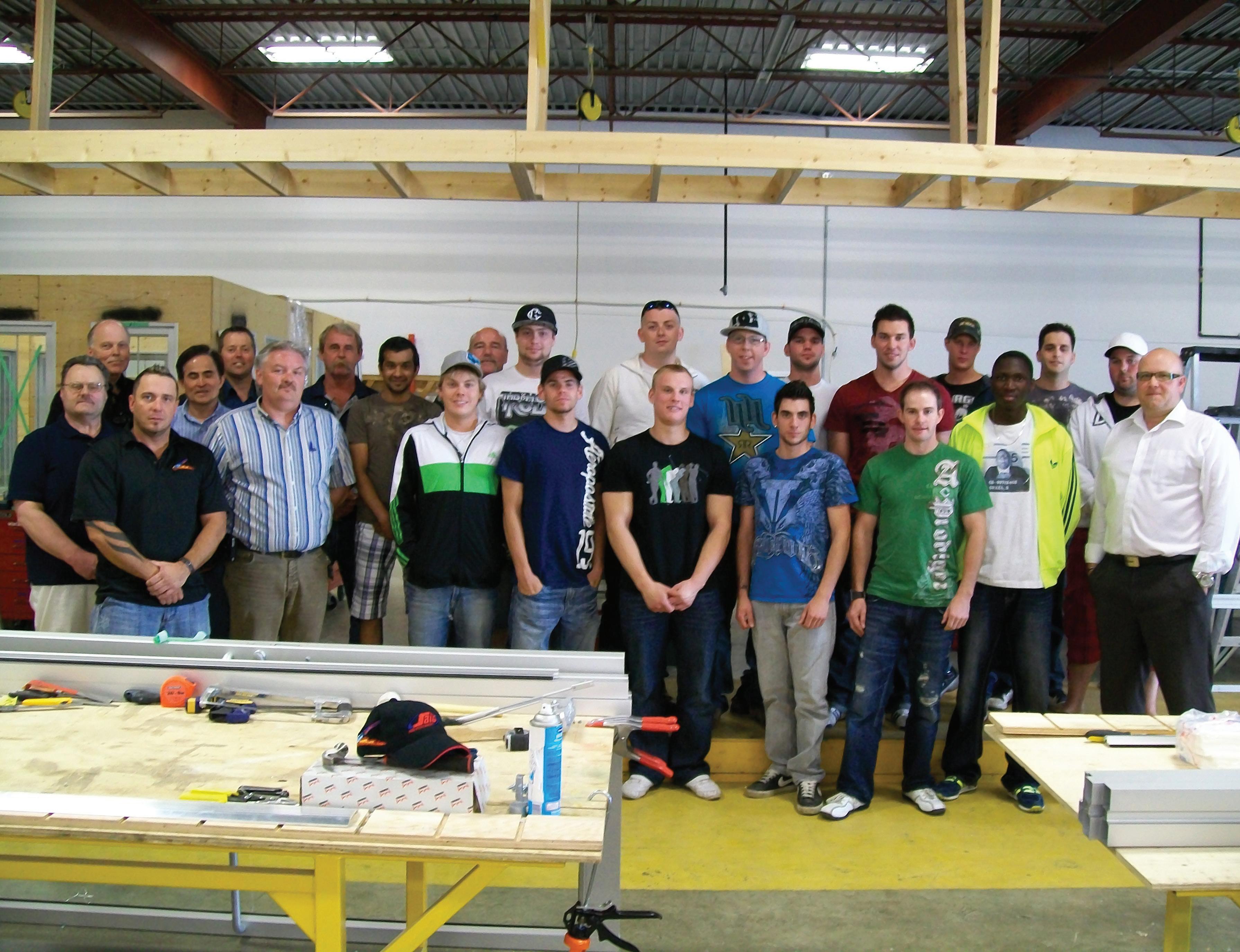
Industry supporters, SAIT Polytechnic staff and faculty, and proud graduates pose for a photo following the speeches and lunchtime celebration.
Location: Edmonton, Alta.
Feelings of pride, accomplishment and teamwork were abundant at the June 9 graduation celebration for the first-ever cohort of glazier apprentices at SAIT Polytechnic’s satellite campus in Edmonton. Sixteen skilled graduates will now set out to address the glazier labour shortage in Alberta, which is exactly what the program was intended to do.
It all began as a collaborative effort by the Glass Trades Association (GTA) and industry stakeholders in central and northern Alberta over three years ago with the intention of growing the trade. Starting with a survey of local employers and then approaching Calgary-based SAIT Polytechnic and Alberta Apprenticeship and Industry Training (a branch of the provincial government), the six-weekper-year, four-year program was quickly approved and classes have filled beyond original expectations.
Watching this first group of graduating apprentices take time to celebrate their achievements and success with lunch, speeches, and networking was especially rewarding to all of the supporters
in attendance. Whether SAIT Polytechnic staff and faculty, government apprenticeship representatives, or the many dedicated industry partners, it was clear to see that everyone is passionate about their trade and has contributed to the cause in one way or another.
Lynn Allan with Alberta Glass Company and the GTA had originally stepped up to get the ball rolling on the idea of the program in Edmonton, and also planned the graduation event. He comments, “The amount of support this program has received is tremendous. Whether it’s time, expertise, or equipment, the participation just goes to show how much everyone cares about the success of our trade, and today’s graduates are proof of that.”
Dedicated instructors, including Calgary-based Ed Dalzell, Brian Risbey and full-time Edmonton instructor Craig Stafford, were extremely proud to see their students complete the program (Gene Aquilini, also of Calgary, couldn’t make the event). As members of the industry, they say it is rewarding to witness the
Length: Four years
Cost: approx. 2,600
Faculty: SAIT School of Construction
Certificate: Recognition of Accomplishment
From the SAIT website: “Train as a glazier and learn to read and interpret drawings and specifications, determine the materials required and install all types of architectural aluminum windows, doorframes and hardware. This program trains you to install and replace glass, aluminum and related products in residential and commercial buildings.”
success of students with whom they spent many hours sharing their knowledge.
The apprenticeship program, which has already been well established and is highly regarded in Calgary, covers the basics of glass pattern cutting, fabrication, and installation, with an emphasis on safety. Offering the program in Edmonton allows employers in the area and in other provinces and territories a great opportunity because they don’t have to
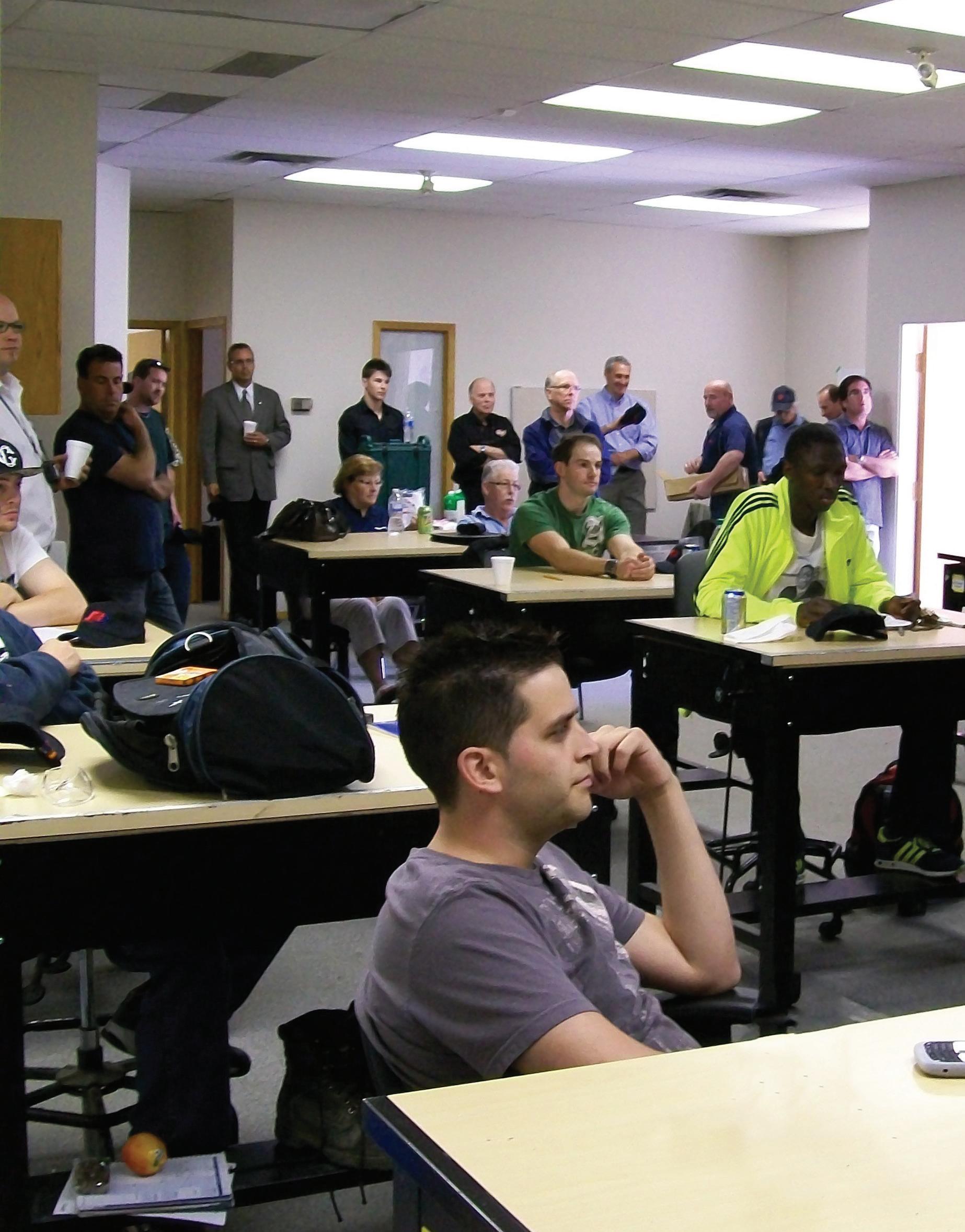
Following the graduation event lunch, the glazier apprentices and other attendees listened to messages of encouragement and support regarding the future of the trade from SAIT Polytechnic staff, Alberta Apprenticeship and Industry Training, and other industry representatives.
lose employees by sending them away for training. It also benefits students who get to take their training close to home. Student Mike Hoffmann says, “I’ve worked in the commercial glass industry since high school, but going away for training was not really an option because it’s hard to afford and I’d have nowhere to stay.”
Another excellent incentive for students who complete the program is that they receive their Journeyman’s Ticket, making them eligible to write their Red Seal Interprovincial Certificate Exam so that they can practise the trade anywhere in Canada.
In addition to the success of establishing the program and celebrating its first group of graduates, it was clear that attention must continue to be paid in order to keep momentum and progress forward. A sentiment expressed in the informal discussions taking place at the graduation event was that skilled trades in general, and the glazier trade in particular, must encourage workers to have confidence in their skills to attract them to and keep them in the industry. SAIT Polytechnic’s apprenticeship program, local and provincial advisory committees, and the ongoing work of associations continue to help change mindsets, making sure education is perceived as viable and helping to grow the trade.
The results can be measured. In 2000, there were just 56 registered glazier apprentices in Alberta. Now in 2011, there are over 350. So far in Edmonton, 80 program seats have already been filled and there is currently a waitlist. Jim Brady, co-owner of Desa Glass and president of the Glass and Architectural Metals Association, attended the event, demonstrating his support and involvement. Brady says, “The trade takes care of us, so we take care of the trade.” He also indicated that, due to the success of the glazier apprenticeship program in general, industry is working with SAIT Polytechnic to develop the framework for a continuing education master glazier program, ensuring that education keeps evolving and remains relevant to current and future demands.
Apprentices can also feel encouraged and reassured about their futures in the industry, as emphasized by industry and government representatives at the event. According to a recent Construction Sector Council Forecast, the labour force for glaziers in Alberta is expected to expand by more than 22 per cent by 2019.
Russell Bridgeman, senior construction manager at PCL Construction Management, knows first-hand that these graduates will be putting their skills to good use. “They will be a huge help,” Bridgeman says. “We had a couple slow years but construction projects are definitely on the rise, especially those that
to brighter futures for students such as Mike Hoffmann. “As a young guy coming in, I definitely learned a ton from my


by Greg Hildebrand, Petr Vegh and Brian Burton
In today’s world we have come to accept that the interaction and performance of building envelopes – a term that describes the perimeter walls and roofing systems that separate the indoor and outdoor environments – is a very complex topic from a scientific, psychological and cultural perspective. The term “envelope” itself has become common in describing enclosure systems because over the past four decades the components have tended to become lighter and lighter, as well as much thinner. It is generally acknowledged today that glazing and other fenestration elements are vital components of these building systems.
It is also recognized that, in addition to becoming more and more complex, buildings are tremendously important to humans. They always have been and always will be.
The study of the building envelope has been primarily focused on performance characteristics related to 11 key functions that were described by one of Canada’s best-known building scientists, Neil Hutchinson, in 1963. They are:
• Control heat flow
• Control air flow
• Control water vapour flow
• Control rain penetration
• Control light, solar and other radiation
• Control noise
• Control fire
• Provide strength and rigidity
• Be durable
• Be esthetically pleasing
• Be economical
For this particular article we researched a number of sources related to historical information about the functions of the building envelope, and will present some thoughts about buildings and building envelopes. As you will see, our expectations of the enclosure system have gradually increased over the last 50 years.
Putting aside for the moment the fact that engineers and architects are always attempting to build taller or more distinctive buildings, historical documents show that the physical protection of the occupants and their personal property is the most important design consideration overall.
The importance of security is clearly apparent in the huge investment of resources in buildings that were designed primarily to provide protection of the occupants and, at the same time, protection of essentials and valuables. These assets include a long list of items necessary for survival, and objects and materials with real or perceived value for trading and/or acquisition of goods.
In the early development phase of human history, the ease of construction and mobility of a shelter were also considered to be very important factors, a consideration we rarely take into account in
In Europe, people are reluctant to demolish structures. This retrofitted post-war highrise is an example of the future of the building envelope as we move toward replaceable facades.

today’s world. This is partly because when humans survived as hunters and gatherers they were constantly on the move. It is somewhat surprising that the efficient use of existing resources does not appear to have been an important consideration in many civilizations, and buildings were not typically viewed as an investment the way they are today until the beginning of the 20th century. For most of history it appears that providing comfort to the occupants was a secondary consideration. In some cases, the tools to provide comfort may not have been available or practical. Rather than comfort, buildings were designed to provide basic environmental separation: protection from inclement weather of all sorts, from precipitation in all its forms, and from temperature variations, wind, particulate matter, unwanted solar radiation, and unwanted intrusion.
As these issues became an essential part of most designs, such other issues as comfort and control of the indoor environment started to receive more attention.
We have gradually come to expect that enclosure systems will provide natural ventilation, daylighting, access and/or egress and a view of the outside environment. But this was not always the case.
This is one area where glass and fenestration components come into play and in which their roles are very significant.
Building envelopes and enclosures came to provide a sense of dimension. They took on an esthetic role, providing decoration and ornamentation. In some very early historical examples the buildings, rather than providing security and comfort, were more likely a symbol of personal, religious and/or political power. Buildings served as a symbolic representation that demonstrated the relationship between leaders and citizens. Early examples would be the palace at Knossos (Crete, 1700 B.C.) and the pyramids of Egypt (2400 B.C.).
In effect, these enclosures served to protect and celebrate the power of the community, the church, the state, the powers that were, or, in some cases, individuals. This can be seen quite clearly in monolithic structures, not all of which were buildings (think of the Great Wall of China, or the pyramids), and later the construction of temples, cathedrals and castles.
So many other factors entered into building envelope design in addition to protection from the elements. There are
numerous cases in history where buildings were actually works of art rather than structures designed for human occupancy.
Over the long history of our habitation of buildings there have been two major classifications of building enclosures. The first is usually constructed of a solid mass of blocks or linear elements made mostly from locally available materials.
The second describes buildings that incorporate active assemblies and such components as adjustable devices for daylighting, ventilation, thermal comfort and security, which have the capability to actively affect the inside environment.
Most buildings in the past were of the first kind: constructed of inexpensive, readily available and easily transportable materials that were present in the local environment. Two interesting examples are the Inuit igloo and the native tent made from animal skins, which served as a transportable environmental envelope. Here in Canada, that meant timber, clay, natural stone, wattle-and-daub (walls fabricated from clay, straw, mud and just about any other material), thatched roofing, and
pebbledash (walls roughly textured by pebbles or stone fragments embedded in mud or clay). Another excellent local example is the use of Dundas shale in the City of Toronto and surrounding areas. For almost 100 years beginning in the 1830s, Lake Ontario between the Credit River and Burlington Bay supported an entire industry of so-called “stonehookers.” These were boats that harvested stone from the bottom of the lake which was then extensively used in foundations and walls. There are still examples of buildings where this stone was used for foundations, walls and landscaping.
The use of locally available material in areas with a high population density often led to over-exploitation of resources. The use of timber for construction in Britain is a good example. The local supply of inexpensive timber was quickly exhausted and a wide range of other locally available materials began to be employed out of necessity. Canada fared somewhat better with the population spread out and our large supply of timber. However, replanting did eventually become necessary and over time we were forced to travel greater distances to obtain an adequate supply. The same phenomenon occurred in other countries with different materials as a result of population growth and building booms.
We have seen building envelopes fabricated from an amazing range of materials.
Animal skins including yak, camel, goat, buffalo, bison, ox, bear and beaver skins have been used to shelter people since antiquity and are the traditional walls of choice for yurts and teepees. Skins were also frequently used to fabricate primitive windows. Hides were softened by soaking the animal skin in a lime mixture, after which the hair was removed with a knife and oil was worked into the skin to improve its water-resistance. The finished hide was then stretched over a wooden frame to dry. Other local materials employed in envelope construction included bamboo, eucalyptus, banana fibre, cane, canvas, cork, driftwood, dung, flax, grass, hemp, jute, palm fronds, pumice blocks, ramie, reeds, seagrass, sisal, straw, turf and grass sod.
Throughout history, the facade has served as the face of a building. The facade often reflects the importance and wealth of the owner. Today, modern buildings are often constructed using especially expensive ma-
terials to demonstrate wealth and importance. These buildings employ high-quality natural stone, glass, stainless steel, copper, and zinc. Architecture using these materials appears to exude an aura of richness or prestige. For these buildings, the cost of the envelope in relation to the total cost of the building has increased to a substantial degree. The Sony Center in Berlin, where the facade structure is primarily constructed of stainless steel elements and glass, is a good example. The cost for the facade equals the cost for the basic concrete load bearing structure. However, this is not always the case with opulent facades. Through innovative architecture and engineering, it has been demonstrated that an esthetic goal can be achieved with lightweight envelope components, such as those clad in a window wall, or an exterior insulating finish system. While the durability of these systems is yet to be determined, it is clear they can be economically employed to provide a functional and appealing building envelope.
Our expectations of the functional facade have expanded to a certain degree in
recent times. The facade that was traditionally designed to provide support by withstanding any structural loading, and to control moisture, heat and air in the enclosure, is now expected to protect the occupant from atmospheric pollution, smoke, odour, mould growth, blast impact, natural hazards and loud noise – an overall much higher standard of physical security. Because modern envelopes are constructed of lightweight layers, each with a specific function, it must accommodate differential movement created by moisture, temperature variations and structural movement. Some of these functions seem contradictory, especially with glass facades where technology is required to unite thermal insulation, condensation resistance and solar control. Current systems employ a myriad of materials and systems to achieve these goals. Most of the common systems are static in nature and include, for example, IGUs with spectrally selective low-emissivity coatings and various gas fills to improve solar control and thermal insulating performance. At present, it is common to employ different systems on the various elevations to optimize these performance





characteristics; for instance, solar control film on the west and south only. There is a new class of affordable switchable glazing systems that are now coming on to the market. Although they are not likely to be employed in the new construction highrise market for a few years, they will become more prevalent in the commercial, institutional and highrise residential markets.
Another example of conflicting expectations in building envelope construction is the call for a vapour-permeable drainage layer to prevent passage of liquid moisture but allow the passage of vapour-phase moisture. Many of the new membranes that can perform this task are recent developments and also serve as an integral part of the air barrier.
In view of our greater awareness of our depleted resources, more attention is now paid to maintainability and the ability to replace or refurbish components as well as their constructability. Accordingly, sustainability has become a central issue and not only includes designing buildings constructed of long-term durable materials, but demands scrutiny relating to the choice of building envelope materials with respect to their carbon footprints, longterm supply, renewability, recyclability and disposal. A common example of the issue would be the use of a window wall incorporating sealed insulating glass units versus a solid masonry or dimensionedstone-clad wall. From a sustainability perspective, the masonry wall will have a much longer useful service life than the IGU, perhaps an order of magnitude in some cases. However, depending on the type of stone, limited availability or the costs associated with procurement or use of it (i.e., placing and anchoring) may make the shorter-lived IGU system appear
perspective. In this case, when adding in the operating costs associated with both systems over their useful service lives, the stone wall becomes a more sustainable system over the long term. Long term is often the issue, given the conflicting goals of the owner and the builder regarding the importance of short-term cost. This is a problem because the builder is not usually the end user of the building.
In some modern building envelopes we see systems that serve to distribute services throughout the building. The future of the building envelope will also include changes in building shape and orientation as we are no longer limited to linear construction. In fact, computer-integrated design and manufacturing have made practically impossible building shapes and facade designs a reality.
Demographics will also affect the construction of the building envelope. With the population of seven billion expected to double over the next decade we can expect to see both modern and developing nations faced with growing population densities. Design and construction of buildings will almost certainly be affected.
The same is true for environmental factors as we begin to build in areas where environmental conditions may be more severe. It has also been suggested that building design and construction will be affected by climate change, requiring modification to both new and existing buildings.
Cultural and psychological factors may assume a greater role in future building envelope design driven by changes in the workplace environment.
In the future, it is likely we will see modifications to our overall approach to quality
ing envelope because at the current time over 70 per cent of all construction defects related to the building envelope are due to water penetration or accumulation. Our National Building Code requires the envelope to be weathertight. The waterproofing or water-shedding characteristics of a building’s envelope are vital for ensuring long-term structural integrity, along with reducing water penetration and accumulation that can result in interior damages and foster mould or other biological growth.
Unlike the robust, solid, masonry walls we have traditionally used, modern building envelopes typically consist of five lightweight critical barriers that serve different essential functions: primary water-shedding surface, waterproofing barrier, thermal barrier, air barrier and vapour retarder.
Unfortunately, nearly half of all building enclosures fail prematurely at some point because the design violates basic building science fundamentals. Builders often fail to identify the proper location and construction sequencing to ensure adequate detailing and constructability. They fail to recognize that the location of the air and vapour retarders within the wall assembly will vary according to climate and occupancy. The waterproofing barrier is compromised in over 90 per cent of all buildings, usually at penetrations through the wall system. And, often, designs submitted cannot be constructed in the manner shown in the construction documentation.
The near future will bring us a wide variety of possibilities and opportunities. Taken as a whole, the construction and maintenance of modern building facades will also present a formidable challenge for the professionals who deal with these components of modern buildings.

Greg Hildebrand, C.E.T., M.Sc. (Eng) is head of Exp’s Façade Engineering Group, Building Engineering Team. He is a member of a number of ASTM and CSA standardssetting committees.
Petr Vegh, PhD, P.Eng. is head of Exp’s Structural Group and a member of the Executive Council of the International Association for Shell and Spatial Structures (IASS).
Brian Burton is a research and development specialist for Exp, a certified CGSB/ ICPI construction inspector and a columnist for Glass Canada magazine. •

by YVES HOULE
Yves Houle is president of Fenestration Canada. Fenestration Canada’s mission is to represent and support all aspects of the window and door manufacturing industry.
Education is key at Fenestration Canada (formerly CWDMA) presently. We are expecting an excellent Win-door show and we will be presenting an informative education program. Included will be seminars on building codes, energy codes across Canada and Energy Star. We will offer the Economic Power Hour, where Peter Norman from Altus Group, back by popular demand, will be providing an economic outlook for the next year, with prospects for activity in the new home-building and renovation sectors. Fenestration Canada will also hold its fall meeting, which will include reports on our work on technical issues and government relations work, along with a range of other topics. The show floor is filling up nicely for Win-door 2011. A significant portion of the floor has been spoken for and sales are ongoing. Now is the time for exhibitors to secure their spaces! Our Win-door committee is again working very hard to provide our industry with a great show. You will not want to miss it.
At the show, we will be presenting two important seminars on Canadian building codes as they apply to windows and doors, with special highlights for door manufacturers. The latest code in effect – NBC 2010 – will begin rolling out across the country in late 2011 and early 2012, starting in Ontario and Quebec. It will require manufacturers, dealers and installers to meet a host of requirements in such areas as labelling of products for air, water, structural and U values. The codes also affect the installation of windows, doors and skylights, and carry sections dealing with sealants, trim and flashing. It is our understanding that these new codes will be strictly enforced, which means that code officials will be scrutinizing product closely
Doors have been an integral part of the national building code for many years; however, the new code signals a renewed scrutiny.
for labelling to ensure it complies with the code and that it has undergone stringent testing in certified test agencies for a broad range of requirements. It also means that installers, building inspectors and new home warranty inspectors will need to be well informed and in the habit of checking work very closely to avoid problems later.
In a changing regulatory environment, fenestration products will have to meet a challenging array of requirements controlling air infiltration/exfiltration, wind resistance, water leakage and heat transfer, plus requirements in the areas of egress, resistance to forced entry, spread of fire, minimum size, overall performance rating, and more. Doors, windows and skylights will be subject to standards based on January design temperature and 1/50 wind pressure ratings by region across the country.
Doors have been an integral part of the national building code for many years; however, the new code signals a renewed scrutiny. Products will now require temporary and permanent labels. Entrance doors must have a door viewer or transparent glazing in the door or sidelite. Exterior doors will be given a class (minimum R) and assigned a performance grade as well as tested for size, positive/negative design pressure (DP), air infiltration/exfiltration and cycles. Exterior doors will have to meet new energy standards and resist forced entry, all while operating with ease. Win-door presentations on the new code will be led by Fenestration Canada technical advisor Jeff Baker, an engineer and renowned expert in fenestration rating. He is a respected industry source for factual information on code compliance and other relevant programs.
Fenestration Canada is pleased to announce its webinar schedule for the summer/fall period.
August 18: Energy Codes in Canada (presented by Jeff Baker)
September 15: Building Codes in Canada (presented by Jeff Baker)
October 27: Glass Performance for Energy Efficient Fenestration (presented by IGMA) •
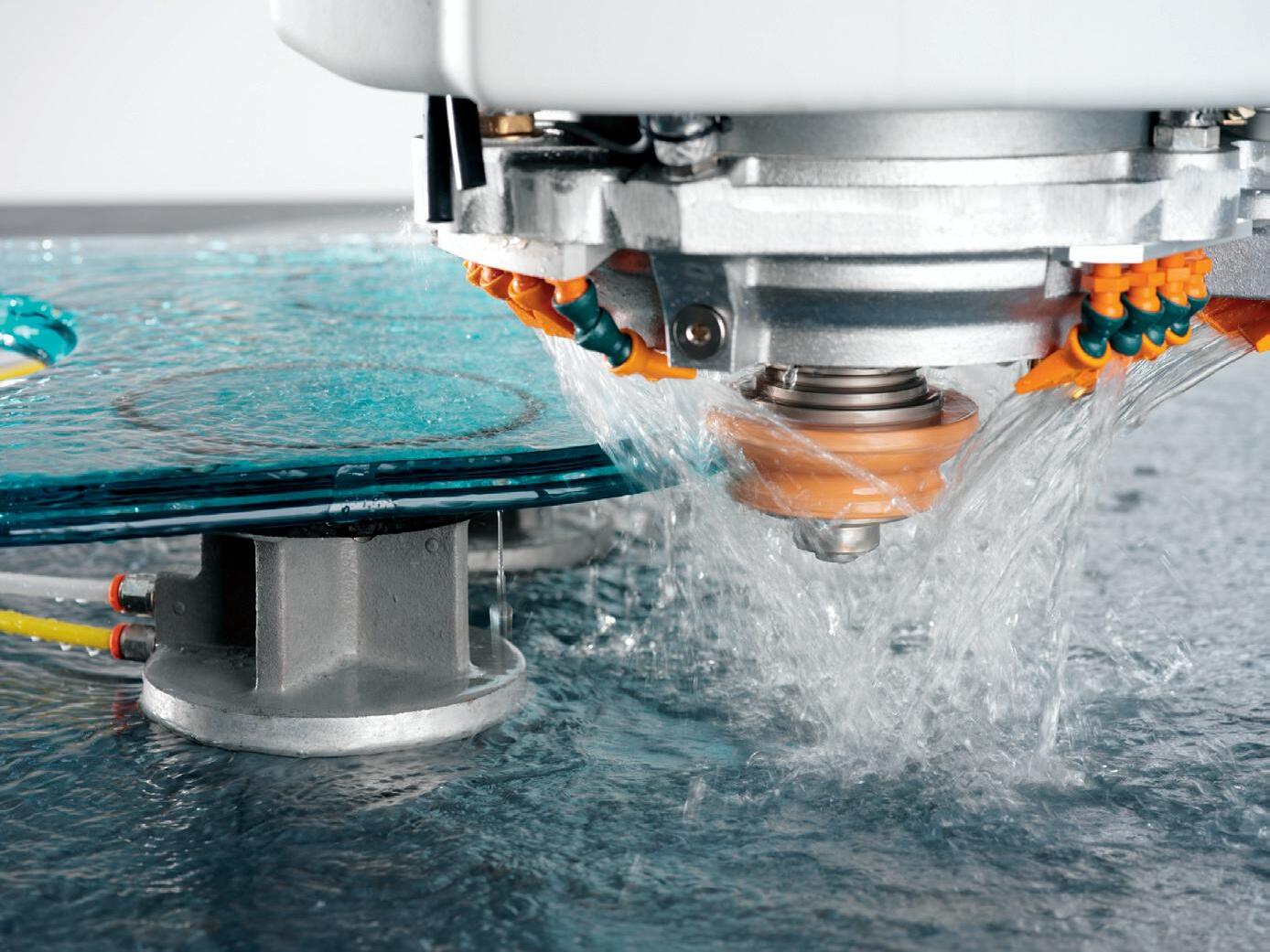
Vertical door cutting machines can cut lites, hinge holes, screw holes, and hardware holes all in one setup. Three-axis CNC processing means designers are limited only by their imaginations when it comes to custom lite shapes and positioning. Chips and dust are enclosed, and fall away from the cutting area.
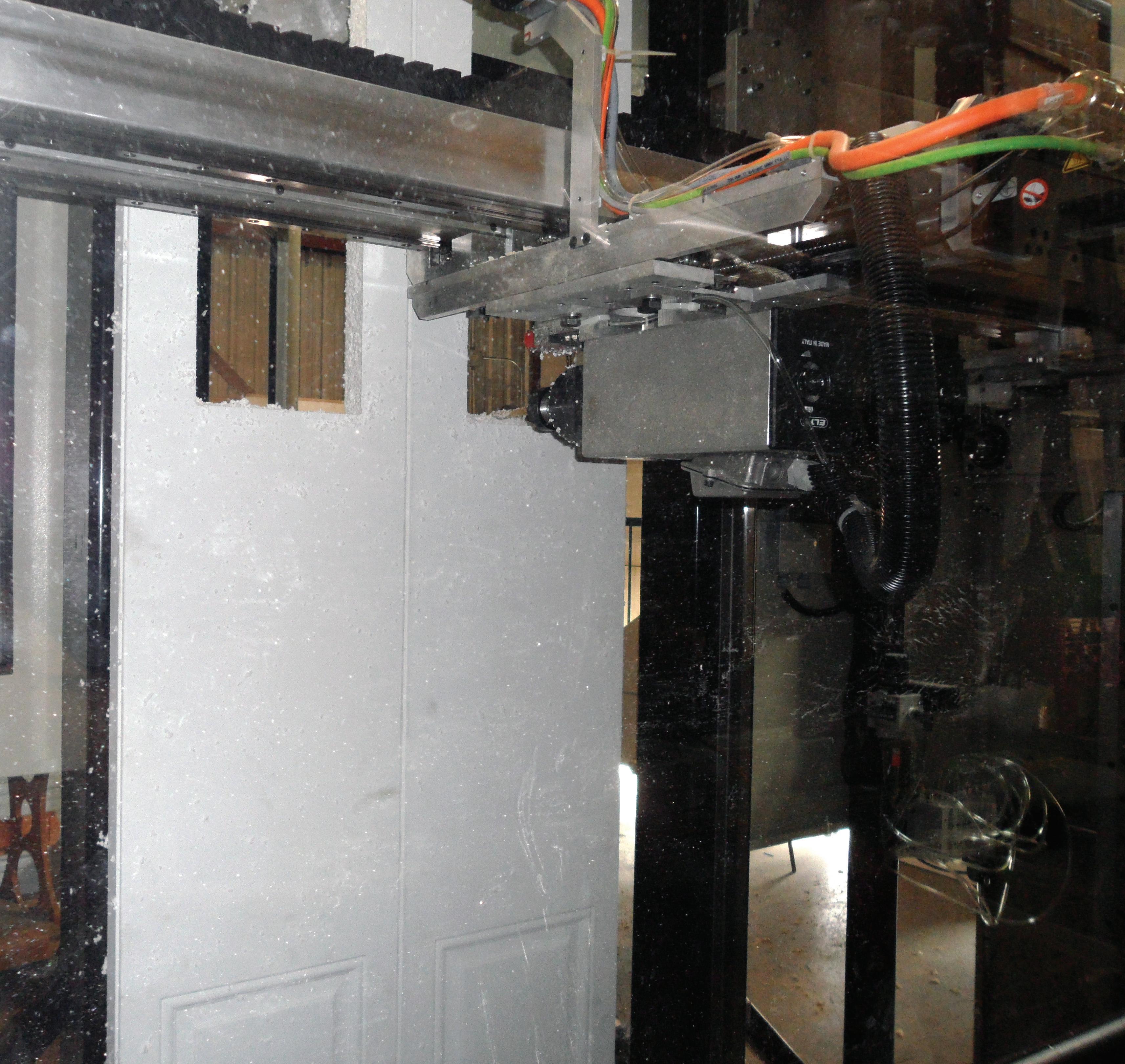
Canadian vertical door manufacturers are creating exciting new options for door manufacturers. By cutting door lites in an upright position using the latest three-axis CNC technology, they can achieve better removal of chips and dust and safer clamping of the workpiece. This leads to faster processing and more accuracy. But the key benefit of these innovative systems is the ability to cut finished doors without damage.
Door manufacturers have long had three basic choices when it comes to cutting lites: hand routing with templates, automatic two-axis routing or full CNC three-axis routing. Anyone who has cut lites all day with a hand router knows the drawbacks. The operator is reaching out over a horizontal surface, manipulating a heavy device that can backlash at any time. “One of the customers we sold our machinery to was doing it the old way,” Jonathan Chauvette explains. “He had to
put tape on the floor to keep the operator from slipping.” Chauvette is the sales manager for JRC Machineries, national distributor of Eugenie vertical door cutting machines.
Two-axis machines are certainly easier to use and faster than hand routers, but are still limited in that they cannot quickly change RPM for different cuts. So users are limited to changing tools if they want to perform different operations, or the same operation in a different material. This becomes a larger problem when machining steel and fibreglass doors. Door manufacturers today have to offer more options than ever before, and be more responsive to customers’ needs in order to compete successfully with offshore producers. The ability to quickly switch from wood to fibreglass to steel door production adds a crucial element of flexibility without adding two more machines.
With three-axis control, the machine
can co-ordinate the spindle RPM and axis movement to achieve the best result for a given cutter. The cuts are clean and smooth, and accomplished at maximum speed. Chauvette says simultaneous three-axis control allows speeds up to 650 inches per minute in fibreglass, and 150 to 200 inches per minute in steel.
Three-axis control technology confers other benefits, as well. Customers can drill or punch holes to locate the screws for such special hardware as panic bars or the garden door clips popular with customers in western Canada. They can even make partial cuts for renovators who want hardware on one side of a door and not the other. Three-axis CNC allows for smooth execution of ovals and other shapes that are hard to do by hand.
Three-axis CNC routers are not unusual. What is different about vertical machines is their array of unique systems for holding the door upright, in a vertical orientation, while cutting. The first big advantage of this design is the effect on the machine’s footprint. A vertical door cutter takes up far less space on the shop floor than a horizontal router that could process the same size piece. For instance, Eugenie’s Sandy SS-A can process doors up to 85 inches high by 42 inches wide on a 6- by 10-foot footprint. A horizontal router capable of machining the same size piece would be around eight feet wide by 13 feet long.
The vertical orientation allows dust and chips to fall away from the cutting area rather than build up. This is a bigger advantage than you might think. Re-machining cutting waste is a major cause of cutter chatter and tool wear because the waste is unstable and harder than the original material. Horizontal operations often have to pause to blow sawdust away from the cutting zone. Vertical processes need to do this less.
Because vertical machines are smaller, they can be completely enclosed, while the cost to do this with a large horizontal machine would be prohibitive. Enclosed operations are safer, prevent dust from blowing around the shop and make dust and chip collection much easier. Door processors take on significant risks using unenclosed machinery. An injury to a machine operator using an unenclosed machine is going to attract attention from provincial safety authorities, and that can ruin your whole day. Manufacturers working with fiberglass have a particular problem, as the dust is abrasive and quite dangerous to breath. Vertical door machines can keep the dust inside. Eugenie also
protects the machine ways with covers to prevent the bearings from becoming fouled.
Machining pre-finished doors is a process engineer’s dream. Engineers now have the flexibility to process standard door configurations and finish them later, or maintain a stock of pre-finished doors and machine them to suit the customer. Or, they can do both, and maintain efficiencies whether the customer is asking for a custom finish or a custom door configuration.
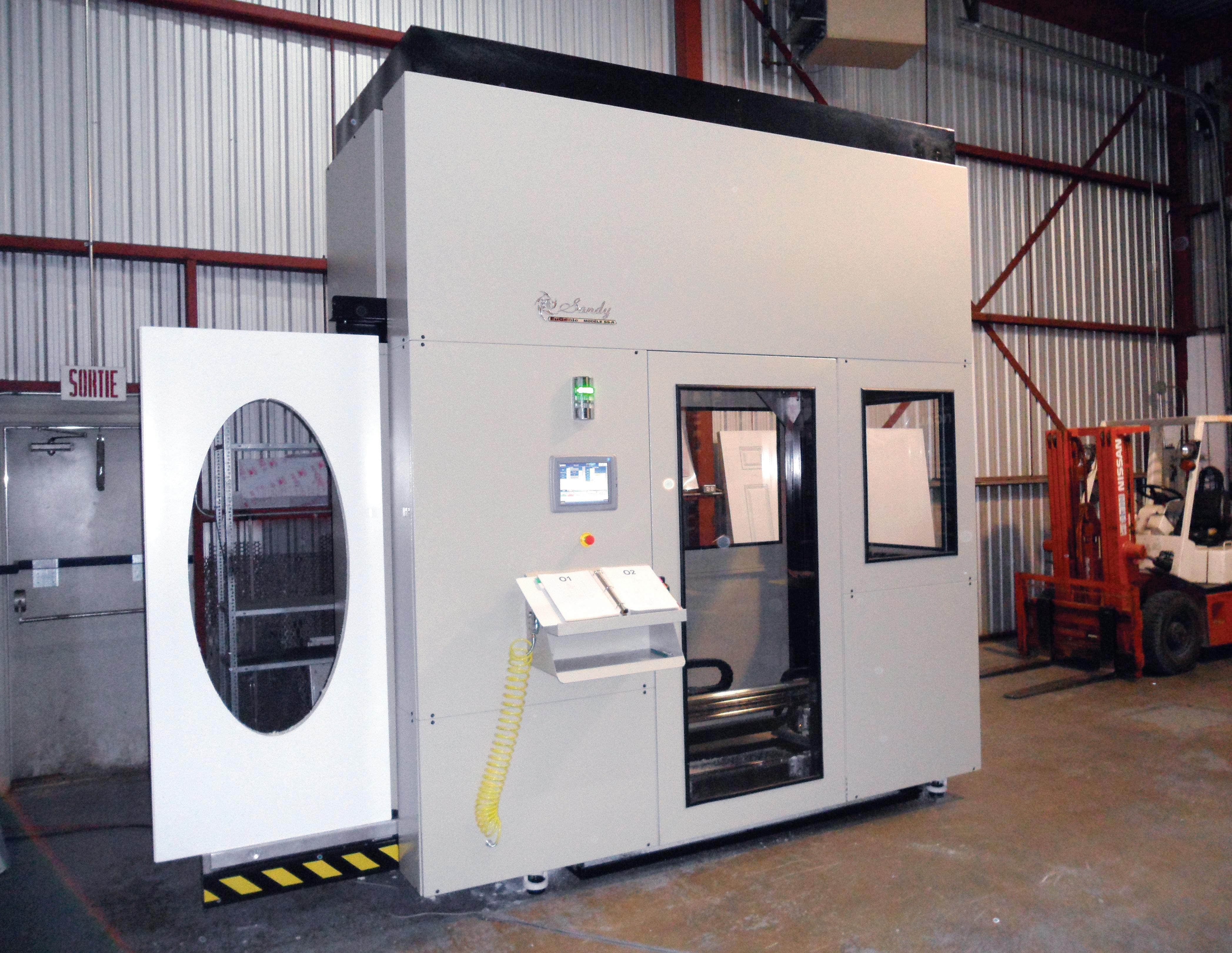
Eugenie’s Sandy SS-A features automated height adjustment, processing doors from 24 to 96 inches high without operator intervention.
Door capacity (inches)
Height: 24 to 96
Width: 10 to 42
Thickness: 1 3/8 to 1 3/4
Cutting zone (inches)
Front: 40 by 79
A really beneficial feature for process engineers is the ability to clamp the workpiece on the top and bottom, allowing the machine to process finished doors without damaging the surface. In a horizontal process, dirt, dust and chips build up on the door’s surface and can stain the finish or scratch it when they are cleaned away. This is a particular problem for steel doors, where the chips come out hot. “Because we clamp top and bottom we liberate the side of the door,” Chauvette explains. “On our machine we have three stations. One main station is doing the cut-out and we have one right-hand station that is doing the side hole. And we can do all the multipoint holes on the door. Then we have a station on the other side doing the hinge holes. So we can do left, right or full hinge holes depending if the customer buys the doors pre-hung.”
Front depth: 0 to 2
Side depth: 0 to 4
Side length: 0 to 4
Dimensions (feet)
Height: 11
Length: 4 ½
Width: 12
Weight: 2,500 pounds
Technical specs
Air pressure: 80 PSI
RPM: 0 to 18,000
Cutting speed: 100 to 650 IPM
Power supply: 600V/3PH/15A
Vertical door machines can be easily integrated into processing lines, travelling along a roller track to be automatically drawn into the machine, clamped, machined, then rolled out to the next process. Going vertical may be the solution for door manufacturers looking to offer customers mass customization of styles, lite patterns and finishes. •
www.theglassrackingcompany.com
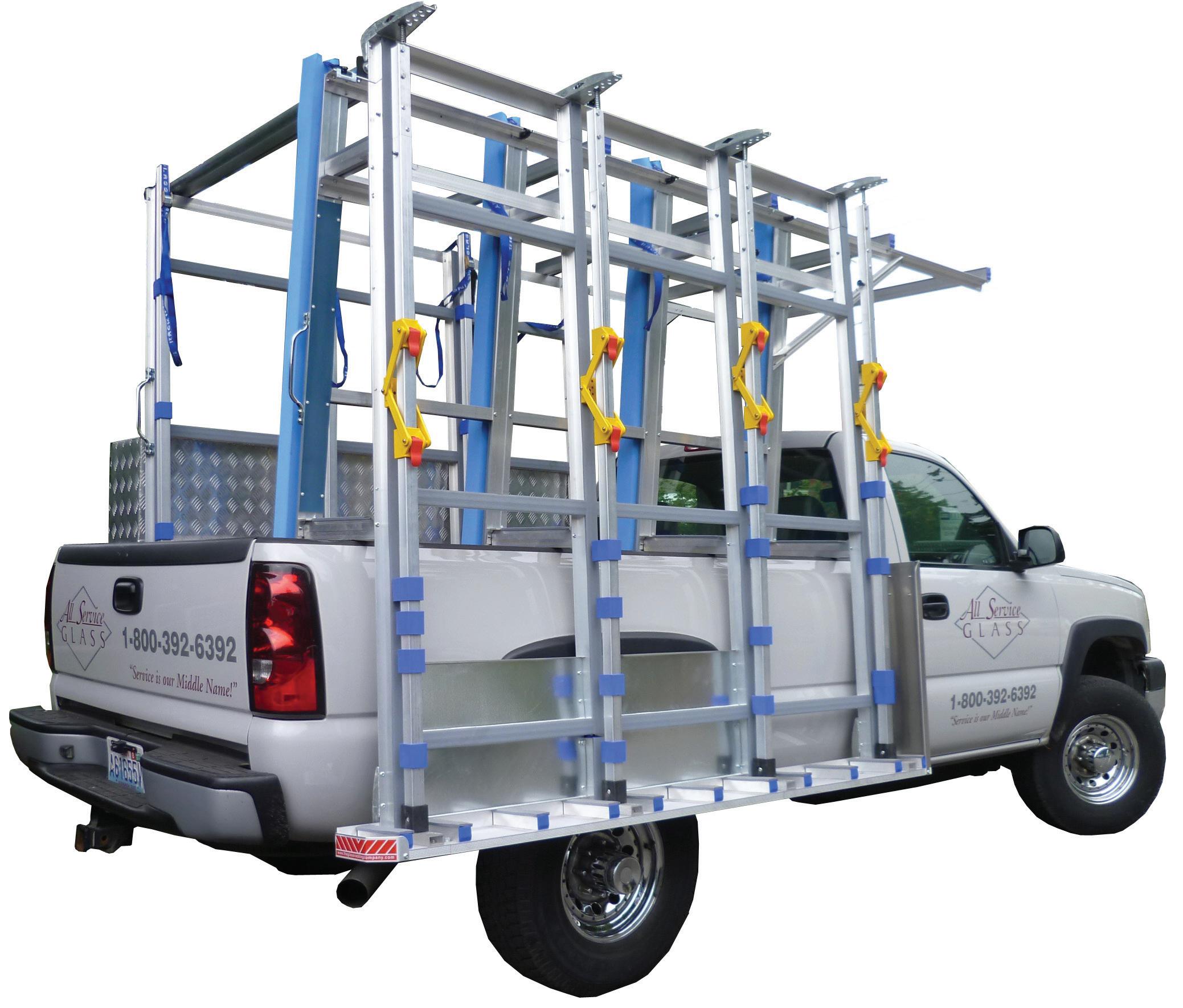
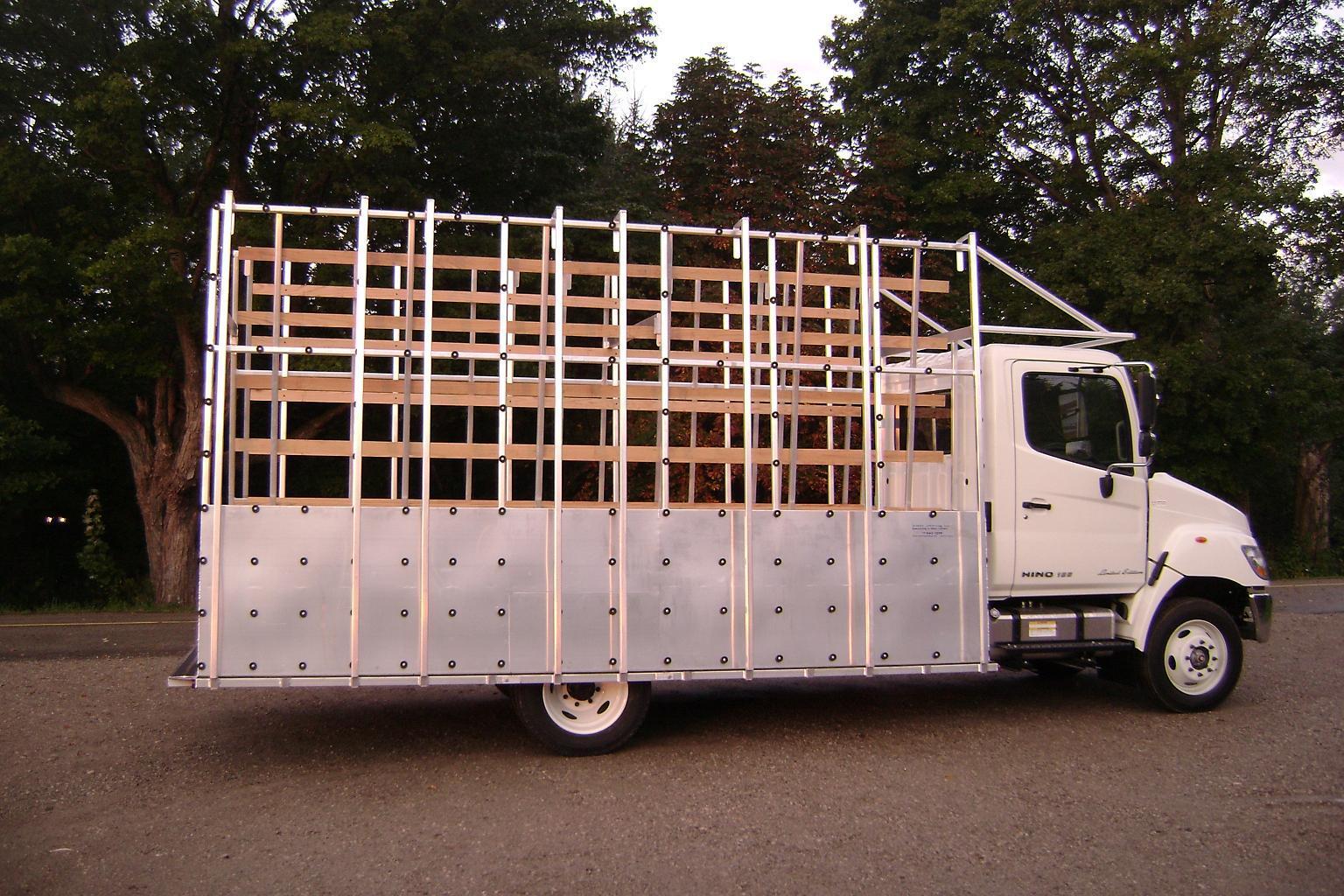
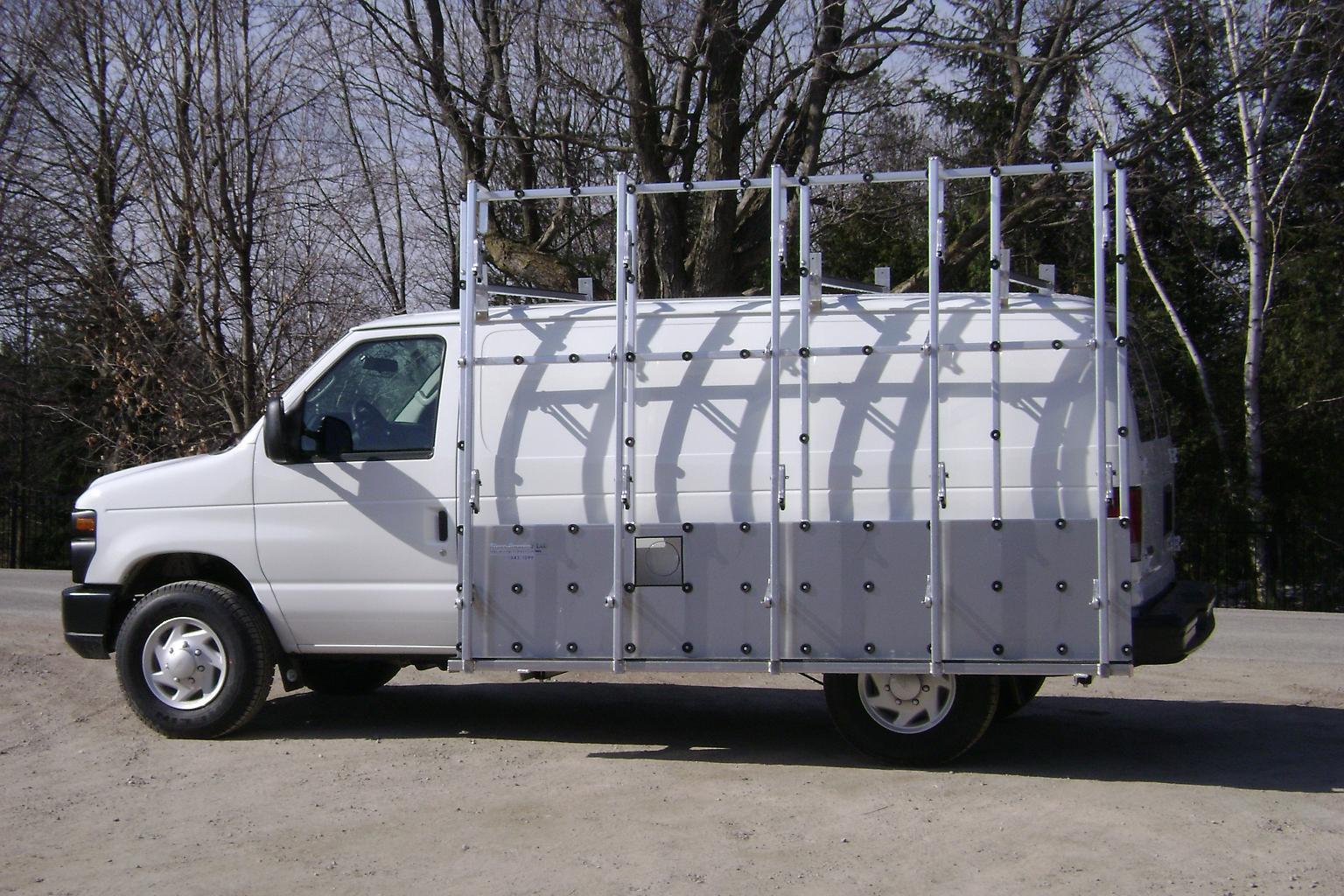
The Glass Racking Company provides a comprehensive range of glass racks for pickup trucks, including both tray bed and OEM box racks. Tray bed racks fit into the base cab chassis providing carrying capacity through the full bed, plus carrying racks outside the wheels on both sides. They are suitable for dedicated glass-carrying vehicles and those requiring large volumes and sheet sizes. A-frame racks are removable and have a storage unit built inside the A-frame. They work best for multi-purpose glass carriers with smaller volumes and users who need to retain the use of their factory beds. A range of racks for OEM beds is also available in single, double, triple or quad designs.
All Glass Racking Company racks can be configured with lengths and heights to suit the user. Gas fill ports can be moved for easy access even when the racks are loaded. A removable module allows access to the wheels. An 18-inch extension is standard on the driver side and optional on the passenger side. Standard lights can be replaced with LED lights for easier installation and maintenance. Company signage and branding is available.
Strength and load-bearing is maximized by T6 aluminum extrusions for the main rack construction, supported by a galvanized steel sub-frame and top and bottom rack brackets. The rack is all aluminum for strength and reduced weight. Glass Racking Company racks add significant capacity by maximizing the external ledge width and the overall rack dimensions. The high-tensile, monobolted construction allows for easy repair and maintenance.
www.powrgrip.com
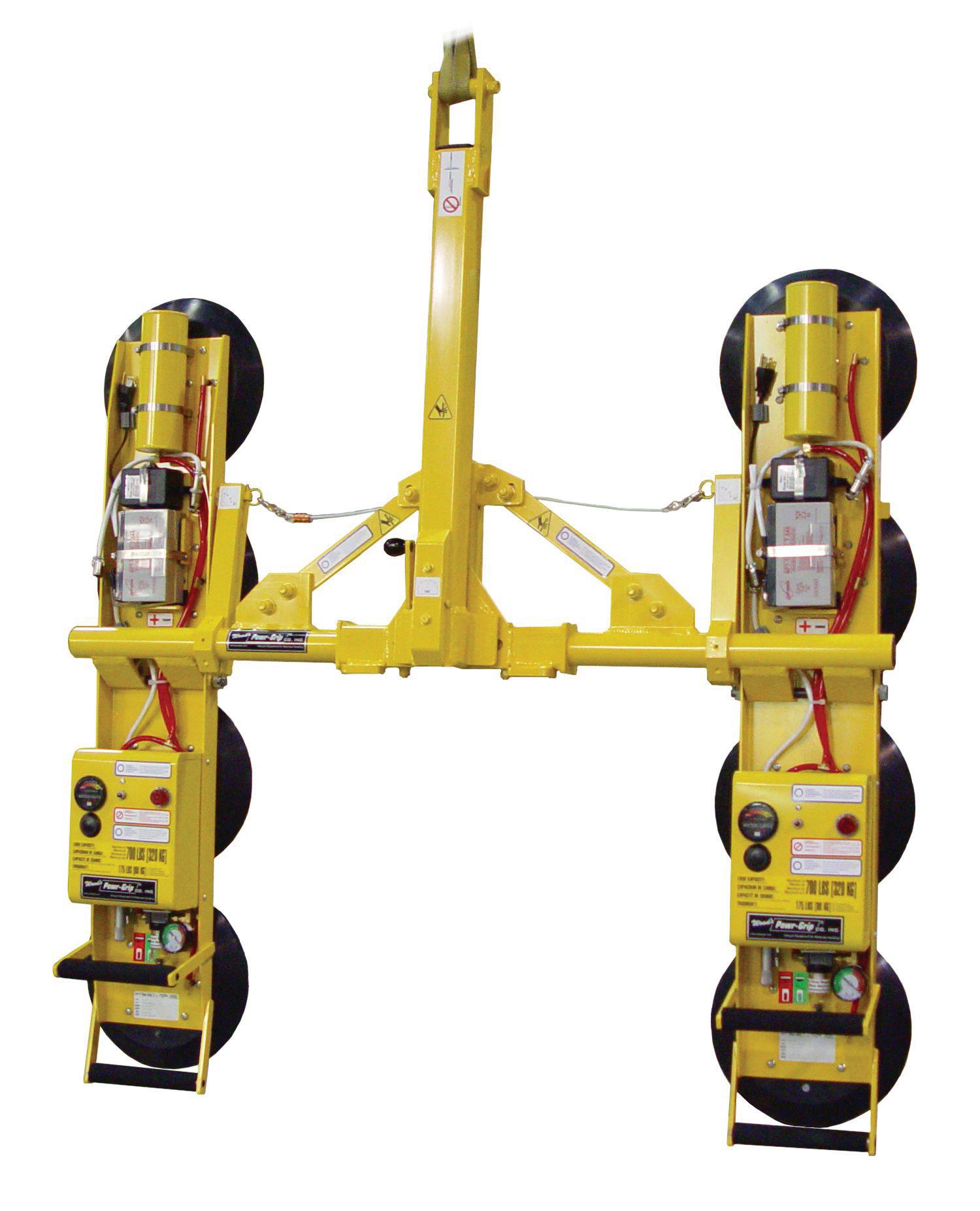
The P1 and P2 Series vacuum lifters from Wood’s Powr-Grip deliver reliable, cord-free operation on the job site or in the plant. These modular vacuum lifters are configured with one or more pad channels and interchangeable lift frames to meet a variety of glass handling needs. Interchangeable lift frames provide manual 180-degree rotation and 90-degree tilting of loads. Pad channels can be switched from one lift frame to another in minutes, for maximum versatility at the installation site. This innovative system
of interchangeable lift frames and pad channels provides load capacities up to 1,400 pounds. On-board DC power permits use with cranes, forklifts or floor hoists. When combined with the CB1 counter-balancer, double-channel vacuum lifters can be used to install windows under overhangs or in other low-clearance settings.
www.bystronic.com
Bystronic glass has underlined its decade-long expertise in glass cutting with the introduction of the Speedcut float glass-cutting table. Thanks to its modular concept, the Speedcut is highly versatile and can be used for cutting architectural glass during pre-processing for photovoltaic modules, or for cutting automotive glass or special glasses. Speedcut provides speed up to 300 metres per minute and acceleration up to six metres per square second. The deployed measuring system improves precision on the desired dimensions, reducing grinding tolerances to a minimum. The cutting bridge is driven by modern linear technology. This replaces the previous common combination of racks and sprockets and significantly reduces maintenance outlay. The Speedcut works more quietly in production than older cutting tables thanks to this drive.
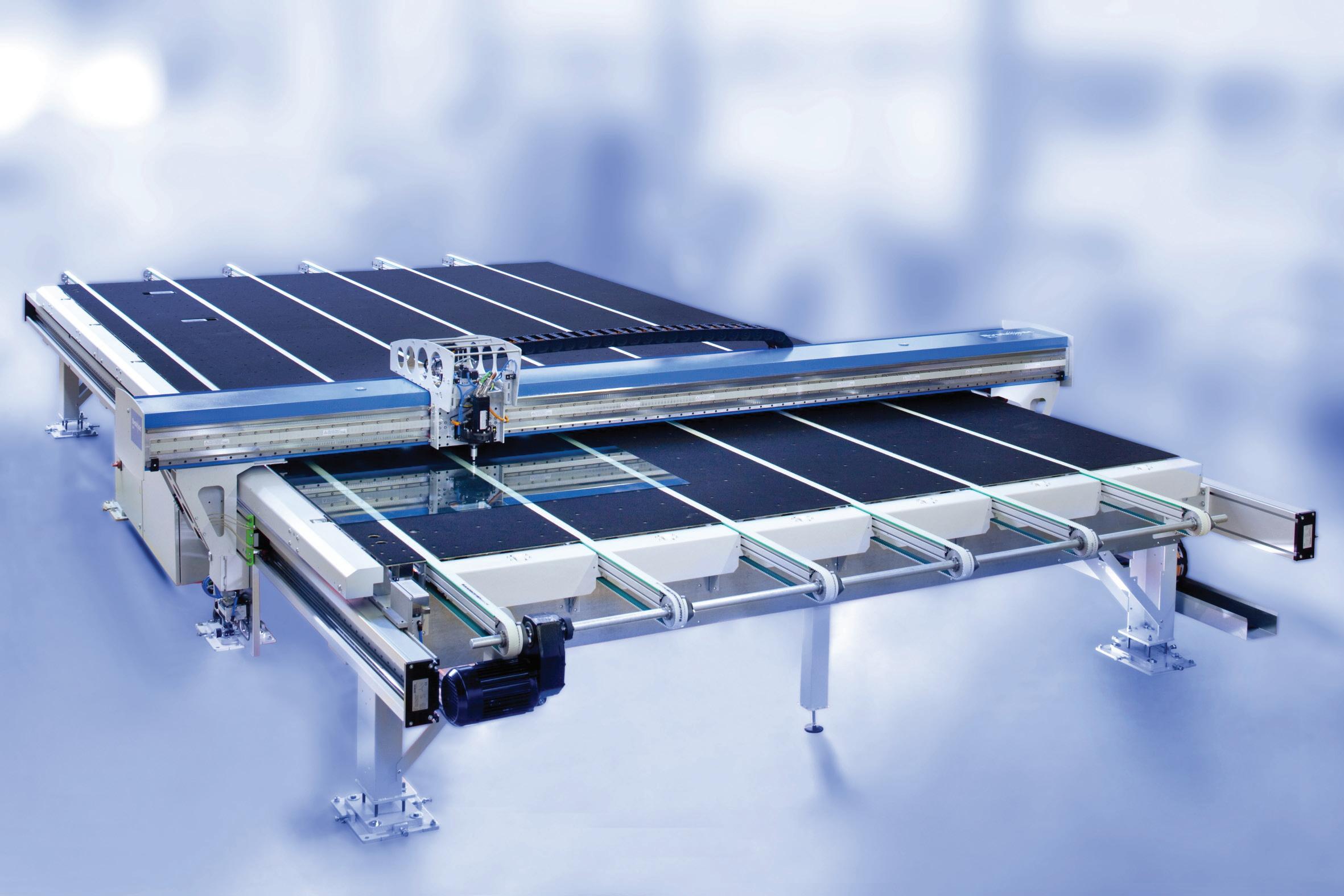
“The Speedcut can offer energy savings because of the honeycomb structure of the cutting bridge. The bridge is designed to be significantly lighter than comparable elements in conventional structures and is extremely stable. The low weight of the cutting bridge leads to a
20 per cent reduction in energy use for acceleration and braking. The cutting head is individually manufactured by Bystronic glass and is processed by hand for each machine. The Speedcut’s edge deletion unit has been adjusted to meet the requirements for ever-harder glass coatings. In combination with the new control, the operator obtains comprehensive process information. Multiple cutting oil circuits for different glasses as well as an automatic tool changer make operational manual interventions almost unnecessary.
www.theglassrackingcompany.com
The Glass Racking Company has been supplying equipment to speed the processing of glass between factory machinery for glass processors for 20 years. The Glass Racking Company supplies a full range of factory handling equipment including stoche glass storage, single glaze and IGU harp carts, pin carts, A-frames, spacer racks and spacer carts, tooth carts, finished goods storage, lifting and transportation solutions.
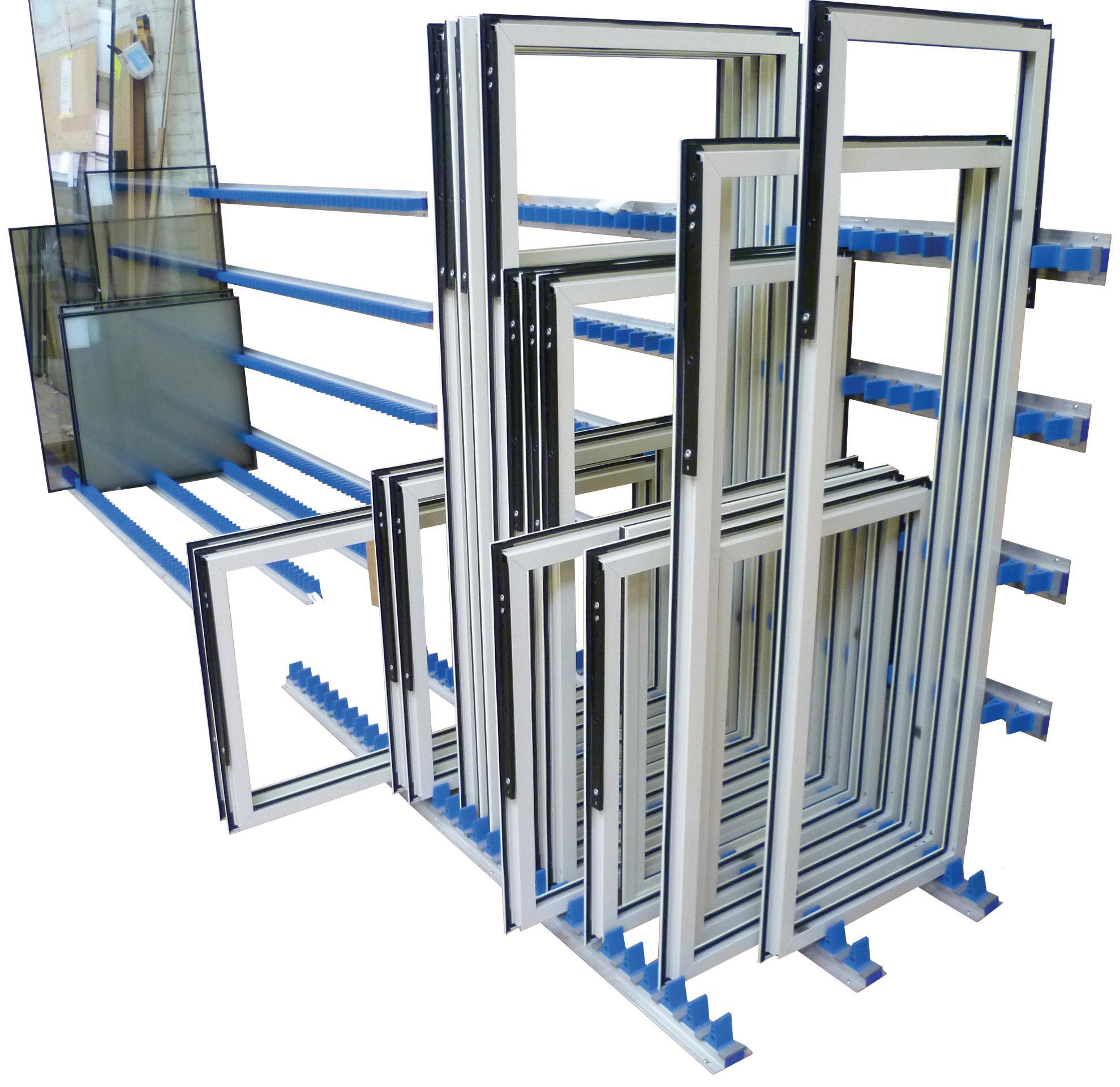
The bearing surfaces on our equipment are made of a purpose-built polymer that is hard-wearing, soft, and nonmarking. This means no rubber marks and reduced scratches on the finished product leading to less rework costs. All carts have quality six-inch casters, hot-dip galvanized finishes and solid steel construction. All equipment is designed with the needs of the glass and window industry in mind.
The Glass Racking Company tooth
storage is a unique racking system that holds IGUs, windows and doors secure for storage and movement around a plant. No hard surface touches the glass or window, which reduces scratching damage. Toaster-style storage speeds access to specific items.
www.grievecorp.com
Grieve Corporation introduces No. 811, a 1,600 F, gas-heated, belt conveyor furnace,
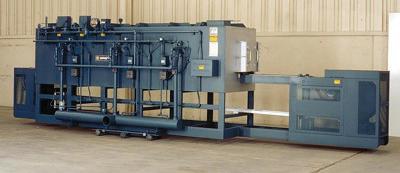
currently in use for forming glass in alloy moulds at a customer’s facility.
Workspace dimensions inside this unit measure 24 inches wide by 12 feet deep by 22 inches high. Workloads travel atop
a six-inch-wide, B-30-28-14, Type 314, stainless steel mesh conveyor belt with a 1/4 horsepower motor drive and a fixed speed 12 feet per minute. The open-belt loading zone is 36 inches long and the insulated heat zone measures 12 feet long with three direct-fired furnaces and a 24inch open unloading zone.
Three modulating gas burners generate 1,320,000 BTU per hour with a floormounted combustion air blower (not shown in photo). The seven-inch thick insulated walls are made with five-inch, 2,300 F ceramic fiber and two-inch block insulation. The 6 ½-inch thick floor insulation is made up of 4 ½ inches of 2,300 F firebrick and two-inch block insulation. Vertical lift doors at each end of the workspace provide further insulation.
A remote, free-standing control panel (not shown in photo) is also included with this Grieve furnace, which features all safety equipment required by IRI, FM and NFPA Standard 86 for gas-heated equipment. •


by BRIAN BURTON
Brian is a research and development specialist for Exp (The new identity of Trow Associates).
Not only are the elements involved in marketing imprecise and uncertain, but also the business environment is constantly changing. As a result, successful marketing for fenestrationrelated industries represents a true challenge in planning and execution. This article is the first of two parts that will focus on the topic.
Developments in recent years have brought increasingly intense competition, rapidly changing market conditions and a client base that insists on value for their expenditures. These conditions have created a need for careful assessment of marketing strategies because flying by the seat of your pants is risky business – in the true sense of the words.
Strategic marketing involves the systematic analysis of the strengths and weaknesses of your firm and your products or services. It also involves assessing your competitors and the market. When properly executed, this enables a firm to develop and implement a plan of action with a much greater probability of success. In theory, this means you may also be able to concentrate resources on market sectors that have strong growth potential and greater profitability. To see how we might be able to do that, we need to start with a look at the early days of marketing.
The fundamental concepts of economics, where products or services are exchanged for mutual advantage, or for profit, can be traced back to the beginning of recorded history. The market, which is made up of producers and service providers on one side and prospective purchasers on the other, has been described as the hidden hand that maintains the equilibrium of supply and demand. It is also viewed by some as mankind’s first computer, operating as a self-regulating mechanism, driving the
For many centuries there was unwavering faith in word-of-mouth advertising, coupled with the belief that marketing would... take care of itself.
economy and providing control and balance of economic activities.
Marketing was generally considered more of an acquired skill than a science until quite recently. It involves any activity that accelerates or expedites the movement of goods and services to the consumer. Over the last 60 years, marketing professionals developed, tested and refined the principles to form the basis of what we now recognize as a science and a professional specialty.
This scientific approach involves the study of behavioural, social and survey sciences, psychographics, economics, statistics, cognitive dissonance in the fields of communication and many other sophisticated concepts. Marketing science, with its emphasis on the probabilities of social and behavioural science, is in many respects the total opposite of the physical sciences.
For many centuries there was unwavering faith in word-of-mouth advertising, coupled with the belief that marketing would, for the most part, take care of itself. According to Thomas Edison, if you invent a better mousetrap the world will beat a path to your doorstep. This statement demonstrates the long-standing assumption that the public will somehow find out quickly that your better mousetrap exists and discover the location of the nearest retail outlet carrying it.
There is a remarkable shortage of written documentation regarding the early attempts at systematic marketing. However, conventional theory suggests that it was linked to the growth of consumerism that followed the industrial revolution. Although the exact date is impossible to pinpoint, the creation of the instruments of commerce, capitalism and international trade combined to create a vigorous and constantly expanding market economy that allowed individual citizens to accumulate wealth. In the early 1950s the study and practice of marketing began to gain acceptance as a science that involved understanding, predicting and influencing human behaviour with reasonable accuracy.
As the body of knowledge relating to psychology, survey science and consumerism expanded, the technology involved in mass communications evolved. Techniques used to influence purchasing decisions became more efficient. Technology also improved various media such as radio and television, and computers were quickly exploited as potential tools in reaching consumers.
Next time, I’ll take a look at the eight steps that make up a modern marketing strategy. •


by JOHN ROPER
John
Roper is the editor for The Installer, The Fabricator, The Conservatory Installer and Glass Works magazine published in the U.K.
It is happening everywhere: governments are setting targets to reduce carbon and save energy.
The feeling here is that the targets are stringent, but I guess I can’t complain because the U.K. started setting goals from a long way behind the rest of the world.
Britain has the draughtiest, leakiest (in energy terms) buildings in Europe. For decades, nobody cared. Sometimes elderly people would die of hypothermia – inside their houses – but tucked up as we are behind the Gulf Stream we have never had seriously cold winters, so we didn’t bother much with girly stuff like double glazing and insulation. I am old enough to remember getting up in the morning and seeing ice on the inside of my bedroom window.
The situation has been changing since the mid–1980s, when we started to see double-glazed windows and central heating become the norm, but the government is determined to do better. Last year, new building regulations specified stringent U-values for windows. At the time there were a lot of politics surrounding this as various organizations vied with each other to approve and certify compliance. Nine months on, they have all driven a coach and horses through the original specification and established new, quick, easy and, more importantly, cheap ways for window manufacturers to comply with the requirements. The target is to reduce energy consumption compared to 1990 by 34 per cent by 2020, heading for 80 per cent by 2050. As far as windows are concerned, U-values are due to fall again quite substantially by 2013.
To drive matters along, the government has come up with The Green Deal. Basically this will mean that, having assessed a property, an energy supplier will be able to sell energy-saving
Britain has the draughtiest, leakiest buildings in Europe. For decades, nobody cared.
EUROPEAN SCENE
products to the householder, the cost being added to the energy bill and paid-for overtime.
There is a general consensus in the industry that the only way we will be able to meet future energy levels will be to move to triple glazing. Considering that until the mid-’80s and well into the ’90s the majority of glazing was single-pane glass, mostly in poor-quality timber frames, we have only just got to the point where double glazing is the norm. Now the whole thing has to be redesigned.
The more stringent requirements may make some existing materials unsuitable for window frame manufacture, and even some styles untenable. Vertical sliding windows are not unusual in the U.K., especially in older properties. Even with double-glazed sealed units and vinyl frames, it is notoriously difficult to achieve low U-values for vertical sliding windows. Some think aluminium will struggle to meet the requirements. Though its use in the domestic market is very low, it is the frame material of choice for commercial buildings. When you factor in sustainability, even timber has its problems. The best these days is engineered timber; softwood has a high maintenance requirement and a relatively short useful life, especially if it is not maintained. Hardwood is really a no-no, especially from rainforest sources, and requires good provenance if it is to be legal.
Triple glazing is generally regarded as a positive thing. The industry is facing some pretty serious consolidation. Recently Bowater Building Products, a company that had already swallowed one old established window system company, was itself taken over by Veka. We badly need to find a new angle. In this respect, triple glazing is a gift. It means more glass, more spacer bar and edge sealant (warm-edge of course), stronger frames (therefore, more compound) and stronger hardware, all making for more expensive windows.
Pilkington does have a wafer-thin, vacuum-sealed unit that was developed by its parent, Nippon Sheet Glass. Its U-value is so low it could do the job in existing frames and save all the hassle. At the moment, it is very expensive and has only been used in the U.K. on a few so-called heritage jobs (see my last column). But then, given the opportunity to sell a third more float glass, who is going to mass-produce a product like that? •






by FRANK FULTON
Frank Fulton is president of Fultech Fenestration Consulting. He has been in the industry for 30 years and can be reached via e-mail at fultech.fc@gmail.com.
In our business, occasionally you will come across people who have made a real impact on the industry. If you were in the glass business in Ontario sometime in the last 40 years, you either knew or knew of Bernie Leaman of Commercial Aluminum. Bernie is that type of guy you’re happy you had the opportunity of meeting. He always greets people with a smile, is quick to laugh, personable, and fun to talk to . . . a very charismatic gentleman. We caught up with Bernie recently and thought you might be interested to hear a bit about him.
Bernie Leaman started his working life as an office clerk with Marcad Printing way back in 1953 at the age of 17, moving on to Robin Hood Flour a while later. While at Robin Hood, Bernie met a gentleman and co-worker by the name of Bill Millington. As it happened, Bill had a few brothers in the glazing business, and convinced Bernie it would be a good idea for him to leave Robin Hood with him and go to work for Millington Brothers Glass. That’s how Bernie found his way into the glass and metal business in 1955, doing the books, estimating, inside sales, and anything else that needed taking care of in the one-man office, while the Millington brothers were out taking care of jobs. That was his start to a long and rewarding career in our industry.
As is typical of young guys starting out, Bernie moved around a bit in his early years, putting in time and gaining experience at Jack’s Glass, and later working for an owner he considered to have very questionable ethical and moral fabric at Builders Glass, getting a first-hand education of how not to behave in business. This baptism by fire would serve Bernie well in his future endeavours.
In the mid ’60s, Bernie and a few of his co-workers at Builders decided to put their entrepreneurial spirit to the test.
In the mid ’60s, Bernie and a few of his co-workers at Builders decided to put their entrepreneurial spirit to the test and started their own subcontract glazing company, going under the name of Capital Glass. They got off to a pretty good start, getting their share of work, until Bernie had a near crippling back injury on a job site from which he was fortunate to recover. That pretty much spelled the end for Capital, as, according to Bernie, the other partners had more interest in booze and women than they did in growing the business.
As it happened, while Leaman was learning the ropes of the glazing contracting business, a gentleman by the name of Barry Reading whom Bernie had got to know over the years, started up a small aluminum door and fin tube shop called Commercial Aluminum. “It was a very small industry at the time. Everyone knew everyone.”
Commercial became part of the Indal group in 1965 and, a few years later in 1969, Reading, who had stayed on as president, enticed Bernie Leaman to join the company and run the office for the princely wage of $55 per week. Commercial had 12 employees at the time, and Bernie was once again in charge of a one-man office, doing all the estimating, inside sales and order processing.
Unfortunately, Barry Reading took seriously ill in 1972, made a brief return to Commercial a year later, and retired permanently shortly thereafter, leaving Bernie to take the lead role in the company. Realizing the talent they had, Indal appointed Bernie Leaman as general manager. At the time, another renowned industry man, Ian Moore, was the president of Indal Products, making aluminum storm windows and doors. Commercial Aluminum was put under the Indal Products umbrella, and Bernie reported directly to Ian Moore. At the company Christmas party in 1976, Ian announced that Bernie had been promoted to president of Commercial Aluminum. By this time the company had grown to 25 employees.
In the next edition, we’ll look at Bernie’s years at Commercial Aluminum and his involvement with the Metro Toronto Glass Association. •