Publication Mail Agreement #40065710. RETURN UNDELIVERABLE CANADIAN ADDRESS TO CIRCULATION DEPARTMENT, P.O. BOX 530, SIMCOE, ON N3Y 4N5 e-mail: awebster@annexweb.com
Printed in Canada, All rights reserved. Editorial material is copyrighted. Permission to reprint may be granted on request. ISSN0843-7041
Canada- 1 Year $39.00 (with HST/QST $42.12) U.S.A. - 1 Year $54.00 (in US dollars)
From time to time, we at Glass Canada make our subscription list available to reputable companies and organizations whose products and services we believe may be of interest to you. If you do not want your name to be made available, contact our circulation department in any of the four ways listed above.
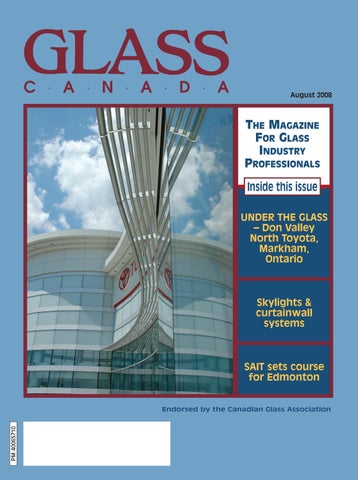
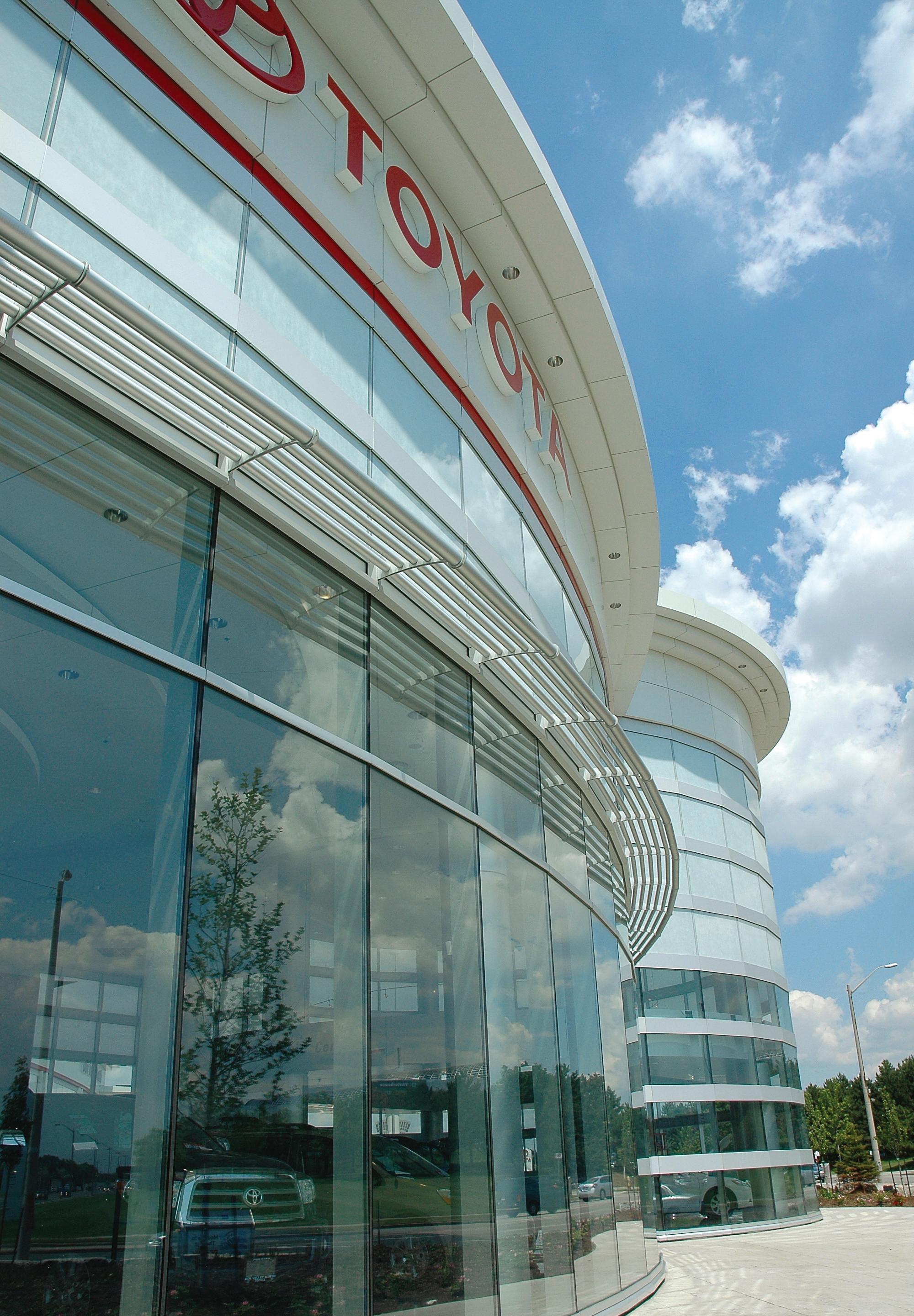
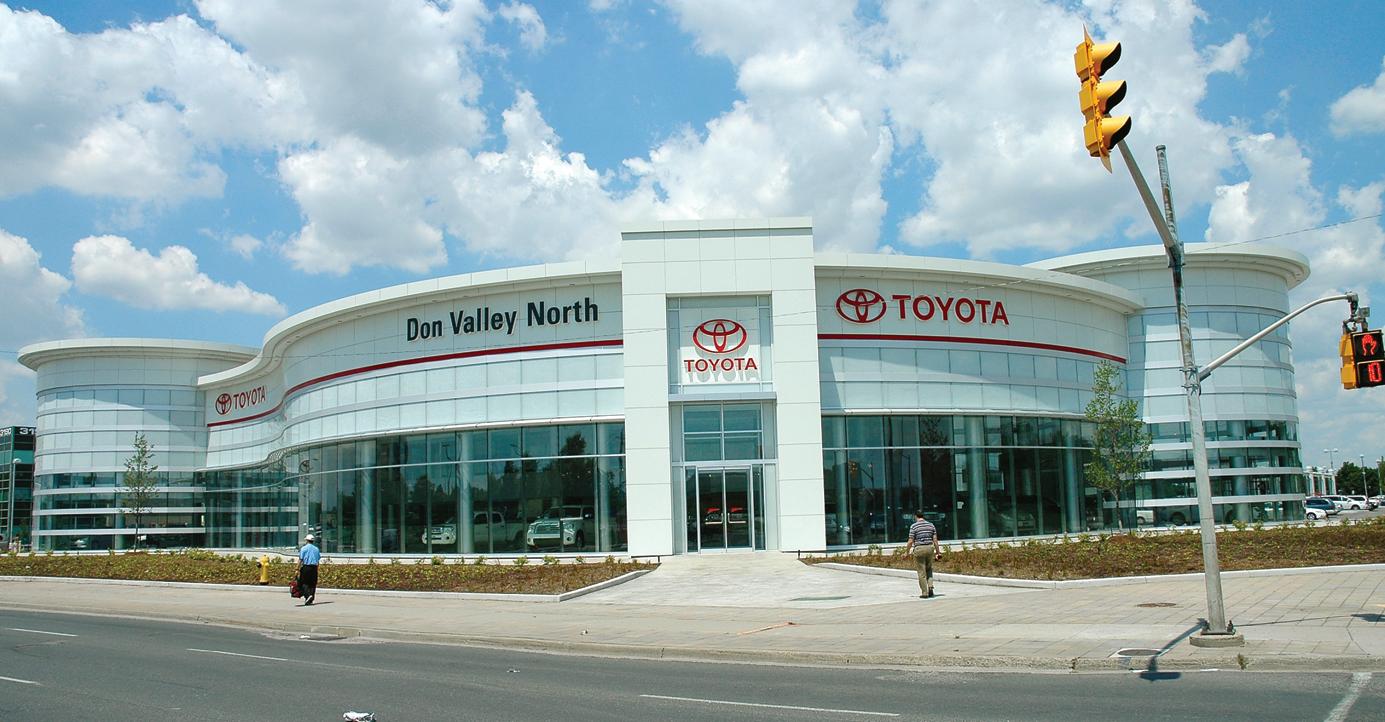
Cover: Don Valley North Toyota, Markham, Ontario. Photo by Chris Skalkos. www.glasscanadamag.com
EDUCATION
SAIT sets course for Edmonton
By Chris Skalkos
Acollaborative effort by the Glass Trades Association (GTA) and industry stakeholders in northern Alberta has successfully established an apprenticeship glazing school in Edmonton to alleviate the shortage of skilled glaziers in the province.
The Southern Alberta Institute of Technology (SAIT) has opened a satellite campus in the city offering its highly recognized glazier apprenticeship program at its main campus in Calgary.
“This is strictly an extension of the SAIT program, but it’s further down the hall from any other classroom,” jokes Ed Dalzell, SAIT instructor who volunteered many hours to get the program ready. He says the six week per year, four-year course, covers the basics of glass pattern cutting, fabrication and installation with an emphasis on safety.
Classes for the first group of first-year students began on May 12 with 270 glazier apprentices registered Alberta wide. Classes for a second group of first
year students will begin on Sept. 8 and it already has half of the required registrants needed. The goal for next year is to add two additional classes.
Ross Wady, president of the GTAsays the program in Edmonton will provide an opportunity for glass shop owners in northern Alberta who cannot afford to lose employees by sending them to Calgary for training. “Especially in the last few years,” he says pointing to the high level of construction activity taking place in the province. “It has been more difficult for companies to send employees to Calgary. Losing them for six weeks was a bit of a stretch. We felt there was enough interest to make a program work up here,” says Wady. He adds that students who complete the program receive their Journeyman’s Certificate making them eligible to write their Interprovincial Ticket Red Seal which entitles them to practise the trade anywhere in Canada.
The GTAinitiated the move to get a SAIT program in Edmonton after discussing the issue for years at association meetings, says Lynn Allan who oversees the GTA’s education committee. “I raised my hand and offered to get the ball rolling,” says Allan. “Last
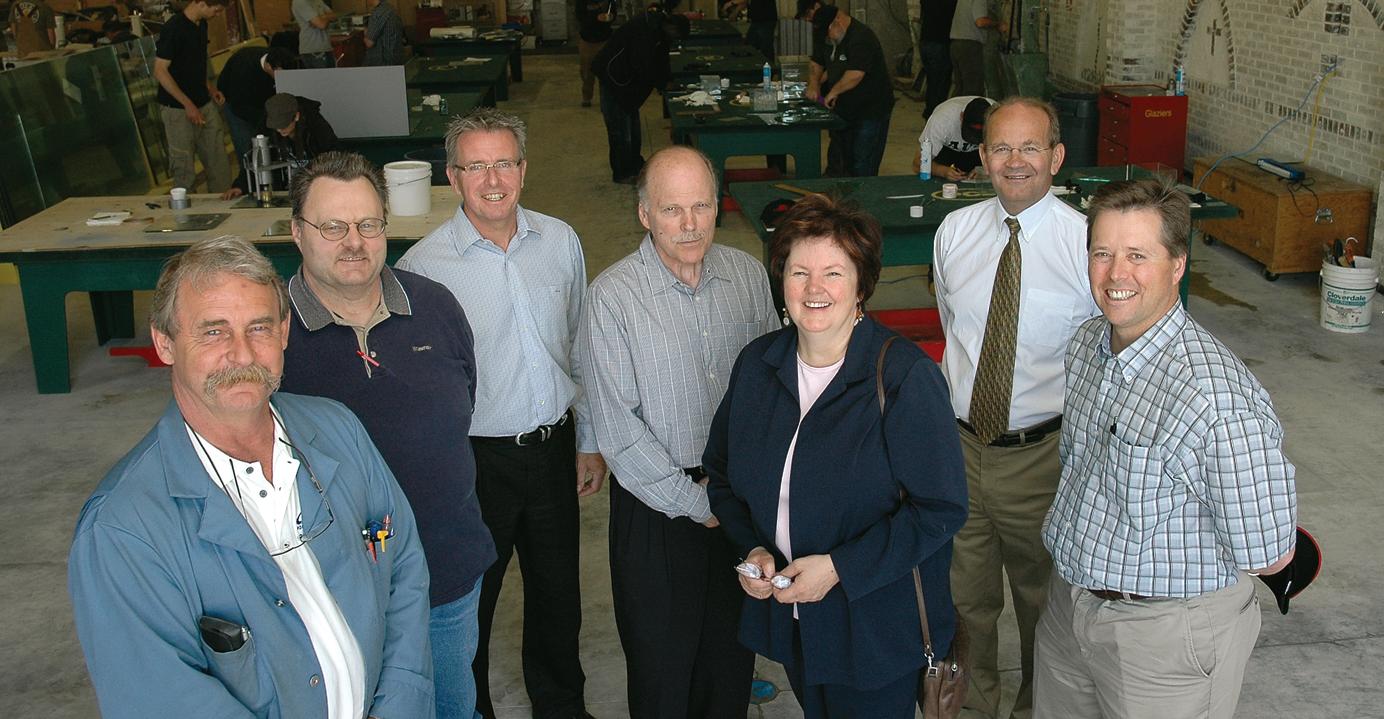
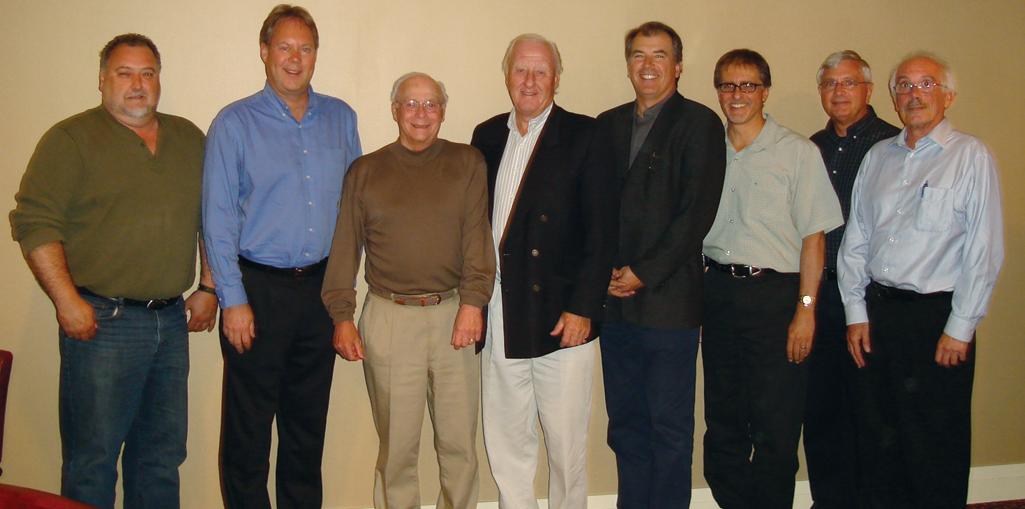
Partners in training and key players in getting the SAIT glazier apprenticeship program: From left, Ed Dalzell, instructor Glazier Program The School of Construction SAIT; Lynn Allan, Beacon Glass Products; Wayne Brandt , Kawneer Company Canada; Ross Wady, All Glass Parts & president of the GTA; Wendy Clarahan, Visionwall; Michael Czernick, AGC; Russell Bridgeman, PCL Construction Management.
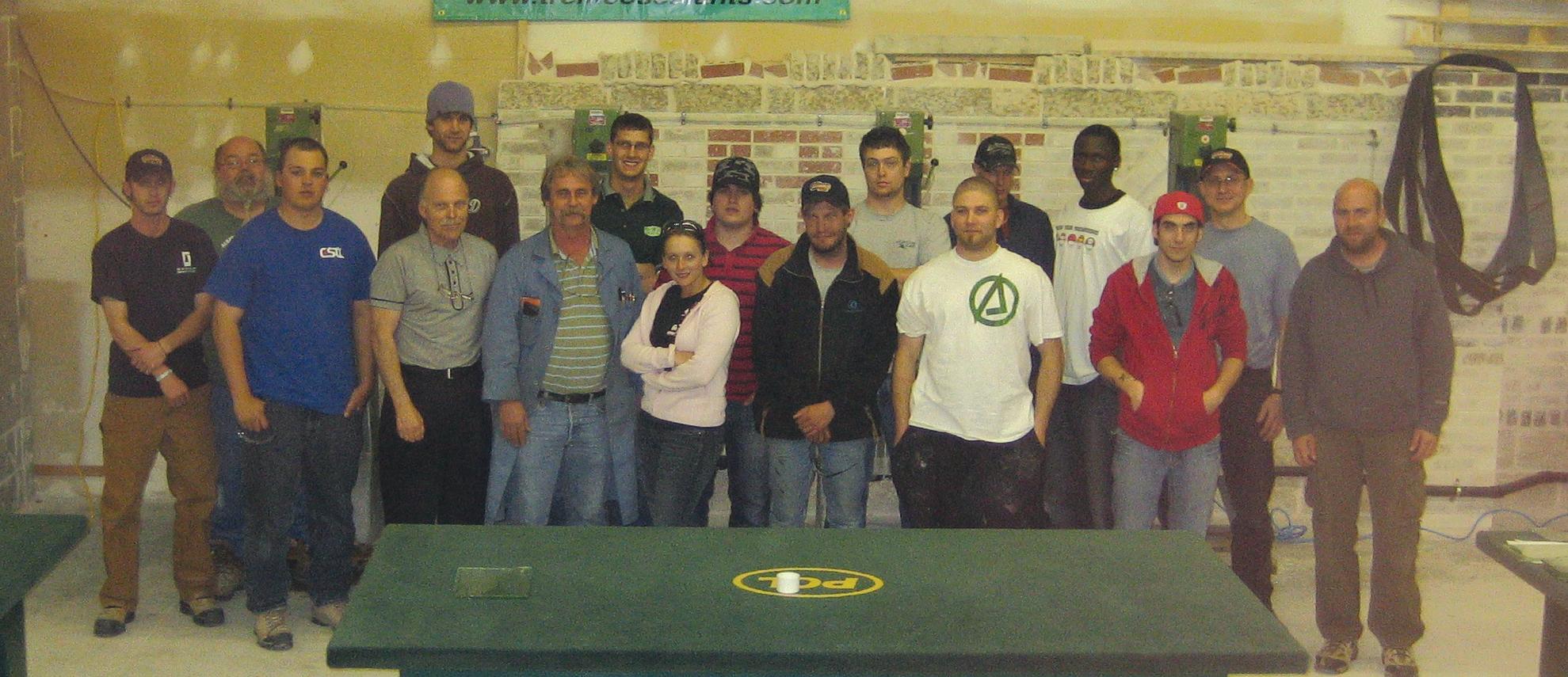
Back row from left, Kristopher Corbett, Lance Ledger, Brent Spriensma, Blake Simon, Clint Sturm, Jonathan Keating, John Nyikabe, Dan Gratton, Clint Gordon.
Front row from left, Cody Proskow, Ross Wady, Ed Dalzell, Melanie Milne, Nick Countryman, Jason Hennessey, John Da Costa.
Apprenticeship glaziers working in the shop area of SAIT’s new satellite campus in Edmonton.
fall we mailed out a questionnaire to glass shops simply asking, would you support a program? Yes or No? And how many apprentices would you send?
We sent 275 questionnaires and the response was overwhelming. By the second week we had several glass shops respond giving us potentially 85-90 students interested in the program,” he says. “So we brought these figures to a
GTAmeeting and then approached Dave Edwards of SAIT and Al Sieben of Alberta Apprenticeship who pointed us in the right direction.
“We had the interest and the numbers so we set out to get the appropriate applications to show Alberta Apprenticeship, (a branch of the provincial government) we are serious about getting a class here,” he says, adding
Contributors to the SAIT Apprenticeship School, Edmonton, Alberta
that association members were slightly surprised by how quickly it was approved.
“We posted the first class six weeks from the time we started to push for the apprentices. We felt that it was fasttracked. We thought we would get it in 2009 so we had to scramble to get a list of materials and equipment we would need,” he says. “We filled the first class with 16 people with another nine out of 16 already registered for September.”
The second-year class is scheduled for May 2009.
Wady says the program was developed in conjunction with local area user committees comprised of various stakeholders with several companies contributing materials and equipment. “We also received a lot of support from the Glass Dealers Association of Saskatchewan (GDAS) and the Glass and Architectural Metals Association (GAMA) based in Calgary. The support we received from the people at SAIT was also very important, they really stepped up to the plate,” he says.
However, Allan says that to sustain the program the registration quotas need to be met so the GTAwill be promoting the SAIT program at high school job fairs and by making presentations to construction companies and other industry associations. “We are hoping to draw students from Saskatchewan, North West Territories and Yukon,” says Allan.
Amajor contributor to the program, PCLConstruction Management Inc, in Edmonton, built the glass cutting tables for the SAIT facility based on designs by instructor Ed Dalzell.
Russell Bridgeman from PCLsays the SAIT apprenticeship program will help the glass industry which is already being squeezed by a shortage of skilled glaziers.
“Trades people in Alberta are in short supply and this is especially true for glass trades people. In construction today we see more glass on buildings and this is creating a need for more glaziers, but it is also creating a greater need to keep up with training which is an important part of any trade,” says Bridgeman. He says while the amount of glass being used in our industry has increased exponentially, the number of people getting into this trade is not keeping pace. “Our goal is to get more people in this trade and improve their skills,” he adds. “The real benefit of a program like this is that we are going to have more skilled glaziers in the industry in just a few years down the road.”
UNDER THE GLASS
Endless flow
By Chris Skalkos
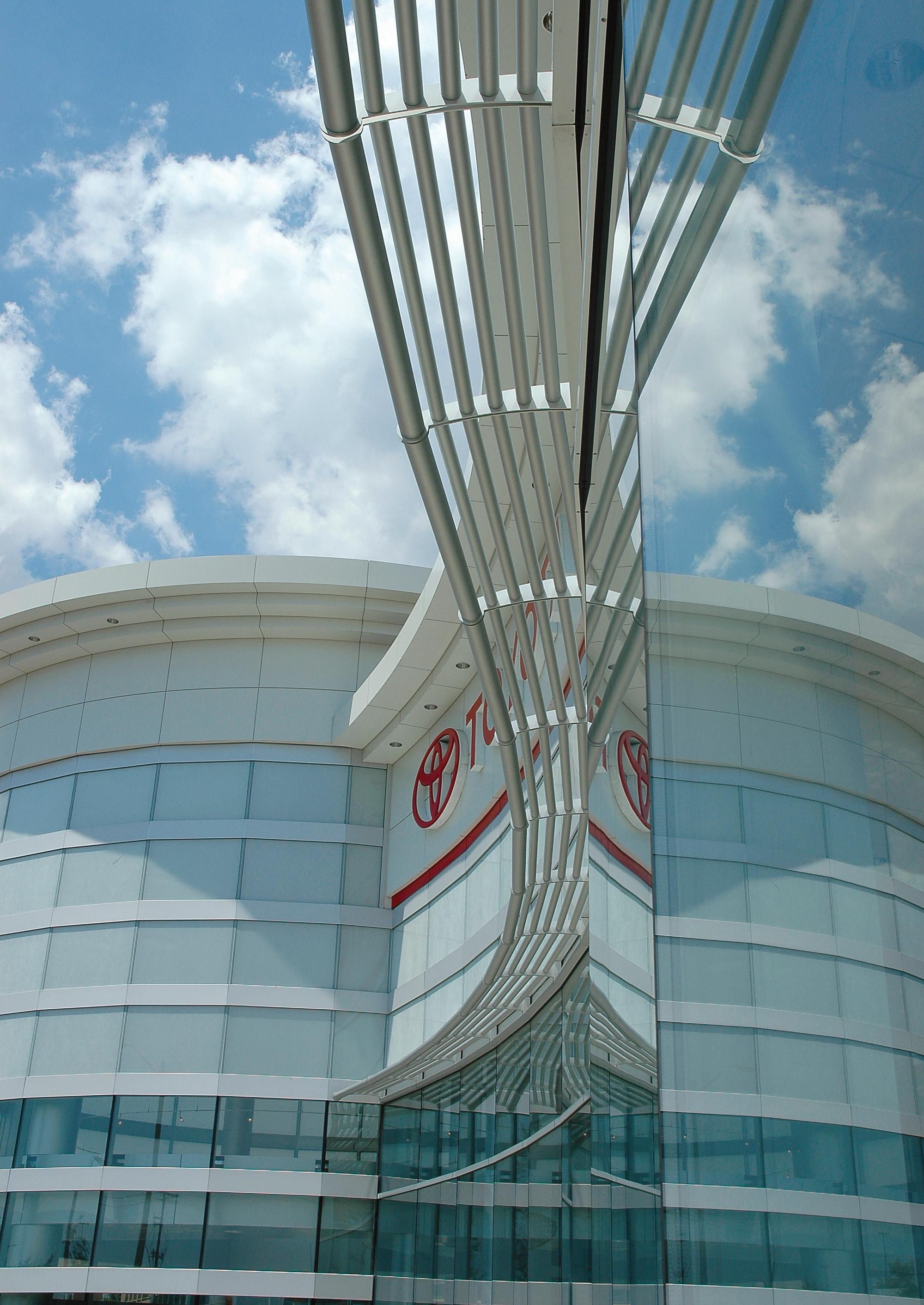
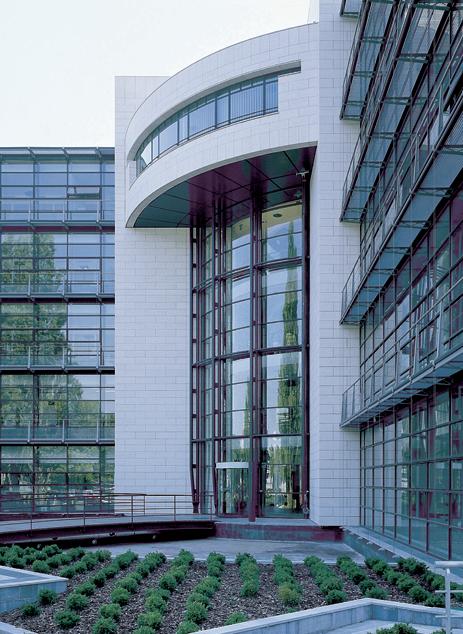
While most automotive dealerships are designed to showcase the vehicles inside the showroom the curtainwall structure that encases the showroom of the new Don Valley North Toyota dealership in Toronto, Ont., is a showcase in itself.
Designed by R.H. Carter Inc. and glazed by Fairview Glass and Mirror Ltd., operated by Peter and John Kanellis, the building features two 34foot-high glass rotundas with splayed mullions anchoring a 220-foot-long serpentine curtainwall between them. In addition to the 500 IG units comprising 12,000 square feet of vision glass supplied by Ontario Float Glass (division of Triple Seal), the curtainwall also sports a unique glass product by Advanced Glazings in Sydney, N.S., called Solera T, that evenly diffuses the light in the showroom.
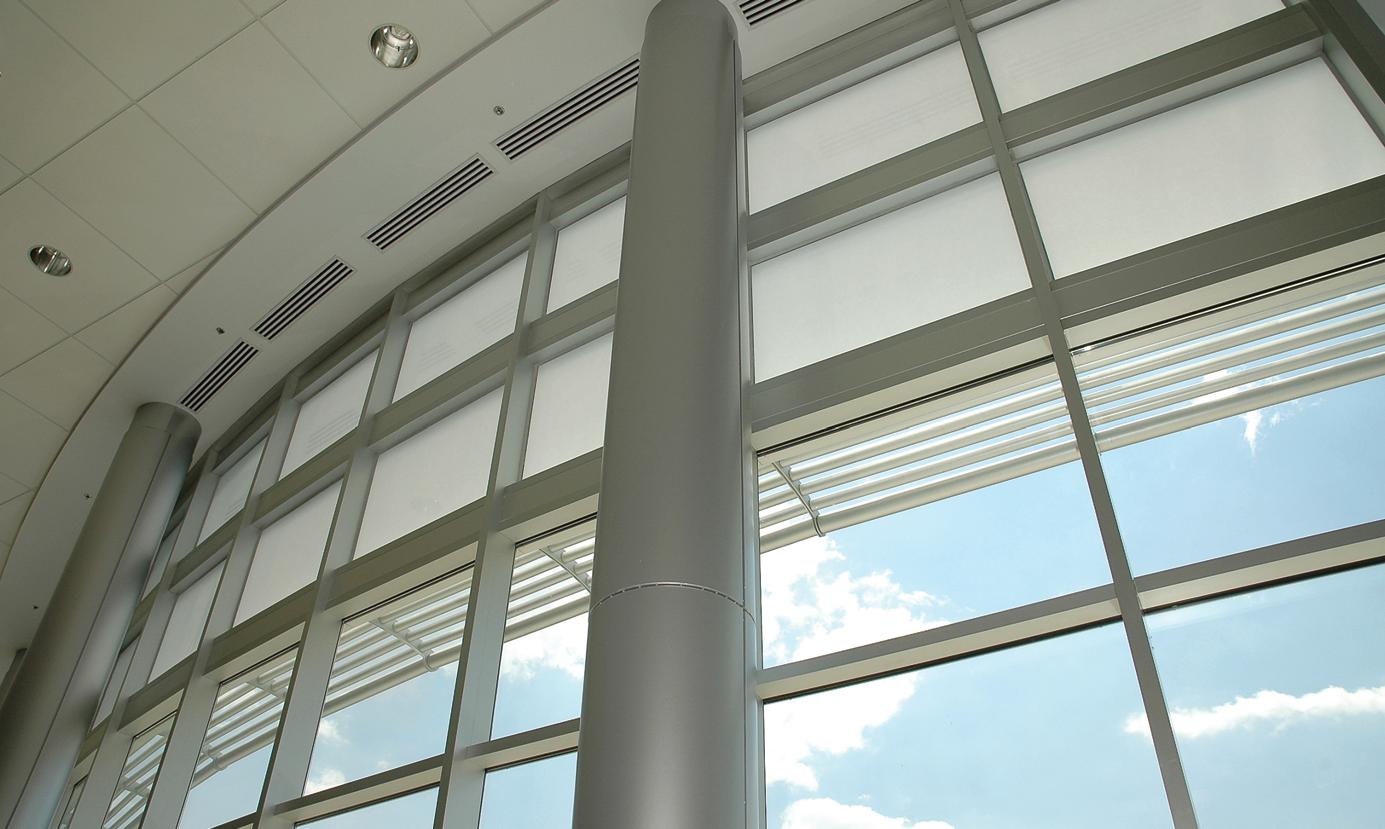
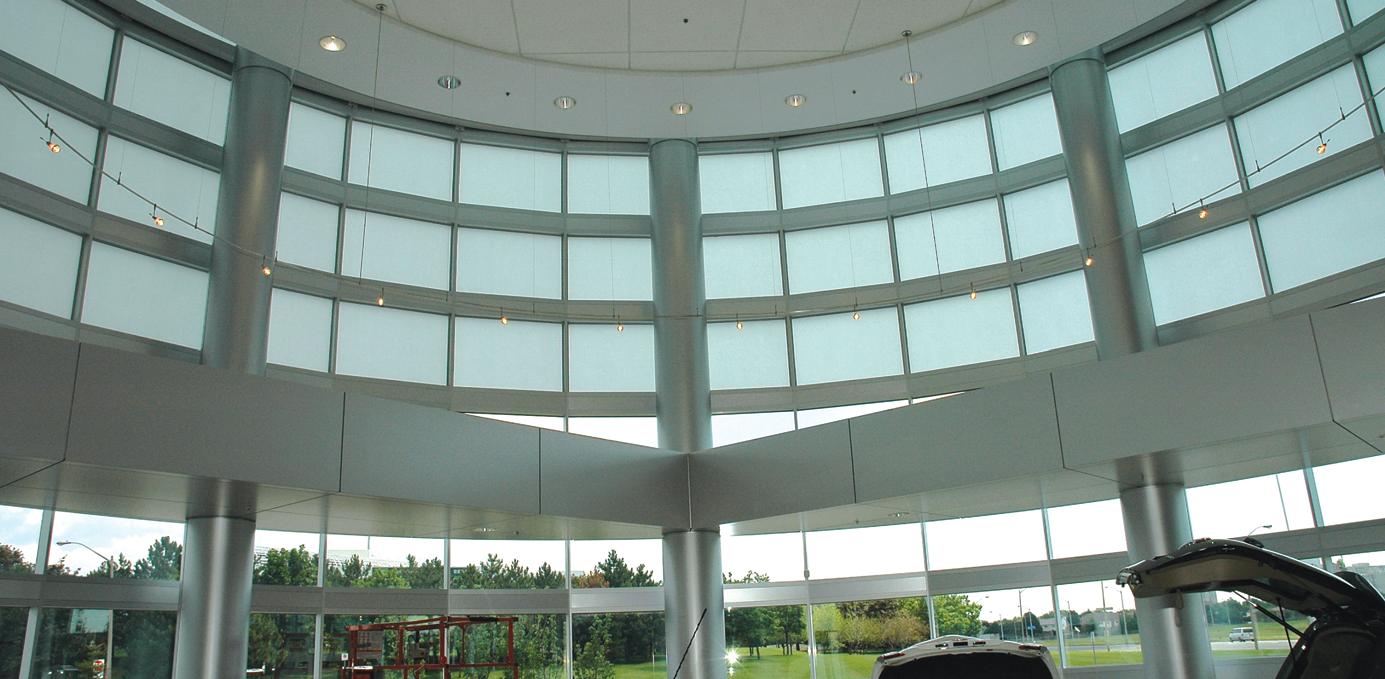
“The objective of the overall design was to get as much diffused light in the showroom as we could to reduce the hotspots and the reflections, but also to save electricity by reducing the amount of interior lighting required inside other than decorative pot lights,” says Emil Frank, senior project manager for R.H. Carter.
Set up high on the curtainwall where spandrel glass and a galvanized backpan would be used on more traditional curtainwall structures, 300 Solera T units cover 5,000 square feet along the top of the curtainwall and the rotundas. Solera is a line of translucent insulated glass units that fit into standard curtainwall or window systems and are designed to convert harsh sunlight into soft diffused
TOPLEFT: Designed by R.H. Carter Inc., and glazed by Fairview Glass and Mirror Ltd., the new Don Valley North Toyota dealership in Toronto, Ont., is a showcase in itself.
LEFT: Fairview Glass and Mirror Ltd., in Scarborough, Ont., is operated by Peter, left, and John Kanellis.
UNDER THE GLASS
daylight while preserving the thermal integrity of the building.
Solera T is a three-inch translucent glazing unit that consists of architectural glass, galvanized steel or aluminum spacer, acrylic insulation core, silicone sealant and polyethylene tape. Light diffusing veils are placed between a honeycomb core and glass skin that creates U-values as low as 0.20 while emitting daylight further into an interior space. Additionally, the honeycomb cells are flush with the plane of the glass surface creating spaces where convection cannot occur. The product can be specified with different glass types in all architectural thicknesses and it is intended to replace sections of roof or higher portions of walls where diffused daylight inside a building is desired.
Frank says the equally distributed light inside the showroom does not cause any glare or shadows, regardless of the angle of the sun, which is the most ideal type of lighting for an automotive dealership. “You can see it on a computer simulation but you need get into the environment to see how the product really works,” he says.
The curtainwall design itself was inspired by both the liberties and the limitations that came with the building site. Frank explains the building was being built on a prominent site so it could not be too tall; however, the municipal government gave the green light to design something nontraditional.
“It couldn’t be overbearing and we had to keep it close to street level but the city encouraged us to explore creative designs. Since we couldn’t go high we were creative in other ways and using glass was effective in helping us achieve that,” he says.
Pete Roberts, contract manager for Fairview Glass and Mirror says the serpentine curtainwall design is not new, but harnessing it to two separate glass and metal rotundas at each end is an amazing feat of engineering and custom fabrication.
“One of the things we wanted to do was to make an endless flow of glass, a continuous wall where the two rotundas meet the serpentine, all glass to glass with everything silicone glazed. The intent was to make the wall flow,” he says, adding that it is common in automotive showrooms to see a positive convex curve. “But to see a positive convex curve in the east elevation and a
The building features two 34-foot-high glass rotundas with splayed mullions anchoring a 220-foot-long serpentine curtainwall between them.
There are 500 IG units comprising 12,000-square-feet of vision glass supplied by Ontario Float Glass (division of Triple Seal).
The curtainwall uses a product by Advanced Glazings in Sydney, N.S., called Solera T, that evenly diffuses the light in the showroom.
UNDER THE GLASS
negative concave curve in the west elevation, meeting each other at the tangent… now that blows you away!”
Kawneer Company of Canada supplied its 1600 Wall System 2 (silicone glazed), which was modified to accommodate a portion of Kawneer’s 1600 Wall System 1 for exterior sunshades.
“We used part of the 1600 Wall System 1 designed for a System 2 which has to be painted and capped. It’s a silicone glazed job but it can’t be silicone glazed in the area of the sunshades because we had to use caps to shroud the brackets in that area where the sunshades attach to the curtainwall system,” says Roberts. “But it was never meant to be used as a System 1 so in just that area alone we installed a System 2 to shroud the brackets of the out rigger, just in that little bit of area where the louvres are.”
Roberts says the complicated design was really not that much of a challenge due to the highly detailed and accurate drawings from the architect. “Good drawings are imperative because a job like that has to be done right. They did their job right, which allowed us to do ours. We could have built the thing completely from the architectural drawings without needing to do our own shop drawings.”
The key from that point on was good communication on site between Tony Roberts of Fairview Glass, fabricating prototypes in the shop, and the company’s site supervisor, Dave Curly, co-ordinating the installation among the glaziers.
“We set up a laser level on top of one of the rotundas and shot the laser across to the other rotunda to see if the curtainwall was level from one end to the other because when you are building a long curtainwall you need to know where the high spot is,” says Roberts. “We found the highspot and saw that it only fluctuated 10 mm. Usually you get undulation in a curve that long, but with two curves at the end plus the serpentine, the high and low points differ by only 10 mm. That’s amazing!”
Frank says the curtainwall design is esthetically appealing and fulfils the architectural objectives for the building owners in providing the environment needed to showcase the vehicles inside.
“It’s not a traditional design for a car dealership…it’s a unique clear design with a distinct form.” ■
Solera T units cover 5,000 square feet along the top of the curtainwall and the rotundas. Solera is a line of translucent insulated glass units that fit into standard curtainwall or window systems.
LEFT: The serpentine curtainwall has a positive convex curve in the east elevation and a negative concave curve in the west elevation which meet each other at the tangent and are harnessed to two separate glass and metal rotundas at each end.
RIGHT: The silicone glazing gives the appearance of an endless flowing wall of glass.
Kawneer Company of Canada supplied its 1600 Wall System 2 (silicone glazed), which was modified to accommodate a portion of Kawneer’s 1600 Wall system 1 for exterior sunshades.
CANADIAN GLASS ASSOCIATION
#23 21848 50TH AVENUE • LANGLEY, BRITISH COLUMBIA • V3A 8A9
TELEPHONE: (604) 880-6757 • FAX: (604) 608-4950
WWW.CANADIANGLASSASSOCIATION.COM
CGA newsletter
President’s report
By David Husson, CGApresident
The Canadian Glass Association held its semi-annual meeting in Edmonton, Alta., on June 6. We would like to thank the executive board of the Glass Trades Association (GTA) for hosting our meeting. We would like to especially thank GTA president Ross Wady and Rick Zucchetto for their hospitality. It was very exciting to see the new SAIT Glaziers Apprenticeship Program, which was put together in six months by the GTA, who were currently putting their first group of apprentices through their facility when we visited.
We had a very productive meeting that predominantly dealt with the future of the CGA. It was decided that the CGA would hire a part-time person to assist our association to move forward. We are pleased to announce that we have hired Zana Gordon of British Columbia to perform these duties on our behalf.
As most of you are aware, one of the principal items that we have been dealing with is the introduction of the Glazing Systems Specifications Manual for Ontario. We now have a completion date set for Sept. 1 of this year. It has taken a lot of work by the Architectural Glass and Metal Contractors Association (AGMCA), the Ontario Glass and Metal Association (OGMA) and the Glazing Contractors Association of B.C. to achieve this. Congratulations to those groups.
We are having our Annual General Meeting AGM in Toronto, Ont., in December. We invite CGA members to attend or forward questions they may have regarding the association. ■
OGMA
By Frank Fulton
The Ontario Glass and Metal Association (OGMA) honoured Bill Parkin at its Spring Golf Tournament in May by presenting him with the OGMA Lifetime Achievement Award. Parkin was introduced to the glass industry as an estimator for Sam Tillet at New Toronto Glass in 1953. His father Al worked as a glazier there. Within a few years he moved on to Pilkington Glass in 1955 as an estimator, and then sales. He was promoted to office manager at Pilkington Glass when the company installed its second Canadian float glass line in 1970. He is one of the few people in the glass industry who can claim to have met and shaken hands with Lord Harry Pilkington as well as his successor, Sir Alastair Pilkington, the inventor of the float glass process. (Oddly, the two were not even distantly related to each other.) He left Pilkington in 1975 to start his own business, Brampton Glass, with longtime friend and fellow Pilkington colleague Morris Lash. Brampton Glass grew by leaps and bounds during the booming
economy of the late 1970s to the point where they decided, against Parkin’s wishes, to give up on the small day-to-day jobs and focus only on large projects.
The economy took a nosedive in 1980, large jobs dried up, contractors went under, and the customers doing small projects had taken their business elsewhere.
It was then that Parkin learned just how supportive large Canadian financial institutions become when you need them the most and he found himself in the difficult position of having to start over. He left Brampton Glass to open his own glass business in Burlington in 1981.
At Burlington Glass and Mirror Parkin was joined by his father Al Parkin, who managed the shop. Al was with Burlington glass until the age of 75. They were then joined by Parkin’s son Greg in 1983 where three generations worked together in the family business.
Parkin’s wife, Margaret, also worked at Burlington for almost 15 years, but decided to take an early retirement at the age of 70. At one point his entire family was working with him at Burlington Glass.
When the devastating recession hit in 1990, and while over half the glazing contracting companies were going out of business, the lessons Parkin learned the hard way a decade earlier about not overextending himself, focusing on small clients and avoiding the banks, helped him to weather the five-year storm.
Parkin has been a longtime and loyal member of the OGMA and its predecessor, the Metro Toronto Glass Association (MTGA) for as long as he’s been involved in the glass industry. He served on the board of directors of the MTGA for more than a decade during the 1980s and early 1990s.
Today Parkin is semi-retired, but friends claim that he will never fully retire because he loves his work, the close-knit family in the business, spending time with customers and many friends he has made over his years in the glass business. ■
PGAA
By Steve Petersen
The Provincial Glaziers Association of Alberta (PGAA) has launched a website at www.pgaa.ca. Glazing-related companies can download membership applications, order a copy of the Glazing System Specification Manuals, link with other glass association websites, and locate the nearest provincial apprenticeship office.
There are more than 500 glass-related companies in Alberta. We have almost 100 members, mostly in Calgary and Edmonton, with the Glass Trades Association of Northern Alberta (GTA) and the Glass and Architectural Metals Association (GAMA) in Calgary. We would like to at least double that number.
We are updating our list of glazing companies, however, there have been some major changes, with Belron buying automotive glass companies and then rationalizing the store locations. This is a lot of time-consuming work. We want to be able to fax or e-mail the entire Alberta glazing market.
CANADIAN GLASS ASSOCIATION
#23 21848 50TH AVENUE • LANGLEY, BRITISH COLUMBIA • V3A 8A9
TELEPHONE: (604) 880-6757 • FAX: (604) 608-4950
WWW.CANADIANGLASSASSOCIATION.COM
Sales of the Glazing Systems Specifications Manual have slowed, and we must re-energize our sales. We have more than 55 manuals sold.
The Provincial Glaziers Association of Alberta (PGAA) is looking for a first vice-president, preferably from the Edmonton area, and more regional and autoglass industry directors. George Kennedy has agreed to be the second vice-president. The presidents of the GTA and GAMA are also directors. We are looking into a managing director as a paid position due to the time investment required to follow through on our communication agenda with the glass industry. ■
GCA of BC
By Zana Gordon
In the past few months the Glazing Contractors Association of BC has been actively involved with the re-evaluation of the apprenticeship program. Working with Construction Industry Training Organization (CITO), a group of industry leaders have organized a governance committee to oversee the changes in the apprentice program. This committee will review the National Occupational Analysis recommendations and make any necessary changes. The new program is slated for the first sessions to be held in January 2009. Currently the GCA of BC is working with a few educational facilities to see who can offer what portion of the program. Currently there are approximately 1,400 registered apprentices in British Columbia; all of these are in varying stages of education and locations. More research will be conducted to see what the exact status is of each apprentice. We believe there are currently approximately 360 active apprentices.
Thompson River University continues to add new apprentices to our industry. It has run three Module A sessions this year. These sessions have brought approximately 14 new glaziers into this industry. Stuart Browning, the glazing instructor from the British Columbia Institute of Technology (BCIT), has retired from teaching. At this time BCIT does not have a replacement instructor. DC38 continues to offer the Glazing Program at its location in Surrey.
The board of directors met recently for an in-depth strategy planning session. This session discussed areas such as education, membership retention and recruitment, social activities, value-based programs, association affiliations, and much more. This plan will be presented at the first general meeting in September.
The GCA of BC/WDMA-BC 17th Annual Golf Tournament was held at Hazelmere Golf and Country Club. The tournament this year was a smashing success. We had full course with 149 golfers and achieved the highest level of sponsor participation. I would like to thank the following sponsors: Platinum Sponsors include Dow Corning and Cardinal IG; Gold Level Sponsors include Antamex International Inc, Kawneer Company Canada Inc., Starline Windows, Tremco Canada Division; Silver Level Sponsors include Allied Windows, Alumicor, BC Hydro, Bronco Industries, Euroline Windows, PFG Glass, True North Drafting, TruSeal, and Western Glass & Mirrors.
We had 20 “Hole Sponsors” also. The social committee did an amazing job to achieve this level of success. The committee consists of Steve Bal (chair) of AFG Glass, Devin Pickles of Starline Windows, Rich Porayko of Simplicity Computers Solutions Inc.,
Mike Taylor of Cascade Aqua-Tech Ltd., Ken Wilson of Firestone Building Products and Ingrid Cooper of WDMA-BC. I applaud all who assisted with this event. We will be holding the 18th Annual Golf Tournament at Hazelmere Golf Course next year on May 21. Watch our website at www.gca-bc.org for current information and upcoming events, social activities, meetings and educational opportunities. ■
GDAS
The Glass Dealers Association of Saskatchewan (GDAS) held its 2nd annual Auto Glass Technician Competition on May 3 in Saskatoon, in conjunction with its Annual General meeting. The competitions were held at the Saskatchewan Government Insurance (SGI), Claim Centre.
There were seven contestants competing to be crowned the best in Saskatchewan and to go on to compete in Las Vegas, Nev., at the Auto Glass Technician Olympics to be held in November.This year’s winner was Brendan Picard of Novus Auto Glass in Regina. This will be the second year Brendan has won the competition and represented the GDAS in Las Vegas at the AGTO.
Nathaniel Vey and Jordy Racette both with Speedy Glass placed 2nd and 3rd respectively. The winner was announced at the GDAS’ AGM banquet that evening. ■
AGMCA
By Dennis Haatvedt
The Architectural Glass and Metal contractors Association (AGMCA) has covered a lot of ground in areas of apprenticeship and training, LEED for construction, Council of Ontario Construction Association involvement, work with government on Occupational Health and Safety and the Workplace Safety and Insurance Board, among other initiatives.
The AGMCA has also completed the final changes to the Glazing Systems Specifications Manual for Ontario, which it sent to the CGA in BC for review. The tentative target date for its launch is Sept. 1.
The AGMCA has appointed its 2008/2008 Executive Board of Directors: Rene Vlahovic, president; Anthony Menecola, vicepresident; Al Jones, treasurer; Dennis Haatvedt, Rick House, Shawn McHale, George Scullion, directors at large; Kline Holland, director of labour relations and Barrie Eon, Association manager. ■
The glass roof
By Chris Makepeace*
Managing water that bypasses the exterior deterrent seals is critical to sloped glazing designs
Atriums with sloped glazing allow light into large floor plates. The widespread implementation of Leadership in Energy and Environmental Design (LEED) accreditation for such designs is prompting architects and designers to include vertical glazing and sloped glazing systems into their building designs. Such design features can give building exteriors a unique signature while providing an exterior view from within to enhance the occupant’s perception of the interior space.
Sloped glazing can be of great benefit to architectural design, but it can also be a building owner’s worst nightmare.
Aluminum manufacturers have standard profiles of rafters and purlins that they use to fulfil the architectural concept for the design. Each design may become a custom design depending on the manufacturer’s aluminum profiles and the design loads that must be accommodated. The basic materials of aluminum and glass units do not leak water, but how they are comprised in a system with joints is where many systems fail to maintain their long-term performance.
Designs that rely solely on exterior seals to provide a single line of defence to water entry have repeatedly proven to be flawed when it comes to long-term performance as these joints are subjected to the extremes of the exterior environment. Yearly maintenance of such systems can be very expensive. Designs where the water tightness seals are placed in a protected location, with minimal contact with water because it is controlled and redirected to the exterior through the design of the framing and surrounding construction details, have provided water tight installations. This alternative concept may sound simple, but the details of how this can be accomplished are complicated by the limitations and compromises imposed by the design and by available systems. Architects must understand these limitations and incorporate them into their designs.
Sloped glazing is a roof, a glass roof, and like any other roof system, people expect it not to leak. Unfortunately, that is not always the case. When it leaks, it can speed up the degradation
of the components that make up the sloped glazing system, increasing the leakage problem or requiring failed components within the system to be replaced.
Water leaking through sloped glazing systems can degrade the construction at its perimeter, resulting in roof damage such as corrosion of steel elements within the roof system, ceilings and walls.
Repeated wetting may promote the growth of mould in these components leading to expensive removal and replacement requiring areas of the building to be closed during the process. Water leaking through sloped glazing can follow structural elements to finally appear in remote parts of the building. Leakage onto floors or stairs on the inside can turn into a serious safety hazard for the occupants and litigation for the owners.
Design principles
An asphalt shingle roof on a residential building can be compared to a glazed skylight. The shingle is watertight but the surrounding joints are not. The shingles are installed in such a fashion so they use gravity to drain water from top to bottom. At the same time, the overlapping and configuration of the shingles controls the surface tension aspects of water to the shingle surface and minimizes the effect of capillarity in the joints between shingles. The sloped glass roof is no different, nor should it be.
Architects are provided with very little details about how systems must be installed. Most glaziers rely on the manufacturers to provide details for their particular systems, while the manufacturers develop their profiles in response to the demands of the marketplace.
Compromises within all designs created by the industry may jeopardize the short- and long-term overall performance. The design must adequately address the basic design principles of air and water control within the system, but also where it ties into the surrounding construction. This is where the architect manufacturer and glazier must have a clear understanding of what is necessary.
If you analyze a vertical curtainwall window by looking at its components you see the structural box framing section is
SKYLIGHTS
4Figure 5Figure 6
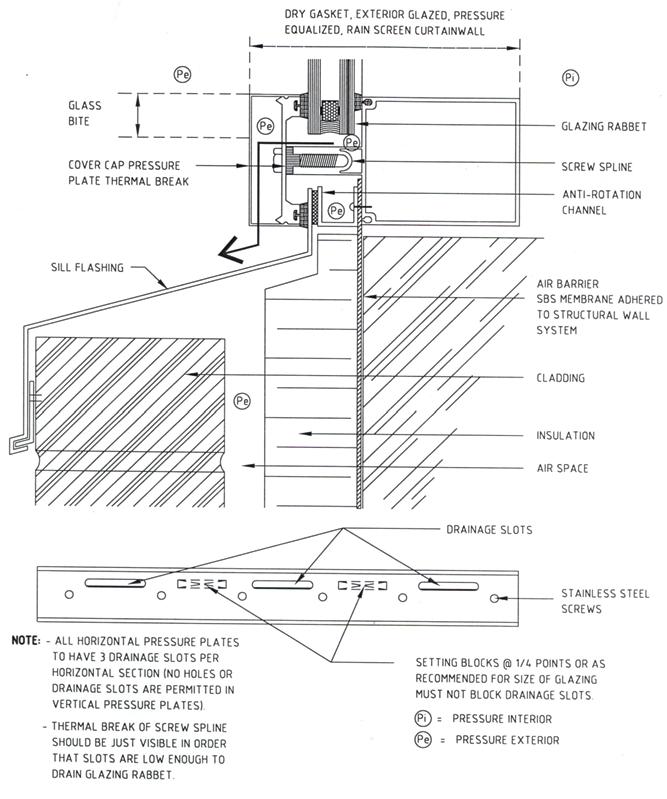
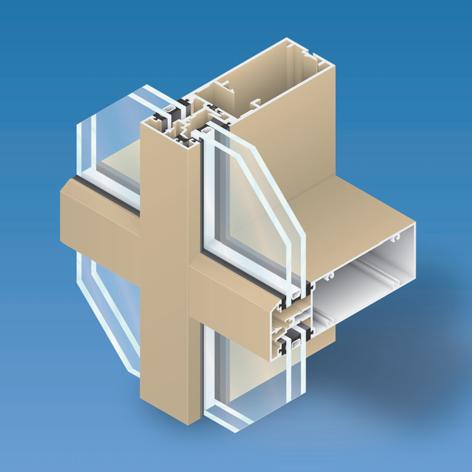
fastened back to the structure of the building. The tube face at the glazing rabbet functions as the plane of air seal and as the plane of water tightness. Continuity on one side of the nosing and thermal break is achieved by a tape or gasket to the inner face of the sealed unit while on the other side a membrane or sealant seal to the plane of air seal of the infill wall is used. The exterior lite to gasket/tape, to pressure plate to flashing acts as the water management plane. If water does leak past this exterior plane it is contained in the glazing rabbet, redirected to the exterior at the horizontal nosing and thermal break, through drainage slots in the pressure plate and eventually out through the bottom lip of the cover cap. The aluminum to aluminum joints of the curtainwall must be sealed and corner blocks installed to provide compartmentalize the system. Water is controlled and redirected to the exterior through the design of the framing and the components to provide a water tight installation. This concept may sound simple, but the details of how this is accomplished are complicated by the limitations and compromises imposed by the design and by the available systems. (Figure 1)
The sloped glazing system has the same complications with the addition that the water is now running on the tube face of the system and therefore cannot be drained through the pressure plate and cover cap on the exterior. The control and redirection of water entering the sloped glazing system is further complicated by the way it must contain and redirect the water back to the exterior. All joints are now susceptible to wetting and the sealed units are prone to resting in water for periods of time if a curtainwall system is used in a sloped glazing application.
Over the years specifically designed aluminum skylight systems have been created for sloped glazing applications. They include the following features and design requirements:
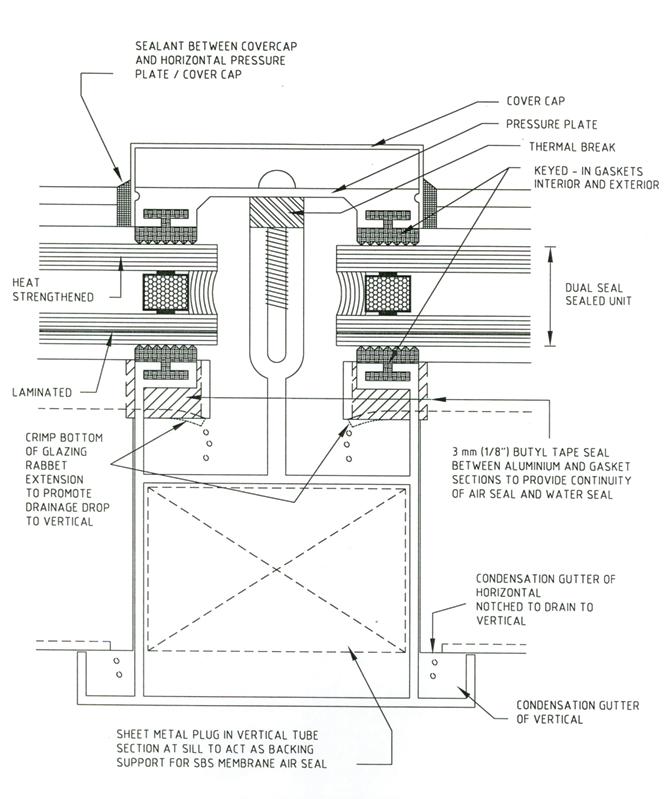
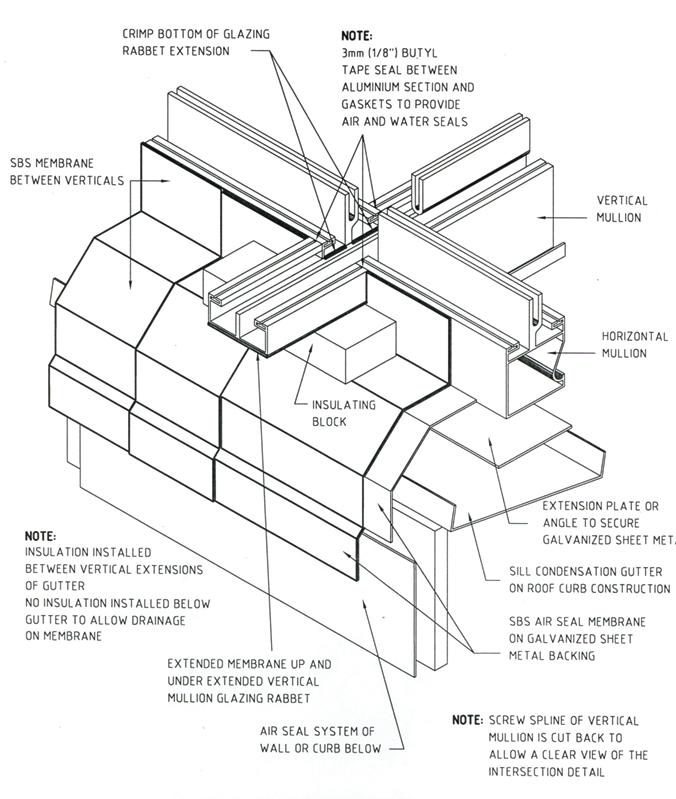
Elevated glazing legs create gutters in the glazing rabbets to contain the draining water and support the sealed glazing units above the water. The rafter gutters are deeper as they collect the water from the rails. The raised leg holds the keyed-in gaskets that elevate the sealed units so their sealants are not exposed to water. Exposure to water will prematurely degrade the sealants resulting in seal failure. (Figure 3)
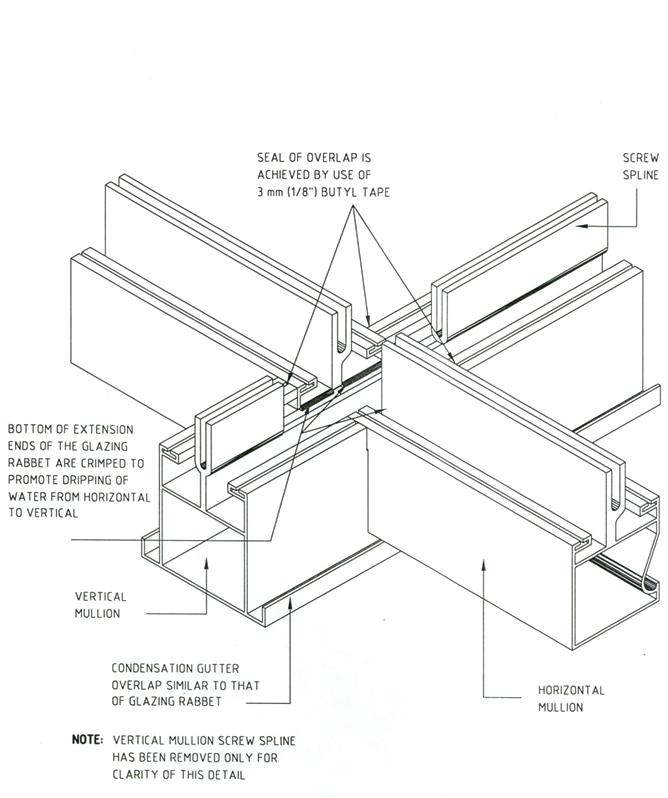
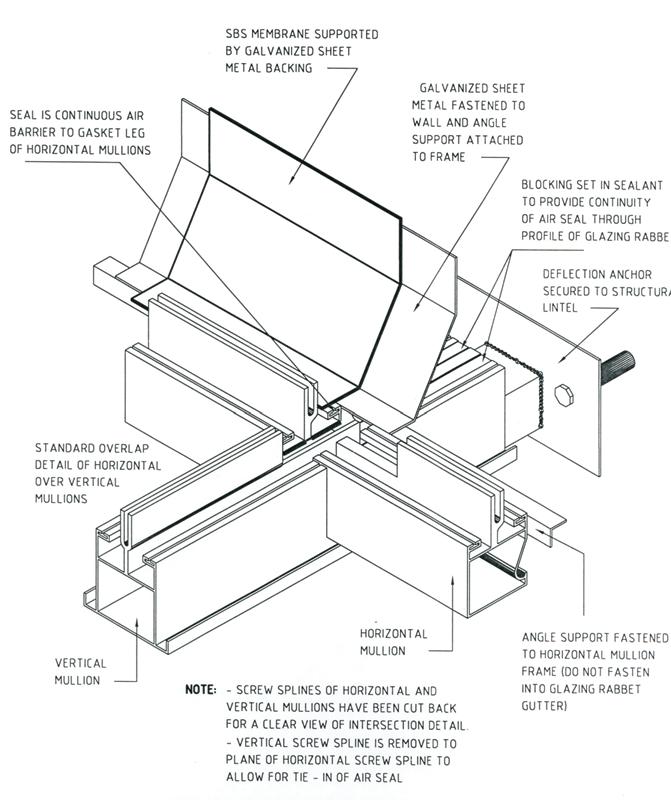
The glazing rabbet, rather than being compartmentalized by corner plugs, becomes the drainage gutter of the system and is elevated between rails and rafters to shingle the joints and not block drainage. The design of the overlap must create a drip point where gravity will overcome the surface tension of the water to cling to the aluminum surfaces. If it does cling to the
aluminum surfaces it could be drawn to the sealant joints between the aluminum profiles and degrade them. These sealant joints are critical in preventing water entry and maintaining continuity of the air seal. (Figure 4)
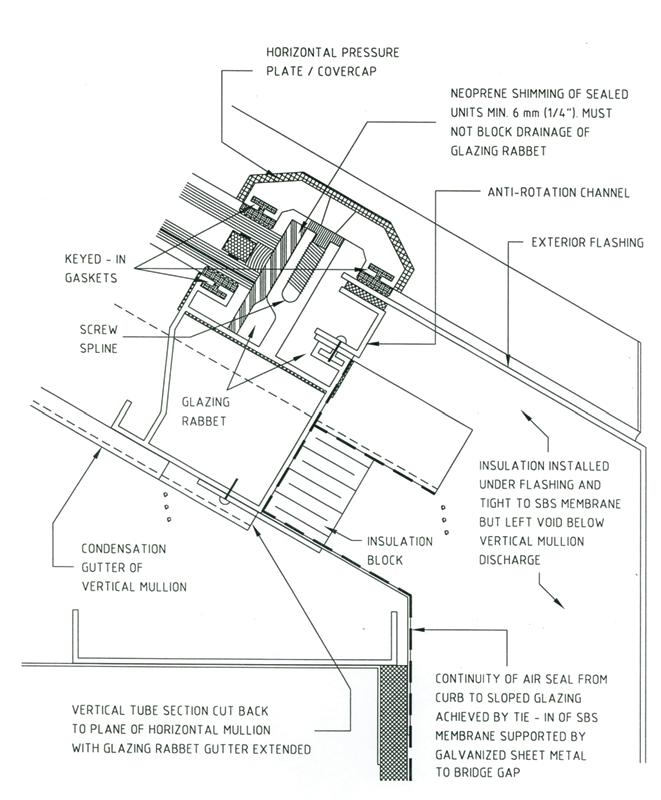
Drainage from the cavity of the construction above the sloped glazing would primarily be drained over the exterior of the sloped glazing system. The tie in of the air seal SBS membrane (supported by sheet metal) from the wall above should then be sealed to the elevated glazing rabbet leg at the top of the horizontal rail. Removal of the leg means that the critical membrane jointing would be sitting in water. The horizontal rail is a typical rail and it is sealed at the overlap junction of the lower glazing rabbet to the rafter. The upper glazing rabbet is extended to the mid-point of the rafter and neoprene seals installed in sealant between the underside of the extended rabbet, and the rabbet of the rafter, to maintain the air seal of the framing sections at their junctions. This removes some of the nosing sections and the profile creates the shingle overlaps between the various planes of components and membranes. (Figure 6)
At the sill the shingle approach is continued. Typical horizontal rails are overlapped to the rafter, which has the structural tube cut back to the plane of the bottom of the rail tube. The glazing rabbet portion of the rafter is left to extend one to two inches beyond this plane. Sheet metal is used to support the SBS membrane air and water seal from the curb to allow adhesion of the membrane to the rail sections and infill sheet metal blocking in the tube of the rafter. (Figure 5) The extension of the rafter glazing rabbet, beyond the jointing of the sections and the tie-in of the air and water seal SBS membrane, results in water draining off the end of the rafter and onto the membrane where it can drain to the roof. (Figure 2)
Differences in design
While the components and methods used to install both vertical and sloped glazing systems have a great deal in common, differences in their design will dictate how water bypasses the exterior deterrent seals is managed, which sets the two systems apart. How quickly the water is drained back to the exterior without contacting the sealant joints between the glass and aluminum components will determine the long-term performance of the systems and set the two systems apart.
As the designs of buildings and their construction methods differ, so do the designs and construction methods of each sloped glazing installation. Some simple concepts, however, can be the
Figure
SKYLIGHTS
difference between success and failure.
Realize there are limitations to the length of aluminum sections that can be extruded.
Realize manufacturers only have a few profiles available unless cost is no object.
Maximize the effectiveness of the outside sealant or gasket system, but do not rely on it to provide total waterproofing for the system. If this is expected then ongoing maintenance must be undertaken at significant cost.
•Minimize or eliminate the ponding of water at these exterior seal locations. This will prolong the effectiveness of the seals and reduce the buildup of dirt and other contaminants at these horizontal profiles.
• When water does get into the glazing rabbet it must be contained, controlled and redirected back to the exterior. The glazing rabbet of the sloped glazing system must provide a gutter that creates an adequate separation between water and the interior seals of the system. (Figure 2)
• Pressure equalization of the glazing rabbet will not perform to the same extent as it does in a vertical curtainwall systems due, in part, to the lack of compartmentalization of the interconnected glazing rabbets of the individual glazed units. It is still extremely important to provide an effective “air barrier” plane within the system. Without this separation between the inner and outer environments, the building envelope is incomplete and can provide a pathway for both air and water to be transported through the building envelope whether it is from inside to the exterior or from the exterior to the interior.
• In cold climates, a means of containing, collecting and disposing of condensation should be developed within the framing profiles to contain condensate water that might accumulate on inner aluminum and glass surfaces. This will depend on surface temperature, humidity and air movement. The use of add-on systems is usually an esthetically poor choice. The incorporation of condensate gutters as a safeguard against containment of water leakage through the glazing rabbet system is just poor design. The drainage of a condensate collection system must not be drained to the exterior, through the air barrier system, but should be drained from an evaporation trough at the sill or by mechanical drainage if a large amount of condensation is expected.
Controlling water
The main function of a roof is that it should not leak and the glass roof is no different. It should not leak. There is a great debate among glazing contractors and designers as to how this can be achieved, but ultimately the owner of the building is the person forced to live with or pay for the problems should the approach taken be unsuccessful.
Sole reliance of an exterior exposed seal as the only line of defence against water infiltration remains a fundamentally flawed concept. The continuous 100 per cent perfect seal in construction does not exist. The alternative is to design a water deterrent at the exterior joints of the exterior components that minimizes the retention of water at the joints and the possibility of water entry through the joints. Within the interior profiles of the glazing rabbet of the aluminum extrusions, a gutter system is created that raises the glazing from a location where it could be sitting in water. The gutter system should contain and redirect any water that passes
Continued on page 17
INDUSTRY NEWS
Oldcastle sells translucent wall and skylight business to Major
Oldcastle Glass has reached an agreement to sell its translucent wall and skylight business to Major Industries, a supplier to the translucent daylighting industry. Under the terms of the sale, Major Industries will assume the translucent wall and skylight backlog, and provide warranty support for existing installations. The sale, expected to close by the end of July, will allow Oldcastle Glass Engineered Products to focus on custom-engineered curtainwall, storefronts, architectural windows and skylights, which are key engineered products used to close the building envelope. Oldcastle Glass will market its curtainwall products under a new brand: Oldcastle Glass Skywall.
Bystronic and Urban Machinery partner to introduce high speed friction corner welding
Bystronic Solution Centre of Ottawa, Ont., and Urban Machinery, with its North American headquarters in Cambridge, Ont., have partnered to introduce a new high-speed method of sash corner joinery for window and door manufacturers. Bystronic’s patented Friction Corner Welding Technology, and the corresponding Friction Corner Welding equipment developed by Urban, promise dramatic manufacturing efficiencies in certain applications when compared with current hot plate or fusion welding technology.
The base technology utilizes corner webs, which are used to bridge and bond the profiles together. The webs are loaded in batches into a magazine where they are automatically cued by the machine into a clamping device. Profiles are directed into the web to create pressure and while a constant pressure is applied, the web itself is vibrated back and forth at a very high rate of speed. The combination of the pressure and vibration action creates a great deal of heat energy, fusing the components together in a mere few seconds. The clamping is removed, leaving a complete and welded square ready for secondary processing or assembly.
Throughputs and related cost
justifications will vary by specific application but manufacturers can expect significant reductions in welding time, work-in-process, number of processes and related capital equipment required, material waste, number of operators, amount of floor space required and material handling.
In its final embodiment this process will also integrate glazing and even improve the structural integrity of the welded sash. Additionally, due to the very short and concentrated weld cycle, the weld flash that is created is highly controlled and virtually non-existent, resulting in the elimination of secondary cleaning equipment in most cases. The process also promotes a cleaner factory environment and because it is very simple, results in extremely consistent product quality.
While the base machine utilizes many of the existing features and components of Urban’s fusion welders, the unique features in Urban’s Friction Corner Welding machine designs are the engineered solutions to the hurdles of vibration isolation, raw material variance and the realities of the ambient conditions present in high-volume window and door manufacturing facilities. Years of research, design and testing, have culminated in what is finally, in the proper application, a dependable, highspeed alternative to hot plate welding. Beta testing is expected to continue through the summer with the first production run of this equipment to be available for sale toward the end of 2008.
PFG Glass installs first fully automated Super Spacer TriSeal line in Canada
Edgetech I.G. has announced that PFG Glass in Langley, B.C., has installed the first fully automated Super Spacer TriSeal line in Canada. The state-of-the-art Lisec line is capable of producing up to 1,500 commercial insulating glass units per day when running two shifts. “Sustainable building and LEED certification are very important in our area. In fact, Vancouver is known as one of the greenest cities in the world,” says Ole Nielsen, founder and CEO of PFG Glass. “We were presented with Edgetech’s TriSeal at just the right time when we were really looking to
differentiate ourselves in the commercial IG market. Since start-up, the TriSeal line has been running very well and it has helped us capture the attention of architects and glazing contractors throughout British Columbia, Washington and Oregon.”
PFG Glass was founded in 1990 and currently operates from a 90,000-squarefoot facility in Langley. In the early years, the company focused primarily on the distribution of high-quality glass products. Since then, PFG has branched out to focus on insulating glass units for commercial and heavy-residential applications.
According to Steve Nielsen, vice president of administration for PFG, “Over the past couple of years we added a tempering line featuring a Uniglass furnace specially designed to temper soft coat low-E glass and we invested in the best software available to track and sort our products to meet the strictest delivery requirements of our customers. These investments are really paying off.”
“The performance numbers we have achieved with TriSeal have been stellar,” says Ryan Nielsen, vice president of operations for PFG. “But we are also enjoying the production efficiencies and product quality results from the fully automated Lisec line. Within two weeks of start-up, we were already producing approximately 400 units per day in one shift with excellent consistency and quality.”
Planning tool helps navigate LEED
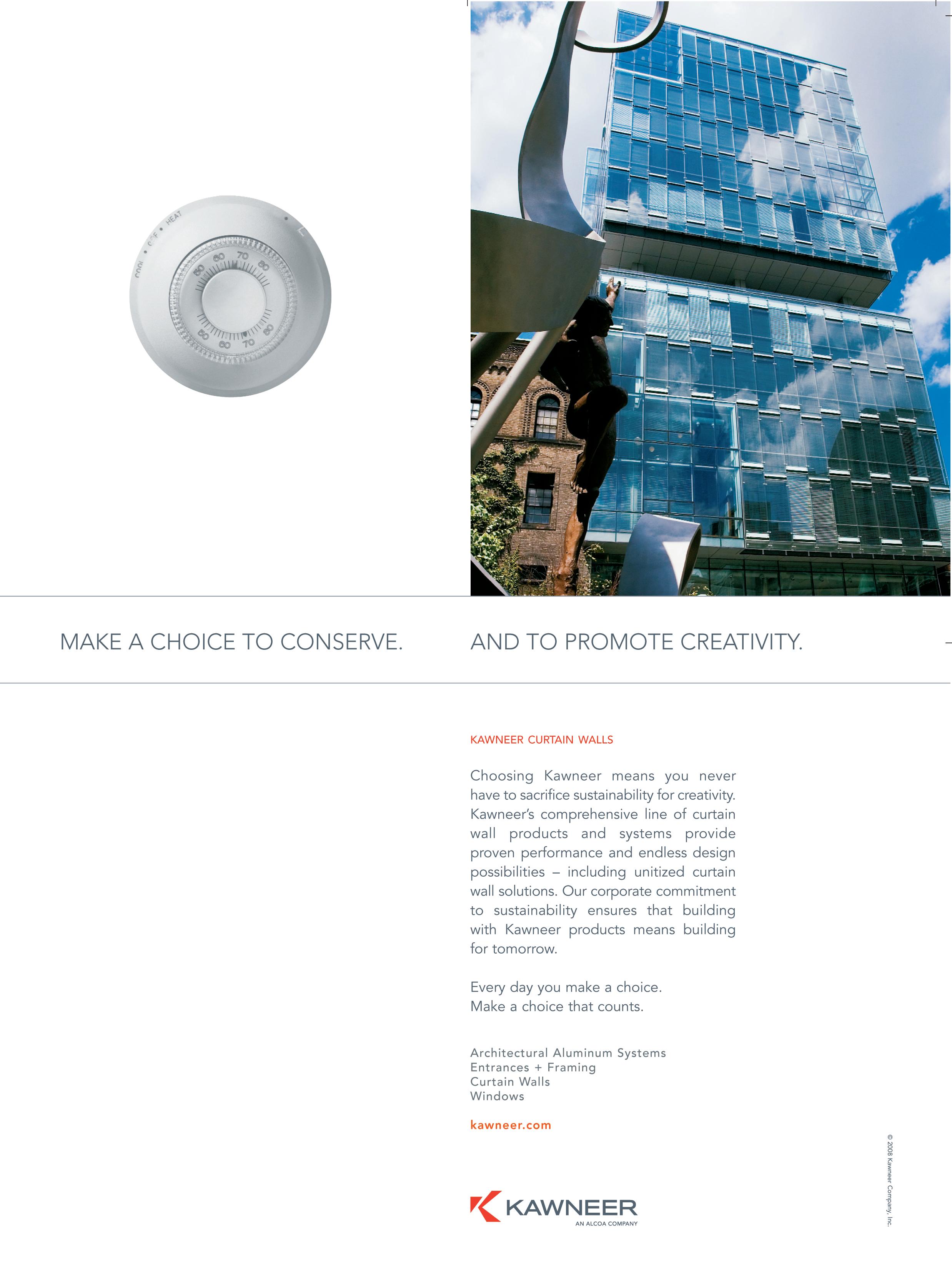
Kawneer Company, Inc. has released the latest version of its LEED Planning Tool. It is designed for use with the Leadership in Energy and Environmental Design (LEED) Green Building Rating System. The tool provides current and accurate information, more precise product recommendations, and is more closely aligned with LEED for New Construction Version 2.2, making it easier for architects to navigate the complex certification process.
As the requirements for LEED certification become more defined and stringent, it is critical that architects have the most up-to-date information as they go through the design and development stage. Designed as a working instrument, Kawneer’s LEED Planning Tool guides users to specific Kawneer products and solutions that can help achieve LEED
INDUSTRY NEWS
certification goals. The latest version of the tool includes fine-tuned product offerings and updated LEED requirements. The tool ties specific strategies to specific products and features sections for “Potential Points” and “Earned Points” based on the recommended products/principles for each LEED category. This allows users to estimate the amount of points that projects can earn and track their progress
SKYLIGHTS
Continued from page 15
through the inevitable imperfections of the exterior seals, from rail to rafter members in a raised and shingled design. The design of the overlap should prevent water from flowing over the joint air and water seal of the aluminum system. The rafter glazing rabbet gutter must be designed to collect all of the water that could enter it and direct it in a similar raised and overlapped design at the sill. Joints that are subjected to constant or periodic wetting are prone to limited performance.
The interior air seal of the system must still be continuous and will depend on details. In some designs and in some drawing details this air seal may also act as a water seal so they must use products that are designed to be waterproof, such as SBS membranes.
Control of water that infiltrates past the exterior seals is perhaps the most important attribute of a sloped glazing system, but the other functional requirements cannot be overlooked. The interweaving of air and water seals, overlapped and elevated aluminum profiled sections, sealants and membranes, is a tangled web, all of which must be designed, installed, inspected and maintained to provide the function it was intended to perform: Aroof that does not leak. ■
*Chris Makepeace works with Richard Ogle of Building Science Engineering Ltd., on building science problems throughout North America. He is also the owner of Chris Makepeace Consulting Ltd., where he does building science work and presentations for the design and construction industries. He can be reached at780-437-5800, or chris@bse.ab.ca.
toward certification.
Kawneer is dedicated to developing products and systems that comply with LEED standards and promote integrated, whole-building design practices. The LEED Planning Tool adds to the company’s already significant focus on sustainability. In addition to its sun control, photovoltaic and thermal product lines, Kawneer’s Architectural Services Team (AST) is available to help
with product applications and technical assistance. Kawneer is a member of the U.S. Green Building Council (USGBC), the industry group that developed LEED. The updated LEED Planning Tool can be downloaded at www.kawneer.com or requested through the “Contact Us” link on the website. Kawneer customers and architects can also obtain a copy of the tool by contacting their local sales representative. ■
Strength of steel
The superior strength of steel, and the SteelBuilt Curtainwall Systems from Technical Glass Products (TGP) allow architects and designers to use larger areas of glass, smaller frame profiles and wider free-spans than is possible with traditional aluminum curtainwall assemblies.
The SteelBuilt Curtainwall Infinity series opens up a new realm of design possibilities by offering back mullions of virtually any profile, including I-, T-, U- and L-shapes. The system can be used as a back mullion for almost any type of framing member that can bear the load of the curtainwall, including stainless steel and glulam beams. The back mullion can be adapted to meet nearly any required engineering loads, including high wind loads and large glass lites. As a result, curtainwalls can now provide glass sizes and free-spans that far surpass typical aluminum systems. In addition, materials and profile shapes integral to a building’s overall design may now be incorporated, allowing the curtainwall to better complement a building’s surrounding design and materials.
The SteelBuilt Curtainwall Infinity series is a dramatic improvement over traditional aluminum curtainwall assemblies, which are typically limited to square-tube back mullions, creating performance limitations as well as a visual break between the main structure and the curtainwall. The flexibility in mullion profiles allow it to be used in many different types of designs, from high-end urban storefronts and grand entrances, to rustic lodges and other facilities that incorporate wood throughout.
The exterior cover caps and interior back mullions of SteelBuilt Curtainwall Infinity series frames can also be made from stainless steel, an increasingly popular material. ■ Technical Glass Products (TGP), 800-426-0279, www.tgpamerica.com
Quality control during assembly
The Series 5250 Unitized CurtainWall from United States Aluminum draws upon years of design experience to deliver a unitized curtain wall system that lowers field installation costs
and provides higher performance capabilities. The unitized curtainwall system allows for shop fabrication, glazing and assembly in an interior environment. Higher field labour costs are avoided with shop assembly and allow for higher quality control during assembly. The completed panels are then shipped to the job site for assembly.
The Series 5250 Unitized CurtainWall is available as either a fully captured or vertically butt glazed system with a 2 1/2 inch sightline and 7 1/2 inch overall depth. The system is designed to be flexible with up to 2.5 per cent inter-storey drift to absorb building movement. The Series 5250 Unitized CurtainWall utilizes a unique three-way adjustable anchor designed for easy adjustment during erection. Thermal efficiency, a driving design requirement from the beginning, is accomplished by using a non-conductive injection-molded thermoplastic connector. Exterior and interior members are joined using the thermoplastic connector resulting in superior thermal performance.
Series 5250 accommodates a one-inch insulated glass infill or a quarter-inch spandrel. Dual or two-tone colours can be achieved by specifying different finishes for the exterior face covers and interior mullions. Finishes range from custom matched painted coatings to a wide selection of clear, bronze or black anodic finishes. ■ United States Aluminum, 972-937-9651, www.usalum.com
Eliminates damage
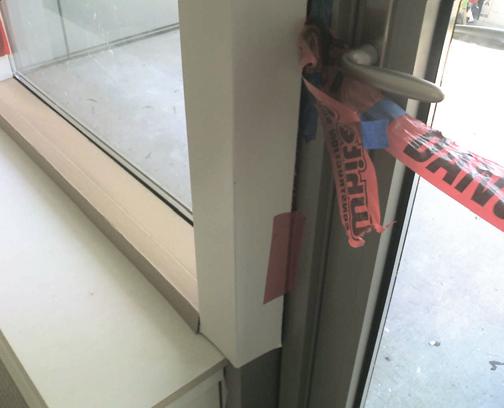
Hyde Park Enterprises (HPE) Inc., has introduced a new, economical and proven damage prevention product system: Curtainwall Protector (CP). It prevents damage to architectural metal-framed window units during the interior finishing of large-scale, highrise buildings under construction. It consists of a laminated and scored .080 calliper solid paperboard made from 100 per cent recycled fibres along with rolls of specifically formulated removable tape.
PRODUCT NEWS
Curtainwall Protector is designed and engineered as a damage prevention product system to meet specifications. It can be printed, perforated and coated according to the need of each application.
It is easy to use, ships flat, requires minimal storage, sets up and forms easily into vertical and horizontal applications and is held in place by a special removable tape that does not leave a residue.
Hyde Park Enterprises says Curtainwall Protector offers superior value in reducing or eliminating expensive damage at a relative small cost. ■ HPE Inc., 856-874-1830, rdbrenne@yahoo.com
Design flexibility
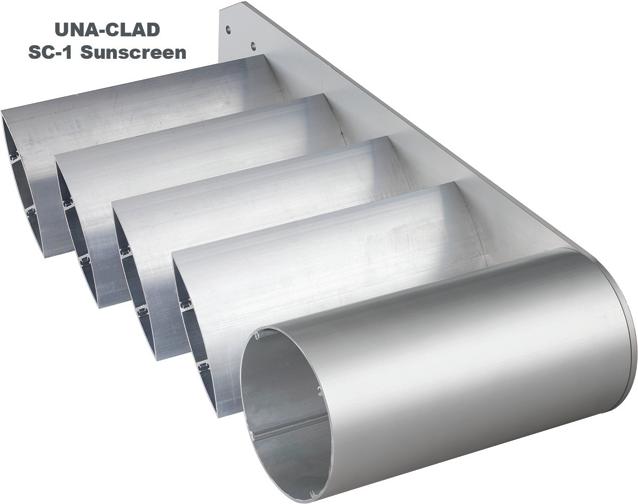
The UNA-CLAD SC-1 extruded aluminum sunscreen system from Firestone Metal Products provides industry leading design flexibility. Designers can choose from standard offerings or customize the SC-1 to fit any project. With its wide selection of blade types, outrigger profiles, wall attachment options and custom fabrication capabilities, the design options are endless.
The UNA-CLAD SC-1 blade options include welded or mechanically attached pieces that can be set to any angle and spaced as required. Available in a wide variety of colours and sizes, the SC-1 offers more options for maximum design flexibility.
The company says that while sunscreen products are not new, providing both pre-engineered standard and custom sunscreens will provide it with a unique niche in the building envelope market.
Bridgestone Firestone Diversified Products (BFDP) acquired Copper Sales in 2005 and now offers vertical wall panel and column cover product lines in addition to a full line of metal roofing products for the entire building envelope. ■ Firestone Metal Products Company, 763-712-5238
Dry joint rain-screen system
Southern Aluminum Finishing Co. (SAF) has introduced the SAF Series 4000 panel system, an affordable, dry joint, rainscreen system. The new architectural rain-screen wall panel system provides a defence against moisture problems by equalizing pressure between the interior and exterior environments by channelling air and water. Flashing and weep holes in the panel bottoms and vent holes in the panel tops can be added to allow for back ventilation and drainage.
Designed for both new build and refurbishment projects, SAF Series 4000 panels are available in a variety of cladding materials, including: Aluminum Composite Materials such as Alucobond, Reynobond and Alpolic, Aluminum coated with Fluorocarbon AAMA2605 coatings and anodized aluminum. Additionally, the SAF Series 4000 panels are designed for fast and simple installation, making them an economical choice for glazing contractors. Series 4000 panels are easily attached to walls with mechanical fasteners. Installers are supported by SAF’s full-service CAD Services department.
SAF is an aluminum distributor, aluminum fabricator, and aluminum finisher specializing in Kynar painting and architectural anodizing for architectural specifiers and glazing contractors. ■ SAF, 770-942-1207, www.saf.com.
Architectural systems and hardware
CR Laurence (CRL), has published a new AM09 Architectural Metals Catalog. This full-colour, 208-page catalogue is available online at www.crlaurence.com, as well as in print.
The AM09 includes an extensive selection of architectural systems and related hardware for the construction of codecompliant building façades, including cladding; column covers; wall, ceiling, and canopy panel systems; sunshades and glass awnings; perforated panels systems and architectural wire cloth; ornamental metals; aluminum and steel canopies and grilles; spider fittings; railing systems; standoffs systems; mall front clamps; windscreens, barriers, and wall protectors; and a variety of tools and accessories.
CRL’s architectural metals can be used in conjunction with the company’s door rails, exit devices, handles, railings, and other architectural hardware to create entire all-glass storefront entrance packages, including custom canopies and sunshades, and metal-clad columns. ■
CR Laurence 877-421-6144, www.crlaurence.com
More than 1,000 exhibitors at glasstec 2008
Key themes will focus on photovoltaics and solar thermal systems
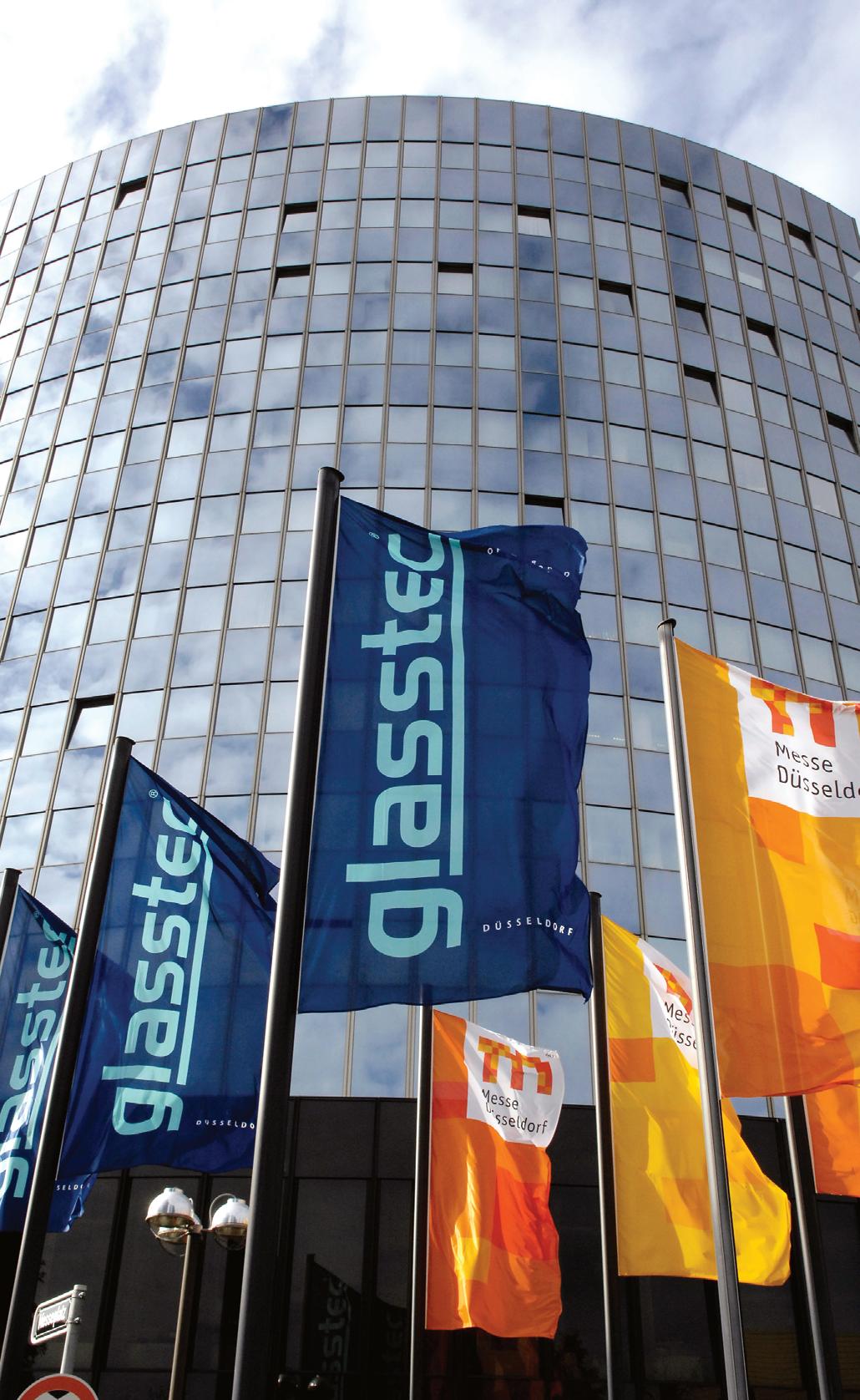
With more than 1,000 exhibitors reserving more than 705,000 square feet of exhibit space, glasstec 2008 promises to be the largest trade show to date in its history.
The International Trade Fair with Special Show glass technology live, takes place from October 21-25 in Düsseldorf, Germany.
“We are extremely satisfied with the great demand. We are receiving new enquiries from companies around the world every single day,” says project director Marianne Ingenhoven, adding that interest from international glass producers has increased compared to the previous event in 2006.
“Needless to say, this outstanding development for glasstec has not just happened coincidentally. Glass is today as much in demand as ever and companies naturally also want to participate in the world’s leading industry event,” adds Ingenhoven.
Two of the key themes at glasstec 2008 will be photovoltaics and solar thermal systems. The “Solar and Laser Center” in Hall 11 will display interesting innovations such as novel thin-film modules, with their films only measuring a few thousandths of a millimetre, they constitute a promising alternative to conventional silicon solar cells. The solar theme will also be the central topic on two of the five conference days of the Technical Symposium which will accompany the “glass technology live” Special Show.
The other segments of the glass industry will focus just as much on innovations that reflect the diversity of this booming market. In Hall 9, craftsman-type finishers and processors of glass will present their practical applications of this material, from the finishing of flat and hollow glass to the construction of glass furniture and the use of glass as a lifestyle product in modern architecture. In Halls 10 and 11, firms representing glass production will showcase new developments such as antimicrobial glass that kills up to 99.9 percent of bacteria for applications in both hospitals and nursing homes. There will be high-tech features such as titanium coatings applied to the outer side of glass lites, such as “easy-clean” coatings that allow sunlight to break down dirt deposits. The largest exhibition category at glasstec 2008 will be glass machinery and equipment manufacturing in Halls 12 to 17.
The Special Show “glass technology live” in Hall 11 will also have “glass and energy” as the main topic. The organizer, professor Stephan Behling from the Institute of Building Construction at the Stuttgart University will deliver a presentation that will cover both today’s resource-saving measures and a preview of tomorrow’s technologies. The Innovationpark will feature the four segments: Light and
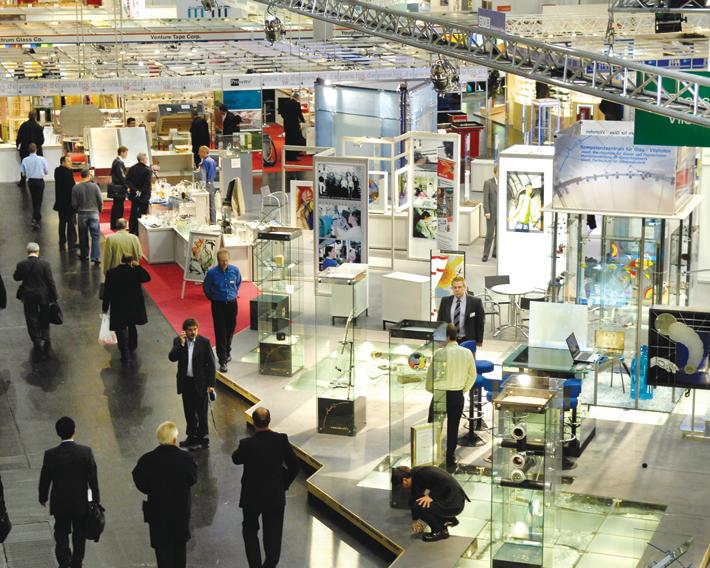
Left: The largest exhibition category at glasstec 2008 will be glass machinery and equipment manufacturing.
Transparency, Photovoltaics, Solar Thermal Systems, and Heat and Solar Protection. Current international architecture projects and glass applications will demonstrate the implementation and integration of the latest technologies in insulation glass, windows and façades and will provide information on the construction of energy-efficient and integrative building covers along with relevant manufacturing and production processes.
The accompanying symposium will address issues such as Glass for Energy-Saving and Energy Generating Applications and Glass Architecture. Case studies will provide compelling examples of the sensational and versatile applications possible with glass as a construction material. ■
For more information about glasstec 2008, contact Messe Düsseldorf North America at 312-781-5180, or e-mail info@mdna.com or visit www.mdna.com.
Above: Glass technology will be on show at glasstec 2008 in Düsseldorf, Germany.
EUROPEAN SCENE
Sustaining the sustainability
By John Roper *
Working with words you sometimes get a bit picky about how they are being used. Sometimes you get the feeling a word is in danger of being usurped rather than used, like when it is taken over by a particular group and turned into jargon. Lately, wherever I look, I keep coming across the word sustainable. It may be a world phenomenon but in the U.K. everything now has to be “sustainable”: windows, houses, energy, everything.
My Oxford dictionary gives sustainable as: “adjective. Able to be maintained at a certain rate or level.”
That could be fair enough; as far as building materials are concerned you could apply that as a rule. But, and here, for me, is the difficulty, how far back in the raw materials chain do you go? Cut down a tree and you can plant another. Eventually you will have more viable timber. Vinyl is a bit more of a problem. The planet has loads of salt – one of the main ingredients – but oil, another important ingredient, is not being replaced at anything like a sustainable rate, if at all. Aluminum is better off. Bauxite, from which it is refined, is the second most common mineral we have on the planet, though there may be an issue with what mining it does to the environment and the supply is not actually infinite.
Many of the arguments about sustainability seem to hang on the recyclability of the materials in question. Aluminum: 99 per cent recycling, better than mining and uses less energy than the original refining. Vinyl has a pretty good yield too and recycling has to be better than using up raw materials. Timber, go plant another tree.
Then there is the issue of sustainable buildings. Clearly they are sustainable, you only have to look at some of the centuries-old piles beloved of English
Heritage, an organization that is sharply against new and prefers that broken bits be mended before worn-out bits are replaced. But these buildings are not the issue here. The eco-warriors have moved on and are looking for buildings to supply their own power. Photovoltaic and other renewable sources emit little carbon.
However, you have to take into account the carbon emitted by putting up the building in the first place and manufacturing the building materials as well – including manufacturing the renewable energy generator. Modern buildings are conceived with a “life” so there is an issue with the recyclability of the components and the carbon emitted when it is eventually demolished.
This is not criteria you could apply to those ancient listed buildings I mentioned or even the Victorian era or 1930s and beyond. There are thousands of these houses, which probably make up the majority of the housing stock in the U.K. The existing stock is something that will have to be addressed if the government is serious about sustainability and not just about taking away even more of our money just to sustain itself. (You have to wonder why this eco-stuff is all sticks and no carrots.) It seems to me that there is an official blindness going on here.
These days to sell a house in the U.K. you have to produce, among other things, a certificate showing the energy efficiency of the property (another new service to create more paperwork, parting us from our cash and producing nothing useful in the process). My property, not untypical of its period or the locality in which I live, is constructed from nine-inch brick. Solid brick: they did not use cavities in the early 1930s but the buildings were built to last. In spite of double-glazing and roof insulation I
am sure it will not be high up the energyefficiency scale. Interestingly the government does not seem to want to address the problem of such old buildings. I guess they see it as having to put money in rather than take money away.
Which leads me to the sustainability of our replacement window industry. I have previously expressed the view that an industry set up to manufacture and install an individual building component is an anomaly. There are precedents of which the window industry is just one example, central heating also had its day. However you get to a point where the job is done and it is back to making building components for the heroes. Afriend of mine who works for a housing association, a privately owned provider of social housing, reckons the current problems faced by, mainly, the vinyl manufacturers are just a blip for the U.K.’s replacement window industry. Given the big pressure to reduce carbon emissions from buildings he reckons we will all be driven to replace our windows with more efficient versions. He is about to spend around $1.4 million of his $6 million building budget on upgrading the vinyl windows in the association’s estate. He reckons everyone will need to do the same over the next few years. Mind you, he replaced all of the windows in his own house four years ago – with hardwood. ■
*John Roper is the editor for The Installer, The Fabricator, The Conservatory Installer and Glass Works magazine published in the U.K. His comments reflect his opinions from the U.K. and may not be applicable in Canada.