Top Glass goes three-dimensional in 2022 with our first live show in three years. Here’s what’s on tap.
12 Labour online
As the challenge to find skilled workers intensifies, companies in the glass industry turn to different solutions.
24 Top Glass sneak preview
Here are some of the leading products you’ll see on the floor at Canada’s architectural glass event. 7 Canada’s Glass Associations 10 Fenestration and Glazing Industry Alliance
17 The Engineer by David Heska
26 That’s Rich by Rich Porayko
Episode #33: A Fond Adieu – Margaret Webb, FGIA (retired)
Margaret Webb has retired after 22 years of dedicating inordinate amounts of time, energy, passion and expertise to this industry. She was instrumental in creating not one but two industry associations: the Insulating Glass Manufacturers Alliance then the Fenestration and Glazing Industry Alliance. She joined GlassTalks to reflect on her incredible career.
A new trades regime
EDITORIAL
There’s no structural shift that will spur any huge surge in participation.
NEXT ISSUE
• Great glazing
Listeners to the GlassTalk podcast (available at glasscanadamag.com and wherever you find podcasts) can download my conversation with the Ontario Minister of Labour, Training and Skills Development, Monte McNaughton, and my follow-up discussion with Ian Howcroft, president of Skills Ontario, Angelo Cairo of Stouffville Glass and Brett Lucier of Provincial Glass. McNaughton replaced Ontario’s skilled trades regulator, the Ontario College of Trades, with a new agency called Skilled Trades Ontario in January. He joined me for a 15-minute conversation to explain the move, then my panel joined the podcast to comment on the Minister’s announcement and discuss skilled trades training and availability in Ontario generally. Some takeaways from the conversation... Not a lot has changed here in terms of how Ontario trades are actually regulated and certified. Requirements, testing, timelines and apprentice/journeyman ratios are all unchanged from the OCOT regime – which itself was not substantially different from the system that preceded it. There’s no structural shift that will spur any huge surge or decline in participation. Most of the changes have to do with streamlining and simplifying the process –worthy goals, for sure, but not any kind of paradigm shift. The elimination of some fees is welcome, of course, but not a gamechanger. No trades were added or removed from the compulsary list.
• Repetitive strain injuries
McNaughton hinted that deeper and more impactful changes could be in the works down the road. For now, I suspect the priority was to put a stake in OCOT as fast as possible and usher in a new brand and a new day. Predictions are dangerous, but I’ll go out on a limb and say we won’t see major changes to the regulatory framework any time soon. McNaughton seems to spend a lot of time listening to stakeholders and I think the message he’s getting from business owners is that simply finding workers is the pressing need. While there are certainly ample areas for improvement, the appetite is probably not there for an overhaul of the system with all the confusion and uncertainty that would create in the short term. In any event, it doesn’t look like glaziers will be made a mandatory trade any time soon.
My panel offered interesting perspectives on all this from three different directions. Lucier, as a non-union shop, commented that he was barely aware of OCOT in the first place as his workers didn’t need any certification from it. Cairo, on the other hand, brought his workforce into the union in an effort to improve his access to skilled workers. So neither are too concerned about what STO does – Lucier is taking care of training in-house and Cairo is relying on the union’s program. But one thing all three (especially Howcroft) could agree with was that the focus on promoting the trades with young people is welcome. It’s high time parents and students understood that trades training is not a dead end to a series of low-paying jobs but rather a route to good money and multiple opportunities in variety of fields, including business ownership. If nothing else, the ministry’s new focus is welcome for its emphasis on that. •
April 2022
Volume 34 • Number 2
Annex Business Media
P.O. Box 530, Simcoe, Ontario N3Y 4N5
READER SERVICE
Print and digital subscription inquiries or changes, please contact Shawn Arul, Audience Development Manager Tel: 416.510.5181
Fax: 416.510.6875
Email: sarul@annexbusinessmedia.com
Mail: 111 Gordon Baker Rd., Suite 400, Toronto, ON M2H 3R1
EDITOR | Patrick FLANNERY pflannery@annexbusinessmedia.com 226.931.0545
COO | Scott JAMIESON sjamieson@annexbusinessmedia.com
SUBSCRIPTION RATES
Canada - 1 Year $37.00 (plus tax)
U.S.A. - 1 Year $85.00 (in CDN dollars)
Publication Mail Agreement #40065710 Printed in Canada ISSN 0843-7041
Occasionally, Glass Canada will mail information on behalf of industry-related groups whose products and services we believe may be of interest to you. If you prefer not to receive this information, please contact our circulation department in any of the four ways listed above.
KPS Capital Partners has announced it has signed a definitive agreement to acquire Oldcastle BuildingEnvelope from CRH for approximately $3.45 billion in cash. Completion of the transaction is expected in mid-2022. OBE is a leading vertically integrated manufacturer, fabricator and distributor of architectural hardware, glass and glazing systems. Headquartered in Dallas, Texas, OBE is a world-class building products company with significant presence in every major metropolitan statistical area in the United States and Canada. The company manufactures high-performance architectural glass products and aluminum framing systems and, through its subsidiary C.R. Laurence, distributes complementary branded hardware and glazing supplies. OBE delivers products to a broad customer base of architects, glaziers, contractors and developers serving diversified residential and commercial construction end-markets. The company has over 6,700 employees and operates 84 manufacturing and distribution facilities in five countries.
Raquel Vargas Palmer, co-managing partner of KPS, said, “We are thrilled to acquire North America’s largest provider of architectural hardware, glass and glazing systems. OBE is the only ‘one-stop shop’ for every critical product a glazing industry customer needs and the company serves attractive, growing, end-markets. We intend to drive profitable growth by providing the company with the financial resources to invest in
commercial and operational excellence. We will leverage KPS’ decades of manufacturing expertise to create an entrepreneurial culture centered on innovation, continuous improvement and excellent customer experience. OBE has demonstrated a strong ability to integrate synergistic acquisitions over the past several decades and we will provide strategic support and capital in pursuit of future growth opportunities. We look forward to partnering with OBE’s talented employees and management team under the leadership of president and CEO, Liz Haggerty, to accelerate the company’s value creation opportunities.”
Haggerty said, “The entire OBE management team looks forward to partnering with KPS as the company begins its journey as an independent company. KPS has an exemplary track record of investing in and improving manufacturing businesses and we are exceedingly confident that they are the right partner to help us execute on our strategic plan. We will continue to build on our industry-leading reputation for quality, reliability and product innovation. KPS’ experience with manufacturing businesses and the significant capital resources available will allow us to invest in our commercial and operational growth strategy. We intend to expand our capabilities as a customer-oriented solutions provider in architectural hardware, glass and glazing markets. We are very excited about OBE’s future opportunities and we have found a great partner in KPS to capture them.” •
GORDON RETIRES FROM FENBC
Zana Gordon, Fenestration Association of BC executive director, will retire at the end of March. Gordon began her career in association management over 25 years ago. She first joined the industry in 2008 as the executive director for the Glazing Contractors Association of BC and in the following year with the Window and Doors Manufacturing Association of BC. In 2012, both groups merged together to form the current association. The FenBC board of directors reports it is looking at a few options for succession.
“I’m a hippie in time and in my heart,” Gordon commented. “I am looking forward to time spent with family and friends, more leisure reading, painting and clay work. I am excited about having the ‘time of day’ to listen.”
Zana’s granddaughter, Adelyn, is excited to be able to spend more time with Grandma.
CANADA’S GLASS ASSOCIATIONS
FENBC
Zana
Gordon’s retirement has been postponed until April as she assists the FenBC board of directors with its transition plan. Major announcements will be coming from the association soon. Most other activities are on hold while we work on this. Some dates to keep in mind: FenBC golf returns May 12 at the Northview Golf and Country Club in Surrey. RSVP by May 9. Also, start looking forward to our Industry Conference in October. Details TBD.
AVFQ
The Association de vitrerie et fenestration du Quebec (AVFQ) takes the representation and defense of its members to heart.
For several years, multiple associations, including the AVFQ, have been grouped together in the coalition for prompt payments for construction contracts. Moreover, one of the principals who pays its contractors and other clients with very long delays is the Quebec government. A pilot project was held during 2021 to test a pre-defined schedule and payment terms. A light is coming from the end of the tunnel! The coalition has been heard in a parliamentary committee and it is possible that the whole thing will lead to a law shortly.
Under the theme “The future is now,” the AVFQ’s annual conference will feature more than a dozen workshops and conferences. The pandemic has forced us to move the annual conference originally scheduled for February. It is also time to book on April 21 and 22 at the magnificent Chateau Frontenac in Quebec. The program and registration are available at avfq.
ca. The Prix Lumieres Gala will be back to reward the most beautiful projects in the industry. It will also be an opportunity to launch the AVFQ’s 60th anniversary celebrations.
The Regie du batiment du Quebec (RBQ) is the organization responsible for implementing provincial building regulations and codes. It has adopted the new Quebec building code in recent weeks. As a result, reference is made to the CSA A440.4:19 standard which has also been recently updated. The AVFQ, which is a provider of training for window installers across Canada in French and in English, has modified this training to take into account the changes made to the standard.
The AVFQ is organizing a trade mission to Germany in French from July 9 to July 17. During this trade mission, participants will visit plants in Germany and attend the world-leading trade show for window, doors and facades, Fensterbau Frontale. Remember that Fensterbau Frontale had to be moved from March to July because of the pandemic. Forty manufacturers will be part of the Quebec delegation.
The AVFQ is the industry’s leading association for its 200 members!
AGMCA
Hundreds of our journeypersons and apprentices across Ontario and Canada will recognize the name Steve Laird. Steve was our lead glazing instructor at the Finishing Trades Institute on Toro Road in Toronto for the past 17 years. In order to achieve your certificate of qualification to become a journeyperson glazier, you needed to spend a lot of time with Steve learning the craft. Steve retired at the end
of December, after a 17-year run at FTI. While there, Steve helped us develop the current curriculum. He developed the zero-to-eight-ton crane course and provided the training on the spider crane and swing stage. He was certified in the AGMT program. Steve was asked to join the CSA group that developed a certification program for low-rise residential buildings. He chaired the Architectural Glass and Metal Trade Board Committee for two terms under the Ontario College of Trades, as well the Red Seal Occupational Standard Committee. Steve represented Ontario in the review of our certificate of qualification exam program and worked closely with the Ministry of Colleges and Training.
Steve started in the trade in Sault Ste Marie in 1979 before moving to Toronto and in 1985 joined Emery Glass, until it closed in 1993. He was hired by C.J. Rush Rovico and worked on many high-profile jobs, including the OPP headquarters in Orillia, Ont., and the Metro Toronto Convention Centre. Steve went on to work with
Guildwood Glass and then Millennium Glass, before eventually recognizing his passion to train young apprentices in the craft he had mastered.
The member glazing contractors represented by the AGMCA are indebted to Steve for his dedicated service to our industry.
OGMA
AndrewDolphin’s term as president of the OGMA concluded at the end of 2021 and on behalf of the entire board of directors we would like to thank Andrew for his direction and leadership over the past number of years.
Jeffrey Makimoto has been voted in as president for the next two-year term. Steve Ringler with Alumicor takes on the vice-president role.
Until Omicron raised its ugly head at the end of 2021, things were looking good for our spring golf tournament scheduled for Thursday, June 2, at the Pipers Heath Golf Club. We’re keeping our fingers crossed that we’ll be able to hold this event so mark your calendar now and think positively. •
Noel Marsella ( L) and Joe Buck of the AGMCA presented Steve with his industry achievement award.
FGIA recognizes industry leaders
The Fenestration and Glazing Industry Alliance recognized the contributions and achievements of its members and congratulated award winners at the Annual Awards Ceremony at the end of the first day of the FGIA Hybrid Annual Conference, which took place Feb. 28 through March 3. Awards were presented by the previous year’s winners, who recognized recipients for their many efforts toward progressing the work of the association and the industry overall.
Outstanding Service Award –Donnie Hunter (Kawneer)
The Outstanding Service Award was presented to Donnie Hunter, director of global product development at Kawneer, by the previous award recipient Joe Hayden, principal engineer at Pella.
The Outstanding Service Award recognizes individuals who have distinguished themselves in their work and dedication to the advancement of FGIA and the industry as a whole.
“As the leader of FGIA during both its beginning stages in 2020 as well as a global pandemic, Donnie has seen our membership through some turbulent times,” said Hayden. “We have all seen that firsthand. FGIA staff in particular recalls him being exceptionally responsive and generous with his time in addressing his board chairman role.”
Hunter is now the outgoing chairman of the board. He is also co-chair of the FenestrationMasters program management committee, displaying care and expertise in helping the next generation of industry leaders through education and professional development. He has been involved in the activities of the North American Fenestration Standard and the Aluminum Material Council marketing committee, as well as steering committees focused on education, regulatory and technical activities.
Architectural Distinguished Service Award – Josh Wignall (Quaker Window Products)
The Architectural Distinguished Service Award was presented to Josh Wignall, director of commercial marketing at Quaker Window Products, by the previous award recipient, Ivan Zuniga, manager of new product development at Kawneer. This award recognizes an individual who accomplishes formative work on behalf of the association and the Architectural Products Council.
“FGIA is lucky to have Josh as such a dedicated member,” said Zuniga. “He has displayed great enthusiasm and knowledge at all levels within FGIA. His passion for his work does not go unnoticed. FGIA staff described him as someone who can always be counted on. Without being asked, he just jumps in and does whatever is needed to help the association, build connections and make everyone feel welcome.”
In addition to his other leadership roles in the association, Wignall serves as chair of the AMC marketing committee and is APC co-chair of the marketing and engagement steering committee. With well-rounded interests in industry matters like the aluminum strategic plan task group and sustainability web page development, he has brought much to the table with FGIA, said Zuniga.
Residential Products Group Distinguished Service Award – Tony Vella (Vision Extrusions)
The Residential Distinguished Service Award was awarded to Tony Vella, vicepresident of materials, at Vision Extrusions, by the previous award recipient, Todd Stratmoen, corporate engineering initiatives manager at Larson Manufacturing. Each year, a member who excels in work toward improving the association and the Residential Products Council is recognized with this distinction.
“Tony’s technical expertise is well-known and highly respected in the vinyl industry through his ongoing work as chair of several technical committees within FGIA, involvement with ASTM and working with various groups in NRCan and Natural Resources Canada,” said Stratmoen. “He has contributed significantly to the advancements of the same in the vinyl sector.”
Vella’s FGIA involvement includes serving as second vicepresident of the Vinyl Material Council and acting as chair of the VMC environmental stewardship committee along with several other committees and task groups.
Glass Products Council Distinguished Service Award –Bill Briese
(GED Integrated Solutions)
The Glass Products Council Distinguished Service Award was presented to Bill Briese, R&D/engineering manager at GED Integrated Solutions by the previous award recipient, Helen Sanders, strategic business development at Technoform. The association recognizes a member with this award each year as one who excels in work toward improving the association and the Glass Products Council.
“Bill can see what others enjoy and care about, even if he doesn’t totally appreciate that thing himself,” said Sanders. “This characteristic is evident in his engineering, industry committee work and equipment design. He carefully listens to input from customers and industry associates. Then, he considers this input and includes requests whenever possible.”
Briese’s impact on the industry is especially visible in the area of education. For years, he has been a presenter at the annual IG Fabricators Workshop, where he shows demonstrations of glass cutting and washing. His prominent roles within the association include serving as chair of the IG fabricator workshop/preventing IG failures task group and GPC co-chair of the education steering committee.
Marketing Distinguished Service Award – Neall Digert (Solatube)
The Marketing Distinguished Service Award was presented to Neall Digert, vice-president of product enterprise at Solatube by the previous recipient, Carl Troiano, owner and president of Trojan Powder Coating. This award acknowledges a single individual who has exhibited leadership and outstanding service in marketing activities for the association.
“Neall continues to be a strong advocate for not only the skylight/sloped glazing council, but for FGIA as a whole,” said Troiano. “His input is always professional, rational and well thought-out. He regularly offers constructive comments in areas beyond just sloped glazing, which indicates a genuine desire to do what’s best for our customers and the industry at large.”
Digert’s involvement with FGIA includes his role as chair of the skylight/sloped glazing codes and regulatory affairs committee as well as being second vice-president of the skylight/sloped glazing council.
Chairman Award – UL
UL was honored with the 2021 Chairman’s Award, which is given to an FGIA member company by the current or outgoing FGIA chairman of the board. UL was selected for distinguishing itself over the past two years, with outstanding commitment and dedicated support to the association and the industry. This award was accepted by Robert Jutras, principal engineer for building envelope performance at UL and presented by FGIA outgoing chairman, Donnie Hunter.
“Robert has a keen ability to take complex technical topics and break them down in layman’s terms,” said Hunter. “He does this especially well in the many seminars he has hosted during these very conferences. He has also been a critical resource for FGIA’s monthly webinar program, contributing to these educational pieces for the good of the industry.”
UL is a testing laboratory specializing in performance evaluation of building envelope components. The Building Envelope Services Canadian headquarters is located in Varennes, Que., a suburb of Montreal.
Value of building permits surged in 2021: StatCan
Thetotal value of building permits surged 25.6 percent to $126.5 billion in 2021, the strongest annual growth ever recorded. However, material price and labour cost increases in the construction industry accounted for almost two-thirds of the increase. On a constant dollar basis the total value of building permits still increased by a robust 9.3 percent to $88.5 billion. Construction intentions in the residential sector in 2021 were up 29.9 percent, reaching a record $87.2 billion. Single family permit values jumped 41.5 percent to $40.7 billion, representing 81,000 new units – the most since 2013. Canadians showed interest in moving away from larger city centres over the course of 2021, with smaller census metropolitan areas such as Peterborough, Ont., (up 134.1 percent), Barrie, Ont., (up 107.5 percent), Oshawa, Ont., (up 79 percent) and Kelowna, B.C., (up 75.8 percent) reporting large gains in construction intentions. Multi-family permit values also hit a record high for the year, rising 21.1 percent to $46.5 billion. Similar to the trends in single family construction, the multi-family component also saw faster growth in smaller areas such as Kelowna (up 175.1 percent), Lethbridge, Alta., (up 159 percent), Saguenay, Que., (up 145.1 percent) and Trois-Rivieres, Que., (up 120.3 percent). The non-residential sector in 2021 was up 17.1 percent to $39.6 billion, continuing its recovery to 2019 levels. Only the institutional component exceeded pre-pandemic levels, while the commercial and industrial components were both roughly eight percent below 2019 totals.
NEW: SWISSPACER EPD environmental declaration
Keep the cold at bay –for a sustainable future
The Environmental Product Declarations (EPDs) help architects and planners to select the most sustainable products for their projects. This is the first step on our journey to carbon neutrality by 2050.
Learn more at www.swisspacer.com
Amy Roberts is FGIA director of Canadian and technical glass operations by AMY ROBERTS
Focus: accessibility
Including effective accessibility requirements within various Canadian building codes has taken on an enhanced momentum in recent years. The development process features a network of organizations and committees to channel the perceived needs of various stakeholders, ensuring meaningful input from the public, the disabled, and implementers at all development stages. The Provincial/Territorial Policy Advisory Committee on Codes has ranked accessibility as second only to “alterations to existing buildings” as priorities for national model code development for the 2020-2025 code cycle. Accessibility provisions in the National Building Code include requirements for the design and construction of barrier-free access, encompassing building entrance elements that include exterior doors.
At the federal level, accessibility was substantially addressed in June 2019, with passage of the Accessible Canada Act (Bill C-81), which is analogous to the Americans with Disabilities Act in the U.S. The ACA as passed has little in terms of specific accessible construction requirements, instead establishing the regulatory environment: the organization, reporting procedures, enforcement measures and a feedback mechanism. The current focus is on improving transactional accessibility in banking, transportation and telecommunications.
The next step will be the creation of actual accessibility standards. For example, Accessibility Standards Canada and CSA are collaborating on the development of three accessibility standards.
ASC/CSA B651, “Accessible Design for the Built Environment,” is to be referenced within the NBC and various provincial codes or standards. The upcoming new edition will provide require-
While current developments have not yet focused in detail on fenestration, it is clearly on the menu.
FGIA
ments involving the exterior environment, circulation (elevators, escalators and moving walkways), tactile walking surface indicators, dwelling facilities and emergency egress.
B651 currently includes fenestration-related provisions for accessible hotel-type sleeping units. These cover window sill height and operability, door closers and the maximum operating force of exterior swing doors.
ASC/CSA B652, “Accessible Homes,” will be a national standard of Canada. It is already in development with funding from the Canada Mortgage and Housing Corporation.
Meanwhile, at the provincial level, British Columbia exhibits leadership in the form of its Accessible BC Act (Bill 6). This act facilitates accessibility standards that could be in place as soon as the end of 2022. It directs the B.C. government to establish a committee, now the Provincial Accessibility Committee, to advise the provincial minister on accessibility matters and support the development of related standards.
The 2018 BC Building Code governs new construction and alterations and includes minimum requirements for accessibility. Its focus is on pathways and building access, placement of signage, illumination and accessway dimensions with no specific mention of windows. Designers are given the option of following the accessibility provisions of the B.C. building code subsection 3.8.3., or those in the CSA B651 standard. Note that input from a recent online survey of various stakeholders sought feedback to inform code change proposals. It will be published later in 2022. In 2023, feedback will be sought on actual proposed changes.
There is a widely recognized need to evaluate where gaps in accessibility standards currently exist and identify priority areas that should be addressed. The development framework briefly summarized above shows how the stage is being set to effectively fill these gaps.
While current developments have not yet focused in detail on fenestration, it is clearly on the menu. We should take advantage of the many points of input made available by both federal and provincial governmental entities to monitor developments and weigh in as warranted at the numerous available stages. •
Sourcing labour
Sourcing skilled labour online
by ANDREW SNOOK
To say there is a shortage of skilled workers available during normal times in Canada would be a serious understatement. Add in the complications brought on by a global pandemic and many companies are left struggling to fill roles through online hiring and remote interviews via phone, Zoom or one of the many other online meeting tools.
“Obviously, it’s an aging industry right now – there’s not a lot of youth in it. Some of the older people aren’t as tech savvy so we run into issues with that,” says Brett Lucier, president of Provincial Glass in London, Ont. “Doing online video interviews has been a nightmare because of the technology thing – having guys that aren’t tech savvy log in.”
Lucier has found hiring through the COVID-19 pandemic challenging over the past two years. His company has tried a wide variety of options to find skilled workers online. Some have been fairly successful, while others have not.
“Even to find them has been challenging – getting on a job bank, or on Kijiji, Indeed or social media. It has been challenging but it has come with some humorous things. I had a guy show up in a tux for a video interview,” Lucier says.
He says the best solution for finding people through the pandemic has been tapping into his online connections.
“Honestly, word of mouth has still been the best online...just asking, ‘Do you know someone?’ on social media,” he says. “Social media has been great. There’s multiple trade business groups, so if you’re looking for a specific glazier with some experience, it’s become easier to ask that way. It’s at least a good starting point.”
Facebook has been the most useful social media tool to date for Lucier.
“We have a pretty wide net in this area. I do network quite a bit, so I have a higher number of connections to choose from, so it works pretty well,” he says.
Lucier also continues to post jobs online, but success in finding qualified candidates has varied significantly.
“For throwing up a job posting, Indeed has worked well. I avoid Kijiji and the government job bank,” he says.
One anomaly that Lucier had never experienced pre-COVID was the number of no-shows for interviews.
“You struggle to get people to apply, contact them for interviews and then, whether it was a phone call or video call, it used to be 100 percent would show up. Now, so many people are not showing up for interviews – they ghost you,” he says. “My last round I set up 12 interviews. I had a couple of really funny ones, a few terrible ones (I knew right away when I started talking to them they weren’t good), one good one, one alright one and three no-shows. Once you selected someone for an interview and they agreed to it [pre-COVID], I’d never had someone not show up.”
Even when a company is lucky enough to find an experienced candidate, that doesn’t mean that person is the right fit.
“Sometimes we find people that are very well experienced, but that can be a negative. Because the more negative experience they have, the more bad habits they have,” Lucier says. “We’ve had more luck hiring younger people with less experience – prior tool or construction experience
– but have a willingness to learn. Training people coming up through the company are the best experiences I’ve had.”
Promoting the industry
While the federal and provincial governments are making some general efforts to promote the skilled trades, they certainly don’t appear to be trying to educate the general public about career opportunities within the glazing industry.
“Nine out of 10 people on the street have no idea what a glazier is. It’s not a fun, sexy trade, but it’s a necessary trade, and not a lot of kids are going into it,” Lucier says, adding that most of the people entering the trade are tradespeople from other professions. “It’s somebody that was a plumber who doesn’t want to be a plumber anymore, and he talks to the guy on site installing the windows and wants a switch – someone that knows someone in the business.”
He says that industry associations could also do more to promote the trade and provide better training opportunities.
“Plumbers, electricians and trades like that have great training programs in multiple locations, where it’s pretty limited in our industry,” Lucier says.
Glazier Nation
While many glazing contractors have been frustrated by the online hiring processes since the onset of the pandemic, one
organization south of the border has gone to impressive lengths to build an online community for hiring professional glaziers all over the U.S. and Canada.
Glazier Nation is an effective online meeting place for employers and job seekers within the glazing industry in North America. The organizer’s website (glaziernation.net) allows people to sign up for weekly job reports and allows employers to post their jobs for industry professionals for free.
Some of the more popular job categories include apprentice and journeyman glaziers; glazier superintendents and foreman; commercial project managers; commercial estimators; general labourers; and fabricator superintendent/foreman, although many more categories of jobs are available to view.
In addition to recruiting hundreds of glaziers into the industry across North America, Glazier Nation also offers training and placement services to industry professionals.
The Glazier Nation initiative is spearheaded by two industry professionals: Glazier Nation founder, Matt Day, and David Schwieterman, president of Global Construction Industries, a production software provider.
Schwieterman says there are lots of places to look for sourcing skilled labour, including tapping into networks of labour contractors like Glaziers on Demand; tapping into state or provincial departments of labour; technical schools; federal veteran recruiting programs (Helmets to Hardhats, for example); third-party staffing specialists; local unions; job fairs; industry associations and more.
He says its vital that companies be consistent and have job postings available at all times.
“There’s a reason we say that consistency always wins the battle. Finding labour a month before a job starts – it shouldn’t be a surprise that it doesn’t work very well,” Schwieterman says.
He adds that companies should keep those job postings consistent to find that “diamond in the rough.”
“Say someone is out there looking for a job but you’re not actively posting a job at that time. You could lose the potential to have a great candidate that is between jobs at another employer, so I really try encourage companies to always have a job posting out there,” Schwieterman says.
When it comes to effective job postings, less words and better content is key.
“What that may mean is people like videos. They don’t want to read through a big article all the time,” Schwieterman says.
“So, when you have that job ad on Glazier Nation’s Facebook page, make it have that viral feel so they want to click on it to read more.”
Another key aspect to consider is promoting job security within the company and any other reason why a potential employee should come work for them, not just the requirements of the job.
“Everybody out in the field wants to know about the backlog. I’m not going over to the company unless I know more about the jobs they have coming up – how long this job is going to be? These are just key things to put into your social media post or your job listing,” Schwieterman says.
Telling potential applicants about the opportunities to
grow in the company and the benefits of working in a particular city can also be advantageous.
Profit-sharing opportunities and bonuses are also items to note in your postings, he adds.
In the case of Glazier Nation founder, Matt Day, it would be difficult to find an individual responsible for recruiting more people into the glazing industry. Day says he uses several key steps for recruiting.
“It’s like a business. If I want my business to have sales, I need to have marketing lead generators that my salesman can close on. And if I want to be able to be a good recruiter, the number-one thing I have to have is an active website where I’m engaging people to come to my website to apply – not just ‘Look at my company’s portfolio or what we do,’” he says.
Day says he keeps his job postings on glaziernation.net promoted months ahead of time for projects to help ensure the right people, and the right number
“I really try to encourage companies to always have a job posting out there.”
- David Schwieterman, Glazier Nation
of people, are recruited to work on a project. It also allows him to have ample time to help recruit more local people to a particular job, which is key to ensuring a project is as profitable as possible.
“The amounts you make on your jobs by hiring local is where you make money and lose money in the glass industry,” he says. “If I’m bringing in a guy from Dallas and I’m going to D.C. with him, my costs go up 20 to 25 per cent. And if you’re talking a two- to three-million-dollar job, that’s massive. Keeping those job posts local when one comes in, that’s the biggest game changer for me.”
Glazier Nation has also built up an
26,000 followers.
“What’s good about the social media from our angle is I can tell you exactly how many glaziers I have in a city, because we’re been keeping up with these analytics for five or six years,” Day says. “Houston, Texas, is our biggest. It’s got over 400 glaziers in the group. Dallas is another strong area – also Toronto, Vancouver, New York.”
The Glazier Nation Facebook page showcases the jobs posted on glaziernation.net to its audience. How effective is the combination? Day says he’s been able to recruit 40 glaziers over a single weekend. One drawback of using social media
ing companies is by helping them learn how to market a job post and optimize the wording of their job postings. When glass companies post on Glazier Nation’s Facebook page, the organization helps them build a profile on glaziernation.net as a free service. They will also help job seekers create their profiles on the site to assist them in their search for their next project.
Glazier Nation has also created a place for labour subcontractors to lend their workers out at a premium, to assist companies in finding qualified candidates.
While all of these tools have been helpful, Day says word of mouth is still the number-one way to recruit people in the industry.
“Word of mouth means you have to have a solid reputation. You have to pay your guys. You have to keep your guys safe. You have to be no-nonsense. You have to make it so you can move up in the company for the people that come on with you. By far, if you don’t want
recruiting issues, word of mouth has to be your strongest proponent,” Day says. “The only reason I’m a good recruiter is because I know glaziers, but glaziers know the most glaziers. Glaziers work five to 10 years in the trade, and they have cell phones with contact lists for five or 10 years and they’ve got just page after page of glaziers. So, if you’ve kept your glaziers happy, a lot of the times having a glazier and bringing them in when they’re very well networked, right there is your whole recruiting program.”
Going offline still an option
Some companies have turned to embracing local trades unions to find their skilled workers. This was the best solution that Angelo Cairo, president of Stouffville Glass in Stouffville, Ont., found to address his labour issues.
“I have posted online many times with Indeed and printed ads for the Toronto Sun, when people actually went to the skilled help section to look for a job,”
he says. “I have noticed that over the last decade the availability of searching for help through online avenues offers us no solutions to hiring skilled trades. Short of following a glass truck and offering a job to the person or hanging out at suppliers’ shops by the shipping doors, I don’t know what else can be done. Since 2017, we joined the union for this very reason as the skilled labour shortage began to be much more prevalent in the non-union (open shop) settings. Now by joining the union, we have more control over having a diversified workforce of pre-apprentice, apprentice and full journeyperson status, all with a call to the union describing the skill set desired. I believe this is the only way today to offer quality skilled workers that are safety minded as well.” •
For more discussion of innovative recruitment strategies, attend Rise Up, Glazier Nation at Top Glass, April 20 in Mississauga, Ont.
Our family-owned company offers Corning® Med-X® Glass: high-quality transparent protective shielding against x-ray radiation:
• Extensive Radiation Shielding/ Leaded X-Ray Glass Stocked: Largest Available Sizes in the Industry
• Customizations & All Plate Sizes & Thicknesses Cut Specifically to Customer Requirements, Delivered Direct to Job Site
Corning® Med-X® Glass is registered as compliant with U.S. Food and Drug Administration (FDA) regulations, and McGrory Glass, Inc. is the only FDA Registered Medical Device Manufacturer; Repackager/ Relabeler of FDA Registered radiation shielding glass.
by DAVID HESKA
David Heska, P.Eng. is a director with WSP’s building sciences team in southwestern Ontario. david.heska@wsp.com.
Simulation Q&A
It was June 1989 at an ASHRAE conference in Vancouver when the idea of a National Fenestration Rating Council was born. Thirty-three years later, much has changed. Something that has not changed is the value that window simulations continue to provide to manufacturers, designers and clients. For a fraction of the cost of physical apparatus, computer modelling can be completed leading to very accurate results when compared to physical hot-box testing. In this article, I’ve chosen to interview my colleague Zeljka Lazarevic asking her a few questions about her career working in the industry.
DH: Zeljka, how many years have you been doing this?
ZL: I’ve been working in the window industry for the past 25 years. I started with Enermodal Engineering here in Kitchener, Ont., and over time have grown along with the company to be a part of WSP today.
DH: What are some of the recent changes you’ve seen in the window industry over the past five years and how have these changes impacted your computer simulation work?
ZL: Our industry is continuing to innovate and improve. I have seen many manufacturers pushing new technologies. Because of the drive towards net zero buildings, many have realized that smaller changes are not good enough anymore. It’s not enough just to take your existing frames and add a low-E coating or new spacer. Entirely new frames are needed, comprised of various materials and a range of new technologies.
DH: What is the hardest part of simulations your team completes using the THERM simulation
When I started I didn’t know how some very small changes can substantially impact the performance of a window or curtain wall system.
software developed at the Lawrence Berkeley National Laboratory?
THE ENGINEER
ZL: Becoming familiar with the software is an adjustment at first. But once you are familiar with it, it’s not that hard. Sometimes what takes time is compiling all of the information that is required together. Sometimes window manufacturers do not have the required drawings or all of the information they need to pass along to us. As an accredited NFRC simulation laboratory, every two years we are required to pass an audit so that also takes some time. All of this is required so manufacturers can get U-factor, SHGC, VT and CR ratings necessary for building energy code compliance.
DH: Why would someone want to get into the window simulation industry?
ZL: My simple answer would be to help clients improve their fenestration products. We all want to build better buildings and for me that includes providing technical advice to manufacturers related to their research and development. A career in the window simulation industry also allows for career progression. A few steps one can take include becoming an NFRC certified simulator and even becoming a simulator in responsible charge.
DH: What are the shortest and longest projects you’re currently working on?
ZL: Some trials projects can take only a couple of hours. A repeat client may call us and ask for some assistance with a new component they are developing. But we also have $50,000 projects that can take our team two to four months to complete. It all depends.
DH: What do you know now that you wish you knew 25 years ago?
ZL: I wish I had all this experience. When I started I didn’t know how some very small changes can substantially impact the performance of a window or curtainwall system. A small piece of advice can have a huge impact.
DH: Thanks, Zeljka, for sharing this with me today and for serving our industry over the past 25 years. •
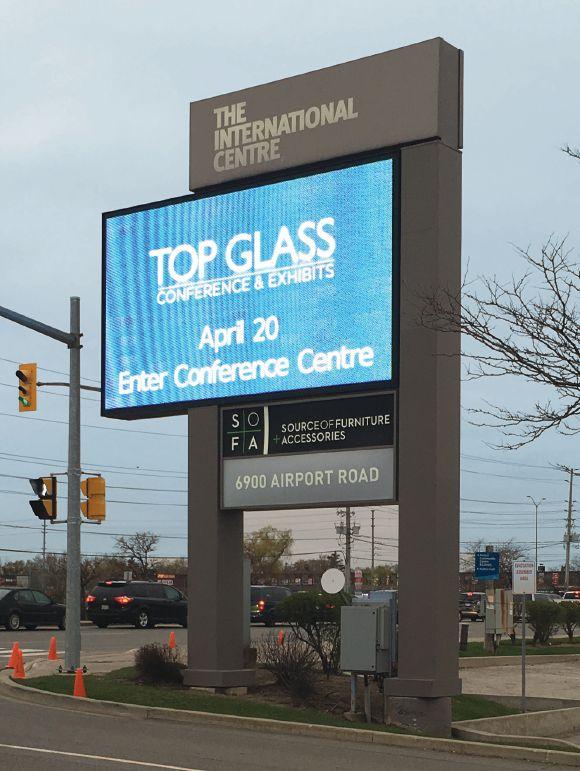
Top Glass, Canada’s conference and trade exposition for the architectural glass industry, will take place at the International Centre in Mississauga, Ont., on April 20. It marks the first time the show has been hosted as a live event since the 2019 edition, having moved online in 2020 and 2021 due to the COVID pandemic. Here’s what you need to know about the 2022 show.
Who will be there?
Top Glass is for anyone involved in the commercial architectural glazing business in Canada. Attendees include glazing contractors, glass fabricators, architects, specifiers, building engineers and suppliers to all those sectors.
What is the event?
Top Glass is a one-day event, running from 9:00 a.m. to 4:00 p.m., featuring a full schedule of educational speakers with a concurrent exhibit hall with booths staffed by top industry suppliers. Check out our preview showcase following this article for a
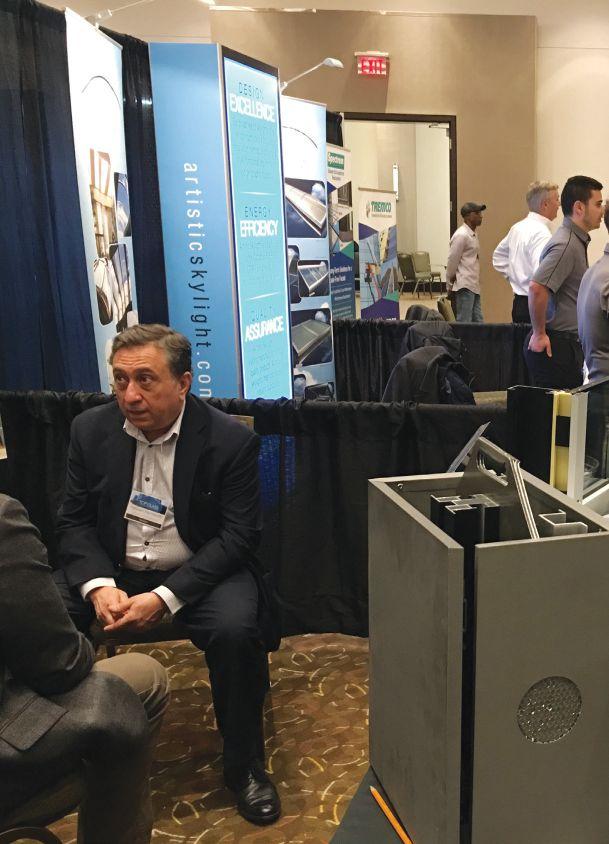
ABOVE: Imagine being able to do this again. We might still need masks at Top Glass 2022, but at least we’ll be able to see each other in three dimensions.
AT A GLANCE TOP GLASS 2022
Date: Wednesday, April 20, 2022
Location: International Centre, 6900 Airport Road, Mississauga, Ont.
Hours: 9:00 a.m. to 4:00 p.m.
Parking: Free on site
Registration: topglasscanada.com
in-person for the first time in three years.
sneak peek at some of the products and companies that will be on display.
Where is the show?
The International Centre is at 6900 Airport Road in Mississauga, Ont., just minutes away from Pearson airport and the 401, 407 and 427 highways. Those wishing to avoid traffic can take the UP train from Union station in downtown Toronto then a very short cab ride from the airport to the conference centre. There is ample parking and it is free. Any Toronto airport hotel will be only a short ride away. The Sandman Signature is where the show organizers stay.
How is it supported?
Top Glass is free to attend, thanks to the support of our show floor exhibitors and our marquee sponsors. The 2022 edition thanks the following for their generous sponsorship:
Top Glass also gets great support from its association partners. Thanks to these organizations for their promotion and assistance:
Why attend?
Top Glass is our annual chance to come together as an industry to learn, renew acquaintances and make new connections – with a Canadian spin and a laser focus on the glass business. Top Glass presentations are accepted as learning credit hours by most Canadian professional organizations. Attendees filling out the post-event survey receive confirmation certificates with the information needed to claim their credits.
What about COVID?
Top Glass will of course follow all the province of Ontario’s and the International Centre’s health rules for public gatherings. As these regulations shift frequently, it is difficult to predict at this time what will be in place on the day. •
9:30 a.m.
Supply and Demand:
Our challenge in an era of entangled global supply chains
PRESENTER
Hon. Tony Clement, Reshoring Canada
Bringing it back to Canada
A former industry minister suggests solutions to our supply chain problems.
Before the pandemic, our biggest concern was finding the customers and making the sales. Now, with the phone ringing off the hook, the difficulty is getting the supplies and equipment we need. This global crisis has laid bare the downside of depending on offshore suppliers for critical products…but are our economies now irrevocably tied to the advantages of cheap labour, less regulation and scale of production that can be found overseas? These are questions that Tony Clement, as former federal Industry Minister, grappled with directly. Today, his concern with the state of our supply chains has led him to co-found Reshoring Canada, an information and advocacy group exploring ways to bring manufacturing back home. Join us at Top Glass to collect Mr. Clement’s insights, prescriptions and predictions for how and where we’ll get our critical supplies going forward.
About the speaker
The Honourable Tony Clement is a former minister in the Harper government federally, and Harris government in the province of Ontario. During his time in the House of Commons, Clement served as both Minister of Health and Minister of Industry, playing a lead role in getting Canada’s economy back on track after the most significant global economic recession since the 1930s. In 2011, Clement was re-elected for a third consecutive time. Shortly after his re-election, he was asked by the Prime Minister to take on the responsibilities of president of the Treasury Board. In this capacity, Clement lead the development and implementation of a cross-government spending review – looking at transformational ways to support and deliver services to taxpayers in the most effective and efficient means possible. Within the federal government, Clement chaired five different committees of Cabinet and served on the cabinet committee on priorities and planning, chaired by the Prime Minister. Clement’s dedication to public service spans three decades. During his eight years as an Ontario MPP, he held prominent cabinet positions in the Ontario government, including Minister of Health and Minister of the Environment. •
11:00 a.m.
Good Ideas: Collected strategies for making our businesses better
PRESENTER
Max Perilstein, Sole Source Consultants
The influencer
Lessons learned from 30 years talking to glass people.
Max Perilstein talks to glazing contractors and glass fabricators. A lot of them. All the time. For more than 30 years now. As author of the must-read weekly newsletter, From the Fabricator, Max collects stories and inside information from across the North American glass industry, keeping us up-to-date on who is doing what and how. In his time so far, Max has seen just about everything this crazy business has to offer – from rocketing success to crashing failure. In this entertaining talk, Perilstein shares his insights and thoughts on what makes this industry tick, what works, what doesn’t and what we all could be doing better.
About the speaker
Max Perilstein has the glass and glazing industry in his blood. Thanks to roots that harken back more than 120 years and a passion for the industry today, what goes on in the present and future of the glass industry is always something at the forefront of Max’s world. Max’s great grandfather Harris Perilstein arrived in North America in 1898 with only $34 dollars and glasscutter in his pocket. He started a glass company in Philadelphia, Pa., and delivered his material by bicycle. Fast forward to today and Max’s current role in the glass world. He is the founder of Sole Source Consultants, a consulting firm that focuses on the glass and glazing industry and specializes in market research, branding, communication strategy and overall reputation management. For the past 30 years Max has been involved at some of the highest levels in the glass and glazing industry including time as vice-president of marketing for Arch Aluminum and Glass, and chief marketing officer for Vitro America. Max served four years on the board of directors of the Glass Association of North America and during that time oversaw the explosive growth of the annual BEC show, taking it from 200 people to a high of more than 800 in 2007. Max still serves on the planning committee of that event and moderates at least one panel discussion each year. Max is also very involved with GlassBuild America and lends his expertise to the National Glass Association staff with regards to the planning and execution of that event. For many, Max is best known through his blog From the Fabricator which is now going on its 16th year after being the first such industry piece of its kind. The blog is published 48 weeks a year and retransmitted on glassmagazine.com. In addition, in 2021, Max launched a monthly podcast also named From the Fabricator that features multiple guests from various segments of the glass and glazing world. Max considers himself an enthusiastic and independent observer of the industry and the people and products that make the glass world go. He is a graduate of Ohio University. Max and his wife Beth live with their two children in New Baltimore, Mi. •
12:45 p.m.
The Codes We Live
By: What’s new and coming in Canadian glazing codes and standards
PRESENTER David Heska, WSP
Spec speak
The rules for designing, making and installing glass facades are constantly evolving and today’s need to drive energy efficiency forward has accelerated the process. Sometimes it’s hard to keep up. David Heska is here to help with an expert look at recent changes to the National Building Code and the standards important to the architectural glazing industry. He’ll draw on his diverse experience and the deep well of knowledge at WSP to not only explain the changes that are happening, but share some insight into likely future directions.
About the speaker
David Heska is a professional engineer and the southwestern Ontario director at WSP. In addition to his regional role, David provides leadership on operational initiatives across the building sciences team from coast-to-coast. David is a contributing columnist in Glass Canada and has spoken at The Buildings Show and the Ontario Non-Profit Housing Association trade show. He is also a member of the Fenestration Canada Education Committee. David’s areas of expertise include building envelope projects (windows, curtainwall, roofs) as well as concrete restoration projects (balconies, walls and parking garages). He has been involved in the assessment and repair of hundreds of buildings across Ontario, including multi-unit residential structures (all types of high-rise, townhouses, condominiums, co-ops), office towers, industrial buildings, stadiums, arenas and other public facilities. WSP is one of the world’s leading consulting engineering firms, working with building owners, governments, businesses and providing integrated solutions across many disciplines with over 49,000 employees across 40 countries. •
2:15 p.m.
Rise Up, Glazier Nation: Innovative solutions to today’s labour challenges
PRESENTER
David Swieterman, Glazier Nation
Good help
It’s hard to find...but here are some ideas.
The struggle to find and retain skilled glass installers and fabrication workers is familiar to everyone in the architectural glass business. Increasingly, our old networks of trade schools, apprenticeship programs and recruiting struggle to meet the needs of our industry. It’s time for some fresh thinking. Glazier Nation is a new recruiting, training and placement service for skilled commercial glaziers that has put hundreds of glaziers into the trade across North America. As a partner in Glazier Nation, David Schwieterman has seen it all when it comes to skilled trades recruiting and has pioneered surprising tactics that are helping glass companies across the U.S. find the workers they need. Schwieterman will share his insights into the labour market, and describe some of the services Glazier Nation will soon be offering Canadians.
About the speaker
David Schwieterman is president of Global Construction Industries, a production software provider. Hailing from Laotto, Ind., David has nine years’ experience in the glazing trades as a project manager and estimator, where he designed his proprietary software products. Schwieterman teamed with Matt Day, founder of Glazier Nation, in 2021 to advance the network’s online capabilities and roll out a new suite of digital tools for glaziers and managers in the architectural glass industry. •
TOPGLASSPREVIEW
Wired glass replacement
glassopolis.com
Glassopolis Specialty Glass will be exhibiting a range of specialty and fire-rated glass products. This year, in response to the many questions about the brand new changes to building codes banning wired glass, they will be showcasing Protect3 safety glass, which is a UL-certified product that replaces traditional wired glass and meets all new building codes and standards. It is both UL-certified for fire (up to 90 minutes) and is impact-safe to CAN/CGSB 12.1-2017 and ANSI Z97.1. It is by far the lowest cost, fully compliant fire-rated glass available in Canada and is the perfect alternative to traditional wired glass. Each piece comes with a UL mark on it, which is required under the building codes, that allows inspectors to verify what it is and that it meets the code. When it comes to fire-rated glass, “if it’s not labelled, it’s not legal.” Protect3 is available pre-cut from Glassopolis or in case quantities for local UL-certified processing. It’s the best way to glaze fire doors and protected openings. Glassopolis also offers the premium fire-rated glass, Schott Pyran Platinum, along with XRay shielding glass, security glass and Robax woodstove glass. Located in Toronto for fast pick up or delivery across Canada.
Fast changeover
starlightcorp.co
The AS 262 GA can produce thermal break profile with a very fast changeover. This fully CNC machine has eight sets of disks for producing thermal break profile. For the last 10 years, the Starlight Sales Corp sales team has proudly represented the renowned and reliable Oemme brand. Oemme is an Italian company that has been manufacturing punches and machines for working and assembling light alloy systems since 1978. Thanks to a steady growth of the production cycle Oemme has achieved complete control of all transformation phases from raw materials to the finished product and nowadays can offer very high quality standard and reliability. Oemme put huge resources into research and technology innovation and has always pursued the aim to produce machines up to the actual customers’ demands.
Certify your quality
naccprogram.com
Tri-Temp Glass has manufactured tempered glass for showers, railings, entrance systems, interior partitions and architectural glass applications since 2007.
• Tempered up to 96 x 144
• Custom Laminated up to 86 x 144
• Bent Tempered Laminated to 66 x 96
• Back Painted Glass
• SentryGlas Lamination
• Opaci-Coat-300 Spandrel
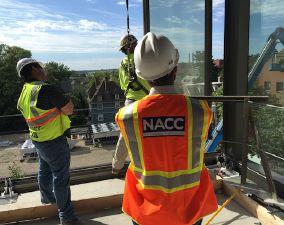
NACC is an award-winning, ANSIaccredited, third-party credential that provides a baseline for competency, business practices, and industryaccepted guidelines for glazing. The program recognizes architectural glass and metal contractors that consistently demonstrate quality and safety excellence. NACC was developed by a balanced cross-section of glaziers; glazing contractors; industry manufacturers and suppliers; architects; spec writers; consultants; and general contractors. NACC is administered by an independent third-party organization and certifying body, Administrative Management Systems, and sponsored by the Architectural Glass and Metal Certification Council, a not-for-profit, public benefit organization. NACC offers proof that a contractor has processes and procedures in place to consistently meet high standards. Certification reduces risk by minimizing errors, improving documentation and establishing standards for business and glazing. Certified contractors report improved and better-controlled processes, reduced waste, fewer mistakes, lower costs, additional opportunities for training and more engaged staff as a result of organization-wide direction and communication. Certification allows glazing contractors to demonstrate - through an independent, ANSI-accredited third party and documented evidence - that they have taken the right steps to deliver the best possible quality and safety to their clients. The NACC program offers resources and workshops for glazing contractors to enhance their organization’s processes and systems for glazing. NACC was awarded the International Risk Management Institute’s 2020 Gary E. Bird Horizon Award for construction risk management. NACC ensures contractors have processes and procedures in place to consistently meet high standards. Certification reduces risk by minimizing errors, improving documentation and establishing standards for business and glazing. NACC means improved job sites and safety, minimized subcontractor defaults, and fewer construction claims. NACC can help make your business more successful while supporting a stronger design and construction industry.
Find solutions
trosifol.com
With our new Solution Finder app, we offer an ideal addition to our existing apps and valuable recommendations for laminated glass for your upcoming projects. After a few inquiries about general conditions, the Solution Finder app gives the best recommendations to select the appropriate interlayer for your project by using Trosifol, PVB or SentryGlas products.
Guided testing
element.com
Element offers a comprehensive suite of fenestration and building envelope testing services, including acoustic, thermal, air, water, and structural testing, as well as platform support. It can help clients test products through the design phase for air leakage resistance, water penetration resistance, structural performance, and thermal properties. Navigating through accreditations and standards can be difficult, Element’s technical experts provide consultative guidance throughout this process. When support is needed on-site, Element can come to the location. With field performance evaluation services of the building envelope during the construction phase, Element can assure the client that variations in the manufacturing process, site condition and installation meet the prescribed performance requirements. Through advanced mobile equipment, Element can evaluate the performance properties when subjected to design conditions, ensuring the optimal performance of the building. Finally, we understand that anyone can experience failures. Element can help clients determine the root cause of a building envelope failure through on-site and laboratory failure analysis services.
Screen made to suit
screenco.ca
Screenco Manufacturing has a long history of being a proud supplier to the window and door industry, providing quality rollformed products. It’s product lines include various shapes in steel reinforcement channel as well as the capability to produce customized aluminum or steel profiles to meet all needs. A complete line of rollformed window screen bar and patio screen bar is available along with complimenting accessories. Screenco can also fabricate window screens and patio door screens on to specification. As well, Screenco offers a wide variety of grille bar and accessories to compliment any window.
RESOURCEDIRECTORY
by RICH PORAYKO
Rich Porayko is a professional writer and founding partner of Construction Creative, a marketing and communications company. richp@ constructioncreativecom
Do less better
Hold still while we talk about TikTok. That’s right, that thing your 12-year-old niece is always looking at on her phone. It won’t seem very relevant to your business today, but neither was LinkedIn five years ago. I collected some insights on this emerging marketing environment at a recent BC marketing association conference.
Content marketing is constantly changing as the media that carry those messages to the intended audience evolves. Gen Z audiences have spurred on the rise and adaptation of visual social media platforms such as TikTok, Snapchat and Metaverse with storytelling platforms. In 2018, Snapchat developed the six-second unskippable ad that was short enough to pacify impatient viewers. Most TikTok videos range from nine to 15 seconds long. This is important insight on how a rapidly growing segment of your customers and employees communicate, seek entertainment and gather information.
“We’re seeing content density more prevalent as we see the evolution of social media networks,” says John Entwistle, outdoor marketing strategist and photographer at Whistler’s Origin Outdoors. “There is an expectation from audiences that the content they consume will be concise, well-produced and relevant,” says Entwistle. “We have conditioned ourselves to require more value per second than ever before.” Entwistle doesn’t believe that well-produced necessarily means a high budget. “I do believe that it requires a lot of thought and planning. Social platforms like TikTok are leading the way. Look at how well-planned your TikTok feed is. You are engaging with every little six-second, 15-second, 30-second clip on there. Deliver as much as we can with
Over the next five years, there’s approximately $30 to 60 billion that is going to transfer from baby boomers to their children.
the time that we have is really becoming a thing.”
THAT’S RICH
Jason Carnew, managing partner for Ackelo, says that over the last few years there has been a lot of conversations around a “frictionless experience.” “What this has created is a world where everything feels the same,” says Carnew. “Everything is Amazon-ish or Netflix-like or Appleesque, and it creates a vanilla approach across the content sphere. Everything blends together and nothing stands out.” Carnew goes on to say that TikTok is not operating like a social brand but much more like an entertainment entity. “Creators are going more niche,” says Carnew. “Content is now being created at the speed of culture. It’s being created so fast that it’s starting to lead culture instead of just following it. Trends are immediate.”
According to Carnew, over the next five years, there’s approximately $30 to $60 billion that is going to transfer from baby boomers to their children. “It’s the largest transfer of money in history,” says Carnew. “The people that are going to be receiving this money, and instantaneously changing their position the economic ladder will have grown up with these social and entertainment channels working for them.”
“As a writer, I look at content from a storytelling perspective,” says creative director and writer, Katie Ainsworth. “Storytelling takes time. Stories have an idea and an emotion connected to them. You can’t engage people and bring them into the brand in six seconds. Try to tell someone a story in six seconds.” Ainsworth says that super-succinct messaging is great for retail and fashion but, “Ryan Reynolds is a great storyteller and I’ve never seen him do a six-second video.” Ainsworth goes on to say that it’s a myth that people have short attention spans. “They have high standards. Give me something engaging and I will engage with it.” Ainsworth recommends creating one large anchor spot where you plan a big thing and then slice it into a lot of little things. “You really do have to figure out all the bits upfront before production, so you’re not caught short-handed later,” she adds. “The content hole is infinite. You don’t have to fill it. Be selective. Pick what works for you. Do less. Do it better.” •