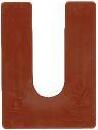
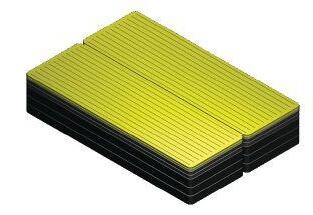
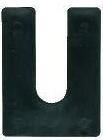
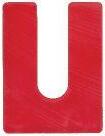
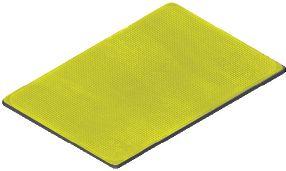
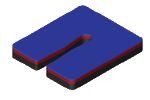
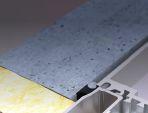
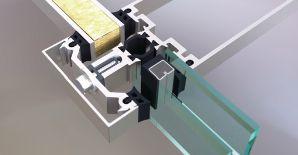
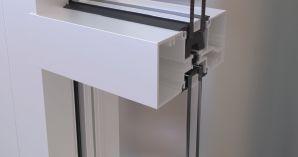
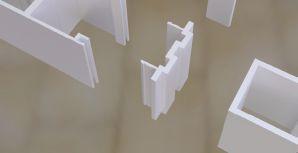
Grove Shims™ has the perfect shim for all your shimming needs. With color-coded shims and solid thicknesses, the right shim can be easily applied for perfect alignment. No guesswork or realigning. Our shims save you time and money.
* Contact us about eligible tariff fee reimbursements on the purchase of Grove’s shims only. “This ad applies to U.S. and Canada only. Offer expires 12/31/20.”
Need help? Just ask! We’re here to help. 978-534-5188 Visit us online to see all of our available solid 3x4 Shims. www.groveshims.com
Free Samples are Available Upon Request. Grove Shims™ is the leading producer of plastic structural shims. We have been in business since 1962, making shims since 1975, our family-owned business provides prompt, personalized attention to each order. In addition to our large line of in-stock shims, we will custom fabricate parts to meet your unique requirements. Unlike many competitors, our shims are solid and do not have hollow voids, so you can depend on them in crucial, load-bearing conditions.
Canadian architectural glass companies amaze the world every year with their stunning achievements. Here’s our annual roundup of their incredible creations.
Keeping you informed
Let’s face it, things don’t usually change that quickly in our industry. It’s often hard to find enough news to fill a website. Not so anymore. The pandemic has created an avalanche of earthshaking changes daily. To help you stay afloat in the flood of new information, you can find our special Coronavirus Roundup section on the home page of glasscanadamag.com. It’s pandemic news relevant to our industry and businesses. Stay safe, everyone.
Running the gauntlet
The Building Envelope Conference carried an extra edge of excitement in Tennessee this year, what with a tornado passing through and a pandemic closing in.
These days, there’s not much point talking about anything else. Important developments from around the industry during this craziest of all times.
The pandemic has been disorienting, but it has only just begun.
I have never in my life seen a level of disruption to life and business like this coronavirus business. Previous outbreaks such as SARS and H1N1 came and went without me doing anything different except possibly squirting a little more hand sanitizer when I went into hospitals. The announcements just today have included Canada closing its borders to all travellers from outside the continent, the death toll in Italy climbing over 1,800 and Tim Hortons closing its dining rooms. Add those to the suspension of all sports leagues, the kids being home from school and the impossibility of finding any toilet paper anywhere and, well, if this isn’t the apocalpyse, I can’t tell the difference. And, by all accounts, we are only at the very start of this thing.
NEXT ISSUE
• Force majeure
• Curtainwall
• Coronavirus
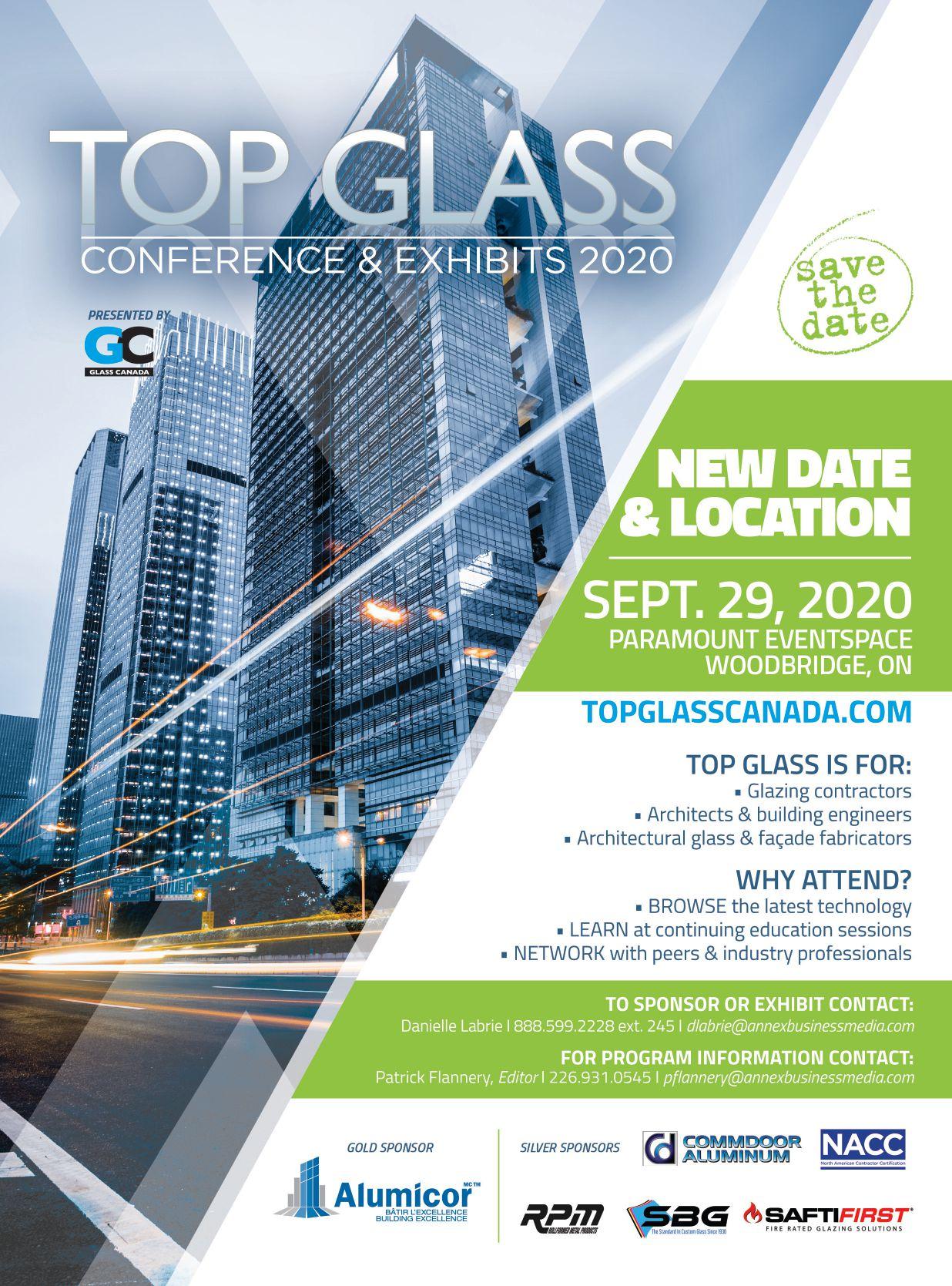
On March 10, I was still struggling with a decision as to whether to go to Las Vegas to attend a massive construction equipment show. That I was even considering travelling internationally to join 130,000 people from all over the world at an indoor event where shaking hands is the primary activity seems today, March 16, to be beyond belief. On March 11 I posted a notice on glasscanadamag.com letting people know that Top Glass was still scheduled to go ahead on April 22. By the end of the week, the idea was unthinkable. So Top Glass has been postponed, along with just about everything else, to the fall. The new date is Sept. 29 and because of all the scheduling conflicts we had to change venues to Paramount EventSpace in nearby Woodbridge, Ont. The space looks great and we think it’s going to be a terrific show because by then everyone is going to be more than ready to get out there and shake hands again.
But of course the postponement of a trade show is small potatoes in all of this. We are all facing serious worries about the economic impact of this pandemic. By the time you read this, huge sectors of business will have been shut down for weeks. Oil fields have essentially stopped production, not just because of health concerns but also because the price of crude has dropped below $20 a barrel. The stock market has absolutely cratered. Airlines have mostly stopped flying and laid just about everyone off. The entire hospitality industry is at a standstill, except for takeout food. The entertainment industry has stopped. Retail has stopped. Not just slowed down or seen a reduction – completely halted. Construction projects have been allowed to go forward in most of the country, but work is slow and nothing new is being started. We are in for a recession the likes of which we have not seen before, and only smart moves by business owners and government will prevent the kind of structural damage that leads to a lasting depression.
So far, it looks like the right attempts are being made. Check out our special coronavirus news section on page 22 for highlights of what has happened in the industry so far. The bill to keep life afloat in Canada so far has run to about $200 billion in government spending. Here’s hoping it’s enough. •
GLASS CANADA
April 2020
Volume 32 • Number 2
Annex Business Media
P.O. Box 530, Simcoe, Ontario N3Y 4N5
EDITOR | Patrick FLANNERY pflannery@annexbusinessmedia.com 226.931.0545
| Martin McANULTY mmcanulty@annexbusinessmedia.com
COO | Scott JAMIESON sjamieson@annexbusinessmedia.com
AUDIENCE DEVELOPMENT MANAGER Urszula Grzyb ugrzyb@annexbusinessmedia.com 416-510-5180
CIRCULATION
Tel: 416-510-5180
Fax: 416-510-6875 or 416-510-5180
Mail: 111 Gordon Baker Rd., Suite 400, Toronto, ON M2H 3R1
SUBSCRIPTION RATES
Canada - 1 Year $37.00 (plus tax)
U.S.A. - 1 Year $85.00 (in CDN dollars)
Publication Mail Agreement #40065710
Printed in Canada ISSN 0843-7041
Occasionally, Glass Canada will mail informationon behalf of industry-related groups whose products and services we believe may be of interest to you. If you prefer not to receive this information, please contact our circulation department in any of the four ways listed above.
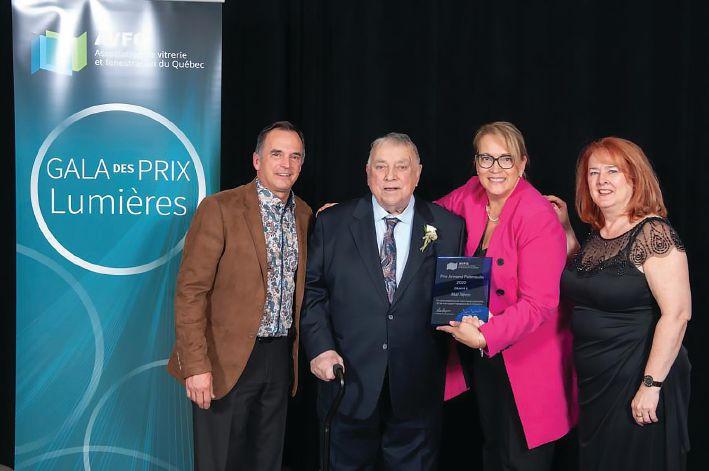
At its annual conference Feb. 26 and 27 in St-Hyacinthe, Que., the AVFQ honoured several member companies. In the Commercial Office/Space category the winner was Multiver for Le Diamant by Robert Lepage for having responded brilliantly to the specific requirements and the complexity of this innovative facade, Camil Andre of Multiver accepting. In the Commercial Institutional, Public Services, Seniors, Industrial category the winner was Techniverre for The Pointe-a-Calliere museum for having taken up this great structural challenge and demonstrating the versatility of glass. Christian Gendron and Yoan Gendron accepted. In the Workforce, OSH, Work/Family/Education/Integration/Retention category the winner was Lepage Millwork for their many initiatives to benefit employees while pursuing the vision and values of the company. Melanie Binette of Lepage Millwork accepted. In the Residential Project-SingleFamily Home category ($500,000 and more), the winner was Fabelta-Fenestration systems for the Residence of the Church. They were recognized for having taken up this great technical challenge while respecting the particular architecture of the building. Michel Desroches, Sylvie Desroches and Simon Desroches acceptd for Fabelta. In the Residential Project-Multi-residentialCo-Ownership category, the winner was Jeld-Wen Saint-Apollinaire division for the
Waldwick Station project showing exemplary energy and acoustic performance as well as its architectural signature. Gilles Bouchard and Lisa Bergeron of Jeld-Wen accepted. In the Internal or External Recovery, Approach or Transfer of Powers category, the winners were Vitrerie A&E Fortin’s PaulAndre Bouchard, Jerome Bouchard and Eric Larouche for their commitment and their concern to take the company to the next level, Marlene Fortin, Eric Larouche, Jerome Bouchard, Paul-Andre Bouchard of Vitrerie A&E Fortin accepting. In the InnovationProducts-Equipment-Technologies-Processes category, the winner was A&D Prevost for the P-55 Evolution curtainwall system for its simplicity of installation as well as its energy and acoustic performance. Claude Cardin and Richard Germain of A&D Prevost accepted. AVFQ extended congratulations to the companies that won the 2020 Lumiere Awards for their remarkable achievements and thanked all the companies who submitted their applications that amazed the jury. AVFQ also recognized the three members of the jury: Daniel Gilbert of the Ordre des architectes du Quebec; Marc Laramée of Hydro-Quebec; and Richard Legendre of the Order of Professional Technologists of Quebec. During the same evening, the AVFQ awarded the Armand-Patenaude Prize to a personality who distinguished himself by his contribution to the industry, Real Neron.
BANQUET HONOURS CONTRIBUTIONS
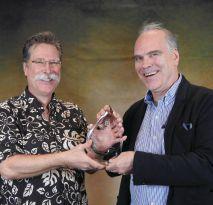
The Fenestration and Glazing Industry Alliance recognized the contributions and achievements of its members and congratulated award winners at the inaugural FGIA Annual Conference Awards Banquet held in February in Ft. Lauderdale, Fla. Award presenters noted the importance of these member contributions, which serve to progress the work of the industry overall. The Glazing Outstanding Service Award went to Mike Burk of Sparklike and Randi Ernst of FDR Design. The Fenestration Outstanding Service Award was presented to Mark Silverberg of Technoform. Carl Troiano of Trojan Powder Coatings took home the Architectural Distinguished Service Award. The Residential Products Group Distinguished Service Award went to Mark Mikkelson of Andersen. The Marketing Distinguished Service Award honoured John Westerfield of CrystaLite. Finally, the Glass Products Council Distinguished Service Award went to Jeff Haberer of Trulite.
CANADA’S GLASS ASSOCIATIONS
Canadian Glass Association
With regret, the Canadian Glass Association board of directors has announced that the association has been dissolved and removed from the registry of Canadian industry associations. “We could not keep it going,” director Zana Gordon reports. “There appears to be no support for a national glass association. B.C. and Alberta were on board, but with no support from the rest of the country we have no choice. So sad.” The move marks the end of an organization that has existed since it was formed by Keith Pynoo, Dan Pappas, Dave Husson, Bill Snow, Steve Petersen, Ken Thomas and Chris Skalkos in 2001. Over that time, the association made attempts to promote B.C.’s Glazing Specification Manual and to encourage the formation of an industry group in Atlantic Canada. It also held several Glass Connections conferences around the country. This page will be rebranded and continue to present news from the various regional glass associations in Canada.
Fenestration Association of B.C.
The FenBC Technical Conference happened Feb. 27 at the beautiful Northview Golf Course in Surrey. The agenda included the popular keynote breakfast, “The Code Talkers.” There were two streams of information sessions: one stream for the commercial sector and one for the residential sector.
Our keynote lunch speaker was Margaret Webb from the newly formed Fenestration and Glazing Industry Alliance. The agenda will included discussions on acoustics, field testing, air leakage, high performance coatings and much more.
The May 14 annual FenBC Golf Tournament slated for Northview Golf Course has been cancelled due to the pandemic. But save the date for the FenBC Industry Conference on Oct. 29, again at Northview Golf Course. Yes, we really like it at Northview Golf Course.
We are working with Morrison Hershfield to revise the Glazing Systems Specifications Manual. The expectation is to have it completed by the middle of 2020.
FenBC also voted in its 2020 board of directors at the Technical Conference. They are: Kavinder Dhillon of LabTest Certification; David Goldsmith of Plygem; Mark Frampton of Excalabor Glass; Murray Frank of Building it Right; Peter Kuschnir of Starline; Cam Leslie of All West Glass; Jason Loutet of Intertek; Cal Marshall of RetroTeck Windows; Carlos Muller of AMG Atlas Meridian Glassworks; and Amy Roberts of PFG Glass
After so many years of supporting the industry David Langton has decided to resign from the FenBC Board. Thank you David for your years of service and support. You will be missed and we wish you all the best.
Provincial Glaziers Association of Alberta
PGAA’s annual golf tournament will be held in August of 2020. The PGAA is currently
looking at hosting a glazier trade show which will be hosted in conjunction with the annual golf tournament (a two-day event). Details of event are to be determined. The executive is in agreement that it is too late in the year to construct this event in 2020 but to look for it in 2021. The PGAA is also entertaining the idea of partnering up with Glass Canada’s Top Glass Conference and Exhibits for this event. Details to follow.
The PGAA Project of Merit award is currently in the final stages of development and the executive will be looking to send out applications this coming May. We will be requesting completed application forms back mid–September which would provide the executive six weeks to judge submissions and prepare award presentations for the respective Calgary (GAMA) and Edmonton (GTA) annual general meetings. Two project awards will be given out per association/territory.
Architectural Glass and Metal Contractors Association
The AGMCA will once again have a booth at the upcoming Top Glass Show, and is looking forward to meeting and greeting its member contractors. Please drop by to hello! We regret to inform all out members that our Glazing Contractor Appreciation events to be held at the Glazier Training centres in Toronto on May 6, and in Ottawa on June 17 have been cancelled. We hope to reschedule so you can come out to tour the facilities, grab a complimentary lunch from our gourmet food truck, and say hello to all your friends and
enemies in the glass business. Details to follow once some semblance of normality returns to our industry.
Ontario Glass And Metal Association
SAD
NEWS: Archie McInnes left us on Jan. 21 following a lengthy struggle with deteriorating health. Archie grew up as the ninth kid in the family on a farm and only got as far as grade nine before heading into the working world where he definitely made his mark in the glass industry. He got his start in the business with PPG in the early 1960s and moved up to the position of sales manager with Glaverbel Glass in Concord in the early ‘70s. It was there that he met Peter Alexander with whom he eventually teamed up to start Trulite Industries in 1975. Trulite became a huge success story and Archie took great pride in the relationships he made while growing the insulating glass company. He received the prestigious OGMA Lifetime Achievement Award in 2002. Archie was an avid golfer, loved business, loved people, and was one of those guys you were always happy to have seen. You’ll be missed Arch.
TOP GLASS: It’s a great way to spend a day to catch up with everybody who’s anybody in the industry, including the big shots from the OGMA. Join us in September as we present the OGMA Awards for Excellence recognizing great design and execution in the Ontario glazing industry.
SPRING GOLF: Mark Thurs., May 28 in your calendar now and plan on being out at Pipers Heath Golf Club in time for lunch that day.
FGIA introduces leaders
The Fenestration and Glazing Industry Alliance has announced the hiring of Nathalie Thibault, who will serve the organization as technical manager for glass products and Canadian industry affairs. Thibault just finished a term as president of the former Insulating Glass Manufacturers Alliance and comes to the position from Prelco in Riviere-du-Loup, Que. Throughout 2020, Thibault will shadow FGIA glass products and Canadian industry affairs director, Marg Webb, to prepare to take on her duties upon Webb’s retirement in early 2021.
At its Annual Conference in Ft. Lauderdale, Fla., the FGIA introduced its 2020 Board of Directors. Since FGIA is the result of having combined the American Architectural Manufacturers Association (AAMA) and the Insulating Glass Manufacturers Alliance (IGMA) at the start of the year, the FGIA board of directors includes representatives who actively served in leadership roles within either of the separate associations. In addition, the vision, mission and goals for the new association were presented as well as preparation for the related strategic plan implementation. Members were also provided with an update on the unification implementation status.
New guidance from FGIA
The Fenestration and Glazing Industry Alliance has released new publications addressing finite element thermal modeling and measurement of surface temperature for purposes of determining condensation performance. AAMA 515-19, “Voluntary Procedure for Determination of Fenestration Surface Temperatures by THERM Finite Element Modeling,” helps designers determine what temperatures and film coefficients to use when running a project-specific condensation analysis. Designers often use two-dimensional finite element thermal modeling tools, such as Lawrence Berkeley National Laboratory’s THERM, to predict interior surface temperatures for standard or project-specific AAMA 501.9 thermal cycling tests of full-size mockups. For products with conductive framing, such as aluminum (with or without thermal barriers), caution is advisable in attempting to correlate FE modeling with testing, or in using FE modeling to predict variable test results. This voluntary procedure is intended to make application of the software tool uniform between users, and to address some of the issues which arise in surface temperature prediction and condensation assessment.
AAMA 501.9, “Surface Temperature Assessment for Condensation Evaluation of Exterior Wall Systems,” is another optional test that can be performed in conjunction with a project-specific curtainwall mock-up. It uses a similar aparatus to AAMA 501.5, but where 501.5 is only concerned with the effect of temperature cycling and thermal movement on the wall system, AAMA 501.9 is used to measure temperatures on the interior surface of the wall at designated exterior and interior ambient air temperatures.
Both documents are available through the FGIA online store.
Officers
• Chairman, Donnie Hunter of Kawneer
• Vice-chairman, Dan Parrish of Pella
• Treasurer, Bill Briese of GED Integrated Solutions
• Immediate past chairman, Roland Rossman of Garibaldi Glass
Architectural Products Council directors
• Robert Jutras of CLEB Laboratory
• Georges Thiret of Graham Architectural Products Corp.
• Mike Turner of YKK AP America
Glass Products Council directors
• Rob Grommesh of Cardinal Glass
• Mark Mikkelson of Andersen
• Helen Sanders of Technoform
Residential Products Council directors
• Kevin Anez of Milgard Manufacturing
• Rob Luter of Lippert Components
• Kevin Seiling of Veka
The vision of the new association focuses on improving home and building performance through better glass, window, door and skylight technologies and standards. FGIA’s mission is to develop an inclusive community, leading the glass, glazing and fenestration industry through research, consensus-based standards, product certification, advocacy, education and professional development.
2019 building permits report
StatisticsCanada has released its annual review of building permits for 2019. In 2019, municipalities issued $102.4 billion worth of permits, up 2.6 per cent compared with 2018. Gains were reported in six provinces, with the largest increase in Ontario (up $2.8 billion). Alberta recorded the largest decrease (down $1.8 billion), with declines in all building types. The value of permits in Toronto increased 1.9 per cent to $19.2 billion, while several other Ontario municipalities also reported notable gains. Kitchener–Cambridge–Waterloo posted the largest increase in the country (up 53.5 per cent to $2.2 billion), largely due to an increase in the value of permits for multi-family dwellings. Edmonton reported the largest decrease in the total value of building permits (down 21.5 per cent to $3.9 billion), accounting for more than half of the overall decline in Alberta. This was the fifth consecutive annual decrease in Edmonton, reflecting the challenging economic environment in the province. Building intentions in the non-residential sector increased 9.4 per cent to $40.4 billion, with gains in seven provinces. All components reported increases, led by commercial permits (up 7.5 per cent to $23.2 billion). Conversely, the value of permits in the residential sector declined 1.3 per cent to $62 billion. The value of permits for single-family dwellings fell 4.9 per cent to $26.5 billion, its lowest level since 2009. Permits for multi-family dwellings offset some of this decline, rising 1.5 per cent to a record $35.5 billion.
Ultra thermal performance with a slim sightline.
Kawneer’s 1620UT/1620UT SSG Curtain Wall System surpasses expectations. Built on the success of the 1600UT Curtain Wall platform, the new system sets the standard for thermal performance. A narrow 2" sightline enhances the sleek, monolithic look of the exterior and views from the interior. And, an engineered polymer thermal break and the ability to accommodate 1" insulating glass increases building performance and occupant comfort. 1620UT/1620UT SSG Curtain Wall System: When less means more.
ARCHITECTURAL SYSTEMS ENTRANCES + FRAMING CURTAIN WALLS WINDOWS kawneer.com
by DAVID HESKA
Top Glass takeaways
As the Top Glass conference approaches I was recently reminded of one of the sessions from last year. A colleague and I were talking about curved glass, so I found the notes I had taken during Top Glass 2019. Last year Elie Alkhoury shared with us about a hotel project in Australia where his company provided testing for the large, curved IGUs. The IGUs were approximately two-by-four-meters in size, manufactured outside of Canada and shipped to the lab in Ontario. Mr. Alkhoury shared about how he was able to successfully adapt the ASTM E2188 standard test method to evaluate the full scale curved panels here before the glass was shipped and installed in Australia. The setup was particularly challenging because it included all phases of high humidity and weather cycling with dew point measurements taken periodically. In addition to the standard weather cycling parameters of E2188, wind load pressures were superimposed on the typical cycle and applied in both positive and negative directions. The challenges did not stop there; the test panel was subjected to prescribed bending prior to cycling and assessed in the bent configuration.
My colleague had been speaking with an architect about some design options for an upcoming project and when he came back to the office we got talking in the lunch room. The architect had shared an article with him about a different curved glass project in Germany. Without going into all of the details of the concert hall project in Germany, I think it’s worth mentioning that a combination of glass types were used including both flat and curved IGUs for the windows, and triple-laminated curved single glazing. If you have not read an article about this project, I encour-
I’m excited to talk to exhibitors, catch up with friends and hear from the great lineup of speakers.
age you to search and find one online.
THE ENGINEER
We all know that most projects do not have the budget or profile of these two examples in Australia and Germany. But as advances occur in the market bent glass is increasingly being included in projects by designers and manufacturers who are also more willing to modify their production facilities to accommodate the increased demand. No one anticipates bent glass will ever reach the substantial market share of flat glass, but keep your eyes open as its popularity rises.
Looking ahead to this year’s Top Glass conference in September, I’ll be excited to talk with exhibitors, catch up with friends and hear from the great lineup of speakers. The morning Young Executives Panel is one that should not be missed. Each of the panelists has a wealth of experience and will discuss how our industry is changing and what new technologies are on the horizon. Knowing their backgrounds I am eager to hear their comments about new curtainwall products and insights into the strategic decisions that Fenestration Canada and the Ontario Glass and Metal Association are making.
I’ll sign off this month with three quotes on the importance of learning:
“Wisdom is not a product of schooling but of the lifelong attempt to acquire it.” – Albert Einstein
“Anyone who stops learning is old, whether at 20 or 80. Anyone who keeps learning stays young.”
– Henry Ford
“Leadership and learning are indispensable to each other.” – John F. Kennedy
On Sept. 29, I hope to see you at the Paramount EventSpace in Woodbridge, Ont., for Top Glass as we can keep leading and learning together. •
by MARGARET WEBB
Report from the spring conference
The former Insulating Glass Manufacturers Alliance committees are now part of the FGIA’s Glass Products Council, led by Helen Sanders of Technoform, first vice-president, and Jeff Haberer of Trulite, second vice-president. The IGMA Certification Committee and the IG Technical Services Committee met at the Spring Conference in Fort Lauderdale, Fla. Here’s a report from the various task groups, focusing on the groups that had progress milestones to report.
Certification Committee
The Quality Management System task group reported that the quality manual, procedures, work instructions and forms for all four tiers of the IGMA quality management system are now available on the FGIA online publication store. This program constitutes a full ISO 9001:2015-compliant quality system specific to the fabrication of insulating glass units. No need to re-invent the wheel - we have your quality system right here. These also happen to be the last documents ever published singly under the IGMA brand.
The Fabricator Considerations for Large Glass Products task group has modified its scope to define large glass. Subjects to be covered in the document are application considerations and limitations, including storage, handling, transportation, installation, compatibility, standards, tolerances and applicable certifications. This is a joint task group working with the National Glass Association.
The Sealant task group says technical bulletin TB-1201 will be retired effective immediately. The task group will be working on a new document – TB-2500, “IG Fabricator Considerations for Non-Structural Edge Seal Sealant(s)” – which will include using the Section 4.0, TB-1400-91(11),
Task groups reported significant progress in Fort Lauderdale.
IG Manufacturing Guidelines: Important Considerations as the content template. This document will not include in-depth discussion of glazing sealants. It will reference TM-2400 for testing methodologies, which will be a compilation of information from a number of other documents.
The Desiccant task group has developed a scope and will be updating TM- 2100-78(81), Test Methods and Performance Criteria for Desiccants and also developing a test methodology to determine desiccant type. Working jointly with the Insulating Glass Certification Council (IGCC), a fingerprinting methodology is being developed for desiccants similar to what was done for sealants.
Technical Services Committee
The IG Cavity Compensation task group reported its document, TM-3200-XX, is close to completion and was balloted to the task group in mid-December. The task group will meet to review the ballot comments and prepare the document for ballot to the GPC Technical Services Committee this year. This technical manual includes generic design alternatives for cavity compensation for insulating glass units and determines conditions that impact the pressure in the IGU cavity. Items included in the document are capillary and breather tubes; one-way valves; desiccant adsorption/desorption; pre‐inflating/pre‐deflating the unit; temperature manipulation during fabrication; and the use of bladders. The section on capillary and breather tubes is still under development.
“Prequalification Testing of Glazing Infill for Hurricane Products” is a joint FGIA-NGA task group. It has approved a new scope and is primarily focused on laminated glass to assure best practices for glass used in the hurricane impact market. The task group will be developing two documents: voluntary guidelines to ensure quality process management and an equivalency process. •
Save the dates:
• Summer Conference, June 22 to 25, Chicago, Ill.
• Fall Conference Oct. 5 to 8, Montreal
• IG Fabricator Workshop, Nov. 10 to 12, Plano, Texas
INDUSTRYEVENT
RUNNING THE GAUNTLET
by RICH PORAYKO
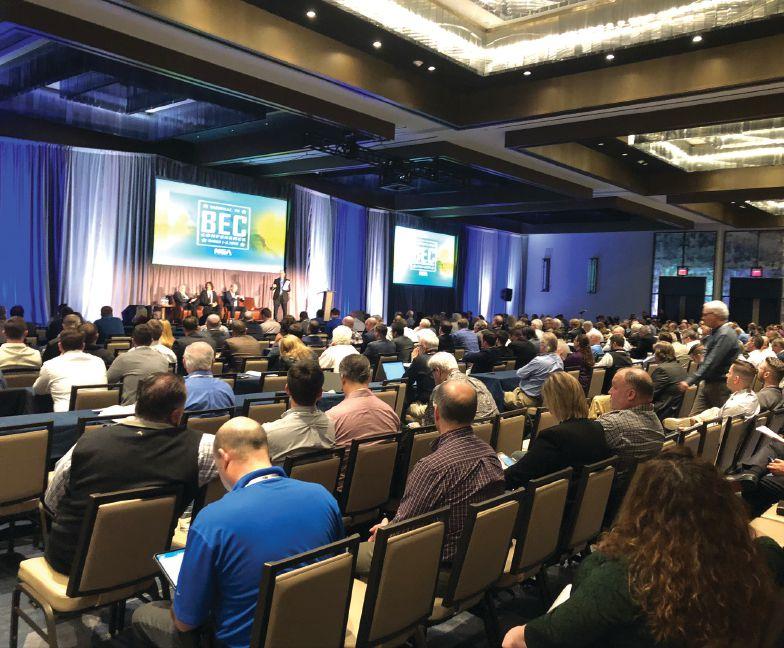
If you weren’t at the 2020 Building Envelope Contractors (BEC) conference in March, you missed one hell of an unforgettable event. Over 680 glass and glazing professionals slathered themselves in hand sanitizer and ran the coronavirus gauntlet to Nashville, Tenn., creating the highest attendance in over a decade.
Everyone knows the coronavirus won’t last since it was made in China, however the fear is real and many attendees did their best to kill the virus with copious amounts of alcohol in Nashville’s entertainment district. COVID-19 was the talk of the show until the tornados touched down, killing 24 people, destroying hundreds of buildings and
BEC proved worth the risks.
causing a state of emergency. As the twisters approached the JW Marriott around 1:00 a.m. local time, the hotel evacuated hundreds of guests to their basement for several hours.
It feels like a lifetime ago since the 2019 BEC when it was just tariffs that everyone was talking about. Crippling taxes actually seem kind of nice compared to pandemics, economic plunges and natural disasters. Black swan events tend to emphasize the big picture while underscoring that we truly need to be grateful during the good times.
“We have grown by over 100 attendees from last year,” said emcee and installation committee chair, Matt Kamper of Woodbridge Glass. “The theme of this year’s BEC conference is ‘Glazing 2020: Advanced. Innovative. Complex.’ Your attendance at this conference is just one indication that the contract glazing industry is ready to kick it up a notch.”
“This years’ BEC has a new energy to it, due much in part to the highest attendance in over a decade,” shared Andrew Haring,
vice-president of business development for the National Glass Association. “This tells me a few things: the market is strong, NGA is reaching new companies and people dig a non-Vegas venue. It’s always amazing to see folks take off their competitive hats for a few days and come together to share ideas to grow this industry together. It’s not only encouraging, but essential. This is what the National Glass Association is all about.”
Joe Puishys, CEO of Apogee Enterprises reminded the audience that he had also given the state-of-the-industry address for BEC in 2015. “I didn’t know repeat performances were allowed,” joked Puishys as he did often during his presentation. “A lot has changed and a lot has not changed in five years. Our industry moves at glacial speed with regards to the implementation of new technology but we’re moving at lightning speed in other areas.”
Apogee was formed over 70 years ago. “We have nine separate operating companies in four segments,” said Puishys. “We
ABOVE: Nashville attracted a record number of BEC attendees and gave them their money’s worth, with a tornado and threat of viral infection thrown in.
TWO INDUSTRY LEADERS. ONE UNIFIED VISION.
AAMA and IGMA have joined forces to set the standards for excellence in fenestration and glazing.
An indispensable network.
Introducing the Fenestration and Glazing Industry Alliance (FGIA), a unification of the American Architectural Manufacturers Association (AAMA) and the Insulating Glass Manufacturers Alliance (IGMA).
With the combined expert resources of these two industry experts, FGIA provides a unified measure of success for professionals across the glass, glazing and fenestration industries through education and professional development, product certification, and an unparalleled network of peers.
Join the alliance at FGIAonline.org
INDUSTRYEVENT
operate in four different countries, primarily in the western hemisphere. I have over 7,230 employees as of last week. We are not ginormous but we’re not insignificant either at almost $1.5 billion in revenue. We make and install a lot of great products and I’m proud of that.”
As one of the world’s largest glass fabricators, Viracon is Apogee’s largest stand-alone company. “We do everything but melt sand,” said Puishys.
Puishys told the audience he wasn’t an economist but he spends a lot of time reading economic reports. “There’s a question mark. Is our end market going to be robust in the foreseeable future? I’ll tell you that the last page in my book says yes.”
Puishys shared with attendees that he had listened to a forum a few hours earlier with a panel of lead economists. “It was all about the coronavirus. It was quite fascinating. The bottom line is that they are lowering their projection for GDP for this country from 3.4 per cent for the year down to 2 per cent. This is a big deal. They are predicting Q1 will be negative and Q2 will be just slightly positive, which means pretty good growth for the second half of the year.”
China makes up almost 20 per cent of the global economy. “They say 90 per cent of the state-owned enterprises are back and open, however the migrant workers have not returned yet from western China and probably won’t for a few more weeks,” said Puishys. Even though the factories are open, having the lights on and the doors unlocked does not necessarily mean there is any production, but it is turning back on. Fifty per cent of non-state owned enterprises are also getting fired up. “There is some hope.
TOP GLASS 2020
There is a lot of room for panic.”
Pushiys told the nearly sold-out audience that the biggest industries that will be impacted will be travel and businesses that cater to large groups of people in one room. “The reality is that it’s probably not a time to panic. Over 120,000 people have died from influenza since the beginning of the season. You don’t get a news headline every day that 111 people died of the flu. But you do get a headline that two people in Oregon passed away. It’s tragic but we need to keep it in perspective. We shall see. One thing we’re certain of is that no one knows what to expect. Things should be okay. There will be supply interruptions for sure. Domestic spending will take a hit. The biggest risk will be if they will be wrong about Q2 being slightly improved. This could drag on for a while. We’re in for a rocky ride.”
According to Puishys, approaching a score of 60 on the Architectural Billing Index (ABI) is overbuilding territory. “If you were to look at the ABI prior to the financial crisis, it was over 65. Most can hopefully attest that buildings are not going up on spec like 2007 and 2008. Most have a high lease rate of at least 70 per cent with an anchor tenant before they build. We feel good about the ABI and it’s recently ticked up again. I think we’re bumping along the top. I think there’s some opportunity for low growth for the foreseeable future. Another two years maybe. I’m not predicting a downturn. We feel good about construction starts as well.”
Job growth is the most important metric to Puishys. “Buildings are built to house people that have jobs. That’s what we care about. Over nine years or 112 months of consecutive job creation in the United States. This is not a phenomenon in the last three years. It’s a good indicator for the next couple years that you should take comfort in.”
Some post-WWII recessions were very short while other were much longer. “Our current recovery is 10-plus years. It’s the longest recovery on record. Where’s the cliff? Thirty-three year-old analysts always like to predict the cliff. Why? Because they are too young. They’ve only lived through one downturn: 2009. Most of us have lived through three or four.”
“Is there a cliff coming? I say no,” says Puishys. “This same re covery is actually the weakest when it comes to growth and GDP because it hasn’t been a big spike. It’s been a slow, steady ascent.”
The economic engine is fueled by consumer spending. “Overall, I think we have a healthy market. The caveat I always give is that the world we live in overreacts to both good news and bad news at lightning speed. If the consumer puts their wal let in their safe, that’s when things start to turn down. And then owners hold off building buildings and we all feel the effect.”
According to Puishys, the U.S. dollar has strengthened 33 per cent over the last five years against the Euro. “This is hard to work with. It makes foreign competitors much more price com petitive. For glaziers, this is good news. You have competitive options from offshore. For us local manufacturers, it’s a tougher story. I have sound advice for my team: get over it. Suck it up. Put your man-pants on. It’s not going away.”
The higher the standards, the better for quality players. Puishys told the audience that the mayor of New York City did not call for a ban on glass buildings, even though that’s kind of how the press treated it. “They are enacting standards that have substantial powers for new construction and renovation. The days of double IGUs with metal spacers and one low-E coating in colder climates are numbered. Glacial speed
will not be in play. It will be much faster than the adoption of triple-glazed IG units with two low-E coatings and nonmetal spacer.”
Five years ago, a major issue was the visible light transmittance of glass was affecting the migratory path of turtles primarily in Florida. They would head in the wrong direction off the beach because of the light coming off the buildings. Standards were enacted, Turtle Glass became a thing and the issue is being resolved.
Two years ago, the Minneapolis Vikings’ U.S. Bank Stadium was showcased across the United States and the world during Super Bowl LII. “That’s our glass,” said Puishys. “Wonderfully installed by
Interclad. An amazing project.”
“I have to hang my hat in this city,” Puishys said, eluding to the ongoing ire of bird lovers who see the huge glass walls of U.S. Bank Stadium as a deathtrap for birds. “I’m in an organization of CEOs in Minnesota and everyone was torturing me over the politics that were going on. The Wilf family that owns the Vikings did not want any pattern on their glass. We discussed a digital print that would address the needs of the National Audubon Society. I actually had one CEO ask me why I didn’t just donate the extra cost of applying the frit. What the fuck, right? To a billionaire owner when half his stadium was supported by tax initiatives?”
After the audience regained composure, Puishys told attendees that 50 per cent of Apogee’s workforce are Millennials. “As the Baby Boomers retire, there are not enough Generation Xers to fill the leadership roles so we need to rely on Millennials to fill these leadership positions.”
Moderated by Sole Source Consulting’s Max Perilstein, “Navigating the Technology Landscape” covered using innovation such as BIM to grow your company and drones to inspect your projects for quality assurance.
“BIM is only at about one per cent of its journey in our industry,” said Nick Bagatelos from Bagatelos Architectural Glass Systems. “We started with Revit about 14 years ago. It’s been the thing that’s driven my company through the roof over the last decade and a half for bottom line and efficiency. We kind of lucked up on a project six times larger than any project we had ever got. We were invited into the room because we’d completed hospitals and this giant hospital wanted it done in Revit. Saying yes allowed me to do a project five times larger than I’d ever been on.”
Major League Baseball player Jim “The Rookie” Morris delivered a powerful keynote on “Remembering Who You Are.” “My definition of a dream-killer is someone who wants to see you fail. For whatever reason they tried and failed or were too afraid to try, so if they can drag you where they are, they feel better where they are.”
The first dream killer in Morris’ life was his father who was physically and verbally abusive. “I could not stand my father. The only way I could get away from him was in between the white lines of a ball field. Whether it was football, basketball or baseball, I did anything I could to stay out of the house. In between the white lines, I got to be the kid I was supposed to be, if only for two hours at a time.”
Additional sessions included panels on delegated design, understanding the mind of an architect, bird-friendly glazing and much more. Save the date for the 25th anniversary BEC, March 14 to 16 at Caesars Palace in Vegas where all bets are that things will be perfectly steady and completely normal with no catastrophes or contagions. •
[This article was filed in mid-March before the full extent of the coronavirus outbreak was known. - ed.]
Joe Puishys of Apogee is the highlight of every BEC conference with his status as a major player in the North American glass industry and his sharp wit and insights.
GREATGLAZING OLYMPIC HEIGHTS
by TREENA HEIN
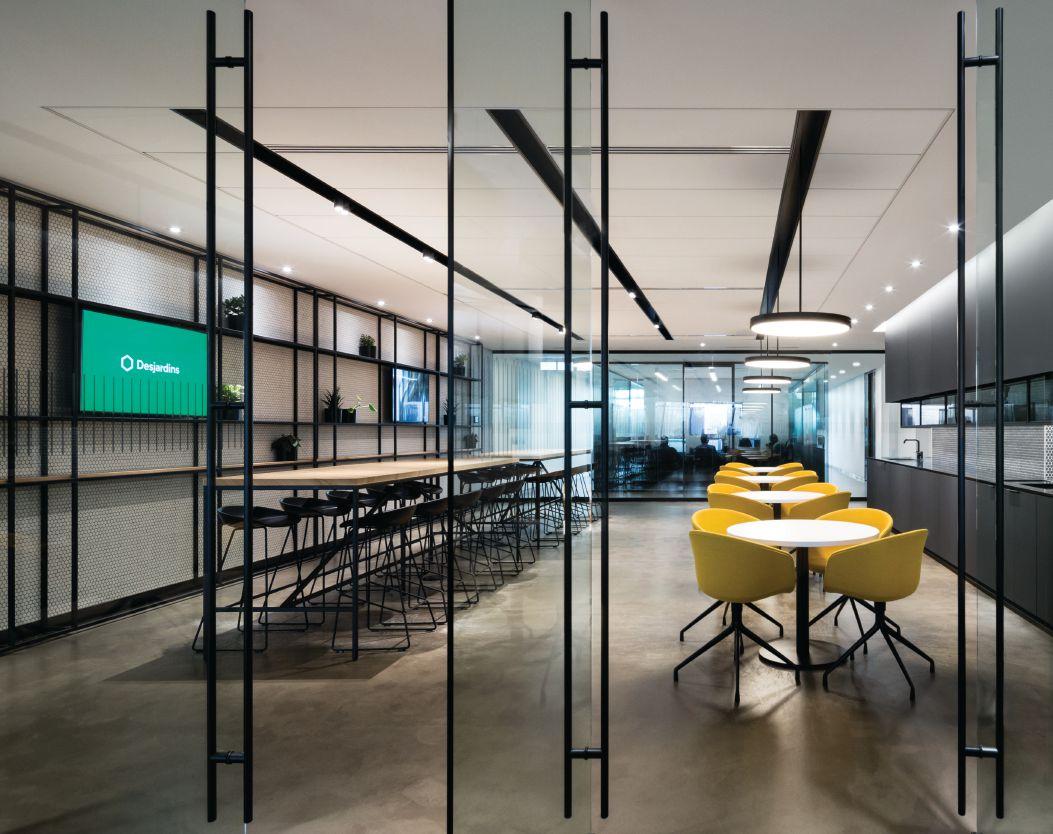
Many Canadians outside Montreal aren’t aware that the Olympic Tower of Montreal has sat empty since 1987. Empty, that is, until the summer of 2018, when employees of Desjardins Movement moved into the newly created office space. The company now occupies most of the rental space available –seven of the 12 floors of this landmark building – with 1,000 people now coming to work there each day.
The historic project was initiated in 2015 with architectural firm Provencher Roy at the helm. The most striking part of the update was replacement of the prefabricated concrete envelope (which did have vertical strips of windows) with a full curtain wall.
“The original facade had a curve running horizontally south to north, due to the curved slab edges of the original structure,” explains Osama Ghani, project director at Vitreco, which was the glazing contractor for this major building update. “Once the original pre-cast units were demolished, the slabs needed to be extended outward to eliminate the original curve. This eliminated the requirement for curved glass prefabricated curtain walls, thus making the project much more economical to the client.”
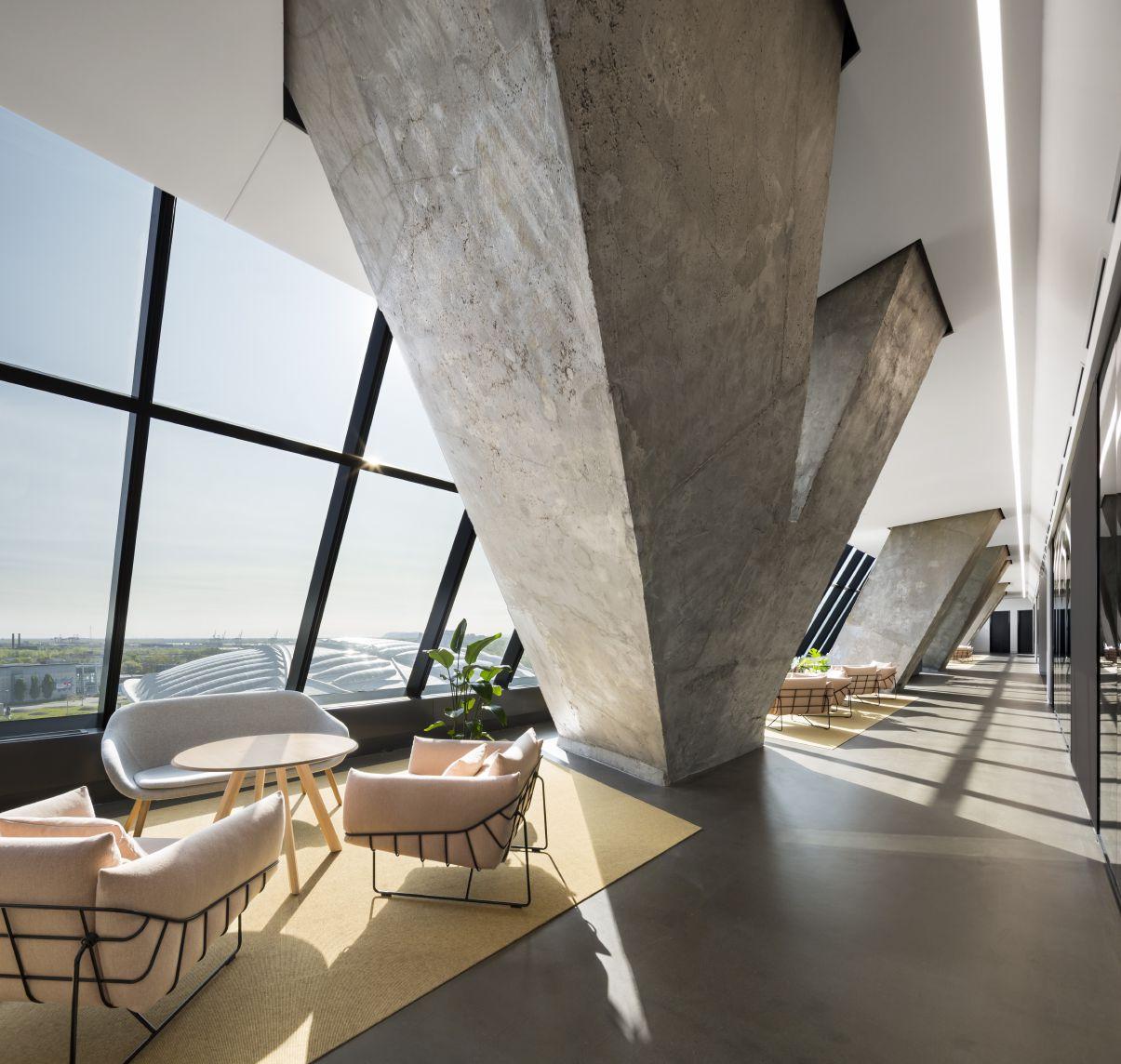
The greatest challenge in the curtainwall installation was site access. “Due to the cross-braced concrete columns of the tower, access to install the curtainwall panels from the interior
AT A GLANCE –Desjardins Tower, Montreal
Architect: Provencher Roy
Glazing contractor: Vitreco (Flynn Group of Companies)
Structural glass consultant: CPA Structural Glass
Glass specifications: Vision Glass
Laminated outboard: 6mm bronze tempered/SGP/6mm clear tempered with easy-clean coating on surface 1 and low-E on surface 4. Argon fill.
Laminated inboard: 6mm clear HS double IGU with PVB.
Spandrel
Similar composition, but with fully tempered laminated inboard and a dark ceramic fritte on face #8
Projection completion: 2018
Video of the panel installation available on YouTube
of the slab was not possible,” Ghani reports. “In addition, the variable slope in the face of glass due to the inclination of the tower posed a greater difficulty for installation as the panels needs to be lifted horizontally and then somehow manipulated
The huge concrete columns are a striking feature, but made installation a challenge.
mid-air to the proper inclination in order to fit into their final locations. To resolve both issues, we installed the panels using the tower crane, coupled with a custom-designed vacuum suction system for the lifting and installation.”
The windows of the re-made building are unobstructed, allowing occupants stunning views of the stadium and the city. Besides offices, many areas for collaborative work and also relaxation were also included in the design.
Ghani notes that the vision glass installation was difficult in that double-laminated 40.5-mm IGUs were used for both the inboard and outboard lites . This doubled the unit weight of the glass in comparison to standard 25-mm units. “In addition to the heavy glass, some prefab curtainwall units were up to 6,300 by 1500 millimeters in size,” he notes, “making the overall weight of the panels very heavy compared to other projects we’ve worked on.”
Ghani also explains that the glass features took the nature of
the tower into account, namely, its limited access to the outside and the safety of building occupants. “For example, if breakage does happen on the outboard lite, due the rigidity of the SentryGuard it would stay intact, in place, and watertight for many months until replacements can be procurred,” he says. “Similarly, with the interior lite, due to the inclined nature of the facade and the fact that some glass units might be directly over people standing next to the curtain wall, any breakage would keep the inboard light intact and therefore the people under it safe.”
The glass was also specified to have an easy-clean coating on the exterior face: a chemical coating that would reduce cleaning costs. “Lastly, the glass spec called for 100 per cent heat soak testing,” Ghani explains. “This testing greatly reduced the risk of spontaneous breakage due to nickel sulfide impurities of the tempered glass during its service life, and therefore reduces the overall risk for the client.” •
Desjardins made extensive use of beautiful glass both inside and out.
PROUDLY CANADIAN SINCE 1989
COMMDOOR ALUMINUM: RESHAPING BOUNDARIES
THE SPECIALIST IN CURTAIN WALLS, WINDOWS AND DOORS
With our transparent approach, we have been serving the commercial and industrial demand for architectural aluminum products since 1989. A proud member of the Toro Aluminum Group of Companies.
CURTAIN WALL
FIXED WINDOW SERIES
HIGH PERFORMANCE CURTAIN WALL
ENTRANCE FRAMING
OPERABLE WINDOWS
SLIDING AND BI-FOLD
SWING DOORS
MISCELLANEOUS PRODUCTS
QUALITY PRODUCTS, INNOVATIVE DESIGNS AND A LASTING RESULT.
With a long and successful history in the commercial glazing industry, Commdoor Aluminum provides high-quality architectural aluminum building products for engineers, architects, glazing contractors, designers and building owners.
GREATGLAZING LEARNING AND DOING
by TREENA HEIN
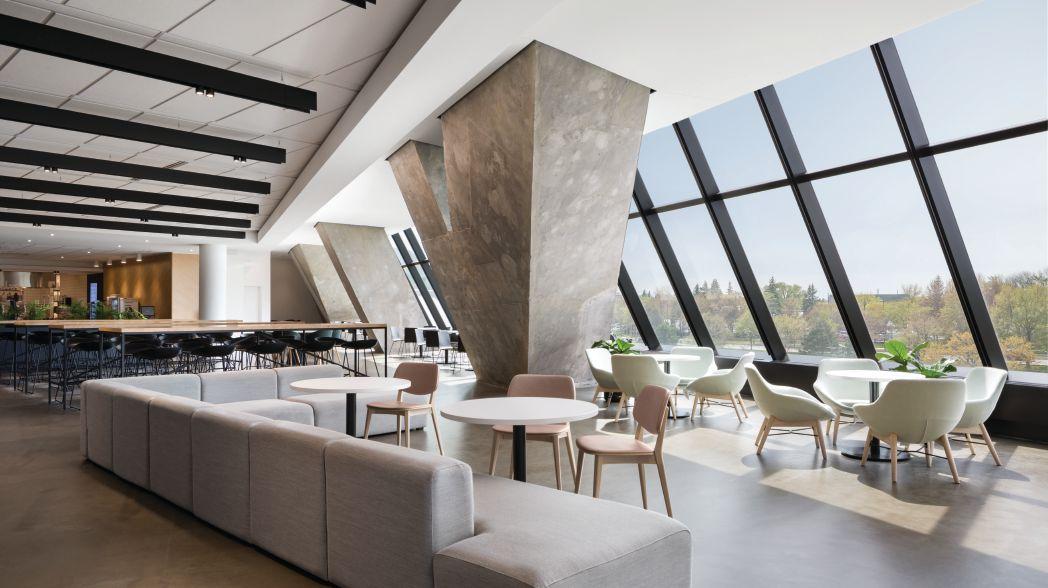
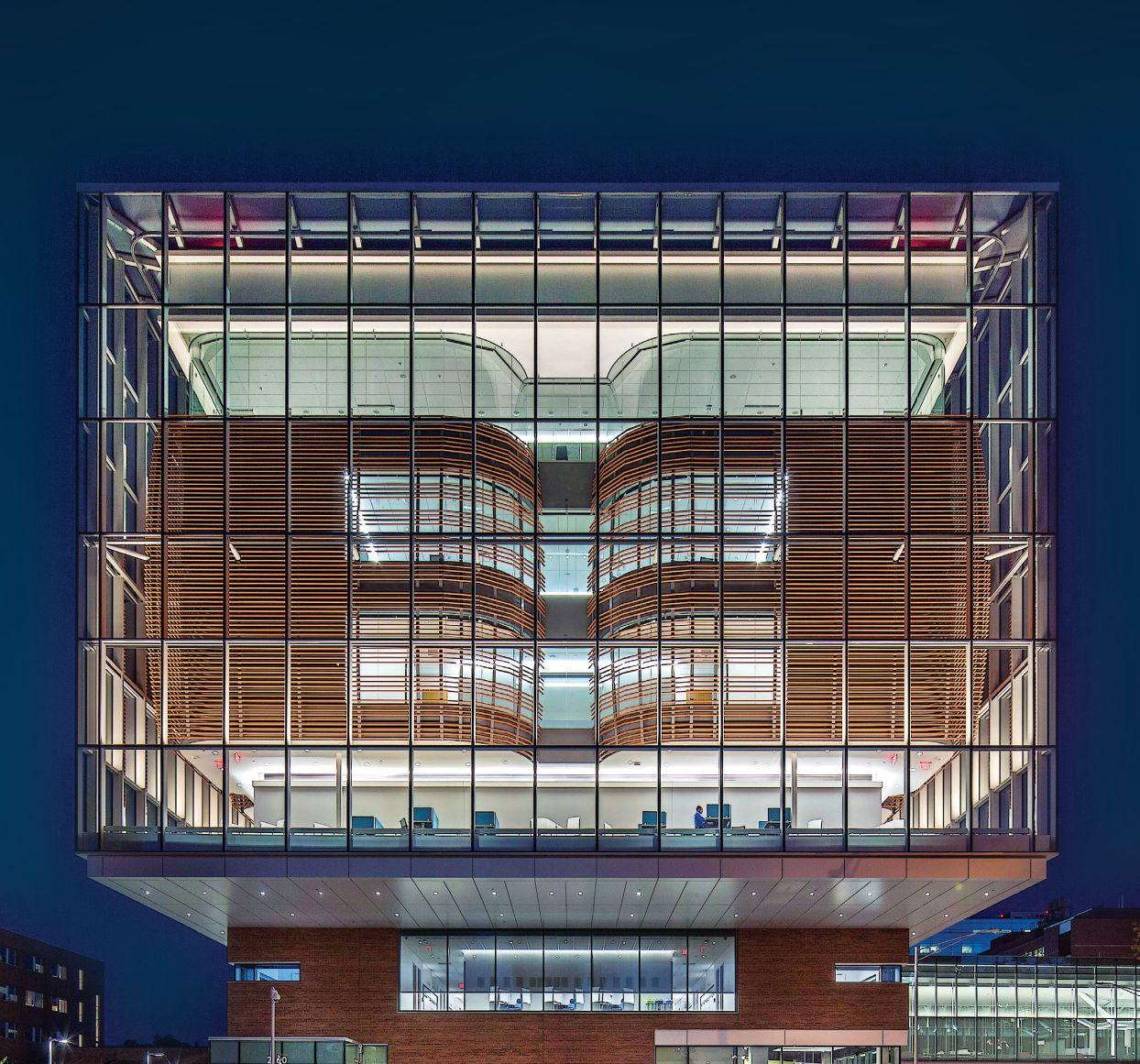
Like it should, the University of Toronto’s Myhal Centre for Engineering Innovation and Entrepreneurship enables students to do what engineering students must do: learn and to apply that learning. With the innovative use of several major glass features, the Myhal Centre is described by the University as a building that’s “designed to foster collaboration between researchers, students, industry partners and alumni, sparking the exchange of new ideas and catalyzing innovation.”
The building, with its pre-glazed curtain wall, both stands out and blends in on the historic St. George downtown campus. It was constructed on the last plot of land that existed along the campus’ main promenade and sits somewhat in contrast but also in compliment to a mix of other campus buildings of varying age. In Canadian Architect, Robert Davies, principal architect at firm Montgomery Sisam, explains that the work of abstract painter Agnes Martin was an inspiration in the Centre’s “simple, disciplined, esthetic” design.
To make students into leadings engineers of tomorrow, the Myhal Centre contains prototyping facilities, multidisciplinary research hubs, design studios and other technology-enhanced learning spaces of varying size. A central theme of this facility, as described in the University’s Varsity newspaper, is that “every space is functional and light pours in from every angle.”
These include the Skule Arena, where over 100 clubs and
AT A GLANCE –Myhal Centre, U of T
Glazing contractors: Tower Glazing Systems
Curtainwall fabricator: Alumicor (2600 series pre-glazed)
Architectural firm: Montgomery Sisam Architects in association with Feilden Clegg Bradley Studios
Glass specifications: Vision
6mm Guardian Sungard Superneutral SN 68 on surface 2, with R-MAX warm-edge spacer and 8mm tempered interior lite Spandrel
6mm Guardian Sungard Superneutral SN 68 on surface 2, with R-MAX warm-edge spacer and 8mm tempered interior lite warm gray ceramic frit on surface 3
Total building footprint: 14,864 square meters
Completed: 2018
engineering teams (such as the Human-Powered Vehicles Design Team) can interact.
Tower Glazing Systems was responsible for the design, fabrication and installation of the pre-glazed curtain wall, which
Creating a functional collaoration space for engineering students was the goal.
DOING
consists of both sealed units and spandrels. “One of the biggest challenges was designing the curtainwall to be installed after the precast installation,” explains project manager, Kyle Youngs. “The sequencing between the precast and curtain wall was crucial to the success of the project.”
In addition, he says “the modified air vapour barrier detail was installed from the inside of the building after precast and curtainwall installation. It was a very difficult detail to achieve due to the limited space between the curtain wall and block wall.”
The centre’s Lee and Margaret Lau Auditorium holds almost 470 seats (arranged at tables, promoting student discussion) as well as the latest technology, including a wall-to-wall digital array. Among other spaces in the centre are the light fabrication facility where students work on projects using various materials, and a prototype facility complete with a laser cutter and 3D printers. Capping the eight-storey building is the Dr. Woo Hon Fai Terrace, from which the CN Tower and the Art Gallery of
Ontario can be viewed, along with the Front campus and the Toronto skyline. This level is also home to the Institute for Sustainable Energy and the Institute for Water Innovation. Youngs notes that mechanical house on this floor has a unique standalone wrap-around cosmetic screen, which “was a challenge to install due to the size and location of the curtain wall. We had the utilize a tower crane for installation.”
As expected, the Myhal Centre is a very green building, with solar panels, a green roof and a cistern to collect rainwater for landscape irrigation. Its energy efficiency is extremely high and that is partly due to the glass selection. Indeed, Youngs explains that the high-performance glass used in this project was quite unique. “The Guardian Sungard Superneutal SN 68 delivers high light transmittance while reducing solar heat gain,” he explains. “Its neutral appearance allows architects to choose a substrate to match their vision and create striking statements of light and colour, while earning LEED points and controlling energy costs.” •
The facade affords views of the CN Tower and the Art Gallery of Ontario.
GREATGLAZING THE OCULUS
by ADAM MITCHELL
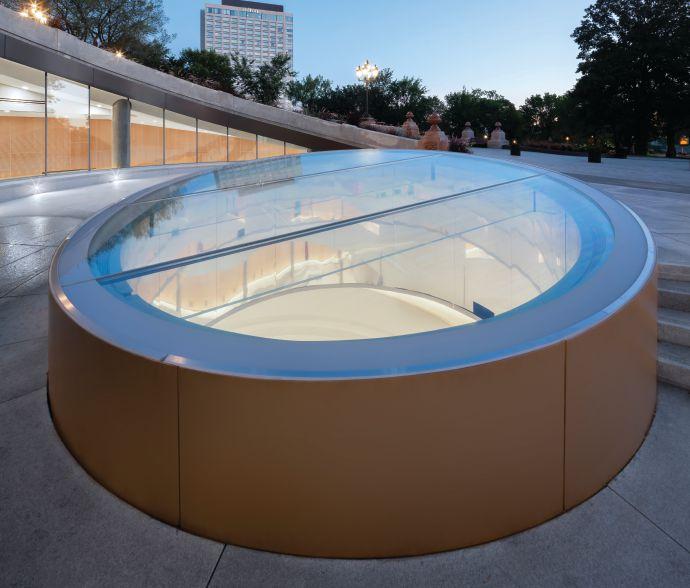
The reception pavilion of Quebec’s National Assembly was due for a modernization and re-imagining in order to create a fantastic, bold centrepiece that engages visitors’ senses and serves as a learning space. Designed by leading architects Provencher Roy and Gagnon Letellier Cyr Richard Mathieu et Associes Architectes (GLCRM Architectes), the reception building was built underground, separate from the Parliament Buildings in an effort to define the modern reception space while maintaining visibility to the unique exterior façade of the heritage site. Connected seamlessly to the front door via elevator, visitors are shuttled to the marvelous underground space in which they can fully experience the gravity of the legislature tower through one of the pavilions defining features: the Oculus.
The Oculus has an overall diameter of 191 inches and is supported by two highly complex five-piece laminates that hold over 7,500 pounds of precision CNC-radiused laminates.
The resulting installation can be described as a work of art. Polished, clear and impeccably fabricated, the Oculus is the centrepiece to this wonderous underground experience, casting brilliant natural light across its floor and creating an area of intrigue.
The Oculus was a highly complex project to fabricate, James Cole, project manager at Agnora, states. “This was one of the most technically difficult jobs I’ve put through fabrication. Our team really knows their stuff and everything was installed without rejection or difficulty, the first time.”
The two horizontal supports had a myriad of custom features and incredible fabrication aspects. The supports for the radiused vision glass were five-layer-laminated half-inch Optiwhite by Pilkington. Combined with a SentryGuard interlayer the total thickness became 2 5/8 inches. The length of the glass was extremely long and narrow, totaling 191 by 16 inches, creating challenging alignments and
complicating the tempering processes. A five-degree angle was added to the 191inch length of each glass support, so each piece of the five-layer had to be individually CNC machined and painstakingly aligned in the lamination process to create a perfectly flush, five-layer, 191-inch, five-degree edge. As this was an exposed edge, all sides were fully polished. Every support was engineered with a notch to allow it to be placed along the structural support of the building.
The exterior glass included a total of three radiused pieces with two being three-layer 12-mm Saint-Gobain CoolLite 7033 and one being a two-layer, six-mm variant of the same. Boasting an impressive total diameter of 191 inches, each of these pieces weighed in at roughly 2,500 pounds. When placed along the supports, the five-degree supports allow for the glass to shed rainwater and maintain a relatively clear surface.
As the perimeter of the Oculus was placed within structural supports, the full perimeter required custom-printed frit to hide unwanted visual features. Agnora’s
AT A GLANCE –The Oculus
Architect: Provencher Roy and GLCRM Architectes
Glazing contractor: Pomerleau
Glass fabricator: Agnora
Supports: Five-layer laminated
0.5-inch Optiwhite by Pilkington combined with SentryGuard interlayer – total thickness 2 5/8 inches
Exterior glass: Three layers of 12-millimeter Saint-Gobain
Cool-Lite 7033 and one two-layer, six-millimeter variant
print team and DipTech printer concocted a custom shade of grey to match perfectly to the surrounding features. This “blended” frit provided a subtle transition from clear to fully opaque glass without outlandish colour differences that would draw the eye and take away from the clarity of the Oculus feature. •
GREATGLAZING
GLASS MEETS WOOD
by TREENA
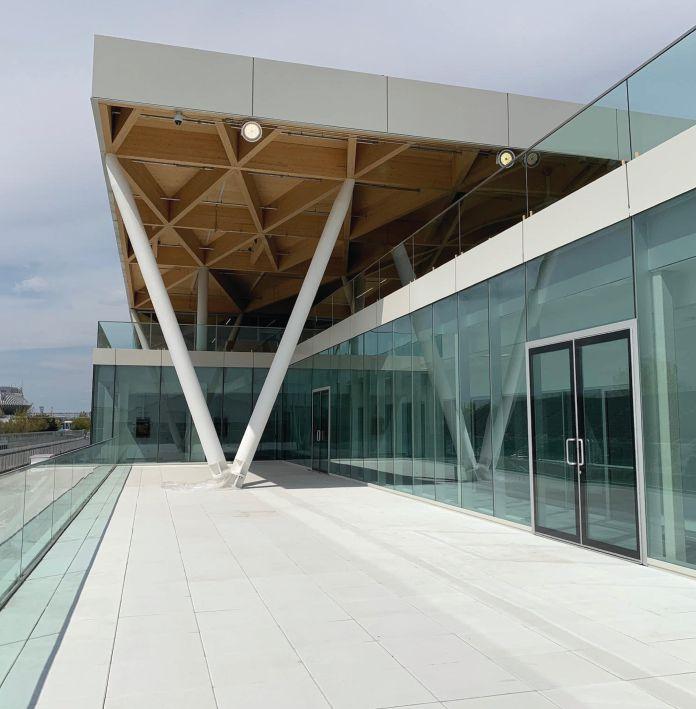
Over the last ten years, Quebec City Jean Lesage International Airport has undergone an extensive expansion, with a state-of-the-art glass addition to the passenger arrival area requiring innovative solutions from the structural glass engineering firm, CPA Structural Glass of Montreal. For this project, the company started out as a client of GLCRM Architects, then was released to offer its engineering expertise and hardware supply to bidders. “We ended up working with Epsylon Concept, a glazing contractor from Quebec City,” says CPA president, Bethanie Cloutier, “so we were involved from start to finish, which is the real way to work these projects.”
A total of $500 million was spent on expansion and upgrades at the airport to keep it aligned with evolving industry standards and to provide an optimal passenger experience. The terminal area was doubled and more dedicated baggage carousels were added, for example. Other upgrades include a more user-friendly customs area,
expanded food service and a state-of-the art curbside passenger arrival zone.
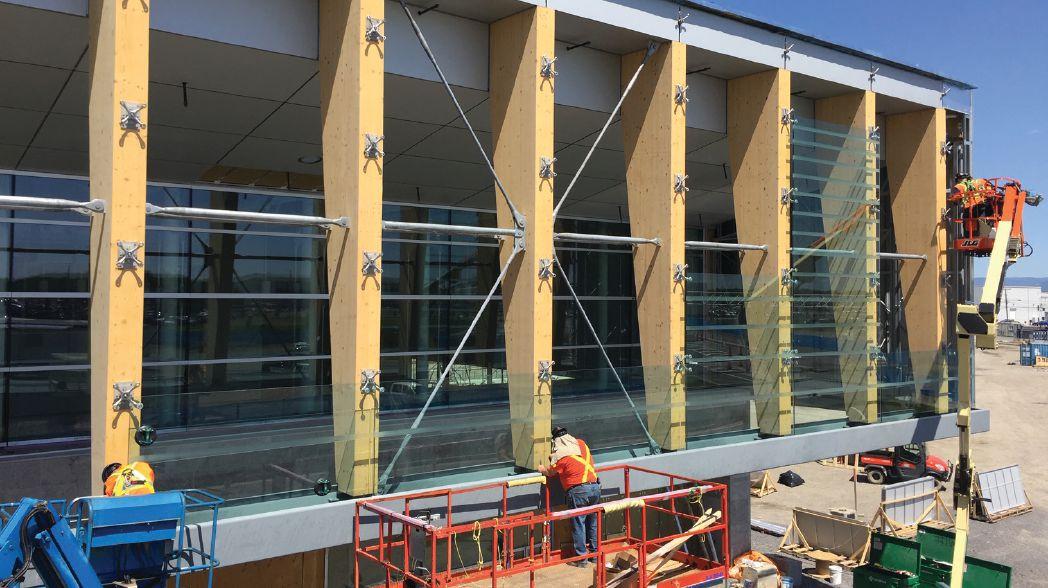
Over the top of this main passenger area, a glass partition/screen was added: an architectural feature intended to particularly showcase a new underlying wood structure suspended from a cantilever roof section. “The concept and installation of this point-fixed glass screen was very challenging,” Cloutier says, “due to unusually high differential movements induced in the wood structure (wind, earthquake and thermal loads).”
The fact that the screen needed to be suspended from a cantilevered roof meant compensating for fabrication and installation tolerances through the use of a versatile, highly-adjustable interface between the spiders and the wood columns, designed and supplied by CPA. Cloutier explains that “while the top of the of the wood structure is anchored to an insulated structure, the bottom link and cross-bracing between the columns are steel, exposed to the elements and therefore subject to a lot of expansion and contraction even with the presence of control joints. So, the in-service change in
AT A GLANCE –Québec City Jean Lesage International Airport (YQB)
Hardware supplier: CPA Structural Glass/Sadev Architectural System
Screen specifications: Doublelayer 10-mm tempered glass (heatsoaked), laminated with 1.52-mm SGP with ink jet-printed ceramic frit supplied by Prelco
HEIN
WOOD
geometry was challenging and had to be accommodated by sizing the gaps between the panels to permit those movements.’’
The glass panels of the screen were installed using four Sadev rotules assembled to spiders, which in turn, were bolted to the adjustable interface carefully positioned on the wood columns. Cloutier and her team worked closely with the structural engineer to obtain all the essential information on the behaviour of the structure through its life cycle. The interface parts were screwed in place once the structure was surveyed, and there were adjustments made (plus/minus 25 mm out of plane, 10 mm horizontally and seven mm vertically). Very precise lines were required for screw anchor installation, but the team also had to account for minimum edge distances to ensure each screw was properly secured.
“To add to the complexity,” Cloutier explains, “variably spaced horizontal ceramic fritted lines on the glass panels had to be coordinated for installation with precision, as well as for all the holes needed for the letters of the airport’s name to be bolted to the glass. At the expansion joints, conditions enabled at one location to simply separate the wall into two independent facades, but in other places, standard spiders were modified to allow for large horizontal displacement at their mounting points.”
The overall airport upgrade received an INOVA award from the Urban Development Institute of Quebec. These awards recognize innovative buildings that have a significant impact on various real estate sectors. Chief among the attributes celebrated was the fact that the project involved a Building Information Modeling (BIM) approach, the first time that it had every been used in the province for such a large undertaking. Also recognized was the sustainability of the new airport, which harnesses geothermal energy, automated lighting, heat recovery and more.
Design and installation of the YQB passenger zone façade was very rewarding, says Cloutier, due to its many technical aspects. She attributes its success “to an incredible team effort from the beginning of the concept with the architects and structural engineers, to the training of the installation team on-site.” •
Photo:
Photo:
FAST GLASS
by JIM DONNELLY
The Canadian Grand Prix (also known as the Montreal Grand Prix) has been held every year since 1961, and has been part of the Formula One World Championship since 1967. It’s been run at Parc Jean Drapeau’s Circuit Gilles-Villeneuve since 1978 and is a smashing success each year, drawing hundreds of thousands of racing fans and generating millions for Montreal’s economy. It is reputed to be the largest annual sporting event in Canada. The facility’s paddocks building, the epicenter of the event, is a multi-purpose structure housing team garages, spectator loges and terraces, media and administrative rooms, and even a control tower to help manage the race.
The paddocks building, however, had been in need of a major upgrade for years. Not only could race organizers only fit 1,800 people in the loges above the garages, but several other missing elements meant it didn’t meet standards set out by the Formula One World Championship – a major issue, considering the race’s five-year contract extension signed with Formula One in 2017 required these upgrades.
But that wasn’t the only challenge. Unicel and the rest of the implementation team were also required to fast-track the upgrades, as they needed to be built under a tight construction timeline of 10 months over an arduous winter season: demolition of the old structure occurred after the 2018 event, with a construction deadline of the first week of June 2019.
Unicel was contracted to supply 32,500 square feet of curtainwall, the skylights, and the glass railings on the paddocks building. Oversize insulated glass units of dimensions up to 57 by 179 inches were imported from Spain to be used in the project. The metal framing consisted of the clear anodized aluminium curtainwall Vision800S, by Unicel Architectural.
The new three-storey paddocks provides a bright, modern and private viewing area with a great view in a unique spot just minutes from downtown Montreal. It provides a 360-degree panorama with
stunning views of the Montreal skyline, St. Lawrence River, and surrounding area while housing teams’ garages, a control tower and administrative offices on the first floor; loges, control tower, podium and media workspace on the second; and loges and the terrace on the third. The building is universally accessible and will integrate works of public art into the North Entrance’s glasswork starting in 2020. The project upgraded the facilities to meet or exceed Formula 1 World Championship standards: it increases capacity from 1,800 to 5,000 people and features sustainable elements such as carbon-negative materials, LED lighting, photovoltaic solar power and natural lighting via the building’s massive glass wall. And even though it entailed considerable challenges considering its scale, timeline, and logistics, the project was completed on time. •
AT A GLANCE –Canadian Grand Prix
Architect: Les Architectes FABG
General Contractor: Groupe Geyser
Glass Manufacturer: Saint-Gobain
Metal Systems Manufacturer: Unicel Architectural Corp
Contract Glazier: Unicel Architectural Corp.
Glass Fabricator: Multiver, GPS
Big views at the new Canadian Grand Prix paddock let F1 fans watch the world speed by.
CANADIAN GLASS ASSOCIATION REGRETFULLY,
Thank you to all the volunteers and supporters over the years of the Canadian Glass Association. Stay safe and healthy.
- CGA board of directors
GREATGLAZING
AT THE MALL
by ANDREW SNOOK
As a consumer, navigating large shopping malls can be dizzying at times. One can only imagine how the team at Griffin Glass felt moving two 1,500-pound pieces of low iron, 10-millimeter heat strengthened laminated safety glass through the massive West Edmonton Mall to get it to its destination: a Louis Vuitton store.
Few companies specialize in these types of installations in Alberta, but the Calgary-based company enjoys a challenge. It has been servicing a variety of industries in the Calgary Metropolitan Area for 60 years, originally opening up shop in 1960. Griffin Glass offers a wide variety of glass and architectural metals for industrial, institutional and commercial construction projects. A few years ago, the company branched out to other regions of Alberta to offer these types of unique installations for shopping mall storefronts.
“We have a young office at Griffin. We’re highly motivated and nothing really scares us, we’ll try anything,” says Trevor Whyte, vice-president of Griffin Glass. “If it has to do with glass, we’ll make it work.”
The Louis Vuitton is on the second floor of the WEM, which presented a big challenge for getting the glass into the mall.
“The West Edmonton Mall was built in the ‘80s, so they have one place we could bring it in on the main floor,” Whyte explains, adding that he had meetings with the manager and engineer of the mall to plan out the best course of action. “We had to walk this thing halfway across the mall. It took us a good day just to figure out how it was going to work. Once you get those logistical things figured out, before you go down there [for the installation], it goes off without a hitch.”
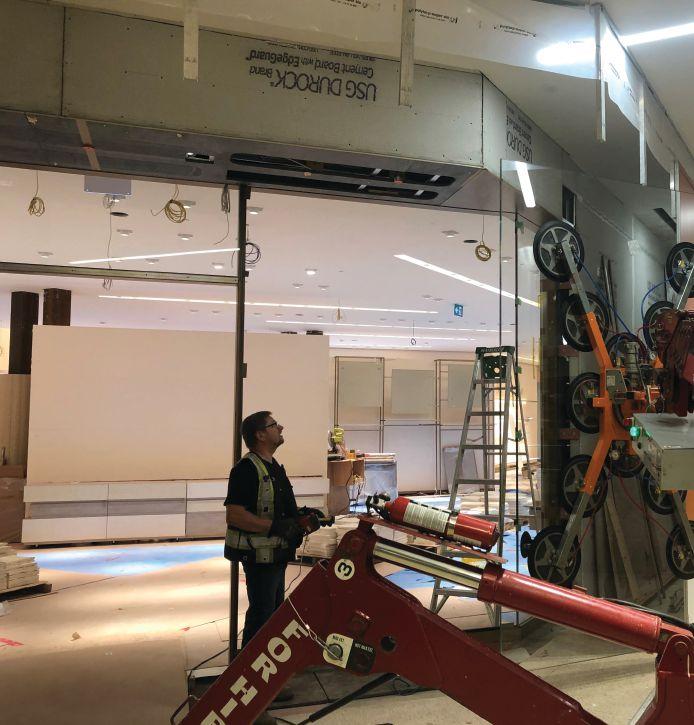
During after the mall’s afterhours, the Griffin Glass team carefully wheeled the glass through the access point on the first floor then navigated it through a large portion of the mall and set it up to be hoisted onto the second floor with a Spydercrane sourced from Burnt Timber Lifting Solutions in Athabasca, Alta.
“We had to set up our crane on the second floor, and kind of hoist it through the opening up onto a different platform – a different rolling A-frame – and then, through the opening, we crane it in with these monster suckers.”
To ensure the installation went smoothly, Griffin Glass sent five employees to Edmonton for the project.
“I’d rather send one extra guy in case something goes wrong than pay for a broken piece,” Whyte says.
The glass was so large that Griffin Glass needed to source it out of another shop in Collingwood, Ont.
Another its successful installation, Whyte said an added bonus was admiring the finished project whenever he decides to go shopping at the WEM.
“It’s really cool to walk around the mall,
AT A GLANCE –West Edmonton Mall
Glazing contractor: Griffin Glass, Calgary, Alta
Feature glass: 2/1,500-lb. heat strengthened Optiwhite glass with a clear PVB 1.52-mm interlayer (Optiwhite is the supplier’s version of low iron Starphire)
Glass supplier: Agnora
once the store is opened, to walk around and take pictures,” he says. “You’re really proud of the project. You wish you could explain to them how it was done and how it came to fruition.” •
The Louis Vuitton store in West Edmonton Mall wanted something special for its storefront.
CORONAVIRUS
NEWS
Provinces take different approaches to
construction workplaces
Different jurisdictions across the country have taken different responses to the coronavirus outbreak.
At press time, Ontario and Quebec had ordered all non-essential businesses in those provinces to close. All other provinces have declared a state of emergency, but not closed workplaces, though restrictions on gatherings are in place. Ontario designated almost all construction and manufacturing activities to be essential. Quebec was more restrictive, saying it would allow construction where maintenance of infrastructure for public safety was concerned. Quebec manufacturers were asked to “minimize” their activities.
Most glass and glazing companies have interpreted these directions as allowing them to continue operations as long as hygiene and social distancing guidelines are followed. Requests to provincial governments for clarification have elicited responses that are essentially repetitions of the public press releases.
Both Ontario and Quebec construction unions expressed concern for the health of workers on construction sites.
The Ontario Construction Consortium, a union lobbying group, called for jobsites to be shut down for 14 days.
But CSD-Construction in Quebec said its survey showed about two-thirds of its workers wanted to continue working
with improved health practices.
WorkSafeBC said it would send inspectors to construction sites after getting complaints that social distancing was not happening on some job sites.
The B.C. health minister said she was not considering further orders. Alberta jobsites remained open.
The Alberta Construction Association sent a letter to premier Jason Kenney requesting the province not shut down construction activities.
Construction activities were allowed to continue throughout Atlantic Canada, though Nova Scotia instituted a 14-day quarantine on all travellers entering the province, even from elsewhere in Canada.
IGMAC SUSPENDS ON-SITE INSPECTIONS
I
nsulating Glass Manufacturing Association of Canada certification program on-site inspections have been suspended until June 30. In order to consistently apply the program requirements to all participants for the 2020 certification year, any IGMAC program plant at which an on-site inspection was already performed in 2020 will receive a virtual/remote inspection during the second half of 2020. Any plant that receives a virtual audit for the first half of the year will have an on-site inspection performed in the second half of the year, assuming normal travel has resumed. re-assess the situation as we
approach June 30 to determine if any further modifications to this on-site inspection strategy need to be made. IGMAC licensees will be contacted by their designated IGMAC auditor and asked to provide records, forms and other information associated with the QMS and audit requirements on an electronic basis and will be provided a timeline for responding. The auditor will review the submissions and prepare inspection reports and corrective action requests as necessary. Normal response times for corrective action will apply. Audits for test sample fabrications will also occur remotely.
green. For less green.
Find affordable clarity in the Solarban® Acuity™ low-e glass series.
Introducing Acuity™ low-iron glass which is 60 percent less green than ordinary clear glass . The new Solarban® Acuity™ series by Vitro Architectural Glass provides the truly clear look you want with the outstanding performance of the full range of Solarban® solar control low-e coatings.
Upgrading a low-e coated clear insulating glass unit to Solarban ® Acuity™ glass will typically increase the total installed curtainwall cost by only $1–2 per square foot.
Give a little, get it all. Request your samples at vitroglazings.com/acuity
TOP GLASS POSTPONED
Top Glass, Canada’s conference for the architectural glass industry, has been rescheduled for Tuesday, Sept. 29, at Paramount EventSpace in Woodbridge, Ont. The conference, originally scheduled for April 22, had to be postponed due to the state of emergency in Ontario over coronavirus.
“While moving the show at the last minute was obviously a challenge, we think we’ve found a date that keeps us far enough away from other industry events and a venue that will serve our exhibitors and attendees well,” said Danielle Labrie, show manager. “We’re looking forward to welcoming everyone who was planning to attend in April and hopefully celebrating the end of this pandemic together.”
Paramount EventSpace is in Woodbridge, Ont., the hotbed of fenestration manufacturing in Canada. It is conveniently located just off the highway near the intersection of the 407 and 400 with numerous nearby hotels and restaurants.The space for the show is the same size as the space provided at the International Centre.
Registrations already received for Top Glass will be honoured on the fall date. All speakers and panelists have confirmed.
“The silver lining here is that with even more time to prepare and promote, Top Glass 2020 might be our best one yet!” Labrie added.
Federal government extends support for unemployed workers
Ottawa has introduced a new program that will cover all workers losing pay due to coronavirus who do not qualify for Employment Insurance. The new Canada Emergency Response Benefit will provide a taxable benefit of $2,000 a month for up to four months to workers who must stop working due to COVID-19 and do not have access to paid leave or other income support. The benefit also extends to workers who are sick, quarantined, or taking care of someone who is sick with COVID-19; working parents who must stay home without pay to care for children that are sick or need additional care because of school and daycare closures; workers who still have their employment but are not being paid because there is currently not sufficient work and their employer has asked them not to come to work; and wage earners and self-employed individuals, including contract workers, who would not otherwise be eligible for Employment Insurance. Workers can apply for CERB benefits online.
Ontario and Quebec WCBs announce reporting and payment deferrals
Both Ontario’s WSIB and Quebec’s CNESST worker’s compensation boards have extended premium reporting and payment deadlines to August 31. Businesses who report and pay monthly, quarterly or annually based on their insurable earnings are eligible for this deferral. All payments due in April through July are eligible for deferral. No interest will accrue on outstanding premium payments and no penalties will be charged during this six-month deferral period.
Federal support for small businesses
Ottawa has announced several measures to assist small businesses through the pandemic. The government is providing eligible employers a temporary wage subsidy for a period of three months. The subsidy will be equal to 75 per cent of remuneration paid during that period, up to a maximum subsidy of $847 per employee per week. To be eligible, employers must show a 30 per cent decline in revenues. Detail of how declines are to be determined and reported are not clear at this time. Businesses will be able to benefit immediately from this support by reducing their remittances of income tax withheld on their employees’ remuneration. Employers benefiting from this measure will include corporations as well as non-profit organizations and charities.
The Canada Revenue Agency will allow all businesses to defer, until after August 31, the payment of any income tax amounts that became owing on or after March 18 and before September. This relief would apply to tax balances due, as well as instalments. No interest or penalties will accumulate on these amounts during this period.
The Canada Revenue Agency will not contact any small or medium-sized businesses to initiate any post assessment GST/HST or income tax audits until mid-April. For the vast majority of businesses, the Canada Revenue Agency will temporarily suspend audit interaction with taxpayers and representatives.
The Business Credit Availability Program will allow the Business Development Bank of Canada and Export Development Canada to provide more than $10 billion of additional support, largely targeted to small and mediumsized businesses.
EDC expands services
Export Development Canada (EDC) has expanded services and support to help as the spread of the coronavirus impacts Canadian businesses. Its immediate focus during this time of crisis is bringing liquidity into the market in order to manage the challenges companies are facing. EDC will support all exporting companies by offering their bank a guarantee on loans of up to $5 million so that companies can access more cash immediately. Details are available through financial institutions. For credit insurance customers, EDC will cover losses for goods shipped even if the buyer has not accepted the goods, subject to terms. It will also waive the 60-day waiting period for claims.
“EDC is here to support Canadian companies in good times and bad. We have an essential role to play alongside Team Canada partners in responding to our current economic crisis. This is the first announcement on how EDC intends to support Canadian businesses. Stay tuned for more.” said Mairead Lavery, president and CEO of EDC.
AGMCA cancels Glazier Appreciation Days
The Architectural Glass and Metal Contractor Association has cancelled it’s inaugural Glazier Appreciation Days. The two open house events were scheduled for May 6 in Toronto and June 1 in Ottawa. The AGMCA said it deeply regretted having to cancel and hoped to reschedule the events for a later date.
Coronavirus deep dive on GlassTalk
The GlassTalk podcast has released three special episodes featuring expert advice on pandemic response and accessing government assistance. Pandemic response expert Suzanne Bernier helped craft Ontario’s response to the SARS pandemic and joins GlassTalk to tell glazing companies what they should expect and how to keep their workers and customers safe. Bonny Koabel helps companies take advantage of government financial assistance, and she chimes in on the new measures provinces and Ottawa have announced to help our industry through this period. Listeners can access the GlassTalk podcast for free at glasscanadamag.com or on popular podcasting services.
Glass Canada wants your story
Glass Canada will be collecting pandemic-related stories from companies and individuals in Canada’s architectural glazing industry for a special feature in our June issue. This has been a remarkable time in the industry and we want to hear what it was like for you, how you coped, what changed and what your plans are going forward. If we share experiences as an industry, we can all learn and grow from this. To share your story, please email Glass Canada editor Patrick Flannery at pflannery@annexbusinessmedia.com or call at 226-931-0545.
Massive federal effort to rescue economy
The Canadian government has announced unprecedented measures aimed at supporting businesses, especially small businesses, and workers laid off during the pandemic. Firm figures for the cost of the measures were not available at press time, but analysts are predicting in excess of $100 billion.
75 per cent wage subsidy
On March 27, prime minister Justin Trudeau announced the previous 10 per cent wage subsidy for small businesses (defined as companies eligible for the small business tax deduction) would be boosted to 75 per cent of eligible workers’ wages. This measure is to be effective for three months. Businesses are also not required to submit employee income tax remittances for the subsidized portion of their salaries. The goal here is to enable companies to retain employees even if they are unable to work due to social distancing or workplace shutdown orders.
BDC credit
The Business Development Bank of Canada was authorized to provide an additional $10 billion of support to small and medium-sized businesses through the Business Credit Availability Program. These dollars are available through private banks, who have had their lending rules loosened to make $300 billion more available to businesses.
Deferred taxes
Businesses can defer federal tax payments and installments until Aug. 31 without interest. No GST/HST audits will be carried out in that period, and “the vast majority” of regular Canada Revenue Agency audits will be suspended.
Canada Account expansion
Export Development Canada has been given expanded flexibility to offer loans, loan guarantees and insurance to exporting companies.
CRL changes will-call services
C.R. Laurence has changed its will-call service practices. The glazing components supplier is accepting and filling orders as normal online or over the phone, but will not accept orders placed in person at service centers. It recommends orders be placed for UPS shipping to eliminate the need to visit service centers. If UPS delivery is not feasible, C.R.L will fill orders at its service centres by prior arrangement. CRL service centers will now close Saturdays and be open during business hours Monday to Friday.
SNC Lavalin withdraws 2020 financial outlook
TheArchitectural Glass and Metal Contractor Association has cancelled it’s inaugural Glazier Appreciation Days. The two open house events were scheduled for May 6 in Toronto and June 1 in Ottawa. The AGMCA said it deeply regretted having to cancel and hoped to reschedule the events for a later date.
SNC-Lavalin Group said on March 27 that given the consequences of the unprecedented and rapidly changing nature of the COVID-19 situation, and the impact on the company’s worldwide operations, the 2020 financial outlook that was provided by the company on Feb. 28 was no longer valid. It said company has and will continue to take all appropriate actions to protect its staff, to maintain business operations for customers where allowable and possible and to preserve liquidity.
“As a global organization we are doing our utmost to protect the health and safety of our workforce and have enacted robust business continuity plans for our customers,’’ said Ian L. Edwards, president and CEO. “I can’t thank our employees enough for everything they are doing for the company and its customers. We are actively managing the emerging impact on our business to minimize disruptions to our service delivery where possible, while taking actions on costs and cashflow with immediate effect to maximize their impact in the second quarter – and will stand ready to take further action if the situation demands.”
Most SNCL engineering eervices personnel have been able to continue servicing clients from non-office-based locations and to transition work among different jurisdictions as required, the company said. The company continues to actively offer its services and capabilities to customers and governments in the regions it operates. It is also closely monitoring the situation with regard to LSTK infrastructure projects and will implement government and client instructions around ability to work as required. The company continues to closely monitor and adjust its plans for its different business segments and customers in response to the evolving situation. In response to the rapidly emerging economic disruptions and impacts from COVID-19, SNCL said management is undertaking actions and measures to align the cost base of the company to deliver cost savings. Those measures are focused on reducing costs and managing cash flow across the company to provide flexibility in addressing varying levels of revenue and customer business. Discretionary expenditure not required to directly support client delivery is being significantly reduced and capital expenditure frozen. Where it is not possible for employees to carry on productive client work, either due to temporary shutdowns or the nature of the client service, remedial actions are being taken, including reduced hours and employee furloughs. All SNC-Lavalin’s executive leadership will be taking a 20 per cent reduction in salary and board members will take a 20 per cent reduction in cash compensation for the second quarter. The company said it stands ready to take additional cost action through the second quarter and beyond should the situation demand, while looking to preserve its capability to be ready and available to deliver for its customers when the economic recovery begins. At the end of the fourth quarter of 2019 SNC-Lavalin had cash available of $1.2 billion and a $2.6 billion revolving credit facility. The company expects to provide a further update on the situation when it releases its first quarter 2020 earnings results.
by FRANK FULTON
Choose your attitude
Unlike Mr. Trump, I like to read. I find myself checking the news feeds on my phone whenever there’s a break in the action and I must read at least a dozen news columns a day on a range of topics I’m interested in: Trudeau; all the political scenarios throughout Canada; Trump; the tire fire of U.S. politics; climate change; business; the inequity of the capitalist system; and, of course, the Leafs when they win. I’m less interested in reading about them following a loss. I feel like the news and what’s going on in the world has made me cynical and less optimistic. It sometimes gives me a negative outlook on life and I really don’t like feeling that way.
Then I read a book called Fish!. It’s one of those self-betterment-type books that is intended to “boost morale and improve results,” plus it’s short, easy and quick to get through. The message is simple enough and I found it gave me something to think about and to work on to get my outlook back onto a positive path.
Fish! is a story about a woman who gets promoted to be the manager of a department where the work is a dull, repetitive, accounting function where everybody hates their jobs. They are just going through the motions to collect a paycheque and are disliked by everybody else in the company because of their sour, unhelpful attitudes. The department is referred to as a toxic energy dump. She is tasked with solving the problems in the department before the company decides to outsource the work. By chance, she discovers the keys to transforming her workplace deadpool in a fish market. There, the work is heavy, the day is long and the place stinks like fish, yet all the employees have great energy, have fun while working, and customers swarm to be part of the lively activity.
Smiling or frowning, helpful or unfriendly, it’s up to you.
YOU BET YOUR GLASS
The underlying moral of the story is that you choose your own attitude. There is always a choice about the way you do your work and how you will approach it, even if there is not a choice about the work itself. The job may be strenuous, heavy, tedious or dull but you have a choice about the attitude you’re going to bring to the job. Smiling or frowning, it’s up to you. Upbeat or whining, it’s up to you. Helpful or unfriendly, it’s up to you. “I don’t believe that companies are necessarily prisons, but sometimes we make prisons of them by the way we choose to work there.”
You are undoubtedly aware of how you are affected by the people around you. If you have to deal with Debbie Downer or Eeyore all day long, you’re bound to be watching the clock and planning your getaway so as not to spend a minute more in your workplace than you have to. On the other hand, if you work with or for people who are friendly, helpful, energized and fun to be around, there’s a good chance your workplace is somewhere you look forward to be going. I think it’s important to empathize, ask yourself how your attitude affects the people around you, then choose to convey the type of person you would like to be dealing with yourself. I believe you’ll find it’s contagious and everybody’s day will be improved, including your own.
In addition to choosing your attitude to make today a great day, it’s also important to have some play incorporated into your day. All work and no play makes Jack a dull boy. You must also “be there” for your customers and team members, meaning looking for ways to reach out to find out what you can be doing to be helpful to them, offering your assistance when they need it and even including them in how you plan to do your work. If you’re successful at determining your customers or co-workers needs then fulfilling them, you will be able to “make their day.” They may even become Raving Fans, another quick and easy read I’d recommend if you’re looking to get motivated. •
Pilkington Energy Advantage™ C
Meets Canadian ENERGY STAR 2020 ER
The new Pilkington Energy Advantage™ C allows for improved passive solar energy efficiency and reduction of thermal transmittance while maintaining the pyrolytic coating benefits of ease of handling and fabrication with a robust and durable surface. The Canadian ENERGY STAR® 2020 specification for residential buildings can be met using Pilkington Energy Advantage™ C in various double glazed and triple glazed IGU configurations.