Introducing the newest kid on the block: MetroView™ Window Wall
Top to bottom, the new FG 501T Window Wall –the first in the MetroView™ Window Wall series –offers the look of a curtain wall with a slab-to-slab framing system that’s perfect for mid-rise multifamily and commercial applications. With air and water performance equal to many curtain walls and a range of aesthetic options including slab edge covers for a seamless transition between floors, MetroView™ Window Wall offers a beautiful frame for life
Power to the glaziers
Certification programs should focus on worker education.
After a launch that attracted a firestorm of complaints from constructionindustry individuals – some of whom formed ad hoc groups to organize their opposition – the Ontario College of Trades has completed a big round of consultations and is ready to start moving forward again with developing designations for construction trade occupations and criteria for certification of tradespeople within those trades. Commercial glaziers already have a designation under the college: Architectural Glazing Technician. It is a non-mandatory designation, meaning an individual is under no obligation to register with the college before working in the trade, and a contractor is free to hire whomever they want whether certified by the college or not.
NEXT ISSUE
• Design Integration
• High-rise vinyl
• BEC report
The near-term goal of this effort is to provide some framework enabling contractors to judge whether a particular individual is trained to do the work for which they are hired. The long-term goal is harder to ascertain. At times I have heard the goal of the college is to establish a self-regulating regime under which tradespeople would determine training standards, certify tradespeople and possibly even discipline members who violate industry standards in a manner similar to other professional colleges, like doctors and lawyers. At other times and from other people, I have heard that the ultimate goal is to establish a province-wide certification scheme under which it becomes illegal for unlicensed tradespeople to work on construction sites. Certainly this is where a lot of small private contractors think the college is heading, provoking in them every instinct to resist another attempt to expand government control and charge them fees.
I do not envy the task of any government official trying to ascertain what is actually best for the industry and the public on this question. I’m not sure how you would get advice from someone without a dog in the fight.
The approach in most of the country has been to put various certification programs in effect on a voluntary basis and to leave it to the market to decide whether they are needed or not. Nothing has prevented architects and building owners from demanding bidders provide proof of worker certification – but they almost never do.
So what is our poor bureaucrat to do? The answer will depend on their focus. To help small businesses enter the market and compete, and to help property owners build for less, the system should be left loose and voluntary. To help larger contractors, unions, schools and consultants, the system should be tightened and backed by laws. To me, the key point is the benefit to individual glaziers in becoming educated in the trade and receiving some formal recognition of that learning. To that end, I think something like the college should be in place, backed by a strong effort to promote the benefits of skilled labour to the people who will be using it. •
MEDIA DESIGNER | Emily SUN GROUP PUBLISHER | Martin MCANULTY mmcanulty@annexweb.com
Publication Mail Agreement #40065710. RETURN UNDELIVERABLE CANADIAN ADDRESS TO CIRCULATION DEPARTMENT, P.O. BOX 530, SIMCOE, ON N3Y 4N5 e-mail: subscribe@glasscanadamag.com
Printed in Canada, All rights reserved. Editorial material is copyrighted. Permission to reprint may be granted on request. ISSN 0843-7041
Occasionally, Glass Canada will mail information on behalf of industry-related groups whose products and services we believe may be of interest to you. If you prefer not to receive this information, please contact our circulation department in any of the four ways listed above.
www.glasscanadamag.com
Salem invests in Canadian service
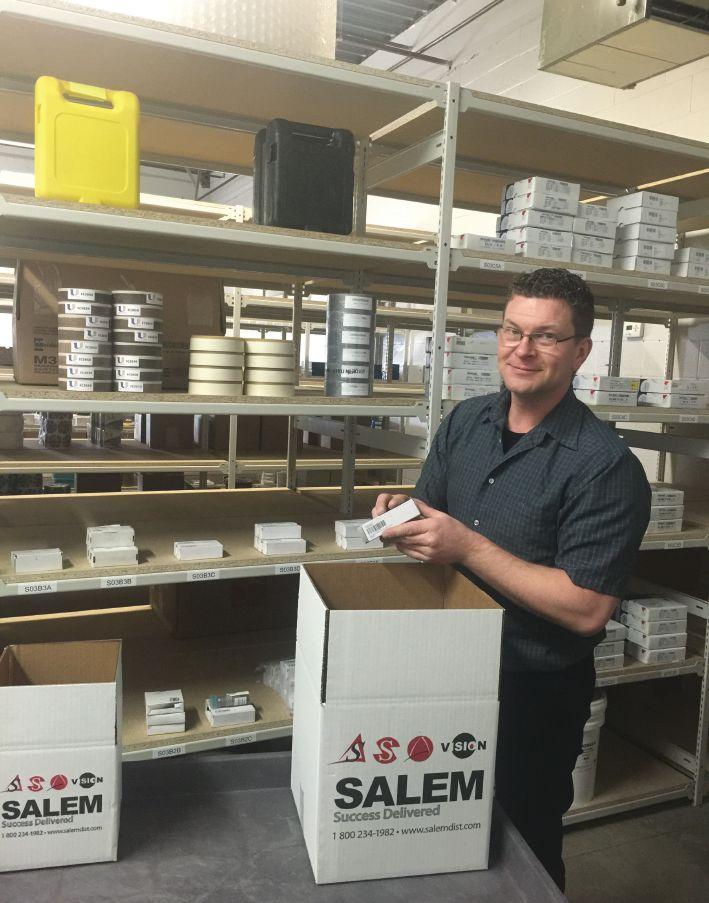
Salem Flat Glass and Mirror has opened a new warehouse in Concord, Ont., to serve the Canadian market. The new facility is on Keele Street, close to the 400 and 407 highways. From there, Salem will supply machinery, material handling equipment, diamond wheels, core drills, felt polishing wheels, cerium oxide polishing compounds and other glass fabrication needs.
Salem says the new location will allow for short turnaround times, including options for same-day delivery and customer pick-up. The focus presently is on eastern Canada,
with plans to expand the company’s footprint coast-to-coast.
“Our customer base is growing,” says Ann Greco, sales operations manager and owner. “We wanted to offer additional inventory and service and maintenance options for our Canadian customers and feel now is the opportune time for this endeavor.”
Greco adds that Salem has hired veteran industry professionals to serve its customers in the regional and inside account manager and operations roles.
April 15 Top Glass Mississauga, Ont. topglasscanada.com
GANA Fall Conference San Antonio, Texas glasswebsite.com
CGA Newsletter
Canadian Glass Association
The CGA has organized another Glass Connections Conference, set for June 3 and 4 in Saskatoon, Sask. This one promises to be every bit as successful as the Halifax conference. We are working closely with Wes Penteliuk of Penwest (Saskatoon) and Brent Wihlidal of Glacier Glass (Regina). We have five informative guest speakers and a keynote speaker lined up for this event.
The CGA will be holding it’s AGM in Saskatoon on the afternoon of Wednesday, June 3, where we will be having our elections. The elections are to choose board members for the CGA. It would be ideal to have two board members per regional association. At the first board meeting after the AGM, the board will choose from the board of directors its president, vice-president, treasurer and secretary. I will stay on as past president in order to provide continuity to the new board as it moves forward.
The current members of the CGA board are: Jim Brady, president, (PGAA); Richard Verdon, vice-president, (APGA); Dennis Haatvedt, treasurer, (AGMCA); Chris Johnson, secretary (PGAA); Angelo Cairo director, (OGMA); Mike Higgins, director, (APGA).
The CGA will be reaching out to FenBC and the AVFQ asking them to consider rejoining the CGA, and we will ask them to nominate individuals to represent them on the new CGA board. In addition to that, the CGA will reach out to the Glass Dealers Association of Saskatchewan and ask them to nominate individuals to the new CGA Board as well.
We have reviewed our
bylaws and have found that individuals or companies that are interested in joining the CGA do not have to be a part of a regional association to join. However, if you are a part of a regional association that is in membership with the CGA, the dues are $25 per member. If you are not a regional association member, then dues are set at $500.
We will likely be joining the Glazing Industry Codes Committee (GICC), which is a standalone, semi-autonomous committee of GANA. This committee will give the CGA a voice at all regulatory bodies, where codes are being reviewed. This will come at a cost of $2,500 to the CGA, which will necessitate a fees increase from $25 per member (through regional associations) to $50 per member. This increase will not take effect until January 2016.
Ontario Glass and Metal Association
New this year, we want to formally recognize some of the great work done by companies in the architectural glass and metal industry. This is your chance to blow your own horn and show off some of the great projects you’ve done. A full description of the program was sent out to OGMA membaers in January. Don’t be shy. Make sure to get your submission in. The winning project will receive the award at the Top Glass Conference and Exhibits show on April 15 at the International Centre in Mississauga, Ont.
We’re also looking for nominations for contributors to our industry and to our association who you feel have stood out
and should be recognized. A request for nominations was sent to OGMA members in January and we would truly appreciate your proposal. The award will be presented at our Spring Golf tournament.
You can mark Thursday, May 28 in your calendar and plan on being at the Piper’s Heath Golf Club. We got nothing but rave reviews from our members last year about the course, the food and the location. The tournament sold out in 2014 so watch for our flyer and get your group booked early.
Provincial Glass Association of Alberta
First off I would like to thank Glass Canada for its support. Having a vehicle to get our message out to our industry peers helps us all.
By the time you read this, the PGAA will have held our annual general meeting in Red Deer, Alta., on March 11. Most of our existing directors will stay for another term with one notable exception. After many years of exceptional recordkeeping our treasurer, Dwayne Stolz from Leydens Glass in Red Deer, will be stepping down. Along with Dwayne’s treasurer duties, he has helped organize our very successful PGAA golf tournament every August. As is usually the case with people who recognize the value of being involved in associations such as ours, Dwayne will not be too far away from the action. I would like to welcome our new treasurer, Mei Whyt from Metro Glass Products in Calgary.
Our annual Certificate of Leadership awards were again successful thanks to the hard
work of Jim Cossar from Metro Glass Products in Calgary.
Our provincial Master Glazier Program is moving forward with the Division 8 Blue Print Reading course nearly complete. Thank you to our industry volunteer subject matter experts, Richard Neal from Ferguson Glass (Western), Richard Munro from Evolution Glass and Lee McRae from Griffin Glass. Southern Alberta Institute of Technology (SAIT) Polytechnic is the facilitator of our MGP. Thanks to SAIT’s expert guidance and support, Alberta will have what we believe is the first Master Glazier Program in North America. Eight more courses to go.
Attracting young people to the glazing trade is an ongoing struggle. The PGAA supports the annual Skills Canada Competition taking place at the Edmonton Expo Centre in Edmonton on May 13 and 14. Several thousand high school students from all over Alberta attend this annual trade expo. Our industry has put together an exciting interactive booth that highlights several aspects of our trade. We had over 500 students attend our booth last year. Thanks to the hard work of Lynn Allan from Capilano Glass, Rick Makepeace from Desa Glass and Joe Millard from Flynn Canada along with 30-plus volunteers, we had a very successful career expo. Our efforts to attract young people into our trade is reflected in our increased apprenticeship numbers. SAIT’s commitment resulted in a second apprenticeship school in Edmonton a few short years ago. I am pleased to say it is well-established and much appreciated by the 125-plus students who attend the Edmonton campus each year.
PPG appoints new president
PPG
Industries has announced the appointment of Michael H. McGarry, formerly chief operating officer , to president and chief operating officer. McGarry became chief operating officer in August 2014. McGarry will continue to have executive oversight responsibility for all of PPG’s strategic business units and operating regions and for the information technology, environment, health and safety and purchasing functions. He will remain based at PPG’s global headquarters in Pittsburgh and will continue to report to chairman and CEO Charles E. Bunch.
“Michael’s appointment to president recognizes his continued leadership in driving PPG’s growth,” Bunch said.
“Michael has played a key role in important strategic actions, including PPG’s acquisition and successful integration of AkzoNobel’s North American architectural coatings business and the recently completed acquisition of Consorcio Comex. Michael’s proven ability to lead the implementation of our global business strategies will continue to be important in delivering increased shareholder value.”
During his 34 years with PPG, McGarry has served in a variety of key business and functional leadership roles in the United States, Europe and Asia. In addition, he helped lead
CRL expands at the top
C.R.Laurence has announced the expansion of its executive team with the promotions of Chris Hanstad, Bojan Komadina, and Armando Rodriguez to vice-president positions.
Chris Hanstad, vice-president of Architectural Sales
Most recently, Hanstad served as brand manager of CRL’s Architectural Railings brand, where he personally oversaw the development of the first and only glass railing system to be approved by the International Code Council (ICC). He also served as a key player managing CRL’s North American expansion projects including new and revamped service centers in South Carolina, New Jersey, and Texas. In his new position, Hanstad will leverage his project management experience and thorough working knowledge of the construction project delivery process to facilitate project efficiencies for architects and stakeholders.
Bojan Komadina, vice-president of Engineering Komadina lead the early development and expansion of C.R. Laurence Engineering from a small group of engineers to a highly trained team of over 50 engineers, architects, draftsmen, and support personnel that have enabled the company to evolve from a limited product distributor to a premier manufacturer of bespoke hardware solutions for the glazing industry. Komadina also helped with the implementation of a design group distinct from the production group, which will allow former vice-president of
several strategic actions that have transformed PPG’s business portfolio, most notably the acquisition of SigmaKalon; the separation of PPG’s former commodity chemicals business; the acquisition and integration of AkzoNobel’s North American architectural coatings business; and, most recently, the acquisition of Consorcio Comex. McGarry joined PPG in 1981 as an engineer at the company’s Lake Charles, La., chemicals complex. He then progressed through a series of management assignments of increasing responsibility, including market development manager for silica products; operations manager for silicas in Thailand; business manager for Teslin sheet; and product manager in the derivatives, chlorine, liquid and dry caustic soda businesses.
He was named general manager of fine chemicals, in 2000, and vice-president of chlor-alkali and derivatives, in 2004. McGarry was elected vice-president of coatings in Europe and managing director of PPG Europe in 2006, then senior vice-president of commodity chemicals in 2008. He was named executive vice-president in September 2012. In this role, his leadership responsibilities included the automotive refinish, aerospace, global architectural and protective and marine coatings businesses, as well as the Europe, Middle East and Africa and Asia Pacific regions, and the EHS and IT functions. McGarry also serves as a director on the boards of Axiall Corporation and Pittsburgh Glass Works.
Engineering, Gary Sprague, to focus on the imperative role of designing and developing new solutions for customers as the new vice-president of Design.
Armando Rodriguez, vice-president of Production
Joining C.R. Laurence almost 10 years ago in a technical sales capacity for the Architectural Metals brand, Rodriguez became instrumental in production management for this critical CRL product line. His demonstrated potential and skill set saw him manage production initiatives and duties with great energy and impact, making his transition into a vice-president role a natural step for C.R. Laurence.
“As C.R. Laurence continues to grow, it is essential that we strengthen our leadership foundation to maintain the same reputation for quality service and innovative products,” says Lloyd Talbert, president. “We are proud to have Chris, Bojan, and Armando continue with the company in these elevated positions and know they will play a critical role in our continued success.”
Chris Hanstad Bojan Komadina Armando Rodriguez
EPDs up for comment
Two new Window Product Category Rules are available for public comment, one for a cradle-to-grave, business consumer EPD that covers only vertical windows. The second EPD is for cradle to gate, business-to-business EPDs, covering all window types.
An Environmental Product Declaration is a comprehensive disclosure of a product’s environmental impacts based on a Life Cycle Assessment (LCA). The Insulating Glass Manufacturers Alliance, along with other industry groups, is
working to establish Product Category Rules that fenestration and glazing providers can use to generate EPDs for their products, demonstrating the environmentally friendly credentials of those products to customers and end-users.
The PCR is being complied by the Institute for Environmental Research and Education, a U.S. non-profit organization. Commenters can find more information, drafts of the proposed PCRs and the comment forms online at iere.org > Programs > Earthsure > Product Category Rules.
Glasstec to feature special printing expo
Glasstec, an international glass show held in Dusseldorf, Germany, has announced GlassPrint 2015 will be “powered by Glasstec” and the two events will continue to support each other.
“We are pleased that GlassPrint will again be held in Düsseldorf. Decorative glass finishing is a dynamic exhibition segment at Glasstec, reflecting the great potential of this field,” commented Birgit Horn, director of Glasstec.
Dave Fordham, publishing and events director at Chameleon Business Media (Glass Worldwide) explains, “As co-organizer of GlassPrint with ESMA, we are very pleased that the 2015 event will be powered again by Glasstec. In addition to our other sponsors, the support of a major organization like Messe Düsseldorf has greatly enhanced GlassPrint and helped to provide even better value to the global glassmakers, decorators and suppliers in attendance.”
GlassPrint 2015 will be staged on Nov. 24 and 25 at the Radisson Blu Scandinavia Hotel in Düsseldorf. Expert speakers will offer a series of technical conference presentations covering the latest advanced technologies for printing onto architectural, automotive and hollow glass with digital and screen applications.
In addition, a series of keynote speeches covering flat and hollow glass will be presented by renowned industry representatives from Glasstec, BV-Glas, FEVE, Glass for Europe and the VDMA (German Engineering Federation). GlassPrint will be jointly organized by Chameleon Business Media, publisher of Glass Worldwide, and ESMA, a European association for specialist printing manufacturers. When last held in 2013, GlassPrint attracted a record audience of approximately 200 attendees from 27 different countries.
AGMCA to hire new executive director
TheArchitectural Glass and Metal Contractors Association (AGMCA) has announced it will hire a new executive director, slated to start in April pending a successful search. It says it is in search of an individual with demonstrated leadership and administrative skills who can work effectively with the association’s board of directors and various industryrelated committees. The successful candidate will have a good understanding of the collective bargaining process. The AGMCA is a not-for-profit trade organization representing the interests of unionized glass and glazing contractors
who work primarily in Ontario’s industrial, commercial and institutional building sector. AGMCA’s primary role is labour relations and training. The AGMCA is recognized by the Ministry of Labour as the Employer Bargaining Agency for all ICI unionized glass and metal contractors signatory to the IUPAT union. The association provides members with labour relations information and counselling with reference to the interpretation of collective agreements, as well, provides a wide range of benefits for the individual growth and advancement of their profession and industry.
CSC No Frills draws interested crowd
Construction Specifications Canada Toronto Chapter put on another successful No Frills trade show event March 5 at the Metro Toronto Convention Centre. The big news at the show was the keynote speaker: Ontario premier Kathleen Wynne. Wynne addressed a packed room over lunch, discussing her government’s desire to attract more young people to the trades, then toured the show floor.
The No Frills show aims to give architects and construction specifiers access to as many suppliers as possible in as convenient a way as possible. The 140 exhibitors are at
tabletop displays arranged in back-to-back rows that make it easy for attendees to quickly stroll through and see everyone. Larger booths are around the outside. Glass building suppliers were well represented, including such familiar names as Alumicor, Tremco, Oldcastle Building Envelope, Fenzi, Dow Corning, C.R. Laurence, Northern Facades and Kawneer. Glass Canada had a booth at the No Frills show for the first time this year, where we attracted a lot of interest in Top Glass. Seminars and product demonstrations ran throughout the day on a stage in the middle of the show floor..
AMAZING GLAZING TOP
We celebrate some of the stunning achievements
by JACK KOHANE
Sometimes we need to just sit back and appreciate the great industry we are in. What could be more satisfying than creating beautiful works of architecture that will serve their occupants well for decades to come? There are a lot of ways to make money in this world, but participating in building the public spaces we live in has to be one of the best. Especially when you get to specialize in a material as versatile, technologically advanced, popular and attractive as glass.
In this feature, we have tried to capture some of the joy of creating with glass – to bring out the views, the reflections, the clean lines and remarkable shapes that modern glass architecture can achieve. There is no doubt from looking at these innovative projects that Canadian glazing is right at the head of the world pack when it comes to imagination and technical expertise.
Triumphant performance
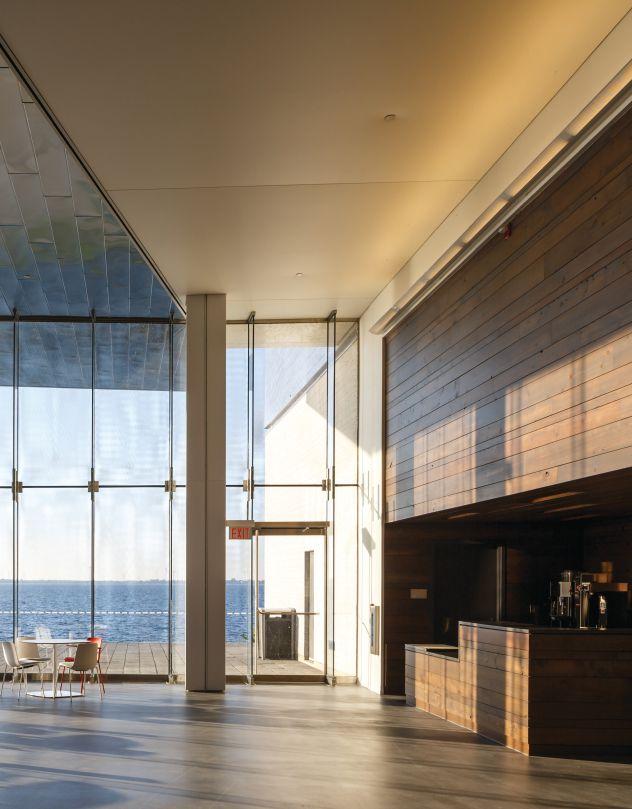
The Isabel Bader Centre for the Performing Arts – Kingston, Ont. The glazing is a big part of what makes the Isabel Bader Centre for the Performing Arts so glorious. This world-class, $72 million, 80,000-square-foot (including a 566-seat performance hall) facility, known simply as “The Isabel,” opened its doors in 2014, purposed to provide Queen’s University in Kingston, Ont., with a state-of-the-art facility for community and student performances, education and training. Project architects, Ottawa-based N45 and Oslo’s internationally renowned Snøhetta, created the design locating the bulk of the new building within the campus courtyard ringed by a historic brewery and stable – and then incorporated them directly into the new
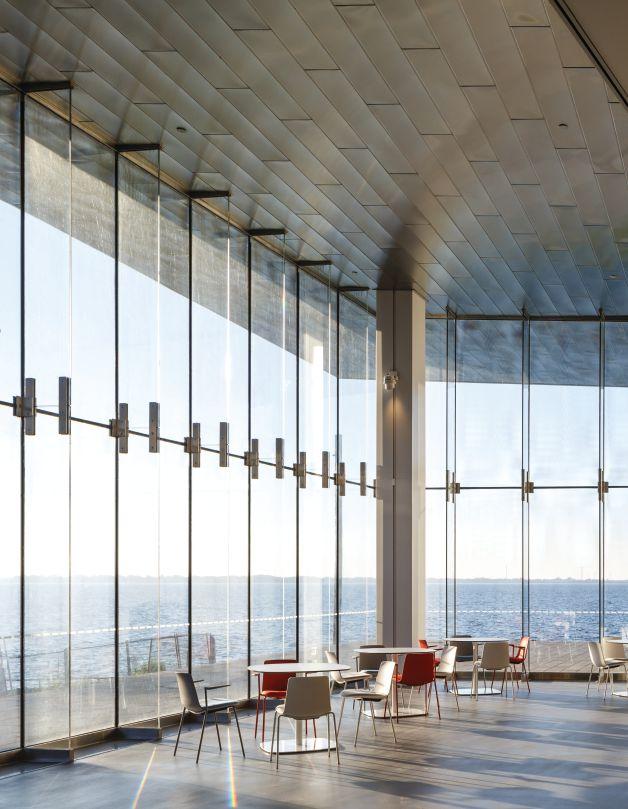
Invisible hardware means no distractions from beautiful views of the St. Lawrence River or from the great performances going on inside. A slight angle on the glazing corners made it possible to support the panels’ weight without the use of a ledge on the patch fitting.
in Canadian glass construction.
facility. For the glazers on this project, the intention was to install a special low-iron tempered glass for clearer views of the lakeside vistas (the structural glazing in the atrium faces the St. Lawrence River). Lobby lighting is directed upwards and is reflected down off the steel and stretched vinyl ceiling, creating a soft light and preventing glare off the windows from obscuring the views.
According to Tom Carolan, director of sales for Richmond, B.C.-based Stella Custom Glass Hardware, the main challenge was to install the glass using minimal hardware to support the glazing. “Typically on structural glass walls the access doors are required to have full portal frames, but there are three access doors on the Isabel that have stainless door headers supported by the structural glass fins,” Carolan explains. “Incorporating this detail with floor closers creates a transparent look.”
There are no holes in the glazing to support the face glass, and there is no “ledge” within the patch fittings in order to support the glazing above. Within the patch fitting is a diamondshaped spacer, and the corners of the glazing are mitred. The weight of the glazing is not carried directly vertical. The corner of the structural glazing is at a 94-degree angle. By using patch fittings on this project, the corner fittings could be welded at
the exact angle of the wall. Glass specs include glass fins of twoby-10 millimetre tempered laminate, 450 mm deep; the IGUs are 12 mm outboard lite, 12.7 mm airgap, 10 mm inboard lite. The wall is six metres tall at the highest. And the distance between glass fins is 1,226 mm. Quebec’s Prelco supplied the glass for this job. “Our aim was to create a structural wall that achieved the vision of N45 and Snøhetta with minimal visible hardware,” Carolan nods. Mission accomplished.
A good read
Halifax Public Library - Halifax, N.S.
Sprawling across 120,000 square feet of space and trimmed with 66,000 square feet of glazing, Halifax’s new $57.6-million, five-storey gleaming glass library looks like a stack of books due to its unique cantilevered rectangular shape. Lauded as architecturally stunning and environmentally sustainable (it may achieve LEED Gold certification), with elegant angles and lines outside and winding stairs, study carousels, a 300-seat theatre and two cafés inside, the structure’s design was a collaborative effort between architects Fowler Bauld and Mitchell of Halifax, N.S., and Denmark’s Schmidt Hammer Lassen. “Many of the challenges faced on this project were related to the unique
TOPGLAZINGPROJECTS
Glass supplier Prelco screened a leaf-shaped pattern in ceramic frit with random letters interspersed. Care was taken to make sure the letters didn’t spell anything untoward.
geometry of the building’s design,” says Andrew Suhayda, project manager for CGI Contract Glaziers, who partnered with Prelco Glass to provide the project’s glazing requirements. He points out that the building’s various intersecting planes created engineering hurdles in maintaining the building’s continuous primary seal between levels. “We held many design meetings to assure proper coordination of
the structure, curtain wall and the roof/ soffit scopes of work to guarantee the primary seal at the intersections were air/ water tight,” he says. The library’s curtain wall uses the Schuco UCC 65 structurally glazed framing system.
The glazing specification for this project included a double-glazed insulated vision unit on the Level One podium, comprising an eight-millimetre low-iron,
heat-strengthened glass lite with low-E on the #2 surface and tempered, six mm low-iron glass. Most of the structure’s upper levels were of custom-designed white leaf frit vision units and white leaf frit spandrel units alongside project-standard vision and spandrel units. Skylight glazing is an insulated vision/dot pattern skylight unit using a six mm clear, tempered glass lite with white ceramic frit 50 per cent coverage dots and low-E on the #2 surface, as well as 15.5 mm argon-filled with black spacer and silicone.
In addition to using conventional boom truck cranes, CGI used one of the company’s Jekko compact crawling cranes, the SPD265C Plus, for the majority of the installation of the curtain wall panels on the library project. “The Jekko mini-crane’s compact size gave us the ability to install efficiently while having increased mobility throughout the jobsite,” Suhayda comments.
The building also boasts a glass cantilevered “City Living Room” with panoramic views of Citadel Hill and the harbour located off the North Atlantic Ocean. “The goals of the project were to provide design/assist solutions for the high performance unitized façade... done,” Suhayda affirms.
New kid on the block
The Queen Richmond Centre –Toronto, Ont.
Floating atop a preserved brick heritage building, the new 11-storey Queen Richmond Centre (or QRC West), is taking shape as the newest addition in Toronto’s entertainment district. The office tower, a proposed LEED Gold structure slated to open mid-2015, will stand above the restored four-storey historic warehouse – an architectural gem made visible from the outside thanks to a mast truss glass system.
“The project was a combination of new construction and replacement fenestration products for the restored buildings located at the site,” says Doug Lilja, sales manager for Ferguson-Neudorf Glass, the glazing contractors for this landmark building. “The historic restored building required the replacement of punched opening windows, some of which were curve tops and included casement windows.”
The Sweeny and Co. Architects and Stephenson Engineering-designed tower
is supported by three seven-storey steel X-shaped column supports. The roof area is a training room that looks out on two sides at the Toronto skyline and the interior on two sides looks through a two-storey structural glass wall down into the atrium.
Some of the QRC West’s key features are the inclusion of functional 42-inchdeep horizontal sunshades which had five six-inch-long oval blades on the
south elevation. The east and west elevations included an array of both 18- and 12-inch-deep functional vertical caps. Horizontally some areas included a custom four-inch-deep arrowhead shaped cap and either a glazed or a six-inch-deep bumped out metal panel at the spandrel areas. The west elevation also included a one-storey curtainwall fly-by at the roof area. The vision glass on the tower is Viracon VRE1-59 and the spandrel glass is
Viracon VRE1-59 with V1086 simulated sandblast on the #3 surface.
The structural glass wall was tendered as an early award package to be supplied under a design/assist basis. The design/ assist process investigated various glass fin and steel truss backup options, glass fitting designs and glass makeup and size options. The final design, Lilja notes, includes a center mast steel truss design that included stainless steel tensioned tie
Balanced on giant steel columns, the Queen Richmond Centre appears to float above a historic brick warehouse. Each steel support column is seven storeys tall.
TOPGLAZINGPROJECTS
rods and clevises. The trusses reached a maximum height of 68 feet. “This span makes the QRCW project one of the tallest structural glass projects in North America, with a total square footage of glass of approximately 17,000 square feet,” Lilja says with pride.
Making the grade Branksome Hall Athletics and Wellness Centre – Toronto, Ont.
When Angelo Cairo thinks about the $1.8 million glass installation his company did for the intricate Branksome Hall sports complex project, he’s still amazed it all came together in just 12 months. There were some definite challenges to hurdle, notes the president of Stouffville Glass, a glazing firm north of Toronto. “This project was a nine out of 10 in difficulty level,” he stresses, pointing out that this glazing job was anything but typical. Five different types of glass were called for by the project’s architects,
MacLennan Jaunkalns Miller, creating a supply and logistics tour de force in delivering each pane on site, on time.
The new 75,000-square-foot Branksome Hall Athletics and Wellness Centre, completed last year, is the centrepiece of the revitalization plan for this centuryplus independent all-girls school sited on a 13-acre campus in the heart of Toronto. The facility includes a 25-metre indoor pool, gymnasium with viewing space for spectators, dance studio and cafeteria to accommodate 600 students.
“We used nearly every product here that Alumicor offers,” Cairo says. An array that included capped, two-sided and four-sided structural silicone with different interior and exterior colours and three different back member sizes coupled with skylight glazing, entrance framing, phantom doors and vents and non-thermally-broken interior aluminum framing. Stouffville Glass brought in Prelco using Cardinal’s low-E 272. Cairo
asserts that the glazing for the project was one of the most difficult combinations for procurement and management “due to having different frit types on different elevations, which have match lines as they went across the elevation,” he says.
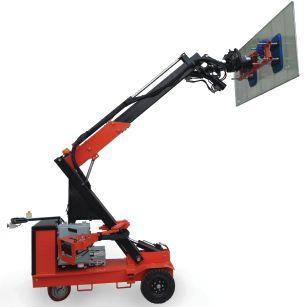
Each 600-pound pane of glass in the facility’s interior rooms was manoeuvred gently into place, in often very tight spaces, using a Winlet 1265 telescopic robot minimanipulator. “Our employees were able to work more efficiently, avoiding back injuries and sick days,” Cairo claims.
Designed to meet LEED Silver certification, the Athletics and Wellness Centre uses a high performance glazing system as the glaziers used a utilized curtain wall at the exterior, primarily in a four-sided application to eliminate most of the exterior aluminum assemblies. Having large thermo-glass vision lights also contributed to the performance of the system. The exterior vents are all silicone glazed as
Stouffville Glass had to pull together an enormous amount of interior and exterior glazing in a short 12-month period to execute this intricate sports complex.
are the doors, so exposed aluminum on the exterior has been eliminated again. “It was done this way because architects like to have clean lines and the assembly concealed,” Cairo says.
Cable net glass wall Complexe Desjardins – Montreal, Que.
It was unconventional reverse engineering that garnered CPA Structural Glass the AVFQ’s 2014 Award of Excellence for “Innovative Project of the Year.” Presented with the challenge of conceiving a new glass wall of 60 by 60 feet to increase visibility and create a new entrance hall for the Montreal Head Office of Mouvement Desjardins, CPA crafted a self-contained cable wall designed to minimize loading transferred to the existing structure. Located in the Complexe Desjardins, comprising office towers and retail space covering two city blocks in downtown Montreal, the renovation project architects gave CPA (a division of engineering firm SDK Associates) carte blanche to come up with something unique.
“Adding 20 tons of glass and steel to an existing structure is far from simple,” CPA’s president Benoit Cloutier says. “But we came up with the idea of creating a perimeter frame to take the compression loads from the tensile system composed
of catenaries and cables in both vertical and horizontal directions.”
The catenaries feature high strength stainless steel rods interconnected to nodes permitting the threaded swaged ends of the stainless steel cables to be anchored. “The main challenge was that we knew the final geometry that was needed for the placement of the cables and we performed reverse engineering to find the un-deformed geometry prior to tensioning,” explains Cloutier. Hundreds of simulations later, a solution was found: some cables were stretched more than five inches to achieve tensions varying from 7,500 to 12,000 pounds; the top catenary carries loads of 90,000 lbs.
Progressive installation of glass and deformations were closely monitored and compensated with pre-loading of the vertical system in order to achieve the final geometry. At each sequence, the support anchor points interconnecting the cables were added one level at a time, then the spiders and the glass. On the last pre-load release, a perfect equilibrium was reached with all the glass panels levelled. The glass (eight-millimetre clear heat strengthened; 1.52 mm SentryGlas; and eight mm clear heat strengthened supplied by Prelco) and glass hardware (SADEV S3000 Monti Spiders SS Type 316 brushed finish; SADEV V2001
CPA Structural Glass had to work backwards to arrive at the correct tensions that would achieve the geometry it needed to execute this suspended cable wall.
countersunk fixed fitting supplied by CPA Structural Glass) were selected for strength and flexibility since the corner panels experience warping due to the deflected shape of the cable net.
“Our proposal exceeded by far their initial vision of what the wall could be,” boasts Benoit, who received the Excellence Award from the Quebec glazing association.
Eden of Vancouver Boedel Conservatory – Vancouver, B.C.
by Rich Porayko
Five years ago the City of Vancouver issued the Bloedel Conservatory a death sentence and ordered the building to be shut down. But the dome, located in Vancouver’s Queen Elizabeth Park, was home to 500 plants and 170 species of birds. So, concerned community and business leaders weren’t willing to let the ecosystem, which has been called a “horticultural, architectural, natural, green jewel at the pinnacle of Vancouver” die. They started the Friends of Bloedel Conservatory and not only successfully lobbied the city for a stay of execution, but also secured funding to rehabilitate the aging façade of the 45-year-old landmark. Bloedel is very much alive and thriving today thanks to their efforts
TOPGLAZINGPROJECTS
Challenge: replace 1,488 acrylic panels without letting the tropical plants and birds on the other side get cold. And improve the thermal performance of the 45-year-old structure so the city can still afford to heat it.
and to Spectrum Skyworks, the company tasked with completing the job.
“The biggest challenge we had was at the beginning,” Spectrum’s managing partner Ken Boyce said. “The company that built the dome back in 1969 only constructed one other like it, so there was nothing to explain how Bloedel was going to be rehabilitated. We had to figure it out.”
Spectrum was familiar with the structure because it had been repairing the dome’s panels for up to 12 years before the decision was made to do a full-scale rehabilitation. “The panels would break because teens used to climb on them at night,” Boyce said. “Replacing one panel is a big deal. You need a lot of people. But nobody had ever taken the whole building apart.”
The Bloedel Conservatory is a geodesic dome that consists of 1,488 quarter-inchthick, acrylic panels in 32 different sizes. Spectrum installed thermal breaks into all 866 of the original cast hubs, which were then reused. Dayliter Skylights, a division of Spectrum based in Langley, B.C., has its own thermal formers. So Spectrum was able to manage the supply chain and blow the dome panels itself.
Spectrum removed up to 30 old domes and asbestos and then installed 30 new domes in one 10-hour shift every day. Once each panel was installed, it had to be face sealed. To allow for the thermal expansion/contraction of the acrylic, Spectrum had Tremco – a supplier of sealant, weatherproofing and passive fire control solutions – design special gaskets to fit into the existing extrusions and also
to achieve improved thermal performance of the overall system.
Safety was Spectrum’s primary concern throughout the entire project and because Bloedel had low-grade asbestos in the old mastic, it had to take special measures. “First thing each morning, we’d suit up three guys in their Hazmat suits with full respirators and we’d do a clean with special vacuums approved for asbestos removal,” Boyce said. “We hired Proactive Hazmat and Environmental Ltd. to oversee everything and take away the waste material every day.” •
by
Photo
Rich Porayko
by SKIP MACLEAN
Skip Maclean is president of Fenestration Canada. He is business development manager for Tru-Tech Doors and has over 40 years’ experience in the window and door industry.
Looking west, east and in between
2014 was a very good but challenging business year for most B.C. manufacturers. Many west-coast fenestration manufacturers had to diligently wrestle with and come to grips with the new building code, NAFS, local bylaws and new energy codes. British Columbia appears to be further along the path of code application than many other areas across the country. There are lessons to be learned from their efforts, which is why the upcoming AGM in Vancouver is so timely. Attending the AGM will provide an excellent opportunity to learn from their trials and tribulations and discuss all that is fenestration.
FenBC and Terry Adamson (Westeck Windows) in particular have been supportive of national efforts and have collaborated on many of the initiatives put forth recently. Many of these initiatives have resulted in solid information and guidelines which can be found on our website, fenestrationcanada.ca.
Alberta and Saskatchewan continue to be on the forefront of growth in Canada, but the recent drop in oil prices presents a challenge few considered a year ago. The weakness of the Canadian dollar along with the surging U.S. economy may provide opportunities for the export of fenestration products to our U.S. neighbours.
Manitoba continues to be the most stable and predictable sector in all the country and is well represented by Fenestration Manitoba. Last year’s AGM held in Winnipeg exposed the strength and diversity of local fenestration manufacturing and its continued leadership on the development of window and door innovation and technology.
The weakness of the Canadian dollar along with the surging U.S. economy may provide opportunities for the export of fenestration products.
Ontario, with Toronto’s ongoing construction boom that seems to defy logic, continues on a strong trend. Ontario’s diverse manufacturing base may allow the province’s manufacturing sector to take advantage of the lower dollar and enjoy increased gains in export trade. Job creation and overall prosperity should translate into increased renovation spending.
Changing energy ratings zones, possible glass shortages and rising prices may present challenges to sales growth in 2015. Many fenestration manufacturers seem to be positioning higher end products and services to entice the homeowner into upgrading their homes. A renewed interest in installation procedures seems to be garnering the attention of many window and door professionals.
Quebec Fenestration interests are well represented by the AVFQ. Executive vice-president Gilbert Lemay and president Marc Bilodeau continue to provide support to the national association as many Quebec manufacturers enjoy membership at both levels. A recent winter meeting was extremely well attended and we would like to thank all for the warm reception provided for Robert Rivard, Fenestration Canada executive director. Quebec’s manufacturing sector is faced with many of the same challenges, but renovation spending has been aided by the current provincial tax credit for fenestration replacement.
Atlantic Canada remains steady yet unspectacular in growth. Many fabricators work diligently to bring their products to current code levels; some of the most severe in the country.
The Windows Seminar produced by BuildAbility and sponsored by Fenestration Canada will be held March 31 in Thornhill, Ont. The seminar, headed by our very own technical guru, Jeff Baker of WestLab, will inform and educate all stakeholders regarding code, application and regulation of fenestration products. For more information visit buildability.ca.
A survey sent to all exhibitors and attendees conducted after the close of Windoor North America 2014 provided the show committee and association directors with positive feedback. New Windoor show committee chair, Rick Pries of Veka Canada, and members of the show committee are actively involved in the production of this year’s version of Windoor which will be held at the Metro Toronto Convention Centre Nov. 3 to 5. Save the dates and mark your calendars.•
PUSHING KNOWLEDGE
The IGMA Winter Conference seeks to advance insulating glass and product category rules for fenestration
by MARGARET WEBB
IGMA’s 2015 Winter Conference was held the first week of February in Fort Lauderdale, Fla. In addition to the technical meetings, highlights included a visit to Construction Research to witness full mock-up testing.
A new board of directors was approved with the following slate of officers:
• President: Mark Hutchinson, Intigral
• Past President: Frank Caporiccio, PPG Canada
• Vice President: Nathalie Thibault, Prelco
• Treasurer: Jennifer Kempf, Dow Corning
• Secretary: Helen Sanders, Sage Electrochromics
In addition to electing the new board of directors, two honorary, lifetime memberships were awarded to Denny Raske (Allmetal) and Bob Spindler (Cardinal IG), both retired. Honorary, lifetime memberships allow these individuals to attend all future IGMA conferences on a complimentary basis and continue to receive all IGMA updates.
Emerging Technology and Innovation
The Emerging Technology and Innovation Committee is chaired by Helen Sanders of Sage Electrochromics. The Advanced Testing Fenestration task group is working on three new test protocols designed to correlate to the ASTM standards and provide a faster means of testing: The first of these is Positive Negative Pressure Cycling, also known as the Thumper. This equipment uses external pressure modulation of plus then minus one pound per square inch to replicate the pressure changes witnessed within an IGU cavity. Variable Environmental Cycling (Oscar), uses a modified P1 chamber with full immersion UV at 100 per cent relative humidity and 60 C pressurized to five psi. Finally, Differential Thermal Cycling Unit (Big Hammer) was developed by the U.S. National Renewable Energy Laboratory (NREL). This equipment
IGMA delegates toured Construction Research Lab in Miami, Fla. Established in 1955, Construction Research says it was the first company in the world to build a curtain wall test facility. Today, the company has 38 test chambers with testing capacity up to 40 feet high.
the industry with new standards for vacuum fenestration products.
uses rapid thermal cycling to replicate thermal cycles in ASTM E2188. The group is currently evaluating the fabrication of “flawed” test samples to determine equivalency to the ASTM standard. Currently this group is working on how to correlate the NREL thermal chamber and the two other test methods with the ASTM E 2190 standard to ensure that the new test procedures will meet or exceed the objectives in the existing standard. NREL now has the capability to frost point the units as well as measure the gas content.
The Vacuum Insulating Glazing task group has completed the first two objectives under their scope. An extensive library has been established of existing vacuum insulating documents and is available to IGMA members as a reference center.
The group has developed a technical bulletin on vacuum insulating glass (VIG) and this document has passed committee ballot and Technical Policy Committee ballot. The IGMA board of directors’ ballot is being developed. We are anticipating publication of this document in mid-summer. Work is ongoing to develop a European (EN) standard. IGMA will be monitoring the progress of this development and a number of IGMA members are participating on this task group. Currently, VIG units are being tested under the IGCC-IGMA Certification Program to the ASTM E 2190 standard. Full certification guidelines will be developed once the standard specification has been completed. The IGMA Glazing Guidelines working group has been assigned to develop glazing guidelines for VIG.
The Product Category Rule for fenestration products has been split into two PCR’s, one for business-to-consumer, which will be a cradle-to-cradle, and the second for business-to-business, which is a cradle-to-gate PCR. Both PCR’s are identical in the cradle-to-gate section. The Use phase has been completed and the section forwarded to the PCR operator, the Institute for Environmental Research and Education, for review. The PCR is now subject to peer review and is anticipated to be ready for publication this summer. IGMA has awarded the contract for the development of the Processed Glass PCR to UL Environment. The timeline is ambitious (six months from commencement of the work) for the development of one core PCR with three modules: one for coated and heat-strengthened glass, a second one for laminated glass and the third for insulating glass. Work will be commencing this spring.
The parameters for the Gas Content Field Correlation Study have been established and the task group is now researching appropriate tools for the measurement of gas content at the point of manufacture, installation and ongoing evaluation.
Technical Services
The Technical Services Committee was chaired by Jeff Haberer of Trulite. It heard that work has been completed for the technical bulletin on setting blocks and has been published. The board of directors ballot on Section 5: Setting Blocks is under development pending completion of the diagrams to facilitate
It’s not all shop talk, even at a technical conference. Frank Caporiccio of PPG and Dave Devenish of Fenzi get into the island theme.
future revisions.
Reporting on the Thermal Stress task group activities, Bill Lingnell, IGMA’s technical consultant, provided an update on the development of models for the calculation of thermal stress in insulating glass units. Work is well under way and it is anticipated that all models will be completed by the end of 2015. Once this work has been completed, it will be shared with the ASTM task group so that work can commence on the development of a thermal glass standard specification for thermal stress in insulating glass units.
The scope of the Tolerances for IG Cavity Width task group is to address non-parallel glazing and the effect on thermal and long-term performance related to changes in the cavity width. The task group met early October and established three work groups.
The Manufacturing Tolerances working group will develop and establish manufacturing tolerances for allowable deflection at the point of manufacture. There are a number of factors that influence IGU performance which are beyond the control of the fabricator. A survey has been circulated to the IGMA manufacturing members to understand current in-plant practices. Guidelines for manufacturing
tolerances will be developed from best practices.
The Thermal working group is working on developing information which correlates the IGU cavity width with thermal performance and how changes in the cavity width impact U-factor.
The Impact of Reflectance working group is reviewing existing available industry data. The scope and objectives of this group are under discussion.
The Dimensional Tolerances task group has developed a first draft of the revised document and has included glass edge alignment as an additional tolerance. The task group will meet one more time and then a committee ballot will be issued.
Canadian standards development
The Canadian General Standards Board has reconvened the CGSB Glass Committee. The committee has established four task groups to work on the CGSB 12.1 standard for safety glazing and the existing standard will be expanded beyond laminated and tempered glass to included organic coated and plastic safety glazing. The task groups are working closely with other organizations including the ANSI
Z 97.1 group to harmonize safety glazing requirements. The first draft of the standard will be reviewed by the full glass committee mid-May 2015.
Certification and Education
Bill Briese of GED Integrated Solutions chairs the Certification and Education Committee. Their Sealant Adhesion to Spacer work group has developed a new test methodology based on a modification to the existing butterfly test. The test method has been approved by the full committee and the video will be re-filmed with an emphasis on handling glass safely. Now that this work has been completed and accepted, the Spacer and Integrated Spacer System task group will re-convene to continue development of equivalency criteria for spacers based on performance.
The TM-4000 Quality Manufacturing task group has completed the first draft for its revised manual. This revision includes all clauses for accreditation to the ISO 9001:2008 standard specific to IG manufacturing. Additionally, each section includes a commentary on the purpose and objectives so that manufacturers can determine which sections are relevant to their manufacturing operations and those from which they can be exempted. Substantial negatives were received on the first committee ballot and the task group will be reviewing these, revising the draft document as required and re-issuing a committee ballot.
The conference also heard from Arlene Stewart of AZS Consulting about upcoming changes to the Florida energy code. Florida’s energy standards often drive other standards in the southern U.S.
The IGMA 2015 Summer Conference will be held in the Denver, Colo., area with a site visit to the National Renewable Energy Laboratory (NREL) to view the Big Hammer and other research initiatives. The conference is scheduled for Sept. 29 to Oct. 2. The next IGMA Winter Conference will be held in Palm Springs, Calif., Feb. 29 to March 4, 2016. •
Find regular updates from IGMA at glasscanadamag.com > Past Issues
Gamechanger
New materials could allow low-temperature processes.
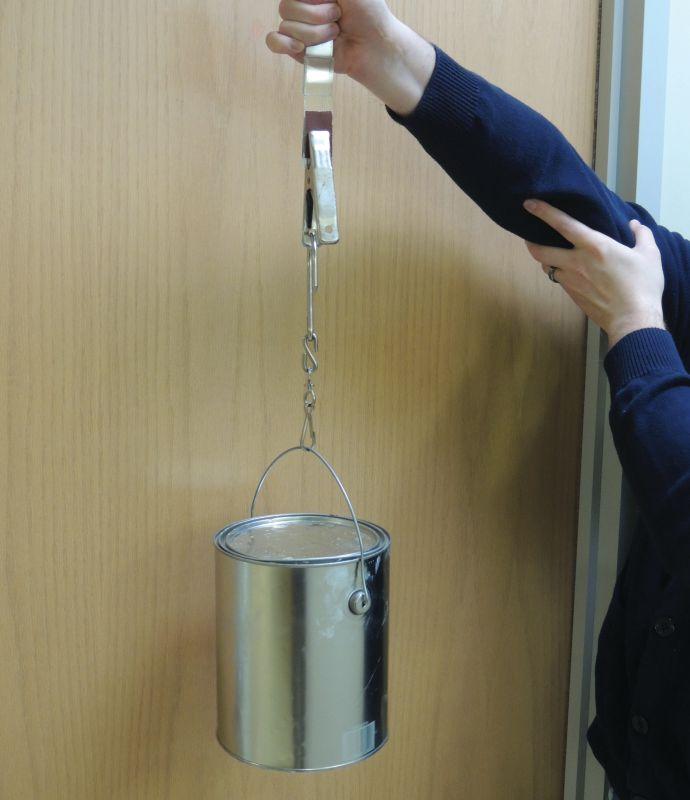
This 6.5-kg paint can is being suspended from a piece of glass that is adhered to another piece of glass using an adhesive based on Sirrus’ new monomer. The set time was five minutes.
Silk screening without heat and laminating without an autoclave. Mind = Blown. According to Kousay Said, chief commercial officer for Sirrus Chemistry, the technology to do these things is in the early stages, however it exists and he is bringing it to a fabricator near you.
It’s a story 130 years in the making. According to Said, Sirrus has been able to stabilize and figure out the initiation of a highly sought-after monomer because of its high reactivity. A monomer is a molecule that binds together with other molecules to form a polymer, a large organic chain of monomers making up the unique properties of the polymers. Still following? Keep up, it will be worth your time.
This particular monomer was first discovered in 1886 and had been highly sought after primarily because of its reactivity, however, until a recent breakthrough, there wasn’t much chemical companies could do with it because it would either simply react with itself or its surroundings. It was Bernard Malofsky, a former senior leader at Loctite, and his son, Adam Malofsky, the former CEO of Sirrus, together with Jeffrey Sullivan who were able to figure out a way to stabilize and isolate this molecule at a yield and purity that would be commercially feasible.
Once the monomer was stabilized, Sirrus was able to do certain things with it. They have been able to expand and now
have stabilized 26 different monomers that provide a range of different properties including very high temperature resistance, solvent resistance and significant optical clarity.
The company claims the chemical platform that Sirrus was able to develop, known for Chemilian and Forza, provides fast cure speeds at ambient temperatures without input from energy: a process known as anionic polymerization. The Sirrus polymerization-on-demand technology is designed to significantly reduce cycle times, increase throughput, reduce energy costs, and enable new material selection in a broad range of customer and consumer applications, including auto, electronics, packaging and hygiene.
“All of this is exciting and this technology is looking for applications,” says Said. “So when we start looking for where can we apply this, one of the greatest areas of interest for us is glass as a substrate. Our technology has a tremendous affinity to glass. Glass as a substrate triggers the process anionic polymerization. The material is 100 per cent reactive and its viscosity is waterthin. You can apply this liquid to the glass surface and it becomes a solid polymer that is optically clear.
“Because polymerization is triggered by the glass, the technology also acts as a great adhesive for multiple layers of glass. We’ve bonded three and four layers of glass together and you cannot tell that there is a bond layer in there when you look through it. The optical clarity is incredible. We’ve measured light transmittance through it that is higher than anything else organic that we’ve seen. It’s inherit characteristics lend themselves to safety glass for both architectural and automotive applications.”
Another possibility is an organic alternative to ceramic frit. Imagine silk screening, rolling or digital printing a coating so it doesn’t need to be fired. According to Said, Sirrus has the tech nology to apply the properties to the glass surface without having to put the energy into it.
By curing at room temperature and taking heat and pressure out of the equation there are obvious savings on operating and capital expenditures. But possibly even more of a game changer is the elimination maximum size constraints, bottlenecks and restrictions on the manufacturing processes associated with tem pering and autoclaves. This technology may open up an oppor tunity for North American fabricators to compete with imported oversized glass.
Said says the technology is also applicable to photovoltaics and dynamic glazing. “This is a perfect way to lower mass without compromising the panel or photovoltaic cell. It protects the glass from breakage and maintains the optical clarity. It is excellent for use in exterior applications and does not introduce a colour shift, which could also allow for warranties to be extended.”
“Our business model says that we work with partners,” says Said. “We are experts at the technology. Relative to the process or application, there are better folks out there that are already in business in their fields and our model says that we work with them and try to bring this technology to the marketplace. We’re in the early stages, however we’ve developed a lot of tests here to prove the concept and we’re looking for partnerships within the fabricating, decorative coating, insulation, laminating, fire resis tance and BIPV fields. We’re looking at discussing this technol ogy and its potential application with glass fabricators as well as other manufacturers globally.”
“Our preference is to have our first discussions with end users. It is not to serve them with direct business, but to learn what fea tures and benefits they value the most to help direct our research
effort. For example, I’d love to work with a fabricator who was interested to find out how many colours they can put on a piece of glass.”
“It’s the total cost where we are competitive. If we are shutting off furnaces and reducing steps, that is going to be a significant advantage for us. Our feedstock has a competitive cost position and we are around 90 per cent yield so we will compete with the frits all day long but we also will be able to compete with acrylics fairly quickly.”
Lower the cost of goods sold significantly without lowering the performance while increasing size. Imagine fabricators lessening their reliance on films or on primary glass companies where the fabricators can now add decorative or other functionality almost on demand through silk screening, roll coating or digital printing. “For fabricators to invest in capital assets to bring simplicity to their processes and serve the market just in time, we could really change the game here.” •
About the author
Rich Porayko is a professional writer and founding partner of Construction Creative, a marketing and communications company located in Metro Vancouver, B.C. He can be reached at richp@ constructioncreative.com
GLASSHANDLINGSHOWCASE
When using the Erdman glass lay-in system, once the sealant bead has been laid on the rabbet, roller ball support rods raise to the level of the glass roll-in rollers. Your operator can then manually and ergonomically set the glass into the position area by gently gliding the glass over the glass roll-in rollers. Using the roller ball support rods, the operator will then glide the glass over the tables to rest against the positioning stops. The rods will then lower the glass part way into the frame above the sealant. Your operator can then insert your setting blocks as required and the seat the glass.
Customizable harp rack
wmacleanagencies.com
The HR-4860 Harp Rack is a easily customizable harp rack that can be adjusted to accommodate both 3/8- and 1 1/8-inch glass. It includes four non-marking swivel casters rated at 1,000 pounds capacity each. Two foot locks are mounted in front for stability. The HR-4860 includes 60 long and short plastic-covered rods. There are 80 hole locations. When the rods are placed in every hole the space between the rods is 3/8 inch. When you skip a hole, the space between rods is 1 1/8 inches. The rack uses 3/8-inch-thick high-density polyethylene on the floor for easy sliding of glass and provides a non-stick surface for insulated glass. It comes with a gray powder-coated finish and ships knocked down for freight savings.
The Erdman EAC Lift is an end effector/ manipulator mounted on a jib crane. The EAC Lift increases productivity and reduces potential product damage and operator injuries. The lift improves the operator’s ability to move glass or any kind of panels without risking damage to themselves or your product. The EAC Lift effortlessly integrates with Erdman hand assists, glass lay-ins, tilt/tip machines or automated glazers.
Ergonomic handling
cynergyergonomics.com
Cynergy Ergonomics specializes in ergonomic workstations and material handling equipment such as lifts, articulating arm manipulators, sheet, panel and roll lifters, vacuum tube lifting, roll manipulators and material handling equipment. It specializes in lifting device design, lift assist system designs, material handling vertical lifts, manual ergonomic pick and place systems and workstation improvements for manufacturing, assembly, production and distribution centers that currently use human power for material handling as well as providing automated material handling solutions.
Caster options
wmacleanagencies.com
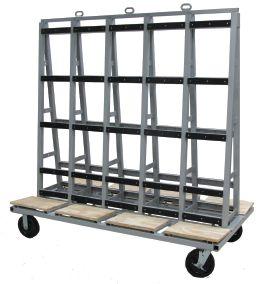
GLC glass carts can easily move cutoffs, finished products, doors, windows, screens and shower doors in a convenient organized manner. The GLC4878 has an 8,000-pound capacity. Carts have plywood bases with rubber mounted on the upright supports. The GLC3248 uses five-inch casters, two rigid and two swivel, with brakes rated at 1,000 lbs. each. The GLC-3660 and GLC-3672 use eight-inch casters, two rigid and two swivel, with brakes rated at 1,000 lbs. each. The optional caster kit for the GLC-4878 consists of four eight-inch casters, two rigid and two swivel, with brakes rated at 2,000 lbs. each. The GLC-3248 has a pull handle mounted on one end for manoeverability. All models include a heavy-duty powder-coated finish for long-lasting durability.
Redundant vacuum system
ergorobotic.com
The GM 2000-12 from Ergo Robotic Solutions has a maximum lifting capacity of 2,000 pounds and a maximum lift height of 12 feet, six inches. It is 34 inches wide and six feet, eight inches high. The machine is eight feet, four inches long when closed, with a gross weight of 3,500 pounds. The GM 2000-12 features a double redundant vacuum system and comes with four cups and four extension bars.
Premium power lifter
wpg.com
The Premium edition of Wood’s PowrGrip’s popular P1 Channel Lifter now features a dual vacuum system and powerloss warning buzzer for added safety, a high-flow vacuum pump and blow-off for greater productivity, and reduced power consumption for extended time on the jobsite. Powr-Grip’s Channel Lifters are comprised of one or more pad channels for gripping loads, plus interchangeable lift frames, for rotating and tilting materials. These vacuum lifters may be ordered as complete units or as individual components to expand existing channel lifter systems. Lift frames are available in single-channel or double-channel styles. Pad channels can be switched from one frame to another in minutes.
New products for the glass industry online at glasscanadamag.com > Products
by BRIAN BURTON
Brian is now involved with an innovative multidisciplinary firm that specializes in technical business writing: Award Bid Management Services http://award-bidmanagement-services. com/. The firm assists companies interested in selling goods and services to governments and institutions. He can be reached at Burton@award-bidmanagement.com
Noise matters
As urban noise levels have steadily increasing over the past two decades, window, door and sealed glazing unit manufacturers have done a remarkably good job in their efforts to improve the acoustic performance of their products. Acoustic performance is improved or enhanced by isolating individual components and incorporating air spares that limit the pathways for sound. The experts I spoke to agreed that these improvements have been at least equal to similar sound control improvements in other components that are part of the building envelope assemblies.
Excessive noise in cities, whether intermittent or continuous, can result from aircraft, increased traffic volume and construction as well as clustered buildings, public transportation and industrial activities. In response to increasing levels of nuisance noise, many municipalities are now passing new bylaws that attempt to restrict excessive noise levels. It’s probably too early to judge whether these preliminary efforts will produce meaningful results.
Sound levels are usually measured using a standardized unit termed a decibel (dB). Acoustic performance also involves determining “sound transmission class” or STC. A normal conversation creates a sound of approximately 55 dB, while urban traffic levels, even indoors, can range between 75 and 95 dB, depending on the time of day. Studies suggest that noise levels measured above 75 dB, especially when they are continuous, are considered intrusive and are deemed to be less than acceptable. Sound levels of this intensity can affect sleep patterns, concentration and general comfort.
There may be trade-offs between the need to provide sufficient daylighting and natural ventilation with adequate sound control.
FENESTRATION FORUM
Due to the adverse effects of urban noise pollution experts have suggested a number of possible noise reduction strategies including placement of acoustic barriers near heavily traveled highways and restrictions on heavy vehicle traffic near residential areas.
Acoustic improvements to fenestration components are significant because limiting unwanted noise to maintain acoustic comfort is considered an important factor in occupant wellbeing in residential settings. Resident surveys demonstrate that acoustic comfort is very important along with air quality, thermal comfort and adequate levels of daylighting. Excessive noise, between units at least, is a common complaint in condominiums according to the Ontario New Home Warranty Program (now referred to as Tarion)
I recently interviewed two building scientists who had completed a number of on-site investigations of excessive noise in condominiums and they reported that it was eventually determined that the noise was emanating primarily from the hallways and adjoining units. In addition, some of the condominium units were relatively close to raised expressways and at certain times of the day excessive traffic noise was recorded. Both professionals also mentioned that investigating reports of excessive noise can be problematic because residents may perceive noise differently even though the sound may actually be of the same intensity. In addition to excessive noise created by external sources sound may be also be created within the building itself by mechanical systems and elevators. Even when sounds may be created by other occupants, it can be extremely difficult to distinguish between internal and/or external sources of noise. In addition, noise can be transmitted through floors, wall partitions, core doors and hallways both through the air and materials as well. As a result occupants may not always be able to distinguish between internal and external sources. Ideally when designers consider the acoustic characteristics of fenestration products they need to consider building orientation, location and occupancy requirements. By necessity there may be trade-offs between the need to provide sufficient daylighting and, in some cases, natural ventilation with adequate sound control. In this regard, the manufacturer is probably the best source for educated guidance. •
by FRANK FULTON
Frank Fulton is president of Fultech Fenestration Consulting. He has been in the industry for 30 years and can be reached via email at fultech.fc@gmail.com
Brace yourselves
If you are an architectural glass and aluminum glazing contractor, a fabricator of glass products or a manufacturer of aluminum architectural metal products, it’s looking like you are in for one wild ride in 2015.
I am predicting that the supply of glass you need for your projects could cause you significant grief as we get into the year. I expect you will face much longer lead times than usual, could experience late deliveries, may actually have a problem getting certain types of glass you need at all, and can expect the price of glass to increase significantly. On the aluminum side of things, shortages are not anticipated, but fluctuating and rising prices will cause you many a sleepless night. What is the cause of this anxiety being put upon you? You can blame the upturn in the American economy for a start, coupled with the tailspin of the Canadian dollar relative to the U.S. greenback, but there are a lot of extenuating circumstances that play a significant role as well.
On the commercial and architectural construction side, it seems the market is doing its best to make up for lost time over the past six years. Many of my colleagues who work within the architectural community have stated that they are seeing activity at levels not seen in many years. Another colleague with an Ontario curtainwall manufacturing and installation company stated that there are so many projects going on in the northeastern United States that they have a full time presence there just trying to keep up with the demand.
Forward planning and locking in your costs is what it’s going to take.
With the economic downturn in 2008 a number of float glass plants were simply shut down due to reduced demand plus being in need of major overhauls. The number of facilities in 2008 stood at 45. Today there are only 36 float lines in operation, with none of those in Canada. PPG sold its Mount Zion, Ill. facility to Fuyao Glass America in the fall of 2014. Until that time, this facility produced glass for the residential and commercial construction markets, but is being converted to manufacture automotive glass only. There are currently no new float glass facilities being contemplated. According to Stephen Weidner, vice-president of architectural glass sales at Pilkington North America, “I do agree that the glass supply-demand in North America is the tightest it has been in quite some time. North American float capacity was reduced immediately following the 2008 global financial crisis by several North American float manufacturers to address overcapacity and excess costs relative to demand. Since that time, North American float demand has experienced slow and steady year-on-year demand increases as the economy heals from the crisis (demand increases in automotive, residential and commercial sectors). Without new float capacity coming on line, the North American float industry is now at the point where this demand has now just about absorbed the excess capacity left from the 2008 financial crisis leaving us with a relatively tight glass environment. ‘Tight’ in the sense that Pilkington, and I suspect other floats as well, can be out of certain SKUs at any particular time, obviously not out of all flat glass inventory.”
YOU BET YOUR GLASS
Mr. Weidner went on to state that “In addition, the ability of the float industry to transport glass has also been affected by the shortage of drivers in the trucking industry. This issue has had a material impact on the float industry’s ability to ship/deliver glass on a timely basis.” The Canadian Trucking Human Resources Council states that “Canada’s trucking sector will need to find as many as 319,000 new employees over the next ten years to keep the wheels moving.”
On the aluminum supply side, Morgan Stanley stated that aluminum demand increased six per cent in 2014 and predicts a 7.4 per cent increase in demand in 2015.
Considering that the demand for glass will exceed supply, demand for aluminum is up, the continuing devaluation of our Canadian dollar and the shortage of trucks available to get you your product, Economics 101 tells you a big bump in price can be expected. Forward planning and locking in your costs is what it’s going to take to get through a very turbulent year. •