GROUP PUBLISHER | Martin MCANULTY mmcanulty@annexweb.com
Publication Mail Agreement #40065710. RETURN UNDELIVERABLE CANADIAN
ADDRESS TO CIRCULATION DEPARTMENT, P.O. BOX 530, SIMCOE, ON N3Y 4N5 e-mail: ncuerrier@annexweb.com
Printed in Canada, All rights reserved. Editorial material is copyrighted. Permission to reprint may be granted on request. ISSN 0843-7041
CIRCULATION
e-mail: ncuerrier@annexweb.com
Tel: 866.790.6070 ext. 208
Fax: 877.624.1940
Mail: P.O. Box 530, Simcoe, ON N3Y 4N5
SUBSCRIPTION RATES
Canada - 1 Year $36.75 (includes GST)
($39.55 includes HST/QST)
U.S.A. - 1 Year $50.00 (in US dollars)
Occasionally, Glass Canada will mail information on behalf of industry-related groups whose products and services we believe may be of interest to you. If you prefer not to receive this information, please contact our circulation department in any of the four ways listed above.
www.glasscanadamag.com
Lead, follow, or go to Ottawa
The defeat of the federal budget means the end of a helpful program, and prolonged uncertainty over the corporate tax rate.
As the yearly federal budget circus unfolds, one gets the sense that a great deal could be accomplished in this country if our elected representatives could just figure out how to get out of their own way. Lately, Ottawa has seemed worse than usual at focusing on anything anyone might consider important or relevant. Our energy sector is in turmoil because of disruptions in the Middle East and Japan, our troops are in theatre in Libya and Afghanistan, and no one knows how we are going to pay for health care or pensions once the baby boomers retire. But all we hear from the capital is how horrible it is that a minister altered a document without attending a bazillion meetings first, and that the government’s restrained, business-as-usual budget is a document so odious that, if passed, it will leave only a smoking crater where this country once stood. The opposition parties say they “cannot” (they really want to, but they just can’t) support the budget, leaving them no alternative but to vote down the government. As sure as tiny green buds will emerge on the tips of branches if this snow ever melts, all sides will shrilly blame the others for forcing this spring election on an unwilling nation and no one will learn anything and exactly nothing will be accomplished.
This time, the parliamentary goofiness comes with an extra sting of frustration, because the defeat of this budget is going to mean the end, for the foreseeable future, of the EcoEnergy Retrofit Program.
• Hot Glass
Cold Glass
Best Business Practices BEC Vegas Glazing trends Architectural metal
Since its inception in April 2007, the program has shelled out $80 to $90 million per year to homeowners who upgraded their windows, doors and HVAC systems with Energy Star-certified retrofits, often with additional funds from complementary provincial programs. It was so popular that the program estimates one in 20 Canadian homeowners has made use of it. In the last budget, this government started to wind it down, citing fiscal restraint in a difficult economy. The program was slated to end on March 31 of this year. That is, until the government put the program back into the 2011 budget, with a proposed $400 million to fund it. With the defeat of this budget, that money will pass into limbo pending the decisions of whoever takes over following the aforementioned election. Restarting the program may require a whole new legislative process.
This is no pro-Conservative rant. The government certainly had it within its power to draft a budget the Opposition would support and to avoid an election until after the EcoEnergy program was safely back in place. I’ll leave it to you to decide who is really at fault, then you can take that information and $1.50 and go get yourself a cup of coffee. Bottom line: take your blessings from Ottawa when and as you can. Who knows where their random stumblings will take them next? • NEXT
INDUSTRY NEWS
Solar and glass industries to converge in Berlin
On April 13 the Solar Meets Glass Second Industry Summit for Quality, Logistics and Materials conference will once again bring together the glass and solar energy industry to the same table to discuss the overlap of pressing themes from both sectors. The conference is being held within the framework of the Third Photovoltaics Thin-Film Week, the world’s largest event for thin-film photovoltaics, in Berlin at the Technologiepark Adlershof. In addition to a market and technology overview, the themes of quality, logistics and material will also be on the agenda. The event is directed at the manufacturers of thin film as well as crystalline photovoltaics, solar system integrators and the manufacturers of PV installation systems. The event is also addressing the suppliers of automation technology, glass manufacturers, system suppliers of glass application and glass installation systems as well as suppliers to the glass and solar energy sector.
As far as the conference is concerned, Solarpraxis AG, one of the leading know-how providers in the renewable energies industry with many years of experience both as a
conference organizer and in the engineering sector, is cooperating with Messe Düsseldorf. This is the continuation of the conference format, which celebrated its successful premiere at Glasstec/Solarpeq in autumn, 2010. Glasstec, the most significant international trade fair for the glass industry, as well as the trade fair for solar production technology, Solarpeq, had brought together around 200 experts from both industry sectors who were unanimous in positively assessing this opportunity for dialogue. The event focussed on the increasing significance of the material components in glass to reducing costs and increasing the degree of effectiveness in photovoltaic applications. With the second Solar Meets Glass conference this format is now also being established in the period between the fair.
In addition, Messe Düsseldorf and Solarpraxis AG are cooperating abroad within the framework of similar congress formats on the theme of solar energy and glass. On January 13 in Mumbai, the First Solar Industry Summit India was held parallel to Glasspex India, a member of the Messe Düsseldorf international glass trade fair family.
Glenn Campbell joins Biesse and Intermac Canada
Biesse Canada has welcomed Glenn Campbell to the position of product area manager for Biesse and Intermac Canada, focused on the geographic areas of Quebec and the Maritimes.
Campbell brings 25 years industry experience to the role. As a representative of the Biesse machine line, he will establish relationships with companies that fabricate, machine and finish wood products, home and commercial furnishings. Campbell will also represent Intermac Stone and Glass Machinery to distributors and fabricators of stone, glass and advanced materials. Both Biesse and Intermac CNC machinery are also used in finished industrial products found in aerospace, rail transportation, architectural, industrial, automotive, consumer electronics, medical and scientific equipment.
A considerable part of Campbell’s sales career was spent in addressing customer needs and solutions in woodworking machinery at Cooper and Horton and SCM Group Canada.While there, he held the roles of sales director and vice-president of sales, working in both Quebec and the Maritimes. His early experience built a foundation of in-depth solution knowledge of machinery capabilities. Campbell has a related education in furniture production.
CGA Newsletter
CGA
TheCanadian Glass Association has been pretty busy over the last few months building on the success of the first Glass Connections Conference held in Vancouver in September 2010. We are now moving to the east with Glass Connections Toronto 2011. This event will be held on May 3 at the Delta Chelsea Hotel in downtown Toronto. We have a great lineup of speakers and topics. Raise Your Window Performance to Meet Tomorrow’s New Levels
Speaker: Christopher Barry, director of technical services, Pilkington NA
Harvesting Sunlight: using photovoltaics and advanced thermal glazing units to meet new federal, provincial and municipal green sustainable design initiatives (AIA credits)
Speaker: John Carpenter, president, Clearstream International Products / Schott Okalux Architectural Glass Silicone Sealants in Construction (AIA credits)
Speaker: Scott Waechter, Dow Corning
Glacier Discovery Walk
Speaker: Brock Shroeder, Read Jones Christoffersen
Canada’s Two Defining Influences over the next Decade: Commodities and Construction
Alex Carrick, Chief Economist, Reed Construction Data
This event offers sponsorship opportunities at all levels. For more information you can go to our website at www.canadianglassassociation.com . Provincial associations
The CGA has completed the work on creating provincial associations in areas without
representation. There is now a Glazing Contractors Association of Manitoba and a Glazing Contractors Association of the Atlantic Provinces. Please contact Zana Gordon at zgordon@canadianglassassociation. com if you are interested in being involved with these new associations. We need your help to make these new associations strong and productive.
GCABC
TheGlazing Contractors
Association of B.C. is proud to announce the completion of the new national version of the Glazing Systems Specification Manual. This new version is a comprehensive reference for architectural aluminum and glass products. It is intended to reflect all aspects of the practice of glazing in Canada and is aimed at all stakeholders including glazing contractors, building envelope professionals, architects and professional specifiers.
The document is segregated into three main parts.The guidelines are intended to serve as a reference manual outlining aspects of glazing from theory to practice.The commentaries are more specific and are segregated into national master specification categories for aluminum fram-
ing systems and glass products. Finally, the guide specifications are intended as templates for specifiers to be used in creating meaningful contract documents.
GCABC is currently on the lunch and learn circuit to promote the manual and educate the glazing systems design community. The presentation is aimed at a broad overview of the manual including a review of major sections with some time spent reviewing the user selection guide, which provides an overview of different glazing systems including curtain wall, window wall, storefronts, overhead glazing and structural glass assemblies.
GCABC has also completed another publication. Building on the need to provide support to the glazing community in developing strong internal health and safety programs GCABC has published a tool box talk record book.Tool box talks are a required component to any successful or recognized health and safety program. It is vital to have a record of these talks many reasons. This book comes with two-part pages. One is a tearaway for your files and the other stays in the book (similar to a bank deposit book).This record book will allow you to keep track of all meetings, all attendees, all topics discussed, any site specific
hazards, any injuries or incident discussions or any suggestions.
If you are interested in ordering any of these books you can visit our website at www.gca-bc.org .
This year’s 20th Anniversary Annual Golf Tournament is going to be a great event.
OGMA
Our next seminar will be held at Tremco on March 23. Please see details on the Ontario Glass and Metal Association website.
The speaker will be John Carpenter of Clearstream, and he will be speaking about harvesting daylight while eliminating glare and controlling solar heat gain, in other words, getting the positive elements from the sun while negating the negatives. John will also discuss how to create an environment with natural light where people improve their productivity, health and overall enjoyment, as well as photovoltaic and birdfriendly glass.
The OGMA is holding our race night at Woodbine on Monday, May 2. It is a little unusual to hold an event on a Monday, but we are coordinating with the CGA Conference and Trade Show taking place at the Delta Chelsea Hotel in Toronto on Tuesday, May 3. Delegates attending the show are invited to join us for an evening at the racetrack, drop some coin on the ponies, swap lies with your contemporaries, and have a great prime rib buffet dinner. Mark your calendar and make sure to attend both events.
We will be holding our Spring Golf Tournament this year on Thursday, May 26, at the Glen Eagle Golf Club near Bolton. Notices will be sent to members and posted on the website as the event date approaches.
Edgetech I.G. promotes Ken Wayman to R&D technical specialist
Edgetech has promoted Ken Wayman to R&D technical specialist at its Cambridge, Ohio, headquarters.Wayman has been employed by Edgetech since 2000, where he most recently served the company as a technical service representative.
“In his new role, Ken will support all R&D and testing efforts toward the continued advancement of Edgetech products and services. He will be an important asset as we continue to develop our technical resources and capabilities,” said Tracy Rogers, technical director.
As technical service representative, Wayman gained experience with Edgetech’s products, applications and customers, providing on-site quality audits, installation of automated and semi-automated equipment and training. As he develops into his new role in R&D, Wayman’s primary responsibilities will include performance testing and evaluation of materials, products, components and insulating glass units, as well as materials research, testing, analysis and evaluation in support of Edgetech’s new product development efforts.
“I look forward to using my field experience and product knowledge to help Edgetech continue to provide the highest quality products to our customers,” Wayman said.
In other Edgetech news, the company will be sending two experts to Glass Processing Days (GPD) 2011, held from June 17-20 in Tampere, Finland. The event promises to be a summit for visionaries created by visionaries, with more than 18 workshops and a variety of high-profile industry speakers from around the world. Edgetech is sendingTracy Rogers, techni-
cal director, and Christoph Rubel, European technical support manager, to make presentions as subject matter experts.
Rogers will present “Consideration for the condensation resistance of fenestration assemblies,” as part of the processing program. His presentation provides an in-depth look at U-factor and condensation resistance basics, system ratings for thermal performance and the relative effects of U-factor and condensation resistance using third-party data.
“Performance factors that may have a minimal impact on U-factor and/or SHGC may be critical in the prevention of condensation formation that may, if not controlled, lead to health concerns and building component or system damage,” Rogers said. “In Finland, I will compare the difference between the performance of fenestration products relative to Ufactor and condensation resistance and outline principal design features to improve the latter.”
Rubel’s presentation “What differences real warm-edge spacers can make in insulating glass,” focuses on how the spacer system impacts the energy efficiency and sustainability of insulating glass systems.
“Besides all energy-related thoughts, design plays a key role in building construction,” Rubel said. “New building component technologies should support design ideas, not limit them. My GPD presentation will focus on how warm-edge technology can enable designers to take advantage of daylighting, without sacrificing efficiency. I will also discuss best practices in manufacturing and achieving optimal IG durability.”
For more information on GPD programming, visit www.gpd.fi, or for more Edgetech news and upcoming events, visit www. edgetech360.com.
Quinlivan retires from Truth Hardware
Jim Quinlivan has retired from Truth Hardware after nearly 35 years with the company. Quinlivan joined Truth as a salesperson in 1976 and spent his entire career with the company in the sales and marketing area, where he also held positions as sales manager, marketing manager and most
recently, channel distribution manager. Over his career, Quinlivan has been active in the industry representing Truth at various trade meetings and association gatherings including WDMA, AAMA, and CWDMA.
“Quinlivan’s knowledge, leadership and dedication have been instrumental to Truth’s success and we wish all the best for Jim and his wife Judy as they enjoy their retirement,” commented Steve Groves, Truth Hardware’s senior vice-president of sales, marketing and new product development.
3
Connections
May 12 – 14
National Convention
May 19
May 25 – 28
Annual Meeting
May 26
Ont.
June 17 – 20
Oct. 5 – 8
Fla.
Nov. 15 – 17
Nov. 20 – Dec. 2
Sept. 12 – 14
May 21 – 23
June 20 – 22
Pilkington North America partners with Energy Star
Pilkington North America is continuing its fundamental commitment to protecting the environment by becoming an Energy Star partner with the U.S. Environmental Protection Agency. Over the past ten years, Pilkington energy efficient products have shown a commitment to the environment by carrying the Energy Star label. With this most recent green building partnership, Pilkington North America will ensure its float glass manufacturing facilities that produce energy efficient products are also operated with concern for the environment. The company believes
that a strategic, corporate energy management program will help enhance its financial health and aid in preserving the environment for future generations.
In partnership with Energy Star, Pilkington North America will measure and track the energy performance of its facilities where possible by using such tools as those offered through Energy Star. It says it will develop and implement a plan consistent with the Energy Star energy management guidelines to achieve energy saving and help spread the word about the importance of energy efficiency.
CRL introduces new architectural railings catalogue
CRL’s new, full colour, 552-page, architectural railings catalogue, CRL63R, is now available online at www. crlaurence.com.
“Our railing line has increased so dramatically that we decided to create a master catalogue dedicated exclusively to railing hardware,” says Chris Hanstad, brand manager of CRL’s architectural railing division. “In the past, our railing products were featured in our architectural hardware catalogue, but with such an expansive railing line, it soon became apparent that we needed to create a separate catalog for our customers. A new CRL63A will be published soon, featuring all the architectural hardware, except railings.”
The CRL63R catalogue features glass railings and balustrades, CRL’s proprietary Taper-Loc rail systems, cap, aluminum and hand railing systems, welded and post railings, swinging gate systems, glass walls and windscreens, plus tools and accessories for installation. Many new
Pre-filled glass
U nilife Corporation has announced it has commenced initial production of the Unifill ready-to-fill (pre-filled) syringe at its FDA-registered manufacturing facility in York, Penn.
The initial production of the Unifill syringe, the world’s first pre-filled syringe with safety features fully integrated within the glass barrel, will enable Unilife to further accelerate discussions with more than 20 pharmaceutical companies.
These pharmaceutical companies are at various stages of review in the potential use of the Unifill syringe with
Correction
In February’s Glass Canada story, Trends in Curtain Wall Design, the maximum U-value legislated by the province of B.C. for new glazing systems was stated incorrectly. The Energy Efficiency Act regulations for windows, glazing, doors and skylights states that “Metal framed curtain wall, window wall and
components and fittings for CRL’s different railing systems have been added, as well as a variety of CRL-Blumcraft products.
Hanstad explains, “Blumcraft railing systems have been installed in some of the most prestigious buildings throughout the world, and we’re proud to have Blumcraft as part of the CRL family of companies. We are currently manufacturing CRL-Blumcraft products at our Los Angeles facility, including hand railing, smoke baffle and glass gate systems. These are all included in the CRL63R catalogue.
“This extensive catalogue includes all the information required to select the perfect railing system for a particular project, and our technical sales department is ready to assist with suggestions, guidance, or alternate designs. Most of the featured products can also be custom manufactured by CRL,” Hanstad says.
For additional information, visit the company’s website at www.crlaurence.com.
a number of approved and pipeline injectable drugs and vaccines across more than a dozen therapeutic classes.
Once Unilife completes final product validation activities for the Unifill syringe during the second quarter of 2011, the company can begin to fulfill initial sales orders to its existing pharmaceutical partner. The supply and sale of the Unifill syringe to other interested pharmaceutical companies is expected to commence shortly afterwards.
Initial production batches are expected to be utilized by pharmaceutical companies and contract manufacturing organizations.
storefront products must have a maximum U-value of 2.57. Windows with framing materials other than metal, with or without metal reinforcing or cladding have a maximum U-value of 2.0. Some exceptions exist including products installed in buildings that are compliant with ASHRAE 90.1 (04 or 07).”
Drama in
COVERSTOrY
in Ottawa
Gamma Windows and Walls creates a new landmark in the nation’s capital
by TreenA Hein
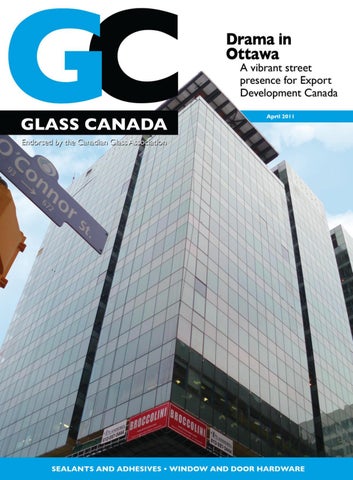
Amyriad of striking and functional features will work together to highlight the new Export Development Canada (EDC) building in Ottawa, which is located at 150 Slater St. and has a completion date of early June.
Gamma Windows and Walls International (Canadian headquarters in L’Ange-Gardien, Quebec) is the designer, manufacturer and installer of the glass and architectural metal features. “Because we provide all-in-one design, fabrication and installation services, we can offer flexibility, speed and a high level of quality,” notes Gamma President Louis Fortin. Béïque-Legault-Thuot architects of Montreal is the architectural firm and Broccolini Construction is the general contractor.
The envelope of the 18-storey building consists of about 170,000 square feet of pre-glazed curtain wall, with about 6,000 square feet of aluminum soffit and 13,000 square feet of zinc panels. There are also 5,000 square feet of structural glass wall (spider wall) in the lobby, plus glass railings and a glass revolving door. “Prefabricated curtain walls have frequently been used for projects of this size over the last decade,” says Fortin. “With this type of preglazed system, you can provide high quality because it’s fabricated in advance in a shop off-site, and installation is very quick.”
Three floors were prepared in advance, with installation occurring at a rate of one floor per week. Each floor features 165 prefabricated curtain wall panels, each measuring five by 15 feet, including the exterior finish. “The high-performance glass we chose is solarban 70XL from PPG,” says Fortin. “It’s about 60 per cent vision glass and 40 per cent spandrel-sealed unit glass with four inches of insulation.” The sealed unit glass panels include triple-layer low-e glass. It has a very good Solar Heat Gain Coefficient (SHGC) to reflect sunlight and keep much of the sun’s heat energy out of the building, but also provides high visible light transmission. This use of high-quality glass reflects national and international trends. The spandrel panels’ back pan was also optimized to provide condensation resistance and to minimize U value.
Using sealed glass units for the spandrels (to hide the concrete slab and services within each floor’s ceiling) and for vision area on each floor allowed the envelope look to be seamless and also accentuates the reflection in the spandrel panel, giving it depth, says Denis C. Blais, architect and a partner at Béïque-Legault-Thuot architects. “The vision panels with the light behind them look similar to the spandrels, making a uniform building skin,” he notes. “We also have the glass going floor to ceiling at the bottom at the facade reveals.” Two reveals emphasize the building corners with the main entrance. A third one is aligned with the elevator core and allows people to easily get oriented when stepping out of the elevator.
The Stanley revolving doors were provided by C.J. Rush, Toronto. “These types of doors have been used in the most famous buildings and give the entrance a glamorous quality,” notes Fortin. Zinc panels were chosen because zinc is “alive,” says Blais. “By this I mean it’s like copper, in that a patina forms on it with exposure to air. It turns a little more grey, always changing over time.” He says that Gamma is well known for expertise in working with aluminum panels and when zinc panels were proposed, the company was willing to make them, enlarging their skills and expertise through working with the new material. “The zinc panels are different than aluminum in terms of both fabrication and installation,” notes Blais. “Zinc panels are a lot thinner. They’re attached differently and sometimes reinforcement is needed.”
High-performance solarban 70XL from PPG reflects heat but transmits visible light well. Each floor required 165 prefabricated curtain wall panels.
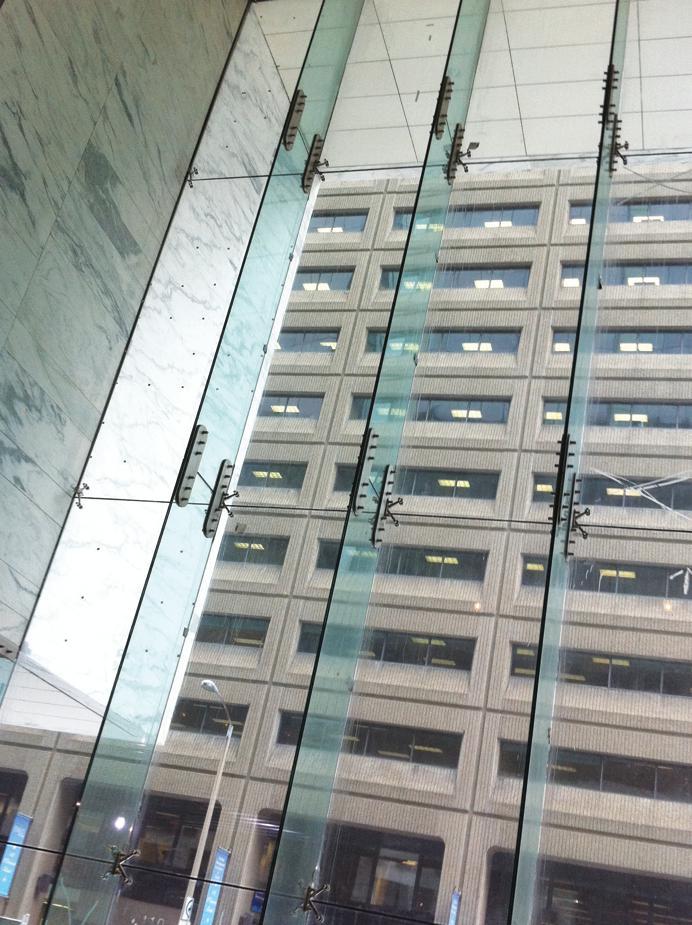
TOP LEFT: The lobby features 5,000 square feet of structural glass, plus glass railings and a glass revolving door.
LEFT: Zinc panels combined with marble give the entrance a striking look that will evolve over time.
Fortin says Gamma has a large and well-experienced sheet metal department and mainly produced aluminum panels in the past, but during the last three years or so has taken on new panel challenges – a lot of stainless steel, and for this project, zinc. “It was a new material for us, but with the assistance of the European zinc sheeting supplier VM Zinc (the Canadian distributor is Canadian Brass) we developed the capability to achieve a new system,” he explains. “It’s always custom work for us with each project. On this building, for example, the architect required a gap between panels that is closer than usual and we developed a fabrication method to meet this requirement.”
Blais says he likes this building because it’s not boring. “There’s an animation to it at the street level in that people passing by see many interesting things such as white marble volumes and accented window frames,” he says. “The main entrance of the building at the corner of Slater and O’Connor streets also features exterior plazas to encourage people to pause and gather.”
Those walking by the new EDC building will also find much to note in terms of the use of glass in the lobby, which spans three floors in some areas. The lobby’s main attraction is its ‘spider wall’ (structural glazing wall), which Fortin describes as “trendy, and bringing a touch of refinement and freedom.”
“With this type of wall, we fix the glass panels to a glass structure instead of a steel structure,” says Blais. “This is really spectacular because it allows a lot of light in the lobby, and a lot of transparency and interest. People from the street can see the people interacting in the lobby much more easily, giving the building an open and living feeling.” Béïque-Legault-Thuot architects has used this type of wall only twice before, both in Montreal at the ECommerce Buildings and in the Windsor Hotel (as an interior glass roof to segregate the atrium volumes).
Those gazing on the new EDC building from afar will also find it exciting due to the large, monumental canopy covering the rooftop terrace. “This canopy, made from steel beams and zinc panels, is not intended to provide much rain or sun protection,” says Blais, “but rather to act as the building’s signature, making it a landmark in downtown Ottawa.” There is also a terrace and canopy on the fifth floor. Fortin sees unlimited possibilities in
the glass and architectural metal industry now. “Years ago, architects used all the same glass from the top of the building to the ground and many buildings were just large rectangles,” he says. “Now, there are so many new products available. This EDC building demonstrates how the use of stone, many glass features such as the spider wall, and unique panels can allow the use of different concepts and make buildings stand out beautifully.” •
product offering is
You already know us for our high performance polyurethanes. Now discover Sikasil®, our new range of silicone adhesives and sealants –specifically designed to meet the needs of the Façade, Fenestration and Insulated Glass Industries.
For more information about the Sikasil® product range, contact your local Sika representative or Ian Collins at: collins.ian@ca.sika.com or 1-800-688-SIKA
by FRANK FULTON
Frank Fulton is president of Fultech Fenestration Consulting. He has been in the industry for 30 years and can be reached via e-mail at fultech.fc@gmail.com.
American justice
During a break at a recent Canadian Standards Association A440 Windows standard technical committee meeting, I had the chance to catch up with a longtime acquaintance from the window industry. He is retired from the daily grind now, but keeps himself busy as an industry expert testifying on behalf of window manufacturers who have been embroiled in defective material lawsuits in the United States. Naturally, to fill this role, he is articulate, knowledgeable, and can talk until the cows come home.
As Canadian businesspeople in the construction industry, you have no doubt heard of some of the legal nightmares that take place in the land of litigation south of our border. The old axiom, innocent until proven guilty, provides no comfort when you are accused of supplying defective product or workmanship, as you must pay vast sums to prove your innocence regardless of the nature of the claims against you, or the outcome of the proceedings.
Across the United States, individual states have enacted various pieces of legislation over the years to equip building, home and condominium owners (and their attorneys) with the tools to seek compensation against suppliers of defective construction materials. What this legislation has done, however, is to create a litigation boom as legions of lawyers used these tools to file unsubstantiated lawsuits accusing builders of shoddy workmanship.
In Nevada, for instance, a statute passed in 1996 (referred to as Chapter 40) that was initially intended to allow homeowners to receive prompt repair of real defects drove the backlog of construction defect cases from about a dozen to hundreds. Of the billions of dollars that have been awarded
The old axiom, innocent until proven guilty, provides no comfort when you are accused of supplying defective product or workmanship.
in settlements since, 40 per cent went to cover guaranteed legal fees, another 30 to 40 per cent went to cover legal expenses and to hire supposed experts, and the homeowner who may or may not have suffered the damage ends up getting roughly 20 to 30 per cent. But this is only the tip of the iceberg.
For every case that gets to court, there are a myriad of claims that are settled out of court by contractors, sub-contractors, material suppliers and their insurance companies. If you are a supplier of any building product to a condo, for example, that decided to start a defective material lawsuit, you will be on their defective-work shopping list. Unfortunately, you will likely find it less expensive to pay the ransom than to fight the bogus claim.
So, what do attorneys in the United States do following their working years? Many of them retire to lovely beachfront condominiums in places like Florida to enjoy the fruits of their labour. Finding themselves with plenty of time on their hands, they get elected to their condominiums’ board of directors.
Now, with the downturn in the economy, aging buildings and the occasional hurricane inflicting damage, these beachfront condos find they can no longer keep up with expenses. Swimming pools are cracking, salt has deteriorated the parking garage, and the owners don’t have the money or the desire to pay for all the work that needs to be done to maintain their property value. Where is the money going to come from?
Fortunately for the condo boards, the other thing retired lawyers with lots of time on their hands like to do is to launch lawsuits. “Don’t worry neighbours,” they say. “I’ll get the money we need to fix the pool and the garage. We’ll start a defective construction materials lawsuit against the window manufacturer and installation contractor. Once they find out what it will cost to repair the alleged problems or pay their legal bills to defend themselves, they’ll be happy to write us a cheque to settle out of court. All our problems will be solved!”
Unfortunately, as a supplier or glazing contractor, that is how easily you could be dragged into a lawsuit in the American justice system. Make sure to do your homework before venturing into the shark-infested waters.•
by JOHN ROPER
John Roper is the editor for The Installer, The Fabricator, The Conservatory Installer and Glass Works magazine published in the U.K.
U.K. trade shows, global lessons?
As of this year the U.K. window industry has no dedicated exhibition. Glassex has been cancelled. A couple of years ago I wrote an obituary for Glassex. However, the patient struggled on beyond expectations as part of the building exhibition, Interbuild. In spite of its size, this show apparently had its own problems as well. Now both are gone. The U.K. window industry takes its media very personally, and everyone has an opinion as to how things could be done differently or better. So there will be endless speculation as to why Glassex failed, whether it should have survived at all, whose fault it all is, and whether we even needed such an event.
The strange thing is, our continental colleagues seem to make exhibitions work. The Glasstec exhibition in Duesseldorf is huge, and covers every aspect of glass from bottles to architectural, and every kind of machinery to make or process the stuff. Fensterbau does the same for fenestration and then there is the building exhibition, Bau, in Munich. Strangely, while the U.K. exhibitions flounder through lack of support, these are all must-attend events for the U.K. industry and, for many companies, must-exhibit events, as well.
Cost is a big factor. My association with exhibitions goes back to the London Motor Shows of the late 1950s. From then until now, exhibitions have been regarded, in the U.K. as a licence to print money. Venue operators control catering and charge what they like. Contractors of all kinds try to do deals with organizers for sole supply and are equally uncompetitive. The result was the worst aspects of monopolistic operating with the exhibitor paying dearly. And all of that before you even try to park your car, which, anywhere in the U.K., is difficult and always expensive. Car drivers are just a milk
The U.K. window industry loves to talk to itself. We Brits like a cosy club; customers are just an unwelcome distraction.
EUROPEAN SCENE
cow for everyone, from government at all levels down to anyone else that can get in on the act. I used to exhibit at Glasstec, though I have not done so for a good many years. When I did it was cheap, cheaper than exhibiting at Glassex, where, as a publisher, I got the stand space for free. Moreover, there were no restrictions on DIY catering or stand fitting. I recall one time having to wire-in my own telephone, something which at any U.K. event would have caused an instant strike.
As far as Glassex is concerned, it always seemed to me that the rot set in early. It started as a glass trade exhibition, but in the mid-’80s changes to the trade meant inevitable decline. The embryonic window industry came to the rescue and Glassex carried on with a new profile but the old name. That always seemed to be the problem. The now defunct Glass Age magazine constantly complained that there was “no glass at Glassex,” in spite of the fact it too relied on the window industry for its income. At its height, Glassex was impressive. Exhibitors spent huge sums on big, multi-level stands and staged amazing events – the systems manufacturer Veka once ran a competition to win a Jaguar car.
But the industry and its needs changed and somehow the organizers just didn’t get it. The aim always was to put on a Glassex of yesteryear. While, as publishers, we were recognizing the rise of the installer and publishing accordingly, Glassex seemed to continue to operate as though nothing had happened. Moreover, as the refurbishment sector declined, it was inevitable that windows would again be seen as what they always were – building components.
The U.K. window industry loves to talk to itself. Other events have sprung up ostensibly to fill the gap opening up as Glassex faded. But at such events, increasingly, I saw marketing and sales people talking to each other, boosting the feel-good factor, not even noticing that their potential customers were not in evidence. We Brits always like a cosy club; the customers are just an unwelcome distraction.
Exhibitions can be a good idea at all sorts of levels but, in the U.K., exhibiting is an expensive way to market. The Internet is cheap and immediate and offers a real alternative. Exhibition organizers need to catch up. Things change; the survivors are the ones that change with them. •
PRODUCTSHOWCASe
OPENING UP NEW
by STeFAnie WAllACe
We’ve put together a short list of the latest and greatest window and door hardware products. All product information has been submitted by the manufacturer and assembled by Glass Canada
Multi-point hinged patio door hardware from Truth
Designed specifically for the North American market, Truth Hardware’s new sentry multi-point hinged patio door hardware system combines flexibility with optimal security. From intuitive functionality, like the 90-degree thumb turn located above the handle, to high-performance adjustable hinges and multiple handle designs – all of which easily adapt to your current door system – the sentry multi-point system produces the superior quality and performance you expect from Truth Hardware. To learn more about this exciting product, visit www. truth.com or call 1-800866-7884.
Innovative new hardware designs.
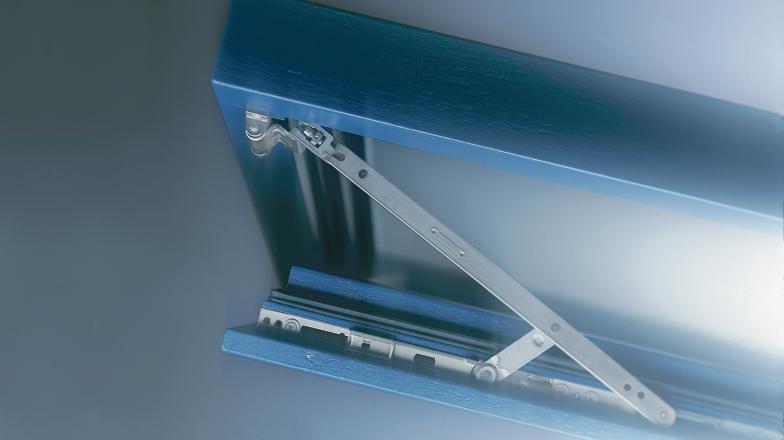
Sigenia locking hardware from Fentro Fentro Technologies distributes Siegenia-Aubi tilt and turn window and door hardware to North America’s leading window and door manufacturers. With a smooth operation that offers high security and weather tightness, Siegenia’s multi-point locking hardware is corrosion-resistant and
durable, ideal for coastal and extreme climates. Fentro is a Canadian distributor of tilt and turn window and door systems, hardware and accessories. Our extensive knowledge of the tilt and turn system, from engineering and development to warehousing and logistics, allows us to provide window and door manufacturers with a one stop shop for
TOP : Simple, intuitive operation for patio doors from Truth Hardware. ABOVE: Corrosion-resistant and durable, Fentro’s Siegenia-Aubi offers tilt and turn solutions for coastal and extreme climates.
POSSIBILITIES
all of their tilt and turn products. For more information, call Fentro’s head office at 204-272-9003, or visit www. fentro.com.
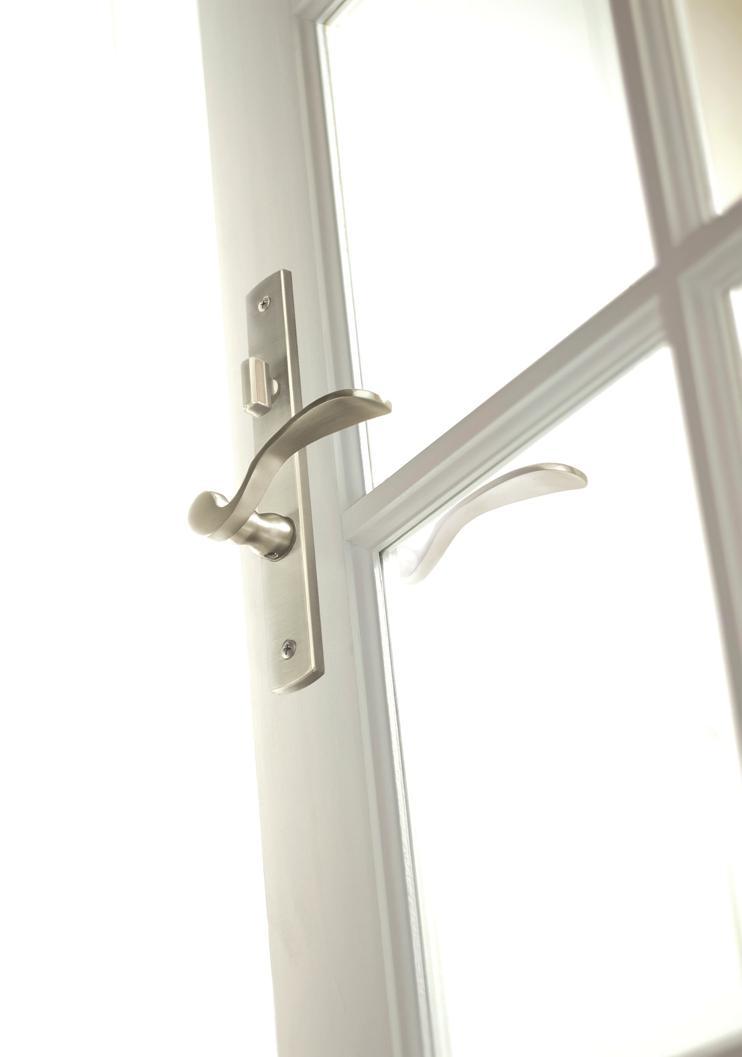
New lock system from Amesbury Amesbury Hardware Products is pleased to announce the launch of our new patent pending Tru-Lock, a multi-point lock system for entry doors. This innovative product is designed to provide increased security while allowing the homeowner flexibility in trim set hardware. The system easily incorporates into standard double bore panel systems of all types and is adaptable to work with most handle brands in the market today. Besides providing point of purchase selection of handle hardware, the system also enables the homeowner to change the trim-set in the future if their decorative tastes change. Once installed, the system functions the same as a standard latch and deadbolt, eliminating the operational confusion experienced with current euro-groove style systems. For more information about Amesbury Door Hardware, or this game-changing product, please contact Tim Eggebraaten, director of sales and marketing, at 605-782-0449 or teggebraaten@amesbury.com. •
Knock Knock.
Tru-Lock offers security, without the operational confusion of euro-groove systems.
Your New Design Solution—The Sentry™ Multi-Point Hinged Patio Door System.
You need the finest hardware to complete your door offering. Something customizable but simple. Strong but stylish. And above all, it needs to be designed for the North American market. Introducing, Truth’s new Sentry™ Multi-Point Hinged Patio Door System: an innovative solution packed with features that exceeds your expectations – and those of your customer.
Innovative And Secure Multi-Point Locking System
Completely modular for custom design, this 300 series SST multi-point locking system easily fits in standard eurogrooves and offers superior strength and security with full 1" throw of dead bolts and shoot bolts.
Robust And Reliable Adjustable Hinges
The Sentry™ adjustable hinge exceeds ANSI grade 3 requirement by achieving 350,000 cycles on panels weighing up to 220 lbs and ANSI grade 1 impact specifications. Intuitive indicators allow for accurate vertical and horizontal adjustment.
Eye-catching Handle Designs
Distinctive styling meets intuitive function. Truth offers multiple handle designs from traditional to contemporary, each with a North American designed 90 degree thumbturn located above the handle.
The Sentry™ Multi-Point Hinged Patio Door System – yet another engineered solution from the company you can trust – Truth Hardware.
For more information contact your Truth Representative or visit www.truth.com
INDUSTRYeVenT
ExPLORING THE INDIAN
by PATriCK FlAnnerY
The numbers are staggering. Import/export consultants
Amritt Ventures (www.amritt. com) estimates India needs over $1 trillion investment in housing and related infrastructure over the next five years, including 80 to 90 million housing units. The industry is growing at a 15 to 20 per cent clip, but still will fall short of meeting the demand for housing shopping malls, multiplexes, food outlets, office spaces, convention and business centres by 25 to 30 per cent. That’s a lot of windows. Canadian suppliers of glass products could hit the jackpot if they find a way to enter that red-hot market. To see Amritt’s full report on the Indian construction industry, check out our web exclusives at www.glasscanadamag.com.
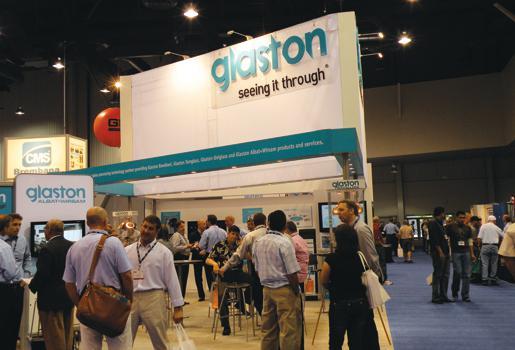
One way to get started making contacts in India would be to attend a Glasspex India trade show. The results of the recently held Glasspex India 2011 in Mumbai confirmed the event has established itself as an permanent
Reach across the world at Glasspex.
part of the international trade fair calendar. Some 176 exhibitors (compared to 139 exhibitors in 2009) from 19 countries represented the entire value chain of the glass manufacturing process to 4,072 visitors (compared to 3,200 visitors in 2009) from 31 nations. Renowned exhibitors such as Bottero, DSF Refractories, Emhart Glass, Grenzabach, Hindustan National Glass, SaintGobain SEFPRO and Shamvik Glasstech as well as Bassra Machine Tools, Den Breven, CUMI, IAG, Gujarat Borosil, K-bond, Techno Trade Links and Zippe Industrieanlagen participated.
Glasspex India 2011 had the support of Glasstec – the world‘s largest trade fair for the glass industry, which is organized every two years in Düsseldorf, Germany by Messe Düsseldorf. The company brought its expertise to India by organizing the show together with its subsidiary Messe Düsseldorf India, making it possible to reach crucial target groups for the Indian market.
Gohul Deepak from the Glazing Society of India, commented, “Glasspex 2011 was organized very well by Messe Düsseldorf India. The quality of visitors was excellent. It was
ABOVE: You just can’t do anything in India without flowers. Lots of flowers.
NDIAN MARKET
an ideal opportunity to network with the stakeholders in the industry. We would like to continue our partnership with Messe Düsseldorf for Glasspex India in the future.”
More visitors than in 2009, good networking opportunities and promising new contacts and projects – that is how the VDMA (German Engineering Federation) Forum Glass Technology summarized the results. German exhibitors are anticipating successful post-show business. “We also see a positive trend for the Indian market. There will be tremendous demand for glass in India over the next few decades, which holds great potential for machine builders. Taking this into account, as well as the excellent development of the exhibition within two years, VDMA looks forward to a very good outlook for the next show in 2013,” stated Dr. BerndHolger Zippe, chairman of the VDMA Forum Glass Technology.
Michele Gusti, managing director of OCMI, noted, “I am very pleased that all our customers from India visited our booth. We also have some very interesting new prospects.”
Wolfgang Schulze-Kadelbach, sales manager at Gardner Denver, added, ”This location was better than the last Glasspex exhibition, with excellent road connections. Being at a central location, it is very convenient for both exhibitors and visitors. The organization team offered quick and personalized service. It was possible to get new contacts and there were good opportunities to promote new sales. In just three days, maximum interaction with customers was possible.”
UV Printers India was participating in Glasspex India for the first time. “The digital printing technology on glass and ceramics that we presented had generated tremendous interest among the visitors. That can only happen if the visitors are knowledgeable. The credit for this must go to the organizers, as they succeeded in reaching the right audience.”
The second Glass Performance Days India (GPD) was held from Jan. 11-12, focusing on such challenges facing the Indian market as glass architecture, flat glass and solar technology. Over 100 high-ranking national and international visitors attended on each day of GPD. Brown Onduso from the GPD India Organizing Committee summarized. “As part of our commitment to provide the best possible service, GPD teams up with other leading organizations to hold world-class conferences in different parts of the world,” he said. “Co-operating with Messe Düsseldorf India
provided us with a partner that shares the same vision: Quality. Organizing GPD India in conjunction with Glasspex India 2011 offered participants two high-quality events at the same time that provided high-quality education and networking opportunities with experts from different fields of the glass industry worldwide, combined with ample international business and networking opportunities with professionals from the flat and hollow glass industries.”
Dave Fordham, publishing and events director at Glass Worldwide, praised the synergies achieved between the trade fair and the congress. “Having been involved with the All India Glass Manufacturers‘ Federation (AIGMF) sponsoring glass exhibitions since their beginning in the mid-1990s it is very impressive to see how Messe Düsseldorf has put its stamp on the event and expanded it so that Glasspex is now a major highlight of the global glass industry calendar,” he said. “The accompanying GPD and solar conference also added significant value for visitors at the 2011 staging.”
Another event held concurrently with Glasspex India 2011 was the Solar Industry Summit India conference, which focused on development, financing and realization of production facilities, the latest production technologies, the international solar power market and the current quality assurance standards. This was the first time that this technical conference, organized in co-operation with Solarpraxis, took place and it was attended by about 100 representatives from Indian and international solar power companies, suppliers and investors. “Glasspex India and the partnership with Messe Düsseldorf offered us a very good framework to position our first conference on the promising Indian solar power market. We are very satisfied with the great interest and the good feedback from the participants and we are looking forward to more projects in India in the future,” stated Miriam Hegner, head of the conference department at Solarpraxis.
Two other events completed the Glasspex India 2011 exhibits: the ninth conference of the AIGMF, with the topic Managing Sustainable Growth attended by about 150 participants. The special show about the future of glass and solar technology was especially popular with architects, civil engineers, planners and designers.
The next Glasspex India will take place in Mumbai from March 20-22, 2013. For further information on visiting or exhibiting at Glasspex India 2013, contact Messe Düsseldorf North America. •
Changes coming to door
by KeVin PelleY, CWDMA PreSiDenT
There are a great number of activities and initiatives going on at the Canadian Window and Door Manufacturer Association in 2011. Some of them are benefiting the industry as a whole, and much is being done to provide an everincreasing number of benefits to those firms who join the CWDMA. We continue to fund standards development and we are providing support for the CSA’s work on a certification program for window installation personnel.
Members only have access to our new comprehensive listing of fenestration requirements in codes and regulations. For the convenience and benefit of our members, CWDMA retained a leading codes expert to prepare a comprehensive summary of fenestration requirements in codes and regulations. Requirements for Windows, Doors and Unit Skylights in
Update from the regulatory front lines.
Canadian Building Codes and Regulations, and Energy Regulations is now available in the members-only section of the website. This document was prepared to assist members in finding window, door and skylight language in codes and regulations and to help the association to follow the codes and regulations in order to comment on proposed changes as they come up. The 36-page document includes an introduction, a summary of codes and regulations reviewed, requirements in the codes and regulations (within the part structure of the National Building Code and Unique Provincial Division, Parts 10 - 12), requirements in referenced energy efficiency documents and separate energy efficiency regulations.
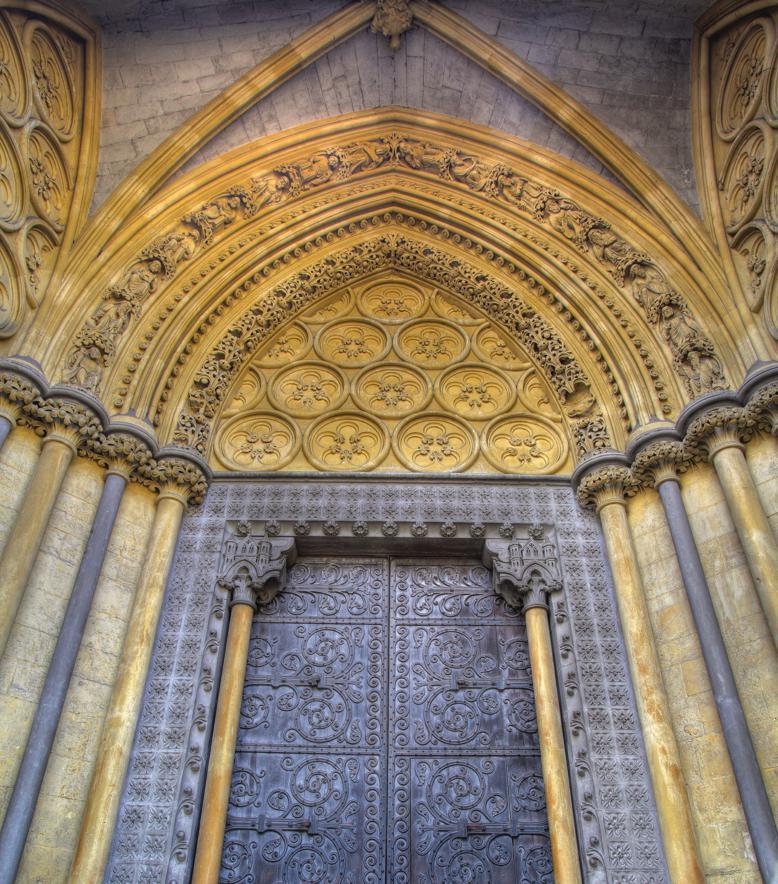
ABOVE: Pretty, but possibly not to code.
A regular series of technical bulletins for members is planned and the first one has been posted on the membersonly section of the CWDMA website. These bulletins are being co-ordinated by Technical Advisor Jeff Baker and will provide our member firms with informative and useful information on a variety of key technical subjects. The first technical bullet outlines sealed unit assembly logic and constraints. Safety glass requirements base on building code specifications and manufacturing constraints when supplying windows and doors units into Part 3 and/or 9 buildings have also been included. Self-flashing sills will be covered soon.
door codes
The association’s technical committee has established a sub-committee that is working on a key document. The 2010 National Building Code will have significant ramifications for the door industry. Requirements for doors to meet the national building code have been part of the code for about 20 years, but they were never enforced. It is anticipated that the requirements in the 2010 NBC will be enforced, as the new version comes into effect across Canada. Building code officials are going to be aware of the new requirements, which indicate that there must be a clear indication on the door that it complies with the code, which means that doors will require a label to demonstrate compliance with the code. Several jurisdictions could begin using the NBC 2010 in late 2011 or early 2012. Our side-hinged door sub-committee is preparing a document that will provide guidelines for testing and limited substitution component procedures.
This document will serve as a guideline to help the door manufacturer/pre-hanger determine the technical steps to have their entrance door systems tested according to the NAFS-08 standard (North American Fenestration Standard/ Harmonized Standard AAMA/WDMA/CSA 101/I.S.2/A440) reference in the new Canadian National Building Code 2010 (CNBC 2010) and determine the procedures to substitute different components of their door system without re-testing. While site-built doors are covered in the CNBC 2010, this document will not include site-built door units at this time. Side-hinged doors according to the NBC 2010, shall be designed, constructed and installed so that they resist the ingress of precipitation, control air leakage, resist the ingress of insects and vermin, resist forced entry and are easily operable. The sub-committee has been working hard on this document for many months, and has included testing labs and certification agencies in the review of the proposed requirements.
Main entrance doors and their components, according to the NBC 2010, shall be designed, constructed and installed so that they control air leakage, resist the ingress of insects and vermin, resist forced entry and are easily operable. The exclusion of ingress of precipitation for main entrance doors assumes that this door is protected by the building structure or a storm door. Side-hinged door systems tested and rated to the water penetration resistance test pressure of 0 Pa must have a designation identifying the product for limited water (LW) performance.
The first section of this document will be a guideline that provides procedures to help side-hinged door system manufacturers test their entrance door systems according to the NAFS08 to prove compliance with NBC 2010. The second section of this document will provide a procedure for limited substitution of components within an exterior side-hinged door assembly. It essentially defines conditions under which a waiver of re-test can be granted for the substitution and specifies additional tests, when required. This document covers all components normally assembled to form a side-hinged entrance door system and applies to both single and double door systems and both in-swing and out-swing installations.
This includes: astragals, door frames (jambs and headers), doorglass and doorglass assemblies, door and sidelight (slab-steel or composite), door and sidelight slabs (wood stile and rail), hinges and single point locksets, mullions, sills (thresholds), sweeps and weather stripping, transoms and full glass sidelights.
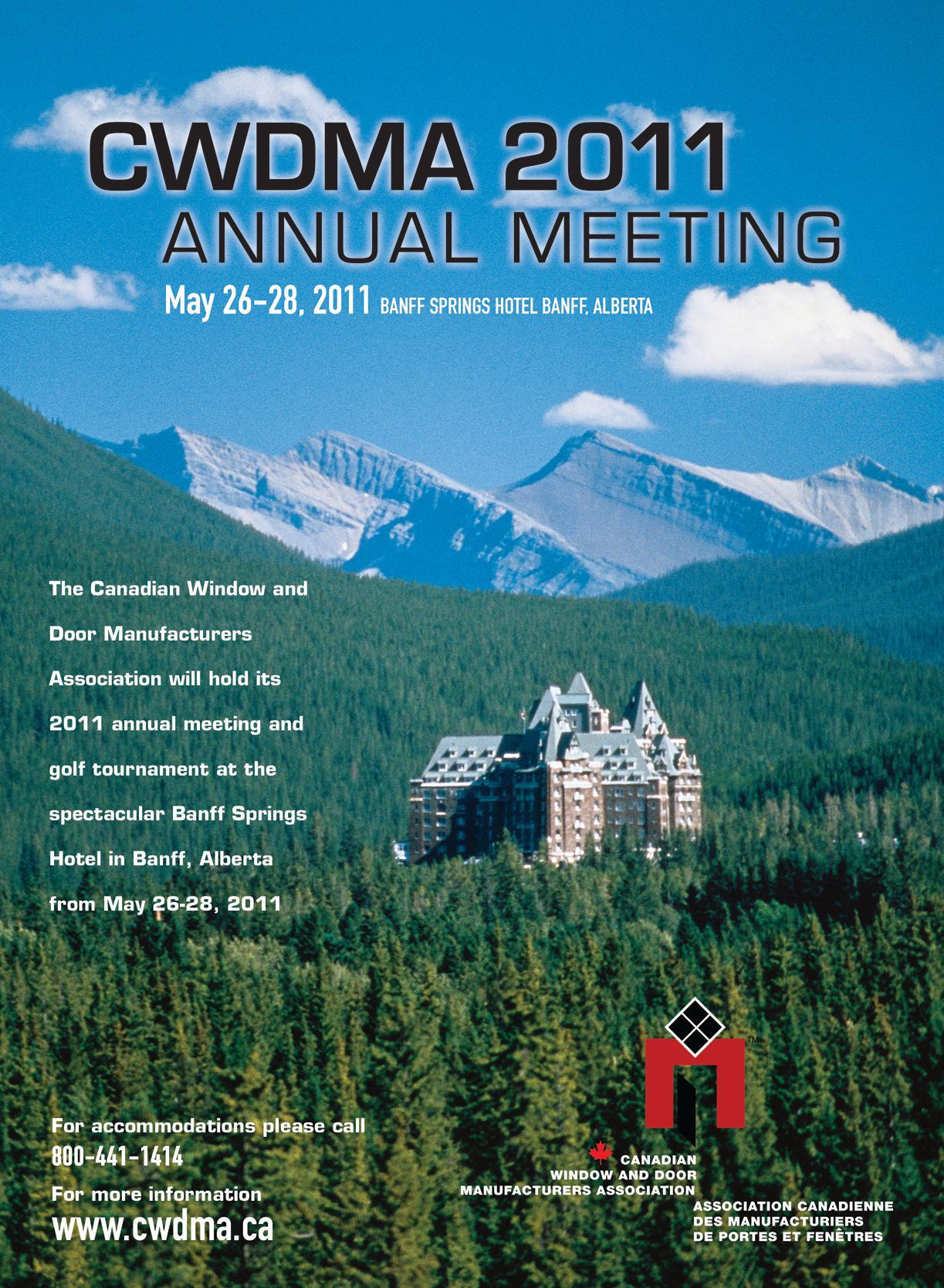
CWDMA is pleased to be working with the other associations in the window and door business, IGMA, WDMA-BC, AIPVFQ, and SAWDAC. We look forward to continued opportunities to be working together with these fine organizations in 2011 and beyond. The executive committee met with the chairs of the CWDMA committees for the second time during the winter. These meetings were established to assist and support the committees, which have been doing the heavy lifting in moving the association’s action items forward for the last several years. The session provided an opportunity to review key issues, exchange ideas and expertise, to brainstorm, analyze and to co-ordinate and leverage the work of the committees. Our thanks to the volunteers who dedicate their time and effort to provide support and leadership for CWDMA’s activities. And finally, you wont want to miss the CWDMA annual meeting in Banff, Alta., which will be held at the beautiful Banff Springs Hotel on May 26, 27 and 28. Plan to attend! •
UnruhBestQualityThirdPg-GlassCanada 1/14/11 8:29 AM Page 1
As an industry leader for over 30 years, we understand your need to get glass delivered looking great and at the best value.
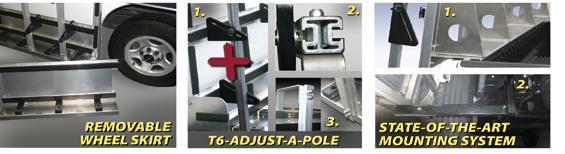
Unruh provides the ultimate in quality, safety and durability to thousands of glass professionals. We offer immediate delivery on pickup and van racks and full customization on bodies, trailers and almost anything you can imagine.
Necessity drives trends
The natural evolution of sealing and bonding in fenestration.
By using adhesives all around the perimeter of the glass to adhere it to the frame, you can use a smaller-profile window frame. The adhesive, shown in red, can be placed in different areas, depending on the manufacturing process.
The availability of a comprehensive range of polyurethane and silicone products specifically designed for use in the fenestration industry is a testament to the unmistakable and diverse benefits of sealants. Polyurethane and silicone sealants and adhesives are widely used in general-purpose weather sealing and structural glazing, as well as the manufacture of insulating glass and curtain walls installation. It is impossible to imagine the fenestration industry existing without them.
Notwithstanding the undisputed value of sealants, architects, contractors and building owners today are progressively looking for much more than simple UV-, water- and weatherresistance. Increasingly, demands are being placed on sealant manufacturers to contribute to meeting requirements for increased energy efficiency, design flexibility and decreased frame profiles, which allow improved light penetration. Ever-evolving building designs and codes
mean increased dynamic load support is also sought. Add to this the ever-present requirement for decreased manufacturing production costs and you can readily appreciate the competing and often contradictory demands being placed on the sealing and bonding manufacturers who supply the fenestration industry.
Increasingly, our group has undertaken the challenge to manufacture sealants that offer improved bonding capabilities. In Europe, where things are built to last, we have developed bonding and sealing products specifically for window manufacturing processes that fully bond the perimeter of the glass to window frames. This allows the glass to impart structural strength to the frame, as opposed to traditional building methods where the frame imparts strength to the glass. Much like the car industry, mechanical fixations are being slowly reduced, giving way to less expensive manufacturing processes that rely heavily on adhesives to impart structural strength.
Cars today, for example, are lighter and less expensive to manufacture thanks to a reduction in the quantity of steel used to manufacture them. Yet their structural integrity has been maintained, and even increased, due to the use of adhesives to complement the mechanical fixations used in their manufacture. Crash tests have shown conclusively that structural members strengthened with adhesives far outperform structural members solidified uniquely with mechanical fixations.
Technological advances in one industry naturally lead to technological advances in another, and the fenestration industry is no different. Slowly but surely, Sika is introducing the bonding technologies it developed for the automotive industry into the fenestration industry. These innovative manufacturing processes have resulted in the glass assuming greater responsibility for providing structural strength to windows and have, in turn, made it possible to design window frames with reduced profiles, which allow for lighter, less expensive frame designs and, most importantly, for more light to penetrate the buildings they grace.
Adhesives used in this way in the manufacture of windows (for example, to replace blocks and wedges) provide greater strength and greatly reduce the failures that often occur when transporting finished windows to installation sites, thus reducing post installation service calls and glass replacements.
In the manufacture of insulating glass, the requirement for increased performance of the secondary IG sealant continues to grow as innovative building designs are introduced by architects.
Where, traditionally, polysulphide-type sealants are used in the fabrication of insulated glass units, they do not offer the structural stability silicones do. Silicones are critical for fabrication of IG glass when replacing traditional methods of installing glass onto building façades because they replace metal and mechanical type fasteners when attaching glass and panels to building frames. This results in the creation of continuous flexible rubber seals and anchors that absorb
and transfer stresses, while preventing air and water intrusion. We are currently engaged in introducing these processes into Canada, where the obvious benefits of these manufacturing processes are steadily gaining in popularity.
For homeowners and building professionals alike, the attraction is apparent: greater design freedom, more attractive windows and increased light penetration along with windows built to the most stringent building codes. •
NEWPrODUCTS
Impact-resistant windows
Kolbe’s K-Force impact products deliver the strength and durability to withstand hurricane force winds and flying debris. Kolbe’s K-Force offering is available in its Windquest series vinyl products, Heritage series wood products and Ultra series aluminum-clad wood products. These window and door units are tested extensively to meet or exceed the strict building codes of the coastal region.
Designers, builders, owners and occupants do not need to compromise on appearance to achieve this level of protection and durability. Kolbe’s K-Force impact products are constructed without unsightly brackets, visible rods or extra locks. The traditional styling, clean design and easy operation are accompanied by the highest performance against the elements.
“While many companies offer windows with impact-approved glass, Kolbe offers impact-approved products, such as casements, awnings, double hungs, lift and slide doors, outswing entrance doors, transoms, segment head and half-circle products,” notes Cindy Bremer, Kolbe’s vice president of marketing. “Several of our products also meet the rigorous Florida Building Code and Texas Department of Insurance requirements.”
Kolbe’s Windquest products are approved for use in the High Velocity Hurricane Zone and received notice of acceptance in compliance with Miami-Dade County codes, some of the most stringent requirements of any jurisdiction. In addition to Kolbe’s Windquest products, its Ultra Series Majesta double hung windows and TerraSpan lift and slide doors have been certified to meet large missile impact Level D and Wind Zone 4 testing standards (IPD4).This IPD4 rating indicates these products are an excellent choice for hurricane areas, as well for any region of the country that is subject to severe storms, tornadoes or gale-force winds.
As part of the K-Force line, Windquest products use double pane, impact laminated, insulating glass as standard. The glass is designed to stay intact if it is broken. Each K-Force product uses glass with interlayer levels that are specific to the performance of each unit. That means that each window and door will perform at the highest level possible. Not only does K-Force impact glass provide safety and security from flying debris or intruders, it also provides better sound transmission.
Kolbe’s Heritage Series and Ultra Series products with K-Force impact performance modifications are available as double pane units with LoE coating to help reduce solar heat gain and improve energy efficiency. Assisting with other environmental goals, Kolbe presents a range of sustainably harvested wood species for the interior trim, such as those certified by the Forest Stewardship Council.
To learn more about Kolbe’s K-Force impact-approved products, please call 800-955-8177 or visit www.kolbe-kolbe.com.
by BRIAN BURTON
Brian Burton is a Business Development Consultant for Kleinfeldt Consultants. He can be reached at bburton@ kcl.ca.
See it before you build it
Building Information Modeling (BIM) is a subject you’re going to hear a lot about in the fenestration industry. From what I’ve learned about the topic over the last several months, I believe BIM technologies have the potential to be a radical innovation, and I suspect it will alter certain aspects of the fenestration industry very quickly.
In effect, we are moving rapidly towards an era of 3-D and 4-D virtual visualization of design and construction that will enable us to manage, store and update all of the files related to a fenestration product fabrication, design and installation in a single computerized database.
Most knowledgeable experts believe that companies will be able to save time, improve performance and keep better records. This translates into productivity improvements, better service for the end user and increased profitability. These systems give architects the ability to see buildings before they are constructed without building an expensive model.
Although the concept has been around since the late ’70s, I have been told that it really took off when the U.S. Army Corps of Engineers began using the software extensively. At present, it has mandated the use of BIM when tendering in awarding contracts.
BIM technologies offer many benefits, including:
• Enabling computer simulations to assess alternative design and construction schemes.
• Simplifying co-ordination of contract documents and shop drawings to identify and resolve overlap conflicts in advance of construction.
• Optimizing the sequence of construction, managing logistics and improving communication with
Using BIM, you can perform virtual retrofits of windows to demonstrate potential energy savings. You can visually illustrate potential energy savings and compare results
subcontractors and other stakeholders.
FENESTRATION FORUM
• Illustrating the scope of work to subcontractors during the tender stage and eliminating ambiguities, which ultimately reduce costs.
I interviewed Michael Laurie, president of Planit Measuring, a firm that provides onsite building measuring and BIM services. Laurie explained that they can undertake virtual retrofits of windows to demonstrate the potential for energy savings and complete simulations that show the monthly savings for various types of windows. He also mentioned that the cladding can be demonstrated using BIM technology.
According to Laurie, the technology is “capable of transforming how we approach construction. Using BIM programs, you can bring all the stakeholders together in the same room and have a live, interactive dialogue that will accomplish in one day what typically takes months of effort.”
Using BIM, you can perform virtual retrofits of windows to demonstrate potential energy savings. You can visually illustrate potential energy savings and compare results that would be produced from utilizing different kinds of window profiles and glazing materials.
Window companies could show their clients the benefits of replacing windows using demonstrative visual effects. The programs are also capable of producing are what are known as time-lapse daylighting studies, to show certain areas that do not need light filters, as well as demonstrating other performance criteria. However, the programs cannot really demonstrate the added benefit of proper sealing around the window or replacing of defective windows.
Another potential benefit results from the capability of anticipated overlap and scheduling problems.
Canadian Construction Association recently joined forces with other design/construction organizations to form the Institute for Building Information Modeling in Canada (IBC).
The group’s mission is to facilitate co-coordinated BIM use in the creation and management of the Canadian-built environment. Its members represent industry sectors with an interest in seeing BIM implemented in a way that enables the primary stakeholders to understand their roles and responsibilities.•
S D10 Frameless Shower Door Hardware Catalog
The CRL product line is continually evolving with the addition of N EW products as shown in the SD10 which features: Hinges, Pull Handles, Knobs, Towel Bars, Clamps, Headers, U-Channels, Tapes, Wipes and Seals, Sliding Door Kits, and most related accessories to enhance the look and functionality of your installations.
CRL Catalogs can be ordered, viewed or downloaded at crlaurence.ca