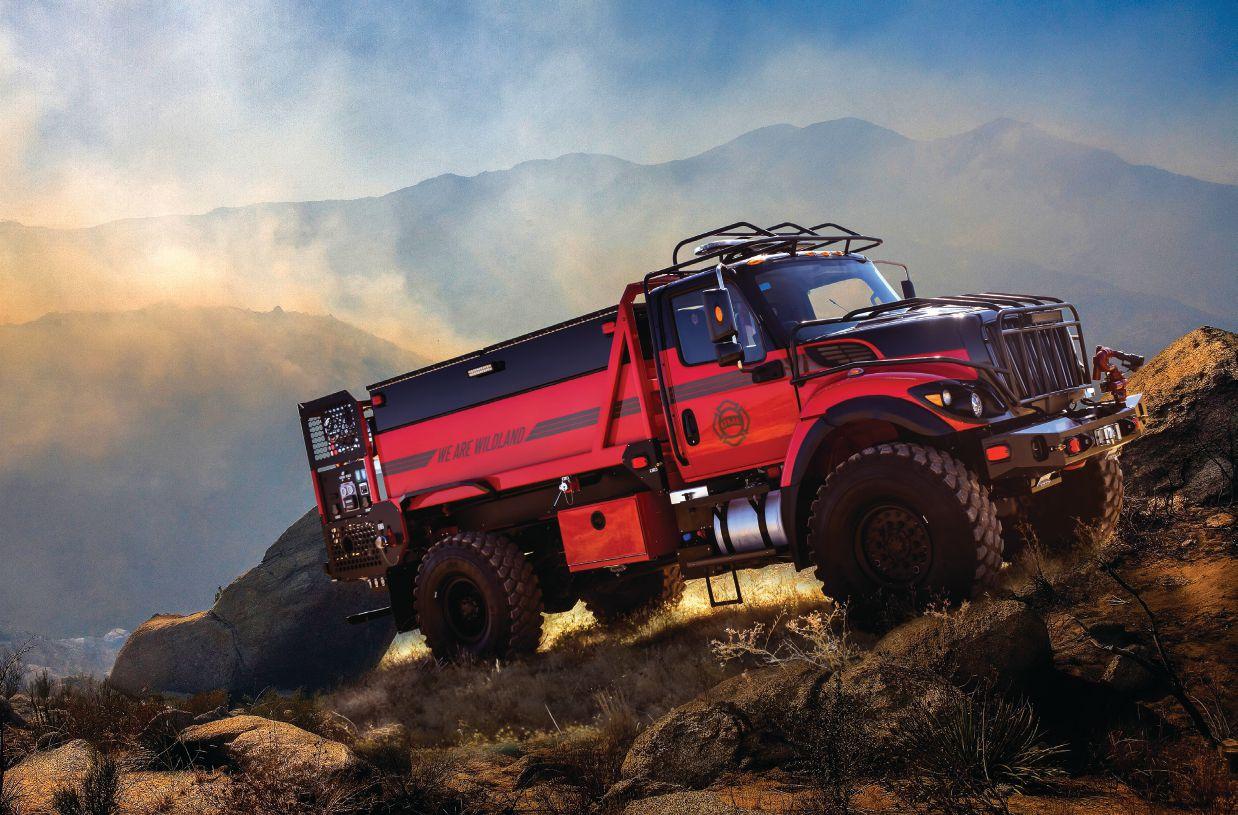
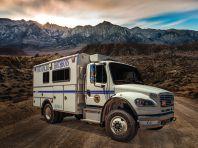
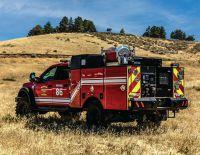
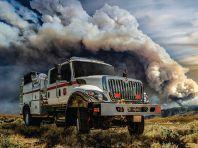
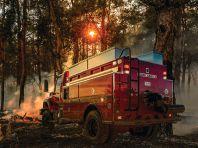
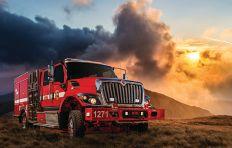
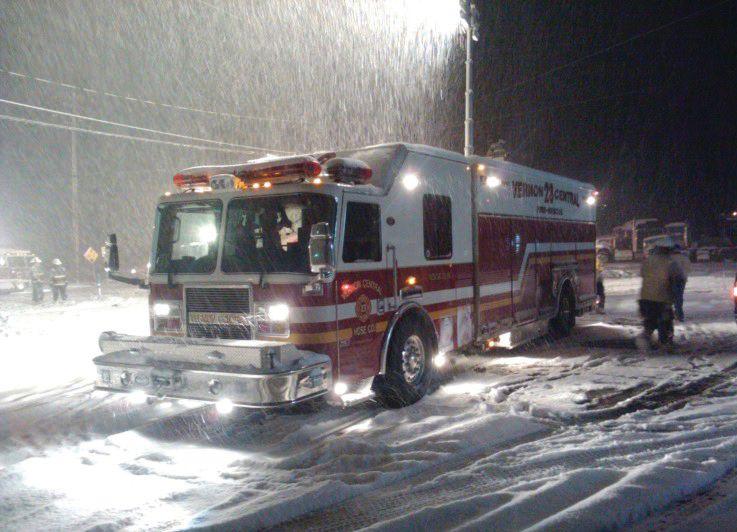
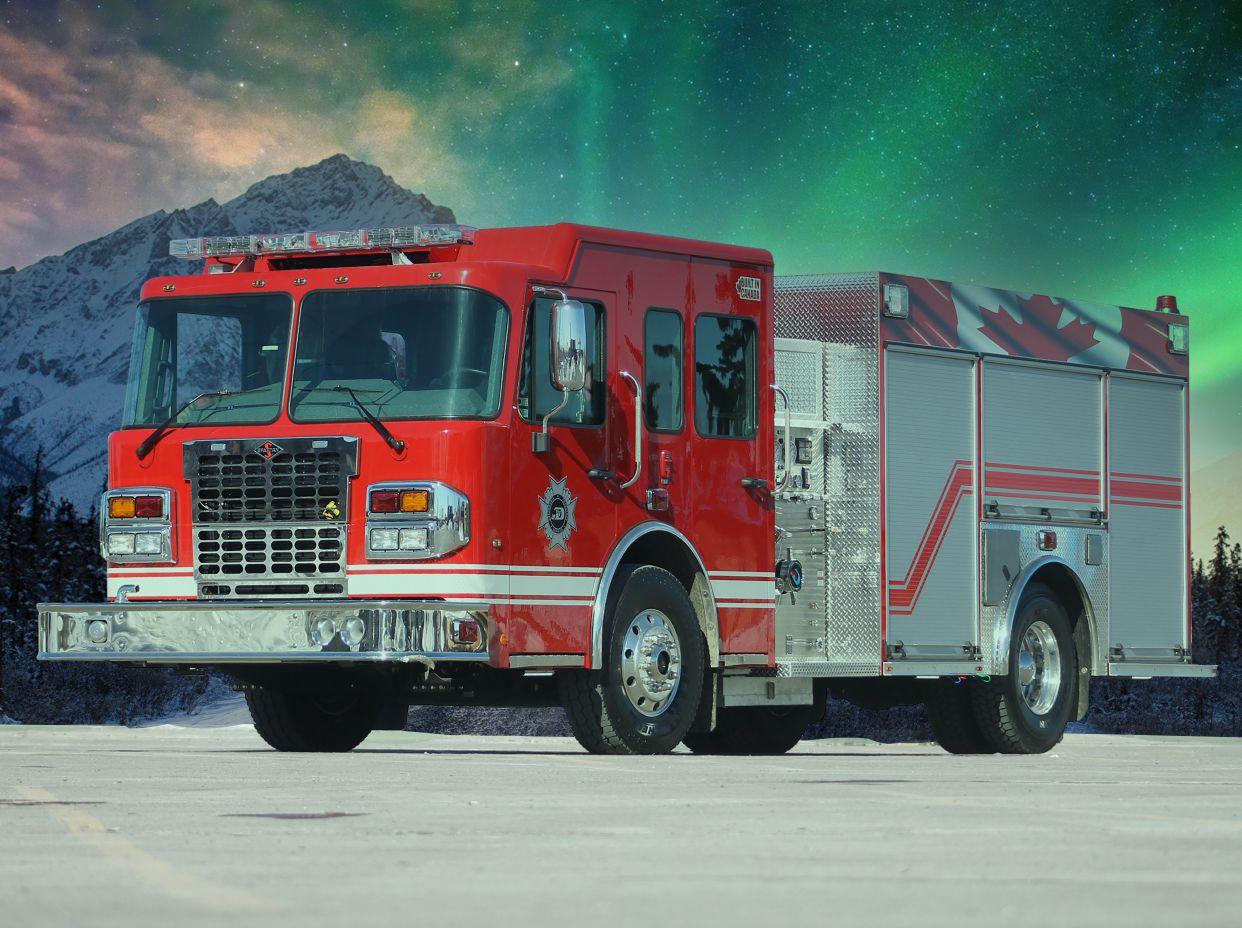
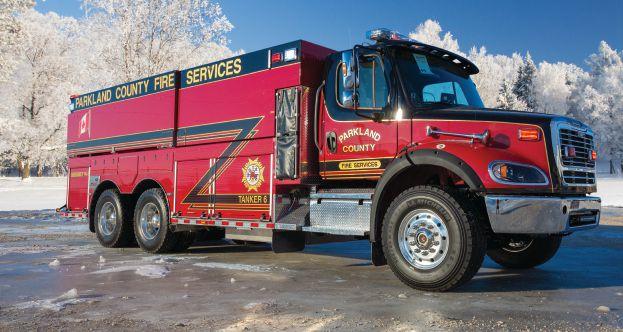
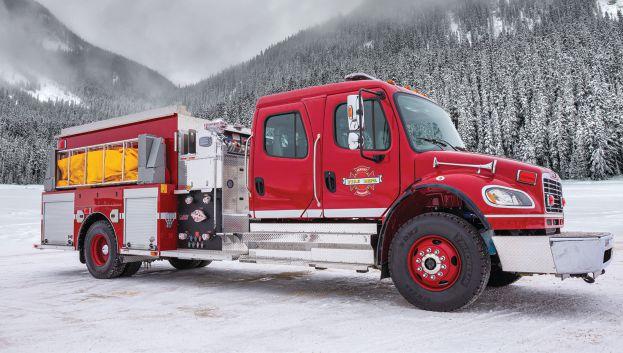
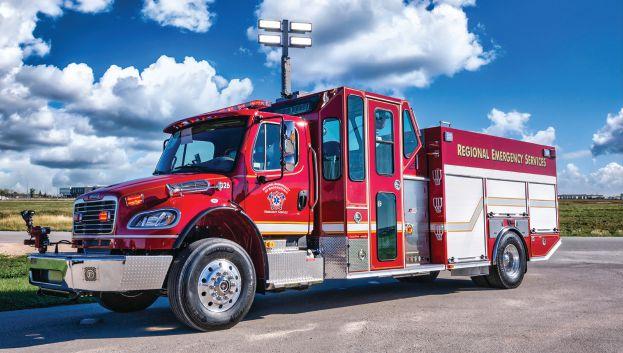
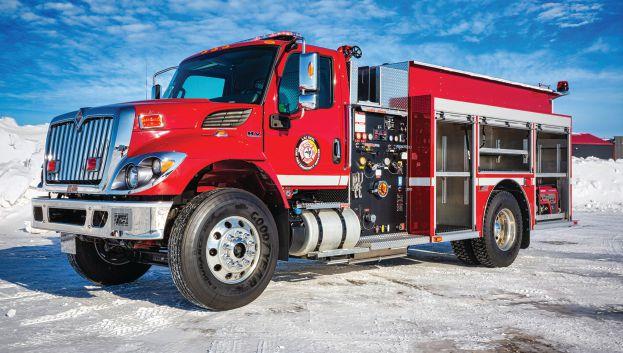
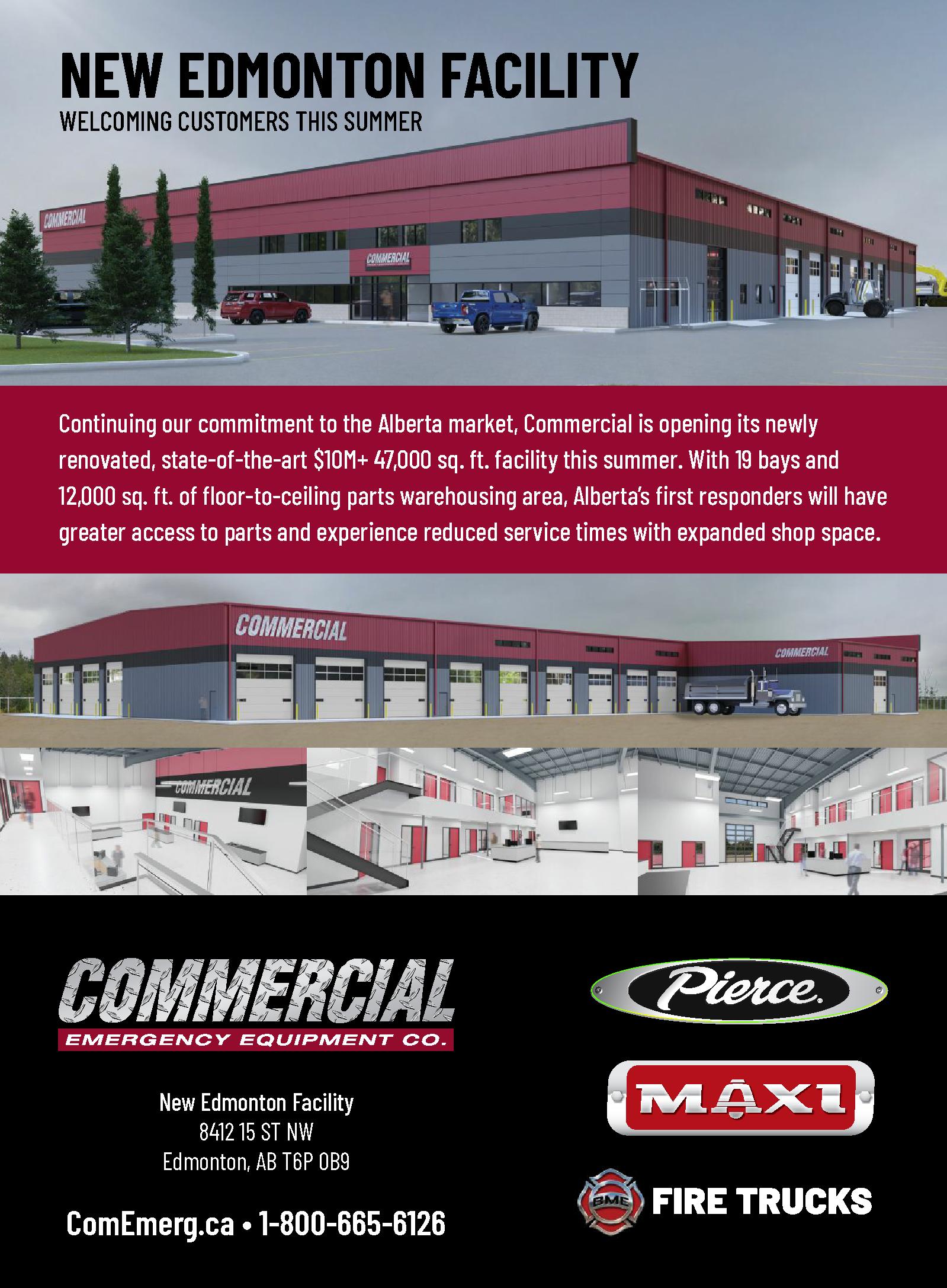
BME Fire Trucks, North America’s leading wildland apparatus manufacturer, has awarded the exclusive dealership territory for its emergency apparatus in Canada to Commercial Emergency Equipment. Commercial and BME have begun working hand-in-hand to bring the extensive line of BME Fire Truck apparatus to Canada’s first responders. Contact an Apparatus Specialist today to start building your next wildland truck. COMMERCIAL EMERGENCY EQUIPMENT IS CANADA’S FIRST AND ONLY DEALER FOR BME FIRE TRUCKS.
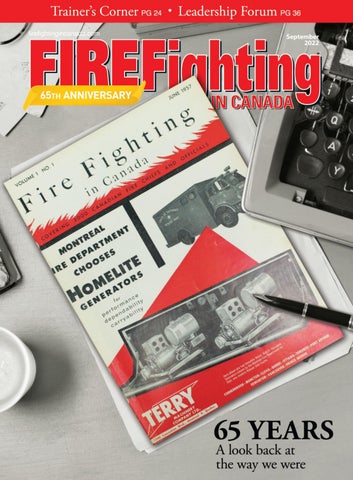
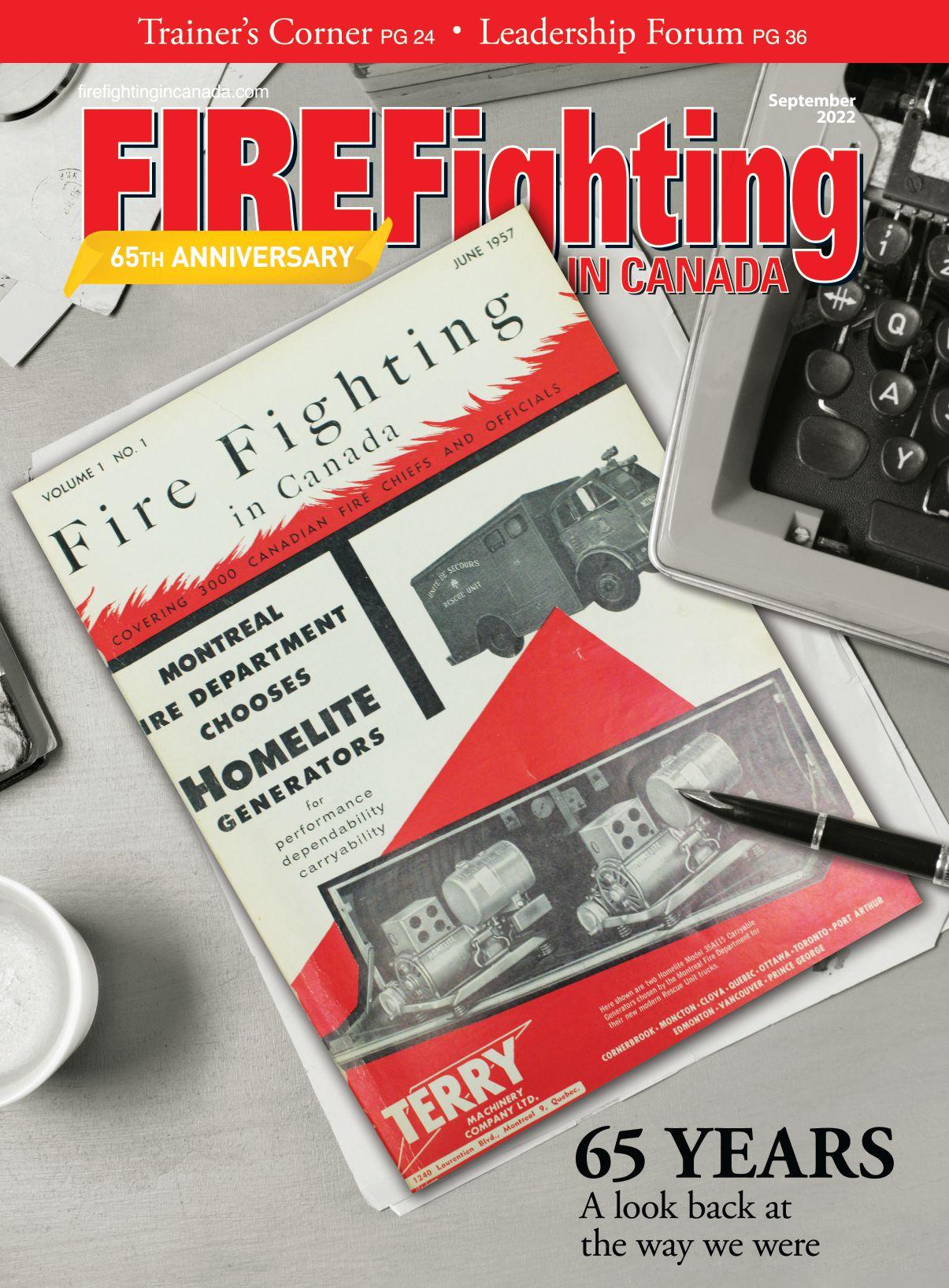
65 YEARS
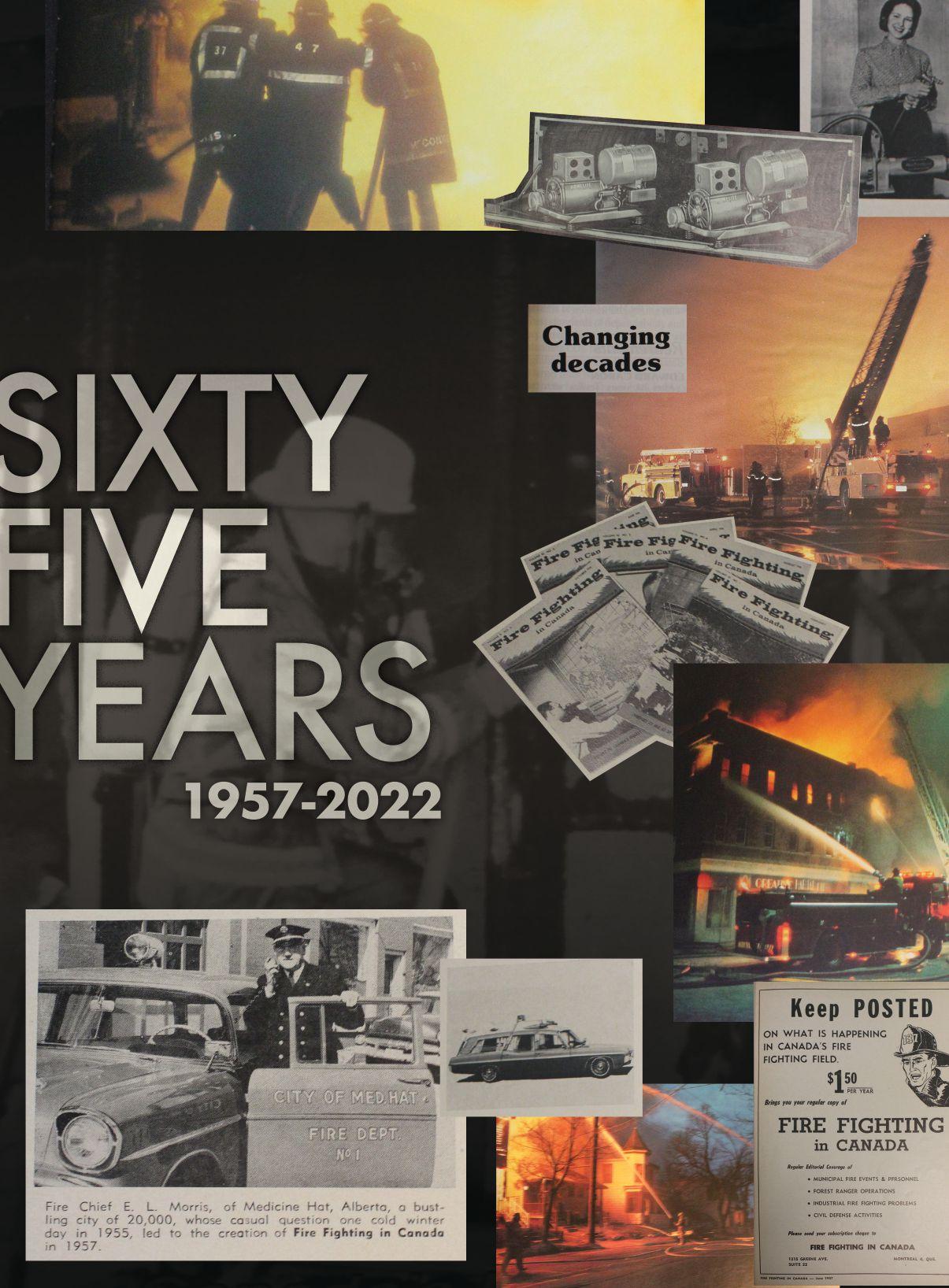
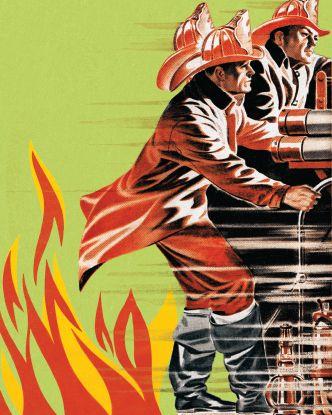
From the history of apparatus, to the way business was done and what firefighters wore, harken back to the past for our 65th anniversary issue.
By Laura Aiken
32
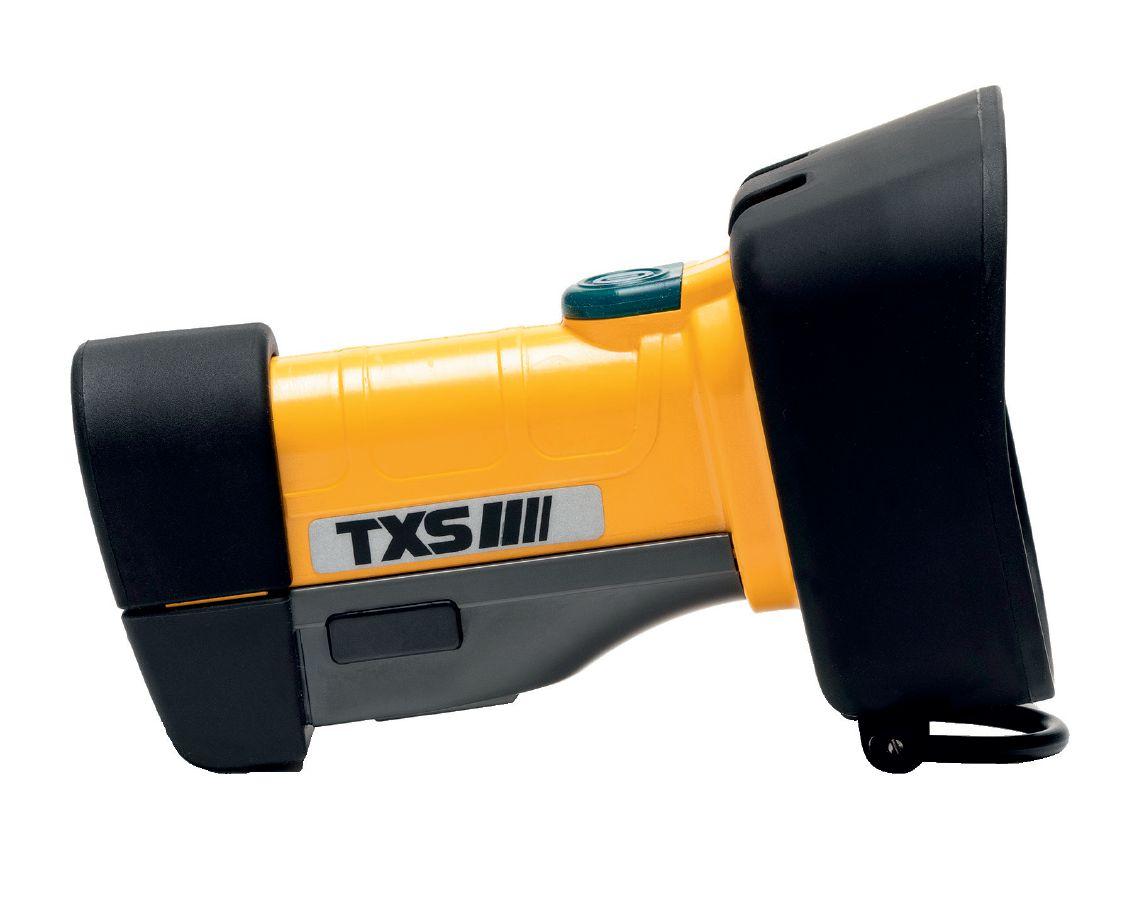
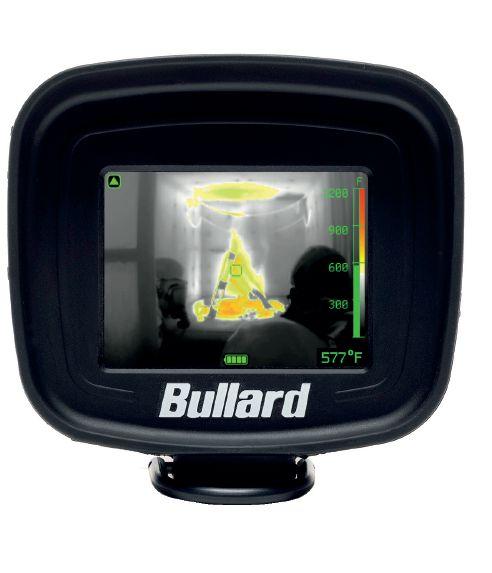
THERMAL IMAGING: TRAINING REFRESHER
Now that training is back in the swing of this new normal, here’s a roundup of top tips to keep in mind when using your thermal imager.
By Manfred Khin
40 THE TRUTH ABOUT POST TRAUMATIC GROWTH
More evidence based research needs to exist to support and measure this possible positive outcome of PTSD.
By Nick Halmasy
BY LAURA AIKEN Editor laiken@annexbusinessmedia.com
F
COMMENT
A fire magazine is born
ire Fighting in Canada was started in 1957 by Norman Parkins after the fire chief in Medicine Hat, E.L. Morris, asked him on a cold winter day in 1955 why there wasn’t a magazine published in Canada to serve the fire field. Morris told Parkins he wanted to see pictures of other chiefs across Canada and find out how they overcame their challenges and read technical articles on fire fighting. Morris also said he wanted to feel confident that the equipment he read about or saw advertised was available in Canada. Parkins called fire chiefs and equipment manufacturers across the country and found the idea of a magazine to be very well received. The first subscriber was a fire marshal who signed up eight months before the first issue.
to some well-known memory keepers in the fire world about how business used to be done, what was worn and simply the way things used to be. I ended up with the intent to call far more than I had space or time to talk to, but my intent remains, and a second installment is underway. A special thank you to Mike Rogers at Rocky Mountain Phoenix for going above and beyond in assisting me with contacts and background information.
ON THE COVER
Happy 65th birthday Fire Fighting in Canada! Let’s reflect on days gone by. See story on page 8.
Sixty-five years later, we are still serving the original vision spawned by Morris and Parkins on that wintry day in Medicine Hat. There is a need to share information in the fire service and the team at Fire Fighting in Canada is proud to work for this national platform of exchange, the legacy it leaves and the future conversation it aspires to. This magazine began for you and it is still for you. Thank you to all our readers and advertisers for your continued support of this endeavour. Your ideas, questions and contributions are always welcome in our inbox, on the phone and of course, once again face-to-face.
For this edition’s cover story, we talked
It has been particularly interesting to reflect on the past at a time when the world feels unusually unstable, like Earth’s sporting a huge question mark. Climate change, wars, polarization, a pandemic, the promise and perils of social media, supply chain woes, inflation; the list feels endless but so is the hope, love and beauty that remains. As the mysteries of the future march on, we can all take a cue from the fire service and do what we can to prepare. As we reminisce in this special 65th anniversary edition, most certainly enjoy the gift that is the present!
ESTABLISHED 1957
SEPTEMBER 2022
VOL. 66 NO. 6
Reader Service
Print and digital subscription inquiries or changes, please contact Angelita Potal, Customer Service
Tel: (416) 510-5113
Fax: (416) 510-6875
Email: apotal@annexbusinessmedia.com
Mail: 111 Gordon Baker Rd., Suite 400, Toronto, ON M2H 3R1
EDITOR LAURA AIKEN laiken@annexbusinessmedia.com 416-522-1595
Occasionally, Fire Fighting in Canada will mail information on behalf of industry-related groups whose products and services we believe may be of interest to you. If you prefer not to receive this information, please contact our circulation department in any of the four ways listed above.
All advertising is subject to the publisher’s approval. Such approval does not imply any endorsement of the products or services advertised. Publisher reserves the right to refuse advertising that does not meet the standards of the publication. www.firefightingincanada.com
STATIONtoSTATION
ACROSS CANADA: Regional news briefs
FCABC: The show circuit’s in-person return to the west coast
Mild sea-soaked air alongside splashes of rain here and there proved the perfect oceanside compliments to the trade show circuit’s return to live and in-person on the west coast. The Fire Chiefs’ Association of British Columbia (FCABC) held its annual conference and trade show from June 5-9 in Victoria, the picturesque island city known internationally as the City of Gardens for its billions of blooms (yes, you read that right – 3.4 billion at Tourism Victoria’s 2018 count).
Dan Derby, FCABC president, shared his thoughts on this year’s BC Fire Expo and FCABC Education Summit.
“The theme of this year’s conference — “We’re BACK” — certainly captured the sentiments of attendees, who were pleased to be able
THE FIRE HALL BULLETIN
Promotions & appointments
THOMAS DOHERTY is the new fire chief for Whistler Fire Rescue Service. Doherty previously served as fire chief for the city of Campbell River, where he led a composite team of 34 career and 50 auxiliary
members. He also served as a board member of the Fire Chiefs’ Association of British Columbia.
STEPHEN EMO is the new deputy chief for the Collingwood Fire Department in Ontario. Emo has 28 years of experience. He started as a volunteer and worked his way through the ranks to full-time and then captain.
to attend our first in-person conference since 2019. The opportunity to network and attend sessions was certainly well received! One of the prominent conversations was around mental health and how we support our members and each other as leaders and chief officers. The FCABC has a mental health task force focused on developing support and resources specific to our members.”
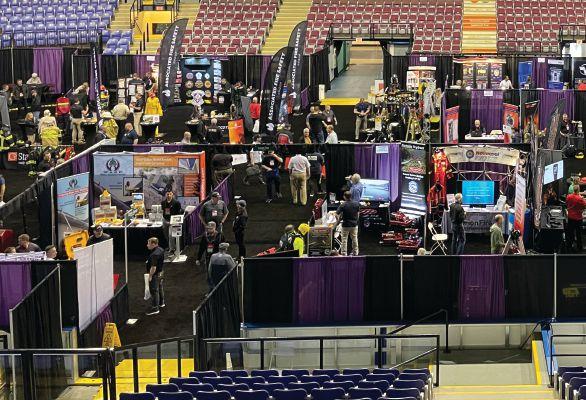
The BC Fire Expo, running June 5-6, drew 270 trade reps from over 100 companies occupying 167 booths at the Save-On-Foods Memorial Centre, with plenty of apparatus outside. There were 260 chief officers registered. Sunday and Monday saw over 200 walk-ins with 70 First Nations’ Emergency Services Society members attending the expo.
The event transitioned to its education summit on June 7, which hosted 24 speakers over 27 sessions along with the various AGM meetings. On the most emotionally engaging speakers, Derby noted, was keynote Joe Roberts, the ‘Skid Row CEO’. Roberts is a particularly adept speaker on resiliency and change as he shares his story of rising up from his former life as a homeless drug addict.
Other educational sessions include Training for Life and Call Signs for Life from Comox Fire Rescue Chief Gord Schreiner. Vancouver’s Fire Chief Karen Fry and Deputy Chief Celene Lemire delivered a talk on diversity. Burnaby Deputy Chief Dave Samson and Coquitlam Deputy Chief Scott Young brought attendees a B.C. first responder mental health update. Delegates took in a “coach approach to leadership” with certified executive coach Shelley Langille, founder and president of SeeShell Consulting (SSC) and the International Coach Coalition (ICC). Best practices in fire hall design and the community risk reduction dashboard were amongst the other subjects rounding out the three-day agenda.
The 2023 BC Expo and FCABC Education Summit will be held in Penticton from June 4-8. – Laura Aiken
In Ontario, the Bracebridge Fire Department promoted MIKE PEAKE to deputy chief. Peake has been with the service for 22 years, starting out as a volunteer firefighter and applying to become a fulltime fire prevention officer 12 years into his service. He has been working as a fire prevention officer for nine years
and acting deputy chief for the past year.
KEN UZELOC is the new fire chief for Kamloops Fire Rescue. Uzeloc has over 30 years of experience in the fire service, serving as deputy chief for the Calgary Fire Department for the past 15. He began his career as a volunteer firefighter in 1968 with the Regional District of Kootenay Boundary in B.C.
The FCABC’s annual event welcomed its attendees and exhibitors to the Save-On-Foods Memorial Centre in Victoria.
PHOTO BY LAURA AIKEN
MFCA brings the fire to downtown Halifax
If you like fantastic food, live music, salty sea air and a chance to hang with your fire family on the east coast, then Halifax was the place to be July 7-9. In a bustling hub located a mere sloping sweep of a walk to the oceanfront, The Maritime Fire Chiefs Association (MFCA) hosted its Atlantic Fire Leadership Conference at the Halifax Convention Centre. The event’s return to Halifax marked a shift in location from Moncton in 2017 through 2019.
MFCA president, Fire Chief Vince MacKenzie, said he was pleased to see the annual event once again take flight in person.
“The MFCA executive is very appreciative of the efforts of all who planned, executed and attended the 106th conference. In this time of uncertainty around conferences, we were very pleased to enjoy a successful conference in Halifax this year after months of deliberation as to if we would have to cancel yet another year. Planning has already started for the 2023 conference building on
the success this year.”
The conference kicked off on July 7 at 7:00 pm with opening ceremonies and a memorial service. The trade show opened its doors from 8:00 pm to 10:00 pm with a ‘wine and cheese’, which included a “wall of spoons” artfully showcasing fancy eats, and some of that famous east coast seafood on offer. The 77 booths and their reps were ready to mix and mingle. The trade show re-opened at 9:30 am the next morning with conference sessions running concurrently.
First up to speak was a familiar face for many, Laura King, the NFPA regional director for Canada, with an update. Of note, 2022 marks the 100th anniversary of Fire Prevention Week with this year’s message being “Fire Won’t Wait. Plan Your Escape”. Day 1 also featured Toledo, Ohio battalion chief Robert Krause and his presentation “What is Killing Firefighters? A study of firefighter fatalities and strategies to reduce
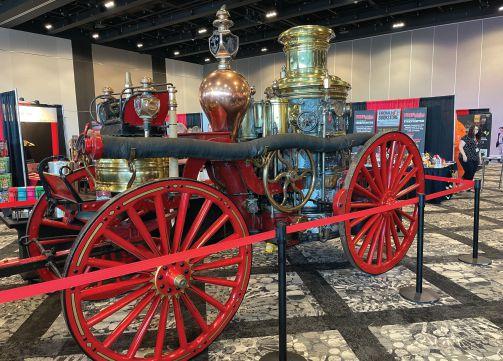
On display in Halifax: This Lulan 1877 Amoskeag steam fire engine, originally delivered from New Hampshire to the Town of New Glasgow following a call for help after a Halifax explosion, is now on long-term loan to the Halifax Fire Historical Society.
their frequency.” (For full coverage on this session, visit firefightingincanda.com).
Other sessions included one on diesel smoke removal in fire halls by Andrew Dudka from Atlantic Air Cleaning Specialists, and Shelley Langille, founder and president of SeeShell Consulting (SSC) and the International Coach Coalition (ICC), brought her
“coach approach” on leadership. Attendees also learned about networking from ‘Team Red’, a group that shared the value of peer support during a pandemic.
The trade show ended on July 8 with sessions continuing on July 9. Stay tuned for updates from the MFCA regarding next year’s show.
– Laura Aiken
ARE YOU A CANDIDATE FOR A BOARD POSITION IN A NEW FIRE SERVICE MUSEUM?
Consider serving on the board of directors for a new Canadian fire service oriented museum designed to become a national hub for all Canadian fire museums and collections. Both individuals involved in Canadian fire service history and individuals engaged in the wider activities of business, education, history and Canadian life might have the interest and ability to serve. Experience is an asset. Geographic representation desired. If you or someone you know might be interested, please query Will Brooks at CMFH922@gmail.com.
Retirements
JOHN MCKEARNEY retired from his role as fire chief for the Whistler Fire Rescue Service. McKearney started his career in 1980 as a firefighter with the City of Vancouver and went on to hold several positions before being promoted to deputy chief
and then fire chief. He served as past director of the Fire Chiefs’ Association of British Columbia and is the president of the Canadian Association of Fire Chiefs. McKearney was also a part of the British Columbia Fire Commissioner’s Diversity Task Force.
Fire Chief STEVE KNOTT retired from the Petawawa Fire Department in Ontario
after more than four decades. Knott started his career with the Petawawa Village Fire Department in 1975 and became chief for the town of Petawawa in 2005. He is the only person to serve on all three fire departments in the community, including the former township, village and town.
Last alarm
TERENCE DALE MCDONALD, retired deputy fire chief for the Hanover Fire Department in Ontario, passed away at the age of 66. McDonald retired from his role in 2011 after serving the community for more than 27 years.
BY
PHOTO
LAURA AIKEN
STRETCH
GORE® moisture barriers manage heat stress better in a broader range of environments.
New thermal liner is lighter, more flexible, and quicker drying.
65 YEARS
Business has changed. The fire service has changed. Hear from some familiar names in Fire on the way we were.
By LAURA AIKEN
Writing about the past is like tugging at a magician’s scarf; no end to the next colour, each piece of fabric leading endlessly to another. The future is such a mystery that a speculative piece is pretty tidy to package up by comparison. For Fire Fighting in Canada’s 65th anniversary cover feature, I tugged at the magician’s scarf and chose a sampling of the colourful history of the fire
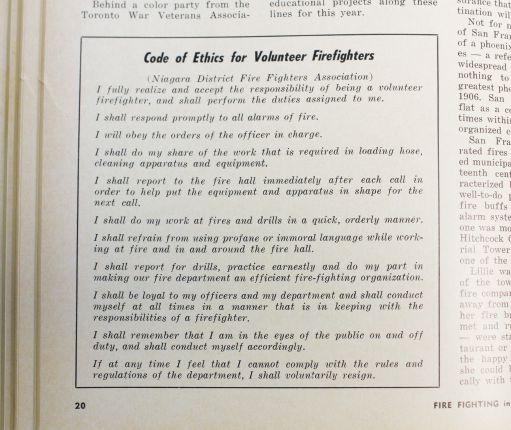
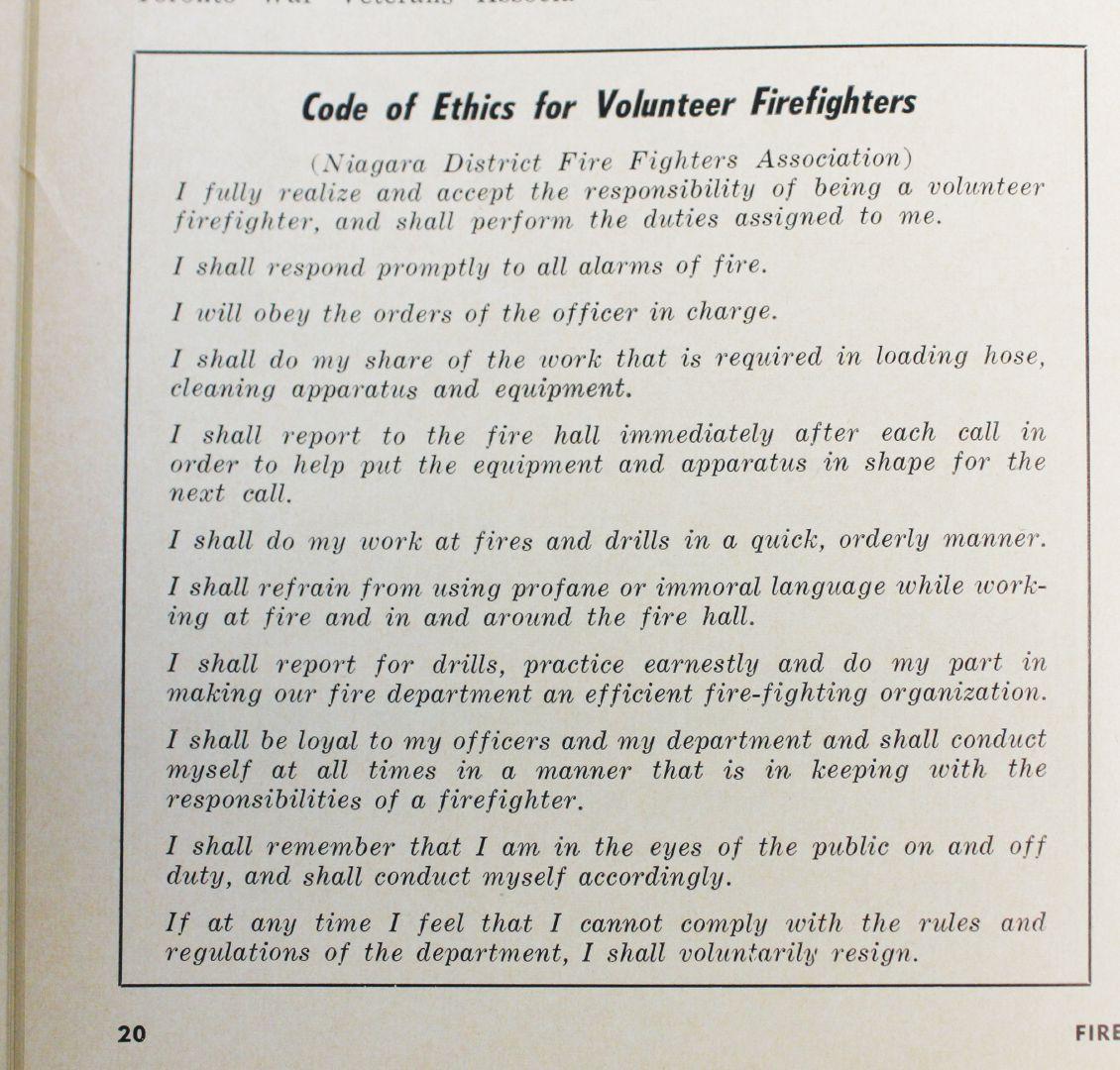
In 1965, Fire Fighting in Canda published the Niagara District Fire Fighters Association’s Code of Ethics for Volunteer Firefighters.
service and industry, by no means comprehensive, and certainly inspiring a second flip through the Rolodex to share more in a future issue.
Canada has a lot to be proud of with so many long-standing companies still thriving. The late Alfred Joseph Stone spent years in the manufacturing and sales side of Fire before starting Ontariobased A.J. Stone Company in 1972. Commercial Emergency Equipment’s history stretches back to 1947 in Vancouver.
The history of Canada’s fire apparatus is a storied one, and a legendary piece of the fabric began with Charles Thibault and Pierre Thibault Ltd., in Pierreville, Que., circa 1918. Thibault was one of the best known and biggest apparatus manufacturers for much of the 20th century, with the original company intact until 1989. When World War II broke out, Thibault was awarded multiple contracts from the Canadian government that helped propel the company towards expansion, detail authors Bob Dubbert, Shane MacKichan and Joel Gebet in the Encyclopedia of Canadian Fire Apparatus, which shares the story of this iconic Canadian company amongst many others. The Encyclopedia of Canadian Fire Apparatus was published in 2004. At that time, 17 of the manufacturers in the book were still operating. Twenty-four were out of business. Some of the bigger names no longer around, like Bickle and King-Seagrave, will still ring bells. Some, like Fort Garry Fire Trucks (born 1979), Dependable (born 1975), and HUB Fire Engines (born 1959), are oldera institutions that continue to innovate and succeed today.
Thibault, who introduced many innovations in the aerial market, debuted his first custom cab-forward fire truck in 1957 and died n 1961, leaving behind nine sons fraught with infighting and power struggles — Pierre-Paul, René, Julien, CharlesÉtienne, Gilles, Marion, Yvon, Réjean and Guy — some of whom would go on to make their own marks on Canada’s apparatus industry. In 1968, five of the nine sons left to create their own company, Pierreville Fire Trucks, putting the two factions in competition with one another. Thibault continued to be successful, expanding its fire truck exports into America and beyond. Despite these successes, Thibault declared bankruptcy twice – in 1972 and again in 1979. Pierreville filed for bankruptcy in 1985. Thibault filed for bankruptcy a final time in 1989, but the business innovations were purchased by a group of investors lead by a former executive of Bombardier, who formed Nova Quintech (1990-1997). Pierce Manufacturing bought the rights to Nova Quintech’s aerial line of product in
No more riding on the tail board. Rick Suche counts a fully enclosed cab as one of the biggest fire safety advances in his time.
1997. The Thibault’s are still around the fire industry in various business enterprises, including Carl Thibault Emergency Vehicles and C.E.T. Fire Pumps Mfg. The
historical details were summarized from the Encyclopedia of Canadian Fire Apparatus.
John Witt began working for Pierreville Fire Trucks in 1980 as their sales manager. Having sold himself into retirement at the age of 28 after his first ventures, Witt put his salesmanship to good use for five years with the storied Quebec apparatus maker. One of his key later contributions for fire departments was engineering the arrival of Bronto Skylift to North America in 1985; helping pioneer Bronto as a leader in advanced articulating and high reaching aerial devices. In 1993, he entered the market as a dealer by starting Safetek Emergency Vehicles Ltd. and later purchased Profire Emergency Inc., to create what is now known in the industry as Safetek Profire, one of Canada’s leading providers of fire-rescue vehicles, parts and service.
After 42 years serving fire departments, Witt said there’s nothing he would have done differently; it’s been a business life of no regrets and many pluses.
“I’ve also been very fortunate to get to know and become friends with competitors and associates through the NFPA 1901 Apparatus Committee which I served on as the only Canadian member for a number of years and now currently on the ULC S-515 Apparatus Standards Committee...I’m proud to see the apparatus we’ve sold save lives and property. I’m proud to see the products and services that we’ve provided to our customer help save lives and property. Our team shares my passion and supports our mission of “Serving Those Who Keep Our Communities Safe.”
A lot has changed since the days of Pierreville when Witt could just price out a truck with a few basics on a piece of paper. Now, sophisticated software creates specifications and line item pricing. A tender used to be 10 pages, now they’re up to 200 with all the specs, legal requirements, terms, and conditions. He’s now also seeing fire departments use group (cooperative) purchasing and long term contracts/ agreements to help standardize apparatus and reduce the need to re-tender every year, which expedites the process and is expedient and transparent.
Also, the sales cycle is longer today. It used to take fewer than 365 days to build a fire apparatus. Now in some cases, and with some builders, 18 to 24 months or longer is the norm. “And I don’t think that’s going to change in the near future,” he said. “We’re suggesting departments expedite their process and consider purchasing apparatus already in production — or stock units.” Stock or not, the life cycle of fire apparatus purchasing has become more complicated and expensive. Inflation can mean significant budgeting increases, primarily due to supply chain issues. A city budgeting to replace an apparatus in 2022/2023 for a delivery in 2024/2025, will need to factor in significant cost increases.
When asked what his workday was like in, say, 1989, compared to today, he said “personal contact” was one of the most prominent methods of securing a sale. “Now we’re using emails and phone or Zoom calls.” He recalled a story where a new deputy was hired by a suburban Toronto area FD and was told by the fire chief to purchase a new aerial apparatus. So he called around and said ‘who do you talk to?’ He was told to call John Witt, the
A tale in longevity: Niedner, est. 1895
Niedner started making linen fire hose in 1895 in Massachusetts. The company, now making circular woven hose products in Montreal, has been innovating ever since, with the latest solution coming in the form of their Altra 3D two-in-one hose. The double jacket design is unique in bringing the outside and inside jacket into a single layer, eliminating snaking and wrinkling. One-hundred and twenty-seven years is a long time to hone your craft, and over the years Niedner was the first to manufacturer a lightweight hose for the fire service in 1982, and the first to make a circular loom for structural jackets larger than 12 inches in diameter in 2014.
‘Aerial guy’.
“He called me out of the blue. I flew to Toronto to see him, told him the features and advantages of my apparatus and he bought it.”
He said it was the sales person’s knowledge/expertise that gave him both the confidence and comfort in what he was purchasing. That was biggest factor in closing the deal of yesteryear. However, despite all of these changes and challenges, this remains a relationship-based industry.
Witt and the Safetek sales team travelled more in the past, spending time taking customers to the factory for pre-construction, pre-paint and final inspections. Now much of that is done remotely. The benefits he sees are the reduced costs and less time away from family for everyone, but as a relationship builder, he says he does miss spending time with established and prospective customers. He much prefers face-to-face interactions to doing things by Zoom: “You can’t always think of everything over a Zoom call.”
Apparatus was simple when Witt started; electronics weren’t even on the market and he has seen technology go from fairly basic to highly technical and sophisticated. “You’re getting apparatus that can be run on your phone now, so to speak, and not everyone is ready for that level of sophistication.”
Apparatus technology has changed and so has fire service purchasing structure. One trend sees the city’s finance or purchasing departments more heavily involved in the acquisition of fire apparatus because of the capital nature. This requires cooperation and insight on both sides so the
FD can acquire the apparatus that they require for their specific operations at a justifiable cost. “Succession planning and training is going to be more important than ever. When the senior staff associated with apparatus and maintenance in a larger city retires, the wealth of knowledge and first hand experience has the potential of being lost.”
Rick Suche, president of Fort Garry Fire Trucks, is another long-time memory keeper in Canada’s fire industry. Suche started with Fort Garry in 1979 when they were building tankers for Indigenous and Northern Affairs Canada. Fort Garry was a general bodybuilder at the time, not yet specialized in fire trucks, and building two to five tankers a year. He had an interest in the fire service, so he took one of the tankers on a road show. They took the feedback, built a better one and the story snowballs from there. Fort Garry builds well over 100 fire trucks a year now. His said day has changed a lot simply because they are serving a lot more customers now with customers in frequently through the week.
Fort Garry moved into the a new custom built building in 2013 and the staff had a lot of input, which Suche counts as a major accomplishment and highlight for Fort Garry. The chiefs that come through the doors these days are more informed, he said, but since most chiefs only buy one or two trucks in their time as a chief, there is a learning curve and Fort Garry does a lot of educating on what’s available. The most important meeting is pre-production —that makes for a good final inspection — and he said that aspect hasn’t changed over time.
Suche likes to maintain face-to-face interactions, ensuring customers are well looked after when they come to Winnipeg.
“They become part of our family. They become friends and many of my friends are long serving fire people as well as the support people and our suppliers.”
While face-to-face may be among the most un-changing, cherished preferences in business relationships, Suche has certainly seen much change. Forty years ago, change was resisted a lot more and was very hard to do, he said. Change is accepted faster now than it used to be. He pointed to the “Everyone Goes Home” campaign started in 2004 as helping change the conversation around firefighter safety, and now the cancer and mental health awareness have become evolving pieces as well.
“It hasn’t changed totally, but it is changing. Definitely.”
The biggest game changer he’s seen in all innovations was the safety of a fully enclosed cab.
“When I started, they were still riding on the tail board. Then they went to open cabs. Then they went to fully enclosed cabs. That’s the biggest safety feature…it saved the most lives.”
But the biggest change of his over four decades in Fire?
“Inflation was normally two, max four per cent a year. Now it 15 to 20 per cent on fire trucks. The chassis costs have just gone crazy. Completely crazy. That’s the biggest thing in 43 years that I can say I have ever seen – the price of fire trucks rise as fast as they have in the last two years. It’s an entirely different world we live in with the supply chain right now.”
Is it fair to say times were more predictable when we were waiting around by the phone instead of for parts to build the truck?
“You spent all day on the telephone and waiting for the mail to come in,” says Suche of his old communication toolbox. “I remember watching the first fax come in. That was an amazing thing to see back then.”
Fax seemed like an antiquated technology until I got on the phone with Brian Evans, a 73-year-old 50-year veteran of the fire industry and owner of Fides Novus Marketing, and he starting talking about telex. Telex used teleprinters and tele -
graph-grade connecting circuits for twoway based text messages between businesses in the post World War II era (and there it is, the original human propensity to text). Evans would type his message into a typewriter pad on the telex machine and it would be typed out on the other end.
“It was magic at the time,” he said. He also noted he paid two thousand dollars for his first cell phone (I suppose we can be thankful not everything has gone up in cost over the years). He paid the hefty price tag because if he was going to be late seeing a customer, he’d have to stop at a pay phone and spend 10 minutes telling the person he was going to be 15 minutes late.
“The battery operated one was all battery and looked like a construction worker’s lunchbox. I used to write my customer’s letters — write or dictate to a secretary and mail it away. Send it away with literature. You could be reluctant to call because long distance used to be expensive, and your boss didn’t want you to eat up too much long distance. Or you drove to see
your customers. You training was: Here’s your keys, catalog, and cards. Off you go.”
In 1970, prior to starting Fides Novus, a marketing company that represents Hale, Federal Signal, Akron Brass and Snap-Tite Hose, among others, he took a job as a salesman at a company called Safety Supply Canada.
“The first time I sold a Scott air pack in 1970, I sold it with the cylinder for $350.”
He also sold a wool, long firefighter’s coat that came below the knees for about $100. The knee-length firefighter’s boots, just rubber boots, no steel toe, would run his customers about $17. Then, they would don thick wool mitts in winter or summer, dipped in a bucket of water.
“They kept your hands warm in the winter even though they were wet…it was weird stuff.”
Evans worked for Fleck Brothers after Safety Supply Canada, then went to Niedner. He stayed with them for six years, moved to corporate side, found it wasn’t for him so he started his marketing compa-
ny, which he’s been doing for 35 years. He’s been travelling for 50 years, and time hasn’t changed that. In the first seven weeks of 2022 he hit up every province in Canada. I suspect 50 years of friendships coast to coast makes for particularly rewarding road trips.
“The thing that makes this business good is that the end users are good. Firefighters care. Fire chiefs care. Fire departments care.”
And, most definitely, Will Brooks in Lunenberg, N.S., cares. This 80-year-old has been keen on helping out in fire halls since he was a young lad. Brooks keeps a vintage fire collection through Lorne Street Fire Company and nationally he is known as a co-founder of the Canadian Fallen Firefighters Foundation. Whenever I call, he seems to have a finger on the pulse of anything from cancer coverage for firefighters to safety legislation. He asked me recently what I thought of Hebbville FD’s unique aerial on a smaller chassis for shorter buildings that was displayed at the
Atlantic Fire Leadership Conference this year, noting it was a pet project of his to see it in Nova Scotia after seeing a similar truck in Italy about 20 years ago. Of pet projects, this man has many.
A fire truck buff at heart, his first memory jogged during our conversation is the 1948 700 series American-LaFrance pumper, which revolutionized design by having the motor placed behind the front axle.
“It changed everything, and I was born before that, so I remember the transition from that style to the 700 series.”
Brooks was raised in a tiny town in Maine (although he is Canadian), where his father was on the town council, and considered the “head select man,” which was the terminology at the time used to describe the leader of the town government. His father recognized his interest in fire engines, and took him to the station, which Brooks described as the corner of a garage, and he was able to sit in the apparatus. He recalled hearing the horn blow many times to send the alarm out and later on you’d find out where the fire was from a little sheet in the newspaper. His father kept his son alerted to active fires so he could go to see the fire trucks. The family moved to another small town in Maine, and through high school he was part of the fire department driving fire trucks and running pumps. At the time, it was commonplace for students to start the initial fire fighting and the older men, who were working in the day, to arrive later.
One story he remembers vividly. When he was nine, his father was ill and asked his son if he’d go down to the factory to pick up his paycheque for him. Happily, he went to the factory, which was across from the firehouse. He went in to get his father’s paycheque and when he came out the hand rung bell was ringing to indicate a fire in town. Brooks, feeling lazy, figured he could hitch a ride on the fire truck and get home a little sooner. He piled in as the truck zipped off, shaking with terror and clinging to his dad’s cheque as he realized the location of the fire required traversing an extremely steep hill by his school that would mean certain death should the brakes fail (he’d overhead the firefighters talking about it). The crew and their nineyear-old ride-along made it down the hill to find a small fire. Brooks grabbed a little
Will Brooks, co-founder of the Canadian Fallen Firefighters Foundation, in a vintage fire truck.
NO HYDRANTS, NO PROBLEM
CET manufactures portable pumps, skid units, brush trucks and more to allow fire departments to Adapt, Improvise & Extinguish fire in almost any scenario where hydrants are scarce and static water resources maybe all you have to work with. CET- Providing fire ground solutions since 1908.
1
Portable Pumps (PFP-20hp-HND-MR Shown)
50+ models to choose from for both fire attack & resupply operations from static water sources like lakes, rivers, ponds and pools
Arrives Completely pre-assembled, pre-plumbed, pre-wired and pre-tested ! Simply mount to your chassis, connect electrical and go fight fire!
Brush Trucks (Custom Built)
Solid/Affordable/Practical
Anderson’s Engineering:
1972 – 2000
Duncan Anderson, owner and operator of Anderson’s Engineering, founded his company from the roots of his father’s machine shop in 1970. That same year, he built his first fire truck for the Langley Township Fire Department.
Anderson’s interest to the fire service started in the middle of his adolescence. Growing up in rural Langley, B.C., Anderson found himself going to the volunteer fire department.
“I couldn’t get a ride to the soccer field or baseball diamond or even to the movie theatres. The department was about a half mile away from my house, and I’d always been interested in cars and machines because of my dad,” said Anderson.
Anderson would later spend his 44-year career at the Langley department, seeing it transition from volunteer department to paid on-call to composite, and serving as district chief and deputy chief.
Anderson’s Engineering came about as a result of Anderson’s childhood fascinations and the chance to carry on his father’s business in his own way.
“When I built my first fire truck, a tanker, I took an old truck and built a new tank for the back,” said Anderson. “It worked very well but it was crude. The first truck I built with the help of a team was in 1974.”
Anderson’s Engineering went on to build apparatus for departments internationally and across Canada.
“We started out with one truck at Langley and next thing we knew, we were building trucks for cities like Seattle, New Jersey and later places like Puerto Rico, Guam and Saipan,” said Anderson. “We had a large number of trucks around B.C., Ontario and Quebec, too.”
In 1986, Anderson’s Engineering became a distributor for Bronto Skylift, which led to a number of Skylifts with Anderson bodies being delivered to departments across Canada.
“I remember when Montreal ordered the 50-metre unit, it was the tallest in North America at the time. That was a big moment for us,” said Anderson.
Anderson’s Engineering apparatus were built based on the need to departments.
“Being in the service myself, I knew that having a truck that worked for a specific departments’ needs were crucial,” said Anderson.
Anderson’s Engineering designed a number of innovative approaches to apparatus construction, including overhead ladder racks, transverse hose beds, separate pump compartments from the body and more.
Anderson said that while the growth and success of his business were impressive, he was proud of more than just the trucks they produced.
“I am exceptionally proud of the trucks we built, but I’m proudest of the people I had working for me,” said Anderson. “I designed the trucks and gave the guidance on how to build them. They were all great at what they did and great to work with too.”
Anderson’s Engineering closed its operation in 2000 but some of the truck built by the company are still functioning in smaller, rural departments today.
- Kaitlin Secord
broom from the truck (already knowing where everything was), and he went and beat the fire out. When more older men arrived, mystified to find a nine-year-old tamping out the fire, the man who brought him down in the truck said, “Oh, he’s no problem.” And that’s how he fought his first fire.
Brooks continued to go to fires, priming his interest in tactics and feeding his interest. He then went to university with no time for fire fighting or observing so much anymore, but he helped out the fire department during the summer when he was home, cleaning equipment and pitching in. He came to Canada in 1969 and worked full-time at a college doing counselling, and he didn’t think it wise to jump up and leave his patients when the pager went off. But when he went into private practice, he had more control over his time. At the age of 45, he joined the fire department and went to a fire school. When he started, he was given a “sort of duck coat” that two or three others had worn before, he said, and woolen mittens.
“And they gave me a helmet and the helmet was made of plastic and I was always very happy no one hit me over the head with it on.”
He joined another department in Nova Scotia and eventually retired at age 70. Since he’s been in Lunenberg he’s been continuously involved in the foundation, on the board of the Nova Scotia firefighter’s school, and just helped establish the Benevolent Fund. Retirement isn’t quite a word to hit Brooks’ vocabulary yet.
And on the west coast, Len Garis has taken a similarly non-retirement approach to his 2019 retirement from the helm of Surrey Fire Services. Garis was highly involved in the fire service during his 18 years as Surrey’s chief, and 39 in the service. He was a president for the Fire Chiefs’ Association of British Columbia and served on various committees addressing everything from building safety to injuries, receiving a number of honours and recognition over the years. He also pursued academic work as an associate, adjunct professor and instructor at various times. Post-retirement, he’s now the director of research for the National Indigenous Fire Safety Council and an advisor for the Canadian Centre for Justice and Community Safety Statistics for StatsCan.
Garis got started as a volunteer firefighter by talking to a neighbour over the back fence, who happened to be doing recruiting for Pitt Meadows FD in August 1980. His foray into fire fighting looked very different than firefighters experience today.
“I showed up on a Tuesday, chatted with the chief. The chief gave us a number, showed us the hook for our hat and boots and said if the pager goes off come to the fire hall as fast you can. And don’t drive right away until you’ve had some practice. First call was a car fire, and I went to the fire hall and just waited in the passenger seat of the fire truck for someone to show up.”
He recalls the enormously social nature of the fire hall at that time.
“In my day, there was a beer fridge. It was a place to go. It had a lot of bravado and privilege in the membership and respect from the community. You needed people to follow and to create that environment where they wanted to belong when they had another job and families – you had to balance that. It’s a bit of an art to keep that in check.”
Today, the fire service still strives for that balance and struggles with recruitment and retention amongst its volunteers.
Another thing that has remained constant around the fire hall?
“The DNA of a firefighter — being focused on being ready; always being ready.”
BACKtoBASICS
The tenets of VES: Part 2
BY MARK VAN DER FEYST
In our last issue, we started to look at the basic tenets of a tactic called Vent, Enter, Search (VES). In Part 1 we explored what VES is and how it can be used by the first arriving unit on scene. In Part 2, we are going to look at the tools needed for VES and the steps to performing it.
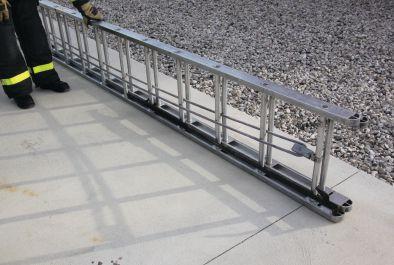
There are basic tools that are going to be needed when performing this tactic: a halligan, a six-foot roof hook and a search light. Most fire trucks are equipped with pike poles instead of roof hooks, but the roof hook is preferred over the pike pole. In Photo 1, you will see an example of a roof hook bedded with a ground ladder. The roof hook is smaller in diameter than a pike pole, made from aircraft steel and designed for multiple purposes compared to the pike pole. The roof hook can be used to pry, strike and force a window very easily. The pike pole made from fiber glass will not sustain the forces or striking required to clear out a window sash or glass and is much thicker in diameter to carry.
As shown in Photo 1, the roof hook is paired with a ground ladder so that two tools can be carried at once. The pike pole is not able to be paired with any ground ladder, thus forcing a firefighter to have to carry it separately. The roof hook will be used to break the window, clear the window sash and glass, and provide a descending ramp into the room. The six-foot length is a perfect fit for any size room for maneuverability.
The halligan is going to be used to assist with the search of the room as well as possibly being used as a door wedge to keep the door shut if need be. A search light is a box light and not a right-angled flashlight. The right-angled lights are personal flashlights and will not provide what is needed for a search light. With a box light, we will have higher lumens to use to our advantage.
If VES is performed on a two-story or higher floor, then a ground ladder will be needed as part of the basic tools needed. Another tool will be the thermal imager, to assist with the search, watching the condi-
tions and for accountability of the firefighter inside the room.
To perform this tactic, the first action step is to vent the room if it is not already vented. One way to accomplish this is to use the roof hook. This will allow the firefighter to stand to the side of the window for a single-story. For a two-story building, the firefighter can be positioned on the ladder so that their head is below the windowsill. Prior to breaking the glass, look inside the window quickly to see what is going on inside the room. Be sure to clear out the window completely, including the glass, sash, curtains, and anything else that may be in the way. This will ensure no interference with getting in and out.
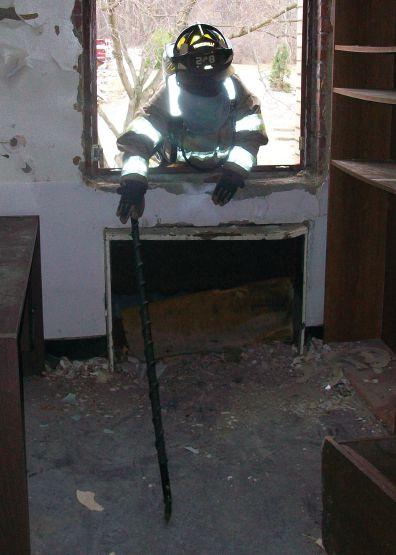
With the room vented, the firefighter will now enter. Prior to entering, take the roof hook and sweep the area below the window to see if there is anyone lying there. Once done, the roof hook can be used as a ramp as shown in Photo 2. This will help with getting into a room where the sill height is greater than three feet and prevent falling head-first into the room.
Once inside the room, the firefighter needs to locate the bedroom door so that it can be closed. This will be done by using the search light and putting the firefighter’s head right on the floor. With the head on the floor, the firefighter can shine their light across the floor to see what is below the smoke layer, locate the door and possibly the occupant that is still inside. The main purpose of doing this is to locate the bedroom door.
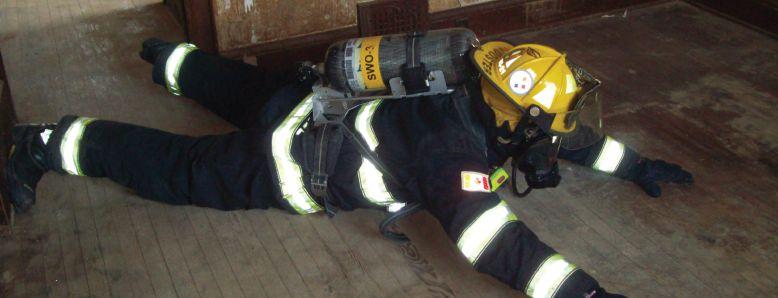
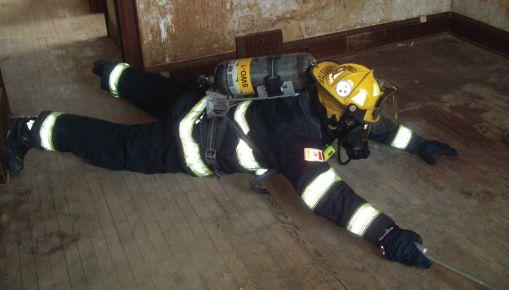
Once the door has been located, the firefighter needs to head in a straight line right to it. Once at the bedroom door, the firefighter will do a quick search of the immediate area outside of the door. This search area is going to be the length of the firefighter’s body as shown in Photo 3. In this area, we may find an occupant who was trying to leave the structure but succumbed to effects of the fire and fell right there. If there is a person lying there, grab them and pull them back into the room, then close the door. If on the way to the door, the
firefighter comes across an occupant, close the door first, then go back for them. The door needs to be closed so that the flow path that has been created will be stopped. If the door is not closed, then the fire will travel to the new vented opening and create more problems for all involved.
With the door being closed, the firefighter
An example of a roof hook bedded with a ground ladder.
PHOTOS BY MARK VAN DER FEYST
The roof hook can be used as a ramp.
can now search the room. This will be a primary search looking for occupants on the floor, on their bed, under their bed, closet floor, on top of a bunk bed and in the crib. Once located, they will be brought to the window by dragging them there, and then removed out the window to outside. If this is a second-story room, they will be brought down the ground ladder. Once the room has been searched and cleared, the firefighter will get out the same way they came in.
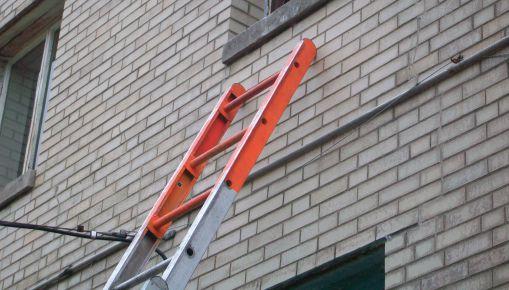
On a second-story window, make sure to ladder the tip just below the sill as shown in Photo 4. This will prevent any obstructions to getting and out of the window. The second firefighter will stay at the window either on the ground or on the ground ladder and they can use the thermal imager to guide the search, monitor the conditions and the firefighter that is inside.
What has been detailed here is a short synopsis of doing VES – the best way to understand it to seek out a person who has done it before and have them walk the crew through it for practice sakes.
Editor’s historical note: 2023 will mark 15 years of Back to Basics. Thank you for being a long-time contributor, Mark!
Mark van der Feyst has been in the fire service since 1999 and is currently a firefighter with the FGFD. He is an international instructor teaching in Canada, the United States, FDIC and India. He is a local level suppression instructor for the Pennsylvania State Fire Academy and the lead author of Fire Engineering’s Residential Fire Rescue book and other DVDs. He can be contacted at Mark@FireStarTraining.com.
Make sure to ladder the tip just below the sill.
The immediate search area is going to be the length of the firefighter’s body.
OCTOBER 9TH-15TH, 2022
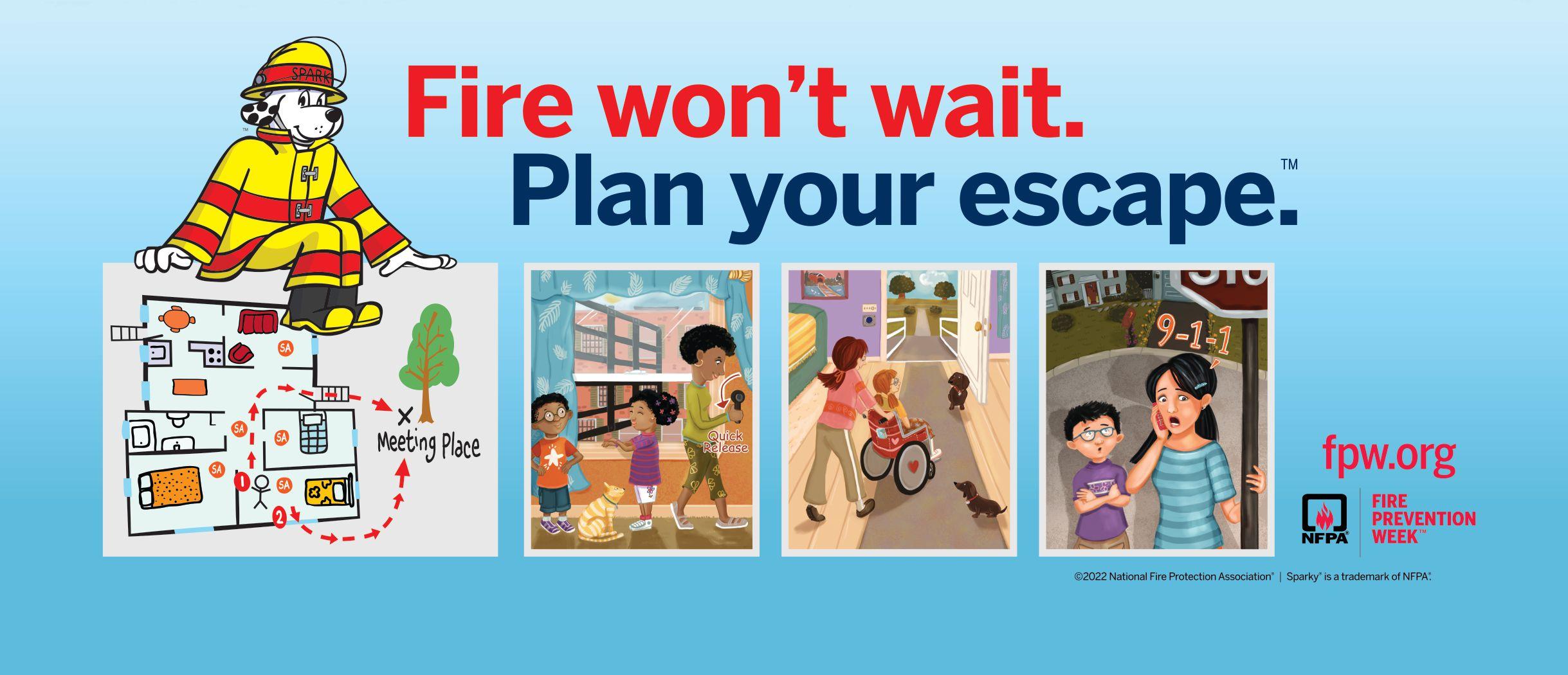
This year’s FPW campaign, “Fire won’t wait. Plan your escape™”, works to educate everyone about simple but important actions they can take to keep themselves and those around them safe from home fires by developing and practicing a home escape plan.
Today’s homes burn faster than ever. You may have as little as two minutes (or even less time) to safely escape a home fire from the time the smoke alarm sounds. Your ability to get out of a home during a fire depends on early warning from smoke alarms and advance planning.
SPARKY THE FIRE DOG® PRODUCTS
• NEW Tattoos (4 designs per pkg.)
• NEW Water Bottle Waterproof Stickers
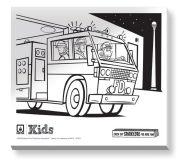
• NEW Fire Truck Colouring Pad
• Colouring/Activity Books
• Crayons, Pencils, Stickers
• Fire Hats
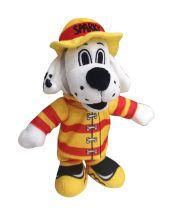
• ….and the popular Sparky Stuffy
LOTS MORE AVAILABLE
• School Items & Handouts
• Tattoos, Water Bottles,
• Kitchen & Bath Items
• Kids Turnout Gear
• Stuffies and More!
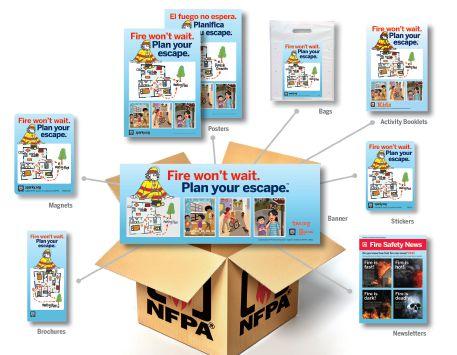
FIRE PREVENTION WEEK IN A BOX
This top-selling value pack for groups of 100, 300 or 500 has everything you need to engage your community this October and throughout the year. Having the right handouts and giveaways are sure ways to increase engagement and help get your messages out far and wide. The products in the FPW in a Box™ are bright and colorful, easy to read and understand, and feature everyone’s favorite, NFPA mascot, Sparky the Fire Dog.®
KIDS FIRE HATS
• Stock and Custom available.
• Ask us about putting your logo on a custom hat!
TRAINER’SCORNER LODDs of influence: why you must practice calling Mayday
By ED BROUWER
Irealize that for some being a fire service instructor is just a role they play as part of the job. But for myself and a few others I have had the privilege to walk alongside, it was seen as a calling. I have often thought that being a training officer is the highest calling in the fire services.
The greatest gift an old firefighter can give a young firefighter is the ability and knowledge to become an old firefighter. With that in mind, let me get on my soap box once again as I introduce you to a few friends of mine. I call them my influencers.
For those who do not know, this Charleston South Carolina fire I am about to detail was reported as America’s deadliest single disaster for firefighters since the Sept. 11 terrorist attacks. At about 19:00 on June 18, 2007, fire swept through the Sofa Super Store and warehouse, collapsing its roof, and killing nine firefighters inside.
Water issues, inadequate training, no truck operations, building code violations, communication problems and no incident commander were just a few of the issues cited in the Phase II report, a document that could be considered one of the most definitive and complete post-incident fire analysis ever conducted.
At the conclusion of the panel’s critical analysis, an emotional Chief Rusty Thomas stood before the packed room and accepted responsibility for the deaths of his nine friends. “I knew every single one...I’m so sorry that myself or somebody could not have done something differently that night to bring back those nine guys.”
We can’t go back to that night to “do something differently” but we can certainly do something differently today so that no other firefighters are lost. We can’t bring back: Captain William Hutchinson (48), 30 years of service; Captain Mike Benke (49) 29 years of service; Captain Louis Mulkey (34),
11.5 years of service; Engineer Mark Kelsey (40), 12.5 years of service; Engineer Bradford Baity (37), 9 years of service; Asst. Engineer Michael French (27), 1.5 years of service; Firefighter James Drayton (56), 32 years of service; Firefighter Brandon Thompson (27), 4 years of service; and Firefighter Melvin Champaign (46), 2 years of service. But, we can honour them by learning from their deaths.
As I listened to the fire ground tapes and read the 44 pages of radio transmission and phone call transcripts, it became all to clear that the fragmented messages of distress were not heard There was no Mayday plan in place. Firefighters were unclear when to call for a Mayday and had little if any ideas of what to do to save themselves or assist others needing to be rescued.
Timed pictures of the fire’s development showed heavy smoke and flames from the roof. The firefighters inside had no idea what was going on above them. The report noted that although they were hearing of deteriorating conditions, none of the chiefs
decided to evacuate the store and move from an offensive to a defensive attack. That decision didn’t come until after several disoriented firefighters had been rescued. The report states that there was no accountability whatsoever.
The voices of my influencers told me that they did everything according to their training. And that, my friend, is the problem. When chaos breaks loose on the fire ground, your members will not rise to the occasion – they will default to their level of training! Sadly, in this case it was inadequate training.
The final analysis indicates that the Charleston FD failed to adequately prepare its members for the situation they encountered at the Sofa Super Store fire.
Here is the timeline to evacuation:
• 19:27 — The first radio traffic related to firefighters in trouble. It was not heard by anyone on the fire ground.
• 19:29 — More radio traffic from firefighters lost/looking for help. No one hears them on the fire ground.
ground in his own car hears the radio distress calls.
• 19:31 — A rescue of the employee trapped inside the building is made by cutting through the wall.
• 19:32 — The only time you hear the Mayday call and now a chief tells everyone to stay off the radio to listen for those calls. Throughout the calls you hear PASS alarms sounding, but there is no notice taken.
• 19:33 — The firefighter traveling to the scene gets out of his car and tells a chief face to face what he has heard. The call goes out for everyone to come out to get accounted for.
• Things are getting a little chaotic now and firefighters are losing each other and struggling to get out. The fire is rapidly expanding. Then five minutes later (five minutes is a long time if you are on SCBA)...
• 19:38 — Chief Thomas orders a full evacuation.
• 19:40 — The interior is fully involved.
The last firefighters who will survive are getting out of the building.
There are several heart wrenching times when you know a mic is being keyed and all you hear is radio static and PASS alarms. Note: It wasn’t until two hours later (22:00) that search and recovery began.
Before we get too critical, let me ask you, what is your department’s Mayday policy? If you do have one, do you train on it? Have you instructed your members in firefighter survival tactics? Do your members carry rescue tools in their bunker gear pockets?
It is my heart felt conviction that both firefighters and officers must experience what it may be like to call a Mayday before it is the real thing. If your members put on SCBA and enter IDLH environments, you must drill on calling a Mayday.
Why is it so difficult to get a firefighter to call a Mayday? We canot treat speaking about Mayday to our firefighters as a young parent might in talking to their children about the “birds and the bees”. Our discomfort in talking about “it” tends to leave it up to the
kids to find out from their street friends.
The way firefighters react to a situation is based on training and experience. If they do not have “Mayday calling” in their experience, calling a Mayday will not come naturally when the need arises.
Mayday comes from the French term m’aider, an imperative that means help me Mayday was adopted as a distress call by the International Radio Telegraph Convention in 1927. In international radio language, “Mayday, Mayday, Mayday”, means “Life is in danger. Immediate help needed!”
It is ludicrous to think that the average firefighter practices tying knots more than calling Mayday. How many funerals do we need to attend? If a task has a low use level but very high consequences for failure, that task must be taught to the highest level of performance and drilled continually to maintain competency. We are talking about the greatest resource in the Canadian fire service — our firefighters.
Among the 272 pages of the NIOSH report were the following lines: “The communications process was not controlled. The Fire Chief, the Assistant Chief, and Battalion Chief 4 were all issuing orders and providing direction independently, using a single overloaded radio channel. Critical messages, including distress messages from firefighters inside of the structure, were not heard.”
The admirable “can do” attitude of Canadian firefighters is both a blessing and a curse, a strength and a weakness. Perhaps it is time we gave permission to our firefighters to call a Mayday. It does not matter what the rest of Canada does, it boils down to what each individual department trains its members to do. We are each responsible for our own house.
Let me get back to my influencers before I close off this edition’s contribution. I discovered that six of the nine firefighters never called for help, and that one had no radio.
Ladder 5 Capt. Kelsey’s last transmission was only three minutes after arriving on scene. He did not bring his portable radio with him when he entered the building.
Eleven minutes after arriving, Capt. Hutchinson made his last radio transmission. Capt. Benke’s last transmission (not audible) was 21:18 minutes into the fire, followed immediately by Thompson’s audible call for help at 21:20: “This is Thompson. We need some help….”
TRAINER’SCORNER
At that same time, Mulkey made his last transmission (system watch activation, no audio). Within two minutes, Drayton’s last transmission (no audio) was recorded.
Only one firefighter (French) actually called a Mayday at 23:13 and activated his emergency alarm at 25:33 and 29:04. French’s Mayday was not heard on the fire ground. The communications centre immediately notified the IC when the firefighter’s emergency button was activated. Yet, six minutes waiting, hoping, and praying for a response to the call for help, was to no avail. I get a cold chill thinking of him calling for help not once but three times and no one responding.
I used the word praying because of something that I have carried in the slideshow of my mind for over a decade. It revolves around my friend, Firefighter Melvin Champaign, (46).
Nineteen minutes into the call, the transcripts clearly show firefighter Champaign calling, “Which way out?” A few seconds later, “Which way out?” then, “Everybody out.” One minute later, “We need some help out.” Several seconds later, “Firefighter needs some help out… lost connection with the hose.” Then, possibly, “I’m in the building.” Another transmission was inaudible. Then we read that Car 5, in response to another transmission, says to dispatch, “We have the man out.” Champaign is heard saying, “What? Can you hear me dispatch?”
Thirty seconds later, French calls a Mayday.
There is an unknown transmission of a firefighter saying, “I love you.” Then you hear a PASS going off in the background. Then,
Champaign says, “In Jesus’ name …” He is praying to God on the radio because no one here on earth was responding to him.
There are three more transmissions from Champaign, none audible – one just breathing. Twenty-eight minutes and 21 seconds into the call marked the last transmission for Champaign.
I am not trying to be dramatic, but I’m tearing up, that familiar lump in my throat is forming. Eight minutes of calling out for help, 10 calls for help, nine keyed mics, one last breath and no one came to his rescue. No one even acknowledged hearing him, yet it is right there in the transcripts.
What was clearly heard in the background of 52 transmissions was a PASS. The first PASS was less than eight minutes of arriving on scene, the last was heard 59 minutes into the incident.
Forgive my bluntness, but what is the point of having a PASS if there is no response to one going off?
Have we become so accustomed to the PASS going off during practices that we don’t even hear it for what it signifies? Why doesn’t the fear of God grip our heart when we hear a PASS going off? Come on, I can’t be the only one who is moved by the fact that for 59 minutes, 52 transmissions had PASS alarms in the background sounding, yet no response!
The only individual who understood and reacted to the urgent radio messages was an off-duty battalion chief who heard the radio traffic on his portable radio. His attempt to contact the IC by radio at
TRAINER’SCORNER
19:30:27 failed. He drove to the fire and at 19:33 and had a face-to-face with the IC.
That was the first recognition that firefighters were in trouble inside the building.
During my years as a trainer, I became connected with the ghosts of approximately 80 firefighters, not in a sci-fi way, but in that I allowed their story to work its way into my brain’s slideshow. I studied them, listened to hundreds of hours of dispatch transmissions, read page after page of transcripts and reports. I studied their LODDs and built training mazes and props to teach survival skills.
For several years I traveled with our Firefighter’s Ghost Maze. This was a hard-core, hands-on maze that tested the firefighter’s willingness to call a Mayday. At our first showing in Oliver, B.C., only one department out of the 50 had trained sufficiently in this area. Only one out of 100 firefighters knew how to and when to call a Mayday! We handed out one ‘Congratulations’ card and the other 99 got ‘Deepest Sympathy’ cards.
I encourage you to address these issues with your department and to implement training programs that incorporate these conditions and procedures for overcoming them. Practice calling a Mayday over the radio. Blindfold the firefighters. Have them wear gloves, hand them the radio and see if they can turn it on, get the correct channel, push the emergency identifier button, push the talk button, and verbally call a Mayday. Have someone on another portable radio serve as
communications and receive the information: Who is calling? Where are you? What is the problem?
Every time you have live-fire training, place crew members in a situation in which they must make the Mayday decision for themselves. If we want ‘RIT’ and ‘Saving Our Own’ to work, we need to give permission to our firefighters to call a Mayday.
Just as you must wear your seatbelt to have it protect you in an accident, you must call a Mayday for the RIT to come to get you out. The big question is, will your members do it?
I thank you in advance on behalf of all the future Canadian firefighters who will go home safely after each call. Until next issue –remember to train like lives depend on it because it does. I beg you… let no firefighter’s ghost say their training let them down. 4-9-4 — Ed Brouwer.
Editor’s note: Ed has been writing the Trainer’s Corner department for Fire Fighting in Canada for 22 years. Thank you for the decades of sharing your knowledge with your fellow training officers across Canada!
Ed Brouwer is the chief instructor for Canwest Fire in Osoyoos, B.C., retired deputy chief training officer for Greenwood Fire and Rescue, a fire warden, wildland urban interface fire-suppression instructor and ordained disaster-response chaplain. Contact aka-opa@hotmail.com.
Starfield LION’s CenterCut™ Bunker Gear Liner System for Drier, Cooler, Lighter and...Safer Gear.
Starfield LION Flame Fighter™ Bunker Gear
Thermal imaging: A training refresher
Here’s a round-up of the most easily forgotten thermal imager tips
By MANFRED KIHN
The COVID-19 pandemic made for some challenging times for frontline workers that went about their daily tasks to the brink of exhaustion. While fire departments may not have suffered the extreme upheaval that healthcare workers had, many changed their routine at the firehouse during this time. I’m particularly thinking about their training programs. With social distancing rules in place, some fire departments continued with their drills, while some were hesitant to bring extra crews together in person. Others halted all training until further notice. If your training schedule had been disrupted, let’s use this time as a refresher. I’ve pulled together the most easily forgotten thermal imaging tips. Let’s dive in!
• Keeping your vision. Wipe both the display and front germanium lens on your thermal imager (TI) often during fire attack/ suppression. Dirt, carbon and fogging inhibit the ability for heat to pass through the lens to the detector, lowering the level of heat detail on the monitor. This can limit your information and may impact proper image interpretation.
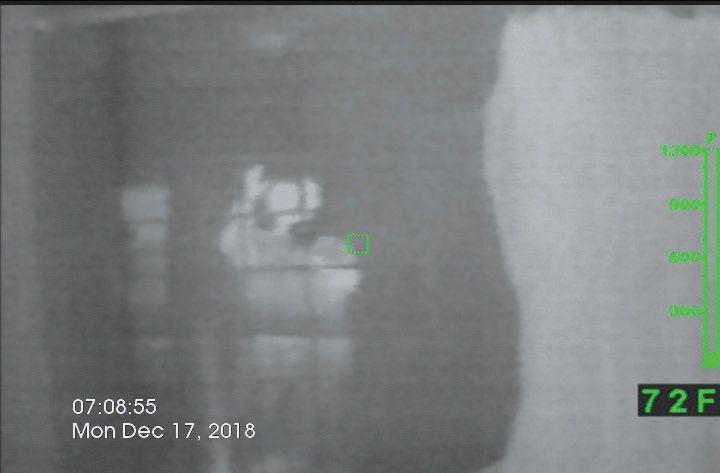
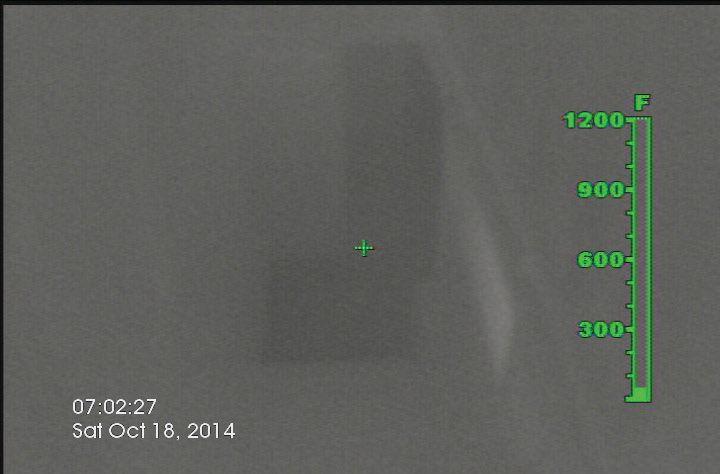
• Know what’s normal. We all understand that a thermal imager tells us what is hot and what is not. But if we don’t benchmark what “normal” looks like, how do we know what is not? For instance, a structure in the heat of summer will look completely different in the cold of winter. Both appear as “normal” heat images based on the emissivity of the building construction materials, temperature, sun exposure, etc. Knowing what to look for that is not normal takes practice.
• Look behind you. When entering an unknown structure using a thermal imager, it’s important to also turn and look back even
though you are using a TI. As you move through a structure, passing through multiple doors, the landscape looks different at your back. Occasionally, take a look at your potential exit course so you can paint the image in your mind.
• Beware of reflections. Modern day kitchens are a potential room full of reflective surfaces. Stainless appliances, granite counters, high gloss wood cabinets and marble/ceramic floors can all give false impressions. Bathrooms are also one of the most common rooms that offer reflective and possibly misleading images. If you think that you are looking at yourself through the lens of a TI then that is your reflection. Confirm by giving a little wave!
Sounding the floor is still required, even when you’re using thermal imaging.
• Share what you see. Paint verbal images for the rest of your crew as you use thermal imaging. Remember, you may have the benefit of a strong visual through your TI but often your crew following behind will be blind in the current conditions. Giving good verbal descriptions of room layouts and contents will improve the ability for the entire crew to move more effectively through unknown structures.
• Don’t forget the floor. Sounding the floor is still required, even when you’re using thermal imaging. Did you know that liquids
Reflection caught with a TI off a ceramic tile wall of an open shower curtain
What is called a black hole – not visible are the stairs leading to the basement
A victim not generating as much heat will only be detected from a shorter distance.
on a floor will often appear the same as a hole in the floor to a thermal imager? The imager will identify a difference in the floor area. Increase your safety by combing your visual cues with basic fire fighting tactics to better identify floor stability.
• Outdoor search and rescue in the woods. Are you prepared and do you understand the limits as well as the advantages of grid/ distance detection that a thermal imager offers? Having a cooler background while looking for a victim that is generating more heat will be seen for a greater distance. The opposite occurs when you have a warmer background. A victim not generating as much heat will only be detected at a shorter distance. Learn what you can and can’t see and understand the relationship of distance and body heat.
• Hazard checks. At MVCs with rollover vehicles, be sure to use a thermal imager to check for any potential hazards such as downed power lines and fuel spills. Touching undetected hot wires could be a fatal mistake.
• Victim check. Use a thermal imager to look at all seats, front and back, including child carrying seats for heat signatures during MVC rollovers or downed motorcycles to ensure for accountability against ejected victims.
• Keep batteries in top condition. Battery maintenance on your thermal imager is vital. You can maintain your batteries by draining and recharging on a schedule. Double-check with your crew, if you aren’t actively implementing a battery maintenance schedule, here’s my favorite tip: every time “C” shift works on Friday have them drain the battery, replace with a spare and recharge the other.
• Grab the TI on every call. There may be some calls where a thermal imager doesn’t seem like a great fit. However, it can provide a benefit in many circumstances. For instance, even when working in confined spaces (i.e., finding victims in tunnels and culvert systems) use your thermal imager to detect humans at 300 feet or more, whereas you’ll only have about 50 feet of visibility with a flashlight.
Thermal imagers are only as effective as the end-user’s interpretation or misinterpretation of the image. To an inexperienced eye, the best technology can be useless or possibly fatal. Training during these unprecedented times is equally important as the message is clear: Practice, practice, practice. Until next time stay safe and train often.
Manfred Kihn is a 19-year veteran of the fire service, having served as an ambulance officer, emergency services specialist, firefighter, captain, and fire chief. He has been a member of Bullard’s Emergency Responder team since 2005 and is the company’s fire training specialist for thermal imaging technology. He is certified through the Law Enforcement Thermographers’ Association (LETA) as a thermal imaging instructor and is a recipient of the Ontario Medal for Firefighters Bravery. If you have questions about thermal imaging, you can e-mail him at manfred_kihn@bullard.com.
BY TINA SARYEDDINE Executive Director Canadian Association of Fire Chiefs
AGUESTCOLUMN
Let’s talk about the weather
ccording to Environment and Climate Change Canada, in 2021 Canada’s top 10 weather events were each the most severe in their class for the past 70 years. The heat dome in British Columbia resulted in over 600 deaths, 52,000 calls to 9-1-1, eight to 12-hour ambulance waits, and the destruction of critical infrastructure. The floods that followed were the equivalent of seven atmospheric rivers (i.e., Amazon River discharge), 90 km/hour winds and power outages. Last summer’s more than 2500 wildfires resulted in over 50,000 evacuations, poor air quality, hours of smoke, and infrastructure damage. Arctic blasts with temperatures between -45 and -55 degrees celsius were 20 degrees below normal, with deadly consequences for the homeless and the disadvantaged. The prairies were 99 per cent drought land with the worst water shortage in history.
It is not surprising then that Budget 2022 and the mandate letters of several federal ministers, contained important commitments for wildfire and climate adaptation writ large. The First Ministers Forest Fire Roundtables sought to inform a whole of society approach to wildfire prevention, mitigation, response and recovery. Its current action plan includes understanding the Wildfire Urban Interface Risk, prioritizing prevention and mitigation, strengthening recovery, and advancing the next generation of wildland fire management science and technology.
Stakeholders spoke to the importance of Indigenous participation and leadership, a serious problem of discrimination against Indigenous firefighters and wildfire management practices, wildfire adaptation issues, partnerships, data, achieving quick wins, cost risk trade-offs, and the importance of the FireSmart program being implemented in communities. Other areas of focus include wildland fire management and healthy forests, and building resilient communities as well as financial instruments that support the process. The CAFC is now in discussions on several of these issues with leadership and support from its newly established Climate committee.
CAFC’s comments focused on a few key themes. First, that disasters are often a matter of local capacity. Second, that given the primacy of local factors, there are methods, resources and capacity that can be spread and scaled nationally. Third, that we must consider the co-occurrence of events, the interconnectedness of actors, the complexity of situations, and the newness or familiarity with the situation that will impact critical infrastructure resilience. Fourth, that modern critical infrastructure considerations involve innovation, and innovation requires new public safety considerations. Fifth, that special considerations for critical infrastructure are needed in our Northern and Indigenous communities.
On the last item, CAFC president John McKearney noted to the House of Commons standing Committee on North and Indigenous Affairs that “Canada’s Arctic and Northern Policy Framework, provides a reasonable starting point for addressing severe disparities and inequities in the north, impacting primarily Indigenous Peoples… However, unless we missed it, there was nothing at all on fire or on how mitigation, response or preparedness for emergencies or fire situations would occur.”
At one point, the weather might have been a simple subject. Now it is one of the most important policy files at the national level. ‘‘ ’’
Public Safety Canada also conducted a Let’s Talk: critical infrastructure consultation on the way it approaches critical infrastructure in Canada. Critical infrastructure is defined as the infrastructure that would need to be maintained in order for society not to experience a major disruption during a disaster like a climate emergency. The consultation draft noted that up to 40 per cent of Canada’s critical infrastructure assets are in poor condition.
Tina
Saryeddine, MHA, CHE, PhD is Executive Director of the Canadian Association of Fire Chiefs and an adjunct faculty member at the Telfer School of Management, University of Ottawa.
Finally, and perhaps the highest profile of the “Let’s Talk” consultation series is the National Adaptation Strategy, which was circulated by the federal government for comment in the summer of 2022. The strategy had proposed a principle of “reallocating funding from response to mitigation and preparedness”.
While the importance of mitigation and preparedness is clear, the CAFC noted that the fire and emergency system is already under-funded in its response capacity.
“Many cities and towns rely on volunteer firefighters who themselves may be fundraising for equipment. This reallocation principle, is akin to shutting down a hospital emergency department because a public health measure was put in place. Emergencies happen. We need to modernize our response capacity, not re-allocate its funding capacity.”
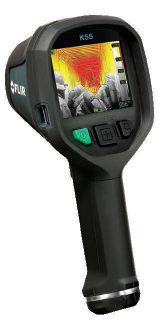
Saving lives and minimizing the spread of a fire—that’s job one. And in the heat of the battle, thermal imaging cameras (TICs) are crucial to ensuring fire crews can find potential victims amid thick smoke, locate hot spots, and monitor the direction of the fire.
That’s why Teledyne FLIR is on a mission to make high quality TICs standard issue equipment for every member of a fire crew. With rugged, reliable TICs like the FLIR K55, you’ll have a comprehensive view of every scene so you can save lives, protect property, and ensure firefighter safety.
Learn more about the entire lineup of FLIR TICs at www.flir.com/firefighting-cameras
BY CHRIS HARROW Director of Fire Services
ILEADERSHIPFORUM
What we’ve learned from where
we’ve been
t is my honour to write this column for the 65th anniversary edition of Fire Fighting in Canada as it has given me an opportunity to look back at leaders of the past and the traits that have laid the foundation for us as leaders today.
I am sure everyone can recall a leader in their past and what an influence the person had on your career or the person you are today. They may have demonstrated a skill or trait that was so memorable or influential that you still use it in your day-to-day leadership. It is a good thing for all of us to reflect on where we came from and what we’ve learned.
I remember the origins of Critical Incident Stress Management (CISM) teams in fire halls. We never knew or formalized it in the past as a CISM team, but essentially it was one to deal with the incidents of the past. Back in the day, everyone used to gather at the fire halls after serious calls and have a beverage, usually acholic in nature. It was an unwritten rule in many fire halls that you stuck around to “discuss” the call over a beverage and decompress. The chiefs of the day made sure everyone knew the rule and watched for everyone to partake. It was essentially an early day CISM team run by the department and overseen by the chief.
Now we have learned from that iteration of CISM that using alcohol to draw people into discussions is not a good thing. We have also come up with a more organized approach and methodology for completing debriefings and diffusing, but many of the origins can be tied back to the sessions most fire departments had sitting around a table talking over a cold beverage.
When I look back at some of the leaders I worked for in the fire service, one trait I picked up early on in my career was the “lead by example” technique. Many old school leaders were of the opinion that they would not send a firefighter to do a task that they couldn’t complete themselves. They would constantly lead by example at a scene. Back then, there was no incident command structure and no command area. Many times the chief would be right beside the crew in the hot zone helping them with the task. Many times this was also done with air packs, because in old school fire fighting there was a need for air packs! We have been able to learn from this trait and improve upon our safety and command structure, but the ability to show the firefighters that you can do the same tasks they can or lead by example still exists for many leaders.
Many of our communication techniques have been passed down from previous generations of leaders. It is very important to look at how they communicated and disseminated information through their departments without the use of social media and cell phones. Today, we rely too much on cell phones and technology to get our messages across. I fall into this trap way too often when a good old-fashioned conversation would help move things along much faster and more effectively. I remember the few times I got into trouble (well, maybe more than a few), and it resulted in a meeting in the chief’s office for a discussion. One former chief was very intimidating around the others and in general meetings, but when you got one-on-one with him, he was the nicest most supportive person you could work for. I could not imagine, in this day and age, how he would come across texting or messaging!
Using the art of conversation seems to be a dying trend and it is something we need to look at resurrecting from our previous generation. I know it is extremely tough because the younger firefighters coming through the ranks are so used to messaging with their cell phone that the art of conversation is getting lost. It is upon us as leaders to take them out of their comfort zones and engage them in conversation. It worked so well
Many old school leaders were of the opinion that they would not send a firefighter to do a task that they couldn’t complete themselves. ‘‘ ’’
for our predecessors; I am sure it could help with our communications around the stations.
Chris Harrow is the director of fire services for the Town of Minto and Township of Wellington North in Ontario. He is a graduate from fire programs at Lakeland College and Dalhousie University and holds a graduate certificate in Advanced Care Paramedics from Conestoga College. He can be reached at c.harrow@mintofiredept.on.ca.
One of the most amazing things we do in the fire service is sit around and swap stories of the past. Nothing engages a crowd of young firefighters more than an older firefighter telling stories of yesterday. They are amazed at what happened in the past and what was learned from the incident. This is a great example of leadership being passed on to a new generation. It is always important for us to look at our past and learn from it. Learning from our past will make better firefighters and fire services. Respect the past and let it form a bright future for all of us.
Editor’s historical note: Chief Matthew Pegg began writing for the Leadership Forum in November 2016, and was joining by his co-author Chief Harrow in March 2018. Thank you for your contributions to the leadership conversation in Fire Fighting in Canda!
Town of Minto and Township of Wellington North, Ontario
A recent study reclassified firefighting within the highest occupational cancer risk category. At Ready Rack, we’ve been sounding this alarm for years, which is why we offer a line of products to help mitigate exposure to on-the-job carcinogens. From highly specialized extractors and dryers to science-based detergent, multisurface cleaner, skin cleanser and wipes all designed to meet or exceed NFPA 1851:2020. Ready Rack is dedicated to keeping America’s Bravest safer and their PPE service-worthy.
BY GORD SCHREINER Fire Chief Comox, B.C.
TSet your bar high
he fire service is constantly in need of highly dedicated, well-trained individuals. We are very fortunate that our beloved service has lots of these types of folks already, however, we can always use more.
We also have a lot of well-trained members who have, for many reasons, lost their dedication and desire and are blocking others from moving up or joining. A few get promoted and then try to coast to the finish line. They quit doing the good things that got them to where they are. They take things for granted. They can be more difficult to deal with then a three-alarm fire. I believe you should put your head down and work hard to get to the finish line. I am sure it will feel much better when you get there.
I have always said, “Don’t quit, but if you do quit, please leave!” Quitting and staying can destroy even the best departments. It can destroy the careers of those below you, ruin the culture of an organization and make your career a lot less rewarding. If you are done, then get out of the way and let others move forward.
In my 47th year in the fire service, I think about this every day. I don’t want to be a blocker (and yes, I know I am). I strongly believe I still have much to contribute. I try to work even harder these days to show others that I can still contribute and still belong. I do that through leading by example. By doing more than is expected of me. By pushing our department forward. By adding more and more innovations. By trying to make our department better every day. I don’t hesitate to help with packing hose or washing a rig. I try to be a first to work at the station everyday and the last one to leave. I show up, speak-up and stand-up. I try to show up for all the events I can including calls and training. I take pride in tackling problems, finding solutions, and moving forward.
STOPBAD
you too! I strongly believe you should be competing for your job (career or volunteer) every day. Many others would love my job (or yours)!
I set high expectations for my staff. I want them to work hard and bring me solutions, not problems. I expect them to excel at customer service. I push my staff, sometimes too hard, but we are all very proud of the dozens of innovations we have developed here. When completing a project or task I expect my staff to put a bow on it! I or someone else should not have to follow up to complete it. Continue to push yourself. No coasting, there is always more to do.
Be impressive, not ordinary. Overwhelm others, don’t underwhelm them. Be kind! Be generous (with your time and your money). I work hard to impress, help and treat those who cannot help my career way more than I do to the people above me who can greatly affect my career. I take extra time to talk to those who have less or need a hand up.
You only get to make a first impression once and often you don’t know when this will be, so just excel all the times. I strongly
You only get to make a first impression once and often you don’t know when this will be, so just excel all the times.
’’
believe I need to pay it forward and pay it back. I have been blessed with a great career. I owe it to others to pay it back.
My staff and team here know very well I’ll speak up if I see something I don’t like. In fact, I think I have developed a reputation (which I am proud of) of being that person that does speak up (sometimes too often). They also know very well that I’ll stand up for what I believe in and will bend over backwards to assist one of our own or a member of our community. Helping others helps
Gord Schreiner joined the fire service in 1975 and is a full-time fire chief in Comox, B.C., where he also manages the Comox Fire Training Centre. He has delivered countless presentations in fire stations all over Canada and is available to assist your department in many areas. For more information please contact: Chief Gord Schreiner, firehall@comox.ca.
I was recently given a Lifetime Achievement award from our local Chamber of Commerce.
I was very surprised by this for a couple of reasons. Firstly, I didn’t think I deserved it, and secondly, I noted to them that I was only halfway through my career. I have much more to give. My lifetime will continue (I hope).
When I sprint across the finish line I want to smile and look back and say, “I made a positive difference!”
Editor’s historical note: Gord has been writing his StopBad column for a decade. Thank you Gord for your contributions to the the fire service conversation through Fire Fighting in Canada!
The truth about Post Traumatic Growth
More evidence based research is needed to support and measure this possible positive outcome.
By NICK HALMASY
Post Traumatic Growth has been the beacon of positive outcomes since we first started hearing of Post Traumatic Stress Disorder and its nefarious other relatives. It is the upside of the down. The promised right to the wrong of the illness. And, at least for me, was an obvious outcome to the process of healing. It made great common sense. I experience things that require recovery, that process is interrupted, and I develop PTSD. I work hard at healing and learning and growing, and I come out stronger in the end. Growing is the point, after all (Tedschie and Calhoun, 2014; Jayawickreme et al., 2020). And that is the reward from the torture and difficulty of PTSD — to come out stronger than we went in.
Only recently did it even occur to me that what felt so true, obvious, and clearly defined may not actually be so clear, obvious, or true. And, to avoid any misattributions to a personal eureka moment, it was a challenge from someone else that came in the most indirect way that made me start to investigate. I was listening to a podcast about something completely different.
The culprit was Canadian psychologist Paul Bloom in an interview of his book The Sweet Spot. He was discussing the role of pain and pleasure in our psychology in his down-to-earth conversational tone that makes his work super approachable no matter your background (and I highly suggest reading his book). He then slipped in a little truth-bomb — or at least it sounded so — when he explained that
Post Traumatic Growth was something that didn’t actually have much research behind it to support its claims. If you have spent any time at all in front of a presenter on mental health, you have heard that this golden, inevitable gem is the reward for enduring. It has been a part of the presentation somewhere…and has been a part of my teaching and presentations too, I confess. After six years of working with first responder mental health, and six years of the belief in this promise, I was forced to do the digging that I tend to do for everything else, but had given Post Traumatic Growth a pass on.
It was certainly not straightforward, clear, or easily defined at all.
First, some history in a nutshell.
Tedschi and Calhoun coined the term stemming out of the field in positive psychology. They were responding somewhat to the responses of clients that describe, in their process of healing, a silver lining within their struggle (2014; Mancini, retrieved Jan 2022). There needed to be some way to understand this experience and so they
BW SPACE PRO
UNDERWATER RESCUE & RECOVERY DRONE
is revolutionizing ice and water state of the art technology
Recovery work. Our intelligent underwater drone camera (from SONY) integrates both underwater shooting and observational functions, all with a 5 hour battery life, 4-thruster drive, and the ability to dive as far as 100 meters. It is easily maneuvered via remote control, is capable of 360 degree free rotation, calculates depth automatically, and provides real time transmission of underwater pictures and video. The BW Space Pro is equipped with two hi intensity LED lights and is available with an optional 6X zoom.
BullDog Hose Company (formerly ANGUS hose) proudly designs and manufactures industry-leading firehoses that are unmatched in quality and performance. Hundreds of North American fire departments depend on BullDog to get the job done safely and efficiently.
Designed for Water and Ice and Reduces risk to first rescue
10 to +40C operating temperature
Max depth
Weight 4.2 kg
43 x 33 x 13 cm (16x12x5”) WIFI repeater
CANADIAN SAFETY EQUIPMENT IS PROUD TO BE A DISTRIBUTOR FOR THE INTERSPIRO RESPIRATORY PROTECTION LINE. THEIR STATE OF THE ART S9 INCURVE IS ONE OF THE MOST COMFORTABLE SCBAs YOU WILL EVER WEAR.
GIVE US A CALL AT 0182 OR EMAIL US AT INFO@CDNSAFETY.
No company has a richer history in Interspiro. Their innovations have become industry
coined Post Traumatic Growth as the response to that. Since then, the field has grown in many ways, expanding into many corners, nooks and crannies of the psychological field (Jayawickreme et al., 2020; Mangelsdorf, Eid & Luhmann, in press). Importantly, the claim was never that one had “healed” to normal, default standards. We grew stronger. If your leg breaks, it heals to where you can walk again (one hopes). Here though, psychologically, the breaking is catalyst to growth above and beyond where you started.
You can see, if you look at it this way, that it is an appealing outlook with obvious positive spins on an otherwise debilitating experience. As Anthony Mancini, resilience and trauma researcher, identifies, “It’s an immensely appealing idea. Who wouldn’t want it to be true?” Indeed, we all want it to be true. Then he adds, “The only problem is: There’s very little evidence for it.” (Retrieved, 2022).
This was the small crack that quickly developed into a chasm of gaps between measurements and findings. In psychobabble, we would say there is a lot of research on Post Traumatic Growth and the argument is whether the research reflects results that measure what we hope it does. For instance, we could do a study on the number of churches in an area, and we will find that the more churches, the higher the crime rate (Trull, 2005). We’d be mistakenly attributing church numbers as causing crime hikes simply because as one goes up the other goes up too. This is an example of misunderstanding the research, of mistaking correlations as causation. For us, though, the problem is much more fundamental.
Jaywayricreme and Blackie explicitly identify the problem in 2014: The evidence that we use to create and rationalize Post Traumatic
Growth as a real and scientifically backed experience is marred by the fact that, “cross-sectional studies utilizing retrospective measures of self-reported growth, which do not allow for tests of meaningful hypothesis on the nature and predictors of growth.” Or, if you’d rather, we have a measurement problem and why isn’t a huge mystery, starting with the problem of gathering information only at one point in time (cross-sectional) and requiring us to self-report on past experiences (subjected to all the inherent biases of memory). Jaywayrickreme and Blackie guide us a bit further on the research on Post Traumatic Growth in noting that “the PTGI (Post Traumatic Growth Inventory) is the most commonly used method to assess post traumatic growth.” Why should we keep this in mind? Tedeschi and Calhoun are also the authors of the measurement tool. This isn’t necessarily a problem in and of itself, but it is easy to see that there is vested interest in this tool measuring the concept that they had created. So, as those two researchers conclude, we really should stop using it.
THE THREE CAMPS OF RESEARCH
The research, as far as I can tell, has created three camps.
Camp 1: Post Traumatic Growth is real and the measurements are valid. This would be the camp that Tedschi and Calhoun subscribe to as they suggest in their book for clinicians in 2013 “We tend to simply accept as genuine the reports of growth that our clients make.” This stance is one that seems to ignore the insurmountable research with regards to memory bias, recall issues and issues of memory recall with self report. But, it is where they stand.
Camp 2: That Post Traumatic Growth is likely not a “real” experience in a measurable sense. The belief that one has grown is different than growing (Mangelsdorf, Eid, & Luhmann, in press; Jayawickreme & Blackie, 2014). This perceived growth or illusion of growth, as is described in the research, is disconnected from the actual outcomes when measured. We can say we have grown, but then go on to complete assessments that show that we have actually grown worse (Wilson & Ross, 2001).
Camp 3: That Post Traumatic Growth is not yet solidly defined or measured. But something is happening that requires further exploration and understanding. The first problem to fix how we measure and what we use as measurement. Second, is dropping what clearly is not linked to Post Traumatic Growth and looking for other aspects. Jaywarickeme and their colleagues would fall into this camp, and their search is taking them into other psychological aspects like looking to personality changes in the Big 5 as potential sources of evidence.
These factors matter to us today, though. Many departments are seeking out people to provide trainings and trustworthy advice on how to implement mental health education for our frontline staff. Since 2016 (and perhaps even a bit before), we have been left without too much direct knowledge and clear guidelines. This has, in turn, left gaps that clinicians and practioners are attempting to fill to ensure the wellness of our first responders. Post Traumatic Growth is an answer to a larger problem of research being too focussed on the negative. So, it’s an inherently positive outlook to be sure. But, as non-researchers, clinicians, and well-meaning organizations seeking out support this, it is confusing and difficult to navigate clearly. Assuming, I would hope, most of this work is not done out of malice on the part of the clinician, we may have simply been too quick at adopting the feelgood outcome of experiencing trauma. We, yes me too, fell to what Coyne and Tennen, researchers in positive psychology and the field of Post Traumatic Growth, cited in 2010 about the founder of positive
Fire Service Leadership Program Graduates 2021–22
CERTIFICATE IN FIRE SERVICE LEADERSHIP
NAME POSITION DEPARTMENT
Thomas Jukes Deputy Regional Fire Chief Wheatland County Fire Services
Carson Ryan Fire Prevention Inspector Oshawa Fire Services
Jason Ripley Chief Greenwich Volunteer Fire Department
Harry P. Ludford Firefighter Kennebecasis Valley Fire Department
Chris Dunnigan 1st Class Firefighter, Acting Captain and Acting District ChiefThunder Bay Fire Rescue Services
Denis Roberge Platoon Chief Dieppe Fire Department
Kevin Daniel O’Brien Captain Dieppe Fire Department
Mitchell Kaizer Captain Hubbards District Volunteer Fire Department
Scott Davison Deputy Fire Chief Clearview Fire and Emergency Services
Chad Anthony DemersCaptain Foothills Fire Department
Jesse Michael BeaudrowActing Captain Pickering Fire Services
Michael Grisdale Fire Inspector Saskatoon Fire Department
Bradley Matthew BaronFirefighter Saskatoon Fire Department
Dwayne Jobson Battalion Chief Saskatoon Fire Department
Peter Dwayne Tait Lieutenant Saint John Fire Department
Scott J. Field Captain Ottawa Fire Service
Christien Arsenault Captain Fire Prevention Dieppe Fire Department
Erik Collette Firefighter Dieppe Fire Department
Jason Allan Kjorsvik Deputy Fire Chief Olds Fire Department
Josh Van Horne Firefighter Brantford Fire Department
Ian Pearcey Firefighter St. John’s Regional Fire Department
Robert J. Rideout Firefighter St. John’s Regional Fire Department
CERTIFICATE IN INCIDENT COMMAND
Robert Sperry Lieutenant Amherst Fire Department
Mark Goodwin Captain Amherst Fire Department
Trevor John Kotowich Director of Protective Fire Services/Fire Chief St. Paul Fire Department
CERTIFICATE IN FIRE SERVICE ADMINISTRATION
CERTIFICATE IN FIRE SERVICE ADMINISTRATION
David Calvin Forster Fire Safety Officer – Fire Prevention Hamilton Fire Department
Andrew MacDonald Captain Halifax Regional Fire & Emergency Services
CERTIFICATE IN FIRE SERVICE ADMINISTRATION, ADVANCED LEADERSHIP
Jody Ann Woodford Chief Tulameen & District Fire Department
ADVANCED CERTIFICATE IN FIRE SERVICE ADMINISTRATION
Stephen Clark Acting Captain Hamilton Fire Department
For more information on our programs, visit dal.ca/fire
psychology who warned of “the temptation for those of us associated with this new field to run ahead of what we know,” no matter how good of story for hope it might present.
There is a downside to all this, though, and it should be noted. That there is a level of potential shame and guilt, and further damage, done to those who experience trauma and don’t experience anything feeling like “growth”. For some, trauma is an ongoing battle, and we know if we look at suicides in first responders that not all of us are able to experience such growth. The idea that there is a “proper” or “positive” outcome of trauma experience is a positive statement for some. It is not a positive statement for our brothers and sisters that are not able to find it in their path. It’s often hard to see the downside to a positive story, but, now that we have a large degree of evidence that suggests that it is likely not as positive as we think, we should try our best to leave this out of our conversations until something more concrete is uncovered.
But I fear, to some degree, Post Traumatic Growth has tattooed itself into mental wellness discussions. And the fallacy I fell prey to is that the abundance of discussions on it are taken as evidence of its existence. Like most things, though; the amount of people claiming its truth does not count as evidence.
The rub is this: what do we put our attention to and how do we continue to keep our members motivated towards wellness if things like Post Traumatic Growth cannot be relied upon? The example of Post Traumatic Growth being, at best, in its infancy (at worst non-existent) is another reason why your mental health programs shouldn’t be “PTSD Prevention” programs. It’s a misnomer for one (there is no
guarantee of prevention) but it also silos and hyper-focuses us on a singular outcome. I hope that if you review my past writings in Fire Fighting in Canada, and this article too, they are enough to convince you to consider mental health programs that are wider sweeping. This way we don’t feel obligated to also only focus on PTSD and the only positive spins we have, like Post Traumatic Growth, to motivate towards wellness. Instead, we support all types of mental wellness and provide adequate support and funding for members to seek that out.
When it comes to trainings, focus on everyday mental wellness, on ways of overcoming challenges in the moment, and not reactive remedies to what sometimes feels like the “inevitable outcome” of PTSD (I’ve actually heard this said by clinicians, unfortunately). These programs neither need be state-of-the-art nor on the forefront of clinician experience. Programs that teach people how to navigate their thinking, feeling, and behavioural reactions to promote choice and options when they feel prey to automatic reactions can do immense amount of good in both restorative and preventative ways.
So, as it started for me with Paul Bloom and I’ll end here with him. Paul discusses two attitudes when it comes to the field, but we’ll end on just one: “The second attitude is optimism. I believe that the methods of scientific psychology will eventually triumph…We’ve made progress; we’ll make much more.”
Nick Halmasy is a registered psychotherapist who spent a decade in the fire service. He is the founder of After the Call, an organization that provides first responders with mental health information. Contact him at nhalmasy@afterthecall.org.
THE FINAL CUT.
The features of the Mini Cutter include:
• Cordless design
• Unique inclined cutter jaw
• Grip teeth on both blades
• Integrated LED light
• Start-stop mode & variable speed control
Holmatro introduces the first battery powered mini cutter in the rescue market. Compact and lightweight, it gives you maximum freedom of movement and optimal cutting performance. First responders from any department can act swiftly with this cordless mini cutter—whether their other tools are powered by battery or a separate hose and pump.
BY TOM DESORCY Fire Chief Hope, B.C.
IVOLUNTEERVISION
Reflecting on the life changing act of becoming a volunteer firefighter
will often take the opportunity, both in person and here in this column, to remind my colleagues and myself to take a step back once in a while, a check-in if you will, to remind ourselves that what we do does make a difference in all our lives.
I’m reminded of this by a colleague that always said to me that when it comes to recruitment in the volunteer fire service, it all comes down to criteria and so long as you could “fog up a mirror” you qualified for the fire department.
All kidding aside, this is not far from the truth, or at least it was in the “good old days”. Today, the mirror can play a different role in true reflection. You never really need to look too much further beyond that mirror to see the person that you really are. However, for a moment, take a step back, and you’ll see that the person looking back at you, gets farther away as well, allowing you to increase your depth of field and reflect a little deeper on who you are and what you’ve become.
I often hear the phrase “life changing” and I like to think that’s what the volunteer fire service means to us all. For me, it’s been almost 35 years involved in one way or another. For others, it’s been even longer. Even for those newer members who are still considered rookies, I challenge that their lives have changed just by hanging a pager from their belt.
The term life changing goes even further than that. Every time you respond in a truck and engage with someone in your community, you stand to make a difference and change someone’s life each and every day. Are you standing there reflecting on what you have done to make a difference or are you thinking about today and how you will do it all over again?
Take a moment and think of any member of your department that has been with the team for a few years. Think back to when you first met that person and imagine what their life would be like had they not joined the fire service. Would they still be in the community? Would they still sign up today knowing what they were in for? It’s crystal ball type stuff but interesting and affirming to us as leaders when we realize how lucky we actually are to have them as part of our team.
you could do without? Seriously, if that’s the case, then maybe they shouldn’t be there, but I suggest that we would be hard pressed to find that individual. Now you can reflect on what we truly have and it doesn’t take long to realize that the value of their stock just went up.
The most honest person in your life is that person in the mirror staring back at you. Do you remember what the younger version of this person was like when they began in the fire service? Do you even remember why you got involved in the first place? Thirty years ago, you didn’t join a volunteer department to become a career firefighter. It was a reason to contribute to your community. Perhaps you were a business owner that wanted to give back or it was a place where your friends were. It may not have been intentional at the time, but you enrolled to make a difference.
Today’s volunteer fire department responds to many more calls for service than we used to. Medical calls, motor vehicle incidents and even natural disasters. If ever I’m questioned as to our reasons for response outside of actual fire calls, which does happen, I ask myself a question before answering. Did we make a difference? Well, rest assured, to someone we did and even if that someone is one of our own responders. Each and every response impacts us all and no matter the outcome we need
Every time you respond in a truck and engage with someone in your community, you stand to make a difference and change someone’s life each and every day.
’’
to recognize that.
That goes for the entire crew. Is there anyone in your fire hall that
Tom DeSorcy became the first paid firefighter in his hometown of Hope, B.C., when he became fire chief in 2000. Originally a radio broadcaster, Tom’s voice could be heard in the early 1990s across Canada as one of the hosts of Country Coast to Coast. DeSorcy is married with two children and enjoys curling and golf. He is also very active with the Fire Chiefs’ Association of B.C as communications director and conference committee chair. E-mail Tom at TDeSorcy@hope.ca and follow him on Twitter at @HopeFireDept.
A wise person told me a long time ago that we should all strive to learn something new every day. Well, I challenge you to also make a difference every day and that includes to yourself. I think it’s worth having this conversation often with members of your team. Remind them that they have the potential to impact with each and every response and remember that everything we do will not only reflect on the people we serve but the people we serve with.
Editor’s historical note: Chief DeSorcy has been co-authoring the Volunteer Vision column for 13 years. His penning partner, Chief Vince MacKenzie, has been co-authoring since December 2010 (his first column for FFIC being a “A View from the East”, also published in 2010). Thank you for your contribution to the volunteer fire service conversation through Fire Fighting in Canada!