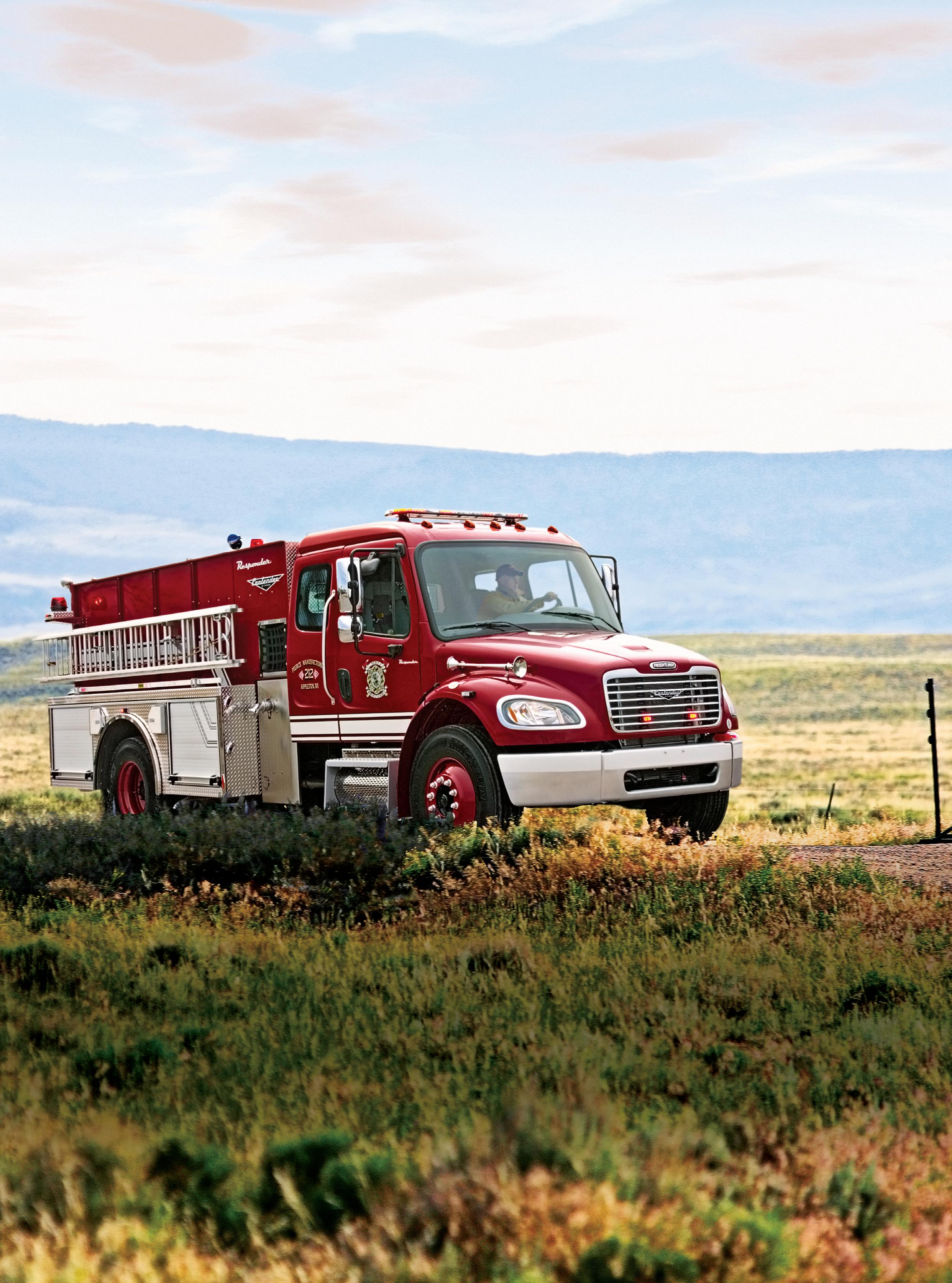
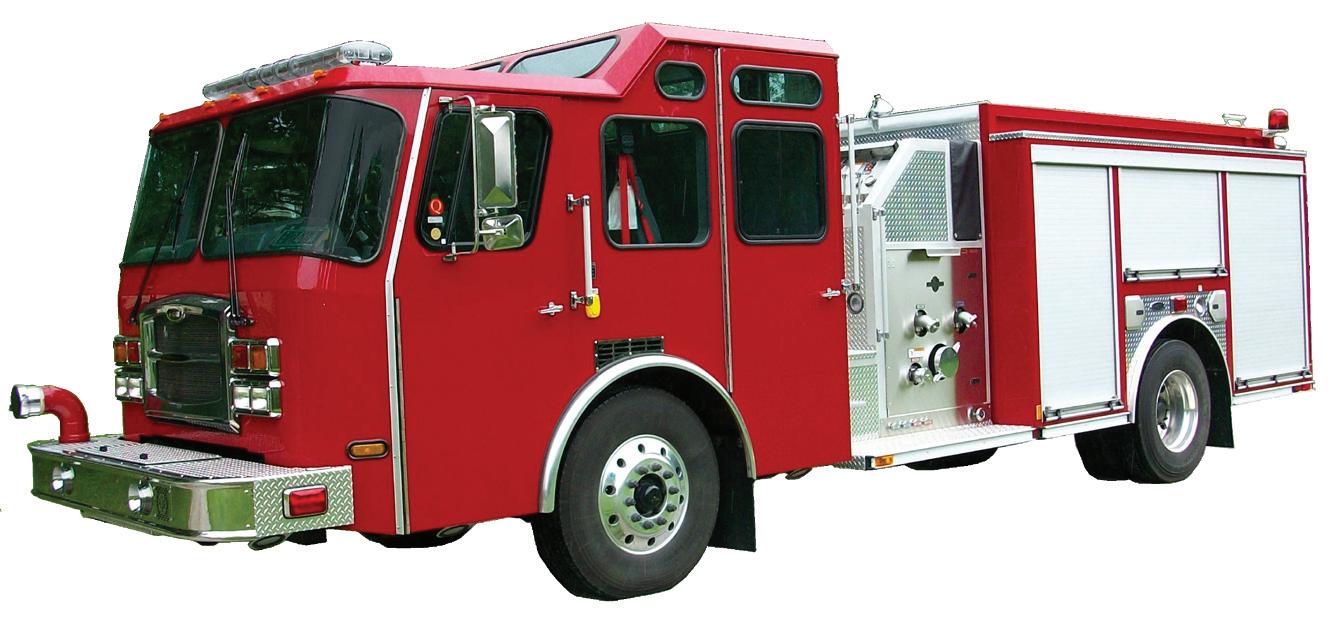
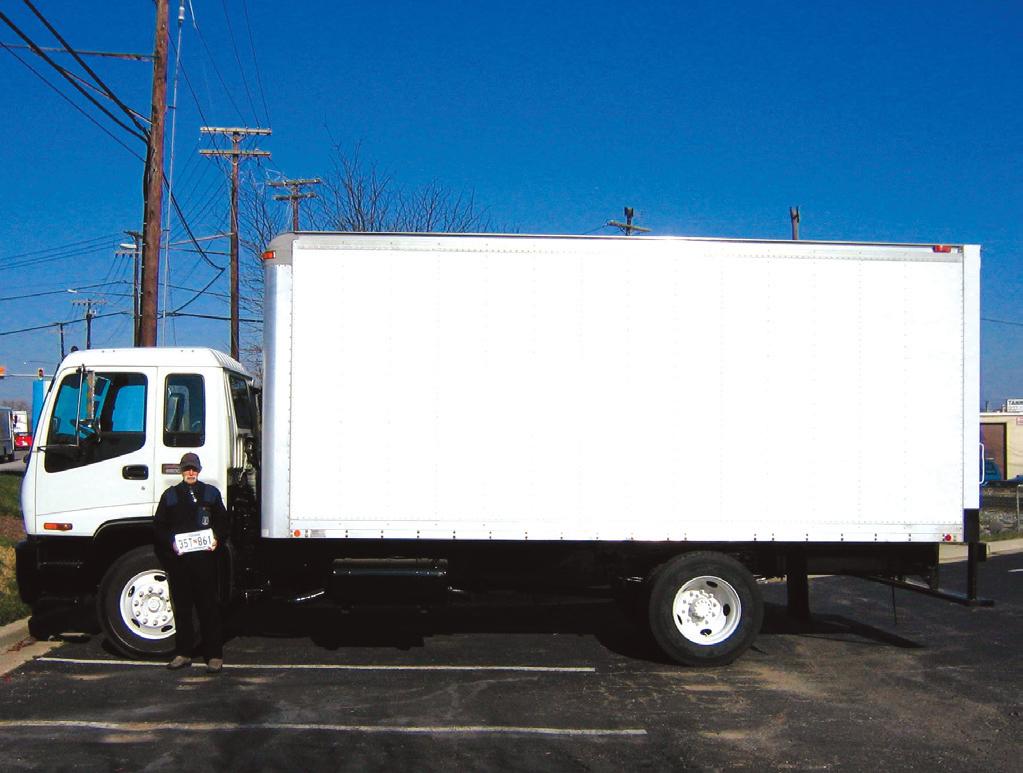
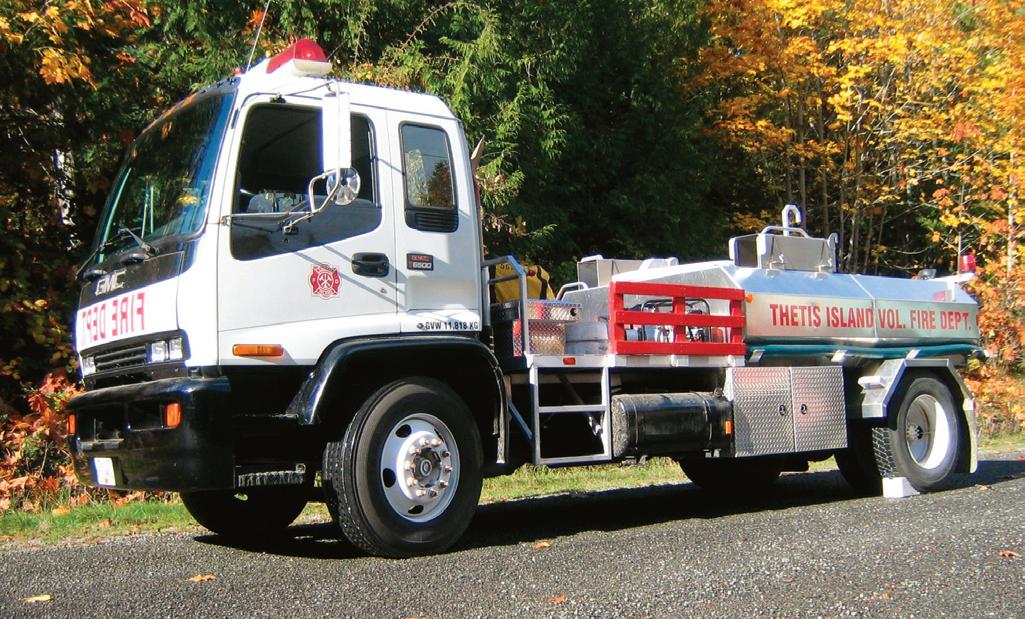
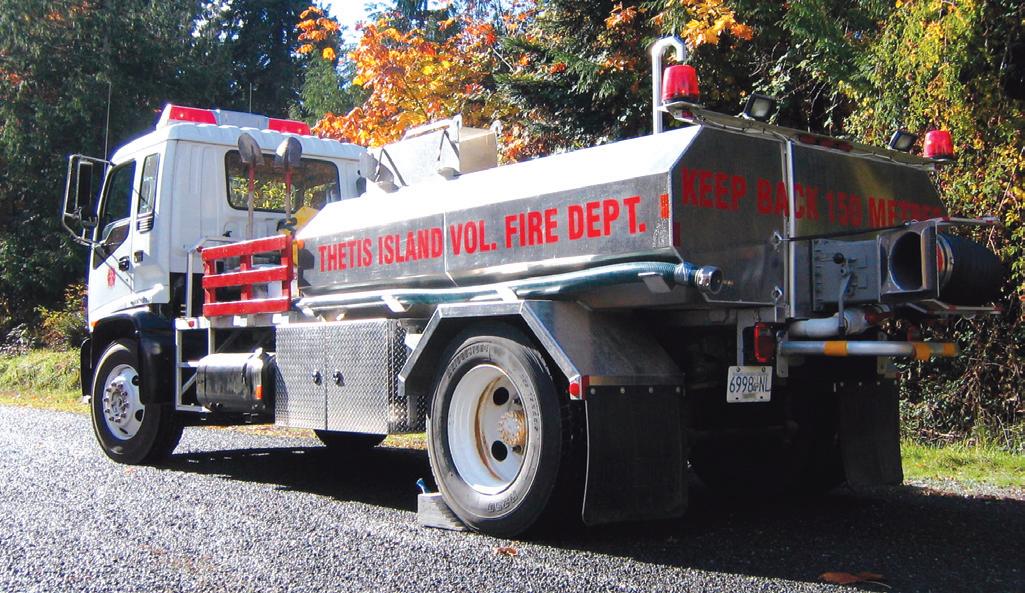
BUY IT BECAUSE THE OPTIONS AND PERFORMANCE ARE OUTSTANDING.
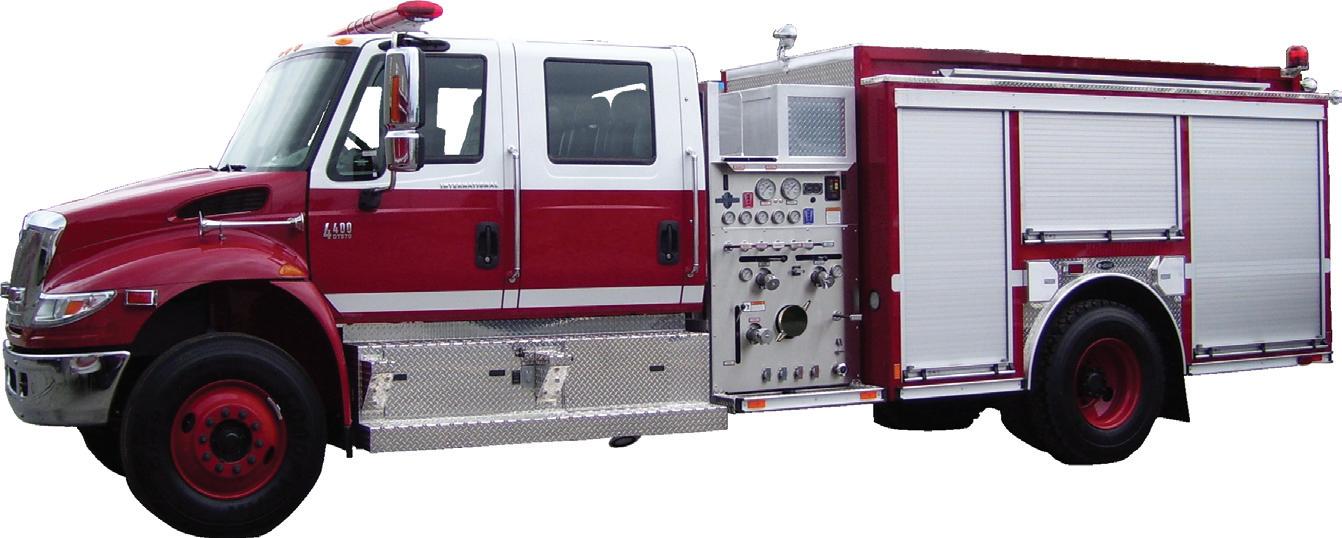
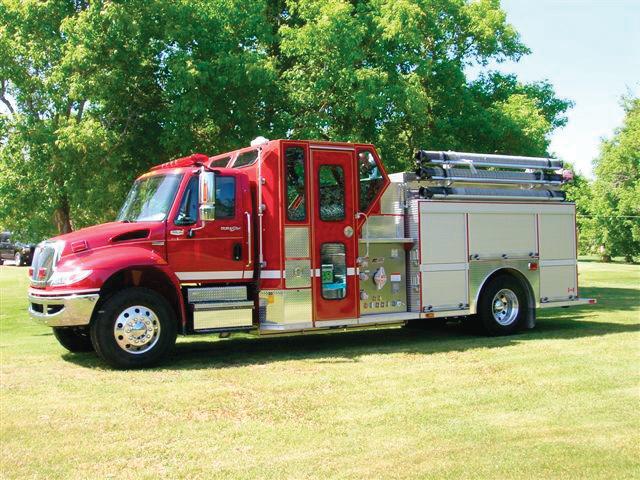
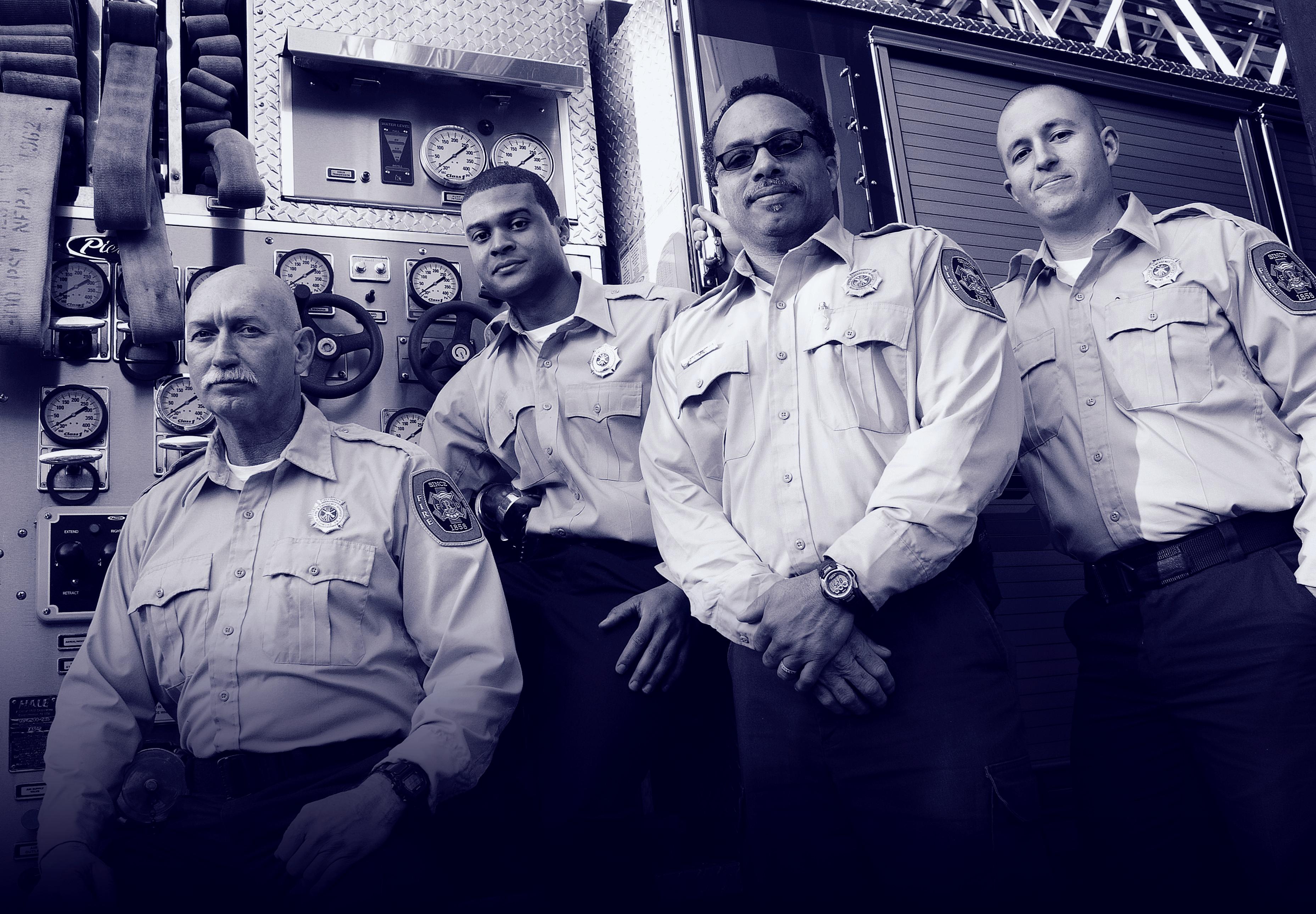
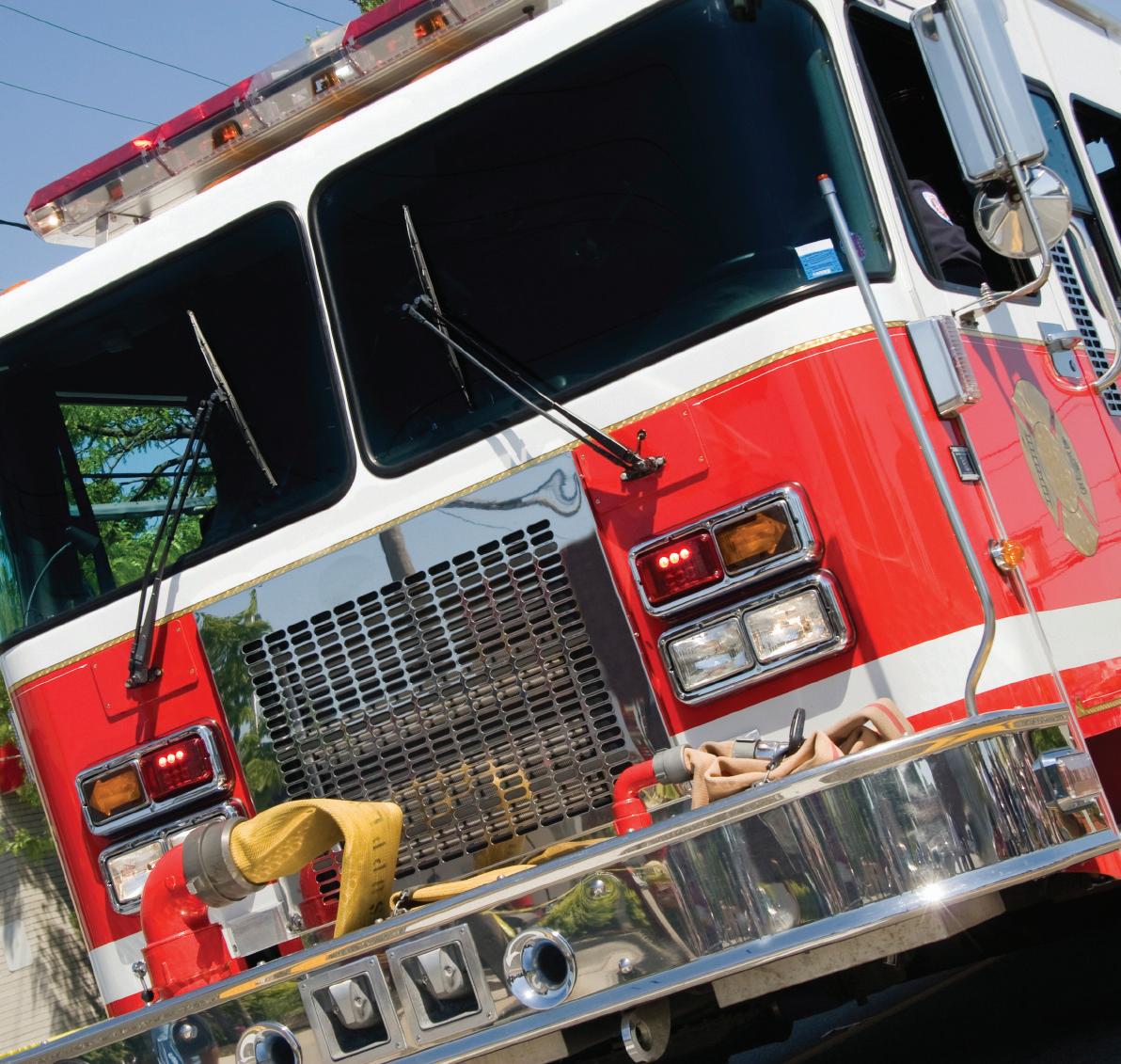
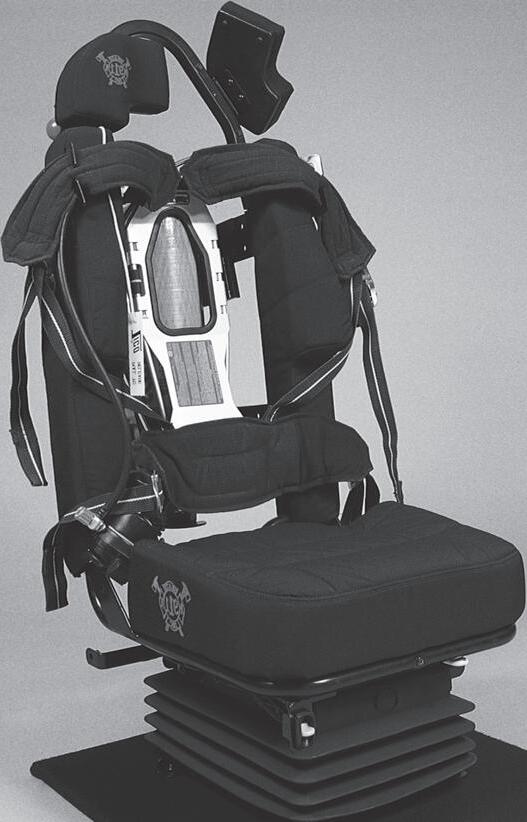
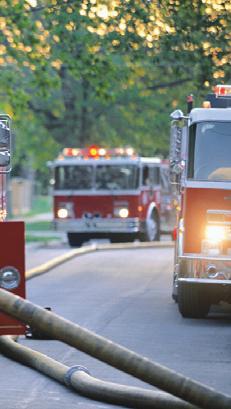
You know the value of hard work. So should your apparatus. The Responder™ is your best-of-both-worlds workhorse –packing a ton of custom features into a commercial configuration. You’ll value the 1250 gpm pump that makes service a breeze. And pump-in-motion and low pre-connect give you the ultimate in ease of use. An optional center SCBA seat, EMS/storage areas and full height compartments on both cab sides give plenty of flexibility for hard working departments on a budget. And because it’s built by Pierce, you know no compromises were made. Go with the truck that understands your values – the Responder. Value. Driven.
Custom chassis with flat or vista roof
• 330 to 425 HP engine
• 1250 to 1500 gpm Hale® pump
• 1000-gallon tank
• Side-mount or top-mount pump configurations
• 1/2, 3/4 or full-height officer side with various ladder storage configurations
• 89 cu. ft. of hosebed storage
• Stock units available
Freightliner® or International® 2-door or 4-door chassis
• 1250 to 1500 gpm Hale® pump
• 1000-gallon tank
• Side-mount or top-mount pump configurations available
• 1/2, 3/4 or full-height officer side with various ladder storage configurations
• 89 cu. ft. of hosebed storage
• Stock units available
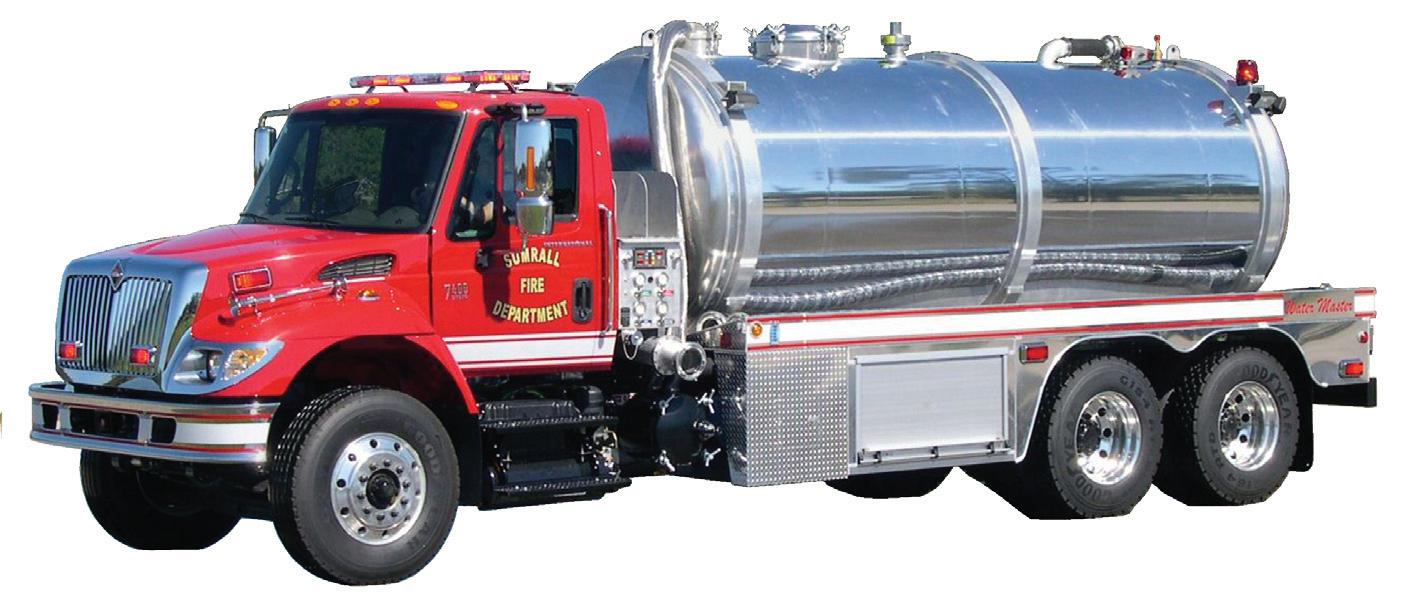
• International® chassis with electronic stability control
• Polished aluminum water tank with vacuum pump system
• In-cab pump and valve control console
• Closed circuit monitor with two cameras
• Hard suction hose trays, length of unit
• Lighting and siren package
• Portable tank rack
12
Building BRidgES
For close to a decade firefighters in Winnipeg had a sour relationship with management that created numerous problems. Over several years and through one of the worst tragedies in the Canadian fire service in 2007, Winnipeg’s union / management relationship evolved into a partnership that is, arguably, the envy of Canadian fire departments. Getting there wasn’t easy. Jay Shaw explains how it happened.
16
CloSing ThE gaP
As a baby boom officer, how do you run a department full of generation Xers and Yers who ask questions, demand answers and think they know more than you do? As James Careless reports, generation gaps are about social position – the older generation has power and the younger generation doesn’t but wants it. Conflict is inevitable but there are ways to manage it.
23
76
STRaighT TalK
As his first year as president closes, Calgary Fire Chief Bruce Burrell reviews the CAFC’s challenges and accomplishments in a frank and open question and answer session. Burrell is standing for re-election at the CAFC’s annual conference this month in Winnipeg.
By l aura King e ditor lking@annexweb.com
Bcomment
The burning issue of wildfires
ritish Columbia is burning. The count, as I write this on Aug. 7, is 2,336 separate fires across the province having consumed 87,000 hectares. That’s 800 more fires than in 2003, the worst wildfire season on record in B.C. The province has spent $138.6 million so far this season fighting wildfires, more than double the budget of $62 million.
One of the first wildland fires of the season, near Lillooet, started in early June, during the Fire Chiefs Association of B.C. annual conference in Nanaimo, and it’s been relentless ever since. Shortly thereafter, fires started in Kelowna, where scars from the 2003 blazes are still fresh. In 2003, 329 structures were lost in the Kelowna and MacLure fires. This year, just three homes have been destroyed in the myriad blazes in B.C.
do enough in advance of the fire season to reduce the potential for wildland interface fires.
A report by former Manitoba premier Gary Filmon after the 2003 fires said that, among other things, the province had to reduce the amount of fuel on the ground in the interface areas between communities and forests.
on ThE CovER
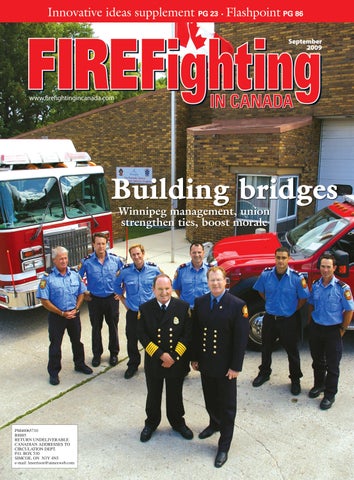
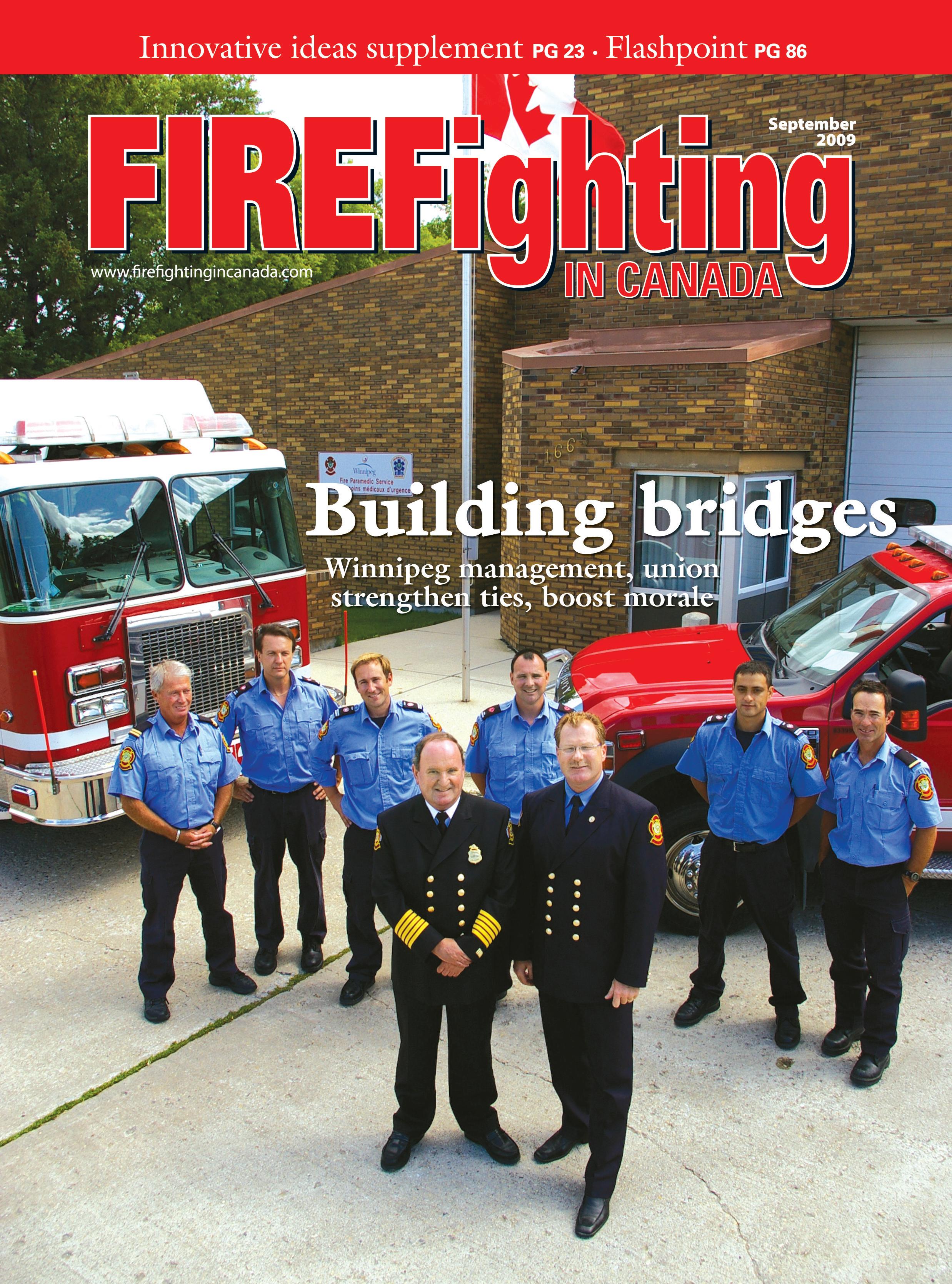
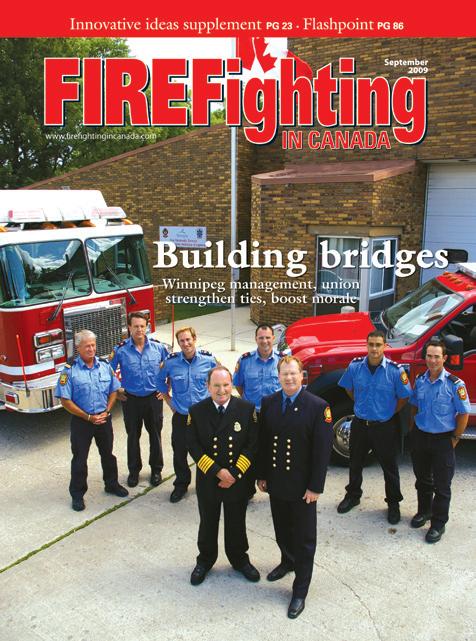
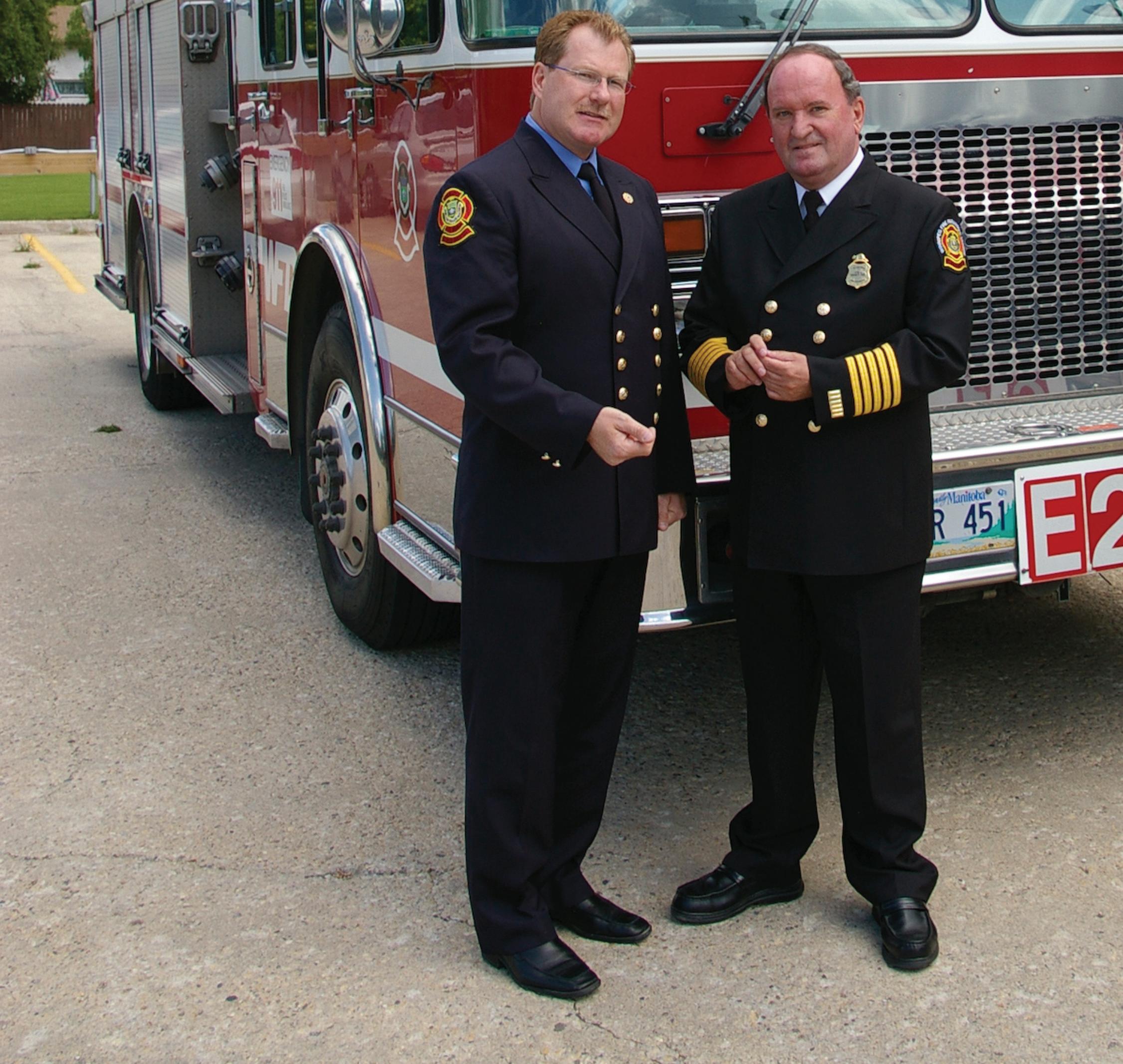
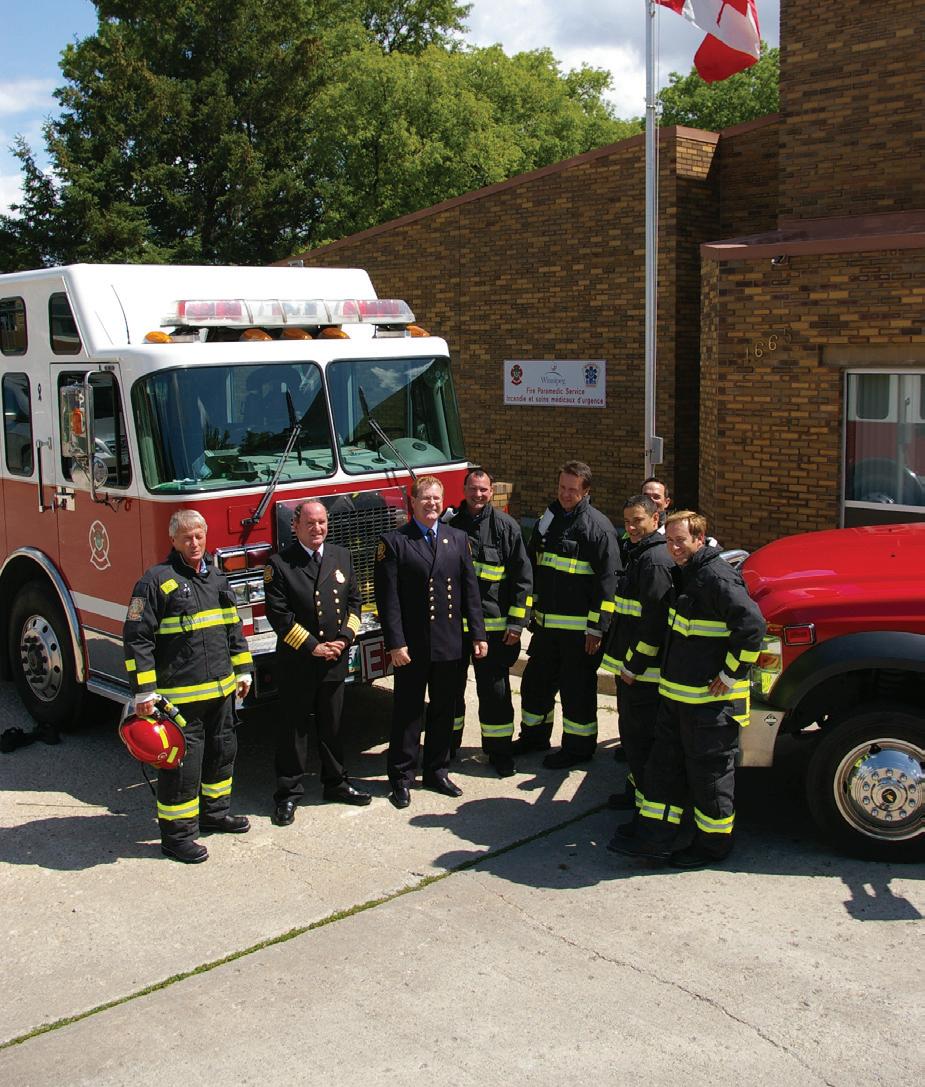
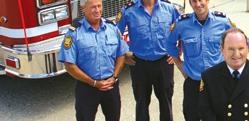
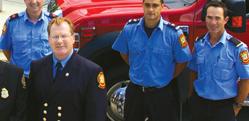
Winnipeg Fire Chief Jim Brennan (front, left) and union president Alex Forrest with (back, left) Capt. Ray Riddolls, firefighters Ed Pidwiryn, Chad Moroz, Karl Hanzmann, Phil Moharb and acting Lt. Don Troschuk. See story page 12. Photo by Bob Poole
We focused on wildland interface fires in the July issue of Fire Fighting in Canada, following a blaze in Nova Scotia in which homes were lost and thousands evacuated. That was a year after a bigger wildland interface fire in Nova Scotia during which 30,000 people were forced out of their homes.
Thankfully there have been no serious injuries in any of the wildland fires across Canada this summer and that’s a testament to the emergency management structures and to the training of wildland firefighters. The challenge, however, is education. Many of the B.C. fires were started by lightning but some were the result of campers and other careless residents.
Norm Macdonald, the NDP’s forestry critic in B.C., said in August that the Liberal government of Gordon Campbell failed to
As Vancouver writer Paul Dixon reported in our July issue, Filmon’s mandate was to review the issues relevant to prevention, planning and response to wildfires. Filmon made recommendations on mitigation, response and recovery, forest management practices, emergency management planning and implementation, command and control issues, communications issues and resources.
According to the NDP, the governing Liberals have downloaded those costs to municipalities, and as a result, just two to five per cent of the necessary work has been done.
Macdonald said much of the cost and the efforts of firefighters and emergency personnel could have been avoided if the government had taken responsibility for fuel reduction. Maybe this time the government will take notice.
On another note, FFIC columnist Ed Brouwer, who wrote in June about wildland fire preparedness, is fighting forest fires of his own in Alberta along with his colleagues at Canwest Fire Service and was therefore unavailable to write his September Trainer’s Corner column. He’ll be back in November. Stay safe, Ed!
PreSiDent MiKE FrEDEriCKS mfredericks@annexweb.com
PuBLiCATiOn MAiL AGrEEMEnT #40065710
PAP registration #8885 rETurn unDELiVErABLE CAnADiAn ADDrESSES TO CirCuLATiOn DEPT.
P.O. Box 530, SiMCOE, On n3Y 4n5 e-mail: lmorrison@annexweb.com
Printed in Canada iSSn 0015–2595
CirCulation e-mail: lmorrison@annexweb.com
Tel: 866-790-6070 ext. 206
Fax: 877-624-1940
Mail: P.O. Box 530 Simcoe, On n3Y 4n5
SuBSCriPtion rateS
Canada – 1 Year - $25.44
(includes GST - #867172652rT0001) uSA – 1 Year $50.00
We acknowledge the financial support of the Government of Canada, through the Publications Assistance Program and the Canada Magazine Fund, toward our mailing and editorial cost. Nous reconnaissons l’aide financiere accordee par le gouvernement du Canada pour nos coults d’envoie postal et nos coutl redactionnels par l’entremise du Programme d’aide aux publications et du Fonds du Canda pour les magazines.
From time to time, we at Fire Fighting in Canada make our subscription list available to reputable companies and organizations whose products and services we believe may be of interest to you. if you do not want your name to be made available, contact our circulation department in any of the four ways listed above.
All advertising is subject to the publisher’s approval. Such approval does not imply any endorsement of the products or services advertised. Publisher reserves the right to refuse advertising that does not meet the standards of the publication.
www.firefightingincanada.com
VERY FEW
THINGS CAN SURVIVE AN INFERNO.
OUR MISSION IS TO MAKE SURE YOU’RE ONE OF THEM.
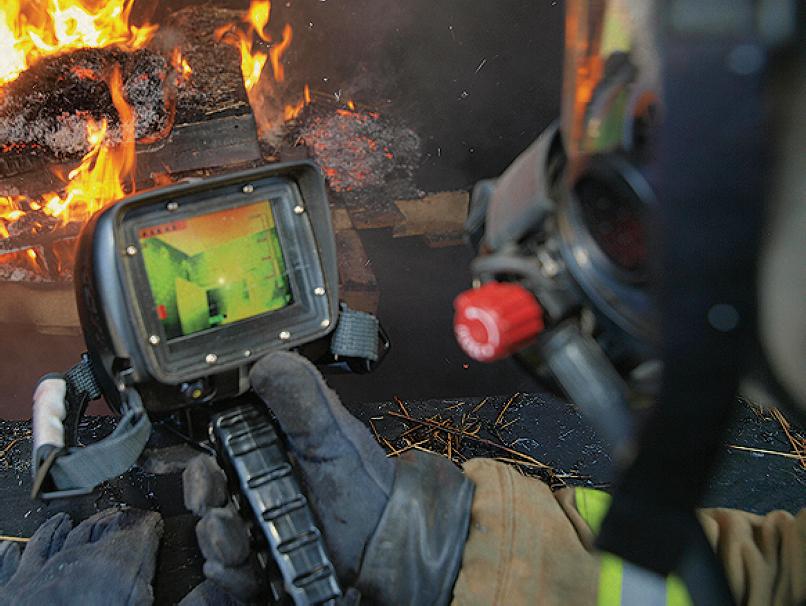
The flames build. The smoke gets thicker and more intense by the second. People are fleeing. And what do you do? You push forward ready to do battle. It goes against every natural human instinct. But then again, firefighters are a different breed. For your infinite courage and selfless dedication, we salute you. But more importantly, we’re going to do everything we can to protect you. We’re MSA. And we equip firefighters with the most advanced thermal imaging cameras, helmets, air masks and gas detection devices available. Coincidentally, we’re somewhat of a different breed ourselves. You see, we’re a safety innovations company that’s been on a relentless crusade to protect lives for more than 90 years. Today we protect firefighters, soldiers, construction, iron and steel workers, oil riggers, utility workers, miners, consumers and hundreds more. Wherever there are workers who need to be protected, we will be there.
statIontostatIon
across canada: Regional news briefs
Fire historical society raises public awareness
■ onTaRio
The Welland Merrittsville Fire Brigade, a fire historical society in Welland, Ont., is celebrating its 25th anniversary.
The brigade began in 1984 with the restoration of Welland’s original 1876 hand pumper (which was found in dilapidated condition) as a bicentennial project, assisted by grants from the city and the federal government. New wooden spoke wheels and babbitt bearings were made and the pump was rebuilt. This engine appeared in many parades and events. Some spectators, who questioned if it worked got soaked by the 30-foot stream. Kids were allowed to operate it and have fun.
Preserving fire history, restoring firematic artifacts and public education of the fire service’s past is the brigade’s mandate. Arrangements were made in 1993 to have Welland’s central fire hall designated a historical building. Welland’s original 1946 LaFrance pumper No. 3, its 1950 Bickle Seagrave Aerial No. 1 and the 1957 LaFrance
quad No. 2 were saved and designated as museum artifacts.
Firefighters’ red uniforms of the 1800s were acquired by members from a seamstress and a unique shoulder patch was developed for the uniform. Equipment was obtained for display use and a power point presentation on local fire history and fires developed.
The brigade worked with Welland Volunteer Fire Co. No. 1 and No. 2 to celebrate its 75th and 100-year anniversaries by organizing a fire truck display, show and competitionsl.
the B rass pole
promotions & appointments
John mCKearney has been named the fire chief in Vancouver. McKearney joined Vancouver Fire and rescue Services in 1980 and served as deputy chief for the last five years. He has been acting chief since May.
Dale WaleS is the new chief in Brighton, Ont. Wales
assumed his new duties Aug. 4 after a nine-year career as a professor at Lambton College’s Fire and Emergency response Centre in Sarnia, Ont. Wales was a member of the Leamington Fire Department from 1984 to 2000, where he was public education officer and fire inspector.
Paul BoiSSonneault is the new fire chief for the County of Brant Fire Department in Ontario. Boissonneault began
In keeping with the Brigade’s mandate, arrangements were made to bring the Halifax Insurance Children’s Fire Safety House to Welland. This was a first for the area.
A competition team was formed to attend musters in Hamilton and Simcoe and many trophies have been brought back home.
Welland’s Merrittsville Fire Brigade is a non profit, incorporated, local fire historical society.
-John J. Dybus, platoon chief, Ret., WFES
his new duties on July 6, overseeing the operation of eight full-time administration and dispatch staff as well as 162 volunteer firefighters based in eight stations with 25 front-line fire apparatus. Boissonneault was chief with the township of AdjalaTosorontio Fire Department since 2004 and as a member of the Department of national Defence Base Borden Fire Department beginning in 2003.
Sprinkler requirements have no impact on housing starts
■ nFPa
A U.S. study conducted for the National Fire Protection Association has determined that the presence of sprinkler ordinances has no negative impact on the number of homes being built.
The study compared residential construction in two counties that have sprinkler ordinances and two that don’t. Montgomery County, Md., which has sprinkler requirements, was compared with Fairfax County, Va. Prince George’s County, Md., which also has sprinkler laws, was compared with Anne Arundel County, Md. The selected areas, all developmentally mature, cover a wide geographic area and contain a
The Town of Markham, Ont., has appointed Dave DeCKer and Phil alexanDer as deputy fire chiefs. The appointments, along with that of Fire Chief Bill Snowball, completes the new senior management team for Markham Fire and Emergency Services.
trent gervaiS is the new fire chief in Peterborough, Ont. The appointment was effective June 16 but Gervais
The Welland Merrittsville Fire Brigade’s original 1876 hand pumper has been restored by the historical society.
Two Canadians on board of Metropolitan Fire Chiefs
The Metropolitan Fire Chiefs Association, a section of the International Association of Fire Chiefs (IAFC) and National Fire Protection Association (NFPA), held its 2009 annual conference in Edmonton, June 21-26. Approximately 80 Mmtro chiefs from Canada, the United Kingdom and the United States attended the conference and elected the section’s 2008-2009 officers and board members.
The new officers are: Chief William “Shorty” Bryson of the City of Miami Department of Fire-Rescue, Miami, Fla., president; Chief Robert Hendricks of the Lexington Division of Fire & Emergency Services, Lexington, Ky., vice
variety of housing stock and income levels, making them prime for comparing municipalities with and without sprinkler ordinances in place.
“This study clearly demonstrates that home fire sprinkler requirements do not impede housing development starts,” says Jim Shannon, NFPA president. “This report is another point to make the case for enacting life-saving sprinkler
had been acting chief since november following the resignation of Chief Lee Grant, who is now a deputy chief in Oakville, Ont. Gervais was deputy chief in Peterborough from 2004 through 2008.
roBert gauCher became fire chief in Shrewsbury, Ont. on June 1 following the May 31 retirement of Gerald LaFlamme.
president; Chief Greg Frederick of the Louisville Division of Fire, Louisville, Ky., secretary; and Chief Douglas Barry of the Los Angeles City Fire Department, Los Angeles, Calif., treasurer. The new board members are: Chief Jim Kay of the Hamilton Fire Department, Hamilton, Ont., board member; Chief (retired) William McCammon of the Alameda County Fire Department, Alameda County, Calif., senior board member; Chief Ned Pettus, Jr. of the Columbus Division of Fire, Columbus, Ohio, alternate board member; and Chief William Stewart of the Toronto Fire Services, immediate past president.
The metro chiefs bestowed
requirements in local communities. “
Sprinkler ordinances were enacted in Montgomery and Prince George’s Counties in several stages, beginning in the late 1980s, but never in Fairfax County. Anne Arundel County adopted a requirement for single-family detached residences this year; this study looked at Anne Arundel County housing starts prior to the ordinance. No reduction in the number
retirements
Charlottetown Fire Chief Bill hogan retires Sept. 18 after 35 years of service. Chief Hogan began as a volunteer firefighter and spent the last 28 years as a career firefighter.
DaviD CollingS has retired as fire chief for the County of Brant in Ontario after 45 years in the fire service.
the following 2009 metro awards: Chief Ned Pettus, Jr. of the Columbus Division of Fire was named Fire Chief of the Year; Chief (retired) Russ Sanders of the National Fire Protection Association (NFPA) and former Chief of the Louisville Division of Fire, received the lifetime achievement award; and Chief (retired) Luther L. Fincher of the Charlotte Fire Department, former member of the NFPA board of directors and current member of the International Association of Fire Chiefs board, received the president’s award of distinction.
FEMA administrator Craig Fugate, acting USFA administrator Glenn Gaines, IAFC president Larry Grorud,
of single-family homes built in either Montgomery County or Prince George’s County accompanied the enactment of ordinances, compared to the other two counties in the study that do not have sprinkler ordinances. Rather, both Montgomery and Prince George’ counties saw larger relative increases in construction in the year after the ordinances went into effect, compared to the other two counties.
last alarm
Yukon Fire Marshal marty DoBBin passed away at his home on Saturday, July 11. Dobbin had been in the territory as fire marshal for three years and leaves a legacy of enhanced training and equipment for Yukon fire departments and closer relationships between respective departments and their municipalities.
IAFC executive director Mark Light, IAFF president Harold Schaitberger and Chief John Bonney, president of the Chief Fire Officers Association of the United Kingdom, addressed the chiefs. A comprehensive education program included presentations ranging from a groundbreaking staffing and deployment study, to the chunnel fire, to infectious disease control, to coping with change and adversity. The chiefs also passed resolutions expressing unanimous support for numerous initiatives, such as the NFPA fire sprinkler initiative and home fire sprinkler coalition, the National Fallen Firefighters Foundation, firefighter health and safety efforts and more.
-NFPA
In interviews, builders and staff of the Maryland-National Capital Building Industry Association all indicated that the sprinkler requirements did not significantly affect the volume, character or price of the construction of new homes. According to the report, “None of the statistical or interview information demonstrated that the requirements led to reduced housing supply.”
-NFPA
SenD uS your DePartment neWS: Fire Fighting in Canada and our readers want to hear about your department’s promotions, appointments and retirements. Send details and a colour photo by e-mail to lking@annexweb. com and we’ll publish an announcement in our next issue.
statIontostatIon
B r I gade news: From stations across Canada
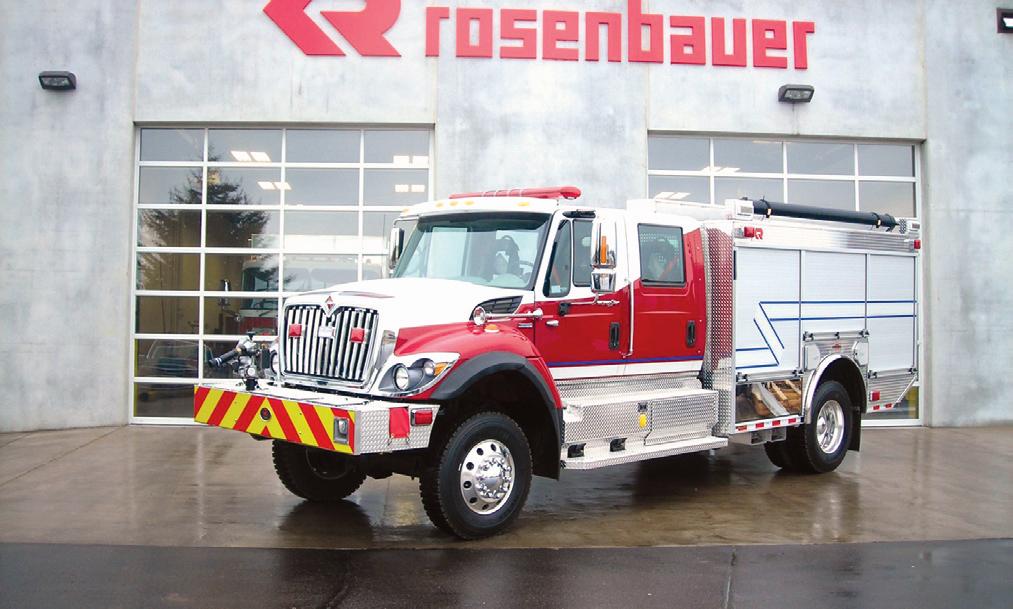
The Brazeau regional Fire ServiCe in Drayton Valley, Alta., took delivery in June of a Rosenbauer-built wildland fire truck. The truck was built on an International chassis and is powered by an International MaxxForce 9 330-horsepower engine. The truck is equipped with a Rosenbauer NH series pump, Foam Pro 2001 and Rosenbauer FixMix foam systems, Allison 3000 EVS transmission, and a 2,800-litre water tank.
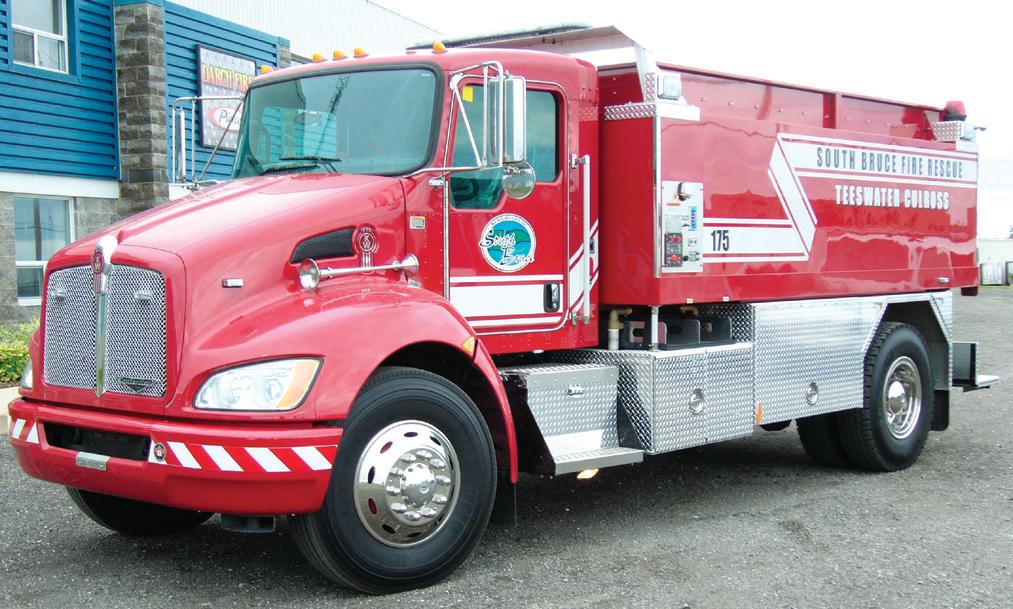
The teeSWater CulroSS Fire DePartment in Ontario, under Chief Terry Sillick, took delivery in June of a Darch Fire-built tanker. The tanker was built on a Kenworth chassis and is powered by a Paccar PX 8 engine. The truck features an 8,000-litre co-poly water tank and is equipped with a Darley 500-gallons-per-minute pump.
reD laKe Fire & reSCue ServiCeS in Balmertown, Ont., took delivery in June of a Fort Garry Fire Trucksbuilt pumper. The pumper was built on an International 4400 chassis and is powered by a MaxxForce 9 310-horsepower engine. The truck features an Allison 3000 EVS transmission and
4,700-litre co-poly water tank, and is equipped with a Waterous 1050 imperial-gallons-per-minute pump and Foam Pro 1600 class A foam system.
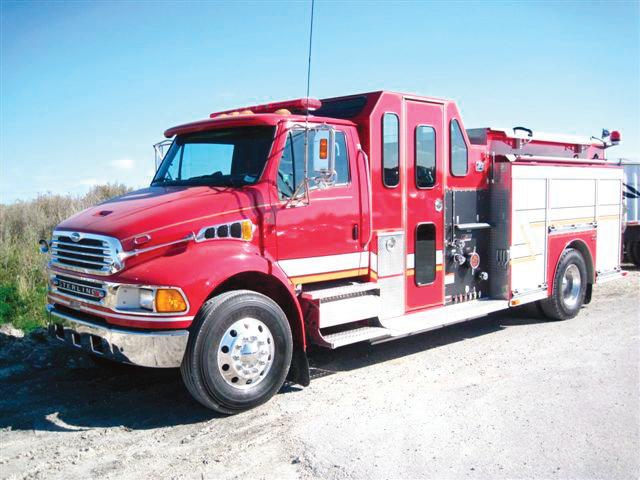
eaSt BeaCheS Fire & reSCue in Grand Marais, Man., took delivery in February of a Fort Garry Fire Trucks-built pumper. Built on a Sterling Acterra chassis and powered by a Cummins ISC 330-horsepower engine, the unit is also outfitted with a Waterous CSYCX1250 – 1050-imperial-gallonsper-minute pump, Foam Pro 1600 Class A foam system, 4,200litre co-poly tank and Allison transmission.
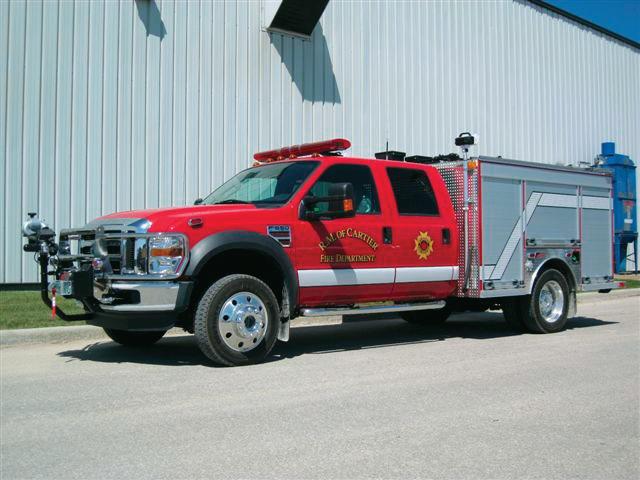
The regional muniCiPality oF Cartier Fire DePartment in Elie, Man., took delivery in June of a Fort Garry Fire Trucks-built initial attack apparatus. Built on a Ford F550 Crew Cab and powered by a 6.4-litre Power Stroke engine, the unit is equipped with a Darley AGE 81-horsepower diesel 250-gallonsper-minute pump, Foam Pro 2001/Odin Kodiak 130 foam systems and 900-litre co-poly tank.
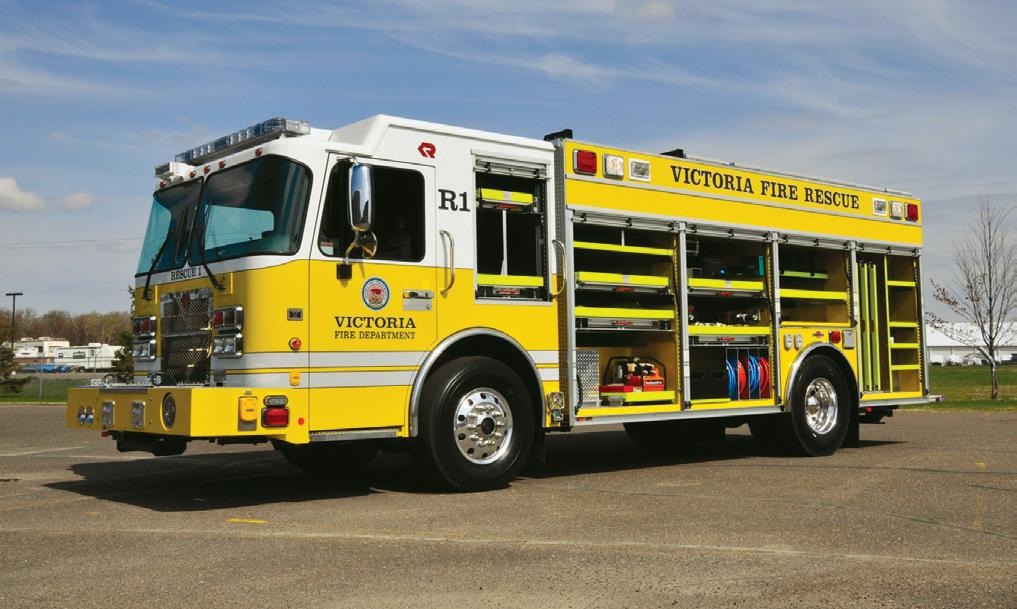
The viCtoria Fire DePartment in British Columbia took delivery recently of a Rosenbauer-built rescue unit. Built on a Spartan Metro Star chassis and powered by a Cummins ISL 425-horsepower engine, the truck is also equipped with; on-scene slide-out trays, oil dry hopper, storage for (42) SCBA bottles and Onan 20-kilowatt generator.
teeSWater
Brazeau
viCtoria
reD laKe
eaSt BeaCheS
Cartier
Building bridges
Winnipeg tragedy forces union and management to work together and results in new relationship and better morale
By Jay shaW
relationships are funny things. Psychologists, sociologists and academics have studied relationships and the problems that certain types of relationships create. The management/ union relationship is one that has been extensively examined. There are courses on how to beat the union, how to beat management and how to win in negotiations without the other side knowing it has lost. There are numerous Canadian examples in which fire-service relationships with management are about as sweet as a bag of lemons.
For close to a decade firefighters in Winnipeg had a sour relationship with management that created numerous problems. Over several years and through one of the worst tragedies in the Canadian fire service in 2007, Winnipeg’s union/management relationship evolved into a partnership that is, arguably, the envy of Canadian fire departments. Getting there wasn’t easy. Here’s how it happened. It was 1998, and an idea was reborn that would save money and provide better service in Winnipeg. Medical calls were going up and costs were skyrocketing. To ease the strain and create efficiencies, the Winnipeg Fire Department was disbanded by order of council. The amalgamation of all fire/rescue and EMS services was ordered and the operation was eventually named the Winnipeg Fire Paramedic Service. The concept made sense and looked promising in its simplicity – do more for less while creating a faster, smoother service to meet the needs of the new millennium.
each other. This caused considerable strife. Firefighters and paramedics wore the same uniforms but differed in skills, culture and history. Bickering was inevitable and relations that were already strained turned bitter and resentful.
The president of the United Fire Fighters of Winnipeg, Local 867, was then, and still is, Alex Forrest. He described the relationship between labour and administration as dysfunctional.
“At one point we had over 57 grievances on the table and there was no end in sight,” Forrest said.
Winnipeg Fire and Paramedic Chief Jim Brennan, who at the time was the deputy chief of support services, remembers those days as “progressively getting really bad, where the attitude eventually became, OK, we’ll just see you in court.”
As things got worse, both sides seemed to dig in their heels deeper and employee resentment became the norm. More energy was exerted fighting and planning individual battle strategies than on fixing everyday operational concerns.
B o V
But somebody forgot to tell the employees who, what, where, why and when. Planning focused on macro initiatives such as stations, equipment and dispatch. Other issues that may have seemed insignificant to management but were paramount to employees, such as lockers, beds and bathrooms, were never properly addressed or completely resolved. Nobody consulted anyone about how two different cultures were supposed to work side by side when they barely knew anything about
Deputy Chief Brennan was tagged by former chief Wes Shoemaker as the “conscience of management”. He recalls wondering on many occasions why management was fighting some grievances that were unrelated to the core issue of amalgamation, such as taking senior fire officers out of scope. “With so many items on the table ” Brennan would often think, “We’re going to lose!”
Brennan and Forrest admit that both sides made mistakes. Brennan says a management error was to rely on consultants, people who really didn’t know much about the local scene.
“We tended to look outwards and say the way to do this is to copy another city, and that was wrong,” he says. “We would have done better to look at what we needed to do here and get it done, instead of looking for models to copy all over North America.
“The other thing we did wrong was that no one gave a lot of definition to anything. For example, the union would ask how many firefighters do you need cross trained as paramedics and management would reply, well we need a cadre. What the heck does that mean? To problem solve you need to be very specific and say things clearly, like we need 231.”
Forrest believes the union didn’t fully understand the impact of culture and how changing the name of the Winnipeg Fire Department would affect the membership
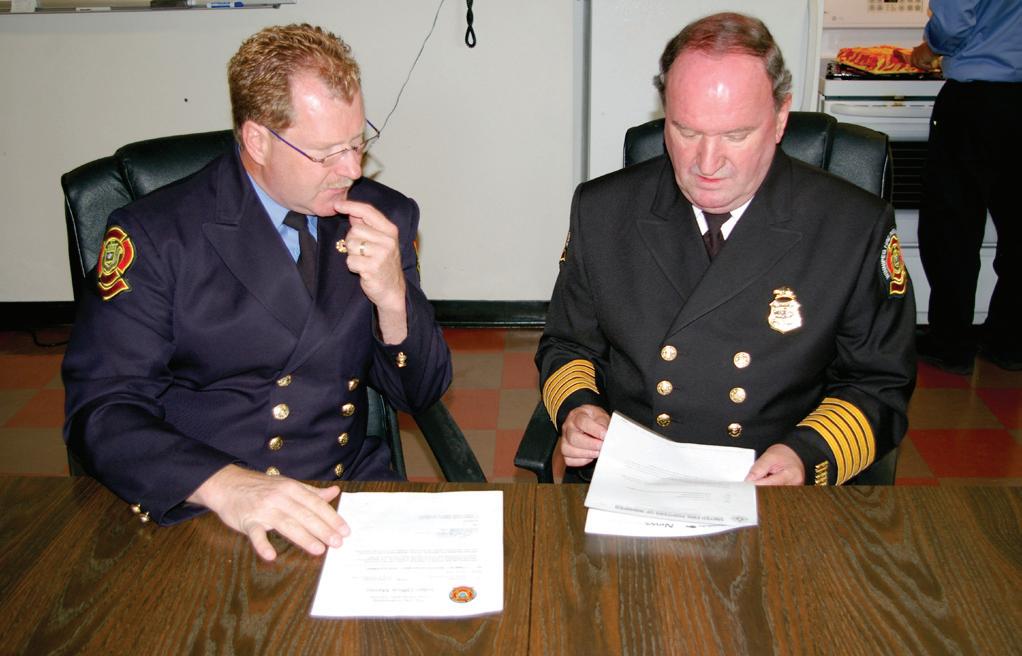
left: Union president Alex Forrest (left) and Winnipeg Fire Paramedic Service Chief Jim Brennan have worked together to build a stronger department. They have succeeded in repairing a strained relationship and acquiring new SCBA and turn-out gear, and implementing a tiered response system.
a
e : Winnipeg Fire Paramedic Service members Capt. Ray Riddolls (left), Ed Pidwirny, Karl Hanzmann, acting Lt. Don Troschuk, Phil Moharb and Chad Moroz with Chief Jim Brennan and union president Alex Forrest.
Photos by b ob Poole
and the day-to-day life in fire halls.
“We threw a lot of issues on the pile when we really should have concentrated on the biggest issue that faced this city in 15 years and that’s the increase in EMS calls,” he says.
Brennan and Forrest estimate that over the years millions of dollars were spent on lawyers and consultants during this negative period.
Things started to change in December 2006 when the former chief moved on and Brennan was made interim fire and paramedic chief. Forrest and Brennan never really had strained relations, due to Brennan’s support-services portfolio that kept him out of the mud for most of the battles. They began a working relationship that was on solid ground for the first time in years.
Winnipeg Mayor Sam Katz, who has witnessed the changes in both the department and the union / management relationship, says the fire service and its relationships with the union is healthy.
”I am very proud of the accomplishments that both the firefighters and paramedics have achieved under the leadership of Chief Brennan,” he says. “The whole team is working well, and that just wasn’t the case before.
Brennan, who was raised in Northern Ireland and immigrated to Canada in 1977, was very aware of cultural issues, as he had watched his country go through some rough times. Brennan was raised in a segregated community of Catholics and Protestants, where 3,000 people were killed and more than 40,000 wounded.
I lived through much of that,” he said. “When you have experience like that you tend to understand the impacts of culture very well. I understand why people get upset over a crest or a name. So for me, I did not have to feel like I was giving up concessions (to the union).”
On Sunday, Feb. 4, 2007, on one of the coldest days of the year, the Winnipeg department lost captains Harold Lessard and Tom Nichols in a horrific house fire that injured four others, two of them critically. Brennan and Forrest met at the emergency room of the St. Boniface General Hospital where one of the captains was taken.
“We supported each other and went to the families together to tell them what had occurred,” Forrest remembers.
At that moment, the two became one unit that would lead their teams over the next few weeks through the challenging task of respectfully honouring the families’ wishes in a way that allowed a very public story to be shared with the city and country.
Imagine helping two families plan private funerals along with a public memorial for 10,000 that would allow a city to grieve along with thousands of firefighters and EMS personnel from all over North
Continued on page 68
■ TRagEdy SPuRS ChangE
Certificate in Fire Service Leadership
Name Position Department
Jay M.H. Adamsson
Deputy Chief
Shawn Andrews Coordinator of Information & Fire Services
Derek John Baranowski
Acting Captain
Normand Beauchamp Fire Chief
John Kyle Berketo
Andrew J. Borsato
Fred Bramston
Glen Peter Bronn
Volunteer Firefighter
Firefighter
Fire Inspector
District Chief Thorold Station Four
Gordon L. Chase Fire Chief Area 4
Andrew D. Coligan
Training Officer
Rick Fielding 3rd Acting Captain
Robert Glen Harding
Captain
Derek Hofrichter 1st Class Firefighter
Jory Jenson
Stephen M. Laforet
Station Officer/Paramedic
Firefighter
Bruce Lake Firefighter
Jon Lasiuk
Antonius Lippers
Cindy MacFadyen
Bruno Martina
Michael S. Moore
Samantha Jean Palmer
David C. Paxton
Eric Poll
Acting Captain
Deputy Fire Chief
Fire Prevention Officer
Captain
Deputy Chief
Firefighter
Firefighter
Safety Officer/Paramedic
George Pottle Firefighter
John Anthony Powers 1st Class Firefighter
Nairn G. Robertson Firefighter
D. Greg Shaw
District Deputy Chief
Daniel Smith Fire Prevention Officer
Mark Smith Firefighter
Richard S. Steinman
Eric St-Pierre
Shelley R. Tyler
James Wall
Senior Captain
Emergency Services Coordinator
Senior Firefighter
Captain/Acting Platoon Chief
Dale R. Willson Fire Prevention Coordinator
St. Peters Volunteer Fire Department
Municipality of the District of Guysborough
Burlington Fire Department
Sécurité Incendie Chambly
Thorold Fire & Emergency Services
Kootenay Boundary Regional Fire Rescue
Saint John Fire Department
City of Thorold Fire & Emergency Services
Niagara Falls Fire Services
Atomic Energy of Canada Ltd.
Waterloo Fire Rescue
Sarnia Fire & Rescue Services
Richmond Hill Fire Department
Cochrane Fire/EMS
Windsor Fire & Rescue Services
Halifax Regional Fire & Emergency
Toronto Fire Services
Caledon Fire & Emergency Services
City of Charlottetown
Halton Hills Fire Protection & Prevention Services
Creston Fire Rescue
Berwick & District Volunteer Fire Department
Thunder Bay Fire & Rescue Service
Wolfville Volunteer Fire Department
St. John’s Regional Fire Department
City of Cornwall Fire Department
Uxbridge Fire Department
Charlottetown Fire Department
Atomic Energy of Canada Ltd.
Mississauga Fire and Emergency Services
Waterloo Fire/Rescue
Canadian Natural Resources Ltd. Horizon Project
Winnipeg Fire Department
Richmond Hill Fire Department
Arcelor Mittal Dofasco Fire Department
Certificate in Fire Service Administration Graduates
Certificate in Fire Service Administration, General
David Candy Firefighter/Paramedic
Certificate in Fire Service Administration, Emergency Management
Riverview Fire & Rescue
Tim Jenkins Lieutenant Charlottetown Fire
Certificate in Fire Service Administration, Human Resource Management
Michael C. Cain
Deputy Fire Chief
Grimsby Fire Department
Anthony Joseph Traer Lieutenant Miramichi Fire Department
Certificate in Fire Service Administration, Operational Planning
Jeff M. Cross Fire Chief
Craig A. Kennedy
Robert D. McKenzie
Tyler J. Pelke
Firefighter/Paramedic
St. Andrews Fire Department
St. John’s Regional Fire Department
Deputy Fire Chief Whitchurch-Stouffville Fire & Emergency Services
Training Officer
Certificate in Fire Service Administration, Strategic Planning
Winnipeg Fire Department
John Donald Rush District Chief East Gwillimbury Emergency Services
Certificate in Theoretical Foundations of Incident Command
Mark Sheridan Gillan
Deputy Fire Chief
Saint John Fire Department
closing the gap
how understanding the generation X/y phenomenon helps boomer bosses succeed
By James careless
Gen X/Yers are willing to follow orders, if the orders make sense to them.
If not – if the orders seem arbitrary and unreasonable –they will tend to question them. Boomer bosses need to understand how the younger generation thinks to succeed as managers.
the generation gap is nothing new. It was an aged Socrates who complained that the young “have bad manners . . . show contempt for authority . . . contradict their parents, gobble up their food and tyrannize their teachers.”
In today’s fire departments, the boomers are in authority; the generation Xers (born between 1960 and 1980) and generation Yers (born after 1980) are the rank and file. And much like Socrates, today’s boomer commanders find a lot of fault in their gen X/Y troops.
“Specifically, gen X/Y firefighters have a tendency to question authority,” says Peter Sells, a district chief with Toronto
Fire Services.
“When you tell them to do something, they want to know what’s in it for them,” adds Lou Wilde, assistant chief with the Kelowna Fire Department in B.C. “They don’t just do what they’re told, as boomers were trained to do.”
It is ironic that boomers are confounded by the younger generation’s lack of unquestioning obedience, given the boomers’ stated pride in questioning the system (at least when they were young). But ironies aside, there is a very real generation gap between today’s fire commanders and their rank and file. For departments to operate effectively and safely, this gap must be addressed and bridged. Lives depend on it.
ThE CulTuRal gaP
At their core, generation gaps are about social position. The older generation is in power and the upcoming generation isn’t and wants to be. As a result, conflict is inevitable.
This said, the fact that each generation grows up in different social, economic and political circumstances is extremely significant. Basically, each generation creates and is then burdened with its own culture. This is why the generation that grew up during the Great Depression and the Second World War is so different from the boomers, and the boomers’ culture isn’t the same as that of gen X/Y.
That’s not all, says Kimberley Alyn, an international fire service speaker/trainer who recently delivered her Real Leadership in the Fire Service is Not for Wimps presentation at the 2009 Alberta fire chiefs convention.
“The gap between boomers and gen X/Ys is more the result of a shift in culture and parenting,” Alyn says. “The first issue is a cultural shift in technology dependence. The younger generations have grown up with technology and depend on it in every aspect of their lives. The older generations invented the technology that the younger generations are enjoying, but the boomers didn’t grow up with it. Technology advancements have allowed us to access information and get the things we want at a faster pace, a higher quality and a lower price. This has cultivated an immediate gratification culture that has emerged in the X and Y generations. This often leads to an entitlement mentality in the younger generation individuals who don’t have enough discipline in their lives to keep this mentality in check.”
“This leads us to the second issue – a cultural change in parenting,” Alyn says. “In most households of the X and Y generation, both parents are working. As a result, less discipline is used to correct behavior, instill manners and cultivate a strong work ethic. Unless some of the younger generation individuals were exposed to strong role models as children or young adults, they tend to need more mentoring in these critical areas than boomers would.”
Schooling has also changed since the boomers were young, warns assistant chief Wilde. “When we were in class, you could get the strap if you didn’t learn your multiplication tables,” he says. “But by the time gen X/Y went to school, this model had changed. So had the overall concept of teachers speaking and students taking notes. Gen X/Y kids were taught to question and to think for themselves.
That opened up their minds but made it harder for them to fit into a paramilitary organization like a fire department, where obeying orders is part of the job.”
Even without these factors, the sheer difference in age makes a difference. “There is a big difference in maturity between a 40-year-old and a 25-year-old,” says District Chief Sells. “Even if everything else between the generations was the same, there would still be this difference. Think of yourself at 25; were you the same person you are today? Did you have the same priorities, discipline and goals? Not likely.”
■ dEaling wiTh BooMER and gEn x/y ConFliCTS
Now that we understand the players, let’s look at the conflicts between boomer commanders and their gen X/Y subordinates.
Fundamentally, boomer commanders want their subordinates to follow the rules of their paramilitary structure. There’s good reason for this: Commanders need to know their people will follow orders meant to save lives and suppress fires.
Gen X/Y firefighters are willing to follow orders, if these orders make sense to them. If not – if the orders seem arbitrary and unreasonable – they will tend to question them. They will also want a say in how orders and the policies that drive them are decided. If fire departments were democracies, this wouldn’t be a problem. But since they are not, it is.
Boomer commanders could simply rely on departmental sanctions to try to force their officers into obedience. Unfortunately, besides being an amusing exercise in karmic payback – how well did boomers actually follow orders back in the ’60s and ’70s? – such an approach would be doomed to failure. The best and brightest gen X/Y officers would likely quit.
Hence, boomer commanders who are serious about making their departments the best they can be – and dedicated gen X/Y officers who believe in the importance of being firefighters – need to meet somewhere in the middle.
Alyn has given much thought to this problem and offers some advice.
“Boomer commanders need to know that gen X and Y want to be part of the process and have input into that process,” she says. “This can create conflict in a paramilitary organization if Boomers are not accustomed to soliciting input and facilitating a more collaborative leadership style. Additionally, boomer leaders will need to spend more time mentoring the gen X and Y when it comes to manual labor activities and self-sacrifice.
“Also, these generations love
technology and want to see it used to create a more efficient work environment,” she adds. “Boomer leaders need to tap into this passion and knowledge and allow the gen X and Y to teach them a thing or two about technology.
Next, Alyn says, gen X and Y need to understand that boomers come from a culture in which you show respect for people who are older than you. “Using manners and demonstrating respect goes a long way when attempting to build bridges with boomers,” Alyn says. “Also, while gen X and Y are teaching boomers about technology, they need to allow boomers to teach them about manual labor, tradition, history and work ethic. It’s alright to ask why and provide suggestions for improving processes, but the asking needs to be done with respect, not arrogance.”
Alyn says boomers have seen a lot of changes in the past 30 years and gen X and Y need to understand that some boomers struggle to keep up with all the technological advancements.
“Try to find other ways to interact and connect with boomers besides Facebook, MySpace, texting or Twittering,” she says. “Boomers still believe the most effective way to communicate is face to face, not through technology.”
Assistant Chief Wilde has his own thoughts on boomer and gen X/Y conflicts. “The various observations on the different generations have their value but I think it is important not to get caught up in stereotypes,” he says. “The real issue is the difference in maturity and position for the generations involved. That’s something that has played out since humans came into existence. One day the gen X/Y generation will have to deal with it, when they are in command.”
District Chief Sells agrees. “In dealing with generational conflicts, the key is for both sides to listen to each other. This means there is a place for discussion, as long as it doesn’t interfere with the proper command structure. Deciding how and when to hold such discussion is up to your department; making this decision is an opportunity to bring gen X/Y officers into the process.”
■ ThE MoRal
Boomers can get along with gen X/Y – and vice versa – as long as both sides understand that they come from different cultural positions and make an effort to bridge the gap. Making this happen requires give and take on both sides, without compromising the fundamental right of command to issue orders to protect the department, its firefighters and the public.
BaCKtoBaSiCS
Know your ladder math
By MaRK van dER FEyST
In August we introduced the concept of truck company operations. We identified the 10 functions within which a truck company operates and looked at some simple tips on overhaul operations. A big part of truck company operations is ladders, especially ground ladders. Every fire apparatus is equipped with at least two ground ladders – a straight, single roof ladder and an extension ladder. This is mandated by NFPA standards for apparatus specifications. Ground ladders have an NFPA standard – 1931 – detailing what is required and how they are to be constructed. These standards are not the most interesting reading material but they do contain some important information that we need to know as part of the basics. For instance:
• beam are preset for 300 F;
The heat sensor labels that are found on the inside of the ladder
An attic ladder will be no longer than 16 feet; •
The minimum distance between beams for single ladders will • be 16 inches;
The minimum distance between beams for an attic ladder will be • no less than 7.5 inches.
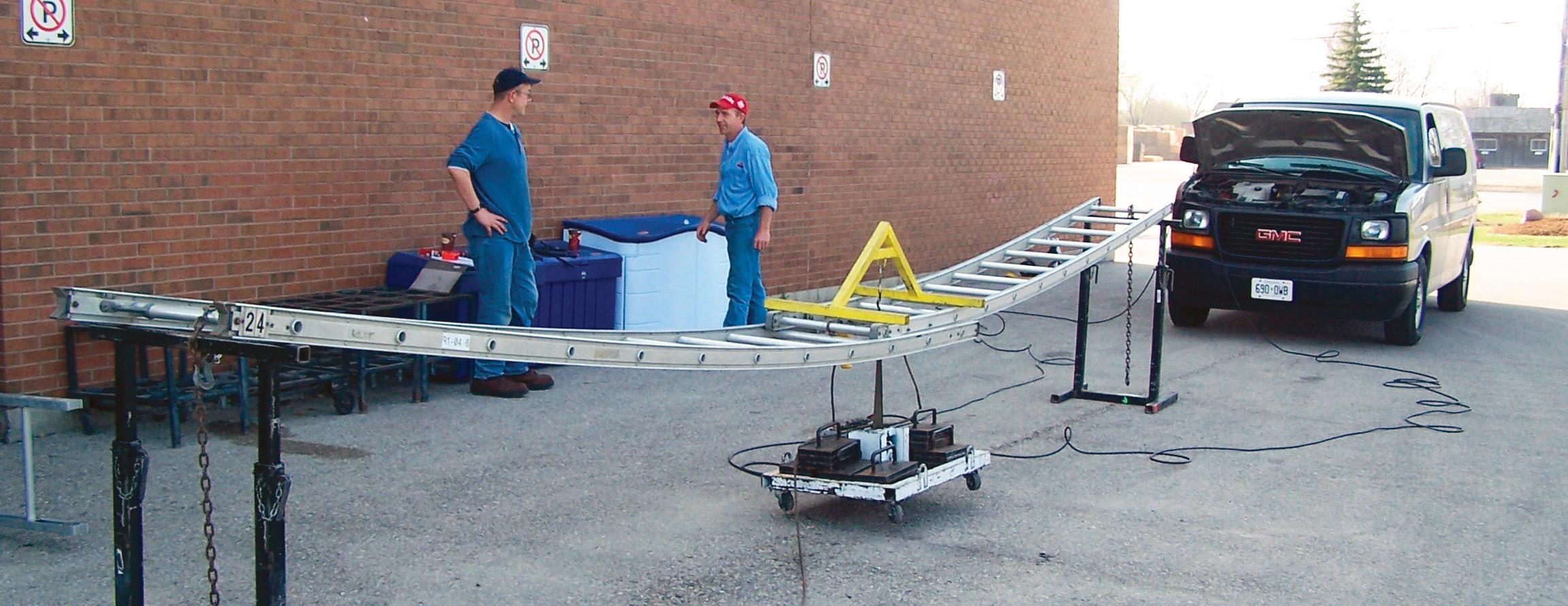
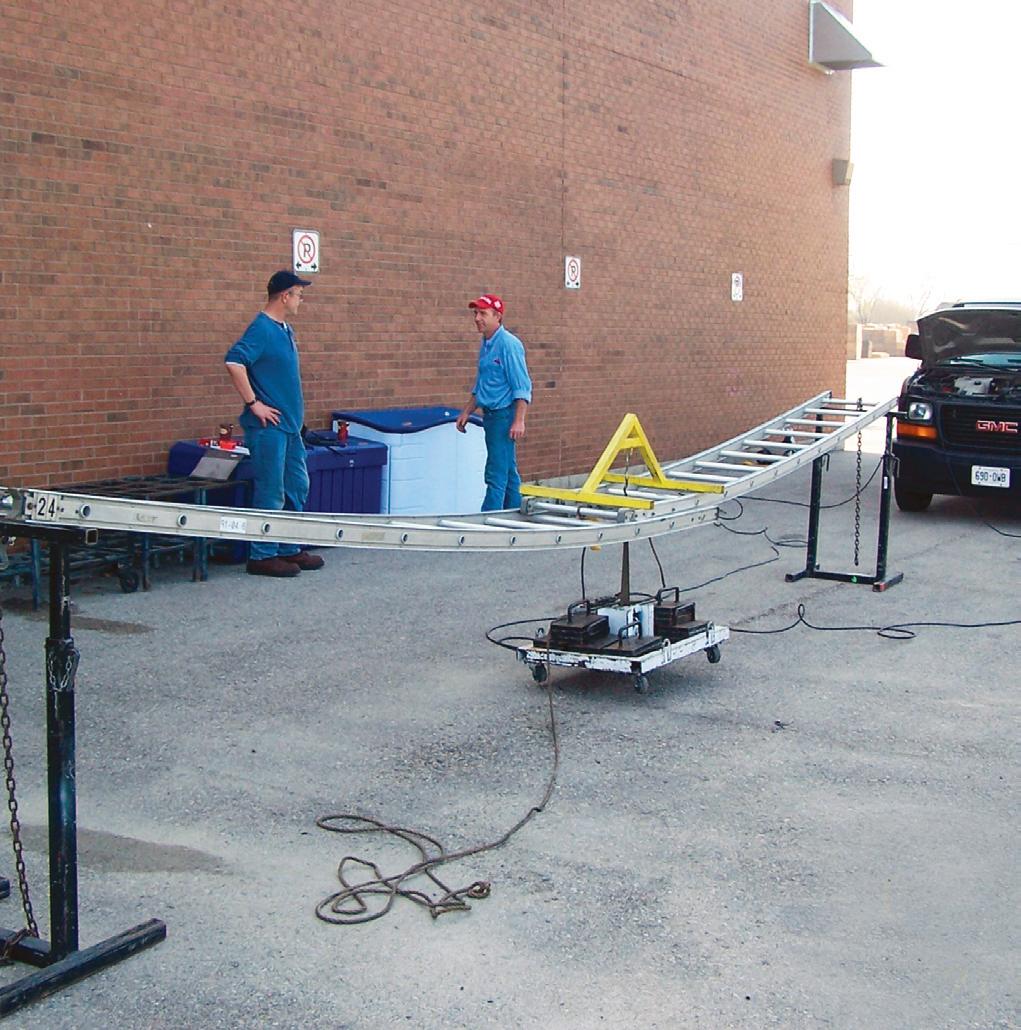
All ground ladders are tested to ensure that they meet the NFPA 1931 standard. Most of us have never witnessed these tests being conducted but they are intrusive and are designed to test the extreme limits of the ground ladder. In photo 1, we see a ground ladder undergoing the horizontal bending test. In this test, a load of 750 pounds is applied to the middle of the ladder. Notice that the ground ladder is fully extended. It is supported by two stands at least six inches from each end of the ladder. The test uses 750 pounds for weight because NFPA 1931 requires that all combination, single and roof ladders – as well as extension ladders – are to have a duty rating of 750 pounds when raised at a 75-degree angle. Any test being conducted on a ladder will maintain a five-minute time limit. Notice how the ladder is bending under the test weight. There is probably a one-foot deflection under this extreme weight. But is this an extreme weight limit? If we were to use a ground ladder to rescue a civilian there is a good chance that the ladder would endure some extreme weight. The average weight of a firefighter fully donned with PPE is 300 pounds. This is a figure that NFPA uses to assess firefighter activity weight for any operation. One firefighter on a ground ladder trying to rescue a civilian who may weigh as much as 300 pounds is putting 600 pounds of weight on the ladder. Depending on the behaviour of the civilian, the ground ladder is likely to bounce as the rescuer and civilian descend. We need to know this to build our trust in the ground ladder. The ladder is designed to work under stressful situations and has proven on many occasions to be a very effective tool.
We also need to know the lengths of the ladders we carry on our apparatus. This is so that when it’s time to ladder a second-storey window we can pull off the correct ladder and raise it to the correct height the first time. Nothing looks worse than watching two firefighters raising and lowering a ground ladder trying to select the proper height. If we know our ladder lengths, the average distances between floors, the height of windowsills from the floor, the distance
Photos by Mark van der Feyst
Photo 1: In the horizontal bending test, a load of 750 pounds is applied to the middle of the ground ladder.
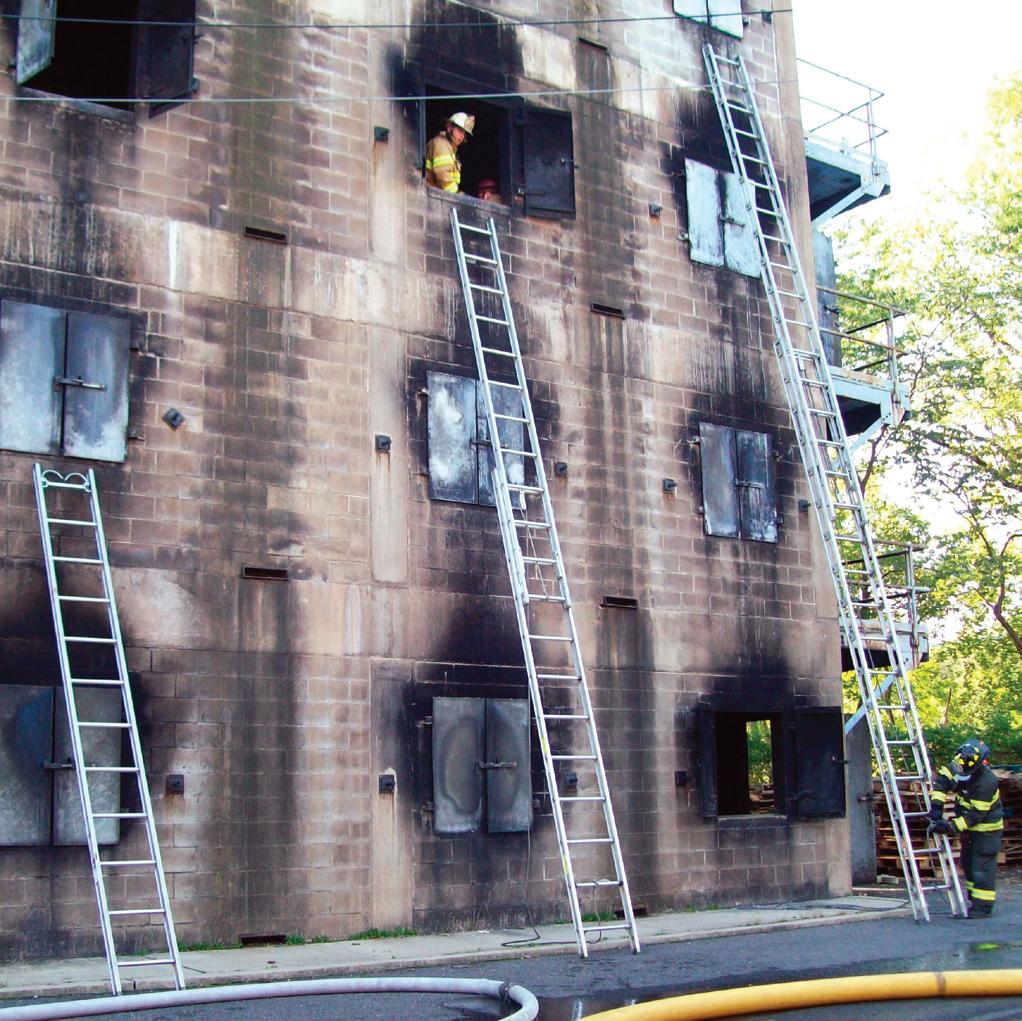
Photo 2: Crews should practise laddering windows to various storeys to learn the limits of their ground ladders.
For more information, call your local Globe dealer or Safedesign
British Colum B ia and a l B erta Guillevin
Coquitlam, British Columbia 800-667-3362
Calgary, Alberta 800-661-9227
Campbell River, British Columbia 250-287-2186
Edmonton, Alberta 800-222-6473
Fort St. John, British Columbia 250-785-3375
Kamloops, British Columbia 250-374-0044
Nanaimo, British Columbia 250-758-3362
Prince George, British Columbia 250-960-4300
Trail, British Columbia 250-364-2526
Que B e C H.Q. Distribution LaSalle, Quebec 800-905-0821
atlanti C provin C es K & D Pratt Ltd. St. John's, Newfoundland 800-563-9595
Dartmouth, Nova Scotia 800-567-1955
Saint John, New Brunswick 800-567-1955
m anito B a and s askatC hewan Trak Ventures 204-724-2281
BaCKtoBaSiCS
between rungs and how much a ladder tip will drop when we pull the base away from the wall, we can estimate correctly the height to which the ladder should be raised the first time.
In photo 2, three different ladders are being used to access different windows at different levels of a building – a 12-foot ladder accessing the second storey, a 24-foot extension ladder accessing the third storey and a 32-foot ladder accessing the fourth storey.
We know that in a typical structure the height between floors is 10 feet. The windowsill will be about three feet from the floor. This gives us a total height of 13 feet to reach. If we grab a 14-foot roof ladder, will it reach the windowsill? Yes, it will. A ladder, when moved away from the wall, will drop one foot for every four feet of horizontal movement. When a 14-foot roof ladder is moved away from the wall to the correct climbing angle, it will have a vertical height of 13 feet. A 12-foot roof ladder would also work. It would be about 18 inches below the windowsill but it would still allow us to gain access or rescue a civilian.
Our extension ladders are usually 24 feet. The bed of the 24-foot ladder measures 14 feet. Rungs on the ladder are about 12 inches apart. When we extend the fly section of the
ladder, we need to count the number of clicks from the dogs to raise the ladder to the correct height. A 24-foot ladder fully extended will measure 24 feet. We can then theoretically reach a third-storey window with a 24-foot ladder, having a vertical height of 23 feet from ladder tip to the ground. We need to consider other factors such as raised basements and sloping surfaces. This will add to the total height we need to reach.
The best way to learn the limits of ground ladders is to practise with them. Use buildings in your area and ladder the windows on different storeys. Ask the crew to estimate how high the ladder must be raised to reach certain windows. Your crew can practise estimating ladder heights to learn the limits of each ladder. Crew members will also know which ladders to use to reach certain windows if they get called to that building.
Mark van der Feyst is a 10-year veteran of the fire service and he works for the City of Woodstock Fire Department. He is an international instructor teaching in Canada and the U.S. Mark is a local level suppression instructor for the Pennsylvania State Fire Academy and an Instructor for the Justice Institute of B.C. He can be reached at Mark@FireStarTraining.com
Knowing ladder heights is crucial to effective rescue.
and flexibility.
SeriouS performance now comeS at a great value. Built with a new, contemporary chaSSiS, g-Xcel™ featureS many of our innovative deSign featureS including eXtended Back length in the jacket and eXtra length in the knee and Seat for eXcellent moBility. pluS a long liS t of optional featureS allowS you to configure g-Xcel™ to your eXacting SpecificationS.
EXPERIENCE leads the way
One volunteer’s role in
firefighting
A SPECIAL REPORT
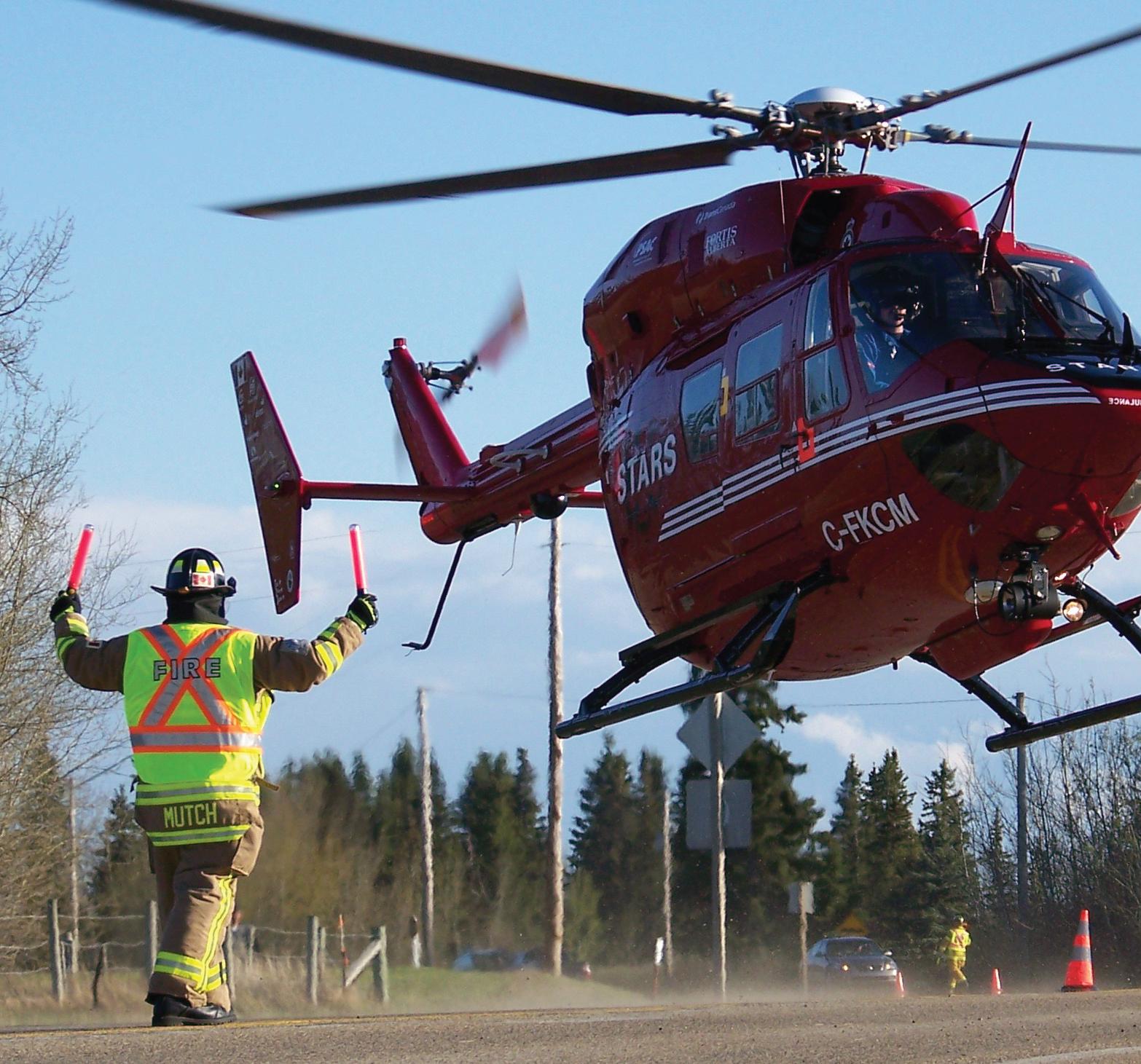
Like volunteer firefighters across Canada, Troy Mutch balances the needs of his community with a career. Troy’s role in his community department provides him the opportunity to continue a 20 year journey in the fire services industry and provide a much needed service to the county where he lives.
“I’ve always been passionate about firefighting” Troy says with a smile. “I started as a volunteer with my local department at 16 and joined the B.C. Forest Service as a Helitack team member at 18 and became crew boss at 19.”
When not racing with the green light to a call, Troy spends his days working for Commercial Solutions, an Alberta based wholesaler with a strong presence in the Canadian fire services market. Troy brings great products to market for volunteer and career departments and brings his experience to the forefront on a daily basis.
n DemanD expert SolutionS
Mutch’s arrival at Commercial cemented his focus to bring the very best products to his brotherhood. Equipment was selected to be safer, longer lasting, and designed to improve every aspect of firefighters’ safety and ability to do their job under the toughest of situations. As Commercial’s National Fire Services Manager, Troy stands behind what he sells.
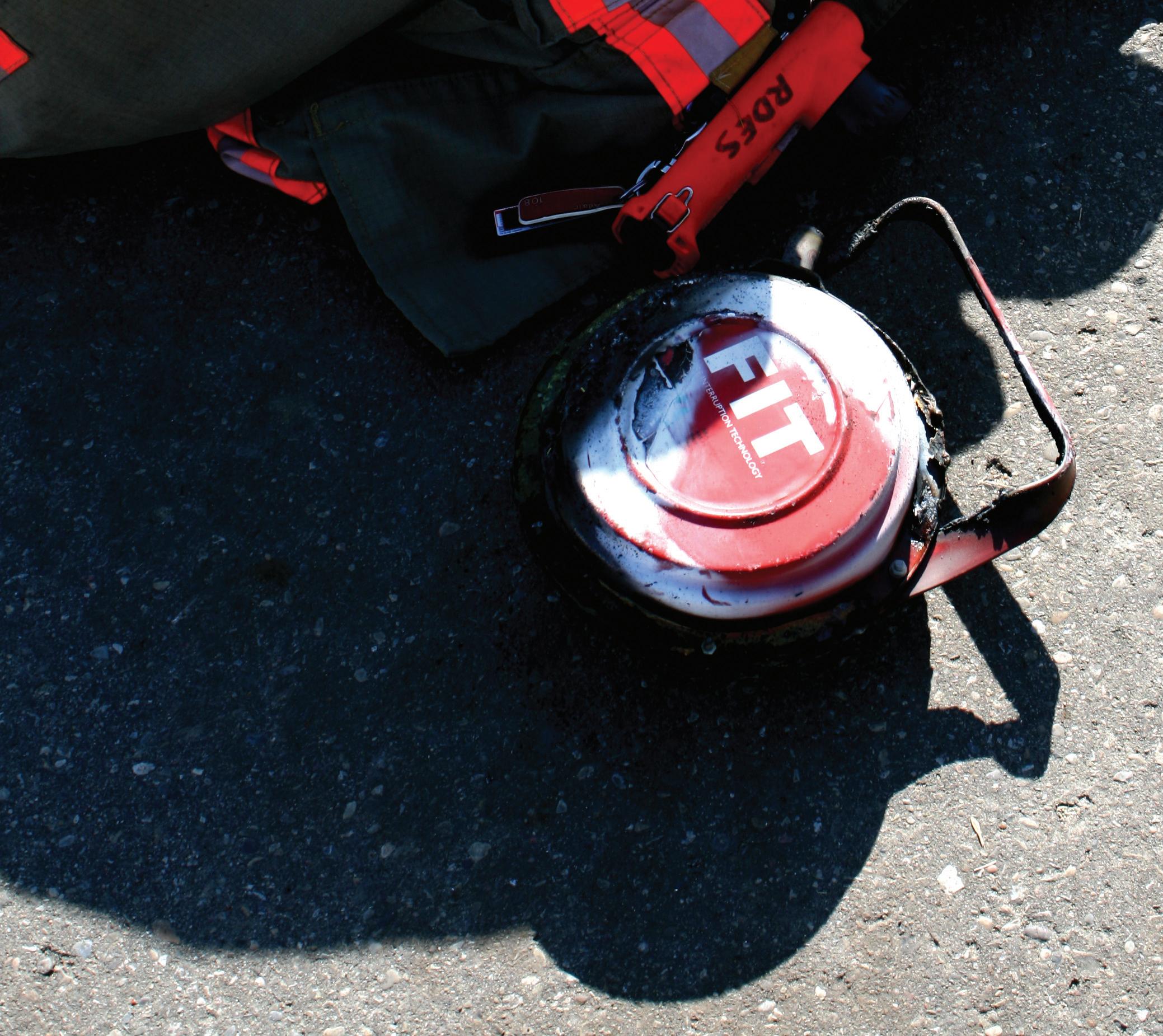
Commercial Solutions offers some of the finest products available to today’s fire professionals. From Morning Pride bunker gear of impeccable quality and record, to the latest advancements in fire suppression technology embodied in the FIT-5. Commercial Solutions staked its claim as
a leading distributor delivering the very best to the hard working men and women in black.
n a hiStory of SucceSS
Commercial Solutions has a proven history in business. Since 1965, Commercial has operated in Alberta, first as a bearings and power transmission distributor and later expanding into the industrial, field and survey markets. In 2002, Commercial Solutions acquired Nisku Safety Supply and began servicing the industrial safety market. The safety division quickly supported industrial firefighting needs and began to offer an ever broadening product base to community and career fire crews. Over the past 4 years, that business has grown nationwide.
“I have the best job in the world. I visit fire halls and get to talk with fellow firefighters about their challenges and successes,” says Troy. “I can share my experience and educate them about tools and equipment giving them solutions that they can work with.”
Most exciting is Commercial’s latest offering of Safetek Emergency Vehicles. Commercial now adds industry leading firefighting apparatus to its product mix. From bunker gear and protective clothing to pumpers and aerials, Troy and Commercial Solutions deliver expert solutions to customers.
To replace, update or upgrade, Commercial Solutions is ready to help. Contact Troy and his team at: 1-877-301-fire (3473) or visit us online at: www.commercialsolutions.ca/whoswhofire
Keeping up the good work
When we started looking six months ago for a theme for our annual September supplement we had some ideas but wanted input from our readers. We turned to our editorial advisory board, a group of 13 fire-service leaders from coast to coast including chiefs from full-time and volunteer departments, for their expertise and insight. As is often the case when great minds meet, a lively and entertaining debate ensued.
We considered profiling fire-service heroes – those who have successfully implemented change or blazed trails – but several organizations already honour those folks and we didn’t want to limit the selection to high-ranking fire-service personnel. We wanted grassroots.
After hearing from most of our editorial board members – some multiple times! – we opted to offer innovations, understanding that while some full-time fire departments are likely to remain well funded no matter what happens to the economy, many volunteer and paid on-call departments constantly struggle to find money to replace aging apparatus or fund public education programs.
One thing that stuck in my mind as we put this issue together was the obvious understanding that many, if not most, volunteer departments in Canada are under funded.
Lastly, our Flashpoint columnist Peter Sells took a different approach (what else is new?) and wrote a tribute to fire-service legend and mentor Alan Brunacini, whose mission to find solutions to fire-service problems, issues, challenges and concerns is a lesson for us all.
One thing that stuck in my mind as we put this issue together was the obvious understanding that many, if not most, volunteer departments in Canada are under funded. Our national survey of Canadian fire departments late last year (published in our March 2009 issue) made it clear that many departments use old apparatus and bunker gear that don’t meet NFPA standards, don’t have radios that communicate with other emergency agencies, don’t have access to consistent training and have little or no money for public education programs.
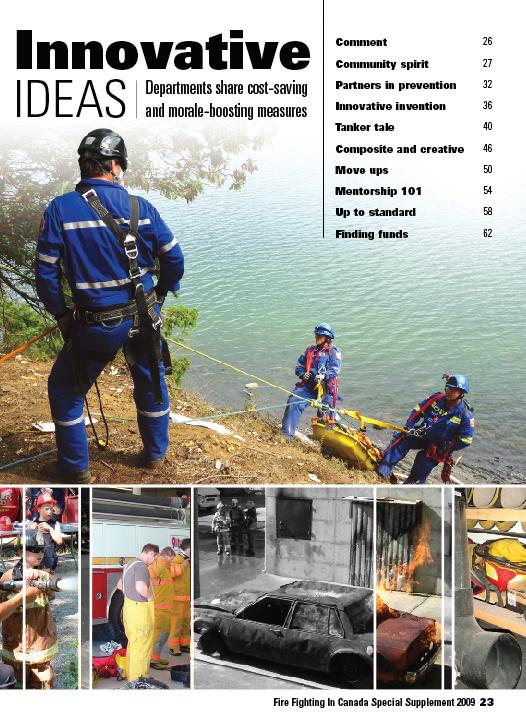
Borrowing from the title of our old and much admired do-ityourself column by longtime Fire Fighting in Canada contributor Lorne Ulley, we titled the section Innovative Ideas. We put out a call on our website for your stories and asked provincial fire chiefs’ associations to send e-mails to all their members offering an opportunity to be featured in our magazine.
Our search for stories coincided with the Fire Chiefs Association of British Columbia conference in early June and B.C.’s departments responded resoundingly. Maybe the west-coast folks just like to brag, or maybe they have better ideas than the rest of us! (Or maybe FCABC communications guru and Hope, B.C. Fire Chief Tom DeSorcy worked his magic!) Regardless, the items from Comox, Hope, Thetis Island, Pender Island and Surrey, B.C., are a testament to the creative thinking, ingenuity and determination that fire departments need to meet the demands of ever-increasing safety standards, public expectations and recruitment/retention challenges.
Our stories from St. Catharines and Simcoe County, Ont., and Redwood Meadows, Atla., offer solutions to problems and issues that could challenge any department, full-time or volunteer, anywhere in Canada.
The familiar refrain that Canadian fire departments do their best with what they’re given has mixed connotations. Some fear that the very ingenuity and creativity we’re promoting in this issue could jeopardize the lobby for increased funding for the fire service because all the great ideas and do-it-yourself projects might allow politicians to claim that departments do just fine with the present budget allotments.
As the Canadian Governmental Committee, which is made up of manufacturers, fire chiefs and other fire-service stakeholders, takes its campaign for increased federal funding for the fire service to a new level with national advertisements in Fire Fighting in Canada, it’s time to look at the big picture. Governments across the country have increased funding to police services and, in many cases, changed the way ambulance service is delivered, while ignoring the fire service. It’s like our mothers used to say – it’s all fun and games until someone puts an eye out. In this case, it’s all fine and dandy until someone gets hurt (or worse) wearing decades-old turnout gear or an aging apparatus fails to make it to a scene.
Keeping up the good work is what you do – it’s in the blood of every firefighter in Canada to work hard, serve the community and find solutions to daily challenges. The next step is to educate the public about the increasing needs of the fire service to meet standards and stay safe. Let’s use this innovative ideas section as a stepping stone to that end.
(To view our editorial board members’ bios visit www.firefightingincanada.com and click on About Us.)
community spirit
chief enlists local eXperts to Boost numBers and morale
By Brian Kieran
Pender Island, B.C. – In the early part of 2005 there weren’t a lot of defining moments at Pender Island Fire Rescue (PIFR) that folks were rushing to capture for posterity in the fire-hall scrapbook.
Some of the department’s volunteers and some members of this Gulf Islands community were conflicted about the future of the department. The ranks of dedicated volunteers were thin and these who remained were becoming emotionally and physically exhausted. Morale was drifting.
When Chief Charlie Boyte returned to lead the department in late 2005 it was obvious he had some huge challenges. He recalls: “Most articles I read said increasing call volumes, service demands and demands to meet health, safety and training requirements were overwhelming volunteer fire departments and that these demands were not sustainable in a changing demographic.”
Talk about a changing demographic. Pender Island could write the book. The pool of young, fit adults in this community of 2,500 was very shallow and those who would traditionally be potential firefighters were raising young families and making a living in a small and relatively isolated setting. And, it seemed as if most of the new blood moving onto the island was, in fact, old blood . . . retirees and mature professionals looking to kick back and enjoy the fruits of lifelong labours.
Chief Boyte was not prepared to let these challenges compromise the department’s ability to provide effective, comprehensive service. He had some ideas and was chomping at the bit to try them out.
First things first. The volunteer force had dwindled to 14 active members while service demands continued to grow. Determined to get PIFR back on track, Chief Boyte launched a three-pronged strategy starting with a 360 assessment.
“I needed a process to identify the issues affecting morale in the core group so I designed an evaluation and then sat down with the group and had each member evaluate each member, including myself. To be truthful, I did not know this process was called a 360 assessment. It just seemed like the right thing to do.”
The assessment confirmed that PIFR’s core group was valuesbased. These values included community mindedness, honesty, integrity, commitment, empathy, concern, care and compassion. It was clear to Chief Boyte that a strategy to build a sustainable organization had to be true to the values that kept the core intact.
With some exceptional help from a volunteer HR professional, Chief Boyte set out to re-focus the core and establish a common mission. The result of this work was a renewed commitment. Best of all, core members trusted management to support them.
“As well, we were able to regain the commitment of eight members who had drifted away and, with a new core group of 22 we set out to build the department,” Chief Boyte says.
The second prong of the strategy was redesigning the management team to capitalize on the skill sets of officers.
“We needed to put our leaders in positions that complemented their skill sets and empowered them to be successful in their work.”
The appointment of Deputy Chief Mike Dine was key to the
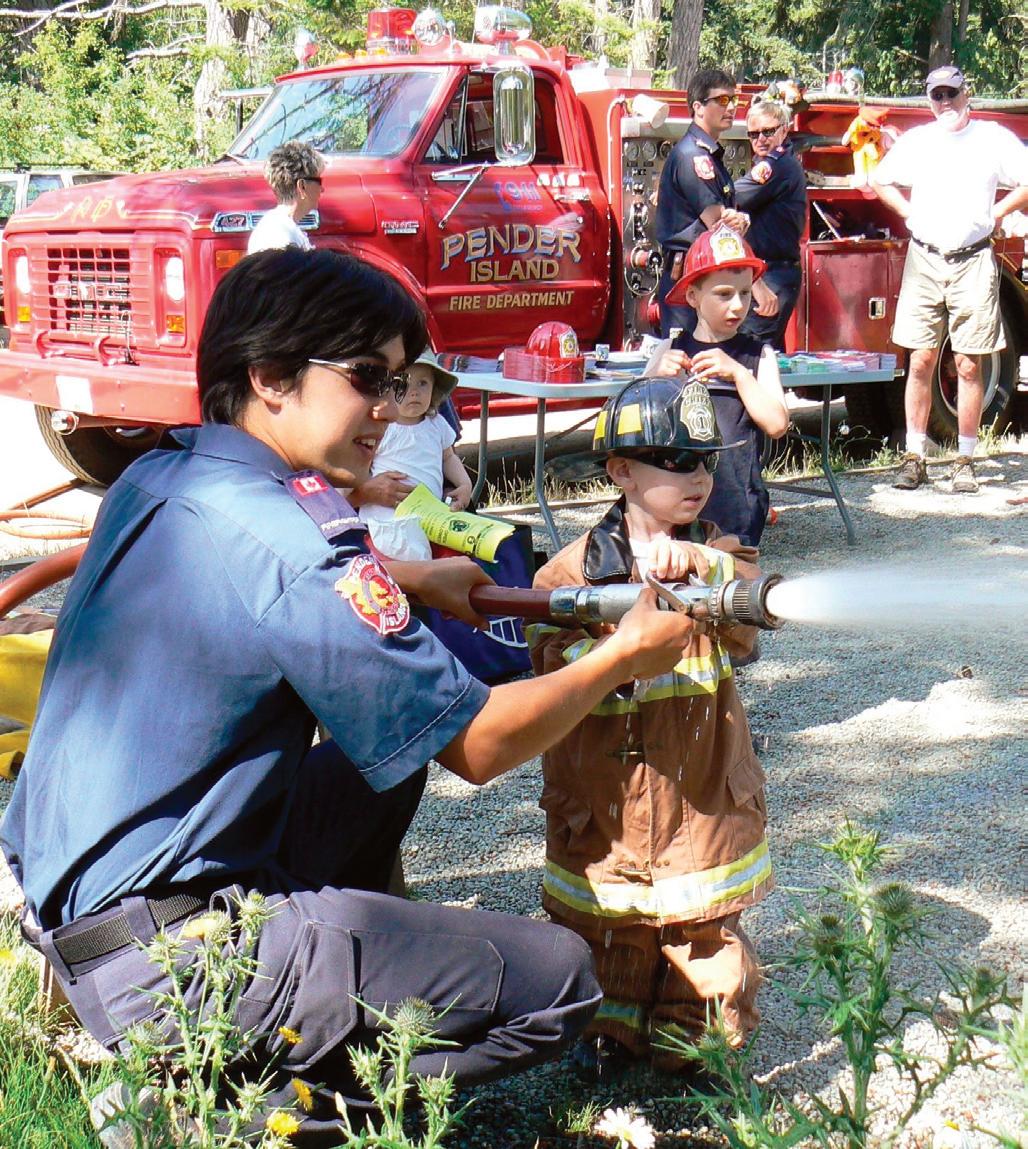
aBove: Pender Island’s youngest firefighter, Matt Kordyback, 19, becomes a fire prevention ambassador every Saturday at the farmers’ market. Youngsters, particularly those visiting from urban centres like Vancouver, just have fun while their parents get the message.
right: Pender Island Fire Rescue Chief Charlie Boyte returned in 2005 to lead the B.C. department, which at the time had just 14 active members.
management restructuring. He was an entrepreneur and businessman who offered superior organizational skills, great recruiting and interview skills and a clear understanding of values-based hiring.
“We needed to find a new way to do business and Deputy Chief Dine’s skill set allowed us to recruit more people, avoid conflict and achieve sustainability. The values of these recruits had to be consistent with those of the core group. Anything less would result in conflicts and dishonour the commitment of the core group,” the chief says.
“We realized we were sitting on a community full of experienced people from diverse backgrounds and we knew their skills would help us achieve a robust sustainable volunteer force.”
The final step was to analyze the complicated jobs members
Photo by
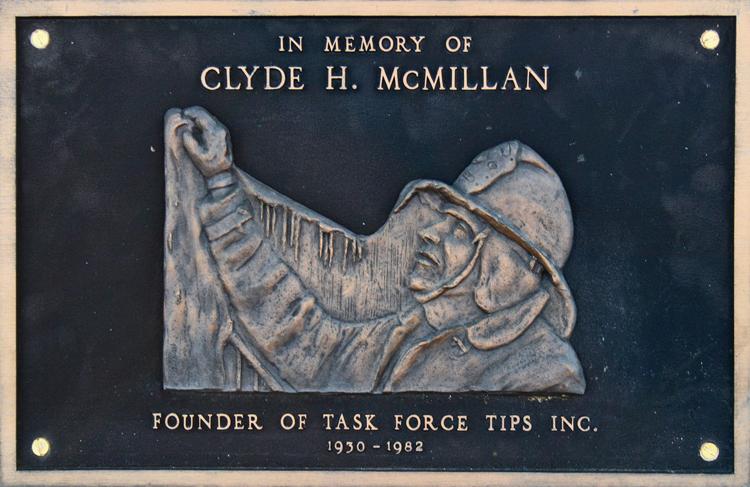
Task Force Tips’ founder Clyde McMillan invented the world’s first automatic nozzle 38 years ago. Aside from revolutionizing the firefighting industry by using the principle of automatic pressure control, the new nozzle also introduced the world to TFT — a Midwestern based company that was driven by a need to create and improve on products that would make life easier and safer for firefighters the world over.
That drive has lead the U.S. based company to design firefighting equipment that includes nozzles, monitors, foam equipment, valves, suction hose, adapters and more. With at least a third of TFT’s staff being professional or volunteer firefighters, the group has a working understanding of the needs and wants of the people who use their firefighting equipment.
Practical firefighting experience, along with listening and understanding the unique challenges facing the industry is what lead to the design and introduction of a new, unique, powerhouse of a portable ground monitor called the “Blitzfire” – a lightweight 500 gpm device with a distinctive, patented, blue finish. It is the first ever initial attack monitor for high flow interior and exterior attacks.
The best selling portable monitor allows “first due” firefighting crews to focus a blitz attack flow directly to the seat of the fire just moments after arrival. Its low attack angle gives operators the ability to “go in the front door” safely with high fire flow, and its 20 degree side-to-side and up to 50 degree elevation give it maximum maneuverability. If the unit destabilizes, its patented safety shut-off valve closes automatically – slowing the flow to near stroke end, eliminating possible water hammer. Another TFT brainchild is the PRO/pak, a portable foam eductor system ideal for small spills, extrication applications, and similar incidents. The PRO/pak idea was sparked by a crude prototype Carringer saw while visiting Germany. Some guy there had taken a water extinguisher, filled it with foam concentrate, duct taped an eductor to it, and used that to make foam. “I thought it was pretty cool, so I bought one, brought it back, and used it on a tire fire,” Carringer says. “Darn if it didn’t work. So I showed it to our engineering department . They said ‘cool.’ Took them a few months to design and build it. Today we have some 20,000 units in service, with instructions printed in something like six different languages.”
TFT’s purchase of Jaffrey Fire Protection Company was an attempt to fill a weakness in the firefighting community. “We picked up Jaffrey because we, as firefighters, knew that we were unhappy with the LDH equipment that was being produced at the time,” Carringer said. “Across the board, all LDH equipment was suffering from the same problem: Corrosion. You could put out the best product, but after it sat on site, corrosion would eat away at it in every case, every time.” “Coating is something we know a lot about,” Carringer says. “Hard coat anodizing, poly impregnation of castings and powder coating are TFT’s primary methods of retarding corrosion. “Our goal here is to never let aluminum and water touch. Period,” explained Bob Steingass, TFT director of research.
“When we applied what we already knew about coatings to our entire LDH line, it made all the difference,” Carringer said. With the addition of its LDH line, TFT can now handle water coming from a source to the truck, as well as everything from the fire truck out.
“People in the U.S have come to know us as this company that makes great nozzles – which we still do. But we also have great monitors, valves, adapters, Jumbo and regular BIVs, a whole new line of remote control equipment. We even make one of the only hard suction hoses in the world that doesn’t leak! TFT is so much more than just nozzles..”
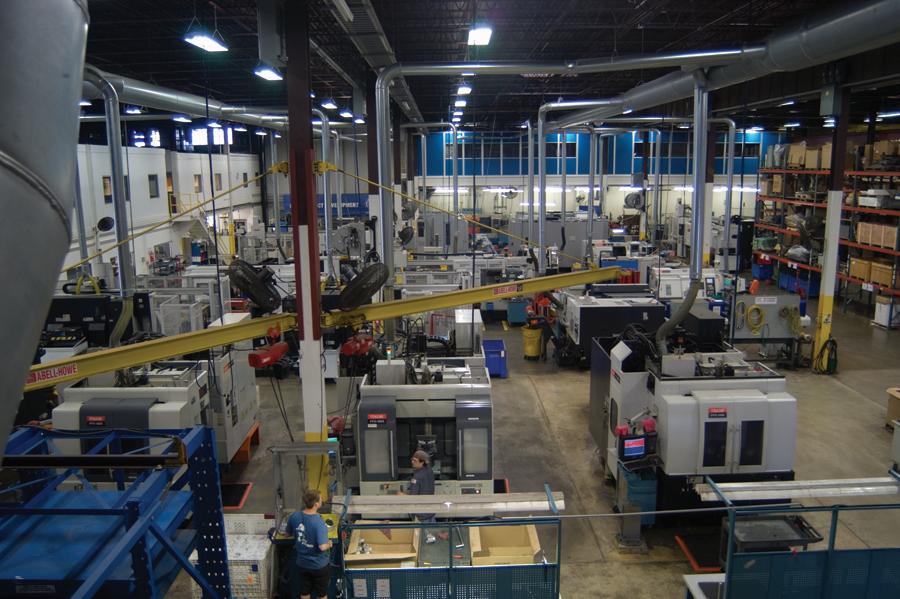
As the technology evolves, so does TFT’s workforce. Many of the 180 (+) employees are highly skilled technicians. The new equipment is computer numerical controlled (CNC) and digitally operated, with a heavy influence of automation and robotics. “The workforce is no longer made up of the artist machinists,” Carringer says, “We now have a group of very young, incredibly technically competent, computer-orientated workers out there.” TFT draws from the area talent pool, as well as regional vocational schools. While some businesses have faced reduction in forces during recent economic fluctuations, TFT has increased its labor pool by nearly five percent over the last year.
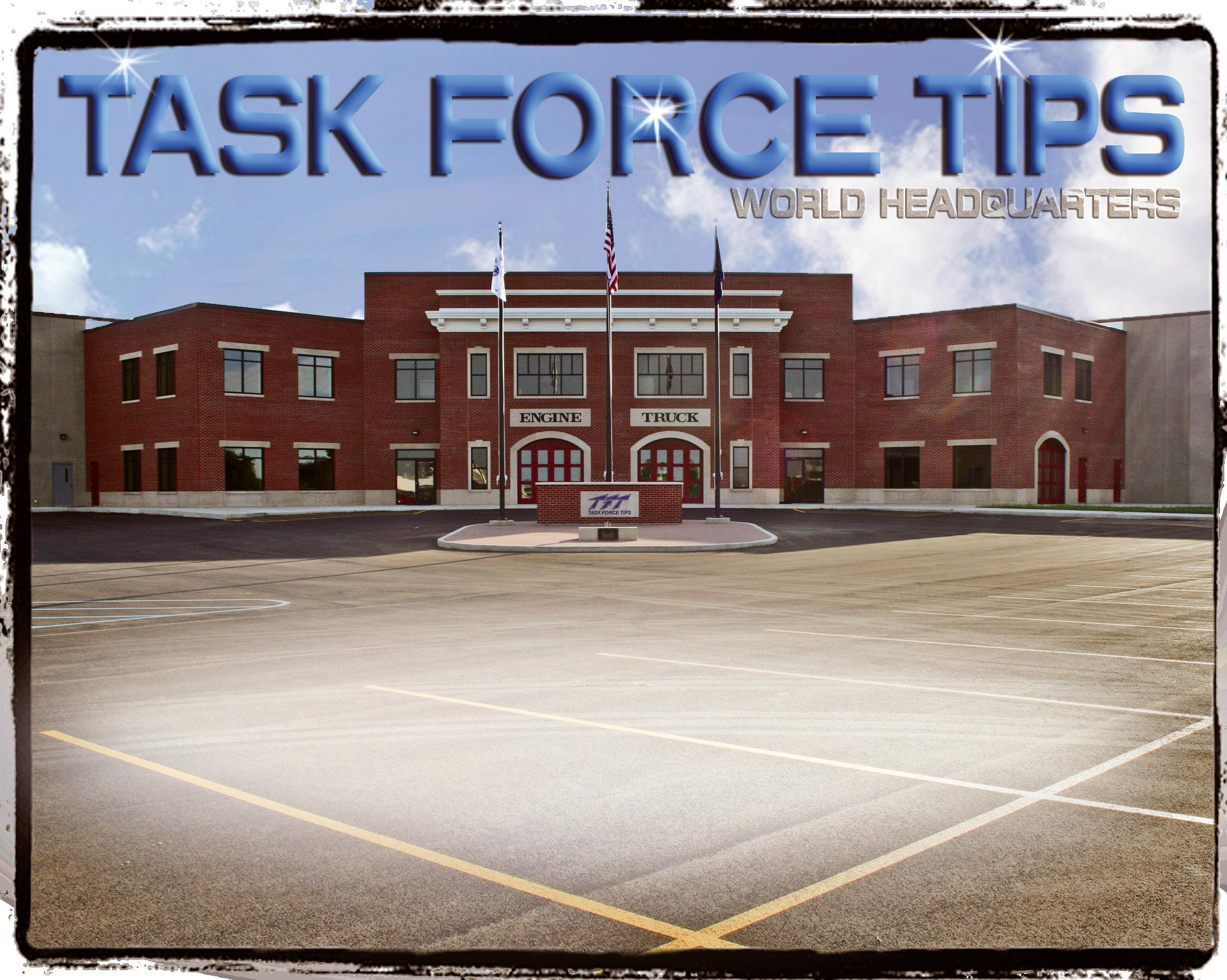
When Task Force Tips purchased an old Coke Factory sitting on 25 acres of land, they knew that they would someday use that building and land to grow. What they didn’t know was how quickly the Midwestern firefighting equipment supply company would nearly double in size and outgrow this new 40,000 square feet of warehouse.
Distribution partners and Firefighters are invited to join with Task Force Tips on Wednesday, September 16, 2009 at 9 a.m. when the doors of the company’s new World headquarters will officially open for business.
The building has been years in the planning – as well as over a year of construction. The new headquarters more than doubles the work area for the Midwestern firefighting equipment manufacturer. “It’s long been our dream to have our entire company housed under a single roof,” said Rod Carringer, vice president of sales and marketing. “This is the third time in our company’s history that we’ve expanded into a newer, larger facility. Since we’ve planned enough space to basically double our size from what we are now, we expect to stay here for some time – and, unlike before, we’ve allowed ourselves a lot of room right here where we can build and grow.”
The new facility adds 98,000 square feet of manufacturing space and 20,000 square feet of office space.
CNC and Robotic Production
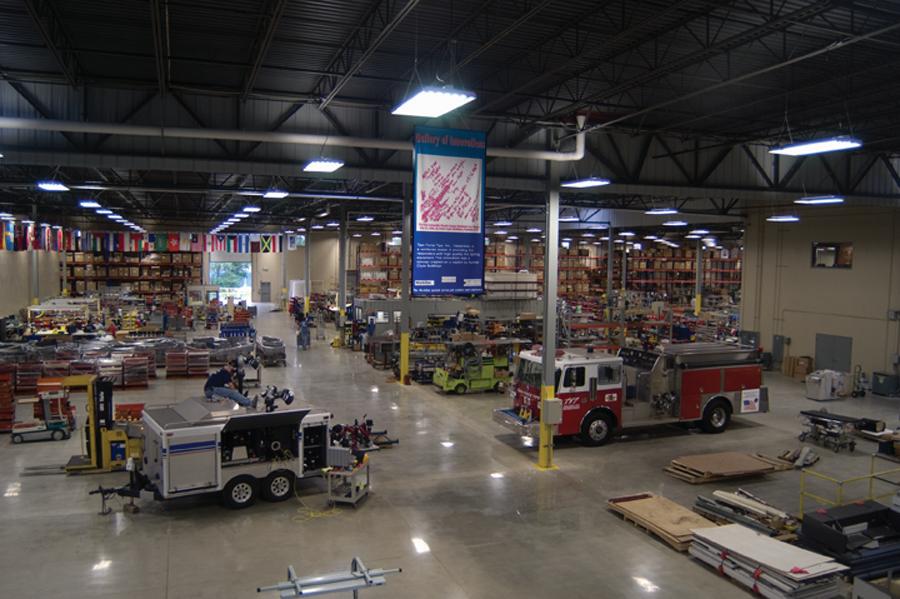
Assembly, Installation and Testing Area
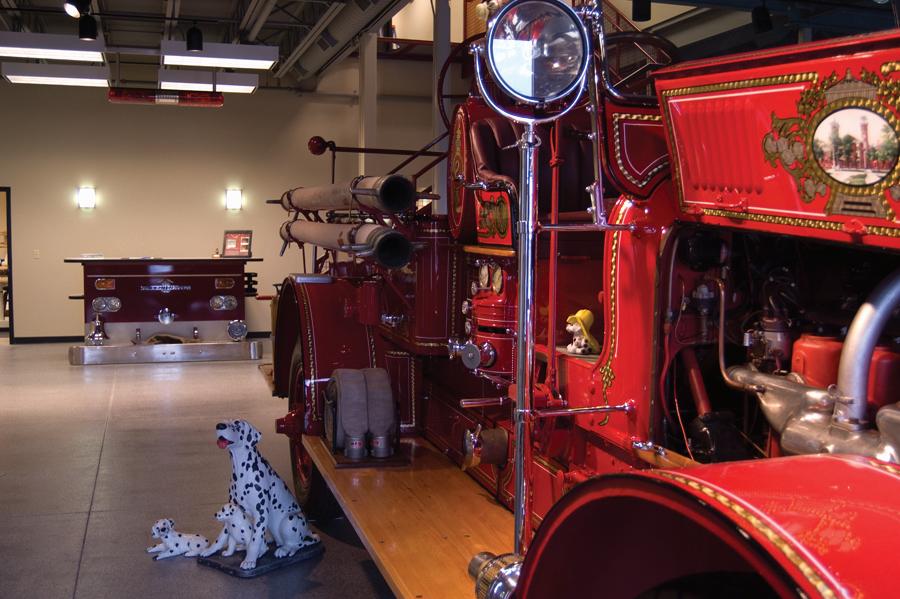
1923 Seagrave Pumper and American LaFrance Reception Desk complete with lights and working siren.
Pender Island B.C.
were being asked to perform and to look for opportunities to job share or job split. This would allow PIFR to implement a program of task-specific recruiting and tap into the broad range of skills available in the changing community.
With the stage set, Chief Boyte focused the management team on: Taking the load off the dedicated • core of volunteer firefighters and first responders by recruiting support from a broad range of skills and talents in the community; Recruiting new task-specific firefighters •
and responders;
And identifying a new spectrum of • potential firefighters from the changing demographic.
Deputy Chief Dine assumed personnel and training responsibilities and enjoyed great success recruiting volunteers to perform tasks that had been onerous for responders. And, with three fire halls spread across North and South Pender, 10 pieces of apparatus to maintain and more than 200 call-outs annually, it was not an insignificant challenge.
Hall maintenance, truck washing,
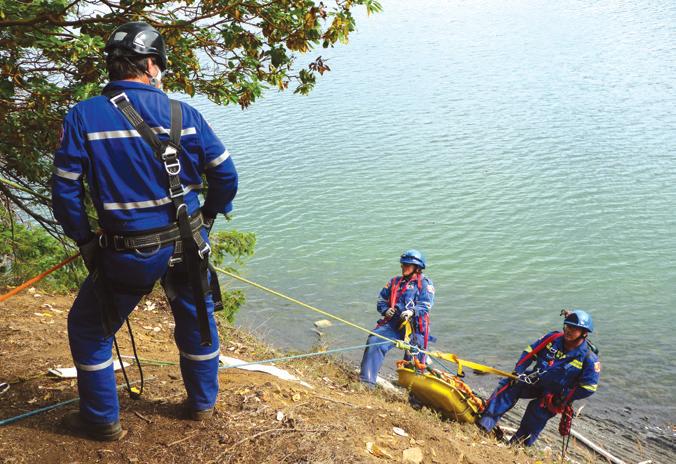
Because of the Gulf Islands’ steep terrain and ocean-side cliffs, rope rescue is a priority for Pender Island Fire Rescue. Firefighters (left to right) Rob Chatfield, Valerie Smith and Ikey McPhee perform technical high-angle rope rescue training on the bluffs above Medicine Beach.
AVAILABLE AUGUST 2009
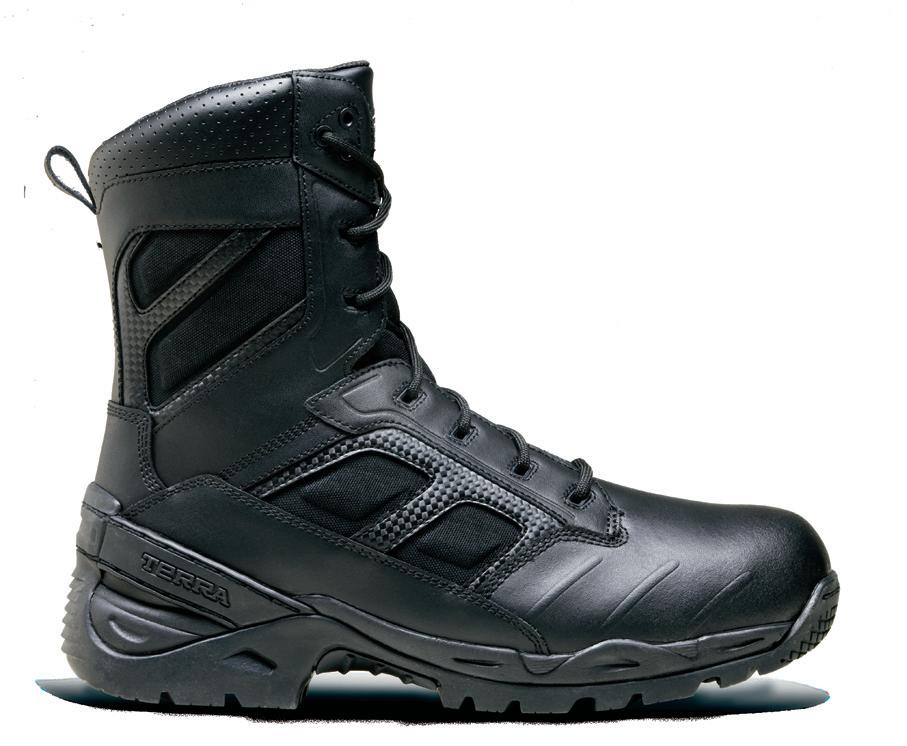
Seven decades of listening, learning and leading the way has made us CANADA’S AUTHORITY in Managed Footwear Programs, with Mobile and Retail locations spanning the nation. Visit www.workauthority.ca for locations near you.
inventory control, records keeping, meal prep, website development, public and media relations, grant application writing . . . the list of chores was long, but talented individuals in the community answered the call in significant numbers.
“We were recruiting a completely new type of volunteer . . . professionals and skilled retirees,” Chief Boyte says. “These people were talented, organized and offered insights that come with life experience.
“With their help we were educating a much broader cross-section of the community about the complexities of running a volunteer fire department and we were building community support.”
PIFR’s success in recruiting created a new dynamic. The core group, re-focused on delivering service excellence, was pressing management for training to support their goals.
“Quite frankly, volunteer training regimes in B.C. were forever shifting underneath us. The programs offered were not accredited and the validity of training was constantly being challenged.
“This left our volunteers feeling like their time was being wasted. We needed a training program that was robust, internationally accredited and based on standards that could not be reasonably challenged. So we formed partnerships with the surrounding departments and set out to deliver the NFPA 1001 level 2 Pro Board and IFSAC accredited program.
“By delivering training in a modular format, we were able to customize it to meet the needs of task-specific responders, get new recruits on the ground quicker and offer younger members the opportunity to achieve training valid almost everywhere in North America. The program met professional pre-employment standards and attracted recruits wishing to pursue a career in fire fighting,” the chief says. Canada’s BEST SELECTION of Premium Brand Footwear for Uniformed Professionals
Photo by n athan
Pierce Ultimate Configuration
It’s called the PUC—a short name for a tall list of design breakthroughs.
By John Phillips
Shorter, lighter, lower center of gravity, sharper turning radius, increased agility—it sounds like a to-do list created by engineers from a major auto manufacturer. Except this isn’t a passenger car or the latest crossover SUV. It’s Pierce’s new PUC, an acronym for Pierce Ultimate Configuration.
The PUC isn’t a single piece of hardware, nor a lone accessory. Rather, it’s a whole new vehicle layout—a bumper-to-bumper rethink— that allows fire-and-rescue apparatus to carry more equipment on a smaller, more maneuverable, pump-and-roll platform.
The patent-pending PUC design begins with the pumphouse. Traditional pumps are mounted amidships, driven by a split shaft off the transmission. That has always meant that four or five feet of real estate was consumed just by the pumphouse. The PUC’s pump, on the other hand, is driven off the engine’s flywheel—a rear engine power take-off. That, in turn, has allowed the pump housing to be moved far forward, above the frame rails and under the cab’s seat-box area.
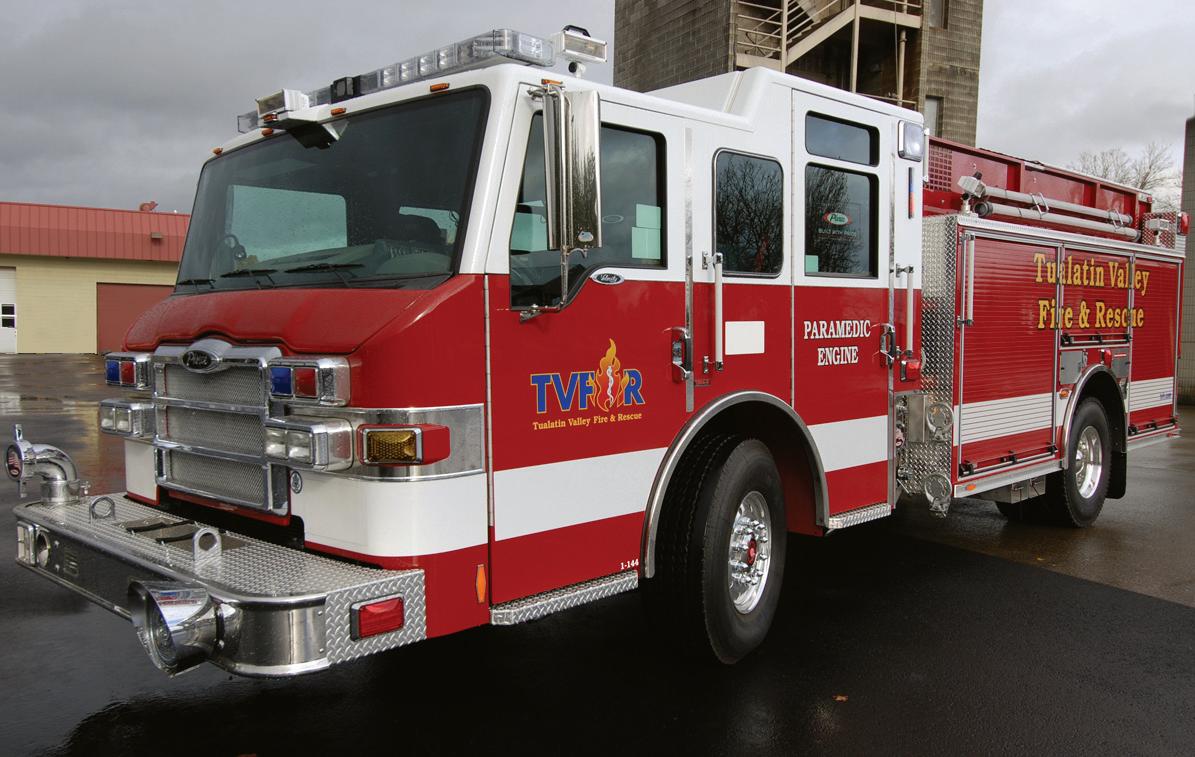
“The pump drive system is simple,” says Kevin Day, Fleet Services Manager for Oregon’s awardwinning Tualatin Valley Fire and Rescue, “and it eliminates the need for additional drivetrain components used in traditional transfer-case designs. It saves weight, reduces drivetrain stress and, theoretically, reduces fuel consumption during pumping operations.”
Day’s department, having purchased their first Pierce product in 1980, now operates a total of 80 response vehicles serving 418,000 citizens. The department’s Apparatus Committee, consisting of AOs, firefighters, officers and mechanics, has
overseen the purchase of nine PUC pumpers. Six units have been delivered; three of those have already been introduced into service. Three more PUCs are scheduled for delivery next spring.
Moving the pumphouse forward and downward accrued other benefits. For one thing, the pump’s position lowered the truck’s center of gravity, which made for more nimble handling. “As urban density increases, and streets and cul-de-sacs become more congested,” says Day, “maneuverability is a real consideration.”
The far-forward pump also freed up as much as 30 percent extra storage space—up to 500 cubic feet—while simultaneously reducing the pumper’s wheelbase by as much as 18 inches. Day says his current 187-inch-wheelbase PUCs can carry more gear than the 212-inch-wheelbase pumpers they’ve replaced. “All of our medical equipment can now be located in one compartment,” he points out. “If the unit carries a full complement of extrication tools, we can now place it in the compartment more ergonomically for the crews.”
The PUC is designed for easy maintenance. All of the pump’s plumbing and valving are mounted on top. “Accessibility is greater than any of our previous pumps,” Day says. “The time it takes to access valves and connections has been significantly reduced.” Because all Pierce pumpers have tilt-forward cabs, access is superb. “Any maintenance or repair can be performed at ground level, rather than on overhead lifts,” he adds.
On traditional pumpers, the area reserved for crosslays was usually atop
the pumphouse. But with the PUC’s pump moved forward, the crosslays have been relocated between the cab and the truck’s body, and they’ve been lowered to chest height. “Lower crosslays are easier to shoulder and easier to reload,” Day notes. Ladders, stokes baskets, and backboards are also far lower, as is the hosebed.
“Firefighters risk injury to their knees and backs when shouldering a hose load and stepping off the tailboard,” Day continues.
“The PUC body has a hosebed height nearly 11 inches lower than our previous pumper’s body. We anticipate that most of our firefighters should be able to shoulder the load from the ground.”
What’s more, the PUC’s pump uses a large clutch that electrically engages the impeller, so putting the pump into gear no longer induces that awful grinding. And it’s a quick two-step process. “The apparatus engineer need only apply the parking brake and activate the pump drive,” Day says.
Pump panels are available in side-or top-mount positions, with the operator standing next to hose connections instead of over them. “The inlets and discharge ports are low and easy to connect,” Day adds, “and the pump panel is laid out in an intuitive manner, with easy-to-use controls. In addition, the pumper’s exhaust stack is vertical, directed up and away from ground level operations, which also reduces noise at the pump panel.”
All PUCs are true pump-and-roll designs, crucial for fighting a moving wildfire or for when you simply need to reposition the pumper for a better angle of attack. Since its introduction 18 months ago, the PUC has already accounted for more than 200 new Pierce orders. It is available on all Pierce custom chassis.
John Phillips has been writing about cars since 1974, is the author of two books, and has been an editor at Car and Driver for 20 years.
partners in prevention
municipalities Band together to reduce costs
By Kevin foster, fire chief, midland, ont.
Something that originally seems to be a problem can turn into a challenge and, ultimately, an opportunity. That was the case in the late 1990s when municipal restructuring occurred in Simcoe County, Ont.
The Township of Tiny Fire Department had used a local shopping centre for delivery of its public fire education and life-safety information programs. When municipal boundaries changed, the shopping centre was no longer part of the municipality and options had to be considered. Members of the fire department prevention divisions from Midland, Penetanguishene, Tiny and Tay began to discuss the need for a united and common message to be delivered to all residents.
The Town of Midland is primarily an urban community with a composite department; Penetanguishene is a mix of urban and rural and is primarily serviced by volunteer firefighters; the townships of Georgian Bay (which joined in 2004), Tay and Tiny are primarily rural-type municipalities with many seasonal residents, each with predominantly volunteer fire services.
During the discussions it was suggested that the departments could work together at public education to ensure all residents receive the same fire safety messages; this also would allow departments that didn’t have appropriate venues through which to provide public education an opportunity to get the message out.
The group, led by then-Tiny Township Fire Chief Paul Ryan, approached the other chiefs about the potential to work collectively in this area and with the support of all, Partners in Prevention was born.
During Fire Prevention Week in 1997 the partners worked together at public events and shared media coverage and staff to work at the events. The first year proved very successful and it was decided to work together on public education in the future.
Over the next several years the group expanded its role and its resources. In 2000-2001 the partners embarked on an ambitious plan to buy a fire-safety house. With the support of the municipal councils and various community organizations, the group raised sufficient funds to unveil the fire-safety house during Fire Prevention Week in 2001, followed in 2003 by a vehicle to move the fire-safety house and in which to store educational materials and other supplies.
This year, Tay Township co-ordinated the purchase of a digital fire extinguisher training system on behalf of Partners in Prevention. The partners have also expanded the scope of the group to include the public education aspects of the municipal emergency management programs.
Each year the group has a booth at an annual spring home
Partnerships among departments have led to shared training and other initiatives that have saved time and money.
show in Midland and shares the staffing of the booth. The Township of Georgian Bay took the lead on that project this year and designed a backdrop and a sample emergency preparedness kit. Fire safety and emergency preparedness information is distributed to the public and there is a free raffle for prizes associated with both topics.
The year 2003 was important for a number of reasons; not only did the group buy the public education vehicle, it also introduced a SAFE Baby program and a new initiative dubbed Operation Co-operation to look at other opportunities to work collectively.
The very successful SAFE Baby program provides families with babies born at Huronia District Hospital with a smoke alarm
Photo
Firefighters from several Simcoe County departments participate in joint recruit training.
for the baby’s nursery and fire-safety educational material. Partners in Prevention received support from the hospital; an early years challenge fund grant through the Ministry of Community, Family and Children’s Services; generous donations from Management and Training Corporation (operator of the local corrections facility); and a purchasing arrangement with American Sensors fire alarms. In addition, when families need help to install the smoke alarms, the local fire department does so.
Operation Co-Operation started as an invitation from Chief Ryan (who has since become chief in Penetanguishene) to chiefs of the Partners in Prevention departments to a networking opportunity (and lunch) to discuss common issues and challenges. The group now meets about every six weeks and discusses labour relations matters, recruitment, training, equipment needs, apparatus and equipment maintenance and other issues. Training and recruitment have been the focus for the last several years. Some departments were just completing volunteer firefighter recruitment and decided to jointly conduct their recruit training programs. The initial program proved successful and at subsequent meetings the group developed a complete volunteer firefighter joint recruitment program and, ultimately, a volunteer firefighter recruit training program that now involves all five departments.
Chief Randy Smith from Tiny Township co-ordinated the recruitment program. It consists of a recruitment guide and newspaper advertising, an orientation session, written and physical evaluations conducted collectively before interviews, and a final selection process. This approach has saved significant time and money for each department.
The recruit training program has been a key success story. After a delivery of the initial recruit training program the administration and management portions were overhauled. Now the program is co-co-ordinated by Chief Ryan and Midland Fire Department Capt. Mike Gagnon. Each member department provides instructors and support personnel for training who are assigned responsibility for specific portions of the program. The program has provided the initial training for about 100 volunteer firefighters over the last four years and each training program culminates with a day of live fire training at the Ontario Fire College. The program has enhanced the quality of the recruit volunteer firefighter and resulted in significant time and cost savings for each of the municipalities. Training initiatives also include live fire training for experienced firefighters, ice/water rescue, pump operations, firefighter survival and rapid intervention teams.
Although the volunteer firefighter recruitment and training programs are the primary successes of this group there have been initiatives in equipment maintenance, testing and purchasing. For example, no one in the group uses much foam but it was recognized that there are significant risks in each of the communities where a larger supply of foam could be beneficial, so the group bought a stockpile of foam to be housed in a central, accessible location. As each department only uses one or two pails annually, this is a cost-effective means of regular stock rotation. The departments have recently bulk purchased PPE to save some money and are exploring the joint purchase of SCBA and spare cylinders.
The departments share the scheduling and organization of annual apparatus pump testing, ladder testing and vehicle rustproofing. One department takes one item and schedules it for all the departments, again saving time and money.
It’s unlikely that these concepts are unique to this group. Considering the economic times, it is important to show the political and senior administrative levels that as the fire-service leaders we are cognizant of the fiscal realities and are an example for other municipal groups to follow.
Redwood Meadows Alta.
Innovative invention
necessity led to creation of do-it-yourself poWer siphon
By roB evans
Nestled in the foothills of the Rocky Mountains, 20 kilometres west of Calgary is the Townsite of Redwood Meadows. The Townsite is protected by a crew of 25 paid on-call firefighters, led since its inception in 1978 by Fire Chief Ed Bowen.
The department serves an area about of 160 square kilometres including part of the Trans-Canada Highway and three busy provincial highways. The area is mostly a rural, bedroom community with a small amount of commercial development and a steady population of about 5,000. The population triples on weekends and holidays with tourist traffic.
The department provides fire, rescue and a BLS first-response service throughout the district that includes the Townsite of Redwood Meadows, part of the Municipal District of Rocky View #44, the Kananaskis Improvement District and the Tsuu T’ina First Nation. More than half of the members are cross-trained as either EMRs or EMTs.
The department responds with a 2009 Kenworth Pierce Contender 1050-gallonper-minute/1,000-gallon/30 Class A, a 1992 International Navistar 1050-gallonper-minute/1,000-gallon pumper, a 1976 Hendrickson 1250-gallon-per-minute/700gallon/54-foot Squirt pumper, a 1981 Ford 500-gallon-per-minute/2,500-gallon tanker, a 2009 250-gallon-per-minute/300gallon rapid response truck, a 1996 Ford ambulance converted to hold the department’s hydraulic rescue tools and a 1997 GMC pickup.
The department responded to 302 calls in 2008. Due to regional dispatch from Calgary, many of the calls involve joint responses with Calgary, the municipal district of Rocky View or the Tsuu T’ina Nation with the computer-aided dispatch system recommending the closest, most appropriate apparatus for response.
Since 2002 Redwood Meadows Emergency Services (RMES) has attempted to host a yearly tanker shuttle training exercises involving its mutual-aid partners from all over the Calgary area. This full-day of training allows fire crews to interact with each other, learning different techniques involving transporting water under a controlled non-emergency environment. Unfortunately, due to flooding emergencies and other uncontrollable conflicts, the exercise has been cancelled a couple of times in the past four years. The importance of the training is not lost on the department’s training officer.
Deputy Chief George Low, training officer for RMES says, “Because a significant portion of our response area lacks hydrants, water supply is a serious concern. We train regularly on rural water supply strategies and conduct a tanker shuttle exercise where our mutual-aid partners train with us to maximize our efficiency.”
During training in 2002, Low saw a need for a simplified means of transferring water from one portable tank to another.
Low explains, “We learned quickly that a key to minimizing tanker waiting time and congestion at the location of the fire is the use of multiple portable tanks.
“A skilled pump operator can, through the use of power siphons, continuously flow a large amount of water while drafting from one main tank.”
However, it was apparent that large, 125-millimetre suction hoses used as power siphons were cumbersome with limited personnel. During a water-supply crisis there are few lengths of hard suction available for such use. There was a second problem, as well. While RMES uses rigid
ABOVE: Redwood Meadows firefighter Russ Innes watches over a siphon during a tanker shuttle training exercise.
LEFT: Two siphons can be made in just over an hour. This angle shows the 38-millimetre outlet side.
Photo by Jason l ow
Photo by r ob e vans
metal-framed portable tanks, some of its mutual aid partners use soft-sided tanks with floating collars.
“We found that a length of hard suction, when feeding from one tank to the other, caused the self-supporting tanks’ walls to collapse. We tried a number of methods to prop up the hard suction to prevent this. While some methods worked better than others, all took time and manpower to implement,” says Low.
DC Low and Lt. Jim Evans (retired) came up with a simple and relatively inexpensive version of a power siphon using 150-millimetre (six-inch) PVC piping.
All that is needed to build a siphon is about 2.5 metres of straight pipe, three 150-millimetre 90-degree elbows, one 38-millimetre 45-degree elbow with NPT end, one 38-millimetre 90-degree elbow, a short (about 60 centimetres) piece of 38-millimetre PVC pipe and a NPT-tofire-hose thread adapter. Of course, the necessary glue for the PVC is required also. Building one siphon should come in just under $125 and could be less if your public works department has any leftover PVC that you can use for the project.
First determine the distance you will require between the tanks and cut a straight piece of pipe that will go between two of the elbows. RMES used a 30-centimetre piece of pipe, which gives lots of room between the tanks when they are set up in a diamond formation.
Then, measure the depth of your tank and cut the outlet part of the siphon. RMES’s three portable tanks are all 80 centimetres deep so we used a length of 60 centimetres for the straight-down part.
When cutting the pipe for the inlet side of the siphon remember that the elbow adds 15 centimetres of total depth that brings the siphon to the top of the tank.
Now, you should have a horseshoe of PVC pipe, with the outlet being slightly longer than the inlet side.
Prepare the inlet 150-millimetre elbow for the 38-millimetre power part of the siphon. Cut a 38-millimetre hole in the side of the elbow and then insert the short piece of 38-millimetre pipe (about 10 centimetres). Once this is glued in place with half inside the 150-millimetre pipe and half outside, position the 90-degree elbow and glue in place so the water flow will go “up” the siphon. When this is complete glue the 45-degree elbow with the NPT end to the outside of the pipe and attach the NPT-tofire-hose thread adapter. To prevent turning of the 38-millimetre inlet a small L-bracket can be screwed into the 150-millimetre elbow and attached to the 38-millimetre for extra strength.
ABOVE: This angle shows the power part of the siphon’s 38-millimetre inlet.
RIGHT: A closer view of the 150-millimetre inlet along with the 38-millimetre power part of the siphon showing the L bracket used for additional strength.
Finish the siphon by attaching the prepared 150-millimetre inlet to the inlet side of the horseshoe. RMES let the siphon sit until the next day before testing.
Low says, “They are inexpensive to build and are lightweight and effective.
“Two are stored on the top deck of our tanker, and a number of others are kept at the fire hall for quick deployment during a water shuttle. Because they are rigid, they don’t cause the soft-sided tanks to collapse.
They are dedicated to this purpose and free up the hard suction for its intended use (at the draft location).”
For more information on the siphons contact Deputy Chief George Low at 403-949-2012 or george.low@rmesfire. org or Deputy Chief Rob Evans at 403-949-2178 or rob.evans@rmesfire. org. Also look for more photos at www.rmesfire.org.
Photos
Photo by: Matt Hayes
tanker tale
thinKing Way outside the BoX gets department an ideal trucK
By Jeanine caldBecK, fire chief, thetis island, B.c
Thetis Island, B.C. – Back in 2006, our 1972 Dodge Fargo ex-fuel tanker (split shift, no power steering) was more than 35 years old and was touchy to drive, overweight on our 18 per cent grades and easy to roll over.
We were having trouble getting parts for the tanker and sought funding from our improvement district for a replacement. We have a very small tax base and two other apparatus were also overdue for replacement so funding was limited.
Eventually, in late 2006 the Thetis Island Volunteer Fire Department was allotted $35,000 for a replacement, after we successfully argued that we could not do much with the initial amount offered. (Our community is very conservative and will not borrow money.)
A fire-department committee was formed to come up with a plan that would suit taxpayers and fulfil the needs of the department, one of which was that the truck had to be driveable by anyone, including senior citizens. This meant that it had to have automatic power steering, hydraulic brakes and a low centre of gravity.
After much research and creative thinking we opted to buy a suitable, used chassis and have a tank built to our specifications.
Deputy Chief Graeme Shelford researched the proper chassis for our needs. A GMC T6500, which provided the bonus of good driver visibility, was eventually found near Baltimore, Md. It was being used as a Ryder truck rental.
We contacted the Laurel Volunteer Fire Department down the road from the Ryder used truck sales lot, and asked if anyone was willing to go and kick the tires before we committed to the purchase. Not only did a Laurel captain kick the tires, he test drove the vehicle, crawled under it and thoroughly checked out the engine. On his recommendation that it was a solid truck for the asking price, two Thetis Island members (Capt. D. Tarris and myself) flew to Baltimore in mid-December 2006 and purchased the 2000 GMC T6500 (Caterpillar engine).
More than 5,000 kilometres later, through snow and hail storms, many turnpikes, much bad coffee and fast food, and unbelievable red tape, the truck arrived on Thetis Island in late January 2007.
We had contacted a local retired aluminum fabricator, Geoff Howard in Duncan, B.C., who had years of experience building coastal aluminum water craft, and he was excited to build the tender for us in his workshop in his yard. We agreed on a price and delivery date with a handshake to seal the deal.
The overall design was our own, and Howard designed the tank to keep the lowest profile possible, with NFPA standards as the template.
Howard bought the truck box from us and reduced the price accordingly. He shortened the chassis and when the baffled, 1,000-imperial-gallon tank was fabricated and mounted he built the deck in front of it to store the drop tanks and other equipment.
He also built four storage lockers for two portable pumps, a
Before: The original Ryder truck with the GMC T6500 chassis that the Thetis Island Volunteer Fire Department bought and transformed into a water tender.
After: The water tender, which meets NFPA standards and features an automatic transmission, power steering and excellent sight lines, cost $40,000 including the trip to Maryland to pick it up.
portable lighting generator, and flat three-inch and four-inch hoses for water transfer, which were hung below the tank in front of the tires, keeping the profile of the vehicle low for great visibility to the rear.
We scrounged dusty cupboards of the fire departments in Popkum and Sahtlam, B.C., for old equipment including lights and a siren. An aluminum storage box was purchased on sale from Costco and mounted on the deck to store our manifold and other sundries. With funds low, we fabricated wooden stakes for the sides of the deck. We are probably the only fire department to have an operational fire truck with wooden sides!
We purchased an off-the-rack Ziamatic dump valve for the rear and had Howard make a chute so that we can dump the water to either side as well as to the rear.
To give us pump-and-roll capabilities we purchased a cranberry bog high-volume pump and plumbed it into the bottom of the tank so we can tandem pump as well as dump.
Although the end result looks more like a live shrimp transporter than a fire truck, we are extremely happy with the vehicle.
Safety was our foremost concern and this apparatus has met all our requirements of a low centre of gravity, an automatic transmission and hydraulic brakes, as well as the bonus of having excellent 360-degree visibility for the driver.
We were able to sell the old tender to a consortium of volunteer departments near Prince George as a stand-by tanker for wildfire, which also reduced our costs.
The new tender was put in operation in July 2007 and came in under $40,000 all in, including the airfare and bad coffee.
Pender Island B.C.
Recruiting from the changing demographic created a new pool of volunteers outside the typical 18 to 40 recruiting envelope. These were physically fit people – male and female, younger and older. To integrate this diverse new group of volunteers the applicant screening process was revamped to a “values-based” hiring system.
“PIFR’s enhanced hiring criteria included typical screening processes such as criminal records checks, drivers’ abstracts, interviews and reference checks. Added to this was a new focus on values and ethics. Conduct expectations were now clearly stated and each new member was required to sign an oath to honour PIFR’s standards,” the chief says.
“In small communities across Canada the only affordable way to provide comprehensive fire and rescue serviced is with a volunteer force. And, the best way to make it sustainable is to build it on a values-based foundation.”
Today, PIFR has 84 volunteers – men and women, from all walks of life, 16 to 60, working together with minimal conflict, embracing change. On the frontline where the need was greatest, the number of active, pager-carrying responders has jumped to 47 from 14 in 2005.
“Best of all, now we are able to provide a broader range of services to our community,” Boyte says, ”including fire prevention education, fire suppression, rope rescue, vehicle extraction and first response in medical emergencies. And, we are doing it with a renewed sense of purpose, pride and honour.”
Brian Kieran is a PIFR volunteer assisting with community and media relations. For more information about PIFR go to: www.penderfire.ca
Over -engineered?
She sure doesn’t think so.
All she knows is her husband came home safe and sound That’s all that mat ters to her and to Dräger Where safet y is ever y thing and exceptional engineering is standard
That’s why our new PSS® 7000 SCBA doesn’t just meet NFPA standards, it exceeds them. In fact, af ter a series of rigorous comparison tests conducted by the Phoenix Arizona Fire Depar tment, the Dräger PSS7000 was judged the best of all SCBAs on the market The competition wasn’t even close
To see the details of the Phoenix test, visit www.draeger.com/scbaChallenge. For more information, contact your local Dräger fire ser vice representative or call 1-877-372-4371
The PSS7000 – Re-engineered from the ground up, we took no shor tcuts in developing the most ergonomically designed, easiest-to-use and easiest-to-maintain SCBA ever It’s packed with features including :
• Fully adjustable back-plate design
• Durable rubber harness (500% more abrasion resistant than cloth)
• Five-second cylinder change out
• Active CBRN protection with 360° second-stage rotation
• Waterproof internal Heads-UP Display
• Dual voice amps
• Sentinel 7000 – Dräger’s third-generation PASS technology with more than a decade of proven per formance
Ingleside, ON
composite and creative
department focuses on paid on-call staff to maintain morale
By gord schreiner, fire chief, comoX, B.c
Comox Fire Rescue on Vancouver Island, B.C., serves a population of about 20,000. The department has evolved into a unique, innovative and dynamic emergency service organization that places a high emphasis on fire prevention and the safety and training of its members. It responded to more than 600 emergencies in 2008, about half of which were medical calls.
Comox works closely with the Justice Institute of BC’s fire and safety divisions and operates a regional training centre at the station. The training centre is staffed by a combination of full- and part-time members and is regularly used by other departments, including some from neighbouring Alberta.
Comox Fire Rescue has five full-time staff and 40 paid on-call staff. The full-time staff work a creative schedule that includes evenings and weekends when access to training is in demand by the paid on-call and volunteer firefighters who typically use the centre.
Comox has been heavily involved in training for many years and boasts some impressive numbers. Forty-two of its 45 members are certified to NFPA 1001 Level I with most having Level II. Thirty members are certified fire-service instructors. Twenty members are enrolled in the Justice Institute’s fire officer program, with two of those members completing fire officer IV and another two soon to complete this final level. Comox has several instructors who can deliver a variety of courses.
“The fact that we operate a training centre, which includes a live burn building, not only increases our own level of training but it has greatly increased our team’s morale and operational readiness,” says Chief Gord Schreiner.
“In addition to this, because we offer so much training here, our members have convenient access to this training and can
upgrade their training much easier than in other departments. I try not to limit the level of training our members get. We do all this with a fairly modest budget.”
Comox’s success is evidenced by the fact that two of its paid on-call captains have recently left to take on full-time chief officer positions in other, larger departments. These vacancies were quickly filled by two very capable lieutenants who were promoted within the department.
Comox has developed several programs and initiatives to keep its paid on-call firefighters happy and productive. Several times a year the department has social functions (many of these funded through the operating budget) designed to include families and support the firefighters. These include an annual banquet, a Mother’s Day breakfast, a Valentine’s dinner (a big hit) and a family day. It also has a monthly crew dinner and regular prize draws in which firefighters receive appreciation gifts from the department. A range of corporate
clothing is given to the firefighters including dress and station uniforms, track suits, golf shirts, hats, jackets and hoodies. Firefighters and their significant others are given free annual fitness passes. As part of their comprehensive training schedule, each crew is scheduled to go to the fitness centre once a month for an hour.
“We spend a lot of time ensuring we are meeting the needs of our paid on-call staff in terms of the training they require or want,” Schreiner says. “We give them above-average equipment and we ensure we have staff here, when they are, to deal with any little problems they might have. Our full-time staff is here to not only meet the needs of our citizens but to ensure our paid on-call firefighters are happy, healthy and have the skills and tools they need to do their jobs.”
Comox Fire Rescue boasts many other successes including managing five, five-day firefighter youth camps over the past few years. It has developed an outstanding
Comox Fire Rescue on Vancouver Island focuses on training and holds lots of social events to keep members engaged, active and interested.
Having a training centre including a live burn building has increased morale and operational readiness for the Comox Fire Rescue.
training area that includes a seven-room, concrete live-fire building, two training towers, several natural gas props, a pumper test pit and a host of other props.
Several of Comox’s members work as part-time instructors for the Justice Institute’s fire and safety division.
Comox Fire Rescue has done a lot of work in the area of firefighter rehab and medical assessments. All firefighters
visiting the training centre must meet acceptable medical standards that include blood pressure, pulse, temperature and O2/ CO level before they can participate in physical training exercises.
“While we haven’t figured out a way to train our firefighters any quicker yet (it takes about two years to achieve firefighter certification) we are pleased that we typically have a waiting list of solid individuals who are
The bridge to your future
SHOR T & LONG TERM COURSES
•MUNICIPAL FIRE FIGHTING
• HAZARDOUS MATERIALS RESPONSE
• INDUSTRIAL FIRE FIGHTING
• CONFINED SPACE ENTRY/ RESCUE
• INCIDENT COMMAND SYSTEM
• CUSTOM TRAINING TO MEET SPECIFIC NEEDS
• PRE-SERVICE FIREFIGHTER EDUCATION and TRAINING CERTIFICATE PROGRAM
• FIRE SCIENCE TECHNOLOGY DIPLOMA PROGRAM
FIRE & EMERGENCY RESPONSE TRAINING CENTRE
Sarnia,ON,Canada
1-800-791-7887 or 519-336-4552, ex t 21 • Fa x : 519-336-4537
e m a i l : c a ro l @ l a m b t o n o n c a • www.lambton.on.ca/fertc
interested in joining us,” Schreiner says.
“That is much different than the current trend where smaller departments like us are constantly looking for new members. I believe this is largely because we care so much about our firefighters and treat them accordingly.”
For more information contact Chief Gord Schreiner at firehall@comox.ca
Renowned Quality You Can Trust
Our full line of analog and digital radios includes P25 compatible mobiles and portables. All Kenwood radios meet strict military and IP54 standards, and many have trunking capability, AVL and other options.
The NEXEDGE™ two-way radios are not only military-tough for today’s demands, you can easily migrate from analog to digital performance in the future. Features and options include: Caller ID, GPS , digital encryption and emergency alert. All of our radios feature world-renowned Kenwood audio.
Call today and let Kenwood’s renowned quality work for you.
move ups
department leverages technology to manage response costs
By Karin marK
When the City of Surrey, B.C., ordered across-theboard cuts this year to help defray a $7.5-million deficit, Surrey Fire Chief Len Garis already had a valuable tool in his arsenal.
British Columbia’s largest composite fire department, Surrey Fire Service, has been using an automated planning tool since 2007 that enables move-ups – the practice of temporarily moving resources to provide emergency coverage when and where it is required.
It’s a different approach than the costly tradition of providing full standby fire coverage for all areas at all times and backfilling stations even when the chance of a call is minimal.
“Move-ups are about placing your resources in the right place at the right time,” Chief Garis said. “As I’ve said before, it’s like Gretzky’s approach – being where the puck is, instead of chasing the puck.”
The Live Move-Up Module (LiveMUM), developed by Deccan International (www.deccanintl.com/), uses real-time and historical data to calculate the probability of emergency calls in a particular area at a particular time.
The benefits for SFS have been two-fold. First, LiveMUM enables the department to dynamically manage its career resources and maintain a high level of coverage while minimizing downtime.
The department has also been able to achieve significant costs savings for callback of volunteer firefighters. Analysis of static data showed that in 2002, prior to LiveMUM, volunteers on callback were used just 48 per cent of the time. Using real-time data from LiveMUM, SFS was able to increase the use rate of volunteers on callback to 87 per cent in 2008 – a 39 per cent increase.
“We can make these strategic decisions because we have the tools, and we can have some confidence in those decisions due to Bayesian probability,” Garis noted.
■ how livEMuM woRKS
LiveMUM interacts with the city’s Computer-Aided Dispatch system in real time to determine when and where move-ups are necessary. For example, when the closest units to a particular neighbourhood will not be available for a significant period of time, a move-up is recommended.
At the same time, LiveMUM’s risk-assessment tool helps to ensure that any relocated resources will actually be put to use.
This critical component uses historical data to calculate the probability of a second call occurring in an area when units are already in use. Factors such as location, time of day and day of the week are part of this calculation. As a result, a move-up into a particular area would be recommended at times/on days when the
area’s call volume is typically high but not at times/on days when it is typically low.
The system employs the Bayesian approach to probability – a simple mathematical formula that determines the probability of an event occurring based on past incidences of the event.
An example of this approach is a gas station owner who operates a convenience store and a car wash but has just one employee to work at the two sites. At different times of the day, the owner wants the employee to be at the location where the demand is greatest.
He decides it is worthwhile to post the employee at the car wash only if there is at least a 50 per cent chance of having four car wash sales per hour. Using historical demand at other similar car wash operations, he can use the Bayesian calculation to determine the probability of a certain number of car wash sales per hour – zero, one, two, three, four or more – at different times of the day and then place the employee accordingly.
LiveMUM applies this same approach, recommending a move-up if the probability of a call occurring is above the threshold determined by Surrey Fire Service.
Colour-coded maps allow users to see the various levels of move-up necessity for different types of apparatus in various areas. For example, if two adjacent fire halls respond to a call, a red colour on the map indicates where a move-up of a pumper, ladder or rescue truck is required, based on the probability of a call occurring while the units are in use elsewhere. Orange indicates if a move-up is not necessary due to historical call infrequency at that time.
Colour-coding also shows where the level of coverage is acceptable (yellow) and optimal (green) throughout the service area. As well, fire stations on the map are colour coded to show if they have units available, no units available or no units assigned. Detailed station-by-station unit information is also available, as is on-screen monitoring of a move-up in progress.
The system accommodates multiple concurrent scenarios – an important feature for a department the size of SFS, which has 17 fire stations covering a service area of 317.4 square kilometres and a population of more than 450,000.
Also key is that LiveMUM continues to update the historical data it uses to calculate probabilities as new calls come in, ensuring its move-up recommendations remain accurate and can be trusted.
Garis noted that tools like LiveMUM are becoming increasingly valuable in light of the economic downturn, which is forcing the fire service to find more efficient and better ways of delivering services.
“When further cuts are needed in the future, this tool will allow us to make decisions without affecting service levels.”
WHEN YOU’RE PROTECTING THE PUBLIC, WE
Starfield-Lion is an established company with extensive experience in fulfilling a wide range of protective clothing and services for numerous commercial and government clients. 2009 marks Starfield’s 30th year as a Canadian based manufacturer for safety apparel.
Our ISO 9001-Certified Toronto manufacturing complex is equipped to manufacture turnout gear, uniforms and wildlands clothing that meet internationally recognized standards: NFPA and CGSB. We also offer inhouse repair and other support services that help fire departments meet NFPA 1851.
Over the years, Starfield-Lion in conjunction with Lion Apparel has strived to bring out the most innovative products with the end user’s safety as the top priority. Here are some of the products that are now available through Starfield-Lion.
CB-Xit™
Lion Apparel’s Janesville CB-Xit firefighter turnout ensemble is the first fully certified NFPA 1971 compliant structural firefighter turnout ensemble that also meets the standard’s optional chemical, biological and radiological particulate terrorism agent protection criteria (CBRN option).
The CB-Xit provides firefighters with resistance to heat and moisture along with single-exposure protection from sarin or mustard gas and other chemical warfare agents by combining features of Lion’s V-Force turnout ensembles with the chem-bio protection of W.L. Gore & Associates’ GORE CHEMPAK barrier technology. When the ensemble’s properly donned, its CBRN protection is always ready to help the firefighter escape at the first sign of a CBRN incident. For more information visit: www.lionpsg.bz/cbrn. The CB-Xit™ will be distributed by Starfield-Lion in Canada.
Class II Integrated Rescue Harness
The Lion Integrated Rescue Harness™ is built into your turnout pants so that it’s always available when you need it. The harness is located between the outer shell and the liner system. This maintains the integrity of the PPE and protects the harness.
The harness is made from Kevlar® and the unique design makes it intuitive- its size responds to the user. It tightens when loaded, yet is relaxed and doesn’t interfere with other work situations.
The Lion Integrated Rescue Harness™ is designated as an NFPA 1983, 2006 Edition Class II Life Safety Harness. It is to be used for emergency escape with up to two-person load/capacity.
It also meets all of the requirements of NFPA 1971, 2007 Edition, so that the harness maintains its integrity when exposed to heat.
The harness fastens around your waist and is engaged with a heavy-duty hook. The optional rescue carabiner and tether runs from the harness through the bunker coat into a pass-through pocket located on the right side of the coat. The carabiner is stowed in this pocket when not in use.
Lion Escape Belt
The Lion Escape Belt is an emergency self-rescue device that fastens at the waist outside of your bunker gear pants. The belt is positioned through belt loops on the pants and fastens with a hook and ring closure. When the escape line is attached to the belt, it engages in the proper position.
The escape belt is made from 2” Kevlar® webbing for strength and durability. Certified for use for up to 300 pounds, the escape belt meets the requirements of NFPA 1983.
RIT Packaging and Rescue Device
When there’s a mayday sometimes the only difference between a rescue and a retrieval is time. The new RIT Packaging and Rescue Device from Starfield-Lion is designed to significantly reduce the time required to package a firefighter in a mayday situation. It eliminates the need to undo any SCBA straps making packaging a much quicker and less labour intensive procedure.
The RIT Packaging and Rescue Device (RPRD) was developed by Toronto Fire Fighter Vincent Pratchett and Starfield-Lion. It is 2” Kevlar® webbing that is attached to the existing drag rescue device in NFPA 1971 compliant gear. The RPRD deploys when needed from the bottom back of the turnout suit and engages the webbing already in place for the DRD. Unlike the drag strap that engages under the arms, the RPRD engages across the shoulder when used.
The 2” webbing can also double as a reverse drag harness that allows you to pull the firefighter out feet first.
When I was first assigned as an acting training officer, I tried to learn as much as I could from the others who were senior to me. As a firefighter on the floor I had had essentially no exposure to any of the fire-service literature that was out there, beyond the departmental training manual that had been issued to me as a recruit. My new peers, on the other hand, had been working in a different environment for several years and were familiar with the Fire Chiefs’ Handbook, the Essentials of Firefighting and other mysterious tomes. One book with which several of them seemed particularly enamoured with was Fire Command. I did not understand what was so fascinating about how they did things in Phoenix.
As I started to get out and around the province to instructors’ association meetings I heard regular references to this book. Like most academic references, sometimes people would refer to the book by its title and sometimes they would refer to the author specifically. So Tthis is how I first heard aboutof Alan Brunacini.
Then, one of my comrades showed us a videotape of a talk that Brunacini had recently given at a provincial conference. Here was a fire chief who clearly had a solid base of experience, had a great firehall sense of humour and who had taken the time to analyze and codify the flow of command responsibility at a fire scene. With opening sentences like “It is 3 o’clock in the morning, you are on the scene of a raging structure fire after having just been awakened from a deep sleep, and you have to urinate very badly”, it was clear that he could simultaneously take the situation seriously and himself less so.
I had the opportunity to see Brunacini speak at the Fire Department Instructors’ Conference in Cincinnati and later in Indianapolis. Whether delivering a solo talk on fire command or in his now-famous east-versus-west armchair discussions with Tom Brennan, his engaging personality, empathy for the public we serve and insight into the mind processes of the incident commander came through loud and clear.
Brunacini has long preached value for the customers or the taxpayer. In today’s leaner fire service these are lessons that will help us gain public trust, boost morale within the station and search for and institute best practices that will benefit Mrs. Smith and our own fire service personnel.
In 1996 I had obtained a copy of his Essentials of Fire Department Customer Service and read it cover to cover. I took five or six excerpts from the book in which Brunacini described situations in which Phoenix firefighters had gone beyond the basic call of duty to deliver excellent service to the customer. An example: when a contractor finishing a concrete driveway collapsed with a possible heart attack, the IC called a couple of firefighters who worked in that trade to the scene in order to finish the concrete before it set. Most of the examples were like that – they didn’t have to do the things they did, they could have just walked away. But the things they did mattered big time to the customer and reflected very positively on the fire department and the city.
I took those excerpts and built an exercise out of them for a captain’s course. I had the students work in teams – each team was assigned one of Brunacini’s anecdotes. They were required to discuss, given the same situations, whether our department could or would deliver that same level of service. The next time I saw Brunacini speak,
I approached him afterwards and told him how I used his book. “I probably shouldn’t tell you this, chief, since I likely violated your copyright.” His reply was an enthusiastic and genuine “No, by all means use the book.” He was more concerned that the information and philosophy be shared than that a few sales were generated.
I continued to see him periodically at conferences or IFSTA committee meetings. Always the same smile, the trademark Hawaiian shirts and the little Bruno-isms; “All fires go out eventually” or “very little will burn when submerged.” Then came FDIC 2002. In the wake of the fire service’s darkest day, we were all asked to break with tradition and wear dress uniform that year. During the opening address, several FDNY survivors of 9/11 gave incredibly moving and passionate memorials of their brethren. Then Brunacini took the stage, the first and only time I have seen him in uniform.
Chief Brunacini gave an equally moving memorial of firefighter/ paramedic Brett Tarver, who had died in a supermarket fire in Phoenix that past year. Tarver’s death caused PFD to re-examine all of its procedures for mayday, search and rescue and rapid intervention. In the ensuing months and years, Phoenix did an exhaustive analysis of what went wrong. Scientifically valid studies of firefighter movement were conducted dozens of times to analyze the validity and effectiveness of existing RIT procedures. The assumptions that were shattered through this research caused ripples around the fire service world. Several senior members of PFD toured all of the regional fire conferences with a presentation called Rapid Intervention Isn’t Rapid.
But back to Brunacini on that stage in 2002. He promised Brett Tarver that his death was not in vain and praised him for his leadership in showing the need for change. That stuck in my head like few things I have ever heard.
Later that week, I happened to be at the publisher’s booth just as Brunacini was setting up to do a book signing of the second edition of Fire Command. I told him that I was taken a bit by surprise by his reference to Brett Tarver’s leadership. The chief told me that through his selfless act (and let’s face it – every firefighter line-of-duty death is a selfless act) Brett Tarver was able to show that change was needed. Without his sacrifice, things would have gone on as before and a dysfunctional system would not have been recognized as such.
As we had our short discussion, unbeknownst to me, a crowd of about 50 people had gathered behind me, not just waiting for the book signing but hanging on every word of our conversation (OK, at least hanging on Brunacini’s every word). But I finally got the point. Recognizing Brett Tarver as the inspiration for the transformational changes that the Phoenix Fire Department instituted under Alan Brunacini’s command was a selfless and inspirational act that will not only save firefighters’ lives, but will serve as a lasting tribute to a brave man who did not go home that day.
Retired District Chief Peter Sells writes, speaks and consults on fire service management and professional development across North America and internationally. He holds a B.Sc. from the University of Toronto and an MBA from the University of Windsor. He sits on the advisory council of the Institution of Fire Engineers, Canada branch.
only domestic manufacturer of leather structural fire fighting Boots in canada
Cambridge, Ont., Sept. 2009
STC Footwear based out of Montreal, Quebec is the only domestic manufacturer of Leather Structural Fire Fighting Boots in Canada. What does that mean to the Canadian Fire Fighting Community? Well to start it means that by supporting STC in your buying decisions you are supporting Canadian jobs. It also means several other things that are equally if not greater in importance. As the only Canadian manufacturer we are the only company offering you these boots with CSA standards in mind as well
1971-2007 Edition compliance. That is a mouthful but what it means is that with ever tightening budgets and a strong interest in switching to leather structural boots from rubber, it is important to get the biggest bang for your buck. We can help where others simply cannot. If you buy STC boots you buy into the reality that we can
if needed resole those boots at a later date thereby extending the lifespan of the boots. This translates into the best value in boots today. Try us on. We’re sure you will like what you see and feel. For the best fit, most support and overall value think STC Footwear.
Now you can get strength and comfort under fire. With Lock-Fit Ankle Support System™, PierceProtect Arch Protection System™ and Vibram ® Fire & Ice outsoles, the STC fire boot brings you the science of fire protective footwear.
We offer the best cold weather soles money can buy because if you work in Canada you need this feature.
as NFPA standards. We are active participants in the CSA Footwear Committee that develops standards for safety footwear. No other company in the world today that manufactures leather structural fire boots has this active interest in CSA. Our boots are made in Canada – by Canadians – for Canadians that understand what our environment is all about. We offer the best cold weather soles money can buy because if you work in Canada you need this feature. Our background crosses over into military boot manufacturing and professional skate manufacturing. We’ve learned a few things over the years about giving our customers the best fit and support for critical working environments. This shows in the superb Fit and comfort of our boots. STC further is the only domestic resource to be able to resole your boots and still maintain the NFPA
up to standard
department finds Way to manage nfpa 1710 during recession
By marK mehlenBacher, fire chief, st. catharines, ont.
The City of St. Catharines, in the Niagara Region of Southern Ontario, is the largest of the 12 municipalities that make up the region. The city is home to more that 132,000 residents with a mostly urban population. St. Catharines supports several industries including two General Motors plants and manufacturer TRW Automotive Parts, and is home to Brock University and a regional hospital centre.
The Niagara Escarpment and Welland Canal shipping route, including a section of the Lake Ontario shoreline, are part of the approximately 100 square kilometres the city encompasses. The original city started in the late 19th century as the first canal was built and eventually amalgamated with four boroughs to make it what it is today.
St. Catharines has a mix of very old commercial structures, modern residential areas and big box stores.
The fire station locations protecting the city are based on a hub design, with the headquarters stationed in the centre and five stations surrounding it. Frontline apparatus consists of seven pumpers, two 100-foot platforms and one command/platoon chief vehicle. Minimum on-duty staffing is set at 27 personnel.
■ dEPaRTMEnT BaCKgRound
In January a master fire plan was presented to council that identified a number of issues. As fire chief, I felt that the most important issue was the potential liability of the city’s staffing practice of having just one officer and two firefighters responding on a pumper truck.
During the MFP process, the city contracted a consulting firm to do station-location scenarios, which included first response and depth-of-response performance measures.
The present station locations allow first-response coverage of four minutes or less 91 per cent of the time but with just three staff on a truck. The second vehicle – usually the platoon chief and his driver – allows us to have four people on scene in fewer than four minutes 61 per cent of the time.
Our depth-of-response coverage is relatively good. With the present station locations and staffing we meet NFAP 1710 – 15 firefighters on scene in eight minutes 90 per cent of the time – 88 per cent of the time.
According to a survey of other fire departments conducted during completion of the MFP, St. Catharines was the only city of its size in all of Ontario that ran just three on a pumper.
The MFP called for the hiring of 20 additional personnel over the next five years, the removal of one pumper from service and the replacement of the pumper with a rescue unit with two personnel. This combination would have placed four staff
on each of the six remaining pumpers, plus two aerials each manned by two personnel, a rescue unit with two firefighters and a platoon chief and his FIT. According to the consultant, NFPA first response coverage would increase to 91 per cent and depth of coverage would be 95 per cent. The approximate annual staffing cost once fully implemented would be $2 million.
Just days after the plan was presented to council the city’s largest employer, General Motors, announced it was facing severe financial hardship and was considering filing for bankruptcy protection.
Faced with the deepening financial crisis and the city’s largest employer struggling, council’s options for fire department staffing were limited.
About two weeks after the GM announcement, council gave direction to the chief administrative officer and to me to develop a plan that put four firefighters on the trucks with limited or no cost to the taxpayer.
As a fire chief who had been hired from the outside just one year earlier, I had no history or attachment to how things had run in the past. I believe this helped me develop what I consider
Continued on page 64
The City of St. Catharines Fire and Emergency Services Department took two apparatus out of service in order to meet NFAP 1710.
SEMS II , THE TRUE BEACON OF ACCOUNTABILITY
The thought of being trapped in a burning building is always in the back of your mind. In order to stay out of harm’s way, you need an accountability system that provides peace-of-mind protection. Scott’s SEMS® II provides a beacon to safety, this remarkable accountability system puts an incident commander at your side, displaying information vital to personal safety, while providing a continuous communications link to incident command. And with the integrated Pak-Tracker™ personnel locator, downed or trapped fi refi ghters can be quickly found. Its patented self-healing mesh network technology makes every SEMS II equipped SCBA a repeater and allows the SEMS II Accountability System to monitor the assignment and status of over 100 firefighters on scene. And, that’s what we call a true beacon of accountability. Scott committed to making sure that everyone goes home safely.
finding funds
department taps local resources to supplement Budget
By tom desorcy, fire chief, hope, B.c
When asked if the downturn in the economy was having an effect on our fire department I was quick to respond. The response, however, fell short of blaming a slowed economy for the way we need to do business, or at least the way we attempt to do business.
I say that because I feel that too many people are using the economy as an excuse when it comes to service delivery or the lack thereof.
Let’s be honest; in emergency services, budget cuts mean many have lost the ability to deliver their service and that’s unfortunate. But how about those of us who really had nothing to begin with, the departments in which learning to make do with very little is just a regular part of our work to provide a service for our communities, regardless of the economic climate?
There are fire departments in this country that survive on bake sales and dunk tanks and, in all likelihood – as is common in the fire service – are quite good at it. These departments are used to providing a service on a shoestring and have learned not to complain. Did they blame the economy before? No. Will they blame it now? Not likely.
It’s a well-known paradigm that most composite and volunteer fire departments do the best they can with what they’re given. They understand the limits of their municipal budgets and make do. Some fire-service leaders say this is inappropriate and that firefighters are being asked to put themselves in danger by not having the proper or most up-to-date equipment. Those of us who have never enjoyed the luxury of full funding know we can’t get blood from a stone but, to use another cliché, we can think outside the box.
In 1999, the District of Hope Fire Department was born out of three area fire
departments that were amalgamated into one. Three fire departments became three fire halls with a single paid fire chief. The budget at the time for training and equipment alone was around $15,000. Ten years later, the original operating budget has grown minimally, but we still maintain an underfunded, yet efficient operation that continues to serve the customer today much like it did back then, only more often, under stricter rules about training and qualifications, and with a less appreciative public – as may be the case in most other jurisdictions.
In relation to the other municipal operations such as public works and policing, we are a drop in the bucket. So what about all those cuts? Yes, we’ve seen them, but when your public education budget is a whopping $500 a year, how much of that can you really cut and make a difference elsewhere?
The point is that we’ve learned to live with what we’re given. Sure, we could do with more, but I think the smaller departments like ours have learned to do more with less by being frugal and, frankly, creative.
An example of this came a few years back when we leased our command vehicle. It was a basic, run-of-the-mill, three-quarter ton, four-wheel-drive pickup truck. Unfortunately, the budget did not allow for all that was required in the way of emergency equipment, lights and siren, so, to pay for them, we “sold” the back window of the canopy to promote the Dial Before You Dig program called BC One Call and placed energy industry sponsors on that back window in exchange for their donations. We raised $6,000 in that project, received industry coverage on the promotion and further cemented the already excellent working relationship we have with our local energy industry.
This particular project was done out of necessity, not as a result of a budget cut, rather as a result of working with what we’d been given. Other initiatives are the same and done through simple efficiencies. Whenever there’s an opportunity to stretch a budget dollar, we try, like everyone else, to take advantage of it, be it the purchase of a specialized piece of equipment such as a thermal imaging camera or partnering with another agency
Innovative advertising that benefits the community and the fire department helped the District of Hope Volunteer Department raise $6,000.
Hope B.C.
to acquire unique nozzles or hazmat gear. Was this done because of the economy at the time? Certainly not. It was done as a result of not having much to begin with – we’re survivors. The way I look at it, it’s just simple, old-fashioned penny pinching. The art of making every dollar go as far as it can and that is the one constant that every fire department in Canada, regardless of the size, knows only too well.
This is not meant to minimize the impact on those who are facing extreme measures and it is true that many fire departments are feeling the effects of the economy with cuts to programs and services.
I just feel it’s important to draw attention to the fact that this is not new to many Canadian fire departments, especially the volunteer and composite departments.
Where I do see the events of the world affecting all the smaller departments is in personnel. Unfortunately, many volunteer firefighters have to leave their communities to find work and therefore the doing-
St. Catharines ONT.
a reasonably simple solution which, although not perfect, will provide NFPA 1710 first response coverage of 91 per cent and, by cross-staffing a ladder and pumper in two of our stations, a depth-of-response coverage of better than 80 per cent.
This is not a magic trick; anyone doing the math can see that 27 personnel divided by six stations results in all stations with four-person crews, with two left over for a rescue unit and the platoon chief to command.
To accomplish this, two frontline vehicles needed to come out of service. This did not sit well with the union and some of the staff. Some staff even wanted to continue to run with three firefighters on a pumper and wait for the economy
Innovative advertising that benefits the community and the fire department helped the District of Hope Volunteer Department raise $6,000.
more-with-less philosophy becomes even more important.
We can’t buy volunteers and stretching the ones we have is getting harder every day, more so than stretching that elusive dollar.
The one thing that is constant, though, is that the public won’t see this: at least
Continued from page 58
we hope they won’t. The emergency call comes in, the customer is served and, at the end of the day, we try to ensure through our training, equipment and good decisions that everyone goes home.
When we start to blame an economic slowdown if this doesn’t happen, then we’re really in trouble.
to improve.
History and tradition are like motherhood and apple pie for the fire service and, to a certain extent, need to be respected. Firefighters do hate change and I am no exception; however, as the chief, given the choice of maintaining the tradition of having more vehicles with inadequate staffing or changing to fewer vehicles that are properly staffed and safer for our firefighters and the public, in this case less is the only way to go.
In my report, city councillors were advised that this is an interim solution as cross-staffing two ladders, in my opinion, is not practical for the long haul. The need to fully staff one ladder in the future (which will support the other six pumpers)
is a goal that I will work toward.
As I write this, we are working on the what and how of vehicle responses. Our response criteria require changesin our CAD system. Additional equipment is also needed on some of the vehicles, since at least two of the trucks ran only with a second vehicle. Our hope was to have this changed and up and running by August.
This was not an easy decision but this challenge by council needed a solution that was innovative and practical. Our need to provide four personnel on every pumper to ensure the safety of the public and the firefighters was the overriding reason to implement this change. Meeting NFPA 1710 is the bonus that the citizens and firefighters of St. Catharines received.
VIVID IMAGERY AND SPECIAL EFFECTS ON THE BIG SCREEN
Scott does it again with the latest sequel in the Scott thermal imaging camera series – the Eagle Imager™ 320 Thermal Imaging Camera – featuring advanced thermal technology in a rugged tool for search and rescue and overhaul operations.
Built on the latest A-Si technology, the Eagle Imager 320 camera produces vivid imagery under hostile conditions. A dynamic range of 1,100°F eliminates white out, ghosted or otherwise distracting images and quickly renders highly detailed images for faster on-scene interpretation.
Advanced temperature identification operating modes and a graphical interface reduces scene misinterpretation and provides clearer identification of actual temperatures on a large LCD that allows images to zoom to 2x and 4x normal.
With the Eagle Imager 320, the difference is in the details.
The ergonomic multi-position handle and tactile 2-button control are ideal for standing, crawling and hands-free operations and aid in quicker hand-offs and convenient battery changes.
Building BRidgES
Continued from page 14
America, and do it in week, with two members still in critical condition, while keeping your own emotions in check.
With the clearance of doctors, one of the injured firefighters who was badly burned and faced months of recovery was moved to the 15,000-seat MTS Centre for the memorial service. Hospital staff practically created a hospital ward to facilitate a firefighter paying his respects to his fallen brothers. The military was brought in to help a march of thousands through the streets of Winnipeg. With lots of help from both teams, Brennan and Forrest pulled off a sincere and respectful tribute.
In the next six months Brennan became the full-time chief and, for the first time in the 125-year history of the Winnipeg Fire Department, a paramedic was at the wheel. In short order, there were considerable positive changes and both sides learned valuable lessons from a tragedy that devastated an organization. Both leaders allowed trust to be the cornerstone of a business relationship that had one goal – to serve the public the best way possible.
“We used to spend our time fighting and preparing for the battles,” Forrest says. “Now we’re spending time to understand the other person’s position, trying to find a win-win situation.”
Forrest admits that it’s sometimes difficult to envision solutions to problems when two sides have opposing views but he has learned to look hard at issues and identify and understand both sides’ goals, which has led to a better working relationship.
Thirty months after Brennan was hired as interim chief the Winnipeg Fire Paramedic Service with its two branches – The Winnipeg Fire Department and the Winnipeg Emergency Medical Services – is effective and efficient and the union / management relationship is healthy and strong.
The accomplishments are considerable and include the first negotiated contract in many years between the United Fire Fighters of Winnipeg, Local 867, and management, new SCBA and turn-out gear, increases in occupational disease coverage and multiple new pieces of apparatus along with increased staffing in areas that were deemed not up to par in response times. In addition, the city has committed to build a new station and re-build three more in the next few years. Credit is due to Brennan and Forrest, their teams and a strengthened relationship with the provincial government that has contributed to many of the positive changes.
The crown jewel is a new tiered response system that properly identifies and dispatches the right resources to the right calls. This is possible by having licensed paramedic firefighters on 37 apparatus for the first time, thereby expanding the deployable resources while saving money. Some of those savings are being used to increase the training level of medics to include one ALS paramedic on every ambulance by the end of 2010. Without this new system the city would have had to immediately buy and staff 10 more ambulances at a cost of $8.5 million.
“No one is saying that additional transport ambulances will not be needed as the population ages and grows but the immediacy of improved response times and increased dispatch flexibility are significant gains,” Brennan says.
Another positive: the service has turned its energy to customerfocused initiatives such as a thrombolytic therapy program that has reduced the death rate in certain cardiac emergencies to two per cent from eight per cent.
These numbers are all the evidence needed to support the benefits of open communication. Brennan can boast the best response times of licensed paramedics in Canada with a four-minute response 90 per
by
cent of the time because Winnipeg’s fire trucks are getting to the scene quickly. “We used to send the closest ambulance, now we send the most appropriate unit whether BLS or ALS, as warranted,” he says.
“While we have focused upon the improved relationship between firefighters and their administration it is important to understand that paramedic union leaders of the period were also deeply instrumental in resolving a difficult period in the service’s history,” Brennan says. “Without their full and sincere co-operation the outcomes may well have been different.”
Brennan and Forrest know that the tragedy of Feb. 4, 2007, laid the groundwork for success; dropping the ball when the whole country was watching was not an option. They admit that being forced to deal with the deaths sped up a warming process that led to advances in the service.
It’s clear to observers that Brennan and Forrest have developed and consistently demonstrate the leadership skills and characteristics necessary to work through difficult times and institute change. Both praise their teams for working through those challenges. Still, Brennan and Forrest recognize that they will not always see eye to eye; when that happens, they put the issue aside and come back to it later with a fresh perspective.
Strong union / management relations allow departments to tackle other initiatives, such as Winnipeg’s recent bid to host the World Police & Fire Games in 2015. Brennan says the economic spin off for the city would have been in the $70-million range had the bid succeeded. “This type of project could never have been done without good labour relations,” he says.
Brennan and Forrest hope to leave a legacy of improved labour relations that will serve the next generation of leaders. In labour relations it’s natural for both sides to think the best way to achieve goals is to win battles. In Winnipeg, it’s not about winning; it’s about advancing joint initiatives that make sense operationally and financially.
Jay Shaw has been involved with emergency services and health care for 15 years as registered orthopaedic technologist, a rural ambulance attendant, a DND firefighter and, for the last seven years, a firefighter in Winnipeg. Shaw is enrolled in the bachelor of fire and life safety studies at the JIBC and is finishing his primary care paramedic training. He is also the life safety specialist, instructing fire and medical programs for the Southern Manitoba Academy of Response Training. Contact him at jayshaw@mts.net
Morale at the Winnipeg Fire Paramedic Service is high and the two sectors have learned to work together under the direction of Chief Jim Brennan, shown here with paramedics (left) Brent Tierney and Bevan Barkman.
Photo
b ob Poole
By Bra D Patton Chief Centre-Wellington, o nt.
IvolunteerVIsIon
Opening the great bunker-gear debate
get it: firefighters love their bunker gear, and by bunker gear I mean structural firefighting coat and pants. We wear it to everything – medical alarms, C/O alarms, motor vehicle accidents and, of course, fires, for which it is designed.
My concern with wearing bunker gear to everything instead of coveralls or jumpsuits made of Nomex, PBI or some other approved material is that bunker gear, no matter how great the latest design, quickly leads to fatigue and fatigue quickly leads to strains, sprains and other physical injuries.
The worst thing about bunker gear is that when you’re working hard it significantly increases your metabolic temperature, in other words, your insides get very hot, which can lead to stokes or heart attacks.
When I received my first set of bunker gear (used, of course, but clean) it felt great to put it on. It was my battle dress, I felt invincible! As the years went on and I received newer, better bunker gear that was measured to fit, the feeling just got better.
As I look back, however, we were going to a lot of fires then and it just seemed best to put on the battle gear for every alarm. I’m not sure that’s the case now and I know we shouldn’t be wearing bunker gear as much as we do.
Bunker gear costs between $1,300 and $ 2,000 a set. Good quality coveralls made for the fire service cost between $300 and $ 1,200. Fire chiefs and health and safety advocates should take a good look at this situation. Should firefighters wear bunker gear to the 90 per cent of non-fire-related calls to which we respond?
There are some very good coveralls and jumpsuits out there that meet our needs and standards. Coveralls are lighter, cooler, fit better and offer protection from fire, chemicals, blood and other bodily fluids, and cuts and bruises.
once they understand the connection between bunker gear fatigue, physical injuries, stokes and heart attacks they will start to come around.
It’s just crazy to watch 20 to 50 firefighters wearing full bunker gear at a large grass or bush fire, then an hour later the coats come off because the firefighters get hot and tired and then their entire upper bodies are exposed to flying embers or flareups.
Bunker gear is designed for structural interior fire fighting and not for wildland fire fighting. Even if you just respond to one or two big ones a year is it worth an injury or death?
Bunker gear is not designed for medical calls, MVCs, hydro wires down or technical rescue. Firefighters’ internal temperatures can reach dangerously high levels when they are fully dressed in bunker gear fighting a house fire or doing auto extrication. It’s time to save the firefighters and the bunker gear.
If you’re going to buy coveralls, here are a few suggestions. If your department can afford it, spend the money and • buy the good stuff – there really is a difference.
f ive to 10 per cent of what we do involves structural fire fighting. Why do we wear bunker gear 100 per cent of the time? ‘‘ ’’
Are we making a tough job even harder by putting firefighters in full turnout gear for a motor-vehicle accident with a person trapped and its 35 C maybe 40 C with the humidex? Not only could we save a lot of wear and tear on our staff and the bunker gear, we could make things a lot more comfortable and safer for our firefighters.
I know there may be push back from some – they want to wear their battle dress and nothing else feels the same – but I’m sure
Brad Patton is fire chief for the Centre Wellington Volunteer Fire Rescue Department in Ontario, one of the largest volunteer departments in the province, with stations in Fergus and Elora. Contact Brad at BPatton@centrewellington.ca
Make sure the coveralls are built to a standard for which • you intend to use them, like NFPA 1977 or 1951 / 1999.
There are several types of material out there including • Nomex, and several styles with lots of pockets, zippered legs, reflective trim and other comforts and accessories. Let’s get the right equipment for the job.
Five to 10 per cent of what we do involves structural fire fighting. Why do we wear bunker gear 100 per cent of the time? We are a technical rescue service that does some fire fighting, not the other way around.
Thanks to all the chiefs and firefighters who contacted me about the platooning column in the August issue. Your comments and advice are great.
truCKchecKs
Lubrication increases life span
By don hEnRy
to maximize the life of your equipment, it’s important to understand proper lubrication. Lubrication of transfer cases and fire pumps is crucial. The Waterous transfer case uses an oil splash system and a supplementary pump that draws oil from a sump strainer and sprays it on the chain drive. As this transfer case uses a chain drive, automatic transmission fluid (ATF) is the strainer lubricant of choice for this manufacturer – the same oil that you use in your Allison automatic transmission will work just fine here. The oil should appear just upx to the level of the drain plug. Your transfer case may be equipped with an oil level sight window.
The oil should appear red in colour, not black, and should not have a strong odour indicating that the oil has been overheated. It is, unfortunately, very common to find water in the transfer case oil. This water will, as I have pointed out before in other articles, drastically shorten the service life of your transfer case. It is neither normal nor acceptable for the drained oil to look like Pepto-Bismol. (I use Pepto-Bismol as an example because I am sure almost all fire chiefs are acquainted with this colour!)
Any water will turn the oil a milky pink colour. How could this water get into a transfer case? In my experience there are three ways. The first is from the normal heating and cooling of the transfer case oil. This cooling draws in small amounts of moisture from the air in the fire hall and contaminates the transfer case oil. This process may take years, but then again it may take years to put on 100 pump hours. The second major cause is poorly adjusted pump shaft packing. The drip rate from just one packing is between a low of eight drops to as much as 120 drops per minute depending on the manufacturer of the fire pump. If it looks like the flow from a garden hose under your fire truck then you can bet that some of this excess water will find its way into your transfer case. It should be noted that there must be some water dripping from the pump shaft – too tight an adjustment will starve the shaft from the needed cooling and lubrication of the pump shaft. It’s not hard to properly adjust a pump shaft seal but it is easy to do it wrong. The third cause is from broken transfer case oil cooler. The cooler in photo 3 was broken because of water that froze in the copper oil cooler at the bottom of the transfer case. This would have been discovered if anyone had got on a creeper during a daily inspection as oil and water was flowing out of the top of the transfer case breather.
If the strainer becomes plugged because of water or other debris make sure you remove this strainer screen and clean it. Waterous recommends this after 100 hours of pumping use or twice a year. A magnetic drain plug is on the bottom of the transfer case; clean it at every oil change. The pump impeller shaft is supported by two bearings; they turn at very high speeds – in many cases nearly twice engine speed. These bearings need to be lubricated with high-speed, medium-thickness ball bearing grease, not the low-speed, thick grease you have been using on steering kingpins, ball joints and fifth wheels. I suggest a lithium-based
grease and a NLGI grade of No. 1 or No. 2, no thicker. Don’t over grease. The biggest killer of greaseable bearings is not under greasing but over greasing. Over greasing causes the grease in the bearings to overheat. The grease lubricant will separate from the thicker and leak out leaving just the thicker. The bearing will then seize. In many cases this destruction of the bearing will be mistaken for lack of greasing and the operator will just grease it more often,
Waterous pump cutaway –note chain drive.
Photos by Don henry
PhoTo 1
note oil level window.
PhoTo 2
Cracked transfer case oil cooler.
PhoTo 3
typical gear drive transfer case cutaway. PhoTo 4
creating a vicious circle. Waterous recommends three shots of grease for every 100 hours of pumping time. Make sure the grease zerks and grease gun are clean. If in doubt about the grease gun, pump a shot or two into a rag to make sure clean, fresh grease is available. When you are done, leave a small amount of grease on the zerks. This will ensure no water will rust the zerks. Let me stress this again – the grease zerks must be very clean before you pump grease in; if not, any dirt on the zerks will be pumped into the bearings, tremendously shortening the service life of the bearings.
Two other popular manufacturers of high-quality transfer cases are Hale and Darley. Their transfer cases use gears, not the chain drive that Waterous uses and, as such, an SAE EP 90 gear oil, a 10w40 motor oil or, in some cases, a straight grade 30 motor oil is specified for these units. You will have to check with the manufacturer for the correct grade information and amount. As an example, Darley recommends that the transfer case oil be changed after 20 hours of pumping or every three months.
The Hale fire pump has a very interesting system of lubrication for its pump shaft. As I have said earlier, the pump shafts are supported on roller bearings and, as such, need to be greased. The Hale auto lube is different – while the rear pump shaft bearing is supported by a roller bearing the front of the pump shaft is supported by this auto lube system.
The oil reservoir is filled with oil – often, an SAE EP 90 weight gear oil is used. Water-pump pressure is allowed into the balancing chamber with a diaphragm used to separate the oil and water. As the pump shaft turns, oil is drawn up the centre of the shaft and then, because of centrifugal action, flung out to lubricate the bushing. As the water pressure in the fire pump increases, the amount of oil pressure will also increase because of the balancing diaphragm. This has the effect of maintaining the oil pressure in the auto lubrication system the same as the water pressure in the fire pump, ensuring a long seal life.
Like all things mechanical, pumps do fail. If the pump shaft seal fails then the oil in the chamber will be milky white rather than the amber colour of normal pure motor oil. If the balancing chamber diaphragm fails then water will be flowing out of the oil plug in the upper left-hand corner (see photo 5). In any case, the pump must be repaired. If not, the pump shaft bushing will fail and the pump will require a very expensive and avoidable repair. If you have never checked this oil level, do it today. It is very easy – simply remove the oil plug, insert a clean plastic drinking straw and remove. Make sure the oil level is correct as this system works on the principle that you cannot compress a liquid. The oil chamber needs to be at the correct level for the system to perform correctly.
There are lots of older fire apparatus that use an oil-type primervane pump to create the vacuum needed to prime the main fire pump during operations such as drafting. There have been a number of lubricants used over the years to facilitate this. Straight motor oil was common, then multi-grade oil, and, finally, you may have been encouraged to use biodegradable oil such as a corn or rapeseed product. One item you may not have noticed is the elbow brass fitting in the upper left-hand corner (see photo 6). This elbow has a very small hole drilled in it. Do not cover up this hole; it needs to be there. As the primer turns, a small amount of oil is drawn out of this tank and down to the primer vane pump. This oil is used to seal and lubricate the vanes in primer pump. When the primer pump is turned off, this small hole breaks the siphon. If this hole is covered then the siphon effect will drain the tank of all its oil. Then, in the future, the primer vane pump will be starved of oil and not function correctly. Newer fire apparatus may not have a primer tank as the industry has gone to oilless primer systems.
In conclusion, find your trouble light, get on your creeper and
start taking lubrication seriously. Change the oil in the transfer cases and take regular oil samples for analysis.
Don Henry teaches in the Automotive Services Technician and Heavy Equipment Technician programs at Lakeland College in Vermilion, Alta. He can be reached at don.henry@lakelandcollege.ca
hale auto lube system.
PhoTo 5
Primer oil tank.
PhoTo 6
By S ean tra C ey Canadian r egional m anager n FPa i nternational, o ttawa, o nt.
aPublic education a no brainer
fter attending several provincial association meetings this summer I am still surprised by the number of smaller volunteer departments that underestimate the benefits of having school-based public education campaigns in their communities. These programs are great tools for saving lives. Unfortunately, the rate at which fires burn in today’s contents-rich structures makes it unlikely firefighters can save lives through interior search-andrescue operations. If occupants are not at the curb by the time the fire department arrives then there is little chance that survivors will be found.
This decrease in tenability times has been proven through studies, most recently the National Research Council of Canada’s December report on fire performance of Canadian houses (http:// www.nrc-cnrc.gc.ca/eng/projects/irc/fire-performance-houses. html). The report shows that it takes fewer than five minutes for a structure fire to reach untenable conditions. Therefore, no fire department in Canada can get to a call quickly enough to be effective if the occupants are still inside. If the occupants have not been alerted and left the building then there is little opportunity for the fire service to rescue them. If we had complete national statistics we would see a trend showing that fires are increasingly more fatal and that those at greatest risk are the less mobile – seniors and infants. Residential sprinklers will solve this problem in future homes but that doesn’t help us now.
Costs to train and equip fire departments are increasing as prices rise for safety systems such as bunker gear, SCBA and apparatus. Conversely, costs for at least some public education programs have declined because of the efforts of organizations such as the Ontario Fire Marshal’s Public Fire Safety Council and its partner, the Canadian Association of Fire Chiefs. These two agencies have garnered national sponsors that have helped to make educational programs more cost effective. And, of course, the Internet makes these types of public education programs available to any fire department at no charge.
Impact
should be amended to be similar to Ontario’s.
School-based programs are the most effective way to influence fire-safety behaviour in our communities. Why? Because these programs can be taught to students in either official language, then the students take the lessons home and communicate them to their parents in the language spoken at home. This is a very effective way to get the information into households. Students should come away from the in-school program with a safety message to take home to their families and/or homework that requires them to work on an escape plan with their families. The next day, the students who successfully completed the home-safety activities are appropriately rewarded in class. The CAFC’s Fire Chief for a Day program, or other similar rewards, work well. A visit to the fire hall should reinforce teaching points given at the school. Simply having students visit the fire hall is not an effective way to get the message across as it does not get safety into the households or change behaviour. Instead, it sends an inappropriate message that the fire department will come to the rescue when the message that needs to get out is that families need to safely evacuate on their own.
I believe that for the cost to replace one single set of SCBA,
s chool-based programs are the most effective way to influence fire-safety behaviour in our communities. ‘‘ ’’
Public fire-safety education is one of the three pillars of fire safety in our communities, the others being effective fireground operations and fire-safety inspection programs. Most provinces leave the establishment of fire departments to municipalities – there are no minimum requirements. In Ontario, legislators, through the Fire Safety Act, had the vision several years ago to mandate that every community needs to have – at a minimum – a smoke-alarm awareness campaign. As a basic requirement, all provincial fire-safety acts
Sean Tracey, P.Eng., MIFireE, is the Canadian regional manager of the National Fire Protection Association International and formerly the Canadian Armed Forces fire marshal. Contact him at stracey@nfpa.org
a fire department in a town of 5,000 could fund a complete smoke-alarm awareness program for its schools and possibly run a door-to-door smoke-alarm replacement campaign for at-risk residents. This makes sense and is the most cost-effective life-saving program for most communities. Any community that does not have a public-education program should re-evaluate why it is in the firefighting business. Is it the thrill of fighting fires or the reward of saving lives?
NFPA has announced the theme for Fire Prevention Week: Stay Fire Smart! Don’t Get Burned. The theme is focused on burn awareness and prevention and there are significant free resources for fire departments. These include complete teachers’ lesson plans for school programs, information for families and how-to planning guides for organizing your fire department’s FPW activities. These resources are available at no charge at www.nfpa.org or www. firepreventionweek.org.
straight talk
cafc president highlights challenges and successes of first term in office
By laura King
Editor’s note: Calgary Fire Chief and Canadian Association of Fire Chiefs president Bruce Burrell attended several provincial fire chiefs’ association conferences this year to spread awareness of the Canadian association and its mandate. We caught up with Chief Burrell at the Maritime Association of Fire Chiefs conference in Nova Scotia in July and sat down for a question and answer session in advance of the CAFC’s conference in Winnipeg this month.
Q. Tell us about the challenges and successes of the last year.
A. I think we’ve certainly made a number of inroads in Ottawa over the last year. Of course we had a dark period when we had some financial issues in the early part of the new millennium; we’re working very diligently to get out of that and we’re actually becoming a more financially sustainable organization. We’re doing a lot of work with sponsorships, which we hadn’t done in the past, so that’s been one of the big things that has been going on.
We’ve certainly upped our presence significantly in Ottawa. We used to just do our annual legislative affairs day once a year but we actually have made a point over the last number of months to be there at least every two to three months and have ongo-
ing meetings with senior bureaucrats and elected officials. In particular, we’ve had some pretty good discussions with the minister of public safety and we have significant interest from the finance department about tax relief for volunteer firefighters.
We have ongoing discussions with DRDC [Defence Research & Development Canada] about the CRTI [CBRNE Research & Technology Initiative Project] program and the Canadian police research centre and the programs that are being offered there that are applicable to the fire service so I think we’ve upped things a bit.
As an organization we’re looking at a lot of different issues. We hope that at the conference in September we’ll be bringing forth some resolutions which will look at a new type of membership structure for the Canadian Association of Fire Chiefs.
by
Photo
Our organization right now is predominantly chiefs and deputy chiefs. The leadership framework that we’ve been spending a lot of money in the last four or five years developing is targeted for future chief officers. So we’re building this leadership initiative and speaking on it at a conference to a group who are already leaders and it’s time to move beyond that – we need to start looking at what the next generation of fire chiefs and deputy chiefs is going to look like and we need to start engaging them in our educational sessions, bringing them in at the company officer rank, getting them involved in the association early and providing the educational development to them to make good chief officers in the future so that we don’t get into the challenges that we have in a number of municipalities now, which is where is the next fire chief going to come from?
Q. What is the strategic leadership program and how is it being launched across the country?
A. It consists of a number of different modules that are geared specifically to the jurisdiction or to the group so that it can be targeted – everybody doesn’t have to do every module. Through a number of survey instruments and a significant amount of research and analysis that has been done, the program looks at the competencies and leadership profiles required to be a successful fire chief in Canada. Through the leadership capabilities and the competency profile you can determine gaps; once you determine gaps a program is designed to deliver the education to help fill those gaps and make people successful in those programs in the future.
We’re going to do the first launch of the framework and the tools at the conference this year. We have a couple of cities that are interested in working with the consultant that we’re using and we’re going to do a couple of pilots in a couple of keen municipalities over the next year as well.
In addition, we want to develop a peer instructor bank so that the people who are going to talk about what it takes to be an effective fire chief are going to be fire chiefs or deputy chiefs who can bring some personal experience to the table and talk about some of the leadership challenges that they faced when they first stepped into those roles and how maybe they didn’t have all the skills that they thought they should have to do the job.
The competency piece is huge. Our competency survey was based on more than 1,000 responses from across Canada where we actually looked at all the competencies for the chief level but then, further to that, as this developed we also compared the competencies in the leadership framework to the competencies possessed by station officers and then the competencies possessed by mid-
level manager like district chiefs and battalion chiefs. So it’s been an extensive process and a long process but we really think what we’ve developed at the end of the day is a stellar tool to help the Canadian fire service move forward.
Q. We’re coming up to the CAFC conference in September. What are the challenges for your second term?
A. The challenges for the second term are political involvement – we know the money’s tight and we understand that but the JEP funding in Canada works out to be about 13.2 cents per head/population in Canada on a 50-cent dollar so the federal government is sending a message to the emergency service providers in Canada that public protection is worth 26 cents per head. So there are messages like that that we’re going to continue to harp on and drive home in Canada.
We’re working closely with a number of other organizations like the fire marshals and the Canadian Fallen Fire Fighters Association; we met this morning with one of the representatives of the CFFF and we want to do more with that partnership and are going to put more pressure on Heritage Canada about the monument site in Ottawa when we return to Ottawa in October.
I think the biggest thing we’ll try to bring into the term for the Canadian Association of Fire Chiefs is that we’re encouraging all of our executive members to serve two years in each portfolio. We’re trying to build it as a succession-based model so that if you’re the second vice president you move up to first vice president then you move up to president, by the time you leave as the past president you’ve actually given eight years to the association and then there’s continuity and sustainability around the organization and all the people on the executive have a very clear idea – when we do our executive meetings and our planning we set out strategies for the future and despite the fact that I’ll be gone a year from September, as the past president my role will diminish significantly but I’ll still be involved in the strategic work with the new people that have come in behind us and I’ll be talking about why that framework is important to the Canadian Association of Fire Chiefs and on the delivery of national issues.
Q. The CAFC has been lobbying for an office of a national fire advisor. There is some opposition to this. Where do things stand?
A. Maybe the title’s the problem more than anything else. I don’t believe when you talk to anybody in Canada you will find that people will say that there shouldn’t be somebody in Ottawa representing the fire service on national issues. We are trying to find somebody, or find a mechanism through which there will be somebody within Ottawa
on a permanent basis, within a government department, who is a go-to person for federal departments when it comes to fire service issues that are national in scale.
We don’t want to dabble in provincial association issues and we don’t want to get into dealing with provincial issues between provincial or territorial governments.
We also represent industry, we represent First Nations, we represent airport firefighters, we represent Department of National Defence firefighters, so the Canadian Association of Fire Chiefs is actually the encompassing organization that can speak clearly on behalf of the Canadian fire service and we believe that there’s a need for somebody in Ottawa representing the fire service at a federal level for federal issues so that if the government wants information or input for research or is talking about developing new funding programs –whatever it may be – that they actually have a contact person that can tap into the resources that they need across Canada.
We’re trying to do a lot of that as an association but we don’t always get touched by the government department so we find out about initiatives after they’re off the ground and the fire service hasn’t been consulted, so really that office is a pro-active measure for the national fire service.
We still have mixed messages and we hit resistance sometimes when we bring it up in Ottawa but I think at the end of the day everybody sees the need clearly for the office – there’s a lot of angst between the provincial and territorial levels and the federal level because their perception is that it’s the firefighters trying to gain control at a federal level but that’s not what it’s about at all. I met with the fire marshals and the fire commissioners about 10 months ago and I said, to me this is a communications issue – it’s about training and understanding. Obviously their perception of what it is and our perception as the organization that’s trying to move it forward are two different things and the interesting thing is that they’re actually a supporter of it because they passed a motion two years ago supporting it, now they’re saying they don’t really want it . . . there’s been a number of changes with the players in both associations.
So, we have a lot of work to do. We have a lot of re-education to do on that particular function and I’m not sure that at the end of the day we’re going to be calling it the national fire adviser but the reality is that for the Canadian fire service it’s critical that we have a voice in Ottawa.
Q. The CAFC is reaching out to the provincial associations and making an effort to be seen at provincial association meetings. Have the provincial associations embraced
Continued on page 84
Duo-Safety Lad der
Aluminum & Fiberglass Fire Service Ladders
Our light weight designs offers a cost effective product compared to other designs
Our exclusive Welded and Expanded rung design offers the strongest rung to rail connection possible
Each ladder features Duo-Safety's famous Tongue and Groove construction
We believe rungs should never come loose Our two step process helps to prevent rungs ever coming loose
Rungs can be repaired in the field as many times as needed
Request Duo-Safety Ladders today!
Duo-Safety Ladder Corporation 513 W 9th Avenue, PO Box 497 Oshkosh, WI 54903-0497
Toll Free: 877-386-5377 Fax: 920-231-2460 www duosafety com mail@duosafety com
By lyle Quan Deputy Chief g uelph Fire Department, o nt.
tCornerstone
Good questions lead to better answers
hanks to two readers for recommending QBQ! –The Question Behind the Question, by John G. Miller and Managing in Times of Change by Michael Maginn.
In QBQ! Miller discusses the fact that before we can embrace change we need to become accountable for our actions. I have heard people ask why a department has to go through change, or wonder aloud who dropped the ball and caused a shakeup. As Miller notes, these types of comments reflect a lack of personal accountability. Instead, we should ask how we can solve the problem. We cannot change how our fellow firefighters think about things but we can demonstrate a commitment to being accountable for what we do. Doing this helps us eliminate the negative and accentuate the positive.
By asking better questions we naturally will receive better answers. Miller notes that there are three simple guidelines for creating a QBQ, which are:
Begin with what or how (not why, when or who); 1. Contain an I (not they, them, we or you); 2. Focus on action. 3.
For example, ask how you can do your job better today, what you can do to improve the situation or how you can support others.
My favourite notation in Miller’s book relates to what he calls gaps of integrity. This is when your supervisor says, “I’m here to help you reach your personal goals” and then dresses you down in front of others.
By becoming accountable for your actions, you will learn how to positively take action (by not blaming others for your mistakes). As Miller notes, “Even though there are risks involved in taking action, the alternative – inaction – is almost never the better choice. Action, even when it leads to mistakes, brings
• learning and growth. Inaction brings stagnation and atrophy.
Action leads us toward solutions. Inaction at best
• does nothing and holds us in the past. Action requires courage. Inaction often indicates fear.
represents. If you find yourself dwelling on the negatives, ask yourself why and switch your perspective.
Look for the critical success factor – Any change is going to
• involve something special; coordination, motivation, teamwork, technical skill and leadership. Put yourself in a position to deliver what is needed.
This book leads readers to the realization that one of the most effective ways for managers to fully engage their employees in change is to demonstrate that things are actually happening and that they are achieving the desired results.
A final lesson in Maginn’s book is that there are four broadly defined barriers that individuals may encounter when dealing with change. The first barrier is some form of resistance; the manager’s role is to motivate these individuals by defining the positive impact of change on the individual. The next barrier is loss of self-control; what used to be familiar is now distressingly strange. At this stage, the manager needs to coach and guide the individuals and teams through one-on-one meetings. The third challenge is the loss of power; this can be a tough area since many people associate their self-esteem with their level of authority within the organiza-
By becoming accountable for your actions, you will learn how to positively take action. ‘‘ ’’
• Action builds confidence; inaction, doubt.”
•
The second book, Managing in Times of Change, complements Miller’s teachings by offering straight talk to help leaders implement change. Michael Maginn notes that leaders should: Find the rainbow – Think carefully about where the opportunity
• might be in the change situation. Where can you shine? What can you learn? What impact can you make?
tion. Finally, the challenge may be so formidable that individuals are unable to accept even the most tantalizing benefits – such as enhanced salary or relocation to a nicer region – because family or professional obligations might conflict and therefore accepting the change becomes a difficult personal sacrifice. Regardless, the manager needs to help the individual see what has been or will be gained through the change initiative.
Banish negative thinking – Don’t let obstacles appear so large
• that they stop you from seeing the opportunity that change
Lyle Quan is a deputy fire chief with the Guelph Fire Department in Ontario. A 28-year veteran of emergency services he is an associate instructor for the Ontario Fire College, Lakeland College and Dalhousie University. Contact him at thequans@sympatico.ca
The keys here to accepting personal accountability are recognizing your role in the change initiative, communicating your intentions and supporting your team by asking how you can help members achieve their goals.
Personal accountability is required at all levels but how we demonstrate it makes the difference. We all need to be accountable for our actions – whether we’re the fire chief, platoon chief, captain or firefighter and whether we’re leading change or simply finding a more effective way to do our jobs.
Knox-Box® Rapid Entry System
Emergency responders require a secure rapid entry system that allows fast access without damage to property or delays waiting for keys. The Knox-Box® Rapid Entry System is a comprehensive UL listed key control system that includes high security key boxes, cabinets, key switches, padlocks, master key retention devices and locking FDC plugs and caps. Rely upon the Knox System for all your rapid entry needs.
B y e . Davi D h o D gin S m anaging Director a lberta e mergency
m anagement a gency
sleaDerShiPforum
Leaders need to build support of rank and file
ome advice for today’s leaders: don’t you dare attempt to think or even lead from outside the box unless you are willing to put your career on the line.
Now that I have your attention, I should clarify that those harsh words are meant somewhat tongue in cheek. However, I assure you the element of risk in becoming an effective leader is based on real life observations.
During my 33-plus years in the emergency service sector, I have observed several bureaucratic debacles that happened because a leader tried to introduce a novel way of thinking and doing business. I have seen gifted and committed leaders walk the plank simply because they made an effort to introduce innovative changes, even though the changes they proposed were necessary for survival in tough financial times. These astute leaders were forced to retire or move to different positions simply because they had the courage to think outside the box. Their intentions were commendable – to introduce transformation to their organization to meet the service expectations of the 21st century in a more effective and resourceful way. Even so, their proposals for change fell flat – as did they. Why? What caused these leaders to leave depends on who you ask. Some would say the rank and file caused the shake up because the leader’s ideas for change were too radical and that lack of support created an environment of non-confidence. Others will tell you the municipality’s senior administration caused the leader to move on, because officials were concerned that the leader had lost credibility with frontline staff and, therefore, the ability to manage. The “who” is not important; what’s important is the reason the leader became persona non grata. Based on my observations, the No. 1 reason was because the leader attempted to introduce change without first securing the support of the rank and file. And when the staff is not on side, the leader is on shaky ground.
Public-sector organizations often reflect on private-sector success stories when envisioning possible innovations. Municipal leaders look to duplicate this success, which is difficult when you consider how public-sector organizations are structured and how they function compared to private-sector companies.
Business leaders take their innovative ideas to the boardroom first, then introduce creative ideas and change from the top down because they survive on production and profits. Employee support can be counted on because the workers recognize the need to support the increased profit/productivity approach if they want career longevity.
Most private-sector companies (though not all) charge individuals with the responsibility to lead based on their abilities to generate earnings. That’s the leader’s top priority. Second, is the leader’s ability to secure the support of staff.
When public-sector leaders follow this model they are more apt to fail if they have not first secured staff support. Unlike in the private sector, public-sector leaders need to generate buy in from the ground up.
Workers at, for example, any of the big Canadian banks do
m ost would agree that change does not come easily in the fire/rescue and emergency management business. ‘‘ ’’
Most would agree that change does not come easily in the fire/ rescue and emergency management business. Even ideas for change that make good sense can be the downfall of leaders naïve enough to introduce them without considering all of the possible consequences. We all understand that ultimately, like death, change is a certainty in this world. So the issue is how change is introduced and what plans are in place to implement it. Leaders need to take into account the impact the proposed change will have on all the people and procedures.
David Hodgins in the managing director, Alberta Emergency Management Agency. He is a former assistant deputy minister and fire commissioner for British Columbia and a 30-year veteran of the fire service. Contact him at David.Hodgins@gov.ab.ca
not generally have direct access to the president and CEO whereas firefighters and emergency management folks can talk with and influence senior administrators and elected officials. And it’s these officials who decide on a leader’s future.
I strongly encourage leaders in emergency services to be risk takers. But I would like to add some words of caution: if you want to avoid increasing the casualty rate of reckless risk takers – those who pay the price for good ideas gone wrong – have a well-developed strategy in place before introducing any risk- taking initiatives.
The most important element to be addressed during any transformation process is communication. And that entails interaction with staff.
Plan your work, then work your plan to ensure the support of the rank and file. And when you think you have communicated sufficiently, communicate more.
Every second counts... Newton Kwik-Dump Valves
STRaighT TalK
Continued from page 78
the CAFC and its mandate?
A. Things have improved over time and one of the things we’re interested in doing is going out and engaging more at a provincial level with the provincial associations. We’re an association that’s member based and we have tried to encourage all of the provincial associations to make sure that their members are members of the CAFC because when we are talking about things like tax relief for volunteer firefighters – volunteer firefighters represent 80 per cent of the firefighters in Canada – that’s a national issue being talked about on a national level by the CAFC on behalf of firefighters across Canada. We need the backing of all the provincial associations and their memberships when we do these national programs on national issues so it’s really quite critical for us to get out and touch base.
We targeted six this year, either regional or industrial conferences, and I believe we got to seven. We’re going to target six again next year and it’s a very clear direction from the executive of the CAFC and there’s unanimous support for the fact that we get back out and start to re-engage. When the organization was recovering financially we didn’t have the spendabilty. We do now and we’re quite happy to be back and re-engaging the way we should be.
Q. Are there any other messages you’d like to get out to Canadian fire departments?
A. One of the big things we’re doing is a lot more survey work and we’re actually asking the fire departments for more information than we ever have in the past. That information is incredibly useful and that’s what the government is looking for. When we go forward and we say something’s an issue they want us to be able to show them why or how it’s an issue on a national basis.
We sent out almost 5,000 surveys on the volunteer fire service issue and we only had a return rate of about 800. If we want to be taken seriously at the federal level of government we have to get a significant return rate on our surveys. We need to be able to go to the federal government and say 60 per cent of fire departments responded so we need 3,000 or 3,500. We need to be able to give them good, solid data that they’re going to look and say, you know what, this is a national issue, this is a recurrent issue across every province, every territory in Canada and affects all aspects of the fire service and it’s not a provincial issue. If we’re not getting those kinds of return rates . . .
I would just encourage everyone, if the CAFC sends out a request for information, the more information we can receive the better off the Canadian fire service is going to be.
CLASSIFIED ADS
EDUCATION AND TRAINING
CUSTOM TRAINING PROGRAMS:
MESC will provide custom design training programs. Other courses available include: Building standards, Rescue program, Emergency Medical, Management Program, Fire Prevention, Public Safety and Hazardous Material. Manitoba Emergency Services College, Brandon, Manitoba, phone: (204) 726-6855.
LIVE FIRE FIGHTING EXPERIENCE: Short and long term courses available, Municipal and Industrial fire fighting. Incident Command System, Emergency Response/HazMat, three year Fire Science Technology Diploma program. Lambton College, Sarnia, Ontario, call 1-800-791-7887 or www.lambton.on. ca/p_c/technology/fire_emerg_resp.htm. Enroll today!
FOR SALE: Used Jordair/Bauer breathing air compressor. IK120 7.5HP 3 stage, capacity 9.3 SCFM. Date of manufacture July 2005, low hours, full low sound enclosure, brand new upgraded purification. Like new condition. Full 1 year warranty. Current Jordair model equivalent FireKat5 120 ultra silent. E-mail bd@adgastech.com for pictures. Phone enquiries toll free 1-866725-7751.
By P eter S ell S r etired District Chief
l Getting retirement ducks in a row
ook up the phrase getting your ducks in a row and you will find that it refers to being completely and meticulously organized in advance of whatever it is you are setting out to do. The phrase may have originated with the manual setting of bowling pins (which used to be referred to as ducks) but I prefer the image of a mother duck organizing her youngsters for a walk. Regardless of its origin, the concept of thorough groundwork and preparedness has many applications in a fire-service career. From an individual financial perspective, we all need to have our ducks in a row for retirement planning before it’s time to exit from our careers.
The advice I have given to recruit firefighters has always been to start their retirement plans from day one. Many new firefighters have been in the workforce for a few years and have already started their RRSPs, for example. Others have less awareness of the options available to them. I recall one Aussie accent interrupting my talk with “Chayf, wut’s an oar oar ess pay?” I told Roo (what else could we call him?) essentially the same thing I have always told any new employee – find a good financial advisor and get yourself educated.
I have known firefighters who resisted the concept of retirement savings, preferring to rely solely on their defined benefit pension at the end of their careers. While our pension plans are certainly solid and guaranteed, they are also limited in terms of how much they will pay out. Generally, a retiree will receive two per cent per year of service times the annualized average of their best consecutive 60 months of earnings. This is normally capped at 70 per cent, so those intrepid few who work beyond 35 years do not build further value in their pensions. On the other hand, they no longer make contributions, which is almost like getting a 10 per cent raise.
same day at age 25, with one choosing a fire service career and the other a career in municipal works. They each rise to supervisory positions and have almost identical earnings when they choose to retire at age 60. They will each receive 70 per cent of their average annual earnings over their best 60 consecutive months, however, the fire-fighting twin will have paid almost 30 per cent more for the same pension. If you are wondering how I arrived at that figure, that is the difference between 7.9 per cent and 10.25 per cent from the previous paragraph.
Given this information, what is the advantage of NRA 60 for firefighters? I don’t believe there is an advantage, unless you start your career in your early twenties. Otherwise, the only advantage is that you will reach your eligibility factor of age plus years of service two and a half years earlier (85 factor for NRA 60 versus 90 factor for NRA 65). Compare that against the non fire-fighting twin, who has 2.35 per cent of his earnings (this time I did subtract) available to invest, and more RRSP eligibility due to lower pension contributions.
This seems like it is skewed against us, doesn’t it? Actually, it is not. The pension plans look at each group separately, and take contribu-
i told ‘roo’ the same thing i have always told any new employee – find a good financial planner and get educated. ‘‘ ’’
Let’s look at contributions for a minute. Many public sector pension plans have a normal retirement age, or NRA, of 65 for most members and of 60 for police and fire. The percentage of earnings deducted from an employees’ pay cheque depends on whether they are NRA 65 or NRA 60. Using figures from Ontario for a plan member earning $90,000 (the approximate salary of a full-time fire captain in a medium or large city), the NRA 65 employee contributes about 7.9 per cent whereas the NRA 60 employee contributes 10.25 per cent for the same benefit. Imagine a set of twins who start work for the same city on the
Retired District Chief Peter Sells writes, speaks and consults on fire service management and professional development across North America and internationally. He holds a B.Sc. from the University of Toronto and an MBA from the University of Windsor. He sits on the advisory council of the Institution of Fire Engineers, Canada branch.
tions based on expected payout of benefits. It seems that the current average retiring NRA 60 member has earned a higher benefit than the average NRA 65 member, and this trend is expected to continue. In the case of the Ontario Municipal Employees Retirement System, these benefit increases are due in part to retention (or recognition) pay incentives, which have increased salaries of many police and fire members by nine per cent in the latter years of their careers. This increase would, in most cases, be in effect during a retiring member’s best 60 months and would therefore increase his pension benefit.
All this information is available from your pension plan, your employer and your union local. All except my spin and examples. As I said above, get a good financial advisor and remember that financial advisors don’t work for free. You read this for free, and I hope it was worth the price. I will continue on this topic in my Flashpoint blog on firefightingincanada.com and I hope to see your comments there.