
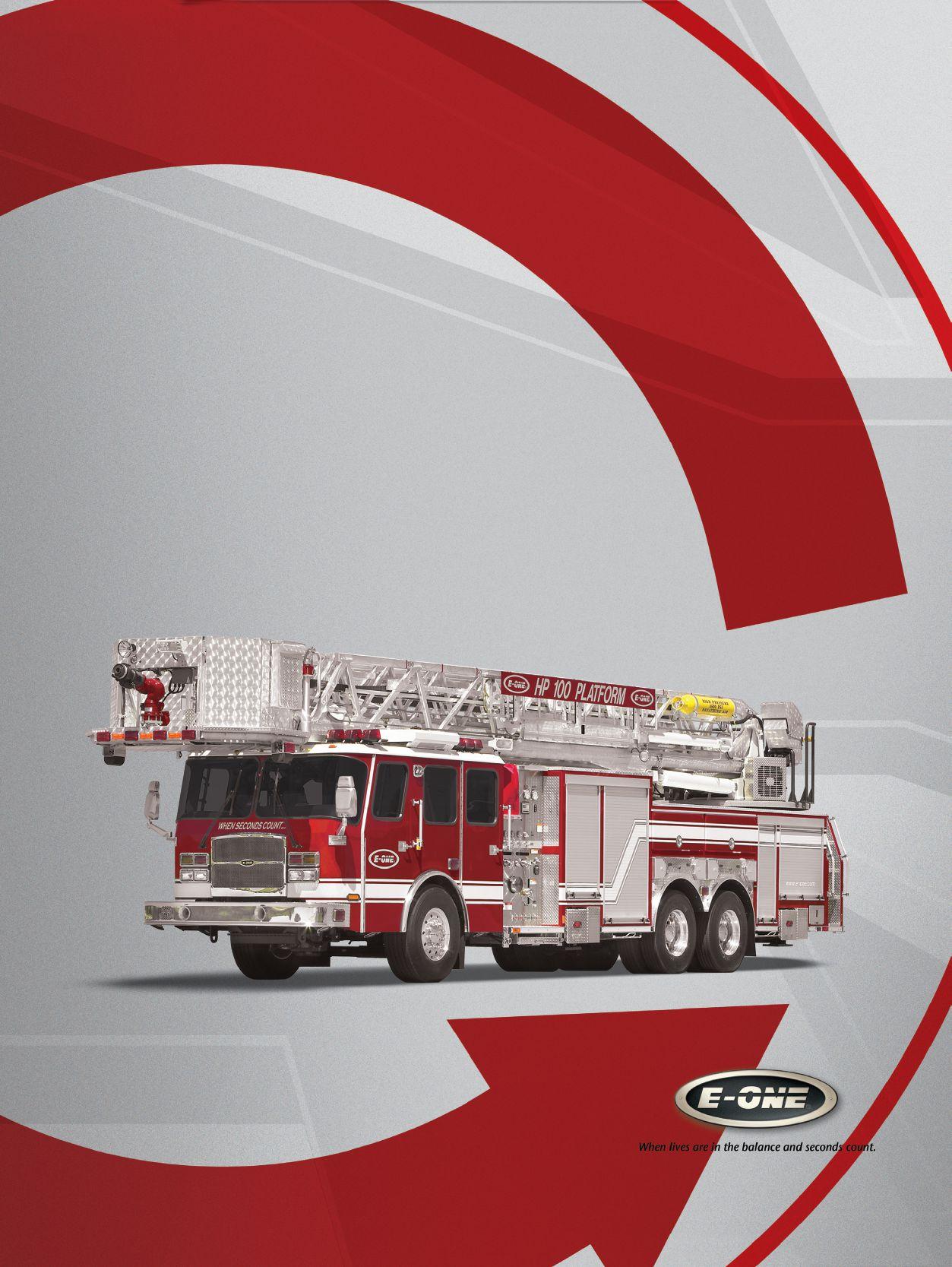
Getting your team in position at the scene can be a matter of life and death. You need complete control and confidence. E-ONE’s HP 100 Platform delivers both. With Variable Speed Control featuring creep mode, you can quickly and accurately place the platform exactly where you need it. Combined with our unmatched aerial stability and the Aerial Information System, you’ve got an aerial that brings new meaning to controlling the scene.
Control the scene at Control-Better.com


On Sunday, Aug. 10, 34 apparatus and more than 100 firefighters battled Toronto’s second six-alarm blaze in six months. Laura King looks at the response. 30
Retired Phoenix Fire Department
Chief Alan Brunacini, in his usual blunt but entertaining style, explains how the fire service can and should better serve Mrs. Smith.
B.C. writer Paul Dixon looks at Operation Dry Lightning, a full-scale functional exercise that tested the capabilities of agencies that would respond to an urban interface fire. Lesson learned? Mother Nature rarely co-operates.









BY LAURA KING Editor
The news came like a punch in the stomach.
Bob Leek, the respected district chief of emergency planning for Toronto Fire Services, died Aug. 10 at the scene of the horrific propane plant explosion in the city’s northwest end.
As early word came in of the tragic turn of events, I found myself staring rather numbly at the words on the screen. We all think we’re busy. We’re all in a rush. The monthly production cycle of a magazine is rewarding and frustrating to varying degrees depending upon the battles won and lost, just like everyone’s job.
And suddenly, this tragedy brought perspective to what the rest of us see as the travails of everyday life.
BY JOHN RIDDELL
ESTABLISHED 1957 September 2008 VOL. 52 NO. 6
EDITOR LAURA KING lking@annexweb.com 905-847-9743
EDITOR EMERITUS DON GLENDINNING
ADVERTISING MANAGER HOPE WILLIAMSON hwilliamson@annexweb.com 800-265-2827 ext. 253
PUBLISHER MARTIN MCANULTY fire@annexweb.com 1-519-429-5178 800-265-2827 ext. 252
service fraught with danger. That danger can sometimes get lost in the mundane chores of daily duty, but that fact only highlights the importance of the work of people like Bob Leek.
Instituting innovative training. Educating and inspiring young recruits. Being a mentor and leader. These things matter most at the time of crisis when everyone has to know that what they have been taught is the right thing to do.
THE COVER
By all accounts, Leek was a teacher and mentor, a beacon of knowledge who illuminated the minds of coming generations of fire service professionals and lit the way for important elements of the future Toronto’s fire service.
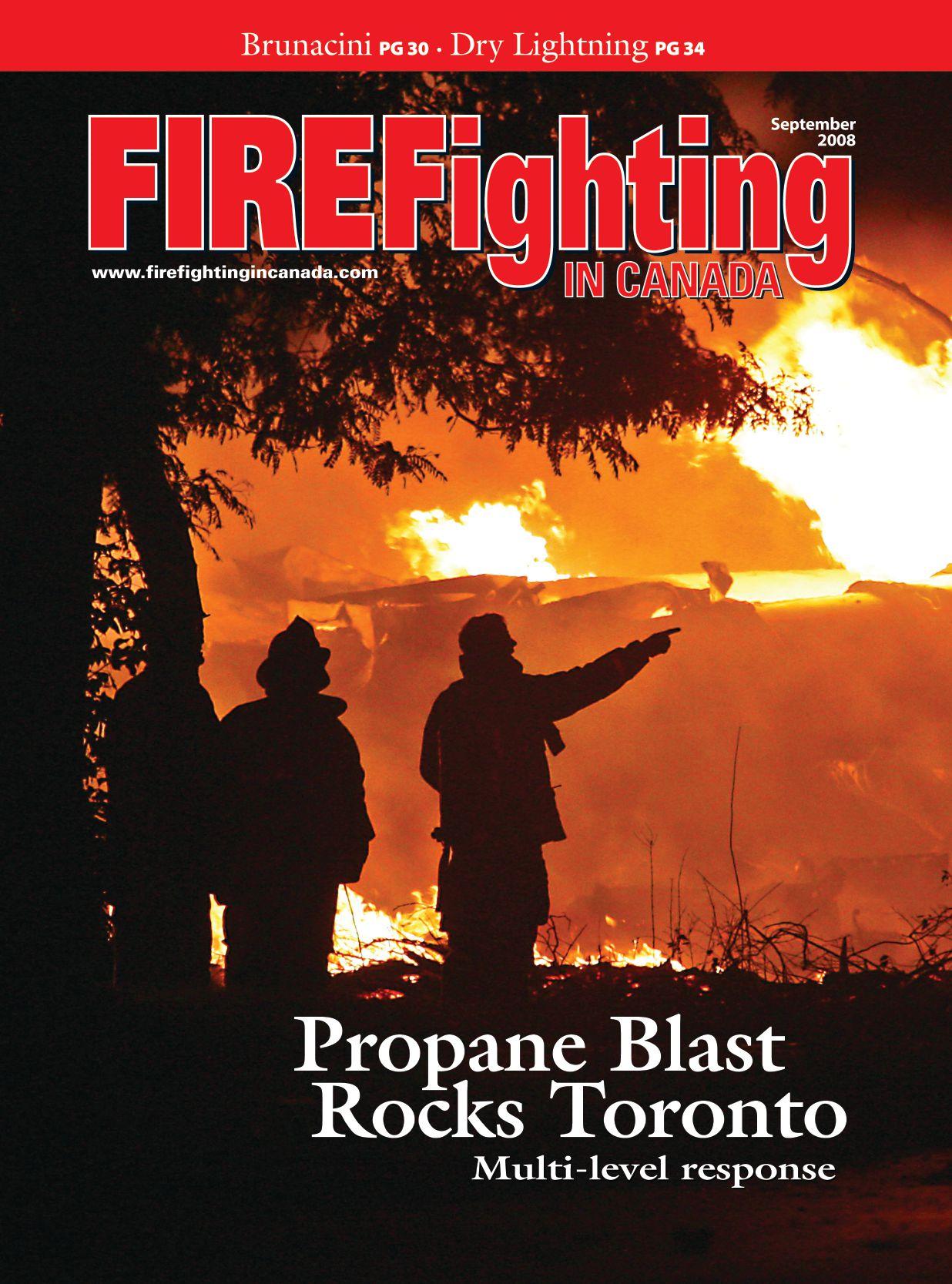
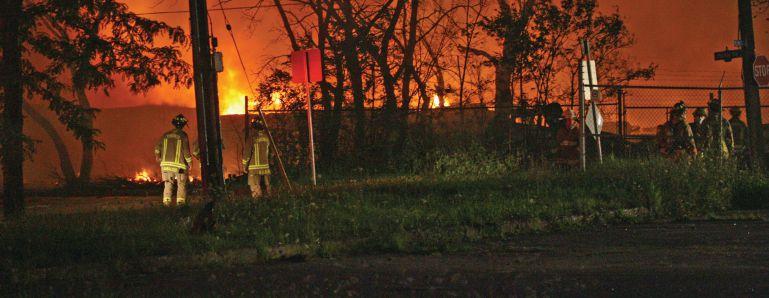
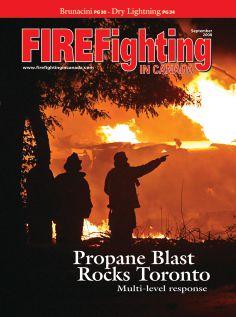
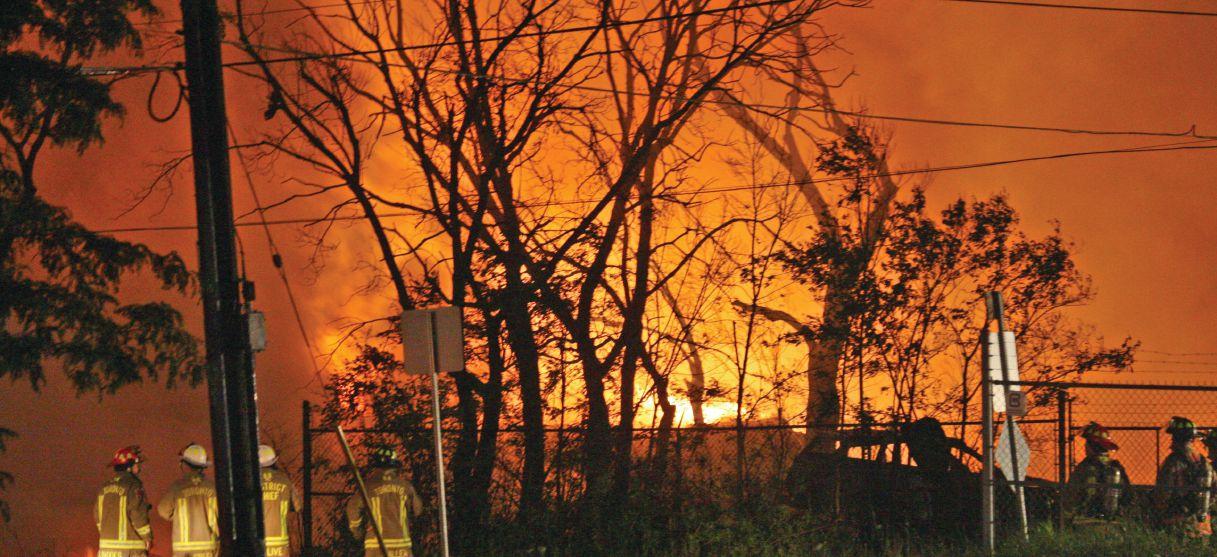
Toronto firefighters survey the scene of the Sunrise Propane explosion and fire on Aug. 10. See story page 16.
He joined the service in 1983 and after a relatively short time in direct fire fighting, moved to support, where he distinguished himself in ways that would enrich the entire fire service for years to come. In the mid 1990s he received an award for implementing a new training program that enabled the department to keep track of each firefighter’s training progress.
A former colleague described him as meticulous. “If you had a job that had 1,000 steps that needed to be done in a specific order, Bob was the guy,” Scott Codwen, recruited with Leek in 1983 and later his boss, told the Toronto Star. “He’d do the jobs that I couldn’t trust with anybody else.”
Line-of-duty death is a phrase that makes the blood run cold in the fire service, a
Leek was Toronto’s first line-of-duty-death since 2001. He rushed to the scene of the Sunrise Propane explosion to deliver an ATV to on-site colleagues. He stayed to help with the evacuation of thousands of terrified, confused residents, who must have found comfort in his reassuring demeanour. He was later found collapsed on a sidewalk.
He leaves his wife of 22 years and an adult son. At Fire Fighting in Canada, we join those from coast to coast offering condolence to his family; we mourn his loss and celebrate his contributions in equal measure. Bob Leek made a difference. As Premier Dalton McGuinty said, he is a true hero.
Enable me to be alert and hear the weakest shout, and quickly and efficiently to put the fire out.
I want to fill my calling and to give the best in me, to guard my every neighbor and protect his property.
And if according to my fate I am to lose my life this day, Please bless with your protecting hand my family this I pray.
- The Firefighter’s Prayer

PRODUCTION ARTIST BROOKE SHAW bshaw@annexweb.com
VP/GROUP PUBLISHER DIANE KLEER dkleer@annexweb.com
PRESIDENT MIKE FREDERICKS mfredericks@annexweb.com
PUBLICATION MAIL AGREEMENT #40065710
PAP Registration #8885
RETURN UNDELIVERABLE CANADIAN ADDRESSES TO CIRCULATION DEPT.
P.O. Box 530, SIMCOE, ON N3Y 4N5 email: sbrady@annexweb.com
Periodical Postage Paid at Buffalo NY. USPS 007-276, ISSN 0015-2595. Published eight times per year (Feb., March, May, June, Aug., Sep., Nov., Dec.) by Annex Publishing & Printing Inc. U.S. Office of Publication c/of DDM Direct.com, 1223 William St. Buffalo NY 14240. U.S. Postmaster send address change to P.O. Box Niagara Falls Ny 14304.
Printed in Canada ISSN 0015–2595
CIRCULATION
e-mail: sbrady@annexweb.com
Tel: 866-790-6070 ext. 206
Fax: 877-624-1940
Mail: P.O. Box 530 Simcoe, ON N3Y 4N5
SUBSCRIPTION RATES
Canada – 1 Year - $25.44 (includes GST - #867172652RT0001)
USA – 1 Year $50.00
We acknowledge the financial support of the Government of Canada, through the Publications Assistance Program and the Canada Magazine Fund, toward our mailing and editorial cost. Nous reconnaissons l’aide financiere accordee par le gouvernement du Canada pour nos coults d’envoie postal et nos coutl redactionnels par l’entremise du Programme d’aide aux publications et du Fonds du Canda pour les magazines.

From time to time, we at Fire Fighting In Canada make our subscription list available to reputable companies and organizations whose products and services we believe may be of interest to you. If you do not want your name to be made available, contact our circulation department in any of the four ways listed above.
No part of the editorial content of this publication may be reprinted without the publisher’s written permission @2008 Annex Publishing & Printing Inc. All rights reserved. Opinions expressed in this magazine are not necessarily those of the editor or the publisher. No liability is assumed for errors or omissions.
All advertising is subject to the publisher’s approval. Such approval does not imply any endorsement of the products or services advertised. Publisher reserves the right to refuse advertising that does not meet the standards of the publication.
www.firefightingincanada.com

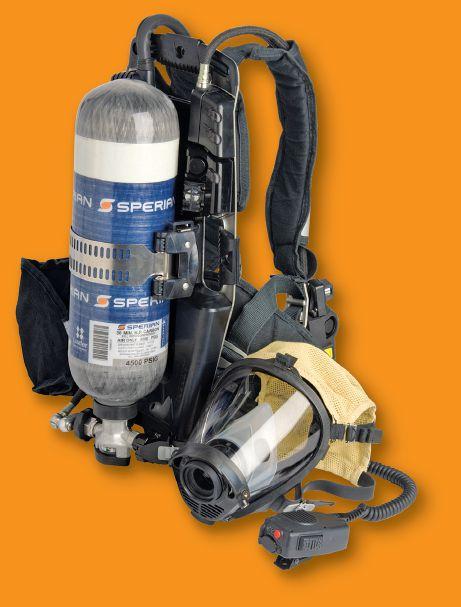
Meets the new 2007 NFPA Standards, 1981 & 1982
A PASS Alarm that can Take the Heat “Bullet-Proof” electronics
Straight-talk communications
Fireground management capabilities
Extended protection
Lightweight and easy to use
Platform for the future


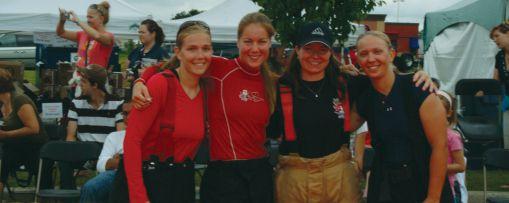
The Scott Firefit Championships have been criss crossing the country since the early spring and were to wrap up Quinte West, Ont. Sept. 11-14.
As of press time in midAugust, some veteran competitors had once again achieved top standings and some rookies, including the women’s team of Sara Gal from Paris, Ont., and Alicia Bethlejemski, Joanna McMorrow and Katherine
Sencar of Brantford, Ont., enjoyed their inaugural Firefit experience.
As of mid-August, Sencar was in fifth place among female competitors behind Tracey Jones (Kamloops, fourth), Denise Townshend (DND - third), Lindsey Ingram (Edmonton - second) and Jacqueline Rasenberg (Vaughan, Ont., first).
Perennial competitors Bob Murray of Edmonton and Mike
Gilbert of St. Catharines, Ont., were first and second respectively, followed by Eric Pichette of Sudbury, Brian Forseille of Edmonton and Steve Armstrong of Mississauga, Ont.
Years ago, most communities didn’t hesitate to share emergency response and critical infrastructure details with other agencies or the public. But post9/11, security concerns are forcing communities to re-evaluate how that information could be used if it fell into the hands of terrorists.
Fire Chief Len Garis with the City of Surrey, B.C., recently asked Supt. Lloyde Plante of RCMP “E” Division National
Security if communities should be concerned about public disclosure by any means – printed, online or other – of their critical infrastructure, emergency capabilities and response plans.
Supt. Plante’s answer, in essence, was: “Yes.”
“While identifying current system needs is of the utmost importance to public safety, it is my opinion that information concerning ones’ agency’s capabilities should as a general rule not be released to the general
HUGH MCKAY was recently appointed full-time deputy fire chief – training and operations for the City of Cold Lake, Alta. A long-time resident and a 17year veteran of Cold Lake FireRescue, including the amalgamated Town of Grand Centre Fire Department, McKay recently served as a station chief for the downtown fire station. The
City of Cold Lake is situated in north eastern Alberta with a population of about 13,000 and operates two active fire stations with approximately 50 part-time members. Cold Lake Fire-Rescue responds to more than 200 calls a year including vehicle and ice rescue.
BOB LEEK, District Chief of Emergency Planning with the
public,” he wrote. “The release of emergency response plans, capacity and critical infrastructure can identify vulnerabilities which may be exploited, and are therefore of concern from a security standpoint.”
Supt. Plante noted that the release of this information could compromise the efforts of “E” Division National Security to prevent, detect, deter and respond to actual or potential threats to critical infrastructure.
“It is well established within
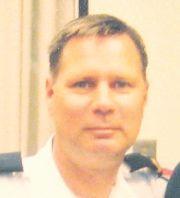
Toronto Fire Services, passed away suddenly on Aug. 10 while working at the six-alarm fire at the site of Sunrise Propane. “Bob was a dedicated member of the Toronto Fire Services.
the Security and Intelligence community, both in Canada and abroad, that terrorism organizations, regardless of their cause, are well trained and versed in information-collection through both overt and covert means for the purpose of identifying vulnerabilities that they can exploit,” he wrote. “It is for this reason that these documents should not be made public, as the security and safety of the public will not be served by their general release.”
His contribution to public safety and emergency planning was in the interests of the citizens of Toronto and Toronto Fire Services,” said Toronto Fire Services Chief William Stewart. Bob, who was 55 years of age, joined Toronto Fire on June 27, 1983. He was promoted to district chief on Jan. 9, 2006. Leek leaves his wife of 22 years, Fulvia and son David.
The No. 1 priority of firefighters is to educate the public, particularly children, about fire safety. Two-time Juno Award nominee Mary Lambert is helping to do just that, through a fun, musical, entertaining and educational show called Sing Out Fire Safety.
The show is in its tenth year and is criss crossing Ontario and other parts of Canada, stopping at schools, fairs and community events. A fall tour is planned for parts of eastern Canada.
The concept for Sing Out Fire Safety developed in March 1999 when Dale Currie, the fire chief of the Township of Beckwith, Ont., took his family to see Lambert perform in Kingston, Ont. After the performance, Currie thought about a musical show to teach the fire prevention message to children.
“Initially, when first approached by Fire Chief Currie to produce a performance for children, I didn’t really know much about fire safety,” Lambert said in an interview. “I really enjoyed the process of researching, learning and becoming familiar with fire prevention.
“I tried to take my knowledge for keeping children entertained, and knowing what works and what doesn’t, and created songs and a performance that
would be interactive, informative and engaging for schoolaged children.”
Later that year, during National Fire Prevention Week, Sing Out Fire Safety was performed for more than 20 schools and received rave reviews from both children and teachers. The original show idea has been made into a CD (in English and French), a video (to be released as a DVD in October), and an activity booklet.
Marcie Brown, a volunteer firefighter with the Labrador City Volunteer Fire Department was looking for a different approach to teaching fire prevention to children and found Lambert while searching the Internet for fire prevention entertainers.
“The effect Mary has on children is amazing,” Brown says. “She captured their attention through song and dance, spoke clearly about the fire prevention messages and did it in a way that children were learning without even realizing it because they were having so much fun. Mary Lambert should be known as Sparky’s mom.”
Lambert’s approach to fire prevention education is different from many fire department outlines.
“Mary has a different approach than a fire department
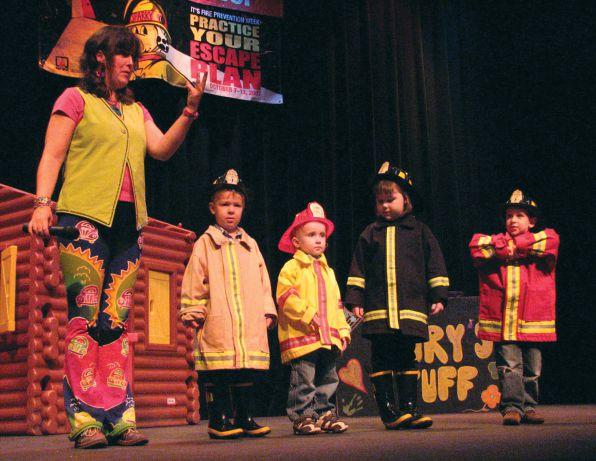
Mary Lawson’s Sing Out Fire Safety stage show will come to your municipality as part of your public education program.
can offer, using music and activities,” says Ken Roseborough, chief of the Hanover Fire Department in Ontario. “Her program is very effective and gets both kids and adults involved, and adds a practical aspect as well”.
Lambert incorporates messages to reinforce concepts such as burn safety, cooking and kitchen safety, the importance of having an escape plan with fire drills and a meeting place, and stop, drop and roll. The show also teaches children that firefighters are their friends. Sing out Fire Safety is geared to children in junior kindergarten through grade five and is about an hour long. Members of local fire departments participate on stage and become an integral part of the show.
Fire departments can buy
the Sing Out Fire Safety CDs at minimal cost so they can be given out at local schools and day cares or used for fundraising. The activity book can be used in classrooms as a postshow activity to help reinforce what the children have learned.
“This is one of my favourite performances because it combines my love of bringing the joy of music to children, with life saving information, and it makes me feel like I’m contributing something important,” Lambert says.
For more information on bringing Sing Out Fire Safety to schools, fairs or community events, contact Mary Lambert Productions at www.mary lambertmusic.com or e-mail Lambert at mary@ marylambertmusic.com.
- Melissa Martz
Caledon, Ont., died June 17. Hilton served the Town of Caledon from 1975 to 1993. He was instrumental in organizing a cohesive firefighting force by bringing together six individual fire stations serving three townships and one village following municipal restructuring in 1974.
Chief Hilton will be remembered for his willingness to implement new and innovative firefighting and rescue techniques, his caring and compassion for the community and his continuous support
and fondness of the firefighting community. He also worked closely with the Brampton and Mississauga Fire Services and served as the Regional Fire Coordinator for the Peel Region Mutual Aid System on a rotating basis with his counterparts in these cities.
Training Officer PAUL JACKSON of the King Fire and Emergency Services in Ontario died June 11 at his home as a result of an apparent heart attack after
returning from an emergency response.
Jackson, who proudly served the Township of King for 27 years, was an extremely dedicated fire service professional always going above and beyond his duties to aid his community and his fellow firefighters; he was a valued member of King Fire and Emergency Services serving in the roles of firefighter, captain, district chief and most recently as the full-time training officer.
Fire Fighting in Canada welcomes submissions to The Brass Pole including promotions, retirements and items for Last Alarm.
Please e-mail submissions, along with colour j-peg photos to lking@annexweb.com
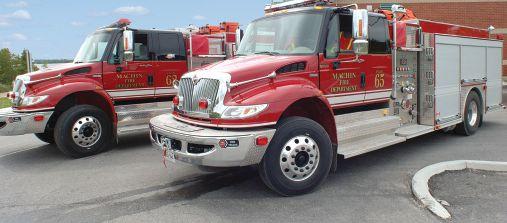
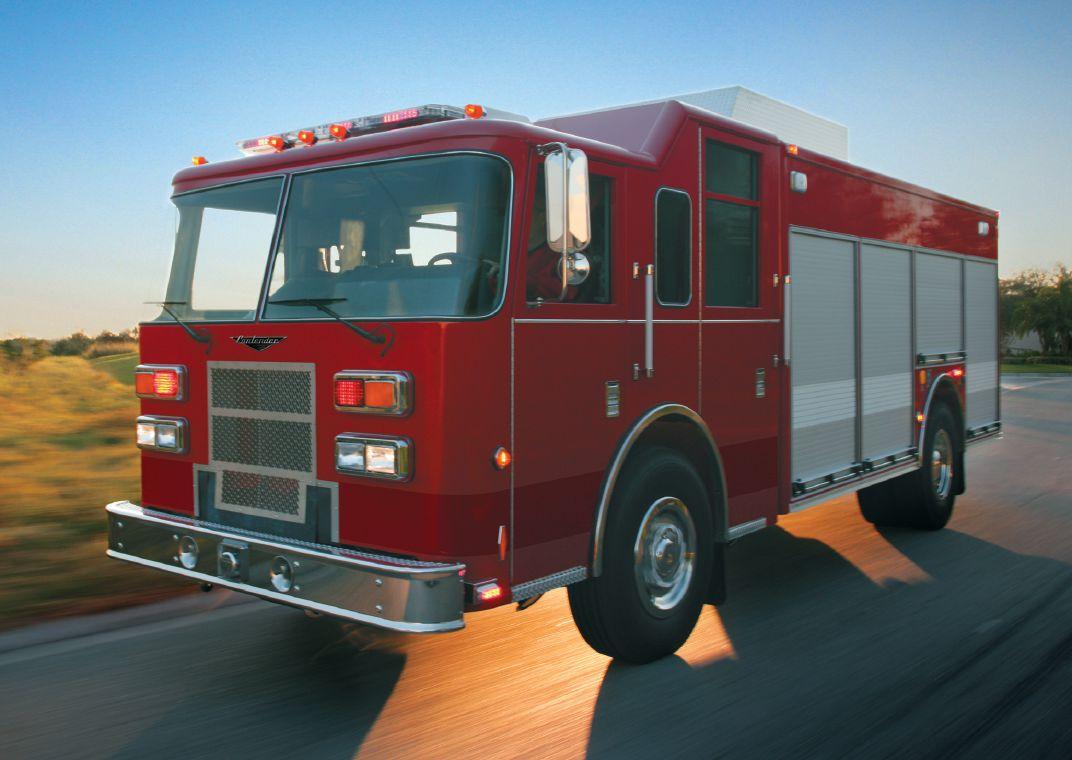
THE MACHIN FIRE DEPARTMENT in northwestern Ontario under the command of Chief Rob Wisneski has taken delivery of two Fort Garry pumper tankers. The identical units were built on International chassis with extended cabs for additional seating and feature Darly 1050 pumps, 1,000-gallon poly tanks with 10-inch Newton dump valves, hydraulic ladder racks and unique rear-access compartments for the porta tank and hard suction. These apparatus service the communities of Vermilion Bay, Eagle River and Minnataki.
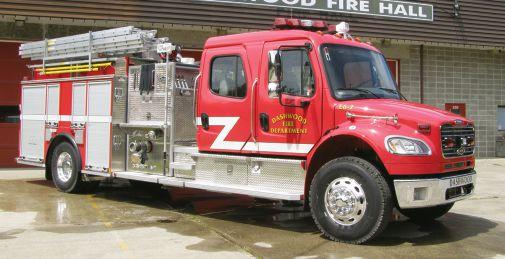
THE DASHWOOD FIRE DEPARTMENT in B.C., under the direction of Chief Nick Acciavatti, took delivery in June of a HUB Fire Enginesbuilt tanker and an engine. The tanker is built on an M2 Freightliner chassis with a 300-hp Cummins ISC engine and a 1,500-gallon tank. The new engine, also on an M2 Freightliner chassis, features a 330-hp Cummins engine, an Allison 3500 EVS transmission, seating for five firefighters, a 1,000-gallon poly tank, 1,050-gpm Waterous pump, Foam Pro 2001 Class “A” system and an HLAS ladder rack.
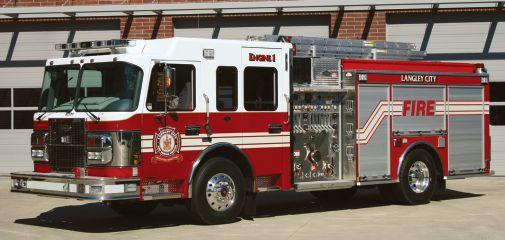
THE LANGLEY CITY FIRE RESCUE SERVICE in B.C., under the direction of Fire Chief Bruce Dundas, took delivery in June of a HUB Fire Engines-built pumper on a Spartan Diamond chassis with a 400-hp Cummins ISL engine, an Allison 3000 EVSP transmission, a Hale Qmax 200 pump, 1750 gpm, a Foam Pro 2001 foam system, a copoly water tank and a side-control pump panel.
Our national survey of Canadian fire departments is available online at firefightingincanada.com. Submit the survey to be entered into a draw to win new SCBA for your department.
Check our home page daily for breaking fire-service news from coast to coast to coast.
Check in regularly to read Tim Beebe’s always entertaining Spontaneous Combustion column, Peter Sells’ opinions in his Fashpoint blog and Brad Lawrence’s fitness and nutrition tips.

DIGITAL MAGAZINE
Visit www.firefightingincanada. com to sign up for your free digital issue.


EVENTS
Send us your events and have them posted on our comprehensive list of conferences, workshops and association meetings.
By ED BROUWER
Irecently received a call from my son Aaron (a firefighter and columnist for Canadian Firefighter and EMS Quarterly) in regard to what has come to be known as the Charleston Nine. Aaron had listened to several hours of audio recordings of the nine firefighters’ last transmissions. In the moments before a furniture store fire took their lives, some of the nine killed shouted “Mayday!” and recited prayers. Another said “I love you.” Then, firefighters tell their colleagues to stay off the radio system. As that order ends, a voice issues a traditional prayer ending: “In Jesus name, amen.”
For those who do not know, the Charleston, S.C., fire was reported as the U.S.’s deadliest single disaster for firefighters since the Sept. 11 terrorist attacks. Fire swept through a warehouse, collapsing its roof and killing nine firefighters inside. Two employees in the building were rescued from the blaze, which broke out at about 19:00, Monday, June 18, 2007, in the Sofa Super Store and warehouse.
Knowing my drive to get the Canadian fire services to include mayday procedures in all rookie and fire-officer training (including dispatchers), Aaron informed me of the investigation’s findings.
Water issues, inadequate training, no truck operations, building-code violations, communications problems and no incident commander were just a few issues cited in the Phase II report on the deadly Sofa Super Store fire. The investigation/report is one of the most definitive and complete post-incident fire analyses ever conducted. The panel made several critical recommendations before the review started, resulting in operational and staffing changes in the Charleston Fire Department. When retired fire chief Gordon Routely, who headed the review panel, finished presenting the panel’s critical analysis, an emotional Charleston Chief Rusty Thomas stood before the packed room and accepted responsibility for the
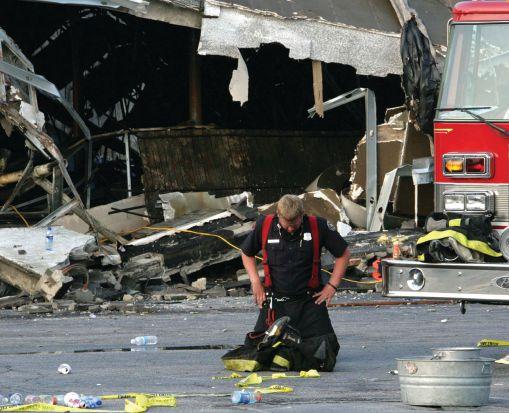
Listening to the tapes from the Charleston Sofa Super Store fire, it became clear that the fragmented messages of distress were not heard.
■ Push the emergency identifier button (EIB) on the radio. This captures the channel for 20 seconds, gives an open mike to the radio (in other words the firefighter does not need to push the talk button on the radio), and sends an emergency signal to radio communications identifying the radio.
■ Announce MAYDAY, MAYDAY, MAYDAY.
■ Give LUNAR: L location; U unit number; N name; A assignment (What were you doing?); R resources (what do you need?).
■ Practise calling mayday. You must practise it if you expect it to work when you need it. Can you push the EIB in five seconds with all you gear on? What happens when you push the EIB? Does the radio channel change, who receives the EIB signal, where is it received, what do they do with the information? Can you get to the radio when you are covered with debris? Where does the mike need to be so you can be heard? How loudly do you need to talk?
■ Include mayday calling in all training where firefighters are put into simulated IDLH conditions.
At a minimum, in rookie school and throughout their service, firefighters need to practise calling.
Our bodies and minds need to be shocked into mayday situations repeatedly so the correct response becomes natural and instantaneous.
■ Get communications involved. How many times do ICs and dispatchers practice receiving and responding to a mayday call?
Do you want your real mayday call to be the first time the IC or radio operator gets to test their mayday skills?
The entire mayday system needs to be trained, drilled and tested. The bottom line regarding the Charleston nine is summed up in the title of the report: Poor training led to their deaths.
Canwest Fire Services has just added the eight-hour NFA Calling A Mayday to our list of hands-on-training courses. Please e-mail me if you would like help putting one together for your department.
deaths of his nine friends. “I knew every single one . . . I’m so sorry that myself or somebody could not have done something differently that night to bring back those nine guys.”
One firefighter, who realized a supply line had not been established, turned the corner to find the hydrant missing. It had been removed because delivery trucks kept hitting it. Unaware where the next hydrant may be, he set out on foot to look. He found one, but wound up 100 feet short of hose. He had to couple the lengths by hand. While that was underway (about nine minutes), 16 firefighters were in the burning building with a booster line and a 1.5-inch hose.
Timed pictures of the fire’s development – taken from across the road – showed heavy smoke and flames from the roof. Routely said the firefighters inside had no idea what was going on above them. He noted that almost every firefighter who arrived went into the building, including those on the ladder truck. “They were entering the building by ones and twos . . . .”
Routely said although officers were hearing of deteriorating conditions, none of the chiefs made a decision to evacuate the store and move from an offensive to a defensive attack. That decision didn’t come until after several disoriented firefighters had been rescued.
There was no accountability whatsoever. There is no suggestion that any CFD members lost or surviving failed to perform their duties as they had been trained or as expected by their organization. The final analysis does indicate, however, that the CFD failed to adequately prepare its members for the situation they encountered at the Sofa Super Store fire.
As I listened to the fire ground tapes and read the 44 pages of radio transmission and phone call transcripts, it became all too clear that the fragmented messages of distress were not heard. There was no mayday plan in place. Firefighters were unclear when to call for a mayday and had little if any idea what to do to save themselves while waiting to be rescued.
According to the transcripts, the first radio traffic related to firefighters in trouble was at 19:27, but it was not heard by anyone on the fire ground. At 19:29 there is more radio traffic from firefighters lost and looking for help. Again, no one can hear them on the fire ground. At 19:30, a firefighter driving to the fire ground in his own car hears the radio distress calls and tries to reach a chief to tell him about it but can’t get through. At 19:31, the now-famous rescue of an employee trapped inside the building is made by cutting through the wall. At 19:32, the mayday call is finally heard and a chief tells everyone to stay off the radio to listen for those calls. Throughout the calls, PASS alarms are sounding but there is no notice taken. At 19:33 the firefighter travelling to the scene gets out of his car and tells a chief face to face what he has heard. The call goes out for everyone to come out and be accounted for. At this point, according to the transcript, it is becoming a little chaotic and firefighters are losing each other and struggling to get out. The fire is rapidly expanding. At 19:38 Chief Thomas orders a full evacuation. By 19:40 the interior is fully involved and the last firefighters who will survive are getting out of the building. There are several heart-wrenching times when you know a mike is being keyed and all you hear is radio static and PASS alarms. It wasn’t until 22:00 that search and recovery began. Although this happened in the U.S., we need to be aware of it and learn from it. We must do everything we can to prevent this from happening to any of our firefighters. We must get this right to honour our nine brothers: Capt. William Hutchinson, 48, 30 years of service; Capt. Mike Benke, 49, 29 years of service; Capt. Louis Mulkey, 34, 11.5 years of service; engineer Mark Kelsey, 40, 12.5 years of service; engineer Bradford Baity, 37, nine years of service; assistant engineer Michael French, 27, 1.5 years of service; firefighter James Drayton,
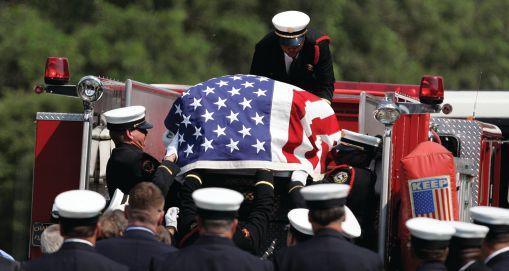
The Charleston, S.C., fire was reported as the U.S.’s deadliest single disaster for firefighters since the Sept. 11 terrorist attacks.
56, 32 years of service; firefighter Brandon Thompson, 27, four years of service; firefighter Melvin Champaign, 46, two years of service.
What is your department’s mayday policy? Does your department train on it? It is my conviction that both firefighters and officers need to experience what it may be like to call a mayday before it is the real thing. If you put on SCBA and enter IDLH environments, you need to drill on calling a mayday.
Why is it so difficult to get a firefighter to call a mayday? We treat speaking about mayday to our firefighters as a young father does in talking to his children about sex. Our discomfort in talking about “it” tends to leave it up to the kids to find out from his or her street friends.
The way firefighters react to any situation is based on their training and experience. If they do not have mayday calling in their experience, calling the mayday will not come naturally when the need arises.
Mayday comes from the French term m’aider, an imperative that means “help me.” Mayday was adopted as a distress call by the International Radio Telegraph Convention in 1927. In international radio language, “Mayday, mayday, mayday,” means “Life is in danger. Immediate help needed!” The average firefighter practises tying knots more than calling mayday. The firefighters’ mayday calling system, which includes a radio, a firefighter, an IC and a dispatcher, is not tested and drilled to ensure the system works.
How many funerals do we need to attend? If a task has a low use level but very high consequences for failure, that task must be taught to the highest level of performance and drilled continually to maintain competency. We are talking about the greatest resource in the Canadian fire service – our firefighters.
It is imperative that our fire departments develop rules for when a firefighter must call a mayday. If need be, give permission to your firefighters to call a mayday. The next hurdle is training ICs what to do should they hear a mayday. Among the 272 pages of the NIOSH report were the following lines: “The communications process was not controlled. The fire chief, the assistant chief, and battalion chief were all issuing orders and providing direction independently, using a single overloaded radio channel. Critical messages, including distress message from firefighters inside of the structure, were not heard.”
Ed Brouwer is the chief instructor for Canwest Fire in Osoyoos, B.C., and the training officer for West Boundary Highway Rescue. The 19-year veteran of the fire service is also a fire warden with the B.C. Ministry of Forests a wildland interface fire suppression instructor/evaluator and a fire-service chaplan.
E-mail: ed@thefire.ca




By LAURA KING
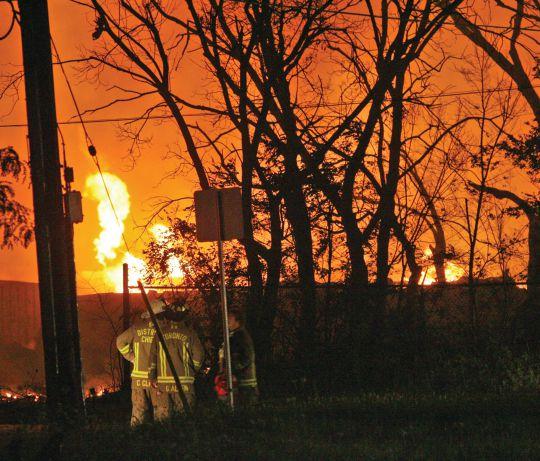
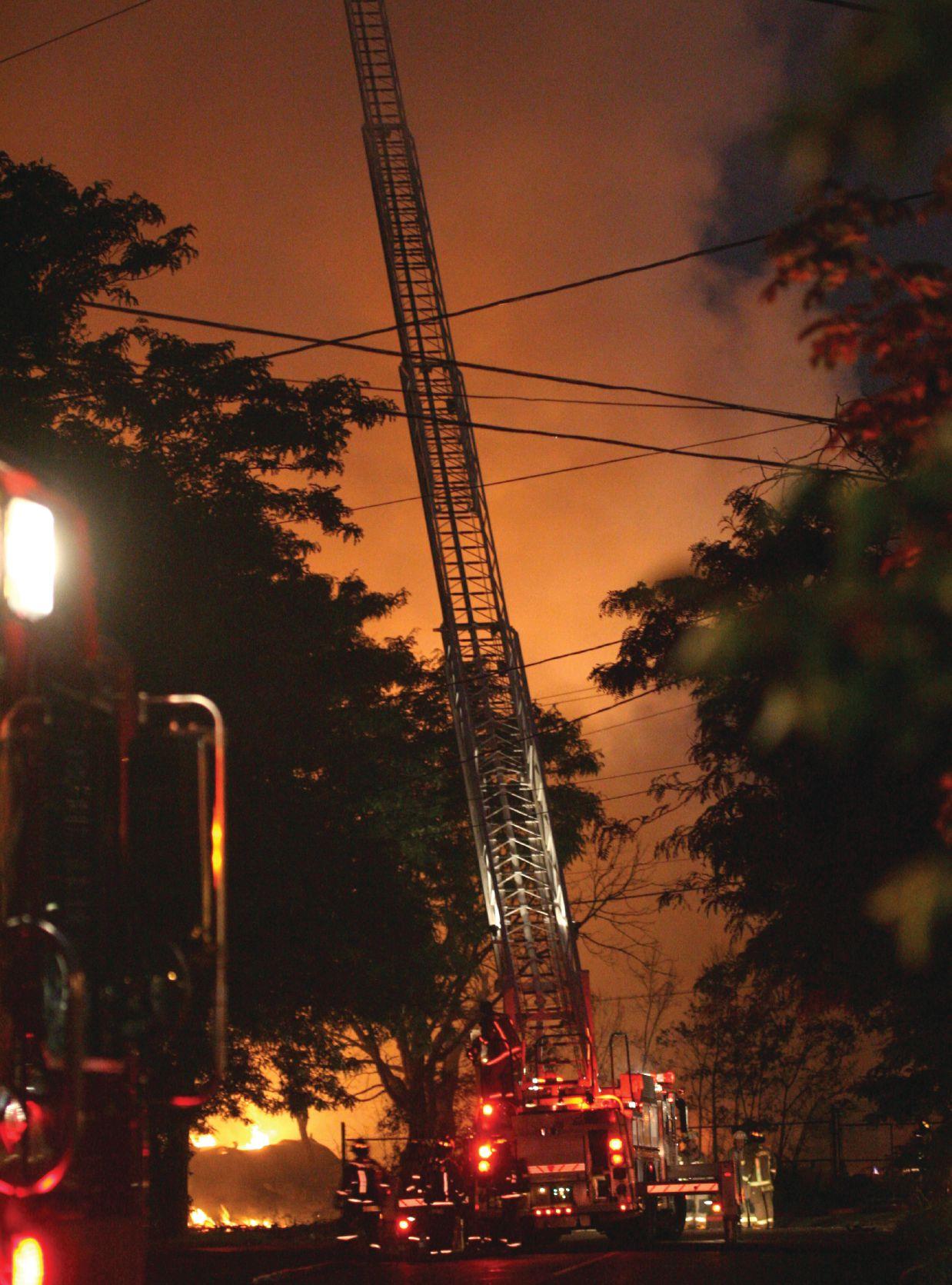
Just six months after Toronto Fire Services battled one of the biggest infernos in the city’s history on Queen Street, another six-alarm blaze tested the mettle of the more than 100 firefighters who responded to the Sunrise Propane Industrial Gases explosion that rocked the Ontario capital on Aug. 10.
By all accounts – blogs, news stories, and politicians quoted on 24-hour news stations – Toronto Fire executed a textbook response to the 3:50 a.m. alarm, with 34 apparatus and 125 firefighters on scene.
One news report said Toronto’s emergency management plan was activated shortly after the explosion in North York, “which sent fireballs into the air, shook scores from their bed, was heard across the city and was visible as far away as Niagara region.”
“The response was quarterbacked at an operations centre by city manager Shirley Hoy and her deputy, Richard Butts, who were in contact with police, fire and ambulance services on the front lines.
TFS Deputy Chief Jim Shelton was the incident commander at the scene, working alongside two division commanders and another deputy chief. Deputy Chief Darryl Fuglerud was at communications and reported to the Emergency Operations Centre when it was activated by the city manager. TFS Division Cmdr. Bob O’Hallaran was the liaison between the Toronto police and the fire service.
A National Post blogger described the response this way: “Crises measure an organization’s virtues, strengths, capabilities and leadership. In the aftermath of last Sunday’s spectacular propane blast that forced more than 12,000 Toronto residents from their homes and led to two deaths, observers have a much clearer picture of what works in Canada’s largest city and what is in desperate need of repair.
“The City’s emergency services undoubtedly deserve the respect afforded them by Torontonians. Police, fire and other emergency officials answered the call to evacuate the area around the explosion and contain the fire that destroyed the Sunrise propane facility with speed and professionalism. They saved lives.”
That said, political fallout has overshadowed the response to the incident and the line-of-duty death of TFS District Chief Bob Leek, who was found near the scene with vital signs absent, and a young Sunrise worker whose body was found at the site.
In light of the political hand wringing over the fact that a massive propane facility was allowed to set up shop in the heart of a residential neighbourhood, Toronto Fire Services and other agencies were effectively gagged by the city in its attempt to manage the message. No wonder. Lawsuits have been filed. Asbestos was found near the site, having blown out of nearby schools. A 16-kilometre stretch of Highway 401 was closed for the better part of the day, something Ontario Provincial Police spokesman Cam Wooley told The Canadian Press he hadn’t seen in 30 years on the job. A partial no-fly zone was established in the air. Residents who lived close to the site were literally blown out of their beds. More than 10,000 people were evacuated. People were angry; the media was hungry for details and Mayor David Miller was out of town.
“The city has taken control of any outside information going
up unmanned hoses near the tanks then withdrew a safe distance and monitored the cooling process.
out because it’s bigger than just a situation that the fire service can control,” said one TFS spokesperson. “That’s why the city is taking control, including their strategic communications staff.”
Meanwhile, Deputy Chief Shelton and other TFS personnel remained on scene for several days after the blast to support the investigation.
“Time of day saved us,” Shelton told reporters that Sunday afternoon before the city clamped down on news coming out of the site, noting that few people were out or working nearby at 4 a.m. on Sunday.
Several days after the incident, crews hadn’t pieced together what caused the explosion and fire. Division Cmdr. Bob O’Hallarn said in an interview on Aug. 18 that the Office of the Fire Marshal was still on scene.
The OFM was investigating along with Toronto police, the Technical Standards and Safety Association, the coroner’s office, the Ministry of Environment (because of the discover of asbestos) and the Ministry of Labour.
As of press time in mid-August, 70 homes remained off limits and six were thought by officials to be uninhabitable.
O’Hallarn was the calm and level-headed voice of the Toronto Fire Services on the day of the explosion, facing TV cameras and reporters in several news conferences.
“There was a very, very large amount of fire when we arrived and the extent of the explosion, if the blast was heard as far away as it was, could have been much more serious,’’ he said.
Later in the day O’Hallarn said there were propane tankers still burning at the site.
“We’re working on cooling those down,’’ said O’Hallarn. “And we’re evacuating the area as a precaution.’’
Toronto Fire Services spokesperson Capt. Adrian Ratushniak described the cooling operations to The Toronto Star:
“We cooled the cylinders off with copious amounts of water and left anything that (was) burning on the top to burn off,” he said.
“You’re best off controlling the fire where you can see it, rather than turn it out and let the gas spread.
“If there’s a fire under one of these propane cylinders, it will warm up that cylinder and bring it to a point where it is boiling and if there is a slight crack in that cylinder then the likelihood is that you’re going to have an explosion.”
Ratushniak said because of the risk of explosion, firefighters set
The initial explosion was most likely a blevy, something TFS worked through the rest of the day to prevent. The tanker trucks were still burning at 12:30 p.m., more than nine hours after the first early morning explosion.
O’Hallarn said during the interview that Toronto Fire’s planning for this kind worked meticulously.
He said first in Deputy Chief Dan Antle’s decision to evacuate the area around the Sunrise Propane site was key.
“I believe the planning did work,” O’Hallarn said by cell phone from the Murray Street site. “Our initial resources were concentrated on getting those people out of that area. There were still people in area and they didn’t really now what to do.”
O’Hallarn said when he arrived on Murray Street, between 4:30 and 5 a.m., “there was still a lot of flame.”
Various reports said there wasn’t enough water near the site so firefighters ran hoses from locations up to a kilometer away. O’Hallaran said the magnitude of the site and the extent of the fire likely meant water had to be brought in.
Acting Fire Chief Roy Law told reporters on the night of Aug. 10 that after more than 16 hours of battling a series of blasts at plant the blaze was under control.
The City of Toronto was still in damage-control mode at press time, saying it has little control over the location of companies such as Sunrise Propane due to zoning regulations that preceded amalgamation. Sunrise, which is based in the former city of North York, had previously been cited for unsafe practices but the company had also been told by municipal officials in 2004 and 2006 that its plant met the zoning requirements.
Still, editorials in Toronto newspapers have called for the city to adopt tougher zoning regulations and have questioned the city’s rationale for not doing so sooner.
“It was six years after amalgamation that Sunrise operators first came to the city, asking if their propane plant fit the rules,” The Toronto Star said. “That was enough time to bring North York’s overly loose bylaw in line with stricter zoning elsewhere in Toronto – if only it had been made a priority. With those changes in place, Sunrise owners could well have been rejected in 2004. True, they could still have taken their case to court, or the Ontario Municipal Board, but the city would at least have taken a stand.
“Miller has responded to the crisis by launching a review of where the city stands, including what new powers it might deploy under the City of Toronto Act. One hopes action will be swift.”
Coquitlam
Ph. (604) 395-3000 Fax (604) 395-3500
Toll Free Ph. (800) 667-3362
Nanaimo
Ph. (250) 758-3362 Fax (250) 758-9822
Cranbrook
Ph. (250) 426-2267 Fax (250) 426-5025
Edmonton
Ph. (780) 454-3535 Fax (780) 451-3979
Toll Free Ph. (800) 222-6473
Kamloops
Ph. (250) 374-0044 Fax (250) 374-8181
Campbell River
Ph. (250) 287-2186 Fax (250) 286-3694
Calgary
Ph. (403) 287-0155 Fax (403) 287-9355
Toll Free Ph. (800) 661-9227
Fort St. John
Ph. (250) 785-3375 Fax (250) 785-1485 Toll Free (866) 474-4531
Prince George
Ph. (250) 960-4300 Fax (250) 563-6625
Trail
Ph. (250) 364-2526 Fax (250) 364-2736
Cambridge
Ph. (519) 740-6472 Fax (519) 740-2050
London
Ph. (519) 673-1596 Fax (519) 673-1613
Trois-Riviéres , QC
Ph. (819) 375-4877 fax (819) 375-6016

To the editor:
From coast to coast, our fire services provide first response to any number of situations. Whether it be a motor vehicle accident, chemical spill, natural disaster or a structural fire, we count on our fire chiefs and their fire departments to answer the call and they have always been there for us.
But aging fleets, outdated equipment and insufficient funding to correct these and other issues are threatening the capability of the fire services in Canada.
No one wants to hear that someone died because the fire department’s truck was old and wouldn’t start or that the brakes failed and the fire truck hit a school bus.
Unfortunately, the truth is that our fire service fleets are aging. They no longer meet current standards and just keeping them on the road costs more each year – in money and response capability.
A recent Ontario study shows that:
almost half (about 42 per cent) of fire apparatus in Ontario are more than 15 years old and don’t meet the minimum requirements set by the Fire Underwriters Survey; about one truck in six is more than 20 years old; roughly two of three departments are using PPE that is more than 10 years old;
and three departments in four can’t equip their on-duty personnel with portable radios.
Ask yourself these questions;
If we won’t let our kids ride in school buses older than 15 years, why are we using a different standard when it comes to the response teams that save lives every day?
If employers are expected to uphold current standards for employees in factories, why do we accept less for the people we ask to “go into harm’s way” on our behalf?
Are we prepared to hear that failed communications caused one, or many, to die?
Barry Malmsten, executive director of the Ontario Association of Fire Chiefs, has estimated that the Ontario fire service needs $1 billion (that’s billion with a b) to bring apparatus, equipment, training and staffing up to current standards.
Fire Fighting in Canada is conducting a survey to determine the national state of fire service apparatus, equipment, training and funding. When made public early next year, the results will give us a great picture of the conditions across Canada. I, for one, think it will look a lot like the Ontario situation but with many more dollars needed.
Everyone has a role to play in making sure Canadian fire services can continue to fulfill their roles as first responders. Raise the issue with your local and provincial governments. Let them know that increased funding is absolutely necessary for the continued health of our loved ones. And let them know that an effective fire service is also a necessity for a healthy economy. If you are in the fire service, respond to the Fire Fighting in Canada survey.
There is no doubt the term “first responder” is correct in that the men and women of our fire services will always be the first to arrive at any incident or disaster. We owe it to our country, ourselves and our loved ones to make sure that our fire services get the funding required so that our first responders can do exactly that – respond first.
Bruce Whitehouse Chair,
Canadian Fire Service: governmental affairs committee Fire Apparatus Manufacturers’ Association (FAMA), and the Fire and Emergency Manufacturers and Services Association (FEMSA)
The Canadian Fire Service: governmental affairs committee is made up of industry and fire service professionals dedicated to ensuring that adequate funding is available so that our fire services are capable of fulfilling the role of first responders – now and in the future.
Certificate in Fire Service Leadership
Name Position Department
Courtney Allen
Sheldon C. Bonadie
Michael G. Boyle
Jason L. Brolund
Carrie Clark-Weatherup
Christopher Dares
Maurice A. deBeaudrap
Dennis M. Derry
Paul C. Gawlik
Dean Walter Harris
Wilf Hergott
Kenneth J. Hoibak
Roy Hollett
Jamie Juteau
Stephen R. Leslie
Mike MacDougall
Tim McCallum
John H. Malloy
John S. Mill
Richard McCurry
Paul Morris

Firefighter
1st Class Firefighter
Firefighter
Fire Inspector 1
Firefighter
Ottawa Fire Service
Ajax Fire and Emergency Services
Kennebecasis Valley Fire Department
Kelowna Fire Department
Adjala-Tosorontio Fire Department
Captain/Advanced Care Paramedic Lunenburg & District Fire Department
Fire Chief Strathmore Fire Department
Captain Centre Hastings Fire Department
Chief Training Officer
Fire & Security Officer
Richmond Hill Fire Department
Churchill Falls Fire & Security Department
Senior Captain Waterloo Fire Rescue
Director of Emergency Services
Deputy Chief Director
Magrath & District Emergency Services
Halifax Regional Fire and Emergency Service
Captain Windsor Fire Department
Deputy Fire Chief
Station Chief
Firefighter
Kentville Volunteer Fire Department
Minto Fire Department
Innisfil Fire and Rescue
Fire Chief Shunbenacadie Volunteer Fire Brigade
Captain Thunder Bay Fire/Rescue
Fire Inspector
Brandon Fire Department
Company Officer Richmond Hill Fire Department
Shane Murphy Firefighter
Shane Parrott
James R. Parker
Robert S. Patey
Lynn S. Seeley
St. John’s Regional Fire Department
Captain Ottawa International Airport Authority
Firefighter/EMT-A
Station Fire Chief
Town of Okotoks
Halifax Regional Fire & Emergency
Platoon Chief Yarmouth Fire Department
Sean Sparling Firefighter
Niagara Falls Fire Department
Kevin A. Semande Firefighter LaSalle Fire Rescue Service
Christopher W. Stewart
1st Class Firefighter
R. Wayne Ward Fire Prevention Officer
Shawn R. White
Jeff W. Wilker
Christopher P. Williams
Firefighter
Firefighter
Firefighter
Scott Wilson Firefighter
Waterloo Fire Rescue
Brock Township Fire Department
Kennebecasis Valley Fire Department
Township of Wellesley Fire Dept.
St. John’s Regional Fire Department
St. John’s Regional Fire Department
Certificate in Fire Service Administration Graduates
Certificate in Fire Service Administration, Operational Planning
Brad Calhoun Captain Grand Bay-Westfield Fire/Rescue
Rob Grimwood Fire Chief Haldimand County
Travis S. Hodder Lieutenant Iqaluit Fire Department
John Mather Fire Chief Miramichi Fire Department
Certificate in Fire Service Administration, Human Resource Management
Douglas Barrett Fire Fighter
Kennebecasis Valley Fire Department
Christopher D. March Fire Fighter Cape Breton Regional Fire Service
Kenneth S. Sheridan Captain, Fire Prevention Officer
Norfolk County Fire & Rescue
John G. Siggers Composite Fire Chief Halifax Regional Fire and Emergency
Certificate in Fire Service Administration, Strategic Planning
Steven Sorenson Deputy Fire Chief Sooke Fire Department
Bryan S. Ward Fire Fighter/Hazmat Specialist Cornwall Fire Service
Certificate in Fire Service Administration,ADVANCED
Jerry F. Peach Shift Superintendent
St. John’s Regional Fire Department
BY LYLE QUAN Deputy Chief Guelph Fire Department, Ont.
ver the years I have read many books about the different types of leadership styles that exist. While reading these books, I’ve thought about what type of leader I am. Better yet, what type of leader do I want to be? These simple questions are part of the reason that I have read and continue to read so many books on leadership, risk management and mentoring. During my reviews of these books and the different leaders that are being portrayed, I have come across two that I find I refer to regularly, not for their technical advice or lists of credentials, rather for their focus on what a leader is and how they treated people under their command.
The two leaders I am talking about are Colin Powell and Ernest Shackleton – two men from different times and with two different challenges.
Most of you have heard of Colin Powell; he joined the army, went to Vietnam, and was involved in the Gulf War. He obtained the rank of general and went on to become the secretary of state. His leadership style and beliefs are quite basic and to some they might even seem simplistic, but that’s what makes him so effective as a leader. Powell is one of those leaders who seem to be able to cut through the clutter and get to the heart of the matter. In two books titled The Powell Principles, 24 lessons from Colin Powell, and The Leadership Secrets of Colin Powell, the author, Oren Harari, reveals Powell’s principles for success and how to shatter some of the old, steadfast rules of leading with an iron fist.
Powell’s 24 principles encompass such concepts as:
Rather than trying to establish your authority, establish trust;
Instead of talking a good game, walk the talk; Check your ego at the door; And strive for balance.
two-year adventure which would, among other things, test his people skills, his leadership ability and ability to unite his crew into embracing in his vision of survival.
After two years in the most inhospitable conditions on the planet, Shackleton beat the odds by sailing a small lifeboat to an island and securing a rescue ship to returning his men. Although undernourished and somewhat beaten by the terrible conditions they endured, not one man was lost to this unfortunate misadventure. Shackleton and his crew lived to return home and tell their stories.
It was only though his strong leadership, confidence and unshakable belief in survival that Shackleton and his crew were able to support each other and draw from each other’s strengths.
I discovered as I read these books that a lot of us who have the desire to lead already have many of the talents and beliefs that Powell and Shackleton demonstrated. Learning to understand which ones work for us and which ones are not part of our character is what counts. For example, I know that I am not an overbearing type of leader. I believe in teamwork and helping to mentor and building on the abilities and strengths of the team. I also believe in the adage that you have two ears and one mouth, so you should listen twice as much as you speak. Our
You have two ears and one mouth, so you should listen twice as much as you speak. ‘‘ ’’
I have had the pleasure of hearing Powell speak and found him to be a man of strong character and convictions. He appears to believe that only by being true to yourself can you be true to others. What a refreshing idea.
In their book Shackleton’s Way, authors Margot Morrell and Stephanie Capparell demonstrate Ernest Schackleton’s leadership secrets by taking the reader through his amazing trip in 1914. Shackleton and his crew of 27 men set out to discover the Antarctic. Shackleton wanted to be the first to reach it and plant his flag. However, the trip didn’t turn out as expected. The ship became stuck in the ice and was eventually crushed by the pressure of the ice pack. From there, the true journey of human endurance and leadership begins; Shackleton’s goal and focus went from trying to reach the Antarctic circle to simply staying alive and finding a way back to civilization for him and his crew. This was a
Lyle Quan is the deputy fire chief – administration with the Guelph Fire Department in Ontario. He is an Associate Instructor for the Ontario Fire College, Lakeland College and Dalhousie University. Email: thequans@sympatico.ca
teammates have a lot to offer. It’s up to us to hear what they have to say and allow them to take the lead once in a while.
Perhaps we won’t realize our full potential until we are faced with the life-threatening challenges that Shackleton and his crew faced, or maybe we will discover and hone our leadership abilities and qualities much the same as Colin Powell did as he continued to move up the ladder of success and took on the challenges.
Either way, reading these books (and others) and applying their lessons about leadership and why different people are successful will help to make us the leaders we strive to be. Leadership should not be about the accolades; it should be about getting the job done and getting it done right.
The Powell Principles, 24 Lessons from Colin Powell (2005) and The Leadership Secrets of Colin Powell (2002), are published by McGrawHill. Shackleton’s Way (2002) is published by the Penguin Group. Both are available online through Chapters and Amazon.




































































































By STEVE KRAFT
In my June scenario I asked how a captain is to deal with an employee who has a terrible attitude and constantly complains.
I knew I was stepping out on the plank with this question because it can be a difficult topic to discuss. Well, I was right. I didn’t receive any e-mail responses to this question. Was I surprised? Not really. However the lack of response needs to be quickly discussed.
I believe there are three possible reasons for this. The first would be that the article didn’t get read. Based on the e-mail replies to past articles, I don’t believe this is the case. The second reason I came up with is that the topic is too dangerous to answer because anyone who replied to this scenario would be putting himself out on the plank with me and risk being scrutinized by peers. Still, I don’t believe that would deter the great leaders in our profession from replying. The third reason, and the one I believe to be correct, is that not too many people have the answer to this question, so the safest thing to do is say nothing. After all, if we had the answers, we wouldn’t have negative people in our fire houses and life would be wonderful.
I don’t profess to be an expert regarding this scenario, but I will provide an answer based on my readings and my experiences over the last 20 years. Negativity is a systemic problem in the workplace (not just the fire services) and it needs to be discussed and helpful solutions provided.
Before I continue, let’s keep things in perspective. The majority of our employees are great. We would hate to see them leave and our departments would suffer if they left. This is all about the one or two bad apples many of us have in our workplaces.
So, let’s tackle the issue. Staff with negative attitudes can zap the enthusiasm of even the most energetic crew. However, not dealing with these kinds of people can have a huge impact on employee morale and the overall happiness of the crew. Ultimately, officers have no choice but to deal with attitude problems head on.
Attitude problems can be very complex issues to confront. Some employees constantly complain, criticize, judge and never seem to be happy. Their behaviour is not directly harmful to anyone but their bad mood is generally demoralizing. Bad attitudes can manifest themselves into serious problems in the future and they must be addressed early. Furthermore, bad attitudes of firefighters have a way of sucking the life out of everyone around them, creating a very difficult environment for a captain. I believe most of us will agree that there is no place for poor attitudes in the fire service.
When dealing with a bad attitude, the first step needs to be discussing the situation with the firefighter. This should be performed in private, possibly even off site if deemed necessary. It is amazing how discussing an issue with someone at a restaurant or coffee shop can help facilitate a positive response. During this discussion, the officer

needs to make the firefighter aware of the problem and ask him to provide his perspective on the issue. The firefighter may open up to the officer and provide possible reasons for the bad attitude. If this is the case, it is the officer’s responsibility to provide the necessary assistance. This may mean talking to someone in a more senior position, but bottom line is to get the firefighter the help he needs. If the officer isn’t able to find a resolution through the initial discussions, he will have to make his expectations and consequences known at another, more formal meeting. In most cases, captains cannot discipline, nor do I expect them to do so. But in this
circumstance I would urge the captain to identify the consequences – if the behaviour does not change, the matter will be escalated to a higher level. Let the firefighter know you would prefer to keep this between you and him, but at the end of the day, you will involve senior staff if things don’t change.
If the firefighter’s attitude changes, congratulations. Make sure you follow up with the firefighter so he knows you appreciate his efforts. However, if the firefighter’s bad attitude does not change, you have no choice but to report the occurrences to senior staff. You cannot feel bad or guilty if the firefighter’s attitude doesn’t change, providing you tried to coach or council him. Meet with senior staff to discuss the issue and get the firefighter help.
It is also very important to document all of your actions when dealing with the firefighter. Any time I have been involved in situations like this, the first question I ask the captain is to provide dates, times and what was discussed with the firefighter to this point. Taking notes is time consuming but I guarantee that firefighter will ask to be given examples of his behaviour problems or he will say that his captain has never talked to him about these issues. When the firefighter states this, the investigating chief officer will be asking you for specific dates and times when the discussions took place.
Let’s leave on a positive note. Most employees who are negative about your fire department are probably negative about life in general. In most cases, the firefighter might not know how to think positively. As a captain, help the firefighter see the positive things around the department and about life in general. When the firefighter says something negative, call him on it. Don’t single him out but make sure you reply with a positive statement. For example, the next time a firefighter complains about working on a Friday night when all his friends are home, remind him of all the time off he
had during the week, when others were working. Or, the next time someone says “I hate medical calls at 2:30 a.m.”, ask the firefighter if he would feel the same if it was him or a family member who was calling.
From Benjamin Franklin, “Up, sluggard, and waste not life; in the grave will be soon enough.”
Steve Kraft is a deputy chief and a 19year member of the Richmond Hill Fire

Department in Ontario. He has completed the certificate in fire service leadership through Dalhousie University and is a graduate of the fire protection technologist course at the Ontario Fire College. He is a certified community emergency management co-ordinator and is enrolled in the University of Western Ontario where he is completing his diploma in public administration.
BY MARK VAN DER FEYST
Last month we discussed the proper techniques for effective nozzle management. In that article, I mentioned that we would look at the job of the backup man in more detail. This person is going to be the workhorse of the team. Without this person, the task of advancing a hoseline becomes much more difficult and more time consuming. Whether you are advancing a hoseline with two people or with three people, the amount of work being performed by the backup man will be the same. In the full-time departments with fully staffed trucks, you will have three to four people advancing a hoseline; in the smaller departments, career or volunteer, you will have the two-man team advancing a hoseline into the structure. We need to practise the basics of the backup-man position so that we master the skill of this important job. With the number of fires decreasing, our chances or opportunities to practise this position are rare, other than in training. This position can be practised anywhere you have access to a hoseline, an engine to pump, and an open area in which to practise the backup-man job. Add in a few stairs, a standpipe or a few corners and you will have an excellent training session with real-life circumstances.
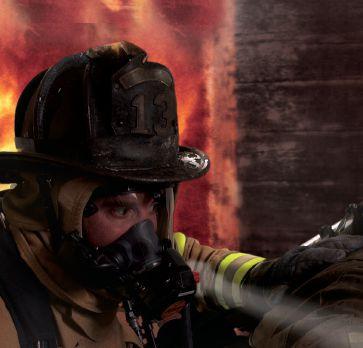
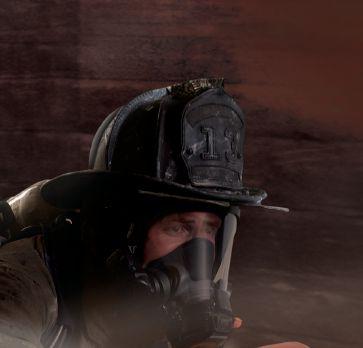
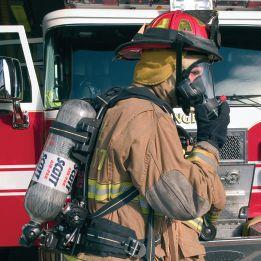
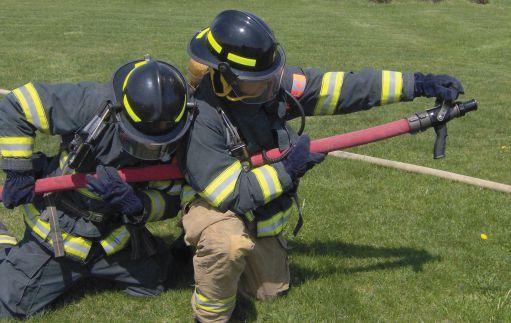
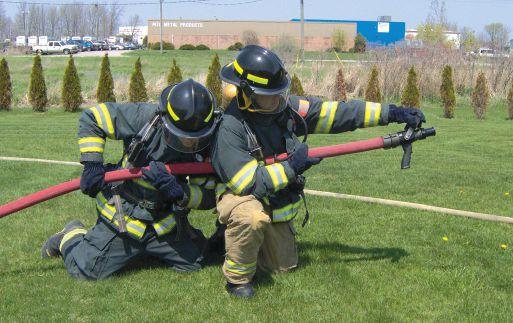
As mentioned, the backup person has a very important job to do. He is the sole support for the nozzle man. The job of the backup person is to take the nozzle reaction away from the nozzle man by supporting him with his full body weight. As depicted in photo 1, the backup person is right behind the nozzle man. Look at how he has his upper body buried right below the nozzle man’s shoulder. His whole body is supporting the nozzle man, thus taking away the nozzle reaction and stopping the nozzle man from moving back from the nozzle reaction. The only thing the nozzle man has to worry about is controlling the nozzle and suppressing the fire.
The hands of the backup man are on the hose – both hands, not just one. Many times we find ourselves having just one hand on the hose and our other hand on the back of the person in front of us. Why do we do this? Because we were taught this back in basic training (IFSTA 4th edition page 435, IFSTA 5th edition page 679). We were taught to have our one hand on the hose and the other hand on the back shoulder of the man in front of us so that we had proper spacing between the nozzle man and the backup man. We were also taught to have one foot placed behind the nozzle man’s to provide support. That works well if we are standing up posing for a picture, but when we are pumping 130 to 150 psi (900 to 1,000 kPa), we need to have both hands on the hose so that we are giving full support to the nozzle man. Without both hands on the hose, we are not taking away the nozzle reaction and not backing up the nozzle man effectively. Most times we are kneeling on the ground when advancing a hoseline for interior attack. Putting one foot behind the nozzle man’s foot does not work; we need to use our whole body.
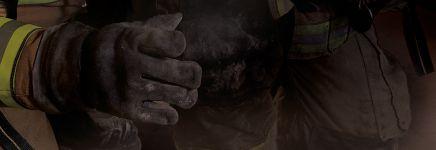
We wear bulky structural firefighting gloves. Our gloves hinder our ability to hold the hose effectively to provide support. Our structural firefighting gloves take away some dexterity from our hands. Usually, our gloves are too bulky, too big for our hands, not sized properly, too wet or too stiff (if they are dry). Our gloves work against us in some ways. They provide us with thermal protection, abrasion protection


For more information, call your local Globe dealer or Safedesign.
GlobedealerorSafedesign.
BRITISH COLUMBIA AND ALBERTA
Coquitlam, British Columbia 800-667-3362
Calgary, Alberta 800-661-9227
Edmonton, Alberta 800-222-6473
Kamloops, British Columbia 250-374-0044
Nanaimo, British Columbia 250-758-3362
Prince George, British Columbia 250-960-4300
QUEBEC
LaSalle, Quebec 800-905-0821
ATLANTIC PROVINCES
St. John's, Newfoundland 800-563-9595
Dartmouth, Nova Scotia 800-567-1955
Saint John, New Brunswick 800-567-1955
MANITOBA AND SASKATCHEWAN
Thompson, Manitoba 204-778-7123
and weather protection but at the same time they take away our ability to use our hands to their capacity. If you have small hands to begin with, this will be your No. 1 enemy and will make your job even tougher. So, make sure you place both hands on the hose to support the nozzle man as depicted in photo 2.
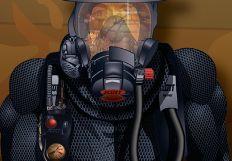
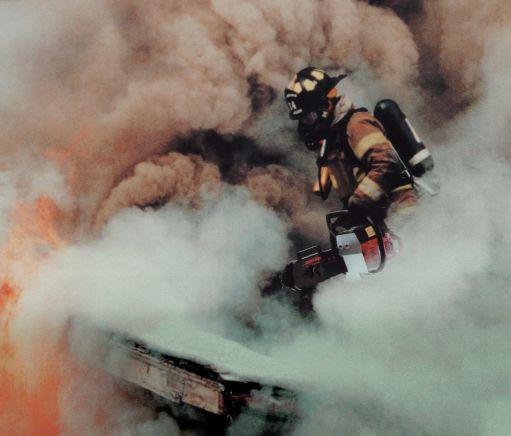
The stance that the backup person takes is important as well. Look at photo 3. Notice how the backup person is kneeling. He has both knees firmly on the ground, which will allow him to support the nozzle man and support himself. He is rooted like a tree, which gives him more stability and will also give him more endurance for supporting the nozzle man. In martial arts, you are taught to take the horse stance when fighting. This stance allows you to have stability when fighting, giving you the advantage over the enemy. The same application can be used here; by having both knees on the ground, we are giving ourselves more stability and gaining a better advantage for hose advancement. In the August article, I showed a picture of the back-to-back position. This position also has great advantages for the backup person. In the back-to-back position, the entire lower body is on the ground, giving us great stability. From the kneeling position, we are able to drive the hoseline as we advance it. We will discuss this later.
The backup man can also act as the eyes behind the nozzle man. He will be able to see what is going on around and behind the two-man team. The nozzle man is going to be busy trying to find the seat of the fire and then applying water to it. Sometimes we get into tunnel vision mode in which we ignore our surroundings and focus on one task – the fire. The backup man should be checking the environment at all times as a precaution.
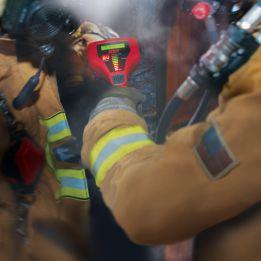
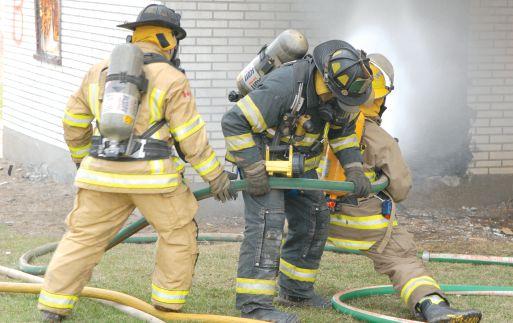
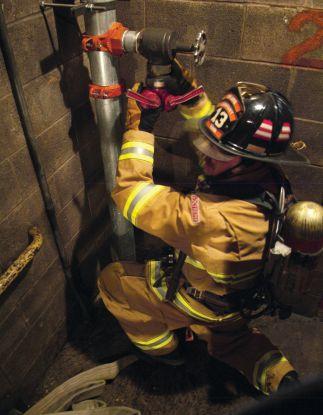
The backup man is also the communicator of the team. He will be the one communicating with the members inside the structure, who will let him know when they need more hose, need hose taken out or if they need more help. He will also be the one doing most of the work on the hoseline. When more hose is needed, the backup man will be responsible for feeding it; the opposite is true as the firefighters retreat from the structure. When team members are hooking up to a standpipe system (see photo 4), the backup man will be responsible for establishing the hook up and then making sure that all the kinks are out of the hoseline as it being advanced into position. He will also be the one turning on the water supply.
In the 5th edition of the IFSTA Essentials book, we are shown some techniques that replace the backup man. On page 652, we are
shown the use of hose straps. These straps are designed to aid the nozzle man with full control of the hoseline and the nozzle. This method of hoseline control may seem innovative, but does it really work? The hose strap will take away the nozzle reaction, but it will not allow the nozzle man to have full control of the nozzle. As discussed in the August article, the main objective of the nozzle man is to control the nozzle. This is done only with the aid of a backup person. For defensive operations, one person can operate a hoseline but not with a hose strap; he is better off looping the hoseline under itself and sitting on it. This way he will be able to control the nozzle and not have to fight against the nozzle reaction.
The position of backup man is always overlooked and is never the glamorous spot on the hoseline. Everybody fights for the nozzle so that they can fight the fire; I have never seen nor heard of fights breaking out over the backup-man position. Just as in football, the quarterback or running back gets the glory for scoring touchdowns but the offensive lineman who created the hole or blocked a tackle is a needed asset on the team. So is the backup man on the hoseline.
Mark van der Feyst began his career in the fire service in 1998 with the Cranberry Township Volunteer Fire Company, Station 21, in Pennsylvania. He served as a firefighter and training officer for four years, then joined the Mississauga Fire & Emergency Services, where he served for three years as a firefighter and shift medical instructor. He is now the training division captain for the City of Woodstock Fire Department in Ontario.








: STIFF,
HURT YOUR FEET AND YOURPERFORMANCE.


Globe Emergency Series available in 8” Lace-up (right) and 6” Step-in (below) both with side zips.
NFPA 1999 compliant. (Emergency Medical)
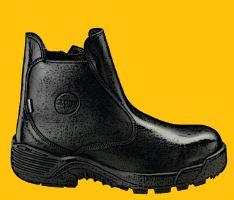
Unique cement construction combines contoured outsole, 3D lasting board with built-in flex zone, and multilayer composite puncture protection. Without stiff welts, ribbed midsoles, or steel plates, this attachment process is far more flexible than traditional welt construction. Globe FootGear has been tested to withstand 1,000,000 flexes with no compromise in performance.

SAY GOODBYE TO HEAVY, STIFF, MILITARY-CONSTRUCTIONBOOTS FOREVER – GLOBEFOOTGEAR IS HERE. REMARKABLY FLEXIBLE WITH A UNIQUE CUSHIONED AND CONTOUREDSOLE AND CUSTOM FIT SYSTEM,GLOBEFOOTGEAR FITSBETTER, GRIPSBETTER, AND FEELSBROKEN IN RIGHTOUTOF THE BOX.GLOBEFOOTGEAR COMES IN A RANGEOF STRUCTURAL,TECHNICAL AND EMERGENCYNFPA COMPLIANTSTYLES. FIND THE GLOBESOLUTION TO ALL YOURPPEPROBLEMS AT:



By CHIEF ALAN BRUNACINI
Teamwork and respect in the department and the community help to boost the image of the fire service. How the community views the department is crucial to its success, says Alan Brunacini.
Everybody has a boss. I’ve studied bosses, and I’ve noticed that the best predictor of behaviour in an organization is the way the boss behaves.
As firefighters, we strive to deliver the best services but we often have an opportunity to deliver added value to the customer. Every fire chief gets letters that say, “I can’t tell you how much I appreciated the patience those [firefighters] showed when they were caring for me.” We have to remember that beyond all the technical innovations, the customer is more likely to remember a simple act of kindness.
Firefighters do many things that may not be in the handbook, but these added-
value items deliver a level of service to the customer that is hard to beat. This level of service must be embraced by every level of the organization. The relationships we have inside the organization are the foundation for how we deliver service to Mrs. Smith.
Workers and bosses connect in a personal and direct way. The boss is the major reference person for workers and represents the organization. The boss/worker relationship is a critical part of organizational behaviour and performance because it creates the “stuff” that gets acted out at Mrs. Smith’s house. How does firefighter Smith treat Mrs. Smith? For the answer go look and see how Chief Smith treats firefighter Smith.
• Record-keeping is easy!
• Test data can be printed or saved for future retrieval
• When a Complete Test is not required, the “Quick Test” evaluates the operational readiness of most SCBA components in less than 2 minutes. Consumes less than 1% of the SCBA’s air supply
• Tests Low Pressure (2216 psig) and High Pressure (4500 psig) SCBAs for mask leakage, exhalation check valve opening pressure, static mask pressure, bypass flow rate, pressure gauge accuracy, low pressure alarm activation, first stage regulator performance, breathing resistance at standard and maximum flow rates
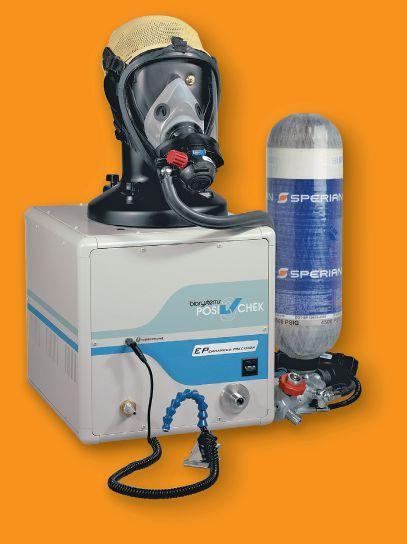
FIREFIGHTERS ENCOUNTER RISKS EVERYDAY. DON’T LET YOUR SCBA BE ONE OF THEM. Thousands of fire departments today rely on the Sperian BIOSYSTEMS POSICHEK3® to positively verify their SCBAs are fit for use. It is the only NFPA-CompliantSCBA Test Bench that meets the stringent NFPA 1852 requirements. In fact, the BIOSYSTEMS POSICHEK3is the standard test bench for virtuallyeverymajor SCBAmanufactureraroundtheworld.
■ NORMAL EVOLUTION
We need our company officers to be good bosses. We’re at an interesting point in the fire service. Experienced officers are leaving and young kids are taking their places. While this is a normal evolution, it’s a challenge for us to make sure these kids are up to the task. Unfortunately, there often is not much training, direction or information on how to be a good boss.
How do firefighters learn to be good bosses? I’d be willing to bet a lot of fire service officers would say, “I wish someone had told me this. . . ”
I have spent 50 years taking notes about things. Over the years, my notes on bosses turned into my functional boss behaviours book. I recently partnered with TargetSafety (www.targetsafety.com) in the U.S., and Medteq Solutions in Canada (www.medteqsolutions.ca) to put this content online because I think it’s our responsibility to share with young officers the lessons we’ve learned.
I’ve boiled it down to a set of 10 behaviours that support and assist workers in delivering added value directly to Mrs. Smith:
■ TAKING CARE OF THE CUSTOMERS
1
Much of our focus is on customers. When we connect with them, we should deliver the best possible service to them. So the magnetic north that we talk about in this program has to do with what we are doing, managing or creating. Does it have impact on Mrs. Smith?
■ TAKING CARE OF THE WORKERS
2 The relationships inside the organization are the launch pad for how we deliver services. The behaviour of the boss is the most powerful thing in the everyday environment in our organizations. If bosses don’t take care of workers, how can we expect the workers to take care of Mrs. Smith?
■ BUILD TRUST OR GO HOME
3
Trust is a basic part of any relationship and is what connects the boss to the worker and to Mrs. Smith. Mrs. Smith trusts us because we respond quickly, solve her problem and we’re nice to her. The workers trust Boss Smith because he responds quickly, solves the problem and has a supportive relationship with the workers. Bosses must foster, develop and then refine the trust relationship inside the system to provide the best service outside the organization.
■ SWEAT THE BIG STUFF
4
The priority for every boss is that everyone goes home. The routine stuff is important and ensures we are ready for the tough stuff but the boss’s focus should be on the critical stuff that allows us to deliver service and survive that service. We should work backward from there.
■ SET THE WORKERS FREE
5
When we become bosses, we gain authority and power that we use to create order, deliver service and take care of the workers. One of the best things a boss can do with that authority is empower workers to be independent and self-directed. This is an expression of trust in an organization and helps create an effective, integrated group.
■ PLAY YOUR POSITION
6 Organizations consist of three levels: strategic; tactical; and task. For the organization to be effective, each level must be independently functional and capable and they must be interconnected. The challenge here is to knit the levels together in a way that connects them to each other but points the organization toward the customer.
■ KEEP FIXIN’ THE SYSTEM
7
We operate within a model of improvement. We follow procedures to deliver service and then critique the outcome. That model is boss driven. Bosses must continually look at SOPs, training and themselves to improve organizational performance.
■ LOYAL DISOBEDIENCE/INSUBORDINATION
8
The firefighters – the workers – have the best set of perceptions, experiences and connections to Mrs. Smith, and often they have ideas about how to improve service. A willingness to make suggestions is a mature form of organizational commitment and respect.
■ ANATOMY AND PHYSIOLOGY
9
Every boss has strengths and weaknesses. A boss’s personal effectiveness depends on how the boss uses his skills and capabilities. This is where a boss and a worker come together. Small improvements in the boss’s personal effectiveness can produce big-time results in the boss/worker relationship.
■ DON’T DO DUMB STUFF
10
Workers can identify anything the boss does that is self-serving or stupid, and this can be destructive in an organization. This simple stuff can quickly get complicated when it’s ignored.
I’ve never figured out how to change somebody’s attitude but I’ve noticed if you can change someone’s behaviour, the attitude will change over time. I don’t think you do that with leadership. You do that with an online, present, conscious, engaged boss. The most powerful way bosses can affect how effective and connected the workers are is by regulating and managing their own behaviour.
Chief Alan Brunacini retired from the Phoenix Fire Department in 2006 after 48 years. For information on Brunacini’s functional boss behaviours training course, visit www.medteqsolutions.ca/4030/9864. html


B.C. exercise reveals strengths and weakness
By PAUL DIXON

Another warm, sunny summer day in Vancouver. With Labour Day approaching, it has been one of the best summers in memory, with no appreciable rain for more than two months. The fire hazard in the forests of Vancouver’s North Shore is extreme. As the sun rises, clouds covering the peaks of the North Shore mountains build to form massive thunderheads. Thunder is heard echoing in the mountain valleys for some time before lightning becomes visible as the clouds swirl. After one spectacular bolt of lightning, smoke is seen rising from the heavily forested slopes of Grouse Mountain. The District of North Vancouver Fire Rescue Service is inundated by 911 calls from across Greater Vancouver. Response is immediate, with the first engine company on scene in minutes. It is readily apparent to those first arriving firefighters that what they are looking at is beyond their capabilities and expertise. Even as the duty chief is still en route to the scene, the call has gone out to Metro Vancouver Watershed Protection and Coastal Fire Centre for wildland firefighters.
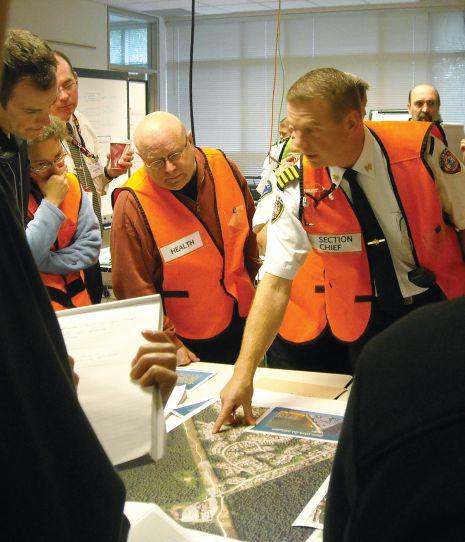
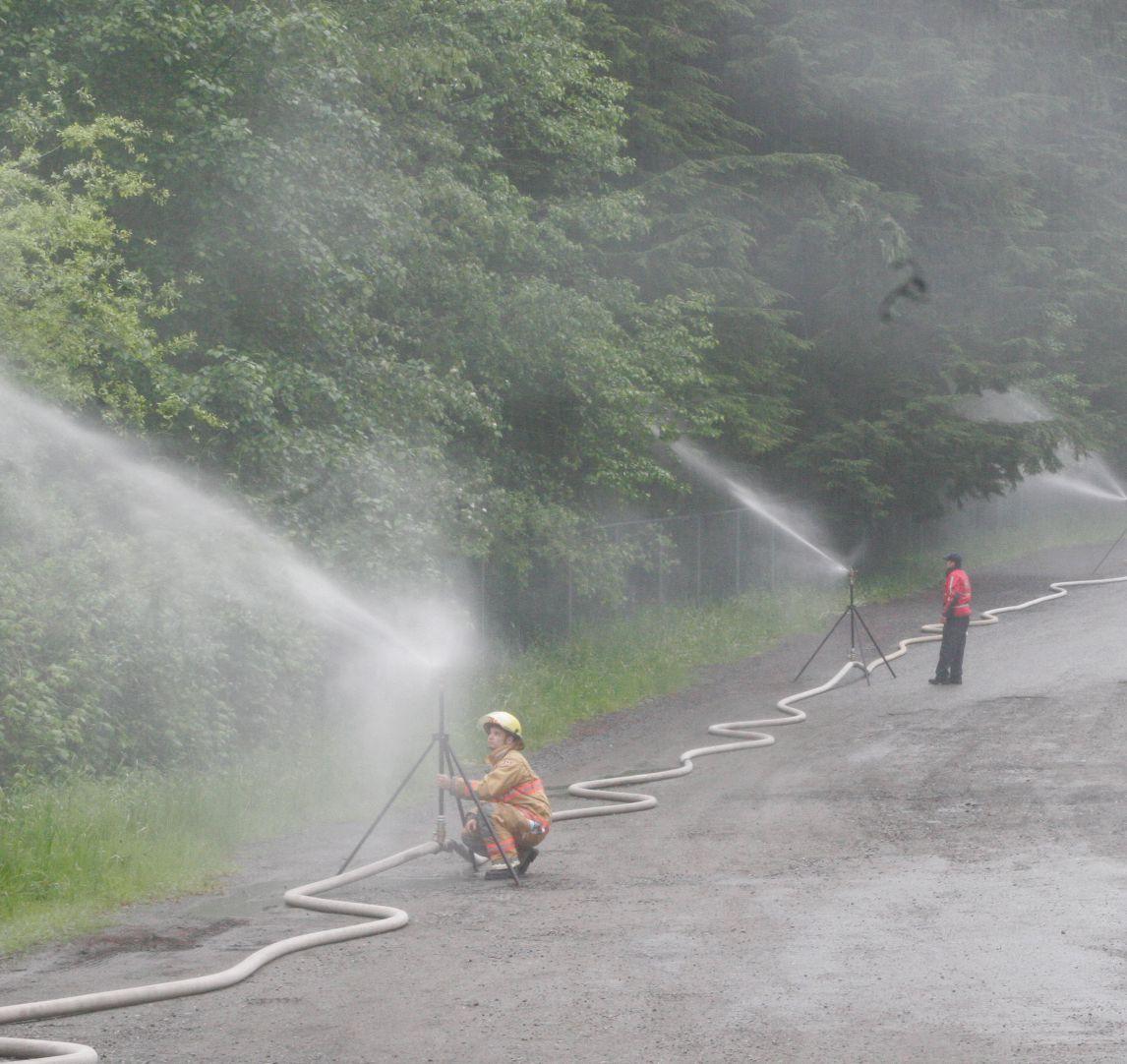
There is no actual fire, as this is the preamble to Operation Dry Lightning, a full-scale functional exercise held on June 11, 2008, to test the capabilities of those agencies that would respond to an urban interface fire: District of North Vancouver; District of North Vancouver Fire Rescue Service; Metro Vancouver Watershed Protection; provincial Ministry of Forests & Range Protection firefighters; B.C. Ambulance Service; RCMP; Grouse Mountain Resorts; BC Hydro; North Shore Emergency Management Office; North Shore Rescue; and many more.
The District of North Vancouver occupies 160 square kilometres on the north shore of Burrard Inlet. Fully 65 per cent of the district is wilderness, much of which is steep, mountainous terrain within large parks such as Mount Seymour Provincial Park, Lynn Headwaters and Grouse Mountain, along with two of Greater Vancouver’s watersheds, Seymour and Capilano. The 85,000 residents live in 20 per cent of the area, with many of the neighbourhoods having extensive green belts and urban parks with mature, second-growth
trees. The geography is challenging, with three major fast-flowing rivers, Capilano, Lynn and Seymour, cutting the district with their steep canyons. Add to this a large number of smaller creeks and streams and compound it with the Trans-Canada Highway running through the middle of the community. The result is that each of the District of North Vancouver’s five fire halls is virtually isolated in its own neighbourhood, with access from any one to the others restricted to one or two easily congested routes.
Operation Dry Lightning grew of out two significant events, Firestorm 2003 and the subsequent Filmon Report, and the 2005 Berkley mudslide in North Vancouver. The District of North Vancouver formed a natural hazard management program, which quickly identified the most significant threats to the municipality – landslide, debris flow/ flood, earthquake, interface fire and extreme weather. Fiona Dercole is the section manager–public safety for the district. “Once we understand the hazards and associated risks, we prioritize our mitigation and preparedness activities,” she says.
B.A Blackwell & Associates, in concert with District of North Vancouver arborist Mark Brown, authored the District of North Vancouver’s community wildfire protection plan. The plan, tabled in April 2007, provided historical background, an assessment of current hazards and a number of recommendations to mitigate risk. Historically, much of the area was logged of mature cedar and fir in the late 19th and early 20th centuries, resulting in a second-growth forest comprising alder and hemlock, with some cedar and fir. Blackwell compiled a database of wildfire starts in the district based on provincial information dating back to 1950. In total, there were 186 fires, with 76 per cent caused by humans and the remainder started by lightning. There were 15 fires in 1963, the most in one year. Of the 186 fires, just three were larger than four hectares, with the largest being in 1967 at 34.3 hectares. The most important point in the report was the significant amount of fuel loading in the interface area. This led to the Grousewoods fuel treatment pilot program, funded by the province, to mitigate the wildfire risk by removing ladder fuels. The program is under the direction of Brown, the arborist.
The release of the Blackwell Report was followed by a tabletop exercise in June 2007 as the lead up for the full-scale, functional exercise. Planning such an exercise requires a significant investment in time and resources, which are in short supply in most organizations. A joint emergency preparedness program grant was applied for and upon
approval, consultant Margaretha Lundh of Global Consulting was engaged to spearhead the planning.
“My job is to oversee the big picture as well as the details,” she says, “make sure that as many agencies and organizations are represented as possible, not just first responders. We create the event timeline, meet as a large group, as well as with the individual agencies. There were at least six major group meetings in the planning phase and many, many smaller meetings with the individual agencies.”
For Fiona Dercole, the public safety manager, “it was very important that we allow the individual agencies within the larger group to test their own, specific emergency plans and responsibilities within the framework of the master plan. As an example, for the North Vancouver RCMP detachment, it meant actually doing a test of their neighbourhood evacuation plan by having members going door to door in the affected area.”
The exercise plan called for a significant air component, both rotary and fixed wing, but Mother Nature hadn’t read the plan. The morning was heavily overcast with a light drizzle, which grounded the air component. Shortly after 9 a.m., the exercise started in the parking lots at the base of Grouse Mountain, with a large contingent of observ-
ers from agencies around the region and the local media. The alarm was sounded and the first-in apparatus responded from DNVFRS hall 3 on Montroyal Boulevard, sizing up the situation upon arrival and making the request for Metro Vancouver and provincial Ministry of Forests firefighters. The plan called for Metro’s initial attack (IA) crew to respond by helicopter from its base at the Seymour Watershed and then have that helicopter begin a bucket attack while the rest of the crew drove to the scene in its wildland apparatus. Now, instead of a five-kilometre line of sight helicopter flight, crews faced a 20-kilometre drive over municipal roads and provincial highways. The provincial Ministry of Forests would have dispatched its IA crew by helicopter from its base in Squamish, with any required support in the form of a road response over the infamous Sea to Sky highway. Further provincial support would have included helicopter dispatched from the Coastal Fire Centre for increased bucketing, along with a bird dog aircraft followed by an aerial tanker from Abbotsford.
DNVFRS Assistant Chief Curtis Bremner responded as the initial incident commander, with Deputy Chief Victor Penman responding as the event ramped up. Bremner was initially the IC, with command passing to Penman upon his arrival. As Metro Vancouver and MOF arrived on scene, they were brought in and a unified command structure established, with Penman as IC. At the same time, the Emergency Operations Centre (EOC) was activated in the North Shore Emergency Management Office (NSEMO) facility. For the first hour or so, communications between IC and the EOC were sporadic, the result of spotty cell coverage and a dropped radio link. Fortunately, members of the North Shore Amateur Radio Club had been included in the exercise as part of the NSEMO support group and were able to provide communications support as required.
The three groups of firefighters worked well together. MOF and Metro took responsibility for the ground attack on the fire, while DNVFRS deployed its wildfire sprinkler system along the natural fire break afforded by the BC Hydro right of way and staged additional apparatus in the adjoining neighbourhood that would be in the line of any windblown embers.
“We learned a lot from actually sending members door to door”, said Cpl. Murray Day of the North Vancouver RCMP, after members of conducted a real-time evacuation alert exercise. “They only got to about half of the residences we hoped to cover. A large number of people were at home during the day and we had to take the extra time to talk to them about what was happening. In a real event we wouldn’t have been stopping to talk
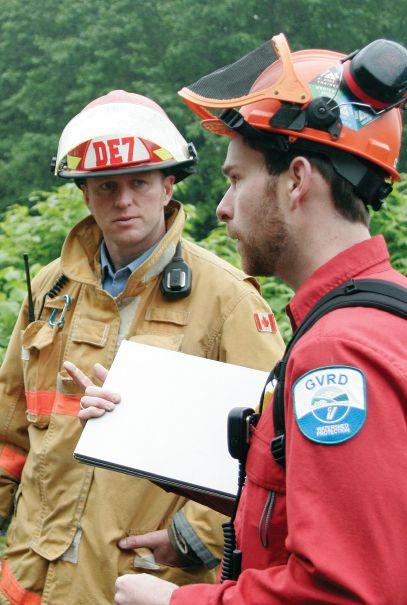
as we did other than to say “get out.”
To maintain a high degree of realism, an actual fire had been set several hundred metres into the forest under the watchful eye of district foresters. Once crews moved into action, the fire was quickly extinguished by the MOF and Metro crews.
The weather may have grounded the helicopters and aerial tankers for the exercise, but there was also a realization that these resources may not be available even on the sunniest of days depending on operational requirements elsewhere in the region or across the province. The effort that went into planning the event along with the time and resources the participating agencies dedicated was as important, if not more important, than the actual event.
“We’ve worked with Metro and MOF in the past”, said Deputy Chief Penman, “but we learned so much more about each other in putting this together. Understanding each other’s responsibilities and capabilities as we do now gives us all a much stronger working relationship. The respect we have for each other’s expertise puts us all at ease when working together. It’s all about the relationships.”
For more information on Operation Dry Lightning, contact section manager– public safety Fiona Dercole, DercoleF@dnv.org; district arborist, Mark Brown, BrownMW@ dnv.org; or Deputy Fire Chief Victor Penman, PenmanV@dnv.org
Paul Dixon is a freelance photojournalist living in North Vancouver. He can be contacted at pd.dixon@shaw.ca

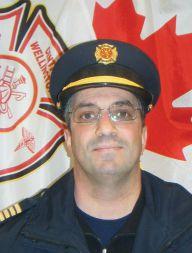
BY BRAD PATTON Fire Chief, Centre Wellington, Ont.
have received many e-mails regarding my first column, Obstacles in maintaining a volunteer department, in June. The e-mails came from fire chiefs, provincial fire marshals and firefighters, all of whom have agreed with the content of the column.
I now feel brave enough to complete my thoughts. It is my opinion that the fire service as a whole is in big trouble, and if a “hero” doesn’t come along soon, we are all in for a very rough time that many of us may not survive.
By a hero, I mean a true leader – someone who will do the right thing for the fire services and the public we serve, even if it means upsetting a whole lot of people.
The management or the delivery style of the fire service, whether it be volunteer, paid on call, part time or full time, has not changed. Yes, we have been able to purchase and enjoy some fantastic equipment: high-tech gear; thermo-imaging cameras; hydraulic cutters that will cut just about anything; bunker gear and boats that are lighter and offer more protection than anything in the past. Our equipment can be very good – that’s not the problem.
Our training can be very good too. If you want to be the besttrained firefighter it’s all there for you: great instructors; college programs; online training; thousands of well-written books that cover everything from venting a house to swift water rescue, etc. Every aspect of our job is written somewhere. But after 100 years, we still manage and deliver our services the same way. I don’t believe there is a successful business administrator out there who would tell you that’s a good thing. I’ll try to put this into perspective for you with my own experiences which, hopefully, you can relate to.
I look at those organizations now and, boy, have they changed!
There are basically three or four types of police departments now: federal; provincial; regional/county; and metropolitan police, who are in the larger cities. Long gone are the small police forces in every little town. They changed how they did business and it works very well. It doesn’t matter where you go in Canada, a cop is a cop – well trained and professional.
The same changes have happened to the ambulance services. Long gone are the Dodge vans and a couple of guys with some basic skills in first aid whose battle plan was simple at the time: stop the big flow of blood or perhaps put the patient on some oxygen, load him and go to the closest hospital. Look at the ambulance service now and see what the once-fledgling services have become.
Not very many small town ambulance services exist today. Once again, they are either run by the province, region/county, large cities, and large, private organizations.
The ambulance attendants have gone from a couple of guys with very basic first aid to a pair of medics. These paramedics are well trained and dedicated to saving lives. They constantly train to become better in their field.
The management or the delivery style of the fire service . . . has not changed. ‘‘ ’’
When I started in the fire service, the ambulance service was run out of the local funeral home and was just evolving and going through a great change to become a dedicated emergency service. At that time, it was a mom-and-pop type of business with a typical staff of a couple of guys who had some very basic first aid and a Dodge van with a kitchen cabinet screwed to the inside. They did the best they could, when or if they showed up at an emergency.
At the same time, just about every town had its own police force, if you could call it that. The towns I lived in usually had five or six beat cops, two or maybe three patrol cars and a police chief who was never far away and was always called to anything big. The cops were generally local big boys with a bit of education who often did things their way. While all that was going on, I was just a young firefighter.
In the last 20 to 30 years, both the police and ambulance services have totally rebuilt their organizations to deliver a better service to their customers, and I do mean a total rebuild of their businesses. They are better run organizations, better equipped and trained to provide a standard level of service now.
I have a simple test to do to check the accuracy of my statements. Go to or think about a rural area near you. If you were to call the police or an ambulance, would the service you receive or the quality of care be any different (other than, perhaps, response time) than if you were in a large town or city? Would you receive the same level of service?
In the November issue of Fire Fighting in Canada, Part 2 of this story will focus on the organizational changes, or lack of, in fire services.
Love the job, learn something new every day and be prepared to make changes.
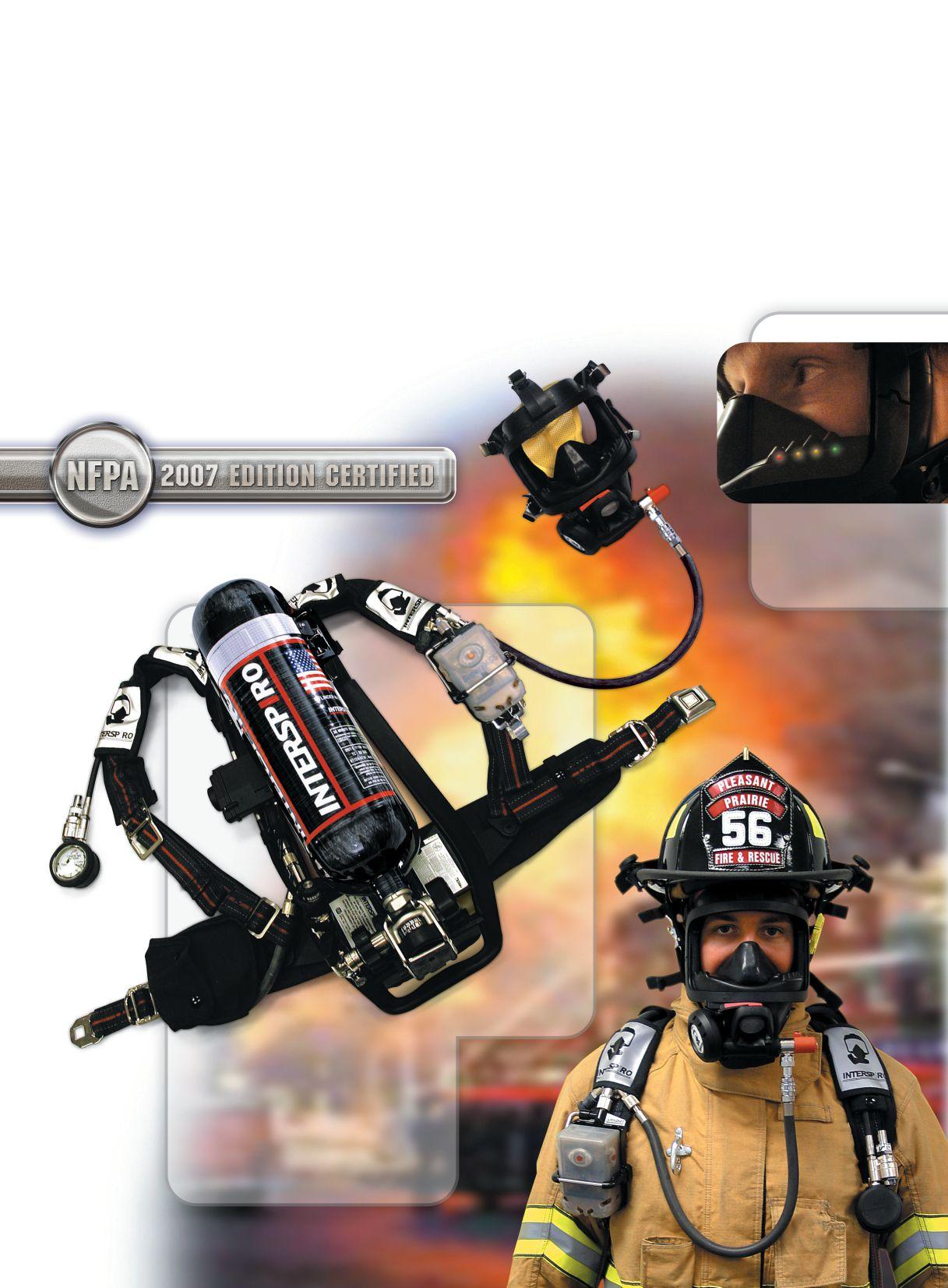

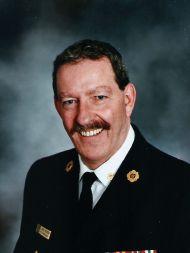
BY E. DAVID HODGINS Managing Director Alberta Emergency Management Agency
had the opportunity recently to vacation in the magnificent country of Singapore. Singapore is a modern and extremely well-governed country with a population of approximately 4.5 million people. It’s amazingly clean with incredibly well-maintained roads, public parks and outdoor shopping spaces. The contemporary design of the buildings located in its core area is a site to behold. In my opinion, the taxi service available in Singapore rates a nine out of 10. The taxis are well maintained, clean, readily available and easy on the wallet. By comparison, I would rate taxi service in other parts of the world, including Canada, at a two or less. And if this travel review of Singapore doesn’t excite you, then let’s move to its world-class fire prevention program.
Singapore is served by a totally integrated fire/rescue, emergency medical and emergency management department. Its system is a highly developed model worth imitating. What is remarkable about Singapore’s integrated service is the apparent scarcity of emergency events. We were in Singapore for seven days and didn’t see a police, fire or EMS vehicle responding to any emergency event.
I had a similar experience while vacationing in Ireland in 2006. Similar to Singapore, Ireland is an island with a population of more than 4 million people. During our three-week visit to the Emerald Isle, which included a couple of days in the incredibly busy city of Dublin, I recall hearing the sound of a siren a total of six times. One wonders why there appears to be so few emergency events in these two countries. Like Canada and the U.S., both Singapore and Ireland are experiencing significant growth in population and infrastructure. Industrial, business and residential development is everywhere. These countries are highly aggressive about trade and commerce. And along with robust and growing economies and local communities are the usual life safety and property protection fire risks similar to what is found in Canada and the U.S. However, the similarity stops when one compares their – and our – number of emergency events.
its seaport, which is the busiest in the world.
According to a 2006 report published by the Centre of Fire Statistics, International Association of Fire and Rescue Services, the average number of fire calls per 1,000 inhabitants in Singapore in 2004 was 2.3. The average number of fire calls per 1,000 inhabitants in the U.S. for the same year was 77. In 2004, the average number of fire deaths per 100,000 for Singapore was 0.2 and for the U.S. per 100,000 it was 1.3. (The entire report is available at http://www.ctif. org/IMG/pdf/CTIF_report11_world_fire_statistics_2006.pdf.)
Canada was not involved with the International Association of Fire and Rescue Services applied research project; however, according to information available through the Council of Canadian Fire Marshals and Fire Commissioners website, the statistics presented for 2002 show that Canada experiences 60,000 fire events annually based on a 10 year average. The average number of fire deaths per 100,000 is 1.25. And how do cities compare? Toronto – with a population of approximately 2.48 million – had its fire department respond to 9,500 events in 2007. The Toronto Fire Services published 2007 annual report also lists the total number of responses at 142,515, of which there were 75,177 medical assist responses and 27,978 responses under the fire alarm
What are others doing to reduce the sounds of sirens? What can we learn from them? ‘‘ ’’
Sitting in my office in the heart of downtown Edmonton, the sound of sirens is heard repeatedly. I have found the same during my numerous visits to other North American cities. This is not meant to be a comprehensive academic analysis of statistical data; however, a quick search on the Internet reveals Singapore responds to approximately 5,000 fire events annually. That includes response services provided for Singapore’s active Changi Airport as well as
David Hodgins is the managing director, Alberta Emergency Management Agency. He is a former assistant deputy minister and fire commissioner for British Columbia. A 30-year veteran of the fire service, he is a graduate of the University of Alberta’s public administration program and a certified emergency and disaster manager. E-mail: David.Hodgins@gov.ab.ca
ringing category. Montreal’s fire department, serving a metropolitan area population of roughly 3.7 million, experiences approximately 50,000 total emergency events annually with approximately 10,000 being fire events. The Hong Kong fire department, which is often applauded for its successful fire prevention program, serves a population of 7 million and responds to approximately 32,000 fire calls annually.
What are others doing to reduce the sounds of sirens? What can we learn from them? And how do we address fire related risks? Key considerations involve the implementation of enhanced education programs, more prescriptive codes and standards, modern engineering practices and increased inspection and enforcement activities. As well, we need to get serious about the challenges related to unfortunate social and economic conditions and negative behaviours.
Then there is the No. 1 challenge, and that is to develop the cando attitude. We can prevent fires. And we can do it by demonstrating leadership through a proactive rather than a reactive stance.
By DON HENRY
Sustainability, according to the Environmental Protection Agency, means “meeting the needs of the present without compromising the ability of future generations to meet their own needs.”
Let’s talk about sustainability from an apparatus-maintenance point of view. From my work as chair of the apparatus maintenance section of the International Association of Fire Chiefs, I have found that fire chiefs want to leave their fire departments in better shape, both financially and morally, than they found them. Fire chiefs face decreasing budgets and increasing expenses and may be tempted to reduce the maintenance budget (you do have a maintenance budget, right?). Reducing the maintenance budget may work for the short term if you have been doing a proper preventive or proactive maintenance schedule until now. Of course, such action would not be sustainable. It would only lead to increased breakdowns and costly repairs in the future, not to mention a decrease in the public’s confidence in your department’s ability to deliver service. If you repair and maintain equipment only when it quits working, then you have already embraced the concept of crisis maintenance. Crisis maintenance is marked by statements such as “Don’t go looking for trouble”, “It’s never done that before”, “What’s that noise?”, “Don’t worry, it will go away”, or, my personal favourite, “The B shift did it”.
So, how do we get off this insanity treadmill and onto the path of a sustainable future for your department? There are three things you need to do.
1These life cycles include the service life cycle, the economic life cycle and the technological life cycle. Each life cycle is different. By fully understanding these cycles, you will be able to successfully justify the replacement schedule for apparatus to your local government (assuming you do have a schedule for replacement).
Let’s look at the service life cycle first. The service life cycle refers to whether the truck can be repaired and maintained. It’s very difficult to find parts for trucks that are more than 20 years old. This is a two-edged sword; if you approach your local government and say you need a new pumper because the old one is in very poor shape, I, as your town councilor, would counter question the purchase of a new truck if you can’t keep the old one in good repair.
Economic life cycle refers to whether the truck is worth fixing. Most city departments look at only the depreciated value of a piece of equipment such as a Caterpillar or a track backhoe. If the needed repairs are more than 25 per cent of the depreciated value, the vehicle simply goes to tender or auction sale as it is not worth fixing. Unfortunately, this same yardstick is not always applied to fire apparatus. New fire apparatus is expensive and you may be encouraged to spend much more than 25 per cent to repair the truck. I know that it may take one year or more to specify and make a new piece of fire apparatus, and a new truck represents a major expense, but old trucks can easily nickel and dime you to death. Of course, newer

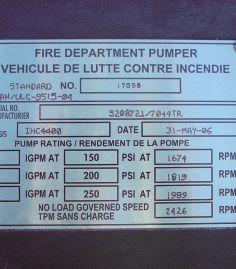
SERVICE LIFE
Be sure to hold onto and record all information that comes with your apparatus so you can order proper parts and correctly maintain the vehicle.
I have found that fire chiefs want to leave their fire departments in better shape, both financially and morally, than they found them. ‘‘ ’’
trucks with electronic engines have fewer engine exhaust emissions and are more fuel efficient than trucks that used mechanical fuel injection systems
The technological life cycle is the basis on which we should argue for the truck’s replacement. The newer trucks stop faster (ABS and disc brakes), handle better (traction control and roll stability) and can use less water (compressed air foam systems). In my view, the newer trucks are also much safer for the fire crews. There have been a number of truck safety improvements from the NFPA 1901 standard of 1996. You may think you should refurbish your old truck to at least incorporate these new safety futures; this can be done but it’s not cheap and may not be for you. Get a copy of the NFPA 1901 annex D of refurbishment of trucks. There is an excellent CD on this subject done by Fire and Emergency Training Network (1-800-845-2443 or www.fetn.com). The price is reasonable and well worth it. Get it before you spend thousands of dollars on a refurbishment.
■ CHANGE CRISIS-MAINTENANCE THINKING
2Instead, embrace, at the very least, a preventive maintenance schedule that reflects the uses of your department, not the department down the road. Even better, embrace a proactive maintenance program that uses such tools as fluid and oil analyses. Fire apparatus are complex machines that require competent, trained personnel. Get a copy of NFPA 1071 and follow it for both your pump/operators (who should also be familiar with NFPA 1002) and your emergency vehicle technicians. Train your emergency vehicle technicians or employ only persons who can prove they are
EVTs. Make sure your operators are using daily/weekly and monthly inspection checklist for your apparatus. Too often, poor inspection practices are passed on to the new operators when they are trained to conduct their daily inspections at the fire hall. You will need to get on a creeper and have a trouble light to conduct a proper inspection. I often go to a fire hall and that’s the first thing I ask for – you would not believe the deer-in-the-headlights looks I often get.
■ MEET NFPA 1901 OR ULC S-515
3Remember that both of these standards are minimum standards. Overweight trucks have no place in the fire service. I started helping departments spec out trucks because I quickly realized that if the truck was made correctly from the start, the department would have a chance to achieve sustainability. It truly amazes me that the people in the fire service are so concerned with safety codes, electrical codes and building codes but when it comes to buying the truck it’s OK to cut some corners. It’s nice that you are concerned with other people’s safety, now build the truck right and put your seatbelt on when you take the truck out of the fire hall!
I agree with the EPA definition of sustainability. I have a definition of insanity that goes like this: Insanity is doing the same thing over and over again and expecting different results.

Don Henry teaches in the Automotive Services Technician and Heavy Equipment Technician programs at Lakeland College in Vermilion, Alta.
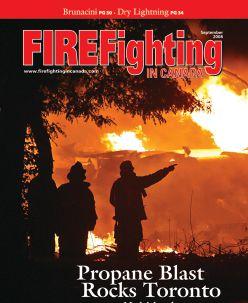

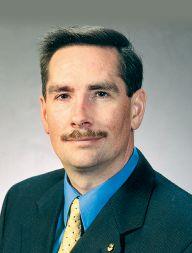
BY SEAN TRACEY Canadian Regional Manager NFPA International, Ottawa, Ont.
he CAFC, IAFF, CVFSA and other national fire service organizations have been actively lobbying for the establishment of a National Fire Service Advisor (NFSA). There is no guarantee that the position of NFSA will come to fruition because several provinces object to the need for such an advisor within the federal government. This lack of unanimous support has sent up a red flag on the issue and may delay the implementation of an NFSA. The conflicting views lead to questions about who is correct and whether we need an NFSA.
It warrants a closer look at what the envisioned role is for this advisor. We shall review the Canadian Association of Fire Chiefs position on this as well as what the first actions of a fire advisor should be. Will this be the panacea for all the fire service woes? Personally, I think not, but it is definitely better than the status quo.
The only place where the envisioned role for a NFSA has been publicly stated is in the CAFC’s recent policy paper to the government. The role includes responsibility for fire training standards, fire prevention and education, co-ordinating a national response to any emergency, serving as a link to the provincial fire marshals, keeping national fire statistics and representing the interest of the fire service at the national codes level.
It is on these CAFC stated roles that there has been resistance from some provinces. Some of these roles are not practical and not necessary, in my view. In particular there is no need to review training or other standards. This would quickly become burdensome and, besides, other standards bodies are already doing this. There is a definite need for somebody to correlate best practices, and our national fire loss and firefighter injury and fatality statistics are an utter embarrassment. (NOTE: See the online version of this column at www.firefightingincanada.com for a more detailed analysis of each of the CAFC envisioned roles.)
Where to go in the future?
America’s Burning report. This should be a good model to review for the Canadian fire services, even though we will likely not have the same financial resources. The U.S. has similar constitutional issues as we do in Canada. In both countries, the requirements for fire protection are at the local level and there is varying involvement at the state/provincial levels. We can learn from the U.S. experiences surrounding when to be engaged at the national level. Like the U.S., we have a national level chief and union organizations, national level standards organizations and a national level fire marshal body. Despite these groups, the USFA has carved out a valuable role for itself.
In Canada today the first task should be to fund a fire service national survey and a national public consultation round. From this, we need to assemble a fire services summit and a published report – perhaps something similar to the U.S. America’s Burning report. This should be the basis for prioritizing the tasks ahead and the government’s resourcing of the NFSA should be determined based on this.
This NFSA role is going to be that of finding its boundaries for the first few years. There will never be unanimity in its actions but we can hope for consensus. The NFSA should establish a working
The NFSA needs to be a resource for the fire services . . . but it cannot dictate policy.
As mentioned, there is resistance from some provinces on this matter. This is based on roles identified by the CAFC that conflict with provincial responsibilities. The solution should be that the NFSA roles should not conflict in these areas. The NFSA needs to be a resource for the fire services to enable them to perform their roles but it cannot dictate policy. It can, however, be a resource for fire services best practices. The NFSA should not be looking to reinvent what is not broken.
In 1978 the U.S. Fire Administration (USFA) was formed. This came about 26 years after the need was first articulated in the
Sean Tracey, P.Eng., MIFireE, is the Canadian regional manager of the National Fire Protection Association International and formerly the Canadian Armed Forces fire marshal. Contact him at stracey@nfpa.org
relationship with the USFA, the codes and standards writing bodies, the CCFM&FC, CAFC, IAFF and others. This office should look at funding of fire protection research, collecting and dissemination of best practices, and be the go-to source of information. It should address the fire statistics nationally. It should take ownership of the First Nations fire safety issues by creating a strategy and funding its implementation. Federal funding for the JEPP program for the fire service should be administered from this organization and it should be used as a tool to increase fire department effectiveness.
In my view, there is more than enough for a NFSA to do in Canada. The areas of conflict in provincial responsibilities can and should be avoided. Make the appointment. Start the review and get a fire summit planned for Canada. We can then move forward on the many other issues in which a national-level fire service point of contact can benefit us all.

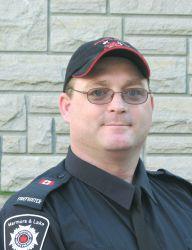
By Mike Seaborn Fire Prevention Assistant
Firefighters responding to a structure fire face many unknowns and variables. Add disabled individuals with special needs to the mix and it creates a potential recipe for disaster.
When the tones go off, firefighters are immediately advised of the type of call. What usually isn’t known is the extent of the incident: How big is the building? How advanced is the fire? Are there any hazards? Are there any potential victims?
If there is a disabled person living in the structure who is unable to escape unassisted, then firefighters face some additional issues: What is the type of disability – mental, physical or both? What is the severity of the disability? Are those with special needs bed ridden or ambulatory? Can they comprehend the emergency and understand instructions?
Fire departments have pre-plans for large buildings. Why not preplan for structures housing people with special needs, or have a registry that lists locations in which disabled individuals are living? Such a registry could be intergraded with fire a department’s dispatch system or function as stand-alone registry housed in the responding apparatus as a printed list or on a laptop. In my research, I found that dispatch systems with integrated registry information are being used in some Canadian and U.S. municipalities. Other fire departments use standalone registries.
Whatever the system, it is vital that information on disabled persons or those with special needs be kept current. For example, while conducting my research and collecting information, I was in contact with a firefighter from Boston, Mass., where an integrated dispatch registry is used. The department was dispatched to a call and, after consulting its registry, learned there was a disabled individual living at the dwelling that was on fire. Upon arrival at the scene, the fire started to catch on the nearby garage. Unfortunately, the registry hadn’t been updated to include the fact that there were oxygen tanks stored in the garage. Some oxygen tanks exploded, narrowly missing the firefighter’s head.
firefighters to deal with the incident itself.”
The responsibilities of caregivers, family members and other professionals are to be aware, not only of the disabilities of their special needs family members or charges, but also their abilities when it comes to escaping from a fire. People with disabilities may require more help, either physically and/or mentally, when escaping. That level of assistance needs to be reflected in the fire-safety planning that families and caregivers undertake. Every household needs an escape plan and people with disabilities must be included in the plan. Their safety therefore needs special consideration in fire escape plans. Fire departments need to encourage families in their municipalities to designate a member of the household to assist anyone with special needs and to decide on a backup plan in case the designee isn’t home. The designated member should know, review and practise the escape plan.
Registries must be voluntary; no one can be forced to register, but fire departments can play a major role in this kind of public education. In Ontario, the Ministry of Health has some information on disabled individuals but that is confidential and cannot be shared.
If a registry or registries are put into place, they need to be maintained to ensure information remains current. Some might suggest
Whatever the system, it is vital that information on disabled persons . . . be kept current. ‘‘ ’’
Registries, whether municipal, provincial or national, would also help firefighters know what to do during and after they have helped disabled people escape the danger of a burning building. Perhaps an ambulance needs to be dispatched upon initiation of the call to provide the disabled person with post-rescue care if the disabled person’s caregiver does not live at the same address, for example,
Randy Vilneff, training officer with the Marmora & Lake Fire Department in Ontario, agrees with this assessment. “Any information that can be provided to the incident commander will help us in focusing our initial search or mitigating potential hazards to the firefighters. Adding paramedics to the mix for post-rescue care will free up the
Mike Seaborn is the fire prevention assistant to Chief Tony Brownson at the Marmora & Lake Fire Department in Ontario.
that the fire department should do this but I believe it should be the responsibility of the disabled individual or the caregiver of a person with special needs. The individual would have keep a copy of the information that is in the registry. If there is a change in the person’s health or other information, the individual or the caregiver would contact the local department to update the details.
In the presentations I make to community groups that support the disabled, I have discussed such a registry. My goal is to get this information to a wider audience but it’s going to take time.
Being disabled as the result of a motor vehicle accident, I see many individuals with special needs. We are not crying for the fire department to keep us safe from harm, but some disabled people or people with special needs don’t know how to speak for themselves. As a chief’s fire prevention assistant who does fire protection presentations for disabled individuals with special needs, I see the need for the firefighters to become involved and help make it safer for all in the home.
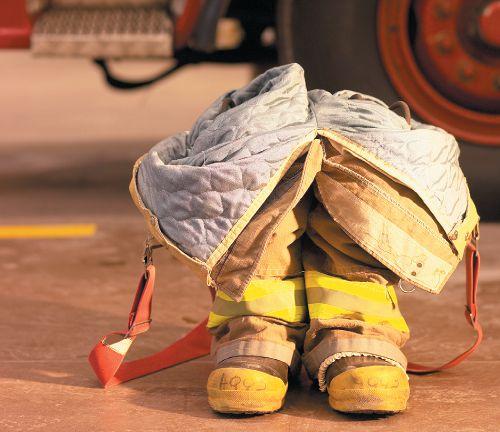


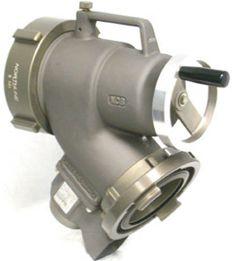


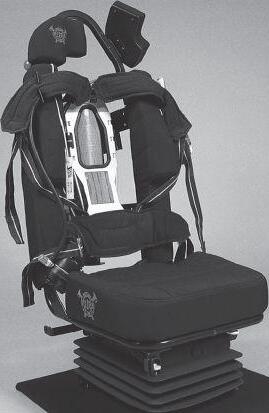


”How to Prevent Home Fires” memorably demonstrates that everyday things, if not used properly, can become dangerous and even life-threatening, but that following simple precautions can head off fires before they start.
Audiences may be surprised as they watch scenes from an ordinary day in the life of typical people in a typical neighbourhood and realize just how many different types of fire hazards we all face every day. The fact is that people cause fires – and thousands of injuries and deaths – could be prevented every year if folks incorporated fire prevention fundamentals into their daily lives.
Show this unique video at your community outreach programs and provide lessons on a wide range of fire prevention and response topics, including:
• Kitchen and cooking safety
• Flammable liquids
• Candles
• Escape plans

• Smoking safety
• Smoke alarms
• Space heaters, fireplaces, and furnaces
• Electrical outlets, extension cords, and light bulbs


Price: $370.47
Member Price: $333.42
CUSTOM TRAINING PROGRAMS:
MESC will provide custom design training programs. Other courses available include: Building standards, Rescue program, Emergency Medical, Management Program, Fire Prevention, Public Safety and Hazardous Material. Manitoba Emergency Services College, Brandon, Manitoba, phone: (204) 726-6855.
LIVE FIRE FIGHTING EXPERIENCE: Short and long term courses available, Municipal and Industrial fire fighting. Incident Command System, Emergency Response/HazMat, three year Fire Science Technology Diploma program. Lambton College, Sarnia, Ontario, call 1-800-791-7887 or www.lambton.on. ca/p_c/technology/fire_emerg_resp.htm. Enroll today!




BY PETER SELLS District Chief
former colleague of mine, now a deputy chief in western Canada, was the perfect guy to answer a question that was bugging me. I noticed in an annual report of a neighbouring fire department that it had purchased a number of public-access defibrillators (PADs). I wondered if the department had gone with a different strategy than the semi-automated external defibs (SAEDs) most departments use once they commit to providing this level of pre-hospital patient care.
Logically, if a PAD is effective in the hands of an untrained bystander in a bus terminal or hockey rink, it would be at least as effective in the hands of a trained firefighter. In addition, the cost of the equipment and the duration of the training would be less of a drain of the resources of the fire department.
So I asked my friend if some fire departments are putting PADs on their apparatus. He replied “Yes, some are, and it is a huge mistake! They will never get past that into symptom relief and IV maintenance.”
That also made sense. If a fire department had drawn the line of its service at PADs, then it would not likely commit to more advanced equipment and training. But the question has to be asked – what is the appropriate level of EMS that should be delivered by a fire department, given its response times, funding and staffing realities, and what existing EMS resources already serve the community?
Fire fighting in the 21st century is a very complex job, requiring current and complex levels of knowledge and skill in multiple areas: What flow rate is required if the local grocery store is 50 per cent involved in fire? What is the correct foam application for this chemical, and at what percentage? Will I have to call in mutual-aid resources or will I have enough if I run a tanker shuttle from the reservoir? What precautions do I have to observe at this trench rescue?
more correct than “back of the throat”, which would have been much more easily understood by most firefighters.
There is a balance between keeping it as simple as you can while making it as technically correct as you have to. You can only stuff so much into the human brain. If you have a large enough organization and you can deal with this competency overload by dividing responsibilities into functional areas – a fire/rescue division and an EMS division – then is this really fire-based EMS or two services under one managerial infrastructure?
It turned out that the PADs had been ordered by the fire department on behalf of parks and recreation for installation in community centres. The fire department already had a budget line for defibs so the funds were transferred over.
We sometimes forget that we are part of a larger corporate entity. It will often be the case that the amalgamation of missions between operationally similar departments will result in efficiencies of scale.
The classic Canadian conundrum – “which level of government is responsible” – will rear its ugly head when dealing with provincial and municipal funding and control, but that is why the fire/EMS chiefs get the big bucks – to sort out these problems.
Adding the demands of EMS to this learning curve may not be realistic. ‘‘ ’’
Adding the demands of EMS to this learning curve may not be realistic. A very good training officer, who has since succumbed to cancer after a decades-long fight, once showed me a draft of a training document on how to insert an oropharyngeal airway. Firefighters were instructed to insert the device into the patient’s mouth facing upwards “until resistance is met at the posterior oropharynx”, before rotating it 180 degrees and completing the insertion. My problem was that “posterior oropharynx”, while absolutely correct, was no
District Chief Peter Sells writes, speaks and consults on fire service management and professional development across North America and internationally. He holds a B.Sc. from the University of Toronto and an MBA from the University of Windsor. He sits on the advisory councils of the Ontario Fire College and the Institution of Fire Engineers Canada Branch.
Aside from the tasks we perform, which are inherently unique, there are many support functions that are common to fire and EMS: both train and equip staff; purchase and maintain vehicles; and operate communications and dispatch centres in order to provide emergency and non-emergency service to the public. But the same can be said about the solid waste, water/waste-water, roads or public health departments. How come I don’t remember anyone talking about fire-based waste management?
The bottom line: if a patient can receive fast and appropriate firstresponder care, including defibrillation if needed, and be handed off to advanced life support within the established time frames, then why would that patient care what shoulder flashes are worn by the medics? And, if all of this can be accomplished by separate services in a costeffective manner, then why would the taxpayer care? The model that can most efficiently and consistently deliver excellent, seamless care is the one that should be chosen.