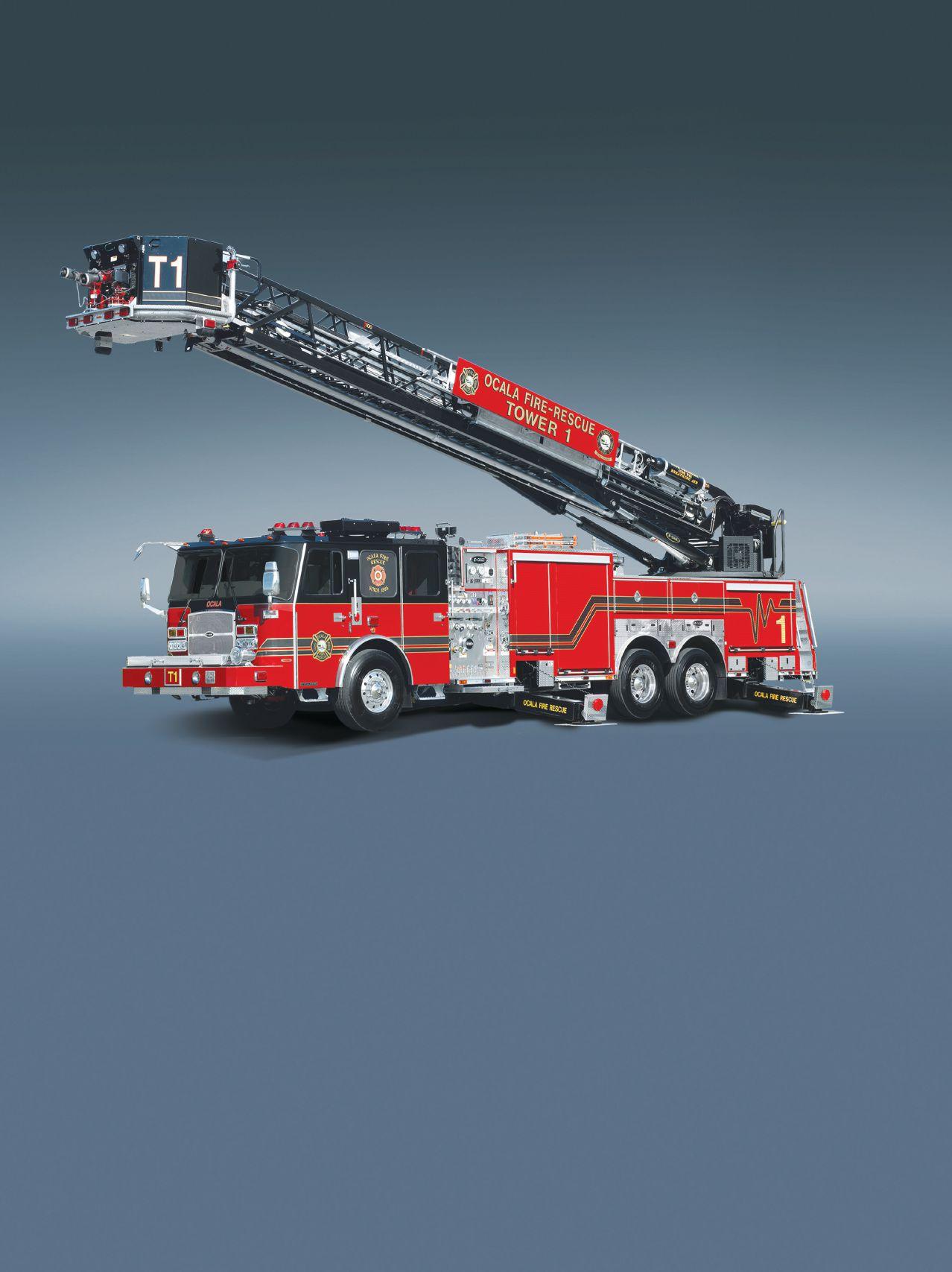
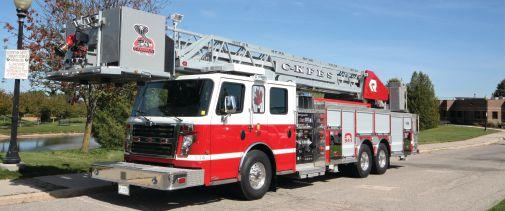
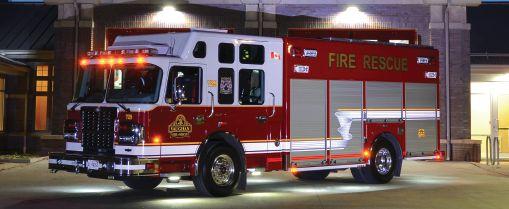
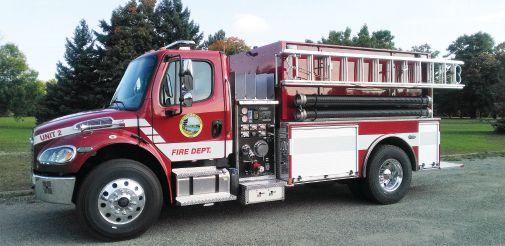
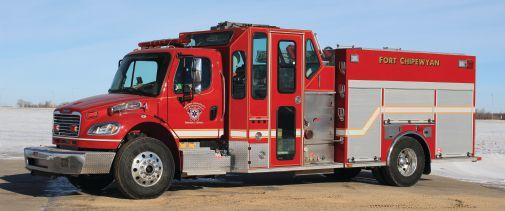
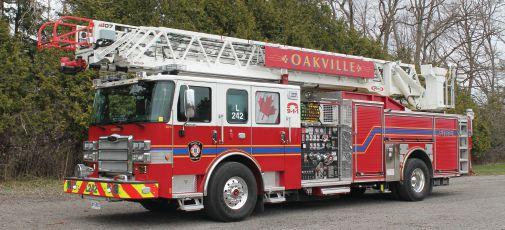
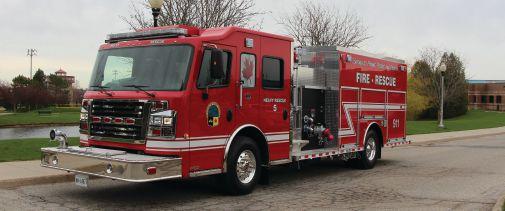
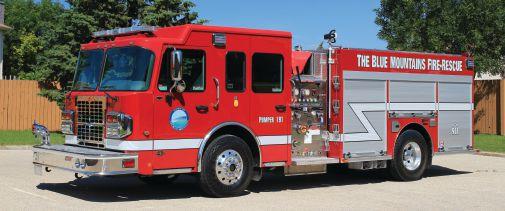
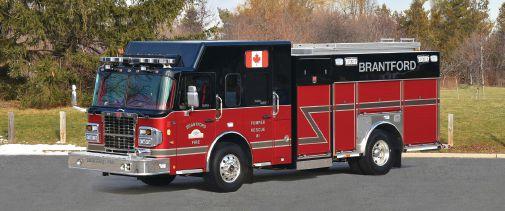
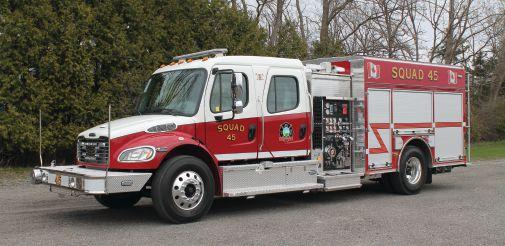
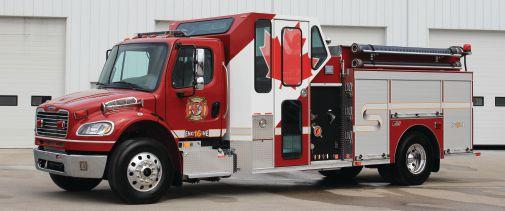
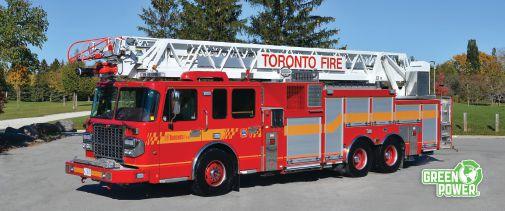
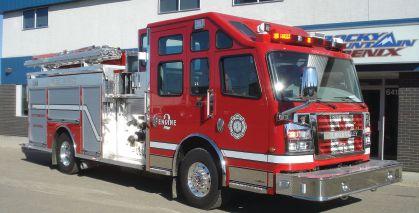
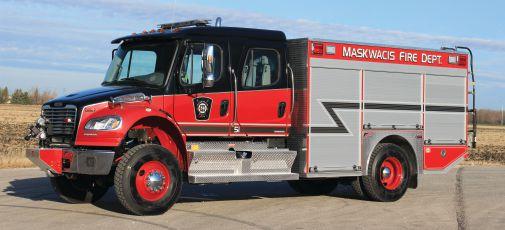
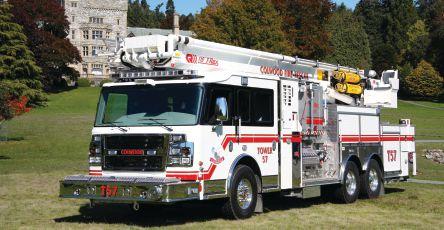
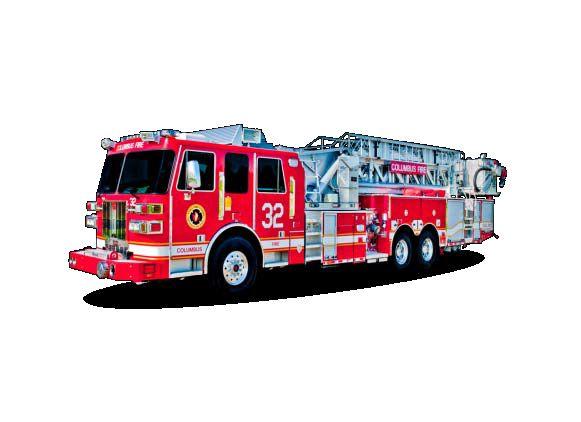
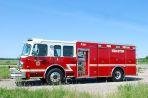
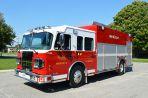
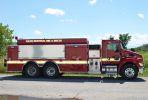
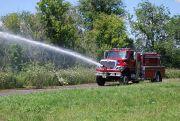
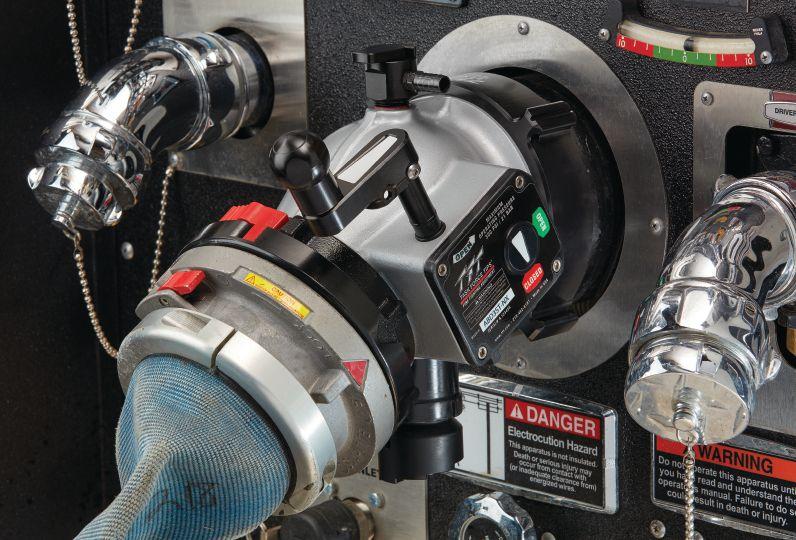
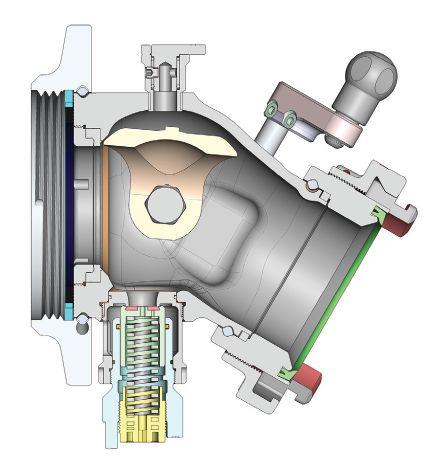
Provides up to 2000 GPM flow and available with wireless remote control.
1305 LB PLATFORM CAPACITY
The HPS 100 Platform has a rated load of 1000 lbs of firefighters and 305 lbs of equipment. Angled front corners and perimeter step provide smooth egress.
STRONGEST CAB IN THE INDUSTRY
Keep your crew safe with the cab that withstands over 5x the static roof load and over twice the frontal impact required by NFPA
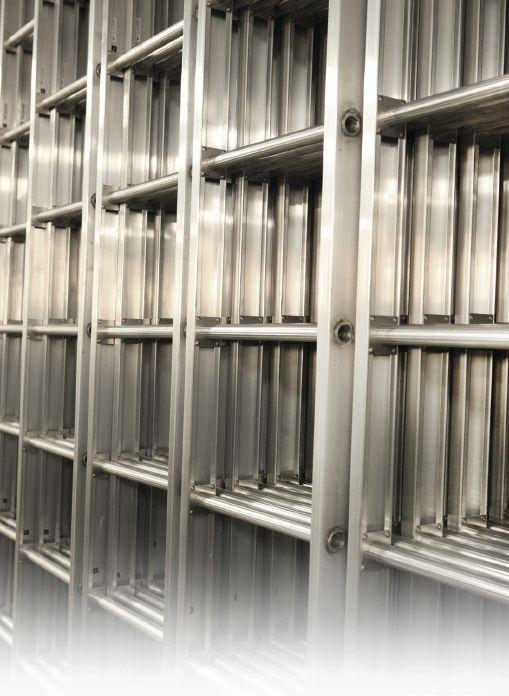
DOMEX® STEEL AND GREASELESS ROLLER SYSTEM
Aerial constructed with high strength DOMEX® steel and features an innovative greaseless roller system, tall hand-rails and maintenance free high traction rung covers to make your climb safer.
2.5 TO 1 STRUCTURAL SAFETY FACTOR
Exceeds NFPA requirements, contributing to E-ONE’s proven safety record for over 35 years.
UNMATCHED STABILITY
Rock solid stability, even when tested to one and a half times the rated load over the front with tires off the ground.
INTEGRAL TORQUE BOX CHASSIS
A unique design that provides a solid foundation and low center of gravity.
MORE STORAGE SPACE
Full depth compartments and up to 182’ of ground ladders in addition to a 300 gallon water tank. SideStacker™ hosebed with a full height body all the way to rear makes loading of hose easier.
INSTEAD OF BUILDING STANDARD AERIALS, WE BUILD REVOLUTIONARY
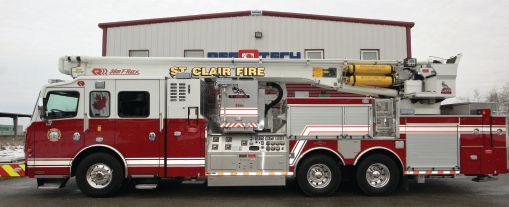
The HPS 100 Platform is a tough, reliable aerial. Constructed of high strength DOMEX® steel, this aerial is mounted to the revolutionary E-ONE chassis. With a 250” wheelbase, a travel height of 11’8” and a 45° cramp angle for enhanced maneuverability, the HPS 100 performs like no other. Its crisscross under-slung outriggers deploy in under 45 seconds, and its 1305 lb platform capacity offer you the strength that is crucial to the fight. The HPS 100 Platform equips your team with the full package from the ground up maximizing your fire fighting capabilities.
NARROW JACK DEPLOYMENT IN UNDER 45 SECONDS
When time is vital and space is limited, the crisscross under-slung outriggers deploy to only 15’6” spread in under 45 seconds
10 TRUCK TRENDS
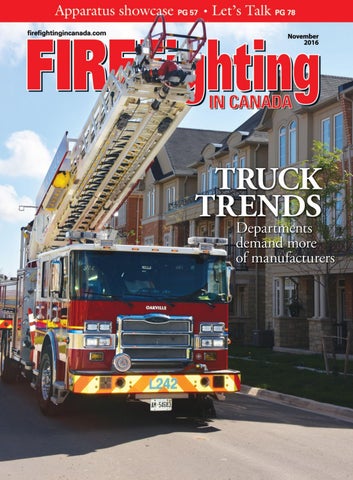
Ask seasoned salespeople what fire departments want in their new pumpers, tankers, aerials and rescues and you’ll get as many different responses as there are options for side compartments. As Laura King writes, essentially, truck buyers want quintessential equipment: smaller, more manoeuvreable vehicles that perform multiple functions but cost less than a specialized, single-purpose apparatus.
22 PROFESSIONAL DEVELOPMENT
Many textbooks offer a few paragraphs about the relationship between a mentor and mentee, and fail to provide any how-to advice. Chief Denis Pilon writes about the characteristics of a successful mentorship and offers formal guidelines for establishing a mentoring program.
52 OPPORTUNITY KNOCKS
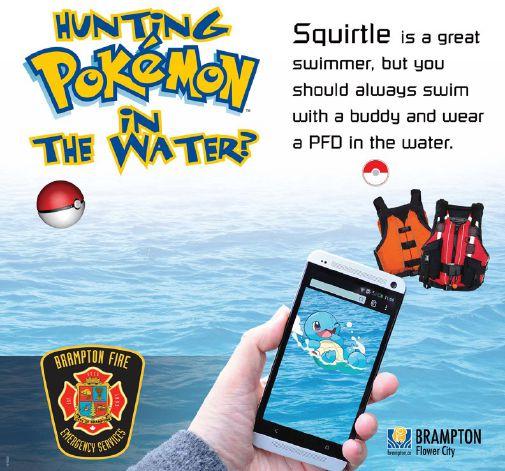
Using cellphone gaming apps to spread fire-safety messages may seem unorthodox but as public education officer Phillip Shuster explains, doing so guarentees an audience of tough-to-reach millenials.
BY LAURA KING Editor lking@annexweb.com
W
COMMENT
Solid customer service
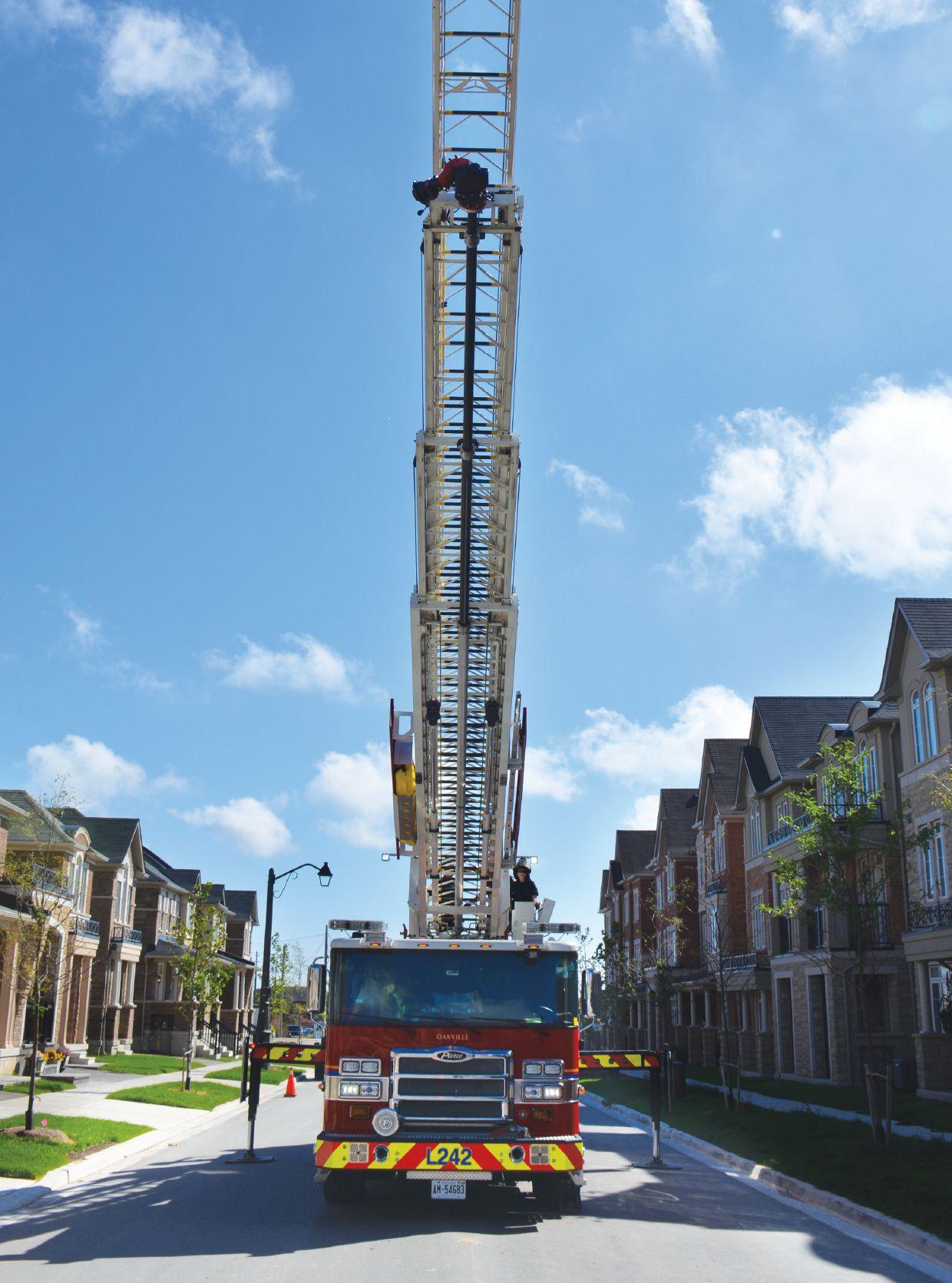
alking the floor at the Ontario Association of Fire Chiefs (OAFC) trade show in May I came upon a Pierce Ascendant 107-foot, single-axle aerial destined for my home town, Oakville, Ont.
The ladder was partially extended, horizontally, and it was quite a sight among the dozens of apparatuses featured at the show, most of them flanked by proud fire chiefs showing off their municipalities’ acquisitions.
I had seen the Ascendant at the Pierce booth in Indianapolis during the Fire Department Instructor Conference in April, and had been briefed about its attributes.
When I moved to Oakville in 1998 the population was 150,000 and it was a quaint community, close enough to Toronto to be convenient but far enough away from the rat race.
truck and its crew – under the supervision of Capt. Glen Carson – to a photo shoot in one such newly constructed neighbourhood.
Coleman, who, with considerable skill guided the 40-foot apparatus through the streets and around the tight turns, praised the truck’s performance.
Truck makers are focusing on technology, design and safety to meet clients’ needs. See story page 10.
Today, there are 30,000 more residents in my town, many of them squeezed into horrifically overpriced, high-density housing in what used to be a quiet community.
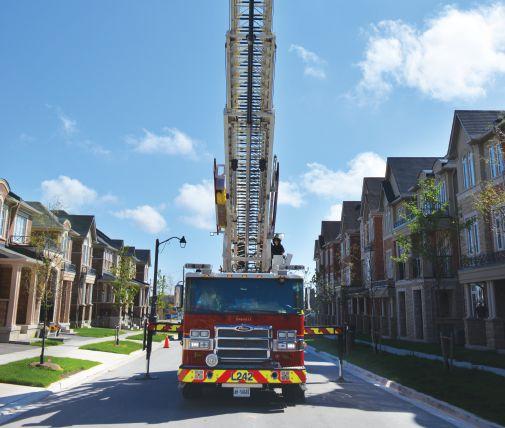
The new aerial is housed at Station 4, in an established, spacious, well-planned neighbourhood built in the late 1980s. But Station 4 also serves a new development dotted with townhomes that are fronted by shallow, boulevard-free yards, backed by narrow laneways, and seemingly squished onto the smallest possible plots of land.
Which means manoeuvrability of the aerial responding to the townhouse fire is a key consideration, according to firefighter/driver Myra Coleman, who obliged an editor on deadline and, with the blessing of an understanding deputy chief, brought the
Chief Brian Durden told me at the OFAC trade show the town needed the truck for the developments in the north end of town; indeed, a fire two weeks before the early-October photo shoot in a nearby neighbourhood destroyed one townhome and damaged two others.
The point is that firetruck manufacturers are responding to the needs of their clients. Municipalities need tax revenue from new developments; builders want the biggest bang for their bucks – on the smallest possible parcels of land, or so it seems; and councils that set the level of service need to provide (fund) the proper tools for their firefighters to safely and efficiently do their jobs.
That manufacturers are building single-axle aerials, offering enhanced safety systems and ergonomic equipment is simply good customer service. Which, in turn, allows fire departments to serve Mrs. Smith.
Fire-truck makers sell about 600 apparatuses a year in Canada. Selling trucks is their business. Good customer service is simply good business.
PUBLICATION MAIL AGREEMENT #40065710 RETURN UNDELIVERABLE CANADIAN ADDRESSES TO CIRCULATION DEPT.
P.O. Box 530, SIMCOE, ON N3Y 4N5
e-mail: subscribe@firefightingincanada.com
Printed in Canada ISSN 0015–2595
CIRCULATION
e-mail: lmalicdem@annexbizmedia.com
Tel: 416-510-5187
Fax: 416-510-6875
Mail: 80 Valleybrook Drive, Toronto, ON, M3B 2S9
SUBSCRIPTION RATES
Canada – 1 Year - $24.50 (with GST $25.73, with HST/QST $27.69) (GST - #867172652RT0001)
USA – 1 Year $42.95 USD
We acknowledge the [financial] support of the Government of Canada.
Occasionally, Fire Fighting in Canada will mail information on behalf of industry-related groups whose products and services we believe may be of interest to you. If you prefer not to receive this information, please contact our circulation department in any of the four ways listed above.
All advertising is subject to the publisher’s approval. Such approval does not imply any endorsement of the products or services advertised. Publisher reserves the right to refuse advertising that does not meet the standards of the publication. www.firefightingincanada.com
PHOTO BY LAURA KING
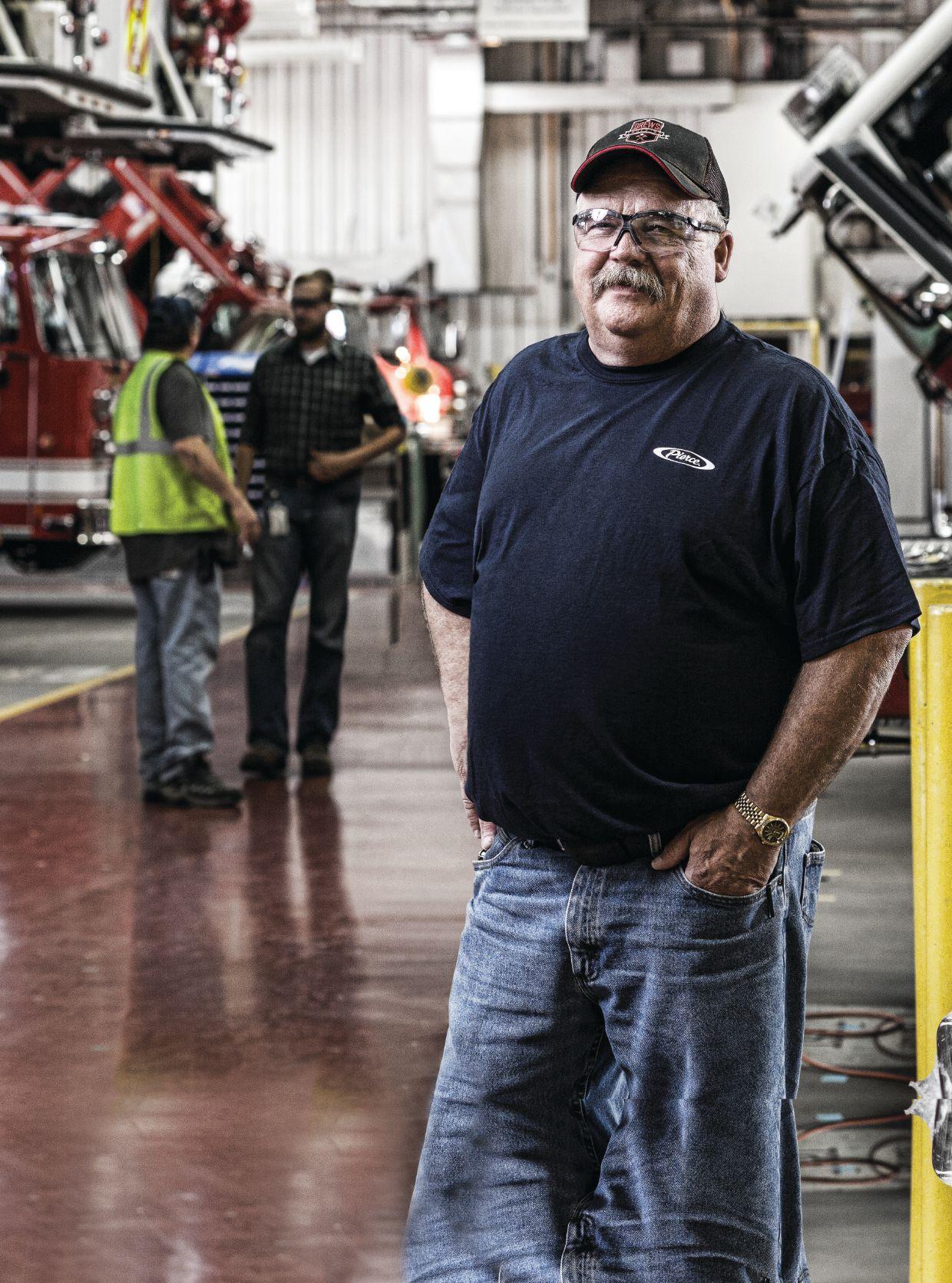
Aanstad Pierce Team Leader - 24 years
Jim
STATIONtoSTATION
ACROSS CANADA: Regional news briefs
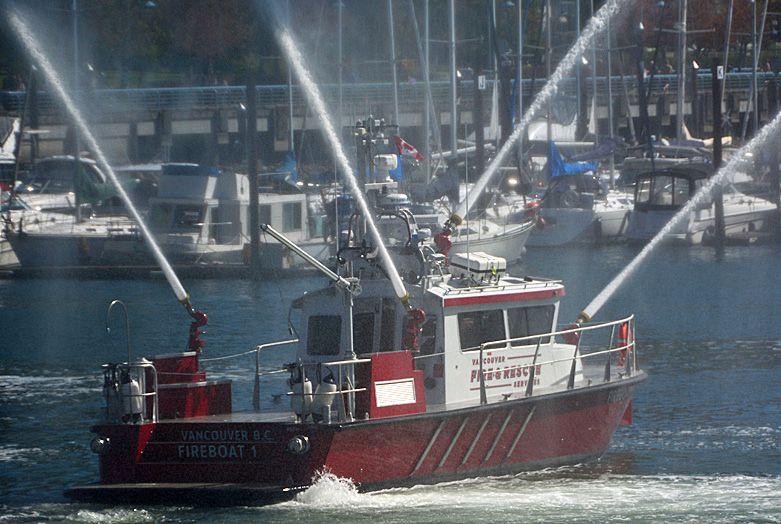
New Vancouver boats boost firefighting capacity
Two new 43-foot fire boats are powered by twin diesel inboard engines and each carry four monitors.
Vancouver Fire & Rescue Service (VF&RS) introduced the first of two new boats to the community at a ceremony on Granville Island in September.
VF&RS had originally planned to place both new fireboats in service at the same time, but the second boat was seriously damaged by a fire
while being transported from its Ontario manufacturer in June. The unnamed fireboat, and its twin, will replace the last two of what were originally five rapid-response fireboats that entered service in 1992. At that time, Vancouver operated two of the boats, while the City of North Vancouver and District of North Vancouver operated
THE BRASS POLE
Promotions & appointments
SHANE CASKANETTE was appointed chief in Oshawa, Ont., in September. Caskanette was the deputy for the Town of Richmond Hill. Caskaette is a masters of labour relations and an employment law candidate
at Osgoode Hall Law School; he has a certificate in labour law from Osgoode, a master’s certificate in municipal leadership from the Schulich Executive Education Centre at York University, a diploma in public administration from the University of Western Ontario, and a degree in fire safety studies/public-safety administration from the Justice Institute of British Columbia.
one each; Port Moody and Burnaby shared the fifth boat. In recent years, service to other municipalities has been provided by Vancouver under agreements as the City is the sole operator. For example, in 2015, the two Vancouver fireboats responded to 24 calls for service, with the most notable being a massive fire in April 2015 that destroyed the dock at Squamish Terminals – a two-hour run from Vancouver up Howe Sound.
The $1.5 million boats were built by Metalcraft Marine of Kingston, Ont.,and though similar in size to the boats they are replacing, the unnamed twins offer a huge improvement in performance and fire fighting capabilities. Based on Metalcraft’s successful Firestorm 40 model, which has more than 50 examples in operation around the world, the 43-foot boats are powered by twin diesel inboard engines which are matched to water-jet
DAVID CUNLIFFE became chief in Hamilton, Ont., in June. Cunliffe joined the Hamilton Fire Department in 2005, became deputy chief in 2007 and had been acting chief since January.
JIM BOUTILIER became chief in Niagara Falls, Ont., in July. Boutilier began his emergency-services career as a paramedic and became a full-time firefighter in 1990; he served as
propulsion units that can drive the boat to speeds of 39 knots, and also allow the boat to perform emergency stops and change direction within two boat lengths. Four monitors and a rated pumping capacity of 6,000 Imperial gallons per minute give the boats more than double the capabilities of their predecessors.
The cabins on the new boats are pressurized, allowing the crew to work in close under the most difficult conditions without having to don SCBA equipment as they did when working in the old boats. The four monitors are remote controlled from the cabin and the full pumping capacity of the boat can be used to supply land operations.
Operating for now as Fireboat 1, there will a public contest to select proper names for the boats when the second boat enters service in the future.
– Paul Dixon
training officer and director of training, and was promoted to deputy chief in 2013.
KEVIN FOSTER was named fire chief in Wainfleet, Ont., on Sept. 7. Foster was chief in Midland from 2001 through 2015, and in North Kawartha, Ont., from 1999 to 2001.
PHOTO BY PAUL DIXON
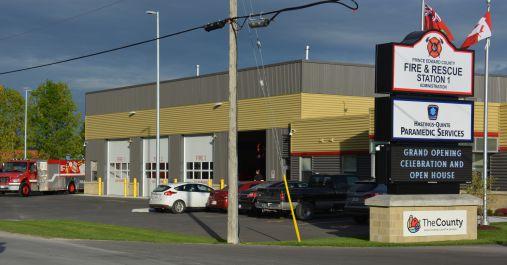
Long-awaited station opens in Prince Edward County
Scott Manlow is one determined fire chief. So said Mayor Rober Quaiff at the opening of Picton Fire & Rescue Station 1 – the culmination five years of persistence and planning.
The $4-million, 17,300-square-foot station in Prince Edward County, Ont., houses firefighters and paramedics, apparatuses and ambulances – a vision of former fire chief George Pettinghill.
“The vision was always to combine fire and EMS,” Manlow said in an interview shortly before councillors, townspeople and lots of little kids arrived for hamburgers and a hose cutting on Sept. 29.
After some setbacks and myriad design changes, the
vision came to fruition back in July when five full-time and 22 volunteer members of the Prince Edward County Fire Department moved into the new emergency-services building.
The three-bay hall replaced an old downtown station, a city landmark that was full of character but which the department had long outgrown.
Manlow said council was cautious about spending, and about optics – the station is fresh and functional but far from fancy, with modest-sized offices and a shared kitchen and training room.
Prince Edward County opened another new building a year ago; the $1.2 million
The $4-million Picton Fire & Rescue Station 1 in Prince Edward County, Ont., which officially opened Sept. 29, houses firefighters and paramedics, apparatuses and ambulances.
Consecon Station 6 replaced two halls that were long past their prime.
The department operates 10 halls and runs 29 apparatuses and five support vehicles; its 144 volunteer firefighters serve a population of 25,000
Chiefs recognized for commitment to safety
Cecil Kerr and Stephen Gamble are fire chiefs at opposite ends of the country – Kerr in Gilliams, N.L., and Gamble in Langley, B.C. – but their commitments to safety are closely aligned.
The chiefs were recognized by their peers in St. John’s in September – Kerr for his unyielding efforts to ensure his firefighters are solidly trained,
and Gamble for his relentless work on new a residential-sprinkler regulation.
Both men were presented fire-chief-of-the-year awards by the Canadian Association of Fire Chiefs at its conference.
In Gillams, where there are 406 people, Kerr is a full-time educator and a volunteer chief.
“Last summer, one night a week (sometimes two) he
would volunteer his time to train other members for the surrounding communities free of charge . . . This training promotes a sense of pride and accomplishment,” said the nomination from Gilliams council and town manager.
Chief Gamble, who is a former president of the CAFC and the Fire Chiefs Association of BC, was instrumental in the
across 1,048 square kilometres surrounded by Lake Ontario and the Bay of Quinte. The coverage area includes CFB Trenton, dozens of wineries and the world-famous Sandbanks Provincial Park. – Laura King
BY
JASON WHITELEY is the new chief in North Bay, Ont. Whiteley was deputy chief in Woodstock, Ont., and for Norfolk County Fire and Rescue Services, also in Ontario. Whitley has 27 years of fire-service experience; he began his career with the City of Burlington Fire Department in 1989 and had spent 16 years with the City of Mississauga Fire and Emergency Service.
Retirements
DENYS PREVOST retired in August after serving for 10 years as chief of the Welland Fire Department in Ontario. Prevost’s fire-service career spanned 39 years;
LEE SMITH retired in May after 28 years of service with the Niagara Falls Fire Department in Ontario, the last nine spent as
chief. Smith joined the department in 1988 as a firefighter. In 1993 he became fire prevention officer and captain. Smith was promoted to assistant chief in 1998 and chief in 2007.
Last alarm
Loyalist Township firefighter PATRICK PIDGEON died July 16 of injuries sustained fighting an apartment fire in
development of a provincial regulation to allow communities to regulate the use of fire sprinklers.
“There is absolutely no question that this tremendous advancement would not have occurred without his knowledge, political acumen, and incredible personal effort,” the nomination said.
– Laura King
Amherstview, Ont. Pidgeon had been a volunteer firefighter with Lloyalist Township Emergency Services for about a year. He was a Canadian Forces veteran who served two tours in Afghanistan. Pidgeon was 45; he was a correctional officer with Correctional Service Canada and a military police reservist . Pidgeon had been selected for the department’s water-rescue team.
PHOTO
LAURA KING
BY SHAYNE MINTZ NFPA Canadian regional director
IRaising the bar for PPE cleanliness
n my travels, certain NFPA standards come up more often than others in conversations. Recently there has been interest in NFPA 1851, Standard on Selection, Care, and Maintenance of Protective Ensembles for Structural Fire Fighting and Proximity Fire Fighting.
What seems to be of the utmost interest is the portion of NFPA 1851 regarding an appropriate maintenance program for firefighting protective ensembles, including the process of inspecting, cleaning and decontaminating all components of a firefighter’s PPE and the repair, storage and retirement of the garments. Also of interest is the role and verification of independent service providers that have emerged over the past decade and a half.
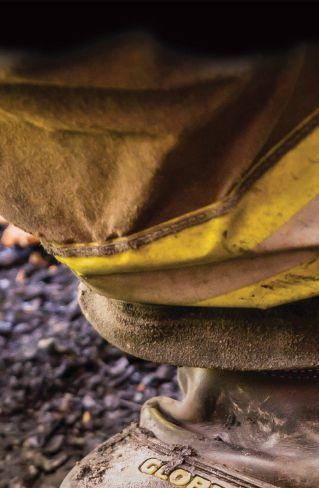
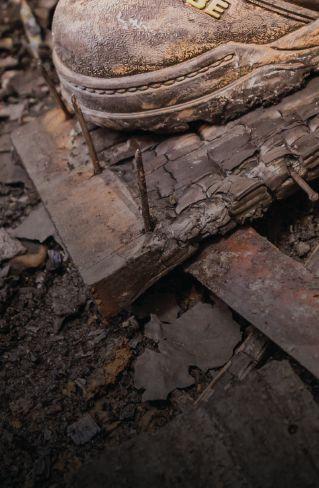
Gone are the days of the veteran firefighter whose bunker gear and helmet were so dirty that it was difficult to tell the colour of the reflective striping. No longer is dirty turnout gear a badge of honour.
Previous generations of firefighters generally overlooked or weren’t aware of the extreme health hazards posed by contaminants captured in firefighter garments, and the contact with particles that firefighters may experience from the exposure to their gear. The modern philosophy is that the fire scene itself is crammed with contaminants. However, the real and equal hazard is when those contaminants are embedded in the gear and taken back to the fire station where they persist.
Fortunately, there is now more focus on both the short- and long-term health effects of soiled bunker gear. Research has confirmed that the carcinogenic particles found in smoke and other contaminated atmospheres can be ingested, inhaled and then combined with lung and body tissue, creating health and safety concerns for firefighters.
decontamination and routine in-station inspection. How effective is advanced cleaning, and how often does gear need this depth of cleaning? Also, what is being done to protect firefighters from exposure to blood-born pathogens, serious cases of infectious superbugs or emerging diseases, such as Ebola?
In response to these questions, the NFPA is planning for changes that may be needed for the next version of NFPA 1851. The next revision of the standard will likely include updated cleaning procedures to address persistent contamination, investigate new and innovative cleaning technologies and practices, and finally, develop or provide a means for verifying the effectiveness of cleaning protocols.
The independent research affiliate of the NFPA, the Fire Protection Research Foundation, along with research partners Intertek, International Personal Protection Inc., and the National Institute for Occupational Safety and Health, have been tasked with exploring the answers to some fundamental questions that will be used to inform the NFPA technical committees in their deliberations for the next version of the standard.
Questions from the foundation include: Can better cleaning pro-
No longer is dirty turnout gear a badge of honour or a sign of a real firefighter.
Now there is consensus that dirty or poorly maintained protective clothing is a clear hazard, and thorough cleaning and hygiene practices and protocols are important.
A webinar hosted by the NFPA, entitled How Clean is Clean: The validation of Firefighter PPE Cleaning (watch the archived version on YouTube), raised a serious question; how effective are these practices?
It is evident that current cleaning methods do some good, but in reality these activities are just best practices with no basis in science. This leaves one to wonder about the effectiveness of fire-ground
Shayne Mintz has more than 35 years of experience in the fire service, having completed his career as chief of the Burlington Fire Department in Ontario. Contact Shayne at smintz@nfpa.org, and follow him on Twitter at @ShayneMintz
cedures be provided? Does cleaning adequately remove both chemical and biological contaminates? When and how do departments know their gear is clean? How can research findings best be transitioned to the apparatus floor?
The expected outcome of the research is that specific techniques will be developed for the application of NFPA 1851 to allow fire departments, independent service providers, gear manufacturers, equipment providers and cleaning-agent suppliers to validate the removal of chemical and biological soils and compounds, and validate the removal of harmful bacteria and other microorganisms. With that, the research findings will be used to develop and establish best industry practices.
For more information on this project, visit NFPA’s web page at http://www.nfpa.org/PPECleaning.
Low Level Strainer Now Includes Floating Option at NO CHARGE ...
WHOLESALE FIRE & RESCUE
BC, AB, SK, YT, NWT, NT (800) 561-0400
ABC FIRE & SAFETY
MB, SK (800) 665-1250
DEPENDABLE EMERGENCY VEHICLES ON (800) 268-0871
M&L FIRE & SAFETY ON (866) 445-3473
SPI HEALTH & SAFETY Northwest ON (800) 465-6822
L`ARSENAL QC (800) 266-7610
MICMAC FIRE & SAFETY SOURCE Atlantic Provinces (800) 667-3030
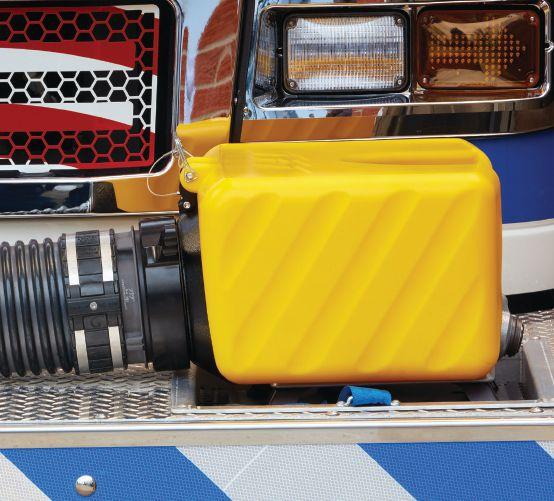
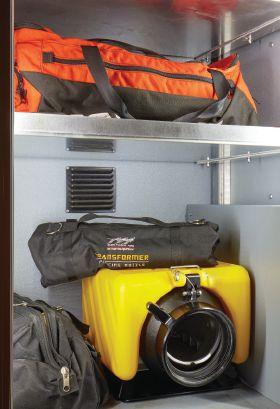
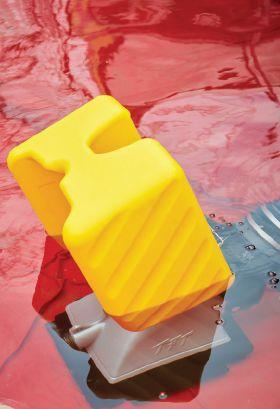
Flotation device allows TFT high volume low-level strainer to collect clean water from ponds, lakes and rivers. The strainer inlet, made of hard anodized and powder-coated aluminum, hangs 18” below water level to avoid sucking surface air and bottom debris. Capable of supporting up to 30 ft of hose, the strainer extends well beyond safety ledges of residential ponds.
The clog-resistant stainless steel filter has over twice as much flow area as a 6” hose keeping friction loss down to 0.5 psi (1” Hg) at 1500 gpm and reducing the potential for air vortexes. Oversized sealed ball pivot allows 45° range of hose angle without constricting the flow path.
WATER LEVEL 18" e allows TFT volume low-level strainer to collect clean water from
Rugged polyethylene float is yellow for high visibility and nests compactly over the strainer for minimal storage space. Float removal is not necessary for low level use, although a tethered latching hinge pin allows the float to be removed or installed instantly if desired.
• Available With or Without Jet Siphon
• Supports Up to 30 Feet of Hose
• Clog-resistant Stainless Steel Filter Keeps Friction Loss to 0.5 psi (1” Hg) at 1500 gpm
• Sealed Ball Pivot Allows 45° Range of Hose Angle
• Rugged High Visibility Polyethylene Float Nests Compactly Over Strainer
• Tethered Latching Hinge Pin Allows Float to Be Removed or Installed
TRUCK
TRUCK TRENDS
Departments demand more of manufacturers, from ergonomics to efficiency
By LAURA KING
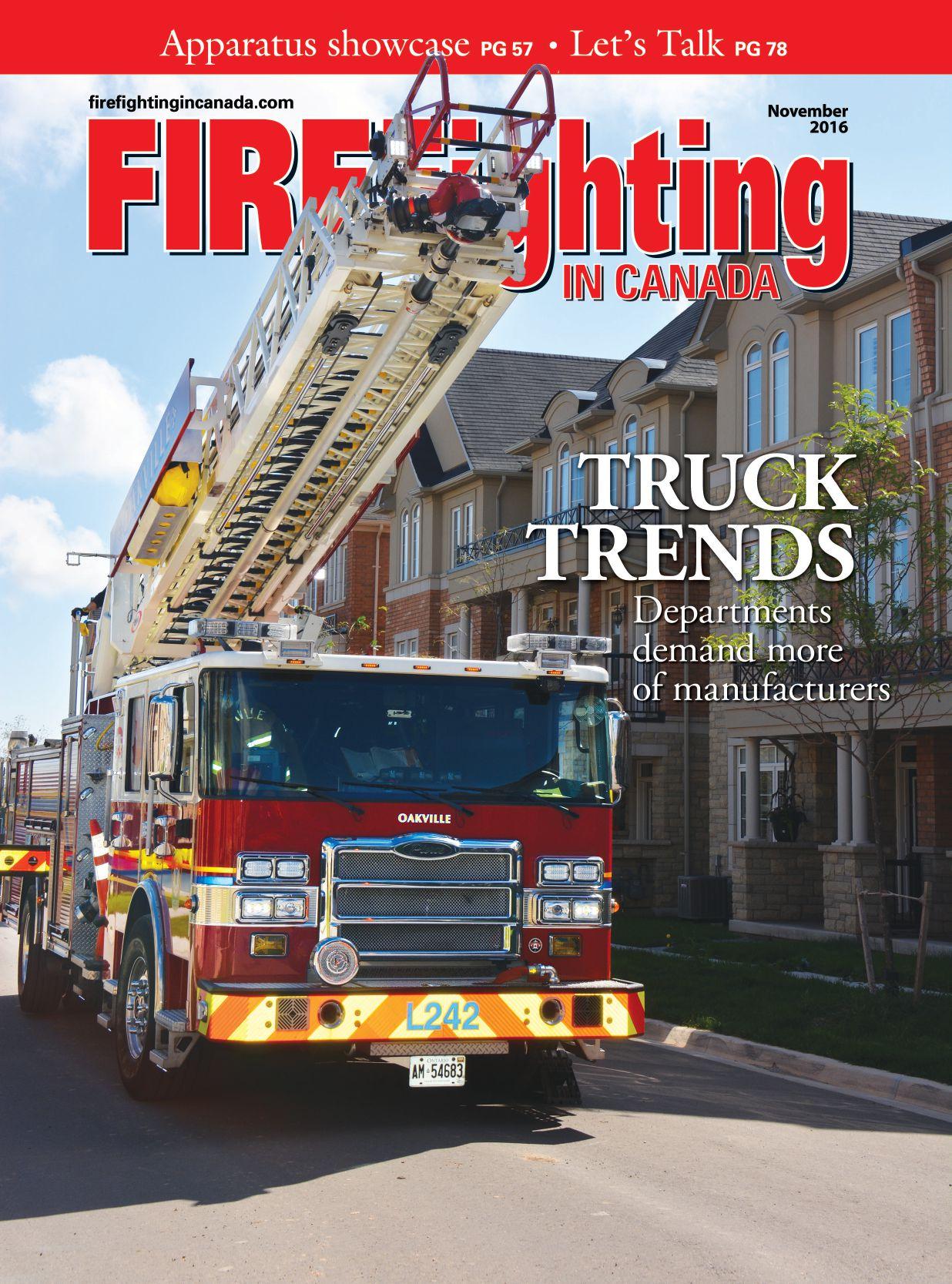
LEFT The Oakville Fire Department in Ontario bought a Pierce single-axle aerial for use in high-density areas with tight corners and narrow laneways .
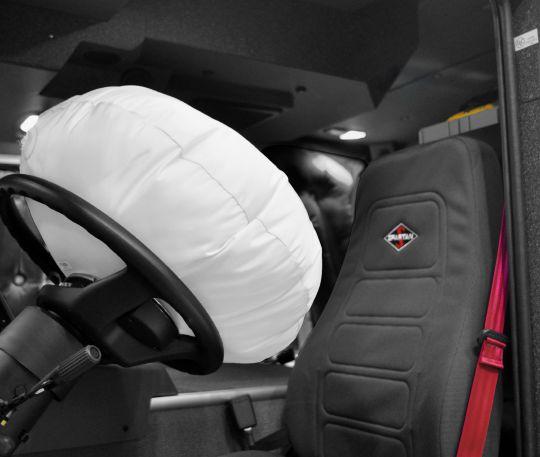
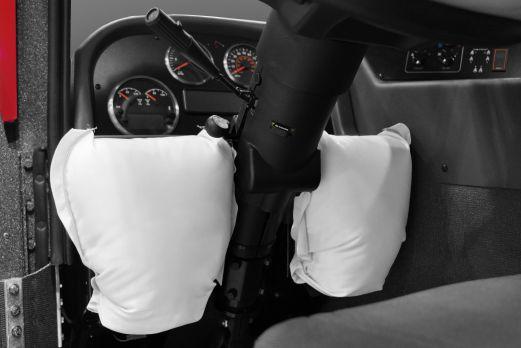
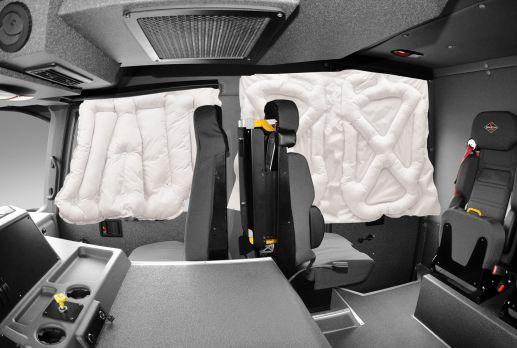
ABOVE Spartan’s personal protective system, which includes multiple airbags, is available on its custom chassis.
Ask seasoned salespeople what fire departments want in their new pumpers, tankers, aerials and rescues and you’ll get as many different responses as there are options for side compartments.
Essentially, truck buyers want quintessential equipment: smaller, more manoeuvreable vehicles that perform multiple functions but cost less than a specialized, single-purpose apparatus.
Combined pumper/tankers are in demand. Almost all Canadian manufacturers and distributors have experienced increased sales of the pumper/tanker configuration. And new, single-axle aerials that can manoeuvre in tight, high-density neighbourhoods – featured at the Fire Department Instructors Conference in Indianapolis and the Ontario Association of Fire Chiefs trade show in Toronto last spring – are becoming popular.
But the one consistent feature Canadian fire-truck manufacturers and suppliers are being asked to deliver has little to do with size, speed or cost. Canadian truck manufacturers and suppliers say departments, and the councils that fund them, want safer trucks in which to transport firefighters to and from incidents.
Safety sells, says Brian Nash, national sales manager for Fort Garry Fire Trucks. And councils are willing to ante up to protect firefighters and prevent injuries.
“If it’s safety related [fire chiefs] can sell it to council,” Nash said in an interview. “For example cameras, and back-up cameras . . . even for the small, rural departments.”
Ergonomics – a business buzzword of the ’80s – has finally worked its way into the fire-services lexicon. Fort Garry’s manager of international sales, Brad Petrie, says the Winnipeg-based manufacturer has made significant changes to its trucks to reduce the risk of firefighter injuries.
“We have a lot more ladders,” Petrie said in an interview, “and a three-point stance going up and down the back of the truck as opposed to just a step.”
Kyle Innes, operations manager with Rosenbauer dealer ResQtech Systems Inc., says departments are demanding innovative ways to keep firefighters on the ground and injury free.
“They want to eliminate the need to climb to the top of the truck,” Innes said. “We’re starting to see increased interest in side foam fills on the pump panel to eliminate the need to climb on top of truck.”
Most fire-truck makers have implemented enhanced in-cab safety mechanisms including air bags, ergonomic seating, better lighting and improved mount and dismount options.
Carrier Centres general manager Todd Finnie says driving to a call in the pumper, aerial or tanker is potentially the most dangerous part of a firefighter’s job, and truck makers are playing catch up.
“We’re seeing safety features that are coming from the passenger car into the fire service,” Finnie said in a phone interview from Brantford, where Carrier makes about 20 E–One trucks a year for the Ontario market.
PHOTO BY LAURA KING
PHOTO COURTESY SPARTAN
“It’s not that many years since airbags were introduced. Some other manufacturers are offering safety features that decelerate the truck – when it’s coming up on an obstruction too quickly it will start to apply the brakes, which, again, we’ve seen in passenger cars for a number of years. Lanechanging sensors, weaving-out-of-the-lane sensors, rollover protection, electronic stability controls on the trucks – anything that can make that vehicle more safe.”
Metalfab sales and marketing manager
Ryan Stacey is based in Centreville, N.B. He says departments that wouldn’t give ergonomics a second thought just a few years ago are ordering components that reduce the potential for back problems.
“They thought they were too expensive,” Stacey said in an interview. “Now, for example, electric-powered racks are becoming more and more requested compared to five years ago.”
Fort Garry’s Nash saw first-hand the demand for improved ergonomics during a department tour in St. John’s in September.
“That was one of their biggest complaints,” Nash said. “Heavy objects housed in high compartments. Their chief mechanic is pretty high on that – having slide-out trays so firefighters don’t have to reach up; those compartments are just compensation claims waiting to happen.”
Metalfab’s HEAT (highly ergonomic apparatus technology) series of pumpers is popular and selling steadily, Stacey said, as departments embrace comfort, plus in-cab and compartment safety.
Essentially, Stacey said, departments want the bells and whistles that help to prevent pains and sprains – “things to facilitate their guys getting things off the trucks.”
Firefighters who belong to volunteer departments are particularly vulnerable, Stacey said. “If they get injured while working with a fire department then they’re off their main job as well.”
Metalfab makes about 40 trucks a year at its Centreville plant, mostly for volunteer departments in Atlantic Canada and the northeastern United States.
“The trend for smaller apparatus is rising,” Stacey said. “In the past, the objective was to get as much equipment and water as possible on the truck, so that made for a high truck.
“Now the trucks are smaller and easier to use and safer, particularly with the electric-powered racks, and we’re trying to get the equipment down as low as possible. The longer the guys keep their two feet on the ground the better, especially late at night. When they have to start climbing up on the trucks late at night that’s when you get risk for things occurring.”
Besides prevention of physical injuries, departments are recognizing the risks associated with contaminated gear and are asking truck makers to create new systems for storing dirty items on the trucks, but outside the cabs.
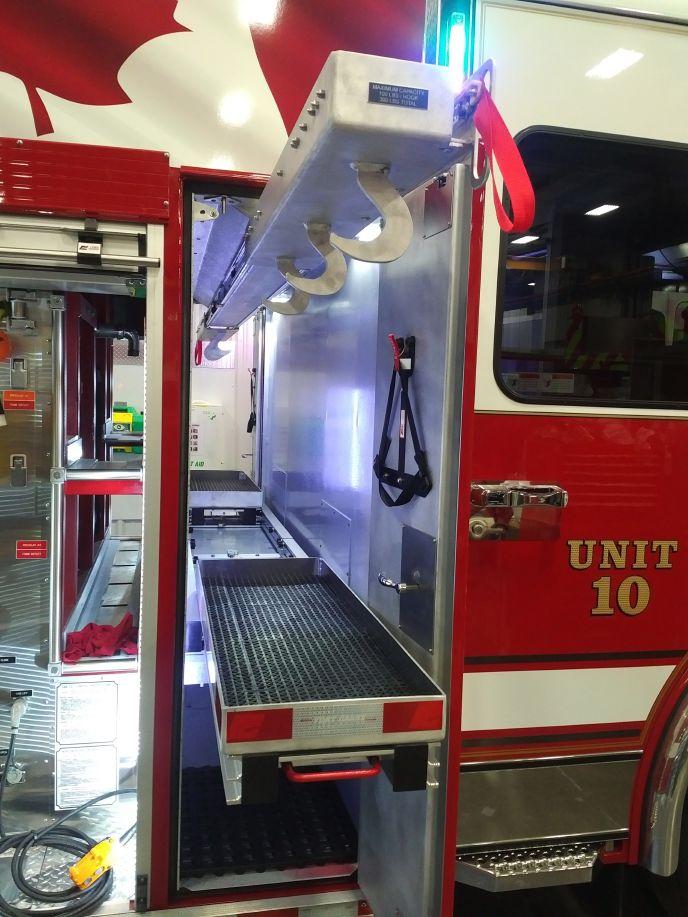
The St. Catharine’s Fire Department in Ontario commissioned Fort Garry to configure external storage space on its new pumpers for dirty bunker gear. With growing awareness of proper hygiene and protection from carcinogenic particles that penetrate firefighters’ personal protective equipment, the $15,000 storage compartments are likely to be replicated.
“Last year’s version was just a box,” Nash said. “But the latest version includes slideout hooks and helmet holders and slide-out trays for boots. It’s totally customized.”
The compartments were a priority for St. Catharines, which has adopted strict hygiene protocols and compromised in other areas to add the storage space.
“The wheel base of the truck grew,” Nash said, “so it’s a slightly less manoeuvreable truck because it’s longer.”
But safety isn’t always first, because customers are bound by budgets.
Pino Natale, director of emergency response vehicles at Dependable Emergency Vehicles in Brampton, Ont., says some clients have opted against airbags in Spartan’s custom chassis and diverted those costs to other needs or wants.
Fire departments and firefighters want premium safety mechanisms but budgets dictate whether truck buyers choose other options over airbags.
PHOTOS COURTESY SPARTAN
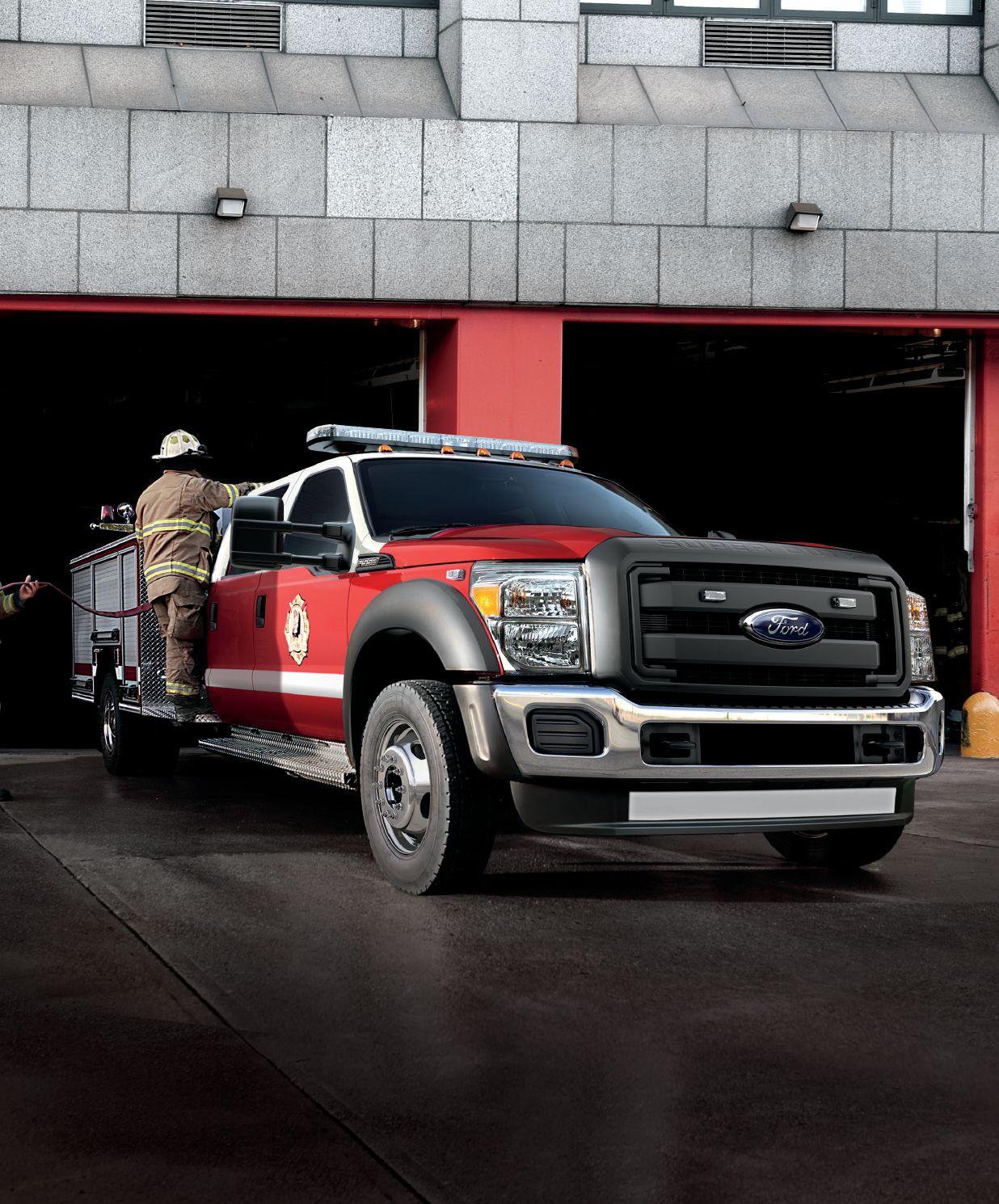
Lives depend on you every day. There’s no room for error and no time to waste. You need the same reliability and accountability from your rescue vehicles, which is why you need the undisputed Ford Class 2 through 7 trucks.
VEHICLES BUILT TO LAST.
A selection of tough and durable vehicles with GVWRs ranging from 6,010 lbs to 37,000 lbs.*
CUSTOMIZATION THAT FITS.
An extensive network of dedicated experts who offer customization to upt your emergency vehicle needs.
EXCELLENT SERVICE, AT YOUR SERVICE.
Hundreds of dealerships that offer after-sales service and repair solutions to save you time and money.
MEET THE TEAM BEHIND YOUR TEAM FORD.CA/BUILTFORBUSINESS
“The Spartan airbag system is in units now,” Natale said in an interview, “but believe it or not some departments are taking them out for budget reasons – they simply can’t afford them. It’s a few thousand dollars you can spend on something else.”
Some truck trends, according to salespeople, are simply a response to technology.
For example, Metalfab’s Stacey said a noticeable change in recent truck orders is the absence of generators.
“The biggest reason for that is the 12-volt LED flood lighting and scene lighting,” Stacey said. “In the past, departments wanted gas generators or hydraulic generators but with LED scene lighting that’s really not a necessity any more; over the past two years there has been a huge decrease.”
The space formerly reserved for generators is now freed up for tools – which doesn’t necessarily mean departments can load more stuff on the trucks.
Nash says the weight and balance issues are crucial.
“We’ve got a gross vehicle weight that we have to maintain,” Nash said. “It gets quite complicated. They’re trying to use every inch of space on a vehicle and pile 20 pounds of equipment into a five-pound bag.”
Dependable’s Natale says departments want their trucks quickly, which is a tall order for some configurations. Spartan has a new, 180-day turnaround promise on apparatuses, and while Natale says the company is committed to its guarantee, the myriad styles and shapes, and demand for electronics, make for tight deadlines.
According to Innes, more departments desire custom cabs.
“They see many advantages,” he said, “such as space and comfort, but at the end of the day are purpose built, engineered and designed for fire apparatus.
Vacuum tankers are also in demand, said Petrie, with Fort Garry, because they require fewer resources – firefighters – to operate, and can load and unload water faster than a traditional tanker.
“It’s the quickest way to load and offload water,” says Petrie. “A lot of guys will put a fire pump on these units as well.”
The East Wellington Fire Department in British Columbia has Fort Garry’s first vacuum tanker.
“With a fire pump you have to have a good air lock on suction hose to pull water in but East Wellington can use four, 80-foot sections and can pull water from anywhere,” Petrie said. “They can lay a number of lines
Fire departments are requesting personal safety enhancements on their trucks, from ergonomic seats and steps to compartments for contaminated personal protective equipment. Fort Garry custom-built a PPE compartment on a truck for the St. Catharines Fire Department in Ontario, which has instituted strict hygiene protocols.
of hard suction . . . We’re see more bids coming out with this style of tanker.”
E-One’s vacuum tanker, called the Water Master, can self-fill from up to three suction inlets from any water source; one operator can maintain a flow of 250 gallons per minute or more over a five-kilometre shuttle route.
As for pumper/tankers, ResQtech’s Innes says there is definitely increased interest in multi-purpose trucks.
“With pumper-rescues and pumper-tankers, departments create more diverse fleets to provide greater flexibility and extinguishing capability.”
And Finnie, with Carrier Centres, says customers are experiencing what he calls fleet rationalization.
“In the rural areas we’re getting calls for pumper/tankers whereas they previously had pumper and a tanker they’re now trying to eliminate a truck in their fleet, so it’s basically a pumper with a whole lot of water on it.
“It means the department has to make some decisions about where their priorities are. We are governed by how much weight we can put on the truck, how much water, how much equipment, how many people can we carry on that truck - weight is the biggest factor, so we have many meetings to discuss what they want that truck to accomplish; there are also limitations because of the size of the fire hall, and we have to say ‘We can’t fit everything you’re asking to go on this truck and still fit it into your fire hall.’ ”
PHOTO COURTESY FORT GARRY FIRE TRUCKS
BY DON JOLLEY Fire chief, Pitt Meadows, B.C.
DLEADINGEDGE
The making of B.C.’s training Playbook
oes your fire service utilize NFPA 1001 as your minimum training standard for your firefighters? Does every firefighter have that level – even if you are one of the thousands of small volunteer fire services in Canada? While many larger departments will hopefully answer yes to the questions, the fact that many smaller volunteer departments won’t was identified as a very serious operational issue in British Columbia. From the recognition of this problem arose a local solution that is gaining universal attention.
In September 2009 the fire service liaison group, in its Transforming the Fire/Rescue Service document, identified that standardized competencies and training standards were an immediate priority. This observation was reinforced by the results documented by the province’s own Fire Service Training Access Review completed the same year. In 2013 the BC Institute of Technology SITE Centre for Applied Research highlighted the serious problem with firefighter training compliance by stating in its BC Fire Training Needs Assessment document that “the NFPA 1001 … appears to be unattainable and unrealistic for many of the departments in B.C.” The NFPA 1001 standard had been the legislated training standard for B.C.’s firefighters since 2002 and yet, during all those years, there were an alarming number of fire departments, mostly in smaller and mid-size communities, that were simply unable or unwilling to comply for myriad reasons.
In late summer of 2013 the Fire Chiefs’ Association of BC decided to try to do something about this systemic and potentially life-threatening situation. Association president Tim Pley and I visited with Lori Wanamaker, the assistant deputy minister of public safety, to propose an idea to find a solution to the problem. During that meeting a concept was hatched to generate a new training standard for firefighters that would be accessible, affordable and attainable (the 3-As); Wanamaker coined it “The Playbook.”
consistent answers: “Costs way too much.” “Can’t get into scheduled courses.” “Too hard to get an instructor.” “Can’t afford to send the members away to the training.” “Takes up too much of our firefight ers’ personal time.” “Volunteers don’t need all that extra stuff.”
Do these musings sound familiar? Turns out that the British Columbia Institute of Technology found that more than 83 per cent of departments reported significant barriers to achieving the NFPA standards, led by inaccessibility to courses and instructors, cost, and time-commitment challenges for firefighters. It was clear that the 3-As approach described by the assistant deputy minister made sense, but the challenge was to develop a program to meet those goals.
To organize a whole new standard, we needed to look holistically at the issue in a very broad and comprehensive way. We decided to focus on competencies rather than certification – a decision that ultimately focussed the entire Playbook project in a new direction. To begin to address the 3-As and focus on competencies, the steering committee ultimately looked internally. The training officers associ ation, under then-president Dean Colthorp, had, since 2007, been guiding the delivery of a simplified firefighter program designed for very small communities with volunteer firefighters, and First Nations fire services. It was called the basic firefighter program and it provided
We decided to focus on competencies rather than certification . . . ‘‘ ’’
At that point, a small steering committee formed of representatives from the chiefs association. The Office of the Fire Commissioner of BC, and the BC Fire Training Officers Association began an exhaustive analysis of literature and research to formulate the beginnings of a new standard. Stakeholders including training agencies, local government management and elected officials, firefighters and chiefs were consulted and surveyed. Repeatedly, we heard that the NFPA standard didn’t work. When we asked why, we were surprised by the
Don Jolley is the fire chief for the City of Pitt Meadows, and the first vice-president of the Fire Chiefs’ Association of British Columbia. Contact him at djolley@pittmeadows.bc.ca
a simple, yet not-so-obvious solution to one of our major dilemmas. The decision was made to utilize the basic firefighter program as the foundation, or absolute minimum training competency standard that every firefighter in the province would need to achieve. The basic firefighter program was rebranded and is now known as the exterior firefighter level; it trains firefighters to attack a fire solely from the outside of a building. Safer, easier, less costly to train, and more realistic as a service level in rural/remote communities, the exterior firefighter level is the first level of The Playbook
Accompanying the exterior firefighter level is a train-the-trainer program that facilitates in-house delivery from a complete package of educational and evaluation tools, provided at no expense, thanks to provincial grant funding.
In the next issue, I will discuss the standard – what makes the Structure Firefighters Competency and Training Playbook what it is.
BACKtoBASICS
Hitting the standpipe – Part 3
BY MARK VAN DER FEYST
In my August and September columns we looked at options for securing the standpipe – on the fire floor or the floor below the fire.
Now, let’s consider standpipe operation in terms of equipment; what items are to be brought up to the operations point by the initial responding crew? There are many opinions about the minimum equipment necessary for this type of operation, and these opinions vary based upon the specific situation.
Logically, firefighters working in a highrise or other standpipe-equipped building need to bring the equipment with them. Which equipment goes into the building depends upon the number of initial firefighters assigned and, therefore, available to carry tools and gear. (We will look at the number of firefighters needed for standpipe operations in the next issue.)
So, what equipment needs to be brought into the building?
The highrise hose kit is the most important piece of equipment for standpipe operations; it needs to be in a format that allows it to be easily carried by firefighters and also easily deployed: a floppy hose kit is difficult to carry and control.
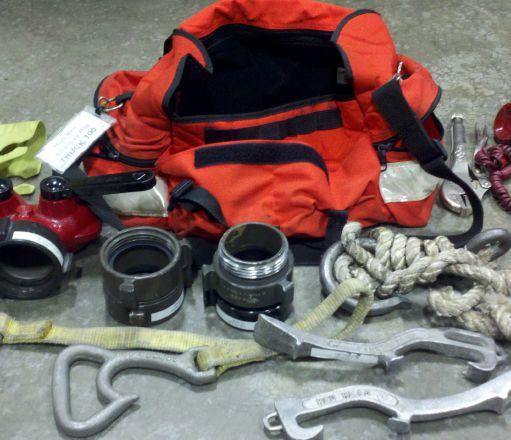
The second crucial item is the highrise kit bag (see photo 1). This bag holds items needed to secure the standpipe and to also troubleshoot any problems. A typical highrise kit bag should include:
• 1 double male coupling (1 ½-inch (38 mm) and 2 ½-inch (65 mm)
• 1 double female coupling (1 ½-inch and 2 ½-inch)
• 1 2 ½-inch (65 mm) x 1 ½-inch (38 mm) reducer
• 1 wire brush
• 1 pipe wrench
• 1 spare wheel for standpipe gate valves
• 2 wood wedges
• 1 hose strap
A forcible entry kit should also be brought to the operations area. This kit holds the Halligan and the flat-head axe, so that a two-person crew can forcibly open any stuck doors. The Haligan can then be used for door control so the door, after being forced open, can be quickly closed, and kept closed until firefighters are ready to make entry with the hoseline. The tools can then be used to aid firefighters who are searching or ventilating the unit or area.
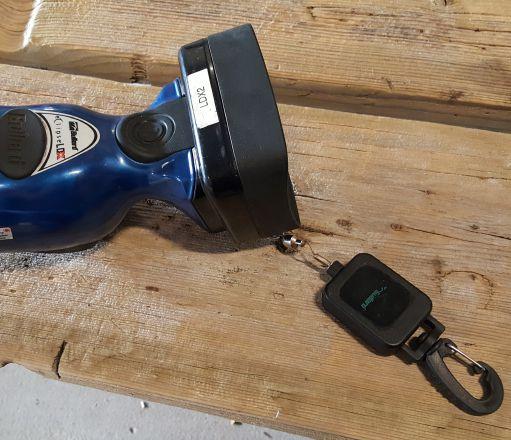
A thermal imaging camera (TIC) (see photo 2), is another item to include. The TIC is useful for locating occupants inside the
Phtot 1: Include a highrise kit bag that has multiple and interchangeable tools that are needed to secure the standpipe.
PHOTOS BY MARK VAN
DER FEYST
Photo 2: A thermal imaging camera can be easily clipped onto a firefighter’s jacket, and helps track personnel and conditions.
unit and/or area quickly and for locating the seat of the fire. It can also be used to monitor conditions around the responding
the officer to keep track of personnel and conditions. The TIC can be clipped onto a firefighter’s jacket with a retractable lanyard.
Portable radios are also needed; they are an essential piece of equipment for communication. As the team is separated while doing different tasks, team members will need to be able to communicate and make certain requests, such as asking that the standpipe be charged. If not enough portable radios are available for all firefighters, each team should have at least one radio.
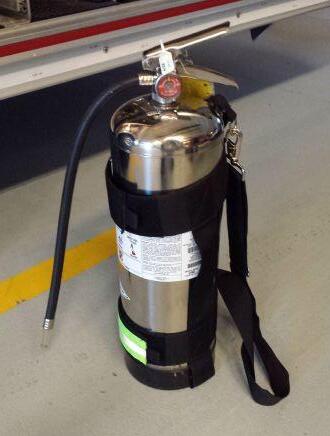
The next essential piece of equipment to carry is a five-pound water extinguisher (see photo 3). This piece of equipment is necessary to provide temporary water application/protection for the search team and fire suppression for the attack team. There may be situations in which a little bit of water is needed to suppress the fire as opposed to a charged handline; for example, a pot-on-the-stove fire or a fire in a garbage can. The water extinguisher will be enough to suppress these types of fires and crews will not have to secure the standpipe.
The extinguisher can also be used by
larger fires. As crews search the unit or area, they may encounter the seat of the fire and with the extinguisher, will be able to keep it controlled until a handline is charged and brought in to complete the job.
The final items that firefighters should carry into a highrise incident are the building keys. Having the keys allows crews to easily access units. Carrying the keys saves time and eliminates the effort necessary to breach locked doors.
Other items that firefighters choose to carry into a multi-storey building will be dictated by the circumstances and situations.
Mark van der Feyst is a 14-year veteran of the fire service. He works for the City of Woodstock Fire Department in Ontario. Mark instructs in Canada, the United States and India and is a local-level suppression instructor for the Pennsylvania State Fire Academy and an instructor for the Justice Institute of B.C. E-mail Mark at
Photo 3: A five-pound water extinguisher provides temporary water application and protection for the search team, and fire suppression for the attack team.
Professional development
Implementing an effective mentoring program that builds strong relationships and prepares new, young officers
By DENIS PILON
TOP The mentoring process should take place over a short period of time, typically six to nine months. A solid mentoring program allows new officers to make decisions – and make mistakes – but provides opportunities for feedback and discussion. Mentors are coaches, rather than teachers.
Most of us who wear stripes understand that mentoring is a critical component in the development of firefighters and newly promoted officers.
Through my research and experiences, I’ve compiled some best practices that departments can use to implement mentoring programs.
There’s little information available about how to mentor up-and-coming leaders: most textbooks have two or three paragraphs about the need to find a mentor,
the need for a formal mentoring program, or the need for mentors to be identified in advance of the need.
Some textbooks give the impression that a mentor relationship could go on indefinitely, that anyone could be a mentor or mentee, that a formal process is best but not necessary, and that a mentor must be the same rank or higher than the mentee. However, none of these textbooks provide any how-to instructions for mentoring.
The mentoring process should take place over a short period of time, typically six to nine months, depending on the position
BY ROB
PHOTO
EVANS
Cut Rescue Time
and past experience of the new person. Typically, this is a growth period, as the newly promoted firefighter learns the ropes and makes decisions that are foreign to his or her experience; it is a time during which the mentee can build confidence and try new things, learn new processes and make changes to the way things have been done. The formal mentoring should be brief, but the resulting relationship will thrive for many years and encourages the mentee to continue to ask for advice.
■ BUILDING A PROGRAM
A formal mentoring program allows the department to pre-screen mentors to ensure they have the right experience, knowledge, skills and abilities, but most importantly, to ensure they have the right attitude. Mentors aren’t teachers; they are coaches and guides.
A good mentor relationship will ensure that the mentor and mentee meet regularly, such as weekly. The meetings can be brief or more lengthy depending on the issues that need to be discussed. The meetings should be face to face or by phone or teleconference, but definitely not by email or social media.
The meetings should have a set format, beginning with a discussion of items from the last meeting. The mentor should lead the discussion by asking open questions such as: What were the results of the decisions that you made? Was there any positive or negative feedback? What did you learn?
Next is a discussion of the new issues the mentee faces. Again, the mentor should ask questions: What are your options? Which is the best option? What are you going to do? It is not the mentor’s role to offer solutions or tell the mentee which solution is best: the mentor’s role is to bring out the possibilities and let the mentee make the decision.
The mentor needs to use probing questions such as: Have you thought of this? Have you considered how this will affect the crews? Have you considered the political implications of that decision? It is not the role of the mentor to lay out the positive and negative effects of the decision, but to ensure that the mentee has thought through them.
Next, the mentor should ask what the mentee sees on the horizon – what issues are about to come to the forefront? How can the mentee deal with those issues? Can the issues be resolved before they become problems? This is the proactive portion of the mentoring process.
■ KNOW THE BOUNDARIES
A good mentor will step in only if the mentee is about to make a critical error that could be illegal, immoral, cause injury or harm to an individual, or harm the reputation of the organization. If intervention is necessary, it is still not the mentor’s role to make the decision, but to guide the mentee to the right decision.
Be aware that the mentee may not do
With a thorough and quality mentoring program, the mentor and mentee relationship can last years and help both the mentor and mentee grow as fire-service leaders.
People who don’t make mistakes aren’t learning and they certainly aren’t trying anything new.
the job or make the decision the way the mentor would do it, and may do so worse or better. Remember, growth comes from making mistakes. If the mentee is making a mistake, as long as no harm will come from it, the mentor must let it go; he or she will grow and so will the mentor.
A mentor does not need to be the same rank or a higher rank than the mentee, nor does he or she need to be in the same fire department or even in the fire service.
If you have promoted a new adminis trative chief who will be responsible for the budget, it would be wise to have that person mentored by someone in the municipal finance section who understands the budget procedure, including where the revenue comes from, how mill rates are set and how council reacts to the proposed budget. You may also know of someone from another municipal department who is an expert in areas such as vehicle maintenance. Find a range of experts to mentor your people.
■ BUILD RELATIONSHIPS
One of the most significant benefits avail able to members of Canadian fire services is the opportunity to meet and share best practices at conferences, meetings and social events. People lead much more mobile lifestyles than we did 20 years ago and, as a result, more members can attend these functions provincially, nationally and inter nationally.
Chief fire officers should make an effort, through their participation in conferences and other events, to meet people from other regions and departments who have experi ence and skills, and include them in their mentoring networks.
People who don’t make mistakes aren’t learning and they certainly aren’t trying anything new. The key to good mentoring is to allow the mentee to learn something new without getting into serious trouble.
If the person makes a mistake, critique the decision and the results, discuss what could have been done differently, look at other options, make corrections and move on. There is an old business adage that
TRUCKTECH Framing the rust problem
By CHRIS DENNIS
Corrosion. Wait, don’t turn the page. This column is not about the rust and corrosion that I have written about in past columns: you know, the stuff that attaches to every square inch of fire trucks. This column is about the rust and corrosion that is so obvious it tends to get overlooked.
During routine maintenance or annual safety inspections, we depend on our apparatus-repair technicians and emergency-vehicle technicians to find hidden, monstrous areas of rust long before things go badly. But we often overlook rust collecting on the frame of the truck. I have mentioned in pervious columns how important it is to wash the apparatus, not only after a fire call but also after a bad winter and spring. Corrosive salts become lodged in crevices and react with the metals again and again, every time the truck gets wet.
■ PAINT
Paint on truck bodies and custom apparatus cabs always shows signs of premature erosion. Paint will swell, peel and bubble around glass, handles, wheel wells, add-on lighting, or anything that bolts to the cab body. Premature rusting is more noticeable on custom cabs than it is on commercial truck bodies because the automotive and commercial truck makers have for years known the correct way to prep, prime and paint the aluminum.
Any truck that has been subjected to cold weather and poor road de-icing methods will start to show bubbling paint after a year or two. Truck add-ons such as lighting, door handles, cab grab-handles, windshields, side-glass, steps – anything that is bolted onto the body –once they are painted, put undue stress on the areas they are pressing against. Manufacturers attach every bolt-on item prior to painting a truck, and all thread holes are threaded or prepared for self-tapping hardware. These items are all put back on once the truck is painted. In some cases pre-drilled holes are even protected prior to painting so that they don’t fill with paint and primer. I am no painter, just a mechanic who has painted a few cars and trucks in my day, but I know that whenever the screws go back in the holes, paint cracks as the item is tightened; these cracks are not seen because they are behind the mounted products. Manufacturers may or may not cover damage in these areas, even if they are still under warranty, if it is considered a maintenance issue.
My advice is keep detailed records. Smartphones are an easy way to photo document and keep track of the point at which issues arise. Contact your dealer or the body builder directly to get a claim started early. The odds are at the end of the warranty period a truck will require a complete paint job. Custom builders typically offer paint and body warranties of between five and seven years, although some now offer lifetime warranties (read all the fine print). If the apparatus is 12 to 15 years old it will most likely need paint and body repairs. Depending on the warranty, the builder will cover a portion of the cost
of the paint and body; you pay the difference.
■ FRAME RAILS
When I worked at a Mack factory branch in the ’80s, I was shown how to weld correctly. This is something every mechanic learns to do in Ontario to get a mechanic’s license; it is not a certification in welding but a step-by-step guide to the welding process. Part of my job was to lengthen and shorten frames to replace frames in one piece, or sub sections. If you come across what you think is a possible frame issue, you must deal with it. Original equipment manufacturers for both custom and commercial trucks usually offer lifetime warranties on frames.
When the build sheets and proposals say lifetime warranty for the frame, it’s easy to skip over it, but, as with the paint warranty, ask questions and read the fine print. I know a few departments that are dealing with badly corroded frames and cross members and are taking trucks out of service (see photo 1). A fire chief cannot go to council and say, “Hey, our 2000 and 2002 fire trucks need new frame rails because you folks continue to allow de-icing agents to be put on the roads.”
Fixing the frame of an aerial will cost about $100,000 and it will be out of service for approximately six months (mainly because nobody knows how to or wants to be liable after they fix it). In these situations I am talking only about custom chassis because I have yet to see a commercial chassis – ladder, pumper or a quint – with frame
A seven-year-old untreated truck frame rail has heavy rusting. Badly corroded frames and cross members force many chiefs to take trucks out of service years before expected.
The fire pump is mounted on the frame of the fire truck.
PHOTO 2
PHOTO 1
PHOTOS BY CHRIS DENNIS
flex issues.
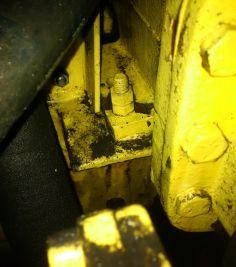
When I wrote this I was working on a 2000 custom fire truck chassis with a lifetime warranty. The truck came in for regular maintenance with a water leak at the fire pump. The water leak required the technician to remove the officer’s side of the truck mid-ship mounted fire-pump panel to see the leak (see photo 2). Once inside, the technician noticed a piece of cast from the fire pump was cracked: the bolted area of the steamer extension for the master intake. The piece of cast was small, with a 1/2-inch coarse bolt still stuck in the cast ear, which had snapped off. Upon inspection we were able to see clearly that the mounting flange to which the fore pump is bolted – the flange then bolts to the side flat face of the frame rail – was raised approximately 3/8 of an inch off the flat flange surface of the top of the frame rail. A third party was invited to conduct a magnetic test on thickness and metal material to see how bad the problem was and to suggest some solutions. The fire chief was immediately notified as was the deputy in charge of apparatus division. The techs recommended we remove the rig from service.
The tandem fire truck is more than 32 feet long, with a torque box, full fire pump, steel ladder, an aluminum body and roll up doors. The frame was separating between the inner frame rail and the outer frame rail C channels. The frame was pushing up on the fire pump mount and eventually broke off a cast piece of the fire pump (see photo 3).
All single, double or triple frames are made so that when the truck turns full right or left it actually twists and moves forward approximately 1/2 to 3/4 of an inch. It is amazing how frames can handle both the yield load and the compression load and not break. The frame metals are pretty darn strong to handle the weight and pounding they go through. There is a lot of load ahead of the first drive axle and behind the cab where the fire pump sits or, for a mid-mount aerial or platform where the turntable sits.
You would think that with rust proofing and continuous maintenance on fire trucks, rusting of the frame would not happen. In the case of the broken tandem truck, the chassis builder is already saying it was not rust proofed correctly and it was overloaded. But a frame rail really should not be bad already in its life. If we are the only department with this problem I would possibly agree, but we are not. Fire chiefs all over Canada are dealing with frame issues. Trucks are being taken
out of service because the budget doesn’t have an extra $100,000 to get it fixed. Yet when the public needs the fire pump to come to their aid, they expect it to be there and in perfect working order.
For our broken tandem, I exposed the side of the frame rail that requires repair or replacement and disassembled the fire pump and frame rail mount to have a clear view of the area. I’ve power washed and degreased the entire pump house module and frame rail and fire-pump mount assemblies. I contacted a structural engineer – somebody who knows about the ins and out of sub structure metal and supporting member. The engineer said he was surprised to see how the frame rails spread apart despite all of the items tying them together. He suggested we clear the area around the frame rails for full visual inspection. Once he saw the rails, he determined that there could be a repair without a full frame replacement. The repair had to be done to a strict standard and by a company that specializes in frame rails. This company would need to be inspected by the engineer to be sure they have the means and knowledge to do the job.
Once I found a company, I instructed the company of what the engineer wants (apparently that is the way they repair all frame rails). I asked the company about the likelihood the frame would break or twist again after the repair. The answer is easy: if the repair is done the right way the first time, the only thing the fire department needs to do is inspect the frame rail more often. Inspecting the frame rails includes training firefighter where and what to look for. This is great news.
I have been a licensed heavy truck and coach mechanic for more than 35 years, working at small truck shops, public transit repair companies, truck-trailer repair shops, and factory branches. I have fixed a few things well and some not so well, but the one thing I did do well was pay attention: if I did something wrong once and I had the opportunity to make it right, I learned from the mistake. Ask lots of questions and ask to be shown.
I will go into detail about how the frame is repaired in my next column. Remember my friends, rubber side down!
Chris Dennis is the chief mechanical officer for Vaughan Fire & Rescue Service in Ontario. He can be reached at Chris.Dennis@ vaughan.ca
LIGHTS, CAMERA, ACTION
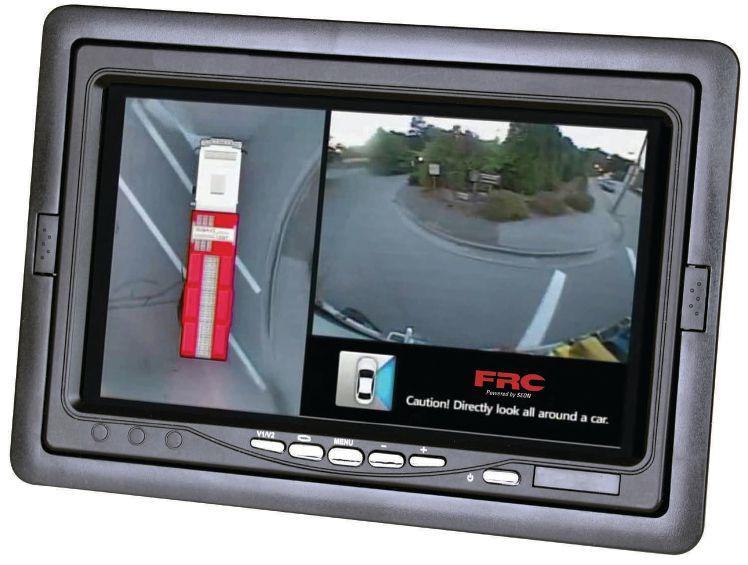
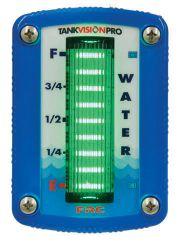
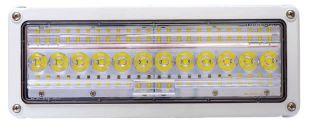
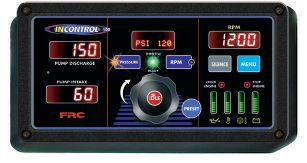
Combining the most innovative and technologically advanced emergency companies into one single force offers you new solutions engineered to increase safety. The inViewTM 360° video system from FRC, a Safe Fleet brand, is a new and exciting product which offers apparatus drivers a 360° “Bird’s-Eye” view, plus it records all events and more. Check out the inViewTM video system and other new FRC products and see how innovative engineering can add to your safety. Contact your Safe Fleet representative to learn more about the many new technologies now available.
TankVision Pro
Brightest lights
High visibility gauges Pinpoint control
Spectra Lights
BY DAVE BALDING Fire chief, Golden, B.C.
TEffective leaders find balance
oday’s fire departments face increasing expectations in terms of service delivery, fiscal constraint and improved training standards: the result is greater demands on our members. Firefighters, supervisors, administrators and entire departments have a limited capacity to continually give. Part of the solution to these challenges is for chief officers to become adept at establishing and balancing priorities. Operational effectiveness, accountability to authorities having jurisdiction, fiscal prudence and human-resource management are all critical to our emergency services organizations, however, none of these alone can create an effective fire department.
A prime example of the need to balance priorities is the commitment of volunteer or paid-on-call members to their family lives. These firefighters often must balance family responsibilities with adequate training and response hours. Ways to help may include alternate training nights or days, and providing for children to be brought to the fire hall and minded during emergency events.
As required by the new British Columbia Structure Firefighters Competency and Training Playbook, fire departments across the province are working with their local governments to formally declare the level of fire protection they will provide to their communities. Golden Fire Rescue is fortunate to have the resources to commit to full-service operations; that means not only committing to a level of fire protection, but also the requisite training. This commitment will place an increased demand on our department and its members. We must balance this demand with the training required for other services the department provides, such as: wildland fire suppression, highway rescue, emergency medical responder, confined space and hazardous-materials response.
FIRELINES
I have yet to encounter a department that does not strive to meet the myriad recommendations, standards and codes, I also have yet to find a department that achieves that goal. Some departments with limited means must choose which regulation they may have to flex or vary in order to comply with others. This issue may also speak to a need for balance at a higher level – those bodies that want fire protection and are responsible for funding them.
My colleague and fellow contributor, Tom DeSorcy, recently wrote about change in his Volunteer Vision column. Change is essential to our progression and survival, but we must also maintain balance with change. Innovations such as new tools, strategies and tactics are more critical now than ever; they allow us to ply our trade more effectively and safely. I believe, however, that many practices from our past retain their value. There is still a place for positive-pressure attack and other long-held procedures, while embracing practices such as transitional attack, door control and knowledge of flow paths that have arisen from recent research. The same applies to equipment: smooth-bore nozzles still thrive alongside combination nozzles, as they should.
Equilibrium between long-held traditions and young members of
Some departments with limited means must choose which regulation they may have to flex or vary in order to comply with others.
’’
I find leading and managing our firefighters to be the most vital area in which balance is required; it may also be one of the most challenging. I’m fortunate to work with an amazing team. Getting to know each unique member and using the leadership style best suited for him or her is not always easy. Learning to balance authority with a somewhat more collegial approach is so important. Recruits who have grown up in the 2000s and are unaccustomed to a paramilitary style have shown us we can no longer treat our firefighters like boot-camp participants. Effective leaders also balance their styles across various situations.
Here’s a sticky one – compliance with codes and standards. While
Dave Balding joined the fire service in 1985 and is now fire chief in Golden, B.C. Contact Dave at dave.balding@golden.ca and follow him on Twitter at @FireChiefDaveB
our departments is another aspect essential to the ongoing health of the organizations. Much like teaching the why behind the how in fire fighting, I believe traditions hold little meaning to recruits if we don’t explain their significance and history.
Both operational and social aspects in a department are needed to maintain a balance between effective operations and camaraderie, trust and friendship. Those latter essential elements don’t come from a training manual; they come from social events with the members and their families. Beware the departments (and they are often reflective of their leaders) that allow one side of this operational-versus-social equation to overly influence the other.
Balance, perhaps underrated, may be a more essential ingredient than we know. A chief officer’s ability to balance is often taken for granted, yet its absence is very noticeable.
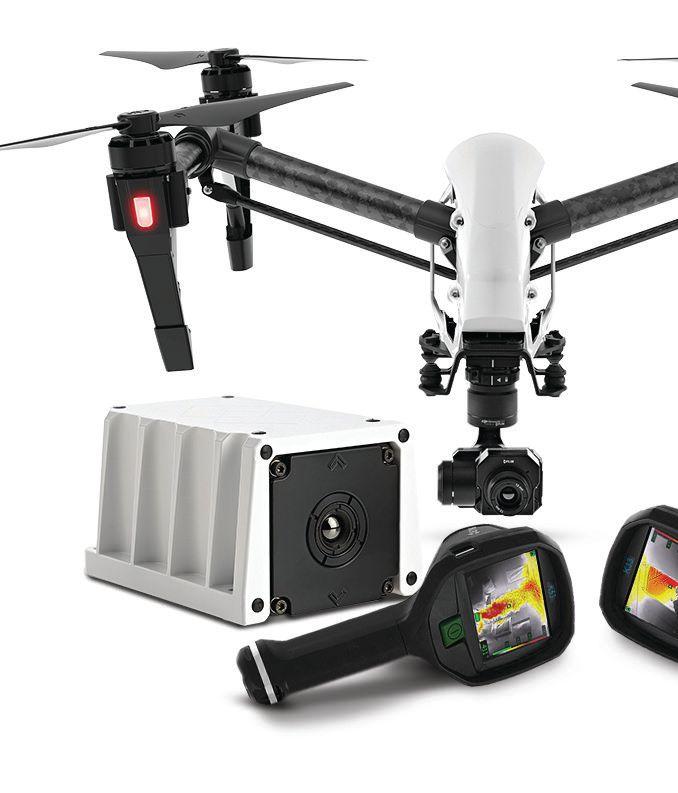
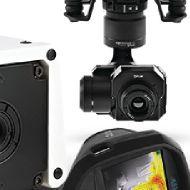
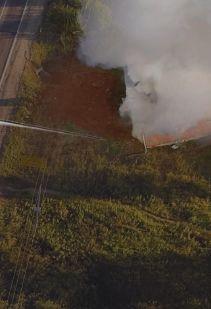
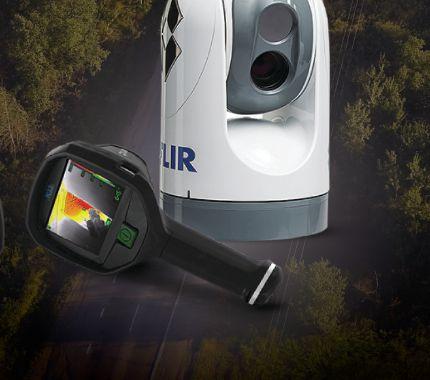
FROM BOOTS ON THE GROUND TO EYE IN THE SKY, WE’VE GOT YOUR BACK.
FLIR’s wide range of TICs can help you identify hot spots from a variety of distances – making safety the top priority. Learn more at FLIR.ca/fire
BUY ANY 4 FLIR K SERIES TICS, GET A FLIR K2 FOR FREE. A $ 1,350 VALUE!
®
FEATURED PRODUCTS:
· FLIR K2 THERMAL IMAGING CAMERA
· FLIR K33 & 53 THERMAL IMAGING CAMERA
· FLIR KF6 AERIAL APPARATUS
FIXED-MOUNTED THERMAL IMAGING CAMERAS
· FLIR M-SERIES PAN-TILT-ZOOM TICs FOR ARFF, HAZMAT & ALL EMERGENCY VEHICLES
· FLIR AERIAL FIRST RESPONDER KITS
BY SAMANTHA HOFFMANN
Public
fire and life-safety officer, Barrie, Ont.
W
FIRSTLINE
Seek partners to support community events
hile the heat and humidity of summer seem distant during the dreary days of November, now is a great time to plan for seasonal activities that showcase your department’s staff and fire-safety initiatives.
Every July and August, Barrie Fire and Emergency Service (BFSE) hosts a summertime tradition at a different park on Thursdays from 6 until 8 p.m.
Residents have the chance to go over some lifesaving tips and reminders while getting acquainted with BFES staff. Kids can check out the fire trucks, participate in hand-on activities, and ask any fire-safety questions. Domino’s Pizza sells pizza for $1 a slice, with proceeds going to our Community Projects charity.
Events such as Hot Summer Nights reflect BFSE’s vision of gaining respect and recognition as a leading service provider in the community, protecting precious lives, property and environment. The focus is on prevention, detection and escape.
Most often, the public sees fire crews when they are busy at an emergency scene; thus they are unapproachable. This program allows the public to see its local fire department in a different light and interact with the firefighters. People are able to:
• ask the crew questions; seek advice on summer safety and fire safety in general
• check out the fire trucks and equipment
• try some hands-on activities
• promote our public image and encourage neighbourhood camaraderie
• have some fun
• learn something!
life-safety programs. Successful partnership development requires promotional, public relations and marketing skills. While financial funding is important, money will not accomplish everything.
We have had great success for staffing by utilizing on-duty fire crews and fire prevention staff and partnering with our local school board and community college pre-service fire students. All Ontario high school students are required to obtain 40 community-service hours. With some training and supervision, students make great fire-safety ambassadors. The pre-service fire students from Georgian College participate in our event and run our mini-combat challenge. The mini-combat challenge incorporates some of the traditional firefighting skills, however it has an educational focus. College students are trained on the mini-combat challenge evolutions and it is their responsibility to educate the children as they participate. The students wear their school fatigues and while they are representing their firefighting program, they are learning first-hand how their chosen career is about community first, and giving back.
To promote our event, we partnered with two local radio stations; they provide free on-air advertisements weekly, and hourly on the day
Successful events lead to successful partnerships. When planning a community event, think outside the box . . .
We have been hosting Hot Summer Nights since 2012 and each year it continues to grow. Part of the overall public fire and life safety strategy is to establish and maintain high visibility within the community. Our Hot Summer Nights program allows us to do this by working with organizations and groups within our community. We have created effective working relationships that help us enhance the awareness of fire- and life-safety issues.
Fire departments generally rely upon mutual aid for fire suppression efforts; apply this same strategy to community fire-safety education programs. You need to know how to establish, nurture and expand partnerships to develop the community based fire- and
Samantha Hoffmann has been in the fire safety field for more than 25 years; she is the public fire and life-safety officer for Barrie Fire & Emergency Service in Ontario. Email Samantha at Samantha.hoffmann@barrie.ca and follow her on Twitter @shoffmannpflso
’’
of the event. In addition, the stations broadcast live from our location; this helps to create a fun ambiance and gets the radio stations out in the public eye as well.
There is no better way to gather a crowd than food, so another partnership was formed with Domino’s Pizza. Domino’s provides pizza at all of our events at no cost but asks for donations. All money raised is given to Barrie Fire Community Projects and used throughout the year to assist struggling families and not-for-profit organizations. As part of this partnership, Domino’s hands out fire-safety tip cards with Hot Summer Night dates and locations with all take out and delivery orders. More than 5,000 advertisements and fire tips are distributed in June, July and August at no cost to Barrie Fire.
When planning a community event, think outside the box: who else needs to reach your audience and can you work together?
*Demo Available for Sale Now
You protect the public
Let us heLp protect you
For your cleaning, decontamination, inspection, testing, repair and record keeping of your firefighter’s protective clothing... we have you covered!
• 24/7 access to Firetrack®, the online data base that provides you with complete details of your C&M Program with FSM. We do the work for you!
• ETL Verified
• ISO 9001 Registered
• Fast turnaround
• Complete Bunker Gear Rental Program – Toronto Location Ontario (toronto) 1-888-731-7377
IN THEWATCHROOM
■ HANNAY REELS INTRODUCES F1500 SERIES
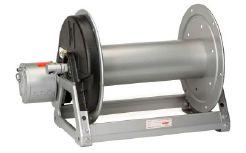
The F1500 Series from Hannay Reels is available in manual or power rewind for long-length utility and breathing air hoses. The lightweight, compact reels are designed especially for the fire and rescue industry with a chain-and-sprocket drive powered by an electric or compressed air motor on power rewind models. Manual rewind models include a cam-lock drag brake and spring actuated pin lock. The F1500 reels are made with internal stainless steel construction for compatibility with breathing air applications. For additional information visit www.hannay.com
■ HOLMATRO LAUNCHES GREENLINE RESCUE TOOLS
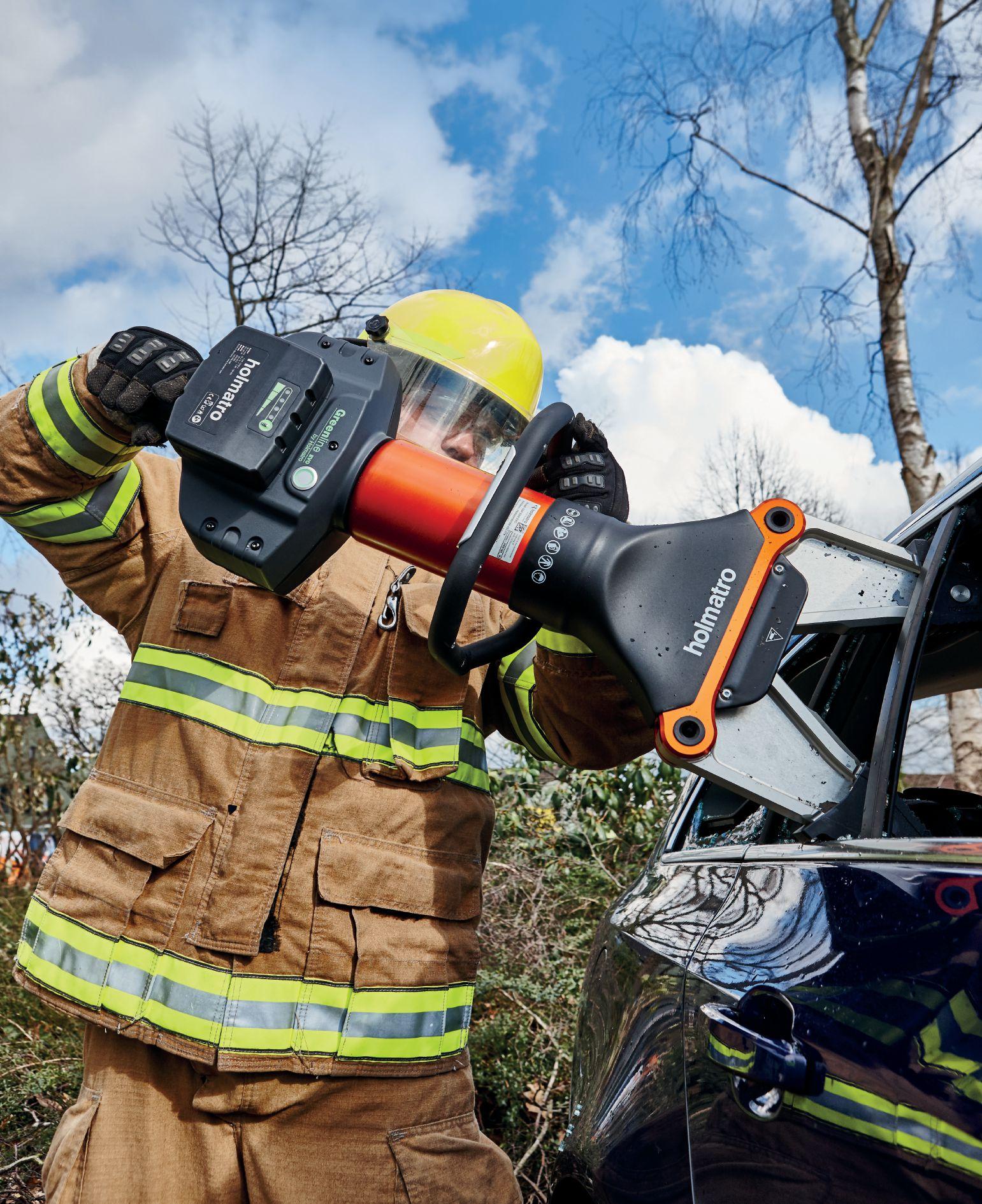
Holmatro has designed a new line of battery-operated Greenline EVO rescue tools that includes three cutters, three spreaders, four combination tools and two rams. The emissions-free range of tools feature lithium-ion batteries, low self-discharge rates, LED indicators to check battery capacity, weather proofing, including wet weather, and a centrally positioned handle. Learn more about the new Greenline EVO range at www.holmatro.com
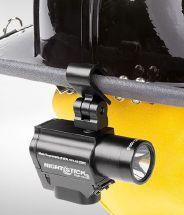
■ NIGHTSTICK CREATES ANGLED HELMET-MOUNTED LIGHT
Bayco Products, Inc., makers of Nightstick lighting products, has reinvented the firefighter helmet-mounted flashlight to include three separate lights and a 45-degree rotation. The Nightstick multi-purpose NSP-4650B
Dual-Light flashlight includes a main, powerful beam, a second angled, soft floodlight, and a third green rear-facing LED light for optimal visibility in a smoke-filled environment. The slim mounting clamp ensures the light avoids goggles, face shields or other obstructions, and allows for plumb mounting on angled brims. The flashlight is waterproof and chemical and impact resistant. Bayco Products are available in Canada through ABC Fire & Safety Equipment, First Response Supply Inc., and Dependable Emergency Vehicles. Learn more at http://www.baycoproducts.com/index.php/product
■ SCOTT SAFETY LAUNCHES NEW COMPRESSOR SYSTEM
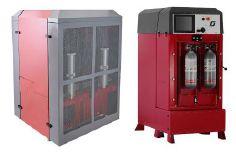
Scott Safety has created a new line of breathing-air system products that includes the HushAir Connect 7500, RevolveAir Connect and SmartTouch Controller. The HushAir Connect’s 7,500-psi design decreases fill times and increases capacity, all will improving safety with fewer maintenance requirements. The HushAir Connect has automatic sensing technology with a touch-screen interface that allows for automatic cylinder fill recording, fulfilling NFPA 1989 logging requirements. Learn more about the line of breathing air system products at www.scottsafety.com
BY VINCE MACKENZIE Fire chief, Grand Falls - Windsor, N.L.
AVOLUNTEERVISION
Leading a shift in fire-hall culture
s volunteer firefighters, we rarely stop to think and analyze the culture in our fire departments. While every department has a culture, these cultures can vary from virtuous and healthy to dysfunctional and vicious. Often, a contributing factor to positive cultures is the persistent effort of a single person valiantly trying to affect positive and virtuous change. That person consequently ends up acting as a spark to a cultural shift and transformation within the department. I had the pleasure recently to be present as the Canadian Association of Fire Chiefs (CAFC) presented annual awards at its conference in St John’s, N.L. Two of the awards were the national career fire chief of the year, and volunteer fire chief of the year. Congratulations to both career chief of the year Steve Gamble of Langley, B.C., and volunteer chief of the year, Cecil Kerr of Gilliams, N.L.
The volunteer fire chief of the year award was especially inspiring to me this year, as the recipient is not only from my province but also from a fire department that had many challenges during its existence, and I knew this first-hand In the early 1990s as a young firefighter, I frequently travelled and trained at the Gilliams fire training site. In fact, I received my level 1001 training and certification at Gilliams. At that time, the site was one of just a handful of smokehouse training buildings in our province that was capable of doing live fire training evolutions and scenarios. This training was mostly conducted by the Fire Commissioner’s Office of Newfoundland and Labrador. The facility was built with government funding in the hope that it would produce economic spinoff for the region as firefighters from all over would come and train. The Town of Gilliams is not a very big community; in fact, the fire department there was small and activity there was all but non-existent when I trained in that community; it was the neighbouring fire departments that were keen to recognize training and used the facility frequently.
just 406 residents, this fire chief spent countless hours training his fire department members to their 1001 level. Being a full-time educator, Kerr recognized the core need for training and brought his skills to his fire department. One advantage of volunteer fire departments is that we all bring the skills of our regular day jobs to the fire halls. Therefore, volunteer fire services can sometimes have a great advantage in training and administration. This was evident in the actions and passion of this volunteer fire chief. During the CAFC awards gala, I was pleasantly surprised and proud to witness the fire chief of a department, that I knew was once not very active, receive an national award of excellence.
My hope is that you examine the culture in your fire station and, more importantly, ask yourself if you are contributing to a positive culture in your department, especially if your members lack interest in training drills.
Volunteer firefighters are motivated by several factors and many will look to the leadership of the organization to provide direction. The paradigm shift occurs when the troops become motivated to purposely change the department. Fire services do not typically accept change well; we are sometimes stuck deep in traditions. It takes a
One advantage of volunteer fire departments is that we all bring the skills of our regular day jobs to the fire halls.
While I am sure Chief Kerr had much help transforming the fire department to a viable and vibrant organization, it is quite often the persistence of one person who demonstrates the leadership required to breathe life back into an organization that results in success. Clearly Chief Kerr had demonstrated this leadership and revived this fire department into a solid organization once again. In a community of
Vince MacKenzie is the fire chief in Grand Falls-Windsor, N.L. He is an executive member of the Canadian Association of Fire Chiefs and the past president of the Newfoundland and Labrador Association of Fire Services. Email him at firechief@townofgfw.com and follow him on Twitter at @FirechiefVince
good group of leaders to transform any aspect of our profession, but an even greater motivator to transform a stagnant organization into a vibrant one; the resistance from those within your fire department can be overwhelming and a good leader is sometimes the lone wolf.
The desired cultural shift of a fire department is usually a slow to materialize and it really does not become evident for a considerable amount of time. Changing cultures is difficult and it can take a toll on the leader as results don’t present themselves quickly in most cases. All too often we hear of fire department leaders who throw up their hands, give up, and fall back into the old cultural norms, or, even worse, resign their position and walk away.
Advancing Canada’s volunteer fire services requires formal leadership awareness and training;, unfortunately the fire departments that need this training the most are usually the ones that fail to seek it out.
TRAINER’SCORNER Practice your evolutions
By ED BROUWER
Iheard one of my neighbours, an old cowboy, say that experience is the best teacher, and I am inclined to believe him. Perhaps that is why I gravitate toward hands-on training rather than just lecturing. The three go-to training methods I use are: scenarios (a description of what could possibly happen); drills (the method, the way things are done); and evolutions (the gradual development of something, especially from a simple form to a more complex form).
With that in mind I’d like to address one of the challenges volunteer departments face; we are never sure who is going to respond to a call out. In fact, the chief and deputy may both be unable to attend, so it is imperative that you train the officers – and even the senior firefighters as well – to be the incident commander (IC).
At our practice, I had two objectives in mind: first to prepare firefighters to be ICs; and to check the firefighters’ abilities to establish a water supply and deploy an initial attack line in a timely manner.
Step 1: All firefighters started the evolution standing in the hall. They were not wearing their personal protective clothing. Two engines and one tender were parked in the bays.
I assigned the IC position to a two-year firefighter. She attends 90 per cent of the calls and is a great candidate for this role. I walked her through the scenario, letting her know that she would be allowed to transfer command to a senior officer sometime after things were rolling. It is good to practice these types of transfers using department radio communications protocol; the firefighter was really glad for that when she found out the details of the scenario. (Note: The training officer can play the part of dispatch throughout the evolution.
Step 2: Call out - Structure fire (flames reported) at local public school. Time of call: 13:30 on a weekday (school is in session).
At this time, all firefighters donned their PPE, and loaded up in their perspective units. All units responded to the given location.
Step 3: Arrival - Command was established and an arrival report was given to dispatch.
I threw a lot at the IC when she arrived on scene – school children in the front yard with teachers; apparatuses needing to be staged; size-up needing to be completed; dispatch needing arrival reports.
Remember, this was an evolution, so I let it develop. The first three steps were to establish the playing field. The rest of the steps were what happened (developed) in our evolution.
At first the IC tried to deal with everything at once. I caught her eye and said one word: delegate. It was as if hearing that one word was the key, because suddenly the IC barked out a few orders and assigned a captain to water supply, another to suppression, two firefighters to do a size-up and two firefighters to assist teachers with the evacuation. Part of this evolution experience is to increase the firefighter’s ability to work as a member of a team.
Prepare firefighters to be incident commanders by having them role play on practice nights.
PHOTO BY LAURA KING
PHOTO BY LAURA KING
Drills help firefighters develop muscle memory.
Evolutions build on skills learned in drills.
Once the IC had delegated tasks, several things were able to go on at the same time, allowing the IC to get a better size-up done and contact dispatch for RCMP, EHS, utilities, and mutual aid if needed.
Step 4: One firefighter removed the end of the supply line from the hose bed, along with the hydrant valve, adapters and hydrant wrench. The supply line was connected to the hydrant using a hydrant valve and the firefighter awaited signal to supply water.
Step 5: The driver/operator set up pump to standby; a water supply was connected.
This was the IC’s first try at this role and I really found little to correct. That isn’t to say there weren’t any problems, as we had our share. However, the main challenges came in the deployment of the attack lines (the second objective of our evolution).
Step 6: Two pre-connect attack lines were laid and charged. Two firefighters per line wearing SCBA prepared for suppression actions.
Step 7: The attack-line teams (wearing SCBA) sprayed water out onto the playing field, simulating attacking the fire, which had come through a few windows.
I had placed flagging tape on several windows and doors on the Charlie side of the building, approximately 61 meters (200 feet) from the parking lot. So when firefighters deployed the pre-connects (61 meters [200 feet]) the hoselines just reached the fire-involved area. Firefighters in SCBA were spraying water out on the playing field, simulating attacking the fire. No one noticed the possible issue of not being able to enter the building if the need arose; and in my scenario the need would arise.
Step 8: IC transferred command to the chief (done over the radio by the original IC).
Step 9: An additional pre-connect was laid from the second engine. I was hoping the need to lengthen our normal 200 feet pre-connect would be noted, but it wasn’t.
Step 10: Ventilation team set up at the school’s front doors.
At this time I called an end to the evolution and we debriefed.
All the firefighters were actively engaged in the evolution and in the debrief. I simply asked a few questions to get the debriefing going.
It was noted that all three pre-connect attack lines were too short to be effective if entry were to be made.
It was observed (through the windows) that the fire was actually in two separate compartments, a classroom and a kitchen. One firefighter noted the closed doors in each room and questioned the effectiveness of ventilation. A great question, which led to a discussion about ventilation.
The suspicious nature of this fire starting in two separate rooms led to a discussion on arson and scene preservation.
The first IC really stepped up to the plate. She was given a few pats on the back by the crew. All and all, it was a good practice night.
One thing I like about evolutions is that, in most cases, they develop in ways that bring out your weak or problem areas ¬– and it’s far better to deal with these at a practice than the real thing. Try not to over plan your evolution; let it play out.
Please remember that experience is a great teacher, and train like lives depend on it, because they do.
Ed Brouwer is the chief instructor for Canwest Fire in Osoyoos, B.C., and training officer for Greenwood Fire and Rescue. Ed has written Trainer’s Corner for 15 of his 27 years in the fire service. Contact Ed at ebrouwer@canwestfire.org
BY MATT PEGG Fire chief, Toronto
LEADERSHIPFORUM
Seize opportunities for career success
Iam thrilled to write for Fire Fighting in Canada. The aim of my column will be to share some of the more interesting questions that I have been asked by those working hard to advance their fire-services careers, along with my perspective on the issue.
“I’m just not lucky.” How many times have you heard that, or more importantly, how many times have you thought, believed or said that yourself? Could it possibly be true that our ability to achieve career success is largely dependent upon luck?
The short answer is yes, but not for reasons you may think. I am a strong believer in luck, but only when it is viewed from a much different perspective than the dictionary definition. The MerriamWebster online dictionary defines luck as “a force that brings good fortune or adversity;” an accurate definition for sure, but are our careers dependent upon “a force that brings good fortune or adversity”? I hope not.
I choose to see luck in a manner very similar to that of Randy Pausch. Pausch was a professor at Carnegie-Mellon University who lost a hard-fought battle against pancreatic cancer in 2008. In his book The Last Lecture, Pausch defines the concept of luck in a striking way: he suggests that luck is what happens when preparation meets opportunity. That sure sounds a lot different than simply hanging out until the stars align, until your ship comes in or until luck starts to come your way. Luck is not the result of some mystical set of invisible dice that are rolling, to which we must succumb and submit.
Achieving your career goals in today’s very competitive, very complex fire services requires relentless preparation. Without adequate preparation, exciting opportunities will surely be missed. I believe that your preparation is within your control and that individuals determine whether they see opportunities coming, how to recognize them and where and when to look for them. Many genuine opportunities are not necessarily above you – many will be lateral to and even beneath your current position.
department or service with which they started, that is certainly not the case for everyone today. Increasingly, we are seeing fire service leaders move from position to position and department to department. Mobility is a reality in today’s career environment and while it still may be somewhat uncommon within the fire service, it is both normal and even expected in other professions. Don’t be afraid to look outside your “home” for opportunities that might present themselves.
Today’s fire services are extremely competitive. The straight truth is that we will not succeed unless we are fully prepared – fully prepared not only to engage and thrive in the recruitment or promotional process that is necessary to put us in the position that we seek, but also fully prepared to actually perform the duties of that position with confidence and competence. Being underprepared will always end in disappointment.
Today’s fire services are changing at a rapid pace; there may be no more exciting time to take on a leadership role than right now. In fact, the demand for transformational change within fire services is both palpable and obvious.
Achieving your career goals in today’s very competitive, very complex fire services requires relentless preparation. ‘‘ ’’
The path to your ultimate career goal may not form a straight line. In fact, your path may well resemble a winding road that covers a lot of different ground. While it is true that most people who enter the fire service tend to finish their fire service careers with the same
Matthew Pegg is interim fire chief with Toronto Fire Services, having previously served in Georgina, Ajax and Brampton, Ont. Pegg was president of the Ontario Association of Fire Chiefs from 2013 to 2016 and has served on the national advisory council to the Canadian Association of Fire Chiefs. Contact him at matt.pegg@toronto.ca
As leaders, we need to be leading improvements in fire services inclusion and equity. We need to be seeking out opportunities to maximize efficient and effective service delivery. We need to be creating ways to teach our next company officers and our next chief officers how to lead people in an ever-changing world. These are but three of the nearly unlimited opportunities for change that exist right now.
In reality, change opportunities are literally endless and can also seem both exciting and even daunting. Is that what you seek? If so, is your commitment to personal preparation aligned with your goals? Are you prepared for the next opportunity that comes along? Are you prepared to seek out and identify transformational change?
Success happens when relentless preparation meets opportunity. Are you feeling lucky?
Opportunity knocks
Embracing trends to sell fire safety to elusive demographic
By PHILLIP SHUSTER
TOP Watching for and seizing social media trends, such as the Pokemon Go craze, is one way to effectively teach the millenial generation about fire safety.
Baby boomers, generation J, generation X, boomers II –these are the generations into which most of you reading this probably fit. While you all have unique habits and tendencies, sociologists have uncovered some generalized experiences of members of these generations that have helped to shape who you are today. For example, most of you grew up in a time of stable economic prosperity in Canada; most of you remember the political ideological battle that was the Cold War; and the nuclear family was the societal norm. As for media consumption, television and movie theatres became the ultimate sources of entertainment, while many of you read the daily newspaper to learn about current events and the commentary of the day. For these generations, in relation to
marketing fire safety education, the more traditional mediums of communication have been the most effective: taking out ads in the newspaper, having a guest speaker on the local community cable network, and paid radio spots have seemed to get the message across and engage audiences. However, to the dismay of the traditionalist in the media world and public educators in fire departments, a generational shift has occurred that has now made news consumption and marketing techniques more complex.
Enter generation Y and generation Z, also commonly referred to as millennials. How different are these generations? To start, 95 per cent of the people who belong to these generations have personal computers, they likely will have owned cell phones as preteens, they stream movies in the
comfort of their bedrooms, they’ll instantly toss a newspaper in the recycling bin rather than read it, and they have never seen an eighttrack player or beta cassette. Members of these generations are the also the ones that have been labeled as entitled, self centred, and have been told they do not know what hard work really is. Statistically, members of these generations will live at home with their parents until they are in their late 20s.
So at this point you may be asking why we should focus the attention on these generations; these are people who were not even born when many of you started on the fire department, so they are mostly still teens, right? The fact of the matter is, as a group, generations y and z represent 30 per cent of the adult population in Canada, or almost eight million people, and the percentage increases every year according to Statistics Canada. Members of these generations will soon be purchasing their first homes, having children and will become responsible for the fire safety in their families.
So now that we know the millennial generation is a group that we as public educators should focus on, how can we begin to make certain they know to test their smoke alarms in their homes at least once a month and make sure they have a home escape plan? Let us turn our attention to one marketing device that most millennials possess and that we at Brampton Fire and Emergency Service recently utilized with success: cellular phones.
Watch any group of people walking along a sidewalk; pedestrians under the age of 35 will either be looking at their cell phones or will using earphones that are attached to the cell phone. According to Ottawa-based Media Technology Monitor (MTM), a marketing research group, 90 per cent of millennials own a cell phone compared to 58 per cent of members of older generations. The iPhone leads the way when it comes to smartphone brands, with almost 50 per cent of millennials preferring the Apple product. As for what millennials are doing on their phones, MTM found that 90 per cent of millennials prefer to text rather than make voice calls, and the same percentage use applications or apps, as we call them, on their phone on a daily basis. As for how long millennials use their phones, MTM found the average use was 27.6 hours per week. Clearly, it is evident that millennials are heavily into their smartphones and depend upon
them to communicate and receive information they deem important. So, it is no coincidence that when a smartphone app combined childhood nostalgia with new integrated technology, the product became an instant hit with millennials.
This past summer, Pokemon Go swept across the world and at its highest peak, had 135 million daily users with the average player age being 25 years old. Essentially, Pokemon Go works through the use of an emerging technology known as augmented reality. This means that Pokemon Go imposes a live direct or indirect view of a physical, real-world environment whose elements are augmented by computer-generated sensory inputs such as sound, video, graphics or GPS data. Players hunt for Pokemon (the world literally translates to little monster in Japanese) to catch and build up their collection to battle other users for bragging rights. Also, within the game the developer placed Pokestops (locations that players collect items to level up) at various landmarks located in the real world; including public parks, fire stations and monuments. To confuse you even more, players are able to place scent lures at Pokestops that attract wild Pokemon to their location which benefits all players in the area.
With all these reports of Pokemon Go in the news and its huge popularity, our team at Brampton Fire and Emergency Services decided that we had to take advantage of it. Being the savvy millennial of the group, I had already installed Pokemon Go on my iPhone a week before it was available in Canada and knew there were three Pokestops within a two-minute walk of one another right next to one of our fire department buildings. I decided to do a little experiment and placed a lure at the Pokestops near the building on a random weekday, which was one of the hottest days of the summer. The response was nothing short of incredible. In the span of just 20 minutes, 80 or so people congregated near our building; people even pulled up in cars. My colleague and I started casual conversations about home fire safety with the Pokemon Go players who showed up based on the fact that the augmented reality map informed them of the placed lures.
From our informal experiment we decided to advertise, solely on Facebook and Twitter, that we would place lures on the Pokestops on two different dates, for three hours each. The response to our Pokemon lure party was incredible. More than 400 people came out to each event, mostly younger adults, the demographic we have trouble engaging. The attendees enjoyed the wild Pokemon that appeared during the event but also had some great conversations with our public education staff about fire safety. Many of participants said that they learned fire-safety facts that they did not know prior to attending, but also admitted that the main reason for their attendance was the Pokemon Go lures. Pokemon lures are an in-game purchase and cost $2.99 each. Thus, it seems the event produced a mutual relationship between us and the attendees: they got to be around a lure they did not pay for, and we attracted hundreds of people to educate in person for the low cost of $20.99.
Our experience using a smartphone application to educate millennials about fire safety was highly effective, and its low cost made the activity highly efficient as well. A few key points for departments interested in using cell-phone based technology for educating on fire safety:
1. Keep up-to date on trends. If you are thinking about opening a Pokemon Go account and hosting a lure party of your own, you may be too late. The number of Pokemon Go users has decreased substantially since this summer and with the colder weather approaching, users are less inclined to stand outside for
Brampton Fire and Emergency Services placed and advertised Pokemon Go lures near the department, and attracted players.
Foam Trailers
Portable Pumps
CAFS
Skid Units
Brush Trucks
It is time to start thinking of using more popular cellphone applications in abstract ways.
three hours. That is why it is important to understand and utilize cellphone apps as quickly as possible, because if you have to wait a month or two before the fire chief approves your idea you may be too late to the party.
2. Focus on the application/technology use as much as you do on fire safety education. Being a millennial, I am comfortable stating that some members of my generation take significant pride in creating a reputation in the online gaming community. Thus, using the example of Pokemon Go, if we did not allow the people who attended to focus on levelling up their character and instead constantly distracted them by throwing pamphlets in their faces and forcing conversation, they would have left and may never attend a future event hosted by the fire department.
3. Know the application you are using and if possible, develop a common interest. It was very important to educate my team about Pokemon Go, including how it worked and how the gaming experience for the user occurred. This was also important in convincing the higher ups about the benefit of using Pokemon Go; I was able to explain step-by-step how the application worked and why it was so popular.
Lastly, it was appreciated by some of the attendees that I knew how to play Pokemon Go and knew the attributes of their favorite Pokemon characters to create outdoor safety signs (see photos). This allowed the gamers to see me more as a peer, which, in turn, made them more open to hearing what I had to say about staying in the kitchen when they cook.
4. Avoid the sole reliance on the traditional social media applications. Yes, Facebook and Twitter are great means of communication. However, Facebook will be 14 years old next year and Twitter just turned 10 years old. It is time to start thinking of using more popular cellphone applications in abstract ways to educate the younger adult generation.
With its use of hilarious facial filters, Snapchat has grown and now has 150 million users daily. Instagram continues to grow and Buzzfeed, a website that started off creating hilarious personality quizzes, has now become the dominant source of news for millennials. If you can think of ways to sneak in a fire-safety message or two, but still keep to the fundamentals of the application, I can guarantee you will see a positive response.
Prior to joining Brampton Fire and Emergency Services in 2009, Phillip Shuster had worked in the private sector as a project manager for a marketing firm with clients including Ford, Microsoft Canada and General Mills. Shuster has a master’s degree in public policy from McMaster University and an undergraduate degree in international relations from the University of Toronto. Shuster is a fire/life safety educator with BFES with an interest in statistical analysis and outreach to diverse communities. Email Shuster at Phillip.Shuster@Brampton.ca
MANUFACTURERS’ DIRECTORY
AN ALPHABETICAL LISTING OF MANUFACTURERS, SUPPLIERS AND DEALERS OF APPARATUS AND COMPONENTS TO THE CANADIAN FIRE SERVICE.
A.J. STONE COMPANY LTD.
62 Bradwick Dr., Vaughan, ON L4K 1K8
Tel:416-785-3752
Fax: 416-781-2827
Toll Free: 1-800-205-3473
email: order@ajstone.com website: www.ajstone.com
Joyce, Lindsay
A.J. Stone Co. Ltd. has proudly served the needs of the Fire/Rescue and First Responder Services of Canada since 1972, featuring quality products, knowledgeable sales reps, and training support.A.J. Stone supplies equipment from MSA, TNT Rescue, Paratech Rescue, Akron, Kochek, FireAde 2000, Streamlight, Innotex Bunker Gear, Pro-Tech Gloves, E.S. Safety Systems, CET, BullEx, and much more. We service what we sell!
AIR VACUUM CORPORATION
PO Box 517, Dover, NH 03821
Tel:603-743-4332
Fax: 603-743-3111
Toll Free: 1-800-540-7264
email: sales@airvacuumcorporation.com
website: www.airvac911.com
Thomas Vitko, Regional Sales Manager, John Koris
The AIRVAC 911® exhaust removal system is a hosefree, fully automatic filtration system that addresses both the gasses and particulate emitted from diesel engines. The AIRVAC 911® system is 100% effective for a clean and safe environment. For a free quote visit www.airvac911.com or call 1-800-540-7264.
ARNPRIOR FIRE TRUCKS CORP.
10 Didak Dr., Arnprior, ON K7S 0C3
Tel:613-623-3434
Fax: 613-622-4009
email: msmith@arnpriorfiretrucks.net
website: www.arnpriorfiretrucks.net
Mike Smith
Although Arnprior Fire Trucks is a new name, we are the same team of Builders and Engineers that produced quality and pride into fire trucks built under two previous fire apparatus companies in the Ottawa Valley. AFT is 100% Canadian owned and operated based in a state-of-the-art manufacturing facility in Arnprior, Ontario.Arnprior Fire Trucks team has provided leading fire fighting solutions to the industry under the Almonte Fire Truck and Seagrave Canada names.AFTC is 100% Canadian owned and provides support and service across Canada and into the US. Our history is built on providing quality trucks that meet a department’s needs and budget.We are your affordable alternative to the standard designs the larger companies provide.
AIR TECHNOLOGY SOLUTIONS CANADA INC.
251 Queen St. S., Ste. 512, Mississauga, ON L5M 1L7
Tel:905-826-6682
Fax: 866-511-6904
Toll Free: 1-866-735-1480
email: info@airmation.ca
website: www.airmation.ca
Randall Weber, VP Marketing & Sales, Canada Air Technology Solutions is dedicated to our Clients, offering updated, timely, full service Indoor Air Quality (IAQ) solutions. Air quality concerns are mitigated using a unique combination of professional indoor air quality assessment coupled with solutions. Off the shelf or customized site specific air cleaning equipment is available to resolve IAQ issues. Our technical experts review client requirements and budgetary availability. The finest appropriate air cleaning systems are provided. Air Technology Solutions is a leader in Diesel Exhaust Remediation and is the ONLY environmental tested and proven filtration system to exceed standards: NFPA, NIOSH, OSHA and ASHRAE.Building and facility managers, business owners, contractors, architects, and engineers have been working with Air Technology Solutions since 1986 to resolve IAQ needs. Employee and personnel safety and health are key issues. Breathing safe air in the workplace is of utmost importance.We provide global customized solutions to control contaminants, pollutants and odours in your facility. We look forward to servicing your requirements.
Steve RobertsON Akron Brass Company is a leading global manufacturer of high performance firefighting products engineered and tested for superior fire suppression and emergency response. Products include nozzles, monitors, valves, scene and vehicle lighting, vehicle electronics, reels, hand tools, engineered solutions, and other firefighting equipment.
AMKUS RESCUE SYSTEMS
4201 Montdale Dr., Valparaiso, IN 46383-4098
Tel:800-592-6587
Fax: 219-476-1669
email: experts@amkus.com
website: www.amkus.com
Kyle Smith, President - 219-548-5001; Alice Hubal, Inside Sales Manager - 219-548-5015
AMKUS Rescue Systems, headquartered in Valparaiso, Indiana is an industry leader that provides cutting edge hydraulic extrication equipment, vehicle stabilization equipment and rescue systems.
BECOMING A FIREFIGHTER
PO Box 530, 105 Donly Drive S., Simcoe, ON N3Y 4N5
Tel:519-429-3966
Fax: 1-866-810-8111
Toll Free: 1-888-599-2228 ext. 235
email: bcomer@annexweb.com
website: www.becomingafirefighter.com
Barb Comer, Acount Co-Ordinator
WATER RESCUE | FORT GARRY FIRE TRUCKS
Built on a Smeal Sirius chassis and powered by a 500-hp Cummins ISX15 engine, this unit features a waterous CMUC20 2,250 GPM pump and can carry 400 imperial gallons of water on board.
DEPARTMENT:
Fire & Rescue Service, British Columbia
The Rosenbauer non-walk-in rescue custom rescue is built on a Commander 4000 chassis and has seating for 10. It is powered by a Cummins ISL 400-hp and boasts a rear bunker gear storage module. It has a 200-foot electric cable reel with junction box. DEPARTMENT: Plympton-Wyoming Fire Department, Ontario
Built on a Freightliner M2 chassis and powered by a 330-hp Cummins engine, this unit has a waterous 1050 pump and an 840 US gallon tank. It is a Pierce Responder.
DEPARTMENT: Township of Seguin Fire Department, Ontario
Built on a Spartan Gladiator chassis and powered by a 550-hp Cummins ISX
Commander 4000 four-door custom chassis and powered by a 450-hp Cummins ISL engine, this unit features a Hale 8FG 1500 IGPM pump and an 11-inch raised roof. It has a FoamPro 2001 foam system and a 500 Imperial gallon water tank, and cab and body collision protection.
DEPARTMENT: Prince George Fire Rescue, British Columbia
The walk-in rescue chassis is a 1999 freightliner. The body is aluminum and the unit boasts Whelen warning equipment. DEPARTMENT: Mississippi Mills, Ontario
Built on a Freightliner M2 crew cab chassis, this unit is powered by a 350-hp Cummins diesel engine. It has a 14-foot aluminum walk-around rescue body. DEPARTMENT: Kenora Fire & Emergency Services, Ontario
C-MAX FIRE SOLUTIONS
3044 Sawmill Rd., St. Jacobs, ON N0B 2N0
Tel:519-664-3796
Fax: 519-664-3624
Toll Free: 1-844-GET-CMAX email: fireinfo@c-max.ca
website: www.c-max.ca
Kathy Brookes, Manager
Canadian family owned and operated business that offers a higher standard of service and sales for all your Fire Apparatus needs. C-Max Fire Solutions offers 24 Hour service from EVT Technicians with fully stocked service trucks. We offer Pump testing and repairs to all makes and models. We offer ground ladder testing as per NFPA 1932. We are also Ontario’s Factory Sales and Service Centre for KME Fire Apparatus.
CANADIAN SAFETY EQUIPMENT INC.
2465 Cawthra Rd., Unit 114, Mississauga, ON L5A 3P2
Ross Humphry, Nick Desmier, Scott Gamble, Chris Hamilton, Steve Shelton, Mark Kentfield, Mike RobinsON We supply SCBA’s, Thermal Cameras, Auto Extrication, CAF Systems, Fall Protection, Bunker Gear, Fire Hose, Communications Equipment, Nozzles, Fittings, Hazmat Suits, Ventilation Fans, Gas Detectors, Confined Space Rescue Equipment, High Angle Rescue Equipment, Boots and Gloves. Everything for Fire Fighting and Confined Space Rescue.
CSE INCENDIE ET SÉCURITÉ
5990 Vanden Abeele, St. Laurent, QC H4S 1R9
Tel:514-737-2280
Fax: 514-737-2751
Toll Free: 1-866-737-2280
email: info@cseis.com
website: www.cseis.com
Richard Abraham, Mike Heering, Brad Bowen
We supply SCBAs, Thermal Imaging Cameras, Auto Extrication Tools, CAF Systems foam, Bunker Gear, Fire Hose and accessories, nozzles, fall protection communications equipment, fittings, hazmat suits, ventilation fans, rescue saws, ice and water rescue gear, high angle rescue gear, boots, helmets and gloves.
CUTTERS EDGE
PO Box 846, 3855 23rd Street, Baker City, OR 97814
Tel:541-524-9999
Fax: 541-524-9996
Toll Free: 1-800-433-3716
email: info@cuttersedge.com
website: www.cuttersedge.com
Thomas Ruzich
Cutters Edge saws are designed for fire and rescue situations. Our product line includes the MULTI-Cut Fire Rescue Chainsaw equipped with carbidetipped BULLET®Chain and Depth/Guard Gauge. The H2 Series Rotary Rescue Saw with Black Diamond Rescue Blade or the new Cutters Edge BULLETBLADE®, and the CE94CRS Concrete Cutting Chainsaw with Diamond Chain; designed specifically for cutting reinforced concrete up to 16”.
DARCH FIRE INC.
9-402 Harmony Rd., Ayr, ON N0B 1E0
Tel:519-622-6110
Fax: 519-622-7705
Toll Free: 1-800-254-2049
email: sales@darchfire.com
E-ONE, INC.
1601 S.W. 37th Ave., Ocala, FL 34474
Tel:352-237-1122
Fax: 352-237-1151
email: info@e-one.com
website: www.e-one.com
CANADIAN DEALERS
Carrier Emergency Equipment
6 Edmondson St., Brantford, ON N3T 5N3
Phone: 519-752-5431
Territory: Ontario
Associated Fire Safety Equipment
106-3070 Norland Ave., Burnaby, BC V5B 3A6
Phone: 604-320-3303
Territory: British Columbia, Yukon
Keewatin Truck Service
610 Keewatin St., Winnipeg, MB R2X 2R9
Phone: 204-633-2700
Territory: Manitoba
Techno Feu Apparatus Maintenance
105 Marie-Victorin, St. Francois-Du-Lac, QC J0G 1M0
Phone: 450-568-2777
Territory: Quebec, Atlantic Canada
ELKHART BRASS
1302 W. Beardsley Ave., Elkhart IN 46514
Tel:574-295-8330
Fax: 574-293-9914
Toll Free: 1-800-346-0250
website: www.elkhartbrass.com
Elkhart Brass is the industry’s most experienced manufacturer of rugged and innovative firefighting and fire protection equipment; including nozzles, valves and monitors. Elkhart’s global presence services the Mining market, municipal fire departments, OEM’s, offshore drilling sites, military, marine, LNG, refineries and other markets.
elkhartbrass.com • 1-800-346-0250
CET FIRE PUMPS MFG.
75, rue Hector, C.P. 90, Pierreville, QC J0G 1J0
Tel:450-568-2719
Fax: 450-568-2613
Toll Free: 1-888-844-2285
email: sales@fire-pump.com
website: www.fire-pump.com
Stephan Thibault
DEMAND QUALITY!Portable Pumps, Skid Units, CAFS, Foam Trailer, Glider Kit, Water Tank, Brush Truck and Fire Apparatus.A Century of Engineering for the Bravest!
website: www.darchfire.com
John Darch
Susan Miller and John Darch own and have operated Darch Fire Inc. since 1993. Darch Fire Inc. partners with leading industry manufacturers including Pierce Manufacturing, Holmatro, Draeger, Elkhart, Geargrid, Key Fire Hose, Blowhard Fans, Southcombe Gloves as well as many, many more to provide you the best products available. The parts department at Darch has all the everyday and hard to find parts needed to keep your emergency vehicles in top form. Darch Fire’s professional mobile fleet service team are fully licensed and EVT certified technicians and are ready to respond to all your fire truck maintenance and service needs including pump testing and scheduled fleet service.
FIRE FIGHTING IN CANADA/ CANADIAN FIREFIGHTER
PO Box 530, 105 Donly Dr. S., Simcoe, ON N3Y 4N5
Tel:519-429-5178
Fax: 888-404-1129
Toll Free: 1-888-599-2228 ext. 252
email: fire@annexweb.com
website: www.firefightingincanada.com
Publisher, Martin McAnulty
Advertising Manager, Adam Szpakowski
Editor, Laura King
This unit is built on a Commander 4000 chassis and is powered by a 500-hp Cummins ISX. It features a Greenstar idle reduction system, and has a waterous CSUC20 2000 GPM pump. It also has a 500 gallon water tank, an EZ load hosebed and an aerial command pedestal with joystick platform controls and wireless platform remote.
DEPARTMENT: Municipality of Chatham-Kent, Ontario
HEAVY RESCUE | SAFETEK EMERGENCY VEHICLES
TRUCKS
on a Spartan Metro Star chassis and powered by a 450-hp Cummins ISL9 engine, this unit has a 16,500-pound
Built on a Rosenbauer Commander chassis with a 24-inch raised roof and powered by a 450-hp Cummins ISL 9L engine, this unit has a 1500 Imperial gallon/6802L water tank. It also features OnSpot chains and a Rosenbauer dual pressure pump.
DEPARTMENT: Jasper Fire Department, Alberta
RANGE TRUCK | FORT GARRY FIRE TRUCKS
Built
WARN Winch and Whelen Pioneer LED scene lights. It features a 20 kW PTO generator, and dual cord reels with junction boxes.
DEPARTMENT: Vaughan Fire & Rescue Services, Ontario
Built on an International 7400 SFA regular cab (4x4) and powered by a 330-hp Navistar N9 diesel engine, this unit has a Darley PTO LSPAH 1000 (1000 USGPM) and a 1000 IMP gallon galvanized tank.
DEPARTMENT: Yukon Wildfire Management, Yukon
Built on a Freightliner M2-106 chassis and powered by a 360-hp Cummins ISB, this Pierce Tanker has a 1000 GMP Hale Pump and a 2100 US gallon tank. DEPARTMENT: Tweed Fire Department, Ontario
Built on a Spartan Metrostar-X and powered by a 380-hp Cummins ISL9, this unit has a Hale DSD 1,500 USGPM pump. It boasts a FoamPro 1600 A-foam system and ahs Whelen LED scene lighting.
DEPARTMENT: Cape Breton Regional Municipality Fire Department, Nova Scotia
Built on a Freightliner M2 regular cab and powered by a 330-hp Cummins diesel engine, this unit boasts a Darley PTO PSP1250 (1250 USGPM) and a FoamPro 2001 Class A/B system. It has a 900 IMP gallon poly tank, a 20 IMP gallon single internal foam tank and features a Crusader flat back body.
DEPARTMENT: Darren Clark Rural Liaison Regional Emergency Services, Alberta
This unit is built on an International 4400 four-door chassis, and is powered by a MaxxForce 9 330-hp engine. It has a 1000 gallon water tank and a Whelen emergency lighting system.
DEPARTMENT: Township of Alnwick-Haldimand, Ontario
FIRE RESEARCH CORP.
26 Southern Blvd., Nesconset, NY 11767
Tel:631-724-8888
Fax: 631-360-9727
Toll Free: 1-800-645-0074
website: www.fireresearch.com
Fire Research Corp. specializes in safety equipment, controls, instrumentation/displays, scene lights and station accessories for the fire service and the Mining industry. The SPECTRA LED lamp-heads are the brightest LED scene lights available with an unmatched output of 28,000 lumens of super bright white light. In addition, the inView 360™, powered by SEON, and InControl governors TankVision Pro are some of the most advanced equipment systems available.fireresearch.com, 631-724-8888
Canada’s Premier facility dedicated exclusively to providing the best in bunker gear cleaning, assessing, decontamination and repair. NFPA 1851:2014 compliant, ISO 9001: 2008 registered, ETL verified for all fabric repairs and all moisture barrier repairs. Locations: Calgary, Toronto, Detroit.
FLASH FIRE & SAFETY
PO Box 339, 5052-50 St., Waskatenau, AB T0A 3P0
FIREHALL BOOKSTORE
PO Box 530, 105 Donly Drive S., Simcoe, ON N3Y 4N5
Becky AtkinsON Canadian distributors for education and training products. Product lines include NFPA, IFSTA, PennWell, Brady, Action Training, Emergency Film Group & Jones & Bartlett.
Tel:780-358-2358
Toll Free: 1-844-FLASH-44 (844-352-7444)
email: info@flashfiresafety.com
website: www.flashfiresafety.com
Lyn Hirthe, 780-289-3798, lyn@campconnect.ca
Flash Fire & Safety - The Best protection is an Inspection!• Portable Wildland Fire Suppression equipment and Sprinkler Systems • Fire Pumps • Hoses • Accessories.• FlameOut Fire Suppressant Foam • Authorized dealer of Waterax Fire Pumps. Based in Waskatenau, Alberta and Meadow Lake, Saskatchewan. Flash Fire & Safety is your One-Stop Fire-Safety Shop!
Adam Szpakowski, Advertising Manager Firehall.com provides an excellent forum for exchange among firefighters and others involved in the fire service. Advertising options include banner ads and e-blasts and offer extensive exposure to the rank and file.
FOAMPRO
26 Southern Blvd., Nesconset, NY 11767
Tel:631-724-8888
Fax: 631-360-9727
Toll Free: 1-800-533-9511
website: www.foampro.com
FoamPro proportioners are innovative, fully automatic systems incorporating advanced technology for fire fighting in Municipal, Industrial, Marine, Wildland and stationary applications. Using push-button technology, our innovative design and patented microprocessor control technology continually monitors water flow and system performance for precise foam solutions. foampro.com, 800-533-9511
FORT GARRY FIRE TRUCKS LTD.
RR 2, 53 Bergen Cutoff Rd., Winnipeg, MB R3C 2E6
Tel:204-594-3473
Fax: 204-694-3230
Toll Free: 1-800-565-3473
website: www.fgft.com
Fort Garry Fire Trucks is Canada’s oldest and largest manufacturer of high quality fire apparatus offering a complete line of quality Pumpers, Tankers, Rescues, Aerial Devices, and Custom Designed & Engineered Specialized Units. Worldwide mobile service by EVT certified technicians and fully stocked part sales for all brands.
Built on a 2016 Ford F550 extended cab and chassis, this truck has a 200-inch wheelbase and is Power Stroke diesel. It features a Crane winch and a custom aluminum deck with removable sides and lower cabinets. It also boasts a winterization package.
DEPARTMENT: Yellowead County, Alberta
Built on a Freightliner 108 SD regular cab chassis and powered by a 400-hp Cummins diesel engine, this unit offers a Hale Module Sidekick 750GPM (750 USGPM), a 3000 IMP gallon poly tank, and it has a Wet Side Tanker body.
DEPARTMENT: Siksika Fire Department, Alberta
The Pierce 107-foot Heavy Duty Ladder is built on an Enforcer 7000 chassis. It is powered by a Cummins ISL9/460-hp engine and features a 500 US gallon tank and a waterous CSU/1500 GPM pump.
DEPARTMENT: Oakville Fire Department, Ontario
This unit is built on a Commander 4000 chassis and is powered by a 500-hp Cummins ISX. It has an eight-foot raised roof, a Hale 8FGR 2000 GPM pump and features Fire Tech Hi-Viz brow lighting.
DEPARTMENT: St. Clair Fire Department – Brigden Station, Ontario
Built on a Freightliner M2 regular cab chassis and powered by a 330-hp Cummins diesel engine, this unit features a Hale Sidekick 750 GMP MBP (750 USGPM), a 1700 IMP gallon poly tank and has a Wet Side Tanker body. DEPARTMENT: Vernon Fire-Rescue Service, British Columbia
This unit is built on a Ford F550 Superduty chassis and has a 350-hp. The body is made from aluminum and it features Whelen warning equipment. DEPARTMENT: Central Frontenac, Ontario
Built on a Spartan Gladiator Classic chassis and powered by a Cummins ISX 12 500-hp engine, this unit features a Waterous CSUC20 2250 GMP single stage pump. It carries 700 gallons of water on board and has a waterous Advantus 6 Foam system. DEPARTMENT: Saanich Fire Department, British Columbia
Built on a Freightliner M2 regular cab chassis and powered by a 350-hp Cummins diesel engine, this unit features a Hale Midship DSD1250 (1250 USGPM), a FoamPro 2001 Class A system and an 800 IMP gallon poly tank. It has a MXV flat back body and a 25 IMP gallon internal foam tank.
GLOBE MANUFACTURING COMPANY, LLC
37 Loudon Rd., Pittsfield, NH 03263
Tel:603-435-8323
Fax: 603-435-6388
Toll Free: 1-800-232-8323
email: info@globefiresuits.com
website: www.globeturnoutgear.com
Stephanie McQuade
Fighting fires is demanding, physical work requiring maximum athletic performance. The fact is, if you want to perform like an athlete, your equipment has to enhance your performance. Your gear should move the way your body does, without restriction. And, of course, it must protect you. It’s more than turnout gear. It’s athletic gear for firefighters. You can learn more about Globe gear by visiting www.globeturnoutgear.com. But the website only tells part of the story. You have to try on the gear, and experience firsthand the difference wearing athletic gear for firefighters can make.
HARRINGTON,
INC.
2630 West 21st St., Erie, PA 16506-2908
Tel:814-838-3957
Fax: 814-838-7339
Toll Free: 1-800-553-0078
email: info@harrinc.com
website: www.harrinc.com
Tim HarringtON Harrington, Inc. is a supplier of high precision equipment for the fire industry. Products include intake valves, gate valves, adapters, couplings, suction hose and other related products. We strive to be the leader by providing our customers with products that meet or exceed their specifications with short lead times.
HASTINGS BRASS FOUNDRY LTD.
236 Clark Dr., Vancouver, BC V5L 3H3
Tel:604-253-2811
Fax: 604-253-3133
Toll Free: 1-800-653-2811
email: hasbra@telus.net
website: www.hasbra.com
Robert Worner, Sales Mgr.
HASBRA FIREFIGHTING EQUIPMENT - Serving the Firefighting Community Through Quality Distributors Since 1916. ISO 9001-2008
HIGHWATER HOSE INC.
12 rue Willard, East Angus, QC J0B 1R0 Fax: 819-832-4340
Worldwide supplier of a wide range of rubber covered and lightweight, layflat fire and industrial hoses. A New Evolution in Fire Fighting:
• Deluge™ - Designed for high volume water supply where excellent friction loss, packability and cold temperature flexibility are critical.
• X-Stream™ Plus - Designed for aggressive interior attack where excellent abrasion and cut resistance are essential and where color-coded attack lines are crucial.
• Available with the iREFLECT™ and iDENTIFY™ Coding SystemOUR CANADIAN DISTRIBUTORS
Ralph Briggs, ralph.briggs@innotexprotection.com (226-791-8275)
INNOTEX® is a premier manufacturer of Fire Fighter Turnout Gear, Gloves and Hoods sold via quality Distribution Partners worldwide.
JORDAIR COMPRESSORS INC.
205-6901 72 St., Delta, BC V4G 0A2
Tel:604-940-8101
Fax: 604-940-8131
Toll Free: 1-800-940-8101
email: info@jordair.ca
website: www.jordair.ca
Shane Gilmore - Inside Sales
Jordair offers a diverse range of standard and engineered compressed air and gas systems for specialized applications. All Jordair compressors are provided with a 24 month warranty. All units are standard with load cycle counters for the final oil and water separators. Bauer and Jordair provide safe, reliable products backed by over 40 years of breathing air compressor expertise. Jordair is CRN registered in all provinces across Canada and CSA certified.
METALFAB LTD.
847 Central St., Centreville, NB E7K 2E8
Tel:506-276-4551
Fax: 506-276-3648
Toll Free: 1-800-561-0012
email: info@metalfabfiretrucks.com
website: www.metalfabfiretrucks.com
Ryan A. Stacey, Sales & Marketing Manager
Metalfab is a Canadian Manufacturer of customized Fire Apparatus. Our product line includes Pumpers, Tankers, Walk in Rescues, Walk Around Rescues, Mini Pumpers and other Fire Department Vehicles.
CUSTOM SIDE MOUNT PUMPER | SAFETEK EMERGENCY VEHICLES LTD./SMEAL
Built on a Spartan Metro Star chassis and powered by a 450-hp Cummins ISL engine, this truck features a waterous CSU 2250 GPM single stage pump, and carries 500 gallons of water on board. It has an Elkhart Cobra EXM electric monitor with remote and Elkhart X-Stream 1250 GPM nozzle.
DEPARTMENT: Justice Institute of BC, British Columbia
Built on a Spartan Metro Star and powered by a 380-hp Cummins diesel engine, this unit features a Darley PSP1250 PTO (1250 USGPM), a FoamPro 2001 Class A/B system and a 1000 IMP gallon poly tank. The MXV body holds both 10 and 24 IMP gallon dual internal foam tanks.
Built on a Rosenbauer Commander 4000, 18-inch raised roof chassis, and powered by a 500-hp Cummins ISX 12L engine, this unit has a FoamPro 3012 injection system and a 530 Imperial gallon water tank. It features Green Star idle reduction technology with a 7.9 kW generator.
DEPARTMENT: Esquimalt Fire Rescue, British Columbia
PUMPER | DARCH FIRE/PIERCE
MANUFACTURING
This Pierce Industrial Pumper is built on an Arrow XT chassis and is powered by a 500hp Detroit DD13 engine. It features a Darley ZSM pump and a 1000 US gallon foam tank.
DEPARTMENT: Nova Chemicals, Ontario
PUMPER | DEPENDABLE EMERGENCY VEHICLES CRUSADER | FORT GARRY FIRE TRUCKS
Built on a Spartan Gladiator chassis and powered by a 450-hp Cummins ISL engine, this truck has a FoamPro 2001 A-foam system. It features a Waterous CSU 1,500 USGPM and has Whelen Pioneer LED lighting.
Built on a Spartan Metro Star-X and powered by a 380-hp Cummins diesel engine, this unit has a Hale Midship DSD 1500 (1500 USGPM) and a FoamPro 1600 Class A system. It also features an 800 IMP gallon poly tank, a 25 IMP gallon single internal foam tank, and has a Crusader flat back body.
The Blue Mountains Fire-Rescue, Ontario
This unit is built on a Commander 4000 chassis and is powered by a 350-hp Cummins engine. It has a waterous CSUC 5000 LPM pump, a 1000 gallon water tank and a 30 gallon foam tank. Other additional features include a FireTech Hi-Viz brow light, Whelen emergency lighting and Fire Research LED scene lights.
DEPARTMENT: Town of Fort Erie, Ontario
Built on a Spartan Metro chassis and powered by a Cummins ISL9 400-hp engine, this truck features a Waterous CSUC 1,750 GPM single stage pump. It carries 540 gallons of water on-board and has a FoamPro 2001 Class A Foam system and a FoamPro Power Fill System.
Robert L. Richardson, President, W.S. (Scott) Fraser, Canadian Sales, Claude Berube, Quebec Sales
More than Just a Fire Hose and Pump ManufacturerBacked by over 35 years of manufacturing firefighting innovation, Mercedes Textiles Limited provides premium fluid delivery systems worldwide. These include municipal, forestry, industrial and cabinet, fire hoses and fire pumps, snowmaking and high water hoses and firefighting supplies.
FIRE HOSE: Innovation Delivered
• KrakenEXO®, the most advanced attack fire hose on the market - weighs less, kinks less, flows more water
• Highly visible WAYOUT® couplings, designed for improved “firefighter safety” during interior suppression
• iDENTIFY® Coding System - Recessed zone on hose couplings (patent pending) designed to receive and protect identification markings and decals from abrasion damage
• Innovative iREFLECT Lock Lever Storz couplings, designed to greatly assist firefighters during LDH deployment and retrieval applications
• UniqueMertex lining yields an extremely low friction loss, for maximum flow and superior adhesion for long life
• Features our Mercedes Textiles Limited 2-10-L warranty (“2 year All Hazards”, “10 year against manufacturing defects” and “Lifetime against delamination”)
PORTABLE FIRE PUMPS:
• A leading manufacturer of high pressure, lightweight, portable fire pumps for forestry and municipal fire department applications
Canadian dealer for KME Fire Apparatus. Specializing in custom and commercial pumpers, aerial, rescue, tankers and wildland units.
NFPA
c/o Firehall BookStore, PO Box 530, 105 Donly Dr. S., Simcoe, ON N3Y 4N5
Fax: 1-877-624-1940
Toll Free: 1-877-267-FIRE (3473)
email: firehallbookstore@annexweb.com
website: www.firehallbookstore.com
Canadian distributor for NFPA products.
ONSPOT AUTOMATIC TIRE CHAINS
555 Lordship Blvd., Stratford, CT 06615-7124
Tel:203-377-0777
Fax: 203-380-0441
Toll Free: 1-800-766-7768
email: onspot@onspot.com website: www.onspot.com
Eric Jones, VP Sales & Mktg.
This system permanently fastens to the vehicle’s rear suspension and allows the operator to engage and disengage tire chains at the flip of a dashboard switch without stopping, to enhance traction and braking in forward or reverse.
PIERCE MANUFACTURING
PO Box 2017, Appleton, WI 54912-2017
Tel:920-832-3231
Fax: 920-832-3084
website: www.piercemfg.com
Pierce Manufacturing Inc., an Oshkosh Corporation [NYSE: OSK] company, is the leading North American manufacturer of custom fire apparatus. Products include custom and commercial pumpers, aerials, rescue trucks, wildland trucks, mini pumpers, elliptical tankers, and homeland security apparatus. In addition, Pierce designs its own foam systems and was the first company to introduce frontal airbags and the Side Roll Protection system to fire apparatus. To learn more about Pierce, visit www.piercemfg.com.
R•O•M
6800 E 163rd St., Belton, MO 64012
Tel:816-318-8000
email: sales@romcorp.com
website: www.romcorp.com
R•O•M created the innovative roll up door technology. Manufactured tough; R•O•M doors, cargo slides and lighting are used worldwide. Simple to operate R•O•M doors provide quick, efficient access and include options specifically designed for various applications and requirements. romcorp.com, 816-318-8000
RESQTECH SYSTEMS INC.
189 Bysham Park Dr., Woodstock, ON N4T 1P1
Tel:519-539-0645
Fax: 519-539-0646
Toll Free: 1-800-363-7370
email: resqtech@resqtech.com
website: www.resqtech.com
Brian Innis
ResQtech Systems, Inc. has served the fire industry since 1985 and is dedicated to providing firefighters with innovative products and solutions. ResQtech Systems is the exclusive fire apparatus dealer for Rosenbauer and Hackney emergency vehicles in Ontario and offer a full line of emergency equipment which includes the Rosenbauer Heros-XT Helmet, Junkyard Dogg Struts, Interspiro Breathing Apparatus, Phoschek Firefighting Foam, Vindicator Nozzles and much more. In addition to the extensive product line, ResQtech has service technicians for your apparatus and emergency equipment needs, available at our in house facilities or on the road.
ROCKY MOUNTAIN PHOENIX
Head Office: 6415 Golden West Ave., Red Deer, AB T4P 3X2
BC Service Center: 103-81 Golden Dr., Coquitlam, BC Tel: 604-226-8707 Toll Free: 1-844-552-8668
Rocky Mountain Phoenix is a leader in the supply of vehicle solutions, products and services to the emergency response and fire combat industry.Your complete source for MSA SCBA, Thermal Imaging, Protective Clothing, Suppression Tools and Equipment. Visit our online catalogue at www.rockymountainphoenix.com
CUSTOM RESCUE |
TRUCKS
EMERGENCY VEHICLES
EMERGENCY RESCUE SIDE CONTROL | FORT GARRY FIRE TRUCKS
DEPARTMENT:
roll-up
doors. DEPARTMENT: City of Yellowknife Fire Division, Northwest Territories Built on
Rosenbauer Custom Commander chassis with
cab
24-inch raised roof, this unit is powered by a Cummins ISX 12L 500-hp engine. It has a Hale RME 100 IGPM rear mountain pump, a FoamPro 2002 foam system and traffic advisor on body sides.
Yellowhead County, Alberta
This unit is built on a Commander 3000 chassis with an 11-foot roof, and is powered by a 450-hp Cummins ISL. It boasts a Whelen lighting package, a FoamPro 1600 system, a 400 gallon water tank and 30 gallon foam tank. It also features a side and rear camera system.
DEPARMTNET: Perth East Fire Department, Ontario
Built on a Freightliner M2-106 two-door chassis and powered by a 330-hp Cummins ISL9 engine, this unit has a Hale DSD 1,250 USGPM. It features Whelen LED lighting and boasts a 2,000 USG poly Brayneck Canaplast.
DEPARTMENT: Mapleton Fire Department, Ontario
Built on a Freightliner M2 crew cab and powered by a 350-hp Cummins diesel engine, this unit has a Darley PTO PSP1250 (1250 USGPM), a FoamPro 1600 Class A system and a 300 IMP gallon poly tank. It also features a 25 IMP gallon single internal foam tank and has a Crusader flat back body.
DEPARTMENT: Telkwa Fire & Rescue, British Columbia
This unit has a department supplied Kenworth chassis. It features a 3000 Imperial gallon water tank and has portable pump storage with connection and fire research LED scene lights.
DEPARTMENT: Township of North Kawartha, Ontario
SAFETEK
SAFEDESIGN APPAREL LTD.
34 Torlake Crescent, Toronto, ON M8Z 1B3
Tel:416-253-9122
Fax: 416-253-0437
Toll Free: 1-877-253-9122
email: sales@safedesign.com
website: www.safedesign.com
Don King, Vice-President/Sales Specialists in Firefighters Protective Clothing. Complete line of Thermal Protective PPE. Globe Firefighters Suits, Shelby ‘Firewall’ Gloves, Globe EMS Lifeline, Black Diamond Footwear, PGI Cobra Hoods & Wildland Clothing, Workrite Stationwear, Firefighters Helmets, Cairns Protective Clothing. Globe Footgear, Globe USAR Clothing/Tech Rescue, Topps Safety Apparel, Stationwear. • Exclusive Dealer Network Coast to Coast.
SEATS CANADA INC.
1800 Bonhill Road, Mississauga, ON L5T 1C8
Tel:905-364-5843
Fax: 905-364-7822
email: seatsinfo@seatscanada.com
website: www.seatscanada.com
Hasan Mohammed
We offer a complete line of quality Emergency Vehicle seating for driver, officer, crew, wall mount and jump seats. Engineered for comfort and safety, these seats have easy exit flip-up split headrest and are manufactured in a wide variety of covering material.
SECURITRIM 2002 INC.
9200 - 5E ave., Ville Saint-Georges, QC G5Y 2A9
Tel:418-226-4961
Fax: 418-221-6147
Toll Free: 1-888-666-4961
SAFETEK EMERGENCY VEHICLES LTD.
30686-A Matsqui Place, Abbotsford, BC V2T 6L4
Tel:604-504-4590
Fax: 604-504-2415
Toll Free: 1-866-723-3838
email: sales@firetrucks.ca
website: www.firetrucks.ca
Safetek Emergency Vehicles is Canada’s leading provider of firefighting and rescue apparatus, equipment, parts, and service. Founded in 1993, Safetek represents more than 20 fire and rescue equipment manufacturers and suppliers, including some of the major brands in the industry: Smeal Fire Apparatus Co. (SFA), SVI Trucks (SVI), US Tanker, Ladder Tower Company (LTC), Gimaex, and Intercontinental Truck Body (ITB).We provide full after-sale warranty and maintenance service for apparatus and equipment through Profire Emergency Equipment, acquired by Safetek in 2009. Profire offers a wide range of parts and services and is an authorized parts centre or distributor for most of the fire industry’s major brands. Together, Safetek and Profire have the experience, resources, and knowhow to help keep your fleet safe and in service. We have customer service centres in Abbotsford, BC, Mississauga, Ontario, Alberta, Manitoba, Quebec, and the Maritimes.
SERVING
THOSE WHO KEEP OUR COMMUNITIES SAFE
email: info@securitrim.ca
website: www.securitrim.comNew! Purchase online! David Russell
Securitrim 2002 is a specialized supplier of both 3M and Reflexite microprismatic reflective sheeting for commercial and emergency vehicle graphics. Brighter graphics enhance motorist safety and is now mandated by law for Fire apparatus. Securitrim 2002 is marketing
RCHEKpoints
for installation over diamond checker plate. Microprismatic custom made one piece pre-striping is now available in easy to install sheets, excellent for full rear coverage.Now available are SEPANS, with 5X the reflective power of cones! Designed specifically for EMERGENCY RESPONSE INTERVENTIONS, SEPANS have proven to be the highest performing EMERGENCY INCIDENT TRAFFIC MANAGEMENT SYSTEM on the market.
SPARKLE SOLUTIONS
100 Courtland Ave., Concord, ON L4K 3T6
Tel:866-660-2282 Ext. 251
Fax: 905-660-2268
Toll Free: 1-866-660-2282 Ext. 251
email: brucem@sparklesolutions.ca
website: www.sparklesolutions.ca
Bruce Miller, 647-308-2625
Sparkle SolutionsWe are the industry leader in supplying Complete Laundering Solutions for personal protection equipment.Complete firefighter protection:When our Ram ExpressDry Gear Dryers are used as a team with our Continental ExpressWash Gear Washers, firefighters can feel secure knowing they are able to properly clean and dry their equipment.
STARFIELD LION
23 Benton Road, Toronto, ON M6M 3G2
Tel:416-789-4354
Fax: 416-789-5475
Toll Free: 1-800-473-5553
website: www.starfieldlion.com
Rob Hosselet, National Sales Manager; Rosanne Kalenuik, Director of Customer Sales and Support. Starfield Lion has a legacy and ongoing vision of introducing PPE that is designed to ensure the health, safety and performance of the first responders who serve our communities. Your safety is our top priority. Your needs drive our innovations, we listen and develop the solution.
Survitec Group is a world leader in design and manufacture of survival products for search and rescue from rescue boats to life jackets and ice rescue suits. In addition, we distribute products such as CO2 systems, SCBAs, fire extinguishers, etc.
PUMPER | ROCKY MOUNTAIN PHOENIX/ROSENBAUER
DEPARTMENT:
Maskwacis Fire Department, Alberta
a
a
This unit is built on a Commander 400 chassis and is powered by a 500-hp Cummins ISX. It features
Hale 8FGR 2000 GPM pump and a 300 gallon foam tank. It has a Rosenbauer Hydro-Matic foam system and boasts Fire Tech Hi-Viz brow lighting.
DEPARTMENT: St. Clair Fire Department – Corunna Station, Ontario
Built on a Freightliner M2 crew cab (4x4) and powered with a 350-hp Cummins diesel engine, this unit features a Darley PSRH1250 PTO (1250 USGPM) and a 1000 IMP gallon poly tank. It boasts a Terminator body.
DEPARTMENT:
Built on a Rosenbauer Commander 4000 four-door chassis, this unit features a Hale 8FGR 1750 IGPM pump and a 250 IMP gallon water tank. It is powered by a 600-hp Cummins ISX engine and has
Whelen TAL65 LED traffic stick.
DEPARTMENT: Colwood Fire Rescue, British Columbia
Built on an International 7400 crew cab (4x4) and powered by a 330-hp Maxxforce 9 diesel engine, this unit offers a Waterous CPK3 high-pressure pump, a Waterous CXV1000 (1000 USGPM) and a FoamPro 2002 Class A system. It also features a 1000 IMP gallon poly tank, a 40 IMP gallon foam tank and a MXV-X Wildland body.
DEPARTMENT: Cypress County Fire Department, Alberta
Built on an Enforcer 7000 chassis and powered by a 450-hp Cummins CSU engine, this unit has a 500 US gallon tank and a waterous CSU/2000 GPM pump. It is a Pierce 107foot heavy duty Aerial Ladder.
DEPARTMENT: Prince Edward County Fire Department, Ontario
FIRE RESCUE | ROCKY MOUNTAIN PHOENIX/ ROSENBAUER
TASK FORCE TIPS, INC.
3701 Innovation Way, Valparaiso, IN 46383-9327
Tel: 219-462-6161 Fax: 219-464-7155
Toll Free: 1-800-348-2686
email: sales@tft.com website: www.tft.com
Rod Carringer, VP of Sales and Marketing; Jim Menkee, National Sales Mgr.; Brian Podsiadlik, Cdn. Mgr.
Please contact our local authorized Distributor for all your fire suppression needs: Wholesale Fire & Rescue Ltd., 1- 800-561-0400 (Western Canada)
ABC Fire & Safety, 1- 800-665-1250 (Manitoba & Saskatchewan)
We go the extra mile to give you personalized service that is second to none. Technical assistance is available 24/7 from knowledgeable staff with many years of fire service experience. If you should require service or repair of a product, we maintain a 24 hour in house turn-a-round on all equipment.Providing the best service to our customers is not just a goal, it’s our way of doing business every day. E-mail: sales@tft.com Website: www.tft.com Toll Free: +1-800-348-2686
WATEROUS COMPANY
125 Hardman Ave. S., South St. Paul, MN 55075
Tel:651-450-5000
Fax: 651-450-5090
email: info@waterousco.com
website: www.waterousco.com
Jim Fazekas
Since 1886 Waterous Company has been manufacturing fire pumps and accessories in the USA. Waterous - Then, Now, Always, Made in America.
ZIAMATIC CORP. (ZICO)
10 West College Ave., PO Box 337, Yardley, PA 19067-8337
Tel:215-493-3618
Fax: 866-493-1401
Toll Free: 1-800-711-3473
email: sales@ziamatic.com
website: www.ziamatic.com
Mike Adams, Vice President - Sales Ziamatic Corp. (ZICO) was founded in 1958 with the intention of providing the men and women of the fire services industry with products that make their profession safer and easier. Over 50 years later those ideas still stand – innovative, quality products at an affordable price. If you want quality, you want ZICO.
Built on a Spartan Metro Star chassis and powered by a 400-hp Cummins diesel engine, this unit boasts a Waterous CSU1250 (1250 USGPM), a 500 IMP gallon poly tank and has an Emergency Rescue Body.
DEPARTMENT: Thunder Bay Fire Department, Ontario
MOUNT PUMPERS | SAFETEK EMERGENCY VEHICLES LTD./SMEAL
Built on a Spartan Gladiator chassis and powered by Cummins IXL 31 500-hp engines, these units can carry 550 gallons of water on board. They feature an Eclipse CAFS with Advantus 3 single foam systems, 30 gallon Class A foam tanks and have Command light traffic flow boards.
DEPARTMENT: Calgary Fire Department, Alberta
TRACKED RANGE VEHICLE | FORT GARRY FIRE TRUCKS
on a UTV
and
by a 235-hp Iveco N67 diesel engine, the unit
hydrostatic transmission, a Waterous skid unit, CAFS rear mount one-step and an 800 IMP gallon water tank. It also features a 25 IMP gallon internal foam tank.
DEPARTMENT: DND Canada – CFB Petawawa, Ontario
DEPARTMENT: Plympton-Wyoming Fire Department, Ontario
TANKER | ROCKY MOUNTAIN PHOENIX/ROSENBAUER
This unit is built on a Freightliner M2 112 chassis and powered by a 400-hp Cummins ISL. It features a Rosenbauer N 500 GPM pump, a 2000 Imperial gallon water tank and has an EZ climb ladder and an Elkhart sidewinder front bumper monitor.
Built on a Rosenbauer Commander chassis and powered by a 500-hp Cummins ISX 12L engine, this unit has a Hale RME 1500 IGPM rear mounted pump. It also features a FoamPro 2002 foam system and has a hosebed mounted electric ladder rack.
DEPARTMENT: Yellowhead County, Alberta
Built
Achiever chassis
powered
has
APPARATUS DIRECTORY RESTRICTIONS ON USE
ALL INFORMATION contained in this apparatus directory, both product and company listings, is for the exclusive use of the purchaser and is to be used solely by the purchaser. None of the information included in this directory may be used to create, in whole or in part, any mailing list or other data compilation, in written or electronic form, that is to be sold or otherwise distributed to any third party. The purchaser may not include directory information as part of their own marketing materials. Failure to comply with these restrictions will constitute violations both of this agreement and the copyright laws of Canada. Purchase and use of this directory constitute acceptance of the restrictions set forth herein.
Although Fire Fighting In Canada magazine makes every effort to ensure the accuracy of information contained in this directory, it must rely on others over whom it has no control for certain information. Purchaser acknowledges that Fire Fighting In Canada magazine and its publishers cannot and do not guarantee or warrant that the information in the directory is complete, correct or current. Additions or corrections are invited at any time.
For more information on appearing in a future edition of the directory, please contact the publisher at 1-888-599-2228 ext. 252
ADAPTERS
A.J. Stone
Akron Brass Company
C-Max
Canadian Safety Eqpt.
CSE Incendie
Darch Fire
Elkhart Brass
Fort Garry
Harrington
Mercedes Textiles
Metalfab
Metz Fire
ResQtech Systems
Rocky Mountain Phoenix
Safetek Emergency
Survitec Group
Task Force Tips
AERIAL REPAIRS
C-Max
CET Fire Pumps
Darch Fire
E-One, Inc.
Fort Garry
Metz Fire
ResQtech Systems
Rocky Mountain Phoenix
Safetek Emergency
AERIAL TESTING
C-Max
CET Fire Pumps
Fort Garry
Metz Fire
Rocky Mountain Phoenix
Safetek Emergency
AERIALS
C-Max
CET Fire Pumps
Darch Fire
E-One, Inc.
Fort Garry
Metz Fire
Pierce Manufacturing
ResQtech Systems
Rocky Mountain Phoenix
Safetek Emergency
AIRPORT CRASH TRUCKS
E-One, Inc.
Fort Garry
Metz Fire
ResQtech Systems
Rocky Mountain Phoenix
Safetek Emergency
ALTERNATORS
C-Max
Darch Fire
Rocky Mountain Phoenix
Safetek Emergency
AMBULANCES
Rocky Mountain Phoenix
Safetek Emergency
Ziamatic Corp. (ZICO)
AXLES
C-Max
Fort Garry
Rocky Mountain Phoenix
Safetek Emergency
BACK-UP ALARMS
C-Max
Darch Fire
Fort Garry
Metalfab
Rocky Mountain Phoenix
Safetek Emergency
BATTERIES
Safetek Emergency
BELLS
C-Max
Darch Fire
Fort Garry
Metalfab
ResQtech Systems
Rocky Mountain Phoenix
BOATS
Canadian Safety Eqpt.
CSE Incendie
Rocky Mountain Phoenix
Survitec Group
BRAKES
C-Max
Darch Fire
Fort Garry
ResQtech Systems
BRUSH TRUCKS
A.J. Stone
CET Fire Pumps
Darch Fire
Fort Garry
Metalfab
Metz Fire
Pierce Manufacturing
ResQtech Systems
Rocky Mountain Phoenix
Safetek Emergency
Ziamatic Corp. (ZICO)
BUNKER GEAR
A.J. Stone
Canadian Safety Eqpt.
FireService Mgmt.
Globe Mfg.
Innotex
ResQtech Systems
Rocky Mountain Phoenix
Safedesign Apparel
Starfield - Lion
CARGO SLIDES/TRAYS
Darch Fire
Metalfab
R.O.M.
Rocky Mountain Phoenix
Safetek Emergency
CASES – WATERPROOF
A.J. Stone
Canadian Safety Eqpt.
CSE Incendie
Darch Fire
Rocky Mountain Phoenix
Survitec Group
CHASSIS
C-Max
Darch Fire
Fort Garry
Metalfab
ResQtech Systems
Rocky Mountain Phoenix
Safetek Emergency
CO2 SYSTEMS
Survitec Group
COMMAND POSTS –MOBILE
A.J. Stone
Canadian Safety Eqpt.
CSE Incendie
Darch Fire
Fort Garry
Metalfab
Metz Fire
ResQtech Systems
Rocky Mountain Phoenix
Safetek Emergency
COMMERCIAL LAUNDRY EQUIPMENT
A.J. Stone
Sparkle Solutions
COMMUNICATIONS
EQUIPMENT – ON-BOARD
Canadian Safety Eqpt.
CSE Incendie
Darch Fire
Fire Research
Metalfab
ResQtech Systems
Rocky Mountain Phoenix
Safetek Emergency
COMPARTMENT DOORS
C-Max
Darch Fire
Fort Garry
Metalfab
R.O.M.
ResQtech Systems
Rocky Mountain Phoenix
Safetek Emergency
COMPARTMENT FLOORING
C-Max
Darch Fire
Fort Garry
Metalfab
ResQtech Systems
Rocky Mountain Phoenix
Safetek Emergency
COMPARTMENT LIGHTING
C-Max
Canadian Safety Eqpt.
CSE Incendie
Darch Fire
Fire Research
Fort Garry
Metalfab
Metz Fire
R.O.M.
Rocky Mountain Phoenix
Safetek Emergency
COMPRESSED AIR FOAM SYSTEMS
A.J. Stone
C-Max
Canadian Safety Eqpt.
CET Fire Pumps
CSE Incendie
Darch Fire
Fort Garry
Metalfab
Metz Fire
Rocky Mountain Phoenix
Safetek Emergency
Waterous
COMPRESSORS
A.J. Stone
C-Max
Canadian Safety Eqpt.
CSE Incendie
Fort Garry
Jordair Compressors
Metalfab
Rocky Mountain Phoenix
Safetek Emergency
COMPUTER MOUNTS
Darch Fire
Metalfab
ResQtech Systems
Rocky Mountain Phoenix
Safetek Emergency
COMPUTERS – APPARATUS
MOUNTED
Rocky Mountain Phoenix
Safetek Emergency
CONSULTING – VEHICLE INSPECTION
C-Max
Darch Fire
Metalfab
Rocky Mountain Phoenix
Safetek Emergency
CORROSION CONTROL
C-Max
Fort Garry
Metalfab
CRIBBING
A.J. Stone
C-Max
Canadian Safety Eqpt.
CSE Incendie
Darch Fire
Metalfab
ResQtech Systems
Rocky Mountain Phoenix
DECK MATTING
A.J. Stone
C-Max
Darch Fire
Fort Garry
Metalfab
Rocky Mountain Phoenix
Safetek Emergency
DECK MONITORS
A.J. Stone
Akron Brass Company
C-Max
Canadian Safety Eqpt.
CSE Incendie
Darch Fire
Elkhart Brass
Fort Garry
Metalfab
ResQtech Systems
Rocky Mountain Phoenix
Safetek Emergency
Task Force Tips
DECONTAMINATION SYSTEMS
A.J. Stone
Canadian Safety Eqpt. CSE Incendie
Darch Fire
Rocky Mountain Phoenix
DETECTION SYSTEMS
A.J. Stone
Canadian Safety Eqpt. CSE Incendie
DOCK LIGHTS
A.J. Stone
Canadian Safety Eqpt.
CSE Incendie
Fort Garry
Safetek Emergency
DRY CHEMICAL SYSTEMS
A.J. Stone
Canadian Safety Eqpt.
CSE Incendie
Flash Fire
Fort Garry
Metalfab
Rocky Mountain Phoenix
Survitec Group
DUMP VALVES
A.J. Stone
C-Max
Canadian Safety Eqpt.
CSE Incendie
Darch Fire
Fort Garry
Harrington
Metalfab
Metz Fire
ResQtech Systems
Rocky Mountain Phoenix
Safetek Emergency
Ziamatic Corp. (ZICO)
ELECTRIC THROTTLES
C-Max
Fire Research
Fort Garry
Metalfab
Metz Fire
Rocky Mountain Phoenix
Safetek Emergency
ELECTRICAL SERVICE/ REPAIR
C-Max
Fort Garry
Metalfab
Metz Fire
Rocky Mountain Phoenix
Safetek Emergency
ENGINE BRAKE
C-Max
Darch Fire
Fort Garry
ResQtech Systems
ENGINE GOVERNOR SYSTEMS
C-Max
Darch Fire
Fire Research
Fort Garry
Metalfab
ResQtech Systems
Rocky Mountain Phoenix
Safetek Emergency
ENGINES
Metalfab
EXHAUST EXTRACTION
Air Technology
Air Vacuum
EXTRICATION TOOLS
Amkus, Inc.
FITTINGS
A.J. Stone
Akron Brass Company
C-Max
Canadian Safety Eqpt.
CSE Incendie
Darch Fire
Elkhart Brass
Flash Fire
Fort Garry
Harrington
Metalfab
ResQtech Systems
Rocky Mountain Phoenix
Safetek Emergency
Task Force Tips
FLOORING – NON-SKID
A.J. Stone
Darch Fire
Safetek Emergency
FLOWMETERS
A.J. Stone
C-Max
Canadian Safety Eqpt.
CSE Incendie
Darch Fire
Fire Research
Fort Garry
Metalfab
ResQtech Systems
Rocky Mountain Phoenix
Safetek Emergency
FOAM SYSTEMS
A.J. Stone
C-Max
Canadian Safety Eqpt.
CET Fire Pumps
CSE Incendie
Darch Fire
Elkhart Brass Fire Research
Flash Fire
FoamPRO
Fort Garry
Harrington
Mercedes Textiles
Metalfab
Pierce Manufacturing
ResQtech Systems
Rocky Mountain Phoenix
Safetek Emergency Waterous
FRAME REPAIRS
C-Max
Fort Garry
GENERATOR GOVERNOR SYSTEMS
Canadian Safety Eqpt.
CSE Incendie
Fire Research
Fort Garry
Metalfab
ResQtech Systems
Safetek Emergency
GENERATORS
A.J. Stone
Canadian Safety Eqpt.
CSE Incendie
Darch Fire
Flash Fire
Fort Garry
Metalfab
ResQtech Systems
Rocky Mountain Phoenix
Safetek Emergency
GROUND LADDER
INSPECTIONS
C-Max
CET Fire Pumps
Metalfab
Rocky Mountain Phoenix
Safetek Emergency
HAZARDOUS MATERIALS
UNITS
Darch Fire
Metalfab
Metz Fire
Rocky Mountain Phoenix
Safetek Emergency
HEADSETS
A.J. Stone
Canadian Safety Eqpt.
CSE Incendie
Darch Fire
Fort Garry
Metalfab
ResQtech Systems
Rocky Mountain Phoenix
Safetek Emergency
HORNS
A.J. Stone
C-Max
Darch Fire
Fort Garry
Metalfab
ResQtech Systems
Rocky Mountain Phoenix
Safetek Emergency
HOSES & ACCESSORIES
A.J. Stone
C-Max
Canadian Safety Eqpt.
CSE Incendie
Darch Fire
Flash Fire
Fort Garry
Harrington
Hastings Brass
Highwater Hose
Mercedes Textiles
Metalfab
ResQtech Systems
Rocky Mountain Phoenix
Safetek Emergency
Survitec Group
Ziamatic Corp. (ZICO)
INDUSTRIAL TRUCKS –IN-PLANT
CET Fire Pumps
Darch Fire
E-One, Inc.
Metalfab
Pierce Manufacturing
Rocky Mountain Phoenix
Safetek Emergency
INSTRUMENT PANELS
C-Max
Canadian Safety Eqpt.
CSE Incendie
Metalfab
Rocky Mountain Phoenix
Safetek Emergency
INTERCOMS
A.J. Stone
C-Max
Darch Fire
Fort Garry
Metalfab
Rocky Mountain Phoenix
Safetek Emergency
INTERFACE VEHICLES
Darch Fire
Fort Garry
Metalfab
Rocky Mountain Phoenix
Safetek Emergency
LADDER ACCESS SYSTEM
A.J. Stone
C-Max
Canadian Safety Eqpt.
CSE Incendie
Darch Fire
Fort Garry
Metalfab
Safetek Emergency
Ziamatic Corp. (ZICO)
LDH HARDWARE
A.J. Stone
C-Max
Darch Fire
Elkhart Brass
Fort Garry
Harrington
Mercedes Textiles
Metalfab
Metz Fire
Rocky Mountain Phoenix
Safetek Emergency
Task Force Tips
LEASE/PURCHASE
FINANCING
A.J. Stone
E-One, Inc.
Fort Garry
Rocky Mountain Phoenix
Safetek Emergency
LIGHT CONTROL SYSTEMS
A.J. Stone
Akron Brass Company
C-Max
Canadian Safety Eqpt.
CSE Incendie
Darch Fire
Fort Garry
Metalfab
ResQtech Systems
Rocky Mountain Phoenix
Safetek Emergency
LIGHTS – BARS/STROBES
A.J. Stone
Akron Brass Company
C-Max
Canadian Safety Eqpt. CSE Incendie
Darch Fire
Fort Garry
Metalfab
ResQtech Systems
Rocky Mountain Phoenix
Safetek Emergency
LIGHTS – FLOOD
A.J. Stone
Akron Brass Company
C-Max
Canadian Safety Eqpt.
CSE Incendie
Darch Fire
Fire Research
Fort Garry
Metalfab
ResQtech Systems
Rocky Mountain Phoenix
Safetek Emergency
Securitrim 2002
LIGHTS – WARNING
A.J. Stone
Akron Brass Company
C-Max
Canadian Safety Eqpt.
CSE Incendie
Darch Fire
Fort Garry
Metalfab
ResQtech Systems
Rocky Mountain Phoenix
Safetek Emergency
MASTS – TELESCOPING
A.J. Stone
C-Max
Darch Fire
Fort Garry
Metalfab
ResQtech Systems
Rocky Mountain Phoenix
Safetek Emergency
MINI-PUMPERS
A.J. Stone
CET Fire Pumps
Darch Fire
Fort Garry
Metalfab
Metz Fire
Pierce Manufacturing
ResQtech Systems
Rocky Mountain Phoenix
Safetek Emergency
MONITORS
A.J. Stone
C-Max
Canadian Safety Eqpt.
CSE Incendie
Darch Fire
Elkhart Brass
Fort Garry
Metalfab
ResQtech Systems
Rocky Mountain Phoenix
Safetek Emergency
Survitec Group
Task Force Tips
N.D.T. INSPECTIONS
C-Max
CET Fire Pumps
Rocky Mountain Phoenix
Safetek Emergency
NOZZLES
A.J. Stone
Akron Brass Company
Canadian Safety Eqpt.
Darch Fire
Elkhart Brass
Harrington
Hastings Brass
Metalfab
ResQtech Systems
Rocky Mountain Phoenix
Survitec Group
Task Force Tips
PEDESTALS – COMPUTER & RADIO
Darch Fire
Metalfab
Rocky Mountain Phoenix
PIPED-IN WATERWAYS
Fort Garry
Rocky Mountain Phoenix
Safetek Emergency
PORTABLE EXTINGUISHERS
A.J. Stone
C-Max
Canadian Safety Eqpt.
CSE Incendie
Flash Fire
Fort Garry
Metalfab
ResQtech Systems
Rocky Mountain Phoenix
Safetek Emergency
Survitec Group
PORTABLE FOAM UNITS
A.J. Stone
Canadian Safety Eqpt.
Darch Fire
Harrington
ResQtech Systems
Rocky Mountain Phoenix
Survitec Group
Task Force Tips
PORTABLE MONITORS
A.J. Stone
Akron Brass Company
C-Max
Canadian Safety Eqpt.
CSE Incendie
Darch Fire
Elkhart Brass
Fort Garry
Metalfab
ResQtech Systems
Rocky Mountain Phoenix
Safetek Emergency
Survitec Group
Task Force Tips
PUMP ACCESSORIES
A.J. Stone
C-Max
Darch Fire
Flash Fire
Fort Garry
Harrington
Metalfab
Metz Fire
Rocky Mountain Phoenix
Safetek Emergency
Waterous
PUMP SERVICE & TESTING
C-Max
Darch Fire
Fort Garry
Metalfab
Metz Fire
Rocky Mountain Phoenix
Safetek Emergency
PUMPERS
Arnprior Fire Trucks
Canadian Safety Eqpt.
CSE Incendie
Darch Fire
E-One, Inc.
Fort Garry
Metalfab
Metz Fire
Pierce Manufacturing
ResQtech Systems
Rocky Mountain Phoenix
Safetek Emergency
PUMPS – PORTABLE
A.J. Stone
C-Max
Canadian Safety Eqpt.
CET Fire Pumps
CSE Incendie
Darch Fire
Flash Fire
Fort Garry
Mercedes Textiles
Metalfab
Metz Fire
ResQtech Systems
Rocky Mountain Phoenix
Safetek Emergency
Waterous
PUMPS
A.J. Stone
C-Max
Canadian Safety Eqpt.
CSE Incendie
Darch Fire
Flash Fire
Fort Garry
Metalfab
ResQtech Systems
Rocky Mountain Phoenix
Safetek Emergency
Waterous
REELS – ELECTRICAL
A.J. Stone
Akron Brass Company
C-Max
Canadian Safety Eqpt.
CET Fire Pumps
CSE Incendie
Darch Fire
Flash Fire
Fort Garry
Metalfab
Metz Fire
ResQtech Systems
Rocky Mountain Phoenix
Safetek Emergency
REELS – HOSE
A.J. Stone
Akron Brass Company
C-Max
Canadian Safety Eqpt.
CET Fire Pumps
CSE Incendie
Darch Fire
Flash Fire
Fort Garry
Mercedes Textiles
Metalfab
Metz Fire
ResQtech Systems
Rocky Mountain Phoenix
Safetek Emergency
REFLECTIVE TAPE & MARKINGS
A.J. Stone
C-Max
Canadian Safety Eqpt.
CSE Incendie
Flash Fire
Fort Garry
Metalfab
ResQtech Systems
Rocky Mountain Phoenix
Safetek Emergency
Securitrim 2002
REFURBISHING
C-Max
CET Fire Pumps
E-One, Inc.
Fort Garry
Metalfab
Metz Fire
ResQtech Systems
Rocky Mountain Phoenix
Safetek Emergency
RESCUE TOOLS
A.J. Stone
Amkus, Inc.
Canadian Safety Eqpt.
Darch Fire
RESCUES
A.J. Stone
Arnprior Fire Trucks
C-Max
CET Fire Pumps
Darch Fire
E-One, Inc.
Fort Garry
Metalfab
Metz Fire
Pierce Manufacturing
ResQtech Systems
Rocky Mountain Phoenix
Safetek Emergency
ROLL-UP DOORS
C-Max
Darch Fire
Fort Garry
Metalfab
Metz Fire
R.O.M.
ResQtech Systems
Rocky Mountain Phoenix
Safetek Emergency
SALVAGE TRUCKS
Darch Fire
Fort Garry
Metalfab
Rocky Mountain Phoenix
Safetek Emergency
SAWS
A.J. Stone
Canadian Safety Eqpt.
Darch Fire
ResQtech Systems
Rocky Mountain Phoenix
SCBA BRACKETS
A.J. Stone
C-Max
Canadian Safety Eqpt.
CSE Incendie
Darch Fire
Fort Garry
Metalfab
Metz Fire
ResQtech Systems
Rocky Mountain Phoenix
Safetek Emergency
Survitec Group
Ziamatic Corp. (ZICO)
SEATING
C-Max
Canadian Safety Eqpt.
CSE Incendie
Darch Fire
Fort Garry
Metalfab
ResQtech Systems
Rocky Mountain Phoenix
Safetek Emergency
Seats Canada
Ziamatic Corp. (ZICO)
SIRENS
A.J. Stone
C-Max
Canadian Safety Eqpt.
CSE Incendie
Darch Fire
Fort Garry
Metalfab
ResQtech Systems
Rocky Mountain Phoenix
Safetek Emergency
SKID UNITS
A.J. Stone
C-Max
Canadian Safety Eqpt.
CET Fire Pumps
Darch Fire
E-One, Inc.
Flash Fire
Fort Garry
Metalfab
Metz Fire
ResQtech Systems
Rocky Mountain Phoenix
Safetek Emergency
SPEAKERS
A.J. Stone
C-Max
Darch Fire
Fort Garry
Metalfab
ResQtech Systems
Rocky Mountain Phoenix
Safetek Emergency
SPEAKERS – EARLY WARNING SYSTEMS
ResQtech Systems
Rocky Mountain Phoenix
Safetek Emergency
STEP CHOCKS
A.J. Stone
C-Max
Canadian Safety Eqpt.
CSE Incendie
Darch Fire
Fort Garry
Metalfab
ResQtech Systems
Rocky Mountain Phoenix
Safetek Emergency
STOP & GO LIGHTS
Canadian Safety Eqpt.
CSE Incendie
Rocky Mountain Phoenix
Safetek Emergency
STRAINERS
A.J. Stone
C-Max
Canadian Safety Eqpt.
CSE Incendie
Darch Fire
Elkhart Brass
Fort Garry
Harrington
Metalfab
ResQtech Systems
Rocky Mountain Phoenix
Safetek Emergency
Task Force Tips
Ziamatic Corp. (ZICO)
SUCTION HOSE
Harrington
TANKERS
Arnprior Fire Trucks
CET Fire Pumps
Darch Fire
E-One, Inc.
Fort Garry
Metalfab
Pierce Manufacturing
ResQtech Systems
Rocky Mountain Phoenix
Safetek Emergency
TANKS
A.J. Stone
C-Max
Canadian Safety Eqpt.
CET Fire Pumps
CSE Incendie
Flash Fire
Fort Garry
Metalfab
ResQtech Systems
Rocky Mountain Phoenix
TIRE CHAINS – AUTOMATIC
Darch Fire
Fort Garry
Metalfab
Onspot
ResQtech Systems
Rocky Mountain Phoenix
TIRES
ResQtech Systems
TOOL MOUNTS
A.J. Stone
Darch Fire
Harrington
TRAILERS
A.J. Stone
Flash Fire
Jordair Compressors
Metalfab
Rocky Mountain Phoenix
Safetek Emergency
TRAINING & EDUCATION
A.J. Stone
Elkhart Brass
Fire Fighting In Canada
Firehall BookStore
NFPA
TRUCK FINISHES – PAINTS
Metalfab
Safetek Emergency
TRUCK SERVICE & REPAIR
C-Max
Darch Fire
Fort Garry
Metalfab
Rocky Mountain Phoenix
Safetek Emergency
TURRETS – BUMPER
Akron Brass Company
C-Max
Canadian Safety Eqpt.
CSE Incendie
Darch Fire
Elkhart Brass
Fort Garry
Metalfab
ResQtech Systems
Rocky Mountain Phoenix
Safetek Emergency
TURRETS – ROOF
Akron Brass Company
C-Max
Canadian Safety Eqpt.
CSE Incendie
Elkhart Brass
Fort Garry
Metalfab
ResQtech Systems
Rocky Mountain Phoenix
Safetek Emergency
USED APPARATUS
Canadian Safety Eqpt.
CET Fire Pumps
Darch Fire
Fort Garry
Metalfab
ResQtech Systems
Rocky Mountain Phoenix
Safetek Emergency
VALVES
A.J. Stone
Akron Brass Company
C-Max
Canadian Safety Eqpt.
CSE Incendie
Darch Fire
Elkhart Brass
Flash Fire
Fort Garry
Harrington
Metalfab
Rocky Mountain Phoenix
Safetek Emergency
Task Force Tips
Waterous
VEHICLE ACCESSORIES
A.J. Stone
C-Max
Darch Fire
Fire Research
Fort Garry
Metalfab
Rocky Mountain Phoenix
Safetek Emergency
Securitrim 2002
Ziamatic Corp. (ZICO)
VEHICLE CONSOLES
C-Max
Darch Fire
Fort Garry
Metalfab
Rocky Mountain Phoenix
Safetek Emergency
VEHICLE STABILIZATION
Amkus, Inc.
VEHICLE UPFITTING
C-Max
Metalfab
Rocky Mountain Phoenix
Safetek Emergency
WATER/FOAM AIRCRAFT
ResQtech Systems
Rocky Mountain Phoenix
Safetek Emergency
Waterous
WELDERS
C-Max
Metalfab
WHEEL CHOCKS
A.J. Stone
C-Max
Canadian Safety Eqpt.
CSE Incendie
Darch Fire
Fort Garry
Metalfab
ResQtech Systems
Rocky Mountain Phoenix
Safetek Emergency
Ziamatic Corp. (ZICO)
WINCHES
A.J. Stone
C-Max
Fort Garry
Metalfab
ResQtech Systems
Rocky Mountain Phoenix
Safetek Emergency
BY MIKE VILNEFF Fire chief, Cobourg, Ont.
LPrioritize, delegate, empower and say no
ife is too short; we have all heard this cliché many times, but it seems that the older you get the more you hear and use it. So, if life is too short, what are you doing to make the most of it?
In previous columns that I have written, there was no specific audience that I was trying to reach. This time, I am targeting those of us who spend a lot of our time behind a desk; chiefs, deputies and assistant chiefs.
When I started here in Cobourg, Ont., 19 years ago, my deal was that I would work 35 hours per week and the corporation would compensate me at the agreed-upon rate of pay. I expect some of you are saying, “Yeah right – 35 hours? Not possible.” I can tell you that for the past 19 years, I have worked 35 hours a week, period. Yes there have been some nights when I have had to stay for council meetings or for some other legitimate reason, but I would venture to say that 99 per cent of my weeks are 35 hours.
I am now sure you are asking how that is possible, wondering how I get away with it or if I’m lying.
First of all, I’m not getting away with anything. I am paid for 35 hours per week, not 45, not 50, not 60 or 70. How is it possible to work so few hours and still get things done? It’s really not that difficult. Prioritize, delegate, empower and say no.
• Prioritize your work. Do what’s really important and put everything else in a pile.
• Delegate this pile to the appropriate people in your organization.
• Empower these people to get things done.
• Say no if your schedule does not allow time.
That’s really all there is to my approach. Now I hear your next thoughts:. ”Did you lose interest?”
and enjoy each other’s company. I took up curling this fall to help keep active during the dreary winter months – I bought shoes so I’m committed.
The takeaway here is that there are myriad activities that you may be missing out on because you have made the decision to spend countless extra hours behind your desk at work. I ask this: why?
a. Is it because you feel you can get two or three little things cleaned up?
b. Is it because you don’t think anybody else can do it?
c. Are you being compensated for your time?
d. Is it because you are indispensable?
Let’s answer those questions together.
a. Yes – you can probably clean these up because they really are not a priority.
b. Yes – probably because you do not trust that anyone can do it as well as you, and you are not good at delegating and empowering.
c. I can almost guarantee the answer is no.
d. Your answer is probably yes. The truth is that none of us are. Accept it.
If you are at all concerned about your mental and physical well-be-
I am paid for 35 hours per week, not 45, not 50, not 60 or 70.’’
“You’re not very dedicated!” No, I did not lose interest. On the contrary, I have stayed very interested. I am also very dedicated to moving the department forward. You can’t be interested or dedicated if you are dead tired and have no life outside of work.
My time away from work is spent doing things I enjoy. I ride my bicycle regularly. My wife and I enjoy having friends and neighbors drop in for evenings of music (she plays ukulele and sings and I play guitar and make unpleasant vocal noises). We enjoy boating and water sports when our grown children are home. We spend time together
Mike Vilneff is the fire chief for the Cobourg Fire Department in Ontario. The 36-year veteran of the fire service is also a member of the Ontario Ministry of Labour Section 21 committee and is the chair of the advisory committee for the Fleming College pre-service program. Email Mike at mvilneff@cobourg.ca and follow him on Twitter at @84supra
ing, I encourage you to make time for the simpler things in life. When you walk out the door today at 16:00, turn work off. Stop off at the local hardware store and pick up the supplies you need to attack the honey-do list for which you never have the time. Go sign up for that golf or badminton league or grab your significant other and go take some dance lessons. No laughing at the last one. If you have not tried it, you don’t know what you are missing; I’ve done it three times and had a blast each time.
When you go back to your desk tomorrow, I am sure the work that was there yesterday will still be waiting for you. Prioritize it, delegate what you can and let people do their jobs. You will find out pretty quickly that you really do have time to enjoy the finer things in life.
My family and my mental health is more important to me than some paper on my desk. What about you?
Low Profile, High Volume, Low Loss...
The 92.7mm Engineered High Performance Flow Path Produces Less Than 0.4bar Loss at 4732 l/min