New fire stations bring more than an aesthetically pleasing building to the community. They enhance safety and service efficiency. By Laura Aiken
18 REPETITION IS KEY TO PREVENTION
Long-term planning and monitoring of fire safety interventions is required to achieve desired outcomes. By Len Garis and Mandy Desautels
20 Q & A: MANDATORY MINIMUM CERTIFICATION FOR ONTARIO’S FIREFIGHTERS
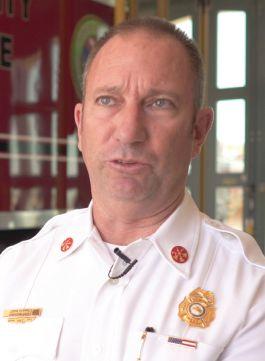
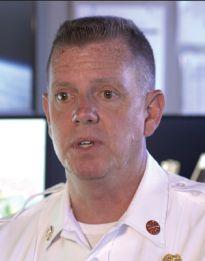
Rob Grimwood, president of the Ontario Association of Fire Chiefs, talks about Ontario’s mandatory minimum training standard draft regulation in the March episode of Fire Fighting in Canada: The Podcast.
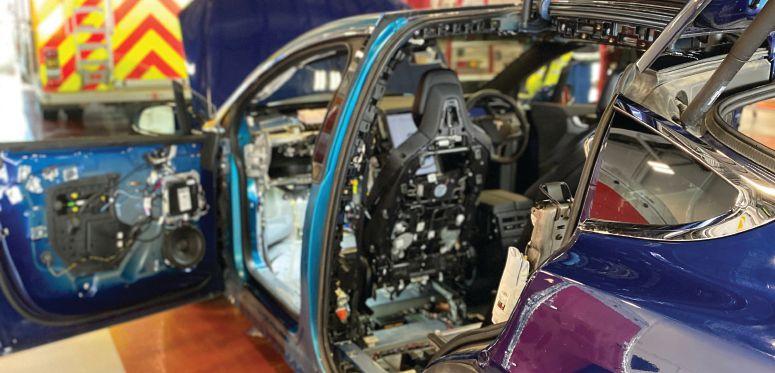
34 INNOVATIONS IN ELECTRIC VEHICLE EXTRICATION TRAINING
Alberta fire services are enjoying a new and innovative electric vehicle extrication training program. By Gary Robertson
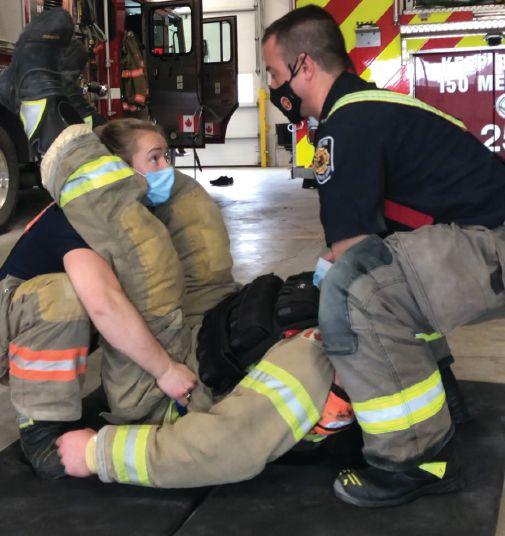
54 BARIATRIC RESCUE
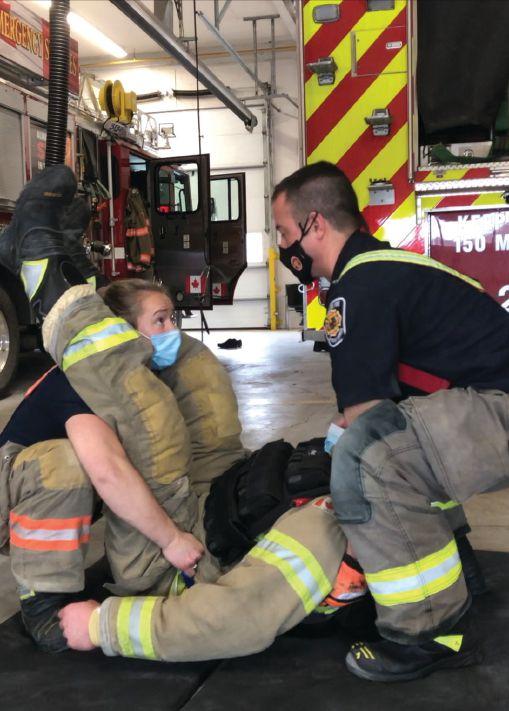
This crew came up with a creative solution to moving a bariatric patient.
By Jared Newcombe
BY LAURA AIKEN Editor laiken@annexbusinessmedia.com
F
COMMENT
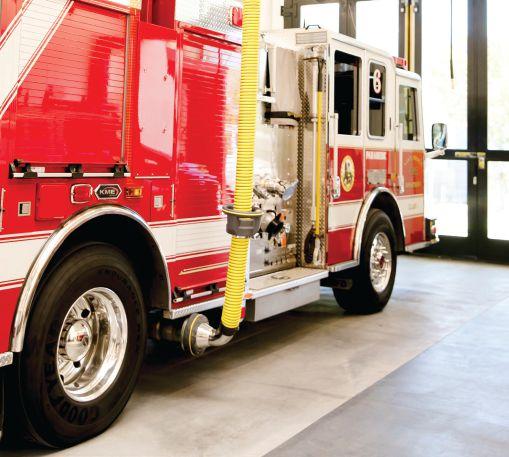
Fire halls in the community
ire stations serve plenty of utilitarian purposes; they are in all respects the workplaces of the fire service. But, there is something different about their existence in the community when compared to other office buildings. Stroll along the street and feel the neutrality of observation that comes from walking amongst office towers, or even many other storefronts. They are part of the landscape. Pay attention when you walk by a hospital, police station or courthouse. There’s a shift in the energy of that observation. Critical things happen in those buildings. Life altering events are associated with these buildings. Fire halls share this magnitude. They are the command centres of the multifaceted first responder firefighters and the chief officers that oversee an incredible variety of calls. Fire stations are a comforting sight in the community.
ON THE COVER
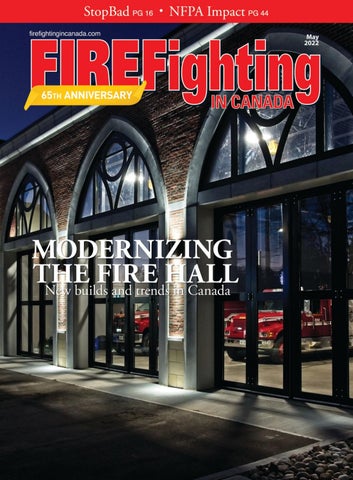
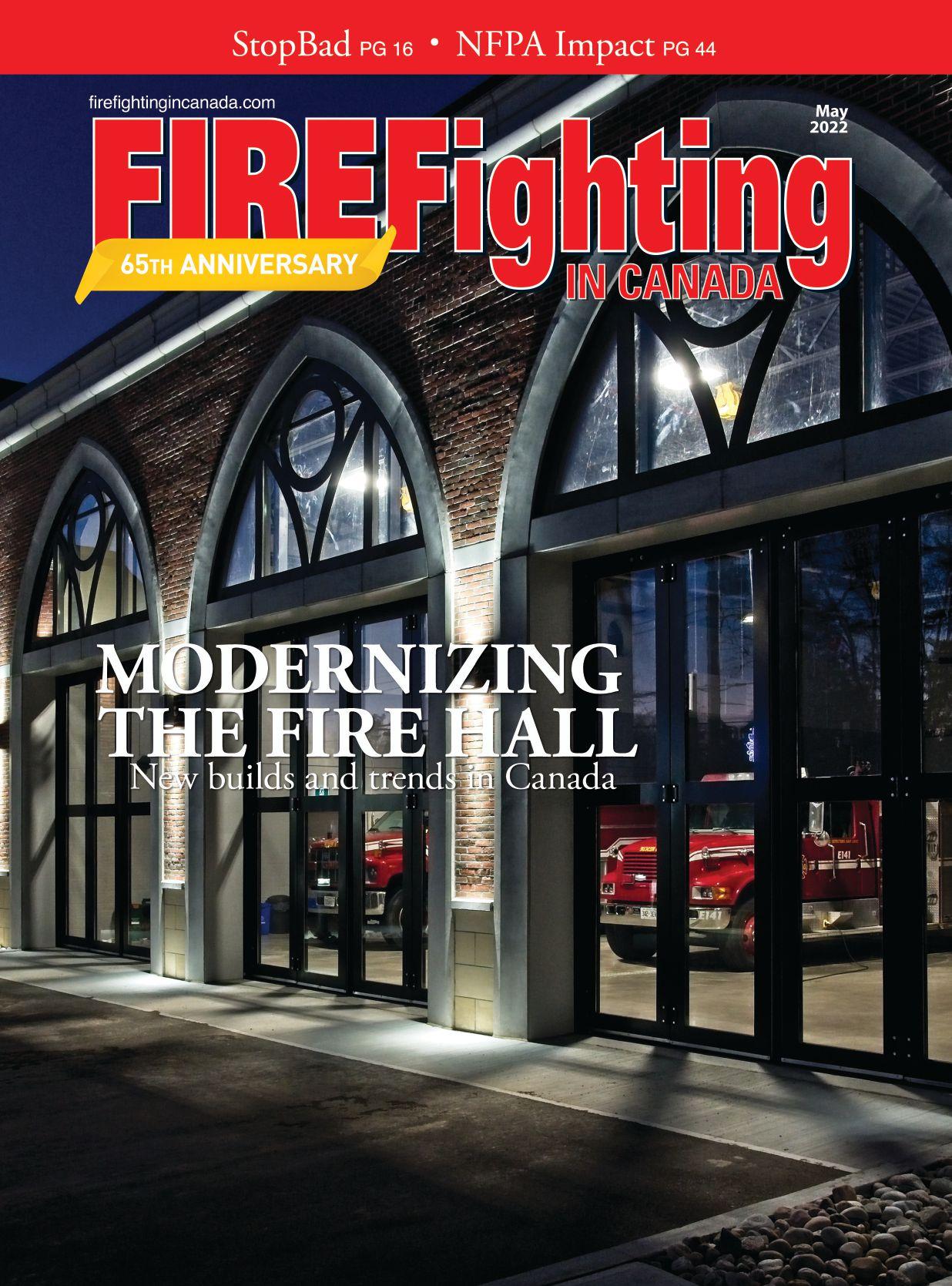
A look inside the bay of Pefferlaw’s newest fire hall. For more on this station and the latest projects in Bradford and Calgary, turn to page 10.
This edition’s cover story looks at three very different new station builds. Pefferlaw blended a historic renovation with a modernization. In Bradford, a welcoming and expansive new fire hall opened to better serve its growing community and department. And in Calgary, plans for a new mixed-use innercity station showcases the city’s innovative side. The new Inglewood station is one of multiple creative solutions in Calgary. In 2020, Extreme Fire Stations, a division of Extreme Portable Buildings, made and installed a unique, portable fire station design to the fire department’s specs. The portable building has a single apparatus bay, four person crew quarters, office and
exercise room. The manufacturer reports it is a first of its kind for a major urban centre. There are many more that could have been talked in depth if space were no object. In Brantford, Ont., recently built Station No. 2 pays tribute to the late Walter Gretzky with a large mural of him on its exterior. In Saanich, B.C., the redevelopment of Station No. 2 has the province kicking in half a million dollars as part of a mass-timber demonstration and research project. The village of Coldstream, Ont., became home to Canada’s first net-zero fire station, which opened in 2017 and exceeded its netzero target as calculated through 2020. All of these recent fire stations have principles within them tied to the values of the communities they serve. While all of them may be considered modern in their safety, efficiency and inclusion considerations for the fire staff that work there, they also all seek to preserve the legacy of the local fire service and the history of the municipality it serves. Canada’s new fire halls exemplify the blending of old with new, showing that modernization can also mean a tribute to tradition.
ESTABLISHED 1957
MAY 2022 VOL. 66 NO. 3
Reader Service
Print and digital subscription inquiries or changes, please contact Beata Olechnowicz, Audience Development Manager Tel: (416) 510-5182 Fax: (416) 510-6875
Email: bolechnowicz@annexbusinessmedia.com
Mail: 111 Gordon Baker Rd., Suite 400, Toronto, ON M2H 3R1
EDITOR LAURA AIKEN laiken@annexbusinessmedia.com 416-522-1595
MEDIA DESIGNER BROOKE SHAW bshaw@annexbusinessmedia.com
GROUP PUBLISHER PAUL GROSSINGER fire@annexbusinessmedia.com
COO SCOTT JAMIESON sjamieson@annexbusinessmedia.com
PUBLICATION MAIL AGREEMENT #40065710
RETURN UNDELIVERABLE CANADIAN ADDRESSES TO CIRCULATION DEPT.
P.O. Box 530, SIMCOE, ON N3Y 4N5 e-mail: subscribe@firefightingincanada.com
Printed in Canada ISSN 0015–2595
SUBSCRIPTION RATES
Canada – 1 Year - $25.50 (GST - #867172652RT0001) USA – 1 Year $58.50 (CDN)
Annex Privacy Officer
Privacy@annexbusinessmedia.com Tel: 800-668-2374
Occasionally, Fire Fighting in Canada will mail information on behalf of industry-related groups whose products and services we believe may be of interest to you. If you prefer not to receive this information, please contact our circulation department in any of the four ways listed above.
All advertising is subject to the publisher’s approval. Such approval does not imply any endorsement of the products or services advertised. Publisher reserves the right to refuse advertising that does not meet the standards of the publication.
www.firefightingincanada.com
PHOTO: SCOTT SHEPERD
STATIONtoSTATION
ACROSS CANADA: Regional news briefs
Sea to Sea raising awareness of PTSD in first responders
A new campaign sets out to raise awareness for PTSD.
On April 2, Alberta sheriff highway patrol officer Chad Kennedy started at the Pacific Ocean and set out to walk across Canada to raise awareness for PTSD among first responders and military personnel.
The goal of the campaign, called Sea to Sea for PTSD, is to promote mental wellness among first responders, along with fundraising to help establish programs and support existing mental health initiatives across the country.
Kennedy shares his journey on the Sea to Sea for PTSD website.
He has been involved in law enforcement since 2004. After responding to a “horrific” incident in 2018 that left him “constantly battling with anger and anxiety,” he reached
out for help and was diagnosed with PTSD. Most recently, he suffered a posttraumatic stress injury after attending an incident in the Canadian Rockies in 2020. He said he thanks his diagnosis for allowing him to recognize the signs that he needed medical help.
According to the Canadian Centre for Suicide Prevention, two per cent of Canadians will experience post-traumatic stress disorder (PTSD) in their lifetime, while first responders will experience it at double this rate.
The Canadian Association of Mental Health released a report stating that the rate of suicide in firefighters is 30 per cent higher than in the general population.
“We are afraid to ask for help, we are the help,” said Lisa Friscolanti, a coordinator for the Sea to Sea for PTSD team. “First responders go above and beyond to service the public. We often do this at the expense of our own mental health. At the end of the day, we need to remind ourselves that we are human too.”
In a Facebook post, Kennedy shares “it’s by accepting PTSD as a challenge and not a struggle that I’ve come to realize that it doesn’t have to be a life sentence.”
THE FIRE HALL BULLETIN
Promotions & appointments
SCOTT KENNEDY is the new fire chief for Langley City Fire Rescue Service in B.C. Kennedy has been with Langley for over 28 years, becoming assistant fire chief in 2017 and deputy chief in 2019.
ROBERT NORTON has been appointed director of public safety and fire chief for Fort St. John, B.C. Norton joined the department in 2020 as deputy chief and became interim chief earlier this year. He has over 30 years of experience in the fire service, including two decades with the Canadian Forces.
STEVE TIERNAN is the new fire chief and manager of
The eight-month journey will take Kennedy from Cranbrook, B.C., to St. John’s, Nfld.
“The route is constantly being worked on.” said Friscolanti
Kennedy hopes community members will join him, and that the walk will help increase the conversation around being proactive with mental health care.
“You bottle all of the horrible things you see up and one day, it all explodes. It’s not a matter of if but when,” said Friscolanti
First responders are seen as brave faces in the community, but what happens when these brave faces need help?
Kennedy’s vision for Sea to Sea for PTSD is to not only get first responders talking to one another, but to also get communities, employers and organizations talking about how to better support them as well.
“Mental wellness is just as important as physical wellbeing,” said Friscolanti. “We go to the doctor and dentist for annual check-ups, so why not start checking in with our minds?”
Sea to Sea for PTSD is fundraising via GoFundMe and through merchandise sales.
fire and emergency services for the municipality of Arran-Elderslie, Ont. Prior to taking on his current role in November 2021, Tiernan served as fire chief in Gananoque for three years and district chief and training officer in Tobermory for eight.
Retirements
RORY THOMPSON, is set to
retire from his role as fire chief for the Langley City Fire Rescue Service after a 48-year career in public service. Thompson served as fire chief in Langley, B.C., for 11 years, and had 24 years of experience as a firefighter on Vancouver Island. He played a significant role in lobbying the provincial government to bring in tougher sprinkle regulations for balconies on high-rises.
PHOTO BY SEA TO SEA FOR PTSD
Telus helping equip Canada’s first responders with new mission critical technology
Telus rolled out of the first phase of migration to the NextGeneration 9-1-1 (NG9-1-1) services in British Columbia and Alberta, with Canada being the first country in the world to begin the rollout of NG9-1-1 on a national level.
Together, with the Canadian Radio-television and Telecommunications Commission (CRTC), NG91-1 broadens the technological possibilities for enhanced information sharing for first responders in the field, from more precise location data to video and photo sharing to enabling connected vehicles to contact public safety services independently.
Historically, 911 systems have been limited to voice calls with only a limited capacity for text messaging in very specific circumstances. For example, deaf and hard of hearing callers, once they registered with their wireless provider, could use text messaging in an emergency through their cell phones. NG9-1-1 will see the eventual arrival of video calling, widespread text availability and document sharing such as image uploads, which will improve communication and
Kamloops’ Fire Chief STEVE ROBINSON is retiring. Robinson was named chief in February 2021. He began his career as a firefighter in Surrey, B.C., in 1992 and was later involved with creating a HomeSafe program that focused on increasing working smoke alarms in homes.
With an increase in information comes the need for updated devices.
provide accessibility benefits to support users and first responders.
With an increase in information comes the need for updated devices.
Telus and Samsung Networks have also joined forces to deployed Canada’s first next-generation Mission Critical Push-to-X (MCPTX) services. Deployed over Telus’ network, this new MCPTX technology will enhance multimedia communications with operational features such as video, geographic information system (GIS), geofencing, remote database access, and more.
Telus and Samsung Networks published a white
Last alarm
Ret. Fire Chief DARRYL HERBERT passed away on March 16. He served 32 years with the fire service, starting his career as a volunteer firefighter with Dryden Fire Department in Ontario. He later became full-time as deputy chief and then fire chief until his retirement in May 2012.
paper, Improving Public Safety Outcomes with Mission Critical Communications & 5G, outlining the relationship between NG9-1-1 and Mission Critical Push-to-X.
“As NG-911 will allow people to record video, take pictures and send data such as locations and texts to emergency dispatchers, first responders can leverage this information to improve situational awareness and enhanced coordination of critical resources. To do this, public safety authorities will need access to a broadband network and responders will need smartphones and related applications. This requires the transition from today’s
ART BROWN, retired fire chief for the Mississippi Mills Fire Department in Ontario, passed away on March 11. Brown began his career in the fire service in 1969 as a volunteer firefighter with the Almonte, Almonte and Ramsay, and Mississippi Mills fire departments. He became
mission critical push to talk (MCPTT) solution on legacy LMR networks to mission critical push to voice-videodata (MCPTX) solutions on broadband networks.”
LMR radios, while reliable for the past 30-plus years, begin to present some challenges in the face of interoperability and efficiency, said Telus in a press release. The limited range and lack of shareability can put a damper on sharing vital information received through NG9-1-1. Replacing these devices with smartphones allows for data, visual and audible information to be shared over a secure network.
Telus’ MCPTX service will be offered with priority access to commercial users on Telus’ network. The service is actively being trialed with a select group of customers, with wider commercial availability planned for later in 2022. Additional traffic brought on by NG9-1-1 will be strategically and cautiously loaded onto Telus’ NG9-1-1 network. This migration will help enhance public safety by adding significant capacity for large-scale emergencies involving high call volumes.
fire chief in 1997 and retired from the role in June 2014.
Ret. Fire Chief HEADLEY DENNILL passed away on Feb. 3. Dennill was a founding member of the Dewberry Fire Department in Alberta. He served for almost 50 years and aided in the department’s growth and modernization.
PHOTO BY VAKSMANV/ADOBE STOCK
STATIONtoSTATION
BRIGADE NEWS: From departments across Canada
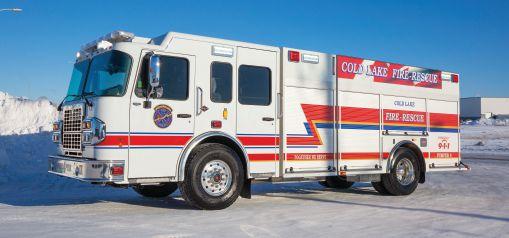
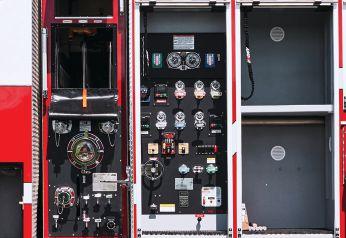
Cold Lake Fire Rescue in Alberta has taken delivery of a J0176 emergency rescue vehicle from Fort Garry Fire Trucks. Manufactured on a Spartan chassis with a Hale Qmax 1500 pump, this vehicle features Akron 8800 ball valves, Foam Pro 2001, Amdor roll up doors, Honda 5000w generator and a CoPoly 800 IG tank.
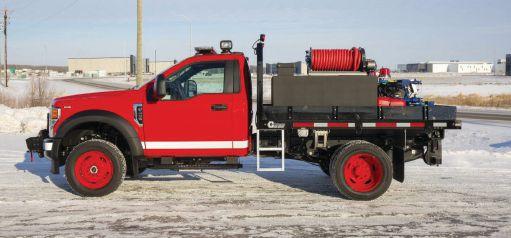
Rolling River First Nation in Erickson, Man., has taken delivery of a 2022 Cougar from Fort Garry Fire Trucks. Manufactured on a Ford F450 chassis, the vehicle features a Darley 375 GPM skid unit pump and Federal Signal light package.
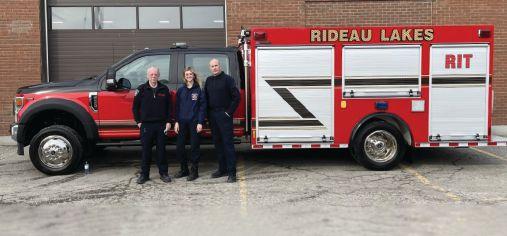
Rideau Lakes Fire and Rescue in Ontario took delivery of a 12-foot mini-rescue from Dependable Truck and Tank Limited. Manufactured on a Ford F550 chassis and cab, the vehicle features a poly body with full transverse L1/R1 compartments, SlideMaster roll out trays, adjustable shelves and Amdor roll up doors.
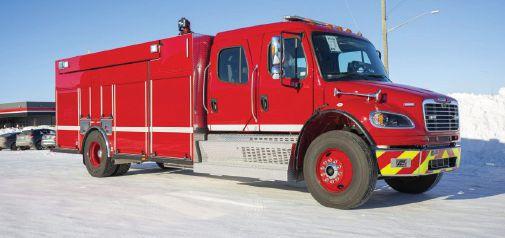
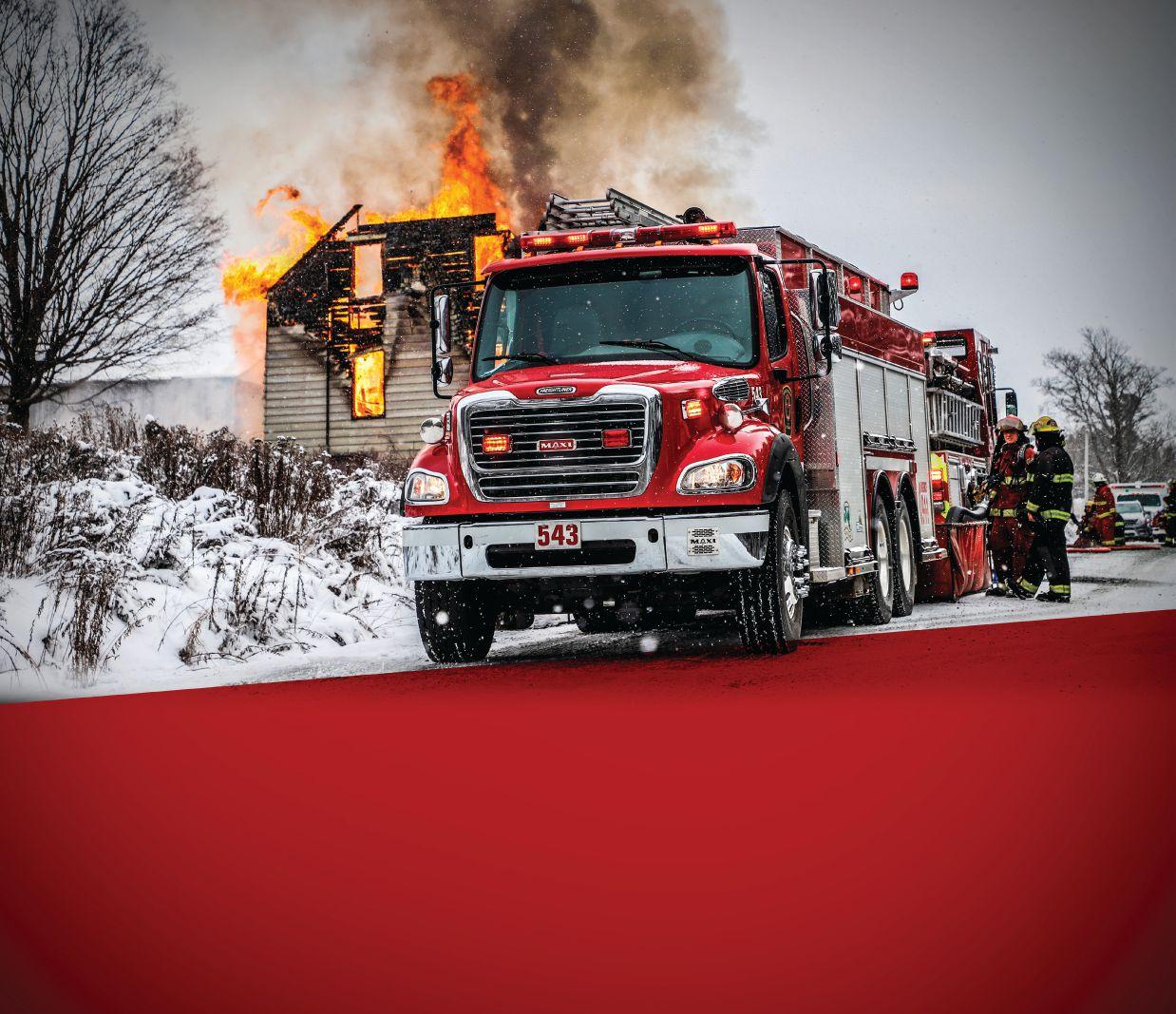
Bonnyville Regional Fire Authority in Kent, Alta., has taken delivery of a J0166 Crusader ER from Fort Garry Fire Trucks. Manufactured on a M2 106 Freightliner chassis, this vehicle features a CoPoly 1100 IG tank, Waterous CX1500 pump, StreamMaster II monitor and Federal Signal light package.
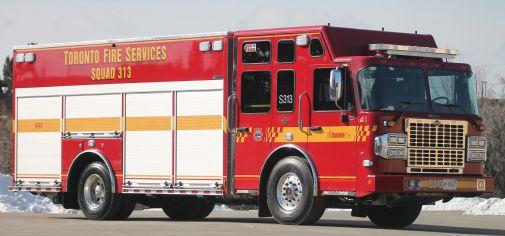
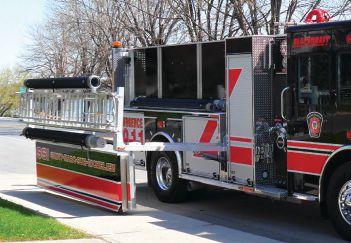
Toronto Fire Services took delivery of a walk-in squad apparatus from Dependable Truck and Tank Limited. Built on a Spartan Gladiator MFD chassis and cab, the vehicle includes a 20-inch raised roof, aluminum body, roll out trays, adjustable shelves, Whelen scene and warning lights and FRC InView 360 HD camera.
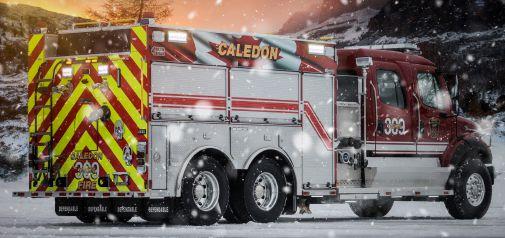
Caledon Fire and Emergency Services in Ontario took delivery of a tanker from Dependable Truck and Tank Limited. The apparatus is built on a Freightliner M2 112 four-door chassis with aluminum body, It features a 2000 USG polytank with integral foam tank and includes a Hale QMax 1750 USGPM pump, FRC Foam Pro 2001 foam system and Akron Brass DeckMaster monitor.
ROLLING RIVER FIRST NATION
COLD LAKE FIRE RESCUE
RIDEAU LAKE FIRE AND RESCUE
BONNYVILLE REGIONAL FIRE AUTHORITY
TORONTO FIRE SERVICES
CALEDON FIRE AND EMERGENCY SERVICES
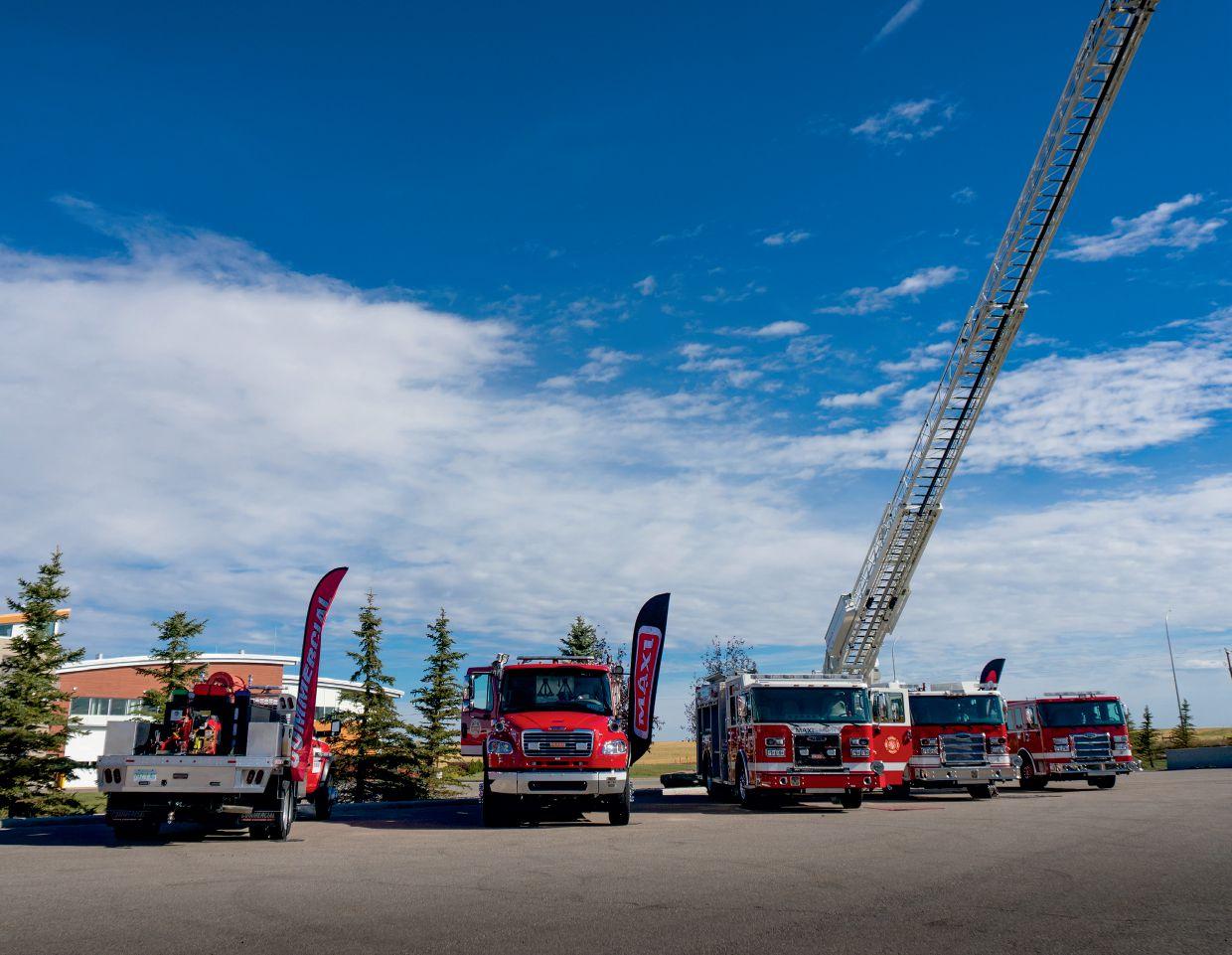
CUSTOM-OUTFITTED TRUCKS BUILT SINCE 1983 TO THE VERY HIGHEST STANDARDS – YOURS !
Each Canadian fire department faces its own unique operational challenges. Our customer experience is centered around listening to those opportunities and sharing our rich and diverse repertoire of solutions. Relying on our experienced team of technical advisors and on-staff firefighters, MAXIMETAL can help you take your truck from a brain-storm of ideas to your ideal in-service piece of equipment, proudly built in Canada. Our satisfied departments range from the smallest fire halls to some of North America’s largest fleets. Visit our web site today and contact us to begin planning your next fire apparatus.
A FEW OF OUR INNOVATIVE SOLUTIONS:
Photo : Jean-Simon Hubert
MODERNIZING
MODERNIZING THE FIRE HALL
Trends and ideas for Canadian fire departments building new stations
By LAURA AIKEN
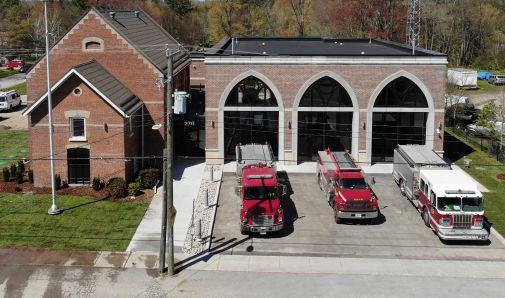
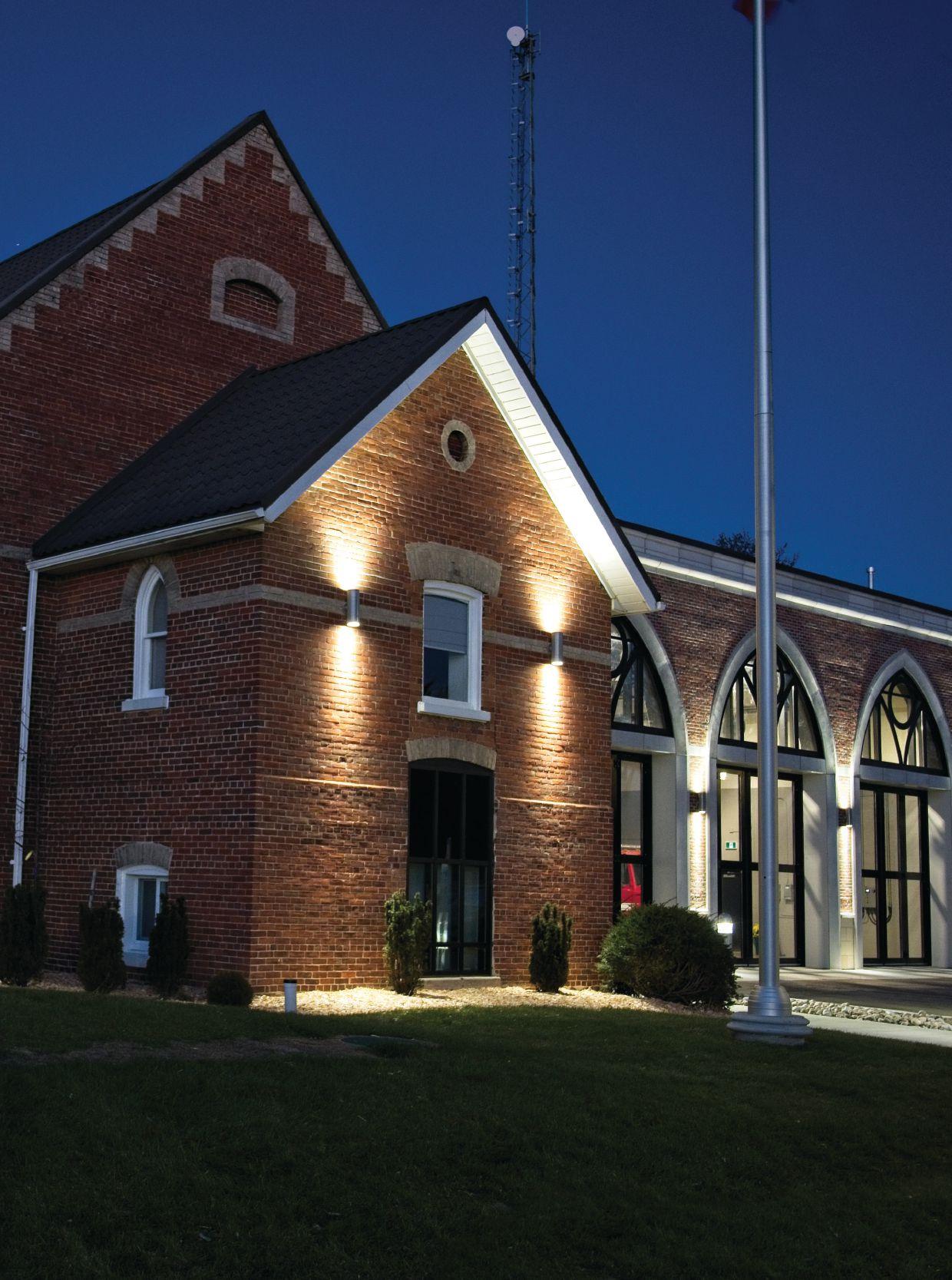
LEFT The new fire hall in Pefferlaw, Ont., combined a modernization with a heritage restoration.
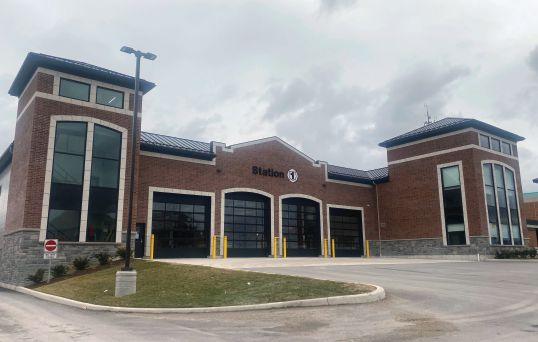
ABOVE Bradford’s new fire station positions the department well for the population growth to come.
Fire halls age. Populations grow. Service needs change. There are many reasons why fire departments become the recipients of a new station, and the story behind each new build is unique and a point of pride for the chiefs, crews, and communities they serve.
Pefferlaw, a small community within the Town of Georgina, Ont., is home to a new fire hall that blends the best characteristics of old and new. The over 10,000 square foot Pefferlaw fire station 1-8 is home base for about 20 on-call firefighters. This crew’s previous hall was one of the most senior in York region, having been built in 1960 by the Lion’s Club.
“A lot has changed since 1960,” said Ron Jenkins, fire chief for Georgina Fire and Rescue Services. The old fire hall stored three trucks in a small bay and a captain’s office, all in about 2,000 square feet with the entire station maxing out around 3,200 square feet. With no exhaust catchment, storage area, or place for individuals to shower after a fire, it was “really lacking for a modern fire service,” he said.
Council approved the design of a new fire station in December 2017 and awarded the contract to build it in June 2018. Jenkins’ priorities were to have a cost-efficient station that was safe and effective for the firefighters. The original concept was to build an entirely new station, and a church, circa 1889, was going to be torn down to make extra room next the existing station’s lot. The community became concerned with losing the church, which had been closed then re-opened as a youth centre in 2005 for a short time before being closed again, and then left vacant for years. Jenkins recounted how two renderings were commissioned from Thomas Brown architects, one a modern build and the other a concept that incorporated the church. An open house was held for the community to view the renderings and share their opinions on what they liked best. The one that overwhelmingly drew the most support included the church, and ultimately that was the rendering that was proceeded with.
Now, the truck bays are adjacent to the church and the church houses a kitchen, large training room, captain’s office and doubles as a back-up emergency operations centre if needed. The design addressed several safety issues for the firefighters. In the previous
PHOTO BY SCOTT
hall, as was typical of the period it was built, bunker gear was stored on hangers around the hall with only about two feet of clearance between the truck and the fire hall walls, meaning firefighters were getting dressed while trucks were pulling out.
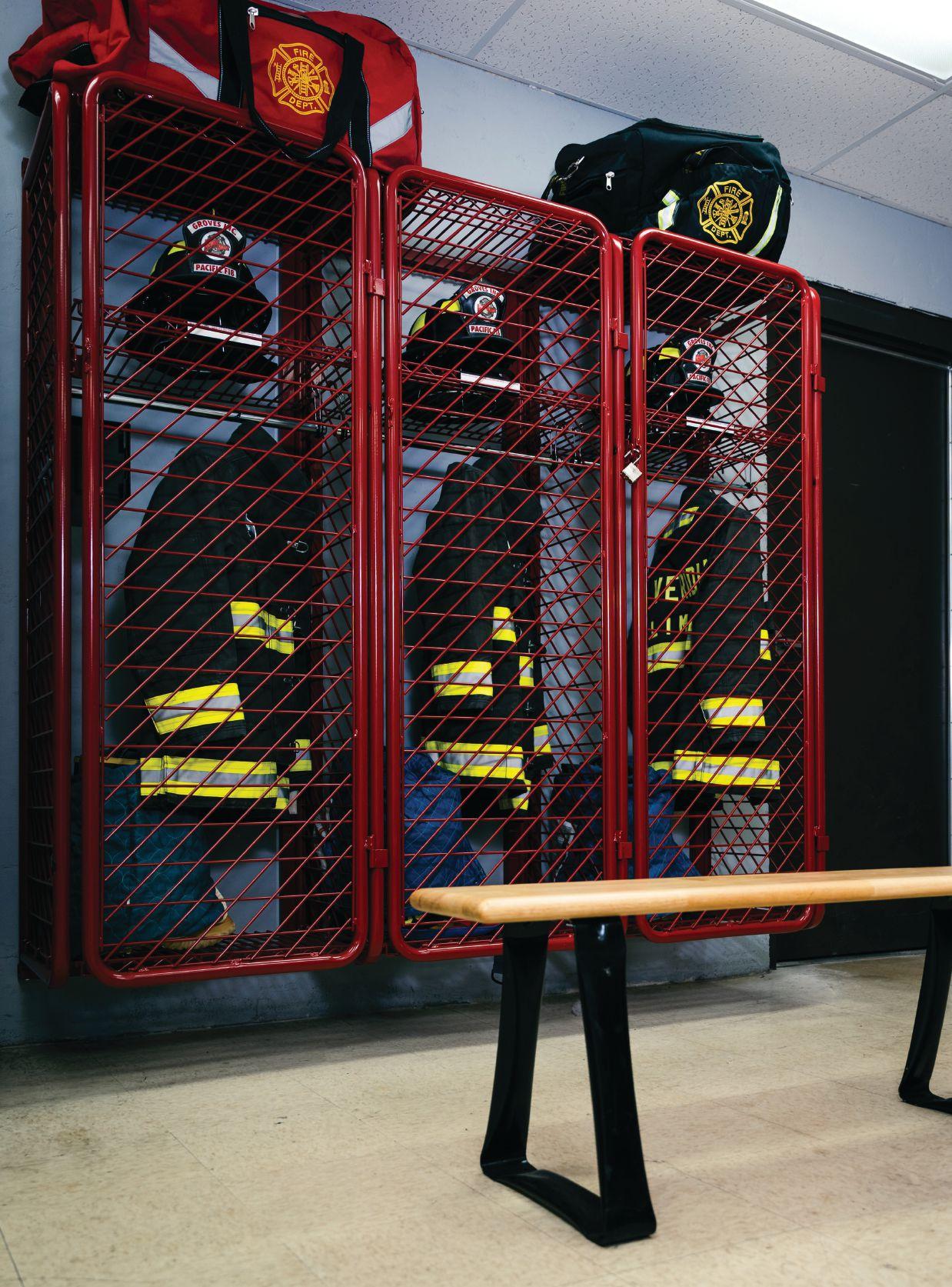
“This was really an accident waiting to happen,” lamented Jenkins. The new hall has separate bunker gear storage with purpose-built racking, and a location that shields the gear from UV damage (an issue in the old station). It was designed so firefighters come in one door, proceed to their bunker gear, dress, and then head to the apparatus bay. The concept was to keep distinct “clean” and “dirty” areas. The new station is equipped with a bunker gear extractor and purpose-built dryer, alongside a regular washer and dryer for contaminated clothes.
The bunker gear upgrade was a big plus in Jenkins’ eyes, but the modernization and upgrades didn’t stop there. The new hall has three bays double deep, capable of equipping up to six various sized trucks and is equipped with a diesel exhaust catchment system. The hall is fully sprinklered and has a fire alarm plus entry alarm system. From a green perspective, a rain harvesting system captures the rain in a cistern for use in filling the fire trucks.
Male and female locker rooms are equipped with showers and an exercise room that encourages members to come to the fire hall to maintain their level of fitness, which Jenkins says benefits the community by keeping more firefighters around should
a call come in.
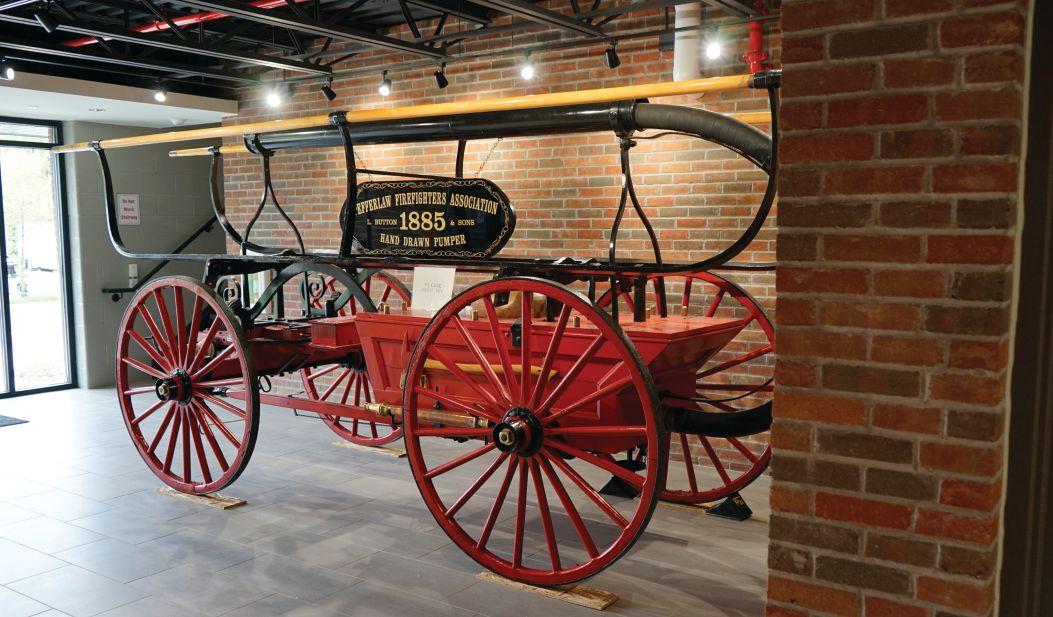
The lobby area connecting the new truck bays to the renovated church is an ode to the past, and special care was taken to match the brickwork to the old church as much as possible. Volunteers had previously purchased an antique hand pumper from 1885 and restored it, and it is now on permanent display alongside pictures of the community dating back to the 1800s.
There’s a lot of history incorporated into this modern fire hall, and Jenkins said his firefighters are loving their new station. Jenkins said Georgina Fire’s 60 volunteers and 40 suppression firefighters have typical retention rates, but the new hall greatly improves the working atmosphere and makes it more inviting for them to come in between calls to check equipment, maintain their gear, self-study or simply just be together.
“We find there’s people at the fire hall much more than there was before,” said Jenkins. “It was certainly a long time overdue and it’s really, certainly, the pride of our service. As the community grows, it’s a much welcome addition to our fire protection.”
At the opposite end of the service-size spectrum, Calgary’s Fire Chief Steve Dongworth is in the planning stages of the city’s new Inglewood station. This is destined to be an integrated mixed-use facility, a public-private project as a priority inner city fire hall that will co-exist with a mid-rise transit-oriented mixed-use development.
Calgary has always had an Inglewood station, and a few years ago it was evaluated as part of a value management study. Station 1 and Station 2 were approaching end of life, said Dongworth, and this provided the fodder to take a close look at what would provide the best service from a response time perspective, as well accessibility to the community for these stations, which he said weren’t particularly friendly for people walking up to them, and that’s “where we’d like to be, in this day and age.” The study concluded that the east end of downtown would be best served by smaller stations and one superstation. Inglewood’s location is moving to improve response times. In 2015, city council directed administration to move away from planning and building single use facilities. As a result, the Integrated Civic Facility Planning (ICFP) Program was created.
“From a conceptual perspective, this is a move towards integrated civic facilities, where rather than just having a standalone fire station, as we historically would have done, that we would have more integrated facilities that would have other emergency services, other city departments, and other private uses. The sky’s the limit in terms of the kinds of entities we could partner with in terms of maximizing the footprint of a fire station.”
This isn’t Calgary’s first mixed-use integrated facility. Station 14 in Haysborough is part of a shopping centre. Station 10 at Briar Hill is attached to a community centre. No.
BY SCOTT
An antique pumper, circa 1885, on permanent display in Pefferlaw’s new fire hall.
PHOTO
I think for the most part, everyone enjoys having firefighters as neighbours. And we encourage them to embrace the community that they’re part of.
’’
6 station downtown is part of two high rise towers, one of which is affordable housing. The fire department has leased buildings and temporary prefabricated buildings.
“We have been pretty innovative in the past, and we really see that as part of the future for the Calgary Fire Department in that greater context...Council directed us that in every circumstance where we can, we build integrated facilities with some kind of stakeholder partner, to maximize the footprint to hopefully lower the costs to the taxpayer.”
A mixed-use facility doesn’t significantly change the ways crews operate, said Dongworth, and they often become part of the fabric of the locale.
“I think for the most part, everyone enjoys having firefighters as neighbours. And we encourage them to embrace the community that they’re part of. Going back to Inglewood, it’s a very vibrant community right now. And at that area where the Inglewood fire station will be, will be transit in the future Green Line station. So, there’s transit oriented development that’s taking place there as well…That [community’s] undergoing a renewal to some degree so we’re very excited to be part of that.”
This particular design is still in progress, but environmental footprint has been a key priority in Calgary, with several more recent station builds meeting gold LEED standards, which is a very high standard for environmental design, energy efficiency and reuse of materials.
“This station will be no different. We’ve got a number of stations that have solar panels. And that had been built to this LEED standard to be kind of leaders in in environmental design and having minimal impact,” Dongworth said.
When it comes to new hall design, at a macro level of fundamentals, Dongworth doesn’t see too much has changed over the past couple decades, but the health of firefighters and other wellness and inclusivity
factors are taken into account much more in terms of an awareness.
The new station is expected to open in 2024 with construction starting next year. The new site will join the complement of 42 stations in the city.
Back in Ontario, Bradford’s Fire Chief Brent Thomas is welcoming a new fire hall in a time of bustling population growth. This new fire hall was part of a multimillion dollar three-site plan, with the fire hall being built on a vacant town lot. The station needed to accommodate the expansion to a second a crew alongside room to train and serve volunteer and career staff.
“We wanted to make sure that we were poised for growth,” said Thomas. “When we’re spending this amount of money, we wanted to make sure that we were ready and really looking at the growth in the community.”
This readiness meant extra room for fire prevention and training staff, a training room, a large boardroom and a small boardroom so there is room to expand without competing for spaces, said Thomas. There is also a large room that can be used by anyone in the community that’s located on the main floor right at the front of the building. Meeting rooms or boardrooms can also be made available for town staff or other agencies that need to run meetings (Simcoe police are right next door). These were all ways for the town to get more use out of one facility.
Smart use of municipal dollars and maximizing town space are at the forefront of trends today, said Thomas, with the eye towards multi-purpose locations being more prevalent than 10 or 20 years ago. The primary emergency operations centre is going to moving into the fire hall as well, which meant ensuring the technology and capacity was in place to run those emergencies.
The new fire station was designed with diversity and inclusion factors in mind. There used to be a big shower and change
room and now there are individual showers. The locker rooms were turned into a podlike system with individual rooms that have a rest area, desk, and then four lockers for the four different shifts. Firefighters are assigned a pod room so they have a private place to change, study and so forth, and there is also plenty of spaces such as the training room, common room and kitchen to encourage and accommodate being together.
“But if you also need or desire, some privacy, or you’re taking a course in between calls — if you’re able to do that — then you also have a private space as well. That was a big consideration.”
In the previous station, there were two spaces for crews/volunteers to share, and now the spaces are more delineated and purpose-built, structured and organized.
Community growth in Bradford has been higher than anticipated, said Thomas. This is the only station in Bradford for now, but a second location is being eyed. A Bradford bypass has now been approved, awarded and completely funded, so that is going to increase traffic and may change where in the area people want to live. Bradford is roughly an hour from Toronto.
“When you walk through, you think there are some empty spaces, but we know that they’re going to fill up fast, especially with the growth we’re having in the community. We have to be able to be ready to respond to that as well.”
There were four over-double size bays built to accommodate six fire apparatus with another bay available for training space or cleaning of admin vehicles, with an eye also to growth down the line.
The hall may be new, but it is also paying tribute to its history through pictures, as well as a bell that was in front of the original fire hall. This will be sent out to be redone and then hung up and functional in the fire hall, said Thomas. The intent is to instill the tradition and the history of the town in the fire department, as well as its future and growth.
“It’s been an exciting project. It’s nice because we’ve had great involvement for our crews with the building committee, and then with our track committees. They all have a piece of it, they have ownership, which is so important that they feel a part of the project. If they have a sense of ownership of it, it just it gives you even a much more prideful feeling when you’re involved with it.” •
BY MATTHEW PEGG Fire Chief Toronto
SLEADERSHIPFORUM
The recipe for results
tarting my day with a cup of good coffee, prepared the way I enjoy it, has me off to a good start. But have you ever taken the first sip of your coffee, with great anticipation, only to realize immediately that something isn’t right? Perhaps there is way too much sugar or no sugar at all, or what should be your piping hot black coffee is loaded with cream instead? Unfortunately, when the mix of ingredients aren’t correct, the desired result is missed.
The same is true for leadership results. Unless the required ingredients are in place, the desired results won’t be achieved. The recipe for leadership results includes authority, responsibility and accountability.
The first ingredient in the delivery of results is the correct amount of authority necessary to make the decisions, direct the work and move to action in a timely manner. Assigning work too far up the chain of command creates a collision between strategy, tactics and task, quickly grinding efficiency to a halt. Likewise, assigning work too far down the chain of command, where the person responsible for the outcome lacks the authority to actually deliver, requires that nearly every decision they encounter having to be escalated for approval. In order to succeed, leaders must possess the correct amount of authority to make decisions and deliver results in an efficient and effective manner.
Responsibility, the second ingredient, is clearly understanding that you are accountable for something that falls within your scope, power, control or management. Every leader must clearly understand what must be achieved, under what parameters, and understand the responsibility to deliver the desired results. Without clearly defined responsibilities in place, progress stalls while a lack of clarity as to who is directly responsible for this work swirls about.
cessful results to be achieved. Missing any one of the three quickly produces issues and challenges.
Having the necessary authority and responsibility, without formal accountabilities being in place, quickly results in a lack of quality assurance and easily opens the door for inappropriate shortcuts and bad assumptions. This also creates an opportunity for poor leaders to abuse others in the process of delivering the results they are accountable for. Granted, while the best leaders may not require significant external accountability to perform, the shadows created by an accountability void are where weak, ill-equipped, “because I am the boss and I said so” managers like to lurk.
Possessing the necessary responsibility and accountability, without the authority required to deliver, quickly results in frustration and the inability to deliver on time as an excessive number of decision escalations will be necessary. This moves the leader into a role more akin to that of messenger and grinds progress to a halt. Imagine an
These three ingredients must be in place in order for successful results to be achieved. Missing any one of the three quickly produces issues and challenges.
’’
Accountability, the third ingredient, requires senior leaders to check, validate and confirm that the team is delivering what is required, when it is required and in the manner that it is required. Equally important, accountability is also the assessment of not only what and when a particular result is delivered, but also how the responsible leader went about getting the work completed. Delivering the desired outcome, but missing deadlines or overspending budgets in the process simply doesn’t constitute acceptable results.
Each of these three ingredients must be in place in order for suc-
Matthew Pegg is the chief with Toronto Fire Services, having previously served in Georgina, Ajax and Brampton, Ont. Contact Matthew at matthew.pegg@toronto.ca and follow him on Twitter at @ChiefPeggTFS.
airline captain having to check with flight operations before making an adjustment to avoid storms and the disaster that would ensue. Leaders must have the authority necessary to move and navigate as the situation warrants.
Having the required authority and accountability, without the clear assignment of responsibility, results in confusion and the associated lack of clarity quickly produces missed milestones, deadlines and targets. Without clearly established and communicated responsibility, leaders fail to understand that they are both empowered and expected to lead the work and will tend to be uncomfortable, afraid and often unable to move ahead on their own.
As leaders, we owe it to our teams to ensure that we provide the correct mix of authority, accountability and responsibility to those whom we assign leadership roles to. This is the recipe for results that will afford our leaders the opportunity to succeed, grow, learn and develop while ensuring that they are able to produce results. •
BY GORD SCHREINER Fire Chief Comox, B.C.
LSTOPBAD
Building a great team
ook at any great organization and you will find a great team. While a good organization may have a great leader, it is a team of leaders that make the organization great. Solid teamwork (everyday) is essential for organizational success and survival. The fire service has always been great at developing solid teams, but don’t take this for granted. It requires a lot of hard work and constant effort to keep the team on track and moving in the right direction. Of course, any team will have stronger and weaker performers. Team leaders need to understand the awesome power of their team and figure out how to best use the individual skills within it while accomplishing goals. Team leaders must know how to lift up a member of the team while calming down another. Our customers expect that when our team arrives we will know what to do and how to do it safely and effectively. Most would agree our number one asset is the people in our fire departments, regardless of their tenure.
I was recently chatting with a young firefighter (recruit) from another fire department who was at our training centre. His training weekend had just ended and I asked him how it went.
He said: “Well, chief, the training was excellent but more importantly I was so amazed and inspired by how your firefighters here treated me. They treated me better than they do at my own station. I felt more welcomed in your station than I do in my own station where I have been for over a year. Nobody talked down to me and I felt respected.”
I was very intrigued by these comments (however, it is not the first time I have heard such comments) and we chatted some more. He went on to say that at his station they (recruits) get talked down to a lot. They don’t get fire department clothing and are not allowed to participate in many fire department functions. They are not made to feel like part of the team until their basic training is completed. I was sad to hear this and I noted that at our station we try to integrate our new recruits into our team as quickly as possible. We give them clothing so they look like they are on our team and we treat them with respect, like we would treat each other. We include them in everything we do, including letting them come on some runs with us as observers. We want them to be and feel a part of our fire family. Further we appoint an individual mentor to
them to give them a comfortable place and person to go to ask questions and to help them grow as a firefighter. We challenge and support them right from their first day. We offer them a ton of training over and above the National Fire Protection Association (NFPA 1001/2) firefighter training. We have even sent groups of new recruits to conferences to see trade shows and listen to leaders in our industry. We give them many of the same rights and privileges as we do our regular firefighters.
We also do the same with our Work Experience Program (WEP) firefighters even though we know they will not be here for long. Proper training is very important to us, but we also want our team members to be great citizens in our community and great members of our team. We want them to develop into nothing less than awesome firefighters. In my world, an awesome firefighter is not only well trained but also well balanced with great personal values. They must have a high level of commitment and dedication, and they must be nice. We ask them to assist us with our many public education programs and events including our youth program and smoke alarm program. We make them look and feel like an important part of our team right from their first day. We encourage all of our firefighters to
When a new person joins the team, we have an opportunity to set them on the right path for team success and personal success. ‘‘ ’’
get involved in all that we do.
I make a point each week of checking in with all our people to see how they are doing. Are we meeting their needs? Do they have any questions? I also try to ask a question or two about their families and the other parts of their lives. Teams work much better when we care about each other.
Gord Schreiner joined the fire service in 1975 and is a full-time fire chief in Comox, B.C., where he also manages the Comox Fire Training Centre. He has delivered countless presentations in fire stations all over Canada and is available to assist your department in many areas. For more information please contact: Chief Gord Schreiner, firehall@comox.ca.
When a new person joins the team, we have an opportunity to set them on the right path for team success and personal success. If we can develop our newest members into great team members it stands to reason that we will have a great team. Managing a fire department is all about managing people. If we get this right, the rest will fall into place. While not perfect, our team here is thriving as are the individuals. We have a high turnover amongst our paid on-call staff but embrace the challenge of recruiting and building new members. •
TIME-TESTED PROCESSES. ENGINEERED INNOVATIONS.
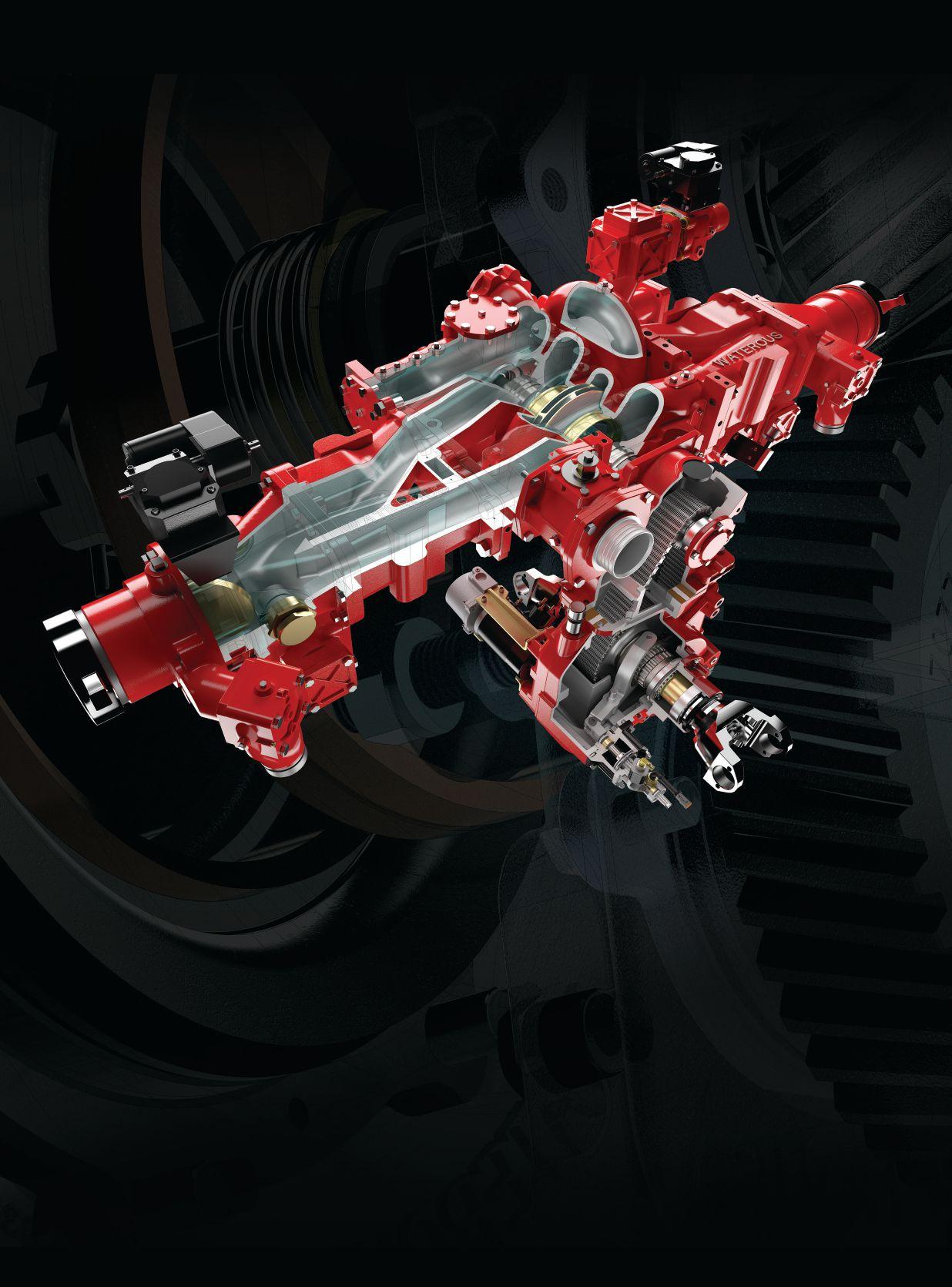
FULL-BODIED MIDSHIP PUMPS
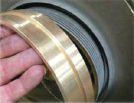
OUR REVERSE FLOW WEAR RINGS
Restrict recirculation and improve overall efficiency and longevity of the wear ring.
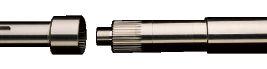
SEPARABLE IMPELLER SHAFT
Allows the pump transmission to be separated from the pump and removed from the apparatus. The pump remains mounted in the apparatus and can be easily repaired minimizing downtime.
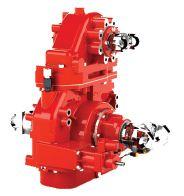
CHAIN DRIVE
TRANSMISSION – Transfers power more efficiently than gear-driven transmissions by having more points of contact between the chain and rotating sprockets.
“Silent” chain drive makes our transmission the quietest in the industry.
In the largest cities across the world, Waterous pumps never fall short. Cast and made in America, our pumps feature industry exclusive innovations. These innovations, along with the Waterous University library of support, help keep your pump running strong and your fire team serving the community.
FLAME-PLATED IMPELLER
PERFORMANCE – Bronze impellers are flame-plated with tungsten carbide, creating an ultra-hard surface resistant to wear.
CS/CSU SERIES SHOWN
REPETITION IS KEY TO PREVENTION
By LEN GARIS AND MANDY DESAUTELS
New research highlights the importance of scheduled, repeated, and measured fire safety interventions as a key strategy for achieving sustained fire-safe behaviours in Indigenous and other vulnerable communities in Canada.
This and other insights are found in a January 2022 paper commissioned by the National Indigenous Fire Safety Council (NIFSC) to propose evidence-based practices for educational and environmental fire safety interventions in Indigenous communities in Canada.
“Content and timing of fire safety training and inspections on First Nations communities and decision-support tool” was prepared by Joseph Clare, a professor at University of Western Australia, and Brighart Analytics, a B.C. developer of logistics and analytics tools.
The report considers proven approaches in North America and around the world through the lens of Clare’s PhD in applied cognitive psychology, drawing on currently available data for First Nations populations living on-reserve in Canada, and research underway on fire prevention in vulnerable and Indigenous communities that has been submitted for journal publication. Based on the collected knowledge and insights, the authors developed a logistics tool to assist the NIFSC with effective program implementation and measurement.
“The assessment of cognitive factors adds a new depth of understanding to the existing research on fire safety interventions, while the new logistics tool creates a roadmap for the more effective delivery of programs designed to reduce injuries and save lives,” said Blaine Wiggins, executive director for the Aboriginal Firefighters
Any intervention involving smoke alarms must ensure they are installed immediately and inspected regularly.
Association of Canada, which represents regional Indigenous emergency and fire service organizations across the country and manages the NIFSC Project. “This work has broad implications for any fire service that is working to target resources to the underserved Indigenous and other vulnerable populations that typically suffer higher
fire death and injury rates.”
■ INSIGHTS ABOUT INTERVENTIONS
The report focuses on two types of interventions: people-based educational programs, and place-based building fire-safety measures. When it comes to educating
BY
PHOTO
vulnerable populations about fire safety, the research indicates that:
• People tend to understand and retain fire safety information more when they have the opportunity to discuss the material and practice their new skills.
• The involvement of fire service personnel in providing the information encourages people to change their decision-making and make safer choices related to fire safety.
Place-based interventions typically fall into three main categories: smoke alarms, residential sprinklers and enforcement. Observations from the research include:
• Functioning smoke alarms are proven to reduce the risk of fire-related fatalities, but only if they are installed properly and maintained. Alarm giveaways that rely on vulnerable populations for installation or maintenance are not effective. Any intervention involving smoke alarms must ensure they are installed immediately and inspected regularly.
• Residential sprinklers significantly reduce the risk of fire-related deaths.
They can be built into new construction or retrofitted to existing properties, but both approaches incur an installation and maintenance cost and are beyond the scope of the fire service.
• Little research or evidence of success exists related to regulatory enforcement of mandatory installation of smoke alarms, building standards, legislation about flammable children’s nightwear or standards for the ignition propensity of cigarettes.
■ THE IMPACT OF THE COGNITIVE FACTORS
While there is substantial evidence that both people-based and place-based interventions can increase fire safety knowledge and reduce related risks, there has been a lack of clarity about how the passage of time impacts the effectiveness of these programs. From a cognitive psychology standpoint, coupled with research on training in other contexts, two main factors must be considered:
• The “knowing-doing” gap, in which new knowledge does not influence
how people act, as discussed by F. Joyner in the 2015 paper “Bridging the knowing/doing gap to create high engagement work cultures,” and
• The “wear-off effect,” in which the benefits of training wear off over time, as described by M. Compton and V. Chein in the 2008 paper “Factors related to knowledge retention after crisis intervention.”
When developing interventions with long-term effectiveness, it is important to monitor the extent to which any training produces a knowing-doing gap and how long it takes trainees to forget the content and return to former unsafe behaviours.
■ PUTTING THE RESEARCH INTO ACTION
NIFSC currently delivers fire safety programs to Indigenous communities across Canada, including community education programs targeting the behaviour and knowledge gaps that increase the risk of residential fire. Topics include cooking CONTINUED
Night Scan Light Towers
Because you need light every night! A must-have tool for safe and efficient operations
Installation Flexibility
Folding and Vertical towers from 1 – 9 meters
All-Weather Design
Proven in all environments worldwide
Powerful
Remote-Controlled Illumination
Direct 220,000 lumens where you need it most regardless of vehicle position
Mandatory minimum certification for Ontario’s firefighters
Transcribed
from: FIRE FIGHTING IN CANADA:THE PODCAST
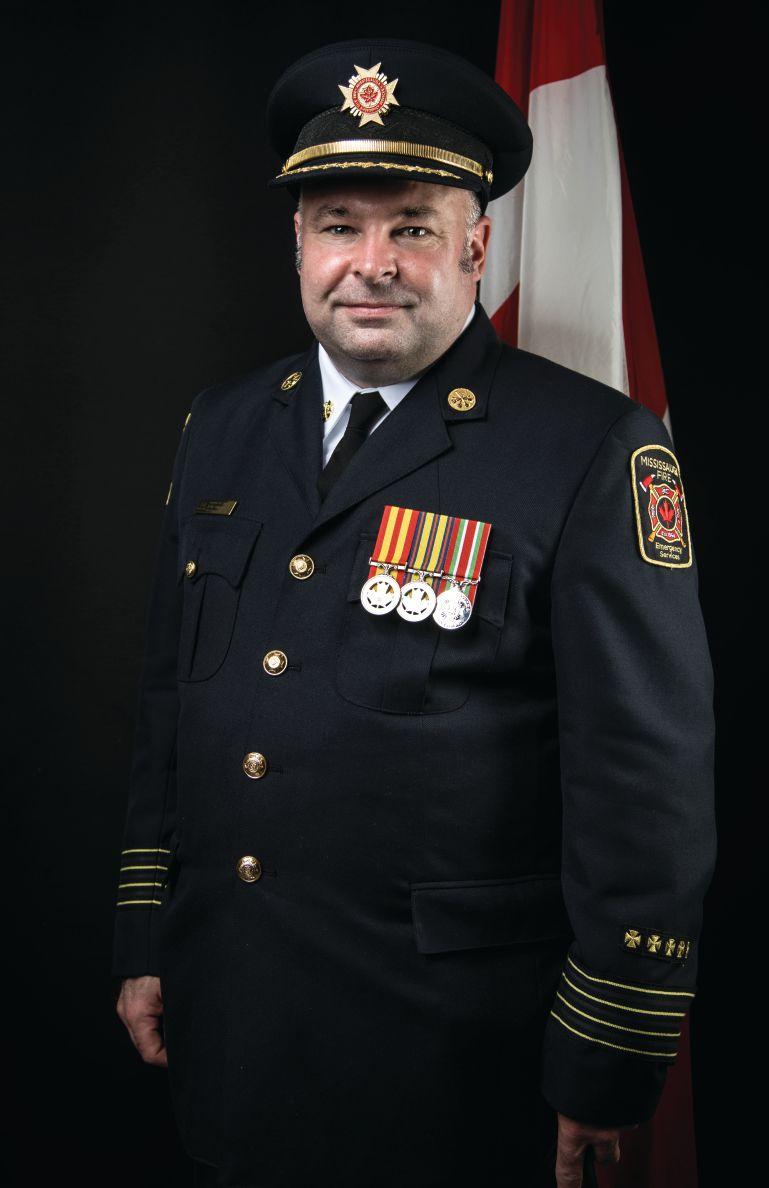
On Jan. 28, the Ontario government released a draft regulation to create mandatory minimum certification standards for specific fire protection services. Rob Grimwood, president of the Ontario Association of Fire Chiefs and deputy chief for Mississauga Fire and Emergency Services, joined Fire Fighting in Canada: The Podcast host Fire Chief Tom DeSorcy to discuss details of the proposed new rules and what it means for Ontario’s fire service.
The following is a transcript of Fire Fighting in Canada: The Podcast’s March episode sponsored by Cubit Fire. This podcast has been edited and condensed.
DeSorcy: We’re going talk today about certification and what’s going on in Ontario. First off, a little bit of history and background, can you tell us where and this how this began? This didn’t happen overnight.
Grimwood: No, it most certainly didn’t. It’s probably been about 10 years now. We used to have what we call the Ontario Fire Service Standards. It was a made-in-Ontario standard for each position: firefighter, officer, training, prevention, and so forth. It included all of the typical job performance requirements, but about 10 years ago, we came to realize that we’re basically just replicating the NFPA standards. There was no significant difference, no real advantage. And we know that the NFPA does a great job. They update them every five years and they’re very robust. Frankly, we just saw it as redundant. Why would we try and have our own standards that say almost exactly the same thing, and struggle to have the capacity to keep them up?
In Ontario, the fire college shifted. We had a firefighter curriculum, a company officer curriculum and that migrated to
PHOTO BY ROB GRIMWOOD
THE HORSES DIDN’T LIKE CHANGE EITHER.
The Rosenbauer RTX (Revolutionary Technology) fire truck has evolved combustability into electricity. And that’s only the start of what makes it revolutionary. This isn’t a fire truck redesign, it’s a reinvention. Every square inch reengineered and tested. Safe. Maneuverable. Agile. High torque. Incredible acceleration. Low center of gravity for unprecedented cornering and high driving stability. All-wheel steering for optimal turning radius. Equipped with its own communication system continuously feeding necessary data like incident reports and receives video feeds from various sources, or building blueprints. Wireless operator’s panel. Optional onboard drones provide aerial photo-based analysis. Nearly silent, stress-reducing fire ground operation. Nearly emission-free power. Reduced brake wear. Minimized brake dust. Minimized body roll. Every RTX innovation answers an existing need now and for the future. And now defines the future. As a family-owned company, it’s personal. So if it
become NFPA, 1001, 1021, and so forth. Then, a few years ago, the provincial government went this route and posted and approved the regulation that would regulate mandatory minimum training standards and certification. It was a similar standard, or regulation, to what you see today. It was met with a lot of resistance, I guess, is a fair statement. We had adopted NFPA, we had embraced the idea of that as a training standard, but the idea of making it mandatory was very new. There was a lot of discussion about the achievability. Ontario is not unlike any of the other provinces but we’re very, very diverse. I mean, you’re talking about applying a regulation to the City of Toronto that has three million residents and 3000 firefighters, and applying the exact same regulation to a one building, one truck, department that runs 10 calls a year with eight volunteers, and everything in between. The government of the day repealed it with the intention of trying to figure out what was missing; what drove the resistance. How can we help departments get from point A to point B? That’s the work that’s going on behind the scenes. On January 28, a new version of the regulation with some built-in flexibility, changes and a wider engagement of members was released.
DeSorcy: If I’m a small volunteer department in Ontario, what does this do for me? What do I have to do or what changes do I have to make to continue to operate?
Grimwood: That’s the million-dollar question for a lot of our volunteer departments. And what it comes down to is, what are you doing today? If what you’re doing today is already training to NFPA standards, all it means for you is that you have to have the evaluation piece. You would have four years for most of the components and six years for technical rescue. The Ontario Fire Marshal’s office would arrange and send out an evaluator at no cost. An evaluator would attend your department, and you would demonstrate the skills.
One of the biggest changes this time around is that if you’re a full-service department, which is interior fire attack tech, auto extrication and hazmat, you would certify the NFPA standard. The evaluator [conducts] the written test and the practical skills.
For most volunteer chiefs, what we’re trying to tell them is that as much as this is scary, it’s change, right? And change is scary for a lot of people. It’s work and it’s going to require a bit of a cultural shift. At the end of this process, it gives you that defined training program, the roadmap. We’re hoping that chiefs embrace it and most of our chiefs are embracing it. What you get is consistency and standardization. You know that your firefighters have met the minimum standard. Your apparatus operators, your officers, they have met the rigorous NFPA standard, and you have a better, safer fire department.
Now, if you’re not a full-service department, you’re not required to certify to NFPA, you’re just required to demonstrate the skills to which your department provides to the Fire Marshal’s Office and you’ll receive a letter of compliance. The OAFC sees that as a big win. It was going to be very difficult to get an exterior attack fire department certified to NFPA 1001 for firefighters because it’s not skills they perform, so we think that this new regulation has that flexibility.
DeSorcy: B.C. did this a number of years ago with the playbook, which I’m sure you’re familiar with. We had to declare what training
At the end of this process, it gives you that defined training program, the roadmap...What you get is consistency and standardization. You know that your firefighters have met the minimum standard...and you have a better, safer fire department. ‘‘ ’’
standard we were going to train toward, the exterior, interior or full service. What other feedback have you had, if any, from other provinces, now that you’ve taken this step?
Grimwood: That’s a very interesting point. I actually haven’t had any feedback from the other provinces. We’ve been so focused on engaging our members. We have 441 different fire departments. The OAFC board of directors, through a series of 16 virtual meetings, talked to 550 of our members across the province. It’s a great question. We haven’t had any dialogue with other provinces, but I’m assuming at some point we will.
DeSorcy: When B.C. first came out with the playbook, it was brand new. With smaller departments like mine, where we trained but didn’t have the regime, this raised our game and brought us into a different world. I, at first, and maybe I’m still the same, don’t care for the terms exterior, interior and full service. It seems to me that the public doesn’t understand if we make a public declaration. That’s what we have to do in our local government. Our council has to declare the level that we’re going to train toward and if we said we were going to be exterior, the public thinks that we’re going stand by and watch their house burned down. How do you how do you answer that?
Grimwood: We actually see the process of every municipality reviewing and revising their level of service as being one of the other big wins of this. We have departments in Ontario who haven’t updated bylaws on their levels of service in decades. We’re hearing from fire chiefs that the last time it was approved by council was in the 1970s. So, you nailed it. There’s a disconnect between what we do, what the public expects from us and what our councils believe that we’re doing. Again, as much as it adds work for fire chiefs, we actually see that as maybe the biggest win of all: All 441 of our departments are going to have that discussion with council. What do you expect of us? What do you see our level of services being? As a fire chief, this is the level of support I would need. This is the level of staffing and funding. If you see us as performing these eight services, I need this. And having that that really transparent discussion with residents so that they understand exactly what it means. The interior and exterior is one piece. But the technical rescue, I think, is
RACK
a really big animal where departments are not necessarily aligned with the expectations of their councils and citizens. If somebody falls through a hole in the ice, are we really trained and equipped to perform the rescue? Or is it just wording in our bylaws? We see that as a parallel project for the chiefs and we see that as having huge benefit to public and firefighter safety.
DeSorcy: When you went around to your members, was it a sales pitch? “It’s mandatory, this is the way it’s going to be,” or did you have to sell it, especially to the smaller departments?
Grimwood: We took a different approach, which is less talking and more listening. The Fire Marshal’s Office did their own technical briefings and were the ones that were really presenting what this looks like. The OAFC wanted to hear from our members and ask them “what are the stumbling blocks?” “What are the concerns with implementing?” We knew that resistance got this regulation repealed at a certain point in time and we wanted to hear from them. We compiled 100-plus pages of things that our members said and because we heard from them, we were able to theme it. Some of them are just clarifying misunderstandings like “how do I interpret this part of the regulation?” Some of them are feedback about training programs. Some of them are them saying, “I don’t have the budget right now to do this. Is there going to be education for council so they understand what this means?’ At the end of the day, I fully see this as achievable. We take what our members say, we work with the Fire Marshal’s Office, and we go through the list of what the members see as roadblocks. They’re not insurmountable at
If somebody falls through a hole in the ice, are we really trained and equipped to perform the rescue? Or is it just the wording in our bylaws?
’’
all. Let’s bring this to a successful conclusion. I see our organization as being very much solutions driven.
DeSorcy: Were there any concerns that took you by surprise? What were biggest questions that came out of that?
Grimwood: I wouldn’t say anything took us by surprise. Because we’re such a large province with so many departments and so varied, we heard from chiefs who said that they want to be more empowered to be able to do this in-house. Moving to online testing was a big theme. These are all good things. They talked about accessibility to specialized training, like hazardous materials and technical rescue, and who’s going to deliver that training because it’s complicated and has material costs. The fire service has been training forever but the idea of doing a written test doesn’t happen in most departments. They talked about the need to acquire enough textbooks and online
subscriptions for their members. It was a case of theming everything and trying to put them in the right buckets so that we could work through them.
DeSorcy: It’s quite a large project for the OAFC to be taking on. Is this something that is going to be maintained by the OAFC or is it something that will be under the umbrella of a Fire Marshal’s Office?
Grimwood: It’s absolutely the Fire Marshal’s Office that has ownership over the regulation. The OAFC sees ourselves as a partner, our members look to us for support…We will keep a repository of training programs and training plans from departments who have achieved this. If I’m a chief of a town of 8000 people and I’m struggling, I can go to the OAFC and I say, “do you have a chief of town of 8000 people who’s done this?” I see the OAFC providing that member support and helping each other, but this is the Fire Marshal’s Office. They’ve got ownership over it, but they work exceptionally well with us. I do see it as a partnership also.
DeSorcy: I’ve always been a big proponent of being involved in associations in this business in particular. When I first saw the playbook come out, I treated it as validation for what we were trying to do and where we want it to go. Is that kind of the positive theme you’re seeing as well?
Grimwood: Absolutely. That’s the other thing we’re telling chiefs. If you’re already training, having somebody show up at your department on a training night from a from a neutral third party, and hav-
ing your crews demonstrate the knowledge, is absolutely validation of your training program. And I mean, none of us are perfect. If you learn something or you tweak your training program, you make a few improvements, then ultimately your firefighters benefit. We see this improving the safety and performance of firefighters, without a doubt.
DeSorcy: Wearing the hat of the president of the OAFC, it’s been a tough couple of years. Can you talk quickly about the importance of your association in the fire service?
Grimwood: No doubt, it has been a tough two years. We see the association as serving the members. We see ourselves as that frontline resource. If a member has an issue, they need help, they need assistance, they call us. But we also do see ourselves as that political advocacy group, and that’s really paid off through COVID. It’s impossible to have 441 different fire departments trying to advocate on their own for access to vaccinations and access to personal protective equipment early on in the pandemic. In Ontario, our departments were running out of masks and whatnot. The OAFC took on a leadership role, where we spoke on behalf of all fire departments and had those open discussions. Our provincial government, frankly, was incredibly responsive. We ended up being able to advocate for early access to vaccinations, advocate for personal protective equipment that was provided through the Fire Marshal’s Office, and we shared best practices through COVID. The association plays a huge role. We are really here to serve the members. •
BACKtoBASICS
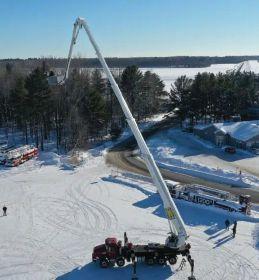
Flowing the aerial
BY MARK VAN DER FEYST
This month’s article may not be applicable to every fire department within the country, but the principles will be. We are going to look at flowing water from the aerial master streams and the basics of doing so. Not every department has an aerial device, but they will have master streams that can be set up on the ground or even mounted on top of the engine or pumper.
Having an elevated master stream allows the fire department to flow water from above and direct the streams into the structure as needed. It is sort of like creating a rain shower for the structure but with a bit more force and quantity. In heavily populated areas,
these devices are very useful as they can operate in narrow alleyways or around buildings will little clearance. The master stream can be elevated up and then directed wherever they need to go in a small geographical area. They are very beneficial and offer a great tactical advantage for structural fire attack.
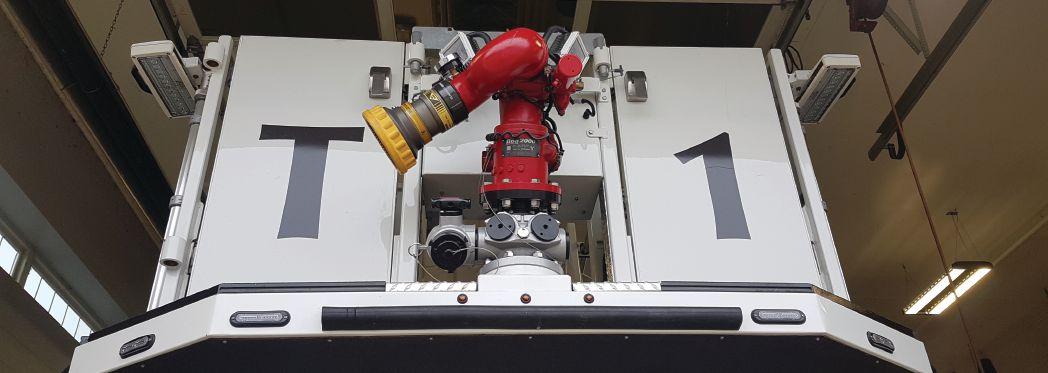
Some aerial ladders will have different combinations of master streams affixed to the tip or platform. Some will have a single master stream and others will have a double master stream. In Photo 1, you will see an example of a single master stream with a smooth bore type of nozzle. This design is the simplest to use as there is just the
Photo 1: A smooth bore nozzle.
PHOTOS BY MARK VAN DER FEYST
Photo 2: Automatic combination nozzle.
The master stream can be elevated up and then directed wherever they need to go and offer a great tactical advantage for structural fire attack.
pipe or waterway and the smooth bore tip. Affixed to it is a tiller bar to aid with directing the stream wherever it needs to go.
In Photo 2 you will see an example of another single master stream, but this is a combination type. In this case, it is an automatic combination nozzle. This type of set up is a little more complicated than the smooth bore type because there are more moving parts involved. There is still the waterway leading to the nozzle but inside the nozzle is where the other added components or parts are going to be. This particular model is also a remote-control type where the operator can be located on the ground and is able to direct the nozzle as needed with a remote-control device.
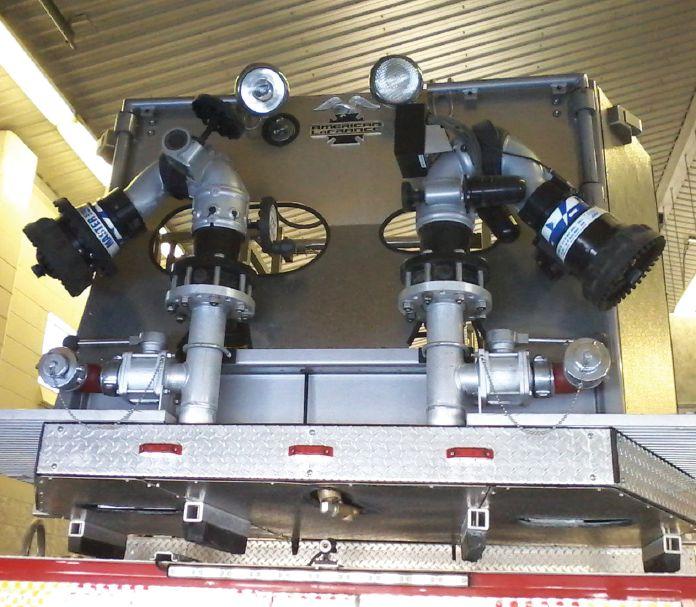
Photo 3 is an example of a double master stream set up. One master stream is a manual nozzle, and the other master stream is a remote-control operated nozzle. This set up is designed to deliver maximum water if needed based upon high target hazards within the response area.
Regardless of the type or master stream affixed to the aerial, whether single or double, they are going to flow a large volume of water. The range of water flow can be from 500 gpm up to 2500 gpm each with the average flow rate being around 1500 gpm. This is a large volume of water that is being pushed out or delivered onto or into the structure. As much as these master streams can flow, there is still a need for the supply of water to feed them. They will only flow volume based upon the amount of water being fed to them. What this means is you need to have a good water supply – both
Emergency Vehicle, Purpose-Built Charger, Allows For Two Battery Chemistries To Charge Simultaneously.
• Integrated systems communications • Charge 3 battery banks
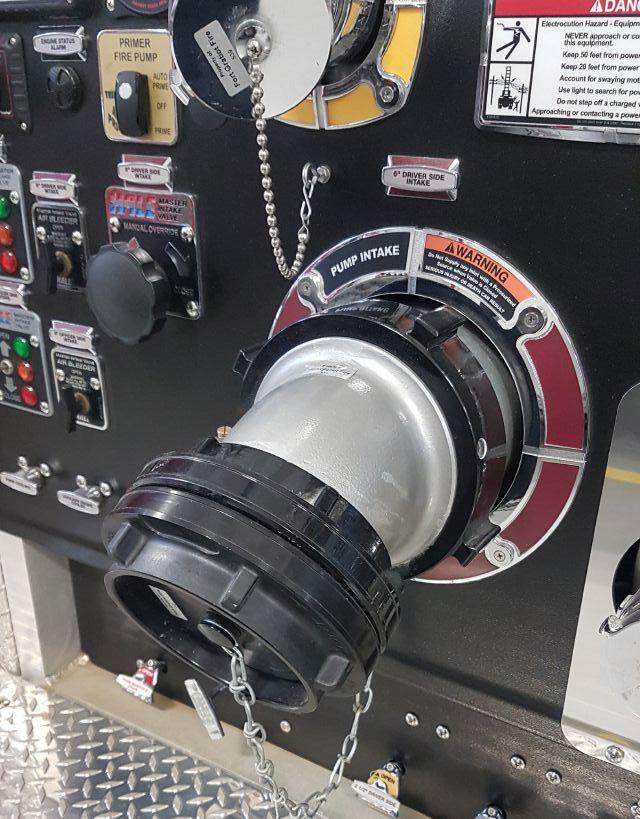
Photo 4 is a side intake valve for an aerial device. This particular one is six inches or 150 mm in size. This is a large intake valve, but it allows for a larger volume of water to be delivered from the supply to the pump with less friction loss. Most aerial trucks will have a four inch or 100 mm intake valve which still provides adequate volume of water. The water source, usually a hydrant, will be utilized to supply the volume and quantity of water needed. In municipal settings, the water supply system can be boosted to assist with fire department operations.
To achieve maximum water supply on the hydrant, be sure to secure the high-volume hose to the largest port on it – this being the steamer port which is usually four inches. A hydrant can also be maximized by double tapping it with (two) four-inch hoses. The one will come directly off the steamer port and the other will come off the two and a half inch or 65 mm port. This will require using an adaptor to increase from the two and a half inches or 65 mm up to the four, five, or six-inch hose size. Double tapping the hydrant will deliver the volume needed to achieve target volumes on the master streams.
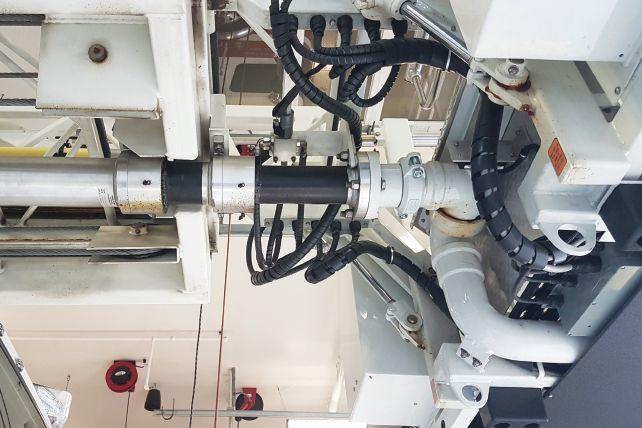
No matter what size intake or supply hose is being used, the “pipe” or waterway going up the aerial device is going to be one size only. In Photo 5, you will see an example of the pipe or waterway. The picture shows a four-inch or 100 mm waterway feeding the master streams. This is the standard size waterway used regardless of a single or double master stream set up on the tip or platform.
Now we have focused our attention on the aerial set up but as mentioned in the beginning, the principles are the same for other master stream set ups like on the ground or on top of a truck. The master streams will only flow what they are supplied with – this can include rural water operations.
The key to being able to flow water adequately from any master stream device is to actually do it –and not on the fire ground only! This is best done by training and getting to know the master stream set up on your aerial device. •
Mark van der Feyst has been in the fire service since 1999 and is currently a firefighter with the FGFD. Mark is an international instructor teaching in Canada, the United States, FDIC and India. He is the lead author of Fire Engineering’s Residential Fire Rescue & Tactical Firefighter books. He can be contacted at Mark@FireStarTraining.com.
Photo 5: A pipe feeds into a master stream.
Photo 4: A side intake valve for an aerial device.
BY TINA SARYEDDINE Executive Director Canadian Association of Fire Chiefs
TComing together for the Great Canadian Fire Census
he Great Canadian Fire Census begins on April 30. It is the first time in recent history, that all fire departments in Canada, big or small, rural or urban, composite, career, or volunteer, are asked to help paint a national snapshot of our sector.
“We often talk about standing on the shoulders of giants,” said the CAFC’s Data Committee chair, Chief Keven Lefebvre. “Last year, under the leadership of my colleague Chief Vince MacKenzie and the Answer the Call Committee, 1,200 volunteer fire departments began the largest data collection on our sector in recent history. Standing on their shoulders, the Data Committee will now join them to engage composite and full-time career departments.”
“We live in a data driven world” said Chief MacKenzie, chair of the Answer the Call Committee at CAFC. “We need to know what’s happening in our sector. Each one of us needs a size up of our sector’s key indicators if we are to maximize our effectiveness locally, regionally, provincially, and nationally.”
The results of the 2021 Census have markedly changed the CAFC’s view of the fire sector.
“Based on 2016 data from the NFPA, most members of the fire sector are used to saying that 85 per cent of firefighters are volunteer,” said Chief John McKearney, CAFC president. “The data no longer supports this, and unless it is because we are paying more full-time firefighters, we may simply be losing our volunteers.”
The 2021 Census showed that 32 per cent of volunteer firefighters are over the age of 50.
Some of the data categories included in 2022 census are: numbers of firefighters; type of firefighters; firefighter demographics, call volumes and types; department type; department services; expenditures; deferred training and equipment needs; consumer safety as it pertains to residential sprinklers and fireworks; and
firefighter safety in terms of floor assemblies, injuries, and death.
Despite the importance of the data, the Great Canadian Fire Census is designed with those filling it in mind, from an access to data, social, or technological perspective.
“We’ve designed and tested a database that allows all the departments that filled the census last year to update their data if necessary and add the responses to the new questions through a specially designed database. The new participants will get to do the same in 2023. We hope everyone will enjoy using it,” said Rhea Laverdure, the CAFC’s administrative and communications coordinator.
Anabel Therrien, the CAFC’s manager of membership services and special projects, who led the Great Canadian Volunteer Firefighter Census in 2021, and who is now leading the Great Canadian Fire Census, said: “The entire community is asked to come together for this project. We will help you in every way we can and ensure that you get to see the results. We have prizes for participation. I’d like to thank our National Advisory Council for the support of the provincial, territorial, and national affiliate fire organizations. It will certainly take a village.”
The Great Canadian Fire Census is designed with those filling it in mind, from an access to data, social, or technological perspective. ‘‘ ’’
The results of last year’s census are available on the CAFC’s website and were shared with the Minister of Finance earlier this year in relation to improvements to the tax credit.
Tina Saryeddine, PhD, MHA, CHE, is executive director of the Canadian Association of Fire Chiefs and an Adjunct Faculty at the Telfer School of Management, University of Ottawa.
You can find this year’s Census at www.cafc.ca/census . Departments are asked to respond by May 30 so that the analysis can begin. •
NO HYDRANTS, NO PROBLEM
CET manufactures portable pumps, skid units, brush trucks and more to allow fire departments to Adapt, Improvise & Extinguish fire in almost any scenario where hydrants are scarce and static water resources maybe all you have to work with. CET- Providing fire ground solutions since 1908.
Portable Pumps (PFP-20hp-HND-MR Shown)
50+ models to choose from for both fire attack & resupply operations from static water sources like lakes, rivers, ponds and pools
Arrives Completely pre-assembled, pre-plumbed, pre-wired and pre-tested ! Simply mount to your chassis, connect electrical and go fight fire!
Brush Trucks (Custom Built)
Solid/Affordable/Practical
SAFEGUARDING from wildfire risk
By JONATHAN GRIFFIN
Once they have a foothold, severe wildfires can quickly overwhelm a community, particularly one that is densely packed. To shield houses against such a fierce threat, a thorough defence is key.
Establishing a deep and multifaceted defence in and around homes is the basis of a new report (A. Maranghides, E.D. Link, S. Hawks, J. McDougald, S.L. Quarles, D.J. Gorham and S. Nazare. WUI Structure/Parcel/Community Fire Hazard Mitigation Methodology. NIST Technical Note 2205. March 2022). This report offers direction for safeguarding residences from external fire threats. Developed by fire safety experts at the National Institute of Standards and Technology (NIST), the California Department of Forestry and Fire Protection (CAL
FIRE) and the Insurance Institute for Business & Home Safety (IBHS), the guidance provides dozens of protective actions — and the context in which each should be taken — all backed by the latest fire science.
This new approach, which is already being implemented in California by the California Governor’s Office of Emergency Services (Cal OES) and CAL FIRE through a pilot program called the California Wildfire Mitigation Program, could spare homes and lives from the intensifying threat of wildfires.
“We’ve seen all these destructive wildfires come through and burn thousands of homes. The way we aim to reduce those losses is to upgrade structures and then create defensible space around them,” said Steven Hawks, CAL FIRE chief and report co-author.
The strategy described in the report is the keystone of the recently launched California pilot program, which is meant to provide support to communities statewide. While the guidance is available for anyone to implement voluntarily, the cost of putting it into practice may be steep for some.
“That’s where the California Wildfire Mitigation Program really steps in and provides the expertise, the education, the funding to back all of those mitigation measures at the level of each individual property,” Hawks said.
With significant gaps in fire codes and regulations, such as the lack of measures that address fire spread between properties, CAL FIRE worked closely with NIST and IBHS researchers to produce a more comprehensive defensive strategy.
The authors of the report compiled methods to protect against wildfires’ two main weapons of choice: flames and airborne pieces of burning debris called embers.
For a home to be made fire resistant, or hardened, up to 40 different components — such as windows, gutters and the deck — may need to be upgraded, either by adding to or replacing them with less flammable material. And because of how pervasive embers are, all 40 boxes must be checked in the end for a homeowner to reap much of any reward.
“If you have literally a million embers flying about your home and you have vulnerabilities, they’re going to find them,” said Alexander Maranghides, a NIST fire protection engineer and lead author of the report. “Hardening half of your home is not going to give you 50 per cent improvement. You cannot pick and choose.”
In contrast, flames exhibit a much shorter reach than embers, and the approach for fending them off is more tailored to a home’s individual circumstances. The authors advise assessing the types and proximity of combustible features on a home’s lot and surrounding lots to determine where potential flames are a threat and identify appropriate actions.
The first line of defence for flames is to either remove combustible items, such as wooden furniture or sheds, or push them away from a home by a distance the authors determined to be safe.
In cases where a combustible object, such as a neighbouring home, is dangerously close and moving it is not a realistic option, the guidance recommends hardening specific home features that would be in striking distance as a last resort, Maranghides said. This might mean having just the wall facing a neighbouring home clad in a noncombustible material, for example.
The implementation of this strategy by every residence is especially critical in crowded neighbourhoods where only a few feet may separate homes, potentially linking their fates in the event of a wildfire.
In California, the guidance is already seeing action through the pilot program, with Cal OES and CAL FIRE using it to assess and upgrade the properties of homeowners in three pilot communities across the state, including San Diego, Shasta and Lake Counties.
For Maranghides, the hope is that California is only the beginning. With several other states already grappling with an ever-increasing wildfire threat, the new, holistic approach for protecting homes and thus communities could be broadly applied throughout the U.S. •
Nederman Magna Systems
Innovations in electric vehicle extrication training
Alberta fire services are leading the charge with an innovative electric vehicle extrication training program
By GARY ROBERTSON
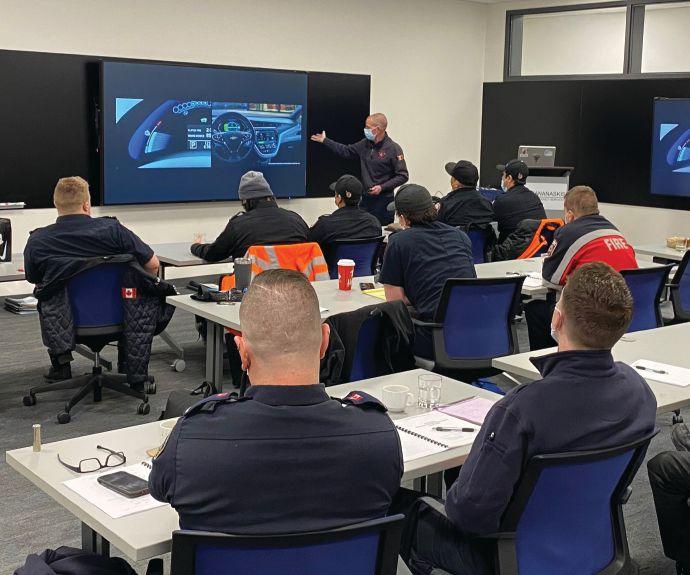
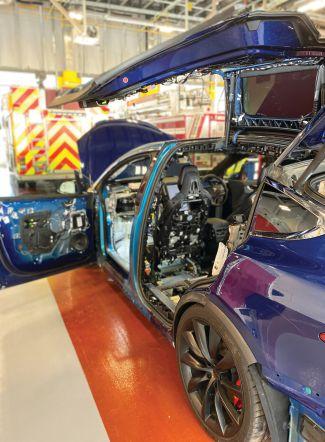
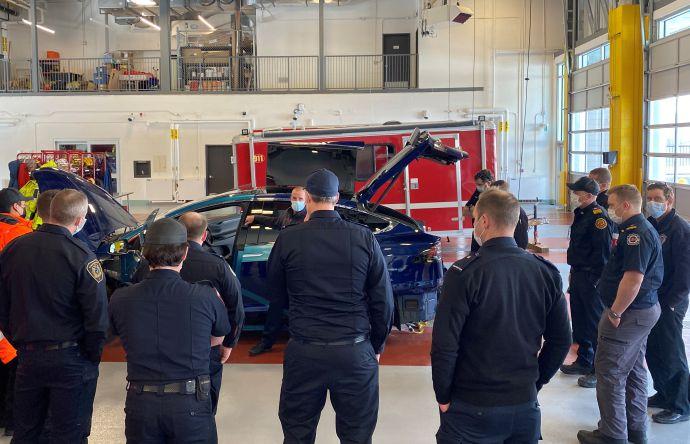
Kananaskis Emergency Services has collaborated with a fellow Bow Valley firefighter to bring an innovative electric vehicle training program to the Calgary region and beyond. The program, “Electric Vehicle Extrication,” was developed by Banff firefighter Kevin Patterson and the program’s inaugural delivery was made to a group of 20 students from seven department at the Kananaskis Emergency Services Centre on Feb. 26 with a second sold-out session taking place on March 19 at the facility. The program is the first of its kind, combining the most current information available on new model hybrid and electric vehicles (EV), new vehicle technology and safety systems coupled with a one of a kind opportunity to get hands on with an EV.
Patterson is a long-time member of the Banff Fire Department and also an expert in vehicle extrication and extrication tools. Patterson has had the opportunity to travel down to the Tesla plant in California on a number of occasions to work with the engineers and emergency response team to bring back vital information to emergency responders and has had the experience of cutting apart over a million dollars in Tesla vehicles throughout his training. Patterson is one of only two people in Canada that are recognized by Tesla’s technical lead for emergency response to deliver this specific training.
Patterson’s close relationship with Tesla afforded him the unique and exclusive opportunity of being given access to an intact and functioning Tesla Model X. Patterson has spent countless hours turning
his Model X into the only one of its kind in North America. The cutaway vehicle has been meticulously split down the middle with half of the vehicle appearing normally and the other half stripped back to reveal specific electric vehicle components, new vehicle technology and safety systems that protect occupants, but can pose risk to emergency responders. The vehicle allows responders to see, in person, the location and configuration of batteries, wiring harnesses, emergency disconnects, airbags, structural reinforcements and more.
Patterson’s specialized cutaway vehi-
cle has garnered the attention of Tesla’s engineers and its branches in Canada and the United States. All of the vehicle’s systems function, which allows Patterson to demonstrate and the students to see the vehicle function; including the Falcon doors, unique to the Model X, and their vehicles air suspension, which Patterson controls using an air bottle from a breathing apparatus. The vehicle is marked on the exterior to show responders the location of vehicle safety systems such as air bags and compressed gas cylinders, some of which are in unconventional locations
Kevin Patterson delivering the in-class portion of the program.
PHOTOS BY GARY ROBERTSON
on the Model X. Students are also able to see some of the vehicle’s reinforcement points that require adaptation to common extrication techniques like dash rolls and modified dash lifts. The additional reinforcement located in the lower A-post is undetectable behind the vehicle’s interior paneling and finishes. It serves as a good reminder to responders of the importance to “peel and peek” when performing an extrication. The only component missing that would make the vehicle driveable is its main battery, so Patterson transports the vehicle to the training sites on his specially configured trailer that uses a winch to load and unload the vehicle.
I am the acting fire chief for Kananaskis Emergency Services, and our vision of is to be leaders through innovation. We have a longstanding professional relationship with Patterson and have had a number of discussions over the past couple of years about collaborating on providing electric vehicle training to the region. We are seeing an increase in electric vehicles throughout the Bow Valley as the technology, especially as it relates to batteries, improves and the range of these vehicles increases. Even locally in Kananaskis, some facilities already have electric vehicle charging stations. We know there are increased challenges and risks faced by responders in managing these vehicles in the event of a fire or collision and we wanted to be part of the solution.
In June 2020, the new Kananaskis Emergency Services Centre formally began operation. The facility, funded by Alberta Parks, houses the Kananaskis Improvement District municipal offices, fire department, Alberta Health Services EMS and the Alberta Parks- Kananaskis dispatch program. The new facility was designed and built not
only for service delivery, but with the vision to establish a centre of excellence in emergency services training. Departments from across Southern Alberta and within the Bow Valley corridor already send their members to Kananaskis for training, and the organizations Firefighter Residency Apprenticeship Program is an industry leading innovation that has garnered attention across the country.
Through design, our intent was to have a facility that not only met the operational needs today and into the future, but afforded us the ability to expand and diversify our training programs and offerings. When the opportunity arose to work with Patterson in bringing his program to life, it was the perfect collaborative opportunity that embodied our organizational vision. All of the credit for the program, its content and his Model X cutaway goes to him. Our role was to provide the venue and use our experience in hosting training programs to manage the logistics of delivery.
The program is hosted as an eight-hour session that combines in-class learning and a hands on walk-through and review of the Model X vehicle. During the in-class section, students go through electric vehicle anatomy, new vehicle safety technology, safe approaches to electric vehicle extrication and safe approaches to electric vehicle fires as it relates to all makes and models of electric vehicles, not just Tesla. In addition to his comprehensive presentation, Patterson also reviews vehicle emergency response guides and resources that first responders can access and reference when they encounter electric vehicles in the field. There are also components students have the opportunity to get their hands on to develop a more comprehensive understanding of the vehicle
components and safety systems. Patterson also works to dispel common misconceptions about working with electric vehicles at emergency scenes and emphasizes what the real risks are to first responders and the vehicle occupants, and how responders can manage those risks.
“I feel this is a huge opportunity for me to make a dent in the electric vehicle and hybrid first responder training” said Patterson, who draws not only on his experience training at the Tesla plant but on years of experience as a firefighter in Banff Alberta and as a rescue tools technician.
In Kananaskis, we have had great feedback so far from our attendees. This is truly a unique offering and many are not sure of what to expect when they sign up. As we host more sessions we anticipate the demand to grow. We are already looking to some additional course dates for 2022 and 2023.
Upon completion of the program students are awarded a certificate and are given resources to take with them back to their home departments. While Kananaskis Emergency Services has had the honour of being the host location of the first two programs of its kind ever delivered, Patterson is interested and willing to deliver the program to other departments who may wish to host it. To contact Patterson about training opportunities visit www.ev-x.ca. •
Gary Robertson is currently serving as acting fire chief for Kananaskis Emergency Services and has been with the organization as a captain and training officer since 2012. Over his 19-year career training has always been his passion both in personal development and organizationally in the development of a number of training programs, courses and a live fire training centre.
Patterson reviews the safety systems and features of his cutaway Tesla Model X.
A close-up look at Patterson’s custom cutaway Tesla Model X.
■ BRONTO SKYLIFT LAUNCHES NORTH AMERICA’S TALLEST FIRE FIGHTING AERIAL
Bronto Skylift launched their 230 foot articulated aerial platform, the Bronto F230RPX, commonly known as ‘The Beast’. The first unit was developed, designed, built and delivered in collaboration with 1200 Degrees, a Bronto Skylift partner in Canada. 1200 Degrees will be the local service provider. The aerial platform has a 1000lbs load capacity and will allow access for wheelchairs or stretchers. The platform can be equipped with breathing air outlets, as well as hydraulic and electric power outlets for different tools needed during an operation. It also features an integrated corrosion resistant telescopic waterway with 1000 gpm capacity, and is mounted on a commercial Mack chassis.
■ FAST RESCUE SOLUTIONS ROLLS OUT NEW SAFETY GLOVES
Fast Rescue Solutions has added the MK-1 and MK-1 Ultra structural fire fighting gloves and the SQUAD-1 extrication gloves to its product line-up. The MK-1 features five layers of 100 per cent Kevlar knit for thermal, cut and puncture resistance. The cowhide-reinforced back shell is intended to offer long-term radiant
IN THEWATCHROOM
heat resistance and the NFPA 1971-compliant moisture barrier blocks chemicals and bloodborne pathogens. The MK-1 Ultra offers the same qualities of the MK-1 but in an all-kangaroo skin version. The SQUAD-1 (SQ-1) extrication gloves were designed for the fire service with the goal of producing an efficient design for extreme flexibility, grip and comfort. They feature a 100 per cent Kevlar palm-side inner liner, flame-resistant back side outer shell, synthetic leather palm shell reinforced with a kangaroo skin outer layer, Kevlar laminate reinforcements on the backs of fingers padded knuckle protection with a reflective strip, and ANSI Cut Level 3 protection.
■ MERCEDES TEXTILES INTRODUCES TWO-INCH ATTACK LINE THAT DELIVERS WITH 30 PER CENT LESS WEIGHT
Mercedes Textiles launched their newest innovation in fire hoses, the KrakenEXO SUPER II. The two-inch attack hose delivers two and a half-inch flows with up to 30 per cent less weight, which aims to improve maneuverability and handling. Compared to a standard two and a half-inch hose, KrakenEXO SUPER II is up to 40lbs lighter per 50 feet and up to 160lbs less over 200 feet. The hose was designed to be ergonomic and also features patented breather technology that is designed to release trapped air and water.
CANADIAN SAFETY EQUIPMENT IS PROUD TO BE A DISTRIBUTOR FOR THE INTERSPIRO RESPIRATORY PROTECTION LINE. THEIR STATE OF THE ART S9 INCURVE IS ONE OF THE MOST COMFORTABLE SCBAs YOU WILL EVER WEAR.
GIVE US A CALL AT 0182 OR EMAIL US AT INFO@CDNSAFETY.
No company has a richer history in respiratory protection than . Their innovations have become industry standards, time and
The most advanced thermal imager for firefighting
Larger 3 5″ display for a clearer view of the fire scene and lightweight at just 830g (1 8Ibs)
Extended dynamic temperature range to 1100˚C (2000˚F) for greater scene detail in larger, hotter fire scenarios
Enhanced feature set including laser pointer to aid communication, electronic compass for greater scene awareness and heat/cold seeker technology NFPA approved
F18 F11 FIRE SUPPRESSION GRENADE
THE SAFEST, MOST COMFORTABLE STRUCTURAL FIRE FIGHTING HELMETS YOU WILL EVER WEAR.
PULL THE PIN AND TOSS IT IN,
NFPA APPROVED STRUCTURAL FIRE HELMETS
The X-Tinguish® X-Treme throwable fire suppression tool is an updated version of our X-Tinguish® FST. Our products are located within thousands of fire departments, commercial establishments, and industrial locations worldwide. The X-Tinguish® X-Treme can remove about 1,000F from an enclosure (up to 5,300Cu Ft ) in 60 seconds while eliminating flames and making the room safer for the first responder The units ability to knock down and hold a fire until the hose team arrives is paramount to its creation. The X-Tinguish® Xtreme is a Tool for every Toolbox. Innovation in Fire Suppression has been our motto since 2012
The Solo SCBA Decon/Washing machine was designed and built for one purpose only…to protect Fire Fighters from Cancer causing agents found in the Smoke and residue left on their SCBAs. As an added bonus it can clean Gloves, boots and Helmets. In addition it substantially lowers the time spent decontaminating firefighter equipment.
Qualified by MSA for cleaning the G1 SCBA.
IN ONE HOUR YOU CAN CLEAN/DECON:
-14 SCBAs W/MASKS and CYLINDERS
WASH/DECON TWO SCBAs IN 8 minutes
ü REDUCED HEALTH RISK
ü SAVES TIME 2/PKS IN 8 MIN
ü EASY TO USE
IN ONE HOUR YOU CAN CLEAN/DECON:
• 30 HELMETS
• 60 PAIRS OF GLOVES
• 20 PAIRS OF BOOTS
• Double the above numbers with a second rack
Low Power use. Minimal moving parts. Low maintenance costs
BY JAMES R. RYCHARD Firefighter Burlington, Ontario
TThe miracle
here is a story inspired by the U.S. hockey team at the 1980 winter Olympics that stands out above many others. Regardless of what nation you belong to, this story and its outcome will always be remembered as the miracle on ice
Let’s start near the beginning, with Herb Brooks, sitting at home on the sofa with his father, watching his hockey team win an Olympic gold medal. The year is 1960 and after making the previous two Olympic teams, a young and deflated Brooks was the last cut for this year’s team. Ever since that moment, Brooks was determined to move from player to coach, eventually coaching a U.S. hockey team.
During the late 1970s, the U.S. was in crisis. The American economy was suffering high inflation rates. The 1973 oil embargo hiked gas prices through the roof and supplies were low. A new president was coming in who offered hope, and while in the spirt of fresh starts, coach Brooks was vying for the head coaching job of the 1980 Olympic team.
Unfortunately for the U.S., the Soviets dominated international hockey; they were a juggernaut having won Olympic golds in 1964, 1968, 1972 and 1976. In other words, they took over Olympic hockey for two decades. No one could compete with them. The Soviets had perfected their craft with consistency, and the U.S. were just looking to maintain a presence at Lake Placid, home to the 1980 winter Olympics.
Having devoted a better part of 20 years to NCAA college level hockey, Brooks built a national-winning program with the University of Minnesota Gophers. This experience set up his head coaching opportunity for the U.S. team. In fact, when he interviewed for the top spot, it was what Brooks shared with the interview panel that won him the job.
GUESTCOLUMN
and team chemistry.
Awestruck by what the U.S. hockey panel heard, they organized a week-long camp for hockey potentials, hoping to pluck out the best ones. Unbeknownst to U.S. hockey, Brooks’ vision for his Olympic hockey team had already been conceptualized. He studied the players he needed to compete, ones who were willing to adopt his four areas of focus. Surprised and miffed that no one else had a say in selecting players, the team was pre-selected. Even Brook’s assistant coach told him that he was missing the best players who were in the camp. But Brooks was not looking for players to compete at NCAA level. He wanted players who could compete at international level of play. Brooks was looking for the right players.
It’s not about finding star players who focus on themselves, but the ones who aspire to work together as a team to reach a goal. Brooks knew by selecting the ‘right players’ he could build the team he deemed worthy to compete at the 1980 winter Olympics in Lake Placid against the Soviets.
No matter how we choose to look at the fire service, there are
It’s not about finding star players who focus on themselves, but the ones who aspire to work together as a team to reach a goal. ‘‘ ’’
In order to beat an indomitable force like the Russian hockey program, you need to understand why they win and embrace the idea. The American program was filled with lots of talent, but the Soviets were excelling at teamwork. In other words, professional hockey players who focus solely on themselves miss the mark of playing for the team. Brooks had a lofty goal to beat the Soviets at their own game. To do that he embarked on a hybrid-style of play, requiring four areas of focus: conditioning, discipline, creativity,
In addition to being a firefighter and R2MR Instructor from the City of Burlington, Ont., James Rychard is an advocate for mental and behavioural health in the fire service, sitting on multiple association committees. He can be reached at jaymzr007@hotmail.com.
elements of sport to it. We compete in games, we work together as a team, and we are governed by a coaching staff who try to make us the best we can be. How often in the fire service do we hire firefighters and/or fire officers who have wonderful resumes comparable to a professional first draft athlete? CVs peppered with long lists of courses, degrees, and experiences; on paper they look outstanding! Yet, once hired they focus solely on themselves.
Employees who are willing to work inside a system that was designed for the betterment of the team was an unconventional philosophy-style of play, but one that worked.
The U.S. hockey team won the 1980 winter Olympics. When we take players who want to work for the betterment of the team, we can also create miracles inside our own organizations, ones that have Olympic gold outcomes. •
The 2020 National Model Codes
New national codes prioritize safety, accessibility and climate readiness
By CANADIAN COMISSION ON BUILDING AND FIRE CO DES (CCBFC)
The 2020 National Model Codes were released on March 28, providing an updated set of model construction codes that will make Canadian homes and buildings safer and more accessible, while responding to climate change. The new codes include the National Building Code of Canada 2020, the National Fire Code of Canada 2020, the National Plumbing Code of Canada 2020, and the National Energy Code of Canada for Buildings 2020.
“These new codes are more reflective of the current world we live in,” said Kevin Griffiths, chair of the Canadian Commission on Building and Fire Codes (CCBFC). “Thanks to these updates, it will be easier for Canadians with accessibility considerations to navigate different spaces; large farm buildings are now included in the codes to reflect the evolving agricultural sector; and energy performance levels have been introduced to make buildings more energy efficient.”
Highlights from the new codes include:
• A clarification that, through certain technical requirements, the existing fire safety objective addresses safety of emergency responders including firefighters when performing their duties.
• Strengthened protections for openable windows in residential occupancies to minimize the risk of falling.
• Safety glazing in windows and doors for schools, and similar buildings, to reduce the hazards of wired glass.
• Updates to evaporative equipment and drain pans to minimize the growth and transmission of legionella and other bacteria.
• Adjustments to the minimum dimensions of building elements to accommodate people using a wider variety of mobility devices, and requirements for tactile signage and for more pedestrian entrances and floor levels to be accessible.
• A tiered energy performance compliance path that incrementally improves energy efficiency at each successive tier.
• The introduction of whole-building airtightness testing as an option for complying with air leakage requirements.
• A new home-type care occupancy that will allow for safe and affordable care.
• The introduction of encapsulated mass timber construction to allow for the construction of wood buildings up to 12 storeys tall.
• The introduction of technical requirements for large farm buildings and addition of new agricultural occupancies.
Code users are invited to download the codes and review the changes that apply to their work. The 2020 codes include nearly 400 changes developed through an open, transparent, and consensus-based process that included expert volunteers from across
Safety glazing in windows and doors for schools, and similar buildings, to reduce the hazards of wired glass is one of the updated highlights in the newly released 2020 National Model Codes.
Canada. As part of the development process, the public was given an opportunity to review and comment on all proposed changes before the codes were finalized. Current provincial and territorial building, fire, plumbing and energy regulations will remain in effect until the 2020 Codes are adopted, with or without modifications, by the provincial or territorial authorities having jurisdiction.
Discussions about the 2025 National Model Codes are already underway. In a news release, the CCBFC stated it encourages the involvement of industry, general interest and regulatory experts in the process to make sure that the best available knowledge drives meaningful change.
The 2020 Codes are available through the National Research Council of Canada (NRC)’s Publications Archive in a free electronic format for download. To purchase the publications in print format, an order can be placed online through the NRC’s Virtual Store.
The National Model Codes are developed by the CCBFC on a five-year cycle and are published by the NRC.
The Canadian Commission on Building and Fire Codes (CCBFC) is a committee of volunteer industry practitioners, construction technology experts, building users and operators, and regulators. The CCBFC is responsible for the development of the National Model Codes.
Members are selected from across Canada for their individual interests and expertise rather than as delegates of any association or group. They are selected with a view to providing broad technical and geographical representation and are appointed by the National Research Council of Canada. •
PHOTOS BY
BY LAURA KING NFPA Regional Director Canada
BThe importance of being (fire) smart
ack in 2011, after a spring wildfire swept through Slave Lake, I interviewed Fire Chief Jamie Coutts for a story for this magazine. It’s been 11 years since that wind driven, weather- and climate-change affected fire roared through a community that was aware of and alert to wildfire. Nothing could have stopped that fire.
If you are in the wildland urban interface, or if your municipality is at risk of wildfire, it’s critical that your residents embrace FireSmart principles, and that neighbours work together to build FireSmart communities.
Slave Lake is a terrific example of positive change, community engagement, government support and resilience. In the years since 2011, Slave Lake has redoubled its efforts to implement FireSmart principles and increase resilience to wildfire. I was honoured to visit Slave Lake in 2018. I stopped at the FireSmart interpretive centre just outside town and walked the trail through the boreal forest with signs that explain how the fire happened, the impact on the ecology, and the need to understand how to live with wildfire.
Slave Lake’s FireSmart committee, with the support of FireSmart Alberta, has moved mountains to educate residents about best practices, fire-resistant building materials and vegetation, and evacuation preparation. Talking to Coutts after the Slave Lake fire, he remembered having read an earlier Fire Fighting in Canada article by Lou Wilde, the former deputy chief in West Kelowna, about the 2003 Okanagan Mountain fire. Wilde described the agony of having to decide which homes to let burn, and which to try to save, a decision which, in some cases, was made easier if homeowners had applied FireSmart principles to the property. Those homes were less susceptible to embers and, therefore, easier to defend.
at Home app, revamped its Local FireSmart Representative training, instituted a FireSmart 101 course, created the Ember the FireSmart Fox mascot and its associated educational materials for children, increased its staff, and merged with the Canadian Interagency Forest Fire Centre to become the national voice of wildfire mitigation and prevention.
NFPA supports FireSmart Canada through staff time, a seat on the FireSmart Canada advisory committee, collaboration with Firewise USA, and shared resources. While Firewise USA is working diligently through its Outthink Wildfire program to encourage policy change to protect the wildland urban interface, in Canada education is the mandate.
We know about 53 per cent of wildfires are human caused (lightning is a close second at 47 per cent), but the data maintained at the national level does not allow for a detailed analysis, so it’s tough to pinpoint whether campfires or sparks from ATVs cause more fires.
Regardless, given the impact of climate change on the length and intensity of the wildfire season, and data showing that learning to live
If you are in the wildland urban interface, it’s critical that your residents embrace FireSmart principles. ‘‘ ’’
with wildfire is the only option, education needs to be a national focus.
“I credit that article for helping me understand that we had to do something different than we had ever done before,” Coutts said.
Wilde wrote another piece in 2009, about the West Kelowna Complex fire, and included a sidebar listing actions recommend by FireSmart Canada that homeowners could take to make their properties more resilient to wildfire, things like pruning tree branches to a height of two metres or more and storing firewood away from the house. Since then, FireSmart Canada and its provincial and territorial partners have refined its recommendations for homeowners, developed materials and resources for builders, grown its Wildfire Community Preparedness Day program, further developed the Home Partners Program for home assessments, created the FireSmart Begins
Laura King is NFPA’s regional director for Canada. Contact her at lking@nfpa.org. @LauraKingNFPA.
FireSmart Canada’s website provides free resources your fire department can download, courses your firefighters can take and programs your municipality can embrace.
FireSmart Canada now has active FireSmart neighbourhoods from coast to coast, FireSmart champions in dozens of communities, a stable of new Local FireSmart Representatives, a fist full of new staff in programming, communications and in technical roles, and support of the Canadian Council of Forest Ministers.
We’re on the precipice of the 2022 wildfire season. It’s imperative that we work to outsmart wildfire using the tools provided by FireSmart Canada and its partners, The Co-operators, the Institute for Catastrophic Loss Reduction, Intact Centre for Climate Adaptation, the Canadian Red Cross, the provincial and territorial natural resources agencies, and our Indigenous collaborators.
Visit firesmartcanada.ca, or contact me to start your FireSmart journey. Follow FireSmart Canada on Twitter at @FireSmartCanada. •
Starfield LION’s CenterCut™ Bunker Gear Liner System for Drier, Cooler, Lighter and...Safer Gear.
Starfield LION Flame Fighter™ Bunker Gear
REPETITION IS KEY TO PREVENTION
FROM PAGE 19
safety, heating safety, electrical safety, home escape planning, senior and elderly safety, multi-generational resident safety, wood heat safety, wood heat maintenance and seasonal safety.
NIFSC also delivers a smaller set of programs targeting place-based issues that increase the risk and severity of residential fire, including smoke alarms and carbon monoxide safety, and home fire safety assessments.
In addition to suggesting a program review for overlap and potential consolidation, the report proposes the development of at least two programs – one focused on educating people with the view to changing their behaviour, and one focused on reducing fire risk by increasing the likelihood of having effective fire prevention systems in place. The recommended program-delivery approach includes:
• Conducting community education programs every two years in consideration of the high-risk and transient target population, with possible future adjustments to the schedule based on collected data.
• Training residents to conduct their own audits of place-based interventions such as fire safety systems and smoke alarms, and inviting them to request additional alarms from NIFSC between inspections.
• Conducting fire-safety and alarm installation inspections every four years, in consideration of manufacturer’s recommendations for smoke alarms and the general requirements for inspecting built-in safety systems.
• Conducting ongoing evaluations of program delivery and effectiveness, including maintaining detailed training records for individual trainees and measuring aspects such as pre- and post-training fire safety knowledge and attitudes, knowledge gain and retention, the knowing-doing gap and the wear-off effect.
Monitoring over time is critical to measure effectiveness and learn more about the patterns of behavioural change and knowledge retention for future program delivery.
“This new information will assist us in continuing to build capacity in our Indigenous communities, by helping us more effectively provide education and increase the likelihood of functioning safety systems where people live and gather,” Wiggins said. “It will ensure we’re targeting our efforts and resources where they will have the most impact and setting our programs up for long-term success.” •
Len Garis is director of research for the National Indigenous Fire Safety Council, Fire Chief (ret) for the City of Surrey, B.C., associate scientist emeritus with the B.C. Injury Research and Prevention Unit, adjunct professor in the School of Criminology and Criminal Justice and associate to the Centre for Social Research at the University of the Fraser Valley (UFV), and a member of the Affiliated Research Faculty at John Jay College of Criminal Justice in New York. Contact him at lwgaris@outlook.com
Mandy Desautels is the director of strategic initiatives at the Aboriginal Firefighters Association of Canada (AFAC). She holds a B.Sc. in global resource systems from the University of British Columbia and a master’s of healthcare administration from University of British Columbia. Prior to joining AFAC’s National Indigenous Fire Safety Council (NIFSC) project, she worked for BC Emergency Health Services and prominent NGOs. Contact her at MandyD@afac-apac.ca.
PARTICULATE BLOCKING
By TODD HERRING
The area around your jaw, face, and neck is the most vulnerable spot when exposed to fireground contaminants from soot and smoke. Standard FR knit hoods protect you from heat and flames, but in recent years, improvements to firefighter hood designs have led to advanced particulate blocking protection.
It’s important that all fire departments become educated on the importance of particulate blocking hood technology for the health and safety of their crew members.
There are several reasons firefighters may consider particulate blocking hoods. As has become much discussed and accepted, firefighters are more likely to be diagnosed with cancer than the gen-
eral public. Research from the Center for Disease Control (CDC) and the National Institute for Occupational Health and Safety (NIOSH), as a firefighter, you have a nine per cent higher risk of being diagnosed with cancer compared to the general U.S. population.
A particulate blocking hood can keep up to 99 per cent of contaminants at bay. Particulate blocking hoods act as a filter to reduce exposure to persistent fireground carcinogens and other toxins. With innovative particulate blocking technology, these hoods can block particulates at 0.2 microns in size or larger. Consider this: there are approximately 25,400 microns in one inch, and a human hair is about 75-100 microns wide, so a 0.2-micron particulate is about
䘀氀攀砀椀戀氀攀 䄀昀 昀漀爀搀愀戀氀攀 刀攀氀椀愀戀氀攀
吀爀甀猀琀 䘀椀爀攀倀爀漀㈀ 琀漀 栀攀氀瀀 眀椀琀栀 礀漀甀爀 挀爀椀琀椀挀愀氀 昀椀氀攀猀
愀渀搀 瀀爀漀瘀椀渀挀椀愀氀 爀攀瀀漀爀 琀椀渀最⸀
500 times smaller than a strand of hair. The FAST Test Report demonstrated that particles at 2.5-micron size penetrated a standard FR knit hood and left a concentrated, heavy deposit on the participant’s neck, cheeks, ears, and jaw.
With fire fighting, many unpredictable elements come with responding to a call. Taking the time to research and find the right solution that will keep your crew safest on the fireground for years to come is crucial. Today, firefighting PPE manufacturers continue to look at fire gear as a way to reduce your chances of succumbing to heat stress and exposure to carcinogens. •
Todd Herring is the vice-president of product innovation and strategy for Fire-Dex.
DO YOU PROTECT YOUR FIREFIGHTERS?
We do. Since 1975, we have made it our business to ensure clean air in fire stations. We provide high-quality exhaust removal systems to protect firefighters and others from exposure to hazardous diesel exhausts.
800-644-0911
www.plymovent.com
PASCO COUNTY FLORIDA FIRE RESCUE ON DECON’S MULTIPLE ROI
SCOTT CASSIN Fire Chief, Pasco County Fire Rescue
“To me, the biggest ROI is we’re protecting our firefighters from additional exposures to cancer.”
“I can tell you that’s way more a priority to me than the cost of the [DECON] machine, but the machine is going to be paying for itself.”
JOHN SCHMIDT Division Chief of Safety, Health & Training Pasco County Fire Rescue
“We worked with the manufacturer and were able to design...a purpose-built DECON unit.
“Instead of having to bring [gear] back to a station or back to the Training Center... they’ll be able to clean it right there at the point of origin. Right there we’re going to save a lot of time, a lot of energy.”
Thermal imagers and fighting wildland fires
How thermal imagers can help wildland firefighters be safer and effective
By MANFRED KIHN
By now, many fire departments are conducting wildland training while government forestry agencies are gearing up for what many anticipate as being another bad year. Scientific news points to global warming as having a lot to do with climate change since some regions may experience flooding while others may suffer with drought conditions.
Over the years, wildland firefighters have battled fire from the air and on the ground, relying on their training and many years of experience. They have fought these fires often in poor visibility and with limited knowledge about burning conditions. With the use of small handheld thermal imagers (TIs), wildland firefighters can greatly enhance their knowledge of working conditions safely on the ground. Aircraft, be it fixed wing or rotary wing type, also have the same capabilities using forward looking infrared, which are mounted to the aircraft and allow them to gather intelligence by conducting reconnaissance flights that gather vital information from the air.
Used properly, handheld TIs can help crews more effectively monitor the flank and head of the fire, place personnel in key areas to create control lines, enhance safety during fire fighting and improve the control or prescribed burns. Firefighters can also use TIs to enhance their safety when navigating through smoke up and down hose lines and around vehicle ground guide movement.
■ THERMAL IMAGING APPLICATIONS IN WILDFIRE
Firefighters can use TIs in several ways for wildland fires:
1. To monitor the flank and head of the fire from the air. On a TI screen, hotter objects show up as white, cooler objects show up as black and objects in between these temperatures are displayed in shades of gray. The fire’s location and progress are evident from an aerial position, regardless of sunlight or smoke conditions. This enables firefighters to precisely monitor fire progress in a way otherwise impossible. The ability to monitor the fire progress during low light conditions means crews can begin operations earlier in the day and end them later in the evening, thereby increasing efficiency and decreasing the duration of fires.
2. To place and monitor personnel. In large fire response operations, the placement of personnel is critical to gaining control. Incident commanders can make use of their enhanced visibility through thermal imaging to determine key locations to place
wildland firefighters and fire lines. Proper placement enhances the firefighter’s ability to protect structures, threatened habitats and critical infrastructure. As ground crews deploy airborne supervisors can monitor their locations and ensure a coordinated and effective response.
3. To monitor dangers and extinguish hot spots on the ground. With proper training on image interpretation, firefighters can effectively use TIs to monitor fire movement on the ground and in the trees above them. They can track and monitor the direction and volume of firebrands. With practice, firefighters can use TIs to identify snags, thereby improving safety on the job. During mop up, crews with TIs can scan burned areas to ensure the fire is completely out.
4. Manage prescribed burns. Controlled burns are critical to reducing the fuel load to improve manageability of wildland fires. Using the TI, wildland firefighters involved in prescribed burning can monitor the direction of fire spread and manage mop up more effectively. The information provided by the TI is often key to protecting exposures and ensuring that such “controlled” burns don’t get out of control.
5. To navigate. When firefighters travel by ground during active wildland fires, their vision may be obscured by smoke. TIs used from a vehicle (through an open window as TIs cannot see through glass) can assist the driver in navigating safely through
Using an imager during mop up operations.
thick smoke and avoiding fixed hazards as wells as moving object such as other crewmembers. Similarly, when smoke obscures their vision, firefighters on foot can use TIs to identify safer routes based on terrain or fire movement, helping crews move safely and effectively.
Used properly, handheld TIs can help crews more effectively monitor the fire and place personnel in key areas to create control lines.
■ DON’T FORGET THE BASICS
Thermal imaging technology is not a replacement for basic tactics or techniques. When using a TI during mop up, you may experience times when it cannot detect a hidden heat source, such as when the heat exists deep within a tree trunk. You may find some images on the TIs screen inconclusive or wild goose chasing as heated up rocks and large boulders will all show up as white. In these cases, use traditional tactics along with the information provided by the TI to identify the fire’s location and rate or spread. If you’re unsure, always error on the side of caution.
As with any other application of technology, planning and practice are the keys to effective TI usage. Firefighters must not
only understand what they see on the TI, but they must also learn how to use this information seamlessly with the topographical and locational information they already employ on the job.
Training tip: Find a planter pot or likewise container and fill with peat moss and use a heat source like BBQ briquettes as this makes for a good training prop to look for hotspots.
Handheld TIs work very effective from an aircraft in case you happen to find yourself onboard one during your response but just remember you cannot see through plexiglass so use either an open window or door for viewing.
Thermal imagers can be used to improve operations in a wide variety of wildland fire fighting operations, from the air and on the ground. Although the dangers faced by wildland firefighters are different than those faced by structural firefighters, the thermal imager is a tool that can benefit firefighters in both types of incidents. By first understanding how a TI can be employed during a wildfire response, then practicing with it on a regular basis, you can improve your personal safety as well are your team’s effectiveness.
Until next time stay safe and practice often. •
Manfred Kihn is a 19-year veteran of the fire service, having served as an ambulance officer, emergency services specialist, firefighter, captain, and fire chief. He has been a member of Bullard’s Emergency Responder team since 2005 and is the company’s fire training specialist for thermal imaging technology. He is certified through the Law Enforcement Thermographers’ Association (LETA) as a thermal imaging instructor and is a recipient of the Ontario Medal for Firefighters Bravery. If you have questions about thermal imaging, you can e-mail him at manfred_kihn@bullard.com.
An airborne handheld thermal imaging view versus a naked eye view.
PHOTOS BY BULLARD
The WEDGE
During my recruitment interview, I was asked about discipline. I had to think about the way I wanted to respond because when it comes to progress, I can be a little intense. Like many of us, I’d lived a lifestyle that was counter to everything I know about what it means to be a first responder: poor diet, zero exercise and a bitter, defeated outlook. On the other side of a six-year journey, I’ve discovered what it means to set a goal and make it happen.
I also discovered that staving off the darker corners of the mind starts with a properly defined aim. Without a specific, measurable, attainable, relevant, and timely goal (a.k.a. SMART goal setting), the work can quickly go to waste in a quagmire of unrelated and unfocused tasks. I found an article published in 2017 by the Canadian Journal of Psychiatry that found firefighters in Canada screen positive for symptoms of mental illness at a rate three times higher than the general public. Too often we carry a heavy load and too often we encounter obstacles toward letting down some of that weight. This information and my own discoveries along the way, led me to develop The Wedge, a free, open-source wellness and fitness initiative focusing on self-improvement, discipline, organization and progress developed to embolden the mind, ready the body and toughen the spirit. I named this project after a simple tool — the wedge — because it provides two simultaneous tasks. It divides and it fortifies. We drive it into the end of a handle to split what once was into a stronger version of itself. We chock it into the crook of a door to hold open our opportunity for escape. The utility gained from the wedge was something I wanted to take reference from in building a challenge for people to find a better, more useful version of themselves.
The exercise operates on the premise that life has become unjustifiably comfortable and that we’re generally missing the rites of passage that once challenged us to grow and change. Using The Wedge, SMART
Divide and fortify with a free wellness program
By BILL DUNGEY
to
goals are chosen, recorded, and personally striven toward in three hierarchical categories. Visually, this is represented by the three points of an inverted triangle. On the top plane, progression in mind and body are held above the only sub-category, which is craft.
The month-long program is capped off with an arduous group-based workout. Spanning multiple hours, the group isn’t tasked to win, but to keep going where they once might have quit. Each participant is encumbered by either a weighted ruck, a coiled hose or found log. The team should carry their weight, which is a representation of the burdens we carry.
The ENDEX, or the end-of-exercise workout, should take place over a longer-than-usual span of time. Ideally, several hours. This workout should cover distance and, where possible, the trek should move through conditions that leave the participants wet, dirty, sandy or otherwise uncomfortable. When we apply a correct aim, disciplined action and a stalwart heart to the obstacles in front of us, lofty as that may be, we are truly capable of remarkable progress. When adequate pressure is applied, it forces us to march forward.
There are multiple factors that directly influence our ability to match the ambitions we have set for ourselves. Time measures
several hours
our willingness to keep disciplined. Effort puts our bodies in the fight and makes us do the work necessary to invoke the changes we want to see. Pace dictates the speed at which we’re able to advance. Cadence is the rhythm that creates habit and keeps us on the path. Combined, these four elements are the crux of this program. The real impact of your month-long passage through The Wedge is simple to understand but not the slightest bit easy to execute. Worthwhile endeavours are often difficult.
In fact, to burden ourselves with voluntary trouble is to stare the beasts that bring us to our knees in the eye and accept the fight. However, life manages to manifest the ugly, bitter storms that darken the horizon, The Wedge aims to outfit its participants with the tools to turn into the waves.
The Wedge is designed to be free, opensource and available to anybody who wants to use it. Progress isn’t a subscription fee. It’s time, effort, pace and cadence.
The Wedge can be downloaded from timeandeffort.ca •
Bill Dungey is a volunteer firefighter in Brant, Ont. He is focused on fitness, mindset development and finding training opportunities to help the fire service make things better.
PHOTO BY
The end-of-exercise workout in The Wedge program is meant
last
and push its participants over a variety of terrain.
RESCUING A BARIATRIC PATIENT
A tough call created the chance for a crew to devise a new technique
By JARED NEWCOMBE
Are you prepared to rescue the bariatric patient?
At a recent fire we were confronted with this very question. Our initial update included the report of a basement fire, people trapped and explosions coming from the basement area. On approach we noticed smoke coming from the front door and occupants exiting the house. During our initial engagement we began by advancing a 45 mm handline and gathered information. During the size-up we determined that everyone upstairs had evacuated the premises. We were advised by the homeowner, who had self evacuated, that a woman and her child were still in the basement, and we were given their location. The hose line was redirected to a side entrance where an exterior door was cut into the side of the building. This led us to a shared room full of pressurized smoke. Upon entering and descending the narrowed set of stairs, the smoke thinned where a closed and locked door was located against the bottom of the step. This was an accessory basement apartment that did not meet building code.
We forced the door open to encounter a high heat zero visibility environment. This vent limited fire had used all the available oxygen and began reacting quickly to the flow path created from an uncontrolled door. The hose line was moved into position, and while the fire was being extinguished, a simultaneous rescue effort was underway. The woman and child were located and taken to the only means of egress, which was the narrowed staircase. The child was rescued up and out of the basement in a matter of seconds. The woman, weighing 385 pounds, was not as easy.
The team who had made the grab required additional assistance with the rescue. We assigned one firefighter to continue with extinguishment while the other two assisted with the rescue. The rescue technique chosen was the fore-and-aft as the narrowed staircase did not allow for firefighters to work side by side but in succession only. One firefighter positioned themselves at the woman’s head while reaching under the arms and cross gripping the wrists. The second firefighter’s SCBA low air alarms activated as they were securing the patient. With each attempt to carry the woman up the stairs, her naked and slippery body escaped the grasp of the firefighters’ arms. Communications were made immediately that more resources would be required to extricate the patient. We continued with the fore-and-aft method until another on scene crew relieved us.
The crews on scene rotated often while applying the various
rescue techniques they were familiar with. We used many techniques such as the fore-and-aft, sticky straps (hasty harness), ladder and finally the scoop stretcher. Rescuing this bariatric patient was a specialized operation.
A bariatric patient is an obese person with a body mass index greater than 30 or 100 pounds greater than their ideal body weight. A 2016 study suggested that one out of three people in North America were obese. A more recent study suggested that by 2030, one in two people will fall under the same category (Ref 1).
It is important to consider the risk of firefighter injury during
The modified fore-and-aft carry.
PHOTO BY JARED NEWCOMBE
FIRE EAGLE® AIR
this type of rescue. More than half (62 per cent) of all prehospital provider back injuries resulted from lifting patients. Injuries are a consequence of three major factors. The significant lifting forces (patient weight), repetitive movements and awkward positions (Ref 2). Firefighters performing rescue operations do not have the luxury of a controlled environment, visibility, and time. Our patients are extricated under war like conditions.
Currently our job performance requirements do not include demonstrating a rescue technique suited to the larger patient, but solely with techniques suited to the 165-pound manikin and firefighter rescue techniques. The fire service needs to recognize that the bariatric rescue is a specialized operation requiring resources, tools, and specific training to be successful. Until then we’ll address this problem ourselves.
Our approach uses the National Fire Protection Associations (NFPA) 1407 standard for rapid intervention training as it addresses the need to train firefighters to locate and rescue lost, trapped, and injured firefighters employing specialized extrication techniques to move firefighters up the stairs, down the stairs and out of windows etc. The same techniques and concepts can be employed towards the bariatric patient.
How do we bridge the gap between bariatric rescue and that
ABOVE A bariatric rescue harness.
LEFT Training to the new technique.
of a firefighter? By making a rescue harness built in seconds that mimics that of a firefighter’s SCBA harness. The harness is simple in design, easy to make under harsh conditions and can be applied to various sized patient in seconds. Specialized rescue techniques reserved to rescue firefighters can now be applied once the bariatric patient. Dragging lifting or carrying a patient on grade, up-stairs or down stairs is now methodical in its approach.
Building a rescue harness that will accommodate bariatric and non-bariatric patients rescue harness combines two continuous loop webbing and a carabiner connecting the two interconnected systems along the spine. The system is best taught as two independent systems but meant to be built simultaneously.
How to build a reverse Swiss seat harness suited to your patient’s size:
• Using a 5’continuous loop webbing, loop around the bariatric patient’s legs or torso and positioned around the waist
• Collect webbing at navel and pull up towards the ceiling
• Twist webbing in a clockwise motion until it is tightly fitted around the waist.
• Roll patient to their side
• Run the twisted webbing between the legs.
• Using a carabiner connect the webbing running between the legs and along the back
How to building a chest harness:
• Using a 5’ continuous loop webbing wrap overtop of the chest
• Roll the patient to a side and clip the webbing into the carabiner
• Roll patient to their other side and clip the webbing into the carabiner
A bariatric rescue requires a considerable amount of time effort and resources and should be considered a specialized operation. Firefighters choosing to build and use a rescue harness have the tools to affect this specialized rescue. This enables them to carry lift and drag a patient upstairs downstairs or on a grade. Professional teams using the right tools and moving as a synchronized unit making the greatest impact towards saving life.
If we could go back in time, could the initial crew have affected the rescue using this new approach? Yes. Building a bariatric rescue harness and applying the RIT approaches learned, we could have easily extricated the 385-pound woman up the stairs.
Author’s note: Special thanks to Paul Winkley, Chris Brooks, Mike Harasiewicz, Jonathan Barnett, Jason Beauchamp, Jessica Zeher, Tricia Beirnes, Chris Presunka, Lech, Mike Haarasma, Mike Lech, Chris Buott , Chris O’blenis, James Kirk, Jamie Foster and C shift for their work in developing the bariatric rescue training initiative.
Jared Newcombe is a captain and a 28-year veteran of the Brampton Fire and Emergency Services in Ontario.
• (2) Hogya PT, Ellis L. Evaluation of the injury profile of personnel in a busy urban EMS system. Am J Emerg Med, 1990 Jul; 8(4): 308–11.
2022 NATIONAL SUPPLIERS DIRECTORY
CANADA
BC (British Columbia)
AB (Alberta)
SK (Saskatchewan),
MB (Manitoba)
ON (Ontario)
QC (Quebec)
PE (Prince Edward Island),
NL (Newfoundland & Labrador)
NB (New Brunswick)
NS (Nova Scotia)
NT (Northwest Territories)
NU (Nunavut)
YT (Yukon)
AIR TECHNOLOGY SOLUTIONS
CANADA INC.
251 Queen St. S., Ste. 512 Mississauga ON L5M 1L7
Tel: 905-826-6682
Toll free: 866-735-1480
Fax: 866-511-6904
Web: www.airmation.ca
ARÉO-FEU
5205, J.-Armand Bombardier Longueuil QC J3Z 1G4
Tel: 450-651-2240
Toll free: 800-469-1963
Fax: 450-651-1970
Web: www.areo-fire.com
BEARSPAW PROTECTAPUMP
A - 927 Goldstream Ave. Langford BC V9B 2Y2
Tel: 778-404-7385
Web: www.ProtectaPump.com
A.J. STONE COMPANY LTD.
62 Bradwick Dr. Vaughan ON L4K 1K8
Tel: 416-785-3752
Toll free: 800-205-3473
Fax: 416-781-2827
Web: www.ajstone.com
A.J. Stone has proudly served the needs of the First Responder Services of Ontario since 1972 by featuring quality products, knowledgeable sales team, and training support.
A.J. Stone supplies equipment from MSA, Task Force Tips, LION Protects, Paratech Rescue, FireBull, Enforcer, Genesis Rescue Systems, Streamlight, Innotex Bunker Gear, ProTech Gloves, Safe-T-System, CET and much more!
We service what we sell!
Serving ON
Air Technology Solutions is dedicated to our Clients, offering updated, timely, full service Indoor Air Quality (IAQ) solutions. Air quality concerns are mitigated using a unique combination of professional indoor air quality assessment coupled with solutions. Off the shelf or customized site specific air cleaning equipment is available to resolve IAQ issues. Our technical experts review client requirements and budgetary availability. The finest appropriate air cleaning systems are provided. Air Technology Solutions is a leader in Diesel Exhaust Remediation and is the ONLY environmental tested and proven filtration system to exceed standards: NFPA, NIOSH, OSHA and ASHRAE. Building and facility managers, business owners, contractors, architects, and engineers have been working with Air Technology Solutions since 1986 to resolve IAQ needs. Employee and personnel safety and health are key issues. Breathing safe air in the workplace is of utmost importance. We provide global customized solutions to control contaminants, pollutants and odours in your facility. We look forward to servicing your requirements. Serving All of Canada
Aréo-Feu – Where Equipment Matches Courage
For more than 55 years, three generations of knowledge have succeeded to make Aréo-Feu the number one reference for the supply and service of equipment in the fire industry, in public safety or in civil protection. Our favourable purchasing power allows us to maintain an important inventory of products that have state-of-the-art technology. Committed to building very good business relationships with our partners, we encourage the constant update and development of our team’s expertise.
Our daily goal is the complete satisfaction of our customers! Multiple suppliers with whom we have a durable relationship for the benefit of our customers.
Official distributor of: MSA/Globe, Innotex, Rosenbauer, Protek, Elkhart Brass, Genesis Rescue Systems, Streamlight, Res-Q-Jack, Petzl, Husky, Solberg, TechTrade, Unifire, CET Fire pump, All American hose, OHD, Harrington Inc., LavXel, Kochek CO. Inc, Lakeland, Tohatsu, Waterous, ect.
Serving All of Canada
Home of the PORTABLE Dry Hydrant - Instantly Draft Anywhere…Safely! BearsPaw ProtectaPump, a 100% Canadian Company focused on liquid / solids Separation and Isolation technology. Our patented Suction Separator, the Fire Ceptor ensures a consistent flow of clean water to both Truck mounted (4”, 5” & 6”) and Portable pumps (2”, 2.5” & 3” w/ foot-valve) drafting in challenging environments.
The Portable Dry Hydrant drafts safely in only 6”- 12” depth, even placed in sand, gravel, or weeds! This ‘Suction Separator’ outperforms any suction ‘strainer’ in both pump protection & high flows - No flotation or suspension required! -
Fire Chief used and approved - See videos at www.ProtectaPump.com
Fire Ceptor, a ‘Made in Canada’ product; reduces downtime, repair costs, extends pump life, increases performance flows and reliability when needed most for Firefighters as they risk their lives to protect people and property.
100% satisfaction guarantee & 5-year warranty.
Serving All of Canada
BULLDOG HOSE COMPANY
141 Junny Road
Angier NC 27501
Tel: 416-436-4910
Web: www.bulldoghose.com
BullDog Hose Company, a division of Puck Enterprises, is proud to be a leading fire hose manufacturer in the North America. From Hi-Combat® II, Firepower® II, Hi-Vol®, Redchfief, and Ultima™, our dedication has positioned us as the premier in fire hose products.
The BullDog name stands for high performance, durability, safety and quality, with American-made products that are built to last.
Serving All of Canada
2022 NATIONAL SUPPLIERS DIRECTORY
C-MAX FIRE SOLUTIONS
3040 Sawmill Rd., PO Box 425
St. Jacobs ON N0B 2N0
Tel: 519-664-3796
Web: www.c-max.ca
Canadian family owned and operated business that offers a higher standard of service and sales for all your Fire Apparatus needs. C-Max Fire Solutions offers 24 Hour service from EVT Technicians with fully stocked service trucks. We offer Pump testing and repairs to all makes and models. We offer ground ladder testing as per NFPA 1932. We are also Ontario’s Factory Sales and Service Centre for KME Fire Apparatus. C-Max is now factory authorized service center for Willburt Light towers.
Serving ON
CANADIAN SAFETY EQUIPMENT
INC.
#3 – 2865 Argentia Rd.
Mississauga ON L5N 8G6
Tel: 905-826-2740
Toll free: 800-265-0182
Fax: 905-272-1866
Web: www.cdnsafety.com
We supply Industrial and Fire SCBA’s, SCBA Decon Washer, Thermal Cameras, CAF Systems, Fall Protection, Bunker Gear, Fire and Rescue and Ballistic helmets, Fire Hose, Communications Equipment, Nozzles, Fittings, Hazmat Suits, Ventilation Fans, Gas Detectors, Confined Space Rescue Equipment, Water and Ice Rescue equipment, Industrial and Municipal Safety and Lone Worker Protection systems.
COMMERCIAL EMERGENCY
EQUIPMENT CO.
591 Chester Road
Delta BC V3M 6G7
Tel: 877-443-2626
Toll free: 800-665-6126
Web: www.comemerg.ca
Commercial Emergency Equipment
Co is Canada’s largest dealer for Pierce Manufacturing Inc, Maxi Metal, and Oshkosh Airport Products. We provide sales, parts, and service of all makes of fire trucks, and support to our customers through our nationwide branch network. .
Commercial Emergency Equipment Co. strives to exceed customer expectations in everything we deliver. With over 70 years in the truck equipment industry, we take pride in a proven track record of providing expert truck equipment solutions, top quality products, and first-class service to our customers.
CSE INCENDIE ET SÉCURITÉ INC.
5651 Chemin St-Francois
St. Laurent QC H4S 1W6
Tel: 514-737-2280
Toll free: 866-737-2280
Fax: 514-737-2751
Web: www.cseis.com
We supply Industrial and Fire, SCBA’S, SCBA Decon Washers, Gear Extractors and Dryers, Thermal Cameras, CAF Systems, Fall Protection, Bunker Gear, Fire, Rescue and Ballistic Helmets, Fire Hose, Communications Equipment, Nozzles, Fittings, Hazmat Suits, Ventilation Fans, Gas Detectors, Confined Space Rescue Equipment, High Angle Rescue Equipment, Ice and Water rescue equipment, Boots and Gloves. Everything for Fire Fighting, EMS, Law Enforcement, Industrial and Municipal Safety and Lone Worker Protection Systems.
CARL THIBAULT FIRE TRUCKS INC.
38 Thibault St., Box 1089
Pierreville QC J0G 1J0
Tel: 450-568-7020
Fax: 450-568-3049
Web: www.thibaultfiretrucks.com
We are a Canadian based company and we manufacture a full line of fire apparatus which includes aerial ladders, pumpers, tankers, rescue units and vacuum tankers. We provide parts and other related products. Serving QC
We are a sole-source service provider with mobile EVT’S, on-call 24/7, throughout our nationwide branch network. We offer inspections, preventative maintenance, mobile pump testing, and foam system calibration, as well as comprehensive apparatus training on operation and maintenance.
We inventory an extensive stock of OEM and aftermarket parts, tools, and equipment ensuring quick delivery and reduced downtime to our customers. Our service technicians undergo continuous training and testing to ensure that the latest technology and innovation is applied to the service of your equipment. When you need prompt, honest, and reliable service, you can count on us to support you.
BC, AB, SK, MB, ON, NT, NU, YT Serving AB|BC|MB|NT|NU|ON|SK|YT
to learn more about SCBA, live fire training system, fixed gas and flame detector, mobile gas detector, thermal imaging camera, drugs and alcohol testing equipment and the rest of our portfolio.
CET FIRE PUMPS MFG.
75 Hector St.
Pierreville QC J0G 1J0
Tel: 450-568-2719
Toll free: 888-844-2285
Fax: 450-568-2613
Web: www.fire-pump.com
No Hydrants, No Problem!
CET Manufactures Portable Pumps, Skid Units, Brush Trucks, Glider Kits, Foam Trailers, Water Tanks, and UTV Fire Units to help you fight fire where static water sources may be your only option.
The Flow Starts Here!
Serving All of Canada
Product services and technical training courses are offered at our Mississauga, Ontario and Edmonton, Alberta locations throughout the year. Arrange for service of your SCBA and gas detector now. Serving All of Canada
2022 NATIONAL SUPPLIERS DIRECTORY
FIRE FIGHTING IN CANADA/ CANADIAN FIREFIGHTER
PO Box 530, 105 Donly Dr. S.
Simcoe ON N3Y 4N5
Tel: 289-221-6605
Fax: 888-404-1129
Web: www.firefightingincanada.com
Canada’s National Fire Publication since 1957.
Serving All of Canada
FIREHALL BOOKSTORE
PO Box 530, 105 Donly Drive S. Simcoe ON N3Y 4N5
Tel: 877-267-3473
Fax: 877-624-1940
Web: www.firehallbookstore.com
The Firehall Bookstore provides training & public education materials to the Canadian Fire Service industry and its professionals. A one-stopshop for textbooks, DVDs, codes and standards, and fire safety & prevention educational materials for community outreach.
Products include: NFPA, IFSTA, Jones & Bartlett, Fire Engineering Books, Action Training Systems, Brady, Emergency Film Group as well as our Firehall Mall section that offers gloves, lights, tools and accessories from A.J. Stone and ResQTech.
Serving All of Canada
FIREHALL.COM
PO Box 530, 105 Donly Dr. S. Simcoe ON N3Y 4N5
Tel: 289-221-6605
Fax: 888-404-1129
Web: www.firehall.com
Firehall.com provides an excellent forum for exchange among firefighters and others involved in the fire service. Advertising options include banner ads and e-blasts and offer extensive exposure to the rank and file.
Serving All of Canada
FIRESERVICE MANAGEMENT LTD.
34 Torlake Cres.
Toronto ON M8Z 1B3
Tel: 416-251-3552
Toll free: 888-731-7377
Fax: 416-253-0437
Web: www.fireservicemanagement. com
We Clean, Test, Customize, Rent and Repair YOUR Gear. Canada’s premier facility dedicated exclusively to providing the best in bunkergear cleaning, decontamination, inspection and repair. We are NFPA 1851 compliant and UL verified for all cleaning and repairs to all materials including moisture barriers. We stock materials and trim for every brand. We’re a certified ISP so we can rebuild damaged components or add pockets and other features to suit your needs. We also offer FireTrack software to help you track your inventory and inspection history. Call us today to see how we can help your department.
FIRESERVICE MANAGEMENT TORONTO
34 Torlake Crescent
Toronto, Ontario
M8Z 1B3
TOLL FREE: 888.731.7377
FIRESERVICE MANAGEMENT CALGARY
Unit 22, 2305
52 Avenue S.E., Calgary, AB T2C 4X7
Phone: 403.287.0155
Serving All of Canada
FIRST ALERT (CANADA) INC.
20 Hereford Street
Brampton ON L6Y 0M1
Tel: 905-488-7283
Fax: 905-793-9798
Web: www.firstalert.ca
First Alert is the most trusted brand in fire safety and the leading manufacturer of smoke alarms, carbon monoxide alarms, fire extinguishers, escape ladders and other home safety products to protect what matters most. To see the full range of home safety products, visit www. firstalert.ca.
Serving All of Canada
FORT GARRY FIRE TRUCKS LTD.
RR 2, 53 Bergen Cutoff Rd.
Winnipeg MB R3C 2E6
Tel: 204-594-3473
Toll free: 800-565-3473
Fax: 204-694-3230
Web: www.fgft.com
Fort Garry Fire Trucks is Canada’s oldest and largest manufacturer of high-quality fire apparatus offering a complete line of quality pumpers, tankers, rescues, aerial devices, and custom-designed and engineered specialized units. With headquarters based in Winnipeg, Manitoba, Canada, our customers emanate from cities, towns, and municipalities throughout Canada, the U.S., and abroad with the harshest weather, climates, and terrain. We boast one of the largest fire apparatus engineering departments amongst our competitors, devoted to the design and production of equipment for the most extreme conditions in the world. We are a Bronto Skylift articulated aerial platform dealer, as well as the exclusive Canadian distributor of Sutphen Corporation aerial ladders and platforms. We truly build “One Tough Truck” and boast over 100 years of quality. COAST TO COAST SALES AND SERVICE NETWORK:
• Brian Nash — Vice President –Sales – bnash@fgft.ca
FSI® NORTH AMERICA, A DIVISION OF FIRE SAFETY INTERNATIONAL INC.®
311 Abbe Rd. Sheffield Lake OH 44054
Tel: 440-949-2400
Fax: 440-949-2900
Web: www.fsinorth.com
FSI – Celebrating 25 years of serving the Life Safety Market worldwide 1997– 2022
FSI North America® is a Full line supplier of mobile, portable and fixed hazmat decon shower systems. Shower Systems include traditional water/solution based decon, electrostatic equipment only decon, and Far UVC 222nm Disinfection.
FSI® TEAS® (Temporary Emergency Air Shelters) shelter systems, offered in among the world’s largest range of size and configurations, serve for Command, Isolation, Field Hospitals/Alternate Care from 10-1,000 beds, Sleeping, Fire Fighter Rehab, Temporary Morgues, and so on.
FSI® offers a complete range of Isolation Chambers, Rooms, Shelters, and Beds/Chairs systems.
FSI® also offers a complete range of sizes and configurations of Trailer Systems, Rescue Boats, Smoke Ejectors, and EMS supplies such as the FSI Transporter Disposable Backboards, Triage Tape Systems, FSI Medical Field Cots, and Mortuary supplies such as body bags.
Serving All of Canada
2022 NATIONAL SUPPLIERS DIRECTORY
GRANBY COMPOSITES
641 Rte 161
Ham-Nord QC G0P 1A0
Tel: 819-344-2525
Web: www.granbycomposites.com
Granby Composites, which forms part of the Granby Industries group, offers a wide range of options for your underground storage projects. Our products are customized to attend to our clients’ diversified mandates based on the market and business sector they serve. Our team of experts develops, manufactures and distributes fiberglass tanks and specialized equipment, whether it is for fire protection, rainwater, potable water or as an alternative to a waste water system. We are proud to have established –over 20 years – of experience and a thousand of tanks installed – a dependable reputation that today allows us to meet the highest quality standards in the field. We are thus able to offer you a custom designed, top-quality product accompanied by a courteous and efficient service, such that we always rise to your expectations.
Our enterprise is committed to be a reliable and responsible partner, and to assist you in all your different projects.
Serving All of Canada
IAMRESPONDING.COM
PO Box 93
Dewitt NY 13214
Tel: 315-701-1372
Toll free: 877-509-0381
Web: www.IamResponding.com
IamResponding is the leading provider of mobile dispatch alerting, delivering dispatch alerts (CAD feeds and live audio) to the mobile devices of more than 400,000 emergency service providers. IaR lets your teams know immediately about the incident, shows them where to go, and lets them know what they will encounter when they get there.
Used by more than 9,000 departments and specialty teams,
IamResponding includes a full suite of functions, including: supplemental dispatch notifications via push notification (including CAD and live audio notifications right to your mobile devices), text message and email; Google Mapping of incident locations, with turn by turn navigation to the scene; hydrant and water source mapping and management; mobile pre-plans, scheduling, mass messaging, records management; incident reporting; training records; and so much more!
Try a FREE 60-day trial!
Serving All of Canada
KOCHEK CANADA
HOLMATRO, INC.
505 McCormick Dr. Glen Burnie MD 21061
Tel: 410-768-9662
Fax: 410-768-4878
Web: www.holmatro.com
Holmatro hydraulic equipment and system solutions are predominantly used in rescue, special tactics and industrial applications around the world. These types of applications demand reliable and safe tools under all circumstances.
Serving All of Canada
62 Bradwick Dr., Vaughan ON L4K 1K8
Tel: 416-602-0404
Web: www.kochek.com
sales@kochekcanada.com
Robin Lewis, Customer Service laura@kochekcanada.com
Laura Kenyon, Regional Director
Serving All of Canada
MATJACK/INDIANAPOLIS
INDUSTRIAL PRODUCTS
2320 Duke St.
Indianapolis IN 46205
Tel: 317-359-3078
Toll free: 800-827-3755
Fax: 317-359-3079
Web: www.matjack.com
Manufacturer of Matjack airlift bags - 120/150 and 175 psi. high pressure along with flat lift HP airbags, medium and low pressure cushions, along with Jumbo Safelift cushion sets, a complete line of underwater air lift bags, Matsack Hazmat tank sealing equipment, Pipe sealing plugs and Hosecat- a firehose coupling and uncoupling assist tool.
Serving All of Canada
NEDERMAN CANADA
5865 McLaughlin Road Unit 1 Mississauga ON L5R 1B8
Tel: 866-332-2611
Web: www.nederman.com
With 75+ years of experience and well over 100,000 installations, Nederman offers diesel exhaust extraction systems designed specifically for emergency and fire vehicles. From the planning and design stage to installation, commissioning and maintenance support Nederman is your clean air partner.
MAXIMETAL INC.
9345, 25e Ave
Tel: 418-228-6637
Saint-Georges, QC G6A 1L1
Toll free: 800-510-6337
Fax: 418-228-0493
Web: www.maximetal.com
Nederman Magna Systems reliably capture 100% of dangerous diesel exhaust emissions with source capture technology that prevents fumes from traveling throughout the station. Exhaust fumes are removed right at the tailpipe – the most efficient method. Our system design supports ergonomic attachments and quick-release when speed is required for fast station exits. Magna Systems have no coiled hoses or loops and saves space between trucks.
Nederman’s wide variety of product solutions are trusted at thousands of fire stations around the world with high quality construction and exceptional performance that maximized protection.
Serving All of Canada
MAXIMETAL is a dynamic, innovative Canadian company with 38 years of experience designing and manufacturing optimized intervention vehicles. Our high-quality, custom-built Maxi fire trucks are found serving fire departments in from coast to coast, including some of Canada’s biggest fire fleets including Montreal, Quebec City, County of Grande Prairie and Chatham-Kent. In 2015 Pierce Manufacturing, the world leader in fire truck manufacturing, chose MAXIMETAL as their exclusive partner to build the MAXI Saber® custom line of fire trucks for the Canadian market. Now represented across the nation by the industry’s strongest dealer network, you can rest assured that you will have an experienced partner not just in designing and building your project, but supporting you long term after the sale.
Serving All of Canada
NFPA
c/o Firehall Bookstore, PO Box 530, 105 Donly Dr. S. Simcoe ON N3Y 4N5
Tel: 877-267-3473
Fax: 877-624-1940
Web: www.firehallbookstore.com
Canadian distributor for NFPA standards, memberships, Fire Prevention Week™, Sparky the Fire Dog® and other public education items.
Serving All of Canada
2022 NATIONAL SUPPLIERS DIRECTORY
OMEGA COMMUNICATIONS LTD.
110 - 3677 Highway 97N
Kelowna BC V1X 5C3
Tel: 250-860-8016
Toll free: 888-860-8016
Fax: 250-860-7477
Web: www.omegacom.ca
Since 1976 Omega Communications has been providing PAGERS, TWO-WAY RADIOS and DISPATCH CONSOLE solutions to Fire Services across Canada.
Serving All of Canada
ONTARIO LAUNDRY SYSTEMS INC.
5-7475 Kimbel St.
Mississauga ON L5S 1E7
Tel: 905-673-1308
Toll free: 888-669-4837
Fax: 905-673-0408
Web: www.ontariolaundry.com
Exclusive distributor in Ontario of Electrolux Professional, Wascomat & Staber washers, dryers, and doing cabinets which meet all NFPA recommendations of laundering Firemen’s Turnout Gear. We offer a large selection of equipment and parts. Our extensive parts and service department offers complete installation and training on operation and maintenance of all equipment. Serving All of Canada
PLYMOVENT
5655 Kennedy Road, Unit 1
Mississauga ON L4Z 3E1
Tel: 800-465-0327
Toll free: 800-644-0911
Fax: 609-655-0569
Web: www.plymovent.com
Since 1975, we have made it our business to ensure clean air in fire stations. We provide high-quality products to protect firefighters and others from exposure to hazardous diesel exhaust. Our source capture and removal systems are the recommended method for controlling exhaust emissions at your station. Breathe clean air at work with Plymovent. #hookupthehose
Serving All of Canada
PROVIX INC.
3 Greengage Road
New Lowell ON L0M 1N0
Tel: 705-424-9960
Toll free: 888-434-0253
Fax: 705-435-6419
Web: www.provix.net
PROVIX is about vision enhancement. Cameras to see where once you could not, Portable and FRC Apparatus Lighting to illuminate scenes, Thermal imaging to see through smoke and fog, as well as command camera systems for situational awareness and remote viewing. PROVIX installs safety camera systems on apparatus for OEMs and on existing equipment. PROVIX supplies FLIR and Seek TICs and provides ladder mounted thermal cameras for aerials. We provide LED flares, for lighting up accident scenes and for traffic control. Apparatus Red Blue lighting from all of the top manufacturers are available at PROVIX. We install what we supply and we service what others sell! Contact PROVIX to discuss any of our services.
Serving All of Canada
READY RACK BY GROVES INCORPORATED
818 Trakk Lane
Woodstock IL 60098
Tel: 815-337-9780
Fax: 815-338-8640
Web: www.readyrack.com
Ready Rack has been pioneering heavy-duty, high-quality turnout gear cleaning, storage, and drying solutions for fire departments for more than 40 years. See your local Canadian Distributor.
Serving All of Canada
RESQTECH SYSTEMS INC.
189 Bysham Park Dr. Woodstock ON N4T 1P1
Tel: 519-539-0645
Toll free: 800-363-7370
Fax: 519-539-0646
Web: www.resqtech.com
ResQtech Systems is a Canadian family-owned and operated fire apparatus and equipment supplier since 1985. Offering a complete line of innovative products, ResQtech is your source for the latest in fire apparatus and equipment. Supported by in-house technicians and full stocked parts inventory, ResQtech is committed to service after the sale.
Resqtech is headquartered in Woodstock, Ontario and provides the ability to shop after hours at the Resqstore.com. Our extensive parts inventory and in-house technicians Serving All of Canada
ROCKY MOUNTAIN PHOENIX
Head Office: 6415 Golden West Ave. Red Deer AB T4P 3X2
Tel: 403-347-7045
Toll free: 800-494-4210
Fax: 403-347-7049
Web: www.rockymountainphoenix. com
Rocky Mountain Phoenix is your one-stop-shop for top-of-the-line innovative fire truck and fire equipment products and services. We offer a comprehensive line of emergency apparatus and emergency equipment, brands you know and trust; Rosenbauer, MSA, Innotex, CET Fire Pumps, HURST Jaws of Life, Akron Brass, Haix, Key Hose, MSA Cairns, Task Force Tips, Ready Rack, Firecraft and many more. We service what we sell. We provide 24/7 service for all your emergency fire apparatus and fire equipment through our Shop Service and Mobile Service. Annual fire pump testing, fire truck and fire equipment service and repairs for British Columbia, Alberta, Saskatchewan, Manitoba, Nova Scotia, PEI and all of Canada’s Arctic.
Visit Us: https://www.rockymountainphoenix.com
BRANCHES: 103-2285 Queen St. Abbotsford, BC V2T 6T3
We offer a complete line of quality Emergency Vehicle seating for driver, officer, crew, wall mount and jump seats. Engineered for comfort and safety, these seats have easy exit flip-up split headrest and are manufactured in a wide variety of covering material.
Serving All of Canada
2022 NATIONAL SUPPLIERS DIRECTORY
STARFIELD LION
23 Benton Road
Toronto ON M6M 3G2
Tel: 416-789-4354
Toll free: 800-473-5553
Fax: 416-789-5475
Web: www.starfieldlion.com
Starfield Lion has a legacy and ongoing vision of introducing PPE that is designed to ensure the health, safety and performance of the first responders who serve our communities. Your safety is our top priority. Your needs drive our innovations, we listen and develop the solution.
Respond to acute patient events with proven tools that will help you save time and lives. We set the standard for excellence in emergency medical care; more than 60 years ago, Dr. Karl William Edmark introduced the world’s first portable defibrillator –launching an industry that changed the way we respond to life-threatening medical emergencies. Today, this legacy of innovation continues as part of Stryker. Working in partnership with our customers, Stryker develops technologies, devices and data solutions to give medical responders more control during a critical event. Our uncompromising commitment to quality means product performance you can count on. Everywhere. Every time.
Our Canadian division was incorporated in 1990 and provides products and services that add value to the efforts of medical professionals and aid in the delivery of quality health care to Canadians. We have an energetic and committed team supporting customers across the country including direct sales and service for Atlantic Canada. Our Canadian office is headquartered in Waterdown, Ontario.
Serving All of Canada
TECHNO FEU - 1200°
105 Route Marie-Victorin
Saint-François-du-Lac QC J0G 1M0
Tel: 450-568-2777
Toll free: 888-568-2777
Fax: 450-658-0211
Web: www.1200-degres.com
Distributors of E-ONE fire trucks for Eastern Ontario, Quebec and Atlantic Canada, Techno Feu enjoys a reputation that goes beyond the brand it sells.
Our experienced sales team is able to understand our clients’ needs and guide them towards their best possible option.
Our service center is the largest in Eastern Canada and our parts department stocks over $1M in inventory, meaning that your truck is out of our repair shop and back in service faster.
We provide peace of mind so you can focus on doing your job: saving lives.
Serving All of Canada
Affordable benefits for your volunteer firefighters
Introducing the CVIS Volunteer Firefighters Group Health, Dental & Memorial (HD&M) Benefit Program
Volunteer firefighters play a vital role in small communities across Canada. And it’s a tough job. So it can be tough to find – and keep – good crew members. Providing full-time benefits can help, but traditional benefits plans are expensive.
That’s why we’ve partnered with Equitable Life of Canada® to offer the CVIS Group HD&M Program.
Plan details
• The plan is mandatory for all members.
• No plan member census data is required to provide a quote.
• No medicals are required.
• Members are covered up to age 70.
• The plan is only available for customers who already have VFIS Accident & Sickness Coverage.
• Only active members on the fire department are eligible. Coverage terminates when members retire or leave the fire department.
• Members can choose Family Coverage to extend coverage to family members.
• Benefits for eligible dependent children terminate at age 21. Dependent children in full-time attendance at school are covered up to age 25.
or to get a quote, give us a call at 1-800-461-8347 or send us an email at
2022 NATIONAL SUPPLIERS DIRECTORY
VECTOR SOLUTIONS
10805 Rancho Bernardo Rd, Suite
200 San Diego CA 92127
Tel: 519-820-7751
Toll free: 877-944-6372
Fax: 858-487-8762
Web: www.vectorsolutions.com
Vector Solutions delivers award-winning, real-time training, operations and workforce management solutions to the fire services, emergency medical services, risk pools, cities and municipalities, law enforcement and public works industries with its record-keeping, credentials, accident tracking, ISO training, and performance support tools. Vector Solutions is a leader in eLearning and performance support, providing award-winning SaaS solutions.
VFIS is Canada’s largest insurer of Accident & Sickness coverage. We have been protecting Canada’s Heroes since 1991. We have the most comprehensive coverage in Canada.
Serving All of Canada
W.S. DARLEY & CO.
325 Spring Lake Drive
Itasca IL 60143
Tel: 715-456-9390
Toll free: 800-634-7812
Web: www.darley.com
Founded in 1908, W.S. Darley & Company is a manufacturer and distributor of firefighting pumps, fire apparatus, and firefighting and defense equipment. They remain a family owned and operated company. Darley has a current customer base of more than 50,000 which includes federal, state and local governments as well as customers in over 100 countries. Darley is headquartered in Itasca, IL and has manufacturing, engineering and operations in Wisconsin, Iowa and Michigan. Darley has been awarded major contracts by the Department of Defense to provide our forces with fire fighting, rescue and special operational equipment. Nowhere else will you find a company as dedicated to the Fire Industry. All this experience comes from a company that cares – W.S. Darley & Co. is customer driven.
Serving All of Canada
WATERAX INC.
6635 Henri-Bourassa W. Montreal QC H4R 1E1
Tel: 514-637-1818
Toll free: 855-616-1818
Web: www.waterax.com
Trusted by wildland firefighters around the world, WATERAX sets the industry standard by developing innovative, portable fire pumps and water-handling equipment designed to withstand demanding applications and rugged environments. With a time-tested legacy of reliability, WATERAX carries on its mission to place powerful, precision engineered pumps into the hands of the men and women who need to move water to protect our forests and most cherished natural resources from the ravages of wildfires!
Serving All of Canada
WFR WHOLESALE FIRE & RESCUE LTD.
240136 Frontier Cres.
Rocky View County AB T1X 0R4
Tel: 403-279-0400
Toll free: 800-561-0400
Fax: 800-561-0400
Web: www.wfrfire.com
WFR Wholesale Fire & Rescue is Canada’s equipment destination for fire & rescue equipment. This family owned and operated business has been serving firefighters since 1986 and endeavours to continue our history of supplying you our best products and unquestionable service and support.
Serving All of Canada
ZIAMATIC CORP. (ZICO)
10 West College Ave., PO Box 337
Yardley PA 19067-8337
Tel: 215-493-3618
Toll free: 800-711-3473
Fax: 866-493-1401
Web: www.ziamatic.com
For over 50 years, Ziamatic Corp. has provided first responders with the tools and equipment they need to make their jobs safer, easier, and more efficient every day. If you want quality, you want ZICO.
Serving All of Canada
Exam Prep: Incident Safety Officer & Live Fire Training Evolutions Item #1733656771
$94.50
This first edition exam prep includes practice examinations, answer forms, self-scoring guides with page references, winning test-taking tips and helpful hints, as well as reading lists and feedback for each exam. Texts and standards referenced include NFPA 1521, NFPA 1403, Jones & Bartlett Live Fire Training 2nd Ed., Fire Department Incident Safety Officer, 3rd Ed. and IFSTA Fire and Emergency Services Safety Officer, 2nd Ed.
Fire Department Strategic Planning: Creating Future Excellence, 3rd Edition Item #1593705701 $93.00
A book about organized common sense in the fire service. Designed to be effective as a manual to develop an individual fire department’s strategic plan as well as a textbook for use in upper division college/ university courses or as a text for post-graduate courses.
Water Rescue: Principles & Practice to NFPA 1006 and 1670: Surface, Swiftwater, Dive, Ice, Surf, and Flood, 3rd Edition Item #1284196337 $126.85
Based on the 2020 editions of NFPA 1006: Standard for Technical Rescue Personnel Professional Qualifications and the 2017 edition of NFPA 1670: Standard on Operations and Training for Technical Search and Rescue Incidents, this single textbook is the most current and comprehensive water rescue textbook available.
BY VINCE MACKENZIE Fire Chief Grand Falls-Windsor Newfoundland and Labrador
IVOLUNTEERVISION
Rebuilding volunteer fire departments from pandemic challenges
t is finally time to start rebuilding our strength. Fire departments across Canada have suffered damage from the last two years of countless pandemic challenges. Providing emergency services, keeping up on training, and the ability to recruit new members has been insane. The challenge was great, and rebuilding will possibly be just as onerous as the pandemic was. Even before the pandemic hit, volunteer fire departments dealt with many challenges on an organizational level. Those challenges have not disappeared just because there was a pandemic. If anything, our return to normal will be further complicated by the compounding damage inflicted to organizations since March 2020. This column will explore some strategies on how to build your department back to where it was and hopefully better than ever around training and recruitment.
In my in June 2013 Volunteer Vision column, I shared my views on the three Ts, which are the three factors of firefighter motivation as I see it: tragedy, technology, and training. These three factors can be attributed directly to the level of motivation your firefighters have on an ongoing basis. Tragedy motivates groups to change things after it happens and technology motivates us with a shiny new piece of equipment, but both those factors are usually short lived-in organizations. The tragic impact gets accepted. The novelty of new equipment wears off. The one factor that has the longest impact is training. The one true way to have stable motivation is to have an ongoing and challenging training program that empowers your members with new skills and confidence, and hones and builds those they already have.
During the pandemic, many training programs and opportunities were paused or adapted virtually to keep our firefighters current. Training certainly suffered, therefore the motivation of our firefighters undoubtedly suffered as well. Training nights were paused and moved to virtual platforms that help sustain our skills. We all know there is nothing like training with your crews in person to really sharpen and hone skills. We grew tired of virtual platforms attended in our pajamas and eagerly awaited opportunities train in person and attend in person live events in courses and conference again. It simply can not be lost that networking is so important to overall motivation in organizations.
Begin rebuilding with robust and frequent training programs and opportunities. Training plays a vital role in what we do, but don’t fail to see the relevance to the overall morale. It’s conceivable that firefighters don’t even remember how good it feels to “get back in the saddle”. Training weekly may seem foreign and out of sorts after such a long and interrupted hiatus of training sessions.
The next step is focused recruitment to rebuild our dwindled numbers. Many of our seasoned firefighters have left departments during the pandemic without the opportunity for departments to recruit due to restrictions on group gatherings. This created a formula that further declined our capabilities. The experience that has retired and left did not have the full opportunity to pass on skills in-person. And as if we did not have enough challenges in recruitment before, that specific challenge is faced by your department now.
A positive trend I noticed is that many people and potential recruits are out there looking for ways to be involved in groups. The pandemic has certainly taught us all how important social interaction
The pandemic has taught us all how important social interaction is and how having a team to assist you is important to our own personal wellbeing.
’’
is and how having a team to assist you is important to our own personal wellbeing. Fire departments should be ready to seize the climate and appeal to those seeking involvement.
Fire departments have been in the spotlight throughout the pandemic, along with all first responders, and appreciated more now than I have seen in my career. Those that have a good public image will surely attract people to join. I fear it will be a short lived window of recruitment as folks start to return to more normal lives and the time factor sets in as their family activities return to normal as well.
Vince MacKenzie is the fire chief in Grand Falls-Windsor, N.L. He is an executive member of the Canadian Association of Fire Chiefs and the past president of the Newfoundland and Labrador Association of Fire Services. Email Vince at firechief@townofgfw.com and follow him on Twitter at @FirechiefVince.
Finally, we must remember that at the time of this writing, things are improving but there is no guarantee that we are out of the woods yet. At some point, we will be. Uncertainty still exists, but we must stay motivated to guide our way through. Now is the time to have the plan in place to rebuild, train, and network. •
Yorkton, SK • Peace River, AB • Mississauga, ON • Red Deer, AB