Rising to the challenge with new innovations to keep your crew safe.
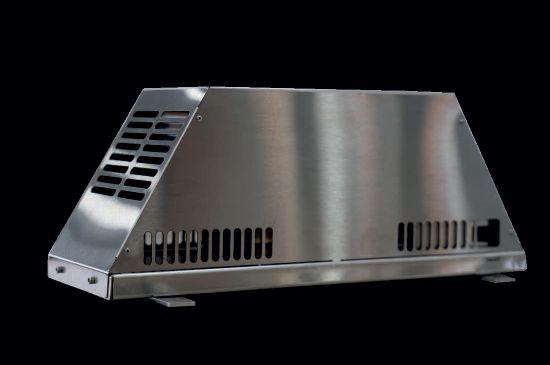
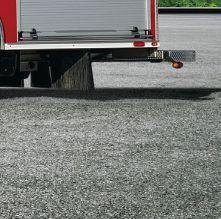
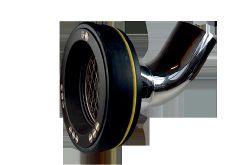
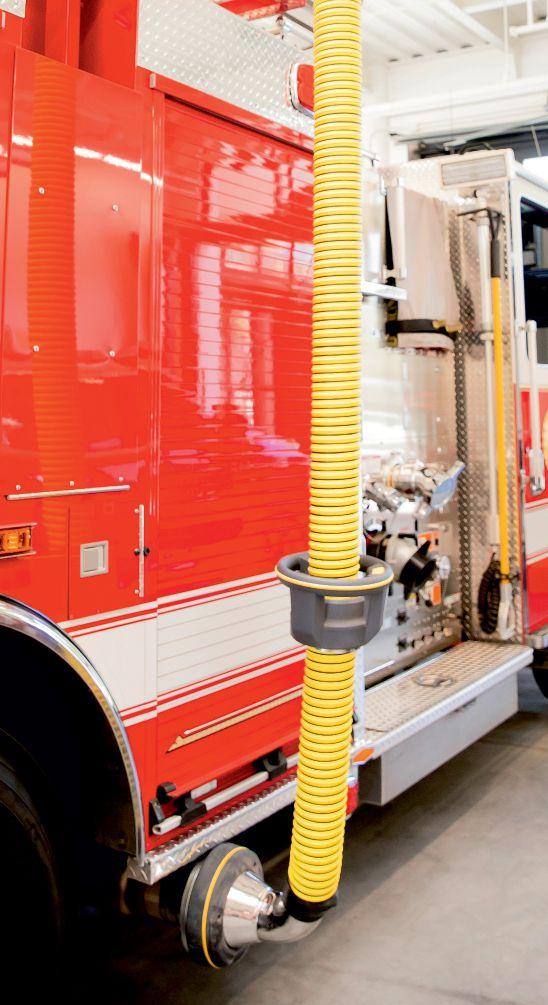
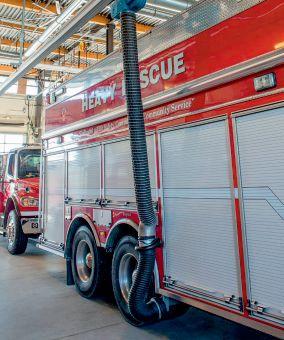
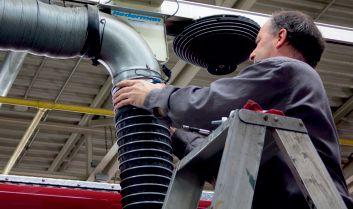
Designed with advanced Photohydroionization® (PHI Cell) and UV technology, the Active Air Purification System kills 99% of pathogens, including the virus which causes COVID-19, in the air and on surfaces delivering better air quality and a safer cab environment for your crew.
Advantages.
▪ Sanitizes air and surfaces
▪ Safe for all passengers
▪ Lowers overhead cost of traditional disinfectants
▪ Millions in service globally
Advanced Technology.
The system utilizes active technology to distribute H2O2 which sanitizes the occupied space and requires no operator or application.
Safe.
Safe levels of naturally occurring hydroperoxides increase the air quality creating a cleaner environment without damaging interior surfaces
AFTER THE INCIDENT
Disinfection technologies for a cleaner cab and firehall have come a long way, and the innovations just keep coming.
By
Laura Aiken
16 GENDER AND FIREFIGHTER RESEARCH
Joy MacDermid, the scientific director of Firewell, shares her perspective on the role of gender in fire fighting research.
By Brieanna Charlebois
30 AN AIRPORT GOES FLOURINE-FREE
A case study of Billy Bishop Airport’s transition to fire fighting with fluorine-free foam. By Mitch Hubert, Mark Siem and Jim Schwander
34 THERMAL IMAGING: HOW MUCH DO YOU KNOW?
Part 3 in our thermal imaging series delivers answers to frequently asked questions. By
Manfred Kihn
BY LAURA AIKEN Editor laiken@annexbusinessmedia.com
TCOMMENT
Where to next?
he pandemic wears on, wears us down and keeps wearing new variants, but the belief that we are on the brink of a better normal is here with the influx of vaccines (I write with hope from Ontario, site of a just announced four-week lockdown and province-wide school closures). After a year and then some (and probably a little more), where to next? What do we take with us from here? As those answers sort themselves into actualities, technology is sure to be one of the most analyzed pandemic revolutionaries on the list. Technology and the pandemic are synonymous with video chat. Zoom, Microsoft Teams, and any other video chat platform are sure to find their longterm place in the mix of communication mediums. We all know what Zoom fatigue is by now, but the opportunities technology is bringing should not be overlooked for fatigue of it. Technology should not be so pressingly synonymous with the internet or computers either. Innovations abound all around us.
We’re taking a look at technologies on the market for the apparatus and the firehall that can help keep firefighters healthier. See story on page 10.
The Merriam Webster dictionary defines technology as “the science of the application of knowledge to practical purposes.” Globally, the internet and this science of application forged minds to give us COVID19 vaccines in record time. In the fire service, this scientific application of technology is driving innovations that also achieve healthier outcomes. The cover story of this edition looks at innovations that are part of the movement towards cleaner cabs and fire halls for healthier firefighters. Another fea-
ture looks at Billy Bishop airport’s transition to non-fluorine fire fighting foam, a product that seems to be making product headlines these days. Manfred Kihn is back with his third installment of thermal imaging tips. Is this technology-focused edition an editor’s subconscious nod to the power of applied science as it’s played out in the last year? Perhaps. Technology has certainly been on my mind. But technology is not all benign. Its deployment by humans has impacts, good and bad. Not all innovations are for everyone (I still don’t enjoy online shopping, no matter its proliferation). Fire chiefs and firefighters will weigh the merits for themselves, but even the most nostalgic amongst us can’t help but admit it’s a pretty fascinating time for technology. The adoption of online education and training, remote communications, and retailing e-commerce were the sprinters of the the pandemic (along with our vaccine developers, of course). And everywhere you look, bright minds are making products to help the fire service do their jobs better and more safely. This column is a nod to them, for the effort and ingenuity that is also a desire to serve, just as the fire service does for Canada.
ESTABLISHED 1957
MAY 2021 VOL. 65 NO. 3
Reader Service
Print and digital subscription inquires or changes, please contact Beata Olechnowicz, Audience Development Manager Tel: (416) 510-5182 Fax: (416) 510-6875
Email: bolechnowicz@annexbusinessmedia.com
Mail: 111 Gordon Baker Rd., Suite 400, Toronto, ON M2H 3R1
EDITOR LAURA AIKEN laiken@annexbusinessmedia.com 416-522-1595
ASSOCIATE EDITOR MAZ ATTA matta@annexbusinessmedia.com 416-435-1779
PUBLISHER ADAM SZPAKOWSKI aszpakowski@annexbusinessmedia.com 289-221-6605
MEDIA DESIGNER EMILY SUN esun@annexbusinessmedia.com
GROUP PUBLISHER/VP SALES MARTIN MCANULTY fire@annexbusinessmedia.com
COO SCOTT JAMIESON sjamieson@annexbusinessmedia.com
PUBLICATION MAIL AGREEMENT #40065710
RETURN UNDELIVERABLE CANADIAN ADDRESSES TO CIRCULATION DEPT.
P.O. Box 530, SIMCOE, ON N3Y 4N5 e-mail: subscribe@firefightingincanada.com
Printed in Canada ISSN 0015–2595
SUBSCRIPTION RATES
Canada – 1 Year - $25.50 (GST - #867172652RT0001) USA – 1 Year $58.50 (CDN) Annex Privacy Officer Privacy@annexbusinessmedia.com Tel: 800-668-2374
Occasionally, Fire Fighting in Canada will mail information on behalf of industry-related groups whose products and services we believe may be of interest to you. If you prefer not to receive this information, please contact our circulation department in any of the four ways listed above.
All advertising is subject to the publisher’s approval. Such approval does not imply any endorsement of the products or services advertised. Publisher reserves the right to refuse advertising that does not meet the standards of the publication.
www.firefightingincanada.com
ON THE COVER
PHOTO BY SHUANL/GETTY IMAGES
STATIONtoSTATION
ACROSS CANADA: Regional news briefs
Camp Courage expands across Canada
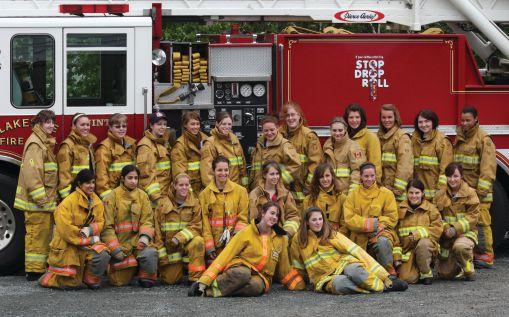
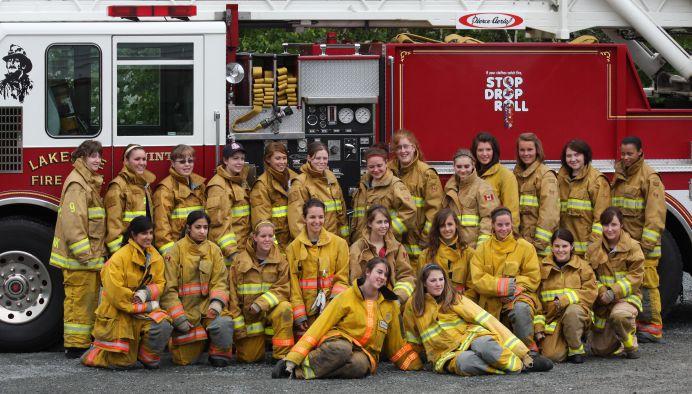
Halifax’s Camp Courage is expanding their first responder camps for females across Canada.
The camp initiative, which runs from two to eight days, introduces young women aged 15 to 19 to careers as paramedics, police officers, and firefighters. Each camp serves up to 24 women.
Camp Courage’s founder, Andréa Speranza, is looking for interested volunteers to start their own Camp Courage in their community. Camp Courage will provide resources like a business plan, marketing plan, guides, and other means to creating a successful community.
“You will need a team of 10 or 30 committed volunteers, facilities, equipment and $5,000 to $30,000 depending on the program duration and level of donations in kind,” shared Speranza.
Speranza said Camp Courage is much more than just preparing them for the job.
“This isn’t just about teaching these young ladies about emergency services careers; it’s about developing our future leaders across the country.”
Several graduates from her camp were inspired to start their own camp, which motivated her to provide the resources needed to “make this opportunity avail-
THE FIRE HALL
Promotions & appointments
RICK MALOTT is the new deputy fire chief for Lasalle Fire Services in Ontario. In 2008, Malott started his career at the Essex Fire and Rescue Services as a firefighter. He continued to climb up the ranks as captain, district chief,
able for every woman in the country.”
Camp Courage also implemented a bursary program for their graduates to help make starting their own camp a smooth and safe experience. Speranza said she knows how much time and money it costs to start a camp from scratch. That’s why she insisted on creating a “very calculated plan” that everyone can use.
“It is difficult to do all these things on your own if you have no background in business or marketing. We’re giving them
BULLETIN
assistant deputy chief and deputy chief.
GUY MCKINTUCK is the new fire chief of Delta Fire and Emergency Services in Delta, B.C. McKintuck is currently the 10th fire chief for Delta since 1963. He takes the mantle from former Chief Paul Scholfield, who retired after serving with the department for 30 years, the last three as chief. Delta’s new
everything they need to be successful.”
Speranza emphasized that having multiple camps nationally can help support training for fire departments. The program is 100 per cent volunteer, free to register, and all camp proceeds go towards the program.
Speranza said that some people are already interested in New Brunswick, Ontario, Saskatchewan, and Calgary. The next camp will go live in July 2022.
– Maz Atta
fire chief has been on the Delta team since 1993. He started off his career as a firefighter, then took other responsibilities as an emergency planner and other leadership positions. He was the deputy chief under Scholfield.
Fire Chief MARK MACDONALD, retired from the Belleville Fire Department, an announcement made in spring of 2021 that was shortly followed by the news
that MacDonald would be taking on the role of fire chief for Cramahe Township, a position that becomes effective March 29. MacDonald is the president of the Ontario Association of Fire Chiefs’ executive committee.
DARREN LEE is the new fire chief for the City of Abbotsford Fire Rescue Services division in British Columbia. Lee joins Abbotsford from the Township
Aspiring first responders can now lead their own Camp Courage anywhere in Canada.
First Nations five times likelier to die in a fire
A new study led by the National Indigenous Fire Safety Council Project (NIFSC) painted a bleak picture within Indigenous communities, concluding that they are over five times likelier to die in a fire.
“Indigenous peoples across Canada are over five times more likely to die in a fire. That number increases to over 10 times for First Nations people living on reserve. Inuit are over 17 times more likely to die in a fire than nonIndigenous people,” reported the study.
Len Garis, director of research at the NIFSC Project, said these results were not a surprise. He said he wasn’t shocked due to similar studies he has viewed in the past regarding First Nations and fire-related incidents.
“Unfortunately, I kind of knew that,” Garis said. “There’s been three isolated studies that have taken place before. Between 2007 and 2011, a study in B.C. on mortalities said they were four times higher.”
The study’s goal was to identify mortality and injury rates for Indigenous peoples in Canada to determine the severity of fire-related deaths
Indigenous people are over five times more at risk in fire-related incidents, which increases to over 10 times for First nations living on reserve.
and injuries, stated a press release by the NIFSC Project. It followed another study conducted earlier this year, which established that many social determinants, such as poverty and inadequate housing, are major factors contributing to the higher mortality rate among Indigenous communities.
Garis said this study was necessary because there isn’t enough fire data on Indigenous peoples since the government “stopped
collecting that around 10 years ago.” A 2016 Toronto Star article quoted Indigenous Affairs Minister Carolyn Bennett as stating that the federal government stopped collecting fire data in 2010 to ease the reporting burden on First Nations communities
In light of these results, the NIFSC Project is offering culturally sensitive fire and safety training and education programs created for and delivered by Indigenous peoples. These programs are
currently available to First Nations living on reserves and individuals working or volunteering in emergency services.
The NIFSC Project is encouraging Indigenous peoples to report fire incidents through the National Incident Reporting System (NIRS).
A goal of NIRS is to provide the missing data regarding fire incidents.
Garis said the NIFSC Project asked Statistics Canada for a possibility and a cost to look at coroners’ data so they have a clearer understanding of mortality rates among Indigenous peoples.
“We can look at it a little deeper, not only based on the potential cases, but also if we can get a little more instruction on the geographical perspective,” Garis said.
The NIFSC Project has already launched nearly 80 programs and services to provide training and ongoing support to more than 650 First Nations communities. A virtual town hall was planned for April 28 to further discuss the mortality and morbidity study.
– Maz Atta
of Langley, where he most recently held the role of deputy chief responsible for training and special operations. He also previously served as chief officer with the City of West Kelowna and the District of Oak Bay.
JAMIE COUTTS is the new deputy fire chief for Chestermere Fire Service in Alberta.
Coutts has been in the fire service for 30 of his 47 years, working up through the ranks as a volunteer firefighter, full-time training officer, deputy chief, and then as a full-time regional fire chief of the Lesser Slave Regional Fire Service. Coutts was part of the 2015 TV show “Hellfire Heroes” and hosts the podcast “Growing Up Fire”.
TIM DOYLE is the new fire chief
of Nanaimo Fire & Rescue in British Columbia. Doyle has been with Nanaimo for 20 years. Between 2014 and 2017, he served as assistant chief until his appointment to deputy chief in 2017. Doyle has been integral, overseeing the construction of the new Fire Station No. 1, recruitment, training, the Vancouver Island Emergency Response Academy (VIERA) and emergency operations.
Retirements
WAYNE RODGER, assistant fire chief for the Saskatoon fire department retired after more than 34 years in the fire service. Rodger started his career in 1987 at a Canadian Forces base in Manitoba, joining the Saskatoon FD nearly 10 years later. He became the fire marshal in Saskatoon in 2009 and the assistant fire chief in 2017.
STATIONtoSTATION
BRIGADE NEWS: From departments across Canada
Wasaga Beach Fire Department in Ontario received this pumper from Commercial Emergency Equipment. This apparatus runs on a Cummins L9 450 HP engine and sits on a Pierce Saber FR chassis. It features a Waterous CSU 1,050 GPM pump, a Husky 3 foam system and holds 1,000 gallons of water.
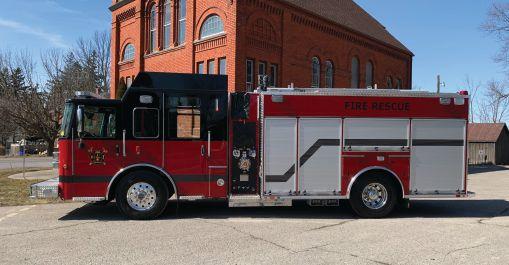
Grey Highlands Fire & Emergency Services in Ontario took delivery of this Crusader pumper from Fort Garry Fire Trucks. This unit sits on a Freightliner M2-106 chassis and runs on a Detroit DD8 330 HP engine. It has an Allison 3000 EVS transmission and is equipped with a Darley PSM1250 midship pump that holds 800 gallons of water.
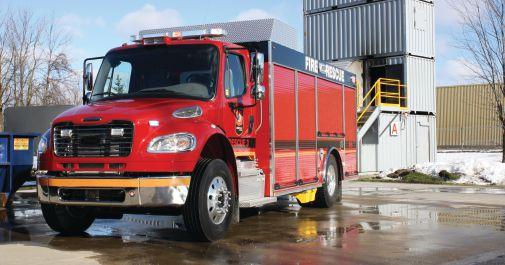
Ontario Power took delivery of this Encore Rescue apparatus from Commercial Emergency Equipment. This unit runs on a Cummins L9, 330 HP engine and sits on a Freightliner M2-106 chassis. It features Gortite roll-up doors, LED compartment lighting and a Lima 40kW Generator.
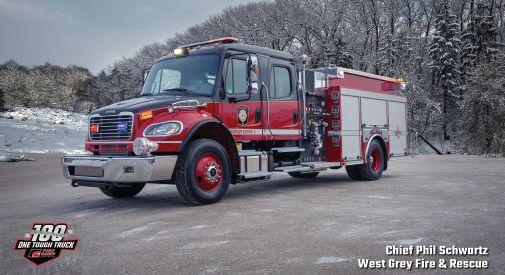
West Grey Fire Service in Ontario took delivery of this pumper from Fort Garry Fire Trucks. This unit sits on a Freightliner M2 chassis and runs on a Detroit DD8 330 HP engine. It has an Allison 3000 EVS transmission and is equipped with a Darley PSM1250 midship pump that holds 800 gallons of water.
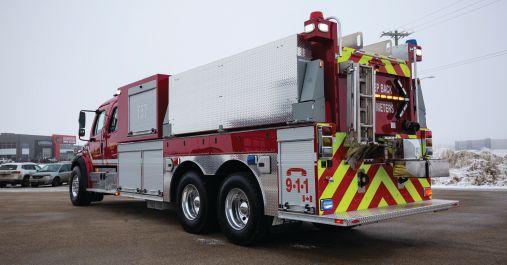
Town of Erin Fire Services in Ontario was delivered this tanker from Fort Garry Fire Trucks. The apparatus sits on a Freightliner M2-112 chassis and runs on Cummins L9 450 HP engine. With an Allison 3000 EVS automatic transmission, the apparatus is also equipped with a portable PFP27HP2D pump and a 3000 IG co-poly tank.
Eramosa Township received this Maximetal pumper from Commercial Emergency Equipment. This unit runs on a Cummins L9 450 HP engine and sits on a Pierce Saber chassis. It features a Hale DSD150 1500 GPM pump and holds 1,000 USG.
WASAGA BEACH FIRE DEPARTMENT
GREY HIGHLANDS FIRE & EMERGENCY SERVICES
ONTARIO POWER
WEST GREY FIRE SERVICE
TOWN OF ERIN FIRE SERVICES
ERAMOSA TOWNSHIP
The new face of firefighting.
After the Incident
Disinfecting and removing toxins for firefighter health and well-being is a front and centre concern that the pandemic has only served to reinforce. Technologies are making it easier.
By LAURA AIKEN
From a cleaner cab to a cleaner firehall, the topic of disinfecting and purifying for better firefighter health has long been on the radar as a matter of importance to fire departments across North America. In 2018, the NFPA published the paper “Developing and Implementing a Fire Service Contamination Control Plan” that recognized the growing concern that exposure to contaminants are a likely source of cancer in firefighters, and other unhealthy outcomes arise from biological or chemical exposures. While the work to date has not included the creation of an NFPA standard for “clean cab” to date, the innovations and best practices being discussed and implemented at the association, firehall and manufacturing level are bringing about widespread recognition of mitigating risks to firefighter health.
The movement has gained momentum and the pandemic has only served to cement the need for technology that will efficiently destroy pathogens, carcinogens and any of the other dangerous foreign substances firefighters may face.
This article serves as a follow-up to the cover story in the November edition of Fire Fighting in Canada that focused on products, services and best practices for a cleaner cab. For the May edition, we are revisiting spraying systems for disinfection as well as look at recent technologies in air purification.
■ SPRAY IT AWAY
The AeroClave decon system is one innovation proving itself efficient and effective at mass disinfection using fogging technology. AeroClave, an American company, was founded in 2003 by Dr. Ronald Brown, an emergency room physician, as a way to disinfect aircraft in response to the SARS epidemic of that time.
In Canada, John Witt, president of Safetek Profire, counts Safetek as a pioneer in Canada’s cleaner cab movement and is the exclusive AeroClave distributor
for the public safety market in Canada. Witt has developed expertise in cleaner cab practices, presented on the subject at fire industry events and shared his knowledge with Fire Fighting in Canada as part of this feature. The AeroClave system is being used at a number of Canadian fire departments, including Winnipeg, Vaughan, Ont., multiple British Columbia departments including Vancouver, Burnaby, Saanich and Richmond, where Fire Chief Tim Wilkinson provided insights for the clean cab article that ran in November.
Here’s how the AeroClave misting technology works to prevent the spread of infectious disease, including COVID-19 (Health Canada approved when used with its cleaning partner Vital Oxide).
Vital Oxide, a broad-spectrum hospital disinfectant, is effective against yeasts, bacteria, viruses and mildews, all of which can be hazardous to human health. Vital Oxide destroys the well-known not-so-novel pathogens — MRSA, Ebola, HIV-1, Hepatitis B and C, E. Coli, Norovirus, H1N1 and Legionella alongside COVID-19. The main ingredient in Vital Oxide is chlorine dioxide and although chlorine is in the name it is not comprised of the same chemistry as household bleach. Vital Oxide contains no volatile organic compounds (VOCs), is safe on the environment and people, doesn’t irritate the skin or require gloves and no rinsing is needed.
One of the benefits AeroClave sells itself on is the premise that manual cleaning can mistakenly spread pathogens around rather than eliminate them. It also bills itself as less labour-intensive and cost-effective. There are three phases to the AeroClave process that can be used in rooms or fire trucks: Injection (apply the aerosol), Dwell (let sit for at least 10 minutes) and Aeration (remove the solution through ventilation or air circulation, though it will also break down naturally).
In 2015, James White, then fire chief in Winter Park, Fla., authored a case study for AeroClave on the department’s use called “Reducing the Invisible Threat of Infection in Fire and EMS Personnel”. In regards to reducing the personnel and financial impact of infection, a retrospective analysis showed a 34 per cent reduction in unscheduled leave time since the AeroClave was added to the disinfection routine, which White wrote that it created a positive fiscal impact
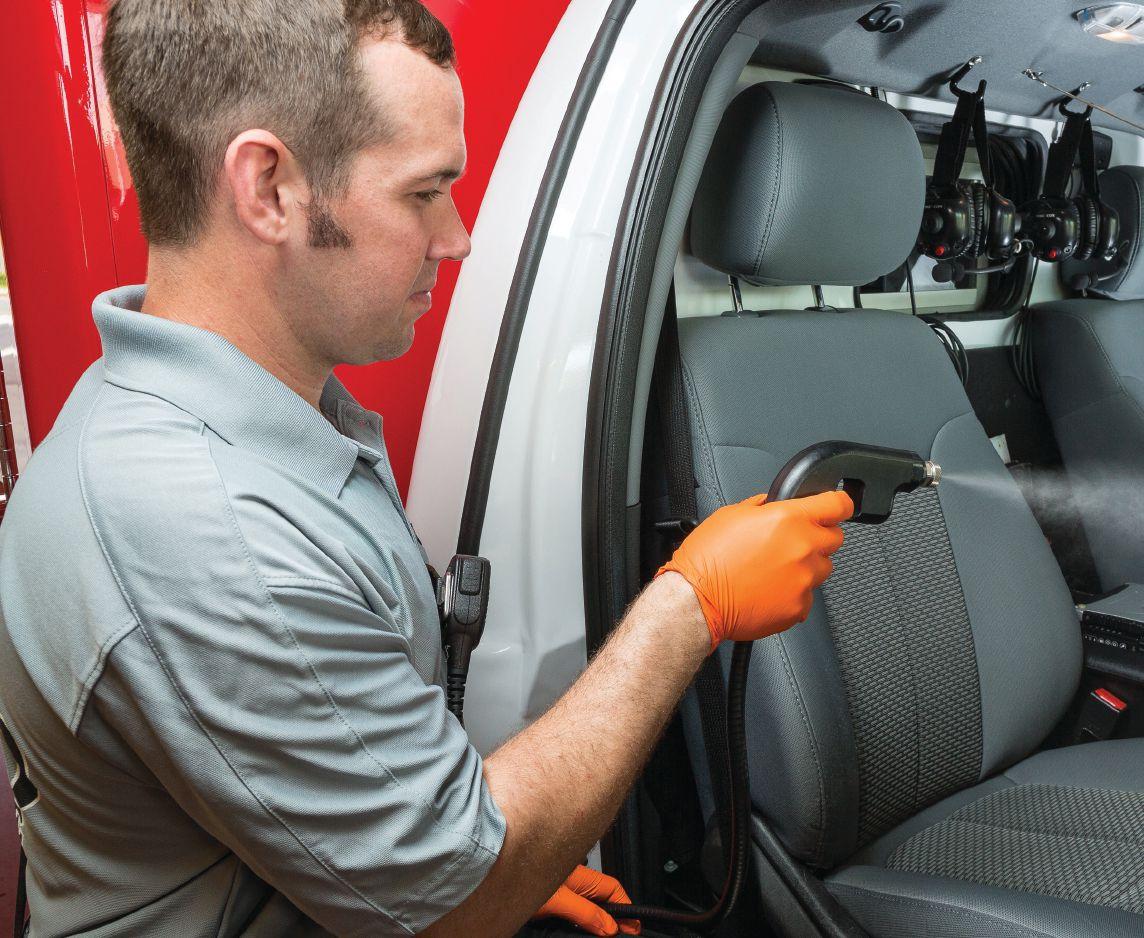
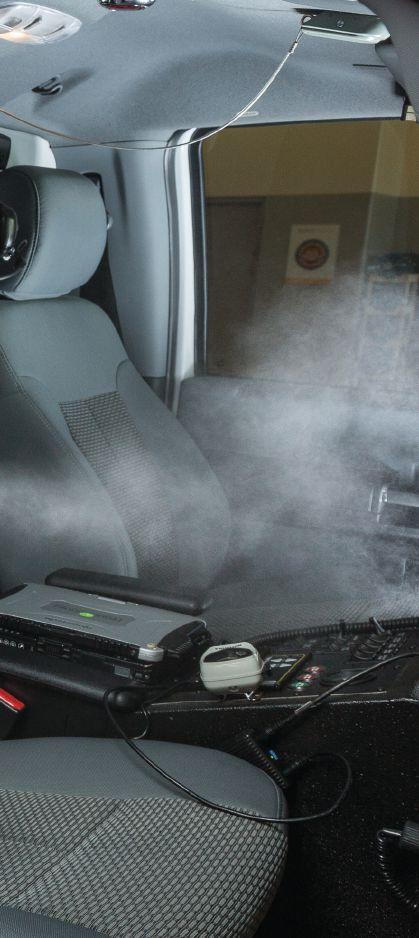
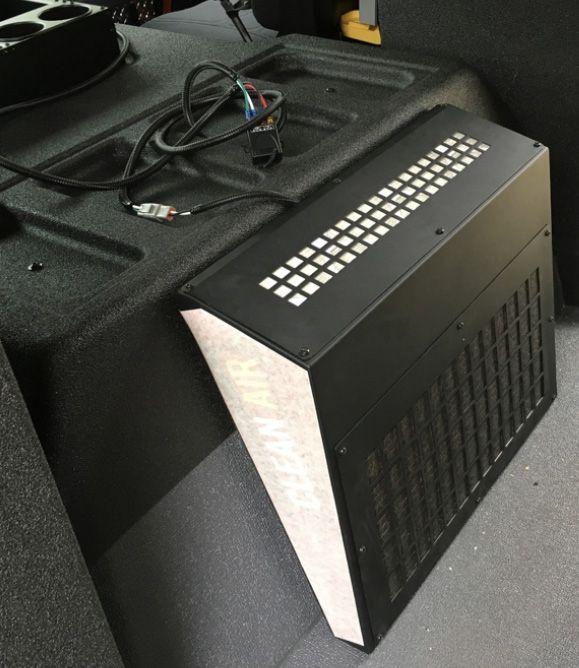
LEFT The AeroClave system at work. ABOVE Rosenbauer’s patent pending re-circulating CleanAir scrubber.
alongside being good for health. The analysis acknowledged there are number of factors that prevent a direct cause and effect use of departmental sick leave as sole indicator of AeroClave cost-effectiveness – the time off may not always be due to illness, they may work other jobs in high risk health care settings, there are enough variables that it wouldn’t stand up to rigorous peer review, but the trend affirmed the health of the department’s firefighters was headed in the right direction. The cost is cited at about a dollar (US) per treatment. In our November “Clean Cab” cover story, Chief Wilkinson in Richmond, B.C., shared that the department has been using an AeroClave system for several years that is incorporated into the cab and plugged in from the outside so no one has to enter to start the decontamination process. Wilkinson also concluded that it is a cost-effective system with visible reduction in sick time due to illness.
In 2015, White was citing MRSA as one of the significant concerns for first responders. Today, it is COVID-19. There will be something else. Fun fact: National Geographic reported that, “an estimated 10 nonillion (10 to the 31st power) individual viruses exist on our planet—enough to assign one to every star in the universe 100 million times over.” We are surely and infinitely outnumbered.
■ CLEANING THE AIR
Alongside disinfection via cleaners, there are technologies making strides in the realm of air purification in the cab. Joe Lichtscheidl, a Rosenbauer sales manager, talked to Fire Fighting in Canada about the company’s patent-pending CleanAir re-circulation scrubber system, which has been designed and tested to the ASHRAE Standard 145.2-2016 in collaboration with the Particle Calibration Laboratory at the University of Minnisota. The University of Minnesota provided a summary of results from their testing. A 50 per cent reduction in VOC concentrations happened in about two minutes with a further 80 per cent reduction occurring by the five-minute mark.
The CleanAir system employs two filters to get the job done, cycling three times every 10 to 15 minutes. In stage one, the large particulates, like soot from fire, are pulled from the air with an electrostatic MERV-15 filter. In stage two, activated coconut shell carbon and potassium permanganate work together to remove VOCs. The two filters work in conjunction with one another, says Lichtscheidl. The CleanAir system can be retrofit to almost any vehicle.
CleanAir, which was introduced at the 2019 FDIC show, is available through dealerships in the U.S. and Canada.
In addition to AeroClave, Safetek Profire sells the Active Air Purification System as part of its suite of cleaner cab technologies. The Active Air system uses advanced photohydroionization (PHI) and UV technology to kill 99 per cent of pathogens, including COVID-19, in the air and on surfaces, having shown to reduce the trajectory of sneeze germs by 99 per cent within three feet. Active Air can also be retrofit to vehicles, and Safetek’s website describes the mechanics of how it works as this: “Low doses of airborne hydroperoxide ( H2O2) are generated and revert back to oxygen and hydrogen once they come in contact with and eliminate bacteria, creating a safer and cleaner cab environment.” Active Air Purification is shock and vibration tested and is available through multiple dealers.
Being a firefighter is an inherently risky but also inherently rewarding job. The health and wellness of our nation’s fire fighting crews, who are truly all hazards responders, continues to be an area where technology is rising to the occasion and delivering effective and efficient ways to provide a cleaner cab.
Unparalleled
Reliability, Innovation and Quality
First Alert fire safety products provide reliable protection families have trusted since 1958.
Gender and firefighter research
A Q&A on the growing attention to gender in firefighter research
By BRIEANNA CHARLEBOIS
Women make up a small but growing number in the fire service and MacDermid says it is always important to consider the impact of gender differences when doing research.
It was a pleasure to interview Joy MacDermid, PhD, for this Q&A on her research about women in the fire service. MacDermid is the scientific director of Firewell. She is a physical therapist, hand therapist, epidemiologist and holds a CIHR New Investigator Award. She is co-director of the Clinical Research Lab within the Roth | McFarlane Hand & Upper Limb Centre and an associate professor at the School of Rehabilitation Science at McMaster University.
Q: Can you give us an overview of your career and how fire fighting fits into it?
I was trained as a physical therapist first, but after a few years I went back to school to pursue my PhD in epidemiology. I had a lot
of experience working with patients on all different issues and kinds of work, and sometimes this included firefighters. I then took on a faculty position at McMaster University in 2001, working mostly on issues related to musculoskeletal problems. While I was there, firefighters actually approached me to say they were having a lot of musculoskeletal injuries and asked if it would be something I’d consider researching. In those days it was actually extremely hard to get any funding, so we conducted the first few studies into firefighters without any funding, just meeting regularly, and that was essentially how I began my research into firefighters.
Q: What was the focus of this research? When we met with firefighters, there were
many emerging trends facing the industry and we focused on three key issues: high rates of musculoskeletal injuries, high rates of mental health issues and higher rates of cancers in firefighters when compared to other first responders.
We started looking at the early experiences of first responder women in Hamilton, Ont. There were only five women firefighters in whole service at that point in time and about 350 men. Four out of the five women were willing to be interviewed about their experience in the workforce and about being a woman in a male-dominated occupation.
Q: What were your biggest takeaways from your study on women in the Hamilton Fire Department?
I really loved that study because the themes that presented themselves through that qualitative study, and in interviewing these women, are still relevant today. The women said they loved being firefighters but they definitely recognized the differences compared to their male colleagues, specifically in terms of physicality. They had this strength deficit that really put a focus on training and keeping their strength up. They also talked about the importance of having respect. They wanted to earn that respect. They didn’t expect it to be just given to them, but some felt that some of their male counterparts felt they weren’t supposed to be there. Of course, sometimes, there were negative consequences to that. It won’t feel like a great work environment if you feel unwelcome, but it can also affect training and cooperation when doing tasks, especially with fire fighting because it requires people to work together.
are better or worse at handling some of the critical traumas or whether they respond differently. What we know now about mental health in general is that men and women tend to respond differently to stressors and they also manifest mental health symptoms differently. So, for example, depression might look different in women than it does in men. Men might feel more stigma about expressing mental health symptoms than women and that can be a barrier to them getting appropriate help. It’s not always that when we study sex or gender, we’re saying that women are always disadvantaged. Sometimes men are disadvantaged and we have to study it to so we know how we can help and benefit both.
Q: How do the social differences between men and women present within the fire service?
Anyone who feels like they’re the minority in any environment—in the case of the fire service, it’s three per cent who identify as women—it’s likely to have some sense of social isolation. For women, in some services, they may be the sole woman in their service or on one particular shift so that’s why I think organizations like Fire Service Women of Ontario are so important. They give women a sense of community and that social connection they may not have otherwise. There’s definitely some evidence that this is even more important for women than for men so the social needs might be different for each gender. Then, we know that gender intersects with other things, like race for example, so if you feel you can’t identify with others in your workplace, that can also lead to greater feelings of isolation.
The other thing we noted was the notion that women are not small men. They have different body shapes. Traditionally, women have been given small men’s equipment but it doesn’t fit the proportions of their bodies properly. One of the really nice things that happened during that study was some of the collaborators on the project, who were men, decided to fix that issue — firefighters are very task-oriented — and find someone who made equipment for women. Even before that paper was issued, that problem was already resolved in the Hamilton fire department. I think Canadian services have moved a lot in that direction in terms of realizing that equipment fit is important for men and women and they may need to do a little bit of extra effort to find equipment that fits women but there’s still definitely room for improvement there.
Q: A lot of your research has focused on firefighter injury statistics. Can you expand on how genetic, biological and hormonal differences between men and women come into play in in firefighting?
There’s so many differences between men and women and it’s always important to research these differences and look at whether they have an impact, but it’s also important to recognize that sometimes there aren’t differences. When we talk about these differences, we are talking about groups and not individuals. For example, men are usually taller than women, but there are some women who are taller than men, so some of these findings don’t apply to specific individuals, and it’s important to respect that individuality too. That said, on average, there are many clear differences and distinctions, and they do play a role. For example, women’s biology will affect how much weight they can carry during a given task. When they are exposed to toxins, women might be more at risk of certain cancers than men, or their systems might respond differently. Another issue is psychological exposures. We don’t know enough about this to determine if women
Firefighters also deal with high-stress conflict in situations all the
Joy MacDermid, the scientific director for Firewell.
time, and men and women have different skillsets they can bring into those situations. We don’t have as much research on that but I’ve heard anecdotally that lots of male firefighters like having women at those situations because they have a different skillset that they find beneficial in those settings. So, on both sides of the fence, in terms of social needs and also social skills, there’s a lot we have to learn about sex and gender and how we can make sure that it’s a welcoming place for all. We need to work to maximize the skillsets that firefighters have in terms of their social skills because that’s become an increasingly important part of their role.
Q: How does behavioural health fit into this discussion around sex and gender, specifically in terms of discrimination, harassment and/or job satisfaction?
The research conducted into this topic has found that when people are harassed at their workplace, they tend to report decreased job satisfaction and develop more mental health issues. The main message is that if employees are treated well, they will be healthier. This is certainly true for both men and women. We have to work to make it a healthy environment for people so when the inevitable stressors and exposures happen, firefighters feel supported and free of discrimination within their work environment.
I think it’s important to note that there isn’t a real big discrimination problem, to my knowledge, within the Canadian fire service, but the reality is that there aren’t as many women or gender-diverse people and the racial diversity often doesn’t reflect the communities that they serve, so, as people become aware of that and move toward making the fire service representative of the populations they serve, it will be something departments need to pay attention to.
Q: Why should research consider sex and gender differences?
There are many reasons and one example we often reference is about how most of the research into pain used male rats but that means we don’t really understand the female physiology of pain as well as we do for men. It’s been just recently that we’ve become more aware of how important it is to consider sex and gender in every research project. There’s very few exceptions where it doesn’t supply. It’s important to consider sex, gender and their intersectionality with race and culture and social things as well because that will affect work in every workplace. The main reason is that we can’t be sure that the results from a study on one group will apply to a different group, meaning if the research is done on men, we don’t know if it’ll apply to women and vice versa. We’ve found that you could actually make big mistakes in terms of treatment programs when you don’t take this into consideration. This has been seen in pain studies, but also in studies of heart disease. In much of the early research, it was thought that heart disease only kills mostly middle-aged men, but we now know that it’s one of the top three killers for both men and women. It was because the research only focused on men that, for the longest time, we didn’t know heart disease presented differently for women; that their symptoms don’t look the same. The consequences of not considering sex or gender may also result in making big mistakes in treatment planning. It’s about recognizing that the same drug and/or treatment that works for men may not help women. We need to know how an issue presents in a person and what treatment will work. That can only be done if we do the research and have the knowledge first.
Brieanna Charlebois is the former associate editor of Fire Fighting in Canada and the newly minted editor of its sister publication Blue Line, serving Canada’s police force.
Best-in-class max. available payload of 7,850 lbs*
Max. available diesel towing of 37,000 lbs**
2021 SUPER DUTY 2021
Best-in-class‡ max. available payload of 3,325 lbs
Best-in-class† max. available towing of 14,000 lbs
When you’re building a business, you need the best. The 2021 Ford Super Duty is a powerful business partner. Designed with productivity in mind, the all-new Ford F-150 – with its available Tailgate Work Surface comes ready for the worksite, and its class-exclusive^ available Pro Power OnboardTM offers exportable power on demand to help keep you running until the job’s done.
BY MATTHEW PEGG Fire Chief Toronto
ALEADERSHIPFORUM
Leadership presence
number of years ago, I was attending a course at the Ontario Fire College alongside a number of fellow fire service leaders. As was always the case, after the classes had ended for the day, we all gathered for dinner and some time together as colleagues and friends afterwards.
To be honest, I don’t remember which course we were taking, yet I vividly recall the evening debate that found its way into the discussion on this particular night. Amidst some laughs and fun, we found ourselves debating the topic of leadership presence and specifically whether chief officers should still be engaging directly in significant issues, incidents and events.
There were some who felt strongly that the authority and trust in frontline officers is undermined when senior officers engage in an issue or respond to an emergency scene and that senior officer engagement should be reserved for only the most major of situations. Others felt that the role of today’s fire chief ought to be one of an administrative CEO, leaving the operational aspects of the job to those in operational leadership roles. Still others felt strongly that senior officers need to be visible and engaged and that doing so enhances both team morale and confidence.
There has been a lot of water go under my personal bridge since that discussion. I have more experience than I did then, have seen more, have made more mistakes and have continued to learn from those around me. Most recently, I have the opportunity to look back over more than a year in the role of COVID-19 Incident Commander and think about all that we have endured, achieved, learned and experienced together.
to protect the safety of others and to be the face of calm against a backdrop of anxiety, fear and uncertainty. When successful, we bring a sense of hope and confidence that the present issue, situation or emergency will be well managed and that we will lead the way back to a place of safety, security and calm.
One of the sincere yet unexpected privileges that I am enjoying amidst the challenges of leading the response to COVID-19 in our city has been to work closely with retired general Rick Hillier, who is leading the province of Ontario’s COVID-19 Vaccine Distribution Task Force. I had heard General Hillier speak in the past and had read his book entitled Leadership: 50 Points of Wisdom for Today’s Leaders. In his book, Hillier explains that leaders must “show up” when things aren’t going well. He further explains that this need is most evident when those on the frontlines begin to question themselves, look over their shoulders and begin thinking about retreating from the mission at hand. This is when the leader is needed most to “stabilize the situation and reassure and reinforce his or her followers.”
I have the privilege of working alongside Hillier on a daily basis as we serve in our respective roles in response to COVID-19. What
Effective leadership presence is unmistakable when it exists –and undeniably absent when it is missing. ‘‘ ’’
What I find interesting, though, is that my opinion on the topic of senior officer response and engagement hasn’t changed. In fact, my feelings on the subject of leadership presence have only become stronger as my experience as a leader has continued to grow. My position that night at the Fire College and my position today remain unchanged: In times of trouble, uncertainty and fear the most important thing leaders can do is be present, visible and engaged.
As fire service and first response professionals, we are called upon to make the very worst day of someone’s life better. We are asked and expected to efficiently bring order to chaos, to take calculated risks
Matthew Pegg is the chief with Toronto Fire Services, having previously served in Georgina, Ajax and Brampton, Ont. He is currently the incident commander for Toronto’s COVID-19 response. Contact Matthew at matthew.pegg@toronto.ca and follow him on Twitter at @ChiefPeggTFS.
impresses me most about this man is actually not his simply extraordinary CV and experience, but the extent to which he practices what he preaches. He shows up and leads from the front with energy, confidence and enthusiasm. The tougher things get, the more I hear from and see him. His presence is unmistakable and inspires confidence each time he reassures his team that they will succeed in this mission and beat COVID-19. Hillier has unmistakable leadership presence.
Oftentimes, leadership presence isn’t about giving orders, taking command, providing direction or even making decisions. Rather, leadership presence is often about choosing to stand alongside and in front of our teams in the face of conflict, adversity, challenge and even danger at times, rather than choosing to leave those functions to others to manage in our absence.Effective leadership presence is unmistakable when it exists – and undeniably absent when it is missing.
Some workplace hazards are more dangerous than others
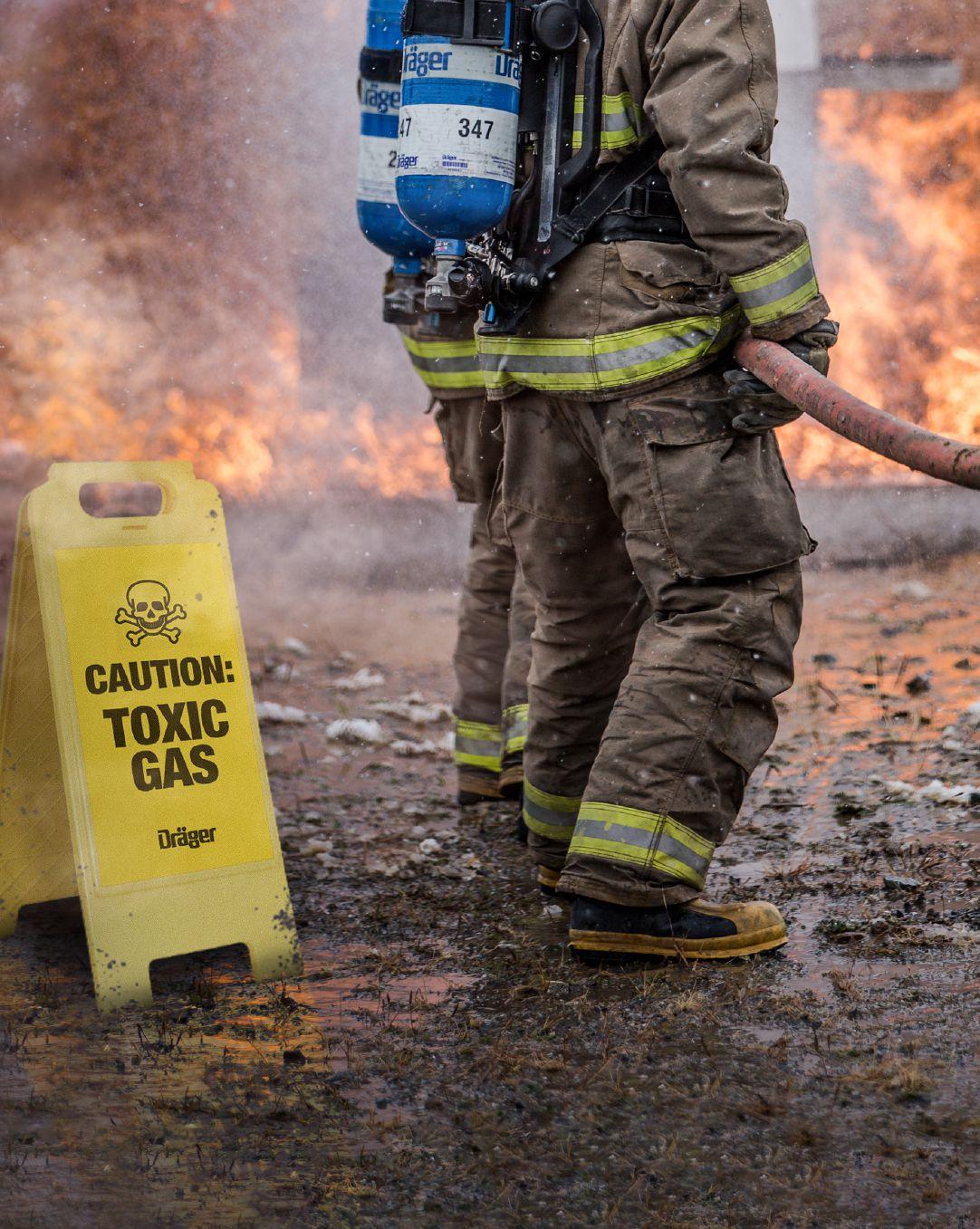
Help ensure everyone comes home safely with Dräger solutions for fire services.
BY GORD SCHREINER Fire Chief Comox British Columbia
IThe truth about bad apples STOPBAD
t’s true: One bad apple can spoil the whole bunch.
I am in my 46th year in the fire service. I still feel young and think I have a more to offer. I have built a reputation of being a hard-working, honest and ethical man. I do not believe there is any other path in life. We have no room in our industry for those who do not want to do the right things!
Over the years, I have met a lot of great people and I have made many lifelong friends in the fire service. On the other hand, I am embarrassed by the very few bad apples that are out there. There have been a number of stories about firefighters, including chief officers, behaving inappropriately. I, like many others, strongly believe that good leadership is vital to a healthy organization. If leaders are behaving poorly or allowing poor behaviour from their firefighters, the negative effects ripple through the entire organization. Some of these firefighters were bad characters to begin with and should never have been hired in the first place. You cannot change a person’s character by hiring or promoting them. With this in mind, we need to do our part to ensure that we hire the best and teach them the importance of ethics. We need to let them know that inappropriate behaviour is not accepted in our organizations. Very simply, we need to lead by good example.
Unfortunately, there are a lot of stories about firefighters behaving badly. So many that I think we could start a reality series titled “Bad Apples”. There would be a lot of content. The episodes would include stories of firefighters making racist remarks, drinking and driving, drinking in public vehicles or at their fire stations, drug use, misuse of public vehicles, misuse of public funds, inappropriate relationships, conflicts of interest, fake degrees, treating our customers poorly, improper training . . . need I go on?
shared much easier and faster than ever before. Make a mistake in the morning and it is possible that millions of people will know about it by lunch time.
I know firefighters are just regular people, but we should still expect them to behave properly, at the very least. I would hope that they would go above and beyond to demonstrate great character. As a firefighter, you have a duty to act appropriately. When you accept the position you have an obligation to be honest and ethical; anything less is unacceptable. If you can’t do this, get out now. While 99 per cent of the firefighters out there are doing the right things right, a small percentage of bad firefighters are making us all look bad. One of the most important things in your life should be your reputation and the reputation of the organization you represent. Good or bad, your reputation is known by the people around you. You are accountable for yourself, no one else is. Do what is right and you should have no worries; do wrong and you could lose your job and your good reputation very quickly. I believe all fire service members can be a part of the solution by letting others know if their behaviour is unacceptable. (It would be nice if they could figure this out by
‘‘ While 99 per cent of the firefighters out there are doing the right things right, a small percentage of bad firefighters are making us all look bad.
’’
Poor behaviour such as this is totally unacceptable; it’s shameful and it blemishes the entire fire service. It is hard to believe these things happen. One would hope only the best would be hired (including volunteers firefighters) or promoted. The problem is an individual’s bad behaviour can negatively affect the reputation of the fire service. Today, with the reach of social media, stories are now
Gord Schreiner joined the fire service in 1975 and is a full-time fire chief in Comox, B.C., where he also manages the Comox Fire Training Centre. He has delivered countless presentations in fire stations all over Canada and is available to assist your department in many areas. For more information please contact: Chief Gord Schreiner, firehall@comox.ca.
themselves, but sadly, many can’t). Tell them their poor behaviour (and bad reputation) hurts us all. Annual surveys show that the fire service is one of the most trusted professions. This will surely change if we do not take the necessary steps to address this problem. There are a lot of great people in the fire service who are ready to step up and make a positive difference. Let’s call bad apples out and let them know that their inappropriate behaviours are unacceptable. By doing so, you might help them correct their careers before it is too late, and you will help us all continue to make the fire service better; you may even help save lives.
I have a reputation of speaking up and saying what is on my mind and I plan to continue to do this until I retire. If I think something is wrong, I will say so. I ask that you do the same.
Please stay safe out there!
BACKtoBASICS
Ladder Dating: When to use two firefighters
BY MARK VAN DER FEYST
In our series on ground ladders, we have focused on the use of one firefighter for ladder carries, deployment, and working off when on the fire ground. Many, if not all firefighters, have been taught to always use two firefighters when carrying or using a ground ladder. While I have been advocating the use of one firefighter in these instances, there are times when two firefighters may be available or needed to be used for ground ladder operations.
When two firefighters are available for ground ladder assignments, their efforts need to be maximized to be effective on the fire ground. This will involve using both sets of hands to carry required tools, equipment and ground ladders.
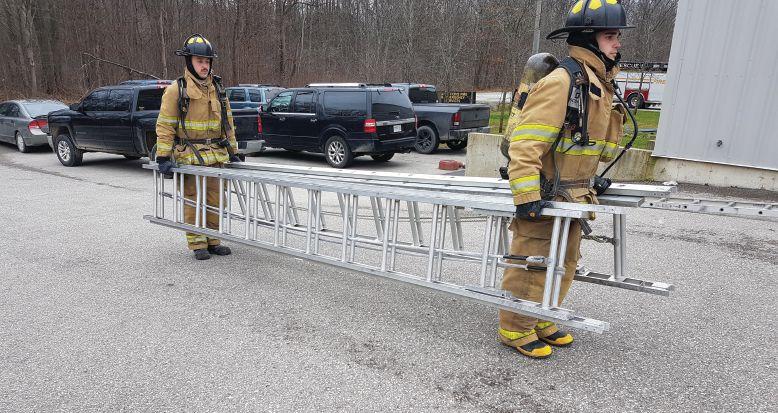
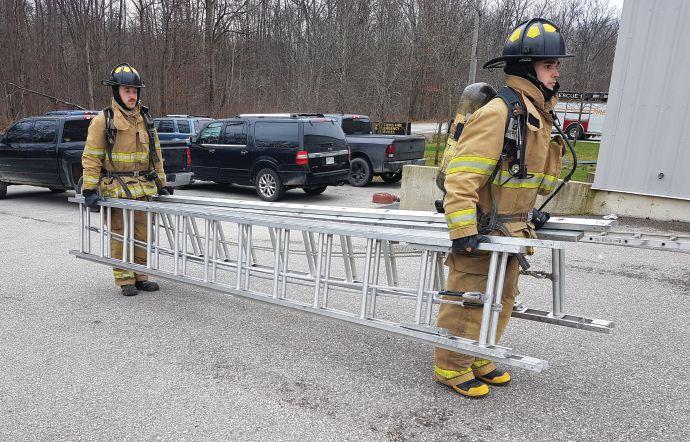
One such instance of where two firefighters will be needed is when there are two ground ladders to be carried. In the first photo, you will see an example of this. The two firefighters are carrying two 24-foot ground ladders at once. Using the suitcase handle, they are able to double their efforts in one travel as opposed to carrying one ladder at a time and making two trips. This can be done for any ground ladder combination, such as 28-foot ladder and a 24-foot ladder, or a 14-foot roof ladder and a 24-foot ladder.
Another situation for using two firefighters to carry a ground ladder is when there is a need for longer-than-normal ground ladders, such as the 36-foot ground ladder or a 40-to-50-foot ground ladder. Any three-section ground ladder will be heavy, requiring two firefighters to carry –although I have seen one firefighter carry a 36-foot ladder. The ladders that have stay poles attached to them will definitely need two or more firefighters to not only carry it, but also deploy it against the building.
Photo 1: The two firefighters are carrying two 24-foot ground ladders at once. Utilizing the suitcase handle, they are able to double their efforts in one travel as opposed to carrying one ladder at a time and making two trips
PHOTOS BY MARK VAN DER FEYST
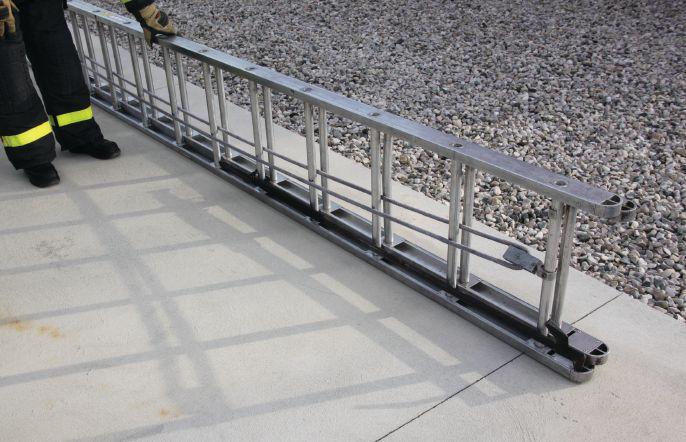
Photo 2: The roof hook can be mounted along the lower side beam of the ladder and tucked into the space between the firefighter’s leg or shoulder when carrying it.
BACKtoBASICS
Even with a 36-foot three section ladder, two firefighters will be better than one to raise and set it against a building.
Using two firefighters to carry any one or two-section ground ladder is a waste of manpower on the fire ground. If this is the case, there must be an abundance of firefighters on scene who can be used for this assignment. Usually, fire departments are struggling for available hands to complete critical assignments, which involve laddering a building. Fire departments must prioritize which assignments will be completed first based on available manpower. Fire departments need to learn how to operate using one firefighter for several tasks that do not require having two.
I mentioned earlier about using all available hands to carry ground ladders, as well as tools and equipment. There are many ways a firefighter can arrange their tools or equipment with a ground ladder to carry both at once. Examples would be the roof hook or pike poles – they can be mounted along the lower side beam of the ladder and tucked into the space between the firefighter’s leg or shoulder when carrying it. (See photo 2)
If the ladder is being used to gain access to a roof, and there are a number of rungs above the roof line, the ladder may need to be heeled.
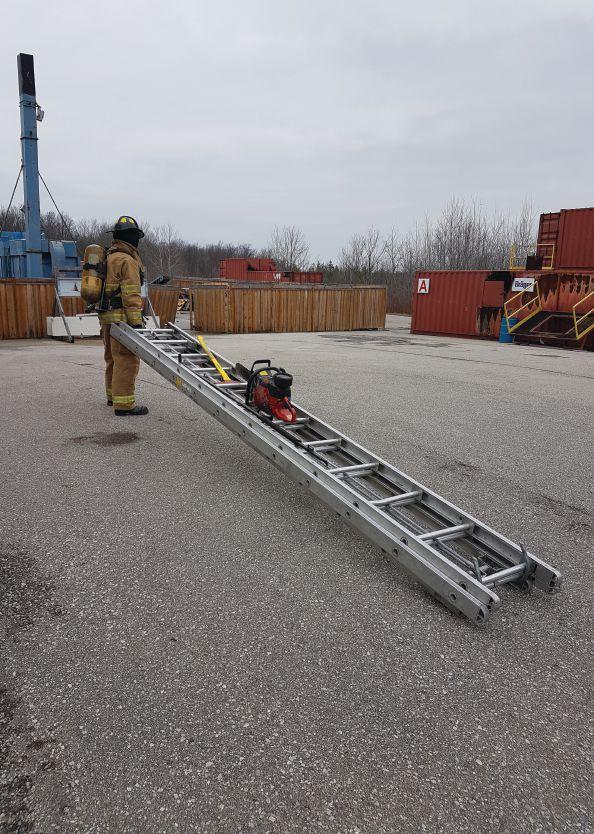
Another example would be to arrange the two ground ladders on top of each other like a stretcher, then place the needed equipment on top of the ladders, such as the saw, axe, halligan, pile pole, or roof hook. Once loaded up, one firefighter will grab the tip end of the ground ladders, and the other will grab the butt end of the ground ladders and walk it to their needed position. The third photo shows an adaption of this by using only one firefighter to drag the ladders along, but a second firefighter could be used to help carry them.
Another area where two firefighters are needed for ladder work is with heeling the ladder. Depending on the surface of the ground, the ground ladder will need to be either heeled or not heeled. If the ground is a hard surface like concrete, the ladder will definitely need to be heeled. If the ground is soft like grass or asphalt, the ladder can be used by one firefighter without heeling it. The butt spurs of the ladder will dig into the soft ground and hold, providing the ladder angle is not at an extreme deviance from the normal 75 degrees. We looked in more detail about heeling the ladder back in November 2020 – you can refer to that article for more information on it. Depending upon what the task is being completed using the ground ladder, a second firefighter will not be needed for heeling it. If the ladder is positioned below a windowsill on soft ground, that ladder is not going anywhere. If the ladder is being used to gain access to a roof, and there are a number of rungs above the roof line, the ladder may need to be heeled. The firefighter climbing up the
ladder needs to be aware of how high they climb above the roof line before stepping off the ladder and onto the roof. If they climb up two or three rungs above the roof line, the ladder will most likely kick out. Yet, if they only climb up to the roof line and step off onto the roof, the ladder will not kick out. The firefighter’s work experience will dictate whether they need to have the ladder heeled or not.
There is certainly a place and a need for working in teams of two on the fire ground, but there is also a time and place for when the task can be accomplished with using one firefighter, especially when there is only one available. Departments need to train like they play. If they are playing with a limited staff situation, they need to practice looking at what one firefighter can do and when they could use two firefighters.
Mark van der Feyst has been in the fire service since 1999 and is currently a firefighter with the FGFD. He is an international instructor teaching in Canada, the United States, FDIC and India. He is a local level suppression instructor for the Pennsylvania State Fire Academy and the lead author of Fire Engineering’s Residential Fire Rescue book and other DVDs. He can be contacted at Mark@FireStarTraining.com.
Athletic feel and firefighter strong, our lightest structural fire boot yet
Photo 3: A firefighter can arrange the two ground ladders on top of each other like a stretcher, then place the needed equipment, such as the saw, on top of the ladders.
PHOTO BY MARK VAN DER FEYST
BY TINA SARYEDDINE Executive Director Canadian Association of Fire Chiefs
GUESTCOLUMN
What’s new at the CAFC?
rgency has never been a stranger to the fire service. The same applies to the national association representing the country’s fire chiefs. With so many issues and opportunities facing our sector, the country’s fire service leadership has rallied for a better Canada and a better future. Let us share with you some of the fire sector challenges the Canadian Association of Fire Chiefs (CAFC) has been working on.
Addressing 10 in 10: Over the past year, CAFC designed a new strategic plan with the challenges of the next decade in mind. Data from over 100 sources helped the CAFC identify the top 10 challenges to 2030 (budgets, affordability, all hazard nature of fire response, mental health and wellness, equity, diversity and inclusion, technology, changing expectations of the fire service, data and culture). To address these, we’ve expanded the four pillars to include research, policy and advocacy, messaging in service of the sector, programs and services and creating a CAFC for all. The new mission is advancing a safe, effective and sustainable fire and emergency service across Canada. The new vision is ‘Canada’s fire and emergency management leaders united in service of public health and safety’. A report is available on the CAFC website.
Supporting Canada’s future fire service leaders: Fire chiefs, for the most part, are seasoned professionals who have accumulated a great deal of experience. Many of these individuals could retire at any time. The question is: when they do retire, who will be ready to take over? With a view to encouraging leadership, the CAFC will offering a free membership to all company officers who wish to enroll in the Executive Chief Fire Officer (Aspire) program which allows individuals to develop nationally relevant competencies before taking the official role of fire chief. You can apply on the CAFC website.
Census Day 2021: For the last few years, we’ve numbered 126,000 volunteer firefighters in Canada based on NFPA data taken in 2016. Is this number still accurate? To answer the question, the CAFC will be launching the Great Canadian Volunteer Firefighter Census. If your department has not filled in the census form, please do so as soon as possible. You can access it on the CAFC website. See Fire Chief Vince MacKenzie’s Volunteer Vision column in this issue of Fire Fighting in Canada for more details.
100 fire chiefs join forces on ED&I: No one claims to have all the answers when it comes to making the fire service look more like society, but 100 of Canada’s fire chiefs have joined together to ask the right questions: how can we raise the bar on improving equity, diver-
Tina
Saryeddine, PhD, MHA, CHE is Executice Director of the Canadian Association of Fire Chiefs. You can read more about the CAFC at cafc.ca.
sity and inclusion in the fire service? Through a generous grant from the Motorola Solutions Foundation, the CAFC launched a Rapid Response Program in Equity, Diversity and Inclusion to provide all fire chiefs with baseline information. The program is free for CAFC members. To support this effort, and also funded by the Motorola Solutions Foundation, is a Celebration Series in Equity Diversity and Canada which, with our friends at Fire Fighting in Canada stories of amazing women leaders and their recommendations for creating a more diverse fire service.
Federal Budget 2021: In February, the Minister of Finance invited Canadians to provide recommendations for consideration in Budget 2021. The CAFC made eight requests. By the time you read this column, we’ll be able to see how those requests fared. Topping the list is funding for municipalities. We’ve asked the federal govern ment to allow applications from the fire service to the Gas Tax Fund which covers capital and infrastructure projects. We asked that the Airport Capital Assistance fund also be expanded and that a Joint Emergency Preparedness Program be reinstated. On the topic of Temporary Foreign Workers, we’ve asked the Federal Government aim for TFW accommodations that meet the building and fire code stipulations that all Canadians can and should expect. In the area of mental health, we’ve asked for the creation of a dedicated suicide pre vention line. To address issues experienced by volunteer firefighters, we asked for the reconsideration of definitions in the Volunteer Tax Credit. A copy of the brief is available on our website.
Comments on Codes: This year marks the beginning of a new codes cycle. CAFC president John McKearney and CAFC fire preven tion committee chair Chief Chantal Bibeau sit on the Building and Fire Codes Commission. A new series called “Comments on Codes” has been launched to provide fire chief perspectives on key topics including Encapsulated Mass Timber Construction, Radio Interoperability of Buildings, Water Supply, Floor Joists and Sprinklers.
Ask a Lawyer Series: With the help of one of Canada’s most experienced fire management lawyers, Ross Dunsmore, and a laure ate of the national human resources lawyer of the year award, James LeNoury, the CAFC launched the “Ask a Lawyer” series to help fire chiefs address issues such as vaccine policy, number of people in a fire truck and mandatory retirement to any issue on any fire chief’s mind. The session is free for members. Questions are accepted two weeks in advance so that the lawyers can prepare. All you have to do is come.
Finally, it’s been a hard year for many, but the CAFC is looking forward to seeing all chiefs and company officers at Fire Rescue Canada 2021. This year, the conference is free for members. We will be trying out new technology to hopefully get the “in person” feel. Book your calendar for Sept. 13 to 14; we’ll “see you there.
MX FUEL™ 14" CUT-OFF SAW
INSTANT START, ZERO EMISSIONS.
EQUIPMENT REDEFINED TRADE FOCUSED SYSTEM WIDE
6FT IN CONCRETE, 72 CUTS IN #5 REBAR PER CHARGE
INDUSTRY’S FIRST CORDLESS EQUIPMENT SYSTEM ZERO EMISSIONS
An airport goes flourine-free
A look at Billy Bishop airport’s transition to fire fighting with fluorine-free foam
By MITCH HUBERT, MARK SIEM AND JIM SCHWANDER
Around the world, fire fighting professionals, facilities managers, regulatory agencies and environmental groups have been engaged in a dialogue about the need to transition to more environmentally benign – or fluorine-free – fire suppressant technology in hangars and fire trucks at airports. At the same time, because the issue is fire safety, the need for assured performance has been one that is inextricably coupled with that transition process. In North America, a region that has traditionally relied on MILSPEC approvals for fire suppressants, the use of fluorine-free foam has not been an option because, to date, no fluorine-free foam technology or product has been certified to the MILSPEC standard.
In July of 2019, Nicholas Robinson, the director general of civil aviation for Transport Canada, issued an exemption from a section of the Aircraft Fire Fighting at Airport and Aerodrome Standards that would allow, under certain conditions, the transition to and use of fluorine-free Aircraft Rescue Fire Fighting (ARFF) fire suppressant technology on fire trucks at every Canadian airport. Among the most relevant of these conditions were:
• Foams needed to have International Civil Aviation Organization (ICAO) Level B or C certification depending on the type of aircraft in use at the airport, along with equipment and staffing at the airport.
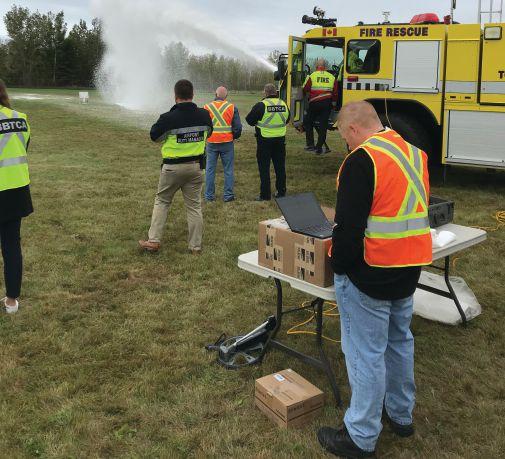
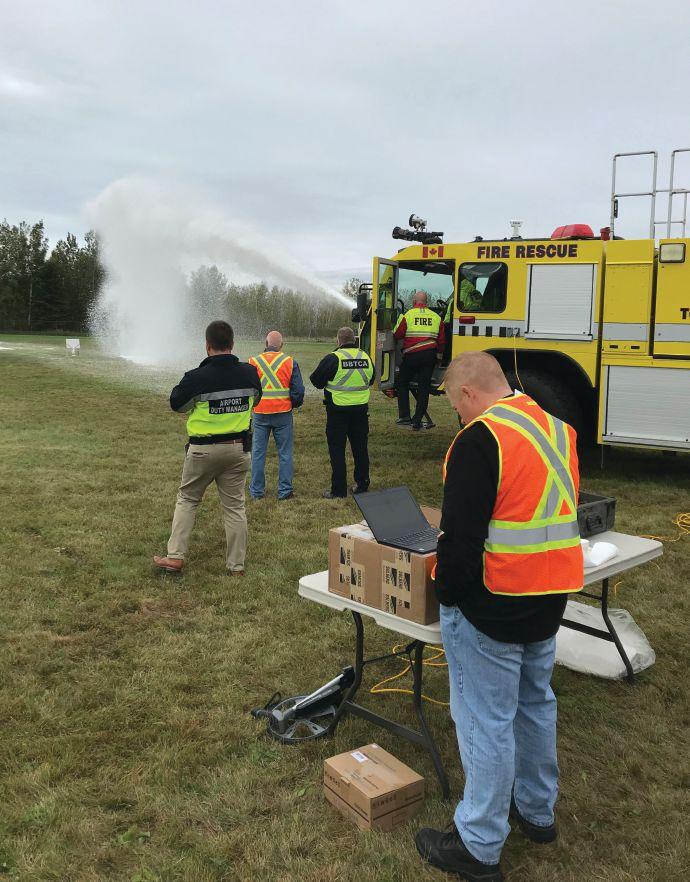
Perimeter Solutions technical personnel went onsite to Billy Bishop Airport and worked with ARFF truck manufacturer OSHKOSH and airport personnel to test Solberg re-healing RF-3 in existing equipment.
• The actual foam product to be used needed to be tested in existing equipment to ensure proper proportioning of foam concentrate in the water at each discharge port of the ARFF truck and every piece of equipment to transition needed to be live tested.
The latter requirement was logical because unlike previous AFFF fire suppres-
• The new foam technology needed to be demonstrably improved from an environmental standpoint and contain no intentionally added PFAS chemicals.
sant foam technologies, which have been in use for decades, fluorine-free foam technology is emerging and different suppliers of these foams have different approaches and formulations as they look to balance firefighting and environmental performance.
QUICK ACTION IN TORONTO
At the time that the Transport Canada exemption was issued, Mark Smith, the Ports Toronto fire chief and emergency
NO HYDRANTS, NO PROBLEM
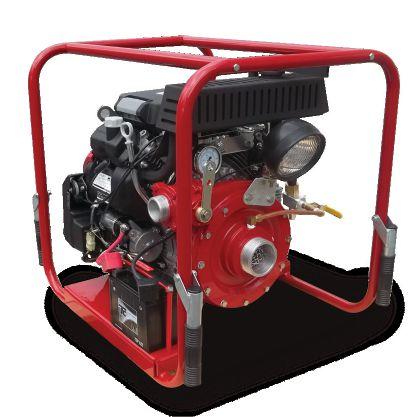
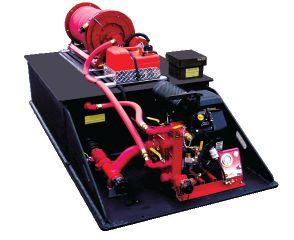
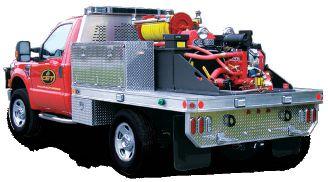
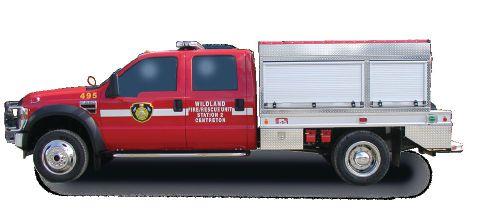
CET manufactures portable pumps, skid units, brush trucks and more to allow fire departments to Adapt, Improvise & Extinguish fire in almost any scenario where hydrants are scarce and static water resources maybe all you have to work with. CET- Providing fire ground solutions since 1908.
1
Portable Pumps (PFP-20hp-HND-MR Shown)
50+ models to choose from for both fire attack & resupply operations from static water sources like lakes, rivers, ponds and pools
Arrives Completely pre-assembled, pre-plumbed, pre-wired and pre-tested ! Simply mount to your chassis, connect electrical and go fight fire!
Brush Trucks (Custom Built)
Solid/Affordable/Practical
response and planning manager, had been in the process of investigating how to improve the environmental and safety performance of the fire suppressant foams in use at Billy Bishop Toronto City Airport. The exemption offered Smith the opportunity to take a big leap into fluorine-free – and he acted quickly.
Smith reached out to long-time foam suppressant supplier Brian Honey, a fire equipment specialist at M.L. Fire & Safety, who represents Perimeter Solutions products in Canada. Perimeter Solutions was the only company offering ICAO Level C certified fluorine-free foam concentrates with their Solberg re-healing product.
Solberg re-healing foam concentrates are fluorosurfactant and fluoropolymer-free fire fighting foams designed to replace traditional AFFF and AR-AFFF foams. They can be used to effectively extinguish Class B fuels, avoiding issues of persistence, bioaccumulation or toxic breakdown. The foam concentrates can be used in fresh, salt or brackish water and are formulated to possess excellent burn back resistance due to superior flow and rapid sealing characteristics.
The foam concentrates are available in three per cent, six per cent and 3x6 ATC formulations. The foam concentrates are intended for use on Class B hydrocarbon and polar solvent fuel fires. They have been tested to and meet the fire performance test criteria of UL Standard 162, UL of Canada (ULC) Standard S564, FM Approval Standard 5130 and European Standard EN 1568 Part 3 and Part 4.
THE MOVE TO FLUORINE-FREE FOAM
The search for optimally performing fluorine-free fire fighting foams spans more than two decades. The first successful development of a true synthetic fluorine-free Class B foam was achieved by
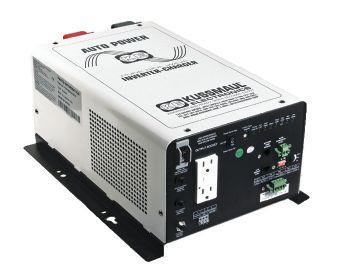
Watt Continuous/4500 Watt Surge Inverter With A 55 Amp Charger Using Pure Sine Wave
Ted Schaefer, a formulation chemist working for the 3M Company, and named RF or ‘re-healing foam’ in 2001. Solberg Scandinavian, a forebear of Perimeter Solutions, bought 3Ms patent rights to re-healing foam in 2007 and continued this development as did most other fire fighting foams companies of the time. As the regulatory environment continued to evolve, the efforts to make all foams fluorine-free heated up.
The key issues in developing successful fluorine-free foams include fire fighting performance (measured in their ability to obtain certifications in various regions and applications), long-term stability, handling properties and cost. While traditional Class B foams – AR-AFFF and AFFF – are well established in these areas, technology development efforts for the next generation of fluorine-free concentrates currently represent a balancing act as the new products are implemented as quickly as they can be.
From a certification standpoint, certain Class B fluorine-free foams pass tests in some applications and not others. Aviation foams that pass the ICAO Level B performance standard may not be capable of passing the Level C performance requirements. And still other foams will work well with freshwater, but not seawater.
Viscosity is an issue that needs to be reconsidered in the light of fluorine-free foam development. Studies have shown that some non-Newtonian fluorine-free foams perform just as well as their low-viscosity counterparts in applications like sprinkler systems –an issue that has led to confusion in the industry and should lead to a re-examination of what these designations mean in real world applications.
All these issues notwithstanding, the fire safety industry is
• Built-in automatic load transfer relay
• Built-in high output 3 stage charger (1-hr boost) for rapid battery replenishment
• Programmable for up to 8 battery types; Gel, Lead Acid, AGM battery, etc...
• UL Listed and built to meet NFPA 1917 KKK specification
Viscosity is an issue that needs to be reconsidered in the light of fluorine-free foam development.
making significant strides in the development of high-performing fluorine-free fire fighting foams. A paper given in February at the Joint Oil and Industry Fire Forum (JOIFF) detailed the progress of foams used on Class B fuels over the last five years. For example, in extinguishing Jet A1 fires, in 2021 fluorine-free foam improved by 23 per cent versus similar technology in 2016, leaving it only marginally behind the fluorinated standard. Five years ago, few fluorine-free products could achieve any success on gasoline fires. Today, some fluorine-free foams offer equal or better performance than traditional AR-AFFF foams. Regarding handling and application, in some cases, 3x3 fluorine-free foams have lower viscosity today than their 3x6 fluorine-free counterparts five years ago. The industry is rising to the technology challenge.
COMPATIBILITY WITH EQUIPMENT A KEY ISSUE
Understanding that Solberg re-healing RF-3 is a non-Newtonian material, one of Smith’s initial concerns was that his two Oshkosh Striker 1500 firetrucks were accustomed to deploying low viscosity foams.
“I was encouraged when I learned that Perimeter Solutions had experience deploying the RF-3 foam concentrate from OSHKOSH
fire trucks,” he said.
Technical personnel went onsite to Billy Bishop airport and worked with ARFF truck manufacturer OSHKOSH and airport personnel to test the fluorine-free foam in existing equipment. The OSHKOSH team led by Seth Newlin, chief engineer of airport products, made minor modifications – primarily poppet valves – to truck equipment onsite to ensure that a minimum three per cent proportioning ratio was maintained in the truck’s discharge ports at all times. During the testing, Transport Canada officials were on site as observers.
At the end of this process, Transport Canada accepted the use of Solberg re-healing RF-3 in place of fluorinated foam. The transition was completed successfully at minimum additional cost to the airport in October 2019, less than four months after the regulatory change.
Said Smith about the transition experience: “I couldn’t have done this alone. I relied on a lot of people—Mark, Mitch, Brian Honey and the team from OSHKOSH. We’re fortunate to have great mechanics at our site.” The site has now been converted to fluorine-free foam for over a year. According to Smith, having gone first, he gets inquiries frequently from airports across Canada.
“I’m happy to have the opportunity to enhance the safety of our fire fighting team and the local community.”
Mitch Hubert is Technology Fellow, R&D at Perimeter Solutions. Mark Siem is a Chemist in the Fire Safety Group at Perimeter Solutions. Jim Schwander is Eastern Regional Sales Manager in the Fire Safety Group at Perimeter Solutions.
Thermal Imaging: FAQS
By MANFRED KIHN
In this edition’s article, I would like to focus on how much you do or don’t know about thermal imaging (TI). Even though fire service thermal imaging has been around since the early 1990s, there is still a lack of knowledge and education on this subject and its uses. Let’s delve into this subject with some questions and answers to challenge your knowledge.
1. How many fire departments have thermal imagers (TIs)?
Not enough. There are still some fire departments that do not have any TIs and every fire department should have at least one.
2. How many fire departments have more than one TI?
The advantage of having more than one TI on an apparatus gives the firefighters extra eyes on the fire. Let’s say you have two TIs. You place one TI on board the apparatus for the officer and a second imager is stored in the back of the cab for a crew member. This is becoming increasingly common during deployment of manpower as each part of the crew, whether he/she has VES (vent, enter, search), roof, outside vent or other duties, has an additional TI for added safety and capabilities.
3.How many different brands of TIs do you have in use?
Having more than one brand of TI can be confusing when understanding the tool’s operations, batteries, charging systems, etc. Standardizing with one brand increases operator safety and helps you to develop a cohesive educational training program for the crew.
4.How many firefighters can say they are proficient in using a TI?
If you are using your TI on every response that you go on, I would say you should be proficient in its operations. If you don’t, time to go back to the classroom and practice.
5.Is your TI used on every call that you respond to?
This is where I need you to think outside the box. A TI can be used on every response. Each time you use your TI, you are gaining valuable information that makes you proficient.
6.Do you know how many modes are in your TI and what they are?
Most TIs have two modes while some manufactures have three modes. Imagers start in high gain mode and then switch to low gain mode at 300 F/148 C while some TIs go from high, medium and low.
8.Do you know what the shutter speed or refresh rate is on your TI?
Depending on your TI’s manufacture, the shutter speed or refresh rate can vary from 9 Hz, 15 Hz, 30 Hz or 60 Hz. This means the higher the number, the faster the imager refreshes itself to give the operator the clearest imagery possible. The lower the number, the slower the refresh rate and the longer the imager processes the infrared information, meaning you can miss a lot of important details.
9.When is the best time to use a
thermal imager — daytime, nighttime, anytime or none of the time?
Anytime! There are no limitations to when you can use a TI. Daytime or nighttime, the imager will detect heat signatures that cannot be detected with the naked eye regardless of lighting conditions.
10.When should I replace my TI(s)?
Replacing or upgrading TIs every couple of years is a good idea as manufactures are always updating and advancing their technologies.
11. Do you know some of the limitations of using a TI?
The first is that a TI cannot see into water, so looking for a victim underwater will not work but will work great if the victim is floating on the surface. Other limitations include shiny surfaces which cause reflections and can give you multiple images that your TI may not interpret correctly. Some of these can be hardwood floors, polished concrete floors, windows, stainless steel appliances and glass shower doors just to name a few. A TI also cannot see through walls, floors, doors and shower curtains. Remember that our TI can only see to the nearest surface.
This is just scratching the surface when it comes to thermal imaging. Should you have any topic ideas of questions, reach out to at manfred_kihn@bullard.com.
Until next time, stay safe and practice often.
Manfred Kihn is a 19-year veteran of the fire service, having served as an ambulance officer, emergency services specialist, firefighter, captain, and fire chief. He has been a member of Bullard’s Emergency Responder team since 2005 and is the company’s fire training specialist for thermal imaging technology. He is certified through the Law Enforcement Thermographers’ Association (LETA) as a thermal imaging instructor and is a recipient of the Ontario Medal for Firefighters Bravery. e-mail him at manfred_kihn@bullard.com.
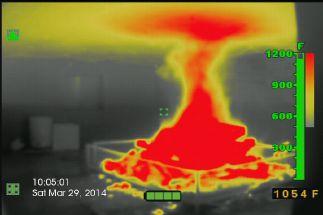
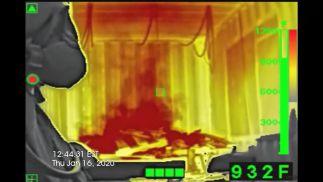
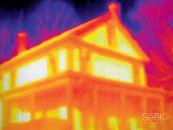
The top image shows older technology while the bottom illustrates enhanced TI technology.
BY LAURA KING NFPA PublicEducation Rep Canada
WWear a mask, stay home, check your smoke alarms
e’ve all, in the last year or so, learned a lot about messaging and the importance of consistency and accuracy: wear a mask; wash your hands; stay at home.
The purpose of health and safety messaging during a pandemic is to change people’s behaviour to prevent something bad from happening. The same applies to fire-safety and fire-prevention messaging.
Behaviour change happens only after people hear the same message dozens of times, delivered by trusted sources, and when consequences are clear. Even then, only some people hear, accept, and adopt the message and the new behaviour.
So what chance do we stand as fire chiefs, FPOs, educators and firefighters, of changing people’s behaviour – to have them install and maintain smoke alarms on every level and in all bedrooms, or never pour water on a grease fire?
The National Fire Protection Association (NFPA) and fire departments across North America have evaluated public-education programs and compiled solid evidence that consistent messaging works.
Where do you find consistent fire-safety and fire-prevention messages? Many of you have heard me talk about NFPA’s messages and seen me wave around my dog-eared copy of the Educational Messages Desk Reference. While the title lacks imagination, the messages are gems, each expertly crafted to align with research and data and resonate with audiences of various literacy levels.
The new edition of the Educational Message Desk Reference is available to download, for free, at www. nfpa.org (go to public education, teaching tools, then educational messaging). The French version will be available shortly.
The updated document includes three new chapters and dozens of new messages, each flagged with a “NEW” label.
Messaging related to top causes of fire – cooking, smoking and electrical – has been expanded. There is new messaging about what to do after an oven fire, how to properly extinguish smoking materials, and about arc-fault circuit interrupters.
The National Candle Association in the United States provided information that helped to shape the new sections of Chapter 14: General Candle Safety, and 14.2: How To Burn A Candle Safely.
Sections of the Desk Reference have been enhanced with additional messaging for people who are deaf or have hearing loss, who have mobility challenges, and who experience other disabilities.
Chapter 5, which used to focus on safety in hotels and motels, is now titled Fire Safety Away From Home and includes messages about hotels/motels, peer-to-peer hospitality, motor homes/campers/RVs, places of public assembly, car fires, and how to prevent car fires.
There’s also new language about calling 911 or emergency services; you’ll see the words “trusted neighbour” in some messages, for example, in Chapter 4, Home Fire Escape: “Make sure everyone in your home knows how to call 9-1-1, or your local emergency number, from a mobile phone or a trusted neighbor’s phone.”
Lastly, remember that the messages are meant to be customized for your target audience. ‘‘ ’’
The new chapters – fire safety away from home, pet safety, and youth firesetter – were created in response to feedback from national fire-safety organizations and subject-matter experts, fire departments, educators, and other users of NFPA messages.
Messages in other chapters have been updated to reflect the way people live their lives – there are new messages about safety around campfires, fire pits, candles, barbecues, turkey fryers, pools, hot tubs, marinas and boats, and even power tools.
Laura King is the NFPA’s public-education representative in Canada; she was the editor of Fire Fighting in Canada and Canadian Firefighter from 2007 to 2017. Contact Laura at canadacrr@nfpa. org. Follow her on Twitter at @LauraKingNFPA
Lastly, remember that the messages are meant to be customized for your target audience. The messages in the <i>Desk Reference<i/> are based on science and data and mirror NFPA’s codes and standards, but they’re a tad dry, and they don’t often fit into 280-character tweets.
So instead of “Stay in the kitchen when you are frying, boiling, grilling or broiling food,” you can always remind people to “Stand by your pan.” Or, like now-(in)famous FPO Michael Atkins from Welland, Ont., video yourself doing a safety dance to decade-old songs by Lady Gaga and Adele from 2011 and post it all over the internet to encourage people to replace their smoke alarms after 10 years. (Google it – it’s worth it!)
People are more inclined to change their behaviour if the message is memorable!
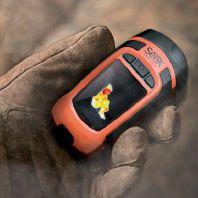
RevealFire PRO
MONITOR HAZARDOUS ENVIRONMENTS
INSPECT MECHANICAL & ELECTRICAL EQUIP SEARCH AND RESCUE FIND HOTSPOTS
ü Durable, All-in-One Device
ü Save images to a 4GB internal hard drive
ü 320 x 240 thermal sensor
ü Direct temperature readout
ü -40F to +625F
ü High resolution thermal sensor
ü 4 hours on a single charge
ü Made in the USA
ü IP67 approved
Using a Solo Rescue® heavy duty SCBA washing machine helps avoid exposing the crew to combustion gases, soot particles, toxins and carcinogens released in the maintenance and hand cleaning processes and also substantially lowers the time spent decontaminating firefighter equipment
IN ONE HOUR YOU CAN CLEAN/DECON:
-14 SCBAs W/MASKS and CYLINDERS IN ONE HOUR YOU CAN CLEAN/DECON:
• 30 HELMETS
• 60 PAIRS OF GLOVES
• 20 PAIRS OF BOOTS
• Double the above numbers with a second rack
ü REDUCED HEALTH RISK
ü SAVES TIME 2/PKS IN 8 MIN ü EASY TO USE
BEST IN COMFORT BEST IN PROTECTION WITH THE BEST WARRANTY
2018 NFPA APPROVED AND COMFORTABLE FIRE HELMET ON THE MARKET KEVLAR™
manufactures industry-leading firehoses that are unmatched in quality and performance. Hundreds of North American fire departments to get the job done safely and efficiently.
NEW SMOKECHASER
5 GALLON COLLAPSIBLE TANK PADDED HARNESS DUAL TOP HANDLES
HOSE RACKS
The legendary ability of Rosenbauer aerials is no myth. A 115’ vertical reach, auto-leveling turntables, platform collision protection and extremely stable short jacking capabilities ensure our aerials are up for any challenge.
TRUST THE TRUCK
TRAINER’SCORNER
The three roles of a training officer
By ED BROUWER
After 31 years of fire fighting, one would think I would embrace my retirement. Yeah — not so much. I miss putting together Wednesday night practice sessions. I miss using my imagination to present fire fighting core skills to the newbies in a way that they will not only be able to do it but understand the ‘why’ behind it. For sure I miss the comradery, but when you are in a paid-on-call department you don’t get to know each other as well as you do in a full-time station.
It is paramount that firefighters know why they are doing something as well as understanding the consequences of not doing something.
I remember approaching a firefighter spraying water on the outside of a burning structure. I asked him a simple question: “What are you doing?” He looked at me all nervous like and replied, “Am I doing something wrong?”
I shook my head. “No, I just want to know, what you are doing?” He replied, “I can do something different.” Again, I said, “No buddy, I just want to know, what you are doing?”
“I’m spraying water on the fire,” he stated, but since his statement was more in the form of a question I pushed a bit more. “Why are you spraying water on the fire?” Now he got flustered. “You told me to!
Should I stop?”
I looked at him and tried rephrasing the original question in “textbook” terminology. “What effect are your present actions having upon the fire compartment?” He took a breath and said, “I don’t know.”
Good, an honest answer. My next question: “What would change if you stopped doing what you are doing?” Again, he responded with, “I don’t know.”
I wasn’t trying to mess with him. I was hoping to give him a better understanding of fire behaviour.
As he continued applying water, we spoke about the fire triangle. I asked him what part of the triangle he was operating in. Then I asked if he knew how effective he was being. He answered no, so I instructed him to radio the pump operator informing them he was shutting down his line. Then we just stood and watched what the fire was doing. We looked at the smoke and discussed the basic smoke indicators: location, colour, density and volume. You cannot observe smoke indicators if you are just “drowning” the fire. You need to take
To mentor is to guide. A mentor is someone that can help another person solve a problem, but who will not attempt to solve it for them. Mentoring is mostly about counseling others that are following in our footsteps.
a break; let the fire breath.
It was a wonderful teaching moment. Looking him straight in the eyes I said, “I am sharing this with you for one reason.” He gave a knowing smile and said, “I know, you want me to be a good firefighter.”
“Yes that is true, but more than that I want you to go home after each and every call.”
My little story illustrates in part the three roles of the training officer: instructor, coach and mentor.
An instructor is one who teaches something. A coach helps bring greater performance in a specific area. A mentor is a bit different. Mentorship can involve training, but it is more like passing down knowledge of how things are done.
I read that the difference between a mentor and an instructor is that a mentor is more focused on the individual rather than their performance.
To mentor is to guide. A mentor is someone that can help another person solve a problem, but who will not attempt to solve it for them. Mentoring is mostly about counseling others that are following in our footsteps.
Throughout your years of service, you have overcome many obstacles. In the process you have obtained a great deal of information that cannot be found in a textbook or online. You need to share your
experience and information in an informal way, helping others grow in order to one day take your role. You have the unique opportunity to positively affect the future by “growing” a replacement.
Looking back over multiple decades as a training officer, I wonder if I have left a “mark” or just a memory.
Volunteer departments often struggle with having a succession plan. And I believe that is where a mentorship program could really help. You should find a younger version of yourself and pass this information on to them. Do not just search for excellence, create it.
Many years ago, I heard a statement that has stuck with me: The way things are in an organization is the way we allow things to be in an organization.
If your department does not have a succession plan, create one. If it has a plan but it is not efficient, fix it. And if your department still appoints officers through the “let’s vote in our buddy” system call 911. Seriously. Positions should be posted with a clear understanding of what each role entails. Keep in mind, not every person is a leader in the making.
I believe in setting the bar high for upcoming fire officers. I have seen far too often a volunteer department crash and burn from within due to people who are a poor fit to be officers. Just because an
officer is a good firefighter, does not qualify him as a good officer candidate. By now, you must have come to realize that less than 10 per cent of a firefighter’s time is actually spent on the fireground.
Be cautious when you hear applicants speak of “experience”. Is it 10 years of experience or 10 years of the same experience? Look for some one who recognizes what they do not know.
If this last year has taught us anything it is clear that our first responders are a priceless resource. That is why it is of the utmost importance we have good leadership.
By the time this goes to print, I will have celebrated my 68th birthday. I have enjoyed my journey thus far, evolving from newbie, to instructor, to coach, to mentor. It is my true belief that the role of training officer is the highest calling in the Canadian fire services. And although, what you spent years building may be destroyed overnight through no fault of your own, build anyway. Continue to give your firefighters your best efforts, and realize that maturity and experience are benefits, not disadvantages.
Your talent and dedication to the fire service are priceless resources. Please remember, “The best thing an old firefighter can teach a young firefighter is how to become an old firefighter.”
Stay safe out there, and as always remember to train like lives depend on it, because they do.
Ed Brouwer is the chief instructor for Canwest Fire in Osoyoos, B.C., retired deputy chief training officer for Greenwood Fire and Rescue, a fire warden, wildland urban interface fire-suppression instructor and ordained disaster-response chaplain. Contact Ed at aka-opa@hotmail.com.
•
•
•
•
•
2021 NATIONAL SUPPLIERS DIRECTORY
CANADA
BC (British Columbia)
AB (Alberta)
SK (Saskatchewan),
MB (Manitoba)
ON (Ontario)
QC (Quebec)
PE (Prince Edward Island),
NL (Newfoundland & Labrador)
NB (New Brunswick)
NS (Nova Scotia)
NT (Northwest Territories)
NU (Nunavut)
YT (Yukon)
1200° Darch Fire Inc
9-402 Harmony RD, Ayr, ON, N0B 1E0
Tel: 800-254-2049
Fax: 519-622-7705
Toll-Free: 800-254-2049
Web: www.1200-degrees.com
“1200˚ is your full service, specialized vehicle dealership.
We have a complete line of solutions for your department from Apparatus sales, Equipment Sales to Parts and Service. 1200° offers exclusive premium brands and sets itself apart from others by offering the highest level of customer service in the industry today.
We take great pride in offering the very best care to our clients throughout the sales process and beyond.
We provide expert advice during the buying process, from consultations, spec development to committee presentations and anything in between, our customers are presented with the highest quality products and our customer care is second to none.
Working with 1200˚ means having a single point of contact for all your departments needs.
1200° will take care of everything for our clients so they can focus on what’s important…. Helping people.”
Serving ON
3M CANADA INC.
300 Tartan Dr., London, ON, N5V 4M9
Tel: 519-451-2500
Toll-Free: 1-800-364-3577
Web: 3m.ca/scottsafety
At 3M, we apply science in collaborative ways to improve lives daily. With $32 billion in sales, our 91,000 employees connect with customers all around the world. Learn more about 3M’s creative solutions to the world’s problems at 3M.ca or on Twitter @3MCanada.
3M offers a comprehensive, diverse portfolio of personal protective equipment solutions including 3M™ Scott™ SCBA, handheld and hands-free thermal imagers, voice communication devices and firefighter accountability solutions. Most notably the 3M™ Scott™ Air-Pak™ SCBA is used by firefighters, military, civil defense and industrial workers around the world.
3M.ca/ScottFire
Serving All of Canada
A.J. STONE COMPANY LTD.
62 Bradwick Dr., Vaughan, ON, L4K 1K8
Tel: 416-785-3752
Fax: 416-781-2827
Toll-Free: 1-800-205-3473
Web: www.ajstone.com
A.J. Stone has proudly served the needs of the First Responder Services of Ontario since 1972 by featuring quality products, knowledgeable sales team, and training support.
A.J. Stone supplies equipment from MSA, Genesis Rescue Systems, LION Protects, Task Force Tips, Paratech Rescue, FireAde, Enforcer, Streamlight, Innotex Bunker Gear, ProTech Gloves, Safe-T-System, CET and much more! We service what we sell! Serving ON
AIR TECHNOLOGY SOLUTIONS CANADA INC.
251 Queen St. S., Ste. 512, Mississauga, ON, L5M 1L7
Tel: 905-826-6682
Fax: 866-511-6904
Toll-Free: 1-866-735-1480
Web: www.airmation.ca
Air Technology Solutions is dedicated to our Clients, offering updated, timely, full service Indoor Air Quality (IAQ) solutions. Air quality concerns are mitigated using a unique combination of professional indoor air quality assessment coupled with solutions. Off the shelf or customized site specific air cleaning equipment is available to resolve IAQ issues. Our technical experts review client requirements and budgetary availability. The finest appropriate air cleaning systems are provided. Air Technology Solutions is a leader in Diesel Exhaust Remediation and is the ONLY environmental tested and proven filtration system to exceed standards: NFPA, NIOSH, OSHA and ASHRAE.
Building and facility managers, business owners, contractors, architects, and engineers have been working with Air Technology Solutions since 1986 to resolve IAQ needs. Employee and personnel safety and health are key issues. Breathing safe air in the workplace is of utmost importance. We provide global customized solutions to control contaminants, pollutants and odours in your facility. We look forward to servicing your requirements.
For more than 55 years, three generations of knowledge have succeeded to make Aréo-Feu the number one reference for the supply and service of equipment in the fire industry, in public safety or in civil protection.
Our favourable purchasing power allows us to maintain an important inventory of products that have state-of-the-art technology. Committed to building very good business relationships with our partners, we encourage the constant update and development of our team’s expertise.
Our daily goal is the complete satisfaction of our customers!
Multiple suppliers with whom we have a durable relationship for the benefit of our customers.
Official distributor of: MSA/Globe, Innotex, Rosenbauer, Protek, Elkhart Brass, Genesis Rescue Systems, Streamlight, Res-Q-Jack, Petzl, Husky, Solberg, TechTrade, Unifire, CET Fire pump, All American hose, OHD, Harrington Inc., LavXel, Kochek CO. Inc, Lakeland, Tohatsu, Waterous, ect.
Serving All of Canada
Bullard
1898 Safety Way, Cynthiana, KY, 41031
Tel: 613-229-7000
Fax: 859-246-0243
Toll-Free: 877-BULLARD
Web: www.Bullard.com
A leader in the safety industry since 1898, Bullard designs and produces tough and innovative thermal imagers and fire helmets. Bullard is focused on providing thermal imagers with the highest quality images, built to last in tough conditions. Bullard fire helmets and other emergency responder
PPE are designed to be comfortable, long lasting, and outfitted with the latest innovations such as the ReTrak integrated visor and the TrakLite integrated lighting. Bullard products can be found through a number of authorized Canadian distributors, or by connecting with a Bullard expert. Find out more at www.Bullard.com.
Serving All of Canada
SOME CONNECTIONS ARE MORE POWERFUL THAN OTHERS.
Stay connected and protected from the palm of your hand with LUNAR, part of the MSA Connected Firefighter Platform.
2021 NATIONAL SUPPLIERS DIRECTORY
BULLDOG HOSE COMPANY
141 Junny Road, Angier, NC, 27501
Tel: 416-436-4910
Web: www.bulldoghose.com
BullDog Hose Company, a division of Puck Enterprises, is proud to be a leading fire hose manufacturer in the North America. From Hi-Combat® II, Firepower® II, Hi-Vol®, Redchfief, and Ultima™, our dedication has positioned us as the premier in fire hose products. The BullDog name stands for high performance, durability, safety and quality, with American-made products that are built to last.
Serving All of Canada
C-MAX FIRE SOLUTIONS
3040 Sawmill Rd., PO Box 425, St. Jacobs, ON, N0B 2N0
Tel: 519-664-3796
Toll-Free: 1-844-GET-CMAX
Web: www.c-max.ca
Canadian family owned and operated business that offers a higher standard of service and sales for all your Fire Apparatus needs. C-Max Fire Solutions offers 24 Hour service from EVT Technicians with fully stocked service trucks. We offer Pump testing and repairs to all makes and models. We offer ground ladder testing as per NFPA 1932. We are also Ontario’s Factory Sales and Service Centre for KME Fire Apparatus.C-Max is now factory authorized service center for Willburt Light towers.
Serving ON
CANADIAN SAFETY EQUIPMENT INC.
2465 Cawthra Rd., Unit 114, Mississauga, ON, L5A 3P2
Tel: 905-949-2741
Fax: 905-272-1866
Toll-Free: 1-800-265-0182
Web: www.cdnsafety.com
We supply Industrial and Fire SCBA’s, SCBA Decon Washer, Thermal Cameras, CAF Systems, Fall Protection, Bunker Gear, Fire and Rescue and Ballistic helmets, Fire Hose, Communications Equipment, Nozzles, Fittings, Hazmat Suits, Ventilation Fans, Gas Detectors, Confined Space Rescue Equipment, Water and Ice Rescue equipment, Industrial and Municipal Safety and Lone Worker Protection systems.
Serving All of Canada
Commercial Emergency Equipment Co.
591 Chester Road, Delta, BC, V3M 6G7
Tel: 604-526-6126, 24/7 service: 1-877443-2626
Toll-Free: 1-800-665-6126
Web: www.comemerg.ca
Commercial Emergency Equipment Co is Canada’s largest dealer for Pierce Manufacturing Inc, Maxi Metal, and Oshkosh Airport Products. We provide sales, parts, and service of all makes of fire trucks, and support to our customers through five sales/service locations across Canada.
CSE INCENDIE ET SÉCURITÉ INC.
5651 Chemin St-Francois, St. Laurent, QC, H4S 1W6
Tel: 514-737-2280
Fax: 514-737-2751
Toll-Free: 1-866-737-2280
Web: www.cseis.com
CET
FIRE
PUMPS MFG.
75, Hector, C.P. 90, Pierreville, QC, J0G 1J0
Tel: 450-568-2719
Fax: 450-568-2613
Toll-Free: 1-888-844-2285
Web: www.fire-pump.com
No Hydrants, No Problem!
CET Manufactures Portable Pumps, Skid Units, Brush Trucks, Glider Kits, Foam Trailers, Water Tanks, and UTV Fire Units to help you fight fire where static water sources may be your only option.
The Flow Starts Here! Serving All of Canada
Commercial Emergency Equipment Co. strives to exceed customer expectation in everything we deliver. With over 70 years in the truck equipment industry, we take pride in a proven track-record of providing expert truck equipment solutions, top quality products and firstclass service to our customers. We are a sole-source service provider with mobile EVT’S, on call 24/7, throughout our nationwide branch network. We offer inspections, preventative maintenance, mobile pump testing, and foam system calibration, as well as comprehensive apparatus training on operation and maintenance. We inventory an extensive stock of OEM and aftermarket parts, tools, and equipment ensuring quick delivery and reduced downtime to our customers. Our service technicians undergo continuous training and testing to ensure that the latest technology and innovation is applied to the service of your equipment.
When you need prompt, honest, and reliable service, you can count on us to support you.
BC, AB, SK, MB, ON, NT, NU, YT Serving AB|BC|MB|NT|NU|ON|SK|YT
We supply Industrial and Fire, SCBA’S, SCBA Decon Washers, Gear Extractors and Dryers, Thermal Cameras, CAF Systems, Fall Protection, Bunker Gear, Fire, Rescue and Ballistic Helmets, Fire Hose, Communications Equipment, Nozzles, Fittings, Hazmat Suits, Ventilation Fans, Gas Detectors, Confined Space Rescue Equipment, High Angle Rescue Equipment, Ice and Water rescue equipment, Boots and Gloves. Everything for Fire Fighting, EMS, Law Enforcement, Industrial and Municipal Safety and Lone Worker Protection Systems.
Serving NB|NL|NS|PE|QC
DRAEGER SAFETY CANADA LTD.
2425 Skymark Ave., Unit 1, Mississauga, ON, L4W 4Y6
Tel: 905-212-6600
Fax: 905-212-6602
Toll-Free: 1-877-372-4371
Web: https://www.draeger.com/en-us_ ca/safety
Contact us at +1 877-372-4371 to learn more about SCBA, live fire training system, fixed gas and flame detector, mobile gas detector, thermal imaging camera, drugs and alcohol testing equipment and the rest of our portfolio. Product services and technical training courses are offered at our Mississauga, Ontario and Edmonton, Alberta locations throughout the year. Arrange for service of your SCBA and gas detector now.
Serving All of Canada
FIRE FIGHTING IN CANADA/ CANADIAN FIREFIGHTER
PO Box 530, 105 Donly Dr. S., Simcoe, ON, N3Y 4N5
Tel: 1-289-221-6605
Fax: 888-404-1129
Web: www.firefightingincanada.com
Canada’s National Fire Publication since 1957.
Serving All of Canada
Fort Garry Fire Trucks is the largest fire apparatus manufacturer in Canada and are proud builders of fire trucks, custom-built pumpers, aerial ladders, and related fire-fighting equipment. Our customers emanate from cities, towns, and municipalities throughout Canada, the U.S., and abroad with the harshest weather, climates, and terrain—which is why we design “One Tough Truck.”
We are a proud distributor of sales, service, and parts for the versatile Bronto Skylift aerial platforms, and we currently have two units available for immediate possession. Fight fire at any height with our Bronto Skylift F116RLP. This 116-foot articulated ladder platform incorporates global market-leading technology and fire fighting devices with the industry-leading custom fire apparatus cab and chassis, the Spartan Gladiator. Our brand new Bronto All-Rounder is also available! It’s the first articulated aerial ladder platform built on a single axle commercial chassis in North America and proudly manufactured in Canada.
INTERESTED IN THESE UNITS? CALL OUR
2021 NATIONAL SUPPLIERS DIRECTORY
FIREHALL BOOKSTORE
PO Box 530, 105 Donly Drive S., Simcoe, ON, N3Y 4N5
Tel: 1-877-267-3473
Fax: 1-877-624-1940
Web: www.firehallbookstore.com
The Firehall Bookstore provides training & public education materials to the Canadian Fire Service industry and its professionals. A one-stop-shop for books, DVDs, codes and standards, and fire prevention and education materials for community outreach.
Product lines include NFPA, IFSTA, Jones & Bartlett, PennWell, Action Training Systems, Brady, and Emergency Film Group. Exclusive fire department pricing on First Alert alarms.
Serving All of Canada
FIREHALL.COM
PO Box 530, 105 Donly Dr. S., Simcoe, ON, N3Y 4N5
Tel: 289-221-6605
Fax: 888-404-1129
Web: www.firehall.com
Firehall.com provides an excellent forum for exchange among firefighters and others involved in the fire service. Advertising options include banner ads and e-blasts and offer extensive exposure to the rank and file.
Serving All of Canada
FIRESERVICE MANAGEMENT LTD.
34 Torlake Cres., Toronto, ON, M8Z 1B3
Tel: 416-251-3552
Fax: 416-253-0437
Toll-Free: 1-888-731-7377
Web: www.fireservicemanagement.com
We Clean, Test, Customize, Rent and Repair YOUR Gear. Canada’s premier facility dedicated exclusively to providing the best in bunkergear cleaning, decontamination, inspection and repair. We are NFPA 1851 compliant and UL verified for all cleaning and repairs to all materials including moisture barriers. We stock materials and trim for every brand. We’re a certified ISP so we can rebuild damaged components or add pockets and other features to suit your needs. We also offer FireTrack software to help you track your inventory and inspection history. Call us today to see how we can help your department. Serving All of Canada
FIRST ALERT CANADA
845 Intermodal Drive, Brampton, ON, L6T 0C6
Tel: 905-488-7283
Fax: 905-793-9798
Web: www.firstalert.ca
First Alert is the most trusted brand in fire safety and the leading manufacturer of smoke alarms, carbon monoxide alarms, fire extinguishers, escape ladders and other home safety products to protect what matters most. To see the full range of home safety products, visit www.firstalert.ca.
Serving All of Canada
53 Bergen Cutoff Road, RR#2, Winnipeg, MB, R3C2E6
Tel: 2045943473
Fax: 204-694-3230
Toll-Free: 1-800-565-3473
Web: www.fgft.com
Fort Garry Fire Trucks is the largest fire apparatus manufacturer in Canada and is proud builders of fire trucks, custom-built pumpers, aerial ladders, and related fire-fighting equipment. Our customers emanate from cities, towns, and municipalities throughout Canada, the U.S., and abroad with the harshest weather, climates, and terrain—which is why we design “One Tough Truck.” We are a proud distributor of sales, service, and parts for the versatile Bronto Skylift aerial platforms, and a proud Canadian distributor of Sutphen aerial platforms.
Serving All of Canada
FSI North America
311 ABBE ROAD, SHEFFIELD LAKE, OH, 44054
Tel: 4409492400
Fax: 4409492900
Web: www.fsinorth.com (FSI®), and its’ wholly owned subsidiary FSI North America ® are involved in the WMD, Life Safety, Hazmat, Decontamination, Mass Casualty, Medical, Mortuary, Isolation, Drive Through Vaccine/Flu Shot Shelters, EMS, and Fire Fighting markets around the world.
FSI® Portable, Mobile, and Fixed Decontamination Emergency Shower Systems, Shelters, Isolation Shelters, Medical Alternate Care/Surge Capacity/Field Hospital Systems, and Accessories are designed to meet the rapid response demands of Homeland Protection personnel worldwide. www. fsinorth.com
FSI® follows a corporate mandate that extends to all products offered - that is - FSI will strive to continually offer superior products in terms of quality and performance, at a fair market price.
FSI® is also committed to assisting the community and country and so we proudly employ Special Vocational Schools for the handicapped to assist us in partial fabrication and final assembly of certain of selected products such as backboards, head immobilizers, and so on.
FSI® welcomes all to review the broad, yet representative sampling only, offering of products herein. Then feel free to contact us for further details and information.
FSI® markets all products through an established and growing distribution network and so welcomes new Distributor and Manufacturer Representative inquiries. All products are available through GSA Contract Holders, Prime Vendors, and Authorized FSI® Distributors.
FSI® Quality of Products
FSI proudly offers products of the highest quality at fair market prices.
FSI decon showers meet and exceed ANSI # 113 portable hazmat decon shower standard and we utilize only CPAI84 and NFPA701/702. FR rated canopy fabrics. Industrial Safety Tank Shower Systems meet and exceed Z358.1 All Editions
FSI self certifies all products as being of the highest quality and have done so since our founding in 1997.
Serving All of Canada
HOLMATRO, INC.
505 McCormick Dr., Glen Burnie, MD, 21061
Tel: 410-768-9662
Fax: 410-768-4878
Web: holmatro.com
Holmatro hydraulic equipment and system solutions are predominantly used in rescue, special tactics and industrial applications around the world. These types of applications demand reliable and safe tools under all circumstances.
Serving All of Canada
IamResponding.com
PO Box 93, Dewitt, NY, 13214
Tel: 315-701-1372
Toll-Free: 1-877-509-0381
Web: https://www.IamResponding.com
Email: dseidberg@emergencysmc.com
Contact: Daniel Seidberg
CAD and live dispatch audio sent right to your phones through the original and most complete notification and response solution. IaR improves alerting, response times, emergency response turnout, communications, and your daily operations. Mobile alerting, mapping, pre-plans, mass-messaging, reporting, and much more is all included.
Serving All of Canada
INDUSTRIES LAFLEUR INC.
2359, Boul. Fiset, Sorel-Tracy, QC, J3P 5K2
Tel: 450-743-3918 x 226
Fax: 450-743-3906
Web: www.industrieslafleur.com
Fire rescue trucks (walk-in and non walk-in rescue trucks)
Custom truck bodies
High quality since 1969
ISO 9001
CWB 47.1 & 47.2
Serving NB|ON|QC
Fort Garry Fire Trucks
2021 NATIONAL SUPPLIERS DIRECTORY
MAXIMETAL INC.
Tel: (418) 228-6637
Fax: (418) 228-0493
9345, 25e Ave, Saint-Georges,, QC, G6A 1L1
Toll-Free: 1-800-510-6337
Web: www.maximetal.com
MAXIMETAL is a dynamic, innovative Canadian company with 38 years of experience designing and manufacturing optimized intervention vehicles. Our high-quality, custom-built Maxi fire trucks are found serving fire departments in from coast to coast, including some of Canada’s biggest fire fleets including Montreal, Quebec City, County of Grande Prairie and Chatham-Kent. In 2015 Pierce Manufacturing, the world leader in fire truck manufacturing, chose MAXIMETAL as their exclusive partner to build the MAXI Saber® custom line of fire trucks for the Canadian market. Now represented across the nation by the industry’s strongest dealer network, you can rest assured that you will have an experienced partner not just in designing and building your project, but supporting you long term after the sale. Serving All of Canada
Nederman Canada
5865 McLaughlin Rd., Mississauga, ON, L5R 1B8
Tel: +1 866-332-2611
Toll-Free: +1 866-332-2611
Web: www.nederman.com
With 75+ years of experience and well over 100,000 installations, Nederman offers diesel exhaust extraction systems designed specifically for emergency and fire vehicles. From the planning and design stage to installation, commissioning and maintenance support Nederman is your clean air partner. Serving All of Canada
PLYMOVENT
5 Corporate Dr., Cranbury, NJ, 08512
Tel: 609-395-3500
Fax: 609-655-0569
Toll-Free: 1-800-644-0911
Web: www.plymovent.com/us
Since 1975, we have made it our business to ensure clean air in fire stations. We provide high-quality products to protect firefighters and others from exposure to hazardous diesel exhaust. Our source capture and removal systems are the recommended method for controlling exhaust emissions at your station. Breathe clean air at work with Plymovent. #hookupthehose Serving All of Canada
READY RACK BY GROVES INCORPORATED
818 Trakk Lane, Woodstock, IL, 60098
Tel: 815-337-9780
Fax: 815-338-8640
Web: www.readyrack.com
Manufacturers of Turnout Gear Storage Systems, Hose Storage Racks and SCBA Storage and Transportation Systems, Sling Link Mast Rescue products. See your local Canadian Distributor. Serving All of Canada
RESQTECH SYSTEMS INC.
189 Bysham Park Dr., Woodstock, ON, N4T 1P1
Tel: 519-539-0645
Fax: 519-539-0646
Toll-Free: 1-800-363-7370
Web: www.resqtech.com
NFPA
c/o Firehall Bookstore, PO Box 530, 105
Donly Dr. S., Simcoe, ON, N3Y 4N5
Tel: 1-877-267-3473
Fax: 1-877-624-1940
Web: www.firehallbookstore.com
Canadian distributor for NFPA standards, membership and public education and Sparky products. Serving All of Canada
ResQtech Systems, Inc. has served the fire industry since 1985 and is dedicated to providing firefighters with innovative products and solutions. ResQtech Systems is the exclusive fire apparatus dealer for Rosenbauer and Hackney emergency vehicles in Ontario and offer a full line of emergency equipment which includes the Rosenbauer Heros-Titan Helmet, Junkyard Dogg Struts, Interspiro Contained Breathing Apparatus, Phos-Chek Firefighting Foam, Vindicator Nozzles and much more. In addition to the extensive product line, ResQtech has service technicians for your apparatus and emergency equipment needs, available at our in house facilities or on the road.
Serving All of Canada
ROCKY MOUNTAIN PHOENIX
Head Office: 6415 Golden West Ave., Red Deer, AB, T4P 3X2
Tel: 403-347-7045
Fax: 403-347-7049
Toll-Free: 1-800-494-4210
Web: www.rockymountainphoenix.com
BRANCHES: 103-2285 Queen St. Abbotsford, BC V2T 6T3
Rocky Mountain Phoenix is a leader in the supply of vehicle solutions, products and services to the emergency response and fire combat industry. Your complete source for MSA SCBA, Thermal Imaging, Protective Clothing, Suppression Tools and Equipment. Visit our online catalogue at www.rockymountainphoenix.com
Serving AB|BC|MB|NB|NT| NS|NU|PE|SK|YT
SAFEDESIGN APPAREL LTD.
34 Torlake Crescent, Toronto, ON, M8Z 1B3
Tel: 416-253-9122
Fax: 416-253-0437
Toll-Free: 1-877-253-9122
Web: www.safedesign.com
Specialists in Firefighters’ Protective Clothing. From Helmets to Bunkergear to Boots and Stationwear, we’ve got you covered from head to toe. Our team is knowledgeable and trained to ensure a proper and professional fit. Our brands: Globe Bunkergear, Hoods and the amazing Globe Boots, Cairns Bunkergear & Helmets, Shelby ‘Firewall’ Gloves, PGI Hoods including the BarriAire Particulate Blocking Hood, PGI Wildland clothing, Black Diamond Footwear, Workrite & Horace Small Stationwear.
If you would like to hear from a rep in your area please call us today or Visit our Website at https://www.safedesign. com/
Serving All of Canada
Sani Gear Inc.
545 Trillium Dr, 4, KITCHENER, ON, N2R1J4
Tel: 519-893-1235
Fax: Sani Gear Inc.
Toll-Free: 888-660-1840
Web: www.sanigear.ca
Sani Gear Inc. is a verified ISP (Independent Service Provider) and is located in two locations, Kitchener, Ontario, and Gatineau, Quebec. Sani Gear completes advanced inspections, advanced cleaning and full repair services, using all NFPA compliant materials. All services provided meet NFPA 1851 - 2020 edition, and are recognized by all manufacturers as a warranty center in Canada. Established in 2003, we have gained the trust of all departments from small volunteer fire services to large full time services. We pride ourselves on providing the same level of service to all of our customers no matter the size of your company. Serving All of Canada
SEATS CANADA INC.
1800 Bonhill Road, Mississauga, ON, L5T 1C8
Tel: 905-364-5843
Fax: 905-364-7822
Web: www.seatscanada.com
We offer a complete line of quality Emergency Vehicle seating for driver, officer, crew, wall mount and jump seats. Engineered for comfort and safety, these seats have easy exit flip-up split headrest and are manufactured in a wide variety of covering material. Serving All of Canada
2021 NATIONAL SUPPLIERS DIRECTORY
SPARKLE SOLUTIONS
100 Courtland Ave., Concord, ON, L4K 3T6
Tel: 866-660-2282 Ext. 251
Fax: 905-660-2268
Toll-Free: 1-866-660-2282 Ext. 251
Web: www.sparklesolutions.ca
We are the industry leader in supplying Complete Laundering Solutions for personal protection equipment.
Complete firefighter protection: Turn Out Gear extractors , dryers plus Gear cleaning detergents.
When our Ram ExpressDry Gear Dryers and our Continental ExpressWash Gear extractors, are combined with our ALL IN ONE gear detergent includes HYGEIO with COVID disinfectant and smart surface 10 wash or 30 day continued mechanical protection.. Also available through AJ Stone. Serving All of Canada
STARFIELD
LION 23 Benton Road, Toronto, ON, M6M 3G2
Tel: 416-789-4354
Fax: 416-789-5475
Toll-Free: 1-800-473-5553
Web: www.starfieldlion.com
Starfield Lion has a legacy and ongoing vision of introducing PPE that is designed to ensure the health, safety and performance of the first responders who serve our communities. Your safety is our top priority. Your needs drive our innovations, we listen and develop the solution.
Serving All of Canada
STEDFAST, INC.
230, St-Charles Sud, Granby, QC, J2G 3Y3
Tel: 450-378-8441
Fax: 450-378-1558
Web: www.stedfast.com
Stedfast is a world leader in protective barrier technologies since its founding in 1930. Headquartered in Granby, Quebec, Stedfast has been producing innovative coated and laminated technical textiles for 90 years; serving multiple specialized markets which include first responders, medical PPE, industrial and military applications. Stedair®®, waterproof breathable moisture barriers provide exceptional TPP and THL ratings that go above and beyond the NFPA 1971-2018 specification. Certified products include Stedair® 3000, Stedair® 4000, Stedair® Gold,Stedair® EMS products, Stedshield® FR and Stedprene® FR.
Serving All of Canada
Sutphen Corporation
6450 Eiterman Road, Dublin, OH, 43016
Tel: 800-726-7030
Web: https://www.sutphen.com/
The mission of our family-owned business of over 130 years is to build the safest, most reliable fire apparatus in the world through innovation and customer focus.
Serving All of Canada
2021 NATIONAL SUPPLIERS DIRECTORY
W.S. DARLEY & CO.
325 Spring Lake Drive, Itasca, IL, 60143
Tel: 715-456-9390
Toll-Free: 1-800-634-7812
Web: https://www.darley.com
Founded in 1908, W.S. Darley & Company is a manufacturer and distributor of firefighting pumps, fire apparatus, and firefighting and defense equipment. They remain a family owned and operated company. Darley has a current customer base of more than 50,000 which includes federal, state and local governments as well as customers in over 100 countries. Darley is headquartered in Itasca, IL and has manufacturing, engineering and operations in Wisconsin, Iowa and Michigan. Darley has been awarded major contracts by the Department of Defense to provide our forces with fire fighting, rescue and special operational equipment. Nowhere else will you find a company as dedicated to the Fire Industry. All this experience comes from a company that cares – W.S. Darley & Co. is customer driven. Serving All of Canada
WATEROUS COMPANY
125 Hardman Ave. S., South St. Paul, MN, 55075
Tel: 651-450-5000
Fax: 651-450-5090
Web: www.waterousco.com
C.H. Waterous started Waterous Engine Works Company in 1844 in Brampton, Ontario and then expanded to South St. Paul, Minnesota in 1886. Since then, Waterous has been the leader in the manufacturing of fire pumps for our everyday heroes. At Waterous, we have been and always will be firefighters. Serving All of Canada
WFR WHOLESALE FIRE & RESCUE
LTD.
240136 Frontier Cres., Rocky View County, AB, T1X 0R4
Tel: 1-403-279-0400
Fax: 1-403-279-0400 | 1-800-561-0400
Toll-Free: 1-800-561-0400
Web: www.wfrfire.com
WFR Wholesale Fire & Rescue is Canada’s equipment destination for fire & rescue equipment. This family owned and operated business has been serving firefighters since 1986 and endeavours to continue our history of supplying you our best products and unquestionable service and support. Serving All of Canada
ZIAMATIC CORP. (ZICO)
10 West College Ave., PO Box 337, Yardley, PA, 19067-8337
Tel: 215-493-3618
Fax: 866-493-1401
Toll-Free: 1-800-711-3473
Web: www.ziamatic.com
Ziamatic Corp. (ZICO) was founded in 1958 with the intention of providing the men and women of the fire services industry with products that make their profession safer and easier. Over 50 years later those ideas still stand – innovative, quality products at an affordable price. If you want quality, you want ZICO.
Serving All of Canada
BY VINCE MACKENZIE Fire Chief
Grand Falls-Windsor Newfoundland and Labrador
TVOLUNTEERVISION
The National Volunteer Firefighter Census
his spring is special time for every volunteer in the Canadian fire service because of the first ever nationwide firefighter count called The Great Canadian Volunteer Firefighter Census. You volunteer in organizations where many decisions and initiatives have been made by governments, associations and the commercial sector that affect the volunteer fire service in our country. Many times these decisions are made using outdated statistical analysis.
This year is the 10th anniversary of the introduction of the volunteer firefighter tax credit in Canada. It took a great deal of lobbying to the federal government by the nation’s fire service in order for that credit to become a reality. This writer was part of a dedicated group of fire service leaders and partners engaged in the massive lobby effort in Ottawa with the Canadian Association of Fire Chiefs (CAFC). We held annual government relations meetings in Ottawa and we worked hard to lobby for the tax credit along with other pertinent issues for several years before it was actually introduced. We were frequently asked questions by government. “How many volunteer firefighters are there? Are firefighters volunteer, part time, full-time or paid-on-call? How many in each province, riding, or municipality?” These were somewhat difficult questions to accurately answer because we still only had approximate statistics.
The CAFC launched this census through actions of the Answer the Call committee. This April, our association, the National Advisory Council and all the affiliate associations involved with volunteer firefighters are making a concerted effort to do an accurate nationwide count. The Great Canadian Volunteer Fire Fighter Census has launched and we need your help. April 30 is census day, and we are looking to compile the volunteer firefighter data for 2021 through an online survey completed by each volunteer and composite fire department. Hopefully by the time you read this column in Fire Fighting in Canada, you will have already heard and your department has already participated. But if not, it’s not too late! This is a timely reminder to please ensure you are counted and have your fire chief or designate complete the short census survey online at the CAFC website link https://cafc.ca/page/2021volcensus.
The short census asks some carefully thought-out questions so we can gather the information we need to provide an accurate picture. You will also notice questions related to the size of your
Vince MacKenzie is the fire chief in Grand Falls-Windsor, N.L. He is an executive member of the Canadian Association of Fire Chiefs and the past president of the Newfoundland and Labrador Association of Fire Services. Email Vince at firechief@townofgfw.com and follow him on Twitter at @FirechiefVince.
department, response area, your department’s definition of a volunteer, and if and how they are compensated. We also hope to capture the demographics of volunteer fire departments in all of Canada. Even after April 30, every fire department can accurately report how many firefighters are in their department on that date. The census will remain open for several weeks afterwards so please ensure your fire department is counted and we also ask you check and network with your neighbouring departments and remind them to participate as well.
The effort has enlisted the entire volunteer fire service networks from across the country and we have partnered with the CAFC’s National Advisory Council to promote and appeal to all fire departments in their field of influence. These partners are your provincial and territorial fire chiefs associations, the Canadian fire marshals and fire commissioners of each jurisdiction, and the affiliate associations that include the Aboriginal Fire Service Association, Canadian Volunteer Fire Service Association, and the Canadian Fallen Firefighters Foundation. We have asked all to promote the census to get as large a scope as we can capture in a short time.
This initiative is so important because no previous statistical numbers have been provided for volunteer responders of our country in a long time. With the ever-changing landscape, many times numbers have been approximate when provincial fire marshals and chiefs’ associations have tallied them at different times. We’ve even used statistics that have been generated in the United States to base important decisions for Canadians. We want to change this and one day has been picked as a census day and all surveys will be based on that snapshot in time — April 30, 2021.
At present, the census is not collecting from totally full-time fire departments, just volunteer and composite who have volunteer components. Full-time data will be collected, and we will ask employers and unions to assist us. Rest assured we do intend to collect full-time data as well in the near future for a total picture of the Canadian fire service. This spring we are concentrating efforts on volunteer and composite departments big and small.
For the good of our collective fire service and future efforts it is imperative that we know the strength or weakness of or volunteer fire services in Canada. Armed with that data, our fire services can accurately make sound decisions, judgments, and even lobby for all things fire and emergency management. We know volunteer firefighter numbers have declined in the past but we don’t accurately know by how much. This project will also determine a baseline data for 2021 and benchmark for years to come. Ensure your department is counted in the census and you are represented nationally. You can count on us — let us count you.
Working under pressure, in a race against the clock, first responders need equipment they can fully rely on. It is for these men and women that we have developed our new Pentheon Series: High-tech rescue tools that are miles ahead of all other equipment on the market, cordless and hose tools alike.
Only the Holmatro Pentheon Series offers you the unrestrained performance, unparalleled speed and ultimate control you’ve never experienced before.