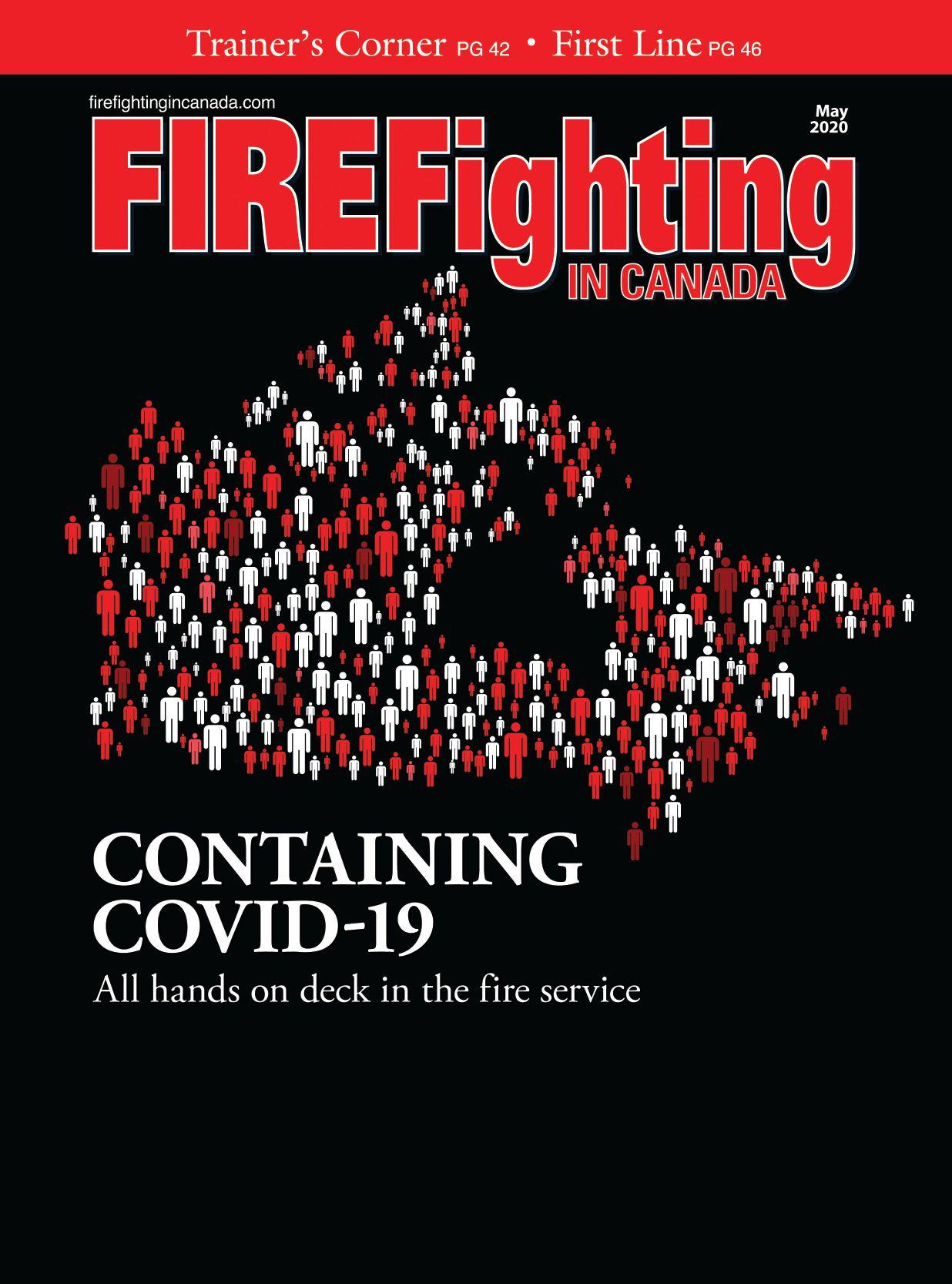
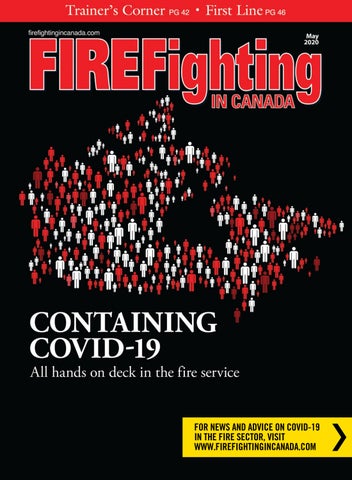
How have fire departments across the country been impacted by the novel coronavirus and the disease it causes called COVID-19? Here’s a roundup of perspectives and changes across the nation.
By Brieanna Charlebois
The technical rescue coordinator with Edmonton Fire Rescue Services shares how his department fostered unique training opportunities through relationships with local businesses and city services.
By Eric Smith
30
FACTS NOT FEAR
Using data isn’t just for urban departments. A deputy fire chief shares how his department is making excellent use of data in a small community.
By Jay Plato
38
WILDFIRE SEASON AND THE CORONAVIRUS
Fire Fighting in Canada hosted an all-about-wildfires week from April 6-10 in partnership with Waterax. Here’s a few insights into how provinces are preparing for the wildfire season during the pandemic.
By Brieanna Charlebois
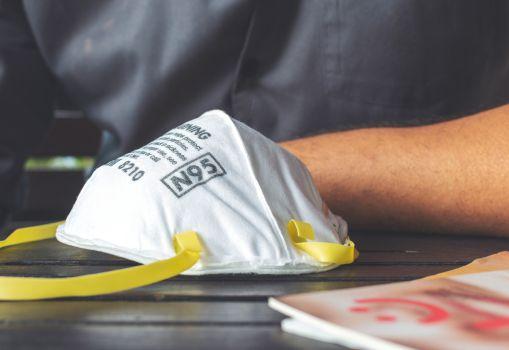

BY LAURA AIKEN Editor laiken@annexbusinessmedia.com
here have been a lot of words to describe this time in which the novel coronavirus upended our lives — unprecedented, uncertain and most definitely unwanted. Unheard of terms like social distancing became common usage overnight. It’s a pandemic with its own vernacular. This language has bonded communities across Canada. We are all in this together has been echoed time and time again.
In periods of upheaval, there are no more comforting words I can think of than the famed adage “this too shall pass.” In times of vast unknowns, one practically burns to get beyond speculation: But when? When shall this pass? We lean into this uncertainty knowing for certain that eventually it will.





a sensibility circulating that the bad surprises are becoming more numerous and catastrophic. The bushfires in Australia was on the cover of our last edition, and now a pandemic graces May. The world lacks not for crisis.




ON THE COVER
Firefighters on the frontlines: here’s a look at the impacts of COVID-19 nationwide. See story on page 10.
This too shall pass — where did such sage words divine from? A Wikipedia entry well supported online attributes it to medieval Persian poets. The phrase’s presence in the West is linked to the English poet Edward Fitzgerald through Solomon’s Seal, the retelling of a Persian fable where a King is searching for a ring that would make him happy whenever he was sad. He was presented with a ring etched with words to the effect of “this too shall pass.”
This too shall pass is one of the most comforting sentiments of our time, its wisdom found in its fundamental truth about the world — the good times pass too; change is always coming. Life is a a series of surprises both delightful and vexing. For those in emergency management, there is
The many other tragedies of no less personal consequence like accidents, fires, flus and heart attacks are still happening. Many people are having the worst day of their life and it has nothing to do with COVID-19. The people who are acutely aware of this continued reckoning with everyday life are the fire service. Fire departments across Canada have stepped up to make the changes they need to keep resources on hand for all emergencies while striving to keep their members safe, members who are frequently on the frontlines of health care. This is no small feat in a global crisis.
And when this too does pass, there will be many lessons and undoubtedly permanent changes to some aspects of the world. Governments will need to regroup on how they prepare for the next pathogen. This isn’t the first pandemic humanity has faced, nor will it be the last.

ESTABLISHED 1957 MAY 2020 VOL. 64 NO. 3
EDITOR LAURA AIKEN laiken@annexbusinessmedia.com 416-522-1595
ASSOCIATE EDITOR BRIEANNA CHARLEBOIS bcharlebois@annexbusinessmedia.com 416-510-5233
ASSOCIATE PUBLISHER ADAM SZPAKOWSKI aszpakowski@annexbusinessmedia.com 289-221-6605
ACCOUNT COORDINATOR SHANELLE TOMLINSON stomlinson@annexbusinessmedia.com 416-510-5232
MEDIA DESIGNER BROOKE SHAW bshaw@annexbusinessmedia.com
GROUP PUBLISHER/VP SALES MARTIN MCANULTY fire@annexbusinessmedia.com
COO SCOTT JAMIESON sjamieson@annexbusinessmedia.com
PUBLICATION MAIL AGREEMENT #40065710
RETURN UNDELIVERABLE CANADIAN ADDRESSES TO CIRCULATION DEPT.
P.O. Box 530, SIMCOE, ON N3Y 4N5 e-mail: subscribe@firefightingincanada.com Printed in Canada ISSN 0015–2595
CIRCULATION e-mail: bolechnowicz@annexbusinessmedia.com Tel: 416-510-5182 Fax: 416-510-6875 or 416-442-2191
Mail: 111 Gordon Baker Rd., Suite 400, Toronto, ON M2H 3R1
SUBSCRIPTION RATES Canada – 1 Year - $25.50 (GST - #867172652RT0001)
USA – 1 Year $58.50 (CDN)
Annex Privacy Officer
Privacy@annexbusinessmedia.com
Tel: 800-668-2374
Occasionally, Fire Fighting in Canada will mail information on
behalf of industry-related groups whose products and services we believe may be of interest to you. If you prefer not to receive this information, please contact our circulation department in any of the four ways listed above.
No part of the editorial content of this publication may be reprinted without the publisher’s written permission ©2020 Annex Publishing and Printing Inc. All rights reserved. Opinions expressed in this magazine are not necessarily those of the editor or the publisher. No liability is assumed for errors or omissions.
All advertising is subject to the publisher’s approval. Such approval does not imply any endorsement of the products or services advertised. Publisher reserves the right to refuse advertising that does not meet the standards of the publication. www.firefightingincanada.com

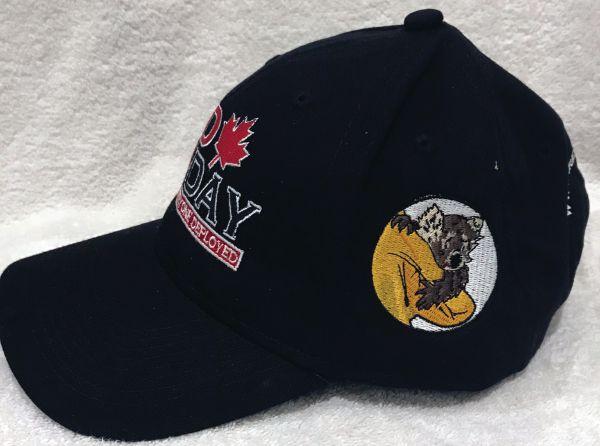
The RED Friday cap can now be purchased with the image of a koala on it to support mental health for Australia’s firefighters.
The RED Friday Organization launched a new fundraiser to support the mental health of firefighters in Australia. RED stands for Remember Everyone Deployed.
Now an international movement, RED Friday’s latest initiative is selling hats under the moniker RAD cap, with RAD standing for Remember Australians Deployed.
Five dollars from every RAD cap will be given to the Volunteer Firefighters Association in Australia to help pay for mental health programs.
Bob McTaggart, CEO of RED Friday, said hat sales are gaining
RICK SAULNIER was promoted to the position of fire chief in Foothills, Alta., on Feb. 1. Saulnier began his career as a part-time volunteer firefighter with Alberta’s Okotoks Fire Department in 2006 before taking on the full-time role as captain at Foothills’ Heritage Pointe
fire station in 2012. Three years later, he moved into an inspector/investigator position before being promoted to deputy fire chief in 2017.
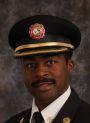
COREY BEALS was promoted to position of deputy chief, community risk reduction, professional development
momentum.
“Firefighters all over North America are picking this up and we’re starting to move a good volume of caps that will translate, we hope, to a minimum of $1 million for the Australians.”
This RAD cap fundraiser is being achieved in operating partnership with M and L Safety Supply, the Volunteer Firefighters Association of BC, Homewood Health Services and Fort Garry Fire Trucks. The working partner in Australia is the Volunteer Firefighter Association New South Wales, and its president Mick Holton. McTaggart observed, and indicates Holton agreed, that the Australian fire service will experience a “tsunami” of occupational stress injuries following this past wildfire season, and that will mean reduced numbers and effectiveness for members on the ground during the next season.
The RED Friday Organization is a self-funded social enterprise with the mission of providing resources for military, first responders and their communities by providing tools and guidance for recognizing and managing operational stress injuries.
McTaggart is founder of the 4th Canadian Mounted Rifles Association (4CMRA), the not-for-profit entity behind the RED Friday social enterprise. He sought out the RED Friday concept’s original founders, Lisa Miller and Karen Boire, because he knew that first responders needed to be part of their military cause as their occupational stress injuries are very similar. Miller and Boire joined the team at 4CMRA. Fire is now on the front burner of the entity’s focus, said McTaggart.
“We do have a self-funding model for fire departments that they can tap into so mental health resources, we hope, will become not something the chief needs to be concerned about on a regular basis…We’re here to help. We do a good job at it.”
Visit redfriday.org to learn more.
and logistics with the Halifax Fire Department on Jan. 25.
Beals spent 10 years as a volunteer firefighter with the Lake Echo & District Volunteer Fire Department in Nova Scotia before beginning his career with the Halifax department in 1997. He was promoted to captain in 2008 then to district chief in 2013. With his promotion to deputy chief, Beals
became the highest-ranking black chief officer in the Halifax department’s 265-year history.

JASON CAIRNEY was promoted to deputy chief of prevention and IT services with British Columbia’s Surrey Fire Service in March. He joined Surrey Fire
Volunteer firefighters in one small Nova Scotian town are redefining their service role in the wake of COVID-19.
In mid-march, shortly after the World Health Organization (WHO) classified the novel coronavirus a pandemic, many Canadian provinces responded by asking residents to distance themselves. At the beginning of social distancing measures in March, the town of Stewiacke identified a way to help those in self-isolation.
Using Hurricane Dorian, the category 5 Atlantic hurricane that hit the east coast last September, as an example of mutual aid and collaborative response in the face of disaster, the town of Stewiacke responded by organizing a free delivery service to the individuals selfisolating in their community. Because the community has a high percentage of seniors, a demographic at a higher risk of becoming seriously ill from the
The fire department in Markham, Ont., has a fire cadet program for teenagers with special needs that is the first of its kind in North America. The 11-week program gives the opportunity to experience life at a fire department. This includes learning about fire prevention, public education, training, dispatch and suppression.
The tenth and most recent class graduated in late February after participating in a range of activities, including trying on bunker gear, giving station tours and giving presentations about the benefits of smoke alarms and carbon monoxide detectors.
Organizers said the goal of the program is to teach soft skills like professionalism, public speaking and respect. It also lets the teens immerse themselves within the culture and work associated with a large urban department. Participants gain exposure to fire prevention, public education, training, dispatch and fire suppression.
So far, 30 teens have successfully completed the fire cadet training program.
“The program always runs with three cadets as MFES has found that to be the optimum number to be assigning resources to that ensures the cadets are fully
virus, community members, including some from the local volunteer fire department, stepped up.
Stewiacke is a small town located about an hour northeast of Halifax with a population of about 1,400, shows a 2016 census. The community has 23 volunteer firefighters.
In response to the rapidly changing COVID19 pandemic, a total of 24 members from the fire department and the town’s
municipal government volunteered to work with the local pharmacy and grocery store to deliver essentials to Stewiacke residents.
Using two utility trucks to complete the deliveries, the volunteers dropped packages off on people’s doorsteps to avoid any personal contact and help reduce the risk of infection.
As of April 13, Nova Scotia had 474 confirmed cases of the infection and three deaths.
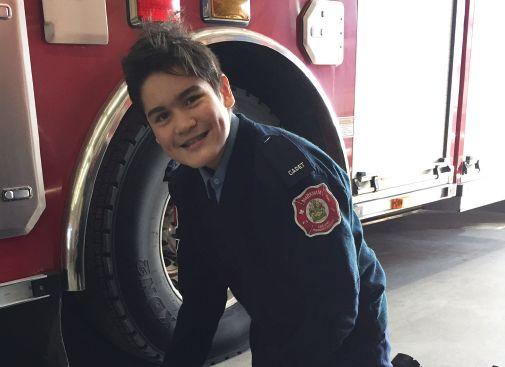
supported,” said Jennifer Yap, communications and media relations coordinator at Markham Fire and Emergency Services (MFES).
The next program’s intake is set to take place this fall. Markham’s fire cadet organizers are encouraging other departments across Canada to consider providing a similar program.
in 2002 as a career firefighter and held the rank of assistant chief of prevention starting in 2017.

DAVID BURNS was promoted to deputy chief of administration with Surrey Fire Service in British Columbia in March. He has worked with the Surrey Fire for over 30 years and
held the rank of assistant chief of operations since 2018. With a background in labour relations as the union vice president, Burns has been very involved in developing wellness and peer support initiatives within his department and throughout the province.
CHRIS KEON, former assistant

chief of operations for Surrey Fire Service in British Columbia, retired in October 2019. With a fire career spanning over 31 years, Keon started as a volunteer firefighter in 1986. He was then hired as a career firefighter in 1988. He was promoted to captain in 2009 before being promoted again to assistant chief of
operations in 2015.
Toronto District Chief and Acting Platoon Chief
DOUGLAS BURLIE passed away Feb. 2, at the age of 60. He was a member of the Toronto Fire Services for 36 years.
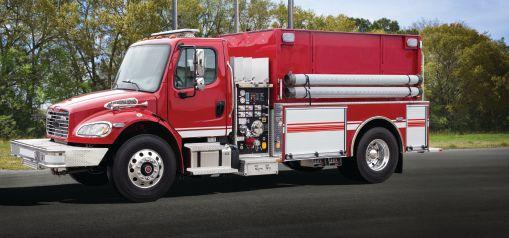
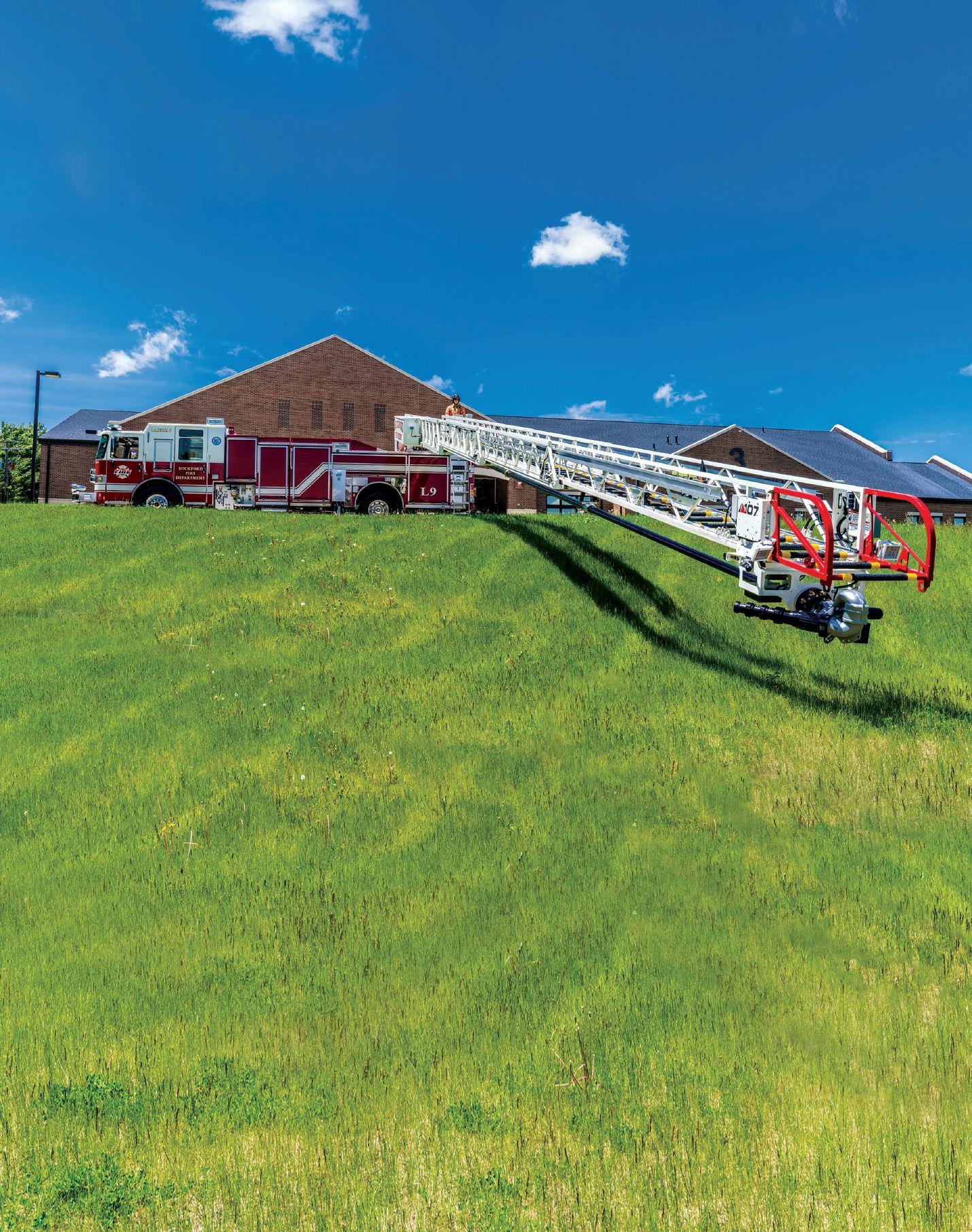
Sturgeon County in Alberta welcomed a vehicle made by Pierce Manufacturing that was delivered by Commercial Truck Equipment. This apparatus runs on a Cummins B6.7 engine with 360 HP and sits on a Freightliner M2-106, single rear axle chassis. Equipped with a 15,000 gpm single stage Hale pump, it’s set up for a foam system and can hold up to 2,100 gallons of water.
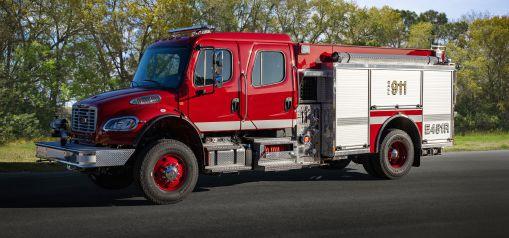
MAIDSTONE WASECA & DISTRICT FIRE BOARD
Maidstone Waseca & District Fire Board in Saskatchewan took delivery of a Pierce Responder pumper delivered by Commercial Truck Equipment. This unit runs on a Cummins L9, 350 HP engine and sits on a Freightliner M2-106 single rear axle chassis. It is equipped with a Husky 3, single agency foam system and a Waterous CXPA, 1250 gpm, single stage pump and can hold up to 500 gallons of water.
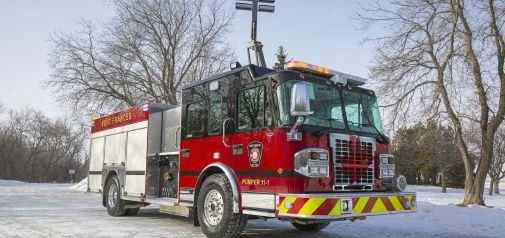
Fort Frances Fire Department in Northern Ontario took delivery of this emergency rescue pumper from Fort Garry Fire Trucks. It is powered by a Cummins L9 380 HP engine and is equipped with side control, a Hale Q-Max 1500 pump and Foam Pro 1600. The vehicle is also equipped with a UPF 800 IG tank.
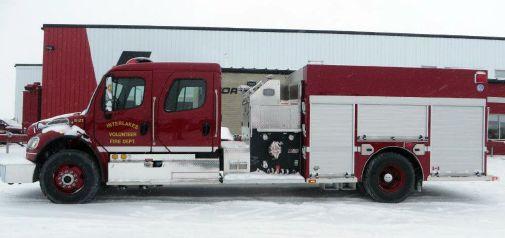
This Freightliner M2 -106 pumper was built by Fort Garry Fire Trucks and delivered to the Interlakes Volunteer Fire Department in Alberta. This unit runs on a Cummins L9 350EV HP engine and an Allison EVS 3000 transmission. The truck’s aluminum body also houses a Hale PTO RSD1250 pump.
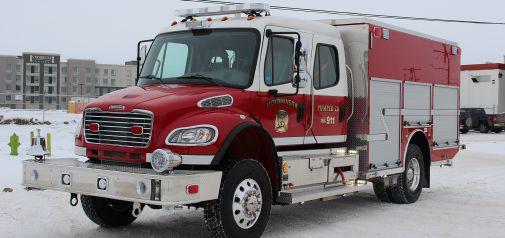
Lloydminster Fire and Rescue in Alberta received a Freightliner M2-106 4x4 pumper from Rocky Mountain Pheonix. This truck is powered by a Cummins L9 330 HP engine and an Allison EVS 3500 automatic transmission. This unit is built with 750 IGAL water tank and houses a Rosenbauer NH 1250 IGPM PTO driven pump. It has a 20 IGAL foam tank and a Foam Pro 2001 foam system with Hale EZ Fill.
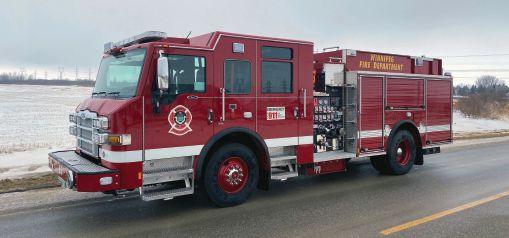
Winnipeg took delivery of three Pierce pumpers from Commercial Truck Equipment. The trucks run on Cummins L9 450 HP engines and are equipped with Husky 3, single agent foam systems, a Waterous 1,500 GPM pump and hold up to 750 gallons of water each. Two of the vehicles sit on a Impel chassis and one has an Enforcer single axle chassis.

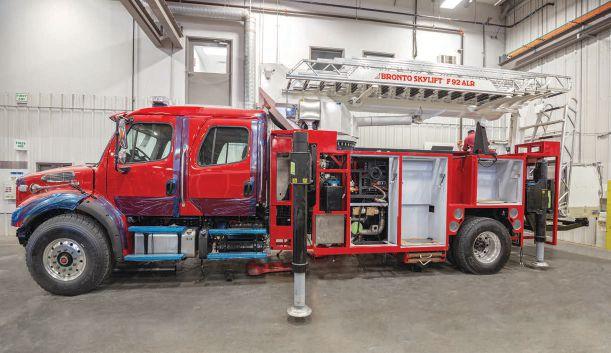
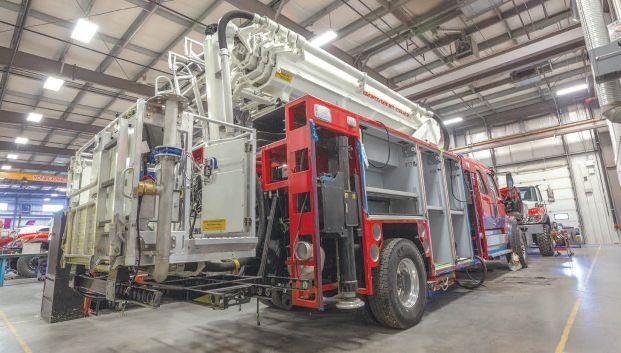

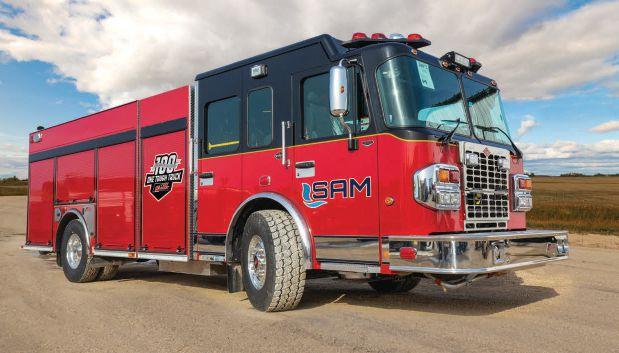
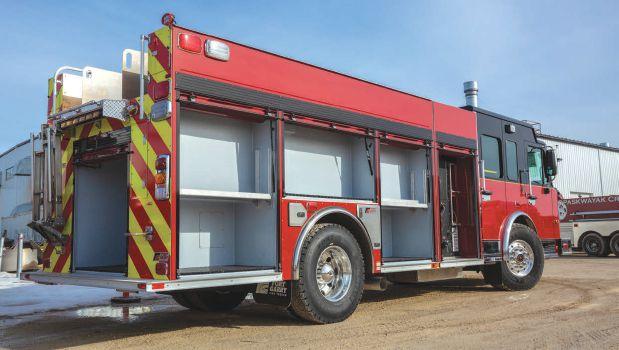
BRONTO ALL-ROUNDER AND SAM DEMO UNIT ARE PROGRESSING NICELY!
Fort Garry Fire Trucks is a proud distributor of sales, service, and parts for the versatile Bronto aerial platforms that are designed for easy maneuvering, quick set-up, and safe and efficient operation. We will soon be unveiling our brand new Bronto All - Rounder. This resourceful apparatus will feature a 92-foot articulated ladder platform built on a Freightliner chassis with a 450 HP diesel engine and will measure
under 13 feet tall, 42 feet long, and 8.5 feet wide. We will also be unveiling our SAM Demo Unit around the same time! SAM is an integrated total water control system that manages your truck’s pump, tank, intakes and discharges. The SAM system replaces your pressure governor and takes care of opening and closing valves based on operator settings. Now firefighters can control all pump controls on a 10″ touch
screen display. If you’re interested in either of our brand new rigs follow us on Facebook for videos and updates during their production.

The Canadian fire service is all hands on deck in this pandemic with a focus on delivering service while maintaining member and public safety.
By BRIEANNA CHARLEBOIS
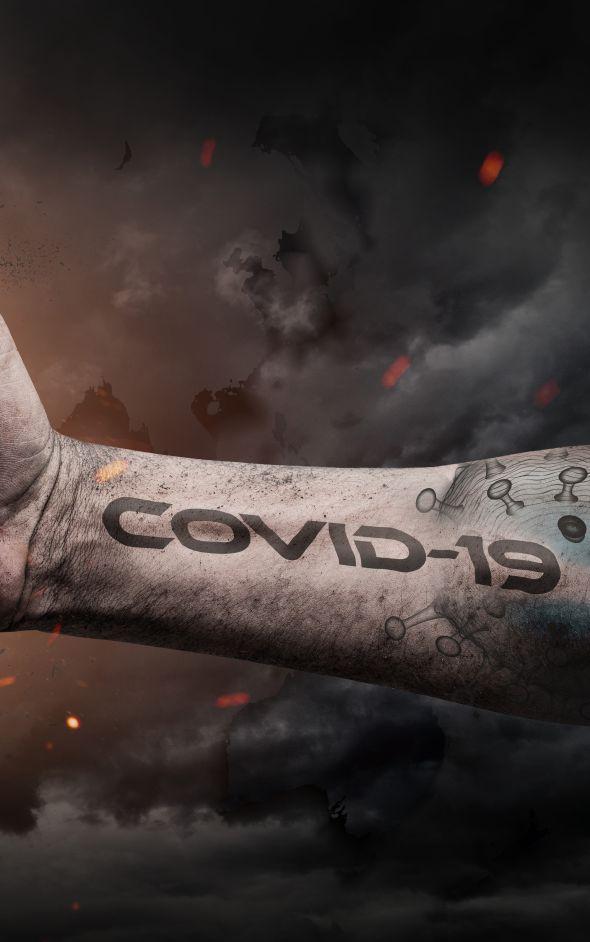

LEFT As of April 14, Canada had 26,163 confirmed cases and 823 deaths.
ABOVE More than 10 firefighters have tested positive for COVID-19 in Canada.
In the wake of the global pandemic, fire departments across Canada have been rising to the occasion and doing what they have been trained to do: face the crisis head on. The novel virus — severe acute respiratory syndrome coronavirus 2 (SARS-CoV-2) — appears to have originated in a seafood market in Wuhan, China last year. The resulting disease, known as COVID-19, became a global crisis.
The World Health Organization (WHO) declared the virus a pandemic on March 11. Federal governments around the world closed borders and asked citizens to isolate themselves at home. Soon, many provincial governments across Canada declared the outbreak a state of emergency and prohibited non-essential work. These measures were put in place hopes of flattening the curve of new infections to save lives and prevent overloading the healthcare system.
Each province and territory reacted to the outbreak in various ways at different times and fire chiefs across the country worked to sort out how to minimize the risk of infected individuals to their members, work with available PPE in light of shortages and remain ready to serve their communities.
“A pandemic offers some unique challenges to the fire service,” said Dan Derby, president of the Fire Chiefs’ Association of British Columbia and regional fire chief for Kootenay Boundary Regional Fire Rescue. Derby spoke to Fire Fighting in Canada during in a Dräger-sponsored podcast with recorded on March 17.
As all-hazard responders, firefighters play a significant role within the healthcare system. In addition to following the directives given by public health officials, departments must also make decisions and adjust their service models based on various factors including the size of the department, work schedules and the severity of the situation in regards to both the population, the number of infected individuals in the jurisdiction and possible exposure risks.
“We’re very good at making decisions and taking direction in a very structured approach to Incident Command and we’re now blending in health authorities and allowing them to lead the discussion,” Derby said in the podcast. “With provincial and federal governments providing oversight and direction, this is a time for us to morph and learn and grow in terms of how we support our communities because that’s ultimately our goal: to support the community and ensure that our members are safe when they respond to the needs of the community.”
As the novel coronavirus began spreading across the country, so too did its many ramifications. Many anticipated fire industry events were cancelled. Departments suspended training, many opting for virtual training where possible. In-person public education in the community was halted and fire safety discussions were focused online. Departments grew extra concious of their PPE and staff resources with the anticipation of firefighter shortages due to isolation requirements and sick time.
In the weeks following the pandemic declaration, fire halls began closing to the public and several fire service members across the country went into self-isolation or quarantine after travelling or coming into contact with a potentially infected person. This included stations in Winnipeg, Saskatoon, Halifax, Langley and Coquitlam, B.C., and Newmarket, Ont. As of April
1, firefighters in Montreal, Toronto/ GTA region had tested positive for COVID-19, as did a district chief in Ottawa.
Decisions were being made amid an onslaught of new information, which often changed daily. Chief concerns around firefighter safety, PPE shortages and staff shortages led various departments to alter their protocol for responding to medical calls.
Using the same protocol that was put in place during H1N1 and SARS outbreaks, New Brunswick and Nova Scotia fire departments decided to respond only to medical under certain conditions, such as necessary auto extrication in Nova Scotia. Similarly, in Montreal it was decided that only ambulance workers would be dispatched to respond to medical calls.
British Columbia’s provincial health officer Bonnie Henry issued a directive on March 31 that ordered the province’s firefighters to stop responding to all but the most dire medical emergency calls for the duration of the pandemic. This included not attending to most overdoses. Comparably, in Thunder Bay, Ont., firefighters were instructed to cease administering naloxone kits at this time.
Aside from restricting medical calls, some departments have also adopted and enhanced other safety protocols in response to the pandemic. In early April, after 80 per cent of firefighters surveyed by the union supported the change, the Calgary Firefighters Association announced firefighters would begin working 24-hour shifts in order to limit the number of people in fire halls.
Processes like recording temperatures and screening firefighters when coming and going from duty began to be implemented in departments.
Some first responders were taking on roles they aren’t typically required to fill. For example, firefighters in La Tuque, Que., were deployed to staff checkpoints set up to protect the regional population.
Canada’s fire chief associations have stepped up to collect and distribute the most accurate and up-to-date information to departments. Derby said it’s important to keep lines of communication open and to respect everyone’s place in the chain of command during this type of event.
“[The Fire Chiefs Association of B.C.] initiated a COVID-19 committee to provide factual, timely information to our members to ensure that they have the information that they need in a consistent format, and to make decisions on service delivery that they have to make at a local level,” he said on the podcast. “We’re not telling our members how to deliver their service, we’re empowering them and giving them the best and most accurate information that we can in a timely fashion from the right resources and health authorities, the provincial government and the federal government, to allow them to make the decisions that are right for their communities.”
Whistler, B.C.’s Fire Chief John McKearney is president of the Canadian Association of Fire Chiefs. McKearney spoke with Fire Fighting in Canada on a podcast sponsored by Fort Garry Fire Trucks in late March. He accentuated the importance of government agencies in understanding that fire departments plays a significant role in healthcare.
“We are bringing it forward to the Public Health Agency of
BY CHRIS HARROW Fire Chief Minto Fire Department Ontario
hile on my most recent vacation, I read a book written by Jerry Howarth, the voice of the Toronto Blue Jays for over 30 years. I grew up listening to Howarth on the radio and enjoying his many calls during championships won by the Jays. He was a gentleman and so knowledgeable with every aspect of baseball. Who knew reading a book about a Blue Jay’s legend would teach leadership techniques to an old fire chief?
In the beginning of his 2019 book Hello Friends!, Howarth asked Toronto-area leadership expert Drew Dudley, author of the book This is Day One: A Practical Guide to Leadership That Matters, to write an introduction that included his views on Howarth. In it, Dudley wrote a perfect quote about leadership: “Most of the leadership on the planet comes from people who don’t see themselves as leaders — people who say they’re just “doing their job” but do so in ways that serve and strengthen our communities.”
He went on to talk about a quality that all leaders need to exhibit and one of Dudley’s favourite leadership insights is: “In your life, you will be given countless opportunities to shut the hell up. Seize every single one that you can.”
The point the author makes is excellent. It drives home the idea a leader does not have to speak all the time to show their leadership abilities. Leadership can be demonstrated just as effectively by staying silent and knowing when to speak your point.
Fast forward a couple of weeks past my vacation and our department gets the bad news that one of our captains, Peter Henderson, passed away after a lengthy battle with cancer. Henderson’s cancer was fire fighting related and considered a line of duty death. He served for 35 years and was instrumental in many different areas of the department.
respect from everyone, it was earned, and it was earned from knowing when to stay quiet and when to speak up. It’s amazing to look back and see how that transpired over the years. Even with new firefighters coming into the department, you could quickly see the respect.
A great deal of respect can come from a leader’s knowledge and the ability to pass on the knowledge at the appropriate time. Individuals who are continually talking or constantly instructing people on what they are doing wrong are quickly labeled a know-it-all. There is very little respect given to these individuals. In fact, they are quite annoying.
A great leader knows when to speak up; when it is a teachable moment. They pick their time wisely and impart their knowledge in a proper way. They allow the firefighters to make mistakes when it is safe to do so or to figure a situation out for themselves. Much can be gained from making mistakes and learning from them. As leaders, knowing when to sit back and not speak up when you know the solution is not going to work is just as important as speaking up too much.
I could see this with Henderson and his profession outside
A great deal of respect can come from a leader’s knowledge and the ability to pass on the knowledge at the appropriate time. ‘‘ ’’
Hendeson was always seen as one of the best leaders in the department. He commanded respect at each and every fire scene he attended. He was also one of the best incident commanders we had. Around the station, he was quiet and respected by firefighters young and old. He would speak up only when he needed, and when he did, everyone listened. He was that quiet, respected leader.
Henderson knew when to stay quiet and let others figure out the problem, only speaking up when things were going down the wrong path. His quietness was his strength. He didn’t need to command
Chris Harrow is the fire chief in Minto, Ont. He is a graduate from fire programs at Lakeland College and Dalhousie University and holds a graduate certificate in Advanced Care Paramedics from Conestoga College. He can be reached at c.harrow@mintofiredept.on.ca.
of being a volunteer firefighter. He owned his own construction company; in fact he and his son built the house my family lives in. I was allowed to “help” on my days off when our house was being constructed. I can see many times now when I was helping and screwing up that Henderson could have spoken up and told me I was not doing it properly. Instead, he allowed me to screw up and fix my mistake so I would learn from it. I also think it was entertaining to him and his crew to watch me attempt things I was not very good at.
Silence is sometimes the best method to use in a situation. Even though you think you need to talk and say something absolutely insightful, zip it and listen. Who knows, you might even learn something from listening. I am sure Henderson is listening to us right now and smiling. Rest easy our friend, we will take it from here.
great training opportunities
fostering community connections — here’s tips for how you can too
By ERIC SMITH
Edmonton Fire Rescue Services (EFRS) believes in four core values: service, safety, relationships and teamwork. These values, combined with continuous improvement, is not only a personal motto, but one that is supported and actioned by the entire department.
In my role as technical rescue coordinator with EFRS, I have established some great working relationships to improve our Technical Rescue Team (TRT). This is in part thanks to the working relationship and support from my superior, EFRS Special Operations Chief Bruce McWhinnie.
One of the main areas I’m responsible for is training our TRT members. In an effort to maintain fiscal responsibility, developing and pursuing community relationships for our team has proven to be highly successful.
The TRT is made possible by its 85 volunteers, which is seven per cent of our department’s 1,200 firefighters. The team operates out of Fire Station 3, with Rescue 3 and Pump 3 and TRTSU (support unit). TRTSU is an extra rig that is at Station 3 and only mobilizes for TRT events. Rescue 3 carries extra specialized TRT equipment, primarily rope rescue equipment. In addition to their regular fire crew duties, the team also serves to respond to TRT related events where they act in a support or specialty role.
The TRT operates within eight distinct disciplines: confined space, embankment rescue, heavy lifting, highlines and offsets, pick-off rescues, rope access, structural collapse and trench rescue. The TRT is most generally dispatched to trench, collapse, confined space and heavy lifting type events.
Living in the northern climate of Edmonton, where -40 C is a common occurrence, is a definite challenge. The balancing of TRT training allotments (includes main-


taining all eight disciplines of TRT) within regular EFRS operations training can be immensely challenging. Fiscal restrictions and economic downturns present another layer of challenges. The key to overcoming these is in building and maintaining relationships. Relationships help navigate political pressures when these fiscal restrictions threaten to slow continuous improvement, disrupt normal operations and stagnate the advancement of the team.
Here are some of the relationships we have built that have fostered the training opportunities for our TRT unit.
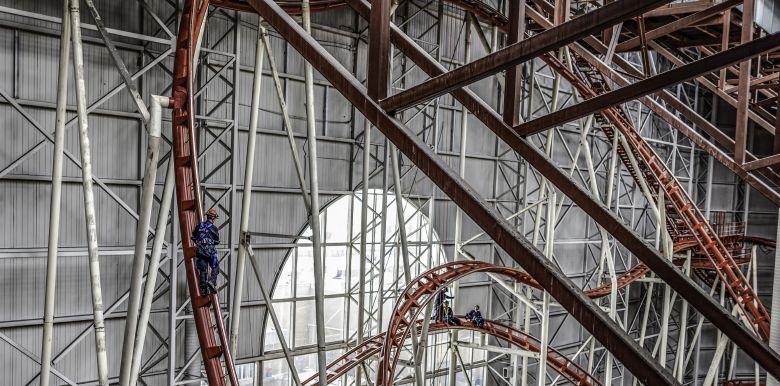
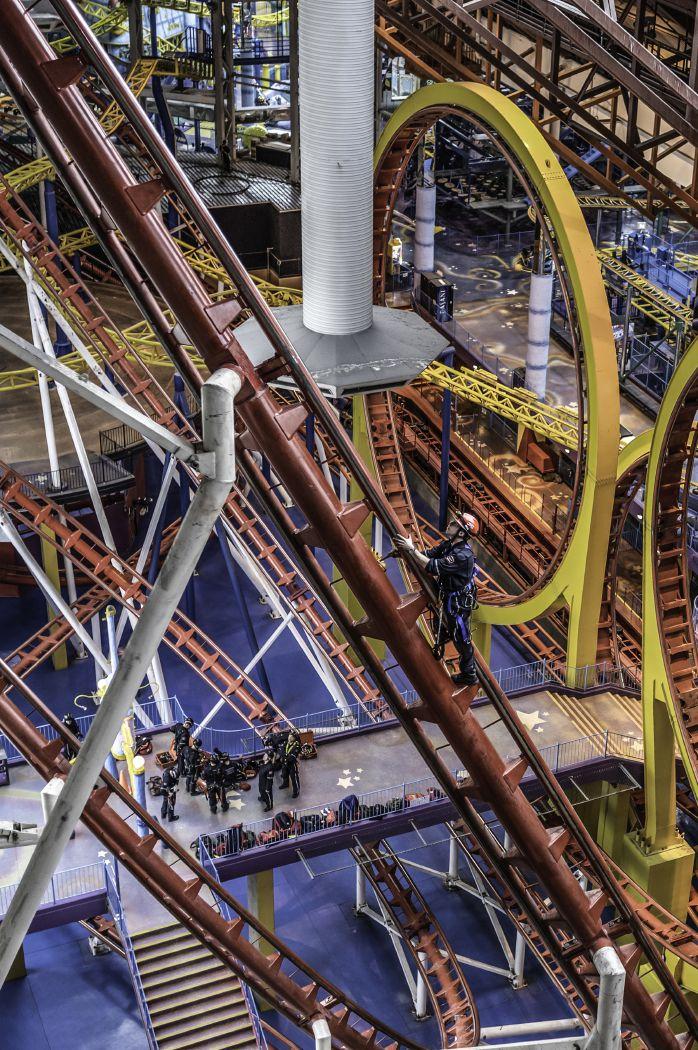
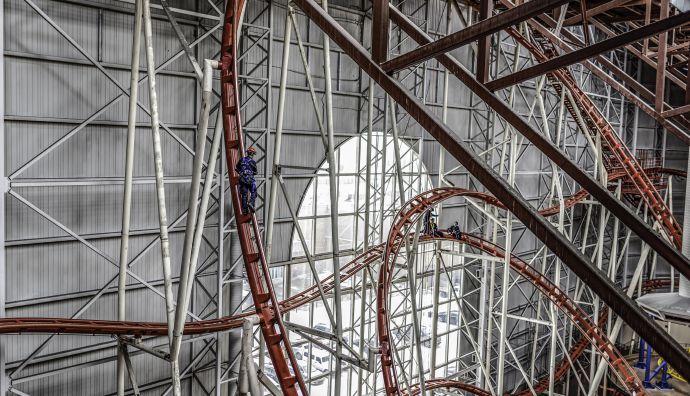
West Edmonton Mall: One of the valued relationships we have is with West Edmonton Mall (WEM), who have allowed us to practice indoors and use their various attractions during the winter months. Some of the attractions that we have used for training include the world’s largest indoor roller coaster, the Santa Maria ship replica and a bungee tower and decommissioned water slide tunnel in the World Waterpark.
Support from WEM staff with the logistics of our training has been outstanding. In an effort to express our gratitude and foster the relationship, and with the support of our Training Academy (thanks to Bradley Hoekstra, deputy fire chief of training and logistics and dean of training, Melissa Creech), we were able to present WEM with a printed collage of photos taken during one of our training exercises in their facility by EFRS firefighter Caleb Snee. The result was an overwhelming and unexpected response from WEM management staff; an extra “knot” strengthening our relationship with them.
EPCOR (electricity provider): Our long standing relationship with EPCOR has been
instrumental in the development of our trench rescue capabilities and traces back to the inception of the team. EPCOR even donated shoring equipment for our team, which we have since been able to upgrade. Our partnership still exists and is ongoing. EPCOR allows us to train on their site and provides trenches for our team. Some of the joint training includes EPCOR’s hydrovac trucks, so that our team is aware of the capabilities and limitations when working with those trucks. We are currently in the process of revamping our training to include more cross-training with EPCOR in efforts to gain and share knowledge and experience in this field. EPCOR has also supplied us with damaged concrete culverts and vaults that we utilize in our structural collapse and heavy lifting disciplines.
City carpenters: We established a working relationship with our city carpenters while researching replacement materials for trench rescue and building shoring. Their quality of work is second to none. The most current example is when city carpenter Sarah Davies worked on our training prop for confined space training. She was able to repurpose decommissioned lumber, completing the project ahead of schedule and with great craftsmanship. Davies also enhanced the project by making it stackable and easily transportable.
In an effort to increase our knowledge and safety around operating our newly replaced Milwaukee cordless tools, we arranged for a couple of senior carpenters to join us during structural collapse training to demo and provide information to the crews on how to be safe and more efficient when operating the tools.
City Hall: Another relationship with the
City of Edmonton exists with the employees based out of City Hall, who allow us to train inside the City Room for pick-off rescues. Not only does this venue provide a real-world scenario, but it also provides a different training scenario, an option for inclement weather and a high public traffic location, to list just a few of the benefits.
We have received very positive feedback from City Hall employees, bystanders and visitors of City Hall that watched the training. Our TRT members appreciate the challenges presented in real-world environments as new locations forced them to adapt. This in turn increases both their experience level and confidence level.
City welder: Our city welder Glen Oleksiw has amazed us with his ingenuity and fabrication skills time and time again. The bigger projects completed have been the fabrication of the securing system for our TRT trailer that houses our additional Paratech and trench rescue equipment. A more recent collaboration was the modification of our TRT Support Unit to make more efficient use of space to hold our Milwaukee cordless tools. Oleksiw has also been extremely valuable in providing training for our members on proper techniques when operating our Petrogen torch.
Hazmat: The other official specialty at EFRS is the Hazardous Materials Team. During our recent confined space rescue training, the Hazmat coordinator delivered an enlightening and pertinent lecture to our TRT instructors on air monitoring and proper use of gas monitors.
Peer support: A frequent call we respond to is for pick-off rescues to assist suicidal individuals from high places, most commonly from one of the many bridges in our 18,000 acre River Valley.
With the support of our fire administration team on the importance of mental health, the peer support team was created. One of the courses offered to the team is the ASIST course. The relationship we have with the Training Academy and our mental health coordinator, Toni Boyko, helped solidify the justification for TRT members to be included in this training course.
Our TRT team attends multiple suicide calls. Usually our members end up being the first point of contact, getting involved in conversations with people at risk. By taking this course, our TRT members now have the resources to manage themselves during these events. Not only has it benefited the team on
CONTINUED ON PAGE 49
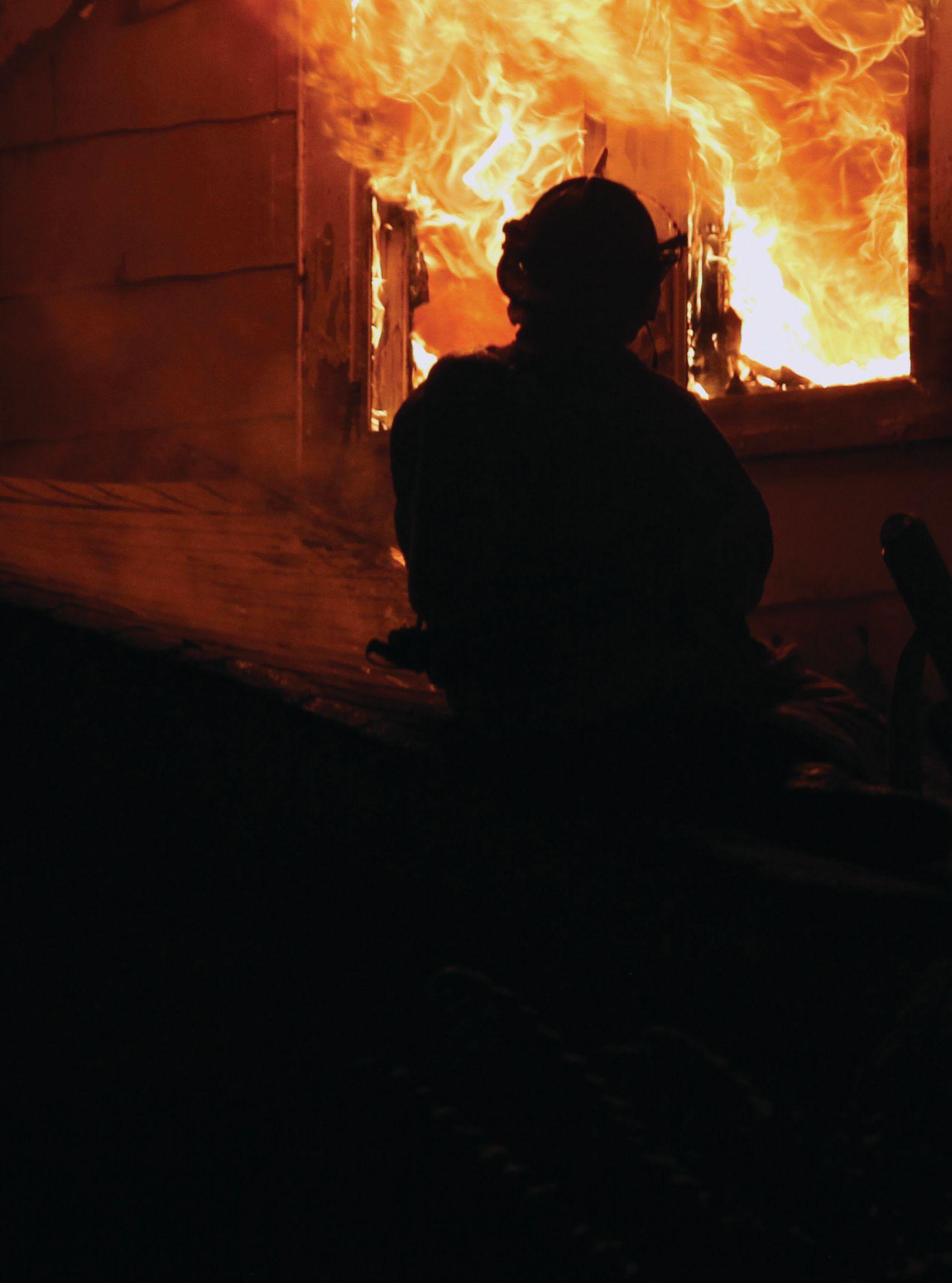
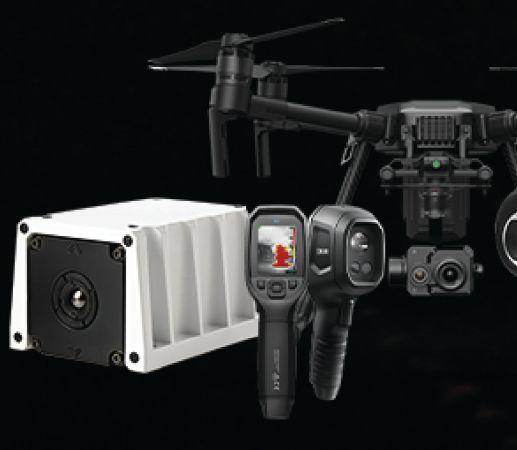
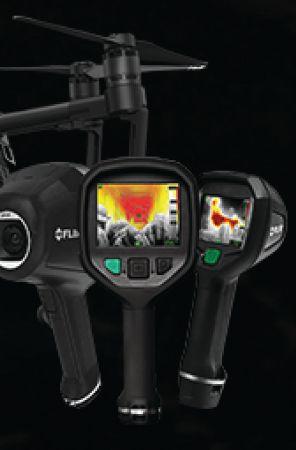
Give your crew FLIR thermal vision — a clear, 360° view of the scene — from the air, ground and by hand in the thick of the smoke. Plan your attack faster, see re as it spreads and make rescues safer for victims and re ghters. FLIR has a TIC solution for any budget.
To learn more or request a demonstration, visit flir.ca/fire

BY TINA SARYEDDINE Executive Director Canadian Association of Fire Chiefs
rom physical and mental health to building codes and pandemic planning, research plays an important role in determining policy and practice in both the fire sector and society in general. The views of researchers are often held in high esteem and the products of research can translate into new technologies, methods, or treatments.
However, seldom will a single piece of research be able to prove something definitively. In fact, the better the research and the manner in which it is presented; the clearer its limitations, caveats, alternate explanations, possibilities, and cautions. In other words, good research always has limitations. The power of research lies in the bodies of knowledge that accumulate, not in a single study. Understanding this is essential for leaders in the fire sector. It is also essential to maximize the value of research and practice collaborations.
Below are some questions that might be helpful in your conversations with researchers when you are assisting in collaborations on a single study or analyzing an article. It is not exhaustive and there are certainly many others. However, the word “conversation” is the key. Your experience in practice is as valuable as, and essential to, research as the research is to practice.
1. Is the research qualitative or quantitative? Research is generally divided into qualitative and quantitative research methods. Qualitative research uses non-statistical and systematically applied methods to analyze “data” from interviews, focus groups, document analysis, or researcher experiences. It is generally used to understand experiences, meanings, and develop theories that can later be tested. Quantitative research is used when knowledge is more advanced and allows for more precise research questions. However, don’t be fooled by the use of numbers. In quantitative research, numbers are used to conduct statistical analysis, not simply to create counts or averages. It is entirely possible to have a qualitative study with numbers in it. This leads us to the next question.
2. Are the findings statistically significant and (or) practically significant? In quantitative research, statistics are often used to understand the extent to which a relationship between two variables may be attributed to something other than chance. If it is just chance, it is not statistically significantly. However, even if a finding is not “statistically significant”, it doesn’t mean that the finding isn’t important and if it is, it doesn’t mean that it matters practically. Similarly, be cautious that some researchers may use the expression “there is no evidence to suggest that”. This means just what it says — there is no evidence — not that something is not true. It may just mean no one has studied it.
Tina Saryeddine,
PhD, MHA,
CHE, is the Executive
Director
of the Canadian Association of Fire Chiefs. You can learn more about the CAFC at www.cafc.ca.
3. What was the goal or your research question? Understanding the research goal in qualitative research or the question in quantitative research is important as it will allow you to trace the methods, results and conclusions back to a starting point around which a good design would be based. A result or conclusion related to something other than the original question may be interesting, but needs to be considered very carefully.
4. Is there reason to be believe this is a causal relationship? It is often tempting, particularly in quantitative research, to conclude that something causes something else. This is seldom possible. For example, if we find that perceptions of stress in organizations go up with mental health issues, we may say there is a relationship, but this doesn’t mean one causes, the other. It might, but it may also be that the more mental health issues, the more negatively the environment is rated. Unless we set up tests to understand this, we simply don’t know. This shouldn’t create a paralysis by analysis, the proposed conclusion it is may be possible, and one can always improve organizational culture. However, be cautious there may be other factors at play.
5. Are there reasons to believe this research is generalizable? Particularly in public safety, there is a tendency to conduct studies with convenience samples. This means that the sample of people or responses studied may be those that can be accessed and not necessarily be representative of the general population. Consider, for example, a study done on public safety personnel work environments, then consider that 85 per cent of firefighters work in volunteer departments. Also consider the differences between the structure, resources and culture of fire departments compared to federal public safety personnel or police departments. Are they all the same? They may be, but unless due consideration was given to this, one should not begin with that assumption.
6.What cautions and limitations should I use in interpreting your research? Some researchers, such as the teams at FireWell and CIPSRT and the NFID database, are very concerned about how lay people interpret research. In the lay summaries of the FireWell research, there is often a section on “cautions”. If a researcher isn’t sharing the cautions to the article interpretation, don’t hesitate to ask!
Perhaps the most important question to ask a researcher — No. 7 — is not about a single study, but about his or her body of work. In other words, what would he or she like you to know, and/or what advice might he or she have to help inform your decision making. Remember, most research is intended to apply to a broad population. Strategic decision making is about leveraging the particulars of your own situation. In conclusion, always consider the possibility, but don’t hesitate to have conversations with researchers. As much as they have knowledge to share, they need your practical insights and experiences as well.

BY LAURA
KING
NFPA Public-Education
Rep
Canada
hen I ask people in workshops and seminars how they “do” public education, the answers are as expected: we go into schools; we have open houses; we use social media. All are good responses. We’re communicating customized messages to people so they can better protect their families from fire and other hazards by changing their behaviour. That’s public education.
You know the messages: Test smoke alarms at least once a month. Plan and practice your escape. The messages are familiar, seemingly old hat, perhaps. But those messages, and the context around them, are finely crafted; every word in every message is there for a reason.
The messages (and the greater context) come from the NFPA, from a team of technical experts who develop, review, amend, and update the wording and content to ensure people on the frontlines have consistent, accurate tools for fire prevention and public education.
The document that defines NFPA’s messages is called the Education Messaging Advisory Committee desk reference, or EMAC. The title is a mouthful, so, for simplicity, we’ll call it the messaging guide.
The messaging guide is updated regularly by members of the committee, all subject-matter experts. The 2020 review meeting was scheduled for March but was postponed; hopefully, the committee will meet in the fall and the new version of the messaging guide will be available by early 2021.
The week the committee was supposed to meet to update the messaging was the first week of COVID19 restrictions in Canada and the United States. As I watched, and scrutinized the sometimes confusing messaging around self-isolating and testing and symptoms, the importance of NFPA’s consistent and accurate messaging struck me on a new level.
a structure fire.
You wouldn’t tell people to plan and practice their escape if you didn’t believe that doing so increased the likelihood of a positive outcome.
We learned from the early days of COVID-19 just how transient our society is, which is why it’s critical that we use the same messaging, from coast to coast to coast. We know that repetition and consistency breed compliance.
So, how do you find the messaging guide? Go to www.nfpa.org, click on public education, then educational messaging. The document is free to download. Print it, save it to your desktop, bookmark it – whatever works for you. A French version of the guide is on the Canadian resources page (www.nfpa.org, click public education, then Canadian fire-education materials).
The guide includes messages for kids, and easy-to-read messages for those for whom English is not a first language. In 2018, the NFPA added messaging about wildfire and university and college housing. When the committee meets next, it will likely clarify messaging around closing bedroom doors when sleeping, based on research and data, so
We’re communicating customized messages to people so they can better protect their families from fire and other hazards. ‘‘ ’’
Less-than-perfect messaging in crisis communication leads to confusion. Confusion leads to bad decisions. Bad decisions lead to tragedy. Ideally, messaging is developed and in place before an emergency, hence, the NFPA messaging guide – a carefully thought out bible for every firefighter, educator, inspector, and chief officer.
The guide provides context and background; it’s written so fire personnel will understand the reasons for the messages before customizing and disseminating them with conviction, passion and complete clarity.
You wouldn’t tell people to test their smoke alarms at least once a month if you didn’t believe that working smoke alarms save lives and provide the best chance (other than sprinklers) for occupants to escape
Laura King is the NFPA’s public education representative for Canada. Contact her at canadacrr@NFPA.org and follow her on Twitter at @ LauraKingNFPA.
everyone can use and share correctly worded guidance.
I see lots of messaging on social media, some accurate and correct, some that could use clarity. As technology develops, so do the messages. For example, I saw “Change your clocks, change your batteries” dozens of times in early March, but no direction for occupants whose alarms are interconnected or powered by 10-year sealed batteries. Make sure, when using messaging, that it’s current and accurate. Check the messaging guide, find your subject matter, and ensure the guidance you provide to your followers or your community is correct and consistent.
There are more ways than ever to reach people today. Be creative in the use of social media platforms; be creative with graphics and pop-culture references; be creative with catchy phrases, rhymes, even poetry! But first, be accurate.

䘀椀最栀琀 䘀椀爀攀猀Ⰰ 一漀琀 倀愀瀀攀爀 眀漀爀欀 䘀氀攀砀椀戀氀攀 䄀昀 昀漀爀搀愀戀氀攀 刀攀氀椀愀戀氀攀
吀爀甀猀琀 䘀椀爀攀倀爀漀㈀ 琀漀 栀攀氀瀀 眀椀琀栀 礀漀甀爀 挀爀椀琀椀挀愀氀 昀椀氀攀猀 愀渀搀 瀀爀漀瘀椀渀挀椀愀氀 爀攀瀀漀爀 琀椀渀最⸀

By CHRIS DENNIS
In the area of fire truck and equipment repairs, this skilled trade — emergency vehicle technician (EVT) or fire department apparatus equipment technician — not only maintains and repairs life-saving apparatus and equipment, but has to understand how the equipment is used and designed. Many departments do not have dedicated EVTs. They have been able to depend on the municipality fleet technician or an outside repair facility for maintenance and repair. And, our repair industry is no longer packed with apprentices banging on the door to get in. It’s the new generation and being an EVT is seen as heavy, dirty and in a lot of cases still not remotely close to paying well. In Ontario, the apprentice now has to pay to go to trade school. The repair industry is suffering with a lack of up and coming technicians. It’s not just our field. Plumbers, electricians, carpenters as well as many other trades are all suffering in the recruiting department. This is a conversation for another time — back to my point about educating your fire deparment repair techs.
Next time you run a pump course or an aerial training course for your firefighters (or any other type of training), include a fire apparatus repair technician in this education. If the technician can see what the apparatus is used for, or how it is used and abused, they can create preventative maintenance plans or repair techniques best suited to your department, who will then benefit. For example, when I stared fixing fire trucks, the fire department was about to run a pump ops training course for the firefighters. This week-long course certified a firefighter as a pump operator. I asked to take part. What I took from this class was what these folks do when on the fireground running the fire pump and supplying water. I spoke with our training division and we built on their course outline to include a preventive maintenance inspection only program for the firefighter at station level to help assist with maintenance in a preventive way (not repairs). Nothing technical, it just enhanced and allowed them to actually see what’s going on and why things are happening when the fire pump is engaged.
It’s also very key to educate your fire department repair techs so they can stay ahead of the electronic curve. Even pump panels have become computers, as you can see from the SAM (Scene Apparatus Manager) system by Akron Brass Idex Corp. that is pictured in this article. These systems are incredibly advanced.
If your repair techs are also firefighters, you will agree with me that they usually are very good at this part of the job when describing potential issues. Don’t get me wrong. All trained firefighters do a good job or they would not be in the field they are in.
In a perfect world, all fire departments in Canada would have a dedicated fire apparatus repair division or at least one technician. Unfortunately, it’s all about cost. It’s a shame that in most cases we must wait for something terrible to happen before the business
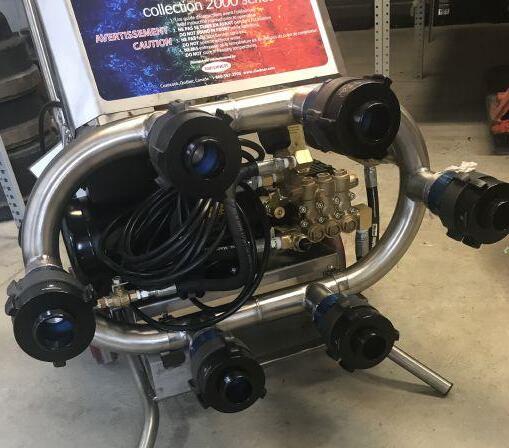
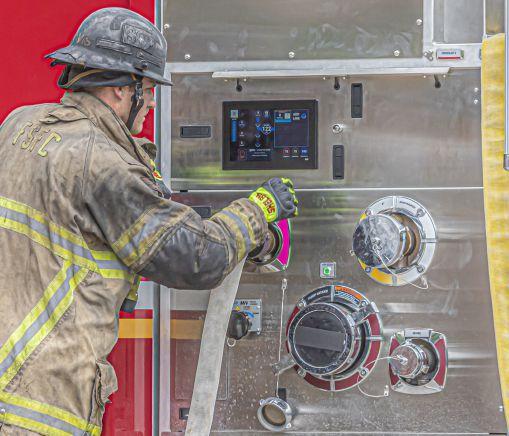

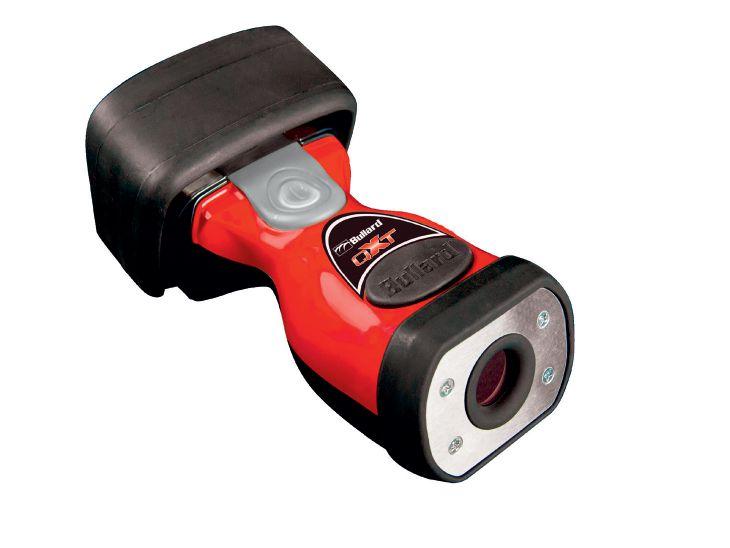
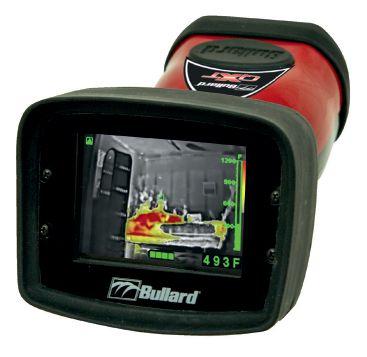
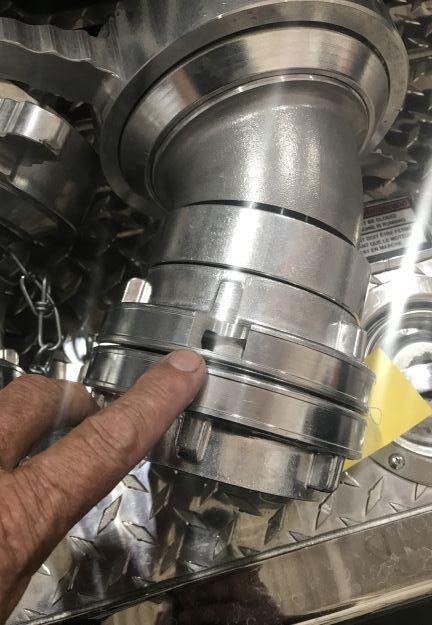
When doing a final inspection on a new build, take nothing for granted. Check every last inch of that truck. No one wants to have to send a truck in for warranty repairs before it has even been put to work.
practices we go by daily are viewed then adjusted. Talk to the surrounding volunteer fire departments about how they conduct apparatus repairs on tight budgets.
The trained and educated EVT should also be involved in the fire truck building stages. He or she can bring so much to the design and spec table then, at least in the paper designed side and the final inspection. This brings me to new truck deliveries and the importance of pre-delivery inspection. Over the years, I have had the opportunity to travel to different parts of Canada and the U.S. to inspect both new and used fire apparatus. These inspections have been as a consultant as well as representing my department, Vaughan Fire Rescue Service. I have been around fire trucks and fire department related equipment for many years, and just when you think you know a little more than the average guy about this side of the
fire service, you find can still be pleasantly and not so pleasantly surprised.
There is a process to performing a new truck inspection prior to taking delivery and making final payment. I will assume your RFP or bid quote spec is exactly what you need, so include your technical repair staff in its creation. Be sure the apparatus is not too big, too long, too wide or too high to even fit in your stations. Yup — this has happened. Give yourself enough time and pre-plan the station it stays in as well as the infrastructure of your municipality. Will the roads and bridges handle this new rig? Again, height and weight are big factors. The purpose of the inspection, first off, is to make sure you get what you pay for. If it’s a custom or a commercial truck, follow the truck throughout the entire build. With smart technology, there is no reason now you can’t view the truck being built. No cameras on the apparatus build floor? Have them video it on a smartphone. If you can cash a cheque with a cell phone you can view a fire truck build. Make it part of the spec build contract. Once the bid has been won, it’s time to “build the truck on paper” as we old-timers say. Use the entire team that was created to build the truck to go over this first stage line by line. It’s usually in these first stages you find you need to make some changes to the build or deletions. In our business, we call them change orders. Include a plant tour in the build spec. This will allow you to see trucks in their infant stages of build all the way to the finished product. It will also give you more ideas for this build or future builds. Encourage your EVTs to go to fire chief shows across Canada and the U.S. that include apparatus trade show components. These shows are a great source for ideas and information. A knowledgeable sales person won’t be afraid to tell you if the ideas you have are good ones or not. He or she can save you money from the beginning. Whether you have a long-term purchase contract with a fire truck builder or every truck has to go out to tender, a knowledgeable sales staff is No. 1. Do your homework — don’t just settle because they are shiny and red.
If travel to the truck builder is difficult, then the video component can virtually be
done live during the build. Let’s fast forward to the completed product. It’s at this time you must see the truck at the facility it was built at. This is the most important inspection. If the fire chief, deputy, senior firefighters or officers are the ones that do final inspections, the mechanical aptitude they take with them needs to be at the highest level. I am proud and honoured when asked to assist in the next truck build. I have been able over the years to educate chiefs, firefighters and purchasing committee staff on this process. I insist that when this final inspection process is going to happen that these folks get on, over and under the trucks as well. I have shown them where to look and what to look for. If they know what they are looking at it, it gives them a better understanding of what they are paying for and to be able to professionally answer questions that they may be asked about the finer details.
From the smallest bolt or screw in the front bumper to the last bolt or smallest screw in the rear bumper or tailboard of the rig, look at the entire build. Follow the build sheet lineby-line. Look and measure every part. It could be something as simple as not being tight to being completely the wrong measurement. For example, your apparatus fire hall door opening is 12 ft exactly and you specified 11’6 ft to your highest point. If the measurement is off slightly, you will have to decide. If it’s close, can you live with it? If not, then have it done right. Don’t just live with it. It’s what they agreed to build to. Take nothing for granted. Check it all. The last thing we all want is to have to send the truck out for warranty repairs before it even goes into service. Time is important. Take the time to include your EVT or fire truck repair technician in the process and be thorough yourselves, don’t just settle. Take the time you need to save down time and heartache as the trucks get older. If you have the ability to include the fire apparatus tech you won’t be disappointed in your team and their performance.
Thank you my friends, and remember “rubber side down!”
Chris Dennis is the chief mechanical officer for Vaughan Fire & Rescue Service in Ontario. He can be reached at Chris. Dennis@vaughan.ca.


By JAY PLATO
TOP Data has served the small town of Niagara-on-the-Lake, Ont., well. Data helped the fire department determine what public safety messages were most important and relevant to its unique community.
Through Fire Fighting in Canada magazine, I recently read two different articles showing why data should be driving the decision-making processes within fire departments. This statement is one of the truest statements I have ever read. Far too often, departments continually stick with what they know and what they believe is working. While most departments collect data in some form or another, are they truly making the best use of it? Are they ensuring it is applied to the everyday decision making? What if the data could show that what a department is doing that works could be done better? Our entire industry is based upon serving the public and if we, as fire departments, are not con-
tinually trying to achieve service excellence, then what level of service are we providing?
One common theme I noticed within the other articles was the size of the departments that are leading this charge. These departments serve hundreds of thousands of citizens and respond to dozens of calls per day. They employ hundreds of firefighters and may have the resources readily available to assist in mass data collection. One city was able to partner with a handful of universities to organize endless amounts of data. The other had the opportunity to work with a GIS Specialist with over 16 years of experience working for police, fire and other municipalities across the country. When you read these articles and consider each department’s make up, size and partnering
abilities it might seem easy to simply think, this concept is for large departments only. I want to clarify and ensure that this is strictly a myth and encourage every small town or volunteer fire department to consider the data driven approach, if not doing so already.
I am currently a deputy fire chief for a small volunteer department in southern Ontario. We are comprised of 110 volunteer firefighters and six full-time staff. We collect and track our data. On average, we run about 600 calls a year across five volunteer stations. The data collection itself is done by the full-time staff. At the beginning this seemed like a daunting task. We were going to go back and collect years’ worth of data to start to put together some better detailed factual information on the trends we were seeing in our small town of approximately 17,500 people. While that collection did take some time to complete, once it was all compiled and organized it has proved itself more valuable than we first believed. Maintaining the data became fairly easy afterwards, as we are able to collect it month by month throughout the year. While our municipality has been fortunate enough to hire a full-time GIS technician, her primary role is working with the operations and engineering departments within the town. We have been able to utilize this position when we can to assist in mapping our data. Even without the aid of a GIS tech, mapping this data does not need to be overly complicated. As quoted in the December issue of Fire Fighting in Canada in the article, “Improving Efficiency with Data” by Jin Y. Xie: “In emergency services, nothing can beat visual representation.” When the data is collected, analyzed and displayed visually it can become an incredible supporting tool for all decisions that a department or municipality can make. This visual support can become a tough thing to argue
against or disagree with.
In a small town it can be difficult to pinpoint where new stations should be located, where new or replaced apparatus should be placed, where to target your public education messages or where to target your prevention efforts. Small towns can often also be subject to pressures from the public or other stakeholders that can try to use the emotional side of emergency responses to influence decisions. When smaller communities may not have an incident for two or three days, if this information is not tracked and stored properly, future decisions are often based on these emotional influences or the fears, not the facts. Consider a central main road in town has three or four motor vehicles collisions a year — to the public this information can drive the fear that this road is dangerous. When collecting the facts, it may be shown that other areas of town experience significantly more motor vehicle collisions. However, because these areas are not central thoroughfares and the public is less aware of the incidents, the fear that these roads are dangerous is not as prevalent. To provide the public with the best service they deserve, we need to ensure station and apparatus placement or other safety decisions are made based on the facts, not the fears.
As a small department it is easy to replace an apparatus with the same or very similar apparatus. By collecting and reviewing the data, it may be shown that a different style of apparatus might better suit the community. It could even be shown that a replacement apparatus should be located at a different station. Many small communities are growing and are not the same as they were 10, 20 or 30 years ago. What worked before might not be serving the public as efficiently as it once was.
Smoke and carbon monoxide alarm messaging will always be the primary focus that fire departments put out there. What is your municipality’s second most important message? Many will say cooking-related fires, which may be true for your community if you have collected the data. After reviewing the data we collected from incidents, we realized we needed to refocus our efforts onto electrical hazard safety messaging. It was the data that confirmed this was our community’s largest issue, even over installing and replacing smoke and carbon monoxide alarms. If departments are not reviewing and analyzing the data from incidents, they may be spreading fire safety messages, that while all important, are not as effective in their community.
The province of Ontario has mandated that community risk assessments be completed within five years of July 1, 2019. This risk assessment is just the beginning of what I believe departments can do to ensure that they are providing the service excellence we should be.
In a conversation with a colleague it was noted that part of my current job description now includes data analytics. While it was directly not said, it was easy to infer that data analytics was not something he believed should have been in the forefront of fire department responsibilities. I could understand his thinking as data analytics is not one of the three lines of defense. However, it should be the backbone for all three lines to ensure they are being completed in a manner that provides the public with the service excellence they deserve. Numerous articles have been written on the benefits of data driven decisions. The NFPA has even produced documents referencing its effects and use. This is by no way a new concept either, in fact its decades old. When it comes to small towns however, I revert back to my earlier statement: While most departments collect data in some form or another, are they truly making the best use of it?
Jay Plato is the Deputy Fire Chief – Community Risk Reduction for the Town of Niagara-on-the-Lake Fire and Emergency Services. You can reach Jay at jay.plato@notl.com.
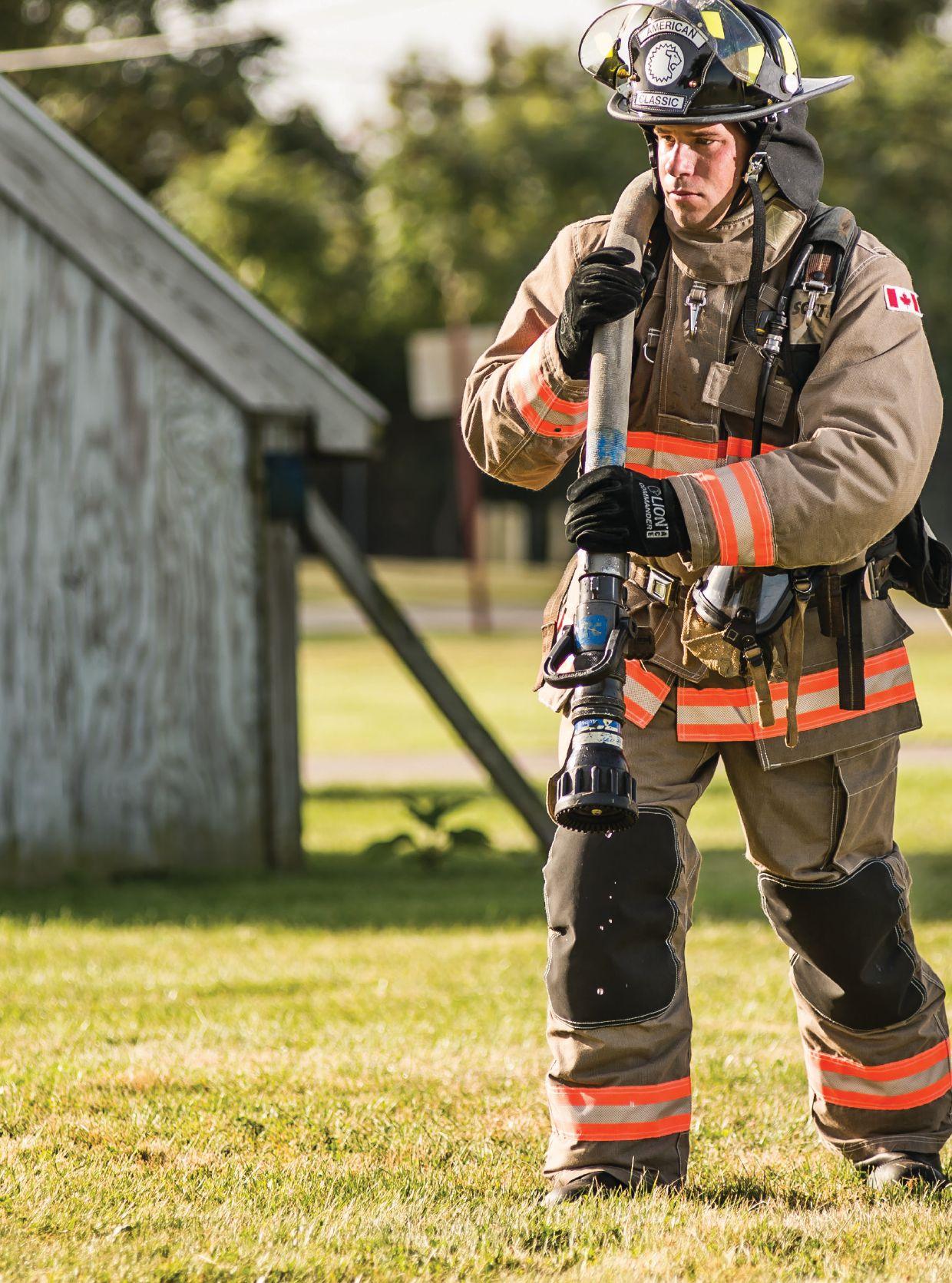
Loaded with safety, comfort and mobility features for unmatched performance, Flame Fighter® bunker gear offers a variety of custom outer shell fabric, liner system, hardware and pocket options to fit your specific needs.
• Patented IsoDri®* moisture management reduces the water absorbtion and helps gear dry faster between runs
• Exclusive Ventilated Trim™ allows vapor to be released, reducing the risk of scald burns
• Thermashield™ provides an additional layer of liner material in the upper back and shoulders to protect against compression burns
• Move-N-Hance™ crotch gusset increases mobility by reducing bunching, twisting and pulling
• Flex Knee™ for easy, natural movement
• Stay Rite™ sleeve wells integrate the sleeve’s liner into a full-length wristlet so that when you reach, the entire sleeve moves with you
For more information about Flame Fighter bunker gear, contact your Starfield LION sales representative at 1.800.473.5553 or visit us online.
BY MARK VAN DER FEYST
In the previous Back to Basics, we looked at the issue of setting the ground ladder at the proper climbing angle and the different facts surrounding not having the exact 75-degree angle set. It will be fitting for us to carry on our discussion with looking at ladder tip positioning when raising the ground ladder.
In my Back to Basics column, I try to write from the realism perspective and not from the textbook perspective because we apply our skills in a realistic manner, not in a textbook manner. In our textbooks, we have a chapter dedicated to ground ladders – a very comprehensive chapter. It details everything about the ground ladder, including setting positions for the ladder tip.
We have been instructed to position the ladder tip at different places depending upon what task is being accomplished — ventilating a window, applying water in a window from a hose line, rescuing an occupant from a window, and gaining access in through the win-
dow (both single and double wide windows).
All of these different tasks require the ladder tip to be placed at a different position on the building in relation to the window. These are the basic ladder tip positions that we teach our new recruits based upon the textbook, which is a good foundation to build on.
While we need to teach the textbook to our new firefighters and lay a good foundation, the question hopefully being asked by our new firefighters is: “Is there just one position that can be used for any and all tasks?”
The answer is yes, there is one position that can be used for any task that we are assigned when laddering to a window.
The best position that a ground ladder should be set to is with the ladder tip at the bottom of the windowsill – all the time, every time. In order for us to understand this, we have to first answer the question of why we are laddering the window in the first place. There are two main reasons — access and egress. The access portion involves the rescue of the
occupants from inside the building, venting a window, or spraying water into the building, whereas the egress portion involves firefighters needing to get out of the building quickly.
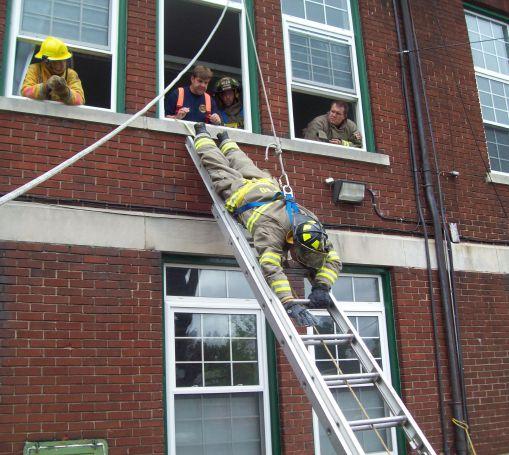
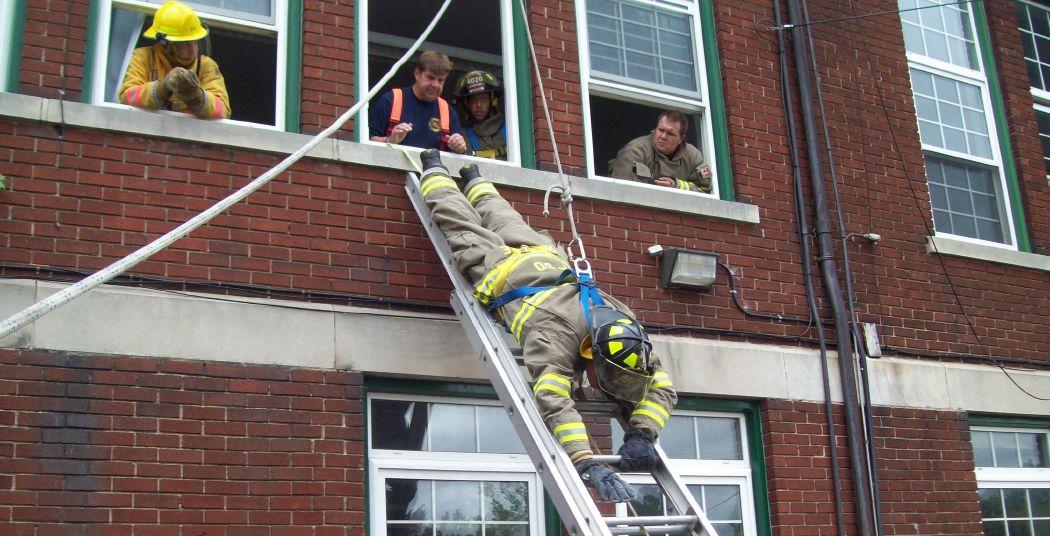
When firefighters need to exit a building quickly, it is a life and death situation. Either they stay where they are and die, or do something and get out and live. The “doing something” might involve doing a headfirst ladder dive – if there is a ladder at that window. In Photo 1, you will see a training exercise taking place where a firefighter is practicing this technique. Notice the ladder tip – it is at the bottom of the windowsill. This allows for quick and unimpeded egress for the firefighter. If the ladder tip were off to one side of the window, or above and to the side or even a rung or two inside the window, the firefighter will not be able to exit quickly, it will be impeded. There is a good video showing a firefighter and officer exiting a house bedroom window in an effort to get out ASAP – they get caught up and slowed down because the ladder tip is

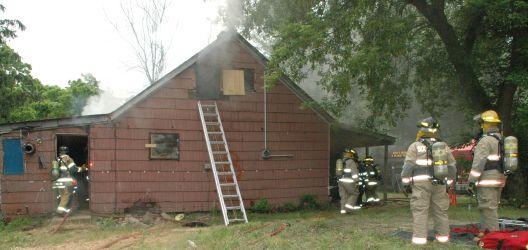
For gaining access to the building, the ladder tip at the windowsill will work for all tasks assigned.
raised one rung into the window and above the windowsill. Had the tip been dropped down below the sill, there would not have been any issues.
For gaining access to the building the ladder tip at the windowsill will work for all tasks assigned as in Photo 2. In the case of venting a window, putting the ladder tip to one side is designed to protect the firefighter from having a glass falling on them as well as the heeling firefighter. When the ladder tip is at the windowsill, the firefighter on the ladder tip is still protected from having any glass falling on them. This can be accomplished by using a 6-foot pike pole or roof hook to break the glass while standing about four to five rungs down from the top.
By standing this far down on the ladder, they are out of the direct path of the falling glass. It also keeps the firefighter’s head even with the windowsill which protects them from the hot gases exiting once the window has been vented. This is also the first action step in Vent, Enter, Search tactic being conducted if the need arises – the ladder tip must be at the windowsill for this to work.
For the heeling firefighter, if they are standing behind the ladder, they are going to get glass on them – but if they are heeling from the front, they will not. We will discuss this further in an upcoming article.
To apply water into the building through the window, the same action steps can be duplicated as above. The firefighter is protected from the exiting hot gases and steam while at the same time being in the lower cool zone of the flow path (unilateral or bilateral).
The most important task that we need to accomplish in gaining access to the building is for rescue. Removing an occupant from their bedroom or from a second or even third story room requires the ladder tip be at the windowsill. This will provide no interference with the passing out of the occupant onto the ladder into the firefighter’s arms. This is the one main reason why we ladder buildings – laddering for life.
Imagine setting up a ladder to vent a window as the textbook calls for only to then having to execute an occupant rescue? This would require the firefighter to climb down the ladder so that they can reposition it for the rescue. How much time would this take? What if this were you needing to be rescued – would you want this extra time to be taken so that you can be rescued? I would hope that your answer is no, you would not. Then ladder the building with the tip always at the windowsill.

Mark van der Feyst has been a member of the fire service since 1999 and is a full-time firefighter in Ontario. Mark teaches in Canada, United States and India, and is an FDIC Instructor. He is the lead author of the Residential Fire Rescue book. Email Mark at Mark@FireStarTraining.com.






















A true game-changer. The eDRAULIC® Watertight Extrication Tools (EWXT) are the first of their kind. They allow rescuers to operate submerged in fresh water up to 11 feet, unencumbered by hoses or power units. And they’ve been thoroughly tested and proven, because trouble doesn’t just stay above water. THE EWXT, PROVEN FOR UNDERWATER RESCUES




















By BRIEANNA CHARLEBOIS
As wildfire season approaches, many wildland fire experts have begun adapting their plans in attempt to best assess and manage the upcoming fire season while the country combats the coronavirus outbreak.
In light of these new developments, the BC Wildfire Service is changing its training model for new 2020 firefighter recruits. As well, several industry events, including the highly anticipated Wildland Urban Interface Symposium in Penticton, B.C., have been postponed or cancelled as a result of the virus.
Jody Lucius is the communications and engagement superintendent for the BC Wildfire Service. She said they have been forced to innovate their model in order to balance public health measures with adequate and effective preparation for the upcoming wildfire season.
“The biggest thing is that we are continuing to work through our preparations for the 2020 floods and fire seasons,” she said. “We do have a mandate to respond and in the interest of public safety, of course, we are doing everything we can to make sure we can fulfill that mandate this year. Part of that is looking at a variety of changes and options in order to help protect our staff and minimize their exposure to COVID-19.”
Typically, new recruits are put through a boot camp in Merritt, B.C., but with self-isolation being advised, sessions shifted to online forums.
Mark Healey, a certified panning section chief for one of the BC Wildfire Service incident management teams, explained that because a lot of the preparation for wildfires includes face-to-face training, social distancing poses a major challenge.
“It’s been a real shift to try to take a bunch of your training that you’ve done for years in a classroom setting and then shift portions of it to an online platform. It’s really hard, especially since we’re not in the business of creating online training,” he said.
Healey said the service is actively working to determine how to properly assess recruits without a physical boot camp or fitness test, which are used to determine which provincial zone to assign them in order to fill the necessary crews. He said service members will eventually have no choice but to meet and train in person. Wildfire season typically begins around May. In-person training must to take place prior to then.
As the COVID-19 situation is changing rapidly, Lucius said the BCWS are taking precautions to ensure the safety of their members. Typically, fire camps house hundreds of firefighters so adjustments have been made in attempt to maintain physical distancing and sanitary regulations. This includes added laundry and shower facilities, hand washing stations and adjusting and adding sleeping quarters.
Lucius also said the service is exploring other safety precautions in attempt to minimize any risk of exposure. However, the BCWS is still

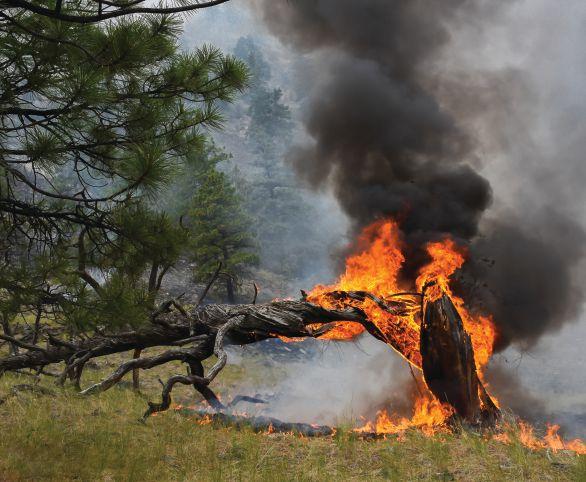
in discussions regarding what precautions should be used throughout the upcoming wildfire and flooding season.
The Ministry of Environment and Climate Change Strategy also issued a ban for all high smoke sensitivity zones in British Columbia on March 26. This comes in light of discussions surrounding smoke from wildfires weakening lungs and potentially making people more vulnerable to COVID-19.
“[Burn ban] restrictions are in place for high smoke sensitivity areas, largely kind of highly populated areas within British Columbia,” she said. “We’ve worked closely with them on it and the restriction is largely in place because of COVID-19 and the impacts of smoke on anybody who may have that illness, or maybe kind of at higher risk for it so we are continuing to look at whether we need to expand on any of those restrictions or perhaps put additional restrictions in place.”
Other provinces, including Alberta and Ontario, have also begun planning for the upcoming season. At the beginning of March, Alberta Wildfire issued a news release to alerting the media that wildfire season had started and was expected to last until October. They are also grappling with staffing issues as they often fly in experts and firefighters from other provinces. That may now be complicated by travel restrictions, flight cancellations and layoffs at Canada’s major airlines. Alberta has also implemented fire bans put in place in wilderness areas as a preventative measure.
In Ontario, to ensure public safety and well-being during the evolving COVID-19 outbreak, the province declared a burn ban on April 3, “effective until further notice.”
There are inherent risks with wildland firefighting. Healey said COVID-19 is simply an added inherent risk that firefighters will have to remain aware of.
“Luckily for us, fires aren’t static. They don’t stay in one place in a wildfire setting, so we’re pretty good at adapting on the fly.”

• Solid craftsmanship
• Clean, smart, efficient designs
• Rugged, dependable & affordable
• Customized & standard designs available
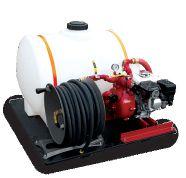
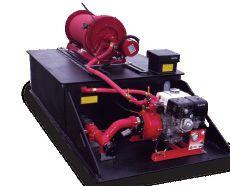
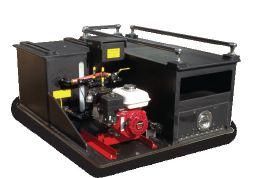
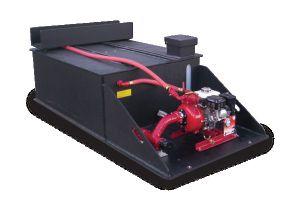
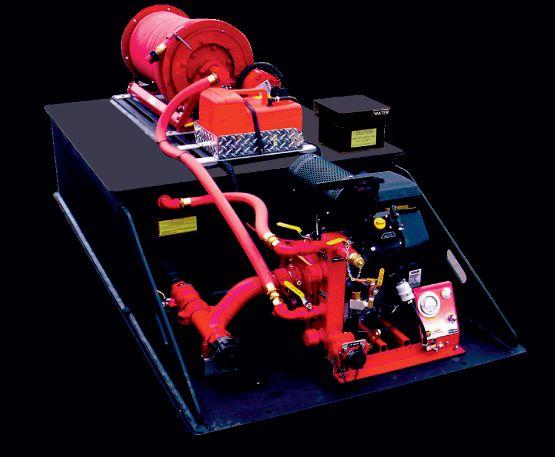
Attack Pac
Sets the standard for Skid Unit mobile fire attack for firefighting agencies in more than 44 countries.
Econo Pac
Simple to operate, great for ranchers, farmers, homeowners in wild land interface areas and smaller fire agency vehicles.
Small and nimble, great for firefighting/EMS use on ATV and UTV vehicles when navigating through large crowds of people at events, or in remote areas where pick-up size trucks are too big to go through.
Forestry Pac
Great for Wild and Forestry fire fighting with larger capacity NFPA tank.
Ready Pac
Features popular 6hp-Twin pump and is similar to Attack Pac, but without Booster Reel. Great for urban interface firefighting… car fires, dumpster fires and small room & contents fires.
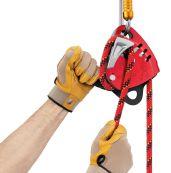
The MAESTRO, a premium rope rescue device for technical operations that was developed by Petzl, is now available in Canada. The development of the MAESTRO, an intuitive and reliable mechanical belay device, expands Petzl’s rescue solution offerings. The device integrates a unidirectional progress capture pulley with a descender, which greatly maximizes efficiency and limits the amount of equipment and users needed to access and evacuate casualties in vertical or confined space environments. This all-in-one advantage is designed to make the transfer between raising and lowering simple and rapid.
Key Features
• A ‘95 percent efficiency’ progress capture pulley
• Efficiency and adaptability when switching between lowering and hauling
• Ergonomic control handle and integrated breaking features provide a comfortable range of friction control
• A string can be attached to the handle for overhead or remote operation
• Auto-lock feature locks the rope whenever the handle is released, and doesn’t require manipulation from the user
• Becket attachment point provides the ability to create a 5:1 mechanical advantage
• Large control handle that pulls away from the anchor point MAESTRO S: The MAESTRO S is compatible with 10.5 to 11.5 mm ropes, can handle loads up to 550 lbs (250 kg) and carries an
“T” rating.
MAESTRO L: The MAESTRO L is compatible with 12.5 to 13 mm ropes, can handle loads up to 617 lbs (280 kg) and carries an NFPA “G” rating. For more information and to locate a dealer near you, visit petzl.com.
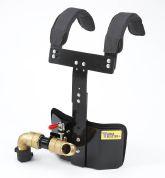
The Aqua Blaster is a fire hose harness designed by Kblock Tools that sits over the user’s shoulders and is designed to distribute the force of the hose’s water pressure evenly among the upper body.
The Aqua Blaster controls flow through two 90 degree elbow swivels that are mounted on the lower abdomen plate of the harness’ frame. Fire hoses can connect to the harness through an adapter on one of the elbow swivels. The other elbow swivel directs flow through a nozzle located at the front of the harness. This nozzle’s 360 rotation capacity allows the user to direct the stream in all directions. The nozzle is equipped with a locking device to hold the charged or uncharged nozzle at any desired angle. In the locked position the nozzle will remain stationary even if the user removes his/her hands. The Aqua Blaster is distributed by Chief Corporation, L.N. Curtis & Sons, MES Fire and W.S. Darley Fire Equipment.
For more In the Watchroom products, go to firefightingincanada.com and click on equipment.
By ED BROUWER
Iwas about to submit my column for this issue’s Trainer’s Corner ironically entitled “Situational Awareness”, but it felt irrelevant considering the current state of affairs in our country.
On March 18, the total confirmed cases of COVID-19 was recorded as 216,480. This number represents 123,177 active cases: 84,409 recovered cases and 8,894 fatal cases.
On that same day the total confirmed cases in Canada was recorded as 644. This includes 623 active cases, 12 recovered cases and nine fatal cases.
This information will have changed several times by the time you read this. In fact, just as of March 23 the total confirmed cases are recorded as 351,705 worldwide, and Canada recorded a rise to 1,472.
The thing to remember is that this “updated” information is compiled from stats a week old. And that is somewhat disconcerting in this rapidly evolving situation.
I feel this article will be deemed a bit like closing the barn doors after the horses have run out. However, having said that, I encourage you to look back and record what worked and what didn’t work during this pandemic. Certainly, we should learn from our history. What PPE didn’t you have? What SOGs need to be revamped?
One disturbing observation for me as a first responder is the number of Canadians who were, at this time, not taking this serious enough. The Vancouver Sun reported, that according to a new poll, Canadians still thought it was OK to gather in groups despite warnings from health officials to stay home. The Research Co. survey they quoted found that while most Canadians agree they must do their part to stop the COVID-19 outbreak, 30 per cent still think it’s “reasonable” to hold a gathering of up to 10 people.
We have been informed by the World Health Organization that the level of infectiousness, or ease of transmission, is still unclear. The coronavirus appears to spread via close contact (two meters) with infected people and/or spreads through exposure to the large droplets created from coughing or sneezing.
It is important to note that all viruses have an incubation period. The incubation period is the period between the exposure of an individual to a pathogen (virus) and the beginning of the illness or disease it causes.
Despite best efforts to contain COVID-19, cases continued to rise worldwide. That was the reason first responders were asking patients whether they had traveled outside of Canada, and or whether they had attended a mass gathering event with international attendees within Canada in the 14 days before onset of illness. They were also asked if they had been in close contact with a confirmed/probable case of COVID-19, or had they been in close contact with a person with acute respiratory illness who has travelled outside of the Canada, or attended a mass gathering event with international attendees within 14 days prior to their illness onset.

The greatest risk in contaminating yourself is when removing your PPE. If your hands are visibly soiled (or you can’t find gel sanitizer if they aren’t), washing them is a must.
If the answer was yes to the above, first responders were to immediately implement droplet and contact precautions and mask the patient. Far too many of our first responder fire departments were not ready for the level of response required. We found ourselves facing a new enemy with too little information, not enough PPE, a lack of medical supplies and equipment, changing protocols every single day and no “do overs”.
Firefighters are responding to increasingly infectious environments: COVID-19 has caused the quarantine of many firefighters. That itself puts a great strain on our resources. Without proper PPE for these types of incidents, we send our first responders in wearing coveralls or bunker gear, and that sets us up for cross contamination. Not every department had gowns, or proper eye protection. This must be addressed for future events.
At the very least our members must take donning (putting on) and doffing (taking off) of PPE much more seriously. It is important they understand that they are at greatest risk to contaminate themselves when removing PPE.
Please note the order of the following safety protocols:
• Removing gloves
• Clean hands with alcohol-based hand rub (ABHR) unless visibly soiled
• Remove gown
• Clean hands with ABHR unless visibly soiled
• Remove eye protection
• Remove mask
• Clean your hands with ABHR unless visibly soiled
If your hands are visibly soiled, proper handwashing with soap and
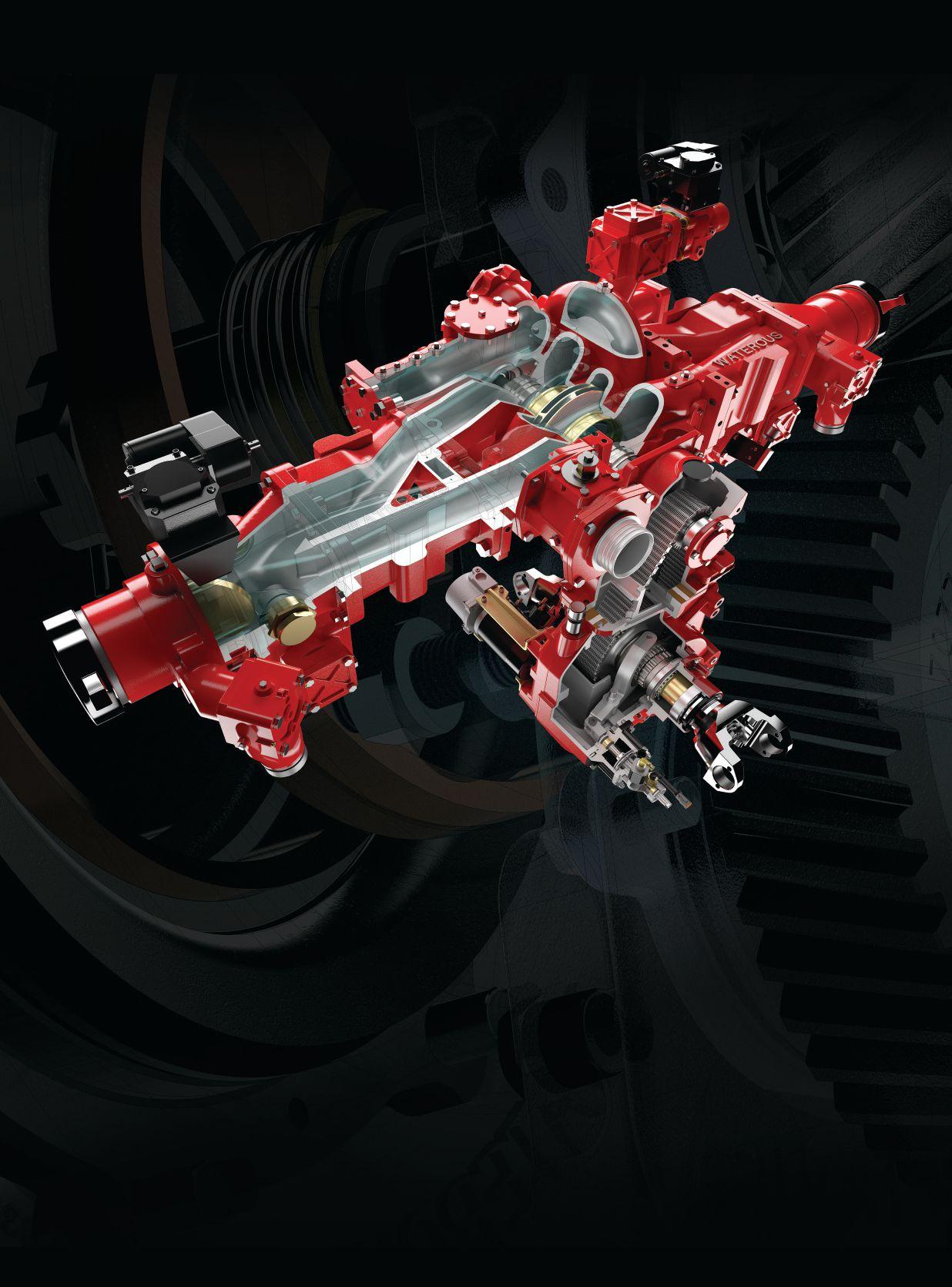

OUR REVERSE FLOW WEAR RINGS
Restrict recirculation and improve overall efficiency and longevity of the wear ring.
SEPARABLE IMPELLER SHAFT
Allows the pump transmission to be separated from the pump and removed from the apparatus. The pump remains mounted in the apparatus and can be easily repaired minimizing downtime.
CHAIN DRIVE
TRANSMISSION – Transfers power more efficiently than gear-driven transmissions by having more points of contact between the chain and rotating sprockets.
“Silent” chain drive makes our transmission the quietest in the industry.
In the largest cities across the world, Waterous pumps never fall short. Cast and made in America, our pumps feature industry exclusive innovations. These innovations, along with the Waterous University library of support, help keep your pump running strong and your fire team serving the community.
FLAME-PLATED IMPELLER
PERFORMANCE – Bronze impellers are flame-plated with tungsten carbide, creating an ultra-hard surface resistant to wear.


water must be performed. Reusable PPE such as goggles must be properly cleaned, decontaminated, and maintained after and between uses. Goggles should be cleaned according to manufacturer’s directions.
The cornerstone of infection control is handwashing using soap and water or the prepared alcohol-based gels. The Centers for Disease Control and Prevention (CDC) recommends everyday preventive actions to help prevent the spread of respiratory diseases: avoid close contact with people who are sick, avoid touching your eyes, nose, and mouth, stay home when you are sick, and cover your cough or sneeze with a tissue, then throw the tissue in the trash. Clean and disinfect frequently touched objects and surfaces. Get into these habits not only for yourself, but for your family and fellow firefighters.
The CDC also recommends that you adhere to your SOGs and SOPs for your department when responding to a known or unknown infection hazard occupancy, keeping in mind airborne precautions including the use of eye and respiratory protection.
Just as we instruct our firefighters that there is no such thing as a routine fire, we need to teach them to assume that every person is potentially infected or colonized with a pathogen that could be transmitted to them as a first responder
I cannot express how important it is to pay strict attention to training on the correct use, proper donning (putting on) and doffing (taking off), and cleaning or disposal of any PPE.
The last thing we need is for our fire halls to become incubators for infectious or contagious diseases. Be sure to diligently clean your station and your apparatus after each response.
Unfortunately, during the initial response firefighters may not know they have been exposed to COVID-19 until later. That is why it is extremely important for responders to follow recommended infection control procedures.
Properly handle, clean, and disinfect individual care equipment, instruments, and devices. Non-disposable items that come into contact with an individual who potentially may be infected must be cleaned / disinfected. This includes things you may not usually think of, such as clipboards, pens, pencils, etc. All disposables must be disposed of properly. Package, transport, and store clean textiles or uniforms so they are protected during transport and unloading so they’re clean for future usage.
No, I’m not saying you need to respond in a full-blown Hazmat suit, but you must take this seriously.
Our members need to be diligent about following these recommendations and procedures to minimize exposure to respiratory diseases. Whatever the state of the COVID-19 pandemic may be at the time this article goes to press, these critical safety protocols stand for all infectious diseases — now and for the future.
Please, stay safe out there and remember to train like lives depend on it, because as we are witnessing, they do.
Ed Brouwer is the chief instructor for Canwest Fire in Osoyoos, B.C., deputy chief training officer for Greenwood Fire and Rescue, a fire warden, wildland urban interface fire-suppression instructor and ordained disaster-response chaplain. Contact Ed at aka-opa@hotmail.com.
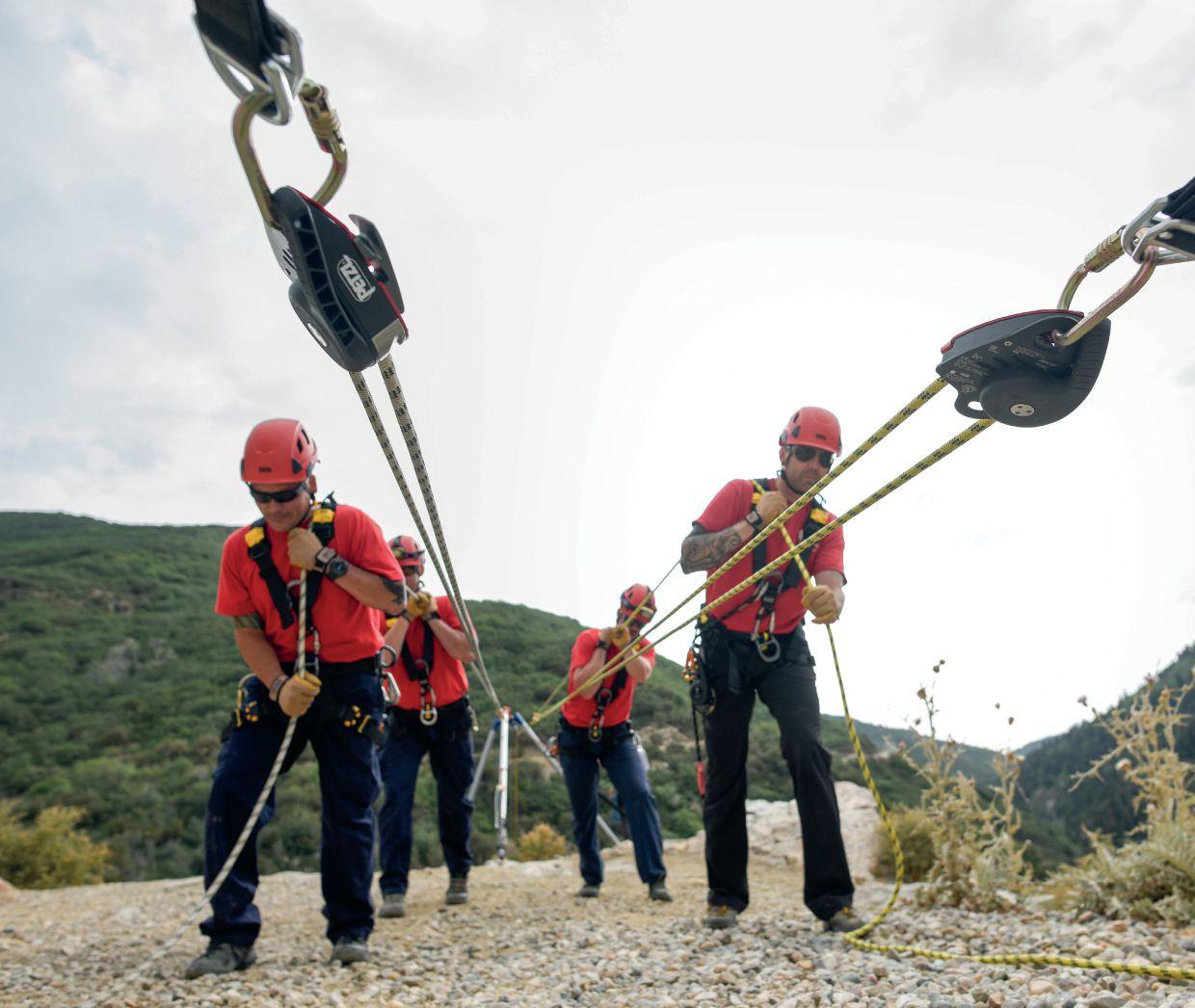
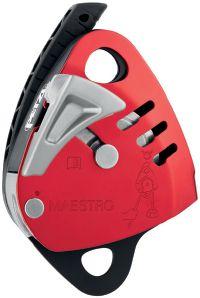
MAESTRO® L
Descender for technical rescue with built-in progress capture pulley, facilitates manipulation of heavy loads, and may be used as a primary system or as a back-up belay. www.petzl.com
The challenge of the rescue professional is their ability to adapt, facing the unexpected in every situation. In order to always be prepared, this American team trains on a daily basis, for example here, in a ravine near Salt Lake City, Utah, USA.
BY SAMANTHA HOFFMAN Public Fire and Life Safety Officer Barrie, Ontario
here is a well-known joke with about a conversation between a firefighter and a child that goes like this:
Firefighter: “What would you do if you got fire on your pants?”
Child: “I wouldn’t put them on!”
It’s funny — the child is right, comes off as very smart and most of us laugh when we hear the joke. In this column I want you to take the time to think about that joke as more than a joke; it is a great lesson in the importance of using plain language when talking to the public about fire safety.
Our goal in public education is to change behavior. We’ve been teaching fire safety for years, yet behaviours don’t seem to change. How is it that while we haven’t changed our messages very much, we expect people’s behaviours to change? I am hoping that after reading this article you walk away with a different way of delivering fire safety; a better understanding of audiences and how people learn. When we hear facts, it activates the data processing centres in our brains, but when we hear stories, it activates the sensory centres in our brains. Everyone loves a good story, and the fire station is full of stories. We just need to learn how to tell them.
There is a scientific explanation for our love of stories. When we hear a story that resonates with us, our levels of a hormone called oxytocin increase. Oxytocin is a feel-good hormone that boosts our feelings of trust, compassion and empathy. It motivates us to work with others and positively influences our social behavior. Because of this, stories have a unique ability to build connections between the fire service and the public.
use plain, easy to understand language. This isn’t to say that simple is easy or means simplistic. It means that you should really hone in on the message and use clear, plain language at all times. You must give the information logically, in common terms and basic phrases so that your audience will understand you. What is crystal clear in your mind might not be logical to someone else.
Here are a few quick tips to keep in mind when talking fire safety:
• Speak at a grade 7 reading level. This means that it is easily understood by an average 12-year-old student.
• Know your audience. People relate better to information that talks directly to them.
• Speak slowly and clearly. You should not use unnecessary words just because they make you sound authoritative.
• Shorten your message. If you use long sentences packed with information, there is a good chance that some of your audience won’t grasp all of the information. Your audience will better appreciate and remember your message if you get it across quickly and effectively.
• Use simple sentences. Keep them short and use one idea/ concept at a time. Whenever possible use common short words over unfamiliar longer ones.
Everyone loves a good story, and the fire station is full of stories. We just need to learn how to tell them.
’’
Trouble is most of us tend to overthink things. We want our audience to respect us, to pay attention to our important message and to change their behaviours. We think the best way to do this is to wow them with our intelligence, to show them how smart we are so that they believe what we are saying.
People have different learning styles, experiences and comprehension levels. If we really want to change behaviour, we need to
Samantha Hoffmann has been in the fire safety field for more than 25 years. She is the public fire and life-safety officer for Barrie Fire & Emergency Service in Ontario. In 2014, Samantha was named Public Fire and Life Safety Educator of the Year by the National Fire Protection Association – the second Canadian and first Ontario educator to receive the award since its inception. Email Samantha at Samantha.hoffmann@barrie.ca and follow her on Twitter @shoffmannpflso.
• Repeat key messages. To ensure that your audience understands your message, it is important to repeat key sentences and phrases, and to paraphrase your comments.
• Use strong verbs. Tell the audience the actions you want them to take.
It is important to remember that you are not “dumbing down” your messages. If you use plain language you are having a conversation with your audience instead of lecturing them. You are telling a story through conversation and you will get your information across faster with less chance of misunderstanding or misinformation. Remember you are trying to sell fire safety. People will not buy what they don’t understand. Poet William Butler Yeats said: “Think like a wise man but communicate in the language of the people.”
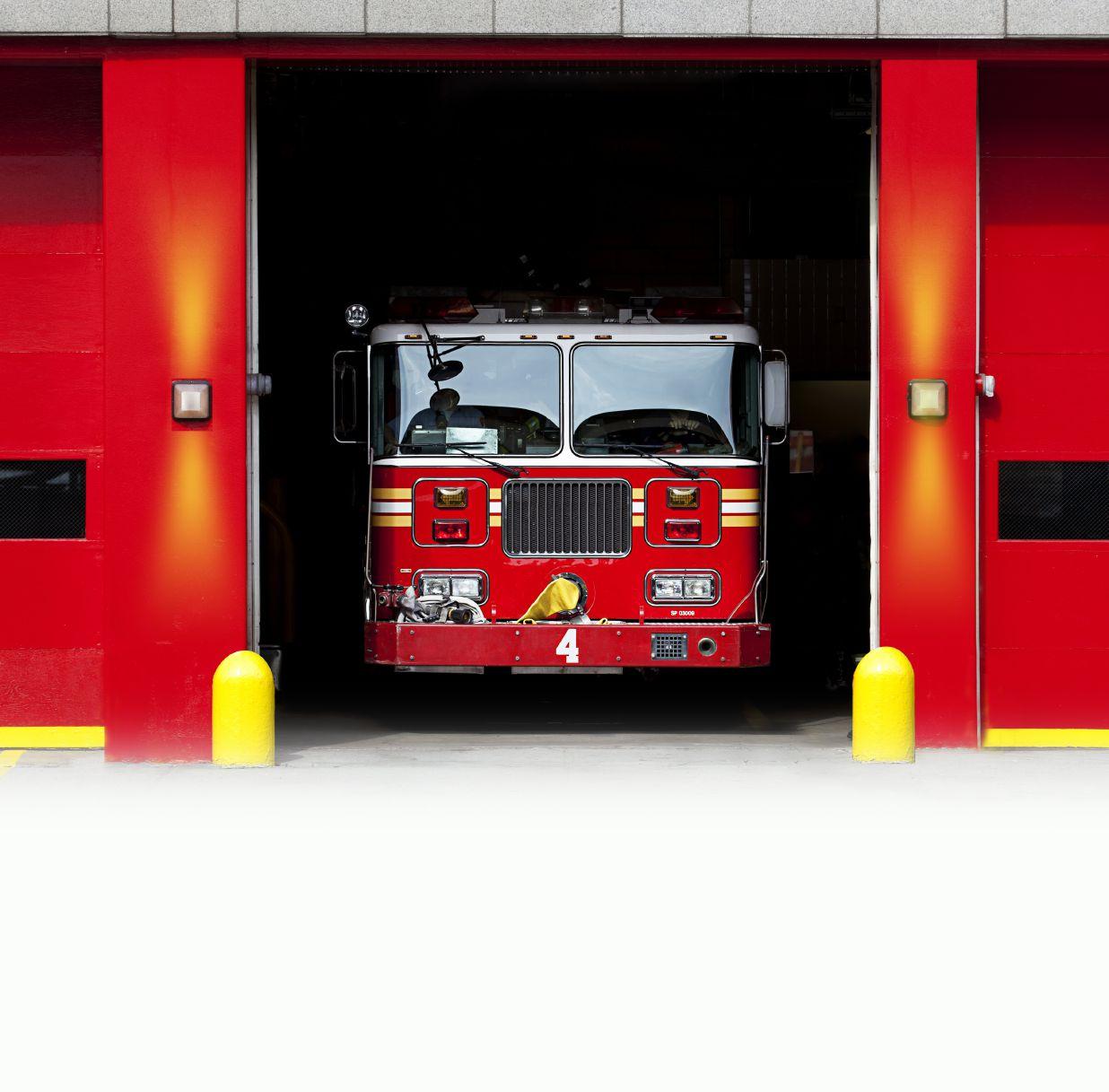
CONTINUED FROM PAGE 12
Canada that firefighters across our country have to be viewed as part of the healthcare system and have to be able to get the right equipment in order to ensure that the other parts of the health community are not overburdened unnecessarily,” he said. “We are part of that that equation right now.”
Some unions, like Winnipeg’s firefighters’ union, are calling for a complete separation of emergency services and are calling on municipalities to ensure workers’ compensation claims are streamlined during the COVID-19 crisis, especially in light of an increased need for PPE that had not yet been met. Concerns around PPE shortages are widely shared.
“The biggest issues are going to be access to PPE and cycling people through if firefighters become infected or exposed,” said Cynthia Ross Tustin, president of the Ontario Association of Fire Chiefs (OAFC) and the fire chief in Essa Township, Ont. “Our biggest concern is the exposure of our firefighters and their ability to come to work healthy.”
On March 3, the World Health Organization (WHO) warned of a global shortage of PPE and began calling for an increase in manufacturing to meet demands by 40 per cent. On March 31, Prime Minister Justin Trudeau announced a government commitment of $2 billion to help buy PPE for frontline workers. Public Safety Canada issued a survey shortly after pertaining to critical infrastructure owner/operator needs that fire chiefs could fill out.
“It’s vital for the decision makers at all three levels of government — local, municipal, or provincial and federal — to understand the depth of abilities in firefighters across our country,” said McKearney. “They see it whenever a crisis strikes but I think it gets a little deaf in non-crisis time periods and so we’re taking this opportunity to remind our ministers and federal government and provincial government that firefighters are here, they’re a valued resource in the community and to please not forget about them. They are they are on the frontlines and they need the right equipment.”
Ross Tustin is also calling for more action by governments to protect firefighters. She said she is in communication with the solicitor general and Ontario’s fire marshal on a daily basis to ensure the association is armed with the most up-to-date information. The OAFC then distributes this information to departments.
“We [associations] are sharing information and consistently advocating for firefighters directly to the government,” she explained. “In our conversations, we are voicing our concerns about the shortage of masks and the need to have the legislation that protects the emergency services equally, like they have put in place for the healthcare workers.”
On April 6, the Ontario government issued a province-wide emergency order allowing first responders, including firefighters, the ability to obtain COVID-19 positive status information regarding individuals they come in contact with while on duty.
Vince Mackenzie, the fire chief in Grand Falls-Windsor, N.L., is a board member for the CAFC. While Mackenzie asserts that it’s a very broad spectrum in terms of what the pandemic means and how it is affecting each department, it’s up to municipalities and individual departments to become knowledgeable and adjust their
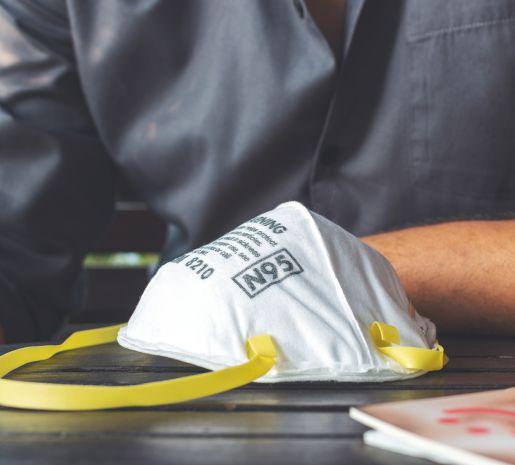
service accordingly.
“All emergency services are affected and are vulnerable right now,” he said. “Emergency managers are always trying to raise awareness to public officials about what can really happen but this is unprecedented; there’s no play book for this one. It’s something we’re going to learn as we go.”
Provinces, particularly in Western Canada, are also grappling with how the crisis will affect the upcoming wildfire season. Training shifted online and wildfire training events, like the Wildland Urban Interface Training Symposium, were cancelled. However, the BC Wildfire Service said wildland firefighters will eventually need to train in person to properly prepare firefighter teams for upcoming deployments. BCWS said safety measures are being organized and proper precautions are being put in place to ensure the protection of their firefighters.
Mental health is also at the forefront of concerns for first responders, who are already susceptible to PTSD and other occupational stress injuries due to the nature of their work. While the full scope of the impact of COVID-19 on first responder health — both mental and physical — has yet to be determined, firefighters are facing risk and across the nation are rising to the occasion.
“We’ve seen it time and time again, every time a major catastrophe or crisis comes about, all first responders step up,” said McKearney in the podcast. “There’s no question in my mind that tomorrow firefighters will take on even greater responsibility and greater skills and certifications in order to adapt and manage whatever comes to their community.”
Trained to handle biological types of emergencies and serve as a vital part of the medical chain, firefighters continue to offer services while departments make the necessary adjustments to keep everyone – including their own team of firefighters – safe while Canada attempts to contain COVID-19.
“This will be the time when you’ll see the fire service shine,” Mackenzie said. “Canadians will realize that all emergency services, and the fire service in particular, will be highlighted because we are built for resiliency. We are built for worst case scenarios. We are critical thinkers and we’re the ones to call if everything goes sideways.”
Editor’s Note: The COVID-19 pandemic is changing rapidly. The details cited in this article were most accurate and relevant information available at the time this issue went to print in April. For more coverage, visit firefightingincanada.com.
successful event outcomes, but it also provides reassurance to the TRT member being asked to perform in these situations. It helps them with their own mental health after the event, be it a positive or negative outcome for the person with suicidal thoughts.
Due to the limited participant capacity of this course being offered, not all TRT members are able to attend. However, we continue to ensure that a couple members are selected to be included in each course. Boyko and one of her peer support coordinators, Jeff Deptuck (a long standing TRT member), was able to provide us with extra information and presented it to our members during pick-off rescue training. By adding Deptuck’s presentation to our training, we improved and advanced our patient care and rescuers well-being. This support and the ASIST course have been a huge improvement to our training in the discipline of pick-off rescues.
Peer fitness: Our relationship with Georgette Reed, EFRS peer fitness coordinator, is one we are also grateful for. We use the peer fitness program with the intent to reduce musculoskeletal injuries and develop warmup routines for our team to perform prior to commencing the physical portion of the training. Based on the reduction of reported injuries during training, it has proven to be effective.
Modified duty: Numerous TRT personnel have worked alongside me during their recovery phase after an injury. This benefits the team by allowing for more productivity from the TRT coordinator office. However, I believe that the most important benefit is the one that contributes to mental health. Modified duty personnel are given meaningful tasks and opportunities to stay connected and
current with the department, as well as with their brothers and sisters.
Team culture: At the end of the day, when the tones go off for a technical rescue event, we need to ensure that the relationship we have within our team — our TRT culture — combined with the confidence and competence derived from our training and experiences made possible by the aforementioned relationships — is solid.
To build effective relationships with community partners means getting out of our silos and being willing to find and ask for those resources. It takes some effort and it would be easier to just continue to follow the normal of what has or hasn’t been done in the past, but the effort is well worth it.
Do some research before contacting the individual or business to find some common ground and learn about the products. If you have an idea or plan on how you could work together, save it until later in the week most people are generally more receptive to thinking about new things or saying yes. The closer it is to the weekend, when they don’t have all the stresses of returning to work on Monday, the better!
Almost 100 per cent of everyone I approached to collaborate with has been successful, so it definitely pays to ask. I had one local climbing gym that I was asking to support us and they were unable to strictly based on their own financial needs and availability for the space we inquired about, but I was able to find another one that gave us exactly what we were looking for.
Our department has done an outstanding job building relationships with the public so
they support us as we continue to provide this service, and possibly because of this long-standing support, the majority of people want to help us. I think it’s just a natural feeling deep rooted in most human instinct to help. If they have the “ask” presented in a way that they can say yes, they usually go for it.
With the fiscal restrictions impacting the ability to attend seminars, conferences and training events, we lose the opportunity to network and build those relationships. Sometimes it comes down to making cold calls to make it happen.
Building relationships inside and outside the department is essential. Also focusing on having a solid team relationship in our unit has allowed us to safely and efficiently perform tasks in high-risk, low frequency events. We are the ones who respond to support Incident Command and on-scene crews — we are it. There are no other locally trained or equipped crews that we can call to support us. This is why we need to operate as an efficient, well trained team. And that too, is all built on relationships.
The “what” is the relationship, and the “how” is the communication, following through to the action; the direction from a leader. How to be successful is, as Daryl Black says, to “be a connected leader” — one that can communicate, build relationships, perform, build culture, earn and give respect, have people follow and be engaged.
Eric Smith is a 15- year member of EFRS and an 11-year member of the Technical Rescue Team. Smith is also an NFPA 1041-Level 2 Instructor, a previous Platoon Training Instructor and long-time Swift Water Summer and Ice Rescue Instructor. He is a husband and father to three young boys and a volunteer minor sports coach. Smith believes the biggest contributor to positive relationships is good communication.
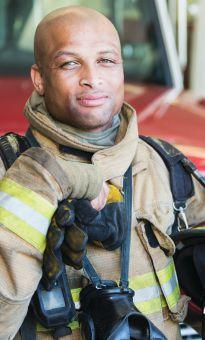
• Diesel exhaust solutions engineered to your station’s unique needs
• Reliable performance you can depend on
• Designed for durability to reduce maintenance and total cost of ownership (855) 925-1609 Nederman.com


1200° Darch Fire Inc
9-402 Harmony RD, Ayr, ON, N0B 1E0
Tel: 800-254-2049
Fax: 519-622-7705
Toll-Free: 800-254-2049
Web: www.1200-degrees.com
Email: cnewman@1200-degrees.com
Contact: Chris Newman
“1200˚ is your full service, specialized vehicle dealership.
We have a complete line of solutions for your department from Apparatus sales, Equipment Sales to Parts and Service. 1200° offers exclusive premium brands and sets itself apart from others by offering the highest level of customer service in the industry today.
We take great pride in offering the very best care to our clients throughout the sales process and beyond.
We provide expert advice during the buying process, from consultations, spec development to committee presentations and anything in between, our customers are presented with the highest quality products and our customer care is second to none. Working with 1200˚ means having a single point of contact for all your departments needs. 1200° will take care of everything for our clients so they can focus on what’s important…. Helping people.”
Serving ON

A.J. STONE COMPANY LTD.
62 Bradwick Dr., Vaughan, ON, L4K 1K8
Tel: 416-785-3752
Fax: 416-781-2827
Toll-Free: 1-800-205-3473
Web: www.ajstone.com
Email: mstone@ajstone.com
Contact: Mike Stone
A.J. Stone has proudly served the needs of the First Responder Services of Ontario since 1972 by featuring quality products, knowledgeable sales team, and training support.
A.J. Stone supplies equipment from MSA, Genesis Rescue Systems, LION Protects, Task Force Tips, Paratech Rescue, FireAde, Enforcer, Streamlight, Innotex Bunker Gear, ProTech Gloves, Safe-T-System, CET and much more! We service what we sell!
Serving ON
251 Queen St. S., Ste. 512, Mississauga, ON, L5M 1L7
Tel: 905-826-6682
Fax: 866-511-6904
Toll-Free: 1-866-735-1480
Web: www.airmation.ca
Email: r.weber@airmation.ca
Contact: Randall Weber
Air Technology Solutions is dedicated to our Clients, offering updated, timely, full service Indoor Air Quality (IAQ) solutions. Air quality concerns are mitigated using a unique combination of professional indoor air quality assessment coupled with solutions. Off the shelf or customized site specific air cleaning equipment is available to resolve IAQ issues. Our technical experts review client requirements and budgetary availability. The finest appropriate air cleaning systems are provided. Air Technology Solutions is a leader in Diesel Exhaust Remediation and is the ONLY environmental tested and proven filtration system to exceed standards: NFPA, NIOSH, OSHA and ASHRAE. Building and facility managers, business owners, contractors, architects, and engineers have been working with Air Technology Solutions since 1986 to resolve IAQ needs. Employee and personnel safety and health are key issues. Breathing safe air in the workplace is of utmost importance. We provide global customized solutions to control contaminants, pollutants and odours in your facility. We look forward to servicing your requirements. Serving All of Canada
5205, J.-Armand Bombardier, Longueuil, QC, J3Z 1G4
Tel: 450-651-2240
Fax: 450-651-1970
Toll-Free: 1-800-469-1963
Web: www.areo-fire.com
Email: mjpicard@areo-feu.com
Contact: Marie-Josée Picard Aréo-Feu – Where Equipment Matches Courage
For more than 55 years, three generations of knowledge have succeeded to make Aréo-Feu the number one reference for the supply and service of equipment in the fire industry, in public safety or in civil protection.
Our favourable purchasing power allows us to maintain an important inventory of products that have state-of-the-art technology. Committed to building very good business relationships with our partners, we encourage the constant update and development of our team’s expertise.
Our daily goal is the complete satisfaction of our customers! Multiple suppliers with whom we have a durable relationship for the benefit of our customers.
Official distributor of: MSA/Globe, Innotex, Rosenbauer, Protek, Elkhart Brass, Genesis Rescue Systems, Streamlight, Res-Q-Jack, Petzl, Husky, Solberg, TechTrade, Unifire, CET Fire pump, All American hose, OHD, Harrington Inc., LavXel, Kochek CO. Inc, Lakeland, Tohatsu, Waterous, ect. Serving All of Canada
1898 Safety Way, Cynthiana, KY, 41031
Tel: 859-234-6616
Fax: 859-234-8987
Web: www.bullard.com
Email: wells_bullard@bullard.com
Contact: Sid Klinksiek
In Canada: Manfred Kihn, Regional Sales Mgr., Emergency Responder Div., Tel: 705-436-5968, Fax: 705-436-9532, Toll Free: 1-877-285-5273 ext. 871, Cell: 204-781-2252, e-mail: manfred_kihn@ bullard.com website: www.bullard. comBullard is a 110 year old family owned company that manufactures fire helmets and thermal imagers for firefighters. Bullard products are sold by a number of highly regarded Canadian distributors. Please visit our web site at www.bullard.com
Serving All of Canada

CANADIAN SAFETY EQUIPMENT INC. 2465 Cawthra Rd., Unit 114, Mississauga, ON, L5A 3P2
Tel: 905-949-2741
Fax: 905-272-1866
Toll-Free: 1-800-265-0182
Web: www.cdnsafety.com
Email: ross@cdnsafety.com
Contact: Ross Humphry
We supply Industrial and Fire, SCBA’s, Thermal Cameras, Auto Extrication equipment, CAF Systems, Fall Protection, Bunker Gear, Fire Hose, Communications Equipment, Nozzles, Fittings, Hazmat Suits, Ventilation Fans, Gas Detectors, Confined Space Rescue Equipment, High Angle Rescue Equipment, Boots and Gloves. Everything for Fire Fighting, EMS, Law Enforcement, Industrial and Municipal Safety and Lone Worker Protection systems.
Serving All of Canada



CARL THIBAULT FIRE TRUCKS
38 Thibault (Street), Box 540, Pierreville, QC, J0G 1J0
Tel: 450-568-7020
Fax: 450-568-3049
Web: www.thibaultfiretrucks.com
Email: mthibault@thibaultfiretrucks.com
Contact: Maricarl Thibault
We are a Canadian based company and we manufacture a full line of fire apparatus which includes aerial ladders, pumpers, tankers, rescue units and vacuum tankers. We provide parts and other related products.
Serving All of Canada
CET FIRE PUMPS MFG.
75, rue Hector, C.P. 90, Pierreville, QC, J0G 1J0
Tel: 450-568-2719
Fax: 450-568-2613
Web: www.fire-pump.com
Email: jburge@cetmfg.com
Contact: Jim Burge
No Hydrants, No Problem!
CET Manufactures Portable Pumps, Skid Units, Brush Trucks, Glider Kits, Foam Trailers, Water Tanks, and UTV Fire Units to help you fight fire where static water sources may be your only option.
The Flow Starts Here!
Serving All of Canada

EQUIPMENT CO.
591 Chester Road, Delta, BC, V3M 6G7
Tel: 604-526-6126, 24/7 service: 1-877443-2626
Toll-Free: 1-800-665-6126
Web: www.comemerg.ca
Email: CParent@comtruck.ca
Contact: Colleen Parent
Commercial Emergency Equipment Co. is Canada’s largest dealer for Pierce Manufacturing Inc. and MAXI Fire. We provide sales, parts, service of all makes of fire trucks, and support to our customers through five sales/service locations across Canada.
Commercial Emergency Equipment Co. strives to exceed customer expectation in everything we deliver. With over 70 years in the truck equipment industry, we take pride in a proven track-record of providing expert truck equipment solutions, top quality products and firstclass service to our customers.
We are a sole-source service provider with mobile EVT’s, on call 24/7, throughout our nationwide branch network. We offer inspections, preventative maintenance, mobile pump testing and foam system calibration, as well as comprehensive apparatus training on operation and maintenance. We inventory an extensive stock of OEM and after-market parts, tools and equipment ensuring quick delivery and reduced downtime to our customers.
Our service technicians undergo continuous training and testing to ensure that the latest technology and innovation is applied to the service of your equipment. When you need prompt, honest, and reliable service, you can count on us to support you.
Our EVT’s are on call to provide 24-hour emergency service.
We are Canada’s largest dealer for Pierce Manufacturing Inc. and a dealer for Maxi Metal, providing sales, parts, service of all makes of fire trucks, and support to our customers through five sales/service locations across Canada.
Commercial Emergency Equipment Co. strives to exceed customer expectation in everything we deliver. With over 70 years in the truck equipment industry, we take pride in a proven track-record of providing expert truck equipment solutions, top quality products and firstclass service to our customers. Our service technicians undergo continuous training and testing to ensure that the latest technology and innovation is applied to the service of your equipment. When you need prompt, honest, and reliable service, you can count on us to support you.
Our EVT’s are on call to provide 24-hour emergency service.
Serving AB|BC|MB|NT|NU|ON|SK|YT
5651 Chemin St-Francois, St. Laurent, QC, H4S 1W6
Tel: 514-737-2280
Fax: 514-737-2751
Toll-Free: 1-266-737-2293
Web: www.cseis.com
Email: info@cseis.com
Contact: Chris Castravelli
We supply Industrial and Fire, SCBA’S, Thermal Cameras, Auto Extrication, CAF Systems, Fall Protection, Bunker Gear, Fire Hose, Communications Equipment, Nozzles, Fittings, Hazmat Suits, Ventilation Fans, Gas Detectors, Confined Space Rescue Equipment, High Angle Rescue Equipment, Boots and Gloves and Pacific Helmets. Everything for Fire Fighting, EMS, Law Enforcement, Industrial and Municipal Safety and Lone Worker Protection Systems.
Serving All of Canada
DRAEGER SAFETY CANADA LTD.
2425 Skymark Ave., Unit 1, Mississauga, ON, L4W 4Y6
Tel: 905-212-6600
Fax: 905-212-6602
Toll-Free: 1-877-372-4371
Web: www.draeger.ca
Email: Sandi.DavisJohn@draeger.com
Contact: Sandi Davis-John Call 1-877-Draeger1 to arrange for service of your SCBA and gas detection at your local Draeger Service Center.
Contact us for fixed flame & gas detection, personal gas monitoring, drugs & alcohol testing, SCBA, thermal imaging cameras, live fire training systems and the rest of our portfolio. Visit www.draeger.com for more info. Serving All of Canada
FIREHALL BOOKSTORE
PO Box 530, 105 Donly Drive S., Simcoe, ON, N3Y 4N5
Tel: 1-877-267-3473
Fax: 1-877-624-1940
Web: www.firehallbookstore.com
Email:
JLudwig@annexbusinessmedia.com
Contact: Jennifer Ludwig
The Firehall Bookstore provides training & public education materials to the Canadian Fire Service industry and its professionals. A one-stop-shop for books, DVDs, codes and standards, and fire prevention and education materials for community outreach. Product lines include NFPA, IFSTA, PennWell, Action Training Systems, Jones & Bartlett, Brady, and Emergency Film Group.
Serving All of Canada
FSI® NORTH AMERICA, A Division of Fire Safety International Inc.®
311 Abbe Rd., heffield Lake, OH, 44054
Tel: 440-949-2400
Fax: 440-949-2900
Web: www.fsinorth.com
Email: vkroyer@fsinorth.com
Contact: Veronica Kroyer
FSI North America® is a Full line supplier of mobile, portable and fixed hazmat decon showers, shelters, field hospital ‘surge capacity’ systems and accessories. Also offers Fire Fighter Rehab, rescue boats, Smoke Ejectors, and EMS supplies such as the FSI Transporter Disposable Backboards, triage tape, FSI Medical Field Cots, mortuary supplies, and a full range of isolation chambers, beds/chairs, and shelters.
Serving All of Canada
FIRE FIGHTING IN CANADA/ CANADIAN FIREFIGHTER
PO Box 530, 105 Donly Dr. S., Simcoe, ON, N3Y 4N5
Tel: 1-800-265-2827
Fax: 888-404-1129
Toll-Free: 1-888-599-2228 ext. 252
Web: www.firefightingincanada.com
Email: mmcanulty@ annexbusinessmedia.com
Contact: Martin McAnulty Canada’s National Fire Publication since 1957.
Serving All of Canada
FIREHALL.COM
PO Box 530, 105 Donly Dr. S., Simcoe, ON, N3Y 4N5
Tel: 888-599-2228 Ext. 253
Fax: 888-404-1129
Web: www.firehall.com
Contact: FIREHALL.COM
Firehall.com provides an excellent forum for exchange among firefighters and others involved in the fire service. Advertising options include banner ads and e-blasts and offer extensive exposure to the rank and file.
Serving All of Canada
FIRESERVICE MANAGEMENT LTD.
34 Torlake Cres., Toronto, ON, M8Z 1B3
Tel: 416-251-3552
Fax: 416-253-0437
Toll-Free: 1-888-731-7377
Web: www.fireservicemanagement.com
Email: markc@safedesign.com
Contact: Mark Christie
We Clean, Test, Customize, Rent and Repair YOUR Gear. Canada’s premier facility dedicated exclusively to providing the best in bunkergear cleaning, decontamination, inspection and repair. We are NFPA 1851 compliant and UL verified for all cleaning and repairs to all materials including moisture barriers. We stock all materials and trim for every brand. We’re a certified ISP so we can rebuild damaged components or add new ones to suit your needs. We also offer FireTracks software to help you track your inventory. Call us today to see how we can help your department. Serving All of Canada
GTAA
PO Box 6031, 3111 Convair Drive, Toronto AMF, ON, L5P 1B2
Tel: 416-776-5997
Fax: 416-776-5851
Web: www.gtaa.com/festi
Email: dwayne.macintosh@gtaa.com
Contact: Antonia Brozic
Serving All of Canada
HOLMATRO, INC.
505 McCormick Dr., Glen Burnie, MD, 21061
Tel: 410-768-9662
Fax: 410-768-4878
Web: holmatro.com
Email: hfalter@holmatro-usa.com
Contact: Heidi Falter
Manufacturer of hydraulic, pneumatic and manually operated rescue equipment. Serving All of Canada
IamResponding.com
PO Box 93, Dewitt, NY, 13214
Tel: 315-701-1372
Toll-Free: 1-877-509-0381
Web: www.IamResponding.com
Email: dseidberg@emergencysmc.com
Contact: Daniel Seidberg
IamResponding is the original and most complete emergency notification and response solution. IaR improves incident notifications, reduces response times, improves emergency response turnout, enhances communications, and simplifies your daily operations. Mobile alerting, mapping, pre-plans, mass-messaging, reporting, and much more is all included. Serving All of Canada


NFPA
c/o Firehall Bookstore, PO Box 530, 105 Donly Dr. S., Simcoe, ON, N3Y 4N5
Tel: 1-877-267-3473
Fax: 1-877-624-1940
Web: www.firehallbookstore.com
Email: batkinson@firehallbookstore.com
Contact: Becky Atkinson
Canadian distributor for NFPA products. Serving All of Canada

ONTARIO LAUNDRY SYSTEMS INC.
5-7475 Kimbel St., Mississauga, ON, L5S 1E7
Tel: 905-673-1308
Fax: 905-677-7163
Toll-Free: 1-888-669-4837
Web: www.ontariolaundry.com
Email: wgibson@ontariolaundry.com
Contact: Warren Gibson
Exclusive distributor in Ontario of Electrolux and Wascomat Professional washers and dryers which meet all NFPA recommendations of laundering Firemen’s Turnout Gear. We offer a large selection of equipment and parts. Our extensive parts and service department offers complete installation and training on operation and maintenance of all equipment.
Serving ON
READY RACK BY GROVES INCORPORATED
818 Trakk Lane, Woodstock, IL, 60098
Tel: 815-337-9780
Fax: 815-338-8640
Web: www.readyrack.com
Email: john@groves.com
Contact: John Groves
Manufacturers of Turnout Gear Storage Systems, Hose Storage Racks and SCBA Storage and Transportation Systems, Sling Link Mast Rescue products. See your local Canadian Distributor.
Serving All of Canada
189 Bysham Park Dr., Woodstock, ON, N4T 1P1
Tel: 519-539-0645
Fax: 519-539-0646
Toll-Free: 1-800-363-7370
Web: www.resqtech.com
Email: kinnis@resqtech.com
Contact: Kyle Innis
ResQtech Systems, Inc. has served the fire industry since 1985 and is dedicated to providing firefighters with innovative products and solutions. ResQtech Systems is the exclusive fire apparatus dealer for Rosenbauer and Hackney emergency vehicles in Ontario and offer a full line of emergency equipment which includes the Rosenbauer Heros-Titan Helmet, Junkyard Dogg Struts, Interspiro Breathing Apparatus, Phos-Chek Firefighting Foam, Vindicator Nozzles and much more. In addition to the extensive product line, ResQtech has service technicians for your apparatus and emergency equipment needs, available at our in house facilities or on the road.
Serving All of Canada
ROCKY MOUNTAIN PHOENIX
Head Office: 6415 Golden West Ave., Red Deer, AB, T4P 3X2
Tel: 403-347-7045
Fax: 403-347-7049
Toll-Free: 1-800-494-4210
Web: www.rockymountainphoenix.com
Email: louise@rockymountainphoenix.com
Contact: Louise Jacques BRANCHES:
• 103-2285 Queen St. Abbotsford, BC V2T 6T3
Tel: 604-864-7303
Fax: 604-864-4938
Toll Free: 1-888-815-0500
• 320 Logan Rd. Bridgewater, NS B4V 3J8
Tel: 902-298-0415
Toll Free: 1-844-530-4003
Rocky Mountain Phoenix is a leader in the supply of vehicle solutions, products and services to the emergency response and fire combat industry. Your complete source for MSA SCBA, Thermal Imaging, Protective Clothing, Suppression Tools and Equipment. Visit our online catalogue at www. rockymountainphoenix.com
Serving BC/AB/SK/MB/QC/NB/ NS/PE/NL/NT/NU/YT
SAFEDESIGN APPAREL LTD.
34 Torlake Crescent, Toronto, ON, M8Z 1B3
Tel: 416-253-9122
Fax: 416-253-0437
Toll-Free: 1-877-253-9122
Web: www.safedesign.com
Email: markc@safedesign.com
Contact: Mark Christie
Specialists in Firefighters’ Protective Clothing. From Bunkergear to Stationwear we’ve got you covered from head to toe. Our team is knowledgable and trained to ensure a proper and professional fit. Our brands: Globe Firefighters suits and Globe Boots, Cairns Bunkergear & Helmets, Shelby ‘Firewall’ Gloves, PGI Hoods including the BarriAire Particulate Blocking Hood, PGI Wildland clothing, Black Diamond Footwear, Workrite & Horace Small Stationwear.
If you would like to hear from a rep in your area please call us today.
Serving ON
SAFETEK EMERGENCY VEHICLES LTD.
30686-A Matsqui Place, Abbotsford, BC, V2T 6L4
Tel: 604-504-4590
Fax: 604-504-2415
Toll-Free: 866-723-3835
Web: www.firetrucks.ca
Email: isabelle@firetrucks.ca
Contact: Isabelle Donohoe
WESTERN CANADA
• 30686-A Matsqui Place Abbotsford, B.C. V2T 6L4
Tel: (604) 504-4590
Fax: (604) 504-2415
Toll Free: 1-866-723-3835
EASTERN CANADA
• 1775 Meyerside Drive, Unit 11-12 Mississauga, ON L5T 1E2
Tel: (905) 564-7900
Fax: (905) 564-7904
Toll Free: 1-877-572-0040
Safetek Emergency Vehicles is Canada’s exclusive dealer for Spartan Emergency Response ®, Smeal Fire Apparatus ®, SVI Trucks & EVI Emergency Vehicles.
We offer the industry’s largest portfolio of fire-rescue vehicles and we stock over $2 million in parts from 300 OEM approved vendors from our locations in Ontario, Alberta and British Columbia. In most cases, we can provide “The Part You Need When You Need It within 48 hours”. Our certified EVT’s are also available to provide “Service Anywhere, Anytime” at a location that’s most convenient for you.
To learn more about the Safetek Advantage, contact us at sales@ firetrucks.ca or www.firetrucks.ca.
Serving All of Canada
SANI-GEAR INC.
107 Manitou Dr., Unit 8, Kitchener, ON, N2C 1L4
Tel: 705-893-1235
Fax: 705-893-1245
Web: bunkergearcleaningandrepair.com
Contact: Rickart Thomsen
Contact us for all your turnout gear needs.Sani-Gear Fire - A complete NFPA certified independent service provider for cleaning, decontaminate testing, repair and tracking for all makes of bunker gear (turnout gear). 48 hours turn-around time from moment suit arrives at shop. Also full ISO registered. 100% Satisfaction Guarantee.
Serving All of Canada

SEATS CANADA INC.
1800 Bonhill Road, Mississauga, ON, L5T 1C8
Tel: 905-364-5843
Fax: 905-364-7822
Web: www.seatscanada.com
Email: hasan@seatscanada.com
Contact: Hasan Mohammed
We offer a complete line of quality Emergency Vehicle seating for driver, officer, crew, wall mount and jump seats. Engineered for comfort and safety, these seats have easy exit flipup split headrest and are manufactured in a wide variety of covering material. Serving All of Canada

SHIBAURA PORTABLE FIRE PUMPS
111 Spartan Cr., Pointe Clair, QC, H9R 3R4
Tel: 514-630-8931
Fax: 514-630-8931
Web: www.portable-fire-pumps.com
Email: kojex@sympatico.ca
Contact: Ken Matsumoto
We offer a complete line of reliable high volume high performance reliable Rabbit portable pumps with over 8 models including water-cooled and aircooled systems.
To insure the best quality, our pumps undergo extensive testing before leaving the production facilities. Also, the inspection and maintenance process are quick and easy due to a one-touch removable outer cover. Serving All of Canada

100 Courtland Ave., Concord, ON, L4K 3T6
Tel: 866-660-2282 Ext. 251
Fax: 905-660-2268
Toll-Free: 1-866-660-2282 Ext. 251
Web: www.sparklesolutions.ca
Email: brucem@sparklesolutions.ca
Contact: Bruce Miller
We are the industry leader in supplying Complete Laundering Solutions for personal protection equipment. Complete firefighter protection: Turn Out Gear extractors , dryers plus Gear cleaning detergents.
When our Ram ExpressDry Gear Dryers and our Continental ExpressWash Gear extractors, are combined with our ALL IN ONE gear detergent your firefighters can feel secure knowing they are able to properly clean and dry their equipment. Also available through AJ Stone. Serving ON
STARFIELD LION 23 Benton Road, Toronto, ON, M6M 3G2
Tel: 416-789-4354
Fax: 416-789-5475
Toll-Free: 1-800-473-5553
Web: www.starfieldlion.com
Email: RKalenuik@lionprotects.com
Contact: Rosanne Kalenuik
Starfield Lion has a legacy and ongoing vision of introducing PPE that is designed to ensure the health, safety and performance of the first responders who serve our communities. Your safety is our top priority. Your needs drive our innovations, we listen and develop the solution.
Serving All of Canada

145 Wellington Street W., 8th Floor, Toronto, ON, M5J 1H8
Tel: 800-461-8347
Fax: 416-596-4067
Web: www.vfis.com
Email: kcosgrove@vfiscanada.com
Contact: Kip Cosgrove
VFIS is Canada’s largest insurer of Accident & Sickness coverage. We have been protecting Canada’s Heroes since 1991. We have the most comprehensive coverage in Canada.
Serving All of Canada

W.S. DARLEY & CO.
325 Spring Lake Drive, Itasca, IL, 60143
Tel: 630-735-3500
Fax: 630-345-8993
Toll-Free: 1-800-323-0244
Web: www.darley.com
Email: AmandaWhitlaw@darley.com
Contact: Amanda Whitlaw
Founded in 1908, W.S. Darley & Company is a manufacturer and distributor of firefighting pumps, fire apparatus, and firefighting and defense equipment. They remain a family owned and operated company. Darley has a current customer base of more than 50,000 which includes federal, state and local governments as well as customers in over 100 countries. Darley is headquartered in Itasca, IL and has manufacturing, engineering and operations in Wisconsin, Iowa and Michigan. Darley has been awarded major contracts by the Department of Defense to provide our forces with fire fighting, rescue and special operational equipment. Nowhere else will you find a company as dedicated to the Fire Industry. All this experience comes from a company that cares – W.S. Darley & Co. is customer driven.
Serving All of Canada
WATEROUS COMPANY
125 Hardman Ave. S., South St. Paul, MN, 55075
Tel: 651-450-5000
Fax: 651-450-5090
Web: www.waterousco.com
Email: gageske@waterousco.com
Contact: Gregg Geske
Since 1886 Waterous Company has been manufacturing fire pumps and accessories in the USA. WaterousThen, Now, Always, Made in America. Serving All of Canada


Ziamatic Corp. (Zico)
10 West College Ave., Yardley, PA, 19067
Tel: 2154933618
Fax: 1-866-493-1401
Toll-Free: 1-800-711-3473
Web: www.ziamatic.com


Email: rglover@ziamatic.com
Contact: Ryan Glover
For over 50 years Ziamatic Corp. (Zico) has provided first responders with the tools and equipment they need to make every day safer, easier, and more efficient. With every new design, Zico strives to meet the ever-evolving demands of the fire service with fresh forward thinking and cutting edge development.
Serving All of Canada
BY VINCE MACKENZIE Fire chief
Grand Falls - Windsor Newfoundland
his is the 10th anniversary of my contributing to this column, and what a way to celebrate. I am writing this submission before my deadline in the third week of March. A global pandemic was officially called last week and as I write this, we are in Day 9 of pandemic response in my municipality. We are in the midst of taking extreme staffing measures to protect our workforce and preserve staff. Even though no one is sick yet in my town, we do this now for the impending future time when more isolation and sick time among our staff will affect our core essential services. The provinces are declaring states of emergency, businesses are being shut and our geographical borders restricted. I have just spent the entire past week as fire chief and emergency planning coordinator for my town in meetings at emergency operations and planning command posts and being the official liaison with our local health authorities.
All situations at present are very fluid and the situation is changing hourly. By the time you read this column, so much will have transpired with this pandemic outbreak in our country. Knowing that any tips and strategies I write today will be outdated by press time, it seems unwise to make the attempt. So let me share this with you instead.
Many chiefs and officers of fire departments, career or volunteer, are also the emergency managers in their respective communities. Especially challenging for small town Canada is the fact that the fire department is the community’s first responder for just about everything that goes wrong. Therefore, it is no surprise that firefighters are on the local organized frontline in this pandemic war. First responders are the first assault wave coordinating the response within our towns and villages. While this is a health emergency, this crisis will affect all aspects of daily life and capabilities of Canada’s fire service as some will be diminished as our personnel become affected by the virus and spend time recovering at home. We hope by flattening the curve it will also give our firefighters time to keep their personnel and staffing strength high enough to effectively put out the fires and handle the everyday emergencies.
police stations within their boundaries. Most rural villages and towns rely heavily on their local volunteer and composite fire department to be the first line of defence for emergencies in the community. This has been demonstrated multiple times through the decades with natural disasters, floods, transportation accidents, and all things imaginable springing local firefighters in action. The most troubling thought in my mind at this very moment is the uncertainty of what my volunteer staffing will be and what local calamities lie ahead. This concern has every fire chief and emergency planner’s attention.
As I write this, the country is shutting down in the hopes of flattening the curve. Some people are already saying that this is an overreaction by our governments, but I disagree. When all is said and done and we are successful, then some people will say, “this was all for nothing because nothing really bad happened.” All our efforts resulting in having nothing happen, however, is the whole point of this exercise. This is similar to a fire department’s continued efforts in fire prevention and public education. We never know actually how many fires were prevented or how many lives were saved by education. We can only count our losses, so the extreme measures that all levels of government are currently getting underway will hopefully
We will be learning the lessons of this event for years and it will surely be a topic at our education conferences to come. ‘‘ ’’
yield the same result. We will surely count the losses for years to come. We will also count our blessings and count the lessons we will bring into future emergency management. We will be learning the lessons of this event for years and it will surely be a topic at our education conferences to come.
In the smaller communities where volunteer and composite departments serve, not all towns have frontline hospitals and staffed
Vince MacKenzie is the fire chief in Grand Falls-Windsor, Nfld. He is an executive member of the Canadian Association of Fire Chiefs and the past president of the Newfoundland and Labrador Association of Fire Services. Email Vince at firechief@townofgfw.com and follow him on Twitter at @FirechiefVince.
I hope this column reminds us all that Canada’s fire service plays a vital role on so many fronts. Emergency management is so important, but realistically it is done from the corner of the fire chief’s desk in smaller communities. Let make emergency planning a positive outcome from this event into the future.
In the last 10 years of writing for Fire Fighting in Canada, I have penned many columns on events affecting our volunteer fire service, and I feel that this current event will guide us for many years to come. Thank you for following my humble views from the east. More importantly, thank you for your service to Canada. Stay safe!